The US dollar index rose for the second week in a row, helped by rising Treasury interest rates.

By JustMarkets

The EUR/USD currency pair

Technical indicators of the currency pair:
  • Prev Open: 1.0734
  • Prev Close: 1.0676
  • % chg. over the last day: -0.54 %

Speaking at the Warwick Economics Summit on Saturday, Bank of Italy Governor Ignazio Visco pointed out that the extreme uncertainty the ECB is experiencing today must necessarily imply a continued tightening of monetary policy to avoid the possibility of related secondary effects. Visco also added that if there are signs of a wage spiral and inflation expectations become insufficiently anchored, a further and significant tightening of monetary policy will certainly be warranted. Thus, the ECB remains on an aggressive path of policy tightening until at least May.

Trading recommendations
  • Support levels: 1.0651, 1.0597
  • Resistance levels: 1.0728, 1.0838, 1.0906, 1.0926, 1.0967, 1.1017, 1.1077

The trend on the EUR/USD currency pair on the hourly time frame is bearish. The price is trading below the moving averages. The MACD indicator has become negative, but divergence can be seen on several timeframes. Under such market conditions, buy trades are best considered from the support level of 1.0651 but with confirmation in the form of a reverse impulse. Sell deals can be considered from the resistance level of 1.0728, but it is better with confirmation in the form of the initiative on the lower time frames.

Alternative scenario: if the price breaks down through the resistance level of 1.0926 and fixes above it, the uptrend will likely resume.

EUR/USD
News feed for 2023.02.13:
  • – US FOMC Member Bowman Speaks at 15:00 (GMT+2).

The GBP/USD currency pair

Technical indicators of the currency pair:
  • Prev Open: 1.2113
  • Prev Close: 1.2052
  • % chg. over the last day: -0.51 %

Friday’s data showed that UK GDP declined by 0.5% for the month, but quarterly GDP was 0.0%, indicating that the economy has not grown in the last 3 months but has avoided a technical recession for now. Industrial production was up by 0.3%. Economic activity in Britain has stagnated mainly because of energy price pressures on households and businesses, with the Bank of England believing that the economy is probably already in recession. This is a negative factor for the British pound, as the Bank of England has no room for further policy tightening, unlike the US Federal Reserve and the Bank of Canada.

Trading recommendations
  • Support levels: 1.2040, 1.2073, 1.2000, 1.1930
  • Resistance levels: 1.2150, 1.2202, 1.2147, 1.2202, 1.2311, 1.2416

From the technical point of view, the trend on the GBP/USD currency pair on the hourly time frame is bearish. At the moment, the price is trading below the moving averages. The MACD indicator has become negative, and sellers dominate within the day. Under such market conditions, it is better to look for buy trades on intraday time frames from the support level of 1.2040 or 1.2000, but with a confirmation in the form of an initiative and short targets. It is better to look for sell trades after a pullback to the resistance level of 1.2150, but it is also better with a confirmation in the form of a reverse initiative.

Alternative scenario: if the price breaks out through the 1.2416 resistance level and fixes above it, the uptrend will likely resume.

GBP/USD
There is no news feed for today.

The USD/JPY currency pair

Technical indicators of the currency pair:
  • Prev Open: 131.55
  • Prev Close: 131.41
  • % chg. over the last day: +0.08 %

The policy leader of the ruling Liberal Democratic Party of Japan said that the country’s soft monetary policy should be maintained. Investors are keeping a close eye on who might be appointed head of the Central Bank, as it could signal a change or continuation of Japan’s ultra-easy monetary policy. Financial markets were surprised that the Japanese government decided to nominate Kazuo Ueda as governor of the Bank of Japan after Deputy Governor Masayoshi Amamiya reportedly refused this role. Amamiya was thought to provide some continuity to Kuroda’s policies. Investors forecast strong uncertainty in yen trading until a new governor is appointed.

Trading recommendations
  • Support levels: 131.45, 129.68, 129.98, 129.19, 129.04, 128.16
  • Resistance levels: 132.37, 132.95, 133.23

From the technical point of view, the medium-term trend on the currency pair USD/JPY is bullish. On Friday, the price tested the support level of 130.34 in the “discount” zone, where the correction was finished. The MACD indicator is in the positive zone, and there is slight buying pressure. Buy trades are best to look for from the support level of 131.45, but only with confirmation on the lower time frames. Sell deals can be sought from the resistance level of 132.37, but it is also better with confirmation in the form of reverse initiative.

Alternative scenario: If the price fixes below the support level of 128.16, the downtrend will be renewed with a high probability.

USD/JPY
There is no news feed for today.

The USD/CAD currency pair

Technical indicators of the currency pair:
  • Prev Open: 1.3447
  • Prev Close: 1.3344
  • % chg. over the last day: -0.77 %

Canadian labor market data on Friday showed that the economy added 150,000 jobs (forecast 15,000, prev. 104,000), and the unemployment rate remained at 5.0%. Such strong labor market data challenges the Bank of Canada’s “pause.” With GDP growth and a strong labor market, the Bank of Canada has room for maneuvering in terms of further policy tightening to surely tame inflation even more. And the Bank of Canada may well take this opportunity not to increase the difference in interest rates with the US Federal Reserve. Therefore, the Canadian dollar may get some short-term fundamental support, especially if oil prices continue to rise.

Trading recommendations
  • Support levels: 1.3333, 1.3295, 1.3212
  • Resistance levels: 1.3472, 1.3496, 1.3520, 1.3554, 1.3595

From the point of view of technical analysis, the trend on the USD/CAD currency pair is bullish. The price has corrected to the “discount” market area, where traders can look for great buying points. The MACD indicator is in the negative zone, and there is no sign of divergence, which is not very good for buying. Sell deals are worth considering from the resistance level of 1.3416 but on the condition of a reverse reaction. Buy trades can be considered from the support of 1.3333, but with additional confirmation in the form of an impulse initiative on the lower time frames.

Alternative scenario: if the price breaks down and consolidates below the support level of 1.3263, the downtrend will likely resume.

USD/CAD
There is no news feed for today.

By JustMarkets


This article reflects a personal opinion and should not be interpreted as an investment advice, and/or offer, and/or a persistent request for carrying out financial transactions, and/or a guarantee, and/or a forecast of future events.


Investors are awaiting the name of the new BoJ governor. The US reporting season is at an end

By JustMarkets

Last week, the Nasdaq recorded its first weekly decline of the year. After a strong report on nonfarm payrolls and data from ISM in service sectors, investors concluded that the US economy remains resilient, and interest rates are pricing in a “higher for the longer term” scenario. Such market conditions create an environment of uncertainty for investors, which limits growth potential. As the stock market closed on Friday, the Dow Jones Index (US30) increased by 0.50 (-0.02% for the week), and the S&P 500 Index (US500) added 0.22% (-0.71% for the week). The NASDAQ Technology Index (US100) fell by 0.61% on Friday (-1.56% for the week).

2-year and 10-year bond yields soared to more than four-week highs last week as traders reassessed the trajectory of monetary policy higher, with the final rate now at 5.17% compared to 4.92% earlier this month.

According to Refinitiv, more than half of the firms in the S&P 500 reported earnings, with 69% beating earnings estimates for the quarter. Coca-Cola (KO), Barrick Gold (GOLD), Kraft Heinz (KHC), Airbnb (ABNB), and Biogen (BIIB) are reporting this week.

Equity markets in Europe were mostly down on Friday. German DAX (DE30) fell by 1.39% (-0.38% on the week), French CAC 40 (FR40) lost 0.82% (-0.73% on the week), Spanish IBEX 35 (ES35) fell by 1.36% (-0.63% on the week), British FTSE 100 (UK100) decreased by 0.36% (-0.24% on the week).

After the Bank of England’s latest rate hike and Friday’s GDP data, markets believe the central bank may soon hit the pause button. According to business surveys, the UK economy faces serious recession risks. The deciding factor this week will be the labor market figures and new inflation data. Inflation is projected to remain above 10%, while the labor market will show signs of weakness. In that case, the Bank of England will have no choice but to stop raising rates.

The selloff in precious metals stabilized somewhat late last week as markets await important inflation data this week. With the new economic data, there is a constant reassessment of forward-looking expectations. A soft landing and a resilient US economy will help push gold prices higher. New signals of policy tightening will be negative for gold, as the precious metals have an inverse correlation to the dollar index and government bond yields.

Asian markets were mostly down last week. Japan’s Nikkei 225 (JP225) declined 0.34% over the week, China’s FTSE China A50 (CHA50) fell by 0.63% over the week, Hong Kong’s Hang Seng (HK50) lost 0.74% over the week, India’s NIFTY 50 (IND50) added 0.60%, and Australia’s S&P/ASX 200 (AU200) was down by 1.65% over the week.

This week, the Japanese government will officially elect a new Governor of the Bank of Japan to replace Haruhiko Kuroda, whose decade as the Central Bank will end in April. Whether the Bank of Japan will adjust its policy is one of the main questions facing markets around the world this year. BoJ observers suspect that the current ultra-soft monetary policy is likely to change as inflation rises. Also, on Friday, it was reported that the Japanese government decided to nominate Kazuo Ueda as governor of the Bank of Japan after Deputy Governor Masayoshi Amamiya reportedly refused the role. It was thought that Amamiya would provide some continuity to Kuroda’s policies. Although Ueda’s political views are not yet clear, traders are betting that he is unlikely to be as cautious as Amamiya about tightening policy. He is not currently a member of the Bank of Japan and has not been involved in extreme stimulus policies in the last decade, so it is thought that he might be more open to raising interest rates.

In the commodities market, futures on WTI crude oil (+8.68%), Brent oil (+8.23%), gasoline (+7.65%), natural gas (+7.05%), orange juice (+4.47%) and wheat (+4.26%) showed the biggest gains last week. Futures on lumber (-15.23%), palladium (-5.8%), and platinum (-2.96%) showed the biggest drop.

S&P 500 (F) (US500) 4,090.46 +8.96 (+0.22%)

Dow Jones (US30) 33,869.27 +169.39 (+0.50%)

DAX (DE40) 15,307.98  −215.44 (−1.39%)

FTSE 100 (UK100) 7,882.45 −28.70 (−0.36%)

USD Index 102.99 +1.24 (+1.22%)

Important events for today:
  • – Switzerland Consumer Price Index (m/m) at 09:30 (GMT+2);
  • – Indian Consumer Price Index (m/m) at 14:00 (GMT+2);
  • – US FOMC Member Bowman Speaks at 15:00 (GMT+2).

By JustMarkets


This article reflects a personal opinion and should not be interpreted as an investment advice, and/or offer, and/or a persistent request for carrying out financial transactions, and/or a guarantee, and/or a forecast of future events.

COT Data Releases delayed again this week due to cybersecurity event

The Commitment of Traders (COT) data that is published by the Commodities Futures Trading Commission (CFTC) each week has been delayed for a second straight week.

This is due to a cybersecurity event that affected ION Cleared Derivatives (a subsidiary of ION Markets).

Here’s the latest CFTC comments:

“Although the impact of the cyber-related incident at ION has been mitigated, firms that are responsible for reporting are continuing to experience some issues with respect to the submission of timely and accurate data to the CFTC. As a result, the weekly Commitments of Traders report, that is produced by CFTC staff, will continue to be delayed until all trades can be reported. A report will be published upon receipt and validation of data from those firms.

“Further, CFTC staff recognizes there remain impacts to some reporting firms due to the incident at ION. Each affected reporting firm should continue their best efforts to expedite compliance obligations in preparing the daily large trader reports required under Part 17 of the Commission’s regulations, working with CFTC staff, to ensure timely compliance. A reporting firm should also file revised reports once the reporting firm’s systems are operational.  CFTC staff will consider any necessary further action as appropriate.”

We will publish our InvestMacro COT articles, data tables and charts once the data is released from the CFTC. Stay up to date with the weekly COT data by joining our email list here.


Gold and Inflation: Here’s a Market Myth

“If you believe in Gold as a consumer price inflation hedge then…”

By Elliott Wave International

Back in the days of the Roman Empire, an ounce of gold could buy a Roman a well-made toga, belt and finely crafted sandals.

In modern day Rome, lo and behold, a businessman can become sharply dressed via the value of that same ounce of gold.

So, yes, gold has maintained its store of value over the centuries.

However, in the relative short term — which can last years — gold may not be the inflation hedge that gold bugs believe it to be.

In a moment, I’ll show you how this relates to what’s going on with gold and inflation now. However, let’s first get insights from a chart and commentary from our February 2022 Global Market Perspective, which published when inflation was really getting going (The monthly Global Market Perspective is an Elliott Wave International publication which covers 50-plus global financial markets):

The chart shows the U.S. dollar price of Gold versus the annualized rate-of-change in the U.S. Consumer Price Index (CPI). If you believe in Gold as a consumer price inflation hedge then, as the CPI is accelerating, the Gold price should be advancing. The green shaded areas show that there have been five occasions since 1980 when the opposite was true, the last year being a good example. On the other side, the Gold-Inflation myth would allude to the price of Gold declining as CPI was decelerating. The grey shaded areas show five occasions since 1970 when this was not the case, 2007 to 2010 being a prime example.

Fast forward to today and we have these headlines:

  • US inflation eases grip on economy, falling for a 6th month (AP News, Jan. 23)
  • Inflation in U.S. could turn negative by midyear, says [this] billionaire investor … (MarketWatch, Jan. 28)

What’s happened to the price of gold? It’s steadily climbed in the face of easing inflation. Of course, this is just the opposite of what was occurring around this time last year. In both cases, the price of gold went in the opposite direction from what many would expect.

On Sept. 28, gold was trading at $1613.75 and has been in an overall uptrend since. The precious metal traded as high as $1949.46 on Jan. 26 (as of this writing on Jan. 30).

The bottom-line takeaway is that the widespread expected relationship between gold and inflation is not always there — indeed, there have been several instances in the past several decades where the opposite is the case.

Know that Elliott wave analysis, which is by no means a crystal ball, can nonetheless help you anticipate gold’s next big price move.

If you’re unfamiliar with Elliott wave analysis, read Frost & Prechter’s Elliott Wave Principle: Key to Market Behavior. Here’s a quote from the book:

The Wave Principle is governed by man’s social nature, and since he has such a nature, its expression generates forms. As the forms are repetitive, they have predictive value.

Learn about these “forms” for free as a Club EWI member.

That’s right — you can gain free access to the entire online version of this Wall Street classic by joining Club EWI — the world’s largest Elliott wave educational community. A Club EWI membership is also free, and members enjoy complimentary access to a wealth of Elliott wave resources on investing and trading.

Get started right away by following this link: Elliott Wave Principle: Key to Market Behaviorget free and instant access.

This article was syndicated by Elliott Wave International and was originally published under the headline Gold and Inflation: Here’s a Market Myth. EWI is the world’s largest market forecasting firm. Its staff of full-time analysts led by Chartered Market Technician Robert Prechter provides 24-hour-a-day market analysis to institutional and private investors around the world.

Week Ahead: USDJPY to feel the love this Valentine’s Day?

By ForexTime 

Roses are red, violets are blue,

new BOJ boss and US CPI are due.

This Valentine’s Day, USDJPY is set to react to major clues on what’s next for the US and Japanese central banks respectively.

But today, there’s already been a shocker!

The Yen is strengthening following local news report that Kazuo Ueda, the 71-year-old former BOJ board member, is set to be announced as the new BOJ chief! 

This underscores JPY’s sensitivity to the imminent unveiling of the next Bank of Japan governor.

At the time of writing, the strengthening Yen is now forcing USDJPY to test its 21-day simple moving average (SMA) for support.


Hence, the official nomination of the next BOJ chief, along with the latest US inflation data, are set to grab the limelight amidst these key economic data releases and event due over the coming week:

Monday, February 13

  • EUR: ECB Governing Council member Mario Centeno speech
  • USD: Fed Governor Michelle Bowman speech

Tuesday, February 14

  • AUD: Australia February consumer confidence
  • JPY: New Bank of Japan Governor to be announced by Japanese PM; Japan 4Q GDP
  • EUR: Eurozone 4Q GDP and employment data
  • GBP: UK December unemployment, January jobless claims
  • USD: US January CPI; speeches by Dallas Fed President Lorie Logan, New York Fed President John Williams, Richmond Fed President Tom Barkin
  • US earnings: Coca-Cola, Airbnb, Marriott International

Wednesday, February 15

  • GBP: UK January CPI
  • EUR: Eurozone December industrial production
  • USD: US January retail sales and industrial production

Thursday, February 16

  • CNH: China January new home prices
  • AUD: Australia January unemployment; February consumer inflation expectations
  • USD: US weekly initial jobless claims

Friday, February 17

  • AUD: RBA Governor Philip Lowe speech
  • USD: Richmond Fed President Thomas Barkin speech


On Tuesday, February 14th, look out for …

1) Japanese Prime Minister Fumio Kishida’s pick for the new Bank of Japan (BOJ) Governor.

This would be the first change at the top in a decade, with current Governor Haruhiko Kuroda having been in the role since March 2013, and due to step down in April 2023.

Recall that the BoJ has yet to hike its own interest rates, sticking out like a sore thumb among other G10 central bankers who had been aggressively raising rates throughout most of 2022.

In fact, the BoJ’s Policy Balance Rate has been stuck in negative territory (minus 0.10%) since 2016.

And it’s shaping up to be a battle between BOJ veterans, past and present: 

  • A step-up from someone within the current administration signals a continuation of the existing dovish policy outlook.
  • However, a new boss from outside the current administration, though having been a previous BOJ insider, would signal to markets that a new policy regime may soon be afoot.
READ MORE:
(January 4th, 203): JPY listed as one of 3 potential winners in 2023
(December 20th, 2022): Why is the Japanese Yen soaring?
(April 21st, 2022): Why is the Yen so weak?


2) January’s US inflation data: forecasted to moderate lower to 6.2%, compared to December’s 6.5% year-on-year advance.

If so, this would strengthen the idea that disinflation (slowing inflation) is truly taking hold in the world’s largest economy, with a 6.2% headline consumer price index (CPI) figure being significantly lower than June’s 9.1% figure.

Signs of moderating inflation should then in turn allow the US Federal Reserve a.k.a. the Fed to soon pause on its rate hikes, having already raised its benchmark rates by 450 basis points since Q1 2022.


Potential scenarios for USDJPY:

  • USDJPY should climb if we see:

1) A higher-than-6.2% CPI number, which would suggest that US inflation isn’t cooling as fast as the Fed hopes

This would mean that the Fed has to keep hiking US rates past the market-forecasted 5.15% peak.

Note that the upper bound of the Fed’s benchmark rates now stands at 4.75% after the 25 basis point hike earlier this month.

Also note: more rate hikes = currency strength.

2) An incoming BOJ Governor that’s similarly dovish to Kuroda.

Look out for names like Masayoshi Amamiya (current deputy governor), who’s a frontrunner for the role, and Masazumi Wakatabe (also current deputy governor).

If markets are forced to unwind hopes of an imminent rates lift-off under the new BOJ Governor, that should translate into a further pullback for the Japanese Yen = immediate gains for USDJPY.


  • USDJPY should fall if we see:

1) A lower-than-6.2% CPI number, which suggests that the Fed’s aggressive rate hikes last year are having the intended effect of slowing down US inflation.

This should enforce market predictions that the Fed can soon pause with its rate hikes, unwinding the US Dollar’s gains so far in February while allowing the Japanese Yen to be reassert itself.

Again, generally, higher interest rates tend to translate into currency strength, and vice versa.


2) A new BOJ Governor (not from within the current administration) who’s hawkish, meaning that this new central bank boss will be more inclined to lift Japan’s benchmark rates out of negative territory.

Judging by the Yen’s surge today (Friday, Feb 10th), Ueda is initially seen as a hawk, not from the existing leadership and perhaps more open to policy change i.e. a rate hike.

Also, look out for names like Hiroshi Nakaso and Hirohide Yamaguchi, both of whom are former deputies to previous BOJ governors.

In other words, if the incoming governor is not part of the current leadership (or at least anyone BUT Amamiya), that would signal a shift in the BoJ’s policy stance, i.e. rate hike coming soon perhaps.

Yen bulls (those who believe that JPY will strengthen) will be eager to react to such prospects.


Key levels for USDJPY:

RESISTANCE

  • 50-day simple moving average (SMA) = which has been thwarting USDJPY’s recent attempts to move higher
  • 132.713 = 50% Fibonacci retracement level from USDJPY’s peak-to-trough ascent in 2022
  • 133.62 – 134.77 = region surrounding psychologically-important 134.0 level, also having acted as support-turn-resistance in December-January period.


SUPPORT

  • 21-day SMA = resistance turn support level
  • 128.174 = 61.8% Fibonacci retracement level from USDJPY’s peak-to-trough ascent in 2022
  • 127.224 = year-to-date low


According to Bloomberg’s FX model, there’s a 70% chance that USDJPY will trade within the 127.1 – 133.7 range over the next one week.


Forex-Time-LogoArticle by ForexTime

ForexTime Ltd (FXTM) is an award winning international online forex broker regulated by CySEC 185/12 www.forextime.com

Murrey Math Lines 10.02.2023 (Brent, S&P 500)

By RoboForex.com

Brent

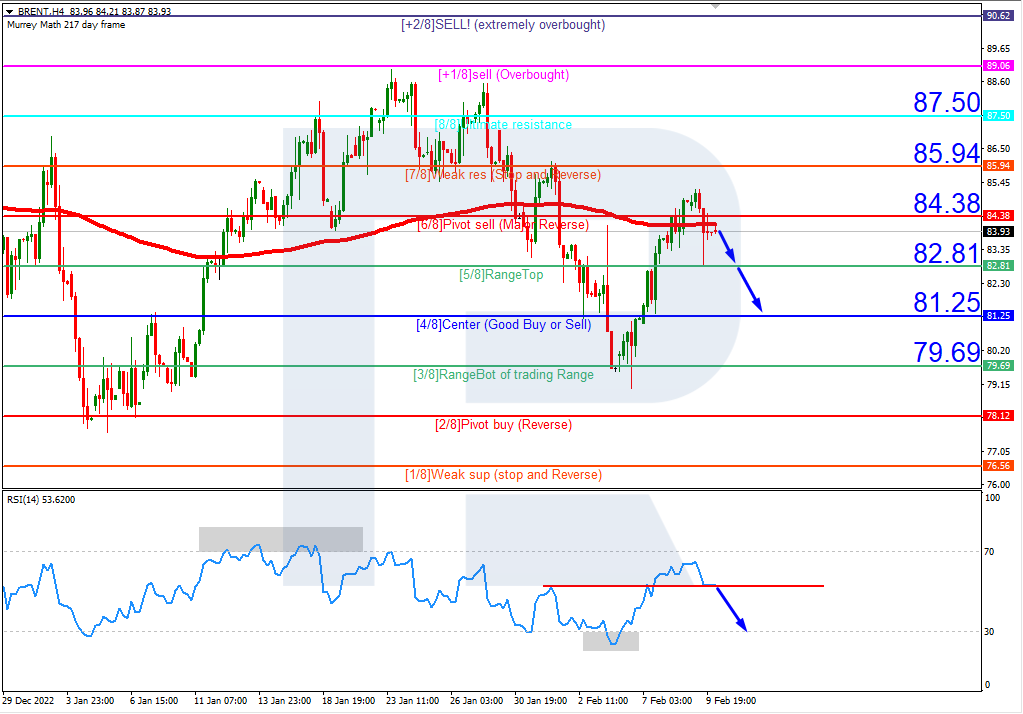
On H4, Brent quotes are under the 200-day Moving Average, which indicates prevalence of a downtrend. The RSI is testing the support level. As a result, a bounce off 5/8 (82.81) downwards is expected, followed by falling to the support level of 4/8 (81.25). This scenario can be cancelled by rising over the resistance level of 6/8 (84.38), which might lead to a trend reversal and growth to the resistance level of 7/8 (85.94).

Brent_H4
Risk Warning: the result of previous trading operations do not guarantee the same results in the future

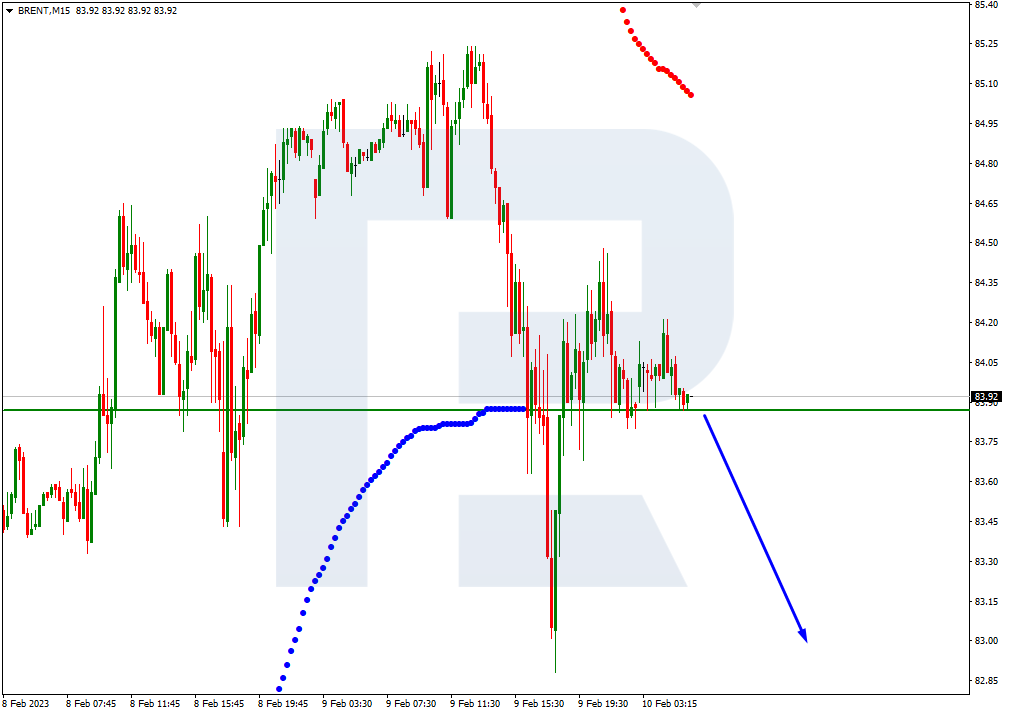
On M15, a new breakaway of the lower border of VoltyChannel will increase the probability of falling on H4.

Brent_M15
Risk Warning: the result of previous trading operations do not guarantee the same results in the future

S&P 500

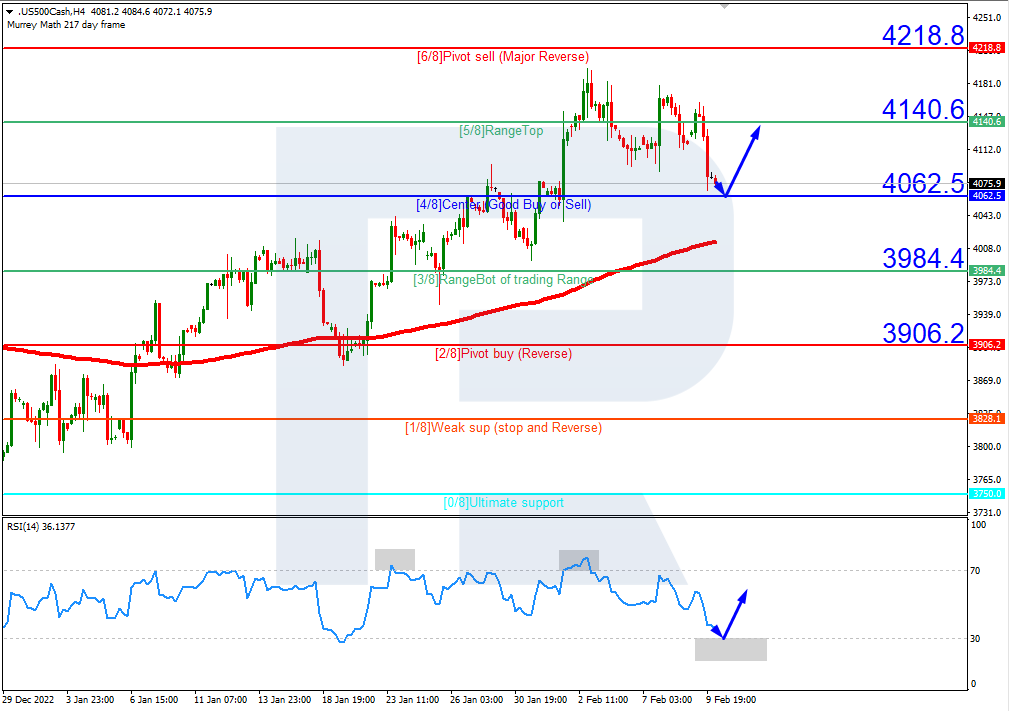
On H4, the quotes of the index are above the 200-day Moving Average, which reveals prevalence of an uptrend. The RSI is nearing the oversold area. As a result, a test of 4/8 (4062.5) should be expected, followed by growth to the resistance level of 5/8 (4140.6). The scenario can be cancelled by a downward breakaway of the support level of 4/8 (4062.2). In this case, falling may continue, and the quotes may drop to 3/8 (3984.4).

S&P500_H4
Risk Warning: the result of previous trading operations do not guarantee the same results in the future

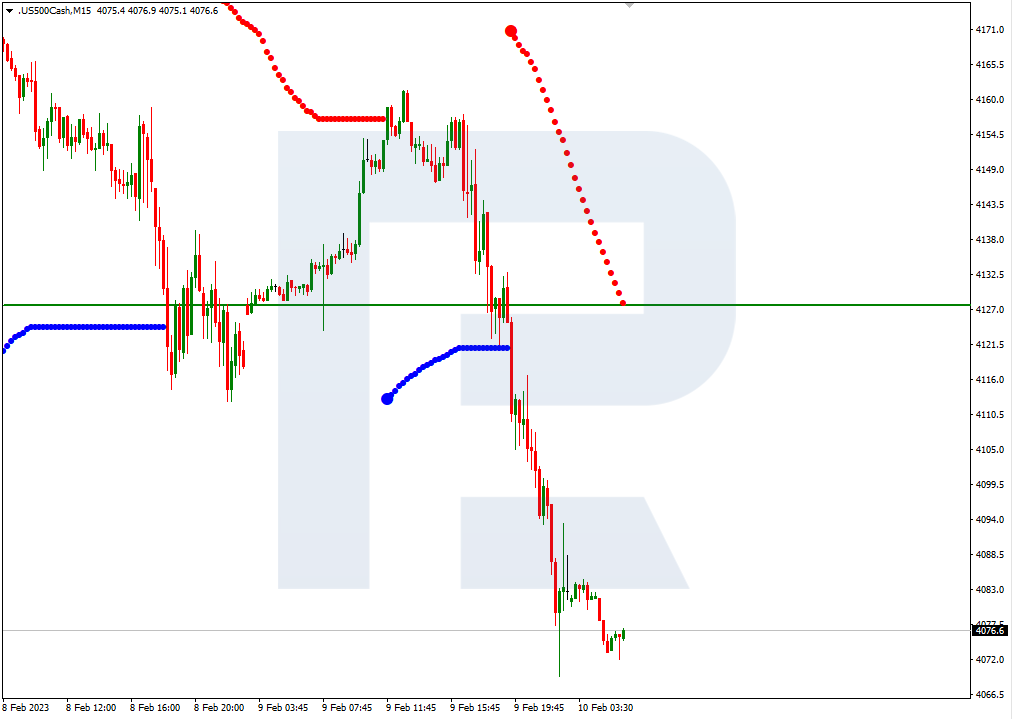
On M15, the upper line of VoltyChannel is too far away from the current price, so growth will be indicated by a bounce off 4/8 (4062.2) on H4.

S&P500_M15

Article By RoboForex.com

Attention!
Forecasts presented in this section only reflect the author’s private opinion and should not be considered as guidance for trading. RoboForex LP bears no responsibility for trading results based on trading recommendations described in these analytical reviews.

The cryptocurrency market digest (BTC). Overview for 10.02.2023

By RoboForex.com

The BTC dropped again. The market melted down under the fears of the upcoming steps of the Federal Reserve System. The US stock indices slid down, and because of high levels of correlation with them the BTC lost balance as well.

For the buyers, the situation looks disquieting because the price has dropped under the support level of 22,700 and 22,500 USD.

Today the day is quite feeble in terms of statistics or events. Keep an eye on any chances for returning to 22,500 USD. And if the movements remain at the current levels, the goal near 21,000 USD will be more valid.

The current BTC price is 21,925 USD.

Capitalisation of the crypto market has dropped seriously to 1.018 trillion USD. The BTC takes up 41.4% of the market and the ETH – 18.6%.

Kraken exchange will pay 30 million USD in argument with SEC

The Kraken crypto exchange is ready to pay 30 million USD to solve an argument with the US Security and Exchange Commission. SEC got an eye on Kraken’s stacking programme as its conditions were not registered as services.

Canadian University in Dubai accepts crypto

The Canadian University in Dubai (CUB) now gives the students an opportunity to pay for studying via a Binance service. This means, they started accepting crypto. An official release goes that the CUB adapts for the digital payments space.

Crypto claims can also be assets

The Three Arrows Capital hedge fund together with Coinflex is launching a platform for deals with claims to bankrupt companies, such as FTX or Celsius. It is mentioned that the market of crypto debt claims might amount to 20 billion USD.

Article By RoboForex.com

Attention!
Forecasts presented in this section only reflect the author’s private opinion and should not be considered as guidance for trading. RoboForex LP bears no responsibility for trading results based on trading recommendations described in these analytical reviews.

The Analytical Overview of the Main Currency Pairs on 2023.02.10

By JustMarkets

The EUR/USD currency pair

Technical indicators of the currency pair:
  • Prev Open: 1.0708
  • Prev Close: 1.0737
  • % chg. over the last day: +0.27 %

Germany’s inflation rate increased from 8.6% to 8.7% (forecast 8.9%) annually. Despite the fact that the data was better than forecasted, the rising inflation is not a pleasant factor in itself, especially for the largest economy in the region. Although the outlook for the eurozone has improved in recent months, many Wall Street analysts still believe a shallow recession will materialize later this year. Weak economic data in the coming weeks may limit the euro’s potential to grow in the short term.

Trading recommendations
  • Support levels: 1.0710, 1.0650, 1.0597
  • Resistance levels: 1.0838, 1.0906, 1.0926, 1.0967, 1.1017, 1.1077

The trend on the EUR/USD currency pair on the hourly time frame is bearish. The price is still forming a corridor. But the false breakdown zone below 1.0710 works as support and does not allow the price to go lower. The MACD indicator has become inactive, and volatility has decreased. Under such market conditions, buy trades are best considered from the support level of 1.0710, but with confirmation since the level has already been tested. Sell deals can be considered from the resistance level of 1.0838, but better with confirmation in the form of a reverse initiative.

Alternative scenario: if the price breaks down through the resistance level of 1.0967 and fixes above it, the uptrend will likely resume.

EUR/USD
News feed for 2023.02.10:
  • – US Michigan Consumer Sentiment (m/m) at 17:00 (GMT+2);
  • – US FOMC Member Waller Speaks at 19:30 (GMT+2).

The GBP/USD currency pair

Technical indicators of the currency pair:
  • Prev Open: 1.2057
  • Prev Close: 1.2117
  • % chg. over the last day: +0.50 %

The British pound has been showing growth in recent days and looks more confident than the euro. Last month’s minutes of the Bank of England’s Monetary Policy Committee (MPC) meeting showed that some policymakers are still set for another rate hike in March as they warn of rising risks to UK inflation. Meanwhile, the Bank of England expects inflation to start falling rapidly from mid-2023 and reach about 4% by the end of the year. Today, the UK will publish GDP data for the quarter as well as data on industrial production levels. A strong reading may give sterling confidence against the dollar and other currencies.

Trading recommendations
  • Support levels: 1.2073, 1.2000, 1.1930
  • Resistance levels: 1.2202, 1.2147, 1.2202, 1.2311, 1.2416

From the technical point of view, the trend on the GBP/USD currency pair on the hourly time frame is bearish. Yesterday the price reached the “premium” area but did not reach the resistance level. Statistically, about 70% of reversals occur in this zone. At the moment, the price is trading at the level of the moving averages. The MACD indicator has become inactive. Under such market conditions, it is better to look for buy deals on intraday time frames from the support level of 1.2073 or 1.2000, but with confirmation in the form of an impulse initiative. Sell trades are best sought after a pullback from the resistance level of 1.2202 but are also better with confirmation in the form of a reverse initiative.

Alternative scenario: if the price breaks out through the 1.2416 resistance level and fixes above it, the uptrend will likely resume.

GBP/USD
News feed for 2023.02.10:
  • – UK GDP (q/q) at 09:00 (GMT+2);
  • – UK Industrial Production (m/m) at 09:00 (GMT+2);
  • – UK Manufacturing Production (m/m) at 09:00 (GMT+2).

The USD/JPY currency pair

Technical indicators of the currency pair:
  • Prev Open: 131.40
  • Prev Close: 131.51
  • % chg. over the last day: +0.08 %

Bank of Japan Governor Haruhiko Kuroda said yesterday that the benefits of the soft monetary policy outweigh any other side effects on the economy, failing to boost wages over the past decade. Kuroda believes that the soft monetary policy should continue after the change in the governor of the Bank of Japan. But that will be up to the new governor, who will be chosen this month and appointed in April 2023. The Producer Price Index, which measures inflation between plants and factories, has declined from 10.5% to 9.5% year-over-year, the first sign of declining inflation.

Trading recommendations
  • Support levels: 131.09, 130.34, 129.68, 129.98, 129.19, 129.04, 128.16
  • Resistance levels: 131.58, 132.95, 133.23

From the technical point of view, the medium-term trend on the currency pair USD/JPY is bullish. Yesterday the price tested the support level of 130.34 in the “discount” zone. The MACD indicator is in the positive area, and there is slight buying pressure. It is better to look for buy deals from the support level of 131.09, but only with confirmation on the lower time frames. Sell positions can be searched from the resistance level of 131.59, but it is also better with confirmation in the form of reverse initiative.

Alternative scenario: If the price fixes below the support level of 128.16, the downtrend will be renewed with a high probability.

USD/JPY
News feed for 2023.02.10:
  • – Japan Producer Price Index (m/m) at 01:50 (GMT+2).

The USD/CAD currency pair

Technical indicators of the currency pair:
  • Prev Open: 1.3439
  • Prev Close: 1.3454
  • % chg. over the last day: +0.11 %

At the Bank of Canada’s latest interest rate meeting, it became clear that the Bank of Canada may have held the last rate hike of the year. Overall inflation was down from a June peak of 6.2%, and December inflation was 5.4%. The short-term interest rate markets see interest rates unchanged for the rest of the year. Canada’s labor market data will be released today. The employment change is expected to show an increase of 15,000 jobs from the previous figure of 104,000. Unemployment is also projected to rise to 5.1%, and average hourly earnings to fall to 5.2%. If the labor market data is negative, the Canadian dollar may lose some ground, especially if oil prices are also down.

Trading recommendations
  • Support levels: 1.3421, 1.3333, 1.3295, 1.3212
  • Resistance levels: 1.3472, 1.3496, 1.3520, 1.3554, 1.3595

From the point of view of technical analysis, the trend on the USD/CAD currency pair is bullish. The price is forming a wide-volatile sideways. The MACD indicator is positive again, but there are signs of divergence. Sell positions should be considered from the resistance level 1.3472, but on the condition of a false breakout, as the level has already been tested. Buy trades can be considered from the support level of 1.3421 but with additional confirmation in the form of an impulse initiative.

Alternative scenario: if the price breaks down and consolidates below the support level of 1.3263, the downtrend will likely resume.

USD/CAD
News feed for 2023.02.10:
  • – Canada Unemployment Rate (m/m) at 15:30 (GMT+2).

By JustMarkets


This article reflects a personal opinion and should not be interpreted as an investment advice, and/or offer, and/or a persistent request for carrying out financial transactions, and/or a guarantee, and/or a forecast of future events.

The Reserve Bank of Australia raised its inflation forecasts. Stock indices are once again under pressure from hawkish statement

By JustMarkets

On Thursday, Federal Reserve officials continued to impose their hawkish message on the market. The main message from policymakers is that further rate hikes are not far off and that the rate should remain high for an extended period. While there is nothing new in these comments, the 2-10 Treasury yield curve has flipped by 85 basis points, the deepest inversion since the early 1980s, raising new fears about economic problems. As the stock market closed Thursday, the Dow Jones Index (US30) decreased by 0.73%, and the S&P 500 Index (US500) fell by 0.88%. The NASDAQ Technology Index (US100) lost 1.02% yesterday.

Walt Disney announced a restructuring plan that will include cutting 7,000 jobs, which could result in about $5.5 billion in savings. PayPal Holdings Inc (PYPL) released a report Thursday with fourth-quarter results that beat analysts’ forecasts. Shares of PayPal Holdings Inc jumped by 7.04% after the market close. LYFT (LYFT) released a report Thursday with fourth-quarter results that disappointed analysts. The company’s stock fell more than 22% on the report.

Stock markets in Europe were mostly up yesterday. Germany’s DAX (DE30) gained 0.33%, France’s CAC 40 (FR40) gained 0.96%, Spain’s IBEX 35 Index (ES35) added 0.18%, and the British FTSE 100 (UK100) closed up by 0.33% on Thursday.

According to the latest report from the National Institute of Economic and Social Research (NIESR), sluggish growth and persistent inflation will continue to hurt British households this year. NIESR expects UK GDP for the fourth quarter to show a 0.3% contraction. Bank of England Governor Andrew Bailey urged workers and employers to consider this year’s expected sharp drop in inflation when discussing wage settlements. Bailey told a parliamentary committee Thursday that the continued tightening reflects the Monetary Policy Committee’s concern about continued inflation and the need to see more evidence of easing in the labor market. The bank expects inflation to begin to decline rapidly from the middle of 2023 and, by the end of the year, will be about 4% due to sharp declines in wholesale energy prices, a sharp drop in import prices, and falling demand due to declining personal income.

On Wednesday, the US Energy and Information Administration (EIA) announced that weekly crude oil inventory levels reached their highest level since June 2021. Production reached a high last seen in April 2020. Despite the rise in inventories, oil continued to rise yesterday. The optimism about growth is due to increased demand from China after Fitch Ratings raised China’s economic growth forecast for 2023 to 5% from the previous figure of 4.1%. Fitch cited January services PMI data as well as Q4 2022 real GDP as reasons for the increase.

Asian markets were also mostly up yesterday. Japan’s Nikkei 225 (JP225) decreased by 0.08% yesterday, China’s FTSE China A50 (CHA50) added 1.24%, Hong Kong’s Hang Seng (HK50) increased by 1.60% for the day, India’s NIFTY 50 (IND50) was up by 0.12%, and Australia’s S&P/ASX 200 (AU200) was down by 0.53% for the day.

The appointment of Haruhiko Kuroda’s successor will probably take place next week. Several representatives of the Liberal Democratic Party have said that opposition would arise within the party if the prime minister of Japan chose Yamaguchi, the former deputy governor of the Bank of Japan. Yamaguchi’s name was recently ranked third in polls of economists as a likely candidate for governor of the Bank of Japan. Yamaguchi, in comparison with other contenders for the top post, is considered more hawkish. If he is appointed, market participants expect it to cause significant market volatility and signal that the government is committed to a clear change in policy toward normalization.

Australia’s Central Bank (RBA) on Friday revised its forecasts for core inflation and wage growth upward and warned of further interest rate hikes, raising the risk of the economy sliding into recession. Given the importance of preventing a price-wage spiral, the council will continue to pay close attention to labor market data. Annual wage growth is expected to peak at 4.2% later this year, up from the previous forecast of 3.9%, and then decline to 3.8% by mid-2025. The unemployment rate will rise steadily to 4.4% by mid-2025 from the current 3.5%. The RBA also raised this year’s economic growth forecast to 1.6%, up from 1.4% previously. All of these forecasts are based on the assumption that interest rates will peak at about 3.75% in mid-2023 and then decline to about 3% by June 2025.

S&P 500 (F) (US500) 4,081.50 −36.36 (−0.88%)

Dow Jones (US30) 33,699.88 −249.13 (−0.73%)

DAX (DE40) 15,523.42 +111.37 (+0.72%)

FTSE 100 (UK100) 7,911.15 +25.98 (+0.33%)

USD Index 103.22 -0.19 (-0.18%)

Important events for today:
  • – Japan Producer Price Index (m/m) at 01:50 (GMT+2);
  • – Australia RBA Monetary Policy Statement at 02:30 (GMT+2);
  • – China Consumer Price Index (m/m) at 03:30 (GMT+2);
  • – China Producer Price Index (m/m) at 03:30 (GMT+2);
  • – UK GDP (q/q) at 09:00 (GMT+2);
  • – UK Industrial Production (m/m) at 09:00 (GMT+2);
  • – UK Manufacturing Production (m/m) at 09:00 (GMT+2);
  • – Canada Unemployment Rate (m/m) at 15:30 (GMT+2);
  • – US Michigan Consumer Sentiment (m/m) at 17:00 (GMT+2);
  • – US FOMC Member Waller Speaks at 19:30 (GMT+2).

By JustMarkets


This article reflects a personal opinion and should not be interpreted as an investment advice, and/or offer, and/or a persistent request for carrying out financial transactions, and/or a guarantee, and/or a forecast of future events.

What does Adani Group crisis in India mean for global investors?

By George Prior

Global investors should remain open to India’s enormous potential, despite the heightening crisis engulfing the Adani Group, affirms the CEO of one of the world’s largest independent financial advisory, asset management and fintech organizations.

The observation by Nigel Green of deVere Group comes as MSCI, the global index provider, is set to change its weightings for Adani Group shares after assessing how many shares can be freely traded.

It follows earlier this week mass protests by India’s opposition parties who are demanding a probe into allegations by a U.S. short-seller against the conglomerate, which triggered the Adani Group of companies share price to plummet sharply.

Market losses have now exceeded $110 billion according to media reports since Hindenburg Research accused the corporate giant of stock manipulation and accounting fraud in a 24 January report.

Adani’s diverse businesses include port management, electric power generation and transmission, renewable energy, mining, airport operations, natural gas, food processing and infrastructure.

“The serious issues of the Adani Group of companies, headed by Gautam Adani, are causing such concern in a large part because he has been a close ally of Prime Minister Narendra Modi for many, many years,” says Nigel Green.

“With questions now mounting about this hugely influential conglomerate and issues of regulatory frameworks, nepotism, governance and debt, India’s credibility amongst global investors is now hanging in the balance.”

The debacle, according to many experts, is particularly inconvenient as some multinationals are currently looking to India as a substitute to China as an investment destination.

The questions being raised by global investors have shaken confidence in India.

“However, I would also urge them to keep an open mind on India’s incredible opportunities,” says the deVere CEO.

“The country is still set to overtake Japan and Germany to become the world’s third-largest economy, and together with China will account for more than half of global growth this year.”

He continues: “India’s economy is showing incredible resilience despite external tailwinds such as supply chain issues, the reopening of China, the war in Ukraine, and the impact of considerable economic slowdowns in developed economies.

“The robustness of the Indian economy is attributable in a large part to enormous domestic markets, a growing middle class, significant supply-side reforms, a strong financial sector, pro-business reforms, and the ongoing digitalization of public and private sectors.”

He concludes: “Investors who want to build long-term wealth should remain open to the current and future opportunities in India.”

About:

deVere Group is one of the world’s largest independent advisors of specialist global financial solutions to international, local mass affluent, and high-net-worth clients.  It has a network of more than 70 offices across the world, over 80,000 clients and $12bn under advisement