Archive for Forex and Currency News

Currency Speculators bets improving for GBP, MXN and going bearish for JPY

By InvestMacro

Speculators OI FX Futures COT Chart

Here are the latest charts and statistics for the Commitment of Traders (COT) data published by the Commodities Futures Trading Commission (CFTC).

The latest COT data is updated through Tuesday January 13th and shows a quick view of how large market participants (for-profit speculators and commercial traders) were positioned in the futures markets. All currency positions are in direct relation to the US dollar where, for example, a bet for the euro is a bet that the euro will rise versus the dollar while a bet against the euro will be a bet that the euro will decline versus the dollar.

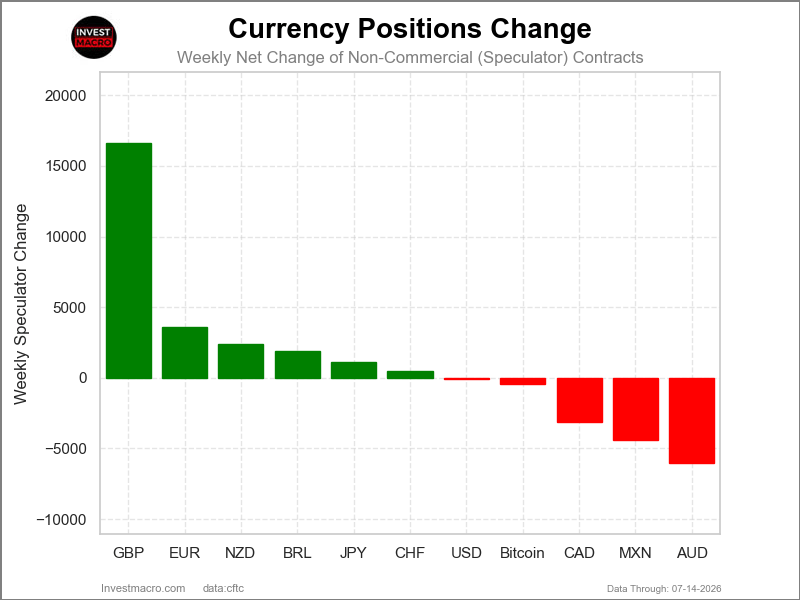
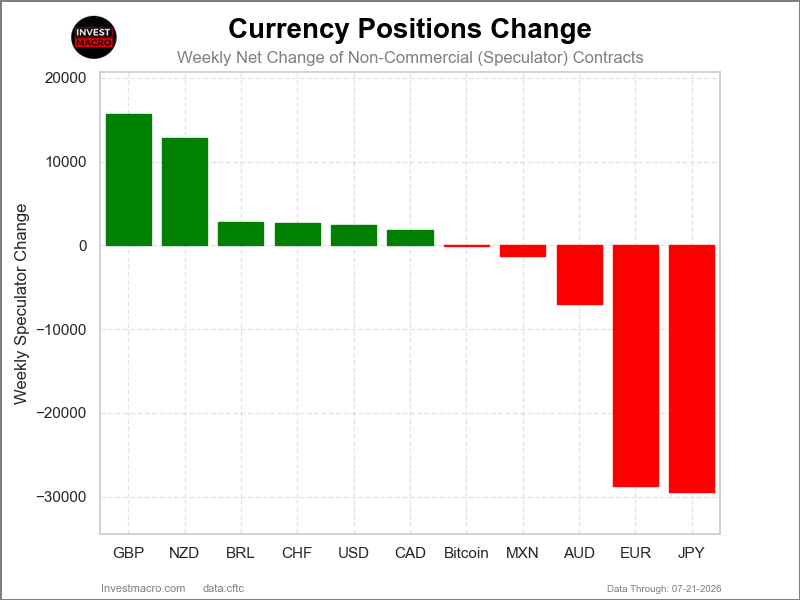
Weekly Speculator Changes led by British Pound

Speculators Nets FX Futures COT Chart
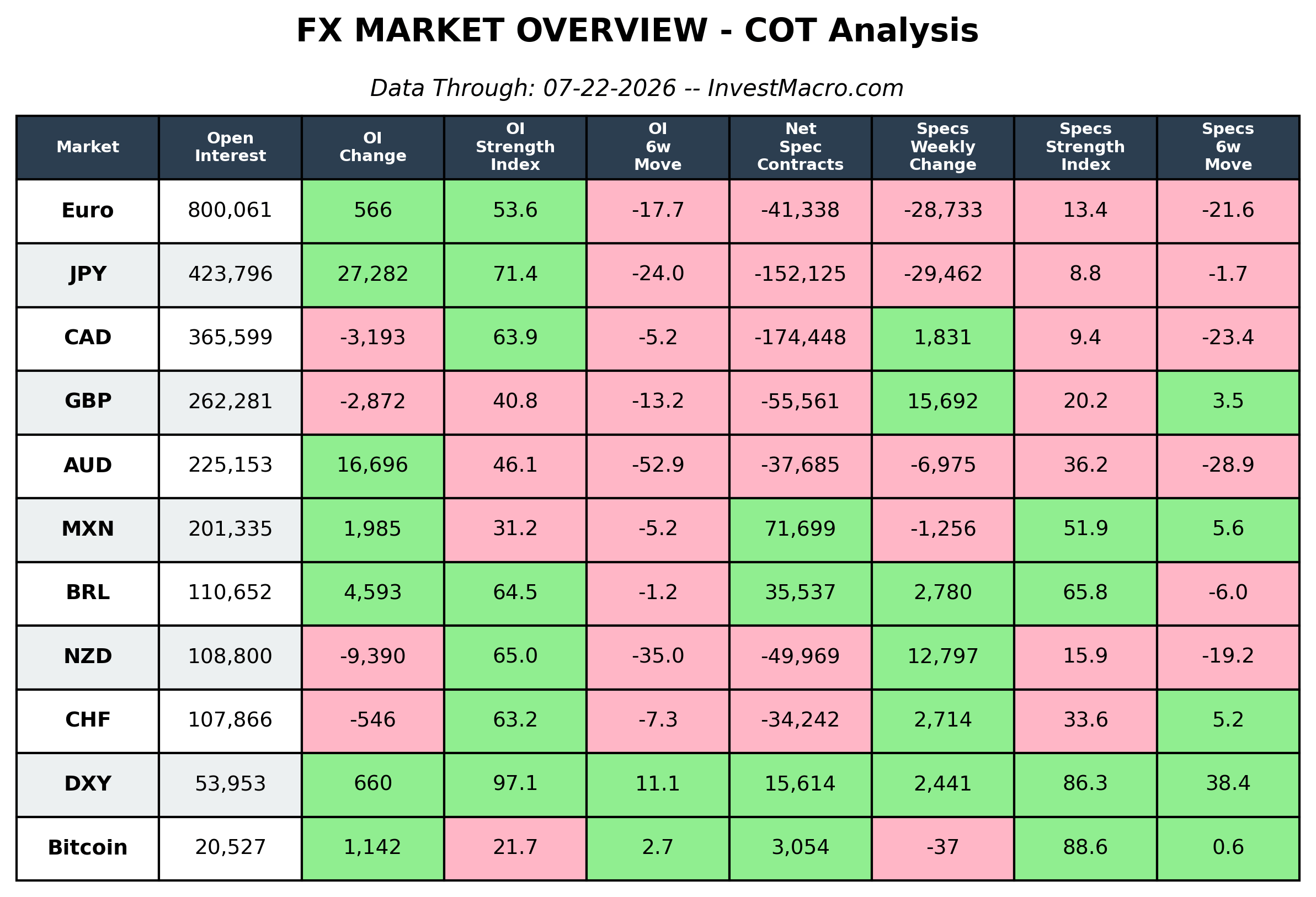
The COT currency market speculator bets were overall lower this week as five out of the eleven currency markets we cover had higher positioning and the other six markets had lower speculator contracts.

Leading the gains for the currency markets was the British Pound (5,268 contracts) with Bitcoin (803 contracts), the Brazilian Real (257 contracts), the Australian Dollar (114 contracts), the US Dollar Index (101 contracts) and  also showing positive weeks.

The currencies seeing declines in speculator bets on the week were the Japanese Yen (-53,979 contracts), the EuroFX (-30,156 contracts), the New Zealand Dollar (-5,488 contracts), the Mexican Peso (-5,743 contracts), the Swiss Franc (-3,126 contracts) and with the Canadian Dollar (-1,665 contracts) also recording lower bets on the week.

Speculators bets improving for GBP, MXN and going bearish for JPY

Highlighting the latest currency data is the British pound sterling seeing improved sentiment, the Mexican peso with net contracts above +100,000 positions and the Japanese yen which is shedding speculator contracts.

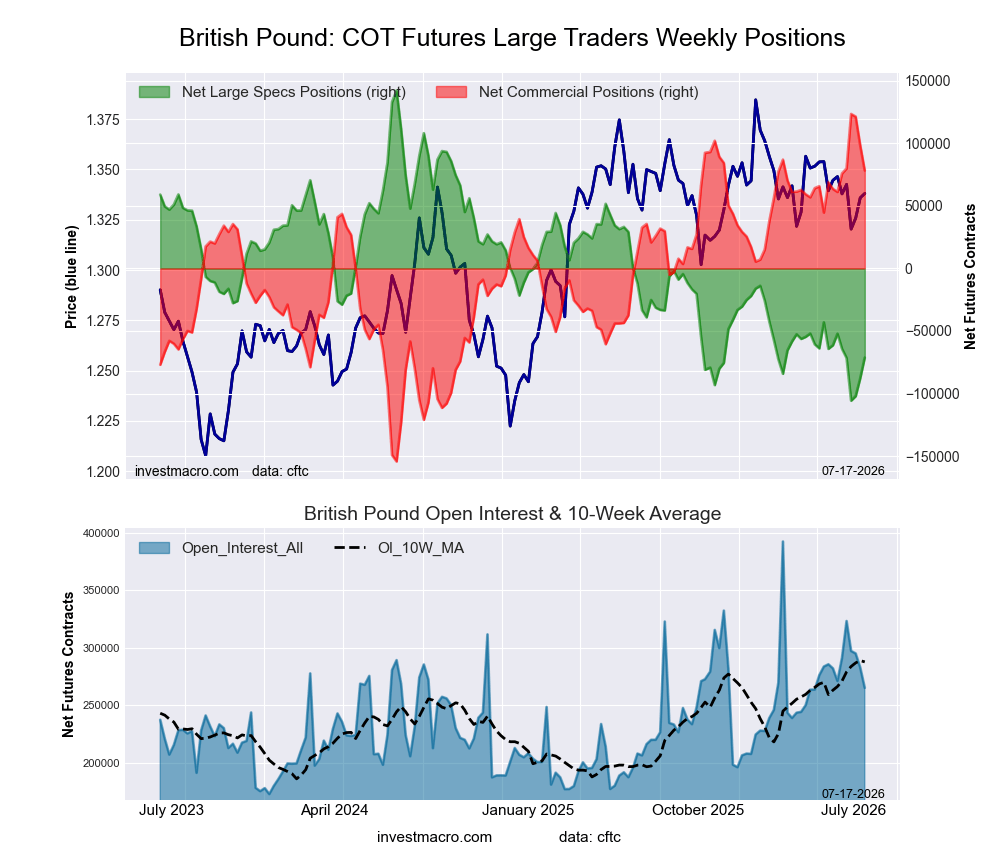
The British pound sterling which saw its speculator bets rise for a seventh straight week in the latest updated data. Over the last seven weeks, there have been +67,951 contracts added to the GBP speculator standing. This has taken the GBP positioning from a highly bearish -93,221 contracts to this week’s -25,270 contracts, which is the least bearish level of the last 11 weeks. The British pound sterling positioning has been consistently on the bearish side, dating back to July of 2025—a span of 25 weeks. The British pound exchange rate against the US Dollar has fluctuated since that time and is actually down by about 300 pips from the July 2025 high.

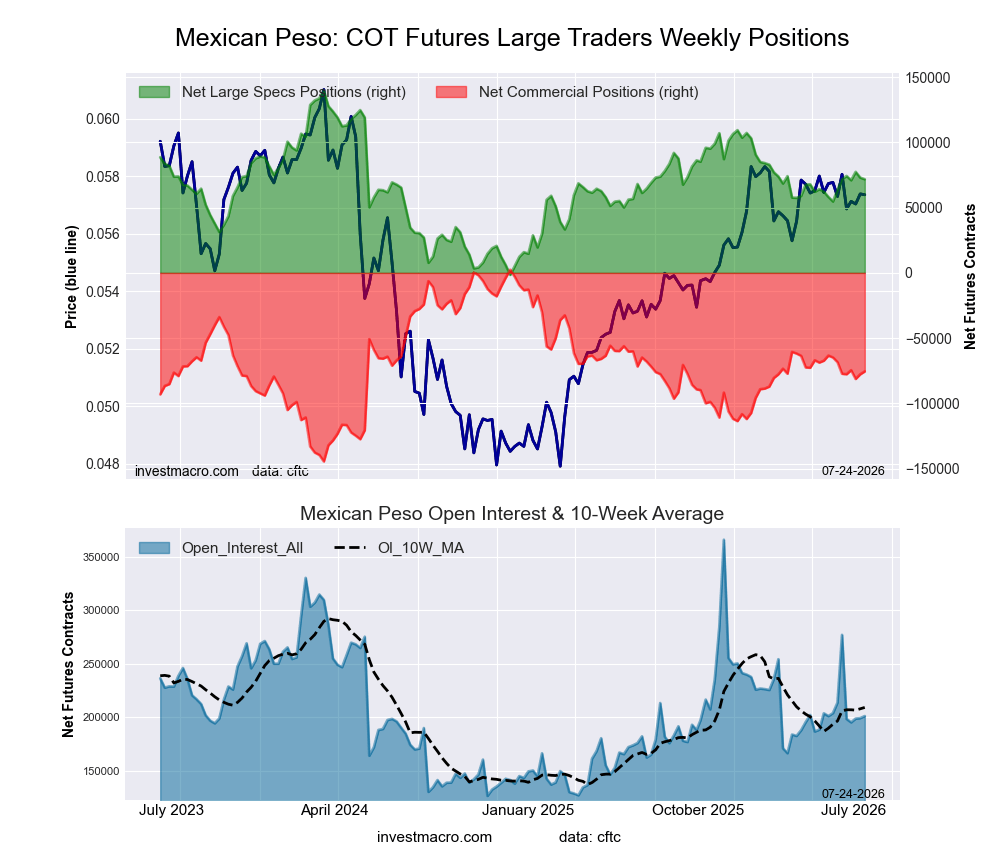
The Mexican peso futures speculator bets dipped this week for the first time in four weeks. However, the peso position is strongly bullish at the current moment, with the overall net position above the 100,000 contract level for a fourth straight week and for the fifth time out of the last six weeks. These are currently the highest and most bullish levels for the peso since June of 2024. In the currency market trading, the peso has been on a steady uptrend since bottoming in February 2025. Since hitting that bottom, the peso is up by roughly 20% against the US dollar and is up by over 2% to start 2026.

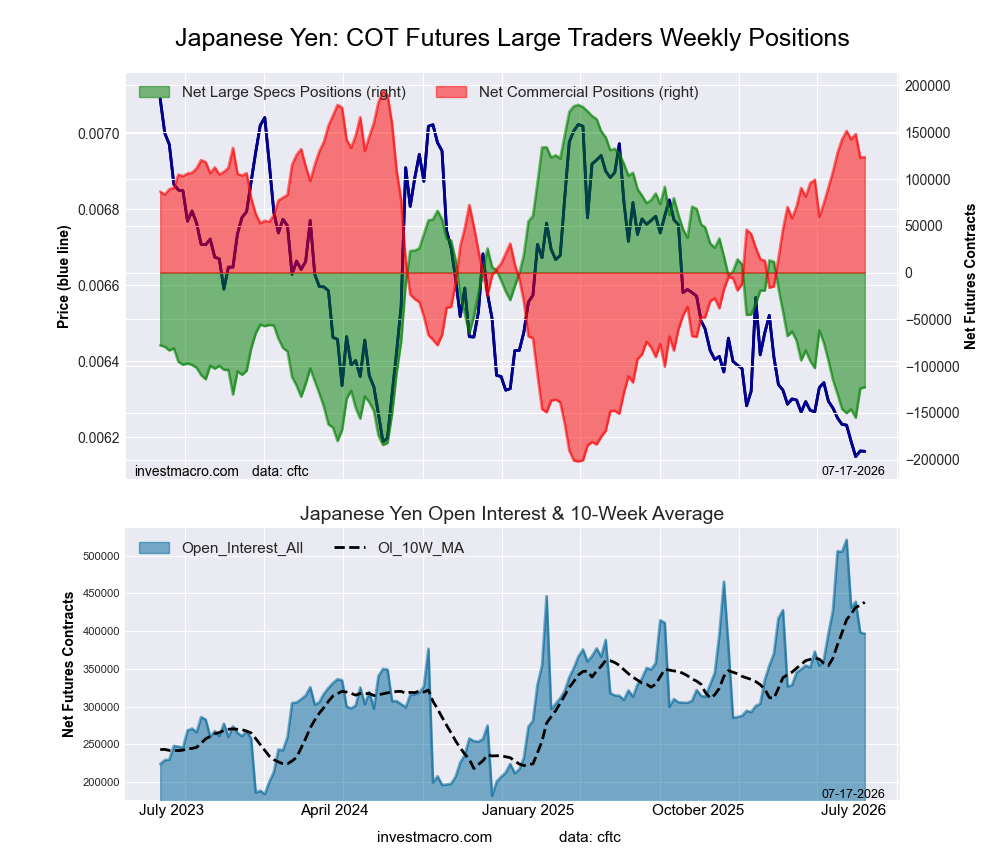
On the other end of the spectrum, the Japanese yen has seen its net speculator position fall into a bearish net standing this week at -45,164 contracts. This was because of a huge decline on the week of over -53,000 contracts. The sentiment for the Japanese yen has shifted sharply, as the yen bullish position was above +100,000 contracts consistently for 21 weeks last year from March all the way to July. Since then, there has been a steady decline week to week and month to month that has culminated in a negative bearish position for the yen. The yen futures price has also been on a stark downtrend and is touching the lowest levels since 2024. Despite recent interest rates in Japan rising (which is usually a boost for the home currency), the yen has been going the opposite way. Giving caution to the yen bulls is the outlook for the new prime minister possibly being implementing a dovish policy and hindering the Bank of Japan plans to hike the interest rate further.

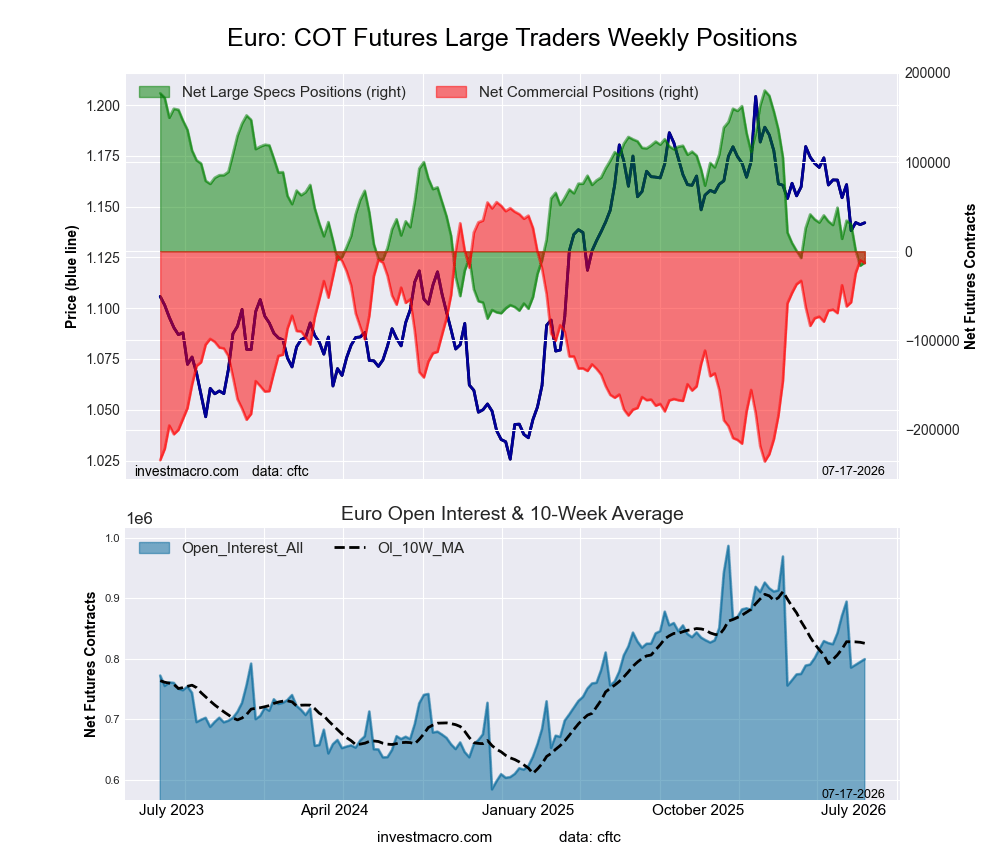
The Euro speculative position saw a large reduction in bullish bets this week. The change in this week’s speculative position looks like a cool off from a very high position, as the euro speculative contracts have now been over +100,000 for seven straight weeks and above the +100,000 net contract level in 27 out of the last 31 weeks. Last week marked the highest level (+162,812 net contracts) for Euro speculative positions since August of 2023. The Euro currency price seems to be in consolidation mode between the 1.1900 level on the top side and the 1.1500 level on the lower support. Currently in the month of January, the Euro is down by -1.3% but recently hit its highest level since 2021 in November at the high of 1.1979.

Bitcoin leads 5-Day Price Performance Changes

Currency market price changes this week were led by Bitcoin, which rose by almost 6%. The Mexican Peso was next with a 1.95% change over the past five days. The US Dollar Index was higher by 0.37%, and the New Zealand Dollar was higher by 0.35%.

On the downside, the Canadian Dollar was virtually unchanged with a 0.02% decline, followed by the Australian Dollar with a 0.07% decrease. Next up, the Japanese Yen was lower by 0.12%, and the British Pound, as well as the Brazilian Real, were both down by 0.20%. The Swiss Franc fell by 0.29%, followed by the Euro, which fell a similar 0.30% over the past five days.

The biggest movers over the past 90 days have been the Mexican Peso, which is up by approximately 5%. The Brazilian Real is up by almost 2% over that same period, while on the downside, the Japanese Yen has fallen sharply by -6.90% in the past 90 days. The New Zealand Dollar is down by -3.69% in the past 90 days.


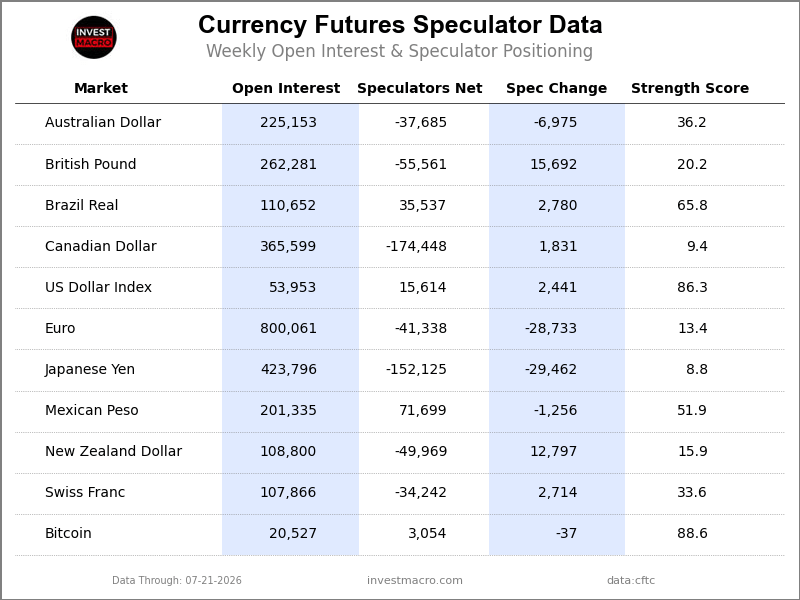
Currencies Data:

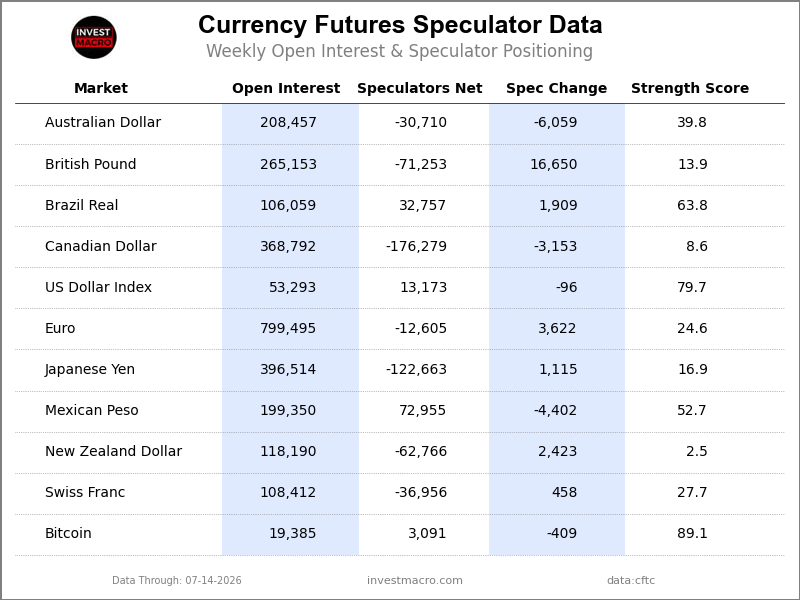
Speculators FX Futures COT Data Table
Legend: Open Interest | Speculators Current Net Position | Weekly Specs Change | Specs Strength Score compared to last 3-Years (0-100 range)


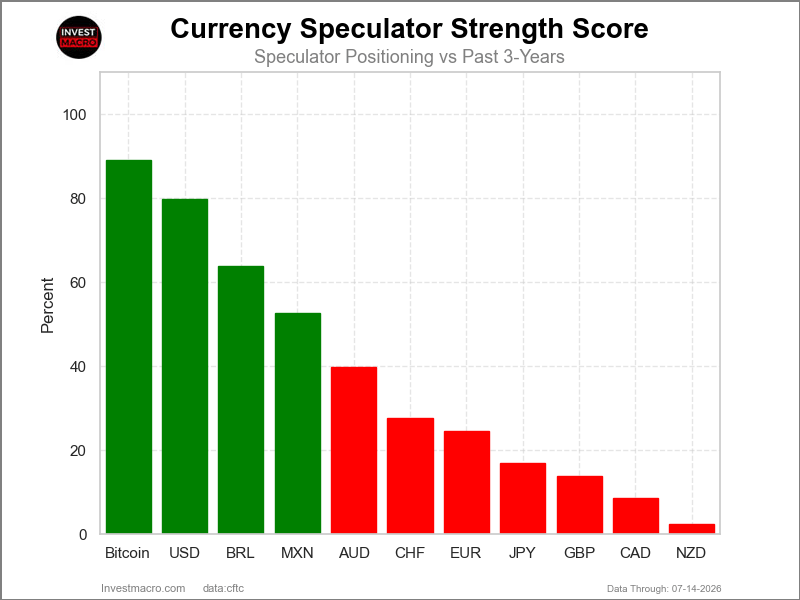
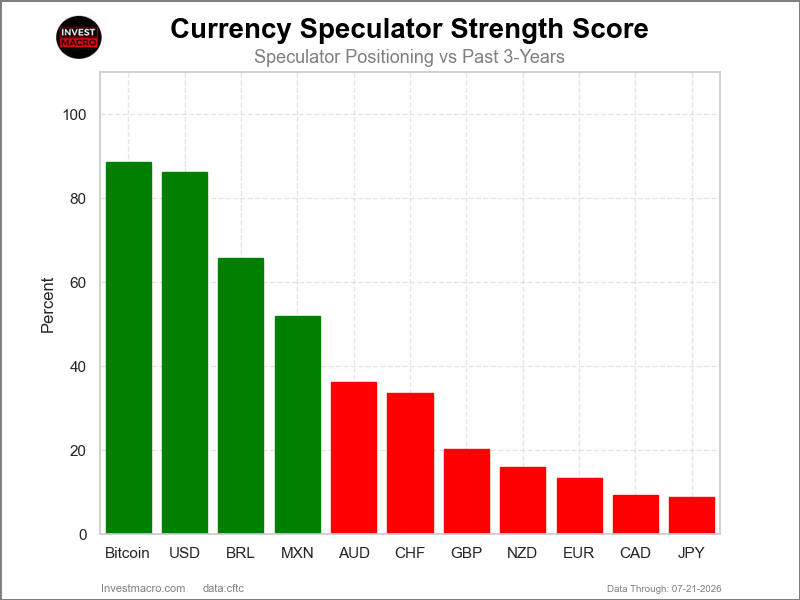
Strength Scores led by Mexican Peso & EuroFX

Speculators Strength Scores FX Futures COT Chart
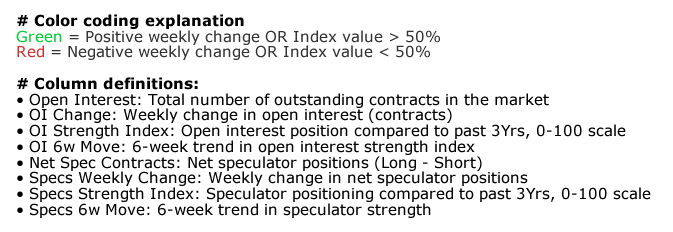
COT Strength Scores (a normalized measure of Speculator positions over a 3-Year range, from 0 to 100 where above 80 is Extreme-Bullish and below 20 is Extreme-Bearish) showed that the Mexican Peso (81 percent) and the EuroFX (79 percent) lead the currency markets this week. The Canadian Dollar (76 percent), the Australian Dollar (63 percent) and Bitcoin (54 percent) come in as the next highest in the weekly strength scores.

On the downside, the New Zealand Dollar (9 percent) and the Swiss Franc (13 percent) come in at the lowest strength levels currently and are in Extreme-Bearish territory (below 20 percent). The next lowest strength scores are the British Pound (29 percent) and the US Dollar Index (34 percent).

3-Year Strength Statistics:
US Dollar Index (34.1 percent) vs US Dollar Index previous week (33.8 percent)
EuroFX (79.3 percent) vs EuroFX previous week (90.8 percent)
British Pound Sterling (28.9 percent) vs British Pound Sterling previous week (26.6 percent)
Japanese Yen (38.3 percent) vs Japanese Yen previous week (53.1 percent)
Swiss Franc (13.0 percent) vs Swiss Franc previous week (19.3 percent)
Canadian Dollar (76.0 percent) vs Canadian Dollar previous week (76.8 percent)
Australian Dollar (62.9 percent) vs Australian Dollar previous week (62.8 percent)
New Zealand Dollar (9.1 percent) vs New Zealand Dollar previous week (15.3 percent)
Mexican Peso (80.8 percent) vs Mexican Peso previous week (83.9 percent)
Brazilian Real (52.9 percent) vs Brazilian Real previous week (52.7 percent)
Bitcoin (54.2 percent) vs Bitcoin previous week (37.1 percent)


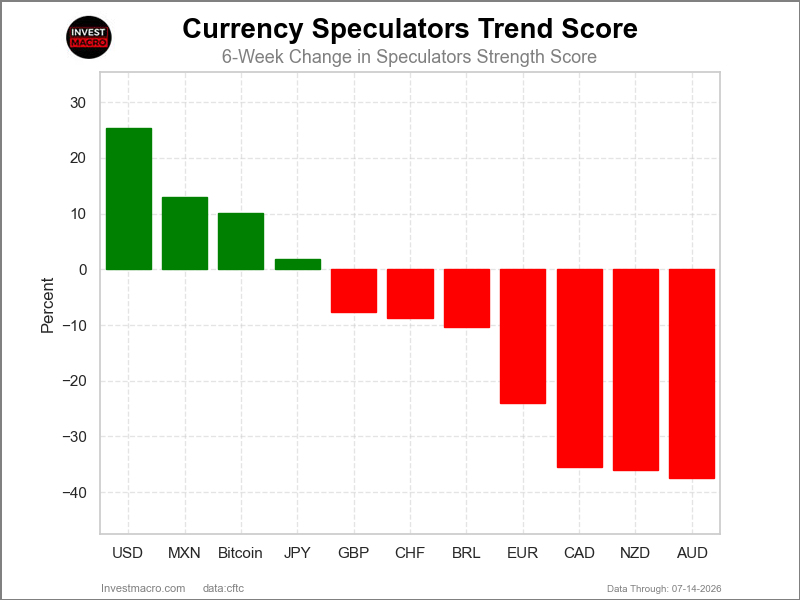
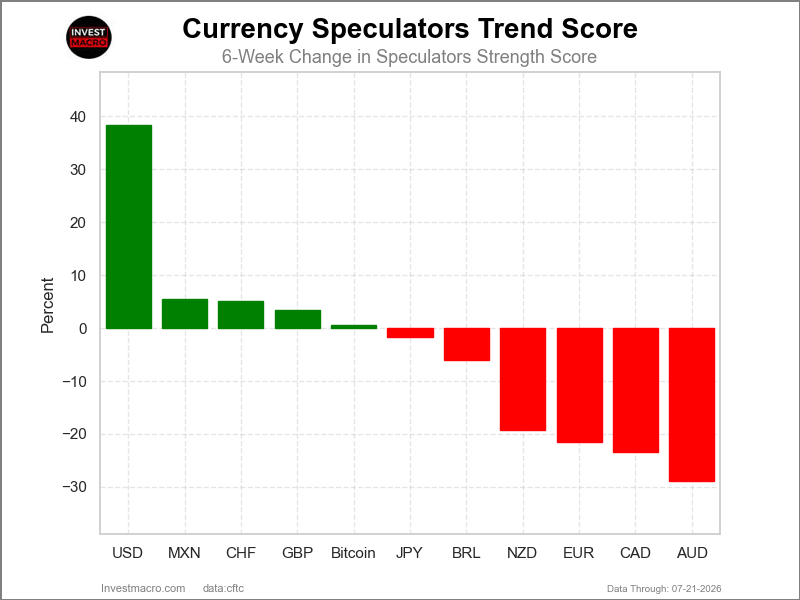
Canadian Dollar & Australian Dollar top the 6-Week Strength Trends

Speculators Trends FX Futures COT Chart
COT Strength Score Trends (or move index, calculates the 6-week changes in strength scores) showed that the Canadian Dollar (53 percent) and the Australian Dollar (46 percent) lead the past six weeks trends for the currencies. The US Dollar Index (34 percent), the British Pound (23 percent) and the EuroFX (9 percent) are the next highest positive movers in the 3-Year trends data.

The Brazilian Real (-31 percent) leads the downside trend scores currently with the Japanese Yen (-22 percent), the Swiss Franc (-15 percent) and Bitcoin (-11 percent) following next with lower trend scores.

3-Year Strength Trends:
US Dollar Index (33.7 percent) vs US Dollar Index previous week (33.8 percent)
EuroFX (9.2 percent) vs EuroFX previous week (26.2 percent)
British Pound Sterling (23.3 percent) vs British Pound Sterling previous week (26.6 percent)
Japanese Yen (-22.4 percent) vs Japanese Yen previous week (-4.9 percent)
Swiss Franc (-15.4 percent) vs Swiss Franc previous week (-9.9 percent)
Canadian Dollar (53.2 percent) vs Canadian Dollar previous week (54.2 percent)
Australian Dollar (45.8 percent) vs Australian Dollar previous week (46.3 percent)
New Zealand Dollar (4.9 percent) vs New Zealand Dollar previous week (9.9 percent)
Mexican Peso (2.5 percent) vs Mexican Peso previous week (7.5 percent)
Brazilian Real (-31.3 percent) vs Brazilian Real previous week (-28.5 percent)
Bitcoin (-10.6 percent) vs Bitcoin previous week (-13.8 percent)


Individual COT Forex Markets:

US Dollar Index Futures:
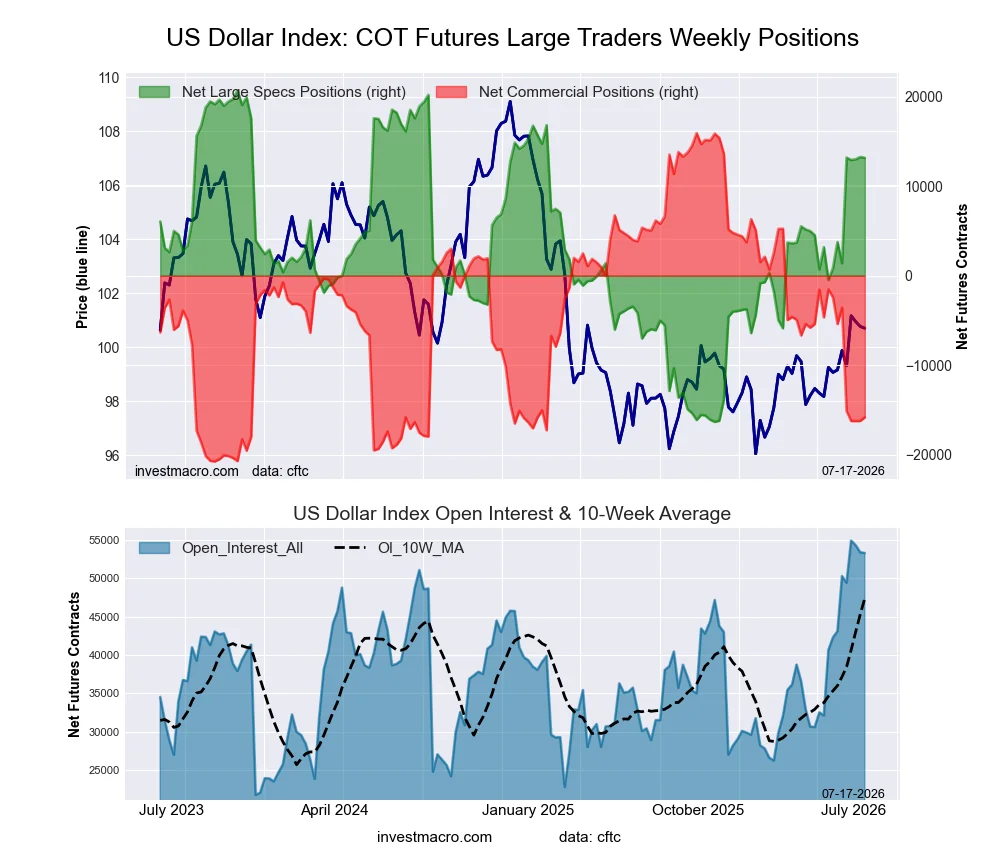
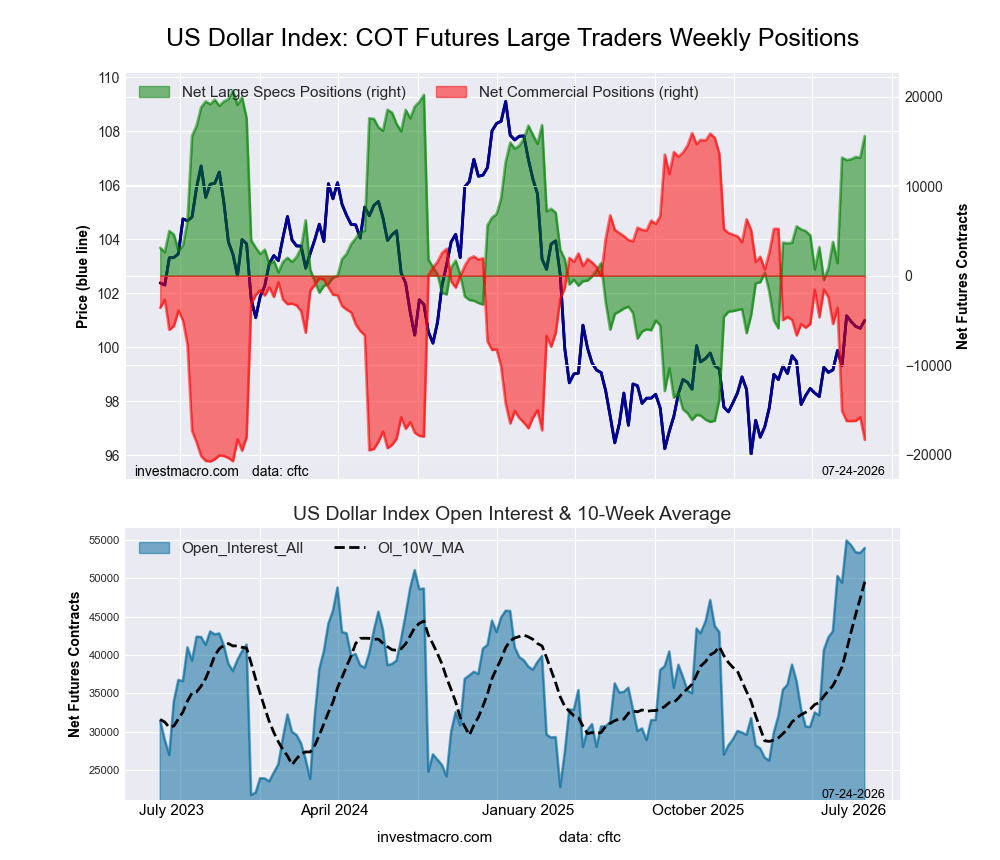
US Dollar Index Forex Futures COT ChartThe US Dollar Index large speculator standing this week recorded a net position of -3,730 contracts in the data reported through Tuesday. This was a weekly advance of 101 contracts from the previous week which had a total of -3,831 net contracts.

This week’s current strength score (the trader positioning range over the past three years, measured from 0 to 100) shows the speculators are currently Bearish with a score of 34.1 percent. The commercials are Bullish with a score of 66.8 percent and the small traders (not shown in chart) are Bearish with a score of 33.3 percent.

Price Trend-Following Model: Weak Uptrend

Our weekly trend-following model classifies the current market price position as: Weak Uptrend.

US DOLLAR INDEX StatisticsSPECULATORSCOMMERCIALSSMALL TRADERS
– Percent of Open Interest Longs:60.024.09.9
– Percent of Open Interest Shorts:72.511.49.9
– Net Position:-3,7303,739-9
– Gross Longs:17,9297,1582,952
– Gross Shorts:21,6593,4192,961
– Long to Short Ratio:0.8 to 12.1 to 11.0 to 1
NET POSITION TREND:
– Strength Index Score (3 Year Range Pct):34.166.833.3
– Strength Index Reading (3 Year Range):BearishBullishBearish
NET POSITION MOVEMENT INDEX:
– 6-Week Change in Strength Index:33.7-31.8-12.3


Euro Currency Futures:

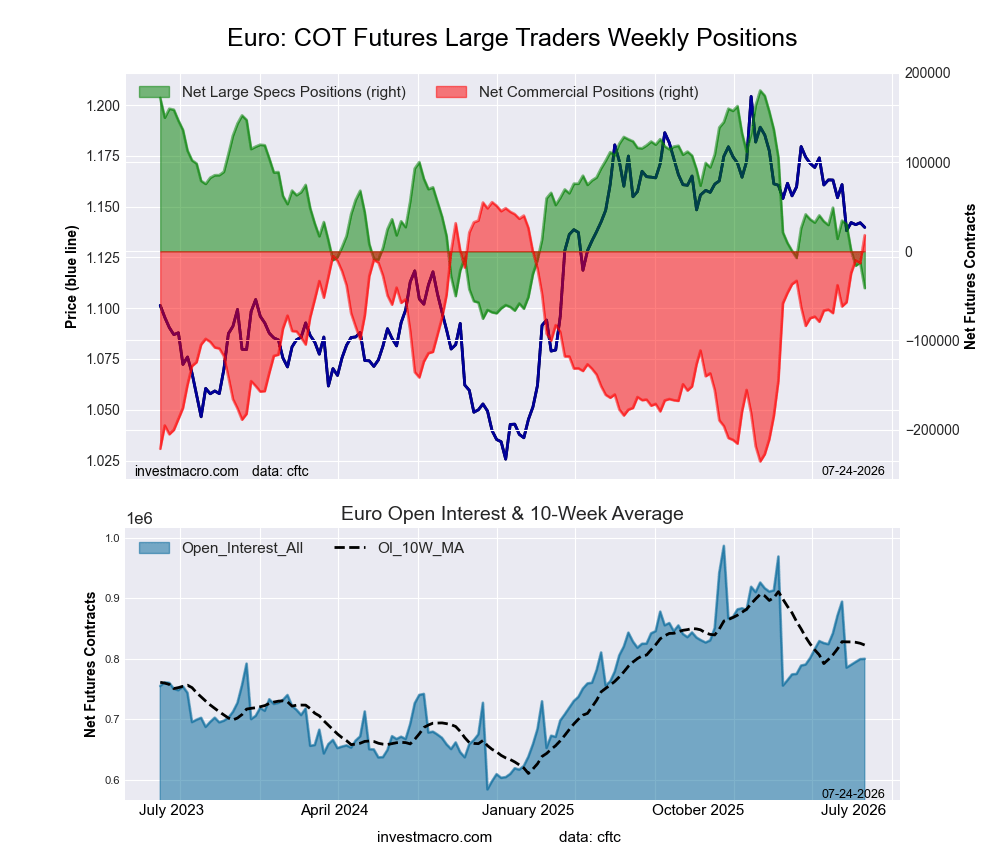
Euro Currency Futures COT ChartThe Euro Currency large speculator standing this week recorded a net position of 132,656 contracts in the data reported through Tuesday. This was a weekly lowering of -30,156 contracts from the previous week which had a total of 162,812 net contracts.

This week’s current strength score (the trader positioning range over the past three years, measured from 0 to 100) shows the speculators are currently Bullish with a score of 79.3 percent. The commercials are Bearish-Extreme with a score of 20.0 percent and the small traders (not shown in chart) are Bullish with a score of 73.9 percent.

Price Trend-Following Model: Downtrend

Our weekly trend-following model classifies the current market price position as: Downtrend.

EURO Currency StatisticsSPECULATORSCOMMERCIALSSMALL TRADERS
– Percent of Open Interest Longs:32.155.210.4
– Percent of Open Interest Shorts:17.175.55.0
– Net Position:132,656-179,76747,111
– Gross Longs:283,592487,59591,580
– Gross Shorts:150,936667,36244,469
– Long to Short Ratio:1.9 to 10.7 to 12.1 to 1
NET POSITION TREND:
– Strength Index Score (3 Year Range Pct):79.320.073.9
– Strength Index Reading (3 Year Range):BullishBearish-ExtremeBullish
NET POSITION MOVEMENT INDEX:
– 6-Week Change in Strength Index:9.2-8.2-0.4


British Pound Sterling Futures:

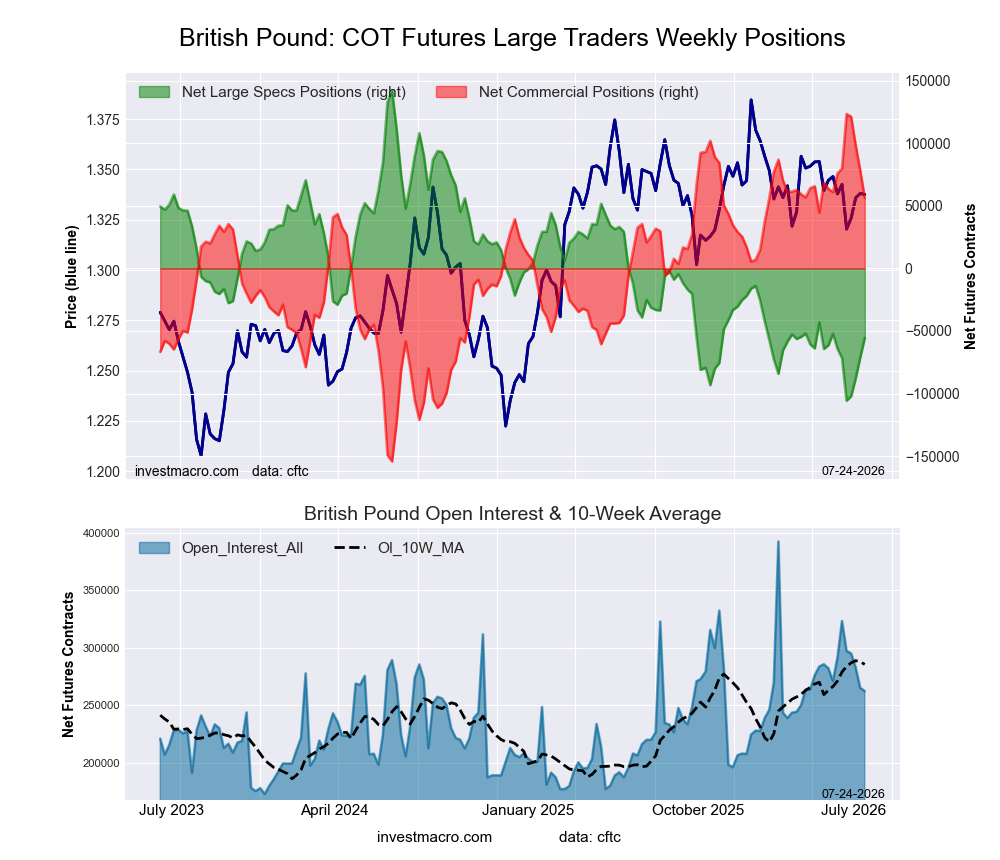
British Pound Sterling Futures COT ChartThe British Pound Sterling large speculator standing this week recorded a net position of -25,270 contracts in the data reported through Tuesday. This was a weekly lift of 5,268 contracts from the previous week which had a total of -30,538 net contracts.

This week’s current strength score (the trader positioning range over the past three years, measured from 0 to 100) shows the speculators are currently Bearish with a score of 28.9 percent. The commercials are Bullish with a score of 70.2 percent and the small traders (not shown in chart) are Bullish with a score of 52.6 percent.

Price Trend-Following Model: Weak Downtrend

Our weekly trend-following model classifies the current market price position as: Weak Downtrend.

BRITISH POUND StatisticsSPECULATORSCOMMERCIALSSMALL TRADERS
– Percent of Open Interest Longs:38.046.813.9
– Percent of Open Interest Shorts:50.234.514.0
– Net Position:-25,27025,504-234
– Gross Longs:79,00397,24328,832
– Gross Shorts:104,27371,73929,066
– Long to Short Ratio:0.8 to 11.4 to 11.0 to 1
NET POSITION TREND:
– Strength Index Score (3 Year Range Pct):28.970.252.6
– Strength Index Reading (3 Year Range):BearishBullishBullish
NET POSITION MOVEMENT INDEX:
– 6-Week Change in Strength Index:23.3-24.922.9


Japanese Yen Futures:

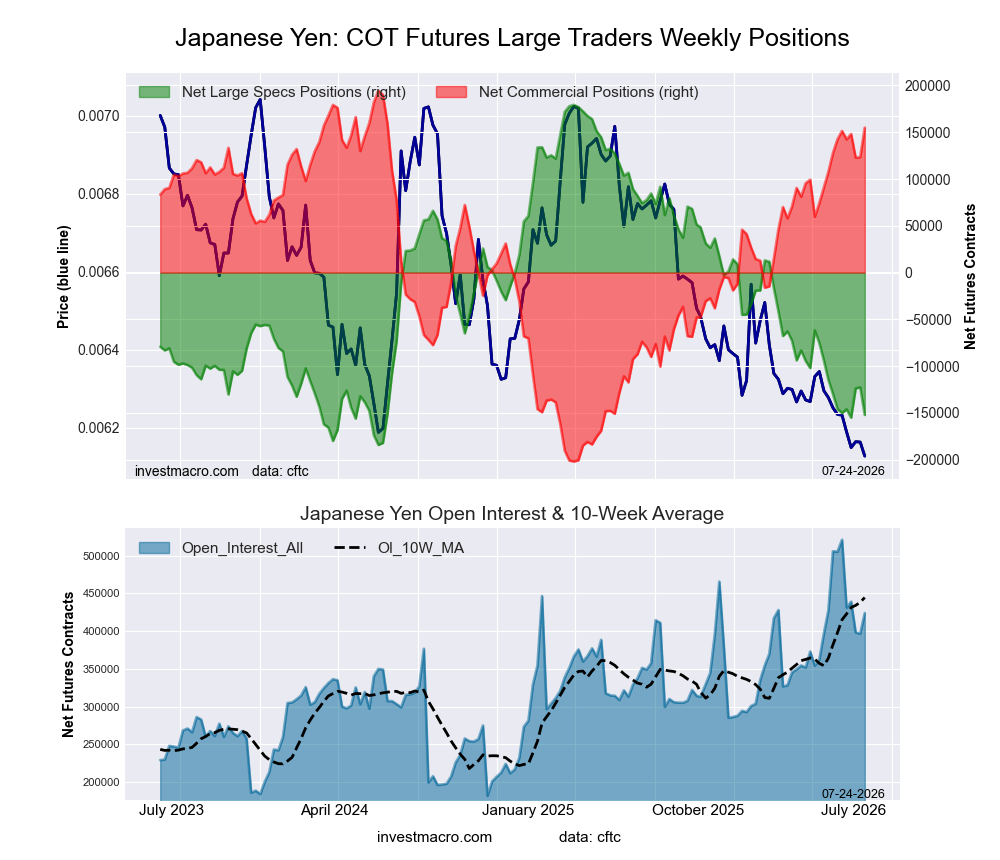
Japanese Yen Forex Futures COT ChartThe Japanese Yen large speculator standing this week recorded a net position of -45,164 contracts in the data reported through Tuesday. This was a weekly decline of -53,979 contracts from the previous week which had a total of 8,815 net contracts.

This week’s current strength score (the trader positioning range over the past three years, measured from 0 to 100) shows the speculators are currently Bearish with a score of 38.3 percent. The commercials are Bullish with a score of 62.5 percent and the small traders (not shown in chart) are Bearish with a score of 35.2 percent.

Price Trend-Following Model: Downtrend

Our weekly trend-following model classifies the current market price position as: Downtrend.

JAPANESE YEN StatisticsSPECULATORSCOMMERCIALSSMALL TRADERS
– Percent of Open Interest Longs:38.038.815.1
– Percent of Open Interest Shorts:53.323.315.3
– Net Position:-45,16445,819-655
– Gross Longs:111,743114,30344,360
– Gross Shorts:156,90768,48445,015
– Long to Short Ratio:0.7 to 11.7 to 11.0 to 1
NET POSITION TREND:
– Strength Index Score (3 Year Range Pct):38.362.535.2
– Strength Index Reading (3 Year Range):BearishBullishBearish
NET POSITION MOVEMENT INDEX:
– 6-Week Change in Strength Index:-22.421.2-6.1


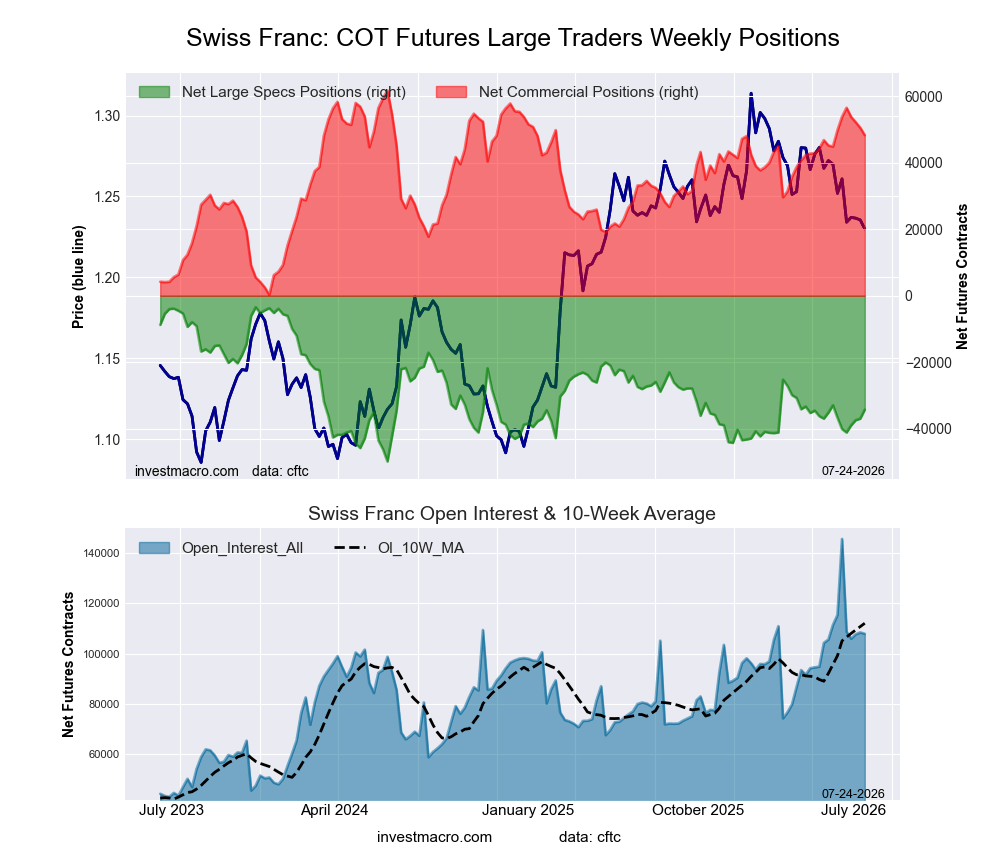
Swiss Franc Futures:

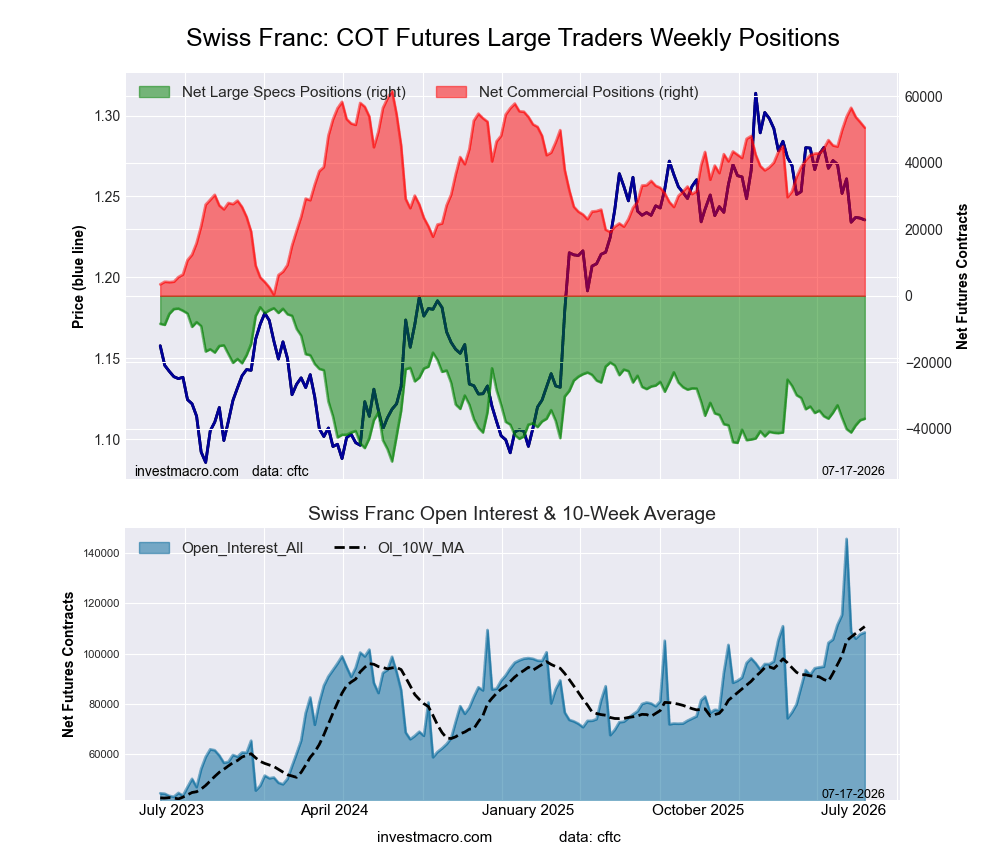
Swiss Franc Forex Futures COT ChartThe Swiss Franc large speculator standing this week recorded a net position of -43,392 contracts in the data reported through Tuesday. This was a weekly decrease of -3,126 contracts from the previous week which had a total of -40,266 net contracts.

This week’s current strength score (the trader positioning range over the past three years, measured from 0 to 100) shows the speculators are currently Bearish-Extreme with a score of 13.0 percent. The commercials are Bullish with a score of 76.4 percent and the small traders (not shown in chart) are Bullish with a score of 62.8 percent.

Price Trend-Following Model: Weak Uptrend

Our weekly trend-following model classifies the current market price position as: Weak Uptrend.

SWISS FRANC StatisticsSPECULATORSCOMMERCIALSSMALL TRADERS
– Percent of Open Interest Longs:13.971.514.5
– Percent of Open Interest Shorts:59.022.518.4
– Net Position:-43,39247,163-3,771
– Gross Longs:13,39568,77813,977
– Gross Shorts:56,78721,61517,748
– Long to Short Ratio:0.2 to 13.2 to 10.8 to 1
NET POSITION TREND:
– Strength Index Score (3 Year Range Pct):13.076.462.8
– Strength Index Reading (3 Year Range):Bearish-ExtremeBullishBullish
NET POSITION MOVEMENT INDEX:
– 6-Week Change in Strength Index:-15.416.8-11.5


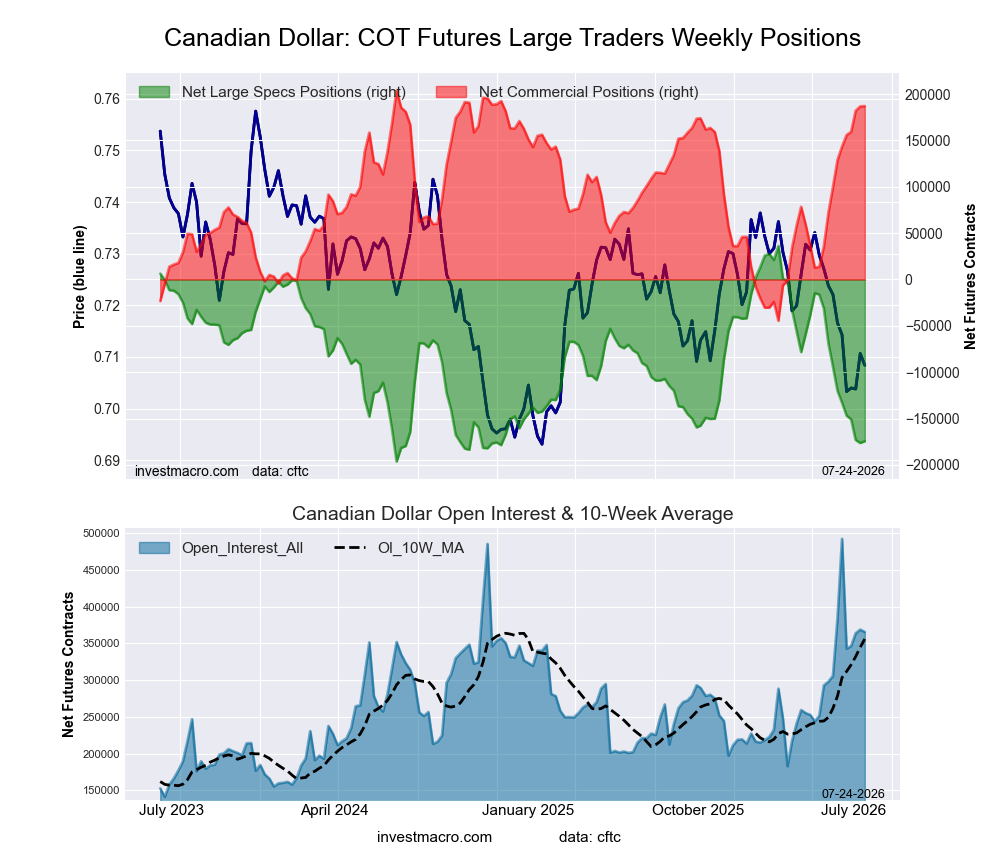
Canadian Dollar Futures:

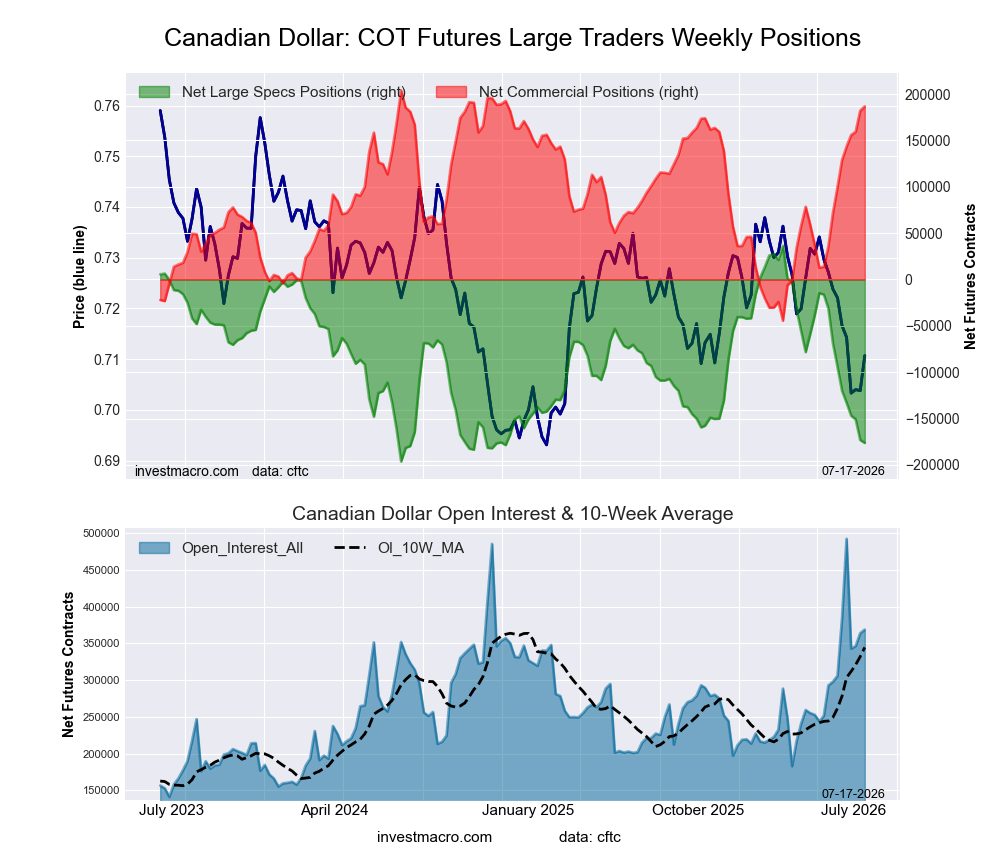
Canadian Dollar Forex Futures COT ChartThe Canadian Dollar large speculator standing this week recorded a net position of -42,250 contracts in the data reported through Tuesday. This was a weekly decline of -1,665 contracts from the previous week which had a total of -40,585 net contracts.

This week’s current strength score (the trader positioning range over the past three years, measured from 0 to 100) shows the speculators are currently Bullish with a score of 76.0 percent. The commercials are Bearish with a score of 30.4 percent and the small traders (not shown in chart) are Bearish with a score of 35.4 percent.

Price Trend-Following Model: Weak Uptrend

Our weekly trend-following model classifies the current market price position as: Weak Uptrend.

CANADIAN DOLLAR StatisticsSPECULATORSCOMMERCIALSSMALL TRADERS
– Percent of Open Interest Longs:28.655.712.8
– Percent of Open Interest Shorts:47.934.814.4
– Net Position:-42,25045,815-3,565
– Gross Longs:62,705122,09628,109
– Gross Shorts:104,95576,28131,674
– Long to Short Ratio:0.6 to 11.6 to 10.9 to 1
NET POSITION TREND:
– Strength Index Score (3 Year Range Pct):76.030.435.4
– Strength Index Reading (3 Year Range):BullishBearishBearish
NET POSITION MOVEMENT INDEX:
– 6-Week Change in Strength Index:53.2-49.915.5


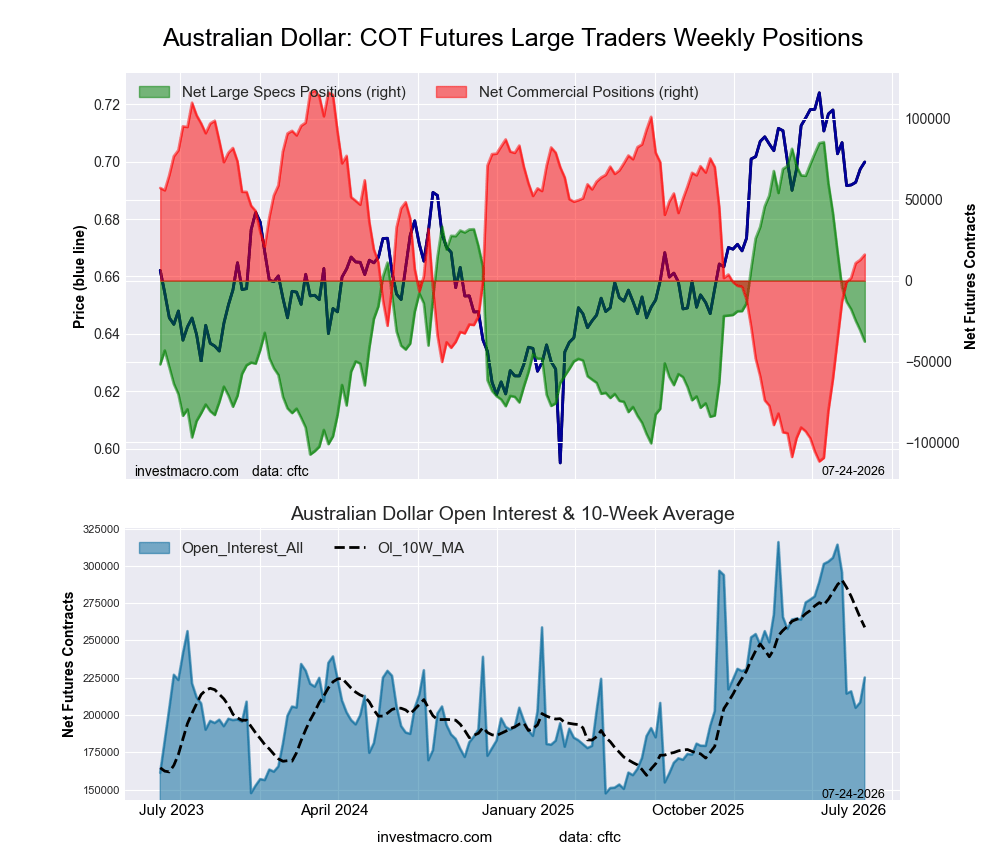
Australian Dollar Futures:

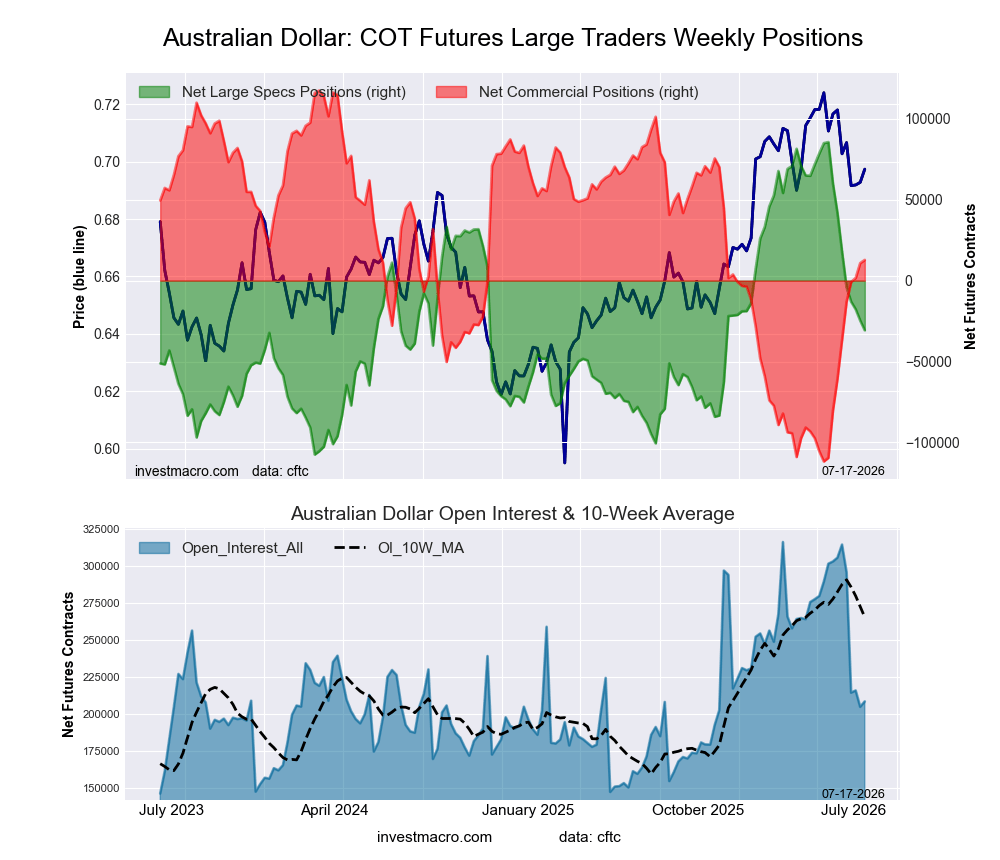
Australian Dollar Forex Futures COT ChartThe Australian Dollar large speculator standing this week recorded a net position of -18,846 contracts in the data reported through Tuesday. This was a weekly advance of 114 contracts from the previous week which had a total of -18,960 net contracts.

This week’s current strength score (the trader positioning range over the past three years, measured from 0 to 100) shows the speculators are currently Bullish with a score of 62.9 percent. The commercials are Bearish with a score of 27.8 percent and the small traders (not shown in chart) are Bullish-Extreme with a score of 100.0 percent.

Price Trend-Following Model: Strong Uptrend

Our weekly trend-following model classifies the current market price position as: Strong Uptrend.

AUSTRALIAN DOLLAR StatisticsSPECULATORSCOMMERCIALSSMALL TRADERS
– Percent of Open Interest Longs:36.645.017.3
– Percent of Open Interest Shorts:44.846.67.6
– Net Position:-18,846-3,61022,456
– Gross Longs:83,955103,29539,790
– Gross Shorts:102,801106,90517,334
– Long to Short Ratio:0.8 to 11.0 to 12.3 to 1
NET POSITION TREND:
– Strength Index Score (3 Year Range Pct):62.927.8100.0
– Strength Index Reading (3 Year Range):BullishBearishBullish-Extreme
NET POSITION MOVEMENT INDEX:
– 6-Week Change in Strength Index:45.8-44.022.7


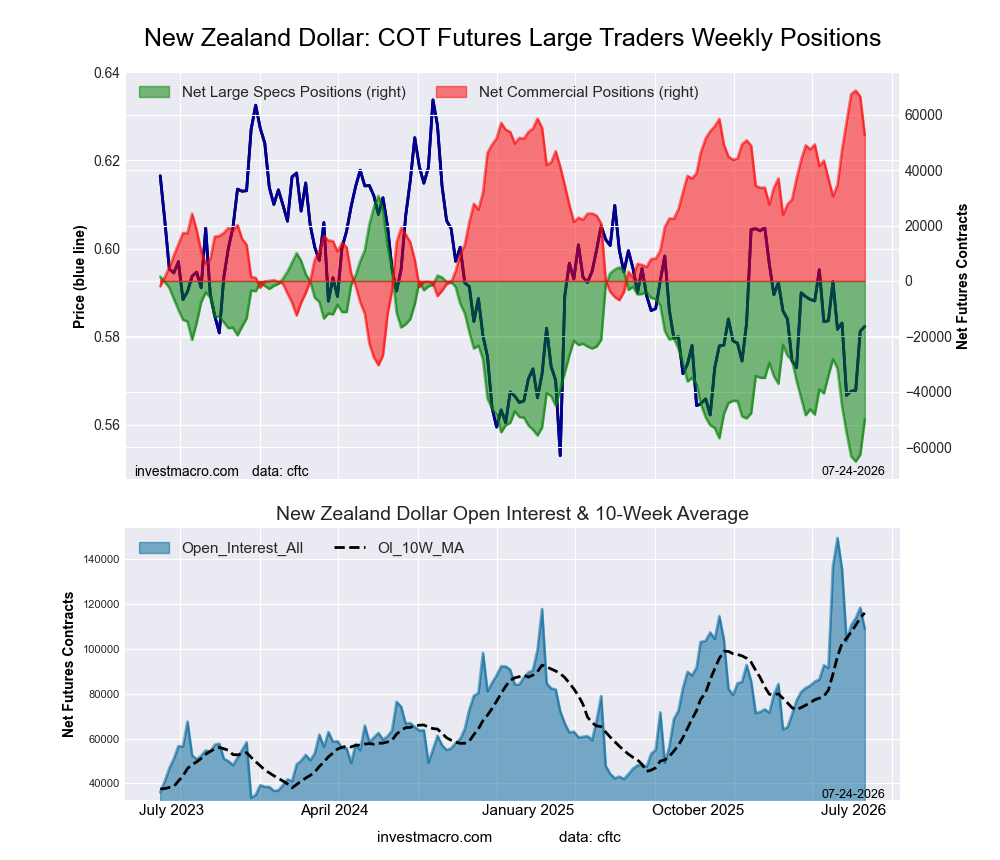
New Zealand Dollar Futures:

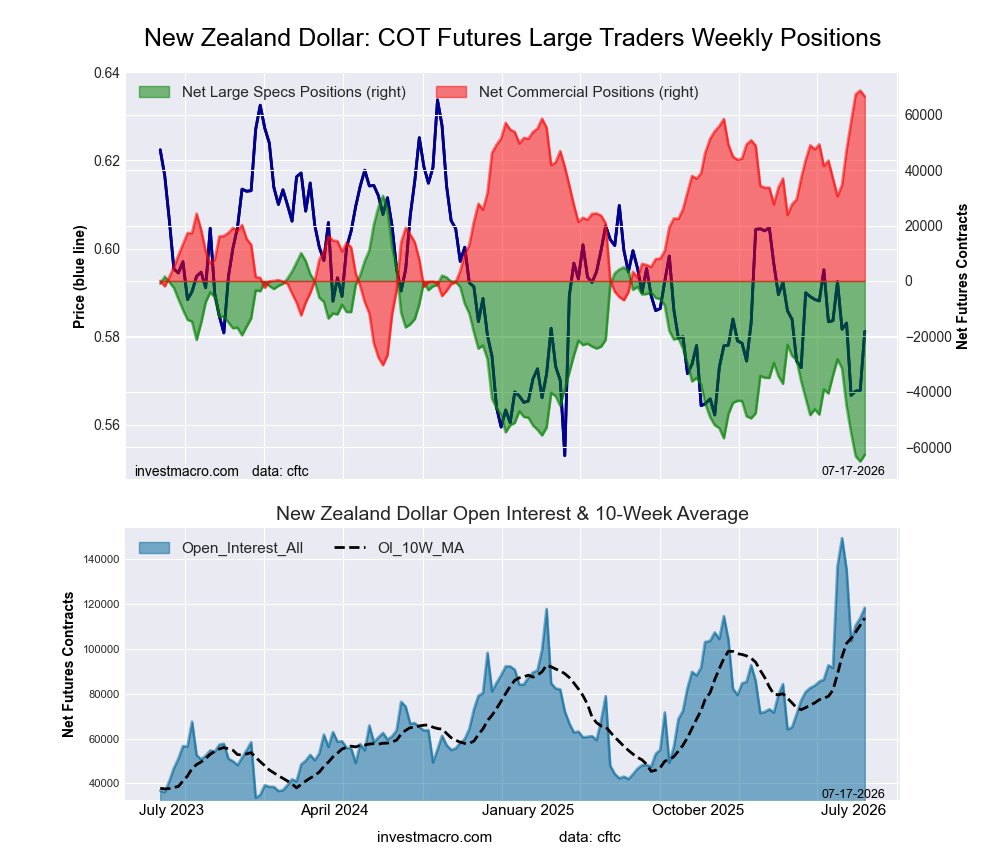
New Zealand Dollar Forex Futures COT ChartThe New Zealand Dollar large speculator standing this week recorded a net position of -48,851 contracts in the data reported through Tuesday. This was a weekly reduction of -5,488 contracts from the previous week which had a total of -43,363 net contracts.

This week’s current strength score (the trader positioning range over the past three years, measured from 0 to 100) shows the speculators are currently Bearish-Extreme with a score of 9.1 percent. The commercials are Bullish-Extreme with a score of 89.6 percent and the small traders (not shown in chart) are Bearish with a score of 45.7 percent.

Price Trend-Following Model: Downtrend

Our weekly trend-following model classifies the current market price position as: Downtrend.

NEW ZEALAND DOLLAR StatisticsSPECULATORSCOMMERCIALSSMALL TRADERS
– Percent of Open Interest Longs:11.381.84.7
– Percent of Open Interest Shorts:68.623.85.3
– Net Position:-48,85149,362-511
– Gross Longs:9,61369,6624,002
– Gross Shorts:58,46420,3004,513
– Long to Short Ratio:0.2 to 13.4 to 10.9 to 1
NET POSITION TREND:
– Strength Index Score (3 Year Range Pct):9.189.645.7
– Strength Index Reading (3 Year Range):Bearish-ExtremeBullish-ExtremeBearish
NET POSITION MOVEMENT INDEX:
– 6-Week Change in Strength Index:4.9-7.429.9


Mexican Peso Futures:

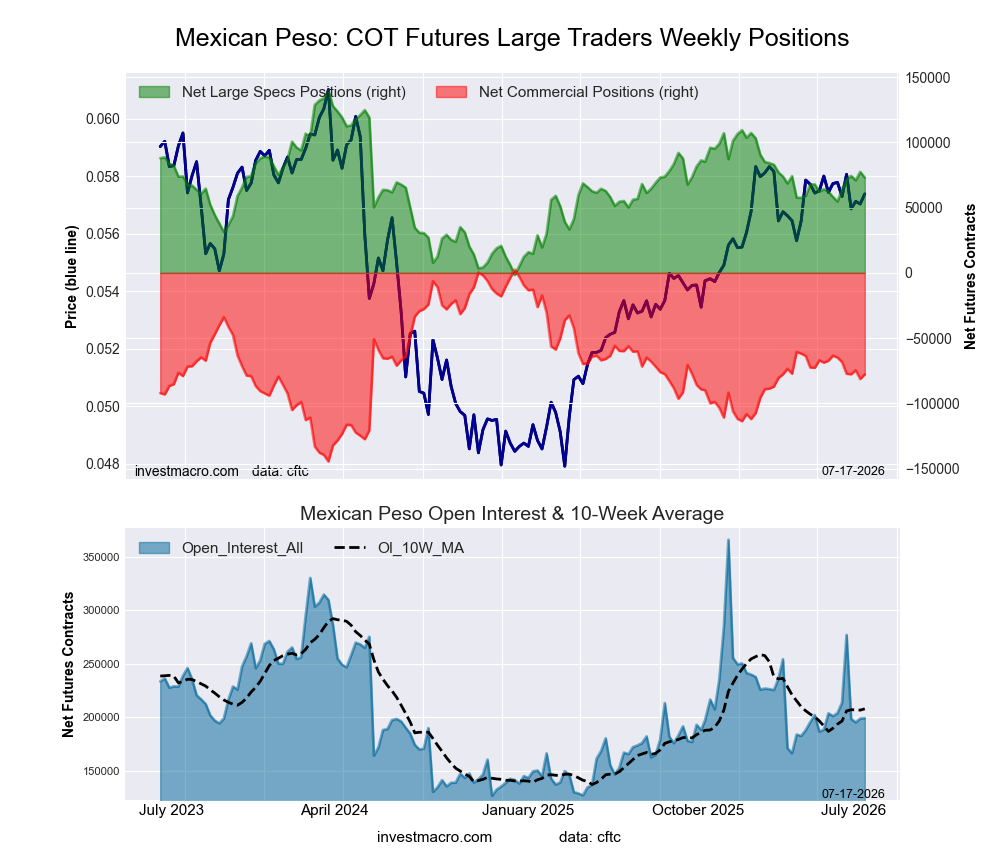
Mexican Peso Futures COT ChartThe Mexican Peso large speculator standing this week recorded a net position of 103,558 contracts in the data reported through Tuesday. This was a weekly lowering of -5,743 contracts from the previous week which had a total of 109,301 net contracts.

This week’s current strength score (the trader positioning range over the past three years, measured from 0 to 100) shows the speculators are currently Bullish-Extreme with a score of 80.8 percent. The commercials are Bearish-Extreme with a score of 19.4 percent and the small traders (not shown in chart) are Bearish with a score of 48.4 percent.

Price Trend-Following Model: Strong Uptrend

Our weekly trend-following model classifies the current market price position as: Strong Uptrend.

MEXICAN PESO StatisticsSPECULATORSCOMMERCIALSSMALL TRADERS
– Percent of Open Interest Longs:63.733.13.0
– Percent of Open Interest Shorts:20.877.91.1
– Net Position:103,558-108,1804,622
– Gross Longs:153,67079,9407,287
– Gross Shorts:50,112188,1202,665
– Long to Short Ratio:3.1 to 10.4 to 12.7 to 1
NET POSITION TREND:
– Strength Index Score (3 Year Range Pct):80.819.448.4
– Strength Index Reading (3 Year Range):Bullish-ExtremeBearish-ExtremeBearish
NET POSITION MOVEMENT INDEX:
– 6-Week Change in Strength Index:2.5-2.61.2


Brazilian Real Futures:

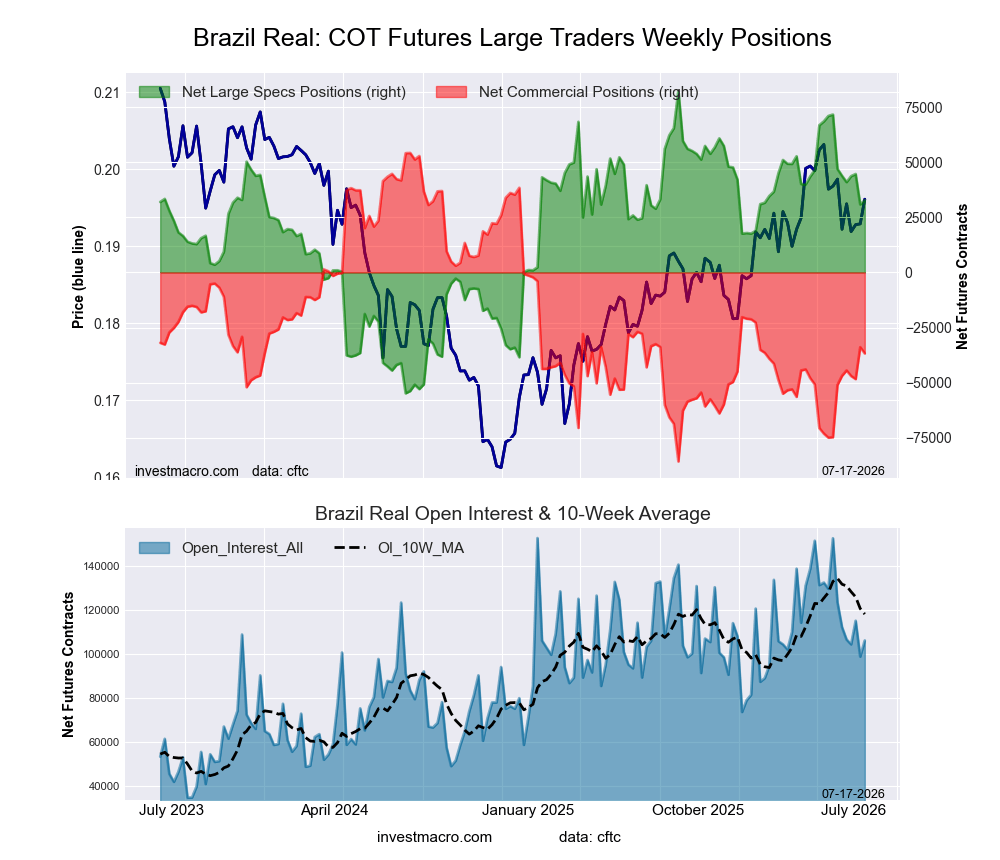
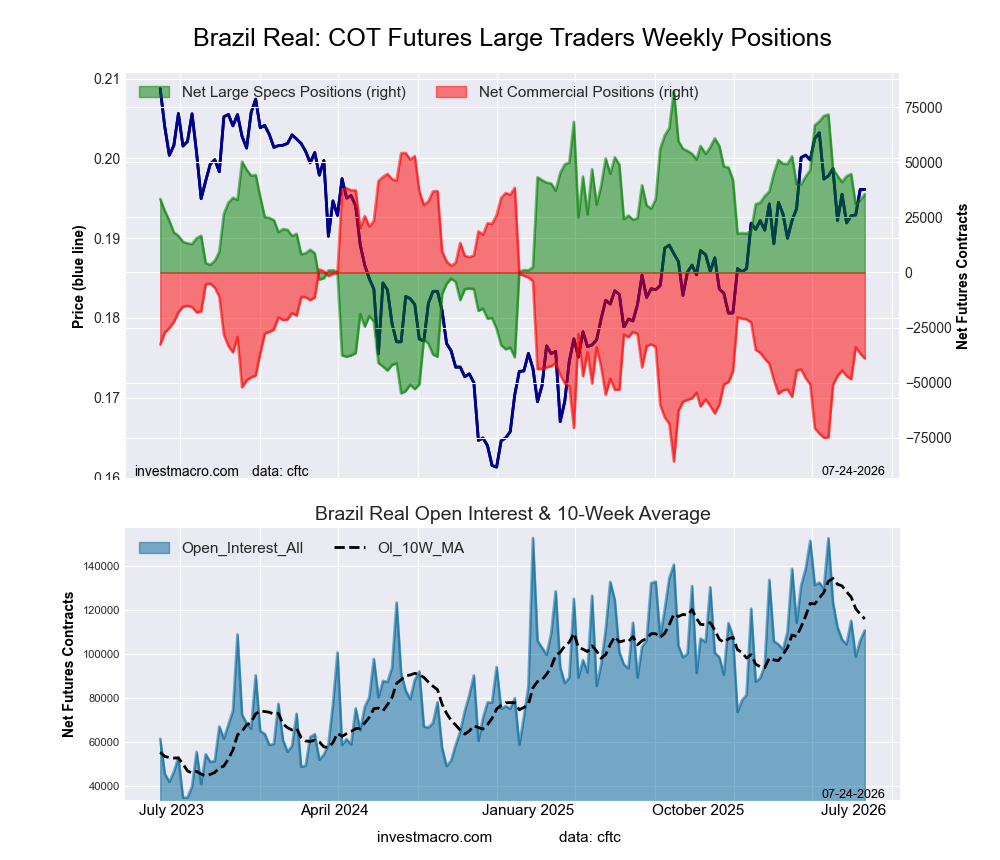
Brazil Real Futures COT ChartThe Brazilian Real large speculator standing this week recorded a net position of 17,874 contracts in the data reported through Tuesday. This was a weekly boost of 257 contracts from the previous week which had a total of 17,617 net contracts.

This week’s current strength score (the trader positioning range over the past three years, measured from 0 to 100) shows the speculators are currently Bullish with a score of 52.9 percent. The commercials are Bearish with a score of 46.3 percent and the small traders (not shown in chart) are Bearish with a score of 38.5 percent.

Price Trend-Following Model: Weak Downtrend

Our weekly trend-following model classifies the current market price position as: Weak Downtrend.

BRAZIL REAL StatisticsSPECULATORSCOMMERCIALSSMALL TRADERS
– Percent of Open Interest Longs:66.327.55.1
– Percent of Open Interest Shorts:43.754.11.1
– Net Position:17,874-21,0033,129
– Gross Longs:52,40021,7534,017
– Gross Shorts:34,52642,756888
– Long to Short Ratio:1.5 to 10.5 to 14.5 to 1
NET POSITION TREND:
– Strength Index Score (3 Year Range Pct):52.946.338.5
– Strength Index Reading (3 Year Range):BullishBearishBearish
NET POSITION MOVEMENT INDEX:
– 6-Week Change in Strength Index:-31.330.7-0.2


Bitcoin Futures:

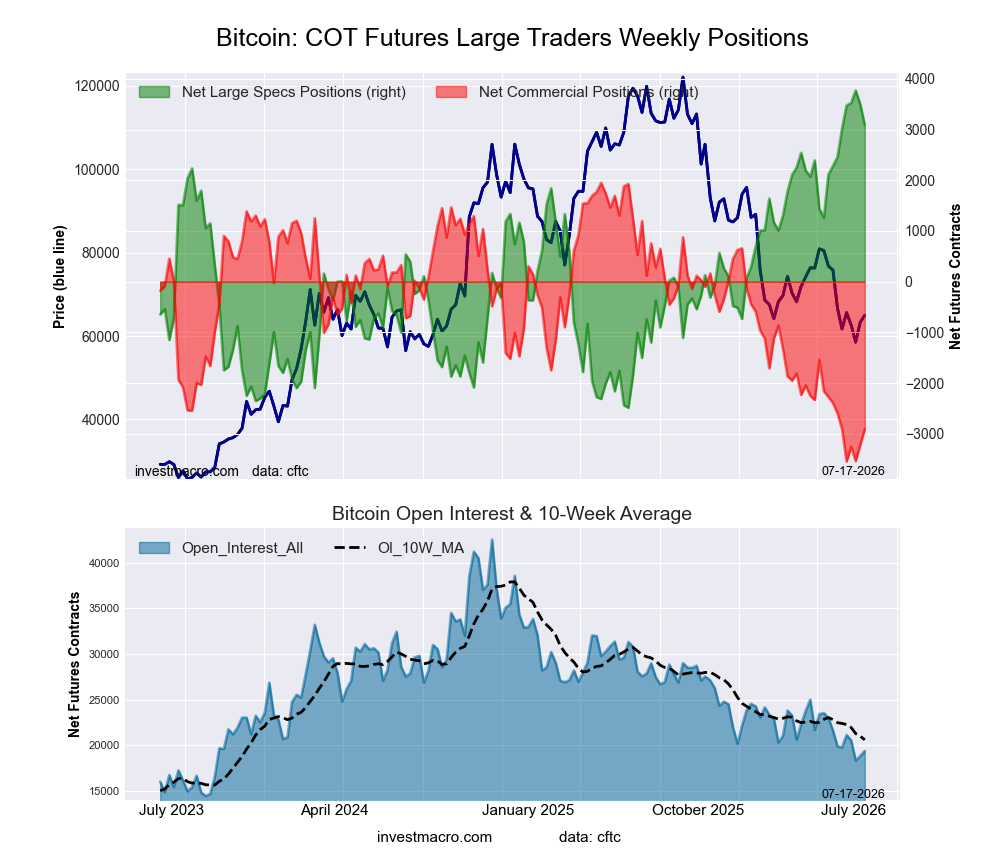
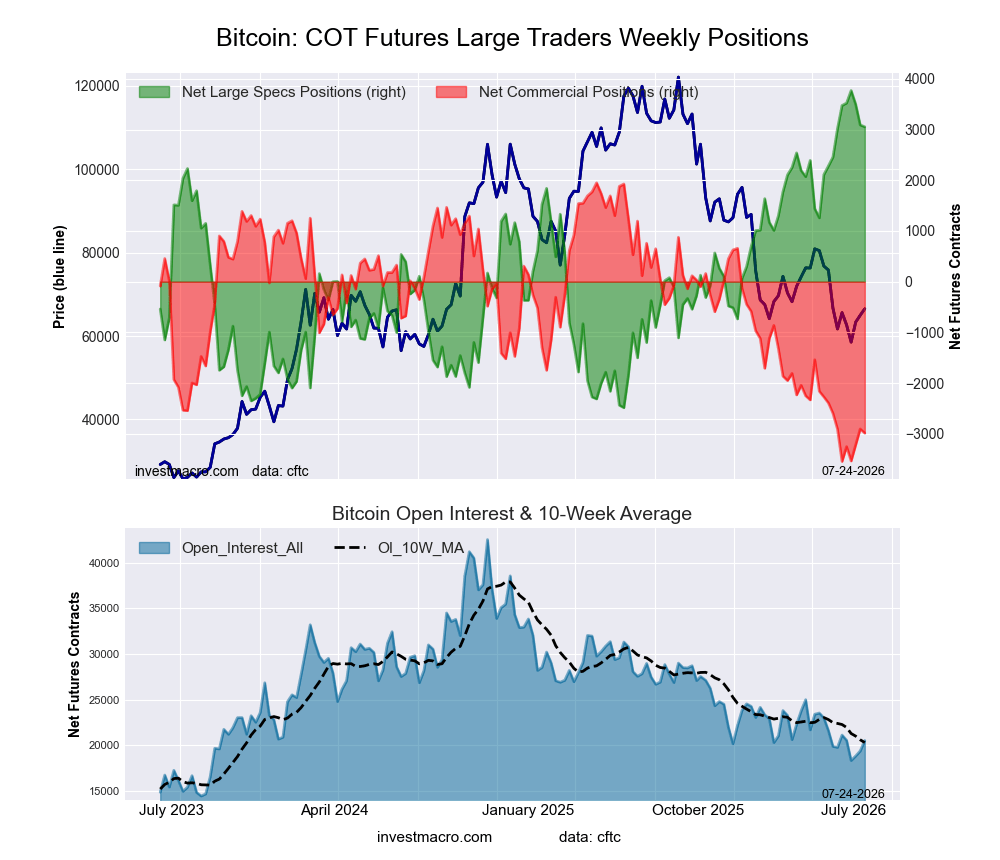
Bitcoin Crypto Futures COT ChartThe Bitcoin large speculator standing this week recorded a net position of 69 contracts in the data reported through Tuesday. This was a weekly increase of 803 contracts from the previous week which had a total of -734 net contracts.

This week’s current strength score (the trader positioning range over the past three years, measured from 0 to 100) shows the speculators are currently Bullish with a score of 54.2 percent. The commercials are Bullish with a score of 53.6 percent and the small traders (not shown in chart) are Bearish with a score of 40.7 percent.

Price Trend-Following Model: Downtrend

Our weekly trend-following model classifies the current market price position as: Downtrend.

BITCOIN StatisticsSPECULATORSCOMMERCIALSSMALL TRADERS
– Percent of Open Interest Longs:80.25.35.0
– Percent of Open Interest Shorts:79.95.84.8
– Net Position:69-13465
– Gross Longs:19,1181,2571,204
– Gross Shorts:19,0491,3911,139
– Long to Short Ratio:1.0 to 10.9 to 11.1 to 1
NET POSITION TREND:
– Strength Index Score (3 Year Range Pct):54.253.640.7
– Strength Index Reading (3 Year Range):BullishBullishBearish
NET POSITION MOVEMENT INDEX:
– 6-Week Change in Strength Index:-10.610.22.1


Article By InvestMacroReceive our weekly COT Newsletter

*COT Report: The COT data, released weekly to the public each Friday, is updated through the most recent Tuesday (data is 3 days old) and shows a quick view of how large speculators or non-commercials (for-profit traders) were positioned in the futures markets.

The CFTC categorizes trader positions according to commercial hedgers (traders who use futures contracts for hedging as part of the business), non-commercials (large traders who speculate to realize trading profits) and nonreportable traders (usually small traders/speculators) as well as their open interest (contracts open in the market at time of reporting). See CFTC criteria here.

USD/JPY Slips as the Yen Reacts to a Wave of Market News

By RoboForex Analytical Department

The USD/JPY pair fell to 158.16 on Friday as the Japanese yen continued its recovery from earlier this week. Market participants are increasingly focused on the upcoming Bank of Japan (BoJ) meeting, hoping for clearer signals regarding the future pace of interest rate hikes.

The regulator is widely expected to keep its policy parameters unchanged at the next meeting. However, investors are already pricing in the next rate hike as early as June. BoJ Governor Kazuo Ueda recently reiterated that the central bank remains ready to tighten policy if economic momentum and inflation dynamics continue to align with official forecasts.

Additional support for the yen came from renewed concerns over possible currency intervention as USD/JPY approached the psychologically important 160 level. Japanese authorities have repeatedly warned against sharp, unilateral exchange rate movements, increasing market sensitivity in this zone.

At the same time, political uncertainty continues to weigh on the yen. Markets are factoring in the possibility of early parliamentary elections. According to media reports, Prime Minister Sanae Takaichi may announce the dissolution of the lower house in an effort to push forward a more active fiscal policy. Further details are expected to be presented to representatives of the ruling coalition on 19 January.

Technical Analysis

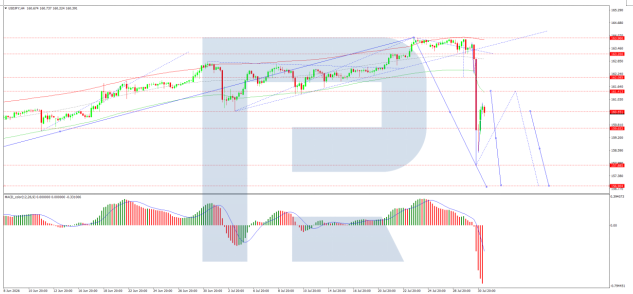
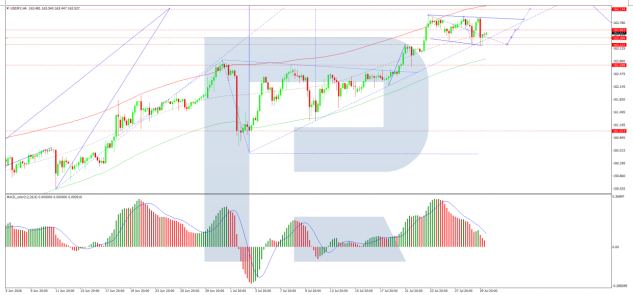
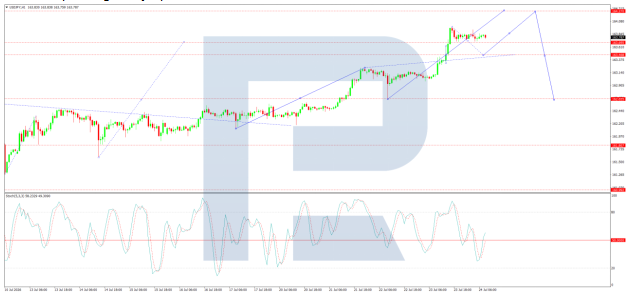
On the H4 chart, USD/JPY has corrected to the 157.90 area. For today, it is relevant to consider the potential formation of the initial phase of a renewed upward structure, targeting 159.59, with the prospect of a further move towards 160.00.

This scenario is technically supported by the MACD indicator, whose signal line remains above the zero level and is directed sharply upward, indicating that bullish momentum remains despite the recent correction.

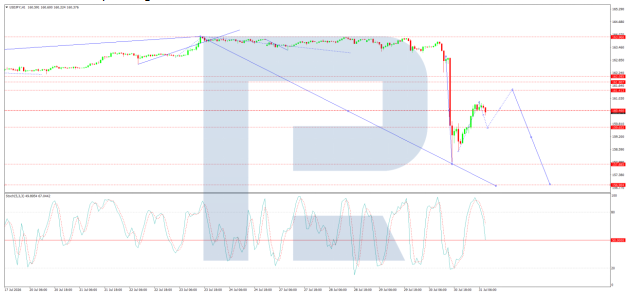
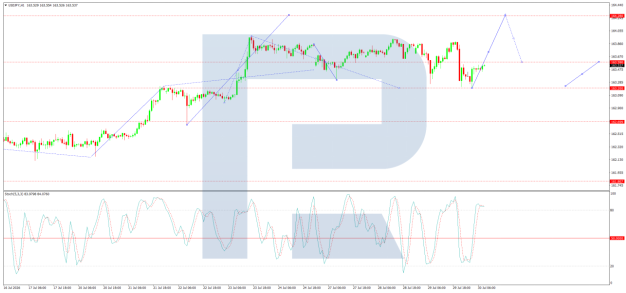
On the H1 chart, USD/JPY is forming a consolidation range around 158.77. The range has currently expanded downward to 157.97.

  • A breakout below this level would likely trigger a decline towards 156.60
  • A breakout to the upside would open the way for a bullish wave towards 159.59

This outlook is supported by the Stochastic Oscillator, whose signal line is positioned above the 50 level and is moving steadily upward towards 80, indicating growing bullish pressure.

Conclusion

USD/JPY remains at a critical juncture, balancing yen support from intervention risks and expectations of BoJ tightening against ongoing pressure from political uncertainty. In the short term, consolidation is likely to persist, but a breakout from the current range will define the next directional move. As long as the pair holds above key support levels, the broader bullish trend towards the 160 area remains technically valid, while a downside breakout would shift focus towards deeper corrective targets.


Disclaimer

Any forecasts contained herein are based on the author’s particular opinion. This analysis may not be treated as trading advice. RoboForex bears no responsibility for trading results based on trading recommendations and reviews contained herein.
Week Ahead: USDJPY timebomb flirts near “danger zone”

By ForexTime 

  • JPY ↓ over 1% versus USD year-to-date
  • Japan last intervened in July 2024, spending $36.8 billion
  • US PCE + Japan CPI + BoJ = fresh volatility?
  • Over past year BoJ triggered moves of ↑ 0.8% & ↓ 0.2%
  • Technical levels: 162, 160 and 158

Global FX markets could roar back to life if the yen descends deeper into intervention “danger zones”.

USDJPY is trading near an 18-month high around 158.50, a region that forced Japan to intervene back in July 2024.

To be clear, the government jumped into action after USDJPY almost hit 162.00, which is less than 2% away from current prices.

With chatter around intervention getting louder by the day, this could translate to heightened levels of volatility.

Beyond this key theme, the coming week also features scheduled events that could influence USDJPY:

Monday, 19th January

  • US markets closed for Martin Luther King, Jr. Day
  • Annual World Economic Forum in Davos
  • CNY: China GDP Growth Rate (Q4); Industrial Production (Dec); Retail Sales (Dec)
  • CAD: Canada Inflation Rate (Dec)

Tuesday, 20th January

  • EUR: Germany PPI (Dec); Germany ZEW Economic Sentiment Index (Jan); Eurozone ZEW Economic Sentiment Index Jan)
  • GBP: UK Unemployment Rate (Nov); Average Earnings
  • USD: US ADP Employment Weekly Change
  • WTI: API Crude Oil Stock Change (w/e Jan 16)
  • US500: Netflix earnings

Wednesday, 21st January

  • Trump’s speech at the World Economic Forum
  • GBP: UK Inflation Rate (Dec)
  • USD: Pending Home Sales (Dec)
  • JPY: Japan Balance of Trade (Dec); Exports (Dec)

Thursday, 22nd January

  • AUD: Australia Employment Data (Dec); S&P Global Manufacturing and Services PMIs (Jan)
  • NZD: New Zealand Inflation Rate (Q4 2025)
  • EUR: ECB Monetary Policy Accounts; Eurozone Consumer confidence (Jan)
  • USD: US PCE Index (Oct, Nov); Personal Income and Spending (Oct, Nov)
  • JPY: Japan Inflation Rate (Dec)
  • WTI: US EIA Crude Oil Stocks Change (w/e Jan 16)

Friday, 23rd January

  • GBP: UK Retail Sales (Dec); S&P Global Manufacturing and Services PMIs (Jan); Gfk Consumer Confidence (Jan)
  • JPY: BoJ Interest Rate Decision
  • EUR: Germany HCOB manufacturing PMI (Jan); Eurozone HCOB Composite, Manufacturing and Services PMIs (Jan)
  • CAD: Retail Sales (Dec)
  • USD: US S&P Global Composite, Manufacturing and Services PMIs (Jan)

The lowdown:

  • The Japanese Yen is weakening due to election-related fiscal fears and political risk, while a stronger dollar is exacerbating the situation.
  • A weak Yen is bad news for Japan because it boosts import costs, erodes purchasing power, and increases the cost of living.
  • The country’s finance minister has warned speculators that Japan will act to defend its currency, while BoJ officials are paying more attention to its impact on inflation.
  • Zooming out, expectations around a potential intervention may rattle FX markets and impact risk-sensitive currencies in addition to equities.

USDJPY set for a pivotal week?

Key events out of either side of the Pacific may rock the USDJPY:

1) US October/November PCE report

The incoming PCE figures are likely to shape interest rate expectations, especially the core PCE which is the Fed’s preferred inflation gauge.

On Thursday 22nd of January, both the October and November releases of the PCE reports will be published.

Traders are currently pricing in a 40% chance of a Fed cut by April with the odds jumping to 85% by June 2026.

  • Signs of still sticky inflation may have Fed cut expectations, pushing the USDJPY higher as the dollar strengthens.
  • A weaker-than-expected PCE report may pull the USDJPY lower as the USD weakens on rising Fed cut bets.

2) Japan CPI + BoJ rate decision

Japan’s December CPI report published on Thursday may influence BoJ monetary policy expectations beyond January.

Inflation is forecast to have risen 2.2% year-on-year, down from 2.9% in November due to the base effects from the jump in fresh food prices and new fuel subsidies last year.

Regarding the BoJ, it is expected to hold rates steady at 0.75% but any clues offered on future rates may rock the yen.

Traders are currently pricing in a 25% chance of a BoJ hike by March with the odds jumping to 57% by April 2026.

  • The Yen may rally if the BoJ strikes a hawkish note and signals a rate hike over the coming months. This may drag the USDJPY away from intervention danger zones.
  • A cautious-sounding BoJ may weaken the yen, pushing the USDJPY deeper into intervention zones.

3) Technical forces

The USDJPY is firmly bullish on the daily timeframe with prices trading above the 50, 100 and 200-day SMA.

  •  A solid move above 159.00 may encourage an incline toward 159.50 and 160.20.
  • Weakness below 158.20 could see prices slip toward 157.50 and 156.90.

Bloomberg’s FX model forecasts a 78.2% chance that USDJPY will trade within the 156.93 – 160.19 range, using current levels as a base, over the next one-week period.


Forex-Time-LogoArticle by ForexTime


ForexTime Ltd (FXTM) is an award winning international online forex broker regulated by CySEC 185/12 www.forextime.com

GBP/USD Stable: Sentiment Shifts in Favour of Sterling

By RoboForex Analytical Department

The GBP/USD pair held around 1.3430 USD on Thursday, with the pound strengthening yesterday following better-than-expected UK economic growth data. These figures may shape market expectations for Bank of England policy in the coming months.

Since the start of January, sterling has made limited headway against the US dollar but has strengthened notably against the euro. Dollar sentiment remains cautious due to geopolitical tensions involving Iran and Greenland, as well as renewed comments from President Donald Trump questioning the Federal Reserve’s independence.

Investor sentiment toward the pound has turned more constructive at the start of 2026. According to the US Commodity Futures Trading Commission (CFTC), traders reduced bearish bets on the pound at the fastest pace in five months during the first week of January. The net long dollar position against sterling fell sharply to 2.577 billion USD, down from 6.586 billion USD at the end of December—marking the steepest weekly decline since September 2019.

Inflation in the UK eased faster than expected toward the end of 2025, and markets are currently pricing in two BoE rate cuts this year. However, analysts view this as overly optimistic: persistently weak growth and subdued inflation could ultimately weigh on the currency. Upcoming soft employment and inflation data for December will be key to reassessing the likelihood of a rate cut as early as February, though markets currently assign low odds to such a move.

Next week brings key releases, including consumer prices and labour market data, followed by GDP figures on Thursday. A Reuters poll suggests the UK economy contracted by 0.2% in the three months to November, with annual growth estimated at around 1.1%.

Technical Analysis: GBP/USD

H4 Chart:

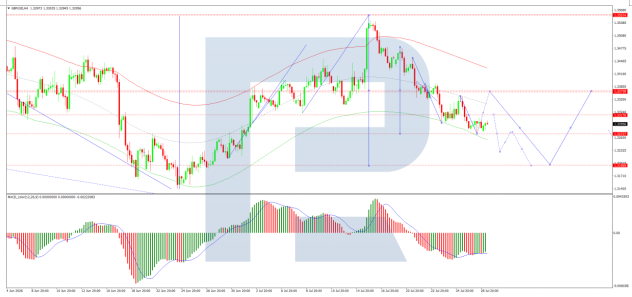
On the H4 chart, GBP/USD is forming a broad consolidation range around 1.3455 USD. The range is expected to extend toward 1.3395 USD, followed by a corrective bounce to 1.3415 USD. Once complete, the downtrend may resume toward 1.3290 USD, with further potential to 1.3220 USD. The MACD indicator supports this bearish near-term outlook, with its signal line below zero and pointing firmly downward.

H1 Chart:

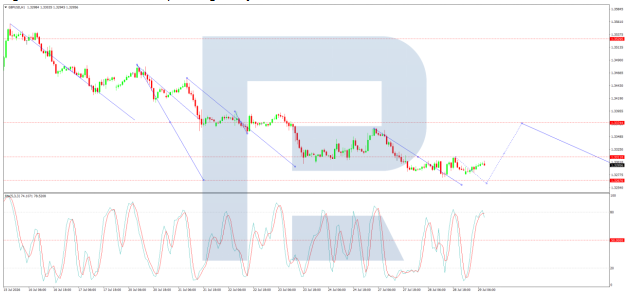
On the H1 chart, the pair has established a tight consolidation range around 1.3440 USD. A downward move toward 1.3395 USD is in progress, and a break below this level would open the door to further declines toward 1.3290 USD. The Stochastic oscillator aligns with this view, as its signal line is below 20 and trending lower, indicating sustained selling momentum.

Conclusion

Despite improving sentiment and a sharp reduction in speculative short positions, the pound remains vulnerable to downside risks from domestic data and shifting BoE expectations. Technically, the pair retains a near-term bearish bias, with key support levels at 1.3395 USD and 1.3290 USD. A break below these levels could accelerate declines, while any sustained recovery would likely require stronger-than-expected UK data in the coming week.


Disclaimer:

Any forecasts contained herein are based on the author’s particular opinion. This analysis may not be treated as trading advice. RoboForex bears no responsibility for trading results based on trading recommendations and reviews contained herein.

EUR/USD Awaiting US Inflation Data for Direction

By RoboForex Analytical Department

The EUR/USD pair stabilised around 1.1658 on Tuesday, following a period of volatility over the preceding two sessions.

Market focus remains firmly on the forthcoming US inflation data, which is expected to provide crucial clarity on the future path of Federal Reserve policy. Currently, the market is pricing in two rate cuts this year, with the first anticipated in June. However, any upside surprise in inflation could significantly temper expectations for policy easing.

Supporting a more dovish outlook was last week’s disappointing Non-Farm Payrolls (NFP) report for December, which revealed weaker-than-expected job growth.

Investors are also monitoring developments in the US Supreme Court, which is expected to rule on the legality of President Donald Trump’s tariff policy as early as Wednesday.

Earlier this week, the US dollar faced additional headwinds following reports that Fed Chair Jerome Powell could face scrutiny over his congressional testimony related to a building renovation project. This has raised concerns, albeit limited, regarding the perceived independence of the Federal Reserve.

Technical Analysis: EUR/USD

H4 Chart:

On the H4 chart, the pair is forming a corrective retracement within the context of the second downward impulse. The immediate corrective target stands at 1.1700. Once this correction concludes, we anticipate the resumption of the downtrend, with the next bearish target at 1.1555. This scenario is supported by the MACD indicator, whose signal line is below zero and pointing decisively downward, reinforcing the ongoing bearish momentum and potential for further downside.

H1 Chart:

On the H1 chart, the market has completed a decline to 1.1655 and is now forming an upward corrective impulse towards 1.1700. Upon reaching this level, we expect a renewed wave of selling pressure to emerge. The Stochastic oscillator aligns with this view, as its signal line is currently below 20 but is turning upward towards 80, indicating room for a short-term rebound before the next potential decline.

Conclusion

The EUR/USD pair is in a holding pattern ahead of key US inflation data, which will likely dictate the near-term direction of the pair. While the technical structure remains bearish, a corrective bounce towards 1.1700 appears likely before sellers potentially regain control. A stronger-than-expected inflation print could reinforce the dollar’s strength and accelerate the move towards 1.1555.


Disclaimer:

Any forecasts contained herein are based on the author’s particular opinion. This analysis may not be treated as trading advice. RoboForex bears no responsibility for trading results based on trading recommendations and reviews contained herein.
USD/JPY Stalls Near One-Year High

By RoboForex Analytical Department

The USD/JPY pair paused on Monday after a sharp rally to around 157.95, with the yen holding near its lowest levels of the year. Trading activity was subdued as Japanese markets were closed for a public holiday.

Political uncertainty increased after Prime Minister Sanae Takaichi, a key coalition partner, raised the possibility of early elections on 8 or 15 February, adding another layer of caution to the market.

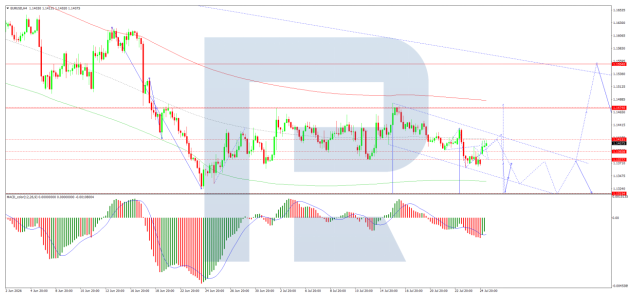
The yen also faced pressure from recent mixed macroeconomic data, which have clouded the outlook for the Bank of Japan’s future rate-hike trajectory.

Last week, BoJ Governor Kazuo Ueda reiterated that the central bank would continue to raise interest rates if economic momentum and inflation align with forecasts, while also emphasising a flexible approach to policy adjustments.

Over the coming week, traders will focus on a series of key Japanese economic indicators, including current account figures, machine tool orders, manufacturing PMI, and business sentiment data. Any surprises could prompt a shift in the yen’s direction.

Technical Analysis: USD/JPY

H4 Chart:

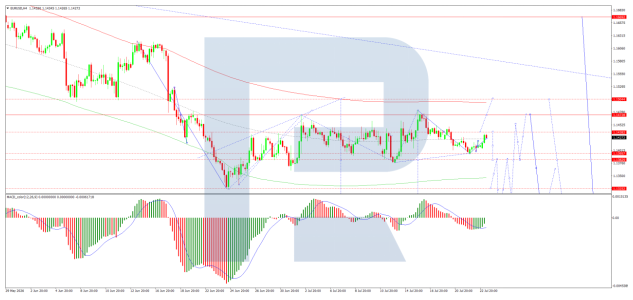
On the H4 chart, the pair has completed a local advance to 157.77 and is likely to enter a period of consolidation around this level. A break below this range could trigger a corrective move towards 156.60. Conversely, an upward break would open the potential for the rally to extend towards 159.33. This outlook is supported by the MACD indicator, with its signal line positioned above zero and pointing firmly upward, indicating ongoing bullish momentum.

H1 Chart:

On the H1 chart, the market is forming a consolidation range centred around 157.77, with interim boundaries at 158.18 to the upside and 157.50 to the downside. A downward exit from this range could see a decline towards 156.60, while an upward resolution would signal potential for a further move towards 159.33. The Stochastic oscillator aligns with this view, as its signal line is above 50 and rising towards 80, suggesting continued near-term upward momentum.

Conclusion

USD/JPY has entered a period of consolidation near annual highs, with direction likely to be determined by upcoming Japanese data and political developments. While the broader technical bias remains bullish, a break below 157.50 could signal the start of a short-term correction.


Disclaimer:

Any forecasts contained herein are based on the author’s particular opinion. This analysis may not be treated as trading advice. RoboForex bears no responsibility for trading results based on trading recommendations and reviews contained herein.
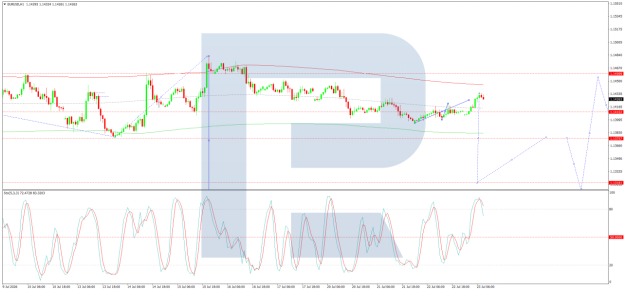
Week Ahead: dollar faces first key test

By ForexTime 

  • USDInd ends 2025 ↓ 9.4% lower, biggest drop since 2017 
  • December NFP report may shape Fed cut bets for Q1 2026 
  • Ongoing Ukraine peace talks = heightened volatility? 
  • Over past year NFP triggered moves of ↑ 0.6% & ↓ 0.4% 
  • Technical levels: 100.00, 99.00 & 98.00 

The first full trading week of 2026 is packed with high-risk events!

Another round of Ukraine peace talks, a speech by Nvidia’s CEO and December’s US jobs report could spark fresh levels of volatility:


Sunday, 4th January

  • OIL: OPEC+ meeting on production levels


Monday, 5th January

  • CNY: China RatingDog services PMI
  • JPY: Japan S&P Global manufacturing PMI
  • USDInd: US ISM manufacturing, vehicle sales
  • Nvidia CEO Jensen Huang speech on innovation & productivity


Tuesday, 6th January

  • EUR: Eurozone HCOB services PMI
  • FRA40: France CPI, HCOB services PMI
  • GER40: Germany CPI, HCOB services PMI
  • USDInd: Richmond Fed President Tom Barkin


Wednesday, 7th January

  • AUD: Australia building approvals, CPI
  • EUR: Eurozone CPI
  • GER40: Germany unemployment
  • USDInd: ISM services index, ADP employment change, JOLTS job openings, Fed Michelle Bowman speech


Thursday, 8th January

  • AUD: Australia trade
  • EUR: ECB publishes 1-year and 3-year CPI expectations
  • EU50: Eurozone PPI, consumer confidence, economic confidence, unemployment
  • GER40: Germany factory orders
  • USDInd: US wholesale inventories, initial jobless claims, trade


Friday, 9th January

  • CAD: Canada unemployment
  • CNY: China PPI, CPI
  • SP35: Spain industrial production
  • EUR: Eurozone retail sales
  • USDInd: US unemployment, nonfarm payrolls, University of Michigan consumer sentiment, housing starts

The spotlight shines on FXTM’s USDInd which ended last year 9.4% lower, its biggest drop in eight years.

A screenshot of a video game  AI-generated content may be incorrect.

Note: The USD Index tracks how the dollar is performing against a basket of six different G10 currencies, including the Euro, British Pound, Japanese Yen, and Canadian dollar.

2025 was rough and rocky for the dollar thanks to worries about the US fiscal deficit, while Trump’s global trade war and lower US interest rates fuelled the downside.

With the USD entering 2026 on a shaky note, could more pain be on the horizon?

Here are three factors to watch out for:


1) December NFP – Friday 9th January

Markets expect the US economy to have created only 55,000 jobs in December while the unemployment rate is expected to drop to 4.5% from 4.6% in the previous month. The low numbers may be a result of the government shutdown as the negative knock-on effects hit labour markets.

  • A stronger-than-expected US jobs report could cool rate cut bets, boosting the USDInd higher as a result.
  • However, further evidence of a cooling US jobs market could reinforce expectations around lower US rates – pulling the USDInd lower.

USDInd is forecast to move 0.6% up or 0.4% down in a 6-hour window after the US NFP report.

Note: Before the key US NFP report, the dollar is likely to be rocked by Fed speeches and other key data including ISM Manufacturing, ADP employment and initial jobless claims.


Traders are currently pricing in a 47% chance that the Fed cuts interest rates by March 2026.

A screen shot of a price list  AI-generated content may be incorrect.


2) Ongoing Ukraine peace talks

According to Ukrainian President Volodymyr Zelensky, the peace agreement to end the war with Russia is “90% ready”.

However, recent drone strikes in Russia have rekindled tensions between the two nations despite diplomats expressing optimism over peace talks.

  • Should tensions intensify, this may weaken the Euro and spark fresh risk aversion – boosting the USDInd as a result.
  • Any signs of cooling tensions could boost the Euro and support overall risk sentiment – weighing on the USDInd.

Note: The Euro accounts for almost 60% of the USDInd weight. A weaker euro tends to push the index higher and vice versa.


3) Technical forces

FXTM’s USDInd remains under pressure on the daily charts.

  • A solid breakout and daily close above the 200-day SMA at 99.00 could trigger an incline toward 100-day SMA.
  • Should prices break below 98.00, bears could be encouraged to hit 97.20 and 96.50.


Forex-Time-LogoArticle by ForexTime


ForexTime Ltd (FXTM) is an award winning international online forex broker regulated by CySEC 185/12 www.forextime.com

USDJPY Bank of Japan Hike Boosts Yen

By RoboForex Analytical Department

The Bank of Japan’s decision to raise its policy rate to 0.75% (from 0.50%), while in line with market forecasts, marks a clear step towards monetary tightening and has pushed yields higher on Japanese assets. For the USD/JPY pair, this typically exerts downward pressure – supporting the yen’s appreciation and weighing on the exchange rate.

The underlying mechanism is straightforward: a higher interest rate in Japan boosts the relative appeal of yen-denominated investments and narrows the yield differential with the US. This, in turn, reduces the incentive for the classic carry trade – borrowing in low-yielding yen to purchase higher-yielding assets abroad – thereby increasing structural demand for the yen.

As the decision was widely anticipated, the immediate market reaction may be relatively contained. However, beyond the rate itself, the tone of the BoJ’s forward guidance will be critical. Should the central bank signal that further hikes are on the table, sustained pressure on USD/JPY is likely. Conversely, an emphasis on caution and the gradual pace of policy normalisation could limit the move to a more short-term correction.

Technical Analysis: USD/JPY

H4 Chart:

On the H4 chart, the market reached a local bullish target at 157.72 before correcting to 155.55. We expect this corrective phase to conclude around the 155.50 level, with the potential for a consolidation range to form thereafter. A break below this range would open the path towards 155.12, while an upward exit could see a renewed advance towards 157.92.

This outlook is supported by the MACD indicator, whose signal line is currently above zero but pointing firmly lower, suggesting a loss of bullish momentum in the near term.

H1 Chart:

On the H1 chart, the pair is trading within a consolidation range around 156.06. A downside break would target a decline towards 155.12, whereas an upside resolution could initiate a move towards 157.92.

This view is further validated by the Stochastic oscillator, whose signal line is below 50 and trending downward towards the 20 level, indicating continued near-term selling pressure.

Conclusion

The BoJ’s rate hike has shifted the fundamental backdrop towards yen strength, though the extent of the move will hinge on the central bank’s future signalling. Technically, USD/JPY is entering a critical consolidation phase, with a break below 155.50 likely to accelerate the correction, while a hold above could see the pair attempt to retest recent highs.


Disclaimer:

Any forecasts contained herein are based on the author’s particular opinion. This analysis may not be treated as trading advice. RoboForex bears no responsibility for trading results based on trading recommendations and reviews contained herein.
GBP/USD: UK GDP Growth Matches Forecasts

By RoboForex Analytical Department

The latest UK GDP data showed annualised growth of 1.3%, in line with market expectations and slightly below the previous reading of 1.4%. The report had a broadly neutral impact on sterling, as it confirms the UK economy continues to expand, albeit at a moderate pace, without signs of acceleration.

For the GBP/USD pair, the lack of surprise is the key takeaway. With the data matching consensus forecasts, investors have little reason to reassess their current macroeconomic outlook. In such cases, the pound tends not to attract fresh buying momentum but also avoids sharp selling pressure.

Nevertheless, the slight deceleration in growth from the prior period creates a modestly cautious backdrop for sterling. The softer figure may signal that the economy remains sensitive to elevated interest rates and subdued domestic demand. This interpretation could temper expectations of further monetary tightening from the Bank of England and limit the scope for more hawkish communication.

In the near term, the direct market impact of this GDP release is assessed as largely neutral, albeit with a mild downside bias for the pound. Subsequent direction will likely depend on upcoming UK inflation and labour market reports, alongside evolving US rate expectations and broader global risk sentiment.

Technical Analysis: GBP/USD

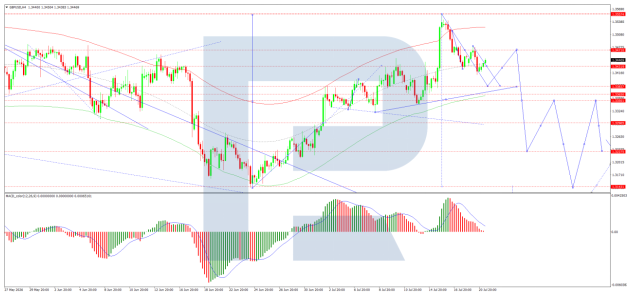
H4 Chart:

On the H4 chart, the pair has entered a broad consolidation zone around 1.3418. We anticipate a possible extension of the range towards 1.3500 in the near term, followed by a corrective pullback to 1.3418. Upon completion of this retracement, the broader upward trend is expected to resume, targeting 1.3520, with potential for further extension towards 1.3550.

This outlook is supported by the MACD indicator, with its signal line positioned above zero and pointing firmly upward.

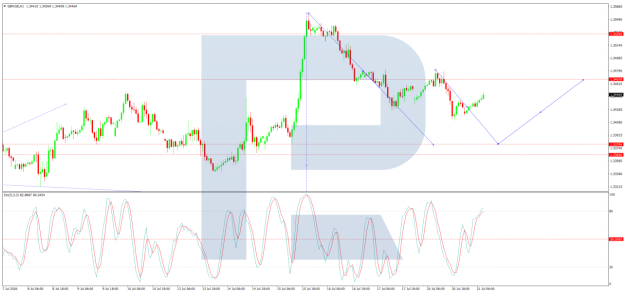
H1 Chart:

On the H1 chart, price action formed a tight consolidation around 1.3424 before breaking higher and advancing to 1.3492 (a local target). We now expect a corrective decline to retest the 1.3424 level from above. Once this correction concludes, the focus will shift to the potential for a subsequent growth wave toward 1.3533.

This scenario is validated by the Stochastic oscillator, whose signal line is above 80 and has begun to turn lower towards the 20 level, indicating near-term corrective momentum.

Conclusion

The GBP/USD pair is likely to remain range-bound in the wake of in-line GDP data, which neither strengthens nor weakens the sterling narrative decisively. While the technical structure favours further upside in the medium term, near-term price action suggests a period of consolidation or mild correction may precede any renewed bullish impulse.


Disclaimer:

Any forecasts contained herein are based on the author’s particular opinion. This analysis may not be treated as trading advice. RoboForex bears no responsibility for trading results based on trading recommendations and reviews contained herein.
EUR/USD: ECB Policy Stance Fails to Surprise Markets

By RoboForex Analytical Department

At its meeting on 18 December, the European Central Bank (ECB) left all key interest rates unchanged, maintaining the deposit facility rate at 2.0%. The decision was widely anticipated, offering no fresh catalyst for meaningful euro movement. While headline inflation for the eurozone remained close to target at 2.15% in November, the ECB’s updated projections saw a slight upward revision for the coming years, primarily driven by persistent price growth in the services sector.

Concurrently, the ECB improved its GDP growth forecast for 2025–2027. However, with the decision fully priced in, it provided neither additional support nor pressure to the single currency.

The primary driver for EUR/USD now stems from US monetary policy. The recent Federal Reserve rate cut from 4.00% to 3.75% has narrowed the yield differential between the dollar and the euro. This reduces the dollar’s interest rate advantage and makes euro-denominated assets relatively more attractive, providing a moderate tailwind for the euro.

Looking ahead, medium-term dynamics will hinge on relative expectations for central bank policy. Should markets continue to price in a more aggressive easing cycle from the Fed compared to the ECB, the euro is likely to find further support. Conversely, any signs that the ECB is preparing to proactively ease policy in response to eurozone economic weakness would limit the euro’s upside potential.

Technical Analysis: EUR/USD

H4 Chart:

On the H4 chart, the pair is consolidating near the breakdown level of the previous growth channel’s lower boundary. We anticipate a downside breakout from this range and a resumption of the third decline wave, with an initial target at 1.1650.

The MACD indicator technically confirms this bearish outlook. Its signal line is below zero and pointing decisively downward, reflecting sustained bearish momentum and potential for further downside.
H1 Chart:

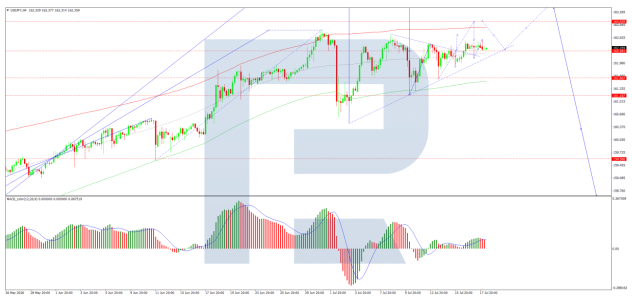
On the H1 chart, the market completed another decline wave to 1.1702, followed by a correction to 1.1737. A new downward impulse towards 1.1650 is currently forming. A sustained break below this level would signal the potential for an extended third wave, targeting the 1.1645 area as a local objective.
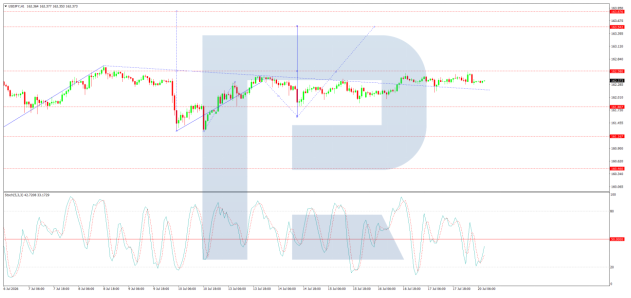
This scenario is supported by the Stochastic oscillator, with its signal line below the 50 level and trending firmly downwards.

Conclusion

The euro’s trajectory remains more sensitive to shifting US policy expectations than to the ECB’s predictable stance. While the narrowed interest rate differential offers near-term support, the technical structure appears bearish. A decisive break below the current consolidation range could trigger a renewed move towards the 1.1650–1.1645 support zone.


Disclaimer:

Any forecasts contained herein are based on the author’s particular opinion. This analysis may not be treated as trading advice. RoboForex bears no responsibility for trading results based on trading recommendations and reviews contained herein.