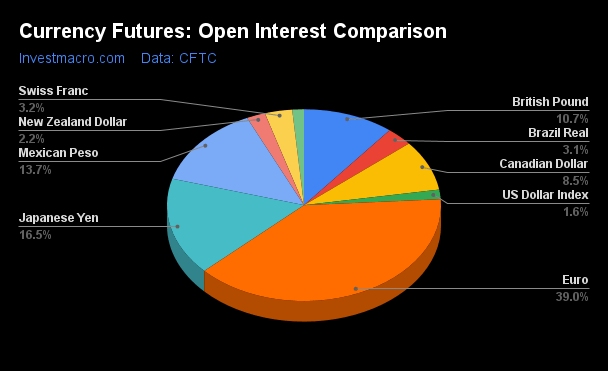
Currency Speculators drop their US Dollar Index bets to 133-week low

By InvestMacro

Here are the latest charts and statistics for the Commitment of Traders (COT) data published by the Commodities Futures Trading Commission (CFTC).

The latest COT data is updated through Tuesday January 16th and shows a quick view of how large market participants (for-profit speculators and commercial traders) were positioned in the futures markets. All currency positions are in direct relation to the US dollar where, for example, a bet for the euro is a bet that the euro will rise versus the dollar while a bet against the euro will be a bet that the euro will decline versus the dollar.

Weekly Speculator Changes led by British Pound Sterling & Swiss Franc

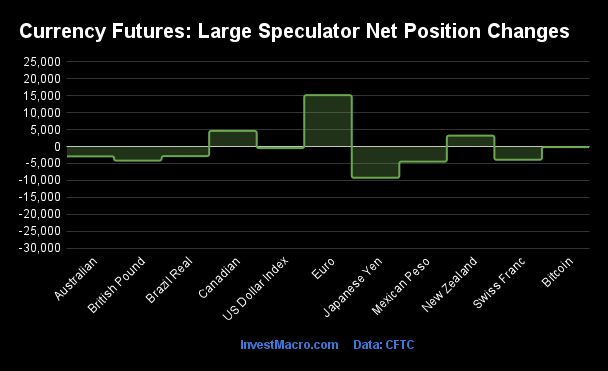
The COT currency market speculator bets were lower this week as three out of the eleven currency markets we cover had higher positioning while the other eight markets had lower speculator contracts.

Leading the gains for the currency markets was the British Pound (10,197 contracts) with the Swiss Franc (654 contracts) and Bitcoin (624 contracts) also recording positive weeks.

The currencies seeing declines in speculator bets on the week were the Australian Dollar (-15,583 contracts), the Euro (-14,785 contracts), the Mexican Peso (-6,837 contracts), the Canadian Dollar (-6,008 contracts), the US Dollar Index (-1,610 contracts), the New Zealand Dollar (-1,115 contracts), the Japanese Yen (-611 contracts) and with the Brazilian Real (-419 contracts) also seeing lower bets on the week.

Speculators drop their US Dollar Index bets to 133-week low

Highlighting the COT currency’s data this week is the continued decline of the speculator’s positioning in the US Dollar Index. The large speculative US Dollar Index positions fell this week for a fifth time out of the past six weeks. The speculator position has now seen an overall decrease by a total of -18,644 net contracts over this last six-week span.

This recent weakness has brought the US Dollar Index speculator net position (currently at a total of +1,300 contracts) to a 133-week low, dating back to June 29th of 2021 when the net position saw it’s last bearish reading at -448 contracts.

The Dollar Index is starting off 2024 on much weaker footing than the previous two years as expectations of peak interest rates in the US have weighed on the currency’s outlook. The Dollar Index’s speculator positioning started 2023 with a total of +17,761 contracts in the first week of trading and the average weekly speculator position over the whole of 2023 was +12,782 contracts. The first week of 2022 started even stronger with a net position of +39,078 contracts in the first week and the weekly average speculator position over the course of 2022 was +33,606 contracts.

The US Dollar Index price, despite the recent setback in speculator bets, has risen for two out of the past three weeks with an approximate gain by 1 percent this week. Since October, the USD Index has been on a downtrend and declined from an October high of 107.05 to the most recent low at 100.32 in late December. The USD Index price has come off that 100.00 support level and has now climbed back to the 103.07 level to close out this week.


Major Currencies – Speculators Leaderboard


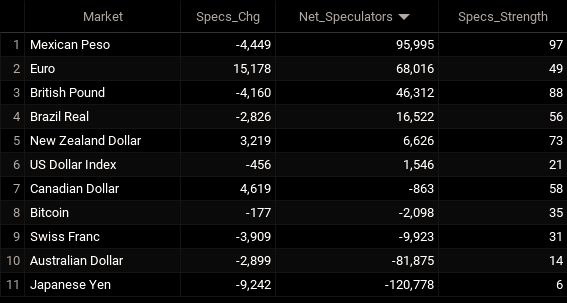
Legend: Weekly Speculators Change | Speculators Current Net Position | Speculators Strength Score compared to last 3-Years (0-100 range)


Strength Scores led by Mexican Peso & British Pound
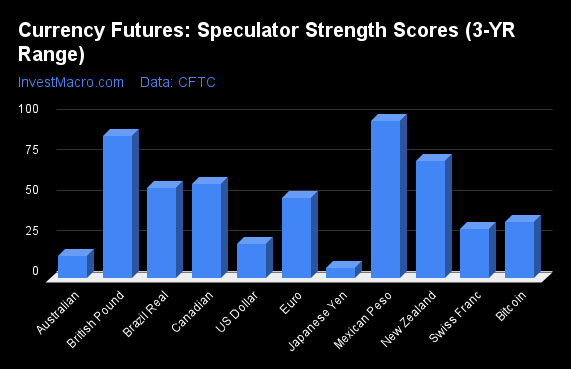
COT Strength Scores (a normalized measure of Speculator positions over a 3-Year range, from 0 to 100 where above 80 is Extreme-Bullish and below 20 is Extreme-Bearish) showed that the Mexican Peso (89 percent) and the British Pound (77 percent) lead the currency markets this week. The Brazilian Real (67 percent), EuroFX (65 percent) and Bitcoin (51 percent) come in as the next highest in the weekly strength scores.

On the downside, the US Dollar Index (27 percent) and the Japanese Yen (42 percent) come in at the lowest strength levels currently.

Strength Statistics:
US Dollar Index (27.0 percent) vs US Dollar Index previous week (29.6 percent)
EuroFX (64.6 percent) vs EuroFX previous week (70.9 percent)
British Pound Sterling (77.2 percent) vs British Pound Sterling previous week (70.2 percent)
Japanese Yen (42.1 percent) vs Japanese Yen previous week (42.4 percent)
Swiss Franc (47.9 percent) vs Swiss Franc previous week (46.1 percent)
Canadian Dollar (47.8 percent) vs Canadian Dollar previous week (52.9 percent)
Australian Dollar (44.9 percent) vs Australian Dollar previous week (59.2 percent)
New Zealand Dollar (47.9 percent) vs New Zealand Dollar previous week (50.8 percent)
Mexican Peso (88.9 percent) vs Mexican Peso previous week (93.1 percent)
Brazilian Real (66.5 percent) vs Brazilian Real previous week (67.1 percent)
Bitcoin (51.4 percent) vs Bitcoin previous week (42.1 percent)


Swiss Franc & Canadian Dollar top the 6-Week Strength Trends

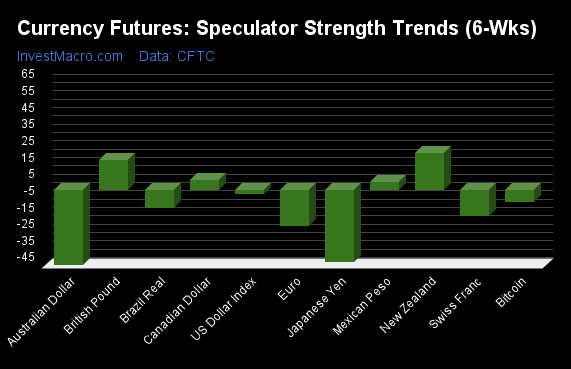
COT Strength Score Trends (or move index, calculates the 6-week changes in strength scores) showed that the Swiss Franc (40 percent) and the Canadian Dollar (37 percent) lead the past six weeks trends for the currencies. The New Zealand Dollar (35 percent), the Japanese Yen (28 percent) and Bitcoin (19 percent) are the next highest positive movers in the latest trends data.

The Brazilian Real (-33 percent) leads the downside trend scores currently with the US Dollar Index (-31 percent) and the EuroFX (-21 percent) following next with lower trend scores.

Strength Trend Statistics:
US Dollar Index (-31.2 percent) vs US Dollar Index previous week (-27.0 percent)
EuroFX (-20.6 percent) vs EuroFX previous week (-10.3 percent)
British Pound Sterling (13.4 percent) vs British Pound Sterling previous week (19.9 percent)
Japanese Yen (27.6 percent) vs Japanese Yen previous week (30.4 percent)
Swiss Franc (40.0 percent) vs Swiss Franc previous week (45.0 percent)
Canadian Dollar (37.3 percent) vs Canadian Dollar previous week (46.9 percent)
Australian Dollar (9.0 percent) vs Australian Dollar previous week (35.7 percent)
New Zealand Dollar (35.3 percent) vs New Zealand Dollar previous week (46.5 percent)
Mexican Peso (5.0 percent) vs Mexican Peso previous week (14.0 percent)
Brazilian Real (-33.1 percent) vs Brazilian Real previous week (-10.1 percent)
Bitcoin (18.9 percent) vs Bitcoin previous week (1.9 percent)


Individual COT Forex Markets:

US Dollar Index Futures:
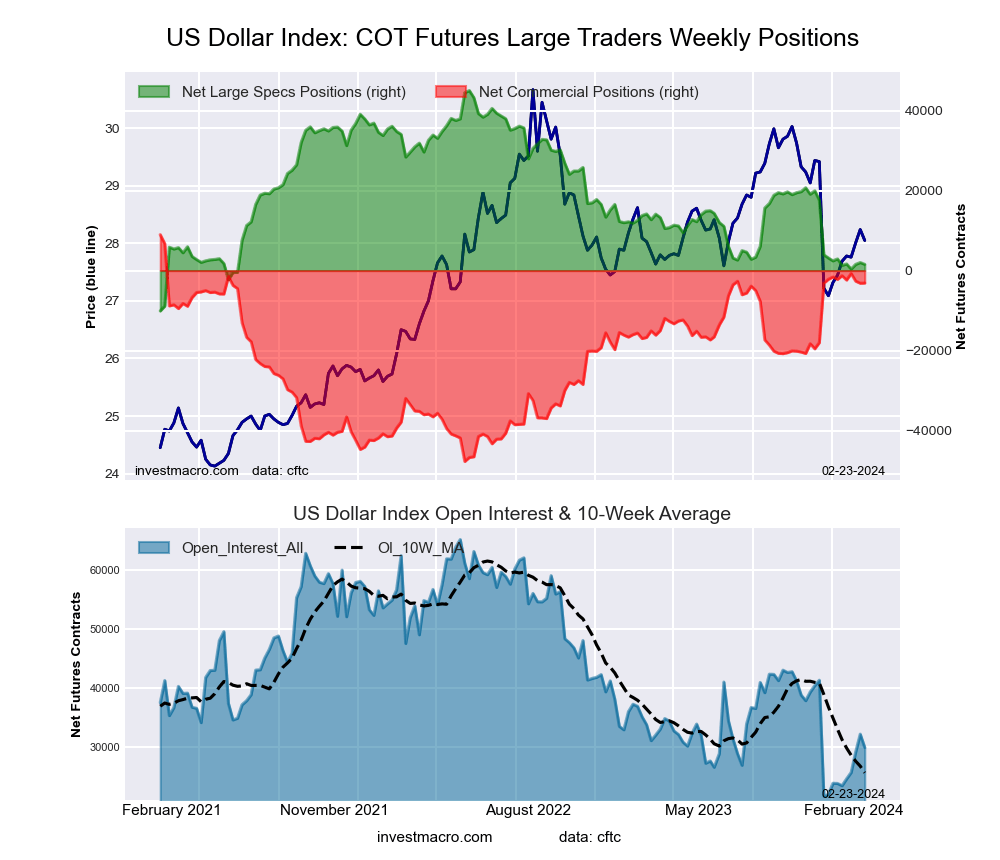
US Dollar Index Forex Futures COT ChartThe US Dollar Index large speculator standing this week came in at a net position of 1,300 contracts in the data reported through Tuesday. This was a weekly lowering of -1,610 contracts from the previous week which had a total of 2,910 net contracts.

This week’s current strength score (the trader positioning range over the past three years, measured from 0 to 100) shows the speculators are currently Bearish with a score of 27.0 percent. The commercials are Bullish with a score of 76.3 percent and the small traders (not shown in chart) are Bearish-Extreme with a score of 11.1 percent.

Price Trend-Following Model: Strong Downtrend

Our weekly trend-following model classifies the current market price position as: Strong Downtrend. The current action for the model is considered to be: Hold – Maintain Short Position.

US DOLLAR INDEX StatisticsSPECULATORSCOMMERCIALSSMALL TRADERS
– Percent of Open Interest Longs:64.216.711.8
– Percent of Open Interest Shorts:58.622.211.9
– Net Position:1,300-1,292-8
– Gross Longs:15,0773,9182,781
– Gross Shorts:13,7775,2102,789
– Long to Short Ratio:1.1 to 10.8 to 11.0 to 1
NET POSITION TREND:
– Strength Index Score (3 Year Range Pct):27.076.311.1
– Strength Index Reading (3 Year Range):BearishBullishBearish-Extreme
NET POSITION MOVEMENT INDEX:
– 6-Week Change in Strength Index:-31.230.04.4


Euro Currency Futures:

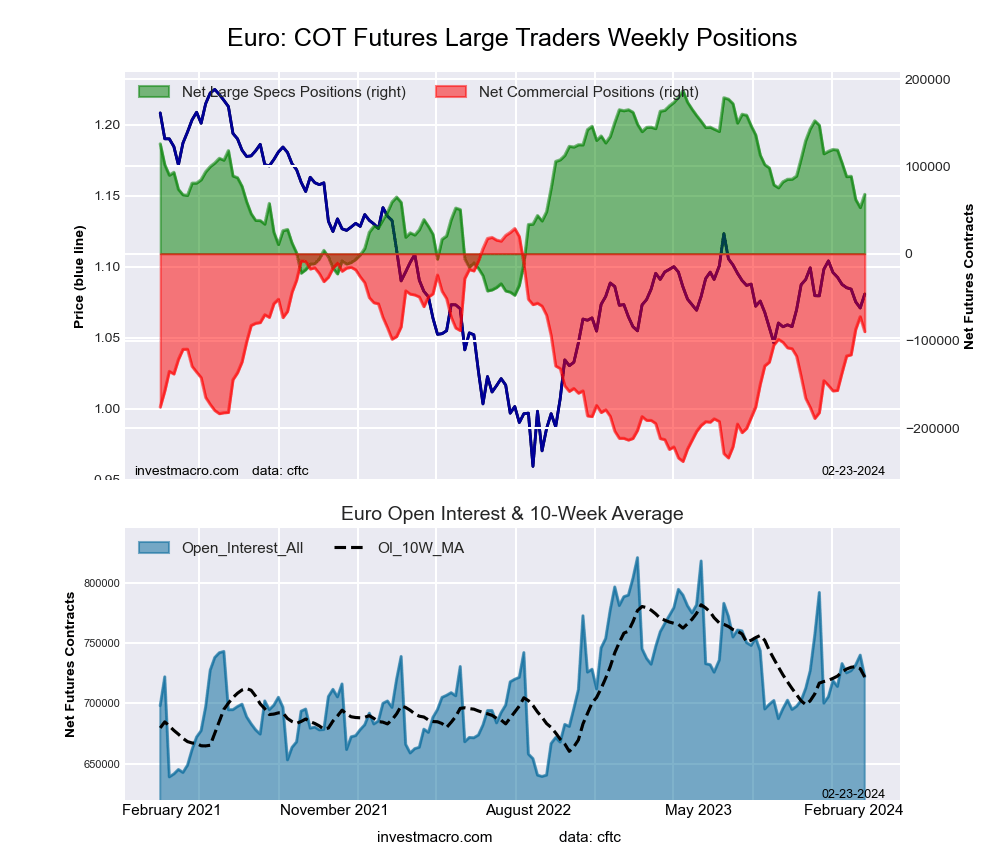
Euro Currency Futures COT ChartThe Euro Currency large speculator standing this week came in at a net position of 104,092 contracts in the data reported through Tuesday. This was a weekly lowering of -14,785 contracts from the previous week which had a total of 118,877 net contracts.

This week’s current strength score (the trader positioning range over the past three years, measured from 0 to 100) shows the speculators are currently Bullish with a score of 64.6 percent. The commercials are Bearish with a score of 38.1 percent and the small traders (not shown in chart) are Bearish with a score of 30.7 percent.

Price Trend-Following Model: Uptrend

Our weekly trend-following model classifies the current market price position as: Uptrend. The current action for the model is considered to be: Hold – Maintain Long Position.

EURO Currency StatisticsSPECULATORSCOMMERCIALSSMALL TRADERS
– Percent of Open Interest Longs:27.959.111.1
– Percent of Open Interest Shorts:13.777.86.6
– Net Position:104,092-136,51332,421
– Gross Longs:204,294433,57781,115
– Gross Shorts:100,202570,09048,694
– Long to Short Ratio:2.0 to 10.8 to 11.7 to 1
NET POSITION TREND:
– Strength Index Score (3 Year Range Pct):64.638.130.7
– Strength Index Reading (3 Year Range):BullishBearishBearish
NET POSITION MOVEMENT INDEX:
– 6-Week Change in Strength Index:-20.619.6-6.6


British Pound Sterling Futures:

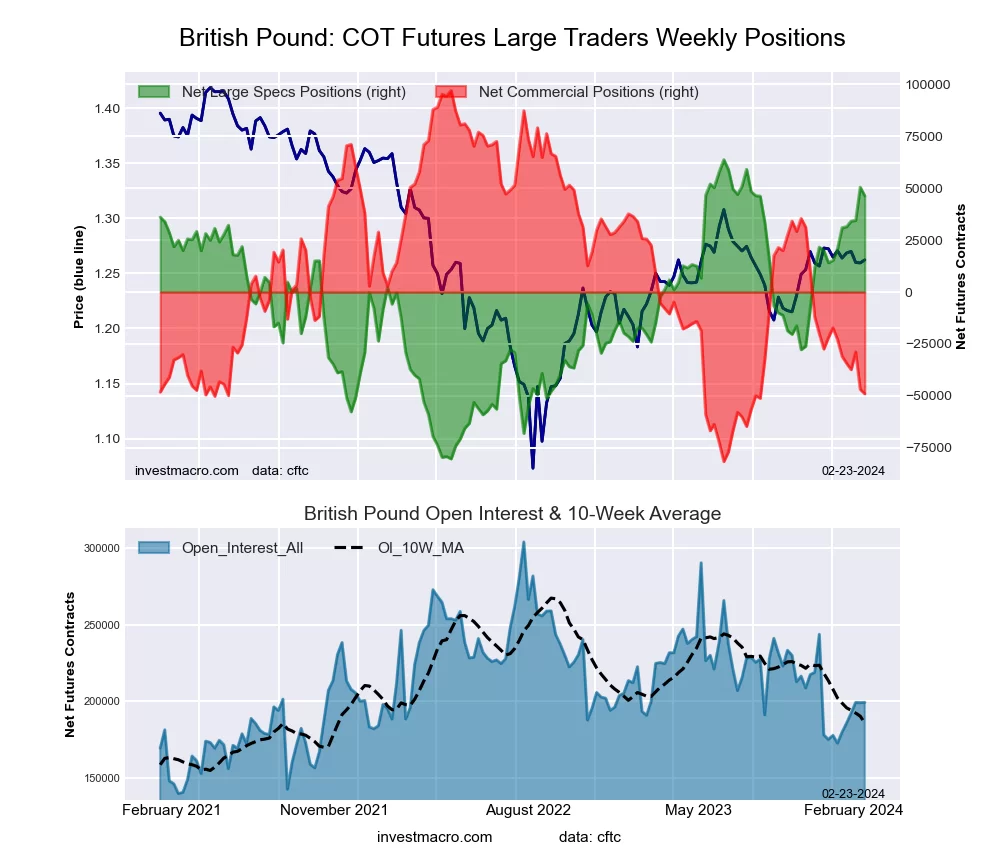
British Pound Sterling Futures COT ChartThe British Pound Sterling large speculator standing this week came in at a net position of 30,931 contracts in the data reported through Tuesday. This was a weekly rise of 10,197 contracts from the previous week which had a total of 20,734 net contracts.

This week’s current strength score (the trader positioning range over the past three years, measured from 0 to 100) shows the speculators are currently Bullish with a score of 77.2 percent. The commercials are Bearish with a score of 28.3 percent and the small traders (not shown in chart) are Bullish with a score of 58.1 percent.

Price Trend-Following Model: Uptrend

Our weekly trend-following model classifies the current market price position as: Uptrend. The current action for the model is considered to be: Hold – Maintain Long Position.

BRITISH POUND StatisticsSPECULATORSCOMMERCIALSSMALL TRADERS
– Percent of Open Interest Longs:36.841.416.5
– Percent of Open Interest Shorts:19.658.616.4
– Net Position:30,931-30,98049
– Gross Longs:66,23074,43829,608
– Gross Shorts:35,299105,41829,559
– Long to Short Ratio:1.9 to 10.7 to 11.0 to 1
NET POSITION TREND:
– Strength Index Score (3 Year Range Pct):77.228.358.1
– Strength Index Reading (3 Year Range):BullishBearishBullish
NET POSITION MOVEMENT INDEX:
– 6-Week Change in Strength Index:13.4-10.6-0.5


Japanese Yen Futures:

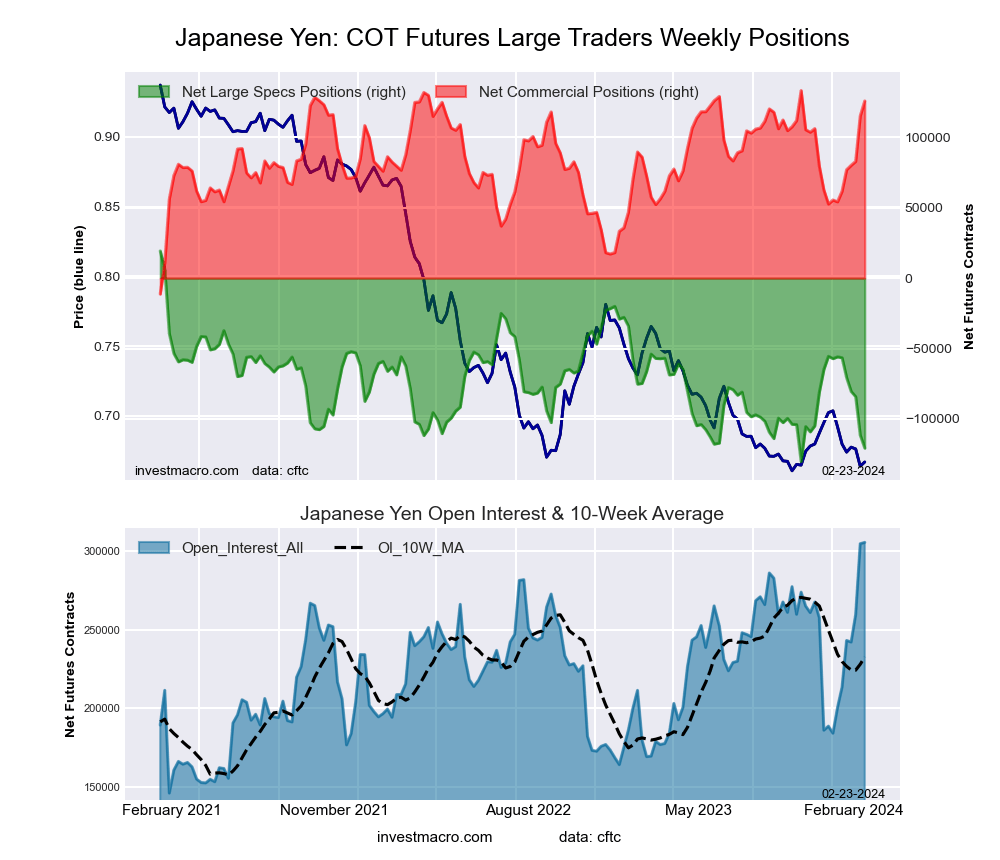
Japanese Yen Forex Futures COT ChartThe Japanese Yen large speculator standing this week came in at a net position of -56,560 contracts in the data reported through Tuesday. This was a weekly lowering of -611 contracts from the previous week which had a total of -55,949 net contracts.

This week’s current strength score (the trader positioning range over the past three years, measured from 0 to 100) shows the speculators are currently Bearish with a score of 42.1 percent. The commercials are Bullish with a score of 63.3 percent and the small traders (not shown in chart) are Bearish with a score of 49.3 percent.

Price Trend-Following Model: Weak Uptrend

Our weekly trend-following model classifies the current market price position as: Weak Uptrend. The current action for the model is considered to be: Hold – Maintain Long Position.

JAPANESE YEN StatisticsSPECULATORSCOMMERCIALSSMALL TRADERS
– Percent of Open Interest Longs:20.758.618.0
– Percent of Open Interest Shorts:47.229.720.4
– Net Position:-56,56061,724-5,164
– Gross Longs:44,180125,04838,443
– Gross Shorts:100,74063,32443,607
– Long to Short Ratio:0.4 to 12.0 to 10.9 to 1
NET POSITION TREND:
– Strength Index Score (3 Year Range Pct):42.163.349.3
– Strength Index Reading (3 Year Range):BearishBullishBearish
NET POSITION MOVEMENT INDEX:
– 6-Week Change in Strength Index:27.6-22.8-9.1


Swiss Franc Futures:

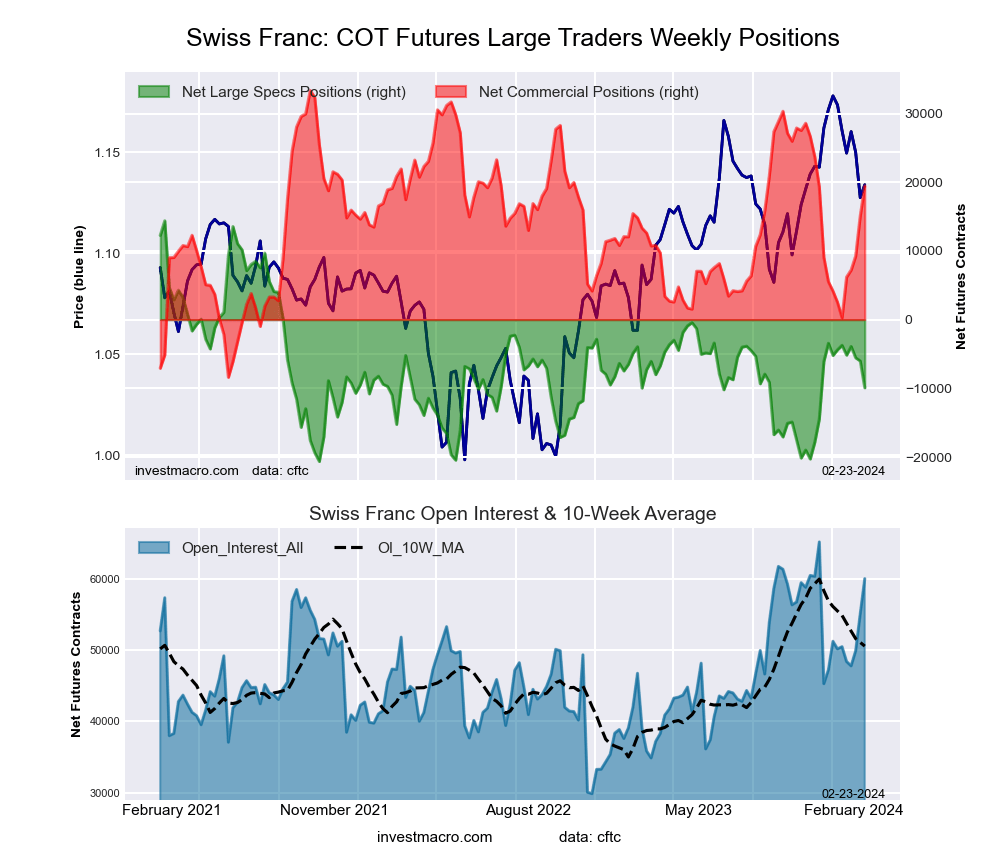
Swiss Franc Forex Futures COT ChartThe Swiss Franc large speculator standing this week came in at a net position of -3,738 contracts in the data reported through Tuesday. This was a weekly lift of 654 contracts from the previous week which had a total of -4,392 net contracts.

This week’s current strength score (the trader positioning range over the past three years, measured from 0 to 100) shows the speculators are currently Bearish with a score of 47.9 percent. The commercials are Bearish with a score of 38.6 percent and the small traders (not shown in chart) are Bullish with a score of 74.6 percent.

Price Trend-Following Model: Uptrend

Our weekly trend-following model classifies the current market price position as: Uptrend. The current action for the model is considered to be: Hold – Maintain Long Position.

SWISS FRANC StatisticsSPECULATORSCOMMERCIALSSMALL TRADERS
– Percent of Open Interest Longs:21.144.533.9
– Percent of Open Interest Shorts:28.543.927.0
– Net Position:-3,7382733,465
– Gross Longs:10,62722,45017,114
– Gross Shorts:14,36522,17713,649
– Long to Short Ratio:0.7 to 11.0 to 11.3 to 1
NET POSITION TREND:
– Strength Index Score (3 Year Range Pct):47.938.674.6
– Strength Index Reading (3 Year Range):BearishBearishBullish
NET POSITION MOVEMENT INDEX:
– 6-Week Change in Strength Index:40.0-43.534.0


Canadian Dollar Futures:

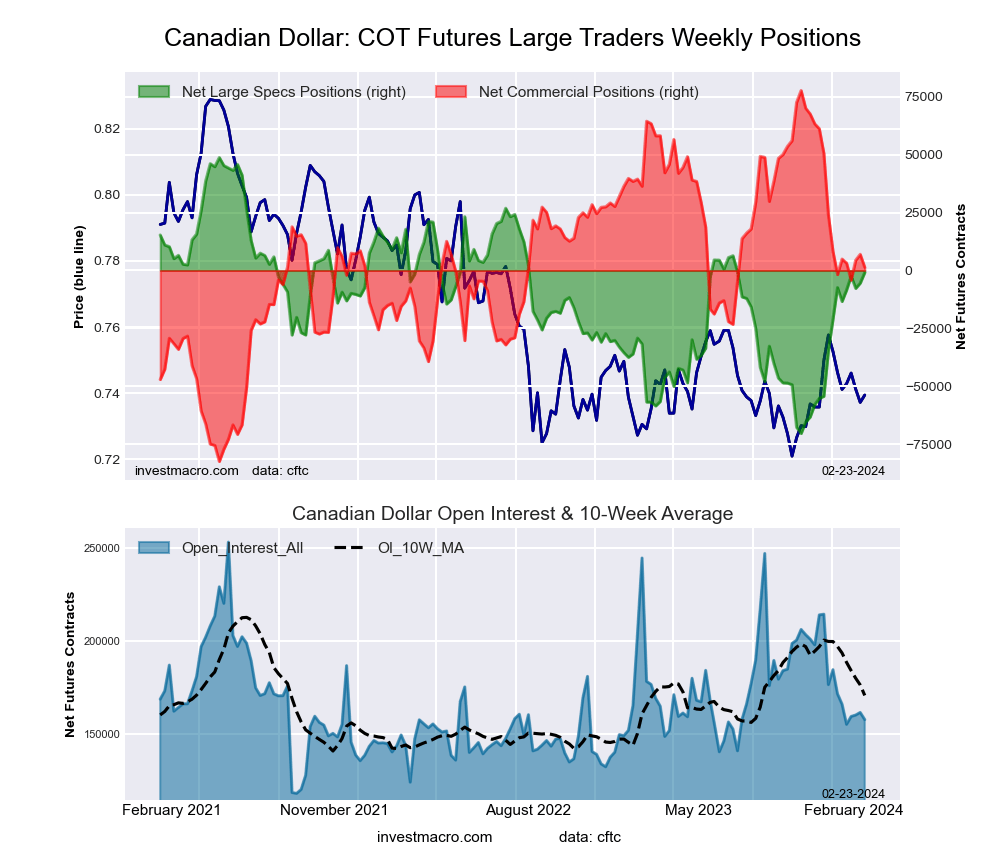
Canadian Dollar Forex Futures COT ChartThe Canadian Dollar large speculator standing this week came in at a net position of -13,388 contracts in the data reported through Tuesday. This was a weekly lowering of -6,008 contracts from the previous week which had a total of -7,380 net contracts.

This week’s current strength score (the trader positioning range over the past three years, measured from 0 to 100) shows the speculators are currently Bearish with a score of 47.8 percent. The commercials are Bullish with a score of 54.6 percent and the small traders (not shown in chart) are Bearish with a score of 41.6 percent.

Price Trend-Following Model: Uptrend

Our weekly trend-following model classifies the current market price position as: Uptrend. The current action for the model is considered to be: Hold – Maintain Long Position.

CANADIAN DOLLAR StatisticsSPECULATORSCOMMERCIALSSMALL TRADERS
– Percent of Open Interest Longs:23.355.319.8
– Percent of Open Interest Shorts:31.452.314.7
– Net Position:-13,3884,9288,460
– Gross Longs:38,73891,78332,870
– Gross Shorts:52,12686,85524,410
– Long to Short Ratio:0.7 to 11.1 to 11.3 to 1
NET POSITION TREND:
– Strength Index Score (3 Year Range Pct):47.854.641.6
– Strength Index Reading (3 Year Range):BearishBullishBearish
NET POSITION MOVEMENT INDEX:
– 6-Week Change in Strength Index:37.3-36.430.9


Australian Dollar Futures:

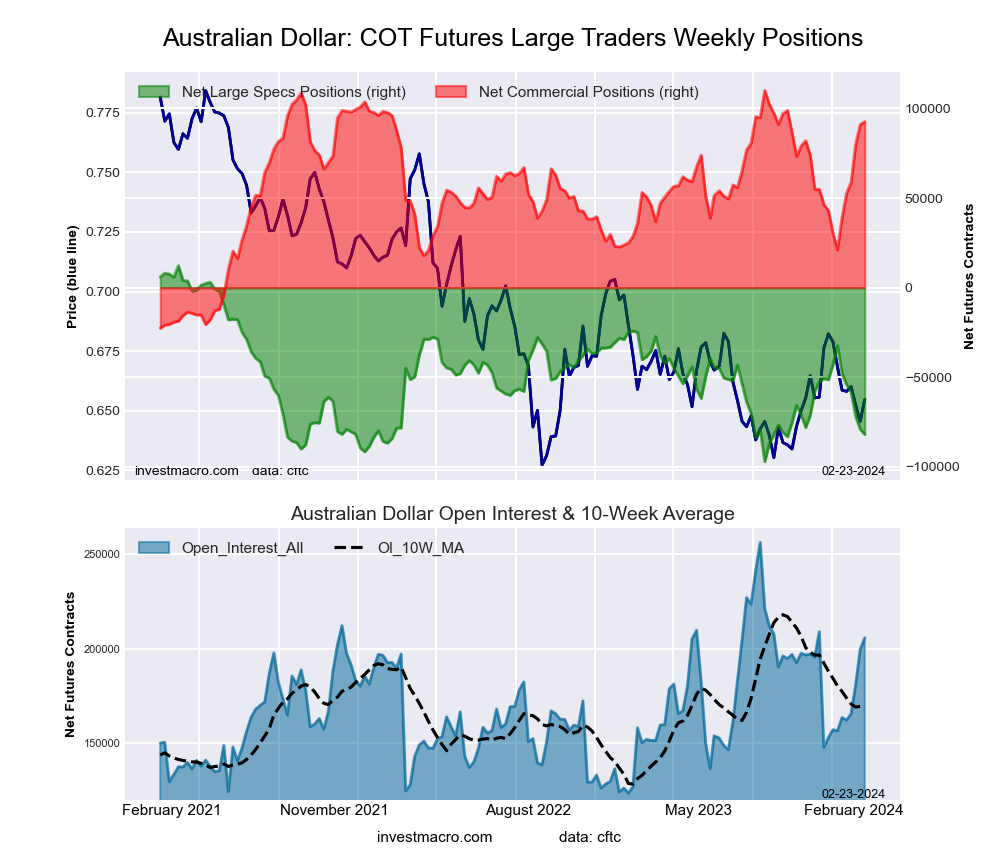
Australian Dollar Forex Futures COT ChartThe Australian Dollar large speculator standing this week came in at a net position of -47,857 contracts in the data reported through Tuesday. This was a weekly decline of -15,583 contracts from the previous week which had a total of -32,274 net contracts.

This week’s current strength score (the trader positioning range over the past three years, measured from 0 to 100) shows the speculators are currently Bearish with a score of 44.9 percent. The commercials are Bearish with a score of 46.5 percent and the small traders (not shown in chart) are Bullish with a score of 73.9 percent.

Price Trend-Following Model: Uptrend

Our weekly trend-following model classifies the current market price position as: Uptrend. The current action for the model is considered to be: Hold – Maintain Long Position.

AUSTRALIAN DOLLAR StatisticsSPECULATORSCOMMERCIALSSMALL TRADERS
– Percent of Open Interest Longs:28.051.316.5
– Percent of Open Interest Shorts:57.327.511.1
– Net Position:-47,85739,0448,813
– Gross Longs:45,81283,91126,937
– Gross Shorts:93,66944,86718,124
– Long to Short Ratio:0.5 to 11.9 to 11.5 to 1
NET POSITION TREND:
– Strength Index Score (3 Year Range Pct):44.946.573.9
– Strength Index Reading (3 Year Range):BearishBearishBullish
NET POSITION MOVEMENT INDEX:
– 6-Week Change in Strength Index:9.0-12.014.7


New Zealand Dollar Futures:

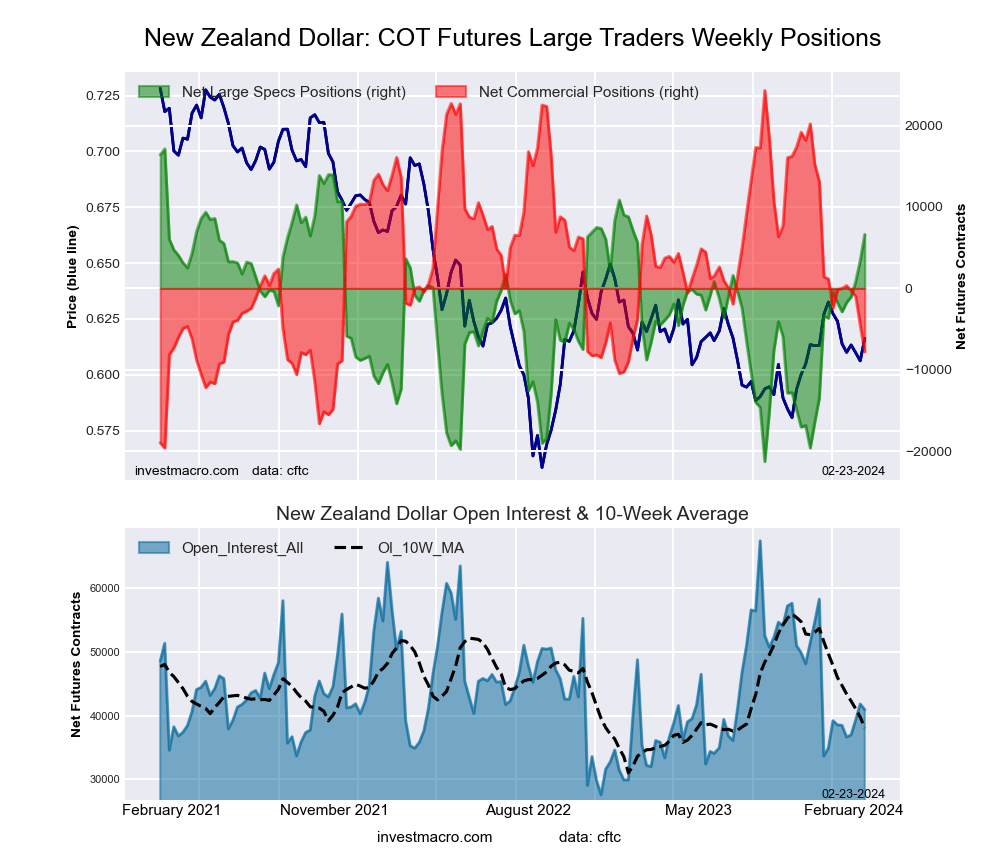
New Zealand Dollar Forex Futures COT ChartThe New Zealand Dollar large speculator standing this week came in at a net position of -2,882 contracts in the data reported through Tuesday. This was a weekly fall of -1,115 contracts from the previous week which had a total of -1,767 net contracts.

This week’s current strength score (the trader positioning range over the past three years, measured from 0 to 100) shows the speculators are currently Bearish with a score of 47.9 percent. The commercials are Bearish with a score of 44.7 percent and the small traders (not shown in chart) are Bullish-Extreme with a score of 85.1 percent.

Price Trend-Following Model: Uptrend

Our weekly trend-following model classifies the current market price position as: Uptrend. The current action for the model is considered to be: Hold – Maintain Long Position.

NEW ZEALAND DOLLAR StatisticsSPECULATORSCOMMERCIALSSMALL TRADERS
– Percent of Open Interest Longs:37.942.115.8
– Percent of Open Interest Shorts:45.442.18.3
– Net Position:-2,882-12,883
– Gross Longs:14,59216,2036,094
– Gross Shorts:17,47416,2043,211
– Long to Short Ratio:0.8 to 11.0 to 11.9 to 1
NET POSITION TREND:
– Strength Index Score (3 Year Range Pct):47.944.785.1
– Strength Index Reading (3 Year Range):BearishBearishBullish-Extreme
NET POSITION MOVEMENT INDEX:
– 6-Week Change in Strength Index:35.3-34.719.8


Mexican Peso Futures:

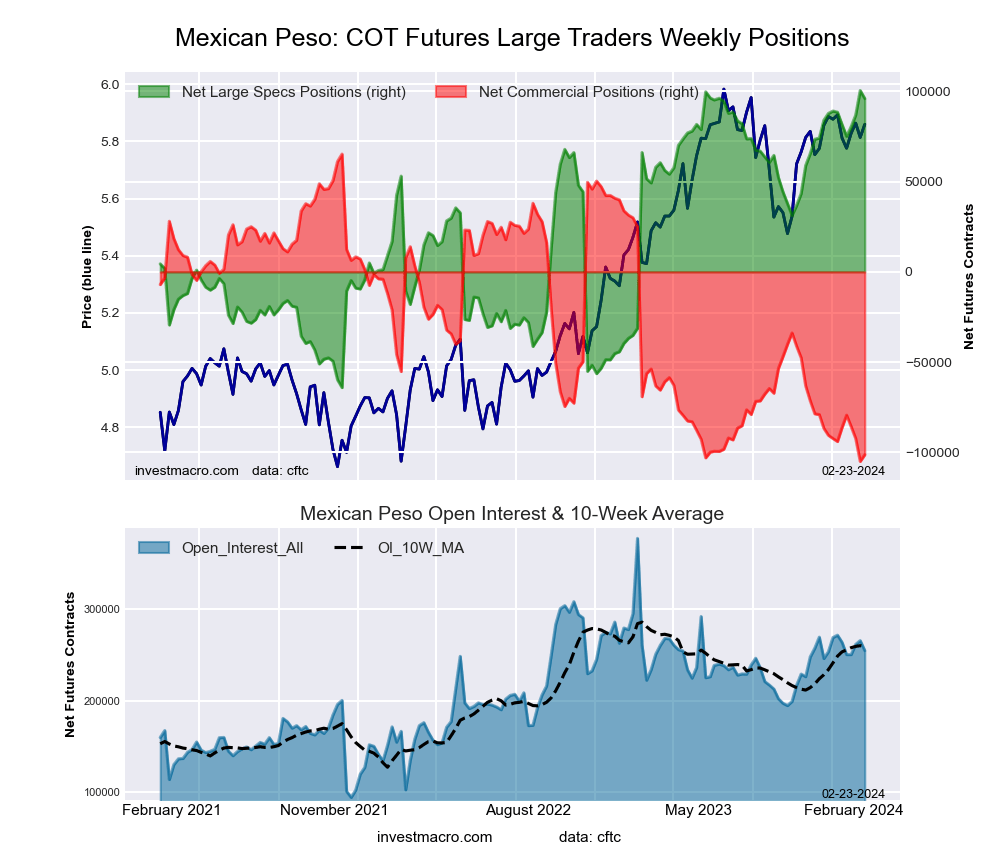
Mexican Peso Futures COT ChartThe Mexican Peso large speculator standing this week came in at a net position of 81,602 contracts in the data reported through Tuesday. This was a weekly decrease of -6,837 contracts from the previous week which had a total of 88,439 net contracts.

This week’s current strength score (the trader positioning range over the past three years, measured from 0 to 100) shows the speculators are currently Bullish-Extreme with a score of 88.9 percent. The commercials are Bearish-Extreme with a score of 10.0 percent and the small traders (not shown in chart) are Bearish with a score of 41.0 percent.

Price Trend-Following Model: Uptrend

Our weekly trend-following model classifies the current market price position as: Uptrend. The current action for the model is considered to be: Hold – Maintain Long Position.

MEXICAN PESO StatisticsSPECULATORSCOMMERCIALSSMALL TRADERS
– Percent of Open Interest Longs:50.743.72.9
– Percent of Open Interest Shorts:19.876.41.1
– Net Position:81,602-86,2714,669
– Gross Longs:133,691115,0507,623
– Gross Shorts:52,089201,3212,954
– Long to Short Ratio:2.6 to 10.6 to 12.6 to 1
NET POSITION TREND:
– Strength Index Score (3 Year Range Pct):88.910.041.0
– Strength Index Reading (3 Year Range):Bullish-ExtremeBearish-ExtremeBearish
NET POSITION MOVEMENT INDEX:
– 6-Week Change in Strength Index:5.0-4.5-3.3


Brazilian Real Futures:

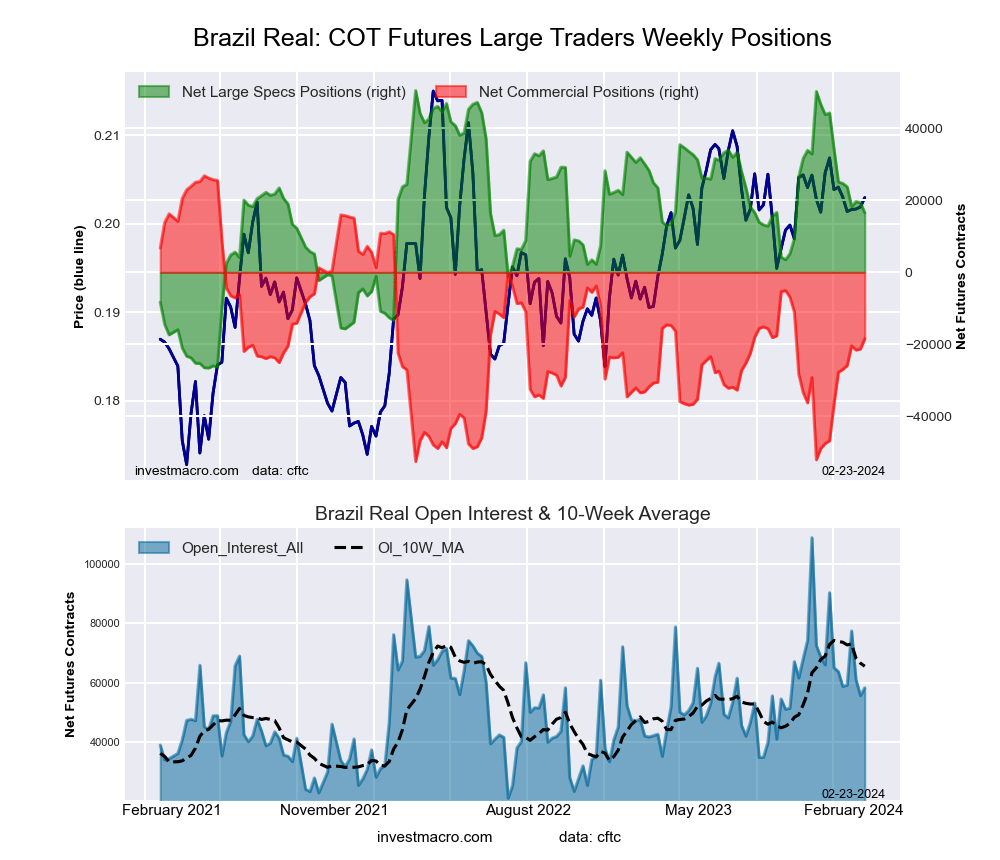
Brazil Real Futures COT ChartThe Brazilian Real large speculator standing this week came in at a net position of 24,695 contracts in the data reported through Tuesday. This was a weekly lowering of -419 contracts from the previous week which had a total of 25,114 net contracts.

This week’s current strength score (the trader positioning range over the past three years, measured from 0 to 100) shows the speculators are currently Bullish with a score of 66.5 percent. The commercials are Bearish with a score of 32.2 percent and the small traders (not shown in chart) are Bullish with a score of 55.7 percent.

Price Trend-Following Model: Uptrend

Our weekly trend-following model classifies the current market price position as: Uptrend. The current action for the model is considered to be: Hold – Maintain Long Position.

BRAZIL REAL StatisticsSPECULATORSCOMMERCIALSSMALL TRADERS
– Percent of Open Interest Longs:67.124.96.3
– Percent of Open Interest Shorts:25.170.82.5
– Net Position:24,695-26,9772,282
– Gross Longs:39,44114,6223,731
– Gross Shorts:14,74641,5991,449
– Long to Short Ratio:2.7 to 10.4 to 12.6 to 1
NET POSITION TREND:
– Strength Index Score (3 Year Range Pct):66.532.255.7
– Strength Index Reading (3 Year Range):BullishBearishBullish
NET POSITION MOVEMENT INDEX:
– 6-Week Change in Strength Index:-33.131.64.1


Bitcoin Futures:

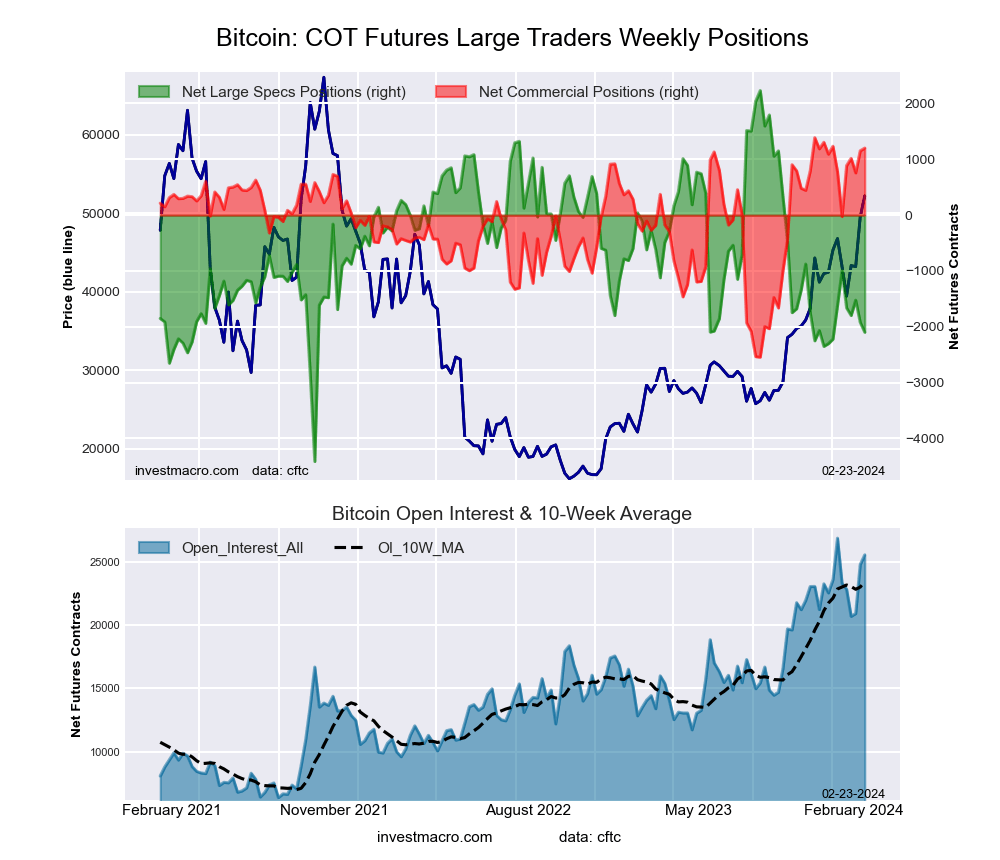
Bitcoin Crypto Futures COT ChartThe Bitcoin large speculator standing this week came in at a net position of -994 contracts in the data reported through Tuesday. This was a weekly advance of 624 contracts from the previous week which had a total of -1,618 net contracts.

This week’s current strength score (the trader positioning range over the past three years, measured from 0 to 100) shows the speculators are currently Bullish with a score of 51.4 percent. The commercials are Bullish with a score of 64.1 percent and the small traders (not shown in chart) are Bearish with a score of 36.1 percent.

Price Trend-Following Model: Uptrend

Our weekly trend-following model classifies the current market price position as: Uptrend. The current action for the model is considered to be: Hold – Maintain Long Position.

BITCOIN StatisticsSPECULATORSCOMMERCIALSSMALL TRADERS
– Percent of Open Interest Longs:75.55.87.5
– Percent of Open Interest Shorts:79.86.03.1
– Net Position:-994-251,019
– Gross Longs:17,5771,3611,747
– Gross Shorts:18,5711,386728
– Long to Short Ratio:0.9 to 11.0 to 12.4 to 1
NET POSITION TREND:
– Strength Index Score (3 Year Range Pct):51.464.136.1
– Strength Index Reading (3 Year Range):BullishBullishBearish
NET POSITION MOVEMENT INDEX:
– 6-Week Change in Strength Index:18.9-35.93.5


Article By InvestMacroReceive our weekly COT Newsletter

*COT Report: The COT data, released weekly to the public each Friday, is updated through the most recent Tuesday (data is 3 days old) and shows a quick view of how large speculators or non-commercials (for-profit traders) were positioned in the futures markets.

The CFTC categorizes trader positions according to commercial hedgers (traders who use futures contracts for hedging as part of the business), non-commercials (large traders who speculate to realize trading profits) and nonreportable traders (usually small traders/speculators) as well as their open interest (contracts open in the market at time of reporting). See CFTC criteria here.


Speculator Extremes: SOFR-3M, Nasdaq, Corn & Soybeans lead Bullish & Bearish Positions

By InvestMacro 

The latest update for the weekly Commitment of Traders (COT) report was released by the Commodity Futures Trading Commission (CFTC) on Friday for data ending on January 16th.

This weekly Extreme Positions report highlights the Most Bullish and Most Bearish Positions for the speculator category. Extreme positioning in these markets can foreshadow strong moves in the underlying market.

To signify an extreme position, we use the Strength Index (also known as the COT Index) of each instrument, a common method of measuring COT data. The Strength Index is simply a comparison of current trader positions against the range of positions over the previous 3 years. We use over 80 percent as extremely bullish and under 20 percent as extremely bearish. (Compare Strength Index scores across all markets in the data table or cot leaders table)


Here Are This Week’s Most Bullish Speculator Positions:

3-Month Secured Overnight Financing Rate


The 3-Month Secured Overnight Financing Rate speculator position comes in as the most bullish extreme standing this week. The 3-Month Secured Overnight Financing Rate speculator level is currently at a 100.0 percent score of its 3-year range.

The six-week trend for the percent strength score totaled 12.5 this week. The overall net speculator position was a total of 751,218 net contracts this week with a gain of 65,855 contract in the weekly speculator bets.


Speculators or Non-Commercials Notes:

Speculators, classified as non-commercial traders by the CFTC, are made up of large commodity funds, hedge funds and other significant for-profit participants. The Specs are generally regarded as trend-followers in their behavior towards price action – net speculator bets and prices tend to go in the same directions. These traders often look to buy when prices are rising and sell when prices are falling. To illustrate this point, many times speculator contracts can be found at their most extremes (bullish or bearish) when prices are also close to their highest or lowest levels.

These extreme levels can be dangerous for the large speculators as the trade is most crowded, there is less trading ammunition still sitting on the sidelines to push the trend further and prices have moved a significant distance. When the trend becomes exhausted, some speculators take profits while others look to also exit positions when prices fail to continue in the same direction. This process usually plays out over many months to years and can ultimately create a reverse effect where prices start to fall and speculators start a process of selling when prices are falling.


1-Month Secured Overnight Financing Rate

The 1-Month Secured Overnight Financing Rate speculator position comes next in the extreme standings this week. The 1-Month Secured Overnight Financing Rate speculator level is now at a 100.0 percent score of its 3-year range.

The six-week trend for the percent strength score was 10.8 this week. The speculator position registered 127,917 net contracts this week with a weekly change of 16,634 contracts in speculator bets.


Nasdaq


The Nasdaq speculator position comes in third this week in the extreme standings. The Nasdaq speculator level resides at a 95.2 percent score of its 3-year range.

The six-week trend for the speculator strength score came in at 43.4 this week. The overall speculator position was 36,571 net contracts this week with an edge lower by -205 contracts in the weekly speculator bets.


Russell 2000 Mini


The Russell 2000 Mini speculator position comes up number four in the extreme standings this week. The Russell 2000 Mini speculator level is at a 95.2 percent score of its 3-year range.

The six-week trend for the speculator strength score totaled a change of 49.4 this week. The overall speculator position was 14,245 net contracts this week with a retreat by -6,767 contracts in the speculator bets.


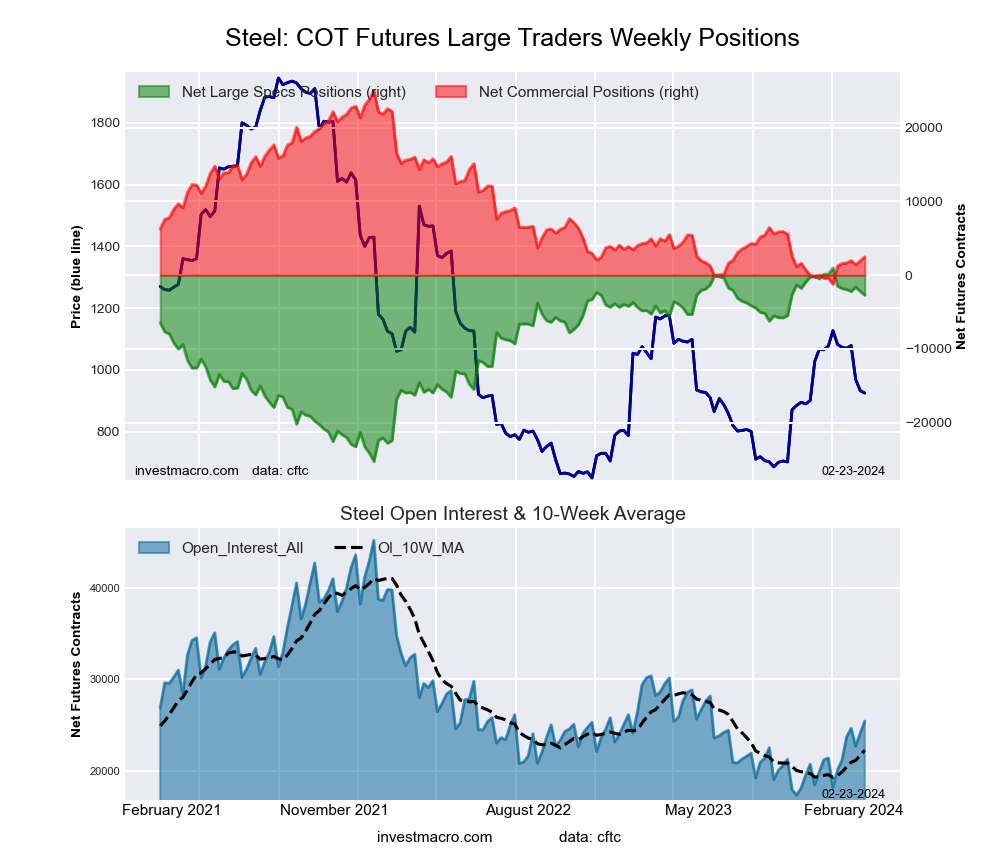
Steel


The Steel speculator position rounds out the top five in this week’s bullish extreme standings. The Steel speculator level sits at a 89.5 percent score of its 3-year range. The six-week trend for the speculator strength score was -6.2 this week.

The speculator position was -1,793 net contracts this week with a dip of -316 contracts in the weekly speculator bets.


This Week’s Most Bearish Speculator Positions:

Corn


The Corn speculator position comes in as the most bearish extreme standing this week. The Corn speculator level is at a 0.0 percent score of its 3-year range.

The six-week trend for the speculator strength score was -14.3 this week. The overall speculator position was -219,968 net contracts this week with a fall by -46,935 contracts in the speculator bets.


Soybeans


The Soybeans speculator position comes in next for the most bearish extreme standing on the week. The Soybeans speculator level is at a 0.0 percent score of its 3-year range.

The six-week trend for the speculator strength score was -33.1 this week. The speculator position was -93,668 net contracts this week with a decrease of -55,619 contracts in the weekly speculator bets.


10-Year Note


The 10-Year Note speculator position comes in as third most bearish extreme standing of the week. The 10-Year Note speculator level resides at a 0.0 percent score of its 3-year range.

The six-week trend for the speculator strength score was -23.6 this week. The overall speculator position was -889,385 net contracts this week with a drop of -102,365 contracts in the speculator bets.


Soybean Meal


The Soybean Meal speculator position comes in as this week’s fourth most bearish extreme standing. The Soybean Meal speculator level is at a 0.0 percent score of its 3-year range.

The six-week trend for the speculator strength score was -67.9 this week. The speculator position was -11,242 net contracts this week with a decline of -8,752 contracts in the weekly speculator bets.


Palladium


Finally, the Palladium speculator position comes in as the fifth most bearish extreme standing for this week. The Palladium speculator level is at a 0.3 percent score of its 3-year range.

The six-week trend for the speculator strength score was -1.4 this week. The speculator position was -11,449 net contracts this week with a drop of -1,977 contracts in the weekly speculator bets.


Article By InvestMacroReceive our weekly COT Newsletter

*COT Report: The COT data, released weekly to the public each Friday, is updated through the most recent Tuesday (data is 3 days old) and shows a quick view of how large speculators or non-commercials (for-profit traders) were positioned in the futures markets.

The CFTC categorizes trader positions according to commercial hedgers (traders who use futures contracts for hedging as part of the business), non-commercials (large traders who speculate to realize trading profits) and nonreportable traders (usually small traders/speculators) as well as their open interest (contracts open in the market at time of reporting). See CFTC criteria here.

COT Metals Charts: Speculator Bets fall this week led by Copper & Platinum

By InvestMacro

Here are the latest charts and statistics for the Commitment of Traders (COT) data published by the Commodities Futures Trading Commission (CFTC).

The latest COT data is updated through Tuesday January 16th and shows a quick view of how large traders (for-profit speculators and commercial entities) were positioned in the futures markets.

Weekly Speculator Bets fall this week led by Copper & Platinum

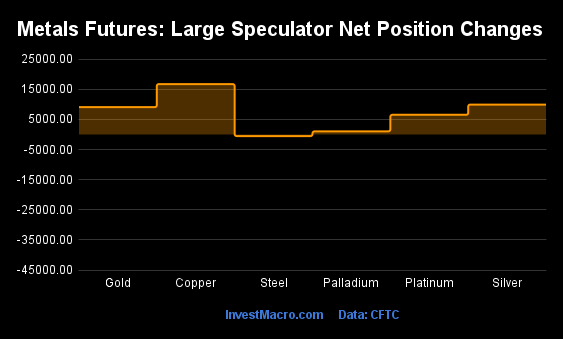
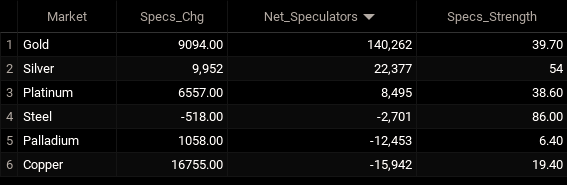
The COT metals markets speculator bets were lower this week as all six metals markets we cover had lower speculator contracts.

Leading the declines in speculator bets for the week were Copper (-12,139 contracts), Platinum (-10,984 contracts), Gold (-8,721 contracts), Palladium (-1,977 contracts), Silver (-769 contracts) and with Steel (-316 contracts) also seeing lower bets on the week.


Major Metals – Speculators Leaderboard

Legend: Weekly Speculators Change | Speculators Current Net Position | Speculators Strength Score compared to last 3-Years (0-100 range)


Strength Scores led by Steel & Gold

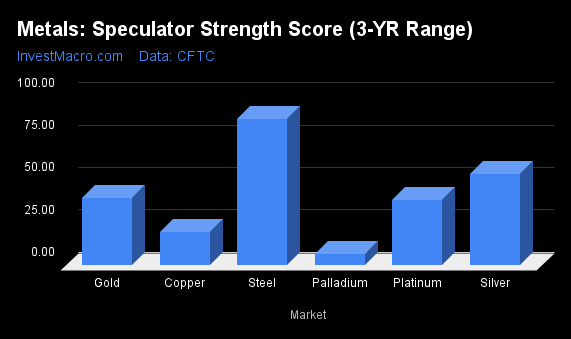
COT Strength Scores (a normalized measure of Speculator positions over a 3-Year range, from 0 to 100 where above 80 is Extreme-Bullish and below 20 is Extreme-Bearish) showed that Steel (89 percent) and Gold (57 percent) lead the metals markets this week. comes in as the next highest in the weekly strength scores.

On the downside, Palladium (0 percent) and Copper (9 percent) come in at the lowest strength levels currently and are in Extreme-Bearish territory (below 20 percent).

Strength Statistics:
Gold (57.5 percent) vs Gold previous week (61.4 percent)
Silver (57.1 percent) vs Silver previous week (58.2 percent)
Copper (9.4 percent) vs Copper previous week (20.3 percent)
Platinum (44.6 percent) vs Platinum previous week (69.9 percent)
Palladium (0.3 percent) vs Palladium previous week (13.9 percent)
Steel (89.5 percent) vs Palladium previous week (90.7 percent)


Platinum & Palladium top the 6-Week Strength Trends

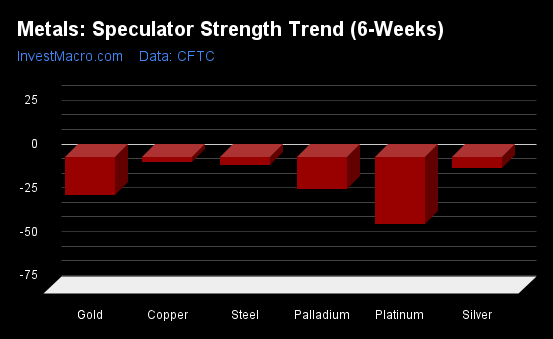
COT Strength Score Trends (or move index, calculates the 6-week changes in strength scores) showed that Platinum (17 percent) and Palladium (-1 percent) lead the past six weeks trends for metals. Silver (-16 percent) is the next highest positive mover in the latest trends data.

Gold (-11 percent) leads the downside trend scores currently with Copper (-21 percent) as the next market with lower trend scores.

Move Statistics:
Gold (-10.6 percent) vs Gold previous week (-5.2 percent)
Silver (-15.9 percent) vs Silver previous week (-11.8 percent)
Copper (-21.0 percent) vs Copper previous week (-8.4 percent)
Platinum (17.1 percent) vs Platinum previous week (31.2 percent)
Palladium (-1.4 percent) vs Palladium previous week (4.8 percent)
Steel (-6.2 percent) vs Steel previous week (-4.7 percent)


Individual Markets:

Gold Comex Futures:

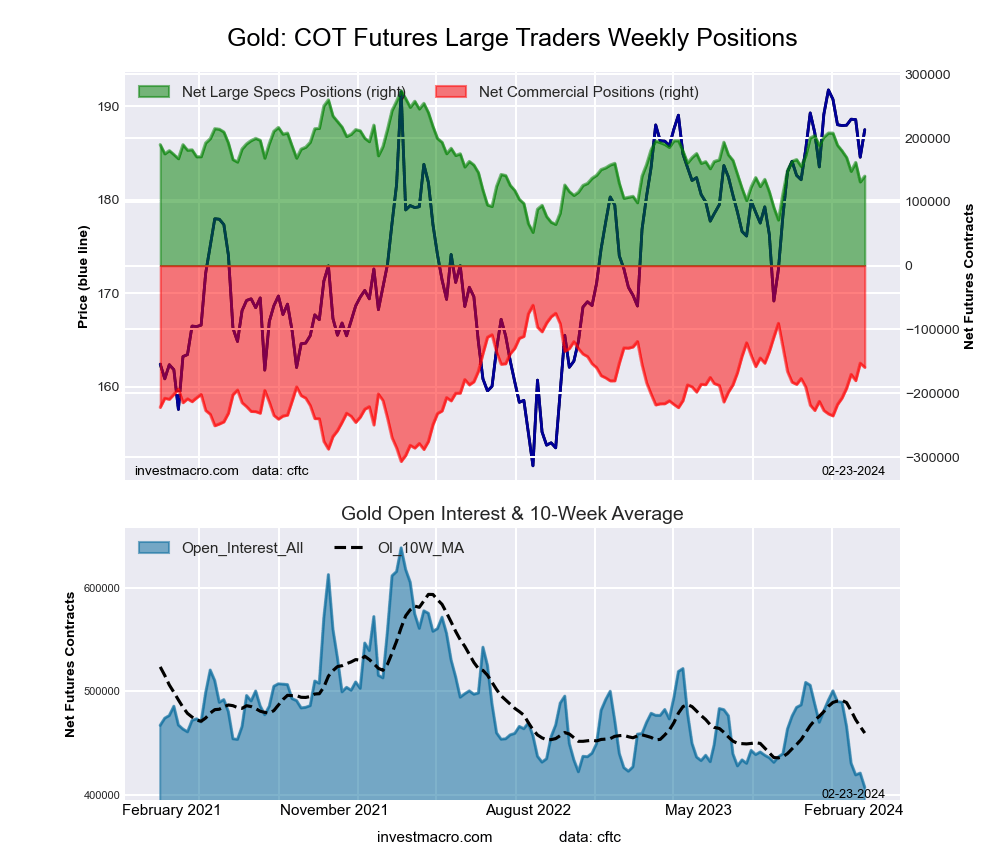
Gold Futures COT ChartThe Gold Comex Futures large speculator standing this week totaled a net position of 179,893 contracts in the data reported through Tuesday. This was a weekly decrease of -8,721 contracts from the previous week which had a total of 188,614 net contracts.

This week’s current strength score (the trader positioning range over the past three years, measured from 0 to 100) shows the speculators are currently Bullish with a score of 57.5 percent. The commercials are Bearish with a score of 40.7 percent and the small traders (not shown in chart) are Bullish with a score of 58.4 percent.

Price Trend-Following Model: Uptrend

Our weekly trend-following model classifies the current market price position as: Uptrend. The current action for the model is considered to be: Hold – Maintain Long Position.

Gold Futures StatisticsSPECULATORSCOMMERCIALSSMALL TRADERS
– Percent of Open Interest Longs:53.622.310.1
– Percent of Open Interest Shorts:16.964.74.5
– Net Position:179,893-207,42027,527
– Gross Longs:262,360109,28749,640
– Gross Shorts:82,467316,70722,113
– Long to Short Ratio:3.2 to 10.3 to 12.2 to 1
NET POSITION TREND:
– Strength Index Score (3 Year Range Pct):57.540.758.4
– Strength Index Reading (3 Year Range):BullishBearishBullish
NET POSITION MOVEMENT INDEX:
– 6-Week Change in Strength Index:-10.68.012.4


Silver Comex Futures:

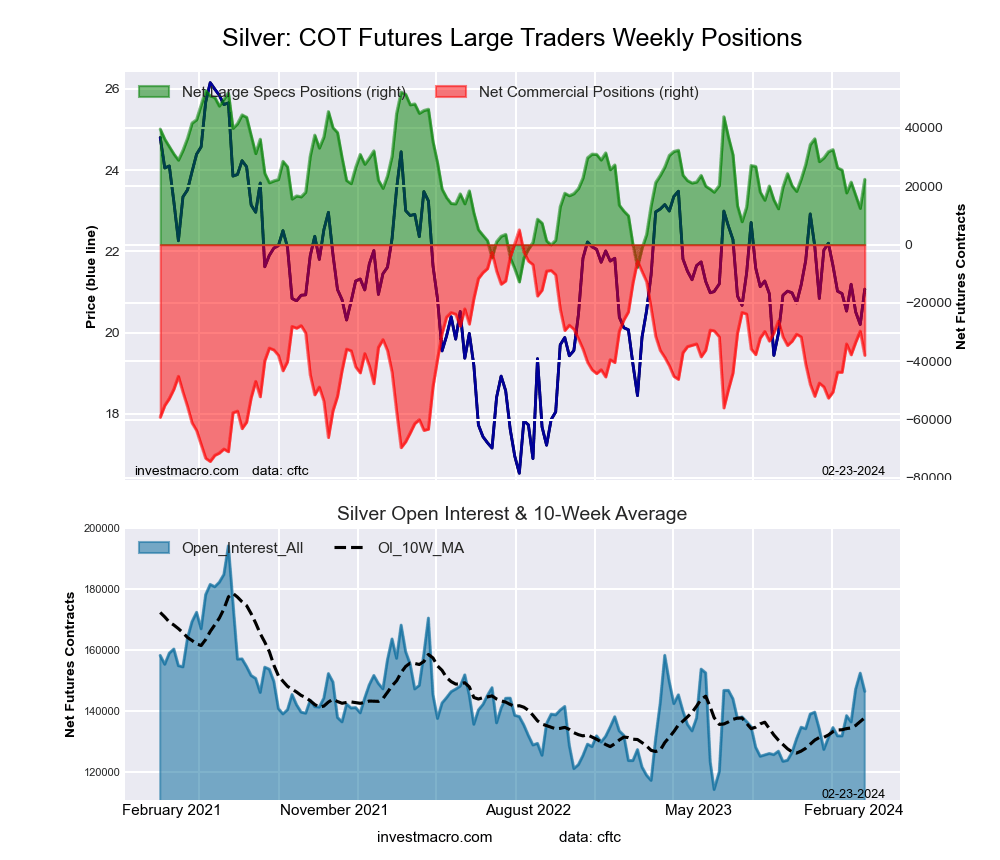
Silver Futures COT ChartThe Silver Comex Futures large speculator standing this week totaled a net position of 25,593 contracts in the data reported through Tuesday. This was a weekly fall of -769 contracts from the previous week which had a total of 26,362 net contracts.

This week’s current strength score (the trader positioning range over the past three years, measured from 0 to 100) shows the speculators are currently Bullish with a score of 57.1 percent. The commercials are Bearish with a score of 38.5 percent and the small traders (not shown in chart) are Bullish with a score of 67.5 percent.

Price Trend-Following Model: Weak Uptrend

Our weekly trend-following model classifies the current market price position as: Weak Uptrend. The current action for the model is considered to be: Hold – Maintain Long Position.

Silver Futures StatisticsSPECULATORSCOMMERCIALSSMALL TRADERS
– Percent of Open Interest Longs:40.927.622.7
– Percent of Open Interest Shorts:21.560.88.9
– Net Position:25,593-43,75918,166
– Gross Longs:54,00136,48229,933
– Gross Shorts:28,40880,24111,767
– Long to Short Ratio:1.9 to 10.5 to 12.5 to 1
NET POSITION TREND:
– Strength Index Score (3 Year Range Pct):57.138.567.5
– Strength Index Reading (3 Year Range):BullishBearishBullish
NET POSITION MOVEMENT INDEX:
– 6-Week Change in Strength Index:-15.910.413.7


Copper Grade #1 Futures:

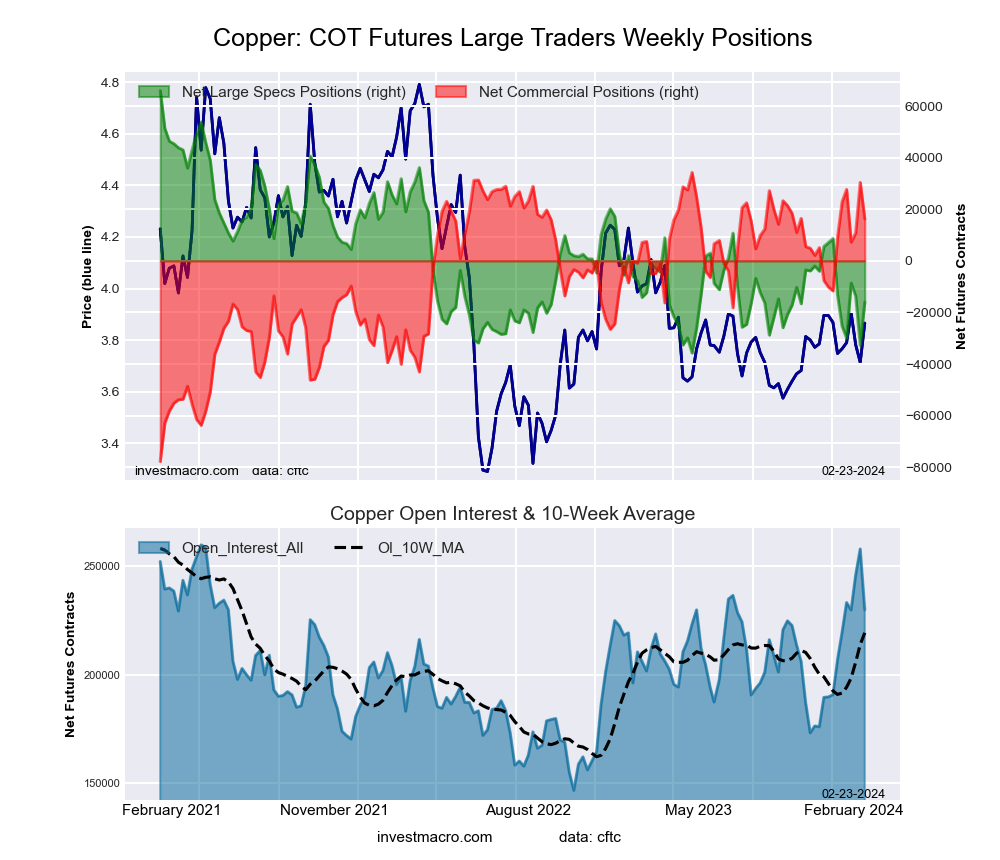
Copper Futures COT ChartThe Copper Grade #1 Futures large speculator standing this week totaled a net position of -25,306 contracts in the data reported through Tuesday. This was a weekly decrease of -12,139 contracts from the previous week which had a total of -13,167 net contracts.

This week’s current strength score (the trader positioning range over the past three years, measured from 0 to 100) shows the speculators are currently Bearish-Extreme with a score of 9.4 percent. The commercials are Bullish-Extreme with a score of 90.6 percent and the small traders (not shown in chart) are Bearish with a score of 34.0 percent.

Price Trend-Following Model: Uptrend

Our weekly trend-following model classifies the current market price position as: Uptrend. The current action for the model is considered to be: Hold – Maintain Long Position.

Copper Futures StatisticsSPECULATORSCOMMERCIALSSMALL TRADERS
– Percent of Open Interest Longs:28.542.66.8
– Percent of Open Interest Shorts:40.032.25.7
– Net Position:-25,30622,8512,455
– Gross Longs:62,40893,53314,856
– Gross Shorts:87,71470,68212,401
– Long to Short Ratio:0.7 to 11.3 to 11.2 to 1
NET POSITION TREND:
– Strength Index Score (3 Year Range Pct):9.490.634.0
– Strength Index Reading (3 Year Range):Bearish-ExtremeBullish-ExtremeBearish
NET POSITION MOVEMENT INDEX:
– 6-Week Change in Strength Index:-21.017.116.4


Platinum Futures:

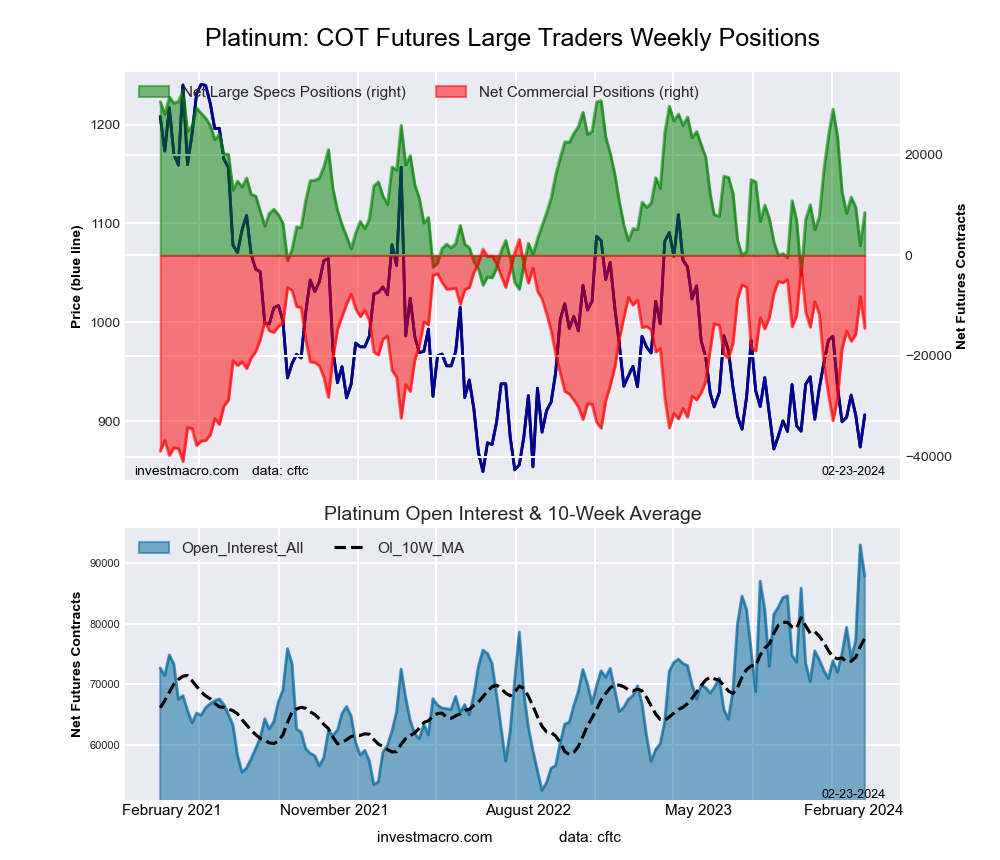
Platinum Futures COT ChartThe Platinum Futures large speculator standing this week totaled a net position of 12,557 contracts in the data reported through Tuesday. This was a weekly fall of -10,984 contracts from the previous week which had a total of 23,541 net contracts.

This week’s current strength score (the trader positioning range over the past three years, measured from 0 to 100) shows the speculators are currently Bearish with a score of 44.6 percent. The commercials are Bullish with a score of 55.2 percent and the small traders (not shown in chart) are Bearish with a score of 47.6 percent.

Price Trend-Following Model: Weak Uptrend

Our weekly trend-following model classifies the current market price position as: Weak Uptrend. The current action for the model is considered to be: Hold – Maintain Long Position.

Platinum Futures StatisticsSPECULATORSCOMMERCIALSSMALL TRADERS
– Percent of Open Interest Longs:57.623.712.7
– Percent of Open Interest Shorts:40.948.34.8
– Net Position:12,557-18,4985,941
– Gross Longs:43,24317,7749,509
– Gross Shorts:30,68636,2723,568
– Long to Short Ratio:1.4 to 10.5 to 12.7 to 1
NET POSITION TREND:
– Strength Index Score (3 Year Range Pct):44.655.247.6
– Strength Index Reading (3 Year Range):BearishBullishBearish
NET POSITION MOVEMENT INDEX:
– 6-Week Change in Strength Index:17.1-19.325.2


Palladium Futures:

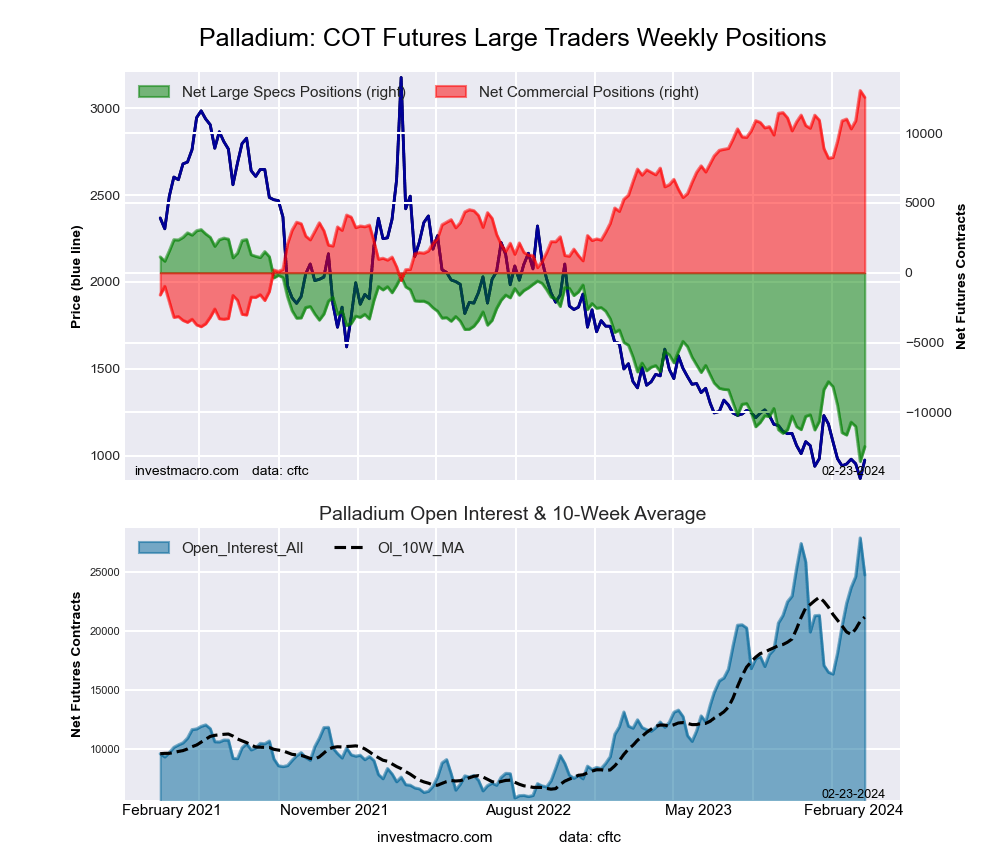
Palladium Futures COT ChartThe Palladium Futures large speculator standing this week totaled a net position of -11,449 contracts in the data reported through Tuesday. This was a weekly fall of -1,977 contracts from the previous week which had a total of -9,472 net contracts.

This week’s current strength score (the trader positioning range over the past three years, measured from 0 to 100) shows the speculators are currently Bearish-Extreme with a score of 0.3 percent. The commercials are Bullish-Extreme with a score of 96.2 percent and the small traders (not shown in chart) are Bullish with a score of 76.3 percent.

Price Trend-Following Model: Strong Downtrend

Our weekly trend-following model classifies the current market price position as: Strong Downtrend. The current action for the model is considered to be: Hold – Maintain Short Position.

Palladium Futures StatisticsSPECULATORSCOMMERCIALSSMALL TRADERS
– Percent of Open Interest Longs:17.860.610.9
– Percent of Open Interest Shorts:73.97.38.1
– Net Position:-11,44910,874575
– Gross Longs:3,62312,3702,226
– Gross Shorts:15,0721,4961,651
– Long to Short Ratio:0.2 to 18.3 to 11.3 to 1
NET POSITION TREND:
– Strength Index Score (3 Year Range Pct):0.396.276.3
– Strength Index Reading (3 Year Range):Bearish-ExtremeBullish-ExtremeBullish
NET POSITION MOVEMENT INDEX:
– 6-Week Change in Strength Index:-1.4-2.636.1


Steel Futures Futures:

Steel Futures COT ChartThe Steel Futures large speculator standing this week totaled a net position of -1,793 contracts in the data reported through Tuesday. This was a weekly decrease of -316 contracts from the previous week which had a total of -1,477 net contracts.

This week’s current strength score (the trader positioning range over the past three years, measured from 0 to 100) shows the speculators are currently Bullish-Extreme with a score of 89.5 percent. The commercials are Bearish-Extreme with a score of 10.7 percent and the small traders (not shown in chart) are Bullish with a score of 54.0 percent.

Price Trend-Following Model: Uptrend

Our weekly trend-following model classifies the current market price position as: Uptrend. The current action for the model is considered to be: Hold – Maintain Long Position.

Steel Futures StatisticsSPECULATORSCOMMERCIALSSMALL TRADERS
– Percent of Open Interest Longs:14.780.12.1
– Percent of Open Interest Shorts:23.272.61.1
– Net Position:-1,7931,595198
– Gross Longs:3,11416,956440
– Gross Shorts:4,90715,361242
– Long to Short Ratio:0.6 to 11.1 to 11.8 to 1
NET POSITION TREND:
– Strength Index Score (3 Year Range Pct):89.510.754.0
– Strength Index Reading (3 Year Range):Bullish-ExtremeBearish-ExtremeBullish
NET POSITION MOVEMENT INDEX:
– 6-Week Change in Strength Index:-6.27.0-23.0


Article By InvestMacroReceive our weekly COT Newsletter

*COT Report: The COT data, released weekly to the public each Friday, is updated through the most recent Tuesday (data is 3 days old) and shows a quick view of how large speculators or non-commercials (for-profit traders) were positioned in the futures markets.

The CFTC categorizes trader positions according to commercial hedgers (traders who use futures contracts for hedging as part of the business), non-commercials (large traders who speculate to realize trading profits) and nonreportable traders (usually small traders/speculators) as well as their open interest (contracts open in the market at time of reporting). See CFTC criteria here.

COT Bonds Charts: Speculator Bets led higher by Fed Funds & SOFR 3-Months

By InvestMacro

Here are the latest charts and statistics for the Commitment of Traders (COT) reports data published by the Commodities Futures Trading Commission (CFTC).

The latest COT data is updated through Tuesday January 16th and shows a quick view of how large traders (for-profit speculators and commercial hedgers) were positioned in the futures markets.

Weekly Speculator Changes led by Fed Funds & SOFR 3-Months

The COT bond market speculator bets were higher this week as five out of the eight bond markets we cover had higher positioning while the other three markets had lower speculator contracts.

Leading the gains for the bond markets was the Fed Funds (70,133 contracts) with the SOFR 3-Months (65,855 contracts), the 2-Year Bonds (36,150 contracts), the US Treasury Bonds (28,000 contracts) and the Ultra 10-Year Bonds (13,627 contracts) also showing positive weeks.

The bond markets with decreases in speculator bets for the week were the 10-Year Bonds (-102,365 contracts), the 5-Year Bonds (-26,655 contracts) and the Ultra Treasury Bonds (-9,423 contracts) also registering lower bets on the week.


Bonds – Speculators Leaderboard

Legend: Weekly Speculators Change | Speculators Current Net Position | Speculators Strength Score compared to last 3-Years (0-100 range)


Strength Scores led by SOFR 3-Months & Fed Funds

COT Strength Scores (a normalized measure of Speculator positions over a 3-Year range, from 0 to 100 where above 80 is Extreme-Bullish and below 20 is Extreme-Bearish) showed that the SOFR 3-Months (100 percent) leads the bond markets this week. The Ultra Treasury Bonds (54 percent) and the Fed Funds (54 percent) come in as the next highest in the weekly strength scores.

On the downside, the 10-Year Bonds (0 percent), the 5-Year Bonds (17 percent) and the 2-Year Bonds (17 percent) come in at the lowest strength level currently and are in Extreme-Bearish territory (below 20 percent). The next lowest strength score was the Ultra 10-Year Bonds (21 percent).

Strength Statistics:
Fed Funds (54.4 percent) vs Fed Funds previous week (39.5 percent)
2-Year Bond (17.5 percent) vs 2-Year Bond previous week (15.2 percent)
5-Year Bond (17.4 percent) vs 5-Year Bond previous week (19.1 percent)
10-Year Bond (0.0 percent) vs 10-Year Bond previous week (9.6 percent)
Ultra 10-Year Bond (21.4 percent) vs Ultra 10-Year Bond previous week (18.9 percent)
US Treasury Bond (39.0 percent) vs US Treasury Bond previous week (29.2 percent)
Ultra US Treasury Bond (54.1 percent) vs Ultra US Treasury Bond previous week (57.9 percent)
SOFR 3-Months (100.0 percent) vs SOFR 3-Months previous week (96.6 percent)


Ultra 10-Year Bonds & Fed Funds top the 6-Week Strength Trends

COT Strength Score Trends (or move index, calculates the 6-week changes in strength scores) showed that the Ultra 10-Year Bonds (20 percent) and the Fed Funds (19 percent) lead the past six weeks trends for bonds. The 2-Year Bonds (17 percent) are the next highest positive mover in the latest trends data.

The 10-Year Bonds (-24 percent) and the Ultra Treasury Bonds (-2 percent) leads the downside trend scores currently.

Strength Trend Statistics:
Fed Funds (18.6 percent) vs Fed Funds previous week (14.4 percent)
2-Year Bond (17.5 percent) vs 2-Year Bond previous week (3.2 percent)
5-Year Bond (14.9 percent) vs 5-Year Bond previous week (14.6 percent)
10-Year Bond (-23.6 percent) vs 10-Year Bond previous week (-9.5 percent)
Ultra 10-Year Bond (19.5 percent) vs Ultra 10-Year Bond previous week (15.2 percent)
US Treasury Bond (0.8 percent) vs US Treasury Bond previous week (-18.7 percent)
Ultra US Treasury Bond (-2.4 percent) vs Ultra US Treasury Bond previous week (6.5 percent)
SOFR 3-Months (12.5 percent) vs SOFR 3-Months previous week (8.2 percent)


Secured Overnight Financing Rate (3-Month) Futures:

SOFR 3-Months Bonds Futures COT ChartThe Secured Overnight Financing Rate (3-Month) large speculator standing this week resulted in a net position of 751,218 contracts in the data reported through Tuesday. This was a weekly increase of 65,855 contracts from the previous week which had a total of 685,363 net contracts.

This week’s current strength score (the trader positioning range over the past three years, measured from 0 to 100) shows the speculators are currently Bullish-Extreme with a score of 100.0 percent. The commercials are Bearish-Extreme with a score of 0.0 percent and the small traders (not shown in chart) are Bullish-Extreme with a score of 84.4 percent.

Price Trend-Following Model: Weak Uptrend

Our weekly trend-following model classifies the current market price position as: Weak Uptrend. The current action for the model is considered to be: Hold – Maintain Long Position.

SOFR 3-Months StatisticsSPECULATORSCOMMERCIALSSMALL TRADERS
– Percent of Open Interest Longs:19.750.00.3
– Percent of Open Interest Shorts:12.257.40.4
– Net Position:751,218-744,978-6,240
– Gross Longs:1,980,3305,041,09532,482
– Gross Shorts:1,229,1125,786,07338,722
– Long to Short Ratio:1.6 to 10.9 to 10.8 to 1
NET POSITION TREND:
– Strength Index Score (3 Year Range Pct):100.00.084.4
– Strength Index Reading (3 Year Range):Bullish-ExtremeBearish-ExtremeBullish-Extreme
NET POSITION MOVEMENT INDEX:
– 6-Week Change in Strength Index:12.5-12.4-1.7


30-Day Federal Funds Futures:

Federal Funds 30-Day Bonds Futures COT ChartThe 30-Day Federal Funds large speculator standing this week resulted in a net position of -66,060 contracts in the data reported through Tuesday. This was a weekly increase of 70,133 contracts from the previous week which had a total of -136,193 net contracts.

This week’s current strength score (the trader positioning range over the past three years, measured from 0 to 100) shows the speculators are currently Bullish with a score of 54.4 percent. The commercials are Bearish with a score of 47.7 percent and the small traders (not shown in chart) are Bullish with a score of 54.5 percent.

Price Trend-Following Model: Downtrend

Our weekly trend-following model classifies the current market price position as: Downtrend. The current action for the model is considered to be: Hold – Maintain Short Position.

30-Day Federal Funds StatisticsSPECULATORSCOMMERCIALSSMALL TRADERS
– Percent of Open Interest Longs:13.665.92.0
– Percent of Open Interest Shorts:17.261.23.1
– Net Position:-66,06084,651-18,591
– Gross Longs:245,7751,193,99236,694
– Gross Shorts:311,8351,109,34155,285
– Long to Short Ratio:0.8 to 11.1 to 10.7 to 1
NET POSITION TREND:
– Strength Index Score (3 Year Range Pct):54.447.754.5
– Strength Index Reading (3 Year Range):BullishBearishBullish
NET POSITION MOVEMENT INDEX:
– 6-Week Change in Strength Index:18.6-17.1-13.0


2-Year Treasury Note Futures:

2-Year Treasury Bonds Futures COT ChartThe 2-Year Treasury Note large speculator standing this week resulted in a net position of -1,202,507 contracts in the data reported through Tuesday. This was a weekly lift of 36,150 contracts from the previous week which had a total of -1,238,657 net contracts.

This week’s current strength score (the trader positioning range over the past three years, measured from 0 to 100) shows the speculators are currently Bearish-Extreme with a score of 17.5 percent. The commercials are Bullish-Extreme with a score of 82.2 percent and the small traders (not shown in chart) are Bullish-Extreme with a score of 87.3 percent.

Price Trend-Following Model: Uptrend

Our weekly trend-following model classifies the current market price position as: Uptrend. The current action for the model is considered to be: Hold – Maintain Long Position.

2-Year Treasury Note StatisticsSPECULATORSCOMMERCIALSSMALL TRADERS
– Percent of Open Interest Longs:11.280.96.4
– Percent of Open Interest Shorts:42.052.93.4
– Net Position:-1,202,5071,088,522113,985
– Gross Longs:437,0463,153,891248,329
– Gross Shorts:1,639,5532,065,369134,344
– Long to Short Ratio:0.3 to 11.5 to 11.8 to 1
NET POSITION TREND:
– Strength Index Score (3 Year Range Pct):17.582.287.3
– Strength Index Reading (3 Year Range):Bearish-ExtremeBullish-ExtremeBullish-Extreme
NET POSITION MOVEMENT INDEX:
– 6-Week Change in Strength Index:17.5-17.8-10.4


5-Year Treasury Note Futures:

5-Year Treasury Bonds Futures COT ChartThe 5-Year Treasury Note large speculator standing this week resulted in a net position of -1,196,837 contracts in the data reported through Tuesday. This was a weekly lowering of -26,655 contracts from the previous week which had a total of -1,170,182 net contracts.

This week’s current strength score (the trader positioning range over the past three years, measured from 0 to 100) shows the speculators are currently Bearish-Extreme with a score of 17.4 percent. The commercials are Bullish with a score of 78.8 percent and the small traders (not shown in chart) are Bullish-Extreme with a score of 94.9 percent.

Price Trend-Following Model: Uptrend

Our weekly trend-following model classifies the current market price position as: Uptrend. The current action for the model is considered to be: Hold – Maintain Long Position.

5-Year Treasury Note StatisticsSPECULATORSCOMMERCIALSSMALL TRADERS
– Percent of Open Interest Longs:8.083.57.3
– Percent of Open Interest Shorts:28.265.84.8
– Net Position:-1,196,8371,045,883150,954
– Gross Longs:470,2604,939,008432,568
– Gross Shorts:1,667,0973,893,125281,614
– Long to Short Ratio:0.3 to 11.3 to 11.5 to 1
NET POSITION TREND:
– Strength Index Score (3 Year Range Pct):17.478.894.9
– Strength Index Reading (3 Year Range):Bearish-ExtremeBullishBullish-Extreme
NET POSITION MOVEMENT INDEX:
– 6-Week Change in Strength Index:14.9-18.13.0


10-Year Treasury Note Futures:

10-Year Treasury Notes Bonds Futures COT ChartThe 10-Year Treasury Note large speculator standing this week resulted in a net position of -889,385 contracts in the data reported through Tuesday. This was a weekly lowering of -102,365 contracts from the previous week which had a total of -787,020 net contracts.

This week’s current strength score (the trader positioning range over the past three years, measured from 0 to 100) shows the speculators are currently Bearish-Extreme with a score of 0.0 percent. The commercials are Bullish-Extreme with a score of 100.0 percent and the small traders (not shown in chart) are Bullish-Extreme with a score of 88.0 percent.

Price Trend-Following Model: Uptrend

Our weekly trend-following model classifies the current market price position as: Uptrend. The current action for the model is considered to be: Hold – Maintain Long Position.

10-Year Treasury Note StatisticsSPECULATORSCOMMERCIALSSMALL TRADERS
– Percent of Open Interest Longs:8.980.98.7
– Percent of Open Interest Shorts:27.663.57.3
– Net Position:-889,385822,77566,610
– Gross Longs:421,5323,836,497411,684
– Gross Shorts:1,310,9173,013,722345,074
– Long to Short Ratio:0.3 to 11.3 to 11.2 to 1
NET POSITION TREND:
– Strength Index Score (3 Year Range Pct):0.0100.088.0
– Strength Index Reading (3 Year Range):Bearish-ExtremeBullish-ExtremeBullish-Extreme
NET POSITION MOVEMENT INDEX:
– 6-Week Change in Strength Index:-23.630.43.1


Ultra 10-Year Notes Futures:

Ultra 10-Year Treasury Notes Bonds Futures COT ChartThe Ultra 10-Year Notes large speculator standing this week resulted in a net position of -160,172 contracts in the data reported through Tuesday. This was a weekly gain of 13,627 contracts from the previous week which had a total of -173,799 net contracts.

This week’s current strength score (the trader positioning range over the past three years, measured from 0 to 100) shows the speculators are currently Bearish with a score of 21.4 percent. The commercials are Bullish with a score of 78.5 percent and the small traders (not shown in chart) are Bullish with a score of 68.8 percent.

Price Trend-Following Model: Weak Uptrend

Our weekly trend-following model classifies the current market price position as: Weak Uptrend. The current action for the model is considered to be: Hold – Maintain Long Position.

Ultra 10-Year Notes StatisticsSPECULATORSCOMMERCIALSSMALL TRADERS
– Percent of Open Interest Longs:15.973.59.7
– Percent of Open Interest Shorts:23.562.213.3
– Net Position:-160,172236,238-76,066
– Gross Longs:332,2321,539,371203,162
– Gross Shorts:492,4041,303,133279,228
– Long to Short Ratio:0.7 to 11.2 to 10.7 to 1
NET POSITION TREND:
– Strength Index Score (3 Year Range Pct):21.478.568.8
– Strength Index Reading (3 Year Range):BearishBullishBullish
NET POSITION MOVEMENT INDEX:
– 6-Week Change in Strength Index:19.5-20.3-3.4


US Treasury Bonds Futures:

US Year Treasury Notes Long Bonds Futures COT ChartThe US Treasury Bonds large speculator standing this week resulted in a net position of -127,752 contracts in the data reported through Tuesday. This was a weekly boost of 28,000 contracts from the previous week which had a total of -155,752 net contracts.

This week’s current strength score (the trader positioning range over the past three years, measured from 0 to 100) shows the speculators are currently Bearish with a score of 39.0 percent. The commercials are Bearish with a score of 37.2 percent and the small traders (not shown in chart) are Bullish-Extreme with a score of 90.4 percent.

Price Trend-Following Model: Uptrend

Our weekly trend-following model classifies the current market price position as: Uptrend. The current action for the model is considered to be: Hold – Maintain Long Position.

US Treasury Bonds StatisticsSPECULATORSCOMMERCIALSSMALL TRADERS
– Percent of Open Interest Longs:12.673.313.6
– Percent of Open Interest Shorts:21.468.49.6
– Net Position:-127,75270,14657,606
– Gross Longs:181,5581,056,607195,609
– Gross Shorts:309,310986,461138,003
– Long to Short Ratio:0.6 to 11.1 to 11.4 to 1
NET POSITION TREND:
– Strength Index Score (3 Year Range Pct):39.037.290.4
– Strength Index Reading (3 Year Range):BearishBearishBullish-Extreme
NET POSITION MOVEMENT INDEX:
– 6-Week Change in Strength Index:0.8-4.77.6


Ultra US Treasury Bonds Futures:

Ultra US Year Treasury Notes Long Bonds Futures COT ChartThe Ultra US Treasury Bonds large speculator standing this week resulted in a net position of -322,618 contracts in the data reported through Tuesday. This was a weekly decrease of -9,423 contracts from the previous week which had a total of -313,195 net contracts.

This week’s current strength score (the trader positioning range over the past three years, measured from 0 to 100) shows the speculators are currently Bullish with a score of 54.1 percent. The commercials are Bearish with a score of 46.3 percent and the small traders (not shown in chart) are Bullish with a score of 52.8 percent.

Price Trend-Following Model: Uptrend

Our weekly trend-following model classifies the current market price position as: Uptrend. The current action for the model is considered to be: Hold – Maintain Long Position.

Ultra US Treasury Bonds StatisticsSPECULATORSCOMMERCIALSSMALL TRADERS
– Percent of Open Interest Longs:9.879.810.1
– Percent of Open Interest Shorts:29.061.59.1
– Net Position:-322,618306,07416,544
– Gross Longs:165,1011,339,541170,046
– Gross Shorts:487,7191,033,467153,502
– Long to Short Ratio:0.3 to 11.3 to 11.1 to 1
NET POSITION TREND:
– Strength Index Score (3 Year Range Pct):54.146.352.8
– Strength Index Reading (3 Year Range):BullishBearishBullish
NET POSITION MOVEMENT INDEX:
– 6-Week Change in Strength Index:-2.46.2-6.0


Article By InvestMacroReceive our weekly COT Newsletter

*COT Report: The COT data, released weekly to the public each Friday, is updated through the most recent Tuesday (data is 3 days old) and shows a quick view of how large speculators or non-commercials (for-profit traders) were positioned in the futures markets.

The CFTC categorizes trader positions according to commercial hedgers (traders who use futures contracts for hedging as part of the business), non-commercials (large traders who speculate to realize trading profits) and nonreportable traders (usually small traders/speculators) as well as their open interest (contracts open in the market at time of reporting). See CFTC criteria here.

COT Soft Commodities Charts: Speculator Bets led lower by Soybeans & Corn

By InvestMacro

Here are the latest charts and statistics for the Commitment of Traders (COT) reports data published by the Commodities Futures Trading Commission (CFTC).

The latest COT data is updated through Tuesday January 16th and shows a quick view of how large traders (for-profit speculators and commercial entities) were positioned in the futures markets.

Weekly Speculator Changes led lower by Soybeans & Corn

The COT soft commodities markets speculator bets were lower this week as four out of the eleven softs markets we cover had higher positioning while the other seven markets had lower speculator contracts.

Leading the gains for the softs markets was Cotton (5,473 contracts) with Coffee (3,794 contracts), Soybean Oil (1,621 contracts) and Cocoa (1,316 contracts) also recording positive weeks.

The markets with the declines in speculator bets this week were Soybeans (-55,619 contracts), Corn (-46,935 contracts), Wheat (-13,221 contracts), Soybean Meal (-8,752 contracts), Sugar (-8,743 contracts), Lean Hogs (-987 contracts) and Live Cattle (-559 contracts) also registering lower bets on the week.


Major Softs – Speculators Leaderboard

Legend: Weekly Speculators Change | Speculators Current Net Position | Speculators Strength Score compared to last 3-Years (0-100 range)


Strength Scores led by Cocoa & Coffee

COT Strength Scores (a normalized measure of Speculator positions over a 3-Year range, from 0 to 100 where above 80 is Extreme-Bullish and below 20 is Extreme-Bearish) showed that Cocoa (82 percent) and Coffee (78 percent) lead the softs markets this week. Wheat (35 percent), Cotton (17 percent) and Sugar (12 percent) come in as the next highest in the weekly strength scores.

On the downside, Soybean Meal (0 percent), Corn (0 percent), Soybeans (0 percent), Live Cattle (4 percent), Soybean Oil (4 percent), Lean Hogs (9 percent), Sugar (12 percent) and Cotton (17 percent) come in at the lowest strength levels currently and are all in Extreme-Bearish territory (below 20 percent).

Strength Statistics:
Corn (0.0 percent) vs Corn previous week (6.1 percent)
Sugar (12.4 percent) vs Sugar previous week (15.5 percent)
Coffee (78.1 percent) vs Coffee previous week (74.2 percent)
Soybeans (0.0 percent) vs Soybeans previous week (16.2 percent)
Soybean Oil (3.8 percent) vs Soybean Oil previous week (2.8 percent)
Soybean Meal (0.0 percent) vs Soybean Meal previous week (4.6 percent)
Live Cattle (3.5 percent) vs Live Cattle previous week (4.1 percent)
Lean Hogs (8.7 percent) vs Lean Hogs previous week (9.5 percent)
Cotton (17.3 percent) vs Cotton previous week (13.2 percent)
Cocoa (81.6 percent) vs Cocoa previous week (80.2 percent)
Wheat (35.1 percent) vs Wheat previous week (44.3 percent)


Coffee & Wheat top the 6-Week Strength Trends

COT Strength Score Trends (or move index, calculates the 6-week changes in strength scores) showed that Coffee (16 percent) and Wheat (14 percent) lead the past six weeks trends for soft commodities. Cotton (4 percent) and Cocoa (3 percent) are the next highest positive movers in the latest trends data.

Soybean Meal (-68 percent) leads the downside trend scores currently with Sugar (-38 percent), Soybeans (-33 percent) and Soybean Oil (-18 percent) following next with lower trend scores.

Strength Trend Statistics:
Corn (-14.3 percent) vs Corn previous week (-2.1 percent)
Sugar (-38.1 percent) vs Sugar previous week (-49.3 percent)
Coffee (15.5 percent) vs Coffee previous week (15.4 percent)
Soybeans (-33.1 percent) vs Soybeans previous week (-25.8 percent)
Soybean Oil (-17.7 percent) vs Soybean Oil previous week (-26.5 percent)
Soybean Meal (-67.9 percent) vs Soybean Meal previous week (-70.7 percent)
Live Cattle (-15.8 percent) vs Live Cattle previous week (-17.8 percent)
Lean Hogs (-0.7 percent) vs Lean Hogs previous week (0.6 percent)
Cotton (3.7 percent) vs Cotton previous week (-0.2 percent)
Cocoa (3.4 percent) vs Cocoa previous week (-2.8 percent)
Wheat (14.2 percent) vs Wheat previous week (44.3 percent)


Individual Soft Commodities Markets:

CORN Futures:

CORN Futures COT ChartThe CORN large speculator standing this week reached a net position of -219,968 contracts in the data reported through Tuesday. This was a weekly lowering of -46,935 contracts from the previous week which had a total of -173,033 net contracts.

This week’s current strength score (the trader positioning range over the past three years, measured from 0 to 100) shows the speculators are currently Bearish-Extreme with a score of 0.0 percent. The commercials are Bullish-Extreme with a score of 100.0 percent and the small traders (not shown in chart) are Bullish-Extreme with a score of 93.3 percent.

Price Trend-Following Model: Strong Downtrend

Our weekly trend-following model classifies the current market price position as: Strong Downtrend. The current action for the model is considered to be: Hold – Maintain Short Position.

CORN Futures StatisticsSPECULATORSCOMMERCIALSSMALL TRADERS
– Percent of Open Interest Longs:16.847.89.9
– Percent of Open Interest Shorts:31.431.711.4
– Net Position:-219,968242,217-22,249
– Gross Longs:252,825718,815148,520
– Gross Shorts:472,793476,598170,769
– Long to Short Ratio:0.5 to 11.5 to 10.9 to 1
NET POSITION TREND:
– Strength Index Score (3 Year Range Pct):0.0100.093.3
– Strength Index Reading (3 Year Range):Bearish-ExtremeBullish-ExtremeBullish-Extreme
NET POSITION MOVEMENT INDEX:
– 6-Week Change in Strength Index:-14.314.08.0


SUGAR Futures:

SUGAR Futures COT ChartThe SUGAR large speculator standing this week reached a net position of 60,215 contracts in the data reported through Tuesday. This was a weekly reduction of -8,743 contracts from the previous week which had a total of 68,958 net contracts.

This week’s current strength score (the trader positioning range over the past three years, measured from 0 to 100) shows the speculators are currently Bearish-Extreme with a score of 12.4 percent. The commercials are Bullish-Extreme with a score of 84.4 percent and the small traders (not shown in chart) are Bearish with a score of 30.0 percent.

Price Trend-Following Model: Downtrend

Our weekly trend-following model classifies the current market price position as: Downtrend. The current action for the model is considered to be: Hold – Maintain Short Position.

SUGAR Futures StatisticsSPECULATORSCOMMERCIALSSMALL TRADERS
– Percent of Open Interest Longs:20.957.89.5
– Percent of Open Interest Shorts:13.468.06.8
– Net Position:60,215-81,56821,353
– Gross Longs:167,220463,36275,786
– Gross Shorts:107,005544,93054,433
– Long to Short Ratio:1.6 to 10.9 to 11.4 to 1
NET POSITION TREND:
– Strength Index Score (3 Year Range Pct):12.484.430.0
– Strength Index Reading (3 Year Range):Bearish-ExtremeBullish-ExtremeBearish
NET POSITION MOVEMENT INDEX:
– 6-Week Change in Strength Index:-38.132.8-2.6


COFFEE Futures:

COFFEE Futures COT ChartThe COFFEE large speculator standing this week reached a net position of 49,382 contracts in the data reported through Tuesday. This was a weekly advance of 3,794 contracts from the previous week which had a total of 45,588 net contracts.

This week’s current strength score (the trader positioning range over the past three years, measured from 0 to 100) shows the speculators are currently Bullish with a score of 78.1 percent. The commercials are Bearish with a score of 25.0 percent and the small traders (not shown in chart) are Bearish with a score of 36.4 percent.

Price Trend-Following Model: Uptrend

Our weekly trend-following model classifies the current market price position as: Uptrend. The current action for the model is considered to be: Hold – Maintain Long Position.

COFFEE Futures StatisticsSPECULATORSCOMMERCIALSSMALL TRADERS
– Percent of Open Interest Longs:33.035.54.7
– Percent of Open Interest Shorts:10.758.63.9
– Net Position:49,382-51,1471,765
– Gross Longs:72,96778,64210,343
– Gross Shorts:23,585129,7898,578
– Long to Short Ratio:3.1 to 10.6 to 11.2 to 1
NET POSITION TREND:
– Strength Index Score (3 Year Range Pct):78.125.036.4
– Strength Index Reading (3 Year Range):BullishBearishBearish
NET POSITION MOVEMENT INDEX:
– 6-Week Change in Strength Index:15.5-15.21.9


SOYBEANS Futures:

SOYBEANS Futures COT ChartThe SOYBEANS large speculator standing this week reached a net position of -93,668 contracts in the data reported through Tuesday. This was a weekly reduction of -55,619 contracts from the previous week which had a total of -38,049 net contracts.

This week’s current strength score (the trader positioning range over the past three years, measured from 0 to 100) shows the speculators are currently Bearish-Extreme with a score of 0.0 percent. The commercials are Bullish-Extreme with a score of 100.0 percent and the small traders (not shown in chart) are Bullish with a score of 59.5 percent.

Price Trend-Following Model: Strong Downtrend

Our weekly trend-following model classifies the current market price position as: Strong Downtrend. The current action for the model is considered to be: Hold – Maintain Short Position.

SOYBEANS Futures StatisticsSPECULATORSCOMMERCIALSSMALL TRADERS
– Percent of Open Interest Longs:12.659.87.0
– Percent of Open Interest Shorts:26.343.29.7
– Net Position:-93,668112,439-18,771
– Gross Longs:85,450406,41547,386
– Gross Shorts:179,118293,97666,157
– Long to Short Ratio:0.5 to 11.4 to 10.7 to 1
NET POSITION TREND:
– Strength Index Score (3 Year Range Pct):0.0100.059.5
– Strength Index Reading (3 Year Range):Bearish-ExtremeBullish-ExtremeBullish
NET POSITION MOVEMENT INDEX:
– 6-Week Change in Strength Index:-33.132.0-3.5


SOYBEAN OIL Futures:

SOYBEAN OIL Futures COT ChartThe SOYBEAN OIL large speculator standing this week reached a net position of -27,587 contracts in the data reported through Tuesday. This was a weekly lift of 1,621 contracts from the previous week which had a total of -29,208 net contracts.

This week’s current strength score (the trader positioning range over the past three years, measured from 0 to 100) shows the speculators are currently Bearish-Extreme with a score of 3.8 percent. The commercials are Bullish-Extreme with a score of 95.4 percent and the small traders (not shown in chart) are Bearish with a score of 22.3 percent.

Price Trend-Following Model: Downtrend

Our weekly trend-following model classifies the current market price position as: Downtrend. The current action for the model is considered to be: Hold – Maintain Short Position.

SOYBEAN OIL Futures StatisticsSPECULATORSCOMMERCIALSSMALL TRADERS
– Percent of Open Interest Longs:18.750.65.6
– Percent of Open Interest Shorts:23.845.95.1
– Net Position:-27,58725,2342,353
– Gross Longs:101,070273,29130,152
– Gross Shorts:128,657248,05727,799
– Long to Short Ratio:0.8 to 11.1 to 11.1 to 1
NET POSITION TREND:
– Strength Index Score (3 Year Range Pct):3.895.422.3
– Strength Index Reading (3 Year Range):Bearish-ExtremeBullish-ExtremeBearish
NET POSITION MOVEMENT INDEX:
– 6-Week Change in Strength Index:-17.716.9-8.1


SOYBEAN MEAL Futures:

SOYBEAN MEAL Futures COT ChartThe SOYBEAN MEAL large speculator standing this week reached a net position of -11,242 contracts in the data reported through Tuesday. This was a weekly decline of -8,752 contracts from the previous week which had a total of -2,490 net contracts.

This week’s current strength score (the trader positioning range over the past three years, measured from 0 to 100) shows the speculators are currently Bearish-Extreme with a score of 0.0 percent. The commercials are Bullish-Extreme with a score of 100.0 percent and the small traders (not shown in chart) are Bearish with a score of 33.6 percent.

Price Trend-Following Model: Strong Downtrend

Our weekly trend-following model classifies the current market price position as: Strong Downtrend. The current action for the model is considered to be: Hold – Maintain Short Position.

SOYBEAN MEAL Futures StatisticsSPECULATORSCOMMERCIALSSMALL TRADERS
– Percent of Open Interest Longs:18.748.910.5
– Percent of Open Interest Shorts:21.250.36.8
– Net Position:-11,242-6,17117,413
– Gross Longs:87,316227,97349,045
– Gross Shorts:98,558234,14431,632
– Long to Short Ratio:0.9 to 11.0 to 11.6 to 1
NET POSITION TREND:
– Strength Index Score (3 Year Range Pct):0.0100.033.6
– Strength Index Reading (3 Year Range):Bearish-ExtremeBullish-ExtremeBearish
NET POSITION MOVEMENT INDEX:
– 6-Week Change in Strength Index:-67.969.7-19.8


LIVE CATTLE Futures:

LIVE CATTLE Futures COT ChartThe LIVE CATTLE large speculator standing this week reached a net position of 22,808 contracts in the data reported through Tuesday. This was a weekly decrease of -559 contracts from the previous week which had a total of 23,367 net contracts.

This week’s current strength score (the trader positioning range over the past three years, measured from 0 to 100) shows the speculators are currently Bearish-Extreme with a score of 3.5 percent. The commercials are Bullish-Extreme with a score of 95.1 percent and the small traders (not shown in chart) are Bullish-Extreme with a score of 88.7 percent.

Price Trend-Following Model: Downtrend

Our weekly trend-following model classifies the current market price position as: Downtrend. The current action for the model is considered to be: Hold – Maintain Short Position.

LIVE CATTLE Futures StatisticsSPECULATORSCOMMERCIALSSMALL TRADERS
– Percent of Open Interest Longs:26.540.312.3
– Percent of Open Interest Shorts:18.148.612.4
– Net Position:22,808-22,619-189
– Gross Longs:71,847109,22433,303
– Gross Shorts:49,039131,84333,492
– Long to Short Ratio:1.5 to 10.8 to 11.0 to 1
NET POSITION TREND:
– Strength Index Score (3 Year Range Pct):3.595.188.7
– Strength Index Reading (3 Year Range):Bearish-ExtremeBullish-ExtremeBullish-Extreme
NET POSITION MOVEMENT INDEX:
– 6-Week Change in Strength Index:-15.812.623.0


LEAN HOGS Futures:

LEAN HOGS Futures COT ChartThe LEAN HOGS large speculator standing this week reached a net position of -25,483 contracts in the data reported through Tuesday. This was a weekly decline of -987 contracts from the previous week which had a total of -24,496 net contracts.

This week’s current strength score (the trader positioning range over the past three years, measured from 0 to 100) shows the speculators are currently Bearish-Extreme with a score of 8.7 percent. The commercials are Bullish-Extreme with a score of 97.4 percent and the small traders (not shown in chart) are Bullish with a score of 56.5 percent.

Price Trend-Following Model: Downtrend

Our weekly trend-following model classifies the current market price position as: Downtrend. The current action for the model is considered to be: Hold – Maintain Short Position.

LEAN HOGS Futures StatisticsSPECULATORSCOMMERCIALSSMALL TRADERS
– Percent of Open Interest Longs:30.139.17.8
– Percent of Open Interest Shorts:43.222.910.9
– Net Position:-25,48331,462-5,979
– Gross Longs:58,54075,95115,122
– Gross Shorts:84,02344,48921,101
– Long to Short Ratio:0.7 to 11.7 to 10.7 to 1
NET POSITION TREND:
– Strength Index Score (3 Year Range Pct):8.797.456.5
– Strength Index Reading (3 Year Range):Bearish-ExtremeBullish-ExtremeBullish
NET POSITION MOVEMENT INDEX:
– 6-Week Change in Strength Index:-0.71.8-5.5


COTTON Futures:

COTTON Futures COT ChartThe COTTON large speculator standing this week reached a net position of 11,423 contracts in the data reported through Tuesday. This was a weekly increase of 5,473 contracts from the previous week which had a total of 5,950 net contracts.

This week’s current strength score (the trader positioning range over the past three years, measured from 0 to 100) shows the speculators are currently Bearish-Extreme with a score of 17.3 percent. The commercials are Bullish-Extreme with a score of 83.1 percent and the small traders (not shown in chart) are Bearish-Extreme with a score of 11.6 percent.

Price Trend-Following Model: Weak Downtrend

Our weekly trend-following model classifies the current market price position as: Weak Downtrend. The current action for the model is considered to be: Hold – Maintain Short Position.

COTTON Futures StatisticsSPECULATORSCOMMERCIALSSMALL TRADERS
– Percent of Open Interest Longs:29.645.65.5
– Percent of Open Interest Shorts:24.150.75.9
– Net Position:11,423-10,695-728
– Gross Longs:61,41194,65911,495
– Gross Shorts:49,988105,35412,223
– Long to Short Ratio:1.2 to 10.9 to 10.9 to 1
NET POSITION TREND:
– Strength Index Score (3 Year Range Pct):17.383.111.6
– Strength Index Reading (3 Year Range):Bearish-ExtremeBullish-ExtremeBearish-Extreme
NET POSITION MOVEMENT INDEX:
– 6-Week Change in Strength Index:3.7-3.73.3


COCOA Futures:

COCOA Futures COT ChartThe COCOA large speculator standing this week reached a net position of 70,197 contracts in the data reported through Tuesday. This was a weekly advance of 1,316 contracts from the previous week which had a total of 68,881 net contracts.

This week’s current strength score (the trader positioning range over the past three years, measured from 0 to 100) shows the speculators are currently Bullish-Extreme with a score of 81.6 percent. The commercials are Bearish-Extreme with a score of 19.4 percent and the small traders (not shown in chart) are Bearish with a score of 30.3 percent.

Price Trend-Following Model: Uptrend

Our weekly trend-following model classifies the current market price position as: Uptrend. The current action for the model is considered to be: Hold – Maintain Long Position.

COCOA Futures StatisticsSPECULATORSCOMMERCIALSSMALL TRADERS
– Percent of Open Interest Longs:38.725.15.4
– Percent of Open Interest Shorts:17.247.34.7
– Net Position:70,197-72,3152,118
– Gross Longs:126,07581,83917,499
– Gross Shorts:55,878154,15415,381
– Long to Short Ratio:2.3 to 10.5 to 11.1 to 1
NET POSITION TREND:
– Strength Index Score (3 Year Range Pct):81.619.430.3
– Strength Index Reading (3 Year Range):Bullish-ExtremeBearish-ExtremeBearish
NET POSITION MOVEMENT INDEX:
– 6-Week Change in Strength Index:3.4-2.3-8.2


WHEAT Futures:

WHEAT Futures COT ChartThe WHEAT large speculator standing this week reached a net position of -46,611 contracts in the data reported through Tuesday. This was a weekly lowering of -13,221 contracts from the previous week which had a total of -33,390 net contracts.

This week’s current strength score (the trader positioning range over the past three years, measured from 0 to 100) shows the speculators are currently Bearish with a score of 35.1 percent. The commercials are Bullish with a score of 66.9 percent and the small traders (not shown in chart) are Bearish with a score of 33.7 percent.

Price Trend-Following Model: Weak Uptrend

Our weekly trend-following model classifies the current market price position as: Weak Uptrend. The current action for the model is considered to be: Hold – Maintain Long Position.

WHEAT Futures StatisticsSPECULATORSCOMMERCIALSSMALL TRADERS
– Percent of Open Interest Longs:27.338.27.6
– Percent of Open Interest Shorts:38.924.79.5
– Net Position:-46,61154,064-7,453
– Gross Longs:109,221153,03530,403
– Gross Shorts:155,83298,97137,856
– Long to Short Ratio:0.7 to 11.5 to 10.8 to 1
NET POSITION TREND:
– Strength Index Score (3 Year Range Pct):35.166.933.7
– Strength Index Reading (3 Year Range):BearishBullishBearish
NET POSITION MOVEMENT INDEX:
– 6-Week Change in Strength Index:14.2-13.7-8.5


Article By InvestMacroReceive our weekly COT Newsletter

*COT Report: The COT data, released weekly to the public each Friday, is updated through the most recent Tuesday (data is 3 days old) and shows a quick view of how large speculators or non-commercials (for-profit traders) were positioned in the futures markets.

The CFTC categorizes trader positions according to commercial hedgers (traders who use futures contracts for hedging as part of the business), non-commercials (large traders who speculate to realize trading profits) and nonreportable traders (usually small traders/speculators) as well as their open interest (contracts open in the market at time of reporting). See CFTC criteria here.

COT Stock Market Charts: Speculator Changes led lower by S&P500 & Russell

By InvestMacro

Here are the latest charts and statistics for the Commitment of Traders (COT) data published by the Commodities Futures Trading Commission (CFTC).

The latest COT data is updated through Tuesday January 16th and shows a quick view of how large traders (for-profit speculators and commercial entities) were positioned in the futures markets.

Weekly Speculator Changes led lower by S&P500-Mini & Russell-Mini

The COT stock markets speculator bets were lower this week as just one out of the seven stock markets we cover had higher positioning while the other six markets had lower speculator contracts.

Leading the gains for the stock markets was the VIX with a small gain of 409 contracts for the week.

The markets with the declines in speculator bets this week were the S&P500-Mini (-52,197 contracts), the Russell-Mini (-6,767 contracts), the DowJones-Mini (-6,692 contracts), the Nikkei 225 (-1,820 contracts), the MSCI EAFE-Mini (-969 contracts) and the Nasdaq-Mini (-205 contracts) also showing lower bets on the week.


Major Stock Markets – Speculators Leaderboard

Legend: Weekly Speculators Change | Speculators Current Net Position | Speculators Strength Score compared to last 3-Years (0-100 range)


Strength Scores led by Nasdaq-Mini & Russell-Mini

COT Strength Scores (a normalized measure of Speculator positions over a 3-Year range, from 0 to 100 where above 80 is Extreme-Bullish and below 20 is Extreme-Bearish) showed that the Nasdaq-Mini (95 percent), the Russell-Mini (95 percent), the DowJones-Mini (89 percent) and the VIX (80 percent) lead the stock markets this week.

On the downside, the MSCI EAFE-Mini (35 percent) and the Nikkei 225 (35 percent) come in at the lowest strength level currently.

Strength Statistics:
VIX (80.0 percent) vs VIX previous week (79.8 percent)
S&P500-Mini (39.5 percent) vs S&P500-Mini previous week (47.3 percent)
DowJones-Mini (89.1 percent) vs DowJones-Mini previous week (100.0 percent)
Nasdaq-Mini (95.2 percent) vs Nasdaq-Mini previous week (95.6 percent)
Russell2000-Mini (95.2 percent) vs Russell2000-Mini previous week (100.0 percent)
Nikkei USD (34.8 percent) vs Nikkei USD previous week (47.7 percent)
EAFE-Mini (35.3 percent) vs EAFE-Mini previous week (36.3 percent)


Russell-Mini & Nasdaq-Mini top the 6-Week Strength Trends

COT Strength Score Trends (or move index, calculates the 6-week changes in strength scores) showed that the Russell-Mini (49 percent) leads the past six weeks trends for the stock markets. The Nasdaq-Mini (43 percent), the DowJones-Mini (28 percent) and the MSCI EAFE-Mini (20 percent) are the next highest positive movers in the latest trends data.

The Nikkei 225 (-20 percent) leads the downside trend scores currently followed by the S&P500-Mini (-18 percent).

Strength Trend Statistics:
VIX (8.7 percent) vs VIX previous week (2.3 percent)
S&P500-Mini (-18.2 percent) vs S&P500-Mini previous week (-7.8 percent)
DowJones-Mini (27.9 percent) vs DowJones-Mini previous week (79.6 percent)
Nasdaq-Mini (43.4 percent) vs Nasdaq-Mini previous week (45.4 percent)
Russell2000-Mini (49.4 percent) vs Russell2000-Mini previous week (54.3 percent)
Nikkei USD (-19.7 percent) vs Nikkei USD previous week (-2.1 percent)
EAFE-Mini (20.5 percent) vs EAFE-Mini previous week (34.1 percent)


Individual Stock Market Charts:

VIX Volatility Futures:

VIX Volatility Futures COT ChartThe VIX Volatility large speculator standing this week recorded a net position of -43,760 contracts in the data reported through Tuesday. This was a weekly lift of 409 contracts from the previous week which had a total of -44,169 net contracts.

This week’s current strength score (the trader positioning range over the past three years, measured from 0 to 100) shows the speculators are currently Bullish-Extreme with a score of 80.0 percent. The commercials are Bearish-Extreme with a score of 19.4 percent and the small traders (not shown in chart) are Bullish with a score of 72.6 percent.

Price Trend-Following Model: Downtrend

Our weekly trend-following model classifies the current market price position as: Downtrend. The current action for the model is considered to be: Hold – Maintain Short Position.

VIX Volatility Futures StatisticsSPECULATORSCOMMERCIALSSMALL TRADERS
– Percent of Open Interest Longs:19.747.67.3
– Percent of Open Interest Shorts:31.934.28.6
– Net Position:-43,76048,439-4,679
– Gross Longs:70,938171,13626,368
– Gross Shorts:114,698122,69731,047
– Long to Short Ratio:0.6 to 11.4 to 10.8 to 1
NET POSITION TREND:
– Strength Index Score (3 Year Range Pct):80.019.472.6
– Strength Index Reading (3 Year Range):Bullish-ExtremeBearish-ExtremeBullish
NET POSITION MOVEMENT INDEX:
– 6-Week Change in Strength Index:8.7-6.1-18.3


S&P500 Mini Futures:

SP500 Mini Futures COT ChartThe S&P500 Mini large speculator standing this week recorded a net position of -169,246 contracts in the data reported through Tuesday. This was a weekly fall of -52,197 contracts from the previous week which had a total of -117,049 net contracts.

This week’s current strength score (the trader positioning range over the past three years, measured from 0 to 100) shows the speculators are currently Bearish with a score of 39.5 percent. The commercials are Bullish with a score of 54.0 percent and the small traders (not shown in chart) are Bullish with a score of 63.7 percent.

Price Trend-Following Model: Strong Uptrend

Our weekly trend-following model classifies the current market price position as: Strong Uptrend. The current action for the model is considered to be: Hold – Maintain Long Position.

S&P500 Mini Futures StatisticsSPECULATORSCOMMERCIALSSMALL TRADERS
– Percent of Open Interest Longs:11.773.611.9
– Percent of Open Interest Shorts:19.469.08.9
– Net Position:-169,246102,43466,812
– Gross Longs:260,1191,632,215263,465
– Gross Shorts:429,3651,529,781196,653
– Long to Short Ratio:0.6 to 11.1 to 11.3 to 1
NET POSITION TREND:
– Strength Index Score (3 Year Range Pct):39.554.063.7
– Strength Index Reading (3 Year Range):BearishBullishBullish
NET POSITION MOVEMENT INDEX:
– 6-Week Change in Strength Index:-18.214.17.7


Dow Jones Mini Futures:

Dow Jones Mini Futures COT ChartThe Dow Jones Mini large speculator standing this week recorded a net position of 17,387 contracts in the data reported through Tuesday. This was a weekly decline of -6,692 contracts from the previous week which had a total of 24,079 net contracts.

This week’s current strength score (the trader positioning range over the past three years, measured from 0 to 100) shows the speculators are currently Bullish-Extreme with a score of 89.1 percent. The commercials are Bearish-Extreme with a score of 11.5 percent and the small traders (not shown in chart) are Bearish with a score of 45.0 percent.

Price Trend-Following Model: Strong Uptrend

Our weekly trend-following model classifies the current market price position as: Strong Uptrend. The current action for the model is considered to be: Hold – Maintain Long Position.

Dow Jones Mini Futures StatisticsSPECULATORSCOMMERCIALSSMALL TRADERS
– Percent of Open Interest Longs:33.350.114.6
– Percent of Open Interest Shorts:15.668.014.4
– Net Position:17,387-17,616229
– Gross Longs:32,70849,13714,319
– Gross Shorts:15,32166,75314,090
– Long to Short Ratio:2.1 to 10.7 to 11.0 to 1
NET POSITION TREND:
– Strength Index Score (3 Year Range Pct):89.111.545.0
– Strength Index Reading (3 Year Range):Bullish-ExtremeBearish-ExtremeBearish
NET POSITION MOVEMENT INDEX:
– 6-Week Change in Strength Index:27.9-30.116.4


Nasdaq Mini Futures:

Nasdaq Mini Futures COT ChartThe Nasdaq Mini large speculator standing this week recorded a net position of 36,571 contracts in the data reported through Tuesday. This was a weekly lowering of -205 contracts from the previous week which had a total of 36,776 net contracts.

This week’s current strength score (the trader positioning range over the past three years, measured from 0 to 100) shows the speculators are currently Bullish-Extreme with a score of 95.2 percent. The commercials are Bearish-Extreme with a score of 9.5 percent and the small traders (not shown in chart) are Bullish-Extreme with a score of 83.4 percent.

Price Trend-Following Model: Strong Uptrend

Our weekly trend-following model classifies the current market price position as: Strong Uptrend. The current action for the model is considered to be: Hold – Maintain Long Position.

Nasdaq Mini Futures StatisticsSPECULATORSCOMMERCIALSSMALL TRADERS
– Percent of Open Interest Longs:30.654.814.0
– Percent of Open Interest Shorts:17.269.013.2
– Net Position:36,571-38,7332,162
– Gross Longs:83,692149,96938,187
– Gross Shorts:47,121188,70236,025
– Long to Short Ratio:1.8 to 10.8 to 11.1 to 1
NET POSITION TREND:
– Strength Index Score (3 Year Range Pct):95.29.583.4
– Strength Index Reading (3 Year Range):Bullish-ExtremeBearish-ExtremeBullish-Extreme
NET POSITION MOVEMENT INDEX:
– 6-Week Change in Strength Index:43.4-27.7-8.2


Russell 2000 Mini Futures:

Russell 2000 Mini Futures COT ChartThe Russell 2000 Mini large speculator standing this week recorded a net position of 14,245 contracts in the data reported through Tuesday. This was a weekly lowering of -6,767 contracts from the previous week which had a total of 21,012 net contracts.

This week’s current strength score (the trader positioning range over the past three years, measured from 0 to 100) shows the speculators are currently Bullish-Extreme with a score of 95.2 percent. The commercials are Bearish-Extreme with a score of 5.4 percent and the small traders (not shown in chart) are Bullish with a score of 60.1 percent.

Price Trend-Following Model: Uptrend

Our weekly trend-following model classifies the current market price position as: Uptrend. The current action for the model is considered to be: Hold – Maintain Long Position.

Russell 2000 Mini Futures StatisticsSPECULATORSCOMMERCIALSSMALL TRADERS
– Percent of Open Interest Longs:18.274.96.3
– Percent of Open Interest Shorts:15.379.74.4
– Net Position:14,245-23,4829,237
– Gross Longs:89,004366,95230,721
– Gross Shorts:74,759390,43421,484
– Long to Short Ratio:1.2 to 10.9 to 11.4 to 1
NET POSITION TREND:
– Strength Index Score (3 Year Range Pct):95.25.460.1
– Strength Index Reading (3 Year Range):Bullish-ExtremeBearish-ExtremeBullish
NET POSITION MOVEMENT INDEX:
– 6-Week Change in Strength Index:49.4-47.715.9


Nikkei Stock Average (USD) Futures:

Nikkei Stock Average (USD) Futures COT ChartThe Nikkei Stock Average (USD) large speculator standing this week recorded a net position of -4,478 contracts in the data reported through Tuesday. This was a weekly decrease of -1,820 contracts from the previous week which had a total of -2,658 net contracts.

This week’s current strength score (the trader positioning range over the past three years, measured from 0 to 100) shows the speculators are currently Bearish with a score of 34.8 percent. The commercials are Bullish with a score of 56.1 percent and the small traders (not shown in chart) are Bullish with a score of 55.9 percent.

Price Trend-Following Model: Strong Uptrend

Our weekly trend-following model classifies the current market price position as: Strong Uptrend. The current action for the model is considered to be: Hold – Maintain Long Position.

Nikkei Stock Average Futures StatisticsSPECULATORSCOMMERCIALSSMALL TRADERS
– Percent of Open Interest Longs:11.767.620.7
– Percent of Open Interest Shorts:37.048.914.1
– Net Position:-4,4783,3171,161
– Gross Longs:2,07611,9813,669
– Gross Shorts:6,5548,6642,508
– Long to Short Ratio:0.3 to 11.4 to 11.5 to 1
NET POSITION TREND:
– Strength Index Score (3 Year Range Pct):34.856.155.9
– Strength Index Reading (3 Year Range):BearishBullishBullish
NET POSITION MOVEMENT INDEX:
– 6-Week Change in Strength Index:-19.713.98.3


MSCI EAFE Mini Futures:

MSCI EAFE Mini Futures COT ChartThe MSCI EAFE Mini large speculator standing this week recorded a net position of -30,095 contracts in the data reported through Tuesday. This was a weekly reduction of -969 contracts from the previous week which had a total of -29,126 net contracts.

This week’s current strength score (the trader positioning range over the past three years, measured from 0 to 100) shows the speculators are currently Bearish with a score of 35.3 percent. The commercials are Bullish with a score of 62.4 percent and the small traders (not shown in chart) are Bearish with a score of 44.0 percent.

Price Trend-Following Model: Uptrend

Our weekly trend-following model classifies the current market price position as: Uptrend. The current action for the model is considered to be: Hold – Maintain Long Position.

MSCI EAFE Mini Futures StatisticsSPECULATORSCOMMERCIALSSMALL TRADERS
– Percent of Open Interest Longs:7.089.53.2
– Percent of Open Interest Shorts:14.083.72.0
– Net Position:-30,09524,6865,409
– Gross Longs:29,826381,53213,776
– Gross Shorts:59,921356,8468,367
– Long to Short Ratio:0.5 to 11.1 to 11.6 to 1
NET POSITION TREND:
– Strength Index Score (3 Year Range Pct):35.362.444.0
– Strength Index Reading (3 Year Range):BearishBullishBearish
NET POSITION MOVEMENT INDEX:
– 6-Week Change in Strength Index:20.5-20.82.4


Article By InvestMacroReceive our weekly COT Newsletter

*COT Report: The COT data, released weekly to the public each Friday, is updated through the most recent Tuesday (data is 3 days old) and shows a quick view of how large speculators or non-commercials (for-profit traders) were positioned in the futures markets.

The CFTC categorizes trader positions according to commercial hedgers (traders who use futures contracts for hedging as part of the business), non-commercials (large traders who speculate to realize trading profits) and nonreportable traders (usually small traders/speculators) as well as their open interest (contracts open in the market at time of reporting). See CFTC criteria here.

Houthi rebels continue to cause problems in the Red Sea. The Bank of Malaysia intends to hold the current rate until the end of 2024

By JustMarkets

As of Thursday’s stock market close, the Dow Jones Index (US30) was up by 0.54%, while the S&P 500 Index (US500) added 0.88% yesterday. The NASDAQ Technology Index (US100) closed positive by 1.35%, with the index setting a record high. Stocks found support on Thursday as political risks eased after the Senate passed a continuing resolution that will fund the government through March and avoid a shutdown on Saturday.

Economic news out of the US on Thursday was mixed. Weekly initial jobless claims unexpectedly fell by 16,000 to a 16-month low of 187,000, indicating a stronger labor market than expected at 205,000. In addition, December housing starts fell by 4.3% m/m to 1.460 million, stronger than expectations of 1.425 million. December building permits, an indicator of future construction, rose by 1.9% m/m to 1.495 million, stronger than expectations of 1.477 million. On the downside, the Philadelphia Fed’s January business outlook survey rose by 2.2 to negative 10.6, weaker than expectations of negative 6.5.

Atlanta Fed President Bostic said yesterday that he wants to see more evidence that inflation is moving toward the Fed’s 2% target and that he expects the first-rate cut in the third quarter of this year. Markets are pricing in a 3% chance of a 25 bps rate cut at the next FOMC meeting on January 30-31 and a 55% chance of such a 25 bps rate cut at the March 19-20 meeting.

Apple (AAPL) rose by more than 3% and topped the Dow Jones Industrials Index after Bank of America upgraded the stock to “buy” from “neutral” with a $225 price target. Advanced Micro Devices (AMD) shares are up more than 1% after Cowen raised its target price on the stock to $185 from $130. Marvel Technology (MRVL) shares are up more than 4% after Cowen raised its price target on the stock to $75 from $65. Boeing (BA) is up more than 4% after it received an order for 150 Max jets from Indian airline Akasa Air.

Equity markets in Europe were mostly up yesterday. Germany’s DAX (DE40) rose by 1.35%, France’s CAC 40 (FR 40) gained 1.13% yesterday, Spain’s IBEX 35 (ES35) added 0.13% on Thursday, and the UK’s FTSE 100 (UK100) closed positive by 0.17%.

The report on the ECB’s December 13-14 meeting was somewhat hawkish as policymakers brushed off expectations of a rate cut and said they were concerned that market speculation over monetary easing could derail the disinflationary process. Swaps put the odds of an ECB rate cut at -25 bps at 3% at the next meeting on January 25 and 23% at the March 7 meeting.

On Thursday, the IEA again raised its forecast for global oil demand growth for 2024, although its forecast remains below OPEC expectations, and said the market looks well-supplied thanks to strong growth outside the producer group. The IEA expects global oil supply to grow by 1.5 mb/d to a new high of 103u5 mb/d in 2024, helped by record output from the US, Brazil, Guyana, and Canada. However, according to the report, there are concerns that the conflict between the US and China may regain attention as the US elections approach, which would negatively impact energy demand.

Attacks on ships by Houthi rebels continued on Thursday. Tanker traffic through the Bab-el-Mandab Strait is down 58% from 2023 at this time, according to consultancy Vortexa.

Asian markets were mixed yesterday. Japanese Nikkei 225 (JP225) was down by 0.03%, China’s FTSE China A50 (CHA50) was up by 1.59% on Thursday, Hong Kong’s Hang Seng (HK50) increased by 0.75% on the day, and Australia’s ASX 200 (AU200) was negative by 0.63% on Thursday.

Japan’s Core Machinery Orders for November fell by 4.9% m/m, weaker than expectations of 0.8% m/m and the biggest decline in 6 months. The nationwide core CPI fell from 2.5% to 2.3% y/y as expected. This situation pushes back the Bank of Japan’s plans for policy normalization. There is a high probability of no change until April as policymakers need to see stronger wage growth, which will only become evident after the spring wage negotiations.

Bank Negara Malaysia (BNM) is likely to leave the overnight policy rate (OPR) unchanged at 3.00% on Jan 24 and hold it at least until the end of 2024 as price pressures are expected to intensify and economic growth remains robust. This forecast was made even though inflation fell to 1.5% in November — the lowest level since March 2021 — and remains below the government’s 3%-4% forecast for 2023, partly due to BNM raising rates by 125 basis points between May 2022 and May 2023. With the Malaysian ringgit appreciating nearly 3% against the US dollar in 2024 and markets expecting the US Federal Reserve to cut rates aggressively this year, the need for BNM to ease policy in the near term will be limited.

S&P 500 (US500) 4,780.94 +41.73 (+0.88%)

Dow Jones (US30) 37,468.61 +201.94 (+0.54%)

DAX (DE40)  16,567.35 +135.66 (+0.83%)

FTSE 100 (UK100) 7,459.09 +12.80 (+0.17%)

USD Index  103.40 -0.05 (-0.05%)

News feed for 2024.01.19:
  • – Japan National Core Consumer Price Index at 01:30 (GMT+2);
  • – UK Retail Sales (m/m) at 09:00 (GMT+2);
  • – World Economic Forum Annual Meetings at 10:00 (GMT+2);
  • – Eurozone ECB President Lagarde Speaks at 12:00 (GMT+2);
  • – Canada Retail Sales (m/m) at 15:30 (GMT+2);
  • – US Existing Home Sales (m/m) at 17:00 (GMT+2);
  • – US Michigan Consumer Sentiment (m/m) at 17:00 (GMT+2);
  • – US FOMC Member Daly Speaks at 23:15 (GMT+2).

By JustMarkets


This article reflects a personal opinion and should not be interpreted as an investment advice, and/or offer, and/or a persistent request for carrying out financial transactions, and/or a guarantee, and/or a forecast of future events.

Week Ahead: USDJPY set to extend uptrend?

By ForexTime 

  • Yen down against G10 majors YTD
  • Watch out for BoJ policy meeting
  • Big US data likely to rock USD
  • USDJPY bullish but RSI signals overbought
  • Key level of interest at 148.50

Monetary policy will take centre stage in the week ahead as major central banks kick off their first meetings of 2024.

Also watch out for top-tier economic data and corporate earnings announcements from the largest companies in the world:

Monday, 22nd January

  • CNH: China loan prime rates
  • USD: US Conference Board leading index

Tuesday, 23rd January

  • EUR: Eurozone consumer confidence
  • JPY: BoJ rate decision
  • NQ100_m: Netflix earnings

Wednesday, 24th January

  • CAD: BoC rate decision
  • EUR: Eurozone/Germany S&P Global PMI
  • GBP: UK S&P Global/CIPS Manufacturing PMI
  • USD: S&P Global Services & Manufacturing PMI
  • S&P500_m: Tesla earnings

Thursday, 25th January

  • EUR: ECB rate decision, Germany IFO business climate
  • USD: Q4 GDP, initial jobless claims

Friday, 26th January

  • JPY: Japan Tokyo CPI, BoJ meeting minutes
  • USD: US December PCE report

Our focus falls on the Japanese Yen which has been on a back foot since December as bets fizzed out around a hawkish pivot by the Bank of Japan (BoJ) from negative rates. This supported the USDJPY with the upside fuelled by stronger than expected US data which dampened expectations around the Fed cutting rates in March.

The widening interest rate differentials between the US and Japan over the recent weeks has propelled the USDJPY. Prices are testing resistance around 148.50 as of writing.

Here are 3 factors that may move the USDJPY next week.

  1. BOJ policy meeting

The BoJ is widely expected to keep its yield-curve control and short-term interest rates unchanged at -0.1%.

Slowing inflation coupled with the devastating earthquake Japan experienced in early January have most likely reduced pressure on the BoJ to raise interest rates anytime soon. Nevertheless, much attention will be directed to the policy statement and updated quarterly outlook for fresh clues on rate hike timings.

As of writing, traders are currently pricing in an 83% probability of the BoJ hiking rates by June 2024.

Looking beyond the rate decision, the incoming Japan Tokyo CPI report on Friday may impact the Yen and rate hike expectations.

  • The Yen may extend losses if the BoJ maintains a dovish stance and offers zero clues on future rate hikes.
  • Any clues offered on future hikes in the policy statement or updated quarterly outlook could support the Yen. 
  1. Big US data

A week packed with top-tier US data is likely to shape expectations around the Fed’s next move.

The potential market shakers will be the final quarter GDP figures and December PCE report. Markets expect the US economy to have expanded 1.9% in Q4, down from the 4.9% in the prior quarter. Regarding the Fed’s preferred inflation gauge – the Core Personal Consumption Expenditure, it is forecast to rise 0.2% month-over-month compared to 0.1% in November. However, the year-over-year is expected to cool 3% vs 3.2% in the prior month.

  • Should overall US economic data disappoint, and inflation numbers print below forecasts, this may weaken the dollar – pulling the USDJPY lower as a result.
  • A set of strong economic reports and hotter-than-expected PCE report have the potential to boost the USD – pushing the USDJPY higher.
  1. Technical forces

The USDJPY is respecting an ascending channel on the daily timeframe with prices trading above the 50, 100 and 200-day SMA. However, the Relative Strength Index (RSI) is approaching 70, indicating that prices are overbought. In addition, key resistance levels can be found at 148.50 and the psychological 150.00 level.

  • A strong breakout and daily close above 148.50 may open the doors towards 150.00 – a level not seen since mid-November 2023 and beyond.
  • Should prices fail to conquer 148.50, this could trigger a decline back towards the 50-day SMA at 146.15 and 200-day SMA at 143.90.


Forex-Time-LogoArticle by ForexTime

ForexTime Ltd (FXTM) is an award winning international online forex broker regulated by CySEC 185/12 www.forextime.com

Solar Energy Company Expands Network Overseas

Source: Streetwise Reports  (1/16/24) 

Three Sixty Solar Ltd. has signed an MOU with a variety of partners in the U.S., the Middle East, and Turkey. Read on to see why analysts rated this company’s stock as a Buy. 

Three Sixty Solar Ltd. (VSOL:NEO; VSOLF:OTC) announced in a press release on January 10, 2024, that the company had signed a memorandum of understanding (MOU) with Infraforward Strategies, Tareeq Al-Ahmadi Company, Fibercom Company, and Zamil Group Trade and Services Company for vertical solar tower systems.

Together, the companies that Three Sixty Solar signed with represent the installation of solar towers in the United States, Iraq, Turkey, and the Kingdom of Saudi Arabia. Infraforward’s focus is on digital infrastructure and green energy, while Tareeq Al-Ahmadi and Fibercom focus on construction, and Zamil Group is primarily a trading company with partnerships overseas.

Technical Analyst Clive Maund published an updated review of Three Sixty Solar, where he reaffirmed his positive view of the company and rated it as “an Immediate Strong Buy.”

The co-founder of Infraforward Strategies, Ahmed Alomary, commented, “We are excited to have signed this MOU with Three Sixty Solar and our partners in the Middle East and Turkey. Since meeting Three Sixty Solar early in 2023, we have held the belief that their technology can be well applied in the renewable energy and telecom projects that we have been working on overseas.”

Alomary continued, “With the addition of our partners in Iraq and Saudi Arabia, we believe that we can achieve deployment of the technology quickly and, with our partners in Turkey, we believe we can make the costs competitive.”

6.9% Expected Annual Growth

According to Grand View Research, the market for solar energy is expected to grow by 15.7% by 2030 and is estimated to be worth US$160.3 billion in 2021. Grand View identified government initiatives prioritizing green energy as major drivers for solar energy, as well as the research race on the part of both private companies and government entities for more efficient energy production.

Fortune Business Insights predicted that the market will be worth US$373.84 billion in 2029 and grow by 6.9% each year. Fortune identified the development of photovoltaic technology as a major focus of the market and reported that the majority of solar panel manufacturing, at about 70%, is focused in China, representing a shortage of supply for solar panels manufactured elsewhere.

An Immediate Strong Buy

On July 24, 2023, Technical Analyst Clive Maund published an updated review of Three Sixty Solar, where he reaffirmed his positive view of the company and rated it as “an Immediate Strong Buy.”

Maund commented on the company’s stock patterns, “The shorter-term 6-month chart shows recent action in more detail, and the most important point to observe is the really big volume on the rally so far this month and how it drove the Accumulation line up to clear new highs which certainly looks bullish.”

In March of 2023, Maund had also reviewed the company as “a Very Strong Buy” and stated that he believed that the company was a great long-term investment opportunity, especially given its bullish stock patterns.

Streetwise Ownership Overview*

Three Sixty Solar (VSOL:NEO;VSOLF:OTC)

Retail: 79.92%
Institutions: 17.12%
Management and Insiders: 2.96%
79.9%
17.1%
*Share Structure as of 1/11/2024


The company has a number of reports, according to the company’s investor presentation, including its 5-year goal to establish 500 MW of solar towers internationally and to develop 25 solar farms in North America and Europe by 2027.

Ownership and Share Structure

Reuters provided a breakdown of the company’s ownership and share structure, where management and insiders own approximately 2.96% of the company. According to Reuters, CEO Brian P. Roth owns 2.79% of the company with 1.25 million shares, and Director Scott McLeod owns 0.17% of the company with 0.08 million shares.

Reuters reports that institutional investors own approximately 17.12% of the company, as 0996996 BC Ltd. owns 17.06% of the company with 7.64 million shares, and Carret Asset Management, L.L.C. owns 0.06% of the company with 0.03 million shares.

According to Reuters, there are 44.78 million shares outstanding with 35.82 million free float traded shares, while the company has a market cap of CA$5.02 million and trades in the 52-week period between CA$0.14 and CA$0.91.

Important Disclosures:

  1. Three Sixty Solar Ltd. has a consulting relationship with an affiliate of Streetwise Reports, and pays a monthly consulting fee between US$8,000 and US$20,000.
  2. As of the date of this article, officers and/or employees of Streetwise Reports LLC (including members of their household) own securities of Three Sixty Solar Ltd.
  3. Amanda Duvall wrote this article for Streetwise Reports LLC and provides services to Streetwise Reports as an employee.
  4. The article does not constitute investment advice. Each reader is encouraged to consult with his or her individual financial professional. By opening this page, each reader accepts and agrees to Streetwise Reports’ terms of use and full legal disclaimer. This article is not a solicitation for investment. Streetwise Reports does not render general or specific investment advice and the information on Streetwise Reports should not be considered a recommendation to buy or sell any security. Streetwise Reports does not endorse or recommend the business, products, services or securities of any company mentioned on Streetwise Reports.

For additional disclosures, please click here.

What the Red Sea crisis could mean for the electric vehicle industry and the planet

By Tom Stacey, Anglia Ruskin University 

Automotive giants Tesla and Volvo have announced pauses to the production of their electric vehicles (EVs) in Europe. Electric vehicles are seeing record sales and demand worldwide, but a lack of parts means that factories cannot sustain their production.

The reasons for this are complex. Parts are taking longer to deliver as attacks by Houthi rebels force ships to avoid the Red Sea. And there are also issues around the monopoly that Chinese factories hold on many EV components, including crucial lithium batteries.

These factors have made it harder (and more expensive) to move parts across the globe to support EV production in Europe.

Modern global supply chains are tightly orchestrated. Moving goods to factories (and away from them to customers) is heavily demand driven. Forecasting this demand has become a huge industry, valued at over US$27 billion (£21.3 billion).

But even with all this intelligence, political tensions, pandemics and even stuck ships can turn this industry on its head overnight. This is particularly the case where the supply side is constrained, as it is with EV batteries from China.

In 2021, a container ship called the Ever Given ran aground in the Suez Canal, blocking this vital shipping route from the far east to Europe for the best part of a week. The blockage prevented goods from passing through the canal, so had the knock-on effect of raising container shipping prices.

Even though the Suez canal has been open for two years, the recent attacks on commercial ships in the Red Sea have caused shipping companies to divert their ships to less direct routes – adding significant costs and time.

What does this mean for consumers and the planet? And are there ways for EV manufacturers to circumvent these risks?

Supply chains are fickle things

If manufacturers cannot produce due to shortages, then factories that make a single product such as Tesla’s gigafactory near Berlin (which produces the best-selling Model Y SUV) have one option – to idle the lines. Hourly-paid workers are sent home and where possible, salaried staff will continue in other roles such as safety checking and testing.

Tesla and Volvo have other factories and other product lines that can keep running. But even finished vehicles travelling from plants in China for sale in Europe are affected by the need to avoid the Red Sea. Vehicle manufacturer, Geely, who also produce Volvo vehicles in China, has warned of delays to European consumers expecting their new cars in early 2024.

Delays are not the only issue associated with shipping parts and vehicles around Africa to avoid the Red Sea. The 3,000 extra miles travelled by ships means they burn more fuel – a lot more fuel.

Peter Sand, a shipping analyst at ocean and air freight analytics platform, Xeneta, has estimated conservatively that each ship taking this route produces 2,700 extra tons of CO₂. If the international shipping industry were a country, it would already be among the world’s top carbon-emitting nations. And greenhouse gas emissions from ships are projected to increase by up to 50% by 2050.

EVs are undoubtedly better for the environment than their combustion engine counterparts. However, when supply is constrained, buyers often have little choice but to delay making the switch. Sales figures from 2023 show that private buyers still did not purchase as many EVs in the historically buoyant month of September as they did in the year before due to uncertainty in the market.

Fleet demand remains strong. But the market can only grow as fast as manufacturers can make cars. And pausing production is not going to help the transition.

Can manufacturers square this circle?

Clearly, these pinch points in the global supply chain have huge repercussions for manufacturers and consumers. Tesla’s factory in Germany is tight-lipped about actual production figures, but reports claim it makes around 4,000 units per week. Each car makes around US$8,000 profit, so this shut down could, in raw terms, lead to a loss of US$64 million in profit.

How do they prevent this? Supply chains do have some element of elasticity, but supply chain managers are always keen to reduce the potential of something known as the “bullwhip effect”. This is where marked differences in order quantities lead to even more shortages down the line. Managing expectations and reassuring buyers will thus help to smooth any issues with supply.

Making supply chains more resilient is also a huge area of research. Rerouting ships to prevent lost components is an example of this concept being put into practice.

If the parts were lost to rebel forces or pirates by taking the Red Sea route, then the revenue loss would be even larger. So although diverting routes is worse for the planet and arguably bad press, it would seem to be the lesser of two evils.

Multinational automotive manufacturer Stellantis has announced that it is instead bypassing the Red Sea by air-freighting parts to its EU factories. But, while this is faster than shipping parts around Africa, it’s not good for either CO₂ emissions or cost.

Keeping the global economy running

To reduce the disruptive potential of geopolitical tensions, Tesla and other automakers are attempting to produce their product closer to the consumer. The strategy is to put factories on each continent or geographical area where their products are sold.

However, as China still produces many of the core EV parts, manufacturers will have to invest heavily in their suppliers and put them closer to their factories.

Ultimately, this will require investment in skills and more factories. But with dropping profit margins, Chinese manufacturing dominance and inflationary pressures, it will continue to be a headache to implement.


Imagine weekly climate newsletter

Don’t have time to read about climate change as much as you’d like?

Get a weekly roundup in your inbox instead. Every Wednesday, The Conversation’s environment editor writes Imagine, a short email that goes a little deeper into just one climate issue. Join the 30,000+ readers who’ve subscribed so far.The Conversation


Tom Stacey, Senior Lecturer in Operations and Supply Chain Management, Anglia Ruskin University

This article is republished from The Conversation under a Creative Commons license. Read the original article.