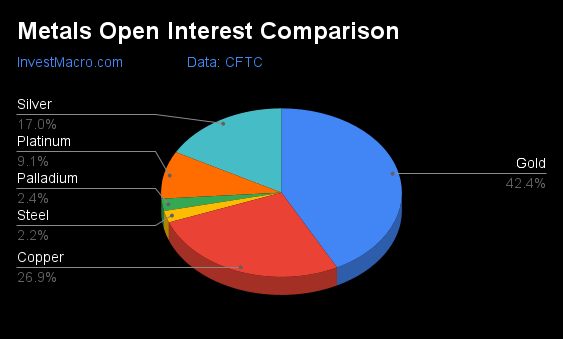
COT Metals Charts: Speculator Bets led lower by Platinum & Copper

By InvestMacro

Here are the latest charts and statistics for the Commitment of Traders (COT) data published by the Commodities Futures Trading Commission (CFTC).

The latest COT data is updated through Tuesday June 4th and shows a quick view of how large traders (for-profit speculators and commercial entities) were positioned in the futures markets.

Weekly Speculator Bets led lower by Platinum & Copper
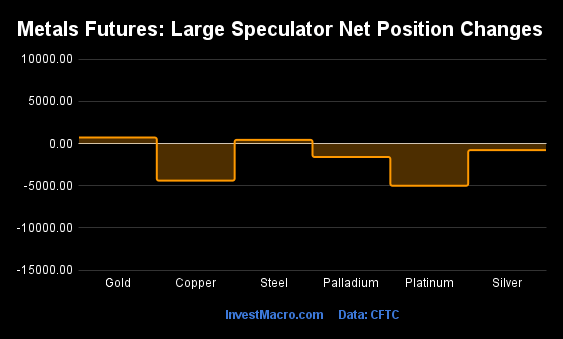
The COT metals markets speculator bets were lower this week as just two out of the six metals markets we cover had higher positioning while the other four markets had lower speculator contracts.

Leading the gains for the metals was Gold (717 contracts) with Steel (441 contracts) also showing a positive week.

The markets with declines in speculator bets for the week were Platinum (-5,001 contracts), Copper (-4,395 contracts), Palladium (-1,593 contracts) and with Silver (-780 contracts) also registering lower bets on the week.


Metals Net Speculators Leaderboard
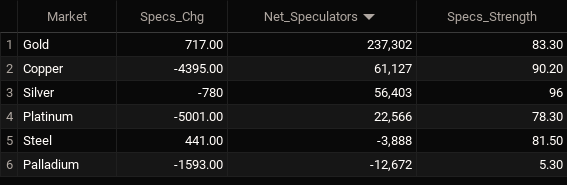
Legend: Weekly Speculators Change | Speculators Current Net Position | Speculators Strength Score compared to last 3-Years (0-100 range)


Strength Scores led by Silver & Copper
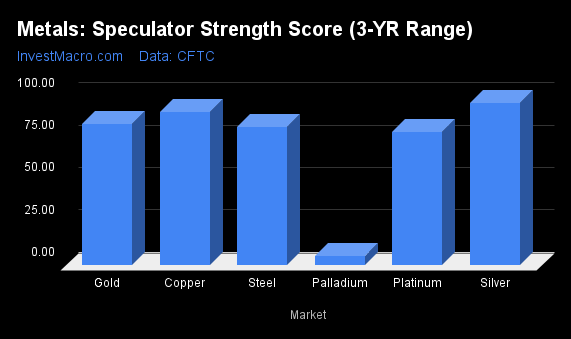
COT Strength Scores (a normalized measure of Speculator positions over a 3-Year range, from 0 to 100 where above 80 is Extreme-Bullish and below 20 is Extreme-Bearish) showed that Silver (96 percent) and Copper (90 percent) lead the metals markets this week. Gold (83 percent), Steel (82 percent) and Platinum (78 percent) come in as the next highest in the weekly strength scores.

On the downside, Palladium (5 percent) comes in at the lowest strength level currently and is in Extreme-Bearish territory (below 20 percent).

Strength Statistics:
Gold (83.3 percent) vs Gold previous week (83.0 percent)
Silver (95.5 percent) vs Silver previous week (96.6 percent)
Copper (90.2 percent) vs Copper previous week (94.3 percent)
Platinum (78.3 percent) vs Platinum previous week (91.6 percent)
Palladium (5.3 percent) vs Palladium previous week (15.3 percent)
Steel (81.5 percent) vs Palladium previous week (79.8 percent)


Platinum & Gold top the 6-Week Strength Trends
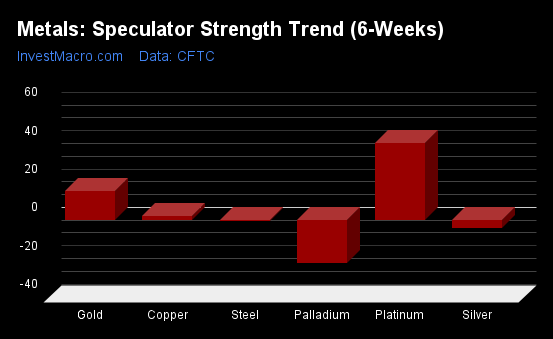
COT Strength Score Trends (or move index, calculates the 6-week changes in strength scores) showed that Platinum (40 percent) and Gold (15 percent) lead the past six weeks trends for metals.

Palladium (-22 percent) leads the downside trend scores currently with Silver (-4 percent) as the next market with lower trend scores.

Move Statistics:
Gold (15.5 percent) vs Gold previous week (15.6 percent)
Silver (-4.1 percent) vs Silver previous week (5.3 percent)
Copper (2.5 percent) vs Copper previous week (16.7 percent)
Platinum (40.3 percent) vs Platinum previous week (24.9 percent)
Palladium (-22.1 percent) vs Palladium previous week (-12.9 percent)
Steel (-0.3 percent) vs Steel previous week (-6.1 percent)


Individual Markets:

Gold Comex Futures:
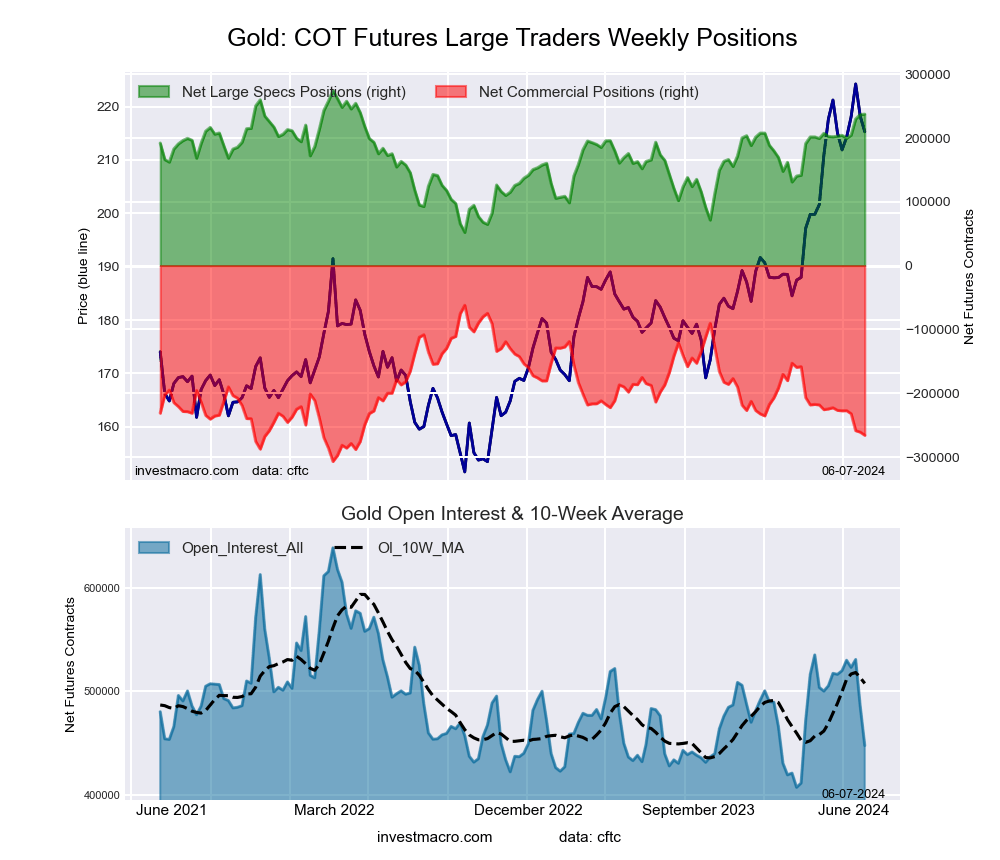
Gold Futures COT ChartThe Gold Comex Futures large speculator standing this week equaled a net position of 237,302 contracts in the data reported through Tuesday. This was a weekly rise of 717 contracts from the previous week which had a total of 236,585 net contracts.

This week’s current strength score (the trader positioning range over the past three years, measured from 0 to 100) shows the speculators are currently Bullish-Extreme with a score of 83.3 percent. The commercials are Bearish-Extreme with a score of 16.8 percent and the small traders (not shown in chart) are Bullish with a score of 66.1 percent.

Price Trend-Following Model: Uptrend

Our weekly trend-following model classifies the current market price position as: Uptrend. The current action for the model is considered to be: Hold – Maintain Long Position.

Gold Futures StatisticsSPECULATORSCOMMERCIALSSMALL TRADERS
– Percent of Open Interest Longs:63.618.611.1
– Percent of Open Interest Shorts:10.678.14.7
– Net Position:237,302-265,93128,629
– Gross Longs:284,56683,41849,807
– Gross Shorts:47,264349,34921,178
– Long to Short Ratio:6.0 to 10.2 to 12.4 to 1
NET POSITION TREND:
– Strength Index Score (3 Year Range Pct):83.316.866.1
– Strength Index Reading (3 Year Range):Bullish-ExtremeBearish-ExtremeBullish
NET POSITION MOVEMENT INDEX:
– 6-Week Change in Strength Index:15.5-16.014.9


Silver Comex Futures:

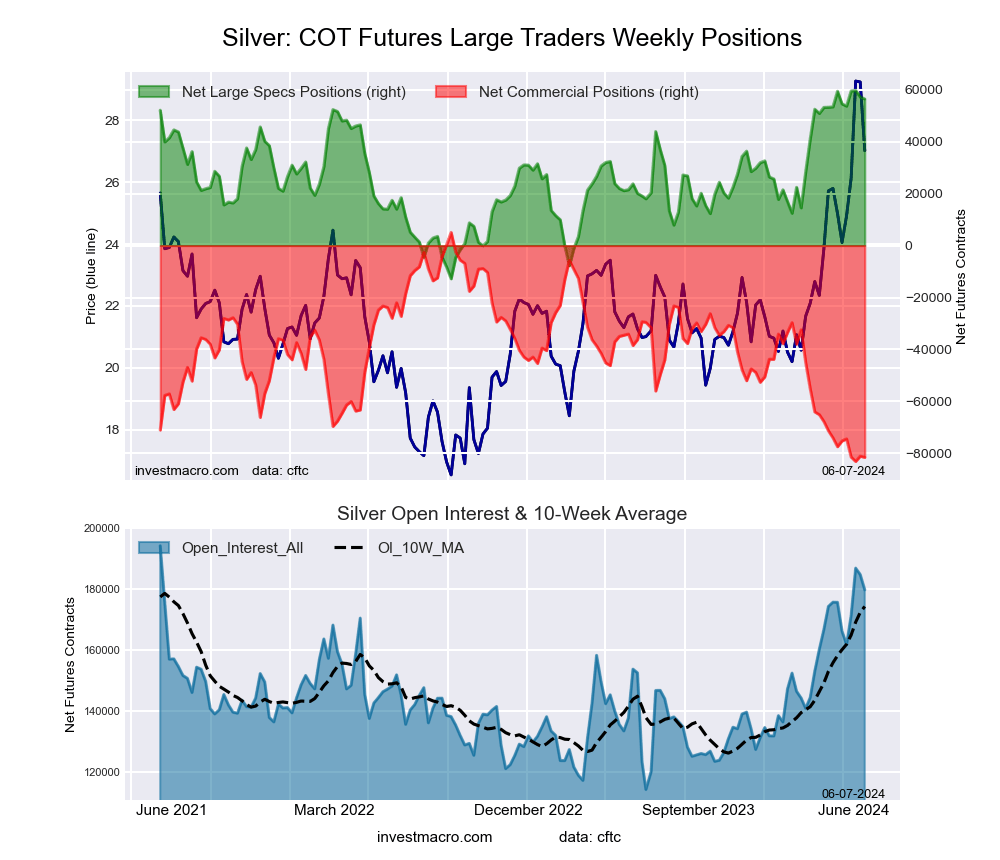
Silver Futures COT ChartThe Silver Comex Futures large speculator standing this week equaled a net position of 56,403 contracts in the data reported through Tuesday. This was a weekly decrease of -780 contracts from the previous week which had a total of 57,183 net contracts.

This week’s current strength score (the trader positioning range over the past three years, measured from 0 to 100) shows the speculators are currently Bullish-Extreme with a score of 95.5 percent. The commercials are Bearish-Extreme with a score of 1.8 percent and the small traders (not shown in chart) are Bullish-Extreme with a score of 100.0 percent.

Price Trend-Following Model: Uptrend

Our weekly trend-following model classifies the current market price position as: Uptrend. The current action for the model is considered to be: Hold – Maintain Long Position.

Silver Futures StatisticsSPECULATORSCOMMERCIALSSMALL TRADERS
– Percent of Open Interest Longs:49.323.019.9
– Percent of Open Interest Shorts:17.968.35.9
– Net Position:56,403-81,52025,117
– Gross Longs:88,60441,28035,798
– Gross Shorts:32,201122,80010,681
– Long to Short Ratio:2.8 to 10.3 to 13.4 to 1
NET POSITION TREND:
– Strength Index Score (3 Year Range Pct):95.51.8100.0
– Strength Index Reading (3 Year Range):Bullish-ExtremeBearish-ExtremeBullish-Extreme
NET POSITION MOVEMENT INDEX:
– 6-Week Change in Strength Index:-4.1-4.737.1


Copper Grade #1 Futures:

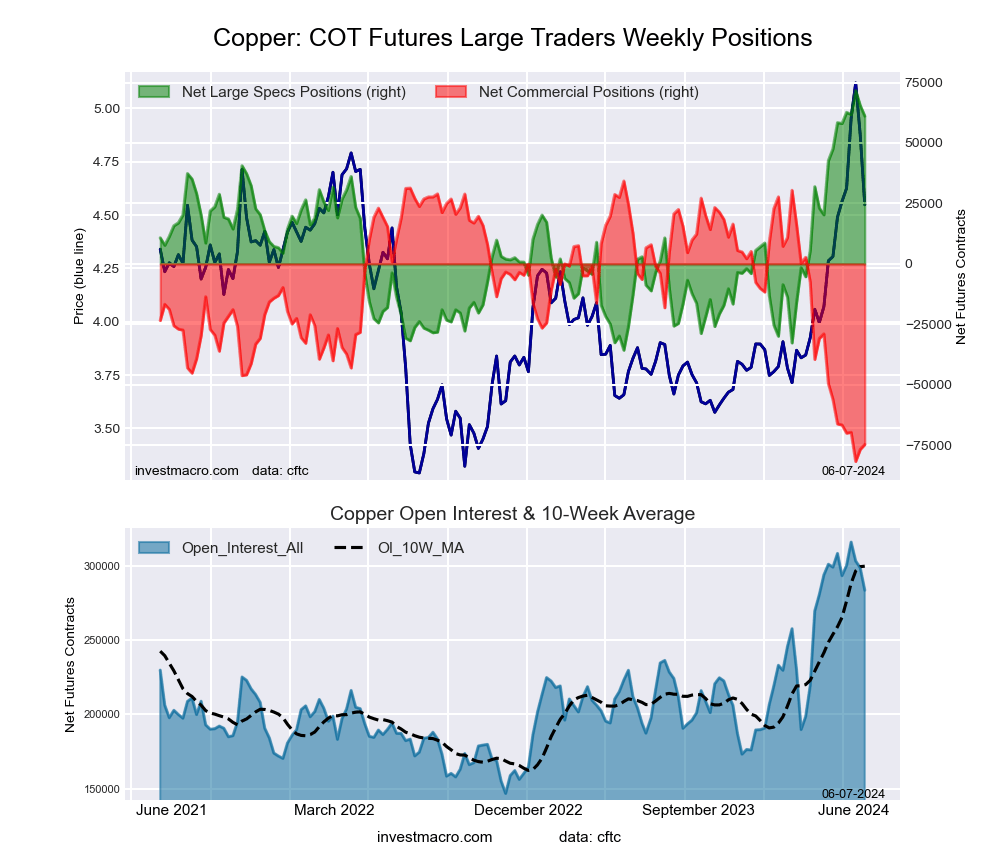
Copper Futures COT ChartThe Copper Grade #1 Futures large speculator standing this week equaled a net position of 61,127 contracts in the data reported through Tuesday. This was a weekly decrease of -4,395 contracts from the previous week which had a total of 65,522 net contracts.

This week’s current strength score (the trader positioning range over the past three years, measured from 0 to 100) shows the speculators are currently Bullish-Extreme with a score of 90.2 percent. The commercials are Bearish-Extreme with a score of 6.0 percent and the small traders (not shown in chart) are Bullish-Extreme with a score of 100.0 percent.

Price Trend-Following Model: Uptrend

Our weekly trend-following model classifies the current market price position as: Uptrend. The current action for the model is considered to be: Hold – Maintain Long Position.

Copper Futures StatisticsSPECULATORSCOMMERCIALSSMALL TRADERS
– Percent of Open Interest Longs:50.327.98.4
– Percent of Open Interest Shorts:28.854.33.6
– Net Position:61,127-74,71513,588
– Gross Longs:142,71279,24923,922
– Gross Shorts:81,585153,96410,334
– Long to Short Ratio:1.7 to 10.5 to 12.3 to 1
NET POSITION TREND:
– Strength Index Score (3 Year Range Pct):90.26.0100.0
– Strength Index Reading (3 Year Range):Bullish-ExtremeBearish-ExtremeBullish-Extreme
NET POSITION MOVEMENT INDEX:
– 6-Week Change in Strength Index:2.5-7.335.0


Platinum Futures:

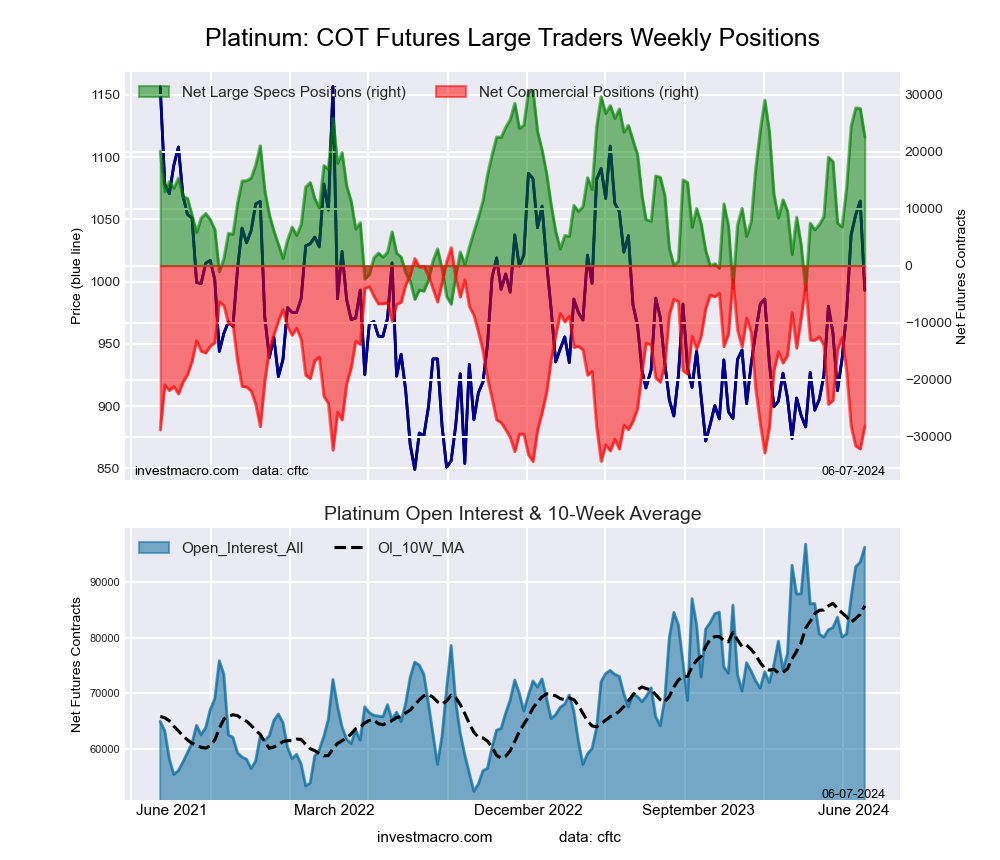
Platinum Futures COT ChartThe Platinum Futures large speculator standing this week equaled a net position of 22,566 contracts in the data reported through Tuesday. This was a weekly lowering of -5,001 contracts from the previous week which had a total of 27,567 net contracts.

This week’s current strength score (the trader positioning range over the past three years, measured from 0 to 100) shows the speculators are currently Bullish with a score of 78.3 percent. The commercials are Bearish-Extreme with a score of 16.6 percent and the small traders (not shown in chart) are Bullish with a score of 50.1 percent.

Price Trend-Following Model: Uptrend

Our weekly trend-following model classifies the current market price position as: Uptrend. The current action for the model is considered to be: Hold – Maintain Long Position.

Platinum Futures StatisticsSPECULATORSCOMMERCIALSSMALL TRADERS
– Percent of Open Interest Longs:58.620.09.9
– Percent of Open Interest Shorts:35.149.24.1
– Net Position:22,566-28,1235,557
– Gross Longs:56,38919,2509,537
– Gross Shorts:33,82347,3733,980
– Long to Short Ratio:1.7 to 10.4 to 12.4 to 1
NET POSITION TREND:
– Strength Index Score (3 Year Range Pct):78.316.650.1
– Strength Index Reading (3 Year Range):BullishBearish-ExtremeBullish
NET POSITION MOVEMENT INDEX:
– 6-Week Change in Strength Index:40.3-35.5-27.9


Palladium Futures:

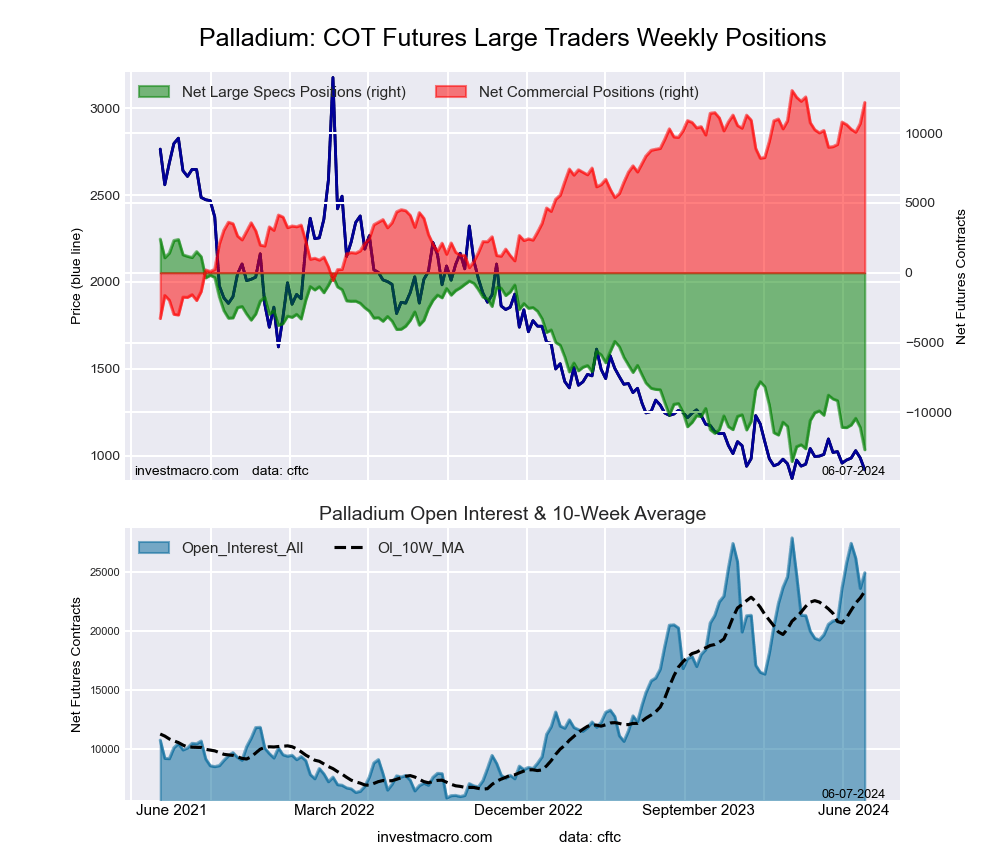
Palladium Futures COT ChartThe Palladium Futures large speculator standing this week equaled a net position of -12,672 contracts in the data reported through Tuesday. This was a weekly lowering of -1,593 contracts from the previous week which had a total of -11,079 net contracts.

This week’s current strength score (the trader positioning range over the past three years, measured from 0 to 100) shows the speculators are currently Bearish-Extreme with a score of 5.3 percent. The commercials are Bullish-Extreme with a score of 94.8 percent and the small traders (not shown in chart) are Bullish with a score of 70.7 percent.

Price Trend-Following Model: Weak Uptrend

Our weekly trend-following model classifies the current market price position as: Weak Uptrend. The current action for the model is considered to be: Hold – Maintain Long Position.

Palladium Futures StatisticsSPECULATORSCOMMERCIALSSMALL TRADERS
– Percent of Open Interest Longs:29.556.99.1
– Percent of Open Interest Shorts:80.37.97.2
– Net Position:-12,67212,189483
– Gross Longs:7,34214,1652,266
– Gross Shorts:20,0141,9761,783
– Long to Short Ratio:0.4 to 17.2 to 11.3 to 1
NET POSITION TREND:
– Strength Index Score (3 Year Range Pct):5.394.870.7
– Strength Index Reading (3 Year Range):Bearish-ExtremeBullish-ExtremeBullish
NET POSITION MOVEMENT INDEX:
– 6-Week Change in Strength Index:-22.118.430.8


Steel Futures Futures:

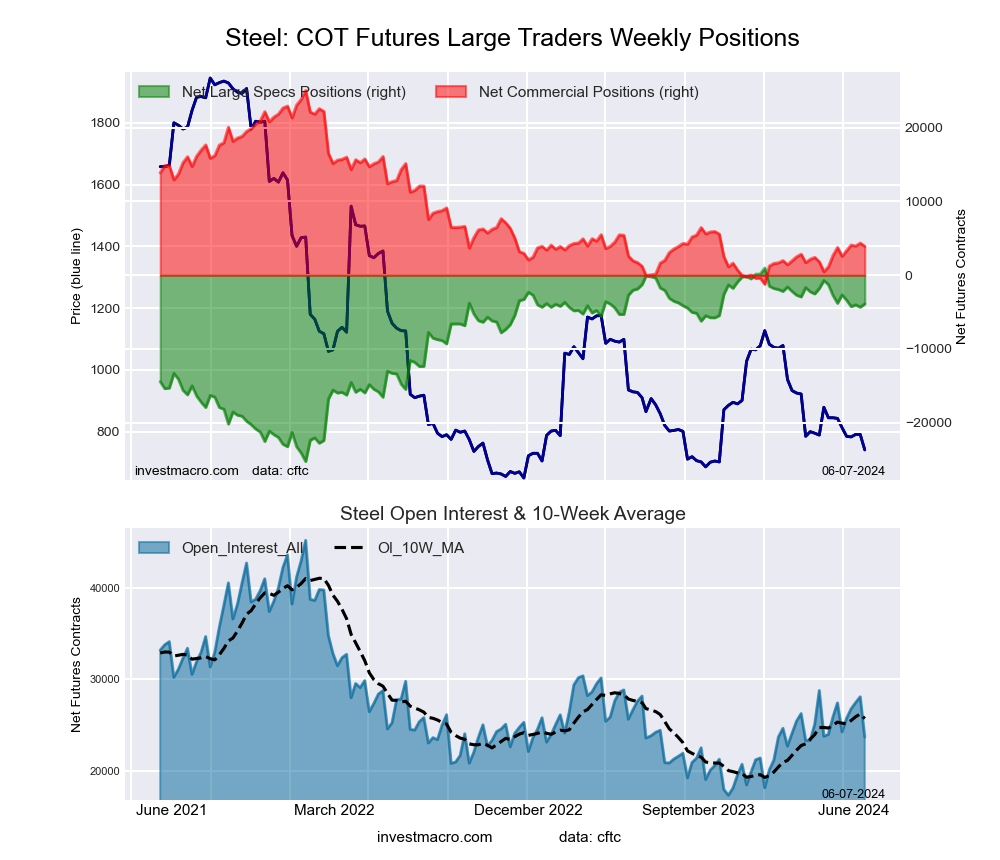
Steel Futures COT ChartThe Steel Futures large speculator standing this week equaled a net position of -3,888 contracts in the data reported through Tuesday. This was a weekly advance of 441 contracts from the previous week which had a total of -4,329 net contracts.

This week’s current strength score (the trader positioning range over the past three years, measured from 0 to 100) shows the speculators are currently Bullish-Extreme with a score of 81.5 percent. The commercials are Bearish-Extreme with a score of 19.6 percent and the small traders (not shown in chart) are Bearish with a score of 28.7 percent.

Price Trend-Following Model: Downtrend

Our weekly trend-following model classifies the current market price position as: Downtrend. The current action for the model is considered to be: Hold – Maintain Short Position.

Steel Futures StatisticsSPECULATORSCOMMERCIALSSMALL TRADERS
– Percent of Open Interest Longs:17.477.41.3
– Percent of Open Interest Shorts:33.860.81.4
– Net Position:-3,8883,922-34
– Gross Longs:4,11118,328303
– Gross Shorts:7,99914,406337
– Long to Short Ratio:0.5 to 11.3 to 10.9 to 1
NET POSITION TREND:
– Strength Index Score (3 Year Range Pct):81.519.628.7
– Strength Index Reading (3 Year Range):Bullish-ExtremeBearish-ExtremeBearish
NET POSITION MOVEMENT INDEX:
– 6-Week Change in Strength Index:-0.30.6-8.1


Article By InvestMacroReceive our weekly COT Newsletter

*COT Report: The COT data, released weekly to the public each Friday, is updated through the most recent Tuesday (data is 3 days old) and shows a quick view of how large speculators or non-commercials (for-profit traders) were positioned in the futures markets.

The CFTC categorizes trader positions according to commercial hedgers (traders who use futures contracts for hedging as part of the business), non-commercials (large traders who speculate to realize trading profits) and nonreportable traders (usually small traders/speculators) as well as their open interest (contracts open in the market at time of reporting). See CFTC criteria here.

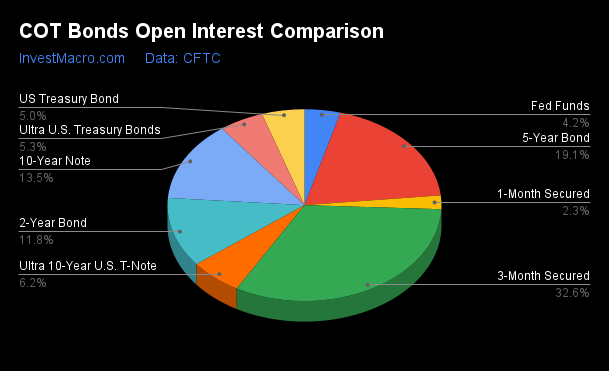
COT Bonds Charts: Speculator Bets led lower by 5-Year Bonds

By InvestMacro

Here are the latest charts and statistics for the Commitment of Traders (COT) reports data published by the Commodities Futures Trading Commission (CFTC).

The latest COT data is updated through Tuesday June 4th and shows a quick view of how large traders (for-profit speculators and commercial hedgers) were positioned in the futures markets.

Weekly Speculator Bets led lower by 5-Year Bonds

The COT bond market speculator bets were lower this week as only one out of the eight bond markets we cover had higher positioning while the other seven markets had lower speculator contracts.

Leading the gains for the bond markets was the Ultra 10-Year Bonds with an increase by 33,731 contracts for the week.

The bond markets with declines in speculator bets for the week were the 5-Year Bonds (-195,920 contracts), the SOFR 3-Months (-77,320 contracts), Fed Funds (-77,263 contracts), the 10-Year Bonds (-66,580 contracts), the US Treasury Bonds (-59,326 contracts), the 2-Year Bonds (-55,603 contracts) and the Ultra Treasury Bonds (-12,463 contracts) also registering lower bets on the week.


Bonds Net Speculators Leaderboard

Legend: Weekly Speculators Change | Speculators Current Net Position | Speculators Strength Score compared to last 3-Years (0-100 range)


Strength Scores led by US Treasury Bonds & Fed Funds

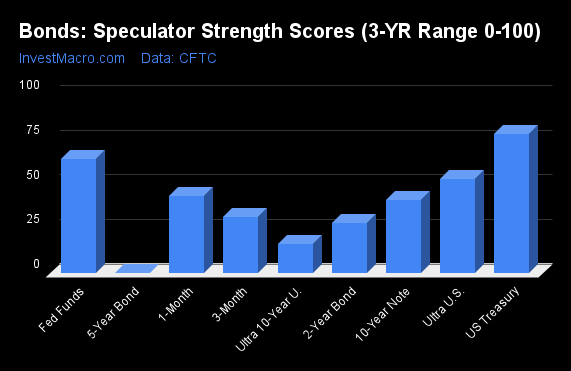
COT Strength Scores (a normalized measure of Speculator positions over a 3-Year range, from 0 to 100 where above 80 is Extreme-Bullish and below 20 is Extreme-Bearish) showed that the US Treasury Bonds (78 percent) and the Fed Funds (64 percent) lead the bond markets this week. The Ultra Treasury Bonds (52 percent) comes in as the next highest in the weekly strength scores.

On the downside, the 5-Year Bonds (0 percent) and the Ultra 10-Year Bonds (16 percent) come in at the lowest strength level currently and are in Extreme-Bearish territory (below 20 percent). The next lowest strength scores were the 2-Year Bonds (28 percent) and the SOFR 3-Months (31 percent).

Strength Statistics:
Fed Funds (63.8 percent) vs Fed Funds previous week (81.3 percent)
2-Year Bond (28.2 percent) vs 2-Year Bond previous week (31.7 percent)
5-Year Bond (0.0 percent) vs 5-Year Bond previous week (11.7 percent)
10-Year Bond (40.6 percent) vs 10-Year Bond previous week (46.8 percent)
Ultra 10-Year Bond (16.4 percent) vs Ultra 10-Year Bond previous week (9.6 percent)
US Treasury Bond (78.1 percent) vs US Treasury Bond previous week (98.8 percent)
Ultra US Treasury Bond (52.4 percent) vs Ultra US Treasury Bond previous week (57.6 percent)
SOFR 3-Months (31.1 percent) vs SOFR 3-Months previous week (35.1 percent)


Ultra 10-Year Bonds & US Treasury Bonds top the 6-Week Strength Trends

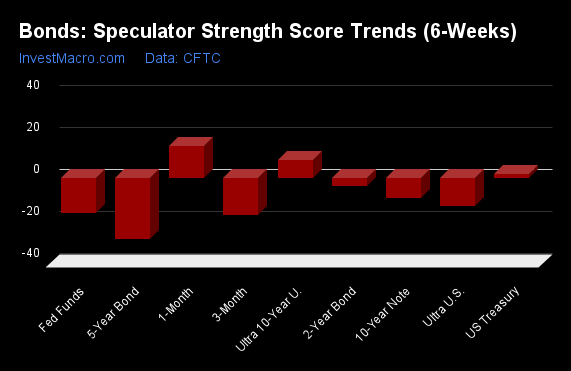
COT Strength Score Trends (or move index, calculates the 6-week changes in strength scores) showed that the Ultra 10-Year Bonds (9 percent) and the US Treasury Bonds (2 percent) lead the past six weeks trends and are the only positive movers for bonds.

The 5-Year Bonds (-29 percent), the SOFR 3-Months (-17 percent) and the Fed Funds (-16 percent) lead the downside trend scores currently with the Ultra Treasury Bonds (-13 percent) following next with lower trend scores.

Strength Trend Statistics:
Fed Funds (-16.3 percent) vs Fed Funds previous week (1.3 percent)
2-Year Bond (-3.5 percent) vs 2-Year Bond previous week (-2.1 percent)
5-Year Bond (-28.9 percent) vs 5-Year Bond previous week (-11.0 percent)
10-Year Bond (-9.4 percent) vs 10-Year Bond previous week (-2.4 percent)
Ultra 10-Year Bond (8.6 percent) vs Ultra 10-Year Bond previous week (-3.5 percent)
US Treasury Bond (2.0 percent) vs US Treasury Bond previous week (20.8 percent)
Ultra US Treasury Bond (-13.3 percent) vs Ultra US Treasury Bond previous week (-9.7 percent)
SOFR 3-Months (-17.2 percent) vs SOFR 3-Months previous week (-18.6 percent)


Secured Overnight Financing Rate (3-Month) Futures:

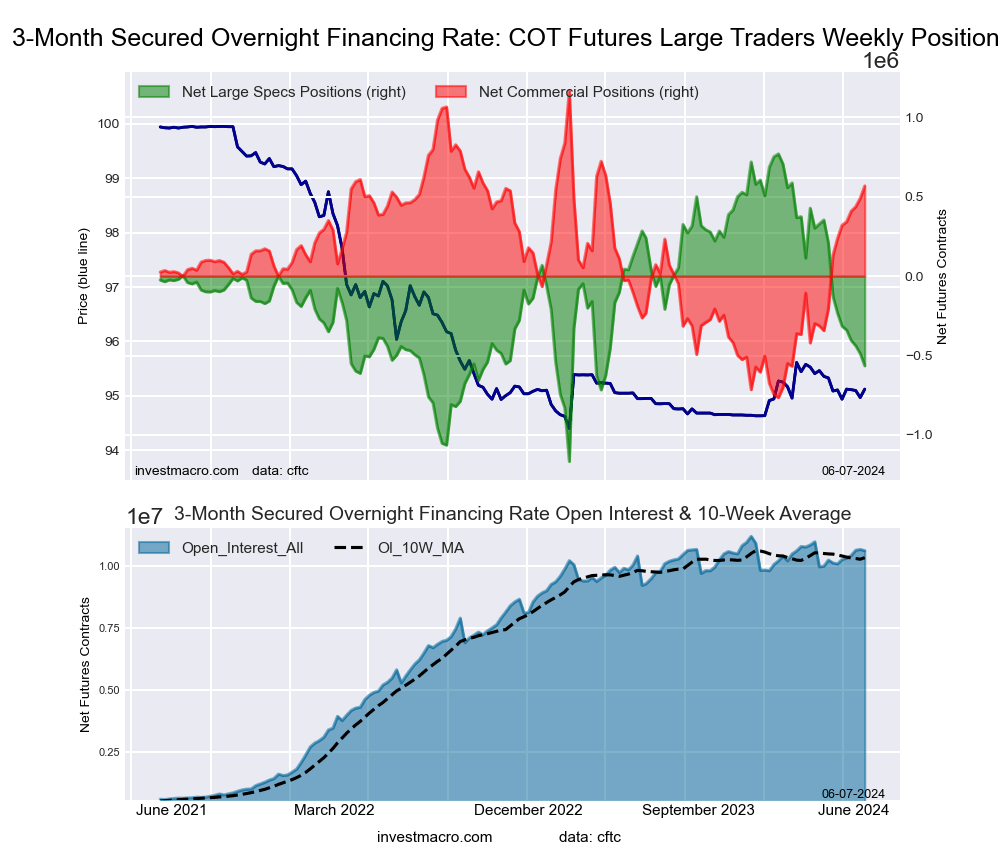
SOFR 3-Months Bonds Futures COT ChartThe Secured Overnight Financing Rate (3-Month) large speculator standing this week was a net position of -564,728 contracts in the data reported through Tuesday. This was a weekly fall of -77,320 contracts from the previous week which had a total of -487,408 net contracts.

This week’s current strength score (the trader positioning range over the past three years, measured from 0 to 100) shows the speculators are currently Bearish with a score of 31.1 percent. The commercials are Bullish with a score of 69.0 percent and the small traders (not shown in chart) are Bullish-Extreme with a score of 86.2 percent.

Price Trend-Following Model: Weak Uptrend

Our weekly trend-following model classifies the current market price position as: Weak Uptrend. The current action for the model is considered to be: Hold – Maintain Long Position.

SOFR 3-Months StatisticsSPECULATORSCOMMERCIALSSMALL TRADERS
– Percent of Open Interest Longs:12.960.90.3
– Percent of Open Interest Shorts:18.255.60.4
– Net Position:-564,728567,744-3,016
– Gross Longs:1,375,6806,478,97834,529
– Gross Shorts:1,940,4085,911,23437,545
– Long to Short Ratio:0.7 to 11.1 to 10.9 to 1
NET POSITION TREND:
– Strength Index Score (3 Year Range Pct):31.169.086.2
– Strength Index Reading (3 Year Range):BearishBullishBullish-Extreme
NET POSITION MOVEMENT INDEX:
– 6-Week Change in Strength Index:-17.217.10.9


30-Day Federal Funds Futures:

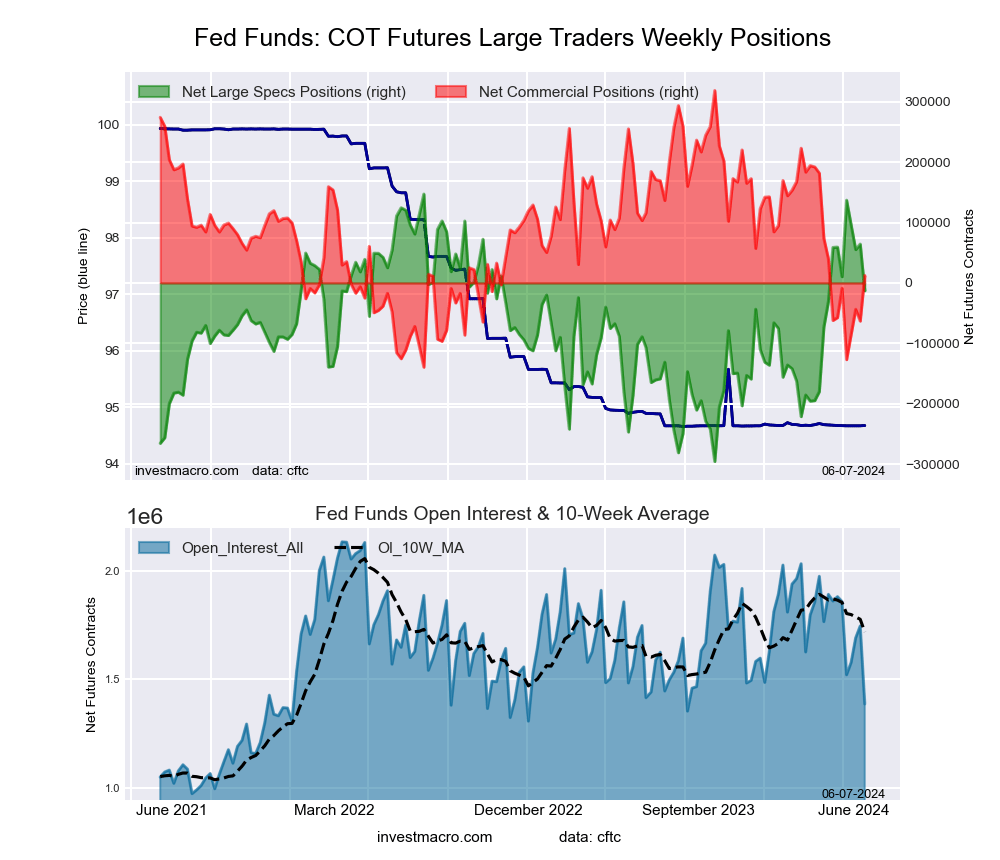
Federal Funds 30-Day Bonds Futures COT ChartThe 30-Day Federal Funds large speculator standing this week was a net position of -12,980 contracts in the data reported through Tuesday. This was a weekly reduction of -77,263 contracts from the previous week which had a total of 64,283 net contracts.

This week’s current strength score (the trader positioning range over the past three years, measured from 0 to 100) shows the speculators are currently Bullish with a score of 63.8 percent. The commercials are Bearish with a score of 33.2 percent and the small traders (not shown in chart) are Bullish-Extreme with a score of 92.1 percent.

Price Trend-Following Model: Downtrend

Our weekly trend-following model classifies the current market price position as: Downtrend. The current action for the model is considered to be: Hold – Maintain Short Position.

30-Day Federal Funds StatisticsSPECULATORSCOMMERCIALSSMALL TRADERS
– Percent of Open Interest Longs:14.263.52.5
– Percent of Open Interest Shorts:15.162.62.5
– Net Position:-12,98012,406574
– Gross Longs:196,856880,75134,967
– Gross Shorts:209,836868,34534,393
– Long to Short Ratio:0.9 to 11.0 to 11.0 to 1
NET POSITION TREND:
– Strength Index Score (3 Year Range Pct):63.833.292.1
– Strength Index Reading (3 Year Range):BullishBearishBullish-Extreme
NET POSITION MOVEMENT INDEX:
– 6-Week Change in Strength Index:-16.315.24.8


2-Year Treasury Note Futures:

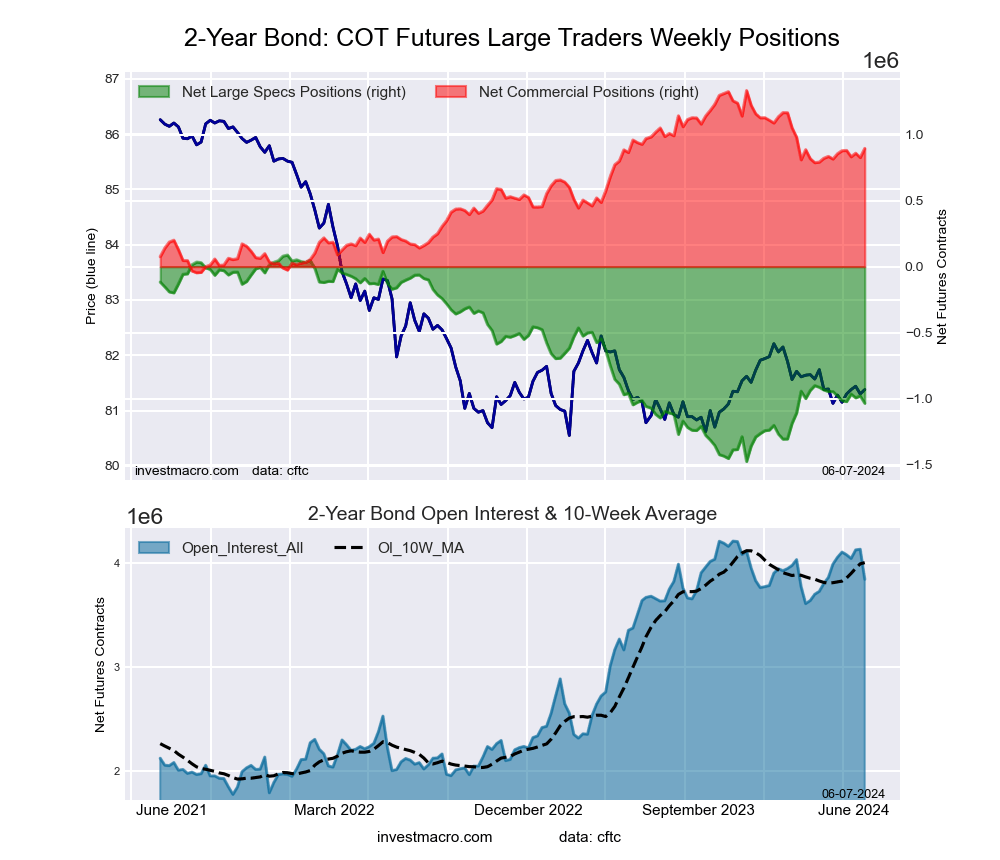
2-Year Treasury Bonds Futures COT ChartThe 2-Year Treasury Note large speculator standing this week was a net position of -1,035,422 contracts in the data reported through Tuesday. This was a weekly decline of -55,603 contracts from the previous week which had a total of -979,819 net contracts.

This week’s current strength score (the trader positioning range over the past three years, measured from 0 to 100) shows the speculators are currently Bearish with a score of 28.2 percent. The commercials are Bullish with a score of 68.2 percent and the small traders (not shown in chart) are Bullish-Extreme with a score of 94.9 percent.

Price Trend-Following Model: Downtrend

Our weekly trend-following model classifies the current market price position as: Downtrend. The current action for the model is considered to be: Hold – Maintain Short Position.

2-Year Treasury Note StatisticsSPECULATORSCOMMERCIALSSMALL TRADERS
– Percent of Open Interest Longs:13.478.07.0
– Percent of Open Interest Shorts:40.454.73.4
– Net Position:-1,035,422895,943139,479
– Gross Longs:516,3642,997,360268,526
– Gross Shorts:1,551,7862,101,417129,047
– Long to Short Ratio:0.3 to 11.4 to 12.1 to 1
NET POSITION TREND:
– Strength Index Score (3 Year Range Pct):28.268.294.9
– Strength Index Reading (3 Year Range):BearishBullishBullish-Extreme
NET POSITION MOVEMENT INDEX:
– 6-Week Change in Strength Index:-3.52.95.3


5-Year Treasury Note Futures:

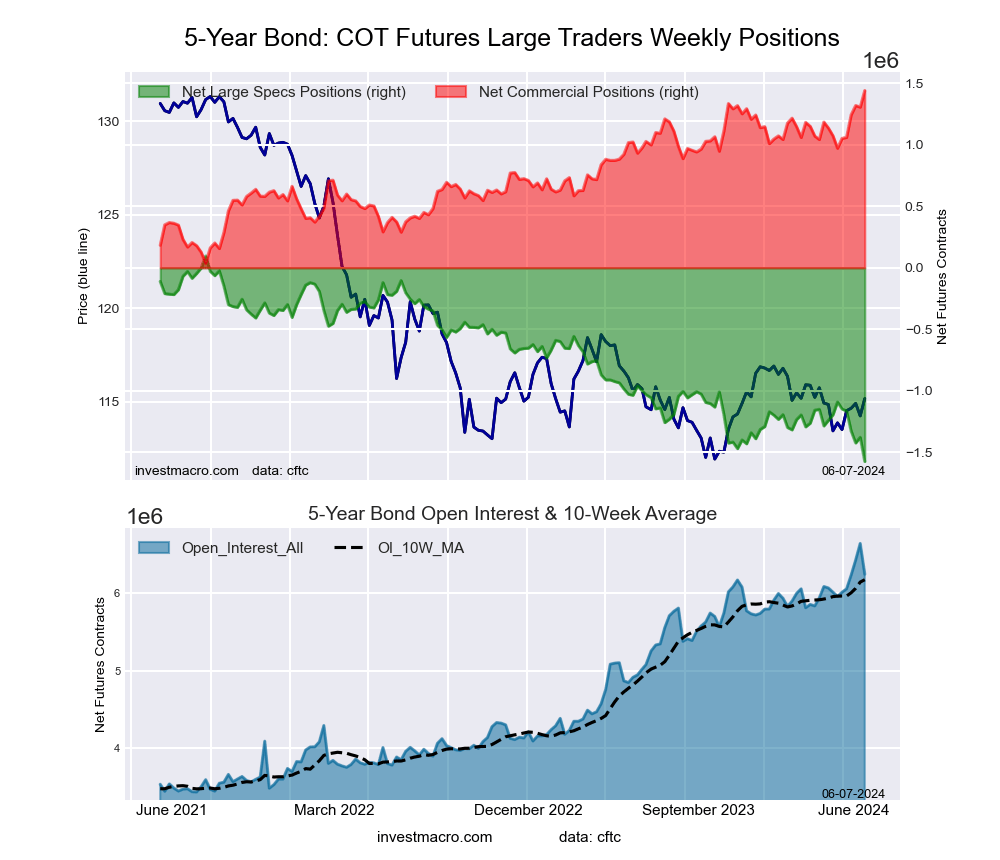
5-Year Treasury Bonds Futures COT ChartThe 5-Year Treasury Note large speculator standing this week was a net position of -1,573,037 contracts in the data reported through Tuesday. This was a weekly decrease of -195,920 contracts from the previous week which had a total of -1,377,117 net contracts.

This week’s current strength score (the trader positioning range over the past three years, measured from 0 to 100) shows the speculators are currently Bearish-Extreme with a score of 0.0 percent. The commercials are Bullish-Extreme with a score of 100.0 percent and the small traders (not shown in chart) are Bullish-Extreme with a score of 91.1 percent.

Price Trend-Following Model: Downtrend

Our weekly trend-following model classifies the current market price position as: Downtrend. The current action for the model is considered to be: Hold – Maintain Short Position.

5-Year Treasury Note StatisticsSPECULATORSCOMMERCIALSSMALL TRADERS
– Percent of Open Interest Longs:6.285.06.8
– Percent of Open Interest Shorts:31.461.94.7
– Net Position:-1,573,0371,439,949133,088
– Gross Longs:389,1175,308,600427,677
– Gross Shorts:1,962,1543,868,651294,589
– Long to Short Ratio:0.2 to 11.4 to 11.5 to 1
NET POSITION TREND:
– Strength Index Score (3 Year Range Pct):0.0100.091.1
– Strength Index Reading (3 Year Range):Bearish-ExtremeBullish-ExtremeBullish-Extreme
NET POSITION MOVEMENT INDEX:
– 6-Week Change in Strength Index:-28.933.42.9


10-Year Treasury Note Futures:

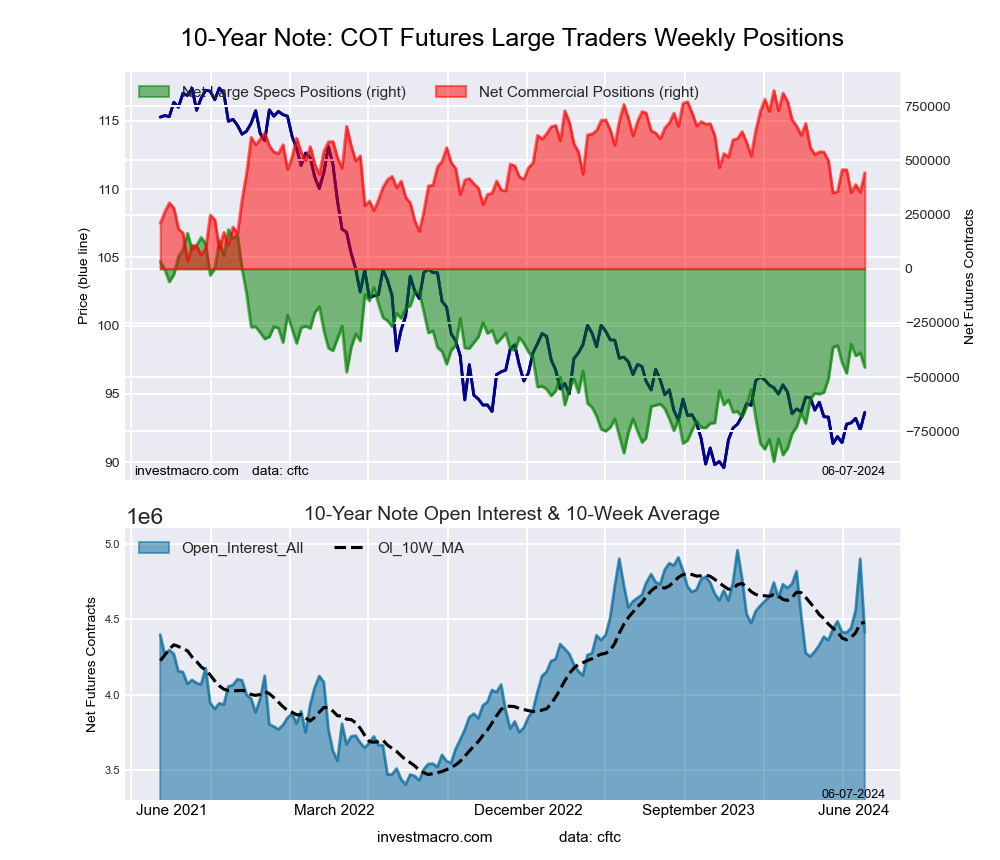
10-Year Treasury Notes Bonds Futures COT ChartThe 10-Year Treasury Note large speculator standing this week was a net position of -454,755 contracts in the data reported through Tuesday. This was a weekly fall of -66,580 contracts from the previous week which had a total of -388,175 net contracts.

This week’s current strength score (the trader positioning range over the past three years, measured from 0 to 100) shows the speculators are currently Bearish with a score of 40.6 percent. The commercials are Bullish with a score of 51.8 percent and the small traders (not shown in chart) are Bullish with a score of 75.9 percent.

Price Trend-Following Model: Downtrend

Our weekly trend-following model classifies the current market price position as: Downtrend. The current action for the model is considered to be: Hold – Maintain Short Position.

10-Year Treasury Note StatisticsSPECULATORSCOMMERCIALSSMALL TRADERS
– Percent of Open Interest Longs:10.177.49.2
– Percent of Open Interest Shorts:20.467.39.0
– Net Position:-454,755443,65511,100
– Gross Longs:447,2133,415,649406,545
– Gross Shorts:901,9682,971,994395,445
– Long to Short Ratio:0.5 to 11.1 to 11.0 to 1
NET POSITION TREND:
– Strength Index Score (3 Year Range Pct):40.651.875.9
– Strength Index Reading (3 Year Range):BearishBullishBullish
NET POSITION MOVEMENT INDEX:
– 6-Week Change in Strength Index:-9.411.03.1


Ultra 10-Year Notes Futures:

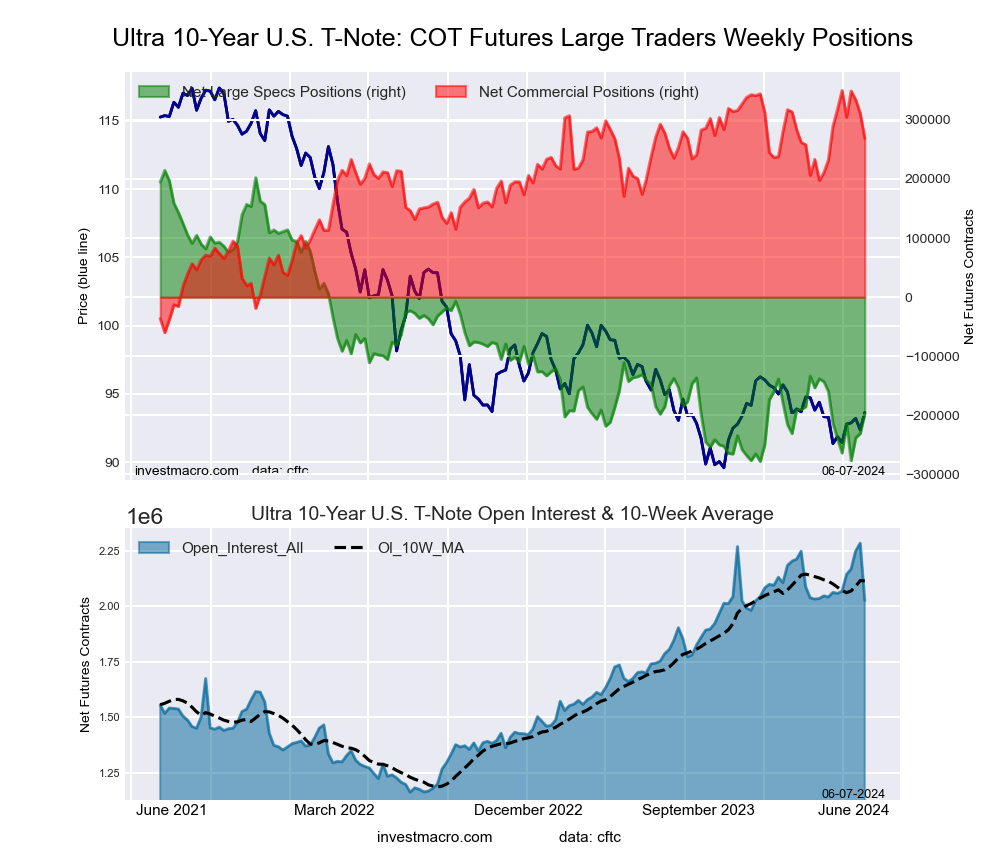
Ultra 10-Year Treasury Notes Bonds Futures COT ChartThe Ultra 10-Year Notes large speculator standing this week was a net position of -197,034 contracts in the data reported through Tuesday. This was a weekly boost of 33,731 contracts from the previous week which had a total of -230,765 net contracts.

This week’s current strength score (the trader positioning range over the past three years, measured from 0 to 100) shows the speculators are currently Bearish-Extreme with a score of 16.4 percent. The commercials are Bullish-Extreme with a score of 80.2 percent and the small traders (not shown in chart) are Bullish with a score of 71.5 percent.

Price Trend-Following Model: Weak Uptrend

Our weekly trend-following model classifies the current market price position as: Weak Uptrend. The current action for the model is considered to be: Hold – Maintain Long Position.

Ultra 10-Year Notes StatisticsSPECULATORSCOMMERCIALSSMALL TRADERS
– Percent of Open Interest Longs:11.577.09.7
– Percent of Open Interest Shorts:21.263.813.2
– Net Position:-197,034268,521-71,487
– Gross Longs:233,5401,560,564196,579
– Gross Shorts:430,5741,292,043268,066
– Long to Short Ratio:0.5 to 11.2 to 10.7 to 1
NET POSITION TREND:
– Strength Index Score (3 Year Range Pct):16.480.271.5
– Strength Index Reading (3 Year Range):Bearish-ExtremeBullish-ExtremeBullish
NET POSITION MOVEMENT INDEX:
– 6-Week Change in Strength Index:8.6-12.14.2


US Treasury Bonds Futures:

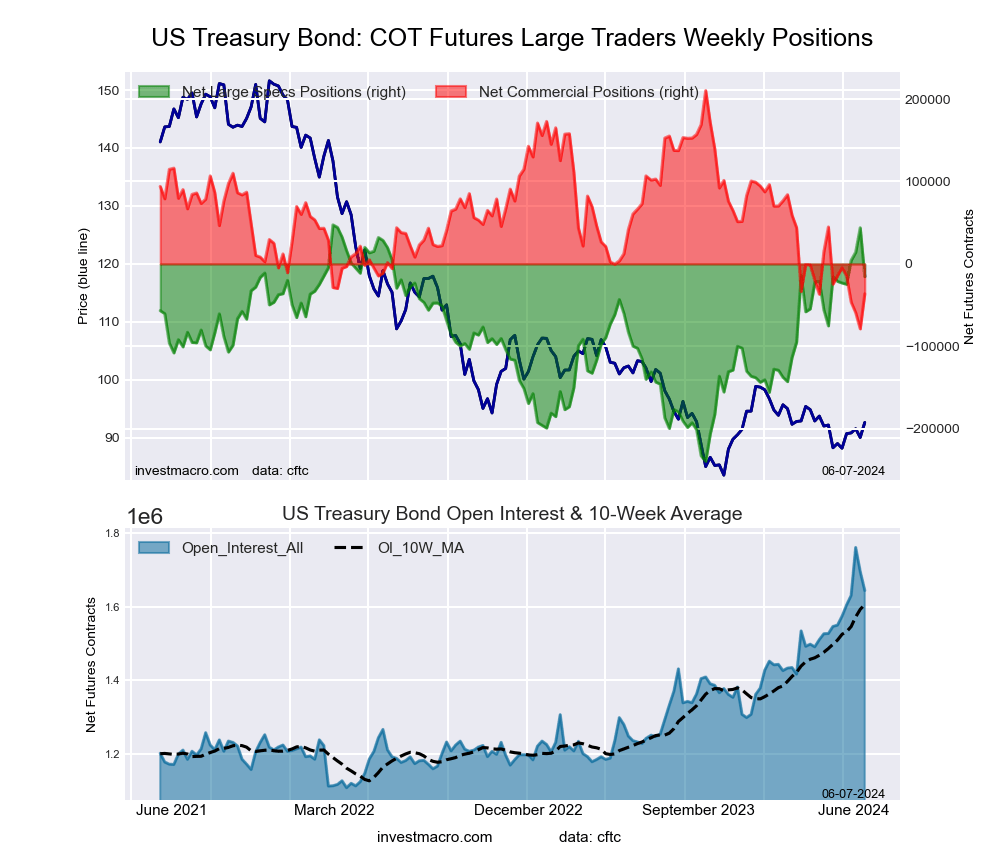
US Year Treasury Notes Long Bonds Futures COT ChartThe US Treasury Bonds large speculator standing this week was a net position of -15,490 contracts in the data reported through Tuesday. This was a weekly decline of -59,326 contracts from the previous week which had a total of 43,836 net contracts.

This week’s current strength score (the trader positioning range over the past three years, measured from 0 to 100) shows the speculators are currently Bullish with a score of 78.1 percent. The commercials are Bearish-Extreme with a score of 14.7 percent and the small traders (not shown in chart) are Bullish-Extreme with a score of 82.4 percent.

Price Trend-Following Model: Downtrend

Our weekly trend-following model classifies the current market price position as: Downtrend. The current action for the model is considered to be: Hold – Maintain Short Position.

US Treasury Bonds StatisticsSPECULATORSCOMMERCIALSSMALL TRADERS
– Percent of Open Interest Longs:17.568.512.7
– Percent of Open Interest Shorts:18.570.79.6
– Net Position:-15,490-36,25951,749
– Gross Longs:288,0781,126,050209,030
– Gross Shorts:303,5681,162,309157,281
– Long to Short Ratio:0.9 to 11.0 to 11.3 to 1
NET POSITION TREND:
– Strength Index Score (3 Year Range Pct):78.114.782.4
– Strength Index Reading (3 Year Range):BullishBearish-ExtremeBullish-Extreme
NET POSITION MOVEMENT INDEX:
– 6-Week Change in Strength Index:2.0-7.615.0


Ultra US Treasury Bonds Futures:

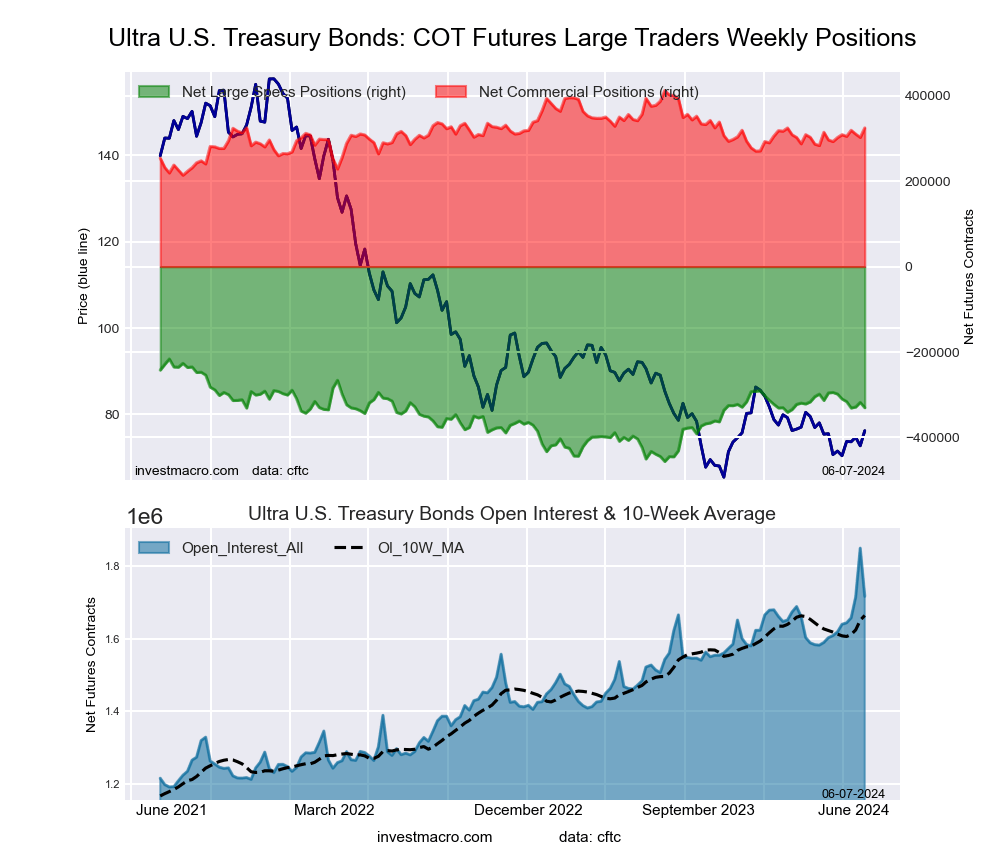
Ultra US Year Treasury Notes Long Bonds Futures COT ChartThe Ultra US Treasury Bonds large speculator standing this week was a net position of -330,531 contracts in the data reported through Tuesday. This was a weekly decrease of -12,463 contracts from the previous week which had a total of -318,068 net contracts.

This week’s current strength score (the trader positioning range over the past three years, measured from 0 to 100) shows the speculators are currently Bullish with a score of 52.4 percent. The commercials are Bullish with a score of 55.8 percent and the small traders (not shown in chart) are Bearish with a score of 22.2 percent.

Price Trend-Following Model: Weak Downtrend

Our weekly trend-following model classifies the current market price position as: Weak Downtrend. The current action for the model is considered to be: Hold – Maintain Short Position.

Ultra US Treasury Bonds StatisticsSPECULATORSCOMMERCIALSSMALL TRADERS
– Percent of Open Interest Longs:8.678.710.5
– Percent of Open Interest Shorts:27.959.810.1
– Net Position:-330,531325,0135,518
– Gross Longs:147,7821,351,715179,644
– Gross Shorts:478,3131,026,702174,126
– Long to Short Ratio:0.3 to 11.3 to 11.0 to 1
NET POSITION TREND:
– Strength Index Score (3 Year Range Pct):52.455.822.2
– Strength Index Reading (3 Year Range):BullishBullishBearish
NET POSITION MOVEMENT INDEX:
– 6-Week Change in Strength Index:-13.311.412.1


Article By InvestMacroReceive our weekly COT Newsletter

*COT Report: The COT data, released weekly to the public each Friday, is updated through the most recent Tuesday (data is 3 days old) and shows a quick view of how large speculators or non-commercials (for-profit traders) were positioned in the futures markets.

The CFTC categorizes trader positions according to commercial hedgers (traders who use futures contracts for hedging as part of the business), non-commercials (large traders who speculate to realize trading profits) and nonreportable traders (usually small traders/speculators) as well as their open interest (contracts open in the market at time of reporting). See CFTC criteria here.
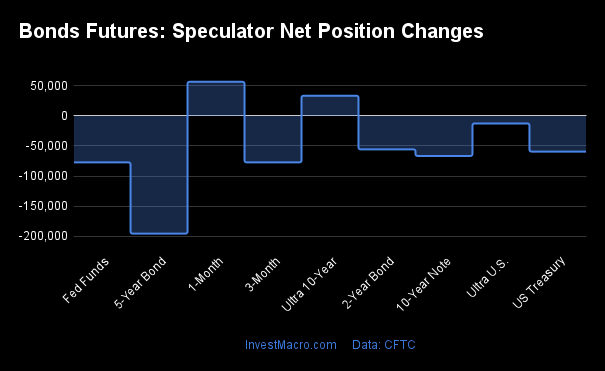
COT Soft Commodities Charts: Speculator bets led by Coffee & Cocoa

By InvestMacro

Here are the latest charts and statistics for the Commitment of Traders (COT) reports data published by the Commodities Futures Trading Commission (CFTC).

The latest COT data is updated through Tuesday June 4th and shows a quick view of how large traders (for-profit speculators and commercial entities) were positioned in the futures markets.

Weekly Speculator Changes led by Coffee & Cocoa

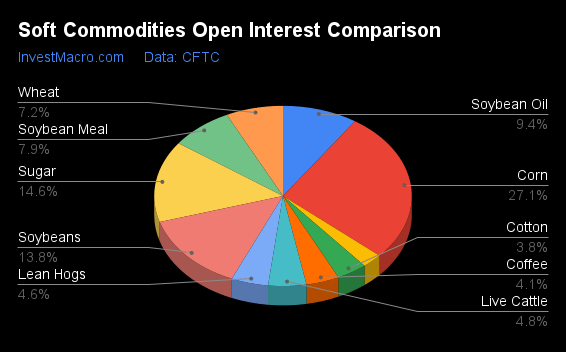
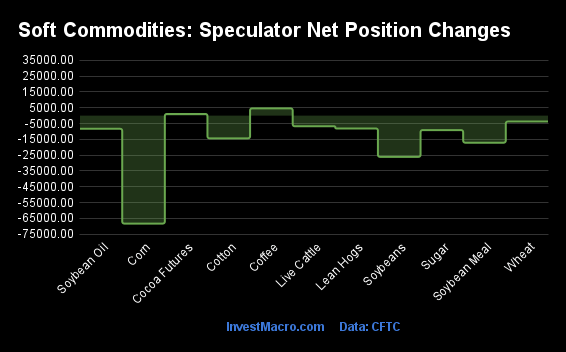
The COT soft commodities markets speculator bets were lower overall this week as just two out of the eleven softs markets we cover had higher positioning while the other nine markets had lower speculator contracts.

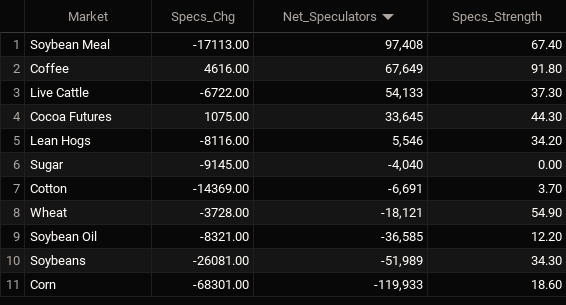
Leading the gains for the softs markets was Coffee (4,616 contracts) with Cocoa (1,075 contracts) as the only other market showing a positive week.

The markets with the declines in speculator bets this week were Corn (-68,301 contracts), Soybeans (-26,081 contracts), Soybean Meal (-17,113 contracts), Cotton (-14,369 contracts), Sugar (-9,145 contracts), Soybean Oil (-8,321 contracts), Lean Hogs (-8,116 contracts), Live Cattle (-6,722 contracts) and with Wheat (-3,728 contracts) also registering lower bets on the week.


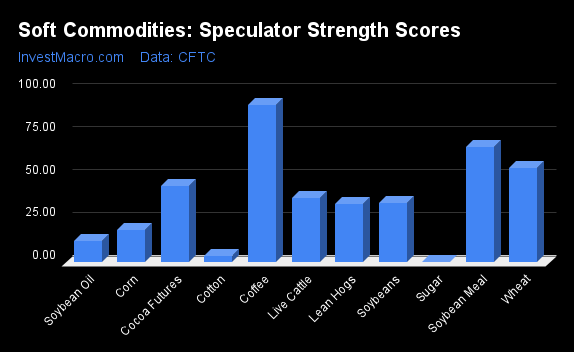
Soft Commodities Net Speculators Leaderboard

Legend: Weekly Speculators Change | Speculators Current Net Position | Speculators Strength Score compared to last 3-Years (0-100 range)


Strength Scores led by Coffee

COT Strength Scores (a normalized measure of Speculator positions over a 3-Year range, from 0 to 100 where above 80 is Extreme-Bullish and below 20 is Extreme-Bearish) showed that Coffee (92 percent) leads the softs markets this week. Soybean Meal (67 percent) and Wheat (55 percent) come in as the next highest in the weekly strength scores.

On the downside, Sugar (0 percent), Cotton (4 percent), Soybean Oil (12 percent) and Corn (19 percent) come in at the lowest strength levels currently and are in Extreme-Bearish territory (below 20 percent).

Strength Statistics:
Corn (18.6 percent) vs Corn previous week (27.3 percent)
Sugar (0.0 percent) vs Sugar previous week (3.0 percent)
Coffee (91.8 percent) vs Coffee previous week (87.3 percent)
Soybeans (34.3 percent) vs Soybeans previous week (40.4 percent)
Soybean Oil (12.2 percent) vs Soybean Oil previous week (17.2 percent)
Soybean Meal (67.4 percent) vs Soybean Meal previous week (74.4 percent)
Live Cattle (37.3 percent) vs Live Cattle previous week (44.6 percent)
Lean Hogs (34.2 percent) vs Lean Hogs previous week (40.9 percent)
Cotton (3.7 percent) vs Cotton previous week (14.5 percent)
Cocoa (44.3 percent) vs Cocoa previous week (43.2 percent)
Wheat (54.9 percent) vs Wheat previous week (57.5 percent)


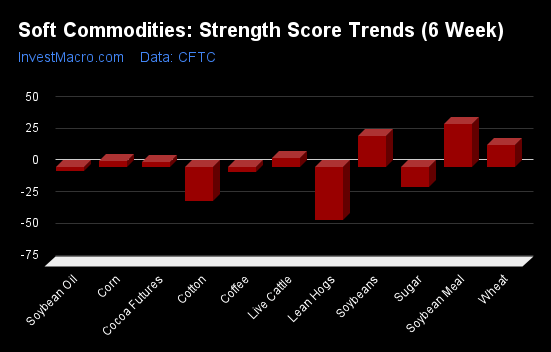
Soybean Meal & Soybeans top the 6-Week Strength Trends

COT Strength Score Trends (or move index, calculates the 6-week changes in strength scores) showed that Soybean Meal (34 percent) and Soybeans (24 percent) lead the past six weeks trends for soft commodities. Wheat (18 percent), Live Cattle (7 percent) and Corn (5 percent) are the next highest positive movers in the latest trends data.

Lean Hogs (-42 percent) leads the downside trend scores currently with Cotton (-27 percent), Sugar (-16 percent) and Coffee (-4 percent) following next with lower trend scores.

Strength Trend Statistics:
Corn (5.1 percent) vs Corn previous week (19.5 percent)
Sugar (-16.0 percent) vs Sugar previous week (-18.8 percent)
Coffee (-4.1 percent) vs Coffee previous week (-12.7 percent)
Soybeans (24.2 percent) vs Soybeans previous week (34.5 percent)
Soybean Oil (-3.2 percent) vs Soybean Oil previous week (3.8 percent)
Soybean Meal (34.0 percent) vs Soybean Meal previous week (52.2 percent)
Live Cattle (7.1 percent) vs Live Cattle previous week (19.2 percent)
Lean Hogs (-42.0 percent) vs Lean Hogs previous week (-35.2 percent)
Cotton (-26.8 percent) vs Cotton previous week (-33.6 percent)
Cocoa (4.1 percent) vs Cocoa previous week (-1.3 percent)
Wheat (17.5 percent) vs Wheat previous week (33.7 percent)


Individual Soft Commodities Markets:

CORN Futures:

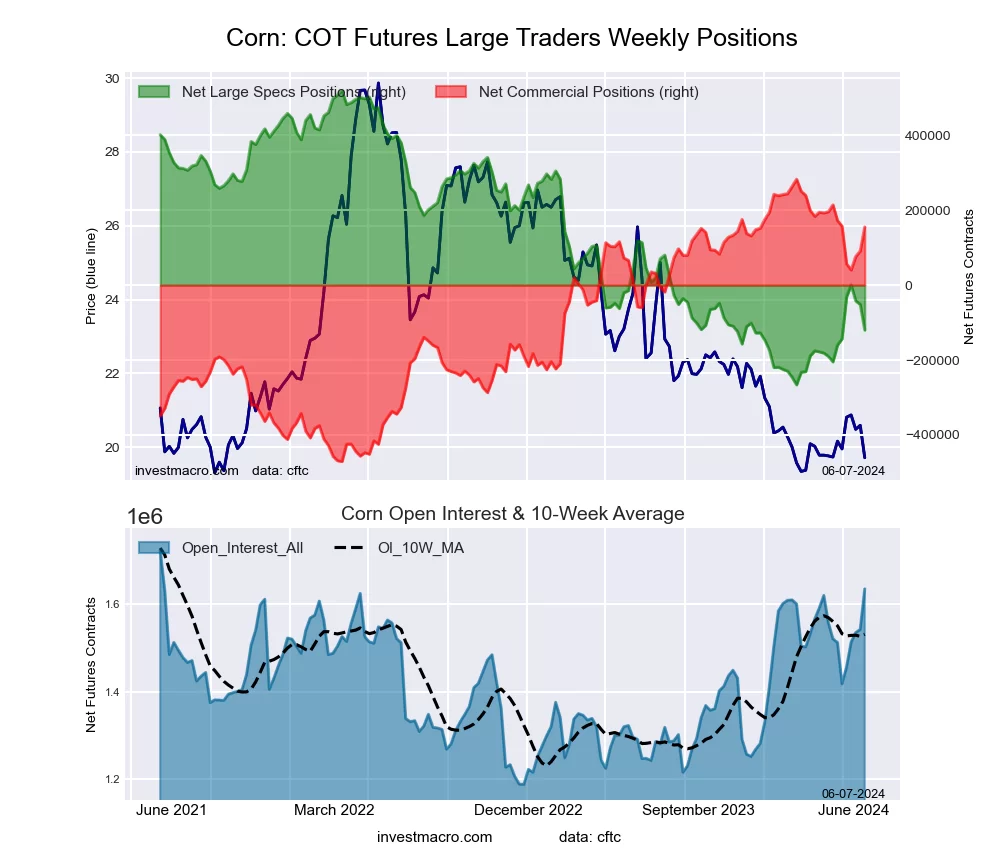
CORN Futures COT ChartThe CORN large speculator standing this week resulted in a net position of -119,933 contracts in the data reported through Tuesday. This was a weekly lowering of -68,301 contracts from the previous week which had a total of -51,632 net contracts.

This week’s current strength score (the trader positioning range over the past three years, measured from 0 to 100) shows the speculators are currently Bearish-Extreme with a score of 18.6 percent. The commercials are Bullish-Extreme with a score of 83.1 percent and the small traders (not shown in chart) are Bullish with a score of 60.7 percent.

Price Trend-Following Model: Weak Uptrend

Our weekly trend-following model classifies the current market price position as: Weak Uptrend. The current action for the model is considered to be: Hold – Maintain Long Position.

CORN Futures StatisticsSPECULATORSCOMMERCIALSSMALL TRADERS
– Percent of Open Interest Longs:20.742.98.8
– Percent of Open Interest Shorts:28.133.510.9
– Net Position:-119,933155,249-35,316
– Gross Longs:339,144702,466143,787
– Gross Shorts:459,077547,217179,103
– Long to Short Ratio:0.7 to 11.3 to 10.8 to 1
NET POSITION TREND:
– Strength Index Score (3 Year Range Pct):18.683.160.7
– Strength Index Reading (3 Year Range):Bearish-ExtremeBullish-ExtremeBullish
NET POSITION MOVEMENT INDEX:
– 6-Week Change in Strength Index:5.1-2.3-30.6


SUGAR Futures:

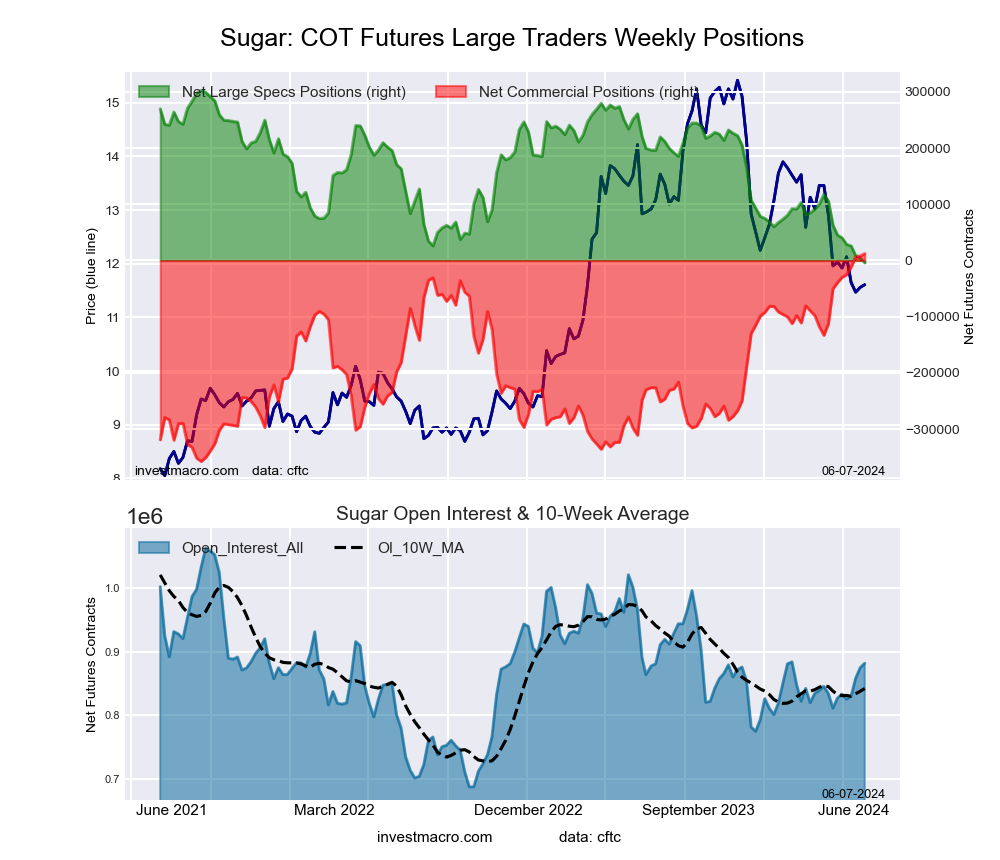
SUGAR Futures COT ChartThe SUGAR large speculator standing this week resulted in a net position of -4,040 contracts in the data reported through Tuesday. This was a weekly fall of -9,145 contracts from the previous week which had a total of 5,105 net contracts.

This week’s current strength score (the trader positioning range over the past three years, measured from 0 to 100) shows the speculators are currently Bearish-Extreme with a score of 0.0 percent. The commercials are Bullish-Extreme with a score of 100.0 percent and the small traders (not shown in chart) are Bearish-Extreme with a score of 8.8 percent.

Price Trend-Following Model: Downtrend

Our weekly trend-following model classifies the current market price position as: Downtrend. The current action for the model is considered to be: Hold – Maintain Short Position.

SUGAR Futures StatisticsSPECULATORSCOMMERCIALSSMALL TRADERS
– Percent of Open Interest Longs:22.053.27.8
– Percent of Open Interest Shorts:22.451.88.8
– Net Position:-4,04012,341-8,301
– Gross Longs:193,811469,22169,222
– Gross Shorts:197,851456,88077,523
– Long to Short Ratio:1.0 to 11.0 to 10.9 to 1
NET POSITION TREND:
– Strength Index Score (3 Year Range Pct):0.0100.08.8
– Strength Index Reading (3 Year Range):Bearish-ExtremeBullish-ExtremeBearish-Extreme
NET POSITION MOVEMENT INDEX:
– 6-Week Change in Strength Index:-16.013.9-3.1


COFFEE Futures:

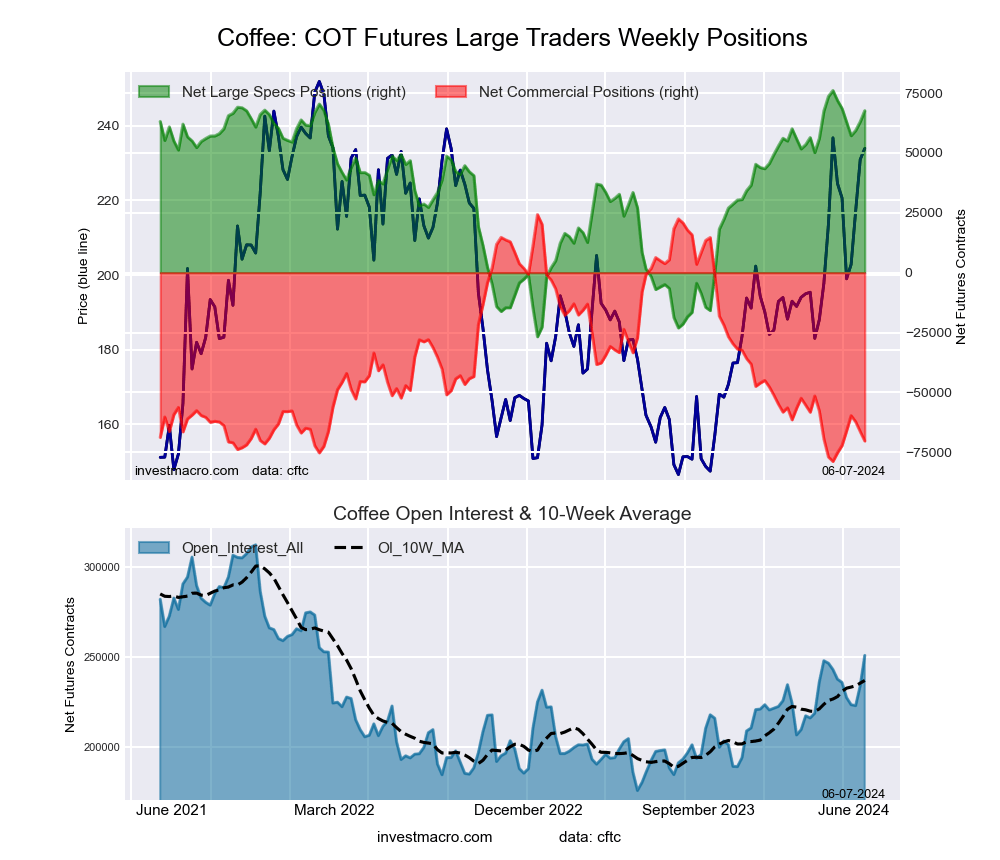
COFFEE Futures COT ChartThe COFFEE large speculator standing this week resulted in a net position of 67,649 contracts in the data reported through Tuesday. This was a weekly advance of 4,616 contracts from the previous week which had a total of 63,033 net contracts.

This week’s current strength score (the trader positioning range over the past three years, measured from 0 to 100) shows the speculators are currently Bullish-Extreme with a score of 91.8 percent. The commercials are Bearish-Extreme with a score of 8.3 percent and the small traders (not shown in chart) are Bullish with a score of 55.0 percent.

Price Trend-Following Model: Strong Uptrend

Our weekly trend-following model classifies the current market price position as: Strong Uptrend. The current action for the model is considered to be: Hold – Maintain Long Position.

COFFEE Futures StatisticsSPECULATORSCOMMERCIALSSMALL TRADERS
– Percent of Open Interest Longs:33.935.43.6
– Percent of Open Interest Shorts:6.963.42.6
– Net Position:67,649-70,2852,636
– Gross Longs:84,94888,7599,069
– Gross Shorts:17,299159,0446,433
– Long to Short Ratio:4.9 to 10.6 to 11.4 to 1
NET POSITION TREND:
– Strength Index Score (3 Year Range Pct):91.88.355.0
– Strength Index Reading (3 Year Range):Bullish-ExtremeBearish-ExtremeBullish
NET POSITION MOVEMENT INDEX:
– 6-Week Change in Strength Index:-4.14.8-9.9


SOYBEANS Futures:

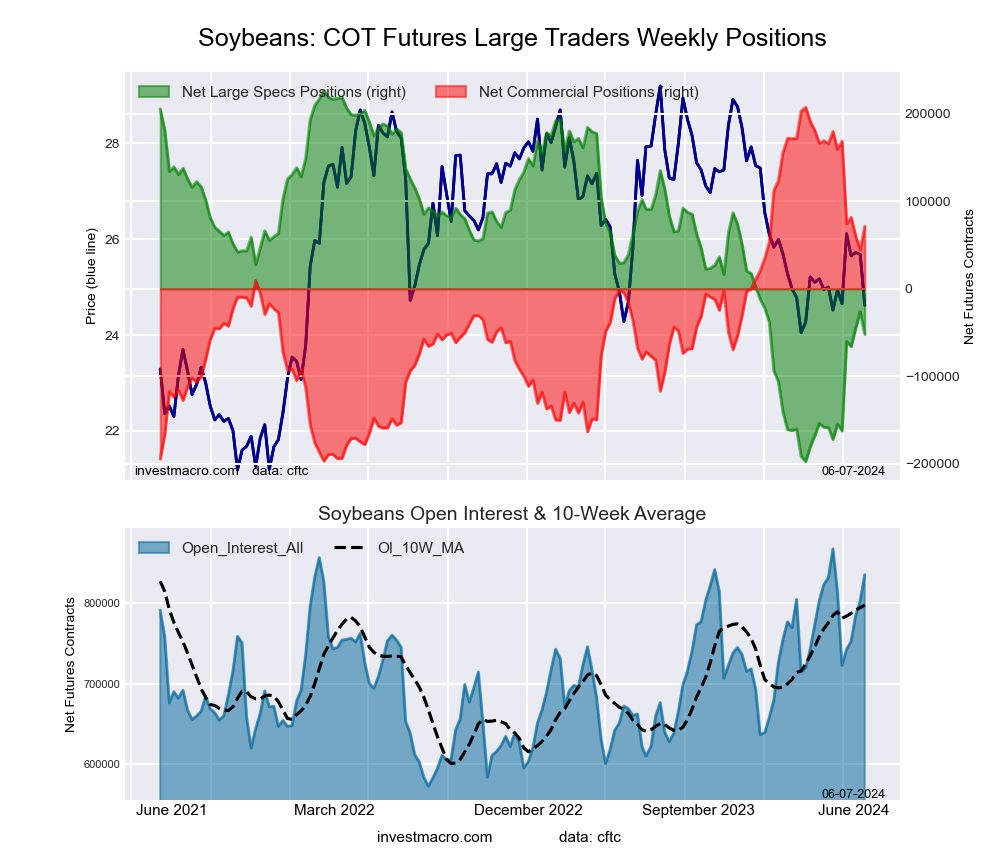
SOYBEANS Futures COT ChartThe SOYBEANS large speculator standing this week resulted in a net position of -51,989 contracts in the data reported through Tuesday. This was a weekly fall of -26,081 contracts from the previous week which had a total of -25,908 net contracts.

This week’s current strength score (the trader positioning range over the past three years, measured from 0 to 100) shows the speculators are currently Bearish with a score of 34.3 percent. The commercials are Bullish with a score of 66.3 percent and the small traders (not shown in chart) are Bullish with a score of 62.1 percent.

Price Trend-Following Model: Weak Uptrend

Our weekly trend-following model classifies the current market price position as: Weak Uptrend. The current action for the model is considered to be: Hold – Maintain Long Position.

SOYBEANS Futures StatisticsSPECULATORSCOMMERCIALSSMALL TRADERS
– Percent of Open Interest Longs:15.357.36.1
– Percent of Open Interest Shorts:21.548.88.4
– Net Position:-51,98971,292-19,303
– Gross Longs:128,076479,27051,219
– Gross Shorts:180,065407,97870,522
– Long to Short Ratio:0.7 to 11.2 to 10.7 to 1
NET POSITION TREND:
– Strength Index Score (3 Year Range Pct):34.366.362.1
– Strength Index Reading (3 Year Range):BearishBullishBullish
NET POSITION MOVEMENT INDEX:
– 6-Week Change in Strength Index:24.2-21.8-37.9


SOYBEAN OIL Futures:

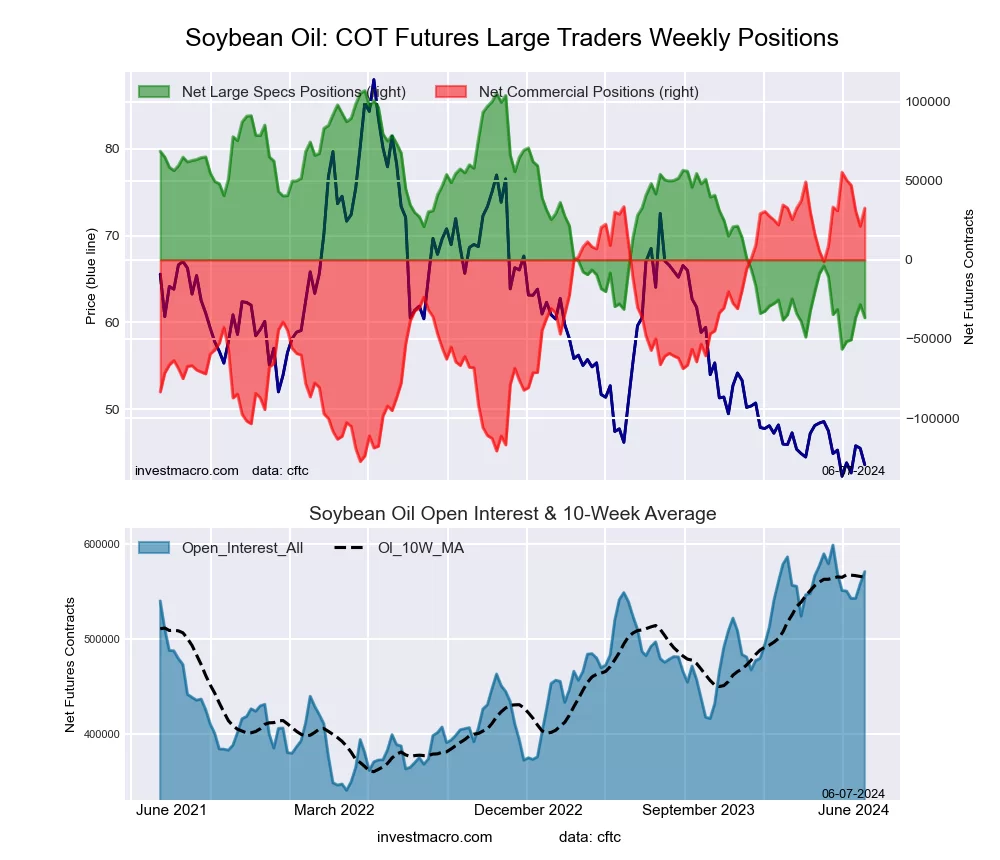
SOYBEAN OIL Futures COT ChartThe SOYBEAN OIL large speculator standing this week resulted in a net position of -36,585 contracts in the data reported through Tuesday. This was a weekly fall of -8,321 contracts from the previous week which had a total of -28,264 net contracts.

This week’s current strength score (the trader positioning range over the past three years, measured from 0 to 100) shows the speculators are currently Bearish-Extreme with a score of 12.2 percent. The commercials are Bullish-Extreme with a score of 87.6 percent and the small traders (not shown in chart) are Bearish with a score of 29.2 percent.

Price Trend-Following Model: Strong Downtrend

Our weekly trend-following model classifies the current market price position as: Strong Downtrend. The current action for the model is considered to be: Hold – Maintain Short Position.

SOYBEAN OIL Futures StatisticsSPECULATORSCOMMERCIALSSMALL TRADERS
– Percent of Open Interest Longs:20.154.25.5
– Percent of Open Interest Shorts:26.548.54.9
– Net Position:-36,58532,6833,902
– Gross Longs:114,518309,54831,673
– Gross Shorts:151,103276,86527,771
– Long to Short Ratio:0.8 to 11.1 to 11.1 to 1
NET POSITION TREND:
– Strength Index Score (3 Year Range Pct):12.287.629.2
– Strength Index Reading (3 Year Range):Bearish-ExtremeBullish-ExtremeBearish
NET POSITION MOVEMENT INDEX:
– 6-Week Change in Strength Index:-3.20.913.8


SOYBEAN MEAL Futures:

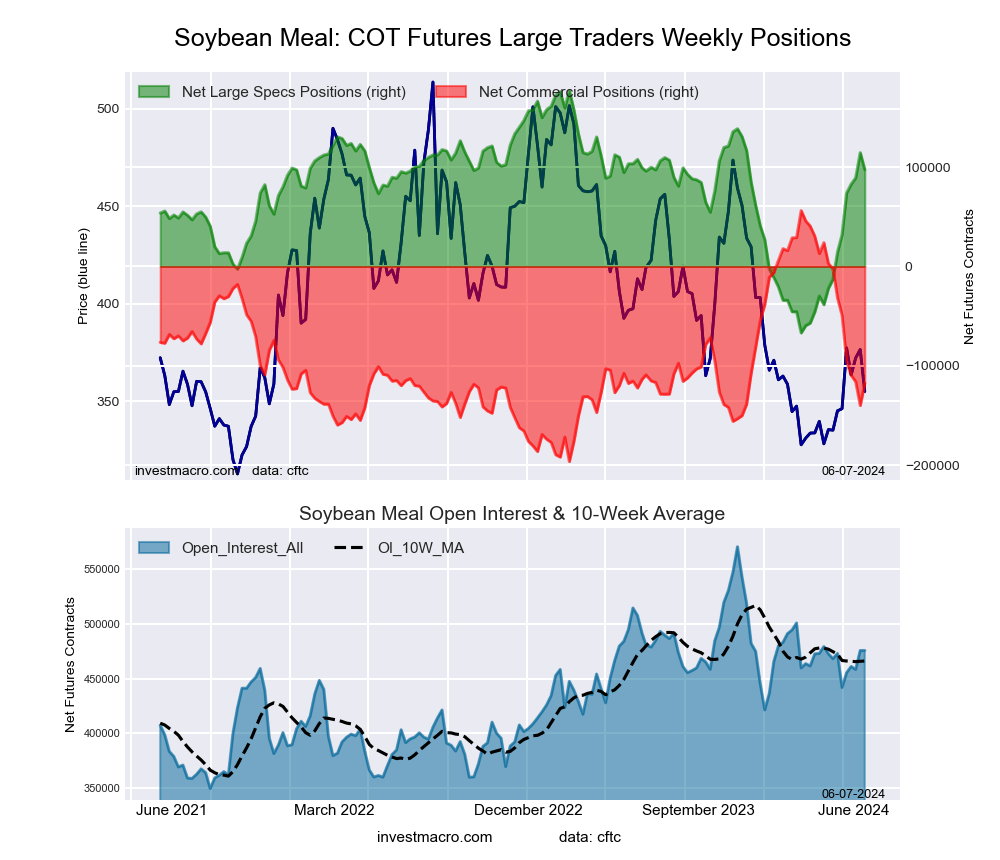
SOYBEAN MEAL Futures COT ChartThe SOYBEAN MEAL large speculator standing this week resulted in a net position of 97,408 contracts in the data reported through Tuesday. This was a weekly decrease of -17,113 contracts from the previous week which had a total of 114,521 net contracts.

This week’s current strength score (the trader positioning range over the past three years, measured from 0 to 100) shows the speculators are currently Bullish with a score of 67.4 percent. The commercials are Bearish with a score of 31.2 percent and the small traders (not shown in chart) are Bearish with a score of 45.3 percent.

Price Trend-Following Model: Strong Uptrend

Our weekly trend-following model classifies the current market price position as: Strong Uptrend. The current action for the model is considered to be: Hold – Maintain Long Position.

SOYBEAN MEAL Futures StatisticsSPECULATORSCOMMERCIALSSMALL TRADERS
– Percent of Open Interest Longs:31.939.29.9
– Percent of Open Interest Shorts:11.563.85.7
– Net Position:97,408-117,32819,920
– Gross Longs:151,919186,34447,039
– Gross Shorts:54,511303,67227,119
– Long to Short Ratio:2.8 to 10.6 to 11.7 to 1
NET POSITION TREND:
– Strength Index Score (3 Year Range Pct):67.431.245.3
– Strength Index Reading (3 Year Range):BullishBearishBearish
NET POSITION MOVEMENT INDEX:
– 6-Week Change in Strength Index:34.0-34.012.6


LIVE CATTLE Futures:

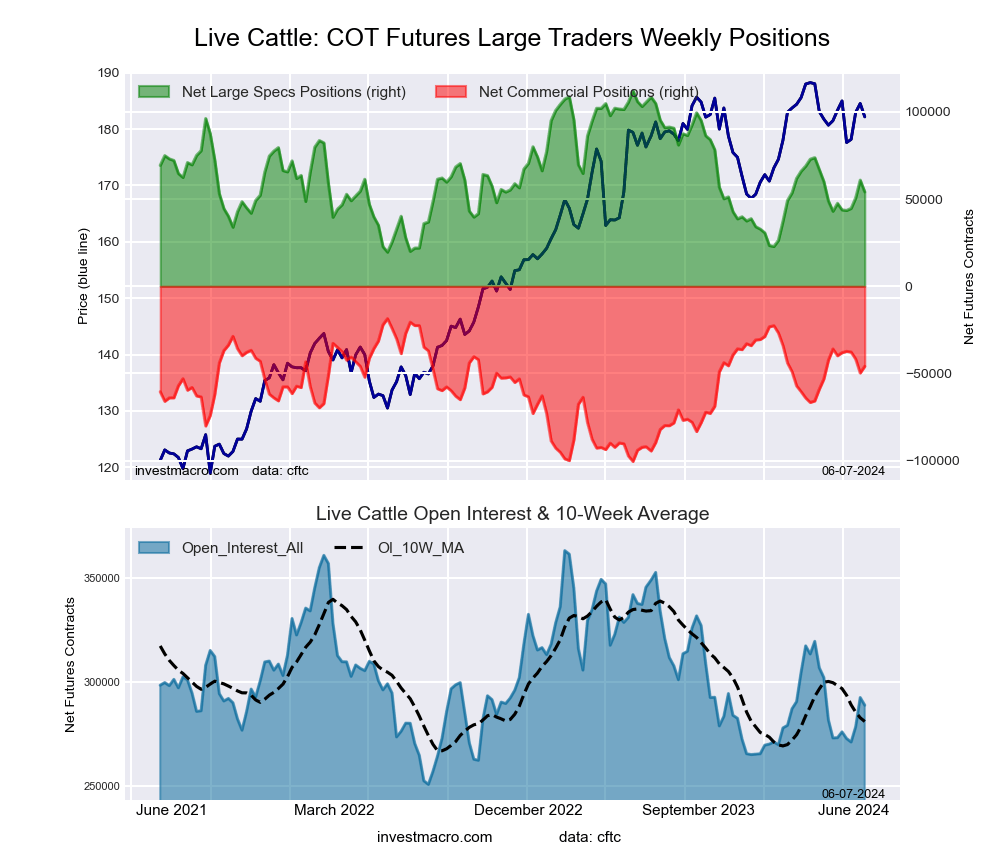
LIVE CATTLE Futures COT ChartThe LIVE CATTLE large speculator standing this week resulted in a net position of 54,133 contracts in the data reported through Tuesday. This was a weekly decline of -6,722 contracts from the previous week which had a total of 60,855 net contracts.

This week’s current strength score (the trader positioning range over the past three years, measured from 0 to 100) shows the speculators are currently Bearish with a score of 37.3 percent. The commercials are Bullish with a score of 66.6 percent and the small traders (not shown in chart) are Bearish with a score of 45.8 percent.

Price Trend-Following Model: Downtrend

Our weekly trend-following model classifies the current market price position as: Downtrend. The current action for the model is considered to be: New Sell – Short Position.

LIVE CATTLE Futures StatisticsSPECULATORSCOMMERCIALSSMALL TRADERS
– Percent of Open Interest Longs:39.933.69.9
– Percent of Open Interest Shorts:21.249.512.7
– Net Position:54,133-45,886-8,247
– Gross Longs:115,31497,04628,476
– Gross Shorts:61,181142,93236,723
– Long to Short Ratio:1.9 to 10.7 to 10.8 to 1
NET POSITION TREND:
– Strength Index Score (3 Year Range Pct):37.366.645.8
– Strength Index Reading (3 Year Range):BearishBullishBearish
NET POSITION MOVEMENT INDEX:
– 6-Week Change in Strength Index:7.1-7.4-2.9


LEAN HOGS Futures:

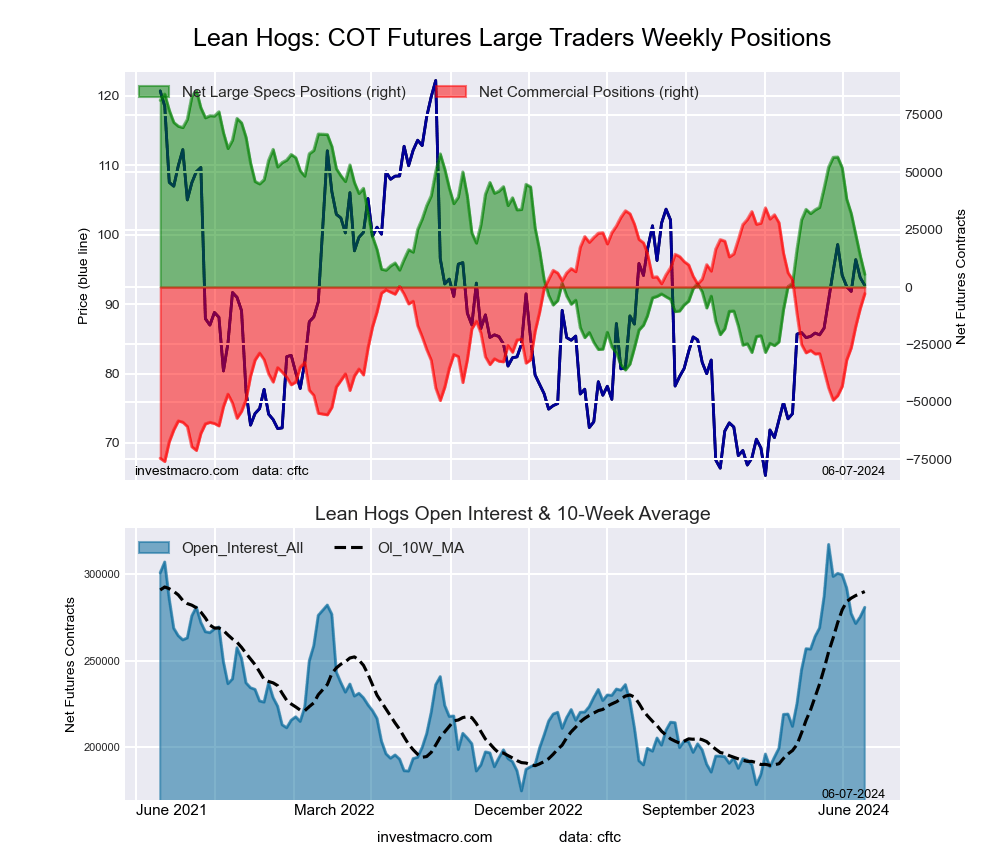
LEAN HOGS Futures COT ChartThe LEAN HOGS large speculator standing this week resulted in a net position of 5,546 contracts in the data reported through Tuesday. This was a weekly reduction of -8,116 contracts from the previous week which had a total of 13,662 net contracts.

This week’s current strength score (the trader positioning range over the past three years, measured from 0 to 100) shows the speculators are currently Bearish with a score of 34.2 percent. The commercials are Bullish with a score of 66.2 percent and the small traders (not shown in chart) are Bullish with a score of 71.3 percent.

Price Trend-Following Model: Uptrend

Our weekly trend-following model classifies the current market price position as: Uptrend. The current action for the model is considered to be: Hold – Maintain Long Position.

LEAN HOGS Futures StatisticsSPECULATORSCOMMERCIALSSMALL TRADERS
– Percent of Open Interest Longs:28.839.17.9
– Percent of Open Interest Shorts:26.840.18.9
– Net Position:5,546-2,865-2,681
– Gross Longs:80,913109,68322,185
– Gross Shorts:75,367112,54824,866
– Long to Short Ratio:1.1 to 11.0 to 10.9 to 1
NET POSITION TREND:
– Strength Index Score (3 Year Range Pct):34.266.271.3
– Strength Index Reading (3 Year Range):BearishBullishBullish
NET POSITION MOVEMENT INDEX:
– 6-Week Change in Strength Index:-42.040.229.7


COTTON Futures:

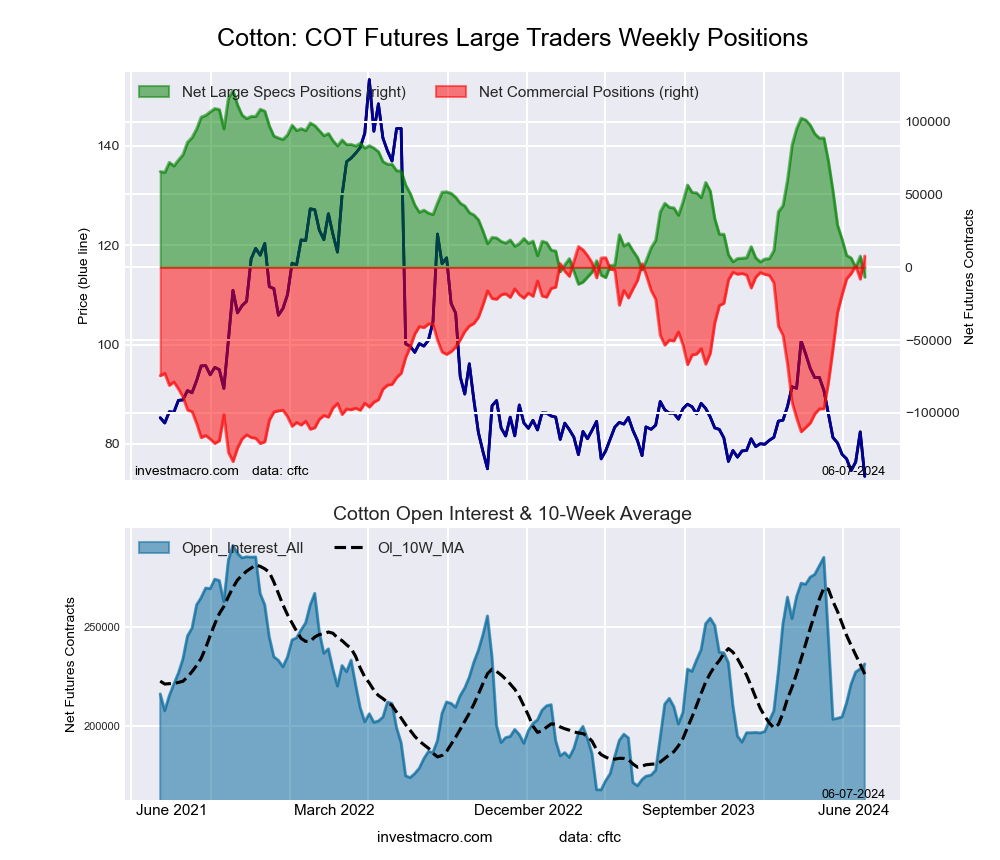
COTTON Futures COT ChartThe COTTON large speculator standing this week resulted in a net position of -6,691 contracts in the data reported through Tuesday. This was a weekly fall of -14,369 contracts from the previous week which had a total of 7,678 net contracts.

This week’s current strength score (the trader positioning range over the past three years, measured from 0 to 100) shows the speculators are currently Bearish-Extreme with a score of 3.7 percent. The commercials are Bullish-Extreme with a score of 95.6 percent and the small traders (not shown in chart) are Bearish-Extreme with a score of 9.6 percent.

Price Trend-Following Model: Strong Downtrend

Our weekly trend-following model classifies the current market price position as: Strong Downtrend. The current action for the model is considered to be: Hold – Maintain Short Position.

COTTON Futures StatisticsSPECULATORSCOMMERCIALSSMALL TRADERS
– Percent of Open Interest Longs:29.146.45.5
– Percent of Open Interest Shorts:32.043.06.0
– Net Position:-6,6917,750-1,059
– Gross Longs:67,396107,33512,729
– Gross Shorts:74,08799,58513,788
– Long to Short Ratio:0.9 to 11.1 to 10.9 to 1
NET POSITION TREND:
– Strength Index Score (3 Year Range Pct):3.795.69.6
– Strength Index Reading (3 Year Range):Bearish-ExtremeBullish-ExtremeBearish-Extreme
NET POSITION MOVEMENT INDEX:
– 6-Week Change in Strength Index:-26.826.3-19.9


COCOA Futures:

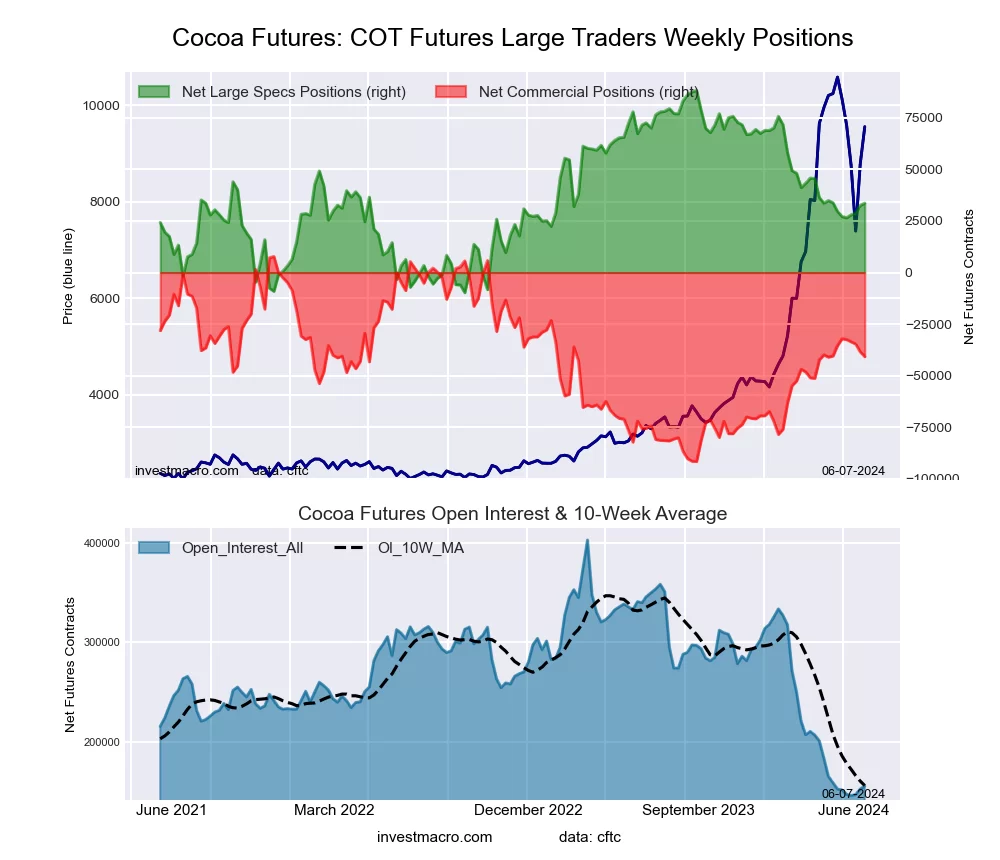
COCOA Futures COT ChartThe COCOA large speculator standing this week resulted in a net position of 33,645 contracts in the data reported through Tuesday. This was a weekly lift of 1,075 contracts from the previous week which had a total of 32,570 net contracts.

This week’s current strength score (the trader positioning range over the past three years, measured from 0 to 100) shows the speculators are currently Bearish with a score of 44.3 percent. The commercials are Bullish with a score of 51.1 percent and the small traders (not shown in chart) are Bullish with a score of 73.1 percent.

Price Trend-Following Model: Uptrend

Our weekly trend-following model classifies the current market price position as: Uptrend. The current action for the model is considered to be: Hold – Maintain Long Position.

COCOA Futures StatisticsSPECULATORSCOMMERCIALSSMALL TRADERS
– Percent of Open Interest Longs:31.234.48.0
– Percent of Open Interest Shorts:9.660.63.4
– Net Position:33,645-40,7997,154
– Gross Longs:48,64353,70412,460
– Gross Shorts:14,99894,5035,306
– Long to Short Ratio:3.2 to 10.6 to 12.3 to 1
NET POSITION TREND:
– Strength Index Score (3 Year Range Pct):44.351.173.1
– Strength Index Reading (3 Year Range):BearishBullishBullish
NET POSITION MOVEMENT INDEX:
– 6-Week Change in Strength Index:4.1-5.411.3


WHEAT Futures:

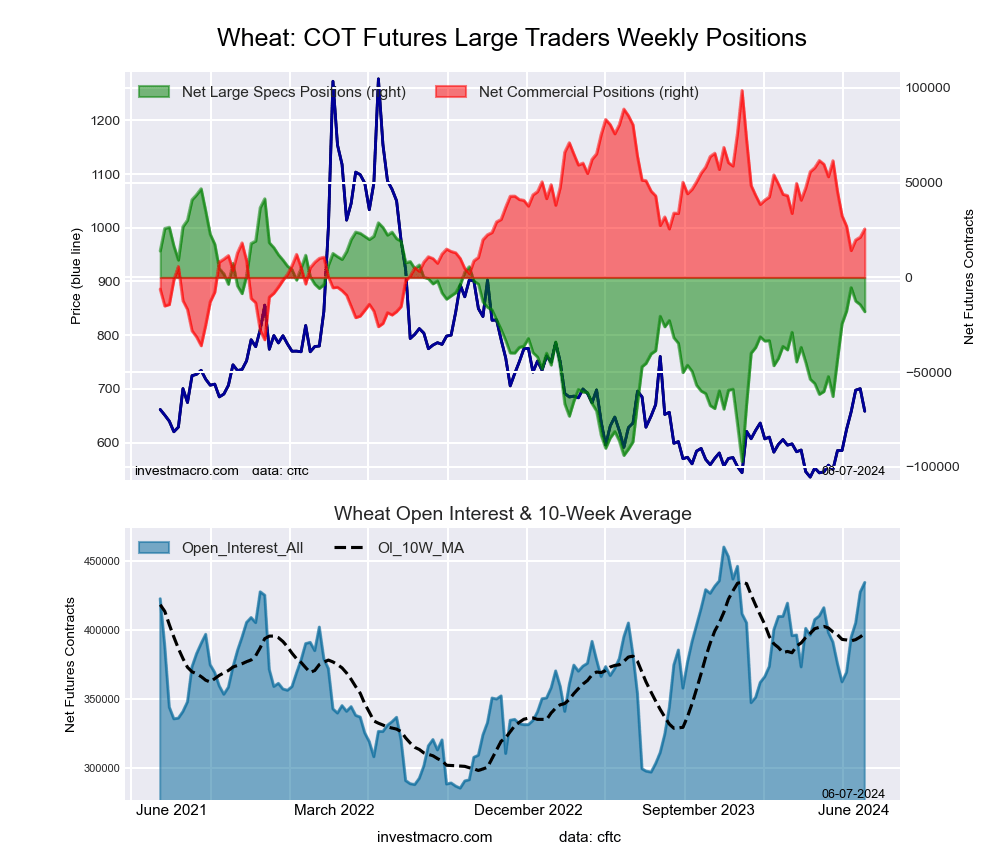
WHEAT Futures COT ChartThe WHEAT large speculator standing this week resulted in a net position of -18,121 contracts in the data reported through Tuesday. This was a weekly fall of -3,728 contracts from the previous week which had a total of -14,393 net contracts.

This week’s current strength score (the trader positioning range over the past three years, measured from 0 to 100) shows the speculators are currently Bullish with a score of 54.9 percent. The commercials are Bearish with a score of 45.7 percent and the small traders (not shown in chart) are Bearish with a score of 33.9 percent.

Price Trend-Following Model: Strong Uptrend

Our weekly trend-following model classifies the current market price position as: Strong Uptrend. The current action for the model is considered to be: Hold – Maintain Long Position.

WHEAT Futures StatisticsSPECULATORSCOMMERCIALSSMALL TRADERS
– Percent of Open Interest Longs:28.137.77.5
– Percent of Open Interest Shorts:32.231.89.2
– Net Position:-18,12125,545-7,424
– Gross Longs:121,898163,90432,453
– Gross Shorts:140,019138,35939,877
– Long to Short Ratio:0.9 to 11.2 to 10.8 to 1
NET POSITION TREND:
– Strength Index Score (3 Year Range Pct):54.945.733.9
– Strength Index Reading (3 Year Range):BullishBearishBearish
NET POSITION MOVEMENT INDEX:
– 6-Week Change in Strength Index:17.5-14.6-24.2


Article By InvestMacroReceive our weekly COT Newsletter

*COT Report: The COT data, released weekly to the public each Friday, is updated through the most recent Tuesday (data is 3 days old) and shows a quick view of how large speculators or non-commercials (for-profit traders) were positioned in the futures markets.

The CFTC categorizes trader positions according to commercial hedgers (traders who use futures contracts for hedging as part of the business), non-commercials (large traders who speculate to realize trading profits) and nonreportable traders (usually small traders/speculators) as well as their open interest (contracts open in the market at time of reporting). See CFTC criteria here.
COT Stock Market Charts: Speculator bets led by MSCI EAFE & Nasdaq

By InvestMacro

Here are the latest charts and statistics for the Commitment of Traders (COT) data published by the Commodities Futures Trading Commission (CFTC).

The latest COT data is updated through Tuesday June 4th and shows a quick view of how large traders (for-profit speculators and commercial entities) were positioned in the futures markets.

Weekly Speculator Changes led by MSCI EAFE & Nasdaq

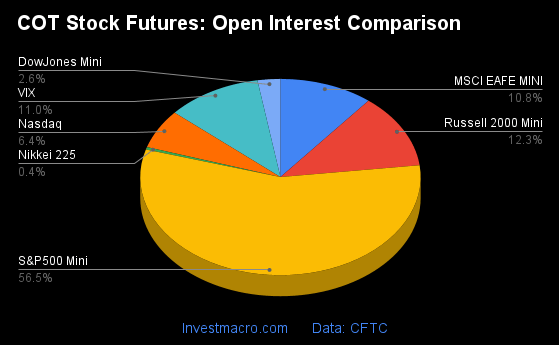
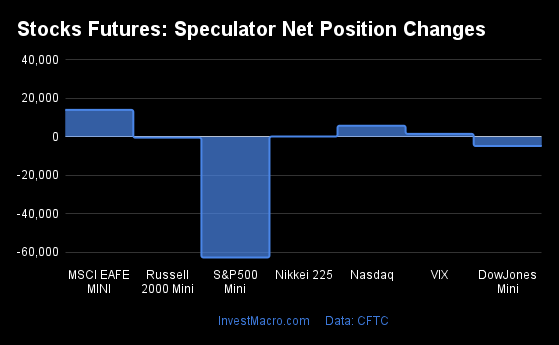
The COT stock markets speculator bets were higher this week as four out of the seven stock markets we cover had higher positioning while the other three markets had lower speculator contracts.

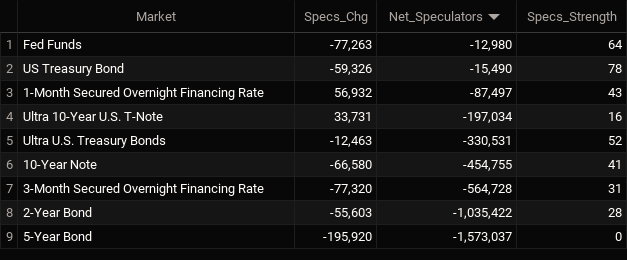
Leading the gains for the stock markets was with the MSCI EAFE-Mini (13,955 contracts), the Nasdaq-Mini (5,723 contracts), the VIX (1,469 contracts) and the Nikkei 225 (73 contracts) also showing positive weeks.

The markets with the declines in speculator bets this week were the S&P500-Mini (-62,792 contracts), the DowJones-Mini (-4,858 contracts) and with the Russell-Mini (-510 contracts) also registering lower bets on the week.


Stock Market Net Speculators Leaderboard

Legend: Weekly Speculators Change | Speculators Current Net Position | Speculators Strength Score compared to last 3-Years (0-100 range)


Strength Scores led by DowJones-Mini & VIX

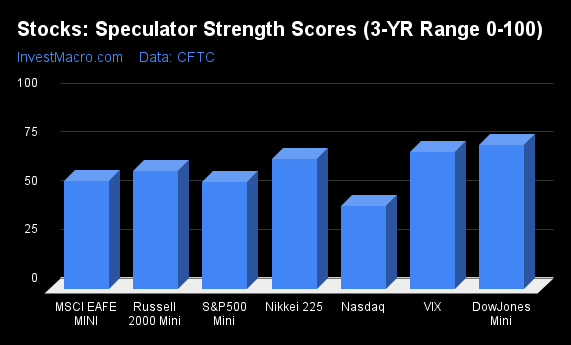
COT Strength Scores (a normalized measure of Speculator positions over a 3-Year range, from 0 to 100 where above 80 is Extreme-Bullish and below 20 is Extreme-Bearish) showed that the DowJones-Mini (74 percent) and the VIX (70 percent) lead the stock markets this week. The Nikkei 225 (67 percent) comes in as the next highest in the weekly strength scores.

On the downside, the Nasdaq-Mini (42 percent) comes in at the lowest strength level currently.

Strength Statistics:
VIX (70.4 percent) vs VIX previous week (68.9 percent)
S&P500-Mini (55.0 percent) vs S&P500-Mini previous week (64.4 percent)
DowJones-Mini (73.8 percent) vs DowJones-Mini previous week (81.7 percent)
Nasdaq-Mini (42.3 percent) vs Nasdaq-Mini previous week (33.4 percent)
Russell2000-Mini (60.7 percent) vs Russell2000-Mini previous week (61.1 percent)
Nikkei USD (66.8 percent) vs Nikkei USD previous week (66.2 percent)
EAFE-Mini (55.6 percent) vs EAFE-Mini previous week (41.2 percent)


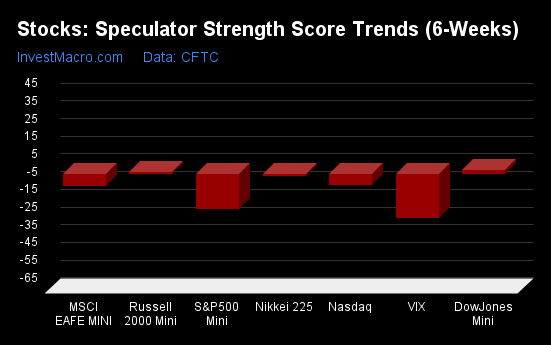
DowJones-Mini & Russell-Mini top the 6-Week Strength Trends

COT Strength Score Trends (or move index, calculates the 6-week changes in strength scores) showed that the DowJones-Mini (2 percent) and the Russell-Mini (1 percent) lead the past six weeks and are the only positive movers in the latest trends data.

The VIX (-25 percent) leads the downside trend scores currently with the S&P500-Mini (-20 percent) coming in as the next market with the lowest trend score.

Strength Trend Statistics:
VIX (-25.2 percent) vs VIX previous week (-21.9 percent)
S&P500-Mini (-19.8 percent) vs S&P500-Mini previous week (-11.4 percent)
DowJones-Mini (2.3 percent) vs DowJones-Mini previous week (-0.9 percent)
Nasdaq-Mini (-6.4 percent) vs Nasdaq-Mini previous week (-19.0 percent)
Russell2000-Mini (1.2 percent) vs Russell2000-Mini previous week (3.3 percent)
Nikkei USD (-1.5 percent) vs Nikkei USD previous week (-6.7 percent)
EAFE-Mini (-7.0 percent) vs EAFE-Mini previous week (-19.4 percent)


Individual Stock Market Charts:

VIX Volatility Futures:

VIX Volatility Futures COT ChartThe VIX Volatility large speculator standing this week resulted in a net position of -41,275 contracts in the data reported through Tuesday. This was a weekly boost of 1,469 contracts from the previous week which had a total of -42,744 net contracts.

This week’s current strength score (the trader positioning range over the past three years, measured from 0 to 100) shows the speculators are currently Bullish with a score of 70.4 percent. The commercials are Bearish with a score of 25.6 percent and the small traders (not shown in chart) are Bullish-Extreme with a score of 89.8 percent.

Price Trend-Following Model: Strong Downtrend

Our weekly trend-following model classifies the current market price position as: Strong Downtrend. The current action for the model is considered to be: New Sell – Short Position.

VIX Volatility Futures StatisticsSPECULATORSCOMMERCIALSSMALL TRADERS
– Percent of Open Interest Longs:22.839.67.2
– Percent of Open Interest Shorts:32.629.67.4
– Net Position:-41,27541,985-710
– Gross Longs:95,865166,55530,228
– Gross Shorts:137,140124,57030,938
– Long to Short Ratio:0.7 to 11.3 to 11.0 to 1
NET POSITION TREND:
– Strength Index Score (3 Year Range Pct):70.425.689.8
– Strength Index Reading (3 Year Range):BullishBearishBullish-Extreme
NET POSITION MOVEMENT INDEX:
– 6-Week Change in Strength Index:-25.220.423.5


S&P500 Mini Futures:

SP500 Mini Futures COT ChartThe S&P500 Mini large speculator standing this week resulted in a net position of -65,000 contracts in the data reported through Tuesday. This was a weekly decline of -62,792 contracts from the previous week which had a total of -2,208 net contracts.

This week’s current strength score (the trader positioning range over the past three years, measured from 0 to 100) shows the speculators are currently Bullish with a score of 55.0 percent. The commercials are Bearish with a score of 33.4 percent and the small traders (not shown in chart) are Bullish-Extreme with a score of 81.6 percent.

Price Trend-Following Model: Strong Uptrend

Our weekly trend-following model classifies the current market price position as: Strong Uptrend. The current action for the model is considered to be: Hold – Maintain Long Position.

S&P500 Mini Futures StatisticsSPECULATORSCOMMERCIALSSMALL TRADERS
– Percent of Open Interest Longs:12.371.013.3
– Percent of Open Interest Shorts:15.373.28.1
– Net Position:-65,000-47,092112,092
– Gross Longs:265,4331,534,557287,673
– Gross Shorts:330,4331,581,649175,581
– Long to Short Ratio:0.8 to 11.0 to 11.6 to 1
NET POSITION TREND:
– Strength Index Score (3 Year Range Pct):55.033.481.6
– Strength Index Reading (3 Year Range):BullishBearishBullish-Extreme
NET POSITION MOVEMENT INDEX:
– 6-Week Change in Strength Index:-19.819.7-4.0


Dow Jones Mini Futures:

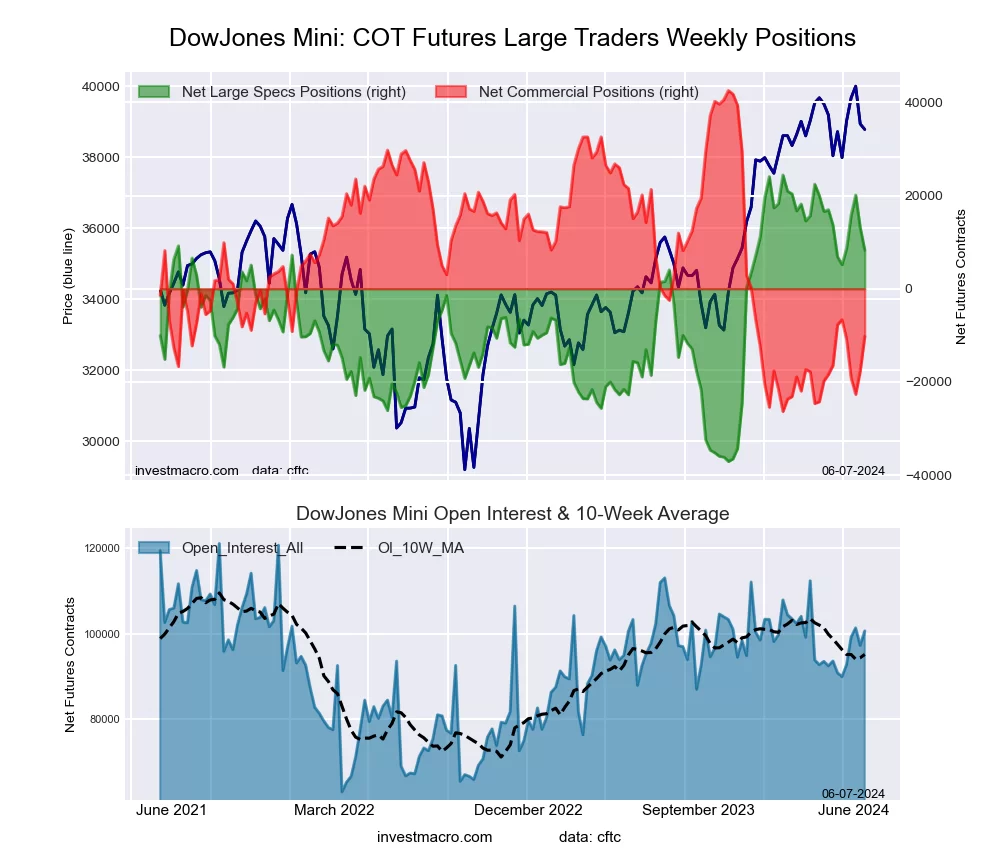
Dow Jones Mini Futures COT ChartThe Dow Jones Mini large speculator standing this week resulted in a net position of 8,286 contracts in the data reported through Tuesday. This was a weekly fall of -4,858 contracts from the previous week which had a total of 13,144 net contracts.

This week’s current strength score (the trader positioning range over the past three years, measured from 0 to 100) shows the speculators are currently Bullish with a score of 73.8 percent. The commercials are Bearish with a score of 23.4 percent and the small traders (not shown in chart) are Bullish with a score of 53.2 percent.

Price Trend-Following Model: Weak Uptrend

Our weekly trend-following model classifies the current market price position as: Weak Uptrend. The current action for the model is considered to be: Hold – Maintain Long Position.

Dow Jones Mini Futures StatisticsSPECULATORSCOMMERCIALSSMALL TRADERS
– Percent of Open Interest Longs:20.958.314.2
– Percent of Open Interest Shorts:12.668.512.3
– Net Position:8,286-10,1951,909
– Gross Longs:21,00858,70914,251
– Gross Shorts:12,72268,90412,342
– Long to Short Ratio:1.7 to 10.9 to 11.2 to 1
NET POSITION TREND:
– Strength Index Score (3 Year Range Pct):73.823.453.2
– Strength Index Reading (3 Year Range):BullishBearishBullish
NET POSITION MOVEMENT INDEX:
– 6-Week Change in Strength Index:2.3-3.65.0


Nasdaq Mini Futures:

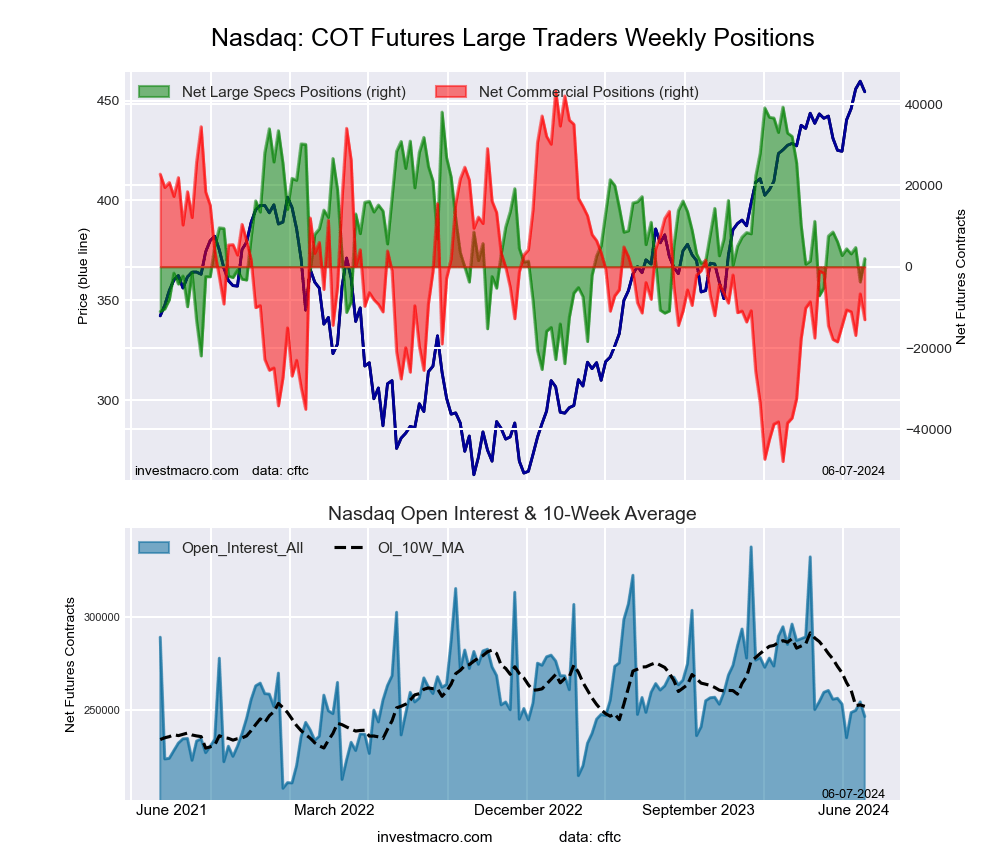
Nasdaq Mini Futures COT ChartThe Nasdaq Mini large speculator standing this week resulted in a net position of 1,997 contracts in the data reported through Tuesday. This was a weekly lift of 5,723 contracts from the previous week which had a total of -3,726 net contracts.

This week’s current strength score (the trader positioning range over the past three years, measured from 0 to 100) shows the speculators are currently Bearish with a score of 42.3 percent. The commercials are Bearish with a score of 38.2 percent and the small traders (not shown in chart) are Bullish-Extreme with a score of 96.8 percent.

Price Trend-Following Model: Strong Uptrend

Our weekly trend-following model classifies the current market price position as: Strong Uptrend. The current action for the model is considered to be: Hold – Maintain Long Position.

Nasdaq Mini Futures StatisticsSPECULATORSCOMMERCIALSSMALL TRADERS
– Percent of Open Interest Longs:24.456.417.6
– Percent of Open Interest Shorts:23.661.713.1
– Net Position:1,997-13,02711,030
– Gross Longs:60,252139,14243,392
– Gross Shorts:58,255152,16932,362
– Long to Short Ratio:1.0 to 10.9 to 11.3 to 1
NET POSITION TREND:
– Strength Index Score (3 Year Range Pct):42.338.296.8
– Strength Index Reading (3 Year Range):BearishBearishBullish-Extreme
NET POSITION MOVEMENT INDEX:
– 6-Week Change in Strength Index:-6.46.0-3.2


Russell 2000 Mini Futures:

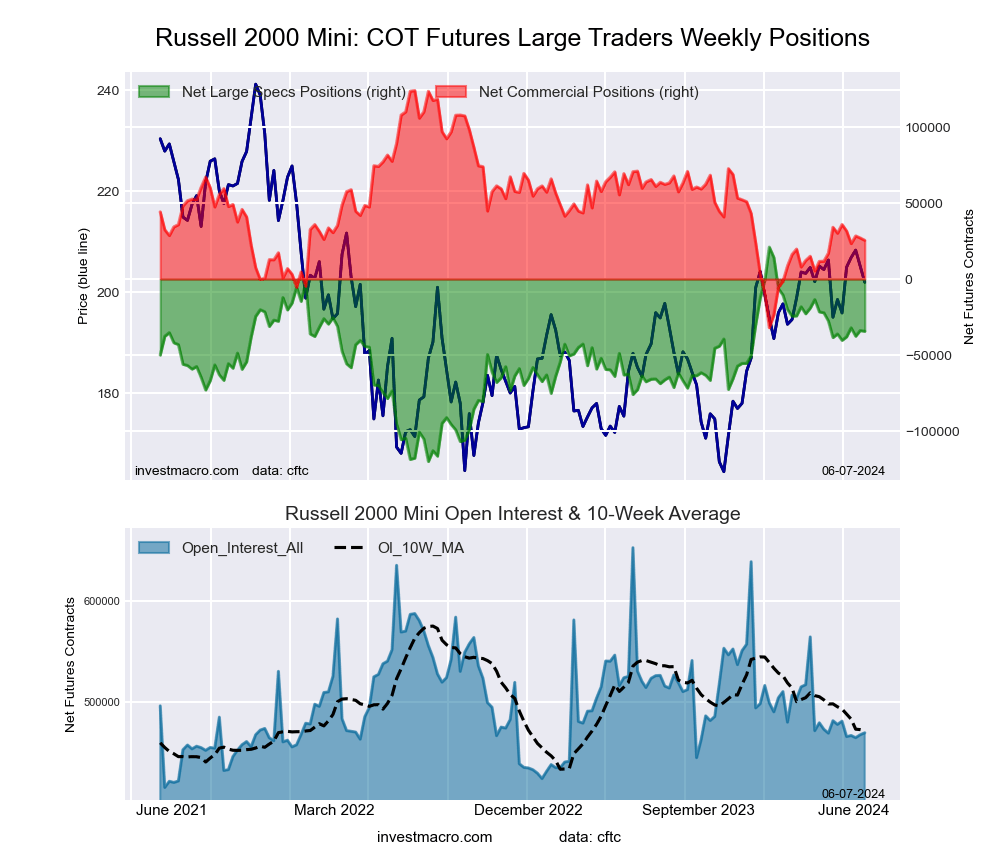
Russell 2000 Mini Futures COT ChartThe Russell 2000 Mini large speculator standing this week resulted in a net position of -34,355 contracts in the data reported through Tuesday. This was a weekly reduction of -510 contracts from the previous week which had a total of -33,845 net contracts.

This week’s current strength score (the trader positioning range over the past three years, measured from 0 to 100) shows the speculators are currently Bullish with a score of 60.7 percent. The commercials are Bearish with a score of 36.8 percent and the small traders (not shown in chart) are Bullish with a score of 58.9 percent.

Price Trend-Following Model: Weak Uptrend

Our weekly trend-following model classifies the current market price position as: Weak Uptrend. The current action for the model is considered to be: Hold – Maintain Long Position.

Russell 2000 Mini Futures StatisticsSPECULATORSCOMMERCIALSSMALL TRADERS
– Percent of Open Interest Longs:18.372.96.4
– Percent of Open Interest Shorts:25.767.54.5
– Net Position:-34,35525,4698,886
– Gross Longs:86,068342,25329,881
– Gross Shorts:120,423316,78420,995
– Long to Short Ratio:0.7 to 11.1 to 11.4 to 1
NET POSITION TREND:
– Strength Index Score (3 Year Range Pct):60.736.858.9
– Strength Index Reading (3 Year Range):BullishBearishBullish
NET POSITION MOVEMENT INDEX:
– 6-Week Change in Strength Index:1.2-3.09.9


Nikkei Stock Average (USD) Futures:

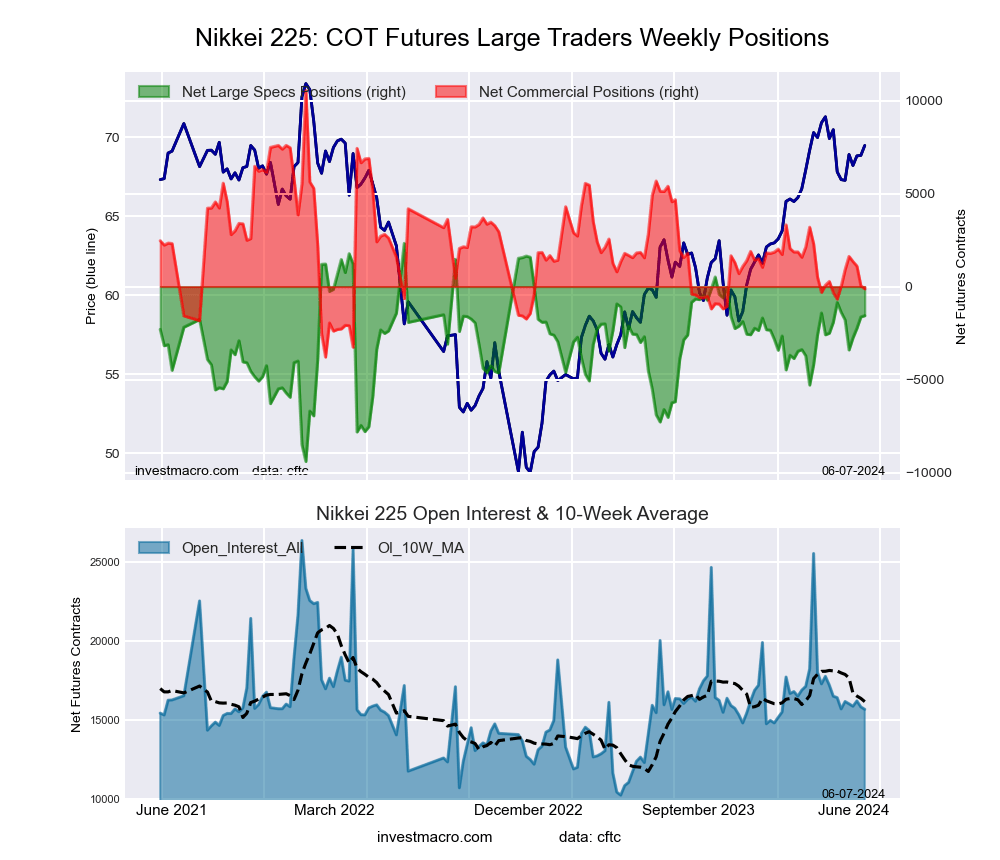
Nikkei Stock Average (USD) Futures COT ChartThe Nikkei Stock Average (USD) large speculator standing this week resulted in a net position of -1,563 contracts in the data reported through Tuesday. This was a weekly rise of 73 contracts from the previous week which had a total of -1,636 net contracts.

This week’s current strength score (the trader positioning range over the past three years, measured from 0 to 100) shows the speculators are currently Bullish with a score of 66.8 percent. The commercials are Bearish with a score of 25.6 percent and the small traders (not shown in chart) are Bullish with a score of 65.6 percent.

Price Trend-Following Model: Uptrend

Our weekly trend-following model classifies the current market price position as: Uptrend. The current action for the model is considered to be: Hold – Maintain Long Position.

Nikkei Stock Average Futures StatisticsSPECULATORSCOMMERCIALSSMALL TRADERS
– Percent of Open Interest Longs:10.063.823.9
– Percent of Open Interest Shorts:20.064.613.1
– Net Position:-1,563-1281,691
– Gross Longs:1,5699,9963,740
– Gross Shorts:3,13210,1242,049
– Long to Short Ratio:0.5 to 11.0 to 11.8 to 1
NET POSITION TREND:
– Strength Index Score (3 Year Range Pct):66.825.665.6
– Strength Index Reading (3 Year Range):BullishBearishBullish
NET POSITION MOVEMENT INDEX:
– 6-Week Change in Strength Index:-1.5-1.05.3


MSCI EAFE Mini Futures:

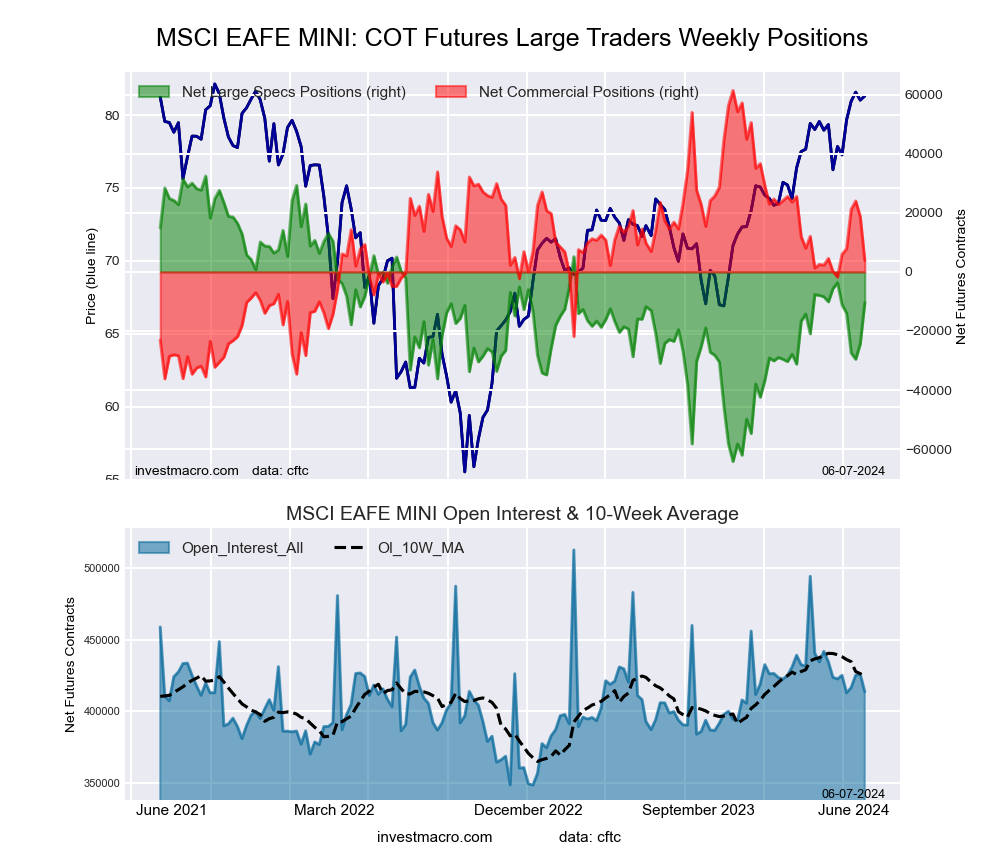
MSCI EAFE Mini Futures COT ChartThe MSCI EAFE Mini large speculator standing this week resulted in a net position of -10,414 contracts in the data reported through Tuesday. This was a weekly boost of 13,955 contracts from the previous week which had a total of -24,369 net contracts.

This week’s current strength score (the trader positioning range over the past three years, measured from 0 to 100) shows the speculators are currently Bullish with a score of 55.6 percent. The commercials are Bearish with a score of 41.0 percent and the small traders (not shown in chart) are Bearish with a score of 49.8 percent.

Price Trend-Following Model: Uptrend

Our weekly trend-following model classifies the current market price position as: Uptrend. The current action for the model is considered to be: Hold – Maintain Long Position.

MSCI EAFE Mini Futures StatisticsSPECULATORSCOMMERCIALSSMALL TRADERS
– Percent of Open Interest Longs:7.289.42.9
– Percent of Open Interest Shorts:9.788.41.3
– Net Position:-10,4143,8286,586
– Gross Longs:29,922369,75811,866
– Gross Shorts:40,336365,9305,280
– Long to Short Ratio:0.7 to 11.0 to 12.2 to 1
NET POSITION TREND:
– Strength Index Score (3 Year Range Pct):55.641.049.8
– Strength Index Reading (3 Year Range):BullishBearishBearish
NET POSITION MOVEMENT INDEX:
– 6-Week Change in Strength Index:-7.05.76.0


Article By InvestMacroReceive our weekly COT Newsletter

*COT Report: The COT data, released weekly to the public each Friday, is updated through the most recent Tuesday (data is 3 days old) and shows a quick view of how large speculators or non-commercials (for-profit traders) were positioned in the futures markets.

The CFTC categorizes trader positions according to commercial hedgers (traders who use futures contracts for hedging as part of the business), non-commercials (large traders who speculate to realize trading profits) and nonreportable traders (usually small traders/speculators) as well as their open interest (contracts open in the market at time of reporting). See CFTC criteria here.
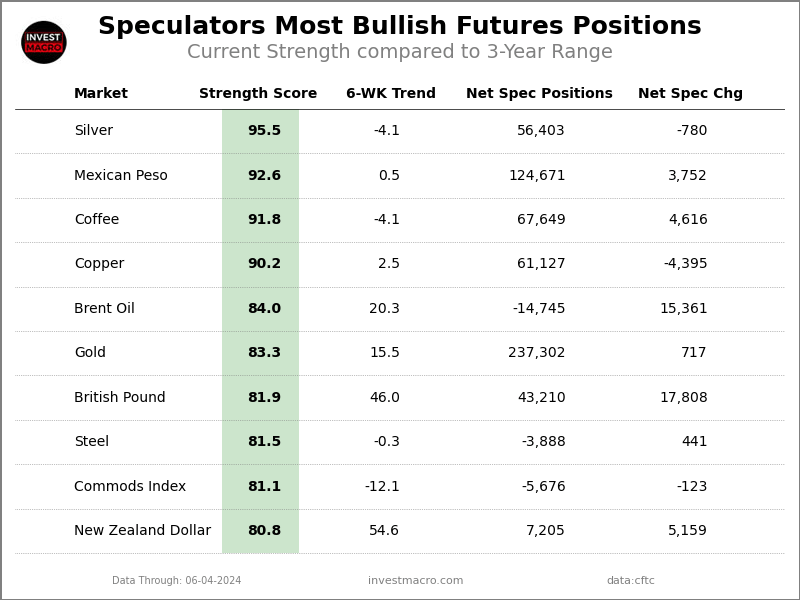
Speculator Extremes: Silver, Peso, 5-Year & Sugar lead weekly bets

By InvestMacro

The latest update for the weekly Commitment of Traders (COT) report was released by the Commodity Futures Trading Commission (CFTC) on Friday for data ending on June 4th.

This weekly Extreme Positions report highlights the Most Bullish and Most Bearish Positions for the speculator category. Extreme positioning in these markets can foreshadow strong moves in the underlying market.

To signify an extreme position, we use the Strength Index (also known as the COT Index) of each instrument, a common method of measuring COT data. The Strength Index is simply a comparison of current trader positions against the range of positions over the previous 3 years. We use over 80 percent as extremely bullish and under 20 percent as extremely bearish. (Compare Strength Index scores across all markets in the data table or cot leaders table)


Here Are This Week’s Most Bullish Speculator Positions:

Silver


The Silver speculator position comes in as the most bullish extreme standing this week. The Silver speculator level is currently at a 95.5 percent score of its 3-year range.

The six-week trend for the percent strength score totaled -4.1 this week. The overall net speculator position was a total of 56,403 net contracts this week with a decline of -780 contract in the weekly speculator bets.


Speculators or Non-Commercials Notes:

Speculators, classified as non-commercial traders by the CFTC, are made up of large commodity funds, hedge funds and other significant for-profit participants. The Specs are generally regarded as trend-followers in their behavior towards price action – net speculator bets and prices tend to go in the same directions. These traders often look to buy when prices are rising and sell when prices are falling. To illustrate this point, many times speculator contracts can be found at their most extremes (bullish or bearish) when prices are also close to their highest or lowest levels.

These extreme levels can be dangerous for the large speculators as the trade is most crowded, there is less trading ammunition still sitting on the sidelines to push the trend further and prices have moved a significant distance. When the trend becomes exhausted, some speculators take profits while others look to also exit positions when prices fail to continue in the same direction. This process usually plays out over many months to years and can ultimately create a reverse effect where prices start to fall and speculators start a process of selling when prices are falling.


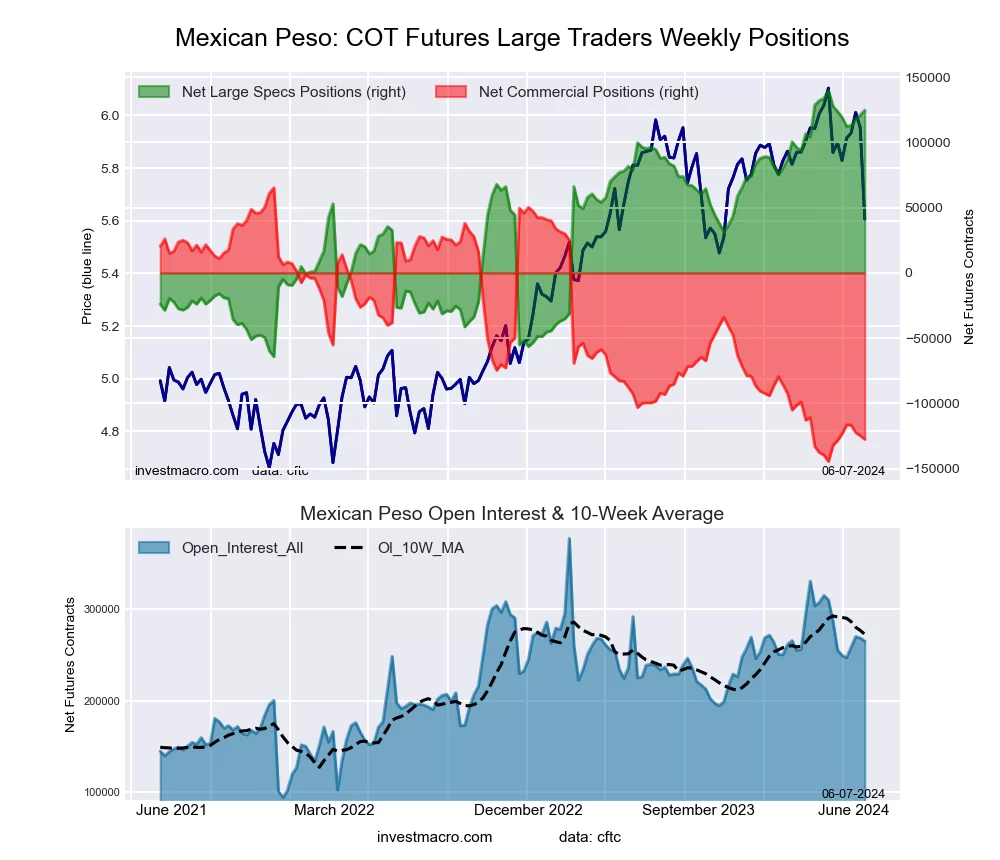
Mexican Peso


The Mexican Peso speculator position comes next in the extreme standings this week. The Mexican Peso speculator level is now at a 92.6 percent score of its 3-year range.

The six-week trend for the percent strength score was 0.5 this week. The speculator position registered 124,671 net contracts this week with a weekly rise of 3,752 contracts in speculator bets.


Coffee


The Coffee speculator position comes in third this week in the extreme standings. The Coffee speculator level resides at a 91.8 percent score of its 3-year range.

The six-week trend for the speculator strength score came in at -4.1 this week. The overall speculator position was 67,649 net contracts this week with a boost of 4,616 contracts in the weekly speculator bets.


Copper


The Copper speculator position comes up number four in the extreme standings this week. The Copper speculator level is at a 90.2 percent score of its 3-year range.

The six-week trend for the speculator strength score totaled a change of 2.5 this week. The overall speculator position was 61,127 net contracts this week with a drop of -4,395 contracts in the speculator bets.


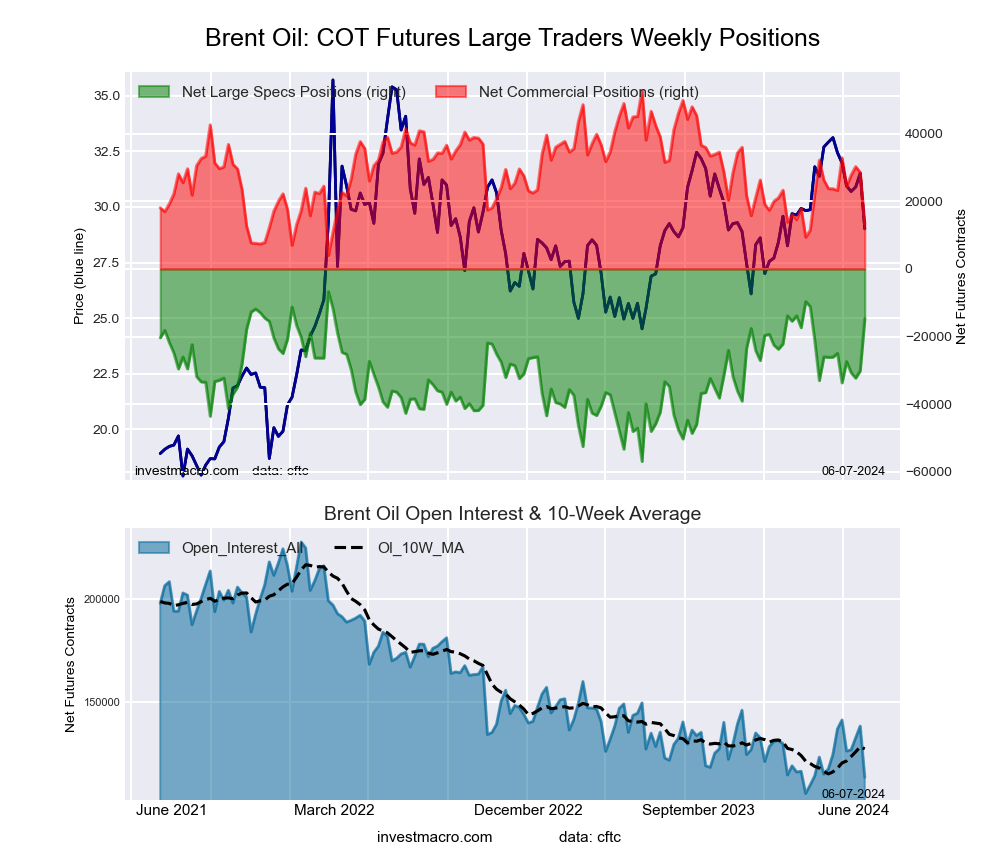
Brent Oil


The Brent Oil speculator position rounds out the top five in this week’s bullish extreme standings. The Brent Oil speculator level sits at a 84.0 percent score of its 3-year range. The six-week trend for the speculator strength score was 20.3 this week.

The speculator position was -14,745 net contracts this week with a gain of 15,361 contracts in the weekly speculator bets.


This Week’s Most Bearish Speculator Positions:

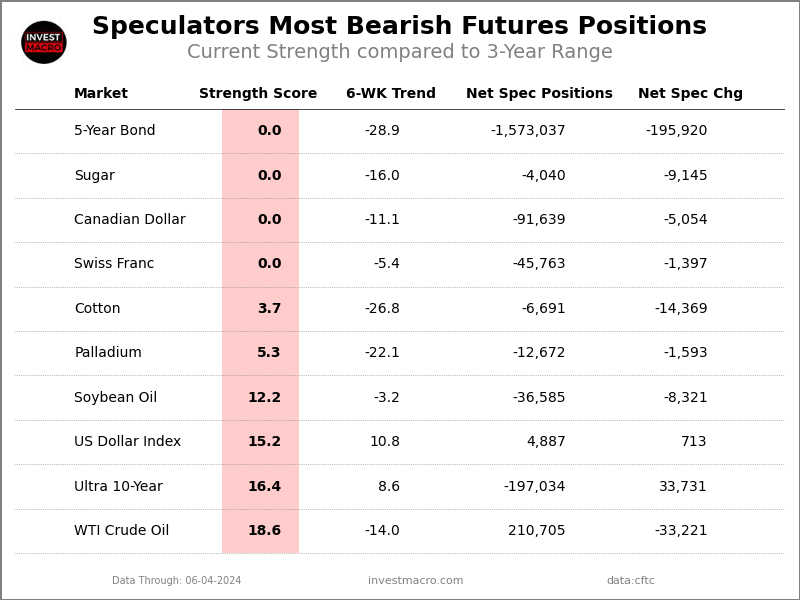
5-Year Bond


The 5-Year Bond speculator position comes in as the most bearish extreme standing this week. The 5-Year Bond speculator level is at a 0.0 percent score of its 3-year range.

The six-week trend for the speculator strength score was -28.9 this week. The overall speculator position was -1,573,037 net contracts this week with a decrease by -195,920 contracts in the speculator bets.


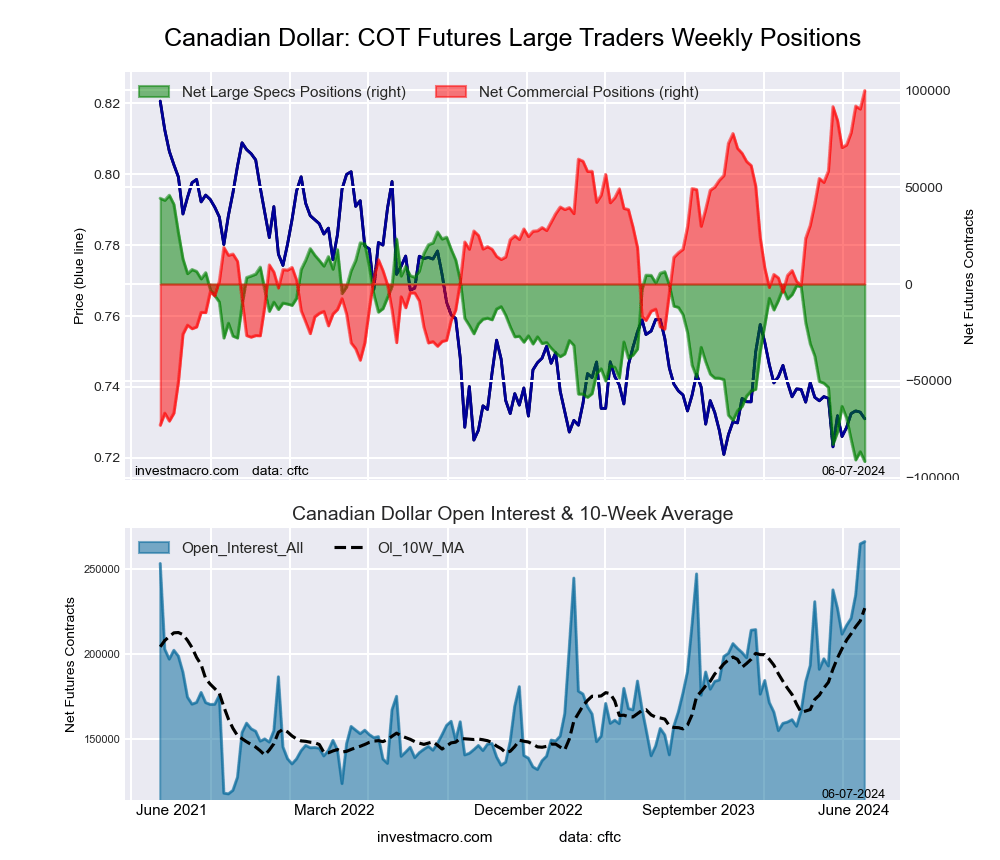
Canadian Dollar


The Canadian Dollar speculator position comes in next for the most bearish extreme standing on the week. The Canadian Dollar speculator level is at a 0.0 percent score of its 3-year range.

The six-week trend for the speculator strength score was -11.1 this week. The speculator position was -91,639 net contracts this week with a decline of -5,054 contracts in the weekly speculator bets.


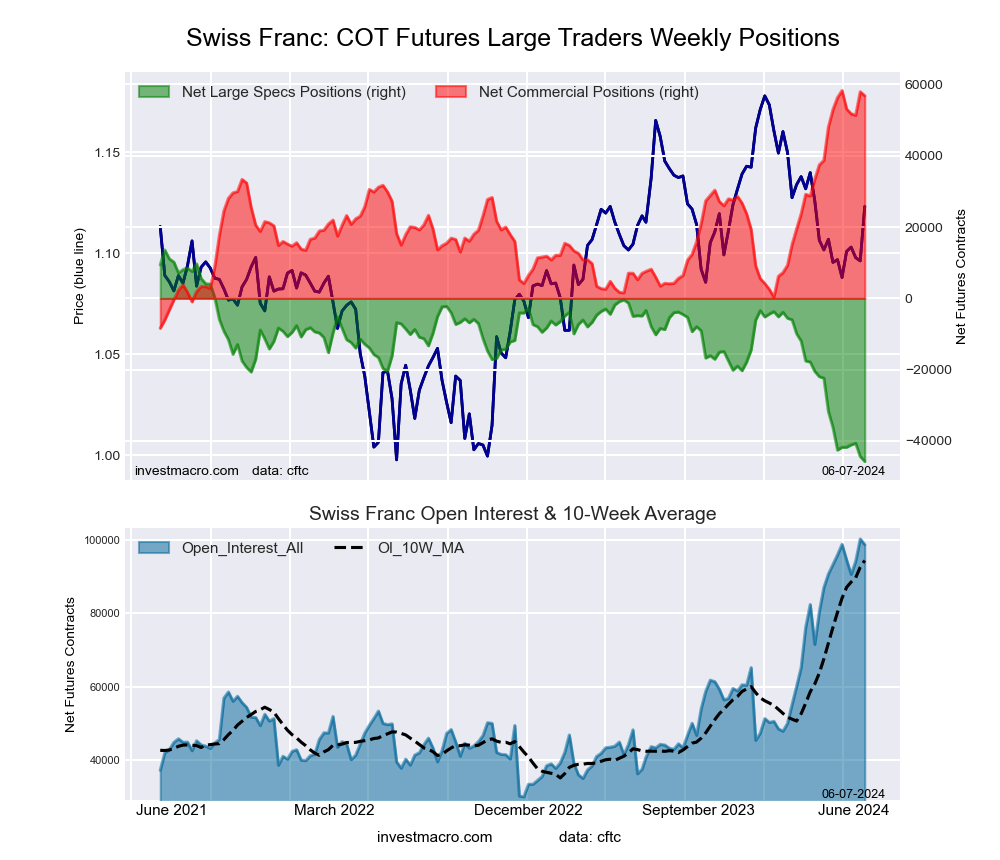
Swiss Franc


The Swiss Franc speculator position comes in as third most bearish extreme standing of the week. The Swiss Franc speculator level resides at a 0.0 percent score of its 3-year range.

The six-week trend for the speculator strength score was -5.4 this week. The overall speculator position was -45,763 net contracts this week with a dip of -1,397 contracts in the speculator bets.


Sugar


The Sugar speculator position comes in as this week’s fourth most bearish extreme standing. The Sugar speculator level is at a 0.0 percent score of its 3-year range.

The six-week trend for the speculator strength score was -16.0 this week. The speculator position was -4,040 net contracts this week with a decline of -9,145 contracts in the weekly speculator bets.


Cotton


Finally, the Cotton speculator position comes in as the fifth most bearish extreme standing for this week. The Cotton speculator level is at a 3.7 percent score of its 3-year range.

The six-week trend for the speculator strength score was -26.8 this week. The speculator position was -6,691 net contracts this week with a reduction by -14,369 contracts in the weekly speculator bets.


Article By InvestMacroReceive our weekly COT Newsletter

*COT Report: The COT data, released weekly to the public each Friday, is updated through the most recent Tuesday (data is 3 days old) and shows a quick view of how large speculators or non-commercials (for-profit traders) were positioned in the futures markets.

The CFTC categorizes trader positions according to commercial hedgers (traders who use futures contracts for hedging as part of the business), non-commercials (large traders who speculate to realize trading profits) and nonreportable traders (usually small traders/speculators) as well as their open interest (contracts open in the market at time of reporting). See CFTC criteria here.
Market awaits NFP data: Euro/Dollar consolidates

By RoboForex Analytical Department

At the end of the week, the US dollar is hovering around an eight-week low against the euro, but trading activity remains subdued. Everyone is conserving energy ahead of this evening’s May employment data from the US. These reports are expected to provide more insight into the timing of the Federal Reserve’s monetary policy easing.

Yesterday, the European Central Bank lowered its interest rate by 25 basis points, from 4.50% to 4.25% per annum. The euro retained its daily gains. The ECB gave few indications about its future steps, and the market remains uncertain whether there will be further rate cuts. Persistent inflationary pressures dim the prospects for the ECB.

In its comments, the ECB mentioned that the consumer price index will remain above the target of 2% until the end of next year.

The market is preparing for relatively soft non-farm payroll (NFP) data from the US. The final figure may fall below the forecast of 185,000.

Investor expectations regarding the Federal Reserve’s decisions are constantly shifting. The market now predicts the first rate cut in September, followed by another in November.

EUR/USD Technical Analysis

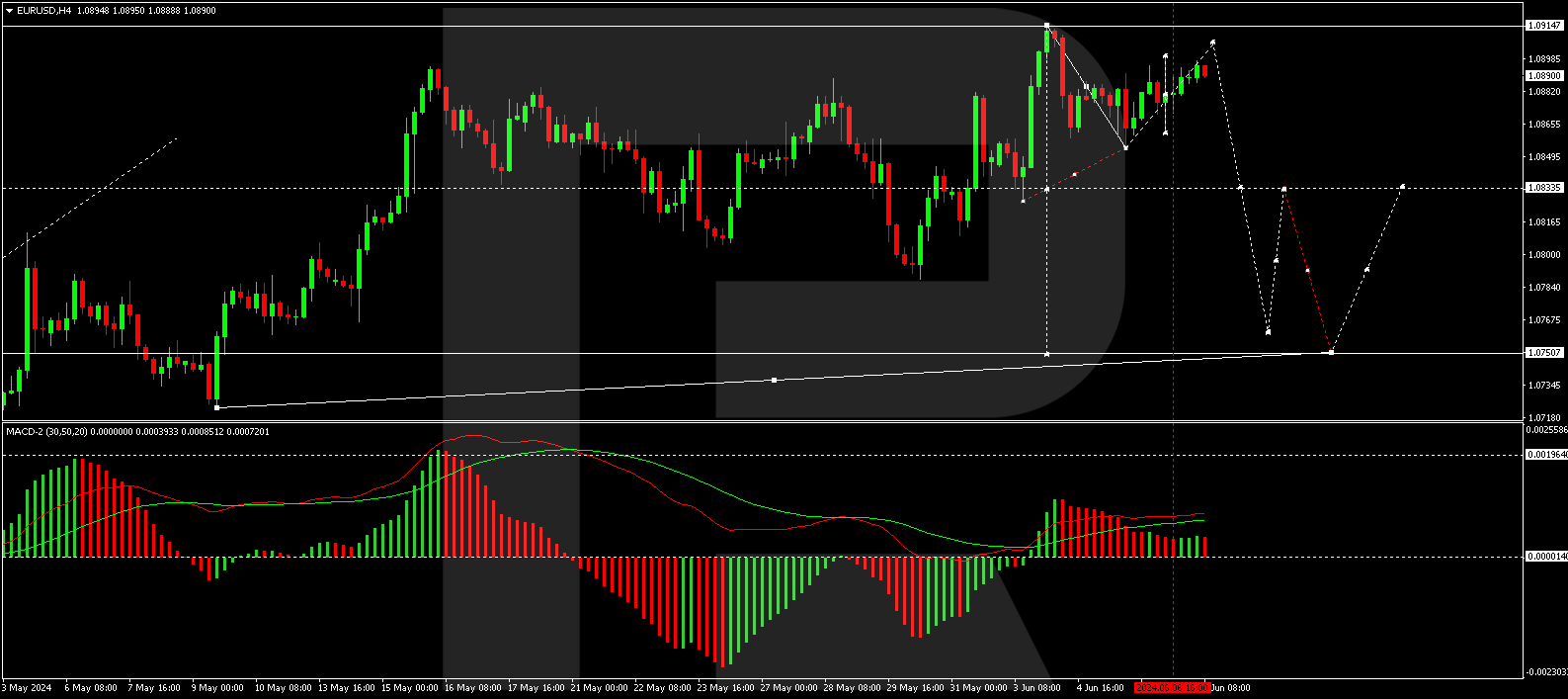
On the H4 chart, EUR/USD has formed an initial wave of decline to 1.0854 and a correction up to 1.0901. We expect the start of a new wave of decline to the level of 1.0833. A break below this level will open the potential for a wave down to 1.0760, with a trend continuation prospect to 1.0750. This first target of the decline wave is technically confirmed by the MACD indicator, whose signal line is at its peak and ready to continue descending.

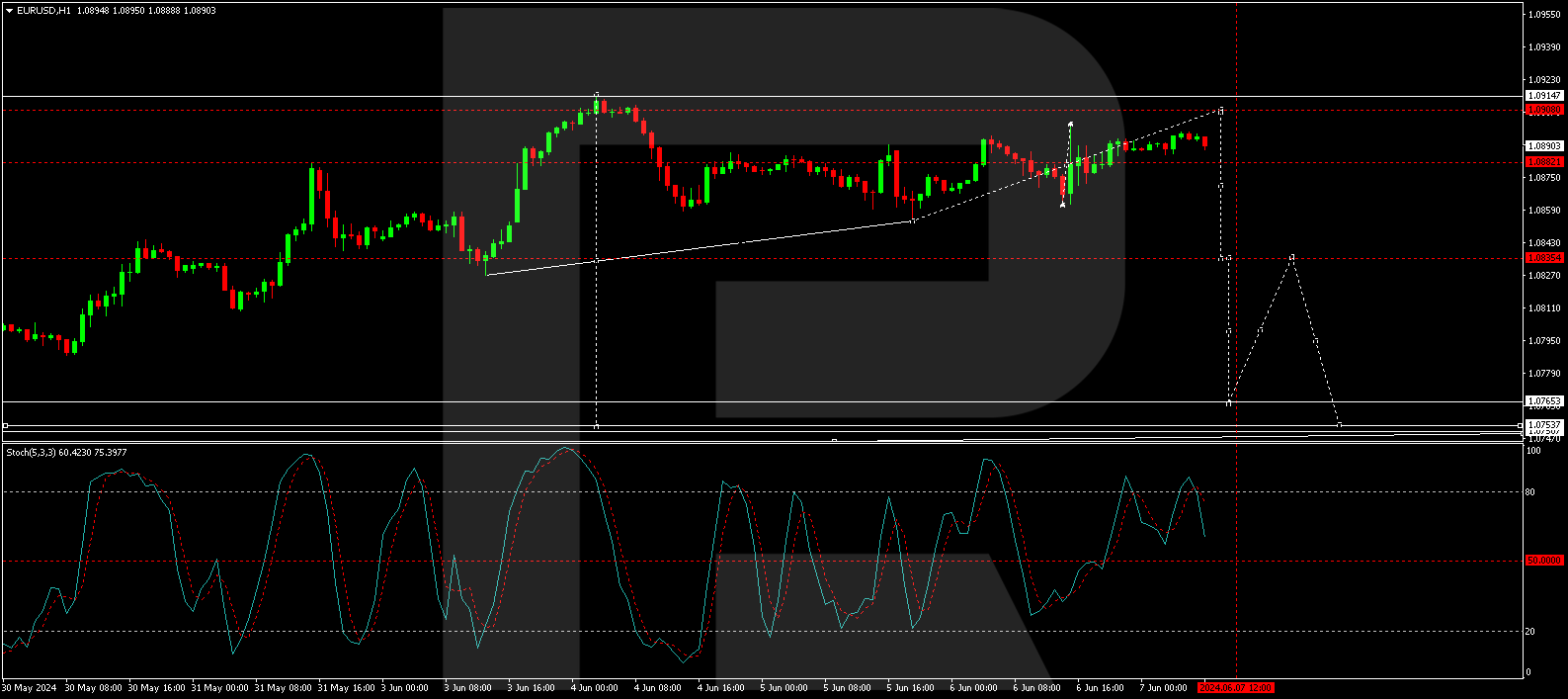
On the H1 chart, EUR/USD is forming a consolidation range around 1.0882. An expansion of the range to 1.0908 is possible. After reaching this level, we will consider the likelihood of a new wave of decline to 1.0882. A break below this level will open the potential for a wave down to 1.0835, with a trend continuation prospect to 1.0765. This local target is technically confirmed by the Stochastic oscillator, whose signal line is below the level of 80. We expect a decline to the level of 20.

Disclaimer

Any forecasts contained herein are based on the author’s particular opinion. This analysis may not be treated as trading advice. RoboForex bears no responsibility for trading results based on trading recommendations and reviews contained herein.

AI plus gene editing promises to shift biotech into high gear

By Marc Zimmer, Connecticut College 

During her chemistry Nobel Prize lecture in 2018, Frances Arnold said, “Today we can for all practical purposes read, write and edit any sequence of DNA, but we cannot compose it.” That isn’t true anymore.

Since then, science and technology have progressed so much that artificial intelligence has learned to compose DNA, and with genetically modified bacteria, scientists are on their way to designing and making bespoke proteins.

The goal is that with AI’s designing talents and gene editing’s engineering abilities, scientists can modify bacteria to act as mini factories producing new proteins that can reduce greenhouse gases, digest plastics or act as species-specific pesticides.

As a chemistry professor and computational chemist who studies molecular science and environmental chemistry, I believe that advances in AI and gene editing make this a realistic possibility.

Gene sequencing – reading life’s recipes

All living things contain genetic materials – DNA and RNA – that provide the hereditary information needed to replicate themselves and make proteins. Proteins constitute 75% of human dry weight. They make up muscles, enzymes, hormones, blood, hair and cartilage. Understanding proteins means understanding much of biology. The order of nucleotide bases in DNA, or RNA in some viruses, encodes this information, and genomic sequencing technologies identify the order of these bases.

The Human Genome Project was an international effort that sequenced the entire human genome from 1990 to 2003. Thanks to rapidly improving technologies, it took seven years to sequence the first 1% of the genome and another seven years for the remaining 99%. By 2003, scientists had the complete sequence of the 3 billion nucleotide base pairs coding for 20,000 to 25,000 genes in the human genome.

However, understanding the functions of most proteins and correcting their malfunctions remained a challenge.

AI learns proteins

Each protein’s shape is critical to its function and is determined by the sequence of its amino acids, which is in turn determined by the gene’s nucleotide sequence. Misfolded proteins have the wrong shape and can cause illnesses such as neurodegenerative diseases, cystic fibrosis and Type 2 diabetes. Understanding these diseases and developing treatments requires knowledge of protein shapes.

Before 2016, the only way to determine the shape of a protein was through X-ray crystallography, a laboratory technique that uses the diffraction of X-rays by single crystals to determine the precise arrangement of atoms and molecules in three dimensions in a molecule. At that time, the structure of about 200,000 proteins had been determined by crystallography, costing billions of dollars.

AlphaFold, a machine learning program, used these crystal structures as a training set to determine the shape of the proteins from their nucleotide sequences. And in less than a year, the program calculated the protein structures of all 214 million genes that have been sequenced and published. The protein structures AlphaFold determined have all been released in a freely available database.

To effectively address noninfectious diseases and design new drugs, scientists need more detailed knowledge of how proteins, especially enzymes, bind small molecules. Enzymes are protein catalysts that enable and regulate biochemical reactions.

AI system AlphaFold3 allows scientists to make intricately detailed models of life’s molecular machinery.

AlphaFold3, released May 8, 2024, can predict protein shapes and the locations where small molecules can bind to these proteins. In rational drug design, drugs are designed to bind proteins involved in a pathway related to the disease being treated. The small molecule drugs bind to the protein binding site and modulate its activity, thereby influencing the disease path. By being able to predict protein binding sites, AlphaFold3 will enhance researchers’ drug development capabilities.

AI + CRISPR = composing new proteins

Around 2015, the development of CRISPR technology revolutionized gene editing. CRISPR can be used to find a specific part of a gene, change or delete it, make the cell express more or less of its gene product, or even add an utterly foreign gene in its place.

In 2020, Jennifer Doudna and Emmanuelle Charpentier received the Nobel Prize in chemistry “for the development of a method (CRISPR) for genome editing.” With CRISPR, gene editing, which once took years and was species specific, costly and laborious, can now be done in days and for a fraction of the cost.

AI and genetic engineering are advancing rapidly. What was once complicated and expensive is now routine. Looking ahead, the dream is of bespoke proteins designed and produced by a combination of machine learning and CRISPR-modified bacteria. AI would design the proteins, and bacteria altered using CRISPR would produce the proteins. Enzymes produced this way could potentially breathe in carbon dioxide and methane while exhaling organic feedstocks, or break down plastics into substitutes for concrete.

I believe that these ambitions are not unrealistic, given that genetically modified organisms already account for 2% of the U.S. economy in agriculture and pharmaceuticals.

Two groups have made functioning enzymes from scratch that were designed by differing AI systems. David Baker’s Institute for Protein Design at the University of Washington devised a new deep-learning-based protein design strategy it named “family-wide hallucination,” which they used to make a unique light-emitting enzyme. Meanwhile, biotech startup Profluent, has used an AI trained from the sum of all CRISPR-Cas knowledge to design new functioning genome editors.

If AI can learn to make new CRISPR systems as well as bioluminescent enzymes that work and have never been seen on Earth, there is hope that pairing CRISPR with AI can be used to design other new bespoke enzymes. Although the CRISPR-AI combination is still in its infancy, once it matures it is likely to be highly beneficial and could even help the world tackle climate change.

It’s important to remember, however, that the more powerful a technology is, the greater the risks it poses. Also, humans have not been very successful at engineering nature due to the complexity and interconnectedness of natural systems, which often leads to unintended consequences.The Conversation

About the Author:

Marc Zimmer, Professor of Chemistry, Connecticut College

This article is republished from The Conversation under a Creative Commons license. Read the original article.


The Bank of Canada has started a cycle of rate cuts. Today the same step is expected from the ECB

By JustMarkets

On Wednesday, the Dow Jones (US30) rose 0.25%, while the S&P 500 (US500) rose 1.18%. The NASDAQ Technology Index (US100) closed yesterday at a positive 1.96%. Stock indices rose on Wednesday, with the S&P 500 and Nasdaq 100 setting new all-time highs and the Dow Jones Industrials rising to a 1-week high. The strength in chip maker stocks on Wednesday led tech stocks higher and was a positive for the broader market. Shares of Nvidia (NVDA) surged 5% to a record high, surpassing a market value of $3 trillion, after briefly outperforming Apple (AAPL) during the intraday session. Additionally, technology stocks were supported by some positive corporate news on Wednesday, with Hewlett Packard Enterprise (HPQ) reporting better-than-expected second-quarter earnings.

Friday will see the release of the monthly US payrolls report for May, looking for clues about the labor market’s strength that will prompt when the Federal Reserve could start cutting interest rates. The consensus expects non-farm payrolls for May to increase by 190,000 and the unemployment rate to remain at 3.9%.

The Canadian dollar weakened past 1.37 per dollar, hitting one-month lows, as investors assessed the Bank of Canada’s latest rate decision. The Bank of Canada cut its key interest rate by 25 basis points to 4.75% at its June meeting, marking a departure from 11 consecutive months of the highest interest rates in the tightening cycle as expected. The decision was reinforced by recent data pointing to continued disinflation towards the target level, prompting the central bank to adopt a less stringent policy stance. The decision was also influenced by lower-than-expected GDP growth in the first quarter and a softer labor market.

Equity markets in Europe mostly rose yesterday. Germany’s DAX (DE40) added 0.93%, France’s CAC 40 (FR40) closed higher by 0.87%, Spain’s IBEX 35 (ES35) rose by 0.59%, and the UK’s FTSE 100 (UK100) closed positive 0.18% on Wednesday. European stocks extended early gains, recovering from losses in the previous session, as markets anticipated improved credit conditions in the eurozone ahead of the ECB’s decision.

The European Central Bank (ECB) will hold a monetary policy meeting today. With almost a 100 percent probability, the ECB will cut the rate by 0.25%. With a 25 basis point rate cut already virtually promised by policymakers, market watchers will focus on what ECB President Christine Lagarde says. Ms. Lagarde will likely say that future rate cuts will be “data dependent.” But in a news release, the euro could rise because the latest wage data could boost inflation going forward, and Lagarde will mention that.

WTI crude oil prices rose 1.1% on Wednesday, breaking a five-day losing streak. That rise was fueled by optimism about a possible Fed rate cut in September, which outweighed a rise in US oil and fuel inventories. There is a 69% chance that the Fed will lower borrowing costs in September, which could stimulate economic activity and boost oil demand. EIA data showed that US crude inventories rose by 1.233 million barrels last week, a reversal after a 4.156 million barrel decline the previous week and contrary to market expectations for a 2.3 million barrel decline.

Asian markets traded flat yesterday. Japan’s Nikkei 225 (JP225) was down 0.89%, China’s FTSE China A50 (CHA50) added 0.44%, Hong Kong’s Hang Seng (HK50) decreased by 0.10% and Australia’s ASX 200 (AU200) was positive 0.41%.

Board member Toyoaki Nakamura said in a speech that the Bank of Japan should maintain its current monetary policy settings as the impact of wage growth on inflation remains weak. Nakamura was one of two dissenters when the board voted to remove the negative interest rate in March and implemented the first rate hike in 17 years.

S&P 500 (US500) 5,354.03 +62.69 (+1.18%)

Dow Jones (US30) 38,807.33 +96.04 (+0.25%)

DAX (DE40) 18,575.94 +170.30 (+0.93%)

FTSE 100 (UK100) 8,246.95 +14.91 (+0.18%)

USD Index 104.32 +0.21 (+0.20%)

Important events today:
  • – Australia Trade Balance (m/m) at 04:30 (GMT+3);
  • – Switzerland Unemployment Rate (m/m) at 08:45 (GMT+3);
  • – Eurozone Retail Sales (m/m) at 12:00 (GMT+3);
  • – Eurozone ECB Interest Rate Decision at 15:15 (GMT+3);
  • – Eurozone ECB Rate Statement at 15:15 (GMT+3);
  • – US Trade Balance (m/m) at 15:30 (GMT+3);
  • – Canada Trade Balance (m/m) at 15:30 (GMT+3);
  • – US Initial Jobless Claims (w/w) at 15:30 (GMT+3);
  • – Eurozone ECB Press Conference at 15:45 (GMT+3);
  • – Canada Ivey PMI (m/m) at 17:00 (GMT+3);
  • – US Natural Gas Storage (w/w) at 17:30 (GMT+3).

By JustMarkets


This article reflects a personal opinion and should not be interpreted as an investment advice, and/or offer, and/or a persistent request for carrying out financial transactions, and/or a guarantee, and/or a forecast of future events.

Job figures are coming out, and here’s my prediction: The markets will overreact to the headlines

By Jeffrey Hart, Auburn University 

As the saying goes, “There are lies, damn lies and statistics.”

And on the first Friday of every month, the American public gets a ton of new statistics to peruse. That’s when the U.S. Bureau of Labor Statistics releases its latest jobs figures. Within minutes of the data drop, news organizations send out push alerts, pundits start opining, and the headlines — and headline numbers — coagulate into a simple narrative, often along the lines of “Jobs are up; the economy is saved” or “Jobs are down; we’re all doomed.”

These narratives consistently influence investors and financial markets.

As a professor of finance, I think these simple storylines aren’t helpful to investors. In fact, they’re actually harmful. Initial narratives stick even when underlying statistics contradict the numbers that make the headlines. So on June 7, 2024, when the latest jobs data will be released, I predict that financial markets will overreact to the headlines.

I get it: There’s so much information in the two job reports the Bureau of Labor Statistics releases each month that you can pick and choose the data you find important. But ignoring nuance isn’t a good investment strategy. And it turns out that economic reality is too complex to fit neatly into a headline. For proof, consider how markets responded to the past two months of jobs data.

Dig into the data

Let’s start with the April jobs numbers, which came out on May 3.

The headline numbers were worse than expected: The unemployment rate ticked up to 3.9% from 3.8% the previous month, and both nonfarm payrolls and private nonfarm payrolls were lower than anticipated.

The stock market rallied on this seemingly bad news because it saw the disappointing jobs reports as a sign that inflation might be slowing. That, in turn, could encourage the Federal Reserve to put interest rate cuts back on the table for 2024 – or at least investors had hoped.

But things look a little more complex when you dig into the data.

The unemployment rate did get worse, rising one-tenth of a percentage point with virtually no change in the labor force participation rate. On its surface, that doesn’t look so good: It seems the unemployment rate has increased by 10 basis points. But that’s because the bureau calculates the unemployment rate only out to one decimal place. But what if you go out to two decimal places?

To do that, you need to crunch some numbers yourself.

You can do that by going to the the bureau’s Current Employment Statistics news release, navigating various rows and columns, and then getting the calculator out to work out a figure for the month that goes one decimal place further than what’s released to the media. Then you have to repeat the process for last month’s data.

When you do that, you can see that the unemployment rate barely budged in April: It rose from 3.83% in March to 3.86%, an increase of just .03%, or 3 basis points. This suggests those seemingly disappointing official unemployment numbers weren’t actually that disappointing after all.

Good headlines, bad news

You’ll see something similar if you look at the March jobs figures, which came out on April 5.

The headline numbers came in much better than expected, and financial markets celebrated. Total nonfarm payrolls came in way above expectations, at 303,000 jobs created, as did private nonfarm payrolls. The official unemployment rate dipped to 3.8%. On its surface, all great news.

But you would get a different perspective if you dig deeper into the data — especially the figures showing how many jobs were created in government and in manufacturing. You have to scroll a few pages into the Current Employment Statistics news release to find the relevant data – in “Employment Situation Summary Table B” – but it’s all there.
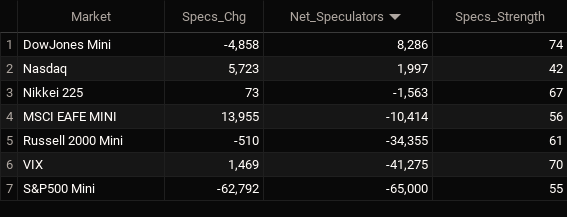
If you look at the March statistics, you’ll see that positions in government make up more than 20% of new jobs added. What’s more, the data shows that zero manufacturing jobs were created in March.

This data suggests the March headline numbers — which suggested a very robust job market — may have been deceptively sunny. Too many jobs were created in government, and too few in manufacturing. That’s not a very healthy jobs market.

When pundits and the public ponder the job statistics that come out on the first Friday of each month, they should be be careful not to simply accept the headlines as the entire story.

When it comes to the economy, simple narratives can be misleading.The Conversation

About the Author:

Jeffrey Hart, Senior Lecturer of Finance, Auburn University

This article is republished from The Conversation under a Creative Commons license. Read the original article.
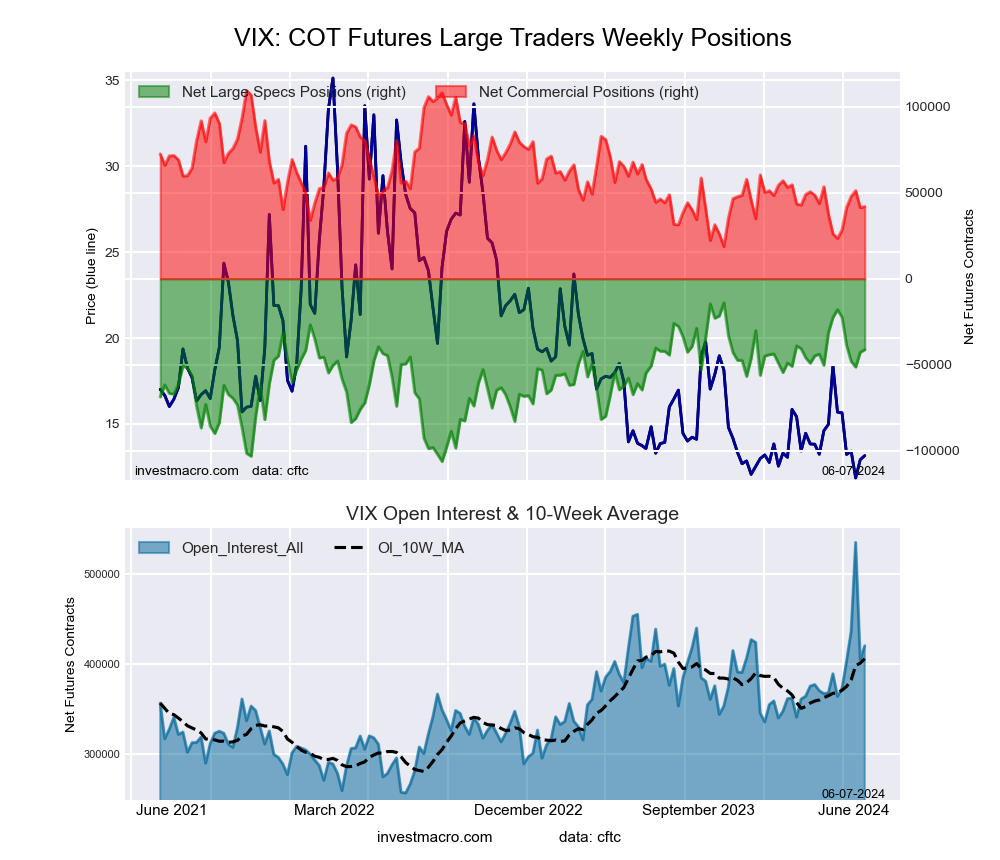
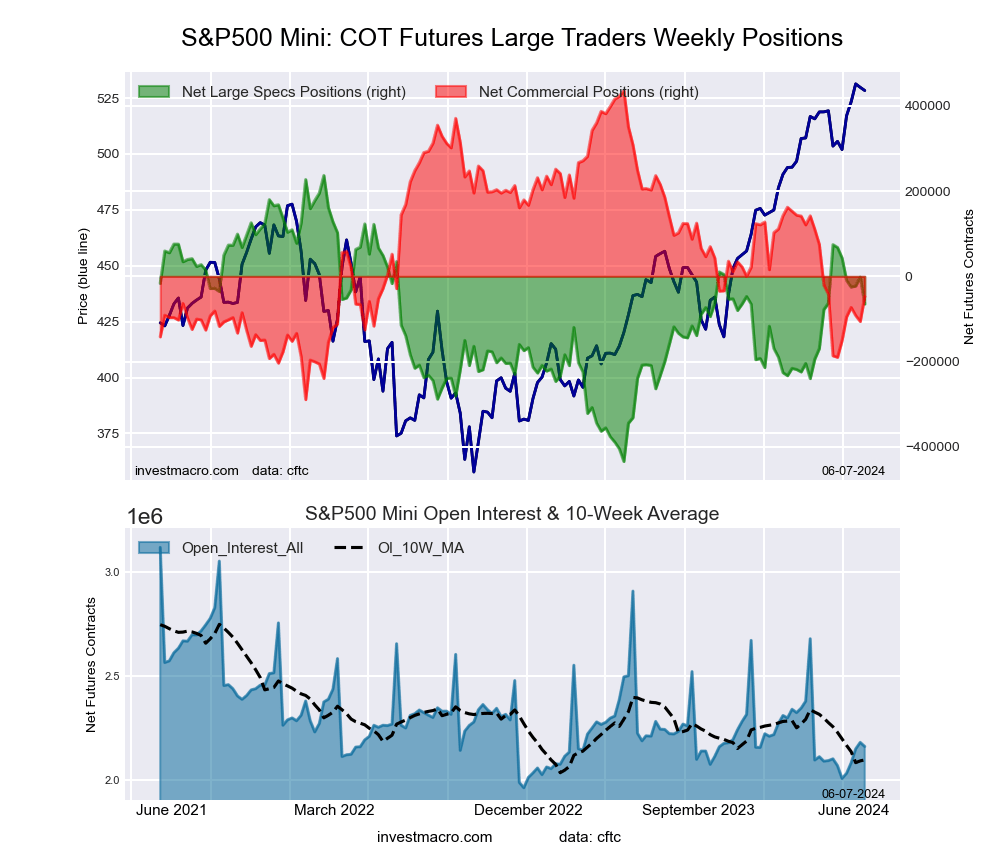
 

Gold prices reach 2368 USD amid speculation of Fed rate cuts

By RoboForex Analytical Department

Gold prices climbed to 2368 USD per troy ounce on Thursday, continuing the upward momentum for the second session. This surge comes as market expectations adjust to the likelihood of future interest rate cuts by the Federal Reserve, fuelled by recent employment data.

Data from ADP indicated that the number of private-sector jobs in the US for May increased less than expected, with April’s figures also revised downwards. This suggests a cooling but robust employment market, reinforcing speculation about impending rate cuts. According to the CME Group’s FedWatch tool, market participants anticipate two rate cuts in 2024, with a 70% probability of easing by September.

Attention is now turning to Friday’s comprehensive labour market reports from the US, which will provide further insights into the economic health and possible direction of monetary policy. Additionally, recent global movements by central banks, such as the Bank of Canada’s first rate cut in four years and the expected rate cut by the European Central Bank today, are influencing gold prices.

XAU/USD technical analysis

The H4 chart shows that gold has broken out of a consolidation range established above the 2315.00 USD level, moving upwards. The market is now poised to reach 2395.00 USD potentially. Once this target is met, a retraction to 2356.20 USD for a test from above could occur before another possible rise to 2399.00 USD. The MACD indicator supports this bullish outlook, with its signal line below zero but ascending sharply towards new highs.

On the H1 chart, gold developed a growth wave towards 2356.20 USD, followed by a consolidation range forming below this level. The market has since broken upwards, continuing the growth trajectory towards 2378.23 USD. After reaching this level, a corrective movement back to 2356.20 USD may occur, potentially setting the stage for a push towards the 2395.00 USD mark. The Stochastic oscillator indicates that, while the signal line has dipped below 80, it is expected to rise again towards 80, suggesting continued upward momentum.

Market outlook

Gold prices are experiencing a bullish phase, underpinned by shifting expectations regarding US monetary policy and actions by other central banks. Investors should closely monitor the upcoming US employment data and global central bank decisions. These events could significantly influence gold’s price dynamics in the short term. The technical indicators suggest a continuation of the current uptrend, with key levels to watch for potential reversals or further gains.


Disclaimer

Any forecasts contained herein are based on the author’s particular opinion. This analysis may not be treated as trading advice. RoboForex bears no responsibility for trading results based on trading recommendations and reviews contained herein.