Valutico Acquires AI Innovator Paraloq Analytics to Revolutionize Private Company Analysis

VIENNA, Austria – JUNE 19, 2025 – Valutico, a global leader in valuation and financial analysis software, today announced its strategic acquisition of Paraloq Analytics, a Vienna-based artificial intelligence (AI) specialist. This acquisition will integrate Paraloq Analytics’ advanced AI capabilities into Valutico’s renowned platform, empowering financial professionals with unprecedented data-driven insights and efficiency.

The two Vienna-headquartered companies have previously cooperated on the development of Done Diligence, an innovative tool that uses advanced AI agents to empower humans to perform due diligence work more efficiently. Now the companies are joining forces to create a powerhouse to further drive digital transformation in the Financial Services and Banking industries. By embedding AI-driven analytics and enhanced data interpretation into its platform, Valutico will offer its global client base even more robust, accurate, and forward-looking valuation solutions.

“We are thrilled to welcome Paraloq Analytics to the Valutico family,” said Paul Resch, CEO of Valutico. “Paraloq’s deep and long standing experience with AI, particularly in the Banking sector, perfectly complements our mission to provide the most sophisticated and user-friendly financial analysis platform on the market. This acquisition will significantly accelerate our product roadmap, bringing next-generation intelligence to our customers and further solidifying our leadership position in the space.”

Paraloq Analytics, founded in 2019 by two Econometrics PhD candidates of the University of St.Gallen, has quickly established itself as an innovator in applying AI to complex challenges in Banking and related fields. Their expertise in areas such as econometrics, machine learning, and AI software development will be instrumental in enhancing Valutico’s data analytics capabilities and augmenting its users’ experience with analysing qualitative information.

“Joining forces with Valutico is an exciting new chapter for Paraloq Analytics,” said Paraloq Co-Founder Maximilian Arrich. “Valutico’s global reach and established platform provide the perfect launchpad for our AI technologies. Over the past year of working together, we built a common vision for the future of financial analysis – one that is more data-driven, intelligent, and efficient. We are eager to contribute our expertise to create truly transformative tools for Finance professionals.”

Strategic Benefits of the Acquisition:

  • Enhanced AI-Powered Insights: Integration of Paraloq’s technology will complement Valutico’s analysis of structured data (e.g. financial information) with diverse sources of unstructured data (e.g. contents of a virtual data room, news, social media, etc)

  • Market Access: Valutico’s global reach will accelerate the roll out of Paraloq’s technology to new client verticals and geographies

  • Talent Acquisition: The Paraloq team will complement the Valutico family and further strengthen its AI capabilities

  • Innovation Acceleration: The combined expertise will fast-track the development of new, cutting-edge features for Valutico users.

Valutico will begin integrating Paraloq Analytics’ technology and team immediately, with Paraloq founder Maxilian Arrich joining Valutico’s management team as VP of AI Research. Clients can expect to see an acceleration of AI-enhanced feature rollouts in upcoming platform updates.

Terms of the acquisition were not disclosed.

About Valutico:

Valutico is a leading global provider of business valuation software. Founded in 2017, Valutico empowers financial professionals and valuation experts in over 90 countries to perform high-quality and efficient valuations with its comprehensive data, automated financial models, and intuitive platform. Valutico is headquartered in Vienna, Austria, with offices in the UK, US, Germany, the Netherlands and Singapore.


About Paraloq Analytics:

Paraloq Analytics is a Vienna-based company founded in 2019, specializing in artificial intelligence, machine learning, and econometric solutions for the Banking industry. Paraloq helps businesses unlock the power of their data by developing and implementing bespoke AI-driven software and providing expert data science and AI consulting.
USD/JPY Reverses Downwards: External Factors Reduce Support for the US Dollar

By RoboForex Analytical Department 

The USD/JPY pair is falling sharply, dropping to 145.49 on Tuesday as the yen recovers some of its losses after weeks of decline.

The reversal follows a broad weakening of the US dollar, triggered by former President Donald Trump’s remarks on the ceasefire between Israel and Iran, which he referred to as a “12-day war.”

Markets largely dismissed Iran’s retaliatory strike on a US base in Qatar – which caused no casualties – while Tehran’s decision not to close the strategically vital Strait of Hormuz helped ease concerns over potential supply disruptions.

Domestically, investors continue to assess the Bank of Japan’s (BoJ) policy stance. At its June meeting, the central bank held the key rate at 0.5% but signalled readiness for further tightening, citing persistent core inflation driven by companies passing on higher wage costs to consumers.

Given the yen’s prolonged depreciation, a period of consolidation – if not a full recovery – now appears likely.

Technical Analysis: USD/JPY

H4 Chart:

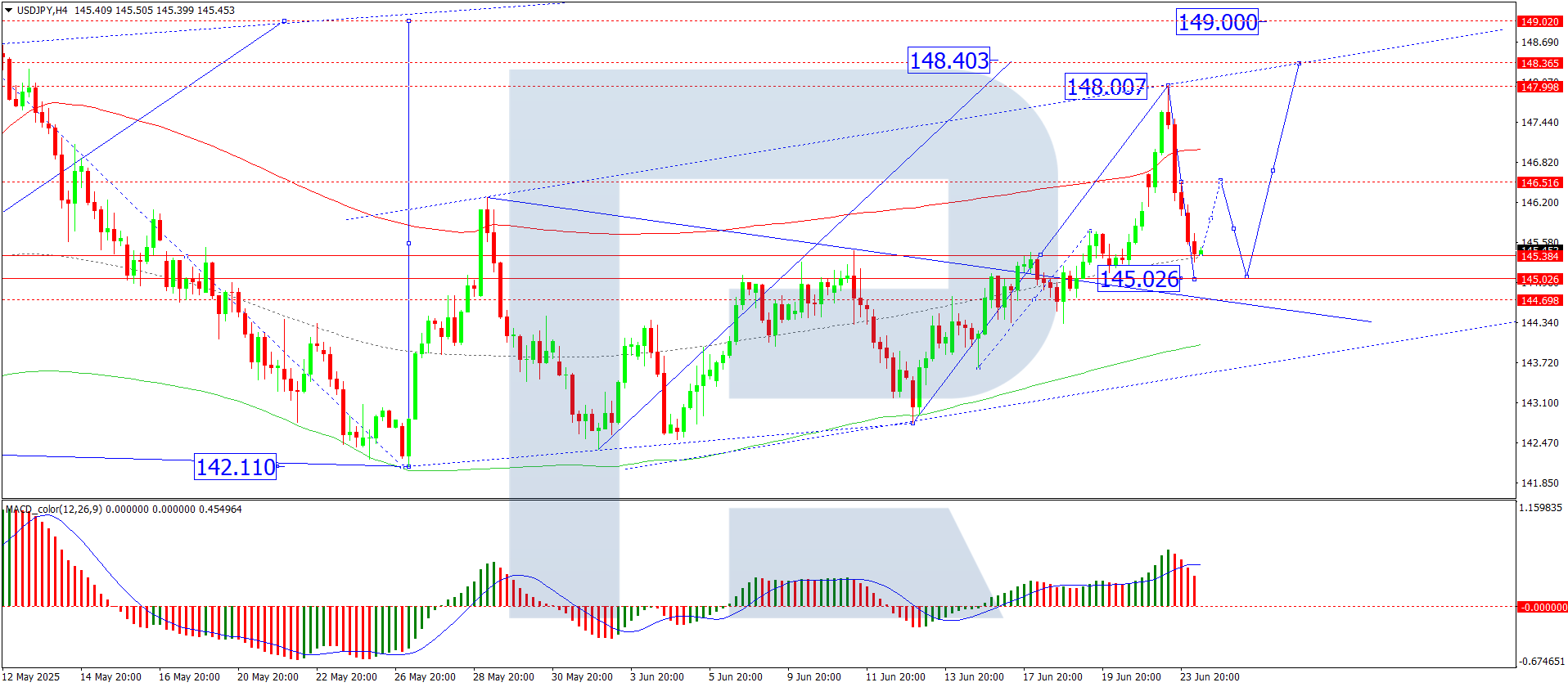
On the H4 chart, USD/JPY broke above the 145.00 consolidation range, rallying to 148.00 before pulling back. We now see a corrective decline, with a potential retest of 145.00 (a technical pullback to the breakout level). Once this correction concludes, another upward wave toward 148.40 could develop, with a longer-term target at 149.00. This scenario is supported by the MACD indicator: its signal line remains above zero, having exited the histogram zone, suggesting a decline, at a minimum, back to the zero line.

H1 Chart:

On the H1 chart, USD/JPY completed an uptrend to 148.00 before forming a consolidation range near 146.50. A downside breakout could extend the decline toward 145.00, after which a new upward wave targeting 149.00 may emerge. The Stochastic oscillator aligns with this outlook, with its signal line below 20 and pointing firmly downward.

Conclusion

The yen’s rebound reflects both external dollar weakness and domestic policy shifts, with technicals suggesting near-term consolidation before potential renewed upside.


Disclaimer

Any forecasts contained herein are based on the author’s particular opinion. This analysis may not be treated as trading advice. RoboForex bears no responsibility for trading results based on trading recommendations and reviews contained herein.

Oil jumped to $76 amid the US attack on Iran. Iran is considering closing the Strait of Hormuz

By JustMarkets 

At the end of Friday, the Dow Jones Index (US30) rose by 0.08% (-0.88% for the week). The S&P 500 Index (US500) fell by 0.22% (-0.55% for the week). The Nasdaq Technology Index (US100) closed lower by 0.43% (-0.23% for the week). On Friday, US Federal Reserve representative Waller’s statement that interest rates could be cut as early as July contrasted sharply with Chairman Powell’s more cautious, data-dependent stance. Shares of semiconductor companies such as Nvidia and TSMC fell more than 1% after reports that the US may revoke export licenses, raising concerns about global chip supply chains.

Retail sales in Canada in May 2025 fell by 1.1% compared to the previous month, according to preliminary estimates. This would reflect the sharpest decline in turnover since March 2023, indicating a stronger impact from US tariffs. This week, the Bank of Canada will get a fresh look at the country’s inflation data. Economists agree that inflation rose to 1.8% year-on-year last month. If these reports show signs of inflation slowing, the Bank of Canada may find an opportunity to cut interest rates to support the economy amid tariffs.

Stock markets in Europe were mostly down. The German DAX (DE40) rose by 1.27% (-1.01% for the week), the French CAC 40 (FR40) closed up 0.48% (-1.52% for the week), the Spanish IBEX35 (ES35) added 0.77% (-0.54% for the week), and the British FTSE 100 (UK100) closed down 0.20% on Friday (-0.86% for the week).

The war between Israel and Iran continues, but only the oil market is reacting to these events. Last week, WTI oil rose by approximately 2.7% after a 13% rally the previous week. WTI oil prices rose to $74.7 per barrel on Monday, reaching their highest level since January. After the US became directly involved in the Israeli-Iranian conflict, fears intensified that Tehran could retaliate by disrupting oil flows from the Middle East, particularly through the Strait of Hormuz. Iran is a major oil producer and exporter, and is located on a narrow waterway through which about 20% of the world’s oil passes. Iran’s parliament voted on Sunday to close the strait in response to US strikes, although the final decision rests with the Supreme National Security Council and Iran’s Supreme Leader.

Asian markets were mostly down last week. Japan’s Nikkei 225 (JP225) rose by 0.91%, China’s FTSE China A50 (CHA50) fell by 0.21%, Hong Kong’s Hang Seng (HK50) lost 1.10%, and Australia’s ASX 200 (AU200) showed a negative result of 0.49%.

On Monday, the Australian dollar fell to $0.640, reaching its lowest level in a month, amid a strengthening US dollar against the backdrop of escalating geopolitical tensions. The US dollar strengthened after US forces struck three major Iranian nuclear sites over the weekend, and President Donald Trump warned of further action if Tehran did not pursue peace. In Australia, economic data showed resilience despite external pressures. The manufacturing PMI remained at 51, while the services PMI rose to a three-month high of 51.3 from 50.6 previously.

S&P 500 (US500) 5,967.84 −13.03 (−0.22%)

Dow Jones (US30) 42,206.82 +35.16 (+0.083%)

DAX (DE40) 23,350.55 +293.17 (+1.27%)

FTSE 100 (UK100) 8,774.65 −17.15 (−0.20%)

USD Index 98.77 −0.13 (−0.13%)

News feed for: 2025.06.23

  • Australia Manufacturing PMI (m/m) at 02:00 (GMT+3);
  • Australia Services PMI (m/m) at 02:00 (GMT+3);
  • Japan Manufacturing PMI (m/m) at 03:30 (GMT+3);
  • Japan Services PMI (m/m) at 03:30 (GMT+3);
  • Singapore Unemployment Rate (m/m) at 05:30 (GMT+3);
  • Singapore Inflation Rate (m/m) at 08:00 (GMT+3);
  • German Manufacturing PMI (m/m) at 10:30 (GMT+3);
  • German Services PMI (m/m) at 10:30 (GMT+3);
  • Eurozone Manufacturing PMI (m/m) at 11:00 (GMT+3);
  • Eurozone Services PMI (m/m) at 11:00 (GMT+3);
  • UK Manufacturing PMI (m/m) at 11:30 (GMT+3);
  • UK Services PMI (m/m) at 11:30 (GMT+3);
  • US Manufacturing PMI (m/m) at 16:45 (GMT+3);
  • US Services PMI (m/m) at 16:45 (GMT+3);
  • US Existing Home Sales (m/m) at 17:00 (GMT+3).

By JustMarkets


This article reflects a personal opinion and should not be interpreted as an investment advice, and/or offer, and/or a persistent request for carrying out financial transactions, and/or a guarantee, and/or a forecast of future events.

Markets rattled by mounting geopolitical risks

By ForexTime

  • Geopolitical risks mount as US joins Israel-Iran conflict 
  • Brent opens almost 6% higher supply disruption fears
  • Bitcoin sheds over 4% from Friday, dipping below $100,000
  • Risk-off mood may boost – USD, JPY, CHF & Gold 

Early on Sunday, the United States joined Israel’s war against Iran by launching airstrikes on three nuclear sites.

Note: It was only last Thursday that Donald Trump set a two-week deadline to decide whether the US would strike Iran or not.

This unexpected development sparked risk aversion, with Bitcoin being the first victim of investor jitters.

As expected, markets kicked off Sunday evening with significant price gaps from Friday’s close.

However, one of the biggest movers was Brent oil which opened almost 6% higher at over $80 a barrel!

Note: calculations based on Bloomberg’s pricing using Friday’s closing price to Sunday evening’s open. 

  • Brent: ↑ 5.7%
  • Crude: ↑ 4.6%
  • XAUUSD: ↑ 0.6%
  • USDInd: ↑ 0.4%
  • Bitcoin: ↓ 4%
  • USDJPY: ↑ 0.4%

Asian shares are under pressure during early trading while European and US futures are flashing red.

Risk-off could remain the name of the game this week as the world awaits Iran’s response to the United States.


Why did oil benchmarks spike?

Markets are becoming increasingly concerned about tensions disrupting supply from a region that produces around a third of the world’s crude. 

But most importantly, Iran’s parliament has voted to close the vital Hormuz shipping channel in retaliation against Trump’s attack. It’s worth noting this is a key checkpoint for global crude, accounting for a fifth of the world’s daily output. 

So, if geopolitical tensions continue to mount and the Strait of Hormuz is blocked, Brent could rally beyond $80.

Note: Brent prices are bullish on the daily timeframe, jumping toward the 2025 high. The next psychological levels can be found at $90 and $100. 


Potential scenarios:

Should the conflict in the Middle East worsen, risk aversion could dominate global financial markets.

  • The biggest winners could be safe-haven assets: USD, JPY, CHF and Gold.
  • The losers are likely to be risk assets: global equities and cryptocurrencies


Any signs of easing tensions between Israel-Iran could soothe investor anxiety and support sentiment.

  • A reduced appetite for safe-haven assets may hit: USD, JPY, CHF and Gold may weaken. 
  • A return of risk appetite may support: global equities and cryptocurrencies.

Forex-Time-LogoArticle by ForexTime

ForexTime Ltd (FXTM) is an award winning international online forex broker regulated by CySEC 185/12 www.forextime.com

Gold Set to Rally All Eyes on the Middle East

By RoboForex Analytical Department 

On Monday, gold traded at $3,360 per troy ounce as markets nervously monitor developments in the Middle East.

Washington’s involvement in the conflict has heightened fears of potential retaliation from Tehran. Particularly concerning is the potential disruption of key Middle Eastern oil supply routes. Iran, one of the world’s largest oil producers and exporters, controls the Strait of Hormuz – a critical maritime passage accounting for 20-30% of global oil shipments.

According to state media, Iran’s parliament backed a proposal on Sunday to close the strait. However, the final decision rests with the Supreme National Security Council and the country’s Supreme Leader.

By this morning, exchanges had already priced in the weekend’s volatility and are now consolidating as traders await further developments. Since the start of the year, gold prices have surged by nearly 30%.

This week, market participants are also focused on speeches by Federal Reserve officials, including Chair Jerome Powell, who will testify before Congress in a two-day hearing. Discussions are expected to cover the economic impact of Trump’s trade tariffs and the strikes on Iran.

Key macroeconomic data releases include core inflation (excluding food and energy), initial jobless claims, and PMI business activity indices. These reports could influence the Fed’s next policy moves.

Technical analysis: XAU/USD

H4 Chart:

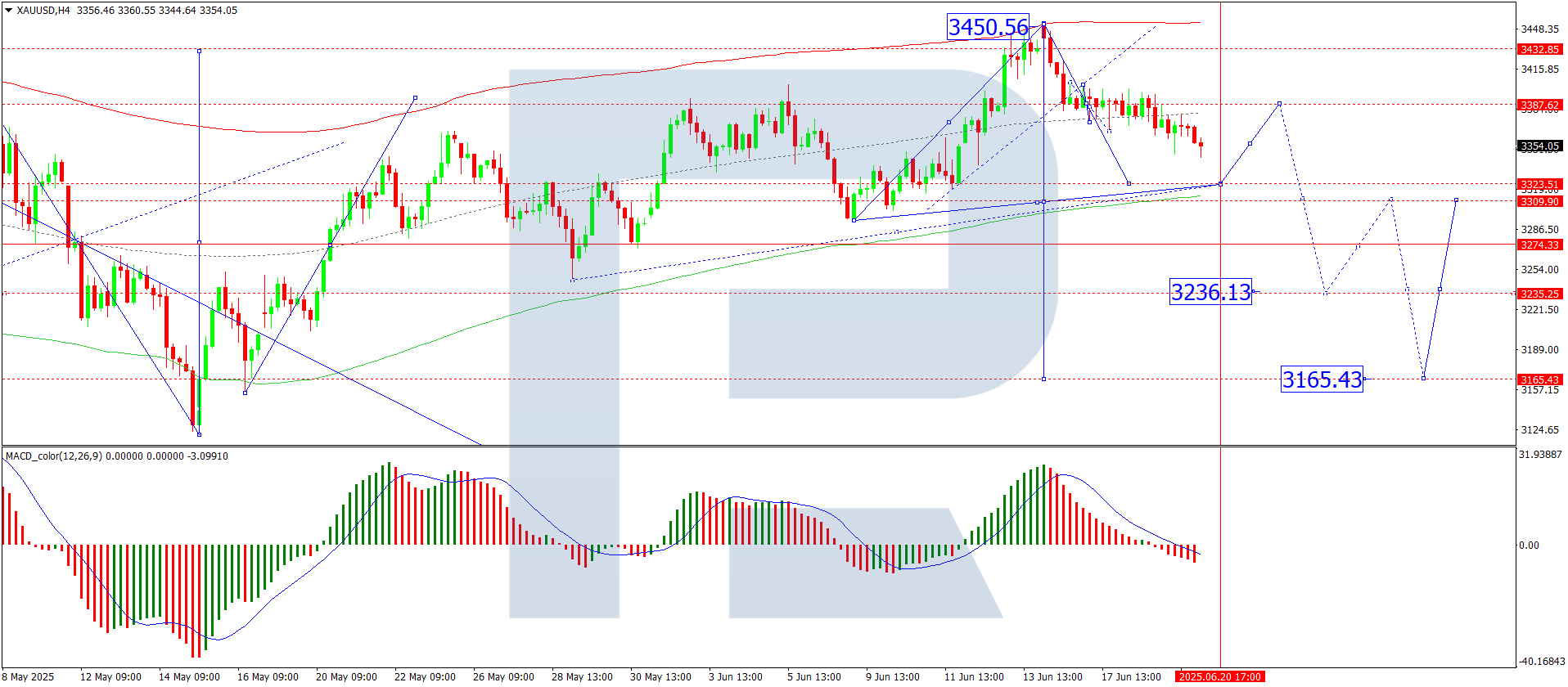
The XAU/USD pair has formed a consolidation range near 3,388 before breaking downward. Further downside is expected towards 3,323 (first target), followed by a possible corrective wave back to 3,388. This scenario is supported by the MACD indicator, where the signal line remains below zero and points sharply downward.

H1 Chart:

The market completed a corrective wave to 3,396 before reversing in an impulsive move towards 3,359. A consolidation range is now forming around this level, with expectations of a downward breakout towards 3,323 (first target). Upon reaching this level, a potential correction back to 3,388 could follow. The Stochastic oscillator supports this outlook, with its signal line below 50 and trending sharply downward towards 20.

Conclusion

Gold remains highly sensitive to geopolitical tensions in the Middle East, while technical indicators suggest further volatility ahead. Traders should monitor Fed commentary and key economic data for directional cues.


Disclaimer

Any forecasts contained herein are based on the author’s particular opinion. This analysis may not be treated as trading advice. RoboForex bears no responsibility for trading results based on trading recommendations and reviews contained herein.

Trump’s Tariffs Threat to the Global South

By Dan Steinbock

 With its misguided tariff wars, the Trump administration is not only disrupting historical trade ties with the world’s largest economies, but waging war against economic development in the Global South.

After agreeing to suspend the “reciprocal” duties for 90 days — till early July — Trump threatened to set country-specific tariff rates. By making good his promise and imposing unilateral tariffs on imports from the US’ trading partners, Trump will severely disrupt export-led growth, which has fueled global growth for years, and shatter the development dreams and aspirations of emerging and developing economies.

China’s global trade engine is a case in point.

$3.6 trillion of exports to 230 countries

In 2024, US exports amounted to some $2.1 trillion. That’s significantly more than those by Germany ($1.7 tr) or the Netherlands ($0.7 tr), Europe’s two largest trading economies. Yet, today the value of US exports is less than 60% of those by China that amount to $3.6 trillion. Today, China contributes some 15% of all exports worldwide. That’s twice as much as the US (Figure 1).


Figure 1 China’s export partners worldwide

Source: Latest data (for 2024), ITC, June 2025


China’s exports have some 230 destinations. Most go to major economies in North America (US, Mexico, Canada), Western Europe (Germany, Netherlands, UK), East Asia (Japan, South Korea, Taiwan), Southeast Asia (Vietnam, Malaysia, Thailand), India, Russia and Australia.

In 2018, before the first Trump administration’s tariff wars, the United States still accounted for over 19% of China’s total exports. In 2024, that figure was barely 16%; that is, less than Chinese exports to Europe and Southeast Asia, each. Ever since the US tariff wars, China has diversified its exports away from the US.

In the past decade, this trend has been greatly reinforced by Chinese trade with Belt and Road Initiative (BRI) countries. Nearly 54% of China’s imports came from BRI partner countries last year, with China’s huge marketplace providing development opportunities for nations around the world.

China’s trade is vital to the emerging and developing economies of the Global South, where the West’s exports often are prohibitively expensive. The West exports mainly to economies that share similar high living standards. Such trade is predicated on high purchasing power, which is the privilege of high-income economies.

Trump’s war against economic development

The first round of Trump tariffs built on traditional trade wars focusing mainly on Canada, Mexico and China. The second round began with “reciprocal tariffs”, which actually are unilateral, flawed as stated and mistakenly calculated. Those tariffs were followed by a slate of retaliatory tariffs.

The net effect has been a stunning downgrading of the economic prospects in the United States, its trading partners and the global economy. What is less understood is the likely long-term effect of Trump’s unilateral tariffs, which is to undermine the rise of the Global South.

The US administration’s original list of these tariff targets comprised almost 60 countries and regions. Except for the EU as a bloc and a few high-income countries, three of four of these targets represent emerging and developing economies; that is, the Global South. The Trump administration is at war against their economic development (Figure 2).


Figure 2 Trump administration’s unilateral tariffs

Source: White House


Since the late 20th century, most economies that have been able to industrialize and catch-up with the advanced economies of the West have done so on the back of export-led growth. It is what fueled the rise of Asian tigers in the postwar era (Hong Kong, Singapore, South Korea, Taiwan), their subsequent successors (Malaysia, Thailand, Vietnam, Indonesia).

They were followed by China – and today India and some Southeast Asian economies.

From Western domination to multipolarity

After World War II, the United States dominated half of the world economy. It was the “world’s factory,” the largest manufacturer and exporter. As the largest creditor, it also held huge leverage over the international economy. This dominance, in turn, was reflected by the mighty US dollar that had a virtual monopoly in international transactions.

All that is history today.

Of course, the United States remains the largest single economy in the world, but its relative share has shrunk to about a fourth or fifth of the world GDP. It hasn’t been the world’s largest export manufacturer since the postwar era. Starting in the 1970s, it has suffered from trade deficits and today it is the world’s largest debtor. Concurrently, the share of US dollar in international transactions has shrunk to less than 60%.

In the process, Washington has played itself into a dark corner: it cannot fully decouple from China without major economic turmoil. But thanks to its tariffs, it cannot any longer benefit from China’s affordable prices, which has long contributed to low inflation in the US.

Today any major threat to undermine Chinese trade poses a $6.2 trillion threat – that is, export plus imports combined – to its trading partners, particularly the Global South and the world at large.

About the Author:

Dr. Dan Steinbock is an internationally recognized strategist of the multipolar world and the founder of Difference Group. He has served at the India, China and America Institute (USA), Shanghai Institutes for International Studies (China) and the EU Center (Singapore). For more, see https://www.differencegroup.net 


The original version was published by China Daily on June 20, 2025


Week Ahead: US500 faces triple threat – Geopolitics, Powell & PCE

By ForexTime 

  • FXTM’s US500 ↑ 1% MTD, less than 3% away from ATH
  • Trump delays decision on Iran strike by two weeks
  • Powell’s testimony + US PCE = potential breakout?
  • US PCE forecasted to move US500 ↑ 1.3% or ↓ 1.0%
  • Technical levels: 6060, 6000 & 5920 

A cautious sense of relief has spread through markets after President Trump delayed deciding on attacking Iran by two weeks.

However, the ongoing Middle East conflict is set to weigh on investor confidence ahead of another heavy event-packed week. 

Speeches by various policymakers, top-tier economic data including the Fed’s preferred inflation gauge and Powell’s testimony could translate to fresh trading opportunities:

Sunday, 22nd June 

  • USDInd: San Francisco Fed President Mary Daly
  • Tesla: Tentative launch of Robotaxi service in Texas

Monday, 23rd June 

  • GER40: Germany HCOB Manufacturing & Services PMI
  • JPY: Japan au Jibun Bank Manufacturing PMI
  • TWN: Taiwan jobless rate
  • UK100: UK S&P Global Manufacturing & Services PMI
  • RUS2000: US S&P Global Manufacturing & Services PMI, Fed speak

Tuesday, 24th June 

  • CN50: China’s National People’s Congress
  • CAD: Canada CPI
  • GER40: Germany IFO business climate
  • UK100: BOE Governor Andrew Bailey testimony
  • US500: Fed Chair Jerome Powell testimony, New York Fed President John Williams

Wednesday, 25th June

  • AUD: Australia CPI
  • NZD: New Zealand trade
  • JPY: BOJ board member Naoki Tamura speech
  • US500: Fed Chair Jerome Powell testimony

Thursday, 26th June

  • SG20: Singapore industrial production
  • GBP: BOE Governor Andrew Bailey speech
  • US30: US revised GDP, initial jobless claims, Fed speak

Friday, 27th June

  • CN50: China industrial profits
  • CAD: Canada GDP
  • EUR: Eurozone economic confidence, consumer confidence
  • JPY: Japan Tokyo CPI, unemployment, retail sales
  • US30: Fed releases annual bank stress test results
  • US500: US personal income, PCE price index, University of Michigan consumer sentiment, Fed speech

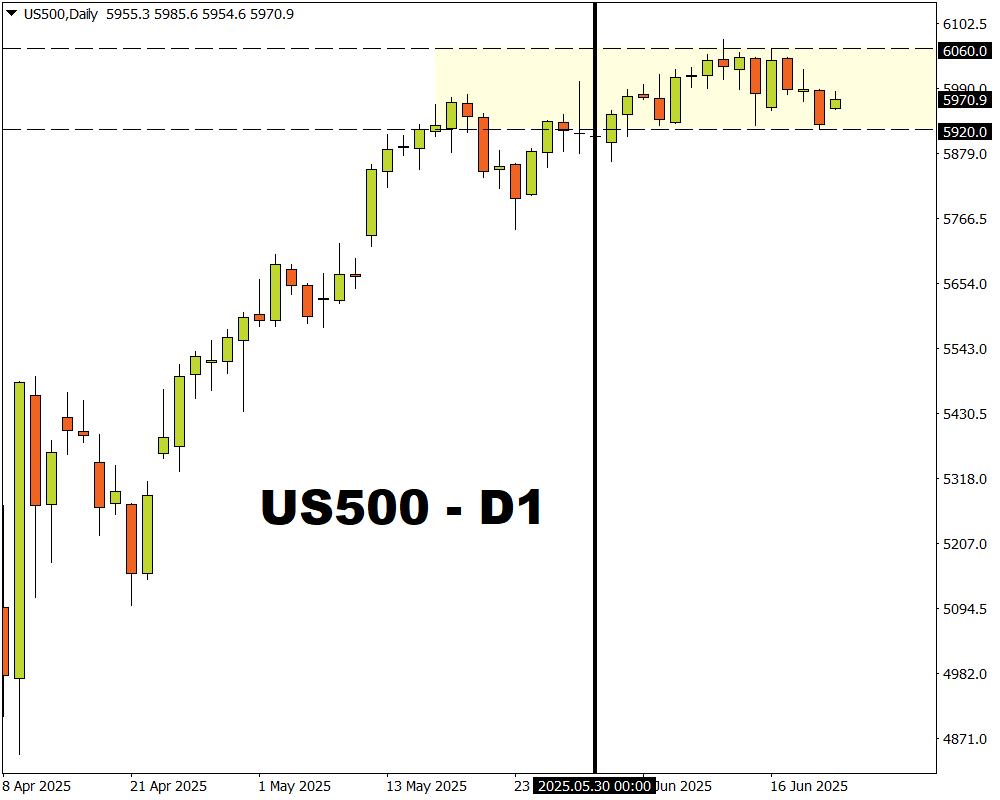
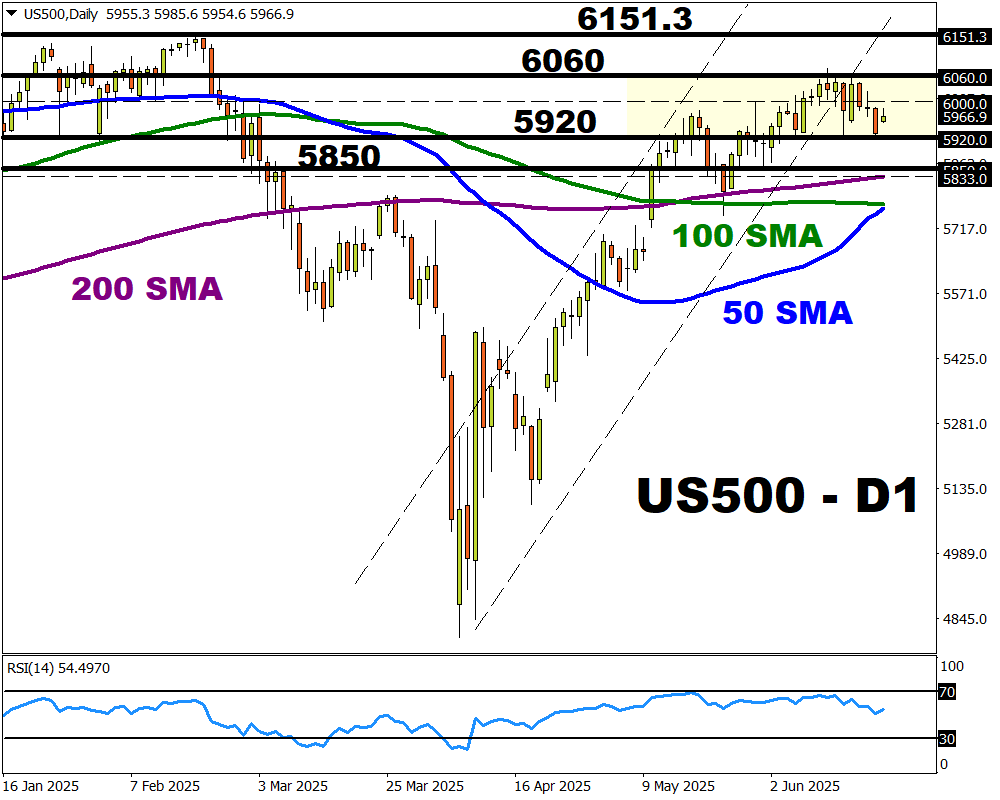
Our attention is drawn to FXTM’s US500, which has been confined within a daily range since the start of June.

Imagen
us500 4

Note: FXTM’s US500 tracks the underlying S&P 500 index

Recently, US equities have been pressured by mounting geopolitical risks, despite the Federal Reserve still penciling in two interest rate cuts for 2025.

Still, US500 is up roughly 1% this month and trading less than 3% away from its all-time high at 6151.3.


Here are 4 factors that could trigger a major breakout:


1) Ongoing Middle East conflict

Israel and Iran have exchanged missile attacks for one week after tensions escalated last Friday.

The conflict between both sides has shown no signs of cooling with investors watching whether the United States will get involved. Although Trump has delayed this decision by two weeks, any hints of potential actions could influence risk sentiment.

  • Any signs of the United States holding off on joining the Israel-Iran conflict may support risk appetite – keeping the US500 buoyed. 
  • Should expectations mount around the US attacking Iran, this may spark fears of a wider conflict. Such development may hit the US500 as risk aversion intensifies. 


2) Fed Chair Powell’s 2-day Testimony

Fed Chair Jerome Powell’s semi-annual testimony before Congress may provide key insight into future policy moves.

During June’s FOMC meeting, Powell stated that the Fed was ‘well-positioned to wait’ before moving further on rates. He also expressed concerns over the effects of tariffs on inflation.

  • Should Powell repeat the same message and strike a hawkish note, this could weigh on the US500.
  • If the Fed Chair sounds more dovish than expected and signals a rate cut in September, the US500 may rise. 


3) US May PCE report

The Fed’s preferred inflation gauge – the Core PCE could influence expectations about when the central bank will cut rates in the second half of 2025.

Markets are forecasting PCE deflators to rise in May with the core figure nudging up 2.6% year-on-year compared to 2.5% seen in the previous month. Ultimately, more signs of rising price pressure may shave bets around lower US interest rates.

Traders are currently pricing in a 68% probability of a 25-basis point cut by September.

Beyond the PCE report, it will be wise to keep an eye on speeches by a host of Fed officials and other US data, including PMI’s which may influence the US500.

US500 is forecasted to move as much as 1.3% or decline 1.0% in a 6-hour window post release.

  • The US500 may slip on signs of rising price pressures in the United States.
  • A cooler-than-expected PCE report could support the US500.


4) Technical forces

The US500 remains trapped within a range with support at 5920 and resistance at 6060.

  • A solid daily close and breakout above 6000 may open a path toward 6060 and 6151.3. 
  • Sustained weakness below 5920 may trigger a selloff toward 5850, the 200-day SMA and 100-day SMA.
Imagen
US500 6

Forex-Time-LogoArticle by ForexTime

ForexTime Ltd (FXTM) is an award winning international online forex broker regulated by CySEC 185/12 www.forextime.com

Gold Falls to One-Week Low: What’s Behind the Drop?

By RoboForex Analytical Department 

The price of gold has dropped below $3,360 per troy ounce, nearing a one-week low and marking its first decline in three weeks. Investors are offloading the precious metal to offset losses in other markets amid escalating tensions in the Middle East.

Geopolitical Tensions Weigh on Gold

Israel and Iran continue to exchange strikes, with Israel intensifying attacks on strategic and government sites in Tehran following reports of an Iranian missile hitting a major Israeli hospital.

Meanwhile, investors are closely monitoring developments in Washington. US President Donald Trump has not ruled out direct military intervention in Iran, and speculation is mounting that a decision could come within the next two weeks. However, the market remains driven by rumours rather than confirmed reports.

Earlier this week, the Federal Reserve held interest rates steady but signalled two potential cuts before year-end. Fed Chair Jerome Powell cautioned, however, that trade tariffs could continue to fuel inflation.

The Fed’s latest projections indicate slower economic growth, rising inflation, and weaker employment prospects in 2025. Persistent inflation concerns may limit the scope for rate cuts, further pressuring gold, which, unlike bonds, offers no coupon income.

Technical Analysis: XAU/USD

H4 Chart:

On the H4 chart, XAU/USD formed a consolidation range around 3,388 before breaking downward. The decline is expected to extend towards 3,323, after which a corrective rebound to 3,388 may follow. This scenario is supported by the MACD indicator, with its signal line below zero and pointing firmly downward.

H1 Chart:

On the H1 chart, the market completed a corrective wave to 3,399 before reversing downward and breaking below the consolidation range. The drop below 3,360 opens the door for further downside, with a target at 3,323. Upon reaching this level, a corrective bounce toward 3,350 could follow. The Stochastic oscillator confirms this scenario, with its signal line below 50 and trending sharply down towards 20.

Conclusion

Gold remains under downward pressure from geopolitical uncertainty, expectations of Fed policy, and technical selling. The key levels to watch are 3,323 (support) and 3,388 (resistance), with potential corrections offering short-term trading opportunities.by technical indicators.


Disclaimer

Any forecasts contained herein are based on the author’s particular opinion. This analysis may not be treated as trading advice. RoboForex bears no responsibility for trading results based on trading recommendations and reviews contained herein.

The SNB reduced the interest rate to 0%. The Norges Bank cut its interest rate for the first time in five years

By JustMarkets 

The US stock indices did not trade yesterday due to a public holiday.

The Mexican peso (MXN) weakened to 19.1 per US dollar, down from a ten-month high of 18.886 reached on June 12, as the US dollar regained strength amid expectations of easing by the Bank of Mexico and renewed geopolitical risks. The US Federal Reserve’s decision to keep rates at 4.25–4.50% and Chairman Powell’s warning that US tariffs could cause inflation boosted demand for dollars. At the same time, markets began to price in an earlier-than-expected rate cut by the Bank of Mexico, even though Mexico’s benchmark rate remains at 8.5%, which negates the carry premium that had been supporting the peso.

European stock markets were mostly down on Thursday. Germany’s DAX (DE40) fell by 1.12%, France’s CAC 40 (FR40) closed down 1.34%, Spain’s IBEX35 (ES35) lost 1.28%, and the British FTSE 100 (UK100) closed down 0.58%.

At its June meeting, the Bank of England (BoE) voted 6-3 to keep the bank rate at 4.25%, focusing on the complex backdrop of heightened global uncertainty and persistent inflationary pressures. Three members of the bank voted to cut the rate by 0.25 percentage points to 4%, although investors had expected the split to be 7–2. The Central Bank noted that consumer price inflation is likely to remain broadly at current levels until the end of the year and return to target next year.

The Swiss National Bank (SNB) lowered its key interest rate by 25 basis points to 0% in June 2025, as expected, setting the cost of borrowing at zero for the first time since the introduction of negative rates at the end of 2022. This decision was made against the backdrop of easing inflationary pressures and a deterioration in the global economic outlook. Consumer prices in Switzerland fell by 0.1% in May, the first decline in four years. The SNB currently expects average inflation of 0.2% in 2025, 0.5% in 2026, and 0.7% in 2027. In the first quarter of 2025, Switzerland’s GDP also showed strong growth, partly driven by exports to the US ahead of the introduction of new tariffs, although the underlying momentum was more modest.

At its meeting in June 2025, Norges Bank lowered its key rate by 25 basis points to 4.25%. This is the first rate cut in five years. Policymakers said that inflation had slowed since the March meeting and that it was appropriate to ease financial conditions and support economic growth. However, the Monetary Policy Committee emphasized that borrowing costs should remain sufficiently tight to prevent a resurgence of inflation. According to the latest expectations, the rate will be around 4% at the end of the year and 3% by 2028.

WTI crude oil prices slowed their growth at the start of Thursday’s session and are trading below $75 per barrel, just slightly below their five-month high, after President Trump’s statement that he would decide on US involvement in the Israeli-Iranian conflict “within two weeks” allayed fears of an immediate supply shock from the Middle East.

Asian markets were in sell-off mode yesterday. Japan’s Nikkei 225 (JP225) fell by 1.02%, China’s FTSE China A50 (CHA50) lost 0.64%, Hong Kong’s Hang Seng (HK50) decreased by 1.99%, and Australia’s ASX 200 (AU200) showed a negative result of 0.09%.

The Philippine Central Bank cut its benchmark interest rate by 25 basis points to 5.25% at its June 2025 policy meeting, the lowest level in two and a half years and in line with market expectations. BSP Governor Eli Remolona said the decision reflected a more moderate inflation outlook and the need to support growth with a more accommodative policy. Annual inflation in May 2025 fell to 1.3% from 1.4% in the previous month, matching market expectations and reaching its lowest level since November 2019. The inflation projections for 2025 was revised downward from 2.4% to 1.6%, reflecting easing price pressures.

S&P 500 (US500) 5,980.87 −1.85 (−0.03%)

Dow Jones (US30) 42,171.66 −44.14 (−0.10%)

DAX (DE40) 23,057.38 −260.43 (−1.12%)

FTSE 100 (UK100) 8,791.80 −51.67 (−0.58%)

USD Index 98.76 −0.14 (−0.14%)

News feed for: 2025.06.20

  • Japan National Core Consumer Price Index at 02:30 (GMT+3);
  • Japan Monetary Policy Meeting Minutes at 02:50 (GMT+3);
  • China PBoC Loan Prime Rate (m/m) at 04:15 (GMT+3);
  • German Producer Price Index (m/m) at 09:00 (GMT+3);
  • UK Retail Sales (m/m) at 09:00 (GMT+3);
  • Japan BOJ Gov Ueda Speaks at 09:40 (GMT+3);
  • Canada Retail Sales (m/m) at 15:30 (GMT+3);
  • US Philadelphia Fed Manufacturing Index (m/m) at 15:30 (GMT+3).

By JustMarkets


This article reflects a personal opinion and should not be interpreted as an investment advice, and/or offer, and/or a persistent request for carrying out financial transactions, and/or a guarantee, and/or a forecast of future events.

AI helps tell snow leopards apart, improving population counts for these majestic mountain predators

By Eve Bohnett, University of Florida 

Snow leopards are known as the “ghosts of the mountains” for a reason. Imagine waiting for months in the harsh, rugged mountains of Asia, hoping to catch even a glimpse of one. These elusive big cats move silently across rocky slopes, their pale coats blending so seamlessly with snow and stone that even the most seasoned biologists seldom spot them in the wild.

Travel writer Peter Matthiessen spent two months in 1973 searching the Tibetan plateau for them and wrote a 300-page book about the effort. He never saw one. Forty years later, Peter’s son Alex retraced his father’s steps – and didn’t see one either.

Researchers have struggled to come up with a figure for the global population. In 2017, the International Union for Conservation of Nature reclassified the snow leopard from endangered to vulnerable, citing estimates of between 2,500 and 10,000 adults in the wild. However, the group also warned that numbers continue to decline in many areas due to habitat loss, poaching and human-wildlife conflict. Those who study these animals want to help protect the species and their habitat – if only we can determine exactly where they live and how many there are.

Traditional tracking methods – searching for footprints, droppings and other signs – have their limits. Instead of waiting for a lucky face-to-face encounter, conservationists from the Wildlife Conservation Society, led by experts including Stéphane Ostrowski and Sorosh Poya Faryabi, began deploying automated camera traps in Afghanistan. These devices snap photos whenever movement is detected, capturing thousands of images over months, all in hopes of obtaining a rare glimpse of a snow leopard.

But capturing images is only half the battle. The next, even harder task is telling one snow leopard apart from another.

Two images of snow leopards.
Are these the same animal or different ones? It’s really hard to tell.
Eve Bohnett, CC BY-ND

At first glance, it might sound simple: Each snow leopard has a unique pattern of black rosettes on its coat, like a fingerprint or a face in a crowd. Yet in practice, identifying individuals by these patterns is slow, subjective and prone to error. Photos may be taken at odd angles, under poor lighting, or with parts of the animal obscured – making matches tricky.

A common mistake happens when photos from different cameras are marked as depicting different animals when they actually show the same individual, inflating population estimates. Worse, camera trap images can get mixed up or misfiled, splitting encounters of one cat across multiple batches and identities.

I am a data analyst working with Wildlife Conservation Society and other partners at Wild Me. My work and others’ has found that even trained experts can misidentify animals, failing to recognize repeat visitors at locations monitored by motion-sensing cameras and counting the same animal more than once. One study found that the snow leopard population was overestimated by more than 30% because of these human errors.

To avoid these pitfalls, researchers follow camera sorting guidelines: At least three clear pattern differences or similarities must be confirmed between two images to declare them the same or different cats. Images too blurry, too dark or taken from difficult angles may have to be discarded. Identification efforts range from easy cases with clear, full-body shots to ambiguous ones needing collaboration and debate. Despite these efforts, variability remains, and more experienced observers tend to be more accurate.

Now people trying to count snow leopards are getting help from artificial intelligence systems, in two ways.

Spotting the spots

Modern AI tools are revolutionizing how we process these large photo libraries. First, AI can rapidly sort through thousands of images, flagging those that contain snow leopards and ignoring irrelevant ones such as those that depict blue sheep, gray-and-white mountain terrain, or shadows.

A snow leopard stands amid rocks.
Unique spots and spot patterns are key to telling snow leopards apart.
Eve Bohnett, CC BY-NC-ND

AI can identify individual snow leopards by analyzing their unique rosette patterns, even when poses or lighting vary. Each snow leopard encounter is compared with a catalog of previously identified photos and assigned a known ID if there is a match, or entered as a new individual if not.

In a recent study, several colleagues and I evaluated two AI algorithms, both separately and in tandem.

The first algorithm, called HotSpotter, identifies individual snow leopards by comparing key visual features such as coat patterns, highlighting distinctive “hot spots” with a yellow marker.

The second is a newer method called pose invariant embeddings, which operates similar to facial recognition technology: It recognizes layers of abstract features in the data, identifying the same animal regardless of how it is positioned in the photo or what kind of lighting there may be.

We trained these systems using a curated dataset of photos of snow leopards from zoos in the U.S., Europe and Tajikistan, and with images from the wild, including in Afghanistan.

Alone, each model worked about 74% of the time, correctly identifying the cat from a large photo library. But when combined, the two systems together were correct 85% of the time.

These algorithms were integrated into Wildbook, an open-source, web-based software platform developed by the nonprofit organization Wild Me and now adopted by ConservationX. We deployed the combined system on a free website, Whiskerbook.org, where researchers can upload images, seek matches using the algorithms, and confirm those matches with side-by-side comparisons. This site is among a growing family of AI-powered wildlife platforms that are helping conservation biologists work more efficiently and more effectively at protecting species and their habitats.

Two images of snow leopards, one in daylight and one in infrared light.
A view from an online wildlife-tracking system suggests a possible match for a snow leopard caught by a remote camera.
Wildbook/Eve Bohnett, CC BY-ND

Humans still needed

These AI systems aren’t error-proof. AI quickly narrows down candidates and flags likely matches, but expert validation ensures accuracy, especially with tricky or ambiguous photos.

Another study we conducted pitted AI-assisted groups of experts and novices against each other. Each was given a set of three to 10 images of 34 known captive snow leopards and asked to use the Whiskerbook platform to identify them. They were also asked to estimate how many individual animals were in the set of photos.

The experts accurately matched about 90% of the images and delivered population estimates within about 3% of the true number. In contrast, the novices identified only 73% of the cats and underestimated the total number, sometimes by 25% or more, incorrectly merging two individuals into one.

Both sets of results were better than when experts or novices did not use any software.

The takeaway is clear: Human expertise remains important, and combining it with AI support leads to the most accurate results. My colleagues and I hope that by using tools like Whiskerbook and the AI systems embedded in them, researchers will be able to more quickly and more confidently study these elusive animals.

With AI tools like Whiskerbook illuminating the mysteries of these mountain ghosts, we have another way to safeguard snow leopards – but success depends on continued commitment to protecting their fragile mountain homes.The Conversation

About the Author:

Eve Bohnett, Assistant Scholar, Center for Landscape Conservation Planning, University of Florida

This article is republished from The Conversation under a Creative Commons license. Read the original article.