Do photons wear out? An astrophysicist explains light’s ability to travel vast cosmic distances without losing energy

By Jarred Roberts, University of California, San Diego 

My telescope, set up for astrophotography in my light-polluted San Diego backyard, was pointed at a galaxy unfathomably far from Earth. My wife, Cristina, walked up just as the first space photo streamed to my tablet. It sparkled on the screen in front of us.

“That’s the Pinwheel galaxy,” I said. The name is derived from its shape – albeit this pinwheel contains about a trillion stars.

The light from the Pinwheel traveled for 25 million years across the universe – about 150 quintillion miles – to get to my telescope.

My wife wondered: “Doesn’t light get tired during such a long journey?”

Her curiosity triggered a thought-provoking conversation about light. Ultimately, why doesn’t light wear out and lose energy over time?

Let’s talk about light

I am an astrophysicist, and one of the first things I learned in my studies is how light often behaves in ways that defy our intuitions.

A photo of outer space that shows a galaxy shaped like a pinwheel.
The author’s photo of the Pinwheel galaxy.
Jarred Roberts

Light is electromagnetic radiation: basically, an electric wave and a magnetic wave coupled together and traveling through space-time. It has no mass. That point is critical because the mass of an object, whether a speck of dust or a spaceship, limits the top speed it can travel through space.

But because light is massless, it’s able to reach the maximum speed limit in a vacuum – about 186,000 miles (300,000 kilometers) per second, or almost 6 trillion miles per year (9.6 trillion kilometers). Nothing traveling through space is faster. To put that into perspective: In the time it takes you to blink your eyes, a particle of light travels around the circumference of the Earth more than twice.

As incredibly fast as that is, space is incredibly spread out. Light from the Sun, which is 93 million miles (about 150 million kilometers) from Earth, takes just over eight minutes to reach us. In other words, the sunlight you see is eight minutes old.

Alpha Centauri, the nearest star to us after the Sun, is 26 trillion miles away (about 41 trillion kilometers). So by the time you see it in the night sky, its light is just over four years old. Or, as astronomers say, it’s four light years away.

Imagine – a trip around the world at the speed of light.

With those enormous distances in mind, consider Cristina’s question: How can light travel across the universe and not slowly lose energy?

Actually, some light does lose energy. This happens when it bounces off something, such as interstellar dust, and is scattered about.

But most light just goes and goes, without colliding with anything. This is almost always the case because space is mostly empty – nothingness. So there’s nothing in the way.

When light travels unimpeded, it loses no energy. It can maintain that 186,000-mile-per-second speed forever.

It’s about time

Here’s another concept: Picture yourself as an astronaut on board the International Space Station. You’re orbiting at 17,000 miles (about 27,000 kilometers) per hour. Compared with someone on Earth, your wristwatch will tick 0.01 seconds slower over one year.

That’s an example of time dilation – time moving at different speeds under different conditions. If you’re moving really fast, or close to a large gravitational field, your clock will tick more slowly than someone moving slower than you, or who is further from a large gravitational field. To say it succinctly, time is relative.

An astronaut floats weightless aboard the International Space Station.
Even astronauts aboard the International Space Station experience time dilation, although the effect is extremely small.
NASA

Now consider that light is inextricably connected to time.
Picture sitting on a photon, a fundamental particle of light; here, you’d experience maximum time dilation. Everyone on Earth would clock you at the speed of light, but from your reference frame, time would completely stop.

That’s because the “clocks” measuring time are in two different places going vastly different speeds: the photon moving at the speed of light, and the comparatively slowpoke speed of Earth going around the Sun.

What’s more, when you’re traveling at or close to the speed of light, the distance between where you are and where you’re going gets shorter. That is, space itself becomes more compact in the direction of motion – so the faster you can go, the shorter your journey has to be. In other words, for the photon, space gets squished.

Which brings us back to my picture of the Pinwheel galaxy. From the photon’s perspective, a star within the galaxy emitted it, and then a single pixel in my backyard camera absorbed it, at exactly the same time. Because space is squished, to the photon the journey was infinitely fast and infinitely short, a tiny fraction of a second.

But from our perspective on Earth, the photon left the galaxy 25 million years ago and traveled 25 million light years across space until it landed on my tablet in my backyard.

And there, on a cool spring night, its stunning image inspired a delightful conversation between a nerdy scientist and his curious wife.The Conversation

About the Author:

Jarred Roberts, Project Scientist, University of California, San Diego

This article is republished from The Conversation under a Creative Commons license. Read the original article.

Singapore could slip into a technical recession. Bitcoin has reached an all-time high

By JustMarkets

At the end of Wednesday, the Dow Jones Index (US30) decreased by 1.91%. The S&P 500 Index (US500) was down 1.61%. The Nasdaq Technology Index (US100) closed lower by 1.34%. The US stocks fell on Wednesday as a sharp rise in Treasury yields and renewed fiscal concerns weighed heavily on investor sentiment. Long-term bond yields rose after a weak $16 billion auction of 20-year Treasuries, and 30-year yields jumped to 5.08%, the highest level since 2023, amid heightened concerns that Washington’s proposed tax-and-spending bill could further widen the federal budget deficit.

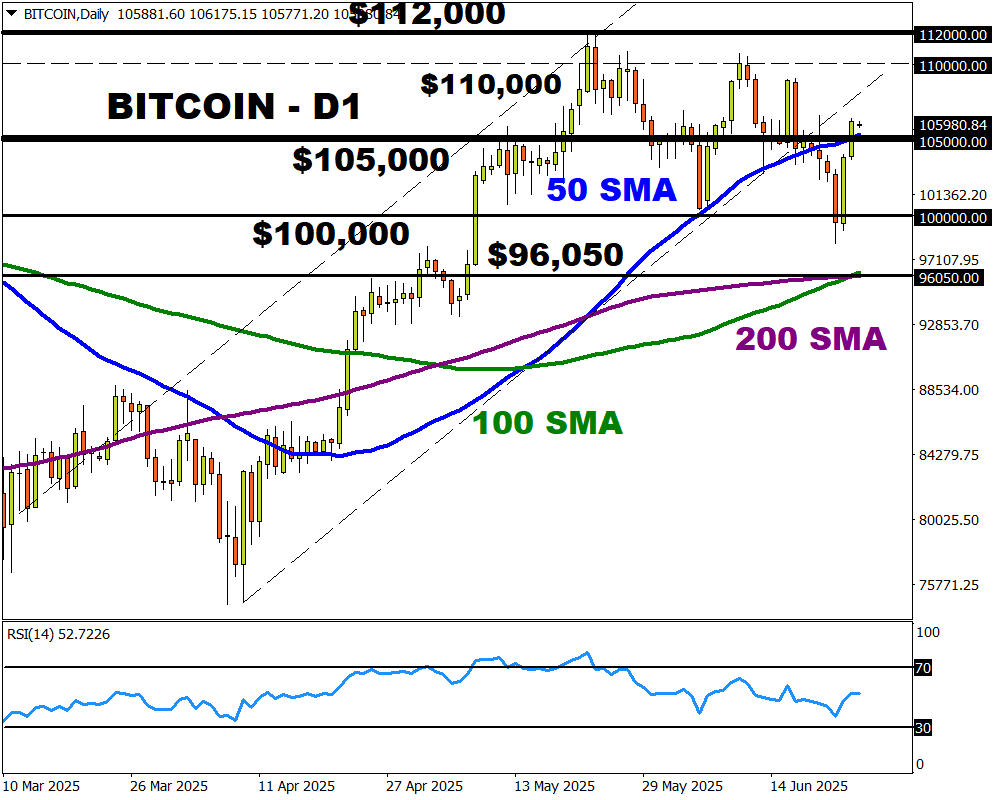
Bitcoin surpassed the $109,500 mark for the first time ever, extending a rally since mid-April, as the advancement of legislation to regulate stablecoins in the US supported the outlook for digital assets. Democrats in Congress dropped their opposition to a bill aimed at regulating stablecoins, paving the way for its passage by the end of the week. The move reinforced expectations that government regulation of digital assets tied to the US dollar could spur adoption of the asset class.

Equity markets in Europe traded flat on Wednesday. Germany’s DAX (DE40) was up 0.36%. France’s CAC 40 (FR40) closed down 0.40%, Spain’s IBEX35 (ES35) fell by 0.11%, and the UK’s FTSE 100 (UK100) closed positive 0.06%. European equities closed unchanged, holding near two-month highs hit in the previous session, as a lack of new catalysts kept hopes alive that rising government spending in Europe would lead to increased investment among corporate giants.

Silver (XAG/USD) prices climbed above $33.1 an ounce on Wednesday, testing the highest level in three weeks, amid a weaker dollar and evidence of heavy buying by the industry. The dollar came under pressure despite a fresh rise in long-dated Treasury yields, reflecting lingering doubts about the exclusivity of US assets and consistent with the recent rush into precious metals in search of safety.

WTI crude oil prices reversed previous gains and are trading below $62 a barrel after an unexpected increase in US crude inventories. The EIA reported a 1.328 million barrel increase in crude inventories, contradicting expectations of a 1.85 million barrel decline.

Asian markets were predominantly up yesterday. Japan’s Nikkei 225 (JP225) fell by 0.61%, China’s FTSE China A50 (CHA50) gained 0.69%, Hong Kong’s Hang Seng (HK50) rose by 0.62%, and Australia’s ASX 200 (AU200) gained 0.52%. Japanese stocks hit a two-week low and followed a sharp sell-off on Wall Street overnight. Japan’s Core Machinery Orders, a key leading indicator of capital investment, unexpectedly rose 13% in March, well above expectations of a 1.6% decline. Despite the upbeat data, sentiment was dampened by weak economic signals elsewhere: manufacturing activity remained in contractionary territory in May, while growth in the services sector also slowed.

Malaysia’s annual inflation rate for April 2025 was 1.4%, unchanged from March and in line with market expectations. It remained the lowest since February 2021, with food prices rising the least in six months (2.3% vs. 2.5% in March). Core consumer prices, excluding volatile fresh food and administrative expenses, rose to 2.0% y/y in April after increasing 1.9% in the previous two months, the sharpest pace since November 2023.

Singapore could slip into a technical recession this year, a government official warned after final GDP data confirmed the economy shrank in the first quarter of 2025, even before US tariffs take effect. The country’s trade-dependent economy grew 3.9% y/y but contracted 0.6% q/q.

S&P 500 (US500) 5,844.61 −95.85 (−1.61%)

Dow Jones (US30) 41,860.44 −816.80 (−1.91%)

DAX (DE40) 24,122.40 +86.29 (+0.36%)

FTSE 100 (UK100) 8,786.46 +5.34 (+0.061%)

USD Index 99.61 −0.51 (−0.51%)

News feed for: 2025.05.22

  • Australia Manufacturing PMI (m/m) at 02:00 (GMT+3);
  • Australia Services PMI (m/m) at 02:00 (GMT+3);
  • Japan Manufacturing PMI (m/m) at 03:30 (GMT+3);
  • Japan Services PMI (m/m) at 03:30 (GMT+3);
  • Eurozone German Manufacturing PMI (m/m) at 10:30 (GMT+3);
  • Eurozone German Services PMI (m/m) at 10:30 (GMT+3);
  • Eurozone Manufacturing PMI (m/m) at 11:00 (GMT+3);
  • Eurozone Services PMI (m/m) at 11:00 (GMT+3);
  • Eurozone German ifo Business Climate (m/m) at 11:00 (GMT+3);
  • UK Manufacturing PMI (m/m) at 11:30 (GMT+3);
  • UK Services PMI (m/m) at 11:30 (GMT+3);
  • Eurozone ECB Monetary Policy Meeting Accounts at 14:30 (GMT+3);
  • US Initial Jobless Claims (w/w) at 15:30 (GMT+3);
  • US Manufacturing PMI (m/m) at 16:45 (GMT+3);
  • US Services PMI (m/m) at 16:45 (GMT+3);
  • US Existing Home Sales (m/m) at 17:00 (GMT+3);
  • US Natural Gas Storage (w/w) at 17:30 (GMT+3).

By JustMarkets


This article reflects a personal opinion and should not be interpreted as an investment advice, and/or offer, and/or a persistent request for carrying out financial transactions, and/or a guarantee, and/or a forecast of future events.

Lifecycle of a research grant – behind the scenes of the system that funds science

By Kelly S. Mix, University of Maryland 

Science funding is a hot topic these days and people have questions about how grants work. Who decides whether a researcher will receive funds? What’s the decision-making process? How is the money spent once a grant proposal has been approved?

As a veteran academic researcher, department chairperson and associate dean for research, I have seen this process play out from multiple perspectives – as a grant recipient, grant reviewer and university administrator.

Research organizations and major federal funders, including the National Institutes of Health, the National Science Foundation and the Defense Advanced Research Projects Agency (DARPA), all rely on careful systems of checks and balances to ensure high standards of scholarship and financial integrity at every stage of a grant’s lifecycle. Here’s how it all works.

The birth of a grant application

To receive research funding, scientists submit grant applications to specific programs. A cancer researcher might apply to the Bioengineering Research Grants program at NIH. Someone investigating sustainable fishing in freshwater habitats could seek funding from the Population and Community Ecology program at the NSF.

Applications must be responsive to the funding program’s specific request for proposals, or RFP. The RFP tells researchers what the agency wants to fund. For example, the NSF’s Education Core Research program currently only funds projects focused on STEM learning.

RFPs might have other application requirements, too, like explaining how a project will contribute to the public good, or supporting training for new scientists.

Grant applications have two main parts. First, the researcher presents an extensive literature review to explain why the new project is needed and what it will add to the existing knowledge base. Next, they write up a detailed description of the proposed research plan. This basic two-part structure ensures that funded research will yield important information that is both new and trustworthy.

Reviewers read the grant applications and compare them to the RFP. Applications that don’t address all the topics and research priorities listed there are unlikely to be funded. I once had a proposal rejected without further review because I left out a paragraph addressing one of the items in the agency’s new RFP. This initial review for RFP compliance is called “triage” and, believe me, nobody wants to see their hard work triaged out of the running.

Merit review: How funding decisions are made

Federal funding decisions are made through rigorous merit review.

For each round of funding, agencies assemble a panel of anonymous content experts who will look for strengths and weaknesses in the proposals – anything from innovation in the question posed to logical flaws in the hypotheses or technical problems with the planned data analyses. With a group of experts looking for every possible weakness, having your grant reviewed is a bit like running a gauntlet.

This careful review might help explain why 70% to 80% of grant applications typically go unfunded at agencies like the NIH and the NSF. But this level of scrutiny is necessary to prevent funding poorly designed or low-impact research.

Several safeguards head off bias or unethical influences during merit review.

First, reviewers must disclose any conflicts of interest with the pool of applicants before they can access the applications. Conflicts of interest can include situations like the reviewer having been the student of an applicant, the applicant and reviewer being divorced, or the proposal coming from the reviewer’s current institution.

When conflicts are identified, the reviewer can remain on the panel, but they are completely excluded from decisions related to that application. They cannot even be in the room when it is discussed.

Second, reviewers usually attend a meeting, supervised by program staff from the funding agency, where everyone debates the proposal’s merits before they score it. Sometimes panel members disagree in their initial critiques and use the meeting to hash out their differences. Other times, a reviewer might raise an important concern that others missed.

Group discussion helps ensure a transparent and thorough review. It also stops any single reviewer from dictating the fate of a proposal because everyone hears the discussion and then scores the proposal individually. Whether a reviewer thinks an application is outstanding or fatally flawed, they must convince the rest of the experts in the room for the group’s overall scores to be greatly affected.

Third, these discussions, along with the applications themselves and any written critiques, are strictly confidential. Reviewers sign written confidentiality agreements under penalty of perjury. This practice stops panelists from scoring political points by telling an applicant they defended their proposal, or divulging trade secrets and proprietary information.

Following the meeting, final decisions are made by program staff using the reviewers’ evaluations. Some agencies adhere closely to the reviewers’ numeric scores – like a grade – when making these decisions. Others ask reviewers to sort applications into “fundable” or “non-fundable” piles; program staff then have some discretion on the final decision. But all decisions are rooted in the peer critiques.

Spending the funds

Headlines about universities receiving large grants may leave the impression that such funds are simply added to the institution’s general coffers. But research funds are granted to support specific research projects, and agencies have strict rules about spending the money.

For example, if a researcher wants to present their findings at a conference, they can charge the grant for their travel costs, but they may not charge above a certain amount for their lodging or purchase business class airplane tickets. Similarly, if a researcher wants to have more time to devote to a funded project, they can use part of the money to pay their own salary in the summer, but there are precise limits on the amount of funding that can be used for this purpose.

It’s not up to the researcher alone to follow these rules. The organization that employs the researcher, usually a university, enforces the agency rules because it’s the employing organization that controls the grant accounts.

Returning to the conference travel example, a university researcher who wants to attend a conference must request permission and provide a budget for the trip before purchasing tickets. If the travel request is approved by their department chair, dean and the university travel office, they may go ahead with their reservations. However, if they don’t produce receipts when they return, they will not be allowed to charge the grant. The same process applies to buying new computers for the lab, ordering standardized tests for a study or purchasing gift cards for study participants.

Research organizations are highly motivated to enforce spending rules properly, because everyone in the organization is at risk of losing access to federal funds in the future if they let things slide. Funding agencies also require periodic reports and sometimes conduct audits to ensure compliance. These practices help guard against any misuse of funds.

The way agencies issue grants to researchers isn’t perfect. But processes like issuing detailed RFPs, conducting merit reviews and monitoring financial compliance go a long way toward protecting the integrity of the research funding process.The Conversation

About the Author:

Kelly S. Mix, Associate Dean for Research, Innovation, and Partnerships in the College of Education, University of Maryland

This article is republished from The Conversation under a Creative Commons license. Read the original article.

Sterling Strengthens Weak US Dollar and UK Inflation Provide Support

By RoboForex Analytical Department

The GBP/USD pair continues its upward trajectory, reaching 1.3429 by Thursday. It is now trading just below yesterday’s peak, its highest level since February 2022.

Key drivers behind GBP/USD’s rise

The rally follows the release of stronger-than-expected UK inflation data. The annual Consumer Price Index (CPI) accelerated to 3.5% in April, the highest reading since January 2024, exceeding both market forecasts (3.3%) and the Bank of England’s projection (3.4%). Contributing factors included:

  • An increase in Ofgem’s energy price cap
  • Higher vehicle tax rates

Notably, services sector inflation surged from 4.7% to 5.4%, signalling persistent underlying price pressures.

Market expectations for monetary policy easing have adjusted significantly. Investors now anticipate just one 25-basis-point rate cut by the end of 2025. The likelihood of a rate cut in August has fallen from 60% to 40%.

The Bank of England reduced interest rates by 25 basis points in May, although policymakers were divided on the decision.

Technical analysis: GBP/USD

H4 Chart:

  • The GBP/USD pair completed an upward wave, peaking at 1.3466
  • Today, we expect consolidation below this level
  • A downward breakout could initiate a decline towards 1.3131, with 1.3300 acting as the first target
  • The MACD indicator supports this view, with its signal line exiting the histogram zone and trending lower

H1 Chart:

  • The pair reached 1.3466 before correcting to 1.3388, establishing a consolidation range
  • A downward breakout today could see a move towards 1.3300
  • The Stochastic oscillator confirms this scenario, with its signal line below 80 and pointing decisively downward towards 20


Conclusion

Sterling’s strength persists amid weaker US dollar dynamics and persistent UK inflation. While technical indicators suggest a potential pullback, the broader trend remains influenced by monetary policy expectations and economic data.


Disclaimer

Any forecasts contained herein are based on the author’s particular opinion. This analysis may not be treated as trading advice. RoboForex bears no responsibility for trading results based on trading recommendations and reviews contained herein.

Target to sink back to 5-year lows after today’s earnings?

By ForexTime 

  • Target set to release earnings before US markets open today (Wed, May 21st)
  • US tariff fears expected to hit results for Q1 FY2026 (3 months ending April 30th)
  • Comparable sales forecasted to fall 1.8% year-on-year; EPS to drop over 18% y/y
  • Post-earnings, 1-day move predicted at 9.3% up/down for Target shares today
  • Wall Street analysts predict, pre-earnings, 20.8% upside over next 12 months

Target is set to unveil its fiscal Q1 earnings before US markets open today (Wed, May 21st).

At the time of writing, Target’s stocks are languishing around their lowest levels since August 2019.

Perhaps more tellingly, this stock has struggled to recover back above the psychologically-important $100 level since US President Donald Trump’s “liberation day” tariffs announcement on April 2nd.

Furthermore, as of the closing price on Tuesday, May 20th, Target’s stocks remain 27.4% lower so far this year.

Such sluggishness is all the more obvious when compared to the rebound in broader US stock markets over the past month, with the benchmark S&P 500 now back up 1% year-to-date.

From a technical perspective, despite finding some measure of support at its 21-day simple moving average (SMA) in recent sessions, Target remains hemmed in by its 50-day SMA, besides the earlier-mentioned psychological $100 level.

Imagen
Target to sink back to 5-year lows after today’s earnings?

Could its fortunes change by today’s market open? 

Experts think it’s unlikely.

Target’s fiscal Q1 2026 earnings (three months ending 30 April 2025): What to look out for?

Overall, Wall Street analysts predict that Target’s soon-to-be-released financial figures will point to a spending pullback by Target’s cautious customers who are wary about US tariffs.

This retail giant is expected to post the following key metrics:

  • Comparable Sales: down 1.84%
  • Average transaction amount: down 1.77%

Additionally, here are other (adjusted) headline numbers to look out for:

  • Revenue: US$ 24 billion – lowest since fiscal Q3 2021
    If so, that would mark a 2.1% drop compared to Q1 FY2025
  • Net income: US$ 756.7 million – lowest since fiscal Q3 2023
  • Earnings per share (EPS): US$1.66
    If so, that would mark an 18.08% drop compared to Q1 FY2025

More importantly, traders and investors will be glued to Target’s outlook on how US consumer demand might hold up in the face of tariff threats.

Can Target draw inspiration from other retail giants?

Target bulls (those hoping this stock can push higher) will be hoping that this retail giant can emulate the earnings outlook from another retail giant: Home Depot.

Just before US markets opened on Tuesday, May 20th, Home Depot – the world’s biggest home-improvement retailer – maintained its full-year sales forecast.

And that’s despite reporting a 0.3% drop in comparable sales for its latest fiscal quarter amid similar expected dampeners to consumer spending.

Home Depot execs also said they expect:

  • the worst of economic concerns to be in the past
  • tariffs to not translate into broad price increases

To be certain, even such seemingly soothing signals were unable to prevent Home Depot’s shares from falling 0.6% post-earnings during Tuesday’s cash session.

In contrast to Home Depot, Walmart sang a different tune at its quarterly results unveiling last week.

Walmart – the largest retailer in the world – suggested that:

  • price spikes stemming from tariffs are starting to take hold
  • the company would likely pass on such costs to end users

It remains to be seen what sort of signals will be conveyed by Target’s C-suite, whether it’s more in line with Home Depot’s confidence, or Walmart’s warnings.


Potential Post-Earnings Scenarios

Note that markets currently predict that Target shares could move 9.3% up or down when US markets reopen today – Wednesday, May 21st  – right after its earnings announcement.


  • BULLISH: Should Target unveil better-than-expected Q1 figures, and more importantly speak confidently of resilient spending among US consumers, that could launch its stock back above $107 for the first time since March.


  • BEARISH: Should Target announce lower-than-expected Q1 results, coupled with growing concerns about weakening US consumer spending amid persistent tariff fears, or worse – pull its earnings guidance altogether for the year – that may see Target’s stocks gapping down to open around the $89.00 level – close to its year-to-date/5-year lows.


Over the next 12 months …

Wall Street analysts are rather neutral on this stock’s 12-month prospects, with:

  • 23 “Hold” calls
  • 14 “Buys”
  • 2 “Sells”

Yet Target’s stocks are predicted to have another 20.8% potential upside over the next 12 months, potentially hitting $118.51 by May 2026.

Of course, all those analysts’ forecasts and 12-month target price may change drastically in a few hours, depending on what Target conveys to markets.

Targets earnings announcement is bound to offer the latest clues on the overall health of US domestic consumption – the primary driver of the world’s largest economy – while also potentially producing outsized trading opportunities in the immediate aftermath.


Forex-Time-LogoArticle by ForexTime

ForexTime Ltd (FXTM) is an award winning international online forex broker regulated by CySEC 185/12 www.forextime.com


The German DAX hit an all-time high. Oil prices jumped above $63 per barrel

By JustMarkets 

At the end of Tuesday, the Dow Jones Index (US30) was down 0.27%. The S&P 500 Index (US500) decreased by 0.39%. The Nasdaq Technology Index (US100) closed lower by 0.38%. Sentiment turned cautious amid renewed uncertainty surrounding trade negotiations and political resistance to the tax plan. An extensive tech sell-off pressured markets, with Alphabet (-1.5%) falling after the Google I/O event, while Nvidia (-0.9%), Meta (-0.5%) and Apple (-0.9%) shares also declined. Additional pressure came from new warnings from JPMorgan and Fed officials, including St. Louis Fed President Alberto Musalem, who said tariffs could hamper economic growth and dampen inflation expectations.

The Canadian dollar strengthened at 1.39 per dollar, rebounding from a one-month low of 1.398 hit on May 14, as markets weighed inflation data for April and a weaker US currency. Canada’s Core Consumer Price Index slowed to a 1.7% annualized rate, the slowest pace in seven months, thanks to a 12.7% drop in energy costs following the repeal of a carbon tax and OPEC supply increases. However, the Bank of Canada’s preferred benchmark rate unexpectedly rose to 3.1%, the highest level in thirteen months, indicating continued underlying price pressures and speaking against imminent policy easing. Simultaneously, talks between US Vice President Vance and Prime Minister Carney bolstered hopes for a comprehensive trade agreement, reducing bilateral uncertainty.

Equity markets in Europe were mostly up on Tuesday. Germany’s DAX (DE40) was up 0.42%. France’s CAC 40 (FR40) closed 0.75% higher, Spain’s IBEX35 (ES35) gained 1.16%, and the UK’s FTSE 100 (UK100) closed positive 0.94%. Frankfurt’s DAX Index rose for the first time to surpass the 24,000 mark and set a new record high. The rally was fueled by strong performances from BMW, Infineon and Merck, which rose over 1.5%, while Bayer, RWE, and Fresenius Medical Care were up 2-4%. On the macroeconomic front, investor sentiment was supported by better-than-expected Eurozone consumer confidence data for May. In addition, producer prices in Germany fell for the second month in a row, and at a faster pace than expected.

WTI crude oil prices jumped above $63 a barrel on Wednesday following reports that Israel plans to strike Iranian nuclear facilities. While it is still unclear whether Israel has made a final decision, the news has already raised fears of possible supply disruptions in the key oil-producing region of the Middle East. There are growing fears that Iran may retaliate by closing the strategically important Strait of Hormuz, a key route for oil and fuel exports from major Gulf countries including Saudi Arabia, Kuwait, Iraq, and the UAE.

The US natural gas (XNG/USD) prices jumped more than 6% on Tuesday, topping $3.325/MMBtu, thanks to lower daily production and higher demand expectations for next week.

Asian markets were predominantly up yesterday. Japan’s Nikkei 225 (JP225) rose by 0.08%, China’s FTSE China A50 (CHA50) gained 0.56%, Hong Kong’s Hang Seng (HK50) added 1.49%, and Australia’s ASX 200 (AU200) posted a positive 0.58%. Hong Kong’s seasonally adjusted unemployment rate rose to 3.4% for the three months ending April 2025 from 3.2% in the previous period, remaining at the highest level in more than two years. The number of unemployed rose by about 6.6 thousand from the previous month to 124,900, the highest since November 2022.

The New Zealand dollar rose to around US$0.593 on Wednesday, helped by a weaker US dollar amid growing concerns about the US economy. Sentiment was boosted by encouraging domestic data. New Zealand posted a trade surplus of $1.43 billion in April, reversing a deficit of $0.01 billion in the same month last year. This was helped by double-digit export growth (25%), which outpaced import growth (1.8%). On the monetary policy front, the Reserve Bank of New Zealand is expected to cut the official money rate by 25 bps next week, but some investors suspect the central bank’s easing cycle is nearing an end, with rates hitting 2.83% by the end of the year.

S&P 500 (US500) 5,940.46 −23.14 (−0.39%)

Dow Jones (US30) 42,677.24 −114.83 (−0.27%)

DAX (DE40) 24,036.11 +101.13 (+0.42%)

FTSE 100 (UK100) 8,781.12 +81.81 (+0.94%)

USD Index 100.01 −0.41 (−0.41%)

News feed for: 2025.05.21

  • New Zealand Trade Balance (q/q) at 01:45 (GMT+3);
  • Japan Trade Balance (m/q) at 02:50 (GMT+3);
  • UK Consumer Price Index (m/m) at 09:00 (GMT+3);
  • UK Producer Price Index (m/m) at 09:00 (GMT+3);
  • US Crude Oil Reserves (w/w) at 17:30 (GMT+3).

By JustMarkets


This article reflects a personal opinion and should not be interpreted as an investment advice, and/or offer, and/or a persistent request for carrying out financial transactions, and/or a guarantee, and/or a forecast of future events.

Gold Prices Climb Amid Geopolitical Tensions

By RoboForex Analytical Department 

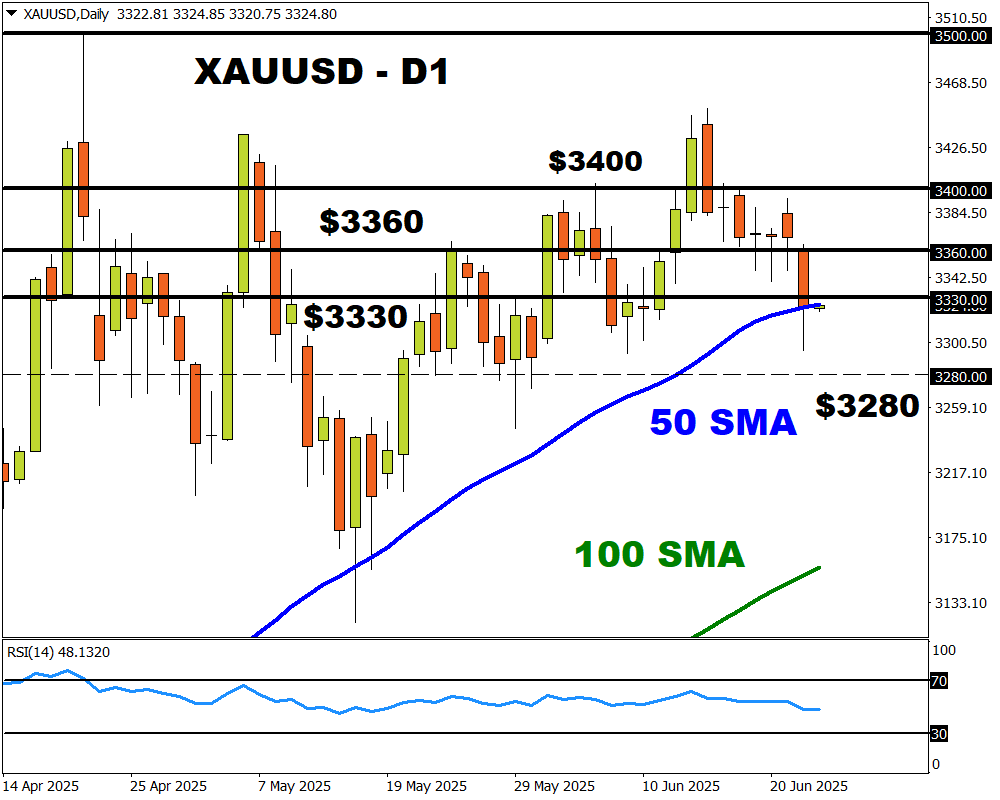
The price of gold rose to $3,303 per troy ounce on Wednesday, nearing a two-week high. The precious metal gained for the third consecutive day, following a 2% surge the previous day as investors sought safety amid heightened geopolitical uncertainty.

Key drivers behind the rally

Middle East Tensions: fears of escalation increased over a potential Israeli strike on Iran’s nuclear facilities, which could trigger retaliatory measures from Tehran.

US Political Uncertainty: President Donald Trump’s remarks on peace talks between Russia and Ukraine added to market unease, though he distanced himself from a mediating role.

Dollar Weakness: the US dollar remained under pressure after the Federal Reserve’s cautious economic outlook and Moody’s downgrade of the US credit rating, citing rising government debt.

Trade & Fiscal Policy: investor confidence in the dollar was further dented by uncertainty over trade tariffs and the pending vote on Trump’s proposed tax reforms.

As a result, the dollar’s weakness has made gold more attractive to international buyers.

Technical analysis: XAU/USD

H4 Chart:

  • The market consolidated near 3,222 before breaking upward
  • The immediate upside target of 3,312 has now been met
  • A pullback to retest 3,222 (from above) is likely, followed by a potential rise towards 3,333
  • MACD Indicator: The signal line remains above zero and points upward, supporting further gains


H1 Chart:

  • The pair broke through 3,250 and continued its upward trajectory towards 3,333
  • A short-term correction to 3,222 is expected before another push higher
  • The current uptrend is viewed as corrective; once complete, a downward wave towards 3,222 may follow
  • Stochastic Oscillator: The signal line is below 80 and trending downward towards 20, indicating potential near-term weakness


Conclusion

Gold’s rally reflects its role as a haven amid geopolitical risks and dollar softness. While technical indicators point to a temporary correction, the broader uptrend remains intact, with 3,333 as the next key resistance level.


Disclaimer

Any forecasts contained herein are based on the author’s particular opinion. This analysis may not be treated as trading advice. RoboForex bears no responsibility for trading results based on trading recommendations and reviews contained herein.

The PBoC cut the prime rates for the first time in a long time. The RBA expectedly cut the rate by 0.25%

By JustMarkets 

At the end of Monday, the Dow Jones Index (US30) was up 0.32%. The S&P 500 Index (US500) added 0.09%. The Nasdaq Technology Index (US100) closed higher by 0.09%. Surprisingly, markets digested positively the downgrade of the US credit rating by Moody’s to Aa1. Treasury Secretary Scott Bessent downplayed the move and urged trading partners to engage during the 90-day tariff pause.

The Mexican peso rose to 19.40 per dollar, nearing a seven-month peak of 19.38 reached on May 14, as Moody’s downgrade of the US sovereign debt rating to Aa1 on May 16 and rising bets on an imminent Federal Reserve rate cut reduced the dollar’s appeal. The Bank of Mexico’s unanimous 50 basis point rate cut to 8.50% on May 15 amid core and core inflation at 3.9% and Q1 GDP growth of just 0.2% drove down yields in Mexico, but a weaker dollar largely supported the peso’s rise.

The Canadian dollar is holding near 1.40 per dollar, remaining near the one-month low of 1.398 hit on May 14, amid US dollar softness offsetting dovish expectations for the Bank of Canada. However, longs remain constrained by expectations of a dovish Bank of Canada rate after disappointing April jobs growth and a rise in the unemployment rate to 6.9% fueled speculation of a rate cut in June, dampening investor appetite for Canadian assets. Canada’s inflation report will be released today, where the same reading as last month is expected.

Equity markets in Europe were mostly up on Monday. Germany’s DAX (DE40) was up 0.70%. France’s CAC 40 (FR40) closed down 0.04%, Spain’s IBEX35 (ES35) gained 0.25%, and the UK’s FTSE 100 (UK100) closed higher 0.17%. The positive sentiment was boosted by a landmark agreement between the UK and the European Union, which calls for closer cooperation in key areas such as energy, trade, defense, travel, and fisheries. The Eurozone’s annual inflation rate for April 2025 was confirmed at 2.2%, just above the European Central Bank’s target of 2.0%.

The US natural gas (XNG/USD) prices fell more than 6% to below $3.10/MMBtu, the lowest since April 25, and extended last week’s decline of more than 12%, driven by weaker near-term demand and lower LNG exports. Warmer-than-normal weather in late May is expected to curb heating demand.

Asian markets were mostly falling yesterday. Japan’s Nikkei 225 (JP225) fell by 0.68%, China’s FTSE China A50 (CHA50) lost 0.42%, Hong Kong’s Hang Seng (HK50) decreased by 0.05%, and Australia’s ASX 200 (AU200) was negative 0.58%.

The People’s Bank of China (PBOC) cut key lending rates to a record low during its May meeting, matching market expectations and marking the first cut since October. The move followed wide-ranging monetary easing measures announced by Beijing earlier this month to support a sluggish economy and mitigate the potential impact of ongoing trade tensions with the US. The one-year prime rate (LPR), the benchmark for most corporate and household loans, was cut by 10 basis points to 3.0%, while the five-year LPR, which determines mortgage rates, was cut by the same amount to 3.5%. The offshore yuan fell to around 7.22 per dollar, posting a third straight session of losses and hitting a one-week low.

The Australian dollar slipped to $0.643 on Tuesday, rebounding from the previous session’s gains, after the Reserve Bank of Australia cut its key interest rate by 25 bps, as expected, and signaled that risks to the economy were diminishing. Policymakers noted that data for the March quarter confirmed further easing in inflation and pointed to reduced upside risks to inflation. Updated expectations indicated that core inflation is likely to remain near the middle of the 2-3% target range. The RBA also pointed to developments in global trade as a potential impediment to growth, which strengthened the case for additional rate cuts and put pressure on the Australian dollar.

S&P 500 (US500) 5,963.60 +5.22 (+0.09%)

Dow Jones (US30) 42,792.07 +137.33 (+0.32%)

DAX (DE40) 23,934.98 +167.55 (+0.70%)

FTSE 100 (UK100) 8,699.31 +14.75 (+0.17%)

USD Index 100.36 -0.73 (-0.73%)

News feed for: 2025.05.20

  • China PBoC Loan Prime Rate at 04:15 (GMT+3);
  • Australia RBA Interest Rate Decision at 07:00 (GMT+3);
  • Australia RBA Monetary Policy Statement at 07:00 (GMT+3);
  • Australia RBA Press Conference at 08:30 (GMT+3);
  • Canada Consumer Price Index (m/m) at 15:30 (GMT+3).

By JustMarkets


This article reflects a personal opinion and should not be interpreted as an investment advice, and/or offer, and/or a persistent request for carrying out financial transactions, and/or a guarantee, and/or a forecast of future events.

Euro Rises as US Dollar Comes Under Pressure Amid Budget Deficit Concerns

By RoboForex Analytical Department 

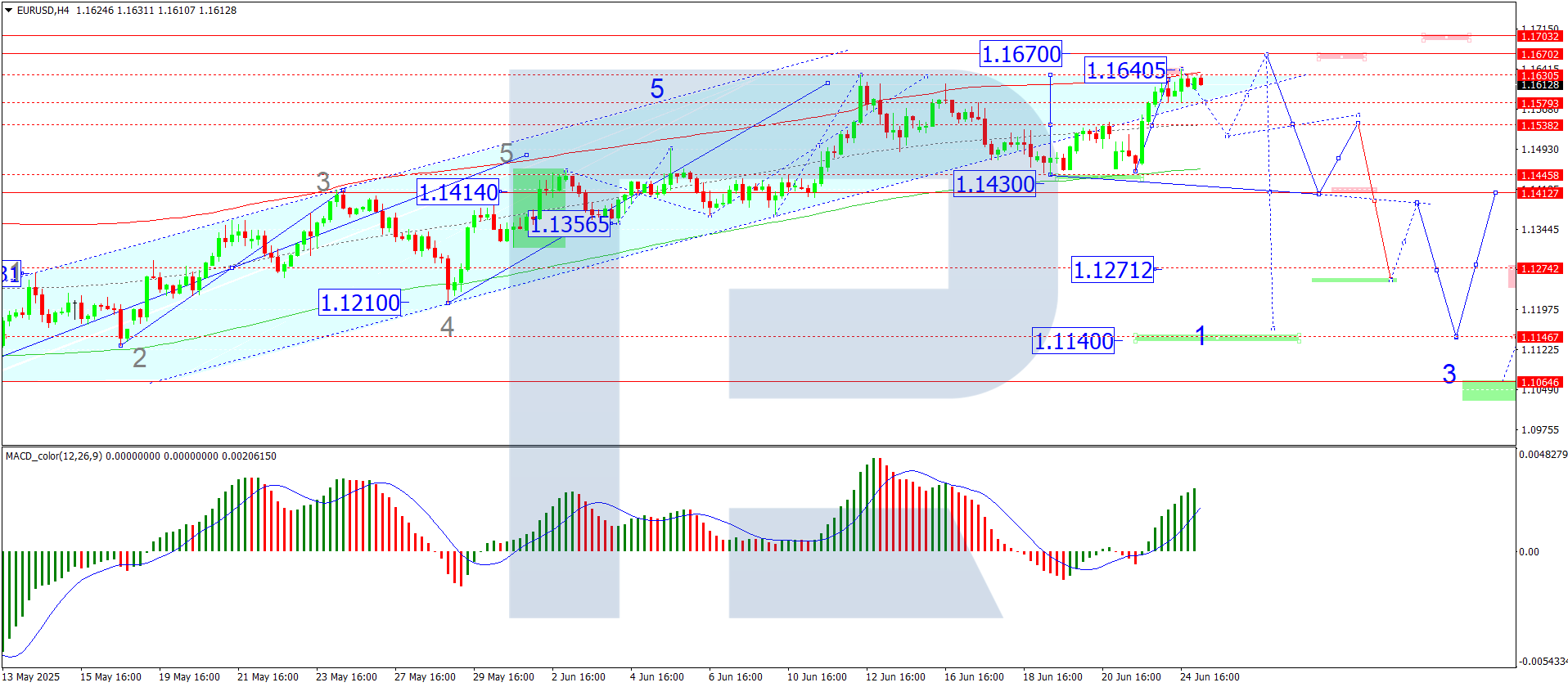
The EUR/USD pair climbed to 1.1243 on Tuesday, marking another attempt to break free from the narrow trading range it has occupied for over a week. This latest upward movement could prove more decisive than previous efforts.

Key drivers affecting EUR/USD

The US dollar came under sustained pressure in the previous session, driven by growing concerns over the widening US debt and budget deficit. These fears were exacerbated by a warning from Moody’s of a potential downgrade to the US credit rating.

Fiscal risks intensified following the House Budget Committee’s approval of President Donald Trump’s fiscal bill, which could add trillions of dollars to the deficit over the next decade. Despite criticism, the administration maintains that tax cuts will spur economic growth, boost revenues, and ultimately reduce the deficit.

Meanwhile, Raphael Bostic, President of the Federal Reserve Bank of Atlanta, reiterated expectations of a single rate cut this year, citing ongoing uncertainty arising from trade tariffs.

Today, market attention turns to the Eurozone’s preliminary consumer confidence index for May. No major US economic releases are scheduled.

Technical analysis: EUR/USD

H4 Chart:

The EUR/USD pair continues to consolidate around 1.1212, with the potential for an upward move towards 1.1300 (testing from below). The current uptrend is a corrective phase following the most recent decline. Once this correction concludes, a new downward wave may emerge, targeting 1.1029 as the initial objective. This outlook is supported by the MACD indicator, with its signal line remaining above zero and trending upwards.

H1 Chart:

The pair is forming a fifth-wave structure within the correction towards 1.1300. Traders should monitor whether this level is reached today. A resumption of the downtrend may follow, with 1.1166 as the next key level. The Stochastic oscillator supports this scenario, with its signal line above 50 and ascending towards 80.

Conclusion

The EUR/USD pair’s latest rally reflects dollar weakness prompted by fiscal concerns, while technical indicators suggest a potential reversal once the current correction has played out. With no major US releases, traders will look to Eurozone sentiment for further direction.


Disclaimer

Any forecasts contained herein are based on the author’s particular opinion. This analysis may not be treated as trading advice. RoboForex bears no responsibility for trading results based on trading recommendations and reviews contained herein.

Moody’s has downgraded the credit rating of the United States. PBoC intends to cut interest rates

By JustMarkets 

At the end of Friday, the Dow Jones Index (US30) increased by 0.78% (for the week +1.80%). The S&P 500 Index (US500) was down 0.70% (for the week +2.60%). The Nasdaq Technology Index (US100) closed higher by 0.43% (for the week +2.93%). Wall Street ended the week on a high note, with all three major indices posting solid weekly gains, helped by easing trade tensions between the US and China. However, soft consumer sentiment data somewhat dampened the rally: the University of Michigan Index fell to 50.8, the second lowest ever recorded, while annual inflation expectations jumped to 7.3%.

Moody’s Credit Ratings downgraded the US credit rating by one notch to Aa1 from Aaa amid concerns about rising debt and interest payments. The agency said it expects federal debt to increase to about 134% of GDP by 2035, up from 98% last year. At the same time, the federal budget deficit is expected to widen to nearly 9% of GDP by 2035, up from 6.4% in 2024, due to higher interest payments on debt, higher social spending, and lower government revenues from tax cuts.

Equity markets in Europe were mostly up on Friday. Germany’s DAX (DE40) rose by 0.30% (for the week +0.04%), setting a new all-time high. France’s CAC 40 (FR40) closed 0.42% higher (for the week +1.11%), Spain’s IBEX35 (ES35) gained 0.96% (+3.10% for the week), and the UK’s FTSE 100 (UK100) closed 0.59% higher (+1.52% for the week). The EU bloc is pushing for a more comprehensive deal with the US to reduce tariffs than those currently being discussed with the UK and China, adding that discussions are progressing positively.

WTI crude oil prices rose by 1.4% to settle at $62.5 a barrel on Friday, recording their second consecutive weekly gain of more than 2% as easing trade tensions between the US and China helped boost sentiment. A 90-day tariff truce between the world’s two biggest oil consumers helped ease fears of weakening demand. However, caution remained due to rising US crude inventories and the IEA’s expectations of a supply surplus in 2025 due to increased OPEC+ production. Analysts also lowered long-term oil price projections, citing trade policy uncertainty.

Asian markets were mostly up last week. Japan’s Nikkei 225 (JP225) rose by 0.15%, China’s FTSE China A50 (CHA50) gained 0.74%, Hong Kong’s Hang Seng (HK50) added 0.74%, and Australia’s ASX 200 (AU200) was positive 1.37%. Mainland equities declined for the second consecutive session as concerns over US tariffs continue to dampen sentiment. Market sentiment was further dampened by a sharp drop in Alibaba Group shares, down more than 4% in Hong Kong, after the e-commerce giant reported lower-than-expected quarterly earnings.

The foundation for China’s economic recovery “needs to be further strengthened” amid external uncertainties, the National Bureau of Statistics said in a statement. The remarks followed April activity data that showed mixed figures. China’s industrial production rose 6.1% y/y, beating expectations of 5.5% but slowing from March’s 7.7% growth, the fastest in nearly four years. Meanwhile, retail sales rose less than expected, reflecting weak domestic consumption and sluggish income growth. At the same time, the nation’s urban unemployment rate fell to a four-month low of 5.1% from 5.2% in March. Fixed asset investment for January-April, including real estate and infrastructure, rose 4.0%, below the 4.2% projections. China’s Central Bank is set to revise its benchmark lending rates, which have remained at record lows in recent months, as the economy faces domestic and external pressures. The People’s Bank of China (PBoC) is scheduled to meet tomorrow.

Hong Kong’s economy grew by 3.1% year-on-year in Q1 2025, in line with preliminary estimates and accelerated from an upwardly revised 2.5% in Q4 2024. Growth was mainly driven by strong external demand, especially in exports of goods and services, as businesses increased shipments in advance in anticipation of the upcoming tariff hike in the US. On a seasonally adjusted quarterly basis, GDP grew by 1.9%, the fastest pace in two years and an acceleration from the previous quarter’s upwardly revised 0.9%.

S&P 500 (US500) 5,958.38 +41.45 (+0.70%)

Dow Jones (US30) 42,654.74 +331.99 (+0.78%)

DAX (DE40) 23,767.43 +71.84 (+0.30%)

FTSE 100 (UK100) 8,684.56 +50.81 (+0.59%)

USD Index 100.98 +0.10 (+0.10%)

News feed for: 2025.05.19

  • New Zealand Producer Price Index (q/q) at 01:45 (GMT+3).
  • China Industrial Production (m/m) at 05:00 (GMT+3);
  • China Retail Sales (m/m) at 05:00 (GMT+3);
  • China Unemployment Rate (m/m) at 05:00 (GMT+3);
  • Eurozone Consumer Price Index (m/m) at 12:00 (GMT+3);
  • Switzerland SNB Chairman Schlegel speaks at 19:30 (GMT+3).

By JustMarkets


This article reflects a personal opinion and should not be interpreted as an investment advice, and/or offer, and/or a persistent request for carrying out financial transactions, and/or a guarantee, and/or a forecast of future events.