PBoC left key rates unchanged. OPEC+ plans to cut production to support oil prices

By JustMarkets

At Friday’s close, the Dow Jones Index (US30) added 0.01% (+2.01% for the week), while the S&P 500 Index (US500) increased by 0.13% (+2.44% for the week). On Friday, the NASDAQ Technology Index (US100) closed positive by 0.08% (+2.76% for the week). The broad market initially went down on Friday as bond yields rose following Friday’s economic news from the US showing an unexpected increase in October housing starts and building permits, a hawkish factor for Fed policy. However, bond yields retreated from highs towards the end of the trading session, allowing stocks to recover towards the end of the trading session.

On Friday, Fed Vice Chairman for Supervision Michael Barr said he believes the Fed is at or near peak interest rates, but San Francisco Fed Chair Mary Daly and Boston Fed President Susan Collins emphasized the need for more evidence of cooling inflation.

According to Bank of America, EPFR Global data showed global equity funds attracted US$23.5 billion in the week to November 15, the second-largest inflow this year. This indicates that funds are building up positions in equities and, therefore, believe in further growth amid the end of the tightening cycle by the US Federal Reserve.

X (formerly Twitter) billionaire owner Elon Musk has been ratcheting up tensions with his posts on the platform supporting an anti-Semitic conspiracy theory. IBM, NBCUniversal, and parent company Comcast said they would stop advertising on X after it was reported that their ads appeared alongside content supporting the anti-Semitic movement. On Thursday and Friday, ads from Apple, Oracle, Amazon, and NBA Mexico were also placed next to anti-Semitic material on X, and there is a high probability that these companies will also stop using the platform. The value of company X continues to plummet. Twitter was sold for $44 billion dollars, and X is now valued at $11 billion dollars.

Equity markets in Europe were mostly up on Friday. Germany’s DAX (DE40) gained 0.84% (week-to-date +4.15%), France’s CAC 40 (FR40) added 0.91% (week-to-date +2.32%) on Friday, Spain’s IBEX 35 (ES35) jumped by 0.97% (week-to-date +3.74%), and the UK’s FTSE 100 (UK100) closed positive by 1.26% (week-to-date +1.95%).

On Friday, ECB Governing Council representative and Bundesbank President Nagel said that borrowing costs should remain high for a sufficient period of time and an ECB rate cut is highly unlikely in the near term. His colleague, ECB Governing Council representative Holzmann, also said that it would be too early for the ECB to start cutting interest rates in the second quarter of next year, and in general, market expectations for a rate cut are premature. At the moment, the ECB still prefers to stick to tight monetary policy, but if the pace of wage growth starts to shift downward in the near future, the current ECB stance will soften sharply, and the door for rate cuts will be open.

A new budget will be presented in the UK this week. UK Treasury chief Jeremy Hunt said that the government can afford to cut some taxes in the face of lower inflation, but cuts to social benefits will accompany any cut. Hunt also said the government needs to reform the welfare system to get more people back to work. Economists believe Wednesday’s autumn budget will also include relief for businesses and wealthy property owners. The tax cuts, along with improvements in the labor market, will improve economic performance but could be factored in more persistent inflation next year.

Crude oil and gasoline prices rose sharply Friday and recovered much of Thursday’s sharp sell-off. Oil prices also rose after Goldman Sachs said it expects OPEC to act to support oil prices. As early as next Sunday, OPEC+ will consider deepening oil production cuts. This could lead to a sharp gap up at the market opening on Monday, November 27. Goldman Sachs believes OPEC+ countries will ensure Brent Crude oil prices in the $80 to $100 range in 2024, providing a moderate deficit.

Asian markets were mostly up last week. Japan’s Nikkei 225 (JP225) gained 2.34% for the week, China’s FTSE China A50 (CHA50) declined 0.04% over five trading days, Hong Kong’s Hang Seng (HK50) ended the week up by 1.11%, and Australia’s ASX 200 (AU200) ended the week positive by 1.04%.

The People’s Bank of China (PBoC), as expected, kept key lending interest rates near record lows. At the same time, the People’s Bank of China injected about 80 billion yuan of additional liquidity into the markets. However, Chinese equities were mostly supported by the rise in real estate stocks after Chinese regulators pledged to provide additional policy support to the struggling real estate sector.

S&P 500 (F)(US500) 4,514.02 +5.78 (+0.13%)

Dow Jones (US30) 34,947.28 +1.81 (+0.01%)

DAX (DE40)  15,919.16  +132.55 (+0.84%)

FTSE 100 (UK100) 7,504.25 +93.28 (+1.26%)

USD Index  103.82 −0.53 (−0.51%)

News feed for 2023.11.20:
  • – China PBoC Loan Prime Rate (m/m) at 03:15 (GMT+2);
  • – German Producer Price Index (m/m) at 09:00 (GMT+2);
  • – UK BoE Gov Andrew Bailey’s Speech at 20:45 (GMT+2);
  • – New Zealand Trade Balance at 23:45 (GMT+2).

By JustMarkets


This article reflects a personal opinion and should not be interpreted as an investment advice, and/or offer, and/or a persistent request for carrying out financial transactions, and/or a guarantee, and/or a forecast of future events.

Brent has risen with support from an OPEC+ decision

By RoboForex Analytical Department

The price of a Brent barrel climbed to 81.20 USD on Monday.

The market primarily relies on OPEC+ member countries reducing crude oil supply to control prices. Energy carrier prices have declined for four consecutive weeks due to diminishing concerns about supply disruptions related to the Middle East conflict.

An OPEC+ meeting is scheduled for 26 November. The possibility of discussing additional supply cuts may arise.

Since the end of September, crude oil prices have dropped by nearly 20%.

Technical analysis of Brent oil:

On the H4 Brent chart, a growth wave is forming to 82.72. A correction to 79.70 might follow, after which a new growth wave to 86.85 could initiate. This is a local target. Technically, this scenario is confirmed by the MACD, with its signal line below zero, strictly pointing upwards.

On the H1 Brent chart, the growth wave movement to 82.72 is complete. This represents the first target. After the price reaches this level, a correction to 79.70 is expected to start, and a rise to 83.25 is expected next. Breaking through this level may unlock the potential for climbing to 86.85. This is a local target. Technically, this scenario is confirmed by the Stochastic oscillator, with its signal line above 80, strictly pointing upwards. New highs are expected to be set in this scenario.

Disclaimer

Any predictions contained herein are based on the author’s particular opinion. This analysis shall not be treated as trading advice. RoboForex shall not be held liable for the results of the trades arising from relying upon trading recommendations and reviews contained herein.

Trade Of The Week: UK100_m knocks on major resistance

By ForexTime 

  • UK100_m trapped in wide range
  • Index could be rocked by political and economic forces
  • Keep eye on UK Autumn Statement
  • Key levels of interest at 7605, 7500 and 7370
  • Possible breakout on the horizon?

Over the past few months, it has felt like the same old story for the UK100_m as it’s traded within a wide range. Significant support can be found at 7240 and resistance at 7730.

Note: The UK100_m tracks the underlying FTSE100 

The index has been influenced by various forces ranging from the pound’s performance to Bank of England (BoE) hike expectations and quarterly earnings from UK companies.

Note: The FTSE100 has a strong international focus with 75% of revenues from FTSE100 companies coming from outside the UK.

With prices flirting around the 50 and 100-day SMA ahead of a big week for the UK economy, a potential breakout may be on the horizon.

Here are 3 things to keep an eye on:

  1. UK Autumn Statement 

On Wednesday, Chancellor of the Exchequer Jeremy Hunt will present the Autumn Statement to Parliament.

Although this event swings more towards politics, investors will be paying close attention to key updates on the country’s finances and the government’s plan for tax and public spending. Confidence towards the UK economy has improved over the past two weeks as the country not only avoided a contraction in Q3 but inflation fell to its lowest rate since October 2021 at 4.6%. It will be interesting to see how this development impacts the Autumn Statement and whether bold steps are taken to boost the UK economy. This political event could impact sentiment towards the UK economy and the British pound, influencing the UK100_m as a result.

Note: The UK100_m has an inverse relationship with the British pound. When the pound appreciates, it translates to lower revenues for FTSE100 companies that acquire revenues from overseas, pulling the index lower as a result. The same is true vice versa. 

  • The UK100_m may trade lower if the Autumn budget boosts optimism over the UK economy and strengthens the pound as a result.
  • Should the Autumn budget disappoint and weaken sterling, this could push the UK100_m higher.
  1. Key UK economic data 

A day after the Autumn Statement, the focus shifts back to economic data with the Gfk consumer confidence and PMIs in focus. Sentiment remains shaky despite the good news from the UK over the past two weeks. Should the Gfk consumer sentiment confidence and manufacturing along with other PMIs paint a gloomy picture, this could hit confidence and fortify expectations around the BoE being done with rate hikes with the next move a cut.

As of writing, traders are currently pricing in a 55% probability of a 25-basis-point rate cut by May 2024.

  • The UK100_m could receive a boost if disappointing UK data weakens the pound and boosts bets around a BoE rate cut.
  • If UK data beats forecasts and the pound strengthens as a result, the UK100_m may trade lower.
  1. Technical forces 

The UK100_m remains in a wide range on the daily charts with prices flirting around the key 7500 level as of writing. 

  • Another daily close beyond the 7500 point could open a path toward the 200-day SMA at 7605 and major resistance at 7730.
  • Should prices remain capped below 7500, this could trigger a decline towards the 7370 and major support at 7240.


Forex-Time-LogoArticle by ForexTime

ForexTime Ltd (FXTM) is an award winning international online forex broker regulated by CySEC 185/12 www.forextime.com

Currency Speculators raised Japanese Yen bearish bets to 6-year high

By InvestMacro

Here are the latest charts and statistics for the Commitment of Traders (COT) data published by the Commodities Futures Trading Commission (CFTC).

The latest COT data is updated through Tuesday November 14th and shows a quick view of how large market participants (for-profit speculators and commercial traders) were positioned in the futures markets. All currency positions are in direct relation to the US dollar where, for example, a bet for the euro is a bet that the euro will rise versus the dollar while a bet against the euro will be a bet that the euro will decline versus the dollar.

Weekly Speculator Bets led by EuroFX & Mexican Peso

The COT currency market speculator bets were slightly lower this week as five out of the eleven currency markets we cover had higher positioning while the other six markets had lower speculator contracts.

Leading the gains for the currency markets was the EuroFX (19,851 contracts) with the Mexican Peso (6,642 contracts), the Brazilian Real (5,100 contracts), Bitcoin (333 contracts) and the US Dollar Index (263 contracts) also recording positive weeks.

The currencies seeing declines in speculator bets on the week were the Japanese Yen (-26,209 contracts), the British Pound (-11,478 contracts), the Australian Dollar (-5,393 contracts), the New Zealand Dollar (-2,094 contracts), Canadian Dollar (-2,682 contracts) and the Swiss Franc (-2,589 contracts) also seeing lower bets on the week.

Japanese Yen Speculator bets decline to 6-year high

Highlighting the COT currency’s data this week was the renewed boost in the weakness of the Japanese yen speculator positioning. Large speculative yen positions fell sharply this week by -26,209 net contracts and dropped for the third straight week. Over the past sixteen weeks, the yen speculator bets have decreased in twelve of those weeks and a total of -52,497 contracts have been added to the current bearish standing.

This week’s yen net position of -130,249 contracts marks the most bearish level of the past 313 weeks, dating all the way back to November 14th of 2017 (exactly six years to the date) when the net position had fallen to -135,999 contracts.

The Bank of Japan (BOJ) has continued with an ultra-loose monetary policy regime in contrast to most major economies that have been aggressively raising interest rates to combat inflationary pressures over the past year. The BOJ recently kept its interest rate unchanged (currently at -0.1 percent) but changed the upper level for the 10-year interest rate to 1 percent and cited an expectation of higher inflation going forward. Market watchers are speculating that the BOJ could end its negative interest rates as early as January. Depending on the path and the many variables going forward, a normalization of policy could be a benefit for the Japanese yen which has been at weakest levels in three decades.

This week, the yen exchange rate against the US Dollar was stronger and managed to close the week at the 149.50 level. This was a turnaround at the end of the week after the USDJPY currency pair touched the 151.90 exchange level on Monday (a higher USDJPY exchange rate means dollar strength & yen weakness) which was the highest point for the currency pair since October of 2022 when the pair reached a high of 151.94.


Data Snapshot of Forex Market Traders | Columns Legend
Nov-14-2023OIOI-IndexSpec-NetSpec-IndexCom-NetCOM-IndexSmalls-NetSmalls-Index
USD Index38,8423219,73458-20,3784364413
EUR702,46335108,90767-140,9873632,08030
GBP216,41147-27,7303735,43966-7,70943
JPY273,76391-130,2490133,272100-3,02347
CHF59,46493-20,151127,54389-7,39235
CAD206,04665-70,403077,698100-7,2957
AUD197,46956-70,9562479,05777-8,10133
NZD49,90656-17,0341119,17088-2,13625
MXN228,8094843,38266-47,568334,18638
RUB20,93047,54331-7,15069-39324
BRL68,0306431,65176-33,408241,75751
Bitcoin21,20396-1,34446481086333


Strength Scores led by Brazilian Real & EuroFX

COT Strength Scores (a normalized measure of Speculator positions over a 3-Year range, from 0 to 100 where above 80 is Extreme-Bullish and below 20 is Extreme-Bearish) showed that the Brazilian Real (76 percent) and the EuroFX (67 percent) lead the currency markets this week. The Mexican Peso (66 percent) and the US Dollar Index (58 percent) come in as the next highest in the weekly strength scores.

On the downside, the Canadian Dollar (0 percent), the Japanese Yen (0 percent), the Swiss Franc (1 percent) and the New Zealand Dollar (11 percent) come in at the lowest strength levels currently and are in Extreme-Bearish territory (below 20 percent).

Strength Statistics:
US Dollar Index (57.8 percent) vs US Dollar Index previous week (57.4 percent)
EuroFX (66.7 percent) vs EuroFX previous week (58.2 percent)
British Pound Sterling (36.5 percent) vs British Pound Sterling previous week (44.5 percent)
Japanese Yen (0.0 percent) vs Japanese Yen previous week (14.5 percent)
Swiss Franc (1.4 percent) vs Swiss Franc previous week (8.7 percent)
Canadian Dollar (0.0 percent) vs Canadian Dollar previous week (2.3 percent)
Australian Dollar (23.8 percent) vs Australian Dollar previous week (28.7 percent)
New Zealand Dollar (11.0 percent) vs New Zealand Dollar previous week (16.5 percent)
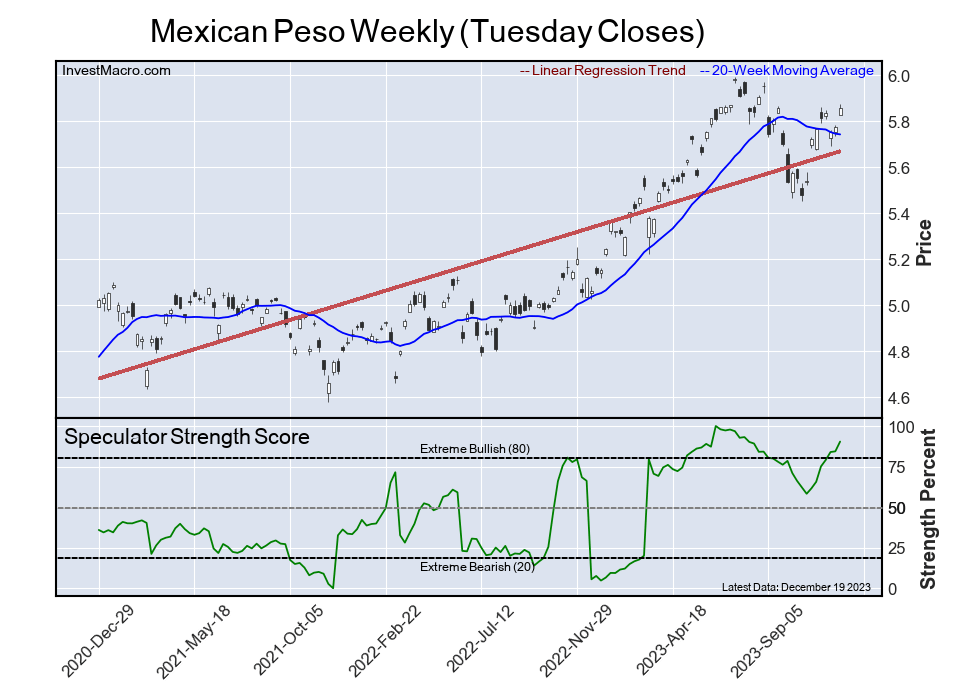
Mexican Peso (65.6 percent) vs Mexican Peso previous week (61.6 percent)
Brazilian Real (75.6 percent) vs Brazilian Real previous week (68.9 percent)
Bitcoin (46.2 percent) vs Bitcoin previous week (41.2 percent)


Brazilian Real & EuroFX top the 6-Week Strength Trends

COT Strength Score Trends (or move index, calculates the 6-week changes in strength scores) showed that the Brazilian Real (19 percent) and the EuroFX (13 percent) lead the past six weeks trends for the currencies. The Australian Dollar (10 percent) and the US Dollar Index (2 percent) represent the next highest positive movers in the trends data.

The Bitcoin (-36 percent) leads the downside trend scores currently with the Canadian Dollar (-25 percent), New Zealand Dollar (-24 percent) and the British Pound (-15 percent) following next with lower trend scores.

Strength Trend Statistics:
US Dollar Index (1.5 percent) vs US Dollar Index previous week (4.5 percent)
EuroFX (12.8 percent) vs EuroFX previous week (-4.0 percent)
British Pound Sterling (-14.6 percent) vs British Pound Sterling previous week (-22.2 percent)
Japanese Yen (-9.0 percent) vs Japanese Yen previous week (3.0 percent)
Swiss Franc (-9.6 percent) vs Swiss Franc previous week (-23.7 percent)
Canadian Dollar (-25.4 percent) vs Canadian Dollar previous week (-29.4 percent)
Australian Dollar (10.1 percent) vs Australian Dollar previous week (19.5 percent)
New Zealand Dollar (-24.4 percent) vs New Zealand Dollar previous week (0.6 percent)
Mexican Peso (-12.9 percent) vs Mexican Peso previous week (-14.6 percent)
Brazilian Real (19.5 percent) vs Brazilian Real previous week (14.3 percent)
Bitcoin (-36.1 percent) vs Bitcoin previous week (-52.2 percent)


Individual COT Forex Markets:

US Dollar Index Futures:

US Dollar Index Forex Futures COT ChartThe US Dollar Index large speculator standing this week was a net position of 19,734 contracts in the data reported through Tuesday. This was a weekly advance of 263 contracts from the previous week which had a total of 19,471 net contracts.

This week’s current strength score (the trader positioning range over the past three years, measured from 0 to 100) shows the speculators are currently Bullish with a score of 57.8 percent. The commercials are Bearish with a score of 43.4 percent and the small traders (not shown in chart) are Bearish-Extreme with a score of 13.2 percent.

Price Trend-Following Model: Uptrend

Our weekly trend-following model classifies the current market price position as: Uptrend. The current action for the model is considered to be: Hold – Maintain Long Position.

US DOLLAR INDEX StatisticsSPECULATORSCOMMERCIALSSMALL TRADERS
– Percent of Open Interest Longs:70.217.89.3
– Percent of Open Interest Shorts:19.470.37.6
– Net Position:19,734-20,378644
– Gross Longs:27,2716,9173,615
– Gross Shorts:7,53727,2952,971
– Long to Short Ratio:3.6 to 10.3 to 11.2 to 1
NET POSITION TREND:
– Strength Index Score (3 Year Range Pct):57.843.413.2
– Strength Index Reading (3 Year Range):BullishBearishBearish-Extreme
NET POSITION MOVEMENT INDEX:
– 6-Week Change in Strength Index:1.5-0.3-8.8


Euro Currency Futures:

Euro Currency Futures COT ChartThe Euro Currency large speculator standing this week was a net position of 108,907 contracts in the data reported through Tuesday. This was a weekly rise of 19,851 contracts from the previous week which had a total of 89,056 net contracts.

This week’s current strength score (the trader positioning range over the past three years, measured from 0 to 100) shows the speculators are currently Bullish with a score of 66.7 percent. The commercials are Bearish with a score of 36.4 percent and the small traders (not shown in chart) are Bearish with a score of 30.2 percent.

Price Trend-Following Model: Weak Downtrend (Possible Trend Change)

Our weekly trend-following model classifies the current market price position as: Weak Downtrend. The current action for the model is considered to be: Hold – Maintain Short Position.

EURO Currency StatisticsSPECULATORSCOMMERCIALSSMALL TRADERS
– Percent of Open Interest Longs:31.554.311.9
– Percent of Open Interest Shorts:16.074.47.4
– Net Position:108,907-140,98732,080
– Gross Longs:221,190381,76583,714
– Gross Shorts:112,283522,75251,634
– Long to Short Ratio:2.0 to 10.7 to 11.6 to 1
NET POSITION TREND:
– Strength Index Score (3 Year Range Pct):66.736.430.2
– Strength Index Reading (3 Year Range):BullishBearishBearish
NET POSITION MOVEMENT INDEX:
– 6-Week Change in Strength Index:12.8-13.610.0


British Pound Sterling Futures:

British Pound Sterling Futures COT ChartThe British Pound Sterling large speculator standing this week was a net position of -27,730 contracts in the data reported through Tuesday. This was a weekly fall of -11,478 contracts from the previous week which had a total of -16,252 net contracts.

This week’s current strength score (the trader positioning range over the past three years, measured from 0 to 100) shows the speculators are currently Bearish with a score of 36.5 percent. The commercials are Bullish with a score of 65.5 percent and the small traders (not shown in chart) are Bearish with a score of 42.9 percent.

Price Trend-Following Model: Downtrend

Our weekly trend-following model classifies the current market price position as: Downtrend. The current action for the model is considered to be: Hold – Maintain Short Position.

BRITISH POUND StatisticsSPECULATORSCOMMERCIALSSMALL TRADERS
– Percent of Open Interest Longs:24.460.112.2
– Percent of Open Interest Shorts:37.243.715.8
– Net Position:-27,73035,439-7,709
– Gross Longs:52,797130,00426,403
– Gross Shorts:80,52794,56534,112
– Long to Short Ratio:0.7 to 11.4 to 10.8 to 1
NET POSITION TREND:
– Strength Index Score (3 Year Range Pct):36.565.542.9
– Strength Index Reading (3 Year Range):BearishBullishBearish
NET POSITION MOVEMENT INDEX:
– 6-Week Change in Strength Index:-14.610.06.2


Japanese Yen Futures:

Japanese Yen Forex Futures COT ChartThe Japanese Yen large speculator standing this week was a net position of -130,249 contracts in the data reported through Tuesday. This was a weekly reduction of -26,209 contracts from the previous week which had a total of -104,040 net contracts.

This week’s current strength score (the trader positioning range over the past three years, measured from 0 to 100) shows the speculators are currently Bearish-Extreme with a score of 0.0 percent. The commercials are Bullish-Extreme with a score of 100.0 percent and the small traders (not shown in chart) are Bearish with a score of 47.3 percent.

Price Trend-Following Model: Downtrend

Our weekly trend-following model classifies the current market price position as: Downtrend. The current action for the model is considered to be: Hold – Maintain Short Position.

JAPANESE YEN StatisticsSPECULATORSCOMMERCIALSSMALL TRADERS
– Percent of Open Interest Longs:10.173.015.4
– Percent of Open Interest Shorts:57.724.316.5
– Net Position:-130,249133,272-3,023
– Gross Longs:27,772199,89042,074
– Gross Shorts:158,02166,61845,097
– Long to Short Ratio:0.2 to 13.0 to 10.9 to 1
NET POSITION TREND:
– Strength Index Score (3 Year Range Pct):0.0100.047.3
– Strength Index Reading (3 Year Range):Bearish-ExtremeBullish-ExtremeBearish
NET POSITION MOVEMENT INDEX:
– 6-Week Change in Strength Index:-9.07.51.7


Swiss Franc Futures:

Swiss Franc Forex Futures COT ChartThe Swiss Franc large speculator standing this week was a net position of -20,151 contracts in the data reported through Tuesday. This was a weekly decrease of -2,589 contracts from the previous week which had a total of -17,562 net contracts.

This week’s current strength score (the trader positioning range over the past three years, measured from 0 to 100) shows the speculators are currently Bearish-Extreme with a score of 1.4 percent. The commercials are Bullish-Extreme with a score of 89.5 percent and the small traders (not shown in chart) are Bearish with a score of 34.6 percent.

Price Trend-Following Model: Weak Downtrend (Possible Trend Change)

Our weekly trend-following model classifies the current market price position as: Weak Downtrend. The current action for the model is considered to be: Hold – Maintain Short Position.

SWISS FRANC StatisticsSPECULATORSCOMMERCIALSSMALL TRADERS
– Percent of Open Interest Longs:9.371.019.5
– Percent of Open Interest Shorts:43.224.732.0
– Net Position:-20,15127,543-7,392
– Gross Longs:5,51542,24011,612
– Gross Shorts:25,66614,69719,004
– Long to Short Ratio:0.2 to 12.9 to 10.6 to 1
NET POSITION TREND:
– Strength Index Score (3 Year Range Pct):1.489.534.6
– Strength Index Reading (3 Year Range):Bearish-ExtremeBullish-ExtremeBearish
NET POSITION MOVEMENT INDEX:
– 6-Week Change in Strength Index:-9.60.311.6


Canadian Dollar Futures:

Canadian Dollar Forex Futures COT ChartThe Canadian Dollar large speculator standing this week was a net position of -70,403 contracts in the data reported through Tuesday. This was a weekly lowering of -2,682 contracts from the previous week which had a total of -67,721 net contracts.

This week’s current strength score (the trader positioning range over the past three years, measured from 0 to 100) shows the speculators are currently Bearish-Extreme with a score of 0.0 percent. The commercials are Bullish-Extreme with a score of 100.0 percent and the small traders (not shown in chart) are Bearish-Extreme with a score of 6.6 percent.

Price Trend-Following Model: Downtrend

Our weekly trend-following model classifies the current market price position as: Downtrend. The current action for the model is considered to be: Hold – Maintain Short Position.

CANADIAN DOLLAR StatisticsSPECULATORSCOMMERCIALSSMALL TRADERS
– Percent of Open Interest Longs:9.173.814.2
– Percent of Open Interest Shorts:43.236.117.7
– Net Position:-70,40377,698-7,295
– Gross Longs:18,678152,04329,204
– Gross Shorts:89,08174,34536,499
– Long to Short Ratio:0.2 to 12.0 to 10.8 to 1
NET POSITION TREND:
– Strength Index Score (3 Year Range Pct):0.0100.06.6
– Strength Index Reading (3 Year Range):Bearish-ExtremeBullish-ExtremeBearish-Extreme
NET POSITION MOVEMENT INDEX:
– 6-Week Change in Strength Index:-25.424.4-19.7


Australian Dollar Futures:

Australian Dollar Forex Futures COT ChartThe Australian Dollar large speculator standing this week was a net position of -70,956 contracts in the data reported through Tuesday. This was a weekly decline of -5,393 contracts from the previous week which had a total of -65,563 net contracts.

This week’s current strength score (the trader positioning range over the past three years, measured from 0 to 100) shows the speculators are currently Bearish with a score of 23.8 percent. The commercials are Bullish with a score of 76.7 percent and the small traders (not shown in chart) are Bearish with a score of 32.7 percent.

Price Trend-Following Model: Weak Downtrend (Possible Trend Change)

Our weekly trend-following model classifies the current market price position as: Weak Downtrend. The current action for the model is considered to be: Hold – Maintain Short Position.

AUSTRALIAN DOLLAR StatisticsSPECULATORSCOMMERCIALSSMALL TRADERS
– Percent of Open Interest Longs:16.667.211.0
– Percent of Open Interest Shorts:52.527.115.2
– Net Position:-70,95679,057-8,101
– Gross Longs:32,728132,63921,818
– Gross Shorts:103,68453,58229,919
– Long to Short Ratio:0.3 to 12.5 to 10.7 to 1
NET POSITION TREND:
– Strength Index Score (3 Year Range Pct):23.876.732.7
– Strength Index Reading (3 Year Range):BearishBullishBearish
NET POSITION MOVEMENT INDEX:
– 6-Week Change in Strength Index:10.1-13.717.5


New Zealand Dollar Futures:

New Zealand Dollar Forex Futures COT ChartThe New Zealand Dollar large speculator standing this week was a net position of -17,034 contracts in the data reported through Tuesday. This was a weekly decline of -2,094 contracts from the previous week which had a total of -14,940 net contracts.

This week’s current strength score (the trader positioning range over the past three years, measured from 0 to 100) shows the speculators are currently Bearish-Extreme with a score of 11.0 percent. The commercials are Bullish-Extreme with a score of 88.3 percent and the small traders (not shown in chart) are Bearish with a score of 24.6 percent.

Price Trend-Following Model: Downtrend

Our weekly trend-following model classifies the current market price position as: Downtrend. The current action for the model is considered to be: Hold – Maintain Short Position.

NEW ZEALAND DOLLAR StatisticsSPECULATORSCOMMERCIALSSMALL TRADERS
– Percent of Open Interest Longs:17.773.86.2
– Percent of Open Interest Shorts:51.835.410.5
– Net Position:-17,03419,170-2,136
– Gross Longs:8,81836,8173,107
– Gross Shorts:25,85217,6475,243
– Long to Short Ratio:0.3 to 12.1 to 10.6 to 1
NET POSITION TREND:
– Strength Index Score (3 Year Range Pct):11.088.324.6
– Strength Index Reading (3 Year Range):Bearish-ExtremeBullish-ExtremeBearish
NET POSITION MOVEMENT INDEX:
– 6-Week Change in Strength Index:-24.419.211.1


Mexican Peso Futures:

Mexican Peso Futures COT ChartThe Mexican Peso large speculator standing this week was a net position of 43,382 contracts in the data reported through Tuesday. This was a weekly rise of 6,642 contracts from the previous week which had a total of 36,740 net contracts.

This week’s current strength score (the trader positioning range over the past three years, measured from 0 to 100) shows the speculators are currently Bullish with a score of 65.6 percent. The commercials are Bearish with a score of 33.0 percent and the small traders (not shown in chart) are Bearish with a score of 37.9 percent.

Price Trend-Following Model: Weak Downtrend (Possible Trend Change)

Our weekly trend-following model classifies the current market price position as: Weak Downtrend. The current action for the model is considered to be: Hold – Maintain Short Position.

MEXICAN PESO StatisticsSPECULATORSCOMMERCIALSSMALL TRADERS
– Percent of Open Interest Longs:34.660.63.0
– Percent of Open Interest Shorts:15.681.41.2
– Net Position:43,382-47,5684,186
– Gross Longs:79,162138,7166,874
– Gross Shorts:35,780186,2842,688
– Long to Short Ratio:2.2 to 10.7 to 12.6 to 1
NET POSITION TREND:
– Strength Index Score (3 Year Range Pct):65.633.037.9
– Strength Index Reading (3 Year Range):BullishBearishBearish
NET POSITION MOVEMENT INDEX:
– 6-Week Change in Strength Index:-12.911.79.3


Brazilian Real Futures:

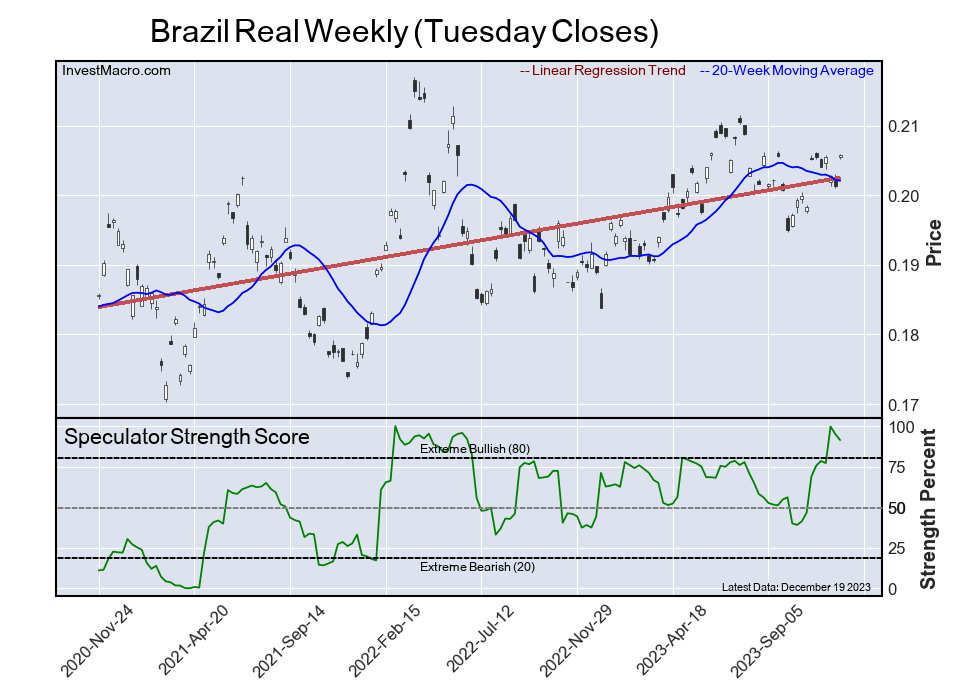
Brazil Real Futures COT ChartThe Brazilian Real large speculator standing this week was a net position of 31,651 contracts in the data reported through Tuesday. This was a weekly lift of 5,100 contracts from the previous week which had a total of 26,551 net contracts.

This week’s current strength score (the trader positioning range over the past three years, measured from 0 to 100) shows the speculators are currently Bullish with a score of 75.6 percent. The commercials are Bearish with a score of 24.1 percent and the small traders (not shown in chart) are Bullish with a score of 50.8 percent.

Price Trend-Following Model: Weak Downtrend (Possible Trend Change)

Our weekly trend-following model classifies the current market price position as: Weak Downtrend. The current action for the model is considered to be: Hold – Maintain Short Position.

BRAZIL REAL StatisticsSPECULATORSCOMMERCIALSSMALL TRADERS
– Percent of Open Interest Longs:72.821.75.1
– Percent of Open Interest Shorts:26.370.82.5
– Net Position:31,651-33,4081,757
– Gross Longs:49,53714,7673,478
– Gross Shorts:17,88648,1751,721
– Long to Short Ratio:2.8 to 10.3 to 12.0 to 1
NET POSITION TREND:
– Strength Index Score (3 Year Range Pct):75.624.150.8
– Strength Index Reading (3 Year Range):BullishBearishBullish
NET POSITION MOVEMENT INDEX:
– 6-Week Change in Strength Index:19.5-19.97.0


Bitcoin Futures:

Bitcoin Crypto Futures COT ChartThe Bitcoin large speculator standing this week was a net position of -1,344 contracts in the data reported through Tuesday. This was a weekly rise of 333 contracts from the previous week which had a total of -1,677 net contracts.

This week’s current strength score (the trader positioning range over the past three years, measured from 0 to 100) shows the speculators are currently Bearish with a score of 46.2 percent. The commercials are Bullish-Extreme with a score of 82.3 percent and the small traders (not shown in chart) are Bearish with a score of 32.6 percent.

Price Trend-Following Model: Strong Uptrend

Our weekly trend-following model classifies the current market price position as: Strong Uptrend. The current action for the model is considered to be: Hold – Maintain Long Position.

BITCOIN StatisticsSPECULATORSCOMMERCIALSSMALL TRADERS
– Percent of Open Interest Longs:75.25.27.6
– Percent of Open Interest Shorts:81.52.93.5
– Net Position:-1,344481863
– Gross Longs:15,9391,1051,609
– Gross Shorts:17,283624746
– Long to Short Ratio:0.9 to 11.8 to 12.2 to 1
NET POSITION TREND:
– Strength Index Score (3 Year Range Pct):46.282.332.6
– Strength Index Reading (3 Year Range):BearishBullish-ExtremeBearish
NET POSITION MOVEMENT INDEX:
– 6-Week Change in Strength Index:-36.153.210.1


Article By InvestMacroReceive our weekly COT Newsletter

*COT Report: The COT data, released weekly to the public each Friday, is updated through the most recent Tuesday (data is 3 days old) and shows a quick view of how large speculators or non-commercials (for-profit traders) were positioned in the futures markets.

The CFTC categorizes trader positions according to commercial hedgers (traders who use futures contracts for hedging as part of the business), non-commercials (large traders who speculate to realize trading profits) and nonreportable traders (usually small traders/speculators) as well as their open interest (contracts open in the market at time of reporting). See CFTC criteria here.

COT Metals Charts: Speculator Bets led by Silver this week

By InvestMacro

Here are the latest charts and statistics for the Commitment of Traders (COT) data published by the Commodities Futures Trading Commission (CFTC).

The latest COT data is updated through Tuesday November 14th and shows a quick view of how large traders (for-profit speculators and commercial entities) were positioned in the futures markets.

Weekly Speculator Changes led by Silver

The COT metals markets speculator bets were lower this week as just one out of the six metals markets we cover had higher positioning while the other five markets had lower speculator contracts.

Leading the way for the metals this week was Silver with a total gain of 4,145 contracts.

The markets with declines in speculator bets for the week were Platinum (-10,954 contracts), Gold (-10,840 contracts), Copper (-6,320 contracts), Steel (-465 contracts) and Palladium (-207 contracts) also registering lower bets on the week.


Data Snapshot of Commodity Market Traders | Columns Legend
Nov-14-2023OIOI-IndexSpec-NetSpec-IndexCom-NetCOM-IndexSmalls-NetSmalls-Index
Gold486,63430155,37645-177,0195621,64338
Silver134,8262622,39850-31,634569,23618
Copper206,07247-16,6081616,4498515919
Palladium27,381100-11,230211,28399-5339
Platinum85,87097-3,9966-2,365896,36153


Strength Scores led by Steel & Silver

COT Strength Scores (a normalized measure of Speculator positions over a 3-Year range, from 0 to 100 where above 80 is Extreme-Bullish and below 20 is Extreme-Bearish) showed that Steel (93 percent) leads the metals markets this week. Silver (50 percent) comes in as the next highest in the weekly strength scores.

On the downside, Palladium (2 percent), Platinum (6 percent) and Copper (16 percent) come in at the lowest strength levels this week and are in Extreme-Bearish territory (below 20 percent).

Strength Statistics:
Gold (45.5 percent) vs Gold previous week (50.2 percent)
Silver (50.2 percent) vs Silver previous week (44.3 percent)
Copper (16.5 percent) vs Copper previous week (22.0 percent)
Platinum (6.4 percent) vs Platinum previous week (31.6 percent)
Palladium (1.7 percent) vs Palladium previous week (3.1 percent)
Steel (92.5 percent) vs Palladium previous week (94.4 percent)


Gold & Steel top the 6-Week Strength Trends

COT Strength Score Trends (or move index, calculates the 6-week changes in strength scores) showed that Gold (28 percent) and Steel (15 percent) topped the past six weeks trends for the metals category.

Platinum (-15 percent) and Palladium (-10 percent) were the leaders for the downside trend scores on the week.

Move Statistics:
Gold (28.2 percent) vs Gold previous week (22.2 percent)
Silver (10.1 percent) vs Silver previous week (-2.6 percent)
Copper (4.6 percent) vs Copper previous week (16.0 percent)
Platinum (-15.3 percent) vs Platinum previous week (-0.8 percent)
Palladium (-9.9 percent) vs Palladium previous week (-4.7 percent)
Steel (14.7 percent) vs Steel previous week (19.4 percent)


Individual Markets:

Gold Comex Futures:

Gold Futures COT ChartThe Gold Comex Futures large speculator standing this week came in at a net position of 155,376 contracts in the data reported through Tuesday. This was a weekly decline of -10,840 contracts from the previous week which had a total of 166,216 net contracts.

This week’s current strength score (the trader positioning range over the past three years, measured from 0 to 100) shows the speculators are currently Bearish with a score of 45.5 percent. The commercials are Bullish with a score of 55.6 percent and the small traders (not shown in chart) are Bearish with a score of 37.8 percent.

Price Trend-Following Model: Strong Uptrend

Our weekly trend-following model classifies the current market price position as: Strong Uptrend. The current action for the model is considered to be: Hold – Maintain Long Position.

Gold Futures StatisticsSPECULATORSCOMMERCIALSSMALL TRADERS
– Percent of Open Interest Longs:52.322.89.3
– Percent of Open Interest Shorts:20.359.14.9
– Net Position:155,376-177,01921,643
– Gross Longs:254,352110,72845,409
– Gross Shorts:98,976287,74723,766
– Long to Short Ratio:2.6 to 10.4 to 11.9 to 1
NET POSITION TREND:
– Strength Index Score (3 Year Range Pct):45.555.637.8
– Strength Index Reading (3 Year Range):BearishBullishBearish
NET POSITION MOVEMENT INDEX:
– 6-Week Change in Strength Index:28.2-25.12.5


Silver Comex Futures:

Silver Futures COT ChartThe Silver Comex Futures large speculator standing this week came in at a net position of 22,398 contracts in the data reported through Tuesday. This was a weekly lift of 4,145 contracts from the previous week which had a total of 18,253 net contracts.

This week’s current strength score (the trader positioning range over the past three years, measured from 0 to 100) shows the speculators are currently Bullish with a score of 50.2 percent. The commercials are Bullish with a score of 55.6 percent and the small traders (not shown in chart) are Bearish-Extreme with a score of 17.5 percent.

Price Trend-Following Model: Weak Downtrend

Our weekly trend-following model classifies the current market price position as: Weak Downtrend. The current action for the model is considered to be: Hold – Maintain Short Position.

Silver Futures StatisticsSPECULATORSCOMMERCIALSSMALL TRADERS
– Percent of Open Interest Longs:37.333.818.8
– Percent of Open Interest Shorts:20.757.212.0
– Net Position:22,398-31,6349,236
– Gross Longs:50,29145,55125,379
– Gross Shorts:27,89377,18516,143
– Long to Short Ratio:1.8 to 10.6 to 11.6 to 1
NET POSITION TREND:
– Strength Index Score (3 Year Range Pct):50.255.617.5
– Strength Index Reading (3 Year Range):BullishBullishBearish-Extreme
NET POSITION MOVEMENT INDEX:
– 6-Week Change in Strength Index:10.1-1.5-32.3


Copper Grade #1 Futures:

Copper Futures COT ChartThe Copper Grade #1 Futures large speculator standing this week came in at a net position of -16,608 contracts in the data reported through Tuesday. This was a weekly lowering of -6,320 contracts from the previous week which had a total of -10,288 net contracts.

This week’s current strength score (the trader positioning range over the past three years, measured from 0 to 100) shows the speculators are currently Bearish-Extreme with a score of 16.5 percent. The commercials are Bullish-Extreme with a score of 85.3 percent and the small traders (not shown in chart) are Bearish-Extreme with a score of 19.5 percent.

Price Trend-Following Model: Downtrend

Our weekly trend-following model classifies the current market price position as: Downtrend. The current action for the model is considered to be: Hold – Maintain Short Position.

Copper Futures StatisticsSPECULATORSCOMMERCIALSSMALL TRADERS
– Percent of Open Interest Longs:30.139.07.3
– Percent of Open Interest Shorts:38.131.07.2
– Net Position:-16,60816,449159
– Gross Longs:61,97680,28715,028
– Gross Shorts:78,58463,83814,869
– Long to Short Ratio:0.8 to 11.3 to 11.0 to 1
NET POSITION TREND:
– Strength Index Score (3 Year Range Pct):16.585.319.5
– Strength Index Reading (3 Year Range):Bearish-ExtremeBullish-ExtremeBearish-Extreme
NET POSITION MOVEMENT INDEX:
– 6-Week Change in Strength Index:4.6-2.9-11.4


Platinum Futures:

Platinum Futures COT ChartThe Platinum Futures large speculator standing this week came in at a net position of -3,996 contracts in the data reported through Tuesday. This was a weekly lowering of -10,954 contracts from the previous week which had a total of 6,958 net contracts.

This week’s current strength score (the trader positioning range over the past three years, measured from 0 to 100) shows the speculators are currently Bearish-Extreme with a score of 6.4 percent. The commercials are Bullish-Extreme with a score of 88.6 percent and the small traders (not shown in chart) are Bullish with a score of 53.2 percent.

Price Trend-Following Model: Downtrend

Our weekly trend-following model classifies the current market price position as: Downtrend. The current action for the model is considered to be: Hold – Maintain Short Position.

Platinum Futures StatisticsSPECULATORSCOMMERCIALSSMALL TRADERS
– Percent of Open Interest Longs:52.429.011.5
– Percent of Open Interest Shorts:57.031.84.1
– Net Position:-3,996-2,3656,361
– Gross Longs:44,96924,9429,842
– Gross Shorts:48,96527,3073,481
– Long to Short Ratio:0.9 to 10.9 to 12.8 to 1
NET POSITION TREND:
– Strength Index Score (3 Year Range Pct):6.488.653.2
– Strength Index Reading (3 Year Range):Bearish-ExtremeBullish-ExtremeBullish
NET POSITION MOVEMENT INDEX:
– 6-Week Change in Strength Index:-15.310.619.5


Palladium Futures:

Palladium Futures COT ChartThe Palladium Futures large speculator standing this week came in at a net position of -11,230 contracts in the data reported through Tuesday. This was a weekly decrease of -207 contracts from the previous week which had a total of -11,023 net contracts.

This week’s current strength score (the trader positioning range over the past three years, measured from 0 to 100) shows the speculators are currently Bearish-Extreme with a score of 1.7 percent. The commercials are Bullish-Extreme with a score of 98.9 percent and the small traders (not shown in chart) are Bearish with a score of 38.5 percent.

Price Trend-Following Model: Strong Downtrend

Our weekly trend-following model classifies the current market price position as: Strong Downtrend. The current action for the model is considered to be: Hold – Maintain Short Position.

Palladium Futures StatisticsSPECULATORSCOMMERCIALSSMALL TRADERS
– Percent of Open Interest Longs:20.849.67.0
– Percent of Open Interest Shorts:61.88.47.2
– Net Position:-11,23011,283-53
– Gross Longs:5,68913,5831,911
– Gross Shorts:16,9192,3001,964
– Long to Short Ratio:0.3 to 15.9 to 11.0 to 1
NET POSITION TREND:
– Strength Index Score (3 Year Range Pct):1.798.938.5
– Strength Index Reading (3 Year Range):Bearish-ExtremeBullish-ExtremeBearish
NET POSITION MOVEMENT INDEX:
– 6-Week Change in Strength Index:-9.99.05.4


Steel Futures Futures:

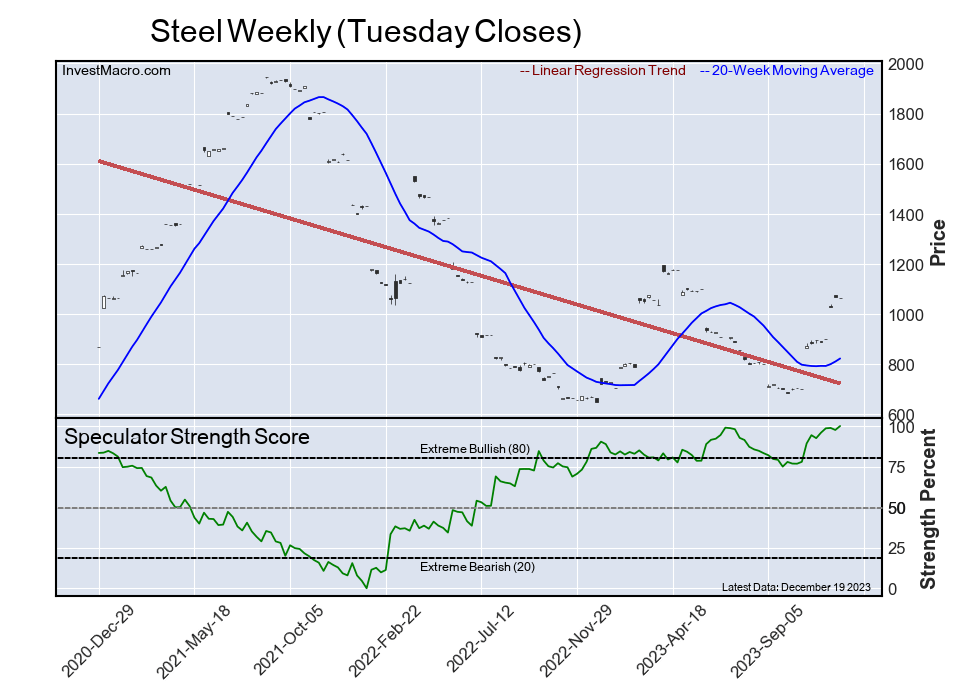
Steel Futures COT ChartThe Steel Futures large speculator standing this week came in at a net position of -1,768 contracts in the data reported through Tuesday. This was a weekly decrease of -465 contracts from the previous week which had a total of -1,303 net contracts.

This week’s current strength score (the trader positioning range over the past three years, measured from 0 to 100) shows the speculators are currently Bullish-Extreme with a score of 92.5 percent. The commercials are Bearish-Extreme with a score of 7.6 percent and the small traders (not shown in chart) are Bearish with a score of 47.7 percent.

Price Trend-Following Model: Weak Downtrend

Our weekly trend-following model classifies the current market price position as: Weak Downtrend. The current action for the model is considered to be: Hold – Maintain Short Position.

Steel Futures StatisticsSPECULATORSCOMMERCIALSSMALL TRADERS
– Percent of Open Interest Longs:19.075.42.2
– Percent of Open Interest Shorts:28.866.41.4
– Net Position:-1,7681,628140
– Gross Longs:3,44613,641400
– Gross Shorts:5,21412,013260
– Long to Short Ratio:0.7 to 11.1 to 11.5 to 1
NET POSITION TREND:
– Strength Index Score (3 Year Range Pct):92.57.647.7
– Strength Index Reading (3 Year Range):Bullish-ExtremeBearish-ExtremeBearish
NET POSITION MOVEMENT INDEX:
– 6-Week Change in Strength Index:14.7-15.728.3


Article By InvestMacroReceive our weekly COT Newsletter

*COT Report: The COT data, released weekly to the public each Friday, is updated through the most recent Tuesday (data is 3 days old) and shows a quick view of how large speculators or non-commercials (for-profit traders) were positioned in the futures markets.

The CFTC categorizes trader positions according to commercial hedgers (traders who use futures contracts for hedging as part of the business), non-commercials (large traders who speculate to realize trading profits) and nonreportable traders (usually small traders/speculators) as well as their open interest (contracts open in the market at time of reporting). See CFTC criteria here.

COT Bonds Charts: Speculator Bets topped by 2-Year Bonds & SOFR 3-Months

By InvestMacro

Here are the latest charts and statistics for the Commitment of Traders (COT) reports data published by the Commodities Futures Trading Commission (CFTC).

The latest COT data is updated through Tuesday November 14th and shows a quick view of how large traders (for-profit speculators and commercial hedgers) were positioned in the futures markets.

Weekly Speculator Changes led by 2-Year Bonds & SOFR 3-Months

The COT bond market speculator bets were mixed this week as four out of the eight bond markets we cover had higher positioning while the other four markets had lower speculator contracts.

Leading the gains for the bond markets was the 2-Year Bonds (65,612 contracts) with the SOFR 3-Months (30,097 contracts), the 5-Year Bonds (7,144 contracts) and the US Treasury Bonds (2,059 contracts) also recording positive weeks.

The bond markets with declines in speculator bets for the week were the Fed Funds (-71,074 contracts), the 10-Year Bonds (-57,267 contracts), the Ultra Treasury Bonds (-396 contracts) and the Ultra 10-Year Bonds (-1,256 contracts) also having lower bets on the week.


Data Snapshot of Bond Market Traders | Columns Legend
Nov-14-2023OIOI-IndexSpec-NetSpec-IndexCom-NetCOM-IndexSmalls-NetSmalls-Index
SOFR-3-Months10,540,40099416,72695-417,79551,06988
FedFunds1,766,82469-150,12136172,71766-22,59647
2-Year4,208,593100-1,388,09441,256,35695131,73898
Long T-Bond1,354,13776-128,7393964,7543463,98595
10-Year4,743,21790-661,76618595,6557966,11188
5-Year6,084,468100-1,416,24001,291,28397124,957100


Strength Scores led by SOFR 3-Months & Ultra Treasury Bonds

COT Strength Scores (a normalized measure of Speculator positions over a 3-Year range, from 0 to 100 where above 80 is Extreme-Bullish and below 20 is Extreme-Bearish) showed that the SOFR 3-Months (95 percent) and the Ultra Treasury Bonds (53 percent) lead the bond markets this week. The US Treasury Bonds (39 percent) comes in as the next highest in the weekly strength scores.

On the downside, the Ultra 10-Year Bonds (0 percent), the 5-Year Bonds (0 percent), the 2-Year Bonds (4 percent) and the 10-Year Bonds (18 percent) come in at the lowest strength level currently and are in Extreme-Bearish territory (below 20 percent).

Strength Statistics:
Fed Funds (36.5 percent) vs Fed Funds previous week (51.7 percent)
2-Year Bond (4.3 percent) vs 2-Year Bond previous week (0.0 percent)
5-Year Bond (0.5 percent) vs 5-Year Bond previous week (0.0 percent)
10-Year Bond (18.3 percent) vs 10-Year Bond previous week (23.8 percent)
Ultra 10-Year Bond (0.0 percent) vs Ultra 10-Year Bond previous week (0.2 percent)
US Treasury Bond (38.6 percent) vs US Treasury Bond previous week (37.9 percent)
Ultra US Treasury Bond (52.8 percent) vs Ultra US Treasury Bond previous week (53.0 percent)
SOFR 3-Months (95.0 percent) vs SOFR 3-Months previous week (93.2 percent)


US Treasury Bonds & Fed Funds top the 6-Week Strength Trends

COT Strength Score Trends (or move index, calculates the 6-week changes in strength scores) showed that the US Treasury Bonds (39 percent), the Ultra Treasury Bonds (17 percent) and the Fed Funds (17 percent) lead the past six weeks trends for bonds.

The 5-Year Bonds (-21 percent), the 2-Year Bonds (-7 percent) and the Ultra 10-Year Bonds (-4 percent) lead the downside trend scores currently.

Strength Trend Statistics:
Fed Funds (16.9 percent) vs Fed Funds previous week (24.8 percent)
2-Year Bond (-7.1 percent) vs 2-Year Bond previous week (-15.8 percent)
5-Year Bond (-21.3 percent) vs 5-Year Bond previous week (-26.2 percent)
10-Year Bond (7.0 percent) vs 10-Year Bond previous week (12.4 percent)
Ultra 10-Year Bond (-3.8 percent) vs Ultra 10-Year Bond previous week (-12.3 percent)
US Treasury Bond (38.6 percent) vs US Treasury Bond previous week (35.5 percent)
Ultra US Treasury Bond (17.1 percent) vs Ultra US Treasury Bond previous week (19.4 percent)
SOFR 3-Months (7.5 percent) vs SOFR 3-Months previous week (4.2 percent)


Secured Overnight Financing Rate (3-Month) Futures:

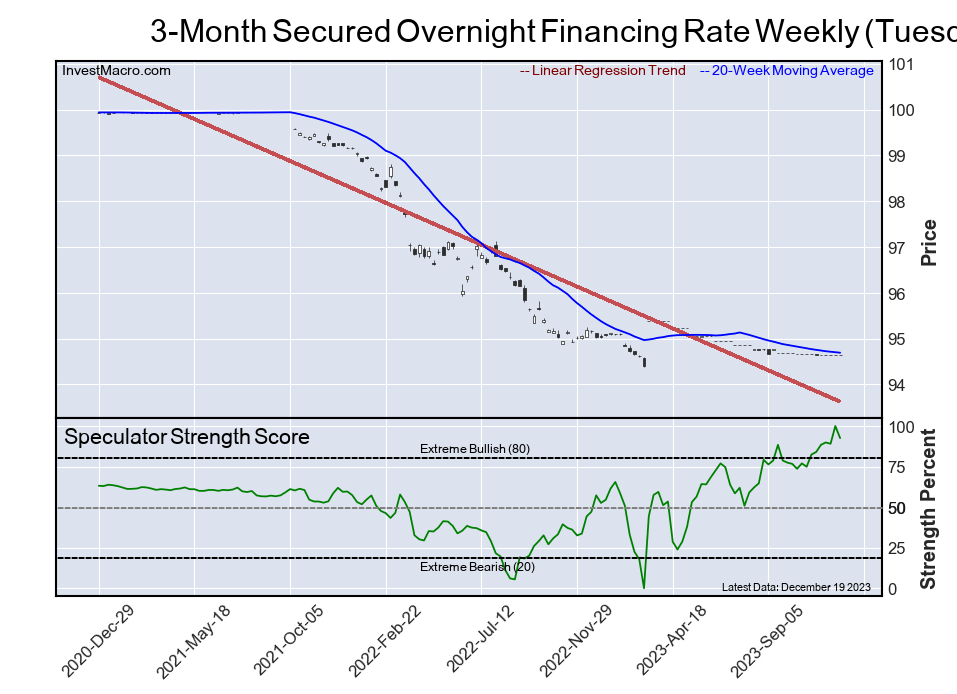
SOFR 3-Months Bonds Futures COT ChartThe Secured Overnight Financing Rate (3-Month) large speculator standing this week recorded a net position of 416,726 contracts in the data reported through Tuesday. This was a weekly advance of 30,097 contracts from the previous week which had a total of 386,629 net contracts.

This week’s current strength score (the trader positioning range over the past three years, measured from 0 to 100) shows the speculators are currently Bullish-Extreme with a score of 95.0 percent. The commercials are Bearish-Extreme with a score of 4.5 percent and the small traders (not shown in chart) are Bullish-Extreme with a score of 88.5 percent.

Price Trend-Following Model: Weak Uptrend

Our weekly trend-following model classifies the current market price position as: Weak Uptrend. The current action for the model is considered to be: Hold – Maintain Long Position.

SOFR 3-Months StatisticsSPECULATORSCOMMERCIALSSMALL TRADERS
– Percent of Open Interest Longs:21.054.60.3
– Percent of Open Interest Shorts:17.058.50.3
– Net Position:416,726-417,7951,069
– Gross Longs:2,213,6045,752,66735,163
– Gross Shorts:1,796,8786,170,46234,094
– Long to Short Ratio:1.2 to 10.9 to 11.0 to 1
NET POSITION TREND:
– Strength Index Score (3 Year Range Pct):95.04.588.5
– Strength Index Reading (3 Year Range):Bullish-ExtremeBearish-ExtremeBullish-Extreme
NET POSITION MOVEMENT INDEX:
– 6-Week Change in Strength Index:7.5-7.60.8


30-Day Federal Funds Futures:

Federal Funds 30-Day Bonds Futures COT ChartThe 30-Day Federal Funds large speculator standing this week recorded a net position of -150,121 contracts in the data reported through Tuesday. This was a weekly decrease of -71,074 contracts from the previous week which had a total of -79,047 net contracts.

This week’s current strength score (the trader positioning range over the past three years, measured from 0 to 100) shows the speculators are currently Bearish with a score of 36.5 percent. The commercials are Bullish with a score of 66.4 percent and the small traders (not shown in chart) are Bearish with a score of 46.7 percent.

Price Trend-Following Model: Downtrend

Our weekly trend-following model classifies the current market price position as: Downtrend. The current action for the model is considered to be: Hold – Maintain Short Position.

30-Day Federal Funds StatisticsSPECULATORSCOMMERCIALSSMALL TRADERS
– Percent of Open Interest Longs:8.176.21.9
– Percent of Open Interest Shorts:16.666.43.2
– Net Position:-150,121172,717-22,596
– Gross Longs:142,4111,346,35334,086
– Gross Shorts:292,5321,173,63656,682
– Long to Short Ratio:0.5 to 11.1 to 10.6 to 1
NET POSITION TREND:
– Strength Index Score (3 Year Range Pct):36.566.446.7
– Strength Index Reading (3 Year Range):BearishBullishBearish
NET POSITION MOVEMENT INDEX:
– 6-Week Change in Strength Index:16.9-15.3-13.9


2-Year Treasury Note Futures:

2-Year Treasury Bonds Futures COT ChartThe 2-Year Treasury Note large speculator standing this week recorded a net position of -1,388,094 contracts in the data reported through Tuesday. This was a weekly lift of 65,612 contracts from the previous week which had a total of -1,453,706 net contracts.

This week’s current strength score (the trader positioning range over the past three years, measured from 0 to 100) shows the speculators are currently Bearish-Extreme with a score of 4.3 percent. The commercials are Bullish-Extreme with a score of 94.9 percent and the small traders (not shown in chart) are Bullish-Extreme with a score of 98.0 percent.

Price Trend-Following Model: Strong Uptrend

Our weekly trend-following model classifies the current market price position as: Strong Uptrend. The current action for the model is considered to be: New Buy – Long Position.

2-Year Treasury Note StatisticsSPECULATORSCOMMERCIALSSMALL TRADERS
– Percent of Open Interest Longs:10.481.66.3
– Percent of Open Interest Shorts:43.351.73.1
– Net Position:-1,388,0941,256,356131,738
– Gross Longs:435,8393,432,176264,080
– Gross Shorts:1,823,9332,175,820132,342
– Long to Short Ratio:0.2 to 11.6 to 12.0 to 1
NET POSITION TREND:
– Strength Index Score (3 Year Range Pct):4.394.998.0
– Strength Index Reading (3 Year Range):Bearish-ExtremeBullish-ExtremeBullish-Extreme
NET POSITION MOVEMENT INDEX:
– 6-Week Change in Strength Index:-7.18.4-2.0


5-Year Treasury Note Futures:

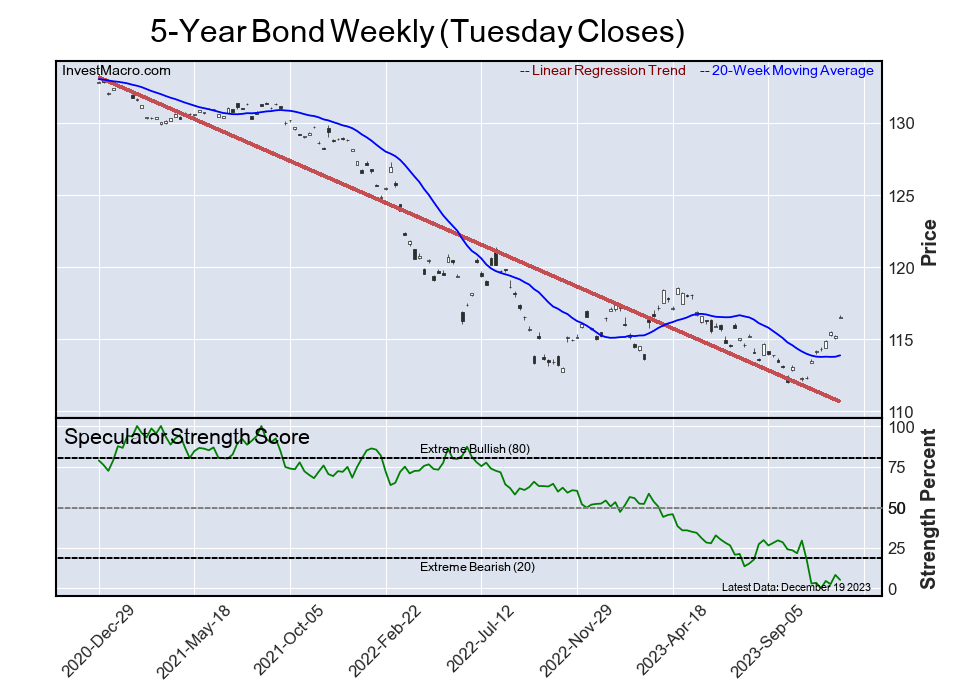
5-Year Treasury Bonds Futures COT ChartThe 5-Year Treasury Note large speculator standing this week recorded a net position of -1,416,240 contracts in the data reported through Tuesday. This was a weekly gain of 7,144 contracts from the previous week which had a total of -1,423,384 net contracts.

This week’s current strength score (the trader positioning range over the past three years, measured from 0 to 100) shows the speculators are currently Bearish-Extreme with a score of 0.5 percent. The commercials are Bullish-Extreme with a score of 96.8 percent and the small traders (not shown in chart) are Bullish-Extreme with a score of 100.0 percent.

Price Trend-Following Model: Weak Downtrend

Our weekly trend-following model classifies the current market price position as: Weak Downtrend. The current action for the model is considered to be: Hold – Maintain Short Position.

5-Year Treasury Note StatisticsSPECULATORSCOMMERCIALSSMALL TRADERS
– Percent of Open Interest Longs:7.483.17.2
– Percent of Open Interest Shorts:30.761.95.1
– Net Position:-1,416,2401,291,283124,957
– Gross Longs:448,8675,057,978436,788
– Gross Shorts:1,865,1073,766,695311,831
– Long to Short Ratio:0.2 to 11.3 to 11.4 to 1
NET POSITION TREND:
– Strength Index Score (3 Year Range Pct):0.596.8100.0
– Strength Index Reading (3 Year Range):Bearish-ExtremeBullish-ExtremeBullish-Extreme
NET POSITION MOVEMENT INDEX:
– 6-Week Change in Strength Index:-21.319.414.0


10-Year Treasury Note Futures:

10-Year Treasury Notes Bonds Futures COT ChartThe 10-Year Treasury Note large speculator standing this week recorded a net position of -661,766 contracts in the data reported through Tuesday. This was a weekly lowering of -57,267 contracts from the previous week which had a total of -604,499 net contracts.

This week’s current strength score (the trader positioning range over the past three years, measured from 0 to 100) shows the speculators are currently Bearish-Extreme with a score of 18.3 percent. The commercials are Bullish with a score of 79.4 percent and the small traders (not shown in chart) are Bullish-Extreme with a score of 87.9 percent.

Price Trend-Following Model: Downtrend

Our weekly trend-following model classifies the current market price position as: Downtrend. The current action for the model is considered to be: Hold – Maintain Short Position.

10-Year Treasury Note StatisticsSPECULATORSCOMMERCIALSSMALL TRADERS
– Percent of Open Interest Longs:10.877.79.2
– Percent of Open Interest Shorts:24.865.17.8
– Net Position:-661,766595,65566,111
– Gross Longs:514,1093,684,382435,784
– Gross Shorts:1,175,8753,088,727369,673
– Long to Short Ratio:0.4 to 11.2 to 11.2 to 1
NET POSITION TREND:
– Strength Index Score (3 Year Range Pct):18.379.487.9
– Strength Index Reading (3 Year Range):Bearish-ExtremeBullishBullish-Extreme
NET POSITION MOVEMENT INDEX:
– 6-Week Change in Strength Index:7.0-8.60.2


Ultra 10-Year Notes Futures:

Ultra 10-Year Treasury Notes Bonds Futures COT ChartThe Ultra 10-Year Notes large speculator standing this week recorded a net position of -265,436 contracts in the data reported through Tuesday. This was a weekly decline of -1,256 contracts from the previous week which had a total of -264,180 net contracts.

This week’s current strength score (the trader positioning range over the past three years, measured from 0 to 100) shows the speculators are currently Bearish-Extreme with a score of 0.0 percent. The commercials are Bullish-Extreme with a score of 98.9 percent and the small traders (not shown in chart) are Bullish-Extreme with a score of 85.1 percent.

Price Trend-Following Model: Weak Uptrend

Our weekly trend-following model classifies the current market price position as: Weak Uptrend. The current action for the model is considered to be: Hold – Maintain Long Position.

Ultra 10-Year Notes StatisticsSPECULATORSCOMMERCIALSSMALL TRADERS
– Percent of Open Interest Longs:9.678.210.5
– Percent of Open Interest Shorts:22.662.812.8
– Net Position:-265,436314,068-48,632
– Gross Longs:195,4681,597,398213,588
– Gross Shorts:460,9041,283,330262,220
– Long to Short Ratio:0.4 to 11.2 to 10.8 to 1
NET POSITION TREND:
– Strength Index Score (3 Year Range Pct):0.098.985.1
– Strength Index Reading (3 Year Range):Bearish-ExtremeBullish-ExtremeBullish-Extreme
NET POSITION MOVEMENT INDEX:
– 6-Week Change in Strength Index:-3.85.9-4.6


US Treasury Bonds Futures:

US Year Treasury Notes Long Bonds Futures COT ChartThe US Treasury Bonds large speculator standing this week recorded a net position of -128,739 contracts in the data reported through Tuesday. This was a weekly lift of 2,059 contracts from the previous week which had a total of -130,798 net contracts.

This week’s current strength score (the trader positioning range over the past three years, measured from 0 to 100) shows the speculators are currently Bearish with a score of 38.6 percent. The commercials are Bearish with a score of 34.0 percent and the small traders (not shown in chart) are Bullish-Extreme with a score of 95.0 percent.

Price Trend-Following Model: Downtrend

Our weekly trend-following model classifies the current market price position as: Downtrend. The current action for the model is considered to be: Hold – Maintain Short Position.

US Treasury Bonds StatisticsSPECULATORSCOMMERCIALSSMALL TRADERS
– Percent of Open Interest Longs:8.175.315.2
– Percent of Open Interest Shorts:17.670.510.5
– Net Position:-128,73964,75463,985
– Gross Longs:109,7971,019,283206,287
– Gross Shorts:238,536954,529142,302
– Long to Short Ratio:0.5 to 11.1 to 11.4 to 1
NET POSITION TREND:
– Strength Index Score (3 Year Range Pct):38.634.095.0
– Strength Index Reading (3 Year Range):BearishBearishBullish-Extreme
NET POSITION MOVEMENT INDEX:
– 6-Week Change in Strength Index:38.6-52.425.3


Ultra US Treasury Bonds Futures:

Ultra US Year Treasury Notes Long Bonds Futures COT ChartThe Ultra US Treasury Bonds large speculator standing this week recorded a net position of -325,761 contracts in the data reported through Tuesday. This was a weekly decrease of -396 contracts from the previous week which had a total of -325,365 net contracts.

This week’s current strength score (the trader positioning range over the past three years, measured from 0 to 100) shows the speculators are currently Bullish with a score of 52.8 percent. The commercials are Bearish with a score of 44.4 percent and the small traders (not shown in chart) are Bullish with a score of 63.5 percent.

Price Trend-Following Model: Downtrend

Our weekly trend-following model classifies the current market price position as: Downtrend. The current action for the model is considered to be: Hold – Maintain Short Position.

Ultra US Treasury Bonds StatisticsSPECULATORSCOMMERCIALSSMALL TRADERS
– Percent of Open Interest Longs:5.682.410.9
– Percent of Open Interest Shorts:26.263.69.1
– Net Position:-325,761297,85427,907
– Gross Longs:89,0691,306,531172,720
– Gross Shorts:414,8301,008,677144,813
– Long to Short Ratio:0.2 to 11.3 to 11.2 to 1
NET POSITION TREND:
– Strength Index Score (3 Year Range Pct):52.844.463.5
– Strength Index Reading (3 Year Range):BullishBearishBullish
NET POSITION MOVEMENT INDEX:
– 6-Week Change in Strength Index:17.1-17.0-6.8


Article By InvestMacroReceive our weekly COT Newsletter

*COT Report: The COT data, released weekly to the public each Friday, is updated through the most recent Tuesday (data is 3 days old) and shows a quick view of how large speculators or non-commercials (for-profit traders) were positioned in the futures markets.

The CFTC categorizes trader positions according to commercial hedgers (traders who use futures contracts for hedging as part of the business), non-commercials (large traders who speculate to realize trading profits) and nonreportable traders (usually small traders/speculators) as well as their open interest (contracts open in the market at time of reporting). See CFTC criteria here.

COT Stock Market Charts: Speculator Bets led by Russell-Mini & S&P500-Mini

By InvestMacro

Here are the latest charts and statistics for the Commitment of Traders (COT) data published by the Commodities Futures Trading Commission (CFTC).

The latest COT data is updated through Tuesday November 14th and shows a quick view of how large traders (for-profit speculators and commercial entities) were positioned in the futures markets.

Weekly Speculator Changes led by Russell-Mini & S&P500-Mini

The COT stock markets speculator bets were lower this week as three out of the seven stock markets we cover had higher positioning while the other four markets had lower speculator contracts.

Leading the gains for the stock markets was the Russell-Mini (7,001 contracts) with the S&P500-Mini (588 contracts) and the DowJones-Mini (563 contracts) also having a positive week.

The markets with the declines in speculator bets this week were the Nasdaq-Mini (-15,980 contracts), the VIX (-9,879 contracts), the MSCI EAFE-Mini (-5,972 contracts) and the Nikkei 225 (-29 contracts) also seeing lower bets on the week.


Data Snapshot of Stock Market Traders | Columns Legend
Nov-14-2023OIOI-IndexSpec-NetSpec-IndexCom-NetCOM-IndexSmalls-NetSmalls-Index
S&P500-Mini2,192,89920-52,8335711,0574141,77654
Nikkei 22516,21037-2,587481,8904769737
Nasdaq-Mini273,7875831539-2,032421,71777
DowJones-Mini101,03065-36,513141,79699-5,28318
VIX415,12480-42,9288146,62718-3,69978
Nikkei 225 Yen66,7366715,047816,44529-21,49238


Strength Scores led by VIX & S&P500-Mini

COT Strength Scores (a normalized measure of Speculator positions over a 3-Year range, from 0 to 100 where above 80 is Extreme-Bullish and below 20 is Extreme-Bearish) showed that the VIX (81 percent) and the S&P500-Mini (57 percent) lead the stock markets this week. The Nikkei 225 (48 percent) comes in as the next highest in the weekly strength scores.

On the downside, the MSCI EAFE-Mini (0 percent) and the DowJones-Mini (1 percent) come in at the lowest strength level currently and are in Extreme-Bearish territory (below 20 percent).

Strength Statistics:
VIX (80.6 percent) vs VIX previous week (87.2 percent)
S&P500-Mini (56.9 percent) vs S&P500-Mini previous week (56.8 percent)
DowJones-Mini (1.2 percent) vs DowJones-Mini previous week (0.0 percent)
Nasdaq-Mini (39.4 percent) vs Nasdaq-Mini previous week (64.0 percent)
Russell2000-Mini (32.6 percent) vs Russell2000-Mini previous week (28.4 percent)
Nikkei USD (48.2 percent) vs Nikkei USD previous week (48.4 percent)
EAFE-Mini (0.0 percent) vs EAFE-Mini previous week (5.5 percent)


S&P500-Mini tops the 6-Week Strength Trends

COT Strength Score Trends (or move index, calculates the 6-week changes in strength scores) showed that the S&P500-Mini (3 percent) leads the past six weeks trends for the stock markets.

The MSCI EAFE-Mini (-41 percent) leads the downside trend scores currently with the Nikkei 225 (-18 percent) coming in as the next market with lower trend scores.

Strength Trend Statistics:
VIX (-5.9 percent) vs VIX previous week (13.3 percent)
S&P500-Mini (3.0 percent) vs S&P500-Mini previous week (5.3 percent)
DowJones-Mini (-8.8 percent) vs DowJones-Mini previous week (-33.4 percent)
Nasdaq-Mini (-1.7 percent) vs Nasdaq-Mini previous week (23.8 percent)
Russell2000-Mini (-1.4 percent) vs Russell2000-Mini previous week (-6.6 percent)
Nikkei USD (-18.0 percent) vs Nikkei USD previous week (-13.8 percent)
EAFE-Mini (-41.3 percent) vs EAFE-Mini previous week (-30.0 percent)


Individual Stock Market Charts:

VIX Volatility Futures:

VIX Volatility Futures COT ChartThe VIX Volatility large speculator standing this week recorded a net position of -42,928 contracts in the data reported through Tuesday. This was a weekly decline of -9,879 contracts from the previous week which had a total of -33,049 net contracts.

This week’s current strength score (the trader positioning range over the past three years, measured from 0 to 100) shows the speculators are currently Bullish-Extreme with a score of 80.6 percent. The commercials are Bearish-Extreme with a score of 18.2 percent and the small traders (not shown in chart) are Bullish with a score of 77.6 percent.

Price Trend-Following Model: Weak Uptrend

Our weekly trend-following model classifies the current market price position as: Weak Uptrend. The current action for the model is considered to be: Hold – Maintain Long Position.

VIX Volatility Futures StatisticsSPECULATORSCOMMERCIALSSMALL TRADERS
– Percent of Open Interest Longs:22.750.15.5
– Percent of Open Interest Shorts:33.138.86.4
– Net Position:-42,92846,627-3,699
– Gross Longs:94,375207,84722,934
– Gross Shorts:137,303161,22026,633
– Long to Short Ratio:0.7 to 11.3 to 10.9 to 1
NET POSITION TREND:
– Strength Index Score (3 Year Range Pct):80.618.277.6
– Strength Index Reading (3 Year Range):Bullish-ExtremeBearish-ExtremeBullish
NET POSITION MOVEMENT INDEX:
– 6-Week Change in Strength Index:-5.94.013.5


S&P500 Mini Futures:

SP500 Mini Futures COT ChartThe S&P500 Mini large speculator standing this week recorded a net position of -52,833 contracts in the data reported through Tuesday. This was a weekly advance of 588 contracts from the previous week which had a total of -53,421 net contracts.

This week’s current strength score (the trader positioning range over the past three years, measured from 0 to 100) shows the speculators are currently Bullish with a score of 56.9 percent. The commercials are Bearish with a score of 41.4 percent and the small traders (not shown in chart) are Bullish with a score of 53.8 percent.

Price Trend-Following Model: Weak Downtrend

Our weekly trend-following model classifies the current market price position as: Weak Downtrend. The current action for the model is considered to be: Hold – Maintain Short Position.

S&P500 Mini Futures StatisticsSPECULATORSCOMMERCIALSSMALL TRADERS
– Percent of Open Interest Longs:12.572.712.0
– Percent of Open Interest Shorts:14.972.210.1
– Net Position:-52,83311,05741,776
– Gross Longs:274,3481,593,850262,981
– Gross Shorts:327,1811,582,793221,205
– Long to Short Ratio:0.8 to 11.0 to 11.2 to 1
NET POSITION TREND:
– Strength Index Score (3 Year Range Pct):56.941.453.8
– Strength Index Reading (3 Year Range):BullishBearishBullish
NET POSITION MOVEMENT INDEX:
– 6-Week Change in Strength Index:3.0-4.85.8


Dow Jones Mini Futures:

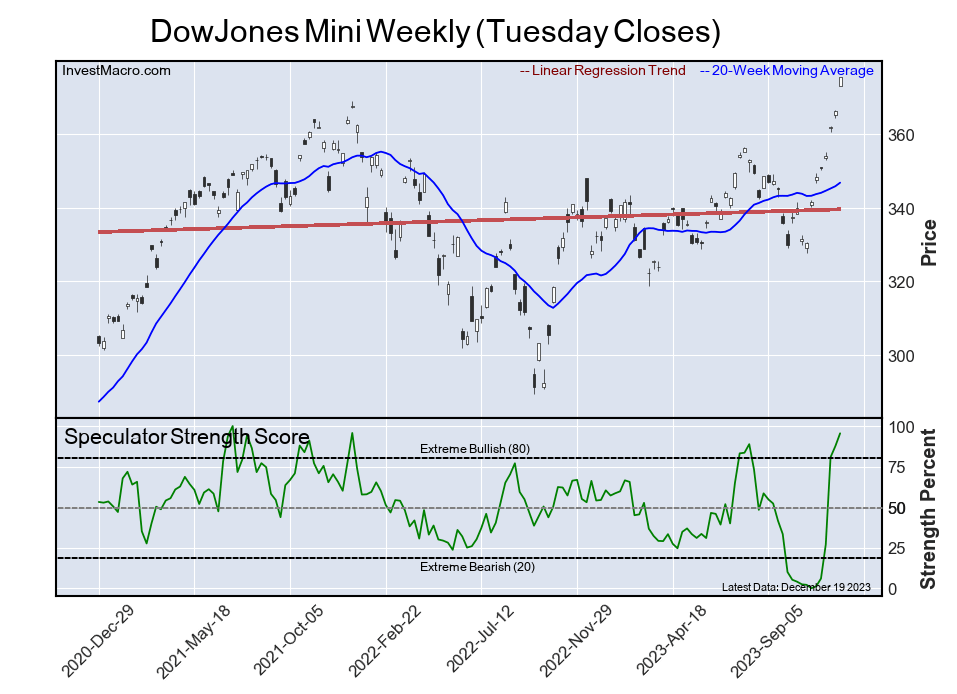
Dow Jones Mini Futures COT ChartThe Dow Jones Mini large speculator standing this week recorded a net position of -36,513 contracts in the data reported through Tuesday. This was a weekly advance of 563 contracts from the previous week which had a total of -37,076 net contracts.

This week’s current strength score (the trader positioning range over the past three years, measured from 0 to 100) shows the speculators are currently Bearish-Extreme with a score of 1.2 percent. The commercials are Bullish-Extreme with a score of 98.7 percent and the small traders (not shown in chart) are Bearish-Extreme with a score of 18.1 percent.

Price Trend-Following Model: Weak Downtrend

Our weekly trend-following model classifies the current market price position as: Weak Downtrend. The current action for the model is considered to be: Hold – Maintain Short Position.

Dow Jones Mini Futures StatisticsSPECULATORSCOMMERCIALSSMALL TRADERS
– Percent of Open Interest Longs:20.766.710.7
– Percent of Open Interest Shorts:56.825.315.9
– Net Position:-36,51341,796-5,283
– Gross Longs:20,91467,38110,795
– Gross Shorts:57,42725,58516,078
– Long to Short Ratio:0.4 to 12.6 to 10.7 to 1
NET POSITION TREND:
– Strength Index Score (3 Year Range Pct):1.298.718.1
– Strength Index Reading (3 Year Range):Bearish-ExtremeBullish-ExtremeBearish-Extreme
NET POSITION MOVEMENT INDEX:
– 6-Week Change in Strength Index:-8.820.7-39.9


Nasdaq Mini Futures:

Nasdaq Mini Futures COT ChartThe Nasdaq Mini large speculator standing this week recorded a net position of 315 contracts in the data reported through Tuesday. This was a weekly reduction of -15,980 contracts from the previous week which had a total of 16,295 net contracts.

This week’s current strength score (the trader positioning range over the past three years, measured from 0 to 100) shows the speculators are currently Bearish with a score of 39.4 percent. The commercials are Bearish with a score of 42.1 percent and the small traders (not shown in chart) are Bullish with a score of 76.6 percent.

Price Trend-Following Model: Weak Downtrend

Our weekly trend-following model classifies the current market price position as: Weak Downtrend. The current action for the model is considered to be: Hold – Maintain Short Position.

Nasdaq Mini Futures StatisticsSPECULATORSCOMMERCIALSSMALL TRADERS
– Percent of Open Interest Longs:25.457.714.5
– Percent of Open Interest Shorts:25.358.513.8
– Net Position:315-2,0321,717
– Gross Longs:69,502158,03939,612
– Gross Shorts:69,187160,07137,895
– Long to Short Ratio:1.0 to 11.0 to 11.0 to 1
NET POSITION TREND:
– Strength Index Score (3 Year Range Pct):39.442.176.6
– Strength Index Reading (3 Year Range):BearishBearishBullish
NET POSITION MOVEMENT INDEX:
– 6-Week Change in Strength Index:-1.7-4.712.1


Russell 2000 Mini Futures:

Russell 2000 Mini Futures COT ChartThe Russell 2000 Mini large speculator standing this week recorded a net position of -65,566 contracts in the data reported through Tuesday. This was a weekly lift of 7,001 contracts from the previous week which had a total of -72,567 net contracts.

This week’s current strength score (the trader positioning range over the past three years, measured from 0 to 100) shows the speculators are currently Bearish with a score of 32.6 percent. The commercials are Bullish with a score of 69.1 percent and the small traders (not shown in chart) are Bearish-Extreme with a score of 16.5 percent.

Price Trend-Following Model: Downtrend

Our weekly trend-following model classifies the current market price position as: Downtrend. The current action for the model is considered to be: Hold – Maintain Short Position.

Russell 2000 Mini Futures StatisticsSPECULATORSCOMMERCIALSSMALL TRADERS
– Percent of Open Interest Longs:14.180.74.1
– Percent of Open Interest Shorts:25.968.24.7
– Net Position:-65,56668,821-3,255
– Gross Longs:77,725445,80422,861
– Gross Shorts:143,291376,98326,116
– Long to Short Ratio:0.5 to 11.2 to 10.9 to 1
NET POSITION TREND:
– Strength Index Score (3 Year Range Pct):32.669.116.5
– Strength Index Reading (3 Year Range):BearishBullishBearish-Extreme
NET POSITION MOVEMENT INDEX:
– 6-Week Change in Strength Index:-1.43.6-12.8


Nikkei Stock Average (USD) Futures:

Nikkei Stock Average (USD) Futures COT ChartThe Nikkei Stock Average (USD) large speculator standing this week recorded a net position of -2,587 contracts in the data reported through Tuesday. This was a weekly decrease of -29 contracts from the previous week which had a total of -2,558 net contracts.

This week’s current strength score (the trader positioning range over the past three years, measured from 0 to 100) shows the speculators are currently Bearish with a score of 48.2 percent. The commercials are Bearish with a score of 47.4 percent and the small traders (not shown in chart) are Bearish with a score of 37.1 percent.

Price Trend-Following Model: Weak Downtrend

Our weekly trend-following model classifies the current market price position as: Weak Downtrend. The current action for the model is considered to be: Hold – Maintain Short Position.

Nikkei Stock Average Futures StatisticsSPECULATORSCOMMERCIALSSMALL TRADERS
– Percent of Open Interest Longs:7.968.922.9
– Percent of Open Interest Shorts:23.957.218.6
– Net Position:-2,5871,890697
– Gross Longs:1,28711,1623,716
– Gross Shorts:3,8749,2723,019
– Long to Short Ratio:0.3 to 11.2 to 11.2 to 1
NET POSITION TREND:
– Strength Index Score (3 Year Range Pct):48.247.437.1
– Strength Index Reading (3 Year Range):BearishBearishBearish
NET POSITION MOVEMENT INDEX:
– 6-Week Change in Strength Index:-18.017.9-5.1


MSCI EAFE Mini Futures:

MSCI EAFE Mini Futures COT ChartThe MSCI EAFE Mini large speculator standing this week recorded a net position of -64,174 contracts in the data reported through Tuesday. This was a weekly reduction of -5,972 contracts from the previous week which had a total of -58,202 net contracts.

This week’s current strength score (the trader positioning range over the past three years, measured from 0 to 100) shows the speculators are currently Bearish-Extreme with a score of 0.0 percent. The commercials are Bullish-Extreme with a score of 100.0 percent and the small traders (not shown in chart) are Bearish with a score of 30.8 percent.

Price Trend-Following Model: Weak Downtrend

Our weekly trend-following model classifies the current market price position as: Weak Downtrend. The current action for the model is considered to be: Hold – Maintain Short Position.

MSCI EAFE Mini Futures StatisticsSPECULATORSCOMMERCIALSSMALL TRADERS
– Percent of Open Interest Longs:4.991.92.5
– Percent of Open Interest Shorts:21.176.31.8
– Net Position:-64,17461,4122,762
– Gross Longs:19,177362,5759,791
– Gross Shorts:83,351301,1637,029
– Long to Short Ratio:0.2 to 11.2 to 11.4 to 1
NET POSITION TREND:
– Strength Index Score (3 Year Range Pct):0.0100.030.8
– Strength Index Reading (3 Year Range):Bearish-ExtremeBullish-ExtremeBearish
NET POSITION MOVEMENT INDEX:
– 6-Week Change in Strength Index:-41.341.8-3.9


Article By InvestMacroReceive our weekly COT Newsletter

*COT Report: The COT data, released weekly to the public each Friday, is updated through the most recent Tuesday (data is 3 days old) and shows a quick view of how large speculators or non-commercials (for-profit traders) were positioned in the futures markets.

The CFTC categorizes trader positions according to commercial hedgers (traders who use futures contracts for hedging as part of the business), non-commercials (large traders who speculate to realize trading profits) and nonreportable traders (usually small traders/speculators) as well as their open interest (contracts open in the market at time of reporting). See CFTC criteria here.

Soft Commodities COT Charts: Weekly Speculator Bets led by Soybeans & Soybean Meal

By InvestMacro

Here are the latest charts and statistics for the Commitment of Traders (COT) reports data published by the Commodities Futures Trading Commission (CFTC).

The latest COT data is updated through Tuesday November 14th and shows a quick view of how large traders (for-profit speculators and commercial entities) were positioned in the futures markets.

Weekly Speculator Changes led by Soybeans & Soybean Meal

The COT soft commodities markets speculator bets were higher this week as seven out of the eleven softs markets we cover had higher positioning while the other four markets had lower speculator contracts.

Leading the gains for the softs markets was Soybeans (23,120 contracts) with Soybean Meal (14,358 contracts), Soybean Oil (5,834 contracts), Cocoa (757 contracts), Coffee (1,692 contracts), Wheat (573 contracts) and Lean Hogs (137 contracts) also showing positive weeks.

The markets with the declines in speculator bets this week were Live Cattle (-8,412 contracts), Sugar (-5,817 contracts), Cotton (-4,788 contracts) and Corn (-3,159 contracts) also registering lower bets on the week.


Data Snapshot of Commodity Market Traders | Columns Legend
Nov-14-2023OIOI-IndexSpec-NetSpec-IndexCom-NetCOM-IndexSmalls-NetSmalls-Index
WTI Crude1,639,13322215,73419-246,7628131,02842
Gold486,63430155,37645-177,0195621,64338
Silver134,8262622,39850-31,634569,23618
Copper206,07247-16,6081616,4498515919
Palladium27,381100-11,230211,28399-5339
Platinum85,87097-3,9966-2,365896,36153
Natural Gas1,296,46467-102,6273583,2456919,38226
Brent129,41610-31,8635028,504503,35957
Heating Oil303,4533732,56982-51,5042818,93559
Soybeans738,2684386,67727-69,49573-17,18263
Corn1,448,93333-109,2001133,08597-23,88597
Coffee189,0441028,66757-29,696461,02925
Sugar860,38439226,26672-277,5252451,25969
Wheat436,95987-59,0382558,7997623969


Strength Scores led by Cocoa & Soybean Meal

COT Strength Scores (a normalized measure of Speculator positions over a 3-Year range, from 0 to 100 where above 80 is Extreme-Bullish and below 20 is Extreme-Bearish) showed that Cocoa (87 percent) and Soybean Meal (77 percent) lead the softs markets this week. Sugar (72 percent) and Coffee (57 percent) come in as the next highest in the weekly strength scores.

On the downside, Corn (1 percent) and Cotton (12 percent) come in at the lowest strength levels currently and are in Extreme-Bearish territory (below 20 percent). The next lowest strength scores are the Lean Hogs (21 percent) and the Live Cattle (25 percent).

Strength Statistics:
Corn (1.4 percent) vs Corn previous week (1.9 percent)
Sugar (72.5 percent) vs Sugar previous week (74.6 percent)
Coffee (56.8 percent) vs Coffee previous week (55.1 percent)
Soybeans (26.5 percent) vs Soybeans previous week (17.8 percent)
Soybean Oil (30.2 percent) vs Soybean Oil previous week (26.8 percent)
Soybean Meal (76.9 percent) vs Soybean Meal previous week (68.9 percent)
Live Cattle (25.1 percent) vs Live Cattle previous week (34.2 percent)
Lean Hogs (21.1 percent) vs Lean Hogs previous week (21.0 percent)
Cotton (11.6 percent) vs Cotton previous week (15.2 percent)
Cocoa (87.3 percent) vs Cocoa previous week (86.5 percent)
Wheat (24.8 percent) vs Wheat previous week (24.4 percent)


Coffee & Soybean Meal top the 6-Week Strength Trends

COT Strength Score Trends (or move index, calculates the 6-week changes in strength scores) showed that Coffee (44 percent) and Soybean Meal (39 percent) lead the past six weeks trends for soft commodities. Soybeans (24 percent) and Cocoa (6 percent) are the next highest positive movers in the latest trends data.

Live Cattle (-47 percent) leads the downside trend scores currently with Cotton (-41 percent) and Soybean Oil (-17 percent) following next with lower trend scores.

Strength Trend Statistics:
Corn (-0.2 percent) vs Corn previous week (1.9 percent)
Sugar (3.2 percent) vs Sugar previous week (-2.6 percent)
Coffee (44.2 percent) vs Coffee previous week (36.5 percent)
Soybeans (24.2 percent) vs Soybeans previous week (6.4 percent)
Soybean Oil (-17.4 percent) vs Soybean Oil previous week (-19.1 percent)
Soybean Meal (39.4 percent) vs Soybean Meal previous week (20.4 percent)
Live Cattle (-46.9 percent) vs Live Cattle previous week (-47.3 percent)
Lean Hogs (-1.1 percent) vs Lean Hogs previous week (-7.0 percent)
Cotton (-40.9 percent) vs Cotton previous week (-29.5 percent)
Cocoa (6.0 percent) vs Cocoa previous week (-3.6 percent)
Wheat (1.6 percent) vs Wheat previous week (0.3 percent)


Individual Soft Commodities Markets:

CORN Futures:

CORN Futures COT ChartThe CORN large speculator standing this week totaled a net position of -109,200 contracts in the data reported through Tuesday. This was a weekly fall of -3,159 contracts from the previous week which had a total of -106,041 net contracts.

This week’s current strength score (the trader positioning range over the past three years, measured from 0 to 100) shows the speculators are currently Bearish-Extreme with a score of 1.4 percent. The commercials are Bullish-Extreme with a score of 97.2 percent and the small traders (not shown in chart) are Bullish-Extreme with a score of 96.9 percent.

Price Trend-Following Model: Downtrend

Our weekly trend-following model classifies the current market price position as: Downtrend. The current action for the model is considered to be: Hold – Maintain Short Position.

CORN Futures StatisticsSPECULATORSCOMMERCIALSSMALL TRADERS
– Percent of Open Interest Longs:19.447.010.8
– Percent of Open Interest Shorts:26.937.812.4
– Net Position:-109,200133,085-23,885
– Gross Longs:280,425681,380156,304
– Gross Shorts:389,625548,295180,189
– Long to Short Ratio:0.7 to 11.2 to 10.9 to 1
NET POSITION TREND:
– Strength Index Score (3 Year Range Pct):1.497.296.9
– Strength Index Reading (3 Year Range):Bearish-ExtremeBullish-ExtremeBullish-Extreme
NET POSITION MOVEMENT INDEX:
– 6-Week Change in Strength Index:-0.2-1.215.9


SUGAR Futures:

SUGAR Futures COT ChartThe SUGAR large speculator standing this week totaled a net position of 226,266 contracts in the data reported through Tuesday. This was a weekly decline of -5,817 contracts from the previous week which had a total of 232,083 net contracts.

This week’s current strength score (the trader positioning range over the past three years, measured from 0 to 100) shows the speculators are currently Bullish with a score of 72.5 percent. The commercials are Bearish with a score of 24.4 percent and the small traders (not shown in chart) are Bullish with a score of 69.4 percent.

Price Trend-Following Model: Uptrend

Our weekly trend-following model classifies the current market price position as: Uptrend. The current action for the model is considered to be: Hold – Maintain Long Position.

SUGAR Futures StatisticsSPECULATORSCOMMERCIALSSMALL TRADERS
– Percent of Open Interest Longs:36.338.510.6
– Percent of Open Interest Shorts:10.070.84.7
– Net Position:226,266-277,52551,259
– Gross Longs:312,037331,51791,508
– Gross Shorts:85,771609,04240,249
– Long to Short Ratio:3.6 to 10.5 to 12.3 to 1
NET POSITION TREND:
– Strength Index Score (3 Year Range Pct):72.524.469.4
– Strength Index Reading (3 Year Range):BullishBearishBullish
NET POSITION MOVEMENT INDEX:
– 6-Week Change in Strength Index:3.2-6.917.8


COFFEE Futures:

COFFEE Futures COT ChartThe COFFEE large speculator standing this week totaled a net position of 28,667 contracts in the data reported through Tuesday. This was a weekly boost of 1,692 contracts from the previous week which had a total of 26,975 net contracts.

This week’s current strength score (the trader positioning range over the past three years, measured from 0 to 100) shows the speculators are currently Bullish with a score of 56.8 percent. The commercials are Bearish with a score of 46.4 percent and the small traders (not shown in chart) are Bearish with a score of 25.1 percent.

Price Trend-Following Model: Strong Uptrend

Our weekly trend-following model classifies the current market price position as: Strong Uptrend. The current action for the model is considered to be: Hold – Maintain Long Position.

COFFEE Futures StatisticsSPECULATORSCOMMERCIALSSMALL TRADERS
– Percent of Open Interest Longs:30.241.85.8
– Percent of Open Interest Shorts:15.057.55.3
– Net Position:28,667-29,6961,029
– Gross Longs:57,03879,01111,018
– Gross Shorts:28,371108,7079,989
– Long to Short Ratio:2.0 to 10.7 to 11.1 to 1
NET POSITION TREND:
– Strength Index Score (3 Year Range Pct):56.846.425.1
– Strength Index Reading (3 Year Range):BullishBearishBearish
NET POSITION MOVEMENT INDEX:
– 6-Week Change in Strength Index:44.2-42.90.7


SOYBEANS Futures:

SOYBEANS Futures COT ChartThe SOYBEANS large speculator standing this week totaled a net position of 86,677 contracts in the data reported through Tuesday. This was a weekly advance of 23,120 contracts from the previous week which had a total of 63,557 net contracts.

This week’s current strength score (the trader positioning range over the past three years, measured from 0 to 100) shows the speculators are currently Bearish with a score of 26.5 percent. The commercials are Bullish with a score of 72.8 percent and the small traders (not shown in chart) are Bullish with a score of 62.7 percent.

Price Trend-Following Model: Weak Downtrend (Possible Trend Change)

Our weekly trend-following model classifies the current market price position as: Weak Downtrend. The current action for the model is considered to be: Hold – Maintain Short Position.

SOYBEANS Futures StatisticsSPECULATORSCOMMERCIALSSMALL TRADERS
– Percent of Open Interest Longs:21.751.67.1
– Percent of Open Interest Shorts:10.061.09.4
– Net Position:86,677-69,495-17,182
– Gross Longs:160,458380,77352,094
– Gross Shorts:73,781450,26869,276
– Long to Short Ratio:2.2 to 10.8 to 10.8 to 1
NET POSITION TREND:
– Strength Index Score (3 Year Range Pct):26.572.862.7
– Strength Index Reading (3 Year Range):BearishBullishBullish
NET POSITION MOVEMENT INDEX:
– 6-Week Change in Strength Index:24.2-22.0-1.4


SOYBEAN OIL Futures:

SOYBEAN OIL Futures COT ChartThe SOYBEAN OIL large speculator standing this week totaled a net position of 20,857 contracts in the data reported through Tuesday. This was a weekly gain of 5,834 contracts from the previous week which had a total of 15,023 net contracts.

This week’s current strength score (the trader positioning range over the past three years, measured from 0 to 100) shows the speculators are currently Bearish with a score of 30.2 percent. The commercials are Bullish with a score of 68.3 percent and the small traders (not shown in chart) are Bearish with a score of 38.4 percent.

Price Trend-Following Model: Downtrend

Our weekly trend-following model classifies the current market price position as: Downtrend. The current action for the model is considered to be: Hold – Maintain Short Position.

SOYBEAN OIL Futures StatisticsSPECULATORSCOMMERCIALSSMALL TRADERS
– Percent of Open Interest Longs:21.346.76.5
– Percent of Open Interest Shorts:17.352.05.3
– Net Position:20,857-27,5116,654
– Gross Longs:111,193243,79334,073
– Gross Shorts:90,336271,30427,419
– Long to Short Ratio:1.2 to 10.9 to 11.2 to 1
NET POSITION TREND:
– Strength Index Score (3 Year Range Pct):30.268.338.4
– Strength Index Reading (3 Year Range):BearishBullishBearish
NET POSITION MOVEMENT INDEX:
– 6-Week Change in Strength Index:-17.417.2-11.4


SOYBEAN MEAL Futures:

SOYBEAN MEAL Futures COT ChartThe SOYBEAN MEAL large speculator standing this week totaled a net position of 135,583 contracts in the data reported through Tuesday. This was a weekly gain of 14,358 contracts from the previous week which had a total of 121,225 net contracts.

This week’s current strength score (the trader positioning range over the past three years, measured from 0 to 100) shows the speculators are currently Bullish with a score of 76.9 percent. The commercials are Bearish with a score of 22.7 percent and the small traders (not shown in chart) are Bearish with a score of 46.0 percent.

Price Trend-Following Model: Strong Uptrend

Our weekly trend-following model classifies the current market price position as: Strong Uptrend. The current action for the model is considered to be: New Buy – Long Position.

SOYBEAN MEAL Futures StatisticsSPECULATORSCOMMERCIALSSMALL TRADERS
– Percent of Open Interest Longs:30.334.79.7
– Percent of Open Interest Shorts:5.563.16.0
– Net Position:135,583-155,77120,188
– Gross Longs:165,856189,85753,081
– Gross Shorts:30,273345,62832,893
– Long to Short Ratio:5.5 to 10.5 to 11.6 to 1
NET POSITION TREND:
– Strength Index Score (3 Year Range Pct):76.922.746.0
– Strength Index Reading (3 Year Range):BullishBearishBearish
NET POSITION MOVEMENT INDEX:
– 6-Week Change in Strength Index:39.4-43.328.5


LIVE CATTLE Futures:

LIVE CATTLE Futures COT ChartThe LIVE CATTLE large speculator standing this week totaled a net position of 42,815 contracts in the data reported through Tuesday. This was a weekly fall of -8,412 contracts from the previous week which had a total of 51,227 net contracts.

This week’s current strength score (the trader positioning range over the past three years, measured from 0 to 100) shows the speculators are currently Bearish with a score of 25.1 percent. The commercials are Bullish with a score of 74.6 percent and the small traders (not shown in chart) are Bullish with a score of 71.6 percent.

Price Trend-Following Model: Weak Uptrend (Possible Trend Change)

Our weekly trend-following model classifies the current market price position as: Weak Uptrend. The current action for the model is considered to be: Hold – Maintain Long Position.

LIVE CATTLE Futures StatisticsSPECULATORSCOMMERCIALSSMALL TRADERS
– Percent of Open Interest Longs:28.336.310.7
– Percent of Open Interest Shorts:13.250.211.9
– Net Position:42,815-39,405-3,410
– Gross Longs:80,267103,12230,490
– Gross Shorts:37,452142,52733,900
– Long to Short Ratio:2.1 to 10.7 to 10.9 to 1
NET POSITION TREND:
– Strength Index Score (3 Year Range Pct):25.174.671.6
– Strength Index Reading (3 Year Range):BearishBullishBullish
NET POSITION MOVEMENT INDEX:
– 6-Week Change in Strength Index:-46.940.156.9


LEAN HOGS Futures:

LEAN HOGS Futures COT ChartThe LEAN HOGS large speculator standing this week totaled a net position of -10,448 contracts in the data reported through Tuesday. This was a weekly increase of 137 contracts from the previous week which had a total of -10,585 net contracts.

This week’s current strength score (the trader positioning range over the past three years, measured from 0 to 100) shows the speculators are currently Bearish with a score of 21.1 percent. The commercials are Bullish-Extreme with a score of 83.3 percent and the small traders (not shown in chart) are Bullish with a score of 65.4 percent.

Price Trend-Following Model: Downtrend

Our weekly trend-following model classifies the current market price position as: Downtrend. The current action for the model is considered to be: Hold – Maintain Short Position.

LEAN HOGS Futures StatisticsSPECULATORSCOMMERCIALSSMALL TRADERS
– Percent of Open Interest Longs:29.938.99.0
– Percent of Open Interest Shorts:35.331.411.0
– Net Position:-10,44814,461-4,013
– Gross Longs:58,05275,44617,383
– Gross Shorts:68,50060,98521,396
– Long to Short Ratio:0.8 to 11.2 to 10.8 to 1
NET POSITION TREND:
– Strength Index Score (3 Year Range Pct):21.183.365.4
– Strength Index Reading (3 Year Range):BearishBullish-ExtremeBullish
NET POSITION MOVEMENT INDEX:
– 6-Week Change in Strength Index:-1.14.2-15.0


COTTON Futures:

COTTON Futures COT ChartThe COTTON large speculator standing this week totaled a net position of 3,780 contracts in the data reported through Tuesday. This was a weekly decline of -4,788 contracts from the previous week which had a total of 8,568 net contracts.

This week’s current strength score (the trader positioning range over the past three years, measured from 0 to 100) shows the speculators are currently Bearish-Extreme with a score of 11.6 percent. The commercials are Bullish-Extreme with a score of 88.1 percent and the small traders (not shown in chart) are Bearish-Extreme with a score of 13.4 percent.

Price Trend-Following Model: Strong Downtrend

Our weekly trend-following model classifies the current market price position as: Strong Downtrend. The current action for the model is considered to be: Hold – Maintain Short Position.

COTTON Futures StatisticsSPECULATORSCOMMERCIALSSMALL TRADERS
– Percent of Open Interest Longs:27.849.76.2
– Percent of Open Interest Shorts:26.051.36.4
– Net Position:3,780-3,342-438
– Gross Longs:58,487104,65812,956
– Gross Shorts:54,707108,00013,394
– Long to Short Ratio:1.1 to 11.0 to 11.0 to 1
NET POSITION TREND:
– Strength Index Score (3 Year Range Pct):11.688.113.4
– Strength Index Reading (3 Year Range):Bearish-ExtremeBullish-ExtremeBearish-Extreme
NET POSITION MOVEMENT INDEX:
– 6-Week Change in Strength Index:-40.942.8-53.0


COCOA Futures:

COCOA Futures COT ChartThe COCOA large speculator standing this week totaled a net position of 75,784 contracts in the data reported through Tuesday. This was a weekly advance of 757 contracts from the previous week which had a total of 75,027 net contracts.

This week’s current strength score (the trader positioning range over the past three years, measured from 0 to 100) shows the speculators are currently Bullish-Extreme with a score of 87.3 percent. The commercials are Bearish-Extreme with a score of 13.6 percent and the small traders (not shown in chart) are Bearish-Extreme with a score of 19.9 percent.

Price Trend-Following Model: Strong Uptrend

Our weekly trend-following model classifies the current market price position as: Strong Uptrend. The current action for the model is considered to be: Hold – Maintain Long Position.

COCOA Futures StatisticsSPECULATORSCOMMERCIALSSMALL TRADERS
– Percent of Open Interest Longs:43.527.24.6
– Percent of Open Interest Shorts:18.153.33.8
– Net Position:75,784-78,1252,341
– Gross Longs:129,94481,11813,726
– Gross Shorts:54,160159,24311,385
– Long to Short Ratio:2.4 to 10.5 to 11.2 to 1
NET POSITION TREND:
– Strength Index Score (3 Year Range Pct):87.313.619.9
– Strength Index Reading (3 Year Range):Bullish-ExtremeBearish-ExtremeBearish-Extreme
NET POSITION MOVEMENT INDEX:
– 6-Week Change in Strength Index:6.0-5.3-5.9


WHEAT Futures:

WHEAT Futures COT ChartThe WHEAT large speculator standing this week totaled a net position of -59,038 contracts in the data reported through Tuesday. This was a weekly boost of 573 contracts from the previous week which had a total of -59,611 net contracts.

This week’s current strength score (the trader positioning range over the past three years, measured from 0 to 100) shows the speculators are currently Bearish with a score of 24.8 percent. The commercials are Bullish with a score of 75.9 percent and the small traders (not shown in chart) are Bullish with a score of 68.6 percent.

Price Trend-Following Model: Downtrend

Our weekly trend-following model classifies the current market price position as: Downtrend. The current action for the model is considered to be: Hold – Maintain Short Position.

WHEAT Futures StatisticsSPECULATORSCOMMERCIALSSMALL TRADERS
– Percent of Open Interest Longs:29.432.28.3
– Percent of Open Interest Shorts:42.918.88.3
– Net Position:-59,03858,799239
– Gross Longs:128,375140,85336,304
– Gross Shorts:187,41382,05436,065
– Long to Short Ratio:0.7 to 11.7 to 11.0 to 1
NET POSITION TREND:
– Strength Index Score (3 Year Range Pct):24.875.968.6
– Strength Index Reading (3 Year Range):BearishBullishBullish
NET POSITION MOVEMENT INDEX:
– 6-Week Change in Strength Index:1.60.4-11.9


Article By InvestMacroReceive our weekly COT Newsletter

*COT Report: The COT data, released weekly to the public each Friday, is updated through the most recent Tuesday (data is 3 days old) and shows a quick view of how large speculators or non-commercials (for-profit traders) were positioned in the futures markets.

The CFTC categorizes trader positions according to commercial hedgers (traders who use futures contracts for hedging as part of the business), non-commercials (large traders who speculate to realize trading profits) and nonreportable traders (usually small traders/speculators) as well as their open interest (contracts open in the market at time of reporting). See CFTC criteria here.

Speculator Extremes: 3M SOFR, Steel, Yen & Ultra 10-Year lead Bullish & Bearish Positions

By InvestMacro

The latest update for the weekly Commitment of Traders (COT) report was released by the Commodity Futures Trading Commission (CFTC) on Friday for data ending on November 14th.

This weekly Extreme Positions report highlights the Most Bullish and Most Bearish Positions for the speculator category. Extreme positioning in these markets can foreshadow strong moves in the underlying market.

To signify an extreme position, we use the Strength Index (also known as the COT Index) of each instrument, a common method of measuring COT data. The Strength Index is simply a comparison of current trader positions against the range of positions over the previous 3 years. We use over 80 percent as extremely bullish and under 20 percent as extremely bearish. (Compare Strength Index scores across all markets in the data table or cot leaders table)


Here Are This Week’s Most Bullish Speculator Positions:

3-Month Secured Overnight Financing Rate


The 3-Month Secured Overnight Financing Rate speculator position comes in as the most bullish extreme standing this week. The 3-Month Secured Overnight Financing Rate speculator level is currently at a 95.0 percent score of its 3-year range.

The six-week trend for the percent strength score totaled 7.5 this week. The overall net speculator position was a total of 416,726 net contracts this week with a net gain of 30,097 contract in the weekly speculator bets.


Speculators or Non-Commercials Notes:

Speculators, classified as non-commercial traders by the CFTC, are made up of large commodity funds, hedge funds and other significant for-profit participants. The Specs are generally regarded as trend-followers in their behavior towards price action – net speculator bets and prices tend to go in the same directions. These traders often look to buy when prices are rising and sell when prices are falling. To illustrate this point, many times speculator contracts can be found at their most extremes (bullish or bearish) when prices are also close to their highest or lowest levels.

These extreme levels can be dangerous for the large speculators as the trade is most crowded, there is less trading ammunition still sitting on the sidelines to push the trend further and prices have moved a significant distance. When the trend becomes exhausted, some speculators take profits while others look to also exit positions when prices fail to continue in the same direction. This process usually plays out over many months to years and can ultimately create a reverse effect where prices start to fall and speculators start a process of selling when prices are falling.


Steel


The Steel speculator position comes next in the extreme standings this week. The Steel speculator level is now at a 92.5 percent score of its 3-year range.

The six-week trend for the percent strength score was 14.7 this week. The speculator position registered -1,768 net contracts this week with a weekly dip of -465 contracts in speculator bets.


Cocoa Futures


The Cocoa Futures speculator position comes in third this week in the extreme standings. The Cocoa Futures speculator level resides at a 87.3 percent score of its 3-year range.

The six-week trend for the speculator strength score came in at 6.0 this week. The overall speculator position was 75,784 net contracts this week with a small gain of 757 contracts in the weekly speculator bets.


Heating Oil


The Heating Oil speculator position comes up number four in the extreme standings this week. The Heating Oil speculator level is at a 81.8 percent score of its 3-year range.

The six-week trend for the speculator strength score totaled a change of -11.2 this week. The overall speculator position was 32,569 net contracts this week with a boost of 3,571 contracts in the speculator bets.


Bloomberg Commodity Index


The Bloomberg Commodity Index speculator position rounds out the top five in this week’s bullish extreme standings. The Bloomberg Commodity Index speculator level sits at a 81.7 percent score of its 3-year range. The six-week trend for the speculator strength score was -4.5 this week.

The speculator position was -6,334 net contracts this week with a shortfall of -172 contracts in the weekly speculator bets.


This Week’s Most Bearish Speculator Positions:

Ultra 10-Year U.S. T-Note


The Ultra 10-Year U.S. T-Note speculator position comes in as the most bearish extreme standing this week. The Ultra 10-Year U.S. T-Note speculator level is at a 0.0 percent score of its 3-year range.

The six-week trend for the speculator strength score was -3.8 this week. The overall speculator position was -265,436 net contracts this week with a small decline of -1,256 contracts in the speculator bets.


Japanese Yen


The Japanese Yen speculator position comes in next for the most bearish extreme standing on the week. The Japanese Yen speculator level is at a 0.0 percent score of its 3-year range.

The six-week trend for the speculator strength score was -9.0 this week. The speculator position was -130,249 net contracts this week with a drop of -26,209 contracts in the weekly speculator bets.


Canadian Dollar


The Canadian Dollar speculator position comes in as third most bearish extreme standing of the week. The Canadian Dollar speculator level resides at a 0.0 percent score of its 3-year range.

The six-week trend for the speculator strength score was -25.4 this week. The overall speculator position was -70,403 net contracts this week with a decrease of -2,682 contracts in the speculator bets.


MSCI EAFE MINI


The MSCI EAFE MINI speculator position comes in as this week’s fourth most bearish extreme standing. The MSCI EAFE MINI speculator level is at a 0.0 percent score of its 3-year range.

The six-week trend for the speculator strength score was -41.3 this week. The speculator position was -64,174 net contracts this week with a drop of -5,972 contracts in the weekly speculator bets.


5-Year Bond


Finally, the 5-Year Bond speculator position comes in as the fifth most bearish extreme standing for this week. The 5-Year Bond speculator level is at a 0.5 percent score of its 3-year range.

The six-week trend for the speculator strength score was -21.3 this week. The speculator position was -1,416,240 net contracts this week with an increase of 7,144 contracts in the weekly speculator bets.


Article By InvestMacroReceive our weekly COT Newsletter

*COT Report: The COT data, released weekly to the public each Friday, is updated through the most recent Tuesday (data is 3 days old) and shows a quick view of how large speculators or non-commercials (for-profit traders) were positioned in the futures markets.

The CFTC categorizes trader positions according to commercial hedgers (traders who use futures contracts for hedging as part of the business), non-commercials (large traders who speculate to realize trading profits) and nonreportable traders (usually small traders/speculators) as well as their open interest (contracts open in the market at time of reporting). See CFTC criteria here.

Hydrogen Firm Craters Over Liquidity Concerns

Source: Streetwise Reports  (11/16/23)

Many people consider hydrogen an important part of the emerging green economy. However, one major player in the field for the past 20 years is facing new and growing issues.

Plug Power Inc. (PLUG:NASDAQ) has spent the past two decades trying to position itself as a provider of turnkey hydrogen fuel cell turnkey solutions. It provides electrolyzers that allow industrial refueling stations to generate hydrogen on-site for use as a fuel.

Plug Power focuses on using this fuel for industrial mobility applications, including electric forklifts and electric industrial vehicles, as well as stationary power systems that support critical operations, such as data centers, microgrids, and generation facilities.

Its technologies are designed to be used in both backup power and continuous power roles, with the ultimate goal of replacing batteries, diesel generators, and the grid for telecommunication logistics, transportation, and utility customers.

The company’s products include GenDrive, GenFuel, GenCare, GenSure, GenKey, ProGen, Electrolyzers, Liquefaction Systems and Cryogenic Equipment. It serves the North American and European material handling markets. It is based in LathamNew York.

 Collapsing Share Price, Market Confidence

On November 13, Investing.com reported that “Plug Power shares slipped in premarket U.S. trading, extending a steep loss posted on Friday, after Morgan Stanley slashed its share price target of the hydrogen fuel cell system developer in the wake of a going concern warning.”

Morgan Stanley lowered its price target for Plug Power from US$9.00 to US$3.50, explaining that it expects “valuation pressure will remain until the company, at a minimum, improves its liquidity position.”

“[We] believe the next three to four months will be consequential in rebuilding investor confidence in the business model,” Morgan Stanley analysts wrote.

Morgan Stanley lowered its price target for Plug Power from US$9.00 to US$3.50, explaining that it expects “valuation pressure will remain until the company, at a minimum, improves its liquidity position.”

This considerable valuation downgrade comes after Plug Power raised doubts about its own viability last week. In a regulatory filing, the company estimated that its “existing cash and available for sale and equity securities will not be sufficient to fund its operations” over a 12-month horizon.

Quite simply, the company was expressing that it would need to secure additional capital in order to stay in business, a concern that the Morgan Stanley analysts echoed. Plug Power claims it is facing a “historically difficult” hydrogen supply environment, especially in North America, where it is facing “multiple frequent force majeure events.”

Shares in the company lost more than 40% of their value on Friday, and the company as a whole has lost over half of its market capitalization since the start of the year.

Hydrogen Hype Hides Inefficiencies

Hydrogen as a fuel has a long and storied history, but the tech and associated supply lines have never really matured in a manner capable of causing a green revolution. In fact, over two years ago, Forbes was already asking, “Why Are We Still Talking About Hydrogen?” In that insightful piece, James Morris examined the many impediments to widespread hydrogen adoption.

Chief among these is that “It can’t seem to escape how massively inefficient it is compared to battery-powered alternatives.”

“The flaw is basically caused by the laws of physics,” Morris explains. “For hydrogen to be completely green, it must be produced by electrolyzing water, which splits this into the H2 and O that it is made of.

New Constructs credit rating issued a suspended neutral rating for Plug Power on November 11, classing the company’s Adjusted Debt to Capital and Adjusted Cash to Debt ratios as “Very Attractive” while listing the Adjusted EBITDA to Debt and Adjusted FCF (3yr avg) to Debt ratios, as well as the Adjusted Interest Coverage, as “Very Unattractive.”

You can produce H2 from fossil fuels (usually methane), but this creates either “gray” hydrogen (which still produces lots of CO2) or “blue” hydrogen (which captures 90% of the CO2 and stores it, merely delaying the problem). Only electrolyzing hydrogen from water using electricity generated from renewable sources makes the fuel entirely green.”

“This is an inefficient system that wastes energy,” Morris continues. “According to a frequently cited study by Transport & Environment, the process of electrolyzing hydrogen already loses 30% of the energy from the process of splitting the H2 from the O. You then have another 26% loss of the remaining energy from transporting the hydrogen to the fuel station, meaning you’ve already lost a total of 48% of the energy before any hydrogen makes it into a vehicle.”

“You can save some of this by making hydrogen on-site,” — which is the model Plug Power is attempting to develop — “but electrolysis plants cost millions, so they will more likely be centralized.

In comparison, the typical loss from transferring electricity over wires to a charging station is just 5%, so you still have 95% left.”

Non-Automotive Solutions

Now, there’s a valid argument that Plug Power isn’t competing in the automotive market but rather in the industrial space. However, as electric vehicle technology grows in popularity, we will inevitably see spillover into industrial uses, such as forklift operation, further squeezing the market for on-site industrial solutions.

In addition, poor efficiency is only one of the concerns associated with the increased use of hydrogen fuel in industrial settings. Writing for Issues in Science and Technology, Joseph J. Romm explains that “hydrogen has its own major safety issues. It is highly flammable, with an ignition energy that is 20 times smaller than that of natural gas or gasoline. It can be ignited by cell phones or by electrical storms located miles away.”

“Hence,” he writes, “leaks pose a significant fire hazard, particularly because they are hard to detect. Hydrogen is odorless, and the addition of common odorants such as sulfur is impractical, in part because they poison fuel cells. Hydrogen burns nearly invisibly, and people have unwittingly stepped into hydrogen flames.”

“Hydrogen can cause many metals, including the carbon steel widely used in gas pipelines, to become brittle. In addition, any high-pressure storage tank presents a risk of rupture. For these reasons, hydrogen is subject to strict and cumbersome codes and standards, especially when used in an enclosed space where a leak might create a growing gas bubble.”

These strict use codes further hamper the industry’s ability to endorse and onboard hydrogen solutions, even where they would otherwise be a decent fit.

“Some 22% or more of hydrogen accidents are caused by undetected hydrogen leaks,” Romm reports.

Such leaks occur “despite the special training, standard operating procedures, protective clothing, electronic flame gas detectors provided to the limited number of hydrogen workers,” writes Russell Moy, former group leader for energy storage programs at Ford, in the November 2003 Energy Law Journal, concluding that “with this track record, it is difficult to imagine how hydrogen risks can be managed acceptably by the general public when wide-scale deployment of the safety precautions would be costly and public compliance impossible to ensure.”

Why Now? Massive Discount

Given the realities of the hydrogen market and the considerable barriers to its growth mentioned above, it might be easy to give up on Plug Power. Clearly, many former shareholders have already made that determination.

That said, where some see crisis, others see opportunity. If you’ve been looking for an undervalued pathway into the hydrogen market in particular — perhaps as a hedge against electric vehicles or even fossil fuels — this massive writedown could be just the goad you need to pick up a position after someone else has eaten a major loss.

However, if you choose to play in these waters, remember that volatility is the name of the game. Third-party advisors seem more unsure of what to do with Plug Power than any stock in recent memory.

Streetwise Ownership Overview*

Plug Power Inc. (PLUG:NASDAQ)

Institutions: 56.95%
Retail: 33.08%
Strategic Investors: 9.08%
Management & Insiders: 0.89%
57.0%
33.1%
9.1%
*Share Structure as of 11/16/2023


For example, New Constructs credit rating issued a suspended neutral rating for Plug Power on November 11, classing the company’s Adjusted Debt to Capital and Adjusted Cash to Debt ratios as “Very Attractive” while listing the Adjusted EBITDA to Debt and Adjusted FCF (3yr avg) to Debt ratios, as well as the Adjusted Interest Coverage, as “Very Unattractive.”

Ownership and Share Structure

According to Reuters, 0.89% of the company is owned by management and insiders. Out of this group, Director and Chairman of the Board George McNamee has the most at 0.15%, with 0.94 million shares.

9.08% is with one strategic investor, SK Inc., which owns 9.08%, at 54.97 million shares.

56.95% is held by institutions. Top investors in this category include The Vangaurd Group Inc. at 8.85%, with 53.60 million shares, and BlackRock Institutional Trust Company N.A. at 4.98%, with 30.16 million.

The rest is with retail investors.

Plug Power Inc. has a market cap of  US$2.13 billion with 605.5 million shares outstanding.


Important Disclosures:

  1. Owen Ferguson wrote this article for Streetwise Reports LLC and provides services to Streetwise Reports as an independent contractor.
  2. The article does not constitute investment advice. Each reader is encouraged to consult with his or her individual financial professional and any action a reader takes as a result of information presented here is his or her own responsibility. By opening this page, each reader accepts and agrees to Streetwise Reports’ terms of use and full legal disclaimer. This article is not a solicitation for investment. Streetwise Reports does not render general or specific investment advice and the information on Streetwise Reports should not be considered a recommendation to buy or sell any security. Streetwise Reports does not endorse or recommend the business, products, services or securities of any company mentioned on Streetwise Reports.

For additional disclosures, please click here.