New FXTM stock index hits record high!

By ForexTime 

  • FXTM launches 6 new stock indices
  • 11 of FXTM’s 18 total indices hit all-time peaks so far in 2024
  • TW50 index is latest to join the record-high party
  • TW50 historically outperformed many Asian/European peers
  • Less-volatile TW50 may be more suited for risk averse traders


This week, FXTM launched 6 new stock indices.

This now brings FXTM’s tally to 18 different stock indices to choose from.

And the TW50 index made it a debut to remember!

Since launching across FXTM’s trading platforms yesterday …

The TW50 has posted its highest-ever intraday price of 1647.5 today (Tuesday, March 5th)!

This index, which tracks Taiwanese stocks, also appears on course to close the day above 1640 for the first time in its history!

FUN FACT: Of the 18 stock indices currently offered by FXTM, 11 have already hit their respective all-time peaks so far in 2024.


What is a stock index?

Imagine a stock index being a basket of many different stocks.

The index measures the overall performance of those stocks inside that “basket”.


What does the TW50 stock index track?

FXTMs TW50 stock index tracks the performance of the FTSE Taiwan RIC Capped Index.

This index aims to capture the overall performance of 119 different large- and mid-cap stocks in Taiwan.


3 key things to know about the TW50 index:

1) Taiwan Semiconductor Manufacturing is the largest member of the TW50 index!

Taiwan Semiconductor Manufacturing (TSMC), accounts for 21% of the total index.

Hence, with the mania over artificial intelligence in full swing (AI is expected to be a major earnings driver for chipmaking companies), the boost to TSMC’s share prices have helped push the TW50 to a fresh all-time peak.


2) Performs better than many Asian/European counterparts

So far in 2024, the FTSE Taiwan RIC Capped Index has climbed by 5.8%.

Amongst the 6 Asian stock indices offered by FXTM …

TW50 is the second-biggest gainer on a year-to-date basis (at the time of writing).

First place belongs to the JAP225 index (up 20% year-to-date), while the CN50 index is in third place (+4.3% year-to-date).

For a longer historical timeframe, the FTSE Taiwan RIC Capped Index has surged by 64.8% since 16th June 2000.

NOTE: The FTSE Taiwan RIC Capped Index was launched on 29 September 2017. However, historical data is only available from June 2000 onwards.

That has the TW50 index comfortably beating European stock indices such as the EU50, the FRA40, and even the UK100 over the same period (16th June 2000 – present)!


3) Lower Volatility

The creators of this index, FTSE Russell, intended for its FTSE Taiwan RIC Capped Index to have relatively more stability (less volatile).

This is done by more evenly distributing the weights assigned to the stocks on this index across 10 different industries (e.g. tech, financial, industrial, etc).

NOTE: To be clear, tech stocks still account for 60% of the TW50, making it a tech-heavy index.

Since June 2000, this TW50 index has an average 30-day volatility reading of 19.28.

Over the same period, the TW50 has demonstrated less risk of crazy price swings (volatility) on average compared to:

  • NAS100: 23.16
  • JAP225: 21.29
  • HK50: 21.07
  • GER40: 20.49
  • EU50: 20.20
(numbers above are 30-day volatility figures)

Hence, while traders may have less of a chance at stunning gains on outsized upswings, the TW50’s more-stable performance could also lower the risk of jaw-dropping losses from sharp unexpected declines.

In short, given its less-volatile nature, risk-averse traders may find the TW50 index more suited for them.


How much higher can TW50 climb?

Over the next 12 months, Wall Street analysts expect that the FTSE Taiwan RIC Capped Index can add on another 100 index points to reach 1745.8.

If so, that represents a further 6% of potential gains for the TW50.

However, given its stunning, TSMC-fuelled ascent of late, this index could be ripe for a technical pullback in the near future.

After all, its 14-day Relative Strength Index (RSI) is already well above the 70 threshold which marks textbook “overbought” conditions.


Forex-Time-LogoArticle by ForexTime

ForexTime Ltd (FXTM) is an award winning international online forex broker regulated by CySEC 185/12 www.forextime.com

Inflation is falling in Switzerland. Oil declines despite OPEC+ countries extending production cuts

By JustMarkets

At Monday’s stock market close, the Dow Jones Index (US30) was down 0.25%. The S&P 500 Index (US500) decreased by 0.12%. The NASDAQ Technology Index (US100) closed negative 0.41%. Stocks are seeing coverage of previously open positions. Markets await Fed Chairman Powell’s semi-annual testimony before a House committee on Wednesday and a Senate committee on Thursday for clues on future Fed policy. Powell is expected to maintain his hawkish stance and clarify that the Fed is in no hurry to cut interest rates. In addition, Friday will see the release of the monthly US payrolls report, which will provide insight into whether the labor market remains strong and whether wage pressures are contained.

Comments from Atlanta Fed President Bostic expects the Fed’s first interest rate cut in the third quarter to be followed by a pause to assess how the policy change affects the economy. Bostic added that he is concerned that businesses have too much optimism, and after a rate cut, it could spark a surge of new demand that would add to price pressures. Markets rate the odds of a 25 bps rate cut at 2% for the March 19-20 FOMC meeting and 21% for the April 30-May 1 meeting.

Tesla (TSLA) stock price fell more than 7% and topped the list of losers in the S&P 500 (US500) and NASDAQ (US100) after the China Passenger Car Association reported that February shipments of Tesla vehicles in China fell by 15.5% m/m. Apple (AAPL) is down more than 2% after the European Union fined it €1.8 billion ($2 billion) in connection with an investigation that it was shutting out competitors on its platforms. Nvidia (NVDA) shares are up more than 3% to a record high, surpassing Saudi Aramco to become the world’s third most valuable public company behind Apple and Microsoft. Lyft (LYFT) closed higher by more than 4% after RBC Capital Markets upgraded the stock to “optimistic” from “neutral” with a $23 price target.

Equity markets in Europe traded flat on Monday. German DAX (DE40) declined 0.11%, French CAC 40 (FR40) gained 0.28% yesterday, Spanish IBEX 35 (ES35) rose by 0.05% on Monday, and British FTSE 100 (UK100) closed negative 0.55%. European stock exchanges were weak on Monday as investors awaited the European Central Bank’s upcoming interest rate decision. The Central Bank is expected to keep rates unchanged despite weakening inflation.

Swiss inflation fell in February to its lowest level in nearly two and a half years. Consumer prices were 1.2% from a year earlier, down from January’s 1.3%, though slightly above the 1.1% forecast. The SNB met its target from May 2023 despite rising rents, higher sales tax, and energy prices. Lower inflation increases the likelihood that the SNB will cut rates at its next meeting on March 21. The probability that the SNB will cut rates from the current level of 1.75% is estimated by markets at 66%.

WTI crude futures fell to around $78.5 a barrel on Tuesday, declining for a second straight session, as lingering demand concerns overshadowed an extension of supply cuts by OPEC and its allies. Analysts argued that subdued growth in global oil demand is likely to counter OPEC+ production cuts, raising questions about its output policy. Investors also priced in developments at a key policy meeting in China, where the government set its economic growth target 2024 at around 5%, matching expectations.

Asian markets traded flat yesterday. Japan’s Nikkei 225 (JP225) jumped 0.50%, China’s FTSE China A50 (CHA50) declined 0.13%, Hong Kong’s Hang Seng (HK50) gained 0.04% on the day, and Australia’s ASX 200 (AU200) was negative 0.13% on Monday.

China’s Caixin Services PMI fell to 52.5 in February 2024 from 52.7 in January. It was the 14th consecutive month of growth in service sector activity but the slowest pace since November last year amid subdued growth in total new work. The growth rate in new orders changed little and remained below the 2023 average.

Jibun Bank’s Japan Services PMI was revised upward to 52.9 in February 2024 from 52.5 after a four-month high of 53.1 in January. This marked the 18th consecutive month of growth in the services sector, helped by the sharpest rise in new business starts since August last year due to tourism demand and new product launches. However, growth was mainly driven by domestic demand.

Final data showed that the Judo Bank Flash Australian Services PMI business activity index rose to 53.1 in February from 49.1 in the previous month. This was the first rise in service sector activity in five months and the fastest since April 2023, as renewed growth in new orders led to a rebound in business activity. Improving demand conditions boosted activity in the services sector, with improved economic conditions and increased inquiries contributing to another rise in new work. New export orders also returned to growth for the first time since September 2023, supported by new customers and increased interest from customers in Asia.

S&P 500 (US500) 5,130.95 −6.13 (−0.12%)

Dow Jones (US30) 38,989.83 −97.55 (−0.25%)

DAX (DE40)  17,716.17 −18.90 (−0.11%)

FTSE 100 (UK100) 7,640.33 −42.17 (−0.55%)

USD Index 103.83 −0.03 (−0.03%)

Important events today:
  • – Australia Services PMI (m/m) at 00:00 (GMT+2);
  • – Japan Tokyo Core CPI (m/m) at 01:30 (GMT+2);
  • – Japan Services PMI (m/m) at 02:30 (GMT+2);
  • – China Caixin Services PMI (m/m) at 03:45 (GMT+2);
  • – Germany Services PMI (m/m) at 10:55 (GMT+2);
  • – Eurozone Services PMI (m/m) at 11:00 (GMT+2);
  • – UK Services PMI (m/m) at 11:30 (GMT+2);
  • – Eurozone Producer Price Index (m/m) at 12:00 (GMT+2);
  • – US ISM Services PMI (m/m) at 17:00 (GMT+2);
  • – US FOMC Member Barr Speaks (m/m) at 19:00 (GMT+2);
  • – US FOMC Member Barr Speaks (m/m) at 22:30 (GMT+2).

By JustMarkets


This article reflects a personal opinion and should not be interpreted as an investment advice, and/or offer, and/or a persistent request for carrying out financial transactions, and/or a guarantee, and/or a forecast of future events.

Trade Of The Week: EURCAD knocks on major resistance

By ForexTime

  • BoC/ECB combo could rattle EURCAD
  • Both central banks expected to hold rates
  • Keep eye on updated ECB economic projections
  • EURCAD bullish on D1 but RSI overbought
  • Key levels of interest at 1.4650 & 1.4750

A central bank combo featuring the Bank of Canada (BoC) and European Central Bank (ECB) may rock the EURCAD this week.

The minor currency pair has been trapped within a wide range since December 2023, with support at 1.4475 and resistance at 1.4750.

However, a bullish presence can be felt on the daily charts with prices approaching key resistance.

The EURCAD could be on the cusp of a major breakout.

Here are 3 reasons why:

  1. BoC rate decision

The Bank of Canada is expected to leave interest rates unchanged at 5% on Wednesday.

Given how economic growth surprised to the upside in Q4 and inflation fell to its lowest since June 2023 at 2.9%, the BoC may not be in a rush to cut interest rates. Nevertheless, much attention will be directed towards the policy statement for more clues on the central bank’s next policy move. Interestingly, traders are pricing in only a 32% probability of a 25-basis point BoC cut by April with this jumping to 86% by June 2024.

  • If the BoC signals that rates will remain higher for longer until there are more signs of cooling inflation, this may boost the Canadian Dollar.
  • Should the BoC strike a dovish note and hint that a rate cut could be around the corner, the CAD may weaken – pushing the USDCAD higher as a result.


  1. ECB rate decision

Markets widely expect the European Central Bank to leave interest rates unchanged on Thursday.

So much focus will be on the fresh forecasts from the ECB’s staff economists and Lagarde’s press conference for fresh clues on future policy moves. It is worth noting that inflation has edged lower in the euro area while economic data remains soft. Traders are currently pricing in a 21% probability of a 25-basis point ECB cut by April with this rising to 92% by June 2024.

  • Should the ECB sound more hawkish than expected and signals the rates will remain higher for longer, the euro may jump – pushing the EURCAD higher.
  • A dovish sounding ECB that confirms potential rate cuts later this year is likely to weaken the euro, dragging the EURCAD lower.


  1. Technical forces

The EURCAD is respecting a bullish channel on the daily charts with prices trading above the 50, 100 and 200-day SMA. However, the Relative Strength Index (RSI) signals that prices are approaching overbought levels.

  • A solid breakout above 1.4750 may spark a move higher towards 1.4850.
  • Should prices slip below the 100-day SMA at 1.4650, this may open a path towards the 50-day and 200-day SMA at 1.4590.

According to Bloomberg’s FX forecast model, there’s a 77% chance that EURCAD will trade within the 1.45895 – 1.48550 range over the next week.


Forex-Time-LogoArticle by ForexTime

ForexTime Ltd (FXTM) is an award winning international online forex broker regulated by CySEC 185/12 www.forextime.com
Stocks: What This “Record Extreme” May Be Signaling

“The total easily exceeds the prior net long extreme”

By Elliott Wave International

When most everyone agrees on the future trend of a market, it’s almost guaranteed that the market will go in the other direction — sooner rather than later.

The reason why is that there is no one left to convince, hence, the market in question will likely have difficulty going in the predicted direction.

As Robert Prechter notes in a classic Elliott Wave Theorist (a monthly publication which analyzes major financial and cultural trends):

The more convincing the arguments seem, the surer one can be that a consensus is signaling a turn in the other direction.

With that in mind, consider this chart and commentary from the February Elliott Wave Financial Forecast, a monthly publication which covers major U.S. financial markets:

[A] new record was recently reached in the net long position of Small Traders as published weekly in the Commitment of Traders Report. The combined net long futures position of Small Traders in the S&P 500, NASDAQ 100 and DJIA soared to an all-time high of $51.59 billion on January 9. The total easily exceeds the prior net long extreme of $42.06 billion in September 2021.

As you may recall, that prior peak reading in investor sentiment occurred just weeks before the November 2021 top in the NASDAQ indexes.

That doesn’t mean that the exact same scenario will play out again.

However, keep in mind that the patterns of investor psychology tend to be similar each time around — as markets go from an uptrend to a downtrend and then back again.

And these patterns don’t just apply to the typical retail or Main Street investor, they also apply to money managers who may oversee portfolios in the tens of billions of dollars. Here’s a quote from another classic Theorist:

Small traders are typically on the wrong side of the market at the turns. You might think that large traders, because they have a lot more money, are right a lot, but they are likewise usually wrong at the turns.

The repetitive patterns of investor psychology show up as Elliott waves on the charts of widely traded financial markets.

If you are unfamiliar with the Wave Principle, read Frost & Prechter’s Wall Street classic, Elliott Wave Principle: Key to Market Behavior. Here’s a quote from this “must read” book:

Without Elliott, there appear to be an infinite number of possibilities for market action. What the Wave Principle provides is a means of first limiting the possibilities and then ordering the relative probabilities of possible future market paths. Elliott’s highly specific rules reduce the number of valid alternatives to a minimum.

No analytical method can guarantee a particular outcome in financial markets but given Elliott waves reflect the repetitive patterns of investor psychology, the knowledge those waves provide about the market’s position within the behavioral continuum is extensive and second to none.

You may be interested in knowing that you can access the online version of the book for free once you join Club EWI, the world’s largest Elliott wave educational community.

A Club EWI membership is free and allows you access to a wealth of Elliott wave resources on investing and trading without any obligations.

Just follow the link to get started: Elliott Wave Principle: Key to Market Behaviorget instant and free access.

This article was syndicated by Elliott Wave International and was originally published under the headline Stocks: What This “Record Extreme” May Be Signaling. EWI is the world’s largest market forecasting firm. Its staff of full-time analysts led by Chartered Market Technician Robert Prechter provides 24-hour-a-day market analysis to institutional and private investors around the world.

Japanese Yen Speculators sharply renew bearish bets for 7th straight week

By InvestMacro

Here are the latest charts and statistics for the Commitment of Traders (COT) data published by the Commodities Futures Trading Commission (CFTC).

The latest COT data is updated through Tuesday February 27th and shows a quick view of how large market participants (for-profit speculators and commercial traders) were positioned in the futures markets. All currency positions are in direct relation to the US dollar where, for example, a bet for the euro is a bet that the euro will rise versus the dollar while a bet against the euro will be a bet that the euro will decline versus the dollar.

Weekly Speculator Changes led by New Zealand Dollar & Australian Dollar

The COT currency market speculator bets were higher this week as six out of the eleven currency markets we cover had higher positioning while the other five markets had lower speculator contracts.

Leading the gains for the currency markets was the New Zealand Dollar (3,431 contracts) with the Australian Dollar (2,699 contracts), the Brazilian Real (1,004 contracts), the US Dollar Index (537 contracts), Bitcoin (131 contracts) and the British Pound (46 contracts) also having positive weeks.

The currencies seeing declines in speculator bets on the week were the Japanese Yen (-11,927 contracts), the EuroFX (-5,162 contracts), the Mexican Peso (-2,181 contracts), the Swiss Franc (-2,058 contracts) and the Canadian Dollar (-515 contracts) also registering lower bets on the week.

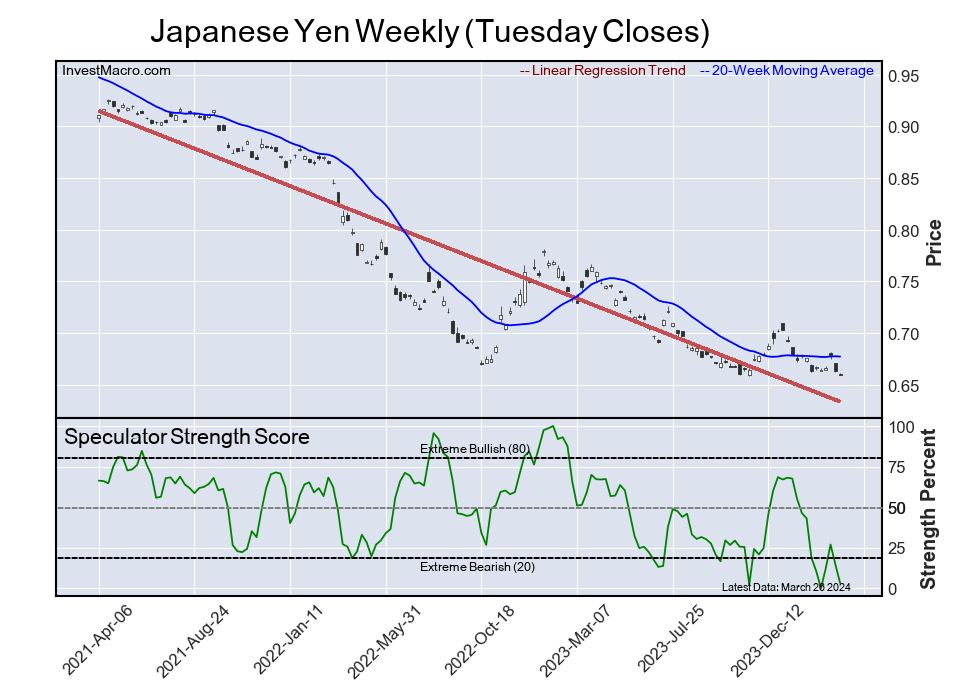
Japanese Yen Speculators sharply renew their bearish bets for 7th straight week

Highlighting the COT currency’s data this week is strong renewal in bearish bets for the Japanese yen speculators. Large speculative yen positions dropped for a seventh straight week this week and have now fallen by a total of -76,756 contracts over these past seven weeks.

This renewed bearishness for the yen has pushed the net position (currently at -132,705 contracts) to the most negative position since November 14th of 2017 (when it fell to -135,999 contracts), the lowest level in a span of 328 weeks.

Just a couple of months ago, the yen speculative positioning had been improving and was at it’s best level in 39-weeks (at -55,568 contracts on December 26th). This optimism was based on the hopes that the Bank of Japan (BOJ) would look to end its negative interest rate policy and its asset-buying program. However, the BOJ has maintained its policy so far in 2024 and speculator hopes for yen strength have been postponed.

The yen exchange rate has taken a large hit in the aftermath with the US Dollar’s exchange versus the yen shooting higher and closing in on the recent 2023 highs. The USDJPY currency pair is up by almost 7 percent since the beginning of the year and has risen in seven out of the past nine weeks. This week’s close was right above the 150.00 level is slightly below the November 2023 high of 151.90.

The USDJPY prices above the 150.00 level are very rare in recent years as these levels had not been reached since 1990 — until this threshold was breached in 2022, 2023 and now in 2024. The yen has now lost approximately 45 percent of its value versus the US Dollar since January of 2021 when the USDJPY traded around 103.00.


Currencies Net Speculators Leaderboard

Legend: Weekly Speculators Change | Speculators Current Net Position | Speculators Strength Score compared to last 3-Years (0-100 range)


Strength Scores led by Mexican Peso & British Pound

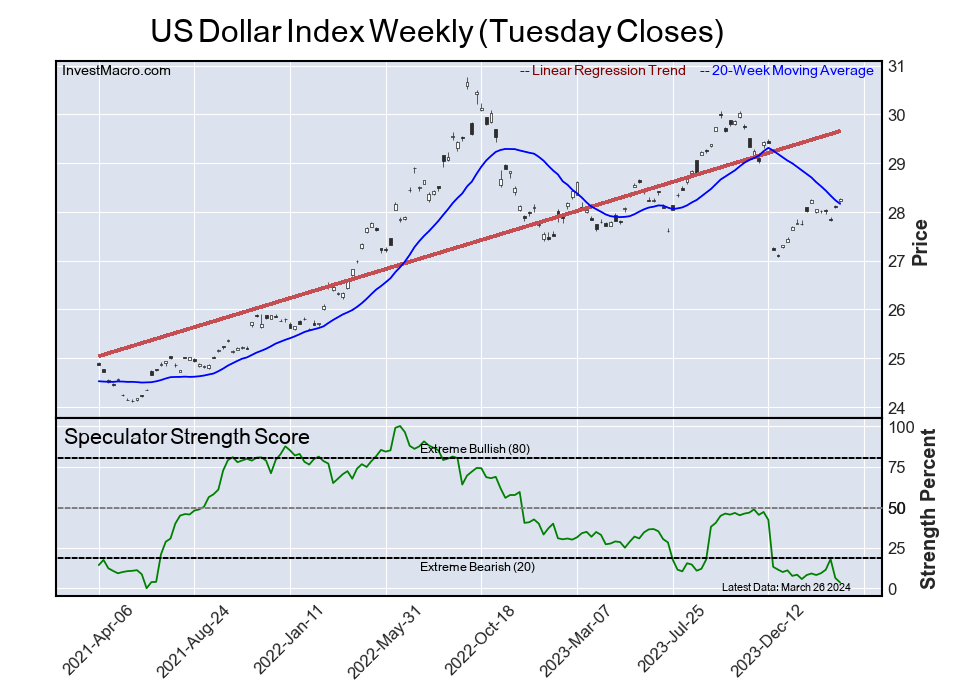
COT Strength Scores (a normalized measure of Speculator positions over a 3-Year range, from 0 to 100 where above 80 is Extreme-Bullish and below 20 is Extreme-Bearish) showed that the Mexican Peso (96 percent), the British Pound (88 percent) and New Zealand Dollar (82 percent) lead the currency markets this week. The Canadian Dollar (58 percent) and the Brazilian Real (57 percent) come in as the next highest in the weekly strength scores.

On the downside, the Japanese Yen (0 percent) and the Australian Dollar (16 percent) come in at the lowest strength levels currently and are in Extreme-Bearish territory (below 20 percent). The next lowest strength scores are the US Dollar Index (20 percent) and the Swiss Franc (25 percent).

Strength Statistics:
US Dollar Index (20.4 percent) vs US Dollar Index previous week (19.4 percent)
EuroFX (47.1 percent) vs EuroFX previous week (49.3 percent)
British Pound Sterling (87.9 percent) vs British Pound Sterling previous week (87.9 percent)
Japanese Yen (0.0 percent) vs Japanese Yen previous week (8.6 percent)
Swiss Franc (24.7 percent) vs Swiss Franc previous week (30.6 percent)
Canadian Dollar (57.9 percent) vs Canadian Dollar previous week (58.4 percent)
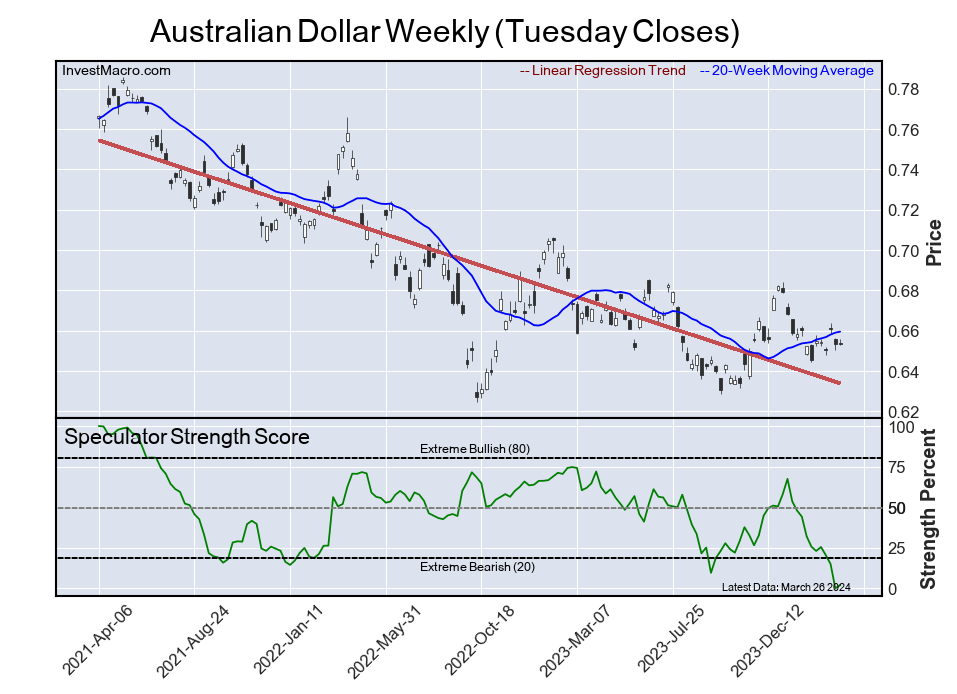
Australian Dollar (16.3 percent) vs Australian Dollar previous week (13.8 percent)
New Zealand Dollar (81.6 percent) vs New Zealand Dollar previous week (72.7 percent)
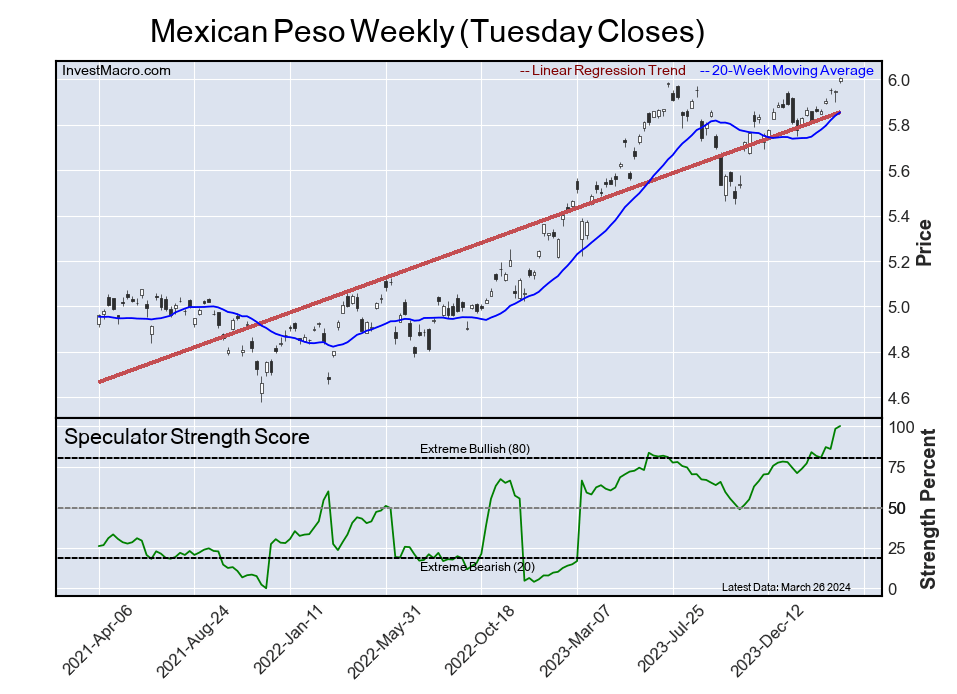
Mexican Peso (96.0 percent) vs Mexican Peso previous week (97.3 percent)
Brazilian Real (57.2 percent) vs Brazilian Real previous week (55.9 percent)
Bitcoin (36.8 percent) vs Bitcoin previous week (34.8 percent)


New Zealand Dollar & British Pound top the 6-Week Strength Trends

COT Strength Score Trends (or move index, calculates the 6-week changes in strength scores) showed that the New Zealand Dollar (34 percent) and the British Pound (11 percent) lead the past six weeks trends for the currencies. The Canadian Dollar (10 percent) and the Mexican Peso (7 percent) are the next highest positive movers in the latest trends data.

The Japanese Yen (-55 percent) leads the downside trend scores currently with the Australian Dollar (-29 percent), Swiss Franc (-24 percent) and the EuroFX (-18 percent) following next with lower trend scores.

Strength Trend Statistics:
US Dollar Index (1.5 percent) vs US Dollar Index previous week (-2.5 percent)
EuroFX (-17.6 percent) vs EuroFX previous week (-21.7 percent)
British Pound Sterling (10.7 percent) vs British Pound Sterling previous week (17.8 percent)
Japanese Yen (-54.7 percent) vs Japanese Yen previous week (-46.6 percent)
Swiss Franc (-23.5 percent) vs Swiss Franc previous week (-15.8 percent)
Canadian Dollar (10.1 percent) vs Canadian Dollar previous week (5.5 percent)
Australian Dollar (-28.7 percent) vs Australian Dollar previous week (-45.4 percent)
New Zealand Dollar (33.7 percent) vs New Zealand Dollar previous week (21.9 percent)
Mexican Peso (7.4 percent) vs Mexican Peso previous week (4.6 percent)
Brazilian Real (-9.3 percent) vs Brazilian Real previous week (-11.1 percent)
Bitcoin (-14.6 percent) vs Bitcoin previous week (-7.2 percent)


Individual COT Forex Markets:

US Dollar Index Futures:

US Dollar Index Forex Futures COT ChartThe US Dollar Index large speculator standing this week reached a net position of 2,083 contracts in the data reported through Tuesday. This was a weekly boost of 537 contracts from the previous week which had a total of 1,546 net contracts.

This week’s current strength score (the trader positioning range over the past three years, measured from 0 to 100) shows the speculators are currently Bearish with a score of 20.4 percent. The commercials are Bullish-Extreme with a score of 81.6 percent and the small traders (not shown in chart) are Bearish with a score of 25.6 percent.

Price Trend-Following Model: Downtrend

Our weekly trend-following model classifies the current market price position as: Downtrend. The current action for the model is considered to be: Hold – Maintain Short Position.

US DOLLAR INDEX StatisticsSPECULATORSCOMMERCIALSSMALL TRADERS
– Percent of Open Interest Longs:63.718.911.5
– Percent of Open Interest Shorts:56.730.27.3
– Net Position:2,083-3,3231,240
– Gross Longs:18,8275,5993,387
– Gross Shorts:16,7448,9222,147
– Long to Short Ratio:1.1 to 10.6 to 11.6 to 1
NET POSITION TREND:
– Strength Index Score (3 Year Range Pct):20.481.625.6
– Strength Index Reading (3 Year Range):BearishBullish-ExtremeBearish
NET POSITION MOVEMENT INDEX:
– 6-Week Change in Strength Index:1.5-3.714.5


Euro Currency Futures:

Euro Currency Futures COT ChartThe Euro Currency large speculator standing this week reached a net position of 62,854 contracts in the data reported through Tuesday. This was a weekly decrease of -5,162 contracts from the previous week which had a total of 68,016 net contracts.

This week’s current strength score (the trader positioning range over the past three years, measured from 0 to 100) shows the speculators are currently Bearish with a score of 47.1 percent. The commercials are Bullish with a score of 55.6 percent and the small traders (not shown in chart) are Bearish with a score of 22.1 percent.

Price Trend-Following Model: Uptrend

Our weekly trend-following model classifies the current market price position as: Uptrend. The current action for the model is considered to be: Hold – Maintain Long Position.

EURO Currency StatisticsSPECULATORSCOMMERCIALSSMALL TRADERS
– Percent of Open Interest Longs:28.757.511.2
– Percent of Open Interest Shorts:19.970.07.4
– Net Position:62,854-89,90127,047
– Gross Longs:205,234411,11780,334
– Gross Shorts:142,380501,01853,287
– Long to Short Ratio:1.4 to 10.8 to 11.5 to 1
NET POSITION TREND:
– Strength Index Score (3 Year Range Pct):47.155.622.1
– Strength Index Reading (3 Year Range):BearishBullishBearish
NET POSITION MOVEMENT INDEX:
– 6-Week Change in Strength Index:-17.617.4-8.6


British Pound Sterling Futures:

British Pound Sterling Futures COT ChartThe British Pound Sterling large speculator standing this week reached a net position of 46,358 contracts in the data reported through Tuesday. This was a weekly lift of 46 contracts from the previous week which had a total of 46,312 net contracts.

This week’s current strength score (the trader positioning range over the past three years, measured from 0 to 100) shows the speculators are currently Bullish-Extreme with a score of 87.9 percent. The commercials are Bearish-Extreme with a score of 16.8 percent and the small traders (not shown in chart) are Bullish with a score of 68.3 percent.

Price Trend-Following Model: Uptrend

Our weekly trend-following model classifies the current market price position as: Uptrend. The current action for the model is considered to be: Hold – Maintain Long Position.

BRITISH POUND StatisticsSPECULATORSCOMMERCIALSSMALL TRADERS
– Percent of Open Interest Longs:43.635.914.7
– Percent of Open Interest Shorts:21.660.412.2
– Net Position:46,358-51,5905,232
– Gross Longs:91,97075,76231,048
– Gross Shorts:45,612127,35225,816
– Long to Short Ratio:2.0 to 10.6 to 11.2 to 1
NET POSITION TREND:
– Strength Index Score (3 Year Range Pct):87.916.868.3
– Strength Index Reading (3 Year Range):Bullish-ExtremeBearish-ExtremeBullish
NET POSITION MOVEMENT INDEX:
– 6-Week Change in Strength Index:10.7-11.510.2


Japanese Yen Futures:

Japanese Yen Forex Futures COT ChartThe Japanese Yen large speculator standing this week reached a net position of -132,705 contracts in the data reported through Tuesday. This was a weekly decrease of -11,927 contracts from the previous week which had a total of -120,778 net contracts.

This week’s current strength score (the trader positioning range over the past three years, measured from 0 to 100) shows the speculators are currently Bearish-Extreme with a score of 0.0 percent. The commercials are Bullish-Extreme with a score of 98.9 percent and the small traders (not shown in chart) are Bullish-Extreme with a score of 84.9 percent.

Price Trend-Following Model: Weak Uptrend

Our weekly trend-following model classifies the current market price position as: Weak Uptrend. The current action for the model is considered to be: Hold – Maintain Long Position.

JAPANESE YEN StatisticsSPECULATORSCOMMERCIALSSMALL TRADERS
– Percent of Open Interest Longs:16.666.014.0
– Percent of Open Interest Shorts:59.423.413.7
– Net Position:-132,705131,982723
– Gross Longs:51,261204,42543,296
– Gross Shorts:183,96672,44342,573
– Long to Short Ratio:0.3 to 12.8 to 11.0 to 1
NET POSITION TREND:
– Strength Index Score (3 Year Range Pct):0.098.984.9
– Strength Index Reading (3 Year Range):Bearish-ExtremeBullish-ExtremeBullish-Extreme
NET POSITION MOVEMENT INDEX:
– 6-Week Change in Strength Index:-54.757.418.5


Swiss Franc Futures:

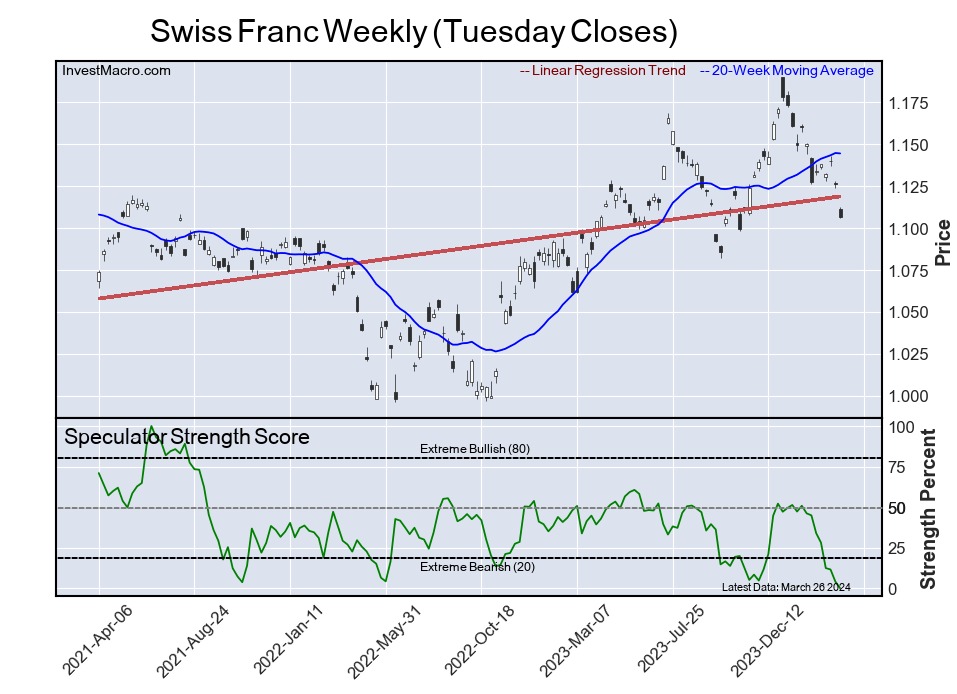
Swiss Franc Forex Futures COT ChartThe Swiss Franc large speculator standing this week reached a net position of -11,981 contracts in the data reported through Tuesday. This was a weekly fall of -2,058 contracts from the previous week which had a total of -9,923 net contracts.

This week’s current strength score (the trader positioning range over the past three years, measured from 0 to 100) shows the speculators are currently Bearish with a score of 24.7 percent. The commercials are Bullish with a score of 76.9 percent and the small traders (not shown in chart) are Bearish with a score of 23.9 percent.

Price Trend-Following Model: Weak Uptrend

Our weekly trend-following model classifies the current market price position as: Weak Uptrend. The current action for the model is considered to be: Hold – Maintain Long Position.

SWISS FRANC StatisticsSPECULATORSCOMMERCIALSSMALL TRADERS
– Percent of Open Interest Longs:24.362.412.7
– Percent of Open Interest Shorts:42.726.130.6
– Net Position:-11,98123,709-11,728
– Gross Longs:15,85740,7168,251
– Gross Shorts:27,83817,00719,979
– Long to Short Ratio:0.6 to 12.4 to 10.4 to 1
NET POSITION TREND:
– Strength Index Score (3 Year Range Pct):24.776.923.9
– Strength Index Reading (3 Year Range):BearishBullishBearish
NET POSITION MOVEMENT INDEX:
– 6-Week Change in Strength Index:-23.556.1-69.1


Canadian Dollar Futures:

Canadian Dollar Forex Futures COT ChartThe Canadian Dollar large speculator standing this week reached a net position of -1,378 contracts in the data reported through Tuesday. This was a weekly fall of -515 contracts from the previous week which had a total of -863 net contracts.

This week’s current strength score (the trader positioning range over the past three years, measured from 0 to 100) shows the speculators are currently Bullish with a score of 57.9 percent. The commercials are Bullish with a score of 51.1 percent and the small traders (not shown in chart) are Bearish with a score of 27.1 percent.

Price Trend-Following Model: Weak Uptrend

Our weekly trend-following model classifies the current market price position as: Weak Uptrend. The current action for the model is considered to be: Hold – Maintain Long Position.

CANADIAN DOLLAR StatisticsSPECULATORSCOMMERCIALSSMALL TRADERS
– Percent of Open Interest Longs:24.754.417.9
– Percent of Open Interest Shorts:25.554.716.7
– Net Position:-1,378-5731,951
– Gross Longs:41,15890,54629,731
– Gross Shorts:42,53691,11927,780
– Long to Short Ratio:1.0 to 11.0 to 11.1 to 1
NET POSITION TREND:
– Strength Index Score (3 Year Range Pct):57.951.127.1
– Strength Index Reading (3 Year Range):BullishBullishBearish
NET POSITION MOVEMENT INDEX:
– 6-Week Change in Strength Index:10.1-3.4-14.5


Australian Dollar Futures:

Australian Dollar Forex Futures COT ChartThe Australian Dollar large speculator standing this week reached a net position of -79,176 contracts in the data reported through Tuesday. This was a weekly advance of 2,699 contracts from the previous week which had a total of -81,875 net contracts.

This week’s current strength score (the trader positioning range over the past three years, measured from 0 to 100) shows the speculators are currently Bearish-Extreme with a score of 16.3 percent. The commercials are Bullish-Extreme with a score of 84.5 percent and the small traders (not shown in chart) are Bearish with a score of 27.5 percent.

Price Trend-Following Model: Weak Uptrend

Our weekly trend-following model classifies the current market price position as: Weak Uptrend. The current action for the model is considered to be: Hold – Maintain Long Position.

AUSTRALIAN DOLLAR StatisticsSPECULATORSCOMMERCIALSSMALL TRADERS
– Percent of Open Interest Longs:24.263.19.5
– Percent of Open Interest Shorts:62.819.314.6
– Net Position:-79,17689,777-10,601
– Gross Longs:49,640129,29219,390
– Gross Shorts:128,81639,51529,991
– Long to Short Ratio:0.4 to 13.3 to 10.6 to 1
NET POSITION TREND:
– Strength Index Score (3 Year Range Pct):16.384.527.5
– Strength Index Reading (3 Year Range):Bearish-ExtremeBullish-ExtremeBearish
NET POSITION MOVEMENT INDEX:
– 6-Week Change in Strength Index:-28.738.8-49.0


New Zealand Dollar Futures:

New Zealand Dollar Forex Futures COT ChartThe New Zealand Dollar large speculator standing this week reached a net position of 10,057 contracts in the data reported through Tuesday. This was a weekly gain of 3,431 contracts from the previous week which had a total of 6,626 net contracts.

This week’s current strength score (the trader positioning range over the past three years, measured from 0 to 100) shows the speculators are currently Bullish-Extreme with a score of 81.6 percent. The commercials are Bearish-Extreme with a score of 16.4 percent and the small traders (not shown in chart) are Bullish-Extreme with a score of 84.7 percent.

Price Trend-Following Model: Uptrend

Our weekly trend-following model classifies the current market price position as: Uptrend. The current action for the model is considered to be: Hold – Maintain Long Position.

NEW ZEALAND DOLLAR StatisticsSPECULATORSCOMMERCIALSSMALL TRADERS
– Percent of Open Interest Longs:49.436.110.4
– Percent of Open Interest Shorts:28.761.75.5
– Net Position:10,057-12,4252,368
– Gross Longs:23,94217,4745,020
– Gross Shorts:13,88529,8992,652
– Long to Short Ratio:1.7 to 10.6 to 11.9 to 1
NET POSITION TREND:
– Strength Index Score (3 Year Range Pct):81.616.484.7
– Strength Index Reading (3 Year Range):Bullish-ExtremeBearish-ExtremeBullish-Extreme
NET POSITION MOVEMENT INDEX:
– 6-Week Change in Strength Index:33.7-28.3-6.6


Mexican Peso Futures:

Mexican Peso Futures COT ChartThe Mexican Peso large speculator standing this week reached a net position of 93,814 contracts in the data reported through Tuesday. This was a weekly reduction of -2,181 contracts from the previous week which had a total of 95,995 net contracts.

This week’s current strength score (the trader positioning range over the past three years, measured from 0 to 100) shows the speculators are currently Bullish-Extreme with a score of 96.0 percent. The commercials are Bearish-Extreme with a score of 3.6 percent and the small traders (not shown in chart) are Bearish with a score of 43.6 percent.

Price Trend-Following Model: Uptrend

Our weekly trend-following model classifies the current market price position as: Uptrend. The current action for the model is considered to be: Hold – Maintain Long Position.

MEXICAN PESO StatisticsSPECULATORSCOMMERCIALSSMALL TRADERS
– Percent of Open Interest Longs:57.138.93.1
– Percent of Open Interest Shorts:20.477.61.1
– Net Position:93,814-98,8955,081
– Gross Longs:146,11899,7277,980
– Gross Shorts:52,304198,6222,899
– Long to Short Ratio:2.8 to 10.5 to 12.8 to 1
NET POSITION TREND:
– Strength Index Score (3 Year Range Pct):96.03.643.6
– Strength Index Reading (3 Year Range):Bullish-ExtremeBearish-ExtremeBearish
NET POSITION MOVEMENT INDEX:
– 6-Week Change in Strength Index:7.4-7.42.6


Brazilian Real Futures:

Brazil Real Futures COT ChartThe Brazilian Real large speculator standing this week reached a net position of 17,526 contracts in the data reported through Tuesday. This was a weekly gain of 1,004 contracts from the previous week which had a total of 16,522 net contracts.

This week’s current strength score (the trader positioning range over the past three years, measured from 0 to 100) shows the speculators are currently Bullish with a score of 57.2 percent. The commercials are Bearish with a score of 41.5 percent and the small traders (not shown in chart) are Bullish with a score of 53.7 percent.

Price Trend-Following Model: Weak Uptrend

Our weekly trend-following model classifies the current market price position as: Weak Uptrend. The current action for the model is considered to be: Hold – Maintain Long Position.

BRAZIL REAL StatisticsSPECULATORSCOMMERCIALSSMALL TRADERS
– Percent of Open Interest Longs:47.443.44.6
– Percent of Open Interest Shorts:23.370.31.7
– Net Position:17,526-19,5922,066
– Gross Longs:34,55031,6533,337
– Gross Shorts:17,02451,2451,271
– Long to Short Ratio:2.0 to 10.6 to 12.6 to 1
NET POSITION TREND:
– Strength Index Score (3 Year Range Pct):57.241.553.7
– Strength Index Reading (3 Year Range):BullishBearishBullish
NET POSITION MOVEMENT INDEX:
– 6-Week Change in Strength Index:-9.39.3-2.0


Bitcoin Futures:

Bitcoin Crypto Futures COT ChartThe Bitcoin large speculator standing this week reached a net position of -1,967 contracts in the data reported through Tuesday. This was a weekly gain of 131 contracts from the previous week which had a total of -2,098 net contracts.

This week’s current strength score (the trader positioning range over the past three years, measured from 0 to 100) shows the speculators are currently Bearish with a score of 36.8 percent. The commercials are Bullish-Extreme with a score of 89.1 percent and the small traders (not shown in chart) are Bearish with a score of 35.8 percent.

Price Trend-Following Model: Strong Uptrend

Our weekly trend-following model classifies the current market price position as: Strong Uptrend. The current action for the model is considered to be: Hold – Maintain Long Position.

BITCOIN StatisticsSPECULATORSCOMMERCIALSSMALL TRADERS
– Percent of Open Interest Longs:79.47.06.8
– Percent of Open Interest Shorts:87.23.22.8
– Net Position:-1,9679601,007
– Gross Longs:20,0341,7591,726
– Gross Shorts:22,001799719
– Long to Short Ratio:0.9 to 12.2 to 12.4 to 1
NET POSITION TREND:
– Strength Index Score (3 Year Range Pct):36.889.135.8
– Strength Index Reading (3 Year Range):BearishBullish-ExtremeBearish
NET POSITION MOVEMENT INDEX:
– 6-Week Change in Strength Index:-14.625.1-0.3


Article By InvestMacroReceive our weekly COT Newsletter

*COT Report: The COT data, released weekly to the public each Friday, is updated through the most recent Tuesday (data is 3 days old) and shows a quick view of how large speculators or non-commercials (for-profit traders) were positioned in the futures markets.

The CFTC categorizes trader positions according to commercial hedgers (traders who use futures contracts for hedging as part of the business), non-commercials (large traders who speculate to realize trading profits) and nonreportable traders (usually small traders/speculators) as well as their open interest (contracts open in the market at time of reporting). See CFTC criteria here.

COT Metals Charts: Speculator bets led by Copper

By InvestMacro

Here are the latest charts and statistics for the Commitment of Traders (COT) data published by the Commodities Futures Trading Commission (CFTC).

The latest COT data is updated through Tuesday February 27th and shows a quick view of how large traders (for-profit speculators and commercial entities) were positioned in the futures markets.

Weekly Speculator Changes led by Copper

The COT metals markets speculator bets were mixed this week as three out of the six metals markets we cover had higher positioning while the other three markets had lower speculator contracts.

Leading the gains for the metals was Copper (14,339 contracts) with Gold (1,374 contracts) and Palladium (138 contracts) also showing positive weeks.

The markets with declines in speculator bets for the week were Silver (-7,878 contracts), Platinum (-4,894 contracts) and Steel with a dip of -234 contracts.


Net Speculators Leaderboard

Legend: Weekly Speculators Change | Speculators Current Net Position | Speculators Strength Score compared to last 3-Years (0-100 range)


Strength Scores led by Steel

COT Strength Scores (a normalized measure of Speculator positions over a 3-Year range, from 0 to 100 where above 80 is Extreme-Bullish and below 20 is Extreme-Bearish) showed that Steel (85 percent) leads the metals markets this week.

On the downside, Palladium (7 percent) comes in at the lowest strength level currently and is in Extreme-Bearish territory (below 20 percent). The next lowest strength score was Platinum (26 percent) this week.

Strength Statistics:
Gold (40.3 percent) vs Gold previous week (39.7 percent)
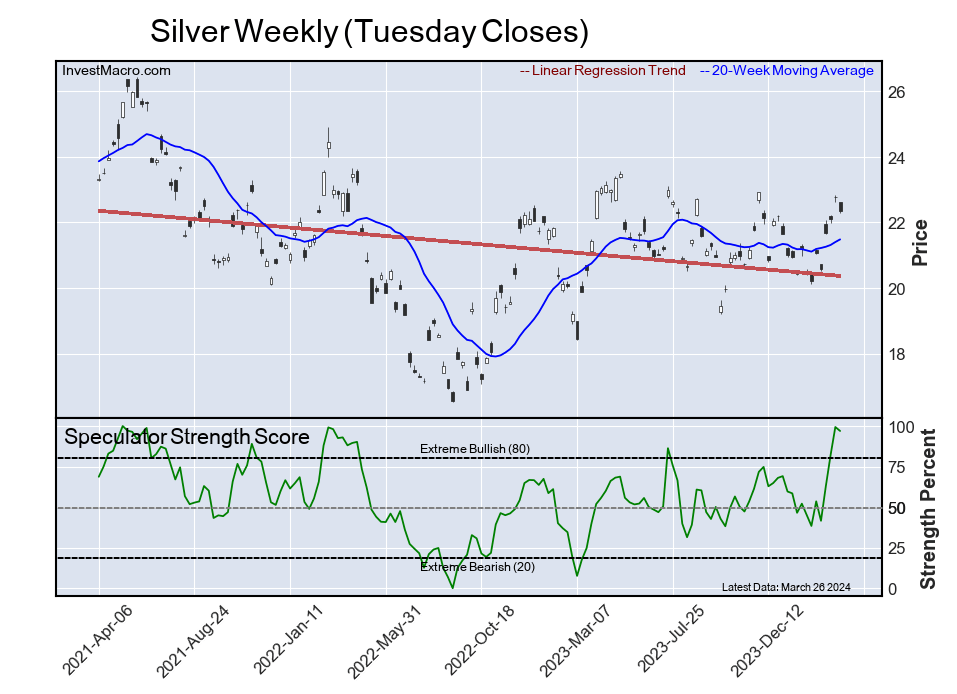
Silver (41.6 percent) vs Silver previous week (53.6 percent)
Copper (38.1 percent) vs Copper previous week (22.1 percent)
Platinum (26.2 percent) vs Platinum previous week (38.6 percent)
Palladium (7.2 percent) vs Palladium previous week (6.4 percent)
Steel (85.1 percent) vs Palladium previous week (86.0 percent)


Copper tops the 6-Week Strength Trends

COT Strength Score Trends (or move index, calculates the 6-week changes in strength scores) showed that Copper (26 percent) leads the past six weeks trends for metals and is the only positive mover in the latest data.

Platinum (-23 percent), Gold (-17 percent) and Silver (-17 percent) lead the downside trend scores this week.

Move Statistics:
Gold (-17.2 percent) vs Gold previous week (-21.8 percent)
Silver (-16.9 percent) vs Silver previous week (-6.1 percent)
Copper (26.5 percent) vs Copper previous week (-3.1 percent)
Platinum (-22.7 percent) vs Platinum previous week (-38.1 percent)
Palladium (-5.2 percent) vs Palladium previous week (-18.0 percent)
Steel (-4.4 percent) vs Steel previous week (-4.7 percent)


Individual Markets:

Gold Comex Futures:

Gold Futures COT ChartThe Gold Comex Futures large speculator standing this week reached a net position of 141,636 contracts in the data reported through Tuesday. This was a weekly gain of 1,374 contracts from the previous week which had a total of 140,262 net contracts.

This week’s current strength score (the trader positioning range over the past three years, measured from 0 to 100) shows the speculators are currently Bearish with a score of 40.3 percent. The commercials are Bullish with a score of 60.7 percent and the small traders (not shown in chart) are Bearish with a score of 27.9 percent.

Price Trend-Following Model: Strong Uptrend

Our weekly trend-following model classifies the current market price position as: Strong Uptrend. The current action for the model is considered to be: Hold – Maintain Long Position.

Gold Futures StatisticsSPECULATORSCOMMERCIALSSMALL TRADERS
– Percent of Open Interest Longs:52.326.49.5
– Percent of Open Interest Shorts:17.864.95.4
– Net Position:141,636-158,35216,716
– Gross Longs:214,948108,43238,943
– Gross Shorts:73,312266,78422,227
– Long to Short Ratio:2.9 to 10.4 to 11.8 to 1
NET POSITION TREND:
– Strength Index Score (3 Year Range Pct):40.360.727.9
– Strength Index Reading (3 Year Range):BearishBullishBearish
NET POSITION MOVEMENT INDEX:
– 6-Week Change in Strength Index:-17.220.0-34.7


Silver Comex Futures:

Silver Futures COT ChartThe Silver Comex Futures large speculator standing this week reached a net position of 14,499 contracts in the data reported through Tuesday. This was a weekly fall of -7,878 contracts from the previous week which had a total of 22,377 net contracts.

This week’s current strength score (the trader positioning range over the past three years, measured from 0 to 100) shows the speculators are currently Bearish with a score of 41.6 percent. The commercials are Bullish with a score of 52.8 percent and the small traders (not shown in chart) are Bullish with a score of 66.3 percent.

Price Trend-Following Model: Downtrend

Our weekly trend-following model classifies the current market price position as: Downtrend. The current action for the model is considered to be: Hold – Maintain Short Position.

Silver Futures StatisticsSPECULATORSCOMMERCIALSSMALL TRADERS
– Percent of Open Interest Longs:37.834.021.5
– Percent of Open Interest Shorts:27.756.59.0
– Net Position:14,499-32,44817,949
– Gross Longs:54,54649,11230,987
– Gross Shorts:40,04781,56013,038
– Long to Short Ratio:1.4 to 10.6 to 12.4 to 1
NET POSITION TREND:
– Strength Index Score (3 Year Range Pct):41.652.866.3
– Strength Index Reading (3 Year Range):BearishBullishBullish
NET POSITION MOVEMENT INDEX:
– 6-Week Change in Strength Index:-16.914.2-1.2


Copper Grade #1 Futures:

Copper Futures COT ChartThe Copper Grade #1 Futures large speculator standing this week reached a net position of -1,603 contracts in the data reported through Tuesday. This was a weekly boost of 14,339 contracts from the previous week which had a total of -15,942 net contracts.

This week’s current strength score (the trader positioning range over the past three years, measured from 0 to 100) shows the speculators are currently Bearish with a score of 38.1 percent. The commercials are Bullish with a score of 65.3 percent and the small traders (not shown in chart) are Bearish with a score of 26.8 percent.

Price Trend-Following Model: Uptrend

Our weekly trend-following model classifies the current market price position as: Uptrend. The current action for the model is considered to be: Hold – Maintain Long Position.

Copper Futures StatisticsSPECULATORSCOMMERCIALSSMALL TRADERS
– Percent of Open Interest Longs:36.736.78.5
– Percent of Open Interest Shorts:37.636.57.8
– Net Position:-1,6032801,323
– Gross Longs:69,67369,61416,214
– Gross Shorts:71,27669,33414,891
– Long to Short Ratio:1.0 to 11.0 to 11.1 to 1
NET POSITION TREND:
– Strength Index Score (3 Year Range Pct):38.165.326.8
– Strength Index Reading (3 Year Range):BearishBullishBearish
NET POSITION MOVEMENT INDEX:
– 6-Week Change in Strength Index:26.5-23.0-7.1


Platinum Futures:

Platinum Futures COT ChartThe Platinum Futures large speculator standing this week reached a net position of 3,601 contracts in the data reported through Tuesday. This was a weekly lowering of -4,894 contracts from the previous week which had a total of 8,495 net contracts.

This week’s current strength score (the trader positioning range over the past three years, measured from 0 to 100) shows the speculators are currently Bearish with a score of 26.2 percent. The commercials are Bullish with a score of 72.0 percent and the small traders (not shown in chart) are Bearish with a score of 43.0 percent.

Price Trend-Following Model: Strong Downtrend

Our weekly trend-following model classifies the current market price position as: Strong Downtrend. The current action for the model is considered to be: New Sell – Short Position.

Platinum Futures StatisticsSPECULATORSCOMMERCIALSSMALL TRADERS
– Percent of Open Interest Longs:56.823.410.8
– Percent of Open Interest Shorts:52.733.94.4
– Net Position:3,601-9,2015,600
– Gross Longs:49,89820,5709,492
– Gross Shorts:46,29729,7713,892
– Long to Short Ratio:1.1 to 10.7 to 12.4 to 1
NET POSITION TREND:
– Strength Index Score (3 Year Range Pct):26.272.043.0
– Strength Index Reading (3 Year Range):BearishBullishBearish
NET POSITION MOVEMENT INDEX:
– 6-Week Change in Strength Index:-22.721.1-4.5


Palladium Futures:

Palladium Futures COT ChartThe Palladium Futures large speculator standing this week reached a net position of -12,315 contracts in the data reported through Tuesday. This was a weekly increase of 138 contracts from the previous week which had a total of -12,453 net contracts.

This week’s current strength score (the trader positioning range over the past three years, measured from 0 to 100) shows the speculators are currently Bearish-Extreme with a score of 7.2 percent. The commercials are Bullish-Extreme with a score of 95.5 percent and the small traders (not shown in chart) are Bearish with a score of 44.2 percent.

Price Trend-Following Model: Downtrend

Our weekly trend-following model classifies the current market price position as: Downtrend. The current action for the model is considered to be: Hold – Maintain Short Position.

Palladium Futures StatisticsSPECULATORSCOMMERCIALSSMALL TRADERS
– Percent of Open Interest Longs:20.762.78.0
– Percent of Open Interest Shorts:78.55.27.8
– Net Position:-12,31512,27342
– Gross Longs:4,41113,3721,708
– Gross Shorts:16,7261,0991,666
– Long to Short Ratio:0.3 to 112.2 to 11.0 to 1
NET POSITION TREND:
– Strength Index Score (3 Year Range Pct):7.295.544.2
– Strength Index Reading (3 Year Range):Bearish-ExtremeBullish-ExtremeBearish
NET POSITION MOVEMENT INDEX:
– 6-Week Change in Strength Index:-5.28.3-32.0


Steel Futures Futures:

Steel Futures COT ChartThe Steel Futures large speculator standing this week reached a net position of -2,935 contracts in the data reported through Tuesday. This was a weekly fall of -234 contracts from the previous week which had a total of -2,701 net contracts.

This week’s current strength score (the trader positioning range over the past three years, measured from 0 to 100) shows the speculators are currently Bullish-Extreme with a score of 85.1 percent. The commercials are Bearish-Extreme with a score of 15.5 percent and the small traders (not shown in chart) are Bearish with a score of 41.8 percent.

Price Trend-Following Model: Weak Uptrend

Our weekly trend-following model classifies the current market price position as: Weak Uptrend. The current action for the model is considered to be: Hold – Maintain Long Position.

Steel Futures StatisticsSPECULATORSCOMMERCIALSSMALL TRADERS
– Percent of Open Interest Longs:11.282.81.0
– Percent of Open Interest Shorts:22.472.00.7
– Net Position:-2,9352,84986
– Gross Longs:2,93721,733269
– Gross Shorts:5,87218,884183
– Long to Short Ratio:0.5 to 11.2 to 11.5 to 1
NET POSITION TREND:
– Strength Index Score (3 Year Range Pct):85.115.541.8
– Strength Index Reading (3 Year Range):Bullish-ExtremeBearish-ExtremeBearish
NET POSITION MOVEMENT INDEX:
– 6-Week Change in Strength Index:-4.44.8-12.3


Article By InvestMacroReceive our weekly COT Newsletter

*COT Report: The COT data, released weekly to the public each Friday, is updated through the most recent Tuesday (data is 3 days old) and shows a quick view of how large speculators or non-commercials (for-profit traders) were positioned in the futures markets.

The CFTC categorizes trader positions according to commercial hedgers (traders who use futures contracts for hedging as part of the business), non-commercials (large traders who speculate to realize trading profits) and nonreportable traders (usually small traders/speculators) as well as their open interest (contracts open in the market at time of reporting). See CFTC criteria here.

COT Bonds Charts: Speculator bets led by 2-Year Bonds & US Treasury Bonds

By InvestMacro

Here are the latest charts and statistics for the Commitment of Traders (COT) reports data published by the Commodities Futures Trading Commission (CFTC).

The latest COT data is updated through Tuesday February 27th and shows a quick view of how large traders (for-profit speculators and commercial hedgers) were positioned in the futures markets.

Weekly Speculator Changes led by 2-Year Bonds & US Treasury Bonds

The COT bond market speculator bets were overall higher this week as seven out of the eight bond markets we cover had higher positioning while the other one markets had lower speculator contracts.

Leading the gains for the bond markets was the 2-Year Bonds (165,226 contracts) with the US Treasury Bonds (80,756 contracts), the 10-Year Bonds (63,484 contracts), the 5-Year Bonds (37,907 contracts), the SOFR 3-Months (5,584 contracts), the Ultra Treasury Bonds (2,977 contracts) and the Ultra 10-Year Bonds (1,139 contracts) also having positive weeks.

The only market with a decline was the Fed Funds with a drop by -58,874 contracts for the week.


Bonds Net Speculators Leaderboard

Legend: Weekly Speculators Change | Speculators Current Net Position | Speculators Strength Score compared to last 3-Years (0-100 range)


Strength Scores led by SOFR 3-Months & US Treasury Bonds

COT Strength Scores (a normalized measure of Speculator positions over a 3-Year range, from 0 to 100 where above 80 is Extreme-Bullish and below 20 is Extreme-Bearish) showed that the SOFR 3-Months (80 percent) and the US Treasury Bonds (79 percent) lead the bond markets this week. The Ultra Treasury Bonds (57 percent) comes in as the next highest in the weekly strength scores.

On the downside, the Ultra 10-Year Bonds (16 percent) and the 5-Year Bonds (17 percent) come in at the lowest strength level currently and are in Extreme-Bearish territory (below 20 percent). The next lowest strength scores were the 10-Year Bonds (21 percent) and the Fed Funds (21 percent).

Strength Statistics:
Fed Funds (21.3 percent) vs Fed Funds previous week (33.8 percent)
2-Year Bond (34.0 percent) vs 2-Year Bond previous week (23.5 percent)
5-Year Bond (17.5 percent) vs 5-Year Bond previous week (15.0 percent)
10-Year Bond (20.9 percent) vs 10-Year Bond previous week (15.0 percent)
Ultra 10-Year Bond (16.0 percent) vs Ultra 10-Year Bond previous week (15.8 percent)
US Treasury Bond (78.6 percent) vs US Treasury Bond previous week (50.5 percent)
Ultra US Treasury Bond (56.9 percent) vs Ultra US Treasury Bond previous week (55.7 percent)
SOFR 3-Months (79.6 percent) vs SOFR 3-Months previous week (79.3 percent)


US Treasury Bonds & 10-Year Bonds top the 6-Week Strength Trends

COT Strength Score Trends (or move index, calculates the 6-week changes in strength scores) showed that the US Treasury Bonds (40 percent) and the 10-Year Bonds (21 percent) lead the past six weeks trends for bonds. The 2-Year Bonds (17 percent) are the next highest positive mover in the latest trends data.

The Fed Funds (-33 percent) and the SOFR 3-Months (-19 percent) lead the downside trend scores currently with the Ultra 10-Year Bonds (-5 percent) following next with lower trend scores.

Strength Trend Statistics:
Fed Funds (-33.2 percent) vs Fed Funds previous week (-5.6 percent)
2-Year Bond (16.5 percent) vs 2-Year Bond previous week (8.3 percent)
5-Year Bond (0.1 percent) vs 5-Year Bond previous week (-4.0 percent)
10-Year Bond (20.9 percent) vs 10-Year Bond previous week (5.4 percent)
Ultra 10-Year Bond (-5.4 percent) vs Ultra 10-Year Bond previous week (-3.1 percent)
US Treasury Bond (39.6 percent) vs US Treasury Bond previous week (21.2 percent)
Ultra US Treasury Bond (1.2 percent) vs Ultra US Treasury Bond previous week (-4.0 percent)
SOFR 3-Months (-19.5 percent) vs SOFR 3-Months previous week (-16.4 percent)


Secured Overnight Financing Rate (3-Month) Futures:

SOFR 3-Months Bonds Futures COT ChartThe Secured Overnight Financing Rate (3-Month) large speculator standing this week resulted in a net position of 373,974 contracts in the data reported through Tuesday. This was a weekly lift of 5,584 contracts from the previous week which had a total of 368,390 net contracts.

This week’s current strength score (the trader positioning range over the past three years, measured from 0 to 100) shows the speculators are currently Bullish with a score of 79.6 percent. The commercials are Bearish with a score of 20.6 percent and the small traders (not shown in chart) are Bullish-Extreme with a score of 84.0 percent.

Price Trend-Following Model: Weak Uptrend

Our weekly trend-following model classifies the current market price position as: Weak Uptrend. The current action for the model is considered to be: Hold – Maintain Long Position.

SOFR 3-Months StatisticsSPECULATORSCOMMERCIALSSMALL TRADERS
– Percent of Open Interest Longs:16.954.70.2
– Percent of Open Interest Shorts:13.458.10.3
– Net Position:373,974-366,966-7,008
– Gross Longs:1,825,9585,914,86126,690
– Gross Shorts:1,451,9846,281,82733,698
– Long to Short Ratio:1.3 to 10.9 to 10.8 to 1
NET POSITION TREND:
– Strength Index Score (3 Year Range Pct):79.620.684.0
– Strength Index Reading (3 Year Range):BullishBearishBullish-Extreme
NET POSITION MOVEMENT INDEX:
– 6-Week Change in Strength Index:-19.519.6-0.4


30-Day Federal Funds Futures:

Federal Funds 30-Day Bonds Futures COT ChartThe 30-Day Federal Funds large speculator standing this week resulted in a net position of -221,404 contracts in the data reported through Tuesday. This was a weekly lowering of -58,874 contracts from the previous week which had a total of -162,530 net contracts.

This week’s current strength score (the trader positioning range over the past three years, measured from 0 to 100) shows the speculators are currently Bearish with a score of 21.3 percent. The commercials are Bullish with a score of 77.1 percent and the small traders (not shown in chart) are Bullish-Extreme with a score of 87.7 percent.

Price Trend-Following Model: Downtrend

Our weekly trend-following model classifies the current market price position as: Downtrend. The current action for the model is considered to be: Hold – Maintain Short Position.

30-Day Federal Funds StatisticsSPECULATORSCOMMERCIALSSMALL TRADERS
– Percent of Open Interest Longs:13.070.31.7
– Percent of Open Interest Shorts:23.959.31.8
– Net Position:-221,404223,075-1,671
– Gross Longs:264,2441,427,60934,288
– Gross Shorts:485,6481,204,53435,959
– Long to Short Ratio:0.5 to 11.2 to 11.0 to 1
NET POSITION TREND:
– Strength Index Score (3 Year Range Pct):21.377.187.7
– Strength Index Reading (3 Year Range):BearishBullishBullish-Extreme
NET POSITION MOVEMENT INDEX:
– 6-Week Change in Strength Index:-33.229.433.2


2-Year Treasury Note Futures:

2-Year Treasury Bonds Futures COT ChartThe 2-Year Treasury Note large speculator standing this week resulted in a net position of -943,898 contracts in the data reported through Tuesday. This was a weekly lift of 165,226 contracts from the previous week which had a total of -1,109,124 net contracts.

This week’s current strength score (the trader positioning range over the past three years, measured from 0 to 100) shows the speculators are currently Bearish with a score of 34.0 percent. The commercials are Bullish with a score of 62.0 percent and the small traders (not shown in chart) are Bullish-Extreme with a score of 95.0 percent.

Price Trend-Following Model: Uptrend

Our weekly trend-following model classifies the current market price position as: Uptrend. The current action for the model is considered to be: Hold – Maintain Long Position.

2-Year Treasury Note StatisticsSPECULATORSCOMMERCIALSSMALL TRADERS
– Percent of Open Interest Longs:10.380.47.1
– Percent of Open Interest Shorts:35.358.93.5
– Net Position:-943,898809,780134,118
– Gross Longs:387,1383,030,544267,240
– Gross Shorts:1,331,0362,220,764133,122
– Long to Short Ratio:0.3 to 11.4 to 12.0 to 1
NET POSITION TREND:
– Strength Index Score (3 Year Range Pct):34.062.095.0
– Strength Index Reading (3 Year Range):BearishBullishBullish-Extreme
NET POSITION MOVEMENT INDEX:
– 6-Week Change in Strength Index:16.5-20.27.6


5-Year Treasury Note Futures:

5-Year Treasury Bonds Futures COT ChartThe 5-Year Treasury Note large speculator standing this week resulted in a net position of -1,195,393 contracts in the data reported through Tuesday. This was a weekly advance of 37,907 contracts from the previous week which had a total of -1,233,300 net contracts.

This week’s current strength score (the trader positioning range over the past three years, measured from 0 to 100) shows the speculators are currently Bearish-Extreme with a score of 17.5 percent. The commercials are Bullish with a score of 79.0 percent and the small traders (not shown in chart) are Bullish-Extreme with a score of 91.8 percent.

Price Trend-Following Model: Uptrend

Our weekly trend-following model classifies the current market price position as: Uptrend. The current action for the model is considered to be: Hold – Maintain Long Position.

5-Year Treasury Note StatisticsSPECULATORSCOMMERCIALSSMALL TRADERS
– Percent of Open Interest Longs:6.383.87.1
– Percent of Open Interest Shorts:26.066.34.8
– Net Position:-1,195,3931,058,803136,590
– Gross Longs:382,3965,074,656428,067
– Gross Shorts:1,577,7894,015,853291,477
– Long to Short Ratio:0.2 to 11.3 to 11.5 to 1
NET POSITION TREND:
– Strength Index Score (3 Year Range Pct):17.579.091.8
– Strength Index Reading (3 Year Range):Bearish-ExtremeBullishBullish-Extreme
NET POSITION MOVEMENT INDEX:
– 6-Week Change in Strength Index:0.11.0-3.1


10-Year Treasury Note Futures:

10-Year Treasury Notes Bonds Futures COT ChartThe 10-Year Treasury Note large speculator standing this week resulted in a net position of -665,582 contracts in the data reported through Tuesday. This was a weekly boost of 63,484 contracts from the previous week which had a total of -729,066 net contracts.

This week’s current strength score (the trader positioning range over the past three years, measured from 0 to 100) shows the speculators are currently Bearish with a score of 20.9 percent. The commercials are Bullish with a score of 73.7 percent and the small traders (not shown in chart) are Bullish-Extreme with a score of 84.2 percent.

Price Trend-Following Model: Uptrend

Our weekly trend-following model classifies the current market price position as: Uptrend. The current action for the model is considered to be: Hold – Maintain Long Position.

10-Year Treasury Note StatisticsSPECULATORSCOMMERCIALSSMALL TRADERS
– Percent of Open Interest Longs:10.577.19.5
– Percent of Open Interest Shorts:25.263.58.4
– Net Position:-665,582616,38549,197
– Gross Longs:474,5293,492,870429,894
– Gross Shorts:1,140,1112,876,485380,697
– Long to Short Ratio:0.4 to 11.2 to 11.1 to 1
NET POSITION TREND:
– Strength Index Score (3 Year Range Pct):20.973.784.2
– Strength Index Reading (3 Year Range):BearishBullishBullish-Extreme
NET POSITION MOVEMENT INDEX:
– 6-Week Change in Strength Index:20.9-26.3-3.8


Ultra 10-Year Notes Futures:

Ultra 10-Year Treasury Notes Bonds Futures COT ChartThe Ultra 10-Year Notes large speculator standing this week resulted in a net position of -189,900 contracts in the data reported through Tuesday. This was a weekly gain of 1,139 contracts from the previous week which had a total of -191,039 net contracts.

This week’s current strength score (the trader positioning range over the past three years, measured from 0 to 100) shows the speculators are currently Bearish-Extreme with a score of 16.0 percent. The commercials are Bullish-Extreme with a score of 83.6 percent and the small traders (not shown in chart) are Bullish with a score of 71.3 percent.

Price Trend-Following Model: Weak Uptrend

Our weekly trend-following model classifies the current market price position as: Weak Uptrend. The current action for the model is considered to be: Hold – Maintain Long Position.

Ultra 10-Year Notes StatisticsSPECULATORSCOMMERCIALSSMALL TRADERS
– Percent of Open Interest Longs:12.575.59.4
– Percent of Open Interest Shorts:21.063.812.6
– Net Position:-189,900261,839-71,939
– Gross Longs:281,6551,696,545210,640
– Gross Shorts:471,5551,434,706282,579
– Long to Short Ratio:0.6 to 11.2 to 10.7 to 1
NET POSITION TREND:
– Strength Index Score (3 Year Range Pct):16.083.671.3
– Strength Index Reading (3 Year Range):Bearish-ExtremeBullish-ExtremeBullish
NET POSITION MOVEMENT INDEX:
– 6-Week Change in Strength Index:-5.45.12.5


US Treasury Bonds Futures:

US Year Treasury Notes Long Bonds Futures COT ChartThe US Treasury Bonds large speculator standing this week resulted in a net position of -14,038 contracts in the data reported through Tuesday. This was a weekly gain of 80,756 contracts from the previous week which had a total of -94,794 net contracts.

This week’s current strength score (the trader positioning range over the past three years, measured from 0 to 100) shows the speculators are currently Bullish with a score of 78.6 percent. The commercials are Bearish-Extreme with a score of 0.0 percent and the small traders (not shown in chart) are Bullish-Extreme with a score of 83.0 percent.

Price Trend-Following Model: Uptrend

Our weekly trend-following model classifies the current market price position as: Uptrend. The current action for the model is considered to be: Hold – Maintain Long Position.

US Treasury Bonds StatisticsSPECULATORSCOMMERCIALSSMALL TRADERS
– Percent of Open Interest Longs:15.566.213.1
– Percent of Open Interest Shorts:16.468.410.0
– Net Position:-14,038-33,38247,420
– Gross Longs:237,9781,015,447201,594
– Gross Shorts:252,0161,048,829154,174
– Long to Short Ratio:0.9 to 11.0 to 11.3 to 1
NET POSITION TREND:
– Strength Index Score (3 Year Range Pct):78.60.083.0
– Strength Index Reading (3 Year Range):BullishBearish-ExtremeBullish-Extreme
NET POSITION MOVEMENT INDEX:
– 6-Week Change in Strength Index:39.6-41.0-7.4


Ultra US Treasury Bonds Futures:

Ultra US Year Treasury Notes Long Bonds Futures COT ChartThe Ultra US Treasury Bonds large speculator standing this week resulted in a net position of -319,783 contracts in the data reported through Tuesday. This was a weekly lift of 2,977 contracts from the previous week which had a total of -322,760 net contracts.

This week’s current strength score (the trader positioning range over the past three years, measured from 0 to 100) shows the speculators are currently Bullish with a score of 56.9 percent. The commercials are Bearish with a score of 37.1 percent and the small traders (not shown in chart) are Bullish with a score of 67.4 percent.

Price Trend-Following Model: Uptrend

Our weekly trend-following model classifies the current market price position as: Uptrend. The current action for the model is considered to be: Hold – Maintain Long Position.

Ultra US Treasury Bonds StatisticsSPECULATORSCOMMERCIALSSMALL TRADERS
– Percent of Open Interest Longs:8.877.510.8
– Percent of Open Interest Shorts:28.160.28.9
– Net Position:-319,783287,81831,965
– Gross Longs:146,3361,287,850179,326
– Gross Shorts:466,1191,000,032147,361
– Long to Short Ratio:0.3 to 11.3 to 11.2 to 1
NET POSITION TREND:
– Strength Index Score (3 Year Range Pct):56.937.167.4
– Strength Index Reading (3 Year Range):BullishBearishBullish
NET POSITION MOVEMENT INDEX:
– 6-Week Change in Strength Index:1.2-9.214.6


Article By InvestMacroReceive our weekly COT Newsletter

*COT Report: The COT data, released weekly to the public each Friday, is updated through the most recent Tuesday (data is 3 days old) and shows a quick view of how large speculators or non-commercials (for-profit traders) were positioned in the futures markets.

The CFTC categorizes trader positions according to commercial hedgers (traders who use futures contracts for hedging as part of the business), non-commercials (large traders who speculate to realize trading profits) and nonreportable traders (usually small traders/speculators) as well as their open interest (contracts open in the market at time of reporting). See CFTC criteria here.

COT Stock Market Charts: Speculator bets led by MSCI EAFE-Mini & Russell-Mini

By InvestMacro

Here are the latest charts and statistics for the Commitment of Traders (COT) data published by the Commodities Futures Trading Commission (CFTC).

The latest COT data is updated through Tuesday February 27th and shows a quick view of how large traders (for-profit speculators and commercial entities) were positioned in the futures markets.

Weekly Speculator Changes led by MSCI EAFE-Mini & Russell-Mini

The COT stock markets speculator bets were slightly lower this week as three out of the seven stock markets we cover had higher positioning while the other four markets had lower speculator contracts.

Leading the gains for the stock markets was the MSCI EAFE-Mini (14,518 contracts) with the Russell-Mini (5,977 contracts) and the DowJones-Mini (1,460 contracts) also showing positive weeks.

The markets with declines in speculator bets this week were the Nasdaq-Mini (-15,315 contracts), the S&P500-Mini (-5,693 contracts), the Nikkei 225 (-1,574 contracts) and the VIX (-1,633 contracts).


Net Speculators Leaderboard

Legend: Weekly Speculators Change | Speculators Current Net Position | Speculators Strength Score compared to last 3-Years (0-100 range)


Strength Scores led by DowJones-Mini & VIX

COT Strength Scores (a normalized measure of Speculator positions over a 3-Year range, from 0 to 100 where above 80 is Extreme-Bullish and below 20 is Extreme-Bearish) showed that the DowJones-Mini (90 percent) and the VIX (77 percent) lead the stock markets this week. The Russell-Mini (72 percent) comes in as the next highest in the weekly strength scores.

On the downside, the Nikkei 225 (29 percent) and the S&P500-Mini (31 percent) come in at the lowest strength levels currently.

Strength Statistics:
VIX (77.0 percent) vs VIX previous week (78.4 percent)
S&P500-Mini (31.3 percent) vs S&P500-Mini previous week (32.2 percent)
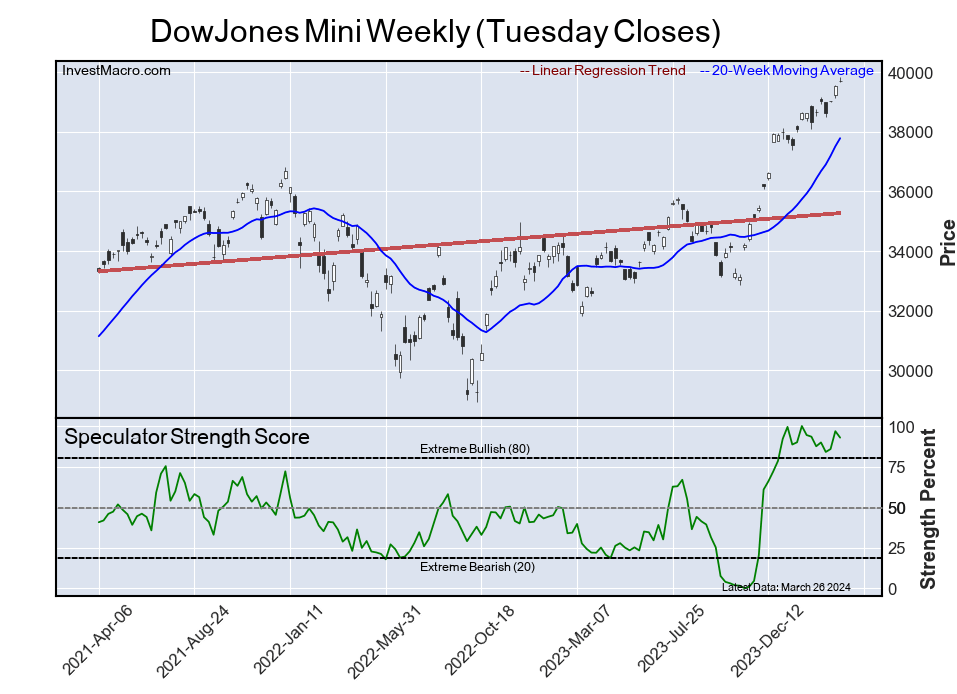
DowJones-Mini (89.9 percent) vs DowJones-Mini previous week (87.5 percent)
Nasdaq-Mini (55.0 percent) vs Nasdaq-Mini previous week (78.8 percent)
Russell2000-Mini (72.2 percent) vs Russell2000-Mini previous week (67.9 percent)
Nikkei USD (29.0 percent) vs Nikkei USD previous week (40.2 percent)
EAFE-Mini (49.1 percent) vs EAFE-Mini previous week (34.1 percent)


MSCI EAFE-Mini & VIX top the 6-Week Strength Trends

COT Strength Score Trends (or move index, calculates the 6-week changes in strength scores) showed that the MSCI EAFE-Mini (14 percent) leads the past six weeks trends for the stock markets. The VIX (3 percent) and the DowJones-Mini (1 percent) are the other positive movers in the latest trends data.

The Nasdaq-Mini (-41 percent) leads the downside trend scores currently with the Russell-Mini (-23 percent) coming in as the next market with lower trend scores.

Strength Trend Statistics:
VIX (2.6 percent) vs VIX previous week (4.4 percent)
S&P500-Mini (-8.2 percent) vs S&P500-Mini previous week (-15.1 percent)
DowJones-Mini (1.3 percent) vs DowJones-Mini previous week (-12.0 percent)
Nasdaq-Mini (-40.8 percent) vs Nasdaq-Mini previous week (-17.4 percent)
Russell2000-Mini (-23.0 percent) vs Russell2000-Mini previous week (-32.1 percent)
Nikkei USD (-5.8 percent) vs Nikkei USD previous week (-7.5 percent)
EAFE-Mini (13.9 percent) vs EAFE-Mini previous week (-2.1 percent)


Individual Stock Market Charts:

VIX Volatility Futures:

VIX Volatility Futures COT ChartThe VIX Volatility large speculator standing this week recorded a net position of -40,704 contracts in the data reported through Tuesday. This was a weekly fall of -1,633 contracts from the previous week which had a total of -39,071 net contracts.

This week’s current strength score (the trader positioning range over the past three years, measured from 0 to 100) shows the speculators are currently Bullish with a score of 77.0 percent. The commercials are Bearish-Extreme with a score of 19.6 percent and the small traders (not shown in chart) are Bullish-Extreme with a score of 85.1 percent.

Price Trend-Following Model: Downtrend

Our weekly trend-following model classifies the current market price position as: Downtrend. The current action for the model is considered to be: Hold – Maintain Short Position.

VIX Volatility Futures StatisticsSPECULATORSCOMMERCIALSSMALL TRADERS
– Percent of Open Interest Longs:20.644.97.4
– Percent of Open Interest Shorts:31.933.18.0
– Net Position:-40,70442,920-2,216
– Gross Longs:74,471162,35626,855
– Gross Shorts:115,175119,43629,071
– Long to Short Ratio:0.6 to 11.4 to 10.9 to 1
NET POSITION TREND:
– Strength Index Score (3 Year Range Pct):77.019.685.1
– Strength Index Reading (3 Year Range):BullishBearish-ExtremeBullish-Extreme
NET POSITION MOVEMENT INDEX:
– 6-Week Change in Strength Index:2.6-4.512.6


S&P500 Mini Futures:

SP500 Mini Futures COT ChartThe S&P500 Mini large speculator standing this week recorded a net position of -224,223 contracts in the data reported through Tuesday. This was a weekly lowering of -5,693 contracts from the previous week which had a total of -218,530 net contracts.

This week’s current strength score (the trader positioning range over the past three years, measured from 0 to 100) shows the speculators are currently Bearish with a score of 31.3 percent. The commercials are Bullish with a score of 59.4 percent and the small traders (not shown in chart) are Bullish with a score of 70.1 percent.

Price Trend-Following Model: Strong Uptrend

Our weekly trend-following model classifies the current market price position as: Strong Uptrend. The current action for the model is considered to be: Hold – Maintain Long Position.

S&P500 Mini Futures StatisticsSPECULATORSCOMMERCIALSSMALL TRADERS
– Percent of Open Interest Longs:12.773.211.2
– Percent of Open Interest Shorts:22.367.27.7
– Net Position:-224,223141,21483,009
– Gross Longs:298,5381,716,692263,456
– Gross Shorts:522,7611,575,478180,447
– Long to Short Ratio:0.6 to 11.1 to 11.5 to 1
NET POSITION TREND:
– Strength Index Score (3 Year Range Pct):31.359.470.1
– Strength Index Reading (3 Year Range):BearishBullishBullish
NET POSITION MOVEMENT INDEX:
– 6-Week Change in Strength Index:-8.25.46.4


Dow Jones Mini Futures:

Dow Jones Mini Futures COT ChartThe Dow Jones Mini large speculator standing this week recorded a net position of 18,188 contracts in the data reported through Tuesday. This was a weekly increase of 1,460 contracts from the previous week which had a total of 16,728 net contracts.

This week’s current strength score (the trader positioning range over the past three years, measured from 0 to 100) shows the speculators are currently Bullish-Extreme with a score of 89.9 percent. The commercials are Bearish-Extreme with a score of 6.4 percent and the small traders (not shown in chart) are Bullish with a score of 62.3 percent.

Price Trend-Following Model: Uptrend

Our weekly trend-following model classifies the current market price position as: Uptrend. The current action for the model is considered to be: Hold – Maintain Long Position.

Dow Jones Mini Futures StatisticsSPECULATORSCOMMERCIALSSMALL TRADERS
– Percent of Open Interest Longs:31.551.315.3
– Percent of Open Interest Shorts:14.072.411.6
– Net Position:18,188-21,9573,769
– Gross Longs:32,77953,39915,869
– Gross Shorts:14,59175,35612,100
– Long to Short Ratio:2.2 to 10.7 to 11.3 to 1
NET POSITION TREND:
– Strength Index Score (3 Year Range Pct):89.96.462.3
– Strength Index Reading (3 Year Range):Bullish-ExtremeBearish-ExtremeBullish
NET POSITION MOVEMENT INDEX:
– 6-Week Change in Strength Index:1.3-6.317.3


Nasdaq Mini Futures:

Nasdaq Mini Futures COT ChartThe Nasdaq Mini large speculator standing this week recorded a net position of 10,246 contracts in the data reported through Tuesday. This was a weekly decrease of -15,315 contracts from the previous week which had a total of 25,561 net contracts.

This week’s current strength score (the trader positioning range over the past three years, measured from 0 to 100) shows the speculators are currently Bullish with a score of 55.0 percent. The commercials are Bearish with a score of 33.1 percent and the small traders (not shown in chart) are Bullish-Extreme with a score of 96.8 percent.

Price Trend-Following Model: Strong Uptrend

Our weekly trend-following model classifies the current market price position as: Strong Uptrend. The current action for the model is considered to be: Hold – Maintain Long Position.

Nasdaq Mini Futures StatisticsSPECULATORSCOMMERCIALSSMALL TRADERS
– Percent of Open Interest Longs:31.553.213.7
– Percent of Open Interest Shorts:27.959.411.1
– Net Position:10,246-17,7027,456
– Gross Longs:90,667153,36139,468
– Gross Shorts:80,421171,06332,012
– Long to Short Ratio:1.1 to 10.9 to 11.2 to 1
NET POSITION TREND:
– Strength Index Score (3 Year Range Pct):55.033.196.8
– Strength Index Reading (3 Year Range):BullishBearishBullish-Extreme
NET POSITION MOVEMENT INDEX:
– 6-Week Change in Strength Index:-40.823.114.2


Russell 2000 Mini Futures:

Russell 2000 Mini Futures COT ChartThe Russell 2000 Mini large speculator standing this week recorded a net position of -18,228 contracts in the data reported through Tuesday. This was a weekly advance of 5,977 contracts from the previous week which had a total of -24,205 net contracts.

This week’s current strength score (the trader positioning range over the past three years, measured from 0 to 100) shows the speculators are currently Bullish with a score of 72.2 percent. The commercials are Bearish with a score of 25.6 percent and the small traders (not shown in chart) are Bullish with a score of 63.6 percent.

Price Trend-Following Model: Uptrend

Our weekly trend-following model classifies the current market price position as: Uptrend. The current action for the model is considered to be: Hold – Maintain Long Position.

Russell 2000 Mini Futures StatisticsSPECULATORSCOMMERCIALSSMALL TRADERS
– Percent of Open Interest Longs:12.580.26.1
– Percent of Open Interest Shorts:16.178.74.1
– Net Position:-18,2287,95610,272
– Gross Longs:64,457413,10431,433
– Gross Shorts:82,685405,14821,161
– Long to Short Ratio:0.8 to 11.0 to 11.5 to 1
NET POSITION TREND:
– Strength Index Score (3 Year Range Pct):72.225.663.6
– Strength Index Reading (3 Year Range):BullishBearishBullish
NET POSITION MOVEMENT INDEX:
– 6-Week Change in Strength Index:-23.020.23.5


Nikkei Stock Average (USD) Futures:

Nikkei Stock Average (USD) Futures COT ChartThe Nikkei Stock Average (USD) large speculator standing this week recorded a net position of -5,294 contracts in the data reported through Tuesday. This was a weekly lowering of -1,574 contracts from the previous week which had a total of -3,720 net contracts.

This week’s current strength score (the trader positioning range over the past three years, measured from 0 to 100) shows the speculators are currently Bearish with a score of 29.0 percent. The commercials are Bullish with a score of 55.3 percent and the small traders (not shown in chart) are Bullish with a score of 71.4 percent.

Price Trend-Following Model: Strong Uptrend

Our weekly trend-following model classifies the current market price position as: Strong Uptrend. The current action for the model is considered to be: Hold – Maintain Long Position.

Nikkei Stock Average Futures StatisticsSPECULATORSCOMMERCIALSSMALL TRADERS
– Percent of Open Interest Longs:9.165.625.2
– Percent of Open Interest Shorts:38.248.113.7
– Net Position:-5,2943,1902,104
– Gross Longs:1,66911,9744,600
– Gross Shorts:6,9638,7842,496
– Long to Short Ratio:0.2 to 11.4 to 11.8 to 1
NET POSITION TREND:
– Strength Index Score (3 Year Range Pct):29.055.371.4
– Strength Index Reading (3 Year Range):BearishBullishBullish
NET POSITION MOVEMENT INDEX:
– 6-Week Change in Strength Index:-5.8-0.815.4


MSCI EAFE Mini Futures:

MSCI EAFE Mini Futures COT ChartThe MSCI EAFE Mini large speculator standing this week recorded a net position of -16,684 contracts in the data reported through Tuesday. This was a weekly advance of 14,518 contracts from the previous week which had a total of -31,202 net contracts.

This week’s current strength score (the trader positioning range over the past three years, measured from 0 to 100) shows the speculators are currently Bearish with a score of 49.1 percent. The commercials are Bearish with a score of 49.4 percent and the small traders (not shown in chart) are Bearish with a score of 40.4 percent.

Price Trend-Following Model: Uptrend

Our weekly trend-following model classifies the current market price position as: Uptrend. The current action for the model is considered to be: Hold – Maintain Long Position.

MSCI EAFE Mini Futures StatisticsSPECULATORSCOMMERCIALSSMALL TRADERS
– Percent of Open Interest Longs:9.786.93.1
– Percent of Open Interest Shorts:13.584.12.0
– Net Position:-16,68411,9984,686
– Gross Longs:41,874375,97513,462
– Gross Shorts:58,558363,9778,776
– Long to Short Ratio:0.7 to 11.0 to 11.5 to 1
NET POSITION TREND:
– Strength Index Score (3 Year Range Pct):49.149.440.4
– Strength Index Reading (3 Year Range):BearishBearishBearish
NET POSITION MOVEMENT INDEX:
– 6-Week Change in Strength Index:13.9-13.0-3.6


Article By InvestMacroReceive our weekly COT Newsletter

*COT Report: The COT data, released weekly to the public each Friday, is updated through the most recent Tuesday (data is 3 days old) and shows a quick view of how large speculators or non-commercials (for-profit traders) were positioned in the futures markets.

The CFTC categorizes trader positions according to commercial hedgers (traders who use futures contracts for hedging as part of the business), non-commercials (large traders who speculate to realize trading profits) and nonreportable traders (usually small traders/speculators) as well as their open interest (contracts open in the market at time of reporting). See CFTC criteria here.

COT Soft Commodities Charts: Speculator bets led by Corn & Lean Hogs

By InvestMacro

Here are the latest charts and statistics for the Commitment of Traders (COT) reports data published by the Commodities Futures Trading Commission (CFTC).

The latest COT data is updated through Tuesday February 27th and shows a quick view of how large traders (for-profit speculators and commercial entities) were positioned in the futures markets.

Weekly Speculator Changes led by Corn & Lean Hogs

The COT soft commodities markets speculator bets were a bit higher this week as six out of the eleven softs markets we cover had higher positioning while the other five markets had lower speculator contracts.

Leading the gains for the softs markets was Corn (33,463 contracts) with Lean Hogs (12,790 contracts), Sugar (11,564 contracts), Wheat (7,658 contracts), Cotton (7,212 contracts) and Live Cattle (4,119 contracts) also showing positive weeks.

The markets with the declines in speculator bets this week were Soybean Meal (-21,367 contracts) with Soybeans (-30,944 contracts), Coffee (-4,163 contracts), Soybean Oil (-4,985 contracts) and Cocoa (-6,938 contracts) also registering lower bets on the week.


Net Speculators Leaderboard

Legend: Weekly Speculators Change | Speculators Current Net Position | Speculators Strength Score compared to last 3-Years (0-100 range)


Strength Scores led by Cotton & Coffee

COT Strength Scores (a normalized measure of Speculator positions over a 3-Year range, from 0 to 100 where above 80 is Extreme-Bullish and below 20 is Extreme-Bearish) showed that Cotton (86 percent) and Coffee (80 percent) lead the softs markets this week. Lean Hogs (54 percent), Cocoa (52 percent) and Live Cattle (50 percent) come in as the next highest in the weekly strength scores.

On the downside, Soybean Oil (0 percent), Soybean Meal (0 percent), Soybeans (0 percent) and Corn (4 percent) come in at the lowest strength levels currently and are in Extreme-Bearish territory (below 20 percent).

Strength Statistics:
Corn (4.1 percent) vs Corn previous week (0.0 percent)
Sugar (27.9 percent) vs Sugar previous week (23.8 percent)
Coffee (80.4 percent) vs Coffee previous week (84.7 percent)
Soybeans (0.0 percent) vs Soybeans previous week (7.0 percent)
Soybean Oil (0.0 percent) vs Soybean Oil previous week (3.1 percent)
Soybean Meal (0.0 percent) vs Soybean Meal previous week (8.8 percent)
Live Cattle (50.1 percent) vs Live Cattle previous week (45.7 percent)
Lean Hogs (53.7 percent) vs Lean Hogs previous week (43.2 percent)
Cotton (85.7 percent) vs Cotton previous week (80.3 percent)
Cocoa (52.0 percent) vs Cocoa previous week (59.1 percent)
Wheat (41.8 percent) vs Wheat previous week (36.5 percent)


Cotton & Live Cattle top the 6-Week Strength Trends

COT Strength Score Trends (or move index, calculates the 6-week changes in strength scores) showed that Cotton (68 percent) and Live Cattle (47 percent) lead the past six weeks trends for soft commodities. Lean Hogs (45 percent), Sugar (16 percent) and Wheat (7 percent) are the next highest positive movers in the latest trends data.

Cocoa (-30 percent) leads the downside trend scores currently with Soybean Meal (-23 percent), Soybeans (-22 percent) and Soybean Oil (-7 percent) following next with lower trend scores.

Strength Trend Statistics:
Corn (-1.6 percent) vs Corn previous week (-11.5 percent)
Sugar (15.6 percent) vs Sugar previous week (8.2 percent)
Coffee (2.4 percent) vs Coffee previous week (10.5 percent)
Soybeans (-22.1 percent) vs Soybeans previous week (-27.7 percent)
Soybean Oil (-7.1 percent) vs Soybean Oil previous week (-3.0 percent)
Soybean Meal (-22.8 percent) vs Soybean Meal previous week (-17.6 percent)
Live Cattle (46.6 percent) vs Live Cattle previous week (41.5 percent)
Lean Hogs (45.0 percent) vs Lean Hogs previous week (33.7 percent)
Cotton (68.4 percent) vs Cotton previous week (67.1 percent)
Cocoa (-29.6 percent) vs Cocoa previous week (-21.2 percent)
Wheat (6.7 percent) vs Wheat previous week (-7.8 percent)


Individual Soft Commodities Markets:

CORN Futures:

CORN Futures COT ChartThe CORN large speculator standing this week recorded a net position of -232,604 contracts in the data reported through Tuesday. This was a weekly increase of 33,463 contracts from the previous week which had a total of -266,067 net contracts.

This week’s current strength score (the trader positioning range over the past three years, measured from 0 to 100) shows the speculators are currently Bearish-Extreme with a score of 4.1 percent. The commercials are Bullish-Extreme with a score of 95.9 percent and the small traders (not shown in chart) are Bullish-Extreme with a score of 94.8 percent.

Price Trend-Following Model: Strong Downtrend

Our weekly trend-following model classifies the current market price position as: Strong Downtrend. The current action for the model is considered to be: Hold – Maintain Short Position.

CORN Futures StatisticsSPECULATORSCOMMERCIALSSMALL TRADERS
– Percent of Open Interest Longs:19.744.610.0
– Percent of Open Interest Shorts:35.127.911.2
– Net Position:-232,604250,628-18,024
– Gross Longs:295,676670,777151,100
– Gross Shorts:528,280420,149169,124
– Long to Short Ratio:0.6 to 11.6 to 10.9 to 1
NET POSITION TREND:
– Strength Index Score (3 Year Range Pct):4.195.994.8
– Strength Index Reading (3 Year Range):Bearish-ExtremeBullish-ExtremeBullish-Extreme
NET POSITION MOVEMENT INDEX:
– 6-Week Change in Strength Index:-1.61.16.3


SUGAR Futures:

SUGAR Futures COT ChartThe SUGAR large speculator standing this week recorded a net position of 103,254 contracts in the data reported through Tuesday. This was a weekly boost of 11,564 contracts from the previous week which had a total of 91,690 net contracts.

This week’s current strength score (the trader positioning range over the past three years, measured from 0 to 100) shows the speculators are currently Bearish with a score of 27.9 percent. The commercials are Bullish with a score of 75.4 percent and the small traders (not shown in chart) are Bearish-Extreme with a score of 13.5 percent.

Price Trend-Following Model: Downtrend

Our weekly trend-following model classifies the current market price position as: Downtrend. The current action for the model is considered to be: Hold – Maintain Short Position.

SUGAR Futures StatisticsSPECULATORSCOMMERCIALSSMALL TRADERS
– Percent of Open Interest Longs:22.952.58.0
– Percent of Open Interest Shorts:10.365.97.1
– Net Position:103,254-110,9527,698
– Gross Longs:187,869431,22766,010
– Gross Shorts:84,615542,17958,312
– Long to Short Ratio:2.2 to 10.8 to 11.1 to 1
NET POSITION TREND:
– Strength Index Score (3 Year Range Pct):27.975.413.5
– Strength Index Reading (3 Year Range):BearishBullishBearish-Extreme
NET POSITION MOVEMENT INDEX:
– 6-Week Change in Strength Index:15.6-9.0-20.0


COFFEE Futures:

COFFEE Futures COT ChartThe COFFEE large speculator standing this week recorded a net position of 51,700 contracts in the data reported through Tuesday. This was a weekly lowering of -4,163 contracts from the previous week which had a total of 55,863 net contracts.

This week’s current strength score (the trader positioning range over the past three years, measured from 0 to 100) shows the speculators are currently Bullish-Extreme with a score of 80.4 percent. The commercials are Bearish with a score of 23.8 percent and the small traders (not shown in chart) are Bearish with a score of 23.9 percent.

Price Trend-Following Model: Uptrend

Our weekly trend-following model classifies the current market price position as: Uptrend. The current action for the model is considered to be: Hold – Maintain Long Position.

COFFEE Futures StatisticsSPECULATORSCOMMERCIALSSMALL TRADERS
– Percent of Open Interest Longs:36.038.03.5
– Percent of Open Interest Shorts:11.363.13.2
– Net Position:51,700-52,424724
– Gross Longs:75,33079,6907,361
– Gross Shorts:23,630132,1146,637
– Long to Short Ratio:3.2 to 10.6 to 11.1 to 1
NET POSITION TREND:
– Strength Index Score (3 Year Range Pct):80.423.823.9
– Strength Index Reading (3 Year Range):Bullish-ExtremeBearishBearish
NET POSITION MOVEMENT INDEX:
– 6-Week Change in Strength Index:2.4-1.3-14.1


SOYBEANS Futures:

SOYBEANS Futures COT ChartThe SOYBEANS large speculator standing this week recorded a net position of -191,232 contracts in the data reported through Tuesday. This was a weekly reduction of -30,944 contracts from the previous week which had a total of -160,288 net contracts.

This week’s current strength score (the trader positioning range over the past three years, measured from 0 to 100) shows the speculators are currently Bearish-Extreme with a score of 0.0 percent. The commercials are Bullish-Extreme with a score of 100.0 percent and the small traders (not shown in chart) are Bullish with a score of 76.7 percent.

Price Trend-Following Model: Strong Downtrend

Our weekly trend-following model classifies the current market price position as: Strong Downtrend. The current action for the model is considered to be: Hold – Maintain Short Position.

SOYBEANS Futures StatisticsSPECULATORSCOMMERCIALSSMALL TRADERS
– Percent of Open Interest Longs:12.960.57.3
– Percent of Open Interest Shorts:39.732.18.9
– Net Position:-191,232202,950-11,718
– Gross Longs:92,361432,41851,829
– Gross Shorts:283,593229,46863,547
– Long to Short Ratio:0.3 to 11.9 to 10.8 to 1
NET POSITION TREND:
– Strength Index Score (3 Year Range Pct):0.0100.076.7
– Strength Index Reading (3 Year Range):Bearish-ExtremeBullish-ExtremeBullish
NET POSITION MOVEMENT INDEX:
– 6-Week Change in Strength Index:-22.120.117.2


SOYBEAN OIL Futures:

SOYBEAN OIL Futures COT ChartThe SOYBEAN OIL large speculator standing this week recorded a net position of -38,926 contracts in the data reported through Tuesday. This was a weekly decrease of -4,985 contracts from the previous week which had a total of -33,941 net contracts.

This week’s current strength score (the trader positioning range over the past three years, measured from 0 to 100) shows the speculators are currently Bearish-Extreme with a score of 0.0 percent. The commercials are Bullish-Extreme with a score of 100.0 percent and the small traders (not shown in chart) are Bearish-Extreme with a score of 19.7 percent.

Price Trend-Following Model: Downtrend

Our weekly trend-following model classifies the current market price position as: Downtrend. The current action for the model is considered to be: Hold – Maintain Short Position.

SOYBEAN OIL Futures StatisticsSPECULATORSCOMMERCIALSSMALL TRADERS
– Percent of Open Interest Longs:20.648.25.4
– Percent of Open Interest Shorts:28.041.15.1
– Net Position:-38,92637,2891,637
– Gross Longs:107,981252,66028,265
– Gross Shorts:146,907215,37126,628
– Long to Short Ratio:0.7 to 11.2 to 11.1 to 1
NET POSITION TREND:
– Strength Index Score (3 Year Range Pct):0.0100.019.7
– Strength Index Reading (3 Year Range):Bearish-ExtremeBullish-ExtremeBearish-Extreme
NET POSITION MOVEMENT INDEX:
– 6-Week Change in Strength Index:-7.16.7-2.7


SOYBEAN MEAL Futures:

SOYBEAN MEAL Futures COT ChartThe SOYBEAN MEAL large speculator standing this week recorded a net position of -66,820 contracts in the data reported through Tuesday. This was a weekly fall of -21,367 contracts from the previous week which had a total of -45,453 net contracts.

This week’s current strength score (the trader positioning range over the past three years, measured from 0 to 100) shows the speculators are currently Bearish-Extreme with a score of 0.0 percent. The commercials are Bullish-Extreme with a score of 100.0 percent and the small traders (not shown in chart) are Bearish-Extreme with a score of 3.2 percent.

Price Trend-Following Model: Downtrend

Our weekly trend-following model classifies the current market price position as: Downtrend. The current action for the model is considered to be: Hold – Maintain Short Position.

SOYBEAN MEAL Futures StatisticsSPECULATORSCOMMERCIALSSMALL TRADERS
– Percent of Open Interest Longs:17.652.89.8
– Percent of Open Interest Shorts:32.140.57.5
– Net Position:-66,82056,23810,582
– Gross Longs:80,930242,67444,952
– Gross Shorts:147,750186,43634,370
– Long to Short Ratio:0.5 to 11.3 to 11.3 to 1
NET POSITION TREND:
– Strength Index Score (3 Year Range Pct):0.0100.03.2
– Strength Index Reading (3 Year Range):Bearish-ExtremeBullish-ExtremeBearish-Extreme
NET POSITION MOVEMENT INDEX:
– 6-Week Change in Strength Index:-22.824.7-30.8


LIVE CATTLE Futures:

LIVE CATTLE Futures COT ChartThe LIVE CATTLE large speculator standing this week recorded a net position of 65,999 contracts in the data reported through Tuesday. This was a weekly boost of 4,119 contracts from the previous week which had a total of 61,880 net contracts.

This week’s current strength score (the trader positioning range over the past three years, measured from 0 to 100) shows the speculators are currently Bullish with a score of 50.1 percent. The commercials are Bearish with a score of 48.8 percent and the small traders (not shown in chart) are Bullish with a score of 60.2 percent.

Price Trend-Following Model: Strong Uptrend

Our weekly trend-following model classifies the current market price position as: Strong Uptrend. The current action for the model is considered to be: New Buy – Long Position.

LIVE CATTLE Futures StatisticsSPECULATORSCOMMERCIALSSMALL TRADERS
– Percent of Open Interest Longs:37.634.710.1
– Percent of Open Interest Shorts:16.054.611.9
– Net Position:65,999-60,465-5,534
– Gross Longs:114,745105,81130,732
– Gross Shorts:48,746166,27636,266
– Long to Short Ratio:2.4 to 10.6 to 10.8 to 1
NET POSITION TREND:
– Strength Index Score (3 Year Range Pct):50.148.860.2
– Strength Index Reading (3 Year Range):BullishBearishBullish
NET POSITION MOVEMENT INDEX:
– 6-Week Change in Strength Index:46.6-46.2-28.5


LEAN HOGS Futures:

LEAN HOGS Futures COT ChartThe LEAN HOGS large speculator standing this week recorded a net position of 29,286 contracts in the data reported through Tuesday. This was a weekly advance of 12,790 contracts from the previous week which had a total of 16,496 net contracts.

This week’s current strength score (the trader positioning range over the past three years, measured from 0 to 100) shows the speculators are currently Bullish with a score of 53.7 percent. The commercials are Bearish with a score of 47.6 percent and the small traders (not shown in chart) are Bullish with a score of 64.1 percent.

Price Trend-Following Model: Strong Uptrend

Our weekly trend-following model classifies the current market price position as: Strong Uptrend. The current action for the model is considered to be: Hold – Maintain Long Position.

LEAN HOGS Futures StatisticsSPECULATORSCOMMERCIALSSMALL TRADERS
– Percent of Open Interest Longs:38.433.88.5
– Percent of Open Interest Shorts:26.544.010.2
– Net Position:29,286-24,985-4,301
– Gross Longs:94,03782,65820,760
– Gross Shorts:64,751107,64325,061
– Long to Short Ratio:1.5 to 10.8 to 10.8 to 1
NET POSITION TREND:
– Strength Index Score (3 Year Range Pct):53.747.664.1
– Strength Index Reading (3 Year Range):BullishBearishBullish
NET POSITION MOVEMENT INDEX:
– 6-Week Change in Strength Index:45.0-49.77.5


COTTON Futures:

COTTON Futures COT ChartThe COTTON large speculator standing this week recorded a net position of 102,305 contracts in the data reported through Tuesday. This was a weekly boost of 7,212 contracts from the previous week which had a total of 95,093 net contracts.

This week’s current strength score (the trader positioning range over the past three years, measured from 0 to 100) shows the speculators are currently Bullish-Extreme with a score of 85.7 percent. The commercials are Bearish-Extreme with a score of 13.8 percent and the small traders (not shown in chart) are Bullish-Extreme with a score of 80.2 percent.

Price Trend-Following Model: Strong Uptrend

Our weekly trend-following model classifies the current market price position as: Strong Uptrend. The current action for the model is considered to be: Hold – Maintain Long Position.

COTTON Futures StatisticsSPECULATORSCOMMERCIALSSMALL TRADERS
– Percent of Open Interest Longs:47.730.36.7
– Percent of Open Interest Shorts:10.171.82.8
– Net Position:102,305-112,88110,576
– Gross Longs:129,75082,40718,183
– Gross Shorts:27,445195,2887,607
– Long to Short Ratio:4.7 to 10.4 to 12.4 to 1
NET POSITION TREND:
– Strength Index Score (3 Year Range Pct):85.713.880.2
– Strength Index Reading (3 Year Range):Bullish-ExtremeBearish-ExtremeBullish-Extreme
NET POSITION MOVEMENT INDEX:
– 6-Week Change in Strength Index:68.4-69.368.5


COCOA Futures:

COCOA Futures COT ChartThe COCOA large speculator standing this week recorded a net position of 41,188 contracts in the data reported through Tuesday. This was a weekly reduction of -6,938 contracts from the previous week which had a total of 48,126 net contracts.

This week’s current strength score (the trader positioning range over the past three years, measured from 0 to 100) shows the speculators are currently Bullish with a score of 52.0 percent. The commercials are Bearish with a score of 45.0 percent and the small traders (not shown in chart) are Bullish with a score of 60.6 percent.

Price Trend-Following Model: Strong Uptrend

Our weekly trend-following model classifies the current market price position as: Strong Uptrend. The current action for the model is considered to be: Hold – Maintain Long Position.

COCOA Futures StatisticsSPECULATORSCOMMERCIALSSMALL TRADERS
– Percent of Open Interest Longs:36.931.06.5
– Percent of Open Interest Shorts:18.352.33.9
– Net Position:41,188-46,8715,683
– Gross Longs:81,55268,54414,358
– Gross Shorts:40,364115,4158,675
– Long to Short Ratio:2.0 to 10.6 to 11.7 to 1
NET POSITION TREND:
– Strength Index Score (3 Year Range Pct):52.045.060.6
– Strength Index Reading (3 Year Range):BullishBearishBullish
NET POSITION MOVEMENT INDEX:
– 6-Week Change in Strength Index:-29.625.630.3


WHEAT Futures:

WHEAT Futures COT ChartThe WHEAT large speculator standing this week recorded a net position of -36,981 contracts in the data reported through Tuesday. This was a weekly rise of 7,658 contracts from the previous week which had a total of -44,639 net contracts.

This week’s current strength score (the trader positioning range over the past three years, measured from 0 to 100) shows the speculators are currently Bearish with a score of 41.8 percent. The commercials are Bullish with a score of 57.0 percent and the small traders (not shown in chart) are Bearish with a score of 49.7 percent.

Price Trend-Following Model: Weak Uptrend

Our weekly trend-following model classifies the current market price position as: Weak Uptrend. The current action for the model is considered to be: Hold – Maintain Long Position.

WHEAT Futures StatisticsSPECULATORSCOMMERCIALSSMALL TRADERS
– Percent of Open Interest Longs:33.036.87.8
– Percent of Open Interest Shorts:42.925.98.8
– Net Position:-36,98140,756-3,775
– Gross Longs:123,166137,34028,974
– Gross Shorts:160,14796,58432,749
– Long to Short Ratio:0.8 to 11.4 to 10.9 to 1
NET POSITION TREND:
– Strength Index Score (3 Year Range Pct):41.857.049.7
– Strength Index Reading (3 Year Range):BearishBullishBearish
NET POSITION MOVEMENT INDEX:
– 6-Week Change in Strength Index:6.7-9.916.0


Article By InvestMacroReceive our weekly COT Newsletter

*COT Report: The COT data, released weekly to the public each Friday, is updated through the most recent Tuesday (data is 3 days old) and shows a quick view of how large speculators or non-commercials (for-profit traders) were positioned in the futures markets.

The CFTC categorizes trader positions according to commercial hedgers (traders who use futures contracts for hedging as part of the business), non-commercials (large traders who speculate to realize trading profits) and nonreportable traders (usually small traders/speculators) as well as their open interest (contracts open in the market at time of reporting). See CFTC criteria here.

Speculator Extremes: Peso, DowJones, Soybeans & Yen lead Bullish & Bearish Positions

By InvestMacro

The latest update for the weekly Commitment of Traders (COT) report was released by the Commodity Futures Trading Commission (CFTC) on Friday for data ending on February 27th.

This weekly Extreme Positions report highlights the Most Bullish and Most Bearish Positions for the speculator category. Extreme positioning in these markets can foreshadow strong moves in the underlying market.

To signify an extreme position, we use the Strength Index (also known as the COT Index) of each instrument, a common method of measuring COT data. The Strength Index is simply a comparison of current trader positions against the range of positions over the previous 3 years. We use over 80 percent as extremely bullish and under 20 percent as extremely bearish. (Compare Strength Index scores across all markets in the data table or cot leaders table)


Here Are This Week’s Most Bullish Speculator Positions:

Mexican Peso


The Mexican Peso speculator position comes in as the most bullish extreme standing this week. The Mexican Peso speculator level is currently at a 96.0 percent score of its 3-year range.

The six-week trend for the percent strength score totaled 7.4 this week. The overall net speculator position was a total of 93,814 net contracts this week with a dip of -2,181 contract in the weekly speculator bets.


Speculators or Non-Commercials Notes:

Speculators, classified as non-commercial traders by the CFTC, are made up of large commodity funds, hedge funds and other significant for-profit participants. The Specs are generally regarded as trend-followers in their behavior towards price action – net speculator bets and prices tend to go in the same directions. These traders often look to buy when prices are rising and sell when prices are falling. To illustrate this point, many times speculator contracts can be found at their most extremes (bullish or bearish) when prices are also close to their highest or lowest levels.

These extreme levels can be dangerous for the large speculators as the trade is most crowded, there is less trading ammunition still sitting on the sidelines to push the trend further and prices have moved a significant distance. When the trend becomes exhausted, some speculators take profits while others look to also exit positions when prices fail to continue in the same direction. This process usually plays out over many months to years and can ultimately create a reverse effect where prices start to fall and speculators start a process of selling when prices are falling.


DowJones Mini


The DowJones Mini speculator position comes next in the extreme standings this week. The DowJones Mini speculator level is now at a 89.9 percent score of its 3-year range.

The six-week trend for the percent strength score was 1.3 this week. The speculator position registered 18,188 net contracts this week with a weekly gain of 1,460 contracts in speculator bets.


British Pound


The British Pound speculator position comes in third this week in the extreme standings. The British Pound speculator level resides at a 87.9 percent score of its 3-year range.

The six-week trend for the speculator strength score came in at 10.7 this week. The overall speculator position was 46,358 net contracts this week with a small edge higher by 46 contracts in the weekly speculator bets.


Cotton


The Cotton speculator position comes up number four in the extreme standings this week. The Cotton speculator level is at a 85.7 percent score of its 3-year range.

The six-week trend for the speculator strength score totaled a change of 68.4 this week. The overall speculator position was 102,305 net contracts this week with a rise of 7,212 contracts in the speculator bets.


Steel


The Steel speculator position rounds out the top five in this week’s bullish extreme standings. The Steel speculator level sits at a 85.1 percent score of its 3-year range. The six-week trend for the speculator strength score was -4.4 this week.

The speculator position was -2,935 net contracts this week with a loss of -234 contracts in the weekly speculator bets.


This Week’s Most Bearish Speculator Positions:

Soybeans


The Soybeans speculator position comes in as the most bearish extreme standing this week. The Soybeans speculator level is at a 0.0 percent score of its 3-year range.

The six-week trend for the speculator strength score was -22.1 this week. The overall speculator position was -191,232 net contracts this week with a drop of -30,944 contracts in the speculator bets.


Japanese Yen


The Japanese Yen speculator position comes in next for the most bearish extreme standing on the week. The Japanese Yen speculator level is at a 0.0 percent score of its 3-year range.

The six-week trend for the speculator strength score was -54.7 this week. The speculator position was -132,705 net contracts this week with a decline of -11,927 contracts in the weekly speculator bets.


Soybean Oil


The Soybean Oil speculator position comes in as third most bearish extreme standing of the week. The Soybean Oil speculator level resides at a 0.0 percent score of its 3-year range.

The six-week trend for the speculator strength score was -7.1 this week. The overall speculator position was -38,926 net contracts this week with a decrease by -4,985 contracts in the speculator bets.


Soybean Meal


The Soybean Meal speculator position comes in as this week’s fourth most bearish extreme standing. The Soybean Meal speculator level is at a 0.0 percent score of its 3-year range.

The six-week trend for the speculator strength score was -22.8 this week. The speculator position was -66,820 net contracts this week with a drop of -21,367 contracts in the weekly speculator bets.


Corn


Finally, the Corn speculator position comes in as the fifth most bearish extreme standing for this week. The Corn speculator level is at a 4.1 percent score of its 3-year range.

The six-week trend for the speculator strength score was -1.6 this week. The speculator position was -232,604 net contracts this week with a boost by 33,463 contracts in the weekly speculator bets.


Article By InvestMacroReceive our weekly COT Newsletter

*COT Report: The COT data, released weekly to the public each Friday, is updated through the most recent Tuesday (data is 3 days old) and shows a quick view of how large speculators or non-commercials (for-profit traders) were positioned in the futures markets.

The CFTC categorizes trader positions according to commercial hedgers (traders who use futures contracts for hedging as part of the business), non-commercials (large traders who speculate to realize trading profits) and nonreportable traders (usually small traders/speculators) as well as their open interest (contracts open in the market at time of reporting). See CFTC criteria here.