Target Thursdays: USDJPY, Copper & EURCAD

By ForexTime

  • USDJPY sees over 700-pip swing 
  • Copper selloff rewards bears
  • EURCAD hits all bearish targets

It has been an intense trading week for financial markets.

More action could be expected due to corporate earnings and the US jobs report on Friday.

In the meantime, check out how these trading setups performed this week:


    1) USDJPY joins monster movers!

  • Where and when was Target Price (TP) published?

In our trade of the week article published on Monday 29th April:

The USDJPY demanded our attention after tumbling over 500 pips from its multi-decade top.

We highlighted that “sustained weakness below 155.00 may open a path back towards 154.20 and 153.60.”


  • What happened since TP was published?

The Yen’s aggressive appreciation on Monday morning fueled speculation around possible intervention by Japanese authorities.

A second suspected bout of intervention took place on Wednesday right after the US markets closed, sending the USDJPY as low as 153.00.

When considering how the USDJPY hit an intra-week peak at 160.22, this means the major currency pair has experienced an over 700-pip swing! 


  • How much in potential profits?

Those who took advantage of the move below 155.00 would have been rewarded 140 pips.


    2) Copper slips below $4.5

  • Where and when was Target Price (TP) published?

After hitting a fresh two-year high this week, FXTM’s new commodity Copper is under pressure.

Although the fundamentals favour further upside, in our article on Tuesday – we cautioned that “a technical throwback could be in play on the H1 charts with prices testing potential support levels”


  • What happened since TP was published?

Since punching above the $4.65 level, prices have tumbled over 3% lower amid potential profit taking.


  • How much in potential profits?

Traders who entered at $4.54 and exited at the $4.50 level would have caught a near 1% move to the downside.


    3) EURCAD hits all bearish targets

  • Where and when was Target Price (TP) published?

This technical scenario (EURCAD) is based on the FXTM Signals that are posted twice a day (before the London and New York sessions) for all FXTM clients to follow.

It can be found in the MyFXTM profile under Trading Services… FXTM Trading Signals.


  • What happened since TP was published?

The EURCAD slipped this morning as Canadian Dollar drew support from the rebound in oil prices.


  • How much in potential profits?

EURCAD has hit all its profit targets.

Traders who entered at 1.46969 and exited at the final target level of 1.46795 would have gained 17 pips.

Feel like you missed out on these profits?

You can keep following our “Daily Market Analysis” for fresh trading ideas and opportunities across global financial markets.


Forex-Time-LogoArticle by ForexTime

ForexTime Ltd (FXTM) is an award winning international online forex broker regulated by CySEC 185/12 www.forextime.com

Cybersecurity researchers spotlight a new ransomware threat – be careful where you upload files

By Selcuk Uluagac, Florida International University 

You probably know better than to click on links that download unknown files onto your computer. It turns out that uploading files can get you into trouble, too.

Today’s web browsers are much more powerful than earlier generations of browsers. They’re able to manipulate data within both the browser and the computer’s local file system. Users can send and receive email, listen to music or watch a movie within a browser with the click of a button.

Unfortunately, these capabilities also mean that hackers can find clever ways to abuse the browsers to trick you into letting ransomware lock up your files when you think that you’re simply doing your usual tasks online.

I’m a computer scientist who studies cybersecurity. My colleagues and I have shown how hackers can gain access to your computer’s files via the File System Access Application Programming Interface (API), which enables web applications in modern browsers to interact with the users’ local file systems.

The threat applies to Google’s Chrome and Microsoft’s Edge browsers but not Apple’s Safari or Mozilla’s Firefox. Chrome accounts for 65% of browsers used, and Edge accounts for 5%. To the best of my knowledge, there have been no reports of hackers using this method so far.

My colleagues, who include a Google security researcher, and I have communicated with the developers responsible for the File System Access API, and they have expressed support for our work and interest in our approaches to defending against this kind of attack. We also filed a security report to Microsoft but have not heard from them.

Double-edged sword

Today’s browsers are almost operating systems unto themselves. They can run software programs and encrypt files. These capabilities, combined with the browser’s access to the host computer’s files – including ones in the cloud, shared folders and external drives – via the File System Access API creates a new opportunity for ransomware.

Imagine you want to edit photos on a benign-looking free online photo editing tool. When you upload the photos for editing, any hackers who control the malicious editing tool can access the files on your computer via your browser. The hackers would gain access to the folder you are uploading from and all subfolders. Then the hackers could encrypt the files in your file system and demand a ransom payment to decrypt them.

Today’s web browsers are more powerful – and in some ways more vulnerable – than their predecessors.

Ransomware is a growing problem. Attacks have hit individuals as well as organizations, including Fortune 500 companies, banks, cloud service providers, cruise operators, threat-monitoring services, chip manufacturers, governments, medical centers and hospitals, insurance companies, schools, universities and even police departments. In 2023, organizations paid more than US$1.1 billion in ransomware payments to attackers, and 19 ransomware attacks targeted organizations every second.

It is no wonder ransomware is the No. 1 arms race today between hackers and security specialists. Traditional ransomware runs on your computer after hackers have tricked you into downloading it.

New defenses for a new threat

A team of researchers I lead at the Cyber-Physical Systems Security Lab at Florida International University, including postdoctoral researcher Abbas Acar and Ph.D. candidate Harun Oz, in collaboration with Google Senior Research Scientist Güliz Seray Tuncay, have been investigating this new type of potential ransomware for the past two years. Specifically, we have been exploring how powerful modern web browsers have become and how they can be weaponized by hackers to create novel forms of ransomware.

In our paper, RøB: Ransomware over Modern Web Browsers, which was presented at the USENIX Security Symposium in August 2023, we showed how this emerging ransomware strain is easy to design and how damaging it can be. In particular, we designed and implemented the first browser-based ransomware called RøB and analyzed its use with browsers running on three different major operating systems – Windows, Linux and MacOS – five cloud providers and five antivirus products.

Our evaluations showed that RøB is capable of encrypting numerous types of files. Because RøB runs within the browser, there are no malicious payloads for a traditional antivirus program to catch. This means existing ransomware detection systems face several issues against this powerful browser-based ransomware.

We proposed three different defense approaches to mitigate this new ransomware type. These approaches operate at different levels – browser, file system and user – and complement one another.

The first approach temporarily halts a web application – a program that runs in the browser – in order to detect encrypted user files. The second approach monitors the activity of the web application on the user’s computer to identify ransomware-like patterns. The third approach introduces a new permission dialog box to inform users about the risks and implications associated with allowing web applications to access their computer’s file system.

When it comes to protecting your computer, be careful about where you upload as well as download files. Your uploads could be giving hackers an “in” to your computer.The Conversation

About the Author:

Selcuk Uluagac, Professor of Computing and Information Science, Florida International University

This article is republished from The Conversation under a Creative Commons license. Read the original article.


Is scientific discovery driven by great individuals or by great teams?

By Denisa Mindruta, HEC Paris Business School 

“This isn’t mine; this is one for the team,” said Succession star Kieran Culkin as he accepted the Best Actor award at this year’s Golden Globes. It’s a familiar aspect of Hollywood awards speeches – a reminder that the stars dazzling us on screen could not exist without the people who support them. “It’s been said, but it’s a team effort, this show,” said Succession creator Jesse Armstrong at the awards, underlining the same sentiment.

Hollywood speeches aside, we do seem to focus on individuals when we acknowledge greatness. In business and science, the dominant cultural narrative is that the bulk of innovation is driven by a handful of exceptional individuals, or “stars.” We elevate pioneers like Steve Jobs or Albert Einstein, and reward individuals who show similar promise with resources that allow them to continue performing high-value work.

Star scientists are those who publish significantly more than their peers, producing papers with greater impact and actively participating in commercialisation ventures. However, science is rarely a solo effort. Even star scientists usually have a team ¬– a “constellation” – of collaborators behind them. Research teams have grown in size by 50% in the period between 1981 and 1999. In recent years, more than 80% of all science and engineering publications and over two-thirds of patents have been the product of multiple authors. Research collaborations that include star researchers typically achieve higher average performance than those without such individuals.

But what is the maximum impact that a single person can have on the joint performance of a collaboration? We examined the relative contributions individuals and their collaborators make to scientific innovation to understand how to optimize team composition to best perform.

Plus de trois fois sur quatre, c’est la complémentarité entre la tête d’affiche de l’équipe et le reste des membres qui apporte le plus de valeur aux recherches.
Flickr/NTNU, CC BY-SA

How star researchers improve collective performance

Star researchers improve collective performance in two ways. First, the presence and contributions of the star researcher improve the quality and output of their collaborators, leading to greater overall team success. Previous approaches have studied this so-called spillover effect by examining what happens when a star scientist leaves the group. These studies showed that when this happened, colleagues experienced a lasting 5-10% decline in publication rate.

Second, once a researcher has initial success, they find it increasingly easy to attract talent and resources. This is called the “Matthew effect,” named after a (loose) interpretation of a Biblical parable.

In practice, the Matthew effect reflects a feedback loop wherein star researchers can increase their success at a greater rate than their peers. It has been borne out by studies showing that star scientists gain preferential access to valuable resources like funding, talented graduate students, and advanced lab facilities in both in academia and in the private sector.

30 star scientists and their constellations

Prior research has treated spillover and the Matthew effect separately, but they are inextricably linked. So, we developed a model to capture this complexity.

We investigated the star-constellation relationship in collaborations that resulted in an invention. University researchers must disclose new inventions to their institutions. Because the disclosure is a legal document, it’s useful for our research because it sidesteps social noise such as favours and institutional politics that may skew rates of publication authorship. The data was taken from a U.S. university with a renowned medical school.

Analysis was performed using data on the 555 invention disclosures that were registered between 1988 and 1999. From the total cohort of 1003 scientists, of which 248 were team leaders, we identified a cohort of 30 “stars” who were in the top 5% of globally cited researchers.

Irreplaceable stars

The contribution of a star scientist to a team is dominant – i.e. their contribution exceeds that of their team – when they are “irreplaceable”. This means that they are so well-matched to the rest of the team that the constellation would be unable to produce work of the same standard without them, even with a new leader.

What makes a leader “well matched” to their team? We looked for trends in the dataset, considered the research impact, knowledge profile, and the range of seniorities in the group, so we could determine what matters the most when scientists choose collaborators.

We found that high-value team leaders tend to work with high-value collaborators, supporting the theory that star scientists attract talented constellations. Further, prominent leaders have access to, and are preferred by, collaborators with whom they share some expertise overlap, though a very high similarity makes the collaboration less favourable. Some common language and goals are a strength, but too much overlap in expertise stifles innovation.

In addition, high-value team leaders tend to work in groups where scientists of both senior and junior ranks come together. We therefore argue that diversity of perspectives and skills enables discovery. Last but not least, star scientists and their collaborators tend to share the same research profile with respect to the application domains of their research.

Star’s surprisingly small contribution

We used these findings to investigate whether the star or constellation makes the greater contribution to scientific discovery. When a star and constellation are well-matched, they produce higher quality research. For each collaboration, we calculated whether the star or constellation would be harder to replace.

To calculate the replaceability, we replaced a star or constellation with the substitute that was the second-best match. The greater the loss in research impact, the more irreplaceable the missing star or constellation was to the research.
Surprisingly, our results show that it is rare for a single person to make a more impactful contribution than their team. The relative contribution the star makes to knowledge creation surpasses the constellation’s in only 14.3% of collaborations. The constellation is the dominant party, in terms of relative value creation, in only 9.5% of cases. In more than three-quarters of cases, neither party dominates, with complementarity between star and constellation maximizing research value. In almost every pairing, innovation was a collective endeavor.

In short, to identify the drivers of innovation and discovery, we should not allow our view of the entire sky to be eclipsed by a few very bright stars.

Championing the whole team

Scientists perceived to bring star qualities are in demand and are often induced to transfer from one institution to another. This research suggests that administrators should endeavour to enable stars to move with their teams. Adjusting to work without their collaborators may have an adverse effect on the scientist’s research and their ability to attract additional talented hires. Dominating stars suffer a smaller loss without their team, but they are getting a bigger piece of a smaller pie.

However, the most significant takeaway for this research is that research credit is unfairly biased towards prominent individuals. Star scientists undoubtedly drive innovation, and a minority brings irreplaceable value. However, when considering the research output of a star, their achievements should be looked at within the context of a team. In most cases, the constellation brings a high contribution that merits recognition with IP credits, financial rents and other resources.The Conversation

About the Author:

Denisa Mindruta, Professeur Associé en Stratégie et Politique d’Entreprise, HEC Paris Business School

This article is republished from The Conversation under a Creative Commons license. Read the original article.


WTI oil declines on rising inventories and negotiations between Israel and Hamas. Rising unemployment in New Zealand may force RBNZ to start cutting rates earlier

By JustMarkets

At the end of Tuesday, the Dow Jones Index (US30) decreased by 1.49%, while the S&P 500 index (US500) was down 1.57%. The NASDAQ Technology Index (US100) closed negative 2.04% yesterday. Rising labor costs pushed bond yields higher and pressured stocks. The US Employment Cost Index for the first quarter rose more than expected, which is hawkish for Fed policy.

The US Federal Reserve will hold its next monetary policy meeting today. The rate is expected to be kept at 5.5% at this meeting, so traders will focus on the FOMC statement and Jerome Powell’s press conference. Higher inflation and strong activity and employment figures have led to a shift in market expectations regarding the timing of the first interest rate cut. Markets now forecast a rate cut of 3 bps by June, 20 bps by September, and 36 bps by December. This is a striking change considering that just three months ago the market was fully discounting 150 bps of rate cuts this year from the March FOMC meeting. So if Jerome Powell announces that the rate cuts have been pushed to late summer or fall/winter, that would be a major support for the US dollar and a negative for indices and precious metals.

Amazon (AMZN) reported strong first-quarter results Tuesday, led by growth in its cloud computing division and new advertising dollars from its Prime Video streaming service. Shares of Amazon.com Inc. rose about 2% in after-hours trading.

Equity markets in Europe were mostly down on Tuesday. The German DAX (DE40) fell by 1.03%, the French CAC 40 (FR40) closed down 0.99% yesterday, the Spanish IBEX 35 (ES35) decreased by 2.22%, and the British FTSE 100 (UK100) closed negative 0.04%.

The Eurozone inflation report showed a decline in the core index (excluding volatile food and energy prices) for April to a 2-year low of 2.7% y/y, which is dovish for ECB policy. ECB Governing Council spokesman Villeroy de Galhau said that Eurozone inflation data for April gives the ECB the confidence to start cutting interest rates in June. Eurozone Q1 GDP grew by 0.3% QoQ and 0.4% YoY, stronger than expectations of 0.1% QoQ and 0.2% YoY. Swaps estimate the odds of a 25 bps ECB rate cut at the next meeting on June 6 at 87%.

WTI crude oil prices fell towards $81/bbl on Wednesday, declining for the third consecutive session as an industry report pointed to a sharp rise in US crude inventories, while hopes of a ceasefire agreement in the Middle East continued to weigh on oil prices. API data showed that US crude inventories rose by 4.906 million barrels last week after declining by 3.23 million barrels the previous week, the biggest increase since mid-March. On Tuesday, the US EIA also reported that US oil production rose to 13.15 million barrels per day in February from 12.58 barrels per day in January, the biggest monthly increase in 3.5 years.

Asian markets were predominantly up yesterday. Japan’s Nikkei 225 (JP225) rose by 1.24%, China’s FTSE China A50 (CHA50) was down 0.18%, Hong Kong’s Hang Seng (HK50) was up 0.09% for Tuesday, and Australia’s ASX 200 (AU200) was positive 0.35%.

New Zealand’s unemployment rate rose to 4.3% in the first quarter, exceeding forecasts and the highest in three years, while employment unexpectedly fell by 0.2%, putting the Reserve Bank of New Zealand (RBNZ) on track to cut interest rates ahead of the US Federal Reserve. Investors are betting on a fourth-quarter RBNZ rate cut, although some expect the official money rate to remain unchanged until 2025.

Judo Bank Flash Australian manufacturing PMI rose to 49.6 in April from 47.3 a month earlier, according to the final estimate. This was the third consecutive monthly deterioration in conditions in the manufacturing sector, albeit slight. New orders for goods continued to fall, attributed to subdued market conditions and the impact of higher interest rates.

S&P 500 (US500) 5,035.69 −80.48 (−1.57%)

Dow Jones (US30) 37,815.92 −570.17 (−1.49%)

DAX (DE40) 17,932.17 −186.15 (−1.03%)

FTSE 100 (UK100) 8,144.13 −2.90 (−0.04%)

USD Index 106.26 +0.68 (+0.64%)

Important events today:
  • – New Zealand RBNZ Financial Stability Report at 00:00 (GMT+3);
  • – New Zealand Unemployment Rate (m/m) at 01:45 (GMT+3);
  • – New Zealand RBNZ Gov Orr Speaks at 04:00 (GMT+3);
  • – UK Manufacturing PMI (m/m) at 11:30 (GMT+3);
  • – US ADP Nonfarm Employment Change (m/m) at 15:15 (GMT+3);
  • – Canada Manufacturing PMI (m/m) at 16:30 (GMT+3);
  • – US ISM Manufacturing PMI (m/m) at 17:00 (GMT+3);
  • – US JOLTs Job Openings (m/m) at 17:00 (GMT+3);
  • – US Crude Oil Reserves (w/w) at 17:30 (GMT+3);
  • – US FOMC Statement at 21:00 (GMT+3);
  • – US Fed Interest Rate Decision at 21:00 (GMT+3);
  • – US FOMC Press Conference at 21:30 (GMT+3);
  • – Canada BoC Gov Macklem Speaks at 23:15 (GMT+3).

By JustMarkets


This article reflects a personal opinion and should not be interpreted as an investment advice, and/or offer, and/or a persistent request for carrying out financial transactions, and/or a guarantee, and/or a forecast of future events.

Bitcoin stumbles below $60k ahead of Fed

By ForexTime 

  • Bitcoin ↓ over 15% in April
  • Crypto hit by “higher for longer” stance
  • Fed meeting in focus
  • 261.8 Fibonacci level key reference point
  • RSI signals that prices are near oversold

Could the party already be over for Bitcoin bulls?

Well, the “OG” crypto ended April over 15% lower despite the infamous halving event almost two weeks ago.

Investor appetite for Bitcoin has been hit by the prospects of “higher for longer” US interest rates with ETF outflows feeding bears further. According to Bloomberg, a group of almost a dozen US spot Bitcoin ETFs saw net outflows of $182 million in April. 

Since the launch of Bitcoin ETFs in January 2024, we may have entered a phase in the crypto currency’s evolution where it responds more to economic data releases, especially from the U.S.

Market participants will today have their attention turned towards the U.S Federal Reserve rate decision this evening which is expected to conclude with rates left unchanged at 5.5%.

So, attention will be directed towards the policy statement and comments from Federal Reserve Chair Jerome Powell for fresh clues on the central bank’s next move.

And that’s not all

Friday’s US jobs data promises to rock this crypto as investors are looking to see data continue to show strength in the US labor market.

  • Average Hourly Earnings: est. 0.3%
  • Unemployment rate: est. 3.8%
  • Non-Farm Employment Change: est 240k

Note: Traders are currently pricing in a 75% probability of a 25-basis point cut by November with a move fully priced in for December. 

Bitcoin has already shed roughly 6% today and may extend losses if the Fed strikes a hawkish stance.

From an Elliot Wave perspective, Bitcoin is in a correction phase following its year-to-date high of $73850, which marked the end of wave 5.

It has since been confined within a downward-sloping channel, later morphing into a falling wedge.

While putting this article together, Bitcoin is piercing through the downward-sloping support line. A break will only be confirmed if we have the current daily candle stick close below the support line.

A break of the lower downward sloping line (support) which has acted as a demand zone since March 5th, 2024, may see Bitcoin bears (those looking to see the cryptocurrency decline further) set their sights on the following near-term support levels.

  • 58054.45: The 261.8 Fibonacci level

  • 54969.63:  An important price value

  • 50000: A psychologically important round number

The Fibonacci level is taken from the November 21st low of 15475.50 to the July 13th, 2023, high of 31789.20.

On the other hand, Bitcoin bulls, (those looking to see the cryptocurrency rally), may have their eyes set on the following near-term resistance levels.

  • 58054.45: The 261.8 Fibonacci level

  • 59423.42: The downward-sloping trendline of the falling wedge

  • 63575.67: The upper resistance of the downward-sloping channel

When considering the Relative strength index, – an indicator that identifies overbought (too many buyers) and oversold zones (too many sellers), It is worth noting that Bitcoin is flirting with the  oversold level


Forex-Time-LogoArticle by ForexTime

ForexTime Ltd (FXTM) is an award winning international online forex broker regulated by CySEC 185/12 www.forextime.com

Expert Says Now Looks Like a Good Time To Buy This Renewable Energy Stock

Source: Clive Maund (4/29/24)

Technical Analyst Clive Maund shares an update on Revolve Renewable Power Corp. to explain why he believes now might be the time to buy this clean energy stock.

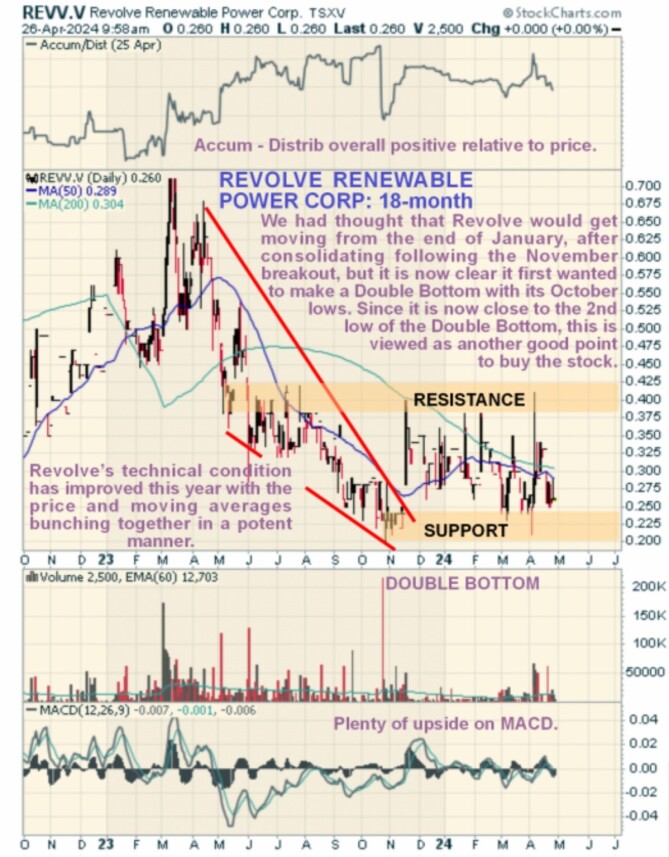
Revolve Renewable Power Corp. (TSXV:REVV;OTCQB:REVVF) was the subject of an article on January 22, when it was thought that, following a clear breakout from a bullish Falling Wedge downtrend and a period of consolidation, it would continue higher.

That didn’t happen, and it is now clear that the price wanted to mark out a larger base pattern, which it has now done by dipping early this month to form a Double Bottom with its lows of late last October.

Since it is now still close to the second low of the Double Bottom shown on the 18-month chart below this looks like another good point to buy or add to positions.

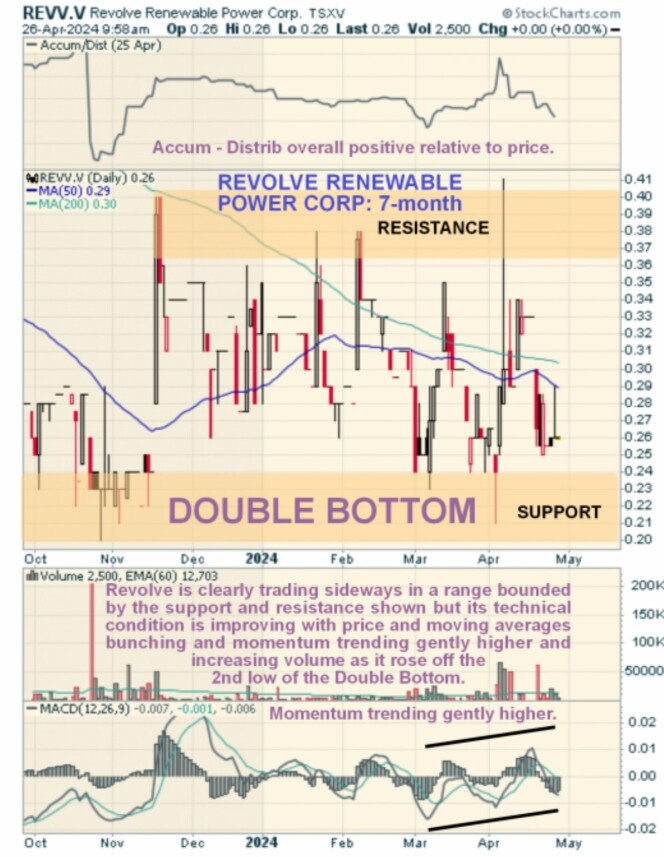
On the 7-month chart, we can see the entire period of the Double Bottom in much more detail. On this chart, we can see that although the stock hasn’t done much since we last looked at it and, in truth, is down a little, its technical condition has improved, with the price and its moving averages bunching more together in a manner that frequently precedes a new uptrend and momentum (MACD) trending gently higher.

The low early this month was marked by a prominent bull hammer, after which the price recovered off the second low of the Double Bottom on increased volume, which is bullish.

So, with the price still close to the second low of what is believed to be a Double Bottom, this is believed to be a good point to buy Revolve Renewable Power Corp. stock or add to positions.

Revolve Renewable Power Corp.’s website.

Revolve Renewable Power Corp. (TSXV:REVV;OTCQB:REVVF) closed for trading at CA$0.25 at 1.30 pm EDT on April 26, 2024.


Important Disclosures:

  1. Revolve Renewable Power Corp. is a billboard sponsor of Streetwise Reports and pays SWR a monthly sponsorship fee between US$4,000 and US$5,000.
  2. As of the date of this article, officers and/or employees of Streetwise Reports LLC (including members of their household) own securities of Revolve Renewable Power Corp.
  3. Author Certification and Compensation: [Clive Maund of clivemaund.com] is being compensated as an independent contractor by Street Smart, an affiliate of Streetwise Reports, for writing this article. Maund received his UK Technical Analysts’ Diploma in 1989.  The recommendations and opinions expressed in this content accurately reflect the personal, independent, and objective views of the author regarding any and all of the designated securities discussed. No part of the compensation received by the author was, is, or will be directly or indirectly related to the specific recommendations or views expressed
  4. Statements and opinions expressed are the opinions of the author and not of Streetwise Reports, Street Smart, or their officers. The author is wholly responsible for the accuracy of the statements. Streetwise Reports requires contributing authors to disclose any shareholdings in, or economic relationships with, companies that they write about. Any disclosures from the author can be found below. Streetwise Reports relies upon the authors to accurately provide this information and Streetwise Reports has no means of verifying its accuracy.
  5.  This article does not constitute investment advice and is not a solicitation for any investment. Streetwise Reports does not render general or specific investment advice and the information on Streetwise Reports should not be considered a recommendation to buy or sell any security. Each reader is encouraged to consult with his or her personal financial adviser and perform their own comprehensive investment research. By opening this page, each reader accepts and agrees to Streetwise Reports’ terms of use and full legal disclaimer. Streetwise Reports does not endorse or recommend the business, products, services or securities of any company.

For additional disclosures, please click here.

Clivemaund.com Disclosures

The above represents the opinion and analysis of Mr. Maund, based on data available to him, at the time of writing. Mr. Maund’s opinions are his own, and are not a recommendation or an offer to buy or sell securities. As trading and investing in any financial markets may involve serious risk of loss, Mr. Maund recommends that you consult with a qualified investment advisor, one licensed by appropriate regulatory agencies in your legal jurisdiction and do your own due diligence and research when making any kind of a transaction with financial ramifications. Although a qualified and experienced stock market analyst, Clive Maund is not a Registered Securities Advisor. Therefore Mr. Maund’s opinions on the market and stocks cannot be  only be construed as a recommendation or solicitation to buy and sell securities.

Heavenly Metals

Source: Michael Ballanger (4/29/24) 

Michael Ballanger of GGM Advisory Inc. takes a look at the current state of the markets, and shares some stocks he believes are worth taking a look at. 

As the Friday trading session came to a close this week, I had an epiphany of sorts in that instead of standing back and admiring the results while reaching around and patting myself several times on the back, I took the septuagenarian skin on the underside of my left bicep and gave it a rather robust pinch.

Rather than standing there reveling at copper and gold prices trading at or near multi-year highs, I instead decided to look “beneath the hood” at “conditions” that have quickly emerged as the standard bearer for the “Reflation Trade” that is quickly morphing into the new narrative for a large number of gargantuan traders.

Electrification

It was around the beginning of 2023, with the dominant narrative being that electrification metals like lithium and uranium are doing God’s work in alleviating the world’s sorry dependence on fossil fuels to provide heat and power to a growing global populace. Being a firm believer in the inevitability of electrification, I gravitated to the space not because I felt a moral or social obligation to avoid those necessary evils like oil and gas and coal. I did so because every time I looked into the mirror and saw a predominance of grey follicles in my beard, I came to the realization that my baby-booming generation of investors has little, if any, sway in influencing either market or social trends.

We are a dying breed of old, embittered gold bugs in constant search of that adrenalin rush that sent Foofoo Mines Ltd. in 1985 from $.10 to $2.00 on the release of drill core assays “too good to be true.” The reality in most cases was that a cabal of well-heeled traders with cavernous pockets full of excess margin could create junior market mania with three or four well-placed “Buy” orders designed to rip all resistance from any chart brave enough to be shown. As the volume alerts and price screeners kicked into gear, novice investors would clamor to buy any and all offerings that showed up while spreading the newly-found gospel called “King Foofoo” to any and all that might listen.

However, I digress.

The point I make is that the “old ways” of doing business in the junior resource sector have been replaced with the “new ways” by a socially responsible group of faux-liberal (with a small “L”) capitalists that will fight the carbon footprint as long as they have a $100,000 Tesla, a new model iPhone, and a pair of stovepipe dress pants too tight and too short for anyone other than a starving Biafran to wear.

The popularity of electrification in the investment narrative brought in huge moves in lithium, nickel, and uranium and I played all of those metals that seemed to explode right after the global central planners decided in March 2020 to shut down world trade and shutter its citizens in a desperate attempt to maintain the status quo of ever-rising equity markets and buoyant real estate. However, because young people these days have been fed a never-ending supply of behavior modification “medicines” (like Ritalin) to keep them “on task,” it appeared as though the vast majority of Millennial and Gen-X traders left their meds at home since 2020 lacking both the focus and resolve to stay invested much longer than the time it took for the ink to dry on their month-end statements.

On the topic of Attention Deficit Hyperactivity Disorder or “ADHD” as it has become known, when I was a young lad, as my mother recalled, I was known as an “active child.” Teachers referred to me as “fidgety” and “prone to distraction,” but it never affected either my behavior or my grades because of the use of a non-pharmaceutical method of attention control.

It was called a “yardstick,” and every teacher patrolled the classroom armed with this incredibly high-tech instrument. Just the sight of it protruding from the folded arms of a 110-lb., five-foot-tall, middle-aged lady teaching us geography would immediately imbed the entire list of world capitals into one’s memory banks, never, ever to be forgotten lest the wrath of “Old Yardie” come crashing down.

Yardsticks notwithstanding, I made a choice in early 2023 to refrain from falling in love (or lust) with any narrative deemed topical by the new generation of traders that run these markets.

Uranium

I turned to uranium and added Cameco Corp. (CCO:TSX; CCJ:NYSE) to my other holding, Western Uranium & Vanadium Corp. (WUC:CSE; WSTRF:OTCQX) in Q3 2023 and road it from $38 to $52 before exiting the uranium trade when it became apparent that the entire Twitterverse was long uranium juniors in every nook, cranny, and crevice of their investing superstructure.

Since my exit, the two “electrification darlings” of 2020-2023 have lagged badly. However, I remain a uranium “bull” and am seeking a re-entry level, hopefully soon.

Copper

While I was dabbling in the Li and U3O8 trades, I was quietly but steadily accumulating a basket of juniors that were not considered to be seen as “trades” but rather long-term positions with either excellent projects or discoveries and all of them are now fully funded and awaiting the commencement of drill programs in the hunt for or development of the one metal that is used universally the world over — copper.

I told subscribers in late 2022 that the two metals for the decade were copper and gold, with copper being the comprehensive answer to the electrification movement as whatever else happens with the establishment of new energy sources (like nuclear’s revival), the current global transmission grid would need to be expanded to accommodate all this new electricity being pumped out of all these new modular nuclear reactors.

Then, along comes another Millennial narrative called “artificial intelligence,” and as the mania of the decade fixes its grip on the investment world, they suddenly realize that all of this new computing power brought about by “AI” will require a boatload of additional electricity to power all of those new computers that will allow kindergarten kiddies to compose operatic symphonies with their iPhones driven by the magic of “AI”!

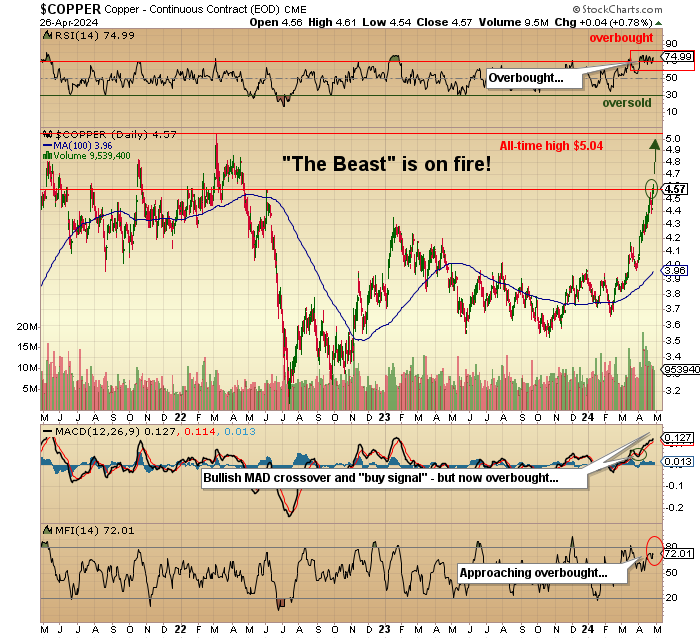
At this point in the weekly missive, I draw your attention to the earlier part where I spoke of an “epiphany of sorts” and that I was forced to “pinch myself” rather than revel in the glory of the 2024 performances of my two favorite metals. I would draw your attention firstly to copper, which just took out the June 2022 high at $4.57 while sporting a near-vertical ascent during the past month. It is now sporting an RSI at around 75, and while there is still a MACD “buy signal” in place, a couple of corrective days could trigger a reversal.

Up until mid-February, the ascent in copper had been gradual, but since then, the rise has moved to vertical. As I have written countless times, “any market whose trend moves from gradual to vertical is approaching a reversal of the prior trend”. So, copper is now overbought and in full vertical regalia, which means it may be like a bug in search of a windshield strictly from a technical perspective.
Now, when I make remarks such as these on a metal that is surely going to enter into a “structural deficit” within the next several quarters, the market appears to be discounting any likelihood of a global slowdown. I will exercise caution in chasing the big copper names. I have owned Freeport-McMoRan Inc. (FCX:NYSE) since $38 and will continue to hold it (at $50.50).

Despite the possibility of a correction, I see $75-100 by the end of 2025. A copper-gold leviathan, it is a core holding in any growth portfolio looking for the leadership of the cyclical names to replace technology as the next mania.

As for the juniors, I hold Fitzroy Minerals Inc. (FTZ:TSX.V; FTZFF:OTCQB) on the strength and promise of good things happening in their Chilean copper and Argentinian gold endeavors. I hear that field results are yielding some very interesting new revelations, and while they will be constrained by the South American winter, aggressive marketing of the new drill targets should set up an interesting drill program in the fall.

I also own American Eagle Gold Corp. (AE:TSXV), a very interesting little junior with a new copper-gold porphyry discovery in B.C. and an eager partner in Teck Resources Ltd. (TECK:TSX; TECK:NYSE) who at last glance own 19.9% of the company.

Their NAK discovery reported last January took the stock from under a dime to a high of CA$0.74 and is a solid “Buy” at around CA$0.60. I also added a brand new junior — Vortex Metals Inc. (VMSSF:OTCMKTS;VMS:TSX;DM8:FSE) by way of the recently announced (and upsized) placement at CA$0.09 (last at CA$0.13).

They are about to receive regulatory approval on a project located near the town of Illapel in north-central Chile, where a very interesting copper prospect exists. I listened to VMS director and ex-BHP country manager John Larson describe in minute detail the prospective nature of the multiple targets that exist. Also of extreme interest to me are the two Oaxaca (Mexico) prospects believed to be volcanogenic massive sulfide targets that were actually described to me by the late, great mine finder David Jones the year before he passed away.

A world-renowned expert in the exploration and exploitation of collapsed calderas (volcanos), he discovered Fortuna’s San Jose Gold Mine using techniques similar to what attracted him to the two Vortex targets. Chairman Michael Williams has brought investors a great deal of success with Underworld Resources (sold for $139 million to Kinross in 2009) and, more recently, Aftermath Silver, which subscribers know all too well from 2020. I am told that with the good graces of regulators and drill availability, Larson could be drilling Illapel by the end of next month.

With AE and VMS about to drill in May and with FTZ busy preparing for a fall start-up, 2024 is proving to be an interesting year with lots of irons in the fire hunting for the hottest metal on the planet.

Gold
The second component of the metals story for 2024 (and beyond) is none other than my sentimental favorite since 1976 — gold. Let it be known that while I was a card-carrying gold bug for nigh on thirty-five years, the events since the 2008 Great Financial Bailout Crisis forced me to turn in my card. I spent years collecting gold and silver coins for their numismatic value while keeping a horde of non-perishable foodstuffs in basement compartments along with fresh

water and medical supplies. I even kept large vessels of iodine rumored to be a repellent for radioactive poisoning. Then, in and around April of 2013, I watched the global trading community, under express orders from the Wall Street and Washington elites, absolutely crush any and all bullish sentiment for gold and silver in the wee hours of the western trading morning with the infamous “Sunday Night Massacre” that vaulted the precious metals into a four-year bear market whose debilitating effects are still being felt in the junior gold mining world a full eleven years later.

At that moment, I went from being a gold “advocate” to a gold “cynic,” and in order to maintain both sanity and net worth, I had to diversify away from a “gold only” allocation mixture to one that included gold but along with other metals as well. As abhorrent to me as it was, the decision to revert control of my investment decisions to the objectivity of reason was the best thing I have ever done, lest I wind up on the scrap heap of failed promises and broken dreams.

To a very large degree, I still bear the scars of a criminal assault by those wielding both power and influence over the masses by way of ruthless control of the legislative and judicial branches of government. Alas, my only defense has been to simplify things to where gold is simply a beachball, being temporarily held beneath the surface by an overzealous and underpowered toddler.

Simple, no?

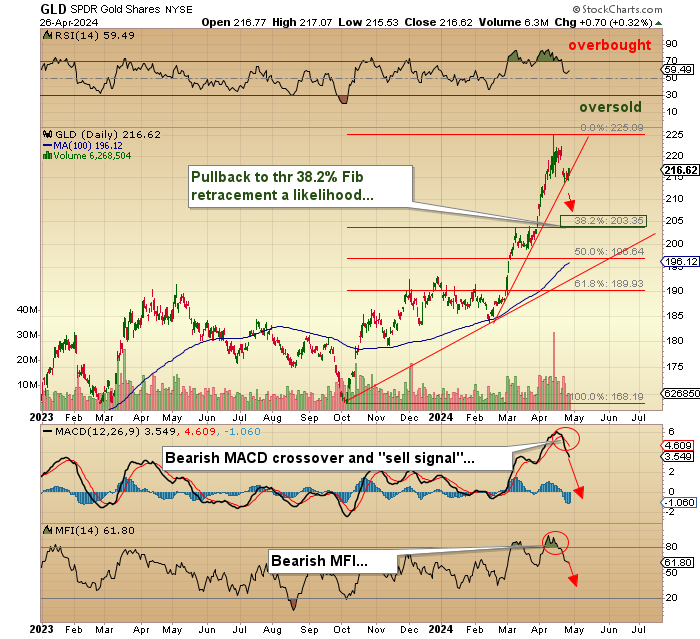
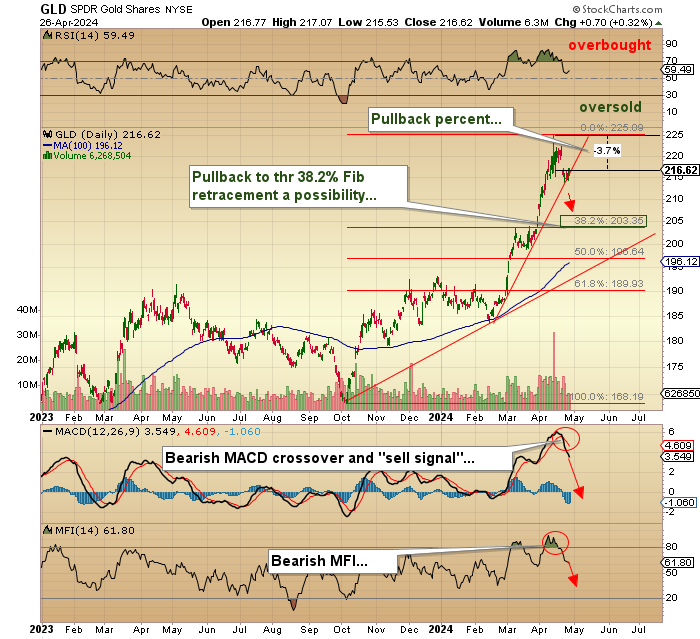
As measured by the SPDR Gold Shares ETF (GLD:NYSE) the giant ETF whose contained ounces have actually dropped on a year-to-date basis despite recent improvements, the gold market is currently in pullback mode, down approximately 3.72% from the recent top at $225.09. As astonishing as the constant drain of ounces from the GLD inventory, the very fact that it is occurring confirms a highly bullish fact: nobody believes the move. If we had GLD inventory rising sharply, we would know that the western retail public has finally and at long last “bought-in” to the notion that gold actually belongs in a portfolio, right up there beside APPL MSFT and Pets.com.

Technically, however, the pullback that began on April 12 is now in its third full week with both MACD and MFI on “sell signals” but with the RSI now down into the 57 area after spending the better part of six weeks in overbought status with a peak in the mid-80s. That is the bad news.

The good news is that GLD is nudging up against an uptrend line that dates back to the February lows around $184. If GLD can trade sideways for another few days allowing the RSI to retrace into the 40’s, it may stand a chance that we get a run to the highs first before anything more serious occurs. Failing that, the 38.2% Fibonacci retracement level is at $203.35, which for June Gold futures is around $2,220, and that level, while painful, would still leave the GLD market in great technical shape for a move to new highs by year-end. I remain a bull on gold and see GLD moving to around $246 on the next advance, which would be about $2,650 for June gold.
As for the junior gold explorers or developers, I continue to hold Getchell Gold Corp. (GTCH:CSE; GGLDF:OTCQB) as my premier selection. With 2,059,900 ounces of gold in the indicated and inferred category, the company now has a new Chairman, Robert Bass. He and his son Chris were added to the Board of Directors in January, which means that the insider group owns and/or controls over 20% of the issued capital.

Prior to those appointments, the number was closer to 1%. The company is busy completing metallurgical studies on the Fondaway Canyon ore in advance of a PEA expected by June. With the deposit wide open in all directions as to strike and to depth, there is considerable upside to resource and the share price. While the old timers tell me that gold ounces in Nevada should trade at $100/ounce, I have not seen anywhere near that number since 2011, and in fact, desperation deals in the past year were being done at $5-10 an ounce as funding completely disappeared and liquidity evaporated.
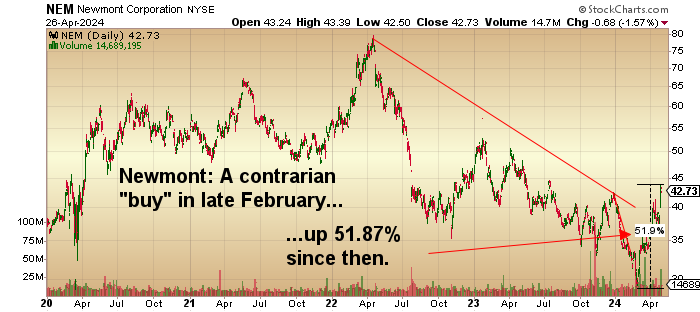
The good news for companies like GTCH came in the form of the Newmont Corp. (NEM:NYSE) earnings, which absolutely knocked the cover off the ball. Back in February, when the world of armchair gold analysts (wearing stupid oversized cowboy hats) were calling Newmont a “POS company” and bragging to the world that they were selling their stock, I tweeted out to my followers that it was the best “contrarian buy” of the year. I said then that Newmont was spending month after month acquiring companies with big gold assets and, in some cases, paying up (as in “too much”) as in their bid last year for Australian-based Newbridge Gold.

Well, how do those acquisitions look now? Their earnings soared, as did gold production, while AISC dropped sharply in direct contrast to the share price, up over 40% since they got thrown under the proverbial bus back in February. (I must confess that I did not include in my note to subscribers because I was more than adequately represented in senior gold allocation by way of Freeport, which still stands as Freeport has been a beast.) Then, late last week, Agnico Eagle reported their earnings, and they, too, blew the doors off and went out for the week at multi-year highs, but with record earnings and free cash flow, the stock is still 18.6% from its all-time high last seen in September 2020.

I believe that in the old horse chestnut that “there ain’t no fever like GOLD fever,” and if last week was just a fractional tidbit of a rotation by the monster generalist funds into the gold space, then I shudder to think what a move to a 5% allocation will look like as we had in the late 1970’s given that gold miner allocations are estimated to be in the fractions of a percent range today.

As these leviathan funds suddenly discover that they simply cannot own enough of the Newmonts and Barricks and Agnicos of the world, they will migrate down the ladder of quality and size, finally adding ounces of any size and shape and regardless of location, style, or depth. It is at this point in the equation that ounces in Nevada will indeed be priced not at USD $100 per ounce but at $300-500 per ounce.

Getchell Gold is valued at $13.36 per ounce of gold and is located in the heart of the best mining jurisdiction in the world — Nevada — and which is wide open to depth and long strike with what could easily evolve into a Tier One asset (5mm ounces or more) with further drilling and if course the blessing of the two goddesses of the junior mining world — Mother Nature and Lady Luck.

While it has been an excruciatingly long wait, I see a huge upside in the entire group of junior gold developers, but what attracts me to GTCH is that they are both developing an existing and growing resource while exploring for much, much more.


Important Disclosures:

  1. As of the date of this article, officers and/or employees of Streetwise Reports LLC (including members of their household) own securities of Cameco Corp., Western Uranium & Vanadium Corp., American Eagel Gold Corp., Vortex Metals Inc. and Getchell Gold Corp.
  2. Michael Ballanger: I, or members of my immediate household or family, own securities of: All. My company has a financial relationship with Fotzroy Minerals. I determined which companies would be included in this article based on my research and understanding of the sector.
  3. Statements and opinions expressed are the opinions of the author and not of Streetwise Reports, Street Smart, or their officers. The author is wholly responsible for the accuracy of the statements. Streetwise Reports was not paid by the author to publish or syndicate this article. Streetwise Reports requires contributing authors to disclose any shareholdings in, or economic relationships with, companies that they write about. Any disclosures from the author can be found  below. Streetwise Reports relies upon the authors to accurately provide this information and Streetwise Reports has no means of verifying its accuracy.
  4.  This article does not constitute investment advice and is not a solicitation for any investment. Streetwise Reports does not render general or specific investment advice and the information on Streetwise Reports should not be considered a recommendation to buy or sell any security. Each reader is encouraged to consult with his or her personal financial adviser and perform their own comprehensive investment research. By opening this page, each reader accepts and agrees to Streetwise Reports’ terms of use and full legal disclaimer. Streetwise Reports does not endorse or recommend the business, products, services or securities of any company.

For additional disclosures, please click here.

Michael Ballanger Disclosures

This letter makes no guarantee or warranty on the accuracy or completeness of the data provided. Nothing contained herein is intended or shall be deemed to be investment advice, implied or otherwise. This letter represents my views and replicates trades that I am making but nothing more than that. Always consult your registered advisor to assist you with your investments. I accept no liability for any loss arising from the use of the data contained on this letter. Options and junior mining stocks contain a high level of risk that may result in the loss of part or all invested capital and therefore are suitable for experienced and professional investors and traders only. One should be familiar with the risks involved in junior mining and options trading and we recommend consulting a financial adviser if you feel you do not understand the risks involved.

Optimism over corporate earnings is fueling stock indices. The Hong Kong index reached a 5-month high

By JustMarkets

On Monday, the Dow Jones (US30) rose by 0.38%, while the S&P 500 (US500) Index gained 0.32%. The NASDAQ Technology Index (US100) closed positive 0.35%. Meanwhile, the S&P 500 (US500) and NASDAQ (US100) 100 indices hit 2-week highs. Optimism over first-quarter earnings, positive corporate news, and lower bond yields contribute to the broader market’s gains.

Tesla’s (TSLA) shares are up more than 12% after the company met vital security and data privacy requirements in China. It will partner with Baidu (BIDU) to introduce a fully autonomous driving feature. Domino’s Pizza (DPZ) is up more than 4% after reporting better-than-expected revenue from operations in the first quarter. Apple (AAPL) shares are up more than 3% after Bernstein upgraded its rating to “outperform.”

First-quarter earnings results were mostly better than expected, which is favorable for the stock. According to Bloomberg Intelligence, about 81% of the S&P 500 companies already reported beat first-quarter earnings estimates.

In the coming days, markets will focus on the outcome of Tuesday/Wednesday’s FOMC meeting and Fed Chair Powell’s comments on how long the Federal Reserve is willing to wait before cutting interest rates. Recent US price data has signaled solid core inflation, pushing back rate cut expectations. Currently, markets are pricing in a 25 bps chance of a rate cut of 2% at the next FOMC meeting on May 1 and 13% at the next meeting on June 12. In addition, the earnings results of AMZN and AAPL on Thursday will also determine the market’s direction.

Equity markets in Europe were mostly down on Monday. Germany’s DAX (DE40) was down 0.24%, France’s CAC 40 (FR40) closed negative 0.29%, Spain’s IBEX 35 (ES35) decreased by 0.48%, and the UK’s FTSE 100 (UK100) closed positive 0.09%.

Hawkish comments from ECB Governing Council representatives Knot and Wunsch on Monday put moderate pressure on European indices when they said the ECB should be cautious, sending a signal to markets that it will cut rates for a second consecutive month in July. The Eurozone economic confidence indicator for April unexpectedly fell by 0.6 to 95.6, weaker than expectations of a rise to 96.7. Germany’s consumer price index (EU harmonized) for April rose by 2.4% y/y, stronger than expectations of 2.3% y/y.

WTI crude oil prices fell to $82.5/bbl on Tuesday, extending losses from the previous session as peace talks between Israel and Hamas eased fears of a widening conflict in the Middle East. Markets are awaiting the Hamas leadership’s response to a phased truce offer made by Israel over the weekend in Cairo. However, ongoing Houthi attacks on maritime traffic south of the Suez Canal keep investors on edge.

Asian markets were predominantly up yesterday. Japan’s Nikkei 225 (JP225) rose by 0.81%, China’s FTSE China A50 (CHA50) added 0.64%, Hong Kong’s Hang Seng (HK50) gained 0.54%, and Australia’s ASX 200 (AU200) was positive 0.81%. The Hang Seng (HK50) retreated from the 5-month peak the previous day as some traders sought to lock in profits after substantial gains in the last six sessions. Meanwhile, investors were digesting China’s manufacturing PMI data for April, where official data showed a second consecutive month of growth in factory activity. Private Caixin survey data indicated the manufacturing sector grew the most in 14 months.

On Monday, the yen fell to 160 per dollar for the first time since 1990 before making a more than 3% jump to 154.5 per dollar due to a supposed intervention by Japanese authorities. Meanwhile, the government has not confirmed whether it has intervened in the markets to support the yen, although chief currency diplomat Masato Kanda said they would release the results at the end of next month. Japan’s March 2024 retail sales rose 1.2% year-on-year, slowing significantly from the upwardly revised 4.7% rise in February and well below market expectations for a 2.5% rise. Nevertheless, it was the 25th consecutive month of retail sales growth as consumption in Japan continued to rise.

Flash data showed that retail sales in Australia fell by 0.4% in March 2024, falling short of the 0.2% growth projection, which was also revised down from February. It was the first decline in retail sales since December last year, as turnover fell across all sectors.

S&P 500 (US500) 5,116.17 +16.21 (+0.32%)

Dow Jones (US30) 38,386.09 +146.43 (+0.38%)

DAX (DE40) 18,118.32 −42.69 (−0.24%)

FTSE 100 (UK100) 8,147.03 +7.20 (+0.09%)

USD Index 105.64 −0.32 (−0.30%)

Important events today:
  • – Japan Unemployment Rate (m/m) at 02:30 (GMT+3);
  • – Japan Industrial Production (m/m) at 02:50 (GMT+3);
  • – Australia Retail Sales (m/m) at 04:30 (GMT+3);
  • – China Manufacturing PMI (m/m) at 04:30 (GMT+3);
  • – China Non-Manufacturing PMI (m/m) at 04:30 (GMT+3);
  • – China Caixin Manufacturing PMI (m/m) at 04:45 (GMT+3);
  • – German Retail Sales (m/m) at 09:00 (GMT+3);
  • – Switzerland KOF Leading Indicators (m/m) at 10:30 (GMT+3);
  • – German Unemployment Rate (m/m) at 10:55 (GMT+3);
  • – German GDP (m/m) at 11:00 (GMT+3);
  • – Eurozone Consumer Price Index (m/m) at 12:00 (GMT+3);
  • – Eurozone GDP (q/q) at 12:00 (GMT+3);
  • – Canada GDP (m/m) at 15:30 (GMT+3);
  • – US Chicago PMI (m/m) at 16:45 (GMT+3);
  • – US CB Consumer Confidence (m/m) at 17:00 (GMT+3).

By JustMarkets


This article reflects a personal opinion and should not be interpreted as an investment advice, and/or offer, and/or a persistent request for carrying out financial transactions, and/or a guarantee, and/or a forecast of future events.

FXTM’s Copper: Hits fresh two-year high!

By ForexTime

  • FXTM launches 10 new commodities!
  • Copper jumps to two-year high
  • Prices up almost 20% year-to-date
  • Bulls in control on H4/D1 charts
  • Key levels of interest at $4.58, $4.54 & $4.50

In case you missed it, FXTM’s new Copper commodity has just hit a fresh two-year high!

Prices punched above $4.65 per pound on Tuesday morning thanks to fundamental forces.

Note: COMEX Copper is priced per pound.

Before we cover the fundamentals, here are some fun facts about copper:

  • 3rd most widely used metal in the world.
  • Used in buildings, electronic products, machinery and transportation.
  • Chile has the world’s largest copper mine.
  • China is the world’s largest consumer.
  • Hit all-time high of $5.01 in March 2022


Now here are the basics:


What is Copper?

It is a shiny, reddish, and malleable metal widely used in our everyday lives.

This metal has major industrial uses and is an essential nutrient in our daily diet!

What does FXTM’s Copper track?

FXTM’s Copper tracks Copper futures on the New York Mercantile Exchange’s COMEX division.

COMEX is an abbreviation of the Commodity Exchange Inc.

Note: Unlike other metals like gold and silver, copper futures are traded as a commodity.

The lowdown…

Copper prices have been trending higher in recent months.

The commodity has gained almost 20% since the start of 2024 due to supply-side factors and expectations around booming demand.

  • In December, Cobre Panama one of the world’s largest copper mines was forced to stop operations.
  • Earlier this month, metal exchanges were prohibited from accepting new Russian production of copper, aluminum and nickel.
  • Zambia, Africa’s second-largest copper producer was hit by power cuts.

The bigger picture

It is not only supply shortages that have boosted copper prices.

The clean energy transition and artificial intelligence projects could fuel upside gains.

Copper remains in hot demand because of its use in electronic devices. But it is also a crucial component in the creation of solar panels, wind turbines and hydro systems.

What does this mean?

Well according to the International Copper Study Group (ICSG), world copper mine production in 2024 has been revised down to 0.5% compared to the 3.7% forecast in October 2023.

In addition, demand is expected to increase by 2% in 2024 and jump to 2.5% in 2025!

With production falling and demand rising, this could spell more gains for copper down the road.

Looking at the technicals…

Prices are firmly bullish on the daily charts with bulls in a position of power.

However, a technical throwback could be in play on the H1 charts with prices testing potential support levels.

  • Sustained weakness below $4.58 may encourage a decline towards the 100-day SMA and $4.50.
  • Should prices rebound from the 100-day SMA, this could trigger a move back towards $4.58, $4.60 and $4.65.


Forex-Time-LogoArticle by ForexTime

ForexTime Ltd (FXTM) is an award winning international online forex broker regulated by CySEC 185/12 www.forextime.com

European indices grow on the ECB’s “dovish” position. Quarterly reports of mega-companies support the broad market

By JustMarkets

On Friday, the Dow Jones (US30) Index gained 0.40% (for the week +0.32%), while the S&P 500 (US500) Index gained 1.02% (for the week +2.26%). The NASDAQ Technology Index (US100) closed positive 2.03% (for the week +3.45%). Positive earnings results from Alphabet (GOOG) and Microsoft (MSFT) are helping to boost the overall market. Alphabet is up more than 10% after reporting better-than-expected first-quarter earnings. Additionally, Microsoft is up more than 2% after reporting better-than-consensus earnings. Shares of chip companies also jumped after tech megacaps, including Meta Platforms, Alphabet, and Microsoft, said they will continue to increase investment in artificial intelligence, which should boost demand for AI chip companies. Stock indices maintained gains despite economic news from the US, which showed that March personal spending and the March core PCE deflator rose more than expected, a hawkish factor for Fed policy. On the downside, Intel (INTC) fell more than 10% after forecasting weaker-than-expected second-quarter earnings.

US personal spending for March rose by 0.8% m/m, stronger than expectations of 0.6% m/m. Personal income for March rose by 0.5% m/m, which aligns with expectations. The US core PCE deflator for March, the Fed’s preferred measure of inflation, came in at 2.8% y/y, unchanged from February and above expectations of 2.7% y/y. The University of Michigan Consumer Sentiment Index for April was revised down 0.7% to 77.2, weaker than expectations of no change at 77.9.

Equity markets in Europe were mostly up on Friday. Germany’s DAX (DE40) rose by 1.36% (for the week +2.38%), France’s CAC 40 (FR40) closed up 0.89% (for the week +0.25%), Spain’s IBEX 35 (ES35) added 1.56% (for the week +3.10%), and the UK’s FTSE 100 (UK100) closed positive 0.75% (for the week +3.09%).

The Eurozone M3 Money Supply for March grew more than expected, which is negative for the euro. March 1-year ECB inflation expectations fell to 3.0% from 3.1% in February, the lowest in two years. However, March’s 3-year inflation expectations were 2.5%, unchanged from February’s and above expectations of 2.4%. Swaps estimate the ECB’s chances of a 25 bps rate cut at its next meeting on June 6 at 88%. This is a growth factor for the European indices.

WTI crude oil prices fell to around $83 a barrel on Monday, recouping some of last week’s gains. High US inflation further undermined sentiment around interest rate cuts, worsening the demand outlook. Investors now await the US central bank’s monetary policy decision this week, which is expected to keep borrowing costs at current high levels. The latest US PCE inflation data strengthened the dollar, increasing oil prices as dollar-denominated commodities become more expensive for buyers holding other currencies.

Asian markets were mostly up last week. Japan’s Nikkei 225 (JP225) rose by 1.86%, China’s FTSE China A50 (CHA50) gained 2.06% for the week, Hong Kong’s Hang Seng (HK50) jumped by 7.56% for the week, and Australia’s ASX 200 (AU200) was negative 0.87%.

The Japanese yen strengthened 2% to 155 per dollar on Monday after falling to 160.2 earlier in the session. Markets saw this as a possible government intervention as Japanese banks are reportedly actively dumping dollars. Traders have been on alert for a possible intervention by Japanese authorities for some time as the yen has slumped to 34-year lows and lost more than 10% against the dollar this year.

Vietnam’s annual inflation rate rose to 4.4% in April 2024 from 3.97% in the previous month. This was the highest inflation rate since January 2023, with food prices rising the most in eight months (4.32% vs. 4.05% in March).

S&P 500 (US500) 5,099.96 +51.54 (+1.02%)

Dow Jones (US30) 38,239.66 +122.77 (+0.32%)

DAX (DE40) 18,161.01 +243.73 (+1.36%)

FTSE 100 (UK100) 8,139.83 +60.97 (+0.75%)

USD Index 106.09 +0.16 (+0.15%)

Important events today:
  • – German Consumer Price Index (m/m) at 15:00 (GMT+3).

By JustMarkets


This article reflects a personal opinion and should not be interpreted as an investment advice, and/or offer, and/or a persistent request for carrying out financial transactions, and/or a guarantee, and/or a forecast of future events.