Speculator Extremes: Yen, VIX, Cotton & WTI Crude Oil top Bullish & Bearish Positions

By InvestMacro 

The latest update for the weekly Commitment of Traders (COT) report was released by the Commodity Futures Trading Commission (CFTC) on Friday for data ending on September 10th.

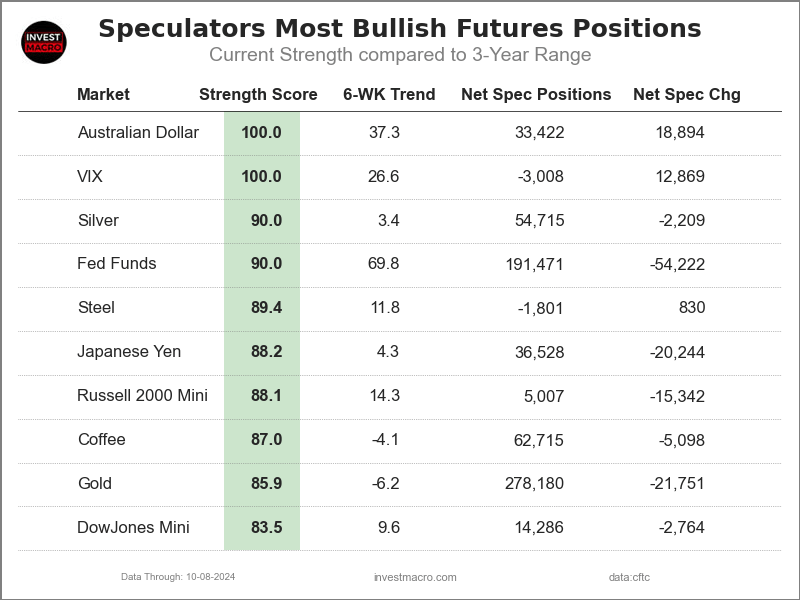
This weekly Extreme Positions report highlights the Most Bullish and Most Bearish Positions for the speculator category. Extreme positioning in these markets can foreshadow strong moves in the underlying market.

To signify an extreme position, we use the Strength Index (also known as the COT Index) of each instrument, a common method of measuring COT data. The Strength Index is simply a comparison of current trader positions against the range of positions over the previous 3 years. We use over 80 percent as extremely bullish and under 20 percent as extremely bearish. (Compare Strength Index scores across all markets in the data table or cot leaders table)


Here Are This Week’s Most Bullish Speculator Positions:

Japanese Yen


The Japanese Yen speculator position comes in as the most bullish extreme standing this week. The Japanese Yen speculator level is currently at a maximum 100.0 percent score of its 3-year range.

The six-week trend for the percent strength score totaled 53.8 this week. The overall net speculator position was a total of 55,770 net contracts this week with a jump by 14,654 contract in the weekly speculator bets.


Speculators or Non-Commercials Notes:

Speculators, classified as non-commercial traders by the CFTC, are made up of large commodity funds, hedge funds and other significant for-profit participants. The Specs are generally regarded as trend-followers in their behavior towards price action – net speculator bets and prices tend to go in the same directions. These traders often look to buy when prices are rising and sell when prices are falling. To illustrate this point, many times speculator contracts can be found at their most extremes (bullish or bearish) when prices are also close to their highest or lowest levels.

These extreme levels can be dangerous for the large speculators as the trade is most crowded, there is less trading ammunition still sitting on the sidelines to push the trend further and prices have moved a significant distance. When the trend becomes exhausted, some speculators take profits while others look to also exit positions when prices fail to continue in the same direction. This process usually plays out over many months to years and can ultimately create a reverse effect where prices start to fall and speculators start a process of selling when prices are falling.


VIX


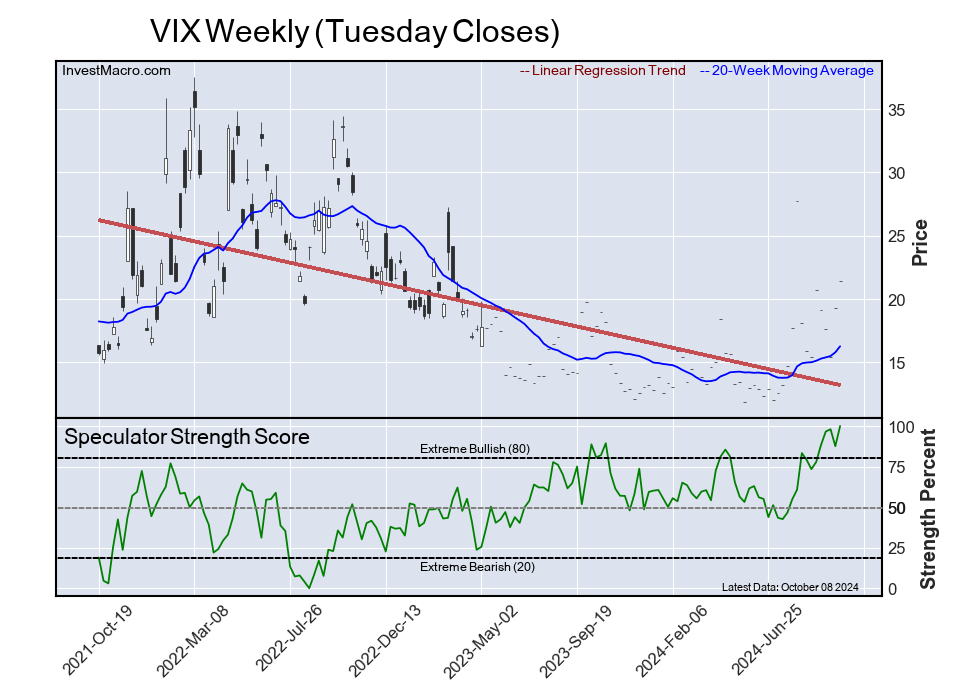
The VIX speculator position comes next in the extreme standings this week. The VIX speculator level is now at a 98.8 percent score of its 3-year range.

The six-week trend for the percent strength score was 37.4 this week. The speculator position registered -15,111 net contracts this week with a weekly rise of 10,778 contracts in speculator bets.


3-Month Secured Overnight Financing Rate


The 3-Month Secured Overnight Financing Rate speculator position comes in third this week in the extreme standings. The 3-Month Secured Overnight Financing Rate speculator level resides at a 98.7 percent score of its 3-year range.

The six-week trend for the speculator strength score came in at 29.2 this week. The overall speculator position was 744,227 net contracts this week with a huge boost of 112,656 contracts in the weekly speculator bets.


Gold


The Gold speculator position comes up number four in the extreme standings this week. The Gold speculator level is at a 95.1 percent score of its 3-year range.

The six-week trend for the speculator strength score totaled a change of 14.8 this week. The overall speculator position was 282,501 net contracts this week with a dip of -5,057 contracts in the speculator bets.


Ultra U.S. Treasury Bonds


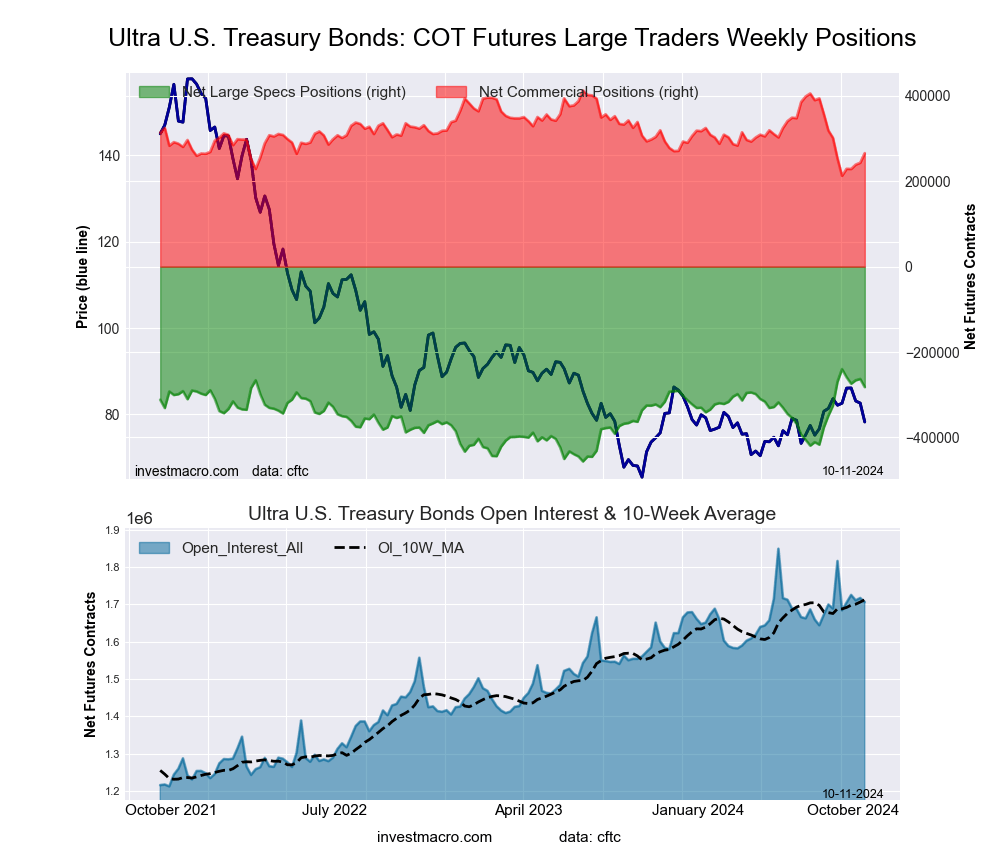
The Ultra U.S. Treasury Bonds speculator position rounds out the top five in this week’s bullish extreme standings. The Ultra U.S. Treasury Bonds speculator level sits at a 91.2 percent score of its 3-year range. The six-week trend for the speculator strength score was 73.0 this week.

The speculator position was -259,158 net contracts this week with a decline of -18,956 contracts in the weekly speculator bets.


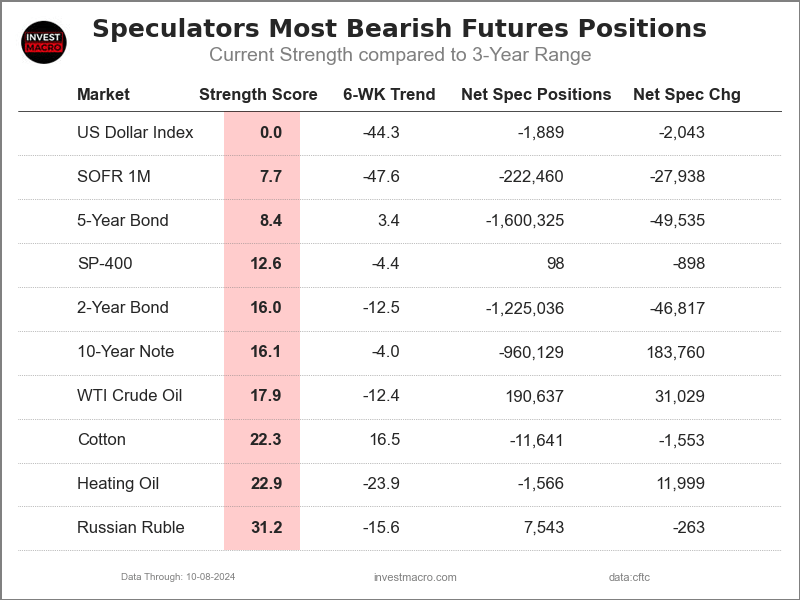
This Week’s Most Bearish Speculator Positions:

Cotton


The Cotton speculator position comes in as the most bearish extreme standing this week. The Cotton speculator level is at the lowest possible value of a 0.0 percent score of its 3-year range.

The six-week trend for the speculator strength score was -5.2 this week. The overall speculator position was -46,111 net contracts this week with a drop of -7,957 contracts in the speculator bets.


WTI Crude Oil


The WTI Crude Oil speculator position comes in next for the most bearish extreme standing on the week. The WTI Crude Oil speculator level is at a just 0.6 percent score of its 3-year range.

The six-week trend for the speculator strength score was -36.2 this week. The speculator position totaled 140,014 net contracts this week with a slide of -37,021 contracts in the weekly speculator bets.


5-Year Bond


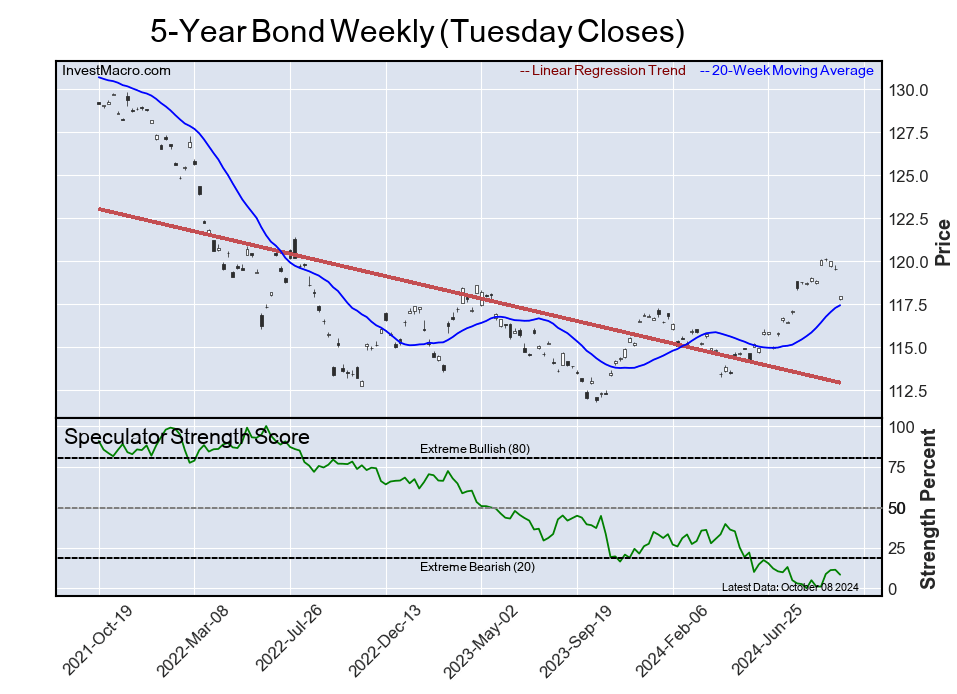
The 5-Year Bond speculator position comes in as third most bearish extreme standing of the week. The 5-Year Bond speculator level resides at a 1.0 percent score of its 3-year range.

The six-week trend for the speculator strength score was -3.9 this week. The overall speculator position was -1,719,996 net contracts this week with a small dip by -1,300 contracts in the speculator bets.


10-Year Note


The 10-Year Note speculator position comes in as this week’s fourth most bearish extreme standing. The 10-Year Note speculator level is at a 1.3 percent score of its 3-year range.

The six-week trend for the speculator strength score was -24.1 this week. The speculator position was -1,022,105 net contracts this week with a fall by -19,278 contracts in the weekly speculator bets.


Gasoline


Finally, the Gasoline speculator position comes in as the fifth most bearish extreme standing for this week. The Gasoline speculator level is at a 5.6 percent score of its 3-year range.

The six-week trend for the speculator strength score was -10.3 this week. The speculator position was 15,637 net contracts this week with a decrease by -4,221 contracts in the weekly speculator bets.


Article By InvestMacroReceive our weekly COT Newsletter

*COT Report: The COT data, released weekly to the public each Friday, is updated through the most recent Tuesday (data is 3 days old) and shows a quick view of how large speculators or non-commercials (for-profit traders) were positioned in the futures markets.

The CFTC categorizes trader positions according to commercial hedgers (traders who use futures contracts for hedging as part of the business), non-commercials (large traders who speculate to realize trading profits) and nonreportable traders (usually small traders/speculators) as well as their open interest (contracts open in the market at time of reporting). See CFTC criteria here.

COT Metals Charts: Speculator Bets led by Platinum

By InvestMacro

Here are the latest charts and statistics for the Commitment of Traders (COT) data published by the Commodities Futures Trading Commission (CFTC).

The latest COT data is updated through Tuesday September 10th and shows a quick view of how large traders (for-profit speculators and commercial entities) were positioned in the futures markets.

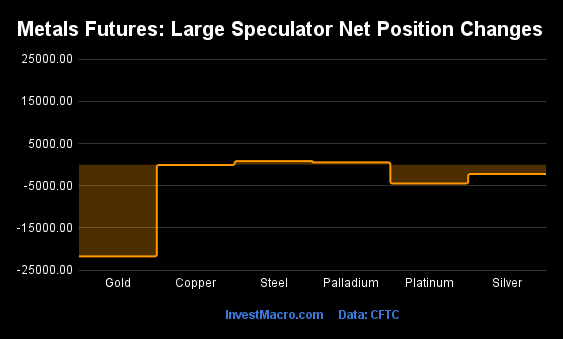
Weekly Speculator Changes led by Platinum

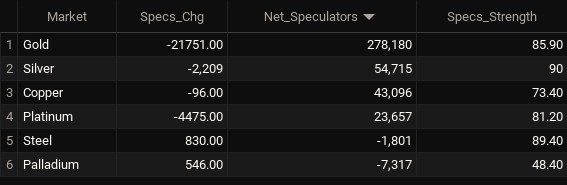
The COT metals markets speculator bets were mixed this week as three out of the six metals markets we cover had higher positioning while the other three markets had lower speculator contracts.

Leading the gains for the metals was Platinum (8,615 contracts) with Palladium (645 contracts) and Steel (155 contracts) also having positive weeks.

The markets with declines in speculator bets for the week were Gold (-5,057 contracts), Silver (-1,317 contracts) and with Copper (-149 contracts) also recording lower bets on the week.


Metals Net Speculators Leaderboard

Legend: Weekly Speculators Change | Speculators Current Net Position | Speculators Strength Score compared to last 3-Years (0-100 range)


Strength Scores led by Gold & Steel

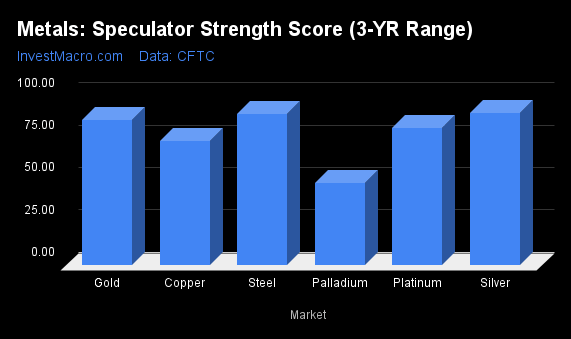
COT Strength Scores (a normalized measure of Speculator positions over a 3-Year range, from 0 to 100 where above 80 is Extreme-Bullish and below 20 is Extreme-Bearish) showed that Gold (95 percent) and Steel (83 percent) lead the metals markets this week. Silver (78 percent) comes in as the next highest in the weekly strength scores.

On the downside, Palladium (21 percent) comes in at the lowest strength level currently. The next lowest strength scores are Platinum (45 percent) and Copper (45 percent).

Strength Statistics:
Gold (95.1 percent) vs Gold previous week (97.2 percent)
Silver (77.9 percent) vs Silver previous week (79.7 percent)
Copper (45.2 percent) vs Copper previous week (45.3 percent)
Platinum (44.7 percent) vs Platinum previous week (21.7 percent)
Palladium (21.4 percent) vs Palladium previous week (16.7 percent)
Steel (82.7 percent) vs Palladium previous week (82.1 percent)


Gold & Palladium top the 6-Week Strength Trends

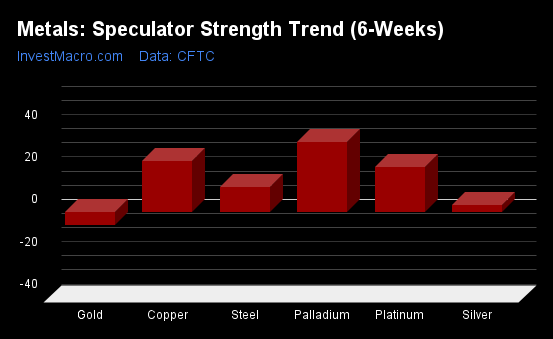
COT Strength Score Trends (or move index, calculates the 6-week changes in strength scores) showed that Gold (15 percent) and Palladium (15 percent) lead the past six weeks trends for metals. Steel (9 percent) is the next highest positive mover in the latest trends data.

Platinum (-12 percent) leads the downside trend scores currently with Copper (-11 percent) as the next market with lower trend scores.

Move Statistics:
Gold (14.8 percent) vs Gold previous week (6.0 percent)
Silver (-5.8 percent) vs Silver previous week (-7.2 percent)
Copper (-10.9 percent) vs Copper previous week (-27.2 percent)
Platinum (-11.5 percent) vs Platinum previous week (-28.9 percent)
Palladium (15.4 percent) vs Palladium previous week (4.6 percent)
Steel (8.8 percent) vs Steel previous week (10.2 percent)


Individual Markets:

Gold Comex Futures:

Gold Futures COT ChartThe Gold Comex Futures large speculator standing this week equaled a net position of 282,501 contracts in the data reported through Tuesday. This was a weekly fall of -5,057 contracts from the previous week which had a total of 287,558 net contracts.

This week’s current strength score (the trader positioning range over the past three years, measured from 0 to 100) shows the speculators are currently Bullish-Extreme with a score of 95.1 percent. The commercials are Bearish-Extreme with a score of 5.9 percent and the small traders (not shown in chart) are Bullish with a score of 59.0 percent.

Price Trend-Following Model: Strong Uptrend

Our weekly trend-following model classifies the current market price position as: Strong Uptrend. The current action for the model is considered to be: Hold – Maintain Long Position.

Gold Futures StatisticsSPECULATORSCOMMERCIALSSMALL TRADERS
– Percent of Open Interest Longs:66.515.310.0
– Percent of Open Interest Shorts:11.275.35.2
– Net Position:282,501-306,89924,398
– Gross Longs:340,00678,23250,937
– Gross Shorts:57,505385,13126,539
– Long to Short Ratio:5.9 to 10.2 to 11.9 to 1
NET POSITION TREND:
– Strength Index Score (3 Year Range Pct):95.15.959.0
– Strength Index Reading (3 Year Range):Bullish-ExtremeBearish-ExtremeBullish
NET POSITION MOVEMENT INDEX:
– 6-Week Change in Strength Index:14.8-13.1-6.7


Silver Comex Futures:

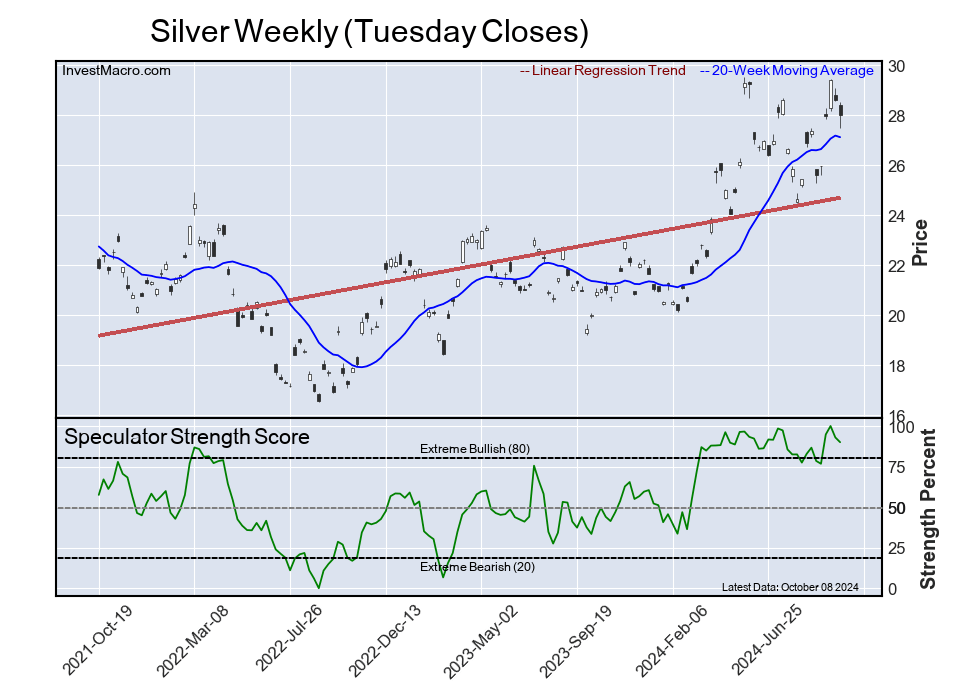
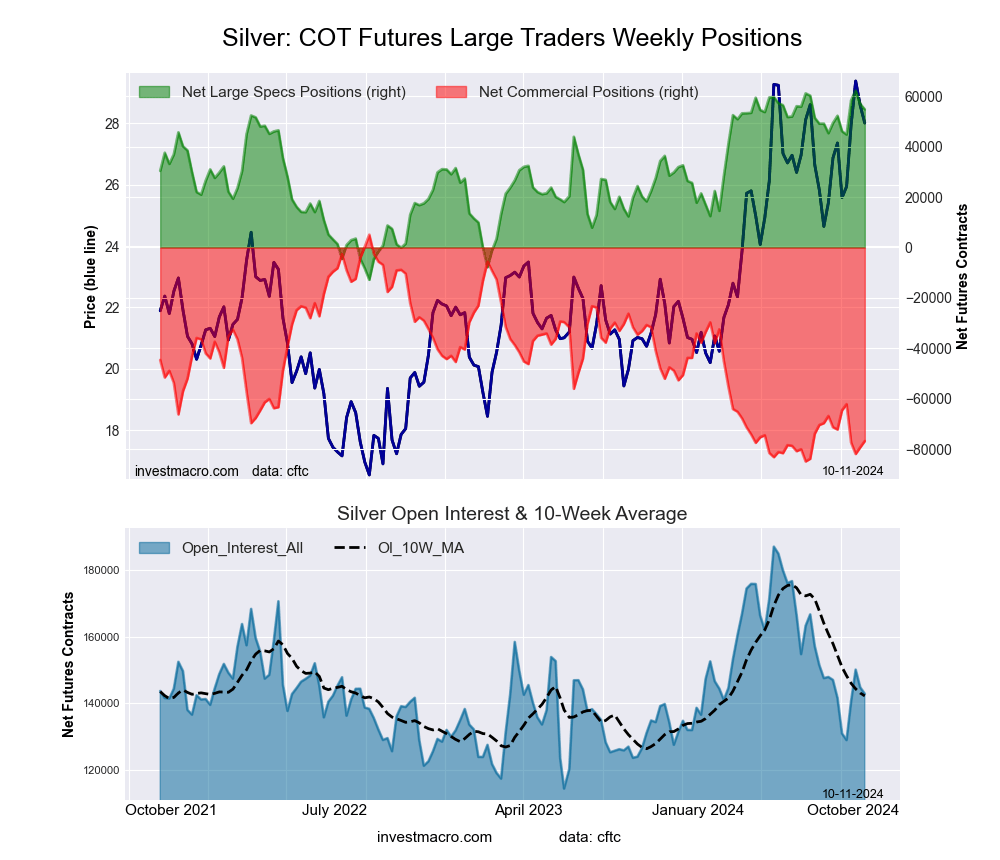
Silver Futures COT ChartThe Silver Comex Futures large speculator standing this week equaled a net position of 44,742 contracts in the data reported through Tuesday. This was a weekly lowering of -1,317 contracts from the previous week which had a total of 46,059 net contracts.

This week’s current strength score (the trader positioning range over the past three years, measured from 0 to 100) shows the speculators are currently Bullish with a score of 77.9 percent. The commercials are Bearish with a score of 25.3 percent and the small traders (not shown in chart) are Bullish with a score of 54.6 percent.

Price Trend-Following Model: Strong Uptrend

Our weekly trend-following model classifies the current market price position as: Strong Uptrend. The current action for the model is considered to be: New Buy – Long Position.

Silver Futures StatisticsSPECULATORSCOMMERCIALSSMALL TRADERS
– Percent of Open Interest Longs:47.823.621.9
– Percent of Open Interest Shorts:13.171.78.4
– Net Position:44,742-62,08617,344
– Gross Longs:61,64930,38628,230
– Gross Shorts:16,90792,47210,886
– Long to Short Ratio:3.6 to 10.3 to 12.6 to 1
NET POSITION TREND:
– Strength Index Score (3 Year Range Pct):77.925.354.6
– Strength Index Reading (3 Year Range):BullishBearishBullish
NET POSITION MOVEMENT INDEX:
– 6-Week Change in Strength Index:-5.89.2-19.2


Copper Grade #1 Futures:

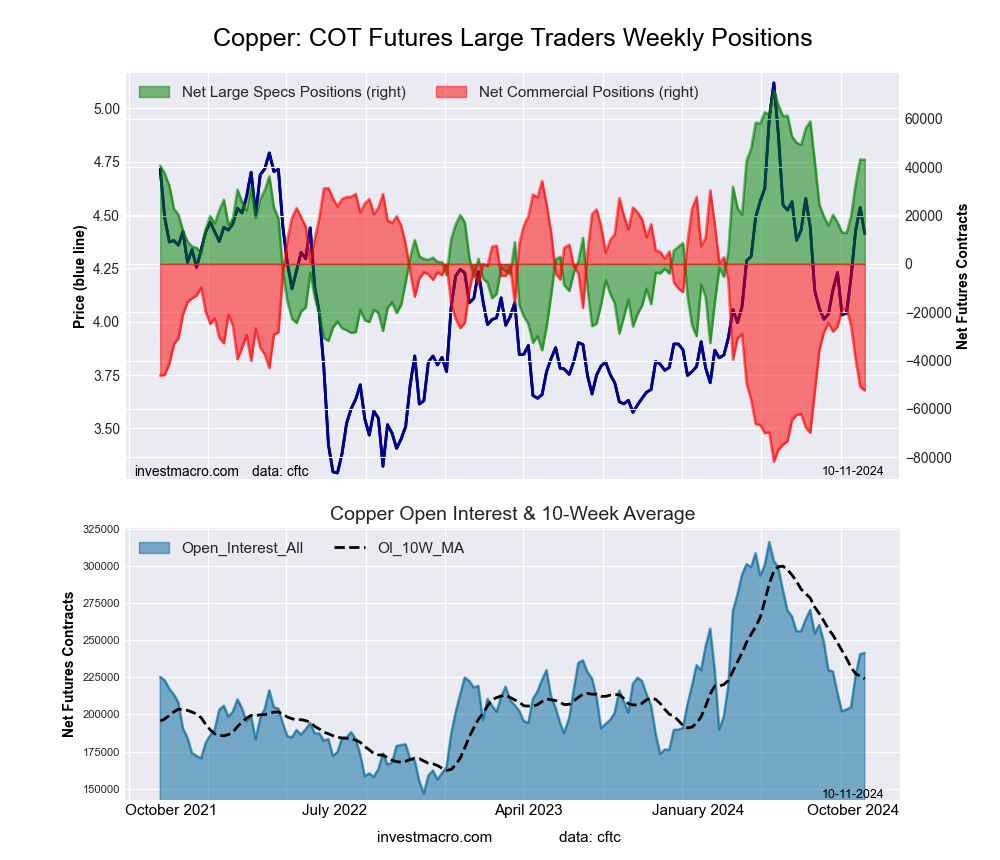
Copper Futures COT ChartThe Copper Grade #1 Futures large speculator standing this week equaled a net position of 12,812 contracts in the data reported through Tuesday. This was a weekly lowering of -149 contracts from the previous week which had a total of 12,961 net contracts.

This week’s current strength score (the trader positioning range over the past three years, measured from 0 to 100) shows the speculators are currently Bearish with a score of 45.2 percent. The commercials are Bullish with a score of 54.6 percent and the small traders (not shown in chart) are Bullish with a score of 51.9 percent.

Price Trend-Following Model: Downtrend

Our weekly trend-following model classifies the current market price position as: Downtrend. The current action for the model is considered to be: Hold – Maintain Short Position.

Copper Futures StatisticsSPECULATORSCOMMERCIALSSMALL TRADERS
– Percent of Open Interest Longs:36.834.89.6
– Percent of Open Interest Shorts:30.543.96.8
– Net Position:12,812-18,4485,636
– Gross Longs:74,75470,85119,482
– Gross Shorts:61,94289,29913,846
– Long to Short Ratio:1.2 to 10.8 to 11.4 to 1
NET POSITION TREND:
– Strength Index Score (3 Year Range Pct):45.254.651.9
– Strength Index Reading (3 Year Range):BearishBullishBullish
NET POSITION MOVEMENT INDEX:
– 6-Week Change in Strength Index:-10.914.8-33.6


Platinum Futures:

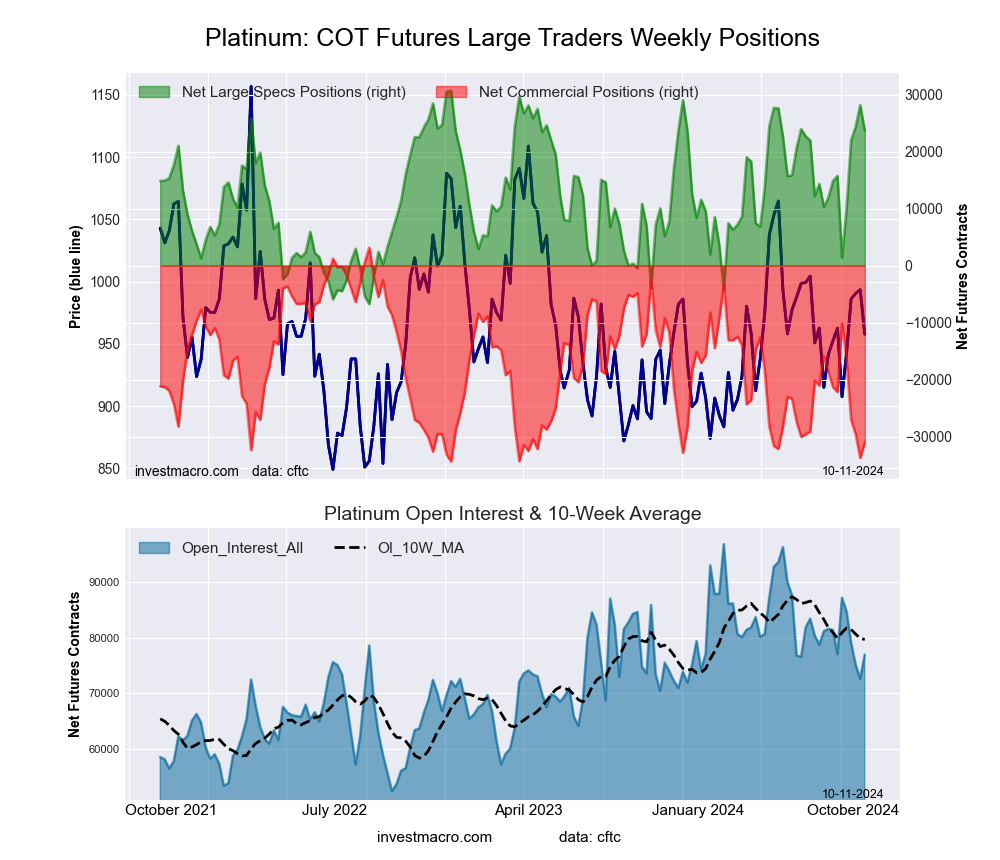
Platinum Futures COT ChartThe Platinum Futures large speculator standing this week equaled a net position of 10,003 contracts in the data reported through Tuesday. This was a weekly increase of 8,615 contracts from the previous week which had a total of 1,388 net contracts.

This week’s current strength score (the trader positioning range over the past three years, measured from 0 to 100) shows the speculators are currently Bearish with a score of 44.7 percent. The commercials are Bearish with a score of 47.8 percent and the small traders (not shown in chart) are Bullish with a score of 63.4 percent.

Price Trend-Following Model: Weak Downtrend

Our weekly trend-following model classifies the current market price position as: Weak Downtrend. The current action for the model is considered to be: Hold – Maintain Short Position.

Platinum Futures StatisticsSPECULATORSCOMMERCIALSSMALL TRADERS
– Percent of Open Interest Longs:53.624.012.4
– Percent of Open Interest Shorts:41.843.44.8
– Net Position:10,003-16,4166,413
– Gross Longs:45,42720,37010,508
– Gross Shorts:35,42436,7864,095
– Long to Short Ratio:1.3 to 10.6 to 12.6 to 1
NET POSITION TREND:
– Strength Index Score (3 Year Range Pct):44.747.863.4
– Strength Index Reading (3 Year Range):BearishBearishBullish
NET POSITION MOVEMENT INDEX:
– 6-Week Change in Strength Index:-11.512.3-4.7


Palladium Futures:

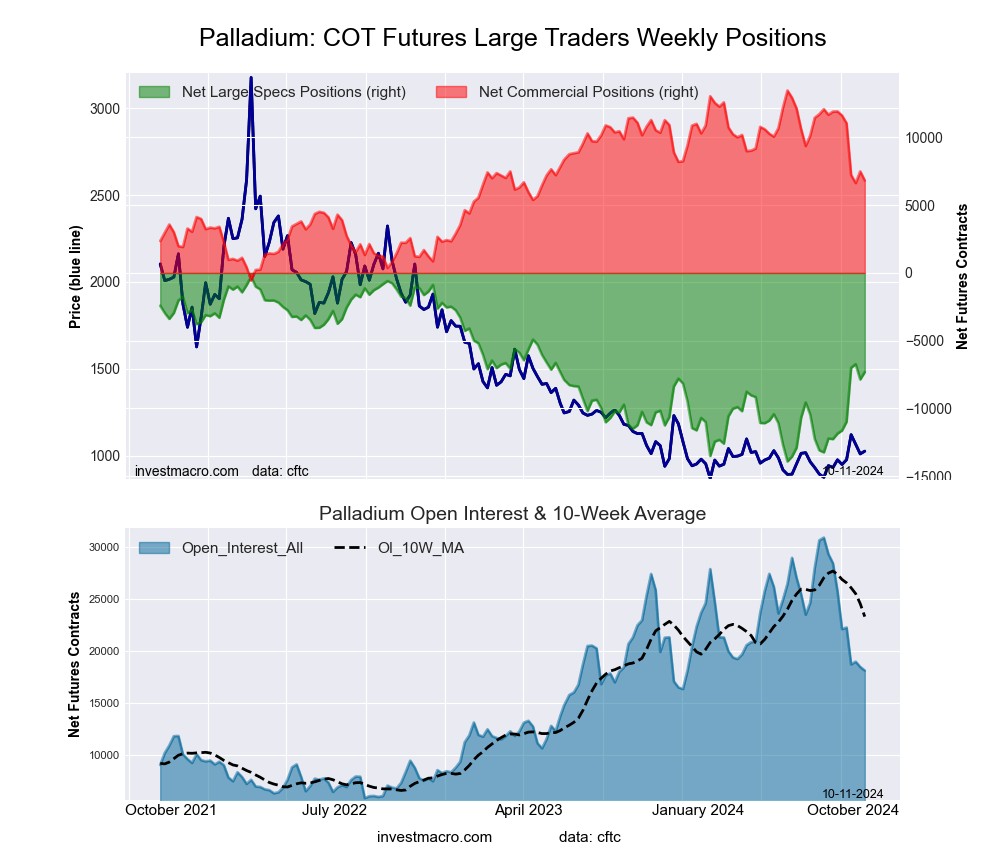
Palladium Futures COT ChartThe Palladium Futures large speculator standing this week equaled a net position of -10,988 contracts in the data reported through Tuesday. This was a weekly rise of 645 contracts from the previous week which had a total of -11,633 net contracts.

This week’s current strength score (the trader positioning range over the past three years, measured from 0 to 100) shows the speculators are currently Bearish with a score of 21.4 percent. The commercials are Bullish-Extreme with a score of 82.8 percent and the small traders (not shown in chart) are Bearish with a score of 30.6 percent.

Price Trend-Following Model: Uptrend

Our weekly trend-following model classifies the current market price position as: Uptrend. The current action for the model is considered to be: New Buy – Long Position.

Palladium Futures StatisticsSPECULATORSCOMMERCIALSSMALL TRADERS
– Percent of Open Interest Longs:28.160.77.1
– Percent of Open Interest Shorts:77.511.17.3
– Net Position:-10,98811,049-61
– Gross Longs:6,24513,5131,569
– Gross Shorts:17,2332,4641,630
– Long to Short Ratio:0.4 to 15.5 to 11.0 to 1
NET POSITION TREND:
– Strength Index Score (3 Year Range Pct):21.482.830.6
– Strength Index Reading (3 Year Range):BearishBullish-ExtremeBearish
NET POSITION MOVEMENT INDEX:
– 6-Week Change in Strength Index:15.4-4.7-69.4


Steel Futures Futures:

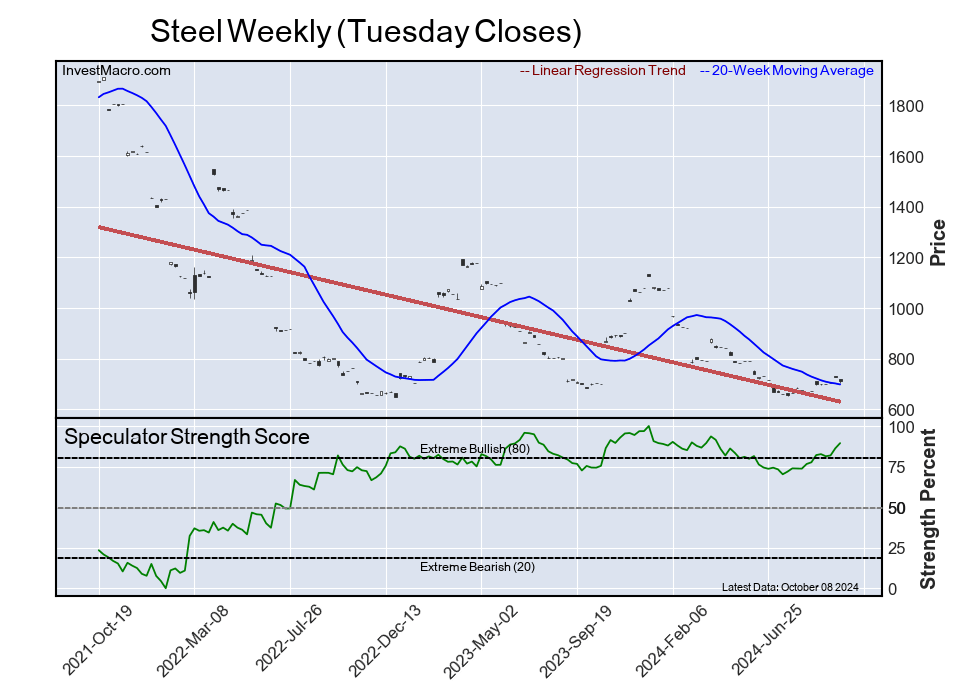
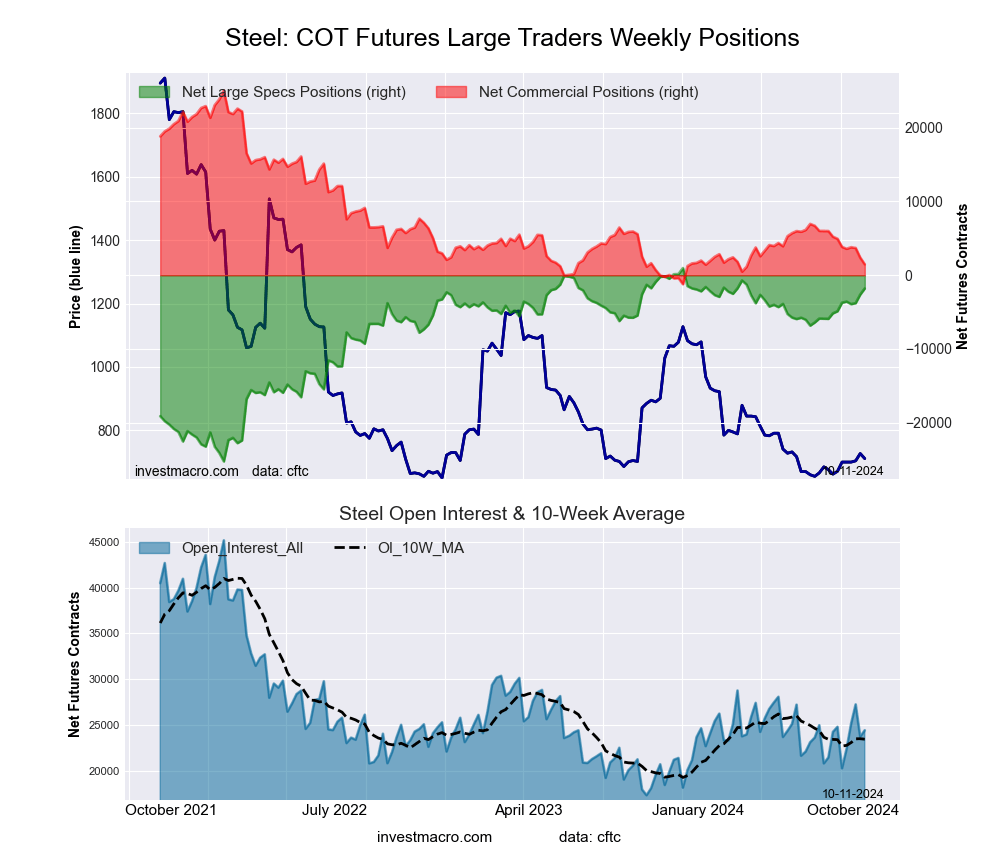
Steel Futures COT ChartThe Steel Futures large speculator standing this week equaled a net position of -3,577 contracts in the data reported through Tuesday. This was a weekly gain of 155 contracts from the previous week which had a total of -3,732 net contracts.

This week’s current strength score (the trader positioning range over the past three years, measured from 0 to 100) shows the speculators are currently Bullish-Extreme with a score of 82.7 percent. The commercials are Bearish-Extreme with a score of 18.3 percent and the small traders (not shown in chart) are Bearish with a score of 32.2 percent.

Price Trend-Following Model: Weak Downtrend

Our weekly trend-following model classifies the current market price position as: Weak Downtrend. The current action for the model is considered to be: Hold – Maintain Short Position.

Steel Futures StatisticsSPECULATORSCOMMERCIALSSMALL TRADERS
– Percent of Open Interest Longs:19.370.00.8
– Percent of Open Interest Shorts:35.354.00.8
– Net Position:-3,5773,579-2
– Gross Longs:4,32715,668169
– Gross Shorts:7,90412,089171
– Long to Short Ratio:0.5 to 11.3 to 11.0 to 1
NET POSITION TREND:
– Strength Index Score (3 Year Range Pct):82.718.332.2
– Strength Index Reading (3 Year Range):Bullish-ExtremeBearish-ExtremeBearish
NET POSITION MOVEMENT INDEX:
– 6-Week Change in Strength Index:8.8-9.314.3


Article By InvestMacroReceive our weekly COT Newsletter

*COT Report: The COT data, released weekly to the public each Friday, is updated through the most recent Tuesday (data is 3 days old) and shows a quick view of how large speculators or non-commercials (for-profit traders) were positioned in the futures markets.

The CFTC categorizes trader positions according to commercial hedgers (traders who use futures contracts for hedging as part of the business), non-commercials (large traders who speculate to realize trading profits) and nonreportable traders (usually small traders/speculators) as well as their open interest (contracts open in the market at time of reporting). See CFTC criteria here.

COT Bonds Charts: Speculator Bets led by SOFR 3-Months & Fed Funds

By InvestMacro

Here are the latest charts and statistics for the Commitment of Traders (COT) reports data published by the Commodities Futures Trading Commission (CFTC).

The latest COT data is updated through Tuesday September 10th and shows a quick view of how large traders (for-profit speculators and commercial hedgers) were positioned in the futures markets.

Weekly Speculator Changes led by SOFR 3-Months & Fed Funds

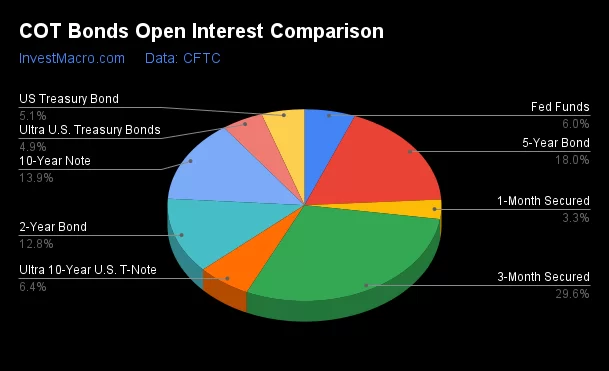
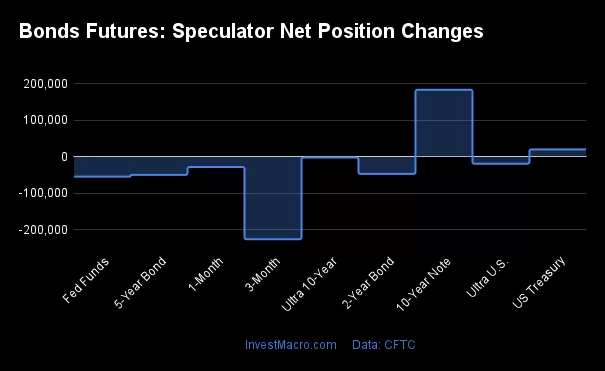
The COT bond market speculator bets were lower this week as just three out of the nine bond markets we cover had higher positioning while the other six markets had lower speculator contracts.

Leading the gains for the bond markets was the SOFR 3-Months (112,656 contracts) with the Fed Funds (34,313 contracts) and the Ultra 10-Year Bonds (27,613 contracts) also having positive weeks.

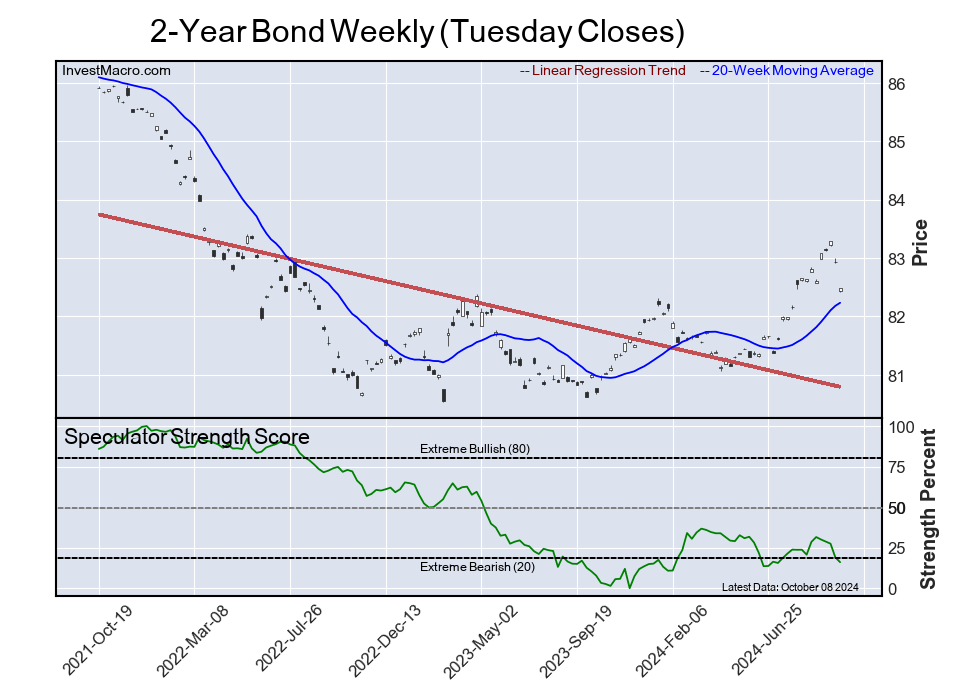
The bond markets with declines in speculator bets for the week were the SOFR 1-Month (-31,894 contracts), the US Treasury Bonds (-31,186 contracts), the 2-Year Bonds (-23,754 contracts), the 10-Year Bonds (-19,278 contracts), the Ultra Treasury Bonds (-18,956 contracts) and with the 5-Year Bonds (-1,300 contracts) also registering lower bets on the week.


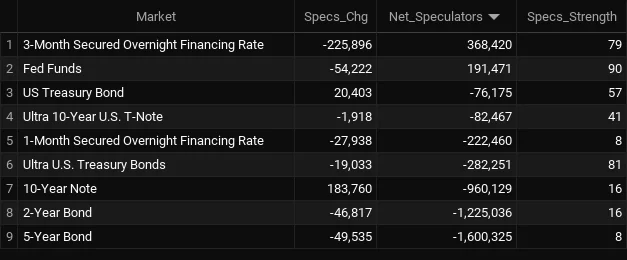
Bonds Net Speculators Leaderboard

Legend: Weekly Speculators Change | Speculators Current Net Position | Speculators Strength Score compared to last 3-Years (0-100 range)


Strength Scores led by SOFR 3-Months & Ultra Treasury Bonds

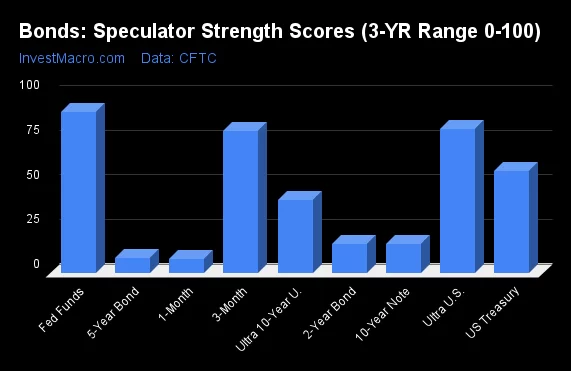
COT Strength Scores (a normalized measure of Speculator positions over a 3-Year range, from 0 to 100 where above 80 is Extreme-Bullish and below 20 is Extreme-Bearish) showed that the SOFR 3-Months (99 percent) and the Ultra Treasury Bonds (91 percent) lead the bond markets this week. The US Treasury Bonds (61 percent) comes in as the next highest in the weekly strength scores.

On the downside, the 5-Year Bond (1 percent) and the 10-Year Bonds (1 percent) come in at the lowest strength level currently and are in Extreme-Bearish territory (below 20 percent). The next lowest strength scores were the 2-Year Bonds (30 percent) and the SOFR 1-Month (30 percent).

Strength Statistics:
Fed Funds (54.0 percent) vs Fed Funds previous week (46.3 percent)
2-Year Bond (30.0 percent) vs 2-Year Bond previous week (31.6 percent)
5-Year Bond (1.0 percent) vs 5-Year Bond previous week (1.1 percent)
10-Year Bond (1.3 percent) vs 10-Year Bond previous week (2.9 percent)
Ultra 10-Year Bond (46.2 percent) vs Ultra 10-Year Bond previous week (40.5 percent)
US Treasury Bond (61.1 percent) vs US Treasury Bond previous week (72.0 percent)
Ultra US Treasury Bond (91.2 percent) vs Ultra US Treasury Bond previous week (100.0 percent)
SOFR 1-Month (30.4 percent) vs SOFR 1-Month previous week (38.8 percent)
SOFR 3-Months (98.7 percent) vs SOFR 3-Months previous week (92.9 percent)


Ultra Treasury Bonds & Fed Funds top the 6-Week Strength Trends

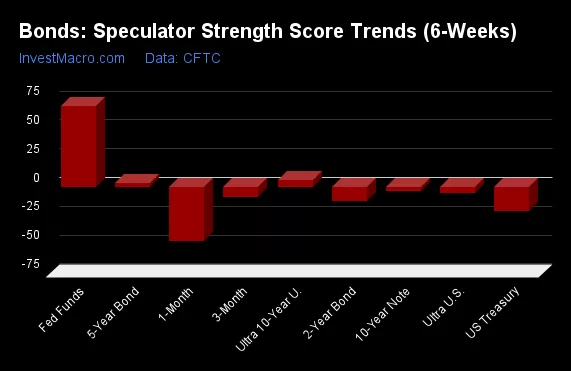
COT Strength Score Trends (or move index, calculates the 6-week changes in strength scores) showed that the Ultra Treasury Bonds (73 percent) and the Fed Funds (35 percent) lead the past six weeks trends for bonds. The SOFR 3-Months (29 percent) and the Ultra 10-Year Bond (11 percent) are the next highest positive movers in the latest trends data.

The SOFR 1-Month (-41.4 percent) and the 10-Year Bonds (-24 percent) lead the downside trend scores currently with the US Treasury Bonds (-6 percent) and the 5-Year Bonds (-4 percent) following next with lower trend scores.

Strength Trend Statistics:
Fed Funds (35.0 percent) vs Fed Funds previous week (10.5 percent)
2-Year Bond (6.2 percent) vs 2-Year Bond previous week (10.2 percent)
5-Year Bond (-3.9 percent) vs 5-Year Bond previous week (-12.0 percent)
10-Year Bond (-24.1 percent) vs 10-Year Bond previous week (-29.6 percent)
Ultra 10-Year Bond (11.4 percent) vs Ultra 10-Year Bond previous week (6.6 percent)
US Treasury Bond (-6.4 percent) vs US Treasury Bond previous week (10.8 percent)
Ultra US Treasury Bond (73.0 percent) vs Ultra US Treasury Bond previous week (79.1 percent)
SOFR 1-Month (-41.4 percent) vs SOFR 1-Month previous week (-40.3 percent)
SOFR 3-Months (29.2 percent) vs SOFR 3-Months previous week (25.9 percent)


30-Day Federal Funds Futures:

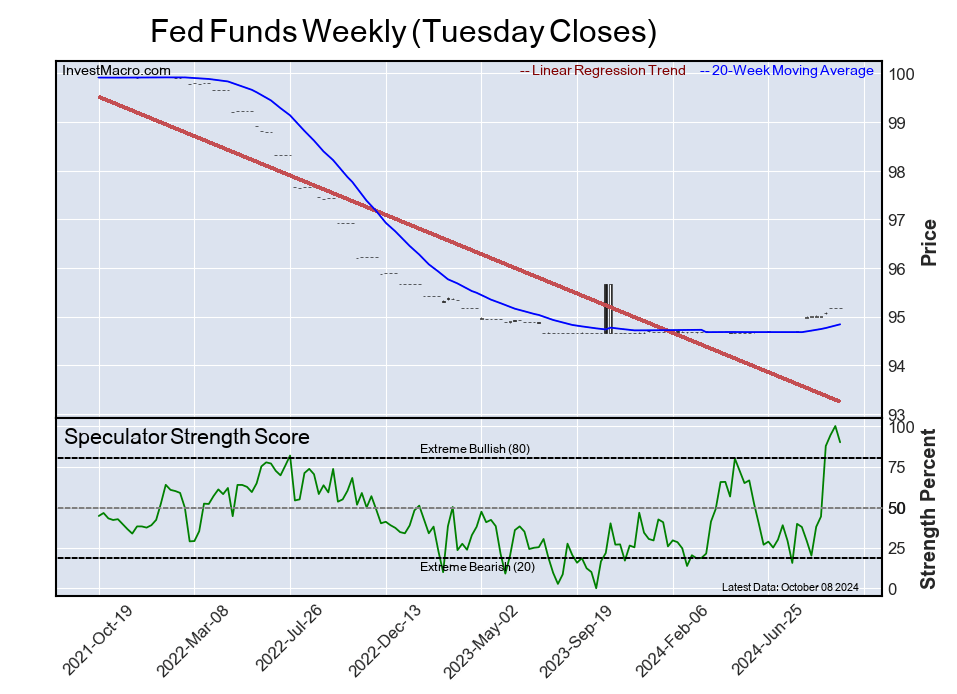
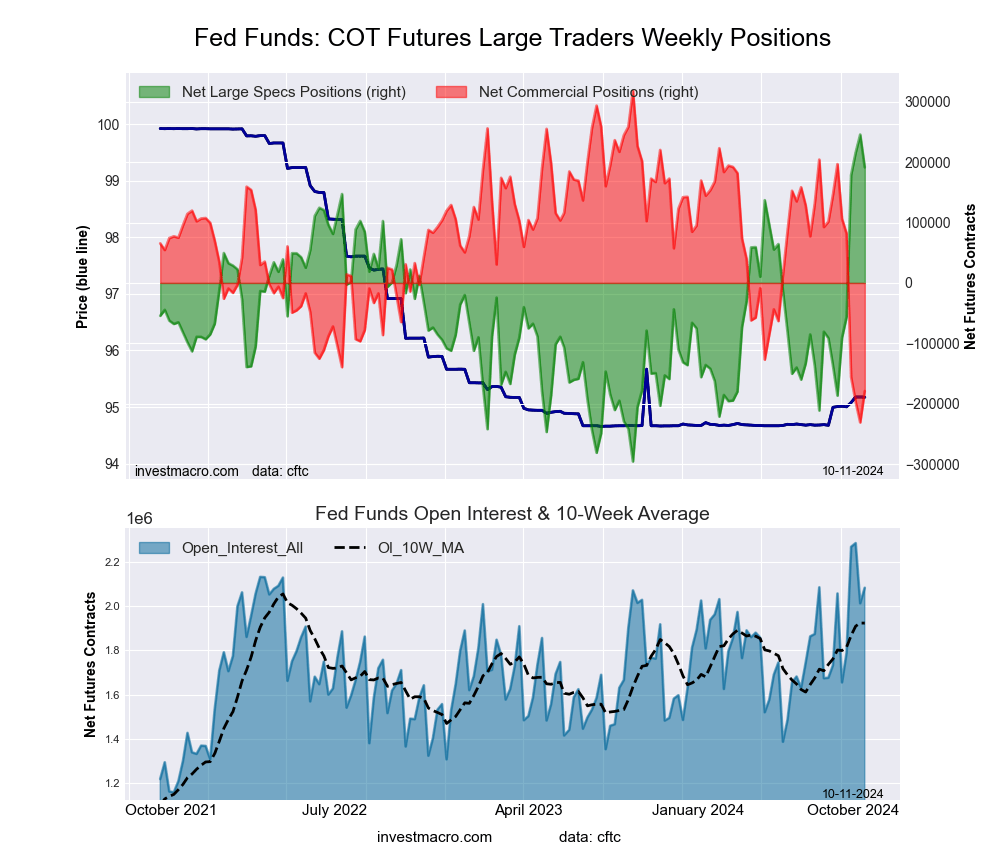
Federal Funds 30-Day Bonds Futures COT ChartThe 30-Day Federal Funds large speculator standing this week was a net position of -56,421 contracts in the data reported through Tuesday. This was a weekly rise of 34,313 contracts from the previous week which had a total of -90,734 net contracts.

This week’s current strength score (the trader positioning range over the past three years, measured from 0 to 100) shows the speculators are currently Bullish with a score of 54.0 percent. The commercials are Bearish with a score of 48.3 percent and the small traders (not shown in chart) are Bearish with a score of 38.3 percent.

Price Trend-Following Model: Downtrend

Our weekly trend-following model classifies the current market price position as: Downtrend. The current action for the model is considered to be: Hold – Maintain Short Position.

30-Day Federal Funds StatisticsSPECULATORSCOMMERCIALSSMALL TRADERS
– Percent of Open Interest Longs:14.866.71.6
– Percent of Open Interest Shorts:17.962.13.0
– Net Position:-56,42181,935-25,514
– Gross Longs:264,5951,193,17228,812
– Gross Shorts:321,0161,111,23754,326
– Long to Short Ratio:0.8 to 11.1 to 10.5 to 1
NET POSITION TREND:
– Strength Index Score (3 Year Range Pct):54.048.338.3
– Strength Index Reading (3 Year Range):BullishBearishBearish
NET POSITION MOVEMENT INDEX:
– 6-Week Change in Strength Index:35.0-26.7-59.8


Secured Overnight Financing Rate (3-Month) Futures:

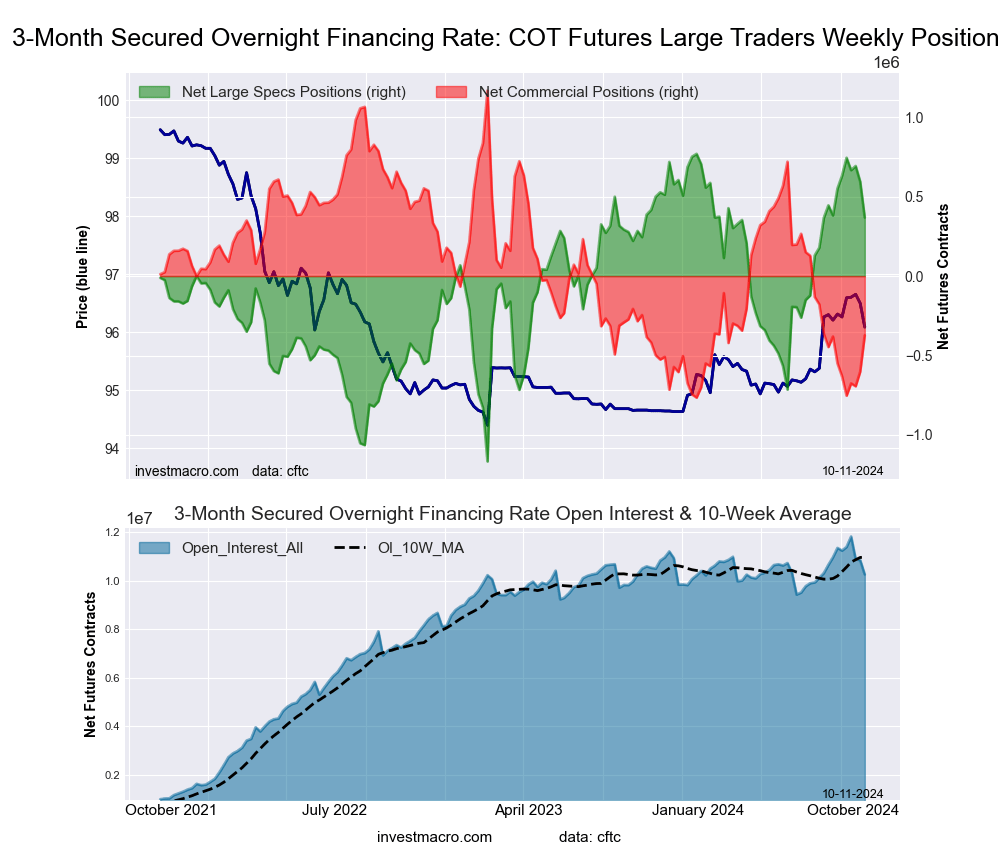
SOFR 3-Months Bonds Futures COT ChartThe Secured Overnight Financing Rate (3-Month) large speculator standing this week was a net position of 744,227 contracts in the data reported through Tuesday. This was a weekly rise of 112,656 contracts from the previous week which had a total of 631,571 net contracts.

This week’s current strength score (the trader positioning range over the past three years, measured from 0 to 100) shows the speculators are currently Bullish-Extreme with a score of 98.7 percent. The commercials are Bearish-Extreme with a score of 0.7 percent and the small traders (not shown in chart) are Bullish-Extreme with a score of 92.4 percent.

Price Trend-Following Model: Weak Uptrend

Our weekly trend-following model classifies the current market price position as: Weak Uptrend. The current action for the model is considered to be: Hold – Maintain Long Position.

SOFR 3-Months StatisticsSPECULATORSCOMMERCIALSSMALL TRADERS
– Percent of Open Interest Longs:18.452.60.5
– Percent of Open Interest Shorts:11.959.20.4
– Net Position:744,227-752,4978,270
– Gross Longs:2,097,1585,997,59351,852
– Gross Shorts:1,352,9316,750,09043,582
– Long to Short Ratio:1.6 to 10.9 to 11.2 to 1
NET POSITION TREND:
– Strength Index Score (3 Year Range Pct):98.70.792.4
– Strength Index Reading (3 Year Range):Bullish-ExtremeBearish-ExtremeBullish-Extreme
NET POSITION MOVEMENT INDEX:
– 6-Week Change in Strength Index:29.2-29.74.9


Individual Bond Markets:

Secured Overnight Financing Rate (1-Month) Futures:

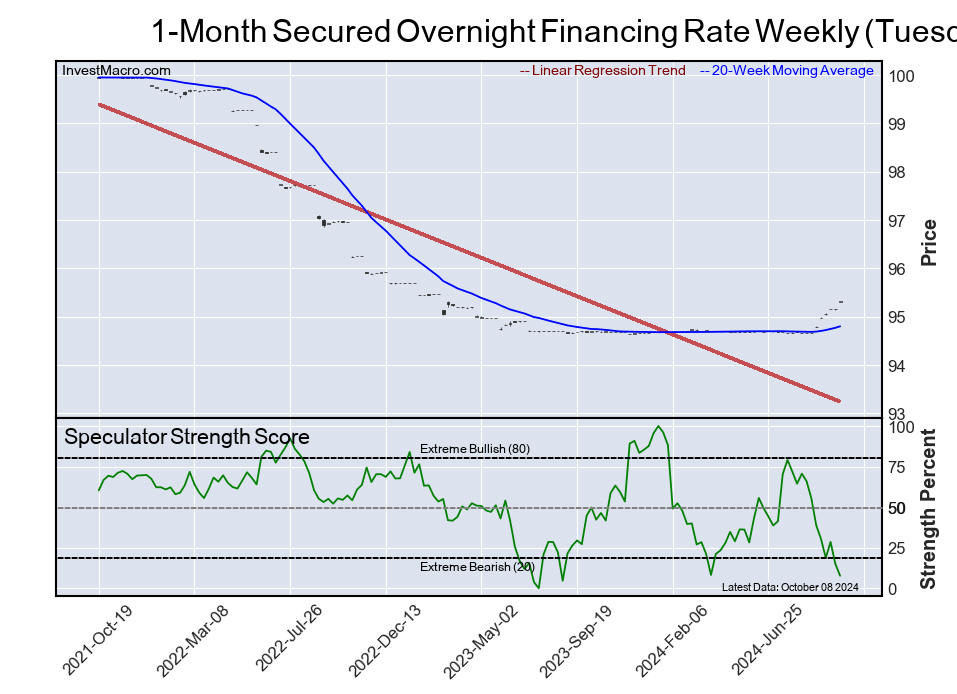
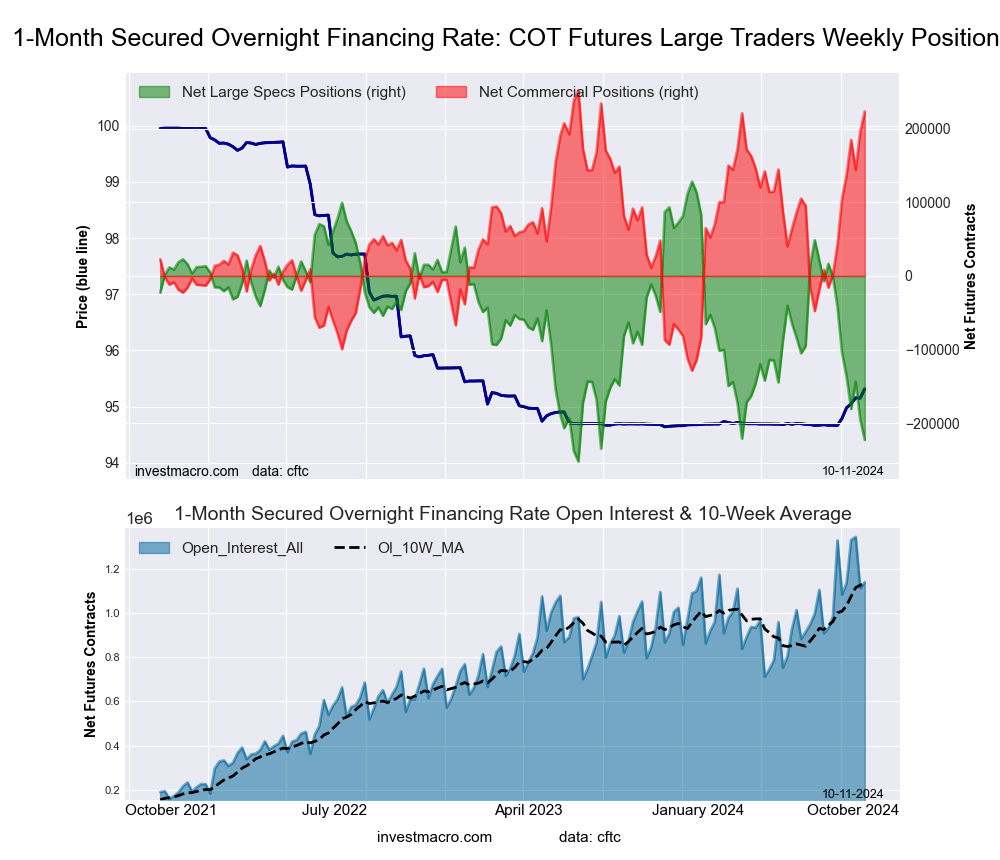
SOFR 1-Month Bonds Futures COT ChartThe Secured Overnight Financing Rate (1-Month) large speculator standing this week was a net position of -136,077 contracts in the data reported through Tuesday. This was a weekly reduction of -31,894 contracts from the previous week which had a total of -104,183 net contracts.

This week’s current strength score (the trader positioning range over the past three years, measured from 0 to 100) shows the speculators are currently Bearish with a score of 30.4 percent. The commercials are Bullish with a score of 69.9 percent and the small traders (not shown in chart) are Bearish with a score of 48.3 percent.

Price Trend-Following Model: Strong Uptrend

Our weekly trend-following model classifies the current market price position as: Strong Uptrend. The current action for the model is considered to be: Hold – Maintain Long Position.

SOFR 1-Month StatisticsSPECULATORSCOMMERCIALSSMALL TRADERS
– Percent of Open Interest Longs:15.466.80.0
– Percent of Open Interest Shorts:27.454.70.1
– Net Position:-136,077137,023-946
– Gross Longs:175,113757,537312
– Gross Shorts:311,190620,5141,258
– Long to Short Ratio:0.6 to 11.2 to 10.2 to 1
NET POSITION TREND:
– Strength Index Score (3 Year Range Pct):30.469.948.3
– Strength Index Reading (3 Year Range):BearishBullishBearish
NET POSITION MOVEMENT INDEX:
– 6-Week Change in Strength Index:-41.441.013.6


2-Year Treasury Note Futures:

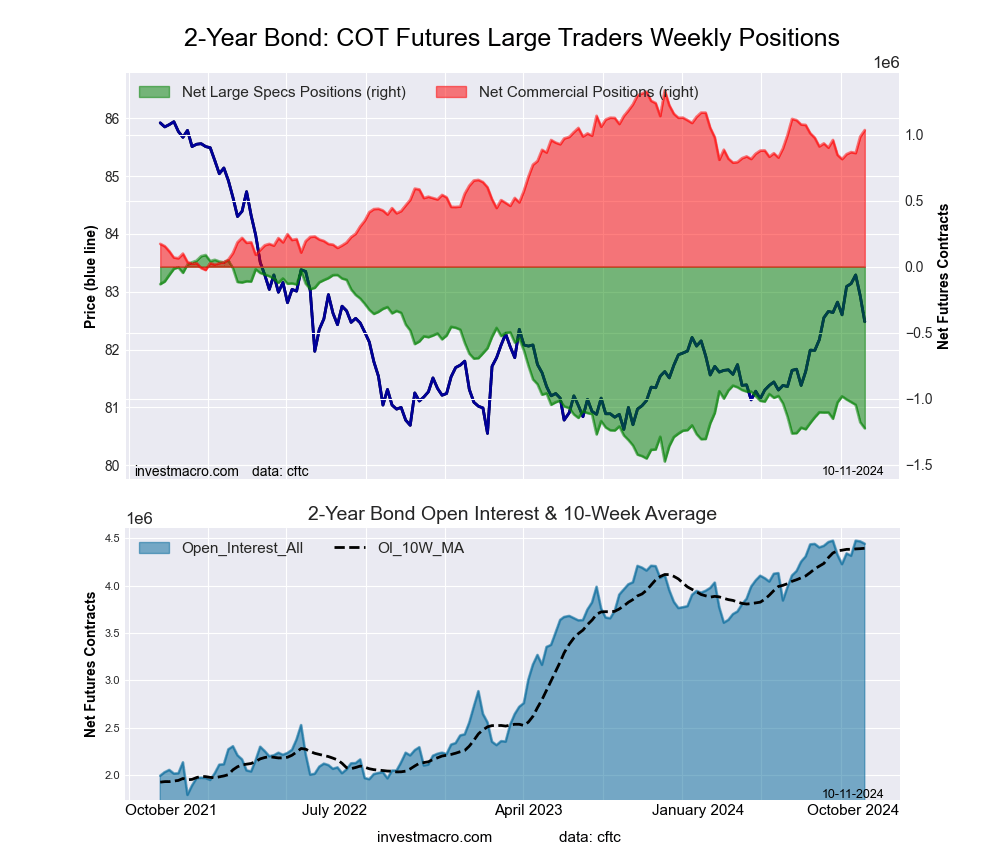
2-Year Treasury Bonds Futures COT ChartThe 2-Year Treasury Note large speculator standing this week was a net position of -1,006,216 contracts in the data reported through Tuesday. This was a weekly decline of -23,754 contracts from the previous week which had a total of -982,462 net contracts.

This week’s current strength score (the trader positioning range over the past three years, measured from 0 to 100) shows the speculators are currently Bearish with a score of 30.0 percent. The commercials are Bullish with a score of 64.5 percent and the small traders (not shown in chart) are Bullish-Extreme with a score of 84.7 percent.

Price Trend-Following Model: Strong Uptrend

Our weekly trend-following model classifies the current market price position as: Strong Uptrend. The current action for the model is considered to be: Hold – Maintain Long Position.

2-Year Treasury Note StatisticsSPECULATORSCOMMERCIALSSMALL TRADERS
– Percent of Open Interest Longs:15.476.76.2
– Percent of Open Interest Shorts:38.657.12.6
– Net Position:-1,006,216852,132154,084
– Gross Longs:666,8173,328,782269,001
– Gross Shorts:1,673,0332,476,650114,917
– Long to Short Ratio:0.4 to 11.3 to 12.3 to 1
NET POSITION TREND:
– Strength Index Score (3 Year Range Pct):30.064.584.7
– Strength Index Reading (3 Year Range):BearishBullishBullish-Extreme
NET POSITION MOVEMENT INDEX:
– 6-Week Change in Strength Index:6.2-4.3-12.1


5-Year Treasury Note Futures:

5-Year Treasury Bonds Futures COT ChartThe 5-Year Treasury Note large speculator standing this week was a net position of -1,719,996 contracts in the data reported through Tuesday. This was a weekly fall of -1,300 contracts from the previous week which had a total of -1,718,696 net contracts.

This week’s current strength score (the trader positioning range over the past three years, measured from 0 to 100) shows the speculators are currently Bearish-Extreme with a score of 1.0 percent. The commercials are Bullish-Extreme with a score of 100.0 percent and the small traders (not shown in chart) are Bullish-Extreme with a score of 96.0 percent.

Price Trend-Following Model: Strong Uptrend

Our weekly trend-following model classifies the current market price position as: Strong Uptrend. The current action for the model is considered to be: Hold – Maintain Long Position.

5-Year Treasury Note StatisticsSPECULATORSCOMMERCIALSSMALL TRADERS
– Percent of Open Interest Longs:8.283.47.4
– Percent of Open Interest Shorts:35.359.93.8
– Net Position:-1,719,9961,491,140228,856
– Gross Longs:522,0205,302,218472,348
– Gross Shorts:2,242,0163,811,078243,492
– Long to Short Ratio:0.2 to 11.4 to 11.9 to 1
NET POSITION TREND:
– Strength Index Score (3 Year Range Pct):1.0100.096.0
– Strength Index Reading (3 Year Range):Bearish-ExtremeBullish-ExtremeBullish-Extreme
NET POSITION MOVEMENT INDEX:
– 6-Week Change in Strength Index:-3.96.9-3.5


10-Year Treasury Note Futures:

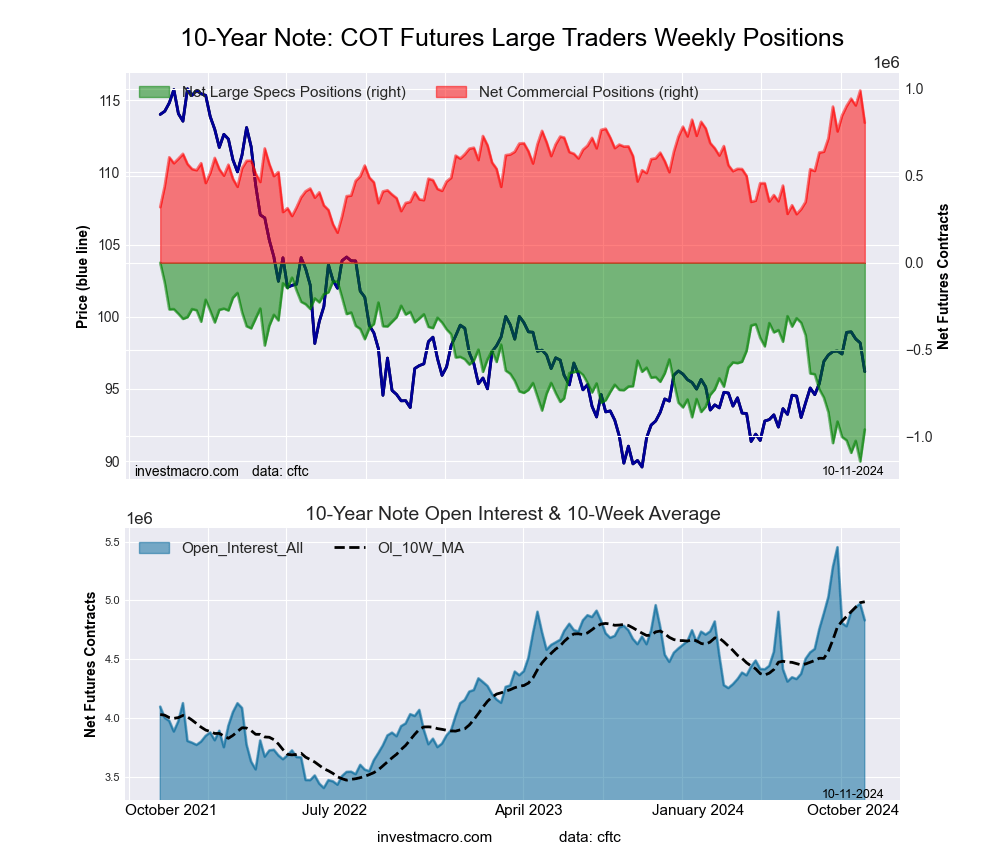
10-Year Treasury Notes Bonds Futures COT ChartThe 10-Year Treasury Note large speculator standing this week was a net position of -1,022,105 contracts in the data reported through Tuesday. This was a weekly decline of -19,278 contracts from the previous week which had a total of -1,002,827 net contracts.

This week’s current strength score (the trader positioning range over the past three years, measured from 0 to 100) shows the speculators are currently Bearish-Extreme with a score of 1.3 percent. The commercials are Bullish-Extreme with a score of 100.0 percent and the small traders (not shown in chart) are Bullish-Extreme with a score of 92.2 percent.

Price Trend-Following Model: Strong Uptrend

Our weekly trend-following model classifies the current market price position as: Strong Uptrend. The current action for the model is considered to be: Hold – Maintain Long Position.

10-Year Treasury Note StatisticsSPECULATORSCOMMERCIALSSMALL TRADERS
– Percent of Open Interest Longs:8.679.59.9
– Percent of Open Interest Shorts:29.960.67.4
– Net Position:-1,022,105901,605120,500
– Gross Longs:409,1213,799,096474,433
– Gross Shorts:1,431,2262,897,491353,933
– Long to Short Ratio:0.3 to 11.3 to 11.3 to 1
NET POSITION TREND:
– Strength Index Score (3 Year Range Pct):1.3100.092.2
– Strength Index Reading (3 Year Range):Bearish-ExtremeBullish-ExtremeBullish-Extreme
NET POSITION MOVEMENT INDEX:
– 6-Week Change in Strength Index:-24.133.85.2


Ultra 10-Year Notes Futures:

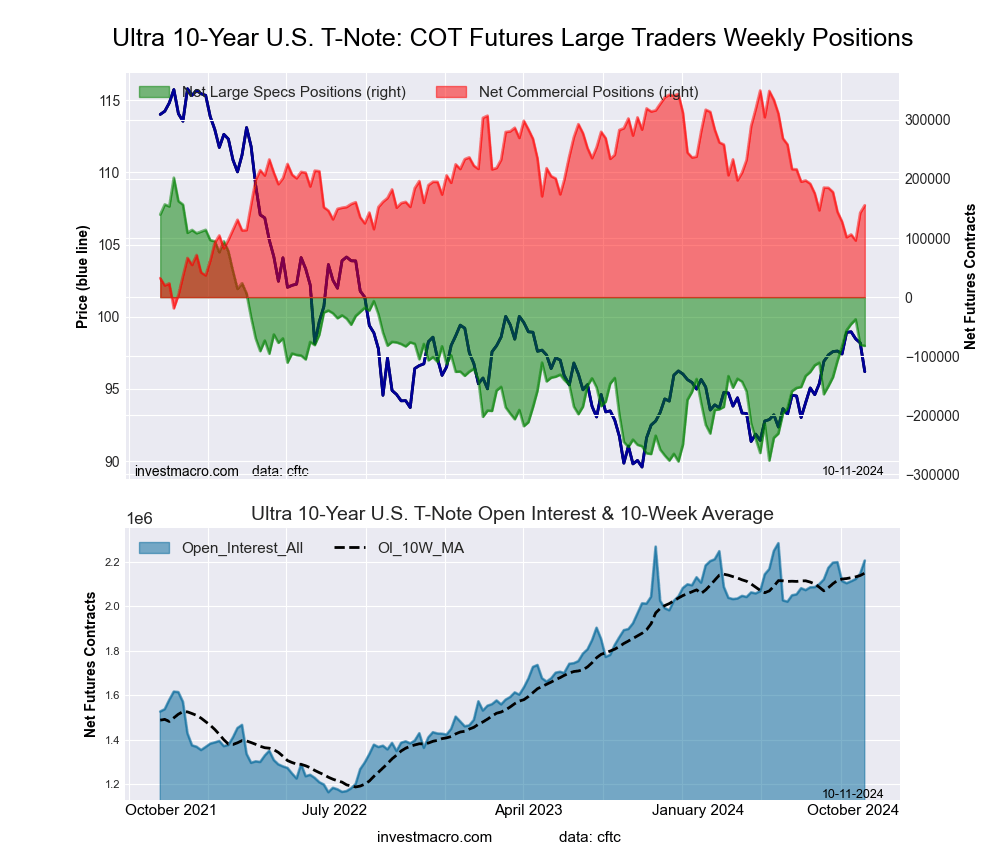
Ultra 10-Year Treasury Notes Bonds Futures COT ChartThe Ultra 10-Year Notes large speculator standing this week was a net position of -56,146 contracts in the data reported through Tuesday. This was a weekly boost of 27,613 contracts from the previous week which had a total of -83,759 net contracts.

This week’s current strength score (the trader positioning range over the past three years, measured from 0 to 100) shows the speculators are currently Bearish with a score of 46.2 percent. The commercials are Bearish with a score of 32.6 percent and the small traders (not shown in chart) are Bullish-Extreme with a score of 85.8 percent.

Price Trend-Following Model: Weak Uptrend

Our weekly trend-following model classifies the current market price position as: Weak Uptrend. The current action for the model is considered to be: Hold – Maintain Long Position.

Ultra 10-Year Notes StatisticsSPECULATORSCOMMERCIALSSMALL TRADERS
– Percent of Open Interest Longs:14.874.010.3
– Percent of Open Interest Shorts:17.569.212.4
– Net Position:-56,146101,353-45,207
– Gross Longs:311,4811,557,384216,428
– Gross Shorts:367,6271,456,031261,635
– Long to Short Ratio:0.8 to 11.1 to 10.8 to 1
NET POSITION TREND:
– Strength Index Score (3 Year Range Pct):46.232.685.8
– Strength Index Reading (3 Year Range):BearishBearishBullish-Extreme
NET POSITION MOVEMENT INDEX:
– 6-Week Change in Strength Index:11.4-12.3-5.5


US Treasury Bonds Futures:

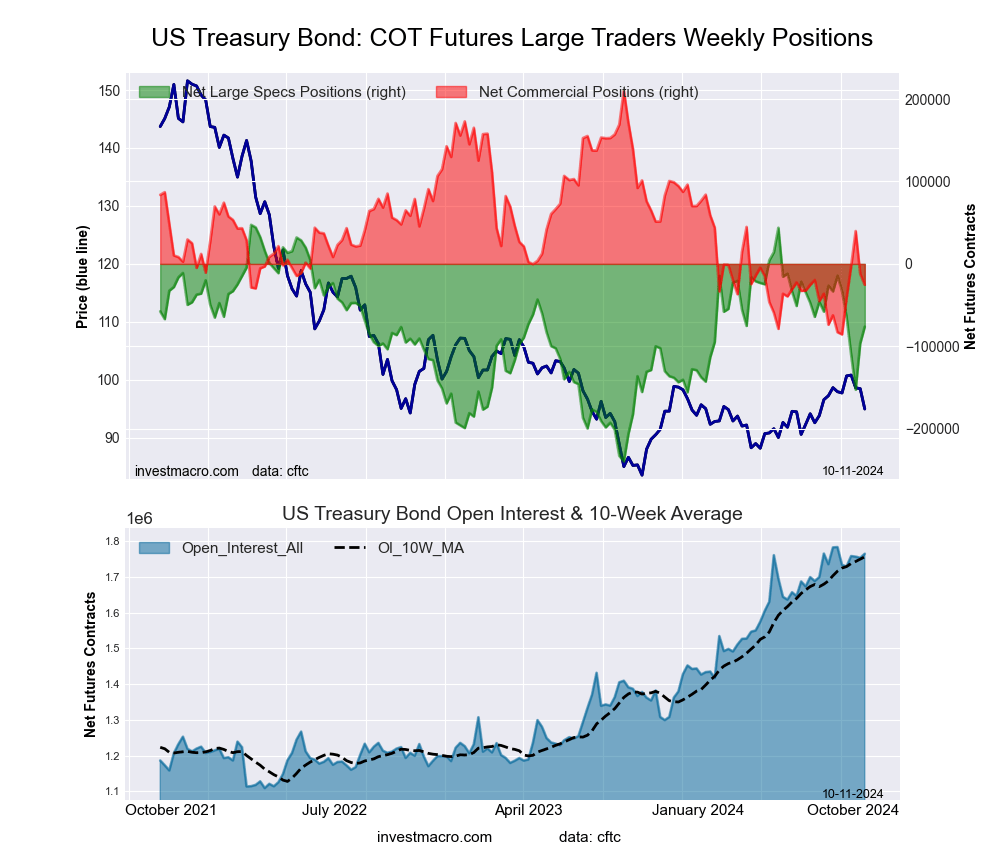
US Year Treasury Notes Long Bonds Futures COT ChartThe US Treasury Bonds large speculator standing this week was a net position of -64,230 contracts in the data reported through Tuesday. This was a weekly fall of -31,186 contracts from the previous week which had a total of -33,044 net contracts.

This week’s current strength score (the trader positioning range over the past three years, measured from 0 to 100) shows the speculators are currently Bullish with a score of 61.1 percent. The commercials are Bearish-Extreme with a score of 14.9 percent and the small traders (not shown in chart) are Bullish-Extreme with a score of 91.1 percent.

Price Trend-Following Model: Strong Uptrend

Our weekly trend-following model classifies the current market price position as: Strong Uptrend. The current action for the model is considered to be: Hold – Maintain Long Position.

US Treasury Bonds StatisticsSPECULATORSCOMMERCIALSSMALL TRADERS
– Percent of Open Interest Longs:20.465.113.7
– Percent of Open Interest Shorts:24.267.57.6
– Net Position:-64,230-41,310105,540
– Gross Longs:353,3801,124,907236,559
– Gross Shorts:417,6101,166,217131,019
– Long to Short Ratio:0.8 to 11.0 to 11.8 to 1
NET POSITION TREND:
– Strength Index Score (3 Year Range Pct):61.114.991.1
– Strength Index Reading (3 Year Range):BullishBearish-ExtremeBullish-Extreme
NET POSITION MOVEMENT INDEX:
– 6-Week Change in Strength Index:-6.41.39.8


Ultra US Treasury Bonds Futures:

Ultra US Year Treasury Notes Long Bonds Futures COT ChartThe Ultra US Treasury Bonds large speculator standing this week was a net position of -259,158 contracts in the data reported through Tuesday. This was a weekly reduction of -18,956 contracts from the previous week which had a total of -240,202 net contracts.

This week’s current strength score (the trader positioning range over the past three years, measured from 0 to 100) shows the speculators are currently Bullish-Extreme with a score of 91.2 percent. The commercials are Bearish-Extreme with a score of 8.2 percent and the small traders (not shown in chart) are Bullish with a score of 52.6 percent.

Price Trend-Following Model: Strong Uptrend

Our weekly trend-following model classifies the current market price position as: Strong Uptrend. The current action for the model is considered to be: Hold – Maintain Long Position.

Ultra US Treasury Bonds StatisticsSPECULATORSCOMMERCIALSSMALL TRADERS
– Percent of Open Interest Longs:9.978.011.3
– Percent of Open Interest Shorts:25.164.59.5
– Net Position:-259,158229,15430,004
– Gross Longs:168,7671,329,192192,521
– Gross Shorts:427,9251,100,038162,517
– Long to Short Ratio:0.4 to 11.2 to 11.2 to 1
NET POSITION TREND:
– Strength Index Score (3 Year Range Pct):91.28.252.6
– Strength Index Reading (3 Year Range):Bullish-ExtremeBearish-ExtremeBullish
NET POSITION MOVEMENT INDEX:
– 6-Week Change in Strength Index:73.0-82.59.1


Article By InvestMacroReceive our weekly COT Newsletter

*COT Report: The COT data, released weekly to the public each Friday, is updated through the most recent Tuesday (data is 3 days old) and shows a quick view of how large speculators or non-commercials (for-profit traders) were positioned in the futures markets.

The CFTC categorizes trader positions according to commercial hedgers (traders who use futures contracts for hedging as part of the business), non-commercials (large traders who speculate to realize trading profits) and nonreportable traders (usually small traders/speculators) as well as their open interest (contracts open in the market at time of reporting). See CFTC criteria here.

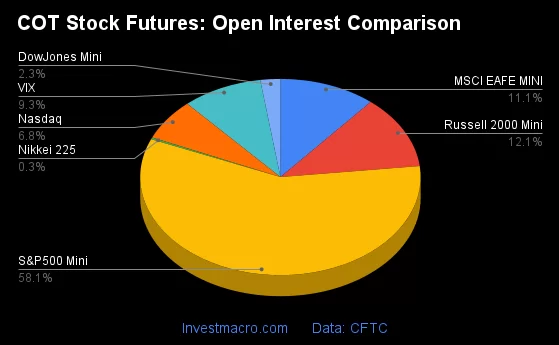
COT Stock Market Charts: Weekly Speculator Bets led by VIX & Russell-2000

By InvestMacro

Here are the latest charts and statistics for the Commitment of Traders (COT) data published by the Commodities Futures Trading Commission (CFTC).

The latest COT data is updated through Tuesday September 10th and shows a quick view of how large traders (for-profit speculators and commercial entities) were positioned in the futures markets.

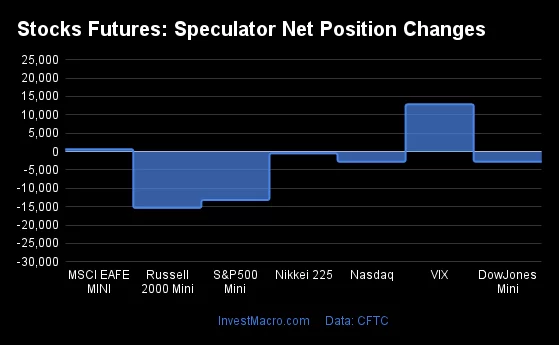
Weekly Speculator Changes led by the VIX & Russell-Mini

The COT stock markets speculator bets were slightly higher this week as four out of the seven stock markets we cover had higher positioning while the other three markets had lower speculator contracts.

Leading the gains for the stock markets was the VIX (10,778 contracts) with the Russell-Mini (5,467 contracts), the DowJones-Mini (1,032 contracts) and the Nikkei 225 (473 contracts) also seeing positive weeks.

The markets with the declines in speculator bets this week were the S&P500-Mini (-10,569 contracts), the MSCI EAFE-Mini (-3,213 contracts) and with the Nasdaq-Mini (-362 contracts) also registering lower bets on the week.


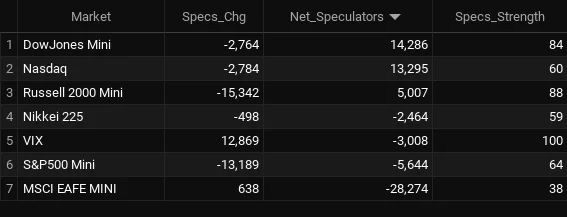
Stock Market Net Speculators Leaderboard

Legend: Weekly Speculators Change | Speculators Current Net Position | Speculators Strength Score compared to last 3-Years (0-100 range)


Strength Scores led by the VIX & Russell-Mini

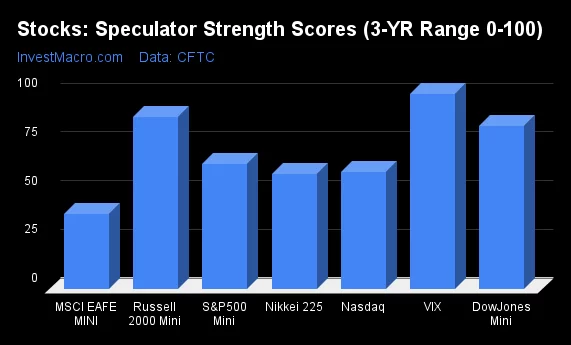
COT Strength Scores (a normalized measure of Speculator positions over a 3-Year range, from 0 to 100 where above 80 is Extreme-Bullish and below 20 is Extreme-Bearish) showed that the VIX (99 percent) and the Russell-Mini (89 percent) lead the stock markets this week. The Nasdaq-Mini (79 percent) and DowJones-Mini (74 percent) come in as the next highest in the weekly strength scores.

On the downside, the MSCI EAFE-Mini (37 percent) comes in at the lowest strength level currently and the only market below a 50 percent strength score.

Strength Statistics:
VIX (98.8 percent) vs VIX previous week (87.1 percent)
S&P500-Mini (55.9 percent) vs S&P500-Mini previous week (57.5 percent)
DowJones-Mini (73.6 percent) vs DowJones-Mini previous week (71.9 percent)
Nasdaq-Mini (78.9 percent) vs Nasdaq-Mini previous week (79.4 percent)
Russell2000-Mini (89.2 percent) vs Russell2000-Mini previous week (85.3 percent)
Nikkei USD (63.4 percent) vs Nikkei USD previous week (59.4 percent)
EAFE-Mini (37.4 percent) vs EAFE-Mini previous week (40.8 percent)


VIX & Nasdaq-Mini top the 6-Week Strength Trends

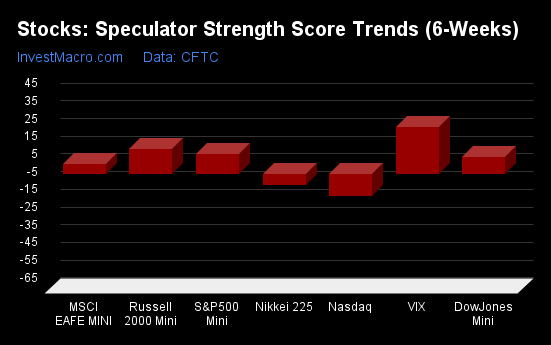
COT Strength Score Trends (or move index, calculates the 6-week changes in strength scores) showed that the VIX (37 percent) leads the past six weeks trends for the stock markets. The Nasdaq-Mini (36 percent), the Russell-Mini (28 percent) and the Nikkei 225 (16 percent) are the next highest positive movers in the latest trends data.

The MSCI EAFE-Mini (-11 percent) and the S&P500-Mini (-11 percent) lead the downside trend scores currently with the DowJones-Mini (-9 percent) coming in as the next market with lower trend scores.

Strength Trend Statistics:
VIX (37.4 percent) vs VIX previous week (34.8 percent)
S&P500-Mini (-10.6 percent) vs S&P500-Mini previous week (-5.3 percent)
DowJones-Mini (-8.7 percent) vs DowJones-Mini previous week (-6.9 percent)
Nasdaq-Mini (36.0 percent) vs Nasdaq-Mini previous week (41.2 percent)
Russell2000-Mini (28.2 percent) vs Russell2000-Mini previous week (40.7 percent)
Nikkei USD (16.2 percent) vs Nikkei USD previous week (28.0 percent)
EAFE-Mini (-10.9 percent) vs EAFE-Mini previous week (-3.8 percent)


Individual Stock Market Charts:

VIX Volatility Futures:

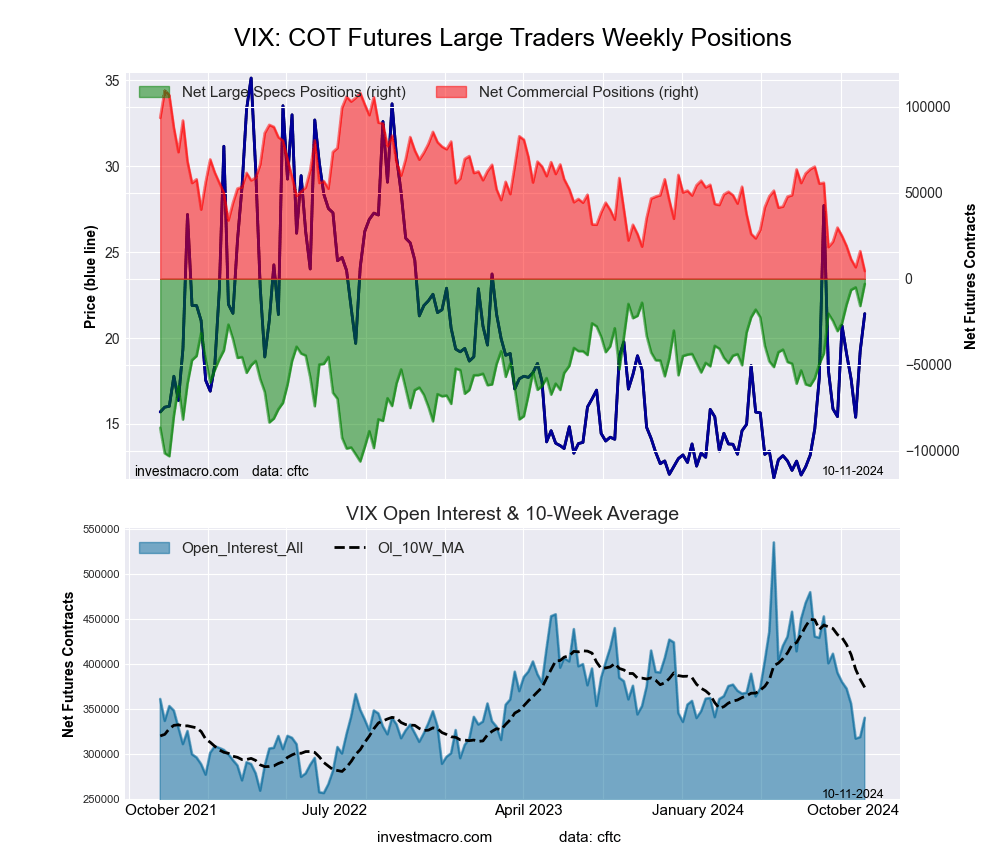
VIX Volatility Futures COT ChartThe VIX Volatility large speculator standing this week was a net position of -15,111 contracts in the data reported through Tuesday. This was a weekly increase of 10,778 contracts from the previous week which had a total of -25,889 net contracts.

This week’s current strength score (the trader positioning range over the past three years, measured from 0 to 100) shows the speculators are currently Bullish-Extreme with a score of 98.8 percent. The commercials are Bearish-Extreme with a score of 0.7 percent and the small traders (not shown in chart) are Bullish with a score of 68.2 percent.

Price Trend-Following Model: Uptrend

Our weekly trend-following model classifies the current market price position as: Uptrend. The current action for the model is considered to be: Hold – Maintain Long Position.

VIX Volatility Futures StatisticsSPECULATORSCOMMERCIALSSMALL TRADERS
– Percent of Open Interest Longs:21.146.37.4
– Percent of Open Interest Shorts:25.141.28.4
– Net Position:-15,11119,037-3,926
– Gross Longs:78,555172,63827,485
– Gross Shorts:93,666153,60131,411
– Long to Short Ratio:0.8 to 11.1 to 10.9 to 1
NET POSITION TREND:
– Strength Index Score (3 Year Range Pct):98.80.768.2
– Strength Index Reading (3 Year Range):Bullish-ExtremeBearish-ExtremeBullish
NET POSITION MOVEMENT INDEX:
– 6-Week Change in Strength Index:37.4-39.98.1


S&P500 Mini Futures:

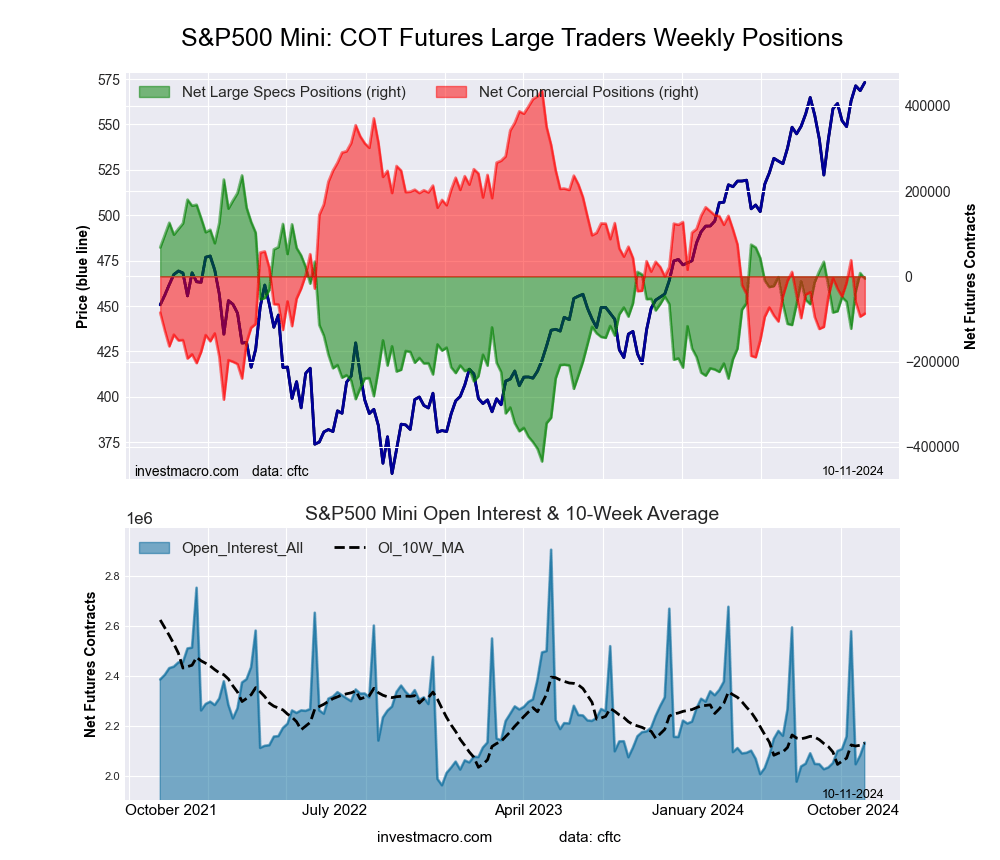
SP500 Mini Futures COT ChartThe S&P500 Mini large speculator standing this week was a net position of -59,388 contracts in the data reported through Tuesday. This was a weekly decline of -10,569 contracts from the previous week which had a total of -48,819 net contracts.

This week’s current strength score (the trader positioning range over the past three years, measured from 0 to 100) shows the speculators are currently Bullish with a score of 55.9 percent. The commercials are Bearish with a score of 37.8 percent and the small traders (not shown in chart) are Bullish with a score of 77.9 percent.

Price Trend-Following Model: Strong Uptrend

Our weekly trend-following model classifies the current market price position as: Strong Uptrend. The current action for the model is considered to be: Hold – Maintain Long Position.

S&P500 Mini Futures StatisticsSPECULATORSCOMMERCIALSSMALL TRADERS
– Percent of Open Interest Longs:15.668.212.0
– Percent of Open Interest Shorts:18.468.98.6
– Net Position:-59,388-15,25474,642
– Gross Longs:337,4201,469,898259,484
– Gross Shorts:396,8081,485,152184,842
– Long to Short Ratio:0.9 to 11.0 to 11.4 to 1
NET POSITION TREND:
– Strength Index Score (3 Year Range Pct):55.937.877.9
– Strength Index Reading (3 Year Range):BullishBearishBullish
NET POSITION MOVEMENT INDEX:
– 6-Week Change in Strength Index:-10.614.9-17.0


Dow Jones Mini Futures:

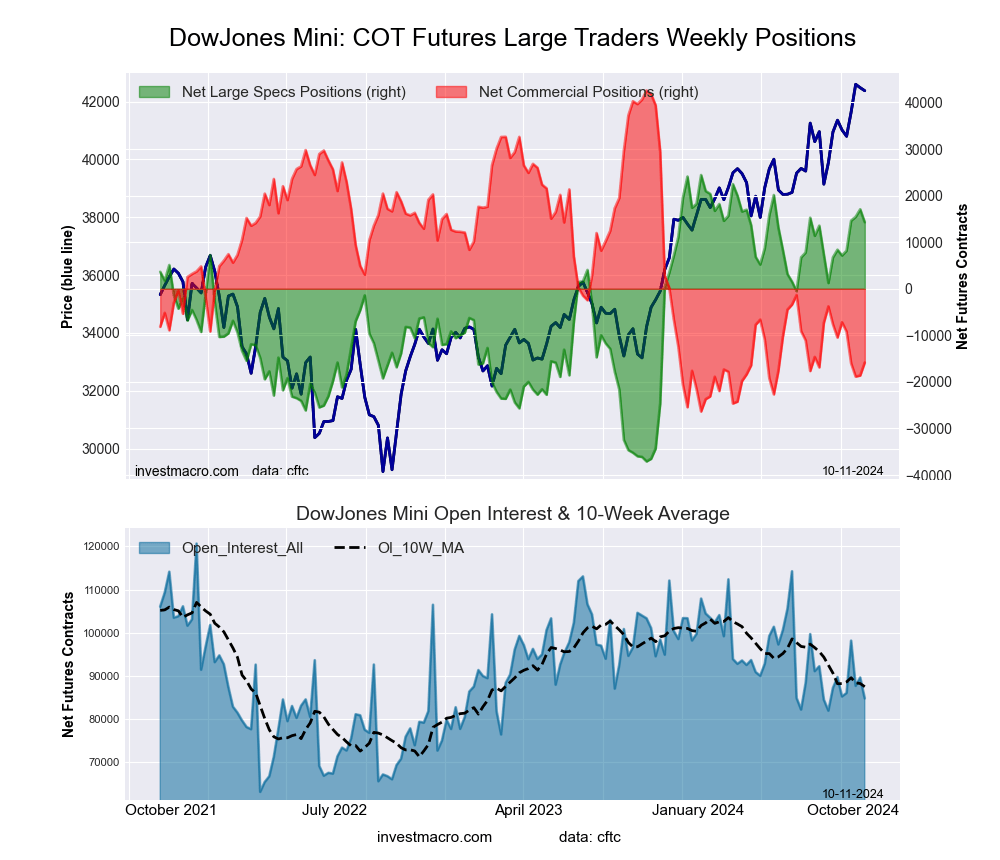
Dow Jones Mini Futures COT ChartThe Dow Jones Mini large speculator standing this week was a net position of 8,168 contracts in the data reported through Tuesday. This was a weekly boost of 1,032 contracts from the previous week which had a total of 7,136 net contracts.

This week’s current strength score (the trader positioning range over the past three years, measured from 0 to 100) shows the speculators are currently Bullish with a score of 73.6 percent. The commercials are Bearish with a score of 24.9 percent and the small traders (not shown in chart) are Bullish with a score of 60.7 percent.

Price Trend-Following Model: Strong Uptrend

Our weekly trend-following model classifies the current market price position as: Strong Uptrend. The current action for the model is considered to be: Hold – Maintain Long Position.

Dow Jones Mini Futures StatisticsSPECULATORSCOMMERCIALSSMALL TRADERS
– Percent of Open Interest Longs:22.857.417.0
– Percent of Open Interest Shorts:13.368.115.8
– Net Position:8,168-9,1861,018
– Gross Longs:19,63649,35814,588
– Gross Shorts:11,46858,54413,570
– Long to Short Ratio:1.7 to 10.8 to 11.1 to 1
NET POSITION TREND:
– Strength Index Score (3 Year Range Pct):73.624.960.7
– Strength Index Reading (3 Year Range):BullishBearishBullish
NET POSITION MOVEMENT INDEX:
– 6-Week Change in Strength Index:-8.711.2-14.0


Nasdaq Mini Futures:

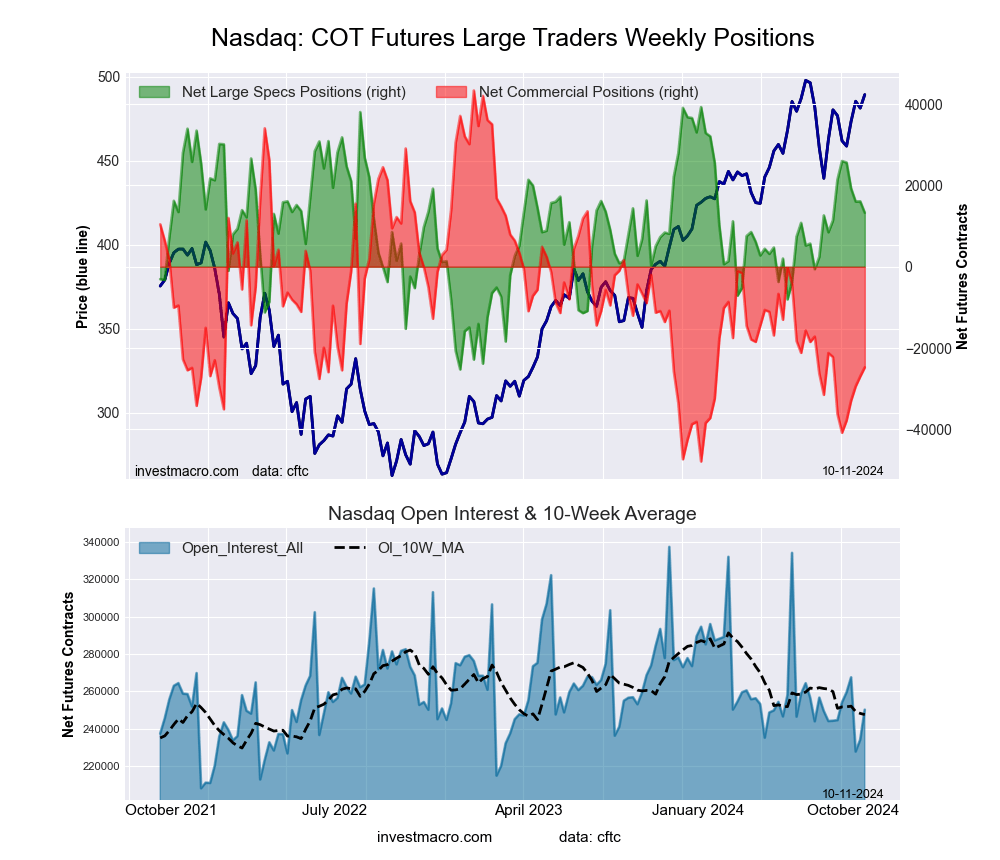
Nasdaq Mini Futures COT ChartThe Nasdaq Mini large speculator standing this week was a net position of 25,626 contracts in the data reported through Tuesday. This was a weekly fall of -362 contracts from the previous week which had a total of 25,988 net contracts.

This week’s current strength score (the trader positioning range over the past three years, measured from 0 to 100) shows the speculators are currently Bullish with a score of 78.9 percent. The commercials are Bearish-Extreme with a score of 11.0 percent and the small traders (not shown in chart) are Bullish with a score of 77.8 percent.

Price Trend-Following Model: Uptrend

Our weekly trend-following model classifies the current market price position as: Uptrend. The current action for the model is considered to be: Hold – Maintain Long Position.

Nasdaq Mini Futures StatisticsSPECULATORSCOMMERCIALSSMALL TRADERS
– Percent of Open Interest Longs:26.953.115.6
– Percent of Open Interest Shorts:17.067.710.9
– Net Position:25,626-37,84212,216
– Gross Longs:69,833137,78740,496
– Gross Shorts:44,207175,62928,280
– Long to Short Ratio:1.6 to 10.8 to 11.4 to 1
NET POSITION TREND:
– Strength Index Score (3 Year Range Pct):78.911.077.8
– Strength Index Reading (3 Year Range):BullishBearish-ExtremeBullish
NET POSITION MOVEMENT INDEX:
– 6-Week Change in Strength Index:36.0-12.7-22.2


Russell 2000 Mini Futures:

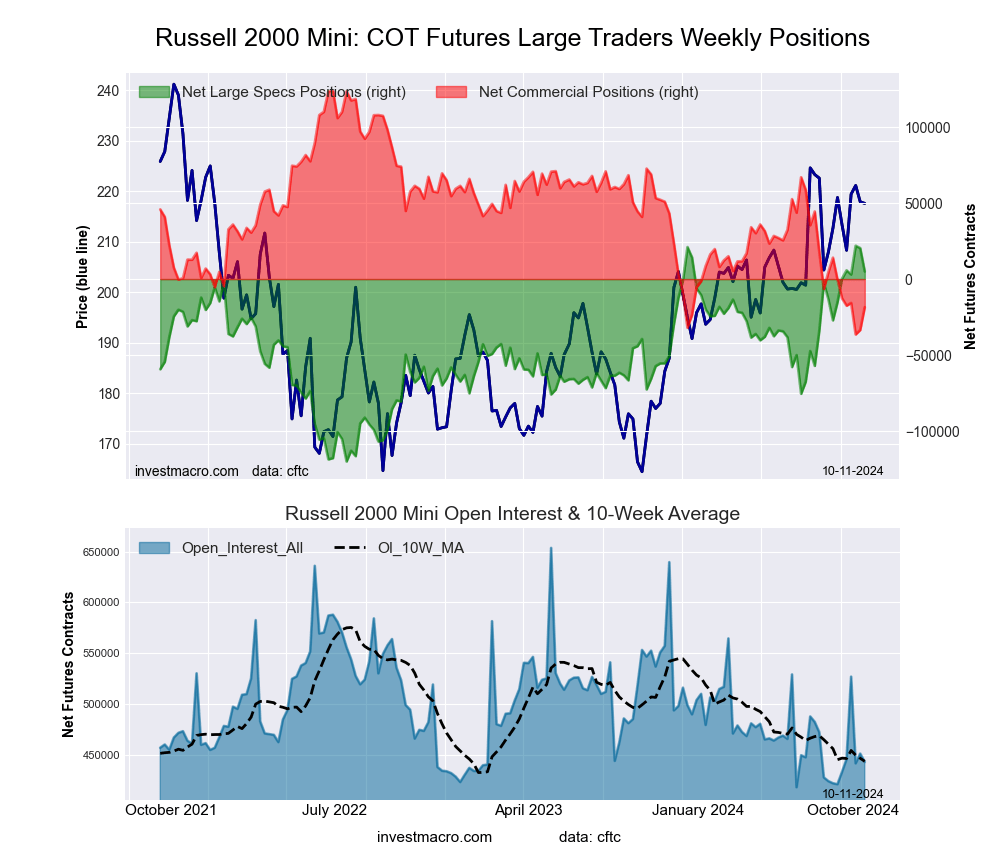
Russell 2000 Mini Futures COT ChartThe Russell 2000 Mini large speculator standing this week was a net position of 5,727 contracts in the data reported through Tuesday. This was a weekly gain of 5,467 contracts from the previous week which had a total of 260 net contracts.

This week’s current strength score (the trader positioning range over the past three years, measured from 0 to 100) shows the speculators are currently Bullish-Extreme with a score of 89.2 percent. The commercials are Bearish-Extreme with a score of 9.3 percent and the small traders (not shown in chart) are Bullish with a score of 68.8 percent.

Price Trend-Following Model: Strong Uptrend

Our weekly trend-following model classifies the current market price position as: Strong Uptrend. The current action for the model is considered to be: Hold – Maintain Long Position.

Russell 2000 Mini Futures StatisticsSPECULATORSCOMMERCIALSSMALL TRADERS
– Percent of Open Interest Longs:19.870.37.0
– Percent of Open Interest Shorts:18.574.24.3
– Net Position:5,727-17,53111,804
– Gross Longs:88,136313,68631,057
– Gross Shorts:82,409331,21719,253
– Long to Short Ratio:1.1 to 10.9 to 11.6 to 1
NET POSITION TREND:
– Strength Index Score (3 Year Range Pct):89.29.368.8
– Strength Index Reading (3 Year Range):Bullish-ExtremeBearish-ExtremeBullish
NET POSITION MOVEMENT INDEX:
– 6-Week Change in Strength Index:28.2-22.7-14.6


Nikkei Stock Average (USD) Futures:

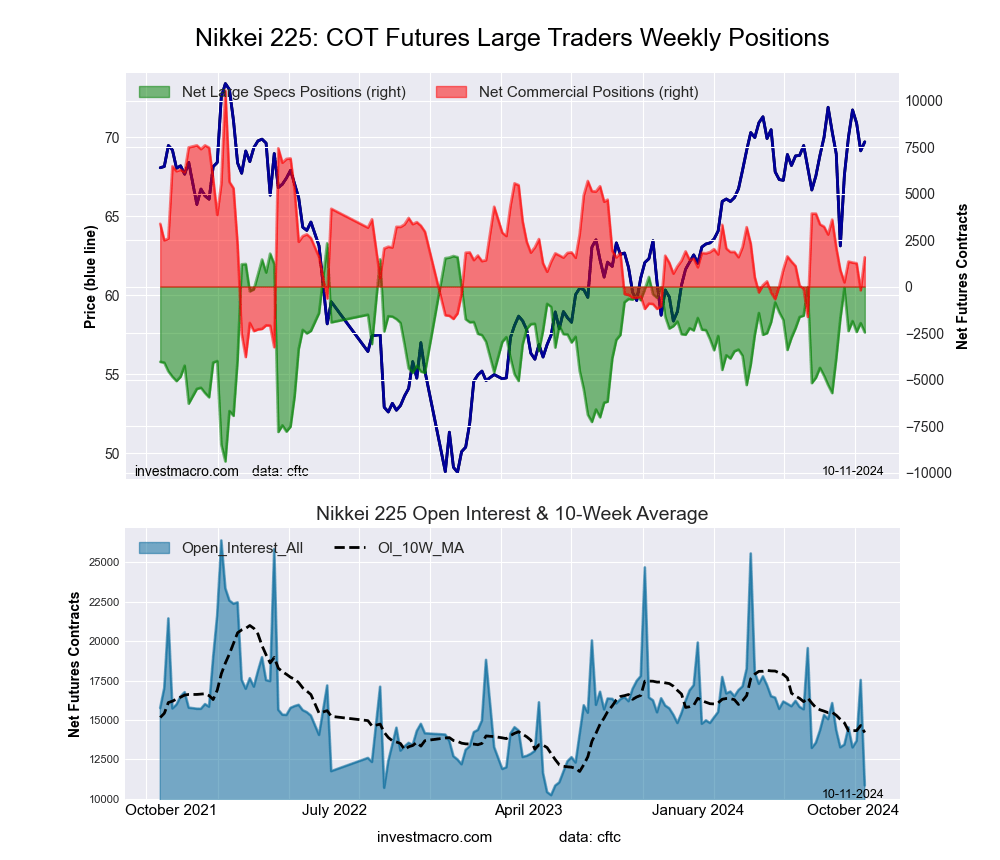
Nikkei Stock Average (USD) Futures COT ChartThe Nikkei Stock Average (USD) large speculator standing this week was a net position of -1,966 contracts in the data reported through Tuesday. This was a weekly boost of 473 contracts from the previous week which had a total of -2,439 net contracts.

This week’s current strength score (the trader positioning range over the past three years, measured from 0 to 100) shows the speculators are currently Bullish with a score of 63.4 percent. The commercials are Bearish with a score of 25.1 percent and the small traders (not shown in chart) are Bullish-Extreme with a score of 84.5 percent.

Price Trend-Following Model: Strong Uptrend

Our weekly trend-following model classifies the current market price position as: Strong Uptrend. The current action for the model is considered to be: Hold – Maintain Long Position.

Nikkei Stock Average Futures StatisticsSPECULATORSCOMMERCIALSSMALL TRADERS
– Percent of Open Interest Longs:11.152.225.3
– Percent of Open Interest Shorts:22.353.313.0
– Net Position:-1,966-1982,164
– Gross Longs:1,9399,1524,445
– Gross Shorts:3,9059,3502,281
– Long to Short Ratio:0.5 to 11.0 to 11.9 to 1
NET POSITION TREND:
– Strength Index Score (3 Year Range Pct):63.425.184.5
– Strength Index Reading (3 Year Range):BullishBearishBullish-Extreme
NET POSITION MOVEMENT INDEX:
– 6-Week Change in Strength Index:16.2-16.07.6


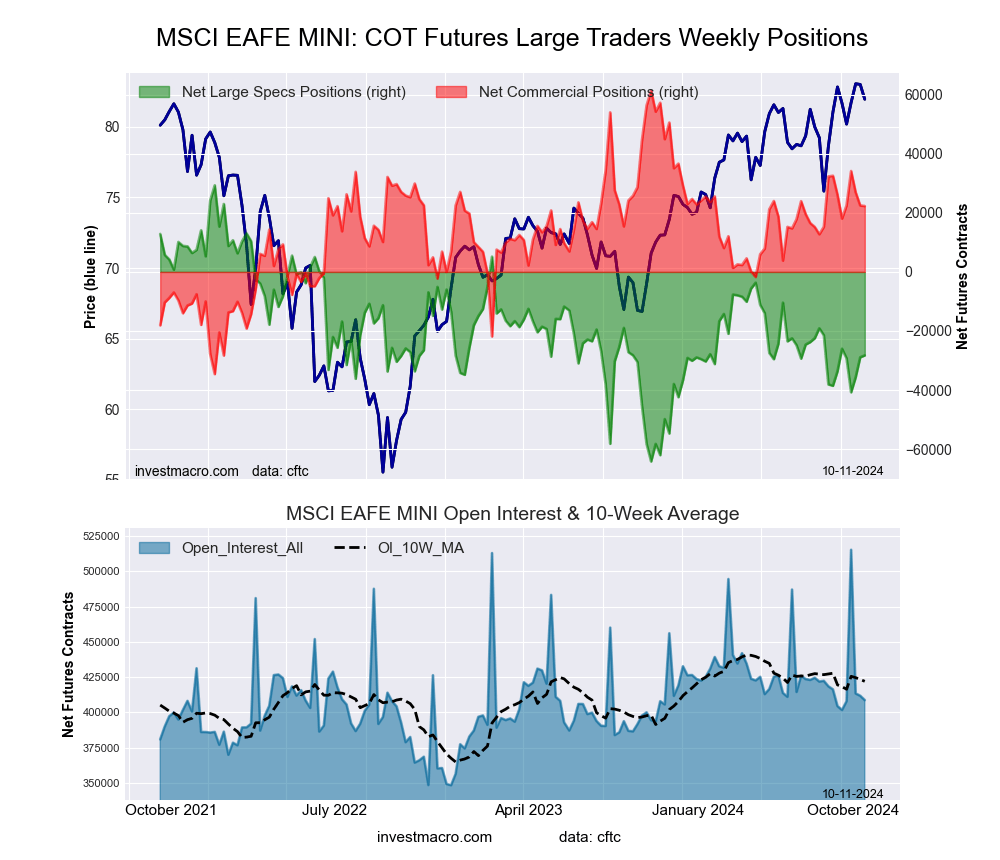
MSCI EAFE Mini Futures:

MSCI EAFE Mini Futures COT ChartThe MSCI EAFE Mini large speculator standing this week was a net position of -29,250 contracts in the data reported through Tuesday. This was a weekly decline of -3,213 contracts from the previous week which had a total of -26,037 net contracts.

This week’s current strength score (the trader positioning range over the past three years, measured from 0 to 100) shows the speculators are currently Bearish with a score of 37.4 percent. The commercials are Bullish with a score of 59.5 percent and the small traders (not shown in chart) are Bullish with a score of 50.5 percent.

Price Trend-Following Model: Strong Uptrend

Our weekly trend-following model classifies the current market price position as: Strong Uptrend. The current action for the model is considered to be: Hold – Maintain Long Position.

MSCI EAFE Mini Futures StatisticsSPECULATORSCOMMERCIALSSMALL TRADERS
– Percent of Open Interest Longs:7.289.33.1
– Percent of Open Interest Shorts:14.483.81.4
– Net Position:-29,25022,5266,724
– Gross Longs:29,468364,43912,526
– Gross Shorts:58,718341,9135,802
– Long to Short Ratio:0.5 to 11.1 to 12.2 to 1
NET POSITION TREND:
– Strength Index Score (3 Year Range Pct):37.459.550.5
– Strength Index Reading (3 Year Range):BearishBullishBullish
NET POSITION MOVEMENT INDEX:
– 6-Week Change in Strength Index:-10.910.21.8


Article By InvestMacroReceive our weekly COT Newsletter

*COT Report: The COT data, released weekly to the public each Friday, is updated through the most recent Tuesday (data is 3 days old) and shows a quick view of how large speculators or non-commercials (for-profit traders) were positioned in the futures markets.

The CFTC categorizes trader positions according to commercial hedgers (traders who use futures contracts for hedging as part of the business), non-commercials (large traders who speculate to realize trading profits) and nonreportable traders (usually small traders/speculators) as well as their open interest (contracts open in the market at time of reporting). See CFTC criteria here.

COT Soft Commodities Charts: Speculator Bets led by Corn & Soybeans

By InvestMacro

Here are the latest charts and statistics for the Commitment of Traders (COT) reports data published by the Commodities Futures Trading Commission (CFTC).

The latest COT data is updated through Tuesday September 10th and shows a quick view of how large traders (for-profit speculators and commercial entities) were positioned in the futures markets.

Weekly Speculator Changes led by Corn & Soybeans

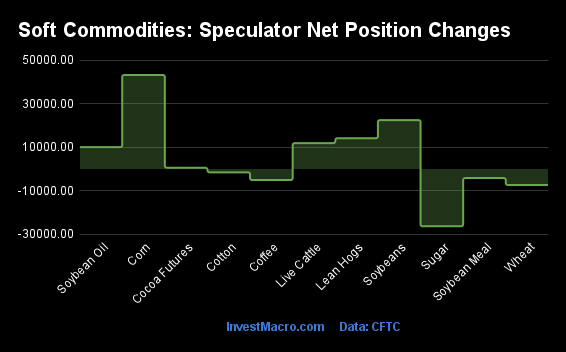
The COT soft commodities markets speculator bets were overall higher this week as eight out of the eleven softs markets we cover had higher positioning while the other three markets had lower speculator contracts.

Leading the gains for the softs markets was Corn (42,723 contracts) with Soybeans (17,794 contracts), Wheat (11,439 contracts), Soybean Meal (9,883 contracts), Soybean Oil (3,436 contracts), Live Cattle (2,720 contracts), Cocoa (295 contracts) and Lean Hogs (261 contracts) also showing positive weeks.

The markets with the declines in speculator bets this week were Sugar (-9,399 contracts), Cotton (-7,957 contracts) and with Coffee (-474 contracts) also registering lower bets on the week.


Soft Commodities Net Speculators Leaderboard
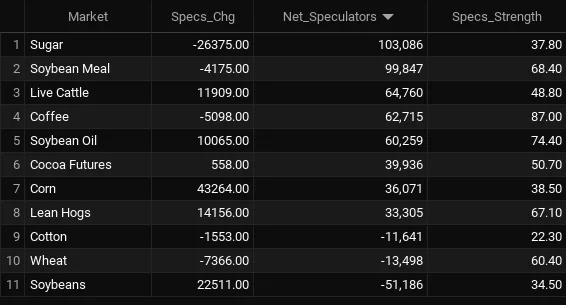
Legend: Weekly Speculators Change | Speculators Current Net Position | Speculators Strength Score compared to last 3-Years (0-100 range)


Strength Scores led by Coffee & Wheat

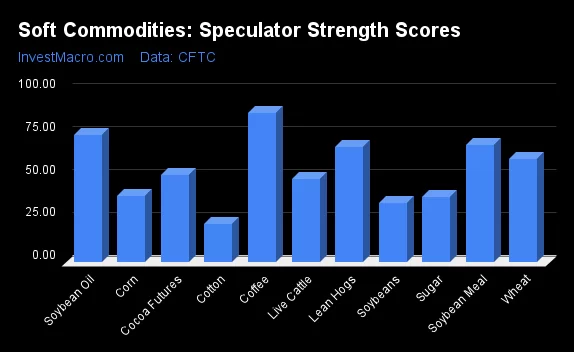
COT Strength Scores (a normalized measure of Speculator positions over a 3-Year range, from 0 to 100 where above 80 is Extreme-Bullish and below 20 is Extreme-Bearish) showed that Coffee (88 percent) and Wheat (58 percent) lead the softs markets this week and are the best markets over the 3-year range currently.

On the downside, Cotton (0 percent), Soybeans (13 percent) and Live Cattle (15 percent) come in at the lowest strength levels currently and are in Extreme-Bearish territory (below 20 percent).

Strength Statistics:
Corn (27.8 percent) vs Corn previous week (22.4 percent)
Sugar (23.8 percent) vs Sugar previous week (27.1 percent)
Coffee (87.7 percent) vs Coffee previous week (88.2 percent)
Soybeans (12.5 percent) vs Soybeans previous week (8.3 percent)
Soybean Oil (38.8 percent) vs Soybean Oil previous week (36.9 percent)
Soybean Meal (43.4 percent) vs Soybean Meal previous week (39.3 percent)
Live Cattle (14.6 percent) vs Live Cattle previous week (11.6 percent)
Lean Hogs (26.1 percent) vs Lean Hogs previous week (25.9 percent)
Cotton (0.0 percent) vs Cotton previous week (4.8 percent)
Cocoa (42.8 percent) vs Cocoa previous week (42.5 percent)
Wheat (58.3 percent) vs Wheat previous week (50.1 percent)


Corn & Wheat top the 6-Week Strength Trends

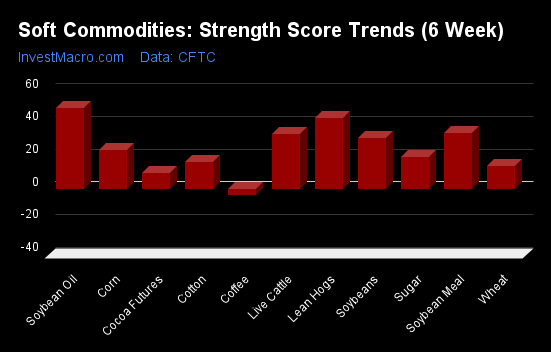
COT Strength Score Trends (or move index, calculates the 6-week changes in strength scores) showed that Corn (21 percent) and Wheat (19 percent) lead the past six weeks trends for soft commodities. Soybean Oil (18 percent), Lean Hogs (13 percent) and Sugar (9 percent) are the next highest positive movers with the strongest trends.

Live Cattle (-29 percent) leads the downside trend scores currently with Cotton (-5 percent) and Cocoa (-1 percent) following next with lower trend scores.

Strength Trend Statistics:
Corn (21.0 percent) vs Corn previous week (16.7 percent)
Sugar (9.5 percent) vs Sugar previous week (13.2 percent)
Coffee (0.4 percent) vs Coffee previous week (-2.5 percent)
Soybeans (5.6 percent) vs Soybeans previous week (-5.6 percent)
Soybean Oil (17.5 percent) vs Soybean Oil previous week (-0.7 percent)
Soybean Meal (0.5 percent) vs Soybean Meal previous week (2.1 percent)
Live Cattle (-29.0 percent) vs Live Cattle previous week (-17.7 percent)
Lean Hogs (13.4 percent) vs Lean Hogs previous week (16.5 percent)
Cotton (-5.2 percent) vs Cotton previous week (-2.3 percent)
Cocoa (-0.7 percent) vs Cocoa previous week (-1.4 percent)
Wheat (19.4 percent) vs Wheat previous week (5.0 percent)


Individual Soft Commodities Markets:

CORN Futures:
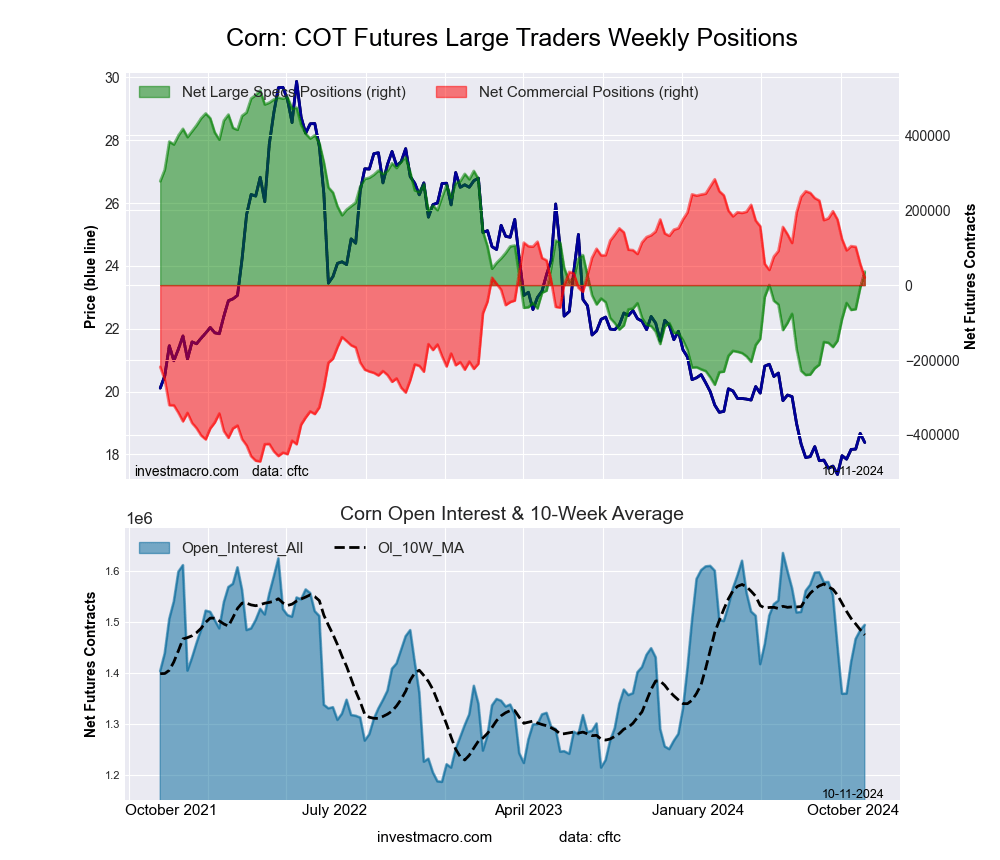
CORN Futures COT ChartThe CORN large speculator standing this week resulted in a net position of -47,760 contracts in the data reported through Tuesday. This was a weekly lift of 42,723 contracts from the previous week which had a total of -90,483 net contracts.

This week’s current strength score (the trader positioning range over the past three years, measured from 0 to 100) shows the speculators are currently Bearish with a score of 27.8 percent. The commercials are Bullish with a score of 74.8 percent and the small traders (not shown in chart) are Bearish with a score of 47.8 percent.

Price Trend-Following Model: Downtrend

Our weekly trend-following model classifies the current market price position as: Downtrend. The current action for the model is considered to be: Hold – Maintain Short Position.

CORN Futures StatisticsSPECULATORSCOMMERCIALSSMALL TRADERS
– Percent of Open Interest Longs:25.044.39.4
– Percent of Open Interest Shorts:28.537.512.7
– Net Position:-47,76092,844-45,084
– Gross Longs:339,497602,238127,801
– Gross Shorts:387,257509,394172,885
– Long to Short Ratio:0.9 to 11.2 to 10.7 to 1
NET POSITION TREND:
– Strength Index Score (3 Year Range Pct):27.874.847.8
– Strength Index Reading (3 Year Range):BearishBullishBearish
NET POSITION MOVEMENT INDEX:
– 6-Week Change in Strength Index:21.0-17.6-42.4


SUGAR Futures:

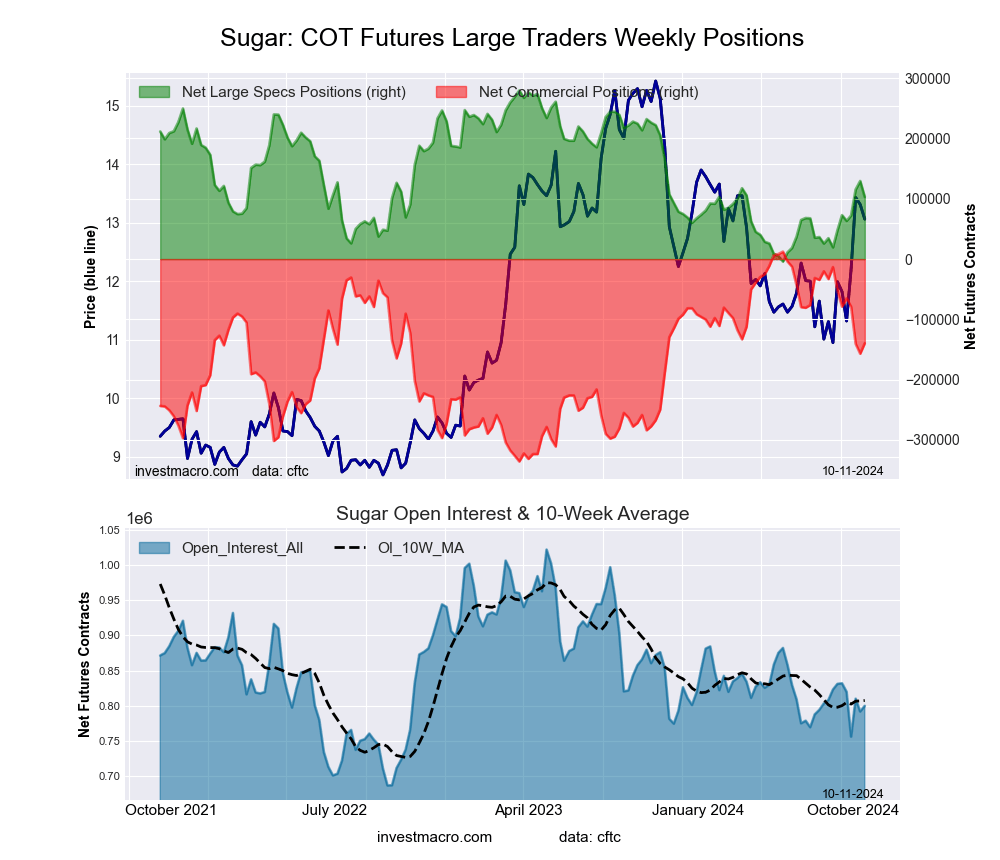
SUGAR Futures COT ChartThe SUGAR large speculator standing this week resulted in a net position of 63,403 contracts in the data reported through Tuesday. This was a weekly decline of -9,399 contracts from the previous week which had a total of 72,802 net contracts.

This week’s current strength score (the trader positioning range over the past three years, measured from 0 to 100) shows the speculators are currently Bearish with a score of 23.8 percent. The commercials are Bullish with a score of 77.7 percent and the small traders (not shown in chart) are Bearish with a score of 21.9 percent.

Price Trend-Following Model: Weak Downtrend

Our weekly trend-following model classifies the current market price position as: Weak Downtrend. The current action for the model is considered to be: Hold – Maintain Short Position.

SUGAR Futures StatisticsSPECULATORSCOMMERCIALSSMALL TRADERS
– Percent of Open Interest Longs:21.555.28.1
– Percent of Open Interest Shorts:13.863.17.9
– Net Position:63,403-65,2181,815
– Gross Longs:176,409452,22866,810
– Gross Shorts:113,006517,44664,995
– Long to Short Ratio:1.6 to 10.9 to 11.0 to 1
NET POSITION TREND:
– Strength Index Score (3 Year Range Pct):23.877.721.9
– Strength Index Reading (3 Year Range):BearishBullishBearish
NET POSITION MOVEMENT INDEX:
– 6-Week Change in Strength Index:9.5-8.84.9


COFFEE Futures:

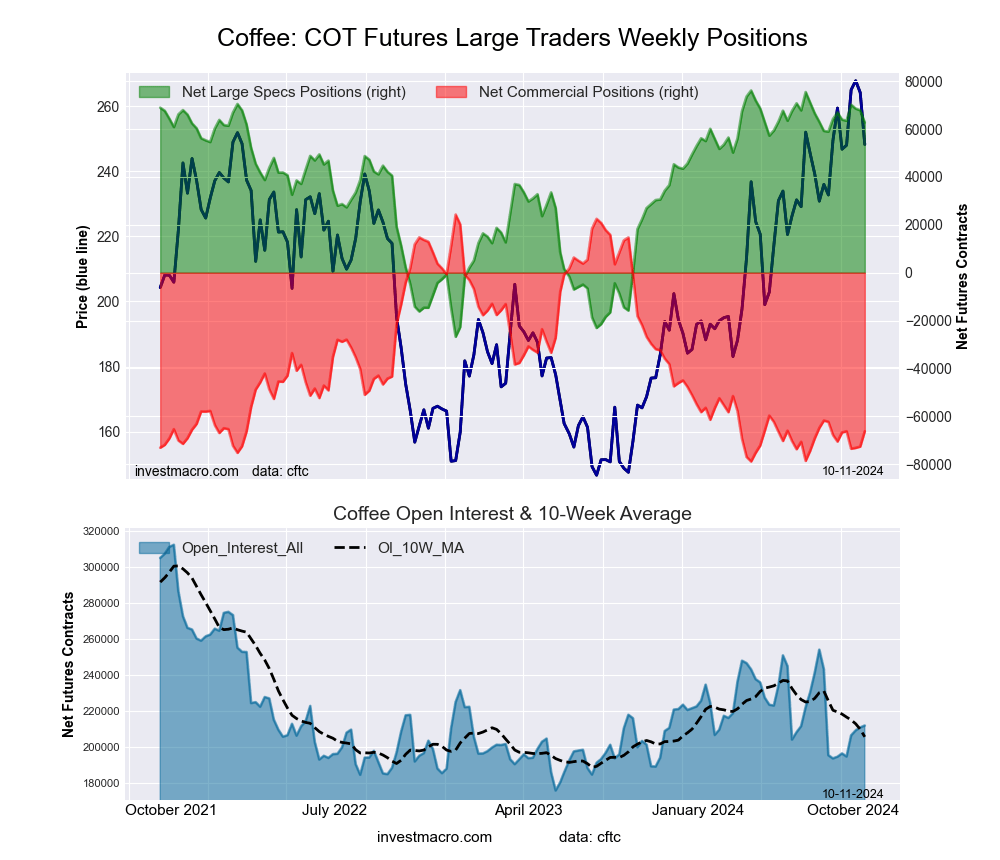
COFFEE Futures COT ChartThe COFFEE large speculator standing this week resulted in a net position of 63,447 contracts in the data reported through Tuesday. This was a weekly fall of -474 contracts from the previous week which had a total of 63,921 net contracts.

This week’s current strength score (the trader positioning range over the past three years, measured from 0 to 100) shows the speculators are currently Bullish-Extreme with a score of 87.7 percent. The commercials are Bearish-Extreme with a score of 12.2 percent and the small traders (not shown in chart) are Bullish with a score of 59.2 percent.

Price Trend-Following Model: Strong Uptrend

Our weekly trend-following model classifies the current market price position as: Strong Uptrend. The current action for the model is considered to be: Hold – Maintain Long Position.

COFFEE Futures StatisticsSPECULATORSCOMMERCIALSSMALL TRADERS
– Percent of Open Interest Longs:40.738.34.0
– Percent of Open Interest Shorts:8.172.32.6
– Net Position:63,447-66,2092,762
– Gross Longs:79,10674,5227,745
– Gross Shorts:15,659140,7314,983
– Long to Short Ratio:5.1 to 10.5 to 11.6 to 1
NET POSITION TREND:
– Strength Index Score (3 Year Range Pct):87.712.259.2
– Strength Index Reading (3 Year Range):Bullish-ExtremeBearish-ExtremeBullish
NET POSITION MOVEMENT INDEX:
– 6-Week Change in Strength Index:0.4-1.314.4


SOYBEANS Futures:

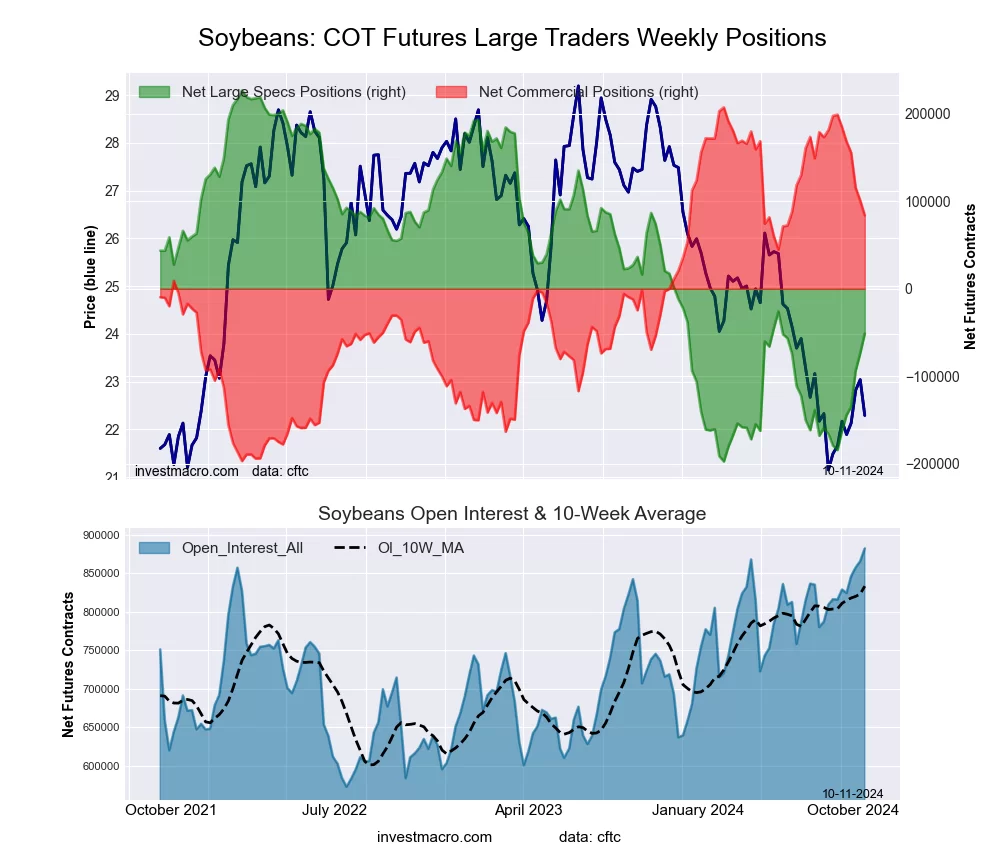
SOYBEANS Futures COT ChartThe SOYBEANS large speculator standing this week resulted in a net position of -144,231 contracts in the data reported through Tuesday. This was a weekly advance of 17,794 contracts from the previous week which had a total of -162,025 net contracts.

This week’s current strength score (the trader positioning range over the past three years, measured from 0 to 100) shows the speculators are currently Bearish-Extreme with a score of 12.5 percent. The commercials are Bullish-Extreme with a score of 90.3 percent and the small traders (not shown in chart) are Bullish with a score of 50.0 percent.

Price Trend-Following Model: Downtrend

Our weekly trend-following model classifies the current market price position as: Downtrend. The current action for the model is considered to be: Hold – Maintain Short Position.

SOYBEANS Futures StatisticsSPECULATORSCOMMERCIALSSMALL TRADERS
– Percent of Open Interest Longs:12.864.04.8
– Percent of Open Interest Shorts:30.343.67.7
– Net Position:-144,231168,163-23,932
– Gross Longs:105,764527,19839,866
– Gross Shorts:249,995359,03563,798
– Long to Short Ratio:0.4 to 11.5 to 10.6 to 1
NET POSITION TREND:
– Strength Index Score (3 Year Range Pct):12.590.350.0
– Strength Index Reading (3 Year Range):Bearish-ExtremeBullish-ExtremeBullish
NET POSITION MOVEMENT INDEX:
– 6-Week Change in Strength Index:5.6-2.7-33.6


SOYBEAN OIL Futures:

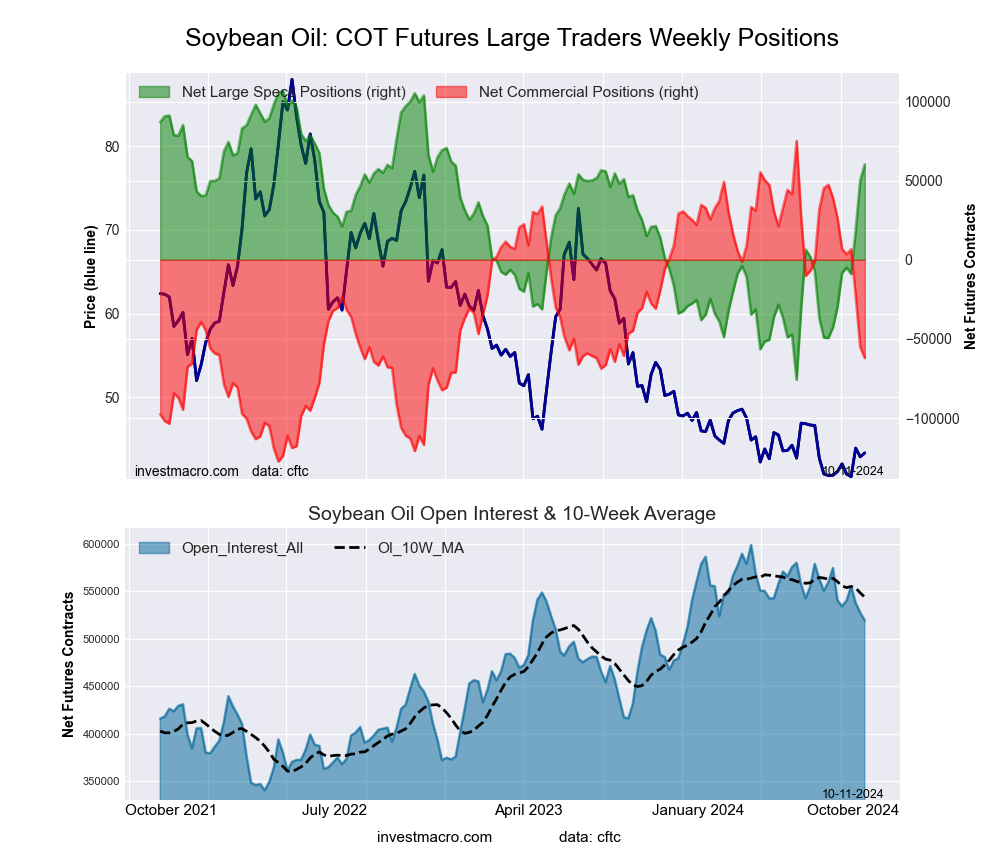
SOYBEAN OIL Futures COT ChartThe SOYBEAN OIL large speculator standing this week resulted in a net position of -4,869 contracts in the data reported through Tuesday. This was a weekly gain of 3,436 contracts from the previous week which had a total of -8,305 net contracts.

This week’s current strength score (the trader positioning range over the past three years, measured from 0 to 100) shows the speculators are currently Bearish with a score of 38.8 percent. The commercials are Bullish with a score of 64.7 percent and the small traders (not shown in chart) are Bearish-Extreme with a score of 19.3 percent.

Price Trend-Following Model: Strong Downtrend

Our weekly trend-following model classifies the current market price position as: Strong Downtrend. The current action for the model is considered to be: Hold – Maintain Short Position.

SOYBEAN OIL Futures StatisticsSPECULATORSCOMMERCIALSSMALL TRADERS
– Percent of Open Interest Longs:25.551.45.4
– Percent of Open Interest Shorts:26.450.85.2
– Net Position:-4,8693,5221,347
– Gross Longs:137,649277,92729,271
– Gross Shorts:142,518274,40527,924
– Long to Short Ratio:1.0 to 11.0 to 11.0 to 1
NET POSITION TREND:
– Strength Index Score (3 Year Range Pct):38.864.719.3
– Strength Index Reading (3 Year Range):BearishBullishBearish-Extreme
NET POSITION MOVEMENT INDEX:
– 6-Week Change in Strength Index:17.5-14.1-13.5


SOYBEAN MEAL Futures:

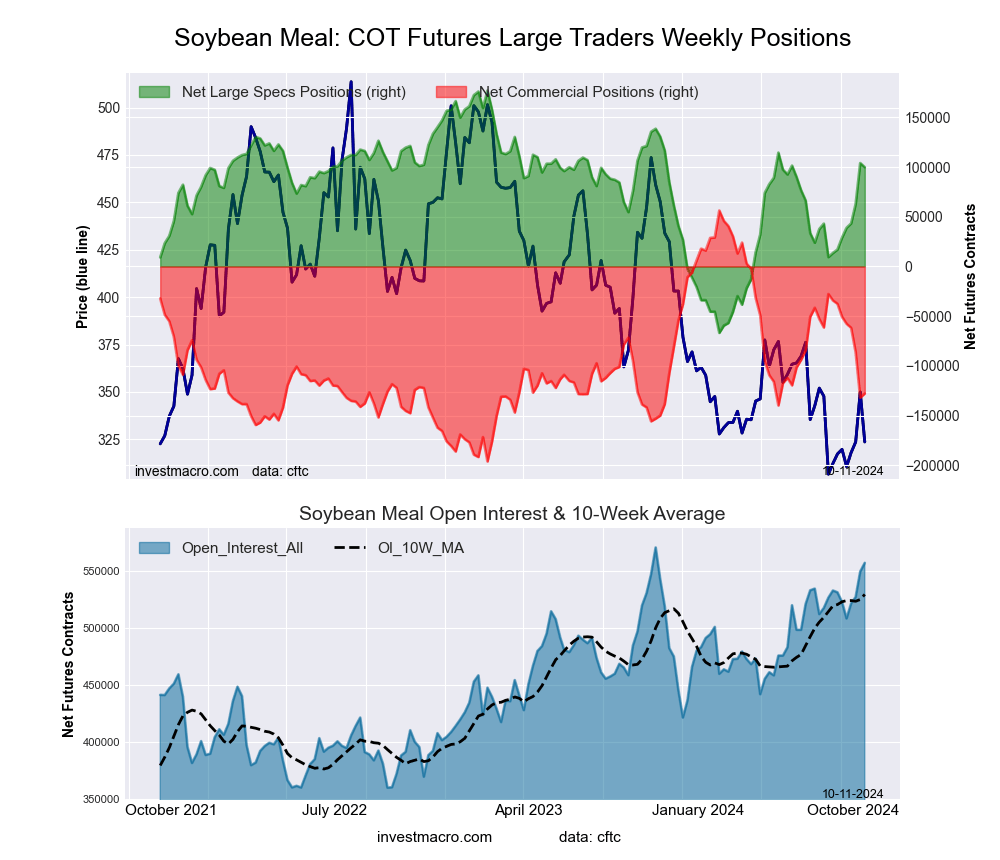
SOYBEAN MEAL Futures COT ChartThe SOYBEAN MEAL large speculator standing this week resulted in a net position of 38,898 contracts in the data reported through Tuesday. This was a weekly boost of 9,883 contracts from the previous week which had a total of 29,015 net contracts.

This week’s current strength score (the trader positioning range over the past three years, measured from 0 to 100) shows the speculators are currently Bearish with a score of 43.4 percent. The commercials are Bullish with a score of 54.9 percent and the small traders (not shown in chart) are Bearish with a score of 40.1 percent.

Price Trend-Following Model: Strong Downtrend

Our weekly trend-following model classifies the current market price position as: Strong Downtrend. The current action for the model is considered to be: Hold – Maintain Short Position.

SOYBEAN MEAL Futures StatisticsSPECULATORSCOMMERCIALSSMALL TRADERS
– Percent of Open Interest Longs:23.547.69.0
– Percent of Open Interest Shorts:15.859.05.4
– Net Position:38,898-57,66618,768
– Gross Longs:119,265242,12546,003
– Gross Shorts:80,367299,79127,235
– Long to Short Ratio:1.5 to 10.8 to 11.7 to 1
NET POSITION TREND:
– Strength Index Score (3 Year Range Pct):43.454.940.1
– Strength Index Reading (3 Year Range):BearishBullishBearish
NET POSITION MOVEMENT INDEX:
– 6-Week Change in Strength Index:0.5-1.916.5


LIVE CATTLE Futures:

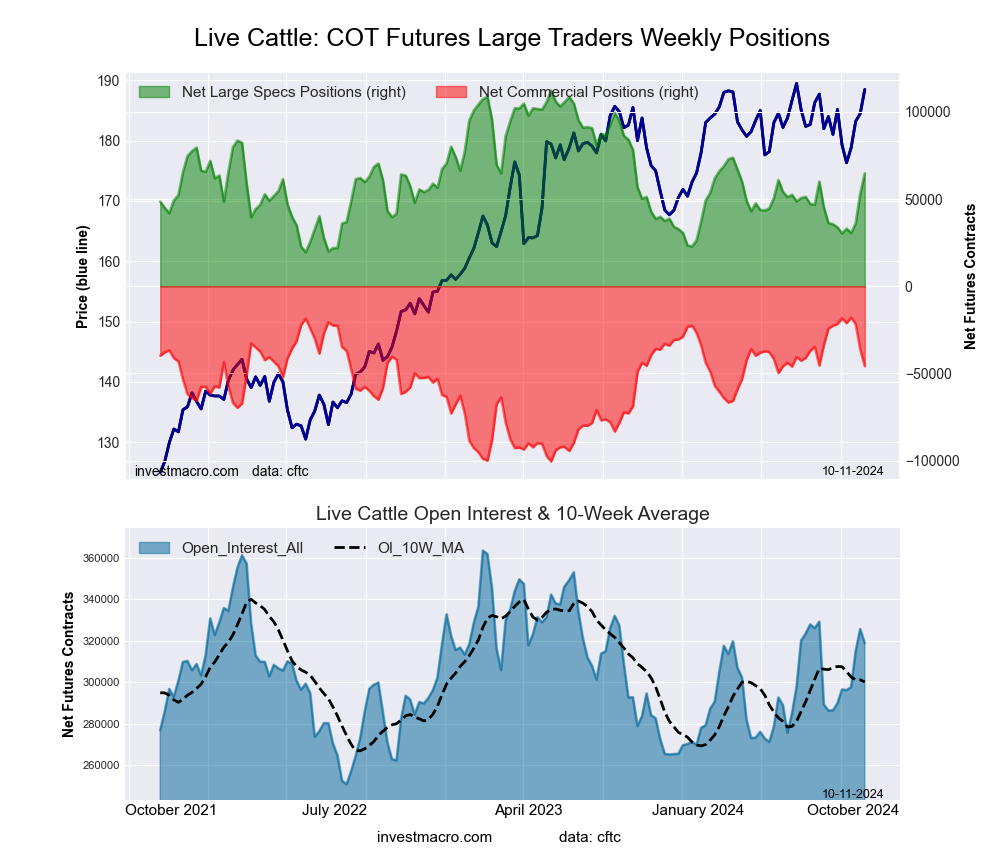
LIVE CATTLE Futures COT ChartThe LIVE CATTLE large speculator standing this week resulted in a net position of 33,049 contracts in the data reported through Tuesday. This was a weekly gain of 2,720 contracts from the previous week which had a total of 30,329 net contracts.

This week’s current strength score (the trader positioning range over the past three years, measured from 0 to 100) shows the speculators are currently Bearish-Extreme with a score of 14.6 percent. The commercials are Bullish-Extreme with a score of 96.6 percent and the small traders (not shown in chart) are Bearish with a score of 26.3 percent.

Price Trend-Following Model: Weak Uptrend

Our weekly trend-following model classifies the current market price position as: Weak Uptrend. The current action for the model is considered to be: Hold – Maintain Long Position.

LIVE CATTLE Futures StatisticsSPECULATORSCOMMERCIALSSMALL TRADERS
– Percent of Open Interest Longs:32.536.09.2
– Percent of Open Interest Shorts:21.343.113.3
– Net Position:33,049-21,140-11,909
– Gross Longs:96,103106,57027,356
– Gross Shorts:63,054127,71039,265
– Long to Short Ratio:1.5 to 10.8 to 10.7 to 1
NET POSITION TREND:
– Strength Index Score (3 Year Range Pct):14.696.626.3
– Strength Index Reading (3 Year Range):Bearish-ExtremeBullish-ExtremeBearish
NET POSITION MOVEMENT INDEX:
– 6-Week Change in Strength Index:-29.029.713.7


LEAN HOGS Futures:

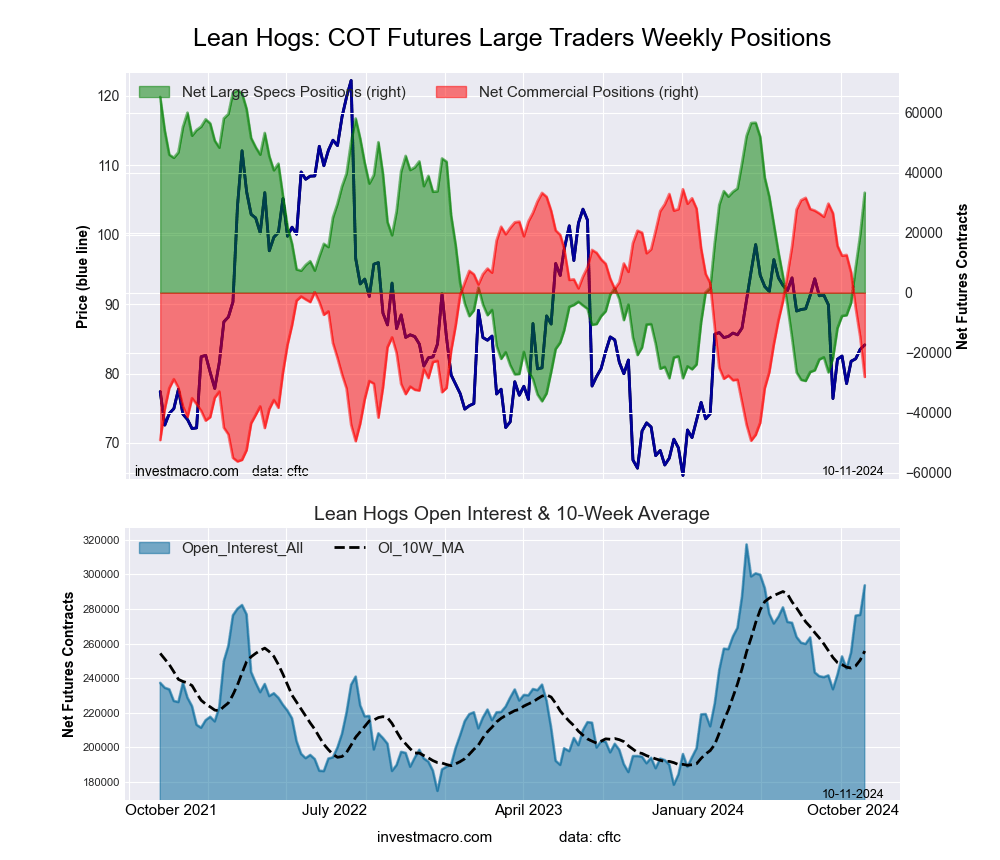
LEAN HOGS Futures COT ChartThe LEAN HOGS large speculator standing this week resulted in a net position of -7,481 contracts in the data reported through Tuesday. This was a weekly gain of 261 contracts from the previous week which had a total of -7,742 net contracts.

This week’s current strength score (the trader positioning range over the past three years, measured from 0 to 100) shows the speculators are currently Bearish with a score of 26.1 percent. The commercials are Bullish with a score of 76.1 percent and the small traders (not shown in chart) are Bullish with a score of 60.5 percent.

Price Trend-Following Model: Strong Downtrend

Our weekly trend-following model classifies the current market price position as: Strong Downtrend. The current action for the model is considered to be: Hold – Maintain Short Position.

LEAN HOGS Futures StatisticsSPECULATORSCOMMERCIALSSMALL TRADERS
– Percent of Open Interest Longs:37.738.47.1
– Percent of Open Interest Shorts:40.733.39.2
– Net Position:-7,48112,577-5,096
– Gross Longs:92,49094,22217,542
– Gross Shorts:99,97181,64522,638
– Long to Short Ratio:0.9 to 11.2 to 10.8 to 1
NET POSITION TREND:
– Strength Index Score (3 Year Range Pct):26.176.160.5
– Strength Index Reading (3 Year Range):BearishBullishBullish
NET POSITION MOVEMENT INDEX:
– 6-Week Change in Strength Index:13.4-15.1-3.9


COTTON Futures:

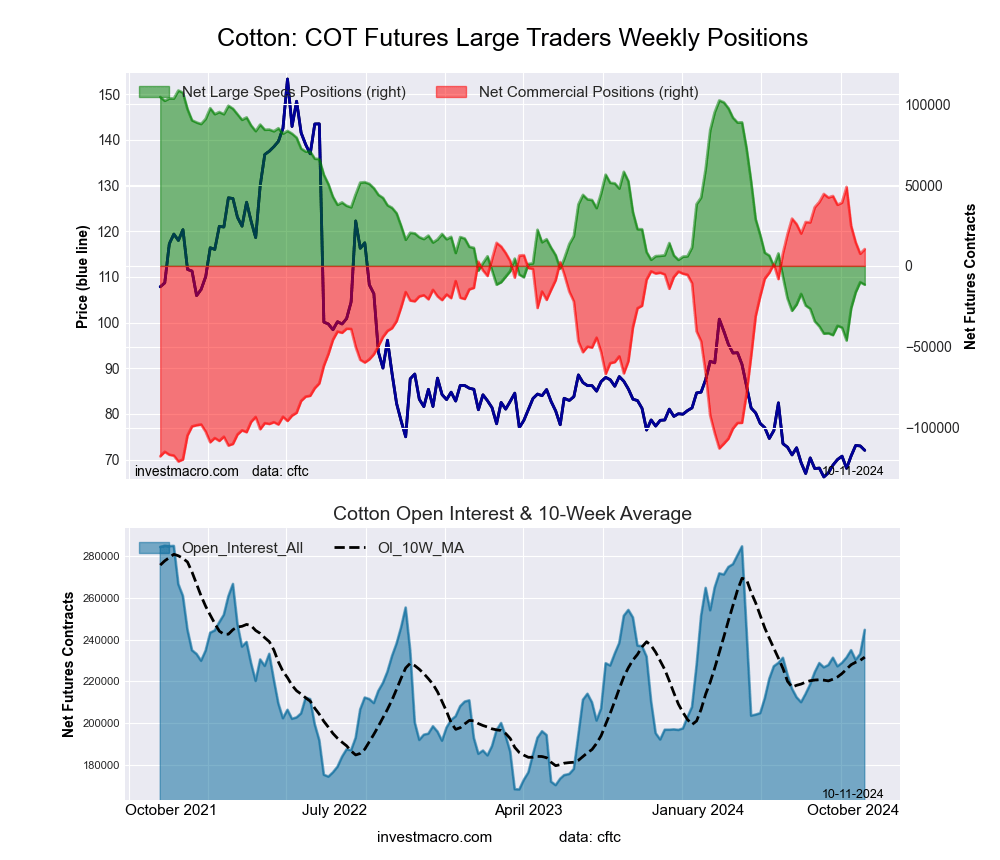
COTTON Futures COT ChartThe COTTON large speculator standing this week resulted in a net position of -46,111 contracts in the data reported through Tuesday. This was a weekly fall of -7,957 contracts from the previous week which had a total of -38,154 net contracts.

This week’s current strength score (the trader positioning range over the past three years, measured from 0 to 100) shows the speculators are currently Bearish-Extreme with a score of 0.0 percent. The commercials are Bullish-Extreme with a score of 100.0 percent and the small traders (not shown in chart) are Bearish-Extreme with a score of 0.0 percent.

Price Trend-Following Model: Downtrend

Our weekly trend-following model classifies the current market price position as: Downtrend. The current action for the model is considered to be: Hold – Maintain Short Position.

COTTON Futures StatisticsSPECULATORSCOMMERCIALSSMALL TRADERS
– Percent of Open Interest Longs:22.951.85.6
– Percent of Open Interest Shorts:42.830.76.8
– Net Position:-46,11148,810-2,699
– Gross Longs:52,919119,95613,031
– Gross Shorts:99,03071,14615,730
– Long to Short Ratio:0.5 to 11.7 to 10.8 to 1
NET POSITION TREND:
– Strength Index Score (3 Year Range Pct):0.0100.00.0
– Strength Index Reading (3 Year Range):Bearish-ExtremeBullish-ExtremeBearish-Extreme
NET POSITION MOVEMENT INDEX:
– 6-Week Change in Strength Index:-5.25.1-3.4


COCOA Futures:

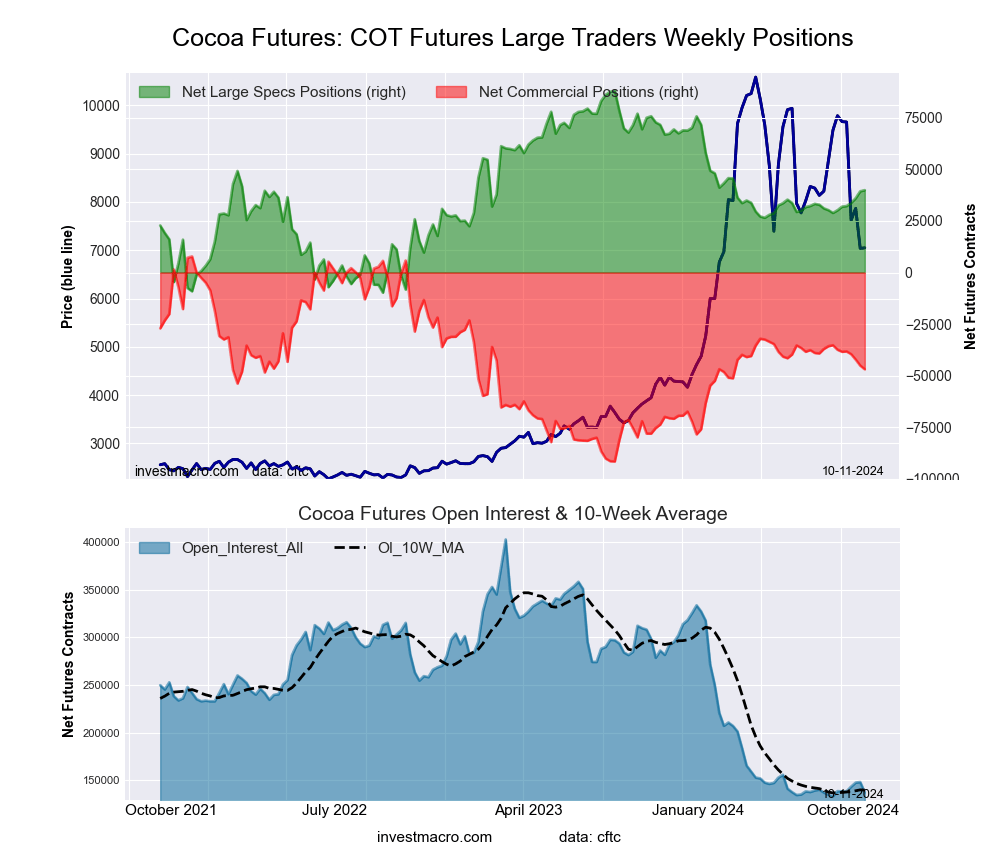
COCOA Futures COT ChartThe COCOA large speculator standing this week resulted in a net position of 32,225 contracts in the data reported through Tuesday. This was a weekly boost of 295 contracts from the previous week which had a total of 31,930 net contracts.

This week’s current strength score (the trader positioning range over the past three years, measured from 0 to 100) shows the speculators are currently Bearish with a score of 42.8 percent. The commercials are Bullish with a score of 53.7 percent and the small traders (not shown in chart) are Bullish with a score of 63.7 percent.

Price Trend-Following Model: Strong Uptrend

Our weekly trend-following model classifies the current market price position as: Strong Uptrend. The current action for the model is considered to be: New Buy – Long Position.

COCOA Futures StatisticsSPECULATORSCOMMERCIALSSMALL TRADERS
– Percent of Open Interest Longs:35.833.97.7
– Percent of Open Interest Shorts:12.561.53.4
– Net Position:32,225-38,2696,044
– Gross Longs:49,60246,98410,736
– Gross Shorts:17,37785,2534,692
– Long to Short Ratio:2.9 to 10.6 to 12.3 to 1
NET POSITION TREND:
– Strength Index Score (3 Year Range Pct):42.853.763.7
– Strength Index Reading (3 Year Range):BearishBullishBullish
NET POSITION MOVEMENT INDEX:
– 6-Week Change in Strength Index:-0.71.0-2.9


WHEAT Futures:

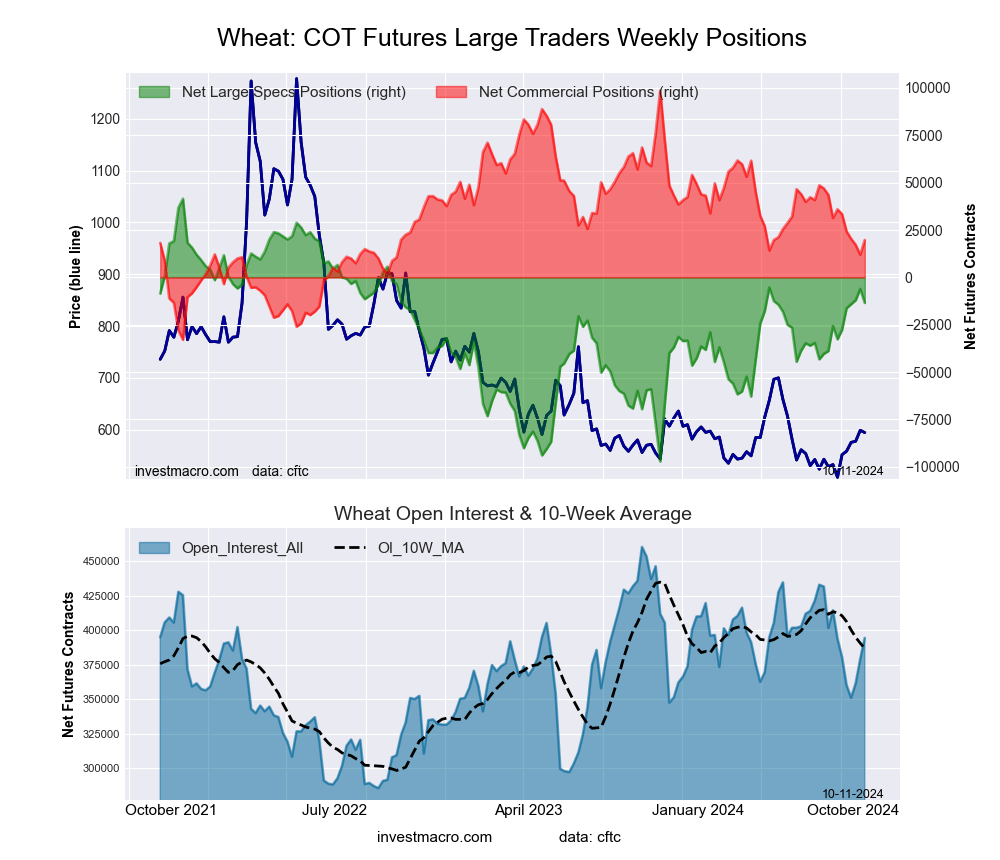
WHEAT Futures COT ChartThe WHEAT large speculator standing this week resulted in a net position of -16,303 contracts in the data reported through Tuesday. This was a weekly rise of 11,439 contracts from the previous week which had a total of -27,742 net contracts.

This week’s current strength score (the trader positioning range over the past three years, measured from 0 to 100) shows the speculators are currently Bullish with a score of 58.3 percent. The commercials are Bearish with a score of 43.5 percent and the small traders (not shown in chart) are Bearish-Extreme with a score of 18.2 percent.

Price Trend-Following Model: Downtrend

Our weekly trend-following model classifies the current market price position as: Downtrend. The current action for the model is considered to be: Hold – Maintain Short Position.

WHEAT Futures StatisticsSPECULATORSCOMMERCIALSSMALL TRADERS
– Percent of Open Interest Longs:35.136.17.6
– Percent of Open Interest Shorts:39.729.39.9
– Net Position:-16,30324,280-7,977
– Gross Longs:126,513129,88427,534
– Gross Shorts:142,816105,60435,511
– Long to Short Ratio:0.9 to 11.2 to 10.8 to 1
NET POSITION TREND:
– Strength Index Score (3 Year Range Pct):58.343.518.2
– Strength Index Reading (3 Year Range):BullishBearishBearish-Extreme
NET POSITION MOVEMENT INDEX:
– 6-Week Change in Strength Index:19.4-18.5-13.7


Article By InvestMacroReceive our weekly COT Newsletter

*COT Report: The COT data, released weekly to the public each Friday, is updated through the most recent Tuesday (data is 3 days old) and shows a quick view of how large speculators or non-commercials (for-profit traders) were positioned in the futures markets.

The CFTC categorizes trader positions according to commercial hedgers (traders who use futures contracts for hedging as part of the business), non-commercials (large traders who speculate to realize trading profits) and nonreportable traders (usually small traders/speculators) as well as their open interest (contracts open in the market at time of reporting). See CFTC criteria here.
Week Ahead: Central banks take centre stage

By ForexTime

  • Will Fed decision push US500 to fresh records?
  • UK100 waits on BoE for next move
  • JP225 could be rocked by BoJ meeting
  • Watch out for other central bank meetings

If you thought the past few days were eventful, check out what’s in store for the week ahead!

A string of major central bank decisions may present fresh trading opportunities across financial markets:

Saturday, 14th Sept

  • CN50: China property prices, retail sales, industrial production

Monday, 16th Sept  

  • CAD: Canada existing home sales
  • USDInd: US empire manufacturing

Tuesday, 17th Sept  

  • CAD: Canada CPI
  • GER40: Germany ZEW survey expectations
  • JP225: Japan tertiary index
  • SG20: Singapore trade
  • US500: US industrial production, retail sales

Wednesday 18th Sept

  • EU50: Eurozone CPI
  • JP225: Japan machinery orders, trade
  • ZAR: South Africa retail sales, CPI
  • UK100: UK CPI
  • US500: FOMC rate decision

Thursday, 19th Sept

  • AU200: Australia unemployment
  • NZD: New Zealand GDP
  • UK100: BoE rate decision
  • ZAR: SARB rate decision
  • TWN: Taiwan rate decision
  • USDInd: US Conf. Board leading index, initial jobless claims

Friday, 20th Sept

  • CN50: China loan prime rates
  • CAD: Canada retail sales
  • EU50: Eurozone consumer confidence
  • JP225: BoJ rate decision, CPI

We have our eyes on 3 indices that could be rocked by 3 central bank announcements:


    1) US500 set for fresh all-time highs?

FXTM’s US500 which tracks the S&P500 staged a strong rebound this week, rising 4% as data reinforced bets around lower US interest rates.

Although the Federal Reserve is expected to cut interest rates at September’s meeting, markets remain divided on the size.

Traders have fully priced in a 25-basis point cut with the odds of a 50-basis point cut around 45%.

The press conference and economic projections – especially ones for interest rates known as the dot plot may offer fresh insight into future moves.

Golden nugget: Over the past 12 months, the Fed decision has triggered upside moves of as much as 1.7% or declines of 1.2% in a 6-hour window post-release.

Looking at the technical picture, the US500 is trading just over 1% away from it’s all-time high at 5678. Prices are trading above the 50, 100 and 200-day SMA while the MACD is above zero.

  • Key levels can be found at 5600 and the 50-day SMA.

SP500


    2) UK100 to experience breakout?

After bouncing within a weekly range, the UK100 which tracks the FTSE100 index could experience a breakout.

This may be sparked by the incoming UK inflation data and BoE rate decision in the week ahead.

Markets expected the BoE to leave interest rates unchanged at 5% in September, so it’s all about the policy statement and how many MPC members voted to cut rates. This major risk could rock the British Pound, influencing the UK100.

Note: When the pound strengthens, it results in lower revenues for FTSE100 companies that attain their revenues from overseas – dragging the UK100 lower as a result. The same is true vice versa.

Golden nugget: Over the past year, the BoE decision has triggered upside moves of as much as 0.9% or declines of 0.8% in a 6-hour window post-release.

Talking technicals, it’s worth noting that the UK100 is trading roughly 3% away from its all-time high.

Weekly support can be found at 8130 and resistance at 8450.

  • A decline below 8130 may signal a selloff toward 8000.
  • While a breakout above 8450 could see the UK100 challenge fresh all-time highs.

UK100


    3) JP225 waits on BoJ decision

The JP225 could be injected with fresh volatility due to the BoJ meeting on Friday.

Note: The JP225 tracks the Nikkie 225 index and tens to weaken when the Yen strengthens, vice versa.

The BoJ is expected to leave interest rates unchanged at 0.25% in September with traders only seeing a 33% probability of another rate hike by the end of 2024.

Still, much attention will be directed toward the tone of the meeting and whether any clues are offered on future moves.

Rising inflationary pressures in Japan support the argument around higher rates. However, concerns over the US economy and possibly unwinding of the carry trades could keep hawks at bay. Whatever the outcome of the meeting, it is likely to influence the JP225.

Golden nugget: Over the past 12 months, the BoJ decision has triggered upside moves of as much as 2% or declines of 1.5% in a 6-hour window post-release.

Looking at the charts, resistance can be found at the 200-day SMA at 37700 and support at 3500. A breakout may be on the horizon.

JP225


Forex-Time-LogoArticle by ForexTime

ForexTime Ltd (FXTM) is an award winning international online forex broker regulated by CySEC 185/12 www.forextime.com

Gold sets a new record as prices rise higher

By RoboForex Analytical Department

Gold prices surged to 2,570 USD per troy ounce on Friday. New record highs became possible amid the weakening position of the US dollar and declining yields on US government bonds.

Gold prices began to rise after the release of another package of US macroeconomic statistics. The weekly initial jobless claims increased compared to the previous week and remained above average values. This signals a weakening employment market, which is confirmed by weak wage figures for August. Meanwhile, US producer prices increased slightly more than expected in August due to high maintenance costs. The overall trend still confirms easing inflationary pressures, which will allow the Federal Reserve to lower interest rates next week.

According to the CME FedWatch tool, the odds of a 25-basis-point interest rate cut is 59% now, while the likelihood of a 50-basis-point rate cut is estimated at 41%. Yesterday, the ECB lowered its interest rate by 60 basis points to 3.65% per annum, which is a good signal for gold prices.

XAU/USD technical analysis

On the XAU/USD H4 chart, the market has broken above the consolidation range. A breakout of the 2,535.35 level can be considered as a market proposal to extend the growth wave to 2,570.00 and potentially further to 2,585.85. Today, the market has completed a wave, reaching 2,570.00. Subsequently, a technical decline to at least 2,541.55 (testing from above) could follow. Once the price hits this level, a growth structure might develop, aiming for the local target of 2,585.85. It is worth noting that breaking through the 2,535.35 level may result in a continuous growth structure to the 2,595.95 level, without a significant correction. This is the main target. This scenario is technically supported by the MACD indicator, whose signal line is above zero and pointing strictly upwards.

On the XAU/USD H1 chart, the market has completed a growth wave, reaching 2,570.00. A consolidation range is currently forming below this level. With a downward breakout, the price could decline to 2,541.55. An upward breakout will open the potential for a continuation of the trend to 2,585.85. This scenario is also technically supported by the Stochastic oscillator, whose signal line is around 80 and poised for a decline to 20.


Disclaimer

Any forecasts contained herein are based on the author’s particular opinion. This analysis may not be treated as trading advice. RoboForex bears no responsibility for trading results based on trading recommendations and reviews contained herein.

Weakening US inflation fuels indices and precious metals. ECB cut interest rates as expected

By JustMarkets

At Thursday’s close, the Dow Jones (US30) Index was up 0.58%, while the S&P 500 (US500) Index increased by 0.75%. The NASDAQ Technology Index (US100) closed positive 1.00%. The US stocks rose for the second consecutive day on Thursday thanks to strong performance from technology and semiconductor stocks. Megacap technology companies led the gains: Nvidia (NVDA) rose by 1.9%, while Alphabet (GOOG) and Meta Platforms (META) rose by 2.3% and 2.7%, respectively. Released economic data, including the August Producer Price Index (PPI), pointed to easing inflation, with wholesale prices rising 0.2% month-on-month, slightly above prognoses. This follows a similar trend in consumer price data and reinforces expectations of a 25 basis point interest rate cut at next week’s Federal Reserve meeting.

Equity markets in Europe closed higher. The German DAX (DE40) rose by 1.03%, the French CAC 40 (FR40) closed higher by 0.52%, the Spanish IBEX 35 (ES35) added 1.08%, the British FTSE 100 (UK100) closed up 0.57%.

As expected, the ECB cut the deposit rate by 25 bps to 3.50% from 3.75% and said it will continue with its data-dependent approach. The ECB lowered its 2024 Eurozone GDP prognosis to 0.8% from the previous estimate of 0.9% and raised its 2024 core inflation expectation to 2.9% from 2.8%. ECB President Lagarde said that Eurozone growth risks have shifted to the downside and according to survey indicators, the Eurozone recovery continues to face some headwinds. Swaps discount the odds of a 25bp ECB rate cut at the October 17 meeting at 56%.

WTI crude oil prices rose by 2.5% to $69 a barrel on Thursday due to Storm Francine, which shut in about 670,000 barrels a day in the Gulf of Mexico — more than a third of the region’s oil production. Despite the rebound, oil prices are under pressure due to concerns about slowing demand in major markets such as China and the US. The International Energy Agency (IEA) has highlighted these concerns, noting that global oil demand growth is slowing, especially as China’s economy weakens. The IEA also predicted a potential supply glut in 2024, even if OPEC+ extends production cuts. This scenario suggests that while short-term factors may temporarily lift prices, broader economic concerns, especially those related to China, continue to weigh on the market, making it vulnerable to further declines.

Asian markets were predominantly up yesterday. Japan’s Nikkei 225 (JP225) was up 3.41%, China’s FTSE China A50 (CHA50) was down 0.45%, Hong Kong’s Hang Seng (HK50) was up 0.77% and Australia’s ASX 200 (AU200) was positive 1.11%.

India’s annual inflation rate rose to 3.65% in August 2024 from an upwardly revised 3.6% in July, the lowest since August 2019, and exceeded projections of 3.55%. Despite the rise, inflation remained below the RBI’s target of 4% for the second consecutive month.

Investors and some economists believe the Central Bank of New Zealand (RBNZ) will cut interest rates further and faster than it says as the economy shrinks and inflation slows. Economists believe the Reserve Bank, which began its easing cycle last month, will cut the official money rate to 2.5% by mid-2026 from 5.25% today. Markets are betting it will be forced to change course more aggressively as a prolonged period of higher borrowing costs suppresses demand. Gross domestic product data next week is expected to show the economy contracted in the second quarter, bringing it to the brink of a third recession since late 2022.

S&P 500 (US500) 5,595.76 +41.63 (+0.75%)

Dow Jones (US30) 41,096.77 +235.06 (+0.58%)

DAX (DE40) 18,518.39 +188.12 (+1.03%)

FTSE 100 (UK100) 8,240.97 +47.03 (+0.57%)

USD Index 101.24 -0.44 (-0.43%)

By JustMarkets


This article reflects a personal opinion and should not be interpreted as an investment advice, and/or offer, and/or a persistent request for carrying out financial transactions, and/or a guarantee, and/or a forecast of future events.

Why We Tip Our Hat to Warren Buffett

One would think that investors would be emulating their #1 hero. One would be wrong.

By Elliott Wave International

Warren Buffett recently acknowledged that he’s playing in overtime in this thing we call life. At 93, the acclaimed investor is still very much in the game and making his moves.

Our August Elliott Wave Theorist elaborates:

We Are in Good Company

We have been steadfastly recommending complete safety in the form of Treasury bills, 2-year Floating Rate Notes, a safe bank and gold stored offshore. We have felt quite alone in this opinion. So, we were pleasantly surprised to see this headline, from CNBC on August 7:

Warren Buffett now owns more T-bills than the Federal Reserve

It’s true: Buffett’s investment firm, Berkshire Hathaway, owns $235 billion worth of T-bills; the Fed owns $195 billion worth. Of course, most of the Fed’s money is in other government-guaranteed debt. Buffett’s is mostly in stocks. Still, his current cash holdings are about twice the average for the previous five years. How did he accumulate so much cash? By selling stocks in this heady environment. As CNBC reported,

“Buffett, 93, pulled off a surprising and yet prescient move by selling big chunks in stock holdings including Apple last quarter, ahead of a drastic global sell-off this week. Berkshire has been a seller of stocks for seven quarters straight, but that selling accelerated in the last period with Buffett shedding more than $75 billion in equities in the second quarter.”

One would think that investors would be emulating their #1 hero. One would be wrong.

The August Elliott Wave Theorist goes on to explain how many investors are behaving in the opposite manner as the Oracle of Omaha.

More than that, you’ll learn why the Quarterly Report on Bank Trading and Derivatives Activities is one of the scariest reports you’ll ever read.

Robert Prechter’s Elliott Wave Theorist has published since 1979 and is still going strong.

Find out how you can access our latest stock market insights below.

FREE — Read Our New Stock Market Highlights Issue

Want to see what’s next for stocks and more? We’ve curated the must-read highlights from our top publications. Don’t miss our unique analysis. Check it out now — free!

Read now

This article was syndicated by Elliott Wave International and was originally published under the headline Why We Tip Our Hat to Warren Buffett. EWI is the world’s largest market forecasting firm. Its staff of full-time analysts led by Chartered Market Technician Robert Prechter provides 24-hour-a-day market analysis to institutional and private investors around the world.

Timing of the Dollar Meltdown

Source: Clive Maund (9/10/24)

Technical Analyst Clive Maund shares his thoughts on the current state of the U.S. Dollar and how it might impact the gold market. 

Because it has such massive implications for just about everything, today we are going to review the charts for the dollar index.

Starting with the long-term 20-year chart, the first point to make is that, given the rampant money creation by the Fed and the grim economic and geopolitical outlook for the U.S., it is remarkable that it has held up as well as it has, which is believed to be largely due to debt servicing by horribly indebted foreign countries saddled with massive dollar debts.

However, the BRICS and the Global South are moving away from the dollar at an increasing pace. The U.S.’s huge debts, coupled with the Fed’s manic money creation, will completely destroy the dollar, which will end up like the currencies of Venezuela and Zimbabwe. So, returning to our chart, what is expected to happen is that the dollar breaks down below the support at 100 and plummets, with the first downside target being the support in the 88 – 90 area. However, there may be a near-term rally before this happens for reasons that we will see when we look at the dollar’s shorter-term charts.

On its 5-year chart, we can see that the dollar accelerated into a parabolic blowoff top in 2022 that is thought to mark the final high, the breakdown from which led to a large trading range forming, which has been going on for about 18 months now.

Normally, following a breakdown from such a parabolic blowoff top, a trading range of the type that has just formed is a consolidation that leads to renewed decline, and we can certainly see for fundamental reasons why this would be.

Over the past couple of months, the dollar has dropped back to quite strong support at the lower boundary of the range, which it arrived at in an oversold state with the 6-month chart that we will look at shortly suggesting some sort of rally soon off this support. However, over the longer term, it looks set to break below this support and drop hard. If this scenario eventuates, then it will present a golden opportunity to add to PM sector positions on a dip ahead of renewed advance that is expected to be powerful.

On the 6-month chart, we can see how the dollar has accelerated into a low at the support, where it bounced with its MACD breaking clear above its moving average in a manner that indicates that it has probably bottomed for now. It retreated back towards this support last week, with Friday’s candle suggesting that it is making a small Double Bottom.

It, therefore, looks likely that it will rally from here, although any such rally is not expected to get very far, probably no further than about 102, before the dollar reverses to the downside again and goes on to breach the support and drop hard to the next significant support in the 88 – 90 zone.

Gold has been added to this chart (and the others) and you can that it is looking a bit frail here after its recent runup. If a short-term rally in the dollar does occur and the PMs get knocked back more it will be regarded as a very good opportunity to buy or add to positions accross the sector.

Coeur Mining Inc. (CDE:NYSE)

You may recall that a near-term top was called for the broad market in the BROAD US MARKETS update on August 30, and so it proved to be, and the example PM stock included in that update, Coeur Mining Inc. (CDE:NYSE), has dropped back towards its 200-day moving average as predicted. If we do see a short-term dollar rally, it may, of course, synchronize with temporary risk-off conditions, meaning that the broad market is likely to drop further, and as a result, PM stocks could drop further, too, bringing Coeur down to a Buy zone near to its rising 200-day moving average and of course other PM stocks too.

At this juncture, we can expect the Fed to indulge in another binge of money creation that reverses the stock market back to the upside.


Important Disclosures:

  1. Clive Maund: I determined which companies would be included in this article based on my research and understanding of the sector.
  2. Statements and opinions expressed are the opinions of the author and not of Streetwise Reports, Street Smart, or their officers. The author is wholly responsible for the accuracy of the statements. Streetwise Reports was not paid by the author to publish or syndicate this article. Streetwise Reports requires contributing authors to disclose any shareholdings in, or economic relationships with, companies that they write about. Any disclosures from the author can be found  below. Streetwise Reports relies upon the authors to accurately provide this information and Streetwise Reports has no means of verifying its accuracy.
  3.  This article does not constitute investment advice and is not a solicitation for any investment. Streetwise Reports does not render general or specific investment advice and the information on Streetwise Reports should not be considered a recommendation to buy or sell any security. Each reader is encouraged to consult with his or her personal financial adviser and perform their own comprehensive investment research. By opening this page, each reader accepts and agrees to Streetwise Reports’ terms of use and full legal disclaimer. Streetwise Reports does not endorse or recommend the business, products, services or securities of any company.

For additional disclosures, please click here.
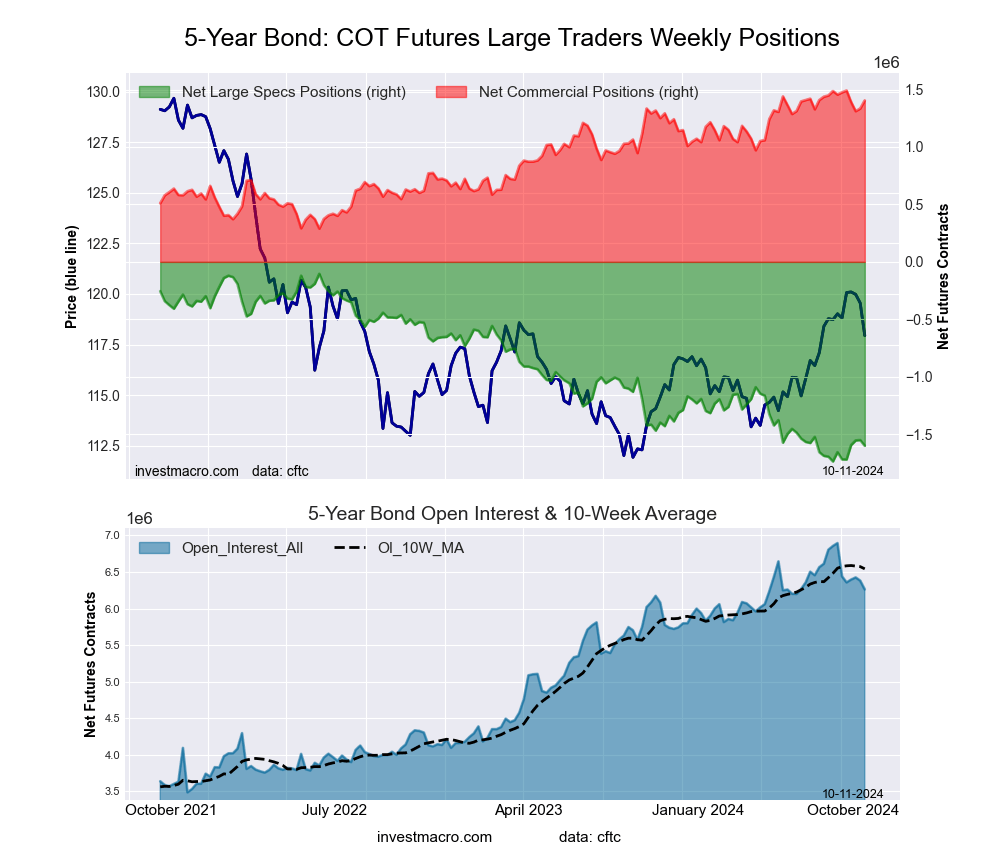
Clivemaund.com Disclosures

The quoted article represents the opinion and analysis of Mr. Maund, based on data available to him, at the time of writing. Mr. Maund’s opinions are his own, and are not a recommendation or an offer to buy or sell securities. As trading and investing in any financial markets may involve serious risk of loss, Mr. Maund recommends that you consult with a qualified investment advisor, one licensed by appropriate regulatory agencies in your legal jurisdiction and do your own due diligence and research when making any kind of a transaction with financial ramifications. Although a qualified and experienced stock market analyst, Clive Maund is not a Registered Securities Advisor. Therefore Mr. Maund’s opinions on the market and stocks cannot be  only be construed as a recommendation or solicitation to buy and sell securities.