NZD/USD is looking for a reason to recover: external background may help

By RoboForex Analytical Department

NZD/USD is attempting to recover from yesterday’s decline on Thursday and is heading towards 0.6148. The pair came under downward pressure on 29 August, and since then its attempts to stabilise have not brought any tangible result. The ambiguous US inflation release has increased bets that the Federal Reserve will ease monetary policy very cautiously next week. This means a 25-basis-point interest rate cut.

The Reserve Bank of New Zealand has already started its easing cycle, with a launch in August. At that time, the RBNZ cut interest rates by 25 basis points, marking the first reduction in four years. The RBNZ is expected to lower borrowing costs at each of the two meetings scheduled for this year, with a 50-basis-point rate cut possible at one of these meetings.

The consensus forecast suggests that the cash rate will be 3.00% by the end of 2025, down from 5.25% now. As for the latest statistics, annual food inflation in New Zealand eased to 0.4% in August from the previous 0.6%. This is a good signal, enabling the RBNZ to maintain its global easing stance.

Technical analysis of NZD/USD

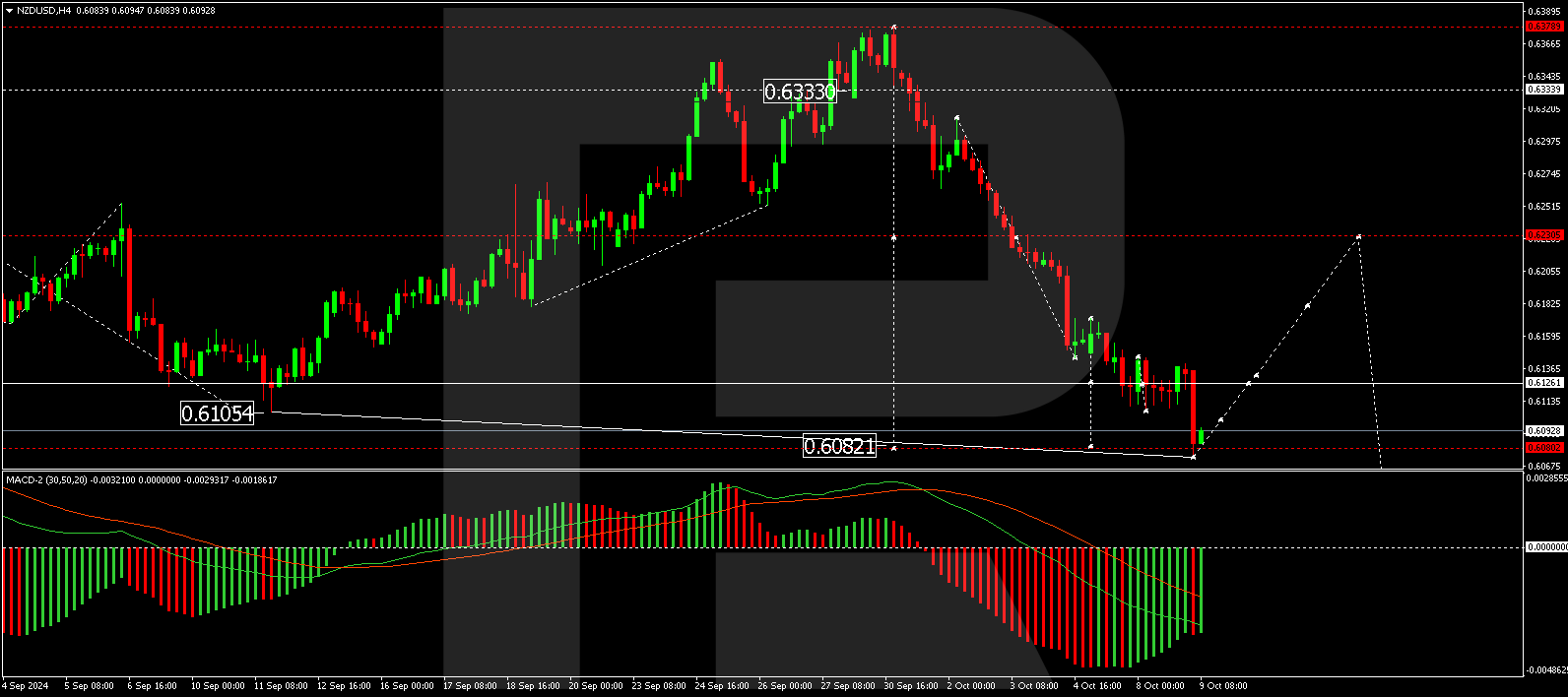
The NZD/USD H4 chart shows that the market has completed a downward wave, reaching 0.6106. A corrective structure is forming today, aiming for 0.6150 (testing from below). The correction could extend to 0.6166. Subsequently, the price might decline to 0.6070, potentially continuing the trend towards the local target of 0.6050. This scenario is technically supported by the MACD indicator, whose signal line is below zero and pointing strictly downwards.

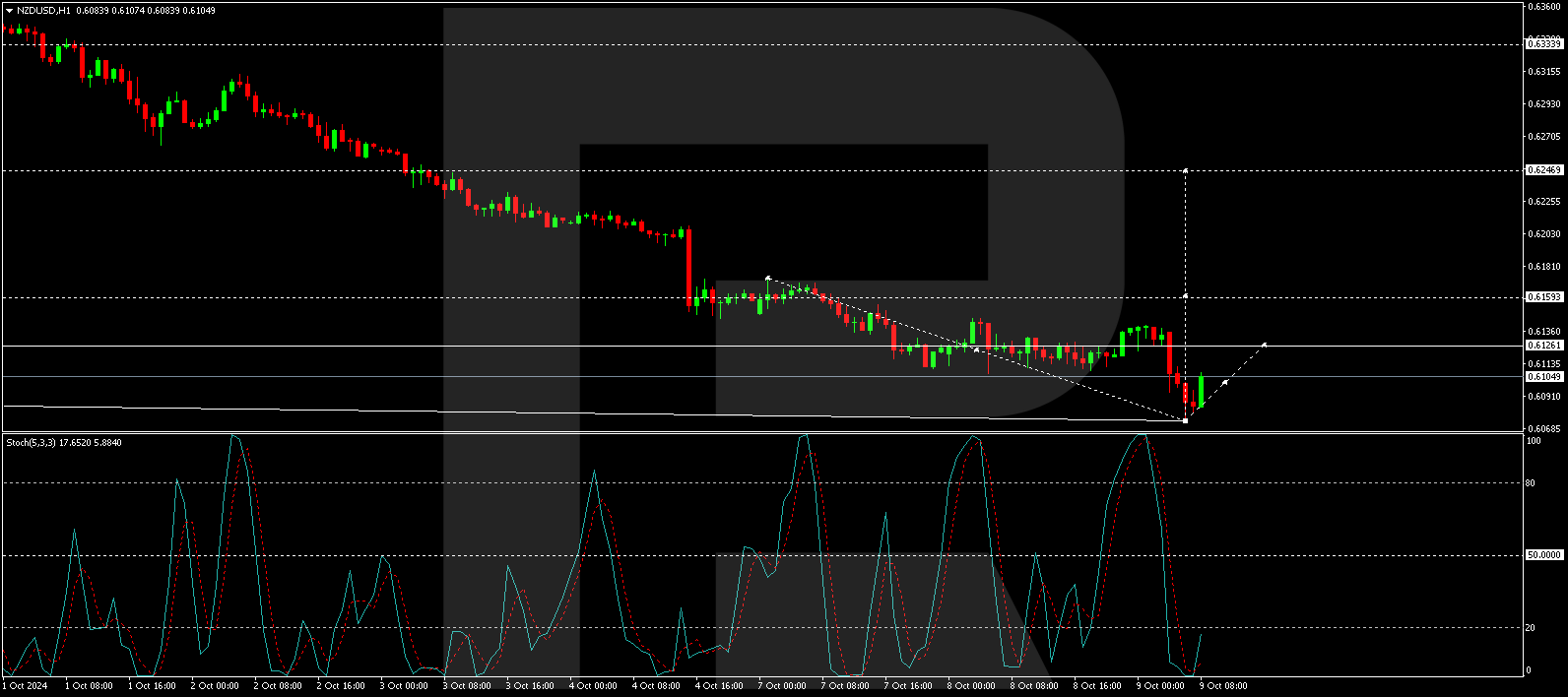
The NZD/USD H1 chart shows that the market has formed a consolidation range around 0.6140 and extended it down to 0.6106. Today, the market is correcting the downward wave, with the target for a correction of at least 0.6157. Once the correction is complete, the downward wave could develop towards 0.6069. This scenario is also technically supported by the Stochastic oscillator, whose signal line is below 50 and pointing strictly towards 80. Subsequently, a decline to 20 is expected.


Disclaimer

Any forecasts contained herein are based on the author’s particular opinion. This analysis may not be treated as trading advice. RoboForex bears no responsibility for trading results based on trading recommendations and reviews contained herein.

The ECB will lower interest rates today. The Bank of Japan may raise rates to 1% within a year

By JustMarkets

At Wednesday’s close, the Dow Jones Industrial Average (US30) was up 0.31%, while the S&P 500 Index (US500) added 1.07%. The NASDAQ Technology Index (US100) closed positive at 2.17%. Yesterday, investors weighed in on the latest inflation data and its implications for Federal Reserve policy. The inflation data showed that core prices fell to a three-year low, but core inflation rose 0.3%, which exceeded expectations. That fueled speculation that the Fed would favor a smaller 0.25% interest rate cut at next week’s meeting, with traders downgrading the probability of a 50 basis point rate cut to 13%. On the political front, the presidential debate boosted the chances of Kamala Harris winning the election, which helped solar stocks rise and cryptocurrency-related stocks fall.

Equity markets in Europe traded flat yesterday. The German DAX (DE40) was up 0.35%, the French CAC 40 (FR40) closed down 0.14%, the Spanish IBEX 35 (ES35) added 0.67%, the British FTSE 100 (UK100) closed negative 0.15%.

The European Central Bank (ECB) will hold a monetary policy meeting on Thursday, September 12. There is almost a 100% chance that the ECB will cut the rate by 0.25%. A quarter-point cut would bring the rate down to 4.00%. The ECB is also expected to make a technical adjustment and reduce the spread between the deposit rate and the main refinancing rate from 50 basis points to 15 basis points. If this happens, a 25 basis point cut in the deposit rate would lead to a more substantial 60 basis point cut in the refinancing rate. This constitutes a “dovish” factor. Financial markets are even more convinced of the need for rate cuts in the coming months and quarters.

Sweden’s annual inflation rate slowed to 1.9% in August 2024, down from 2.6% in the previous month and below the market expectation of 2.1%. This is the lowest level since July 2021.

WTI crude oil prices rose by 2.4% to $67.3 on Wednesday, regaining some ground after hitting a near three-year low in the previous session. However, oil prices remained near their lowest level since May 2023 despite a smaller-than-expected increase in inventories. The US crude stockpiles rose 0.83 million barrels, below the expected 1 million, while gasoline and distillate inventories rose more than expected. In addition, the EIA lowered oil price estimates for Q4 and 2025 after OPEC continued its downward revision of demand prognoses. Concerns remain about weakening demand in key markets, especially China.

The US natural gas (XNG/USD) prices climbed above $2.27/mmbtu, nearing the two-month high of $2.275 reached on September 6, driven by stronger seasonal demand, and record LNG exports. While inventories remain slightly above average, potential supply disruptions due to Gulf Coast storms and increased export volumes could quickly draw down those inventories, putting further upward pressure on prices.

Asian markets were predominantly down yesterday. Japan’s Nikkei 225 (JP225) was down 1.49%, China’s FTSE China A50 (CHA50) lost 0.59%, Hong Kong’s Hang Seng (HK50) was 0.73% cheaper and Australia’s ASX 200 (AU200) was negative 0.30%.

Expectations for Australian consumer inflation in September 2024 came in at 4.4%, down slightly from August’s 4-month high of 4.5%. The latest reading reflects the Central Bank’s efforts to bring inflation down within a reasonable timeframe while maintaining positive labor market outcomes. Reserve Bank Governor Michele Bullock recently noted that inflation has slowed significantly since its peak, although it remains above the midpoint of the 2–3% target. She also emphasized that it is premature to consider easing monetary policy.

The Bank of Japan (BoJ) should raise interest rates to at least 1% by the end of 2025, hawkish board spokesman Naoki Tamura said in a speech. It marked the first time a policymaker has publicly proposed a specific target level for the cost of short-term borrowing. Tamura said that the likelihood of the Japanese economy being able to consistently meet the 2% inflation target is increasing. He also explained that an interest rate of around 1% is considered neutral, meaning it neither stimulates nor slows the economy.

S&P 500 (US500) 5,554.13 +58.61 (+1.07%)

Dow Jones (US30) 40,861.71 +124.75 (+0.31%)

DAX (DE40) 18,330.27 +64.35 (+0.35%)

FTSE 100 (UK100) 8,193.94 −12.04 (−0.15%)

USD Index 101.73 +0.10 (+0.09%)

News feed for: 2024.09.12

  • Japan Producer Price Index (m/m) at 02:50 (GMT+3);
  • Eurozone ECB Monetary Policy Statement at 15:15 (GMT+3);
  • Eurozone ECB Interest Rate Decision at 15:15 (GMT+3);
  • US Producer Price Index (m/m) at 15:30 (GMT+3);
  • US Initial Jobless Claims (w/w) at 15:30 (GMT+3);
  • Eurozone ECB Press Conference at 15:45 (GMT+3);
  • US Natural Gas Storage (w/w) at 17:30 (GMT+3).

By JustMarkets


This article reflects a personal opinion and should not be interpreted as an investment advice, and/or offer, and/or a persistent request for carrying out financial transactions, and/or a guarantee, and/or a forecast of future events.

Oil and gas communities are a blind spot in America’s climate and economic policies

By Noah Kaufman, Columbia University 

On a recent visit to Rangely, a small town in northwest Colorado, my colleagues and I met with the administrators of a highly regarded community college to discuss the town’s economy. Leaving the scenic campus, we saw families driving into the mountains in off-road vehicles, a favorite activity for this outdoors-loving community. With a median household income above US$70,000 and a low cost of living, Rangely does not have the signs of a town in economic distress.

But an existential risk looms over Rangely. The town is here because of an oil boom during World War II. Today, the oil and gas industry contributes over half of the county’s economic output.

Rangely is not unique in the United States, which is the world’s largest producer of oil and natural gas. There are towns across the country that depend on the oil and gas industry for well-paying jobs and public revenues that fund their schools and other critical services.

A heavy dependence on any single industry is risky, and the oil industry is prone to booms and busts. But the economies of oil- and gas-dependent towns face a unique threat from global efforts to address the risks of climate change, which is fueled by the burning of oil and natural gas. Any serious strategy to halt global warming involves policies that will, over time, sharply reduce demand for all fossil fuels.

Early signs of this transformation can be seen in last year’s international agreement to “transition away from fossil fuels” and in the spread of electric vehicles that are starting to displace gasoline- and diesel-powered cars, trucks and buses.

As an economist who worked at the White House during the Obama administration and early Biden administration, I contributed to detailed strategies to reduce greenhouse gas emissions and to support communities in economic distress. But we did not have a plan to prepare oil and gas towns like Rangely for future economic challenges.

Why oil and gas towns are overlooked

Congress has prioritized support for small towns in recent legislation. However, oil- and gas-dependent towns were largely absent from these strategies for three primary reasons.

First is a perceived lack of urgency. The attention to a “just transition” as the nation moves away from fossil fuels has been disproportionately directed to coal-dependent communities. U.S. coal production has declined for 15 years, and a continued transition away from coal appears imminent and inevitable.

In contrast, U.S. production of oil and natural gas continues to grow. To be sure, some oil and gas communities are already struggling. But the widespread economic risks of a shift away from oil and gas may feel more like a problem for future decades.

Second, politicians downplay risks to oil and gas communities.

Most Republicans are not planning for a future decline in oil and gas production at all, and that includes many local politicians in oil and gas-dependent communities. For their part, most Democratic politicians prefer to focus on how climate action can be an engine of future economic growth. President Joe Biden likes to say, “When I think about climate change, I think jobs.”

He is not wrong to highlight the economic opportunities of climate solutions. But clean energy jobs rarely offer one-for-one replacements for the high-paying jobs in the oil and gas industries and the public revenues those industries bring local communities.

Third, economists’ policy toolbox is poorly suited to the challenges facing oil and gas communities.

Proposals to support local economic development commonly suggest targeting persistently distressed local economies with measures such as wage subsidies that have the potential to rapidly put more people to work.

A different prescription is needed for oil and gas communities, which are not generally struggling today. Over the 15-year period prior to the pandemic, the U.S. counties with oil and gas production experienced average annual GDP growth of 2.4% per year, compared with 1.9% nationwide.

Most oil and gas communities do not need economic stimulus policies that provide immediate relief. What they need are holistic economic development strategies that can cultivate new industries – building on their existing strengths – that will enable them to prosper into the future.

Solutions to help oil and gas towns prepare

Harvard economist Ricardo Hausmann compares the challenge of developing new economic capabilities to the game of Scrabble, where each additional letter enables the creation of more words. He cites the Finish economy as an example: It evolved from harvesting lumber to making tools that cut wood to producing automated cutting machines. From there, it evolved to sophisticated automated machines, including those used by global corporations such as telecommunications giant Nokia.

Such economic evolutions must be tailored to the characteristics of individual places. But the initial step is to recognize the problem and invest in solutions.

The Southern Ute Indian Tribe is doing this in southwest Colorado. It devotes oil and gas revenues to a Permanent Fund, which promotes fiscal sustainability by ensuring the tribe’s assets are aligned with its long-term financial goals, and a Growth Fund that diversifies the tribe’s revenue sources by investing in a range of businesses.

At the national level, a recent National Academies panel proposed the creation of a federally chartered corporation to help communities facing acute economic threats, including a future decline in oil and gas. This corporation could provide funding for displaced workers, critical public infrastructure and programs that ensure access to economic opportunities.

Colorado’s state Office of Just Transition has started to serve this role. Currently, it focuses only on the transition away from coal, with the goals of helping communities develop new economic opportunities and helping workers transition to new jobs. But its mission could be expanded in the future. In fact, Rangely is already receiving some support due to coal closures nearby.

No one-size-fits-all solution

Small, rural towns like Rangely illustrate how oil- and gas-reliant regions will need unique strategies tailored to the strengths and limitations of individual places. No off-the-shelf playbook exists.

Our group of researchers who visited Rangely are part of the Resilient Energy Economies initiative, which was created by universities, research institutes and philanthropic organizations to ensure that policymakers have the information they need to help fossil fuel-dependent communities successfully navigate the energy transition.

The best time to build a more resilient economy is before a crisis arrives. Anyone familiar with the Bible – or Broadway – knows the story of Joseph, whose dreams foresaw seven years of abundance for Egypt followed by seven years of famine. The pharaoh acted on Joseph’s vision, using the boom to prepare for the bust.

The United States is experiencing abundant oil and gas production today. Policymakers know risks are coming. But so far, the country is failing to prepare communities for harder days to come.The Conversation

About the Author:

Noah Kaufman, Senior Research Scholar in Climate Economics, Columbia University

This article is republished from The Conversation under a Creative Commons license. Read the original article.

Oil prices have fallen to November 2021 lows. OPEC+ lowered demand estimates

By JustMarkets

At Tuesday’s close, the Dow Jones Index (US30) was down 0.23%, while the S&P 500 Index (US500) was up 0.45%. The NASDAQ Technology Index (US100) closed positive 0.84%. A 4.3% drop in the price of WTI crude oil to a 16-month low on Tuesday hamstrung energy stocks. However, the broad market closed in positive territory due to gains in technology companies. Tesla (TSLA) shares rose by 4.6% and were the second-best performer among Nasdaq 100 stocks after Deutsche Bank named it a top pick with a “buy” recommendation and a $295 price target. Oracle (ORCL) rose by 11.44% and led the S&P 500 higher after reporting adjusted first-quarter revenue of $13.31 billion, better than the consensus estimate of $13.26 billion.

The Dollar Index fell below 101.5 on Wednesday, trimming recent gains as investors reacted to the first and only debate between US presidential candidates Kamala Harris and Donald Trump before the November election. Analysts suggested that the chances of a Harris presidency had increased slightly, which put pressure on the dollar, supported by expectations of higher tariffs and increased fiscal spending under another Trump presidency.

The Mexican peso fell to 20 per dollar in September, hitting a two-year low amid concerns over judicial reform and dovish expectations for the Bank of Mexico. Investor sentiment was dampened by the judicial reform bill. The reform, perceived as a threat to judicial independence and foreign investment, prompted warnings from financial institutions such as Morgan Stanley and Julius Baer of possible credit downgrades.

Equity markets in Europe were mostly down yesterday. The German DAX (DE40) fell by 0.96%, the French CAC 40 (FR40) closed down 0.24%, the Spanish IBEX 35 (ES35) lost 0.61%, the British FTSE 100 (UK100) closed down 0.78%. The worst-performing sector was the automotive sector, which fell 3.8% after Continental announced that it would have to lay off a significant amount of money due to warranty problems with one of its brake systems. The news also impacted BMW, which lowered its profitability estimate for 2024, citing the brake problem and other factors; BMW shares fell by 11%, and Continental shares fell more than 10%.

WTI crude prices fell more than 4% to $65.7 a barrel on Tuesday, hitting their lowest level since November 2021, after OPEC cut demand prognoses for the second time in two months. OPEC now expects global oil demand to grow by 2 million barrels per day (bpd) in 2024, down 80,000 bpd from the previous estimate. For 2025, OPEC revised its demand growth prognosis to 1.7 million bpd, down 40,000 bpd from the previous estimate. This reduction is due to lower oil consumption in China, especially as rising sales of electric vehicles reduce demand for conventional fuels.

Asian markets were predominantly up yesterday. Japan’s Nikkei 225 (JP225) was down 0.16%, China’s FTSE China A50 (CHA50) was up 0.23%, Hong Kong’s Hang Seng (HK50) added 0.22% and Australia’s ASX 200 (AU200) was positive 0.30%. The Hang Seng Index (HK50) fell to its lowest level in nearly five weeks and Chinese stocks were on the verge of falling to a seven-month low as strong mainland export data for August failed to ease growing concerns over deflation risks and ongoing trade friction with the US-led West. Meanwhile, the US House of Representatives on Monday passed a bill aimed at restricting business with some Chinese biotech companies on national security grounds.

Bank of Japan (BoJ) board spokeswoman Junko Nakagawa said the Central Bank will continue to raise interest rates if inflation moves in line with its prognosis. She added that a tight labor market and the continued rise in import prices also pose upward risks to inflation. In addition, she noted that real interest rates remain deeply negative despite the July rate hike.

S&P 500 (US500) 5,495.52 +24.47 (+0.45%)

Dow Jones (US30) 40,736.96 −92.63 (−0.23%)

DAX (DE40) 18,265.92 −177.64 (−0.96%)

FTSE 100 (UK100) 8,205.98 −64.86 (−0.78%)

USD Index 101.67 +0.12 (+0.12%)

News feed for: 2024.09.11

  • UK GDP (m/m) at 09:00 (GMT+3);
  • UK Industrial Production (m/m) at 09:00 (GMT+3);
  • UK Manufacturing Production (m/m) at 09:00 (GMT+3);
  • UK Trade Balance  (m/m) at 09:00 (GMT+3);
  • US Consumer Price Index (m/m) at 15:30 (GMT+3);
  • US Crude Oil Reserves (w/w) at 17:30 (GMT+3).

By JustMarkets


This article reflects a personal opinion and should not be interpreted as an investment advice, and/or offer, and/or a persistent request for carrying out financial transactions, and/or a guarantee, and/or a forecast of future events.

EUR/USD halted its decline: the market awaits US inflation data

By RoboForex Analytical Department 

EUR/USD halted its decline near a four-week low at 1.1034 on Wednesday. The information flow currently appears congested. The market is awaiting today’s US inflation release for August and is keeping an eye on the upcoming political debates between the main US presidential nominees. In addition, yesterday, the Fed outlined a plan to increase the capital of large banks by 9%. The banking sector was disappointed by this, with the proposal immediately gaining many critics.

Despite the abundance of news and events ahead, none of them is likely to influence the Fed’s upcoming interest rate decision. The meeting is scheduled for next week. The main scenario suggests a 25-basis-point reduction in borrowing costs, with the likelihood of the scenario estimated at 67%.

As for inflation expectations, CPI could have decreased to 2.6% y/y in August from the previous 2.9%. The indicator is projected to increase by 0.2% month-over-month as in July. Core inflation could have remained at 3.2% y/y. This data appears rather moderate largely due to core prices remaining unchanged. This may mean that the trend towards easing inflationary pressures is not as strong as wished to be.

EUR/USD technical analysis

On the EUR/USD H4 chart, the market is forming a downward wave structure, aiming for 1.0985. The price could reach this target level today. Subsequently, a consolidation range is expected to develop, extending up to 1.1026 and down to 1.0960. A breakout below the 1.0960 level may be considered a signal for a continuation of the trend to 1.0818. This scenario is technically supported by the MACD indicator, with its signal line below the zero level and pointing sharply downwards.

On the EUR/USD H1 chart, the market has completed a downward wave, reaching 1.1015, and today corrected towards 1.1049. The price is expected to decline to 1.0985. Subsequently, a consolidation range might form above this level, with the price expected to break below it. The third downward wave is forming, targeting 1.0818. This scenario is also technically supported by the Stochastic oscillator, whose signal line is above 80 and poised for a decline to 20.


Disclaimer

Any forecasts contained herein are based on the author’s particular opinion. This analysis may not be treated as trading advice. RoboForex bears no responsibility for trading results based on trading recommendations and reviews contained herein.

Brent remains under pressure: China and rapid growth in OPEC+ production to blame

By RoboForex Analytical Department

The oil market remains under pressure. A barrel of Brent oil declined to 71.80 USD by Tuesday. The commodity erased all early-week gains as fears of slowing demand in China outweighed the risk of energy shortages due to the storm in the Persian Gulf.

In recent weeks, market participants have been paying close attention and analysing the whole range of news related to China. The sluggish economic growth rate combined with the global strategy of transition to low-carbon raw materials is reducing China’s need for oil. This negatively impacts Chinese oil imports and naturally affects market prices as China is considered the world’s largest raw material consumer.

Investors are also confident that oil consumption in Europe and the US will reduce following the active driving season. Additionally, some oil refineries are going into maintenance mode, meaning they will not need as many raw materials as before. OPEC+ had previously postponed the planned increase in oil output for a couple of months. Yes, the market now has a respite but the likelihood of an imminent commodity oversupply is still looming over prices

Storm Francine is expected to intensify near Texas, US and could become a Category 2 storm, which means a hurricane threat. Some production facilities in Texas may be shut down until weather conditions improve.

Brent technical analysis

The BRENT H4 chart shows that the market has broken below the 74.96 level and completed a downward wave, reaching 70.50. A consolidation range could form at the current lows today. An upward breakout will open the potential for growth to 75.00 (testing from below). With a downward breakout, the range could expand to the local target of 69.69. This scenario is technically supported by the MACD indicator, with its signal line below the zero level at the lows and poised for growth.

The BRENT H1 chart shows that the market has reached the downward wave’s local target of 70.50. Today, the market is forming a consolidation range above this level. The range expanded up to 71.90 and down to 70.46. A breakout above the 71.90 level will open the potential for a corrective wave towards 75.00. With a breakout below 70.46, the range could expand downwards, with the wave continuing to 69.69. This scenario is technically supported by the Stochastic oscillator, whose signal line is below 20 and poised for growth.


Disclaimer

Any forecasts contained herein are based on the author’s particular opinion. This analysis may not be treated as trading advice. RoboForex bears no responsibility for trading results based on trading recommendations and reviews contained herein.

The Analytical Overview of the Main Currency Pairs on Natural gas prices fell by 4%. Oil also remains under pressure from weak demand

By JustMarkets

At Monday’s close, the Dow Jones (US30) Index was up 1.16%, while the S&P 500 (US500) Index added 1.16%. The NASDAQ Technology Index (US100) closed positive 1.30%. A rise in chip company stocks provided support for the broader market. In addition, positive corporate news drove the stock higher. Palantir Technologies (PLTR) closed higher by more than 13%, and Dell Technologies (DELL) closed higher by more than 3% after news that both companies will join the S&P 500 in the index’s latest quarterly change before trading opens on September 23. Boeing (BA) also closed higher by more than 3% on optimism that an agreement with its largest labor union will avoid a strike at factories.

Mexico’s annualized inflation rate fell to 4.99% in August 2024, down from a 14-month high of 5.57% in the prior period and slightly below market estimates of 5.09%. The annualized core inflation rate fell to 4% in August, the lowest since February 2021, down from 4.05% in the previous month. Lower inflationary pressures could be negative for the MXN currency.

Equity markets in Europe’s advantage rallied yesterday. The German DAX (DE40) gained 0.77%, the French CAC 40 (FR40) closed higher by 0.99%, the Spanish IBEX 35 (ES35) rose by 0.89%, the British FTSE 100 (UK100) closed up 1.09%. In Europe, the focus is on Thursday’s European Central Bank monetary policy decision, where a 25 basis point rate cut is widely expected. Investors are also awaiting the final French inflation data, which is due out on Friday.

WTI crude oil prices fell to around $68.6 a barrel on Tuesday, reversing earlier gains. Concerns over weak consumption in China persist as a shift to low-carbon fuels and a sluggish economy continue to slow demand growth in the world’s top oil consumer. In addition, consumption in Europe and the US is expected to decline as the summer season ends.

US natural gas (XNG/USD) prices fell more than 3% to below $2.35 per MMBtu due to a looming hurricane expected to hit Louisiana this week. The hurricane, which the National Hurricane Center predicts will form in the Gulf of Mexico and hit Louisiana, where several large LNG plants are located, could reduce demand, cause power outages, and disrupt LNG exports.

Asian markets were mostly down yesterday. Japan’s Nikkei 225 (JP225) decreased by 0.48%, China’s FTSE China A50 (CHA50) was down 1.22%, Hong Kong’s Hang Seng (HK50) lost 1.34%, and Australia’s ASX 200 (AU200) was negative 0.32%.

The offshore yuan weakened to 7.11 per dollar, marking the third straight session of declines, as the US dollar strengthened on expectations that the Federal Reserve will opt for a modest interest rate cut at its meeting next week. Traders assessed the latest economic data from China. On Tuesday, China reported a sharp widening of its trade surplus to 91.02 billion US dollars in August 2024 from 67.81 billion US dollars a year earlier. Export growth slowed to a four-month low of 4.6% year-on-year, falling short of the projected 6.5% growth, compared with a 7% increase in the previous month. Meanwhile, import growth slowed to 2.5% from a three-month high of 7.2% in July, although slightly above the expected 2% increase.

NAB Australia’s August 2024 business confidence index fell to 4 from July’s reading of 1. This was the first negative reading in three months and the lowest in a year amid sharp declines in leisure and personal services, transport and utilities, construction, and manufacturing.

S&P 500 (US500) 5,471.05 +62.63 (+1.16%)

Dow Jones (US30) 40,829.59 +484.18 (+1.20%)

DAX (DE40) 18,443.56 +141.66 (+0.77%)

FTSE 100 (UK100) 8,270.84 +89.37 (+1.09%)

USD Index 101.62 +0.44 (+0.44%)

News feed for: 2024.09.10

  • Australia NAB Business Confidence (m/m) at 04:30 (GMT+3);
  • China Trade Balance  (m/m) at 06:00 (GMT+3);
  • German Consumer Price Index (m/m) at 09:00 (GMT+3);
  • UK Average Earnings Index (m/m) at 09:00 (GMT+3);
  • UK Claimant Count Change (m/m) at 09:00 (GMT+3);
  • UK Unemployment Rate (m/m) at 09:00 (GMT+3);
  • Canada BoC Macklem Speeaks (m/m) at 15:10 (GMT+3).

By JustMarkets


This article reflects a personal opinion and should not be interpreted as an investment advice, and/or offer, and/or a persistent request for carrying out financial transactions, and/or a guarantee, and/or a forecast of future events.

The Analytical Overview of the Main Currency Pairs on The Bank of Canada is likely to continue cutting rates amid a weak labor market. OPEC+ postponed the planned production increase

By JustMarkets

On Friday, the Dow Jones (US30) decreased by 1.01% (for the week -2.47%), while the S&P 500 (US500) was down 1.73% (for the week -3.64%). The NASDAQ Technology Index (US100) closed negative 2.55% (for the week -5.44%). The Dow Jones (US30) and S&P 500 (US500) fell to 3-week lows, while the NASDAQ (US100) fell to 4-week lows. Weakness in chip company stocks hurt the overall market on Friday, led by a 10% drop in Broadcom (AVGO) shares after the company gave a disappointing fourth-quarter earnings outlook. The weakness in the US labor market is a negative for the economy, and stocks rose less than expected after the US Nonfarm Payrolls rose less than expected in August, and the July employment number was revised downward.

US Nonfarm Payrolls for August rose by 142,000, weaker than expectations of 165,000. In addition, July Nonfarm Payrolls were revised downward to 89,000 from the previously announced 114,000. The August unemployment rate fell 0.1 to 4.2%, which aligned with expectations. Average hourly earnings in the US rose by 0.4% m/m and 3.8% y/y in August, slightly stronger than expectations of 0.3% m/m and 3.7% y/y. Federal Reserve Bank of New York President John Williams said that it is now appropriate for the Central Bank to lower interest rates given the progress in reducing inflation and cooling the labor market.

As 2025 approaches, analysts at Capital Economics said this week that they expect a moderate recovery for most of the world’s major economies after a challenging second half of 2024. According to the company’s analysis, two key themes will drive advanced economies: normalizing inflation and loosening monetary policy, which should support GDP growth.

Canada’s unemployment rate climbed to 6.6%, the highest since October 2021, reflecting the Bank of Canada’s fears of a cooling labor market, as evidenced by its recent 25 bps rate cut. In addition, economic activity contracted for the first time in 13 months. Ivey’s PMI fell to 48.2, the lowest since December 2020, as employment growth slowed and price pressures intensified, further supporting the need for further easing.

Equity markets in Europe were declining on Friday. Germany’s DAX (DE40) was down 1.48% (for the week -3.23%), France’s CAC 40 (FR40) closed down 1.07% (for the week -3.63%), Spain’s IBEX 35 (ES35) was down 0.89% (for the week -1.94%), and the UK’s FTSE 100 (UK100) closed down 0.73% (for the week -2.33%). Eurozone GDP growth for the second quarter was revised downward to 0.2%, in line with concerns that restrictive monetary policy has a greater impact on the bloc’s economy, especially in its largest representative, Germany. Consequently, markets have increased bets that the central bank will stay on course for another 25 bps rate cut next week.

WTI crude oil prices fell by 2.1% to hit $67.70 a barrel on Friday, the lowest since June 2023. As oil began to fall sharply in price, OPEC+ postponed a planned 180,000 barrels a day production increase until December, which would have added about 2.2 million barrels a day to the market by the end of next year. However, recent economic data from China and the US have highlighted weakness in their manufacturing sectors, raising concerns about further demand weakness.

Asian markets were mostly down last week. Japan’s Nikkei 225 (JP225) decreased by 6.75%, China’s FTSE China A50 (CHA50) was down 1.48%, Hong Kong’s Hang Seng (HK50) lost 2.34%, and Australia’s ASX 200 (AU200) was negative 0.97% for the week. The Hang Seng Index (HK50) was near its lowest level in three weeks after fresh data showed that China’s consumer prices rose less than expected in August, and the decline in producer prices continued. The fall was topped by data on foreign exchange reserves in Hong Kong, which hit a five-month high last month, while on the mainland, they were the highest since 2015.

China’s annual consumer prices rose to a six-month high of 0.6% in August 2024 from 0.5% in the previous month, although the increase fell short of the projection of a 0.7% rise. The moderate rise in consumer inflation reflects Beijing’s continued efforts to boost domestic consumption amid a slowing economy. Meanwhile, China’s producer prices continued their downward trend, falling 1.8% year-on-year in August, following a 0.8% decline in July and exceeding the expected 1.4% drop. This marked the 23rd consecutive month of producer price deflation and the sharpest decline since April, indicating continued weakness in domestic demand.

S&P 500 (US500) 5,408.42 −94.99 (−1.73%)

Dow Jones (US30) 40,345.41 −410.34 (−1.01%)

DAX (DE40) 18,301.90 −274.60 (−1.48%)

FTSE 100 (UK100) 8,181.47 −60.24 (−0.73%)

USD Index 101.19 +0.08 (+0.08%)

News feed for: 2024.09.09

  • Japan GDP (q/q) at 02:50 (GMT+3);
  • China Consumer Price Index (m/m) at 04:30 (GMT+3);
  • China Producer Price Index (m/m) at 04:30 (GMT+3).

This article reflects a personal opinion and should not be interpreted as an investment advice, and/or offer, and/or a persistent request for carrying out financial transactions, and/or a guarantee, and/or a forecast of future events.

USDJPY pauses, but this is temporary

By RoboForex Analytical Department

The USDJPY pair halted its decline around 142.98 on Monday. However, this pause in the yen’s rally should not be misleading, as it comes amid uncertainty surrounding the extent of the anticipated monetary policy easing by the US Federal Reserve. The latest US employment report provided little information for adjusting forecasts of the Fed’s interest rate trajectory. Investors must assess fresh inflation data this week before drawing any fundamental conclusions.

Over the past week, the JPY strengthened by almost 3.0% against the US dollar. The USDJPY pair dropped to its annual low amid expectations of decisive action from the Bank of Japan. The BoJ is expected to raise rates by the end of the year, which will be supported by steady economic growth, wage increases, and ongoing inflationary pressure.

If the Bank of Japan’s monetary policymakers’ projections regarding macroeconomic aspects materialise, the central bank will be ready to adjust its monetary policy parameters more actively. Meanwhile, the latest data reflected weak GDP growth in Japan in Q2. The economy expanded by only 2.9% year-on-year, compared to the preliminary estimate of 3.1%.

Technical analysis of USDJPY

On the H4 chart, USD/JPY has formed a consolidation range around the 143.43 level. Due to recent news, the range has widened upwards to 144.00 and downwards to 141.76. Today, a rise towards the 143.43 level (testing from below) is possible, followed by a decline towards 141.70. Breaking this level could signal a continuation of the trend towards 139.70, with the potential for further development towards 137.77. This scenario is technically supported by the MACD indicator, whose signal line is below zero and pointing sharply downwards.

On the H1 chart, USD/JPY completed a downward impulse towards 141.76 and a subsequent rise to 143.00. A new consolidation range has almost formed. Today, a breakout below the lower boundary of this range is likely, with the downward wave continuing towards 140.30 and potentially further towards 139.70. After reaching this level, a correction towards 143.43 is possible. This scenario is also technically supported by the Stochastic oscillator, whose signal line is above 80 and pointing sharply downwards.


Disclaimer

Any forecasts contained herein are based on the author’s particular opinion. This analysis may not be treated as trading advice. RoboForex bears no responsibility for trading results based on trading recommendations and reviews contained herein.

All targets reached: Gold, USDInd, US500 index

By ForexTime 

  • Friday’s NFP report: mixed data sparked initial market confusion
  • Jobless rate edged lower, but hiring also slowed in August
  • Odds for 50-bps Sept Fed rate cut now down to 26% from 40%
  • Now, US500 and US dollar indexes up; gold still lower, as predicted
  • All highlighted post-NFP target prices reached!


The US500, USDInd, and Gold have fulfilled our forecasts from Friday!

During this past US nonfarm payrolls (NFP) release, which typically happens on the first Friday of every month, we held a webinar titled:

Profit from Payrolls? How to Trade the NFP

During this exclusive webinar on September 6th, we shared an overview of:

  • What is the NFP?
  • What is the NFP so important?
  • Potential trading strategies


Perhaps more importantly for traders, during the webinar …

We also shared some price targets for the US500 index (which tracks the S&P 500), the USDInd (US Dollar index), and XAUUSD (gold).


What were the target prices?

These price targets were oversimplified as an easy-to-track measure, solely looking at the incoming US unemployment rate:

  • If the August unemployment rate came in at 4.2%, which in turn eases US recession fears:

    – US500 index to rise to its 21-day simple moving average (SMA)

    – USDInd to rise to its 21-day SMA

    – XAUUSD to move down to its 21-day SMA


  • If the August unemployment rate came in at 4.3%, matching July’s number which was also the highest jobless rate since 2021:

    – US500 index to fall to its 100-day SMA

    – USDInd to fall to around 100.5

    – XAUUSD to soar to $2530 (or higher to new record high)

NOTE: Lines in bold above = target prices reached. See more below.

FXTM Webinar - 6 September 2024 - Profit from Payrolls - How to trade NFP


What were the August NFP numbers?

At 12:30PM GMT on Friday, September 6th, during our live webinar, investors and traders worldwide received these official numbers:

  • US unemployment rate: fell to 4.2% in August from 4.3% in July 2024.
  • August headline NFP number: 142,000 new jobs added; lower than the forecasted 165,000.
  • July’s headline NFP number: revised lower to 89,000 compared to the 114,000 previously reported on August 2nd, 2024.


How did markets react at first?

As a knee-jerk reaction immediately after the NFP data was released:

  • USDInd fell to within 10 pips (100.595) of our 100.5 downside target
  • US500 climbed by as much as 54 index points to print at 5528.9
  • Gold jumped up to as high as $2529.10, flirting with our $2530 (or higher) upside target


The above price action came as Fed funds futures markets also saw wild swings, before paring those bets for a jumbo-sized 50-basis point Fed rate cut on September 18th:

  • Before Sept 6th NFP release: 40% chance
  • Soon after NFP release: 50% chance
  • At time of writing on Monday, September 9th: 26% chance


All highlighted price levels have been reached!

Once markets had more time to digest the data, they reached our forecasted prices:

1) USDInd reversed losses and has now reached its 21-day SMA target, as forecasted!

USDInd DXY dollar index

2) US500 index fell all the way down to its 100-day SMA.

This US stock index duly found support at that widely-followed technical indicator (100-day SMA) before bouncing higher today (Monday, September 9th).

US500 index S&P 500 reaches forecasted price
To be clear, the US500 went in the “other” direction. We had initially anticipated the US500 to rise if shown the lower 4.2% unemployment rate.

Instead, stock markets preferred to focus on the hiring slowdown (lower-than-expected headline August NFP number, and the downward revision to the headline July NFP number), instead of the lower unemployment rate. Refer to numbers stated earlier in this article.

However, the fact that the US500’s declines last Friday was halted almost perfectly at its 100-day SMA proved true our expectations that this technical indicator would act as a critical support level.


3) Gold erased its initial spike higher to fall down to its 21-day SMA, as expected.

XAUUSD spot gold price hits target


After all, the latest US jobs report wasn’t all that bad.

The jobless rate ticked back down in August, while the creation of new jobs was still evident in the world’s largest economy.

This past Friday’s data release offered little that screams an imminent recession, nor the jarring need for a jumbo-sized 50-bps rate cut by the Fed this month.


Hence, once markets could hang on to a more sensible narrative:

  • Odds for a 50-bps Fed rate cut has been duly lowered to 26%
  • The US dollar index (USDInd) has recovered higher to its 21-day SMA
  • Spot gold (XAUUSD) is kept lower around its 21-day SMA
  • The S&P 500 (US500) is now staging a modest rebound off its 100-day SMA support

… all as we had forecasted prior to the September 6th release of the US nonfarm payrolls report.


Forex-Time-LogoArticle by ForexTime
ForexTime Ltd (FXTM) is an award winning international online forex broker regulated by CySEC 185/12 www.forextime.com