Archive for Opinions – Page 90

Copper Speculator bets go bullish for first time since February

By InvestMacro

Here are the latest charts and statistics for the Commitment of Traders (COT) data published by the Commodities Futures Trading Commission (CFTC).

The latest COT data is updated through Tuesday April 18th and shows a quick view of how large traders (for-profit speculators and commercial entities) were positioned in the futures markets.

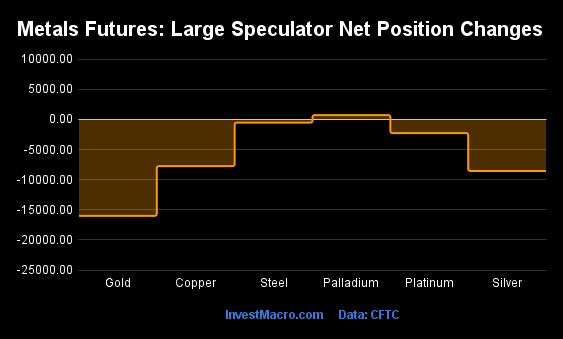
Weekly Speculator Changes led by Steel & Silver

The COT metals markets speculator bets were higher this week as five out of the six metals markets we cover had higher positioning while the other one market had lower speculator contracts.

Leading the gains for the metals was Copper (13,237 contracts) with Platinum (10,986 contracts), Silver (2,877 contracts), Palladium (1,436 contracts) and Steel (329 contracts) also having positive weeks.

The market with a decline in speculator bets for the week was Gold with a drop of -2,852 contracts on the week.

Copper bets go bullish for first time since February

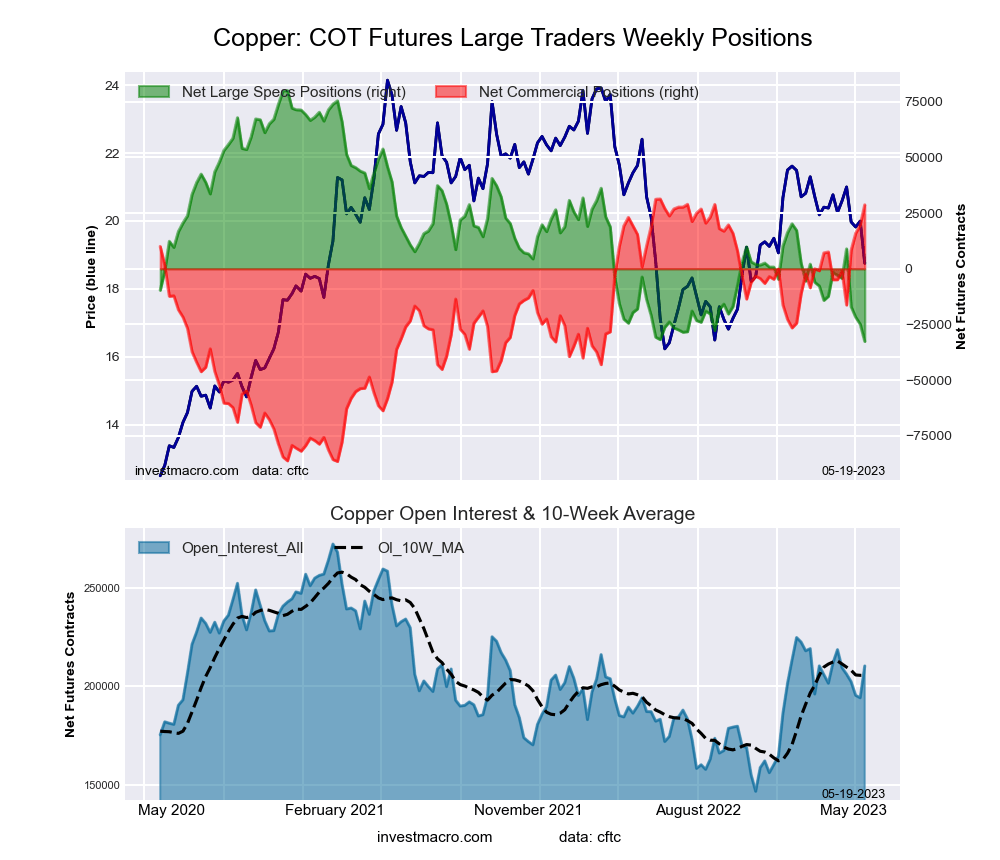
Highlighting the COT metals data this week is the renewed bullishness for the Copper speculative positions. The large speculator position in Copper futures rose by over +13,000 contracts this week and are higher for the third time in the past five weeks.

Copper speculative bets have now gained by a total of +23,090 contracts over the past five weeks, going from a bearish net position of -14,156 contracts on March 14th to this week’s net position of +8,934 contracts. This week was the first time that net positions crossed over into bullish territory since February and Copper’s sentiment has been helped out by China’s economic reopening which uses the metal for many types of manufacturing and industry.

The Copper front-month futures price dipped this week but has been higher in the three of the past five weeks, continuing an uptrend since bottoming in July of 2022. Copper futures have gained by approximately 25 percent since that recent bottom in July and closed this week just below the $4.00 per pound major price level.


Data Snapshot of Commodity Market Traders | Columns Legend
Apr-18-2023OIOI-IndexSpec-NetSpec-IndexCom-NetCOM-IndexSmalls-NetSmalls-Index
Gold482,25428189,89361-216,4254026,53246
Silver158,3714626,59556-38,6564712,06133
Copper206,216478,93436-16,280607,34665
Palladium11,84882-5,637136,15189-51411
Platinum63,7945324,31972-28,202353,88320


Strength Scores led by Platinum & Gold

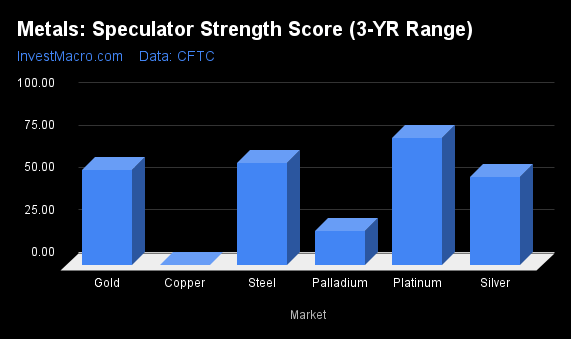
COT Strength Scores (a normalized measure of Speculator positions over a 3-Year range, from 0 to 100 where above 80 is Extreme-Bullish and below 20 is Extreme-Bearish) showed that Platinum (72 percent) and Gold (61 percent) lead the metals markets this week.  Steel (59 percent) comes in as the next highest in the weekly strength scores.

On the downside, Palladium (13 percent) comes in at the lowest strength level currently and is in Extreme-Bearish territory (below 20 percent).

Strength Statistics:
Gold (60.6 percent) vs Gold previous week (61.9 percent)
Silver (56.2 percent) vs Silver previous week (52.1 percent)
Copper (36.4 percent) vs Copper previous week (24.6 percent)
Platinum (71.7 percent) vs Platinum previous week (46.4 percent)
Palladium (13.5 percent) vs Palladium previous week (0.2 percent)
Steel (59.3 percent) vs Palladium previous week (58.4 percent)


Silver & Platinum top the 6-Week Strength Trends

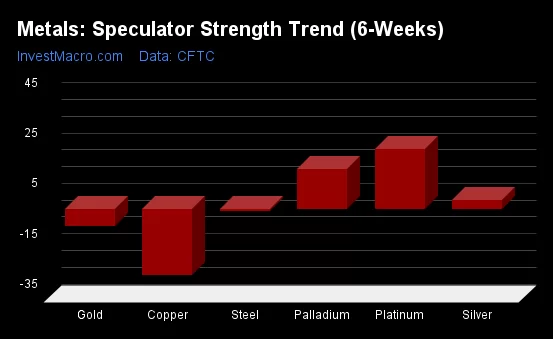
COT Strength Score Trends (or move index, calculates the 6-week changes in strength scores) showed that Silver (49 percent) and Platinum (44 percent) lead the past six weeks trends for metals. Gold (40 percent) is the next highest positive mover in the latest trends data.

Steel (-1 percent) leads the downside trend scores currently.

Move Statistics:
Gold (40.2 percent) vs Gold previous week (37.0 percent)
Silver (49.1 percent) vs Silver previous week (33.9 percent)
Copper (14.9 percent) vs Copper previous week (1.6 percent)
Platinum (44.3 percent) vs Platinum previous week (18.5 percent)
Palladium (13.5 percent) vs Palladium previous week (-9.7 percent)
Steel (-1.2 percent) vs Steel previous week (-4.1 percent)


Individual Markets:

Gold Comex Futures:

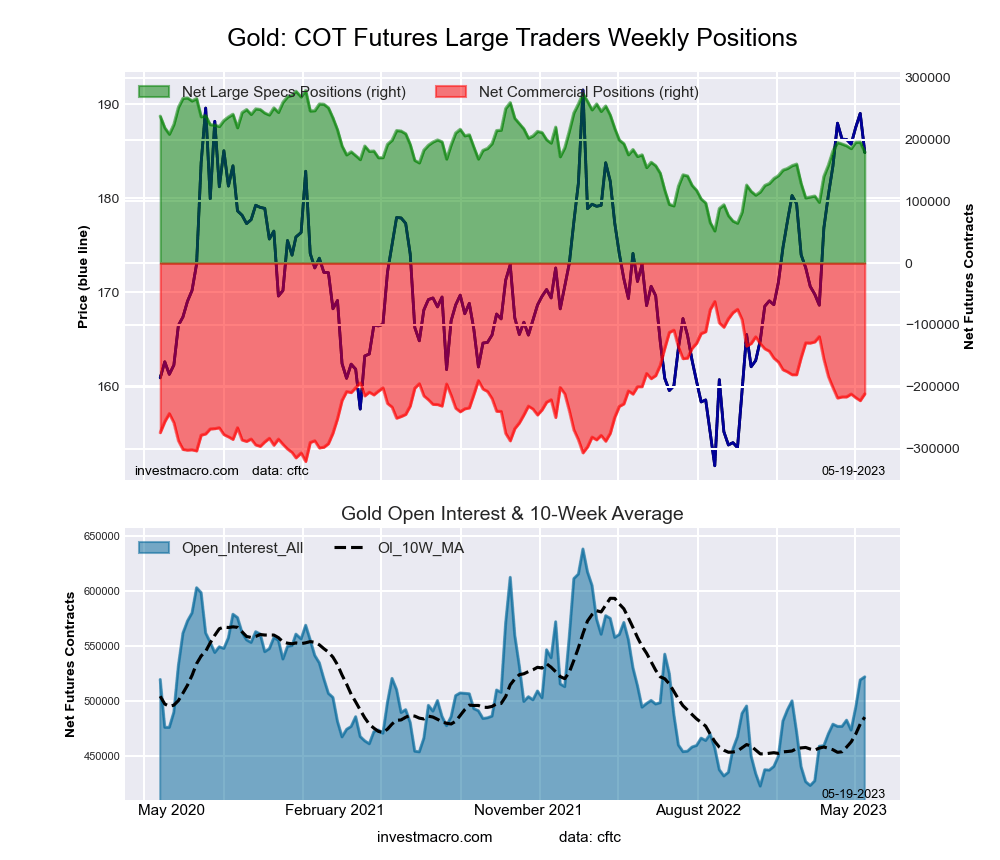
Gold Futures COT ChartThe Gold Comex Futures large speculator standing this week was a net position of 189,893 contracts in the data reported through Tuesday. This was a weekly decline of -2,852 contracts from the previous week which had a total of 192,745 net contracts.

This week’s current strength score (the trader positioning range over the past three years, measured from 0 to 100) shows the speculators are currently Bullish with a score of 60.6 percent. The commercials are Bearish with a score of 40.4 percent and the small traders (not shown in chart) are Bearish with a score of 46.5 percent.

Gold Futures StatisticsSPECULATORSCOMMERCIALSSMALL TRADERS
– Percent of Open Interest Longs:53.925.610.5
– Percent of Open Interest Shorts:14.670.55.0
– Net Position:189,893-216,42526,532
– Gross Longs:260,061123,49650,647
– Gross Shorts:70,168339,92124,115
– Long to Short Ratio:3.7 to 10.4 to 12.1 to 1
NET POSITION TREND:
– Strength Index Score (3 Year Range Pct):60.640.446.5
– Strength Index Reading (3 Year Range):BullishBearishBearish
NET POSITION MOVEMENT INDEX:
– 6-Week Change in Strength Index:40.2-37.715.3


Silver Comex Futures:

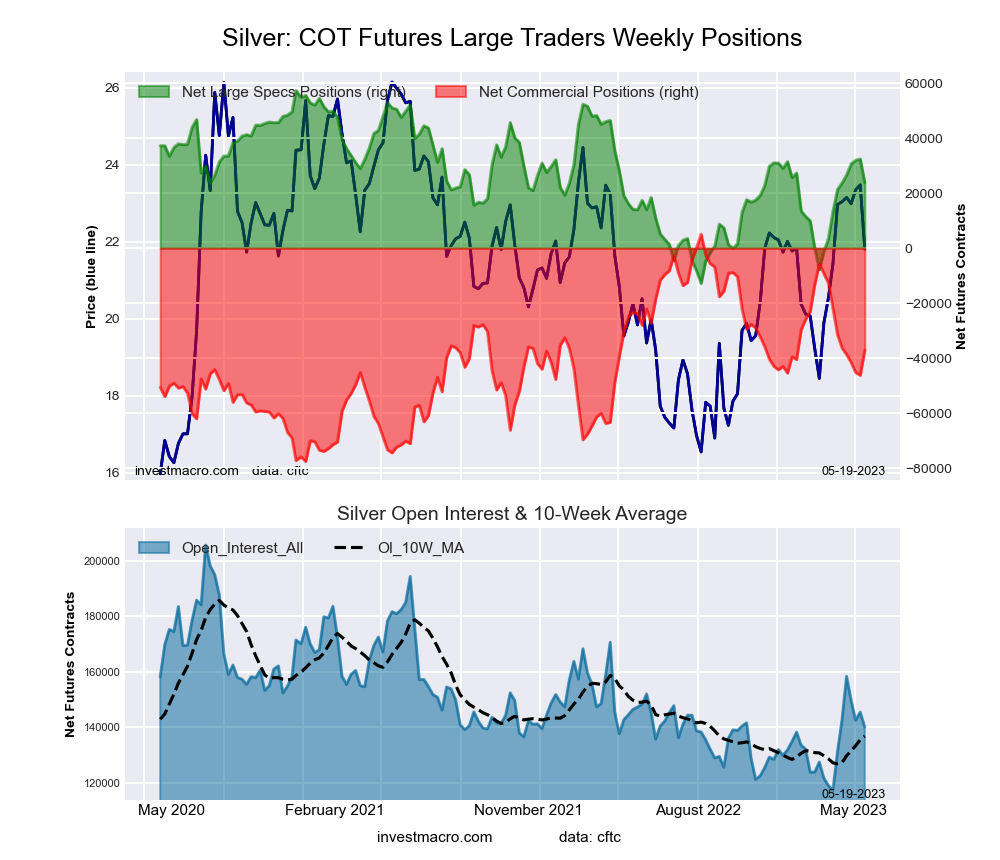
Silver Futures COT ChartThe Silver Comex Futures large speculator standing this week was a net position of 26,595 contracts in the data reported through Tuesday. This was a weekly lift of 2,877 contracts from the previous week which had a total of 23,718 net contracts.

This week’s current strength score (the trader positioning range over the past three years, measured from 0 to 100) shows the speculators are currently Bullish with a score of 56.2 percent. The commercials are Bearish with a score of 47.1 percent and the small traders (not shown in chart) are Bearish with a score of 33.4 percent.

Silver Futures StatisticsSPECULATORSCOMMERCIALSSMALL TRADERS
– Percent of Open Interest Longs:39.832.816.1
– Percent of Open Interest Shorts:23.057.28.4
– Net Position:26,595-38,65612,061
– Gross Longs:62,96851,89125,438
– Gross Shorts:36,37390,54713,377
– Long to Short Ratio:1.7 to 10.6 to 11.9 to 1
NET POSITION TREND:
– Strength Index Score (3 Year Range Pct):56.247.133.4
– Strength Index Reading (3 Year Range):BullishBearishBearish
NET POSITION MOVEMENT INDEX:
– 6-Week Change in Strength Index:49.1-40.0-7.5


Copper Grade #1 Futures:

Copper Futures COT ChartThe Copper Grade #1 Futures large speculator standing this week was a net position of 8,934 contracts in the data reported through Tuesday. This was a weekly lift of 13,237 contracts from the previous week which had a total of -4,303 net contracts.

This week’s current strength score (the trader positioning range over the past three years, measured from 0 to 100) shows the speculators are currently Bearish with a score of 36.4 percent. The commercials are Bullish with a score of 59.6 percent and the small traders (not shown in chart) are Bullish with a score of 64.8 percent.

Copper Futures StatisticsSPECULATORSCOMMERCIALSSMALL TRADERS
– Percent of Open Interest Longs:32.643.29.1
– Percent of Open Interest Shorts:28.351.15.6
– Net Position:8,934-16,2807,346
– Gross Longs:67,26289,13118,851
– Gross Shorts:58,328105,41111,505
– Long to Short Ratio:1.2 to 10.8 to 11.6 to 1
NET POSITION TREND:
– Strength Index Score (3 Year Range Pct):36.459.664.8
– Strength Index Reading (3 Year Range):BearishBullishBullish
NET POSITION MOVEMENT INDEX:
– 6-Week Change in Strength Index:14.9-13.0-8.1


Platinum Futures:

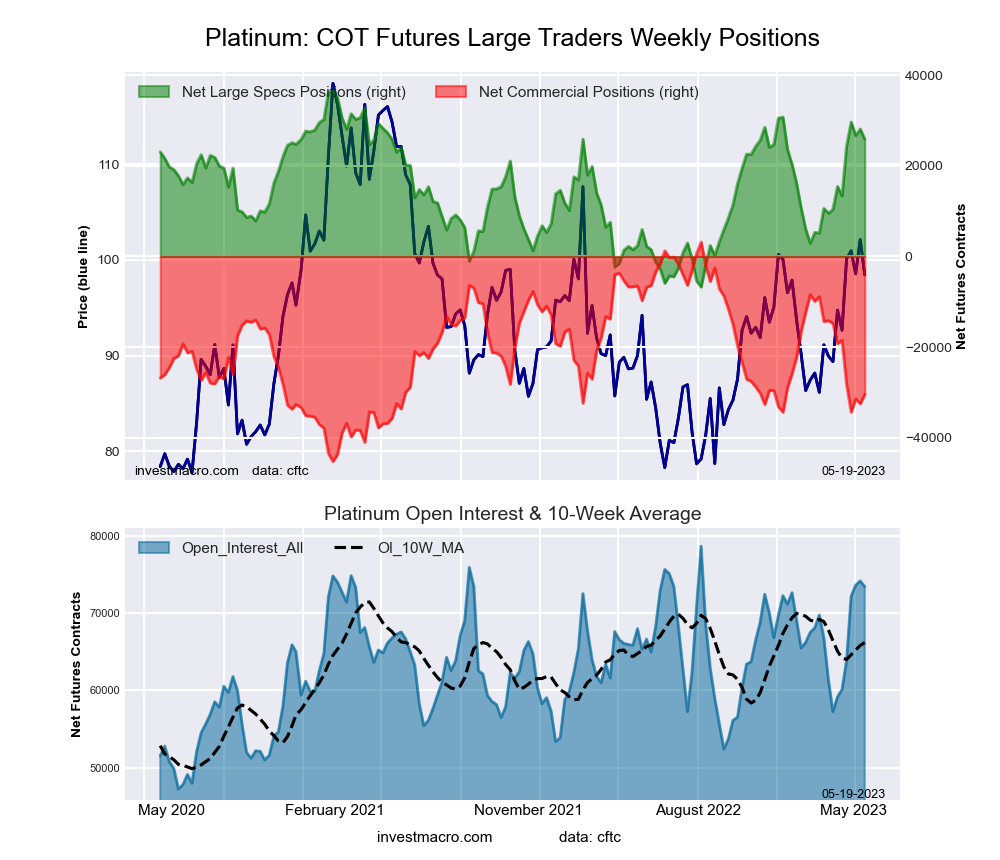
Platinum Futures COT ChartThe Platinum Futures large speculator standing this week was a net position of 24,319 contracts in the data reported through Tuesday. This was a weekly boost of 10,986 contracts from the previous week which had a total of 13,333 net contracts.

This week’s current strength score (the trader positioning range over the past three years, measured from 0 to 100) shows the speculators are currently Bullish with a score of 71.7 percent. The commercials are Bearish with a score of 35.2 percent and the small traders (not shown in chart) are Bearish with a score of 20.2 percent.

Platinum Futures StatisticsSPECULATORSCOMMERCIALSSMALL TRADERS
– Percent of Open Interest Longs:54.928.411.1
– Percent of Open Interest Shorts:16.872.75.0
– Net Position:24,319-28,2023,883
– Gross Longs:35,02818,1477,076
– Gross Shorts:10,70946,3493,193
– Long to Short Ratio:3.3 to 10.4 to 12.2 to 1
NET POSITION TREND:
– Strength Index Score (3 Year Range Pct):71.735.220.2
– Strength Index Reading (3 Year Range):BullishBearishBearish
NET POSITION MOVEMENT INDEX:
– 6-Week Change in Strength Index:44.3-40.02.3


Palladium Futures:

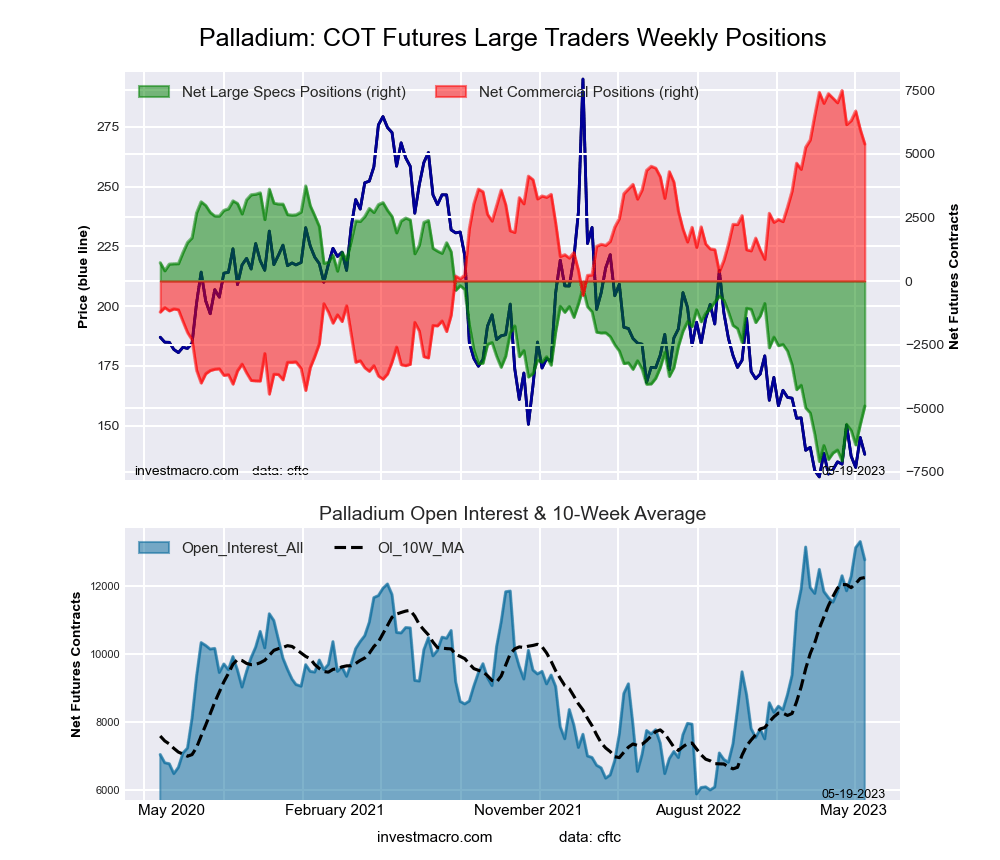
Palladium Futures COT ChartThe Palladium Futures large speculator standing this week was a net position of -5,637 contracts in the data reported through Tuesday. This was a weekly rise of 1,436 contracts from the previous week which had a total of -7,073 net contracts.

This week’s current strength score (the trader positioning range over the past three years, measured from 0 to 100) shows the speculators are currently Bearish-Extreme with a score of 13.5 percent. The commercials are Bullish-Extreme with a score of 88.8 percent and the small traders (not shown in chart) are Bearish-Extreme with a score of 10.8 percent.

Palladium Futures StatisticsSPECULATORSCOMMERCIALSSMALL TRADERS
– Percent of Open Interest Longs:16.167.49.1
– Percent of Open Interest Shorts:63.715.513.5
– Net Position:-5,6376,151-514
– Gross Longs:1,9127,9881,084
– Gross Shorts:7,5491,8371,598
– Long to Short Ratio:0.3 to 14.3 to 10.7 to 1
NET POSITION TREND:
– Strength Index Score (3 Year Range Pct):13.588.810.8
– Strength Index Reading (3 Year Range):Bearish-ExtremeBullish-ExtremeBearish-Extreme
NET POSITION MOVEMENT INDEX:
– 6-Week Change in Strength Index:13.5-10.6-11.5


Steel Futures Futures:

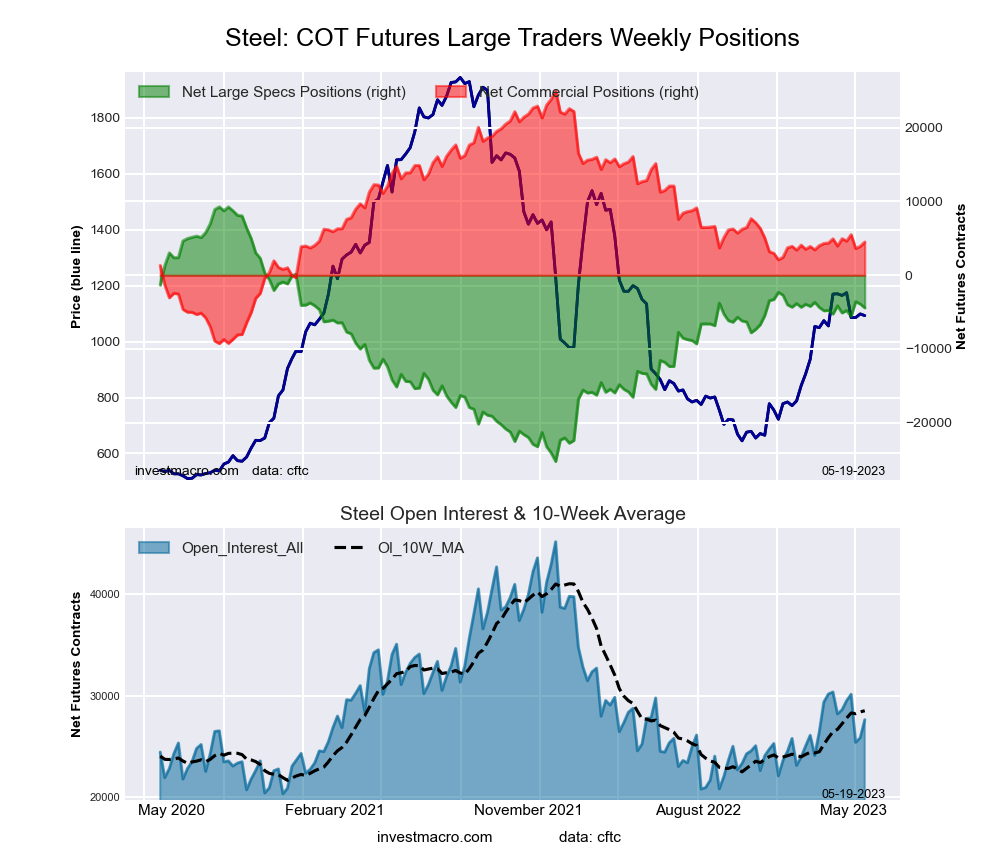
Steel Futures COT ChartThe Steel Futures large speculator standing this week was a net position of -4,779 contracts in the data reported through Tuesday. This was a weekly boost of 329 contracts from the previous week which had a total of -5,108 net contracts.

This week’s current strength score (the trader positioning range over the past three years, measured from 0 to 100) shows the speculators are currently Bullish with a score of 59.3 percent. The commercials are Bearish with a score of 40.5 percent and the small traders (not shown in chart) are Bearish with a score of 38.5 percent.

Steel Futures StatisticsSPECULATORSCOMMERCIALSSMALL TRADERS
– Percent of Open Interest Longs:12.476.01.0
– Percent of Open Interest Shorts:28.660.30.5
– Net Position:-4,7794,632147
– Gross Longs:3,67122,409303
– Gross Shorts:8,45017,777156
– Long to Short Ratio:0.4 to 11.3 to 11.9 to 1
NET POSITION TREND:
– Strength Index Score (3 Year Range Pct):59.340.538.5
– Strength Index Reading (3 Year Range):BullishBearishBearish
NET POSITION MOVEMENT INDEX:
– 6-Week Change in Strength Index:-1.21.8-25.1


Article By InvestMacroReceive our weekly COT Newsletter

*COT Report: The COT data, released weekly to the public each Friday, is updated through the most recent Tuesday (data is 3 days old) and shows a quick view of how large speculators or non-commercials (for-profit traders) were positioned in the futures markets.

The CFTC categorizes trader positions according to commercial hedgers (traders who use futures contracts for hedging as part of the business), non-commercials (large traders who speculate to realize trading profits) and nonreportable traders (usually small traders/speculators) as well as their open interest (contracts open in the market at time of reporting). See CFTC criteria here.

Week Ahead: “Big M.A.M.A.” to weigh on NQ100_m

By ForexTime

Four Big Tech companies, with a combined market cap of over US$ 5 trillion (that’s $5,000,000,000,000), are set to release their respective quarterly earnings in the coming week.

The final week of April also features these scheduled economic data releases and events:

Monday, April 24

  • EUR: Germany April IFO business climate
  • Walt Disney may cut thousands of jobs this week
  • Q1 earnings from embattled banks: Credit Suisse, First Republic Bank

Tuesday, April 25

  • USD: US April consumer confidence
  • NQ100_m: Microsoft, Alphabet Q1 earnings (after US markets close)

Wednesday, April 26

  • NZD: New Zealand March external trade
  • AUD: Australia March CPI
  • CAD: Bank of Canada releases April meeting minutes
  • NQ100_m: Meta Q1 earnings (after US markets close)

Thursday, April 27

  • EUR: Eurozone April economic confidence
  • USD: US 1Q GDP; weekly initial jobless claims
  • NQ100_m: Amazon Q1 earnings (after US markets close)

Friday, April 28

  • JPY: Bank of Japan rate decision; April Tokyo CPI; Japan March industrial production, retail sales, and unemployment
  • EUR: Eurozone 1Q GDP; Germany April CPI
  • USD: US March PCE Deflator, personal income and spending


How big is “Big M.A.M.A.”?

First, a quick reminder about the sheer size of these tech giants that are due to report their Q1 earnings.

Here’s their respective market cap as of US market’s close on Thursday, April 20:

(Market capitalization = how much each company is valued by the markets)

  • Microsoft: US$ 2.130 trillion
  • Alphabet: US$ 1.352 trillion
  • Amazon: US$ 1.064 trillion
  • Meta: US$ 0.5466 trillion


What to look out for from these Big Tech announcements?

  1. Economic headwinds dampening earnings?

Fears of a looming global recession are set to weigh negatively on the core businesses of these Big Tech companies:

  • Microsoft is already facing a structural slowdown in the PC industry
  • Alphabet’s ad business may see a pullback from customers in the financial sector from last month’s banking turmoil
  • Meta’s Facebook is experiencing weakening engagement
  • Amazon’s core business of selling goods across the US has lost money for the last 5 consecutive quarters

The challenging economic backdrop is also expected to be a drag on demand for cloud computing services out of Microsoft (Azure), Amazon (AWS), and Alphabet (Google Cloud) – which have been key earnings drivers for these respective companies.


  1. Job cuts: boost to the bottom line?

Here are the headline figures for the intended number of jobs to be slashed according to announcements made in Q1 2023:

  • Microsoft: 10,000 jobs (5% of its workforce)
  • Amazon: 18,000 jobs (1% of total employees)
  • Meta: 10,000 jobs (accumulated 25% of workforce, including the 11k jobs, or 13% of its workforce, already removed back in November 2022)
  • Alphabet: 12,000 jobs (6% of global workforce)

Ultimately, fundamentally-driven investors want to know whether such cost-cutting measures are having the desired effect of propping up the company’s financials amidst these challenging times.


  1. ChatGPT: the AI race is on

​​​​​​​The buzz surrounding ChatGPT/AI technologies have certainly contributed to the double-digit gains for Big Tech stocks so far in 2023.

Markets will be eager to find out how soon before the hype can turn into a profits boost, and whether each of these tech companies have enough of an edge in this red-hot AI race.


How much could these stocks move post-earnings?

Here are the forecasted moves for each stock, either upwards or downwards, on the trading day after their respective financial announcements:

  • Microsoft: 3.7% move on Wednesday, April 25th
  • Alphabet: 5.45% move on Wednesday, April 25th
  • Meta: 9% move on Thursday, April 27th
  • Amazon: 6.54% move on Friday, April 28th

(% figures as of Friday, April 21st before US markets open)


Why would NQ100_m react to these Big Tech earnings?

Note that every single one of these behemoths (Microsoft, Alphabet, Amazon, and Meta) are members of the tech-heavy index, the Nasdaq 100, which is the underlying asset tracked by the NQ100_m.

Their combined market cap of US$5.09 trillion accounts for one-third of the Nasdaq 100’s market cap of US$15.03 trillion.

Hence, the market’s collective reaction to these upcoming Big Tech earnings is set to have an outsized impact on how the NQ100_m performs in the final week of April.


How might NQ100_m react to Big Tech earnings?

  • Should markets react positively to these Big Tech earnings, that could send the NQ100_m above its month-to-date high at 13,242, and to a fresh 8-month peak.
  • However, disappointing earnings out of these tech giants may drag the NQ100_m to a lower low beneath the key 12850 support region.

    This price area also contains the 38.2% Fibonacci retracement level from NQ100_m’s November 2021 peak down to the October 2022 trough.


To be clear, the Nasdaq 100’s year-to-date advance still stands at an impressive 18.7% so far in 2023, despite the rally having stalled so far in April.

These tech giants could do with a fundamental boost by way of better-than-expected earnings to extend that advance in share prices before April is over.

Otherwise, tech stock bulls might have to wait until the Federal Reserve’s next policy meeting in early May.

A more dovish note out of the US central bank, perhaps indicating a pause on its rate hikes after its May FOMC meeting with perhaps an eye on lowering interest rates later in 2023, may just send stock market bulls racing once more and charging US stock indices higher.

On the other hand, a disappointing earnings season out of Big Tech next week, followed by still-hawkish signals out of the Fed in early May, would likely undo some of the NQ100_m’s year-to-date gains.


Forex-Time-LogoArticle by ForexTime

ForexTime Ltd (FXTM) is an award winning international online forex broker regulated by CySEC 185/12 www.forextime.com

Generative AI: 5 essential reads about the new era of creativity, job anxiety, misinformation, bias and plagiarism

By Eric Smalley, The Conversation 

The light and dark sides of AI have been in the public spotlight for many years. Think facial recognition, algorithms making loan and sentencing recommendations, and medical image analysis. But the impressive – and sometimes scary – capabilities of ChatGPT, DALL-E 2 and other conversational and image-conjuring artificial intelligence programs feel like a turning point.

The key change has been the emergence within the last year of powerful generative AI, software that not only learns from vast amounts of data but also produces things – convincingly written documents, engaging conversation, photorealistic images and clones of celebrity voices.

Generative AI has been around for nearly a decade, as long-standing worries about deepfake videos can attest. Now, though, the AI models have become so large and have digested such vast swaths of the internet that people have become unsure of what AI means for the future of knowledge work, the nature of creativity and the origins and truthfulness of content on the internet.

Here are five articles from our archives the take the measure of this new generation of artificial intelligence.

1. Generative AI and work

A panel of five AI experts discussed the implications of generative AI for artists and knowledge workers. It’s not simply a matter of whether the technology will replace you or make you more productive.

University of Tennessee computer scientist Lynne Parker wrote that while there are significant benefits to generative AI, like making creativity and knowledge work more accessible, the new tools also have downsides. Specifically, they could lead to an erosion of skills like writing, and they raise issues of intellectual property protections given that the models are trained on human creations.

University of Colorado Boulder computer scientist Daniel Acuña has found the tools to be useful in his own creative endeavors but is concerned about inaccuracy, bias and plagiarism.

University of Michigan computer scientist Kentaro Toyama wrote that human skill is likely to become costly and extraneous in some fields. “If history is any guide, it’s almost certain that advances in AI will cause more jobs to vanish, that creative-class people with human-only skills will become richer but fewer in number, and that those who own creative technology will become the new mega-rich.”

Florida International University computer scientist Mark Finlayson wrote that some jobs are likely to disappear, but that new skills in working with these AI tools are likely to become valued. By analogy, he noted that the rise of word processing software largely eliminated the need for typists but allowed nearly anyone with access to a computer to produce typeset documents and led to a new class of skills to list on a resume.

University of Colorado Anschutz biomedical informatics researcher Casey Greene wrote that just as Google led people to develop skills in finding information on the internet, AI language models will lead people to develop skills to get the best output from the tools. “As with many technological advances, how people interact with the world will change in the era of widely accessible AI models. The question is whether society will use this moment to advance equity or exacerbate disparities.”

2. Conjuring images from words

Generative AI can seem like magic. It’s hard to imagine how image-generating AIs can take a few words of text and produce an image that matches the words.

Hany Farid, a University of California, Berkeley computer scientist who specializes in image forensics, explained the process. The software is trained on a massive set of images, each of which includes a short text description.

“The model progressively corrupts each image until only visual noise remains, and then trains a neural network to reverse this corruption. Repeating this process hundreds of millions of times, the model learns how to convert pure noise into a coherent image from any caption,” he wrote.

3. Marking the machine

Many of the images produced by generative AI are difficult to distinguish from photographs, and AI-generated video is rapidly improving. This raises the stakes for combating fraud and misinformation. Fake videos of corporate executives could be used to manipulate stock prices, and fake videos of political leaders could be used to spread dangerous misinformation.

Farid explained how it’s possible to produce AI-generated photos and video that contain watermarks verifying that they are synthetic. The trick is to produce digital watermarks that can’t be altered or removed. “These watermarks can be baked into the generative AI systems by watermarking all the training data, after which the generated content will contain the same watermark,” he wrote.

4. Flood of ideas

For all the legitimate concern about the downsides of generative AI, the tools are proving to be useful for some artists, designers and writers. People in creative fields can use the image generators to quickly sketch out ideas, including unexpected off-the-wall material.

AI as an idea generator for designers.

Rochester Institute of Technology industrial designer and professor Juan Noguera and his students use tools like DALL-E or Midjourney to produce thousands of images from abstract ideas – a sort of sketchbook on steroids.

“Enter any sentence – no matter how crazy – and you’ll receive a set of unique images generated just for you. Want to design a teapot? Here, have 1,000 of them,” he wrote. “While only a small subset of them may be usable as a teapot, they provide a seed of inspiration that the designer can nurture and refine into a finished product.”

5. Shortchanging the creative process

However, using AI to produce finished artworks is another matter, according to Nir Eisikovits and Alec Stubbs, philosophers at the Applied Ethics Center at University of Massachusetts Boston. They note that the process of making art is more than just coming up with ideas.

The hands-on process of producing something, iterating the process and making refinements – often in the moment in response to audience reactions – are indispensable aspects of creating art, they wrote.

“It is the work of making something real and working through its details that carries value, not simply that moment of imagining it,” they wrote. “Artistic works are lauded not merely for the finished product, but for the struggle, the playful interaction and the skillful engagement with the artistic task, all of which carry the artist from the moment of inception to the end result.”

Editor’s note: This story is a roundup of articles from The Conversation’s archives.The Conversation

About the Author:

Eric Smalley, Science + Technology Editor, The Conversation

This article is republished from The Conversation under a Creative Commons license. Read the original article.


Rage On

Source: Michael Ballanger  (4/17/23)

Michael Ballanger of GGM Advisory Inc. takes a look at the current state of the market and the gold and silver sector to tell you where he believes it is all headed. 

Cornering (a market): In finance, cornering the market consists of obtaining sufficient control of a particular stockcommodity, or other asset in an attempt to manipulate the market price. One definition of cornering the market is “having the greatest market share in a particular industry without having a monopoly.”

Anyone old enough to recall the late, great, stagflationary 70s was around to witness one of the truly great market “cornerings” of modern market history and one which was carried out in compliance with all laws and statutes set out by regulators in the 1970s.

It involved two Texas brothers, Herbert and Nelson “Bunker” Hunt, heirs to the multi-billion-dollar A.L. Hunt oil fortune, who made the determination that profligate spending by the Democrats for social programs to create “The Great Society” under Lyndon Johnston and continued by Republicans under Nixon with the Vietnam War would eventually, if not immediately, bankrupt the nation and debase the U.S. currency, which had been ongoing since 1971 with the termination of the Bretton Woods Agreement.

Silver Thursday

I was in university in the U.S. when the Dean of Finance of the Saint Louis U. business school went off on one of his legendary pre-lecture rants one morning, and it was always a “morning after” his weekly Thursday pub crawl on Friday morning at 8:00 a.m. — the first class of the day — as “The Doc” (Dr. Fred Yeager) — would fire up a Camel non-filter, sipping black coffee from a Styrofoam cup and launch into a “fire and brimstone” narrative on something the Fed or the Treasury was doing.

This time, it was a news headline of 1976 where it was first reported in the Wall Street Journal that a certain “Southern group” was amassing hundreds of thousands of ounces of silver which continued all through the late 70s until finally, after silver had charged from US$2 per ounce to over US$50 that the U.S. government decided they had had enough.

They came down with a sledgehammer-like strategy of moral suasion (urging Hunt’s creditors to withhold loans) and increased minimum maintenance margin levels, the combination of which choked off the Hunts’ ability to carry the massive trade and starting on March 27, 1980, the brokers carrying the position began a gargantuan liquidation that took silver from over US$50 to a shade above US$5 by June.

It was called “Silver Thursday.”

Despite a sincere desire to protect their wealth from the dangers of out-of-control government spending, the Hunts were trotted out as “Enemies of the State” and were relieved of hundreds of millions of dollars by a government and the infamous Wall Street “old boys club” that arbitrarily changed all of the rules and even fabricated new ones to fit their mission. Once the hammer came down, memories of the enrichment created for early players in the 70’s silver squeeze were forever etched in the collective psyches the world over, but it took until 2011 until silver once again approached US$50 per ounce in response to massively inflationary bailouts of the Wall Street banks.

With silver outperforming gold and the miners outperforming the metals . . .  I get a perfect set-up for a continuation move into summer of 2023 with new highs on the horizon.

Those very bankers, fearing the negative connotations of the spirited silver run being linked to outrageous Congressional favoritism over banks versus the public taxpayer, organized a brilliant wee-hours raid on the silver market when all of the Western traders were asleep and the “Sunday Night Massacre” of April 4, 2013, ushered in an epic crash taking the shiny metal’s price down through all support levels and into a bear market until late 2015.

While the 2011-2016 silver bear was painful, there was never any blatant evidence, such as materialized in 1979, that the government was going to intervene in the market. Instead, it took the shape and form of a classic Watergate Break-in type of crime.

No smoking guns were ever recovered from the 2013 pistol-whipping, but it smelled of government intervention with its trademark punctuality and savagery. Body bags were everywhere, and losses within the retail ranks were deep and widespread, but stocks went on to new highs day in and day out, further placating an investing public that was being trained in masterful Pavlovian fashion what happens when you invest in “high-risk assets like silver.”

So, here we are again in the midst of a strong, multi-month advance in the precious metals, with silver outperforming gold and the miners outperforming the metals, and that has been the case if I use as my starting point November 3, which was the date of the 2022 low for gold, I get a perfect set-up for a continuation move into summer of 2023 with new highs on the horizon.

If I take a second reading off the March 8 lows of five weeks ago, I get an even better technical picture with the PM miners and silver neck-and-neck and outperforming gold by a lengthy margin.

GDX and GDXJ 

VanEck Gold Miners ETF (GDX:NYSEARCA:)

I have ample exposure to gold and silver through physical ownership and by way of the junior portfolios.

But it has been almost three tears since I exited the VanEck Gold Miners ETF (GDX:NYSEARCA:) after making one of the best calls in my career on March 16, 2020, at the exact days the precious metals all bottomed.

I exited the positions in August 2020, with GDX approaching US$44 per share.

Thirty months later, we have the perfect set-up for precious metals, and up til the recent decision to cut output by the producer nations, energy was moving in the miner’s favorite direction — down.

VanEck Junior Gold Miner ETF (GDXJ:NYSEArca), 

Today’s little hiccup was all profit-taking as silver’s RSI touched 79 briefly before closing out the week back below 70. Within the complex, silver needs to cool off for a few days, during which I will be buying back my GDX position, hopefully in the US$32-33 range, into an early-week pullback.

I will also be teeing up the VanEck Junior Gold Miner ETF (GDXJ:NYSEArca), and while it may appear “late,” it really isn’t on a fundamental basis.

The miners are all dirt cheap, but once we achieve escape velocity for gold above US$2,100, I see a doubling of both Senior and Junior Gold ETFs by Q1/2024.

That should hit home pretty hard because I have avoided these ETFs for what feels like a lifetime. (Subscribers will receive notifications next week as to price and strategy.)

Stocks

I get no fewer than twenty-five emails a day from services offering to help me “Navigate the Upcoming CRASH!” followed by pictures of some bombed-out war zone or children wandering in the night.

The entire world is preoccupied to the point of obsession with this pending Armageddon that is lurking somewhere just above the tree line, but for me, I cannot buy it. There are really bad places on this earth to call “HOME,” but unless you had the bad fortune of being born there, you could always leave.

I met an ultra-sound technician today that emigrated from northeast mainland China over ten years ago with his wife and mother, who gave up a general practitioner “M.D.” license to take a secondary profession in Canada.

I asked how he liked the move, and he said it was the best decision he had ever made despite the 50-hour work weeks helping out in off hours his wife’s laundry business. He was undoubtedly the most over-qualified medical technician in the history of the North Durham Medical Centre, and I walked away after a handshake and a smile, feeling pretty happy for the chap.

Oddly enough, that is how I feel about the SPX these days.

Bob Farrell Rule #9: “When all the experts and forecasts agree — something else is going to happen.”

On the topic of consensus, what is the most heavily-debated topic in a Wall Street boardroom these days? It is “When will the Fed pivot?” Thousands of guesses and thousands of theories camouflage the least debated topic, which is “Will there be a recession?”

Bob Farrell Rule #9: “When all the experts and forecasts agree — something else is going to happen.”

No one agrees on the “Fed Pivot” thing, but they all agree that there will be a recession and a really nasty one, so the only thing to banty about should be “How Bad?”

Well, Bob Farrell was a pretty good investor with a long, battle-tested track record, and I will go with his Rule #9, which would have me take the absolute unanimity of agreement over the pending recession, which falls into the category of “foregone conclusion,” verging upon “no-brainer” verging upon “Take it to the bank” and assume that a) there will be NO recession or b) there will be a recession, but stocks go UP, not DOWN, or c) the recession is not enough to cool off inflation and the old adage that I should “Never underestimate the replacement power of equities within an inflationary spiral” rings true.

Every CNBC Guest commentator, every podcast guru, and every armchair “investment strategist” is calling for new lows, and they all can cite technical and fundamental reasons for that event to occur.

And I say, “No way.”

Stocks just went through a month that had huge volumes of “smart money” exiting the bank stocks (Uncle Warren, too!), with commentators drawing comparisons to 2008 and 2001 and all boasting from the rooftops that they were positioned with “record cash” or adequately hedged” as March not only did not whimper into April, it rumbled into April knocking tables over and stopping traffic.

It is within earshot of the February highs, just under 4,200, and just out of the M4 range for the August highs at 4,325. We have the positive buy signal of the January Barometer, giving me not a guarantee of an up year but a historical probability of one. And I’ll take that, any day, all day.

Stocks are climbing that very annoying “Wall of Worry” like 1982 and 1988 and 2009 and 2020, where prognosticators gnash and gnarl their incisors, crying in despair as margin calls swarm their inboxes.

I learned after many years and hundreds of thousands of lost dollars that stocks to whatever the hell they choose to, and there is no preordained rule that says that the number of hours you spend on “due diligence” will ensure a favorable outcome. Stocks have a personality, and they have memory muscles far more hardened than anything you or I possess, so when they go against you, learn to respect the mortal danger inherent in the wounded animal.

Stocks gave us a little “growl” in March; make damn sure you are on the right side of the “roar” in April.


Michael Ballanger Disclaimer:

This letter makes no guarantee or warranty on the accuracy or completeness of the data provided. Nothing contained herein is intended or shall be deemed to be investment advice, implied or otherwise. This letter represents my views and replicates trades that I am making but nothing more than that. Always consult your registered advisor to assist you with your investments. I accept no liability for any loss arising from the use of the data contained on this letter. Options and junior mining stocks contain a high level of risk that may result in the loss of part or all invested capital and therefore are suitable for experienced and professional investors and traders only. One should be familiar with the risks involved in junior mining and options trading and we recommend consulting a financial adviser if you feel you do not understand the risks involved.

Disclosures:

1) Michael J. Ballanger: I, or members of my immediate household or family, own securities of the following companies mentioned in this article: None. I personally am, or members of my immediate household or family are, paid by the following companies mentioned in this article: None.

2) The following companies mentioned in this article are billboard sponsors of Streetwise Reports: None. Click here for important disclosures about sponsor fees. As of the date of this article, an affiliate of Streetwise Reports has a consulting relationship with: None. Please click here for more information.

3) Statements and opinions expressed are the opinions of the author and not of Streetwise Reports or its officers. The author is wholly responsible for the validity of the statements. The author was not paid by Streetwise Reports for this article. Streetwise Reports was not paid by the author to publish or syndicate this article. Streetwise Reports requires contributing authors to disclose any shareholdings in, or economic relationships with, companies that they write about. Streetwise Reports relies upon the authors to accurately provide this information and Streetwise Reports has no means of verifying its accuracy.

4) This article does not constitute investment advice. Each reader is encouraged to consult with his or her individual financial professional and any action a reader takes as a result of information presented here is his or her own responsibility. By opening this page, each reader accepts and agrees to Streetwise Reports’ terms of use and full legal disclaimer. This article is not a solicitation for investment. Streetwise Reports does not render general or specific investment advice and the information on Streetwise Reports should not be considered a recommendation to buy or sell any security. Streetwise Reports does not endorse or recommend the business, products, services or securities of any company mentioned on Streetwise Reports.

5) From time to time, Streetwise Reports LLC and its directors, officers, employees or members of their families, as well as persons interviewed for articles and interviews on the site, may have a long or short position in securities mentioned. Directors, officers, employees or members of their immediate families are prohibited from making purchases and/or sales of those securities in the open market or otherwise from the time of the decision to publish an article until three business days after the publication of the article. The foregoing prohibition does not apply to articles that in substance only restate previously published company releases.

5 policies that could make future bank failures less likely or severe

By Brian Gendreau, University of Florida 

The abrupt failures of Silicon Valley Bank and Signature Bank and subsequent concerns about the stability of other banks have reignited a fierce debate among lawmakers, the financial industry, the Biden administration and former government officials about an array of banking reforms and regulatory changes.

The ideas floated within a month of Silicon Valley Bank’s collapse on March 10, 2023, range from calls to tweak banking regulations to a major overhaul of the government’s oversight of the banking system.

I’m a finance professor who previously worked for two major banks and was an economist at the Federal Reserve. Based on what I’ve learned from the banking crises that have occurred in the past 40 years, I’d put all the banking reform proposals under consideration into five categories.

stock market investing

1. Stronger supervision

Silicon Valley Bank reportedly ignored six separate warnings from the Federal Reserve Bank of San Francisco that it had too little cash on hand and was engaging in risky practices. So calls for stronger bank supervision and regulation should come as no surprise.

Any such reforms would at least, in part, reverse changes from a law Congress passed in 2018 that loosened some banking regulations.

Previously, the government had to pay especially close attention to banks with at least US$50 billion in assets. Among other things, it needed to subject them to stress tests – in which the authorities assess whether banks have the ability to respond to hypothetical economic shocks – by having enough cash on hand to meet relatively strict capital requirements.

The 2018 law raised the cutoff for what counts as a “systemically important” bank to $250 billion in assets, thus allowing many banks, including SVB, to avoid these more stringent regulations.

The White House has already called for new rules similar to what’s listed above for mid-sized banks — those with $100 billion to $250 billion in assets. SVB, which had about $210 billion in assets, fell in this category before its demise.

Sen. Elizabeth Warren of Massachusetts and Rep. Katie Porter of California have introduced legislation in the Senate and the House of Representatives that would simply repeal the 2018 law, returning the threshold to $50 billion.

Major banking trade groups, such as the Bank Policy Institute, which advocates on behalf of its large-bank members, have argued that the 2018 law was not a major factor in the failures of SVB and Signature Bank.

2. Higher deposit insurance threshold

The role that deposit insurance plays in staving off and alleviating banking crises could also change.

The Federal Deposit Insurance Corp. was only supposed to insure accounts of up to $100,000 during the 2008 financial crisis. But instead, it covered nearly all depositors, uninsured as well as insured, in most bank failures that occurred at that time.

The government subsequently raised that limit to $250,000 in October 2008. But the FDIC once again broke with its official mandate when it protected depositors from losses in excess of that ceiling during the March 2023 bank failures.

Some lawmakers have suggested raising the $250,000 cap on deposit insurance.

Rep. Maxine Waters, the highest-ranking Democrat on the House Financial Services Committee, says she supports that step. And Warren has suggested that she might support new limits that are in the millions of dollars rather than the hundreds of thousands.

“Is it $2 million? Is it $5 million? Is it 10 million?” she said in a television interview.

But those lawmakers have so far stopped short of calling for the FDIC to commit to always fully covering all losses among customers who experience losses when bank failures cause their deposits to vanish – rather than doing so on a case by case basis.

FDIC Chair Martin J. Gruenberg told the Senate Banking Committee during a recent hearing that the insurer plans to release its own proposals on May 1.

3. ‘Modified deposit payoff’

Other proposals go further.

For example, William Isaac, who chaired the FDIC from 1978 to 1986, is calling for the government to insure all non-interest-bearing checking accounts, regardless of size. But he also has a recommendation that might potentially discipline banks that run into trouble.

Isaac distinguishes between deposits that are essentially investments, such as certificates of deposit that people use for long-term savings purposes, and, say, a checking account a customer maintains primarily for basic transactions.

Investors with large sums of money held in CDs are generally wealthy individuals who can either assess financial risks on their own or with input from a paid adviser. People with CDs also have an incentive to leave them with the bank, because withdrawing the money tied up in them before maturity can mean paying a penalty or forfeiting the high interest rates that make them attractive investments.

Isaac also advocates returning to the way uninsured deposits – currently, those above the $250,000 mark – were treated in the 1980s. He calls this the “modified deposit payoff” model.

In resolving a bank failure, the FDIC would cover the full cost of compensating customers with uninsured deposits that don’t pay any interest, yet give uninsured depositors certificates worth 80% of their uninsured funds.

If the government were to recover at least 80% of its cost of covering the uninsured deposits, often by selling failed banks to financial institutions, investors with large deposits at a failed bank would get paid more, Isaac explained in a Wall Street Journal op-ed.

“This reform would protect business accounts that are essential to keeping the economy moving and would reduce substantially the risk of panics,” he wrote.

4. ‘Ring-fencing’

The most comprehensive proposals that call for restructuring the banking system would use what’s known as a “ring fence” model.

Ring-fencing segregates a portion of bank assets and liabilities from the rest. The United Kingdom already follows this approach.

Since 2019, British banks have had to segregate their retail banking activities from their presumably riskier investment banking and international lending.

The most radical of these proposals would lodge all insured deposits in “narrow banks” which would be allowed to hold only cash and U.S. Treasury securities.

All bank lending activity would occur outside of narrow banks, perhaps in finance companylike firms funded with uninsured borrowing and capital instruments such as stocks and bonds.

Economist Robert Litan wrote a book about narrow-banking in the 1980s, but the idea can be traced back to Milton Friedman – the late University of Chicago economist and Nobel Prize winner.

Banks are typically required to set aside a portion of their deposits as reserves held either as cash or deposits at their local Federal Reserve bank. However, the Fed reduced that share to zero in March 2020 – effectively eliminating the requirement altogether.

Some experts question whether ring-fencing, by preventing the transfer of capital among bank subdivisions, might make banks less flexible in responding to financial shocks – and therefore riskier.

Critics of the narrow-bank model point out that this approach would drastically reduce the amount of money banks could lend. As a result, systemic risks would shift from real banks into “shadow banks” – securities firms, hedge funds and other credit intermediaries that face less regulation and supervision. Shadow banks contributed to the 2007-2009 global financial crisis, according to the International Monetary Fund.

5. Compensation clawbacks

At the heart of the debate about banking reform is “moral hazard.” That’s a concept regarding how insurance can create an incentive to take bigger risks when people, institutions and even countries realize they won’t bear the full cost of that risk.

One way to reduce risks in this context is to make bank executives bear some of the costs when the banks they run fail.

A bipartisan group of senators have introduced a bill to do just that. It would require regulators to claw back compensation, including the bonuses and stock awards paid to bank executives in the five years preceding a failure.

In my view, it’s too early to tell whether policymakers will make minor adjustments or opt for more significant reforms.

One thing that I hope all policymakers will keep in mind is that there are trade-offs between the financial stability of banks and market discipline. Offering too much government support – such as insuring all liabilities in the event of a bank failure – creates incentives for banks and their customers to ignore risks or to engage in risky behavior.

This article was updated to clarify Robert Litan’s contributions to the debate over banking reform.The Conversation

About the Author:

Brian Gendreau, Director, Latin American Business Environment program, University of Florida

This article is republished from The Conversation under a Creative Commons license. Read the original article.

Large Currency Speculators push Euro bullish bets higher to 7-week high

By InvestMacro

Here are the latest charts and statistics for the Commitment of Traders (COT) data published by the Commodities Futures Trading Commission (CFTC).

The latest COT data is updated through Tuesday April 11th and shows a quick view of how large market participants (for-profit speculators and commercial traders) were positioned in the futures markets. All currency positions are in direct relation to the US dollar where, for example, a bet for the euro is a bet that the euro will rise versus the dollar while a bet against the euro will be a bet that the euro will decline versus the dollar.

Weekly Speculator Changes led by Euro & British Pound

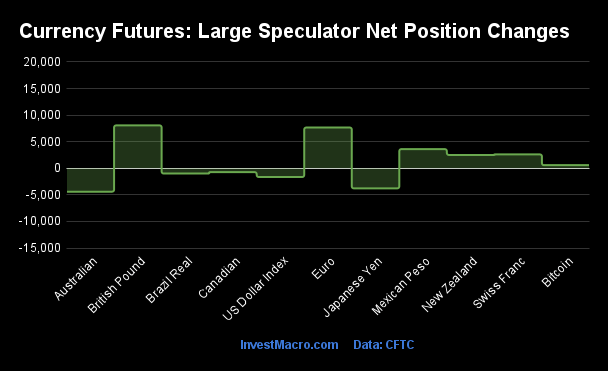
The COT currency market speculator bets were lower this week as five out of the eleven currency markets we cover had higher positioning while the other six markets had lower speculator contracts.

Leading the gains for the currency markets was the EuroFX (19,945 contracts) with the British Pound (12,395 contracts), Mexican Peso (2,564 contracts), Canadian Dollar (1,930 contracts) and the Swiss Franc (1,269 contracts) also showing positive weeks.

The currencies seeing declines in speculator bets on the week were the Australian Dollar (-10,704 contracts), the Brazilian Real (-1,058 contracts), the Japanese Yen (-171 contracts), the New Zealand Dollar (-450 contracts), the US Dollar Index (-842 contracts) and Bitcoin (-507 contracts) also registering lower bets on the week.

Euro bullish bets go higher to 7-week high

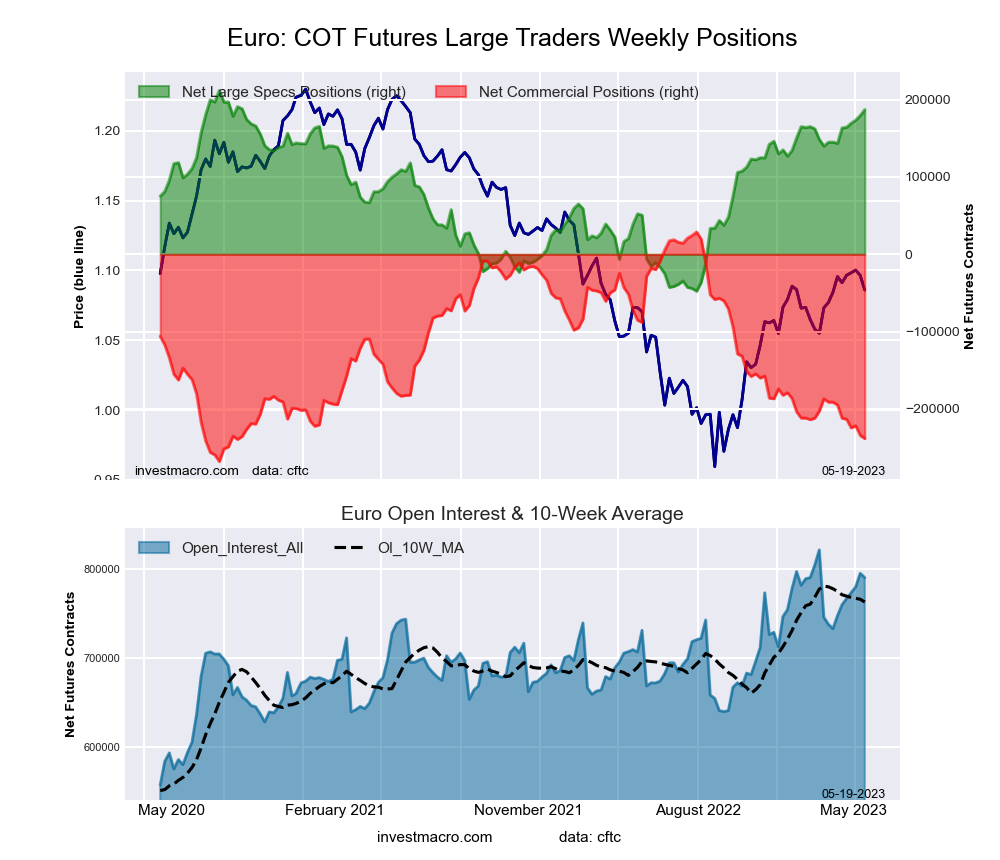
Highlighting the COT currency’s data this week is the continued strength of the speculator’s positioning for the Euro. Large speculative Euro currency positions jumped this week by over +19,000 net contracts, marking the highest one-week gain since September. This is the third time Euro positions have risen in the past four weeks and places the current net position at the best level in the past seven weeks.

The Euro, overall, has now been in a continuous bullish standing for the past 30 weeks, dating back to September 20th when the net position flipped from bearish to bullish. It was also in September when the Euro exchange rate hit a multi-decade low against the US Dollar. The Euro fell below the parity level for the first time since 2002 and bottomed out near the 0.9600 exchange level in late-September. Since that bottom, the Euro has bounced back above parity and has risen by over 14 percent to close this week above the 1.1030 exchange rate.

Helping the Euro gain ground against the US Dollar has been the interest rate differential. Last year, the rate differential was in favor of the US Dollar as the Federal Reserve hiked consistently and sharply while the European Central Bank (ECB) lagged behind. This year, investor’s are forecasting an end to the Fed’s hiking campaign while the ECB seeks to continue raising their interest rate to further combat inflation and triggering further Euro bullish calls.


Data Snapshot of Forex Market Traders | Columns Legend
Apr-11-2023OIOI-IndexSpec-NetSpec-IndexCom-NetCOM-IndexSmalls-NetSmalls-Index
USD Index33,0763013,26447-15,012521,74836
EUR759,43978163,33881-212,0651948,72757
GBP225,29252-2,39867-5,341307,73973
JPY176,82232-57,2073456,3496385855
CHF38,27229-6,734379,73661-3,00247
CAD164,87540-56,579258,20596-1,62619
AUD159,44157-37,9375047,07054-9,13330
NZD35,80623-4,481412,571531,91074
MXN260,0535960,47794-65,51565,03887
RUB20,93047,54331-7,15069-39324
BRL43,9863112,94552-14,593471,64857
Bitcoin15,97781-1,12257373074930


Strength Scores led by Mexican Peso & EuroFX

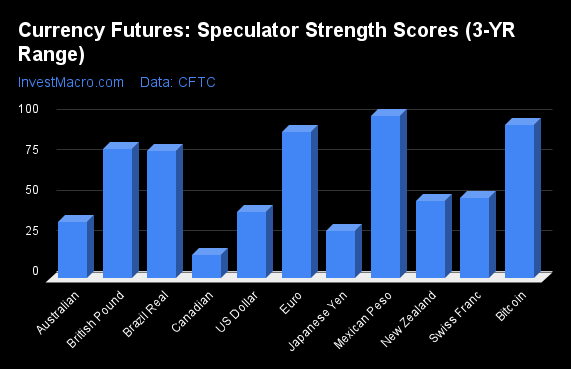
COT Strength Scores (a normalized measure of Speculator positions over a 3-Year range, from 0 to 100 where above 80 is Extreme-Bullish and below 20 is Extreme-Bearish) showed that the Mexican Peso (94 percent) and the EuroFX (81 percent) lead the currency markets this week. The British Pound (67 percent), Bitcoin (57 percent) and the Brazilian Real (52 percent) come in as the next highest in the weekly strength scores.

On the downside, the Canadian Dollar (2 percent) comes in at the lowest strength levels currently and is in Extreme-Bearish territory (below 20 percent). The next lowest strength scores are the Japanese Yen (34 percent) and the Swiss Franc (37 percent).

Strength Statistics:
US Dollar Index (47.1 percent) vs US Dollar Index previous week (48.5 percent)
EuroFX (81.3 percent) vs EuroFX previous week (73.7 percent)
British Pound Sterling (67.0 percent) vs British Pound Sterling previous week (56.3 percent)
Japanese Yen (33.6 percent) vs Japanese Yen previous week (33.7 percent)
Swiss Franc (36.8 percent) vs Swiss Franc previous week (33.4 percent)
Canadian Dollar (1.8 percent) vs Canadian Dollar previous week (0.0 percent)
Australian Dollar (49.7 percent) vs Australian Dollar previous week (59.6 percent)
New Zealand Dollar (41.4 percent) vs New Zealand Dollar previous week (42.7 percent)
Mexican Peso (94.4 percent) vs Mexican Peso previous week (92.5 percent)
Brazilian Real (52.3 percent) vs Brazilian Real previous week (53.6 percent)
Bitcoin (57.4 percent) vs Bitcoin previous week (66.2 percent)


Mexican Peso & British Pound top the 6-Week Strength Trends

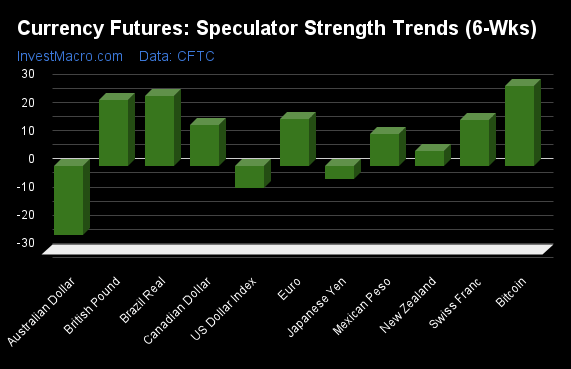
COT Strength Score Trends (or move index, calculates the 6-week changes in strength scores) showed that the Mexican Peso (72 percent) and the British Pound (18 percent) lead the past six weeks trends for the currencies. The US Dollar Index (2 percent) and the Japanese Yen (1 percent) are the next highest positive movers in the latest trends data.

The New Zealand Dollar (-31 percent) leads the downside trend scores currently with the Brazilian Real (-24 percent), Canadian Dollar (-19 percent) and the Australian Dollar (-13 percent) following next with lower trend scores.

Strength Trend Statistics:
US Dollar Index (2.3 percent) vs US Dollar Index previous week (3.2 percent)
EuroFX (0.4 percent) vs EuroFX previous week (-8.4 percent)
British Pound Sterling (18.3 percent) vs British Pound Sterling previous week (5.7 percent)
Japanese Yen (0.9 percent) vs Japanese Yen previous week (-14.2 percent)
Swiss Franc (-4.8 percent) vs Swiss Franc previous week (-3.9 percent)
Canadian Dollar (-19.1 percent) vs Canadian Dollar previous week (-19.6 percent)
Australian Dollar (-12.8 percent) vs Australian Dollar previous week (-2.3 percent)
New Zealand Dollar (-31.4 percent) vs New Zealand Dollar previous week (-34.7 percent)
Mexican Peso (72.5 percent) vs Mexican Peso previous week (71.8 percent)
Brazilian Real (-24.0 percent) vs Brazilian Real previous week (-21.0 percent)
Bitcoin (-9.1 percent) vs Bitcoin previous week (3.4 percent)


Individual COT Forex Markets:

US Dollar Index Futures:
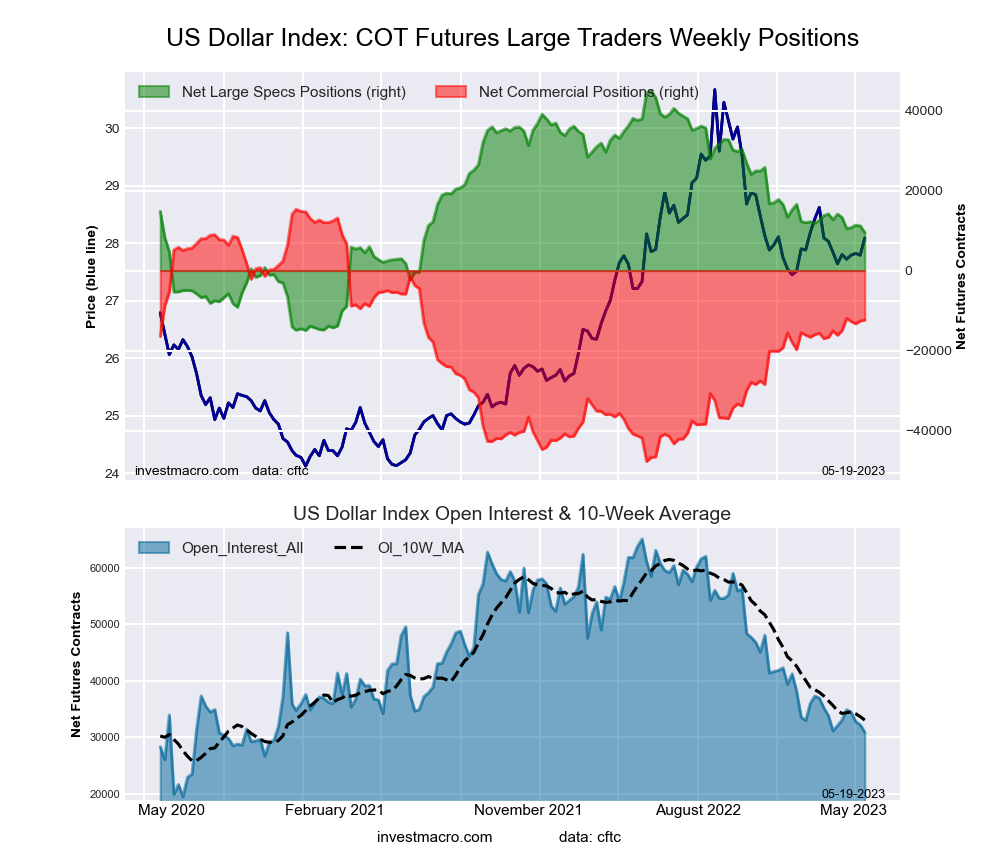
US Dollar Index Forex Futures COT ChartThe US Dollar Index large speculator standing this week totaled a net position of 13,264 contracts in the data reported through Tuesday. This was a weekly lowering of -842 contracts from the previous week which had a total of 14,106 net contracts.

This week’s current strength score (the trader positioning range over the past three years, measured from 0 to 100) shows the speculators are currently Bearish with a score of 47.1 percent. The commercials are Bullish with a score of 51.9 percent and the small traders (not shown in chart) are Bearish with a score of 35.6 percent.

US DOLLAR INDEX StatisticsSPECULATORSCOMMERCIALSSMALL TRADERS
– Percent of Open Interest Longs:78.93.014.0
– Percent of Open Interest Shorts:38.848.48.7
– Net Position:13,264-15,0121,748
– Gross Longs:26,0901,0064,626
– Gross Shorts:12,82616,0182,878
– Long to Short Ratio:2.0 to 10.1 to 11.6 to 1
NET POSITION TREND:
– Strength Index Score (3 Year Range Pct):47.151.935.6
– Strength Index Reading (3 Year Range):BearishBullishBearish
NET POSITION MOVEMENT INDEX:
– 6-Week Change in Strength Index:2.31.6-26.3


Euro Currency Futures:

Euro Currency Futures COT ChartThe Euro Currency large speculator standing this week totaled a net position of 163,338 contracts in the data reported through Tuesday. This was a weekly boost of 19,945 contracts from the previous week which had a total of 143,393 net contracts.

This week’s current strength score (the trader positioning range over the past three years, measured from 0 to 100) shows the speculators are currently Bullish-Extreme with a score of 81.3 percent. The commercials are Bearish-Extreme with a score of 18.8 percent and the small traders (not shown in chart) are Bullish with a score of 56.7 percent.

EURO Currency StatisticsSPECULATORSCOMMERCIALSSMALL TRADERS
– Percent of Open Interest Longs:32.254.211.8
– Percent of Open Interest Shorts:10.682.15.3
– Net Position:163,338-212,06548,727
– Gross Longs:244,180411,45689,357
– Gross Shorts:80,842623,52140,630
– Long to Short Ratio:3.0 to 10.7 to 12.2 to 1
NET POSITION TREND:
– Strength Index Score (3 Year Range Pct):81.318.856.7
– Strength Index Reading (3 Year Range):Bullish-ExtremeBearish-ExtremeBullish
NET POSITION MOVEMENT INDEX:
– 6-Week Change in Strength Index:0.4-0.1-1.6


British Pound Sterling Futures:

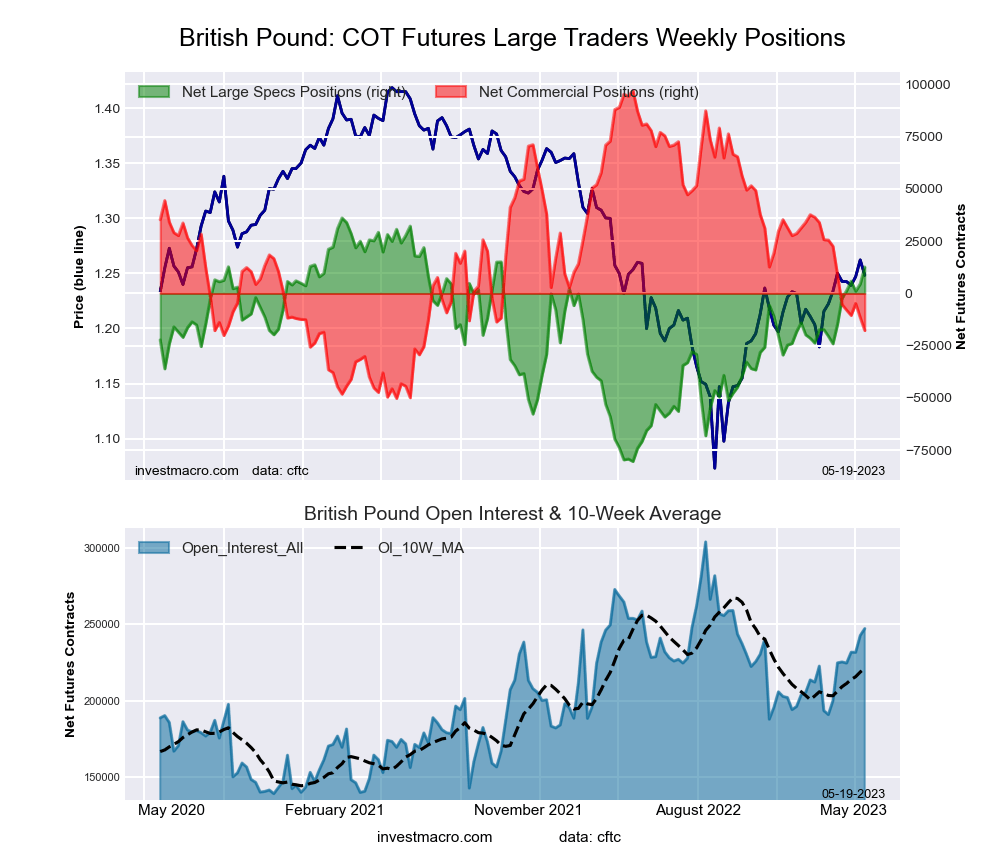
British Pound Sterling Futures COT ChartThe British Pound Sterling large speculator standing this week totaled a net position of -2,398 contracts in the data reported through Tuesday. This was a weekly advance of 12,395 contracts from the previous week which had a total of -14,793 net contracts.

This week’s current strength score (the trader positioning range over the past three years, measured from 0 to 100) shows the speculators are currently Bullish with a score of 67.0 percent. The commercials are Bearish with a score of 30.5 percent and the small traders (not shown in chart) are Bullish with a score of 73.2 percent.

BRITISH POUND StatisticsSPECULATORSCOMMERCIALSSMALL TRADERS
– Percent of Open Interest Longs:24.455.813.9
– Percent of Open Interest Shorts:25.458.110.4
– Net Position:-2,398-5,3417,739
– Gross Longs:54,928125,63431,221
– Gross Shorts:57,326130,97523,482
– Long to Short Ratio:1.0 to 11.0 to 11.3 to 1
NET POSITION TREND:
– Strength Index Score (3 Year Range Pct):67.030.573.2
– Strength Index Reading (3 Year Range):BullishBearishBullish
NET POSITION MOVEMENT INDEX:
– 6-Week Change in Strength Index:18.3-28.440.1


Japanese Yen Futures:

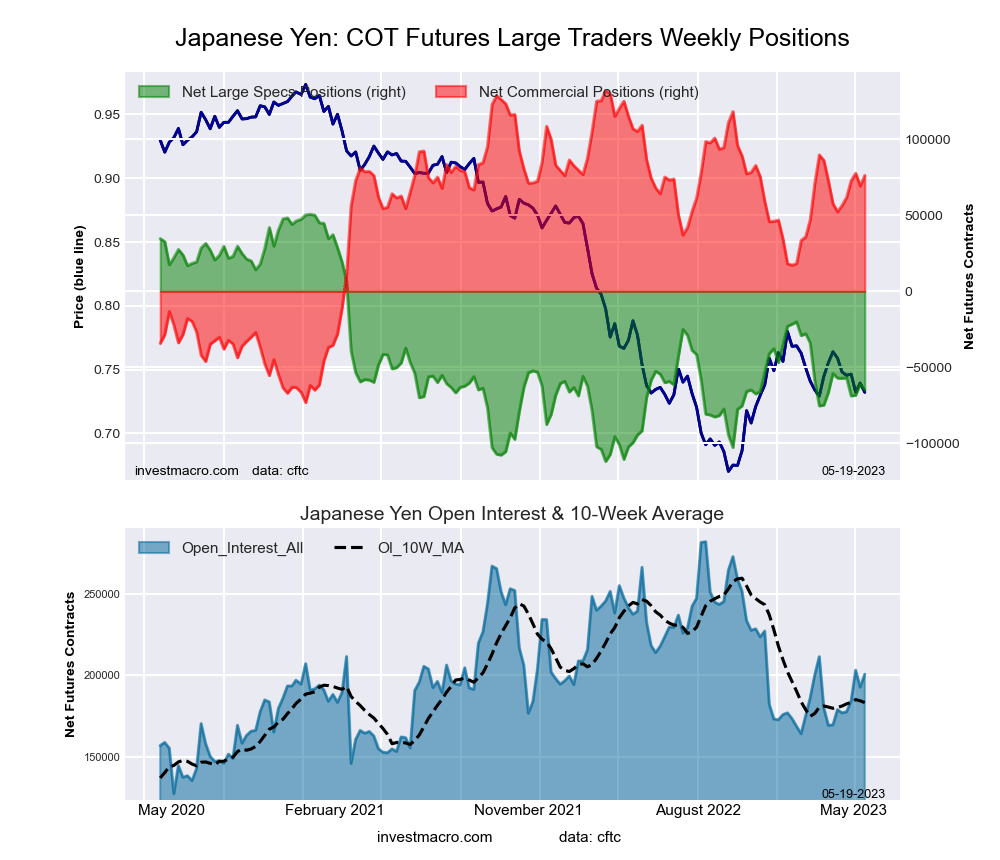
Japanese Yen Forex Futures COT ChartThe Japanese Yen large speculator standing this week totaled a net position of -57,207 contracts in the data reported through Tuesday. This was a weekly fall of -171 contracts from the previous week which had a total of -57,036 net contracts.

This week’s current strength score (the trader positioning range over the past three years, measured from 0 to 100) shows the speculators are currently Bearish with a score of 33.6 percent. The commercials are Bullish with a score of 63.1 percent and the small traders (not shown in chart) are Bullish with a score of 55.2 percent.

JAPANESE YEN StatisticsSPECULATORSCOMMERCIALSSMALL TRADERS
– Percent of Open Interest Longs:6.775.017.2
– Percent of Open Interest Shorts:39.143.116.7
– Net Position:-57,20756,349858
– Gross Longs:11,933132,60430,405
– Gross Shorts:69,14076,25529,547
– Long to Short Ratio:0.2 to 11.7 to 11.0 to 1
NET POSITION TREND:
– Strength Index Score (3 Year Range Pct):33.663.155.2
– Strength Index Reading (3 Year Range):BearishBullishBullish
NET POSITION MOVEMENT INDEX:
– 6-Week Change in Strength Index:0.9-6.925.8


Swiss Franc Futures:

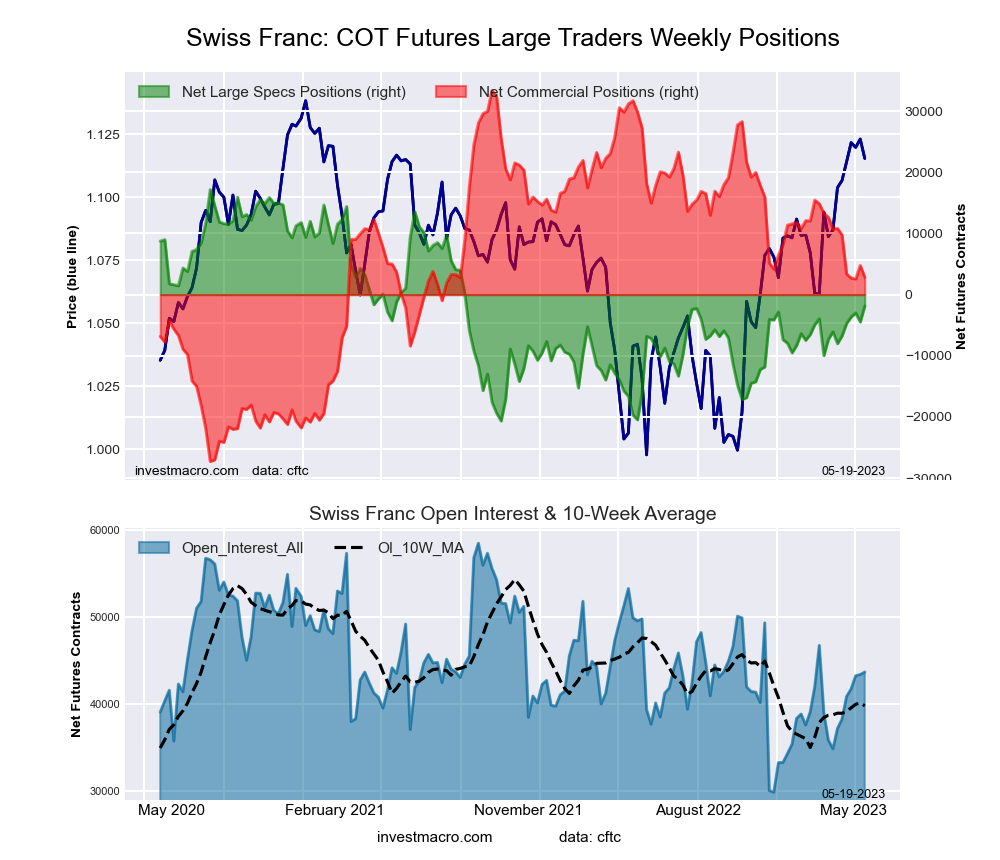
Swiss Franc Forex Futures COT ChartThe Swiss Franc large speculator standing this week totaled a net position of -6,734 contracts in the data reported through Tuesday. This was a weekly increase of 1,269 contracts from the previous week which had a total of -8,003 net contracts.

This week’s current strength score (the trader positioning range over the past three years, measured from 0 to 100) shows the speculators are currently Bearish with a score of 36.8 percent. The commercials are Bullish with a score of 61.0 percent and the small traders (not shown in chart) are Bearish with a score of 47.4 percent.

SWISS FRANC StatisticsSPECULATORSCOMMERCIALSSMALL TRADERS
– Percent of Open Interest Longs:10.952.031.5
– Percent of Open Interest Shorts:28.526.639.3
– Net Position:-6,7349,736-3,002
– Gross Longs:4,15519,92012,050
– Gross Shorts:10,88910,18415,052
– Long to Short Ratio:0.4 to 12.0 to 10.8 to 1
NET POSITION TREND:
– Strength Index Score (3 Year Range Pct):36.861.047.4
– Strength Index Reading (3 Year Range):BearishBullishBearish
NET POSITION MOVEMENT INDEX:
– 6-Week Change in Strength Index:-4.8-9.425.5


Canadian Dollar Futures:

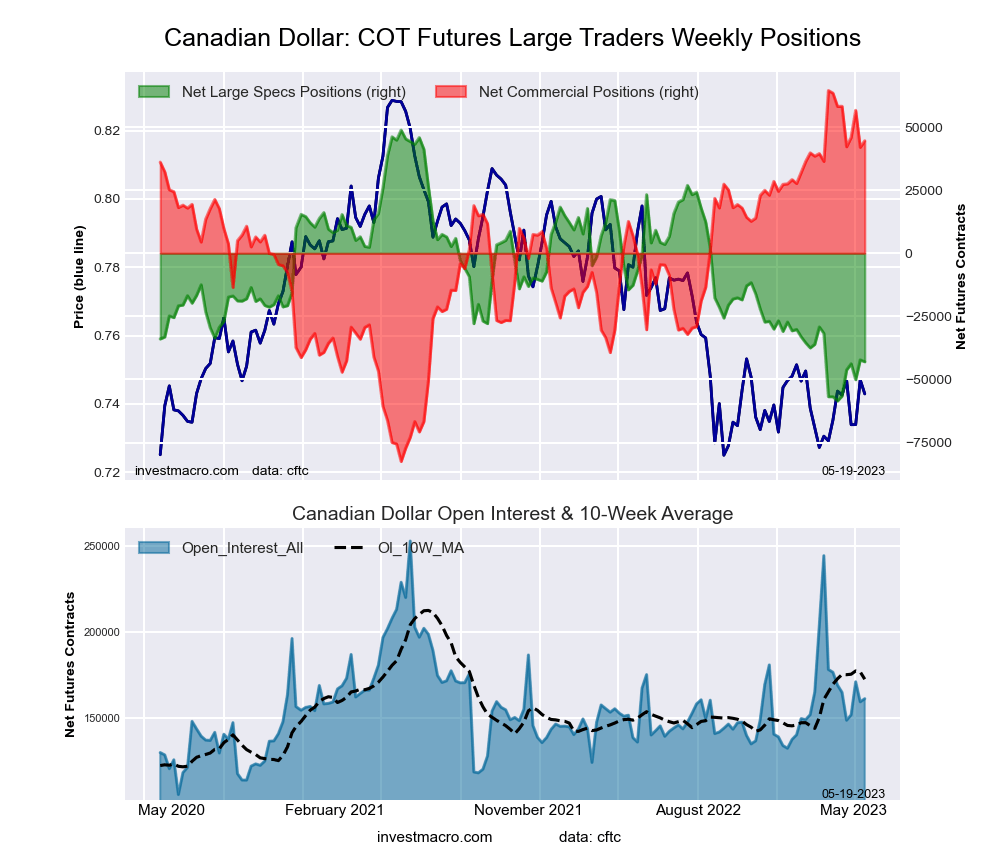
Canadian Dollar Forex Futures COT ChartThe Canadian Dollar large speculator standing this week totaled a net position of -56,579 contracts in the data reported through Tuesday. This was a weekly advance of 1,930 contracts from the previous week which had a total of -58,509 net contracts.

This week’s current strength score (the trader positioning range over the past three years, measured from 0 to 100) shows the speculators are currently Bearish-Extreme with a score of 1.8 percent. The commercials are Bullish-Extreme with a score of 95.8 percent and the small traders (not shown in chart) are Bearish-Extreme with a score of 19.2 percent.

CANADIAN DOLLAR StatisticsSPECULATORSCOMMERCIALSSMALL TRADERS
– Percent of Open Interest Longs:10.370.717.6
– Percent of Open Interest Shorts:44.635.418.6
– Net Position:-56,57958,205-1,626
– Gross Longs:16,914116,53729,091
– Gross Shorts:73,49358,33230,717
– Long to Short Ratio:0.2 to 12.0 to 10.9 to 1
NET POSITION TREND:
– Strength Index Score (3 Year Range Pct):1.895.819.2
– Strength Index Reading (3 Year Range):Bearish-ExtremeBullish-ExtremeBearish-Extreme
NET POSITION MOVEMENT INDEX:
– 6-Week Change in Strength Index:-19.113.41.7


Australian Dollar Futures:

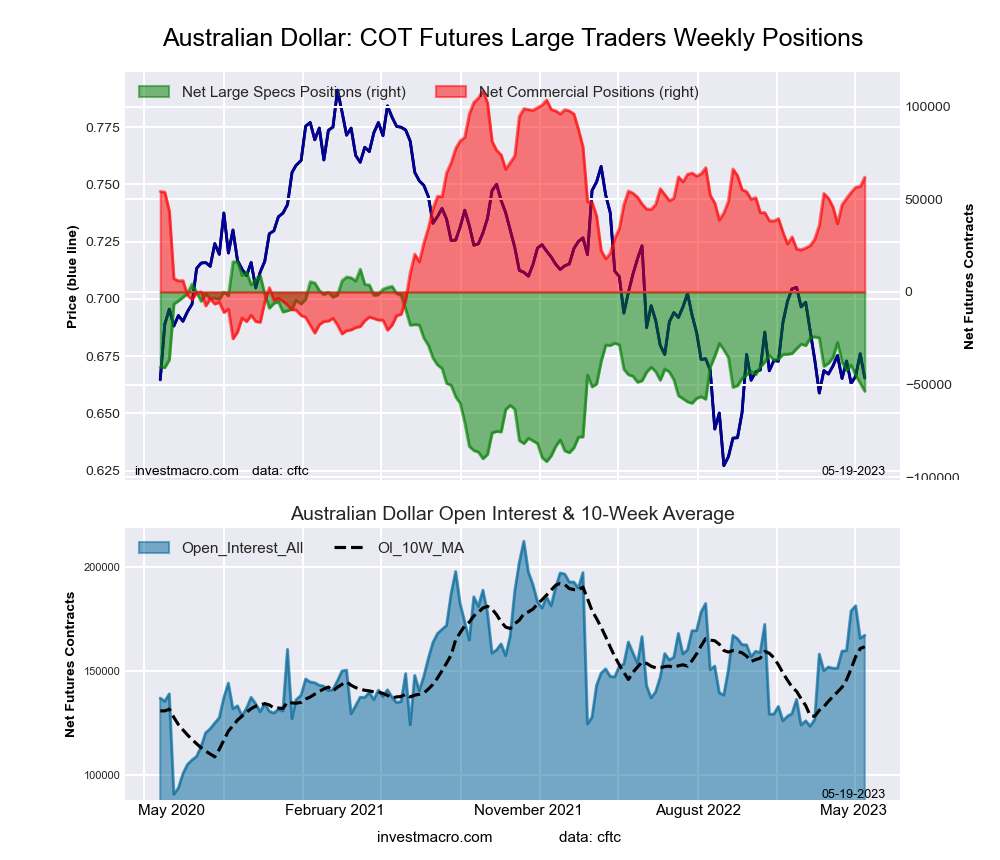
Australian Dollar Forex Futures COT ChartThe Australian Dollar large speculator standing this week totaled a net position of -37,937 contracts in the data reported through Tuesday. This was a weekly lowering of -10,704 contracts from the previous week which had a total of -27,233 net contracts.

This week’s current strength score (the trader positioning range over the past three years, measured from 0 to 100) shows the speculators are currently Bearish with a score of 49.7 percent. The commercials are Bullish with a score of 54.0 percent and the small traders (not shown in chart) are Bearish with a score of 30.2 percent.

AUSTRALIAN DOLLAR StatisticsSPECULATORSCOMMERCIALSSMALL TRADERS
– Percent of Open Interest Longs:28.554.213.5
– Percent of Open Interest Shorts:52.324.719.3
– Net Position:-37,93747,070-9,133
– Gross Longs:45,48186,46821,588
– Gross Shorts:83,41839,39830,721
– Long to Short Ratio:0.5 to 12.2 to 10.7 to 1
NET POSITION TREND:
– Strength Index Score (3 Year Range Pct):49.754.030.2
– Strength Index Reading (3 Year Range):BearishBullishBearish
NET POSITION MOVEMENT INDEX:
– 6-Week Change in Strength Index:-12.813.8-11.5


New Zealand Dollar Futures:

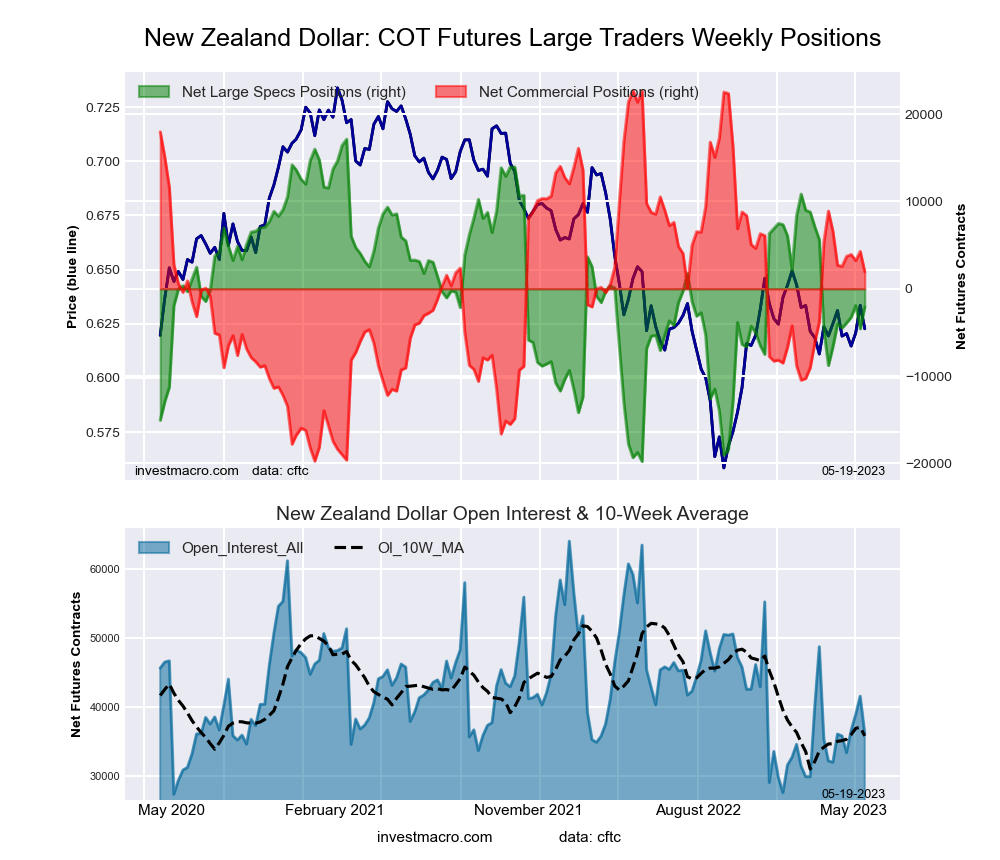
New Zealand Dollar Forex Futures COT ChartThe New Zealand Dollar large speculator standing this week totaled a net position of -4,481 contracts in the data reported through Tuesday. This was a weekly fall of -450 contracts from the previous week which had a total of -4,031 net contracts.

This week’s current strength score (the trader positioning range over the past three years, measured from 0 to 100) shows the speculators are currently Bearish with a score of 41.4 percent. The commercials are Bullish with a score of 52.5 percent and the small traders (not shown in chart) are Bullish with a score of 73.6 percent.

NEW ZEALAND DOLLAR StatisticsSPECULATORSCOMMERCIALSSMALL TRADERS
– Percent of Open Interest Longs:36.649.613.4
– Percent of Open Interest Shorts:49.142.48.1
– Net Position:-4,4812,5711,910
– Gross Longs:13,09717,7584,811
– Gross Shorts:17,57815,1872,901
– Long to Short Ratio:0.7 to 11.2 to 11.7 to 1
NET POSITION TREND:
– Strength Index Score (3 Year Range Pct):41.452.573.6
– Strength Index Reading (3 Year Range):BearishBullishBullish
NET POSITION MOVEMENT INDEX:
– 6-Week Change in Strength Index:-31.420.632.7


Mexican Peso Futures:

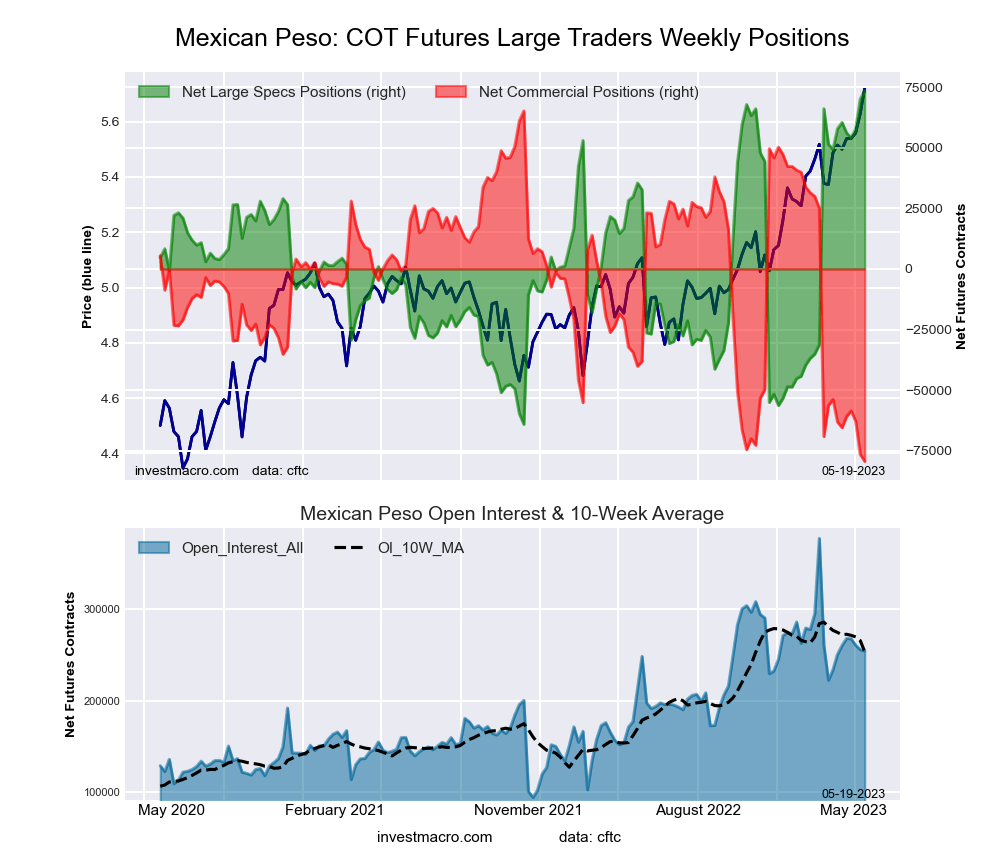
Mexican Peso Futures COT ChartThe Mexican Peso large speculator standing this week totaled a net position of 60,477 contracts in the data reported through Tuesday. This was a weekly gain of 2,564 contracts from the previous week which had a total of 57,913 net contracts.

This week’s current strength score (the trader positioning range over the past three years, measured from 0 to 100) shows the speculators are currently Bullish-Extreme with a score of 94.4 percent. The commercials are Bearish-Extreme with a score of 6.5 percent and the small traders (not shown in chart) are Bullish-Extreme with a score of 87.4 percent.

MEXICAN PESO StatisticsSPECULATORSCOMMERCIALSSMALL TRADERS
– Percent of Open Interest Longs:52.444.42.9
– Percent of Open Interest Shorts:29.269.61.0
– Net Position:60,477-65,5155,038
– Gross Longs:136,355115,4997,520
– Gross Shorts:75,878181,0142,482
– Long to Short Ratio:1.8 to 10.6 to 13.0 to 1
NET POSITION TREND:
– Strength Index Score (3 Year Range Pct):94.46.587.4
– Strength Index Reading (3 Year Range):Bullish-ExtremeBearish-ExtremeBullish-Extreme
NET POSITION MOVEMENT INDEX:
– 6-Week Change in Strength Index:72.5-68.3-0.9


Brazilian Real Futures:

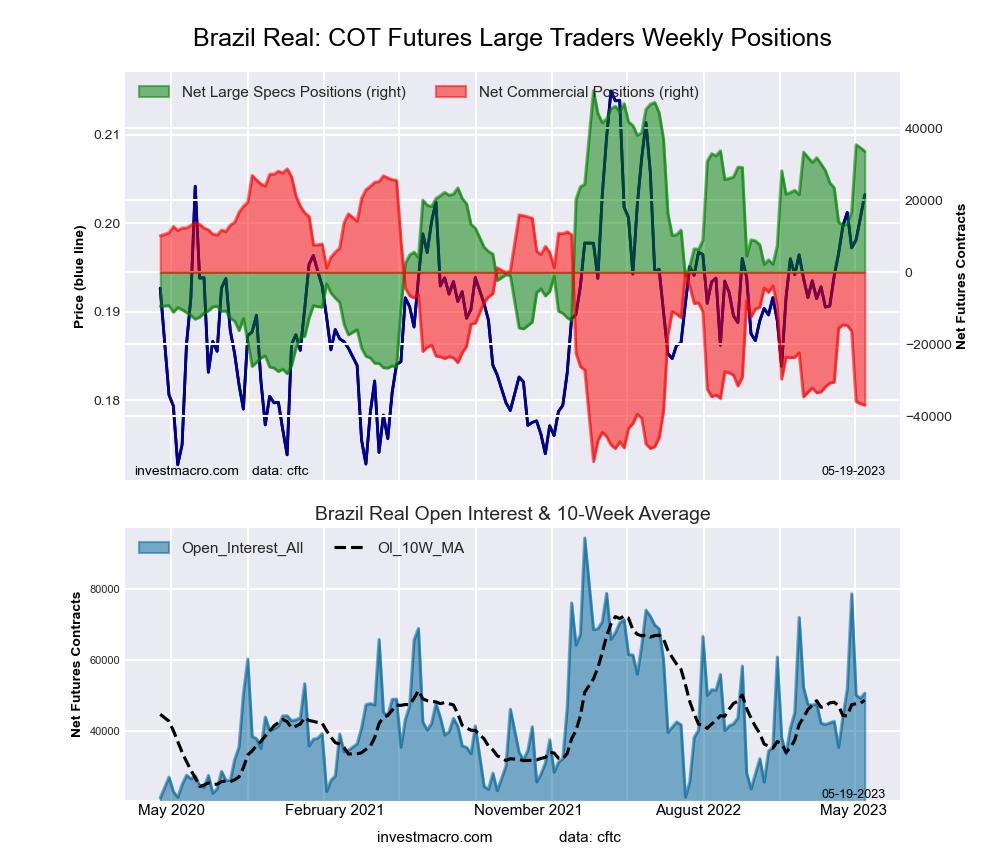
Brazil Real Futures COT ChartThe Brazilian Real large speculator standing this week totaled a net position of 12,945 contracts in the data reported through Tuesday. This was a weekly lowering of -1,058 contracts from the previous week which had a total of 14,003 net contracts.

This week’s current strength score (the trader positioning range over the past three years, measured from 0 to 100) shows the speculators are currently Bullish with a score of 52.3 percent. The commercials are Bearish with a score of 46.7 percent and the small traders (not shown in chart) are Bullish with a score of 57.1 percent.

BRAZIL REAL StatisticsSPECULATORSCOMMERCIALSSMALL TRADERS
– Percent of Open Interest Longs:70.020.39.4
– Percent of Open Interest Shorts:40.653.45.6
– Net Position:12,945-14,5931,648
– Gross Longs:30,7958,9164,132
– Gross Shorts:17,85023,5092,484
– Long to Short Ratio:1.7 to 10.4 to 11.7 to 1
NET POSITION TREND:
– Strength Index Score (3 Year Range Pct):52.346.757.1
– Strength Index Reading (3 Year Range):BullishBearishBullish
NET POSITION MOVEMENT INDEX:
– 6-Week Change in Strength Index:-24.023.2-0.0


Bitcoin Futures:

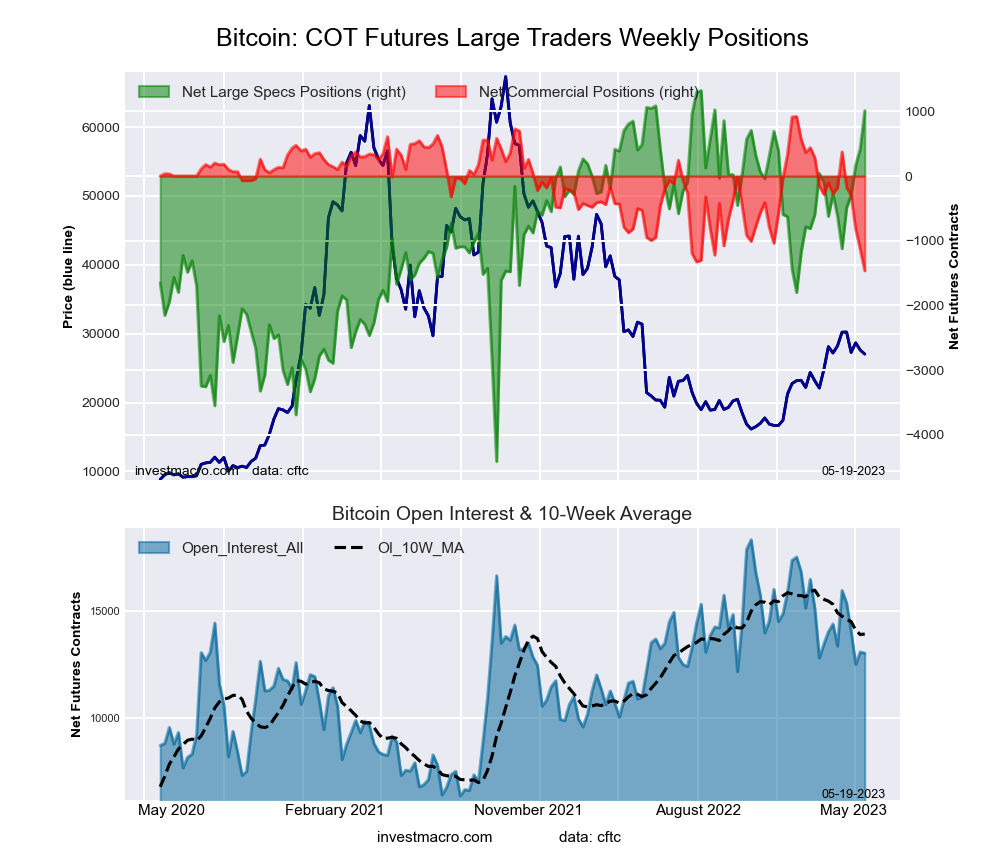
Bitcoin Crypto Futures COT ChartThe Bitcoin large speculator standing this week totaled a net position of -1,122 contracts in the data reported through Tuesday. This was a weekly lowering of -507 contracts from the previous week which had a total of -615 net contracts.

This week’s current strength score (the trader positioning range over the past three years, measured from 0 to 100) shows the speculators are currently Bullish with a score of 57.4 percent. The commercials are Bullish with a score of 75.7 percent and the small traders (not shown in chart) are Bearish with a score of 30.0 percent.

BITCOIN StatisticsSPECULATORSCOMMERCIALSSMALL TRADERS
– Percent of Open Interest Longs:76.55.49.7
– Percent of Open Interest Shorts:83.53.05.0
– Net Position:-1,122373749
– Gross Longs:12,2168571,542
– Gross Shorts:13,338484793
– Long to Short Ratio:0.9 to 11.8 to 11.9 to 1
NET POSITION TREND:
– Strength Index Score (3 Year Range Pct):57.475.730.0
– Strength Index Reading (3 Year Range):BullishBullishBearish
NET POSITION MOVEMENT INDEX:
– 6-Week Change in Strength Index:-9.13.99.9


Article By InvestMacroReceive our weekly COT Newsletter

*COT Report: The COT data, released weekly to the public each Friday, is updated through the most recent Tuesday (data is 3 days old) and shows a quick view of how large speculators or non-commercials (for-profit traders) were positioned in the futures markets.

The CFTC categorizes trader positions according to commercial hedgers (traders who use futures contracts for hedging as part of the business), non-commercials (large traders who speculate to realize trading profits) and nonreportable traders (usually small traders/speculators) as well as their open interest (contracts open in the market at time of reporting). See CFTC criteria here.

COT Bonds Speculators raise 3-Month SOFR bets as Eurodollars are phased out

By InvestMacro

Here are the latest charts and statistics for the Commitment of Traders (COT) reports data published by the Commodities Futures Trading Commission (CFTC).

The latest COT data is updated through Tuesday April 11th and shows a quick view of how large traders (for-profit speculators and commercial hedgers) were positioned in the futures markets.

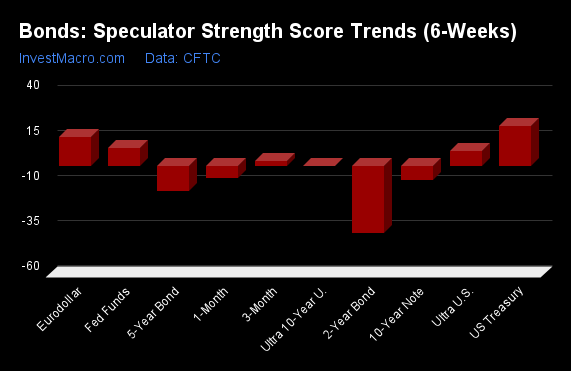
Weekly Speculator Changes led by SOFR 3-Months & 5-Year Bonds

The COT bond market speculator bets were lower this week as four out of the nine bond markets we cover had higher positioning while the other five markets had lower speculator contracts.

Leading the gains for the bond markets was the SOFR 3-Months (41,837 contracts) with the 5-Year Bonds (19,258 contracts), the Ultra Treasury Bonds (8,480 contracts) and the 2-Year Bonds (5,214 contracts) also showing positive weeks.

The bond markets with declines in speculator bets for the week were the Fed Funds (-20,036 contracts), the 10-Year Bonds (-18,006 contracts), the Eurodollar (-2,166 contracts), the US Treasury Bonds (-2,938 contracts) and the Ultra 10-Year Bonds (-10,494 contracts) also registering lower bets on the week.

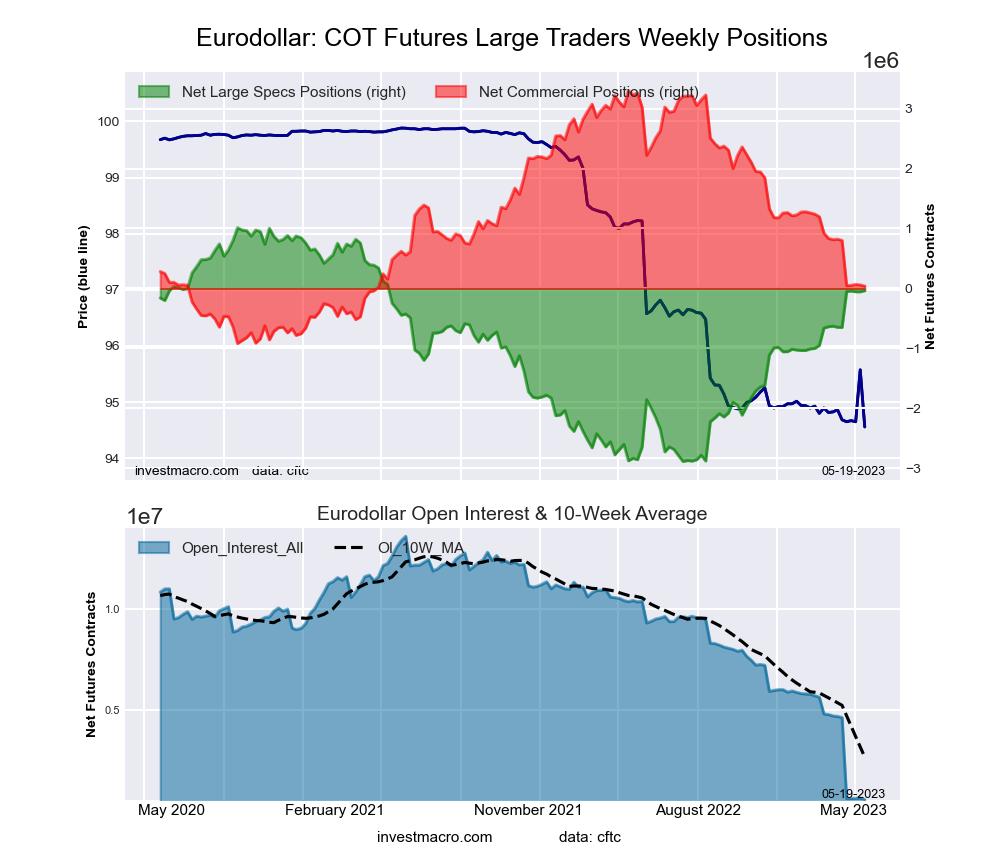
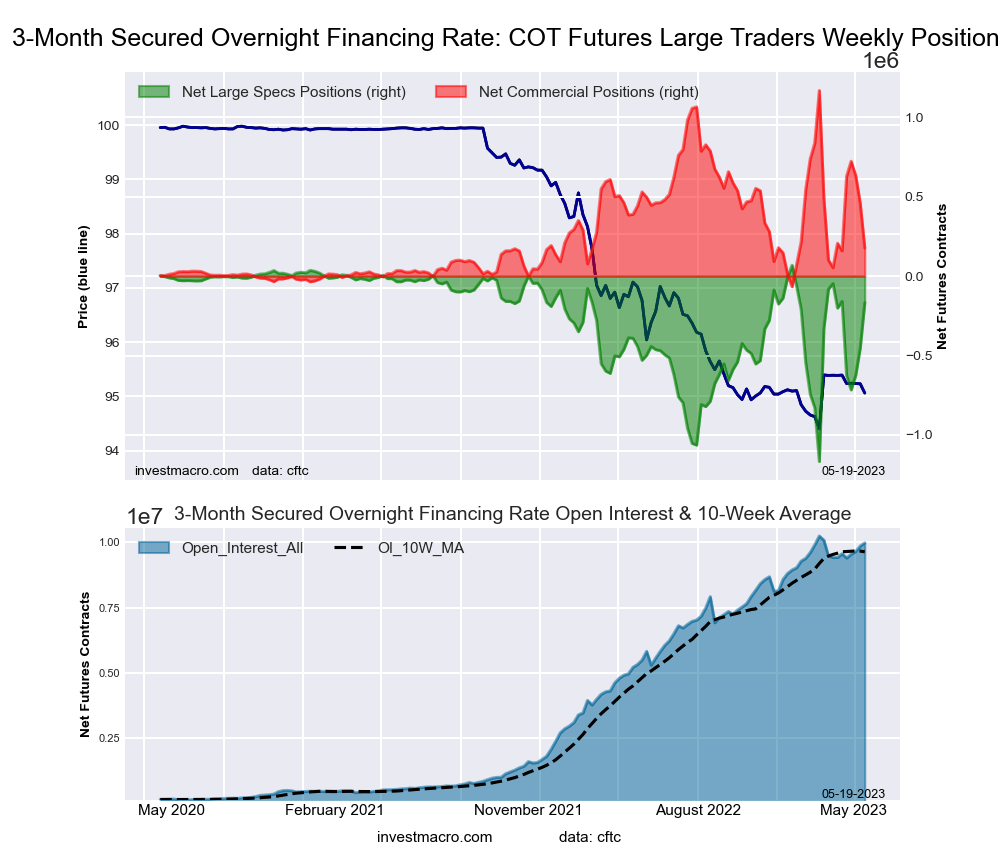
SOFR contracts to replace Eurodollar contracts this week

Highlighting the COT bond’s data this week is an important week for the Secured Overnight Financing Rate (3-Months) or SOFR contracts. The SOFR contracts are relatively new on the scene as these futures only started in 2020. The SOFR contracts are in the process of taking the place of the Eurodollar contracts as the Eurodollars are being phased out and this week marks the last week for traders to use the Eurodollars contracts. Going forward, the Eurodollars contracts will be converted into 3-Month SOFRs and we will cease to have a Eurodollars futures contract.

The Eurodollars were the most traded and the highest open interest contract in the futures market for many years because it was a way for investors to express a view on short-term interest rates based on the London Interbank Offered Rate (LIBOR). However, LIBOR was fraught with controversy as it was a survey based on banks and was caught up in a manipulation scandal in 2012. In that scandal, bank participants colluded to move the LIBOR rate higher or lower and use that to their advantage.

The SOFR has taken precedence because it is calculated using actually market data (provided by the NY Fed Bank) instead of survey data. The SOFR data is from the US Dollar Treasury overnight repurchase agreement (REPO) transactions which are essentially loans between banks that are backed and collateralized by Treasury securities.

The SOFR contracts now have the highest open interest levels with these contracts exceeding over 10 million in open interest in March. To read more on the SOFRs and how to imply the SOFR interest rate from the futures contracts, see here.


Data Snapshot of Bond Market Traders | Columns Legend
Apr-11-2023OIOI-IndexSpec-NetSpec-IndexCom-NetCOM-IndexSmalls-NetSmalls-Index
Eurodollar4,630,6510-649,48557801,07341-151,58871
FedFunds1,624,73057-167,27619175,87581-8,59974
2-Year2,531,96968-496,84125460,4137236,42873
Long T-Bond1,179,82352-132,5844169,5083563,07695
10-Year4,275,29384-639,0370622,6618816,37687
5-Year4,446,56697-761,9812722,7029439,27992


Strength Scores led by SOFR 3-Months & Eurodollar

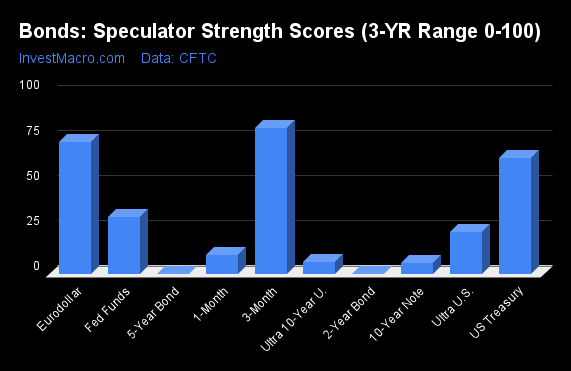
COT Strength Scores (a normalized measure of Speculator positions over a 3-Year range, from 0 to 100 where above 80 is Extreme-Bullish and below 20 is Extreme-Bearish) showed that the SOFR 3-Months (82 percent) and the Eurodollar (57 percent) lead the bond markets this week. The US Treasury Bonds (41 percent) comes in as the next highest in the weekly strength scores.

On the downside, the 10-Year Bonds (0 percent) and the Ultra 10-Year Bonds (1 percent) come in at the lowest strength level currently and are in Extreme-Bearish territory (below 20 percent). The next lowest strength scores were the 5-Year Bonds (2 percent) and the Ultra Treasury Bonds (19 percent).

Strength Statistics:
Fed Funds (19.0 percent) vs Fed Funds previous week (21.4 percent)
2-Year Bond (25.5 percent) vs 2-Year Bond previous week (24.8 percent)
5-Year Bond (2.2 percent) vs 5-Year Bond previous week (0.0 percent)
10-Year Bond (0.0 percent) vs 10-Year Bond previous week (2.2 percent)
Ultra 10-Year Bond (1.2 percent) vs Ultra 10-Year Bond previous week (3.4 percent)
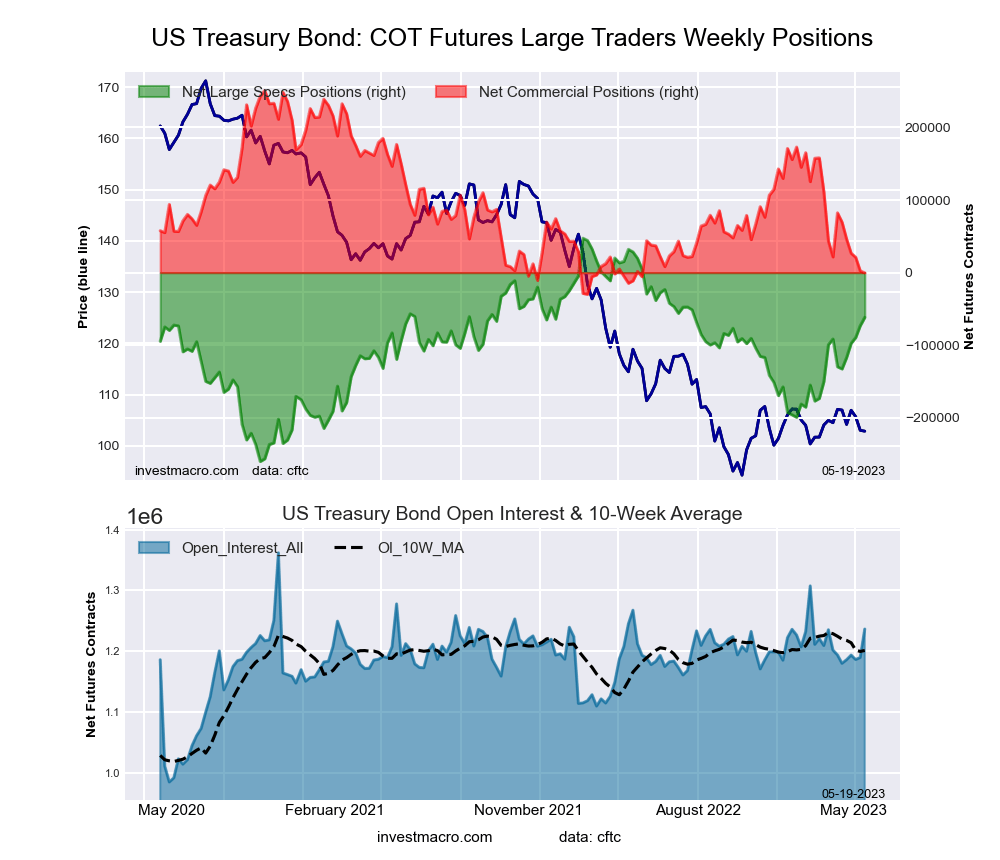
US Treasury Bond (41.4 percent) vs US Treasury Bond previous week (42.4 percent)
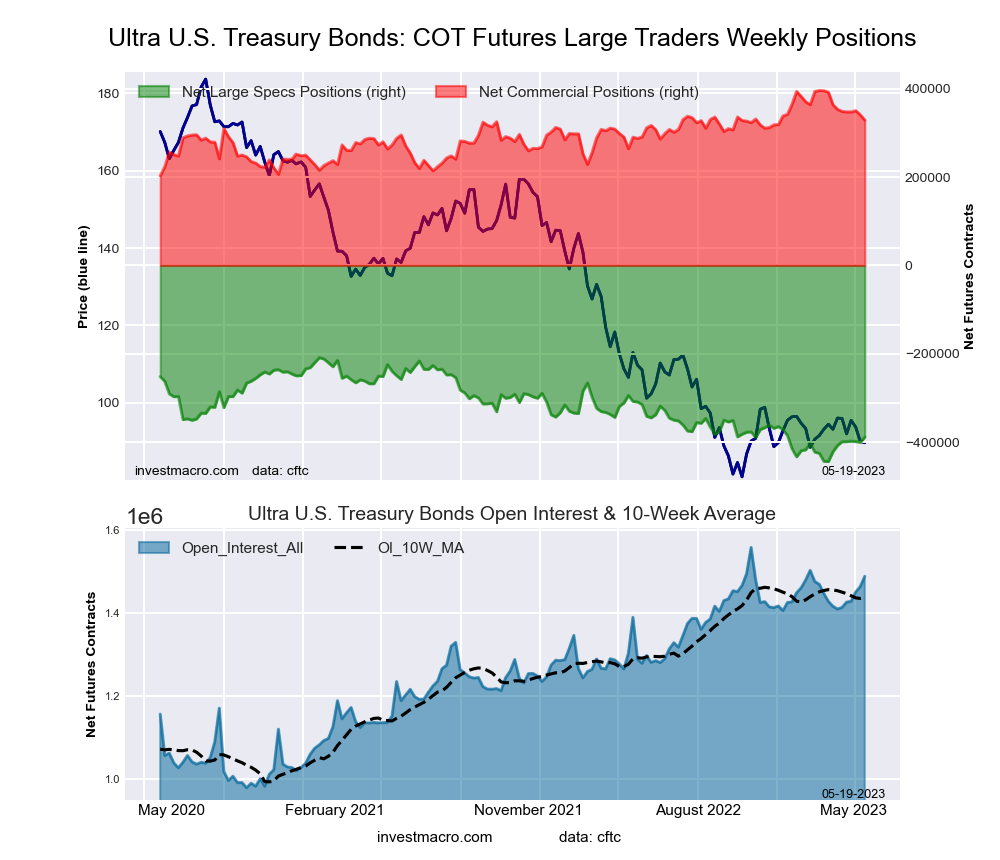
Ultra US Treasury Bond (19.0 percent) vs Ultra US Treasury Bond previous week (15.4 percent)
Eurodollar (57.4 percent) vs Eurodollar previous week (57.4 percent)
SOFR 3-Months (81.6 percent) vs SOFR 3-Months previous week (78.2 percent)


SOFR 3-Months & 2-Year Bonds top the 6-Week Strength Trends

COT Strength Score Trends (or move index, calculates the 6-week changes in strength scores) showed that the SOFR 3-Months (54 percent) and the 2-Year Bonds (20 percent) lead the past six weeks trends for bonds. The US Treasury Bonds (14 percent) and the 5-Year Bonds (-12 percent) are the next highest positive movers in the latest trends data.

The 10-Year Bonds (-1 percent) leads the downside trend scores currently with the Fed Funds (0 percent) and the Ultra 10-Year Bonds (1 percent) following next with lower trend scores.

Strength Trend Statistics:
Fed Funds (0.5 percent) vs Fed Funds previous week (-7.1 percent)
2-Year Bond (20.4 percent) vs 2-Year Bond previous week (24.4 percent)
5-Year Bond (-12.4 percent) vs 5-Year Bond previous week (-20.8 percent)
10-Year Bond (-1.4 percent) vs 10-Year Bond previous week (-14.7 percent)
Ultra 10-Year Bond (1.2 percent) vs Ultra 10-Year Bond previous week (-9.8 percent)
US Treasury Bond (14.4 percent) vs US Treasury Bond previous week (8.2 percent)
Ultra US Treasury Bond (9.9 percent) vs Ultra US Treasury Bond previous week (-1.9 percent)
Eurodollar (9.0 percent) vs Eurodollar previous week (9.3 percent)
SOFR 3-Months (54.2 percent) vs SOFR 3-Months previous week (43.9 percent)


Individual Bond Markets:

3-Month Eurodollars Futures:

Eurodollar Bonds Futures COT ChartThe 3-Month Eurodollars large speculator standing this week recorded a net position of -649,485 contracts in the data reported through Tuesday. This was a weekly reduction of -2,166 contracts from the previous week which had a total of -647,319 net contracts.

This week’s current strength score (the trader positioning range over the past three years, measured from 0 to 100) shows the speculators are currently Bullish with a score of 57.4 percent. The commercials are Bearish with a score of 40.7 percent and the small traders (not shown in chart) are Bullish with a score of 71.1 percent.

3-Month Eurodollars StatisticsSPECULATORSCOMMERCIALSSMALL TRADERS
– Percent of Open Interest Longs:6.267.74.5
– Percent of Open Interest Shorts:20.350.47.7
– Net Position:-649,485801,073-151,588
– Gross Longs:288,6503,134,754207,022
– Gross Shorts:938,1352,333,681358,610
– Long to Short Ratio:0.3 to 11.3 to 10.6 to 1
NET POSITION TREND:
– Strength Index Score (3 Year Range Pct):57.440.771.1
– Strength Index Reading (3 Year Range):BullishBearishBullish
NET POSITION MOVEMENT INDEX:
– 6-Week Change in Strength Index:9.0-10.419.5


Secured Overnight Financing Rate (3-Month) Futures:

SOFR 3-Months Bonds Futures COT ChartThe Secured Overnight Financing Rate (3-Month) large speculator standing this week recorded a net position of -159,440 contracts in the data reported through Tuesday. This was a weekly advance of 41,837 contracts from the previous week which had a total of -201,277 net contracts.

This week’s current strength score (the trader positioning range over the past three years, measured from 0 to 100) shows the speculators are currently Bullish-Extreme with a score of 81.6 percent. The commercials are Bearish-Extreme with a score of 18.3 percent and the small traders (not shown in chart) are Bullish-Extreme with a score of 88.0 percent.

SOFR 3-Months StatisticsSPECULATORSCOMMERCIALSSMALL TRADERS
– Percent of Open Interest Longs:20.157.70.5
– Percent of Open Interest Shorts:21.856.00.5
– Net Position:-159,440159,269171
– Gross Longs:1,920,6375,513,37548,102
– Gross Shorts:2,080,0775,354,10647,931
– Long to Short Ratio:0.9 to 11.0 to 11.0 to 1
NET POSITION TREND:
– Strength Index Score (3 Year Range Pct):81.618.388.0
– Strength Index Reading (3 Year Range):Bullish-ExtremeBearish-ExtremeBullish-Extreme
NET POSITION MOVEMENT INDEX:
– 6-Week Change in Strength Index:54.2-55.04.8


30-Day Federal Funds Futures:

Federal Funds 30-Day Bonds Futures COT ChartThe 30-Day Federal Funds large speculator standing this week recorded a net position of -167,276 contracts in the data reported through Tuesday. This was a weekly decline of -20,036 contracts from the previous week which had a total of -147,240 net contracts.

This week’s current strength score (the trader positioning range over the past three years, measured from 0 to 100) shows the speculators are currently Bearish-Extreme with a score of 19.0 percent. The commercials are Bullish-Extreme with a score of 81.2 percent and the small traders (not shown in chart) are Bullish with a score of 74.1 percent.

30-Day Federal Funds StatisticsSPECULATORSCOMMERCIALSSMALL TRADERS
– Percent of Open Interest Longs:2.382.12.4
– Percent of Open Interest Shorts:12.671.32.9
– Net Position:-167,276175,875-8,599
– Gross Longs:37,1001,334,56938,360
– Gross Shorts:204,3761,158,69446,959
– Long to Short Ratio:0.2 to 11.2 to 10.8 to 1
NET POSITION TREND:
– Strength Index Score (3 Year Range Pct):19.081.274.1
– Strength Index Reading (3 Year Range):Bearish-ExtremeBullish-ExtremeBullish
NET POSITION MOVEMENT INDEX:
– 6-Week Change in Strength Index:0.5-1.314.0


2-Year Treasury Note Futures:

2-Year Treasury Bonds Futures COT ChartThe 2-Year Treasury Note large speculator standing this week recorded a net position of -496,841 contracts in the data reported through Tuesday. This was a weekly advance of 5,214 contracts from the previous week which had a total of -502,055 net contracts.

This week’s current strength score (the trader positioning range over the past three years, measured from 0 to 100) shows the speculators are currently Bearish with a score of 25.5 percent. The commercials are Bullish with a score of 72.0 percent and the small traders (not shown in chart) are Bullish with a score of 73.3 percent.

2-Year Treasury Note StatisticsSPECULATORSCOMMERCIALSSMALL TRADERS
– Percent of Open Interest Longs:8.782.38.1
– Percent of Open Interest Shorts:28.464.26.7
– Net Position:-496,841460,41336,428
– Gross Longs:221,1392,084,824205,672
– Gross Shorts:717,9801,624,411169,244
– Long to Short Ratio:0.3 to 11.3 to 11.2 to 1
NET POSITION TREND:
– Strength Index Score (3 Year Range Pct):25.572.073.3
– Strength Index Reading (3 Year Range):BearishBullishBullish
NET POSITION MOVEMENT INDEX:
– 6-Week Change in Strength Index:20.4-25.79.9


5-Year Treasury Note Futures:

5-Year Treasury Bonds Futures COT ChartThe 5-Year Treasury Note large speculator standing this week recorded a net position of -761,981 contracts in the data reported through Tuesday. This was a weekly gain of 19,258 contracts from the previous week which had a total of -781,239 net contracts.

This week’s current strength score (the trader positioning range over the past three years, measured from 0 to 100) shows the speculators are currently Bearish-Extreme with a score of 2.2 percent. The commercials are Bullish-Extreme with a score of 94.0 percent and the small traders (not shown in chart) are Bullish-Extreme with a score of 91.8 percent.

5-Year Treasury Note StatisticsSPECULATORSCOMMERCIALSSMALL TRADERS
– Percent of Open Interest Longs:7.083.48.2
– Percent of Open Interest Shorts:24.267.27.3
– Net Position:-761,981722,70239,279
– Gross Longs:312,0763,708,958365,278
– Gross Shorts:1,074,0572,986,256325,999
– Long to Short Ratio:0.3 to 11.2 to 11.1 to 1
NET POSITION TREND:
– Strength Index Score (3 Year Range Pct):2.294.091.8
– Strength Index Reading (3 Year Range):Bearish-ExtremeBullish-ExtremeBullish-Extreme
NET POSITION MOVEMENT INDEX:
– 6-Week Change in Strength Index:-12.41.925.4


10-Year Treasury Note Futures:

10-Year Treasury Notes Bonds Futures COT ChartThe 10-Year Treasury Note large speculator standing this week recorded a net position of -639,037 contracts in the data reported through Tuesday. This was a weekly reduction of -18,006 contracts from the previous week which had a total of -621,031 net contracts.

This week’s current strength score (the trader positioning range over the past three years, measured from 0 to 100) shows the speculators are currently Bearish-Extreme with a score of 0.0 percent. The commercials are Bullish-Extreme with a score of 88.4 percent and the small traders (not shown in chart) are Bullish-Extreme with a score of 87.4 percent.

10-Year Treasury Note StatisticsSPECULATORSCOMMERCIALSSMALL TRADERS
– Percent of Open Interest Longs:9.879.78.7
– Percent of Open Interest Shorts:24.765.18.3
– Net Position:-639,037622,66116,376
– Gross Longs:418,0803,405,619371,253
– Gross Shorts:1,057,1172,782,958354,877
– Long to Short Ratio:0.4 to 11.2 to 11.0 to 1
NET POSITION TREND:
– Strength Index Score (3 Year Range Pct):0.088.487.4
– Strength Index Reading (3 Year Range):Bearish-ExtremeBullish-ExtremeBullish-Extreme
NET POSITION MOVEMENT INDEX:
– 6-Week Change in Strength Index:-1.4-11.628.9


Ultra 10-Year Notes Futures:

Ultra 10-Year Treasury Notes Bonds Futures COT ChartThe Ultra 10-Year Notes large speculator standing this week recorded a net position of -196,971 contracts in the data reported through Tuesday. This was a weekly fall of -10,494 contracts from the previous week which had a total of -186,477 net contracts.

This week’s current strength score (the trader positioning range over the past three years, measured from 0 to 100) shows the speculators are currently Bearish-Extreme with a score of 1.2 percent. The commercials are Bullish-Extreme with a score of 94.3 percent and the small traders (not shown in chart) are Bullish with a score of 64.4 percent.

Ultra 10-Year Notes StatisticsSPECULATORSCOMMERCIALSSMALL TRADERS
– Percent of Open Interest Longs:7.981.19.7
– Percent of Open Interest Shorts:20.363.414.9
– Net Position:-196,971280,480-83,509
– Gross Longs:126,5171,290,288153,890
– Gross Shorts:323,4881,009,808237,399
– Long to Short Ratio:0.4 to 11.3 to 10.6 to 1
NET POSITION TREND:
– Strength Index Score (3 Year Range Pct):1.294.364.4
– Strength Index Reading (3 Year Range):Bearish-ExtremeBullish-ExtremeBullish
NET POSITION MOVEMENT INDEX:
– 6-Week Change in Strength Index:1.2-4.910.3


US Treasury Bonds Futures:

US Year Treasury Notes Long Bonds Futures COT ChartThe US Treasury Bonds large speculator standing this week recorded a net position of -132,584 contracts in the data reported through Tuesday. This was a weekly decrease of -2,938 contracts from the previous week which had a total of -129,646 net contracts.

This week’s current strength score (the trader positioning range over the past three years, measured from 0 to 100) shows the speculators are currently Bearish with a score of 41.4 percent. The commercials are Bearish with a score of 35.4 percent and the small traders (not shown in chart) are Bullish-Extreme with a score of 95.1 percent.

US Treasury Bonds StatisticsSPECULATORSCOMMERCIALSSMALL TRADERS
– Percent of Open Interest Longs:5.979.014.7
– Percent of Open Interest Shorts:17.273.19.4
– Net Position:-132,58469,50863,076
– Gross Longs:69,855932,461173,415
– Gross Shorts:202,439862,953110,339
– Long to Short Ratio:0.3 to 11.1 to 11.6 to 1
NET POSITION TREND:
– Strength Index Score (3 Year Range Pct):41.435.495.1
– Strength Index Reading (3 Year Range):BearishBearishBullish-Extreme
NET POSITION MOVEMENT INDEX:
– 6-Week Change in Strength Index:14.4-31.332.2


Ultra US Treasury Bonds Futures:

Ultra US Year Treasury Notes Long Bonds Futures COT ChartThe Ultra US Treasury Bonds large speculator standing this week recorded a net position of -399,278 contracts in the data reported through Tuesday. This was a weekly rise of 8,480 contracts from the previous week which had a total of -407,758 net contracts.

This week’s current strength score (the trader positioning range over the past three years, measured from 0 to 100) shows the speculators are currently Bearish-Extreme with a score of 19.0 percent. The commercials are Bullish with a score of 77.2 percent and the small traders (not shown in chart) are Bullish-Extreme with a score of 90.4 percent.

Ultra US Treasury Bonds StatisticsSPECULATORSCOMMERCIALSSMALL TRADERS
– Percent of Open Interest Longs:5.583.011.3
– Percent of Open Interest Shorts:33.858.37.7
– Net Position:-399,278348,66950,609
– Gross Longs:78,0231,172,982159,503
– Gross Shorts:477,301824,313108,894
– Long to Short Ratio:0.2 to 11.4 to 11.5 to 1
NET POSITION TREND:
– Strength Index Score (3 Year Range Pct):19.077.290.4
– Strength Index Reading (3 Year Range):Bearish-ExtremeBullishBullish-Extreme
NET POSITION MOVEMENT INDEX:
– 6-Week Change in Strength Index:9.9-21.821.9


Article By InvestMacroReceive our weekly COT Newsletter

*COT Report: The COT data, released weekly to the public each Friday, is updated through the most recent Tuesday (data is 3 days old) and shows a quick view of how large speculators or non-commercials (for-profit traders) were positioned in the futures markets.

The CFTC categorizes trader positions according to commercial hedgers (traders who use futures contracts for hedging as part of the business), non-commercials (large traders who speculate to realize trading profits) and nonreportable traders (usually small traders/speculators) as well as their open interest (contracts open in the market at time of reporting). See CFTC criteria here.

COT Metals Speculators raise their Silver bets for 5th week to a 10-week high

By InvestMacro

Here are the latest charts and statistics for the Commitment of Traders (COT) data published by the Commodities Futures Trading Commission (CFTC).

The latest COT data is updated through Tuesday April 11th and shows a quick view of how large traders (for-profit speculators and commercial entities) were positioned in the futures markets.

Weekly Speculator Changes led by Silver

The COT metals markets speculator bets were lower this week as just one out of the six metals markets we cover had higher positioning while the other five markets had lower speculator contracts.

Leading the gains for the metals was Silver with a rise of 2,435 contracts this week.

The markets with declines in speculator bets for the week were Gold (-2,471 contracts) with Platinum (-2,090 contracts), Copper (-1,349 contracts), Steel (-970 contracts) and Palladium (-427 contracts) also having lower bets on the week.

Silver speculator bets rise for 5th week to 10-week high

Highlighting the COT metals data this week is the continued bullishness for the Silver speculative positions. The large speculator position in Silver futures climbed this week for a fifth straight week. Silver spec bets have now jumped by a total of +31,500 contracts over the past five weeks. This recent speculator sentiment bump has taken the Silver position from a total of -1,219 contracts on March 14th to a total of +23,718 contracts this week, leveling at the most bullish standing for Silver in ten weeks.

The Silver futures price has continued to enjoy a bullish run and has now increased for five consecutive weeks. The futures price has risen by over 20 percent in these past five weeks and touched the highest level since last April before closing this week at almost $25.50.


Data Snapshot of Commodity Market Traders | Columns Legend
Apr-11-2023OIOI-IndexSpec-NetSpec-IndexCom-NetCOM-IndexSmalls-NetSmalls-Index
Gold476,56725192,74562-216,5484023,80340
Silver142,6992923,71852-36,2555012,53736
Copper209,50150-4,30325-1,217725,52053
Palladium12,29088-7,07307,491100-41817
Platinum60,1154113,33346-18,511555,17837


Strength Scores led by Gold & Steel

COT Strength Scores (a normalized measure of Speculator positions over a 3-Year range, from 0 to 100 where above 80 is Extreme-Bullish and below 20 is Extreme-Bearish) showed that Gold (62 percent) and Steel (58 percent) lead the metals markets this week.

On the downside, Palladium (0.2 percent) comes in at the lowest strength level currently and is in Extreme-Bearish territory (below 20 percent).

Strength Statistics:
Gold (61.9 percent) vs Gold previous week (63.0 percent)
Silver (52.1 percent) vs Silver previous week (48.6 percent)
Copper (24.6 percent) vs Copper previous week (25.8 percent)
Platinum (46.4 percent) vs Platinum previous week (51.2 percent)
Palladium (0.2 percent) vs Palladium previous week (4.2 percent)
Steel (58.4 percent) vs Palladium previous week (61.2 percent)


Gold & Silver top the 6-Week Strength Trends

COT Strength Score Trends (or move index, calculates the 6-week changes in strength scores) showed that Gold (37 percent) and Silver (34 percent) lead the past six weeks trends for metals. Platinum (18.5 percent) is the next highest positive mover in the latest trends data.

Palladium (-10 percent) leads the downside trend scores currently with Steel (-4 percent) as the next market with lower trend scores.

Move Statistics:
Gold (37.0 percent) vs Gold previous week (38.8 percent)
Silver (33.9 percent) vs Silver previous week (16.2 percent)
Copper (1.6 percent) vs Copper previous week (-4.5 percent)
Platinum (18.5 percent) vs Platinum previous week (28.9 percent)
Palladium (-9.7 percent) vs Palladium previous week (-13.5 percent)
Steel (-4.1 percent) vs Steel previous week (0.2 percent)


Individual Markets:

Gold Comex Futures:

Gold Futures COT ChartThe Gold Comex Futures large speculator standing this week resulted in a net position of 192,745 contracts in the data reported through Tuesday. This was a weekly decline of -2,471 contracts from the previous week which had a total of 195,216 net contracts.

This week’s current strength score (the trader positioning range over the past three years, measured from 0 to 100) shows the speculators are currently Bullish with a score of 61.9 percent. The commercials are Bearish with a score of 40.3 percent and the small traders (not shown in chart) are Bearish with a score of 39.6 percent.

Gold Futures StatisticsSPECULATORSCOMMERCIALSSMALL TRADERS
– Percent of Open Interest Longs:54.625.110.3
– Percent of Open Interest Shorts:14.170.65.3
– Net Position:192,745-216,54823,803
– Gross Longs:260,165119,71049,102
– Gross Shorts:67,420336,25825,299
– Long to Short Ratio:3.9 to 10.4 to 11.9 to 1
NET POSITION TREND:
– Strength Index Score (3 Year Range Pct):61.940.339.6
– Strength Index Reading (3 Year Range):BullishBearishBearish
NET POSITION MOVEMENT INDEX:
– 6-Week Change in Strength Index:37.0-34.412.3


Silver Comex Futures:

Silver Futures COT ChartThe Silver Comex Futures large speculator standing this week resulted in a net position of 23,718 contracts in the data reported through Tuesday. This was a weekly advance of 2,435 contracts from the previous week which had a total of 21,283 net contracts.

This week’s current strength score (the trader positioning range over the past three years, measured from 0 to 100) shows the speculators are currently Bullish with a score of 52.1 percent. The commercials are Bearish with a score of 50.0 percent and the small traders (not shown in chart) are Bearish with a score of 36.0 percent.

Silver Futures StatisticsSPECULATORSCOMMERCIALSSMALL TRADERS
– Percent of Open Interest Longs:39.033.417.7
– Percent of Open Interest Shorts:22.358.88.9
– Net Position:23,718-36,25512,537
– Gross Longs:55,58347,62925,218
– Gross Shorts:31,86583,88412,681
– Long to Short Ratio:1.7 to 10.6 to 12.0 to 1
NET POSITION TREND:
– Strength Index Score (3 Year Range Pct):52.150.036.0
– Strength Index Reading (3 Year Range):BullishBearishBearish
NET POSITION MOVEMENT INDEX:
– 6-Week Change in Strength Index:33.9-28.0-3.7


Copper Grade #1 Futures:

Copper Futures COT ChartThe Copper Grade #1 Futures large speculator standing this week resulted in a net position of -4,303 contracts in the data reported through Tuesday. This was a weekly decline of -1,349 contracts from the previous week which had a total of -2,954 net contracts.

This week’s current strength score (the trader positioning range over the past three years, measured from 0 to 100) shows the speculators are currently Bearish with a score of 24.6 percent. The commercials are Bullish with a score of 72.4 percent and the small traders (not shown in chart) are Bullish with a score of 53.3 percent.

Copper Futures StatisticsSPECULATORSCOMMERCIALSSMALL TRADERS
– Percent of Open Interest Longs:26.843.69.0
– Percent of Open Interest Shorts:28.844.26.3
– Net Position:-4,303-1,2175,520
– Gross Longs:56,06391,39918,793
– Gross Shorts:60,36692,61613,273
– Long to Short Ratio:0.9 to 11.0 to 11.4 to 1
NET POSITION TREND:
– Strength Index Score (3 Year Range Pct):24.672.453.3
– Strength Index Reading (3 Year Range):BearishBullishBullish
NET POSITION MOVEMENT INDEX:
– 6-Week Change in Strength Index:1.6-1.0-3.5


Platinum Futures:

Platinum Futures COT ChartThe Platinum Futures large speculator standing this week resulted in a net position of 13,333 contracts in the data reported through Tuesday. This was a weekly lowering of -2,090 contracts from the previous week which had a total of 15,423 net contracts.

This week’s current strength score (the trader positioning range over the past three years, measured from 0 to 100) shows the speculators are currently Bearish with a score of 46.4 percent. The commercials are Bullish with a score of 55.2 percent and the small traders (not shown in chart) are Bearish with a score of 37.4 percent.

Platinum Futures StatisticsSPECULATORSCOMMERCIALSSMALL TRADERS
– Percent of Open Interest Longs:49.234.512.6
– Percent of Open Interest Shorts:27.065.34.0
– Net Position:13,333-18,5115,178
– Gross Longs:29,57020,7687,569
– Gross Shorts:16,23739,2792,391
– Long to Short Ratio:1.8 to 10.5 to 13.2 to 1
NET POSITION TREND:
– Strength Index Score (3 Year Range Pct):46.455.237.4
– Strength Index Reading (3 Year Range):BearishBullishBearish
NET POSITION MOVEMENT INDEX:
– 6-Week Change in Strength Index:18.5-17.98.0


Palladium Futures:

Palladium Futures COT ChartThe Palladium Futures large speculator standing this week resulted in a net position of -7,073 contracts in the data reported through Tuesday. This was a weekly decline of -427 contracts from the previous week which had a total of -6,646 net contracts.

This week’s current strength score (the trader positioning range over the past three years, measured from 0 to 100) shows the speculators are currently Bearish-Extreme with a score of 0.2 percent. The commercials are Bullish-Extreme with a score of 100.0 percent and the small traders (not shown in chart) are Bearish-Extreme with a score of 16.6 percent.

Palladium Futures StatisticsSPECULATORSCOMMERCIALSSMALL TRADERS
– Percent of Open Interest Longs:11.971.710.7
– Percent of Open Interest Shorts:69.510.814.1
– Net Position:-7,0737,491-418
– Gross Longs:1,4638,8141,319
– Gross Shorts:8,5361,3231,737
– Long to Short Ratio:0.2 to 16.7 to 10.8 to 1
NET POSITION TREND:
– Strength Index Score (3 Year Range Pct):0.2100.016.6
– Strength Index Reading (3 Year Range):Bearish-ExtremeBullish-ExtremeBearish-Extreme
NET POSITION MOVEMENT INDEX:
– 6-Week Change in Strength Index:-9.78.24.2


Steel Futures Futures:

Steel Futures COT ChartThe Steel Futures large speculator standing this week resulted in a net position of -5,108 contracts in the data reported through Tuesday. This was a weekly lowering of -970 contracts from the previous week which had a total of -4,138 net contracts.

This week’s current strength score (the trader positioning range over the past three years, measured from 0 to 100) shows the speculators are currently Bullish with a score of 58.4 percent. The commercials are Bearish with a score of 41.4 percent and the small traders (not shown in chart) are Bearish with a score of 39.8 percent.

Steel Futures StatisticsSPECULATORSCOMMERCIALSSMALL TRADERS
– Percent of Open Interest Longs:12.076.41.1
– Percent of Open Interest Shorts:29.859.10.6
– Net Position:-5,1084,951157
– Gross Longs:3,42821,857317
– Gross Shorts:8,53616,906160
– Long to Short Ratio:0.4 to 11.3 to 12.0 to 1
NET POSITION TREND:
– Strength Index Score (3 Year Range Pct):58.441.439.8
– Strength Index Reading (3 Year Range):BullishBearishBearish
NET POSITION MOVEMENT INDEX:
– 6-Week Change in Strength Index:-4.14.4-10.3


Article By InvestMacroReceive our weekly COT Newsletter

*COT Report: The COT data, released weekly to the public each Friday, is updated through the most recent Tuesday (data is 3 days old) and shows a quick view of how large speculators or non-commercials (for-profit traders) were positioned in the futures markets.

The CFTC categorizes trader positions according to commercial hedgers (traders who use futures contracts for hedging as part of the business), non-commercials (large traders who speculate to realize trading profits) and nonreportable traders (usually small traders/speculators) as well as their open interest (contracts open in the market at time of reporting). See CFTC criteria here.

Soft Commodities Speculators boost their Coffee bets to best level in 26-Weeks

By InvestMacro

Here are the latest charts and statistics for the Commitment of Traders (COT) reports data published by the Commodities Futures Trading Commission (CFTC).

The latest COT data is updated through Tuesday April 11th and shows a quick view of how large traders (for-profit speculators and commercial entities) were positioned in the futures markets.

Weekly Speculator Changes led by Corn & Sugar

The COT soft commodities markets speculator bets were higher this week as seven out of the eleven softs markets we cover had higher positioning while the other four markets had lower speculator contracts.

Leading the gains for the softs markets was Corn (17,619 contracts) with Sugar (13,137 contracts), Coffee (12,229 contracts), Live Cattle (8,442 contracts), Cotton (3,464 contracts), Soybean Oil (2,969 contracts) and Soybean Meal (2,810 contracts) also showing positive weeks.

The markets with the declines in speculator bets this week were Wheat (-5,883 contracts) with Lean Hogs (-4,303 contracts), Soybeans (-4,999 contracts) and Cocoa (-332 contracts) also registering lower bets on the week.

Coffee bets rebound to best level in 26-Weeks

Highlighting the COT soft commodities data this week is the rebound in the Coffee speculator’s positioning. The large speculator bets for Coffee jumped this week by over +12,000 contracts after having fallen in the previous two weeks. Coffee’s speculative positioning is showing positive trends again with the net position back in bullish territory for each of the past ten weeks. This follows a streak of thirteen straight weeks of bearish Coffee positions that took place from November 8th to January 31st.

Coffee speculative bets had experienced a strong few years with positions rising strongly in the second half of 2020 and maintaining that momentum through 2021 and most of 2022. The end of 2022 saw the shine fall off the Coffee positions and the Coffee price as well with the Coffee futures price dropping over 35 percent from September to January.

The Coffee price hit a recent bottom in January and has been back on a bullish trend with prices gaining by more than 30 percent since that bottom compared to this week’s close. This week saw the Coffee futures price rise for a second straight week and with a 2-week total gain of over +10 percent.

The speculator’s net position, meanwhile, is now at the most bullish level of the past 26 weeks, dating back to October 11th of 2022.


Data Snapshot of Commodity Market Traders | Columns Legend
Apr-11-2023OIOI-IndexSpec-NetSpec-IndexCom-NetCOM-IndexSmalls-NetSmalls-Index
WTI Crude1,875,14043235,63219-255,4118219,77932
Gold476,56725192,74562-216,5484023,80340
Silver142,6992923,71852-36,2555012,53736
Copper209,50150-4,30325-1,217725,52053
Palladium12,29088-7,07307,491100-41817
Platinum60,1154113,33346-18,511555,17837
Natural Gas1,355,67279-140,89516111,1818429,71451
Brent146,90511-42,6102237,056745,55484
Heating Oil268,008239,69444-30,7705321,07671
Soybeans716,90631179,34660-148,51145-30,83520
Corn1,338,48419103,30943-45,28365-58,02619
Coffee192,988724,87753-25,2415136417
Sugar992,08669259,78883-317,3081257,52079
Wheat391,89961-66,682562,318924,36494


Strength Scores led by Cocoa & Live Cattle

COT Strength Scores (a normalized measure of Speculator positions over a 3-Year range, from 0 to 100 where above 80 is Extreme-Bullish and below 20 is Extreme-Bearish) showed that Cocoa (98 percent), Live Cattle (84 percent) and Sugar (83 percent) lead the softs markets this week are all in Extreme-Bullish levels.  Soybean Meal (68 percent) and Soybeans (60 percent) come in as the next highest in the weekly strength scores.

On the downside, Lean Hogs (0 percent), Soybean Oil (2 percent), Wheat (5 percent) and the Cotton (6 percent) come in at the lowest strength levels currently and are in Extreme-Bearish territory (below 20 percent).

Strength Statistics:
Corn (43.2 percent) vs Corn previous week (41.0 percent)
Sugar (83.3 percent) vs Sugar previous week (78.7 percent)
Coffee (52.9 percent) vs Coffee previous week (40.4 percent)
Soybeans (59.6 percent) vs Soybeans previous week (61.6 percent)
Soybean Oil (2.0 percent) vs Soybean Oil previous week (0.0 percent)
Soybean Meal (68.1 percent) vs Soybean Meal previous week (66.7 percent)
Live Cattle (84.2 percent) vs Live Cattle previous week (74.7 percent)
Lean Hogs (0.0 percent) vs Lean Hogs previous week (3.9 percent)
Cotton (6.2 percent) vs Cotton previous week (3.6 percent)
Cocoa (98.3 percent) vs Cocoa previous week (98.7 percent)
Wheat (5.5 percent) vs Wheat previous week (10.4 percent)


Sugar & Coffee top the 6-Week Strength Trends

COT Strength Score Trends (or move index, calculates the 6-week changes in strength scores) showed that Sugar (12 percent) and Coffee (9 percent) lead the past six weeks trends for soft commodities. Soybeans (8 percent) and Cocoa (6 percent) are the next highest positive movers in the latest trends data.

Soybean Oil (-23 percent) leads the downside trend scores currently with Soybean Meal (-23 percent), Lean Hogs (-18 percent) and Live Cattle (-14 percent) following next with lower trend scores.

Strength Trend Statistics:
Corn (-5.1 percent) vs Corn previous week (-25.2 percent)
Sugar (12.4 percent) vs Sugar previous week (4.6 percent)
Coffee (8.7 percent) vs Coffee previous week (0.3 percent)
Soybeans (8.2 percent) vs Soybeans previous week (-3.5 percent)
Soybean Oil (-22.5 percent) vs Soybean Oil previous week (-30.3 percent)
Soybean Meal (-22.7 percent) vs Soybean Meal previous week (-32.8 percent)
Live Cattle (-14.2 percent) vs Live Cattle previous week (-20.3 percent)
Lean Hogs (-18.4 percent) vs Lean Hogs previous week (-19.6 percent)
Cotton (-3.8 percent) vs Cotton previous week (-2.8 percent)
Cocoa (5.7 percent) vs Cocoa previous week (18.1 percent)
Wheat (0.1 percent) vs Wheat previous week (-11.1 percent)


Individual Soft Commodities Markets:

CORN Futures:

CORN Futures COT ChartThe CORN large speculator standing this week was a net position of 103,309 contracts in the data reported through Tuesday. This was a weekly boost of 17,619 contracts from the previous week which had a total of 85,690 net contracts.

This week’s current strength score (the trader positioning range over the past three years, measured from 0 to 100) shows the speculators are currently Bearish with a score of 43.2 percent. The commercials are Bullish with a score of 65.4 percent and the small traders (not shown in chart) are Bearish-Extreme with a score of 19.0 percent.

CORN Futures StatisticsSPECULATORSCOMMERCIALSSMALL TRADERS
– Percent of Open Interest Longs:25.147.98.6
– Percent of Open Interest Shorts:17.451.313.0
– Net Position:103,309-45,283-58,026
– Gross Longs:336,195640,896115,312
– Gross Shorts:232,886686,179173,338
– Long to Short Ratio:1.4 to 10.9 to 10.7 to 1
NET POSITION TREND:
– Strength Index Score (3 Year Range Pct):43.265.419.0
– Strength Index Reading (3 Year Range):BearishBullishBearish-Extreme
NET POSITION MOVEMENT INDEX:
– 6-Week Change in Strength Index:-5.14.38.0


SUGAR Futures:

SUGAR Futures COT ChartThe SUGAR large speculator standing this week was a net position of 259,788 contracts in the data reported through Tuesday. This was a weekly boost of 13,137 contracts from the previous week which had a total of 246,651 net contracts.

This week’s current strength score (the trader positioning range over the past three years, measured from 0 to 100) shows the speculators are currently Bullish-Extreme with a score of 83.3 percent. The commercials are Bearish-Extreme with a score of 12.1 percent and the small traders (not shown in chart) are Bullish with a score of 79.0 percent.

SUGAR Futures StatisticsSPECULATORSCOMMERCIALSSMALL TRADERS
– Percent of Open Interest Longs:34.439.010.9
– Percent of Open Interest Shorts:8.270.95.1
– Net Position:259,788-317,30857,520
– Gross Longs:341,373386,564108,381
– Gross Shorts:81,585703,87250,861
– Long to Short Ratio:4.2 to 10.5 to 12.1 to 1
NET POSITION TREND:
– Strength Index Score (3 Year Range Pct):83.312.179.0
– Strength Index Reading (3 Year Range):Bullish-ExtremeBearish-ExtremeBullish
NET POSITION MOVEMENT INDEX:
– 6-Week Change in Strength Index:12.4-15.321.4


COFFEE Futures:

COFFEE Futures COT ChartThe COFFEE large speculator standing this week was a net position of 24,877 contracts in the data reported through Tuesday. This was a weekly increase of 12,229 contracts from the previous week which had a total of 12,648 net contracts.

This week’s current strength score (the trader positioning range over the past three years, measured from 0 to 100) shows the speculators are currently Bullish with a score of 52.9 percent. The commercials are Bullish with a score of 50.8 percent and the small traders (not shown in chart) are Bearish-Extreme with a score of 17.0 percent.

COFFEE Futures StatisticsSPECULATORSCOMMERCIALSSMALL TRADERS
– Percent of Open Interest Longs:23.646.34.4
– Percent of Open Interest Shorts:10.759.44.2
– Net Position:24,877-25,241364
– Gross Longs:45,50389,3398,467
– Gross Shorts:20,626114,5808,103
– Long to Short Ratio:2.2 to 10.8 to 11.0 to 1
NET POSITION TREND:
– Strength Index Score (3 Year Range Pct):52.950.817.0
– Strength Index Reading (3 Year Range):BullishBullishBearish-Extreme
NET POSITION MOVEMENT INDEX:
– 6-Week Change in Strength Index:8.7-7.4-12.0


SOYBEANS Futures:

SOYBEANS Futures COT ChartThe SOYBEANS large speculator standing this week was a net position of 179,346 contracts in the data reported through Tuesday. This was a weekly decline of -4,999 contracts from the previous week which had a total of 184,345 net contracts.

This week’s current strength score (the trader positioning range over the past three years, measured from 0 to 100) shows the speculators are currently Bullish with a score of 59.6 percent. The commercials are Bearish with a score of 45.4 percent and the small traders (not shown in chart) are Bearish with a score of 20.4 percent.

SOYBEANS Futures StatisticsSPECULATORSCOMMERCIALSSMALL TRADERS
– Percent of Open Interest Longs:29.944.16.5
– Percent of Open Interest Shorts:4.964.810.8
– Net Position:179,346-148,511-30,835
– Gross Longs:214,620316,23446,749
– Gross Shorts:35,274464,74577,584
– Long to Short Ratio:6.1 to 10.7 to 10.6 to 1
NET POSITION TREND:
– Strength Index Score (3 Year Range Pct):59.645.420.4
– Strength Index Reading (3 Year Range):BullishBearishBearish
NET POSITION MOVEMENT INDEX:
– 6-Week Change in Strength Index:8.2-10.616.1


SOYBEAN OIL Futures:

SOYBEAN OIL Futures COT ChartThe SOYBEAN OIL large speculator standing this week was a net position of -6,356 contracts in the data reported through Tuesday. This was a weekly boost of 2,969 contracts from the previous week which had a total of -9,325 net contracts.

This week’s current strength score (the trader positioning range over the past three years, measured from 0 to 100) shows the speculators are currently Bearish-Extreme with a score of 2.0 percent. The commercials are Bullish-Extreme with a score of 98.1 percent and the small traders (not shown in chart) are Bearish-Extreme with a score of 1.1 percent.

SOYBEAN OIL Futures StatisticsSPECULATORSCOMMERCIALSSMALL TRADERS
– Percent of Open Interest Longs:14.858.76.4
– Percent of Open Interest Shorts:16.157.06.7
– Net Position:-6,3568,180-1,824
– Gross Longs:71,655284,39230,877
– Gross Shorts:78,011276,21232,701
– Long to Short Ratio:0.9 to 11.0 to 10.9 to 1
NET POSITION TREND:
– Strength Index Score (3 Year Range Pct):2.098.11.1
– Strength Index Reading (3 Year Range):Bearish-ExtremeBullish-ExtremeBearish-Extreme
NET POSITION MOVEMENT INDEX:
– 6-Week Change in Strength Index:-22.524.9-33.9


SOYBEAN MEAL Futures:

SOYBEAN MEAL Futures COT ChartThe SOYBEAN MEAL large speculator standing this week was a net position of 115,912 contracts in the data reported through Tuesday. This was a weekly lift of 2,810 contracts from the previous week which had a total of 113,102 net contracts.

This week’s current strength score (the trader positioning range over the past three years, measured from 0 to 100) shows the speculators are currently Bullish with a score of 68.1 percent. The commercials are Bearish with a score of 32.6 percent and the small traders (not shown in chart) are Bearish with a score of 29.4 percent.

SOYBEAN MEAL Futures StatisticsSPECULATORSCOMMERCIALSSMALL TRADERS
– Percent of Open Interest Longs:31.438.211.1
– Percent of Open Interest Shorts:4.868.96.9
– Net Position:115,912-134,05218,140
– Gross Longs:136,621166,24648,190
– Gross Shorts:20,709300,29830,050
– Long to Short Ratio:6.6 to 10.6 to 11.6 to 1
NET POSITION TREND:
– Strength Index Score (3 Year Range Pct):68.132.629.4
– Strength Index Reading (3 Year Range):BullishBearishBearish
NET POSITION MOVEMENT INDEX:
– 6-Week Change in Strength Index:-22.719.729.4


LIVE CATTLE Futures:

LIVE CATTLE Futures COT ChartThe LIVE CATTLE large speculator standing this week was a net position of 94,616 contracts in the data reported through Tuesday. This was a weekly gain of 8,442 contracts from the previous week which had a total of 86,174 net contracts.

This week’s current strength score (the trader positioning range over the past three years, measured from 0 to 100) shows the speculators are currently Bullish-Extreme with a score of 84.2 percent. The commercials are Bearish-Extreme with a score of 14.8 percent and the small traders (not shown in chart) are Bullish with a score of 51.1 percent.

LIVE CATTLE Futures StatisticsSPECULATORSCOMMERCIALSSMALL TRADERS
– Percent of Open Interest Longs:43.126.410.5
– Percent of Open Interest Shorts:14.952.612.5
– Net Position:94,616-87,749-6,867
– Gross Longs:144,36288,30135,140
– Gross Shorts:49,746176,05042,007
– Long to Short Ratio:2.9 to 10.5 to 10.8 to 1
NET POSITION TREND:
– Strength Index Score (3 Year Range Pct):84.214.851.1
– Strength Index Reading (3 Year Range):Bullish-ExtremeBearish-ExtremeBullish
NET POSITION MOVEMENT INDEX:
– 6-Week Change in Strength Index:-14.213.68.3


LEAN HOGS Futures:

LEAN HOGS Futures COT ChartThe LEAN HOGS large speculator standing this week was a net position of -24,092 contracts in the data reported through Tuesday. This was a weekly fall of -4,303 contracts from the previous week which had a total of -19,789 net contracts.

This week’s current strength score (the trader positioning range over the past three years, measured from 0 to 100) shows the speculators are currently Bearish-Extreme with a score of 0.0 percent. The commercials are Bullish-Extreme with a score of 99.6 percent and the small traders (not shown in chart) are Bullish-Extreme with a score of 100.0 percent.

LEAN HOGS Futures StatisticsSPECULATORSCOMMERCIALSSMALL TRADERS
– Percent of Open Interest Longs:28.536.212.2
– Percent of Open Interest Shorts:39.026.711.2
– Net Position:-24,09221,6232,469
– Gross Longs:65,09782,73327,981
– Gross Shorts:89,18961,11025,512
– Long to Short Ratio:0.7 to 11.4 to 11.1 to 1
NET POSITION TREND:
– Strength Index Score (3 Year Range Pct):0.099.6100.0
– Strength Index Reading (3 Year Range):Bearish-ExtremeBullish-ExtremeBullish-Extreme
NET POSITION MOVEMENT INDEX:
– 6-Week Change in Strength Index:-18.415.322.5


COTTON Futures:

COTTON Futures COT ChartThe COTTON large speculator standing this week was a net position of -3,279 contracts in the data reported through Tuesday. This was a weekly gain of 3,464 contracts from the previous week which had a total of -6,743 net contracts.

This week’s current strength score (the trader positioning range over the past three years, measured from 0 to 100) shows the speculators are currently Bearish-Extreme with a score of 6.2 percent. The commercials are Bullish-Extreme with a score of 92.4 percent and the small traders (not shown in chart) are Bearish-Extreme with a score of 17.4 percent.

COTTON Futures StatisticsSPECULATORSCOMMERCIALSSMALL TRADERS
– Percent of Open Interest Longs:27.548.86.7
– Percent of Open Interest Shorts:29.347.16.6
– Net Position:-3,2793,057222
– Gross Longs:51,25590,94112,514
– Gross Shorts:54,53487,88412,292
– Long to Short Ratio:0.9 to 11.0 to 11.0 to 1
NET POSITION TREND:
– Strength Index Score (3 Year Range Pct):6.292.417.4
– Strength Index Reading (3 Year Range):Bearish-ExtremeBullish-ExtremeBearish-Extreme
NET POSITION MOVEMENT INDEX:
– 6-Week Change in Strength Index:-3.83.9-4.7


COCOA Futures:

COCOA Futures COT ChartThe COCOA large speculator standing this week was a net position of 59,913 contracts in the data reported through Tuesday. This was a weekly fall of -332 contracts from the previous week which had a total of 60,245 net contracts.

This week’s current strength score (the trader positioning range over the past three years, measured from 0 to 100) shows the speculators are currently Bullish-Extreme with a score of 98.3 percent. The commercials are Bearish-Extreme with a score of 0.4 percent and the small traders (not shown in chart) are Bearish with a score of 48.2 percent.

COCOA Futures StatisticsSPECULATORSCOMMERCIALSSMALL TRADERS
– Percent of Open Interest Longs:36.334.74.7
– Percent of Open Interest Shorts:19.153.53.3
– Net Position:59,913-65,0755,162
– Gross Longs:126,337120,83816,466
– Gross Shorts:66,424185,91311,304
– Long to Short Ratio:1.9 to 10.6 to 11.5 to 1
NET POSITION TREND:
– Strength Index Score (3 Year Range Pct):98.30.448.2
– Strength Index Reading (3 Year Range):Bullish-ExtremeBearish-ExtremeBearish
NET POSITION MOVEMENT INDEX:
– 6-Week Change in Strength Index:5.7-6.77.6


WHEAT Futures:

WHEAT Futures COT ChartThe WHEAT large speculator standing this week was a net position of -66,682 contracts in the data reported through Tuesday. This was a weekly decline of -5,883 contracts from the previous week which had a total of -60,799 net contracts.

This week’s current strength score (the trader positioning range over the past three years, measured from 0 to 100) shows the speculators are currently Bearish-Extreme with a score of 5.5 percent. The commercials are Bullish-Extreme with a score of 91.8 percent and the small traders (not shown in chart) are Bullish-Extreme with a score of 94.2 percent.

WHEAT Futures StatisticsSPECULATORSCOMMERCIALSSMALL TRADERS
– Percent of Open Interest Longs:28.034.410.8
– Percent of Open Interest Shorts:45.018.59.7
– Net Position:-66,68262,3184,364
– Gross Longs:109,545134,82642,293
– Gross Shorts:176,22772,50837,929
– Long to Short Ratio:0.6 to 11.9 to 11.1 to 1
NET POSITION TREND:
– Strength Index Score (3 Year Range Pct):5.591.894.2
– Strength Index Reading (3 Year Range):Bearish-ExtremeBullish-ExtremeBullish-Extreme
NET POSITION MOVEMENT INDEX:
– 6-Week Change in Strength Index:0.1-3.613.7


Article By InvestMacroReceive our weekly COT Newsletter

*COT Report: The COT data, released weekly to the public each Friday, is updated through the most recent Tuesday (data is 3 days old) and shows a quick view of how large speculators or non-commercials (for-profit traders) were positioned in the futures markets.

The CFTC categorizes trader positions according to commercial hedgers (traders who use futures contracts for hedging as part of the business), non-commercials (large traders who speculate to realize trading profits) and nonreportable traders (usually small traders/speculators) as well as their open interest (contracts open in the market at time of reporting). See CFTC criteria here.

The Colorado River drought crisis: 5 essential reads

By Jennifer Weeks, The Conversation 

A 23-year western drought has drastically shrunk the Colorado River, which provides water for drinking and irrigation for Wyoming, Colorado, Utah, New Mexico, Arizona, Nevada, California and two states in Mexico. Under a 1922 compact, these jurisdictions receive fixed allocations of water from the river – but now there’s not enough water to provide them.

As states try to negotiate ways to share the decreasing flow, the U.S. Department of the Interior is considering cuts of up to 25% in allotments for California, Nevada and Arizona. The federal government can regulate these states’ water shares because they come mainly from Lake Mead, the largest U.S. reservoir, which was created when the Hoover Dam was built on the Colorado River near Las Vegas.

These five articles from The Conversation’s archive explain what’s happening and what’s at stake in the Colorado River basin’s drought crisis.

The Colorado River provides water to 40 million people and some of the fastest-growing cities in the U.S., but its flow is dwindling.

1. A faulty river compact

The idea of negotiating a legally binding agreement to share river water among states was innovative in the 1920s. But the Colorado River Compact made some critical assumptions that have proved to be fatal flaws.

The lawyers who wrote the compact knew that the Colorado’s flow could vary and that they didn’t have enough data for long-term planning. But they still allocated fixed quantities of water to each participating state. “We know now that they used optimistic flow numbers measured during a particularly wet period,” wrote Patricia J. Rettig, head archivist of Colorado State University’s Water Resources Archive.

Nor did the compact encourage conservation as the West’s population grew. “When settlers developed the West, their prevailing attitude was that water reaching the sea was wasted, so people aimed to use it all,” Rettig observed.

2. Temporary cuts aren’t big enough

Western states have known for years that they were taking more water from the Colorado than nature was putting in. But reducing water use is politically charged, since it means imposing limits on such powerful constituencies as farmers and developers.

In 2019, officials from the U.S. government and the seven Colorado Basin states signed a seven-year drought contingency plan that temporarily reduced states’ water allocations. But the plan did not propose long-term strategies for addressing climate change or overuse of water in the region.

“Since 2000, Colorado River flows have been 16% below the 20th-century average,” wrote water policy experts Brad Udall, Douglas Kenney and John Fleck. “Temperatures across the Colorado River Basin are now over 2 degrees Fahrenheit (1.1 degrees Celsius) warmer than the 20th-century average, and are certain to continue rising. Scientists have begun using the term ‘aridification’ to describe the hotter, drier climate in the basin, rather than ‘drought,’ which implies a temporary condition.”

3. The looming threat of dead pool

Lake Mead and Lake Powell, the other major reservoir on the lower Colorado River, were created to provide water for irrigation and to generate hydropower, which is produced by the force of water flowing through large turbines in the lakes’ dams. If water in either lake drops below the intakes for the turbines, the lake will fall below “minimum power pool” and stop producing electricity.

If water in the lakes dropped even further, they could reach “dead pool,” the point at which water is too low to flow through the dam. This is an extreme scenario, but it can’t be ruled out, University of Arizona water expert Robert Glennon warned. In addition to drought and climate change, he noted, both lakes lie in canyons that “are V-shaped, like martini glasses – wide at the rim and narrow at the bottom. As levels in the lakes decline, each foot of elevation holds less water.”

Infographic of Hoover Dam and water levels where power general and then water flow would stop.
This graphic shows the water level in Lake Powell as of November 2022 and the levels that represent minimum power pool and dead pool.
Arizona Department of Water Resources

4. Why hydropower matters

Climate change and drought are stressing hydropower generation throughout the U.S. West by reducing snowpack and precipitation and drying up rivers. This could create serious stress for regional electric grid operators, according to Penn State civil engineers Caitlin Grady and Lauren Dennis.

“Because it can quickly be turned on and off, hydroelectric power can help control minute-to-minute supply and demand changes,” they wrote. “It can also help power grids quickly bounce back when blackouts occur. Hydropower makes up about 40% of U.S. electric grid facilities that can be started without an additional power supply during a blackout, in part because the fuel needed to generate power is simply the water held in the reservoir behind the turbine.”

While most hydropower dams are likely here to stay, in Grady’s and Dennis’ view, “climate change will change how these plants are used and managed.”

5. The resurrection of Glen Canyon

Lake Powell was created by flooding Glen Canyon, a spectacular swath of canyons on the Utah-Arizona border. As the lake’s water level drops, many side canyons have reemerged. Effectively, climate change is draining the lake.

A boat trip into zones of Glen Canyon that have been uncovered as water levels drop.

This is a once-in-a-lifetime opportunity to recover a unique landscape, wrote University of Utah political scientist Dan McCool. “But managing this emergent landscape also presents serious political and environmental challenges.”

In McCool’s view, a key priority should be to give Native American tribes a meaningful role in managing those lands – including cultural sites and artifacts that were flooded when the river was dammed. The river has also deposited massive quantities of sediments in the canyon behind the dam, some of which are contaminated. And as visitors flock to newly accessible side canyons, the area will need staff to manage visitors and protect fragile resources.

“Other landscapes are likely to emerge across the West as climate change reshapes the region and numerous reservoirs decline. With proper planning, Glen Canyon can provide a lesson in how to manage them,” McCool observed.The Conversation

About the Author:

Jennifer Weeks, Senior Environment + Energy Editor, The Conversation

This article is republished from The Conversation under a Creative Commons license. Read the original article.