Archive for Opinions – Page 91

Boosting EV market share to 67% of US car sales is a huge leap – but automakers can meet EPA’s tough new standards

By Alan Jenn, University of California, Davis 

One big question keeps surfacing after the Biden administration announced plans to raise auto standards so sharply they would likely boost electric vehicle production to 67% of all new passenger vehicle sales in under a decade: Can automakers pull that off?

The proposal would require a huge change in production and consumer choice. To put it in perspective, in 2022 about 6% of U.S. passenger vehicle sales were all-electric.

I study the electric vehicle industry and policy. Here’s why I think the Environmental Protection Agency’s plan can succeed.

Automakers have met tough targets before

Automakers typically push back against tougher rules and often lobby to get standards relaxed. However, U.S. car companies have also shown that they can meet ambitious goals.

When California began requiring that car companies sell a certain percentage of zero-emissions vehicles, its initial target translated to about 15% of all new car sales by 2025. Automakers quickly exceeded that goal. By 2022, nearly 19% of California’s new light-duty vehicle sales were electric. In response, the rules were ramped up last year to 100% of all new cars by 2035.

U.S. automakers are already ramping up to meet the California rules, as well as aggressive requirements in Europe and China.

The U.S. Environmental Protection Agency can’t set quotas for EV sales, but it can require automakers to progressively lower total greenhouse gas emissions from the vehicles they sell. Emission rates are inherently tied to fuel economy – more fuel-efficient vehicles emit less carbon dioxide, a greenhouse gas that is warming the planet.

The new federal proposal, which still faces a comments period and could change before being finalized, would set emissions restrictions tight enough that it will effectively result in about two-thirds of new light-duty vehicles sold by 2032 being electric. That’s almost as aggressive as rules in the European Union. A second EPA proposal, also announced April 12, 2023, affects heavy-duty vehicles in the same way, but sets a lower target.

The government is offering lots of incentives

While the proposed rules are strict, the federal government has provided unprecedented support over the last year and a half to help meet demand for EV battery parts and production, computer chips and charging infrastructure.

The Bipartisan Infrastructure Law, in conjunction with 2022’s Inflation Reduction Act, are providing billions of dollars in grants and loans for EV and battery manufacturing, plus tax breaks for EV buyers. The infrastructure law also allocated US$7.5 billion to build a network of EV chargers throughout the country under the National Electric Vehicle Infrastructure program.

In an ideal world, “carrots” like these would be enough to encourage automakers to embrace the technological shift. But the EPA’s new greenhouse gas emissions standards represent the “stick” designed to guarantee the shift happens.

EVs aren’t just luxury anymore

Making EVs affordable will be crucial to success. Tightening fuel economy and greenhouse gas emission standards is known to increase the average price of new vehicles. For now, EVs have a higher sticker price than gasoline vehicles, which is a major barrier to their adoption.

The cost of batteries is one reason EV prices are higher. But there’s another important reason, and it may be changing: the types of electric vehicles being produced.

Many of the current EV models are large or luxury vehicles. Those vehicle classes have higher profit margins, meaning automakers make more money off the sales, which helps them invest in production.

But more entry-level EVs are coming on the market soon. And many of them, such as the Chevrolet Bolt, are already fairly cost competitive with comparable gas cars – and cheaper overall when taking into account lower energy and maintenance costs.

Increasing EV production will bring down costs over time as manufacturing processes improve and sales and competition grow.

In the meantime, the Inflation Reduction Act’s tax credits can help narrow the current price gap between certain EVs and gas vehicles. Buyers can get up to $7,500 for qualifying new electric vehicles.

Investments are already underway

Meeting the EPA’s standards won’t be easy, and the industry will face other challenges. For example, the U.S. needs to train workers in new skills, both for auto production and for charger installation, and it will need to boost renewable energy production to power EVs cleanly.

The ramp-up will also come with costs. Ford announced in early 2023 that its EV division had lost $3 billion in each of the previous two years and would likely lose a similar amount in 2023 as it invested in new production.

But Ford also said it expects to see an 8% profit margin by 2026 and to boost production that year to 2 million electric vehicles. Ford and several other automakers have announced large investments in electric vehicle capabilities. A recent Reuters analysis found that 37 global automakers expected to invest $1.2 trillion in EVs, batteries and materials through 2030.

John Bozzella, CEO of the industry trade group Alliance for Automotive Innovation, said automakers were committed to the EV transition and would work with U.S. regulators, but he also called the EPA plan “aggressive by any measure.” Whether it’s feasible, he said, will depend in part on how the U.S. manages charging infrastructure, supply chains and the resilience of the power grid.

The proposed rules provide clear targets

The aggressive nature of the EPA’s proposed regulation is a major departure from the norm. Efficiency standards have traditionally meant incremental improvements in vehicle technologies, like increasing engine efficiency. The proposed rule likely will be challenged once finalized, and since it isn’t written into law, there’s a chance it could be reversed by future administrations.

But these standards can help companies set goals for the future by providing clear targets. Failing to meet EPA rules can come with tough penalties, up to $45,000 per vehicle per day in some cases. That’s enough to very rapidly put any automaker out of business.

In my view, the updated standards are necessary to ensure that the U.S. can keep pace with EV adoption around the world.The Conversation

About the Author:

Alan Jenn, Associate Professional Researcher in Transportation, University of California, Davis

This article is republished from The Conversation under a Creative Commons license. Read the original article.


Week Ahead: 3 potential trading opportunities

By ForexTime 

Shifting expectations surrounding Fed rate hikes remain the primary driver of financial markets.

Yet, the week ahead still features several other potential catalysts for more opportunities for various assets:

Monday, April 17

  • GBP: Speech by Bank of England Deputy Governor Jon Cunliffe
  • USD: Speech by Richmond Fed President Thomas Barkin

Tuesday, April 18

  • AUD: Australia March household spending; RBA April meeting minutes
  • CNH: China 1Q GDP; March retail sales, industrial production, jobless rate
  • EUR: Germany April ZEW survey expectations; Eurozone February trade balance
  • GBP: UK February unemployment rate; March jobless claims
  • CAD: Canada March CPI
  • SPX500_m: Q1 earnings from Goldman Sachs and Bank of America

Wednesday, April 19

  • JPY: Japan February industrial production (final)
  • EUR: Eurozone March CPI (final)
  • GBP: UK March CPI
  • USD: Fed Beige Book
  • Crude: EIA weekly US stockpiles data

Thursday, April 20

  • NZD: New Zealand 1Q CPI
  • JPY: Japan March external trade
  • CNH: China loan prime rates
  • EUR: Eurozone April consumer confidence; ECB March meeting report
  • USD: Fed speak; US weekly initial jobless claims

Friday, April 21

  • JPY: Japan March national CPI; April PMIs
  • EUR: Eurozone April PMIs
  • GBP: UK April PMIs and consumer confidence; March retail sales
  • CAD: Canada February retail sales
  • USD: US April PMIs


1) Brent oil to climb higher towards $90?

With markets now having a stronger grasp of the supply outlook in light of the OPEC+ production cuts, oil markets are set to focus their attentions towards other factors over the coming week:

Look out for the data releases that speak to the health of major economies, such as China’s data dump on Tuesday, as well as PMI readings out of the likes of Japan, the Eurozone, the UK, and the US on Friday.

Of course, there’s the weekly EIA report on US crude stockpiles due on Wednesday to consider as well.

  • If markets are given fresh evidence that these major economies, especially China, are losing growth momentum, that may drag oil prices lower on fears that global demand may not be robust enough to even absorb the lowered oil supplies.
    Similarly, a larger-than-expected build in US crude stockpiles tend to translate into oil prices moderating back towards the $84.47 Fibonacci support (23.6% Fib level from the 2022 high down to the March 2023 trough).
  • On the other hand, better-than-expected economic data and/or a larger drawdown in US oil stockpiles may boost prices to a new cycle high closer to $90/bbl.

Note that from a technical perspective, Brent still appears “overbought”, which suggests a technical pullback may soon ensue.


2) USDInd to touch 100?

The Fed’s Beige Book due on Wednesday, along with the slate of public speeches by Fed officials on Thursday, should offer insights into what Fed officials will be considering at its upcoming rate decision.

Note that this is the last few chances to hear from Fed officials before they enter a blackout period beginning this Saturday, April 22, ahead of the next FOMC meeting to be held on May 2nd – 3rd.

  • Should the Fed’s Beige Book present anecdotal evidence about worsening US economic conditions, that may prompt the Fed to ease up on its “demand-destroying” rate hikes. Combined with more Fed officials who state publicly that they’re willing to consider a pause with its rate hikes, such dovish signals may drag the USD index closer towards the psychologically-important 100 mark.
  • On the other hand, if the Fed’s Beige Book is a repeat of its previous release in suggesting that the US economy remains on solid footing, coupled with Fed officials signalling their continued desire for even more rate hikes to vanquish inflationary pressures, such a hawkish scenario might prompt the USD Index to test resistance around its previous cycle low at 101.385.


3) USDJPY to touch 131?

The Japanese Yen has been lagging behind its G10 peers in taking advantage of the weaker US dollar.

So far in April, JPY has gained by merely 0.23% against the greenback, putting it in last place among its G10 counterparts’ month-to-date performance against the buck.

This has been largely due to markets paring bet their bets over a rate hike by the Bank of Japan, under the stewardship of new governor Kazuo Ueda.

However, Japan’s national consumer price index (CPI) release on Friday may provide enough reason to reawaken expectations that the BoJ can finally move closer to exiting negative interest rates, perhaps first by further tweaking its YCC (yield curve control) programme.

  • A higher-than-3.2% headline inflation print may allow the Yen to play catch up and push USDJPY back lower and closer towards the psychologically-important 130 level.
  • A lower-than-3.2% headline inflation print may force markets to further delay their bets for when that BoJ rate hike may eventually occur, potentially translating into a breach above its 50-day and 100-day simple moving averages (SMAs) for USDJPY.

From current levels at the time of writing, Bloomberg’s FX model is now pointing to a slightly higher chance (42%) that USDJPY will touch the 131 mark rather than the 134 level (38% chance) over the next one-week period.


Forex-Time-LogoArticle by ForexTime

ForexTime Ltd (FXTM) is an award winning international online forex broker regulated by CySEC 185/12 www.forextime.com

What are passkeys? A cybersecurity researcher explains how you can use your phone to make passwords a thing of the past

By Sayonnha Mandal, University of Nebraska Omaha 

Passwords could soon become passé.

Effective passwords are cumbersome, all the more so when reinforced by two-factor authentication. But the need for authentication and secure access to websites is as great as ever. Enter passkeys.

Passkeys are digital credentials stored on your phone or computer. They are analogous to physical keys. You access your passkey by signing in to your device using a personal identification number (PIN), swipe pattern or biometrics like fingerprint or face recognition. You set your online accounts to trust your phone or computer. To break into your accounts, a hacker would need to physically possess your device and have the means to sign in to it.

As a cybersecurity researcher, I believe that passkeys not only provide faster, easier and more secure sign-ins, they minimize human error in password security and authorization steps. You don’t need to remember passwords for every account and don’t need to use two-factor authentication.

How passkeys work

Passkeys are generated via public-key cryptography. They use a public-private key pair to ensure a mathematically protected private relationship between users’ devices and the online accounts being accessed. It would be nearly impossible for a hacker to guess the passkey – hence the need to physically possess the device the passkey is accessed from.

Passkeys consist of a long private key – a long string of encrypted characters – created for a specific device. Websites cannot access the value of the passkey. Rather, the passkey verifies that a website possesses the corresponding public key. You can use the passkey from one device to access a website using another device. For example, you can use your laptop to access a website using the passkey on your phone by authorizing the login from your phone. And if you lose your phone, the passkey can be stored securely in the cloud with the phone’s other data, which can be restored to a new phone.

Passkeys explained in 76 seconds.

Why passkeys matter

Passwords can be guessed, phished or otherwise stolen. Security experts advise users to make their passwords longer with more characters, mixing alphanumeric and special symbols. A good password should not be in the dictionary or in phrases, have no consecutive letters or numbers, but be memorable. Users should not share them with anyone. Last but not least, users should change passwords every six months at minimum for all devices and accounts. Using a password manager to remember and update strong passwords helps but can still be a nuisance.

Even if you follow all of the best practices to keep your passwords safe, there is no guarantee of airtight security. Hackers are continuously developing and using software exploits, hardware tools and ever-advancing algorithms to break these defenses. Cybersecurity experts and malicious hackers are locked in an arms race.

Passkeys remove the onus from the user to create, remember and guard all their passwords. Apple, Google and Microsoft are supporting passkeys and encourage users to use them instead of passwords. As a result, passkeys are likely to soon overtake passwords and password managers in the cybersecurity battlefield.

However, it will take time for websites to add support for passkeys, so passwords aren’t going to go extinct overnight. IT managers still recommend that people use a password manager like 1Password or Bitwarden. And even Apple, which is encouraging the adoption of passkeys, has its own password manager.The Conversation

About the Author:

Sayonnha Mandal, Lecturer in Interdisciplinary Informatics, University of Nebraska Omaha

This article is republished from The Conversation under a Creative Commons license. Read the original article.

Don’t bet with ChatGPT – study shows language AIs often make irrational decisions

By Mayank Kejriwal, University of Southern California 

The past few years have seen an explosion of progress in large language model artificial intelligence systems that can do things like write poetry, conduct humanlike conversations and pass medical school exams. This progress has yielded models like ChatGPT that could have major social and economic ramifications ranging from job displacements and increased misinformation to massive productivity boosts.

Despite their impressive abilities, large language models don’t actually think. They tend to make elementary mistakes and even make things up. However, because they generate fluent language, people tend to respond to them as though they do think. This has led researchers to study the models’ “cognitive” abilities and biases, work that has grown in importance now that large language models are widely accessible.

This line of research dates back to early large language models such as Google’s BERT, which is integrated into its search engine and so has been coined BERTology. This research has already revealed a lot about what such models can do and where they go wrong.

For instance, cleverly designed experiments have shown that many language models have trouble dealing with negation – for example, a question phrased as “what is not” – and doing simple calculations. They can be overly confident in their answers, even when wrong. Like other modern machine learning algorithms, they have trouble explaining themselves when asked why they answered a certain way.

People make irrational decisions, too, but humans have emotions and cognitive shortcuts as excuses.

Words and thoughts

Inspired by the growing body of research in BERTology and related fields like cognitive science, my student Zhisheng Tang and I set out to answer a seemingly simple question about large language models: Are they rational?

Although the word rational is often used as a synonym for sane or reasonable in everyday English, it has a specific meaning in the field of decision-making. A decision-making system – whether an individual human or a complex entity like an organization – is rational if, given a set of choices, it chooses to maximize expected gain.

The qualifier “expected” is important because it indicates that decisions are made under conditions of significant uncertainty. If I toss a fair coin, I know that it will come up heads half of the time on average. However, I can’t make a prediction about the outcome of any given coin toss. This is why casinos are able to afford the occasional big payout: Even narrow house odds yield enormous profits on average.

On the surface, it seems odd to assume that a model designed to make accurate predictions about words and sentences without actually understanding their meanings can understand expected gain. But there is an enormous body of research showing that language and cognition are intertwined. An excellent example is seminal research done by scientists Edward Sapir and Benjamin Lee Whorf in the early 20th century. Their work suggested that one’s native language and vocabulary can shape the way a person thinks.

The extent to which this is true is controversial, but there is supporting anthropological evidence from the study of Native American cultures. For instance, speakers of the Zuñi language spoken by the Zuñi people in the American Southwest, which does not have separate words for orange and yellow, are not able to distinguish between these colors as effectively as speakers of languages that do have separate words for the colors.

Making a bet

So are language models rational? Can they understand expected gain? We conducted a detailed set of experiments to show that, in their original form, models like BERT behave randomly when presented with betlike choices. This is the case even when we give it a trick question like: If you toss a coin and it comes up heads, you win a diamond; if it comes up tails, you lose a car. Which would you take? The correct answer is heads, but the AI models chose tails about half the time.

screenshot of text dialogue
ChatGPT is not clear on the concept of gains and losses.
ChatGPT dialogue by Mayank Kejriwal, CC BY-ND

Intriguingly, we found that the model can be taught to make relatively rational decisions using only a small set of example questions and answers. At first blush, this would seem to suggest that the models can indeed do more than just “play” with language. Further experiments, however, showed that the situation is actually much more complex. For instance, when we used cards or dice instead of coins to frame our bet questions, we found that performance dropped significantly, by over 25%, although it stayed above random selection.

So the idea that the model can be taught general principles of rational decision-making remains unresolved, at best. More recent case studies that we conducted using ChatGPT confirm that decision-making remains a nontrivial and unsolved problem even for much bigger and more advanced large language models.

Getting the decision right

This line of study is important because rational decision-making under conditions of uncertainty is critical to building systems that understand costs and benefits. By balancing expected costs and benefits, an intelligent system might have been able to do better than humans at planning around the supply chain disruptions the world experienced during the COVID-19 pandemic, managing inventory or serving as a financial adviser.

Our work ultimately shows that if large language models are used for these kinds of purposes, humans need to guide, review and edit their work. And until researchers figure out how to endow large language models with a general sense of rationality, the models should be treated with caution, especially in applications requiring high-stakes decision-making.The Conversation

About the Author:

Mayank Kejriwal, Research Assistant Professor of Industrial & Systems Engineering, University of Southern California

This article is republished from The Conversation under a Creative Commons license. Read the original article.

Time for Rumination

Source: Michael Ballanger  (4/10/23)

Michael Ballanger of GGM Advisory Inc. takes time to ruminate on the current state of the markets, both looking at the S&P Index and the gold market.

Auguste Rodin (1840-1917) was a famous French sculptor that chiseled out “The Thinker” shown above and featured in the highly-popular television series “The Many Loves of Dobie Gillis” as a background set piece.

It is the likeness of a man immersed in “rumination” as if obsessed with a conundrum such that when I was conjuring up a theme for this weekend’s weekly missive, had a mirror been close by, I may have observed Rodin’s masterpiece in lieu of my pitiable visage.

It was John Maynard Keynes that once remarked that “When the facts change, I change my mind.” And it was only after decades of stubborn resistance to any new information challenging my original investment thesis that I learned to embrace it.

That is one of the many cognitive biases that plague investors with this one known as confirmation bias. You seek out only the research and related articles that confirm your original premise for owning something.

The reason I mention this is that the current set of conditions that surround equity markets are sending off conflicting signals.

They say that “beauty is in the eye of the beholder,” but that also applies to “ugliness.” And this market is both.

The last barrage of fundamental data was about as ugly as it comes but when it comes to the technical picture, not so much. Just as “The Thinker” sits mesmerized as he stares down at the floor, many of us are also perplexed, although I do remain a cautious, short-term bull on stocks as well as a pound-the-table bull on gold.

Positive also on the electrification metals and on nuclear energy, I also see selected lithium names with near-term proximity to production at the forefront.

However, as these are amongst the most difficult markets I can ever recall, I empathize with Rodin’s sculpture.

S&P

The chart of the S&P 500 (“SPX”) is about as inoffensive as one could expect after stocks shrugged off several bank “runs” in March and more than a few mini-panics in North America and Europe. Goldman Sachs believes that the lows reached in October of 2022 may have been “THE” lows for the correction and that all-time highs will soon arrive, bypassing the most-heavily predicted recession in world history.

Three weeks ago, Morgan Stanley’s Michael Wilson was warning people of a “20% downside” for the markets before the bear market is over but now says (in very fine print) “for some stocks” as bearish rhetoric eases and forecasts are delivered in increasingly “couched” manners.

I felt like I was doing my rendition of a toilet seat lid at a frat house “kegger” all through March, as the vagary of direction had me wanting to chase breakouts one day and then selling breakdowns the next. Up, down, bullish, bearish – these are the types of choppy markets that drive trend traders crazy. What I am forced to do is refer back to four and half decades of built-up scar tissue to attempt to glean some distant recognition of a pattern or series of patterns that rings a bell, and it was just last evening as I scanned the stock index section of my chart book did I find myself in the agony of self-doubt.

As you will recall, I said one week ago that I thought that “The Bull is Back” with the SPX finally achieving escape velocity above that narrow band where 50, 100, and 200-DMA lines were all clustered together.

Last week, however, the JOLTS and ADP reports threw cold water on the technical heat resulting in a stall of sorts, and if there is anything more doubt-instilling after dodging the jaws of the meat grinder trading range, it is the dreaded stall.

At times like these, I pour myself a cup of Chai tea and gaze out over the lovely swamp called “Lake” Scugog, now devoid of ice after all the wind and rain of yesterday’s tempest, at which point I am reminded of a lecture once administered by a mentor back in the 1980s in which he swore black-and-blue that no bull market could endure without the cooperation and participation of the banks.

Mind you, the banks of the 1980s are mere shadows of the banks of the 2020s as they refrained back then from any of those “shenanigans of speculation” so commonplace today. Nevertheless, banks are banks, and they are important from a technical perspective, acting as a confirming indicator of the health (or fragility) of any market advance.

Despite a 4.5% rebound, the S&P Bank Index is still off 14.64% year-to-date, which really throws a technical damper over the set-up for stocks, albeit nothing as of yet terminal.

I draw this to your attention because whether you are trading tech or crypto or metals or energy, those sub-sectors are all heavily correlated to the SPX, and as we witnessed in 2008, 2020, and 2022, when they take the broad markets down, everything goes with it — or as that mentor of mine used to say, “When they raid the wh*** house, they take all the ladies, even the piano player.” (Please forgive the rather crass analogy.)

Gold

In keeping with the theme of “unavoidable correlation,” while it is important to remember that gold did not go unaffected by the events of 2008 and 2020, there have been two memorable stock market corrections in my recollective wheelhouse that stand out.

The first was October 19 to October 26th, 1987 — the Crash of ’87 — when I was 100%-invested in the senior and junior gold miners as a means of protecting my clients from a serious correction in stock prices which had advanced from Dow Jones 865 to 2,720 in five years sporting an average P/E of over 30 just before the Crash.

That year, there was an inverse correlation between the stock market and gold bullion prices, but it was a very sneaky affair, where the miners related to gold bullion decided to run for the exits along with the panicked equity bulls while physical gold bullion rallied from around US$425 to US$505. Where the lesson of 1987 was absolutely seared into my synapses was watching the TSE Gold and Silver Index ignore physical bullion’s 8% advance over the next four days and get cut in half – 10,300 to under 5,000 despite an US$80/ounce jump in spot gold.

Not only was it shocking, it was cruel.

The other time there was a departure from the correlation with equities was in the past fifteen months.

Since the date the SPX topped on January 7, 2022, gold is up 11.68% versus the 10.8% drop in the SPX, and while both 2008 and 2020 were liquidity-starved crashes, 2022 was an orderly decline which speaks even more loudly for gold’s performance.

Because rising real interest rates are the mortal enemy of the gold bug, that real rates have actually been moving in that very time frame from deeply negative (- 7.51%) to mildly negative (- 1.56%) while gold moves to within 3% of (USD) all-time high prices is amazing.

There is a really fascinating interview with geopolitical analyst Peter Zeihan, one of my favorite research sources, and in the interest of giving full credit to where it absolutely deserves to be, his assessment of the inflationary outlook here in 2023 is brilliant and one to which I fully subscribe.

You see, from 1990 until March 2020 (the arrival of the pandemic), the world enjoyed three decades of cheap Asian labor, cheap energy, and cheap capital. The forces of disinflation could not have been scripted any better than in an era in which major improvements in access to the global supply chain were made. By 2020, the trade routes of the seas were like the L.A. Expressway, with the oversupply of dollar store electronics and obsolete air conditioners sitting idle in offshore queues in major western ports.

However, with the shutdown in the global economy by dim-sighted politicians and underqualified medical hacks, the supply chain was irreversibly altered. With the playing field no longer favoring cheap Chinese labor and open-armed American markets, things are simply going to cost more.

Zeihan thinks we will run a 9% CPI for the next fifteen years providing that North America moves quickly to repatriate its once-formidable, post-WWII manufacturing juggernaut as the required resources tilt hard at commodity supplies (and therefore prices). Without this rebuild of the American Middle Class, he sees 15% CPI because, as Zeihan says with such masterful bluntness, “the supply chain is screwed, and stuff will be harder to get.”

As I am watching the carp already starting to flop around the shoreline of the Scugog Swamp in a grotesque mating ritual too bizarre for words, I ruminate on the role of gold given the global outlook described by Zeihan.

Absent any of the counterparty risks associated with virtually every other asset class, physical metals do not need any permissions in order for the owner to transact. I think that when the world suddenly wakes up to the reality of what actually happened at FTX or Silicon Valley Bank (and what was about to happen at Credit Suisse), they will opt for the unimpaired status of owning gold bullion over everything else.

Furthermore, when the generalist money managers decide to shift 1% of their AUM into gold, the impact upon such a comparatively minuscule market cap will be gargantuan in scale. As one walks down the aisle of valuation analysis, the “perfect storm” for gold miners is rising gold prices, declining energy prices, and negative real interest rates.

With the major cost input being diesel fuel for producers as well as timber and concrete for developers, profit margins are widening rapidly while, for the first time since the 1930s, liberal dividend policies are attracting a different breed of investor to an asset class current under-loved and under-owned, an ideal prerequisite for opportune accumulation.


Michael Ballanger Disclaimer:

This letter makes no guarantee or warranty on the accuracy or completeness of the data provided. Nothing contained herein is intended or shall be deemed to be investment advice, implied or otherwise. This letter represents my views and replicates trades that I am making but nothing more than that. Always consult your registered advisor to assist you with your investments. I accept no liability for any loss arising from the use of the data contained on this letter. Options and junior mining stocks contain a high level of risk that may result in the loss of part or all invested capital and therefore are suitable for experienced and professional investors and traders only. One should be familiar with the risks involved in junior mining and options trading and we recommend consulting a financial adviser if you feel you do not understand the risks involved.

Disclosures:

1) Michael J. Ballanger: I, or members of my immediate household or family, own securities of the following companies mentioned in this article: None.  I personally am, or members of my immediate household or family are, paid by the following companies mentioned in this article: None.

2) The following companies mentioned in this article are billboard sponsors of Streetwise Reports: None. Click here for important disclosures about sponsor fees. As of the date of this article, an affiliate of Streetwise Reports has a consulting relationship with: None. Please click here for more information.

3) Statements and opinions expressed are the opinions of the author and not of Streetwise Reports or its officers. The author is wholly responsible for the validity of the statements. The author was not paid by Streetwise Reports for this article. Streetwise Reports was not paid by the author to publish or syndicate this article. Streetwise Reports requires contributing authors to disclose any shareholdings in, or economic relationships with, companies that they write about. Streetwise Reports relies upon the authors to accurately provide this information and Streetwise Reports has no means of verifying its accuracy.

4) This article does not constitute investment advice. Each reader is encouraged to consult with his or her individual financial professional and any action a reader takes as a result of information presented here is his or her own responsibility. By opening this page, each reader accepts and agrees to Streetwise Reports’ terms of use and full legal disclaimer. This article is not a solicitation for investment. Streetwise Reports does not render general or specific investment advice and the information on Streetwise Reports should not be considered a recommendation to buy or sell any security. Streetwise Reports does not endorse or recommend the business, products, services or securities of any company mentioned on Streetwise Reports.

5) From time to time, Streetwise Reports LLC and its directors, officers, employees or members of their families, as well as persons interviewed for articles and interviews on the site, may have a long or short position in securities mentioned. Directors, officers, employees or members of their immediate families are prohibited from making purchases and/or sales of those securities in the open market or otherwise from the time of the decision to publish an article until three business days after the publication of the article. The foregoing prohibition does not apply to articles that in substance only restate previously published company releases.

Large Currency Speculators drop their Canadian dollar bets to 220-week low

By InvestMacro

Here are the latest charts and statistics for the Commitment of Traders (COT) data published by the Commodities Futures Trading Commission (CFTC).

The latest COT data is updated through Tuesday April 4th and shows a quick view of how large market participants (for-profit speculators and commercial traders) were positioned in the futures markets. All currency positions are in direct relation to the US dollar where, for example, a bet for the euro is a bet that the euro will rise versus the dollar while a bet against the euro will be a bet that the euro will decline versus the dollar.

Weekly Speculator Changes led by British Pound & Mexican Peso

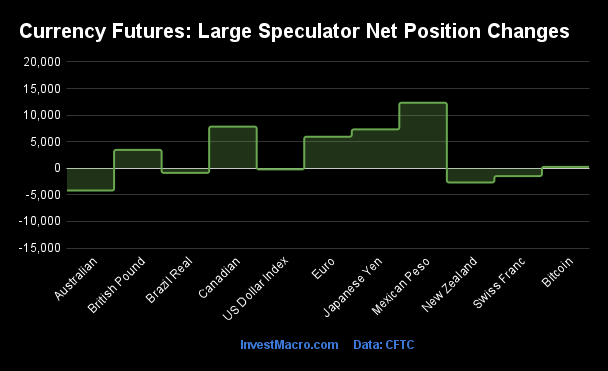
The COT currency market speculator bets were lower this week as five out of the eleven currency markets we cover had higher positioning while the other six markets had lower speculator contracts.

Leading the gains for the currency markets was the British Pound (9,291 contracts) with the Mexican Peso (8,634 contracts), Australian Dollar (8,120 contracts), New Zealand Dollar (2,579 contracts), US Dollar Index (1,387 contracts) and the Brazilian Real (-9,480 contracts) also showing positive weeks.

The currencies seeing declines in speculator bets on the week were the EuroFX (-1,632 contracts) with the Canadian Dollar (-1,684 contracts), the Swiss Franc (-1,929 contracts), Japanese Yen (-3,061 contracts) and Bitcoin (-339 contracts) also registering lower bets on the week.

Large Currency Speculators drop their Canadian dollar bets to 220-week low

Highlighting the COT currency’s data this week is the continued bearishness of the speculator’s positioning in the Canadian dollar.

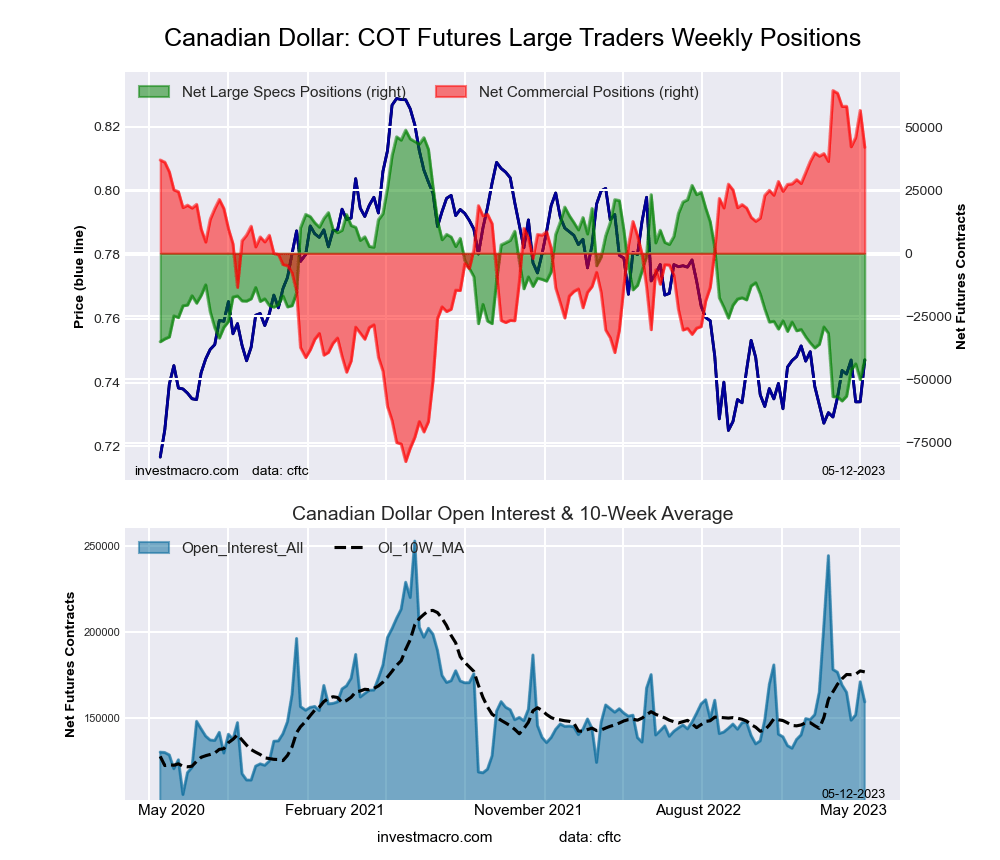
Large speculative Canadian dollar positions fell this week for the fourth consecutive week and for the seventh time in the past nine weeks. Speculators have now added a total of -29,307 net contracts to the overall bearish position in just the last four weeks. This bearishness has pushed the CAD speculator net position (currently at -58,509 contracts) to the most bearish level of the past 220 weeks, dating back to January 15th of 2019.

Hurting the Canadian dollar’s appeal has been the recent pause in interest rate rises by the Bank of Canada (after 8 rate hikes previously) as well as the slide in the price of Crude Oil. The Canadian dollar’s exchange rate versus the US dollar has been in a downtrend since hitting a multi-year high in May of 2022 at over 0.8280. The CAD front month futures price closed this week at the 0.7431 exchange and has now risen for two straight weeks.


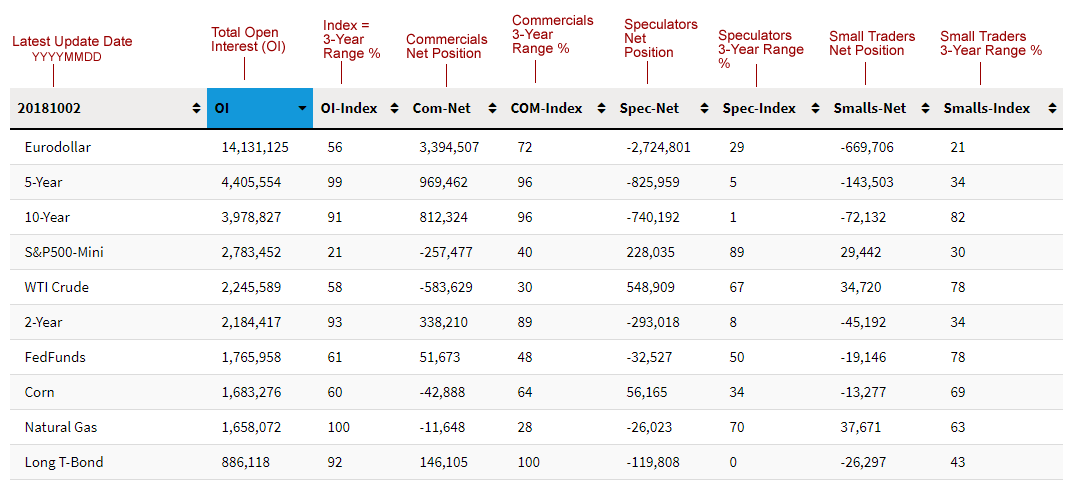
Data Snapshot of Forex Market Traders | Columns Legend
Apr-04-2023OIOI-IndexSpec-NetSpec-IndexCom-NetCOM-IndexSmalls-NetSmalls-Index
USD Index32,0762814,10648-16,154502,04839
EUR747,09574143,39374-194,7872551,39461
GBP224,69052-14,793568,881405,91270
JPY178,82835-57,0363452,266614,77063
CHF37,17726-8,0033310,82263-2,81948
CAD169,13843-58,509058,1489636124
AUD151,24250-27,2336036,83746-9,60429
NZD36,08024-4,031432,697531,33467
MXN250,4035557,91392-63,17785,26489
RUB20,93047,54331-7,15069-39324
BRL35,2441914,00354-15,562461,55956
Bitcoin13,38061-61566-183079831


Strength Scores led by Mexican Peso & EuroFX
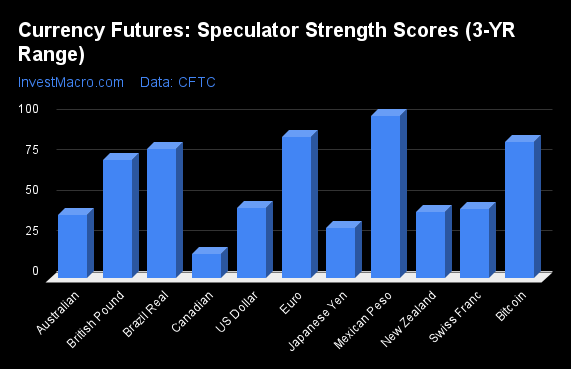
COT Strength Scores (a normalized measure of Speculator positions over a 3-Year range, from 0 to 100 where above 80 is Extreme-Bullish and below 20 is Extreme-Bearish) showed that the Mexican Peso (92 percent) and the EuroFX (74 percent) lead the currency markets this week. The Bitcoin (66 percent), Australian Dollar (60 percent) and the British Pound (56 percent) come in as the next highest in the weekly strength scores.

On the downside, the Canadian Dollar (0 percent) comes in at the lowest strength levels currently and is in Extreme-Bearish territory (below 20 percent).

Strength Statistics:
US Dollar Index (48.5 percent) vs US Dollar Index previous week (46.1 percent)
EuroFX (73.7 percent) vs EuroFX previous week (74.3 percent)
British Pound Sterling (56.3 percent) vs British Pound Sterling previous week (48.3 percent)
Japanese Yen (33.7 percent) vs Japanese Yen previous week (35.6 percent)
Swiss Franc (33.4 percent) vs Swiss Franc previous week (38.5 percent)
Canadian Dollar (0.0 percent) vs Canadian Dollar previous week (1.6 percent)
Australian Dollar (59.6 percent) vs Australian Dollar previous week (52.1 percent)
New Zealand Dollar (42.7 percent) vs New Zealand Dollar previous week (35.7 percent)
Mexican Peso (92.5 percent) vs Mexican Peso previous week (85.9 percent)
Brazilian Real (53.6 percent) vs Brazilian Real previous week (65.7 percent)
Bitcoin (66.2 percent) vs Bitcoin previous week (72.1 percent)


Mexican Peso & British Pound top the 6-Week Strength Trends

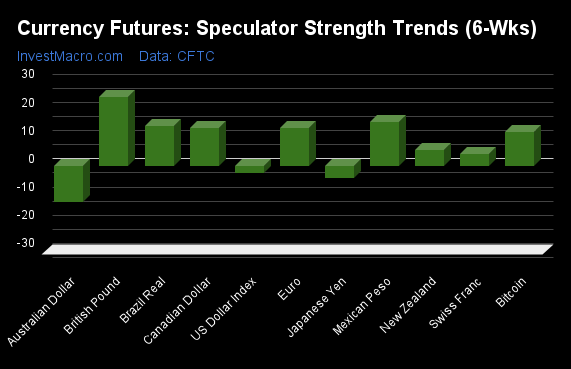
COT Strength Score Trends (or move index, calculates the 6-week changes in strength scores) showed that the Mexican Peso (72 percent) and the British Pound (6 percent) lead the past six weeks trends for the currencies. The US Dollar Index (3 percent) and Bitcoin (3 percent) are the next highest positive movers in the latest trends data.

The New Zealand Dollar (-35 percent) leads the downside trend scores currently with the Brazilian Real (-21 percent), Canadian Dollar (-20 percent) and the Japanese Yen (-14 percent) following next with lower trend scores.

Strength Trend Statistics:
US Dollar Index (3.2 percent) vs US Dollar Index previous week (1.2 percent)
EuroFX (-8.4 percent) vs EuroFX previous week (-7.3 percent)
British Pound Sterling (5.7 percent) vs British Pound Sterling previous week (-3.7 percent)
Japanese Yen (-14.2 percent) vs Japanese Yen previous week (-16.1 percent)
Swiss Franc (-3.9 percent) vs Swiss Franc previous week (3.7 percent)
Canadian Dollar (-19.6 percent) vs Canadian Dollar previous week (-19.9 percent)
Australian Dollar (-2.3 percent) vs Australian Dollar previous week (-6.0 percent)
New Zealand Dollar (-34.7 percent) vs New Zealand Dollar previous week (-42.3 percent)
Mexican Peso (71.8 percent) vs Mexican Peso previous week (67.4 percent)
Brazilian Real (-21.0 percent) vs Brazilian Real previous week (-10.8 percent)
Bitcoin (3.4 percent) vs Bitcoin previous week (8.8 percent)


Individual COT Forex Markets:

US Dollar Index Futures:
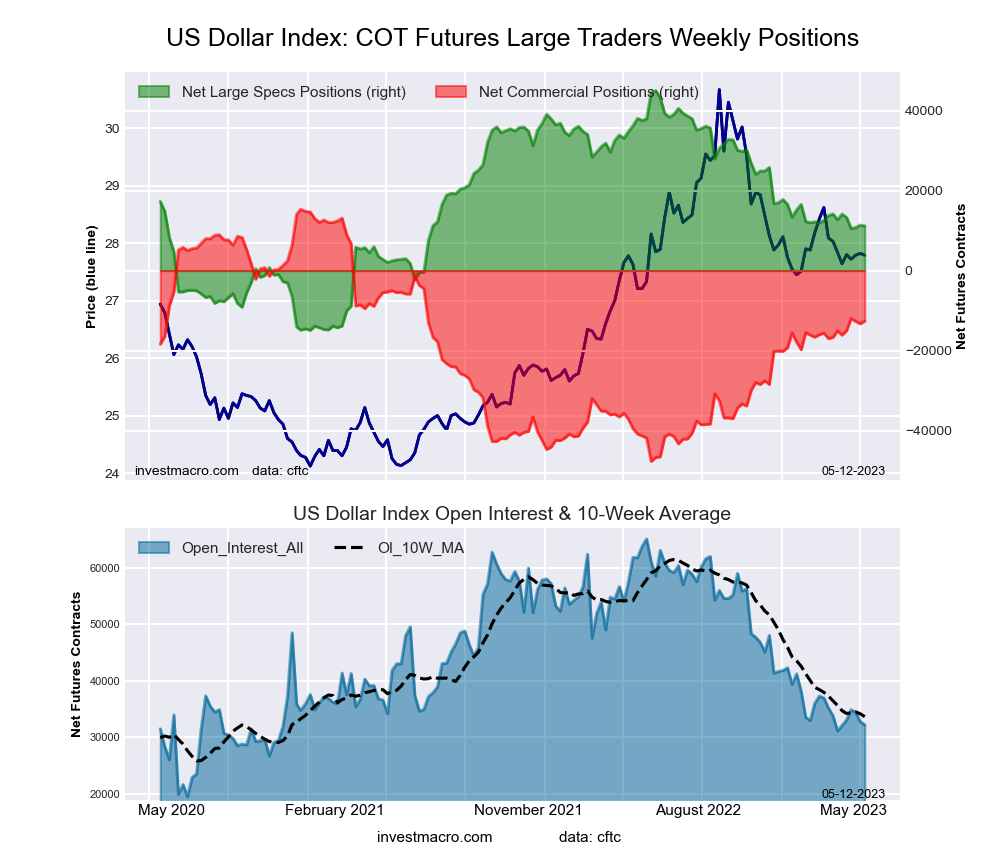
US Dollar Index Forex Futures COT ChartThe US Dollar Index large speculator standing this week reached a net position of 14,106 contracts in the data reported through Tuesday. This was a weekly advance of 1,387 contracts from the previous week which had a total of 12,719 net contracts.

This week’s current strength score (the trader positioning range over the past three years, measured from 0 to 100) shows the speculators are currently Bearish with a score of 48.5 percent. The commercials are Bullish with a score of 50.1 percent and the small traders (not shown in chart) are Bearish with a score of 38.9 percent.

US DOLLAR INDEX StatisticsSPECULATORSCOMMERCIALSSMALL TRADERS
– Percent of Open Interest Longs:79.71.514.7
– Percent of Open Interest Shorts:35.851.88.3
– Net Position:14,106-16,1542,048
– Gross Longs:25,5744734,703
– Gross Shorts:11,46816,6272,655
– Long to Short Ratio:2.2 to 10.0 to 11.8 to 1
NET POSITION TREND:
– Strength Index Score (3 Year Range Pct):48.550.138.9
– Strength Index Reading (3 Year Range):BearishBullishBearish
NET POSITION MOVEMENT INDEX:
– 6-Week Change in Strength Index:3.20.8-26.2


Euro Currency Futures:

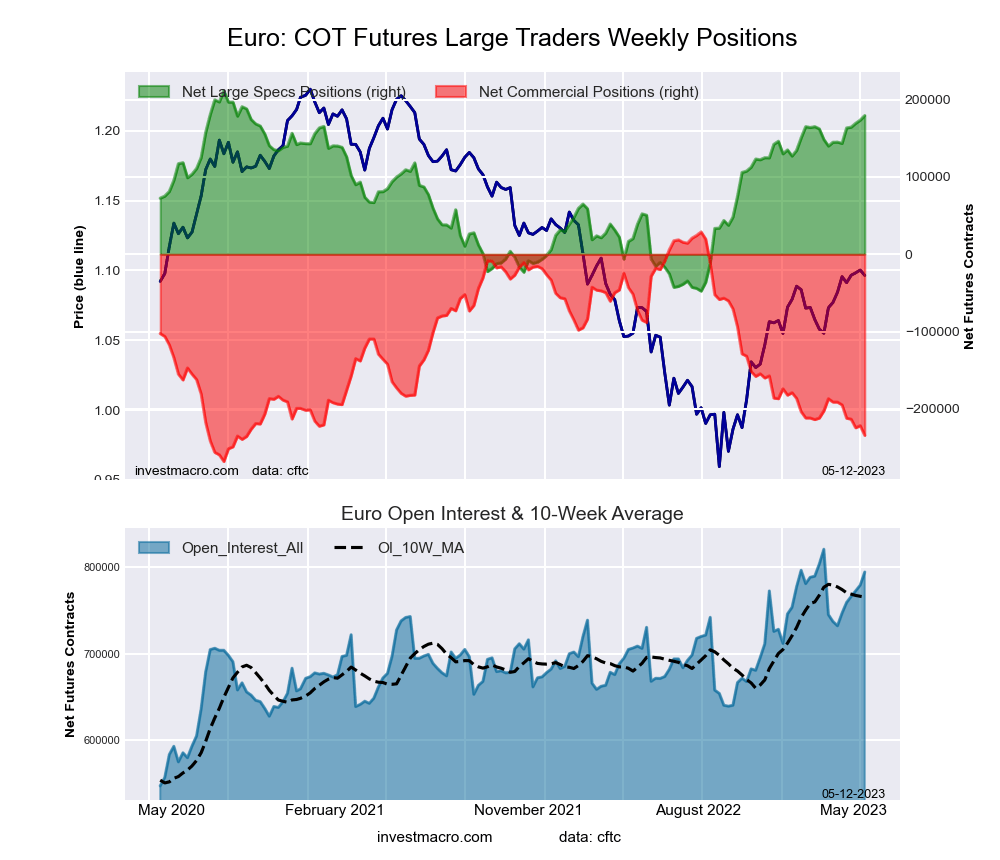
Euro Currency Futures COT ChartThe Euro Currency large speculator standing this week reached a net position of 143,393 contracts in the data reported through Tuesday. This was a weekly decline of -1,632 contracts from the previous week which had a total of 145,025 net contracts.

This week’s current strength score (the trader positioning range over the past three years, measured from 0 to 100) shows the speculators are currently Bullish with a score of 73.7 percent. The commercials are Bearish with a score of 24.7 percent and the small traders (not shown in chart) are Bullish with a score of 61.0 percent.

EURO Currency StatisticsSPECULATORSCOMMERCIALSSMALL TRADERS
– Percent of Open Interest Longs:30.255.612.3
– Percent of Open Interest Shorts:11.081.65.4
– Net Position:143,393-194,78751,394
– Gross Longs:225,416415,10491,568
– Gross Shorts:82,023609,89140,174
– Long to Short Ratio:2.7 to 10.7 to 12.3 to 1
NET POSITION TREND:
– Strength Index Score (3 Year Range Pct):73.724.761.0
– Strength Index Reading (3 Year Range):BullishBearishBullish
NET POSITION MOVEMENT INDEX:
– 6-Week Change in Strength Index:-8.46.44.2


British Pound Sterling Futures:

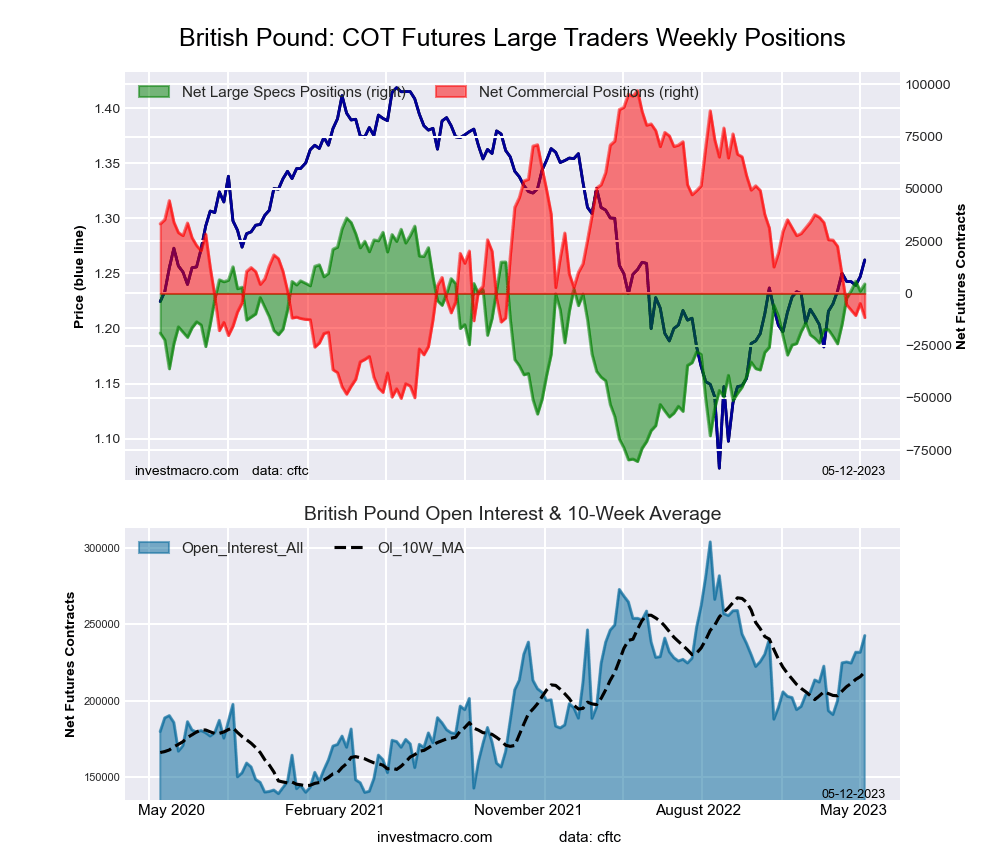
British Pound Sterling Futures COT ChartThe British Pound Sterling large speculator standing this week reached a net position of -14,793 contracts in the data reported through Tuesday. This was a weekly rise of 9,291 contracts from the previous week which had a total of -24,084 net contracts.

This week’s current strength score (the trader positioning range over the past three years, measured from 0 to 100) shows the speculators are currently Bullish with a score of 56.3 percent. The commercials are Bearish with a score of 40.1 percent and the small traders (not shown in chart) are Bullish with a score of 69.6 percent.

BRITISH POUND StatisticsSPECULATORSCOMMERCIALSSMALL TRADERS
– Percent of Open Interest Longs:20.759.513.9
– Percent of Open Interest Shorts:27.255.611.3
– Net Position:-14,7938,8815,912
– Gross Longs:46,415133,80231,247
– Gross Shorts:61,208124,92125,335
– Long to Short Ratio:0.8 to 11.1 to 11.2 to 1
NET POSITION TREND:
– Strength Index Score (3 Year Range Pct):56.340.169.6
– Strength Index Reading (3 Year Range):BullishBearishBullish
NET POSITION MOVEMENT INDEX:
– 6-Week Change in Strength Index:5.7-19.543.4


Japanese Yen Futures:

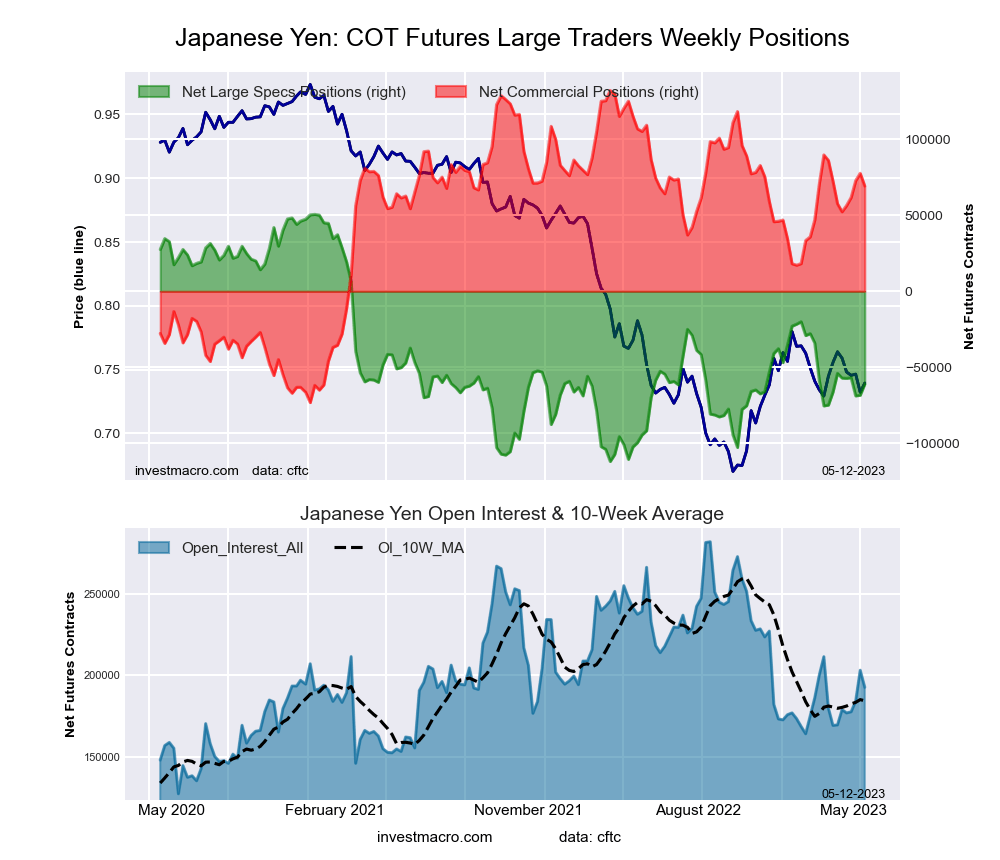
Japanese Yen Forex Futures COT ChartThe Japanese Yen large speculator standing this week reached a net position of -57,036 contracts in the data reported through Tuesday. This was a weekly reduction of -3,061 contracts from the previous week which had a total of -53,975 net contracts.

This week’s current strength score (the trader positioning range over the past three years, measured from 0 to 100) shows the speculators are currently Bearish with a score of 33.7 percent. The commercials are Bullish with a score of 61.2 percent and the small traders (not shown in chart) are Bullish with a score of 63.1 percent.

JAPANESE YEN StatisticsSPECULATORSCOMMERCIALSSMALL TRADERS
– Percent of Open Interest Longs:6.474.618.0
– Percent of Open Interest Shorts:38.345.315.3
– Net Position:-57,03652,2664,770
– Gross Longs:11,523133,32732,150
– Gross Shorts:68,55981,06127,380
– Long to Short Ratio:0.2 to 11.6 to 11.2 to 1
NET POSITION TREND:
– Strength Index Score (3 Year Range Pct):33.761.263.1
– Strength Index Reading (3 Year Range):BearishBullishBullish
NET POSITION MOVEMENT INDEX:
– 6-Week Change in Strength Index:-14.22.635.8


Swiss Franc Futures:

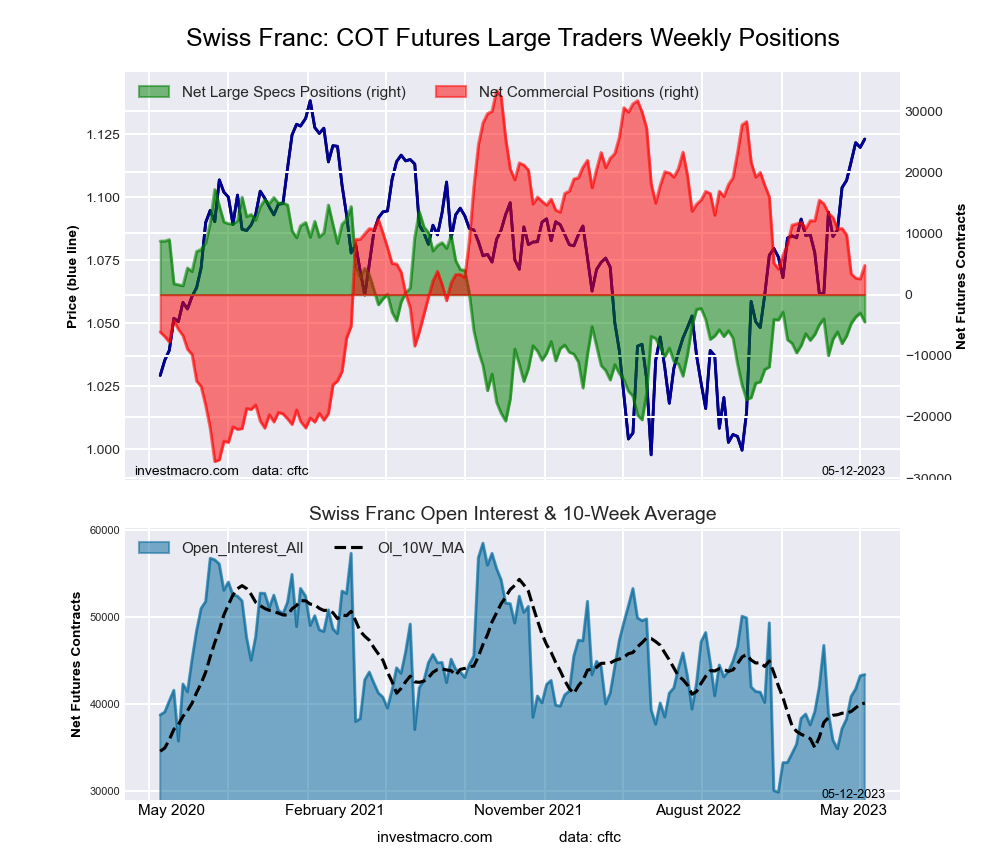
Swiss Franc Forex Futures COT ChartThe Swiss Franc large speculator standing this week reached a net position of -8,003 contracts in the data reported through Tuesday. This was a weekly reduction of -1,929 contracts from the previous week which had a total of -6,074 net contracts.

This week’s current strength score (the trader positioning range over the past three years, measured from 0 to 100) shows the speculators are currently Bearish with a score of 33.4 percent. The commercials are Bullish with a score of 62.8 percent and the small traders (not shown in chart) are Bearish with a score of 48.0 percent.

SWISS FRANC StatisticsSPECULATORSCOMMERCIALSSMALL TRADERS
– Percent of Open Interest Longs:8.053.932.9
– Percent of Open Interest Shorts:29.524.840.5
– Net Position:-8,00310,822-2,819
– Gross Longs:2,95820,03812,249
– Gross Shorts:10,9619,21615,068
– Long to Short Ratio:0.3 to 12.2 to 10.8 to 1
NET POSITION TREND:
– Strength Index Score (3 Year Range Pct):33.462.848.0
– Strength Index Reading (3 Year Range):BearishBullishBearish
NET POSITION MOVEMENT INDEX:
– 6-Week Change in Strength Index:-3.9-2.09.2


Canadian Dollar Futures:

Canadian Dollar Forex Futures COT ChartThe Canadian Dollar large speculator standing this week reached a net position of -58,509 contracts in the data reported through Tuesday. This was a weekly lowering of -1,684 contracts from the previous week which had a total of -56,825 net contracts.

This week’s current strength score (the trader positioning range over the past three years, measured from 0 to 100) shows the speculators are currently Bearish-Extreme with a score of 0.0 percent. The commercials are Bullish-Extreme with a score of 95.7 percent and the small traders (not shown in chart) are Bearish with a score of 23.6 percent.

CANADIAN DOLLAR StatisticsSPECULATORSCOMMERCIALSSMALL TRADERS
– Percent of Open Interest Longs:9.870.218.4
– Percent of Open Interest Shorts:44.435.918.2
– Net Position:-58,50958,148361
– Gross Longs:16,607118,79031,176
– Gross Shorts:75,11660,64230,815
– Long to Short Ratio:0.2 to 12.0 to 11.0 to 1
NET POSITION TREND:
– Strength Index Score (3 Year Range Pct):0.095.723.6
– Strength Index Reading (3 Year Range):Bearish-ExtremeBullish-ExtremeBearish
NET POSITION MOVEMENT INDEX:
– 6-Week Change in Strength Index:-19.612.55.8


Australian Dollar Futures:

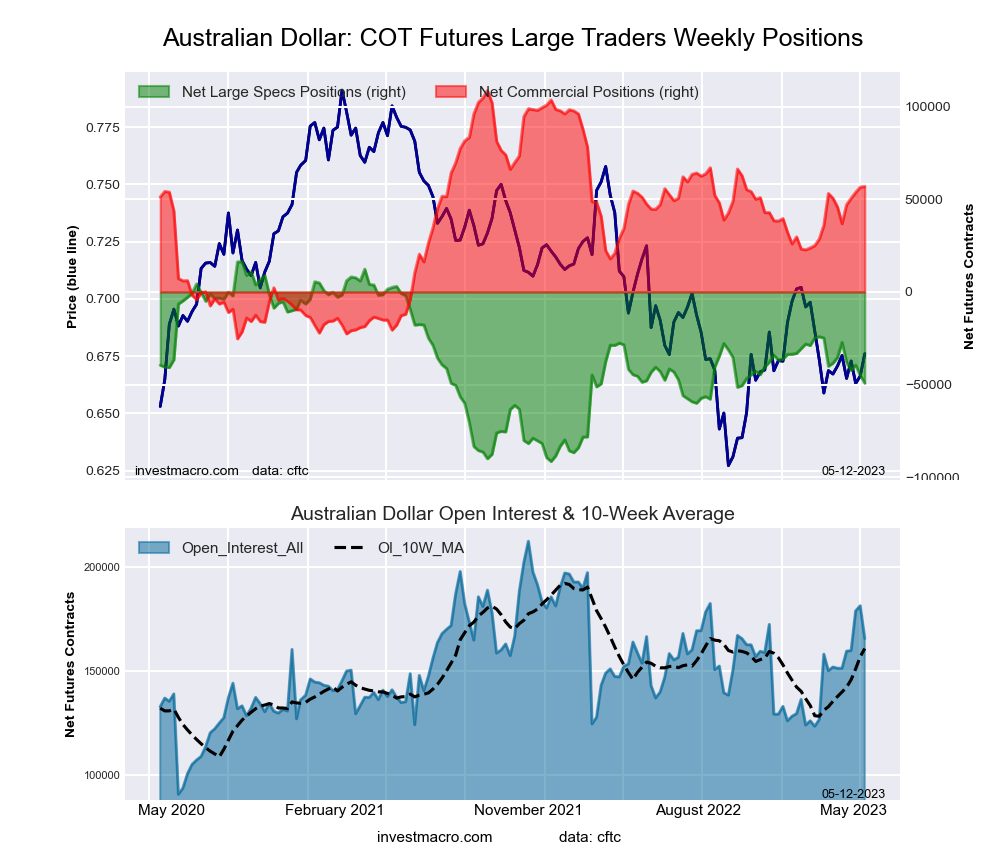
Australian Dollar Forex Futures COT ChartThe Australian Dollar large speculator standing this week reached a net position of -27,233 contracts in the data reported through Tuesday. This was a weekly boost of 8,120 contracts from the previous week which had a total of -35,353 net contracts.

This week’s current strength score (the trader positioning range over the past three years, measured from 0 to 100) shows the speculators are currently Bullish with a score of 59.6 percent. The commercials are Bearish with a score of 46.4 percent and the small traders (not shown in chart) are Bearish with a score of 29.0 percent.

AUSTRALIAN DOLLAR StatisticsSPECULATORSCOMMERCIALSSMALL TRADERS
– Percent of Open Interest Longs:30.953.112.9
– Percent of Open Interest Shorts:48.928.719.3
– Net Position:-27,23336,837-9,604
– Gross Longs:46,68780,25719,523
– Gross Shorts:73,92043,42029,127
– Long to Short Ratio:0.6 to 11.8 to 10.7 to 1
NET POSITION TREND:
– Strength Index Score (3 Year Range Pct):59.646.429.0
– Strength Index Reading (3 Year Range):BullishBearishBearish
NET POSITION MOVEMENT INDEX:
– 6-Week Change in Strength Index:-2.38.8-22.8


New Zealand Dollar Futures:

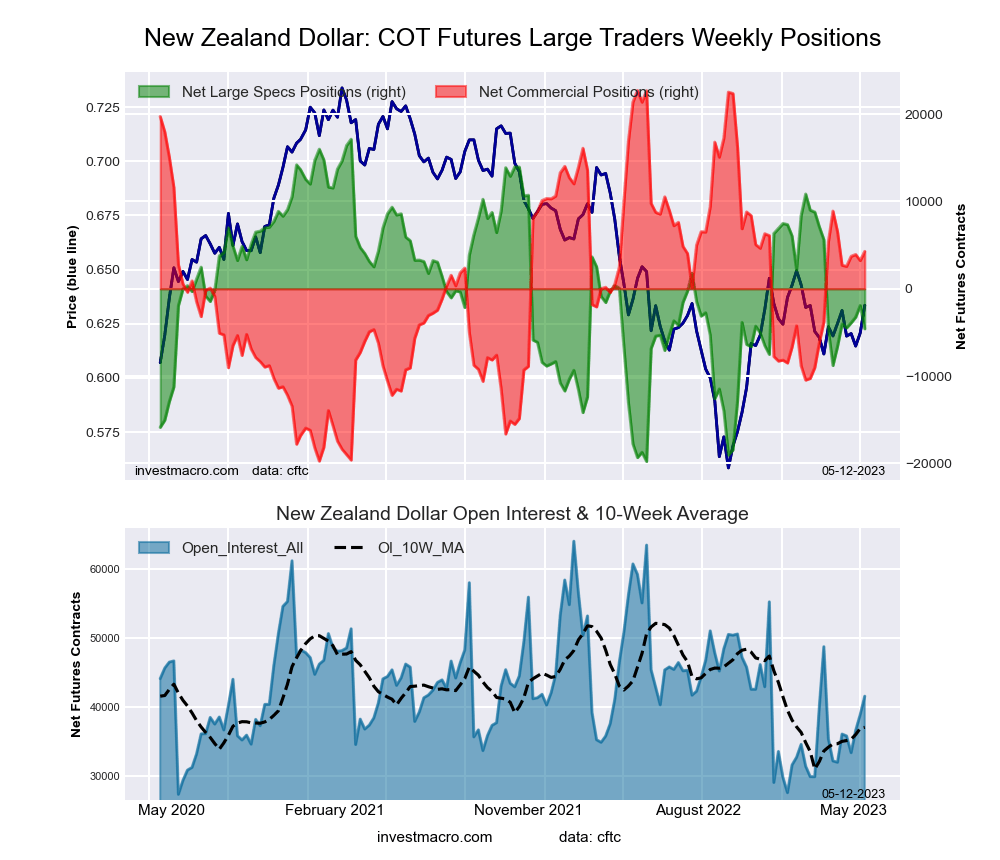
New Zealand Dollar Forex Futures COT ChartThe New Zealand Dollar large speculator standing this week reached a net position of -4,031 contracts in the data reported through Tuesday. This was a weekly rise of 2,579 contracts from the previous week which had a total of -6,610 net contracts.

This week’s current strength score (the trader positioning range over the past three years, measured from 0 to 100) shows the speculators are currently Bearish with a score of 42.7 percent. The commercials are Bullish with a score of 52.8 percent and the small traders (not shown in chart) are Bullish with a score of 67.0 percent.

NEW ZEALAND DOLLAR StatisticsSPECULATORSCOMMERCIALSSMALL TRADERS
– Percent of Open Interest Longs:39.647.312.5
– Percent of Open Interest Shorts:50.839.88.8
– Net Position:-4,0312,6971,334
– Gross Longs:14,28017,0504,501
– Gross Shorts:18,31114,3533,167
– Long to Short Ratio:0.8 to 11.2 to 11.4 to 1
NET POSITION TREND:
– Strength Index Score (3 Year Range Pct):42.752.867.0
– Strength Index Reading (3 Year Range):BearishBullishBullish
NET POSITION MOVEMENT INDEX:
– 6-Week Change in Strength Index:-34.727.612.6


Mexican Peso Futures:

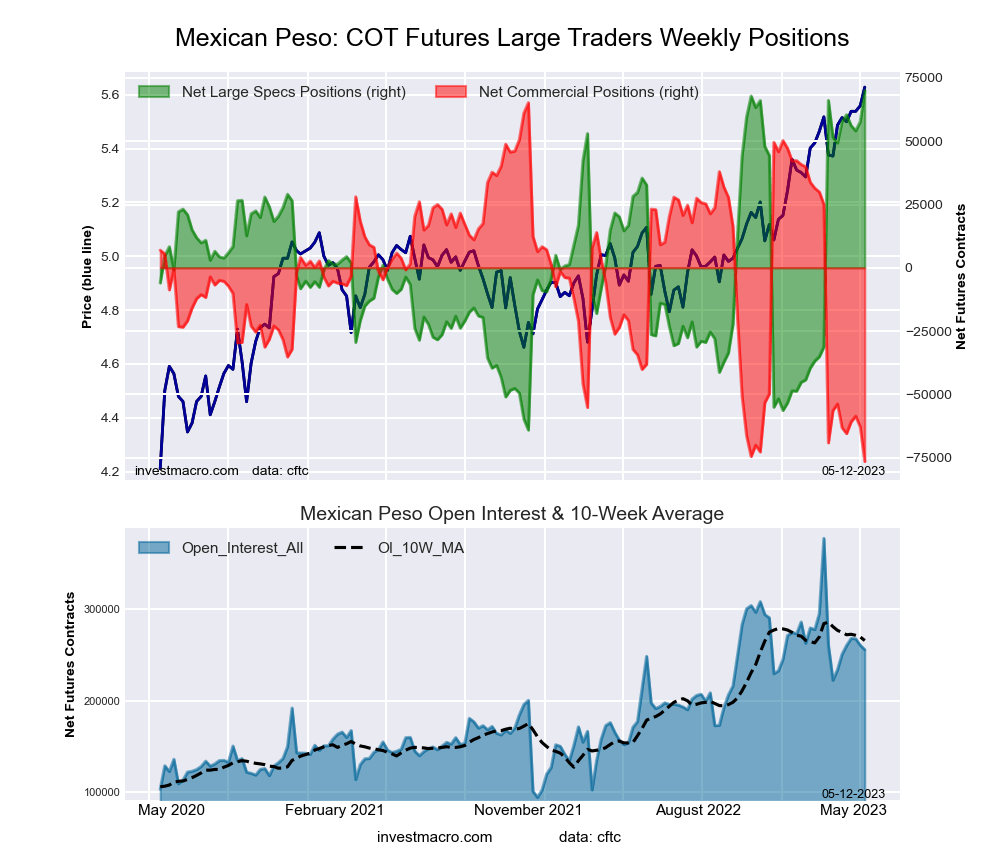
Mexican Peso Futures COT ChartThe Mexican Peso large speculator standing this week reached a net position of 57,913 contracts in the data reported through Tuesday. This was a weekly boost of 8,634 contracts from the previous week which had a total of 49,279 net contracts.

This week’s current strength score (the trader positioning range over the past three years, measured from 0 to 100) shows the speculators are currently Bullish-Extreme with a score of 92.5 percent. The commercials are Bearish-Extreme with a score of 8.1 percent and the small traders (not shown in chart) are Bullish-Extreme with a score of 88.7 percent.

MEXICAN PESO StatisticsSPECULATORSCOMMERCIALSSMALL TRADERS
– Percent of Open Interest Longs:50.945.93.1
– Percent of Open Interest Shorts:27.771.11.0
– Net Position:57,913-63,1775,264
– Gross Longs:127,371114,9777,808
– Gross Shorts:69,458178,1542,544
– Long to Short Ratio:1.8 to 10.6 to 13.1 to 1
NET POSITION TREND:
– Strength Index Score (3 Year Range Pct):92.58.188.7
– Strength Index Reading (3 Year Range):Bullish-ExtremeBearish-ExtremeBullish-Extreme
NET POSITION MOVEMENT INDEX:
– 6-Week Change in Strength Index:71.8-67.7-0.9


Brazilian Real Futures:

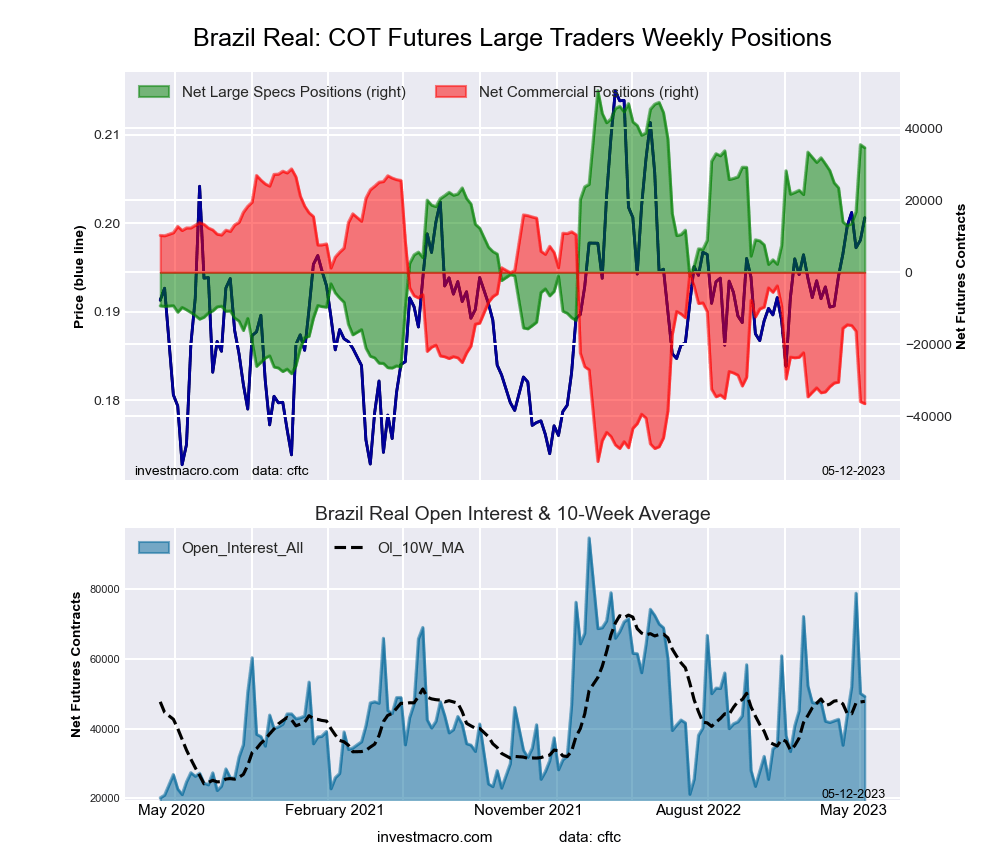
Brazil Real Futures COT ChartThe Brazilian Real large speculator standing this week reached a net position of 14,003 contracts in the data reported through Tuesday. This was a weekly reduction of -9,480 contracts from the previous week which had a total of 23,483 net contracts.

This week’s current strength score (the trader positioning range over the past three years, measured from 0 to 100) shows the speculators are currently Bullish with a score of 53.6 percent. The commercials are Bearish with a score of 45.5 percent and the small traders (not shown in chart) are Bullish with a score of 56.4 percent.

BRAZIL REAL StatisticsSPECULATORSCOMMERCIALSSMALL TRADERS
– Percent of Open Interest Longs:69.719.810.5
– Percent of Open Interest Shorts:30.063.96.1
– Net Position:14,003-15,5621,559
– Gross Longs:24,5766,9643,704
– Gross Shorts:10,57322,5262,145
– Long to Short Ratio:2.3 to 10.3 to 11.7 to 1
NET POSITION TREND:
– Strength Index Score (3 Year Range Pct):53.645.556.4
– Strength Index Reading (3 Year Range):BullishBearishBullish
NET POSITION MOVEMENT INDEX:
– 6-Week Change in Strength Index:-21.020.4-0.2


Bitcoin Futures:

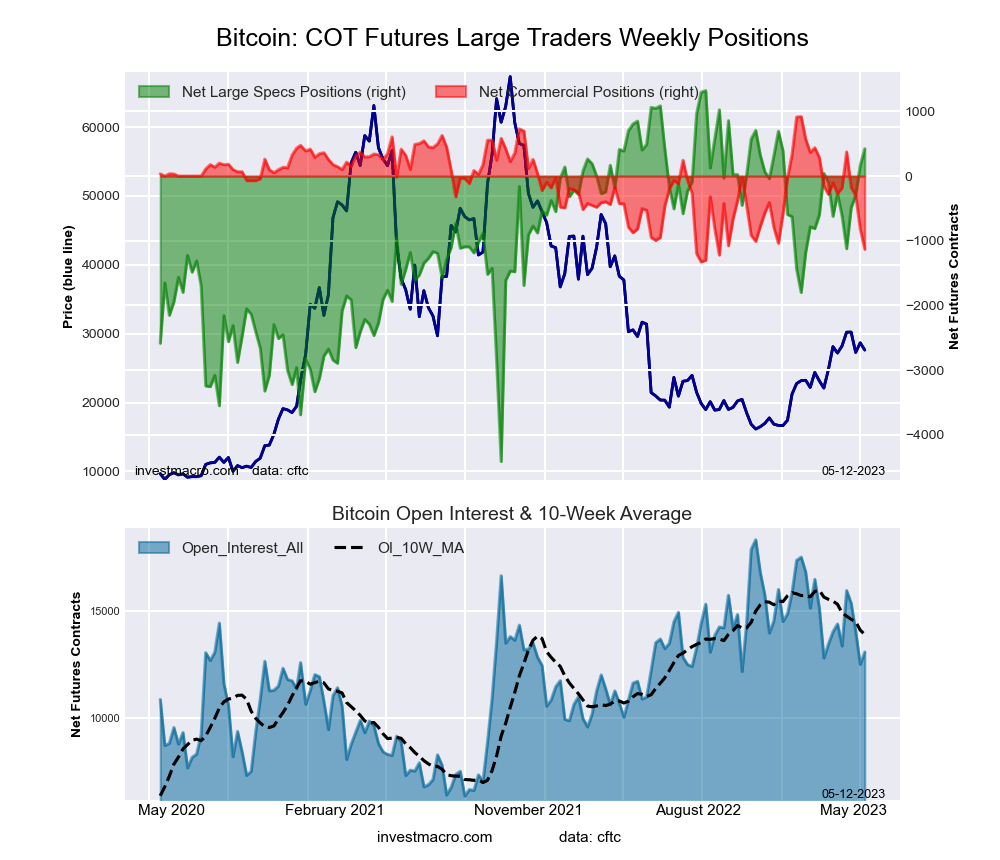
Bitcoin Crypto Futures COT ChartThe Bitcoin large speculator standing this week reached a net position of -615 contracts in the data reported through Tuesday. This was a weekly decline of -339 contracts from the previous week which had a total of -276 net contracts.

This week’s current strength score (the trader positioning range over the past three years, measured from 0 to 100) shows the speculators are currently Bullish with a score of 66.2 percent. The commercials are Bullish with a score of 50.9 percent and the small traders (not shown in chart) are Bearish with a score of 31.1 percent.

BITCOIN StatisticsSPECULATORSCOMMERCIALSSMALL TRADERS
– Percent of Open Interest Longs:77.82.310.9
– Percent of Open Interest Shorts:82.43.64.9
– Net Position:-615-183798
– Gross Longs:10,4153021,458
– Gross Shorts:11,030485660
– Long to Short Ratio:0.9 to 10.6 to 12.2 to 1
NET POSITION TREND:
– Strength Index Score (3 Year Range Pct):66.250.931.1
– Strength Index Reading (3 Year Range):BullishBullishBearish
NET POSITION MOVEMENT INDEX:
– 6-Week Change in Strength Index:3.4-27.69.6


Article By InvestMacroReceive our weekly COT Newsletter

*COT Report: The COT data, released weekly to the public each Friday, is updated through the most recent Tuesday (data is 3 days old) and shows a quick view of how large speculators or non-commercials (for-profit traders) were positioned in the futures markets.

The CFTC categorizes trader positions according to commercial hedgers (traders who use futures contracts for hedging as part of the business), non-commercials (large traders who speculate to realize trading profits) and nonreportable traders (usually small traders/speculators) as well as their open interest (contracts open in the market at time of reporting). See CFTC criteria here.

COT Metals: Gold and Silver Speculator positions continue to move higher

By InvestMacro

Here are the latest charts and statistics for the Commitment of Traders (COT) data published by the Commodities Futures Trading Commission (CFTC).

The latest COT data is updated through Tuesday April 4th and shows a quick view of how large traders (for-profit speculators and commercial entities) were positioned in the futures markets.

Weekly Speculator Changes led by Gold & Silver

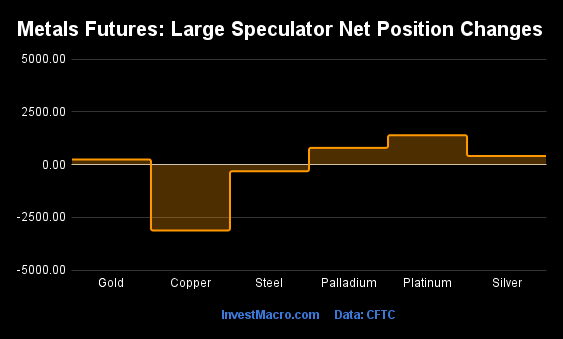
The COT metals markets speculator bets were higher this week as five out of the six metals markets we cover had higher positioning while the other one markets had lower speculator contracts.

Leading the gains for the metals was Gold (13,586 contracts) with Silver (7,922 contracts), Platinum (5,049 contracts), Palladium (118 contracts) and Steel (1,117 contracts) also showing positive weeks.

The market with declines in speculator bets for the week was Copper (-1,409 contracts).

Gold and Silver Speculator positions continue to move higher

Highlighting the COT metals data this week is the continued rise in bets for the Gold and Silver speculative positions.

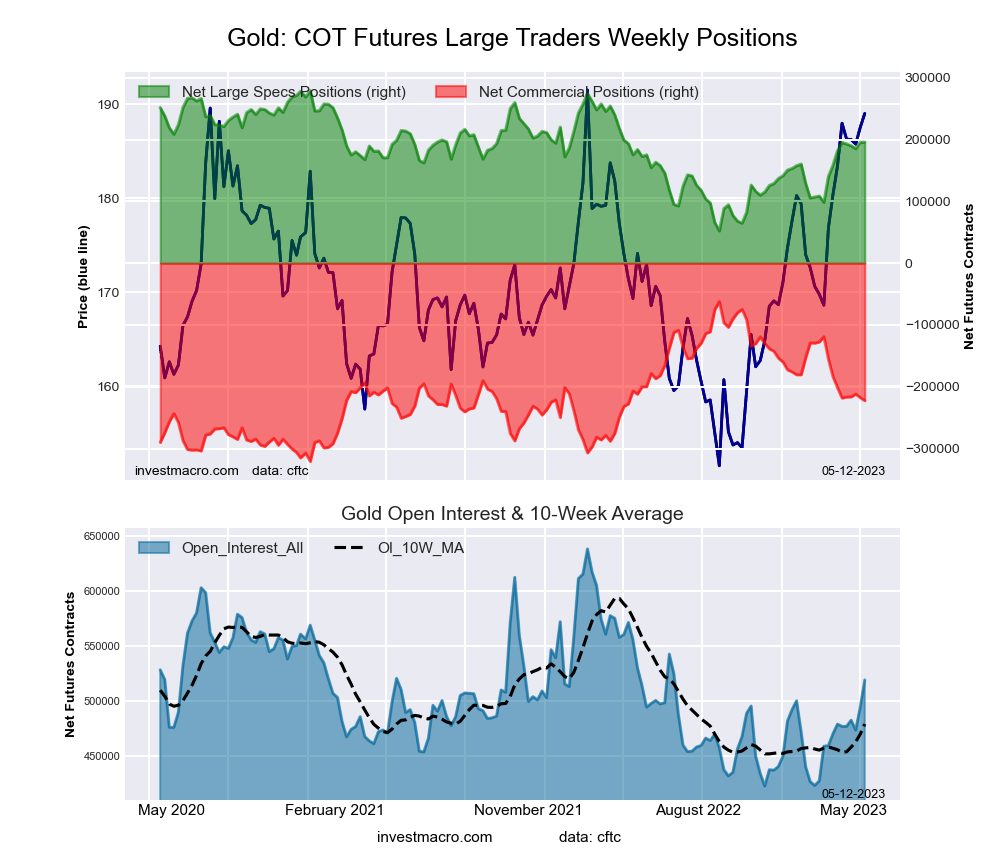
The large speculator position in Gold futures rose this week for a fourth straight week and for the sixth time out of the past seven weeks. Gold speculator bets have now jumped by a total of +96,742 contracts over just the past four weeks going from a total net position of +98,474
contracts on March 7th to a total of +195,216 contracts this week.

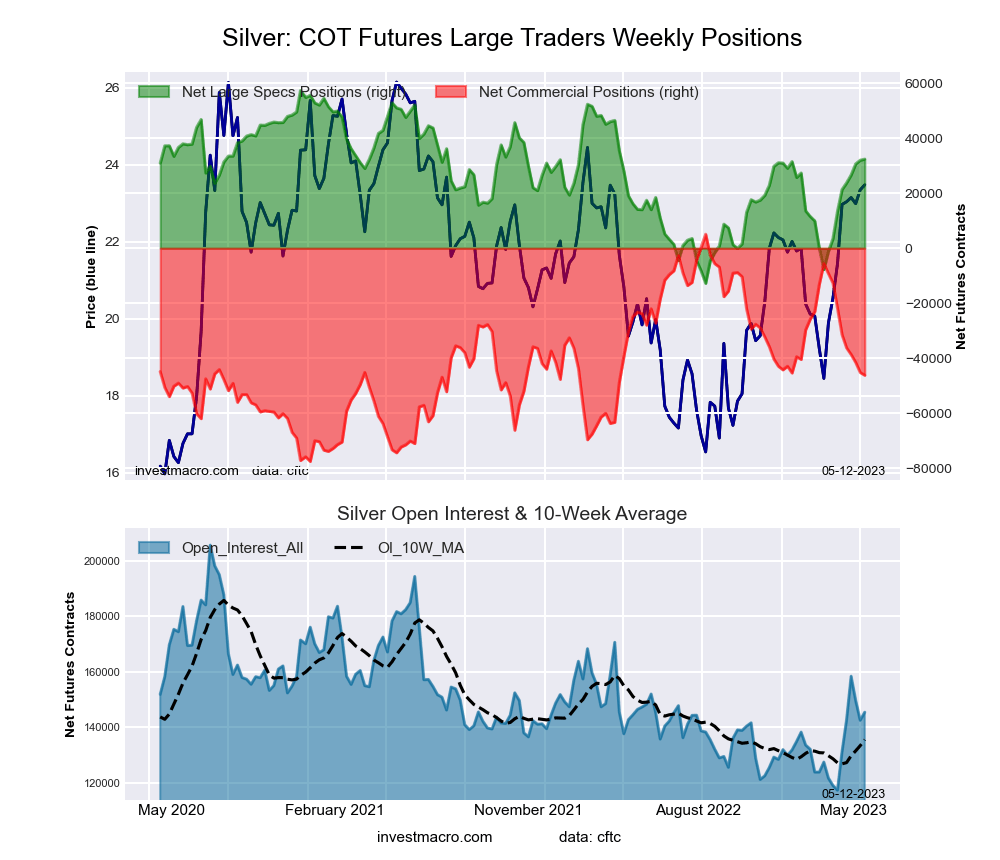
Meanwhile, the Silver speculator positions have also risen for four straight weeks and have gained by a total of +29,065 contracts over that four-week period. These gains have taken the Silver position out of an overall bearish level of -7,782 contracts on March 7th to a total of +21,283 contracts this week (the most bullish level since January 31st).

The Gold and Silver futures prices have also been on the rise as well. The Gold futures front month price closed this week at approximately the $2,026 level which is the highest weekly close since August 3rd of 2020. Gold is now up over 25 percent since October.

Silver futures prices have gained for four straight weeks and closed this week above $25, the highest level since April of 2022. Silver prices are up by over 40 percent from the most recent cycle low in late-August of 2022.


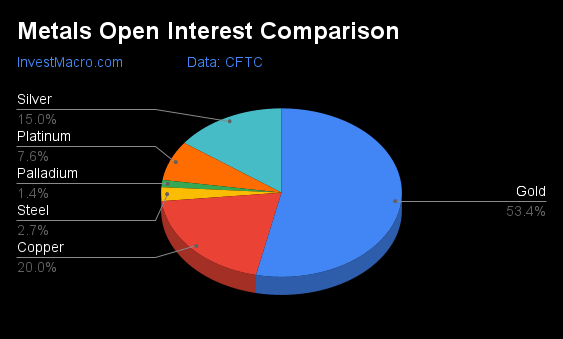
Data Snapshot of Commodity Market Traders | Columns Legend
Apr-04-2023OIOI-IndexSpec-NetSpec-IndexCom-NetCOM-IndexSmalls-NetSmalls-Index
Gold476,59225195,21663-218,2504023,03438
Silver131,2101621,28349-31,4355610,15223
Copper218,68757-2,95426-4,897697,85168
Palladium11,82082-6,64647,01197-36520
Platinum59,1563815,42351-19,201543,77819


Strength Scores led by Gold & Steel

COT Strength Scores (a normalized measure of Speculator positions over a 3-Year range, from 0 to 100 where above 80 is Extreme-Bullish and below 20 is Extreme-Bearish) showed that Gold (63 percent) and Steel (61 percent) lead the metals markets this week. Palladium (4 percent) comes in as the next highest in the weekly strength scores.

On the downside, Palladium (4 percent) comes in at the lowest strength level currently and is in Extreme-Bearish territory (below 20 percent).

Strength Statistics:
Gold (63.0 percent) vs Gold previous week (57.0 percent)
Silver (48.6 percent) vs Silver previous week (37.3 percent)
Copper (25.8 percent) vs Copper previous week (27.0 percent)
Platinum (51.2 percent) vs Platinum previous week (39.5 percent)
Palladium (4.2 percent) vs Palladium previous week (3.1 percent)
Steel (61.2 percent) vs Palladium previous week (57.9 percent)


Gold & Platinum top the 6-Week Strength Trends

COT Strength Score Trends (or move index, calculates the 6-week changes in strength scores) showed that Gold (39 percent) and Platinum (29 percent) lead the past six weeks trends for metals.

Palladium (-13 percent) leads the downside trend scores currently.

Move Statistics:
Gold (38.8 percent) vs Gold previous week (33.5 percent)
Silver (16.2 percent) vs Silver previous week (2.6 percent)
Copper (-4.5 percent) vs Copper previous week (3.5 percent)
Platinum (28.9 percent) vs Platinum previous week (10.1 percent)
Palladium (-13.5 percent) vs Palladium previous week (-16.4 percent)
Steel (0.2 percent) vs Steel previous week (-3.8 percent)


Individual Markets:

Gold Comex Futures:

Gold Futures COT ChartThe Gold Comex Futures large speculator standing this week was a net position of 195,216 contracts in the data reported through Tuesday. This was a weekly gain of 13,586 contracts from the previous week which had a total of 181,630 net contracts.

This week’s current strength score (the trader positioning range over the past three years, measured from 0 to 100) shows the speculators are currently Bullish with a score of 63.0 percent. The commercials are Bearish with a score of 39.7 percent and the small traders (not shown in chart) are Bearish with a score of 37.7 percent.

Gold Futures StatisticsSPECULATORSCOMMERCIALSSMALL TRADERS
– Percent of Open Interest Longs:55.824.510.2
– Percent of Open Interest Shorts:14.970.35.4
– Net Position:195,216-218,25023,034
– Gross Longs:266,164116,86948,740
– Gross Shorts:70,948335,11925,706
– Long to Short Ratio:3.8 to 10.3 to 11.9 to 1
NET POSITION TREND:
– Strength Index Score (3 Year Range Pct):63.039.737.7
– Strength Index Reading (3 Year Range):BullishBearishBearish
NET POSITION MOVEMENT INDEX:
– 6-Week Change in Strength Index:38.8-34.42.0


Silver Comex Futures:

Silver Futures COT ChartThe Silver Comex Futures large speculator standing this week was a net position of 21,283 contracts in the data reported through Tuesday. This was a weekly rise of 7,922 contracts from the previous week which had a total of 13,361 net contracts.

This week’s current strength score (the trader positioning range over the past three years, measured from 0 to 100) shows the speculators are currently Bearish with a score of 48.6 percent. The commercials are Bullish with a score of 55.8 percent and the small traders (not shown in chart) are Bearish with a score of 22.7 percent.

Silver Futures StatisticsSPECULATORSCOMMERCIALSSMALL TRADERS
– Percent of Open Interest Longs:38.434.218.5
– Percent of Open Interest Shorts:22.158.210.7
– Net Position:21,283-31,43510,152
– Gross Longs:50,32744,93624,209
– Gross Shorts:29,04476,37114,057
– Long to Short Ratio:1.7 to 10.6 to 11.7 to 1
NET POSITION TREND:
– Strength Index Score (3 Year Range Pct):48.655.822.7
– Strength Index Reading (3 Year Range):BearishBullishBearish
NET POSITION MOVEMENT INDEX:
– 6-Week Change in Strength Index:16.2-10.2-16.8


Copper Grade #1 Futures:

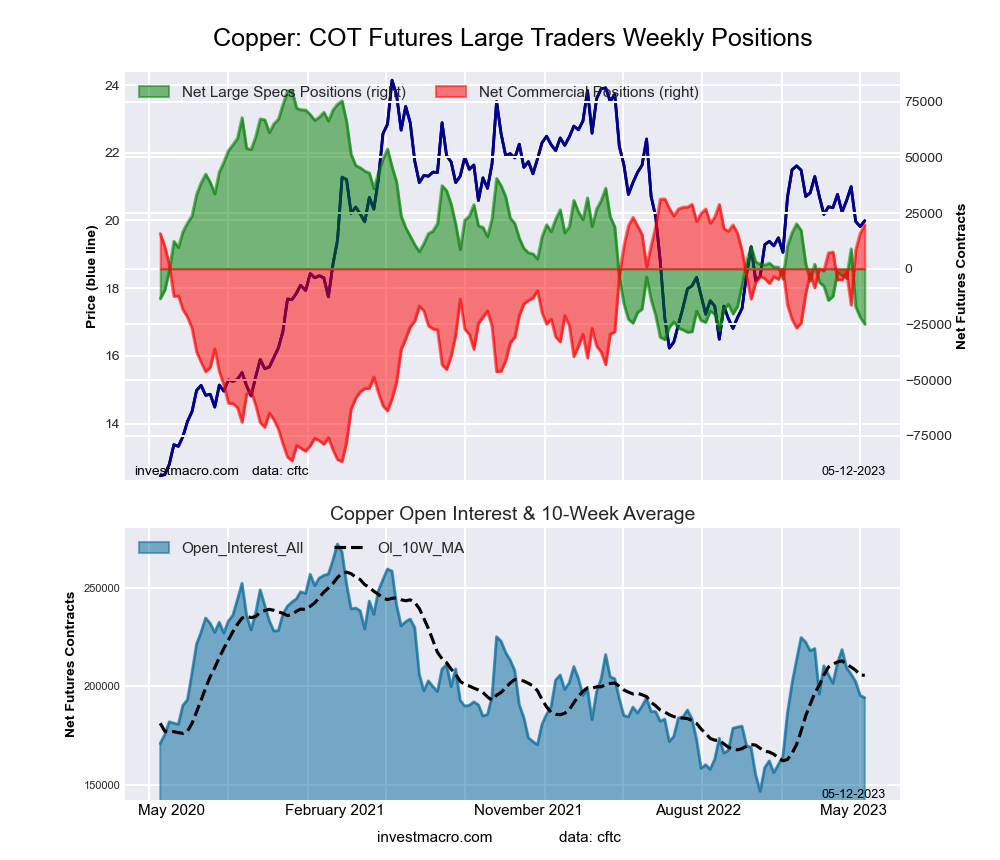
Copper Futures COT ChartThe Copper Grade #1 Futures large speculator standing this week was a net position of -2,954 contracts in the data reported through Tuesday. This was a weekly reduction of -1,409 contracts from the previous week which had a total of -1,545 net contracts.

This week’s current strength score (the trader positioning range over the past three years, measured from 0 to 100) shows the speculators are currently Bearish with a score of 25.8 percent. The commercials are Bullish with a score of 69.3 percent and the small traders (not shown in chart) are Bullish with a score of 68.0 percent.

Copper Futures StatisticsSPECULATORSCOMMERCIALSSMALL TRADERS
– Percent of Open Interest Longs:27.742.78.9
– Percent of Open Interest Shorts:29.045.05.3
– Net Position:-2,954-4,8977,851
– Gross Longs:60,53893,46519,483
– Gross Shorts:63,49298,36211,632
– Long to Short Ratio:1.0 to 11.0 to 11.7 to 1
NET POSITION TREND:
– Strength Index Score (3 Year Range Pct):25.869.368.0
– Strength Index Reading (3 Year Range):BearishBullishBullish
NET POSITION MOVEMENT INDEX:
– 6-Week Change in Strength Index:-4.53.18.8


Platinum Futures:

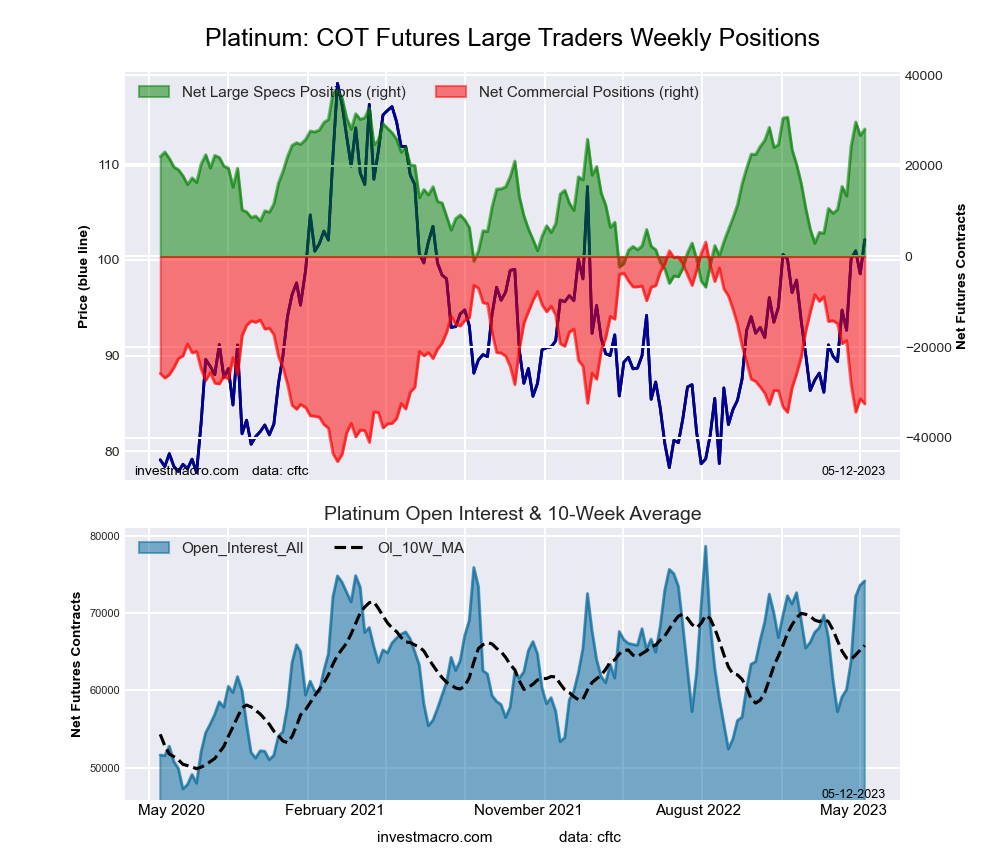
Platinum Futures COT ChartThe Platinum Futures large speculator standing this week was a net position of 15,423 contracts in the data reported through Tuesday. This was a weekly lift of 5,049 contracts from the previous week which had a total of 10,374 net contracts.

This week’s current strength score (the trader positioning range over the past three years, measured from 0 to 100) shows the speculators are currently Bullish with a score of 51.2 percent. The commercials are Bullish with a score of 53.8 percent and the small traders (not shown in chart) are Bearish-Extreme with a score of 18.8 percent.

Platinum Futures StatisticsSPECULATORSCOMMERCIALSSMALL TRADERS
– Percent of Open Interest Longs:50.435.011.6
– Percent of Open Interest Shorts:24.467.55.2
– Net Position:15,423-19,2013,778
– Gross Longs:29,84120,7086,873
– Gross Shorts:14,41839,9093,095
– Long to Short Ratio:2.1 to 10.5 to 12.2 to 1
NET POSITION TREND:
– Strength Index Score (3 Year Range Pct):51.253.818.8
– Strength Index Reading (3 Year Range):BullishBullishBearish-Extreme
NET POSITION MOVEMENT INDEX:
– 6-Week Change in Strength Index:28.9-22.3-22.8


Palladium Futures:

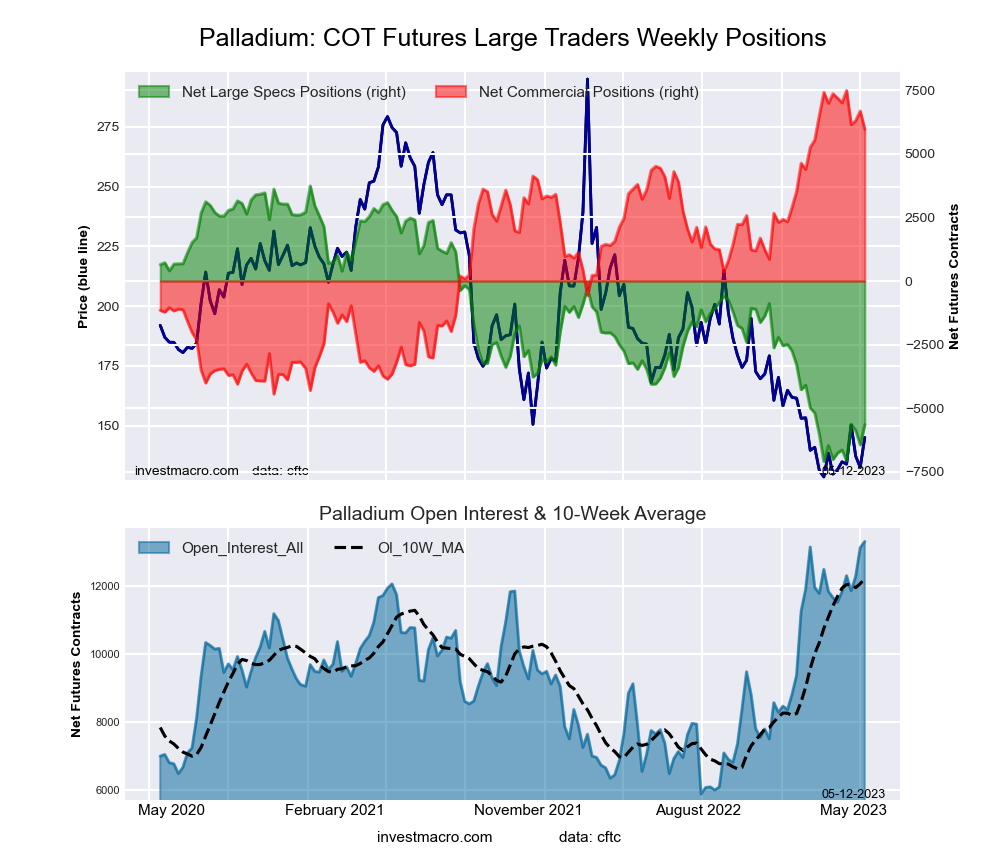
Palladium Futures COT ChartThe Palladium Futures large speculator standing this week was a net position of -6,646 contracts in the data reported through Tuesday. This was a weekly gain of 118 contracts from the previous week which had a total of -6,764 net contracts.

This week’s current strength score (the trader positioning range over the past three years, measured from 0 to 100) shows the speculators are currently Bearish-Extreme with a score of 4.2 percent. The commercials are Bullish-Extreme with a score of 96.6 percent and the small traders (not shown in chart) are Bearish-Extreme with a score of 19.8 percent.

Palladium Futures StatisticsSPECULATORSCOMMERCIALSSMALL TRADERS
– Percent of Open Interest Longs:13.171.510.8
– Percent of Open Interest Shorts:69.312.213.9
– Net Position:-6,6467,011-365
– Gross Longs:1,5518,4501,279
– Gross Shorts:8,1971,4391,644
– Long to Short Ratio:0.2 to 15.9 to 10.8 to 1
NET POSITION TREND:
– Strength Index Score (3 Year Range Pct):4.296.619.8
– Strength Index Reading (3 Year Range):Bearish-ExtremeBullish-ExtremeBearish-Extreme
NET POSITION MOVEMENT INDEX:
– 6-Week Change in Strength Index:-13.512.3-0.1


Steel Futures Futures:

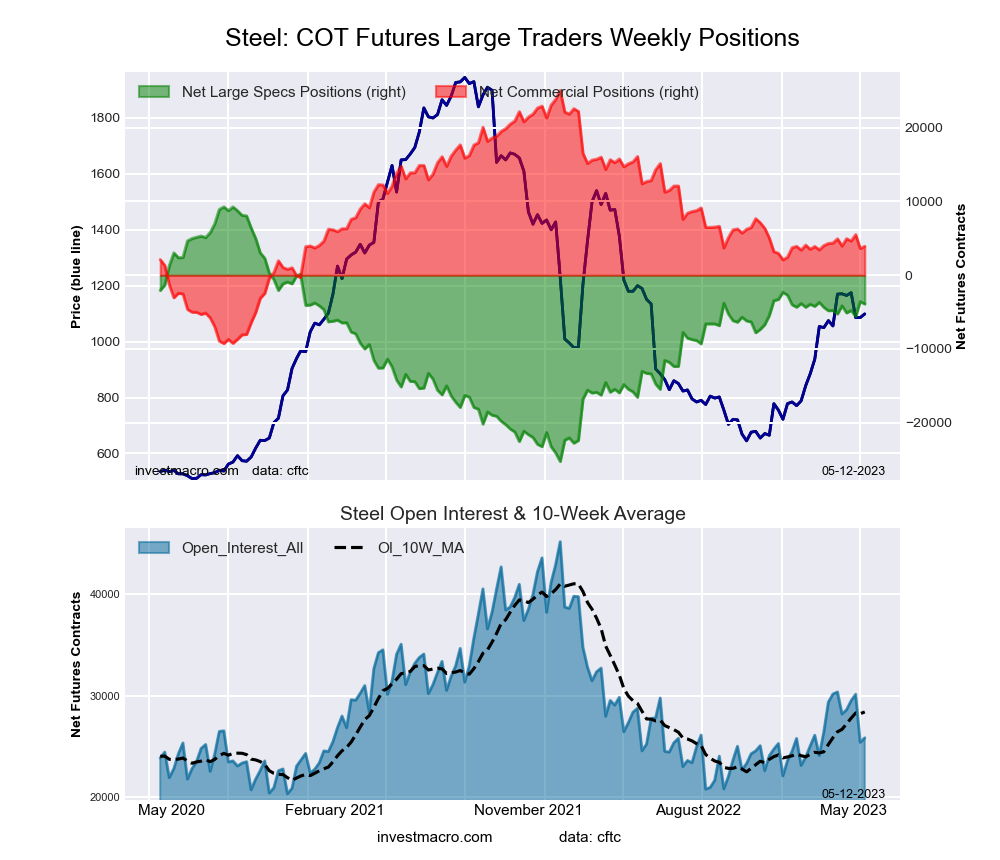
Steel Futures COT ChartThe Steel Futures large speculator standing this week was a net position of -4,138 contracts in the data reported through Tuesday. This was a weekly gain of 1,117 contracts from the previous week which had a total of -5,255 net contracts.

This week’s current strength score (the trader positioning range over the past three years, measured from 0 to 100) shows the speculators are currently Bullish with a score of 61.2 percent. The commercials are Bearish with a score of 38.5 percent and the small traders (not shown in chart) are Bearish with a score of 42.8 percent.

Steel Futures StatisticsSPECULATORSCOMMERCIALSSMALL TRADERS
– Percent of Open Interest Longs:12.575.31.2
– Percent of Open Interest Shorts:27.261.30.5
– Net Position:-4,1383,958180
– Gross Longs:3,53221,243334
– Gross Shorts:7,67017,285154
– Long to Short Ratio:0.5 to 11.2 to 12.2 to 1
NET POSITION TREND:
– Strength Index Score (3 Year Range Pct):61.238.542.8
– Strength Index Reading (3 Year Range):BullishBearishBearish
NET POSITION MOVEMENT INDEX:
– 6-Week Change in Strength Index:0.20.2-18.1


Article By InvestMacroReceive our weekly COT Newsletter

*COT Report: The COT data, released weekly to the public each Friday, is updated through the most recent Tuesday (data is 3 days old) and shows a quick view of how large speculators or non-commercials (for-profit traders) were positioned in the futures markets.

The CFTC categorizes trader positions according to commercial hedgers (traders who use futures contracts for hedging as part of the business), non-commercials (large traders who speculate to realize trading profits) and nonreportable traders (usually small traders/speculators) as well as their open interest (contracts open in the market at time of reporting). See CFTC criteria here.
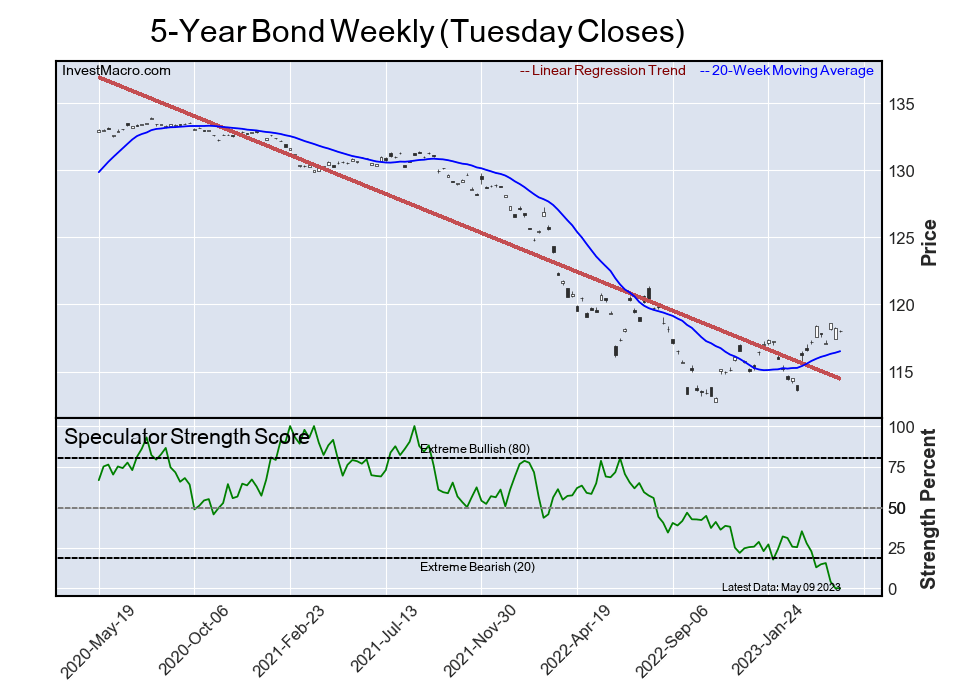
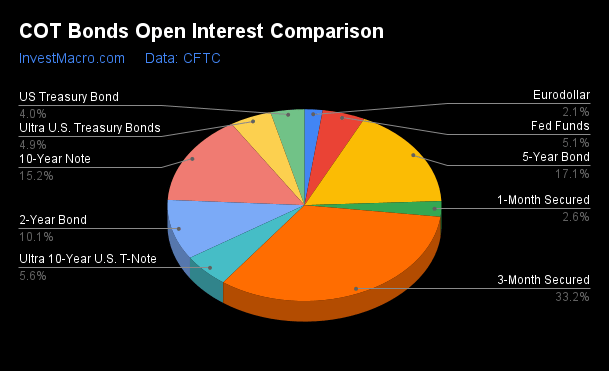
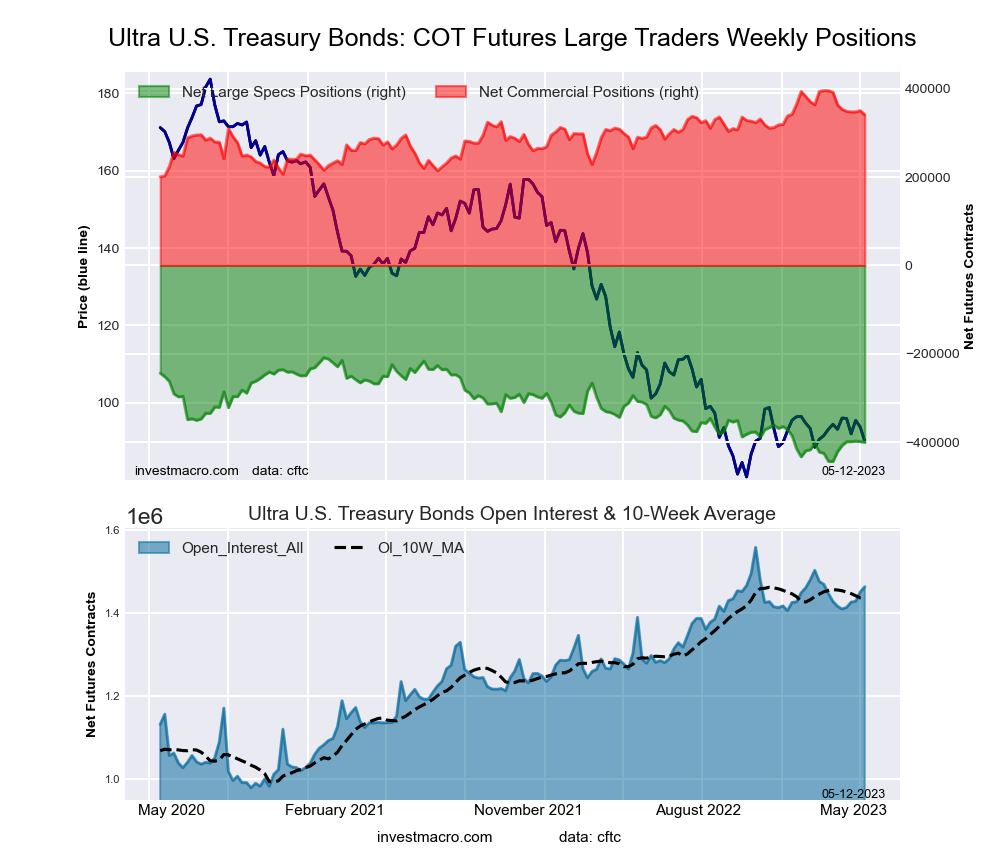
Bond Speculators boost their 5-Year Bond bearish bets to highest level since 2018

By InvestMacro

Here are the latest charts and statistics for the Commitment of Traders (COT) reports data published by the Commodities Futures Trading Commission (CFTC).

The latest COT data is updated through Tuesday April 4th and shows a quick view of how large traders (for-profit speculators and commercial hedgers) were positioned in the futures markets.

Weekly Speculator Changes led by 2-Year Bonds & Fed Funds

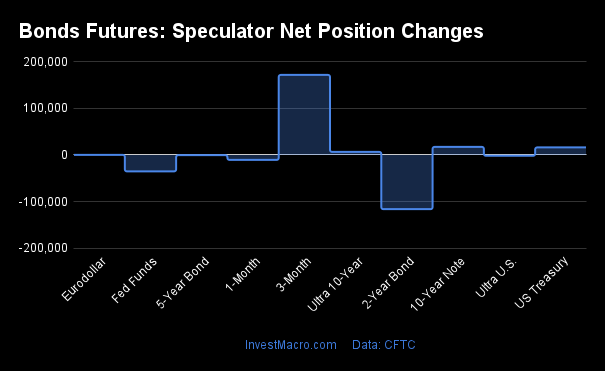
The COT bond market speculator bets were lower this week as three out of the nine bond markets we cover had higher positioning while the other six markets had lower speculator contracts.

Leading the gains for the bond markets was the 2-Year Bonds (23,422 contracts) with the Fed Funds (21,360 contracts) and the Ultra Treasury Bonds (14,018 contracts) also showing positive weeks.

The bond markets with declines in speculator bets for the week were the SOFR 3-Months (-154,078 contracts), the 10-Year Bonds (-149,453 contracts), the 5-Year Bonds (-98,884 contracts), the US Treasury Bonds (-38,247 contracts), the Eurodollar (-17,911 contracts) and the Ultra 10-Year Bonds (-34,673 contracts) also registering lower bets on the week.

Speculators boost their 5-Year Bond bearish bets to highest level since 2018

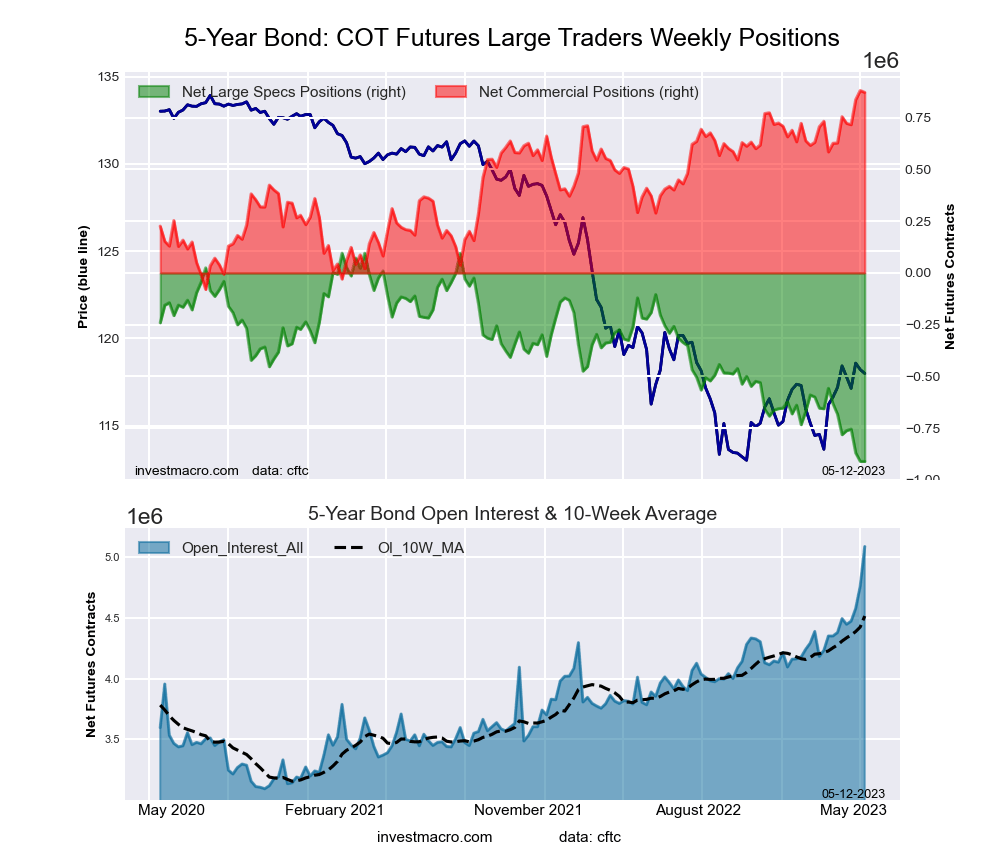
Highlighting the COT bond’s data this week is the renewed bearishness of the speculator positioning in the 5-Year Bonds contracts.

Large speculative positions for the 5-Year Bonds dropped sharply this week by the largest one-week amount of the past 17 weeks. Speculator bets have fallen for three straight weeks and in six out of the past seven weeks.

Prior to the past seven weeks, speculator bets had been improving and saw lessening bearish bets in seven out of the previous nine weeks that had brought the overall bearish level to a total of -589,391 contracts on February 14th. Since then a total of -191,848 contracts have been added back to the overall net bearish position – bringing this week’s total of -781,239 contracts to the most bearish standing since October 16th of 2018, a span dating back 233 weeks. The 5-Year Bond speculator positions have been in a continuous bearish position for the 84 consecutive weeks (since August 31st of 2021).

Despite the speculators bearishness this week, the 5-Year Bond futures price closed the week higher. The front month futures finished the week over the 110.20 level which marks the highest closing price since September and the 5-Year Bond futures have now risen for five out of the past six weeks.


Data Snapshot of Bond Market Traders | Columns Legend
Apr-04-2023OIOI-IndexSpec-NetSpec-IndexCom-NetCOM-IndexSmalls-NetSmalls-Index
Eurodollar4,684,5640-647,31957820,93841-173,61966
FedFunds1,577,22553-147,24021156,92779-9,68772
2-Year2,351,68252-502,05525483,1707518,88565
Long T-Bond1,193,58356-129,6464282,2814047,36584
10-Year4,263,19583-621,0311618,359882,67284
5-Year4,493,575100-781,2390754,9709826,26988


Strength Scores led by SOFR 3-Months & Eurodollar

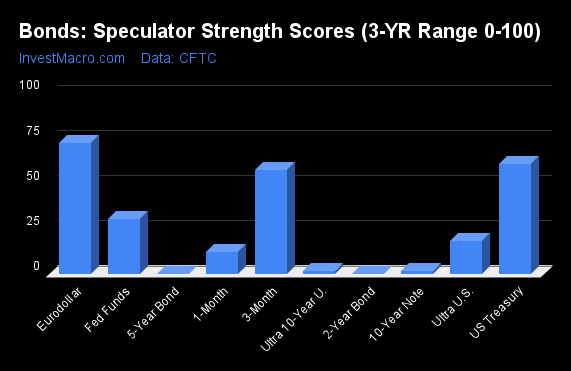
COT Strength Scores (a normalized measure of Speculator positions over a 3-Year range, from 0 to 100 where above 80 is Extreme-Bullish and below 20 is Extreme-Bearish) showed that the SOFR 3-Months (78 percent) and the Eurodollar (57 percent) lead the bond markets this week. The US Treasury Bonds (42 percent) comes in as the next highest in the weekly strength scores.

On the downside, the 5-Year Bonds (0 percent), the 10-Year Bonds (1 percent), the Ultra 10-Year Bonds (3 percent) and the Ultra Treasury Bonds (15 percent) came in at the lowest strength level currently and are in Extreme-Bearish territory (below 20 percent).

Strength Statistics:
Fed Funds (21.4 percent) vs Fed Funds previous week (18.8 percent)
2-Year Bond (24.8 percent) vs 2-Year Bond previous week (21.8 percent)
5-Year Bond (0.0 percent) vs 5-Year Bond previous week (11.3 percent)
10-Year Bond (0.9 percent) vs 10-Year Bond previous week (19.3 percent)
Ultra 10-Year Bond (3.4 percent) vs Ultra 10-Year Bond previous week (10.6 percent)
US Treasury Bond (42.4 percent) vs US Treasury Bond previous week (54.8 percent)
Ultra US Treasury Bond (15.4 percent) vs Ultra US Treasury Bond previous week (9.4 percent)
Eurodollar (57.4 percent) vs Eurodollar previous week (57.9 percent)
SOFR 3-Months (78.2 percent) vs SOFR 3-Months previous week (90.7 percent)


SOFR 3-Months & 2-Year Bonds top the 6-Week Strength Trends

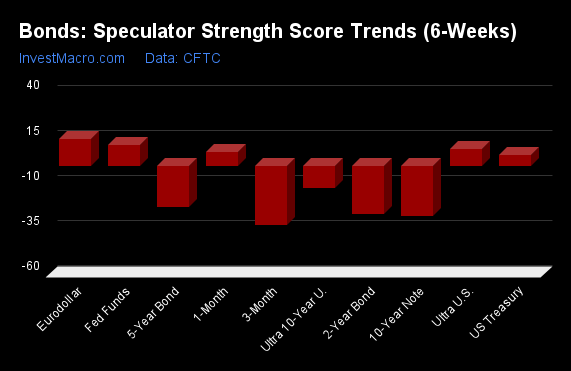
COT Strength Score Trends (or move index, calculates the 6-week changes in strength scores) showed that the SOFR 3-Months (44 percent) and the 2-Year Bonds (24 percent) lead the past six weeks trends for bonds.

The 10-Year Bonds (-15 percent) leads the downside trend scores currently with the Ultra 10-Year Bonds (-10 percent) and the Fed Funds (-7 percent) following next with lower trend scores.

Strength Trend Statistics:
Fed Funds (-7.1 percent) vs Fed Funds previous week (-6.9 percent)
2-Year Bond (24.4 percent) vs 2-Year Bond previous week (21.8 percent)
5-Year Bond (-20.8 percent) vs 5-Year Bond previous week (-10.6 percent)
10-Year Bond (-14.9 percent) vs 10-Year Bond previous week (11.3 percent)
Ultra 10-Year Bond (-9.8 percent) vs Ultra 10-Year Bond previous week (-6.4 percent)
US Treasury Bond (8.2 percent) vs US Treasury Bond previous week (30.5 percent)
Ultra US Treasury Bond (-1.9 percent) vs Ultra US Treasury Bond previous week (-1.9 percent)
Eurodollar (9.3 percent) vs Eurodollar previous week (10.3 percent)
SOFR 3-Months (43.9 percent) vs SOFR 3-Months previous week (40.2 percent)


Individual Bond Markets:

3-Month Eurodollars Futures:

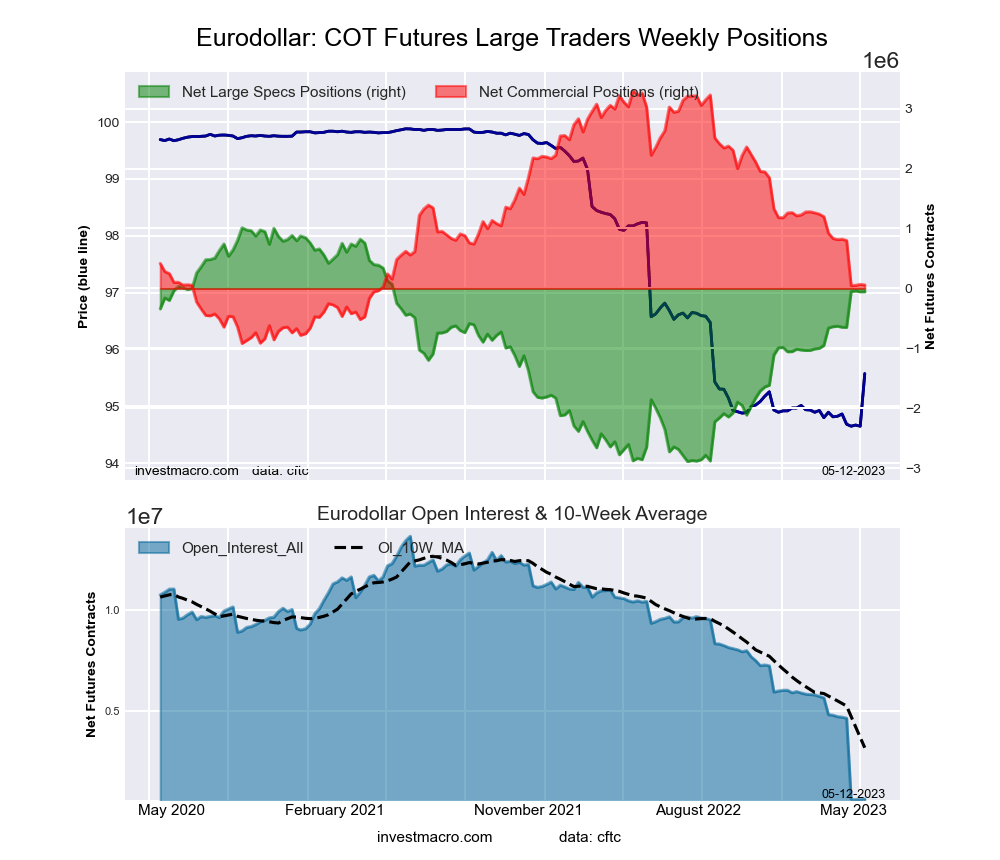
Eurodollar Bonds Futures COT ChartThe 3-Month Eurodollars large speculator standing this week resulted in a net position of -647,319 contracts in the data reported through Tuesday. This was a weekly decrease of -17,911 contracts from the previous week which had a total of -629,408 net contracts.

This week’s current strength score (the trader positioning range over the past three years, measured from 0 to 100) shows the speculators are currently Bullish with a score of 57.4 percent. The commercials are Bearish with a score of 41.2 percent and the small traders (not shown in chart) are Bullish with a score of 66.3 percent.

3-Month Eurodollars StatisticsSPECULATORSCOMMERCIALSSMALL TRADERS
– Percent of Open Interest Longs:5.967.65.1
– Percent of Open Interest Shorts:19.750.18.8
– Net Position:-647,319820,938-173,619
– Gross Longs:275,7243,168,706237,406
– Gross Shorts:923,0432,347,768411,025
– Long to Short Ratio:0.3 to 11.3 to 10.6 to 1
NET POSITION TREND:
– Strength Index Score (3 Year Range Pct):57.441.266.3
– Strength Index Reading (3 Year Range):BullishBearishBullish
NET POSITION MOVEMENT INDEX:
– 6-Week Change in Strength Index:9.3-10.417.3


Secured Overnight Financing Rate (3-Month) Futures:

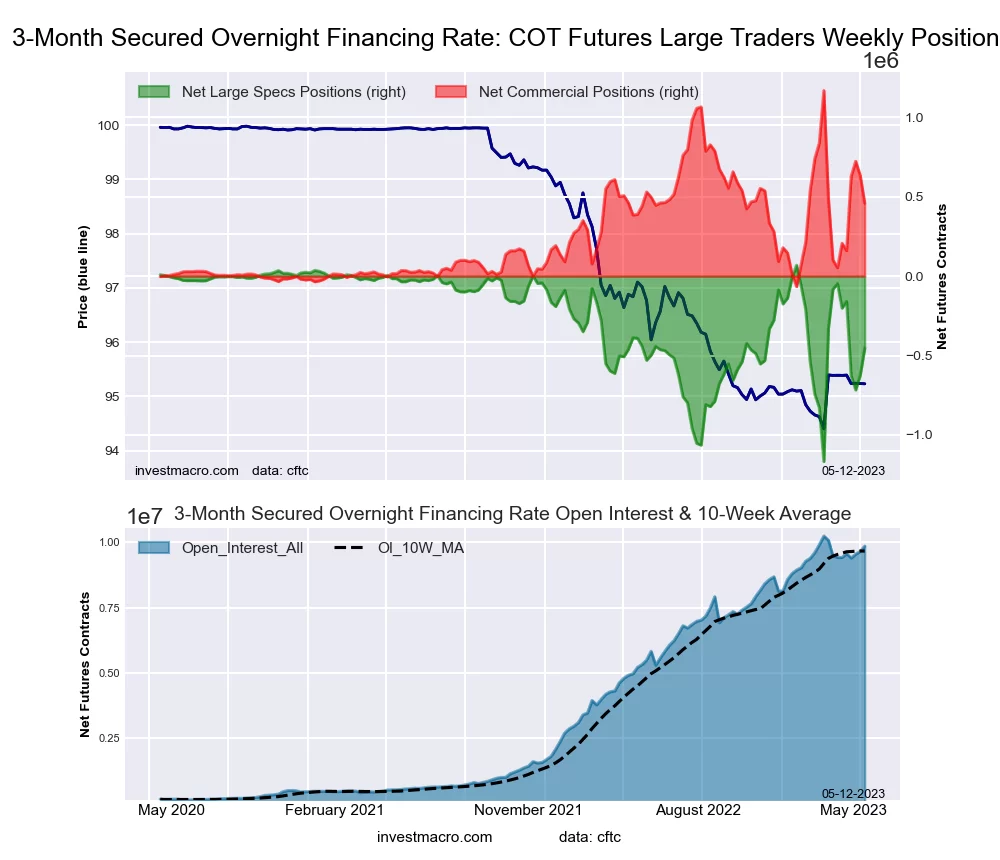
SOFR 3-Months Bonds Futures COT ChartThe Secured Overnight Financing Rate (3-Month) large speculator standing this week resulted in a net position of -201,277 contracts in the data reported through Tuesday. This was a weekly decline of -154,078 contracts from the previous week which had a total of -47,199 net contracts.

This week’s current strength score (the trader positioning range over the past three years, measured from 0 to 100) shows the speculators are currently Bullish with a score of 78.2 percent. The commercials are Bearish with a score of 22.1 percent and the small traders (not shown in chart) are Bullish-Extreme with a score of 85.2 percent.

SOFR 3-Months StatisticsSPECULATORSCOMMERCIALSSMALL TRADERS
– Percent of Open Interest Longs:20.157.90.9
– Percent of Open Interest Shorts:22.255.70.9
– Net Position:-201,277206,206-4,929
– Gross Longs:1,887,9735,451,41780,647
– Gross Shorts:2,089,2505,245,21185,576
– Long to Short Ratio:0.9 to 11.0 to 10.9 to 1
NET POSITION TREND:
– Strength Index Score (3 Year Range Pct):78.222.185.2
– Strength Index Reading (3 Year Range):BullishBearishBullish-Extreme
NET POSITION MOVEMENT INDEX:
– 6-Week Change in Strength Index:43.9-43.1-5.6


30-Day Federal Funds Futures:

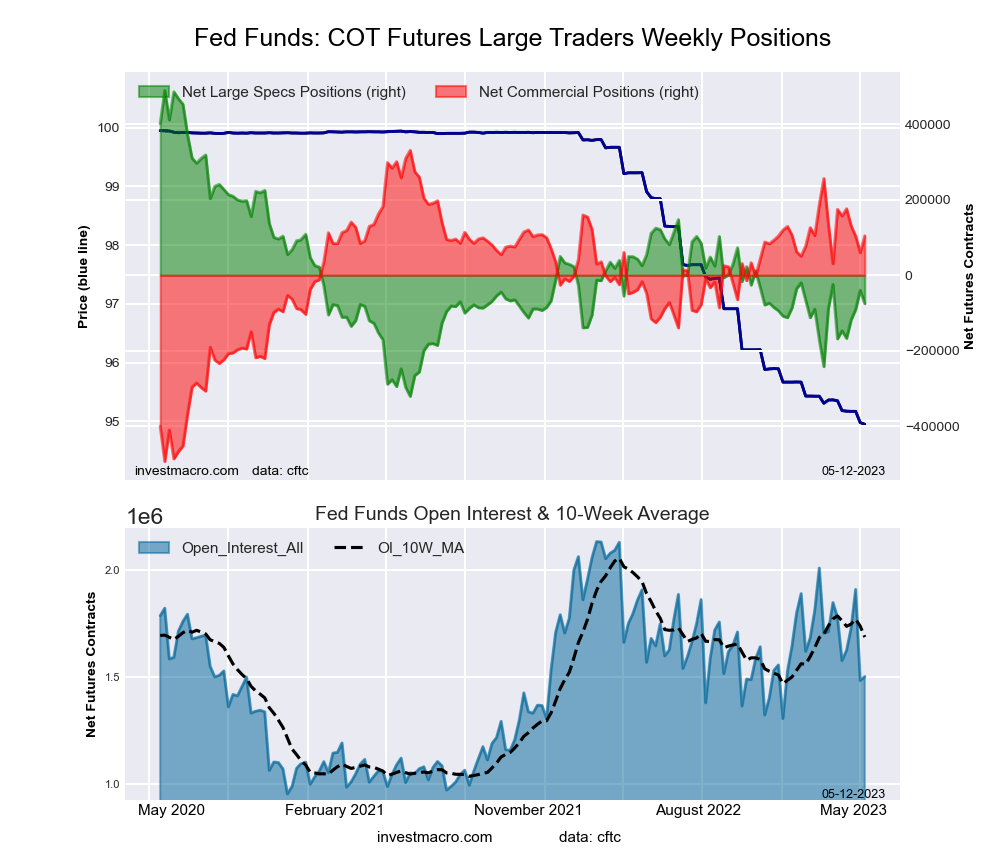
Federal Funds 30-Day Bonds Futures COT ChartThe 30-Day Federal Funds large speculator standing this week resulted in a net position of -147,240 contracts in the data reported through Tuesday. This was a weekly lift of 21,360 contracts from the previous week which had a total of -168,600 net contracts.

This week’s current strength score (the trader positioning range over the past three years, measured from 0 to 100) shows the speculators are currently Bearish with a score of 21.4 percent. The commercials are Bullish with a score of 78.9 percent and the small traders (not shown in chart) are Bullish with a score of 72.0 percent.

30-Day Federal Funds StatisticsSPECULATORSCOMMERCIALSSMALL TRADERS
– Percent of Open Interest Longs:2.281.52.5
– Percent of Open Interest Shorts:11.671.63.1
– Net Position:-147,240156,927-9,687
– Gross Longs:35,2041,285,51338,653
– Gross Shorts:182,4441,128,58648,340
– Long to Short Ratio:0.2 to 11.1 to 10.8 to 1
NET POSITION TREND:
– Strength Index Score (3 Year Range Pct):21.478.972.0
– Strength Index Reading (3 Year Range):BearishBullishBullish
NET POSITION MOVEMENT INDEX:
– 6-Week Change in Strength Index:-7.16.310.3


2-Year Treasury Note Futures:

2-Year Treasury Bonds Futures COT ChartThe 2-Year Treasury Note large speculator standing this week resulted in a net position of -502,055 contracts in the data reported through Tuesday. This was a weekly boost of 23,422 contracts from the previous week which had a total of -525,477 net contracts.

This week’s current strength score (the trader positioning range over the past three years, measured from 0 to 100) shows the speculators are currently Bearish with a score of 24.8 percent. The commercials are Bullish with a score of 75.3 percent and the small traders (not shown in chart) are Bullish with a score of 64.9 percent.

2-Year Treasury Note StatisticsSPECULATORSCOMMERCIALSSMALL TRADERS
– Percent of Open Interest Longs:5.684.88.3
– Percent of Open Interest Shorts:26.964.37.5
– Net Position:-502,055483,17018,885
– Gross Longs:131,3691,994,892194,214
– Gross Shorts:633,4241,511,722175,329
– Long to Short Ratio:0.2 to 11.3 to 11.1 to 1
NET POSITION TREND:
– Strength Index Score (3 Year Range Pct):24.875.364.9
– Strength Index Reading (3 Year Range):BearishBullishBullish
NET POSITION MOVEMENT INDEX:
– 6-Week Change in Strength Index:24.4-24.7-8.4


5-Year Treasury Note Futures:

5-Year Treasury Bonds Futures COT ChartThe 5-Year Treasury Note large speculator standing this week resulted in a net position of -781,239 contracts in the data reported through Tuesday. This was a weekly decrease of -98,884 contracts from the previous week which had a total of -682,355 net contracts.

This week’s current strength score (the trader positioning range over the past three years, measured from 0 to 100) shows the speculators are currently Bearish-Extreme with a score of 0.0 percent. The commercials are Bullish-Extreme with a score of 97.8 percent and the small traders (not shown in chart) are Bullish-Extreme with a score of 88.2 percent.

5-Year Treasury Note StatisticsSPECULATORSCOMMERCIALSSMALL TRADERS
– Percent of Open Interest Longs:6.284.48.2
– Percent of Open Interest Shorts:23.567.67.6
– Net Position:-781,239754,97026,269
– Gross Longs:276,4323,791,191366,353
– Gross Shorts:1,057,6713,036,221340,084
– Long to Short Ratio:0.3 to 11.2 to 11.1 to 1
NET POSITION TREND:
– Strength Index Score (3 Year Range Pct):0.097.888.2
– Strength Index Reading (3 Year Range):Bearish-ExtremeBullish-ExtremeBullish-Extreme
NET POSITION MOVEMENT INDEX:
– 6-Week Change in Strength Index:-20.814.516.0


10-Year Treasury Note Futures:

10-Year Treasury Notes Bonds Futures COT ChartThe 10-Year Treasury Note large speculator standing this week resulted in a net position of -621,031 contracts in the data reported through Tuesday. This was a weekly decline of -149,453 contracts from the previous week which had a total of -471,578 net contracts.

This week’s current strength score (the trader positioning range over the past three years, measured from 0 to 100) shows the speculators are currently Bearish-Extreme with a score of 0.9 percent. The commercials are Bullish-Extreme with a score of 87.9 percent and the small traders (not shown in chart) are Bullish-Extreme with a score of 84.0 percent.

10-Year Treasury Note StatisticsSPECULATORSCOMMERCIALSSMALL TRADERS
– Percent of Open Interest Longs:8.680.78.8
– Percent of Open Interest Shorts:23.266.28.7
– Net Position:-621,031618,3592,672
– Gross Longs:366,7933,440,398374,033
– Gross Shorts:987,8242,822,039371,361
– Long to Short Ratio:0.4 to 11.2 to 11.0 to 1
NET POSITION TREND:
– Strength Index Score (3 Year Range Pct):0.987.984.0
– Strength Index Reading (3 Year Range):Bearish-ExtremeBullish-ExtremeBullish-Extreme
NET POSITION MOVEMENT INDEX:
– 6-Week Change in Strength Index:-14.93.122.8


Ultra 10-Year Notes Futures:

Ultra 10-Year Treasury Notes Bonds Futures COT ChartThe Ultra 10-Year Notes large speculator standing this week resulted in a net position of -186,477 contracts in the data reported through Tuesday. This was a weekly decline of -34,673 contracts from the previous week which had a total of -151,804 net contracts.

This week’s current strength score (the trader positioning range over the past three years, measured from 0 to 100) shows the speculators are currently Bearish-Extreme with a score of 3.4 percent. The commercials are Bullish-Extreme with a score of 94.0 percent and the small traders (not shown in chart) are Bullish with a score of 58.9 percent.

Ultra 10-Year Notes StatisticsSPECULATORSCOMMERCIALSSMALL TRADERS
– Percent of Open Interest Longs:7.880.310.8
– Percent of Open Interest Shorts:19.662.616.7
– Net Position:-186,477279,297-92,820
– Gross Longs:122,7711,268,053171,348
– Gross Shorts:309,248988,756264,168
– Long to Short Ratio:0.4 to 11.3 to 10.6 to 1
NET POSITION TREND:
– Strength Index Score (3 Year Range Pct):3.494.058.9
– Strength Index Reading (3 Year Range):Bearish-ExtremeBullish-ExtremeBullish
NET POSITION MOVEMENT INDEX:
– 6-Week Change in Strength Index:-9.813.4-9.3


US Treasury Bonds Futures:

US Year Treasury Notes Long Bonds Futures COT ChartThe US Treasury Bonds large speculator standing this week resulted in a net position of -129,646 contracts in the data reported through Tuesday. This was a weekly reduction of -38,247 contracts from the previous week which had a total of -91,399 net contracts.

This week’s current strength score (the trader positioning range over the past three years, measured from 0 to 100) shows the speculators are currently Bearish with a score of 42.4 percent. The commercials are Bearish with a score of 39.9 percent and the small traders (not shown in chart) are Bullish-Extreme with a score of 83.6 percent.

US Treasury Bonds StatisticsSPECULATORSCOMMERCIALSSMALL TRADERS
– Percent of Open Interest Longs:6.679.113.9
– Percent of Open Interest Shorts:17.472.39.9
– Net Position:-129,64682,28147,365
– Gross Longs:78,208944,657165,747
– Gross Shorts:207,854862,376118,382
– Long to Short Ratio:0.4 to 11.1 to 11.4 to 1
NET POSITION TREND:
– Strength Index Score (3 Year Range Pct):42.439.983.6
– Strength Index Reading (3 Year Range):BearishBearishBullish-Extreme
NET POSITION MOVEMENT INDEX:
– 6-Week Change in Strength Index:8.2-15.313.1


Ultra US Treasury Bonds Futures:

Ultra US Year Treasury Notes Long Bonds Futures COT ChartThe Ultra US Treasury Bonds large speculator standing this week resulted in a net position of -407,758 contracts in the data reported through Tuesday. This was a weekly increase of 14,018 contracts from the previous week which had a total of -421,776 net contracts.

This week’s current strength score (the trader positioning range over the past three years, measured from 0 to 100) shows the speculators are currently Bearish-Extreme with a score of 15.4 percent. The commercials are Bullish with a score of 79.4 percent and the small traders (not shown in chart) are Bullish-Extreme with a score of 94.2 percent.

Ultra US Treasury Bonds StatisticsSPECULATORSCOMMERCIALSSMALL TRADERS
– Percent of Open Interest Longs:5.183.111.7
– Percent of Open Interest Shorts:34.058.17.8
– Net Position:-407,758353,31354,445
– Gross Longs:71,9161,171,667164,167
– Gross Shorts:479,674818,354109,722
– Long to Short Ratio:0.1 to 11.4 to 11.5 to 1
NET POSITION TREND:
– Strength Index Score (3 Year Range Pct):15.479.494.2
– Strength Index Reading (3 Year Range):Bearish-ExtremeBullishBullish-Extreme
NET POSITION MOVEMENT INDEX:
– 6-Week Change in Strength Index:-1.9-5.115.1


Article By InvestMacroReceive our weekly COT Newsletter

*COT Report: The COT data, released weekly to the public each Friday, is updated through the most recent Tuesday (data is 3 days old) and shows a quick view of how large speculators or non-commercials (for-profit traders) were positioned in the futures markets.

The CFTC categorizes trader positions according to commercial hedgers (traders who use futures contracts for hedging as part of the business), non-commercials (large traders who speculate to realize trading profits) and nonreportable traders (usually small traders/speculators) as well as their open interest (contracts open in the market at time of reporting). See CFTC criteria here.
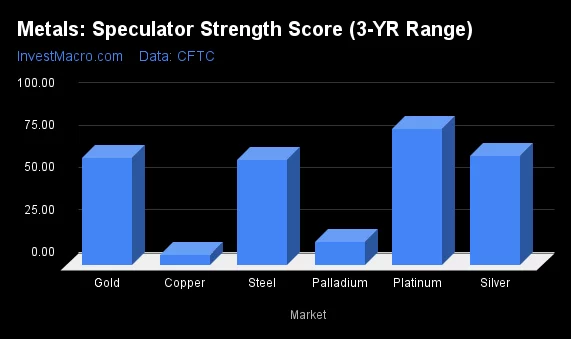
Sugar Speculator bets rise higher as Futures prices hit highest level since 2016

By InvestMacro

Here are the latest charts and statistics for the Commitment of Traders (COT) reports data published by the Commodities Futures Trading Commission (CFTC).

The latest COT data is updated through Tuesday April 4th and shows a quick view of how large traders (for-profit speculators and commercial entities) were positioned in the futures markets.

Weekly Speculator Changes led by Sugar & Soybeans

The COT soft commodities markets speculator bets were a little higher this week as six out of the eleven softs markets we cover had higher positioning while the other five markets had lower speculator contracts.

Leading the gains for the softs markets was Sugar (23,822 contracts) with Soybeans (23,325 contracts), Live Cattle (21,476 contracts), Corn (14,162 contracts), Lean Hogs (2,214 contracts) and Cotton (3,378 contracts) also showing positive weeks.

The markets with the declines in speculator bets this week were Coffee (-4,103 contracts) with Soybean Meal (-1,439 contracts), Cocoa (-1,028 contracts), Soybean Oil (-1,717 contracts) and Wheat (-254 contracts) also registering lower bets on the week.

Sugar Speculator bets rise higher as Futures prices hit highest level since 2016

Highlighting the COT soft commodities data this week is the gains in the Sugar speculator’s bullish positioning. The large speculator bets for Sugar rose this week by over +23,000 contracts and have gained for two straight weeks as well as for three out of the past five weeks. The bullish sentiment has pushed the Sugar net speculator positions to their highest level in nine weeks and are currently also at the second highest level since November of 2021 with a current net position of +246,651 contracts.

Sugar’s speculator strength score level has been on the rise with a current score of 79 percent (out of a 3-year range on a 0-100 percent scale) while its 6-week strength score trend has increased by 5 percent.

The Sugar futures price has been in a strong bullish trend, climbing for a third consecutive week and closing out the week higher by over 8 percent. This week’s front month futures price reached above $23.00 which is the highest prices have touched since 2016. Overall, Sugar prices are up by approximately 25 percent since the start of the year.


Data Snapshot of Commodity Market Traders | Columns Legend
Apr-04-2023OIOI-IndexSpec-NetSpec-IndexCom-NetCOM-IndexSmalls-NetSmalls-Index
WTI Crude1,858,44641226,12717-239,9708613,84322
Gold476,59225195,21663-218,2504023,03438
Silver131,2101621,28349-31,4355610,15223
Copper218,68757-2,95426-4,897697,85168
Palladium11,82082-6,64647,01197-36520
Platinum59,1563815,42351-19,201543,77819
Natural Gas1,365,65681-130,48520100,7378029,74851
Brent146,92511-38,5403033,701674,83975
Heating Oil270,347244,85635-22,6076517,75160
Soybeans746,11137184,34562-163,26740-21,07837
Corn1,334,6711985,69041-53,31464-32,37640
Coffee201,4251312,64840-13,1196347118
Sugar1,005,89272246,65179-304,0191657,36879
Wheat375,99952-60,7991054,864855,935100


Strength Scores led by Cocoa & Sugar

COT Strength Scores (a normalized measure of Speculator positions over a 3-Year range, from 0 to 100 where above 80 is Extreme-Bullish and below 20 is Extreme-Bearish) showed that Cocoa (99 percent) and Sugar (79 percent) lead the softs markets this week. Live Cattle (75 percent), Soybean Meal (67 percent) and Soybeans (62 percent) come in as the next highest in the weekly strength scores.

On the downside, Soybean Oil (0 percent), Lean Hogs (2 percent), Cotton (4 percent) and Wheat (10 percent) come in at the lowest strength levels currently and are in Extreme-Bearish territory (below 20 percent).

Strength Statistics:
Corn (41.0 percent) vs Corn previous week (39.2 percent)
Sugar (78.7 percent) vs Sugar previous week (70.5 percent)
Coffee (40.4 percent) vs Coffee previous week (44.6 percent)
Soybeans (61.6 percent) vs Soybeans previous week (52.4 percent)
Soybean Oil (0.0 percent) vs Soybean Oil previous week (1.1 percent)
Soybean Meal (66.7 percent) vs Soybean Meal previous week (67.4 percent)
Live Cattle (74.7 percent) vs Live Cattle previous week (50.6 percent)
Lean Hogs (2.1 percent) vs Lean Hogs previous week (0.0 percent)
Cotton (3.6 percent) vs Cotton previous week (1.1 percent)
Cocoa (98.7 percent) vs Cocoa previous week (100.0 percent)
Wheat (10.4 percent) vs Wheat previous week (10.6 percent)


Cocoa & Sugar top the 6-Week Strength Trends

COT Strength Score Trends (or move index, calculates the 6-week changes in strength scores) showed that Cocoa (18 percent) and Sugar (5 percent) lead the past six weeks trends for soft commodities. Coffee (0.3 percent) is the next highest positive mover in the latest trends data.

Soybean Meal (-33 percent) leads the downside trend scores currently with Soybean Oil (-30 percent), Corn (-25 percent) and Lean Hogs (-20 percent) following next with lower trend scores.

Strength Trend Statistics:
Corn (-25.2 percent) vs Corn previous week (-29.8 percent)
Sugar (4.6 percent) vs Sugar previous week (-5.5 percent)
Coffee (0.3 percent) vs Coffee previous week (12.0 percent)
Soybeans (-3.5 percent) vs Soybeans previous week (-12.1 percent)
Soybean Oil (-30.3 percent) vs Soybean Oil previous week (-24.4 percent)
Soybean Meal (-32.8 percent) vs Soybean Meal previous week (-30.1 percent)
Live Cattle (-20.3 percent) vs Live Cattle previous week (-40.5 percent)
Lean Hogs (-20.0 percent) vs Lean Hogs previous week (-15.0 percent)
Cotton (-2.8 percent) vs Cotton previous week (-16.0 percent)
Cocoa (18.1 percent) vs Cocoa previous week (41.4 percent)
Wheat (-11.1 percent) vs Wheat previous week (-22.0 percent)


Individual Soft Commodities Markets:

CORN Futures:

CORN Futures COT ChartThe CORN large speculator standing this week resulted in a net position of 85,690 contracts in the data reported through Tuesday. This was a weekly increase of 14,162 contracts from the previous week which had a total of 71,528 net contracts.

This week’s current strength score (the trader positioning range over the past three years, measured from 0 to 100) shows the speculators are currently Bearish with a score of 41.0 percent. The commercials are Bullish with a score of 64.3 percent and the small traders (not shown in chart) are Bearish with a score of 40.0 percent.

CORN Futures StatisticsSPECULATORSCOMMERCIALSSMALL TRADERS
– Percent of Open Interest Longs:23.248.310.0
– Percent of Open Interest Shorts:16.852.312.5
– Net Position:85,690-53,314-32,376
– Gross Longs:310,288644,140134,134
– Gross Shorts:224,598697,454166,510
– Long to Short Ratio:1.4 to 10.9 to 10.8 to 1
NET POSITION TREND:
– Strength Index Score (3 Year Range Pct):41.064.340.0
– Strength Index Reading (3 Year Range):BearishBullishBearish
NET POSITION MOVEMENT INDEX:
– 6-Week Change in Strength Index:-25.222.233.7


SUGAR Futures:

SUGAR Futures COT ChartThe SUGAR large speculator standing this week resulted in a net position of 246,651 contracts in the data reported through Tuesday. This was a weekly boost of 23,822 contracts from the previous week which had a total of 222,829 net contracts.

This week’s current strength score (the trader positioning range over the past three years, measured from 0 to 100) shows the speculators are currently Bullish with a score of 78.7 percent. The commercials are Bearish-Extreme with a score of 15.9 percent and the small traders (not shown in chart) are Bullish with a score of 78.8 percent.

SUGAR Futures StatisticsSPECULATORSCOMMERCIALSSMALL TRADERS
– Percent of Open Interest Longs:32.638.610.7
– Percent of Open Interest Shorts:8.168.95.0
– Net Position:246,651-304,01957,368
– Gross Longs:328,123388,632107,776
– Gross Shorts:81,472692,65150,408
– Long to Short Ratio:4.0 to 10.6 to 12.1 to 1
NET POSITION TREND:
– Strength Index Score (3 Year Range Pct):78.715.978.8
– Strength Index Reading (3 Year Range):BullishBearish-ExtremeBullish
NET POSITION MOVEMENT INDEX:
– 6-Week Change in Strength Index:4.6-7.516.0


COFFEE Futures:

COFFEE Futures COT ChartThe COFFEE large speculator standing this week resulted in a net position of 12,648 contracts in the data reported through Tuesday. This was a weekly lowering of -4,103 contracts from the previous week which had a total of 16,751 net contracts.

This week’s current strength score (the trader positioning range over the past three years, measured from 0 to 100) shows the speculators are currently Bearish with a score of 40.4 percent. The commercials are Bullish with a score of 62.8 percent and the small traders (not shown in chart) are Bearish-Extreme with a score of 18.3 percent.

COFFEE Futures StatisticsSPECULATORSCOMMERCIALSSMALL TRADERS
– Percent of Open Interest Longs:18.949.24.5
– Percent of Open Interest Shorts:12.655.74.2
– Net Position:12,648-13,119471
– Gross Longs:37,98599,1749,019
– Gross Shorts:25,337112,2938,548
– Long to Short Ratio:1.5 to 10.9 to 11.1 to 1
NET POSITION TREND:
– Strength Index Score (3 Year Range Pct):40.462.818.3
– Strength Index Reading (3 Year Range):BearishBullishBearish-Extreme
NET POSITION MOVEMENT INDEX:
– 6-Week Change in Strength Index:0.31.1-17.1


SOYBEANS Futures:

SOYBEANS Futures COT ChartThe SOYBEANS large speculator standing this week resulted in a net position of 184,345 contracts in the data reported through Tuesday. This was a weekly increase of 23,325 contracts from the previous week which had a total of 161,020 net contracts.

This week’s current strength score (the trader positioning range over the past three years, measured from 0 to 100) shows the speculators are currently Bullish with a score of 61.6 percent. The commercials are Bearish with a score of 40.3 percent and the small traders (not shown in chart) are Bearish with a score of 36.7 percent.

SOYBEANS Futures StatisticsSPECULATORSCOMMERCIALSSMALL TRADERS
– Percent of Open Interest Longs:28.843.17.6
– Percent of Open Interest Shorts:4.165.010.5
– Net Position:184,345-163,267-21,078
– Gross Longs:214,749321,61257,051
– Gross Shorts:30,404484,87978,129
– Long to Short Ratio:7.1 to 10.7 to 10.7 to 1
NET POSITION TREND:
– Strength Index Score (3 Year Range Pct):61.640.336.7
– Strength Index Reading (3 Year Range):BullishBearishBearish
NET POSITION MOVEMENT INDEX:
– 6-Week Change in Strength Index:-3.5-4.536.7


SOYBEAN OIL Futures:

SOYBEAN OIL Futures COT ChartThe SOYBEAN OIL large speculator standing this week resulted in a net position of -9,325 contracts in the data reported through Tuesday. This was a weekly reduction of -1,717 contracts from the previous week which had a total of -7,608 net contracts.

This week’s current strength score (the trader positioning range over the past three years, measured from 0 to 100) shows the speculators are currently Bearish-Extreme with a score of 0.0 percent. The commercials are Bullish-Extreme with a score of 100.0 percent and the small traders (not shown in chart) are Bearish-Extreme with a score of 0.0 percent.

SOYBEAN OIL Futures StatisticsSPECULATORSCOMMERCIALSSMALL TRADERS
– Percent of Open Interest Longs:14.058.86.1
– Percent of Open Interest Shorts:15.956.56.5
– Net Position:-9,32511,432-2,107
– Gross Longs:67,755284,78129,453
– Gross Shorts:77,080273,34931,560
– Long to Short Ratio:0.9 to 11.0 to 10.9 to 1
NET POSITION TREND:
– Strength Index Score (3 Year Range Pct):0.0100.00.0
– Strength Index Reading (3 Year Range):Bearish-ExtremeBullish-ExtremeBearish-Extreme
NET POSITION MOVEMENT INDEX:
– 6-Week Change in Strength Index:-30.334.1-50.2


SOYBEAN MEAL Futures:

SOYBEAN MEAL Futures COT ChartThe SOYBEAN MEAL large speculator standing this week resulted in a net position of 113,102 contracts in the data reported through Tuesday. This was a weekly decline of -1,439 contracts from the previous week which had a total of 114,541 net contracts.

This week’s current strength score (the trader positioning range over the past three years, measured from 0 to 100) shows the speculators are currently Bullish with a score of 66.7 percent. The commercials are Bearish with a score of 34.3 percent and the small traders (not shown in chart) are Bearish with a score of 27.1 percent.

SOYBEAN MEAL Futures StatisticsSPECULATORSCOMMERCIALSSMALL TRADERS
– Percent of Open Interest Longs:31.138.410.9
– Percent of Open Interest Shorts:5.268.36.8
– Net Position:113,102-130,79617,694
– Gross Longs:135,891167,54947,471
– Gross Shorts:22,789298,34529,777
– Long to Short Ratio:6.0 to 10.6 to 11.6 to 1
NET POSITION TREND:
– Strength Index Score (3 Year Range Pct):66.734.327.1
– Strength Index Reading (3 Year Range):BullishBearishBearish
NET POSITION MOVEMENT INDEX:
– 6-Week Change in Strength Index:-32.832.09.7


LIVE CATTLE Futures:

LIVE CATTLE Futures COT ChartThe LIVE CATTLE large speculator standing this week resulted in a net position of 86,174 contracts in the data reported through Tuesday. This was a weekly gain of 21,476 contracts from the previous week which had a total of 64,698 net contracts.

This week’s current strength score (the trader positioning range over the past three years, measured from 0 to 100) shows the speculators are currently Bullish with a score of 74.7 percent. The commercials are Bearish with a score of 26.4 percent and the small traders (not shown in chart) are Bearish with a score of 44.9 percent.

LIVE CATTLE Futures StatisticsSPECULATORSCOMMERCIALSSMALL TRADERS
– Percent of Open Interest Longs:42.527.110.5
– Percent of Open Interest Shorts:16.350.812.9
– Net Position:86,174-78,189-7,985
– Gross Longs:139,99489,21834,675
– Gross Shorts:53,820167,40742,660
– Long to Short Ratio:2.6 to 10.5 to 10.8 to 1
NET POSITION TREND:
– Strength Index Score (3 Year Range Pct):74.726.444.9
– Strength Index Reading (3 Year Range):BullishBearishBearish
NET POSITION MOVEMENT INDEX:
– 6-Week Change in Strength Index:-20.320.66.1


LEAN HOGS Futures:

LEAN HOGS Futures COT ChartThe LEAN HOGS large speculator standing this week resulted in a net position of -19,789 contracts in the data reported through Tuesday. This was a weekly gain of 2,214 contracts from the previous week which had a total of -22,003 net contracts.

This week’s current strength score (the trader positioning range over the past three years, measured from 0 to 100) shows the speculators are currently Bearish-Extreme with a score of 2.1 percent. The commercials are Bullish-Extreme with a score of 97.5 percent and the small traders (not shown in chart) are Bullish-Extreme with a score of 99.0 percent.

LEAN HOGS Futures StatisticsSPECULATORSCOMMERCIALSSMALL TRADERS
– Percent of Open Interest Longs:30.036.111.7
– Percent of Open Interest Shorts:38.927.411.6
– Net Position:-19,78919,479310
– Gross Longs:67,17380,67526,223
– Gross Shorts:86,96261,19625,913
– Long to Short Ratio:0.8 to 11.3 to 11.0 to 1
NET POSITION TREND:
– Strength Index Score (3 Year Range Pct):2.197.599.0
– Strength Index Reading (3 Year Range):Bearish-ExtremeBullish-ExtremeBullish-Extreme
NET POSITION MOVEMENT INDEX:
– 6-Week Change in Strength Index:-20.016.525.0


COTTON Futures:

COTTON Futures COT ChartThe COTTON large speculator standing this week resulted in a net position of -6,743 contracts in the data reported through Tuesday. This was a weekly increase of 3,378 contracts from the previous week which had a total of -10,121 net contracts.

This week’s current strength score (the trader positioning range over the past three years, measured from 0 to 100) shows the speculators are currently Bearish-Extreme with a score of 3.6 percent. The commercials are Bullish-Extreme with a score of 95.8 percent and the small traders (not shown in chart) are Bearish-Extreme with a score of 8.2 percent.

COTTON Futures StatisticsSPECULATORSCOMMERCIALSSMALL TRADERS
– Percent of Open Interest Longs:25.649.15.9
– Percent of Open Interest Shorts:29.045.06.6
– Net Position:-6,7438,030-1,287
– Gross Longs:49,55495,21011,458
– Gross Shorts:56,29787,18012,745
– Long to Short Ratio:0.9 to 11.1 to 10.9 to 1
NET POSITION TREND:
– Strength Index Score (3 Year Range Pct):3.695.88.2
– Strength Index Reading (3 Year Range):Bearish-ExtremeBullish-ExtremeBearish-Extreme
NET POSITION MOVEMENT INDEX:
– 6-Week Change in Strength Index:-2.83.7-10.4


COCOA Futures:

COCOA Futures COT ChartThe COCOA large speculator standing this week resulted in a net position of 60,245 contracts in the data reported through Tuesday. This was a weekly fall of -1,028 contracts from the previous week which had a total of 61,273 net contracts.

This week’s current strength score (the trader positioning range over the past three years, measured from 0 to 100) shows the speculators are currently Bullish-Extreme with a score of 98.7 percent. The commercials are Bearish-Extreme with a score of 1.5 percent and the small traders (not shown in chart) are Bearish with a score of 36.4 percent.

COCOA Futures StatisticsSPECULATORSCOMMERCIALSSMALL TRADERS
– Percent of Open Interest Longs:31.536.44.0
– Percent of Open Interest Shorts:16.652.33.0
– Net Position:60,245-64,2273,982
– Gross Longs:127,043146,54116,086
– Gross Shorts:66,798210,76812,104
– Long to Short Ratio:1.9 to 10.7 to 11.3 to 1
NET POSITION TREND:
– Strength Index Score (3 Year Range Pct):98.71.536.4
– Strength Index Reading (3 Year Range):Bullish-ExtremeBearish-ExtremeBearish
NET POSITION MOVEMENT INDEX:
– 6-Week Change in Strength Index:18.1-16.2-15.3


WHEAT Futures:

WHEAT Futures COT ChartThe WHEAT large speculator standing this week resulted in a net position of -60,799 contracts in the data reported through Tuesday. This was a weekly reduction of -254 contracts from the previous week which had a total of -60,545 net contracts.

This week’s current strength score (the trader positioning range over the past three years, measured from 0 to 100) shows the speculators are currently Bearish-Extreme with a score of 10.4 percent. The commercials are Bullish-Extreme with a score of 84.9 percent and the small traders (not shown in chart) are Bullish-Extreme with a score of 100.0 percent.

WHEAT Futures StatisticsSPECULATORSCOMMERCIALSSMALL TRADERS
– Percent of Open Interest Longs:26.434.311.3
– Percent of Open Interest Shorts:42.619.79.8
– Net Position:-60,79954,8645,935
– Gross Longs:99,290129,01542,631
– Gross Shorts:160,08974,15136,696
– Long to Short Ratio:0.6 to 11.7 to 11.2 to 1
NET POSITION TREND:
– Strength Index Score (3 Year Range Pct):10.484.9100.0
– Strength Index Reading (3 Year Range):Bearish-ExtremeBullish-ExtremeBullish-Extreme
NET POSITION MOVEMENT INDEX:
– 6-Week Change in Strength Index:-11.16.822.1


Article By InvestMacroReceive our weekly COT Newsletter

*COT Report: The COT data, released weekly to the public each Friday, is updated through the most recent Tuesday (data is 3 days old) and shows a quick view of how large speculators or non-commercials (for-profit traders) were positioned in the futures markets.

The CFTC categorizes trader positions according to commercial hedgers (traders who use futures contracts for hedging as part of the business), non-commercials (large traders who speculate to realize trading profits) and nonreportable traders (usually small traders/speculators) as well as their open interest (contracts open in the market at time of reporting). See CFTC criteria here.
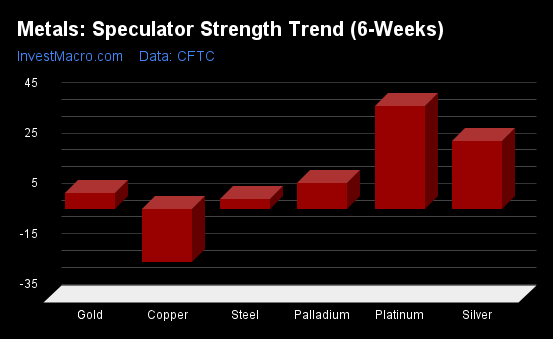
Companies that frack for oil and gas can keep a lot of information secret – but what they disclose shows widespread use of hazardous chemicals

By Vivian R. Underhill, Northeastern University and Lourdes Vera, University at Buffalo 

From rural Pennsylvania to Los Angeles, more than 17 million Americans live within a mile of at least one oil or gas well. Since 2014, most new oil and gas wells have been fracked.

Fracking, short for hydraulic fracturing, is a process in which workers inject fluids underground under high pressure. The fluids fracture coal beds and shale rock, allowing the gas and oil trapped within the rock to rise to the surface. Advances in fracking launched a huge expansion of U.S. oil and gas production starting in the early 2000s but also triggered intense debate over its health and environmental impacts.

Fracking fluids are up to 97% water, but they also contain a host of chemicals that perform functions such as dissolving minerals and killing bacteria. The U.S. Environmental Protection Agency classifies a number of these chemicals as toxic or potentially toxic.

The Safe Drinking Water Act, enacted in 1974, regulates underground injection of chemicals that can threaten drinking water supplies. However, Congress has exempted fracking from most federal regulation under the law. As a result, fracking is regulated at the state level, and requirements vary from state to state.

We study the oil and gas industry in California and Texas and are members of the Wylie Environmental Data Justice Lab, which studies fracking chemicals in aggregate. In a recent study, we worked with colleagues to provide the first systematic analysis of chemicals found in fracking fluids that would be regulated under the Safe Drinking Water Act if they were injected underground for other purposes. Our findings show that excluding fracking from federal regulation under the Safe Drinking Water Act is exposing the public to an array of chemicals that are widely recognized as threats to public health.

Averting federal regulation

Fracking technologies were originally developed in the 1940s but only entered widespread use for fossil fuel extraction in the U.S. in the early 2000s. Since the process involves injecting chemicals underground and then disposing of contaminated water that flows back to the surface, it faced potential regulation under multiple U.S. environmental laws.

In 1997, the 11th Circuit Court of Appeals ruled that fracking should be regulated under the Safe Drinking Water Act. This would have required oil and gas producers to develop underground injection control plans, disclose the contents of their fracking fluids and monitor local water sources for contamination.

In response, the oil and gas industry lobbied Congress to exempt fracking from regulation under the Safe Drinking Water Act. Congress did so as part of the Energy Policy Act of 2005.

This provision is widely known as the Halliburton Loophole because it was championed by former U.S. Vice President Dick Cheney, who previously served as CEO of oil services company Halliburton. The company patented fracking technologies in the 1940s and remains one of the world’s largest suppliers of fracking fluid.

Fracking fluids and health

Over the past two decades, studies have linked exposure to chemicals in fracking fluid with a wide range of health risks. These risks include giving birth prematurely and having babies with low birth weights or congenital heart defects, as well as heart failure, asthma and other respiratory illnesses among patients of all ages.

Though researchers have produced numerous studies on the health effects of these chemicals, federal exemptions and sparse data still make it hard to monitor the impacts of their use. Further, much existing research focuses on individual compounds, not on the cumulative effects of exposure to combinations of them.

Chemical use in fracking

For our review we consulted the FracFocus Chemical Disclosure Registry, which is managed by the Ground Water Protection Council, an organization of state government officials. Currently, 23 states – including major producers like Pennsylvania and Texas – require oil and gas companies to report to FracFocus information such as well locations, operators and the masses of each chemical used in fracking fluids.

We used a tool called Open-FracFocus, which uses open-source coding to make FracFocus data more transparent, easily accessible and ready to analyze.

This 2020 news report examines possible leakage of fracking wastewater from an underground injection well in west Texas.

We found that from 2014 through 2021, 62% to 73% of reported fracks each year used at least one chemical that the Safe Drinking Water Act recognizes as detrimental to human health and the environment. If not for the Halliburton Loophole, these projects would have been subject to permitting and monitoring requirements, providing information for local communities about potential risks.

In total, fracking companies reported using 282 million pounds of chemicals that would otherwise regulated under the Safe Drinking Water Act from 2014 through 2021. This likely is an underestimate, since this information is self-reported, covers only 23 states and doesn’t always include sufficient information to calculate mass.

Chemicals used in large quantities included ethylene glycol, an industrial compound found in substances such as antifreeze and hydraulic brake fluid; acrylamide, a widely used industrial chemical that is also present in some foods, food packaging and cigarette smoke; naphthalene, a pesticide made from crude oil or tar; and formaldehyde, a common industrial chemical used in glues, coatings and wood products and also present in tobacco smoke. Naphthalene and acrylamide are possible human carcinogens, and formaldehyde is a known human carcinogen.

The data also show a large spike in the use of benzene in Texas in 2019. Benzene is such a potent human carcinogen that the Safe Drinking Water Act limits exposure to 0.001 milligrams per liter – equivalent to half a teaspoon of liquid in an Olympic-size swimming pool.

Many states – including states that require disclosure – allow oil and gas producers to withhold information about chemicals they use in fracking that the companies declare to be proprietary information or trade secrets. This loophole greatly reduces transparency about what chemicals are in fracking fluids.

We found that the share of fracking events reporting at least one proprietary chemical increased from 77% in 2015 to 88% in 2021. Companies reported using about 7.2 billion pounds of proprietary chemicals – more than 25 times the total mass of chemicals listed under the Safe Drinking Water Act that they reported.

Closing the Halliburton loophole

Overall, our review found that fracking companies have reported using 28 chemicals that would otherwise be regulated under the Safe Drinking Water Act. Ethylene glycol was used in the largest quantities, but acrylamide, formaldehyde and naphthalene were also common.

Given that each of these chemicals has serious health effects, and that hundreds of spills are reported annually at fracking wells, we believe action is needed to protect public and environmental health, and to enable scientists to rigorously monitor and research fracking chemical use.

Based on our findings, we believe Congress should pass a law requiring full disclosure of all chemicals used in fracking, including proprietary chemicals. We also recommend disclosing fracking data in a centralized and federally mandated database, managed by an agency such as the EPA or the National Institute of Environmental Health Sciences. Finally, we recommend that Congress repeal the Halliburton Loophole and once again regulate fracking under the Safe Drinking Water Act.

As the U.S. ramps up liquefied natural gas exports in response to the war in Ukraine, fracking could continue for the foreseeable future. In our view, it’s urgent to ensure that it is carried out as safely as possible.The Conversation

About the Author:

Vivian R. Underhill, Postdoctoral Researcher in social Science and Environmental Health, Northeastern University and Lourdes Vera, Assistant Professor of Sociology and Environment and Sustainability, University at Buffalo

This article is republished from The Conversation under a Creative Commons license. Read the original article.