Archive for Opinions – Page 89

Bonds Speculators push their 5-Year Bond bets to most bearish on record

By InvestMacro

Here are the latest charts and statistics for the Commitment of Traders (COT) reports data published by the Commodities Futures Trading Commission (CFTC).

The latest COT data is updated through Tuesday April 25th and shows a quick view of how large traders (for-profit speculators and commercial hedgers) were positioned in the futures markets.

Weekly Speculator Changes led by Fed Funds & 2-Year Bonds

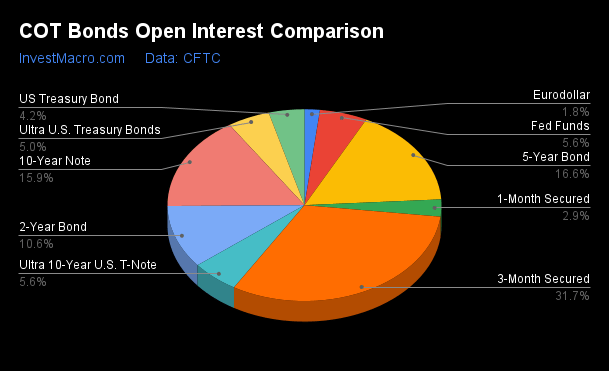
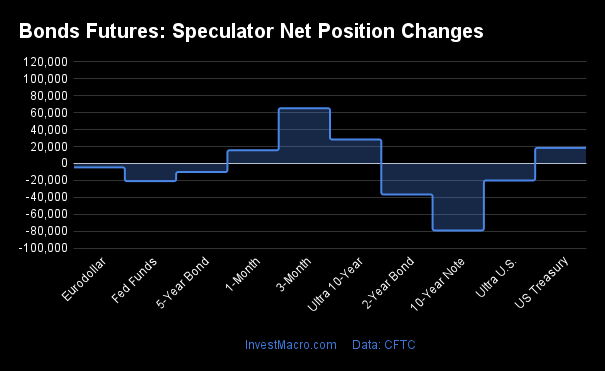
The COT bond market speculator bets were higher this week as six out of the nine bond markets we cover had higher positioning while the other three markets had lower speculator contracts.

Leading the gains for the bond markets was the 2-Year Bonds (28,607 contracts) with the Fed Funds (28,111 contracts), the US Treasury Bonds (19,560 contracts), the Ultra 10-Year Bonds (15,667 contracts), the Eurodollar (8,395 contracts) and the Ultra Treasury Bonds (1,016 contracts) also showing positive weeks.

The bond markets with declines in speculator bets for the week were the 5-Year Bonds (-114,786 contracts), the SOFR 3-Months (-89,967 contracts) and the 10-Year Bonds (-60,180 contracts) seeing lower bets on the week.

Speculators push their 5-Year Bond bets to most bearish on record

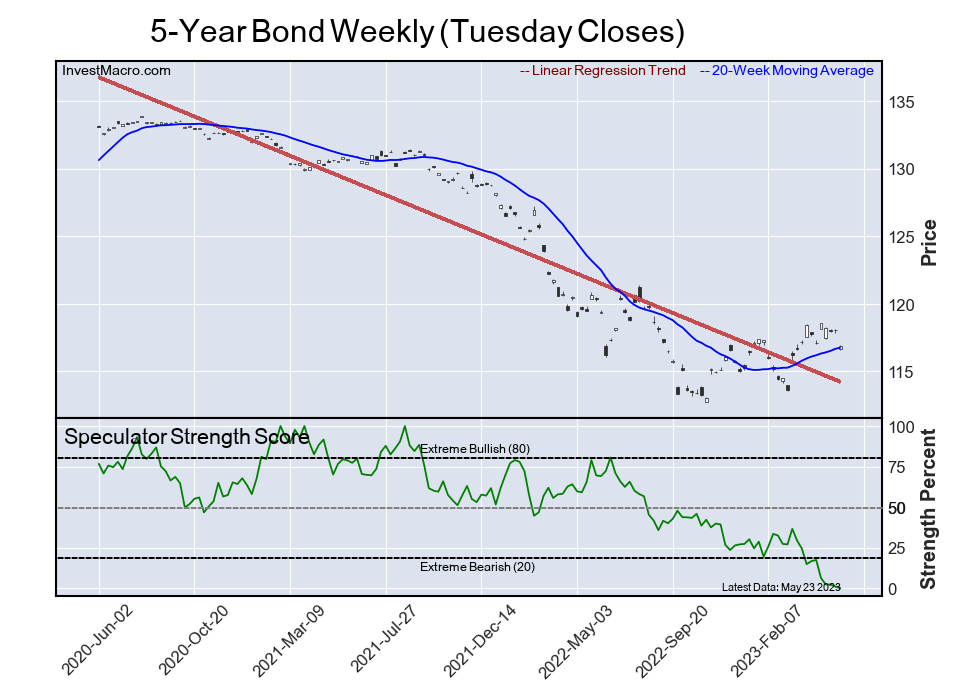
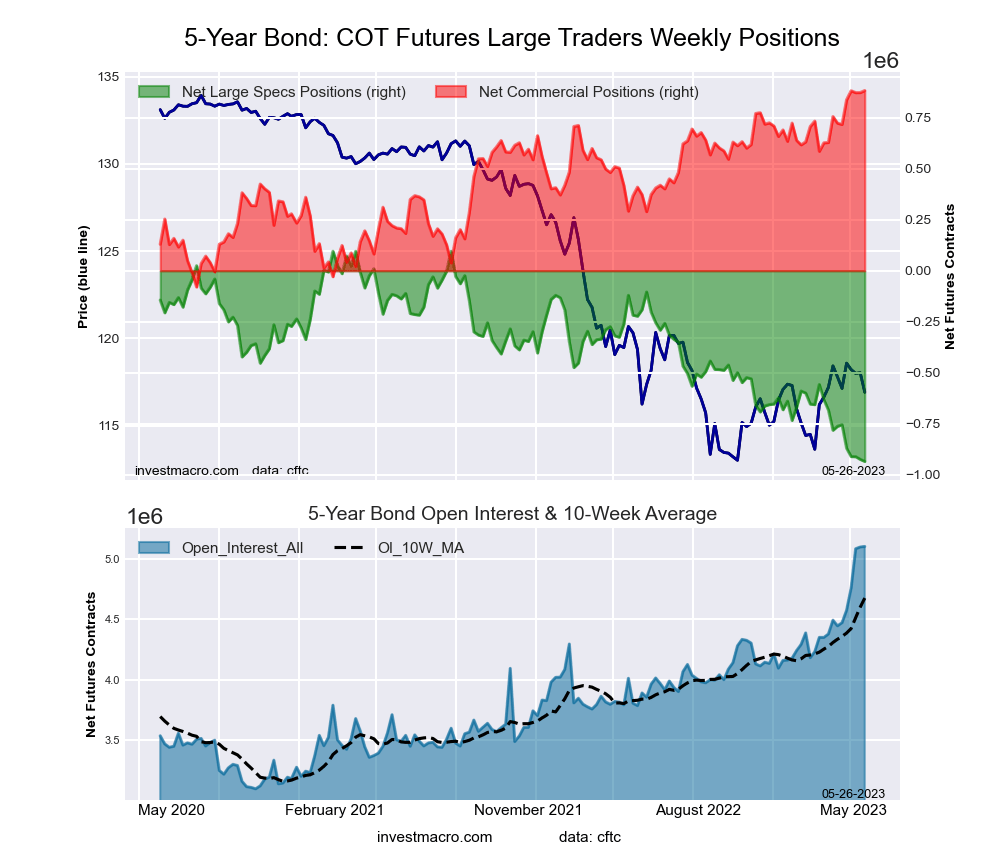
Highlighting the COT bond’s data this week is the historic weakness in the 5-Year Bonds speculator net contracts. Large speculative 5-Year Bond positions dropped sharply this week by over -114,000 net contracts, marking the largest decline in 20 weeks and have now decreased in four out of the past six weeks. The 5-Year net positions have fallen by a total of -312,076 contracts over the past six-week period, going from a total of -557,212 contracts on March 14th to a total net position of -869,288 contracts this week.

This bearishness has pushed the net position to the most bearish level in history, according to CFTC data that goes back to 1988. The previous record bearish position was a total of -867,556 contracts that took place on August 7th of 2018 and coincided with an almost exact bottom in the 5-Year Bond futures price (see image below comparing the price on dates of record bearish levels).

The 5-Year Bond futures price has not followed along lately with the extreme bearishness of the speculators in this case and has potentially already bottomed with a low of 105.14 in October and a more recent dip to 106.02 in March. The 5-Year futures closed this week higher near the 109.24 level and about 3.25 percent higher than the most recent low in March. In terms of bond yields, the 5-Year yield is currently trading at the 3.48 percent level and also down from a recent high of 4.37 percent in March. Only time will tell if the 5-Year Bond price has bottomed (and yields have topped out) with the future paths of the US Federal Reserve and the US economy likely weighing heavily on the future direction.

Chart by TradingView

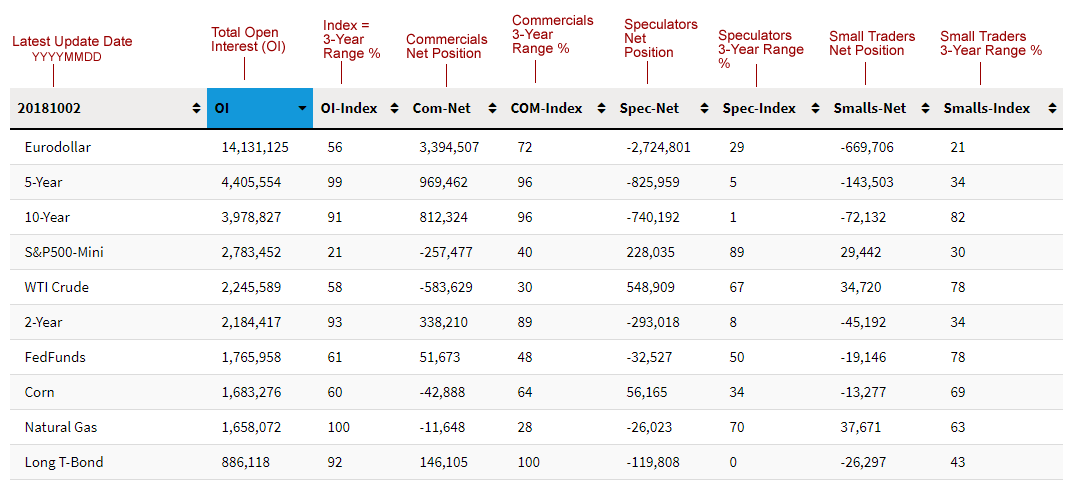
Data Snapshot of Bond Market Traders | Columns Legend
Apr-25-2023OIOI-IndexSpec-NetSpec-IndexCom-NetCOM-IndexSmalls-NetSmalls-Index
Eurodollar604,7220-42,8367352,68223-9,84697
FedFunds1,909,06781-90,60828103,00672-12,39867
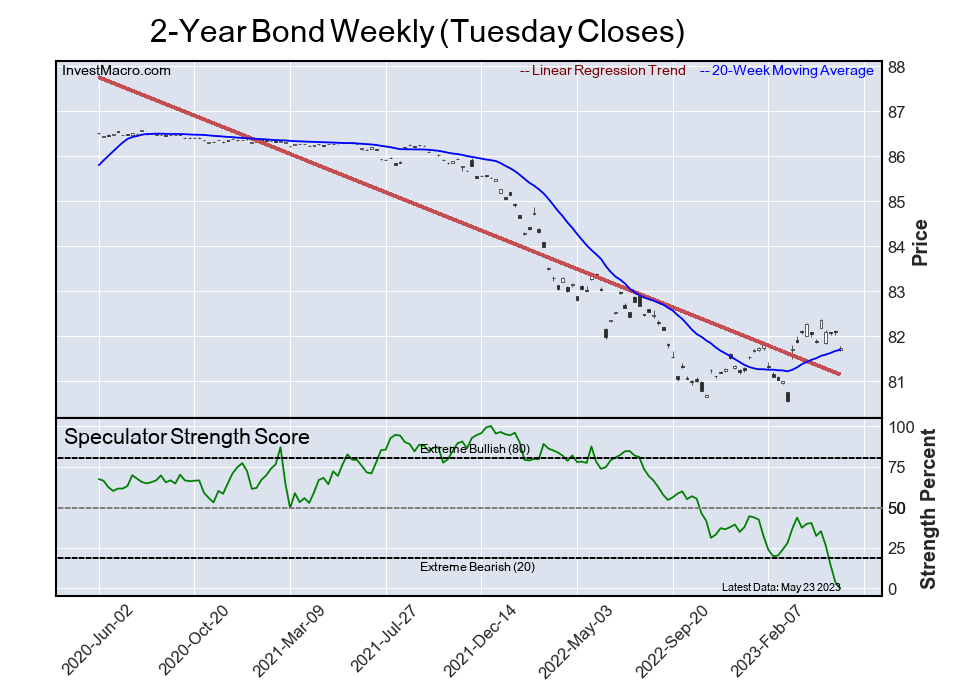
2-Year2,719,44185-546,30719486,7577659,55084
Long T-Bond1,193,35855-97,3685326,6982070,670100
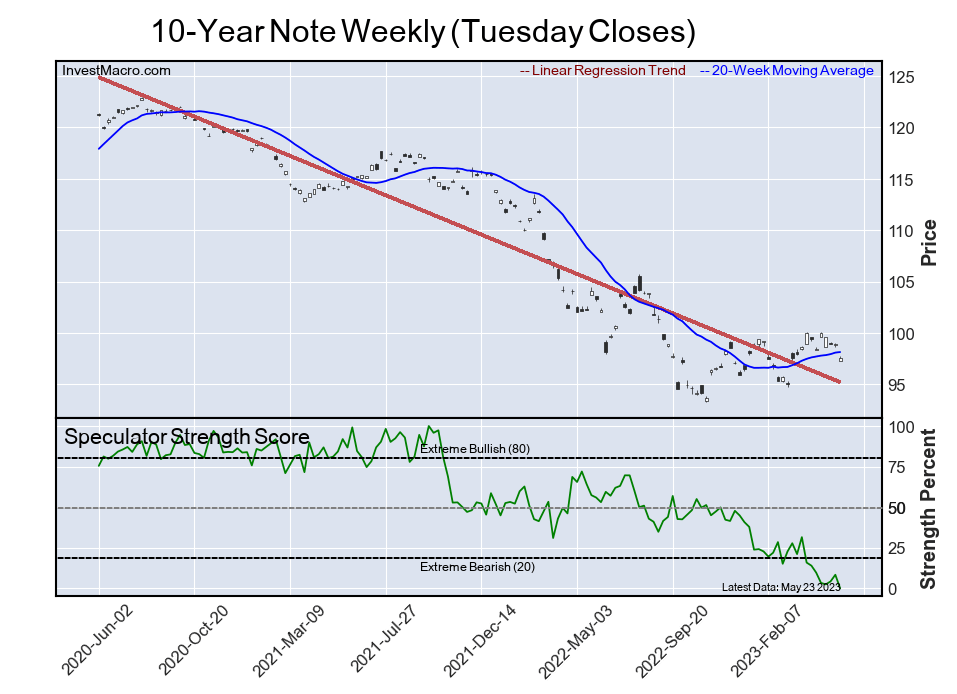
10-Year4,362,22290-740,2610685,2169555,04597
5-Year4,576,091100-869,2880837,20910032,07990


Strength Scores led by Eurodollar & US Treasury Bonds

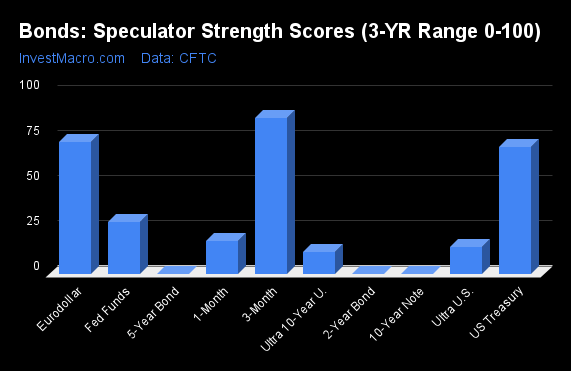
COT Strength Scores (a normalized measure of Speculator positions over a 3-Year range, from 0 to 100 where above 80 is Extreme-Bullish and below 20 is Extreme-Bearish) showed that the Eurodollar (73 percent) and the US Treasury Bonds (53 percent) lead the bond markets this week. The SOFR 3-Months (36 percent) comes in as the next highest in the weekly strength scores.

On the downside, the 5-Year Bonds (0 percent), the 10-Year Bonds (0 percent), the Ultra 10-Year Bonds (3 percent) and the 2-Year Bonds (19 percent) come in at the lowest strength level currently and are in Extreme-Bearish territory (below 20 percent).

Strength Statistics:
Fed Funds (28.4 percent) vs Fed Funds previous week (25.0 percent)
2-Year Bond (19.2 percent) vs 2-Year Bond previous week (15.5 percent)
5-Year Bond (0.0 percent) vs 5-Year Bond previous week (11.9 percent)
10-Year Bond (0.0 percent) vs 10-Year Bond previous week (6.5 percent)
Ultra 10-Year Bond (3.3 percent) vs Ultra 10-Year Bond previous week (0.0 percent)
US Treasury Bond (52.9 percent) vs US Treasury Bond previous week (46.5 percent)
Ultra US Treasury Bond (19.6 percent) vs Ultra US Treasury Bond previous week (19.1 percent)
Eurodollar (72.9 percent) vs Eurodollar previous week (72.7 percent)
SOFR 3-Months (36.5 percent) vs SOFR 3-Months previous week (43.8 percent)


Ultra Treasury Bonds & US Treasury Bonds top the 6-Week Strength Trends

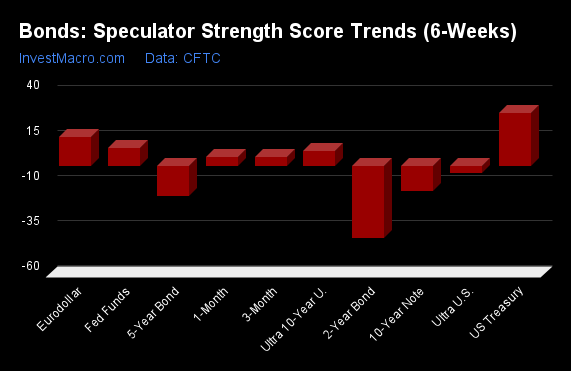
COT Strength Score Trends (or move index, calculates the 6-week changes in strength scores) showed that the Ultra Treasury Bonds (19 percent) and the US Treasury Bonds (17 percent) lead the past six weeks trends for bonds.

The 5-Year Bond (-32.3 percent) leads the downside trend scores currently with the SOFR 3-Months (-31 percent) and the 10-Year Bonds (-25 percent) following next with lower trend scores.

Strength Trend Statistics:
Fed Funds (-0.2 percent) vs Fed Funds previous week (15.2 percent)
2-Year Bond (-1.9 percent) vs 2-Year Bond previous week (5.5 percent)
5-Year Bond (-32.3 percent) vs 5-Year Bond previous week (-10.2 percent)
10-Year Bond (-25.3 percent) vs 10-Year Bond previous week (-13.5 percent)
Ultra 10-Year Bond (0.3 percent) vs Ultra 10-Year Bond previous week (-3.0 percent)
US Treasury Bond (17.1 percent) vs US Treasury Bond previous week (18.3 percent)
Ultra US Treasury Bond (19.4 percent) vs Ultra US Treasury Bond previous week (11.3 percent)
Eurodollar (15.9 percent) vs Eurodollar previous week (23.1 percent)
SOFR 3-Months (-31.3 percent) vs SOFR 3-Months previous week (43.8 percent)


Individual Bond Markets:

3-Month Eurodollars Futures:

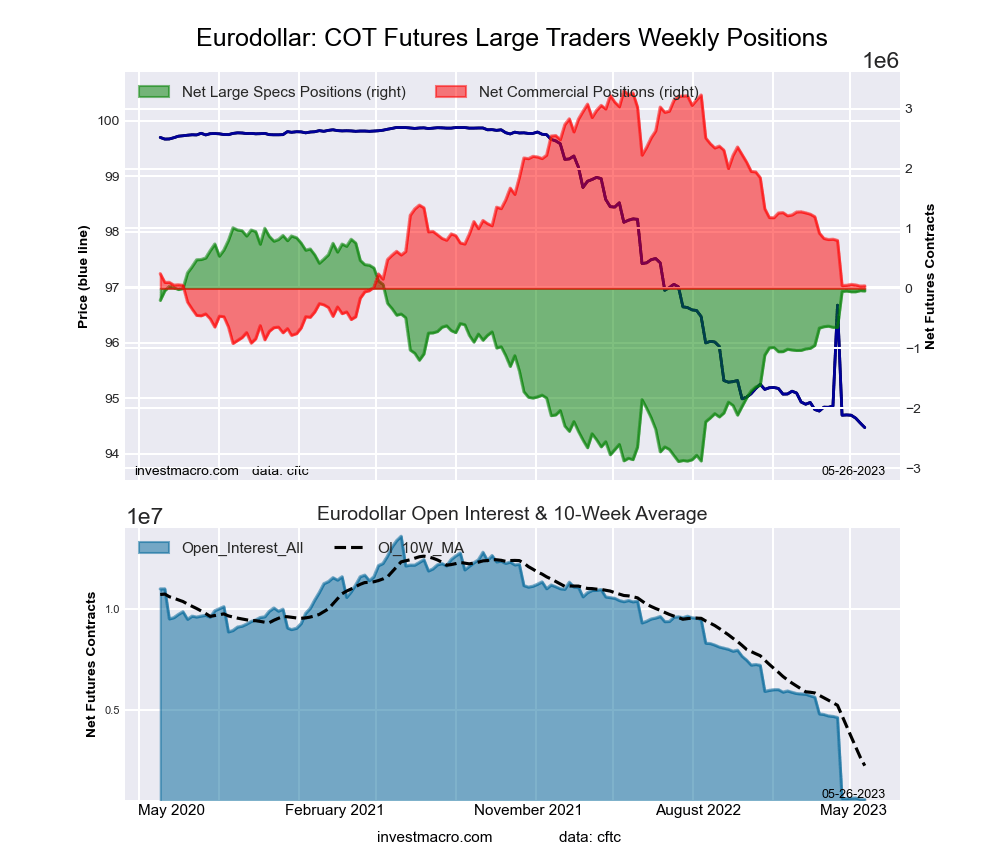
Eurodollar Bonds Futures COT ChartThe 3-Month Eurodollars large speculator standing this week was a net position of -42,836 contracts in the data reported through Tuesday. This was a weekly lift of 8,395 contracts from the previous week which had a total of -51,231 net contracts.

This week’s current strength score (the trader positioning range over the past three years, measured from 0 to 100) shows the speculators are currently Bullish with a score of 72.9 percent. The commercials are Bearish with a score of 23.0 percent and the small traders (not shown in chart) are Bullish-Extreme with a score of 97.2 percent.

3-Month Eurodollars StatisticsSPECULATORSCOMMERCIALSSMALL TRADERS
– Percent of Open Interest Longs:26.862.29.5
– Percent of Open Interest Shorts:33.953.511.2
– Net Position:-42,83652,682-9,846
– Gross Longs:162,210375,92457,705
– Gross Shorts:205,046323,24267,551
– Long to Short Ratio:0.8 to 11.2 to 10.9 to 1
NET POSITION TREND:
– Strength Index Score (3 Year Range Pct):72.923.097.2
– Strength Index Reading (3 Year Range):BullishBearishBullish-Extreme
NET POSITION MOVEMENT INDEX:
– 6-Week Change in Strength Index:15.9-20.752.8


Secured Overnight Financing Rate (3-Month) Futures:

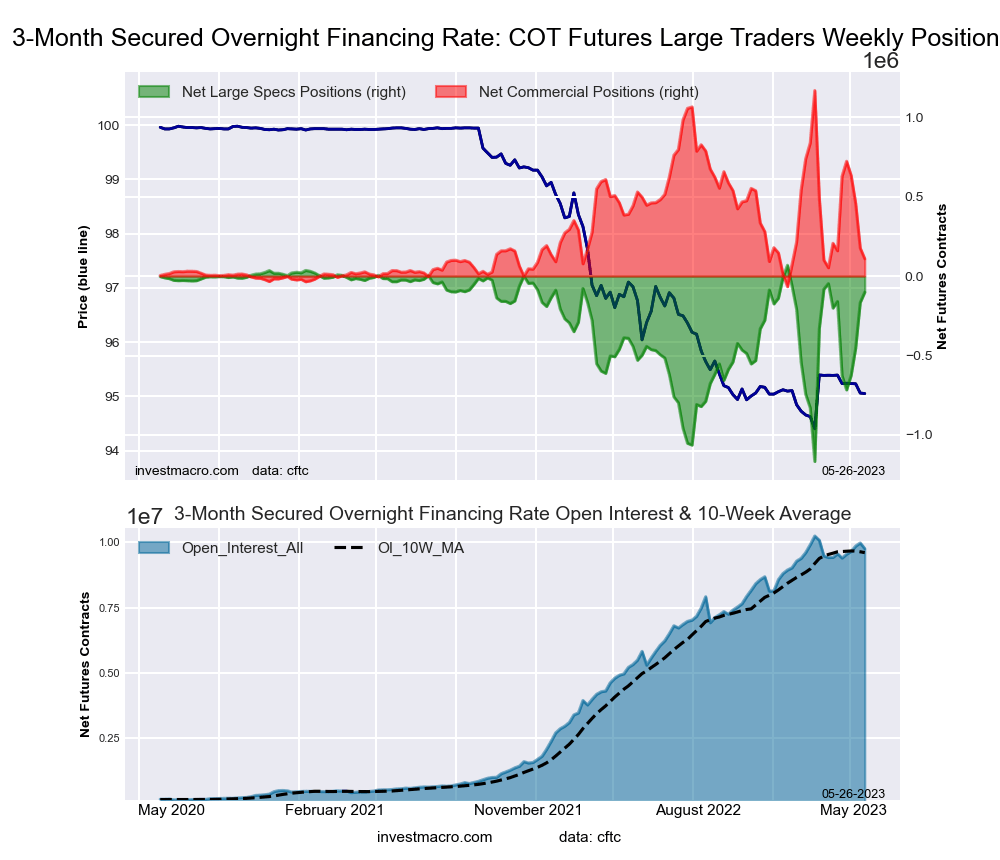
SOFR 3-Months Bonds Futures COT ChartThe Secured Overnight Financing Rate (3-Month) large speculator standing this week was a net position of -716,355 contracts in the data reported through Tuesday. This was a weekly decrease of -89,967 contracts from the previous week which had a total of -626,388 net contracts.

This week’s current strength score (the trader positioning range over the past three years, measured from 0 to 100) shows the speculators are currently Bearish with a score of 36.5 percent. The commercials are Bullish with a score of 63.9 percent and the small traders (not shown in chart) are Bullish-Extreme with a score of 84.5 percent.

SOFR 3-Months StatisticsSPECULATORSCOMMERCIALSSMALL TRADERS
– Percent of Open Interest Longs:14.264.00.4
– Percent of Open Interest Shorts:21.756.40.5
– Net Position:-716,355722,508-6,153
– Gross Longs:1,351,6486,105,24641,555
– Gross Shorts:2,068,0035,382,73847,708
– Long to Short Ratio:0.7 to 11.1 to 10.9 to 1
NET POSITION TREND:
– Strength Index Score (3 Year Range Pct):36.563.984.5
– Strength Index Reading (3 Year Range):BearishBullishBullish-Extreme
NET POSITION MOVEMENT INDEX:
– 6-Week Change in Strength Index:-31.318.984.5


30-Day Federal Funds Futures:

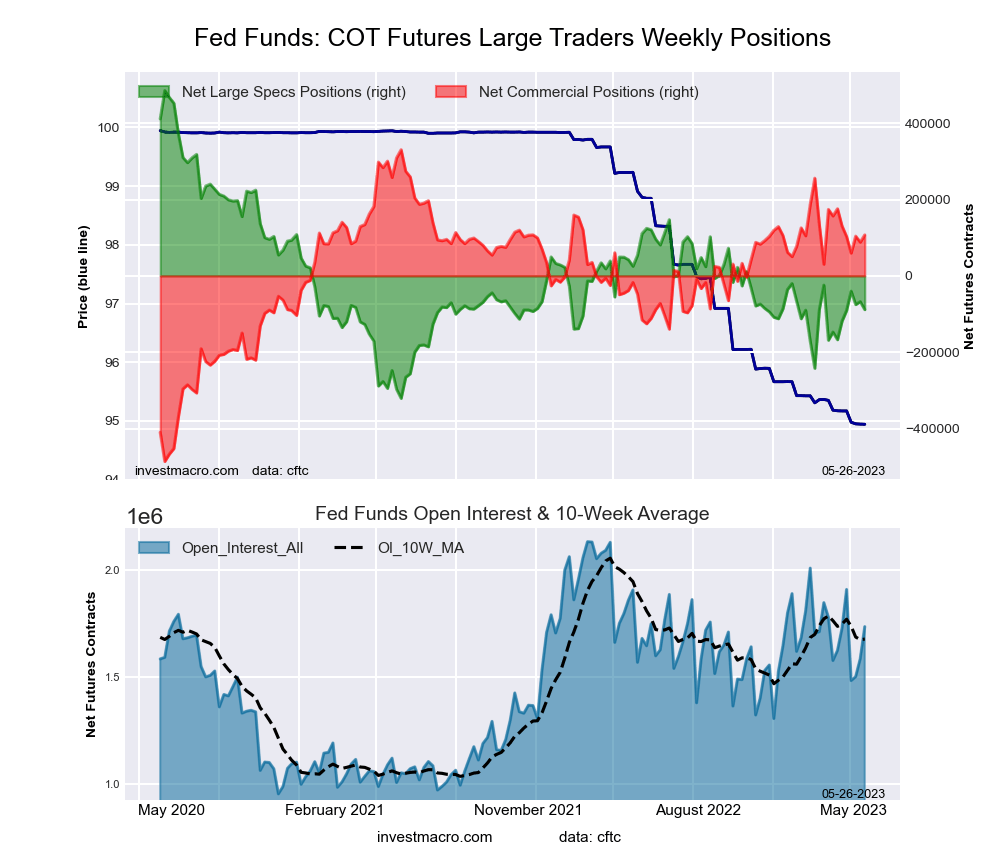
Federal Funds 30-Day Bonds Futures COT ChartThe 30-Day Federal Funds large speculator standing this week was a net position of -90,608 contracts in the data reported through Tuesday. This was a weekly boost of 28,111 contracts from the previous week which had a total of -118,719 net contracts.

This week’s current strength score (the trader positioning range over the past three years, measured from 0 to 100) shows the speculators are currently Bearish with a score of 28.4 percent. The commercials are Bullish with a score of 72.4 percent and the small traders (not shown in chart) are Bullish with a score of 66.7 percent.

30-Day Federal Funds StatisticsSPECULATORSCOMMERCIALSSMALL TRADERS
– Percent of Open Interest Longs:3.779.72.2
– Percent of Open Interest Shorts:8.474.32.8
– Net Position:-90,608103,006-12,398
– Gross Longs:70,4411,520,81641,850
– Gross Shorts:161,0491,417,81054,248
– Long to Short Ratio:0.4 to 11.1 to 10.8 to 1
NET POSITION TREND:
– Strength Index Score (3 Year Range Pct):28.472.466.7
– Strength Index Reading (3 Year Range):BearishBullishBullish
NET POSITION MOVEMENT INDEX:
– 6-Week Change in Strength Index:-0.2-3.966.7


2-Year Treasury Note Futures:

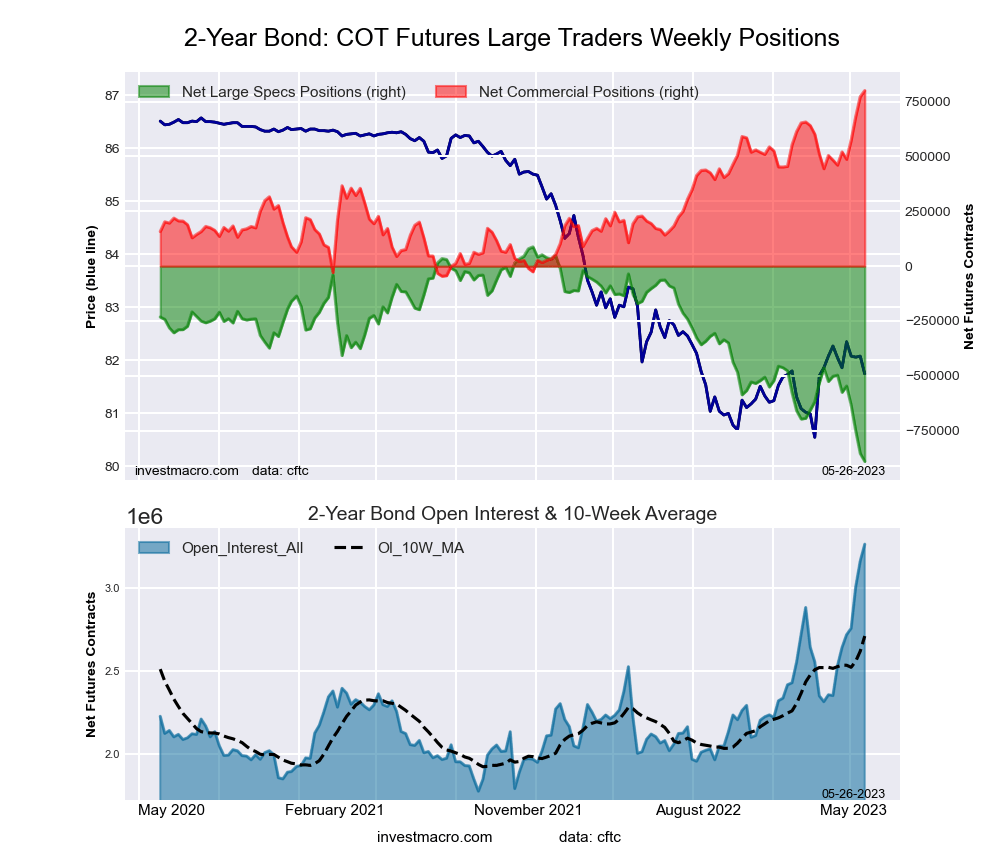
2-Year Treasury Bonds Futures COT ChartThe 2-Year Treasury Note large speculator standing this week was a net position of -546,307 contracts in the data reported through Tuesday. This was a weekly increase of 28,607 contracts from the previous week which had a total of -574,914 net contracts.

This week’s current strength score (the trader positioning range over the past three years, measured from 0 to 100) shows the speculators are currently Bearish-Extreme with a score of 19.2 percent. The commercials are Bullish with a score of 75.8 percent and the small traders (not shown in chart) are Bullish-Extreme with a score of 84.3 percent.

2-Year Treasury Note StatisticsSPECULATORSCOMMERCIALSSMALL TRADERS
– Percent of Open Interest Longs:9.881.08.2
– Percent of Open Interest Shorts:29.963.16.0
– Net Position:-546,307486,75759,550
– Gross Longs:265,7112,203,465221,675
– Gross Shorts:812,0181,716,708162,125
– Long to Short Ratio:0.3 to 11.3 to 11.4 to 1
NET POSITION TREND:
– Strength Index Score (3 Year Range Pct):19.275.884.3
– Strength Index Reading (3 Year Range):Bearish-ExtremeBullishBullish-Extreme
NET POSITION MOVEMENT INDEX:
– 6-Week Change in Strength Index:-1.9-3.418.5


5-Year Treasury Note Futures:

5-Year Treasury Bonds Futures COT ChartThe 5-Year Treasury Note large speculator standing this week was a net position of -869,288 contracts in the data reported through Tuesday. This was a weekly decline of -114,786 contracts from the previous week which had a total of -754,502 net contracts.

This week’s current strength score (the trader positioning range over the past three years, measured from 0 to 100) shows the speculators are currently Bearish-Extreme with a score of 0.0 percent. The commercials are Bullish-Extreme with a score of 100.0 percent and the small traders (not shown in chart) are Bullish-Extreme with a score of 89.8 percent.

5-Year Treasury Note StatisticsSPECULATORSCOMMERCIALSSMALL TRADERS
– Percent of Open Interest Longs:6.784.17.9
– Percent of Open Interest Shorts:25.765.87.2
– Net Position:-869,288837,20932,079
– Gross Longs:307,6403,846,432359,672
– Gross Shorts:1,176,9283,009,223327,593
– Long to Short Ratio:0.3 to 11.3 to 11.1 to 1
NET POSITION TREND:
– Strength Index Score (3 Year Range Pct):0.0100.089.8
– Strength Index Reading (3 Year Range):Bearish-ExtremeBullish-ExtremeBullish-Extreme
NET POSITION MOVEMENT INDEX:
– 6-Week Change in Strength Index:-32.327.516.4


10-Year Treasury Note Futures:

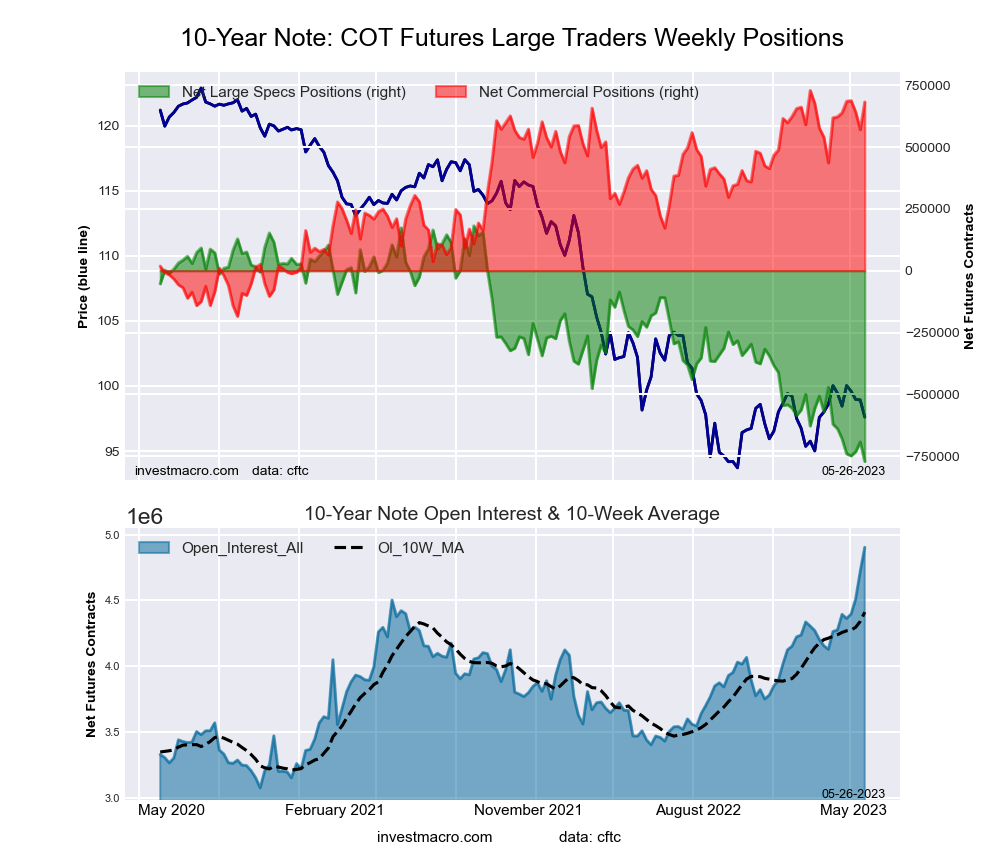
10-Year Treasury Notes Bonds Futures COT ChartThe 10-Year Treasury Note large speculator standing this week was a net position of -740,261 contracts in the data reported through Tuesday. This was a weekly decline of -60,180 contracts from the previous week which had a total of -680,081 net contracts.

This week’s current strength score (the trader positioning range over the past three years, measured from 0 to 100) shows the speculators are currently Bearish-Extreme with a score of 0.0 percent. The commercials are Bullish-Extreme with a score of 95.2 percent and the small traders (not shown in chart) are Bullish-Extreme with a score of 96.9 percent.

10-Year Treasury Note StatisticsSPECULATORSCOMMERCIALSSMALL TRADERS
– Percent of Open Interest Longs:8.979.49.2
– Percent of Open Interest Shorts:25.963.77.9
– Net Position:-740,261685,21655,045
– Gross Longs:389,7283,462,741400,768
– Gross Shorts:1,129,9892,777,525345,723
– Long to Short Ratio:0.3 to 11.2 to 11.2 to 1
NET POSITION TREND:
– Strength Index Score (3 Year Range Pct):0.095.296.9
– Strength Index Reading (3 Year Range):Bearish-ExtremeBullish-ExtremeBullish-Extreme
NET POSITION MOVEMENT INDEX:
– 6-Week Change in Strength Index:-25.311.830.8


Ultra 10-Year Notes Futures:

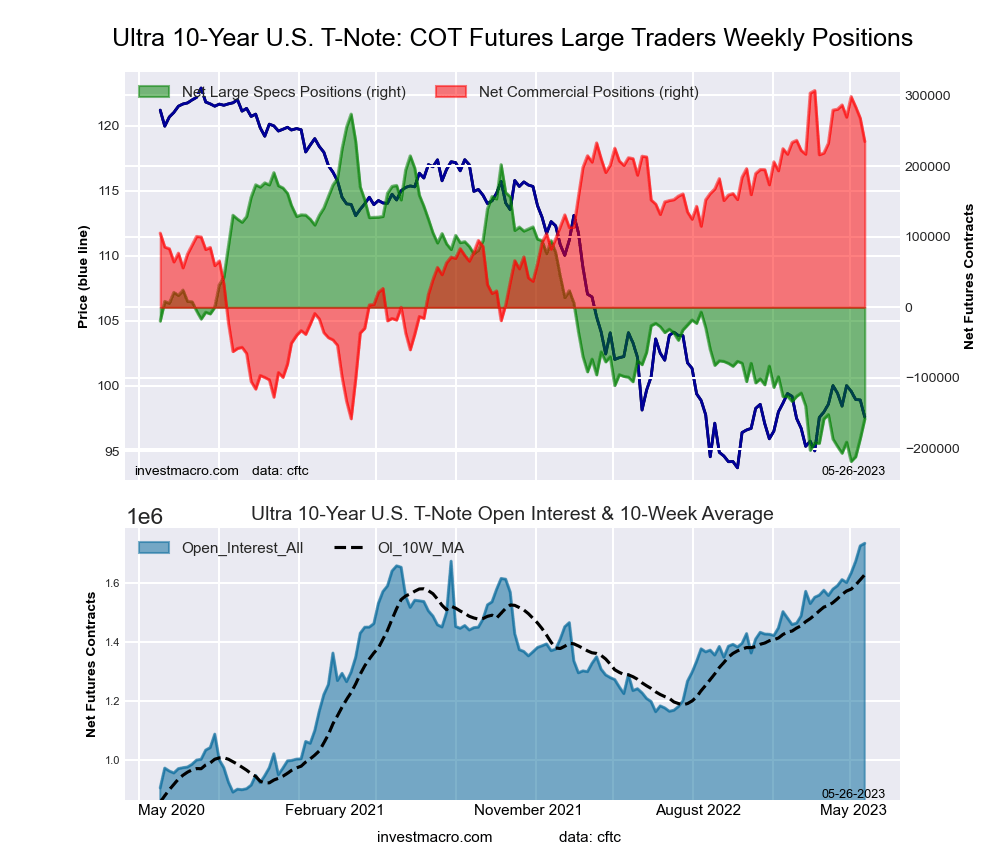
Ultra 10-Year Treasury Notes Bonds Futures COT ChartThe Ultra 10-Year Notes large speculator standing this week was a net position of -190,916 contracts in the data reported through Tuesday. This was a weekly advance of 15,667 contracts from the previous week which had a total of -206,583 net contracts.

This week’s current strength score (the trader positioning range over the past three years, measured from 0 to 100) shows the speculators are currently Bearish-Extreme with a score of 3.3 percent. The commercials are Bullish-Extreme with a score of 91.9 percent and the small traders (not shown in chart) are Bullish with a score of 67.4 percent.

Ultra 10-Year Notes StatisticsSPECULATORSCOMMERCIALSSMALL TRADERS
– Percent of Open Interest Longs:8.680.010.0
– Percent of Open Interest Shorts:20.563.214.9
– Net Position:-190,916269,304-78,388
– Gross Longs:137,5311,281,853160,380
– Gross Shorts:328,4471,012,549238,768
– Long to Short Ratio:0.4 to 11.3 to 10.7 to 1
NET POSITION TREND:
– Strength Index Score (3 Year Range Pct):3.391.967.4
– Strength Index Reading (3 Year Range):Bearish-ExtremeBullish-ExtremeBullish
NET POSITION MOVEMENT INDEX:
– 6-Week Change in Strength Index:0.311.5-32.6


US Treasury Bonds Futures:

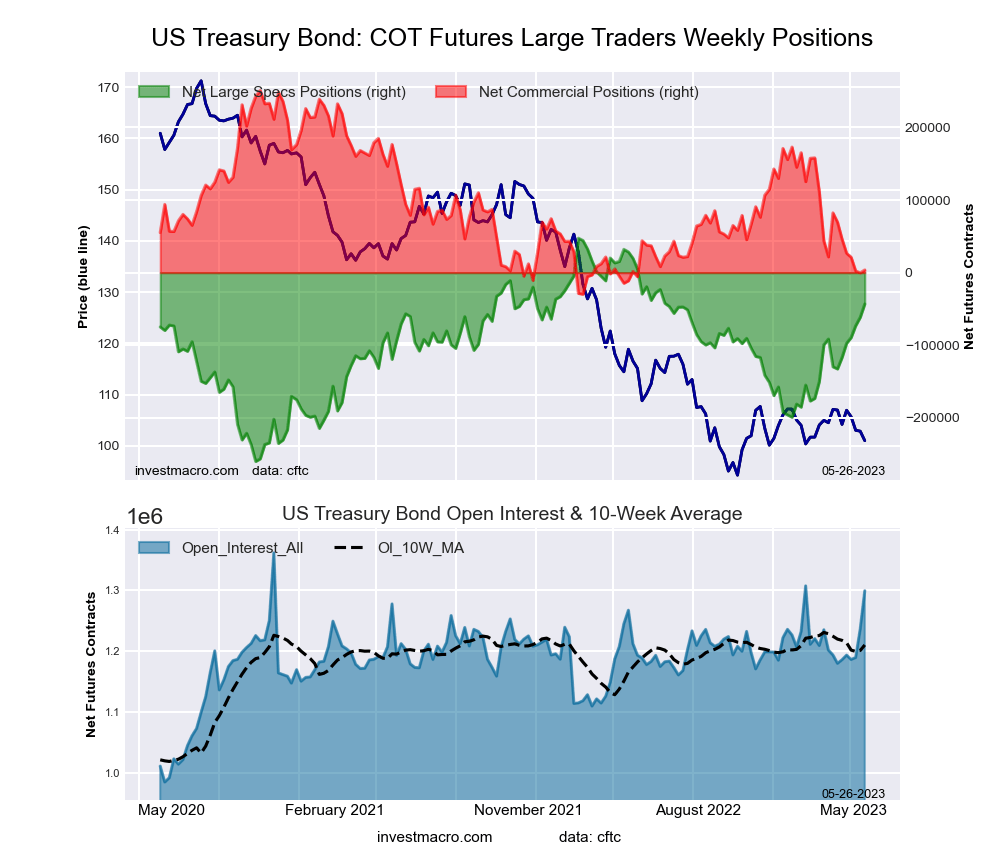
US Year Treasury Notes Long Bonds Futures COT ChartThe US Treasury Bonds large speculator standing this week was a net position of -97,368 contracts in the data reported through Tuesday. This was a weekly advance of 19,560 contracts from the previous week which had a total of -116,928 net contracts.

This week’s current strength score (the trader positioning range over the past three years, measured from 0 to 100) shows the speculators are currently Bullish with a score of 52.9 percent. The commercials are Bearish with a score of 20.1 percent and the small traders (not shown in chart) are Bullish-Extreme with a score of 100.0 percent.

US Treasury Bonds StatisticsSPECULATORSCOMMERCIALSSMALL TRADERS
– Percent of Open Interest Longs:6.877.914.8
– Percent of Open Interest Shorts:15.075.78.8
– Net Position:-97,36826,69870,670
– Gross Longs:81,222929,608176,053
– Gross Shorts:178,590902,910105,383
– Long to Short Ratio:0.5 to 11.0 to 11.7 to 1
NET POSITION TREND:
– Strength Index Score (3 Year Range Pct):52.920.1100.0
– Strength Index Reading (3 Year Range):BullishBearishBullish-Extreme
NET POSITION MOVEMENT INDEX:
– 6-Week Change in Strength Index:17.1-30.123.2


Ultra US Treasury Bonds Futures:

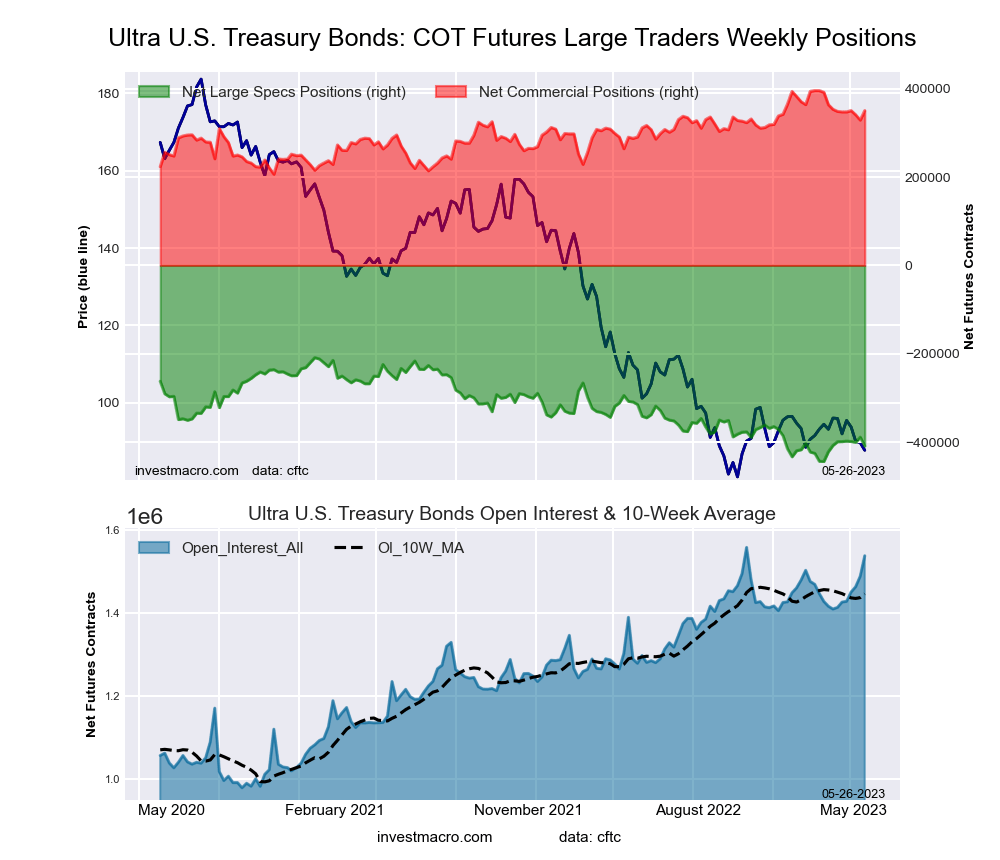
Ultra US Year Treasury Notes Long Bonds Futures COT ChartThe Ultra US Treasury Bonds large speculator standing this week was a net position of -397,985 contracts in the data reported through Tuesday. This was a weekly rise of 1,016 contracts from the previous week which had a total of -399,001 net contracts.

This week’s current strength score (the trader positioning range over the past three years, measured from 0 to 100) shows the speculators are currently Bearish-Extreme with a score of 19.6 percent. The commercials are Bullish with a score of 76.7 percent and the small traders (not shown in chart) are Bullish-Extreme with a score of 90.2 percent.

Ultra US Treasury Bonds StatisticsSPECULATORSCOMMERCIALSSMALL TRADERS
– Percent of Open Interest Longs:5.882.012.0
– Percent of Open Interest Shorts:33.757.78.4
– Net Position:-397,985347,57550,410
– Gross Longs:83,0531,171,201170,666
– Gross Shorts:481,038823,626120,256
– Long to Short Ratio:0.2 to 11.4 to 11.4 to 1
NET POSITION TREND:
– Strength Index Score (3 Year Range Pct):19.676.790.2
– Strength Index Reading (3 Year Range):Bearish-ExtremeBullishBullish-Extreme
NET POSITION MOVEMENT INDEX:
– 6-Week Change in Strength Index:19.4-23.22.5


Article By InvestMacroReceive our weekly COT Newsletter

*COT Report: The COT data, released weekly to the public each Friday, is updated through the most recent Tuesday (data is 3 days old) and shows a quick view of how large speculators or non-commercials (for-profit traders) were positioned in the futures markets.

The CFTC categorizes trader positions according to commercial hedgers (traders who use futures contracts for hedging as part of the business), non-commercials (large traders who speculate to realize trading profits) and nonreportable traders (usually small traders/speculators) as well as their open interest (contracts open in the market at time of reporting). See CFTC criteria here.

Speculator Extremes: Cocoa, 5-Year & 10-Year Bonds lead weekly Bullish & Bearish Positions

By InvestMacro

The latest update for the weekly Commitment of Traders (COT) report was released by the Commodity Futures Trading Commission (CFTC) on Friday for data ending on April 25th.

This weekly Extreme Positions report highlights the Most Bullish and Most Bearish Positions for the speculator category. Extreme positioning in these markets can foreshadow strong moves in the underlying market.

To signify an extreme position, we use the Strength Index (also known as the COT Index) of each instrument, a common method of measuring COT data. The Strength Index is simply a comparison of current trader positions against the range of positions over the previous 3 years. We use over 80 percent as extremely bullish and under 20 percent as extremely bearish. (Compare Strength Index scores across all markets in the data table or cot leaders table)


Speculators or Non-Commercials Notes:

Speculators, classified as non-commercial traders by the CFTC, are made up of large commodity funds, hedge funds and other significant for-profit participants. The Specs are generally regarded as trend-followers in their behavior towards price action – net speculator bets and prices tend to go in the same directions. These traders often look to buy when prices are rising and sell when prices are falling. To illustrate this point, many times speculator contracts can be found at their most extremes (bullish or bearish) when prices are also close to their highest or lowest levels.

These extreme levels can be dangerous for the large speculators as the trade is most crowded, there is less trading ammunition still sitting on the sidelines to push the trend further and prices have moved a significant distance. When the trend becomes exhausted, some speculators take profits while others look to also exit positions when prices fail to continue in the same direction. This process usually plays out over many months to years and can ultimately create a reverse effect where prices start to fall and speculators start a process of selling when prices are falling.


Here Are This Week’s Most Bullish Speculator Positions:

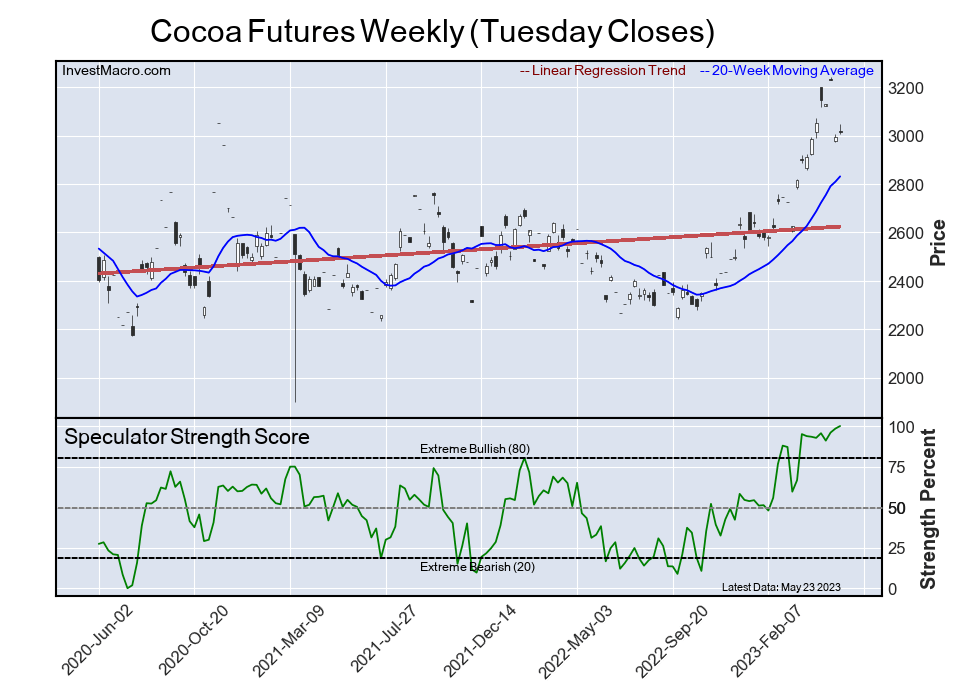
Cocoa Futures


The Cocoa Futures speculator position comes in as the most bullish extreme standing this week with the speculator level at a 100.0 percent score of its 3-year range.

The six-week trend change for the percent strength score totaled 37.7 this week. The overall net speculator position was a total of 61,714 net contracts this week with a gain of 2,359 contract in the weekly speculator bets.


Bloomberg Commodity Index


The Bloomberg Commodity Index speculator position comes next in the extreme standings this week. The Bloomberg Commodity Index speculator level is now at a 99.6 percent score of its 3-year range.

The six-week trend for the percent strength score was 4.6 this week. The speculator position registered -2,059 net contracts this week with a weekly change of 1,851 contracts in speculator bets.


Live Cattle


The Live Cattle speculator position comes in third this week in the extreme standings. The Live Cattle speculator level resides at a 92.5 percent score of its 3-year range.

The six-week trend for the speculator strength score came in at 7.4 this week. The overall speculator position was 102,034 net contracts this week with a dip of -38 contracts in the weekly speculator bets.


Sugar


The Sugar speculator position comes up number four in the extreme standings this week. The Sugar speculator level is at a 89.8 percent score of its 3-year range.

The six-week trend for the speculator strength score totaled a change of 17.1 this week. The overall speculator position was 279,528 net contracts this week with a rise of 10,356 contracts in the speculator bets.


Mexican Peso


The Mexican Peso speculator position rounds out the top five in this week’s bullish extreme standings. The Mexican Peso speculator level sits at a 89.6 percent score of its 3-year range. The six-week trend for the speculator strength score was -9.1 this week.

The net speculator position was 54,128 net contracts this week with a decline of -2,043 contracts in the weekly speculator bets.


This Week’s Most Bearish Speculator Positions:

5-Year Bond


The 5-Year Bond speculator position comes in as the most bearish extreme standing this week as the speculator level is at a 0.0 percent score of its 3-year range.

The six-week trend for the speculator strength score was -32.3 this week. The overall speculator position was -869,288 net contracts with a sharp drop of -114,786 contracts in the speculator bets.


10-Year Note


The 10-Year Note speculator position comes in next for the most bearish extreme standing on the week. The 10-Year Note speculator level is at a 0.0 percent score of its 3-year range.

The six-week trend for the speculator strength score was -25.3 this week. The speculator position was -740,261 net contracts this week with a decrease of -60,180 contracts in the weekly speculator bets.


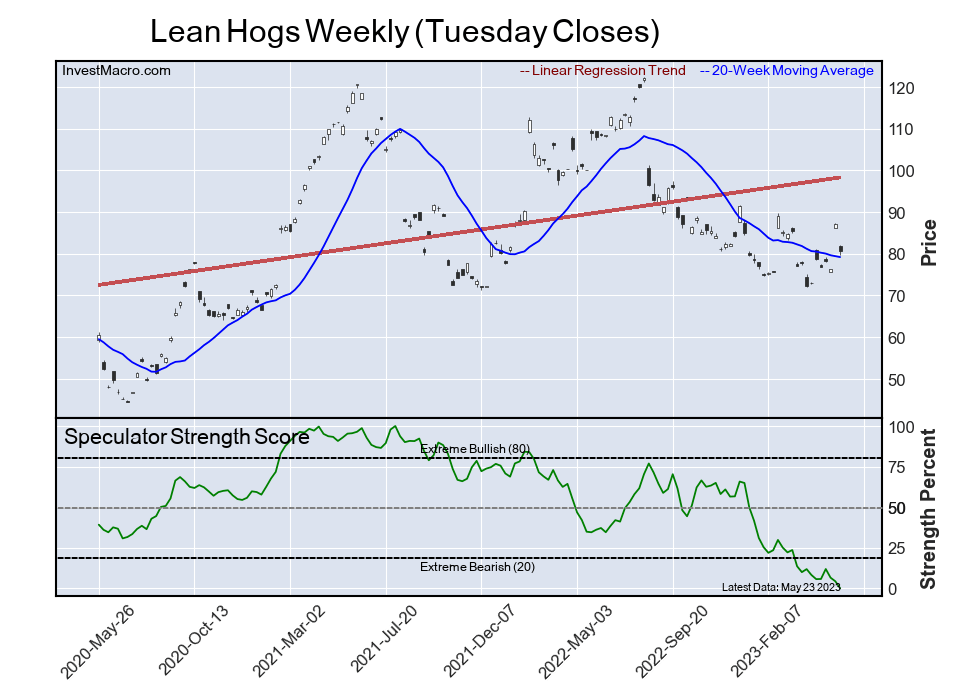
Lean Hogs


The Lean Hogs speculator position comes in as third most bearish extreme standing of the week. The Lean Hogs speculator level resides at a 0.1 percent score of its 3-year range.

The six-week trend for the speculator strength score was -18.9 this week. The overall speculator position was -27,022 net contracts this week with a nudge higher by 135 contracts in the speculator bets.


Ultra 10-Year U.S. T-Note


The Ultra 10-Year U.S. T-Note speculator position comes in as this week’s fourth most bearish extreme standing with a speculator level is at 3.3 percent score of its 3-year range.

The six-week trend for the speculator strength score was 0.3 this week. The speculator position was -190,916 net contracts this week with a gain of 15,667 contracts in the weekly speculator bets.


Cotton


Finally, the Cotton speculator position comes in as the fifth most bearish extreme standing for this week. The Cotton speculator level is at a 4.6 percent score of its 3-year range.

The six-week trend for the speculator strength score was -2.0 this week. The speculator position was -5,413 net contracts this week with a drop of -9,883 contracts in the weekly speculator bets.


Article By InvestMacroReceive our weekly COT Newsletter

*COT Report: The COT data, released weekly to the public each Friday, is updated through the most recent Tuesday (data is 3 days old) and shows a quick view of how large speculators or non-commercials (for-profit traders) were positioned in the futures markets.

The CFTC categorizes trader positions according to commercial hedgers (traders who use futures contracts for hedging as part of the business), non-commercials (large traders who speculate to realize trading profits) and nonreportable traders (usually small traders/speculators) as well as their open interest (contracts open in the market at time of reporting). See CFTC criteria here.

Speculators boost Cocoa bullish bets to highest since March 2020

By InvestMacro

Here are the latest charts and statistics for the Commitment of Traders (COT) reports data published by the Commodities Futures Trading Commission (CFTC).

The latest COT data is updated through Tuesday April 25th and shows a quick view of how large traders (for-profit speculators and commercial entities) were positioned in the futures markets.

Weekly Speculator Changes led by Cocoa & Sugar

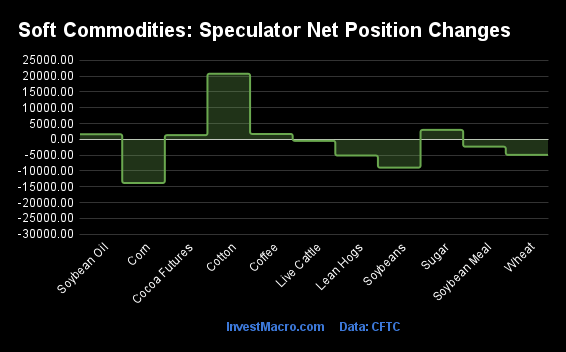
The COT soft commodities markets speculator bets were lower this week as three out of the eleven softs markets we cover had higher positioning while the other eight markets had lower speculator contracts.

Leading the gains for the softs markets was Sugar (10,356 contracts) with Cocoa (2,359 contracts) and Lean Hogs (135 contracts) also showing positive weeks.

The markets with the declines in speculator bets this week were Corn (-80,988 contracts), Soybeans (-73,414 contracts), Wheat (-12,652 contracts), Soybean Meal (-19,017 contracts), Cotton (-9,883 contracts), Soybean Oil (-8,806 contracts), Coffee (-409 contracts) and Live Cattle (-38 contracts).

Cocoa bullish bets hit highest since March 2020

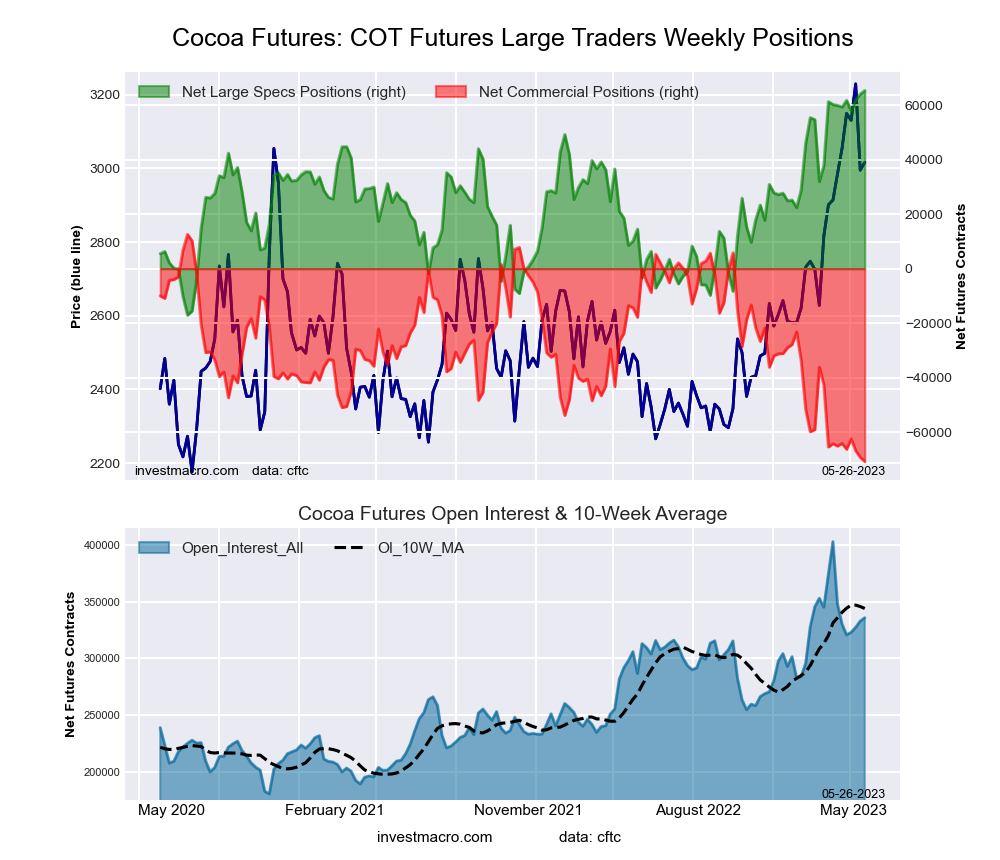
Highlighting the COT soft commodities data this week is the multi-year high in bullish bets of the Cocoa speculator’s positioning. The large speculator bets for Cocoa rose this week for the first time in the past four weeks but the boost pushed the overall net position to its highest level since 2020. This week’s gain brought the Cocoa speculator net position to a total of +61,714 contracts which marks the most bullish level of the past 164 weeks, dating back to March 10th of 2020.

Cocoa trader sentiment and futures prices have been pushed higher recently due to increased demand and because of supply issues arising out of Africa. Nigeria’s exports as well as the Ivory Coast’s exports have been on the decline while dryer weather conditions have also hampered production on the continent. Meanwhile, the demand for Cocoa is being forecast to grow approximately 5 percent annually for the next decade.

The Cocoa futures price fell modestly this week but has been on a strong bullish trend since hitting a recent low in September. Last week, the futures price hit its highest level since 2016 right around the 2995 price before retreating this week to 2937.


Data Snapshot of Commodity Market Traders | Columns Legend
Apr-25-2023OIOI-IndexSpec-NetSpec-IndexCom-NetCOM-IndexSmalls-NetSmalls-Index
WTI Crude1,826,19538236,43820-271,1977934,75953
Gold473,20924185,26459-211,9284226,66447
Silver149,6923730,60362-41,5234410,92027
Copper202,42244-17,042138,304808,73874
Palladium12,27088-5,877116,30990-43216
Platinum72,1257929,61784-34,316234,69931
Natural Gas1,274,53663-136,15018105,7748230,37652
Brent140,3216-40,5642636,713733,85161
Heating Oil268,225237,59340-16,018818,42528
Soybeans630,93512104,09630-76,49170-27,60526
Corn1,242,943724,6483334,70077-59,34818
Coffee192,927736,59265-37,705381,11326
Sugar959,70861279,52890-335,640756,11276
Wheat366,39047-83,188075,3691007,819100


Strength Scores led by Cocoa & Live Cattle

COT Strength Scores (a normalized measure of Speculator positions over a 3-Year range, from 0 to 100 where above 80 is Extreme-Bullish and below 20 is Extreme-Bearish) showed that Cocoa (100 percent) and Live Cattle (93 percent) lead the softs markets this week. Sugar (90 percent), Soybean Meal (66 percent) and Coffee (65 percent) come in as the next highest in the weekly strength scores.

On the downside, Lean Hogs (0 percent), Soybean Oil (0 percent), Wheat (0 percent) and the Cotton (5 percent) come in at the lowest strength levels currently and are in Extreme-Bearish territory (below 20 percent).

Strength Statistics:
Corn (33.2 percent) vs Corn previous week (43.5 percent)
Sugar (89.8 percent) vs Sugar previous week (86.1 percent)
Coffee (64.9 percent) vs Coffee previous week (65.4 percent)
Soybeans (30.1 percent) vs Soybeans previous week (58.9 percent)
Soybean Oil (0.0 percent) vs Soybean Oil previous week (5.5 percent)
Soybean Meal (65.7 percent) vs Soybean Meal previous week (75.6 percent)
Live Cattle (92.5 percent) vs Live Cattle previous week (92.5 percent)
Lean Hogs (0.1 percent) vs Lean Hogs previous week (0.0 percent)
Cotton (4.6 percent) vs Cotton previous week (12.1 percent)
Cocoa (100.0 percent) vs Cocoa previous week (97.0 percent)
Wheat (0.0 percent) vs Wheat previous week (9.7 percent)


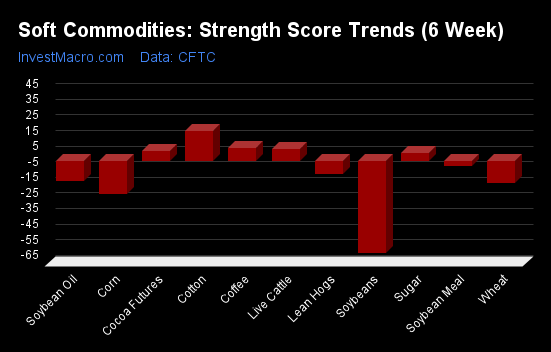
Cocoa & Coffee top the 6-Week Strength Trends

COT Strength Score Trends (or move index, calculates the 6-week changes in strength scores) showed that Cocoa (38 percent) and Coffee (25 percent) lead the past six weeks trends for soft commodities. Sugar (17 percent) and Live Cattle (7 percent) are the next highest positive movers in the latest trends data.

Soybeans (-25 percent) leads the downside trend scores currently with Soybean Meal (-24 percent), Lean Hogs (-19 percent) and Wheat (-14 percent) following next with lower trend scores.

Strength Trend Statistics:
Corn (-2.4 percent) vs Corn previous week (0.3 percent)
Sugar (17.1 percent) vs Sugar previous week (10.1 percent)
Coffee (24.9 percent) vs Coffee previous week (22.5 percent)
Soybeans (-25.1 percent) vs Soybeans previous week (-1.1 percent)
Soybean Oil (-12.0 percent) vs Soybean Oil previous week (-19.5 percent)
Soybean Meal (-24.2 percent) vs Soybean Meal previous week (-24.4 percent)
Live Cattle (7.4 percent) vs Live Cattle previous week (-7.5 percent)
Lean Hogs (-18.9 percent) vs Lean Hogs previous week (-17.5 percent)
Cotton (-2.0 percent) vs Cotton previous week (-1.1 percent)
Cocoa (37.7 percent) vs Cocoa previous week (5.9 percent)
Wheat (-13.8 percent) vs Wheat previous week (2.1 percent)


Individual Soft Commodities Markets:

CORN Futures:

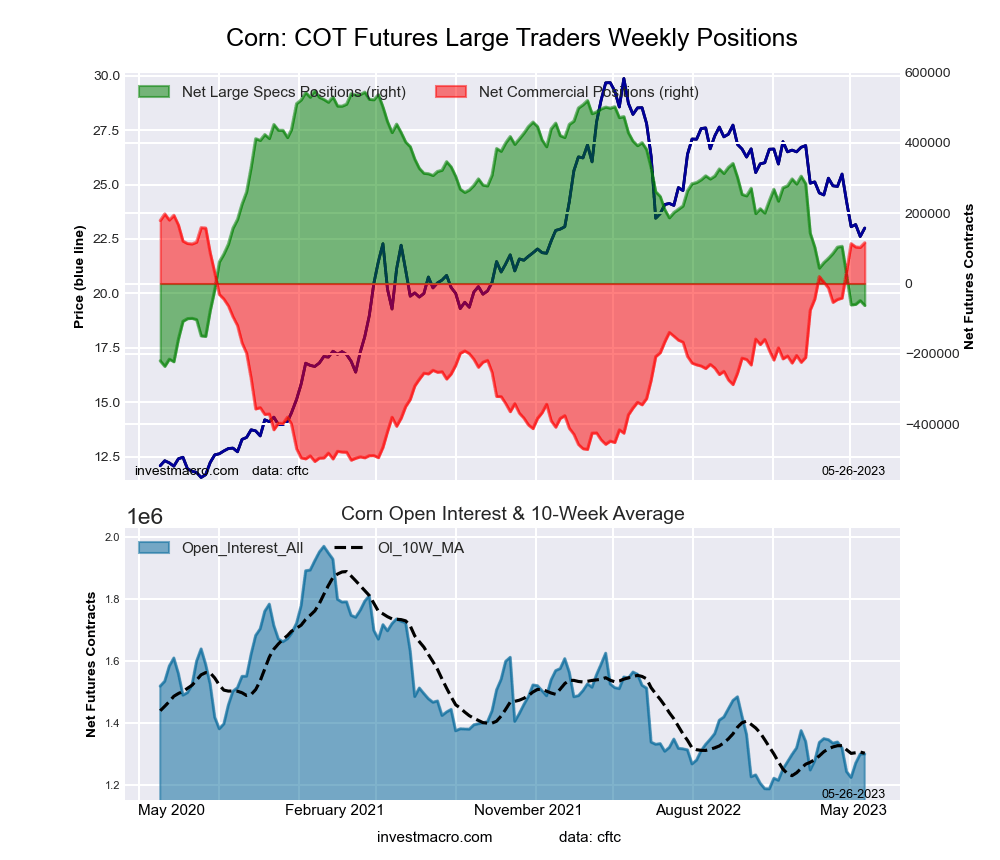
CORN Futures COT ChartThe CORN large speculator standing this week was a net position of 24,648 contracts in the data reported through Tuesday. This was a weekly lowering of -80,988 contracts from the previous week which had a total of 105,636 net contracts.

This week’s current strength score (the trader positioning range over the past three years, measured from 0 to 100) shows the speculators are currently Bearish with a score of 33.2 percent. The commercials are Bullish with a score of 76.8 percent and the small traders (not shown in chart) are Bearish-Extreme with a score of 17.9 percent.

CORN Futures StatisticsSPECULATORSCOMMERCIALSSMALL TRADERS
– Percent of Open Interest Longs:23.951.88.8
– Percent of Open Interest Shorts:21.949.013.5
– Net Position:24,64834,700-59,348
– Gross Longs:297,251644,207109,017
– Gross Shorts:272,603609,507168,365
– Long to Short Ratio:1.1 to 11.1 to 10.6 to 1
NET POSITION TREND:
– Strength Index Score (3 Year Range Pct):33.276.817.9
– Strength Index Reading (3 Year Range):BearishBullishBearish-Extreme
NET POSITION MOVEMENT INDEX:
– 6-Week Change in Strength Index:-2.42.13.4


SUGAR Futures:

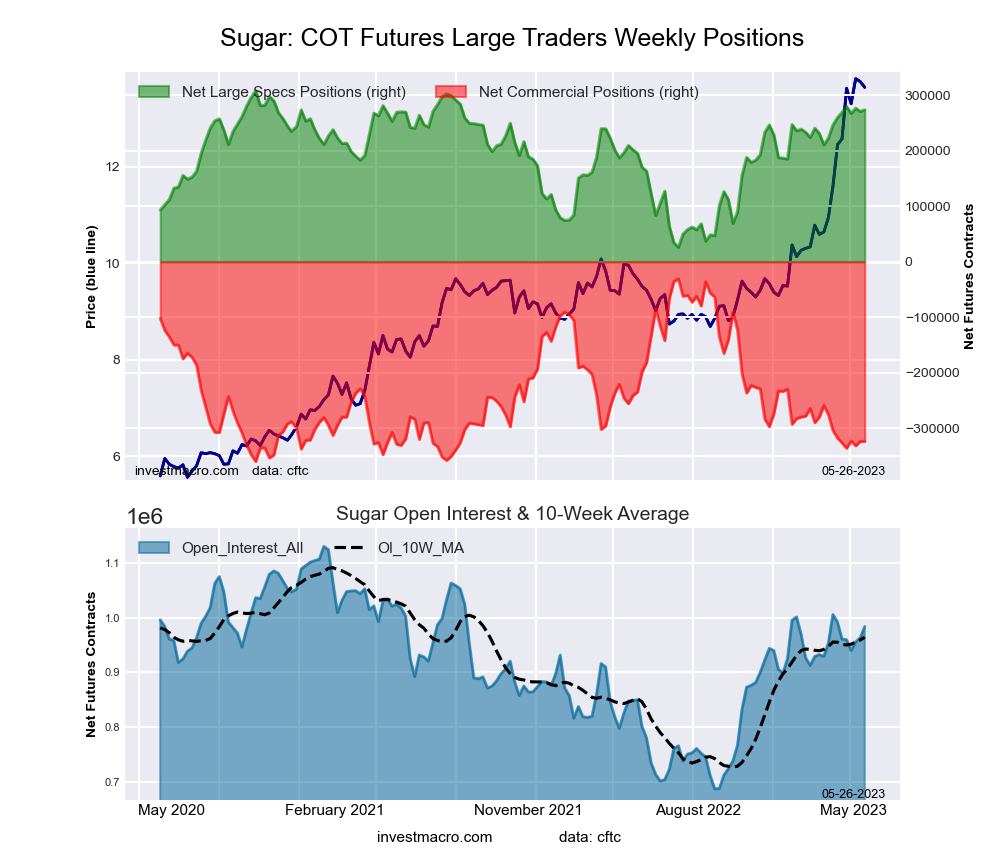
SUGAR Futures COT ChartThe SUGAR large speculator standing this week was a net position of 279,528 contracts in the data reported through Tuesday. This was a weekly gain of 10,356 contracts from the previous week which had a total of 269,172 net contracts.

This week’s current strength score (the trader positioning range over the past three years, measured from 0 to 100) shows the speculators are currently Bullish-Extreme with a score of 89.8 percent. The commercials are Bearish-Extreme with a score of 7.3 percent and the small traders (not shown in chart) are Bullish with a score of 75.8 percent.

SUGAR Futures StatisticsSPECULATORSCOMMERCIALSSMALL TRADERS
– Percent of Open Interest Longs:36.939.510.6
– Percent of Open Interest Shorts:7.874.54.8
– Net Position:279,528-335,64056,112
– Gross Longs:354,581379,027101,894
– Gross Shorts:75,053714,66745,782
– Long to Short Ratio:4.7 to 10.5 to 12.2 to 1
NET POSITION TREND:
– Strength Index Score (3 Year Range Pct):89.87.375.8
– Strength Index Reading (3 Year Range):Bullish-ExtremeBearish-ExtremeBullish
NET POSITION MOVEMENT INDEX:
– 6-Week Change in Strength Index:17.1-17.110.3


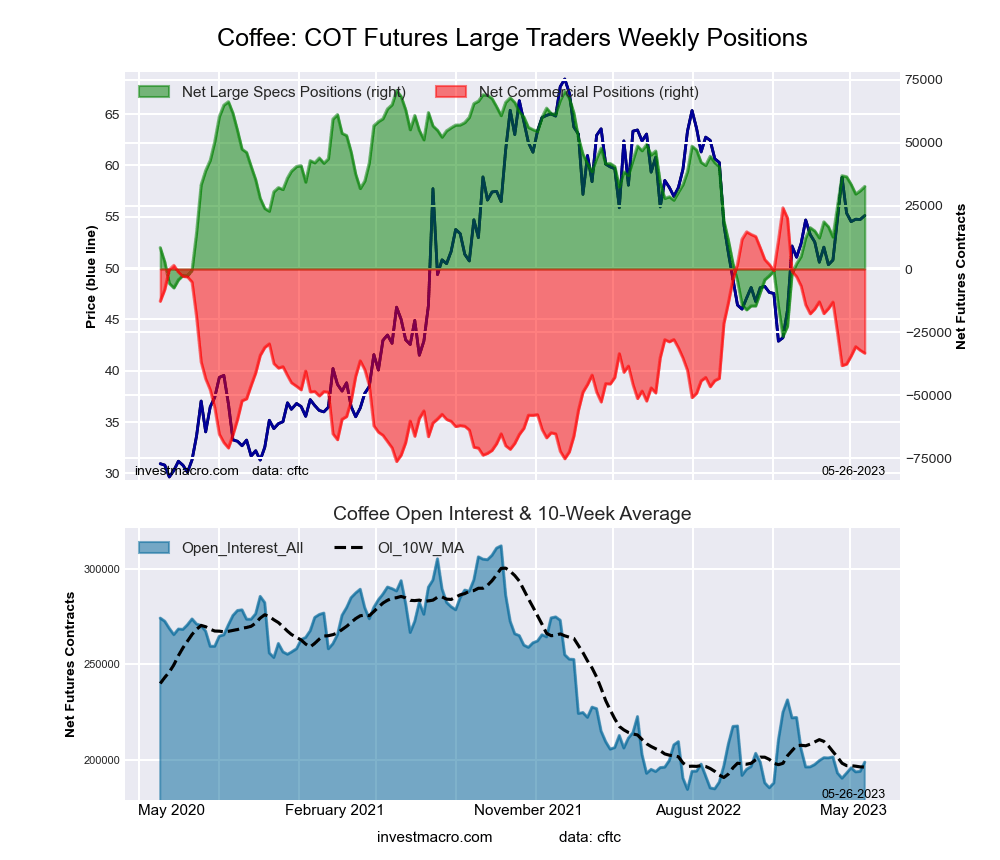
COFFEE Futures:

COFFEE Futures COT ChartThe COFFEE large speculator standing this week was a net position of 36,592 contracts in the data reported through Tuesday. This was a weekly lowering of -409 contracts from the previous week which had a total of 37,001 net contracts.

This week’s current strength score (the trader positioning range over the past three years, measured from 0 to 100) shows the speculators are currently Bullish with a score of 64.9 percent. The commercials are Bearish with a score of 38.4 percent and the small traders (not shown in chart) are Bearish with a score of 26.1 percent.

COFFEE Futures StatisticsSPECULATORSCOMMERCIALSSMALL TRADERS
– Percent of Open Interest Longs:30.242.33.8
– Percent of Open Interest Shorts:11.261.93.3
– Net Position:36,592-37,7051,113
– Gross Longs:58,26681,7047,412
– Gross Shorts:21,674119,4096,299
– Long to Short Ratio:2.7 to 10.7 to 11.2 to 1
NET POSITION TREND:
– Strength Index Score (3 Year Range Pct):64.938.426.1
– Strength Index Reading (3 Year Range):BullishBearishBearish
NET POSITION MOVEMENT INDEX:
– 6-Week Change in Strength Index:24.9-24.65.1


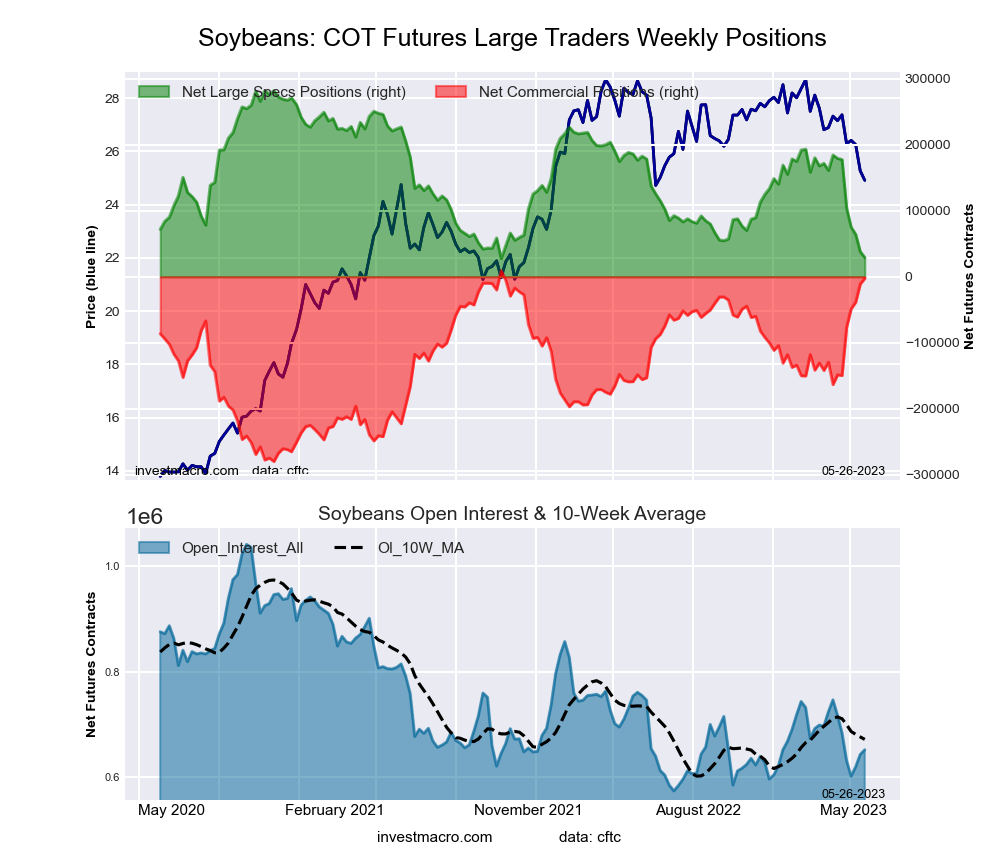
SOYBEANS Futures:

SOYBEANS Futures COT ChartThe SOYBEANS large speculator standing this week was a net position of 104,096 contracts in the data reported through Tuesday. This was a weekly reduction of -73,414 contracts from the previous week which had a total of 177,510 net contracts.

This week’s current strength score (the trader positioning range over the past three years, measured from 0 to 100) shows the speculators are currently Bearish with a score of 30.1 percent. The commercials are Bullish with a score of 70.4 percent and the small traders (not shown in chart) are Bearish with a score of 25.8 percent.

SOYBEANS Futures StatisticsSPECULATORSCOMMERCIALSSMALL TRADERS
– Percent of Open Interest Longs:25.449.07.1
– Percent of Open Interest Shorts:8.961.111.5
– Net Position:104,096-76,491-27,605
– Gross Longs:160,083309,25645,031
– Gross Shorts:55,987385,74772,636
– Long to Short Ratio:2.9 to 10.8 to 10.6 to 1
NET POSITION TREND:
– Strength Index Score (3 Year Range Pct):30.170.425.8
– Strength Index Reading (3 Year Range):BearishBullishBearish
NET POSITION MOVEMENT INDEX:
– 6-Week Change in Strength Index:-25.118.716.5


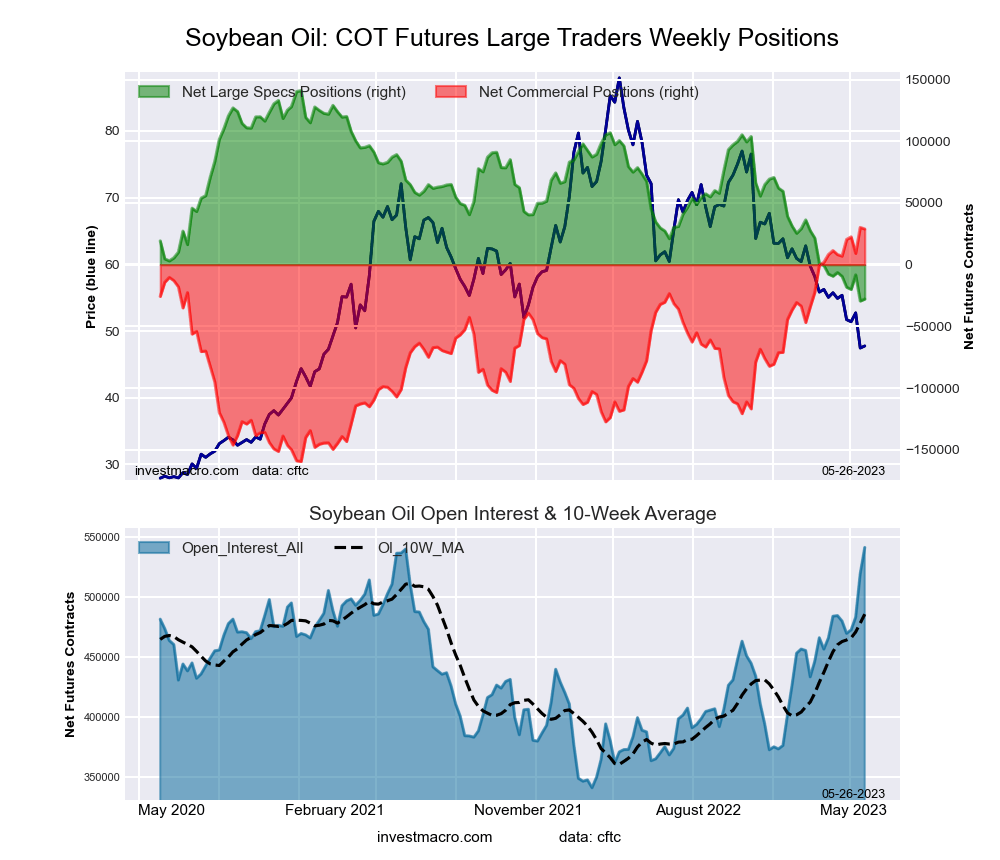
SOYBEAN OIL Futures:

SOYBEAN OIL Futures COT ChartThe SOYBEAN OIL large speculator standing this week was a net position of -18,257 contracts in the data reported through Tuesday. This was a weekly decrease of -8,806 contracts from the previous week which had a total of -9,451 net contracts.

This week’s current strength score (the trader positioning range over the past three years, measured from 0 to 100) shows the speculators are currently Bearish-Extreme with a score of 0.0 percent. The commercials are Bullish-Extreme with a score of 100.0 percent and the small traders (not shown in chart) are Bearish-Extreme with a score of 0.0 percent.

SOYBEAN OIL Futures StatisticsSPECULATORSCOMMERCIALSSMALL TRADERS
– Percent of Open Interest Longs:15.759.86.3
– Percent of Open Interest Shorts:19.655.46.8
– Net Position:-18,25720,425-2,168
– Gross Longs:73,661280,73529,738
– Gross Shorts:91,918260,31031,906
– Long to Short Ratio:0.8 to 11.1 to 10.9 to 1
NET POSITION TREND:
– Strength Index Score (3 Year Range Pct):0.0100.00.0
– Strength Index Reading (3 Year Range):Bearish-ExtremeBullish-ExtremeBearish-Extreme
NET POSITION MOVEMENT INDEX:
– 6-Week Change in Strength Index:-12.011.6-7.0


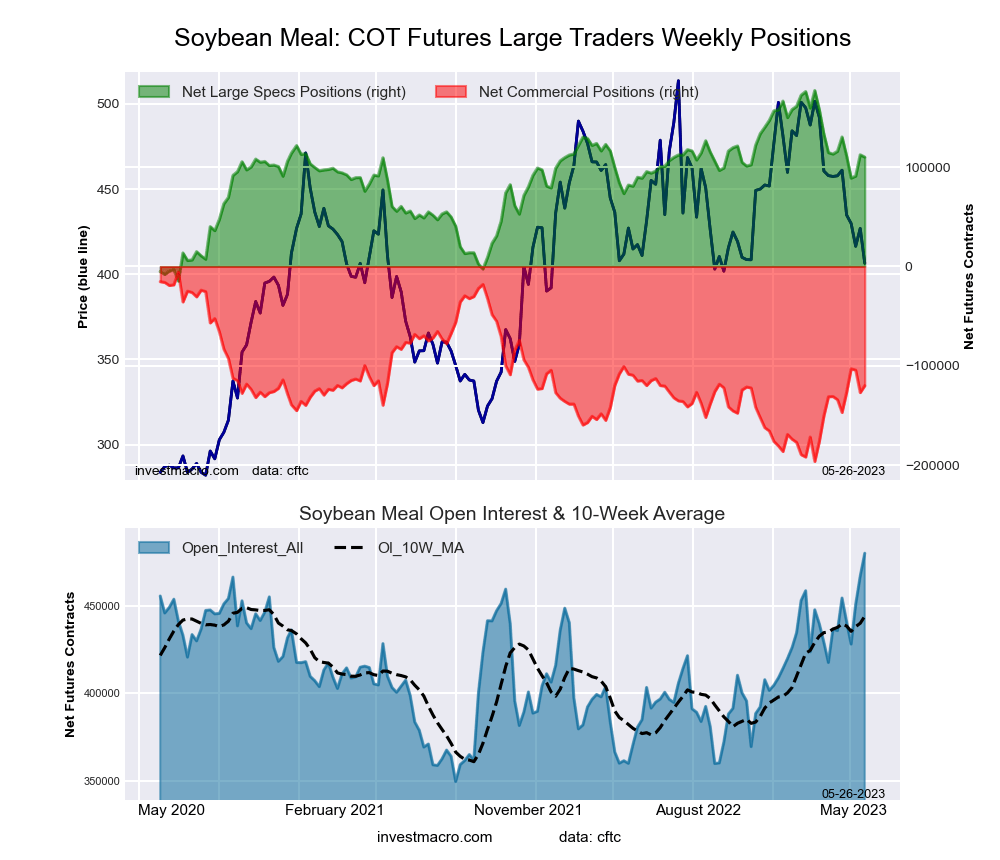
SOYBEAN MEAL Futures:

SOYBEAN MEAL Futures COT ChartThe SOYBEAN MEAL large speculator standing this week was a net position of 111,252 contracts in the data reported through Tuesday. This was a weekly decline of -19,017 contracts from the previous week which had a total of 130,269 net contracts.

This week’s current strength score (the trader positioning range over the past three years, measured from 0 to 100) shows the speculators are currently Bullish with a score of 65.7 percent. The commercials are Bearish with a score of 36.4 percent and the small traders (not shown in chart) are Bearish-Extreme with a score of 16.5 percent.

SOYBEAN MEAL Futures StatisticsSPECULATORSCOMMERCIALSSMALL TRADERS
– Percent of Open Interest Longs:31.639.010.1
– Percent of Open Interest Shorts:6.367.86.6
– Net Position:111,252-126,82215,570
– Gross Longs:139,164171,92944,665
– Gross Shorts:27,912298,75129,095
– Long to Short Ratio:5.0 to 10.6 to 11.5 to 1
NET POSITION TREND:
– Strength Index Score (3 Year Range Pct):65.736.416.5
– Strength Index Reading (3 Year Range):BullishBearishBearish-Extreme
NET POSITION MOVEMENT INDEX:
– 6-Week Change in Strength Index:-24.225.9-13.9


LIVE CATTLE Futures:

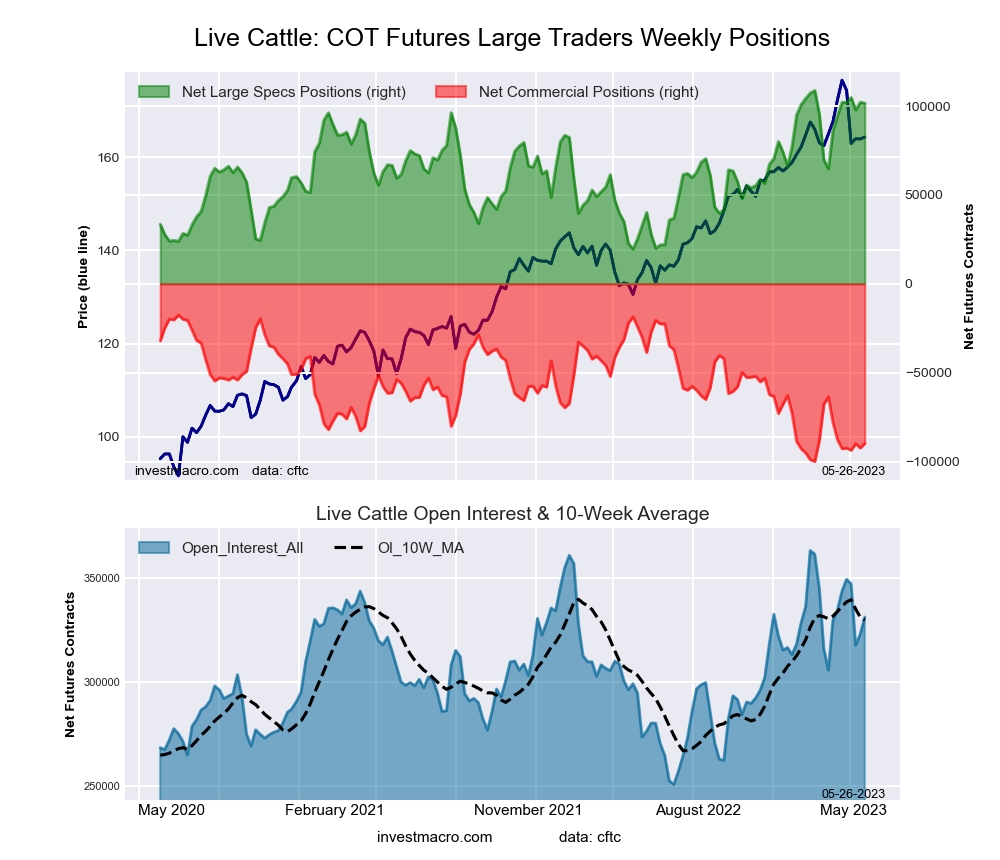
LIVE CATTLE Futures COT ChartThe LIVE CATTLE large speculator standing this week was a net position of 102,034 contracts in the data reported through Tuesday. This was a weekly decline of -38 contracts from the previous week which had a total of 102,072 net contracts.

This week’s current strength score (the trader positioning range over the past three years, measured from 0 to 100) shows the speculators are currently Bullish-Extreme with a score of 92.5 percent. The commercials are Bearish-Extreme with a score of 9.1 percent and the small traders (not shown in chart) are Bearish with a score of 36.1 percent.

LIVE CATTLE Futures StatisticsSPECULATORSCOMMERCIALSSMALL TRADERS
– Percent of Open Interest Longs:44.925.39.7
– Percent of Open Interest Shorts:15.751.712.4
– Net Position:102,034-92,450-9,584
– Gross Longs:156,83888,28133,814
– Gross Shorts:54,804180,73143,398
– Long to Short Ratio:2.9 to 10.5 to 10.8 to 1
NET POSITION TREND:
– Strength Index Score (3 Year Range Pct):92.59.136.1
– Strength Index Reading (3 Year Range):Bullish-ExtremeBearish-ExtremeBearish
NET POSITION MOVEMENT INDEX:
– 6-Week Change in Strength Index:7.4-5.3-12.4


LEAN HOGS Futures:

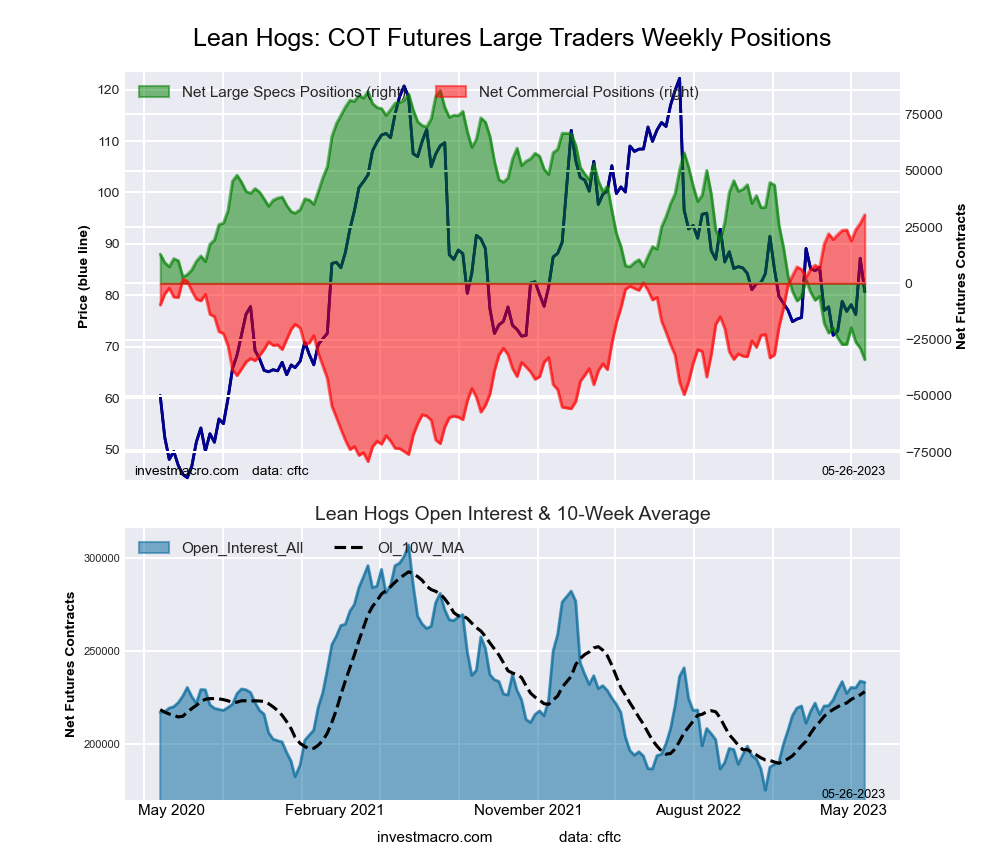
LEAN HOGS Futures COT ChartThe LEAN HOGS large speculator standing this week was a net position of -27,022 contracts in the data reported through Tuesday. This was a weekly rise of 135 contracts from the previous week which had a total of -27,157 net contracts.

This week’s current strength score (the trader positioning range over the past three years, measured from 0 to 100) shows the speculators are currently Bearish-Extreme with a score of 0.1 percent. The commercials are Bullish-Extreme with a score of 100.0 percent and the small traders (not shown in chart) are Bullish-Extreme with a score of 98.3 percent.

LEAN HOGS Futures StatisticsSPECULATORSCOMMERCIALSSMALL TRADERS
– Percent of Open Interest Longs:26.637.312.4
– Percent of Open Interest Shorts:38.526.910.9
– Net Position:-27,02223,6863,336
– Gross Longs:60,38384,74228,143
– Gross Shorts:87,40561,05624,807
– Long to Short Ratio:0.7 to 11.4 to 11.1 to 1
NET POSITION TREND:
– Strength Index Score (3 Year Range Pct):0.1100.098.3
– Strength Index Reading (3 Year Range):Bearish-ExtremeBullish-ExtremeBullish-Extreme
NET POSITION MOVEMENT INDEX:
– 6-Week Change in Strength Index:-18.916.519.3


COTTON Futures:

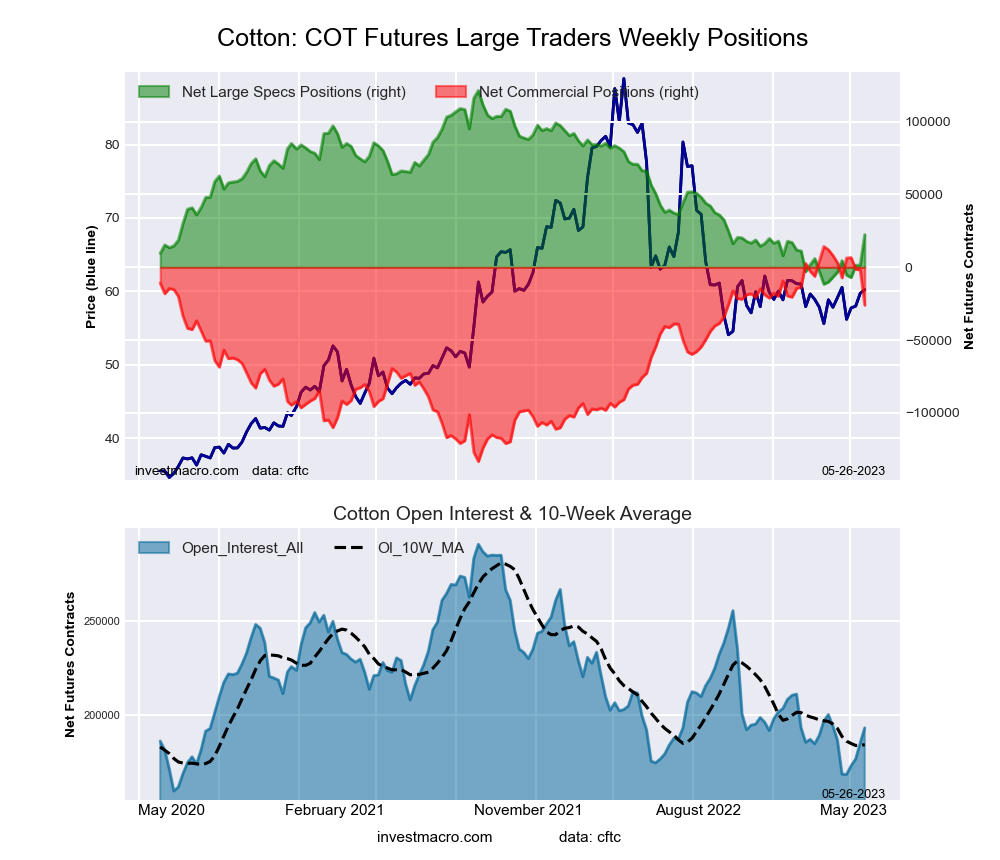
COTTON Futures COT ChartThe COTTON large speculator standing this week was a net position of -5,413 contracts in the data reported through Tuesday. This was a weekly reduction of -9,883 contracts from the previous week which had a total of 4,470 net contracts.

This week’s current strength score (the trader positioning range over the past three years, measured from 0 to 100) shows the speculators are currently Bearish-Extreme with a score of 4.6 percent. The commercials are Bullish-Extreme with a score of 94.6 percent and the small traders (not shown in chart) are Bearish-Extreme with a score of 10.5 percent.

COTTON Futures StatisticsSPECULATORSCOMMERCIALSSMALL TRADERS
– Percent of Open Interest Longs:31.349.26.3
– Percent of Open Interest Shorts:34.545.46.9
– Net Position:-5,4136,321-908
– Gross Longs:52,62482,68010,665
– Gross Shorts:58,03776,35911,573
– Long to Short Ratio:0.9 to 11.1 to 10.9 to 1
NET POSITION TREND:
– Strength Index Score (3 Year Range Pct):4.694.610.5
– Strength Index Reading (3 Year Range):Bearish-ExtremeBullish-ExtremeBearish-Extreme
NET POSITION MOVEMENT INDEX:
– 6-Week Change in Strength Index:-2.01.43.2


COCOA Futures:

COCOA Futures COT ChartThe COCOA large speculator standing this week was a net position of 61,714 contracts in the data reported through Tuesday. This was a weekly lift of 2,359 contracts from the previous week which had a total of 59,355 net contracts.

This week’s current strength score (the trader positioning range over the past three years, measured from 0 to 100) shows the speculators are currently Bullish-Extreme with a score of 100.0 percent. The commercials are Bearish-Extreme with a score of 0.0 percent and the small traders (not shown in chart) are Bearish with a score of 41.9 percent.

COCOA Futures StatisticsSPECULATORSCOMMERCIALSSMALL TRADERS
– Percent of Open Interest Longs:42.231.14.7
– Percent of Open Interest Shorts:22.951.83.3
– Net Position:61,714-66,2514,537
– Gross Longs:135,29299,73015,048
– Gross Shorts:73,578165,98110,511
– Long to Short Ratio:1.8 to 10.6 to 11.4 to 1
NET POSITION TREND:
– Strength Index Score (3 Year Range Pct):100.00.041.9
– Strength Index Reading (3 Year Range):Bullish-ExtremeBearish-ExtremeBearish
NET POSITION MOVEMENT INDEX:
– 6-Week Change in Strength Index:37.7-38.24.4


WHEAT Futures:

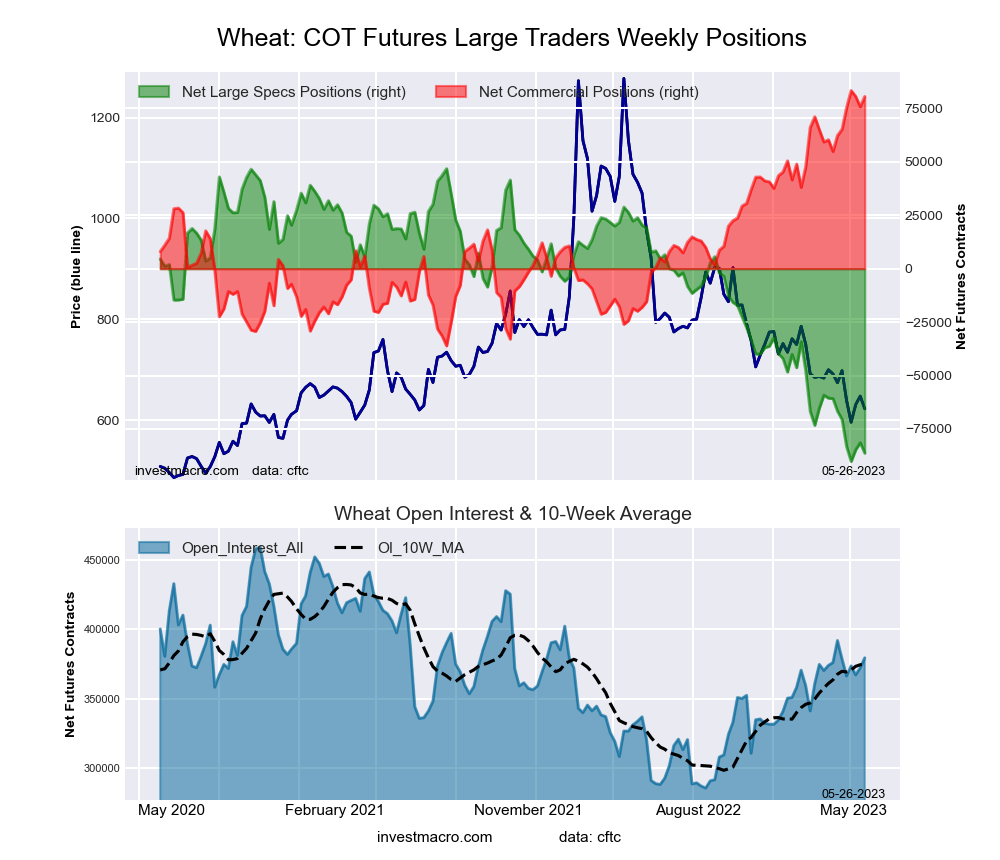
WHEAT Futures COT ChartThe WHEAT large speculator standing this week was a net position of -83,188 contracts in the data reported through Tuesday. This was a weekly reduction of -12,652 contracts from the previous week which had a total of -70,536 net contracts.

This week’s current strength score (the trader positioning range over the past three years, measured from 0 to 100) shows the speculators are currently Bearish-Extreme with a score of 0.0 percent. The commercials are Bullish-Extreme with a score of 100.0 percent and the small traders (not shown in chart) are Bullish-Extreme with a score of 100.0 percent.

WHEAT Futures StatisticsSPECULATORSCOMMERCIALSSMALL TRADERS
– Percent of Open Interest Longs:27.837.711.8
– Percent of Open Interest Shorts:50.517.19.6
– Net Position:-83,18875,3697,819
– Gross Longs:101,941137,97743,119
– Gross Shorts:185,12962,60835,300
– Long to Short Ratio:0.6 to 12.2 to 11.2 to 1
NET POSITION TREND:
– Strength Index Score (3 Year Range Pct):0.0100.0100.0
– Strength Index Reading (3 Year Range):Bearish-ExtremeBullish-ExtremeBullish-Extreme
NET POSITION MOVEMENT INDEX:
– 6-Week Change in Strength Index:-13.89.326.0


Article By InvestMacroReceive our weekly COT Newsletter

*COT Report: The COT data, released weekly to the public each Friday, is updated through the most recent Tuesday (data is 3 days old) and shows a quick view of how large speculators or non-commercials (for-profit traders) were positioned in the futures markets.

The CFTC categorizes trader positions according to commercial hedgers (traders who use futures contracts for hedging as part of the business), non-commercials (large traders who speculate to realize trading profits) and nonreportable traders (usually small traders/speculators) as well as their open interest (contracts open in the market at time of reporting). See CFTC criteria here.

Week Ahead: EURUSD braced for explosive risk cocktail

By ForexTime 

If you thought the last few days were wild for financial markets, then wait until you see what’s in store for the week ahead…

Investors will be served a generous platter of risk investors ranging from pivotal major central bank meetings in the shape of the Reserve Bank of Australia (RBA), Federal Reserve (Fed), and European Central Bank (ECB).

This will be complemented with top-tier data like the US ISM and Friday’s monthly non-farm payrolls report. Another wave of quarterly earnings from the largest economies in the world will top this off, leaving even the hungriest of market players satisfied.

The first trading week of May features these scheduled economic data releases and events:

Monday, May 1

  • May Day holiday: UK, France & China
  • USD: ISM manufacturing

Tuesday, May 2

  • AUD: RBA rate decision
  • EUR: CPI, Eurozone S&P Global manufacturing PMI
  • GBP: UK S&P Global manufacturing PMI
  • USD: US factory orders, revised durable goods

Wednesday, May 3

  • AUD: Australia retail sales
  • NZD: RBNZ financial stability report
  • EUR: Eurozone unemployment
  • USD: Fed rate decision, US ADP payrolls data

Thursday, May 4

  • CNH: China Caixin manufacturing PMI
  • EUR: ECB rate decision
  • USD: US initial jobless claims
  • NQ100_m: Apple Inc (after US markets close)

Friday, May 5

  • CNH: China Caixin services PMI
  • EUR: Eurozone retail sales
  • USD: US April nonfarm payrolls (NFP)

Given the crackerjack list of risk events, investors may feel like a kid in a candy store of volatility and opportunity! Our focus will fall on the world’s most popular traded currency pair which could be heavily influenced by central bank meetings and economic data.

Here are 3 reasons why we’re focusing on the EURUSD for the coming week:

  1. Fed + ECB meeting combo

A central bank combo featuring the Fed and ECB could spark explosive levels of volatility on the EURUSD.

Markets widely expect the Federal Reserve to raise interest rates by 25 basis points on Wednesday, taking the upper band of the Fed funds rates to 5.25%. The key question is whether this will be the final hike that marks the end of the Central Bank’s hiking cycle. Given how annual US inflation cooled for a ninth consecutive period in March and economic growth slowed in Q1, this could strengthen the argument for a cut down the road. If the Fed moves along with a dovish hike, dollar weakness could become a dominant theme in the week ahead.

In regards to the ECB, a 25-basis point hike has been penciled for its Thursday meeting. Stabilizing inflationary pressures continue to support expectations around the central bank shifting into lower gear from 50 basis point hikes. It may be wise to keep a close eye on the euro-inflation data for April which could influence May’s policy decision and beyond. If core inflation remains sticky, this could fuel speculation of the ECB hiking into the summer.

Whatever the outcome of both central bank rate decisions, it will certainly impact the EURUSD.

  1. US April nonfarm payrolls

The NFP may provide fresh clues on what actions the Federal Reserve may take beyond May.

Markets expect the US economy to have created 177,000 jobs in April which is less than the prior month while the unemployment rate is seen holding at 3.5%. A stronger-than-expected US jobs report may support expectations around the Fed keeping US interest rates high for longer – boosting the dollar. However, further evidence of weakening US jobs markets may reinforce bets around the Fed pausing rate hikes, before eventually lowering them. Such a scenario is likely to weaken the dollar – pushing the EURUSD higher.

  1. EURUSD ready to breakout?

Euro bulls have struggled to conquer the 1.1075 level on repeated occasions.

Although the trend remains bullish with prices above the 50 and 100-day Simple Moving Average, bears could strike if prices slip below 1.0950. A daily close below this point could signal a decline towards 1.0910 and 1.0845, respectively. Alternatively, a strong breakout above 1.1075 could inspire an incline toward levels not seen since late March 2022 at 1.1150.

Zooming out to the weekly chart, bulls are clearly in the driving seat. A strong weekly close above 1.1075 may signal a move toward the 200-week SMA near 1.1200. If prices dip back under 1.0900, prices may test 1.0754 and 1.0500, respectively.

At the time of writing Bloomberg’s FX model forecasts a 72% chance that EURUSD will trade within the 1.0827 – 1.1153 range over the upcoming week.


Forex-Time-LogoArticle by ForexTime

ForexTime Ltd (FXTM) is an award winning international online forex broker regulated by CySEC 185/12 www.forextime.com

Cognitive flexibility is essential to navigating a changing world – new research in mice shows how your brain learns new rules

By Vikaas Sohal, University of California, San Francisco and Kathleen Cho, Inserm 

Being flexible and learning to adapt when the world changes is something you practice every day. Whether you run into a new construction site and have to reroute your commute or download a new streaming app and have to relearn how to find your favorite show, changing familiar behaviors in response to new situations is an essential skill.

To make these adaptations, your brain changes its activity patterns within a structure called the prefrontal cortex – an area of the brain critical for cognitive functions such as attention, planning and decision-making. But which specific circuits “tell” the prefrontal cortex to update its activity patterns in order to change behavior have been unknown.

The prefrontal cortex of the brain is involved in executive functions like self-control and decision-making.

We are a team of neuroscientists who study how the brain processes information and what happens when this function is impaired. In our newly published research, we discovered a special class of neurons in the prefrontal cortex that may enable flexible behavior and, when they malfunction, may lead to conditions such as schizophrenia and bipolar disorder.

Inhibitory neurons and learning new rules

Inhibitory neurons dampen the activity of other neurons in the brain. Researchers have traditionally assumed they send their electrical and chemical outputs only to nearby neurons. However, we found a particular class of inhibitory neurons in the prefrontal cortex that communicate across long distances to neurons in the opposite hemisphere of the brain.

We wondered whether these long-range inhibitory connections are involved in coordinating changes in activity patterns across the left and right prefrontal cortex. By doing so, they might provide the critical signals that help you change your behavior at the right moment.

Microscopy image of an interneuron
Interneurons connect other neurons together.
NICHD/McBain Laboratory via Flickr, CC BY-NC-ND

To test the function of these long-range inhibitory connections, we observed mice performing a task that required them to learn a rule to receive a reward and then later adapt to a new rule in order to continue receiving the reward. In this task, mice dug in bowls to find hidden food. Initially, the smell of garlic or the presence of sand within a bowl might indicate the location of the hidden food. The specific cue associated with the reward would later change, forcing the mice to learn a new rule.

We found that silencing the long-range inhibitory connections between the left and right prefrontal cortex caused the mice to get stuck, or perseverate, on one rule and prevented them from learning new ones. They were unable to change gears and learn that the old cue was now meaningless and the new cue signaled food.

Brain waves and flexible behavior

We also made surprising discoveries about how these long-range inhibitory connections create behavioral flexibility. Specifically, they synchronize a set of “brain waves” called gamma oscillations across the two hemispheres. Gamma oscillations are rhythmic fluctuations in brain activity that occur roughly 40 times per second. These fluctuations can be detected during many cognitive functions, such as when performing a task that requires holding information in your memory or making different movements based on what you see on a computer screen.

Though scientists have observed the presence of gamma oscillations for many decades, their function has been controversial. Many researchers think that the synchronization of these rhythmic fluctuations across different brain regions doesn’t serve any useful purpose. Others have speculated that synchronization across different brain regions enhances communication between those regions.

Fluctuations in neural activity manifest as brain waves, or neural oscillations.

We found a completely different potential role for gamma synchrony. When long-range inhibitory connections synchronize gamma oscillations across the left and right prefrontal cortex, they seem to also gate communication between them. When mice learn to disregard a previously established rule that no longer leads to a reward, these connections synchronize gamma oscillations and seem to stop one hemisphere from maintaining unneeded activity patterns in the other. In other words, long-range inhibitory connections seem to stop input from one hemisphere from “getting in the way” of the other when it is trying to learn something new.

For example, the left prefrontal cortex can “remind” the right prefrontal cortex about your usual route to work. But when long-range inhibitory connections synchronize these two areas, they also seem to shut off these reminders and enable new patterns of brain activity corresponding to your new commute to take hold.

Finally, these long-range inhibitory connections also trigger long-lasting effects. Shutting off these connections just once caused mice to have trouble learning new rules several days later. Conversely, rhythmically stimulating these connections to artificially synchronize gamma oscillations can reverse these deficits and restore normal learning.

Cognitive flexibility and schizophrenia

Long-range inhibitory connections play an important role in cognitive flexibility. The inability to appropriately update previously learned rules is one hallmark form of cognitive impairment in psychiatric conditions such as schizophrenia and bipolar disorder.

Research has also seen deficiencies in gamma synchronization and abnormalities in a class of prefrontal inhibitory neurons, which includes the ones we studied, in people with schizophrenia. In this context, our study suggests that treatments that target these long-range inhibitory connections may help improve cognition in people with schizophrenia by synchronizing gamma oscillations.

Many details of how these connections affect brain circuits remain unknown. For example, we do not know exactly which cells within the prefrontal cortex receive input from these long-range inhibitory connections and change their activity patterns to learn new rules. We also do not know whether there are specific molecular pathways that produce the long-lasting changes in neural activity. Answering these questions could reveal how the brain flexibly switches between maintaining and updating old information and potentially lead to new treatments for schizophrenia and other psychiatric conditions.The Conversation

About the Author:

Vikaas Sohal, Professor of Psychiatry, University of California, San Francisco and Kathleen Cho, Principal Investigator in Neuroscience, Inserm

This article is republished from The Conversation under a Creative Commons license. Read the original article.


What are stock buybacks, which critics are blaming for hastening Bed Bath & Beyond’s bankruptcy? A finance professor explains

By D. Brian Blank, Mississippi State University 

Bed Bath & Beyond filed for bankruptcy on April 23, 2023, and some analysts are blaming the billions of dollars the retailer spent on share buybacks as one of the reasons for its downfall. In total, the company has spent nearly US$12 billion buying back its own stock since 2005, including $1 billion in 2021 alone – cash that could have potentially helped stave off bankruptcy.

Bed Bath & Beyond is hardly alone in snapping up its own stock. Companies have been buying back record amounts of their own shares in recent years, which prompted President Joe Biden to propose quadrupling the tax on buybacks to 4%.

But what are stock buybacks, and why do some people consider them to be a bad thing? The Conversation tapped D. Brian Blank, who studies company financial decision-making at Mississippi State University, to fill us in.

1. What are stock buybacks?

Before we can answer that question, first we need to understand the basics of how stock works.

Stock represents an ownership interest in a company, such that stockholders have a stake in the business. Companies use stock as one way to raise capital by selling their shares to investors, usually in an initial public offering.

Most stockholders, however, obtain stock by buying it on a secondary market, like the New York Stock Exchange. In this case, one person chooses to sell their ownership in the company, while another person buys it.

As partial owners, shareholders see the value of their stock rise when the company does well.

One way investors can benefit from holding the stock is that some corporations pay dividends, which are payments made directly to shareholders. Another way that stockholders can benefit is by selling the stock for more than they paid for it. Together, this creates a return on investment.

And this brings us to share buybacks – and why investors like them.

2. Why do companies buy back their own stock?

When companies have extra capital, they might go into the secondary market and buy back stock from investors. This is often referred to as a stock repurchase or buyback program. Companies that are older and less focused on rapid growth tend to do them more often.

Companies do this for a variety of reasons, such as because they think their shares are undervalued and want to signal optimism to Wall Street, or because they simply want another way to distribute profits to shareholders – a key goal of any companyother than through dividends.

Shareholders like buybacks because companies often pay a premium over market price. And when companies buy their own stock, this removes those shares from the market, which has the effect of lifting share prices as supply goes down, benefiting existing stockholders.

It’s estimated that American companies bought back a record $1 trillion of their own stock in 2022. And Apple is the biggest user of buybacks, having spent $557 billion over the past decade repurchasing its own shares.

3. Why do Biden and others dislike buybacks?

Critics like Biden contend that share buybacks represent short-term thinking that doesn’t actually create any real value. They argue instead that companies should use more of their profits to invest in more productive activities like business operations, innovation or employees.

Returning money that a company makes to stockholders does mean less capital is available for other investments. In his speech, Biden specifically called out “Big Oil” companies for using the record profits they’ve earned from high energy prices to buy back their stock rather than investing in new wells to increase supply – and help reduce gas prices.

But the decision whether to invest to increase domestic production is a complicated one. For example, the reason companies aren’t investing in new wells right now is not simply because they are buying back stock. The reason has more to do with how oil companies, and their shareholders, don’t think it is profitable to invest in more supply for a whole host of reasons, including the global push for greener energy by both policymakers and consumers, which is bound to reduce demand for fossil fuels in the future.

It’s also worth noting that while share repurchases are becoming increasingly common and controversial, they remain very similar to dividends, which don’t prompt the same concerns among politicians.

4. Would increasing the tax result in fewer buybacks?

The 1% tax on buybacks is actually brand new.

Congress passed the tax in 2022 as part of the Inflation Reduction Act. It took effect at the beginning of 2023 and only affects buyback programs of $1 million or more.

Usually when an activity is taxed, it happens less frequently. So, I expect the tax to nudge companies to spend less on buybacks and more elsewhere. While politicians intend more of the money to be used to invest in their productive capacity, companies may simply spend more on paying shareholders dividends.

Since the tax is new, it’s hard to evaluate its actual impact. Companies reportedly accelerated their repurchase programs in 2022 to avoid paying the tax.

But early data from 2023 suggests the 1% tax isn’t significantly deterring buybacks. Companies announced $132 billion in buybacks in January, three times as much as a year earlier and the most for the month on record.

Biden’s proposal to boost the tax to 4% may alter corporate behavior more. But again, it may just lead to greater dividend payments, not the other types of investments he and others hope for.

In addition, given that Republicans control the House, and Democrats have only a narrow majority in the Senate, this proposal has little chance of becoming law anytime soon.

The reasons why large corporations make the decisions they do about where to allocate capital – whether to build a factory, hire more workers or buy back stock – are complicated and, in my view, never taken lightly. These decisions have many facets and implications, and are not necessarily bad. I believe this is something worth remembering the next time you hear politicians sayingcorporations should do the right thing.”

This is an updated version of an article originally published on Feb. 10, 2023.The Conversation

About the Author:

D. Brian Blank, Assistant Professor of Finance, Mississippi State University

This article is republished from The Conversation under a Creative Commons license. Read the original article.

Global shipping is under pressure to stop its heavy fuel oil use fast – that’s not simple, but changes are coming

By Don Maier, University of Tennessee 

Most of the clothing and gadgets you buy in stores today were once in shipping containers, sailing across the ocean. Ships carry over 80% of the world’s traded goods. But they have a problem – the majority of them burn heavy sulfur fuel oil, which is a driver of climate change.

While cargo ships’ engines have become more efficient over time, the industry is under growing pressure to eliminate its carbon footprint.

The European Union Parliament this year voted to require an 80% drop in shipping fuels’ greenhouse gas intensity by 2050 and to require shipping lines to pay for the greenhouse gases their ships release. The International Maritime Organization, the United Nations agency that regulates international shipping, also plans to strengthen its climate strategy this summer. The IMO’s current goal is to cut shipping emissions 50% by 2050. President Joe Biden said on April 20, 2023, that the U.S. would push for a new international goal of zero emissions by 2050 instead.

We asked maritime industry researcher Don Maier if the industry can meet those tougher targets.

Why is it so hard for shipping to transition away from fossil fuels?

Economics and the lifespan of ships are two primary reasons.

Most of the big shippers’ fleets are less than 20 years old, but even the newer builds don’t necessarily have the most advanced technology. It takes roughly a year and a half to come out with a new build of a ship, and it will still be based on technology from a few years ago. So, most of the engines still run on fossil fuel oil.

If companies do buy ships that run on alternative fuels, such as hydrogen, methanol and ammonia, they run into another challenge: There are only a few ports so far with the infrastructure to provide those fuels. Without a way to refuel at all the ports that a ship might use, companies will lose their return on investment, so they will keep using the same technology instead.

It isn’t necessarily that the maritime industry doesn’t want to go the direction of cleaner fuels. But their assets – their fleets – were purchased with a long lifespan in mind, and alternative fuels aren’t yet widely available.

Ships are being built that can run on liquefied natural gas (LNG) and methanol, and even hydrogen is coming online. Often these are dual-fuel – ships that can run on either alternative fuels or fossil fuels. But so far, not enough of this type of ship is being ordered for the costs to make financial sense for most builders or buyers.

The costs of alternative fuels, like methanol and hydrogen fuels made with renewable energy (as opposed to being made with natural gas), are also still significantly higher than fuel oil or LNG. But the good news is those costs are starting to decline. As production ramps up, emissions will drop further.

Can tougher regulations and carbon pricing effectively push the industry to change?

A little bit of pressure on the industry can be helpful, but too much, too fast can really make things more disruptive.

Like most industries, shipping lines want standardized rules they can count on not to change next year. Some of these companies have invested millions of dollars in new ships in recent years, and they’re now being told that those ships might not meet the new standards – even though the ships may be almost brand new.

Another concern with the EU’s moves is whether it has a grasp on all the “what if” scenarios. For example, if the EU has stricter rules than other countries, that affects which ships companies can use on European routes. Any vessels that they put on routes to Europe will have to meet those emissions standards. If there’s a greater demand for products in Europe, they may have fewer vessels they could use.

Press the play button or zoom out and use the filters to see where different ship types travel. Created by London-based data visualization studio Kiln and the UCL Energy Institute

I do think the change will be coming soon in the industry, but changes have to make financial sense to the shipping lines and their customers, too.

Economists have estimated that the cost of cutting emissions 50% by 2050 are anywhere from US$1 trillion to, more realistically, over $3 trillion, and full decarbonization would be even higher. Many of those costs will be passed down to charterers, shippers and eventually consumers – meaning you and me.

Are there ways companies can cut emissions now while preparing to upgrade their fleets?

There are a number of options ship companies are using now to lower emissions.

One that has been used for at least 10 years is putting higher quality paint on the hulls, which reduces the friction between the hull and the water. With less friction, the engine isn’t working as hard, which reduces emissions.

Another is slow speed. If ships run at a higher speed, their engines work harder, which means they use more fuel and release more emissions. So shippers will use slow steaming. Most of the time, ships will go slow when they’re close to shore to reduce emissions that cause smog in port cities like Los Angeles. On the open ocean, they will go back to normal speed.

Another option common in the U.S. and Europe is shutting down the ship’s engines while in port and plugging into the port’s electricity. It’s called “cold ironing.” It avoids burning more of the ship’s fuel, which affects air quality. The Ports of Los Angeles and Long Beach, where smog from idling ships has been a health concern, have been a big driver of electrification. It’s also less expensive for shipping companies than burning their fuel while in port.

As simple as those may sound, they have made huge improvements in terms of emissions, but they aren’t enough on their own.

Will a higher goal set by the IMO be enough to pressure the industry to change?

I used to work in shipping, and I know the maritime industry is a very old-school industry from centuries ago. But the industry has invested millions in new ships with the most effective technology available in recent years.

When the IMO began requiring all ships using heavy fuel in global trade to shift to low-sulfur fuel, the industry pivoted to meet the rule, even though retrofits were costly and time consuming. Many shipping lines complied by installing “scrubbers” that essentially filter the ship’s engine, and new ships were built to run on the low-sulfur fuel oil.

Now, the industry is being told the standards are changing again.

All industries want consistency so they can be confident investing in a new technology. The shipping lines will follow what the IMO says. They will push back, but they will still do it. That’s in part because the IMO supports the maritime industry, too.The Conversation

About the Author:

Don Maier, Associate Professor of Business, University of Tennessee

This article is republished from The Conversation under a Creative Commons license. Read the original article.


Currency Speculators trim US Dollar Index bets to lowest level in 93-weeks

By InvestMacro

Here are the latest charts and statistics for the Commitment of Traders (COT) data published by the Commodities Futures Trading Commission (CFTC).

The latest COT data is updated through Tuesday April 18th and shows a quick view of how large market participants (for-profit speculators and commercial traders) were positioned in the futures markets. All currency positions are in direct relation to the US dollar where, for example, a bet for the euro is a bet that the euro will rise versus the dollar while a bet against the euro will be a bet that the euro will decline versus the dollar.

Weekly Speculator Changes led by Canadian Dollar & British Pound

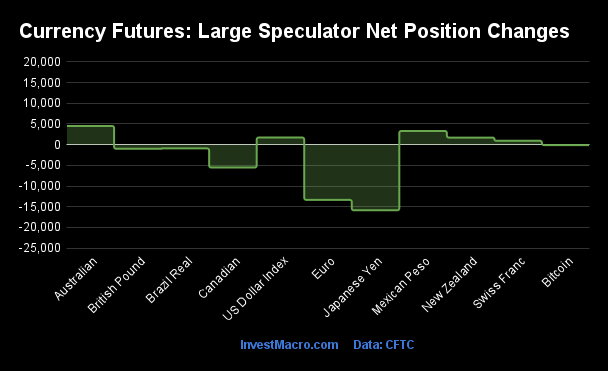
The COT currency market speculator bets were higher this week as eight out of the eleven currency markets we cover had higher positioning while the other three markets had lower speculator contracts.

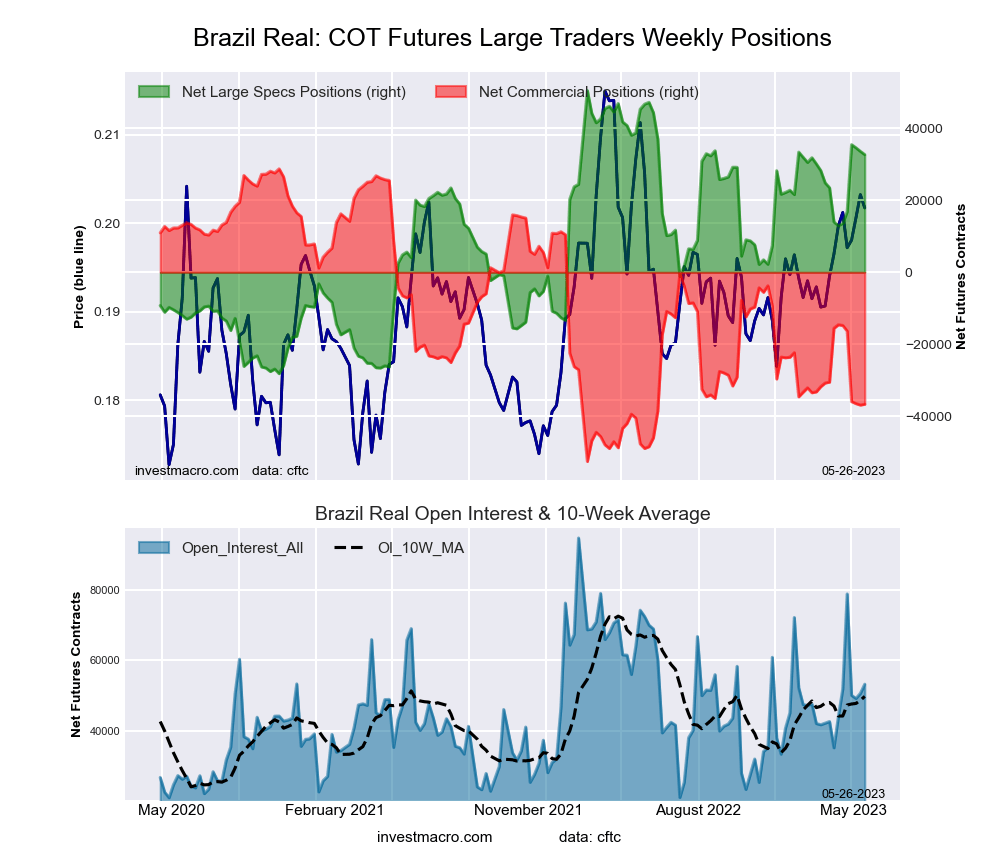
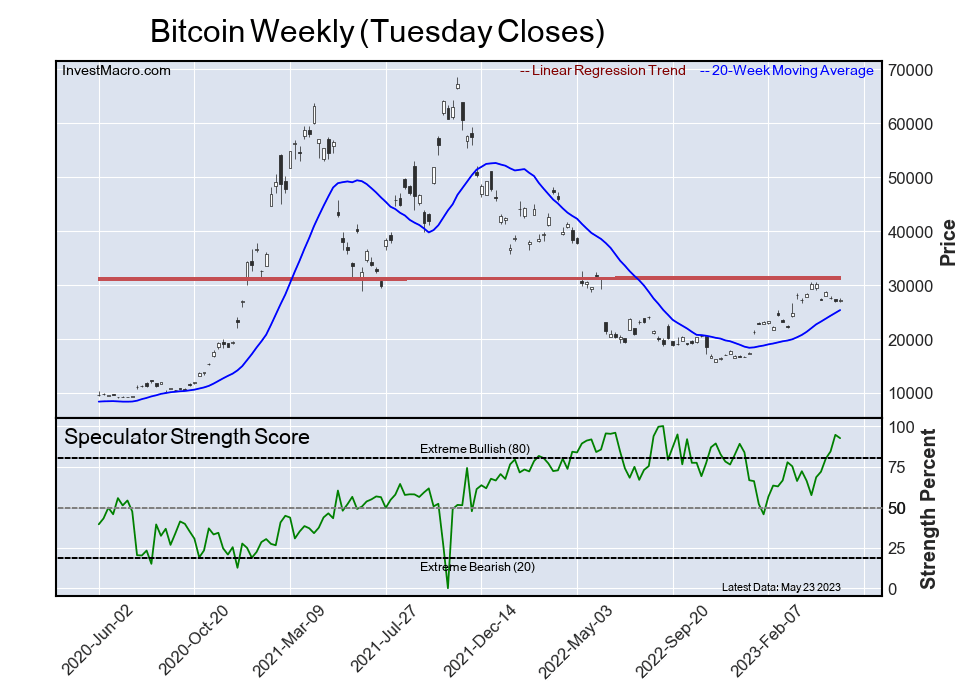
Leading the gains for the currency markets was the Canadian Dollar (10,346 contracts) with the British Pound (3,700 contracts), the Swiss Franc (2,014 contracts), the EuroFX (1,023 contracts), Brazilian Real (651 contracts), Bitcoin (633 contracts), New Zealand Dollar (577 contracts) and the Japanese Yen (338 contracts) also recording positive weeks.

The currencies seeing declines in speculator bets on the week were the Mexican Peso (-4,306 contracts) with the Australian Dollar (-4,419 contracts) and the US Dollar Index (-2,751 contracts) also seeing lower bets on the week.

Speculators reduce US Dollar Index bets to lowest level in 93-weeks

Highlighting the COT currency’s data this week is the increased bearishness of the speculator’s positioning in the US Dollar Index.

Large speculative US Dollar Index positions fell this week for a second consecutive week and for the third time in the past four weeks. Speculators have now subtracted a total of -3,631 net contracts from the overall position over the last four weeks. This bearishness has pushed the US Dollar Index speculator net position (currently at +10,513 contracts) to the lowest level of the past 93 weeks, dating back to July 6th of 2021.

Overall, the US Dollar speculator position has been in bullish territory dating back to June 29th of 2021 with the most bullish point of the cycle taking place on June 21st of 2022 with a high of +45,010 contracts. Since then, speculator positions have slowly eroded and have now been under the +20,000 net contract level for the past 18 weeks in a row.

The US Dollar Index futures price has been on the defensive as well with this week being the first weekly advance over the past eight weeks. The front-month futures price closed this week around 101.50 and is down around 4 percent since February while also being down over 10 percent since October.


Data Snapshot of Forex Market Traders | Columns Legend
Apr-18-2023OIOI-IndexSpec-NetSpec-IndexCom-NetCOM-IndexSmalls-NetSmalls-Index
USD Index34,8653410,51342-11,955571,44232
EUR766,37480164,36182-213,2851848,92457
GBP224,536521,30270-7,995296,69371
JPY177,50733-56,8693461,64566-4,77644
CHF40,87038-4,720423,386511,33462
CAD148,63829-46,2331142,194854,03932
AUD159,70857-42,3564650,55757-8,20132
NZD33,37716-3,904433,7175518754
MXN267,6986156,17191-60,884104,71385
RUB20,93047,54331-7,15069-39324
BRL51,8834213,59653-14,778461,18253
Bitcoin15,38576-48968-176066528


Strength Scores led by Mexican Peso & EuroFX

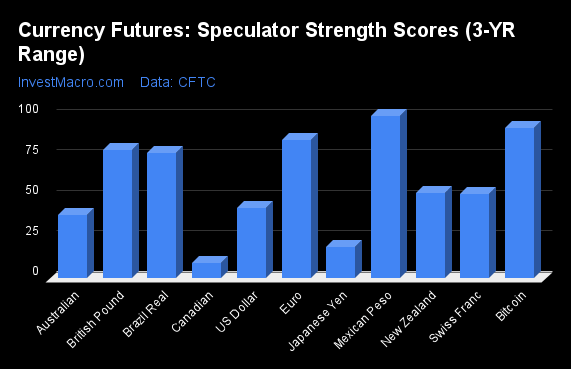
COT Strength Scores (a normalized measure of Speculator positions over a 3-Year range, from 0 to 100 where above 80 is Extreme-Bullish and below 20 is Extreme-Bearish) showed that the Mexican Peso (91 percent) and the EuroFX (82 percent) lead the currency markets this week. The British Pound (70 percent), Bitcoin (68 percent) and the Brazilian Real (53 percent) come in as the next highest in the weekly strength scores.

On the downside, the Canadian Dollar (11 percent) comes in at the lowest strength levels currently and is in Extreme-Bearish territory (below 20 percent).

Strength Statistics:
US Dollar Index (42.5 percent) vs US Dollar Index previous week (47.1 percent)
EuroFX (81.7 percent) vs EuroFX previous week (81.3 percent)
British Pound Sterling (70.1 percent) vs British Pound Sterling previous week (67.0 percent)
Japanese Yen (33.9 percent) vs Japanese Yen previous week (33.6 percent)
Swiss Franc (42.1 percent) vs Swiss Franc previous week (36.8 percent)
Canadian Dollar (11.4 percent) vs Canadian Dollar previous week (1.8 percent)
Australian Dollar (45.6 percent) vs Australian Dollar previous week (49.7 percent)
New Zealand Dollar (43.0 percent) vs New Zealand Dollar previous week (41.4 percent)
Mexican Peso (91.1 percent) vs Mexican Peso previous week (94.4 percent)
Brazilian Real (53.1 percent) vs Brazilian Real previous week (52.3 percent)
Bitcoin (68.4 percent) vs Bitcoin previous week (57.4 percent)


Mexican Peso & British Pound top the 6-Week Strength Trends

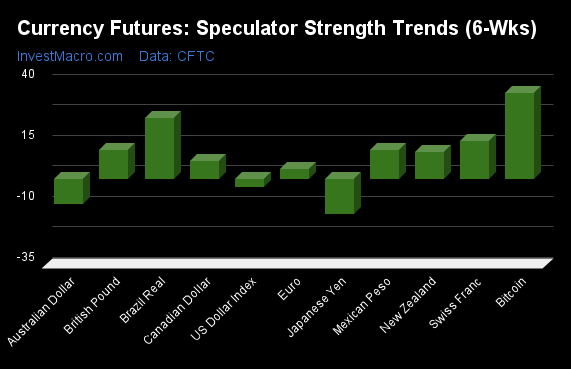
COT Strength Score Trends (or move index, calculates the 6-week changes in strength scores) showed that the Mexican Peso (66 percent) and the British Pound (16 percent) lead the past six weeks trends for the currencies. The Japanese Yen (11 percent), the EuroFX (6 percent) and the Swiss Franc (-2 percent) are the next highest positive movers in the latest trends data.

The New Zealand Dollar (-26 percent) leads the downside trend scores currently with the Brazilian Real (-21 percent), Australian Dollar (-16 percent) and the Canadian Dollar (-16 percent) following next with lower trend scores.

Strength Trend Statistics:
US Dollar Index (-3.4 percent) vs US Dollar Index previous week (2.3 percent)
EuroFX (6.1 percent) vs EuroFX previous week (0.4 percent)
British Pound Sterling (16.1 percent) vs British Pound Sterling previous week (18.3 percent)
Japanese Yen (11.4 percent) vs Japanese Yen previous week (0.9 percent)
Swiss Franc (-2.0 percent) vs Swiss Franc previous week (-4.8 percent)
Canadian Dollar (-15.9 percent) vs Canadian Dollar previous week (-19.1 percent)
Australian Dollar (-16.3 percent) vs Australian Dollar previous week (-12.8 percent)
New Zealand Dollar (-25.8 percent) vs New Zealand Dollar previous week (-31.4 percent)
Mexican Peso (66.2 percent) vs Mexican Peso previous week (72.5 percent)
Brazilian Real (-21.0 percent) vs Brazilian Real previous week (-24.0 percent)
Bitcoin (-9.2 percent) vs Bitcoin previous week (-9.1 percent)


Individual COT Forex Markets:

US Dollar Index Futures:
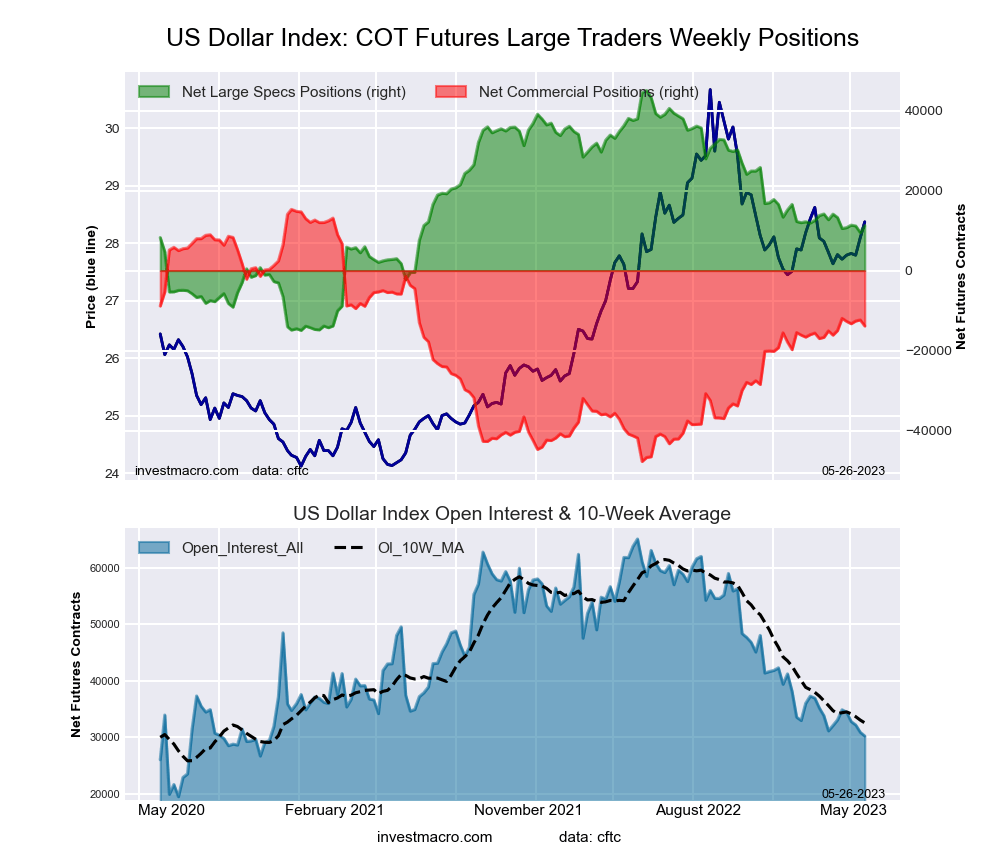
US Dollar Index Forex Futures COT ChartThe US Dollar Index large speculator standing this week reached a net position of 10,513 contracts in the data reported through Tuesday. This was a weekly decrease of -2,751 contracts from the previous week which had a total of 13,264 net contracts.

This week’s current strength score (the trader positioning range over the past three years, measured from 0 to 100) shows the speculators are currently Bearish with a score of 42.5 percent. The commercials are Bullish with a score of 56.8 percent and the small traders (not shown in chart) are Bearish with a score of 32.3 percent.

US DOLLAR INDEX StatisticsSPECULATORSCOMMERCIALSSMALL TRADERS
– Percent of Open Interest Longs:72.39.714.2
– Percent of Open Interest Shorts:42.144.010.0
– Net Position:10,513-11,9551,442
– Gross Longs:25,1923,3714,940
– Gross Shorts:14,67915,3263,498
– Long to Short Ratio:1.7 to 10.2 to 11.4 to 1
NET POSITION TREND:
– Strength Index Score (3 Year Range Pct):42.556.832.3
– Strength Index Reading (3 Year Range):BearishBullishBearish
NET POSITION MOVEMENT INDEX:
– 6-Week Change in Strength Index:-3.45.8-17.9


Euro Currency Futures:

Euro Currency Futures COT ChartThe Euro Currency large speculator standing this week reached a net position of 164,361 contracts in the data reported through Tuesday. This was a weekly rise of 1,023 contracts from the previous week which had a total of 163,338 net contracts.

This week’s current strength score (the trader positioning range over the past three years, measured from 0 to 100) shows the speculators are currently Bullish-Extreme with a score of 81.7 percent. The commercials are Bearish-Extreme with a score of 18.4 percent and the small traders (not shown in chart) are Bullish with a score of 57.0 percent.

EURO Currency StatisticsSPECULATORSCOMMERCIALSSMALL TRADERS
– Percent of Open Interest Longs:31.654.511.8
– Percent of Open Interest Shorts:10.282.35.4
– Net Position:164,361-213,28548,924
– Gross Longs:242,369417,58690,436
– Gross Shorts:78,008630,87141,512
– Long to Short Ratio:3.1 to 10.7 to 12.2 to 1
NET POSITION TREND:
– Strength Index Score (3 Year Range Pct):81.718.457.0
– Strength Index Reading (3 Year Range):Bullish-ExtremeBearish-ExtremeBullish
NET POSITION MOVEMENT INDEX:
– 6-Week Change in Strength Index:6.1-3.6-8.4


British Pound Sterling Futures:

British Pound Sterling Futures COT ChartThe British Pound Sterling large speculator standing this week reached a net position of 1,302 contracts in the data reported through Tuesday. This was a weekly rise of 3,700 contracts from the previous week which had a total of -2,398 net contracts.

This week’s current strength score (the trader positioning range over the past three years, measured from 0 to 100) shows the speculators are currently Bullish with a score of 70.1 percent. The commercials are Bearish with a score of 28.7 percent and the small traders (not shown in chart) are Bullish with a score of 71.1 percent.

BRITISH POUND StatisticsSPECULATORSCOMMERCIALSSMALL TRADERS
– Percent of Open Interest Longs:24.056.913.7
– Percent of Open Interest Shorts:23.460.410.7
– Net Position:1,302-7,9956,693
– Gross Longs:53,834127,73130,745
– Gross Shorts:52,532135,72624,052
– Long to Short Ratio:1.0 to 10.9 to 11.3 to 1
NET POSITION TREND:
– Strength Index Score (3 Year Range Pct):70.128.771.1
– Strength Index Reading (3 Year Range):BullishBearishBullish
NET POSITION MOVEMENT INDEX:
– 6-Week Change in Strength Index:16.1-28.545.5


Japanese Yen Futures:

Japanese Yen Forex Futures COT ChartThe Japanese Yen large speculator standing this week reached a net position of -56,869 contracts in the data reported through Tuesday. This was a weekly lift of 338 contracts from the previous week which had a total of -57,207 net contracts.

This week’s current strength score (the trader positioning range over the past three years, measured from 0 to 100) shows the speculators are currently Bearish with a score of 33.9 percent. The commercials are Bullish with a score of 65.7 percent and the small traders (not shown in chart) are Bearish with a score of 43.7 percent.

JAPANESE YEN StatisticsSPECULATORSCOMMERCIALSSMALL TRADERS
– Percent of Open Interest Longs:8.874.815.3
– Percent of Open Interest Shorts:40.940.118.0
– Net Position:-56,86961,645-4,776
– Gross Longs:15,661132,74727,108
– Gross Shorts:72,53071,10231,884
– Long to Short Ratio:0.2 to 11.9 to 10.9 to 1
NET POSITION TREND:
– Strength Index Score (3 Year Range Pct):33.965.743.7
– Strength Index Reading (3 Year Range):BearishBullishBearish
NET POSITION MOVEMENT INDEX:
– 6-Week Change in Strength Index:11.4-13.619.3


Swiss Franc Futures:

Swiss Franc Forex Futures COT ChartThe Swiss Franc large speculator standing this week reached a net position of -4,720 contracts in the data reported through Tuesday. This was a weekly advance of 2,014 contracts from the previous week which had a total of -6,734 net contracts.

This week’s current strength score (the trader positioning range over the past three years, measured from 0 to 100) shows the speculators are currently Bearish with a score of 42.1 percent. The commercials are Bullish with a score of 50.6 percent and the small traders (not shown in chart) are Bullish with a score of 62.0 percent.

SWISS FRANC StatisticsSPECULATORSCOMMERCIALSSMALL TRADERS
– Percent of Open Interest Longs:13.144.437.2
– Percent of Open Interest Shorts:24.636.133.9
– Net Position:-4,7203,3861,334
– Gross Longs:5,34718,13815,185
– Gross Shorts:10,06714,75213,851
– Long to Short Ratio:0.5 to 11.2 to 11.1 to 1
NET POSITION TREND:
– Strength Index Score (3 Year Range Pct):42.150.662.0
– Strength Index Reading (3 Year Range):BearishBullishBullish
NET POSITION MOVEMENT INDEX:
– 6-Week Change in Strength Index:-2.0-18.941.4


Canadian Dollar Futures:

Canadian Dollar Forex Futures COT ChartThe Canadian Dollar large speculator standing this week reached a net position of -46,233 contracts in the data reported through Tuesday. This was a weekly rise of 10,346 contracts from the previous week which had a total of -56,579 net contracts.

This week’s current strength score (the trader positioning range over the past three years, measured from 0 to 100) shows the speculators are currently Bearish-Extreme with a score of 11.4 percent. The commercials are Bullish-Extreme with a score of 84.9 percent and the small traders (not shown in chart) are Bearish with a score of 31.8 percent.

CANADIAN DOLLAR StatisticsSPECULATORSCOMMERCIALSSMALL TRADERS
– Percent of Open Interest Longs:12.064.921.9
– Percent of Open Interest Shorts:43.136.519.2
– Net Position:-46,23342,1944,039
– Gross Longs:17,80696,42132,592
– Gross Shorts:64,03954,22728,553
– Long to Short Ratio:0.3 to 11.8 to 11.1 to 1
NET POSITION TREND:
– Strength Index Score (3 Year Range Pct):11.484.931.8
– Strength Index Reading (3 Year Range):Bearish-ExtremeBullish-ExtremeBearish
NET POSITION MOVEMENT INDEX:
– 6-Week Change in Strength Index:-15.91.931.8


Australian Dollar Futures:

Australian Dollar Forex Futures COT ChartThe Australian Dollar large speculator standing this week reached a net position of -42,356 contracts in the data reported through Tuesday. This was a weekly decline of -4,419 contracts from the previous week which had a total of -37,937 net contracts.

This week’s current strength score (the trader positioning range over the past three years, measured from 0 to 100) shows the speculators are currently Bearish with a score of 45.6 percent. The commercials are Bullish with a score of 56.6 percent and the small traders (not shown in chart) are Bearish with a score of 32.4 percent.

AUSTRALIAN DOLLAR StatisticsSPECULATORSCOMMERCIALSSMALL TRADERS
– Percent of Open Interest Longs:27.955.512.8
– Percent of Open Interest Shorts:54.523.818.0
– Net Position:-42,35650,557-8,201
– Gross Longs:44,61088,62820,500
– Gross Shorts:86,96638,07128,701
– Long to Short Ratio:0.5 to 12.3 to 10.7 to 1
NET POSITION TREND:
– Strength Index Score (3 Year Range Pct):45.656.632.4
– Strength Index Reading (3 Year Range):BearishBullishBearish
NET POSITION MOVEMENT INDEX:
– 6-Week Change in Strength Index:-16.310.97.3


New Zealand Dollar Futures:

New Zealand Dollar Forex Futures COT ChartThe New Zealand Dollar large speculator standing this week reached a net position of -3,904 contracts in the data reported through Tuesday. This was a weekly lift of 577 contracts from the previous week which had a total of -4,481 net contracts.

This week’s current strength score (the trader positioning range over the past three years, measured from 0 to 100) shows the speculators are currently Bearish with a score of 43.0 percent. The commercials are Bullish with a score of 55.3 percent and the small traders (not shown in chart) are Bullish with a score of 53.8 percent.

NEW ZEALAND DOLLAR StatisticsSPECULATORSCOMMERCIALSSMALL TRADERS
– Percent of Open Interest Longs:32.655.311.3
– Percent of Open Interest Shorts:44.344.210.7
– Net Position:-3,9043,717187
– Gross Longs:10,87618,4743,757
– Gross Shorts:14,78014,7573,570
– Long to Short Ratio:0.7 to 11.3 to 11.1 to 1
NET POSITION TREND:
– Strength Index Score (3 Year Range Pct):43.055.353.8
– Strength Index Reading (3 Year Range):BearishBullishBullish
NET POSITION MOVEMENT INDEX:
– 6-Week Change in Strength Index:-25.817.723.3


Mexican Peso Futures:

Mexican Peso Futures COT ChartThe Mexican Peso large speculator standing this week reached a net position of 56,171 contracts in the data reported through Tuesday. This was a weekly decline of -4,306 contracts from the previous week which had a total of 60,477 net contracts.

This week’s current strength score (the trader positioning range over the past three years, measured from 0 to 100) shows the speculators are currently Bullish-Extreme with a score of 91.1 percent. The commercials are Bearish-Extreme with a score of 9.8 percent and the small traders (not shown in chart) are Bullish-Extreme with a score of 85.5 percent.

MEXICAN PESO StatisticsSPECULATORSCOMMERCIALSSMALL TRADERS
– Percent of Open Interest Longs:52.045.02.7
– Percent of Open Interest Shorts:31.067.71.0
– Net Position:56,171-60,8844,713
– Gross Longs:139,289120,3717,352
– Gross Shorts:83,118181,2552,639
– Long to Short Ratio:1.7 to 10.7 to 12.8 to 1
NET POSITION TREND:
– Strength Index Score (3 Year Range Pct):91.19.885.5
– Strength Index Reading (3 Year Range):Bullish-ExtremeBearish-ExtremeBullish-Extreme
NET POSITION MOVEMENT INDEX:
– 6-Week Change in Strength Index:66.2-61.5-8.5


Brazilian Real Futures:

Brazil Real Futures COT ChartThe Brazilian Real large speculator standing this week reached a net position of 13,596 contracts in the data reported through Tuesday. This was a weekly gain of 651 contracts from the previous week which had a total of 12,945 net contracts.

This week’s current strength score (the trader positioning range over the past three years, measured from 0 to 100) shows the speculators are currently Bullish with a score of 53.1 percent. The commercials are Bearish with a score of 46.5 percent and the small traders (not shown in chart) are Bullish with a score of 53.4 percent.

BRAZIL REAL StatisticsSPECULATORSCOMMERCIALSSMALL TRADERS
– Percent of Open Interest Longs:73.218.18.7
– Percent of Open Interest Shorts:47.046.56.4
– Net Position:13,596-14,7781,182
– Gross Longs:37,9919,3654,527
– Gross Shorts:24,39524,1433,345
– Long to Short Ratio:1.6 to 10.4 to 11.4 to 1
NET POSITION TREND:
– Strength Index Score (3 Year Range Pct):53.146.553.4
– Strength Index Reading (3 Year Range):BullishBearishBullish
NET POSITION MOVEMENT INDEX:
– 6-Week Change in Strength Index:-21.022.7-15.4


Bitcoin Futures:

Bitcoin Crypto Futures COT ChartThe Bitcoin large speculator standing this week reached a net position of -489 contracts in the data reported through Tuesday. This was a weekly lift of 633 contracts from the previous week which had a total of -1,122 net contracts.

This week’s current strength score (the trader positioning range over the past three years, measured from 0 to 100) shows the speculators are currently Bullish with a score of 68.4 percent. The commercials are Bullish with a score of 51.2 percent and the small traders (not shown in chart) are Bearish with a score of 28.1 percent.

BITCOIN StatisticsSPECULATORSCOMMERCIALSSMALL TRADERS
– Percent of Open Interest Longs:75.63.48.9
– Percent of Open Interest Shorts:78.84.54.6
– Net Position:-489-176665
– Gross Longs:11,6295171,368
– Gross Shorts:12,118693703
– Long to Short Ratio:1.0 to 10.7 to 11.9 to 1
NET POSITION TREND:
– Strength Index Score (3 Year Range Pct):68.451.228.1
– Strength Index Reading (3 Year Range):BullishBullishBearish
NET POSITION MOVEMENT INDEX:
– 6-Week Change in Strength Index:-9.2-1.112.6


Article By InvestMacroReceive our weekly COT Newsletter

*COT Report: The COT data, released weekly to the public each Friday, is updated through the most recent Tuesday (data is 3 days old) and shows a quick view of how large speculators or non-commercials (for-profit traders) were positioned in the futures markets.

The CFTC categorizes trader positions according to commercial hedgers (traders who use futures contracts for hedging as part of the business), non-commercials (large traders who speculate to realize trading profits) and nonreportable traders (usually small traders/speculators) as well as their open interest (contracts open in the market at time of reporting). See CFTC criteria here.
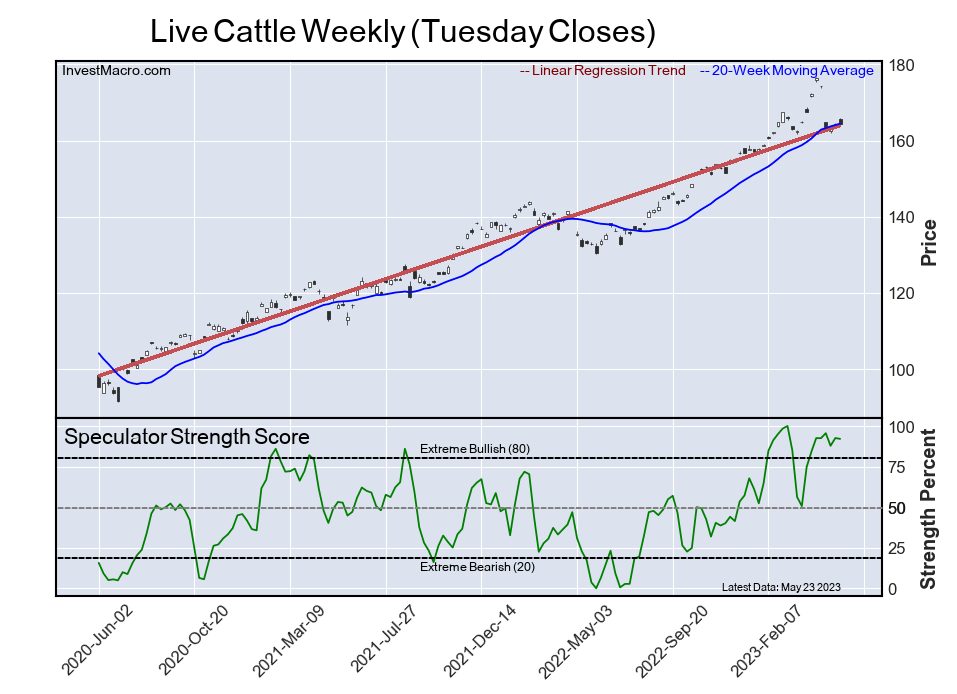
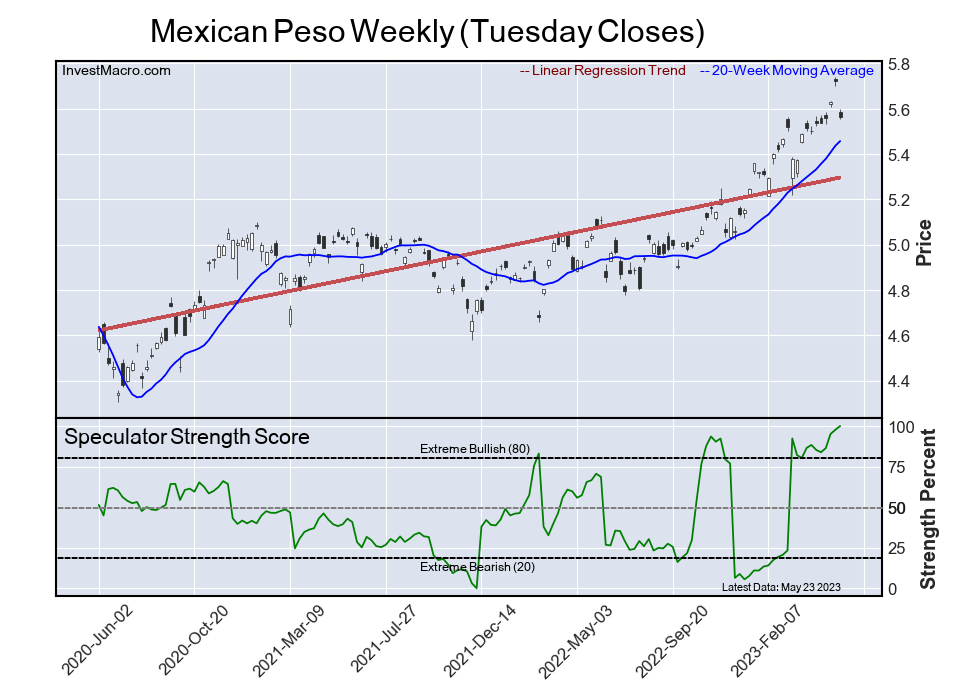
Bonds Speculators drop their 10-Year Treasury bets to a 237-week low

By InvestMacro

Here are the latest charts and statistics for the Commitment of Traders (COT) reports data published by the Commodities Futures Trading Commission (CFTC).

The latest COT data is updated through Tuesday April 18th and shows a quick view of how large traders (for-profit speculators and commercial hedgers) were positioned in the futures markets.

Weekly Speculator Changes led by 5-Year Bonds & Eurodollar

The COT bond market speculator bets were higher this week as five out of the nine bond markets we cover had higher positioning while the other four markets had lower speculator contracts.

Leading the gains for the bond markets was the Eurodollar (598,254 contracts) which, as noted last week, is being phased out and replaced by the Secured Overnight Financing Rate (SOFR 3-Months) contracts. The rise in Eurodollar bets was due to traders closing out their bearish positions while the SOFR 3-Months contracts saw a similar rise in bearish contracts this week.

The other markets with gains this week were the Fed Funds (48,557 contracts), the US Treasury Bonds (15,656 contracts), the 5-Year Bonds (7,479 contracts) and the Ultra Treasury Bonds (277 contracts) also showing positive weeks.

The bond markets with declines in speculator bets for the week were the SOFR 3-Months (-466,948 contracts) with the 2-Year Bonds (-78,073 contracts), the 10-Year Bonds (-41,044 contracts) and the Ultra 10-Year Bonds (-9,612 contracts) also registering lower bets on the week.

10-Year Bond Speculators drop bets to 237-week low

Highlighting the COT bond’s data this week is the weakness in the 10-Year Bonds speculator net contracts. Large speculative 10-Year Bond positions fell this week by over -40,000 net contracts and have declined for three straight weeks as well as in four out of the past five weeks. The 10-Year Bond net position has now seen a total of -172,715 contracts added to the existing bearish standing over this past five week period.

The 10-Year positions have now fallen (currently at -680,081 contracts) to the most bearish level since October 2nd of 2018, a span of 237 weeks from when the net position totaled -740,192 contracts.

Overall, the 10-Year speculator net positions have now been in a continuous bearish level for 80 straight weeks, dating back to October 12th of 2021 when the net position flipped from bullish to bearish. Since that time, the net position has steadily increased in bearishness (save for a couple of short pullbacks) as the sentiment for bonds has been decimated due to the US Federal Reserve raising their benchmark interest rate (to fight inflation). Despite the current outlook (Fed Rate Tool) that the Federal Reserve will likely only raise the interest rate one more time in May, speculators have continued to raise their bearish bets for the 10-Year.

The 10-Year front-month futures price, meanwhile, has not dropped back to the lowest levels of this cycle. The price closed at 114.15 this week and is almost 5 percent higher than the lows of October when prices dropped to the 108 levels.


Data Snapshot of Bond Market Traders | Columns Legend
Apr-18-2023OIOI-IndexSpec-NetSpec-IndexCom-NetCOM-IndexSmalls-NetSmalls-Index
Eurodollar603,3100-51,2317347,522233,709100
FedFunds1,728,59466-118,71925130,56376-11,84468
2-Year2,642,31478-574,91416520,5588154,35682
Long T-Bond1,185,80254-116,9284746,2352770,693100
10-Year4,393,55992-680,0810638,7409041,34194
5-Year4,472,64299-754,5023716,6339337,86991


Strength Scores led by Eurodollar & US Treasury Bonds

COT Strength Scores (a normalized measure of Speculator positions over a 3-Year range, from 0 to 100 where above 80 is Extreme-Bullish and below 20 is Extreme-Bearish) showed that the Eurodollar (73 percent) and the US Treasury Bonds (47 percent) lead the bond markets this week. The SOFR 3-Months (44 percent) comes in as the next highest in the weekly strength scores.

On the downside, the Ultra 10-Year Bonds (0 percent), the 10-Year Bonds (0 percent), the 5-Year Bonds (3 percent) and the 2-Year Bonds (16 percent) come in at the lowest strength level currently and are all in Extreme-Bearish territory (below 20 percent).

Strength Statistics:
Fed Funds (25.0 percent) vs Fed Funds previous week (19.0 percent)
2-Year Bond (15.5 percent) vs 2-Year Bond previous week (25.5 percent)
5-Year Bond (3.0 percent) vs 5-Year Bond previous week (2.2 percent)
10-Year Bond (0.0 percent) vs 10-Year Bond previous week (4.8 percent)
Ultra 10-Year Bond (0.0 percent) vs Ultra 10-Year Bond previous week (2.0 percent)
US Treasury Bond (46.5 percent) vs US Treasury Bond previous week (41.4 percent)
Ultra US Treasury Bond (19.1 percent) vs Ultra US Treasury Bond previous week (19.0 percent)
Eurodollar (72.7 percent) vs Eurodollar previous week (57.4 percent)
SOFR 3-Months (43.8 percent) vs SOFR 3-Months previous week (81.6 percent)


SOFR 3-Months & Eurodollar top the 6-Week Strength Trends

COT Strength Score Trends (or move index, calculates the 6-week changes in strength scores) showed that the SOFR 3-Months (44 percent) and the Eurodollar (23 percent) lead the past six weeks trends for bonds. The US Treasury Bonds (18 percent) and are the next highest positive movers in the latest trends data.

The 10-Year Bonds (-14 percent) and the 5-Year Bonds (-11 percent) lead the downside trend scores currently with the Ultra 10-Year Bonds (-3 percent) following next with lower trend scores.

Strength Trend Statistics:
Fed Funds (15.2 percent) vs Fed Funds previous week (0.5 percent)
2-Year Bond (5.5 percent) vs 2-Year Bond previous week (20.4 percent)
5-Year Bond (-11.2 percent) vs 5-Year Bond previous week (-12.4 percent)
10-Year Bond (-14.4 percent) vs 10-Year Bond previous week (-1.3 percent)
Ultra 10-Year Bond (-3.0 percent) vs Ultra 10-Year Bond previous week (1.1 percent)
US Treasury Bond (18.3 percent) vs US Treasury Bond previous week (14.4 percent)
Ultra US Treasury Bond (11.3 percent) vs Ultra US Treasury Bond previous week (9.9 percent)
Eurodollar (23.1 percent) vs Eurodollar previous week (9.0 percent)
SOFR 3-Months (43.8 percent) vs SOFR 3-Months previous week (54.2 percent)


Individual Bond Markets:

3-Month Eurodollars Futures:

Eurodollar Bonds Futures COT ChartThe 3-Month Eurodollars large speculator standing this week reached a net position of -51,231 contracts in the data reported through Tuesday. This was a weekly lift of 598,254 contracts from the previous week which had a total of -649,485 net contracts.

This week’s current strength score (the trader positioning range over the past three years, measured from 0 to 100) shows the speculators are currently Bullish with a score of 72.7 percent. The commercials are Bearish with a score of 22.9 percent and the small traders (not shown in chart) are Bullish-Extreme with a score of 100.0 percent.

3-Month Eurodollars StatisticsSPECULATORSCOMMERCIALSSMALL TRADERS
– Percent of Open Interest Longs:26.360.611.1
– Percent of Open Interest Shorts:34.852.710.5
– Net Position:-51,23147,5223,709
– Gross Longs:158,876365,30867,086
– Gross Shorts:210,107317,78663,377
– Long to Short Ratio:0.8 to 11.1 to 11.1 to 1
NET POSITION TREND:
– Strength Index Score (3 Year Range Pct):72.722.9100.0
– Strength Index Reading (3 Year Range):BullishBearishBullish-Extreme
NET POSITION MOVEMENT INDEX:
– 6-Week Change in Strength Index:23.1-27.252.0


Secured Overnight Financing Rate (3-Month) Futures:

SOFR 3-Months Bonds Futures COT ChartThe Secured Overnight Financing Rate (3-Month) large speculator standing this week reached a net position of -626,388 contracts in the data reported through Tuesday. This was a weekly lowering of -466,948 contracts from the previous week which had a total of -159,440 net contracts.

This week’s current strength score (the trader positioning range over the past three years, measured from 0 to 100) shows the speculators are currently Bearish with a score of 43.8 percent. The commercials are Bullish with a score of 56.3 percent and the small traders (not shown in chart) are Bullish-Extreme with a score of 87.0 percent.

SOFR 3-Months StatisticsSPECULATORSCOMMERCIALSSMALL TRADERS
– Percent of Open Interest Longs:13.965.00.6
– Percent of Open Interest Shorts:20.558.30.6
– Net Position:-626,388627,991-1,603
– Gross Longs:1,301,6266,103,49354,601
– Gross Shorts:1,928,0145,475,50256,204
– Long to Short Ratio:0.7 to 11.1 to 11.0 to 1
NET POSITION TREND:
– Strength Index Score (3 Year Range Pct):43.856.387.0
– Strength Index Reading (3 Year Range):BearishBullishBullish-Extreme
NET POSITION MOVEMENT INDEX:
– 6-Week Change in Strength Index:43.8-43.7-0.3


30-Day Federal Funds Futures:

Federal Funds 30-Day Bonds Futures COT ChartThe 30-Day Federal Funds large speculator standing this week reached a net position of -118,719 contracts in the data reported through Tuesday. This was a weekly rise of 48,557 contracts from the previous week which had a total of -167,276 net contracts.

This week’s current strength score (the trader positioning range over the past three years, measured from 0 to 100) shows the speculators are currently Bearish with a score of 25.0 percent. The commercials are Bullish with a score of 75.7 percent and the small traders (not shown in chart) are Bullish with a score of 67.8 percent.

30-Day Federal Funds StatisticsSPECULATORSCOMMERCIALSSMALL TRADERS
– Percent of Open Interest Longs:4.179.72.4
– Percent of Open Interest Shorts:11.072.23.0
– Net Position:-118,719130,563-11,844
– Gross Longs:70,6941,377,90340,832
– Gross Shorts:189,4131,247,34052,676
– Long to Short Ratio:0.4 to 11.1 to 10.8 to 1
NET POSITION TREND:
– Strength Index Score (3 Year Range Pct):25.075.767.8
– Strength Index Reading (3 Year Range):BearishBullishBullish
NET POSITION MOVEMENT INDEX:
– 6-Week Change in Strength Index:15.2-15.23.8


2-Year Treasury Note Futures:

2-Year Treasury Bonds Futures COT ChartThe 2-Year Treasury Note large speculator standing this week reached a net position of -574,914 contracts in the data reported through Tuesday. This was a weekly decrease of -78,073 contracts from the previous week which had a total of -496,841 net contracts.

This week’s current strength score (the trader positioning range over the past three years, measured from 0 to 100) shows the speculators are currently Bearish-Extreme with a score of 15.5 percent. The commercials are Bullish-Extreme with a score of 80.6 percent and the small traders (not shown in chart) are Bullish-Extreme with a score of 81.8 percent.

2-Year Treasury Note StatisticsSPECULATORSCOMMERCIALSSMALL TRADERS
– Percent of Open Interest Longs:8.682.28.4
– Percent of Open Interest Shorts:30.462.56.3
– Net Position:-574,914520,55854,356
– Gross Longs:227,6522,173,300221,790
– Gross Shorts:802,5661,652,742167,434
– Long to Short Ratio:0.3 to 11.3 to 11.3 to 1
NET POSITION TREND:
– Strength Index Score (3 Year Range Pct):15.580.681.8
– Strength Index Reading (3 Year Range):Bearish-ExtremeBullish-ExtremeBullish-Extreme
NET POSITION MOVEMENT INDEX:
– 6-Week Change in Strength Index:5.5-11.518.1


5-Year Treasury Note Futures:

5-Year Treasury Bonds Futures COT ChartThe 5-Year Treasury Note large speculator standing this week reached a net position of -754,502 contracts in the data reported through Tuesday. This was a weekly lift of 7,479 contracts from the previous week which had a total of -761,981 net contracts.

This week’s current strength score (the trader positioning range over the past three years, measured from 0 to 100) shows the speculators are currently Bearish-Extreme with a score of 3.0 percent. The commercials are Bullish-Extreme with a score of 93.3 percent and the small traders (not shown in chart) are Bullish-Extreme with a score of 91.4 percent.

5-Year Treasury Note StatisticsSPECULATORSCOMMERCIALSSMALL TRADERS
– Percent of Open Interest Longs:6.084.48.2
– Percent of Open Interest Shorts:22.968.47.4
– Net Position:-754,502716,63337,869
– Gross Longs:270,0633,775,123366,773
– Gross Shorts:1,024,5653,058,490328,904
– Long to Short Ratio:0.3 to 11.2 to 11.1 to 1
NET POSITION TREND:
– Strength Index Score (3 Year Range Pct):3.093.391.4
– Strength Index Reading (3 Year Range):Bearish-ExtremeBullish-ExtremeBullish-Extreme
NET POSITION MOVEMENT INDEX:
– 6-Week Change in Strength Index:-11.2-1.931.5


10-Year Treasury Note Futures:

10-Year Treasury Notes Bonds Futures COT ChartThe 10-Year Treasury Note large speculator standing this week reached a net position of -680,081 contracts in the data reported through Tuesday. This was a weekly lowering of -41,044 contracts from the previous week which had a total of -639,037 net contracts.

This week’s current strength score (the trader positioning range over the past three years, measured from 0 to 100) shows the speculators are currently Bearish-Extreme with a score of 0.0 percent. The commercials are Bullish-Extreme with a score of 90.1 percent and the small traders (not shown in chart) are Bullish-Extreme with a score of 93.5 percent.

10-Year Treasury Note StatisticsSPECULATORSCOMMERCIALSSMALL TRADERS
– Percent of Open Interest Longs:10.878.39.0
– Percent of Open Interest Shorts:26.263.78.1
– Net Position:-680,081638,74041,341
– Gross Longs:473,0723,439,022395,955
– Gross Shorts:1,153,1532,800,282354,614
– Long to Short Ratio:0.4 to 11.2 to 11.1 to 1
NET POSITION TREND:
– Strength Index Score (3 Year Range Pct):0.090.193.5
– Strength Index Reading (3 Year Range):Bearish-ExtremeBullish-ExtremeBullish-Extreme
NET POSITION MOVEMENT INDEX:
– 6-Week Change in Strength Index:-14.4-4.139.9


Ultra 10-Year Notes Futures:

Ultra 10-Year Treasury Notes Bonds Futures COT ChartThe Ultra 10-Year Notes large speculator standing this week reached a net position of -206,583 contracts in the data reported through Tuesday. This was a weekly lowering of -9,612 contracts from the previous week which had a total of -196,971 net contracts.

This week’s current strength score (the trader positioning range over the past three years, measured from 0 to 100) shows the speculators are currently Bearish-Extreme with a score of 0.0 percent. The commercials are Bullish-Extreme with a score of 95.6 percent and the small traders (not shown in chart) are Bullish with a score of 66.5 percent.

Ultra 10-Year Notes StatisticsSPECULATORSCOMMERCIALSSMALL TRADERS
– Percent of Open Interest Longs:8.779.810.3
– Percent of Open Interest Shorts:21.562.015.3
– Net Position:-206,583286,593-80,010
– Gross Longs:140,1071,286,225166,166
– Gross Shorts:346,690999,632246,176
– Long to Short Ratio:0.4 to 11.3 to 10.7 to 1
NET POSITION TREND:
– Strength Index Score (3 Year Range Pct):0.095.666.5
– Strength Index Reading (3 Year Range):Bearish-ExtremeBullish-ExtremeBullish
NET POSITION MOVEMENT INDEX:
– 6-Week Change in Strength Index:-3.0-4.420.7


US Treasury Bonds Futures:

US Year Treasury Notes Long Bonds Futures COT ChartThe US Treasury Bonds large speculator standing this week reached a net position of -116,928 contracts in the data reported through Tuesday. This was a weekly boost of 15,656 contracts from the previous week which had a total of -132,584 net contracts.

This week’s current strength score (the trader positioning range over the past three years, measured from 0 to 100) shows the speculators are currently Bearish with a score of 46.5 percent. The commercials are Bearish with a score of 27.1 percent and the small traders (not shown in chart) are Bullish-Extreme with a score of 100.0 percent.

US Treasury Bonds StatisticsSPECULATORSCOMMERCIALSSMALL TRADERS
– Percent of Open Interest Longs:5.879.014.8
– Percent of Open Interest Shorts:15.775.18.9
– Net Position:-116,92846,23570,693
– Gross Longs:69,031936,757175,995
– Gross Shorts:185,959890,522105,302
– Long to Short Ratio:0.4 to 11.1 to 11.7 to 1
NET POSITION TREND:
– Strength Index Score (3 Year Range Pct):46.527.1100.0
– Strength Index Reading (3 Year Range):BearishBearishBullish-Extreme
NET POSITION MOVEMENT INDEX:
– 6-Week Change in Strength Index:18.3-39.840.5


Ultra US Treasury Bonds Futures:

Ultra US Year Treasury Notes Long Bonds Futures COT ChartThe Ultra US Treasury Bonds large speculator standing this week reached a net position of -399,001 contracts in the data reported through Tuesday. This was a weekly gain of 277 contracts from the previous week which had a total of -399,278 net contracts.

This week’s current strength score (the trader positioning range over the past three years, measured from 0 to 100) shows the speculators are currently Bearish-Extreme with a score of 19.1 percent. The commercials are Bullish with a score of 76.7 percent and the small traders (not shown in chart) are Bullish-Extreme with a score of 91.3 percent.

Ultra US Treasury Bonds StatisticsSPECULATORSCOMMERCIALSSMALL TRADERS
– Percent of Open Interest Longs:5.582.511.9
– Percent of Open Interest Shorts:33.558.18.3
– Net Position:-399,001347,52151,480
– Gross Longs:78,0301,176,217169,143
– Gross Shorts:477,031828,696117,663
– Long to Short Ratio:0.2 to 11.4 to 11.4 to 1
NET POSITION TREND:
– Strength Index Score (3 Year Range Pct):19.176.791.3
– Strength Index Reading (3 Year Range):Bearish-ExtremeBullishBullish-Extreme
NET POSITION MOVEMENT INDEX:
– 6-Week Change in Strength Index:11.3-23.321.9


Article By InvestMacroReceive our weekly COT Newsletter

*COT Report: The COT data, released weekly to the public each Friday, is updated through the most recent Tuesday (data is 3 days old) and shows a quick view of how large speculators or non-commercials (for-profit traders) were positioned in the futures markets.

The CFTC categorizes trader positions according to commercial hedgers (traders who use futures contracts for hedging as part of the business), non-commercials (large traders who speculate to realize trading profits) and nonreportable traders (usually small traders/speculators) as well as their open interest (contracts open in the market at time of reporting). See CFTC criteria here.
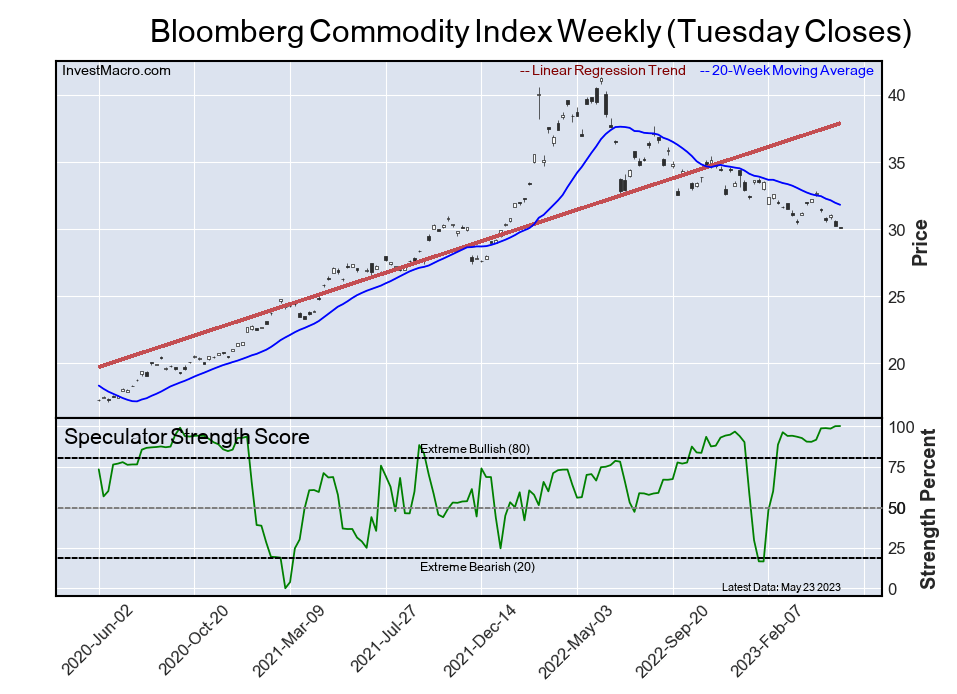
Soft Commodities Speculators boost Sugar bullish bets for 4th week to 84-week high

By InvestMacro

Here are the latest charts and statistics for the Commitment of Traders (COT) reports data published by the Commodities Futures Trading Commission (CFTC).
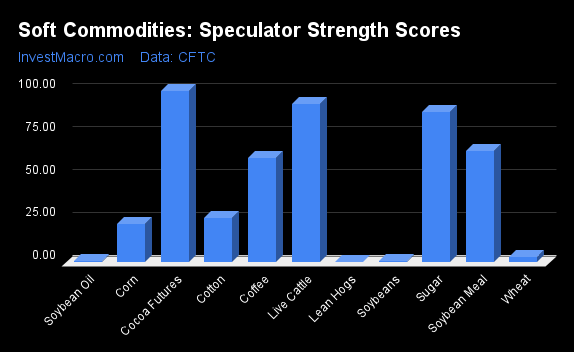
The latest COT data is updated through Tuesday April 18th and shows a quick view of how large traders (for-profit speculators and commercial entities) were positioned in the futures markets.

Weekly Speculator Changes led by Soybean Meal & Coffee

The COT soft commodities markets speculator bets were higher this week as six out of the eleven softs markets we cover had higher positioning while the other five markets had lower speculator contracts.

Leading the gains for the softs markets was Soybean Meal (14,357 contracts) with Coffee (12,124 contracts), Sugar (9,384 contracts), Cotton (7,749 contracts), Live Cattle (7,456 contracts) and Corn (2,327 contracts) also showing positive weeks.

The markets with the declines in speculator bets this week were Soybeans (-1,836 contracts) with Lean Hogs (-3,065 contracts), Soybean Oil (-3,095 contracts), Wheat (-3,854 contracts) and Cocoa (-558 contracts) also registering lower bets on the week.

Sugar Speculators boost bullish bets for 4th week to 84-week high

Highlighting the COT soft commodities data this week is the continued bullish strength in the Sugar speculator’s positioning. The large speculator bets for Sugar rose this week for the fourth straight week and for the seventh time out of the past ten weeks. Speculators have added a total of +58,516 contracts to the net position over the past 4-week period.

The bullish sentiment has now pushed the Sugar net speculator positions to their highest level in the past 84-weeks, dating back to September 9th of 2021.

Sugar’s speculator strength score level (a 3-year range of speculator positions, on a 0-100 percent scale) has also increased with a score of 86.5 percent this week and up from a score of 83.3 percent last week. Its 6-week trend of strength scores has increased by 10 percent.

The Sugar futures price has also been flying high and touched its highest level since April of 2012 this week. The Sugar front-month futures price has risen for five consecutive weeks and closed at approximately $24.83 on Friday. Sugar futures are now up by over 40 percent since October.


Data Snapshot of Commodity Market Traders | Columns Legend
Apr-18-2023OIOI-IndexSpec-NetSpec-IndexCom-NetCOM-IndexSmalls-NetSmalls-Index
WTI Crude1,913,19246244,57521-273,2477828,67247
Gold482,25428189,89361-216,4254026,53246
Silver158,3714626,59556-38,6564712,06133
Copper206,216478,93436-16,280607,34665
Palladium11,84882-5,637136,15189-51411
Platinum63,7945324,31972-28,202353,88320
Natural Gas1,330,94774-139,98616111,8938428,09347
Brent146,38410-43,3222039,827803,49556
Heating Oil260,459208,86543-24,9876516,12254
Soybeans683,16124177,51059-149,49145-28,01925
Corn1,319,55117105,63644-41,24466-64,39214
Coffee190,253537,00165-38,309381,30828
Sugar961,06062269,17286-326,1981057,02678
Wheat378,53154-70,536265,243955,29398


Strength Scores led by Cocoa & Live Cattle

COT Strength Scores (a normalized measure of Speculator positions over a 3-Year range, from 0 to 100 where above 80 is Extreme-Bullish and below 20 is Extreme-Bearish) showed that Cocoa (98 percent) and Live Cattle (93 percent) lead the softs markets this week. Sugar (86 percent), Soybean Meal (76 percent) and Coffee (65 percent) come in as the next highest in the weekly strength scores.

On the downside, Lean Hogs (0 percent), Soybean Oil (0 percent), Wheat (2 percent) and the Cotton (12 percent) come in at the lowest strength levels currently and are all in Extreme-Bearish territory (below 20 percent).

Strength Statistics:
Corn (43.5 percent) vs Corn previous week (43.2 percent)
Sugar (86.5 percent) vs Sugar previous week (83.3 percent)
Coffee (65.4 percent) vs Coffee previous week (52.9 percent)
Soybeans (58.9 percent) vs Soybeans previous week (59.6 percent)
Soybean Oil (0.0 percent) vs Soybean Oil previous week (2.1 percent)
Soybean Meal (75.6 percent) vs Soybean Meal previous week (68.1 percent)
Live Cattle (92.5 percent) vs Live Cattle previous week (84.2 percent)
Lean Hogs (0.0 percent) vs Lean Hogs previous week (2.7 percent)
Cotton (12.1 percent) vs Cotton previous week (6.2 percent)
Cocoa (97.6 percent) vs Cocoa previous week (98.3 percent)
Wheat (2.3 percent) vs Wheat previous week (5.5 percent)


Coffee & Sugar top the 6-Week Strength Trends

COT Strength Score Trends (or move index, calculates the 6-week changes in strength scores) showed that Coffee (22 percent) and Sugar (10 percent) lead the past six weeks trends for soft commodities. Cocoa (6 percent) and Wheat (2 percent) are the next highest positive movers in the latest trends data.

Soybean Meal (-24 percent) leads the downside trend scores currently with Soybean Oil (-21 percent), Lean Hogs (-17 percent) and Live Cattle (-7 percent) following next with lower trend scores.

Strength Trend Statistics:
Corn (0.3 percent) vs Corn previous week (-5.1 percent)
Sugar (9.8 percent) vs Sugar previous week (12.4 percent)
Coffee (22.5 percent) vs Coffee previous week (8.7 percent)
Soybeans (-1.1 percent) vs Soybeans previous week (8.2 percent)
Soybean Oil (-20.6 percent) vs Soybean Oil previous week (-22.5 percent)
Soybean Meal (-24.4 percent) vs Soybean Meal previous week (-22.7 percent)
Live Cattle (-7.5 percent) vs Live Cattle previous week (-14.2 percent)
Lean Hogs (-17.5 percent) vs Lean Hogs previous week (-17.9 percent)
Cotton (-1.1 percent) vs Cotton previous week (-3.8 percent)
Cocoa (5.9 percent) vs Cocoa previous week (5.7 percent)
Wheat (2.3 percent) vs Wheat previous week (0.1 percent)


Individual Soft Commodities Markets:

CORN Futures:

CORN Futures COT ChartThe CORN large speculator standing this week was a net position of 105,636 contracts in the data reported through Tuesday. This was a weekly lift of 2,327 contracts from the previous week which had a total of 103,309 net contracts.

This week’s current strength score (the trader positioning range over the past three years, measured from 0 to 100) shows the speculators are currently Bearish with a score of 43.5 percent. The commercials are Bullish with a score of 66.0 percent and the small traders (not shown in chart) are Bearish-Extreme with a score of 13.7 percent.

CORN Futures StatisticsSPECULATORSCOMMERCIALSSMALL TRADERS
– Percent of Open Interest Longs:25.848.18.3
– Percent of Open Interest Shorts:17.851.313.2
– Net Position:105,636-41,244-64,392
– Gross Longs:340,625635,232109,200
– Gross Shorts:234,989676,476173,592
– Long to Short Ratio:1.4 to 10.9 to 10.6 to 1
NET POSITION TREND:
– Strength Index Score (3 Year Range Pct):43.566.013.7
– Strength Index Reading (3 Year Range):BearishBullishBearish-Extreme
NET POSITION MOVEMENT INDEX:
– 6-Week Change in Strength Index:0.30.4-4.3


SUGAR Futures:

SUGAR Futures COT ChartThe SUGAR large speculator standing this week was a net position of 269,172 contracts in the data reported through Tuesday. This was a weekly boost of 9,384 contracts from the previous week which had a total of 259,788 net contracts.

This week’s current strength score (the trader positioning range over the past three years, measured from 0 to 100) shows the speculators are currently Bullish-Extreme with a score of 86.5 percent. The commercials are Bearish-Extreme with a score of 9.6 percent and the small traders (not shown in chart) are Bullish with a score of 78.4 percent.

SUGAR Futures StatisticsSPECULATORSCOMMERCIALSSMALL TRADERS
– Percent of Open Interest Longs:35.540.111.0
– Percent of Open Interest Shorts:7.474.15.1
– Net Position:269,172-326,19857,026
– Gross Longs:340,696385,588105,872
– Gross Shorts:71,524711,78648,846
– Long to Short Ratio:4.8 to 10.5 to 12.2 to 1
NET POSITION TREND:
– Strength Index Score (3 Year Range Pct):86.59.678.4
– Strength Index Reading (3 Year Range):Bullish-ExtremeBearish-ExtremeBullish
NET POSITION MOVEMENT INDEX:
– 6-Week Change in Strength Index:9.8-10.510.1


COFFEE Futures:

COFFEE Futures COT ChartThe COFFEE large speculator standing this week was a net position of 37,001 contracts in the data reported through Tuesday. This was a weekly increase of 12,124 contracts from the previous week which had a total of 24,877 net contracts.

This week’s current strength score (the trader positioning range over the past three years, measured from 0 to 100) shows the speculators are currently Bullish with a score of 65.4 percent. The commercials are Bearish with a score of 37.8 percent and the small traders (not shown in chart) are Bearish with a score of 28.5 percent.

COFFEE Futures StatisticsSPECULATORSCOMMERCIALSSMALL TRADERS
– Percent of Open Interest Longs:29.244.14.5
– Percent of Open Interest Shorts:9.764.33.8
– Net Position:37,001-38,3091,308
– Gross Longs:55,54283,9828,620
– Gross Shorts:18,541122,2917,312
– Long to Short Ratio:3.0 to 10.7 to 11.2 to 1
NET POSITION TREND:
– Strength Index Score (3 Year Range Pct):65.437.828.5
– Strength Index Reading (3 Year Range):BullishBearishBearish
NET POSITION MOVEMENT INDEX:
– 6-Week Change in Strength Index:22.5-22.36.3


SOYBEANS Futures:

SOYBEANS Futures COT ChartThe SOYBEANS large speculator standing this week was a net position of 177,510 contracts in the data reported through Tuesday. This was a weekly lowering of -1,836 contracts from the previous week which had a total of 179,346 net contracts.

This week’s current strength score (the trader positioning range over the past three years, measured from 0 to 100) shows the speculators are currently Bullish with a score of 58.9 percent. The commercials are Bearish with a score of 45.1 percent and the small traders (not shown in chart) are Bearish with a score of 25.1 percent.

SOYBEANS Futures StatisticsSPECULATORSCOMMERCIALSSMALL TRADERS
– Percent of Open Interest Longs:32.143.36.9
– Percent of Open Interest Shorts:6.165.211.0
– Net Position:177,510-149,491-28,019
– Gross Longs:219,301296,14947,114
– Gross Shorts:41,791445,64075,133
– Long to Short Ratio:5.2 to 10.7 to 10.6 to 1
NET POSITION TREND:
– Strength Index Score (3 Year Range Pct):58.945.125.1
– Strength Index Reading (3 Year Range):BullishBearishBearish
NET POSITION MOVEMENT INDEX:
– 6-Week Change in Strength Index:-1.1-2.818.0


SOYBEAN OIL Futures:

SOYBEAN OIL Futures COT ChartThe SOYBEAN OIL large speculator standing this week was a net position of -9,451 contracts in the data reported through Tuesday. This was a weekly lowering of -3,095 contracts from the previous week which had a total of -6,356 net contracts.

This week’s current strength score (the trader positioning range over the past three years, measured from 0 to 100) shows the speculators are currently Bearish-Extreme with a score of 0.0 percent. The commercials are Bullish-Extreme with a score of 97.4 percent and the small traders (not shown in chart) are Bearish-Extreme with a score of 18.2 percent.

SOYBEAN OIL Futures StatisticsSPECULATORSCOMMERCIALSSMALL TRADERS
– Percent of Open Interest Longs:15.058.86.6
– Percent of Open Interest Shorts:17.057.36.1
– Net Position:-9,4516,9442,507
– Gross Longs:72,093282,06531,891
– Gross Shorts:81,544275,12129,384
– Long to Short Ratio:0.9 to 11.0 to 11.1 to 1
NET POSITION TREND:
– Strength Index Score (3 Year Range Pct):0.097.418.2
– Strength Index Reading (3 Year Range):Bearish-ExtremeBullish-ExtremeBearish-Extreme
NET POSITION MOVEMENT INDEX:
– 6-Week Change in Strength Index:-20.617.26.3


SOYBEAN MEAL Futures:

SOYBEAN MEAL Futures COT ChartThe SOYBEAN MEAL large speculator standing this week was a net position of 130,269 contracts in the data reported through Tuesday. This was a weekly rise of 14,357 contracts from the previous week which had a total of 115,912 net contracts.

This week’s current strength score (the trader positioning range over the past three years, measured from 0 to 100) shows the speculators are currently Bullish with a score of 75.6 percent. The commercials are Bearish with a score of 25.9 percent and the small traders (not shown in chart) are Bearish with a score of 21.7 percent.

SOYBEAN MEAL Futures StatisticsSPECULATORSCOMMERCIALSSMALL TRADERS
– Percent of Open Interest Longs:33.536.410.8
– Percent of Open Interest Shorts:4.868.77.1
– Net Position:130,269-146,88016,611
– Gross Longs:152,035165,43048,978
– Gross Shorts:21,766312,31032,367
– Long to Short Ratio:7.0 to 10.5 to 11.5 to 1
NET POSITION TREND:
– Strength Index Score (3 Year Range Pct):75.625.921.7
– Strength Index Reading (3 Year Range):BullishBearishBearish
NET POSITION MOVEMENT INDEX:
– 6-Week Change in Strength Index:-24.425.9-12.8


LIVE CATTLE Futures:

LIVE CATTLE Futures COT ChartThe LIVE CATTLE large speculator standing this week was a net position of 102,072 contracts in the data reported through Tuesday. This was a weekly gain of 7,456 contracts from the previous week which had a total of 94,616 net contracts.

This week’s current strength score (the trader positioning range over the past three years, measured from 0 to 100) shows the speculators are currently Bullish-Extreme with a score of 92.5 percent. The commercials are Bearish-Extreme with a score of 8.7 percent and the small traders (not shown in chart) are Bearish with a score of 37.7 percent.

LIVE CATTLE Futures StatisticsSPECULATORSCOMMERCIALSSMALL TRADERS
– Percent of Open Interest Longs:45.425.69.9
– Percent of Open Interest Shorts:15.752.612.6
– Net Position:102,072-92,780-9,292
– Gross Longs:155,95688,01733,970
– Gross Shorts:53,884180,79743,262
– Long to Short Ratio:2.9 to 10.5 to 10.8 to 1
NET POSITION TREND:
– Strength Index Score (3 Year Range Pct):92.58.737.7
– Strength Index Reading (3 Year Range):Bullish-ExtremeBearish-ExtremeBearish
NET POSITION MOVEMENT INDEX:
– 6-Week Change in Strength Index:-7.58.7-3.0


LEAN HOGS Futures:

LEAN HOGS Futures COT ChartThe LEAN HOGS large speculator standing this week was a net position of -27,157 contracts in the data reported through Tuesday. This was a weekly reduction of -3,065 contracts from the previous week which had a total of -24,092 net contracts.

This week’s current strength score (the trader positioning range over the past three years, measured from 0 to 100) shows the speculators are currently Bearish-Extreme with a score of 0.0 percent. The commercials are Bullish-Extreme with a score of 100.0 percent and the small traders (not shown in chart) are Bullish-Extreme with a score of 100.0 percent.

LEAN HOGS Futures StatisticsSPECULATORSCOMMERCIALSSMALL TRADERS
– Percent of Open Interest Longs:28.136.112.6
– Percent of Open Interest Shorts:39.826.111.0
– Net Position:-27,15723,4433,714
– Gross Longs:65,67184,33929,502
– Gross Shorts:92,82860,89625,788
– Long to Short Ratio:0.7 to 11.4 to 11.1 to 1
NET POSITION TREND:
– Strength Index Score (3 Year Range Pct):0.0100.0100.0
– Strength Index Reading (3 Year Range):Bearish-ExtremeBullish-ExtremeBullish-Extreme
NET POSITION MOVEMENT INDEX:
– 6-Week Change in Strength Index:-17.515.019.3


COTTON Futures:

COTTON Futures COT ChartThe COTTON large speculator standing this week was a net position of 4,470 contracts in the data reported through Tuesday. This was a weekly gain of 7,749 contracts from the previous week which had a total of -3,279 net contracts.

This week’s current strength score (the trader positioning range over the past three years, measured from 0 to 100) shows the speculators are currently Bearish-Extreme with a score of 12.1 percent. The commercials are Bullish-Extreme with a score of 85.5 percent and the small traders (not shown in chart) are Bearish with a score of 32.8 percent.

COTTON Futures StatisticsSPECULATORSCOMMERCIALSSMALL TRADERS
– Percent of Open Interest Longs:32.845.87.9
– Percent of Open Interest Shorts:30.150.16.3
– Net Position:4,470-7,2292,759
– Gross Longs:55,15677,14213,335
– Gross Shorts:50,68684,37110,576
– Long to Short Ratio:1.1 to 10.9 to 11.3 to 1
NET POSITION TREND:
– Strength Index Score (3 Year Range Pct):12.185.532.8
– Strength Index Reading (3 Year Range):Bearish-ExtremeBullish-ExtremeBearish
NET POSITION MOVEMENT INDEX:
– 6-Week Change in Strength Index:-1.1-0.715.1


COCOA Futures:

COCOA Futures COT ChartThe COCOA large speculator standing this week was a net position of 59,355 contracts in the data reported through Tuesday. This was a weekly fall of -558 contracts from the previous week which had a total of 59,913 net contracts.

This week’s current strength score (the trader positioning range over the past three years, measured from 0 to 100) shows the speculators are currently Bullish-Extreme with a score of 97.6 percent. The commercials are Bearish-Extreme with a score of 1.6 percent and the small traders (not shown in chart) are Bearish with a score of 44.5 percent.

COCOA Futures StatisticsSPECULATORSCOMMERCIALSSMALL TRADERS
– Percent of Open Interest Longs:39.833.34.7
– Percent of Open Interest Shorts:21.852.73.3
– Net Position:59,355-64,1434,788
– Gross Longs:131,355110,05015,617
– Gross Shorts:72,000174,19310,829
– Long to Short Ratio:1.8 to 10.6 to 11.4 to 1
NET POSITION TREND:
– Strength Index Score (3 Year Range Pct):97.61.644.5
– Strength Index Reading (3 Year Range):Bullish-ExtremeBearish-ExtremeBearish
NET POSITION MOVEMENT INDEX:
– 6-Week Change in Strength Index:5.9-6.64.8


WHEAT Futures:

WHEAT Futures COT ChartThe WHEAT large speculator standing this week was a net position of -70,536 contracts in the data reported through Tuesday. This was a weekly decline of -3,854 contracts from the previous week which had a total of -66,682 net contracts.

This week’s current strength score (the trader positioning range over the past three years, measured from 0 to 100) shows the speculators are currently Bearish-Extreme with a score of 2.3 percent. The commercials are Bullish-Extreme with a score of 94.6 percent and the small traders (not shown in chart) are Bullish-Extreme with a score of 97.6 percent.

WHEAT Futures StatisticsSPECULATORSCOMMERCIALSSMALL TRADERS
– Percent of Open Interest Longs:28.037.911.1
– Percent of Open Interest Shorts:46.620.79.7
– Net Position:-70,53665,2435,293
– Gross Longs:105,806143,55942,074
– Gross Shorts:176,34278,31636,781
– Long to Short Ratio:0.6 to 11.8 to 11.1 to 1
NET POSITION TREND:
– Strength Index Score (3 Year Range Pct):2.394.697.6
– Strength Index Reading (3 Year Range):Bearish-ExtremeBullish-ExtremeBullish-Extreme
NET POSITION MOVEMENT INDEX:
– 6-Week Change in Strength Index:2.3-5.411.4


Article By InvestMacroReceive our weekly COT Newsletter

*COT Report: The COT data, released weekly to the public each Friday, is updated through the most recent Tuesday (data is 3 days old) and shows a quick view of how large speculators or non-commercials (for-profit traders) were positioned in the futures markets.

The CFTC categorizes trader positions according to commercial hedgers (traders who use futures contracts for hedging as part of the business), non-commercials (large traders who speculate to realize trading profits) and nonreportable traders (usually small traders/speculators) as well as their open interest (contracts open in the market at time of reporting). See CFTC criteria here.