Kinross Gold Corporation has been added to our data-driven Watchlist.

Kinross Gold Corporation has been added to our data-driven Watchlist.

Here are the details:

📈 KGC – Kinross Gold Corporation
🏭 Sector: Basic Materials
📊 Market Cap: Medium Cap
📈 52W Performance: +108.8%
📊 Quant Score: 53/100 (Watchlist)

KGC is a Medium Cap Materials (Precious Metals extraction, processing, exploration) and has beaten its earnings-per-share estimates in three out of the past four quarters — just missing the most recent earnings release estimate. Currently, it has a dividend of just over 0.50 percent, with a payout ratio of approximately 10%.

The KGC Stock price has been on a strong uptrend since the 1st quarter of 2023. The 52-Week return is over 100% however, the stock is up by just 2.30% in 2026. KGC trades right around the $28 level currently as the stock has fallen below its recent support of $30 and could test $26.50 support next on downside movement.

Full Disclosure: I do not currently own this stock. Disclaimer: Content is educational purposes and not intended as investment advice.

Kinross Gold Corporation has been added to our data-driven Watchlist

RBA raises interest rate to 4.35%. Investors flee to the US dollar amid escalation in the Middle East

By JustMarkets 

On Monday, the US stock market declined. By the end of the session, the Dow Jones (US30) fell by 1.13%, the S&P 500 (US500) dropped 0.41%, and the Nasdaq (US100) closed 0.19% lower. The market came under pressure from a sharp rise in oil prices amid escalating conflict in the Middle East, which intensified investor concerns about further inflation acceleration. Tensions surged after an exchange of strikes between the US and Iran. The situation worsened following statements from Donald Trump about plans to ensure safe navigation in the Strait of Hormuz, to which Tehran responded with threats against US forces. Against this backdrop, commodity and industrial sectors performed the worst, while energy companies posted gains.

European stock markets fell sharply amid escalating US-Iran tensions, which heightened fears of an energy crisis and its economic consequences. Germany’s DAX (DE40) dropped 1.24%, France’s CAC 40 (FR40) closed 1.71% lower, Spain’s IBEX 35 (ES35) declined 2.39%, and the UK’s FTSE 100 (UK100) slipped 0.14%. Eurozone and pan‑European indices came under pressure as rising geopolitical tensions triggered another spike in oil prices and tightened financial conditions. Reports of mutual attacks and military actions in the Persian Gulf increased uncertainty, pushing bond yields higher and strengthening expectations of further ECB tightening. The banking sector suffered from rising borrowing costs, while higher electricity prices weighed on industrial and tech companies. An additional negative factor was the US announcement of new tariffs on European cars, which dragged down automaker stocks and deepened the market sell‑off.
WTI crude rose about 3%, approaching $105 per barrel amid a sharp escalation in the Middle East. The trigger was a confrontation between US and Iranian forces near the Strait of Hormuz: according to US reports, Iran launched cruise missiles at military and commercial vessels, while American forces intercepted drones and small boats to protect shipping routes. Additional concerns were fueled by reports of intercepted missiles, a fire at the Fujairah oil terminal, and a drone strike on a tanker near the strait – one of the first significant incidents involving infrastructure in recent weeks.

Silver fell more than 2%, dropping toward $73 per ounce and partially correcting its previous rally. The metal came under pressure from rising geopolitical tensions, which revived fears of accelerating inflation. The prolonged conflict has already driven energy prices sharply higher, increasing the risk of prolonged or even tighter monetary policy. Since the start of the confrontation, silver has lost roughly one‑fifth of its value.

In Asia, Japan’s Nikkei 225 (JP225) and China’s FTSE China A50 were closed on Monday. Hong Kong’s Hang Seng (HK50) jumped 1.24%, while Australia’s ASX 200 (AU200) fell by 0.37%.

On Tuesday, the Australian dollar (AUD) fell to 0.71 USD, losing support after the Reserve Bank of Australia meeting. Although the RBA raised the cash rate for the third consecutive time, by 25 basis points to 4.35%, the highest since the post‑pandemic spike, the regulator’s tone was softer than expected. The decision passed with an 8-1 vote, but policymakers hinted at a possible pause and a “data‑dependent” approach, disappointing AUD buyers who expected a stronger signal for continued tightening. Geopolitical tensions added further pressure: the threat of escalation in the Strait of Hormuz and renewed oil supply disruptions triggered a flight to the US dollar as a safe‑haven asset.

The New Zealand dollar (NZD) fell to 0.586 USD amid a sharp escalation of the geopolitical crisis. A direct military clash between US and Iranian forces in the Persian Gulf, with the involvement of the UAE, jeopardized the four‑week ceasefire and crushed investor appetite for risk assets. Market attention is now focused on Wednesday’s release of New Zealand’s Q1 labor‑market report. Investors are trying to assess how severely the national economy has been affected by the energy shock.

S&P 500 (US500) 7,200.75 −29.37 (−0.41%)

Dow Jones (US30) 48,941.90 −557.37 (−1.13%)

DAX (DE40) 23,991.27 −301.11 (−1.24%)

FTSE 100 (UK100) 10,363.93 −14.89 (−0.14%)

USD Index 98.46 +0.31 (+0.31%)

News feed for: 2026.05.05

  • Australia Service PMI (m/m) at 02:00 (GMT+3) – AUD (MED)
  • Australia RBA Cash Rate at 07:30 (GMT+3) – AUD (HIGH)
  • Australia RBA Rate Statement at 07:30 (GMT+3) – AUD (HIGH)
  • Australia RBA Press Conference at 08:30 (GMT+3) – AUD (HIGH)
  • Switzerland Consumer Price Index (m/m) at 09:30 (GMT+3) – CHF (HIGH)
  • US Building Permits (m/m) at 15:00 (GMT+3) – USD (MED)
  • Canada Trade Balance (m/m) at 15:30 (GMT+3) – CAD (MED)
  • US Trade Balance (m/m) at 15:30 (GMT+3) – USD (MED)
  • Eurozone ECB President Lagarde Speaks at 15:30 (GMT+3) – EUR (LOW)
  • US ISM Services PMI (m/m) at 17:00 (GMT+3) – USD (MED)
  • US JOLTS Job Openings (m/m) at 17:00 (GMT+3) – USD (MED)
  • US New Home Sales (m/m) at 17:00 (GMT+3) – USD (LOW)

By JustMarkets


This article reflects a personal opinion and should not be interpreted as an investment advice, and/or offer, and/or a persistent request for carrying out financial transactions, and/or a guarantee, and/or a forecast of future events.

Yen Weakens as Demand for the US Dollar Returns

By Analytical Department RoboForex

USD/JPY held near 157.22 on Tuesday following a volatile start to the week. Pressure on the Japanese yen has increased as demand for the US dollar has returned, with investors once again favouring the greenback as a defensive asset. The move comes amid renewed tensions in the Middle East, which threaten the fragile truce between the US and Iran.

The renewed escalation around the Strait of Hormuz has pushed energy prices higher and reignited inflation concerns. In turn, this has supported the US dollar by increasing expectations that the Federal Reserve may need to maintain a tighter monetary stance for longer.

At the same time, markets remain cautious following Japan’s suspected currency intervention last week, which triggered a sharp rebound in the yen. Market estimates suggest Tokyo may have spent as much as USD 35 billion, although the authorities have yet to confirm any direct action.

Investors continue to price in the risk of further intervention. Japan has historically preferred to act during periods of thinner liquidity and has often intervened in waves, helping to sustain elevated volatility across the foreign exchange market.

Technical Analysis

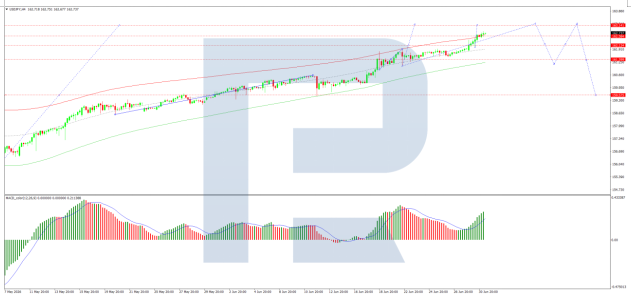
On the H4 chart, USD/JPY is trading within a consolidation range around 156.50 and is now moving towards 157.60. This level remains the immediate upside target. Once reached, a corrective move lower may begin, with scope for a decline towards 153.80 and potentially 153.00 thereafter. The MACD supports this scenario, with its signal line below zero but pointing firmly upwards, indicating that bullish momentum is still building in the short term before a broader correction may emerge.

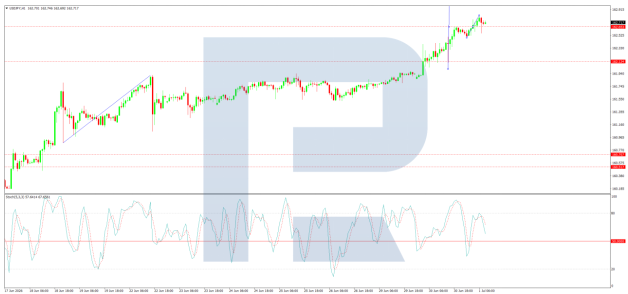
On the H1 chart, the market is attempting a breakout above 157.26. A further push higher towards 157.60 is likely in the near term. After that, a pullback towards 155.77 may follow, with the potential for the decline to extend to 153.80. The Stochastic oscillator supports this view, with its signal line above 80, indicating overbought conditions and suggesting that short-term downside pressure may begin to build once the current upward move fades.

Conclusion

USD/JPY remains supported by renewed demand for the US dollar amid heightened geopolitical tensions and inflation concerns, strengthening the greenback’s defensive appeal. However, the risk of renewed intervention from Japan continues to cap upside potential, leaving the pair vulnerable to sharp reversals despite the near-term bullish bias.


Disclaimer

Any forecasts contained herein are based on the author’s particular opinion. This analysis may not be treated as trading advice. RoboForex bears no responsibility for trading results based on trading recommendations and reviews contained herein.

S&P 500 and Nasdaq 100 hit new all‑time highs. Bitcoin remains resilient

By JustMarkets 

On Friday, the US stock market posted a sharp rise. By the end of the session, the Dow Jones (US30) slipped 0.31%, while the S&P 500 (US500) gained 0.29%. The tech‑heavy Nasdaq 100 (US100) closed 0.94% higher. Both the S&P 500 and Nasdaq 100 updated their all‑time highs. Apple shares rose more than 3% thanks to strong earnings and upbeat guidance, supported by robust iPhone sales and stable performance in the Chinese market. In the energy sector, ExxonMobil and Chevron posted moderate gains after reporting profits above expectations. Tech stocks remained in focus as well: Meta stabilized after recent declines, and Nvidia added over 1% amid ongoing discussions about AI‑related investment prospects.

In the first week of May, investors will face a new wave of corporate earnings, with major companies from technology, pharmaceuticals, consumer goods, and entertainment set to report. At the same time, market attention will shift to US macroeconomic data, with a full set of labor‑market indicators scheduled for release. These include the April nonfarm payrolls report, ADP employment data, Q1 productivity and labor‑cost figures, and job‑openings statistics. Expectations point to slower job growth compared to March, moderate wage acceleration, and unemployment remaining broadly unchanged.

Bitcoin (BTC/USD) surpassed $80,000, hitting a three‑month high amid a broad rally in risk assets. Investor sentiment was boosted by progress in the US Senate on stablecoin regulation, seen as a key step toward legitimizing the digital assets industry. Institutional demand also supported the move: US spot ETFs recorded $630 million in weekly inflows, underscoring the asset’s resilience after a 12% gain in April. Geopolitical tensions remain extremely high. Donald Trump’s statement about providing military escort for ships passing through the Strait of Hormuz triggered a sharp protest from Tehran, which viewed it as a violation of the ceasefire. Despite ongoing volatility in the conflict zone weighing on traditional markets, Bitcoin continues to act as “digital gold” and an alternative risk asset, largely ignoring escalation risks.

Most European markets were closed on Friday due to a banking holiday. The only major index trading was the UK’s FTSE 100 (UK100), which ended the day 0.14% lower. After a busy end to April, marked by key economic data, central‑bank decisions, and corporate earnings, Europe’s early‑May agenda will be somewhat calmer. With rate‑hold decisions already announced, attention will shift to the next steps from regulators: central banks of Sweden and Norway will publish their decisions, while the ECB will release analytical materials and projections accompanied by speeches from policymakers. A key macroeconomic event will be Germany’s foreign‑trade data, where a decline in the trade surplus is expected due to higher energy prices and increased imports. Additional insight into industrial conditions will come from production and order figures, which may show signs of recovery. The UK will release housing‑market data, while Switzerland will publish inflation, unemployment, and consumer‑sentiment indicators. Meanwhile, earnings season continues for major European companies in the banking, industrial, and energy sectors.

On Friday, WTI crude prices fell to nearly $101 per barrel, partially giving back weekly gains amid rising expectations that the temporary ceasefire between the US and Iran may evolve into a more stable agreement. Reports emerged of a new proposal from Tehran, and Donald Trump noted progress in negotiations, though he expressed doubts about reaching a final deal. Markets are also watching the political dimension: the US president faces a 60‑day limit under the War Powers Act, requiring either congressional approval or troop withdrawal. The administration maintains that the ceasefire has effectively halted active hostilities. Since the conflict began in late February, oil prices have surged nearly 60%, as disruptions in the Strait of Hormuz significantly reduced global supply.
In Asia, Japan’s Nikkei 225 (JP225) rose 0.38% on Friday. China’s FTSE China A50 and Hong Kong’s Hang Seng (HK50) were closed, while Australia’s ASX 200 (AU200) gained 0.74%.

This week in China, market attention will focus on April foreign‑trade data, which will help assess the impact of the Middle East conflict on the country’s economy, as well as private‑sector activity indicators, including services PMIs. In Japan, investors will analyze the minutes of the March central‑bank meeting for clues on future policy and monitor wage‑growth trends.

In Australia, another rate hike is expected amid rising inflationary pressures linked to global risks. Across the region, a large batch of macroeconomic releases is scheduled, including inflation, GDP, labor‑market data, foreign‑trade figures, and manufacturing PMIs, offering a broader view of economic conditions in Asia and neighboring regions.

S&P 500 (US500) 7,230.12 +21.11 (+0.29%)

Dow Jones (US30) 49,499.27 −152.87 (−0.31%)

DAX (DE40) 24,292.38 +337.82 (+1.41%)

FTSE 100 (UK100) 10,363.93 −14.89 (−0.14%)

USD Index 98.21 +0.16 (+0.16%)

News feed for: 2026.05.04

  • Switzerland Manufacturing PMI (m/m) at 10:30 (GMT+3) – CHF (MED)
  • Eurozone Manufacturing PMI (m/m) at 11:00 (GMT+3) – EUR (MED)
  • Canada BOC Gov Macklem Speaks at 22:30 (GMT+3) – CAD (LOW)

By JustMarkets


This article reflects a personal opinion and should not be interpreted as an investment advice, and/or offer, and/or a persistent request for carrying out financial transactions, and/or a guarantee, and/or a forecast of future events.

Week Ahead: Gold Futures/Index set for May mayhem?

By ForexTime 

  • Trump vows to maintain naval blockade on Iran 
  • Prediction markets see little chance of a peace deal anytime soon
  • Newly launched gold index/futures offset CFD risk 
  • Iran war + Fed speeches+ NFP = fresh volatility 
  • Technical levels – $4300, $4500 and $4750 

A fragile ceasefire. A naval blockade. And odds that are anything but encouraging.

Trump has vowed to maintain a chokehold on Iran’s waters which may cast a shadow over the first week of May.

Considering that prediction markets are pricing a permanent peace deal at just 30% by the end-June, the Strait of Hormuz saga is far from over.

Heightened geopolitical risk, corporate earnings, speeches by Fed officials and the NFP may trigger extreme levels of volatility in the week ahead:

Sunday, 3rd May

  • OPEC+ monthly meeting held as the war in Iran moves into its third month.

Monday, 4th May

  •  EUR: Eurozone S&P Global manufacturing PMI
  • GER40: Germany S&P Global/BME Germany manufacturing PMI
  • GOLDInd: NY Fed President John Williams

Tuesday, 5th May

  • AUD: RBA rate decision
  • SPN35: Spain unemployment
  • GOLDInd: US new home sales, trade, job openings, ISM Services, building permits

Wednesday, 6th May

  • CNH: China RatingDog composite and services PMI
  • EUR: Eurozone S&P Global services PMI, PPI
  • GER40: Germany S&P Global services PMI
  • NZD: New Zealand unemployment
  • US500: US Treasury Department holds quarterly refunding announcement
  • GOLDM6: US ADP employment, St. Louis Fed President Alberto Musalem

Thursday, 7th May

  • EUR: Eurozone retail sales
  • JPY: Japan BOJ meeting minutes
  • CHF: Sweden rate decision
  • TWN: Taiwan CPI
  • GOLDM6: US construction spending, initial jobless claims, NY Fed President John Williams


Friday, 8th May

  • CAD: Canada employment
  • GER40: Germany industrial production, trade
  • GOLDInd: US NFP (April), University of Michigan consumer sentiment

Gold has been trending lower thanks to a broadly stronger dollar and inflation fears.

As concerns over inflation shocks mount, central banks are likely to keep rates steady or even hike down the road as witnessed in the latest batch of policy decisions.

This hawkish reality is bad news for zero-yielding gold despite the risk-off sentiment.

Considering how volatility may remain the name of the game in May, FXTM’s Gold Index and Futures may be ideal for offsetting spot CFD risk.


FXTM’s GOLDJ6 future

FXTM’s GOLDJ6 is 100% pegged to CME Group Futures price for absolute price clarity, charging traders zero swap when holding overnight positions.

This asset is a gift for active and long-term traders who want full price transparency without financing drag of holding positions over extended periods.

FXTM’s GOLDInd

FXTM’s GOLDInd tracks the spot/future price with fixed swap and spreads.

This asset is ideal for traders who want to hold the position over an extended period at a fixed cost, avoiding surprise overnight charges or widening spreads sparked by volatility.


With all the above said, here are 3 key factors that may influence Gold Futures & Indices.

1)     Strait of Hormuz saga

An impasse between the United States and Iran continues to drain risk sentiment, with market fatigue building due to the back and forth.

Trump has vowed to maintain the naval blockade while Iran has warned that this will further push up oil prices.

Given how both sides are waiting for the other to yield, this could translate to extended levels of uncertainty and elevated oil prices amid the closure.

  •  If the conflict deepens, gold futures/index may dip as surging oil prices fuel inflation fears.
  •  Any signs of easing tensions and re-opening of the Straight of Hormuz to the US may weaken gold as inflation concerns reduce.

2)     US April NFP

The April US jobs report on Friday 8th May may provide insight into the health of the labour markets.

Here’s what economists predict for this closely watched jobs report:

  • Headline NFP figure: 60,000 (new jobs added to US labour market)

If so, this would be a decline from the March 178,000 headline NFP figure.

  • Unemployment rate: 4.3%

If so, this would match March unemployment rate

  • Average hourly earnings month-on-month (April 2026 vs. March 2026): 0.3%

If so, this would higher than March’s figure.

Note: Other key data in the week including the ADP and Fed speeches may influence gold prices.

  • A stronger-than-expected US jobs data may stimulate bets around the Fed hiking rates.
  • A weaker-than-expected figure could cool bets around Fed hikes.


Note: Traders are currently pricing a 5% chance that the Fed will cut rates by June 2026.

3)     Technical forces

Prices remain in a bearish channel on the daily charts as there have been consistently lower lows and lower highs. However, the RSI is slowly approaching oversold regions, suggesting a potential rebound down the road.

  • Should $4500 prove reliable support, prices may rebound back toward $4750 and higher.
  • Weakness below $4500 could take prices toward $4300.


Forex-Time-LogoArticle by ForexTime


ForexTime Ltd (FXTM) is an award winning international online forex broker regulated by CySEC 185/12 www.forextime.com

Gold Supported by Cautious Optimism

By Analytical Department RoboForex

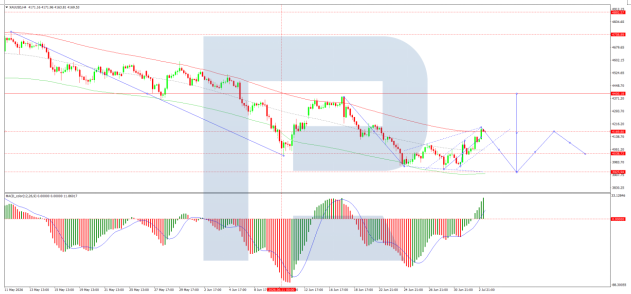
Gold is holding at around 4,611 USD per ounce on Monday as markets assess Donald Trump’s proposal to escort commercial vessels through the Strait of Hormuz, alongside tentative signs of progress in US–Iran negotiations.

The plan involves assisting civilian ships from neutral countries in safely leaving the conflict zone and restoring access to the shipping route. At the same time, Iran has stated that it is reviewing the US response to its latest proposal, which has helped support hopes for a diplomatic resolution.

However, the conflict, now entering its tenth week, continues to drive energy prices higher and intensify inflationary pressures. This has reinforced expectations that central banks may keep interest rates elevated for longer, or even tighten policy further if inflation risks persist.

Since the beginning of the confrontation, gold has remained under pressure and has lost around 12% of its value. At the same time, data from the World Gold Council show that central banks continue to increase their gold reserves, providing underlying support for long-term demand.

Technical Analysis

On the H4 chart, XAU/USD is consolidating above the 4,600 USD  evel. A move higher could open the way for a corrective rebound towards 4,704 USD. On the downside, a fresh decline towards 4,430 USD cannot be ruled out. The MACD indicator supports the current recovery bias: the signal line remains below the zero mark but continues to point firmly upwards, indicating strengthening bullish momentum.

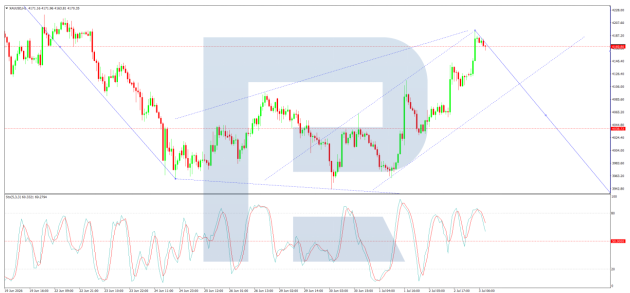
On the H1 chart, the market has broken below the 4,620 USD level and is extending its move towards 4,580. In the near term, a rebound towards 4,690 USD remains possible as a retest from below, followed by a potential pullback to 4,625 USD. After that, a further move higher towards 4,741 USD may develop. The Stochastic oscillator supports this scenario, with the signal line remaining below 50 and pointing lower towards 20, signalling short-term downside pressure.

Conclusion

Gold remains caught between cautious optimism over diplomacy and persistent inflation risks driven by the Middle East conflict. While short-term price action remains fragile, continued central bank demand and geopolitical uncertainty are likely to provide underlying support for gold in the medium to longer term.


Disclaimer

Any forecasts contained herein are based on the author’s particular opinion. This analysis may not be treated as trading advice. RoboForex bears no responsibility for trading results based on trading recommendations and reviews contained herein.

W. P. Carey Inc. has been added to our data-driven Watchlist.

W. P. Carey Inc. has been added to our data-driven Watchlist.

📈 WPC – W. P. Carey Inc.
🏭 Sector: Real Estate
📊 Market Cap: Medium Cap
🛡️ Beta: 0.79 (Low Risk)
📈 52W Performance: +18.2%
👍 Quant Score: 60/100 (Fair)

WPC is a Medium Cap Real Estate (REIT) company (net lease REIT) and has beaten its earnings-per-share estimates this previous quarter. Currently, it has a dividend of over 5.05 percent, with a payout ratio of approximately 70-90% (REITs are required to distribute 90% of taxable income to shareholders).

The WPC stock has been in an uptrend since the beginning of 2025 and is up over 15 percent in the past 52 weeks with the Relative Strength Index (RSI) showing a roughly 60 score on the weekly RSI.

Full Disclosure: I do not currently own this stock. Disclaimer: Content is educational purposes and not intended as investment advice.

Canadian Dollar Speculator Bets up strongly for 2nd week as CAD price gains for 4th week

By InvestMacro


Speculators OI FX Futures COT Chart

Here are the latest charts and statistics for the Commitment of Traders (COT) data published by the Commodities Futures Trading Commission (CFTC).

The latest COT data is updated through Tuesday April 28th and shows a quick view of how large market participants (for-profit speculators and commercial traders) were positioned in the futures markets. All currency positions are in direct relation to the US dollar where, for example, a bet for the euro is a bet that the euro will rise versus the dollar while a bet against the euro will be a bet that the euro will decline versus the dollar.

Weekly Speculator Changes led by Canadian Dollar & Australian Dollar

Speculators Nets FX Futures COT Chart
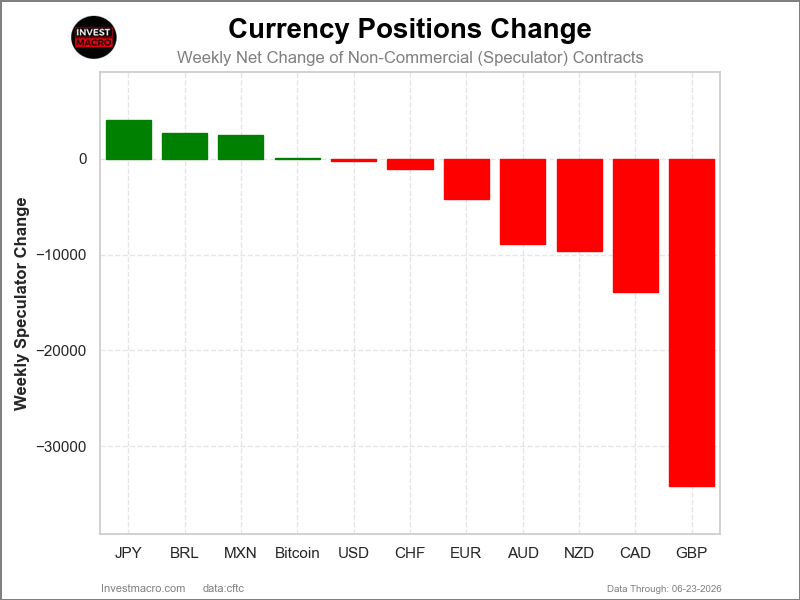
The COT currency market speculator bets were overall slightly higher this week as six out of the eleven currency markets we cover had higher positioning while the other five markets had lower speculator contracts.

Leading the gains for the currency markets was a jump by the Canadian Dollar (20,358 contracts) with the Australian Dollar (7,052 contracts), Brazilian Real (2,910 contracts), New Zealand Dollar (2,132 contracts), Bitcoin (321 contracts) and the Mexican Peso (122 contracts) also showing positive weeks.

The currencies seeing declines in speculator bets on the week were the British Pound (-8,600 contracts), the Japanese Yen (-7,599 contracts), the EuroFX (-5,612 contracts), the Swiss Franc (-1,948 contracts) and with the US Dollar Index (-475 contracts) also registering lower bets on the week.

Canadian Dollar bets gained strongly for 2nd week as CAD price rises for 4th week

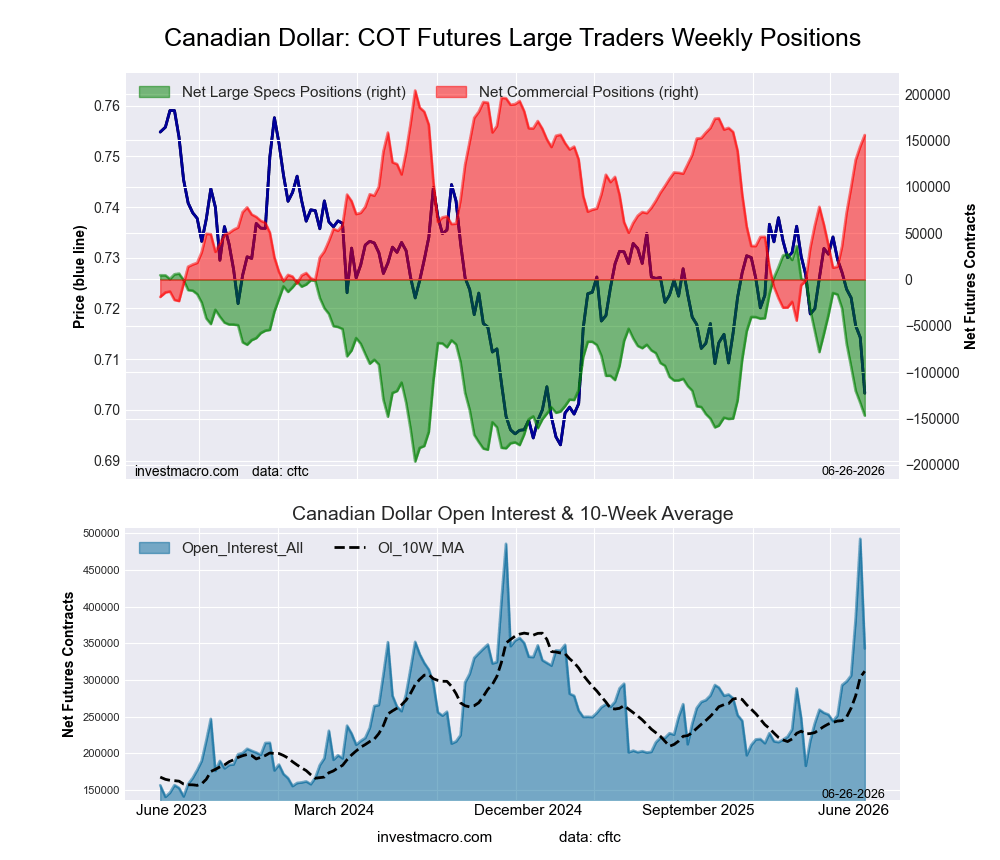
Highlighting the Currency markets this week were the Canadian dollar speculator bets, which rose by over 20,000 contracts this week following last week’s approximate gain of 20,000 contracts as well. Canadian dollar speculators have boosted their positions in the past two weeks following the previous five weeks where speculator bets had declined sharply and brought the overall standing to its lowest level since December. The current standing for speculator bets is still in bearish territory at -38,476 contracts but is at a 67% strength score compared to the past 3-years range illustrating how bearish the CAD has been recently.

The Canadian dollar, as one of the commodity currencies, is typically helped out by higher commodity prices and could see an outlook for a higher upside with higher energy and commodity prices likely to persist going forward. There is also speculation the Bank of Canada (BOC) may be inclined to have a bias of raising interest rates with the economic outlook. The Canadian dollar’s price in the Foreign Exchange market has risen for four consecutive weeks. This week the CAD closed out trading at a 0.7374 exchange rate and above its 200-week moving average. Currently, the CAD is in an ascending triangle pattern with overhead resistance around 0.7400. A break above this could test the highest levels for the Canadian dollar versus the US dollar since September of 2024.

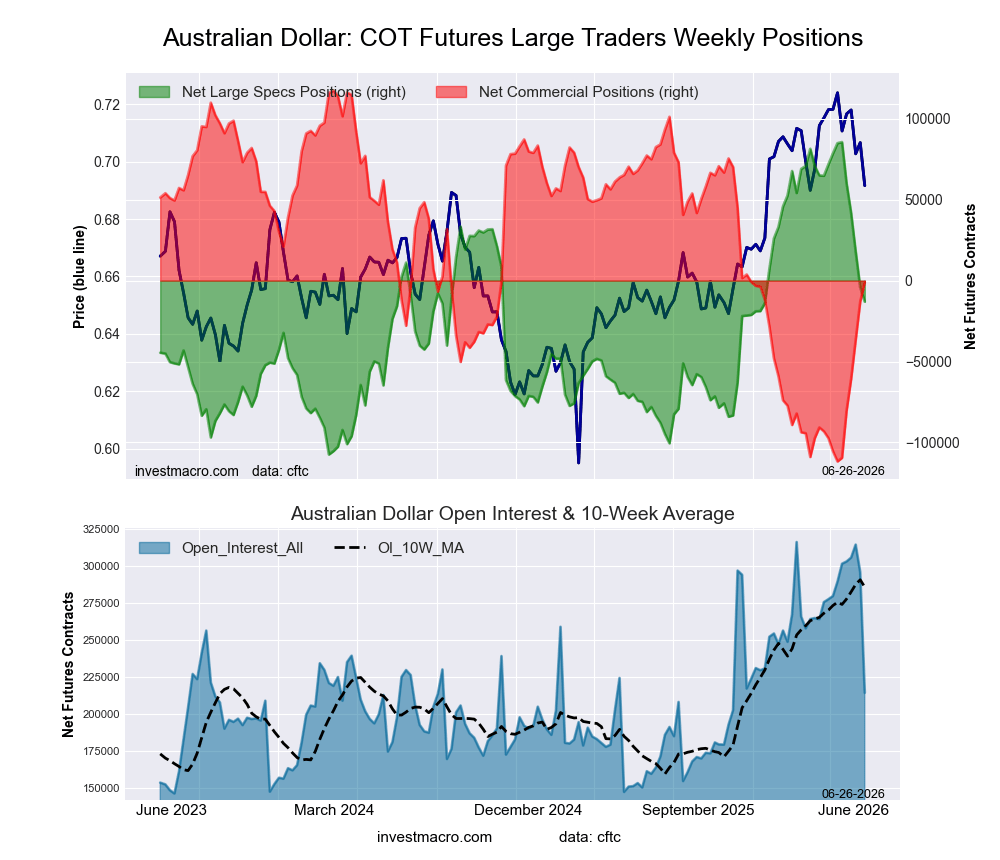
The Australian dollar speculator positions got a boost this week by over 7,000 contracts and halts a three-week streak of declining bullish bets. The overall positioning for the Australian dollar speculators comes in at 71,869 contracts this week, which is an extreme bullish score for the Australian dollar compared to the last three years. The Australian dollar’s strength score is currently at a 94.9% reading compared to these last three years which had seen net positions mainly in bearish territory until January 27th. The Australian dollar currency price in the Foreign Exchange markets has been on a strong bullish run and has risen for five consecutive weeks and in 13 out of the past 15 weeks. The Aussie closed out the week at 0.7204, and this marks the highest weekly price close since May of 2022. The AUD is currently sitting right at resistance in the 0.7200 area and a further break above this could bring 0.7350 into play.

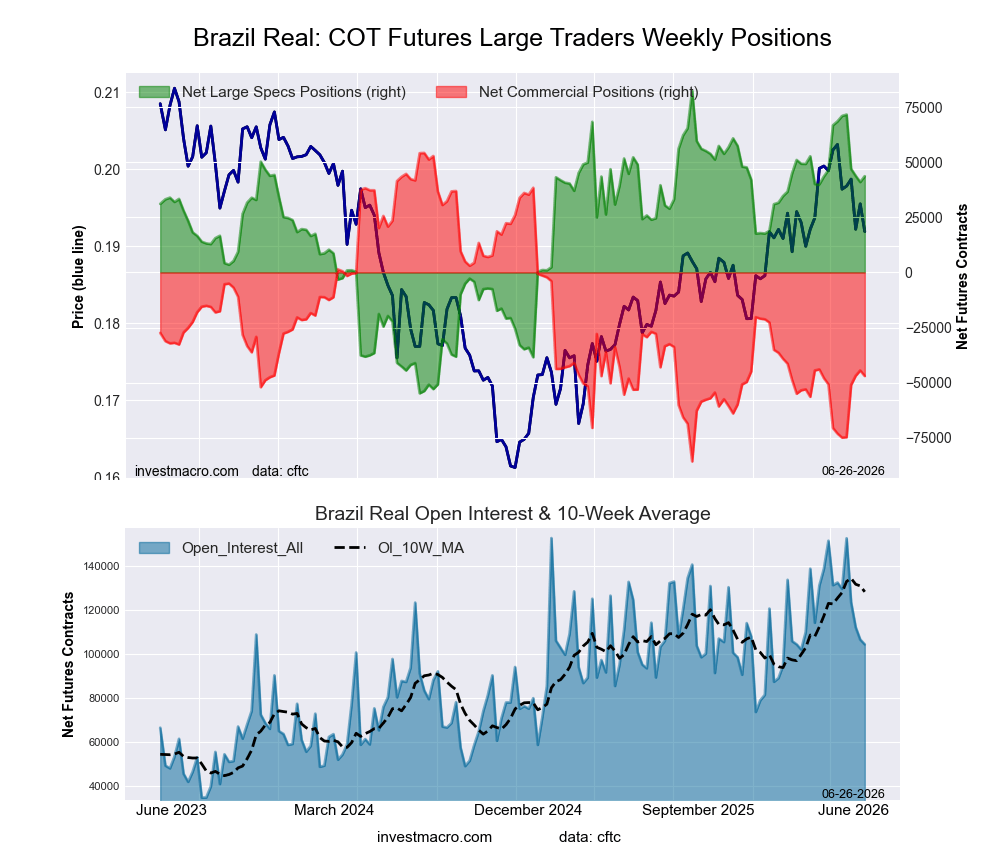
Next up, the Brazilian real rose by roughly 3,000 speculator contracts this week, and has risen for two consecutive weeks, as well as three out of the past four weeks. The real has seen a consistently bullish net contract position dating back to February of 2025. The real currently has a total net standing of 46,443 contracts and the current positioning is at a strength score of 73.7% of its three-year range — bullish, but not extremely bullish as of yet. The BRL price has been in a strong uptrend in the Currency markets and has risen for six out of the past seven weeks. Currently the BRL, which closed at 0.2006 this week, is at the highest weekly close since March of 2024, a span of over two years.

Finally, the US Dollar Index saw a slight decline in its speculative bets this week for the third consecutive week. Right now, the US Dollar Index has a total net position of 4,508. Compared to the past three years, this positioning is almost right down the middle with a 56.3% strength score signalling an almost a neutral position for speculators at this time compared to the past three years. In the FX markets, the US Dollar Index continues to fluctuate in a range between 96.50 on the downside and with prices being capped around the 100.00 level on the upside. The current pricing is very close to the middle of that range, and we will have to wait to see if the US Dollar Index decisively breaks either of those barriers before evaluating the next levels to be.

Japanese Yen (BOJ Intervention) and Australian Dollar lead Currency markets price performance.

Over the past week, the Japanese Yen was the highest mover in the Foreign Exchange market, with a 1.62% gain over the past five days. The Yen’s sharp gain this week was reportedly helped out by the Bank of Japan’s (BOJ) Currency intervention. This was the first time the BOJ had intervened in the Currency markets in the past couple of years, and this was to stem a slide in the Yen’s performance. The intervention helped cut the US Dollar strength against the Yen as the USD/JPY Currency pair dropped from an exchange rate mid-week over 160.70 to approximately around the 156.00 area. The USD/JPY pair closed the week out at the 157.08 exchange.

Coming in second for the week was the Australian Dollar, which rose by 0.83% and has now risen by 4.79% over the past 30 days. Over the past 90 days, the Australian Dollar has been up by 7.75% against the US Dollar.

The Canadian Dollar came in next with a 0.59% gain and was followed by the Swiss Franc, which rose by 0.53%. The New Zealand Dollar was higher by 0.45%, while the Brazilian Real was close behind at 0.44%, and the British Pound Sterling was also not too far behind with a 0.38% rise. Rounding out the week for the gainers was the Euro, which edged up by a small 0.13%.

On the downside, the US Dollar Index was lower by -0.18%, followed by the Mexican Peso, which fell by -0.27%, and Bitcoin came in as the biggest decliner with a -0.57% shortfall.

Over the past 30 days, Bitcoin has seen the biggest rise with a roughly 15% gain, followed by the Brazilian Real, which is up by 5.86% over the past 30 days. The only market lower over the past 30 days is the US Dollar Index with a -1.91% decline.

Over the past 90 days, the Brazilian Real is the performance leader with an 8.42% increase, followed by the Australian Dollar, which is up by 7.75%. On the downside, the US Dollar Index is lower by -1.14% and is followed by Bitcoin, which is lower over the past 90 days by a modest -0.54%.


Currencies Data:

Speculators FX Futures COT Data Table
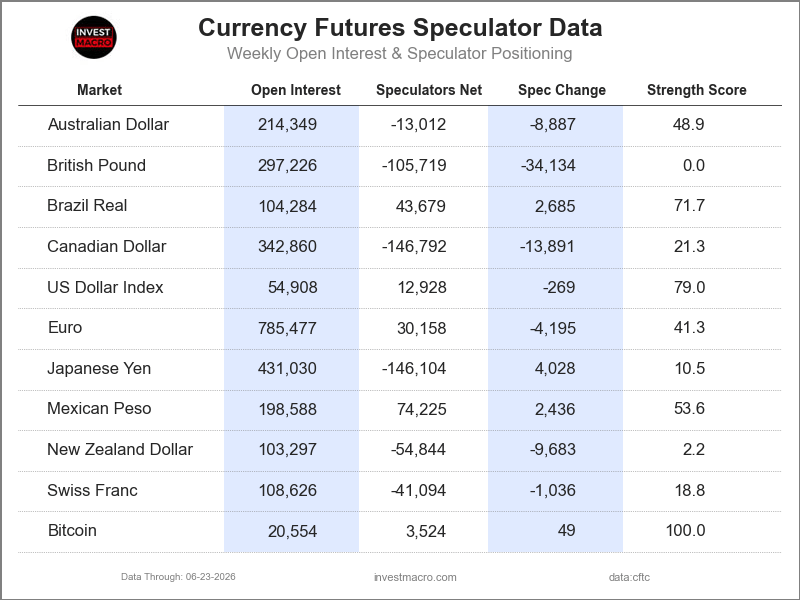
Legend: Open Interest | Speculators Current Net Position | Weekly Specs Change | Specs Strength Score compared to last 3-Years (0-100 range)


Strength Scores led by Bitcoin & Australian Dollar


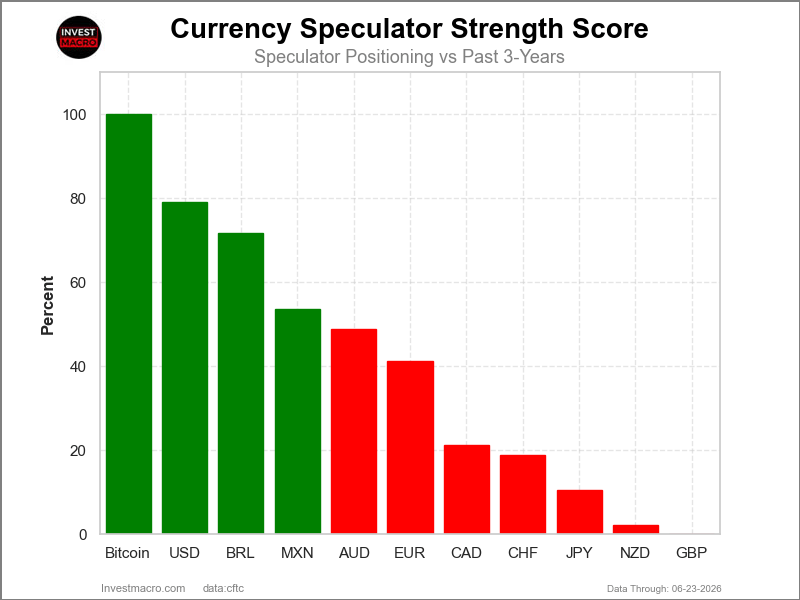
COT Strength Scores (a normalized measure of Speculator positions over a 3-Year range, from 0 to 100 where above 80 is Extreme-Bullish and below 20 is Extreme-Bearish) showed that the Bitcoin (97 percent) and the Australian Dollar (95 percent) lead the currency markets this week. The Brazilian Real (74 percent), Canadian Dollar (68 percent) and the US Dollar Index (56 percent) come in as the next highest in the weekly strength scores.

On the downside, the New Zealand Dollar (12 percent) and the British Pound (14 percent) come in at the lowest strength levels currently and are in Extreme-Bearish territory (below 20 percent). The next lowest strength scores are the Japanese Yen (23 percent) and the Swiss Franc (30 percent).

3-Year Strength Statistics:
US Dollar Index (56.3 percent) vs US Dollar Index previous week (57.6 percent)
EuroFX (42.4 percent) vs EuroFX previous week (44.5 percent)
British Pound Sterling (13.8 percent) vs British Pound Sterling previous week (17.5 percent)
Japanese Yen (22.6 percent) vs Japanese Yen previous week (24.7 percent)
Swiss Franc (29.5 percent) vs Swiss Franc previous week (33.5 percent)
Canadian Dollar (67.9 percent) vs Canadian Dollar previous week (59.1 percent)
Australian Dollar (94.9 percent) vs Australian Dollar previous week (91.2 percent)
New Zealand Dollar (11.9 percent) vs New Zealand Dollar previous week (9.5 percent)
Mexican Peso (49.1 percent) vs Mexican Peso previous week (49.0 percent)
Brazilian Real (73.7 percent) vs Brazilian Real previous week (71.6 percent)
Bitcoin (97.1 percent) vs Bitcoin previous week (90.7 percent)


Bitcoin & EuroFX top the 6-Week Strength Trends

Speculators Trends FX Futures COT Chart
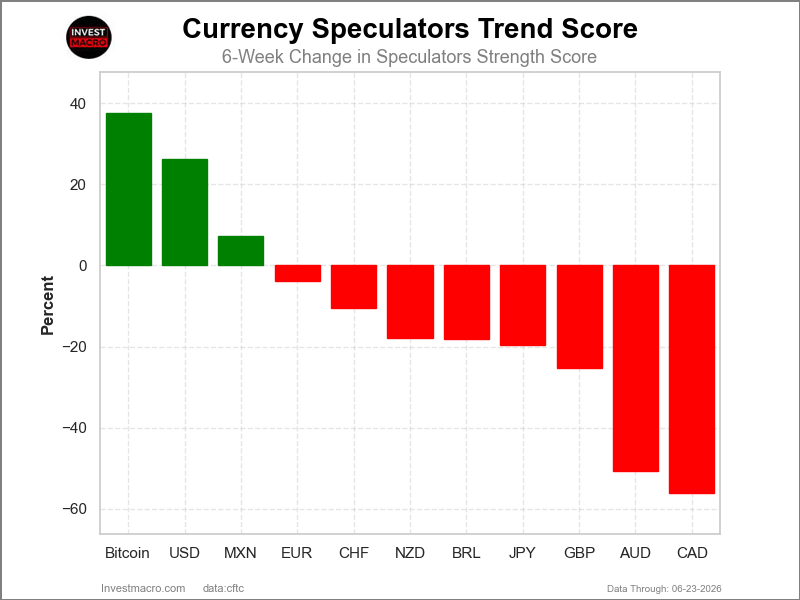
COT Strength Score Trends (or move index, calculates the 6-week changes in strength scores) showed that the Bitcoin (12 percent) and the EuroFX (6 percent) lead the past six weeks trends for the currencies. The US Dollar Index (2 percent), the British Pound (2 percent) and the Australian Dollar (1 percent) are the next highest positive movers in the 3-Year trends data.

The New Zealand Dollar (-27 percent) was the leader in the downside trend scores currently with the Swiss Franc (-20 percent), Canadian Dollar (-17 percent) and the Japanese Yen (-9 percent) following next with lower trend scores.

3-Year Strength Trends:
US Dollar Index (2.2 percent) vs US Dollar Index previous week (29.3 percent)
EuroFX (5.6 percent) vs EuroFX previous week (-24.3 percent)
British Pound Sterling (2.1 percent) vs British Pound Sterling previous week (13.7 percent)
Japanese Yen (-9.4 percent) vs Japanese Yen previous week (-14.6 percent)
Swiss Franc (-20.3 percent) vs Swiss Franc previous week (15.8 percent)
Canadian Dollar (-16.9 percent) vs Canadian Dollar previous week (-40.9 percent)
Australian Dollar (1.5 percent) vs Australian Dollar previous week (5.6 percent)
New Zealand Dollar (-26.6 percent) vs New Zealand Dollar previous week (-13.0 percent)
Mexican Peso (-0.5 percent) vs Mexican Peso previous week (-4.3 percent)
Brazilian Real (-2.1 percent) vs Brazilian Real previous week (-5.5 percent)
Bitcoin (12.3 percent) vs Bitcoin previous week (15.3 percent)


Individual COT Forex Markets:

US Dollar Index Futures:
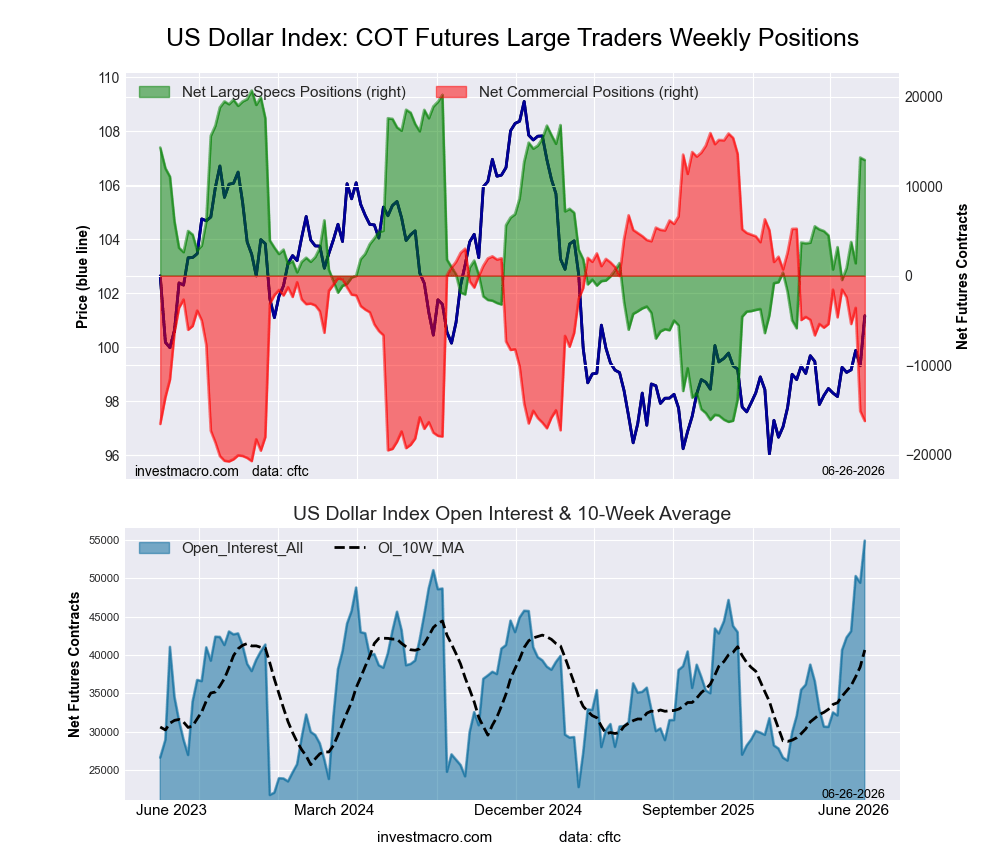
US Dollar Index Forex Futures COT ChartPositioning Notes:

  • US Dollar Index large speculator standing this week reached a net position of 4,508 contracts in the data reported through Tuesday.
  • Weekly Speculator position decrease of -475 contracts from the previous week which had a total of 4,983 net contracts.
  • This week’s current strength score (range over the past 3 years, measured from 0 to 100) shows the speculators are currently Bullish with a score of 56.3 percent.
  • The Commercials are Bearish with a score of 41.9 percent.
  • The Small Traders (not shown in chart) are Bullish with a score of 54.6 percent.

Price Trend-Following Model: Weak Uptrend

Our weekly trend-following model classifies the current market price position as: Weak Uptrend.

US DOLLAR INDEX StatisticsSPECULATORSCOMMERCIALSSMALL TRADERS
– Percent of Open Interest Longs:56.126.58.8
– Percent of Open Interest Shorts:41.444.25.9
– Net Position:4,508-5,404896
– Gross Longs:17,1808,1192,687
– Gross Shorts:12,67213,5231,791
– Long to Short Ratio:1.4 to 10.6 to 11.5 to 1
NET POSITION TREND:
– Strength Index Score (3 Year Range Pct):56.341.954.6
– Strength Index Reading (3 Year Range):BullishBearishBullish
NET POSITION MOVEMENT INDEX:
– 6-Week Change in Strength Index:2.2-1.2-6.4


Euro Currency Futures:

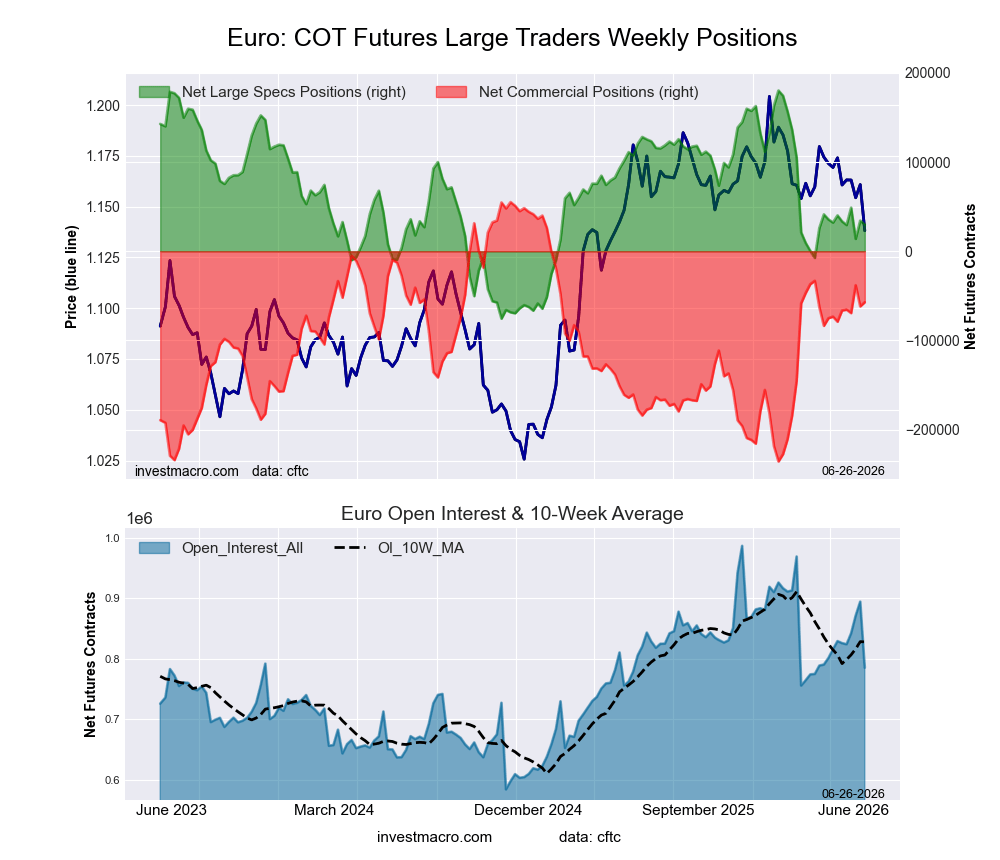
Euro Currency Futures COT ChartPositioning Notes:

  • Euro Currency large speculator standing this week reached a net position of 35,712 contracts in the data reported through Tuesday.
  • Weekly Speculator position reduction of -5,612 contracts from the previous week which had a total of 41,324 net contracts.
  • This week’s current strength score (range over the past 3 years, measured from 0 to 100) shows the speculators are currently Bearish with a score of 42.4 percent.
  • The Commercials are Bullish with a score of 55.6 percent.
  • The Small Traders (not shown in chart) are Bullish with a score of 57.7 percent.

Price Trend-Following Model: Weak Downtrend

Our weekly trend-following model classifies the current market price position as: Weak Downtrend.

EURO Currency StatisticsSPECULATORSCOMMERCIALSSMALL TRADERS
– Percent of Open Interest Longs:27.158.610.8
– Percent of Open Interest Shorts:22.668.05.9
– Net Position:35,712-75,13739,425
– Gross Longs:217,091469,71586,558
– Gross Shorts:181,379544,85247,133
– Long to Short Ratio:1.2 to 10.9 to 11.8 to 1
NET POSITION TREND:
– Strength Index Score (3 Year Range Pct):42.455.657.7
– Strength Index Reading (3 Year Range):BearishBullishBullish
NET POSITION MOVEMENT INDEX:
– 6-Week Change in Strength Index:5.6-5.74.5


British Pound Sterling Futures:

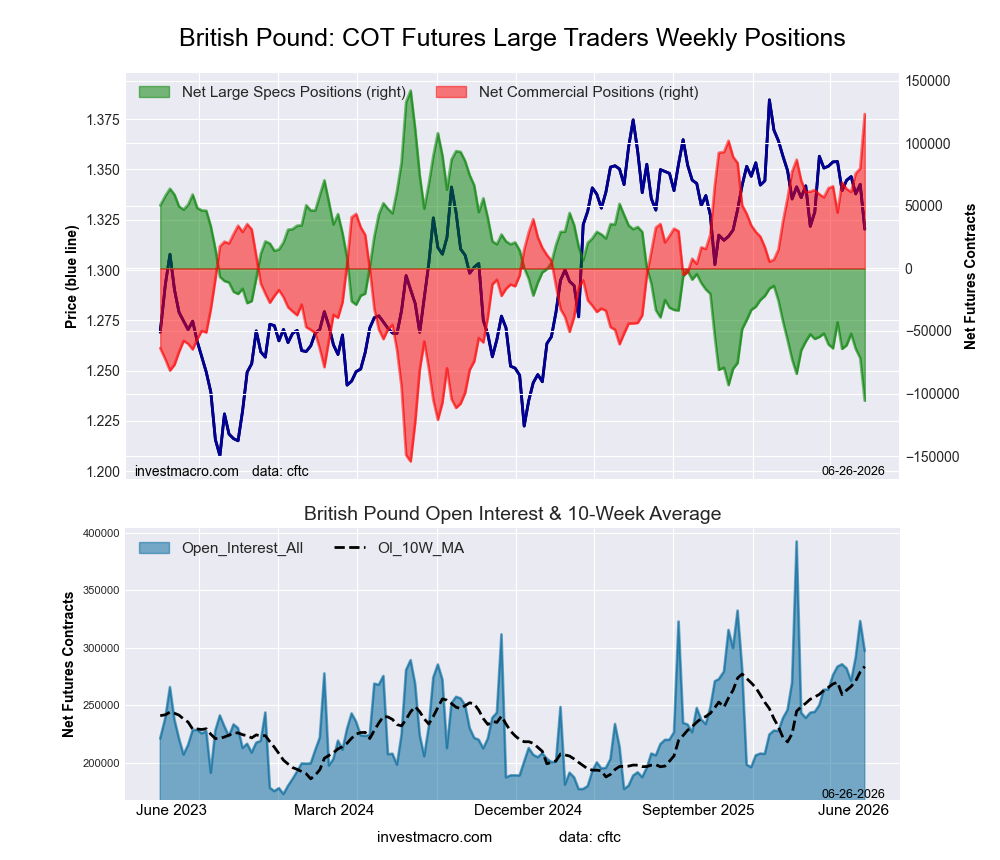
British Pound Sterling Futures COT ChartPositioning Notes:

  • British Pound Sterling large speculator standing this week reached a net position of -60,639 contracts in the data reported through Tuesday.
  • Weekly Speculator position lowering of -8,600 contracts from the previous week which had a total of -52,039 net contracts.
  • This week’s current strength score (range over the past 3 years, measured from 0 to 100) shows the speculators are currently Bearish-Extreme with a score of 13.8 percent.
  • The Commercials are Bullish-Extreme with a score of 85.2 percent.
  • The Small Traders (not shown in chart) are Bearish with a score of 44.2 percent.

Price Trend-Following Model: Weak Downtrend

Our weekly trend-following model classifies the current market price position as: Weak Downtrend.

BRITISH POUND StatisticsSPECULATORSCOMMERCIALSSMALL TRADERS
– Percent of Open Interest Longs:22.666.79.6
– Percent of Open Interest Shorts:45.642.410.9
– Net Position:-60,63964,120-3,481
– Gross Longs:59,577175,79025,368
– Gross Shorts:120,216111,67028,849
– Long to Short Ratio:0.5 to 11.6 to 10.9 to 1
NET POSITION TREND:
– Strength Index Score (3 Year Range Pct):13.885.244.2
– Strength Index Reading (3 Year Range):Bearish-ExtremeBullish-ExtremeBearish
NET POSITION MOVEMENT INDEX:
– 6-Week Change in Strength Index:2.1-2.43.5


Japanese Yen Futures:

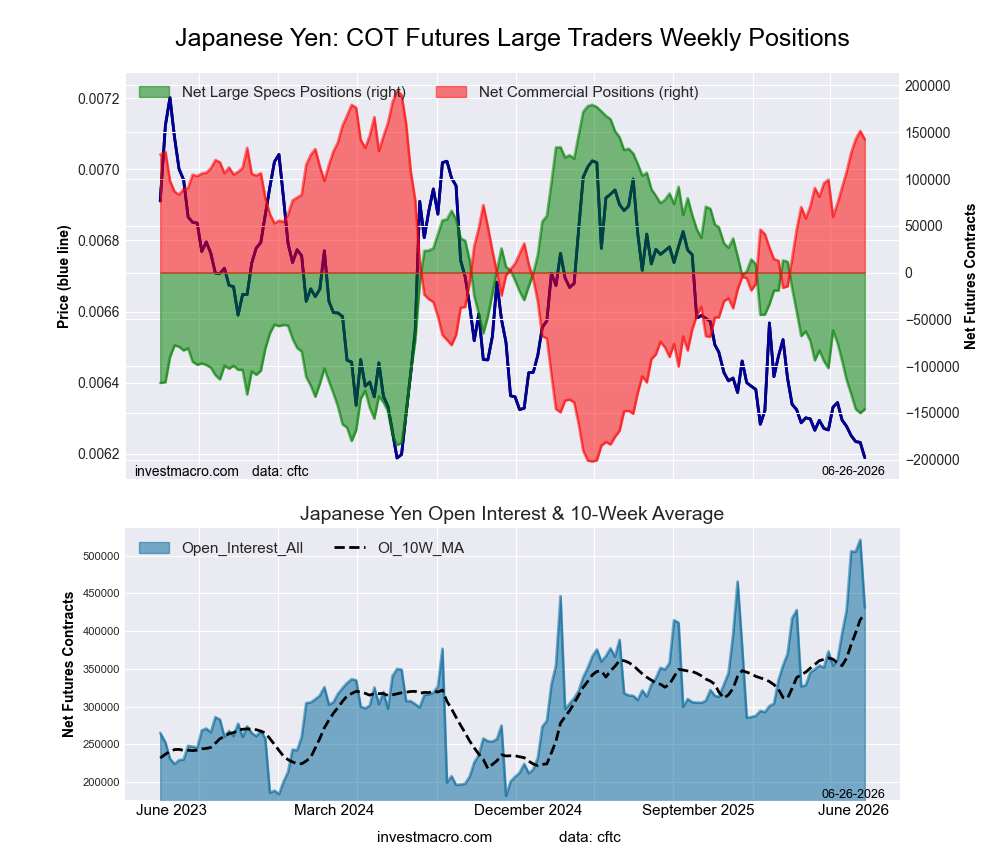
Japanese Yen Forex Futures COT ChartPositioning Notes:

  • Japanese Yen large speculator standing this week reached a net position of -102,059 contracts in the data reported through Tuesday.
  • Weekly Speculator position decline of -7,599 contracts from the previous week which had a total of -94,460 net contracts.
  • This week’s current strength score (range over the past 3 years, measured from 0 to 100) shows the speculators are currently Bearish with a score of 22.6 percent.
  • The Commercials are Bullish with a score of 76.0 percent.
  • The Small Traders (not shown in chart) are Bearish with a score of 43.9 percent.

Price Trend-Following Model: Weak Downtrend

Our weekly trend-following model classifies the current market price position as: Weak Downtrend.

JAPANESE YEN StatisticsSPECULATORSCOMMERCIALSSMALL TRADERS
– Percent of Open Interest Longs:28.654.111.6
– Percent of Open Interest Shorts:56.027.410.9
– Net Position:-102,05999,2702,789
– Gross Longs:106,530201,52743,285
– Gross Shorts:208,589102,25740,496
– Long to Short Ratio:0.5 to 12.0 to 11.1 to 1
NET POSITION TREND:
– Strength Index Score (3 Year Range Pct):22.676.043.9
– Strength Index Reading (3 Year Range):BearishBullishBearish
NET POSITION MOVEMENT INDEX:
– 6-Week Change in Strength Index:-9.47.413.0


Swiss Franc Futures:

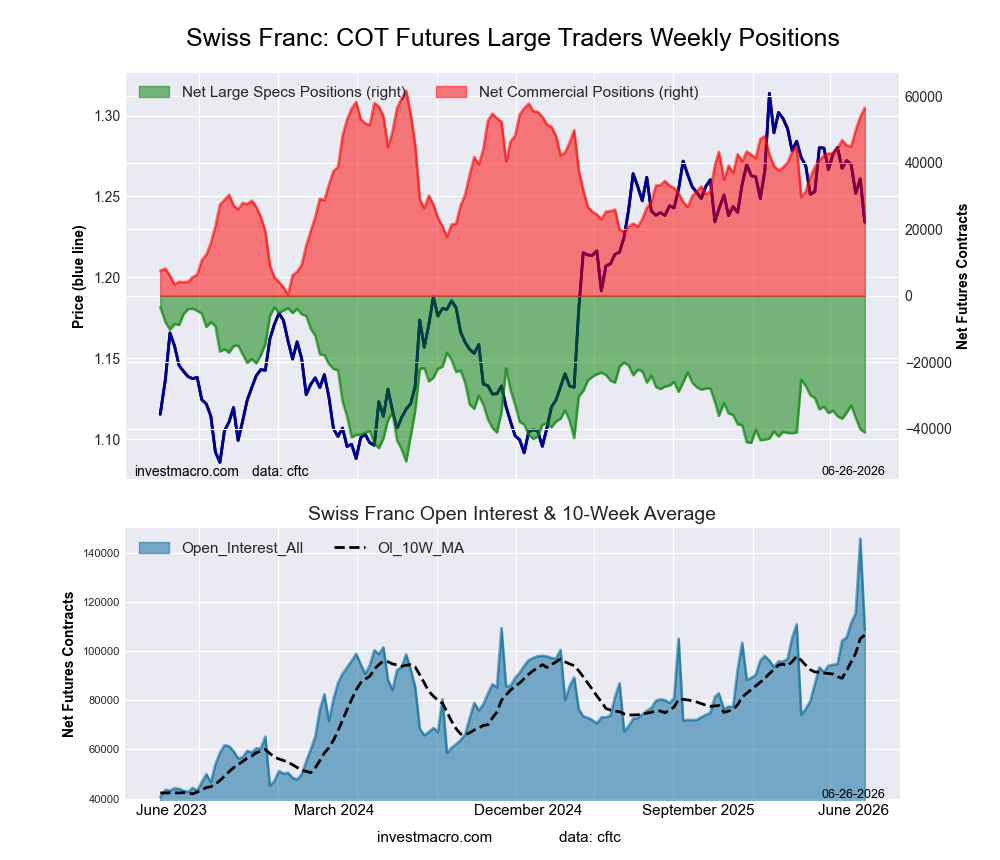
Swiss Franc Forex Futures COT ChartPositioning Notes:

  • Swiss Franc large speculator standing this week reached a net position of -35,221 contracts in the data reported through Tuesday.
  • Weekly Speculator position decrease of -1,948 contracts from the previous week which had a total of -33,273 net contracts.
  • This week’s current strength score (range over the past 3 years, measured from 0 to 100) shows the speculators are currently Bearish with a score of 29.5 percent.
  • The Commercials are Bullish with a score of 69.1 percent.
  • The Small Traders (not shown in chart) are Bearish with a score of 46.9 percent.

Price Trend-Following Model: Uptrend

Our weekly trend-following model classifies the current market price position as: Uptrend.

SWISS FRANC StatisticsSPECULATORSCOMMERCIALSSMALL TRADERS
– Percent of Open Interest Longs:6.879.213.8
– Percent of Open Interest Shorts:44.233.821.7
– Net Position:-35,22142,729-7,508
– Gross Longs:6,35974,56212,960
– Gross Shorts:41,58031,83320,468
– Long to Short Ratio:0.2 to 12.3 to 10.6 to 1
NET POSITION TREND:
– Strength Index Score (3 Year Range Pct):29.569.146.9
– Strength Index Reading (3 Year Range):BearishBullishBearish
NET POSITION MOVEMENT INDEX:
– 6-Week Change in Strength Index:-20.321.4-13.2


Canadian Dollar Futures:
Canadian Dollar Forex Futures COT Chart
Positioning Notes:

  • Canadian Dollar large speculator standing this week reached a net position of -38,476 contracts in the data reported through Tuesday.
  • Weekly Speculator position advance of 20,358 contracts from the previous week which had a total of -58,834 net contracts.
  • This week’s current strength score (range over the past 3 years, measured from 0 to 100) shows the speculators are currently Bullish with a score of 67.9 percent.
  • The Commercials are Bearish with a score of 32.8 percent.
  • The Small Traders (not shown in chart) are Bearish with a score of 49.1 percent.

Price Trend-Following Model: Uptrend

Our weekly trend-following model classifies the current market price position as: Uptrend.

CANADIAN DOLLAR StatisticsSPECULATORSCOMMERCIALSSMALL TRADERS
– Percent of Open Interest Longs:26.360.211.5
– Percent of Open Interest Shorts:41.645.511.0
– Net Position:-38,47637,1431,333
– Gross Longs:66,517152,03529,088
– Gross Shorts:104,993114,89227,755
– Long to Short Ratio:0.6 to 11.3 to 11.0 to 1
NET POSITION TREND:
– Strength Index Score (3 Year Range Pct):67.932.849.1
– Strength Index Reading (3 Year Range):BullishBearishBearish
NET POSITION MOVEMENT INDEX:
– 6-Week Change in Strength Index:-16.917.5-11.1


Australian Dollar Futures:

Australian Dollar Forex Futures COT ChartPositioning Notes:

  • Australian Dollar large speculator standing this week reached a net position of 71,869 contracts in the data reported through Tuesday.
  • Weekly Speculator position boost of 7,052 contracts from the previous week which had a total of 64,817 net contracts.
  • This week’s current strength score (range over the past 3 years, measured from 0 to 100) shows the speculators are currently Bullish-Extreme with a score of 94.9 percent.
  • The Commercials are Bearish-Extreme with a score of 5.1 percent.
  • The Small Traders (not shown in chart) are Bullish-Extreme with a score of 93.9 percent.

Price Trend-Following Model: Strong Uptrend

Our weekly trend-following model classifies the current market price position as: Strong Uptrend.

AUSTRALIAN DOLLAR StatisticsSPECULATORSCOMMERCIALSSMALL TRADERS
– Percent of Open Interest Longs:49.434.715.6
– Percent of Open Interest Shorts:23.469.86.4
– Net Position:71,869-97,38525,516
– Gross Longs:136,90996,35643,136
– Gross Shorts:65,040193,74117,620
– Long to Short Ratio:2.1 to 10.5 to 12.4 to 1
NET POSITION TREND:
– Strength Index Score (3 Year Range Pct):94.95.193.9
– Strength Index Reading (3 Year Range):Bullish-ExtremeBearish-ExtremeBullish-Extreme
NET POSITION MOVEMENT INDEX:
– 6-Week Change in Strength Index:1.5-1.61.7


New Zealand Dollar Futures:

New Zealand Dollar Forex Futures COT ChartPositioning Notes:

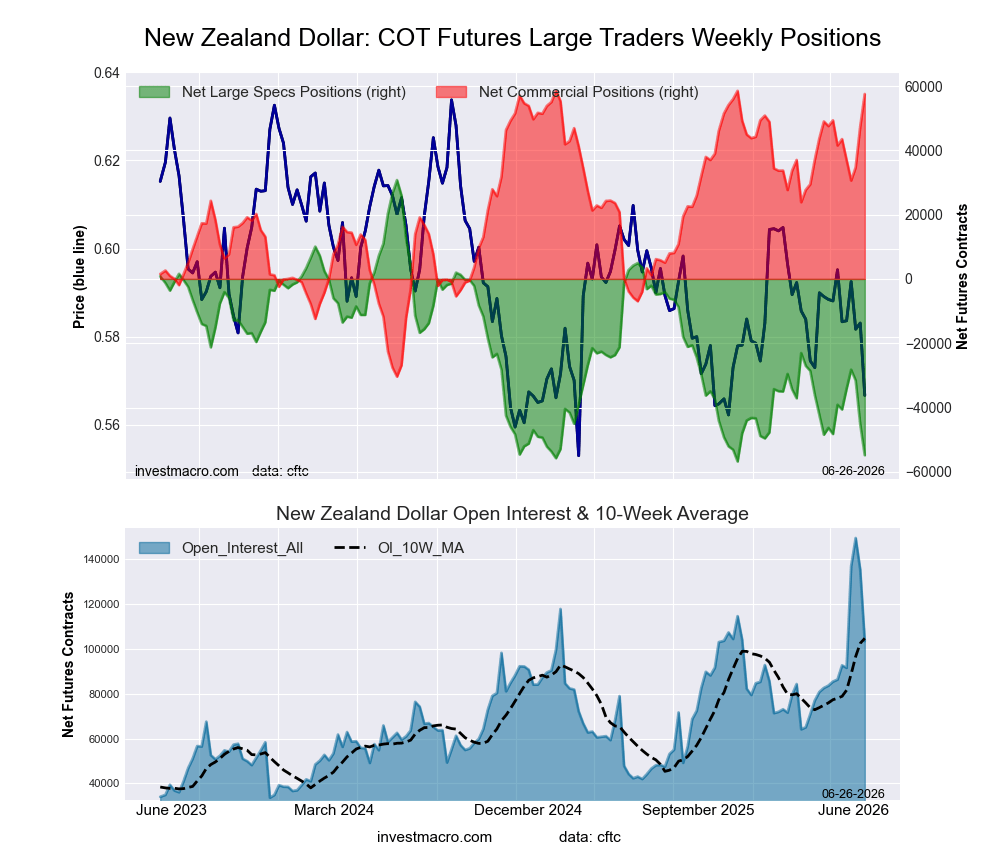
  • New Zealand Dollar large speculator standing this week reached a net position of -46,322 contracts in the data reported through Tuesday.
  • Weekly Speculator position advance of 2,132 contracts from the previous week which had a total of -48,454 net contracts.
  • This week’s current strength score (range over the past 3 years, measured from 0 to 100) shows the speculators are currently Bearish-Extreme with a score of 11.9 percent.
  • The Commercials are Bullish-Extreme with a score of 87.6 percent.
  • The Small Traders (not shown in chart) are Bearish with a score of 36.4 percent.

Price Trend-Following Model: Uptrend

Our weekly trend-following model classifies the current market price position as: Uptrend.

NEW ZEALAND DOLLAR StatisticsSPECULATORSCOMMERCIALSSMALL TRADERS
– Percent of Open Interest Longs:10.884.44.4
– Percent of Open Interest Shorts:66.327.55.9
– Net Position:-46,32247,550-1,228
– Gross Longs:9,04470,5243,716
– Gross Shorts:55,36622,9744,944
– Long to Short Ratio:0.2 to 13.1 to 10.8 to 1
NET POSITION TREND:
– Strength Index Score (3 Year Range Pct):11.987.636.4
– Strength Index Reading (3 Year Range):Bearish-ExtremeBullish-ExtremeBearish
NET POSITION MOVEMENT INDEX:
– 6-Week Change in Strength Index:-26.626.6-5.5


Mexican Peso Futures:

Mexican Peso Futures COT ChartPositioning Notes:

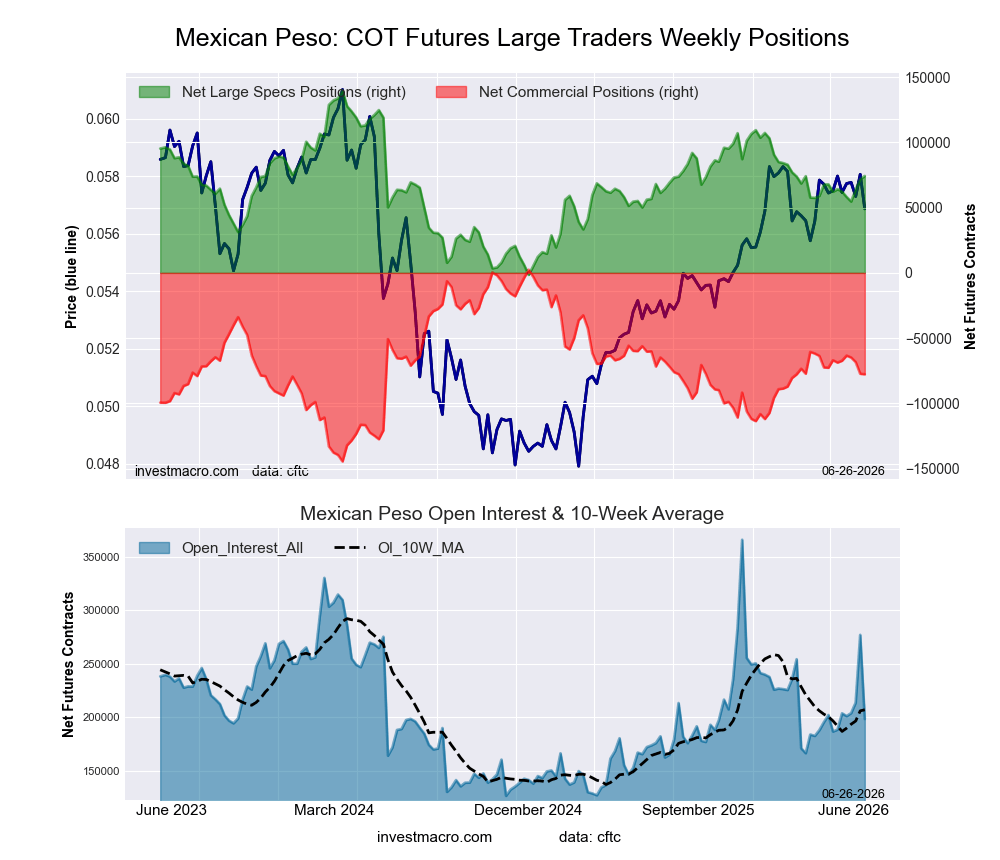
  • Mexican Peso large speculator standing this week reached a net position of 67,823 contracts in the data reported through Tuesday.
  • Weekly Speculator position advance of 122 contracts from the previous week which had a total of 67,701 net contracts.
  • This week’s current strength score (range over the past 3 years, measured from 0 to 100) shows the speculators are currently Bearish with a score of 49.1 percent.
  • The Commercials are Bearish with a score of 48.9 percent.
  • The Small Traders (not shown in chart) are Bearish with a score of 49.8 percent.

Price Trend-Following Model: Strong Uptrend

Our weekly trend-following model classifies the current market price position as: Strong Uptrend.

MEXICAN PESO StatisticsSPECULATORSCOMMERCIALSSMALL TRADERS
– Percent of Open Interest Longs:51.344.63.4
– Percent of Open Interest Shorts:17.780.61.0
– Net Position:67,823-72,7044,881
– Gross Longs:103,69790,2616,932
– Gross Shorts:35,874162,9652,051
– Long to Short Ratio:2.9 to 10.6 to 13.4 to 1
NET POSITION TREND:
– Strength Index Score (3 Year Range Pct):49.148.949.8
– Strength Index Reading (3 Year Range):BearishBearishBearish
NET POSITION MOVEMENT INDEX:
– 6-Week Change in Strength Index:-0.50.5-0.5


Brazilian Real Futures:

Brazil Real Futures COT ChartPositioning Notes:

  • Brazilian Real large speculator standing this week reached a net position of 46,443 contracts in the data reported through Tuesday.
  • Weekly Speculator position gain of 2,910 contracts from the previous week which had a total of 43,533 net contracts.
  • This week’s current strength score (range over the past 3 years, measured from 0 to 100) shows the speculators are currently Bullish with a score of 73.7 percent.
  • The Commercials are Bearish with a score of 25.0 percent.
  • The Small Traders (not shown in chart) are Bearish with a score of 45.4 percent.

Price Trend-Following Model: Strong Uptrend

Our weekly trend-following model classifies the current market price position as: Strong Uptrend.

BRAZIL REAL StatisticsSPECULATORSCOMMERCIALSSMALL TRADERS
– Percent of Open Interest Longs:58.534.93.5
– Percent of Open Interest Shorts:27.868.50.6
– Net Position:46,443-50,7944,351
– Gross Longs:88,49252,7565,272
– Gross Shorts:42,049103,550921
– Long to Short Ratio:2.1 to 10.5 to 15.7 to 1
NET POSITION TREND:
– Strength Index Score (3 Year Range Pct):73.725.045.4
– Strength Index Reading (3 Year Range):BullishBearishBearish
NET POSITION MOVEMENT INDEX:
– 6-Week Change in Strength Index:-2.11.90.9


Bitcoin Futures:

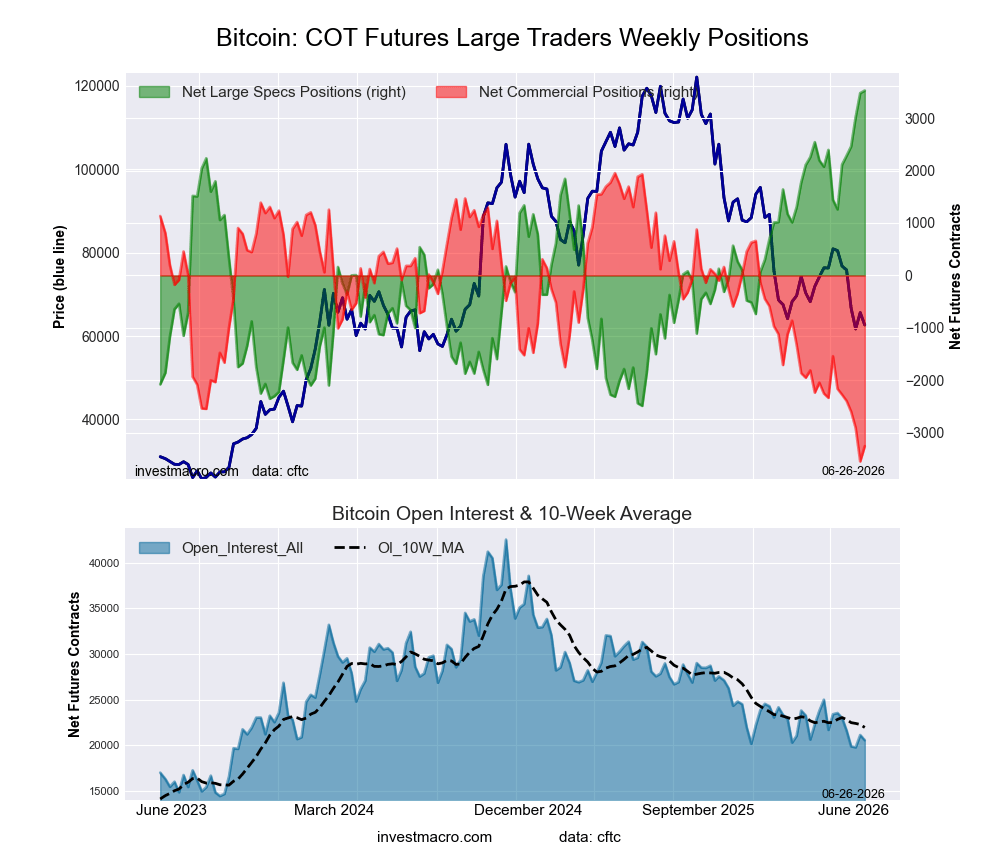
Bitcoin Crypto Futures COT ChartPositioning Notes:

  • Bitcoin large speculator standing this week reached a net position of 2,392 contracts in the data reported through Tuesday.
  • Weekly Speculator position lift of 321 contracts from the previous week which had a total of 2,071 net contracts.
  • This week’s current strength score (range over the past 3 years, measured from 0 to 100) shows the speculators are currently Bullish-Extreme with a score of 97.1 percent.
  • The Commercials are Bearish-Extreme with a score of 4.7 percent.
  • The Small Traders (not shown in chart) are Bearish with a score of 34.2 percent.

Price Trend-Following Model: Weak Downtrend

Our weekly trend-following model classifies the current market price position as: Weak Downtrend.

BITCOIN StatisticsSPECULATORSCOMMERCIALSSMALL TRADERS
– Percent of Open Interest Longs:80.40.84.8
– Percent of Open Interest Shorts:69.311.65.1
– Net Position:2,392-2,332-60
– Gross Longs:17,4311751,046
– Gross Shorts:15,0392,5071,106
– Long to Short Ratio:1.2 to 10.1 to 10.9 to 1
NET POSITION TREND:
– Strength Index Score (3 Year Range Pct):97.14.734.2
– Strength Index Reading (3 Year Range):Bullish-ExtremeBearish-ExtremeBearish
NET POSITION MOVEMENT INDEX:
– 6-Week Change in Strength Index:12.3-10.5-7.7


Article By InvestMacroReceive our weekly COT Newsletter

*COT Report: The COT data, released weekly to the public each Friday, is updated through the most recent Tuesday (data is 3 days old) and shows a quick view of how large speculators or non-commercials (for-profit traders) were positioned in the futures markets.

The CFTC categorizes trader positions according to commercial hedgers (traders who use futures contracts for hedging as part of the business), non-commercials (large traders who speculate to realize trading profits) and nonreportable traders (usually small traders/speculators) as well as their open interest (contracts open in the market at time of reporting). See CFTC criteria here.

Popular, Inc. has been added to our data-driven Watchlist.

Here are the details:

📈 BPOP – Popular, Inc.
🏭 Sector: Financial Services
📊 Market Cap: Small Cap
🛡️ Beta: 0.61 (Low Risk)
📈 52W Performance: +54.4%
📊 Quant Score: 50/100 (Watchlist)

BPOP is a small cap bank and has beaten its earnings-per-share estimates for four consecutive quarters. Currently, it has a dividend of just over 2 percent, with a payout ratio of approximately 22%. The current P/E ratio is slightly above 16 with a 5-year average P/E around 15.

The BPOP Stock price has been on a strong uptrend since the 1st quarter of 2023. The 52-Week return is over 50% and the stock trades right around the $150 level currently.

Full Disclosure: I do not currently own this stock. Disclaimer: Content is educational purposes and not intended as investment advice.

Speculator Extremes: Soybean Oil, Wheat & Ultra 10-Year Bonds lead Bullish Positions

By InvestMacro

The latest update for the weekly Commitment of Traders (COT) report was released by the Commodity Futures Trading Commission (CFTC) on Friday for data ending on Tuesday April 28th.

This weekly Extreme Positions report highlights the Most Bullish and Most Bearish Positions for the speculator category and is a current snapshot of how speculators were positioned as of Tuesday. Extreme positioning in these markets can foreshadow strong moves in the underlying market.


Extreme Bullish Speculator Table

To signify an extreme position, we use the Strength Index (also known as the COT Index) of each instrument, a common method of measuring COT data. The Strength Index is simply a comparison of current trader positions against the range of positions over the previous 3 years. We use over 80 percent as extremely bullish and under 20 percent as extremely bearish (Compare Strength Index scores across all markets in the data table or cot leaders table).

The 6-WK Trend score is the change in the Strength Index over the past 6 weeks and signals how strong and which way the Strength Index is going.


Here Are This Week’s Most Bullish Speculator Positions:

Soybean Oil

Extreme Bullish Leader
The Soybean Oil speculator position comes in tied at the top of the most bullish extreme standings this week as the Soybean Oil speculator level is currently at a 100 percent score of its 3-year range.

The six-week trend for the percent strength score totaled an advance by 21 percentage points this week. The overall net speculator position was a total of 171,812 net contracts this week and rose to a new all-time high with a gain of 2,731 contract in the weekly speculator bets.


Speculators or Non-Commercials Notes:

Speculators, classified as non-commercial traders by the CFTC, are made up of large commodity funds, hedge funds and other significant for-profit participants. The Specs are generally regarded as trend-followers in their behavior towards price action – net speculator bets and prices tend to go in the same directions. These traders often look to buy when prices are rising and sell when prices are falling. To illustrate this point, many times speculator contracts can be found at their most extremes (bullish or bearish) when prices are also close to their highest or lowest levels.

These extreme levels can be dangerous for the large speculators as the trade is most crowded, there is less trading ammunition still sitting on the sidelines to push the trend further and prices have moved a significant distance. When the trend becomes exhausted, some speculators take profits while others look to also exit positions when prices fail to continue in the same direction. This process usually plays out over many months to years and can ultimately create a reverse effect where prices start to fall and speculators start a process of selling when prices are falling.


Ultra 10-Year

Extreme Bullish Leader
The Ultra 10-Year speculator position comes in tied at the top of the extreme standings this week. The Ultra 10-Year speculator level is also now at a 100 percent score of its 3-year range.

The six-week trend for the percent strength score was an advance by 47 percentage points this week while the speculator position registered -27,840 net contracts this week with a boost of 45,355 contracts in speculator bets.


Wheat

Extreme Bullish Leader
The Wheat speculator position comes in tied at the top of the extreme standings as well. The Wheat speculator level resides at a 100 percent score of its 3-year range while the six-week trend for the speculator strength score came in at a lift of 22 percentage points this week.

The overall speculator position was 866 net contracts this week with a strong gain of 26,403 contracts in the weekly speculator bets.


Bitcoin

Extreme Bullish Leader
The Bitcoin speculator position comes up number four in the extreme standings this week. The Bitcoin speculator level is at a 97 percent score of its 3-year range.

The six-week trend for the speculator strength score totaled a gain of 12 percentage points this week and the overall speculator position was 2,392 net contracts this week with a edge higher of 321 contracts in the speculator bets.


Soybean Meal

Extreme Bullish Leader
The Soybean Meal speculator position rounds out the top five in this week’s bullish extreme standings as the Soybean Meal speculator level sits at a 96 percent score of its 3-year range.

The six-week trend for the speculator strength score was a gain of 17 percentage points this week and the speculator position was 143,101 net contracts this week with an increase of 6,646 contracts in the weekly speculator bets.


The Most Bearish Speculator Positions of the Week:

Extreme Bearish Speculator Table


Cocoa Futures

Extreme Bearish Leader
On the downside, the Cocoa Futures speculator position comes in as the most bearish extreme standing this week as the Cocoa speculator level sits at a minimum 0 percent score of its 3-year range.

The six-week trend for the speculator strength score was a fall by -5 percentage points this week. The overall speculator position was -23,643 net contracts this week with a decline of -4,220 contracts in the speculator bets.


2-Year Bond

Extreme Bearish Leader
The 2-Year Bond speculator position comes in next for the most bearish extreme standing on the week as the 2-Year speculator level is at a 3 percent score of its 3-year range.

The six-week trend for the speculator strength score was a decrease by -23 percentage points this week and the speculator position was -1,709,263 net contracts this week with a rise of 34,090 contracts in the weekly speculator bets.


New Zealand Dollar

Extreme Bearish Leader
The New Zealand Dollar speculator position comes in as third most bearish extreme standing of the week. The NZD speculator level resides at a 12 percent score of its 3-year range.

The six-week trend for the speculator strength score was a reduction of -27 percentage points this week while the overall speculator position was -46,322 net contracts this week with a weekly advance of 2,132 contracts in the speculator bets.


Nasdaq

Extreme Bearish Leader
The Nasdaq speculator position comes in as this week’s fourth most bearish extreme standing with the Nasdaq-Mini speculator level sitting at a 13 percent score of its 3-year range.

The six-week trend for the speculator strength score was a fall by -38 percentage points this week while the speculator position was -2,322 net contracts this week with a reduction of -11,761 contracts in the weekly speculator bets.


British Pound

Extreme Bearish Leader
The British Pound speculator position comes in as the fifth most bearish extreme standing for this week as the GBP speculator level resides at a 14 percent score of its 3-year range.

The six-week trend for the speculator strength score was a small gain of 2 percentage points this week and the speculator position totaled -60,639 net contracts this week with a drop by -8,600 contracts in the weekly speculator bets.


Article By InvestMacroReceive our weekly COT Newsletter

*COT Report: The COT data, released weekly to the public each Friday, is updated through the most recent Tuesday (data is 3 days old) and shows a quick view of how large speculators or non-commercials (for-profit traders) were positioned in the futures markets.

The CFTC categorizes trader positions according to commercial hedgers (traders who use futures contracts for hedging as part of the business), non-commercials (large traders who speculate to realize trading profits) and nonreportable traders (usually small traders/speculators) as well as their open interest (contracts open in the market at time of reporting). See CFTC criteria here.