The situation in the Strait of Hormuz remains uncertain

By JustMarkets 

By the end of the day, the Dow Jones Index (US30) rose by 1.79% (weekly result +3.62%). The S&P 500 Index (US500) increased by 1.20% (weekly result +4.70%). The Tech Index NASDAQ (US100) closed higher on Friday by 1.29% (weekly result +6.40%).

The outlook for the US economy in the near future will be closely tied to the dynamics of relations between the United States and Iran. Donald Trump’s statement that Tehran agreed to suspend its nuclear program and halt attacks in the Strait of Hormuz became a powerful signal for markets, strengthening hopes for a rapid stabilization of energy prices. In monetary policy, attention will focus on the congressional testimony of Kevin Warsh, the nominee for the position of Federal Reserve Chair. His stance on the optimal size of the Fed’s balance sheet may become a key benchmark for the bond market.

On Friday, the Canadian dollar (CAD) fell to 1.36 per US dollar. The main driver of the decline was the sharp drop in global oil prices, which plunged 12% to 82 dollars. The rapid correction in the energy market occurred after official confirmation that the Strait of Hormuz is fully open for commercial shipping. For Canada, as a major commodity exporter, such a decline in export revenues traditionally results in a weaker national currency. Additional pressure on the loonie came from shifting market expectations regarding monetary policy. De‑escalation of the Middle East conflict eased fears of an inflation shock, prompting investors to revise their predictions towards an earlier rate cut by the Bank of Canada.

Germany’s DAX (DE40) rose by 2.27% (weekly +4.84%), France’s CAC 40 (FR40) closed up 1.97% (weekly +3.02%), Spain’s IBEX 35 (ES35) gained 2.18% (weekly +2.66%), and the UK’s FTSE 100 (UK100) closed the session up 0.73% (weekly +0.62%). The catalyst for such strong optimism was Tehran’s official announcement of the full resumption of shipping in the Strait of Hormuz. Investors interpreted this as real confirmation of Donald Trump’s statement that the active phase of the conflict is nearing its end, significantly reducing the geopolitical risk premium.

This week, the Eurozone will focus on preliminary PMI business‑activity indices for the Eurozone, Germany, France, and the United Kingdom. Analysts expect a broad decline in indicators, pointing to a cooling business cycle and a possible shift toward recessionary scenarios in both manufacturing and services. Germany’s leading indicators are of particular concern. The ZEW economic sentiment index is expected to fall to a yearly low, while the Ifo Business Climate Index is projected to hit its weakest level since February 2025. These data, along with the upcoming producer‑price index (PPI), may increase pressure on the ECB to reconsider its tight monetary policy.

On Friday, the energy market experienced a massive collapse: WTI crude futures plunged more than 10%, falling below 84 dollars per barrel. This drop pushed prices to a five‑week low and was a direct reaction to the foreign minister’s statement that the Strait of Hormuz is fully open to commercial vessels during the ceasefire, effectively removing the threat of a global energy collapse that had weighed on the market for the past month and a half. But on Monday at the open, oil prices surged again. Panic was triggered by reports that US Navy forces seized an Iranian cargo ship by force. The vessel ignored an order to stop while exiting the strait, leading to an armed clash. In response, Iran struck vessels in the region and officially declared the restoration of full control over the Strait of Hormuz.

The silver (XNG) market showed impressive dynamics: prices jumped 5%, reaching 82 dollars per ounce. Investors enthusiastically welcomed the news that the Strait of Hormuz would remain fully open to commercial vessels during the ten‑day ceasefire. However, the situation remains highly uncertain. Donald Trump confirmed that the US naval blockade will remain in place until a final peace agreement is signed, maintaining a certain risk premium in the market.

In Asia, Japan’s Nikkei 225 (JP225) rose by 3.64% for the week, China’s FTSE China A50 (CHA50) increased by 2.20%, Hong Kong’s Hang Seng (HK50) closed the week up 1.76%, and Australia’s ASX 200 (AU200) gained 0.39%.

The PBOC officially confirmed the preservation of benchmark lending rates (LPR) at current levels. This decision marked the eleventh consecutive maintenance of the status quo, fully in line with analysts’ expectations. The Chinese regulator continues to follow a policy of “moderate easing,” balancing the need to support domestic growth with the need to protect the national currency from excessive volatility amid global instability.

This week in monetary policy, decisions by Bank Indonesia and the Central Bank of the Philippines will come into focus. Against the backdrop of global volatility and regional inflation dynamics, their actions will serve as an important signal for investors regarding the resilience of emerging‑market currencies.

S&P 500 (US500) 7,126.06 +84.78 (+1.20%)

Dow Jones (US30) 49,447.43 +868.71 (+1.79%)

DAX (DE40) 24,702.24 +547.77 (+2.27%)

FTSE 100 (UK100) 10,667.63 +77.64 (+0.73%)

USD Index 98.23 +0.01 (+0.01%)

News feed for: 2026.04.20

  • New Zealand Trade Balance (q/q) at 01:45 (GMT+3) – NZD (MED)
  • China PBoC Loan Prime Rate (m/m) at 04:15 (GMT+3) – CHA50, HK50 (MED)
  • Canada Consumer Price Index (m/m) at 15:30 (GMT+3) – CAD (HIGH)
  • Eurozone ECB President Lagarde Speaks at 19:40 (GMT+3) – EUR (LOW)

By JustMarkets


This article reflects a personal opinion and should not be interpreted as an investment advice, and/or offer, and/or a persistent request for carrying out financial transactions, and/or a guarantee, and/or a forecast of future events.

The CHF exchange rate has reached a 15‑year high – the SNB signaled readiness for active currency interventions

By JustMarkets 

On Thursday, the US stock market maintained positive dynamics. By the end of the day, the Dow Jones Index (US30) rose by 0.24%. The S&P 500 Index (US500) increased by 0.26%. The Tech Index NASDAQ (US100) closed higher by 0.36%. The leading positions were held by the energy, commodities, and real estate sectors. In the corporate sector, attention was focused on the start of earnings season. Shares of Bank of New York Mellon rose by 1.3% thanks to strong financial results, while PepsiCo shares added a modest 0.3% after publishing a report that exceeded analysts’ expectations for profit and revenue.

On Thursday, European stocks traded without a unified trend. By the end of the day, Germany’s DAX (DE40) rose by 0.36%, France’s CAC 40 (FR40) closed down by 0.14%, Spain’s IBEX 35 (ES35) fell by 0.53%, and the UK’s FTSE 100 (UK100) closed the session up by 0.29%. According to the minutes of the March meeting, the ECB leadership noted that the Middle East conflict has become a key source of uncertainty, creating a classic monetary‑policy trap: simultaneous risks of accelerating inflation and economic stagnation. Despite this, the regulator remains confident in its ability to manage volatility, noting that the current situation may either drag on or find an unexpected diplomatic solution in the coming months. Although short‑term inflation expectations were significantly revised upward, the ECB’s strategic goal remains unchanged – stabilizing prices at 2% in the medium term. Board members agreed that in such high geopolitical turbulence, the most reasonable tactic is to avoid long‑term commitments.

The Swiss franc (CHF) strengthened to 0.78 per US dollar, reaching its highest level in nearly 15 years. The internal agenda of the SNB remains cautious. The published minutes of the March meeting emphasize that the regulator sees the Middle East conflict as a serious threat to price stability. The main risk for the SNB is excessive strengthening of the national currency caused by capital inflows into “safe havens.” An overly strong franc may trigger deflationary pressure and harm Swiss exporters. In this regard, the SNB leadership confirmed its readiness for active currency interventions. The regulator intends to closely monitor market dynamics and, if necessary, intervene by selling francs to prevent its sharp and excessive appreciation.

WTI oil prices rose by 4%, surpassing 95 dollars per barrel. The sharp rise in prices was triggered by a wave of skepticism regarding the success of the diplomatic process between the US and Iran. While earlier the market hoped for a comprehensive agreement and a quick reopening of the Strait of Hormuz, the focus has now shifted to a less ambitious scenario – the signing of a temporary memorandum aimed only at preventing a new escalation of hostilities. Against the backdrop of geopolitical uncertainty, the market largely ignored news of a ten‑day ceasefire between Israel and Lebanon.

An additional bullish factor came from fresh data from the US Energy Information Administration. After a long period of accumulation, US crude‑oil inventories unexpectedly fell by 9.13 million barrels. This figure shocked analysts, who had expected a symbolic increase of 154 thousand barrels. Such a significant drop in inventories, combined with reduced imports and strong gasoline demand, confirms tightening supply in the physical market.

The US natural‑gas prices (XNG) rose to 2.657 dollars per MMBtu, although quotes still remain near the lows of autumn 2024. The main driver of the local rise was a sharp decline in average daily production, which in recent days fell to a ten‑week low of 108 billion cubic feet. Alongside falling production, high activity is observed in the export sector. Gas flows to US LNG terminals in April increased to 18.9 billion cubic feet per day, approaching historical records. This factor, along with expectations of moderate demand growth in the next two weeks, is preventing prices from falling.

In Asia, Japan’s Nikkei 225 (JP225) rose sharply by 2.38% during the session, China’s FTSE China A50 (CHA50) increased by 1.19%, Hong Kong’s Hang Seng (HK50) closed up by 1.72%, and Australia’s ASX 200 (AU200) fell by 0.26%.

The New Zealand dollar (NZD) fell to 0.588 US dollars, reacting to domestic economic data that softened expectations of an immediate interest‑rate hike. The main pressure factor was slowing food inflation: in March, food prices (which account for nearly one‑fifth of the consumer basket) rose by 3.4% year‑on‑year compared to 4.5% in February. This is the lowest reading in the past year, indicating a gradual cooling of price pressure. Alongside slowing inflation, a decline in consumer activity was recorded. Monthly growth in core electronic‑card spending slowed by half, from 1.4% to 0.7%. The combination of these factors gives the RBNZ temporary breathing room, reducing the need for emergency monetary tightening in the near term.

According to preliminary data, in the first quarter of 2026, Malaysia’s economy grew by 5.3% year‑on‑year. Although the figure remains relatively high, it indicates a noticeable cooling of economic activity compared to the strong 6.3% growth recorded in the fourth quarter of 2025. The slowdown affected most key sectors. This was especially evident in services, the most important sector of the economy, where growth fell from 6.3% to 5.4%. Alongside slowing growth, inflationary pressure is increasing. The annual inflation rate in March 2026 accelerated to 1.7% compared to 1.4% in February. This figure matched market expectations and became the highest in more than a year (since January 2025).

S&P 500 (US500) 7,041.28 +18.33 (+0.26%)

Dow Jones (US30) 48,578.72 +115.00 (+0.24%)

DAX (DE40) 24,154.47 +87.77 (+0.36%)

FTSE 100 (UK100) 10,589.99 +30.41 (+0.29%)

USD Index 98.22 +0.16 (+0.16%)

News feed for: 2026.04.17

  • Eurozone Trade Balance (m/m) at 12:00 (GMT+3) – EUR (LOW)

By JustMarkets


This article reflects a personal opinion and should not be interpreted as an investment advice, and/or offer, and/or a persistent request for carrying out financial transactions, and/or a guarantee, and/or a forecast of future events.

Week Ahead: NAS100 faces triple risk cocktail

By ForexTime 

  • NAS100 ↑ 11% MTD, recently touching ATH
  • Tesla ↑ 5% MTD ahead of earnings on Tuesday 22nd April
  • US-Iran two-week ceasefire deadline expires April 21
  • US retail sales sparked moves of ↑ 0.6% & ↓ 0.5% over past year
  • Technical levels: 27000, 26500, 26000

The week ahead is packed with top-tier data releases, quarterly earnings from the world’s largest companies and key geopolitical developments.

Investors will be monitoring the looming deadline of a ceasefire between the US and Iran, Tesla earnings and US retail sales among other heavy hitting reports:

Monday, 20th April

  • CNY: China loan prime rates
  • CAD: Inflation Rate YoY


Tuesday, 21st April

  •  EUR: Germany ZEW Economic Sentiment Index
  • GBP: Unemployment Rate
  • NAS100: US retail sales MoM
  • The US-Iran two-week ceasefire is set to expire 

Wednesday, 22nd April

  • EUR: Eurozone consumer confidence, ECB President Christine Lagarde speech
  • ZAR: South Africa CPI, retail sales
  • GBP: UK Inflation Rate YoY
  • NAS100: Tesla earnings

Thursday, 23rd April

  • EU50: Eurozone S&P Global Manufacturing PMI Flash
  • UK100: S&P Global Manufacturing PMI Flash
  • TWN: Taiwan industrial production, unemployment
  • NAS100: US initial jobless claims; S&P Global manufacturing, services PMI

Friday, 24th April

  • JPY: Inflation Rate YoY
  • CAD: Canada retail sales
  • GBP: Retail Sales MoM
  • EUR: German Ifo Business Climate
  • NAS100: US University of Michigan consumer sentiment

The spotlight shines on FXTM’s NAS100 which has rebounded 16% from its 2026 low. 

Note: FXTM’s NAS100 tracks the underlying Nasdaq 100 index

Recently, US equities have been buoyed by hopes that the US and Iran will secure a permanent ceasefire. This has propelled both the NAS100 and US500 to fresh all-time highs!

Here are 4 factors that could trigger significant price swings:  

1)     US-Iran truce deadline

The US-Iran two-week ceasefire is set to expire on Tuesday April 21st at day’s end.

Yet markets remain hopeful over both sides extending the truce – which could pave the way for a permanent ceasefire agreement. Despite Trump striking an optimistic tone, markets are likely to remain guarded and highly sensitive to any fresh developments.

  • Global sentiment may receive a boost if the truce is extended with hopes of an extended ceasefire supporting the NAS100.
  • Should the deadline expire and result in renewed conflict, this may hit risk assets like the NAS100.

2)     Tesla Q1 earnings

Earnings season is in full swing with US banks posting solid earnings. US equity markets could be injected with fresh volatility when big tech companies report their results.

One of the world’s largest EV manufacturers with a market cap of over $1.46 trillion will publish its Q1 results on April 22nd  after US markets close.

Tesla shares have had a rough year so far, down almost 15% YTD. Deliveries already came in below expectations – totaling 358,023 vehicles in Q1 2026, marking a 14.3% decline from the previous quarter but a 6.2% increase year-over-year.

Markets are forecasting a 3.1% move, either Up or Down, for Tesla stocks post earnings which make up roughly 4% of the NAS100 weight.

3)     US retail sales

A string of key US data including the latest US retail sales report may provide fresh insights into the health of the US economy.

Given how this data may influence Fed cut expectations, this could mean fresh volatility for the NAS100 which remains sensitive to interest rates.

Note: US retail sales sparked moves of ↑ 0.6% & ↓ 0.5% over past year

Note: Traders are currently pricing a 35% chance that the Fed cuts rates in 2026.

4)     Technical forces

The NAS100 is firmly bullish on the daily charts, recently hitting fresh all-time highs beyond 26300. However, the RSI indicates that prices are heavily overbought.

  • A solid breakout above 26500 may trigger an incline toward 27000.
  • Weakness below 26500 may open the doors toward 26000 and 25800.


Forex-Time-LogoArticle by ForexTime


ForexTime Ltd (FXTM) is an award winning international online forex broker regulated by CySEC 185/12 www.forextime.com

USD/JPY in Positive Territory: Yen Erases All Weekly Gains

By Analytical Department RoboForex

USD/JPY rose to 159.40 on Friday, with the Japanese yen surrendering all the gains accumulated since the beginning of this week. Pressure intensified following comments from Bank of Japan Governor Kazuo Ueda, who failed to provide clear guidance on rates ahead of the next meeting.

Ueda noted that the regulator must balance rising inflation against the risks of an economic slowdown. Ahead of previous rate decisions, he had provided more explicit signals, and the market had expected a similar tone.

At the same time, investors acknowledge that the BoJ may raise its inflation forecasts amid rising energy prices.

Earlier in the week, the yen had strengthened following statements from Finance Minister Satsuki Katayama regarding coordination with the US Treasury on foreign exchange policy and a readiness to intervene in the market if necessary.

Technical Analysis

On the H4 USD/JPY chart, the market is forming a consolidation range around the 159.00 level, currently extending up to 159.25. A move higher towards 159.90 (testing from below) is likely, followed by a possible decline back to the 159.00 level. Technically, this scenario is confirmed by the MACD indicator, whose signal line is below the zero level and pointing firmly upwards.

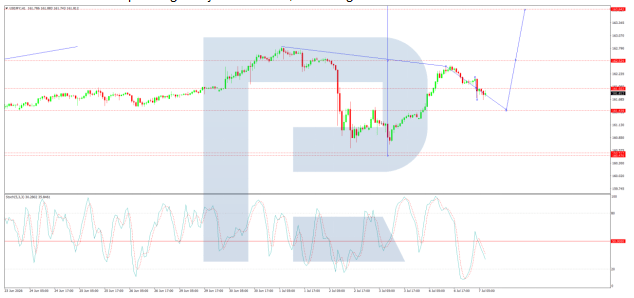
On the H1 chart, the market is forming the structure of the next upward wave towards the 159.60 level. A wave extension to 159.90 is possible. Subsequently, a decline to at least 159.00 is likely. Technically, this scenario is confirmed by the Stochastic oscillator, with its signal line above the 80 level and pointing firmly upwards.

Conclusion

USD/JPY has returned to positive territory, with the yen erasing all its weekly gains after BOJ Governor Ueda’s ambiguous rate guidance. Markets had anticipated clearer signals ahead of the upcoming meeting, but instead received a balanced assessment of competing inflation and growth risks. While the BoJ may yet raise its inflation forecasts due to higher energy prices, the lack of explicit hawkish communication has weighed on the currency. Earlier intervention warnings from the Finance Minister provided only temporary support. Technically, further upside towards 159.90 appears likely before any potential pullback, with the pair’s direction hinging on whether Ueda delivers clearer signals at the April meeting.


Disclaimer

Any forecasts contained herein are based on the author’s particular opinion. This analysis may not be treated as trading advice. RoboForex bears no responsibility for trading results based on trading recommendations and reviews contained herein.

Industries most exposed to AI are not only seeing productivity gains but jobs and wage growth too

By Christos Makridis, Arizona State University; Institute for Humane Studies 

Forecasts of the impact of artificial intelligence range from the apocalyptic to the utopian. An October 2025 report from Senate Democrats, for example, predicted AI will destroy millions of U.S. jobs. A couple of years earlier, consultant company McKinsey forecast AI will add trillions to the global economy, while emphasizing job losses can be mitigated by training workers to do new things.

The problem is that many of these claims are based on projections, overly simplified surveys or thought experiments rather than observed changes in the economy. That makes it hard for the public, and often policymakers, to know what to trust.

As a labor economist who studies how technology and organizational change affect productivity and well-being, I believe a better place to start is with actual data on output, employment and wages – which are all looking relatively more hopeful.

AI and jobs

In one of my new research papers with economist Andrew Johnston, we studied how exposure to generative AI affected industries across America between 2017 and 2024, using administrative data that covers nearly all employers. Our analysis covered a crucial period when generative AI use exploded, allowing us to analyze the effect within businesses and industries.

We measured AI exposure using occupation-level task data matched to each industry and state’s occupational workforce mix prior to the pandemic. A state and industry with more workers in roles requiring language processing, coding or data tasks scored higher on exposure, for example, compared with one with more plumbers and electricians.

We then took that exposure ranking by occupation and looked at changes in the standard deviation in occupational exposure, comparing that with labor market and GDP across states and industries from 2017 to 2024.

Think of a standard deviation as roughly the gap between a paramedic – whose work centers on physical assessment, emergency response and hands-on care that AI cannot easily replicate – and a public relations manager, whose work involves drafting communications, analyzing sentiment and synthesizing information that AI tools handle well. That gap in AI exposure is roughly what we’re measuring when we ask: Does being on the higher-exposure side of that divide change your industry’s trajectory?

This data allowed us to answer two questions: When AI tools became widely available following the public release of ChatGPT in late 2022, did states and industries that were more exposed to generative AI become more productive, and what happened to workers?

Our answers are more encouraging, and more nuanced, than much of the public debate suggests.

We found that industries in states that were more exposed to AI experienced faster productivity growth beginning in 2021 – before ChatGPT reached the public – driven by enterprise tools already embedded in professional workflows, including GitHub Copilot for software development, Jasper for marketing and content writing, and Microsoft’s GPT-3-powered business applications. In 2024, for example, industries whose AI exposure was one standard deviation higher saw gains of 10% in productivity, 3.9% in jobs and 4.8% in wages than comparable industries in the same state.

Those patterns suggest that, at least so far, AI has acted as a productivity-enhancing tool that boosts employment and wages rather than a simple substitute for labor.

Augmentation versus displacement

A crucial distinction in the data is between tasks where AI works with people and tasks where AI can act more independently. In sectors where AI mainly complements workers – think marketing, writing or financial analysis – our data show that employment rose by about 3.6% per standard deviation increase in exposure.

In sectors where AI can execute tasks more autonomously – including basic data processing, generating boilerplate code, or handling standardized customer interactions – we found no significant employment change, though workers in those roles saw slower wage growth.

What these findings suggest is that when AI lowers the cost of completing a task and raises worker productivity, companies expand output enough to increase their demand for labor overall — the same logic that explains why power tools didn’t eliminate construction workers.

The economic question is not whether any given task disappears. It is whether businesses and workers can reorganize fast enough to create new productive combinations. And so far, in most sectors, our evidence suggests they can.

But state policies also matter: These benefits were concentrated in the states with more efficient labor markets, meaning that the impact of generative AI on workers and the economy also depends on the types of policies and institutions of the local economy.

Importantly, these findings hold beyond occupational exposure. In additional work with co-authors at the Bureau of Economic Analysis, we found a similar effect on GDP and employment when looking at actual AI utilization — that is how often workers use AI. Drawing on the Gallup Workforce Panel, we measured workers actively using AI daily or multiple times a week. We found that each percentage-point increase in the share of frequent AI users in a state and industry is associated with roughly 0.1% to 0.2% higher real output and 0.2% to 0.4% higher employment.

To put that in context: The share of frequent AI users across all occupations rose from about 12% in mid-2024 to 26% by late 2025, a shift our estimates suggest corresponds to roughly 1.4% to 2.8% higher real output – or about 1 to 2 percentage points of annualized growth over that period.

New technologies rarely leave work untouched. But they also rarely eliminate the need for human contribution altogether. Instead, they change the composition of work, as our research shows. Some tasks shrink. Others expand. New ones emerge that were previously too costly or too hard to perform at scale. Put simply, some occupations might go away, but most of them just change.

If anything, the trends documented here are likely to strengthen rather than fade. Not only are generative AI tools rapidly improving, but also the experimentation and research and development that many workers and companies are engaging in are likely to pay large dividends. These investments – often referred to as intangible capital – tend to get unlocked a few years after a technology comes onto the scene, once complementary investments have been made.

The role of companies and managers

Whether AI leads to anxiety or adaptation for workers depends in part on what happens inside organizations. Using additional data collected over many years in the Gallup Workforce Panel covering more than 30,000 U.S. employees from 2023 to 2026, I found in a 2026 paper that workplace adoption of generative AI rose quickly over the period, with the share of workers using AI often increasing from 9% to 26%.

But the more important finding is that adoption was far more common where workers believed their organization had communicated a clear AI strategy and where employees said they trust leadership. This suggests that growing adoption and effective use of AI depends not only on the availability of the technology but on whether managers make its use clear, credible and safe.

Where that clarity exists, frequent AI use is associated with higher engagement and job satisfaction, and it even reverses the burnout penalties that appear elsewhere.

In other words, the broader economic effects of AI depend not only on how sophisticated the tools are but on whether companies and managers create environments where workers can experiment, reorganize tasks and integrate new tools into productive routines. That is, if employees do not feel the psychological safety to experiment, they are less likely to use AI, and they are especially less likely to use it for higher-value work.

That is precisely the kind of adaptation that I believe makes labor markets more resilient than the most alarmist forecasts suggest.The Conversation

About the Author:

Christos Makridis, Associate Research Professor of Information Systems, Arizona State University; Institute for Humane Studies

This article is republished from The Conversation under a Creative Commons license. Read the original article.


 

A strong labor market supports the Australian dollar. China’s economy continues to show resilience

By JustMarkets 

On Wednesday, the US stock market continued its upward rally. By the end of the day, the Dow Jones Index (US30) fell by 0.15%. The S&P 500 Index (US500) rose by 0.80%. The Tech Index Nasdaq (US100) closed higher by 1.40%. A powerful growth driver came from artificial‑intelligence news: Broadcom shares rose more than 3%, and Meta shares gained nearly 2% amid a deal to deploy specialized 1‑gigawatt AI chips. Investors paid special attention to Tesla shares, which surged more than 7%. Shareholder optimism was driven by updated vehicle software and Elon Musk’s statements about significant progress in developing the advanced AI5 chip. Alongside the tech sector, the financial sector also showed strong growth: Morgan Stanley shares jumped more than 5% thanks to record revenue, and Bank of America shares added 2.5% after a strong quarterly profit report. Geopolitical news also supported overall market sentiment. Donald Trump’s statement that the active phase of the conflict with Iran is nearing its end, combined with the diplomatic mission of Pakistan’s Chief of General Staff in Tehran, strengthened hopes for a long‑term ceasefire.

The Mexican peso (MXN) strengthened to 17.27 per dollar, reaching its highest level since late February. The main driver of growth was a combination of global optimism and strong domestic economic indicators. Investors are attracted by high real yields: with a base interest rate of 6.75% and inflation at 4.59%, Mexican assets remain highly sought after. Tight monetary policy combined with slowing consumer‑price growth creates a favorable environment for carry‑trade strategies.

On Wednesday, European stocks mostly declined. By the end of the day, Germany’s DAX (DE40) rose by 0.09%, France’s CAC 40 (FR40) closed down 0.64%, Spain’s IBEX 35 (ES35) fell by 0.55%, and the UK’s FTSE 100 (UK100) closed the session down 0.47%. The main pressure on the tech sector came from ASML Holding shares, which fell more than 4%. Despite an optimistic full‑year sales outlook, investors were disappointed by the company’s short‑term expectations: second‑quarter revenue is projected at 8.4-9 billion euros, below analysts’ consensus. Although hopes for extending the two‑week ceasefire remain, current financial reports from major European corporations still reflect the real damage caused by regional instability.

Silver prices (XAG) surpassed 80 dollars per ounce, approaching monthly highs. The main driver of growth was investor optimism regarding a possible resumption of diplomatic dialogue between Washington and Tehran. However, even with the current rise, silver prices remain nearly 15% below levels recorded before the conflict began. This indicates that the market has only partially recovered from the initial geopolitical shock.

On Wednesday, WTI oil futures held near 92 dollars per barrel, and high market volatility is likely to persist – traders are closely monitoring developments in the Middle East, trying to identify signs of de‑escalation and a possible resumption of shipping through the Strait of Hormuz.
In Asia, Japan’s Nikkei 225 (JP225) rose by 0.44% during the session, China’s FTSE China A50 (CHA50) increased by 0.19%, Hong Kong’s Hang Seng (HK50) closed up 0.29%, and Australia’s ASX 200 (AU200) gained 0.09%.

China’s economy showed unexpected resilience in the first quarter of 2026, posting 5.0% year‑on‑year growth. This result not only exceeded market expectations (4.8%) but also marked a noticeable acceleration after the minimal 4.5% recorded at the end of last year. Beijing managed to effectively cushion the impact of the Middle East conflict through accumulated strategic oil reserves, diversification of energy sources, and strict state control over prices, which prevented shock volatility in the domestic market. The industrial sector remains the main driver, showing growth above the outlook’s levels. At the same time, the consumer sector signals weakness: retail sales fell short of expectations, and the unemployment rate jumped to its highest level in 13 months. This indicates that domestic demand remains fragile. The external trade balance also shifted: March saw a sharp slowdown in exports alongside a spike in imports, likely linked to rising logistics and raw‑material costs.

The Australian dollar (AUD) broke through the psychologically important level of 0.70 US dollars, reaching its highest point in nearly four years. The currency’s rise was supported by strong domestic labor‑market data: in March, the unemployment rate held at 4.3%, and the employment increase of 17.9 thousand was entirely driven by full‑time job creation. This confirms the resilience of Australia’s economy to external shocks. The Reserve Bank of Australia’s (RBA) hawkish rhetoric became the second key factor strengthening the aussie. Deputy Governor Andrew Hauser expressed doubt that current interest rates are restrictive enough to contain inflation, which is being fueled by high oil prices. His remarks about possible further tightening forced the market to revise projections: most economists now expect a third consecutive rate hike in May to 4.35%.

S&P 500 (US500) 7,022.95 +55.57 (+0.80%)

Dow Jones (US30) 48,463.72 −72.27 (−0.15%)

DAX (DE40) 24,066.70 +22.48 (+0.09%)

FTSE 100 (UK100) 10,559.58 −49.48 (−0.47%)

USD Index 98.08 −0.04 (−0.04%)

News feed for: 2026.04.16

  • Australia Unemployment Rate (m/m) at 04:30 (GMT+3) – AUD (HIGH)
  • China GDP (q/q) at 05:00 (GMT+3) – CHA50, HK50 (MED)
  • China Industrial Production m/m) at 05:00 (GMT+3) – CHA50, HK50 (MED)
  • China Unemployment Rate (m/m) at 05:00 (GMT+3) – CHA50, HK50 (MED)
  • China Retail Sales (m/m) at 05:00 (GMT+3) – CHA50, HK50 (MED)
  • UK GDP (m/m) at 09:00 (GMT+3) – GBP (MED)
  • UK Trade Balance (m/m) at 09:00 (GMT+3) – GBP (MED)
  • Switzerland SNB Monetary Policy Meeting Minutes at 10:30 (GMT+3) – CHF (MED)
  • Eurozone Inflation Rate (w/w) at 12:00 (GMT+3) – EUR (MED)
  • Eurozone ECB Monetary Policy Meeting Accounts at 14:30 (GMT+3) – EUR (MED)
  • US Initial Jobless Claims (w/w) at 15:30 (GMT+3) – USD (MED)
  • US Philadelphia Fed Manufacturing Index (m/m) at 15:30 (GMT+3) – USD (LOW)
  • US Industrial Production (m/m) at 16:15 (GMT+3) – USD (MED)
  • US Natural Gas Storage (w/w) at 17:30 (GMT+3) – XNG (HIGH)

By JustMarkets


This article reflects a personal opinion and should not be interpreted as an investment advice, and/or offer, and/or a persistent request for carrying out financial transactions, and/or a guarantee, and/or a forecast of future events.

EUR/USD Rallies as Gains Extend to Nine Consecutive Sessions

By Analytical Department RoboForex

EUR/USD climbed to 1.1817 on Thursday, marking its ninth consecutive session of gains without interruption. The major currency pair continues to hit six-week highs. Pressure on the US dollar has intensified amid growing expectations of a diplomatic breakthrough between the US and Iran, which has reduced demand for safe-haven assets.

President Donald Trump stated that the seven-week conflict is nearing its end. The White House has also expressed confidence that an agreement can be reached. Fresh face-to-face negotiations may resume in Pakistan.

Tehran is considering allowing the free passage of ships through the Omani portion of the Strait of Hormuz if an agreement is reached, which could reduce the risks of further escalation.

Additional pressure on the dollar has come from lower energy prices, which have eased inflation fears and reduced expectations of further monetary tightening.

The broader market expects the Federal Reserve to keep interest rates unchanged this month and likely through the remainder of the year.

Technical Analysis

On the H4 chart of EUR/USD, the market is forming a consolidation range around 1.1771. An upward wave continuing to 1.1877 is expected as a local target, followed by a possible downward wave to 1.1700. Technically, this scenario is confirmed by the MACD indicator, with its signal line above zero and pointing firmly upwards, reflecting continued bullish momentum and supporting the potential for the uptrend to persist.

On the H1 chart, the market is forming the structure of the next upward wave to the 1.1835 level. After reaching this level, a correction to 1.1795 is likely, followed by a possible rise to 1.1855, with a trend perspective towards 1.1877. Technically, this scenario is confirmed by the Stochastic oscillator, with its signal line below 80 and pointing firmly downwards towards 20.

Conclusion

EUR/USD has experienced an impressive nine-session rally, driven by rising hopes for a US-Iran diplomatic breakthrough, which has diminished safe-haven demand for the dollar. With President Trump suggesting the seven-week conflict is near its end and Tehran considering concessions on passage through the Strait of Hormuz, energy prices have fallen, easing inflation fears and reducing expectations of monetary tightening. The Fed is widely expected to hold rates steady. While technical indicators suggest continued upside momentum towards 1.1877, the pair may be due for a near-term correction. The trajectory ahead hinges on whether diplomatic efforts deliver a tangible agreement or disappoint markets.


Disclaimer

Any forecasts contained herein are based on the author’s particular opinion. This analysis may not be treated as trading advice. RoboForex bears no responsibility for trading results based on trading recommendations and reviews contained herein.

The IMF has lowered its global economic growth expectations. The Chinese yuan continues to strengthen

By JustMarkets 

On Tuesday, the US stock market showed positive dynamics for the second session in a row. By the end of the day, the Dow Jones Index (US30) rose by 0.66%. The S&P 500 Index (US500) increased by 1.18%. The Technology Index NASDAQ (US100) closed higher by 1.96%. The main driver of optimism was hopes for the resumption of diplomatic dialogue between Washington and Tehran, which could lead to de‑escalation of the conflict and the lifting of the blockade of the Strait of Hormuz. The main inflow of capital was concentrated in the communication services and consumer‑goods sectors, while energy companies were among the underperformers due to falling oil prices.

The IMF revised its expectations for global economic development in 2026, lowering the growth outlook to 3.1%. This is 0.2 percentage points below previous estimates and is attributed to the negative impact of the prolonged conflict in the Middle East. At the same time, the prediction for 2027 remained unchanged at 3.2%. IMF experts emphasize that the current energy crisis caused by the confrontation with Iran is comparable in scale to the oil shock of 1974, although the modern economic system has a higher degree of resilience.

On Tuesday, the European stock market closed in the green. By the end of the day, Germany’s DAX (DE40) rose by 1.27%, France’s CAC 40 (FR40) closed up 1.12%, Spain’s IBEX 35 (ES35) gained 1.46%, and the UK’s FTSE 100 (UK100) closed the trading session up 0.25%. The positive dynamics were driven by hopes for de‑escalation of the Middle East conflict: reports emerged about a possible return of US and Iranian delegations to the negotiating table in Islamabad as early as this week. An additional factor that made the market question the long‑term viability of strict measures was criticism of the maritime blockade of Iranian ports from Saudi Arabia and China, which cast doubt on the effectiveness and sustainability of such restrictions. Siemens shares led the gainers, rising more than 4%.

On Tuesday, WTI oil prices showed a sharp decline, falling more than 7% lower to below 92 dollars per barrel, the lowest level in the past three weeks. Donald Trump allowed for the resumption of negotiations in Pakistan within the next two days, and Tehran expressed readiness to temporarily suspend restrictions in the Strait of Hormuz to facilitate the diplomatic process. These developments outweighed concerns related to the officially imposed maritime blockade of Iranian exports by the United States. At the same time, IEA experts expressed serious concern about the long‑term outlook for the market. According to the agency, the prolonged confrontation threatens to completely offset global oil‑demand growth this year, potentially leading to the first annual decline in consumption since the pandemic.

In Asia, Japan’s Nikkei 225 (JP225) fell by 0.74% for the trading week, China’s FTSE China A50 (CHA50) rose by 0.30%, Hong Kong’s Hang Seng (HK50) closed down 0.90% yesterday, and Australia’s ASX 200 (AU200) declined by 0.39%.

On Wednesday, the offshore yuan traded near 6.81 per dollar, holding close to its highest levels in the past three years. The strengthening of the Chinese currency is driven by a combination of domestic economic success and a favorable external environment. According to the current prognosis, China’s GDP will grow by 4.8% year‑on‑year in the first quarter of 2026. This indicates a gradual recovery of activity after slowing to 4.5% at the end of last year, when indicators reached their lowest point since the post‑pandemic reopening of the economy.

Notably, Beijing has managed to minimize the negative consequences of the Middle East conflict. Thanks to consistent efforts toward energy independence and diversification of resource supplies, the impact of geopolitical instability on domestic prices and production remains limited.

S&P 500 (US500) 6,967.38 +81.14 (+1.18%)

Dow Jones (US30) 48,535.99 +317.74 (+0.66%)

DAX (DE40) 24,044.22 +301.78 (+1.27%)

FTSE 100 (UK100) 10,609.06 +26.10 (+0.25%)

USD Index 98.11 −0.26 (−0.27%)

News feed for: 2026.04.15

  • Eurozone Industrial Production (m/m) at 12:00 (GMT+3) – EUR (LOW)
  • US NY Empire State Manufacturing Index (m/m) at 15:30 (GMT+3) – USD (MED)
  • US Crude Oil Reserves (w/w) at 17:30 (GMT+3) – WTI (HIGH)
  • Switzerland SNB Chairman Schlegel Speaks at 20:00 (GMT+3) – CHF (MED)
  • New Zealand RNBZ Gov Breman Speaks at 20:00 (GMT+3) – NZD (MED)
  • UK BOE Gov Bailey Speaks at 21:00 (GMT+3) – GBP (MED)
  • Eurozone ECB President Lagarde Speaks at 22:30 (GMT+3) – EUR (MED)

By JustMarkets


This article reflects a personal opinion and should not be interpreted as an investment advice, and/or offer, and/or a persistent request for carrying out financial transactions, and/or a guarantee, and/or a forecast of future events.

Gold in Positive Territory: External Backdrop Remains Supportive

By Analytical Department RoboForex

The price of gold rose to 4,800 USD per troy ounce on Wednesday, with the local trend gaining strength. The precious metal is supported by expectations of a possible agreement between the US and Iran, which would reduce the risks of an energy-driven inflationary shock.

Press reports indicate that Washington and Tehran are working to organise a new round of negotiations following the breakdown in dialogue over the weekend. At the same time, the US is maintaining a naval blockade of Iranian oil supplies through the Strait of Hormuz. Iran is reportedly considering temporarily suspending exports via this route to advance negotiations.

An additional supporting factor is the decline in oil prices below 90.00 USD per barrel and the weakening of the US dollar to six-week lows. Both developments traditionally boost demand for gold.

Markets are also revising their monetary policy expectations. The Federal Reserve is adopting a wait-and-see approach when assessing inflation risks, which is reducing pressure on precious metals.

Technical Analysis

On the H4 XAU/USD chart, the market is forming a consolidation range around the 4,772 USD level. An upside breakout would open potential for a correction to 4,903 USD. A downside breakout could see the beginning of a downward wave to 4,460 USD. The MACD indicator confirms the current upward momentum, with its signal line above the centre line and pointing firmly upwards.

On the H1 chart, the market has broken above the 4,775 USD level and completed a wave to 4,868 USD. A correction to the 4,775 USD level (testing from above) is likely, followed by a possible rise to 4,903 USD. The Stochastic oscillator supports this scenario, with its signal line remaining below the 20 level and showing upward pressure towards 80.

Conclusion

Gold is trading in positive territory as hopes for a renewed US-Iran negotiation effort ease concerns over an energy-driven inflationary shock. The combination of falling oil prices (below 90.00 USD per barrel), a weaker dollar (at six-week lows), and the Fed’s patient stance on inflation risks has created a supportive environment for the precious metal. While the US maintains a naval blockade and Iran considers suspending exports to advance talks, the market is cautiously optimistic. Technical indicators suggest further upside potential towards 4,903 USD, although any setbacks in diplomatic efforts could quickly reverse the current momentum.


Disclaimer

Any forecasts contained herein are based on the author’s particular opinion. This analysis may not be treated as trading advice. RoboForex bears no responsibility for trading results based on trading recommendations and reviews contained herein.

GBP/USD Finds Support: Geopolitics Already Priced In, Focus on Bank of England

By Analytical Department RoboForex

GBP/USD rose to 1.3506 on Tuesday. Sterling has moved comfortably away from last week’s one-month high of 1.3480. Pressure on the currency had previously increased following the collapse of US-Iran talks over the weekend.

The breakdown in dialogue followed Tehran’s refusal to abandon its nuclear program and disagreements over the terms of the agreement, which the Iranian side described as excessive. Against this backdrop, Donald Trump threatened to block the Strait of Hormuz, a critical oil supply route. This pushed Brent crude prices to 102.00 USD per barrel.

Oil has become markedly more expensive, adding tension to the already strained global energy situation and raising the risks of an inflationary shock. As a result, market expectations have shifted towards a tighter Bank of England policy.

As a result, investors are now pricing in at least one interest rate hike by the end of 2026.

Technical Analysis

On the H4 GBP/USD chart, the market is forming a wide consolidation range around the 1.3333 level, currently extending up to 1.3535. A decline to 1.3333 is expected in the near term. Following the completion of this correction, a new consolidation range is likely to form. An upside breakout would open potential for a continuation wave to 1.3411, while a downside breakout would suggest further movement to 1.3120. Technically, this scenario is confirmed by the MACD indicator, whose signal line is above the zero level and pointing firmly downwards.

On the H1 chart, the market formed a compact consolidation range around the 1.3455 level and, with an upside breakout, completed a wave structure to 1.3535. The start of a decline towards the 1.3388 level is now expected. Technically, this scenario is confirmed by the Stochastic oscillator, with its signal line above the 80 level and pointing firmly downwards towards 20.

Conclusion

GBP/USD has found support as markets appear to have largely priced in the latest geopolitical escalation following failed US-Iran talks. Trump’s threat to block the Strait of Hormuz has sent oil prices above 102.00 USD per barrel, intensifying inflationary concerns and shifting expectations towards tighter Bank of England policy, with at least one rate hike now priced for 2026. While sterling has shown resilience, the broader outlook remains clouded by risks related to the energy market. Technical indicators suggest a near-term pullback is likely, but the pair’s direction will ultimately depend on whether geopolitical tensions continue to escalate or show signs of easing.


Disclaimer

Any forecasts contained herein are based on the author’s particular opinion. This analysis may not be treated as trading advice. RoboForex bears no responsibility for trading results based on trading recommendations and reviews contained herein.