Currency Speculators continue to trim their US Dollar Index bullish bets

By InvestMacro

Here are the latest charts and statistics for the Commitment of Traders (COT) data published by the Commodities Futures Trading Commission (CFTC).

The latest COT data is updated through Tuesday November 15th and shows a quick view of how large market participants (for-profit speculators and commercial traders) were positioned in the futures markets. All currency positions are in direct relation to the US dollar where, for example, a bet for the euro is a bet that the euro will rise versus the dollar while a bet against the euro will be a bet that the euro will decline versus the dollar.

Japanese Yen & Mexican Peso top Weekly Speculator Changes

The COT currency market speculator bets were overall higher this week as nine out of the eleven currency markets we cover had higher positioning while the other two markets had lower speculator contracts.

Leading the gains for the currency markets was the Japanese yen (9,416 contracts) with the Mexican peso (8,237 contracts), the British pound sterling (6,901 contracts), the Canadian dollar (5,544 contracts), the Euro (5,067 contracts), the Brazilian real (4,517 contracts), the Australian dollar (1,934 contracts), Bitcoin (553 contracts) and the Swiss franc (327 contracts) also showing a positive week.

The currencies leading the declines in speculator bets this week were the US Dollar Index (-3,339 contracts) with the New Zealand dollar (-261 contracts) also registering lower bets on the week.

Highlighting the COT currency data this week is the US Dollar Index positioning. Large speculators dropped their bullish bets for the US Dollar Index this week by the most in the past eight weeks and have now decreased their weekly bets for four out of the past five weeks. The Dollar positions have slipped under +30,000 contracts for the second time in three weeks and this week’s level marks the lowest net standing in the past 59-weeks, dating back to September 28th of 2021. Overall, the Dollar positioning has been in a continuous bullish position for the past 72-weeks, dating back to July of 2021.

The price of the Dollar Index has been in retreat since reaching a 20-year high of over 114.00 at the end of the September. Since the start of November, the Dollar Index has declined sharply from a November 3rd high at over 113.00 to this week’s close on Friday November 18th at 106.83.


Data Snapshot of Forex Market Traders | Columns Legend
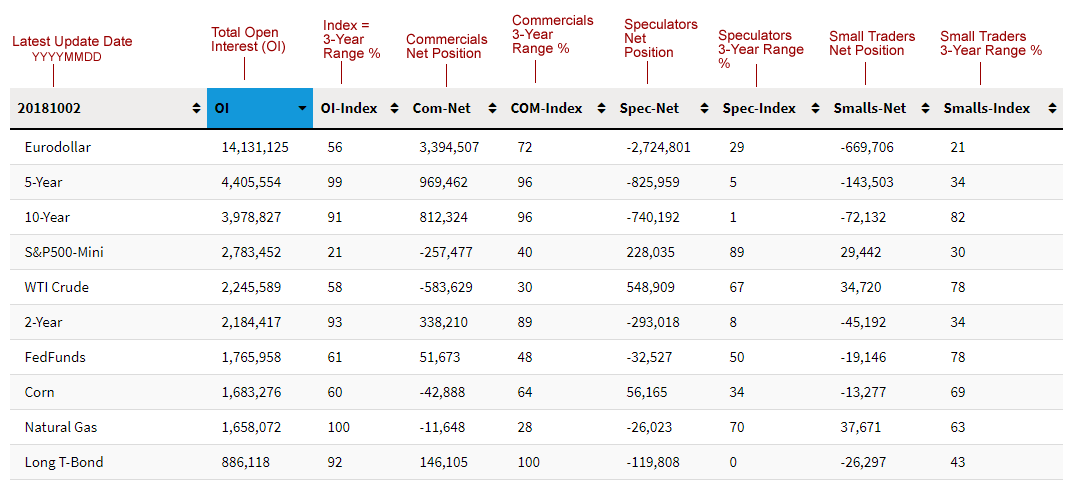
Nov-15-2022OIOI-IndexSpec-NetSpec-IndexCom-NetCOM-IndexSmalls-NetSmalls-Index
USD Index48,3826326,85470-29,981283,12751
EUR682,57570112,66670-151,5733338,90741
GBP230,10255-32,8344149,43968-16,60525
JPY233,34670-65,8422877,21373-11,37130
CHF41,96625-16,8271421,63778-4,81041
CAD139,75323-12,9202614,22981-1,30927
AUD162,44054-44,7494354,11259-9,36330
NZD42,58932-6,628558,38148-1,75331
MXN303,4429767,85156-74,563426,71271
RUB20,93047,54331-7,15069-39324
BRL23,46949,01859-12,404393,386100
Bitcoin17,90110057187-914034321


Bitcoin tops Strength Scores

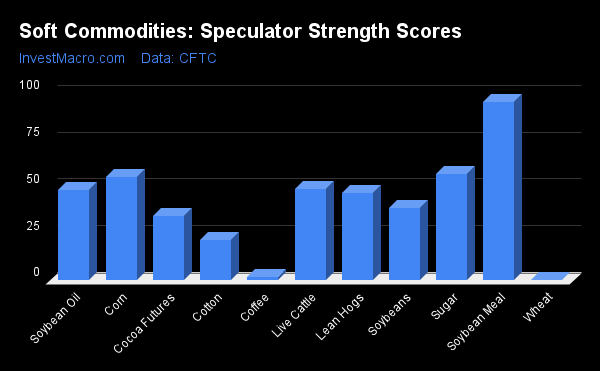
Strength Scores (a normalized measure of Speculator positions over a 3-Year range, from 0 to 100 where above 80 is extreme bullish and below 20 is extreme bearish) show that Bitcoin (86.9 percent) leads the currency markets at the top of their respective ranges and are both in bullish extreme positions. The US Dollar Index (69.7 percent) and the EuroFX (69.6 percent) come in as the next highest in the currency markets in strength scores.

On the downside, the Swiss Franc (13.8 percent) comes in at the lowest strength score currently and the only one with an extreme bearish level (below 20 percent).

Strength Statistics:
US Dollar Index (69.7 percent) vs US Dollar Index previous week (75.3 percent)
EuroFX (69.6 percent) vs EuroFX previous week (68.0 percent)
British Pound Sterling (40.8 percent) vs British Pound Sterling previous week (34.9 percent)
Japanese Yen (28.3 percent) vs Japanese Yen previous week (22.5 percent)
Swiss Franc (13.8 percent) vs Swiss Franc previous week (13.0 percent)
Canadian Dollar (26.4 percent) vs Canadian Dollar previous week (19.8 percent)
Australian Dollar (43.3 percent) vs Australian Dollar previous week (41.6 percent)
New Zealand Dollar (55.1 percent) vs New Zealand Dollar previous week (55.6 percent)
Mexican Peso (56.3 percent) vs Mexican Peso previous week (52.8 percent)
Brazilian Real (59.2 percent) vs Brazilian Real previous week (54.8 percent)
Bitcoin (86.9 percent) vs Bitcoin previous week (77.3 percent)

Strength Trends led by Mexican Peso

Strength Score Trends (or move index, calculates the 6-week changes in strength scores) showed that the Mexican Peso (44.9 percent) leads the past six weeks trends for the currency markets this week. The EuroFX (21.2 percent), the British Pound Sterling (14.3 percent) and the New Zealand Dollar (13.9 percent) fill out the top movers in the latest trends data.

The Swiss Franc (-25.3 percent) leads the downside trend scores currently while the next markets with lower trend scores were the Brazilian Real (-16.5 percent), the Australian Dollar (-15.8 percent) and the US Dollar Index (-8.1 percent).

Strength Trend Statistics:
US Dollar Index (-8.1 percent) vs US Dollar Index previous week (-0.6 percent)
EuroFX (21.2 percent) vs EuroFX previous week (22.7 percent)
British Pound Sterling (14.3 percent) vs British Pound Sterling previous week (5.7 percent)
Japanese Yen (9.7 percent) vs Japanese Yen previous week (4.5 percent)
Swiss Franc (-25.3 percent) vs Swiss Franc previous week (-29.0 percent)
Canadian Dollar (10.1 percent) vs Canadian Dollar previous week (-1.0 percent)
Australian Dollar (-15.8 percent) vs Australian Dollar previous week (-11.2 percent)
New Zealand Dollar (13.9 percent) vs New Zealand Dollar previous week (9.6 percent)
Mexican Peso (44.9 percent) vs Mexican Peso previous week (43.0 percent)
Brazilian Real (-16.5 percent) vs Brazilian Real previous week (-28.8 percent)
Bitcoin (10.5 percent) vs Bitcoin previous week (-17.5 percent)


Individual COT Forex Markets:

US Dollar Index Futures:

US Dollar Index Forex Futures COT ChartThe US Dollar Index large speculator standing this week recorded a net position of 26,854 contracts in the data reported through Tuesday. This was a weekly reduction of -3,339 contracts from the previous week which had a total of 30,193 net contracts.

This week’s current strength score (the trader positioning range over the past three years, measured from 0 to 100) shows the speculators are currently Bullish with a score of 69.7 percent. The commercials are Bearish with a score of 28.2 percent and the small traders (not shown in chart) are Bullish with a score of 50.7 percent.

US DOLLAR INDEX StatisticsSPECULATORSCOMMERCIALSSMALL TRADERS
– Percent of Open Interest Longs:80.54.412.1
– Percent of Open Interest Shorts:25.066.45.6
– Net Position:26,854-29,9813,127
– Gross Longs:38,9652,1495,843
– Gross Shorts:12,11132,1302,716
– Long to Short Ratio:3.2 to 10.1 to 12.2 to 1
NET POSITION TREND:
– Strength Index Score (3 Year Range Pct):69.728.250.7
– Strength Index Reading (3 Year Range):BullishBearishBullish
NET POSITION MOVEMENT INDEX:
– 6-Week Change in Strength Index:-8.110.8-21.8


Euro Currency Futures:

Euro Currency Futures COT ChartThe Euro Currency large speculator standing this week recorded a net position of 112,666 contracts in the data reported through Tuesday. This was a weekly gain of 5,067 contracts from the previous week which had a total of 107,599 net contracts.

This week’s current strength score (the trader positioning range over the past three years, measured from 0 to 100) shows the speculators are currently Bullish with a score of 69.6 percent. The commercials are Bearish with a score of 33.0 percent and the small traders (not shown in chart) are Bearish with a score of 41.1 percent.

EURO Currency StatisticsSPECULATORSCOMMERCIALSSMALL TRADERS
– Percent of Open Interest Longs:35.150.312.6
– Percent of Open Interest Shorts:18.672.56.9
– Net Position:112,666-151,57338,907
– Gross Longs:239,369343,38886,147
– Gross Shorts:126,703494,96147,240
– Long to Short Ratio:1.9 to 10.7 to 11.8 to 1
NET POSITION TREND:
– Strength Index Score (3 Year Range Pct):69.633.041.1
– Strength Index Reading (3 Year Range):BullishBearishBearish
NET POSITION MOVEMENT INDEX:
– 6-Week Change in Strength Index:21.2-26.941.1


British Pound Sterling Futures:

British Pound Sterling Futures COT ChartThe British Pound Sterling large speculator standing this week recorded a net position of -32,834 contracts in the data reported through Tuesday. This was a weekly boost of 6,901 contracts from the previous week which had a total of -39,735 net contracts.

This week’s current strength score (the trader positioning range over the past three years, measured from 0 to 100) shows the speculators are currently Bearish with a score of 40.8 percent. The commercials are Bullish with a score of 67.7 percent and the small traders (not shown in chart) are Bearish with a score of 25.4 percent.

BRITISH POUND StatisticsSPECULATORSCOMMERCIALSSMALL TRADERS
– Percent of Open Interest Longs:15.174.08.6
– Percent of Open Interest Shorts:29.352.515.8
– Net Position:-32,83449,439-16,605
– Gross Longs:34,699170,32219,676
– Gross Shorts:67,533120,88336,281
– Long to Short Ratio:0.5 to 11.4 to 10.5 to 1
NET POSITION TREND:
– Strength Index Score (3 Year Range Pct):40.867.725.4
– Strength Index Reading (3 Year Range):BearishBullishBearish
NET POSITION MOVEMENT INDEX:
– 6-Week Change in Strength Index:14.3-20.225.4


Japanese Yen Futures:

Japanese Yen Forex Futures COT ChartThe Japanese Yen large speculator standing this week recorded a net position of -65,842 contracts in the data reported through Tuesday. This was a weekly boost of 9,416 contracts from the previous week which had a total of -75,258 net contracts.

This week’s current strength score (the trader positioning range over the past three years, measured from 0 to 100) shows the speculators are currently Bearish with a score of 28.3 percent. The commercials are Bullish with a score of 73.3 percent and the small traders (not shown in chart) are Bearish with a score of 30.3 percent.

JAPANESE YEN StatisticsSPECULATORSCOMMERCIALSSMALL TRADERS
– Percent of Open Interest Longs:14.574.110.3
– Percent of Open Interest Shorts:42.741.015.2
– Net Position:-65,84277,213-11,371
– Gross Longs:33,797172,90524,061
– Gross Shorts:99,63995,69235,432
– Long to Short Ratio:0.3 to 11.8 to 10.7 to 1
NET POSITION TREND:
– Strength Index Score (3 Year Range Pct):28.373.330.3
– Strength Index Reading (3 Year Range):BearishBullishBearish
NET POSITION MOVEMENT INDEX:
– 6-Week Change in Strength Index:9.7-7.90.7


Swiss Franc Futures:

Swiss Franc Forex Futures COT ChartThe Swiss Franc large speculator standing this week recorded a net position of -16,827 contracts in the data reported through Tuesday. This was a weekly gain of 327 contracts from the previous week which had a total of -17,154 net contracts.

This week’s current strength score (the trader positioning range over the past three years, measured from 0 to 100) shows the speculators are currently Bearish-Extreme with a score of 13.8 percent. The commercials are Bullish with a score of 78.0 percent and the small traders (not shown in chart) are Bearish with a score of 41.2 percent.

SWISS FRANC StatisticsSPECULATORSCOMMERCIALSSMALL TRADERS
– Percent of Open Interest Longs:5.469.724.0
– Percent of Open Interest Shorts:45.518.135.4
– Net Position:-16,82721,637-4,810
– Gross Longs:2,27129,24910,058
– Gross Shorts:19,0987,61214,868
– Long to Short Ratio:0.1 to 13.8 to 10.7 to 1
NET POSITION TREND:
– Strength Index Score (3 Year Range Pct):13.878.041.2
– Strength Index Reading (3 Year Range):Bearish-ExtremeBullishBearish
NET POSITION MOVEMENT INDEX:
– 6-Week Change in Strength Index:-25.39.014.8


Canadian Dollar Futures:

Canadian Dollar Forex Futures COT ChartThe Canadian Dollar large speculator standing this week recorded a net position of -12,920 contracts in the data reported through Tuesday. This was a weekly boost of 5,544 contracts from the previous week which had a total of -18,464 net contracts.

This week’s current strength score (the trader positioning range over the past three years, measured from 0 to 100) shows the speculators are currently Bearish with a score of 26.4 percent. The commercials are Bullish-Extreme with a score of 80.6 percent and the small traders (not shown in chart) are Bearish with a score of 27.5 percent.

CANADIAN DOLLAR StatisticsSPECULATORSCOMMERCIALSSMALL TRADERS
– Percent of Open Interest Longs:26.850.221.8
– Percent of Open Interest Shorts:36.040.022.7
– Net Position:-12,92014,229-1,309
– Gross Longs:37,45670,17330,478
– Gross Shorts:50,37655,94431,787
– Long to Short Ratio:0.7 to 11.3 to 11.0 to 1
NET POSITION TREND:
– Strength Index Score (3 Year Range Pct):26.480.627.5
– Strength Index Reading (3 Year Range):BearishBullish-ExtremeBearish
NET POSITION MOVEMENT INDEX:
– 6-Week Change in Strength Index:10.1-3.1-9.6


Australian Dollar Futures:

Australian Dollar Forex Futures COT ChartThe Australian Dollar large speculator standing this week recorded a net position of -44,749 contracts in the data reported through Tuesday. This was a weekly lift of 1,934 contracts from the previous week which had a total of -46,683 net contracts.

This week’s current strength score (the trader positioning range over the past three years, measured from 0 to 100) shows the speculators are currently Bearish with a score of 43.3 percent. The commercials are Bullish with a score of 59.3 percent and the small traders (not shown in chart) are Bearish with a score of 29.6 percent.

AUSTRALIAN DOLLAR StatisticsSPECULATORSCOMMERCIALSSMALL TRADERS
– Percent of Open Interest Longs:20.467.89.3
– Percent of Open Interest Shorts:48.034.515.0
– Net Position:-44,74954,112-9,363
– Gross Longs:33,214110,09915,029
– Gross Shorts:77,96355,98724,392
– Long to Short Ratio:0.4 to 12.0 to 10.6 to 1
NET POSITION TREND:
– Strength Index Score (3 Year Range Pct):43.359.329.6
– Strength Index Reading (3 Year Range):BearishBullishBearish
NET POSITION MOVEMENT INDEX:
– 6-Week Change in Strength Index:-15.811.44.1


New Zealand Dollar Futures:

New Zealand Dollar Forex Futures COT ChartThe New Zealand Dollar large speculator standing this week recorded a net position of -6,628 contracts in the data reported through Tuesday. This was a weekly reduction of -261 contracts from the previous week which had a total of -6,367 net contracts.

This week’s current strength score (the trader positioning range over the past three years, measured from 0 to 100) shows the speculators are currently Bullish with a score of 55.1 percent. The commercials are Bearish with a score of 48.3 percent and the small traders (not shown in chart) are Bearish with a score of 31.5 percent.

NEW ZEALAND DOLLAR StatisticsSPECULATORSCOMMERCIALSSMALL TRADERS
– Percent of Open Interest Longs:35.957.16.3
– Percent of Open Interest Shorts:51.537.410.4
– Net Position:-6,6288,381-1,753
– Gross Longs:15,28524,3112,680
– Gross Shorts:21,91315,9304,433
– Long to Short Ratio:0.7 to 11.5 to 10.6 to 1
NET POSITION TREND:
– Strength Index Score (3 Year Range Pct):55.148.331.5
– Strength Index Reading (3 Year Range):BullishBearishBearish
NET POSITION MOVEMENT INDEX:
– 6-Week Change in Strength Index:13.9-15.317.6


Mexican Peso Futures:

Mexican Peso Futures COT ChartThe Mexican Peso large speculator standing this week recorded a net position of 67,851 contracts in the data reported through Tuesday. This was a weekly increase of 8,237 contracts from the previous week which had a total of 59,614 net contracts.

This week’s current strength score (the trader positioning range over the past three years, measured from 0 to 100) shows the speculators are currently Bullish with a score of 56.3 percent. The commercials are Bearish with a score of 41.7 percent and the small traders (not shown in chart) are Bullish with a score of 71.5 percent.

MEXICAN PESO StatisticsSPECULATORSCOMMERCIALSSMALL TRADERS
– Percent of Open Interest Longs:65.231.53.1
– Percent of Open Interest Shorts:42.856.10.9
– Net Position:67,851-74,5636,712
– Gross Longs:197,70095,5309,390
– Gross Shorts:129,849170,0932,678
– Long to Short Ratio:1.5 to 10.6 to 13.5 to 1
NET POSITION TREND:
– Strength Index Score (3 Year Range Pct):56.341.771.5
– Strength Index Reading (3 Year Range):BullishBearishBullish
NET POSITION MOVEMENT INDEX:
– 6-Week Change in Strength Index:44.9-44.45.5


Brazilian Real Futures:

Brazil Real Futures COT ChartThe Brazilian Real large speculator standing this week recorded a net position of 9,018 contracts in the data reported through Tuesday. This was a weekly lift of 4,517 contracts from the previous week which had a total of 4,501 net contracts.

This week’s current strength score (the trader positioning range over the past three years, measured from 0 to 100) shows the speculators are currently Bullish with a score of 59.2 percent. The commercials are Bearish with a score of 39.2 percent and the small traders (not shown in chart) are Bullish-Extreme with a score of 100.0 percent.

BRAZIL REAL StatisticsSPECULATORSCOMMERCIALSSMALL TRADERS
– Percent of Open Interest Longs:69.98.520.2
– Percent of Open Interest Shorts:31.461.35.8
– Net Position:9,018-12,4043,386
– Gross Longs:16,3971,9864,742
– Gross Shorts:7,37914,3901,356
– Long to Short Ratio:2.2 to 10.1 to 13.5 to 1
NET POSITION TREND:
– Strength Index Score (3 Year Range Pct):59.239.2100.0
– Strength Index Reading (3 Year Range):BullishBearishBullish-Extreme
NET POSITION MOVEMENT INDEX:
– 6-Week Change in Strength Index:-16.514.817.9


Bitcoin Futures:

Bitcoin Crypto Futures COT ChartThe Bitcoin large speculator standing this week recorded a net position of 571 contracts in the data reported through Tuesday. This was a weekly increase of 553 contracts from the previous week which had a total of 18 net contracts.

This week’s current strength score (the trader positioning range over the past three years, measured from 0 to 100) shows the speculators are currently Bullish-Extreme with a score of 86.9 percent. The commercials are Bearish with a score of 20.1 percent and the small traders (not shown in chart) are Bearish with a score of 20.7 percent.

BITCOIN StatisticsSPECULATORSCOMMERCIALSSMALL TRADERS
– Percent of Open Interest Longs:78.70.86.9
– Percent of Open Interest Shorts:75.65.95.0
– Net Position:571-914343
– Gross Longs:14,0961371,231
– Gross Shorts:13,5251,051888
– Long to Short Ratio:1.0 to 10.1 to 11.4 to 1
NET POSITION TREND:
– Strength Index Score (3 Year Range Pct):86.920.120.7
– Strength Index Reading (3 Year Range):Bullish-ExtremeBearishBearish
NET POSITION MOVEMENT INDEX:
– 6-Week Change in Strength Index:10.5-24.0-2.5


Article By InvestMacroReceive our weekly COT Newsletter

*COT Report: The COT data, released weekly to the public each Friday, is updated through the most recent Tuesday (data is 3 days old) and shows a quick view of how large speculators or non-commercials (for-profit traders) were positioned in the futures markets.

The CFTC categorizes trader positions according to commercial hedgers (traders who use futures contracts for hedging as part of the business), non-commercials (large traders who speculate to realize trading profits) and nonreportable traders (usually small traders/speculators) as well as their open interest (contracts open in the market at time of reporting). See CFTC criteria here.

Bonds Speculator’s bearish bets surge to push 2-Year Bond positions to record low

By InvestMacro

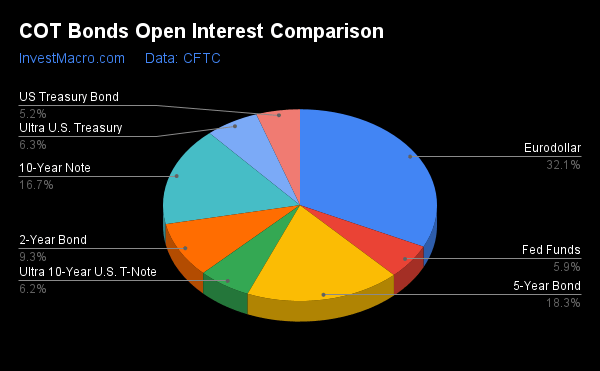
Here are the latest charts and statistics for the Commitment of Traders (COT) reports data published by the Commodities Futures Trading Commission (CFTC).

The latest COT data is updated through Tuesday November 15th and shows a quick view of how large traders (for-profit speculators and commercial hedgers) were positioned in the futures markets.

Weekly Speculator Changes led by Eurodollar & 2-Year Bond

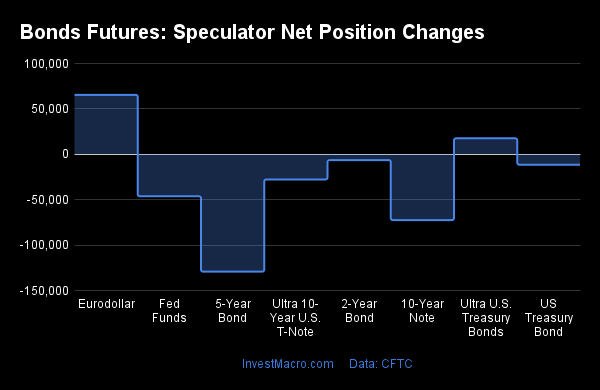
The COT bond market speculator bets were lower overall this week as just two out of the eight bond markets we cover had higher positioning this week while six other markets had lower contracts.

Leading the weekly gains for the bond markets was the Eurodollar (145,719 contracts) with the Ultra US Bond (4,465 contracts) also showing a positive week.

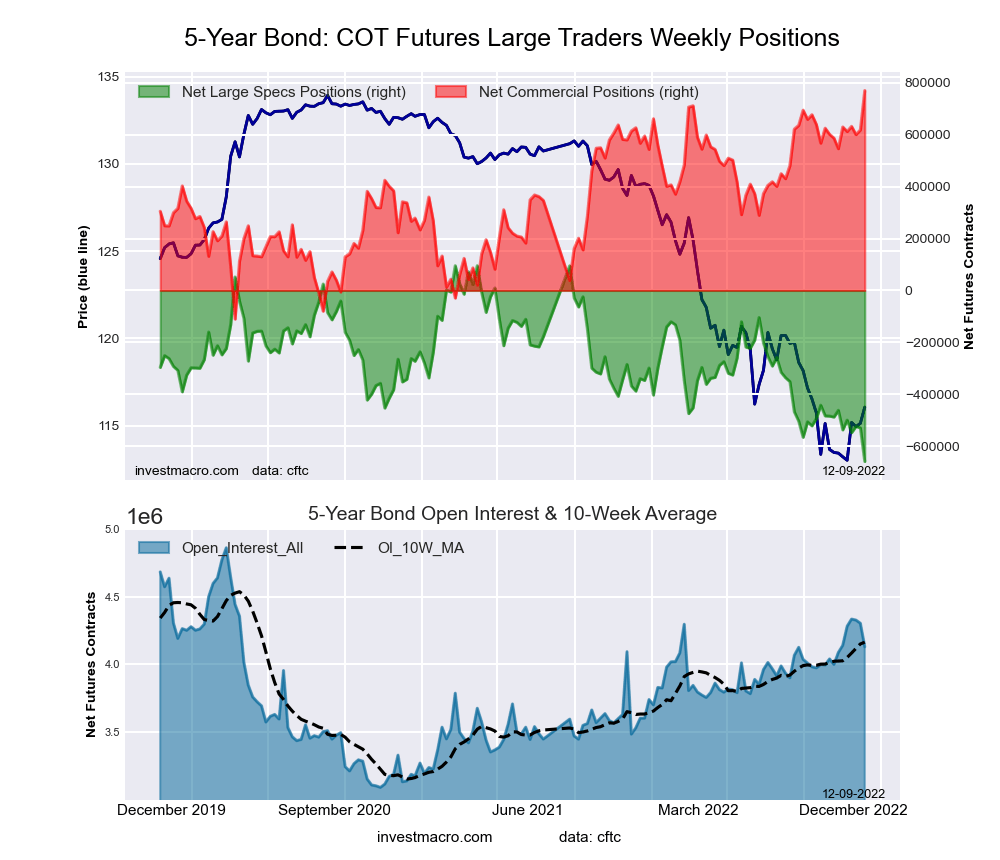
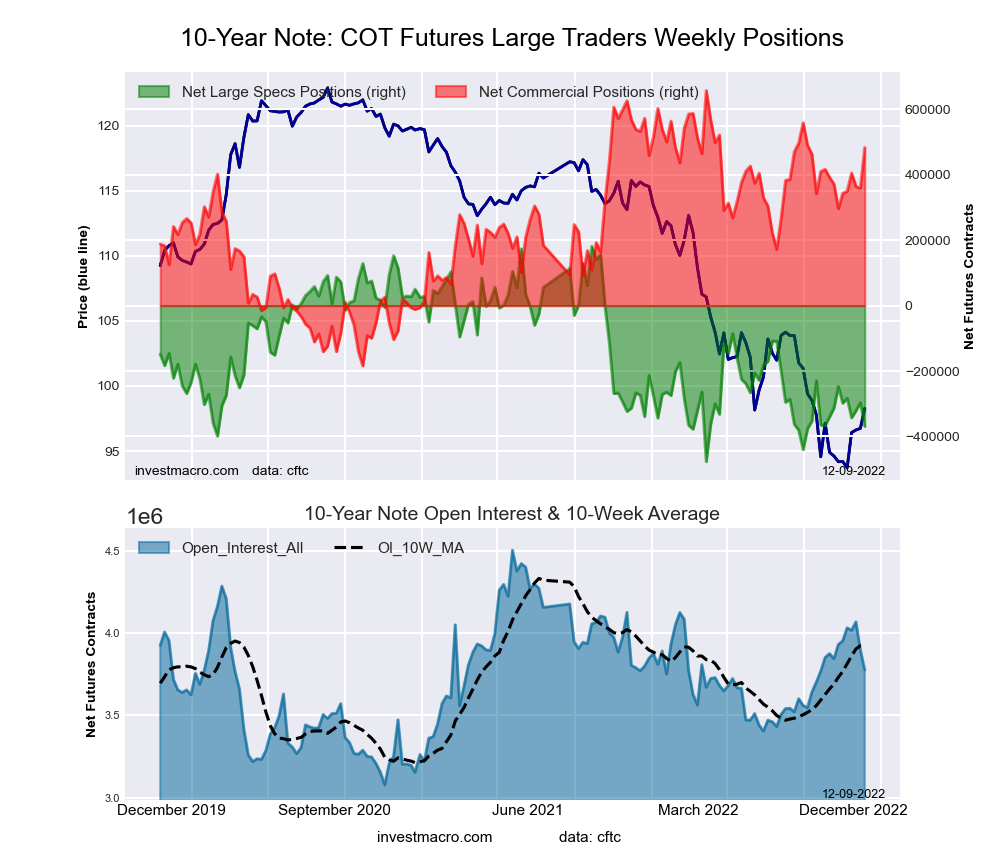
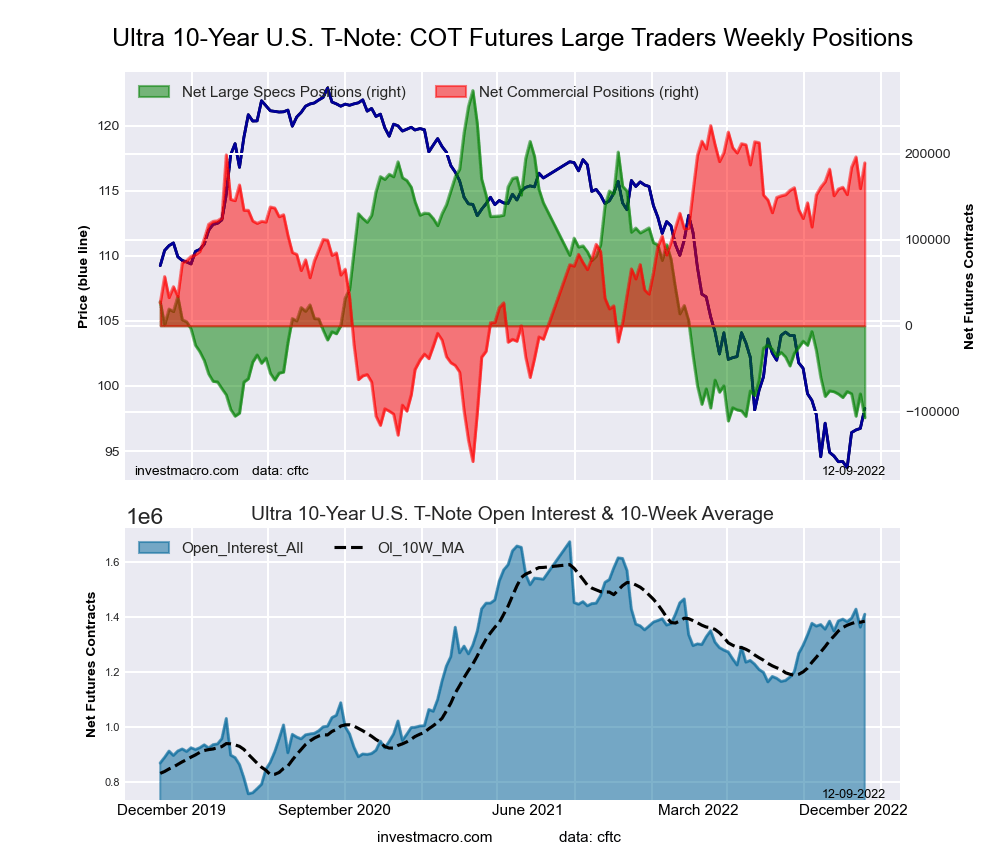
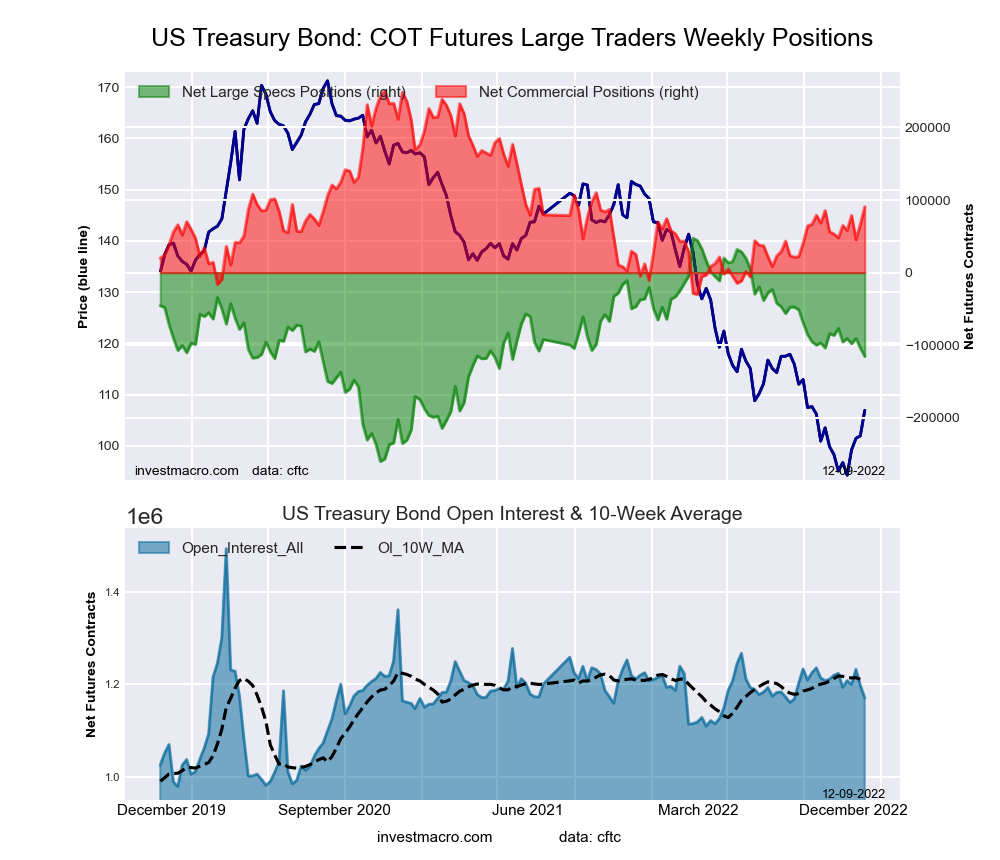
The bond markets leading the weekly declines in speculator bets this week was the 2-Year Bond (-102,997 contracts) with the 10-Year Bond (-59,962 contracts), the Fed Funds (-48,469 contracts), the 5-Year Bond (-48,163 contracts), the Long US Bond (-6,956 contracts) and the Ultra 10-Year (-2,545 contracts) also registering lower bets on the week.

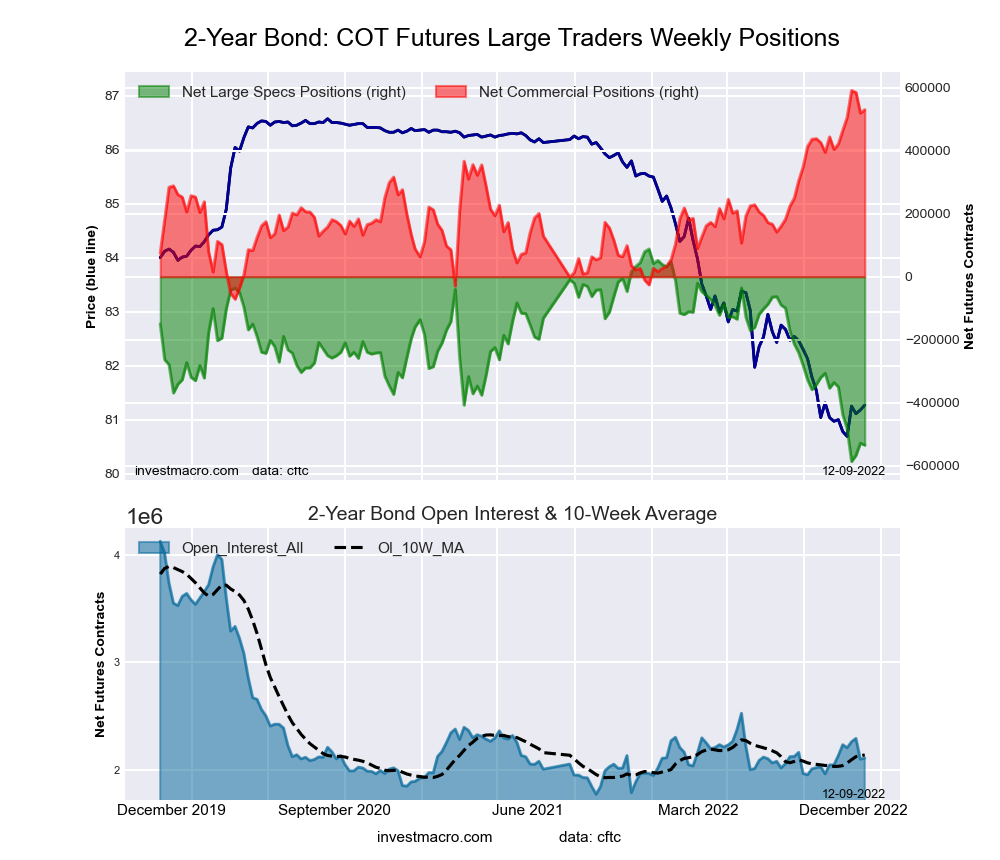
Highlighting the COT bonds data this week is the 2-Year Bond position that continues to see the bearish bets pile up. Large speculators sharply added to their bearish positioning this week by a total of -102,997 contracts and marking the largest one-week bearish gain since February. Overall, bearish bets have risen for the past four straight weeks and for five out of the past six weeks. The bearish position has now risen by a total of -250,758 contracts over just the past four weeks.

This continued weakness for the 2-Year has pushed the overall net position standing to the lowest on record for a third straight week with this week’s standing totaling -586,270 contracts, according to CFTC data going back to 1990.

The 2-Year Bond futures price has continued to be in a steep downtrend but has trended a bit higher in the past week off its recent low touched on November 4th at 101.19.


Data Snapshot of Bond Market Traders | Columns Legend
Nov-15-2022OIOI-IndexSpec-NetSpec-IndexCom-NetCOM-IndexSmalls-NetSmalls-Index
Eurodollar7,670,6960-1,966,931172,232,77781-265,84646
FedFunds1,488,04342-26,2853632,82264-6,53743
2-Year2,261,04222-586,2700590,806100-4,53650
Long T-Bond1,199,68743-97,6815378,7453918,93668
10-Year4,015,83366-343,02120405,12970-62,10865
5-Year4,333,91270-547,6183632,20790-84,58958


Strength Scores led by US Treasury Bond
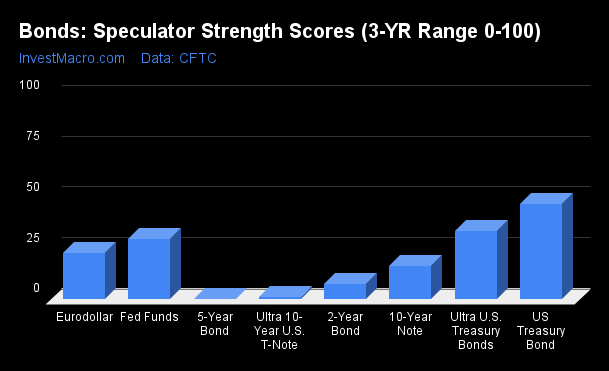
Strength Scores (a normalized measure of Speculator positions over a 3-Year range, from 0 to 100 where above 80 is extreme bullish and below 20 is extreme bearish) show that the US Treasury Bond (52.8 percent) leads the bonds category and is the only bond market above the 50 percent level (3-Year Midpoint).

On the downside, the 2-Year Bond (0.0 percent) comes in at the lowest strength level and currently at the bottom of its 3-Year range. The 5-Year Bond (2.7 percent), the Ultra 10-Year Bond (8.2 percent) and the Eurodollar (16.9 percent) join the 2-Year Bond with scores in bearish extreme positions (below 20 percent).

Strength Statistics:
Fed Funds (36.4 percent) vs Fed Funds previous week (42.4 percent)
2-Year Bond (0.0 percent) vs 2-Year Bond previous week (15.3 percent)
5-Year Bond (2.7 percent) vs 5-Year Bond previous week (10.0 percent)
10-Year Bond (20.3 percent) vs 10-Year Bond previous week (29.4 percent)
Ultra 10-Year Bond (8.2 percent) vs Ultra 10-Year Bond previous week (8.9 percent)
US Treasury Bond (52.8 percent) vs US Treasury Bond previous week (55.1 percent)
Ultra US Treasury Bond (31.1 percent) vs Ultra US Treasury Bond previous week (29.3 percent)
Eurodollar (16.9 percent) vs Eurodollar previous week (14.2 percent)

10-Year Bond lead the Strength Trends

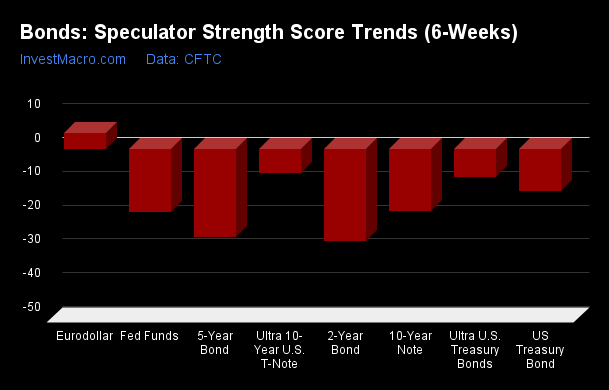
Strength Score Trends (or move index, calculates the 6-week changes in strength scores) show that the 10-Year Bond (3.6 percent) leads the past six weeks trends for bonds this week. The Eurodollar (2.2 percent), the US Treasury Bond (1.9 percent) and the Ultra 10-Year Bond (0.8 percent) fill out the other positive movers in the latest trends data.

The 2-Year Bond (-41.6 percent) leads the downside trend scores currently with a steep drop while the next markets with lower trend scores was the 5-Year Bond (-9.8 percent) followed by the Fed Funds (-2.4 percent).

Strength Trend Statistics:
Fed Funds (-2.4 percent) vs Fed Funds previous week (-9.9 percent)
2-Year Bond (-41.6 percent) vs 2-Year Bond previous week (-24.2 percent)
5-Year Bond (-9.8 percent) vs 5-Year Bond previous week (-8.7 percent)
10-Year Bond (3.6 percent) vs 10-Year Bond previous week (12.5 percent)
Ultra 10-Year Bond (0.8 percent) vs Ultra 10-Year Bond previous week (-4.4 percent)
US Treasury Bond (1.9 percent) vs US Treasury Bond previous week (1.9 percent)
Ultra US Treasury Bond (-0.4 percent) vs Ultra US Treasury Bond previous week (-0.1 percent)
Eurodollar (2.2 percent) vs Eurodollar previous week (0.9 percent)


Individual Bond Markets:

3-Month Eurodollars Futures:
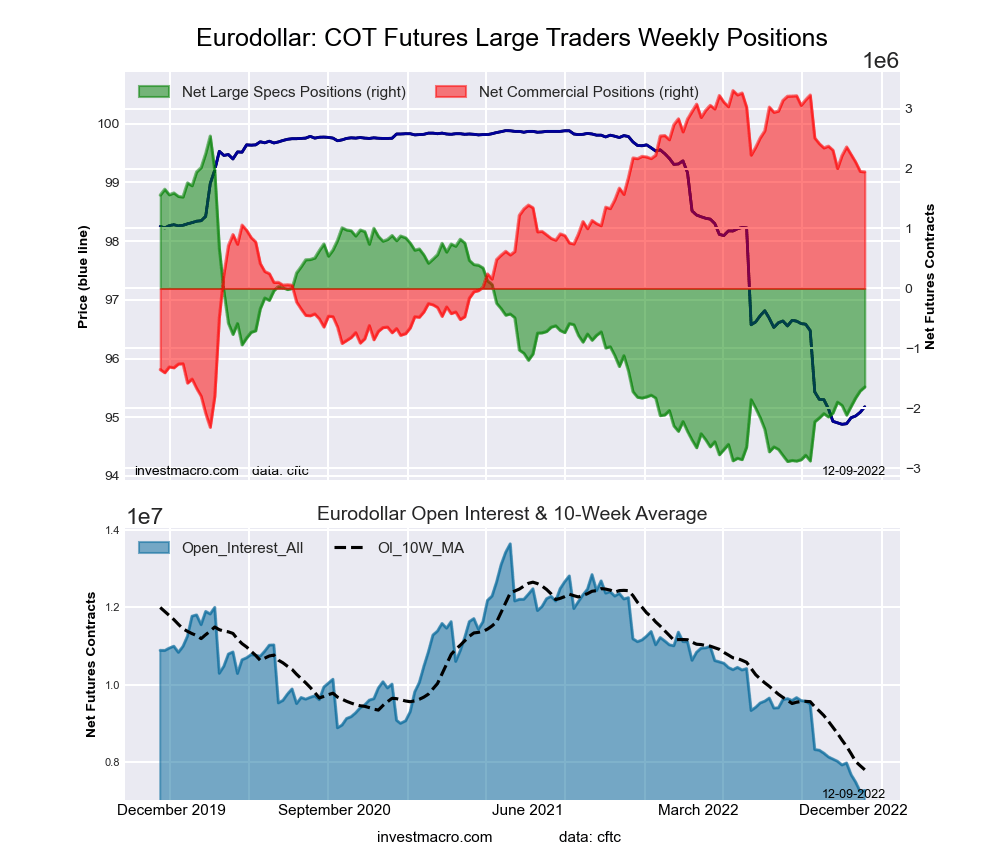
Eurodollar Bonds Futures COT ChartThe 3-Month Eurodollars large speculator standing this week totaled a net position of -1,966,931 contracts in the data reported through Tuesday. This was a weekly lift of 145,719 contracts from the previous week which had a total of -2,112,650 net contracts.

This week’s current strength score (the trader positioning range over the past three years, measured from 0 to 100) shows the speculators are currently Bearish-Extreme with a score of 16.9 percent. The commercials are Bullish-Extreme with a score of 81.0 percent and the small traders (not shown in chart) are Bearish with a score of 45.9 percent.

3-Month Eurodollars StatisticsSPECULATORSCOMMERCIALSSMALL TRADERS
– Percent of Open Interest Longs:7.367.95.2
– Percent of Open Interest Shorts:32.938.88.7
– Net Position:-1,966,9312,232,777-265,846
– Gross Longs:559,9465,207,904402,188
– Gross Shorts:2,526,8772,975,127668,034
– Long to Short Ratio:0.2 to 11.8 to 10.6 to 1
NET POSITION TREND:
– Strength Index Score (3 Year Range Pct):16.981.045.9
– Strength Index Reading (3 Year Range):Bearish-ExtremeBullish-ExtremeBearish
NET POSITION MOVEMENT INDEX:
– 6-Week Change in Strength Index:2.2-2.0-2.1


30-Day Federal Funds Futures:

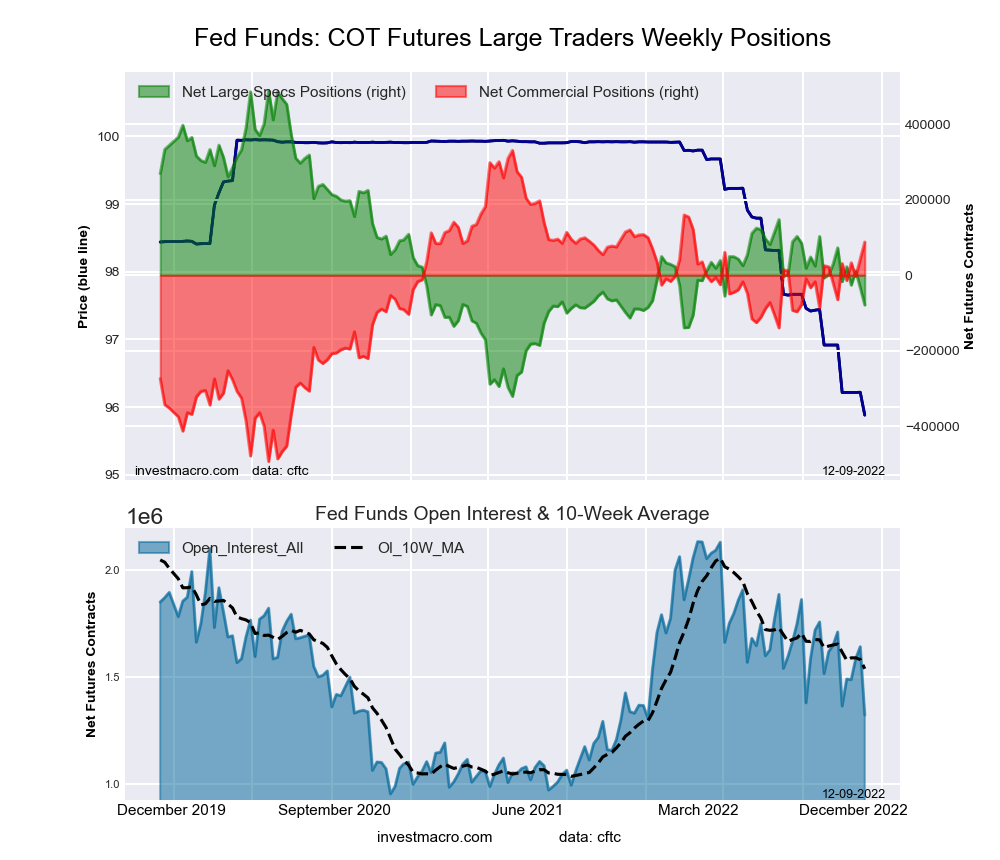
Federal Funds 30-Day Bonds Futures COT ChartThe 30-Day Federal Funds large speculator standing this week totaled a net position of -26,285 contracts in the data reported through Tuesday. This was a weekly lowering of -48,469 contracts from the previous week which had a total of 22,184 net contracts.

This week’s current strength score (the trader positioning range over the past three years, measured from 0 to 100) shows the speculators are currently Bearish with a score of 36.4 percent. The commercials are Bullish with a score of 63.9 percent and the small traders (not shown in chart) are Bearish with a score of 43.0 percent.

30-Day Federal Funds StatisticsSPECULATORSCOMMERCIALSSMALL TRADERS
– Percent of Open Interest Longs:10.175.62.6
– Percent of Open Interest Shorts:11.873.43.0
– Net Position:-26,28532,822-6,537
– Gross Longs:149,6931,124,42138,519
– Gross Shorts:175,9781,091,59945,056
– Long to Short Ratio:0.9 to 11.0 to 10.9 to 1
NET POSITION TREND:
– Strength Index Score (3 Year Range Pct):36.463.943.0
– Strength Index Reading (3 Year Range):BearishBullishBearish
NET POSITION MOVEMENT INDEX:
– 6-Week Change in Strength Index:-2.41.029.4


2-Year Treasury Note Futures:

2-Year Treasury Bonds Futures COT ChartThe 2-Year Treasury Note large speculator standing this week totaled a net position of -586,270 contracts in the data reported through Tuesday. This was a weekly fall of -102,997 contracts from the previous week which had a total of -483,273 net contracts.

This week’s current strength score (the trader positioning range over the past three years, measured from 0 to 100) shows the speculators are currently Bearish-Extreme with a score of 0.0 percent. The commercials are Bullish-Extreme with a score of 100.0 percent and the small traders (not shown in chart) are Bullish with a score of 50.0 percent.

2-Year Treasury Note StatisticsSPECULATORSCOMMERCIALSSMALL TRADERS
– Percent of Open Interest Longs:6.582.28.3
– Percent of Open Interest Shorts:32.456.18.5
– Net Position:-586,270590,806-4,536
– Gross Longs:146,3331,859,038187,082
– Gross Shorts:732,6031,268,232191,618
– Long to Short Ratio:0.2 to 11.5 to 11.0 to 1
NET POSITION TREND:
– Strength Index Score (3 Year Range Pct):0.0100.050.0
– Strength Index Reading (3 Year Range):Bearish-ExtremeBullish-ExtremeBullish
NET POSITION MOVEMENT INDEX:
– 6-Week Change in Strength Index:-41.629.637.5


5-Year Treasury Note Futures:

5-Year Treasury Bonds Futures COT ChartThe 5-Year Treasury Note large speculator standing this week totaled a net position of -547,618 contracts in the data reported through Tuesday. This was a weekly decline of -48,163 contracts from the previous week which had a total of -499,455 net contracts.

This week’s current strength score (the trader positioning range over the past three years, measured from 0 to 100) shows the speculators are currently Bearish-Extreme with a score of 2.7 percent. The commercials are Bullish-Extreme with a score of 90.3 percent and the small traders (not shown in chart) are Bullish with a score of 57.8 percent.

5-Year Treasury Note StatisticsSPECULATORSCOMMERCIALSSMALL TRADERS
– Percent of Open Interest Longs:7.183.87.2
– Percent of Open Interest Shorts:19.869.29.1
– Net Position:-547,618632,207-84,589
– Gross Longs:309,3733,632,210310,934
– Gross Shorts:856,9913,000,003395,523
– Long to Short Ratio:0.4 to 11.2 to 10.8 to 1
NET POSITION TREND:
– Strength Index Score (3 Year Range Pct):2.790.357.8
– Strength Index Reading (3 Year Range):Bearish-ExtremeBullish-ExtremeBullish
NET POSITION MOVEMENT INDEX:
– 6-Week Change in Strength Index:-9.80.915.8


10-Year Treasury Note Futures:

10-Year Treasury Notes Bonds Futures COT ChartThe 10-Year Treasury Note large speculator standing this week totaled a net position of -343,021 contracts in the data reported through Tuesday. This was a weekly lowering of -59,962 contracts from the previous week which had a total of -283,059 net contracts.

This week’s current strength score (the trader positioning range over the past three years, measured from 0 to 100) shows the speculators are currently Bearish with a score of 20.3 percent. The commercials are Bullish with a score of 70.0 percent and the small traders (not shown in chart) are Bullish with a score of 65.3 percent.

10-Year Treasury Note StatisticsSPECULATORSCOMMERCIALSSMALL TRADERS
– Percent of Open Interest Longs:11.876.19.4
– Percent of Open Interest Shorts:20.366.011.0
– Net Position:-343,021405,129-62,108
– Gross Longs:472,2883,054,508379,476
– Gross Shorts:815,3092,649,379441,584
– Long to Short Ratio:0.6 to 11.2 to 10.9 to 1
NET POSITION TREND:
– Strength Index Score (3 Year Range Pct):20.370.065.3
– Strength Index Reading (3 Year Range):BearishBullishBullish
NET POSITION MOVEMENT INDEX:
– 6-Week Change in Strength Index:3.6-1.4-2.9


Ultra 10-Year Notes Futures:

Ultra 10-Year Treasury Notes Bonds Futures COT ChartThe Ultra 10-Year Notes large speculator standing this week totaled a net position of -79,073 contracts in the data reported through Tuesday. This was a weekly decrease of -2,545 contracts from the previous week which had a total of -76,528 net contracts.

This week’s current strength score (the trader positioning range over the past three years, measured from 0 to 100) shows the speculators are currently Bearish-Extreme with a score of 8.2 percent. The commercials are Bullish-Extreme with a score of 87.6 percent and the small traders (not shown in chart) are Bullish with a score of 57.3 percent.

Ultra 10-Year Notes StatisticsSPECULATORSCOMMERCIALSSMALL TRADERS
– Percent of Open Interest Longs:9.679.99.6
– Percent of Open Interest Shorts:15.366.717.1
– Net Position:-79,073184,254-105,181
– Gross Longs:133,9711,114,722133,372
– Gross Shorts:213,044930,468238,553
– Long to Short Ratio:0.6 to 11.2 to 10.6 to 1
NET POSITION TREND:
– Strength Index Score (3 Year Range Pct):8.287.657.3
– Strength Index Reading (3 Year Range):Bearish-ExtremeBullish-ExtremeBullish
NET POSITION MOVEMENT INDEX:
– 6-Week Change in Strength Index:0.84.2-12.9


US Treasury Bonds Futures:

US Year Treasury Notes Long Bonds Futures COT ChartThe US Treasury Bonds large speculator standing this week totaled a net position of -97,681 contracts in the data reported through Tuesday. This was a weekly fall of -6,956 contracts from the previous week which had a total of -90,725 net contracts.

This week’s current strength score (the trader positioning range over the past three years, measured from 0 to 100) shows the speculators are currently Bullish with a score of 52.8 percent. The commercials are Bearish with a score of 38.7 percent and the small traders (not shown in chart) are Bullish with a score of 67.6 percent.

US Treasury Bonds StatisticsSPECULATORSCOMMERCIALSSMALL TRADERS
– Percent of Open Interest Longs:4.879.314.5
– Percent of Open Interest Shorts:12.972.813.0
– Net Position:-97,68178,74518,936
– Gross Longs:57,233951,931174,421
– Gross Shorts:154,914873,186155,485
– Long to Short Ratio:0.4 to 11.1 to 11.1 to 1
NET POSITION TREND:
– Strength Index Score (3 Year Range Pct):52.838.767.6
– Strength Index Reading (3 Year Range):BullishBearishBullish
NET POSITION MOVEMENT INDEX:
– 6-Week Change in Strength Index:1.9-2.30.6


Ultra US Treasury Bonds Futures:

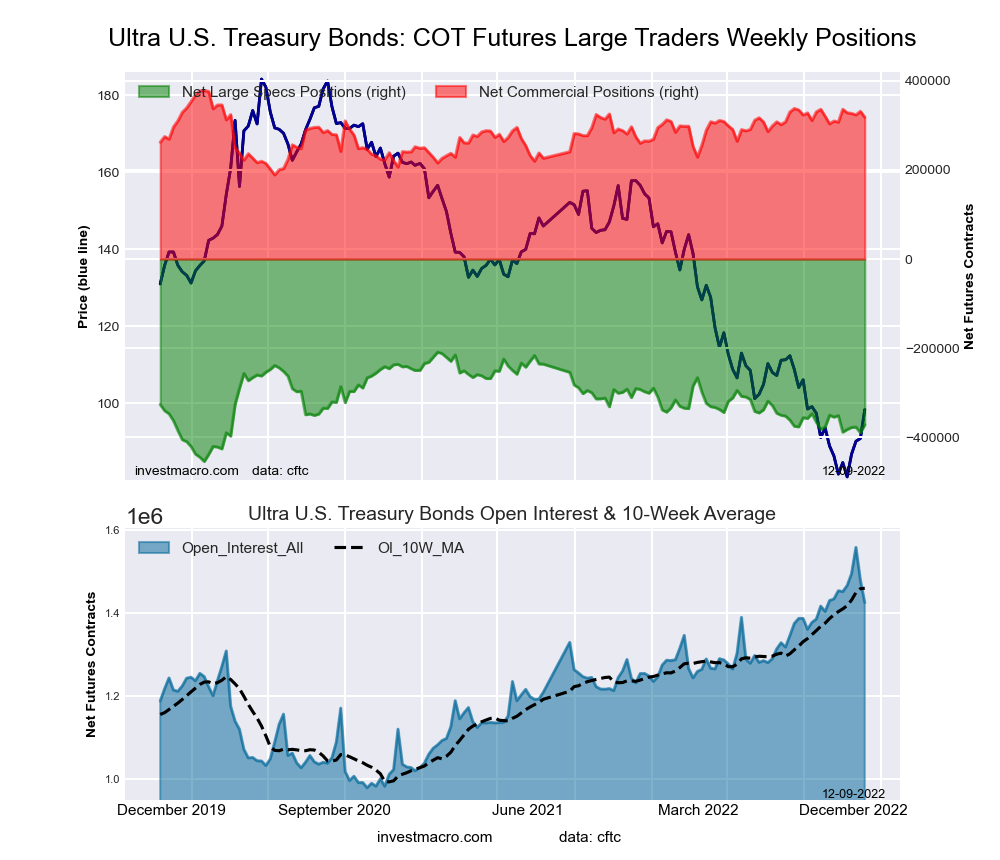
Ultra US Year Treasury Notes Long Bonds Futures COT ChartThe Ultra US Treasury Bonds large speculator standing this week totaled a net position of -377,708 contracts in the data reported through Tuesday. This was a weekly increase of 4,465 contracts from the previous week which had a total of -382,173 net contracts.

This week’s current strength score (the trader positioning range over the past three years, measured from 0 to 100) shows the speculators are currently Bearish with a score of 31.1 percent. The commercials are Bullish with a score of 72.9 percent and the small traders (not shown in chart) are Bullish with a score of 73.8 percent.

Ultra US Treasury Bonds StatisticsSPECULATORSCOMMERCIALSSMALL TRADERS
– Percent of Open Interest Longs:6.381.511.4
– Percent of Open Interest Shorts:31.659.78.0
– Net Position:-377,708326,61751,091
– Gross Longs:94,5401,217,889170,609
– Gross Shorts:472,248891,272119,518
– Long to Short Ratio:0.2 to 11.4 to 11.4 to 1
NET POSITION TREND:
– Strength Index Score (3 Year Range Pct):31.172.973.8
– Strength Index Reading (3 Year Range):BearishBullishBullish
NET POSITION MOVEMENT INDEX:
– 6-Week Change in Strength Index:-0.43.5-4.6


Article By InvestMacroReceive our weekly COT Newsletter

*COT Report: The COT data, released weekly to the public each Friday, is updated through the most recent Tuesday (data is 3 days old) and shows a quick view of how large speculators or non-commercials (for-profit traders) were positioned in the futures markets.

The CFTC categorizes trader positions according to commercial hedgers (traders who use futures contracts for hedging as part of the business), non-commercials (large traders who speculate to realize trading profits) and nonreportable traders (usually small traders/speculators) as well as their open interest (contracts open in the market at time of reporting). See CFTC criteria here.

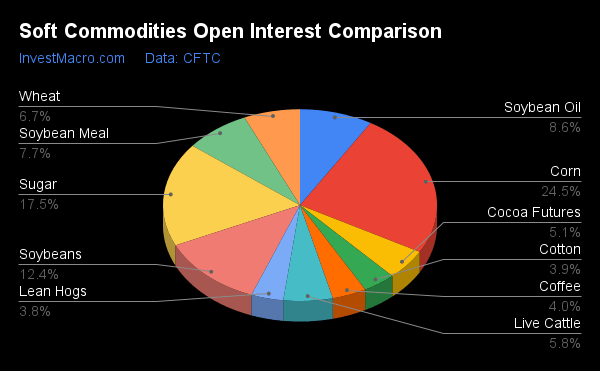
COT Metals Speculators boost their Gold bullish bets to 13-week high

By InvestMacro

Here are the latest charts and statistics for the Commitment of Traders (COT) data published by the Commodities Futures Trading Commission (CFTC).

The latest COT data is updated through Tuesday November 15th and shows a quick view of how large traders (for-profit speculators and commercial entities) were positioned in the futures markets.

Weekly Speculator Changes led by Gold

The COT precious metals speculator bets were higher this week as all five of the metals markets we cover had higher positioning this week.

Leading the gains for the precious metals markets was Gold (43,931 contracts) with Copper (6,908 contracts), Silver (4,604 contracts), Platinum (3,095 contracts) and Palladium (1,338 contracts) also showing a positive week.

Highlighting the COT metals data this week is the rebound of the Gold speculator bets. The large speculator position for Gold jumped by over +40,000 contracts this week following a gain by over +17,000 contracts. This week’s rise marked the highest weekly gain in 143-weeks and the renewed speculator sentiment has pushed the overall Gold net position back above the +100,000 contract level for the first time since early September. The Gold speculator net standing is now at the highest level since August 16th when the net contracts was +141,164 contracts.

Gold prices have had a bit of an upswing since November 4th as well as the futures price has risen from the (Nov. 4th) opening level of $1,631.00 to close out this week at the $1,754.40 threshold. Gold, also this week, touched its highest level since the middle of August just below $1,792.00 before retreating lower.


Data Snapshot of Commodity Market Traders | Columns Legend
Nov-15-2022OIOI-IndexSpec-NetSpec-IndexCom-NetCOM-IndexSmalls-NetSmalls-Index
WTI Crude1,469,4373278,26718-307,3958129,12848
Gold495,17117126,26925-134,308788,0390
Silver141,6231417,60734-29,4246711,81727
Copper168,96299,82144-13,583563,76247
Palladium8,79314-1,072171,23181-15932
Platinum63,3912722,54439-27,037624,49328
Natural Gas978,4256-152,11433120,8306931,28454
Brent139,0804-25,1946920,782284,41269
Heating Oil275,2542625,66080-46,9332121,27372
Soybeans616,094976,80437-49,04672-27,75824
Corn1,421,55522252,90862-211,86242-41,04619
Coffee191,7436-14,154011,8401002,31432
Sugar832,52226156,19459-201,7793945,58564
Wheat350,09127-22,481029,310100-6,82975


Copper & Platinum lead Strength Scores

Strength scores (a measure of the 3-Year range of Speculator positions, from 0 to 100 where above 80 is extreme bullish and below 20 is extreme bearish) showed that Copper (44.1 percent) and Platinum (39.4 percent) lead the metals category. Silver (33.5 percent) comes in as the next highest metals market in strength scores.

On the downside, Palladium (17.5 percent) is at the lowest strength level currently and is in a bearish extreme position with a score under 20 percent.

Strength Statistics:
Gold (24.6 percent) vs Gold previous week (10.0 percent)
Silver (33.5 percent) vs Silver previous week (28.4 percent)
Copper (44.1 percent) vs Copper previous week (38.6 percent)
Platinum (39.4 percent) vs Platinum previous week (35.2 percent)
Palladium (17.5 percent) vs Palladium previous week (9.7 percent)

Platinum tops the Strength Trends

Strength Score Trends (or move index, calculates the 6-week changes in strength scores) showed that the Platinum (25.9 percent) leads the past six weeks trends for metals this week. Copper (22.3 percent), Gold (12.6 percent) and Silver (9.8 percent) fill out the other positive movers in the latest trends data.

Palladium (-2.8 percent) leads the downside trend scores currently.

Move Statistics:
Gold (12.6 percent) vs Gold previous week (10.0 percent)
Silver (9.8 percent) vs Silver previous week (13.5 percent)
Copper (22.3 percent) vs Copper previous week (24.4 percent)
Platinum (25.9 percent) vs Platinum previous week (25.9 percent)
Palladium (-2.8 percent) vs Palladium previous week (-9.3 percent)


Individual Markets:

Gold Comex Futures:

Gold Futures COT ChartThe Gold Comex Futures large speculator standing this week reached a net position of 126,269 contracts in the data reported through Tuesday. This was a weekly lift of 43,931 contracts from the previous week which had a total of 82,338 net contracts.

This week’s current strength score (the trader positioning range over the past three years, measured from 0 to 100) shows the speculators are currently Bearish with a score of 24.6 percent. The commercials are Bullish with a score of 77.7 percent and the small traders (not shown in chart) are Bearish-Extreme with a score of 0.0 percent.

Gold Futures StatisticsSPECULATORSCOMMERCIALSSMALL TRADERS
– Percent of Open Interest Longs:45.927.37.5
– Percent of Open Interest Shorts:20.454.45.8
– Net Position:126,269-134,3088,039
– Gross Longs:227,282135,03536,973
– Gross Shorts:101,013269,34328,934
– Long to Short Ratio:2.3 to 10.5 to 11.3 to 1
NET POSITION TREND:
– Strength Index Score (3 Year Range Pct):24.677.70.0
– Strength Index Reading (3 Year Range):BearishBullishBearish-Extreme
NET POSITION MOVEMENT INDEX:
– 6-Week Change in Strength Index:12.6-11.7-0.3


Silver Comex Futures:

Silver Futures COT ChartThe Silver Comex Futures large speculator standing this week reached a net position of 17,607 contracts in the data reported through Tuesday. This was a weekly increase of 4,604 contracts from the previous week which had a total of 13,003 net contracts.

This week’s current strength score (the trader positioning range over the past three years, measured from 0 to 100) shows the speculators are currently Bearish with a score of 33.5 percent. The commercials are Bullish with a score of 67.4 percent and the small traders (not shown in chart) are Bearish with a score of 27.4 percent.

Silver Futures StatisticsSPECULATORSCOMMERCIALSSMALL TRADERS
– Percent of Open Interest Longs:37.234.217.2
– Percent of Open Interest Shorts:24.854.98.9
– Net Position:17,607-29,42411,817
– Gross Longs:52,69248,39324,386
– Gross Shorts:35,08577,81712,569
– Long to Short Ratio:1.5 to 10.6 to 11.9 to 1
NET POSITION TREND:
– Strength Index Score (3 Year Range Pct):33.567.427.4
– Strength Index Reading (3 Year Range):BearishBullishBearish
NET POSITION MOVEMENT INDEX:
– 6-Week Change in Strength Index:9.8-11.214.0


Copper Grade #1 Futures:

Copper Futures COT ChartThe Copper Grade #1 Futures large speculator standing this week reached a net position of 9,821 contracts in the data reported through Tuesday. This was a weekly gain of 6,908 contracts from the previous week which had a total of 2,913 net contracts.

This week’s current strength score (the trader positioning range over the past three years, measured from 0 to 100) shows the speculators are currently Bearish with a score of 44.1 percent. The commercials are Bullish with a score of 56.5 percent and the small traders (not shown in chart) are Bearish with a score of 47.0 percent.

Copper Futures StatisticsSPECULATORSCOMMERCIALSSMALL TRADERS
– Percent of Open Interest Longs:35.936.510.3
– Percent of Open Interest Shorts:30.144.68.0
– Net Position:9,821-13,5833,762
– Gross Longs:60,73061,69317,332
– Gross Shorts:50,90975,27613,570
– Long to Short Ratio:1.2 to 10.8 to 11.3 to 1
NET POSITION TREND:
– Strength Index Score (3 Year Range Pct):44.156.547.0
– Strength Index Reading (3 Year Range):BearishBullishBearish
NET POSITION MOVEMENT INDEX:
– 6-Week Change in Strength Index:22.3-24.520.4


Platinum Futures:

Platinum Futures COT ChartThe Platinum Futures large speculator standing this week reached a net position of 22,544 contracts in the data reported through Tuesday. This was a weekly gain of 3,095 contracts from the previous week which had a total of 19,449 net contracts.

This week’s current strength score (the trader positioning range over the past three years, measured from 0 to 100) shows the speculators are currently Bearish with a score of 39.4 percent. The commercials are Bullish with a score of 61.9 percent and the small traders (not shown in chart) are Bearish with a score of 28.3 percent.

Platinum Futures StatisticsSPECULATORSCOMMERCIALSSMALL TRADERS
– Percent of Open Interest Longs:52.227.411.9
– Percent of Open Interest Shorts:16.670.14.8
– Net Position:22,544-27,0374,493
– Gross Longs:33,07917,3747,567
– Gross Shorts:10,53544,4113,074
– Long to Short Ratio:3.1 to 10.4 to 12.5 to 1
NET POSITION TREND:
– Strength Index Score (3 Year Range Pct):39.461.928.3
– Strength Index Reading (3 Year Range):BearishBullishBearish
NET POSITION MOVEMENT INDEX:
– 6-Week Change in Strength Index:25.9-25.18.5


Palladium Futures:

Palladium Futures COT ChartThe Palladium Futures large speculator standing this week reached a net position of -1,072 contracts in the data reported through Tuesday. This was a weekly increase of 1,338 contracts from the previous week which had a total of -2,410 net contracts.

This week’s current strength score (the trader positioning range over the past three years, measured from 0 to 100) shows the speculators are currently Bearish-Extreme with a score of 17.5 percent. The commercials are Bullish-Extreme with a score of 81.1 percent and the small traders (not shown in chart) are Bearish with a score of 32.2 percent.

Palladium Futures StatisticsSPECULATORSCOMMERCIALSSMALL TRADERS
– Percent of Open Interest Longs:22.751.313.2
– Percent of Open Interest Shorts:34.937.315.0
– Net Position:-1,0721,231-159
– Gross Longs:1,9974,5121,161
– Gross Shorts:3,0693,2811,320
– Long to Short Ratio:0.7 to 11.4 to 10.9 to 1
NET POSITION TREND:
– Strength Index Score (3 Year Range Pct):17.581.132.2
– Strength Index Reading (3 Year Range):Bearish-ExtremeBullish-ExtremeBearish
NET POSITION MOVEMENT INDEX:
– 6-Week Change in Strength Index:-2.85.0-23.5


Article By InvestMacroReceive our weekly COT Newsletter

*COT Report: The COT data, released weekly to the public each Friday, is updated through the most recent Tuesday (data is 3 days old) and shows a quick view of how large speculators or non-commercials (for-profit traders) were positioned in the futures markets.

The CFTC categorizes trader positions according to commercial hedgers (traders who use futures contracts for hedging as part of the business), non-commercials (large traders who speculate to realize trading profits) and nonreportable traders (usually small traders/speculators) as well as their open interest (contracts open in the market at time of reporting). See CFTC criteria here.
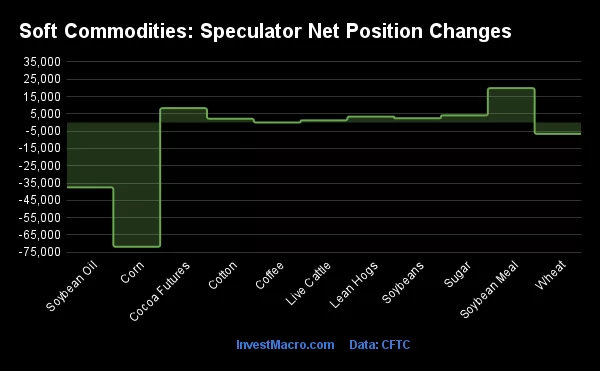
Soft Commodities Speculators drop their Coffee bets to 158-week low

By InvestMacro

Here are the latest charts and statistics for the Commitment of Traders (COT) reports data published by the Commodities Futures Trading Commission (CFTC).

The latest COT data is updated through Tuesday November 15th and shows a quick view of how large traders (for-profit speculators and commercial entities) were positioned in the futures markets.

Sugar & Cocoa top Weekly Speculator Changes

The COT soft commodities speculator bets were lower overall this week as four out of the eleven soft commodities markets we cover had higher positioning this week while the other seven markets had decreases in contracts.

Leading the gains for soft commodities markets was Sugar (66,012 contracts) with Cocoa (13,895 contracts), Soybean Oil (5,282 contracts) and Lean Hogs (897 contracts) also showing positive weeks.

The softs market leading the declines in speculator bets this week was Corn (-48,646 contracts) with Soybean Meal (-16,485 contracts), Soybeans (-11,005 contracts), Live Cattle (-9,513 contracts), Coffee (-9,471 contracts), Wheat (-5,267 contracts) and Cotton (-364 contracts) also registering lower bets on the week.

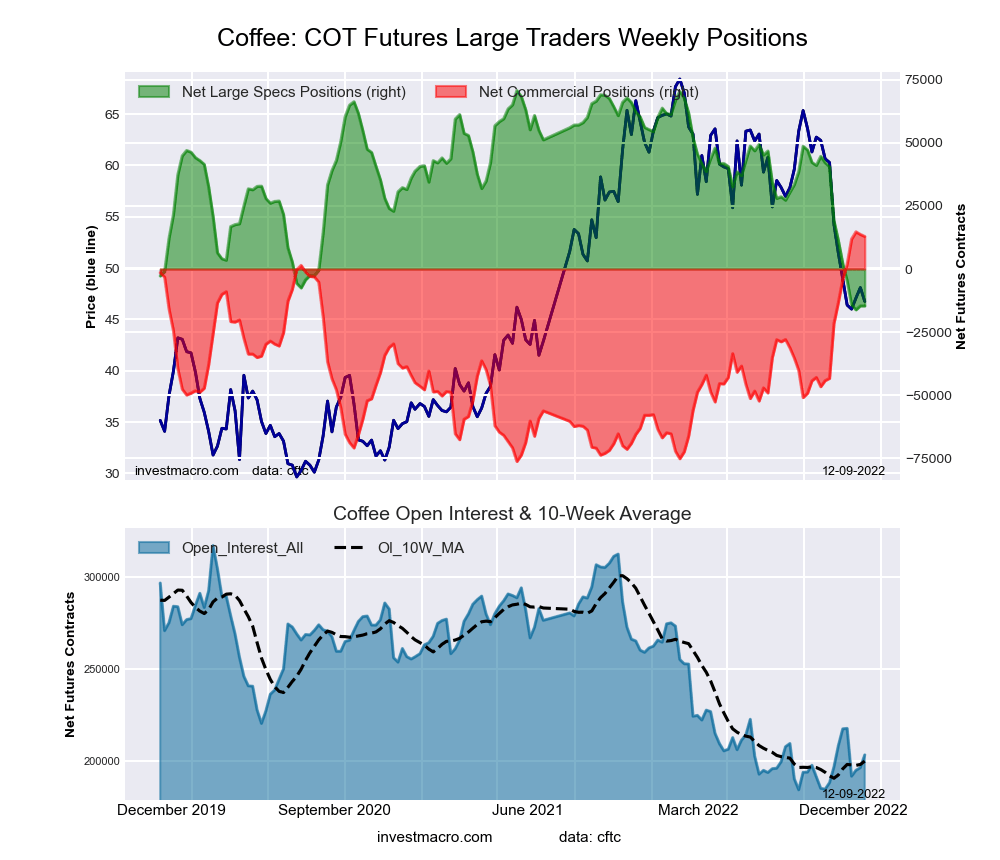
A highlight of this week’s COT soft commodities data is the continued decline of the Coffee futures positioning that have hit their first net bearish positions since July of 2020. Large speculators dropped their weekly bets for Coffee for the seventh straight week this week and for the tenth time out of the past eleven weeks. Coffee bets have now fallen by a total of -58,834 contracts over just these past seven weeks and are in an overall bearish position for the second straight week.

The decline in spec bets has happened very rapidly as bullish positions were as high as +40,000 contracts on November 1st while the position leveled at a total net position of -14,154 contracts through Tuesday. This week’s net position marks the lowest speculator standing since November 5th of 2019, a span of 158 weeks.

Coffee prices have been on a steep drop as well with futures prices falling by over -35 percent since late-August. Helping put a dent in prices is an improved outlook for production out of Brazil that is seen as positive for the coffee harvest.


Data Snapshot of Commodity Market Traders | Columns Legend
Nov-15-2022OIOI-IndexSpec-NetSpec-IndexCom-NetCOM-IndexSmalls-NetSmalls-Index
WTI Crude1,469,4373278,26718-307,3958129,12848
Gold495,17117126,26925-134,308788,0390
Silver141,6231417,60734-29,4246711,81727
Copper168,96299,82144-13,583563,76247
Palladium8,79314-1,072171,23181-15932
Platinum63,3912722,54439-27,037624,49328
Natural Gas978,4256-152,11433120,8306931,28454
Brent139,0804-25,1946920,782284,41269
Heating Oil275,2542625,66080-46,9332121,27372
Soybeans616,094976,80437-49,04672-27,75824
Corn1,421,55522252,90862-211,86242-41,04619
Coffee191,7436-14,154011,8401002,31432
Sugar832,52226156,19459-201,7793945,58564
Wheat350,09127-22,481029,310100-6,82975


Soybean Meal  & Soybean Oil lead the Strength Scores

Strength Scores (a normalized measure of Speculator positions over a 3-Year range, from 0 to 100 where above 80 is extreme bullish and below 20 is extreme bearish) showed that Soybean Meal (85.8 percent) continues to lead the soft commodity markets and is in a bullish extreme position with a score above 80 percent. Soybean Oil (75.3 percent) comes in as the next highest soft commodity markets in strength scores followed by Corn (62.3 percent) and Sugar (59.4 percent).

On the downside, Coffee (0.0 percent) joins Wheat (0.0 percent) at the lowest strength levels currently and are both in bearish extreme positions (below 20 percent).

Strength Statistics:
Corn (62.3 percent) vs Corn previous week (68.6 percent)
Sugar (59.4 percent) vs Sugar previous week (41.7 percent)
Coffee (0.0 percent) vs Coffee previous week (11.2 percent)
Soybeans (37.0 percent) vs Soybeans previous week (40.3 percent)
Soybean Oil (75.3 percent) vs Soybean Oil previous week (71.7 percent)
Soybean Meal (85.8 percent) vs Soybean Meal previous week (95.0 percent)
Live Cattle (39.5 percent) vs Live Cattle previous week (51.4 percent)
Lean Hogs (52.2 percent) vs Lean Hogs previous week (51.3 percent)
Cotton (24.2 percent) vs Cotton previous week (24.4 percent)
Cocoa (42.4 percent) vs Cocoa previous week (28.7 percent)
Wheat (0.0 percent) vs Wheat previous week (6.2 percent)

Strength Trends led by Soybean Oil, Sugar & Cocoa

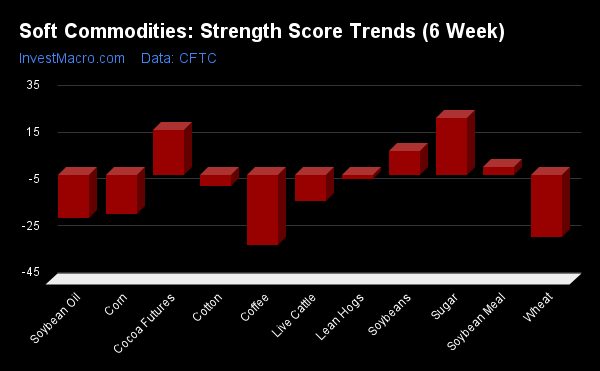
Strength Score Trends (or move index, calculates the 6-week changes in strength scores) show that Soybean Oil (31.1 percent) leads the past six weeks trends for soft commodity markets this week. Sugar (29.1 percent), Cocoa (25.4 percent) and Lean Hogs (19.8 percent) fill out the next top movers in the latest trends data.

Coffee (-66.3 percent) leads the downside trend scores currently while the next market with lower trend scores was Wheat (-33.2 percent) followed by Cotton (-13.0 percent).

Strength Trend Statistics:
Corn (-6.7 percent) vs Corn previous week (0.6 percent)
Sugar (29.1 percent) vs Sugar previous week (11.1 percent)
Coffee (-66.3 percent) vs Coffee previous week (-58.1 percent)
Soybeans (3.1 percent) vs Soybeans previous week (2.4 percent)
Soybean Oil (31.1 percent) vs Soybean Oil previous week (31.0 percent)
Soybean Meal (-0.7 percent) vs Soybean Meal previous week (3.4 percent)
Live Cattle (6.0 percent) vs Live Cattle previous week (-4.4 percent)
Lean Hogs (19.8 percent) vs Lean Hogs previous week (1.3 percent)
Cotton (-13.0 percent) vs Cotton previous week (-16.2 percent)
Cocoa (25.4 percent) vs Cocoa previous week (21.5 percent)
Wheat (-33.2 percent) vs Wheat previous week (-23.6 percent)


Individual Soft Commodities Markets:

CORN Futures:

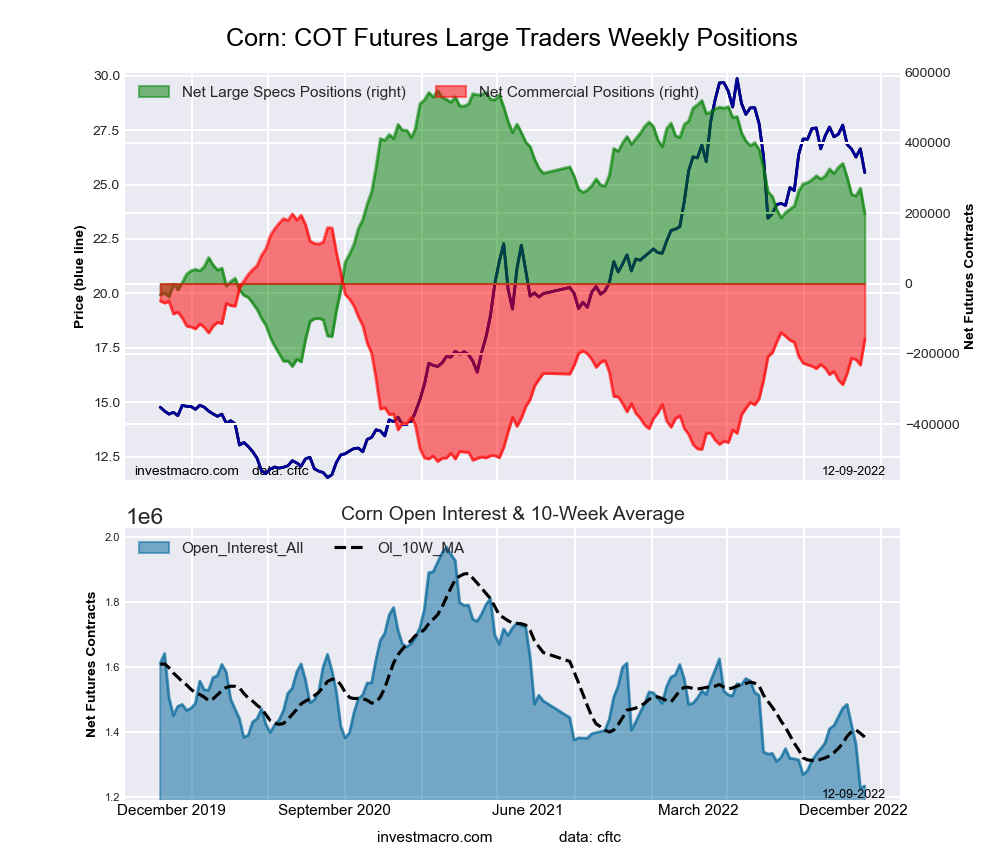
CORN Futures COT ChartThe CORN large speculator standing this week came in at a net position of 252,908 contracts in the data reported through Tuesday. This was a weekly decline of -48,646 contracts from the previous week which had a total of 301,554 net contracts.

This week’s current strength score (the trader positioning range over the past three years, measured from 0 to 100) shows the speculators are currently Bullish with a score of 62.3 percent. The commercials are Bearish with a score of 41.7 percent and the small traders (not shown in chart) are Bearish-Extreme with a score of 19.5 percent.

CORN Futures StatisticsSPECULATORSCOMMERCIALSSMALL TRADERS
– Percent of Open Interest Longs:27.246.99.4
– Percent of Open Interest Shorts:9.461.812.2
– Net Position:252,908-211,862-41,046
– Gross Longs:386,487667,033133,045
– Gross Shorts:133,579878,895174,091
– Long to Short Ratio:2.9 to 10.8 to 10.8 to 1
NET POSITION TREND:
– Strength Index Score (3 Year Range Pct):62.341.719.5
– Strength Index Reading (3 Year Range):BullishBearishBearish-Extreme
NET POSITION MOVEMENT INDEX:
– 6-Week Change in Strength Index:-6.74.013.8


SUGAR Futures:

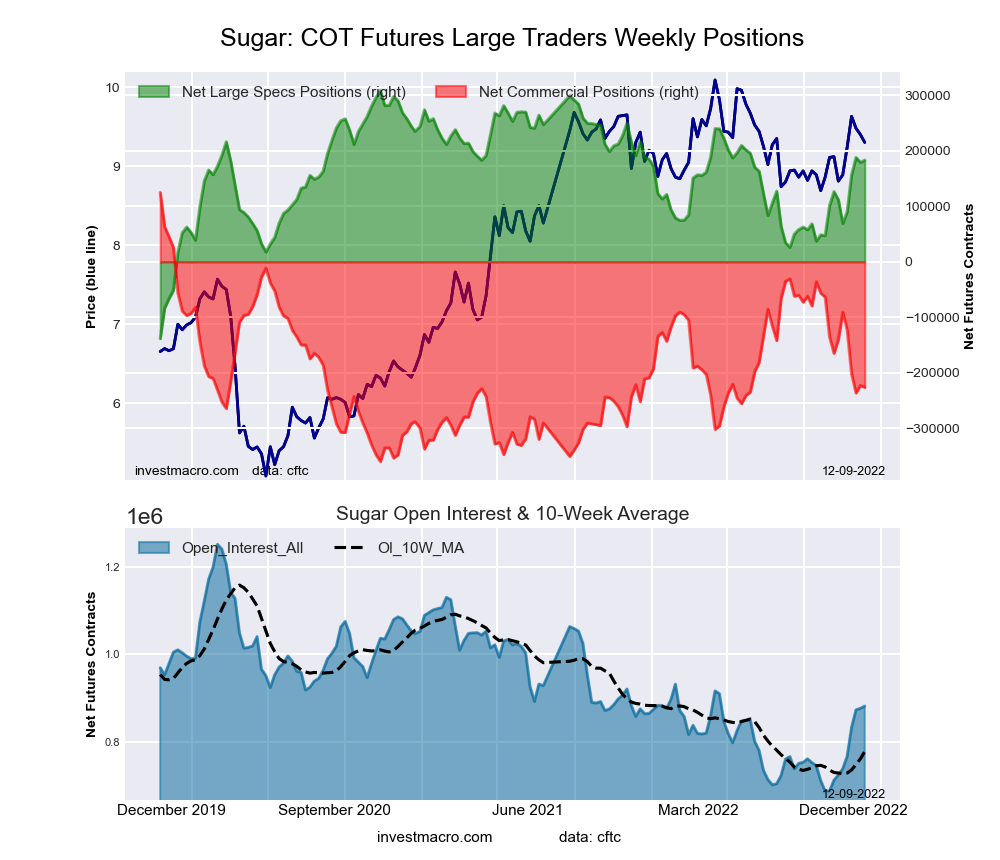
SUGAR Futures COT ChartThe SUGAR large speculator standing this week came in at a net position of 156,194 contracts in the data reported through Tuesday. This was a weekly rise of 66,012 contracts from the previous week which had a total of 90,182 net contracts.

This week’s current strength score (the trader positioning range over the past three years, measured from 0 to 100) shows the speculators are currently Bullish with a score of 59.4 percent. The commercials are Bearish with a score of 39.0 percent and the small traders (not shown in chart) are Bullish with a score of 64.2 percent.

SUGAR Futures StatisticsSPECULATORSCOMMERCIALSSMALL TRADERS
– Percent of Open Interest Longs:30.347.011.5
– Percent of Open Interest Shorts:11.571.26.0
– Net Position:156,194-201,77945,585
– Gross Longs:251,928391,03495,587
– Gross Shorts:95,734592,81350,002
– Long to Short Ratio:2.6 to 10.7 to 11.9 to 1
NET POSITION TREND:
– Strength Index Score (3 Year Range Pct):59.439.064.2
– Strength Index Reading (3 Year Range):BullishBearishBullish
NET POSITION MOVEMENT INDEX:
– 6-Week Change in Strength Index:29.1-34.236.2


COFFEE Futures:

COFFEE Futures COT ChartThe COFFEE large speculator standing this week came in at a net position of -14,154 contracts in the data reported through Tuesday. This was a weekly decline of -9,471 contracts from the previous week which had a total of -4,683 net contracts.

This week’s current strength score (the trader positioning range over the past three years, measured from 0 to 100) shows the speculators are currently Bearish-Extreme with a score of 0.0 percent. The commercials are Bullish-Extreme with a score of 100.0 percent and the small traders (not shown in chart) are Bearish with a score of 31.6 percent.

COFFEE Futures StatisticsSPECULATORSCOMMERCIALSSMALL TRADERS
– Percent of Open Interest Longs:19.554.05.3
– Percent of Open Interest Shorts:26.947.84.1
– Net Position:-14,15411,8402,314
– Gross Longs:37,332103,54410,167
– Gross Shorts:51,48691,7047,853
– Long to Short Ratio:0.7 to 11.1 to 11.3 to 1
NET POSITION TREND:
– Strength Index Score (3 Year Range Pct):0.0100.031.6
– Strength Index Reading (3 Year Range):Bearish-ExtremeBullish-ExtremeBearish
NET POSITION MOVEMENT INDEX:
– 6-Week Change in Strength Index:-66.363.62.8


SOYBEANS Futures:

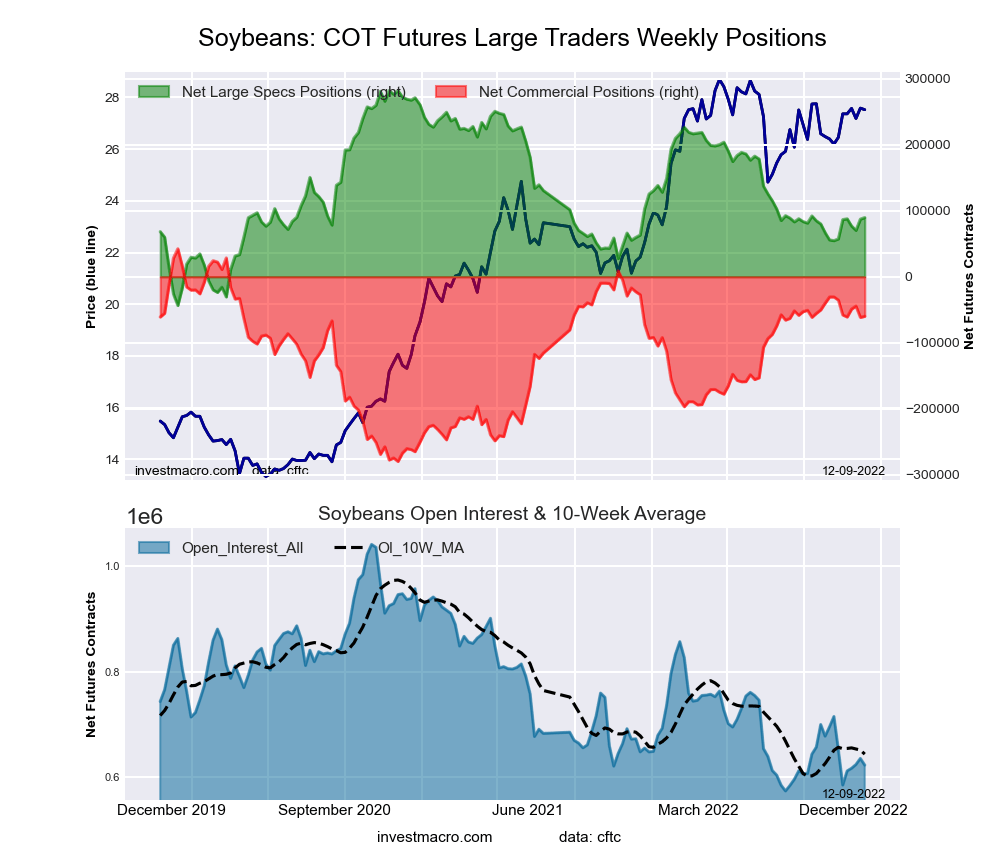
SOYBEANS Futures COT ChartThe SOYBEANS large speculator standing this week came in at a net position of 76,804 contracts in the data reported through Tuesday. This was a weekly reduction of -11,005 contracts from the previous week which had a total of 87,809 net contracts.

This week’s current strength score (the trader positioning range over the past three years, measured from 0 to 100) shows the speculators are currently Bearish with a score of 37.0 percent. The commercials are Bullish with a score of 71.6 percent and the small traders (not shown in chart) are Bearish with a score of 24.1 percent.

SOYBEANS Futures StatisticsSPECULATORSCOMMERCIALSSMALL TRADERS
– Percent of Open Interest Longs:23.252.87.6
– Percent of Open Interest Shorts:10.860.712.1
– Net Position:76,804-49,046-27,758
– Gross Longs:143,181325,09346,855
– Gross Shorts:66,377374,13974,613
– Long to Short Ratio:2.2 to 10.9 to 10.6 to 1
NET POSITION TREND:
– Strength Index Score (3 Year Range Pct):37.071.624.1
– Strength Index Reading (3 Year Range):BearishBullishBearish
NET POSITION MOVEMENT INDEX:
– 6-Week Change in Strength Index:3.1-2.8-1.8


SOYBEAN OIL Futures:

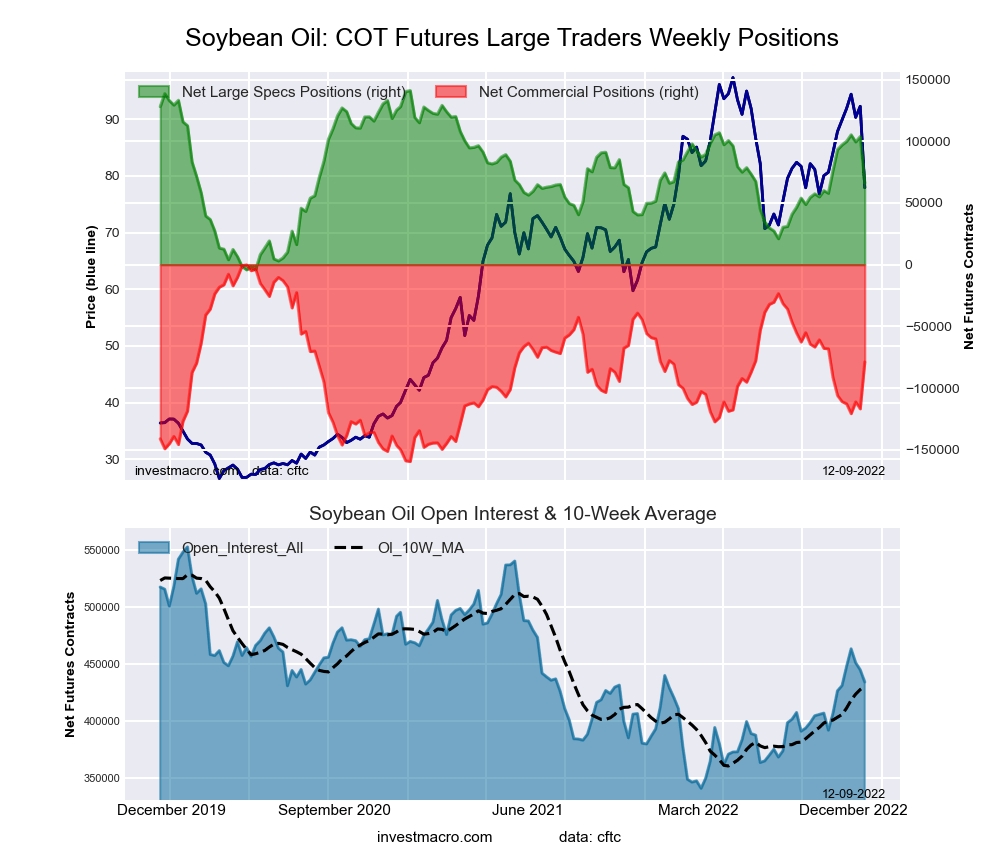
SOYBEAN OIL Futures COT ChartThe SOYBEAN OIL large speculator standing this week came in at a net position of 105,263 contracts in the data reported through Tuesday. This was a weekly boost of 5,282 contracts from the previous week which had a total of 99,981 net contracts.

This week’s current strength score (the trader positioning range over the past three years, measured from 0 to 100) shows the speculators are currently Bullish with a score of 75.3 percent. The commercials are Bearish with a score of 24.3 percent and the small traders (not shown in chart) are Bullish with a score of 71.3 percent.

SOYBEAN OIL Futures StatisticsSPECULATORSCOMMERCIALSSMALL TRADERS
– Percent of Open Interest Longs:30.042.88.9
– Percent of Open Interest Shorts:7.368.85.6
– Net Position:105,263-120,76815,505
– Gross Longs:138,838198,01341,274
– Gross Shorts:33,575318,78125,769
– Long to Short Ratio:4.1 to 10.6 to 11.6 to 1
NET POSITION TREND:
– Strength Index Score (3 Year Range Pct):75.324.371.3
– Strength Index Reading (3 Year Range):BullishBearishBullish
NET POSITION MOVEMENT INDEX:
– 6-Week Change in Strength Index:31.1-33.228.7


SOYBEAN MEAL Futures:

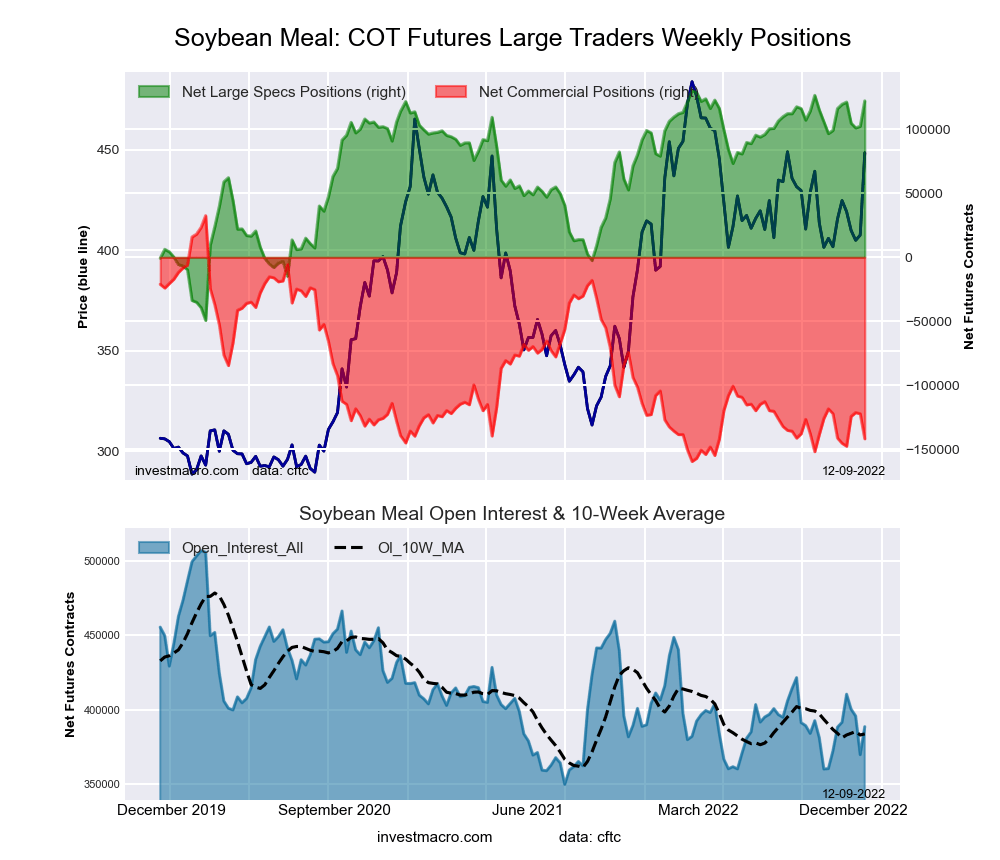
SOYBEAN MEAL Futures COT ChartThe SOYBEAN MEAL large speculator standing this week came in at a net position of 104,749 contracts in the data reported through Tuesday. This was a weekly reduction of -16,485 contracts from the previous week which had a total of 121,234 net contracts.

This week’s current strength score (the trader positioning range over the past three years, measured from 0 to 100) shows the speculators are currently Bullish-Extreme with a score of 85.8 percent. The commercials are Bearish-Extreme with a score of 18.3 percent and the small traders (not shown in chart) are Bearish with a score of 34.2 percent.

SOYBEAN MEAL Futures StatisticsSPECULATORSCOMMERCIALSSMALL TRADERS
– Percent of Open Interest Longs:31.341.811.7
– Percent of Open Interest Shorts:5.172.96.8
– Net Position:104,749-124,28219,533
– Gross Longs:125,175167,38746,718
– Gross Shorts:20,426291,66927,185
– Long to Short Ratio:6.1 to 10.6 to 11.7 to 1
NET POSITION TREND:
– Strength Index Score (3 Year Range Pct):85.818.334.2
– Strength Index Reading (3 Year Range):Bullish-ExtremeBearish-ExtremeBearish
NET POSITION MOVEMENT INDEX:
– 6-Week Change in Strength Index:-0.70.9-2.6


LIVE CATTLE Futures:

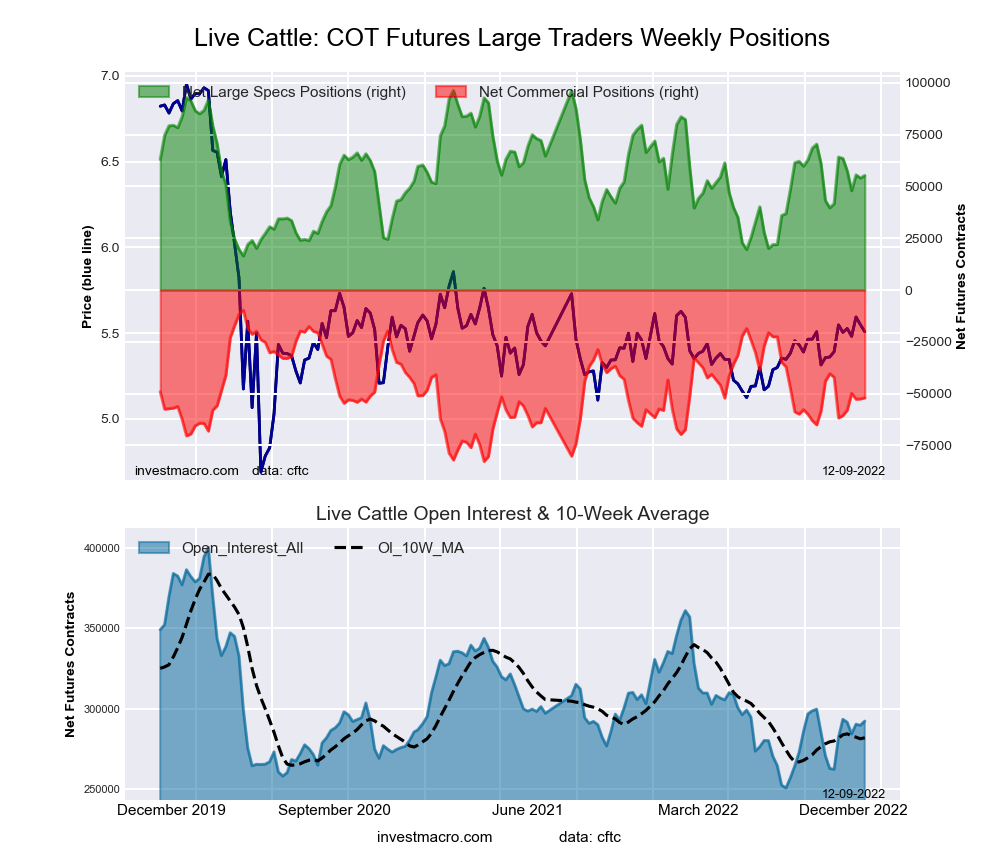
LIVE CATTLE Futures COT ChartThe LIVE CATTLE large speculator standing this week came in at a net position of 47,916 contracts in the data reported through Tuesday. This was a weekly decrease of -9,513 contracts from the previous week which had a total of 57,429 net contracts.

This week’s current strength score (the trader positioning range over the past three years, measured from 0 to 100) shows the speculators are currently Bearish with a score of 39.5 percent. The commercials are Bearish with a score of 45.0 percent and the small traders (not shown in chart) are Bullish-Extreme with a score of 100.0 percent.

LIVE CATTLE Futures StatisticsSPECULATORSCOMMERCIALSSMALL TRADERS
– Percent of Open Interest Longs:34.634.512.4
– Percent of Open Interest Shorts:17.752.011.7
– Net Position:47,916-49,8451,929
– Gross Longs:98,27498,08135,307
– Gross Shorts:50,358147,92633,378
– Long to Short Ratio:2.0 to 10.7 to 11.1 to 1
NET POSITION TREND:
– Strength Index Score (3 Year Range Pct):39.545.0100.0
– Strength Index Reading (3 Year Range):BearishBearishBullish-Extreme
NET POSITION MOVEMENT INDEX:
– 6-Week Change in Strength Index:6.0-8.14.3


LEAN HOGS Futures:

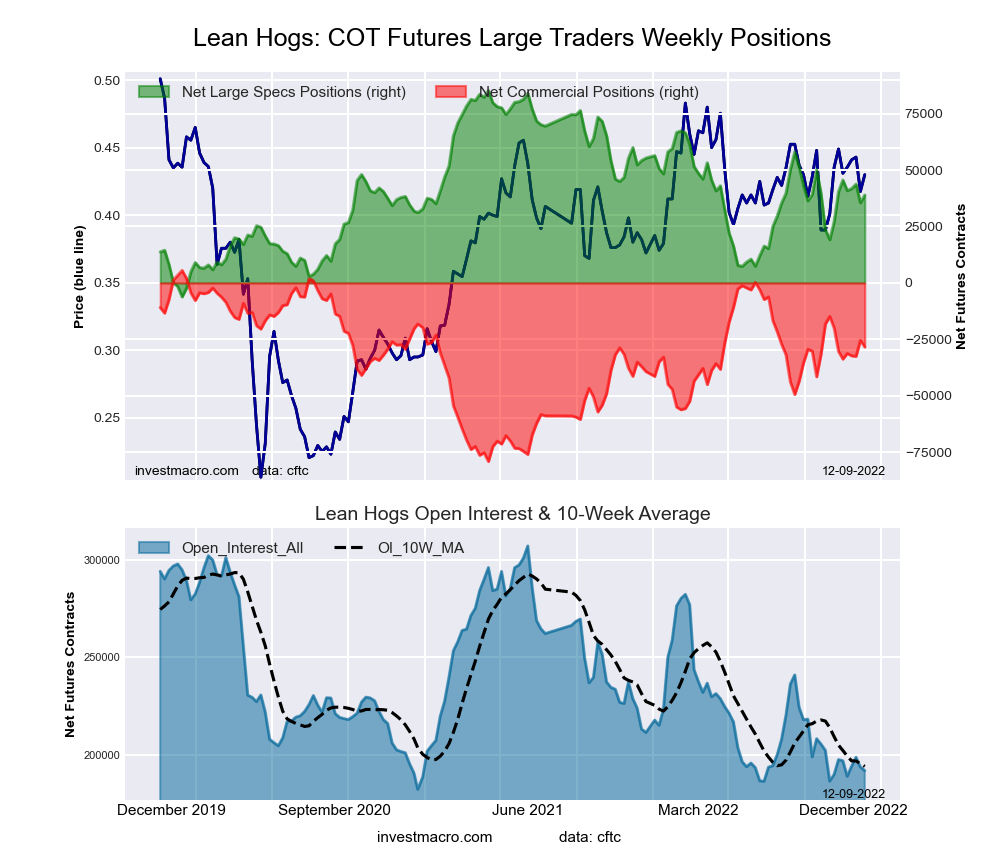
LEAN HOGS Futures COT ChartThe LEAN HOGS large speculator standing this week came in at a net position of 41,759 contracts in the data reported through Tuesday. This was a weekly rise of 897 contracts from the previous week which had a total of 40,862 net contracts.

This week’s current strength score (the trader positioning range over the past three years, measured from 0 to 100) shows the speculators are currently Bullish with a score of 52.2 percent. The commercials are Bullish with a score of 55.3 percent and the small traders (not shown in chart) are Bearish with a score of 47.4 percent.

LEAN HOGS Futures StatisticsSPECULATORSCOMMERCIALSSMALL TRADERS
– Percent of Open Interest Longs:40.134.89.0
– Percent of Open Interest Shorts:18.651.413.9
– Net Position:41,759-32,298-9,461
– Gross Longs:77,83567,50217,551
– Gross Shorts:36,07699,80027,012
– Long to Short Ratio:2.2 to 10.7 to 10.6 to 1
NET POSITION TREND:
– Strength Index Score (3 Year Range Pct):52.255.347.4
– Strength Index Reading (3 Year Range):BullishBullishBearish
NET POSITION MOVEMENT INDEX:
– 6-Week Change in Strength Index:19.8-16.7-20.9


COTTON Futures:

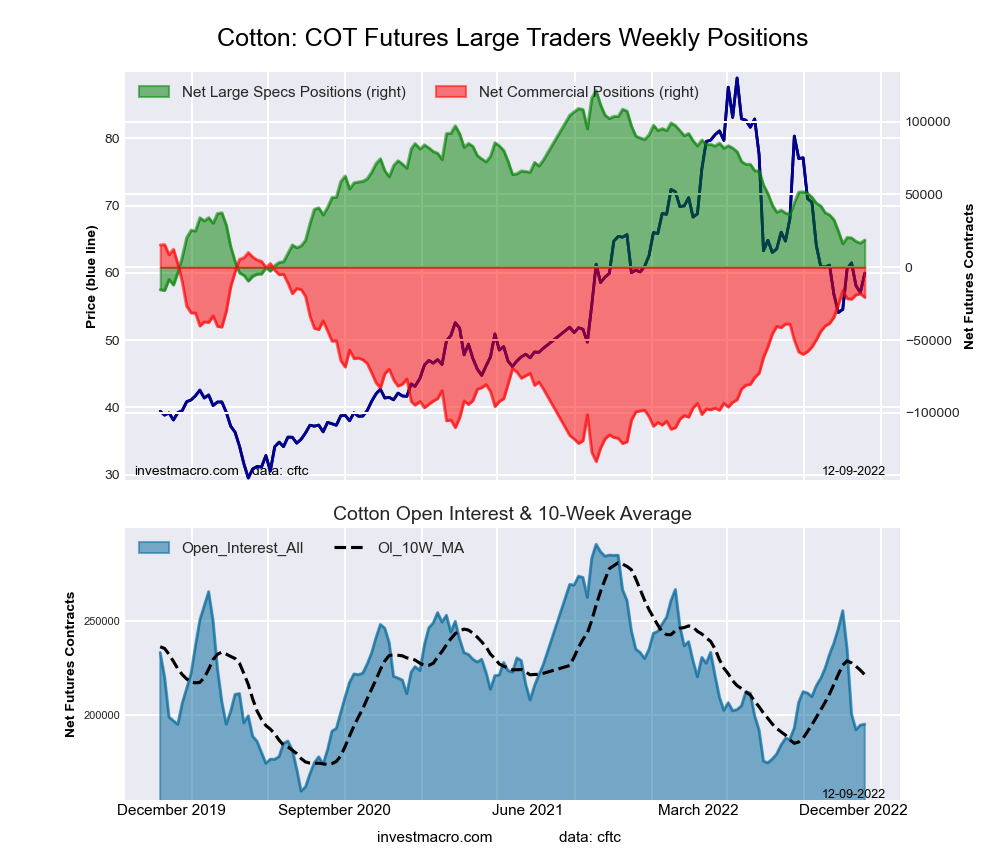
COTTON Futures COT ChartThe COTTON large speculator standing this week came in at a net position of 20,113 contracts in the data reported through Tuesday. This was a weekly decline of -364 contracts from the previous week which had a total of 20,477 net contracts.

This week’s current strength score (the trader positioning range over the past three years, measured from 0 to 100) shows the speculators are currently Bearish with a score of 24.2 percent. The commercials are Bullish with a score of 76.5 percent and the small traders (not shown in chart) are Bearish with a score of 21.9 percent.

COTTON Futures StatisticsSPECULATORSCOMMERCIALSSMALL TRADERS
– Percent of Open Interest Longs:33.147.26.9
– Percent of Open Interest Shorts:23.158.16.0
– Net Position:20,113-21,9001,787
– Gross Longs:66,42794,50313,814
– Gross Shorts:46,314116,40312,027
– Long to Short Ratio:1.4 to 10.8 to 11.1 to 1
NET POSITION TREND:
– Strength Index Score (3 Year Range Pct):24.276.521.9
– Strength Index Reading (3 Year Range):BearishBullishBearish
NET POSITION MOVEMENT INDEX:
– 6-Week Change in Strength Index:-13.012.6-6.5


COCOA Futures:

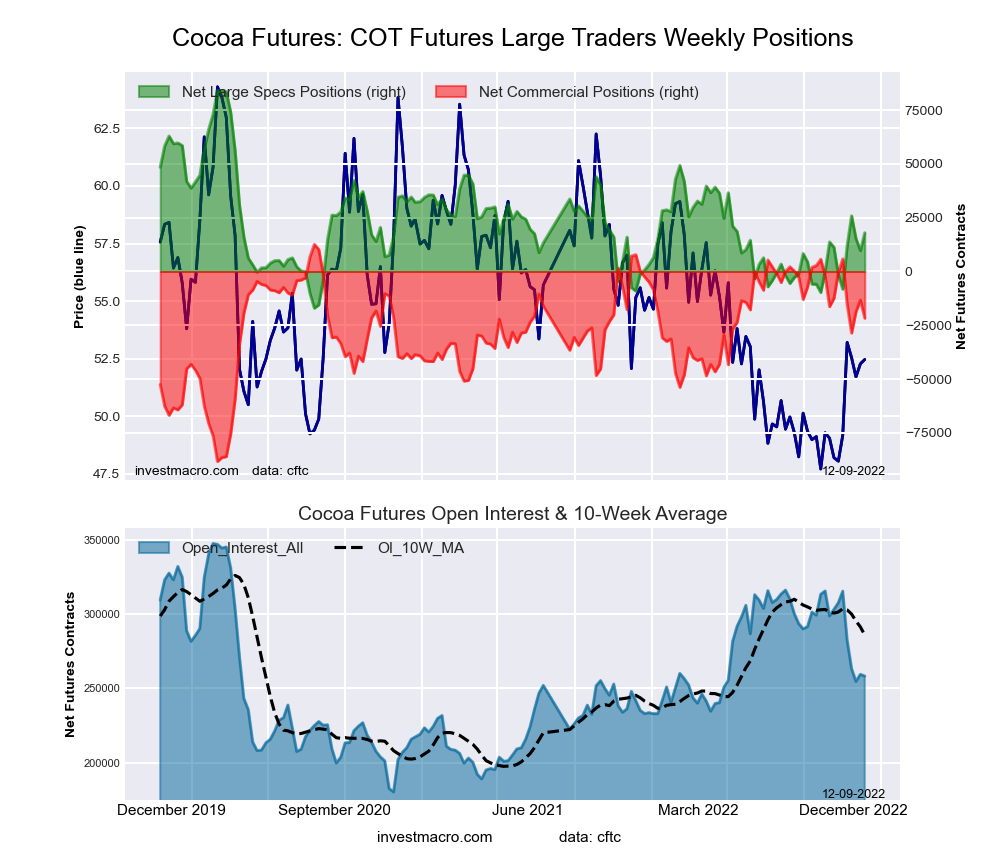
COCOA Futures COT ChartThe COCOA large speculator standing this week came in at a net position of 25,843 contracts in the data reported through Tuesday. This was a weekly advance of 13,895 contracts from the previous week which had a total of 11,948 net contracts.

This week’s current strength score (the trader positioning range over the past three years, measured from 0 to 100) shows the speculators are currently Bearish with a score of 42.4 percent. The commercials are Bullish with a score of 59.2 percent and the small traders (not shown in chart) are Bearish with a score of 24.1 percent.

COCOA Futures StatisticsSPECULATORSCOMMERCIALSSMALL TRADERS
– Percent of Open Interest Longs:32.345.94.5
– Percent of Open Interest Shorts:22.556.83.4
– Net Position:25,843-28,5972,754
– Gross Longs:85,052120,92511,816
– Gross Shorts:59,209149,5229,062
– Long to Short Ratio:1.4 to 10.8 to 11.3 to 1
NET POSITION TREND:
– Strength Index Score (3 Year Range Pct):42.459.224.1
– Strength Index Reading (3 Year Range):BearishBullishBearish
NET POSITION MOVEMENT INDEX:
– 6-Week Change in Strength Index:25.4-26.27.1


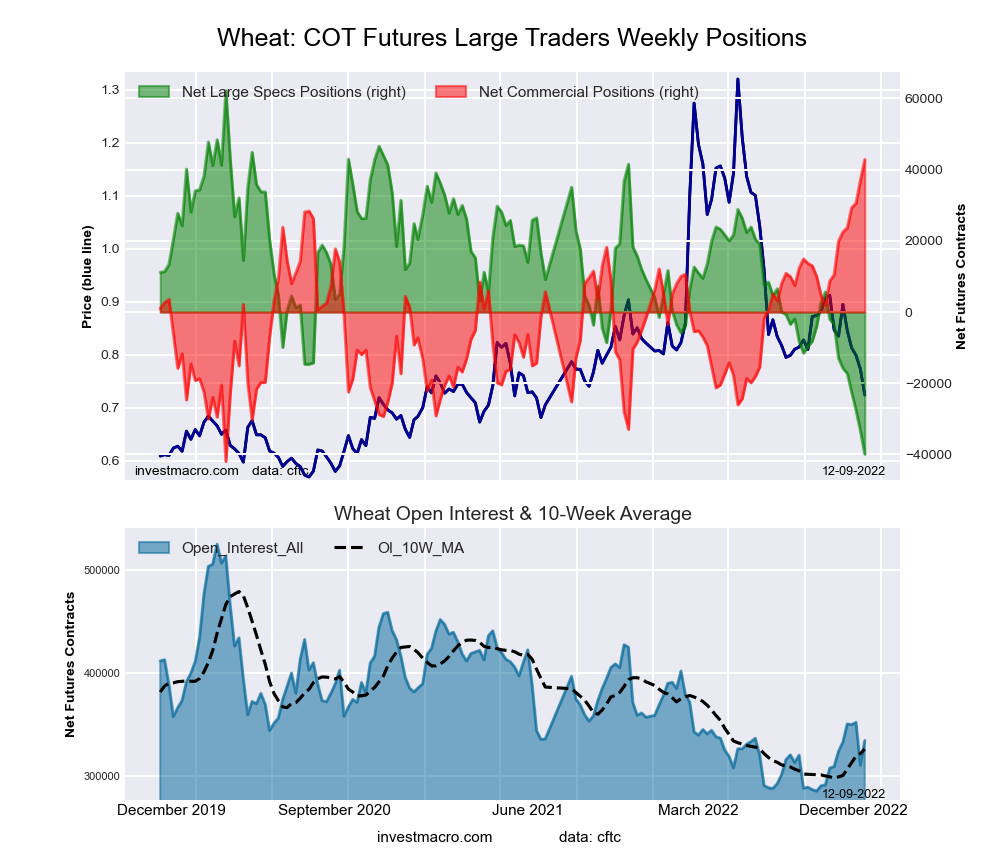
WHEAT Futures:

WHEAT Futures COT ChartThe WHEAT large speculator standing this week came in at a net position of -22,481 contracts in the data reported through Tuesday. This was a weekly decline of -5,267 contracts from the previous week which had a total of -17,214 net contracts.

This week’s current strength score (the trader positioning range over the past three years, measured from 0 to 100) shows the speculators are currently Bearish-Extreme with a score of 0.0 percent. The commercials are Bullish-Extreme with a score of 100.0 percent and the small traders (not shown in chart) are Bullish with a score of 75.0 percent.

WHEAT Futures StatisticsSPECULATORSCOMMERCIALSSMALL TRADERS
– Percent of Open Interest Longs:25.839.69.4
– Percent of Open Interest Shorts:32.231.211.3
– Net Position:-22,48129,310-6,829
– Gross Longs:90,194138,56532,837
– Gross Shorts:112,675109,25539,666
– Long to Short Ratio:0.8 to 11.3 to 10.8 to 1
NET POSITION TREND:
– Strength Index Score (3 Year Range Pct):0.0100.075.0
– Strength Index Reading (3 Year Range):Bearish-ExtremeBullish-ExtremeBullish
NET POSITION MOVEMENT INDEX:
– 6-Week Change in Strength Index:-33.238.53.6


Article By InvestMacroReceive our weekly COT Newsletter

*COT Report: The COT data, released weekly to the public each Friday, is updated through the most recent Tuesday (data is 3 days old) and shows a quick view of how large speculators or non-commercials (for-profit traders) were positioned in the futures markets.

The CFTC categorizes trader positions according to commercial hedgers (traders who use futures contracts for hedging as part of the business), non-commercials (large traders who speculate to realize trading profits) and nonreportable traders (usually small traders/speculators) as well as their open interest (contracts open in the market at time of reporting). See CFTC criteria here.
Dramatic collapse of the cryptocurrency exchange FTX contains lessons for investors but won’t affect most people

By D. Brian Blank, Mississippi State University and Brandy Hadley, Appalachian State University 

In the fast-paced world of cryptocurrency, vast sums of money can be made or lost in the blink of an eye. In early November 2022, the second-largest cryptocurrency exchange, FTX, was valued at more than US$30 billion. By Nov. 14, FTX was in bankruptcy proceedings along with more than 100 companies connected to it. D. Brian Blank and Brandy Hadley are professors who study finance, investing and fintech. They explain how and why this incredible collapse happened, what effect it might have on the traditional financial sector and whether you need to care if you don’t own any cryptocurrency.

1. What happened?

In 2019, Sam Bankman-Fried founded FTX, a company that ran one of the largest cryptocurrency exchanges.

FTX is where many crypto investors trade and hold their cryptocurrency, similar to the New York Stock Exchange for stocks. Bankman-Fried is also the founder of Alameda Research, a hedge fund that trades and invests in cryptocurrencies and crypto companies.

Within the traditional financial sector, these two companies would be separate firms entirely or at least have divisions and firewalls in place between them. But in early November 2022, news outlets reported that a significant proportion of Alameda’s assets were a type of cryptocurrency released by FTX itself.

A few days later, news broke that FTX had allegedly been loaning customer assets to Alameda for risky trades without the consent of the customers and also issuing its own FTX cryptocurrency for Alameda to use as collateral. As a result, criminal and regulatory investigators began scrutinizing FTX for potentially violating securities law.

These two pieces of news basically led to a bank run on FTX.

Large crypto investors, like FTX’s competitor Binance, as well as individuals, began to sell off cryptocurrency held on FTX’s exchange. FTX quickly lost its ability to meet customer withdrawals and halted trading. On Nov. 14, FTX was also hit by an apparent insider hack and lost $600 million worth of cryptocurrency.

That same day, FTX, Alameda Research and 130 other affiliated companies founded by Bankman-Fried filed for bankruptcy. This action may leave more than a million suppliers, employees and investors who bought cryptocurrencies through the exchange or invested in these companies with no way to get their money back.

Among the groups and individuals who held currency on the FTX platform were many of the normal players in the crypto world, but a number of more traditional investment firms also held assets within FTX. Sequoia Capital, a venture capital firm, as well as the Ontario Teacher’s Pension, are estimated to have held millions of dollars of their investment portfolios in ownership stake of FTX. They have both already written off these investments with FTX as lost.

2. Did a lack of oversight play a role?

In traditional markets, corporations generally limit the risk they expose themselves to by maintaining liquidity and solvency. Liquidity is the ability of a firm to sell assets quickly without those assets losing much value. Solvency is the idea that a company’s assets are worth more than what that company owes to debtors and customers.

But the crypto world has generally operated with much less caution than the traditional financial sector, and FTX is no exception. About two-thirds of the money that FTX owed to the people who held cryptocurrency on its exchange – roughly $11.3 billion of $16 billion owed – was backed by illiquid coins created by FTX. FTX was taking its customers’ money, giving it to Alameda to make risky investments and then creating its own currency, known as FTT, as a replacement – cryptocurrency that it was unable to sell at a high enough price when it needed to.

In addition, nearly 40% of Alameda’s assets were in FTX’s own cryptocurrency – and remember, both companies were founded by the same person.

This all came to a head when investors decided to sell their coins on the exchange. FTX did not have enough liquid assets to meet those demands. This in turn drove the value of FTT from over $26 a coin at the beginning of November to under $2 by Nov. 13. By this point, FTX owed more money to its customers than it was worth.

In regulated exchanges, investing with customer funds is illegal. Additionally, auditors validate financial statements, and firms must publish the amount of money they hold in reserve that is available to fund customer withdrawals. And even if things go wrong, the Securities Investor Protection Corporation – or SIPC – protects depositors against the loss of investments from an exchange failure or financially troubled brokerage firm. None of these guardrails are in place within the crypto world.

3. Why is this a big deal in crypto?

As a result of this meltdown, the company Binance is now considering creating an industry recovery fund – akin to a private version of SIPC insurance – to avoid future failures of crypto exchanges.

But while the collapse of FTX and Alameda – valued at more than $30 billion and now essentially worth nothing – is dramatic, the bigger implication is simply the potential lost trust in crypto. Bank runs are rare in traditional financial institutions, but they are increasingly common in the crypto space. Given that Bankman-Fried and FTX were seen as some of the biggest, most trusted figures in crypto, these events may lead more investors to think twice about putting money in crypto.

4. If I don’t own crypto, should I care?

Though investment in cryptocurrencies has grown rapidly, the entire crypto market – valued at over $3 trillion at its peak – is much smaller than the $120 trillion traditional stock market.

While investors and regulators are still evaluating the consequences of this fall, the impact on any person who doesn’t personally own crypto will be minuscule. It is true that many larger investment funds, like BlackRock and the Ontario Teachers Pension, held investments in FTX, but the estimated $95 million the Ontario Teachers Pension lost through the collapse of FTX is just 0.05% of the entire fund’s investments.

The takeaway for most individuals is not to invest in unregulated markets without understanding the risks. In high-risk environments like crypto, it’s possible to lose everything – a lesson investors in FTX are learning the hard way.The Conversation

About the Author:

D. Brian Blank, Assistant Professor of Finance, Mississippi State University and Brandy Hadley, Associate Professor of Finance and the David A. Thompson Professor in Applied Investments, Appalachian State University

This article is republished from The Conversation under a Creative Commons license. Read the original article.

Ichimoku Cloud Analysis 18.11.2022 (EURUSD, AUDUSD, GBPUSD)

By RoboForex.com

EURUSD

The pair is pushing off the signal lines of the indicator, going below the Ichimoku Cloud, which suggests the prevalence of an uptrend. A test of the upper border of the Cloud is expected at 1.0285, followed by growth to 1.0715. An additional signal confirming the growth will be a bounce off the lower border of the bullish channel. The scenario can be cancelled by a breakaway of the lower border of the Cloud and securing under 1.0015, which will entail further falling to 0.9925. The growth can be confirmed by a breakaway of the upper border of the descending channel and securing above 1.0425.

EURUSD
Risk Warning: the result of previous trading operations do not guarantee the same results in the future

AUDUSD

The pair is testing the resistance level, going above the Ichimoku Cloud, which means an uptrend. A test of the upper border of the Cloud is expected at 0.6655, followed by growth to 0.6955. An additional signal confirming the growth will be a bounce off the lower border of the bullish channel. The scenario can be cancelled by a breakaway of the lower border of the Cloud and securing under 0.6445, which will entail further falling to 0.6345. The growth can be secured by a breakaway of the upper border of the correctional channel and securing above 0.6745.

AUDUSD
Risk Warning: the result of previous trading operations do not guarantee the same results in the future

GBPUSD

The pair has secured above the upper border of the bullish channel, going above the Ichimoku Cloud, which suggests the prevalence of an uptrend. A test of the Tenkan-Sen line at 1.1825 is expected, followed by growth to 1.2305. An additional signal confirming the growth of the pair will be a bounce off the lower border of the ascending channel. The scenario can be cancelled by a breakaway of the lower border of the Cloud and securing under 1.1455, which will mean further falling to 1.1365.

GBPUSD

Article By RoboForex.com

Attention!
Forecasts presented in this section only reflect the author’s private opinion and should not be considered as guidance for trading. RoboForex LP bears no responsibility for trading results based on trading recommendations described in these analytical reviews.

Murrey Math Lines 18.11.2022 (Brent, S&P 500)

By RoboForex.com

BRENT

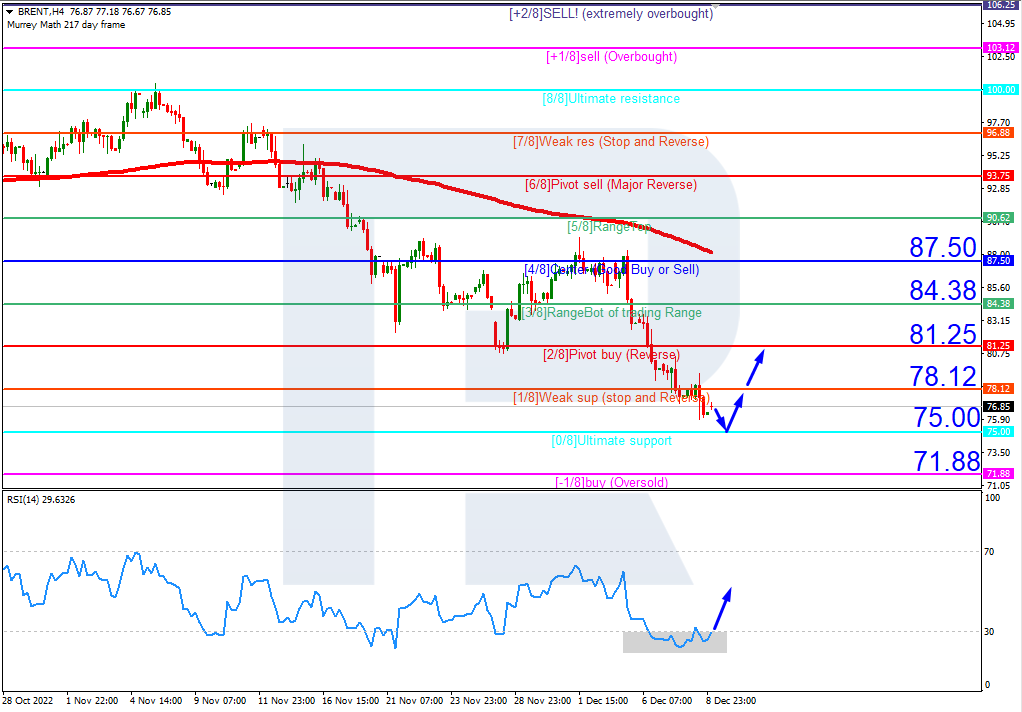
On H4, the quotes are under the 200-day Moving Average, which indicates prevalence of the downtrend. The RSI is nearing the oversold area. Currently, we should expect a test of 1/8 (89.06), a breakaway of it, and falling to the support level of 0/8 (87.50). The scenario can be cancelled by rising over the resistance level of 2/8 (90.62). In this case, the quotes might rise to 3/8 (92.19).

BRENTH4
Risk Warning: the result of previous trading operations do not guarantee the same results in the future

On M15, the lower line of VoltyChannel is broken away, which confirms the downtrend and a high probability of further price falling.

BRENT_M15
Risk Warning: the result of previous trading operations do not guarantee the same results in the future

S&P 500

On H4, the quotes have bounced off the 200-day Moving Average and are now beneath it, which indicates the prevalence of a downtrend. The RSI is testing the resistance line. Currently, we expect the price to break through the support level of 1/8 (3906.2) downwards and fall to 0/8 (3750.0). The scenario can be cancelled by rising over the resistance level of 2/8 (4062.5). This might lead to a trend reversal and growth of the index quotes to 3/8 (4218.8).

S&P 500_H4
Risk Warning: the result of previous trading operations do not guarantee the same results in the future

On M15, the lower line of VoltyChannel is broken away, which increases the probability of further falling.

S&P 500_M15

Article By RoboForex.com

Attention!
Forecasts presented in this section only reflect the author’s private opinion and should not be considered as guidance for trading. RoboForex LP bears no responsibility for trading results based on trading recommendations described in these analytical reviews.

Week Ahead: More Pain Ahead For USD?

By ForexTime

Nobody, it seems loves the dollar which has weakened against every single G10 currency this month.

It was already suffering from markets scaling back bets for further aggressive Fed rate increases, but the most recent soft US inflation report dealt the knockout blow. With signs of cooling inflation significantly reducing the pressure for the Fed to keep raising rates aggressively, the dollar could be yanked from its throne sooner than expected.

Before we discuss the technical and fundamental forces that may influence the not so mighty dollar, here are the scheduled economic data releases/events in the coming week:

Monday, 21 November

  • CNH: China loan prime rates
  • EUR: Germany producer prices
  • USD: US Chicago Fed national activity index

Tuesday, 22 November

  • CNH: China Bloomberg economic survey
  • EUR: Euro area consumer confidence
  • USD: US Richmond Fed manufacturing index, Cleveland Fed President Loretta and St. Louis Fed President James Bullard speech

Wednesday, 23 November

  • NZD: Reserve Bank of New Zealand rate decision
  • EUR: S&P Global PMIs Euro area
  • USD: FOMC minutes of November meeting, University of Michigan sentiment

Thursday, 24 November

  • EUR: Germany IFO business climate, ECB minutes of October meeting
  • NGN: Nigeria GDP
  • US markets closed for the Thanksgiving holiday

Friday, 25 November

  • EUR: Germany GDP
  • NZD: New Zealand consumer confidence index
  • US markets close early

On paper, the week ahead looks relatively quiet with US stock and bond markets closed on Thursday for Thanksgiving. But looks can be deceiving with economic reports, central bank meetings in Israel and New Zealand among others in addition to speeches from financial heavyweights potentially injecting some more life into markets.

In regards to the USD, attention will be directed towards the US Chicago Fed national activity index and US Fed manufacturing index earlier in the week. However, the main risk event and potential shaker will be the FOMC minutes for the November meeting which could provide clues on the pace of US rate hikes. Although the central bank raised interest by 75 basis points during the meeting, it signalled that the next hike could be smaller. Any fresh information regarding this could reinforce expectations around the Fed dialling back on aggressive rates, especially after the soft US inflation figures. Such an outcome is likely to weaken the dollar further, dragging the equally weighted dollar index below 1.1900.

Looking beyond the FOMC minutes, EU energy ministers are scheduled to hold an emergency meeting in Brussels on Thursday which could influence market sentiment, possibly having a knock-on effect on the USD. On Friday, US markets close early as Black Friday marks the start of the festive shopping season.

Talking technicals, the equally weighted dollar Index remains under intense pressure on the daily charts. With the dollar stripped of its glory and fundamental forces supporting bears, the path of least resistance for the Index points south. A strong breakdown below 1.1900 could open a path towards 1.1700 and 1.1600, respectively. A move back above 1.2184 could signal an incline towards 1.2400.


Forex-Time-LogoArticle by ForexTime

ForexTime Ltd (FXTM) is an award winning international online forex broker regulated by CySEC 185/12 www.forextime.com

The Analytical Overview of the Main Currency Pairs on 2022.11.18

By JustMarkets

The EUR/USD currency pair

Technical indicators of the currency pair:
  • Prev Open: 1.0392
  • Prev Close: 1.0364
  • % chg. over the last day: -0.27 %

The Eurozone’s annual inflation rate decreased from 10.7% to 10.6%. Core Inflation (excluding food and fuel prices) remained at 5% y/y. The data points to a possible peak in inflation. This increases the likelihood that the ECB will raise interest rates by 0.5% at its next meeting rather than by 0.75%, as previously discussed. ECB spokesman Lane said yesterday that the ECB expects inflation to fall next year but also noted the importance of further interest rate hikes.

Trading recommendations
  • Support levels: 1.0193, 1.0092, 1.0043, 0.9812
  • Resistance levels: 1.0384, 1.0504

From the technical point of view, the trend on the EUR/USD currency pair on the hourly time frame is bullish. The price is trading at the level of moving averages, the MACD indicator has become inactive, and the price is trading in a narrow price range. For buy deals, it is best to wait for a corrective movement to the support levels of 1.0193 or 1.0092, but with additional confirmation. Sell deals can be considered from the resistance level of 1.0384 inside the day, but it is also better with confirmation in the initiative on the lower time frames.

Alternative scenario: if the price breaks down through the support level of 0.9993 and fixes below it, the downtrend will likely resume.

EUR/USD
News feed for 2022.11.18:
  • – Eurozone ECB President Lagarde Speaks at 10:30 (GMT+2);
  • – US Existing Home Sales (m/m) at 17:00 (GMT+2).

The GBP/USD currency pair

Technical indicators of the currency pair:
  • Prev Open: 1.1913
  • Prev Close: 1.1863
  • % chg. over the last day: -0.42 %

On Thursday, the UK government unveiled a £55 billion ($66 billion) budget plan aimed at closing the hole in public finances and restoring confidence in the British economy. These measures will increase financial hardship for millions of Britons, who are facing the country’s worst cost-of-living crisis in decades and its longest recession. Jeremy Hunt pointed out that these measures are necessary to curb inflation, which has reached a 41-year high and restore Britain’s reputation.

Trading recommendations
  • Support levels: 1.1684, 1.1476, 1.1418, 1.1172, 1.1093, 1.0915, 1.0817
  • Resistance levels: 1.1921

From the technical point of view, the GBP/USD currency pair trend on the hourly time frame is bullish. The price is trading at the level of the moving averages. The MACD indicator has become inactive, and the divergence indicates weakness and a possible correction. Under such market conditions, it is better to look for buy deals after a slight correction to the support levels of 1.1684 or even 1.1476. Sell trades are best sought on intraday time frames from the resistance level of 1.1921.

Alternative scenario: if the price breaks down of the 1.1418 support level and fixes below it, the downtrend will likely resume.

GBP/USD
News feed for 2022.11.18:
  • – UK Retail Sales (m/m) at 09:00 (GMT+2).

The USD/JPY currency pair

Technical indicators of the currency pair:
  • Prev Open: 139.46
  • Prev Close: 140.21
  • % chg. over the last day: +0.53 %

Japan’s nationwide core consumer price index rose to a 40-year high from 3% to 3.6%, with an expectation of 3.5%. But despite the fact that the inflation rate has already exceeded the BoJ’s inflation target of 2% for the seventh time, the BoJ governor was quick to release a statement that an interest rate hike is undesirable at the moment. Thus, due to the divergent monetary policies of the Japanese banks and the US Federal Reserve, USD/JPY quotes are still inclined to rise.

Trading recommendations
  • Support levels: 139.44, 137.65, 136.80
  • Resistance levels: 141.05, 143.17, 145.16, 146.06, 147.34, 148.82, 150.00

From the technical point of view, the medium-term trend on the currency pair USD/JPY is bearish. The price is trading at the level of the moving averages. The MACD indicator has become inactive again, indicating the uncertainty of the market participants. The price is flying in a narrow corridor, which makes it difficult to find good entry points. Under such market conditions, buy trades can be searched for on intraday time frames from the support level of 139.44, but only with confirmation. Sell deals can be searched from the resistance level of 141.05, provided there is a reversal or a false breakout.

Alternative scenario: If the price fixes above 146.06, the uptrend will likely resume.

USD/JPY
News feed for 2022.11.18:
  • – Japan National Consumer Price Index (m/m) at 01:30 (GMT+2).

The USD/CAD currency pair

Technical indicators of the currency pair:
  • Prev Open: 1.3324
  • Prev Close: 1.3326
  • % chg. over the last day: +0.02 %

Higher interest rates have driven up the cost of credit in Canada, with mortgage rates up 11.4% for the year, the largest increase since February 1991. This, combined with higher rents, helped raise housing rates. The Bank of Canada raised its prime rate by 350 basis points from March to 3.75%, one of the fastest tightening cycles on record. Money markets are betting mainly on a 25 bps hike at the Bank of Canada’s next meeting on Dec. 7.

Trading recommendations
  • Support levels: 1.3281, 1.3212
  • Resistance levels: 1.3508, 1.3608, 1.3682, 1.3776, 1.3855, 1.3968

From the point of view of technical analysis, the trend on the USD/CAD currency pair is bearish. But inside the day, there is a slight dominance of buying. The MACD indicator has become inactive again, and the price is trading at the level of moving averages. The best way to sell is to consider the resistance level of 1.3508, but with confirmation. Buy trades should be considered on the lower time frames from the support level of 1.3281, but with additional confirmation in the form of a reverse initiative.

Alternative scenario: if the price breaks out and consolidates above the resistance level of 1.3508, the uptrend will likely resume.

USD/CAD
There is no news feed for today.

By JustMarkets


This article reflects a personal opinion and should not be interpreted as an investment advice, and/or offer, and/or a persistent request for carrying out financial transactions, and/or a guarantee, and/or a forecast of future events.

COP27 deadlock shows why private money is needed for climate crisis

By George Prior

The deadlock at COP27 underscores why political leaders cannot be trusted to tackle the climate crisis and why private money must be urgently mobilized.

This is the stark warning from Nigel Green, the CEO and founder of deVere Group, one of the world’s largest independent financial advisory, asset management and fintech organizations.

It comes as the EU offered a plan late on Thursday to find a solution to deadlocked climate talks at COP27 in Egypt, suggesting a loss and damage finance facility for the most vulnerable countries in return for a vow to phase down oil, gas and coal.

The deVere CEO says: “The official draft of the decision text put forward by the Egyptian presidency on Friday morning goes nowhere near hard enough on the phasing out of fossil fuels – a major condition for the European Union.

“This is unlikely to break the deadlock.

“As such, talks are now likely to go on into the weekend.”

He continues: “This deadlock shows how politicians, especially those in developed countries, are often all talk, less action.

“But what is required is major action – and now – if we are to reverse the worst impact of human-created climate change.

“To date, there have been decades of inaction from political leaders. Governments around the world are either unwilling or unable to funnel the resources necessary to try and tackle the problem head-on.

“Therefore, it is critical that the private money is mobilized and harnessed to usher in an era of real action before it’s too late.”

Nigel Green has long been issuing a ‘call to arms’ in this regard.  Ahead of COP27, he noted: “Trillions of dollars are needed. This is why it is now critical that private money is unlocked and mobilized in the battle to mitigate the worst effects of human-created climate change.

“For this to happen, all sectors within the financial industry need to step-up, including financial advisories, insurance firms, banks, wealth and asset managers, investment companies, fintech groups, banks and auditors.

“If we fail on this, the level of finance will not be available, nor at the pace necessary, to halt the catastrophic effects of global warming.”

The deVere Group CEO’s calls come after he has publicly criticized some within the financial advisory industry who fail to urge clients to invest in Environmental, Social and Governance (ESG) orientated investments.

“I would say to those in our industry who are looking to weaponize or politicize ESG investing by branding it as ‘woke virtue-signalling’, amongst other things, that they are placing themselves and their companies on the wrong side of history.”

He went on to add that clients’ investment strategies would also benefit.

“Funds investing in entities with robust ESG credentials have outperformed their benchmarks over recent years. From a risk management point of view, including these companies in your portfolio is, clearly, a sensible decision to take.”

Last year ahead of COP26, deVere Group became one of 18 founding signatories of the UN-backed Net Zero initiative, the international alliance of powerhouse global finance companies that will help accelerate the transition to a net zero financial system.

The deVere CEO concludes: “The leaders at COP27 need to urgently step up or the summit becomes little more than a ‘talking shop.’ I hope they do.

“But there is no doubt that huge amounts of private money will also be needed.”

About:

deVere Group is one of the world’s largest independent advisors of specialist global financial solutions to international, local mass affluent, and high-net-worth clients.  It has a network of more than 70 offices across the world, over 80,000 clients and $12bn under advisement.