Archive for Healthcare

Heathcare and Biotech Updates

A billion-dollar drug was found in Easter Island soil – what scientists and companies owe the Indigenous people they studied

By Ted Powers, University of California, Davis 

An antibiotic discovered on Easter Island in 1964 sparked a billion-dollar pharmaceutical success story. Yet the history told about this “miracle drug” has completely left out the people and politics that made its discovery possible.

Named after the island’s Indigenous name, Rapa Nui, the drug rapamycin was initially developed as an immunosuppressant to prevent organ transplant rejection and to improve the efficacy of stents to treat coronary artery disease. Its use has since expanded to treat various types of cancer, and researchers are currently exploring its potential to
treat diabetes,
neurodegenerative diseases and
even aging. Indeed, studies raising rapamycin’s promise to extend lifespan or combat age-related diseases seem to be published almost daily. A PubMed search reveals over 59,000 journal articles that mention rapamycin, making it one of the most talked-about drugs in medicine.

Connected hexagonal structures
Chemical structure of rapamycin.
Fvasconcellos/Wikimedia Commons

At the heart of rapamycin’s power lies its ability to inhibit a protein called the target of rapamycin kinase, or TOR. This protein acts as a master regulator of cell growth and metabolism. Together with other partner proteins, TOR controls how cells respond to nutrients, stress and environmental signals, thereby influencing major processes such as protein synthesis and immune function. Given its central role in these fundamental cellular activities, it is not surprising that cancer, metabolic disorders and age-related diseases are linked to the malfunction of TOR.

Despite being so ubiquitous in science and medicine, how rapamycin was discovered has remained largely unknown to the public. Many in the field are aware that scientists from the pharmaceutical company Ayerst Research Laboratories isolated the molecule from a soil sample containing the bacterium Streptomyces hydroscopicus in the mid-1970s. What is less well known is that this soil sample was collected as part of a Canadian-led mission to Rapa Nui in 1964, called the Medical Expedition to Easter Island, or METEI.

As a scientist who built my career around the effects of rapamycin on cells, I felt compelled to understand and share the human story underlying its origin. Learning about historian Jacalyn Duffin’s work on METEI completely changed how I and many of my colleagues view our own field.

Unearthing rapamycin’s complex legacy raises important questions about systemic bias in biomedical research and what pharmaceutical companies owe to the Indigenous lands from which they mine their blockbuster discoveries.

History of METEI

The Medical Expedition to Easter Island was the brainchild of a Canadian team comprised of surgeon Stanley Skoryna and bacteriologist Georges Nogrady. Their goal was to study how an isolated population adapted to environmental stress, and they believed the planned construction of an international airport on Easter Island offered a unique opportunity. They presumed that the airport would result in increased outside contact with the island’s population, resulting in changes in their health and wellness.

With funding from the World Health Organization and logistical support from the Royal Canadian Navy, METEI arrived in Rapa Nui in December 1964. Over the course of three months, the team conducted medical examinations on nearly all 1,000 island inhabitants, collecting biological samples and systematically surveying the island’s flora and fauna.

It was as part of these efforts that Nogrady gathered over 200 soil samples, one of which ended up containing the rapamycin-producing Streptomyces strain of bacteria.

Poster of the word METEI written vertically between the back of two moai heads, with the inscription '1964-1965 RAPA NUI INA KA HOA (Don't give up the ship)'
METEI logo.
Georges Nogrady, CC BY-NC-ND

It’s important to realize that the expedition’s primary objective was to study the Rapa Nui people as a sort of living laboratory. They encouraged participation through bribery by offering gifts, food and supplies, and through coercion by enlisting a long-serving Franciscan priest on the island to aid in recruitment. While the researchers’ intentions may have been honorable, it is nevertheless an example of scientific colonialism, where a team of white investigators choose to study a group of predominantly nonwhite subjects without their input, resulting in a power imbalance.

There was an inherent bias in the inception of METEI. For one, the researchers assumed the Rapa Nui had been relatively isolated from the rest of the world when there was in fact a long history of interactions with countries outside the island, beginning with reports from the early 1700s through the late 1800s.

METEI also assumed that the Rapa Nui were genetically homogeneous, ignoring the island’s complex history of migration, slavery and disease. For example, the modern population of Rapa Nui are mixed race, from both Polynesian and South American ancestors. The population also included survivors of the African slave trade who were returned to the island and brought with them diseases, including smallpox.

This miscalculation undermined one of METEI’s key research goals: to assess how genetics affect disease risk. While the team published a number of studies describing the different fauna associated with the Rapa Nui, their inability to develop a baseline is likely one reason why there was no follow-up study following the completion of the airport on Easter Island in 1967.

Giving credit where it is due

Omissions in the origin stories of rapamycin reflect common ethical blind spots in how scientific discoveries are remembered.

Georges Nogrady carried soil samples back from Rapa Nui, one of which eventually reached Ayerst Research Laboratories. There, Surendra Sehgal and his team isolated what was named rapamycin, ultimately bringing it to market in the late 1990s as the immunosuppressant Rapamune. While Sehgal’s persistence was key in keeping the project alive through corporate upheavals – going as far as to stash a culture at home – neither Nogrady nor the METEI was ever credited in his landmark publications.

Although rapamycin has generated billions of dollars in revenue, the Rapa Nui people have received no financial benefit to date. This raises questions about Indigenous rights and biopiracy, which is the commercialization of Indigenous knowledge.

Agreements like the United Nations’s 1992 Convention on Biological Diversity and the 2007 Declaration on the Rights of Indigenous Peoples aim to protect Indigenous claims to biological resources by encouraging countries to obtain consent and input from Indigenous people and provide redress for potential harms before starting projects. However, these principles were not in place during METEI’s time.

Some argue that because the bacteria that produces rapamycin has since been found in other locations, Easter Island’s soil was not uniquely essential to the drug’s discovery. Moreover, because the islanders did not use rapamycin or even know about its presence on the island, some have countered that it is not a resource that can be “stolen.”

However, the discovery of rapamycin on Rapa Nui set the foundation for all subsequent research and commercialization around the molecule, and this only happened because the people were the subjects of study. Formally recognizing and educating the public about the essential role the Rapa Nui played in the eventual discovery of rapamycin is key to compensating them for their contributions.

In recent years, the broader pharmaceutical industry has begun to recognize the importance of fair compensation for Indigenous contributions. Some companies have pledged to reinvest in communities where valuable natural products are sourced. However, for the Rapa Nui, pharmaceutical companies that have directly profited from rapamycin have not yet made such an acknowledgment.

Ultimately, METEI is a story of both scientific triumph and social ambiguities. While the discovery of rapamycin has transformed medicine, the expedition’s impact on the Rapa Nui people is more complicated. I believe issues of biomedical consent, scientific colonialism and overlooked contributions highlight the need for a more critical examination and awareness of the legacy of breakthrough scientific discoveries.The Conversation

About the Author:

Ted Powers, Professor of Molecular and Cellular Biology, University of California, Davis

This article is republished from The Conversation under a Creative Commons license. Read the original article.
RNA has newly identified role: Repairing serious DNA damage to maintain the genome

By Francesca Storici, Georgia Institute of Technology 

Your DNA is continually damaged by sources both inside and outside your body. One especially severe form of damage called a double-strand break involves the severing of both strands of the DNA double helix.

Double-strand breaks are among the most difficult forms of DNA damage for cells to repair because they disrupt the continuity of DNA and leave no intact template to base new strands on. If misrepaired, these breaks can lead to other mutations that make the genome unstable and increase the risk of many diseases, including cancer, neurodegeneration and immunodeficiency.

Cells primarily repair double-strand breaks by either rejoining the broken DNA ends or by using another DNA molecule as a template for repair. However, my team and I discovered that RNA, a type of genetic material best known for its role in making proteins, surprisingly plays a key role in facilitating the repair of these harmful breaks.

These insights could not only pave the way for new treatment strategies for genetic disorders, cancer and neurodegenerative diseases, but also enhance gene-editing technologies.

Sealing a knowledge gap in DNA repair

I have spent the past two decades investigating the relationship between RNA and DNA in order to understand how cells maintain genome integrity and how these mechanisms could be harnessed for genetic engineering.

A long-standing question in the field has been whether RNA in cells helps keep the genome stable beyond acting as a copy of DNA in the process of making proteins and a regulator of gene expression. Studying how RNA might do this has been especially difficult due to its similarity to DNA and how fast it degrades. It’s also technically challenging to tell whether the RNA is directly working to repair DNA or indirectly regulating the process. Traditional models and tools for studying DNA repair have for the most part focused on proteins and DNA, leaving RNA’s potential contributions largely unexplored.

RNA plays a key role in protein synthesis.

My team and I were curious about whether RNA might actively participate in fixing double-strand breaks as a first line of defense. To explore this, we used the gene-editing tool CRISPR-Cas9 to make breaks at specific spots in the DNA of human and yeast cells. We then analyzed how RNA influences various aspects of the repair process, including efficiency and outcomes.

We found that RNA can actively guide the repair process of double-strand breaks. It does this by binding to broken DNA ends, helping align sequences of DNA on a matching strand that isn’t broken. It can also seal gaps or remove mismatched segments, further influencing whether and how the original sequence is restored.

Additionally, we found that RNA aids in double-strand break repair in both yeast and human cells, suggesting that its role in DNA repair is evolutionary conserved across species. Notably, even low levels of RNA were sufficient to influence the efficiency and outcome of repair, pointing to its broad and previously unrecognized function in maintaining genome stability.

RNA in control

By uncovering RNA’s previously unknown function to repair DNA damage, our findings show how RNA may directly contribute to the stability and evolution of the genome. It’s not merely a passive messenger, but an active participant in genome maintenance.

These insights could help researchers develop new ways to target the genomic instability that underlies many diseases, including cancer and neurodegeneration. Traditionally, treatments and gene-editing tools have focused almost exclusively on DNA or proteins. Our findings suggest that modifying RNA in different ways could also influence how cells respond to DNA damage. For example, researchers could design RNA-based therapies to enhance the repair of harmful breaks that could cause cancer, or selectively disrupt DNA break repair in cancer cells to help kill them.

In addition, these findings could improve the precision of gene-editing technologies like CRISPR by accounting for interactions between RNA and DNA at the site of the cut. This could reduce off-target effects and increase editing precision, ultimately contributing to the development of safer and more effective gene therapies.

There are still many unanswered questions about how RNA interacts with DNA in the repair process. The evolutionary role that RNA plays in maintaining genome stability is also unclear. But one thing is certain: RNA is no longer just a messenger, it is a molecule with a direct hand in DNA repair, rewriting what researchers know about how cells safeguard their genetic code.The Conversation

About the Author:

Francesca Storici, Professor of Biological Sciences, Georgia Institute of Technology

This article is republished from The Conversation under a Creative Commons license. Read the original article.


Top Healthcare Companies scored from recent earnings including Humana

By InvestMacro Research

Earnings season continues on and our latest update highlights some of the top companies that have been recently added to our Cosmic Rays Watchlist.

Today, we have a selection of healthcare companies. The healthcare sector has been one of the weak links so far this year among the sector stock indexes and is considered a defensive stock category (in favor when growth and stocks are not under pressure).

The Cosmic Rays Watchlist is the output from our proprietary fundamental analysis algorithm. The algo examines company fundamental metrics, earnings trends and overall sector strength trends. The aim is identify quality dividend-paying companies on the NYSE and Nasdaq stock exchanges. If a company scores over 50, it gets added to our Watchlist for further analysis.

We use this system as a stock market ideas generator and to update our Watchlist every quarter. However, be aware the fundamental system does not take the stock price as a direct element in our rating so one must compare each idea with their current stock prices (this is not a timing tool).

Many studies are consistently showing overvalued markets and that has to be taken into consideration with any stock market idea. As with all investment ideas, past performance does not guarantee future results. A stock added to our list is not a recommendation to buy or sell the security.


Here we go with 5 of our of Top Healthcare Stocks scored in Q1 2025:


CONMED Corporation (CNMD):

CONMED Corporation (Symbol: CNMD) was recently added to our Cosmic Rays WatchList. CNMD scored a 68 in our fundamental rating system on May 1st.

At time of writing, only 4.44% of stocks have scored a 60 or better out of a total of 13,007 scores in our earnings database. This stock has made our Watchlist a total of 3 times and rose by 8 system points from our last update.

CNMD is a Small Cap stock and part of the Healthcare sector. The industry focus for CNMD is Medical – Devices.

ConMed sports a PE ratio of approximately 15.64. The dividend yield at this moment is 1.39% with a dividend payout ratio around 20%. ConMed has beaten analyst earnings expectations 4 quarters in a row.

On a price return basis, ConMed has fared worse than its healthcare benchmark with a 52-week price return of over -23% compared to the healthcare benchmark which has fallen almost -9% in the past 52 weeks.

Company Description (courtesy of SEC.gov):

CONMED Corporation, a medical technology company, develops, manufactures, and sells surgical devices and related equipment for surgical procedures worldwide. Company Website: https://www.conmed.com


Asset vs Sector Benchmark:*P/E Ratio (TTM)*52-Week Price Return
– Stock: CONMED Corporation (CNMD)15.64-23.03
– Benchmark Symbol: XLV24.92-8.97


* Data through May 29, 2025


Novartis AG (NVS):

Novartis AG (Symbol: NVS) was recently added to our Cosmic Rays WatchList. NVS scored a 77 in our fundamental rating system on April 30th.

At time of writing, only 1.81% of stocks have scored a 70 or better out of a total of 13,007 scores in our earnings database. This stock has made our Watchlist a total of 9 times and rose by 20 system points from our last update.

NVS is a Mega Cap stock and part of the Healthcare sector. The industry focus for NVS is Drug Manufacturers – General.

Novatis (NVS) is a company with a PE ratio of 17.43. The current dividend yield is approximately 3.50%. This company is a mega cap and has seen its EPS beat analysts’ expectations for 4 quarters in a row. The payout ratio currently is approximately 65%.

The NVS price return has beaten the healthcare benchmark over the last 52 weeks with a return of over 11% compared to a -9% benchmark return.

Company Description (courtesy of SEC.gov):

Novartis AG researches, develops, manufactures, and markets healthcare products worldwide. The company operates through two segments, Innovative Medicines and Sandoz. The Innovative Medicines segment offers prescription medicines for patients and healthcare providers. Company Website: https://www.novartis.com


Asset vs Sector Benchmark:*P/E Ratio (TTM)*52-Week Price Return
– Stock: Novartis AG (NVS)17.4311.14
– Benchmark Symbol: XLV24.92-8.97


* Data through May 29, 2025


Novo Nordisk A/S (NVO):

Novo Nordisk A/S (Symbol: NVO) was recently added to our Cosmic Rays WatchList. NVO scored a 65 in our fundamental rating system on May 8th.

At time of writing, only 4.44% of stocks have scored a 60 or better out of a total of 13,007 scores in our earnings database. This stock has made our Watchlist a total of 4 times and rose by 62 system points from our last update.

NVO is a Mega Cap stock and part of the Healthcare sector. The industry focus for NVO is Drug Manufacturers – General.

Novo Nordisk (NVO), a healthcare company out of Denmark that engages in the manufacturing distribution of pharmaceutical products. The PE ratio for NVO is approximately 20.50. The dividend yield comes in at approximately 2.43% with a payout ratio on its dividend near 51%. NVO has beaten analysts’ earnings expectations 3 out of the last 4 quarters and for the last 3 quarters in a row.

NVO has significantly underperformed the benchmark over the last 52 weeks with an almost -50% return over that time compared to the -9% for the healthcare benchmark. NVO had previously surged higher with a return of over +200% from September 2022 to June 2024 before retreating lower.

Company Description (courtesy of SEC.gov):

Novo Nordisk A/S, together with its subsidiaries, engages in the research and development, manufacture, and distribution of pharmaceutical products in Europe, the Middle East, Africa, Mainland China, Hong Kong, Taiwan, North America, and internationally. It operates in two segments, Diabetes and Obesity Care, and Rare Disease. Company Website: https://www.novonordisk.com


Asset vs Sector Benchmark:*P/E Ratio (TTM)*52-Week Price Return
– Stock: Novo Nordisk A/S (NVO)20.58-49.47
– Benchmark Symbol: XLV24.92-8.97


* Data through May 29, 2025


CVS Health Corporation (CVS):

CVS Health Corporation (Symbol: CVS) was recently added to our Cosmic Rays WatchList. CVS scored a 55 in our fundamental rating system on May 2nd.

At time of writing, only 7.77% of stocks have scored a 50 or better out of a total of 13,007 scores in our earnings database. This stock has made our Watchlist a total of 4 times and rose by 9 system points from our last update.

CVS is a Large Cap stock and part of the Healthcare sector. The industry focus for CVS is Medical – Healthcare Plans.

CVS has a PE ratio of just below 15.00 at the moment. The dividend yield for CVS is 4.30% with a payout ratio of around 63%. CVS has beaten analysts’ expectations 3 out of the last 4 quarters.

CVS has beaten the healthcare benchmark with a 12% return over the last 52 weeks compared to the -9% healthcare benchmark price return.

Company Description (courtesy of SEC.gov):

CVS Health Corporation provides health services in the United States. The company’s Health Care Benefits segment offers traditional, voluntary, and consumer-directed health insurance products and related services. Company Website: https://www.cvshealth.com


Asset vs Sector Benchmark:*P/E Ratio (TTM)*52-Week Price Return
– Stock: CVS Health Corporation (CVS)14.9212.26
– Benchmark Symbol: XLV24.92-8.97


* Data through May 29, 2025


Humana Inc. (HUM):

Humana Inc. (Symbol: HUM) was recently added to our Cosmic Rays WatchList. HUM scored a 57 in our fundamental rating system on May 1st.

At time of writing, only 7.77% of stocks have scored a 50 or better out of a total of 13,007 scores in our earnings database. This stock is on our Watchlist for the first time and rose by 62 system points from our last update.

HUM is a Medium Cap stock and part of the Healthcare sector. The industry focus for HUM is Medical – Healthcare Plans.

Humana (HUM) has a PE ratio of 16.11. The estimated yield is 1.45% with a dividend payout ratio of right around 25%. Humana has beaten analysts’ expectations for 4 quarters in a row on its earnings per share. Argus Research and Refinitiv/Verus recently upgraded Humana to BUY.

Humana has fared worse than the healthcare benchmark over the last 52 weeks with a return of roughly -35% compared to the price return for the healthcare benchmark of approximately -9%.

Company Description (courtesy of SEC.gov):

Humana Inc., together with its subsidiaries, operates as a health and well-being company in the United States. It operates through three segments: Retail, Group and Specialty, and Healthcare Services. The company offers medical and supplemental benefit plans to individuals. Company Website: https://www.humana.com


Asset vs Sector Benchmark:*P/E Ratio (TTM)*52-Week Price Return
– Stock: Humana Inc. (HUM)16.11-35.14
– Benchmark Symbol: XLV24.92-8.97


* Data through May 29, 2025


By InvestMacro – Be sure to join our stock market newsletter to get our updates and to see more top companies we add to our stock watch list.

All information, stock ideas and opinions on this website are for general informational purposes only and do not constitute investment advice. Stock scores are a data driven process through company fundamentals and are not a recommendation to buy or sell a security. Company descriptions provided by sec.gov.

Massachusetts Biotech Advances Novel Cytokine Therapies

Source: Dr. Robert Driscoll  (11/15/23)

Wedbush sees over 300% upside for Werewolf stock based on early clinical success for its PREDATOR platform and pipeline, according to a WedBush research note.

Cambridge, Massachusetts-based Werewolf Therapeutics Inc. (HOWL:NASDAQ) reported Q3 2023 results and progress for its pipeline of INDUKINE product candidates, noted Wedbush analyst Dr. Robert Driscoll in a November 15 research report.

The analysts have an Outperform rating and US$9 price target on Werewolf Therapeutics.

Early Efficacy Signals Seen for Lead Candidate

According to the analysts, Werewolf’s WTX-124 INDUKINE therapy has shown initial proof-of-concept with a differentiated safety profile compared to standard high-dose IL-2 and evidence of antitumor activity in early studies.

At the 12 mg dose, WTX-124 yielded a partial response in a melanoma patient and disease control in lung cancer patients. The company is now testing an 18 mg dose cohort.

The analysts believe this data validates Werewolf’s novel INDUKINE approach to conditionally activating cytokines within tumors while limiting systemic toxicity.

Advancing Broad Pipeline

Beyond WTX-124, Werewolf is evaluating the second INDUKINE candidate, WTX-330, in dose escalation and plans to share preclinical data on WTX-518 in 2024.

The company is also progressing IL-21 INDUKINE WTX-712 towards the clinic based on encouraging preclinical results.

Significant Upside from Current Levels

Wedbush maintains an Outperform rating on Werewolf Therapeutics and a US$9 price target, seeing over 300% upside for the shares.

The firm’s valuation is based on projected 2031 sales for WTX-124 applied to standard revenue multiples.

In summary, the analysts see Werewolf’s INDUKINE platform and early WTX-124 efficacy as validating the company’s novel approach to cytokine therapies in oncology. With multiple clinical catalysts upcoming, they view the risk/reward as favorable.


Important Disclosures:

  1. The article does not constitute investment advice. Each reader is encouraged to consult with his or her individual financial professional and any action a reader takes as a result of information presented here is his or her own responsibility. By opening this page, each reader accepts and agrees to Streetwise Reports’ terms of use and full legal disclaimer. This article is not a solicitation for investment. Streetwise Reports does not render general or specific investment advice and the information on Streetwise Reports should not be considered a recommendation to buy or sell any security. Streetwise Reports does not endorse or recommend the business, products, services or securities of any company mentioned on Streetwise Reports.
  2. This article does not constitute medical advice. Officers, employees and contributors to Streetwise Reports are not licensed medical professionals. Readers should always contact their healthcare professionals for medical advice.

For additional disclosures, please click here.

Disclosures for Wedbush, Werewolf Therapeutics, November 15, 2023


Analyst Certification We, Robert Driscoll, Ritika Das and Sam Ravina, certify that the views expressed in this report accurately reflect our personal opinions and that we have not and will not, directly or indirectly, receive compensation or other payments in connection with our specific recommendations or views contained in this report.

Company Specific Disclosures This information is subject to change at any time. 1. WS makes a market in the securities of Werewolf Therapeutics.

OTHER DISCLOSURES The information herein is based on sources that we consider reliable, but its accuracy is not guaranteed. The information contained herein is not a representation by this corporation, nor is any recommendation made herein based on any privileged information. This information is not intended to be nor should it be relied upon as a complete record or analysis: neither is it an offer nor a solicitation of an offer to sell or buy any security mentioned herein. This firm, Wedbush Securities, its officers, employees, and members of their families, or any one or more of them, and its discretionary and advisory accounts, may have a position in any security discussed herein or in related securities and may make, from time to time, purchases or sales thereof in the open market or otherwise. The information and expressions of opinion contained herein are subject to change without further notice. The herein mentioned securities may be sold to or bought from customers on a principal basis by this firm. Additional information with respect to the information contained herein may be obtained upon request. Wedbush Securities does and seeks to do business with companies covered in its research reports. Thus, investors should be aware that the firm may have a conflict of interest that could affect the objectivity of this report. Investors should consider this report as only a single factor in making their investment decision. Please see pages 3–7 of this report for analyst certification and important disclosure information. Retail Investors The information provided is for general informational purposes only and should not be considered an individual recommendation or personalized investment advice. The companies/investments mentioned may not be suitable for everyone. Each investor needs to review their own respective situation(s) before making any investment decisions. All expressions of opinion are subject to change without notice due to shifting market(s), economic or political conditions. Investment involves risks including the risk of principal. Past performance is no guarantee of future results and the opinions presented cannot be viewed as an indicator of future performance.

Telehealth Co. Signs Largest Client Yet

Source: Streetwise Reports  (3/30/23)

Onboarding will begin in April for the health care system that has more than 1,200 care centers in seven states.

Telemedicine company Reliq Health Technologies Inc. (RHT:TSX.V; RQHTF:OTCQB; A2AJTB:WKN) announced it has signed a contract with its largest client yet, a healthcare system with more than 1,200 care centers in seven states.

Onboarding will begin in April at 20 of their skilled nursing facilities, which are expected to add more than 2,000 new patients per month to Reliq’s iUGO platform by the end of the year at an average revenue of US$65 per patient per month.

Skilled nursing facilities are “a very big space for us,” Chief Executive Lisa Crossley said.

Over the last six months, the company has signed three large networks of such facilities, including the newest client.

“That market segment has become incredibly important to us over a very short period of time,” Crossley said. “I think it really speaks to the value proposition we offer to that market segment that we’ve gotten such strong traction in such a short period of time.”

The U.S. skilled nursing facility and rehabilitation market is expected to grow at a compound annual growth rate of 4.5% to US$308.8 billion by 2023, according to a report by Markets and Research.

The U.S. skilled nursing facility and rehabilitation market is expected to grow at a compound annual growth rate of 4.5% to US$308.8 billion by 2023, according to a report by Markets and Research.

“The growing incidences of chronic conditions such as diabetes, paralysis, hypertension, etc., and the rising geriatric population is expected to fuel the market over the next few years,” the report said. “Medicare and Medicaid availability and the growing technologies will play a driving role for the market in the coming years.”

The global telehealth market Reliq serves is anticipated to reach US$380 billion by 2023, according to another Research and Markets report.

The pandemic “led to increased awareness about telemedicine solutions, propelled the adoption rates among patients and providers, and increased the investment activities in the market,” the report said.

Technical analyst Clive Maund of CliveMaund.com recommended the stock shortly after news broke last year that the company’s cash intake went up 485% from the fiscal year 2021 to the fiscal year 2022.

“We, therefore, stay long,” Maund wrote for Streetwise Reports.

The Catalyst: ‘A Very Large Opportunity’

The new client network, which was not identified, has more than 10 million patient encounters per year in New York, Ohio, Maryland, Virginia, Florida, Kentucky, and South Carolina, Reliq said.

Newly discharged patients will get long-term virtual care at home using Reliq’s Transitional Care Management, Remote Patient Monitoring, and Chronic Care Management, and Behavioral Health Integration modules on its platform.

Those patients will bring in an average revenue of US$60 per patient for their first 30 days after discharge and US$65 per patient per month after that.

Technical analyst Clive Maund of CliveMaund.com recommended the stock shortly after news broke last year that the company’s cash intake went up 485% from the fiscal year 2021 to the fiscal year 2022. “We, therefore, stay long,” Maund wrote for Streetwise Reports.

The new client manages a wide variety of care settings, such as primary care clinics, hospice agencies, home health agencies, and hospitals.

“It’s a very large opportunity for us,” Crossley said. “This client is really representative of that very comprehensive, holistic offering that our product and platform represents, and (have) very broad appeal in the market.”

The company also recently announced it had signed 40 new skilled nursing facility clients in California, Florida, and Pennsylvania, adding more than 4,000 new patients per month to iUGO.

This week, it announced it had signed ten new contracts with eight physician practices in Nevada and California and two home health agencies in Texas.

Crossley has said the company services more than 100,000 on iUGO and expects to have as many as 200,000 patients on the platform by the middle of 2023.

Managing Patients at Home

Diseases the company aims to manage at home with iUGO include chronic obstructive pulmonary disease (COPD), congestive heart failure, diabetes, hypertension, and others. Patients get audible reminders to step on a scale, take their blood pressure, or prick their fingers for glucose monitoring. The information is automatically uploaded to the cloud.

iUGO draws on data from fall detection devices, medication tracking, and vitals data to flag patients at home or in facilities who need additional monitoring. It even uses artificial intelligence algorithms in its software.

Reliq is on the cutting edge there, as AI has yet to be widely deployed in health care. But a recent report from McKinsey & Co. and Harvard researchers said that AI adoption could result in savings of 5% to 10% of health care spending, or US$200 billion to US$360 billion annually.

Retail: 91.7%
Management & Insiders: 8%
Institutions: 0.3%
Strategic Investors: 0%
91.7%
8.0%
*Share Structure as of 3/30/2023


“For hospitals, the savings come largely from use cases that improve clinical operations . . .  and quality and safety,” the report’s authors wrote. “For physician groups, the savings also mostly come from use cases that improve clinical operations.”

Ownership and Share Structure

About 8% of Reliq’s shares are owned by insiders, including Crossley, with 1.61% or 3.22 million shares. About 0.3% of the company is owned by institutional investors, including FNB Wealth Management, with 0.02% or 0.03 million shares, according to Reuters.

Other top investors include Eugene Beukman, who owns 0.11% or 0.23 million shares, and Brian Storseth, who owns 0.07% or 0.14 million shares, Reuters said.

Crossley said 91.7% of the company is retail.

The company has 200.6 million shares outstanding, with about 197 million free-floating. It has a market cap of CA$97.4 million and trades in a 52-week range of CA$0.92 and CA$0.36.


Disclosures:
1) Steve Sobek wrote this article for Streetwise Reports LLC and provides services to Streetwise Reports. He or members of his household own securities of the following companies mentioned in the article: None. He or members of his household are paid by the following companies mentioned in this article: None.

2) The following companies mentioned in this article are billboard sponsors of Streetwise Reports: Reliq Health Technologies Inc. Click here for important disclosures about sponsor fees.

3) The article does not constitute investment advice. Each reader is encouraged to consult with his or her individual financial professional and any action a reader takes as a result of information presented here is his or her own responsibility. By opening this page, each reader accepts and agrees to Streetwise Reports’ terms of use and full legal disclaimer. This article is not a solicitation for investment. Streetwise Reports does not render general or specific investment advice and the information on Streetwise Reports should not be considered a recommendation to buy or sell any security. Streetwise Reports does not endorse or recommend the business, products, services or securities of any company mentioned on Streetwise Reports.

4) From time to time, Streetwise Reports LLC and its directors, officers, employees or members of their families, as well as persons interviewed for articles and interviews on the site, may have a long or short position in securities mentioned. Directors, officers, employees or members of their immediate families are prohibited from making purchases and/or sales of those securities in the open market or otherwise from the time of the decision to publish an article until three business days after the publication of the article. The foregoing prohibition does not apply to articles that in substance only restate previously published company releases.

5) This article does not constitute medical advice. Officers, employees and contributors to Streetwise Reports are not licensed medical professionals. Readers should always contact their healthcare professionals for medical advice.

Eli Lilly is cutting insulin prices and capping copays at $35 – 5 questions answered

By Dana Goldman, University of Southern California and Karen Van Nuys, University of Southern California 

Pharmaceutical giant Eli Lilly is slashing the list prices for some of its most popular insulin products by 70% and capping insulin copays at US$35 for uninsured patients and those with private health insurance. These changes follow efforts by the federal government, the California state government, nonprofits and some companies to make insulin more affordable for the more than 7 million Americans with diabetes who require it.

The Conversation asked Dana Goldman and Karen Van Nuys, two scholars who have researched insulin pricing, to explain why Eli Lilly is dramatically cutting the cost of some of its insulin products and to sum up how it may improve access to this essential medical treatment.

1. Why is Lilly reducing prices now?

High insulin prices have not earned any U.S. manufacturer many friends, with list prices increasing 54% from 2014 to 2019.

Most troublingly, an estimated 1.3 million uninsured people with diabetes and patients with inadequate insurance have resorted to rationing their insulin. Skipping doses because of high insulin prices has sometimes had tragic and even deadly consequences.

But growing competition has shaken up the insulin market in recent years.

For example, Walmart introduced its own private-brand insulin in 2021. Mylan, a large generic drugmaker, developed a version of long-acting insulin called Semglee, priced 65% lower than its branded competitor. But few consumers use those products.

Efforts to produce cheaper insulin by the nonprofit drugmaker CivicaRx and the state of California are several years out and won’t provide immediate relief.

Then there’s the Inflation Reduction Act, a big spending package Congress approved in 2022. It capped insulin out-of-pocket costs at $35 for Americans with Medicare, a government health insurance program that covers people over 65.

And, in fact, Lilly itself has been trying to disrupt insulin prices. In 2019, the drugmaker introduced insulin lispro, a lower-cost version of its blockbuster insulin, Humalog.

2. What does this mean for Americans who need insulin?

Part of the problem with the existing system is that some patients, especially if they’re uninsured or have high deductibles, end up paying the list price – which can mean spending $1,000 or more a month on insulin. This can be a crushing financial burden.

Lilly’s new $35 out-of-pocket cap means that privately insured patients and those without insurance requiring insulin will spend no more than that monthly for copays. Its 70% reduction in the list price of two popular name brand insulins, Humalog and Humulin, will bring some financial relief. And the company has also reduced its generic lispro’s list price to $25 a vial, down from $126.

The evidence is clear that these price reductions will improve patient adherence – which means fewer missed doses of this lifesaving medication.

3. How might Lilly’s actions affect the whole industry?

Lilly has put pressure on its biggest competitors, Novo Nordisk and Sanofi, to follow suit.

These lower prices could also make Lilly’s insulins affordable to cash-paying patients. As a result, these insulins could be added to the list of drugs provided by pharmacies that are disrupting the U.S. prescription drug industry, like Mark Cuban’s Cost Plus Drug Co. and Blueberry Pharmacy. These companies provide low-cost drugs with transparent markups or through membership programs, typically without insurance.

4. Why did insulin get so expensive in the US?

That lispro, Lilly’s own, cheaper authorized generic insulin, hasn’t completely displaced the equivalent name brand Humalog in the market by now may seem surprising. But it is the result of the complex U.S. prescription drug distribution system.

Insulin prices are the result of a complex set of negotiations between manufacturers and pharmacy benefit managers, which act on behalf of insurers. The three largest – CVS Caremark, Express Scripts and Optum Rx – handle about 80% of all prescriptions.

These middlemen negotiate directly with Lilly and other insulin manufacturers, focusing on two key sums: the list price and the rebate. Manufacturers are paid the list price but then must pay a rebate to the pharmacy benefit managers.

How do pharmacy benefit managers get manufacturers to pay rebates? They maintain formularies – lists of drugs that patients in a health plan can access. If an insulin manufacturer wants to supply diabetes patients, it needs to remain on those formularies. And doing so requires the manufacturer to pay bigger rebates. Otherwise, pharmacy benefit managers can exclude the manufacturer.

In 2016, OptumRx, which negotiates insulin prices for about 28 million people, excluded only four types of insulin from its formulary. By 2022, OptumRx was excluding 13 insulins.

Keeping insulin on formularies, in short, has required high rebates, and list prices have increased along with them. Ironically, as insulin list prices have been rising, manufacturers have been making less money off of insulin sales, while middlemen have been making more. The key to true price competition is to ensure access to all versions of insulin and to convince patients and providers that people with diabetes can substitute lower-cost versions without compromising their health.

5. What might happen next?

The Federal Trade Commission, a government agency that probes anti-competitive practices, and Congress are now investigating pharmacy benefit managers’ rebate and formulary practices, among other things. These investigations, along with Lilly’s moves, may lead other insulin manufacturers to lower their list prices.

And once its competitors decide whether they will follow Lilly’s example, pharmacy benefit managers will be under a lot of scrutiny to see whether they give preferred formulary placement to the lowest-cost insulin products, or to those that pay the highest rebates.The Conversation

About the Authors:

Dana Goldman, Dean of the Sol Price School of Public Policy; Professor of Pharmacy, Public Policy, and Economics, University of Southern California and Karen Van Nuys, Executive Director of the Value of Life Sciences Innovation program; Fellow at the USC Schaeffer Center, University of Southern California

This article is republished from The Conversation under a Creative Commons license. Read the original article.


Exploring Why The Economist Named this Biotech ‘One To watch’ in 2023

Source: Streetwise Reports  (1/23/23)

As more researchers delve into the medicinal potentials of once-verboten compounds, forward-thinking companies like Awakn Life Sciences Corp. are leading the charge to map their most useful aspects and open access for people who need help now. Read more to learn what catalysts Awakn has in store and why The Economist touched on this treatment as one of their top stories of 2023.

Addiction is a serious problem and one for which drugs are often largely to blame. However, drugs — which is to say, the right drugs, used in the right ways — can also play a large part in the solution.

Few companies are more convinced of the inevitability of this approach to treatment than Awakn Life Sciences Corp. (AWKN:NEO; AWKNF:OTCQB). Founded with the goal of bringing surcease of suffering to the 285 million people who struggle with alcohol addiction each year, the company is at the forefront of addressing this US$25B market.

Awakn was founded in 2020 by a team of experienced researchers and industry professionals who saw a need for more effective, personalized treatments for addiction and mental health disorders.

Awakn’s Treatment is Unique

Many current treatments, such as 12-step programs and other group counseling, are not tailored to the unique needs and characteristics of individual patients, making it difficult for them to achieve long-term recovery.

Currently, three medications are approved by the U.S. Food and Drug Administration to treat alcohol use disorder: acamprosate, disulfiram, and naltrexone. However, studies have found that most people attempting traditional therapies require between two and five attempts to actually shake their addiction.

The Economist touched on Awakn’s current clinics in a recent video, marking it as one of the five stories to watch out for in 2023. In it, Natasha Loder, the health policy editor for The Economist, said, “2023 is going to be a really pivotal year for psychedelic medicines.”

In addition, many existing treatments have not been thoroughly tested and validated through clinical research, leaving doubt about their effectiveness. Awakn has staked its reputation on developing trial-verified therapies that incorporate scheduled substances like the drug ketamine, which is a licensed medicine with well-established safety and efficacy as an analgesic and anesthetic.

In addition to its research and development efforts on the clinical side, Awakn is working to improve access to addiction and mental health care. The company is partnering with healthcare providers, payers, and other stakeholders to develop and implement innovative models of care that are more accessible and affordable for patients.

While the company has made large strides in deploying these methods in its own clinics, it is also bundling its technologies and techniques for licensed distribution to other providers.

The Economist touched on Awakn’s current clinics in a recent video, marking it as one of the five stories to watch out for in 2023. In it, Natasha Loder, the health policy editor for The Economist, said, “2023 is going to be a really pivotal year for psychedelic medicines.”

The Catalyst: Clinic Expansions and a Subsidized Phase III Trial

The past month has been quite busy for Awakn, with the expansion of its Oslo clinic and the announcement of a second Norwegian clinic in Trondheim. The company also announced that its ‘Ketamine for Reduction of Alcohol Relapse’ (KARE) trial has reached Phase III with the assistance of the UK’s National Health System (NHS) and will take place at seven sites across the Kingdom, where Awakn already operates two clinics in London and Bristol.

“More than two million UK adults have serious alcohol problems, yet only one in five get treatment. Unfortunately, three out of four people who quit alcohol will be back drinking heavily after a year,” explains Professor Celia Morgan from the University of Exeter. According to the latest report from Polaris Market Research, the global addiction treatment market was valued at US$8.28 billion in 2021 and is expected to grow at a CAGR of 6.4% during the forecast period.

“If this trial definitively establishes that ketamine and therapy works, we hope we can begin to see it used in NHS settings,” Morgan explains. It should be noted that the NHS spends over £3.5 billion per year treating alcohol addiction.

Awakn’s CEO Anthony Tennyson concurs: “With three Awakn clinics already open in the UK and more in Europe, we are already seeing the benefits of this treatment for our clients on an off-label basis.”

STIFEL GMP analyst Andrew Partheniou recently rated the company a speculative Buy on news of Awakn’s Phase III trial, stating in a report that “government funding for 66% of the total trial cost” is “significantly reducing AWKN’s out-of-pocket expense to just over US$1 million.”

“Awakn therapeutics for treating addiction have been proven to be highly efficacious. In our Phase II trial of AUD sufferers, our approach delivered 86% abstinence in the six months post-treatment versus 2% abstinence at the trial start and 25% in the current standard of care,” he continues.

“To put that in context, study participants went from being sober on average seven days a year to being sober on average 314 days a year on an annualized basis.”

“We are focused on addiction because there are few (if any) people whose lives have not been touched by addiction. Alcohol Use Disorder affects 285 million people globally. It destroys families, lives and, sadly, often kills.”

These positive developments follow the company’s 27% revenue growth in Q3 2022 and suggest that while the business is still in the nascent stages of growth, its underlying value proposition is well advanced and nearing a level of sustainable maturation.

STIFEL GMP analyst Andrew Partheniou recently rated the company a speculative Buy on news of Awakn’s Phase III trial, stating in a report that “government funding for 66% of the total trial cost” is “significantly reducing AWKN’s out-of-pocket expense to just over US$1 million.”

His report goes on to detail how “AWKN signed its third licensing agreement in North America, this time with Nushama, an operator in New York City. The offering is expected to be attractive to patients, providing better efficacy at a fraction of standard offerings (min. US$50k in NYC vs. AWKN at US$12.5k), with Nushama paying AWKN an annual fee and undisclosed royalty.”

Partheniou is optimistic that while clinic revenue could reach US$10 million by 2024, its real growth will come from licensing agreements. However, licensing and ketamine therapy aren’t the only tools that Awakn has to work with.

In a July report, H.C. Wainwright & Co. Analyst Patrick Trucchio focused on the company’s concurrent trials involving the equally ‘circumspect’ pharmaceutical MDMA. “We estimate (that MDMA-assisted therapy) could have blockbuster drug potential based on the significant unmet medical need and evidence generated to date pointing to the potential of MDMA-assisted therapy in a variety of mood disorders,” Trucchio explained.

“Moreover, Awakn’s MDMA-assisted therapy has generated promising Phase 2a data in AUD (alcohol use disorder), which follows the validation of the approach in PTSD in a late-stage program being conducted by MAPS, a non-profit organization based in the U.S.”

Awakn is currently pursuing four R&D programs, three live and one paused. The live programs focus on the following:

  • Ketamine combined with therapy to treat AUD, with Phase II complete and Phase III planned for 2023
  • Repurposing ketamine combined with therapy to treat behavioral addictions, with feasibility activity ongoing and Phase II planned for 2023
  • Developing MDMA in partnership with Catalent to address its known IP and pharmacokinetics challenges in order to increase the probability of developing MDMA into a successfully marketed drug to treat addictions with trauma as a causative factor.

The fourth, paused, program involves developing New Chemical Entity (NCE) candidates with properties similar to MDMA to treat addictions and mental health conditions with the poorest current standards of care, trauma as a causative factor, and the most significant total addressable markets.

Ownership and Share Structure

Awakn’s management owns 18.82% of the company’s 32,476,187 common shares.  Awakn also has 9,049,240 warrants, 2,971,746 stock options, and 35,172 DSUs outstanding for a fully diluted of 44,532,345.

OrbiMed Advisors LLC files as an insider, with a 7.40% equity stake (2,403,550 regular shares) and 989,583 warrants exercisable at prices of CA$1.80 or higher.

According to Reuters, 18.27% of shares are held by institutions and strategic investors, 8.35% by investment managers, and 9.93% by individual investors.

The company is covered by a myriad of analysts, including previously mentioned Andrew Partheniou of Stifel and Patrick Trucchio of H.C. Wainwright & Co. The company has also been reviewed by Jason McCarthy of Maxim Group and technical analyst Clive Maund of Clivemaund.com. You can click “See More Live Data” in the data box above to read more of what they are saying.

Other institutional investors of note include Iter Investments, Palo Santo, Negev Capital, Neo Kuma, TD Veen, JLS, and Ambria. The company’s market cap is US$ 7,354,000.

Disclosures:

1) Owen Ferguson wrote this article for Streetwise Reports LLC and provides services to Streetwise Reports as an independent contractor. They members of their household own securities of the following companies mentioned in the article: None. They or members of their household are paid by the following companies mentioned in this article: None.

2) The following companies mentioned in this article are billboard sponsors of Streetwise Reports: None. Click here for important disclosures about sponsor fees. The information provided above is for informational purposes only and is not a recommendation to buy or sell any security. As of the date of this article, an affiliate of Streetwise Reports has a consulting relationship with Awakn Life Sciences Corp. Please click here for more information.

3) The article does not constitute investment advice. Each reader is encouraged to consult with his or her individual financial professional and any action a reader takes as a result of information presented here is his or her own responsibility. By opening this page, each reader accepts and agrees to Streetwise Reports’ terms of use and full legal  disclaimer. This article is not a solicitation for investment. Streetwise Reports does not render general or specific investment advice and the information on Streetwise Reports should not be considered a recommendation to buy or sell any security. Streetwise Reports does not endorse or recommend the business, products, services or securities of any company mentioned on Streetwise Reports.

4) From time to time, Streetwise Reports LLC and its directors, officers, employees or members of their families, as well as persons interviewed for articles and interviews on the site, may have a long or short position in securities mentioned. Directors, officers, employees or members of their immediate families are prohibited from making purchases and/or sales of those securities in the open market or otherwise from the time of the decision to publish an article until three business days after the publication of the article. The foregoing prohibition does not apply to articles that in substance only restate previously published company releases. As of the date of this article, officers and/or employees of Streetwise Reports LLC (including members of their household) own securities of Awakn Life Sciences Corp., a company mentioned in this article.

5) This article does not constitute medical advice. Officers, employees and contributors to Streetwise Reports are not licensed medical professionals. Readers should always contact their healthcare professionals for medical advice.

Biopharma Co.’s Burn Tissue Removal Product Approved

Source: Swayampakula Ramakanth  (1/4/23)

Because of the green light from the U.S. Food and Drug Administration, H.C. Wainwright & Co. raised its target price on the developer of this drug, according to a recent report.

Vericel Corp.’s (VCEL:NASDAQ) NexoBrid, a product that removes nonviable burn tissue, was recently approved and given a wider label than expected by the U.S. Food and Drug Administration (FDA), reported H.C. Wainwright & Co. analyst Dr. Swayampakula Ramakanth in a Jan. 3 research note. Vericel expects to commercially launch the drug in Q2/23.

“We expect management to provide additional details of the commercial launch in Q1/23 at an investor conference,” Ramakanth wrote.

On the news of the FDA approval, H.C. Wainwright increased its price target on Vericel to US$37 per share from US$35, the analyst pointed out. The biopharma is trading now at about $26.34 per share. The investment bank also reiterated its Buy rating on it.

Approved Uses

Ramakanth reported that NexoBrid is approved for adults with deep partial thickness and/or full-thickness thermal burns.

Patients may apply it to these burns twice within a 24-hour period, first to an area of up to 15% of their body surface area and second to an area of up to 20% of their body surface area.

Milestone Payment Due

NexoBrid is the result of a collaboration between Vericel and MediWound, Ramakanth indicated. Now that the drug is FDA approved, Vericel owes MediWound a milestone payment of US$7.5 million ($7.5M), payable in this first quarter of 2023.

Rationale for a New Target

H.C. Wainwright derived its new price target on Vericel based on a few assumptions, Ramakanth noted. One is that Vericel will initially garner US$6,500 per patient per burn treatment.

Another is that the biopharma will start generating revenue from NexoBrid in Q3/23. The third is that Vericel’s revenue from NexoBrid in 2023 will be an estimated US$8.5M and, by year-end 2026, will be about US$31M.

Disclosures:
1) Doresa Banning wrote this article for Streetwise Reports LLC and provides services to Streetwise Reports as an independent contractor. She or members of her household own securities of the following companies mentioned in the article: None. She or members of her household are paid by the following companies mentioned in this article: None.

2) The following companies mentioned in this article are billboard sponsors of Streetwise Reports: None. Click here for important disclosures about sponsor fees. The information provided above is for informational purposes only and is not a recommendation to buy or sell any security.

3) Statements and opinions expressed are the opinions of the author and not of Streetwise Reports or its officers. The author is wholly responsible for the validity of the statements. The author was not paid by Streetwise Reports for this article. Streetwise Reports was not paid by the author to publish or syndicate this article. Streetwise Reports requires contributing authors to disclose any shareholdings in, or economic relationships with, companies that they write about. Streetwise Reports relies upon the authors to accurately provide this information and Streetwise Reports has no means of verifying its accuracy.

4) This article does not constitute investment advice. Each reader is encouraged to consult with his or her individual financial professional and any action a reader takes as a result of information presented here is his or her own responsibility. By opening this page, each reader accepts and agrees to Streetwise Reports’ terms of use and full legal disclaimer. This article is not a solicitation for investment. Streetwise Reports does not render general or specific investment advice and the information on Streetwise Reports should not be considered a recommendation to buy or sell any security. Streetwise Reports does not endorse or recommend the business, products, services or securities of any company mentioned on Streetwise Reports.

5) From time to time, Streetwise Reports LLC and its directors, officers, employees or members of their families, as well as persons interviewed for articles and interviews on the site, may have a long or short position in securities mentioned. Directors, officers, employees or members of their immediate families are prohibited from making purchases and/or sales of those securities in the open market or otherwise from the time of the decision to publish an article until three business days after the publication of the article. The foregoing prohibition does not apply to articles that in substance only restate previously published company releases.

6) This article does not constitute medical advice. Officers, employees and contributors to Streetwise Reports are not licensed medical professionals. Readers should always contact their healthcare professionals for medical advice.

Disclosures For H.C.Wainwright & Co., MediWound Ltd.,  January 3, 2023

H.C. Wainwright & Co, LLC (the “Firm”) is a member of FINRA and SIPC and a registered U.S. Broker-Dealer. I, Swayampakula Ramakanth, Ph.D., Arthur He, Ph.D. and Sean Lee , certify that 1) all of the views expressed in this report accurately reflect my personal views about any and all subject securities or issuers discussed; and 2) no part of my compensation was, is, or will be directly or indirectly related to the specific recommendation or views expressed in this research report; and 3) neither myself nor any members of my household is an officer, director or advisory board member of these companies.

None of the research analysts or the research analyst’s household has a financial interest in the securities of Vericel Corporation and MediWound Ltd. (including, without limitation, any option, right, warrant, future, long or short position). As of December 31, 2022 neither the Firm nor its affiliates beneficially own 1% or more of any class of common equity securities of Vericel Corporation and MediWound Ltd.

Neither the research analyst nor the Firm knows or has reason to know of any other material conflict of interest at the time of publication of this research report. The research analyst principally responsible for preparation of the report does not receive compensation that is based upon any specific investment banking services or transaction but is compensated based on factors including total revenue and profitability of the Firm, a substantial portion of which is derived from investment banking services.

The Firm or its affiliates did not receive compensation from Vericel Corporation for investment banking services within twelve months before, but will seek compensation from the companies mentioned in this report for investment banking services within three months following publication of the research report. The Firm or its affiliates did receive compensation from MediWound Ltd. for investment banking services within twelve months before, and will seek compensation from the companies mentioned in this report for investment banking services within three months following publication of the research report. H.C. Wainwright & Co., LLC managed or co-managed a public offering of securities for MediWound Ltd. during the past 12 months.

The Firm does not make a market in Vericel Corporation and MediWound Ltd. as of the date of this research report. The securities of the company discussed in this report may be unsuitable for investors depending on their specific investment objectives and financial position. Past performance is no guarantee of future results. This report is offered for informational purposes only, and does not constitute an offer or solicitation to buy or sell any securities discussed herein in any jurisdiction where such would be prohibited. This research report is not intended to provide tax advice or to be used to provide tax advice to any person.

H.C. Wainwright & Co., LLC does not provide individually tailored investment advice in research reports. This research report is not intended to provide personal investment advice and it does not take into account the specific investment objectives, financial situation and the particular needs of any specific person. Investors should seek financial advice regarding the appropriateness of investing in financial instruments and implementing investment strategies discussed or recommended in this research report.

H.C. Wainwright & Co., LLC’s and its affiliates’ salespeople, traders, and other professionals may provide oral or written market commentary or trading strategies that reflect opinions that are contrary to the opinions expressed in this research report. H.C. Wainwright & Co., LLC and its affiliates, officers, directors, and employees, excluding its analysts, will from time to time have long or short positions in, act as principal in, and buy or sell, the securities or derivatives (including options and warrants) thereof of covered companies referred to in this research report.

The information contained herein is based on sources which we believe to be reliable but is not guaranteed by us as being accurate and does not purport to be a complete statement or summary of the available data on the company, industry or security discussed in the report. All opinions and estimates included in this report constitute the analyst’s judgment as of the date of this report and are subject to change without notice. Securities and other financial instruments discussed in this research report: may lose value; are not insured by the Federal Deposit Insurance Corporation; and are subject to investment risks, including possible loss of the principal amount invested.

Tech. Analyst Says Pharma Co. Is at a Favorable Risk/Reward Ratio

Source: Clive Maund  (12/28/22) 

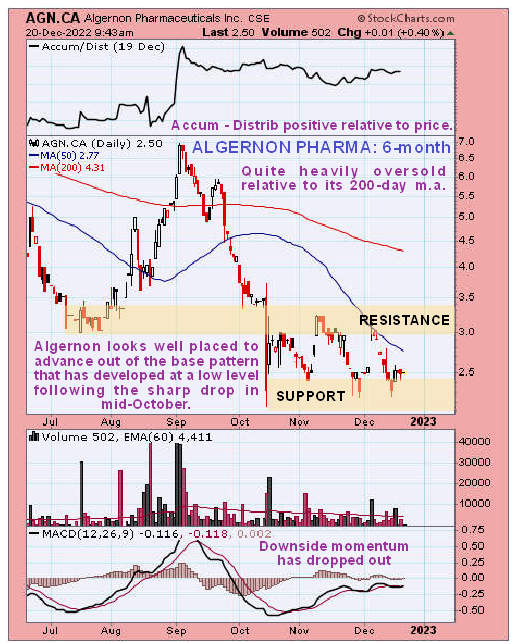
Technical analyst Clive Maund reviews Algernon Pharmaceuticals Inc.’s 6-month, 3-year, and 9-year charts to tell you whether you should be interested in this pharma company.

Another stock that appears to be at stony rock bottom is Algernon Pharmaceuticals Inc. (AGN:CSE; AGNPF:OTCQB; AGN0:XFRA), and it has two things going for it — one is that it could come out with positive news at any time that could get it moving and the other is that, with only 2.3 million shares in issue, when it does move it is likely to result in big percentage gains, as happened back last January when it rocketed from CA$4 to CA$12 in a matter of a couple of weeks, a move which we rode.

On its 6-month chart, we can see that after dropping hard in mid-October, it has marked out a low trading range that has allowed downside momentum to drop out and the 50-day moving average has dropped down close to the price, in the process opening up a quite large gap between it and the 200-day and these factors taken together make a rally soon increasingly likely with the relatively strong Accumulation line over the past several months being another positive factor.

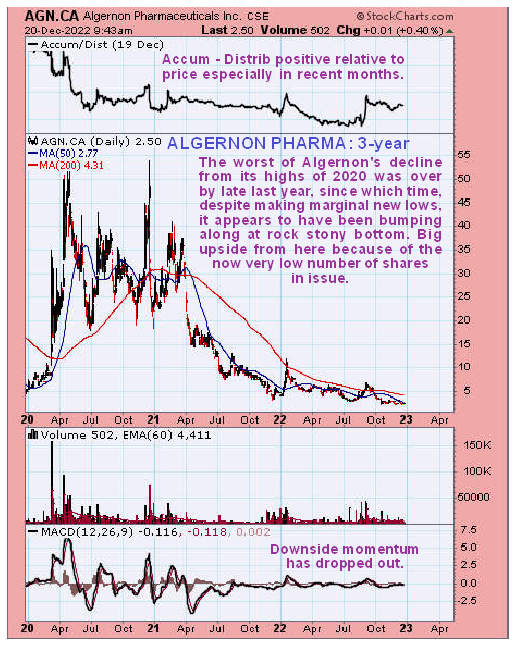
Zooming out on a 3-year chart enables us to put recent action in more perspective (note that this chart and the 9-year we are also looking at have been adjusted for a one-for-100-share rollback about a year ago, which explains the low number of shares in issue).

On this chart, we see that Algernon is now extraordinarily cheap as it has dropped back from a peak at over CA$53 in 2020 to the current miserly price of CA$2.50. The worst decline was behind it by late last year, since which time, although it has continued to make new lows, the rate of decline has slowed, with, as mentioned above, the Accumulation line showing a marked positive divergence in recent months.

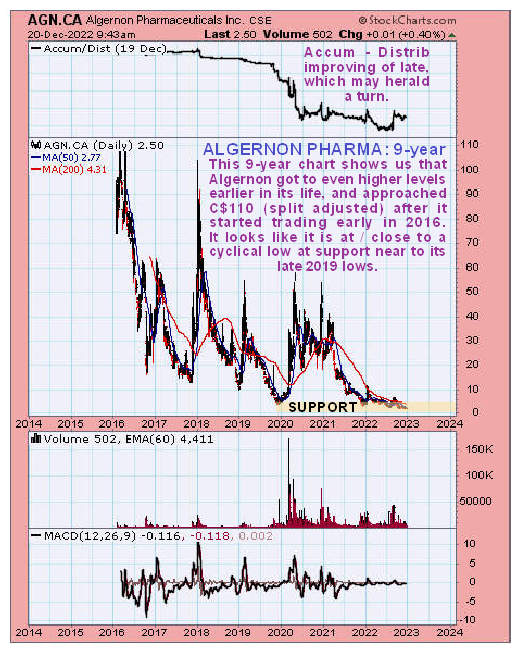
The 9-year chart shows us the entire history of the stock, and on this chart, we see that it got to even higher levels than we saw in 2020, as back in 2016, shortly after it started trading, it got close to CA$110 and at the start of 2018 it spiked to about CA$103.

It looks like it is making a cyclical low here, close to the late 2019 lows.

Even without factoring in the extremely low number of shares in issue, Algernon looks like it is at a low here with a very favorable risk/reward ratio, which is magnified enormously by the low number of shares in issue, as any good news coming through – and there is believed to be some coming through soon — could see it take off strongly higher.

Algernon is therefore rated a strong speculative Buy here.

Algernon Pharmaceuticals’ website

Algernon Pharmaceuticals Inc. closed at CA$2.50, $1.76 on December 20, 2022.

CliveMaund.com Disclosures

The above represents the opinion and analysis of Mr. Maund, based on data available to him, at the time of writing. Mr. Maund’s opinions are his own, and are not a recommendation or an offer to buy or sell securities. Mr. Maund is an independent analyst who receives no compensation of any kind from any groups, individuals or corporations mentioned in his reports. As trading and investing in any financial markets may involve serious risk of loss, Mr. Maund recommends that you consult with a qualified investment advisor, one licensed by appropriate regulatory agencies in your legal jurisdiction and do your own due diligence and research when making any kind of a transaction with financial ramifications. Although a qualified and experienced stock market analyst, Clive Maund is not a Registered Securities Advisor. Therefore Mr. Maund’s opinions on the market and stocks can only be construed as a solicitation to buy and sell securities when they are subject to the prior approval and endorsement of a Registered Securities Advisor operating in accordance with the appropriate regulations in your area of jurisdiction.

Disclosures:
1) Clive Maund: I, or members of my immediate household or family, own securities of the following companies mentioned in this article: None. I personally am, or members of my immediate household or family are, paid by the following companies mentioned in this article: None.

2) The following companies mentioned in this article are billboard sponsors of Streetwise Reports: Algernon Pharmaceuticals Inc. Click here for important disclosures about sponsor fees. As of the date of this article, an affiliate of Streetwise Reports has a consulting relationship with Algernon Pharmaceuticals Inc. Please click here for more information.

3) Statements and opinions expressed are the opinions of the author and not of Streetwise Reports or its officers. The author is wholly responsible for the validity of the statements. The author was not paid by Streetwise Reports for this article. Streetwise Reports was not paid by the author to publish or syndicate this article. Streetwise Reports requires contributing authors to disclose any shareholdings in, or economic relationships with, companies that they write about. Streetwise Reports relies upon the authors to accurately provide this information and Streetwise Reports has no means of verifying its accuracy.

4) This article does not constitute investment advice. Each reader is encouraged to consult with his or her individual financial professional and any action a reader takes as a result of information presented here is his or her own responsibility. By opening this page, each reader accepts and agrees to Streetwise Reports’ terms of use and full legal disclaimer. This article is not a solicitation for investment. Streetwise Reports does not render general or specific investment advice and the information on Streetwise Reports should not be considered a recommendation to buy or sell any security. Streetwise Reports does not endorse or recommend the business, products, services or securities of any company mentioned on Streetwise Reports.

5) From time to time, Streetwise Reports LLC and its directors, officers, employees or members of their families, as well as persons interviewed for articles and interviews on the site, may have a long or short position in securities mentioned. Directors, officers, employees or members of their immediate families are prohibited from making purchases and/or sales of those securities in the open market or otherwise from the time of the decision to publish an article until three business days after the publication of the article. The foregoing prohibition does not apply to articles that in substance only restate previously published company releases. As of the date of this article, officers and/or employees of Streetwise Reports LLC (including members of their household) own securities of Algernon Pharmaceuticals Inc., a company mentioned in this article.

6) This article does not constitute medical advice. Officers, employees and contributors to Streetwise Reports are not licensed medical professionals. Readers should always contact their healthcare professionals for medical advice.

Biotech at Good Entry Point for Investors, Analyst Says

Source: Andrew Partheniou  (12/20/22)

The company, focused on psychedelic-assisted psychotherapies to better treat addiction, is worth more than the CA$10 million the market is valuing it at, noted a Stifel report.

Awakn Life Sciences Corp. (AWKN:NEO; AWKNF:OTCQB) is currently undervalued and, thus, providing investors an attractive time to get into the stock, reported Stifel analyst Andrew Partheniou in a Dec. 16 research note.

With the Canadian biotech firm, the “market sees about a CA$10 million ($10M) valuation,” he wrote. “We see a Phase 3 company with a derisked molecule.”

Further, Awakn offers significant potential return for investors given the difference between its current share price (CA$0.40) and Stifel’s target price on it (CA$1.75). As such, Stifel rates the biotech Speculative Buy.

The reasons Stifel considers Awakn undervalued are its three recent key accomplishments, Partheniou wrote, “despite a materially challenging market backdrop.”

Recent Progress Made

1) Awakn completed the second tranche of its capital raise, generating US$1.9M. The two tranches together and debt settlement yielded US$3M, enough to get it through the next three quarters, Partheniou wrote.

“This could provide the company with time to realize some potential catalyst to create shareholder value through derisking its outlook and pursue another equity financing,” he added.

2) Awakn partnered with the British government on the life sciences firm’s Phase 3 pivotal trial of ketamine for alcohol use disorder, and it will be conducted at seven National Health Service sites. Also, the company secured governmental funding in the form of a grant that will cover 66% of the trial cost, or CA$3.75M, dropping Awakn’s contribution at CA$1.25M, “a significantly advantageous position,” noted Partheniou.

3) Awakn further grew its ketamine clinic business, adding locations in Norway and the U.S. reported Partheniou. In Norway, the biotech signed a lease for a second location, expected to be up and running by late Q1/23. The company also entered a licensing agreement with Nushama in New York, making it the third such arrangement in North America. Nushama will pay Awakn an annual fee and a royalty of an unknown amount.

“Hence, we see good momentum overall,” wrote Partheniou.

Disclosures:
1) Doresa Banning wrote this article for Streetwise Reports LLC and provides services to Streetwise Reports as an independent contractor. She or members of her household own securities of the following companies mentioned in the article: None. She or members of her household are paid by the following companies mentioned in this article: None.

2) The following companies mentioned in this article are billboard sponsors of Streetwise Reports: None. Click here for important disclosures about sponsor fees. The information provided above is for informational purposes only and is not a recommendation to buy or sell any security. As of the date of this article, an affiliate of Streetwise Reports has a consulting relationship with: Awakn Life Sciences Corp. Please click here for more information.

3) Comments and opinions expressed are those of the specific experts and not of Streetwise Reports or its officers. The information provided above is for informational purposes only and is not a recommendation to buy or sell any security.

4) The article does not constitute investment advice. Each reader is encouraged to consult with his or her individual financial professional and any action a reader takes as a result of information presented here is his or her own responsibility. By opening this page, each reader accepts and agrees to Streetwise Reports’ terms of use and full legal  disclaimer. This article is not a solicitation for investment. Streetwise Reports does not render general or specific investment advice and the information on Streetwise Reports should not be considered a recommendation to buy or sell any security. Streetwise Reports does not endorse or recommend the business, products, services or securities of any company mentioned on Streetwise Reports.

5) From time to time, Streetwise Reports LLC and its directors, officers, employees or members of their families, as well as persons interviewed for articles and interviews on the site, may have a long or short position in securities mentioned. Directors, officers, employees or members of their immediate families are prohibited from making purchases and/or sales of those securities in the open market or otherwise from the time of the decision to publish an article until three business days after the publication of the article. The foregoing prohibition does not apply to articles that in substance only restate previously published company releases. As of the date of this article, officers and/or employees of Streetwise Reports LLC (including members of their household) own securities of Awakn Life Sciences Corp., a company mentioned in this article.

6) This article does not constitute medical advice. Officers, employees and contributors to Streetwise Reports are not licensed medical professionals. Readers should always contact their healthcare professionals for medical advice.

Disclosures For Stifel GMP, Awakn Life Sciences Corp a.nd Cybin Inc.,  December 16, 2022

I, Andrew Partheniou, certify that the views expressed in this research report accurately reflect my personal views about the subject securities or issuers; and I, Andrew Partheniou, certify that no part of my compensation was, is, or will be directly or indirectly related to the specific recommendations or views contained in this research report.

Stifel or an affiliate expects to receive or intends to seek compensation for investment banking services from Awakn Life Sciences Corp. in the next 3 months. The equity research analyst(s) responsible for the preparation of this report receive(s) compensation based on various factors, including Stifel’s overall revenue, which includes investment banking revenue.

The information contained herein has been prepared from sources believed to be reliable but is not guaranteed by us and is not a complete summary or statement of all available data, nor is it considered an offer to buy or sell any securities referred to herein. Opinions expressed are as of the date of this publication and are subject to change without notice. These opinions do not constitute a personal recommendation and do not take into account the particular investment objectives, financial situation or needs of individual investors. Employees of Stifel, or its affiliates may, at times, release written or oral commentary, technical analysis or trading strategies that differ from the opinions expressed within. Stifel or any of its affiliates may have positions in the securities mentioned and may make purchases or sales of such securities from time to time in the open market or otherwise and may sell to or buy from customers such securities on a principal basis; such transactions may be contrary to recommendations in this report. Past performance should not and cannot be viewed as an indicator of future performance.

Unless otherwise noted, the financial instruments mentioned in this report are priced as of market close on the previous trading day and presumed performance is calculated always over the next 12 months. As a multi-disciplined financial services firm, Stifel regularly seeks investment banking assignments and compensation from issuers for services including, but not limited to, acting as an underwriter in an offering or financial advisor in a merger or acquisition, or serving as a placement agent in private transactions.

Affiliate Disclosures: References to “Stifel” (collectively ”Stifel”) refer to SFC and other associated affiliated subsidiaries including (i) Stifel, Nicolaus & Company, Incorporated (“SNC”); (ii) Keefe, Bruyette & Woods, Incorporated (“KBWI’’), which are both U.S. broker-dealers registered with the United States Securities and Exchange Commission (“SEC”) and members of the Financial Industry National Regulatory Authority (“FINRA”), respectively; (iii) Stifel Nicolaus Canada, Incorporated. (“Stifel Canada”), which is authorised and regulated by Investment Industry Regulatory Organization of Canada (“IIROC”), and also trades under the names “Stifel GMP” and/or “Stifel FirstEnergy”; (iv) Stifel Nicolaus Europe Limited (“SNEL”), which is authorised and regulated by the Financial Conduct Authority (“FCA”) (FRN 190412) and is a member of the London Stock Exchange and also trades under the name Keefe, Bruyette & Woods Europe (“KBW Europe”); (v) Stifel Europe Bank AG (“SEBA”), which is regulated by the German Federal Financial Supervisory Authority (Bundesanstalt für Finanzdienstleistungsaufsicht; “BaFin”) and is a member of Deutsche Boerse and SIX Swiss Exchange and (vi) Stifel Schweiz AG (“STSA”), which is representative of SEBA in Switzerland and regulated by the Eidgenössische Finanzmarktaufsicht (“FINMA”). SNEL, SEBA and STSA are collectively referred to as Stifel Europe.