Currency Speculators continued to trim their Japanese Yen bearish positions

By InvestMacro

Here are the latest charts and statistics for the Commitment of Traders (COT) data published by the Commodities Futures Trading Commission (CFTC).

The latest COT data is updated through Tuesday March 28th and shows a quick view of how large market participants (for-profit speculators and commercial traders) were positioned in the futures markets. All currency positions are in direct relation to the US dollar where, for example, a bet for the euro is a bet that the euro will rise versus the dollar while a bet against the euro will be a bet that the euro will decline versus the dollar.

Weekly Speculator Changes led by Japanese Yen & Australian Dollar

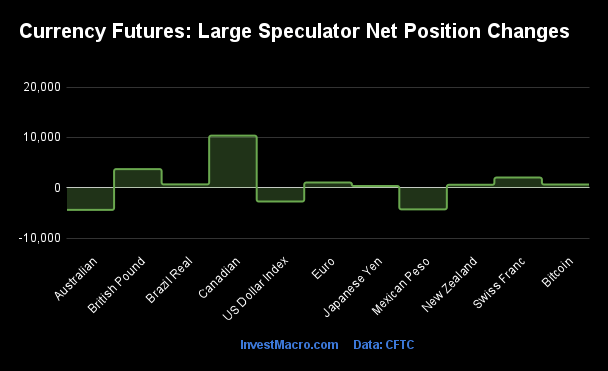
The COT currency market speculator bets were higher this week as six out of the eleven currency markets we cover had higher positioning while the other five markets had lower speculator contracts.

Leading the gains for the currency markets was the Japanese Yen (12,370 contracts) with the Australian Dollar (3,106 contracts), New Zealand Dollar (2,173 contracts), the Swiss Franc (1,223 contracts), EuroFX (183 contracts) and Bitcoin (345 contracts) also showing positive weeks.

The currencies seeing declines in speculator bets on the week were the British Pound (-3,586 contracts) with the Mexican Peso (-2,251 contracts), Brazilian Real (-1,374 contracts), the US Dollar Index (-1,425 contracts) and the Canadian Dollar (-4 contracts) also registering lower bets on the week.

Japanese Yen Speculators continued to trim their bearish positions

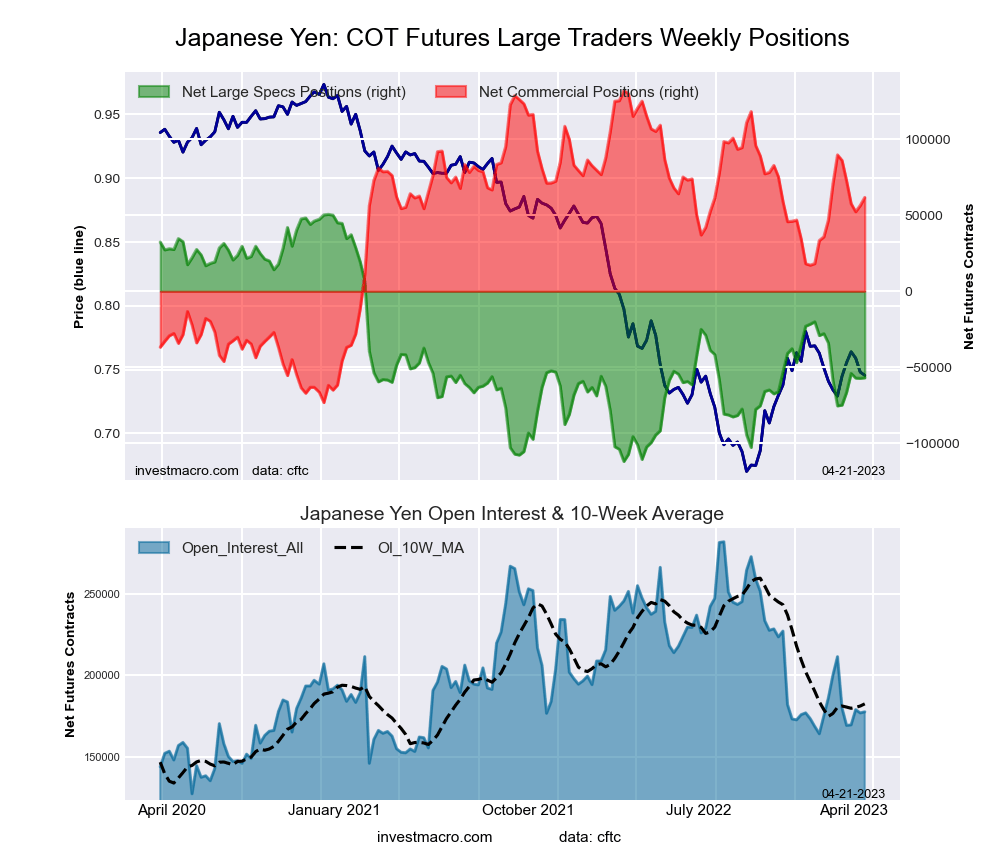
Highlighting the COT currency’s data this week is the improvement of the speculator’s positioning for the Japanese yen. Large speculative Japanese yen positions gained this week by over +12,000 net contracts and rose for a third straight week with a total change of +21,328 contracts over that 3-week period.

The yen, overall, has been in a continuous bearish standing for the past 107 weeks, dating back to March of 2021. The height of the yen bearish positions (eleven straight weeks over -90,000 contracts) was in April and May of 2022 while the bearish level reached a position of -102,618 contracts as recently as October 25th. Since that recent low, the yen positioning has improved markedly with positions falling to as low as -20,060 contracts on January 31st. This week’s gain marks the best in the past fifteen weeks and brings the overall net position (currently at -53,975 contracts) to the least bearish level since February 21st.

The yen spot price has been on the move since dropping to a multi-decade low against the US Dollar in October. The USDJPY currency pair had surged as high as 151.94 on October 17th but has now come back down to the 130s level with the currency pair closing out this week at 132.83.


Data Snapshot of Forex Market Traders | Columns Legend
Mar-28-2023OIOI-IndexSpec-NetSpec-IndexCom-NetCOM-IndexSmalls-NetSmalls-Index
USD Index31,1282612,71946-15,085522,36642
EUR732,50668145,02574-191,2482646,22353
GBP199,86837-24,0844822,577491,50761
JPY169,47331-53,9753657,56264-3,58746
CHF34,85617-6,0743910,73363-4,65942
CAD176,55948-56,825063,41799-6,5928
AUD151,23850-35,3535245,83053-10,47727
NZD31,98113-6,610366,553625752
MXN233,6694949,27986-53,828154,54985
RUB20,93047,54331-7,15069-39324
BRL42,6633023,48366-30,522277,039100
Bitcoin14,40969-27672-271054725


Strength Scores led by Mexican Peso & EuroFX
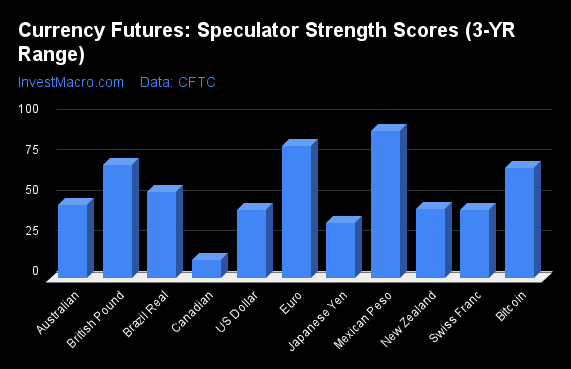
COT Strength Scores (a normalized measure of Speculator positions over a 3-Year range, from 0 to 100 where above 80 is Extreme-Bullish and below 20 is Extreme-Bearish) showed that the Mexican Peso (86 percent) and the EuroFX (74 percent) lead the currency markets this week. The Bitcoin (72 percent), Brazilian Real (66 percent) and the Australian Dollar (52 percent) come in as the next highest in the weekly strength scores.

On the downside, the Canadian Dollar (0 percent) comes in at the lowest strength levels currently and is in Extreme-Bearish territory (below 20 percent). The next lowest strength scores are the New Zealand Dollar (36 percent), Japanese Yen (36 percent) and the Swiss Franc (39 percent).

Strength Statistics:
US Dollar Index (46.1 percent) vs US Dollar Index previous week (48.5 percent)
EuroFX (74.3 percent) vs EuroFX previous week (74.2 percent)
British Pound Sterling (48.3 percent) vs British Pound Sterling previous week (51.4 percent)
Japanese Yen (35.6 percent) vs Japanese Yen previous week (28.0 percent)
Swiss Franc (38.5 percent) vs Swiss Franc previous week (35.3 percent)
Canadian Dollar (0.0 percent) vs Canadian Dollar previous week (0.0 percent)
Australian Dollar (52.1 percent) vs Australian Dollar previous week (49.2 percent)
New Zealand Dollar (35.7 percent) vs New Zealand Dollar previous week (29.8 percent)
Mexican Peso (85.9 percent) vs Mexican Peso previous week (87.6 percent)
Brazilian Real (65.7 percent) vs Brazilian Real previous week (67.4 percent)
Bitcoin (72.1 percent) vs Bitcoin previous week (66.1 percent)


Mexican Peso & Bitcoin top the 6-Week Strength Trends

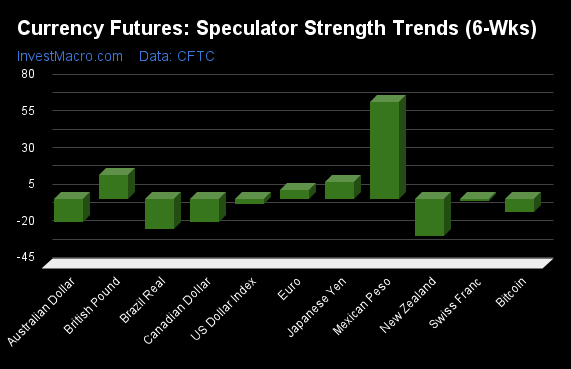
COT Strength Score Trends (or move index, calculates the 6-week changes in strength scores) showed that the Mexican Peso (67 percent) and the Bitcoin (9 percent) lead the past six weeks trends for the currencies. The Swiss Franc (4 percent) and the US Dollar Index (1 percent) are the next highest positive movers in the latest trends data.

The New Zealand Dollar (-42 percent) leads the downside trend scores currently with the Canadian Dollar (-20 percent), Japanese Yen (-16 percent) and the Brazilian Real (-11 percent) following next with lower trend scores.

Strength Trend Statistics:
US Dollar Index (1.2 percent) vs US Dollar Index previous week (3.1 percent)
EuroFX (-7.3 percent) vs EuroFX previous week (-7.8 percent)
British Pound Sterling (-3.7 percent) vs British Pound Sterling previous week (-5.5 percent)
Japanese Yen (-16.1 percent) vs Japanese Yen previous week (-22.9 percent)
Swiss Franc (3.7 percent) vs Swiss Franc previous week (-2.5 percent)
Canadian Dollar (-20.2 percent) vs Canadian Dollar previous week (-22.5 percent)
Australian Dollar (-6.0 percent) vs Australian Dollar previous week (-9.6 percent)
New Zealand Dollar (-42.3 percent) vs New Zealand Dollar previous week (-53.2 percent)
Mexican Peso (67.4 percent) vs Mexican Peso previous week (72.6 percent)
Brazilian Real (-10.8 percent) vs Brazilian Real previous week (-10.8 percent)
Bitcoin (8.8 percent) vs Bitcoin previous week (9.7 percent)


Individual COT Forex Markets:

US Dollar Index Futures:
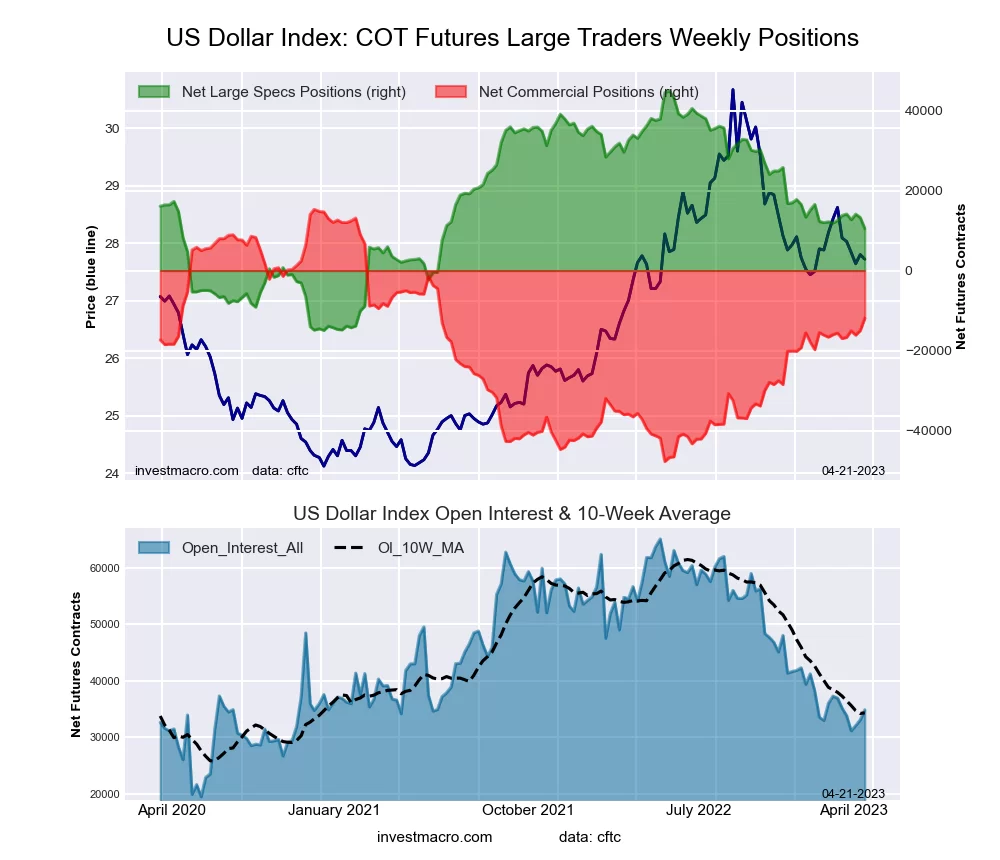
US Dollar Index Forex Futures COT ChartThe US Dollar Index large speculator standing this week equaled a net position of 12,719 contracts in the data reported through Tuesday. This was a weekly lowering of -1,425 contracts from the previous week which had a total of 14,144 net contracts.

This week’s current strength score (the trader positioning range over the past three years, measured from 0 to 100) shows the speculators are currently Bearish with a score of 46.1 percent. The commercials are Bullish with a score of 51.8 percent and the small traders (not shown in chart) are Bearish with a score of 42.4 percent.

US DOLLAR INDEX StatisticsSPECULATORSCOMMERCIALSSMALL TRADERS
– Percent of Open Interest Longs:78.91.815.2
– Percent of Open Interest Shorts:38.050.27.6
– Net Position:12,719-15,0852,366
– Gross Longs:24,5525454,737
– Gross Shorts:11,83315,6302,371
– Long to Short Ratio:2.1 to 10.0 to 12.0 to 1
NET POSITION TREND:
– Strength Index Score (3 Year Range Pct):46.151.842.4
– Strength Index Reading (3 Year Range):BearishBullishBearish
NET POSITION MOVEMENT INDEX:
– 6-Week Change in Strength Index:1.21.7-19.7


Euro Currency Futures:

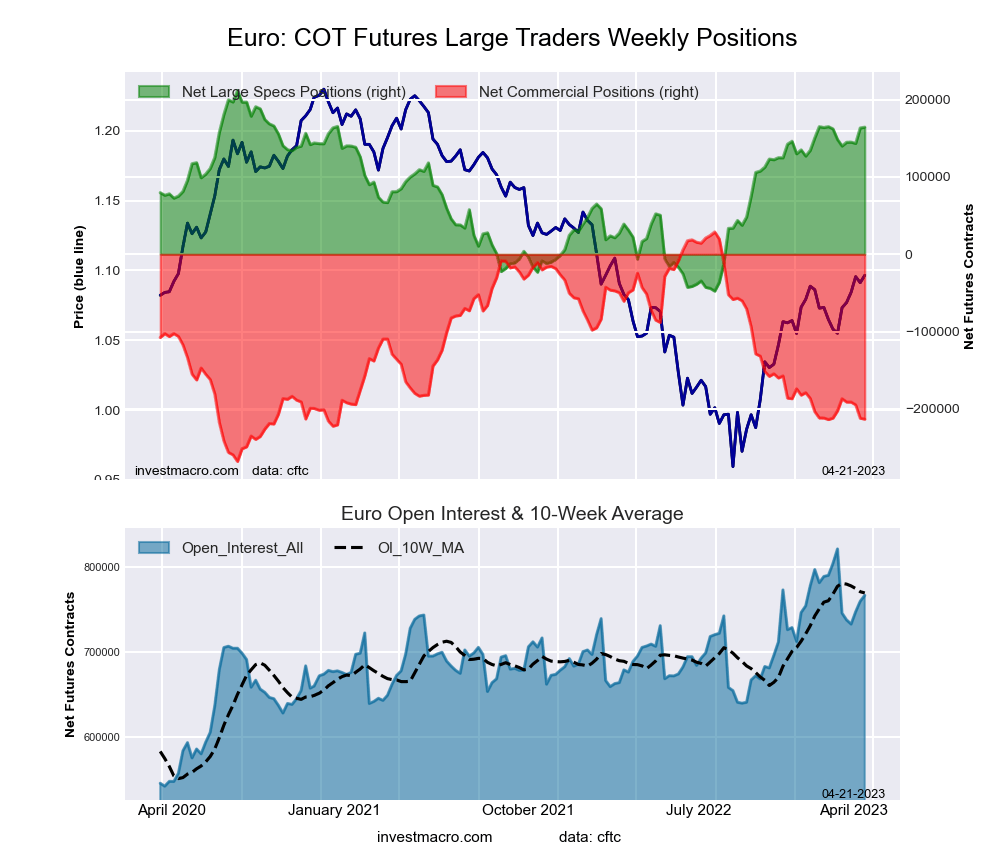
Euro Currency Futures COT ChartThe Euro Currency large speculator standing this week equaled a net position of 145,025 contracts in the data reported through Tuesday. This was a weekly increase of 183 contracts from the previous week which had a total of 144,842 net contracts.

This week’s current strength score (the trader positioning range over the past three years, measured from 0 to 100) shows the speculators are currently Bullish with a score of 74.3 percent. The commercials are Bearish with a score of 25.9 percent and the small traders (not shown in chart) are Bullish with a score of 52.7 percent.

EURO Currency StatisticsSPECULATORSCOMMERCIALSSMALL TRADERS
– Percent of Open Interest Longs:30.456.011.7
– Percent of Open Interest Shorts:10.682.25.4
– Net Position:145,025-191,24846,223
– Gross Longs:222,918410,54585,724
– Gross Shorts:77,893601,79339,501
– Long to Short Ratio:2.9 to 10.7 to 12.2 to 1
NET POSITION TREND:
– Strength Index Score (3 Year Range Pct):74.325.952.7
– Strength Index Reading (3 Year Range):BullishBearishBullish
NET POSITION MOVEMENT INDEX:
– 6-Week Change in Strength Index:-7.36.9-2.6


British Pound Sterling Futures:

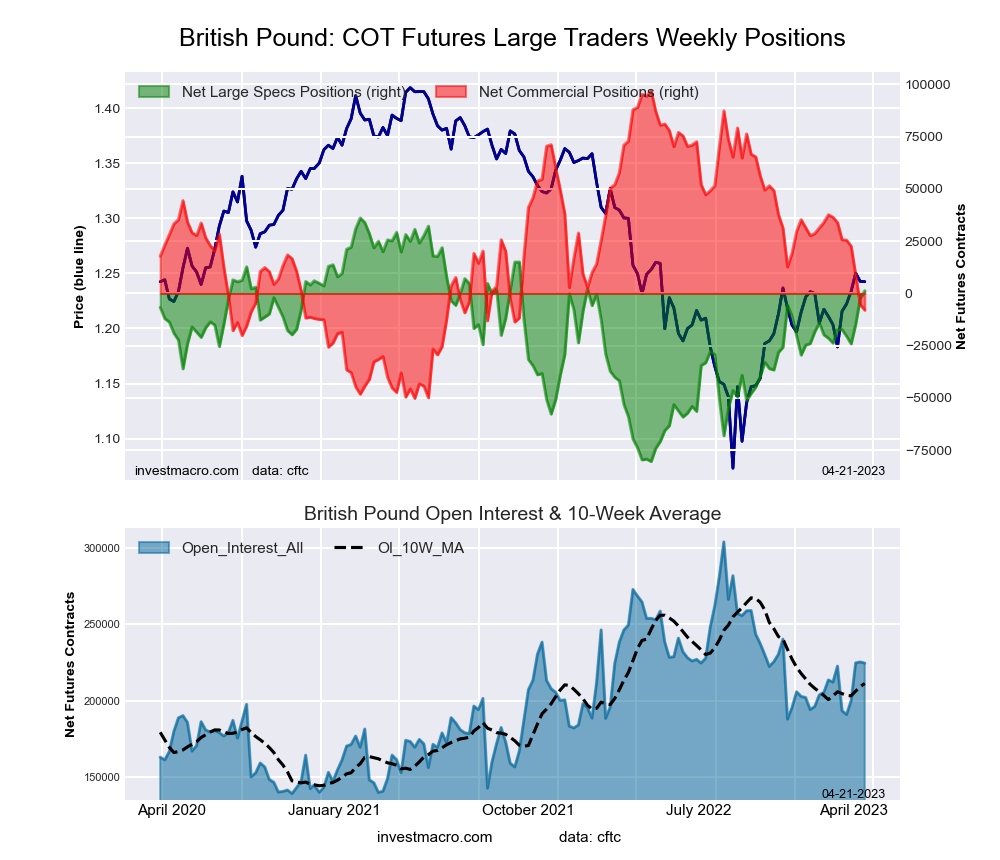
British Pound Sterling Futures COT ChartThe British Pound Sterling large speculator standing this week equaled a net position of -24,084 contracts in the data reported through Tuesday. This was a weekly lowering of -3,586 contracts from the previous week which had a total of -20,498 net contracts.

This week’s current strength score (the trader positioning range over the past three years, measured from 0 to 100) shows the speculators are currently Bearish with a score of 48.3 percent. The commercials are Bearish with a score of 49.4 percent and the small traders (not shown in chart) are Bullish with a score of 61.0 percent.

BRITISH POUND StatisticsSPECULATORSCOMMERCIALSSMALL TRADERS
– Percent of Open Interest Longs:14.266.613.1
– Percent of Open Interest Shorts:26.255.312.4
– Net Position:-24,08422,5771,507
– Gross Longs:28,355133,14926,264
– Gross Shorts:52,439110,57224,757
– Long to Short Ratio:0.5 to 11.2 to 11.1 to 1
NET POSITION TREND:
– Strength Index Score (3 Year Range Pct):48.349.461.0
– Strength Index Reading (3 Year Range):BearishBearishBullish
NET POSITION MOVEMENT INDEX:
– 6-Week Change in Strength Index:-3.7-7.830.9


Japanese Yen Futures:

Japanese Yen Forex Futures COT ChartThe Japanese Yen large speculator standing this week equaled a net position of -53,975 contracts in the data reported through Tuesday. This was a weekly gain of 12,370 contracts from the previous week which had a total of -66,345 net contracts.

This week’s current strength score (the trader positioning range over the past three years, measured from 0 to 100) shows the speculators are currently Bearish with a score of 35.6 percent. The commercials are Bullish with a score of 63.7 percent and the small traders (not shown in chart) are Bearish with a score of 46.1 percent.

JAPANESE YEN StatisticsSPECULATORSCOMMERCIALSSMALL TRADERS
– Percent of Open Interest Longs:5.777.914.5
– Percent of Open Interest Shorts:37.644.016.6
– Net Position:-53,97557,562-3,587
– Gross Longs:9,717132,07024,593
– Gross Shorts:63,69274,50828,180
– Long to Short Ratio:0.2 to 11.8 to 10.9 to 1
NET POSITION TREND:
– Strength Index Score (3 Year Range Pct):35.663.746.1
– Strength Index Reading (3 Year Range):BearishBullishBearish
NET POSITION MOVEMENT INDEX:
– 6-Week Change in Strength Index:-16.110.68.8


Swiss Franc Futures:

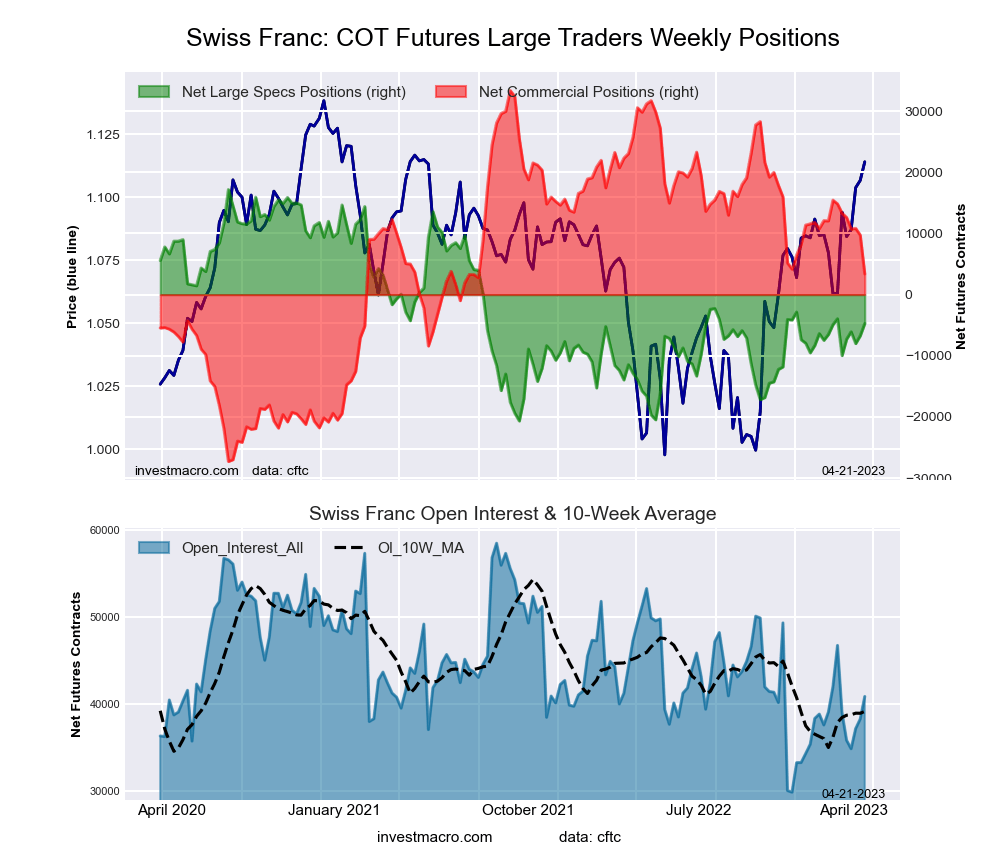
Swiss Franc Forex Futures COT ChartThe Swiss Franc large speculator standing this week equaled a net position of -6,074 contracts in the data reported through Tuesday. This was a weekly lift of 1,223 contracts from the previous week which had a total of -7,297 net contracts.

This week’s current strength score (the trader positioning range over the past three years, measured from 0 to 100) shows the speculators are currently Bearish with a score of 38.5 percent. The commercials are Bullish with a score of 62.7 percent and the small traders (not shown in chart) are Bearish with a score of 41.8 percent.

SWISS FRANC StatisticsSPECULATORSCOMMERCIALSSMALL TRADERS
– Percent of Open Interest Longs:11.457.029.2
– Percent of Open Interest Shorts:28.826.242.6
– Net Position:-6,07410,733-4,659
– Gross Longs:3,97819,86510,185
– Gross Shorts:10,0529,13214,844
– Long to Short Ratio:0.4 to 12.2 to 10.7 to 1
NET POSITION TREND:
– Strength Index Score (3 Year Range Pct):38.562.741.8
– Strength Index Reading (3 Year Range):BearishBullishBearish
NET POSITION MOVEMENT INDEX:
– 6-Week Change in Strength Index:3.7-2.2-0.2


Canadian Dollar Futures:

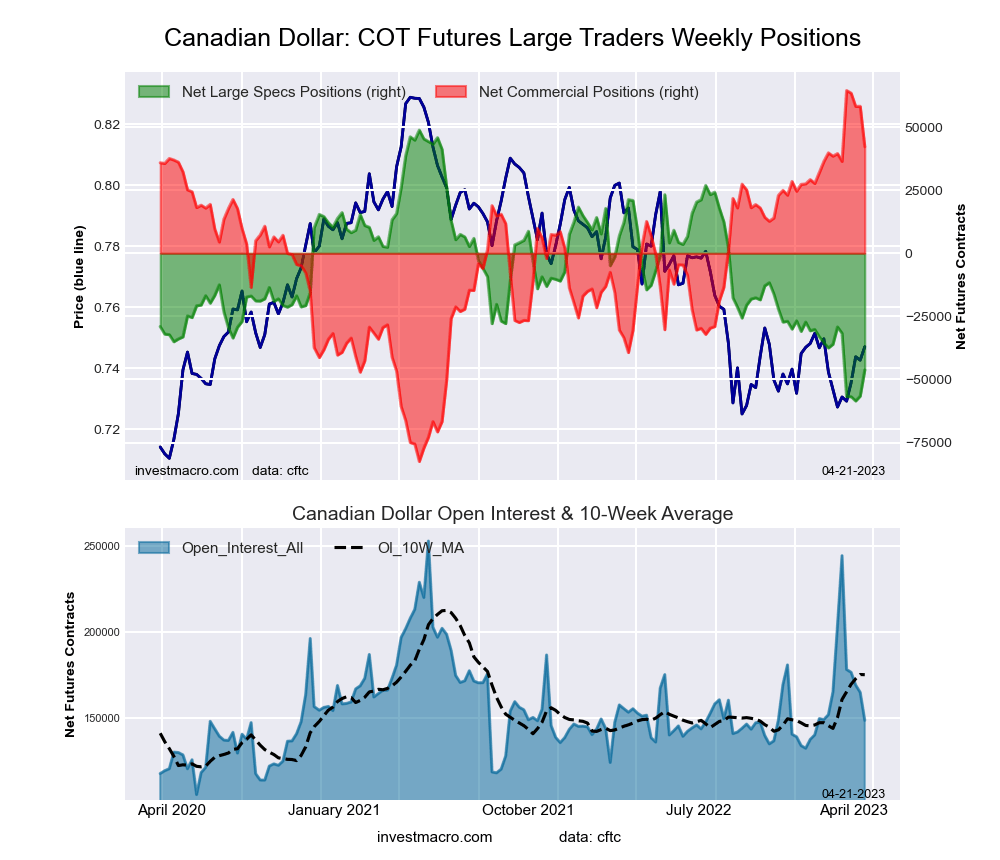
Canadian Dollar Forex Futures COT ChartThe Canadian Dollar large speculator standing this week equaled a net position of -56,825 contracts in the data reported through Tuesday. This was a weekly decrease of -4 contracts from the previous week which had a total of -56,821 net contracts.

This week’s current strength score (the trader positioning range over the past three years, measured from 0 to 100) shows the speculators are currently Bearish-Extreme with a score of 0.0 percent. The commercials are Bullish-Extreme with a score of 99.3 percent and the small traders (not shown in chart) are Bearish-Extreme with a score of 8.2 percent.

CANADIAN DOLLAR StatisticsSPECULATORSCOMMERCIALSSMALL TRADERS
– Percent of Open Interest Longs:11.170.417.4
– Percent of Open Interest Shorts:43.334.521.1
– Net Position:-56,82563,417-6,592
– Gross Longs:19,672124,28530,744
– Gross Shorts:76,49760,86837,336
– Long to Short Ratio:0.3 to 12.0 to 10.8 to 1
NET POSITION TREND:
– Strength Index Score (3 Year Range Pct):0.099.38.2
– Strength Index Reading (3 Year Range):Bearish-ExtremeBullish-ExtremeBearish-Extreme
NET POSITION MOVEMENT INDEX:
– 6-Week Change in Strength Index:-20.218.4-12.7


Australian Dollar Futures:

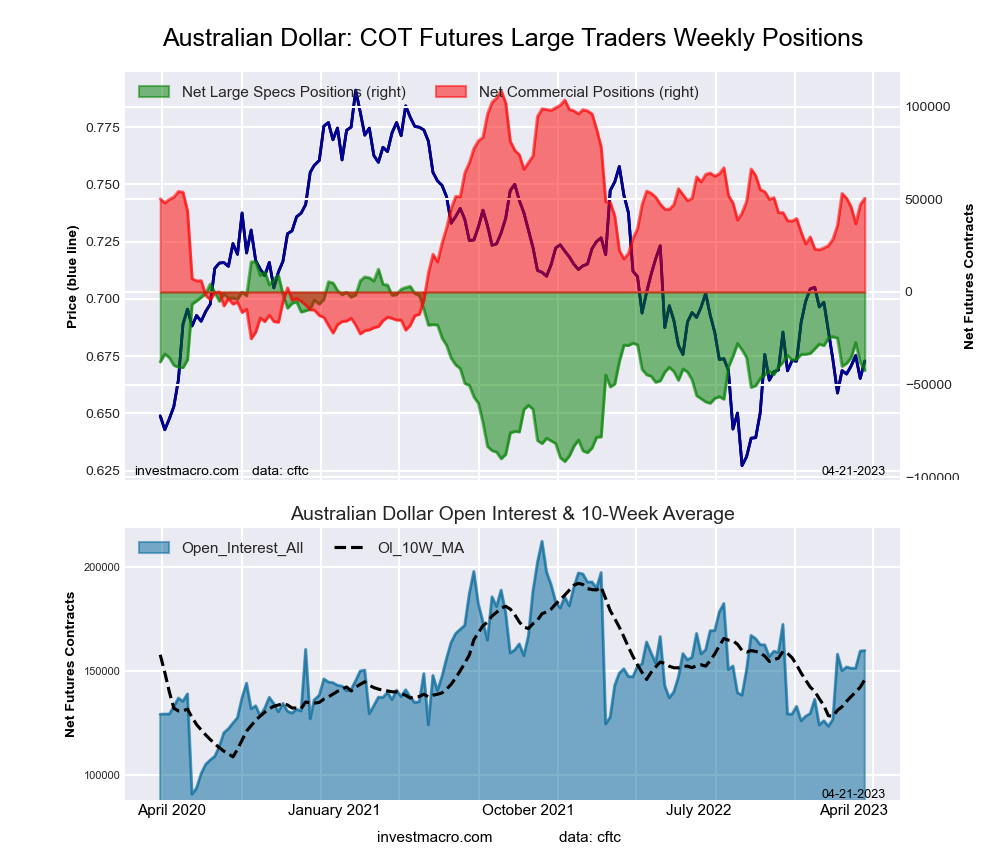
Australian Dollar Forex Futures COT ChartThe Australian Dollar large speculator standing this week equaled a net position of -35,353 contracts in the data reported through Tuesday. This was a weekly rise of 3,106 contracts from the previous week which had a total of -38,459 net contracts.

This week’s current strength score (the trader positioning range over the past three years, measured from 0 to 100) shows the speculators are currently Bullish with a score of 52.1 percent. The commercials are Bullish with a score of 53.1 percent and the small traders (not shown in chart) are Bearish with a score of 26.9 percent.

AUSTRALIAN DOLLAR StatisticsSPECULATORSCOMMERCIALSSMALL TRADERS
– Percent of Open Interest Longs:29.055.212.8
– Percent of Open Interest Shorts:52.324.919.7
– Net Position:-35,35345,830-10,477
– Gross Longs:43,81383,52319,330
– Gross Shorts:79,16637,69329,807
– Long to Short Ratio:0.6 to 12.2 to 10.6 to 1
NET POSITION TREND:
– Strength Index Score (3 Year Range Pct):52.153.126.9
– Strength Index Reading (3 Year Range):BullishBullishBearish
NET POSITION MOVEMENT INDEX:
– 6-Week Change in Strength Index:-6.016.5-38.2


New Zealand Dollar Futures:

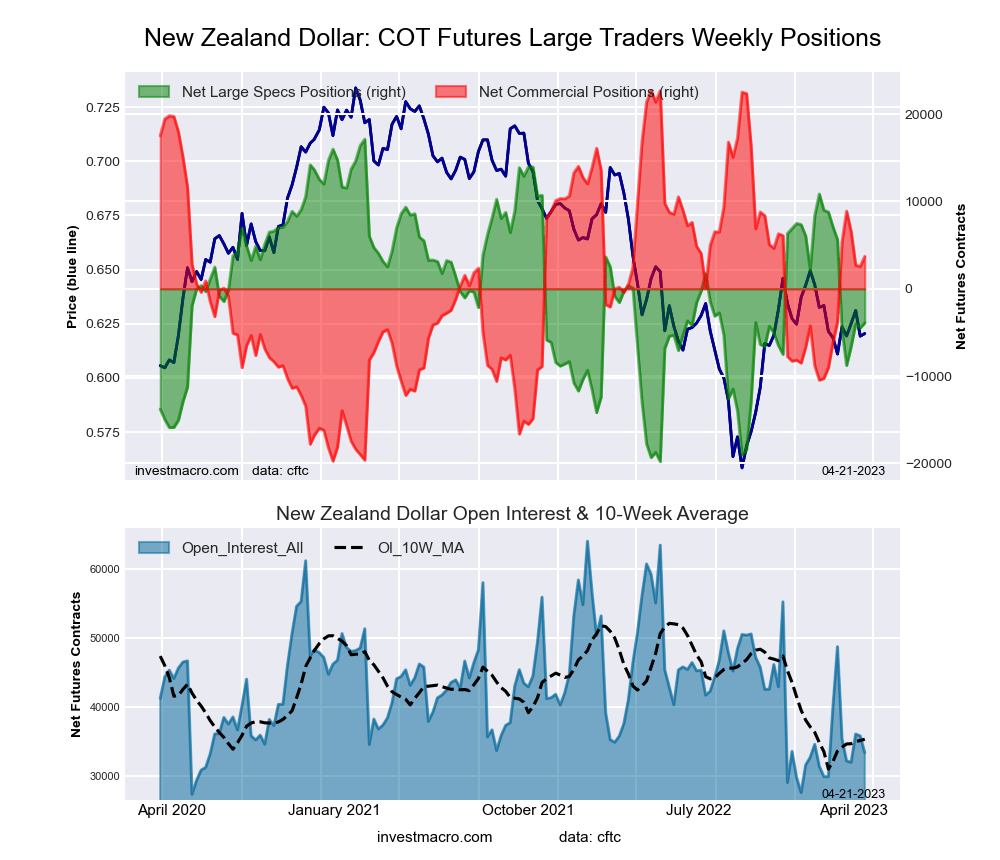
New Zealand Dollar Forex Futures COT ChartThe New Zealand Dollar large speculator standing this week equaled a net position of -6,610 contracts in the data reported through Tuesday. This was a weekly lift of 2,173 contracts from the previous week which had a total of -8,783 net contracts.

This week’s current strength score (the trader positioning range over the past three years, measured from 0 to 100) shows the speculators are currently Bearish with a score of 35.7 percent. The commercials are Bullish with a score of 61.9 percent and the small traders (not shown in chart) are Bullish with a score of 52.3 percent.

NEW ZEALAND DOLLAR StatisticsSPECULATORSCOMMERCIALSSMALL TRADERS
– Percent of Open Interest Longs:30.458.310.8
– Percent of Open Interest Shorts:51.137.810.7
– Net Position:-6,6106,55357
– Gross Longs:9,72018,6393,467
– Gross Shorts:16,33012,0863,410
– Long to Short Ratio:0.6 to 11.5 to 11.0 to 1
NET POSITION TREND:
– Strength Index Score (3 Year Range Pct):35.761.952.3
– Strength Index Reading (3 Year Range):BearishBullishBullish
NET POSITION MOVEMENT INDEX:
– 6-Week Change in Strength Index:-42.339.6-13.9


Mexican Peso Futures:

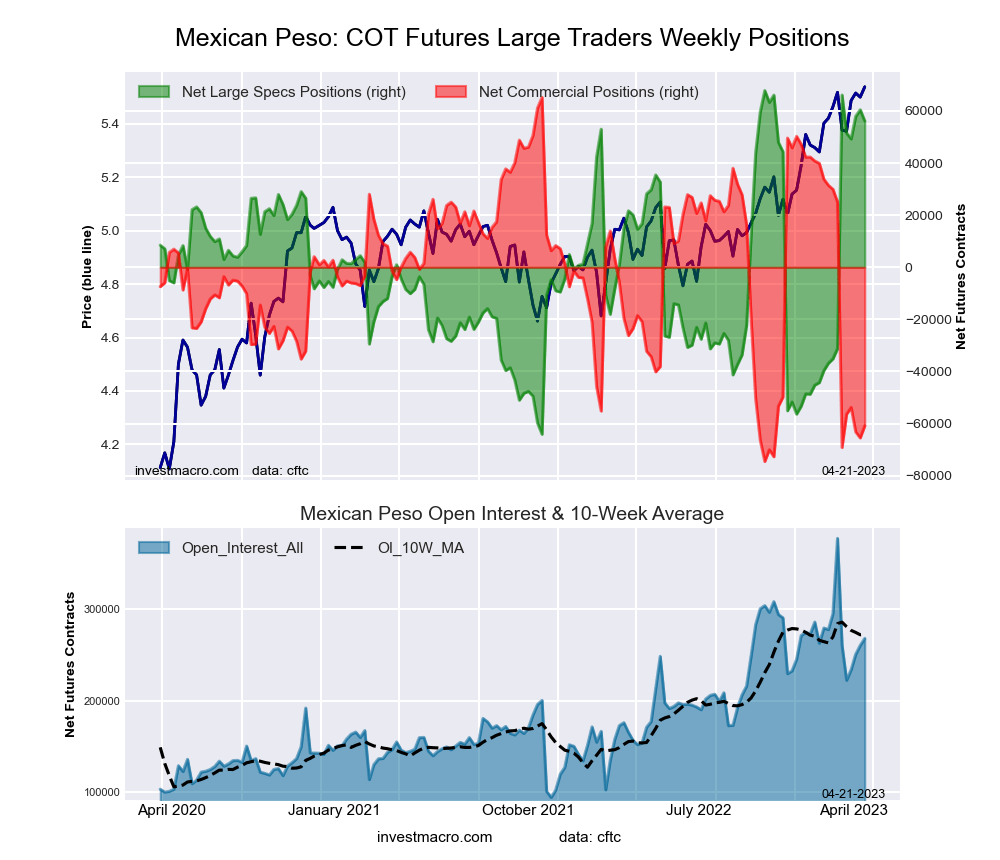
Mexican Peso Futures COT ChartThe Mexican Peso large speculator standing this week equaled a net position of 49,279 contracts in the data reported through Tuesday. This was a weekly decline of -2,251 contracts from the previous week which had a total of 51,530 net contracts.

This week’s current strength score (the trader positioning range over the past three years, measured from 0 to 100) shows the speculators are currently Bullish-Extreme with a score of 85.9 percent. The commercials are Bearish-Extreme with a score of 14.8 percent and the small traders (not shown in chart) are Bullish-Extreme with a score of 84.6 percent.

MEXICAN PESO StatisticsSPECULATORSCOMMERCIALSSMALL TRADERS
– Percent of Open Interest Longs:46.850.03.0
– Percent of Open Interest Shorts:25.773.11.1
– Net Position:49,279-53,8284,549
– Gross Longs:109,417116,9397,079
– Gross Shorts:60,138170,7672,530
– Long to Short Ratio:1.8 to 10.7 to 12.8 to 1
NET POSITION TREND:
– Strength Index Score (3 Year Range Pct):85.914.884.6
– Strength Index Reading (3 Year Range):Bullish-ExtremeBearish-ExtremeBullish-Extreme
NET POSITION MOVEMENT INDEX:
– 6-Week Change in Strength Index:67.4-62.7-7.5


Brazilian Real Futures:

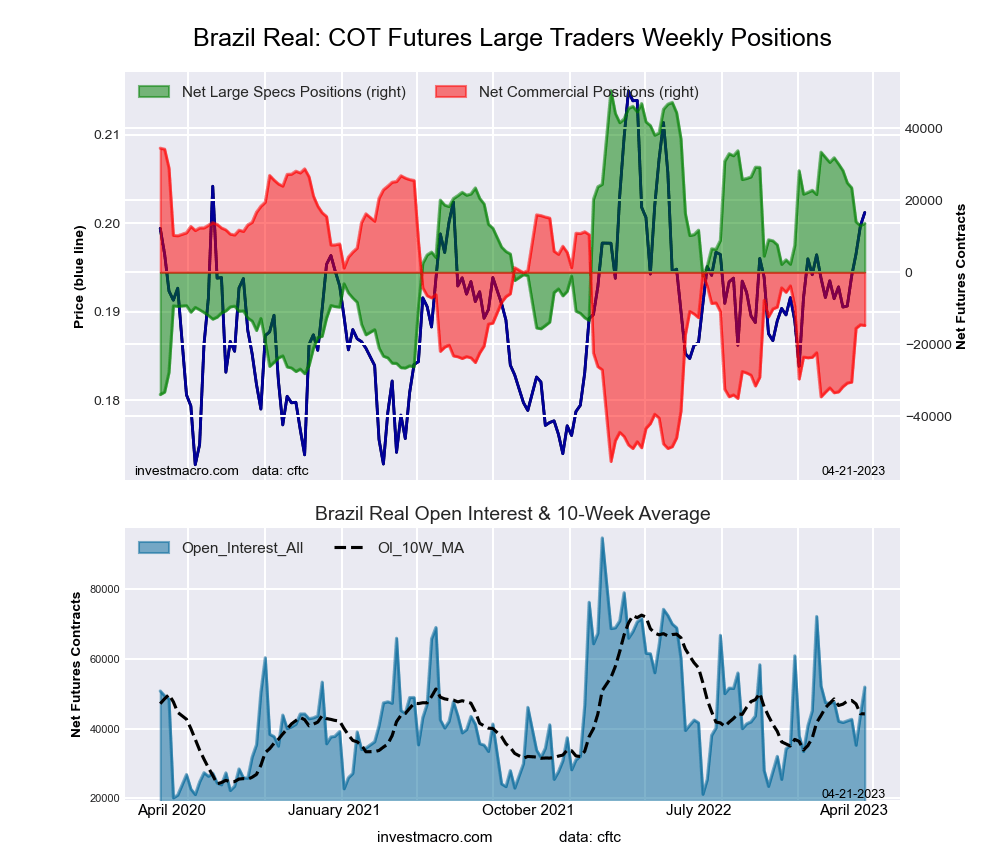
Brazil Real Futures COT ChartThe Brazilian Real large speculator standing this week equaled a net position of 23,483 contracts in the data reported through Tuesday. This was a weekly decrease of -1,374 contracts from the previous week which had a total of 24,857 net contracts.

This week’s current strength score (the trader positioning range over the past three years, measured from 0 to 100) shows the speculators are currently Bullish with a score of 65.7 percent. The commercials are Bearish with a score of 27.1 percent and the small traders (not shown in chart) are Bullish-Extreme with a score of 100.0 percent.

BRAZIL REAL StatisticsSPECULATORSCOMMERCIALSSMALL TRADERS
– Percent of Open Interest Longs:60.919.319.8
– Percent of Open Interest Shorts:5.890.83.3
– Net Position:23,483-30,5227,039
– Gross Longs:25,9688,2318,429
– Gross Shorts:2,48538,7531,390
– Long to Short Ratio:10.4 to 10.2 to 16.1 to 1
NET POSITION TREND:
– Strength Index Score (3 Year Range Pct):65.727.1100.0
– Strength Index Reading (3 Year Range):BullishBearishBullish-Extreme
NET POSITION MOVEMENT INDEX:
– 6-Week Change in Strength Index:-10.83.545.0


Bitcoin Futures:

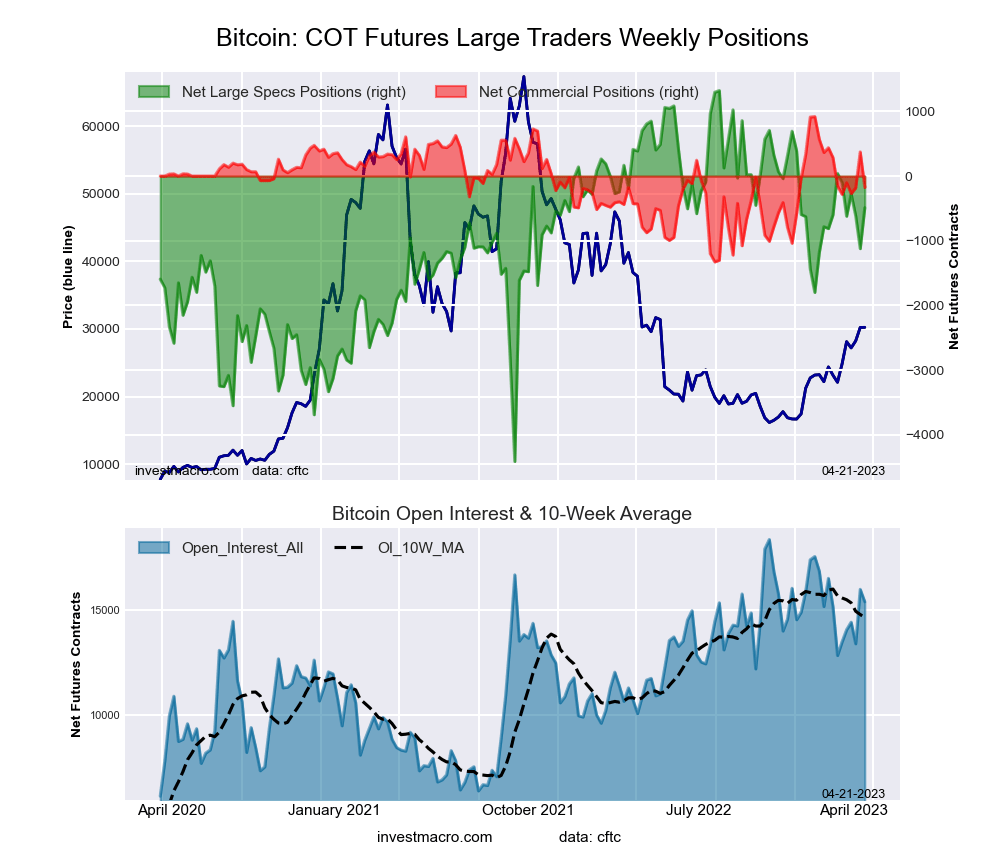
Bitcoin Crypto Futures COT ChartThe Bitcoin large speculator standing this week equaled a net position of -276 contracts in the data reported through Tuesday. This was a weekly gain of 345 contracts from the previous week which had a total of -621 net contracts.

This week’s current strength score (the trader positioning range over the past three years, measured from 0 to 100) shows the speculators are currently Bullish with a score of 72.1 percent. The commercials are Bearish with a score of 47.0 percent and the small traders (not shown in chart) are Bearish with a score of 25.4 percent.

BITCOIN StatisticsSPECULATORSCOMMERCIALSSMALL TRADERS
– Percent of Open Interest Longs:77.51.810.1
– Percent of Open Interest Shorts:79.43.76.3
– Net Position:-276-271547
– Gross Longs:11,1682631,449
– Gross Shorts:11,444534902
– Long to Short Ratio:1.0 to 10.5 to 11.6 to 1
NET POSITION TREND:
– Strength Index Score (3 Year Range Pct):72.147.025.4
– Strength Index Reading (3 Year Range):BullishBearishBearish
NET POSITION MOVEMENT INDEX:
– 6-Week Change in Strength Index:8.8-28.32.9


Article By InvestMacroReceive our weekly COT Newsletter

*COT Report: The COT data, released weekly to the public each Friday, is updated through the most recent Tuesday (data is 3 days old) and shows a quick view of how large speculators or non-commercials (for-profit traders) were positioned in the futures markets.

The CFTC categorizes trader positions according to commercial hedgers (traders who use futures contracts for hedging as part of the business), non-commercials (large traders who speculate to realize trading profits) and nonreportable traders (usually small traders/speculators) as well as their open interest (contracts open in the market at time of reporting). See CFTC criteria here.


Gold Speculator’s bullish bets continued to climb to 44-week high

By InvestMacro

The Commodities Futures Trading Commission (CFTC) has released the latest Commitment of Traders (COT) data, which provides an update view of how large traders, such as speculators and commercial entities, position themselves in the futures markets. This data is current as of Tuesday March 28th.

Weekly Speculator Changes led by Silver & Platinum

The COT metals markets speculator bets were higher this week as five out of the six metals markets we cover had higher positioning while the other one markets had lower speculator contracts.

Leading the gains for the metals was Gold (23,025 contracts) with Copper (10,806 contracts), Silver (9,899 contracts), Platinum (848 contracts) and Palladium (254 contracts) also showing positive weeks.

The only market with declines in speculator bets for the week was Steel (-484 contracts).

Gold Speculator bets continue to climb to 44-week high

Highlighting the COT metals data this week is the continued bullishness for the Gold speculative positions. The large speculator position in Gold futures climbed this week for a third straight week and for the fifth time out of the past six weeks. Gold spec bets have now advanced by a total of +83,156 contracts over just the past three weeks.

The Gold position has increased from a total net position of +105,529 contracts on February 14th to a total of +181,630 contracts this week which marks the highest level in 44-weeks, dating back to May of 2022. The boost in speculator sentiment has pushed the Gold speculator strength score to 57.0 percent (0 to 100 percent over a 3-year range) while the 6-week speculator strength score trend has gained by 33.5 percent.

The Gold futures price saw a small gain this week after a small decline last week. Previously to the past two weeks, Gold futures had risen for three straight weeks and hit the highest price in just about a year over the $2,014.00 level. This week Gold futures managed to reach a high back over the $2,000.00 price level but retreated to close at $1,986.20.


Data Snapshot of Commodity Market Traders | Columns Legend
Mar-28-2023OIOI-IndexSpec-NetSpec-IndexCom-NetCOM-IndexSmalls-NetSmalls-Index
Gold478,61126181,63057-201,5084619,87830
Silver117,395013,36137-21,875678,51414
Copper211,88952-1,54527-4,924696,46959
Palladium11,51478-6,76437,19398-42916
Platinum57,2443210,37440-14,781634,40727


Strength Scores led by Steel & Gold

COT Strength Scores (a normalized measure of Speculator positions over a 3-Year range, from 0 to 100 where above 80 is Extreme-Bullish and below 20 is Extreme-Bearish) showed that Steel (58 percent) and Gold (57 percent) lead the metals markets this week. Platinum (39.5 percent) comes in as the next highest in the weekly strength scores.

On the downside, Palladium (3.1 percent) comes in at the lowest strength level currently and is in Extreme-Bearish territory (below 20 percent).

Strength Statistics:
Gold (57.0 percent) vs Gold previous week (46.9 percent)
Silver (37.3 percent) vs Silver previous week (23.2 percent)
Copper (27.0 percent) vs Copper previous week (17.4 percent)
Platinum (39.5 percent) vs Platinum previous week (37.6 percent)
Palladium (3.1 percent) vs Palladium previous week (0.7 percent)
Steel (57.9 percent) vs Palladium previous week (59.3 percent)

Gold & Platinum top the 6-Week Strength Trends

COT Strength Score Trends (or move index, calculates the 6-week changes in strength scores) showed that Gold (34 percent) and Platinum (10 percent) lead the past six weeks trends for metals.

Palladium (-16 percent) leads the downside trend scores currently with Steel (-4 percent) as the next market with lower trend scores.

Move Statistics:
Gold (33.5 percent) vs Gold previous week (13.1 percent)
Silver (2.6 percent) vs Silver previous week (-14.4 percent)
Copper (3.5 percent) vs Copper previous week (-13.3 percent)
Platinum (10.1 percent) vs Platinum previous week (-2.5 percent)
Palladium (-16.4 percent) vs Palladium previous week (-26.9 percent)
Steel (-3.8 percent) vs Steel previous week (-1.3 percent)


Individual Markets:

Gold Comex Futures:

Gold Futures COT ChartThe Gold Comex Futures large speculator standing this week came in at a net position of 181,630 contracts in the data reported through Tuesday. This was a weekly rise of 23,025 contracts from the previous week which had a total of 158,605 net contracts.

This week’s current strength score (the trader positioning range over the past three years, measured from 0 to 100) shows the speculators are currently Bullish with a score of 57.0 percent. The commercials are Bearish with a score of 46.1 percent and the small traders (not shown in chart) are Bearish with a score of 29.8 percent.

Gold Futures StatisticsSPECULATORSCOMMERCIALSSMALL TRADERS
– Percent of Open Interest Longs:51.227.59.9
– Percent of Open Interest Shorts:13.369.65.7
– Net Position:181,630-201,50819,878
– Gross Longs:245,135131,78647,388
– Gross Shorts:63,505333,29427,510
– Long to Short Ratio:3.9 to 10.4 to 11.7 to 1
NET POSITION TREND:
– Strength Index Score (3 Year Range Pct):57.046.129.8
– Strength Index Reading (3 Year Range):BullishBearishBearish
NET POSITION MOVEMENT INDEX:
– 6-Week Change in Strength Index:33.5-28.0-9.2


Silver Comex Futures:

Silver Futures COT ChartThe Silver Comex Futures large speculator standing this week came in at a net position of 13,361 contracts in the data reported through Tuesday. This was a weekly lift of 9,899 contracts from the previous week which had a total of 3,462 net contracts.

This week’s current strength score (the trader positioning range over the past three years, measured from 0 to 100) shows the speculators are currently Bearish with a score of 37.3 percent. The commercials are Bullish with a score of 67.4 percent and the small traders (not shown in chart) are Bearish-Extreme with a score of 13.5 percent.

Silver Futures StatisticsSPECULATORSCOMMERCIALSSMALL TRADERS
– Percent of Open Interest Longs:36.038.318.8
– Percent of Open Interest Shorts:24.656.911.5
– Net Position:13,361-21,8758,514
– Gross Longs:42,25444,97022,062
– Gross Shorts:28,89366,84513,548
– Long to Short Ratio:1.5 to 10.7 to 11.6 to 1
NET POSITION TREND:
– Strength Index Score (3 Year Range Pct):37.367.413.5
– Strength Index Reading (3 Year Range):BearishBullishBearish-Extreme
NET POSITION MOVEMENT INDEX:
– 6-Week Change in Strength Index:2.64.8-32.5


Copper Grade #1 Futures:

Copper Futures COT ChartThe Copper Grade #1 Futures large speculator standing this week came in at a net position of -1,545 contracts in the data reported through Tuesday. This was a weekly lift of 10,806 contracts from the previous week which had a total of -12,351 net contracts.

This week’s current strength score (the trader positioning range over the past three years, measured from 0 to 100) shows the speculators are currently Bearish with a score of 27.0 percent. The commercials are Bullish with a score of 69.2 percent and the small traders (not shown in chart) are Bullish with a score of 59.3 percent.

Copper Futures StatisticsSPECULATORSCOMMERCIALSSMALL TRADERS
– Percent of Open Interest Longs:26.744.38.7
– Percent of Open Interest Shorts:27.446.65.7
– Net Position:-1,545-4,9246,469
– Gross Longs:56,59593,92018,451
– Gross Shorts:58,14098,84411,982
– Long to Short Ratio:1.0 to 11.0 to 11.5 to 1
NET POSITION TREND:
– Strength Index Score (3 Year Range Pct):27.069.259.3
– Strength Index Reading (3 Year Range):BearishBullishBullish
NET POSITION MOVEMENT INDEX:
– 6-Week Change in Strength Index:3.5-2.2-8.5


Platinum Futures:

Platinum Futures COT ChartThe Platinum Futures large speculator standing this week came in at a net position of 10,374 contracts in the data reported through Tuesday. This was a weekly gain of 848 contracts from the previous week which had a total of 9,526 net contracts.

This week’s current strength score (the trader positioning range over the past three years, measured from 0 to 100) shows the speculators are currently Bearish with a score of 39.5 percent. The commercials are Bullish with a score of 62.9 percent and the small traders (not shown in chart) are Bearish with a score of 27.2 percent.

Platinum Futures StatisticsSPECULATORSCOMMERCIALSSMALL TRADERS
– Percent of Open Interest Longs:42.440.412.6
– Percent of Open Interest Shorts:24.266.34.9
– Net Position:10,374-14,7814,407
– Gross Longs:24,24723,1467,193
– Gross Shorts:13,87337,9272,786
– Long to Short Ratio:1.7 to 10.6 to 12.6 to 1
NET POSITION TREND:
– Strength Index Score (3 Year Range Pct):39.562.927.2
– Strength Index Reading (3 Year Range):BearishBullishBearish
NET POSITION MOVEMENT INDEX:
– 6-Week Change in Strength Index:10.1-5.2-24.7


Palladium Futures:

Palladium Futures COT ChartThe Palladium Futures large speculator standing this week came in at a net position of -6,764 contracts in the data reported through Tuesday. This was a weekly gain of 254 contracts from the previous week which had a total of -7,018 net contracts.

This week’s current strength score (the trader positioning range over the past three years, measured from 0 to 100) shows the speculators are currently Bearish-Extreme with a score of 3.1 percent. The commercials are Bullish-Extreme with a score of 98.1 percent and the small traders (not shown in chart) are Bearish-Extreme with a score of 15.9 percent.

Palladium Futures StatisticsSPECULATORSCOMMERCIALSSMALL TRADERS
– Percent of Open Interest Longs:13.872.210.2
– Percent of Open Interest Shorts:72.69.713.9
– Net Position:-6,7647,193-429
– Gross Longs:1,5938,3141,174
– Gross Shorts:8,3571,1211,603
– Long to Short Ratio:0.2 to 17.4 to 10.7 to 1
NET POSITION TREND:
– Strength Index Score (3 Year Range Pct):3.198.115.9
– Strength Index Reading (3 Year Range):Bearish-ExtremeBullish-ExtremeBearish-Extreme
NET POSITION MOVEMENT INDEX:
– 6-Week Change in Strength Index:-16.416.3-9.6


Steel Futures Futures:

Steel Futures COT ChartThe Steel Futures large speculator standing this week came in at a net position of -5,255 contracts in the data reported through Tuesday. This was a weekly decline of -484 contracts from the previous week which had a total of -4,771 net contracts.

This week’s current strength score (the trader positioning range over the past three years, measured from 0 to 100) shows the speculators are currently Bullish with a score of 57.9 percent. The commercials are Bearish with a score of 41.4 percent and the small traders (not shown in chart) are Bullish with a score of 61.4 percent.

Steel Futures StatisticsSPECULATORSCOMMERCIALSSMALL TRADERS
– Percent of Open Interest Longs:12.176.11.4
– Percent of Open Interest Shorts:29.559.80.3
– Net Position:-5,2554,933322
– Gross Longs:3,68723,103422
– Gross Shorts:8,94218,170100
– Long to Short Ratio:0.4 to 11.3 to 14.2 to 1
NET POSITION TREND:
– Strength Index Score (3 Year Range Pct):57.941.461.4
– Strength Index Reading (3 Year Range):BullishBearishBullish
NET POSITION MOVEMENT INDEX:
– 6-Week Change in Strength Index:-3.84.1-11.0


Article By InvestMacroReceive our weekly COT Newsletter

*COT Report: The COT data, released weekly to the public each Friday, is updated through the most recent Tuesday (data is 3 days old) and shows a quick view of how large speculators or non-commercials (for-profit traders) were positioned in the futures markets.

The CFTC categorizes trader positions according to commercial hedgers (traders who use futures contracts for hedging as part of the business), non-commercials (large traders who speculate to realize trading profits) and nonreportable traders (usually small traders/speculators) as well as their open interest (contracts open in the market at time of reporting). See CFTC criteria here.

Bonds Speculators raised their 10-Year Bond bets to best level in 11-weeks

By InvestMacro

Here are the latest charts and statistics for the Commitment of Traders (COT) reports data published by the Commodities Futures Trading Commission (CFTC).

The latest COT data is updated through Tuesday March 28th and shows a quick view of how large traders (for-profit speculators and commercial hedgers) were positioned in the futures markets.

Weekly Speculator Changes led by 10-Year Bonds & SOFR 3-Months

The COT bond market speculator bets were higher this week as six out of the nine bond markets we cover had higher positioning while the other three markets had lower speculator contracts.

Leading the gains for the bond markets was the 10-Year Bonds (99,451 contracts) with the SOFR 3-Months (35,598 contracts), the Ultra Treasury Bonds (22,186 contracts), Eurodollar (8,563 contracts), US Treasury Bonds (8,014 contracts), and the Ultra 10-Year Bonds (6,322 contracts) also seeing positive weeks.

The bond markets with declines in speculator bets for the week were the Fed Funds (-144,248 contracts), the 2-Year Bonds (-61,280 contracts) and the 5-Year Bonds (-50,787 contracts) also having lower bets on the week.

10-Year Bond Speculator bets improve to best level in 11-weeks

Highlighting the COT bond’s data this week is the recent improvement of the speculator positioning in the 10-Year Bonds contracts. Large speculative positions for the 10-Year Bonds rose this week by the largest amount of the past 27 weeks and the weekly bets have now been higher in three out of the past five weeks as well as five out of the past seven weeks.

The 10-Year Bond speculator net positions, overall, have been in a continuous bearish position for the past 76 weeks (since October of 2021). The bearish bets have accelerated over the past year in conjunction with the Federal Reserve’s interest rate hiking campaign to tame inflation. The 10-Year Bonds spec position recently hit a 230-week low of -627,947 contracts on February 28th, marking the lowest level dating back to October of 2018 and potentially the low for this cycle.

Since then, the 10-Year Bond speculator positions have taken +156,369 contracts off of the bearish standing and leveled this week at a total of -471,578 contracts which marks the least bearish level of the past eleven weeks. The 10-Year Bond’s speculator strength score level remains depressed in a bearish-extreme standing of 19.3 percent (compared to its 3-year range) but its 6-week strength score trend has shown an improvement by 11.3 percent.

The 10-Year Bond futures price dipped this week after showing gains in the previous four straight weeks. The front month futures price closed at approximately the 114.30 level, just below its 50-day moving average but up over 4 percent from the 2023 low of 110.125.


Data Snapshot of Bond Market Traders | Columns Legend
Mar-28-2023OIOI-IndexSpec-NetSpec-IndexCom-NetCOM-IndexSmalls-NetSmalls-Index
Eurodollar4,708,9920-629,40858815,49941-186,09164
FedFunds1,779,64770-168,60019174,03381-5,43380
2-Year2,356,31852-525,47722504,3957821,08266
Long T-Bond1,201,69958-91,3995521,6861869,713100
10-Year4,127,91774-471,57819436,4976835,08192
5-Year4,378,90099-682,3556628,1788354,17796


Strength Scores led by SOFR 3-Months & Eurodollar

COT Strength Scores (a normalized measure of Speculator positions over a 3-Year range, from 0 to 100 where above 80 is Extreme-Bullish and below 20 is Extreme-Bearish) showed that the SOFR 3-Months (91 percent) and the Eurodollar (58 percent) lead the bond markets this week. The US Treasury Bonds (55 percent) comes in as the next highest in the weekly strength scores.

On the downside, the 5-Year Bonds (6 percent), the Ultra Treasury Bonds (9 percent), the Ultra 10-Year Bonds (11 percent), the Fed Funds (18.8 percent) and the 10-Year Bonds (19 percent) came in at the lowest strength levels currently and are all in Extreme-Bearish territory (below 20 percent).

Strength Statistics:
Fed Funds (18.8 percent) vs Fed Funds previous week (36.6 percent)
2-Year Bond (21.8 percent) vs 2-Year Bond previous week (29.6 percent)
5-Year Bond (6.1 percent) vs 5-Year Bond previous week (12.2 percent)
10-Year Bond (19.3 percent) vs 10-Year Bond previous week (7.0 percent)
Ultra 10-Year Bond (10.6 percent) vs Ultra 10-Year Bond previous week (9.3 percent)
US Treasury Bond (54.8 percent) vs US Treasury Bond previous week (52.2 percent)
Ultra US Treasury Bond (9.4 percent) vs Ultra US Treasury Bond previous week (0.0 percent)
Eurodollar (57.9 percent) vs Eurodollar previous week (57.7 percent)
SOFR 3-Months (90.7 percent) vs SOFR 3-Months previous week (87.8 percent)

SOFR 3-Months & US Treasury Bonds top the 6-Week Strength Trends

COT Strength Score Trends (or move index, calculates the 6-week changes in strength scores) showed that the SOFR 3-Months (40 percent) and the US Treasury Bonds (31 percent) lead the past six weeks trends for bonds. The 2-Year Bonds (22 percent) are the next highest positive movers in the latest trends data.

The 5-Year Bond (-11.2 percent) and the Fed Funds (-7 percent) lead the downside trend scores currently with the Ultra 10-Year Bonds (-6 percent) and the Ultra Treasury Bonds (-2 percent) following next with lower trend scores.

Strength Trend Statistics:
Fed Funds (-6.9 percent) vs Fed Funds previous week (5.2 percent)
2-Year Bond (21.8 percent) vs 2-Year Bond previous week (24.8 percent)
5-Year Bond (-11.2 percent) vs 5-Year Bond previous week (4.5 percent)
10-Year Bond (11.3 percent) vs 10-Year Bond previous week (1.8 percent)
Ultra 10-Year Bond (-6.4 percent) vs Ultra 10-Year Bond previous week (-6.7 percent)
US Treasury Bond (30.5 percent) vs US Treasury Bond previous week (26.5 percent)
Ultra US Treasury Bond (-1.9 percent) vs Ultra US Treasury Bond previous week (-10.3 percent)
Eurodollar (10.3 percent) vs Eurodollar previous week (10.2 percent)
SOFR 3-Months (40.2 percent) vs SOFR 3-Months previous week (10.2 percent)


Individual Bond Markets:

Eurodollars Futures:

Eurodollar Bonds Futures COT ChartThe 3-Month Eurodollars large speculator standing this week was a net position of -629,408 contracts in the data reported through Tuesday. This was a weekly rise of 8,563 contracts from the previous week which had a total of -637,971 net contracts.

This week’s current strength score (the trader positioning range over the past three years, measured from 0 to 100) shows the speculators are currently Bullish with a score of 57.9 percent. The commercials are Bearish with a score of 41.1 percent and the small traders (not shown in chart) are Bullish with a score of 63.5 percent.

3-Month Eurodollars StatisticsSPECULATORSCOMMERCIALSSMALL TRADERS
– Percent of Open Interest Longs:7.167.25.1
– Percent of Open Interest Shorts:20.449.99.0
– Net Position:-629,408815,499-186,091
– Gross Longs:332,4233,163,717238,646
– Gross Shorts:961,8312,348,218424,737
– Long to Short Ratio:0.3 to 11.3 to 10.6 to 1
NET POSITION TREND:
– Strength Index Score (3 Year Range Pct):57.941.163.5
– Strength Index Reading (3 Year Range):BullishBearishBullish
NET POSITION MOVEMENT INDEX:
– 6-Week Change in Strength Index:10.3-11.013.2


Secured Overnight Financing Rate (SOFR 3-Month) Futures:

SOFR 3-Months Bonds Futures COT ChartThe Secured Overnight Financing Rate (3-Month) large speculator standing this week was a net position of -47,199 contracts in the data reported through Tuesday. This was a weekly gain of 35,598 contracts from the previous week which had a total of -82,797 net contracts.

This week’s current strength score (the trader positioning range over the past three years, measured from 0 to 100) shows the speculators are currently Bullish-Extreme with a score of 90.7 percent. The commercials are Bearish-Extreme with a score of 9.6 percent and the small traders (not shown in chart) are Bullish-Extreme with a score of 84.9 percent.

SOFR 3-Months StatisticsSPECULATORSCOMMERCIALSSMALL TRADERS
– Percent of Open Interest Longs:21.356.50.8
– Percent of Open Interest Shorts:21.856.00.8
– Net Position:-47,19952,561-5,362
– Gross Longs:2,001,1245,319,82773,750
– Gross Shorts:2,048,3235,267,26679,112
– Long to Short Ratio:1.0 to 11.0 to 10.9 to 1
NET POSITION TREND:
– Strength Index Score (3 Year Range Pct):90.79.684.9
– Strength Index Reading (3 Year Range):Bullish-ExtremeBearish-ExtremeBullish-Extreme
NET POSITION MOVEMENT INDEX:
– 6-Week Change in Strength Index:40.2-39.6-3.5


30-Day Federal Funds Futures:

Federal Funds 30-Day Bonds Futures COT ChartThe 30-Day Federal Funds large speculator standing this week was a net position of -168,600 contracts in the data reported through Tuesday. This was a weekly fall of -144,248 contracts from the previous week which had a total of -24,352 net contracts.

This week’s current strength score (the trader positioning range over the past three years, measured from 0 to 100) shows the speculators are currently Bearish-Extreme with a score of 18.8 percent. The commercials are Bullish-Extreme with a score of 81.0 percent and the small traders (not shown in chart) are Bullish-Extreme with a score of 80.3 percent.

30-Day Federal Funds StatisticsSPECULATORSCOMMERCIALSSMALL TRADERS
– Percent of Open Interest Longs:3.581.71.9
– Percent of Open Interest Shorts:13.071.92.2
– Net Position:-168,600174,033-5,433
– Gross Longs:62,6641,454,31533,575
– Gross Shorts:231,2641,280,28239,008
– Long to Short Ratio:0.3 to 11.1 to 10.9 to 1
NET POSITION TREND:
– Strength Index Score (3 Year Range Pct):18.881.080.3
– Strength Index Reading (3 Year Range):Bearish-ExtremeBullish-ExtremeBullish-Extreme
NET POSITION MOVEMENT INDEX:
– 6-Week Change in Strength Index:-6.95.915.6


2-Year Treasury Note Futures:

2-Year Treasury Bonds Futures COT ChartThe 2-Year Treasury Note large speculator standing this week was a net position of -525,477 contracts in the data reported through Tuesday. This was a weekly reduction of -61,280 contracts from the previous week which had a total of -464,197 net contracts.

This week’s current strength score (the trader positioning range over the past three years, measured from 0 to 100) shows the speculators are currently Bearish with a score of 21.8 percent. The commercials are Bullish with a score of 78.3 percent and the small traders (not shown in chart) are Bullish with a score of 65.9 percent.

2-Year Treasury Note StatisticsSPECULATORSCOMMERCIALSSMALL TRADERS
– Percent of Open Interest Longs:5.785.28.3
– Percent of Open Interest Shorts:28.063.87.4
– Net Position:-525,477504,39521,082
– Gross Longs:133,3762,007,134196,052
– Gross Shorts:658,8531,502,739174,970
– Long to Short Ratio:0.2 to 11.3 to 11.1 to 1
NET POSITION TREND:
– Strength Index Score (3 Year Range Pct):21.878.365.9
– Strength Index Reading (3 Year Range):BearishBullishBullish
NET POSITION MOVEMENT INDEX:
– 6-Week Change in Strength Index:21.8-21.1-10.9


5-Year Treasury Note Futures:

5-Year Treasury Bonds Futures COT ChartThe 5-Year Treasury Note large speculator standing this week was a net position of -682,355 contracts in the data reported through Tuesday. This was a weekly reduction of -50,787 contracts from the previous week which had a total of -631,568 net contracts.

This week’s current strength score (the trader positioning range over the past three years, measured from 0 to 100) shows the speculators are currently Bearish-Extreme with a score of 6.1 percent. The commercials are Bullish-Extreme with a score of 82.9 percent and the small traders (not shown in chart) are Bullish-Extreme with a score of 95.9 percent.

5-Year Treasury Note StatisticsSPECULATORSCOMMERCIALSSMALL TRADERS
– Percent of Open Interest Longs:7.882.58.6
– Percent of Open Interest Shorts:23.468.17.4
– Net Position:-682,355628,17854,177
– Gross Longs:343,2413,611,307377,097
– Gross Shorts:1,025,5962,983,129322,920
– Long to Short Ratio:0.3 to 11.2 to 11.2 to 1
NET POSITION TREND:
– Strength Index Score (3 Year Range Pct):6.182.995.9
– Strength Index Reading (3 Year Range):Bearish-ExtremeBullish-ExtremeBullish-Extreme
NET POSITION MOVEMENT INDEX:
– 6-Week Change in Strength Index:-11.21.422.3


10-Year Treasury Note Futures:

10-Year Treasury Notes Bonds Futures COT ChartThe 10-Year Treasury Note large speculator standing this week was a net position of -471,578 contracts in the data reported through Tuesday. This was a weekly rise of 99,451 contracts from the previous week which had a total of -571,029 net contracts.

This week’s current strength score (the trader positioning range over the past three years, measured from 0 to 100) shows the speculators are currently Bearish-Extreme with a score of 19.3 percent. The commercials are Bullish with a score of 68.0 percent and the small traders (not shown in chart) are Bullish-Extreme with a score of 92.0 percent.

10-Year Treasury Note StatisticsSPECULATORSCOMMERCIALSSMALL TRADERS
– Percent of Open Interest Longs:10.478.69.2
– Percent of Open Interest Shorts:21.968.08.3
– Net Position:-471,578436,49735,081
– Gross Longs:430,5983,245,247379,666
– Gross Shorts:902,1762,808,750344,585
– Long to Short Ratio:0.5 to 11.2 to 11.1 to 1
NET POSITION TREND:
– Strength Index Score (3 Year Range Pct):19.368.092.0
– Strength Index Reading (3 Year Range):Bearish-ExtremeBullishBullish-Extreme
NET POSITION MOVEMENT INDEX:
– 6-Week Change in Strength Index:11.3-24.633.0


Ultra 10-Year Notes Futures:

Ultra 10-Year Treasury Notes Bonds Futures COT ChartThe Ultra 10-Year Notes large speculator standing this week was a net position of -151,804 contracts in the data reported through Tuesday. This was a weekly advance of 6,322 contracts from the previous week which had a total of -158,126 net contracts.

This week’s current strength score (the trader positioning range over the past three years, measured from 0 to 100) shows the speculators are currently Bearish-Extreme with a score of 10.6 percent. The commercials are Bullish-Extreme with a score of 84.0 percent and the small traders (not shown in chart) are Bullish with a score of 66.1 percent.

Ultra 10-Year Notes StatisticsSPECULATORSCOMMERCIALSSMALL TRADERS
– Percent of Open Interest Longs:8.879.110.9
– Percent of Open Interest Shorts:18.564.216.1
– Net Position:-151,804232,397-80,593
– Gross Longs:136,4411,232,587170,563
– Gross Shorts:288,2451,000,190251,156
– Long to Short Ratio:0.5 to 11.2 to 10.7 to 1
NET POSITION TREND:
– Strength Index Score (3 Year Range Pct):10.684.066.1
– Strength Index Reading (3 Year Range):Bearish-ExtremeBullish-ExtremeBullish
NET POSITION MOVEMENT INDEX:
– 6-Week Change in Strength Index:-6.42.212.0


US Treasury Bonds Futures:

US Year Treasury Notes Long Bonds Futures COT ChartThe US Treasury Bonds large speculator standing this week was a net position of -91,399 contracts in the data reported through Tuesday. This was a weekly boost of 8,014 contracts from the previous week which had a total of -99,413 net contracts.

This week’s current strength score (the trader positioning range over the past three years, measured from 0 to 100) shows the speculators are currently Bullish with a score of 54.8 percent. The commercials are Bearish-Extreme with a score of 18.3 percent and the small traders (not shown in chart) are Bullish-Extreme with a score of 100.0 percent.

US Treasury Bonds StatisticsSPECULATORSCOMMERCIALSSMALL TRADERS
– Percent of Open Interest Longs:8.876.614.4
– Percent of Open Interest Shorts:16.474.88.6
– Net Position:-91,39921,68669,713
– Gross Longs:105,219920,469172,685
– Gross Shorts:196,618898,783102,972
– Long to Short Ratio:0.5 to 11.0 to 11.7 to 1
NET POSITION TREND:
– Strength Index Score (3 Year Range Pct):54.818.3100.0
– Strength Index Reading (3 Year Range):BullishBearish-ExtremeBullish-Extreme
NET POSITION MOVEMENT INDEX:
– 6-Week Change in Strength Index:30.5-51.136.5


Ultra US Treasury Bonds Futures:

Ultra US Year Treasury Notes Long Bonds Futures COT ChartThe Ultra US Treasury Bonds large speculator standing this week was a net position of -421,776 contracts in the data reported through Tuesday. This was a weekly rise of 22,186 contracts from the previous week which had a total of -443,962 net contracts.

This week’s current strength score (the trader positioning range over the past three years, measured from 0 to 100) shows the speculators are currently Bearish-Extreme with a score of 9.4 percent. The commercials are Bullish-Extreme with a score of 84.5 percent and the small traders (not shown in chart) are Bullish-Extreme with a score of 97.9 percent.

Ultra US Treasury Bonds StatisticsSPECULATORSCOMMERCIALSSMALL TRADERS
– Percent of Open Interest Longs:4.883.012.0
– Percent of Open Interest Shorts:34.657.47.9
– Net Position:-421,776363,69758,079
– Gross Longs:68,5401,175,863170,261
– Gross Shorts:490,316812,166112,182
– Long to Short Ratio:0.1 to 11.4 to 11.5 to 1
NET POSITION TREND:
– Strength Index Score (3 Year Range Pct):9.484.597.9
– Strength Index Reading (3 Year Range):Bearish-ExtremeBullish-ExtremeBullish-Extreme
NET POSITION MOVEMENT INDEX:
– 6-Week Change in Strength Index:-1.9-3.311.3


Article By InvestMacroReceive our weekly COT Newsletter

*COT Report: The COT data, released weekly to the public each Friday, is updated through the most recent Tuesday (data is 3 days old) and shows a quick view of how large speculators or non-commercials (for-profit traders) were positioned in the futures markets.

The CFTC categorizes trader positions according to commercial hedgers (traders who use futures contracts for hedging as part of the business), non-commercials (large traders who speculate to realize trading profits) and nonreportable traders (usually small traders/speculators) as well as their open interest (contracts open in the market at time of reporting). See CFTC criteria here.

Stock Market Speculators continue DowJones-Mini bearish bets despite stocks uptick

By InvestMacro

Here are the latest charts and statistics for the Commitment of Traders (COT) data published by the Commodities Futures Trading Commission (CFTC).

The latest COT data is updated through Tuesday March 28th and shows a quick view of how large traders (for-profit speculators and commercial entities) were positioned in the futures markets.

Weekly Speculator Changes led by VIX & Russell-Mini

The COT stock markets speculator bets were lower this week as three out of the seven stock markets we cover had higher positioning while the other five markets had lower speculator contracts.

Leading the gains for the stock markets was the VIX (7,472 contracts) with Russell-Mini (2,238 contracts) and MSCI EAFE-Mini (1,388 contracts) also showing positive weeks.

The markets with the declines in speculator bets this week were the S&P500-Mini (-22,176 contracts) with the Nasdaq-Mini (-2,228 contracts), the DowJones-Mini (-1,421 contracts) and Nikkei 225 (-164 contracts) also registering lower bets on the week.

DowJones-Mini bets at lowest level since June

Highlighting the COT stocks data this week is the rise in bearish bets for the DowJones-Mini speculative positions. The large speculator position in the DowJones-Mini futures declined again this week and fell for the third straight week as well as for the fifth time out of the past seven weeks. The DowJones-Mini bets have now been in a continuous bearish position for the past 64 consecutive weeks, dating back to January 4th of 2022.

This week’s net position of -23,569 contracts marks the most bearish level since June of 2022 and the speculator strength scores shows a bearish-extreme strength score level at just 14 percent of its 3-year range. The speculator strength score trend (the past 6-weeks change of strength scores) also shows a strong downtrend of -44 percent which could perhaps be explained by speculators looking to hedge the recent market gains.

The DowJones-Mini stock futures price has continued to be on the uptrend after bottoming in October near the 28,650 level. This week saw the DowJone-Mini futures close above its 50-day moving average and rise by over 3 percent to the 33460 level.


Data Snapshot of Stock Market Traders | Columns Legend
Mar-28-2023OIOI-IndexSpec-NetSpec-IndexCom-NetCOM-IndexSmalls-NetSmalls-Index
S&P500-Mini2,142,23212-224,65615270,97885-46,32217
Nikkei 22510,2260-1,094711,34438-25025
Nasdaq-Mini220,07425-7,3487114,84636-7,49839
DowJones-Mini76,34933-23,5691432,570100-9,0010
VIX315,94150-42,1778445,77114-3,59474
Nikkei 225 Yen33,4977699369,04836-9,74770


Strength Scores led by VIX & Nikkei 225

COT Strength Scores (a normalized measure of Speculator positions over a 3-Year range, from 0 to 100 where above 80 is Extreme-Bullish and below 20 is Extreme-Bearish) showed that the VIX (84 percent), Nasdaq-Mini (71 percent) and the Nikkei 225 (71 percent) lead the stock markets this week. The Russell-Mini (46 percent) came in as the next highest in the weekly strength scores.

On the downside, the S&P500-Mini (14.6 percent) and the DowJones-Mini (14 percent) came in at the lowest strength level currently and are in Extreme-Bearish territory (below 20 percent).

Strength Statistics:
VIX (83.9 percent) vs VIX previous week (78.7 percent)
S&P500-Mini (14.6 percent) vs S&P500-Mini previous week (18.7 percent)
DowJones-Mini (13.7 percent) vs DowJones-Mini previous week (17.4 percent)
Nasdaq-Mini (70.9 percent) vs Nasdaq-Mini previous week (72.2 percent)
Russell2000-Mini (46.3 percent) vs Russell2000-Mini previous week (45.0 percent)
Nikkei USD (70.9 percent) vs Nikkei USD previous week (71.8 percent)
EAFE-Mini (28.8 percent) vs EAFE-Mini previous week (27.1 percent)


Russell-Mini & VIX top the 6-Week Strength Trends

COT Strength Score Trends (or move index, calculates the 6-week changes in strength scores) showed that the Russell-Mini (13 percent) leads the past six weeks trends for the stock markets. The VIX (10 percent), the Nasdaq-Mini (9 percent) and the MSCI EAFE-Mini (7 percent) are the next highest positive movers in the latest trends data.

The DowJones-Mini (-44 percent) leads the downside trend scores currently.

Strength Trend Statistics:
VIX (9.7 percent) vs VIX previous week (10.5 percent)
S&P500-Mini (4.0 percent) vs S&P500-Mini previous week (2.8 percent)
DowJones-Mini (-44.3 percent) vs DowJones-Mini previous week (-41.8 percent)
Nasdaq-Mini (8.6 percent) vs Nasdaq-Mini previous week (5.5 percent)
Russell2000-Mini (12.7 percent) vs Russell2000-Mini previous week (18.1 percent)
Nikkei USD (5.9 percent) vs Nikkei USD previous week (10.9 percent)
EAFE-Mini (6.6 percent) vs EAFE-Mini previous week (14.4 percent)


Individual Stock Market Charts:

VIX Volatility Futures:

VIX Volatility Futures COT ChartThe VIX Volatility large speculator standing this week reached a net position of -42,177 contracts in the data reported through Tuesday. This was a weekly lift of 7,472 contracts from the previous week which had a total of -49,649 net contracts.

This week’s current strength score (the trader positioning range over the past three years, measured from 0 to 100) shows the speculators are currently Bullish-Extreme with a score of 83.9 percent. The commercials are Bearish-Extreme with a score of 14.0 percent and the small traders (not shown in chart) are Bullish with a score of 73.9 percent.

VIX Volatility Futures StatisticsSPECULATORSCOMMERCIALSSMALL TRADERS
– Percent of Open Interest Longs:19.951.98.6
– Percent of Open Interest Shorts:33.337.49.8
– Net Position:-42,17745,771-3,594
– Gross Longs:62,963163,83727,312
– Gross Shorts:105,140118,06630,906
– Long to Short Ratio:0.6 to 11.4 to 10.9 to 1
NET POSITION TREND:
– Strength Index Score (3 Year Range Pct):83.914.073.9
– Strength Index Reading (3 Year Range):Bullish-ExtremeBearish-ExtremeBullish
NET POSITION MOVEMENT INDEX:
– 6-Week Change in Strength Index:9.7-10.78.3


S&P500 Mini Futures:

SP500 Mini Futures COT ChartThe S&P500 Mini large speculator standing this week reached a net position of -224,656 contracts in the data reported through Tuesday. This was a weekly lowering of -22,176 contracts from the previous week which had a total of -202,480 net contracts.

This week’s current strength score (the trader positioning range over the past three years, measured from 0 to 100) shows the speculators are currently Bearish-Extreme with a score of 14.6 percent. The commercials are Bullish-Extreme with a score of 84.9 percent and the small traders (not shown in chart) are Bearish-Extreme with a score of 17.1 percent.

S&P500 Mini Futures StatisticsSPECULATORSCOMMERCIALSSMALL TRADERS
– Percent of Open Interest Longs:9.378.19.7
– Percent of Open Interest Shorts:19.865.511.9
– Net Position:-224,656270,978-46,322
– Gross Longs:199,4721,673,807208,519
– Gross Shorts:424,1281,402,829254,841
– Long to Short Ratio:0.5 to 11.2 to 10.8 to 1
NET POSITION TREND:
– Strength Index Score (3 Year Range Pct):14.684.917.1
– Strength Index Reading (3 Year Range):Bearish-ExtremeBullish-ExtremeBearish-Extreme
NET POSITION MOVEMENT INDEX:
– 6-Week Change in Strength Index:4.03.0-9.0


Dow Jones Mini Futures:

Dow Jones Mini Futures COT ChartThe Dow Jones Mini large speculator standing this week reached a net position of -23,569 contracts in the data reported through Tuesday. This was a weekly lowering of -1,421 contracts from the previous week which had a total of -22,148 net contracts.

This week’s current strength score (the trader positioning range over the past three years, measured from 0 to 100) shows the speculators are currently Bearish-Extreme with a score of 13.7 percent. The commercials are Bullish-Extreme with a score of 100.0 percent and the small traders (not shown in chart) are Bearish-Extreme with a score of 0.0 percent.

Dow Jones Mini Futures StatisticsSPECULATORSCOMMERCIALSSMALL TRADERS
– Percent of Open Interest Longs:16.070.112.9
– Percent of Open Interest Shorts:46.827.424.7
– Net Position:-23,56932,570-9,001
– Gross Longs:12,19053,5049,852
– Gross Shorts:35,75920,93418,853
– Long to Short Ratio:0.3 to 12.6 to 10.5 to 1
NET POSITION TREND:
– Strength Index Score (3 Year Range Pct):13.7100.00.0
– Strength Index Reading (3 Year Range):Bearish-ExtremeBullish-ExtremeBearish-Extreme
NET POSITION MOVEMENT INDEX:
– 6-Week Change in Strength Index:-44.345.6-27.4


Nasdaq Mini Futures:

Nasdaq Mini Futures COT ChartThe Nasdaq Mini large speculator standing this week reached a net position of -7,348 contracts in the data reported through Tuesday. This was a weekly lowering of -2,228 contracts from the previous week which had a total of -5,120 net contracts.

This week’s current strength score (the trader positioning range over the past three years, measured from 0 to 100) shows the speculators are currently Bullish with a score of 70.9 percent. The commercials are Bearish with a score of 35.6 percent and the small traders (not shown in chart) are Bearish with a score of 39.4 percent.

Nasdaq Mini Futures StatisticsSPECULATORSCOMMERCIALSSMALL TRADERS
– Percent of Open Interest Longs:23.360.115.3
– Percent of Open Interest Shorts:26.753.418.7
– Net Position:-7,34814,846-7,498
– Gross Longs:51,309132,37133,614
– Gross Shorts:58,657117,52541,112
– Long to Short Ratio:0.9 to 11.1 to 10.8 to 1
NET POSITION TREND:
– Strength Index Score (3 Year Range Pct):70.935.639.4
– Strength Index Reading (3 Year Range):BullishBearishBearish
NET POSITION MOVEMENT INDEX:
– 6-Week Change in Strength Index:8.6-17.524.3


Russell 2000 Mini Futures:

Russell 2000 Mini Futures COT ChartThe Russell 2000 Mini large speculator standing this week reached a net position of -42,750 contracts in the data reported through Tuesday. This was a weekly rise of 2,238 contracts from the previous week which had a total of -44,988 net contracts.

This week’s current strength score (the trader positioning range over the past three years, measured from 0 to 100) shows the speculators are currently Bearish with a score of 46.3 percent. The commercials are Bullish with a score of 55.0 percent and the small traders (not shown in chart) are Bearish with a score of 24.3 percent.

Russell 2000 Mini Futures StatisticsSPECULATORSCOMMERCIALSSMALL TRADERS
– Percent of Open Interest Longs:8.885.25.0
– Percent of Open Interest Shorts:17.776.15.1
– Net Position:-42,75043,502-752
– Gross Longs:42,013407,84923,878
– Gross Shorts:84,763364,34724,630
– Long to Short Ratio:0.5 to 11.1 to 11.0 to 1
NET POSITION TREND:
– Strength Index Score (3 Year Range Pct):46.355.024.3
– Strength Index Reading (3 Year Range):BearishBullishBearish
NET POSITION MOVEMENT INDEX:
– 6-Week Change in Strength Index:12.7-7.3-25.1


Nikkei Stock Average (USD) Futures:

Nikkei Stock Average (USD) Futures COT ChartThe Nikkei Stock Average (USD) large speculator standing this week reached a net position of -1,094 contracts in the data reported through Tuesday. This was a weekly lowering of -164 contracts from the previous week which had a total of -930 net contracts.

This week’s current strength score (the trader positioning range over the past three years, measured from 0 to 100) shows the speculators are currently Bullish with a score of 70.9 percent. The commercials are Bearish with a score of 37.6 percent and the small traders (not shown in chart) are Bearish with a score of 25.2 percent.

Nikkei Stock Average Futures StatisticsSPECULATORSCOMMERCIALSSMALL TRADERS
– Percent of Open Interest Longs:19.553.926.7
– Percent of Open Interest Shorts:30.240.729.1
– Net Position:-1,0941,344-250
– Gross Longs:1,9935,5072,726
– Gross Shorts:3,0874,1632,976
– Long to Short Ratio:0.6 to 11.3 to 10.9 to 1
NET POSITION TREND:
– Strength Index Score (3 Year Range Pct):70.937.625.2
– Strength Index Reading (3 Year Range):BullishBearishBearish
NET POSITION MOVEMENT INDEX:
– 6-Week Change in Strength Index:5.9-5.5-1.6


MSCI EAFE Mini Futures:

MSCI EAFE Mini Futures COT ChartThe MSCI EAFE Mini large speculator standing this week reached a net position of -12,689 contracts in the data reported through Tuesday. This was a weekly rise of 1,388 contracts from the previous week which had a total of -14,077 net contracts.

This week’s current strength score (the trader positioning range over the past three years, measured from 0 to 100) shows the speculators are currently Bearish with a score of 28.8 percent. The commercials are Bullish with a score of 66.9 percent and the small traders (not shown in chart) are Bearish with a score of 47.6 percent.

MSCI EAFE Mini Futures StatisticsSPECULATORSCOMMERCIALSSMALL TRADERS
– Percent of Open Interest Longs:7.589.72.3
– Percent of Open Interest Shorts:10.788.10.7
– Net Position:-12,6896,5516,138
– Gross Longs:29,761355,2539,028
– Gross Shorts:42,450348,7022,890
– Long to Short Ratio:0.7 to 11.0 to 13.1 to 1
NET POSITION TREND:
– Strength Index Score (3 Year Range Pct):28.866.947.6
– Strength Index Reading (3 Year Range):BearishBullishBearish
NET POSITION MOVEMENT INDEX:
– 6-Week Change in Strength Index:6.6-4.3-9.2


Article By InvestMacroReceive our weekly COT Newsletter

*COT Report: The COT data, released weekly to the public each Friday, is updated through the most recent Tuesday (data is 3 days old) and shows a quick view of how large speculators or non-commercials (for-profit traders) were positioned in the futures markets.

The CFTC categorizes trader positions according to commercial hedgers (traders who use futures contracts for hedging as part of the business), non-commercials (large traders who speculate to realize trading profits) and nonreportable traders (usually small traders/speculators) as well as their open interest (contracts open in the market at time of reporting). See CFTC criteria here.

Soft Commodities Speculators boost Cocoa bullish bets to multi-year highs

By InvestMacro

Here are the latest charts and statistics for the Commitment of Traders (COT) reports data published by the Commodities Futures Trading Commission (CFTC).

The latest COT data is updated through Tuesday March 28th and shows a quick view of how large traders (for-profit speculators and commercial entities) were positioned in the futures markets.

Weekly Speculator Changes led by Cocoa & Sugar

The COT soft commodities markets speculator bets were lower this week as four out of the eleven softs markets we cover had higher positioning while the other seven markets had lower speculator contracts.

Leading the gains for the softs markets was Cocoa (23,427 contracts) with Sugar (12,173 contracts), Corn (12,052 contracts), Cotton (1,461 contracts), Soybean Oil (-7,041 contracts) and Live Cattle (-5,002 contracts) also showing positive weeks.

The markets with the declines in speculator bets this week were Soybean Meal (-18,802 contracts) with Soybeans (-10,767 contracts), Lean Hogs (-4,350 contracts), Coffee (-1,945 contracts) and Wheat (-1,342 contracts) also registering lower bets on the week.

Cocoa speculator bets and futures prices hit multi-year highs

Highlighting the COT soft commodities data this week is the continued rise in the Cocoa speculator’s bullish positioning. The large speculator bets for Cocoa rose this week by over +20,000 contracts and have gained for two straight weeks as well as for five out of the past seven weeks (total 7-week rise of +38,842 contracts). The Cocoa net positions has now advanced to the highest net speculator position level of the past 160 weeks, dating back to March 3rd of 2020 when positions totaled +73,970 net contracts.

Cocoa’s speculator strength score level is at the top of its 3-year range at 100 percent while its strength score trend (6-weeks) has jumped by 41 percent and illustrates its recent speculator sentiment strength.

The Cocoa futures price has been on a strong bullish run since hitting a bottom in September of 2022. This week marked a third straight week of gains and Cocoa futures touched their highest level since 2017 at over the 2960 threshold.


Data Snapshot of Commodity Market Traders | Columns Legend
Mar-28-2023OIOI-IndexSpec-NetSpec-IndexCom-NetCOM-IndexSmalls-NetSmalls-Index
WTI Crude1,785,80735181,0696-191,6169710,54716
Gold478,61126181,63057-201,5084619,87830
Silver117,395013,36137-21,875678,51414
Copper211,88952-1,54527-4,924696,46959
Palladium11,51478-6,76437,19398-42916
Platinum57,2443210,37440-14,781634,40727
Natural Gas1,279,18064-126,1972295,3827830,81553
Brent159,74221-52,506048,5691003,93762
Heating Oil271,542259,26344-26,9765617,71360
Soybeans723,43332161,02052-129,32152-31,69919
Corn1,345,8862071,52839-12,51870-59,01018
Coffee200,8941316,75145-15,70960-1,0420
Sugar953,47760222,82971-275,1572452,32873
Wheat373,92651-60,5451160,3249022192


Strength Scores led by Cocoa & Sugar

COT Strength Scores (a normalized measure of Speculator positions over a 3-Year range, from 0 to 100 where above 80 is Extreme-Bullish and below 20 is Extreme-Bearish) showed that Cocoa (100 percent) and Sugar (71 percent) lead the softs markets this week. Soybean Meal (67 percent), Soybeans (52 percent) and Live Cattle (51 percent) come in as the next highest in the weekly strength scores.

On the downside, Lean Hogs (0 percent), Soybean Oil (0 percent), Cotton (1 percent) and Wheat (11 percent) came in at the lowest strength levels currently and are in Extreme-Bearish territory (below 20 percent).

Strength Statistics:
Corn (39.2 percent) vs Corn previous week (37.6 percent)
Sugar (70.5 percent) vs Sugar previous week (66.3 percent)
Coffee (44.6 percent) vs Coffee previous week (46.6 percent)
Soybeans (52.4 percent) vs Soybeans previous week (56.7 percent)
Soybean Oil (0.0 percent) vs Soybean Oil previous week (4.7 percent)
Soybean Meal (67.4 percent) vs Soybean Meal previous week (77.2 percent)
Live Cattle (50.6 percent) vs Live Cattle previous week (56.2 percent)
Lean Hogs (0.0 percent) vs Lean Hogs previous week (4.0 percent)
Cotton (1.1 percent) vs Cotton previous week (0.0 percent)
Cocoa (100.0 percent) vs Cocoa previous week (70.1 percent)
Wheat (10.6 percent) vs Wheat previous week (11.7 percent)


Cocoa & Coffee top the 6-Week Strength Trends

COT Strength Score Trends (or move index, calculates the 6-week changes in strength scores) showed that Cocoa (41 percent) and Coffee (12 percent) lead the past six weeks trends for soft commodities.

Live Cattle (-41 percent) leads the downside trend scores currently with Soybean Meal (-30 percent), Corn (-30 percent) and Soybean Oil (-25 percent) following next with lower trend scores.

Strength Trend Statistics:
Corn (-29.8 percent) vs Corn previous week (-28.5 percent)
Sugar (-5.5 percent) vs Sugar previous week (-8.7 percent)
Coffee (12.0 percent) vs Coffee previous week (17.0 percent)
Soybeans (-12.1 percent) vs Soybeans previous week (-1.2 percent)
Soybean Oil (-24.7 percent) vs Soybean Oil previous week (-17.5 percent)
Soybean Meal (-30.1 percent) vs Soybean Meal previous week (-14.5 percent)
Live Cattle (-40.5 percent) vs Live Cattle previous week (-28.4 percent)
Lean Hogs (-15.0 percent) vs Lean Hogs previous week (-9.2 percent)
Cotton (-16.0 percent) vs Cotton previous week (-17.6 percent)
Cocoa (41.4 percent) vs Cocoa previous week (19.7 percent)
Wheat (-22.0 percent) vs Wheat previous week (-10.7 percent)


Individual Soft Commodities Markets:

CORN Futures:

CORN Futures COT ChartThe CORN large speculator standing this week reached a net position of 71,528 contracts in the data reported through Tuesday. This was a weekly boost of 12,052 contracts from the previous week which had a total of 59,476 net contracts.

This week’s current strength score (the trader positioning range over the past three years, measured from 0 to 100) shows the speculators are currently Bearish with a score of 39.2 percent. The commercials are Bullish with a score of 70.1 percent and the small traders (not shown in chart) are Bearish-Extreme with a score of 18.2 percent.

CORN Futures StatisticsSPECULATORSCOMMERCIALSSMALL TRADERS
– Percent of Open Interest Longs:23.649.18.4
– Percent of Open Interest Shorts:18.350.112.7
– Net Position:71,528-12,518-59,010
– Gross Longs:317,171661,172112,429
– Gross Shorts:245,643673,690171,439
– Long to Short Ratio:1.3 to 11.0 to 10.7 to 1
NET POSITION TREND:
– Strength Index Score (3 Year Range Pct):39.270.118.2
– Strength Index Reading (3 Year Range):BearishBullishBearish-Extreme
NET POSITION MOVEMENT INDEX:
– 6-Week Change in Strength Index:-29.830.018.2


SUGAR Futures:

SUGAR Futures COT ChartThe SUGAR large speculator standing this week reached a net position of 222,829 contracts in the data reported through Tuesday. This was a weekly gain of 12,173 contracts from the previous week which had a total of 210,656 net contracts.

This week’s current strength score (the trader positioning range over the past three years, measured from 0 to 100) shows the speculators are currently Bullish with a score of 70.5 percent. The commercials are Bearish with a score of 24.2 percent and the small traders (not shown in chart) are Bullish with a score of 72.5 percent.

SUGAR Futures StatisticsSPECULATORSCOMMERCIALSSMALL TRADERS
– Percent of Open Interest Longs:33.037.511.1
– Percent of Open Interest Shorts:9.666.45.6
– Net Position:222,829-275,15752,328
– Gross Longs:314,608357,720106,016
– Gross Shorts:91,779632,87753,688
– Long to Short Ratio:3.4 to 10.6 to 12.0 to 1
NET POSITION TREND:
– Strength Index Score (3 Year Range Pct):70.524.272.5
– Strength Index Reading (3 Year Range):BullishBearishBullish
NET POSITION MOVEMENT INDEX:
– 6-Week Change in Strength Index:-5.51.214.6


COFFEE Futures:

COFFEE Futures COT ChartThe COFFEE large speculator standing this week reached a net position of 16,751 contracts in the data reported through Tuesday. This was a weekly reduction of -1,945 contracts from the previous week which had a total of 18,696 net contracts.

This week’s current strength score (the trader positioning range over the past three years, measured from 0 to 100) shows the speculators are currently Bearish with a score of 44.6 percent. The commercials are Bullish with a score of 60.3 percent and the small traders (not shown in chart) are Bearish-Extreme with a score of 0.0 percent.

COFFEE Futures StatisticsSPECULATORSCOMMERCIALSSMALL TRADERS
– Percent of Open Interest Longs:20.049.14.6
– Percent of Open Interest Shorts:11.657.05.1
– Net Position:16,751-15,709-1,042
– Gross Longs:40,11298,7339,239
– Gross Shorts:23,361114,44210,281
– Long to Short Ratio:1.7 to 10.9 to 10.9 to 1
NET POSITION TREND:
– Strength Index Score (3 Year Range Pct):44.660.30.0
– Strength Index Reading (3 Year Range):BearishBullishBearish-Extreme
NET POSITION MOVEMENT INDEX:
– 6-Week Change in Strength Index:12.0-8.9-33.3


SOYBEANS Futures:

SOYBEANS Futures COT ChartThe SOYBEANS large speculator standing this week reached a net position of 161,020 contracts in the data reported through Tuesday. This was a weekly decrease of -10,767 contracts from the previous week which had a total of 171,787 net contracts.

This week’s current strength score (the trader positioning range over the past three years, measured from 0 to 100) shows the speculators are currently Bullish with a score of 52.4 percent. The commercials are Bullish with a score of 52.1 percent and the small traders (not shown in chart) are Bearish-Extreme with a score of 19.0 percent.

SOYBEANS Futures StatisticsSPECULATORSCOMMERCIALSSMALL TRADERS
– Percent of Open Interest Longs:28.345.26.5
– Percent of Open Interest Shorts:6.063.010.8
– Net Position:161,020-129,321-31,699
– Gross Longs:204,717326,71846,723
– Gross Shorts:43,697456,03978,422
– Long to Short Ratio:4.7 to 10.7 to 10.6 to 1
NET POSITION TREND:
– Strength Index Score (3 Year Range Pct):52.452.119.0
– Strength Index Reading (3 Year Range):BullishBullishBearish-Extreme
NET POSITION MOVEMENT INDEX:
– 6-Week Change in Strength Index:-12.17.117.3


SOYBEAN OIL Futures:

SOYBEAN OIL Futures COT ChartThe SOYBEAN OIL large speculator standing this week reached a net position of -7,608 contracts in the data reported through Tuesday. This was a weekly decline of -7,041 contracts from the previous week which had a total of -567 net contracts.

This week’s current strength score (the trader positioning range over the past three years, measured from 0 to 100) shows the speculators are currently Bearish-Extreme with a score of 0.0 percent. The commercials are Bullish-Extreme with a score of 100.0 percent and the small traders (not shown in chart) are Bearish-Extreme with a score of 3.3 percent.

SOYBEAN OIL Futures StatisticsSPECULATORSCOMMERCIALSSMALL TRADERS
– Percent of Open Interest Longs:14.658.26.3
– Percent of Open Interest Shorts:16.356.46.4
– Net Position:-7,6088,146-538
– Gross Longs:68,222270,89329,443
– Gross Shorts:75,830262,74729,981
– Long to Short Ratio:0.9 to 11.0 to 11.0 to 1
NET POSITION TREND:
– Strength Index Score (3 Year Range Pct):0.0100.03.3
– Strength Index Reading (3 Year Range):Bearish-ExtremeBullish-ExtremeBearish-Extreme
NET POSITION MOVEMENT INDEX:
– 6-Week Change in Strength Index:-24.724.9-20.1


SOYBEAN MEAL Futures:

SOYBEAN MEAL Futures COT ChartThe SOYBEAN MEAL large speculator standing this week reached a net position of 114,541 contracts in the data reported through Tuesday. This was a weekly decline of -18,802 contracts from the previous week which had a total of 133,343 net contracts.

This week’s current strength score (the trader positioning range over the past three years, measured from 0 to 100) shows the speculators are currently Bullish with a score of 67.4 percent. The commercials are Bearish with a score of 34.2 percent and the small traders (not shown in chart) are Bearish with a score of 21.4 percent.

SOYBEAN MEAL Futures StatisticsSPECULATORSCOMMERCIALSSMALL TRADERS
– Percent of Open Interest Longs:33.138.310.4
– Percent of Open Interest Shorts:5.669.76.5
– Net Position:114,541-131,09516,554
– Gross Longs:138,126159,90543,573
– Gross Shorts:23,585291,00027,019
– Long to Short Ratio:5.9 to 10.5 to 11.6 to 1
NET POSITION TREND:
– Strength Index Score (3 Year Range Pct):67.434.221.4
– Strength Index Reading (3 Year Range):BullishBearishBearish
NET POSITION MOVEMENT INDEX:
– 6-Week Change in Strength Index:-30.130.6-2.1


LIVE CATTLE Futures:

LIVE CATTLE Futures COT ChartThe LIVE CATTLE large speculator standing this week reached a net position of 64,698 contracts in the data reported through Tuesday. This was a weekly decline of -5,002 contracts from the previous week which had a total of 69,700 net contracts.

This week’s current strength score (the trader positioning range over the past three years, measured from 0 to 100) shows the speculators are currently Bullish with a score of 50.6 percent. The commercials are Bearish with a score of 44.1 percent and the small traders (not shown in chart) are Bullish-Extreme with a score of 83.6 percent.

LIVE CATTLE Futures StatisticsSPECULATORSCOMMERCIALSSMALL TRADERS
– Percent of Open Interest Longs:36.728.912.4
– Percent of Open Interest Shorts:15.549.712.8
– Net Position:64,698-63,683-1,015
– Gross Longs:112,14788,37838,033
– Gross Shorts:47,449152,06139,048
– Long to Short Ratio:2.4 to 10.6 to 11.0 to 1
NET POSITION TREND:
– Strength Index Score (3 Year Range Pct):50.644.183.6
– Strength Index Reading (3 Year Range):BullishBearishBullish-Extreme
NET POSITION MOVEMENT INDEX:
– 6-Week Change in Strength Index:-40.535.339.0


LEAN HOGS Futures:

LEAN HOGS Futures COT ChartThe LEAN HOGS large speculator standing this week reached a net position of -22,003 contracts in the data reported through Tuesday. This was a weekly decrease of -4,350 contracts from the previous week which had a total of -17,653 net contracts.

This week’s current strength score (the trader positioning range over the past three years, measured from 0 to 100) shows the speculators are currently Bearish-Extreme with a score of 0.0 percent. The commercials are Bullish-Extreme with a score of 100.0 percent and the small traders (not shown in chart) are Bullish-Extreme with a score of 97.5 percent.

LEAN HOGS Futures StatisticsSPECULATORSCOMMERCIALSSMALL TRADERS
– Percent of Open Interest Longs:29.537.411.1
– Percent of Open Interest Shorts:39.527.411.1
– Net Position:-22,00321,98320
– Gross Longs:64,99082,47824,503
– Gross Shorts:86,99360,49524,483
– Long to Short Ratio:0.7 to 11.4 to 11.0 to 1
NET POSITION TREND:
– Strength Index Score (3 Year Range Pct):0.0100.097.5
– Strength Index Reading (3 Year Range):Bearish-ExtremeBullish-ExtremeBullish-Extreme
NET POSITION MOVEMENT INDEX:
– 6-Week Change in Strength Index:-15.015.71.5


COTTON Futures:

COTTON Futures COT ChartThe COTTON large speculator standing this week reached a net position of -10,121 contracts in the data reported through Tuesday. This was a weekly rise of 1,461 contracts from the previous week which had a total of -11,582 net contracts.

This week’s current strength score (the trader positioning range over the past three years, measured from 0 to 100) shows the speculators are currently Bearish-Extreme with a score of 1.1 percent. The commercials are Bullish-Extreme with a score of 98.5 percent and the small traders (not shown in chart) are Bearish-Extreme with a score of 4.7 percent.

COTTON Futures StatisticsSPECULATORSCOMMERCIALSSMALL TRADERS
– Percent of Open Interest Longs:25.450.05.5
– Percent of Open Interest Shorts:30.544.06.5
– Net Position:-10,12111,990-1,869
– Gross Longs:50,89399,93411,070
– Gross Shorts:61,01487,94412,939
– Long to Short Ratio:0.8 to 11.1 to 10.9 to 1
NET POSITION TREND:
– Strength Index Score (3 Year Range Pct):1.198.54.7
– Strength Index Reading (3 Year Range):Bearish-ExtremeBullish-ExtremeBearish-Extreme
NET POSITION MOVEMENT INDEX:
– 6-Week Change in Strength Index:-16.017.4-26.2


COCOA Futures:

COCOA Futures COT ChartThe COCOA large speculator standing this week reached a net position of 61,273 contracts in the data reported through Tuesday. This was a weekly boost of 23,427 contracts from the previous week which had a total of 37,846 net contracts.

This week’s current strength score (the trader positioning range over the past three years, measured from 0 to 100) shows the speculators are currently Bullish-Extreme with a score of 100.0 percent. The commercials are Bearish-Extreme with a score of 0.0 percent and the small traders (not shown in chart) are Bearish with a score of 38.0 percent.

COCOA Futures StatisticsSPECULATORSCOMMERCIALSSMALL TRADERS
– Percent of Open Interest Longs:32.436.24.5
– Percent of Open Interest Shorts:16.053.73.4
– Net Position:61,273-65,4184,145
– Gross Longs:121,238135,58216,709
– Gross Shorts:59,965201,00012,564
– Long to Short Ratio:2.0 to 10.7 to 11.3 to 1
NET POSITION TREND:
– Strength Index Score (3 Year Range Pct):100.00.038.0
– Strength Index Reading (3 Year Range):Bullish-ExtremeBearish-ExtremeBearish
NET POSITION MOVEMENT INDEX:
– 6-Week Change in Strength Index:41.4-40.7-6.8


WHEAT Futures:

WHEAT Futures COT ChartThe WHEAT large speculator standing this week reached a net position of -60,545 contracts in the data reported through Tuesday. This was a weekly decrease of -1,342 contracts from the previous week which had a total of -59,203 net contracts.

This week’s current strength score (the trader positioning range over the past three years, measured from 0 to 100) shows the speculators are currently Bearish-Extreme with a score of 10.6 percent. The commercials are Bullish-Extreme with a score of 90.0 percent and the small traders (not shown in chart) are Bullish-Extreme with a score of 91.6 percent.

WHEAT Futures StatisticsSPECULATORSCOMMERCIALSSMALL TRADERS
– Percent of Open Interest Longs:27.235.59.7
– Percent of Open Interest Shorts:43.419.39.6
– Net Position:-60,54560,324221
– Gross Longs:101,707132,61636,122
– Gross Shorts:162,25272,29235,901
– Long to Short Ratio:0.6 to 11.8 to 11.0 to 1
NET POSITION TREND:
– Strength Index Score (3 Year Range Pct):10.690.091.6
– Strength Index Reading (3 Year Range):Bearish-ExtremeBullish-ExtremeBullish-Extreme
NET POSITION MOVEMENT INDEX:
– 6-Week Change in Strength Index:-22.020.717.8


Article By InvestMacroReceive our weekly COT Newsletter

*COT Report: The COT data, released weekly to the public each Friday, is updated through the most recent Tuesday (data is 3 days old) and shows a quick view of how large speculators or non-commercials (for-profit traders) were positioned in the futures markets.

The CFTC categorizes trader positions according to commercial hedgers (traders who use futures contracts for hedging as part of the business), non-commercials (large traders who speculate to realize trading profits) and nonreportable traders (usually small traders/speculators) as well as their open interest (contracts open in the market at time of reporting). See CFTC criteria here.

Murrey Math Lines 31.03.2023 (Brent, S&P 500)

By RoboForex.com

Brent

On H4, Brent quotes are under the 200-day Moving Average, which indicates the prevalence of a downtrend. The RSI is testing the resistance line. In this circumstances, we expect a downward breakout of 1/8 (78.12) and falling to the support at 0/8 (75.00). The scenario can be canceled by rising above 2/8 (81.25), which might lead to a trend reversal and growth to the resistance level of 3/8 (84.38).

Brent_H4
Risk Warning: the result of previous trading operations do not guarantee the same results in the future

On M15, a breakout of the lower line of the VoltyChannel indicator will increase the probability of further price falling.

Brent_M15
Risk Warning: the result of previous trading operations do not guarantee the same results in the future

S&P 500

On H4, the quotes of the S&P 500 index have broken the 200-day Moving Average and are now above it, which indicates a probable development of the uptrend. However, the RSI has reached the overbought area. As a result, in such a situation, a rebound from the level of 4/8 (4062.5) is expected, after which the price could fall to the support at 3/8 (3984.4). The scenario can be canceled by rising above the resistance at 4/8 (4062.5). In this case, the growth of the S&P 500 index will continue, and the index could reach 5/8 (4140.6).

S&P500_H4
Risk Warning: the result of previous trading operations do not guarantee the same results in the future

On M15, further price falling can be supported by a breakout of the lower border of VoltyChannel.

S&P500_M15

Article By RoboForex.com

Attention!
Forecasts presented in this section only reflect the author’s private opinion and should not be considered as guidance for trading. RoboForex LP bears no responsibility for trading results based on trading recommendations described in these analytical reviews.

Crude Oil: Will “Banking Crisis Send Prices Even Lower”? Ha!

SVB failed in March. Oil was destined to fall as early as February – here’s why;

By Elliott Wave International

The failures of Silicon Valley Bank, Silvergate Bank and Signature Bank have prompted a lot of discussion about the potential of a domino effect. People are wondering “what’s next?”

The financial press is linking just about every downward price move in just about every financial market to the woes in the banking sector.

As a March 15 headline noted (CNBC):

Oil tumbles to lowest level since December 2021 as banking crisis routs markets

At the time that headline published, West Texas Intermediate had fallen around 5% during that trading session.

But, first of all, if you’re failing to see an immediate connection between bank failures and crude oil prices, you’re not alone. I see no connection, either. What’s more, Elliott Wave International was forecasting the price of crude oil to decline well before the bank failures hit the news.

On Feb. 3, the February Global Market Perspective, a monthly Elliott Wave International publication which covers 50-plus financial markets, published with this chart and commentary (Elliott wave labels are shown to subscribers):

NYMEXFebGMP

Crude Oil’s trend still looks down… [a strong Elliott wave] decline still seems like the likely path.

During the next month, oil largely traded sideways. Sometimes, Elliott wave analysis requires patience. On March 3, our March Global Market Perspective updated its crude oil analysis with this chart and commentary:

OilMarchGMP

Crude Oil still looks lower. Crude has yet to step into the meat of the [strong Elliott wave decline] we’re anticipating, but it still seems like the likely path.

As you probably know, the price of crude oil has moved lower since our March Global Market Perspective published.

As with all financial markets, countertrend moves will inevitably occur. Yet, Elliott wave analysis provides context and a basis for forecasting before the news; without any news.

If you’d like to learn the details of the Elliott wave model, read Frost & Prechter’s Elliott Wave Principle: Key to Market Behavior. Here’s a quote from this Wall Street classic:

The Wave Principle is governed by man’s social nature, and since he has such a nature, its expression generates forms. As the forms are repetitive, they have predictive value.

Sometimes the market appears to reflect outside conditions and events, but at other times it is entirely detached from what most people assume are causal conditions. The reason is that the market has a law of its own. It is not propelled by the external causality to which one becomes accustomed in the everyday experiences of life. The path of prices is not a product of news. Nor is the market the cyclically rhythmic machine that some declare it to be. Its movement reflects a repetition of forms that is independent both of presumed causal events and of periodicity.

The market’s progression unfolds in waves. Waves are patterns of directional movement.

If you want to know what the waves are showing for the energy sector next, we have a rare, free opportunity for you. Now through April 5, use our trader-focused Energy Pro Service — free.

Learn How to Navigate Oil & Volatile Energies now.

This article was syndicated by Elliott Wave International and was originally published under the headline Crude Oil: Will “Banking Crisis Send Prices Even Lower”? Ha!. EWI is the world’s largest market forecasting firm. Its staff of full-time analysts led by Chartered Market Technician Robert Prechter provides 24-hour-a-day market analysis to institutional and private investors around the world.

Q2: Chen ‘Excited’ for Silver’s Possibilities

Source: Streetwise Reports  (3/28/23)

The start of Q2 is fast approaching and one thing has not change for asset manager Chen Lin: he’s still bullish on silver and precious metals.

The start of Q2 is fast approaching, and one thing has not changed for asset manager Chen Lin: he’s still bullish on silver and precious metals.

The author of the What is Chen Buying? What is Chen Selling? newsletter told Streetwise Reports that several companies have him “excited” about future possibilities right now.

Silver is great at coating electrical contacts, and it’s an important element in solar technology. Almost all computers, phones, cars, and appliances contain the metal. Because of this growing demand, the Silver Institute predicted global demand for silver would reach a new high of 1.21 billion ounces in 2022, up 16% from the preceding year.

“Physical investment (in silver) in 2022 (was) on track to jump by 18% to 329 (million ounces) Moz, which would also be a new record,” the report said.

Silver prices have gone up US$3 an ounce since March 7; Chen said he thinks it’s just “the beginning.”

While one of the companies Chen recommends will be familiar to his readers, there are some surprises, including a country you might not associate with precious metal mining.

First Majestic Silver Corp.

What has Chen so excited?

First Majestic Silver Corp. (FR:TSX; AG:NYSE; FMV:FSE) recently announced it was suspending all mining activities at its Jerritt Canyon Gold Mine in Nevada.

The company said it had been focused on increasing mining rates there to feed the processing plant at a minimum of 3,000 tonnes per day but has never hit that threshold since buying the project about two years ago.

The news of the suspension sent First Majestic’s stock sinking 24% in one day.

Chen said he knew Jarrett Canyon was an issue for the company and has “been waiting for this day for a long time.”

“It’s a good opportunity,” Chen said. “Today is a happy day, and I will start loading up on First Majestic.”

Retail: 66%
Institutions: 32%
Insiders & Management: 2%
Strategic Investors: 0%
66%
32%
*Share Structure as of 3/27/2023


While the mine accounted for 21% of the company’s revenue in 2022, First Majestic still has three other major properties: San Dimas, Santa Elena, and La Encantada in Mexico. It also recorded record annual revenue in 2022 and just renewed a share repurchase program.

“They have free cash flow,” Chen said. “It was just a mistake to buy Jarett Canyon.”

A research note by Jefferson Research on March 24 rated its cash flow “strong.”

First Majestic said it still intends to process about 45,000 tonnes of above-ground stockpiles through the plant at Jerritt Canyon and will continue exploration activities at the site.

“The company will continue exploring both near-mine and prospective regional greenfield targets to grow Jerritt Canyon’s resources, which we believe will significantly enhance the economics for the eventual restart of operations,” First Majestic said.

According to Yahoo Finance, about 2% of First Majestic is held by insiders, and 32% is held by institutions. The rest is retail.

Insider shareholders include President and Chief Executive Officer Keith Neumeyer, who owns 1.56% or 4.1 million shares, Reuters said. Top institutional owners include Van Eck Associates Corp. with 9.99% or 26.27 million shares and the Vanguard Group Inc. with 3% or 7.88 million shares.

It has a market cap of US$1.74 million with 263 million shares outstanding, 256.2 million of them free-floating. It trades in a 52-week range of US$14.59 and US$5.53.

i-80 Gold Corp.

Another precious metal stock Chen likes in the second quarter is i-80 Gold Corp. (IAU:TSX; IAUCF:OTCQX), which is focused on its five projects in northern Nevada: Lone Tree, Ruby Hill, Granite Creek, McCoy-Cove, and Buffalo Mountain. Its stated goal is to achieve mid-tier gold producer status.

The stock moved as high as CA$3.52 in February but sank to CA$2.97 on March 7 when news broke that major shareholder Equinox Gold Corp. (EQX:TSX; EQX:NYSE.A) was selling CA$32 million in shares in a private placement. Equinox’s ownership went from about 25% to about 20%.

However, the company has recently made discoveries at its Ruby Hill project and graduated to producer status at Granite Creek.

Streetwise Ownership Overview*

i-80 Gold Corp. (IAU:TSX; IAUCF:OTCQX)

Institutions: 49%
Retail: 28%
Insiders & Management: 23%
Strategic Investors: 0%
49%
28%
23%
*Share Structure as of 3/27/2023


“It makes a very good opportunity now,” Chen said. “And they continue making the discoveries of very high-grade gold, silver, and base metals in the middle of Nevada. I like the price.”

The stock had risen to CA$3.11 per share by Monday morning.

The company, which started trading on the New York Stock Exchange last May, said it had gold sales of more than 21,000 ounces in 2022, increased the size of Granite Creek by more than 500 hectares, and completed a total of more than 240,000 feet of drilling.

The National Bank of Canada was neutral on i-80 Gold’s fourth-quarter 2022 results released recently, saying there were “no surprises.” It gave the company an outperform rating with a CA$5.50 target.

About 23% of the company is held by insiders, and about 49% is held by institutions, according to Yahoo Finance. The rest is retail.

The top insider shareholder is Chief Executive Officer and Director Ewan Downie, with 2.24% or 5.53 million shares, Reuters said. Top institutional shareholders include Equinox with 19.98% or 49.24 million shares, Sprott Asset Management LP with 8.45% or 20.81 million shares, and Orion Resources Partners (USA) LP with 8.24% or 20.3 million shares.

It has a market cap of US$548 million with 246.4 million shares outstanding, 169.69 million of them free-floating. It trades in a 52-week range of US$3.18 and US$1.52.

Cerro de Pasco Resources Inc.

Chen also has high hopes for Cerro de Pasco Resources Inc. (CNSX:CDPR; OTCMKTS:GPPRF), focused on the development of the El Metalurgista mining concession in Peru.

It recently announced that it had signed a memorandum of understanding with Volcan Compania Minera to collaborate in the first phase of exploring the Quiulacocha Tailings Project at the site.

Glencore International Plc (GLNCY:OTCMKTS) is providing a US$2 million loan to cover the costs of the first phase of the project, including geophysical studies, sonic drilling, laboratory testing, mineralogy studies, resource estimation, and economic assessment.

Retail: 59%
Insiders & Management: 23%
Institutions: 18%
Strategic Investors: 0%
59%
23%
18%
*Share Structure as of 3/27/2023


Volcan will allow Cerro de Pasco rights to process materials through its processing plants.

The Glencore loan is unusual, Chen said. The Peruvian government is also collaborating by giving the company a special designation.

“Glencore is really interested in their deposits,” Chen said. “We should have some very exciting results coming out in the fall.”

The stock was at CA$0.105 on Monday afternoon.

“Right now is the best time to buy the stock in the past five years,” Chen said. “Once people wake up, I expect the stock will have a huge performance.”

About 23% of the company is owned by insiders, according to Yahoo Finance, and 18% is held by institutions. The rest is retail.

According to Reuters, top institutional holders include LH Financial Services Corp., with 18.37% or 52.89 million shares, and Gordaldo Ltd. With 10.82% or 31.15 million shares. Executive Chairman Steven Zadka leads insiders with 8.72% or 25.1 million shares.

Cerro de Pasco has a market cap of CA$30.2 million with 287.9 million shares outstanding, 222.88 million of them free-floating. It trades in a 52-week range of CA$0.28 and CA$0.07.

Irving Resources Inc.

Another company that has Chen’s attention is Irving Resources Inc. (IRV:CSE; IRVRF:OTCQX), a Canadian explorer going after gold and silver in Japan.

The country is known for some of the highest-grade gold mines in the world, and there are dozens of past-producing epithermal mines, Irving Resources said. But Japan shut down most of its gold production to focus on base metals during World War II, and little exploration has occurred since then.

Few mines there have seen modern-day exploration techniques like drilling, the company said.

Chen said he plans to visit the mines there with renowned geologist Quinton Hennigh, who is a director and technical advisor for the company, next month.

“It should be a very exciting story,” he said.

Streetwise Ownership Overview*

Irving Resources Inc. (IRV:CSE; IRVRF:OTCQX)

Retail: 65%
Strategic Investors: 24%
Insiders & Management: 10%
Institutions: 1%
65%
24%
10%
*Share Structure as of 3/27/2023


Earlier this month, Irving announced it had discovered a new high-grade vein system in a newly drilled hole near the historic Hokuryu mine at its flagship Omui project in Hokkaido.

The company encountered veins extending 33 meters and grading 1.35 grams per tonne gold (g/t Au) and 15.45 g/t silver (Ag).

Irving Resources said it has started an aggressive exploration program for this year, testing multiple new drill targets and vein extensions at Omui.

Newmont Corp. (NEM:NYSE) owns 18.34% of the company, Irving said, while Japan Gold Corp. (JG:TSX.V) is partnering with Barrick Gold Corp. (ABX:TSX; GOLD:NYSE).

“So, the largest mining companies are very interested in Japan,” Chen said.

The company said management and directors own about 10%, and strategic investors Newmont and Sumitomo Corp. (8053:TKY; SSUMF:OTCPK) own 18% and 6%, respectively. Yahoo Finance said about 1% is owned institutions. The rest is retail.

According to Reuters, top insiders include President and Chief Executive Officer Akiko Levinson with 4.78% or 3.46 million shares and Hennigh with 3.14% or 2.27 million shares.

Irving Resources has a market cap of CA$85.5 million with 72.4 million shares outstanding, 41 million of them free-floating. It trades in a 52-week range of CA$1.84 and CA$0.63.

First Tellurium Corp.

Finally, Chen recommended a company he’s picked beforeFirst Tellurium Corp. (FTEL:CSE).

Tellurium is another element important to the new green economy, as it is critical to solar panels and lithium batteries. It has also been used to vulcanize rubber, tint glass, and manufacture rewritable CDs and DVDs.

First Tellurium’s Deer Horn property in British Columbia is known to have the only positive Preliminary Economic Assessment (PEA) for a tellurium project (Te) in North America. It’s named by First Solar as one of only four world-class Te projects.

“There’s a very decent chance tellurium will breakout this year, because First Solar is using 60 to 70% of worldwide production to make a solar panel,” Chen said. “Their production has grown rapidly.”

Streetwise Ownership Overview*

First Tellurium Corp. (FTEL:CSE)

Retail: 89%
Management/Insiders: 11%
Institutions: 0%
Strategic Investors: 0%
89%
11%
*Share Structure as of 3/27/2023


Recent International Energy Agency (IEA) forecasts show that solar photovoltaic (solar PV) technology will generate more power by 2027 than any other source.

Deer Horn also has a large silver resource, the company said. Silver is another important element in solar panels.

“We have a very attractive mix of precious and green metals, including copper porphyry mineralization, in a time of strong metals markets,” First Tellurium President and Chief Executive Officer Tyron Docherty said.

According to the company, 11% of First Tellurium is owned by management and insiders. Docherty owns 10.50% or 7.63 million shares, Director Josef Anthony Steve Fogarassy has 1.38% or 1 million shares, and Director Lyle Allen Schwabe has 0.77% or 0.56 million shares. There are no institutional investors, and the rest is retail.

The company has a market cap of CA$11.6 million, with 72.7 million shares outstanding, 63.46 of them free-floating. It trades in a 52-week range of CA$0.255 and CA$0.085.

Sign up for our FREE newsletter

Disclosures:
1) Steve Sobek wrote this article for Streetwise Reports LLC. He or members of his household own securities of the following companies mentioned in the article: None. He or members of his household are paid by the following companies mentioned in this article: None.

2) The following companies mentioned in this article are billboard sponsors of Streetwise Reports: None. Click here for important disclosures about sponsor fees. The information provided above is for informational purposes only and is not a recommendation to buy or sell any security. As of the date of this article, an affiliate of Streetwise Reports has a consulting relationship with: First Tellurium Corp. Please click here for more information.

3) The article does not constitute investment advice. Each reader is encouraged to consult with his or her individual financial professional and any action a reader takes as a result of information presented here is his or her own responsibility. By opening this page, each reader accepts and agrees to Streetwise Reports’ terms of use and full legal disclaimer. This article is not a solicitation for investment. Streetwise Reports does not render general or specific investment advice and the information on Streetwise Reports should not be considered a recommendation to buy or sell any security. Streetwise Reports does not endorse or recommend the business, products, services or securities of any company mentioned on Streetwise Reports.

4) From time to time, Streetwise Reports LLC and its directors, officers, employees or members of their families, as well as persons interviewed for articles and interviews on the site, may have a long or short position in securities mentioned. Directors, officers, employees or members of their immediate families are prohibited from making purchases and/or sales of those securities in the open market or otherwise from the time of the decision to publish an article until three business days after the publication of the article. The foregoing prohibition does not apply to articles that in substance only restate previously published company releases. As of the date of this article, officers and/or employees of Streetwise Reports LLC (including members of their household) own securities of First Majestic Silver Corp. and First Tellurium Corp., companies mentioned in this article.

Biden’s new banking reforms are badly focused – here’s why

By George Prior

President Joe Biden’s push for regulators to tighten the rules for banks is “well-intentioned but badly focused,” says the CEO of one of the world’s largest financial advisory, asset management and fintech organizations.

The observation from deVere Group’s Nigel Green comes as The White House on Thursday called for federal banking agencies, in conjunction with the Treasury Department, to implement a raft of reforms.

These include raising liquidity requirements for banks, updating liquidity stress tests to consider high-speed digital withdrawals, and requiring banks to submit plans to regulators on how they would close should they fail.

He says: “This is the US government’s boldest response yet to the banking crisis that recently led to the collapse of two banks – although it’s not definite that the regulators will impose the changes.

“Clearly, and especially after previous waves of deregulation, the tightening of rules must be a good thing.

“A robust regulatory framework is important for protecting depositors and consumers, promoting financial stability, and preventing fraud and illegal activities.

“But, while this move by the Biden administration is well-intentioned, it is also badly focused.”

The deVere CEO continues: “At the same time as The White House is pushing for greater regulation for legacy banks, they must also simultaneously focus on digital-only financial institutions. The government can and should do both.

“But currently, there’s too much emphasis on traditional banks, which seem to have been in a perpetual game of ‘catch-up’ in recent years amid evolving customer expectations, regulatory requirements and tech advances, when digital is inevitably the future of banking.”

Nigel Green says demographics, tech and mistrust show why digital banking should get more attention from regulators as it is destined to outrun traditional banking.

“Not only are Millennials and Gen Z the fastest-growing cohort of clients, but they are also becoming the beneficiaries of the Greatest Transfer of Wealth in history.

“According to some estimates, $68 trillion in wealth is to be passed down from the baby boomers – the wealthiest generation ever – to their children and other heirs over the next few decades.

“Also, critically, Millennials and Gen Z have grown up on technology. They are ‘digital natives’.

“They’ve been influenced by the enormous surge in tech as they came into adulthood and they seemingly became comfortable using fintech [financial technology] to help them access, manage and use their money, rather than using a traditional bank.

He continues: “This wave of tech that bought us not only fintech, but the likes of Uber, AirBnB, and Amazon, also coincided with the financial crash.

“Many people blame the traditional banking industry for causing that crisis and believe that banks prioritise their own profits over their customers’ interests, that they lack transparency, fees are too high, customer experience is low and they have poor standards or corporate responsibility.

“In short, there’s huge mistrust in legacy institutions.”

This environment has helped fuel the demand for digital-only banks, as customers seek out more convenience, accessibility, a better user experience, innovation, and security.

Another major reason why the US government “must focus on digital” is its own move towards a digital dollar.

Nellie Liang, the US Treasury Department’s undersecretary for domestic finance, noted recently that the federal government will start meetings in the “coming months” on a Central Bank Digital Currency (CBDC).

“A digital dollar – which, again, seems like an inevitability in our increasingly tech-driven world – would destroy traditional banks, it’ll be the final nail in the coffin. Therefore, it seems misguided that the regulatory resources are focused on them,” says Nigel Green.

The American Bankers Association has recently argued that the digital dollar would mean “deposits accounting for 71% of bank funding are at risk of moving to the Federal Reserve.” This would increase the cost of funding in banking to an “unsustainable” level.

The deVere CEO concludes: “Our world is increasingly being shaped and driven by the blistering pace of tech innovation.

“More and more of us are turning to fintech instead of a traditional banking system that is perceive as outdated, inconvenient, expensive and/or untrustworthy.

“Yet the US government is seemingly focusing its attention and resources on legacy rather than future-focused digital banking. Unless this changes, it will mean that it will forever be playing catch-up with a fast-changing sector.”

About:

deVere Group is one of the world’s largest independent advisors of specialist global financial solutions to international, local mass affluent, and high-net-worth clients.  It has a network of more than 70 offices across the world, over 80,000 clients and $12bn under advisement.

Week Ahead: US jobs report may move these 3 markets

By ForexTime

Despite the holiday-shortened week ahead for US and UK financial market, the US March nonfarm payrolls (NFP) report is set to grab hold of traders and investors’ attentions.

The NFP is due at the end of a week that also features these economic data releases and events:

Monday, April 3

  • CNH: China March Caixin manufacturing PMI
  • EUR: Eurozone March manufacturing PMI
  • GBP: UK March manufacturing PMI (final)
  • USD: US March ISM manufacturing

Tuesday, April 4

  • AUD: Reserve Bank of Australia rate decision
  • GBP: Bank of England Chief Economist Huw Pill speech
  • USD: Cleveland Fed President Loretta Mester speech

Wednesday, April 5

  • AUD: RBA Governor Philip Lowe speech
  • EUR: Germany February factory orders; Eurozone composite and services PMIs (final); speech by ECB chief economist Phillip Lane

Thursday, April 6

  • AUD: Australia February trade balance
  • CNH: China March composite and services PMIs
  • EUR: Germany February industrial production
  • CAD: Canada March unemployment
  • USD: US weekly initial jobless claims; speech by St. Louis Fed President James Bullard

Friday, April 7

  • USD: US March nonfarm payrolls (NFP)
  • US and UK stock markets closed for Good Friday


Why is the NFP report important to global financial markets?

The US jobs report offers a major clue for how much higher the Federal Reserve can raise interest rates.

And various assets, including FX, commodities, and stocks, have been rocked by shifting forecasts surrounding the future rate adjustments by the world’s most influential central bank (the Fed).

Note that the Fed wants to see more “destruction” in the jobs market

While it’s odd to think that a central bank of the world’s largest economy would want to see more people losing their jobs (or at least fewer people getting jobs), but that’s the prescribed antidote by the Fed for subduing inflation that’s still too high.

Fewer people with jobs = less spending in the economy = businesses are less confident about hiking their prices aggressively = slower inflation

With the Fed already hiking US rates by 450 basis points over the past 12 months, here’s what markets are forecasting for the Fed’s next major adjustments to its benchmark interest rates:

  • 60% chance of another 25 basis points hike in May 2023
  • 61% chance of a 25-basis point cut in September
  • 76% chance of the Fed lowering rates by a total of 50 basis points before 2023 is over

Those rate cuts by year-end are being priced in by the markets because they think the Fed won’t want to incur too much damage to the US economy and/or the financial system, especially after the recent turmoil in the US banking sector.


What are markets forecasting for the March NFP numbers?

  • Headline NFP number: 240,000 new jobs added in the US economy in March
  • Unemployment rate: 3.6%
  • Average hourly earnings: 4.3% rise year-on-year (March 2023 vs. March 2022)

It’s important to note that the above forecasts set the base for how various assets may react (more on that later) to the official figures released a week from today.


Here are 2 broad potential outcomes from the upcoming NFP report:

  • A stronger-than-expected US jobs report may force markets into thinking that the Fed can afford to keep raising interest rates, provided it doesn’t incur more damage on the US banking sector.
  • Further evidence of a weakening US jobs market (fewer jobs added/higher unemployment/slowing wage growth) may allow the Fed to pause its rate hikes, before eventually lowering them.


With all of the above in mind, here’s how these 3 assets are ready to react to the NFP prints:


1) USD Index

The US dollar tends to rise at the prospects of US interest rates moving even higher.

  • Stronger-than-expected US jobs report = higher bets for more Fed rate hikes in 2023 = USD index may retest its 50-day simple moving average (SMA) for resistance.
  • Weaker-than-expected US jobs report = reinforce market bets for Fed rate cuts in 2023 = USD index may test the mid-January lows around 101.3 for support.


2) Gold

Note that gold is a zero-yielding asset, which means it does not pay interest to the investor for holding on to that asset.

Hence, the precious metal tends to fall at the thought of US interest rates moving higher, and vice versa.

  • Stronger-than-expected US jobs report = higher bets for more Fed rate hikes in 2023 = spot gold may drop back into sub-$1960 levels
  • Weaker-than-expected US jobs report = reinforce market bets for Fed rate cuts in 2023 = gold may stay above the psychologically-important $2,000 mark.


3) NQ100_m

The Nasdaq 100 is an index that’s filled with US tech stocks, which generally do not like the thought of US interest rates moving higher.

  • Stronger-than-expected US jobs report = higher bets for more Fed rate hikes in 2023 = NQ100_m might falter back into sub-13,000 territory
  • Weaker-than-expected US jobs report = reinforce market bets for Fed rate cuts in 2023 = NQ100_m might go above the late-August cycle high at 13,206.3.

Forex-Time-LogoArticle by ForexTime

ForexTime Ltd (FXTM) is an award winning international online forex broker regulated by CySEC 185/12 www.forextime.com