China’s economic data once again falls short of expectations. Gold regains its shelter asset status

By JustMarkets

At Monday’s close, the Dow Jones Index (US30) added 0.14%, and the S&P 500 (US500) was up by 0.30%. The NASDAQ Technology Index (US100) closed yesterday positive by 0.66%. Reports of progress in the debt ceiling negotiations fuel investor optimism that US lawmakers can break the current impasse and agree to increase the federal budget and prevent the United States from defaulting on its debt. President Biden is scheduled to meet with House Speaker Kevin McCarthy and other congressional leaders today.

Beyond politics, the focus remains on regional banks, which have partially recovered from last week’s sell-off: PacWest Bancorp (PACW) jumped by 17%, Comerica Inc (CMA) increased by 7%, and Zions Bancorporation (ZION) has added over 8% yesterday. Nevertheless, despite the rally, concerns about the banking sector remain. Data released on Friday showed that US commercial bank deposits fell for the second week in a row, and lending activity declined strongly after a month of growth.

As for economic indicators, the Empire State manufacturing index for May fell more than expected, indicating a continued slowdown in manufacturing activity.

Microsoft Corporation (MSFT) got approval from EU antitrust regulators to buy Activision Blizzard (ATVI) for $69 billion. But Microsoft will also have to appeal against the decision of the British Competition Authority, which had earlier blocked the deal.

Stock markets in Europe were mostly up yesterday. German DAX (DE30) gained 0.02%, French CAC 40 (FR40) added 0.05%, Spanish IBEX 35 (ES35) lost 0.35% on Monday, British FTSE 100 (UK100) closed the day up by 0.30%.

Oil prices increased yesterday as the US government confirmed plans to start replenishing its depleted strategic oil reserves (SPR). The Department of Energy (DOE) said on Monday that it would purchase up to 3 million barrels of oil for SPR. Oil prices were also helped by news of supply cuts in Canada due to wildfires.

Gold prices fell slightly yesterday as a number of Federal Reserve officials warned that interest rates could still rise amid relatively high inflation and a robust labor market. Gold has an inverse correlation to government bond yields, which tend to rise when rates rise. Nevertheless, gold’s medium-term trend remains bullish. Unless the US somehow raises the government debt ceiling, investors will sell off dollars in favor of gold as a shelter asset. If there is no US default, there is a high probability of a pause by the Fed in June, which would also be a green flag for gold.

Asian markets rose strongly yesterday. Japan’s Nikkei 225 (JP225) gained 0.81%, China’s FTSE China A50 (CHA50) increased by 1.33%, Hong Kong’s Hang Seng (HK50) jumped by 1.75%, India’s NIFTY 50 (IND50) added 0.46%, and Australia’s S&P/ASX 200 (AU200) was up by 0.14% over the Monday.

Industrial production in China rose less than expected in April (actual 5.6%, expectations 10.9%). Lower-than-expected retail sales data (actual 18.4%, expectations 21%) suggest a sluggish economic recovery this year. Fixed-asset investment, a key indicator of business sentiment for the coming months, rose by 4.7% in April, below the 5.5% increase expected and slower than the 5.1% increase seen in March. The unemployment rate fell from 5.3% to 5.2%. But looking at the numbers from a non-expected perspective, China’s economy is recovering, but not at such a fast pace.

S&P 500 (F) (US500)  4,136.28 +12.20 (+0.30%)

Dow Jones (US30)33,348.60 +47.98 (+0.14%)

DAX (DE40) 15,917.24 +3.42 (+0.021%)

FTSE 100 (UK100) 7,777.70 +23.08 (+0.30%)

USD Index 102.71 +0.65 +0.63%

Important events for today:
  • – Australia RBA Meeting Minutes (m/m) at 03:30 (GMT+3);
  • – China Retail Sales (m/m) at 05:00 (GMT+3);
  • – China Unemployment Rate (m/m) at 05:00 (GMT+3);
  • – UK Average Earnings Index (m/m) at 09:00 (GMT+3);
  • – UK Claimant Count Change (m/m) at 09:00 (GMT+3);
  • – UK Unemployment Rate (m/m) at 09:00 (GMT+3);
  • – German ZEW Economic Sentiment (m/m) at 12:00 (GMT+3);
  • – Eurozone ZEW Economic Sentiment (m/m) at 12:00 (GMT+3);
  • – Eurozone GDP (q/q) at 12:00 (GMT+3);
  • – Eurozone Trade Balance (q/q) at 12:00 (GMT+3);
  • – Canada Consumer Price Index (m/m) at 15:30 (GMT+3);
  • – US Retail Sales (m/m) at 15:30 (GMT+3);
  • – US Industrial Production (m/m) at 16:15 (GMT+3);
  • – Eurozone ECB President Lagarde Speaks at 17:00 (GMT+3);
  • – US FOMC Member Williams Speaks at 19:15 (GMT+3).

By JustMarkets


This article reflects a personal opinion and should not be interpreted as an investment advice, and/or offer, and/or a persistent request for carrying out financial transactions, and/or a guarantee, and/or a forecast of future events.

Crude Oil Price Continues to Fall

By RoboForex Analytical Department

Oil continues to fall at the start of another May week. A barrel of Brent crude fell to 73.70 USD.

The sell-off in the commodities market has been ongoing for several weeks. Investors tried to get a foothold above 78.00 USD, but their attempts failed. The OPEC report, which normally looks optimistic, did not give investors any reason to buy this time. The main trigger for selling remains fears that the high interest rates around the world will put pressure on global economic activity. This, in turn, will reduce the demand for energy commodities.

Data from Baker Hughes showed that US drilling activity declined. Gas rigs were primarily affected (-16) but oil rigs also declined (-2).

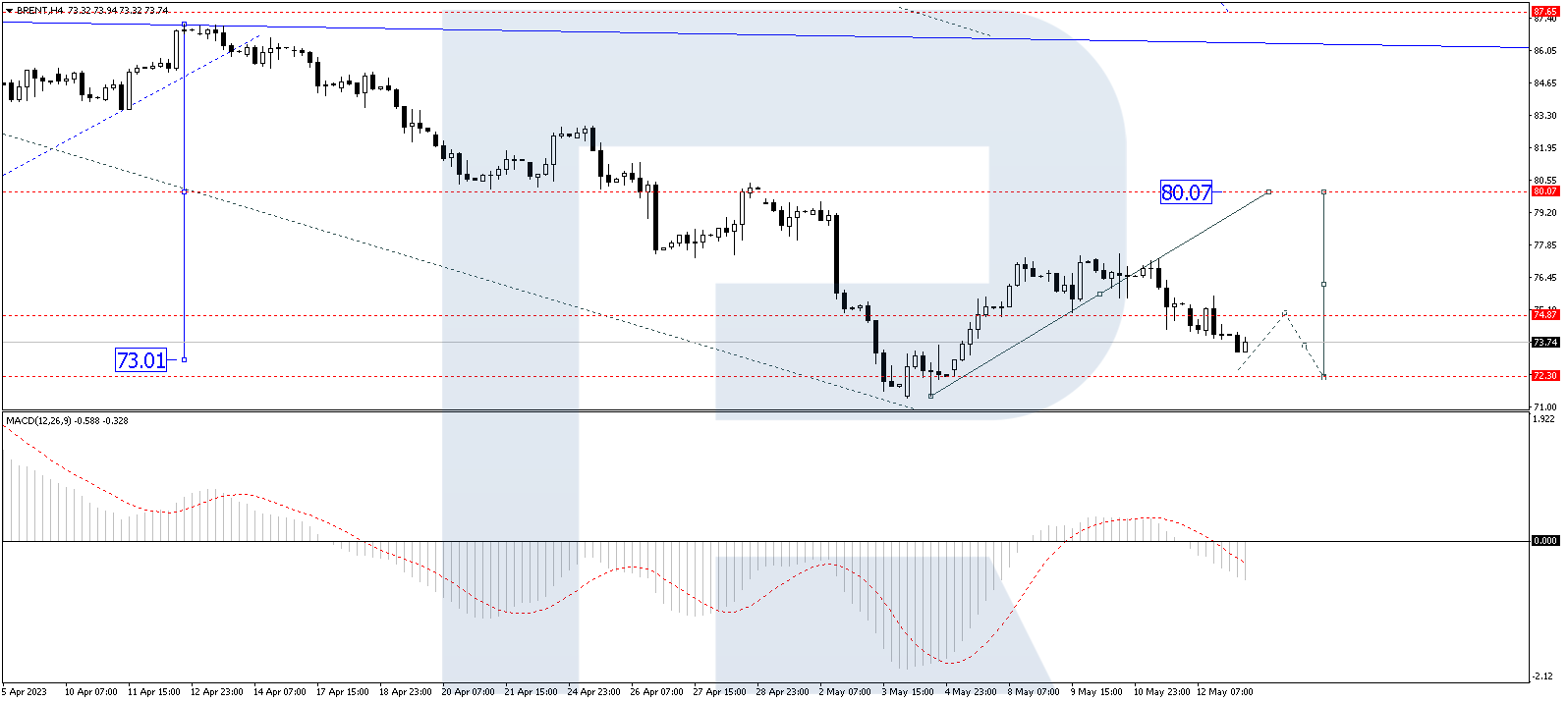
On H4, Brent has worked its way up to the 77.44 level.  The market continues to develop a correction today. A decline to 72.33 is expected, followed by a new wave of growth to 80.07. After its breakdown, a new growth potential could open to the level of 87.77. The target is local. Technically, this scenario is confirmed by the MACD indicator: its signal line is below zero, with growth to new highs expected.

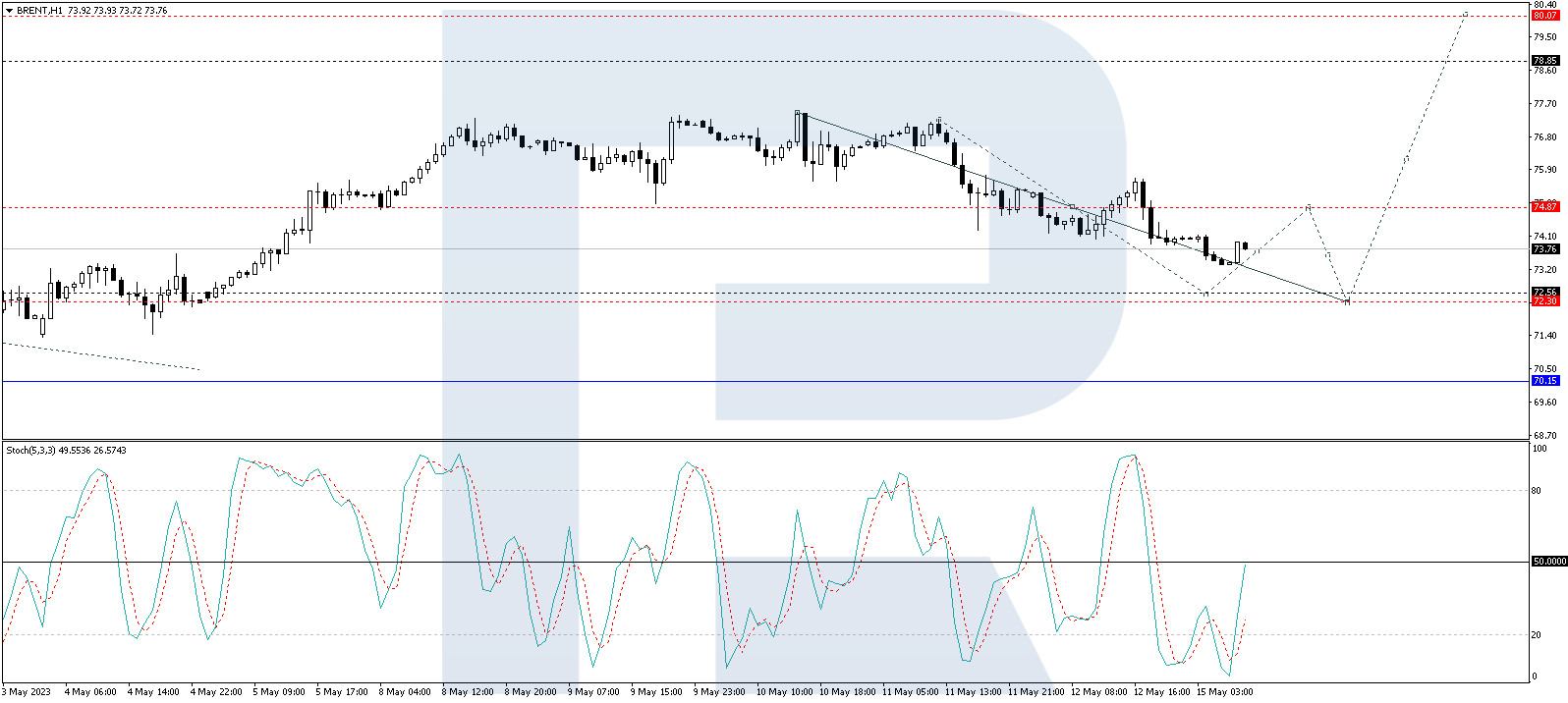
On H1, a consolidation range has formed around the 74.87 level. The market has escaped it downwards today. A decline to 72.56 is expected, followed by a rise to 74.87 and a decline to 72.33. After the price reaches this level, a wave of growth to 80.00 could begin. Technically, this scenario is confirmed by the Stochastic oscillator: Its signal line is breaking through the level of 20 upwards, aiming at 50. A rebound from this level is expected, followed by a new decline to 20. Next, growth to 80 could follow.

Disclaimer

Any forecasts contained herein are based on the author’s particular opinion. This analysis may not be treated as trading advice. RoboForex bears no responsibility for trading results based on trading recommendations and reviews contained herein.

The cryptocurrency market digest (BTC). Overview for 10.05.2023

By RoboForex.com

The BTC rate stabilised around 27,413 USD on Monday. The weekly loss is estimated at 2%.

The leading cryptocurrency rose today above intermediate resistance at 27,300 USD. This may force sellers to reduce volumes, but for a solid rise, the quotes need to secure above the 29,300 USD level. The target to secure is at 31,500 USD and from there to 32,700 USD.

The market focus is on the situation with the US budget and the public debt limit. Time is running out: by 1 June, the federal government may run out of money to finance its own needs. If this happens, BTC could become a defensive asset for a while.

The cryptocurrency market capitalisation has recovered to 1.143 trillion USD, with BTC’s share returning to 46.5% and ETH’s share rising to 19.7%.

The number of investors in BTC is on the rise

Glassnode notes that the number of Bitcoin addresses holding at least 1 BTC has surpassed the one million mark. According to the service, this number has increased by 190,000 since 1 February 2022.

US cryptocurrency companies move to Bermuda

US cryptocurrency companies are increasingly choosing the jurisdiction of Bermuda to continue their operations as the US regulatory environment becomes increasingly complex and aggressive towards the industry. Coinbase was previously licensed by the Bermuda Monetary Authority.

Article By RoboForex.com

Attention!
Forecasts presented in this section only reflect the author’s private opinion and should not be considered as guidance for trading. RoboForex LP bears no responsibility for trading results based on trading recommendations described in these analytical reviews.

The US debt ceiling crisis is ultimate gift for China: deVere CEO

By George Prior

The US failing to raise the debt ceiling and defaulting on its financial obligations would be the “ultimate gift” for China, affirms the CEO and founder of deVere Group, one of the world’s largest independent financial advisory, asset management and fintech organizations.

Nigel Green’s comments come as President Joe Biden, House Speaker Kevin McCarthy and other congressional leaders are planning to meet Tuesday to discuss budget negotiations to avoid what could be an unprecedented default that would rock the global financial system.

Biden has been reluctant to give details about terms of the negotiation but said at the weekend that he believed a deal could be reached.

The standoff is down to Democrats demanding a “clean” increase without conditions to pay debts resulting from spending and tax cuts approved by Congress. Meanwhile, Republicans are saying they will not authorise any additional borrowing without an agreement to cut spending.

According to the Treasury, the US may default as soon as June 1, causing a global economic catastrophe, if the limit is not raised by Congress before then.

The deVere Group CEO says: “A default would upend the global financial system and would likely be worse than the 2008 crash.

“It would cause upheaval on an unprecedented level. However, there would be a major beneficiary of the economic and financial fallout: China.”

He continues: “The US failing to raise the debt ceiling and defaulting on its financial obligations would be the ultimate gift for China as it seeks global economic and financial dominance.

“A default would lead to a decline in the value of the US dollar and a loss of confidence in the US financial system. As such, investors would seek alternative destinations for their capital.

“China would move to position itself as a more stable and attractive investment option, attracting more international investment and capital inflows. In turn, this would boost the Chinese economy and financial markets.”

If Congress is unable to agree and raise the debt ceiling there would be a depreciation of US asset prices, including real estate, companies, and infrastructure. “China, with its significant foreign exchange reserves, would likely take advantage of the situation by purchasing these assets at discounted prices.

“Beijing would, we expect, acquire strategic assets in sectors like technology, energy, or manufacturing, which could enhance its economic and technological capabilities.”

The strengthening of the yuan’s position would also be a major advantage for China, notes Nigel Green. “The US dollar’s status as the world’s primary reserve currency could be undermined in the event of a default. This would be an opportunity for China to promote the internationalisation of its own currency.”

Beijing has been pushing for the use of the yuan in global trade, investment, and as a reserve currency, aiming to reduce reliance on the US dollar and enhance the influence of its currency – and a default would be a huge help for China in this regard.

Last week, in a media statement, the deVere CEO said that even if there is a last-minute agreement and a default is diverted, the drama will have eroded some of the current global reserve currency’s credibility and reputation as a ‘safety asset’.

“In addition, we expect that China would seize the opportunity to strengthen its trade partnerships with other countries, offering more attractive trade terms and position itself as a reliable trading partner. This could lead to increased market access and trade opportunities for Chinese firms.”

Nigel Green concludes: “Whatever happens in debt ceiling talks this week between Democrats and Republicans, China’s massive PR machine is already spinning the narrative that the US is a declining power.”

About:

deVere Group is one of the world’s largest independent advisors of specialist global financial solutions to international, local mass affluent, and high-net-worth clients.  It has a network of more than 70 offices across the world, over 80,000 clients and $12bn under advisement.

Trade Of The Week: Dollar Rebound Or Dead Cat Bounce?

By ForexTime 

The dollar caught our attention this morning after touching its highest level in five weeks against other major currencies.

It looks like dollar bulls may be back in the driver’s seat, especially after the solid rebound witnessed last week. But the key question is whether the US Dollar Index can maintain this bullish momentum or if this is just another dead cat bounce.

The low down…

After being suppressed by increasing Fed cut bets, the dollar has fought back with a vengeance thanks to political uncertainty and inflation worries. Concerns continue to mount over the US debt ceiling debate while a recent survey revealed that five-year inflation expectations among US consumers have jumped to a 12-year high.

Given how these forces already influencing the dollar, this could be another volatile week for the currency and here are 3 reasons why:

  1. Safe-haven demand

The messy mashup of political uncertainty and global growth fears could send investors rushing towards the dollar’s safe embrace.

  • Ongoing drama revolving around the debt limit saga is likely to leave investors on edge. Last Friday, the US Congressional Budget Office warned that the US faced a “significant risk” of defaulting in early June without a debt ceiling increase. Talks between US President Joe Biden and top lawmakers have been postponed to this week. Should the ongoing stalemate result in elevated uncertainty and turbulence across markets, this could increase the appetite for the dollar.
  • Concerns still linger over global economic growth. Throughout this week, investors will be presented with key economic reports from major economies ranging from Europe, the United Kingdom, and China among many others. A set of disappointing figures may fuel risk aversion as growth fears intensify, and the flight to safety may propel the dollar higher.
  1. Fed speeches + US data 

After US annual inflation dipped below 5% in April, investors will be keeping a very close eye on Fed speeches and data for more clues on the Fed’s next move.

  • A host of Fed speakers could influence the dollar’s near-term trajectory. Although US inflation has dipped below 5%, the jobs market remains tight with core and headline monthly inflation data still sticky. If policymakers strike an overall hawkish note, this could support the dollar further. However, any whiff of doves or further hints the Fed pausing may empower dollar bears.
  • It will be wise to keep an eye on the latest US retail sales figures, industrial production, and US weekly initial jobless claims. A disappointing set of reports may fuel expectations around the Fed cutting rates down the road, weakening the dollar. If the figures exceed forecasts, it may fuel speculation around the Fed keeping rates higher for longer.
  1. USDInd Bullish breakout

Dollar bulls marked their territory after securing a strong daily and weekly close above the 102.35 resistance level.

Nevertheless, the resistance around 50 and 100-day SMA could still weaken bulls before prices test the 103.00 level. Should prices push above this point, the next key level of interest on the US Dollar Index can be found at around 103.80 and 104.00. Alternatively, a decline back under 102.35 could signal a selloff towards 101.50 and 100.72, respectively.


Forex-Time-LogoArticle by ForexTime

ForexTime Ltd (FXTM) is an award winning international online forex broker regulated by CySEC 185/12 www.forextime.com

Is a Pension Fund Crisis Next?

“U.S. pension funds are on the brink of implosion”

By Elliott Wave International

Did you get a heads-up from the financial media that the U.S. banking system was vulnerable before the failures of Silicon Valley, Signature and First Republic banks?

There may have been outlier articles here and there but no real warnings.

By contrast, the 2021 edition of Robert Prechter’s book Conquer the Crash, Last Chance to Conquer the Crash, reminded readers that:

In a crash and depression, we will see falling asset values, massive layoffs, high unemployment, corporate and municipal bankruptcies, pension fund implosions, bank and insurance company failures and ultimately social and political crises.

As you know, some of these things have recently been unfolding.

Let’s focus on pension funds for a few moments. Yes, some recent articles have provided warnings, but they have not been widespread.

The headline of one of those news items is from the Washington Post (Feb. 14):

Time Bomb of Public Pension Funding Ticks Louder

Many public pensions suffer from funding shortfalls. In other words, they don’t have nearly enough money to meet their obligations. More than that, investments are being made in potentially financially dangerous assets to boost returns, such as private equity.

Many people who are counting on a pension probably don’t know that some private equity firms have invested pension-fund money in the housing market since the Great Recession — yes, they bought actual houses. As the Atlanta Journal Constitution reported (Feb. 12):

Private equity firms like Blackstone Group, Pretium Partners and Amherst convinced public pension funds and other large institutional investors to bankroll their homebuying sprees.

If the housing market crashes, you guessed it, some pension funds will take a big hit.

Here’s another headline from a British newspaper, the Guardian (Feb. 2):

US pension funds are on the brink of implosion — and Wall Street is ignoring it

However, Elliott Wave International is not ignoring it.

As the Elliott Wave Theorist said in February [The Elliott Wave Theorist has published monthly since 1979 and covers major financial and cultural trends):

Unfunded liabilities of states’ pension funds in the U.S. stood at $1.3 trillion as of year-end 2022. Private pension funds are underfunded as well. The whole system has made promises it can’t fulfill.

And, getting back to the banking crisis, the FDIC may face challenges fulfilling its promises to depositors if bank failures become widespread. In other words, the FDIC can only “make whole” a limited number of depositors at one time (up to $250,000). Whether the federal government steps in is another matter. The point is: it may not be wise to count on the FDIC during a major banking panic.

So, the question arises: Are there viable alternatives to banks?

Yes!

Elliott Wave International is now offering a special report titled “Your 5 Top Alternatives to Banks,” which is excerpted from Robert Prechter’s Last Chance to Conquer the Crash.

You can access this special report for free when you join Club EWI, the world’s largest Elliott wave educational community. Just follow the link below:

Read “Your 5 Top Alternatives to Banks” now when you sign up for a FREE Club EWI account.

This article was syndicated by Elliott Wave International and was originally published under the headline Is a Pension Fund Crisis Next?. EWI is the world’s largest market forecasting firm. Its staff of full-time analysts led by Chartered Market Technician Robert Prechter provides 24-hour-a-day market analysis to institutional and private investors around the world.

Political disputes over raising the US debt ceiling could trigger a recession

By JustMarkets

At the closing of the stock market on Friday, Dow Jones Index (US30) decreased by 0.03% (-0.23% for the week), and S&P 500 (US500) fell by 0.16% (-0.31% for the week). The Technology Index NASDAQ (US100) lost 0.32% on Friday (+0.43% for the week). Friday’s data, which showed a sharper-than-expected drop in consumer sentiment in the United States, heightened fears that the political debate over raising the debt ceiling could trigger a recession. Republicans are pushing for steep spending cuts in exchange for raising the debt ceiling, while Democrats are pointing out that the debt ceiling is not an appropriate vehicle for budget changes.

The Congressional Budget Office warned late last week that the US would face a significant risk of default during the first two weeks of June if lawmakers do not raise the debt ceiling the country is legally allowed to incur. Negotiations between US President Joe Biden and top lawmakers to raise the $31.4 trillion debt ceiling are scheduled to resume early this week. Analysts at JPMorgan believe there is unwarranted panic in the markets, and politicians will not default but point out that, statistically, volatility in financial markets at a time like this is increasing.

Equity markets in Europe mostly rose on Friday. German DAX (DE30) gained 0.50% (-0.34% for the week), French CAC 40 (FR40) added 0.45% (-0.18% for the week), Spanish IBEX 35 (ES35) increased by 0.56% (+0.78% for the week), British FTSE 100 (UK100) close up by 0.31% (+0.67% for the week).

With underlying inflation in the Eurozone remaining steady, there is no doubt that the ECB will continue to raise rates. Europe’s central bank has already raised interest rates by 375 basis points in the current tightening cycle and is expected to raise them another 50 basis points in two quarter-point steps in June and July.

Oil prices fell more than 1% Friday, falling for the third straight week because of a stronger dollar and fears of weak demand due to weak data from China. Data from Beijing last week showed that China’s consumer inflation barely rose in April, while producer inflation fell to its lowest level since the pandemic peak in 2020. China’s trade data is also disappointing, with imports down 1.4% and exports up 8.5%. This is evidence that the economy is recovering unevenly, which could hit demand.

Gold gained momentum on Friday. The trigger for gold’s rise now is investor concern about the impasse over the US government debt hike. Investors are looking for safe-haven assets, which tend to be gold, the US dollar, and the Swiss franc. And the medium-term outlook for gold remains bullish. Historically, once the Fed officially pushes the pause button, nominal government bond yields begin to fall over the next few months. And that tends to drive up the price of precious metals, especially if rates fall further.

Turkish President Tayyip Erdogan beat his opposition rival Kemal Kilicdaroglu in Sunday’s election (49% to 45%) but failed to win an absolute majority to extend his 20-year rule. Neither Erdogan nor Kilicdaroglu passed the 50% barrier needed to avoid a second round, which is due in the May 28 elections.

Asian markets traded unevenly last week. Japan’s Nikkei 225 (JP225) gained 1.01% over the week, China’s FTSE China A50 (CHA50) fell by 1.76% over the week, Hong Kong’s Hang Seng (HK50) lost 2.49% over the week, India’s NIFTY 50 (IND50) gained 0.75%, and Australia’s S&P/ASX 200 (AU200) was up by 0.51% over the week.

In the commodities market, futures on natural gas (+6.6%), gasoline (+2.14%), and lumber (+2.1%) showed the biggest gains last week. Futures on orange juice (-9.54%), silver (-6.94%), cotton (-4.22%), copper (-4.06%), wheat (-3.79%), coffee (-2.92%) and corn (-2.22%) showed the biggest declines.

S&P 500 (F) (US500) 4,124.08 −6.54 (−0.16%)

Dow Jones (US30)33,300.62 −8.89 (−0.027%)

DAX (DE40) 15,913.82 +78.91 (+0.50%)

FTSE 100 (UK100) 7,754.62 +24.04 (+0.31%)

USD Index 102.71 +0.65 +0.63%

Important events for today:
  • – Japan Producer Price Index (m/m) at 02:50 (GMT+3);
  • – Switzerland Producer Price Index (m/m) at 09:30 (GMT+3);
  • – Eurozone EU Economic Forecasts at 12:00 (GMT+3);
  • – Eurozone Industrial Production (m/m) at 12:00 (GMT+3);
  • – US NY Empire State Manufacturing Index (m/m) at 15:30 (GMT+3);
  • – US FOMC Member Kashkari Speaks at 16:15 (GMT+3).

By JustMarkets


This article reflects a personal opinion and should not be interpreted as an investment advice, and/or offer, and/or a persistent request for carrying out financial transactions, and/or a guarantee, and/or a forecast of future events.

Turkish lira could collapse if Erdogan wins election

By George Prior

The Turkish lira could collapse if the incumbent Recep Tayyip Erdogan wins Turkey’s elections on Sunday and continues his presidency, warns the CEO and founder of one of the world’s largest independent financial advisory organizations.

The bleak warning from Nigel Green of deVere Group come as polls open in the country’s fiercely fought presidential and parliamentary elections that could mean the end to Erdogan’s 20-year rule.

His main opponent is CHP leader Kemal Kılıçdaroğlu, who represents an election coalition of six opposition parties.

A candidate must win over 50% of the vote on Sunday evening in order to be elected. A failure to secure more than half the vote means Turkey will head to a run-off on May 28.

Nigel Green says: “The Turkish lira has been one of the world’s worst-performing currencies for a long time already.

“Should Erdogan win on Sunday, we expect this downward trend for the currency to gain momentum, and it could face collapse within this quarter.

“This is because confidence in the crisis-stricken lira will be further eroded as the incumbent president would continue his highly unconventional monetary policy agenda, which sees Erdogan opining that raising interest rates increases inflation, instead of cooling it.

“Currently, the official inflation rate is just above 50%, but analysts believe it is actually higher than 100%.”

The chief executive of deVere Group, which offers 80,000 clients favourable foreign exchange rates, continues: “It’s likely that an Erdogan win will mean a significant and rapid devaluation of the Turkish lira, leading to a loss of confidence in its value and a decline in its purchasing power relative to other currencies.

“A sharp decline in the exchange rate would likely be accompanied by hyperinflation, economic instability, and financial turmoil within Turkey.”

The last two years has seen Turkey’s currency plummet and prices rise considerably, triggering a cost-of-living crisis that has helped erode Erdogan’s conservative, working class base.

Kemal Kılıçdaroğlu, the opponent, is fighting as a unity candidate for six opposition parties, ranging from his own centre-left party and the nationalist Good party to four smaller groups, which include two former Erdogan allies one of whom co-founded the AK Party.

Nigel Green concludes: “The outcome of Turkey’s election will determine the trajectory of the country’s under-siege currency for years to come.”

About:

deVere Group is one of the world’s largest independent advisors of specialist global financial solutions to international, local mass affluent, and high-net-worth clients.  It has a network of more than 70 offices across the world, over 80,000 clients and $12bn under advisement.

Currency Speculators push Mexican Peso positions to 165-week high as peso cruises

By InvestMacro

Here are the latest charts and statistics for the Commitment of Traders (COT) data published by the Commodities Futures Trading Commission (CFTC).

The latest COT data is updated through Tuesday May 9th and shows a quick view of how large market participants (for-profit speculators and commercial traders) were positioned in the futures markets. All currency positions are in direct relation to the US dollar where, for example, a bet for the euro is a bet that the euro will rise versus the dollar while a bet against the euro will be a bet that the euro will decline versus the dollar.

Weekly Speculator Changes led by Mexican Peso & Canadian Dollar
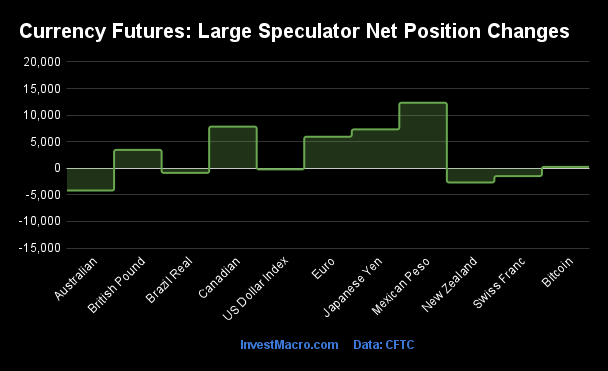
The COT currency market speculator bets were higher this week as six out of the eleven currency markets we cover had higher positioning while the other five markets had lower speculator contracts.

Leading the gains for the currency markets was the Mexican Peso (12,322 contracts) with the Canadian Dollar (7,833 contracts), the Japanese Yen (7,309 contracts), EuroFX (5,933 contracts), British Pound (3,463 contracts) and Bitcoin (255 contracts) also showing positive weeks.

The currencies seeing declines in speculator bets on the week were the Australian Dollar (-4,183 contracts) with the New Zealand Dollar (-2,664 contracts), Swiss Franc (-1,468 contracts), Brazilian Real (-867 contracts) and the US Dollar Index (-194 contracts) also registering lower bets on the week.

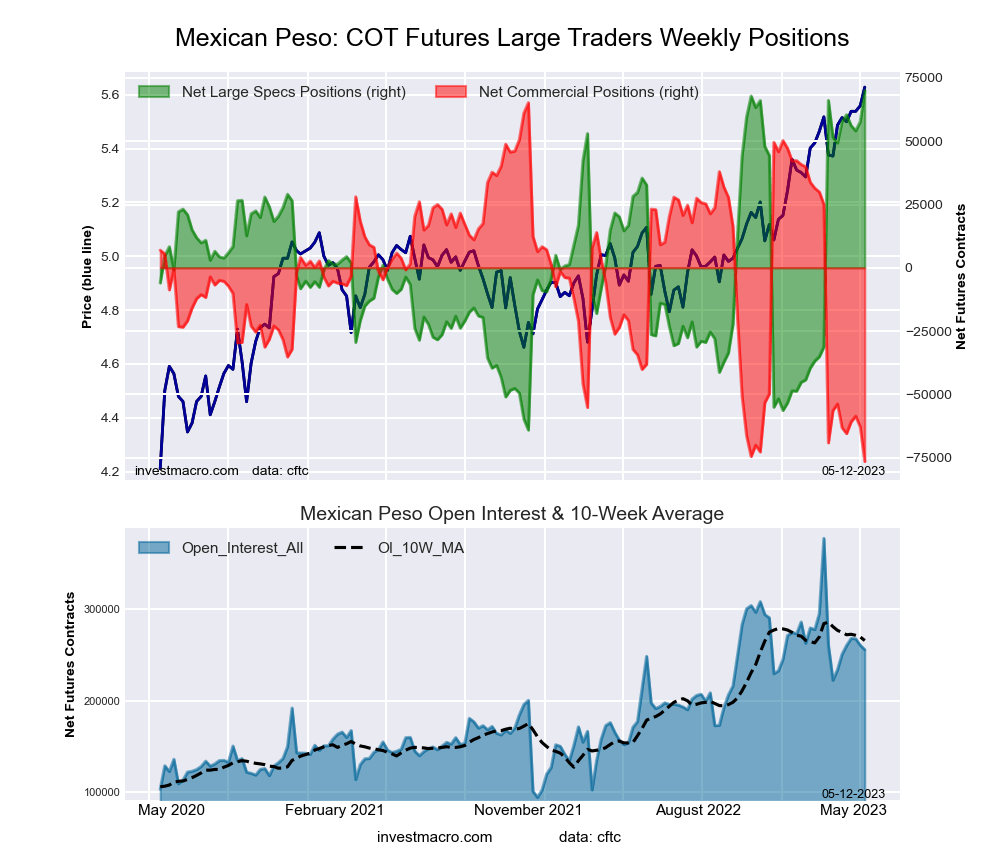
Mexican Peso positions hit 165-week high as peso cruises higher

Highlighting the COT currency data this week is the continued rise in the Mexican peso positioning. Large speculators boosted their bullish bets for the Mexican peso this week for the second straight week and for the fourth time out of the past six weeks.

Peso bets have now improved by a total of +101,284 contracts over the past nine weeks, going from a net position of -31,252 contracts on March 7th to this week’s total net position of +70,032 contracts. This boost in speculator sentiment has brought the current net position to the highest level in 165 weeks, dating back to the height of the pandemic in March of 2020.

Helping the peso positioning has been the rising interest rates in Mexico that recently reached the 11.25 percent level at the latest central bank meeting in March. There is speculation of another 25 basis point increase in May as well. This has given Mexico a rising interest rate differential with the US central bank that is seen as mostly likely holding its key interest rate in June with an 84 percent probability, according to the CME Fed Tool.

The Mexican peso exchange rate versus the US dollar has been in a sharp uptrend to start 2023. The MXN futures (front month) price closed this week at 0.5642 compared to the 2023 opening price around the 0.5070 exchange rate. The MXN futures have gained in six out of the past eight weeks and, this week, reached its highest level since September 2017.


Data Snapshot of Forex Market Traders | Columns Legend
May-09-2023OIOI-IndexSpec-NetSpec-IndexCom-NetCOM-IndexSmalls-NetSmalls-Index
USD Index32,1752811,15644-12,626561,47033
EUR794,72190179,42288-234,2601154,83866
GBP242,576634,52873-11,528267,00072
JPY192,57442-61,0153169,16269-8,14737
CHF43,38947-4,467434,75953-29257
CAD159,36437-42,2631541,9578530623
AUD165,53262-49,1933956,89761-7,70434
NZD41,58339-4,581414,2835729854
MXN255,4415770,032100-76,53306,50196
RUB20,93047,54331-7,15069-39324
BRL49,2083834,59480-36,504201,91059
Bitcoin13,1025642384-1,131070829


Strength Scores led by Mexican Peso & EuroFX
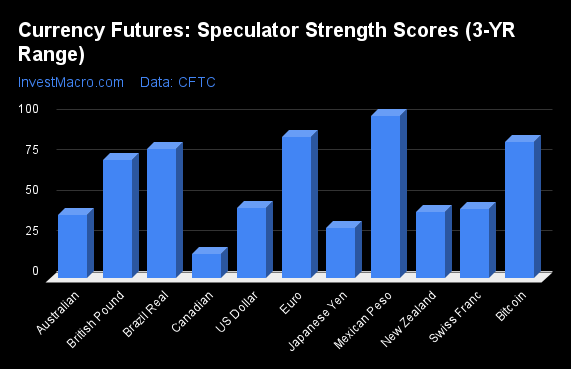
COT Strength Scores (a normalized measure of Speculator positions over a 3-Year range, from 0 to 100 where above 80 is Extreme-Bullish and below 20 is Extreme-Bearish) showed that the Mexican Peso (100 percent) and the EuroFX (88 percent) lead the currency markets this week. Bitcoin (84 percent), Brazilian Real (80 percent) and the British Pound (73 percent) come in as the next highest in the weekly strength scores.

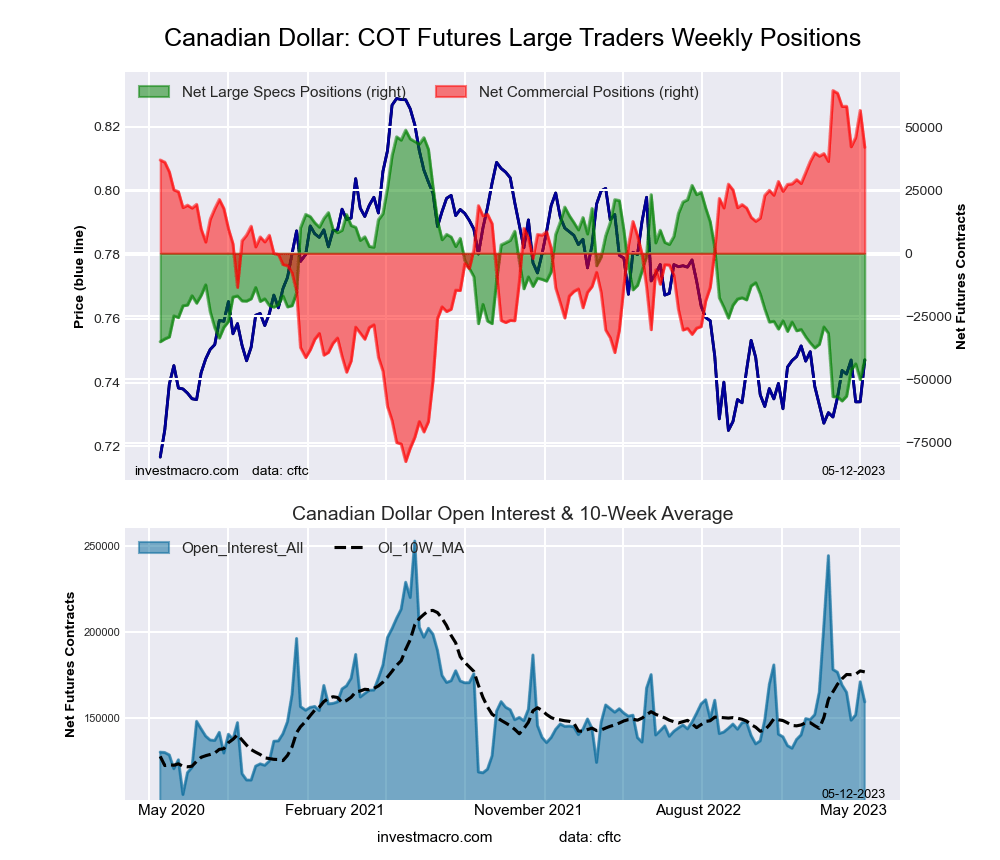
On the downside, the Canadian Dollar (15 percent) comes in at the lowest strength levels currently and is in Extreme-Bearish territory (below 20 percent). The next lowest strength scores are the Japanese Yen (31 percent), Australian Dollar (39 percent) and the New Zealand Dollar (41 percent).

Strength Statistics:
US Dollar Index (43.5 percent) vs US Dollar Index previous week (43.9 percent)
EuroFX (87.5 percent) vs EuroFX previous week (85.3 percent)
British Pound Sterling (72.9 percent) vs British Pound Sterling previous week (69.9 percent)
Japanese Yen (31.3 percent) vs Japanese Yen previous week (26.8 percent)
Swiss Franc (42.8 percent) vs Swiss Franc previous week (46.7 percent)
Canadian Dollar (15.1 percent) vs Canadian Dollar previous week (7.8 percent)
Australian Dollar (39.2 percent) vs Australian Dollar previous week (43.1 percent)
New Zealand Dollar (41.2 percent) vs New Zealand Dollar previous week (48.4 percent)
Mexican Peso (100.0 percent) vs Mexican Peso previous week (90.8 percent)
Brazilian Real (79.8 percent) vs Brazilian Real previous week (80.9 percent)
Bitcoin (84.3 percent) vs Bitcoin previous week (79.9 percent)


British Pound & Mexican Peso top the 6-Week Strength Trends
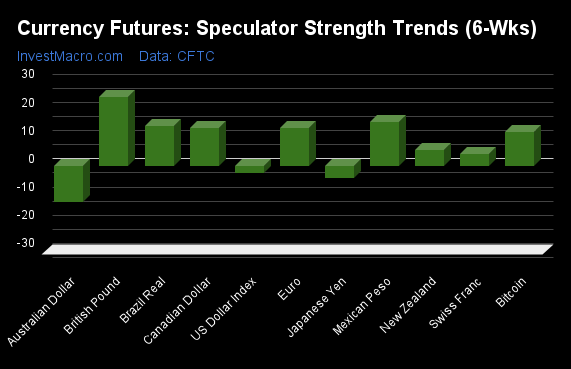
COT Strength Score Trends (or move index, calculates the 6-week changes in strength scores) showed that the British Pound (25 percent) and the Mexican Peso (15 percent) lead the past six weeks trends for the currencies. The Canadian Dollar (14 percent), the Brazilian Real (14 percent) and the EuroFX (13 percent) are the next highest positive movers in the latest trends data.

The Australian Dollar (-13 percent) leads the downside trend scores currently with the Japanese Yen (-4 percent), US Dollar Index (-3 percent) and the Swiss Franc (4 percent) following next with lower trend scores.

Strength Trend Statistics:
US Dollar Index (-2.6 percent) vs US Dollar Index previous week (-4.7 percent)
EuroFX (13.3 percent) vs EuroFX previous week (11.0 percent)
British Pound Sterling (24.6 percent) vs British Pound Sterling previous week (18.5 percent)
Japanese Yen (-4.3 percent) vs Japanese Yen previous week (-1.2 percent)
Swiss Franc (4.2 percent) vs Swiss Franc previous week (11.4 percent)
Canadian Dollar (13.6 percent) vs Canadian Dollar previous week (6.3 percent)
Australian Dollar (-12.8 percent) vs Australian Dollar previous week (-6.1 percent)
New Zealand Dollar (5.5 percent) vs New Zealand Dollar previous week (18.6 percent)
Mexican Peso (15.5 percent) vs Mexican Peso previous week (4.6 percent)
Brazilian Real (14.1 percent) vs Brazilian Real previous week (13.5 percent)
Bitcoin (12.2 percent) vs Bitcoin previous week (13.8 percent)


Individual COT Forex Markets:

US Dollar Index Futures:
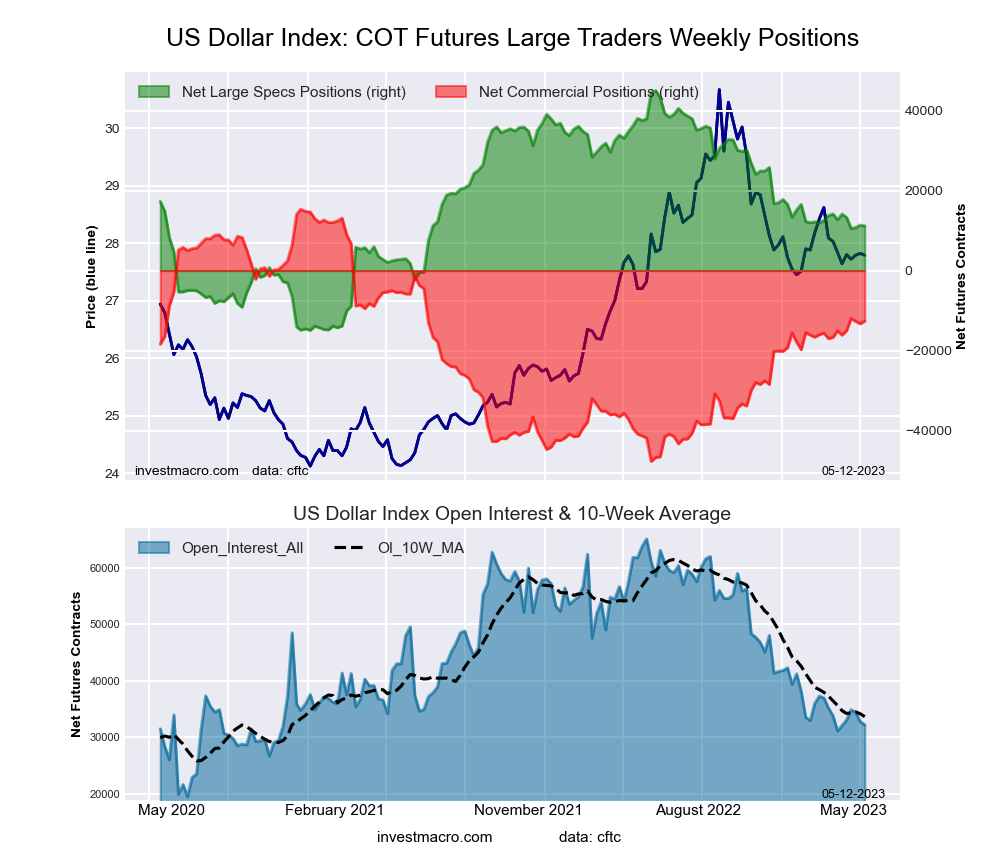
US Dollar Index Forex Futures COT ChartThe US Dollar Index large speculator standing this week resulted in a net position of 11,156 contracts in the data reported through Tuesday. This was a weekly reduction of -194 contracts from the previous week which had a total of 11,350 net contracts.

This week’s current strength score (the trader positioning range over the past three years, measured from 0 to 100) shows the speculators are currently Bearish with a score of 43.5 percent. The commercials are Bullish with a score of 55.7 percent and the small traders (not shown in chart) are Bearish with a score of 32.6 percent.

US DOLLAR INDEX StatisticsSPECULATORSCOMMERCIALSSMALL TRADERS
– Percent of Open Interest Longs:67.312.115.3
– Percent of Open Interest Shorts:32.651.410.7
– Net Position:11,156-12,6261,470
– Gross Longs:21,6563,9024,923
– Gross Shorts:10,50016,5283,453
– Long to Short Ratio:2.1 to 10.2 to 11.4 to 1
NET POSITION TREND:
– Strength Index Score (3 Year Range Pct):43.555.732.6
– Strength Index Reading (3 Year Range):BearishBullishBearish
NET POSITION MOVEMENT INDEX:
– 6-Week Change in Strength Index:-2.63.9-9.8


Euro Currency Futures:

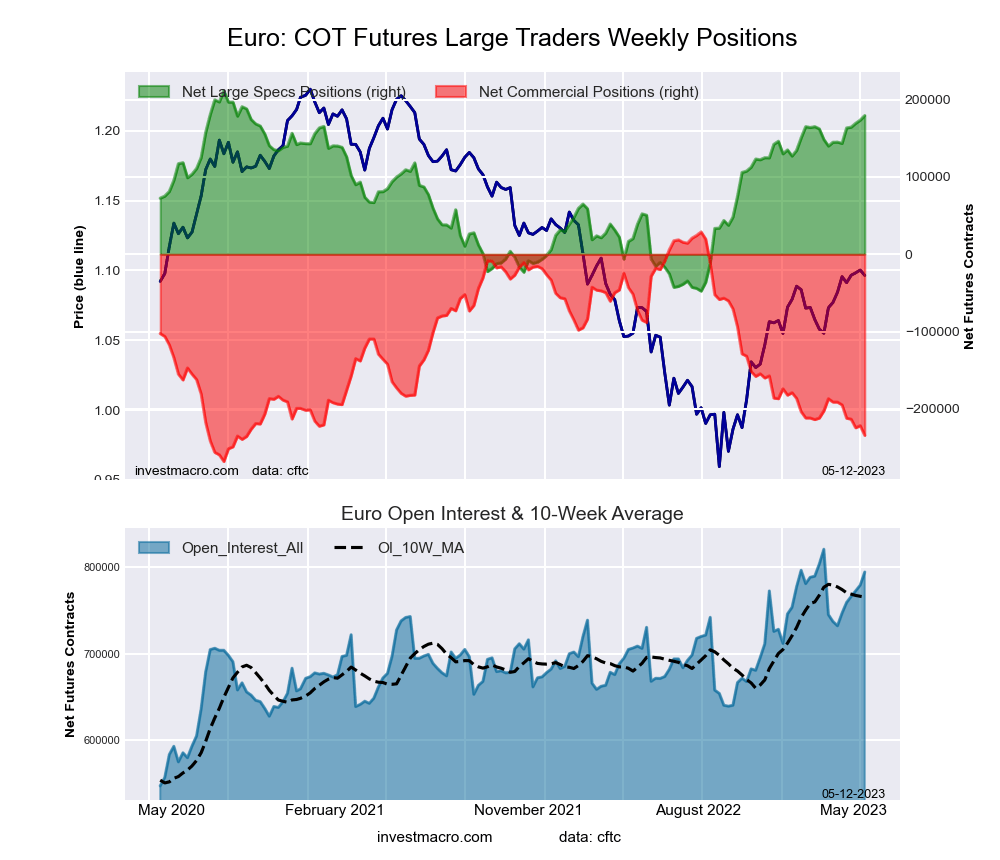
Euro Currency Futures COT ChartThe Euro Currency large speculator standing this week resulted in a net position of 179,422 contracts in the data reported through Tuesday. This was a weekly increase of 5,933 contracts from the previous week which had a total of 173,489 net contracts.

This week’s current strength score (the trader positioning range over the past three years, measured from 0 to 100) shows the speculators are currently Bullish-Extreme with a score of 87.5 percent. The commercials are Bearish-Extreme with a score of 11.4 percent and the small traders (not shown in chart) are Bullish with a score of 66.5 percent.

EURO Currency StatisticsSPECULATORSCOMMERCIALSSMALL TRADERS
– Percent of Open Interest Longs:32.852.612.1
– Percent of Open Interest Shorts:10.282.15.2
– Net Position:179,422-234,26054,838
– Gross Longs:260,335418,41096,515
– Gross Shorts:80,913652,67041,677
– Long to Short Ratio:3.2 to 10.6 to 12.3 to 1
NET POSITION TREND:
– Strength Index Score (3 Year Range Pct):87.511.466.5
– Strength Index Reading (3 Year Range):Bullish-ExtremeBearish-ExtremeBullish
NET POSITION MOVEMENT INDEX:
– 6-Week Change in Strength Index:13.3-14.513.7


British Pound Sterling Futures:

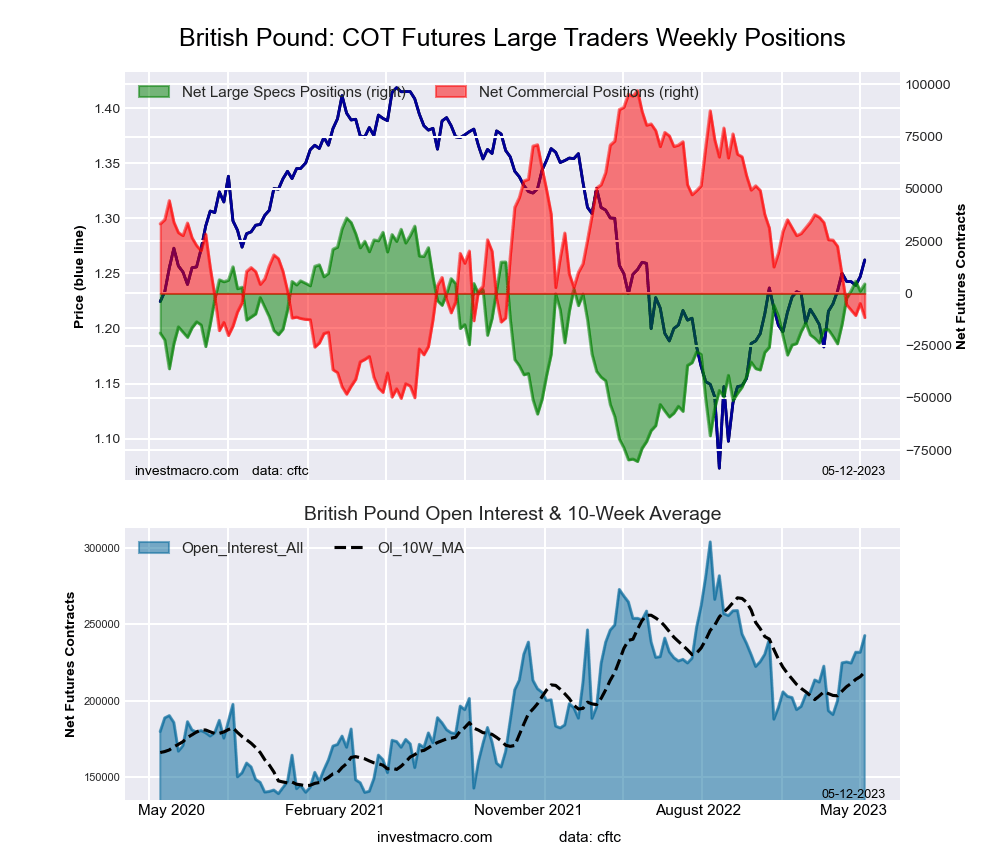
British Pound Sterling Futures COT ChartThe British Pound Sterling large speculator standing this week resulted in a net position of 4,528 contracts in the data reported through Tuesday. This was a weekly advance of 3,463 contracts from the previous week which had a total of 1,065 net contracts.

This week’s current strength score (the trader positioning range over the past three years, measured from 0 to 100) shows the speculators are currently Bullish with a score of 72.9 percent. The commercials are Bearish with a score of 26.3 percent and the small traders (not shown in chart) are Bullish with a score of 71.8 percent.

BRITISH POUND StatisticsSPECULATORSCOMMERCIALSSMALL TRADERS
– Percent of Open Interest Longs:29.552.312.8
– Percent of Open Interest Shorts:27.657.19.9
– Net Position:4,528-11,5287,000
– Gross Longs:71,561126,93531,057
– Gross Shorts:67,033138,46324,057
– Long to Short Ratio:1.1 to 10.9 to 11.3 to 1
NET POSITION TREND:
– Strength Index Score (3 Year Range Pct):72.926.371.8
– Strength Index Reading (3 Year Range):BullishBearishBullish
NET POSITION MOVEMENT INDEX:
– 6-Week Change in Strength Index:24.6-23.210.8


Japanese Yen Futures:

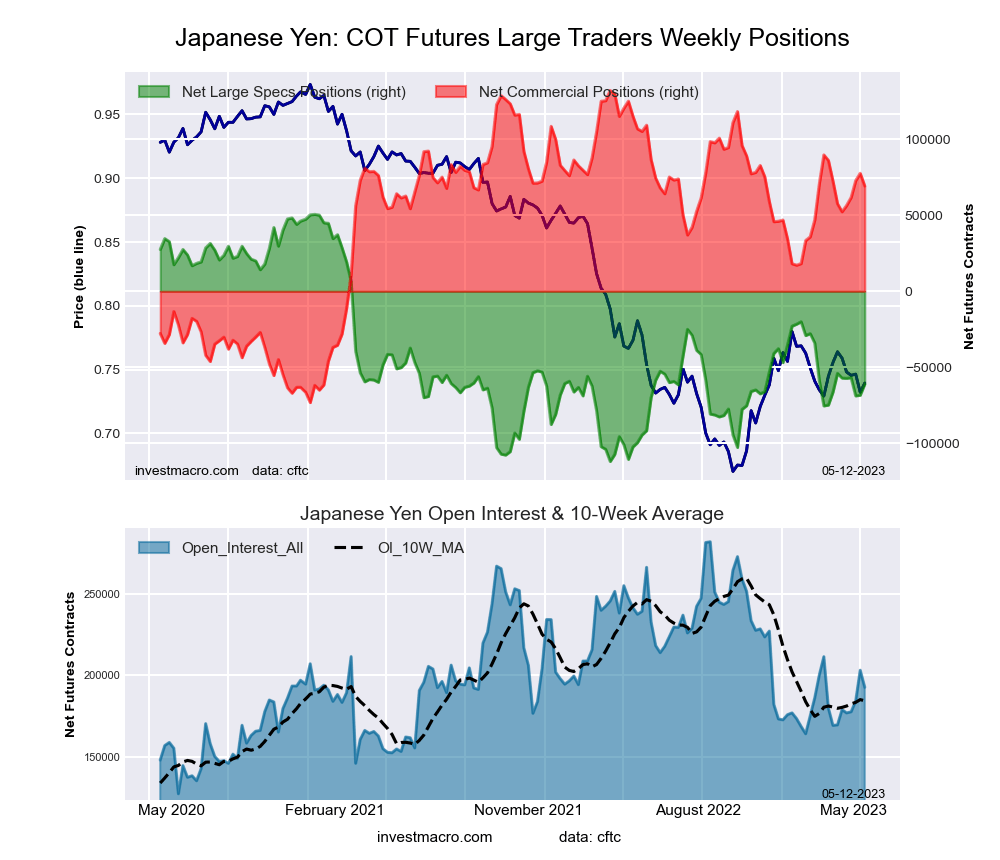
Japanese Yen Forex Futures COT ChartThe Japanese Yen large speculator standing this week resulted in a net position of -61,015 contracts in the data reported through Tuesday. This was a weekly rise of 7,309 contracts from the previous week which had a total of -68,324 net contracts.

This week’s current strength score (the trader positioning range over the past three years, measured from 0 to 100) shows the speculators are currently Bearish with a score of 31.3 percent. The commercials are Bullish with a score of 69.4 percent and the small traders (not shown in chart) are Bearish with a score of 36.9 percent.

JAPANESE YEN StatisticsSPECULATORSCOMMERCIALSSMALL TRADERS
– Percent of Open Interest Longs:11.571.715.1
– Percent of Open Interest Shorts:43.235.719.4
– Net Position:-61,01569,162-8,147
– Gross Longs:22,229137,99229,150
– Gross Shorts:83,24468,83037,297
– Long to Short Ratio:0.3 to 12.0 to 10.8 to 1
NET POSITION TREND:
– Strength Index Score (3 Year Range Pct):31.369.436.9
– Strength Index Reading (3 Year Range):BearishBullishBearish
NET POSITION MOVEMENT INDEX:
– 6-Week Change in Strength Index:-4.35.7-9.3


Swiss Franc Futures:

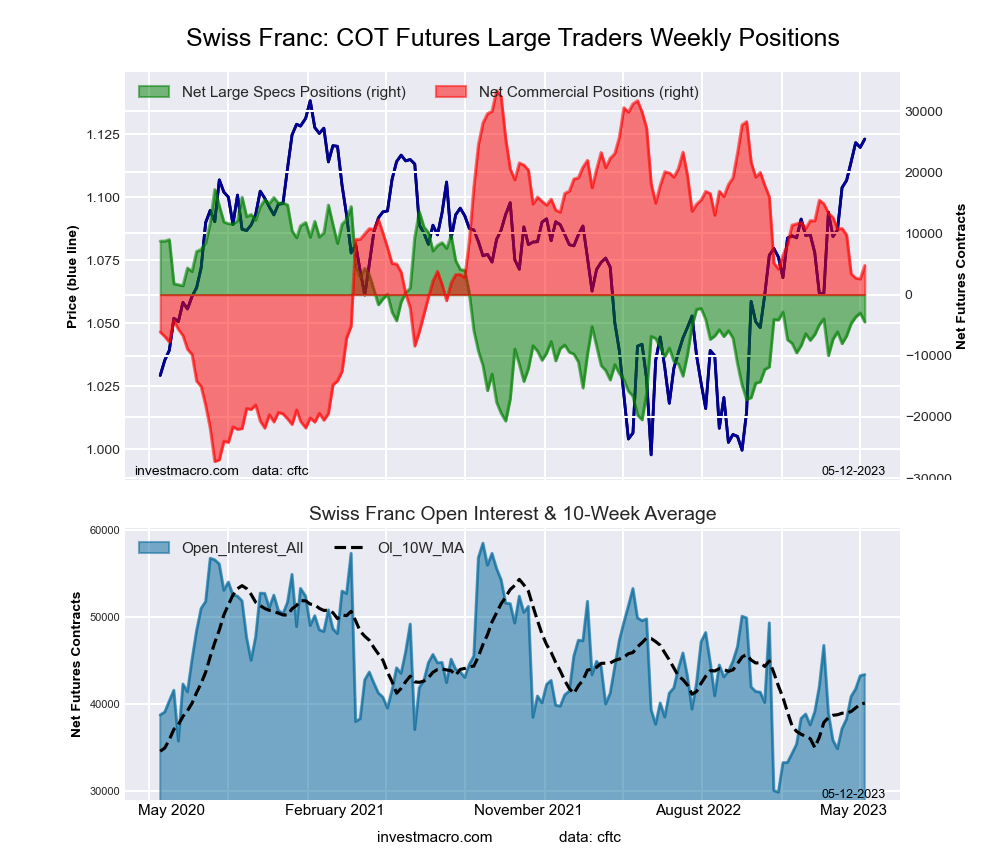
Swiss Franc Forex Futures COT ChartThe Swiss Franc large speculator standing this week resulted in a net position of -4,467 contracts in the data reported through Tuesday. This was a weekly fall of -1,468 contracts from the previous week which had a total of -2,999 net contracts.

This week’s current strength score (the trader positioning range over the past three years, measured from 0 to 100) shows the speculators are currently Bearish with a score of 42.8 percent. The commercials are Bullish with a score of 52.8 percent and the small traders (not shown in chart) are Bullish with a score of 56.5 percent.

SWISS FRANC StatisticsSPECULATORSCOMMERCIALSSMALL TRADERS
– Percent of Open Interest Longs:16.344.833.8
– Percent of Open Interest Shorts:26.633.834.5
– Net Position:-4,4674,759-292
– Gross Longs:7,05619,43114,657
– Gross Shorts:11,52314,67214,949
– Long to Short Ratio:0.6 to 11.3 to 11.0 to 1
NET POSITION TREND:
– Strength Index Score (3 Year Range Pct):42.852.856.5
– Strength Index Reading (3 Year Range):BearishBullishBullish
NET POSITION MOVEMENT INDEX:
– 6-Week Change in Strength Index:4.2-9.914.8


Canadian Dollar Futures:

Canadian Dollar Forex Futures COT ChartThe Canadian Dollar large speculator standing this week resulted in a net position of -42,263 contracts in the data reported through Tuesday. This was a weekly gain of 7,833 contracts from the previous week which had a total of -50,096 net contracts.

This week’s current strength score (the trader positioning range over the past three years, measured from 0 to 100) shows the speculators are currently Bearish-Extreme with a score of 15.1 percent. The commercials are Bullish-Extreme with a score of 84.7 percent and the small traders (not shown in chart) are Bearish with a score of 23.5 percent.

CANADIAN DOLLAR StatisticsSPECULATORSCOMMERCIALSSMALL TRADERS
– Percent of Open Interest Longs:18.659.419.6
– Percent of Open Interest Shorts:45.133.119.4
– Net Position:-42,26341,957306
– Gross Longs:29,60994,66231,226
– Gross Shorts:71,87252,70530,920
– Long to Short Ratio:0.4 to 11.8 to 11.0 to 1
NET POSITION TREND:
– Strength Index Score (3 Year Range Pct):15.184.723.5
– Strength Index Reading (3 Year Range):Bearish-ExtremeBullish-ExtremeBearish
NET POSITION MOVEMENT INDEX:
– 6-Week Change in Strength Index:13.6-14.615.3


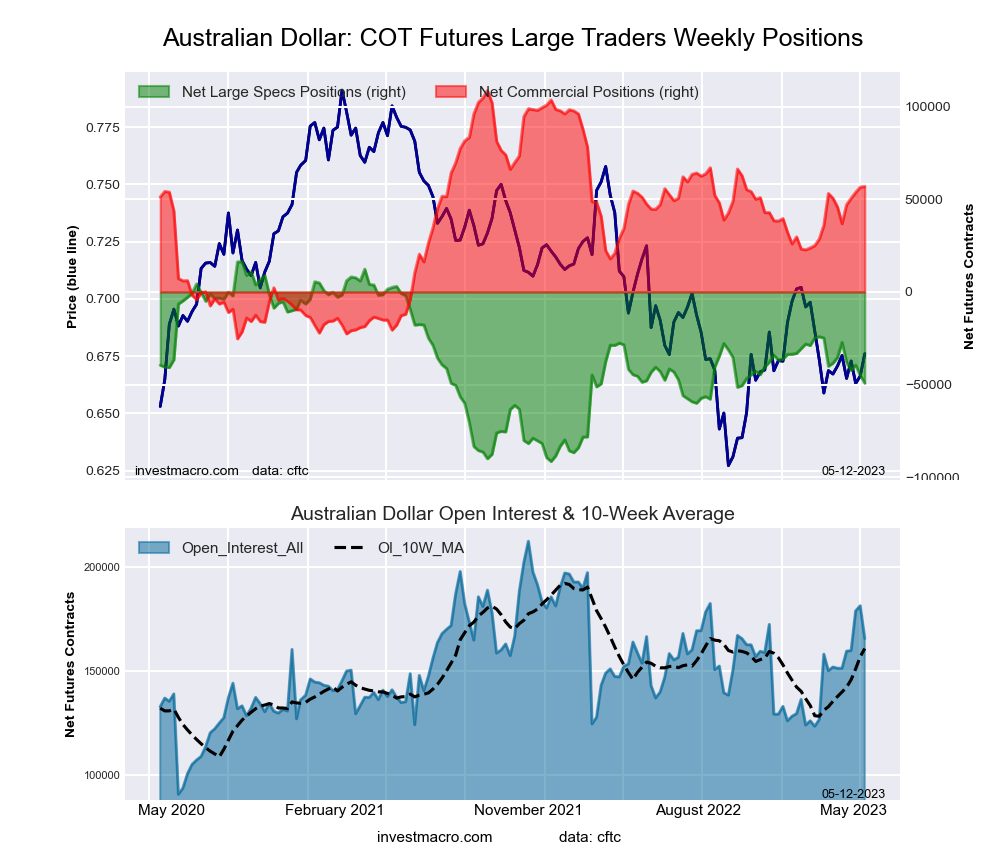
Australian Dollar Futures:

Australian Dollar Forex Futures COT ChartThe Australian Dollar large speculator standing this week resulted in a net position of -49,193 contracts in the data reported through Tuesday. This was a weekly lowering of -4,183 contracts from the previous week which had a total of -45,010 net contracts.

This week’s current strength score (the trader positioning range over the past three years, measured from 0 to 100) shows the speculators are currently Bearish with a score of 39.2 percent. The commercials are Bullish with a score of 61.3 percent and the small traders (not shown in chart) are Bearish with a score of 33.6 percent.

AUSTRALIAN DOLLAR StatisticsSPECULATORSCOMMERCIALSSMALL TRADERS
– Percent of Open Interest Longs:24.959.611.7
– Percent of Open Interest Shorts:54.625.316.4
– Net Position:-49,19356,897-7,704
– Gross Longs:41,22598,69819,371
– Gross Shorts:90,41841,80127,075
– Long to Short Ratio:0.5 to 12.4 to 10.7 to 1
NET POSITION TREND:
– Strength Index Score (3 Year Range Pct):39.261.333.6
– Strength Index Reading (3 Year Range):BearishBullishBearish
NET POSITION MOVEMENT INDEX:
– 6-Week Change in Strength Index:-12.88.36.8


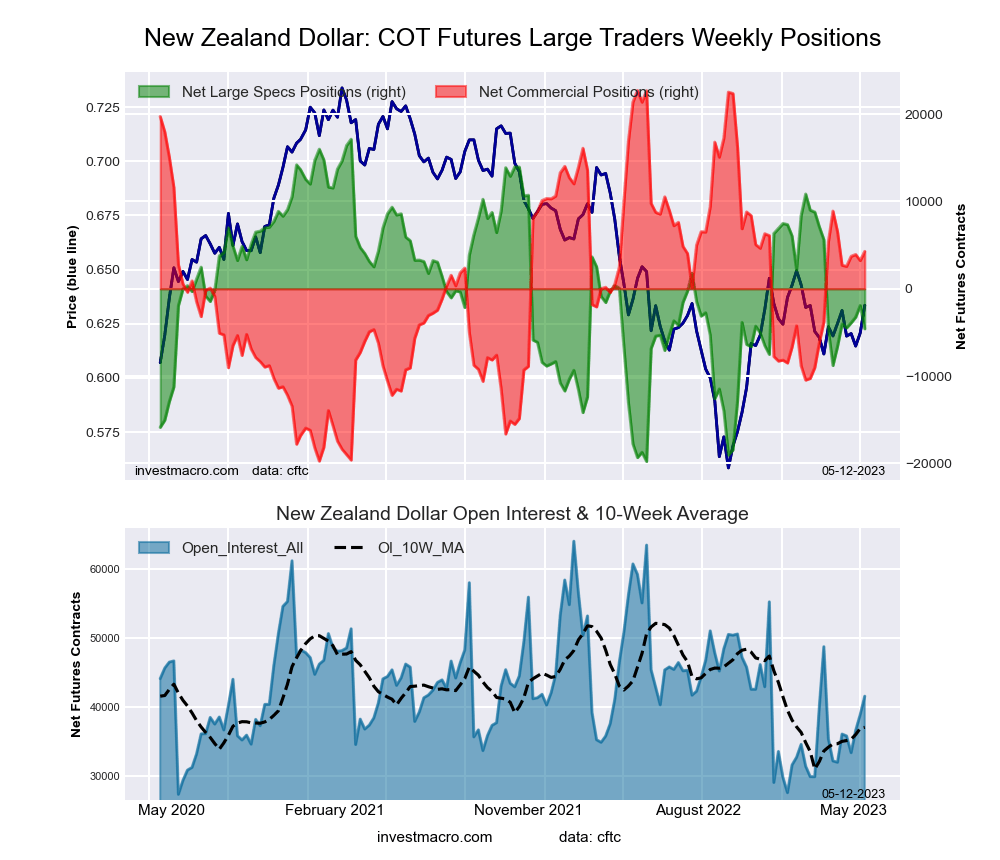
New Zealand Dollar Futures:

New Zealand Dollar Forex Futures COT ChartThe New Zealand Dollar large speculator standing this week resulted in a net position of -4,581 contracts in the data reported through Tuesday. This was a weekly decrease of -2,664 contracts from the previous week which had a total of -1,917 net contracts.

This week’s current strength score (the trader positioning range over the past three years, measured from 0 to 100) shows the speculators are currently Bearish with a score of 41.2 percent. The commercials are Bullish with a score of 56.6 percent and the small traders (not shown in chart) are Bullish with a score of 53.5 percent.

NEW ZEALAND DOLLAR StatisticsSPECULATORSCOMMERCIALSSMALL TRADERS
– Percent of Open Interest Longs:42.048.68.9
– Percent of Open Interest Shorts:53.038.38.1
– Net Position:-4,5814,283298
– Gross Longs:17,46120,2243,681
– Gross Shorts:22,04215,9413,383
– Long to Short Ratio:0.8 to 11.3 to 11.1 to 1
NET POSITION TREND:
– Strength Index Score (3 Year Range Pct):41.256.653.5
– Strength Index Reading (3 Year Range):BearishBullishBullish
NET POSITION MOVEMENT INDEX:
– 6-Week Change in Strength Index:5.5-5.42.9


Mexican Peso Futures:

Mexican Peso Futures COT ChartThe Mexican Peso large speculator standing this week resulted in a net position of 70,032 contracts in the data reported through Tuesday. This was a weekly boost of 12,322 contracts from the previous week which had a total of 57,710 net contracts.

This week’s current strength score (the trader positioning range over the past three years, measured from 0 to 100) shows the speculators are currently Bullish-Extreme with a score of 100.0 percent. The commercials are Bearish-Extreme with a score of 0.0 percent and the small traders (not shown in chart) are Bullish-Extreme with a score of 95.8 percent.

MEXICAN PESO StatisticsSPECULATORSCOMMERCIALSSMALL TRADERS
– Percent of Open Interest Longs:50.046.23.5
– Percent of Open Interest Shorts:22.676.10.9
– Net Position:70,032-76,5336,501
– Gross Longs:127,763117,8908,859
– Gross Shorts:57,731194,4232,358
– Long to Short Ratio:2.2 to 10.6 to 13.8 to 1
NET POSITION TREND:
– Strength Index Score (3 Year Range Pct):100.00.095.8
– Strength Index Reading (3 Year Range):Bullish-ExtremeBearish-ExtremeBullish-Extreme
NET POSITION MOVEMENT INDEX:
– 6-Week Change in Strength Index:15.5-16.011.2


Brazilian Real Futures:

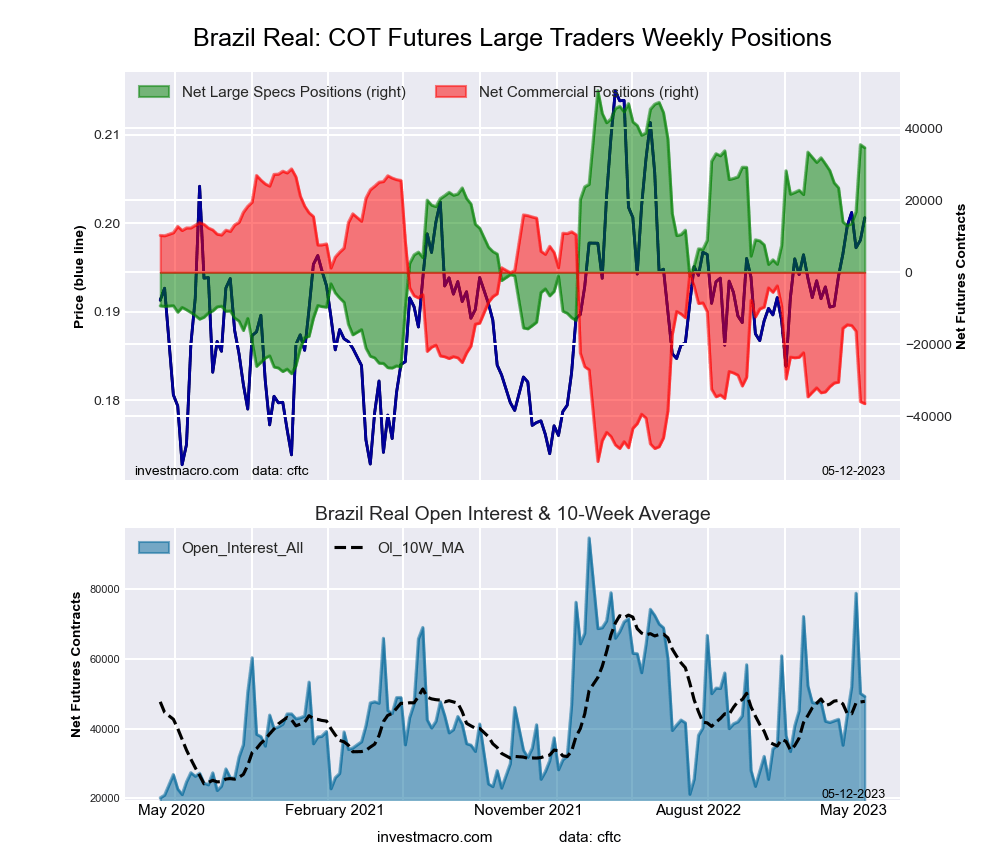
Brazil Real Futures COT ChartThe Brazilian Real large speculator standing this week resulted in a net position of 34,594 contracts in the data reported through Tuesday. This was a weekly decrease of -867 contracts from the previous week which had a total of 35,461 net contracts.

This week’s current strength score (the trader positioning range over the past three years, measured from 0 to 100) shows the speculators are currently Bullish with a score of 79.8 percent. The commercials are Bearish-Extreme with a score of 19.8 percent and the small traders (not shown in chart) are Bullish with a score of 59.2 percent.

BRAZIL REAL StatisticsSPECULATORSCOMMERCIALSSMALL TRADERS
– Percent of Open Interest Longs:77.614.47.8
– Percent of Open Interest Shorts:7.388.63.9
– Net Position:34,594-36,5041,910
– Gross Longs:38,1967,0973,841
– Gross Shorts:3,60243,6011,931
– Long to Short Ratio:10.6 to 10.2 to 12.0 to 1
NET POSITION TREND:
– Strength Index Score (3 Year Range Pct):79.819.859.2
– Strength Index Reading (3 Year Range):BullishBearish-ExtremeBullish
NET POSITION MOVEMENT INDEX:
– 6-Week Change in Strength Index:14.1-7.4-40.8


Bitcoin Futures:

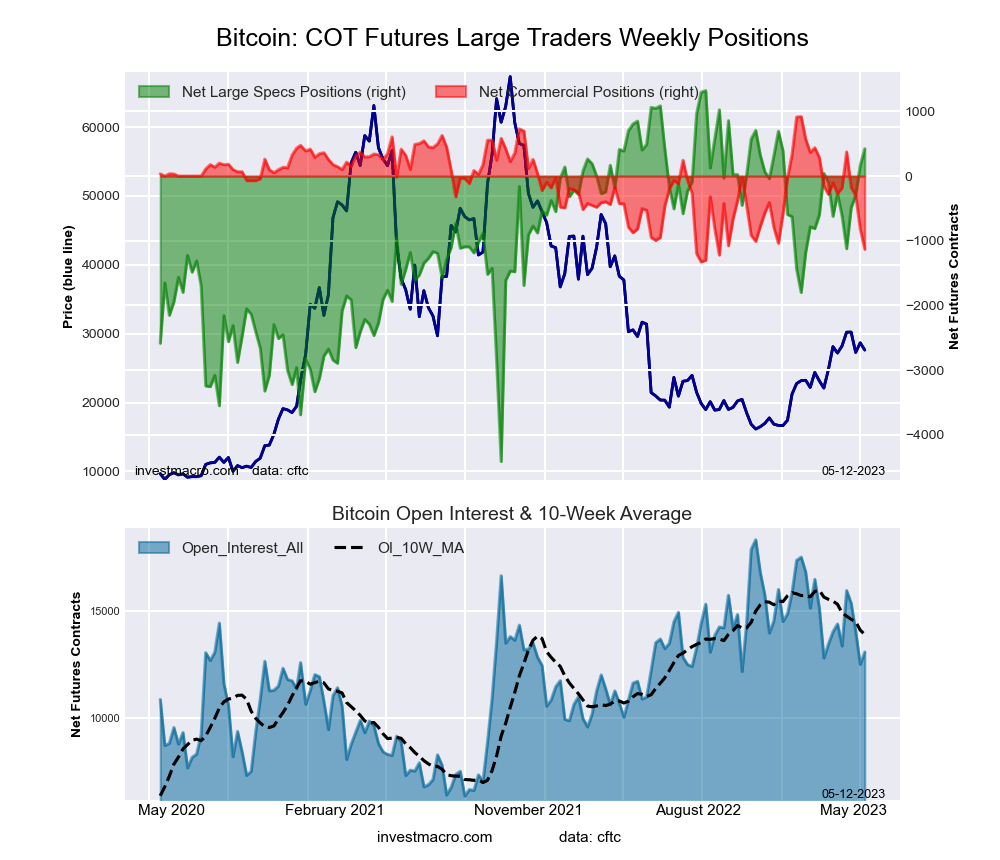
Bitcoin Crypto Futures COT ChartThe Bitcoin large speculator standing this week resulted in a net position of 423 contracts in the data reported through Tuesday. This was a weekly rise of 255 contracts from the previous week which had a total of 168 net contracts.

This week’s current strength score (the trader positioning range over the past three years, measured from 0 to 100) shows the speculators are currently Bullish-Extreme with a score of 84.3 percent. The commercials are Bearish-Extreme with a score of 8.7 percent and the small traders (not shown in chart) are Bearish with a score of 29.0 percent.

BITCOIN StatisticsSPECULATORSCOMMERCIALSSMALL TRADERS
– Percent of Open Interest Longs:76.51.810.2
– Percent of Open Interest Shorts:73.310.44.8
– Net Position:423-1,131708
– Gross Longs:10,0272331,334
– Gross Shorts:9,6041,364626
– Long to Short Ratio:1.0 to 10.2 to 12.1 to 1
NET POSITION TREND:
– Strength Index Score (3 Year Range Pct):84.38.729.0
– Strength Index Reading (3 Year Range):Bullish-ExtremeBearish-ExtremeBearish
NET POSITION MOVEMENT INDEX:
– 6-Week Change in Strength Index:12.2-38.33.7


Article By InvestMacroReceive our weekly COT Newsletter

*COT Report: The COT data, released weekly to the public each Friday, is updated through the most recent Tuesday (data is 3 days old) and shows a quick view of how large speculators or non-commercials (for-profit traders) were positioned in the futures markets.

The CFTC categorizes trader positions according to commercial hedgers (traders who use futures contracts for hedging as part of the business), non-commercials (large traders who speculate to realize trading profits) and nonreportable traders (usually small traders/speculators) as well as their open interest (contracts open in the market at time of reporting). See CFTC criteria here.


Copper Speculator bets slide to 32-week low as prices touch lowest since November

By InvestMacro

Here are the latest charts and statistics for the Commitment of Traders (COT) data published by the Commodities Futures Trading Commission (CFTC).

The latest COT data is updated through Tuesday May 9th and shows a quick view of how large traders (for-profit speculators and commercial entities) were positioned in the futures markets.

Weekly Speculator Changes led by Platinum & Palladium

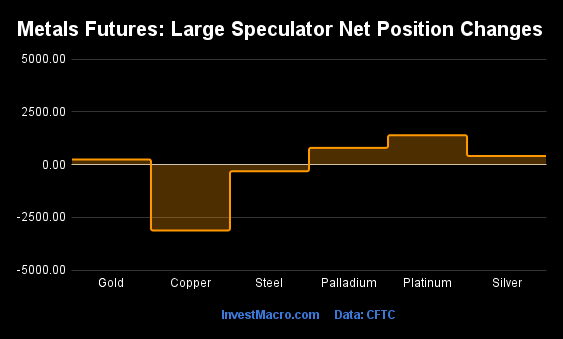
The COT metals markets speculator bets were higher this week as four out of the six metals markets we cover had higher positioning while the other two markets had lower speculator contracts.

Leading the gains for the metals was Platinum (1,397 contracts) with Palladium (797 contracts), Silver (408 contracts) and Gold (247 contracts) also recording positive weeks.

The markets with declines in speculator bets for the week were Copper (-3,123 contracts) and Steel (-314 contracts).

Copper bets slide to 32-week low as prices touch lowest since November

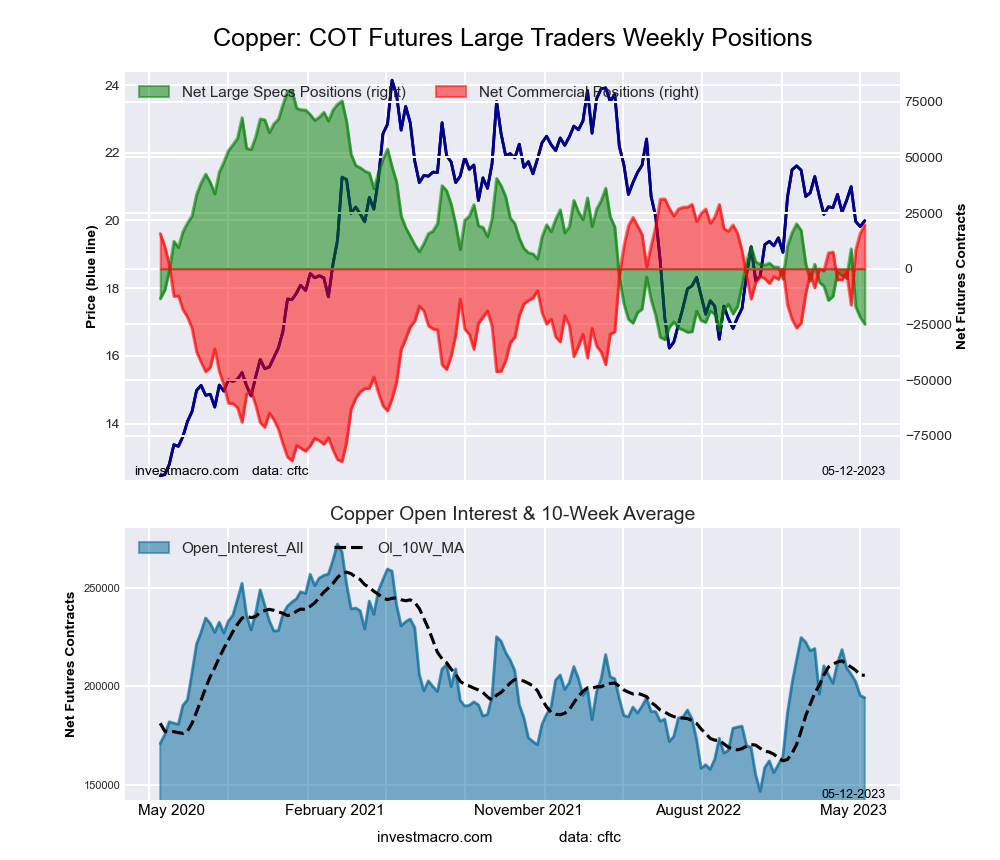
Highlighting the COT metals data this week is the recent bearishness for the Copper speculative positions. The large speculator position in Copper futures decreased for the third straight week this week and has now dropped in five out of the past six weeks. The slide in Copper bets has taken the current net contracts standing down to a total of -24,865 contracts. This marks the most bearish level for speculators in the past 32-weeks, dating back to last September 27th.

Overall, the Copper speculator position has now been in a bearish level for eleven out of the past thirteen weeks.

Denting the sentiment for the red metal has been the weaker than expected data out of China (including imports & inflation), which is the largest importer of Copper in the world.

The Copper front-month futures price (US Comex futures) has been on downtrend since hitting a most recent high of $4.25 per pound in January. This week saw the price fall for a fourth straight week and close at approximately 3.73 per pound while also touching the lowest price since November. Overall, the Copper price is down about 25 percent from the post-2020 high of $4.6255 per pound that was reached in March of 2022.


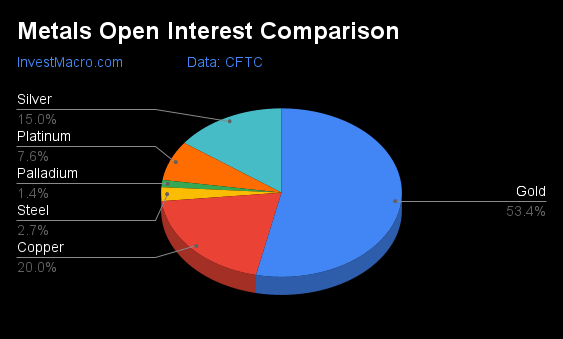
Data Snapshot of Commodity Market Traders | Columns Legend
May-09-2023OIOI-IndexSpec-NetSpec-IndexCom-NetCOM-IndexSmalls-NetSmalls-Index
Gold518,95145195,81463-222,5153826,70147
Silver145,4453232,36064-46,1903813,83043
Copper194,24338-24,865619,732905,13351
Palladium13,295100-5,647135,96587-31823
Platinum74,1258628,08480-32,484264,40027


Strength Scores led by Platinum & Silver

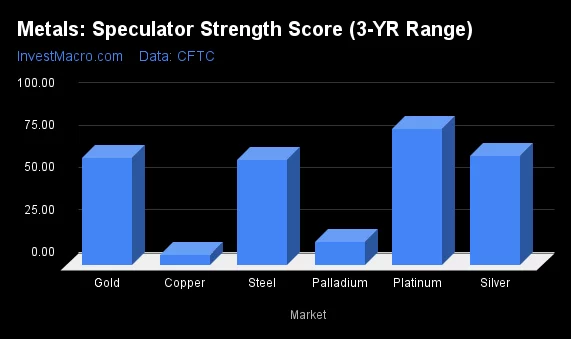
COT Strength Scores (a normalized measure of Speculator positions over a 3-Year range, from 0 to 100 where above 80 is Extreme-Bullish and below 20 is Extreme-Bearish) showed that Platinum (80 percent) and Silver (64 percent) lead the metals markets this week. Steel (62 percent) comes in as the next highest in the weekly strength scores.

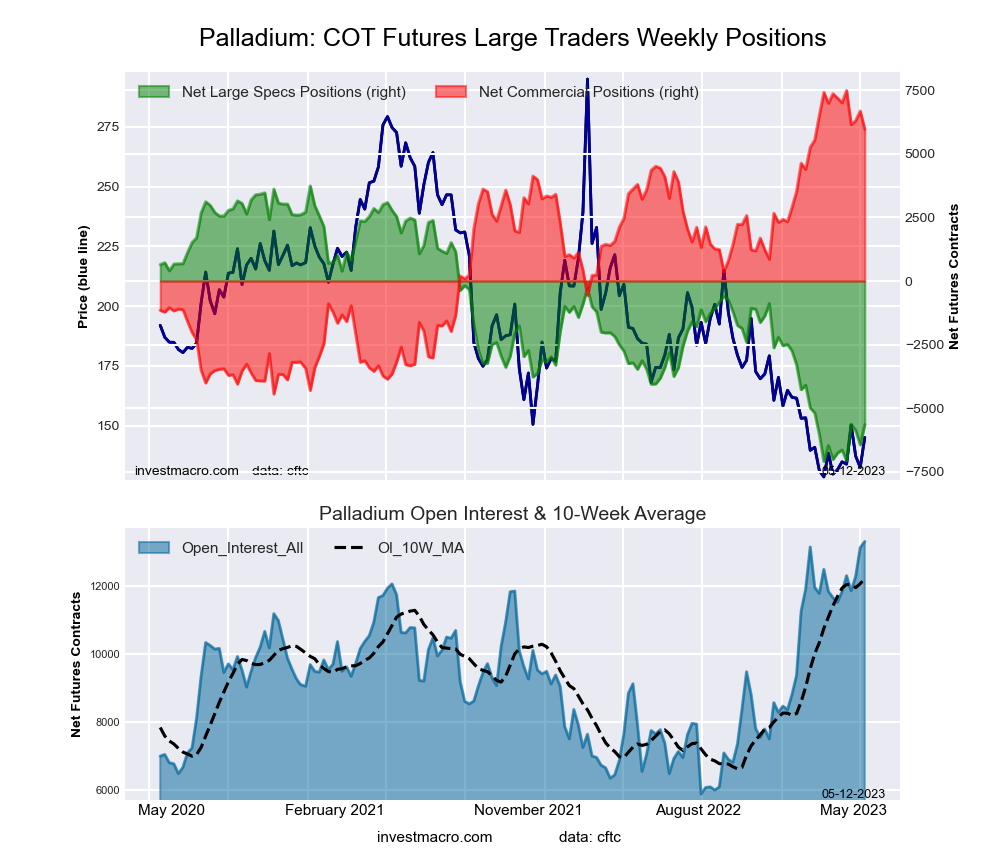
On the downside, Palladium (13 percent) comes in at the lowest strength level currently and is in Extreme-Bearish territory (below 20 percent).

Strength Statistics:
Gold (63.3 percent) vs Gold previous week (63.1 percent)
Silver (64.4 percent) vs Silver previous week (63.8 percent)
Copper (6.2 percent) vs Copper previous week (9.0 percent)
Platinum (80.4 percent) vs Platinum previous week (77.2 percent)
Palladium (13.4 percent) vs Palladium previous week (6.0 percent)
Steel (61.9 percent) vs Palladium previous week (62.8 percent)


Platinum & Silver top the 6-Week Strength Trends

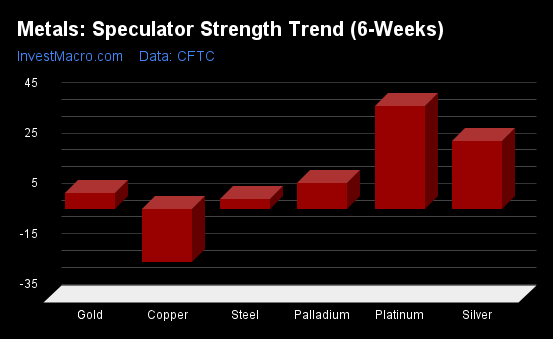
COT Strength Score Trends (or move index, calculates the 6-week changes in strength scores) showed that Platinum (41 percent) and Silver (27 percent) lead the past six weeks trends for metals.

Copper (-21 percent) leads the downside trend scores currently.

Move Statistics:
Gold (6.2 percent) vs Gold previous week (16.3 percent)
Silver (27.1 percent) vs Silver previous week (40.7 percent)
Copper (-20.9 percent) vs Copper previous week (-8.4 percent)
Platinum (40.9 percent) vs Platinum previous week (39.6 percent)
Palladium (10.3 percent) vs Palladium previous week (5.3 percent)
Steel (3.9 percent) vs Steel previous week (3.4 percent)


Individual Markets:

Gold Comex Futures:

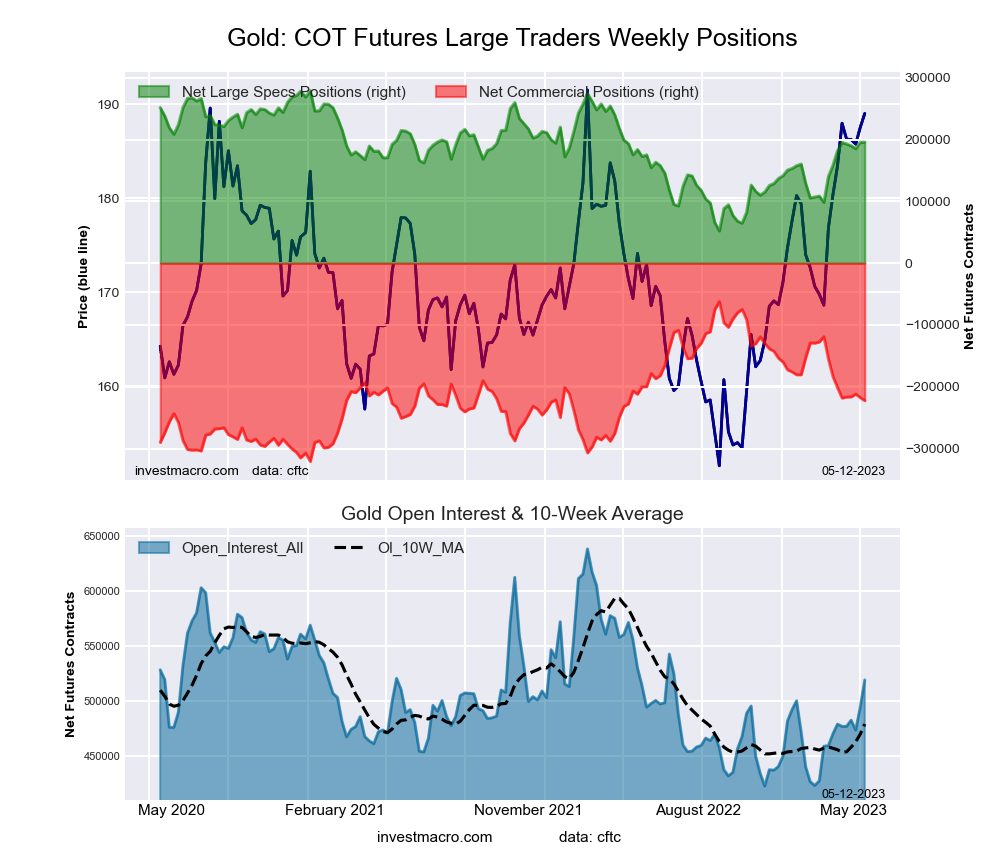
Gold Futures COT ChartThe Gold Comex Futures large speculator standing this week resulted in a net position of 195,814 contracts in the data reported through Tuesday. This was a weekly advance of 247 contracts from the previous week which had a total of 195,567 net contracts.

This week’s current strength score (the trader positioning range over the past three years, measured from 0 to 100) shows the speculators are currently Bullish with a score of 63.3 percent. The commercials are Bearish with a score of 38.0 percent and the small traders (not shown in chart) are Bearish with a score of 46.9 percent.

Gold Futures StatisticsSPECULATORSCOMMERCIALSSMALL TRADERS
– Percent of Open Interest Longs:51.325.210.0
– Percent of Open Interest Shorts:13.668.14.9
– Net Position:195,814-222,51526,701
– Gross Longs:266,472130,98552,012
– Gross Shorts:70,658353,50025,311
– Long to Short Ratio:3.8 to 10.4 to 12.1 to 1
NET POSITION TREND:
– Strength Index Score (3 Year Range Pct):63.338.046.9
– Strength Index Reading (3 Year Range):BullishBearishBearish
NET POSITION MOVEMENT INDEX:
– 6-Week Change in Strength Index:6.2-8.117.1


Silver Comex Futures:

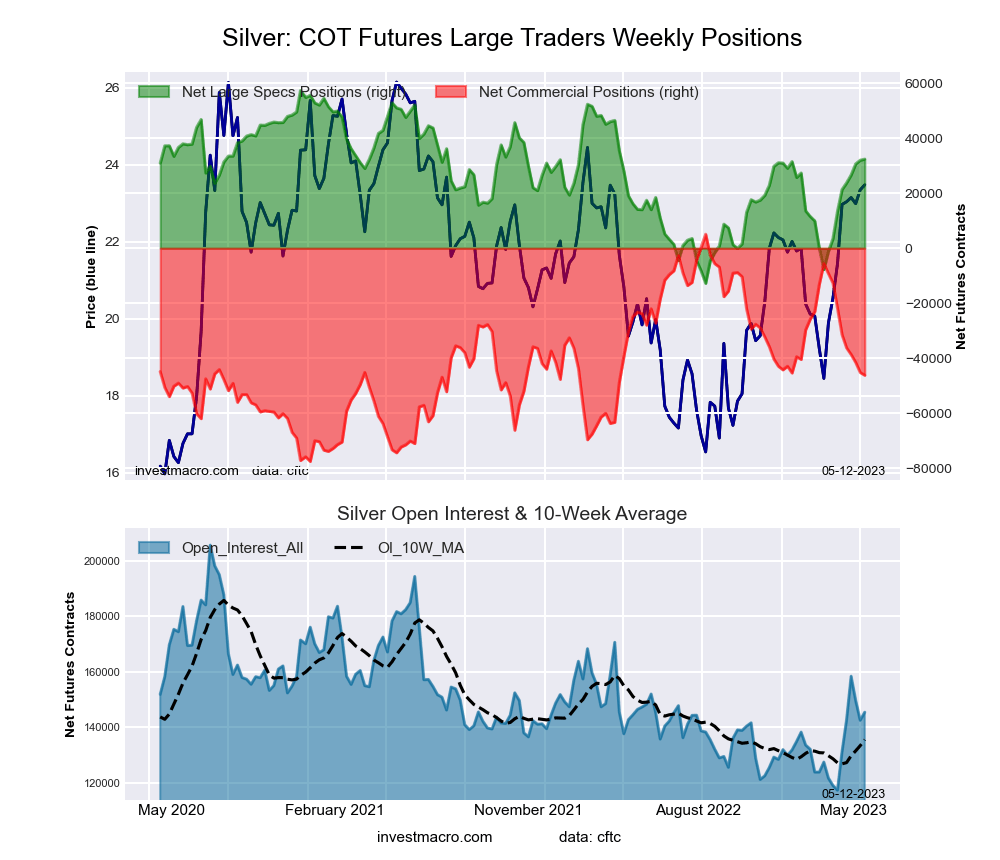
Silver Futures COT ChartThe Silver Comex Futures large speculator standing this week resulted in a net position of 32,360 contracts in the data reported through Tuesday. This was a weekly advance of 408 contracts from the previous week which had a total of 31,952 net contracts.

This week’s current strength score (the trader positioning range over the past three years, measured from 0 to 100) shows the speculators are currently Bullish with a score of 64.4 percent. The commercials are Bearish with a score of 37.9 percent and the small traders (not shown in chart) are Bearish with a score of 43.3 percent.

Silver Futures StatisticsSPECULATORSCOMMERCIALSSMALL TRADERS
– Percent of Open Interest Longs:47.628.617.5
– Percent of Open Interest Shorts:25.360.48.0
– Net Position:32,360-46,19013,830
– Gross Longs:69,16641,63625,474
– Gross Shorts:36,80687,82611,644
– Long to Short Ratio:1.9 to 10.5 to 12.2 to 1
NET POSITION TREND:
– Strength Index Score (3 Year Range Pct):64.437.943.3
– Strength Index Reading (3 Year Range):BullishBearishBearish
NET POSITION MOVEMENT INDEX:
– 6-Week Change in Strength Index:27.1-29.429.8


Copper Grade #1 Futures:

Copper Futures COT ChartThe Copper Grade #1 Futures large speculator standing this week resulted in a net position of -24,865 contracts in the data reported through Tuesday. This was a weekly decrease of -3,123 contracts from the previous week which had a total of -21,742 net contracts.

This week’s current strength score (the trader positioning range over the past three years, measured from 0 to 100) shows the speculators are currently Bearish-Extreme with a score of 6.2 percent. The commercials are Bullish-Extreme with a score of 90.2 percent and the small traders (not shown in chart) are Bullish with a score of 50.9 percent.

Copper Futures StatisticsSPECULATORSCOMMERCIALSSMALL TRADERS
– Percent of Open Interest Longs:28.448.09.4
– Percent of Open Interest Shorts:41.237.86.8
– Net Position:-24,86519,7325,133
– Gross Longs:55,13193,21118,255
– Gross Shorts:79,99673,47913,122
– Long to Short Ratio:0.7 to 11.3 to 11.4 to 1
NET POSITION TREND:
– Strength Index Score (3 Year Range Pct):6.290.250.9
– Strength Index Reading (3 Year Range):Bearish-ExtremeBullish-ExtremeBullish
NET POSITION MOVEMENT INDEX:
– 6-Week Change in Strength Index:-20.920.9-8.4


Platinum Futures:

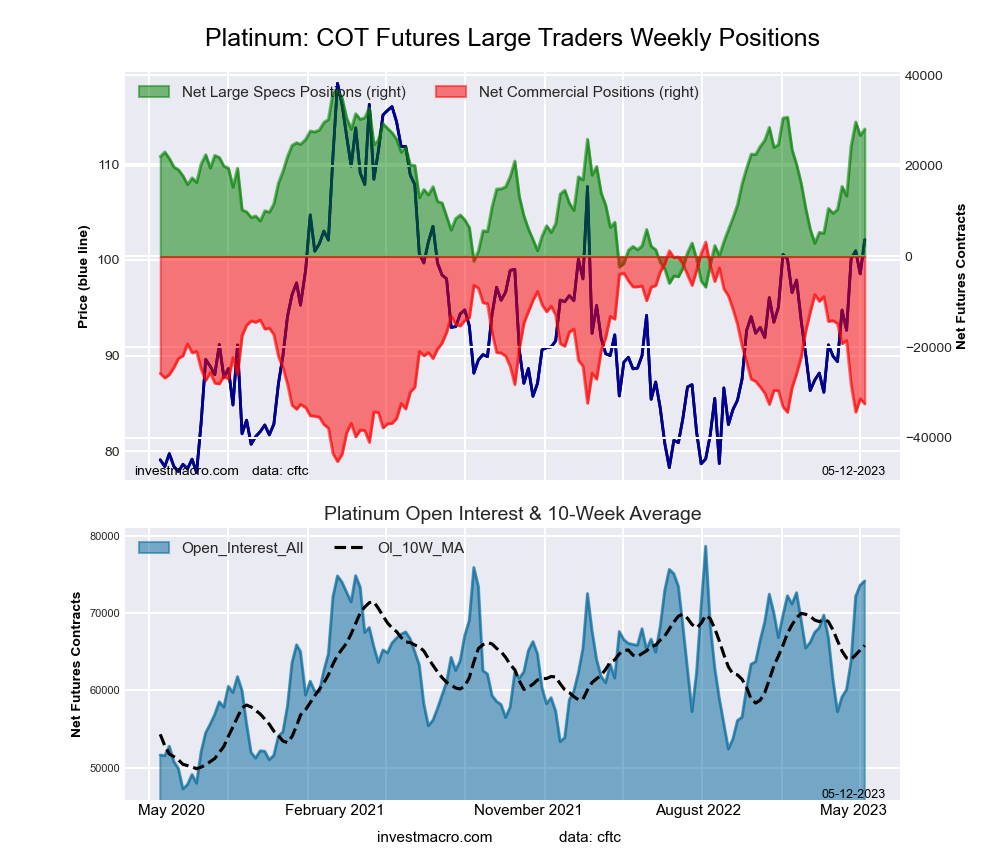
Platinum Futures COT ChartThe Platinum Futures large speculator standing this week resulted in a net position of 28,084 contracts in the data reported through Tuesday. This was a weekly gain of 1,397 contracts from the previous week which had a total of 26,687 net contracts.

This week’s current strength score (the trader positioning range over the past three years, measured from 0 to 100) shows the speculators are currently Bullish-Extreme with a score of 80.4 percent. The commercials are Bearish with a score of 26.3 percent and the small traders (not shown in chart) are Bearish with a score of 27.1 percent.

Platinum Futures StatisticsSPECULATORSCOMMERCIALSSMALL TRADERS
– Percent of Open Interest Longs:56.327.510.2
– Percent of Open Interest Shorts:18.471.44.2
– Net Position:28,084-32,4844,400
– Gross Longs:41,71220,4087,535
– Gross Shorts:13,62852,8923,135
– Long to Short Ratio:3.1 to 10.4 to 12.4 to 1
NET POSITION TREND:
– Strength Index Score (3 Year Range Pct):80.426.327.1
– Strength Index Reading (3 Year Range):Bullish-ExtremeBearishBearish
NET POSITION MOVEMENT INDEX:
– 6-Week Change in Strength Index:40.9-36.6-0.1


Palladium Futures:

Palladium Futures COT ChartThe Palladium Futures large speculator standing this week resulted in a net position of -5,647 contracts in the data reported through Tuesday. This was a weekly lift of 797 contracts from the previous week which had a total of -6,444 net contracts.

This week’s current strength score (the trader positioning range over the past three years, measured from 0 to 100) shows the speculators are currently Bearish-Extreme with a score of 13.4 percent. The commercials are Bullish-Extreme with a score of 87.2 percent and the small traders (not shown in chart) are Bearish with a score of 22.6 percent.

Palladium Futures StatisticsSPECULATORSCOMMERCIALSSMALL TRADERS
– Percent of Open Interest Longs:13.062.29.1
– Percent of Open Interest Shorts:55.517.311.5
– Net Position:-5,6475,965-318
– Gross Longs:1,7338,2691,211
– Gross Shorts:7,3802,3041,529
– Long to Short Ratio:0.2 to 13.6 to 10.8 to 1
NET POSITION TREND:
– Strength Index Score (3 Year Range Pct):13.487.222.6
– Strength Index Reading (3 Year Range):Bearish-ExtremeBullish-ExtremeBearish
NET POSITION MOVEMENT INDEX:
– 6-Week Change in Strength Index:10.3-10.36.7


Steel Futures Futures:

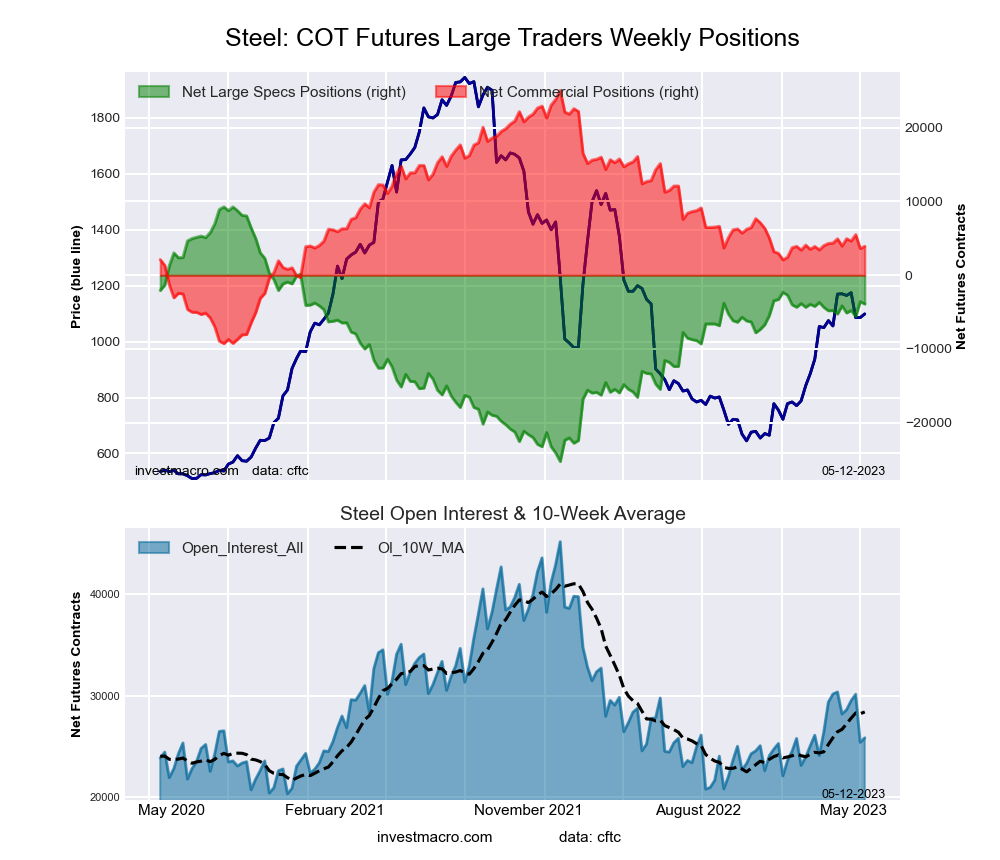
Steel Futures COT ChartThe Steel Futures large speculator standing this week resulted in a net position of -3,896 contracts in the data reported through Tuesday. This was a weekly decline of -314 contracts from the previous week which had a total of -3,582 net contracts.

This week’s current strength score (the trader positioning range over the past three years, measured from 0 to 100) shows the speculators are currently Bullish with a score of 61.9 percent. The commercials are Bearish with a score of 38.4 percent and the small traders (not shown in chart) are Bearish-Extreme with a score of 15.9 percent.

Steel Futures StatisticsSPECULATORSCOMMERCIALSSMALL TRADERS
– Percent of Open Interest Longs:12.277.10.8
– Percent of Open Interest Shorts:27.361.90.9
– Net Position:-3,8963,922-26
– Gross Longs:3,16119,929214
– Gross Shorts:7,05716,007240
– Long to Short Ratio:0.4 to 11.2 to 10.9 to 1
NET POSITION TREND:
– Strength Index Score (3 Year Range Pct):61.938.415.9
– Strength Index Reading (3 Year Range):BullishBearishBearish-Extreme
NET POSITION MOVEMENT INDEX:
– 6-Week Change in Strength Index:3.9-2.9-45.4


Article By InvestMacroReceive our weekly COT Newsletter

*COT Report: The COT data, released weekly to the public each Friday, is updated through the most recent Tuesday (data is 3 days old) and shows a quick view of how large speculators or non-commercials (for-profit traders) were positioned in the futures markets.

The CFTC categorizes trader positions according to commercial hedgers (traders who use futures contracts for hedging as part of the business), non-commercials (large traders who speculate to realize trading profits) and nonreportable traders (usually small traders/speculators) as well as their open interest (contracts open in the market at time of reporting). See CFTC criteria here.