What this year’s El Niño means for wheat and global food supply

By David Ubilava, University of Sydney 

The World Meteorological Organization has declared the onset of the first El Niño event in seven years. It estimates 90% probability the climatic phenomenon, involving an unusual warming of the Pacific Ocean, will develop through 2023, and be of moderate strength.

El Niño events bring hotter, drier weather to places such as Brazil, Australia and Indonesia, increasing the risk of wildfires and drought. Elsewhere, such as Peru and Ecuador, it increases rain, leading to floods.

The effects are sometimes described as a preview of “the new normal” in the wake of human-forced climate change. Of particular concern is the effect on agricultural production, and thereby the price of food – particularly “breadbasket” staples such as wheat, maize and rice.

El Niño’s global impacts are complex and multifaceted. It can potentially impact the lives of the majority of the world’s population. This is especially true for poor and rural households, whose fates are intrinsically linked with climate and farming.

The global supply and prices of most food is unlikely to move that much. The evidence from the ten El Niño events in the past five decades suggests relatively modest, and to some extent ambiguous, global price impacts. While reducing crop yield on average, these events have not resulted in a “perfect storm” of the scale to induce global “breadbasket yield shocks”.

But local effects could be severe. Even a “moderate” El Niño may significantly affect crops grown in geographically concentrated regions — for example palm oil, which primarily comes from Indonesia and Malaysia.

In some places El Niño-induced food availability and affordability issues may well lead to serious social consequences, such as conflict and hunger.

Impact on global food prices

The following graph shows the correlation between El Niño events and global food prices, as measured by the United Nations’ Food Price Index. This index tracks monthly changes in international prices of a basket of food commodities.


Despite the general inflationary pattern, there have rarely been big swings in El Niño years. Indeed, it shows prices decreasing during the two strongest El Niño episodes of the past three decades.

Other human-caused factors were at play – notably the Asian Financial Crisis in 1997, and the Global Financial Crisis in 2007-2008. In 2015, prices decreased due to stronger (than expected) supply and weaker demand, when the El Niño event did not turn out to be as bad as feared.

This all suggests that El Niño does not usually play the lead role in global commodity price movements.

Impacts on wheat supply

Why? Because El Niño does induce crop failures, but for food grown around the world the losses tend to be offset by positive changes in production across other key producing regions.

For example, it can bring favourable weather to the conflict-ridden and famine-prone Horn of Africa (Djibouti, Ethiopia, Eritrea and Somalia).

A good example is wheat.

The following chart shows how El Nino has affected Australian wheat production since 1980. In six out of nine El Niño events of at least moderate strength, production has dropped significantly – in four cases, at least 30% below the “trend line” (representing the long-term average).


Australia is one of the world’s top three wheat exporters, accounting for about 13% of global exports. So its production does affect global wheat prices. But in terms of total wheat grown it’s less significant – about 3.5% of world production. And El Niño-induced crop failures tend to be offset by production in other key wheat-producing regions.

The next graph compare changes in Australia’s wheat production with other significant wheat exporters in El Niño years. Dips in Australia’s production tend tend to be offset by changes elsewhere.


In 1994, for example, Australian wheat production dropped nearly 50% but barely changed elsewhere. In 1982, when Australian production dropped 30%, Argentina’s production was 50% higher. Such balancing patterns tends to be present across most El Niño years.

But some will bear the cost

That said, there will be at least some negative effects. Even if crop failures in one region are fully offset by rich harvests in others, some people are going to bear the costs of El Niño’s direct impact.

Australian farmers, for example, will be worse off if local wheat yields drop while global prices remain relatively stable.

Moreover, because most countries are connected via trade, El Niño will have wider economic impacts. It could still lead to deeper societal issues in some region, such as famine and agro-pastoral conflicts.

These effects may also be nuanced. For example, poor harvests in Africa may mitigate seasonal violence linked with the appropriation of agricultural surpluses. But considering other vulnerabilities around the world, the odds are that even a moderate El Niño will make already dire socio-economic conditions in some countries worse.

Most of the usual warnings about the caveats of climate change apply here. The difference, of course, is that all this is happening now.The Conversation

About the Author:

David Ubilava, Associate Professor of Economics, University of Sydney

This article is republished from The Conversation under a Creative Commons license. Read the original article.


Brent Failed to Rise Despite Improved Sentiment

By RoboForex Analytical Department

Crude oil prices have paused in their rally. Brent quotes on Monday dropped to 79.20 USD per barrel.

One of the reasons for this local decline might be the market decision to lock in a part of the profit after the steady growth earlier. This version is also supported by the fact that today is the first work day after the weekend.

At the same time, the commodity market sentiment improved noticeably over the last week. Large investment houses still expect a shortage in crude oil supply in the second half of this year, which looks like a favourable factor, keeping in mind the current demand parameters.

The buyers are equally supported by the fundamental background. The geopolitical situation in Libya is unstable, which might lead to problems with the supply of energy carriers.

Technical analysis of Brent:

On the H4 Brent chart, the structure of the third wave of growth is developing. At a certain point, the quotes rose to 78.00. A consolidation range formed around this level, the price broke it upwards and extended to 81.45. Today the market is correcting this growth. A technical return to 78.00 is expected with a test of this level from above. Next, a rise to 84.00 is to follow. This is a local target. After the quotes reach this level, a new correction to 78.00 could develop, followed by an increase to 85.00. This is the first target. Technically, this scenario is confirmed by the MACD: its signal line is at the highs, moving out of the histogram area, which is a signal in favour of a decline to zero.

On the H1 Brent chart, a corrective wave to 78.00 is developing. After it is over, a wave of growth to 84.00 is expected to start. This is a local target. Technically, this scenario is confirmed by the Stochastic oscillator: its signal line is under 20, ready to go on growing to 50. And if this level also breaks, the potential for a rise to 80 could open.

Disclaimer

Any forecasts contained herein are based on the author’s particular opinion. This analysis may not be treated as trading advice. RoboForex bears no responsibility for trading results based on trading recommendations and reviews contained herein.

Bitcoin can help mitigate climate change emergency: deVere CEO

By George Prior 

Bitcoin could help mitigate the climate change emergency that we’re seeing in real time as swathes of the northern hemisphere experience extreme heatwaves, affirms the CEO of one of the world’s largest independent financial advisory, asset management and fintech organizations.

The analysis from Nigel Green of deVere Group comes as extreme temperatures are breaking records worldwide. Both the US and China saw the mercury crossing 50C on Sunday and southern Europe is bracing for the all-time records to be broken this week.

He says: “Amidst the global climate change emergency, a perhaps surprising contender is emerging as a potential solution: Bitcoin.

“Contrary to belief in some quarters, this revolutionary digital currency has the capacity to drive positive change and aid in the fight against climate change.

“With its unique characteristics and transformative potential, Bitcoin is positioned to play a crucial role in transitioning to a more sustainable and eco-friendly future.”

The deVere CEO continues: “An often-overlooked point is that Bitcoin mining (the process of verifying and adding transactions to the Bitcoin blockchain while also creating new Bitcoins) could speed up the transition from fossil fuels to renewables.

“Clearly, clean energy is the way forward, but their sources are sometimes irregular and there’s not enough storage capacity for when these sources generate excess energy.

“Bitcoin miners, who need huge amounts of energy, could act as major buyers of last resort, providing substantial profit for investment and expansion. This would then enhance the renewables supply, which would go on to bring down prices for consumers and further drive demand.”

Bitcoin’s rise in popularity has resulted in increased wealth accumulation for early adopters and cryptocurrency enthusiasts. Many individuals within the Bitcoin community are leveraging their newfound wealth to fund sustainable projects and initiatives.

“This philanthropic approach can lead to significant investments in renewable energy, clean technology, and other climate change mitigation efforts,” notes Nigel Green.

He also stresses the promotion of financial inclusion. “Bitcoin has the potential to enhance financial inclusion for underserved populations around the world. By providing individuals with access to digital currencies and blockchain-based financial services, Bitcoin can empower the unbanked and foster economic growth in marginalized communities.

“This increased access to financial resources enables individuals to invest in sustainable practices and contribute to climate change mitigation.”

He concludes: “While no monetary system or investment is perfect, and the crypto ecosystem can still improve in many ways, the argument that digital currencies cannot necessarily form part of a climate change mitigation strategy does not stand-up to scrutiny.

“Indeed, as the emergency intensifies, we must use every weapon at our disposal to fight it – and Bitcoin is one of them.”

About:

deVere Group is one of the world’s largest independent advisors of specialist global financial solutions to international, local mass affluent, and high-net-worth clients.  It has a network of more than 70 offices across the world, over 80,000 clients and $12bn under advisement.


The cryptocurrency market digest (BTC). Overview for 17.07.2023

By RoboForex.com

The BTC quotes on Monday are hovering near 30,313 USD.

The market failed to continue skyrocketing though it still had all reasons to do so. Last week, the resounding victory of Ripple over the SEC in court provided the cryptocurrency sector with a mighty momentum. More than that, the crash of the USD also facilitated the flow of money to digital assets.

The technical boundary at 31,150 USD was tested but the next one at 31,500 USD remained intact, pushing BTC back.

The daily price chart is giving signals for a decline. It is high time to turn to the support level near 29,800 USD. For the flagship cryptocurrency to start growing again, it needs to secure above 31,000 USD.

The cryptocurrency market capitalisation amounts to 1.220 trillion USD. The BTC share remains at 48.5%, while the ETH share has dropped to 19.1%.

Coinbase capitalisation rose noticeably

The capitalisation of the Coinbase cryptocurrency exchange has increased to 25 billion USD from under 7 billion USD at the beginning of the year. Just last Thursday, the capitalisation of the exchange platform surged 20%.

The total cost of Cardano TVL reached its annual high

The total cost of assets blocked in smart contracts (TVL) of the Cardano network increased to 209 million USD. This is the annual high. In January this year, the digit was assessed at no more than 50 million USD.

Article By RoboForex.com

Attention!
Forecasts presented in this section only reflect the author’s private opinion and should not be considered as guidance for trading. RoboForex LP bears no responsibility for trading results based on trading recommendations described in these analytical reviews.

Trade Of The Week: What Next For SPX500_m?

By ForexTime 

The S&P 500 has gained roughly 17% year-to-date, fuelled by the AI mania that magnetized investors toward a handful of big tech names.

After hitting a fresh 2023 high last week thanks to the cooler-than-expected US inflation data, US equity bulls are certainly in the building.

The strong earning results from big Wall Street banks last Friday could support upside gains, possibly pushing the S&P 500 higher. However, this is likely to be influenced by fresh fundamental and technical forces over the next few days. Taking a quick look at the technical picture, the index remains in a firm uptrend on the daily charts. The daily close above 4500 could encourage an incline towards 4580. Should prices slip back under 4500, bears could target 4463.

This could be another volatile week for the SPX500_m and here are 3 reasons why:

  1. US earnings season 

Earnings season is set to enter a busy week as the focus falls on large-cap companies. The likes of Bank of America, Morgan Stanley, Goldman Sachs, Netflix, and Tesla among others will announce their quarterly results. These results are likely to be closely scrutinized by investors for more insight into the health of the economy and corporate America. It may be wise to keep an eye on Tesla which is within the top 5 holdings in the S&P 500. The company is set to post its Q2 results on July 19 after the closing bell.

Ultimately, if the company earnings impress and stimulate risk appetite, this could propel the SPX500_m towards a fresh 2023 high beyond 4530. Alternatively, a set of disappointing earnings could see the index experience a decline back towards 4463 and potentially lower.

  1. Key US economic data

Some key US economic releases may influence the S&P 500 this week.

On Monday, the US Empire manufacturing will be in focus. Attention will be directed toward the key US retail sales and industrial production figures on Tuesday which could provide fresh insight into the health of the largest economy in the world. Thursday sees the US initial jobless claims which have the potential to impact Fed hike expectations.

  • If overall US economic data disappoints, this could fuel expectations around the Federal Reserve pausing rates beyond July – a development that will be welcomed by US equity bulls.
  • A solid set of economic reports could strengthen the argument around US rates remaining higher for longer – a scenario that may drag the SPX500_m lower.
  1. Technical forces

As highlighted earlier, the SPX500_m remains in a bullish trend on the daily timeframe. There have been consistently higher highs and higher lows while prices are trading above the 50, 100, and 200-day SMA. Should 4500 prove to be reliable support, this could springboard prices towards 4580 and 4640, respectively. Should prices slip back below 4500, bulls still have a chance to fight back if 4463 becomes a reliable support. A scenario where prices slip below 4463 may trigger a selloff towards 4390 and 4332, respectively.

Zooming out on the weekly timeframe, bulls seem to be building momentum after securing a weekly close above past resistance at 4332. Although prices are respecting a weekly bullish channel, the weekly Relative Strength Index (RSI) signals that prices are flirting around overbought levels. A solid breakout above 4500 may pave a path to higher levels with 4640 and 4800 acting as key points of interest. Alternatively, if 4500 proves to be a tough nut to crack, prices may slip back towards 4332 and lower.


Forex-Time-LogoArticle by ForexTime

ForexTime Ltd (FXTM) is an award winning international online forex broker regulated by CySEC 185/12 www.forextime.com

China is experiencing a slowdown in economic growth. In the US, the reporting period for the second quarter has started

By JustMarkets

At Friday’s close, the Dow Jones Index (US30) increased by 0.33% (+2.38% for the week), while the S&P 500 Index (US500) was down by 0.10% (+2.53% for the week). The NASDAQ Technology Index (US100) closed negative by 0.18% (+3.43% for the week) on Friday.

Rising interest rates, which surprised many US banks, proved to be a boon for the nation’s largest banks. JPMorgan Chase (JPM) posted record profits, and some of its major competitors reported better-than-expected loan income. Shares of JPMorgan Chase (JPM) rose by 0.6%, while Wells Fargo (WFC) fell by 0.3%. Both major banks reported higher quarterly earnings but said they set aside more funds to cover expected losses on commercial real estate loans. Friday’s quarterly reports unofficially opened the second quarter in the US. According to Refintiiv, analysts expect S&P 500 earnings for the quarter to be down by 8.1% compared with a year ago result, but most companies are expected to beat expectations.

The US consumer sentiment jumped to a near two-year high. The University of Michigan’s preliminary index rose by 8.2 points to 72.6, the highest level since September 2021. The index beat all forecasts. The surge in sentiment was largely attributed to a continued slowdown in inflation along with stability in the labor market. Friday’s report also showed that consumers expect low unemployment over the next year, and most believe their incomes will rise by at least as much as inflation rises. While longer-term inflation expectations appear reasonable, minutes from the Fed’s June meeting showed that some officials remain concerned that these expectations may become unreasonable, especially in light of stronger-than-expected consumer demand and a robust labor market.

Equity markets in Europe were mostly down on Friday, but all closed in positive territory at the end of the week. Germany’s DAX (DE30) decreased by 0.22% (+3.33% for the week), France’s CAC 40 (FR40) added 0.06% on Friday (+4.12% for the week), Spain’s IBEX 35 (ES35) was down by 0.43% (+2.47% for the week), and the UK’s FTSE 100 (UK100) closed negative by 0.08% (+2.45% for the week).

US Treasury bond yields have fallen sharply over the past week as traders raised bets that the US Federal Reserve’s monetary tightening program is coming to an end. Rate-sensitive UST 2 yields are down 50 basis points since last Thursday, while UST 10 yields are down about 30 basis points, and UST 30 yields are down about 18 basis points over the same time period. Since gold and silver have an inverse correlation to US government bond yields, there is a high probability of continued uptrends in the precious metals.

Despite a slight decline in oil prices on Friday, oil prices posted their third consecutive weekly gain last week, and the potential for further gains remains as weakening inflation, plans to replenish the US strategic reserve, supply cuts, and production disruptions in some OPEC countries support black gold prices.

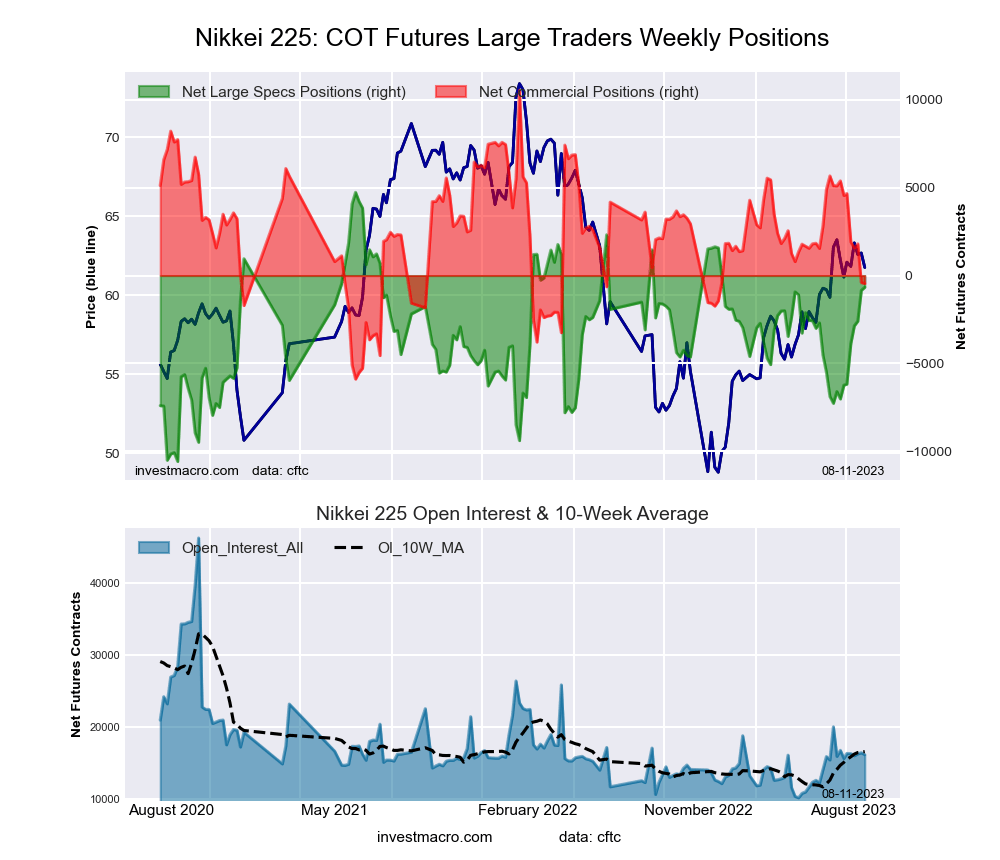
Asian markets were mostly on the rise last week. Japan’s Nikkei 225 (JP225) was little changed for the week, China’s FTSE China A50 (CHA50) gained 2.20%, Hong Kong’s Hang Seng (HK50) ended the week up by 3.55%, and Australia’s S&P/ASX 200 (AU200) ended the week positive by 3.70%.

Chinese indices fell sharply on Monday after data showed a significant slowdown in the country’s economic growth in the second quarter. China’s gross domestic product (GDP) grew by 0.8% in the second quarter. The figure was above expectations of 0.5% growth but significantly weaker than the 2.2% jump recorded in the first quarter. The annualized GDP figure fell short of expectations, showing growth of 6.5% vs. the expected 7.3%. China’s manufacturing sector also came under pressure due to sluggish overseas demand for Chinese exports amid deteriorating economic conditions globally. The data suggest that the economic recovery in Asia’s largest country is decreasing and that the government will likely have to consider additional stimulus measures in the coming months.

S&P 500 (F)(US500) 4,505.42 −4.62 (−0.10%)

Dow Jones (US30) 34,509.03 +113.89 (+0.33%)

DAX (DE40)  16,105.07 −35.96 (−0.22%)

FTSE 100 (UK100) 7,434.57 −5.64 (−0.076%)

USD Index  99.96 +0.19 (−0.19%)

Important events for today:
  • – China GDP (q/q) at 05:00 (GMT+3);
  • – China Industrial Production (m/m) at 05:00 (GMT+3);
  • – China Retail Sales (m/m) at 05:00 (GMT+3);
  • – China Unemployment Rate (m/m) at 05:00 (GMT+3);
  • – Eurozone ECB President Lagarde Speaks at 11:15 (GMT+3);
  • – US NY Empire State Manufacturing Index (m/m) at 15:30 (GMT+3).

By JustMarkets


This article reflects a personal opinion and should not be interpreted as an investment advice, and/or offer, and/or a persistent request for carrying out financial transactions, and/or a guarantee, and/or a forecast of future events.

Tesla’s New Competition

Source: Ron Struthers  (7/12/23)

Ron Struthers has followed Tesla since its infancy and says hydrogen fuel cells and vehicles will be the next big rage, and he sees huge growth in green energy transportation. Struthers discusses one company that he believes has lined up all the ducks in order to benefit.

I have followed Tesla since the early days, suggesting to buy or sell the stock numerous times. My last suggestion was a buy In January around $113. See my January Seeking Alpha article here, called “A Perfect Storm Hits Tesla in 2022.” I think the stock will test $300 so around $295 I will probably suggest selling.

The battery driven EVs have been all the rage with the “climate change” narrative; however, they are not a good enough solution. They are fine for commuters and those driving low daily mileage, but where they fail big time is higher mileage like the transport industry, as an example. A friend had a recent discussion with an Uber driver in Vancouver, Canada, about why he was not driving an EV. He said they are not practical because of battery charge life and long wait and charge times, especially in the colder months when the efficiency of the EVs drops -50% and more.

I did an in-depth article on the charging of EVs, the costs and efficiency. You will be surprised, so here a few tidbits from that analysis.

  • The average price to charge a 60-kilowatt-hour Tesla Model 3 at home is US$6.83, while it’s $8.88 for Volvo XC40 Recharge with a a 78-kWh battery pack and $14.92 for a Ford F-150 Lightning with its larger 131 kWh battery;
  • A big catch is that price is based on US$0.11 per-KWh. Where I am in Ontario the average is around Cdn $0.20. California is high at US$0.29 and the U.S. state average is US$0.16;
  • It will take a week to charge your EV at home unless you fork out about $2,000 to install a level 2 charger in your garage that will charge overnight in 8 to 12 hours, depending on battery size;
  • High-speed charging at Electrify America, meanwhile, costs something on the order of US$0.41 per kWh. Some Tesla Superchargers are charging as much as US$0.50 per kWh. That would mean your $6.83 at- home Tesla Model 3 charge would instead cost US$30, while that $14.92 Lightning fill-up jumps to $53.71;
  • The EVs mileage sucks big time in cold weather, so for almost half the year in Canada and northern US. Car.com did a road test with a Tesla Model Y and the range dropped over 50% at 0 to 5 degrees Fahrenheit.

I compared the fueling costs of a Tesla Model 3 with two other comparable luxury sedans, BMW 3 and the Jaguar XE. I used the EPA [Environmental Protection Agency] ratings on these cars. Plus you will pay a higher price for the Tesla and I did not include the cost of a Level 2 charger, so charging cost is at charging stations. I used $3 per gallon gasoline as that is about the current going rate where I am in Florida at that time.

Car                               Summer                                  Winter
Tesla Model 3            11.2 cents/mile                  15.8 cents/mile
BMW 3 Series (gas)  10.4 cents/mile                  10.4 cents/mile
Jaguar XE (gas)        10.4 cents/mile                  10.4 cents/mile

The battery technology has a long way to go yet. Weight of the batteries is another issue. I have seen estimates that one-third of the payload of a transport truck would have to be the batteries to move it. Hydrogen is going to be a much better solution in many cases and it is in it’s infancy like Tesla and EVs in the early days. There are numerous hydrogen test vehicles doing trials and there are few hydrogen filling stations like there were few charging stations six or seven years ago. The U.S. had about 3,000 charging stations in 2016 and 22,000 in 2021.

There are very few hydrogen stations, but they are coming. I saw news this week that a new one is being built at Toronto Airport. Geazone, a British Columbia courier company, recently ordered 40 Toyota Mirais because they are well served by four strategically located hydrogen refueling stations. The British Columbia government has committed $10 million to build more. Meanwhile, there are now some 47 hydrogen refueling stations in California.

Let’s compare hydrogen to batteries.

A modern car battery can store 250 watt-hours of energy for every kilogram of lithium-ion. A kilogram of hydrogen, meanwhile, has 33,200 of those watt-hour things per kilo. Yes, hydrogen is more than 100 times as energy-dense as a li-ion battery. The batteries will improve some but that won’t be much of a factor in this regard. Hydrogen vehicles will be far lighter than the battery-loaded EVs as well.

Hydrogen is only about 38% efficient versus 80% for lithium batteries The difference is in how the two process electricity. For hydrogen to be as emissions-free as a battery-powered car, you need to electrolyze the water — splitting H2O into, well, H2 and O — with clean wind, solar, or nuclear power. This electrolysis is not nearly as efficient as simply charging a battery. Similarly, in the fuel cell itself, the H2 and O must be recombined to generate electricity. This process, again, is not nearly as efficient as a battery dumping its electrons.

The newer electric cars are capable of achieving an 80% charge in around 30 minutes. However a fuel cell EV (FCEV) is like filling a gasoline car being fueled in under four minutes and can travel around 300 miles on a single tank. Hydrogen is a big winner here!

There are longer term environmental problems with EVs. Thousands of new mines will have to be built for battery metals. ln the Salar de Uyuni – the world’s largest salt flat and an enormous lithium reserve located in southwest Bolivia – mining is threatening to destroy the ecosystem and drain the water supply. Indeed, extracting just a tonne of lithium requires up to 2 million liters of water.

The sourcing of metals for lithium batteries can result in profound environmental damage and can produce as much as 16 tons of carbon emissions. For hydrogen it will be a matter of building green electrical plants to make the hydrogen. A lot of these will have to be built.

Currently less than 5% of EV batteries are being recycled; there is a substantial risk of environmental contamination relating to spent battery disposal. According to recent estimates, by 2030, the number of EV batteries requiring disposal will roughly equal the number currently produced annually. Most EV batteries have a 10-year warranty so that is an approximate lifespan. A hydrogen fuel cell will typically last the life of the vehicle and only require one small battery.

Summary

The biggest advantage for EVs is a lot more infrastructure is available while FCEV infrastructure is in its infancy. The EV electrical use is more efficient than FCEV but the recharging/fueling is a clear winner for FCEV. EVs have a lot of excess weight with batteries so the lighter FCEV could make up on its comparable electrical deficiency. The long-term environmental aspects of EVs have not been considered or have been ignored. FCEVs will play a big part in long haul transportation, taxis, service fleets, and last mile delivery.

The green hydrogen market was valued at US$676 million in 2022 and is projected to reach US$7,314 million by 2027, growing at a compound annual growth rate of 61% from 2022 to 2027. The market’s growth is attributed to the lowering cost of producing renewable energy by all sources, the development of electrolysis technologies, and high demand from FCEVs.

A recent report from the EIA [Energy Information Agency] shows very strong growth for hydrogen in FCEVs. Currently they are consuming less than 1% of the hydrogen market with the current big users being ammonia production and the others being methanol and steel production.

Hydrogen demand in road transport increases 60% in 2021 from 2020.


Heavy-duty hydrogen trucks increased significantly in 2021 (up over 60-fold from 2020).

I have talked about the technology “S curve” numerous times in the past. Once a technology reaches acceptance, and that is where FCEVs have just arrived, you have the strongest growth in the market. For example if the new technology has 5% of the market, the growth to 50% is a 1,000% increase. Currently FCEVs have less than 5% of the EV market.

A company I see as very well positioned for the development of hydrogen and FCEVs is:

First Hydrogen Corp. (FHYD:TSX; FHYDF:OTC; FIT:FSE) TSXV:FHYD OTC:FHYDF

Shares outstanding – 70 million approx.

First Hydrogen is based in Vancouver and London, UK, focused on zero-emission vehicles, green hydrogen production and distribution, and super-critical carbon dioxide extractor systems. The company has designed and built hydrogen-fuel-cell-powered light commercial demonstrator vehicles (LCV) under two agreements with AML Powertrain and Ballard Power Systems Inc. This graphic on their home page shows the FCEV and some bullet points.


These vehicles are currently being trialed with an initial 16 fleet operators in the United Kingdom.

On June 26, First Hydrogen’s FCEV was delivered to U.K. utility SSE PLC. The FCEV will begin real-world trials at SSE’s operational site at Aberdeen, Scotland, and surrounding areas, which features some of the U.K.’s best hydrogen infrastructure. This infrastructure will enable SSE to experience easy and fast refuelling within five to seven minutes, showcasing a significant advantage of the company’s FCEV over battery electric vehicles (BEV), which typically take hours to recharge.

The FCEV has some good reviews/praise such as in May from award-winning fleet management provider Rivus for its smooth and pleasant driving experience. Rivus drivers noted the capability to manage greater ranges and refuel much faster than battery electric vehicles, which will help fleets using this vehicle class to switch to meet zero emissions targets. Following initial journeys on roads in Birmingham, the West Midlands, and South Yorkshire, Rivus’ drivers have complimented the vehicle for its “effortless” and “comfortable” driving. Drivers were particularly impressed with the automatic transmission, which they appraised as “easier than a petrol or diesel van to operate” as it does not require gear changes and the vehicle is much quieter to run. Rivus, which manages approximately 120,000 vehicles, including approximately 85,000 LCVs, is the first fleet management company to test drive the first-of-its-kind hydrogen vehicle on U.K. roads.

The company has a very experienced and strong management team. FHYD is led by Malraj Mann, chairman and CEO, who has 40+ years of experience in corporate finance, acquisitions, and financial reporting for both private and public companies.

Rob Campbell is CEO-Energy with 40+ years engineering, commercial, and executive experience, including Chief Commercial Officer at Ballard Power Systems. He has held various previous leadership roles in energy and technology space (including solar and hydrogen).

Steve Gill is CEO- Automotive with 30+ years in automotive, with 20 years with Ford Motor Company (final role: Director, Powertrain Engineering at Ford of Europe); Board Director Ford Technologies; 11 years with Perkins Engines; (final role: Chief Engineer).

Allan Rushforth is CCO-Mobility with 30+ years in automotive and mobility. He has held senior leadership roles in automotive sales, distribution and service, including Marque Group, Lookers, Nissan, Hyundai and Volkswagen/Audi. International experience includes Japan, Korea, and Germany.

First Hydrogen is also active in Canada and has finalized land option agreements with the City of Shawinigan, Quebec. Next they signed a feasibility study agreement with Sacre-Davey for the development of a 35-megawatt green hydrogen production facility and vehicle assembly factory in Shawinigan. The purpose of the feasibility study is to establish the technical and market analysis, engineering review, analysis of grid and water constraints, permitting requirements, environmental constraints, and a review of distribution and operations. The overarching theme throughout the study is to recognize the combined aim to create a zero-emission hydrogen ecosystem.

The production facility will use advanced electrolysis and supply the company’s hydrogen-fuel-cell-powered vehicles (FCEV), as well as support other hydrogen-fueled vehicles and applications in the Montreal-Quebec City region. The company’s planned FCEV assembly factory will be designed for annual production of 25,000 vehicles per year when at full capacity and will represent a major boost to green technology jobs in the region. The distribution of First Hydrogen’s FCEV, throughout North America, will be in combination with the company’s hydrogen-as-a-service product offering.

It is very early days for First Hydrogen but it will have a far easier path than Tesla did. Tesla was met with much skepticism and doubt as North America’s first EV producer. Now governments and large investment funds are pouring oodles of money into the EV and hydrogen markets.

So far First Hydrogen’s FCEV has accumulated 6,000 kilometers on United Kingdom roads, including mileage around London’s M25 motorway. The data logging supports vehicle range simulations, which exceed a 500-kilometer range. The vehicle is currently performing with excellent efficiency, including both urban, extraurban (which includes driving at higher speeds), and highway operations. First Hydrogen’s LCV fuel consumption figures seen in many driving scenarios are under two kilograms per 100 km, and in mostly urban driving this is 1.5 kg/100 km.

Conclusion

First Hydrogen is at the very beginning of its growth cycle. It will have revenues from selling FCEVs that have now reached acceptance and I expect will soon see major purchase orders. The company has partnered with the Quebec University and numerous other government, investor, and industry partners in the sector. It is not doing this alone. First Hydrogen will also make revenues producing and selling hydrogen.

There is enormous government support for hydrogen in Western countries. In Canada’s recent budget, programs supporting First Hydrogen include investment tax credits for clean hydrogen ($17.7 billion) and zero-emission technology manufacturing ($11.1 billion), as well as lower tax rates for zero-emission technology manufactures ($1.3 billion). The federal incentives are in addition to incentive programs offered by the province of Quebec, which the company has picked for its first green hydrogen eco-system.

The stock ran up last year with good news from the company and Canada officially getting behind hydrogen. PM Justin Trudeau and German Chancellor Olaf Scholz met in Newfoundland, Canada, creating an alliance between Canada and Germany. The joint declaration of intent to invest in hydrogen and establish a transatlantic Canada-Germany supply corridor will be the start of establishing Canada as a significant hydrogen producer and advancing on its decarbonization path.

The stock has come down after what now looks like too much hype in the sector, but has put in a bottom and current prices look like an attractive entry point. There is not much resistance until around $3.40 and the the $4.00 area.


Important Disclosures:

  1. First Hydrogen has a consulting relationship with an affiliate of Streetwise Reports, and pays a monthly consulting fee between US$8,000 and US$20,000.
  2. As of the date of this article, officers and/or employees of Streetwise Reports LLC (including members of their household) own securities of First Hydrogen.
  3. Ron Struthers: I, or members of my immediate household or family, does not own securities of First Hydrogen. My company does not have a financial relationship with First Hydrogen. I determined which companies would be included in this article based on my research and understanding of the sector.
  4. Statements and opinions expressed are the opinions of the author and not of Streetwise Reports or its officers. The author is wholly responsible for the validity of the statements. The author was not paid by Streetwise Reports for this article. Streetwise Reports was not paid by the author to publish or syndicate this article. Streetwise Reports requires contributing authors to disclose any shareholdings in, or economic relationships with, companies that they write about. Streetwise Reports relies upon the authors to accurately provide this information and Streetwise Reports has no means of verifying its accuracy.
  5.  This article does not constitute investment advice. Each reader is encouraged to consult with his or her individual financial professional. By opening this page, each reader accepts and agrees to Streetwise Reports’ terms of use and full legal disclaimer. This article is not a solicitation for investment. Streetwise Reports does not render general or specific investment advice and the information on Streetwise Reports should not be considered a recommendation to buy or sell any security. Streetwise Reports does not endorse or recommend the business, products, services or securities of any company.

For additional disclosures, please click here.

Struthers Resource Stock Report Disclosures

All forecasts and recommendations are based on opinion. Markets change direction with consensus beliefs, which may change at any time and without notice. The author/publisher of this publication has taken every precaution to provide the most accurate information possible. The information & data were obtained from sources believed to be reliable, but because the information & data source are beyond the author’s control, no representation or guarantee is made that it is complete or accurate. The reader accepts information on the condition that errors or omissions shall not be made the basis for any claim, demand or cause for action. Because of the ever-changing nature of information & statistics the author/publisher strongly encourages the reader to communicate directly with the company and/or with their personal investment adviser to obtain up to date information. Past results are not necessarily indicative of future results. Any statements non-factual in nature constitute only current opinions, which are subject to change. The author/publisher may or may not have a position in the securities and/or options relating thereto, & may make purchases and/or sales of these securities relating thereto from time to time in the open market or otherwise. Neither the information, nor opinions expressed, shall be construed as a solicitation to buy or sell any stock, futures or options contract mentioned herein. The author/publisher of this letter is not a qualified financial adviser & is not acting as such in this publication.

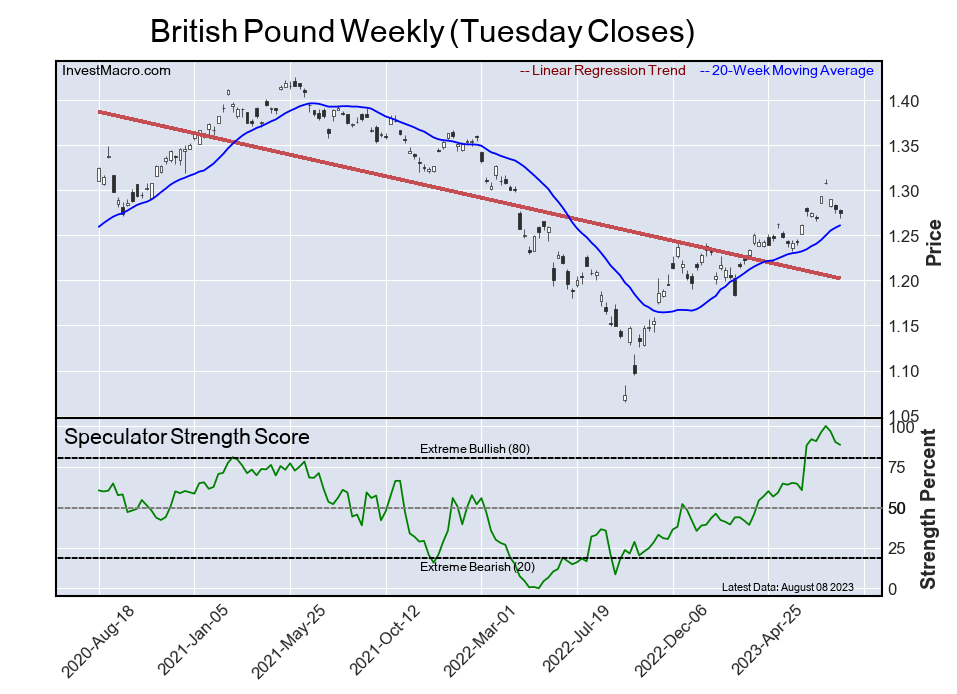
British Pound Speculator bets jump to 15-year high as GBP closes above 1.30

By InvestMacro

Here are the latest charts and statistics for the Commitment of Traders (COT) data published by the Commodities Futures Trading Commission (CFTC).

The latest COT data is updated through Tuesday July 11th and shows a quick view of how large market participants (for-profit speculators and commercial traders) were positioned in the futures markets. All currency positions are in direct relation to the US dollar where, for example, a bet for the euro is a bet that the euro will rise versus the dollar while a bet against the euro will be a bet that the euro will decline versus the dollar.

Weekly Speculator Changes led by British Pound & Brazilian Real

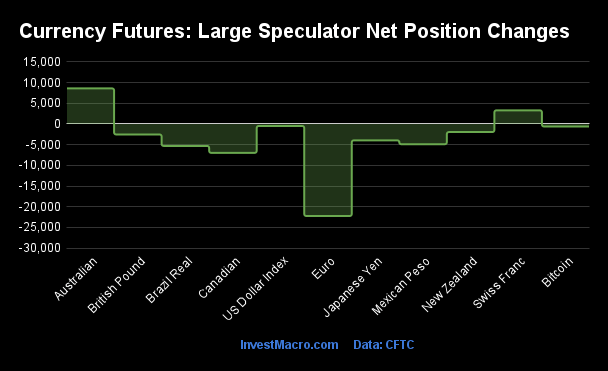
The COT currency market speculator bets were lower this week as five out of the eleven currency markets we cover had higher positioning while the other six markets had lower speculator contracts.

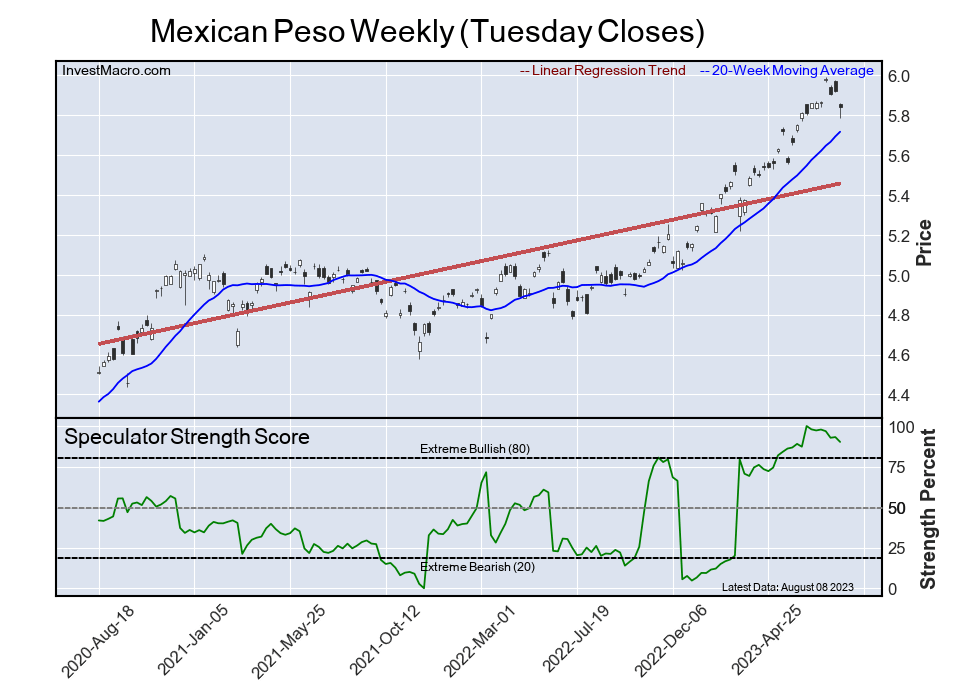
Leading the gains for the currency markets was the British Pound (7,798 contracts) with the Brazilian Real (2,094 contracts), Mexican Peso (926 contracts), Japanese Yen (738 contracts) and Bitcoin (221 contracts) also showing positive weeks.

The currencies seeing declines in speculator bets on the week were the Swiss Franc (-4,503 contracts), the US Dollar Index (-2,306 contracts), EuroFX (-2,675 contracts), the New Zealand Dollar (-2,081 contracts), the Australian Dollar (-502 contracts) and the Canadian Dollar (-83 contracts)also registering lower bets on the week.

British Pound Speculator bets jump to 15-year high as GBP closes above 1.30

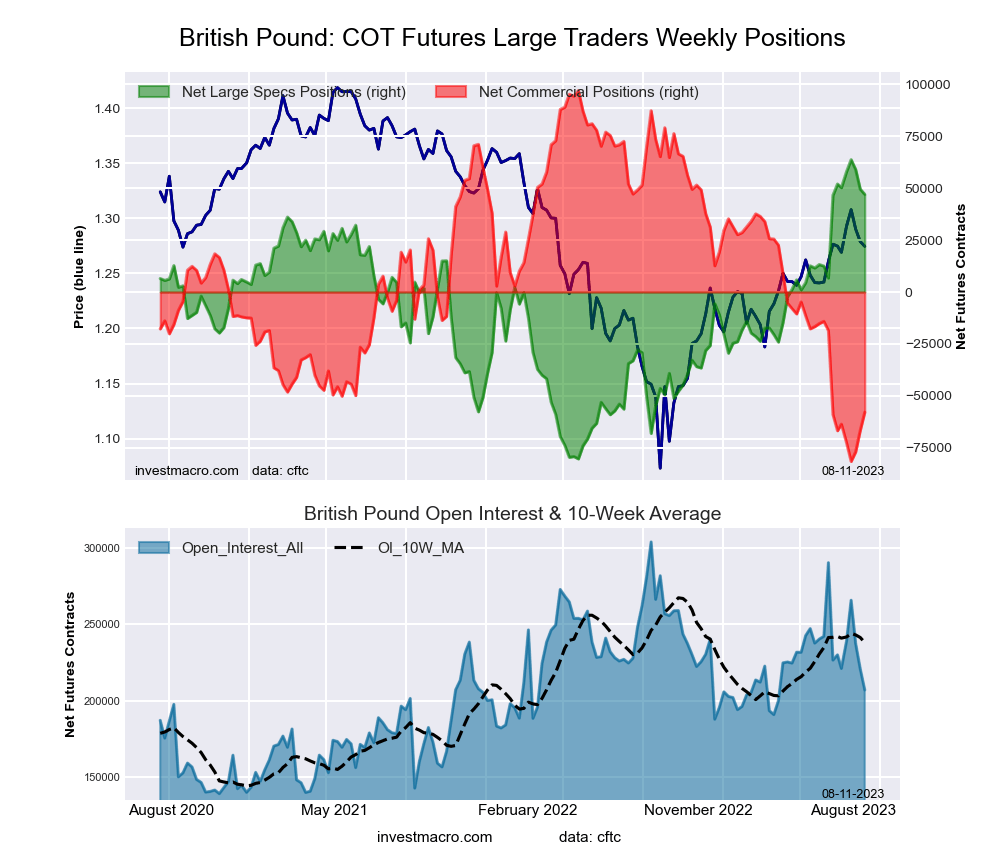
Highlighting the COT currency’s data this week is the bullish strength in the speculator’s positioning of the British Pound Sterling. Large speculative Pound positions rose this week by almost +8,000 contracts and have now increased their bullish positions in three out of the past four weeks.

The overall gain for the past four weeks now totals +51,328 contracts. This has pushed the overall net position, which currently sits at +58,063 contracts, to the highest speculator bullish standing since November 6th of 2007, an over 15-year high.

The Pound’s positioning has been helped out by the Bank of England’s most recent interest rate increase in June that was by 50 basis points and brought the bank rate to 5 percent – its highest sitting in the past 15 years as well. Traders are forecasting more rate hikes out of the UK due to high inflation while other countries, like the US, are likely nearing the end of a rate-rising cycle.

The Pound Sterling exchange rate against the US Dollar has been streaking higher this year and this week closed above the 1.3000 exchange rate for the first time since April of 2022. The GBPUSD currency pair had touched a low near 1.0360 as recently as September and has been on a strong uptrend since then. The GBPUSD has now risen by approximately 25 percent since that September bottom.


Data Snapshot of Forex Market Traders | Columns Legend
Jul-11-2023OIOI-IndexSpec-NetSpec-IndexCom-NetCOM-IndexSmalls-NetSmalls-Index
USD Index28,925612,01145-13,577541,56634
EUR736,05656140,16272-192,4622552,30062
GBP239,1256158,063100-72,701014,63887
JPY252,34979-117,1820129,07799-11,89529
CHF43,56348-7,907348,16558-25857
CAD140,395194,44459-14,026479,58244
AUD152,49542-45,0844354,03559-8,95131
NZD34,94720-1,251502,61953-1,36834
MXN239,7385196,16698-99,49323,32732
RUB20,93047,54331-7,15069-39324
BRL49,3633833,19878-31,19326-2,00528
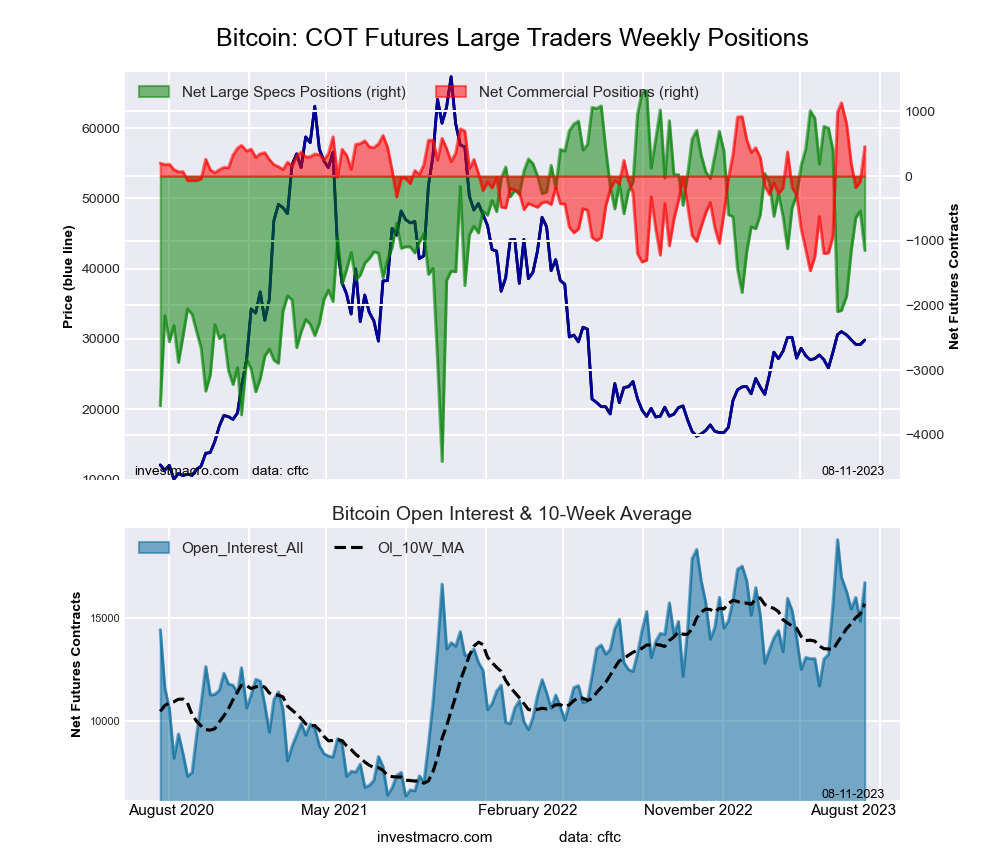
Bitcoin16,30280-1,8554580401,05137


Strength Scores led by British Pound & Mexican Peso

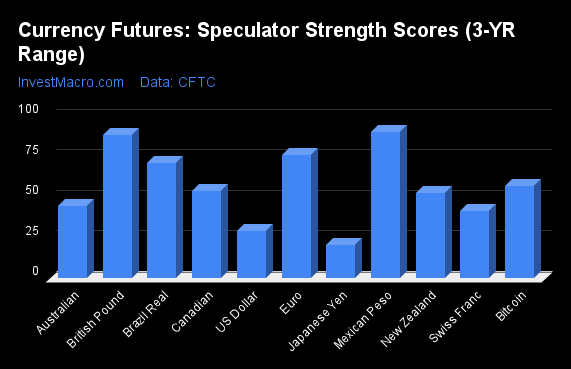
COT Strength Scores (a normalized measure of Speculator positions over a 3-Year range, from 0 to 100 where above 80 is Extreme-Bullish and below 20 is Extreme-Bearish) showed that the British Pound (100 percent) and the Mexican Peso (98 percent) lead the currency markets this week. The Brazilian Real (78 percent), EuroFX (72 percent) and the Canadian Dollar (59 percent) come in as the next highest in the weekly strength scores.

On the downside, the Japanese Yen (0 percent) and the Swiss Franc (34 percent) come in at the lowest strength levels currently and are in Extreme-Bearish territory (below 20 percent). The next lowest strength scores are the Australian Dollar (43 percent) and the Bitcoin (45 percent).

Strength Statistics:
US Dollar Index (45.0 percent) vs US Dollar Index previous week (48.8 percent)
EuroFX (72.4 percent) vs EuroFX previous week (73.4 percent)
British Pound Sterling (100.0 percent) vs British Pound Sterling previous week (94.4 percent)
Japanese Yen (0.4 percent) vs Japanese Yen previous week (0.0 percent)
Swiss Franc (33.7 percent) vs Swiss Franc previous week (45.6 percent)
Canadian Dollar (58.7 percent) vs Canadian Dollar previous week (58.8 percent)
Australian Dollar (43.0 percent) vs Australian Dollar previous week (43.5 percent)
New Zealand Dollar (50.2 percent) vs New Zealand Dollar previous week (55.8 percent)
Mexican Peso (97.8 percent) vs Mexican Peso previous week (97.3 percent)
Brazilian Real (78.0 percent) vs Brazilian Real previous week (75.3 percent)
Bitcoin (44.6 percent) vs Bitcoin previous week (40.7 percent)


British Pound & Canadian Dollar top the 6-Week Strength Trends

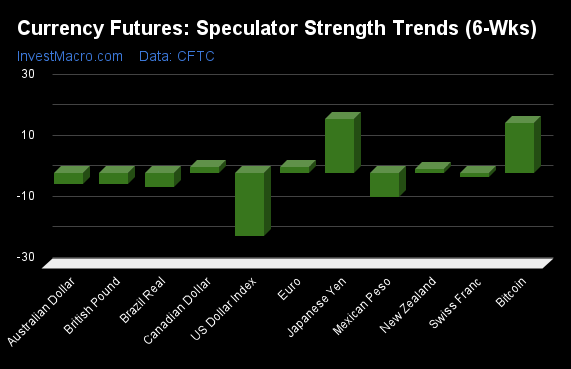
COT Strength Score Trends (or move index, calculates the 6-week changes in strength scores) showed that the British Pound (32 percent) and the Canadian Dollar (32 percent) lead the past six weeks trends for the currencies. The Mexican Peso (11 percent), the Brazilian Real (2 percent) and the US Dollar Index (-1 percent) are the next highest positive movers in the latest trends data.

The Bitcoin (-36 percent) leads the downside trend scores currently with the Swiss Franc (-20 percent), Japanese Yen (-12 percent) and the EuroFX (-10 percent) following next with lower trend scores.

Strength Trend Statistics:
US Dollar Index (-1.3 percent) vs US Dollar Index previous week (5.1 percent)
EuroFX (-9.9 percent) vs EuroFX previous week (-11.9 percent)
British Pound Sterling (32.4 percent) vs British Pound Sterling previous week (27.9 percent)
Japanese Yen (-12.5 percent) vs Japanese Yen previous week (-22.1 percent)
Swiss Franc (-19.8 percent) vs Swiss Franc previous week (-6.6 percent)
Canadian Dollar (32.0 percent) vs Canadian Dollar previous week (49.5 percent)
Australian Dollar (-0.9 percent) vs Australian Dollar previous week (4.2 percent)
New Zealand Dollar (-3.0 percent) vs New Zealand Dollar previous week (3.2 percent)
Mexican Peso (11.1 percent) vs Mexican Peso previous week (11.2 percent)
Brazilian Real (2.4 percent) vs Brazilian Real previous week (-2.0 percent)
Bitcoin (-35.6 percent) vs Bitcoin previous week (-51.8 percent)


Individual COT Forex Markets:

US Dollar Index Futures:
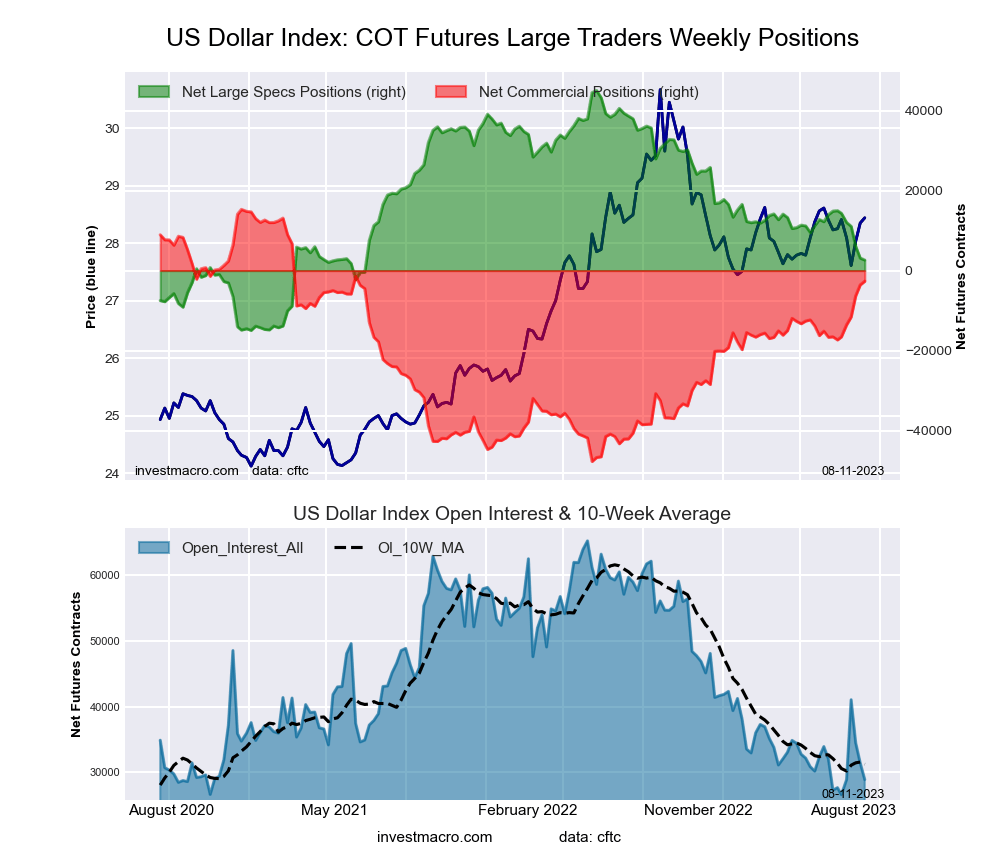
US Dollar Index Forex Futures COT ChartThe US Dollar Index large speculator standing this week equaled a net position of 12,011 contracts in the data reported through Tuesday. This was a weekly decline of -2,306 contracts from the previous week which had a total of 14,317 net contracts.

This week’s current strength score (the trader positioning range over the past three years, measured from 0 to 100) shows the speculators are currently Bearish with a score of 45.0 percent. The commercials are Bullish with a score of 54.2 percent and the small traders (not shown in chart) are Bearish with a score of 33.6 percent.

Price Trend-Following Model: Weak Uptrend

Our weekly trend-following model classifies the current market price position as: Weak Uptrend. The current action for the model is considered to be: Hold – Maintain Long Position.

US DOLLAR INDEX StatisticsSPECULATORSCOMMERCIALSSMALL TRADERS
– Percent of Open Interest Longs:71.78.814.9
– Percent of Open Interest Shorts:30.255.79.5
– Net Position:12,011-13,5771,566
– Gross Longs:20,7412,5364,316
– Gross Shorts:8,73016,1132,750
– Long to Short Ratio:2.4 to 10.2 to 11.6 to 1
NET POSITION TREND:
– Strength Index Score (3 Year Range Pct):45.054.233.6
– Strength Index Reading (3 Year Range):BearishBullishBearish
NET POSITION MOVEMENT INDEX:
– 6-Week Change in Strength Index:-1.34.3-21.1


Euro Currency Futures:

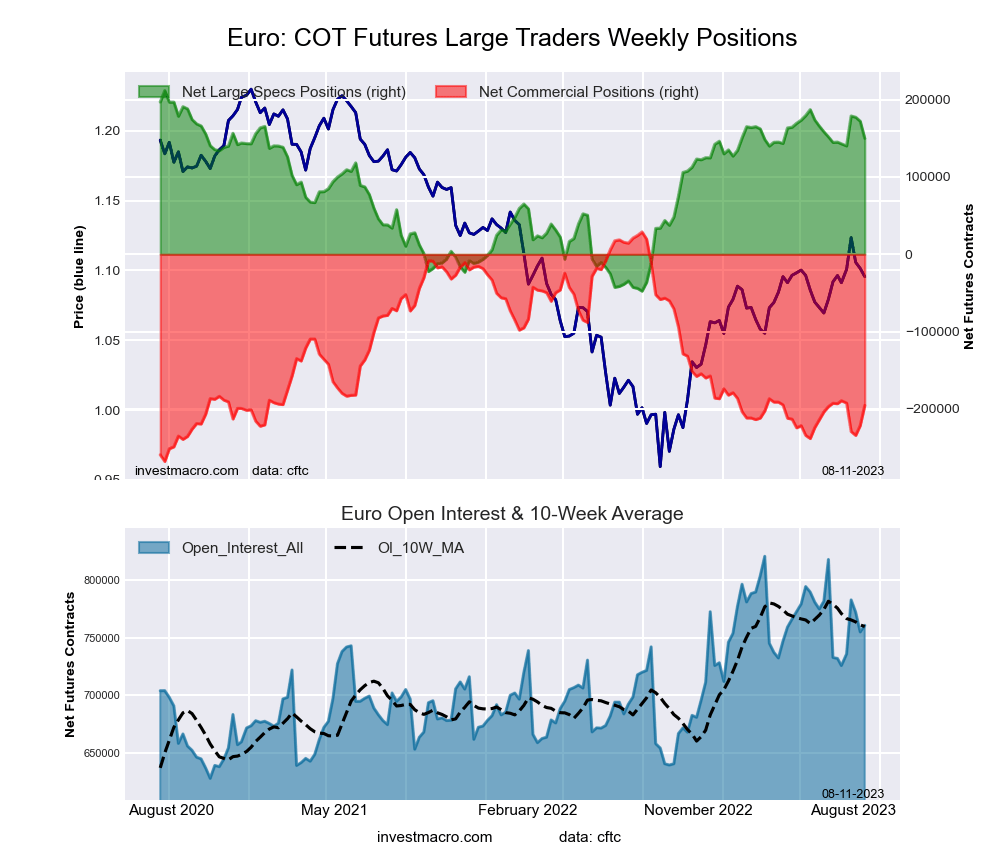
Euro Currency Futures COT ChartThe Euro Currency large speculator standing this week equaled a net position of 140,162 contracts in the data reported through Tuesday. This was a weekly decline of -2,675 contracts from the previous week which had a total of 142,837 net contracts.

This week’s current strength score (the trader positioning range over the past three years, measured from 0 to 100) shows the speculators are currently Bullish with a score of 72.4 percent. The commercials are Bearish with a score of 25.4 percent and the small traders (not shown in chart) are Bullish with a score of 62.4 percent.

Price Trend-Following Model: Strong Uptrend

Our weekly trend-following model classifies the current market price position as: Strong Uptrend. The current action for the model is considered to be: Hold – Maintain Long Position.

EURO Currency StatisticsSPECULATORSCOMMERCIALSSMALL TRADERS
– Percent of Open Interest Longs:30.554.813.0
– Percent of Open Interest Shorts:11.481.05.9
– Net Position:140,162-192,46252,300
– Gross Longs:224,351403,46095,768
– Gross Shorts:84,189595,92243,468
– Long to Short Ratio:2.7 to 10.7 to 12.2 to 1
NET POSITION TREND:
– Strength Index Score (3 Year Range Pct):72.425.462.4
– Strength Index Reading (3 Year Range):BullishBearishBullish
NET POSITION MOVEMENT INDEX:
– 6-Week Change in Strength Index:-9.97.36.4


British Pound Sterling Futures:

British Pound Sterling Futures COT ChartThe British Pound Sterling large speculator standing this week equaled a net position of 58,063 contracts in the data reported through Tuesday. This was a weekly boost of 7,798 contracts from the previous week which had a total of 50,265 net contracts.

This week’s current strength score (the trader positioning range over the past three years, measured from 0 to 100) shows the speculators are currently Bullish-Extreme with a score of 100.0 percent. The commercials are Bearish-Extreme with a score of 0.0 percent and the small traders (not shown in chart) are Bullish-Extreme with a score of 86.7 percent.

Price Trend-Following Model: Strong Uptrend

Our weekly trend-following model classifies the current market price position as: Strong Uptrend. The current action for the model is considered to be: Hold – Maintain Long Position.

BRITISH POUND StatisticsSPECULATORSCOMMERCIALSSMALL TRADERS
– Percent of Open Interest Longs:46.730.616.7
– Percent of Open Interest Shorts:22.461.010.5
– Net Position:58,063-72,70114,638
– Gross Longs:111,66773,15039,825
– Gross Shorts:53,604145,85125,187
– Long to Short Ratio:2.1 to 10.5 to 11.6 to 1
NET POSITION TREND:
– Strength Index Score (3 Year Range Pct):100.00.086.7
– Strength Index Reading (3 Year Range):Bullish-ExtremeBearish-ExtremeBullish-Extreme
NET POSITION MOVEMENT INDEX:
– 6-Week Change in Strength Index:32.4-33.924.8


Japanese Yen Futures:

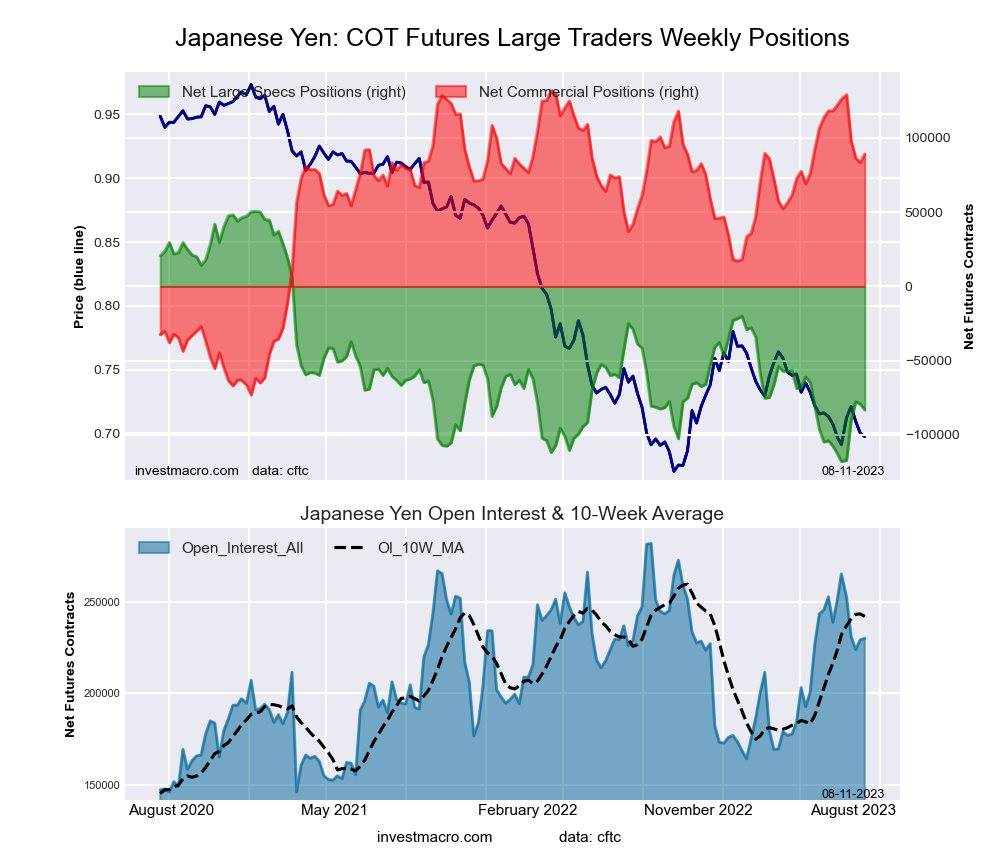
The Japanese Yen large speculator standing this week equaled a net position of -117,182 contracts in the data reported through Tuesday. This was a weekly rise of 738 contracts from the previous week which had a total of -117,920 net contracts.

This week’s current strength score (the trader positioning range over the past three years, measured from 0 to 100) shows the speculators are currently Bearish-Extreme with a score of 0.4 percent. The commercials are Bullish-Extreme with a score of 98.6 percent and the small traders (not shown in chart) are Bearish with a score of 29.3 percent.

Price Trend-Following Model: Downtrend

Our weekly trend-following model classifies the current market price position as: Downtrend. The current action for the model is considered to be: Hold – Maintain Short Position.

JAPANESE YEN StatisticsSPECULATORSCOMMERCIALSSMALL TRADERS
– Percent of Open Interest Longs:11.875.411.6
– Percent of Open Interest Shorts:58.324.216.3
– Net Position:-117,182129,077-11,895
– Gross Longs:29,838190,18929,288
– Gross Shorts:147,02061,11241,183
– Long to Short Ratio:0.2 to 13.1 to 10.7 to 1
NET POSITION TREND:
– Strength Index Score (3 Year Range Pct):0.498.629.3
– Strength Index Reading (3 Year Range):Bearish-ExtremeBullish-ExtremeBearish
NET POSITION MOVEMENT INDEX:
– 6-Week Change in Strength Index:-12.511.0-3.2


Swiss Franc Futures:

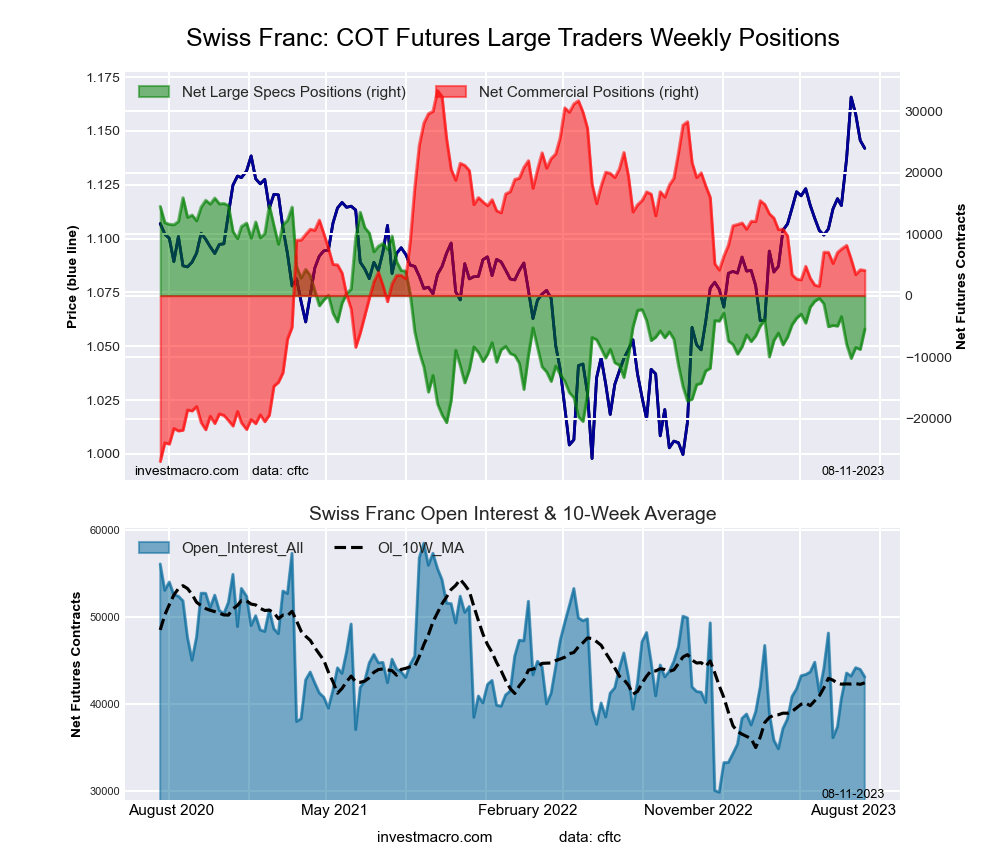
Swiss Franc Forex Futures COT ChartThe Swiss Franc large speculator standing this week equaled a net position of -7,907 contracts in the data reported through Tuesday. This was a weekly decrease of -4,503 contracts from the previous week which had a total of -3,404 net contracts.

This week’s current strength score (the trader positioning range over the past three years, measured from 0 to 100) shows the speculators are currently Bearish with a score of 33.7 percent. The commercials are Bullish with a score of 58.5 percent and the small traders (not shown in chart) are Bullish with a score of 56.7 percent.

Price Trend-Following Model: Strong Uptrend

Our weekly trend-following model classifies the current market price position as: Strong Uptrend. The current action for the model is considered to be: Hold – Maintain Long Position.

SWISS FRANC StatisticsSPECULATORSCOMMERCIALSSMALL TRADERS
– Percent of Open Interest Longs:17.047.335.4
– Percent of Open Interest Shorts:35.228.636.0
– Net Position:-7,9078,165-258
– Gross Longs:7,41720,60415,411
– Gross Shorts:15,32412,43915,669
– Long to Short Ratio:0.5 to 11.7 to 11.0 to 1
NET POSITION TREND:
– Strength Index Score (3 Year Range Pct):33.758.556.7
– Strength Index Reading (3 Year Range):BearishBullishBullish
NET POSITION MOVEMENT INDEX:
– 6-Week Change in Strength Index:-19.810.92.8


Canadian Dollar Futures:

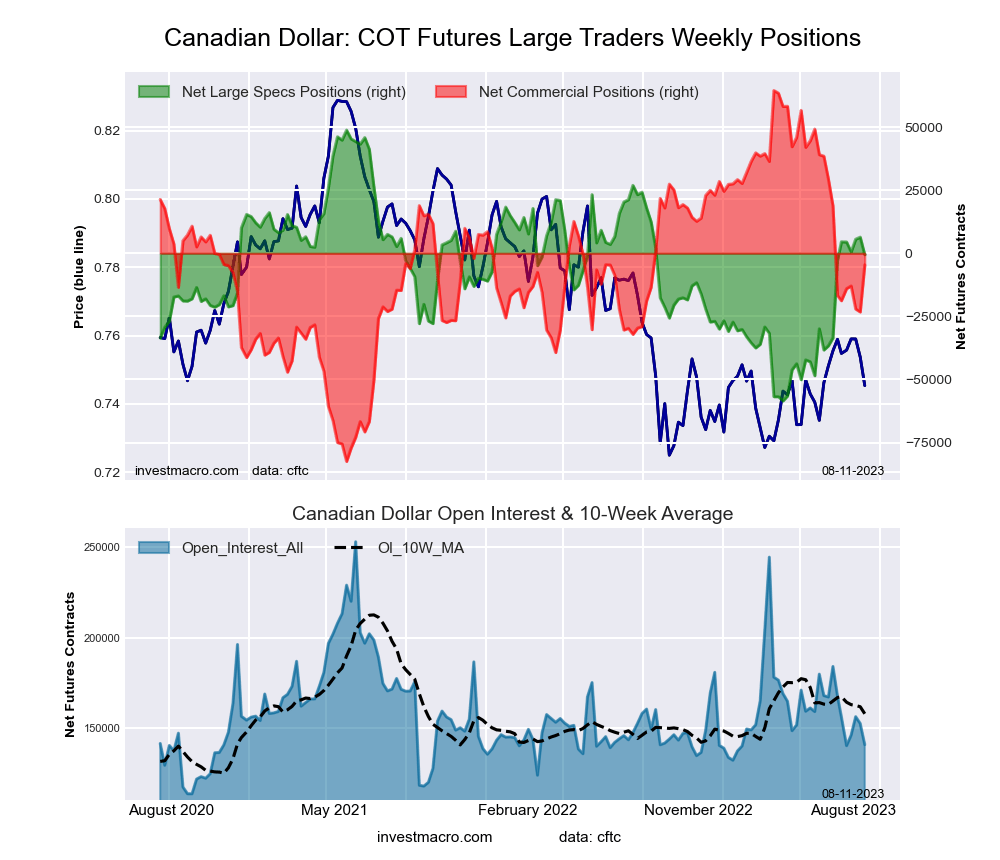
Canadian Dollar Forex Futures COT ChartThe Canadian Dollar large speculator standing this week equaled a net position of 4,444 contracts in the data reported through Tuesday. This was a weekly fall of -83 contracts from the previous week which had a total of 4,527 net contracts.

This week’s current strength score (the trader positioning range over the past three years, measured from 0 to 100) shows the speculators are currently Bullish with a score of 58.7 percent. The commercials are Bearish with a score of 46.6 percent and the small traders (not shown in chart) are Bearish with a score of 44.1 percent.

Price Trend-Following Model: Strong Uptrend

Our weekly trend-following model classifies the current market price position as: Strong Uptrend. The current action for the model is considered to be: Hold – Maintain Long Position.

CANADIAN DOLLAR StatisticsSPECULATORSCOMMERCIALSSMALL TRADERS
– Percent of Open Interest Longs:25.049.123.4
– Percent of Open Interest Shorts:21.859.116.6
– Net Position:4,444-14,0269,582
– Gross Longs:35,07268,93532,865
– Gross Shorts:30,62882,96123,283
– Long to Short Ratio:1.1 to 10.8 to 11.4 to 1
NET POSITION TREND:
– Strength Index Score (3 Year Range Pct):58.746.644.1
– Strength Index Reading (3 Year Range):BullishBearishBearish
NET POSITION MOVEMENT INDEX:
– 6-Week Change in Strength Index:32.0-36.141.5


Australian Dollar Futures:

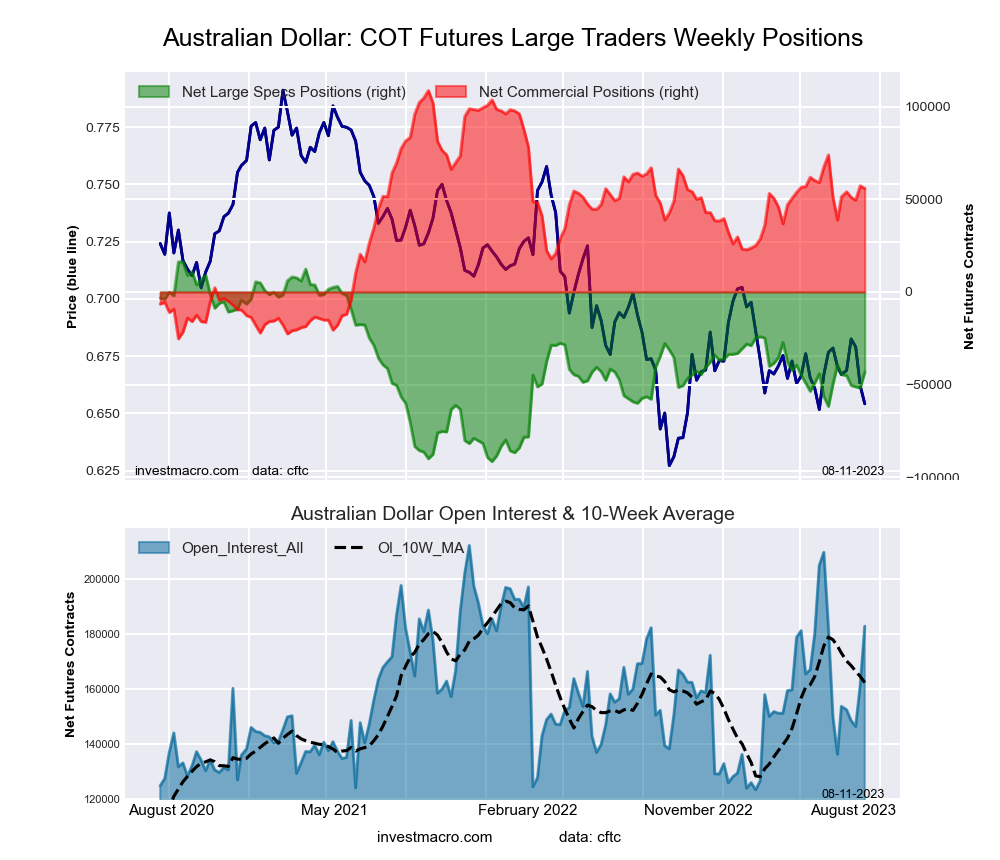
Australian Dollar Forex Futures COT ChartThe Australian Dollar large speculator standing this week equaled a net position of -45,084 contracts in the data reported through Tuesday. This was a weekly decline of -502 contracts from the previous week which had a total of -44,582 net contracts.

This week’s current strength score (the trader positioning range over the past three years, measured from 0 to 100) shows the speculators are currently Bearish with a score of 43.0 percent. The commercials are Bullish with a score of 59.2 percent and the small traders (not shown in chart) are Bearish with a score of 30.6 percent.

Price Trend-Following Model: Strong Uptrend

Our weekly trend-following model classifies the current market price position as: Strong Uptrend. The current action for the model is considered to be: New Buy – Long Position.

AUSTRALIAN DOLLAR StatisticsSPECULATORSCOMMERCIALSSMALL TRADERS
– Percent of Open Interest Longs:28.657.410.7
– Percent of Open Interest Shorts:58.221.916.6
– Net Position:-45,08454,035-8,951
– Gross Longs:43,66187,45816,392
– Gross Shorts:88,74533,42325,343
– Long to Short Ratio:0.5 to 12.6 to 10.6 to 1
NET POSITION TREND:
– Strength Index Score (3 Year Range Pct):43.059.230.6
– Strength Index Reading (3 Year Range):BearishBullishBearish
NET POSITION MOVEMENT INDEX:
– 6-Week Change in Strength Index:-0.9-3.814.7


New Zealand Dollar Futures:

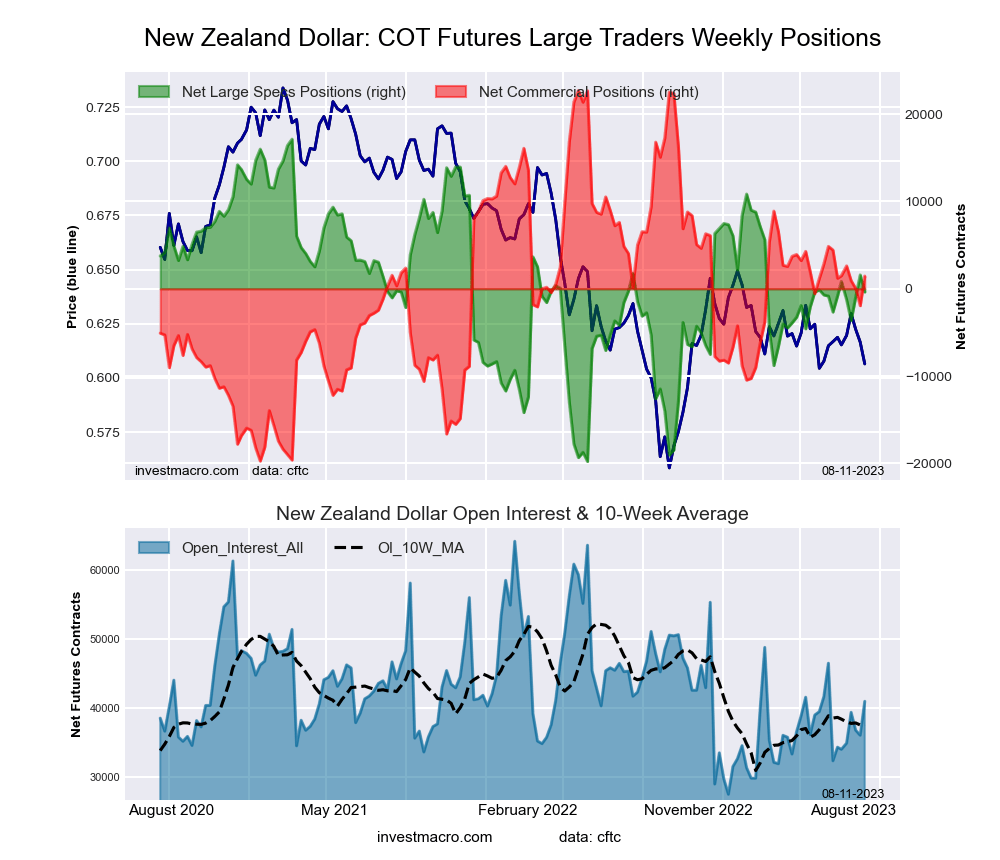
New Zealand Dollar Forex Futures COT ChartThe New Zealand Dollar large speculator standing this week equaled a net position of -1,251 contracts in the data reported through Tuesday. This was a weekly lowering of -2,081 contracts from the previous week which had a total of 830 net contracts.

This week’s current strength score (the trader positioning range over the past three years, measured from 0 to 100) shows the speculators are currently Bullish with a score of 50.2 percent. The commercials are Bullish with a score of 52.7 percent and the small traders (not shown in chart) are Bearish with a score of 33.7 percent.

Price Trend-Following Model: Weak Downtrend

Our weekly trend-following model classifies the current market price position as: Weak Downtrend. The current action for the model is considered to be: Hold – Maintain Short Position.

NEW ZEALAND DOLLAR StatisticsSPECULATORSCOMMERCIALSSMALL TRADERS
– Percent of Open Interest Longs:38.053.47.6
– Percent of Open Interest Shorts:41.645.911.5
– Net Position:-1,2512,619-1,368
– Gross Longs:13,29718,6662,656
– Gross Shorts:14,54816,0474,024
– Long to Short Ratio:0.9 to 11.2 to 10.7 to 1
NET POSITION TREND:
– Strength Index Score (3 Year Range Pct):50.252.733.7
– Strength Index Reading (3 Year Range):BullishBullishBearish
NET POSITION MOVEMENT INDEX:
– 6-Week Change in Strength Index:-3.03.4-3.6


Mexican Peso Futures:

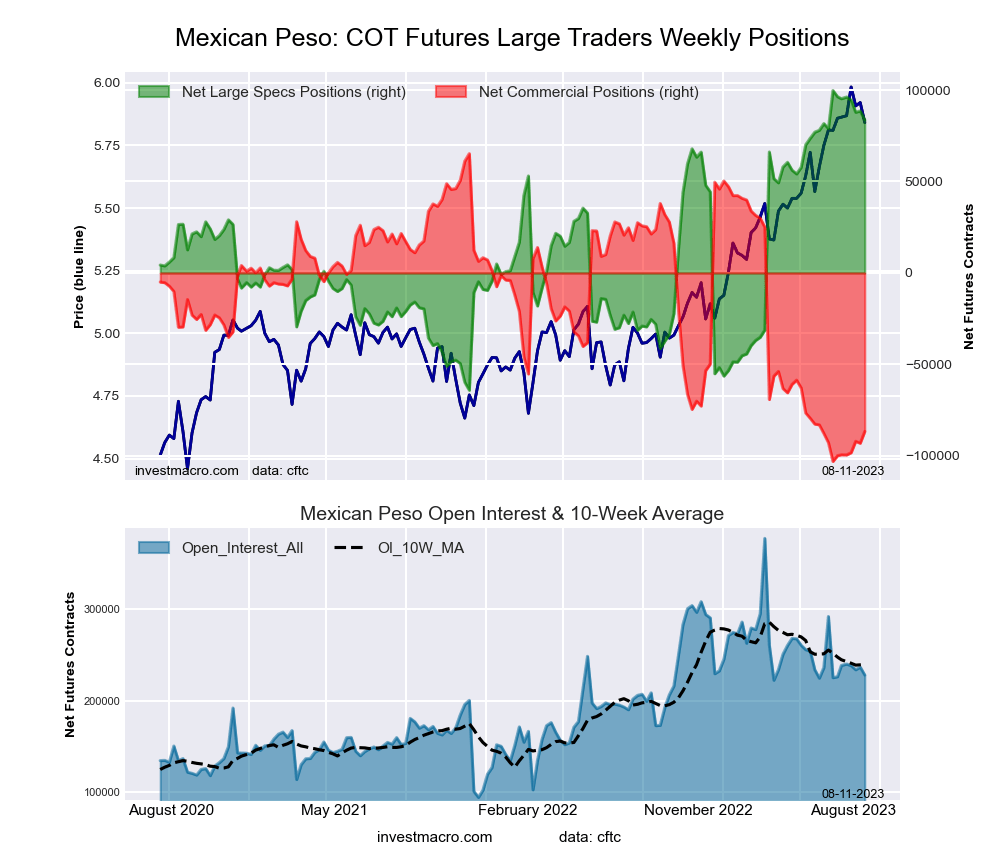
The Mexican Peso large speculator standing this week equaled a net position of 96,166 contracts in the data reported through Tuesday. This was a weekly gain of 926 contracts from the previous week which had a total of 95,240 net contracts.

This week’s current strength score (the trader positioning range over the past three years, measured from 0 to 100) shows the speculators are currently Bullish-Extreme with a score of 97.8 percent. The commercials are Bearish-Extreme with a score of 2.1 percent and the small traders (not shown in chart) are Bearish with a score of 32.4 percent.

Price Trend-Following Model: Strong Uptrend

Our weekly trend-following model classifies the current market price position as: Strong Uptrend. The current action for the model is considered to be: Hold – Maintain Long Position.

MEXICAN PESO StatisticsSPECULATORSCOMMERCIALSSMALL TRADERS
– Percent of Open Interest Longs:51.344.83.5
– Percent of Open Interest Shorts:11.286.32.1
– Net Position:96,166-99,4933,327
– Gross Longs:122,996107,4918,414
– Gross Shorts:26,830206,9845,087
– Long to Short Ratio:4.6 to 10.5 to 11.7 to 1
NET POSITION TREND:
– Strength Index Score (3 Year Range Pct):97.82.132.4
– Strength Index Reading (3 Year Range):Bullish-ExtremeBearish-ExtremeBearish
NET POSITION MOVEMENT INDEX:
– 6-Week Change in Strength Index:11.1-9.8-10.8


Brazilian Real Futures:

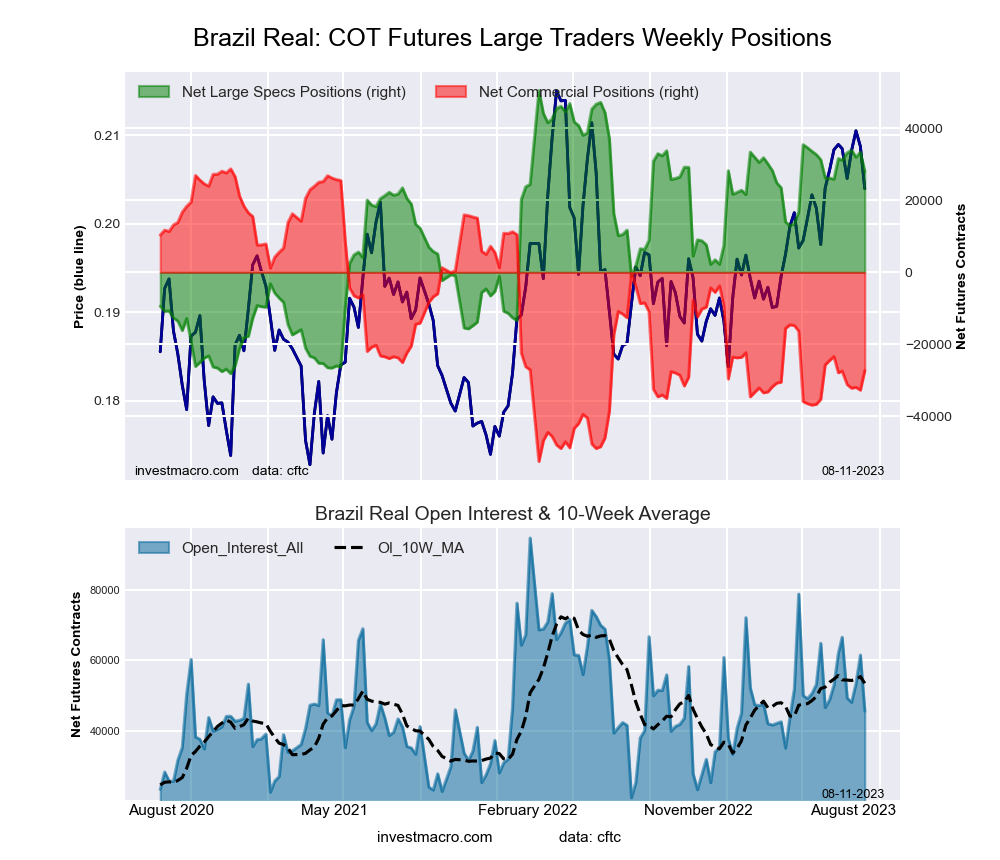
Brazil Real Futures COT ChartThe Brazilian Real large speculator standing this week equaled a net position of 33,198 contracts in the data reported through Tuesday. This was a weekly gain of 2,094 contracts from the previous week which had a total of 31,104 net contracts.

This week’s current strength score (the trader positioning range over the past three years, measured from 0 to 100) shows the speculators are currently Bullish with a score of 78.0 percent. The commercials are Bearish with a score of 26.3 percent and the small traders (not shown in chart) are Bearish with a score of 28.0 percent.

Price Trend-Following Model: Uptrend

Our weekly trend-following model classifies the current market price position as: Uptrend. The current action for the model is considered to be: Hold – Maintain Long Position.

BRAZIL REAL StatisticsSPECULATORSCOMMERCIALSSMALL TRADERS
– Percent of Open Interest Longs:74.016.38.5
– Percent of Open Interest Shorts:6.879.512.6
– Net Position:33,198-31,193-2,005
– Gross Longs:36,5418,0704,213
– Gross Shorts:3,34339,2636,218
– Long to Short Ratio:10.9 to 10.2 to 10.7 to 1
NET POSITION TREND:
– Strength Index Score (3 Year Range Pct):78.026.328.0
– Strength Index Reading (3 Year Range):BullishBearishBearish
NET POSITION MOVEMENT INDEX:
– 6-Week Change in Strength Index:2.45.0-47.7


Bitcoin Futures:

Bitcoin Crypto Futures COT ChartThe Bitcoin large speculator standing this week equaled a net position of -1,855 contracts in the data reported through Tuesday. This was a weekly advance of 221 contracts from the previous week which had a total of -2,076 net contracts.

This week’s current strength score (the trader positioning range over the past three years, measured from 0 to 100) shows the speculators are currently Bearish with a score of 44.6 percent. The commercials are Bullish-Extreme with a score of 87.4 percent and the small traders (not shown in chart) are Bearish with a score of 36.8 percent.

Price Trend-Following Model: Strong Uptrend

Our weekly trend-following model classifies the current market price position as: Strong Uptrend. The current action for the model is considered to be: Hold – Maintain Long Position.

BITCOIN StatisticsSPECULATORSCOMMERCIALSSMALL TRADERS
– Percent of Open Interest Longs:75.68.29.4
– Percent of Open Interest Shorts:87.03.33.0
– Net Position:-1,8558041,051
– Gross Longs:12,3221,3431,535
– Gross Shorts:14,177539484
– Long to Short Ratio:0.9 to 12.5 to 13.2 to 1
NET POSITION TREND:
– Strength Index Score (3 Year Range Pct):44.687.436.8
– Strength Index Reading (3 Year Range):BearishBullish-ExtremeBearish
NET POSITION MOVEMENT INDEX:
– 6-Week Change in Strength Index:-35.655.014.0


Article By InvestMacroReceive our weekly COT Newsletter

*COT Report: The COT data, released weekly to the public each Friday, is updated through the most recent Tuesday (data is 3 days old) and shows a quick view of how large speculators or non-commercials (for-profit traders) were positioned in the futures markets.

The CFTC categorizes trader positions according to commercial hedgers (traders who use futures contracts for hedging as part of the business), non-commercials (large traders who speculate to realize trading profits) and nonreportable traders (usually small traders/speculators) as well as their open interest (contracts open in the market at time of reporting). See CFTC criteria here.

All information and opinions on this website are for general informational purposes only and do not constitute investment advice.


COT Speculator Extremes: British Pound, Palladium lead Bullish & Bearish Positions

By InvestMacro

The latest update for the weekly Commitment of Traders (COT) report was released by the Commodity Futures Trading Commission (CFTC) on Friday for data ending on July 11th.

This weekly Extreme Positions report highlights the Most Bullish and Most Bearish Positions for the speculator category. Extreme positioning in these markets can foreshadow strong moves in the underlying market.

To signify an extreme position, we use the Strength Index (also known as the COT Index) of each instrument, a common method of measuring COT data. The Strength Index is simply a comparison of current trader positions against the range of positions over the previous 3 years. We use over 80 percent as extremely bullish and under 20 percent as extremely bearish. (Compare Strength Index scores across all markets in the data table or cot leaders table).


Here Are This Week’s Most Bullish Speculator Positions:

British Pound


The British Pound speculator position comes in as the most bullish extreme standing this week. The British Pound speculator level is currently at a 100.0 percent score of its 3-year range.

The six-week trend for the percent strength score totaled 32.4 this week. The overall net speculator position was a total of 58,063 net contracts this week with a change of 7,798 contract in the weekly speculator bets.


Speculators or Non-Commercials Notes:

Speculators, classified as non-commercial traders by the CFTC, are made up of large commodity funds, hedge funds and other significant for-profit participants. The Specs are generally regarded as trend-followers in their behavior towards price action – net speculator bets and prices tend to go in the same directions. These traders often look to buy when prices are rising and sell when prices are falling. To illustrate this point, many times speculator contracts can be found at their most extremes (bullish or bearish) when prices are also close to their highest or lowest levels.

These extreme levels can be dangerous for the large speculators as the trade is most crowded, there is less trading ammunition still sitting on the sidelines to push the trend further and prices have moved a significant distance. When the trend becomes exhausted, some speculators take profits while others look to also exit positions when prices fail to continue in the same direction. This process usually plays out over many months to years and can ultimately create a reverse effect where prices start to fall and speculators start a process of selling when prices are falling.


Mexican Peso


The Mexican Peso speculator position comes next in the extreme standings this week. The Mexican Peso speculator level is now at a 97.8 percent score of its 3-year range.

The six-week trend for the percent strength score was 11.1 this week. The speculator position registered 96,166 net contracts this week with a weekly change of 926 contracts in speculator bets.


Live Cattle


The Live Cattle speculator position comes in third this week in the extreme standings. The Live Cattle speculator level resides at a 96.0 percent score of its 3-year range.

The six-week trend for the speculator strength score came in at 7.7 this week. The overall speculator position was 108,501 net contracts this week with a change of 3,058 contracts in the weekly speculator bets.


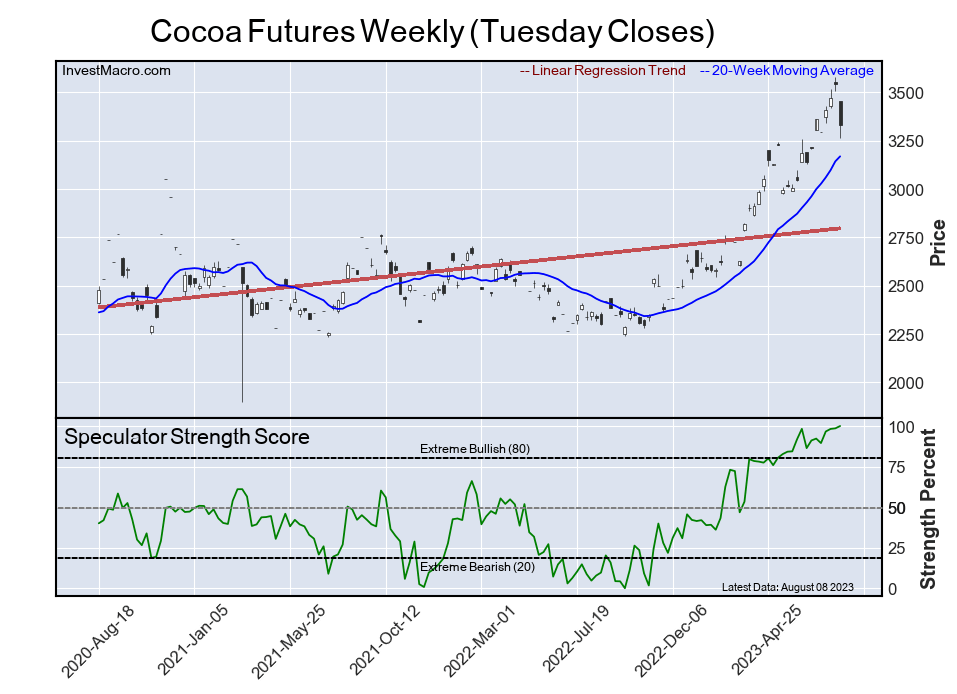
Cocoa Futures


The Cocoa Futures speculator position comes up number four in the extreme standings this week. The Cocoa Futures speculator level is at a 91.6 percent score of its 3-year range.

The six-week trend for the speculator strength score totaled a change of 4.9 this week. The overall speculator position was 70,115 net contracts this week with a change of -2,469 contracts in the speculator bets.


Bloomberg Commodity Index


The Bloomberg Commodity Index speculator position rounds out the top five in this week’s bullish extreme standings. The Bloomberg Commodity Index speculator level sits at a 84.3 percent score of its 3-year range. The six-week trend for the speculator strength score was -15.0 this week.

The speculator position was -5,651 net contracts this week with a change of 95 contracts in the weekly speculator bets.


This Week’s Most Bearish Speculator Positions:

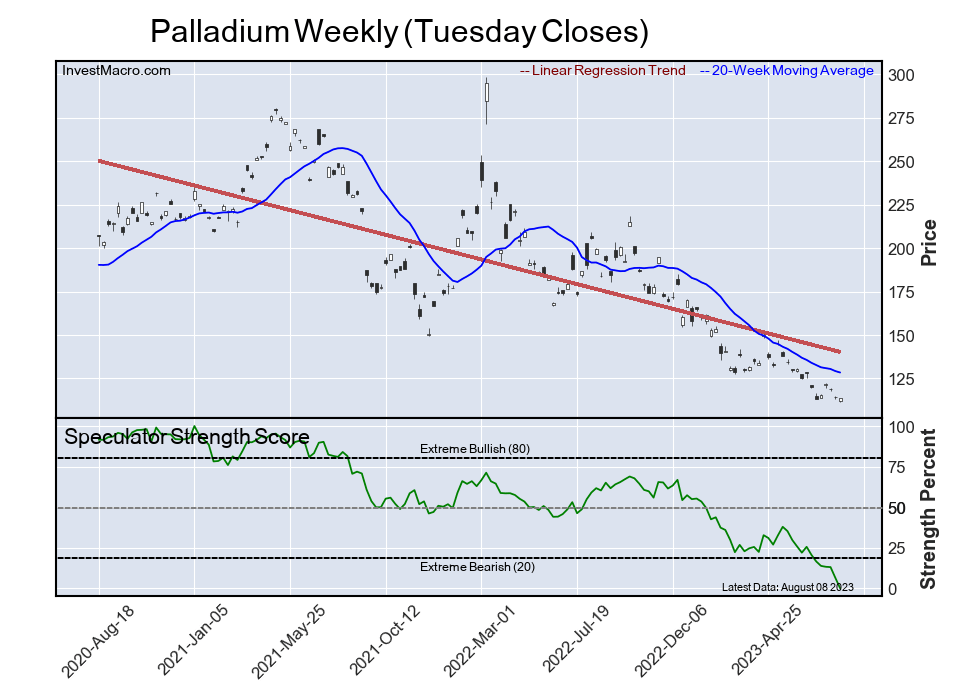
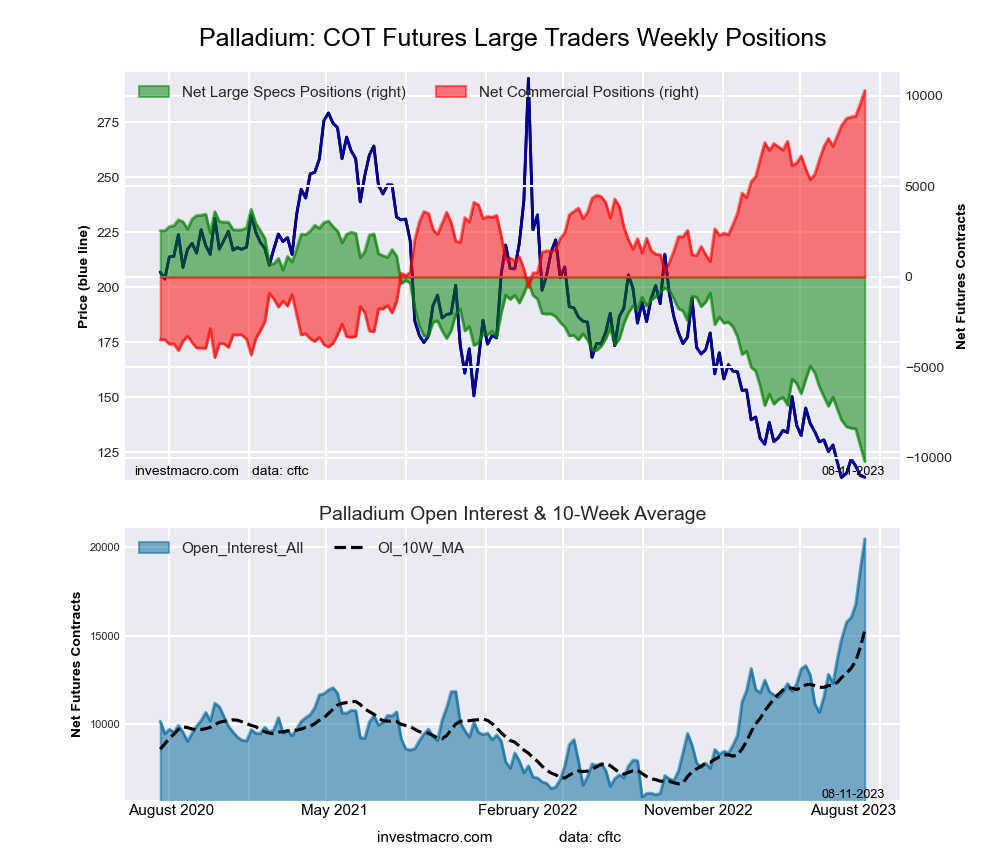
Palladium


The Palladium speculator position comes in as the most bearish extreme standing this week. The Palladium speculator level is at a 0.0 percent score of its 3-year range.

The six-week trend for the speculator strength score was -18.5 this week. The overall speculator position was -8,272 net contracts this week with a change of -382 contracts in the speculator bets.


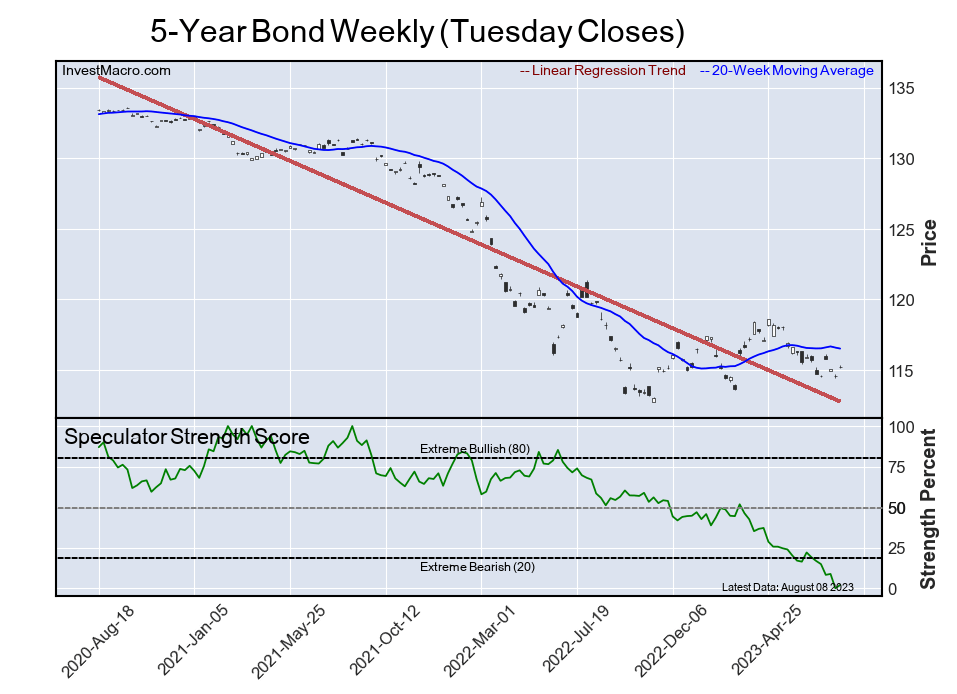
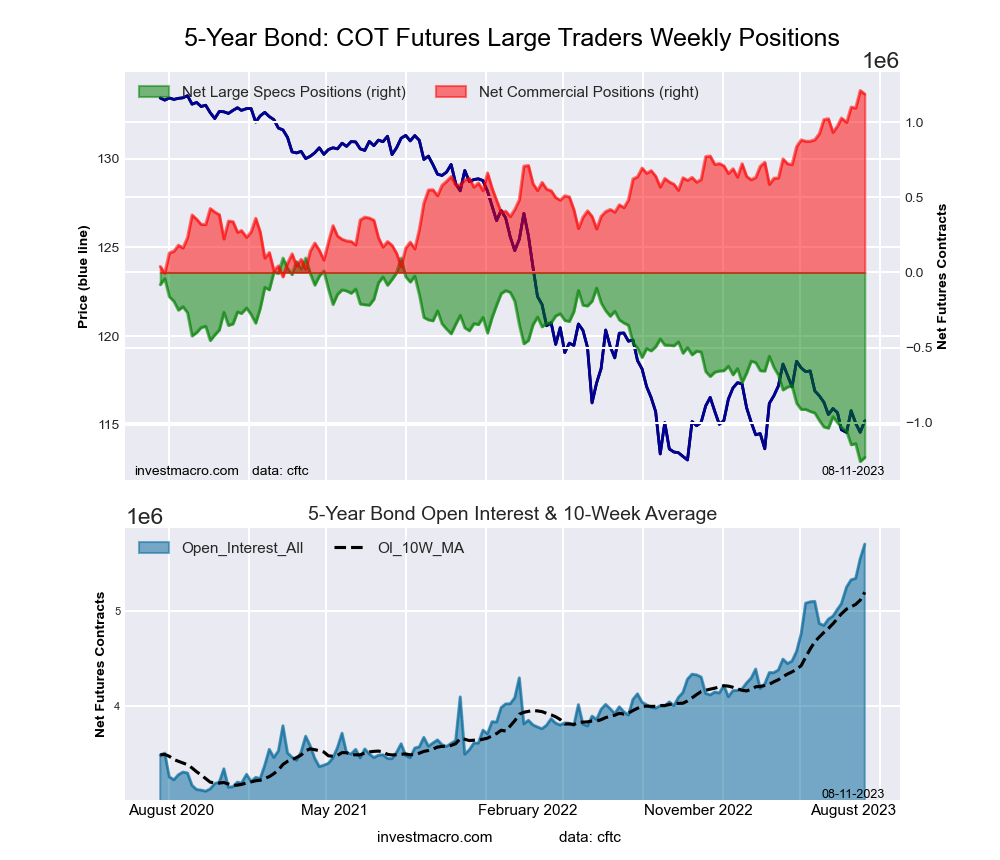
5-Year Bond


The 5-Year Bond speculator position comes in next for the most bearish extreme standing on the week. The 5-Year Bond speculator level is at a 0.0 percent score of its 3-year range.

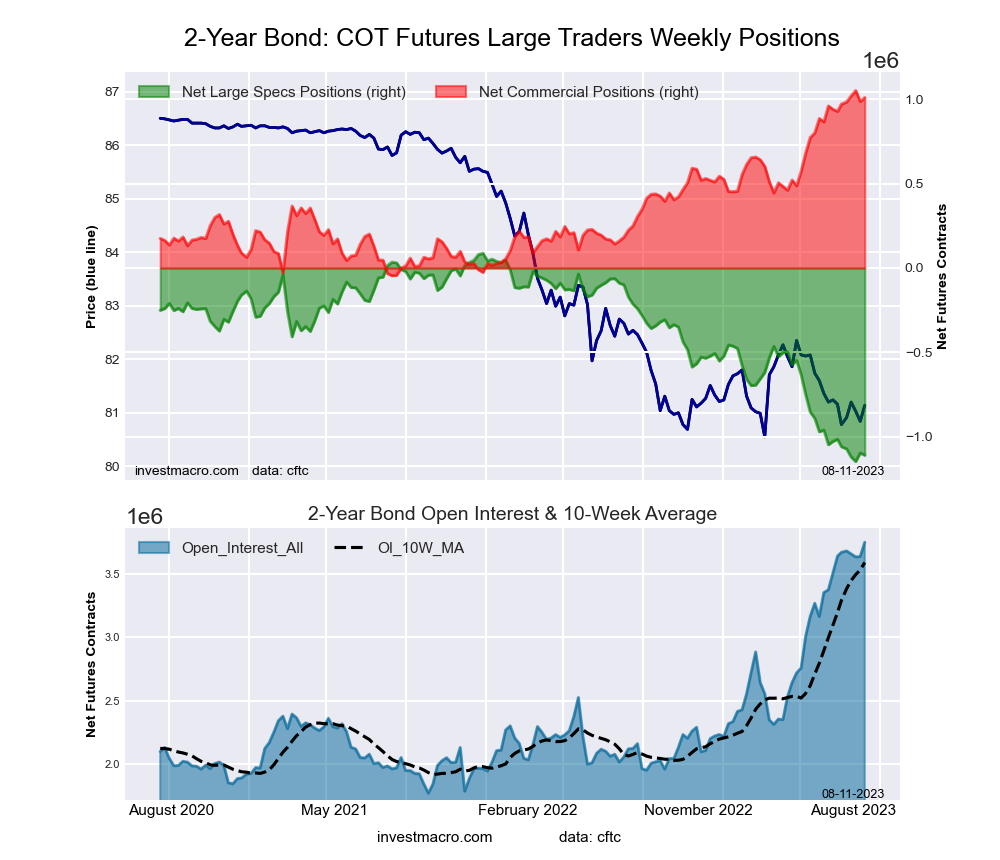
The six-week trend for the speculator strength score was -6.3 this week. The speculator position was -1,056,084 net contracts this week with a change of -26,270 contracts in the weekly speculator bets.


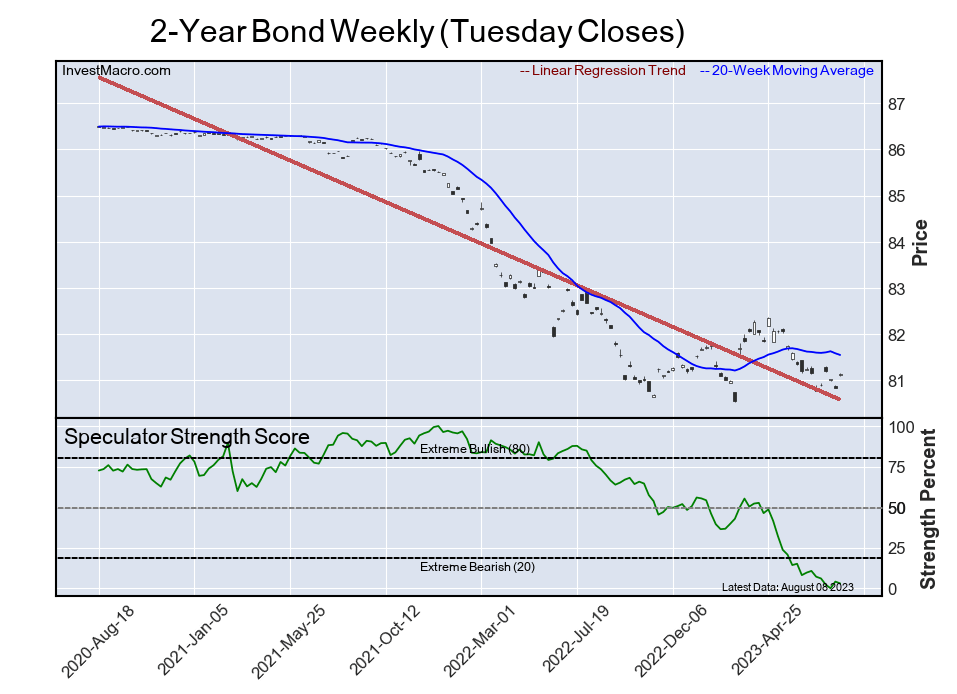
2-Year Bond


The 2-Year Bond speculator position comes in as third most bearish extreme standing of the week. The 2-Year Bond speculator level resides at a 0.0 percent score of its 3-year range.

The six-week trend for the speculator strength score was -8.8 this week. The overall speculator position was -1,071,700 net contracts this week with a change of -13,274 contracts in the speculator bets.


Japanese Yen


The Japanese Yen speculator position comes in as this week’s fourth most bearish extreme standing. The Japanese Yen speculator level is at a 0.4 percent score of its 3-year range.

The six-week trend for the speculator strength score was -12.5 this week. The speculator position was -117,182 net contracts this week with a change of 738 contracts in the weekly speculator bets.


1-Month Secured Overnight Financing Rate

Finally, the 1-Month Secured Overnight Financing Rate speculator position comes in as the fifth most bearish extreme standing for this week. The 1-Month Secured Overnight Financing Rate speculator level is at a 4.5 percent score of its 3-year range.

The six-week trend for the speculator strength score was -33.7 this week. The speculator position was -192,693 net contracts this week with a change of 13,807 contracts in the weekly speculator bets.


Article By InvestMacroReceive our weekly COT Newsletter

*COT Report: The COT data, released weekly to the public each Friday, is updated through the most recent Tuesday (data is 3 days old) and shows a quick view of how large speculators or non-commercials (for-profit traders) were positioned in the futures markets.

The CFTC categorizes trader positions according to commercial hedgers (traders who use futures contracts for hedging as part of the business), non-commercials (large traders who speculate to realize trading profits) and nonreportable traders (usually small traders/speculators) as well as their open interest (contracts open in the market at time of reporting). See CFTC criteria here.

COT Bonds Charts: Weekly Speculator Changes led by 10-Year Treasury Bonds

By InvestMacro

Here are the latest charts and statistics for the Commitment of Traders (COT) reports data published by the Commodities Futures Trading Commission (CFTC).

The latest COT data is updated through Tuesday July 11th and shows a quick view of how large traders (for-profit speculators and commercial hedgers) were positioned in the futures markets.

Weekly Speculator Changes led by 10-Year Treasury Bonds

The COT bond market speculator bets were lower this week as three out of the eight bond markets we cover had higher positioning while the other five markets had lower speculator contracts.

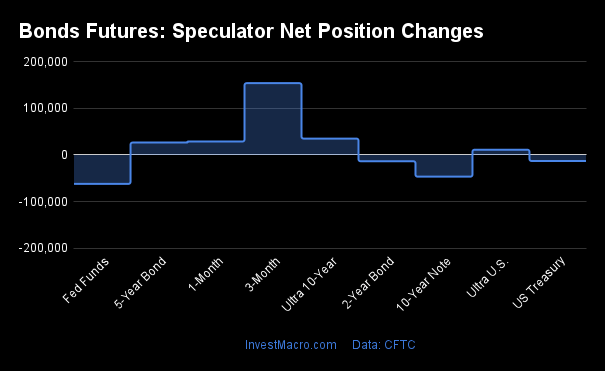
Leading the gains for the bond markets was the 10-Year Bonds (145,541 contracts) with the Ultra Treasury Bonds (17,660 contracts), the US Treasury Bonds (8,945 contracts) , and  also showing positive weeks.

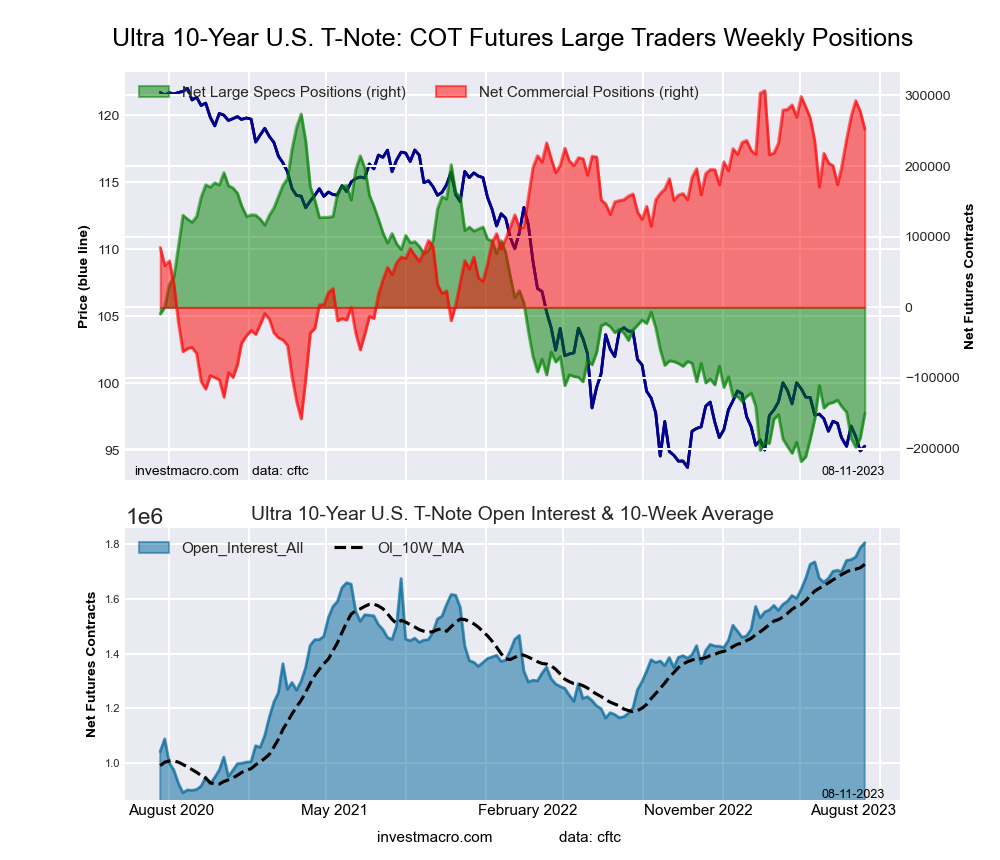
The bond markets with declines in speculator bets for the week were the SOFR 3-Months (-203,437 contracts), the Fed Funds (-58,101 contracts), the 5-Year Bonds (-26,270 contracts), the 2-Year Bonds (-13,274 contracts) and the Ultra 10-Year Bonds (-8,572 contracts)also registering lower bets on the week.


Data Snapshot of Bond Market Traders | Columns Legend
Jul-11-2023OIOI-IndexSpec-NetSpec-IndexCom-NetCOM-IndexSmalls-NetSmalls-Index
SOFR-3-Months9,506,8639136,40283-14,93617-21,46676
FedFunds1,440,37041-164,85924184,51477-19,65552
2-Year3,678,629100-1,071,7000983,34110088,35997
Long T-Bond1,251,59263-130,98442101,6784729,30670
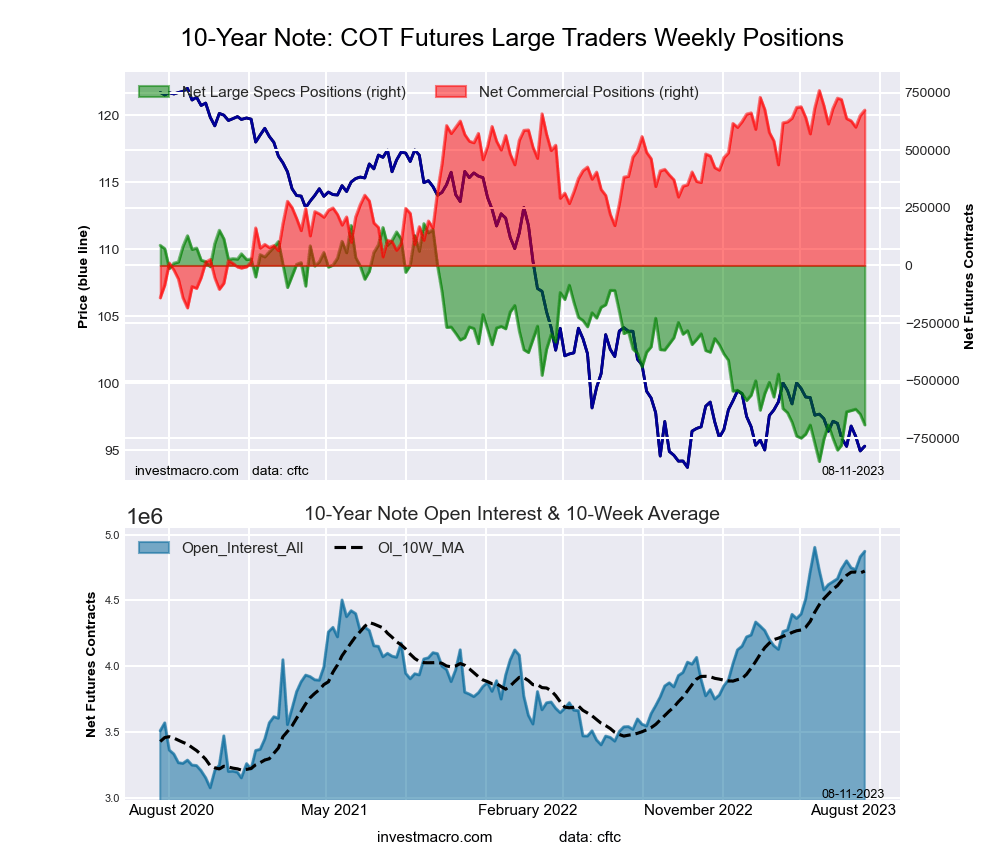
10-Year4,800,09194-635,13721636,94387-1,80673
5-Year5,257,885100-1,056,0840997,9449758,14097


Strength Scores led by SOFR 3-Months & US Treasury Bonds

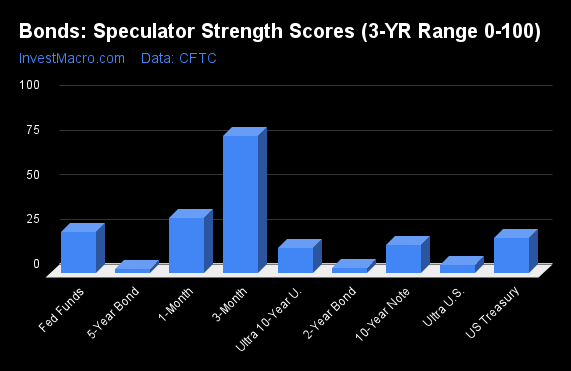
COT Strength Scores (a normalized measure of Speculator positions over a 3-Year range, from 0 to 100 where above 80 is Extreme-Bullish and below 20 is Extreme-Bearish) showed that the SOFR 3-Months (83 percent) and the US Treasury Bonds (42 percent) lead the bond markets this week.

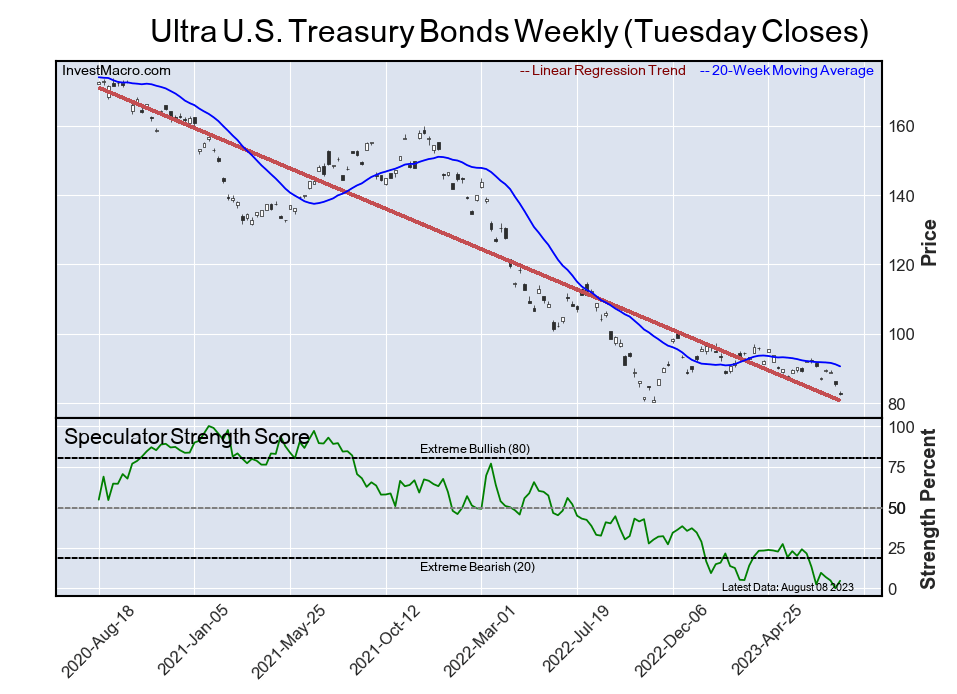
On the downside, the 5-Year Bonds (0 percent), the 2-Year Bonds (0 percent), the Ultra Treasury Bonds (7 percent) and the Ultra 10-Year Bonds (14 percent) come in at the lowest strength level currently and are in Extreme-Bearish territory (below 20 percent).

Strength Statistics:
Fed Funds (24.4 percent) vs Fed Funds previous week (33.5 percent)
2-Year Bond (0.0 percent) vs 2-Year Bond previous week (1.1 percent)
5-Year Bond (0.0 percent) vs 5-Year Bond previous week (2.3 percent)
10-Year Bond (20.9 percent) vs 10-Year Bond previous week (6.8 percent)
Ultra 10-Year Bond (14.2 percent) vs Ultra 10-Year Bond previous week (15.9 percent)
US Treasury Bond (42.0 percent) vs US Treasury Bond previous week (39.1 percent)
Ultra US Treasury Bond (7.3 percent) vs Ultra US Treasury Bond previous week (0.0 percent)
SOFR 3-Months (82.9 percent) vs SOFR 3-Months previous week (97.0 percent)


10-Year Bonds & Fed Funds top the 6-Week Strength Trends

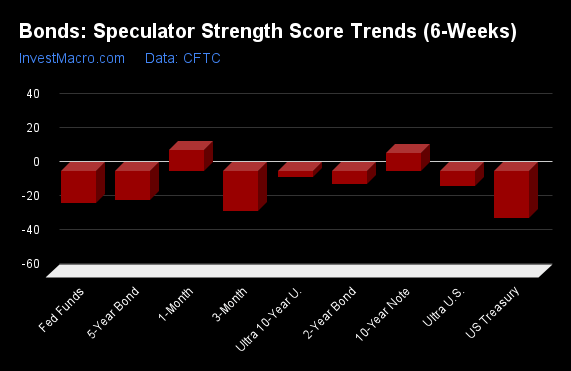
COT Strength Score Trends (or move index, calculates the 6-week changes in strength scores) showed that the 10-Year Bonds (21 percent) and the Fed Funds (2 percent) lead the past six weeks trends for bonds.

The US Treasury Bonds (-23 percent) and the Ultra Treasury Bonds (-14 percent) lead the downside trend scores currently with the 2-Year Bonds (-9 percent) and the Ultra 10-Year Bonds (-8 percent) following next with lower trend scores.

Strength Trend Statistics:
Fed Funds (2.4 percent) vs Fed Funds previous week (-2.9 percent)
2-Year Bond (-8.8 percent) vs 2-Year Bond previous week (-14.5 percent)
5-Year Bond (-6.3 percent) vs 5-Year Bond previous week (-8.3 percent)
10-Year Bond (20.9 percent) vs 10-Year Bond previous week (-0.9 percent)
Ultra 10-Year Bond (-7.7 percent) vs Ultra 10-Year Bond previous week (3.7 percent)
US Treasury Bond (-23.1 percent) vs US Treasury Bond previous week (-31.5 percent)
Ultra US Treasury Bond (-13.7 percent) vs Ultra US Treasury Bond previous week (-17.2 percent)
SOFR 3-Months (-0.5 percent) vs SOFR 3-Months previous week (23.5 percent)


Secured Overnight Financing Rate (3-Month) Futures:

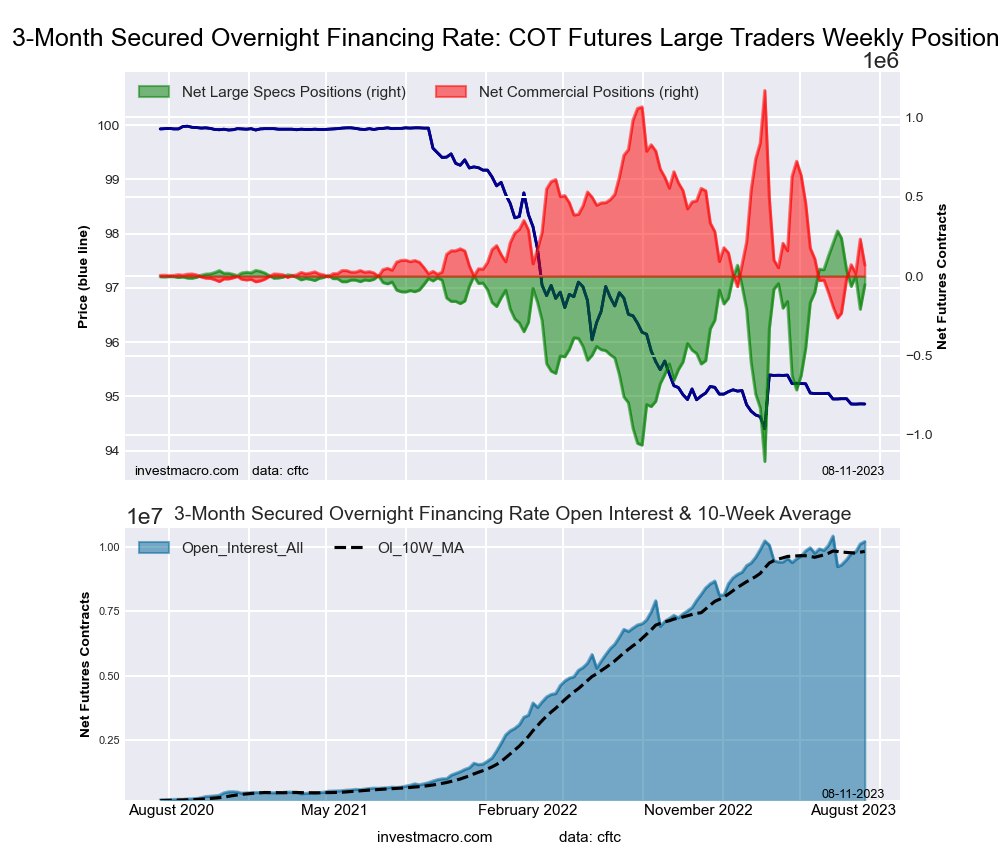
SOFR 3-Months Bonds Futures COT ChartThe Secured Overnight Financing Rate (3-Month) large speculator standing this week came in at a net position of 36,402 contracts in the data reported through Tuesday. This was a weekly lowering of -203,437 contracts from the previous week which had a total of 239,839 net contracts.

This week’s current strength score (the trader positioning range over the past three years, measured from 0 to 100) shows the speculators are currently Bullish-Extreme with a score of 82.9 percent. The commercials are Bearish-Extreme with a score of 17.4 percent and the small traders (not shown in chart) are Bullish with a score of 76.1 percent.

Price Trend-Following Model: Weak Uptrend

Our weekly trend-following model classifies the current market price position as: Weak Uptrend. The current action for the model is considered to be: Hold – Maintain Long Position.

SOFR 3-Months StatisticsSPECULATORSCOMMERCIALSSMALL TRADERS
– Percent of Open Interest Longs:19.759.20.3
– Percent of Open Interest Shorts:19.359.40.5
– Net Position:36,402-14,936-21,466
– Gross Longs:1,871,7335,629,34928,673
– Gross Shorts:1,835,3315,644,28550,139
– Long to Short Ratio:1.0 to 11.0 to 10.6 to 1
NET POSITION TREND:
– Strength Index Score (3 Year Range Pct):82.917.476.1
– Strength Index Reading (3 Year Range):Bullish-ExtremeBearish-ExtremeBullish
NET POSITION MOVEMENT INDEX:
– 6-Week Change in Strength Index:-0.50.9-3.6


30-Day Federal Funds Futures:

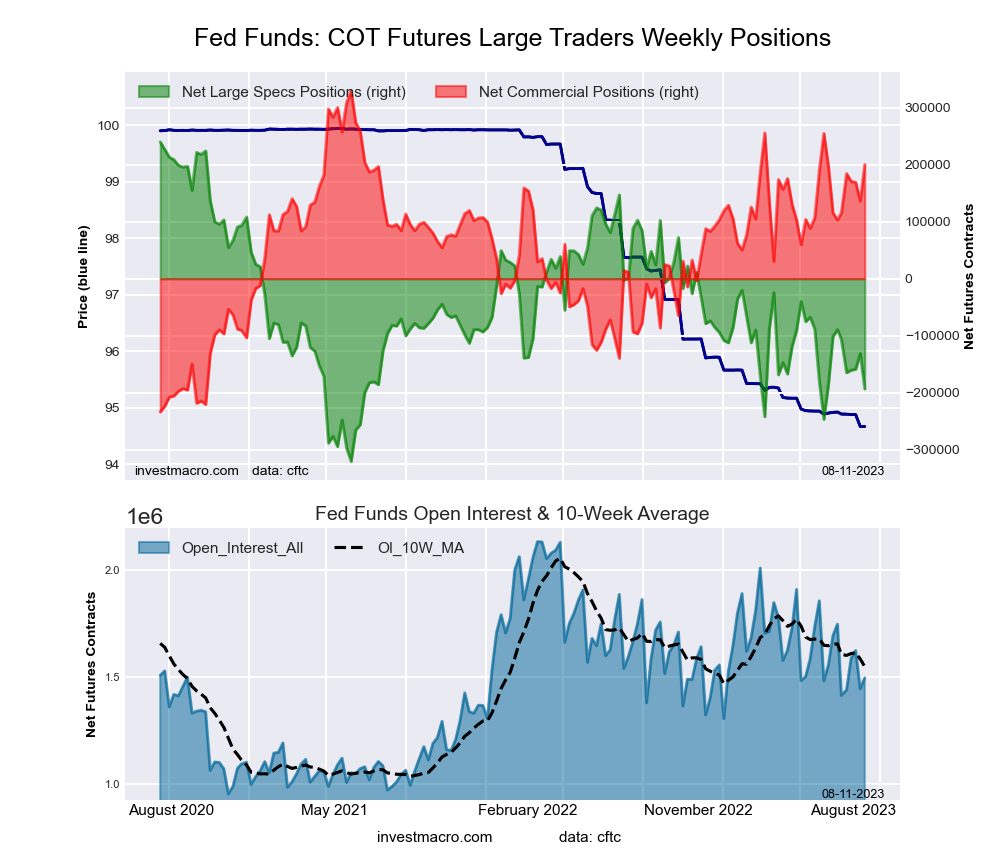
Federal Funds 30-Day Bonds Futures COT ChartThe 30-Day Federal Funds large speculator standing this week came in at a net position of -164,859 contracts in the data reported through Tuesday. This was a weekly fall of -58,101 contracts from the previous week which had a total of -106,758 net contracts.

This week’s current strength score (the trader positioning range over the past three years, measured from 0 to 100) shows the speculators are currently Bearish with a score of 24.4 percent. The commercials are Bullish with a score of 77.1 percent and the small traders (not shown in chart) are Bullish with a score of 52.4 percent.

Price Trend-Following Model: Downtrend

Our weekly trend-following model classifies the current market price position as: Downtrend. The current action for the model is considered to be: Hold – Maintain Short Position.

30-Day Federal Funds StatisticsSPECULATORSCOMMERCIALSSMALL TRADERS
– Percent of Open Interest Longs:4.073.72.1
– Percent of Open Interest Shorts:15.560.93.5
– Net Position:-164,859184,514-19,655
– Gross Longs:57,9051,060,99830,921
– Gross Shorts:222,764876,48450,576
– Long to Short Ratio:0.3 to 11.2 to 10.6 to 1
NET POSITION TREND:
– Strength Index Score (3 Year Range Pct):24.477.152.4
– Strength Index Reading (3 Year Range):BearishBullishBullish
NET POSITION MOVEMENT INDEX:
– 6-Week Change in Strength Index:2.4-0.9-19.3


2-Year Treasury Note Futures:

2-Year Treasury Bonds Futures COT ChartThe 2-Year Treasury Note large speculator standing this week came in at a net position of -1,071,700 contracts in the data reported through Tuesday. This was a weekly decrease of -13,274 contracts from the previous week which had a total of -1,058,426 net contracts.

This week’s current strength score (the trader positioning range over the past three years, measured from 0 to 100) shows the speculators are currently Bearish-Extreme with a score of 0.0 percent. The commercials are Bullish-Extreme with a score of 100.0 percent and the small traders (not shown in chart) are Bullish-Extreme with a score of 96.8 percent.

Price Trend-Following Model: Downtrend

Our weekly trend-following model classifies the current market price position as: Downtrend. The current action for the model is considered to be: Hold – Maintain Short Position.

2-Year Treasury Note StatisticsSPECULATORSCOMMERCIALSSMALL TRADERS
– Percent of Open Interest Longs:10.681.66.7
– Percent of Open Interest Shorts:39.754.94.3
– Net Position:-1,071,700983,34188,359
– Gross Longs:390,4693,003,415246,614
– Gross Shorts:1,462,1692,020,074158,255
– Long to Short Ratio:0.3 to 11.5 to 11.6 to 1
NET POSITION TREND:
– Strength Index Score (3 Year Range Pct):0.0100.096.8
– Strength Index Reading (3 Year Range):Bearish-ExtremeBullish-ExtremeBullish-Extreme
NET POSITION MOVEMENT INDEX:
– 6-Week Change in Strength Index:-8.89.51.7


5-Year Treasury Note Futures:

5-Year Treasury Bonds Futures COT ChartThe 5-Year Treasury Note large speculator standing this week came in at a net position of -1,056,084 contracts in the data reported through Tuesday. This was a weekly reduction of -26,270 contracts from the previous week which had a total of -1,029,814 net contracts.

This week’s current strength score (the trader positioning range over the past three years, measured from 0 to 100) shows the speculators are currently Bearish-Extreme with a score of 0.0 percent. The commercials are Bullish-Extreme with a score of 97.4 percent and the small traders (not shown in chart) are Bullish-Extreme with a score of 97.0 percent.

Price Trend-Following Model: Downtrend

Our weekly trend-following model classifies the current market price position as: Downtrend. The current action for the model is considered to be: Hold – Maintain Short Position.

5-Year Treasury Note StatisticsSPECULATORSCOMMERCIALSSMALL TRADERS
– Percent of Open Interest Longs:8.183.97.2
– Percent of Open Interest Shorts:28.264.96.1
– Net Position:-1,056,084997,94458,140
– Gross Longs:425,7794,410,220377,047
– Gross Shorts:1,481,8633,412,276318,907
– Long to Short Ratio:0.3 to 11.3 to 11.2 to 1
NET POSITION TREND:
– Strength Index Score (3 Year Range Pct):0.097.497.0
– Strength Index Reading (3 Year Range):Bearish-ExtremeBullish-ExtremeBullish-Extreme
NET POSITION MOVEMENT INDEX:
– 6-Week Change in Strength Index:-6.36.8-0.9


10-Year Treasury Note Futures:

10-Year Treasury Notes Bonds Futures COT ChartThe 10-Year Treasury Note large speculator standing this week came in at a net position of -635,137 contracts in the data reported through Tuesday. This was a weekly gain of 145,541 contracts from the previous week which had a total of -780,678 net contracts.

This week’s current strength score (the trader positioning range over the past three years, measured from 0 to 100) shows the speculators are currently Bearish with a score of 20.9 percent. The commercials are Bullish-Extreme with a score of 87.1 percent and the small traders (not shown in chart) are Bullish with a score of 73.1 percent.

Price Trend-Following Model: Strong Downtrend

Our weekly trend-following model classifies the current market price position as: Strong Downtrend. The current action for the model is considered to be: Hold – Maintain Short Position.

10-Year Treasury Note StatisticsSPECULATORSCOMMERCIALSSMALL TRADERS
– Percent of Open Interest Longs:10.879.18.1
– Percent of Open Interest Shorts:24.065.88.2
– Net Position:-635,137636,943-1,806
– Gross Longs:518,2053,797,358389,650
– Gross Shorts:1,153,3423,160,415391,456
– Long to Short Ratio:0.4 to 11.2 to 11.0 to 1
NET POSITION TREND:
– Strength Index Score (3 Year Range Pct):20.987.173.1
– Strength Index Reading (3 Year Range):BearishBullish-ExtremeBullish
NET POSITION MOVEMENT INDEX:
– 6-Week Change in Strength Index:20.9-12.9-20.4


Ultra 10-Year Notes Futures:

Ultra 10-Year Treasury Notes Bonds Futures COT ChartThe Ultra 10-Year Notes large speculator standing this week came in at a net position of -148,473 contracts in the data reported through Tuesday. This was a weekly decline of -8,572 contracts from the previous week which had a total of -139,901 net contracts.

This week’s current strength score (the trader positioning range over the past three years, measured from 0 to 100) shows the speculators are currently Bearish-Extreme with a score of 14.2 percent. The commercials are Bullish-Extreme with a score of 85.2 percent and the small traders (not shown in chart) are Bullish with a score of 60.6 percent.

Price Trend-Following Model: Weak Uptrend

Our weekly trend-following model classifies the current market price position as: Weak Uptrend. The current action for the model is considered to be: Hold – Maintain Long Position.

Ultra 10-Year Notes StatisticsSPECULATORSCOMMERCIALSSMALL TRADERS
– Percent of Open Interest Longs:9.578.810.0
– Percent of Open Interest Shorts:18.065.115.2
– Net Position:-148,473238,401-89,928
– Gross Longs:165,4361,371,281174,306
– Gross Shorts:313,9091,132,880264,234
– Long to Short Ratio:0.5 to 11.2 to 10.7 to 1
NET POSITION TREND:
– Strength Index Score (3 Year Range Pct):14.285.260.6
– Strength Index Reading (3 Year Range):Bearish-ExtremeBullish-ExtremeBullish
NET POSITION MOVEMENT INDEX:
– 6-Week Change in Strength Index:-7.714.6-17.9


US Treasury Bonds Futures:

US Year Treasury Notes Long Bonds Futures COT ChartThe US Treasury Bonds large speculator standing this week came in at a net position of -130,984 contracts in the data reported through Tuesday. This was a weekly boost of 8,945 contracts from the previous week which had a total of -139,929 net contracts.

This week’s current strength score (the trader positioning range over the past three years, measured from 0 to 100) shows the speculators are currently Bearish with a score of 42.0 percent. The commercials are Bearish with a score of 46.9 percent and the small traders (not shown in chart) are Bullish with a score of 69.7 percent.

Price Trend-Following Model: Downtrend

Our weekly trend-following model classifies the current market price position as: Downtrend. The current action for the model is considered to be: Hold – Maintain Short Position.

US Treasury Bonds StatisticsSPECULATORSCOMMERCIALSSMALL TRADERS
– Percent of Open Interest Longs:6.278.414.4
– Percent of Open Interest Shorts:16.770.312.1
– Net Position:-130,984101,67829,306
– Gross Longs:78,154981,658180,701
– Gross Shorts:209,138879,980151,395
– Long to Short Ratio:0.4 to 11.1 to 11.2 to 1
NET POSITION TREND:
– Strength Index Score (3 Year Range Pct):42.046.969.7
– Strength Index Reading (3 Year Range):BearishBearishBullish
NET POSITION MOVEMENT INDEX:
– 6-Week Change in Strength Index:-23.131.9-13.4


Ultra US Treasury Bonds Futures:

Ultra US Year Treasury Notes Long Bonds Futures COT ChartThe Ultra US Treasury Bonds large speculator standing this week came in at a net position of -432,912 contracts in the data reported through Tuesday. This was a weekly advance of 17,660 contracts from the previous week which had a total of -450,572 net contracts.

This week’s current strength score (the trader positioning range over the past three years, measured from 0 to 100) shows the speculators are currently Bearish-Extreme with a score of 7.3 percent. The commercials are Bullish-Extreme with a score of 89.4 percent and the small traders (not shown in chart) are Bullish-Extreme with a score of 91.1 percent.

Price Trend-Following Model: Downtrend

Our weekly trend-following model classifies the current market price position as: Downtrend. The current action for the model is considered to be: Hold – Maintain Short Position.

Ultra US Treasury Bonds StatisticsSPECULATORSCOMMERCIALSSMALL TRADERS
– Percent of Open Interest Longs:5.482.811.4
– Percent of Open Interest Shorts:33.758.27.7
– Net Position:-432,912375,82857,084
– Gross Longs:82,0321,264,189174,380
– Gross Shorts:514,944888,361117,296
– Long to Short Ratio:0.2 to 11.4 to 11.5 to 1
NET POSITION TREND:
– Strength Index Score (3 Year Range Pct):7.389.491.1
– Strength Index Reading (3 Year Range):Bearish-ExtremeBullish-ExtremeBullish-Extreme
NET POSITION MOVEMENT INDEX:
– 6-Week Change in Strength Index:-13.717.7-0.5


Article By InvestMacroReceive our weekly COT Newsletter

*COT Report: The COT data, released weekly to the public each Friday, is updated through the most recent Tuesday (data is 3 days old) and shows a quick view of how large speculators or non-commercials (for-profit traders) were positioned in the futures markets.

The CFTC categorizes trader positions according to commercial hedgers (traders who use futures contracts for hedging as part of the business), non-commercials (large traders who speculate to realize trading profits) and nonreportable traders (usually small traders/speculators) as well as their open interest (contracts open in the market at time of reporting). See CFTC criteria here.