COT Speculator Extremes: British Pound, Palladium lead Bullish & Bearish Positions

By InvestMacro

The latest update for the weekly Commitment of Traders (COT) report was released by the Commodity Futures Trading Commission (CFTC) on Friday for data ending on July 11th.

This weekly Extreme Positions report highlights the Most Bullish and Most Bearish Positions for the speculator category. Extreme positioning in these markets can foreshadow strong moves in the underlying market.

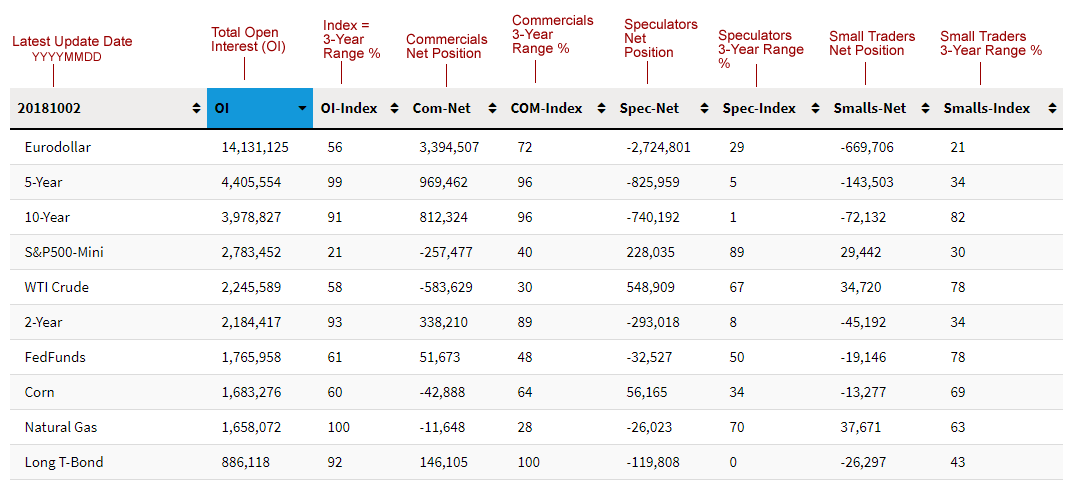
To signify an extreme position, we use the Strength Index (also known as the COT Index) of each instrument, a common method of measuring COT data. The Strength Index is simply a comparison of current trader positions against the range of positions over the previous 3 years. We use over 80 percent as extremely bullish and under 20 percent as extremely bearish. (Compare Strength Index scores across all markets in the data table or cot leaders table).


Here Are This Week’s Most Bullish Speculator Positions:

British Pound


The British Pound speculator position comes in as the most bullish extreme standing this week. The British Pound speculator level is currently at a 100.0 percent score of its 3-year range.

The six-week trend for the percent strength score totaled 32.4 this week. The overall net speculator position was a total of 58,063 net contracts this week with a change of 7,798 contract in the weekly speculator bets.


Speculators or Non-Commercials Notes:

Speculators, classified as non-commercial traders by the CFTC, are made up of large commodity funds, hedge funds and other significant for-profit participants. The Specs are generally regarded as trend-followers in their behavior towards price action – net speculator bets and prices tend to go in the same directions. These traders often look to buy when prices are rising and sell when prices are falling. To illustrate this point, many times speculator contracts can be found at their most extremes (bullish or bearish) when prices are also close to their highest or lowest levels.

These extreme levels can be dangerous for the large speculators as the trade is most crowded, there is less trading ammunition still sitting on the sidelines to push the trend further and prices have moved a significant distance. When the trend becomes exhausted, some speculators take profits while others look to also exit positions when prices fail to continue in the same direction. This process usually plays out over many months to years and can ultimately create a reverse effect where prices start to fall and speculators start a process of selling when prices are falling.


Mexican Peso


The Mexican Peso speculator position comes next in the extreme standings this week. The Mexican Peso speculator level is now at a 97.8 percent score of its 3-year range.

The six-week trend for the percent strength score was 11.1 this week. The speculator position registered 96,166 net contracts this week with a weekly change of 926 contracts in speculator bets.


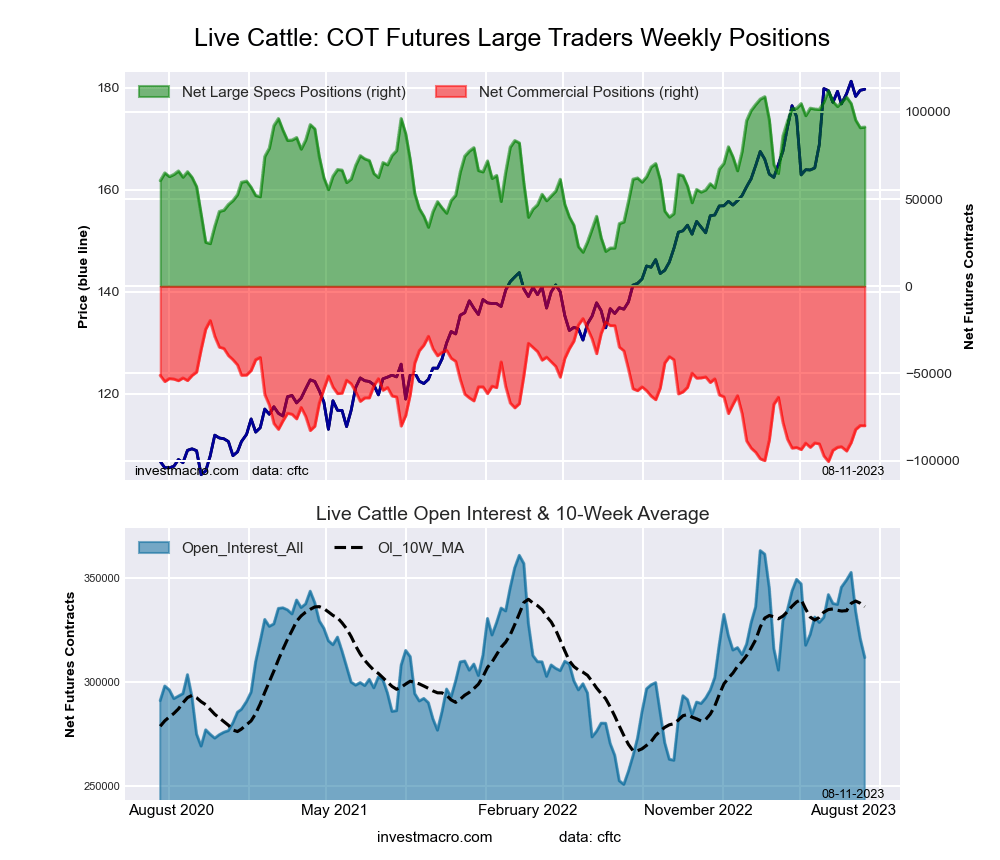
Live Cattle


The Live Cattle speculator position comes in third this week in the extreme standings. The Live Cattle speculator level resides at a 96.0 percent score of its 3-year range.

The six-week trend for the speculator strength score came in at 7.7 this week. The overall speculator position was 108,501 net contracts this week with a change of 3,058 contracts in the weekly speculator bets.


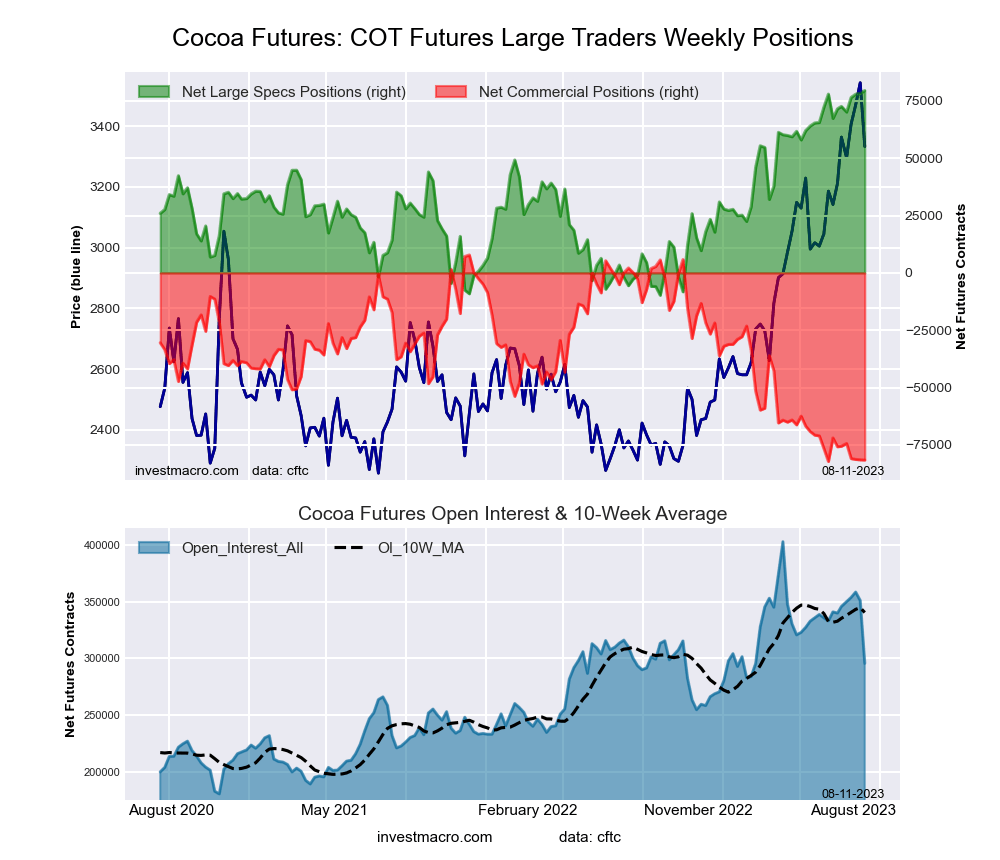
Cocoa Futures


The Cocoa Futures speculator position comes up number four in the extreme standings this week. The Cocoa Futures speculator level is at a 91.6 percent score of its 3-year range.

The six-week trend for the speculator strength score totaled a change of 4.9 this week. The overall speculator position was 70,115 net contracts this week with a change of -2,469 contracts in the speculator bets.


Bloomberg Commodity Index


The Bloomberg Commodity Index speculator position rounds out the top five in this week’s bullish extreme standings. The Bloomberg Commodity Index speculator level sits at a 84.3 percent score of its 3-year range. The six-week trend for the speculator strength score was -15.0 this week.

The speculator position was -5,651 net contracts this week with a change of 95 contracts in the weekly speculator bets.


This Week’s Most Bearish Speculator Positions:

Palladium


The Palladium speculator position comes in as the most bearish extreme standing this week. The Palladium speculator level is at a 0.0 percent score of its 3-year range.

The six-week trend for the speculator strength score was -18.5 this week. The overall speculator position was -8,272 net contracts this week with a change of -382 contracts in the speculator bets.


5-Year Bond


The 5-Year Bond speculator position comes in next for the most bearish extreme standing on the week. The 5-Year Bond speculator level is at a 0.0 percent score of its 3-year range.

The six-week trend for the speculator strength score was -6.3 this week. The speculator position was -1,056,084 net contracts this week with a change of -26,270 contracts in the weekly speculator bets.


2-Year Bond


The 2-Year Bond speculator position comes in as third most bearish extreme standing of the week. The 2-Year Bond speculator level resides at a 0.0 percent score of its 3-year range.

The six-week trend for the speculator strength score was -8.8 this week. The overall speculator position was -1,071,700 net contracts this week with a change of -13,274 contracts in the speculator bets.


Japanese Yen


The Japanese Yen speculator position comes in as this week’s fourth most bearish extreme standing. The Japanese Yen speculator level is at a 0.4 percent score of its 3-year range.

The six-week trend for the speculator strength score was -12.5 this week. The speculator position was -117,182 net contracts this week with a change of 738 contracts in the weekly speculator bets.


1-Month Secured Overnight Financing Rate

Finally, the 1-Month Secured Overnight Financing Rate speculator position comes in as the fifth most bearish extreme standing for this week. The 1-Month Secured Overnight Financing Rate speculator level is at a 4.5 percent score of its 3-year range.

The six-week trend for the speculator strength score was -33.7 this week. The speculator position was -192,693 net contracts this week with a change of 13,807 contracts in the weekly speculator bets.


Article By InvestMacroReceive our weekly COT Newsletter

*COT Report: The COT data, released weekly to the public each Friday, is updated through the most recent Tuesday (data is 3 days old) and shows a quick view of how large speculators or non-commercials (for-profit traders) were positioned in the futures markets.

The CFTC categorizes trader positions according to commercial hedgers (traders who use futures contracts for hedging as part of the business), non-commercials (large traders who speculate to realize trading profits) and nonreportable traders (usually small traders/speculators) as well as their open interest (contracts open in the market at time of reporting). See CFTC criteria here.

COT Bonds Charts: Weekly Speculator Changes led by 10-Year Treasury Bonds

By InvestMacro

Here are the latest charts and statistics for the Commitment of Traders (COT) reports data published by the Commodities Futures Trading Commission (CFTC).

The latest COT data is updated through Tuesday July 11th and shows a quick view of how large traders (for-profit speculators and commercial hedgers) were positioned in the futures markets.

Weekly Speculator Changes led by 10-Year Treasury Bonds

The COT bond market speculator bets were lower this week as three out of the eight bond markets we cover had higher positioning while the other five markets had lower speculator contracts.

Leading the gains for the bond markets was the 10-Year Bonds (145,541 contracts) with the Ultra Treasury Bonds (17,660 contracts), the US Treasury Bonds (8,945 contracts) , and  also showing positive weeks.

The bond markets with declines in speculator bets for the week were the SOFR 3-Months (-203,437 contracts), the Fed Funds (-58,101 contracts), the 5-Year Bonds (-26,270 contracts), the 2-Year Bonds (-13,274 contracts) and the Ultra 10-Year Bonds (-8,572 contracts)also registering lower bets on the week.


Data Snapshot of Bond Market Traders | Columns Legend
Jul-11-2023OIOI-IndexSpec-NetSpec-IndexCom-NetCOM-IndexSmalls-NetSmalls-Index
SOFR-3-Months9,506,8639136,40283-14,93617-21,46676
FedFunds1,440,37041-164,85924184,51477-19,65552
2-Year3,678,629100-1,071,7000983,34110088,35997
Long T-Bond1,251,59263-130,98442101,6784729,30670
10-Year4,800,09194-635,13721636,94387-1,80673
5-Year5,257,885100-1,056,0840997,9449758,14097


Strength Scores led by SOFR 3-Months & US Treasury Bonds

COT Strength Scores (a normalized measure of Speculator positions over a 3-Year range, from 0 to 100 where above 80 is Extreme-Bullish and below 20 is Extreme-Bearish) showed that the SOFR 3-Months (83 percent) and the US Treasury Bonds (42 percent) lead the bond markets this week.

On the downside, the 5-Year Bonds (0 percent), the 2-Year Bonds (0 percent), the Ultra Treasury Bonds (7 percent) and the Ultra 10-Year Bonds (14 percent) come in at the lowest strength level currently and are in Extreme-Bearish territory (below 20 percent).

Strength Statistics:
Fed Funds (24.4 percent) vs Fed Funds previous week (33.5 percent)
2-Year Bond (0.0 percent) vs 2-Year Bond previous week (1.1 percent)
5-Year Bond (0.0 percent) vs 5-Year Bond previous week (2.3 percent)
10-Year Bond (20.9 percent) vs 10-Year Bond previous week (6.8 percent)
Ultra 10-Year Bond (14.2 percent) vs Ultra 10-Year Bond previous week (15.9 percent)
US Treasury Bond (42.0 percent) vs US Treasury Bond previous week (39.1 percent)
Ultra US Treasury Bond (7.3 percent) vs Ultra US Treasury Bond previous week (0.0 percent)
SOFR 3-Months (82.9 percent) vs SOFR 3-Months previous week (97.0 percent)


10-Year Bonds & Fed Funds top the 6-Week Strength Trends

COT Strength Score Trends (or move index, calculates the 6-week changes in strength scores) showed that the 10-Year Bonds (21 percent) and the Fed Funds (2 percent) lead the past six weeks trends for bonds.

The US Treasury Bonds (-23 percent) and the Ultra Treasury Bonds (-14 percent) lead the downside trend scores currently with the 2-Year Bonds (-9 percent) and the Ultra 10-Year Bonds (-8 percent) following next with lower trend scores.

Strength Trend Statistics:
Fed Funds (2.4 percent) vs Fed Funds previous week (-2.9 percent)
2-Year Bond (-8.8 percent) vs 2-Year Bond previous week (-14.5 percent)
5-Year Bond (-6.3 percent) vs 5-Year Bond previous week (-8.3 percent)
10-Year Bond (20.9 percent) vs 10-Year Bond previous week (-0.9 percent)
Ultra 10-Year Bond (-7.7 percent) vs Ultra 10-Year Bond previous week (3.7 percent)
US Treasury Bond (-23.1 percent) vs US Treasury Bond previous week (-31.5 percent)
Ultra US Treasury Bond (-13.7 percent) vs Ultra US Treasury Bond previous week (-17.2 percent)
SOFR 3-Months (-0.5 percent) vs SOFR 3-Months previous week (23.5 percent)


Secured Overnight Financing Rate (3-Month) Futures:

SOFR 3-Months Bonds Futures COT ChartThe Secured Overnight Financing Rate (3-Month) large speculator standing this week came in at a net position of 36,402 contracts in the data reported through Tuesday. This was a weekly lowering of -203,437 contracts from the previous week which had a total of 239,839 net contracts.

This week’s current strength score (the trader positioning range over the past three years, measured from 0 to 100) shows the speculators are currently Bullish-Extreme with a score of 82.9 percent. The commercials are Bearish-Extreme with a score of 17.4 percent and the small traders (not shown in chart) are Bullish with a score of 76.1 percent.

Price Trend-Following Model: Weak Uptrend

Our weekly trend-following model classifies the current market price position as: Weak Uptrend. The current action for the model is considered to be: Hold – Maintain Long Position.

SOFR 3-Months StatisticsSPECULATORSCOMMERCIALSSMALL TRADERS
– Percent of Open Interest Longs:19.759.20.3
– Percent of Open Interest Shorts:19.359.40.5
– Net Position:36,402-14,936-21,466
– Gross Longs:1,871,7335,629,34928,673
– Gross Shorts:1,835,3315,644,28550,139
– Long to Short Ratio:1.0 to 11.0 to 10.6 to 1
NET POSITION TREND:
– Strength Index Score (3 Year Range Pct):82.917.476.1
– Strength Index Reading (3 Year Range):Bullish-ExtremeBearish-ExtremeBullish
NET POSITION MOVEMENT INDEX:
– 6-Week Change in Strength Index:-0.50.9-3.6


30-Day Federal Funds Futures:

Federal Funds 30-Day Bonds Futures COT ChartThe 30-Day Federal Funds large speculator standing this week came in at a net position of -164,859 contracts in the data reported through Tuesday. This was a weekly fall of -58,101 contracts from the previous week which had a total of -106,758 net contracts.

This week’s current strength score (the trader positioning range over the past three years, measured from 0 to 100) shows the speculators are currently Bearish with a score of 24.4 percent. The commercials are Bullish with a score of 77.1 percent and the small traders (not shown in chart) are Bullish with a score of 52.4 percent.

Price Trend-Following Model: Downtrend

Our weekly trend-following model classifies the current market price position as: Downtrend. The current action for the model is considered to be: Hold – Maintain Short Position.

30-Day Federal Funds StatisticsSPECULATORSCOMMERCIALSSMALL TRADERS
– Percent of Open Interest Longs:4.073.72.1
– Percent of Open Interest Shorts:15.560.93.5
– Net Position:-164,859184,514-19,655
– Gross Longs:57,9051,060,99830,921
– Gross Shorts:222,764876,48450,576
– Long to Short Ratio:0.3 to 11.2 to 10.6 to 1
NET POSITION TREND:
– Strength Index Score (3 Year Range Pct):24.477.152.4
– Strength Index Reading (3 Year Range):BearishBullishBullish
NET POSITION MOVEMENT INDEX:
– 6-Week Change in Strength Index:2.4-0.9-19.3


2-Year Treasury Note Futures:

2-Year Treasury Bonds Futures COT ChartThe 2-Year Treasury Note large speculator standing this week came in at a net position of -1,071,700 contracts in the data reported through Tuesday. This was a weekly decrease of -13,274 contracts from the previous week which had a total of -1,058,426 net contracts.

This week’s current strength score (the trader positioning range over the past three years, measured from 0 to 100) shows the speculators are currently Bearish-Extreme with a score of 0.0 percent. The commercials are Bullish-Extreme with a score of 100.0 percent and the small traders (not shown in chart) are Bullish-Extreme with a score of 96.8 percent.

Price Trend-Following Model: Downtrend

Our weekly trend-following model classifies the current market price position as: Downtrend. The current action for the model is considered to be: Hold – Maintain Short Position.

2-Year Treasury Note StatisticsSPECULATORSCOMMERCIALSSMALL TRADERS
– Percent of Open Interest Longs:10.681.66.7
– Percent of Open Interest Shorts:39.754.94.3
– Net Position:-1,071,700983,34188,359
– Gross Longs:390,4693,003,415246,614
– Gross Shorts:1,462,1692,020,074158,255
– Long to Short Ratio:0.3 to 11.5 to 11.6 to 1
NET POSITION TREND:
– Strength Index Score (3 Year Range Pct):0.0100.096.8
– Strength Index Reading (3 Year Range):Bearish-ExtremeBullish-ExtremeBullish-Extreme
NET POSITION MOVEMENT INDEX:
– 6-Week Change in Strength Index:-8.89.51.7


5-Year Treasury Note Futures:

5-Year Treasury Bonds Futures COT ChartThe 5-Year Treasury Note large speculator standing this week came in at a net position of -1,056,084 contracts in the data reported through Tuesday. This was a weekly reduction of -26,270 contracts from the previous week which had a total of -1,029,814 net contracts.

This week’s current strength score (the trader positioning range over the past three years, measured from 0 to 100) shows the speculators are currently Bearish-Extreme with a score of 0.0 percent. The commercials are Bullish-Extreme with a score of 97.4 percent and the small traders (not shown in chart) are Bullish-Extreme with a score of 97.0 percent.

Price Trend-Following Model: Downtrend

Our weekly trend-following model classifies the current market price position as: Downtrend. The current action for the model is considered to be: Hold – Maintain Short Position.

5-Year Treasury Note StatisticsSPECULATORSCOMMERCIALSSMALL TRADERS
– Percent of Open Interest Longs:8.183.97.2
– Percent of Open Interest Shorts:28.264.96.1
– Net Position:-1,056,084997,94458,140
– Gross Longs:425,7794,410,220377,047
– Gross Shorts:1,481,8633,412,276318,907
– Long to Short Ratio:0.3 to 11.3 to 11.2 to 1
NET POSITION TREND:
– Strength Index Score (3 Year Range Pct):0.097.497.0
– Strength Index Reading (3 Year Range):Bearish-ExtremeBullish-ExtremeBullish-Extreme
NET POSITION MOVEMENT INDEX:
– 6-Week Change in Strength Index:-6.36.8-0.9


10-Year Treasury Note Futures:

10-Year Treasury Notes Bonds Futures COT ChartThe 10-Year Treasury Note large speculator standing this week came in at a net position of -635,137 contracts in the data reported through Tuesday. This was a weekly gain of 145,541 contracts from the previous week which had a total of -780,678 net contracts.

This week’s current strength score (the trader positioning range over the past three years, measured from 0 to 100) shows the speculators are currently Bearish with a score of 20.9 percent. The commercials are Bullish-Extreme with a score of 87.1 percent and the small traders (not shown in chart) are Bullish with a score of 73.1 percent.

Price Trend-Following Model: Strong Downtrend

Our weekly trend-following model classifies the current market price position as: Strong Downtrend. The current action for the model is considered to be: Hold – Maintain Short Position.

10-Year Treasury Note StatisticsSPECULATORSCOMMERCIALSSMALL TRADERS
– Percent of Open Interest Longs:10.879.18.1
– Percent of Open Interest Shorts:24.065.88.2
– Net Position:-635,137636,943-1,806
– Gross Longs:518,2053,797,358389,650
– Gross Shorts:1,153,3423,160,415391,456
– Long to Short Ratio:0.4 to 11.2 to 11.0 to 1
NET POSITION TREND:
– Strength Index Score (3 Year Range Pct):20.987.173.1
– Strength Index Reading (3 Year Range):BearishBullish-ExtremeBullish
NET POSITION MOVEMENT INDEX:
– 6-Week Change in Strength Index:20.9-12.9-20.4


Ultra 10-Year Notes Futures:

Ultra 10-Year Treasury Notes Bonds Futures COT ChartThe Ultra 10-Year Notes large speculator standing this week came in at a net position of -148,473 contracts in the data reported through Tuesday. This was a weekly decline of -8,572 contracts from the previous week which had a total of -139,901 net contracts.

This week’s current strength score (the trader positioning range over the past three years, measured from 0 to 100) shows the speculators are currently Bearish-Extreme with a score of 14.2 percent. The commercials are Bullish-Extreme with a score of 85.2 percent and the small traders (not shown in chart) are Bullish with a score of 60.6 percent.

Price Trend-Following Model: Weak Uptrend

Our weekly trend-following model classifies the current market price position as: Weak Uptrend. The current action for the model is considered to be: Hold – Maintain Long Position.

Ultra 10-Year Notes StatisticsSPECULATORSCOMMERCIALSSMALL TRADERS
– Percent of Open Interest Longs:9.578.810.0
– Percent of Open Interest Shorts:18.065.115.2
– Net Position:-148,473238,401-89,928
– Gross Longs:165,4361,371,281174,306
– Gross Shorts:313,9091,132,880264,234
– Long to Short Ratio:0.5 to 11.2 to 10.7 to 1
NET POSITION TREND:
– Strength Index Score (3 Year Range Pct):14.285.260.6
– Strength Index Reading (3 Year Range):Bearish-ExtremeBullish-ExtremeBullish
NET POSITION MOVEMENT INDEX:
– 6-Week Change in Strength Index:-7.714.6-17.9


US Treasury Bonds Futures:

US Year Treasury Notes Long Bonds Futures COT ChartThe US Treasury Bonds large speculator standing this week came in at a net position of -130,984 contracts in the data reported through Tuesday. This was a weekly boost of 8,945 contracts from the previous week which had a total of -139,929 net contracts.

This week’s current strength score (the trader positioning range over the past three years, measured from 0 to 100) shows the speculators are currently Bearish with a score of 42.0 percent. The commercials are Bearish with a score of 46.9 percent and the small traders (not shown in chart) are Bullish with a score of 69.7 percent.

Price Trend-Following Model: Downtrend

Our weekly trend-following model classifies the current market price position as: Downtrend. The current action for the model is considered to be: Hold – Maintain Short Position.

US Treasury Bonds StatisticsSPECULATORSCOMMERCIALSSMALL TRADERS
– Percent of Open Interest Longs:6.278.414.4
– Percent of Open Interest Shorts:16.770.312.1
– Net Position:-130,984101,67829,306
– Gross Longs:78,154981,658180,701
– Gross Shorts:209,138879,980151,395
– Long to Short Ratio:0.4 to 11.1 to 11.2 to 1
NET POSITION TREND:
– Strength Index Score (3 Year Range Pct):42.046.969.7
– Strength Index Reading (3 Year Range):BearishBearishBullish
NET POSITION MOVEMENT INDEX:
– 6-Week Change in Strength Index:-23.131.9-13.4


Ultra US Treasury Bonds Futures:

Ultra US Year Treasury Notes Long Bonds Futures COT ChartThe Ultra US Treasury Bonds large speculator standing this week came in at a net position of -432,912 contracts in the data reported through Tuesday. This was a weekly advance of 17,660 contracts from the previous week which had a total of -450,572 net contracts.

This week’s current strength score (the trader positioning range over the past three years, measured from 0 to 100) shows the speculators are currently Bearish-Extreme with a score of 7.3 percent. The commercials are Bullish-Extreme with a score of 89.4 percent and the small traders (not shown in chart) are Bullish-Extreme with a score of 91.1 percent.

Price Trend-Following Model: Downtrend

Our weekly trend-following model classifies the current market price position as: Downtrend. The current action for the model is considered to be: Hold – Maintain Short Position.

Ultra US Treasury Bonds StatisticsSPECULATORSCOMMERCIALSSMALL TRADERS
– Percent of Open Interest Longs:5.482.811.4
– Percent of Open Interest Shorts:33.758.27.7
– Net Position:-432,912375,82857,084
– Gross Longs:82,0321,264,189174,380
– Gross Shorts:514,944888,361117,296
– Long to Short Ratio:0.2 to 11.4 to 11.5 to 1
NET POSITION TREND:
– Strength Index Score (3 Year Range Pct):7.389.491.1
– Strength Index Reading (3 Year Range):Bearish-ExtremeBullish-ExtremeBullish-Extreme
NET POSITION MOVEMENT INDEX:
– 6-Week Change in Strength Index:-13.717.7-0.5


Article By InvestMacroReceive our weekly COT Newsletter

*COT Report: The COT data, released weekly to the public each Friday, is updated through the most recent Tuesday (data is 3 days old) and shows a quick view of how large speculators or non-commercials (for-profit traders) were positioned in the futures markets.

The CFTC categorizes trader positions according to commercial hedgers (traders who use futures contracts for hedging as part of the business), non-commercials (large traders who speculate to realize trading profits) and nonreportable traders (usually small traders/speculators) as well as their open interest (contracts open in the market at time of reporting). See CFTC criteria here.

COT Metals Charts: Weekly Speculator Changes led by Gold & Silver

By InvestMacro

Here are the latest charts and statistics for the Commitment of Traders (COT) data published by the Commodities Futures Trading Commission (CFTC).

The latest COT data is updated through Tuesday July 11th and shows a quick view of how large traders (for-profit speculators and commercial entities) were positioned in the futures markets.

Weekly Speculator Changes led by Gold & Silver

The COT metals markets speculator bets were lower this week as two out of the six metals markets we cover had higher positioning while the other four markets had lower speculator contracts.

Leading the gains for the metals was Gold (2,657 contracts) with Silver (2,302 contracts) also showing a positive week.

The markets with declines in speculator bets for the week were Palladium (-382 contracts), Platinum (-280 contracts), Copper (-2,395 contracts) and Steel (-71 contracts) also registering lower bets on the week.


Data Snapshot of Commodity Market Traders | Columns Legend
Jul-11-2023OIOI-IndexSpec-NetSpec-IndexCom-NetCOM-IndexSmalls-NetSmalls-Index
Gold483,17028165,75450-187,7495121,99535
Silver120,282620,29247-31,6495611,35729
Copper197,78541-11,157217,915783,24239
Palladium15,772100-8,27208,765100-49312
Platinum71,007727,78734-13,912656,12550


Strength Scores led by Steel & Gold

COT Strength Scores (a normalized measure of Speculator positions over a 3-Year range, from 0 to 100 where above 80 is Extreme-Bullish and below 20 is Extreme-Bearish) showed that Steel (73 percent) and Gold (50 percent) lead the metals markets this week. Palladium (0 percent) comes in as the next highest in the weekly strength scores.

On the downside, Copper (21 percent) comes in at the lowest strength level currently and is in Extreme-Bearish territory (below 20 percent). The next lowest strength score was Platinum (34 percent).

Strength Statistics:
Gold (50.0 percent) vs Gold previous week (48.9 percent)
Silver (47.2 percent) vs Silver previous week (43.9 percent)
Copper (21.2 percent) vs Copper previous week (23.3 percent)
Platinum (33.6 percent) vs Platinum previous week (34.2 percent)
Palladium (0.0 percent) vs Palladium previous week (3.2 percent)
Steel (72.6 percent) vs Palladium previous week (72.8 percent)

Copper & Steel top the 6-Week Strength Trends

COT Strength Score Trends (or move index, calculates the 6-week changes in strength scores) showed that Copper (21 percent) and Steel (15 percent) lead the past six weeks trends for metals. Palladium (-18 percent) is the next highest positive mover in the latest trends data.

Gold (-2 percent) leads the downside trend scores currently with Platinum (-36 percent) as the next market with lower trend scores.

Move Statistics:
Gold (-1.6 percent) vs Gold previous week (1.0 percent)
Silver (-1.2 percent) vs Silver previous week (-5.7 percent)
Copper (21.2 percent) vs Copper previous week (18.2 percent)
Platinum (-36.0 percent) vs Platinum previous week (-44.8 percent)
Palladium (-18.5 percent) vs Palladium previous week (-21.7 percent)
Steel (14.8 percent) vs Steel previous week (15.0 percent)


Individual Markets:

Gold Comex Futures:

Gold Futures COT ChartThe Gold Comex Futures large speculator standing this week was a net position of 165,754 contracts in the data reported through Tuesday. This was a weekly lift of 2,657 contracts from the previous week which had a total of 163,097 net contracts.

This week’s current strength score (the trader positioning range over the past three years, measured from 0 to 100) shows the speculators are currently Bullish with a score of 50.0 percent. The commercials are Bullish with a score of 51.5 percent and the small traders (not shown in chart) are Bearish with a score of 35.1 percent.

Price Trend-Following Model: Uptrend

Our weekly trend-following model classifies the current market price position as: Uptrend. The current action for the model is considered to be: Hold – Maintain Long Position.

Gold Futures StatisticsSPECULATORSCOMMERCIALSSMALL TRADERS
– Percent of Open Interest Longs:49.823.89.6
– Percent of Open Interest Shorts:15.562.65.1
– Net Position:165,754-187,74921,995
– Gross Longs:240,546114,79046,618
– Gross Shorts:74,792302,53924,623
– Long to Short Ratio:3.2 to 10.4 to 11.9 to 1
NET POSITION TREND:
– Strength Index Score (3 Year Range Pct):50.051.535.1
– Strength Index Reading (3 Year Range):BullishBullishBearish
NET POSITION MOVEMENT INDEX:
– 6-Week Change in Strength Index:-1.60.93.3


Silver Comex Futures:

Silver Futures COT ChartThe Silver Comex Futures large speculator standing this week was a net position of 20,292 contracts in the data reported through Tuesday. This was a weekly lift of 2,302 contracts from the previous week which had a total of 17,990 net contracts.

This week’s current strength score (the trader positioning range over the past three years, measured from 0 to 100) shows the speculators are currently Bearish with a score of 47.2 percent. The commercials are Bullish with a score of 55.5 percent and the small traders (not shown in chart) are Bearish with a score of 29.4 percent.

Price Trend-Following Model: Strong Uptrend

Our weekly trend-following model classifies the current market price position as: Strong Uptrend. The current action for the model is considered to be: Hold – Maintain Long Position.

Silver Futures StatisticsSPECULATORSCOMMERCIALSSMALL TRADERS
– Percent of Open Interest Longs:42.731.819.4
– Percent of Open Interest Shorts:25.858.19.9
– Net Position:20,292-31,64911,357
– Gross Longs:51,30538,23823,304
– Gross Shorts:31,01369,88711,947
– Long to Short Ratio:1.7 to 10.5 to 12.0 to 1
NET POSITION TREND:
– Strength Index Score (3 Year Range Pct):47.255.529.4
– Strength Index Reading (3 Year Range):BearishBullishBearish
NET POSITION MOVEMENT INDEX:
– 6-Week Change in Strength Index:-1.23.5-11.5


Copper Grade #1 Futures:

Copper Futures COT ChartThe Copper Grade #1 Futures large speculator standing this week was a net position of -11,157 contracts in the data reported through Tuesday. This was a weekly decrease of -2,395 contracts from the previous week which had a total of -8,762 net contracts.

This week’s current strength score (the trader positioning range over the past three years, measured from 0 to 100) shows the speculators are currently Bearish with a score of 21.2 percent. The commercials are Bullish with a score of 78.2 percent and the small traders (not shown in chart) are Bearish with a score of 38.9 percent.

Price Trend-Following Model: Downtrend

Our weekly trend-following model classifies the current market price position as: Downtrend. The current action for the model is considered to be: Hold – Maintain Short Position.

Copper Futures StatisticsSPECULATORSCOMMERCIALSSMALL TRADERS
– Percent of Open Interest Longs:30.043.78.8
– Percent of Open Interest Shorts:35.739.77.1
– Net Position:-11,1577,9153,242
– Gross Longs:59,38986,46617,338
– Gross Shorts:70,54678,55114,096
– Long to Short Ratio:0.8 to 11.1 to 11.2 to 1
NET POSITION TREND:
– Strength Index Score (3 Year Range Pct):21.278.238.9
– Strength Index Reading (3 Year Range):BearishBullishBearish
NET POSITION MOVEMENT INDEX:
– 6-Week Change in Strength Index:21.2-21.811.4


Platinum Futures:

Platinum Futures COT ChartThe Platinum Futures large speculator standing this week was a net position of 7,787 contracts in the data reported through Tuesday. This was a weekly decrease of -280 contracts from the previous week which had a total of 8,067 net contracts.

This week’s current strength score (the trader positioning range over the past three years, measured from 0 to 100) shows the speculators are currently Bearish with a score of 33.6 percent. The commercials are Bullish with a score of 64.7 percent and the small traders (not shown in chart) are Bullish with a score of 50.0 percent.

Price Trend-Following Model: Strong Downtrend

Our weekly trend-following model classifies the current market price position as: Strong Downtrend. The current action for the model is considered to be: Hold – Maintain Short Position.

Platinum Futures StatisticsSPECULATORSCOMMERCIALSSMALL TRADERS
– Percent of Open Interest Longs:54.327.213.2
– Percent of Open Interest Shorts:43.446.84.6
– Net Position:7,787-13,9126,125
– Gross Longs:38,59019,2949,369
– Gross Shorts:30,80333,2063,244
– Long to Short Ratio:1.3 to 10.6 to 12.9 to 1
NET POSITION TREND:
– Strength Index Score (3 Year Range Pct):33.664.750.0
– Strength Index Reading (3 Year Range):BearishBullishBullish
NET POSITION MOVEMENT INDEX:
– 6-Week Change in Strength Index:-36.029.120.7


Palladium Futures:

Palladium Futures COT ChartThe Palladium Futures large speculator standing this week was a net position of -8,272 contracts in the data reported through Tuesday. This was a weekly decrease of -382 contracts from the previous week which had a total of -7,890 net contracts.

This week’s current strength score (the trader positioning range over the past three years, measured from 0 to 100) shows the speculators are currently Bearish-Extreme with a score of 0.0 percent. The commercials are Bullish-Extreme with a score of 100.0 percent and the small traders (not shown in chart) are Bearish-Extreme with a score of 12.1 percent.

Price Trend-Following Model: Strong Downtrend

Our weekly trend-following model classifies the current market price position as: Strong Downtrend. The current action for the model is considered to be: Hold – Maintain Short Position.

Palladium Futures StatisticsSPECULATORSCOMMERCIALSSMALL TRADERS
– Percent of Open Interest Longs:22.762.39.6
– Percent of Open Interest Shorts:75.16.812.8
– Net Position:-8,2728,765-493
– Gross Longs:3,5759,8311,519
– Gross Shorts:11,8471,0662,012
– Long to Short Ratio:0.3 to 19.2 to 10.8 to 1
NET POSITION TREND:
– Strength Index Score (3 Year Range Pct):0.0100.012.1
– Strength Index Reading (3 Year Range):Bearish-ExtremeBullish-ExtremeBearish-Extreme
NET POSITION MOVEMENT INDEX:
– 6-Week Change in Strength Index:-18.517.4-4.3


Steel Futures Futures:

Steel Futures COT ChartThe Steel Futures large speculator standing this week was a net position of -201 contracts in the data reported through Tuesday. This was a weekly decline of -71 contracts from the previous week which had a total of -130 net contracts.

This week’s current strength score (the trader positioning range over the past three years, measured from 0 to 100) shows the speculators are currently Bullish with a score of 72.6 percent. The commercials are Bearish with a score of 27.1 percent and the small traders (not shown in chart) are Bearish with a score of 40.2 percent.

Price Trend-Following Model: Strong Downtrend

Our weekly trend-following model classifies the current market price position as: Strong Downtrend. The current action for the model is considered to be: Hold – Maintain Short Position.

Steel Futures StatisticsSPECULATORSCOMMERCIALSSMALL TRADERS
– Percent of Open Interest Longs:17.375.31.5
– Percent of Open Interest Shorts:18.275.10.8
– Net Position:-20146155
– Gross Longs:4,12417,946347
– Gross Shorts:4,32517,900192
– Long to Short Ratio:1.0 to 11.0 to 11.8 to 1
NET POSITION TREND:
– Strength Index Score (3 Year Range Pct):72.627.140.2
– Strength Index Reading (3 Year Range):BullishBearishBearish
NET POSITION MOVEMENT INDEX:
– 6-Week Change in Strength Index:14.8-15.634.8


Article By InvestMacroReceive our weekly COT Newsletter

*COT Report: The COT data, released weekly to the public each Friday, is updated through the most recent Tuesday (data is 3 days old) and shows a quick view of how large speculators or non-commercials (for-profit traders) were positioned in the futures markets.

The CFTC categorizes trader positions according to commercial hedgers (traders who use futures contracts for hedging as part of the business), non-commercials (large traders who speculate to realize trading profits) and nonreportable traders (usually small traders/speculators) as well as their open interest (contracts open in the market at time of reporting). See CFTC criteria here.
Stock Market Speculator Changes led by Nasdaq-Mini & the VIX

By InvestMacro

Here are the latest charts and statistics for the Commitment of Traders (COT) data published by the Commodities Futures Trading Commission (CFTC).

The latest COT data is updated through Tuesday July 11th and shows a quick view of how large traders (for-profit speculators and commercial entities) were positioned in the futures markets.

Weekly Speculator Changes led by Nasdaq-Mini & the VIX

The COT stock markets speculator bets were higher this week as four out of the seven stock markets we cover had higher positioning while the other three markets had lower speculator contracts.

Leading the gains for the stock markets was the Nasdaq-Mini (5,490 contracts) with the VIX (4,191 contracts), the Nikkei 225 (2,314 contracts) and the Russell-Mini (1,637 contracts) also showing positive weeks.

The markets with the declines in speculator bets this week were with DowJones-Mini (-5,503 contracts), the MSCI EAFE-Mini (-1,318 contracts) and the S&P500-Mini (-1,740 contracts) also registering lower bets on the week.


Data Snapshot of Stock Market Traders | Columns Legend
Jul-11-2023OIOI-IndexSpec-NetSpec-IndexCom-NetCOM-IndexSmalls-NetSmalls-Index
S&P500-Mini2,209,60721-208,97934202,437686,54247
Nikkei 22516,33817-3,871441,916481,95553
Nasdaq-Mini259,4913710,94883-8,01318-2,93548
DowJones-Mini97,78260-18,5852121,32577-2,74031
VIX403,07274-50,7338252,12713-1,39489
Nikkei 225 Yen53,8284311,8367112,92046-24,75627


Strength Scores led by Nasdaq-Mini & VIX

COT Strength Scores (a normalized measure of Speculator positions over a 3-Year range, from 0 to 100 where above 80 is Extreme-Bullish and below 20 is Extreme-Bearish) showed that the Nasdaq-Mini (83 percent) and the VIX (82 percent) lead the stock markets this week. The Nikkei 225 Yen (71 percent) and Nikkei 225 (44 percent) come in as the next highest in the weekly strength scores.

On the downside, the DowJones-Mini (21 percent) comes in at the lowest strength level currently. The next lowest strength score is the MSCI EAFE-Mini (28 percent).

Strength Statistics:
VIX (82.4 percent) vs VIX previous week (79.4 percent)
S&P500-Mini (33.6 percent) vs S&P500-Mini previous week (33.8 percent)
DowJones-Mini (21.3 percent) vs DowJones-Mini previous week (36.9 percent)
Nasdaq-Mini (83.5 percent) vs Nasdaq-Mini previous week (80.3 percent)
Russell2000-Mini (32.4 percent) vs Russell2000-Mini previous week (31.5 percent)
Nikkei USD (43.8 percent) vs Nikkei USD previous week (28.7 percent)
EAFE-Mini (28.3 percent) vs EAFE-Mini previous week (29.9 percent)


S&P500-Mini & Nikkei 225 top the 6-Week Strength Trends

COT Strength Score Trends (or move index, calculates the 6-week changes in strength scores) showed that the S&P500-Mini (34 percent) leads the past six weeks trends for the stock markets. The Nikkei 225 (20 percent), the VIX (9 percent) and the DowJones-Mini (9 percent) are the next highest positive movers in the latest trends data.

The Russell-Mini (-2 percent) leads the downside trend scores currently.

Strength Trend Statistics:
VIX (8.6 percent) vs VIX previous week (7.1 percent)
S&P500-Mini (33.6 percent) vs S&P500-Mini previous week (29.4 percent)
DowJones-Mini (8.5 percent) vs DowJones-Mini previous week (27.3 percent)
Nasdaq-Mini (1.4 percent) vs Nasdaq-Mini previous week (-5.2 percent)
Russell2000-Mini (-1.7 percent) vs Russell2000-Mini previous week (-11.2 percent)
Nikkei USD (19.7 percent) vs Nikkei USD previous week (-4.4 percent)
EAFE-Mini (6.7 percent) vs EAFE-Mini previous week (10.7 percent)


Individual Stock Market Charts:

VIX Volatility Futures:

VIX Volatility Futures COT ChartThe VIX Volatility large speculator standing this week resulted in a net position of -50,733 contracts in the data reported through Tuesday. This was a weekly boost of 4,191 contracts from the previous week which had a total of -54,924 net contracts.

This week’s current strength score (the trader positioning range over the past three years, measured from 0 to 100) shows the speculators are currently Bullish-Extreme with a score of 82.4 percent. The commercials are Bearish-Extreme with a score of 13.2 percent and the small traders (not shown in chart) are Bullish-Extreme with a score of 88.7 percent.

Price Trend-Following Model: Downtrend

Our weekly trend-following model classifies the current market price position as: Downtrend. The current action for the model is considered to be: Hold – Maintain Short Position.

VIX Volatility Futures StatisticsSPECULATORSCOMMERCIALSSMALL TRADERS
– Percent of Open Interest Longs:23.348.96.4
– Percent of Open Interest Shorts:35.936.06.7
– Net Position:-50,73352,127-1,394
– Gross Longs:93,879197,28225,734
– Gross Shorts:144,612145,15527,128
– Long to Short Ratio:0.6 to 11.4 to 10.9 to 1
NET POSITION TREND:
– Strength Index Score (3 Year Range Pct):82.413.288.7
– Strength Index Reading (3 Year Range):Bullish-ExtremeBearish-ExtremeBullish-Extreme
NET POSITION MOVEMENT INDEX:
– 6-Week Change in Strength Index:8.6-9.67.5


S&P500 Mini Futures:

SP500 Mini Futures COT ChartThe S&P500 Mini large speculator standing this week resulted in a net position of -208,979 contracts in the data reported through Tuesday. This was a weekly reduction of -1,740 contracts from the previous week which had a total of -207,239 net contracts.

This week’s current strength score (the trader positioning range over the past three years, measured from 0 to 100) shows the speculators are currently Bearish with a score of 33.6 percent. The commercials are Bullish with a score of 67.8 percent and the small traders (not shown in chart) are Bearish with a score of 46.5 percent.

Price Trend-Following Model: Strong Uptrend

Our weekly trend-following model classifies the current market price position as: Strong Uptrend. The current action for the model is considered to be: Hold – Maintain Long Position.

S&P500 Mini Futures StatisticsSPECULATORSCOMMERCIALSSMALL TRADERS
– Percent of Open Interest Longs:10.276.211.3
– Percent of Open Interest Shorts:19.667.011.0
– Net Position:-208,979202,4376,542
– Gross Longs:224,5541,683,791249,227
– Gross Shorts:433,5331,481,354242,685
– Long to Short Ratio:0.5 to 11.1 to 11.0 to 1
NET POSITION TREND:
– Strength Index Score (3 Year Range Pct):33.667.846.5
– Strength Index Reading (3 Year Range):BearishBullishBearish
NET POSITION MOVEMENT INDEX:
– 6-Week Change in Strength Index:33.6-32.22.8


Dow Jones Mini Futures:

Dow Jones Mini Futures COT ChartThe Dow Jones Mini large speculator standing this week resulted in a net position of -18,585 contracts in the data reported through Tuesday. This was a weekly decrease of -5,503 contracts from the previous week which had a total of -13,082 net contracts.

This week’s current strength score (the trader positioning range over the past three years, measured from 0 to 100) shows the speculators are currently Bearish with a score of 21.3 percent. The commercials are Bullish with a score of 77.1 percent and the small traders (not shown in chart) are Bearish with a score of 30.5 percent.

Price Trend-Following Model: Strong Uptrend

Our weekly trend-following model classifies the current market price position as: Strong Uptrend. The current action for the model is considered to be: Hold – Maintain Long Position.

Dow Jones Mini Futures StatisticsSPECULATORSCOMMERCIALSSMALL TRADERS
– Percent of Open Interest Longs:23.763.112.2
– Percent of Open Interest Shorts:42.741.215.0
– Net Position:-18,58521,325-2,740
– Gross Longs:23,20561,65811,959
– Gross Shorts:41,79040,33314,699
– Long to Short Ratio:0.6 to 11.5 to 10.8 to 1
NET POSITION TREND:
– Strength Index Score (3 Year Range Pct):21.377.130.5
– Strength Index Reading (3 Year Range):BearishBullishBearish
NET POSITION MOVEMENT INDEX:
– 6-Week Change in Strength Index:8.5-2.1-9.6


Nasdaq Mini Futures:

Nasdaq Mini Futures COT ChartThe Nasdaq Mini large speculator standing this week resulted in a net position of 10,948 contracts in the data reported through Tuesday. This was a weekly increase of 5,490 contracts from the previous week which had a total of 5,458 net contracts.

This week’s current strength score (the trader positioning range over the past three years, measured from 0 to 100) shows the speculators are currently Bullish-Extreme with a score of 83.5 percent. The commercials are Bearish-Extreme with a score of 17.5 percent and the small traders (not shown in chart) are Bearish with a score of 47.9 percent.

Price Trend-Following Model: Strong Uptrend

Our weekly trend-following model classifies the current market price position as: Strong Uptrend. The current action for the model is considered to be: Hold – Maintain Long Position.

Nasdaq Mini Futures StatisticsSPECULATORSCOMMERCIALSSMALL TRADERS
– Percent of Open Interest Longs:29.152.715.5
– Percent of Open Interest Shorts:24.955.816.6
– Net Position:10,948-8,013-2,935
– Gross Longs:75,622136,66840,206
– Gross Shorts:64,674144,68143,141
– Long to Short Ratio:1.2 to 10.9 to 10.9 to 1
NET POSITION TREND:
– Strength Index Score (3 Year Range Pct):83.517.547.9
– Strength Index Reading (3 Year Range):Bullish-ExtremeBearish-ExtremeBearish
NET POSITION MOVEMENT INDEX:
– 6-Week Change in Strength Index:1.4-8.419.5


Russell 2000 Mini Futures:

Russell 2000 Mini Futures COT ChartThe Russell 2000 Mini large speculator standing this week resulted in a net position of -65,873 contracts in the data reported through Tuesday. This was a weekly boost of 1,637 contracts from the previous week which had a total of -67,510 net contracts.

This week’s current strength score (the trader positioning range over the past three years, measured from 0 to 100) shows the speculators are currently Bearish with a score of 32.4 percent. The commercials are Bullish with a score of 67.3 percent and the small traders (not shown in chart) are Bearish with a score of 27.8 percent.

Price Trend-Following Model: Strong Uptrend

Our weekly trend-following model classifies the current market price position as: Strong Uptrend. The current action for the model is considered to be: Hold – Maintain Long Position.

Russell 2000 Mini Futures StatisticsSPECULATORSCOMMERCIALSSMALL TRADERS
– Percent of Open Interest Longs:10.283.84.6
– Percent of Open Interest Shorts:22.871.34.5
– Net Position:-65,87365,463410
– Gross Longs:53,492438,84324,054
– Gross Shorts:119,365373,38023,644
– Long to Short Ratio:0.4 to 11.2 to 11.0 to 1
NET POSITION TREND:
– Strength Index Score (3 Year Range Pct):32.467.327.8
– Strength Index Reading (3 Year Range):BearishBullishBearish
NET POSITION MOVEMENT INDEX:
– 6-Week Change in Strength Index:-1.7-2.220.7


Nikkei Stock Average (USD) Futures:

Nikkei Stock Average (USD) Futures COT ChartThe Nikkei Stock Average (USD) large speculator standing this week resulted in a net position of -3,871 contracts in the data reported through Tuesday. This was a weekly lift of 2,314 contracts from the previous week which had a total of -6,185 net contracts.

This week’s current strength score (the trader positioning range over the past three years, measured from 0 to 100) shows the speculators are currently Bearish with a score of 43.8 percent. The commercials are Bearish with a score of 47.5 percent and the small traders (not shown in chart) are Bullish with a score of 52.9 percent.

Price Trend-Following Model: Strong Uptrend

Our weekly trend-following model classifies the current market price position as: Strong Uptrend. The current action for the model is considered to be: Hold – Maintain Long Position.

Nikkei Stock Average Futures StatisticsSPECULATORSCOMMERCIALSSMALL TRADERS
– Percent of Open Interest Longs:8.862.828.4
– Percent of Open Interest Shorts:32.551.016.4
– Net Position:-3,8711,9161,955
– Gross Longs:1,44510,2544,639
– Gross Shorts:5,3168,3382,684
– Long to Short Ratio:0.3 to 11.2 to 11.7 to 1
NET POSITION TREND:
– Strength Index Score (3 Year Range Pct):43.847.552.9
– Strength Index Reading (3 Year Range):BearishBearishBullish
NET POSITION MOVEMENT INDEX:
– 6-Week Change in Strength Index:19.7-22.99.3


MSCI EAFE Mini Futures:

MSCI EAFE Mini Futures COT ChartThe MSCI EAFE Mini large speculator standing this week resulted in a net position of -13,061 contracts in the data reported through Tuesday. This was a weekly fall of -1,318 contracts from the previous week which had a total of -11,743 net contracts.

This week’s current strength score (the trader positioning range over the past three years, measured from 0 to 100) shows the speculators are currently Bearish with a score of 28.3 percent. The commercials are Bullish with a score of 67.4 percent and the small traders (not shown in chart) are Bearish with a score of 47.6 percent.

Price Trend-Following Model: Strong Uptrend

Our weekly trend-following model classifies the current market price position as: Strong Uptrend. The current action for the model is considered to be: Hold – Maintain Long Position.

MSCI EAFE Mini Futures StatisticsSPECULATORSCOMMERCIALSSMALL TRADERS
– Percent of Open Interest Longs:7.189.32.9
– Percent of Open Interest Shorts:10.587.51.3
– Net Position:-13,0616,9266,135
– Gross Longs:27,415345,86311,243
– Gross Shorts:40,476338,9375,108
– Long to Short Ratio:0.7 to 11.0 to 12.2 to 1
NET POSITION TREND:
– Strength Index Score (3 Year Range Pct):28.367.447.6
– Strength Index Reading (3 Year Range):BearishBullishBearish
NET POSITION MOVEMENT INDEX:
– 6-Week Change in Strength Index:6.7-7.94.9


Article By InvestMacroReceive our weekly COT Newsletter

*COT Report: The COT data, released weekly to the public each Friday, is updated through the most recent Tuesday (data is 3 days old) and shows a quick view of how large speculators or non-commercials (for-profit traders) were positioned in the futures markets.

The CFTC categorizes trader positions according to commercial hedgers (traders who use futures contracts for hedging as part of the business), non-commercials (large traders who speculate to realize trading profits) and nonreportable traders (usually small traders/speculators) as well as their open interest (contracts open in the market at time of reporting). See CFTC criteria here.
COT Energy Charts: Weekly Speculator Changes led by WTI Crude Oil and Natural Gas 

By InvestMacro

Here are the latest charts and statistics for the Commitment of Traders (COT) data published by the Commodities Futures Trading Commission (CFTC).

The latest COT data is updated through Tuesday July 11th and shows a quick view of how large traders (for-profit speculators and commercial hedgers) were positioned in the futures markets.

Weekly Speculator Changes led by WTI Crude Oil and Natural Gas

COT energy market speculator bets were higher this week as five out of the six energy markets we cover had higher positioning this week while the other one market had lower contracts.

Leading the gains for energy markets was WTI Crude Oil (32,004 contracts) with Natural Gas (12,020 contracts), Gasoline (7,393 contracts), Heating Oil (301 contracts) and Bloomberg Commodity Index (95 contracts) also showing positive weeks.

The energy market leading the declines in speculator bets this week was Brent Crude Oil with a decrease of -8,158 contracts also registering lower bets on the week.


Data Snapshot of Commodity Market Traders | Columns Legend
Jul-11-2023OIOI-IndexSpec-NetSpec-IndexCom-NetCOM-IndexSmalls-NetSmalls-Index
WTI Crude1,796,34836173,4339-196,6889323,25526
Gold483,17028165,75450-187,7495121,99535
Silver120,282620,29247-31,6495611,35729
Copper197,78541-11,157217,915783,24239
Palladium15,772100-8,27208,765100-49312
Platinum71,007727,78734-13,912656,12550
Natural Gas1,236,80256-86,7553755,5546231,20154
Brent134,6628-48,0311846,617871,41428
Heating Oil320,0014428,00079-47,7283119,72867
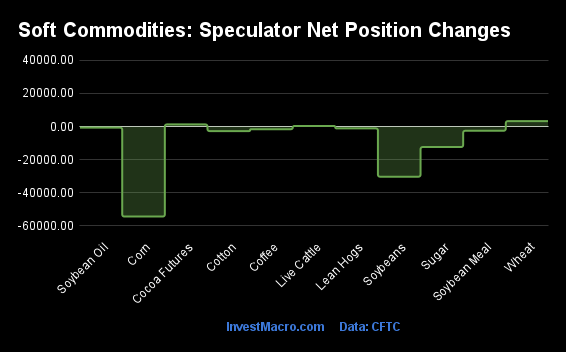
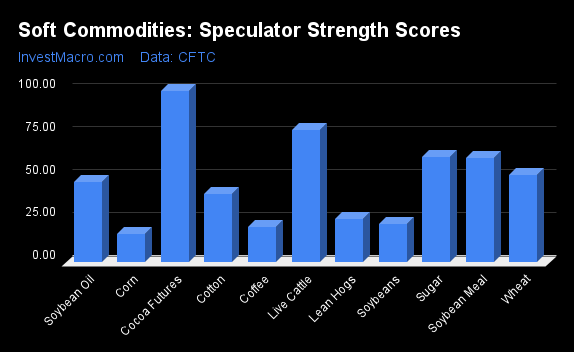
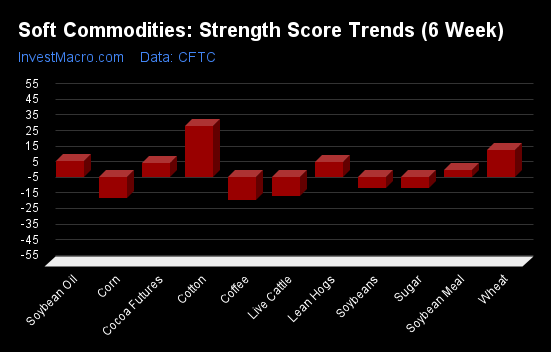
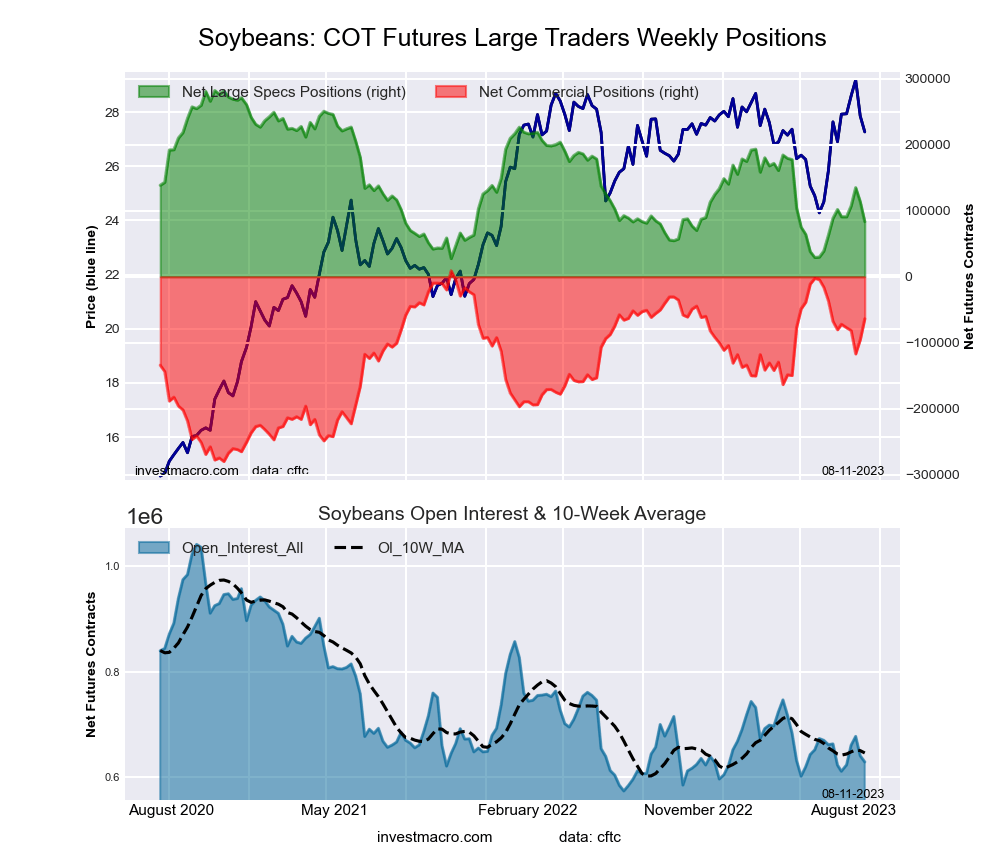
Soybeans622,5091190,86325-77,18070-13,68368
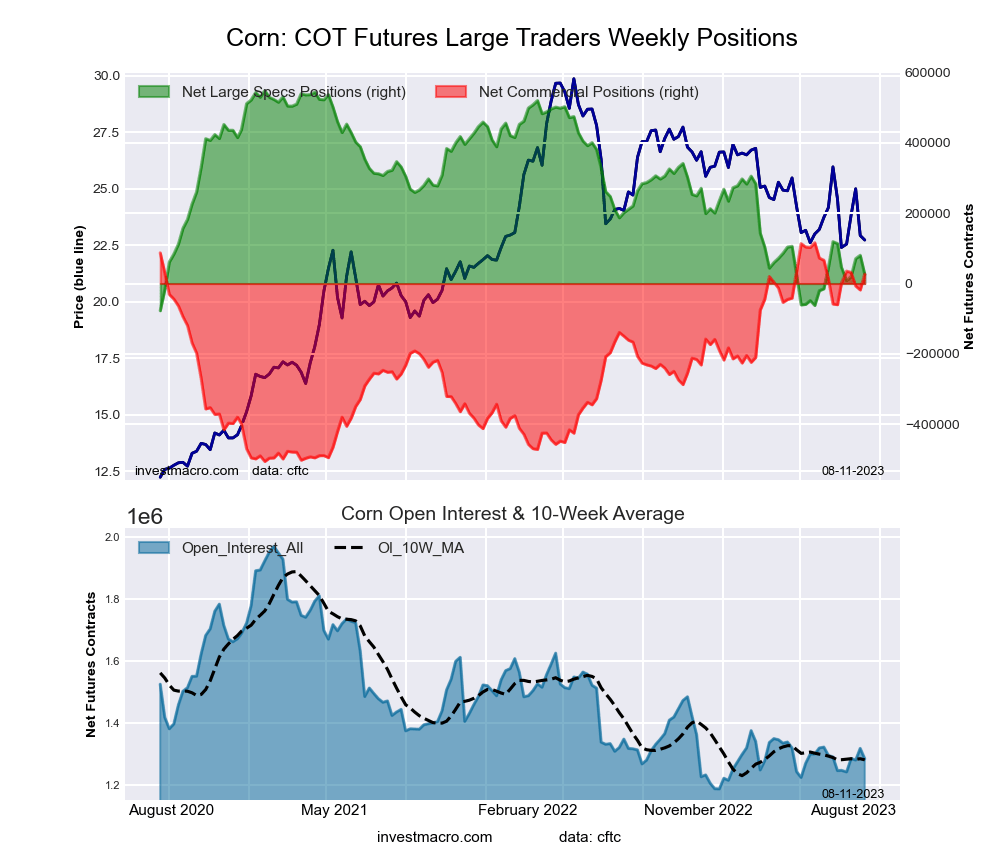
Corn1,241,94077,8112335,21581-43,02652
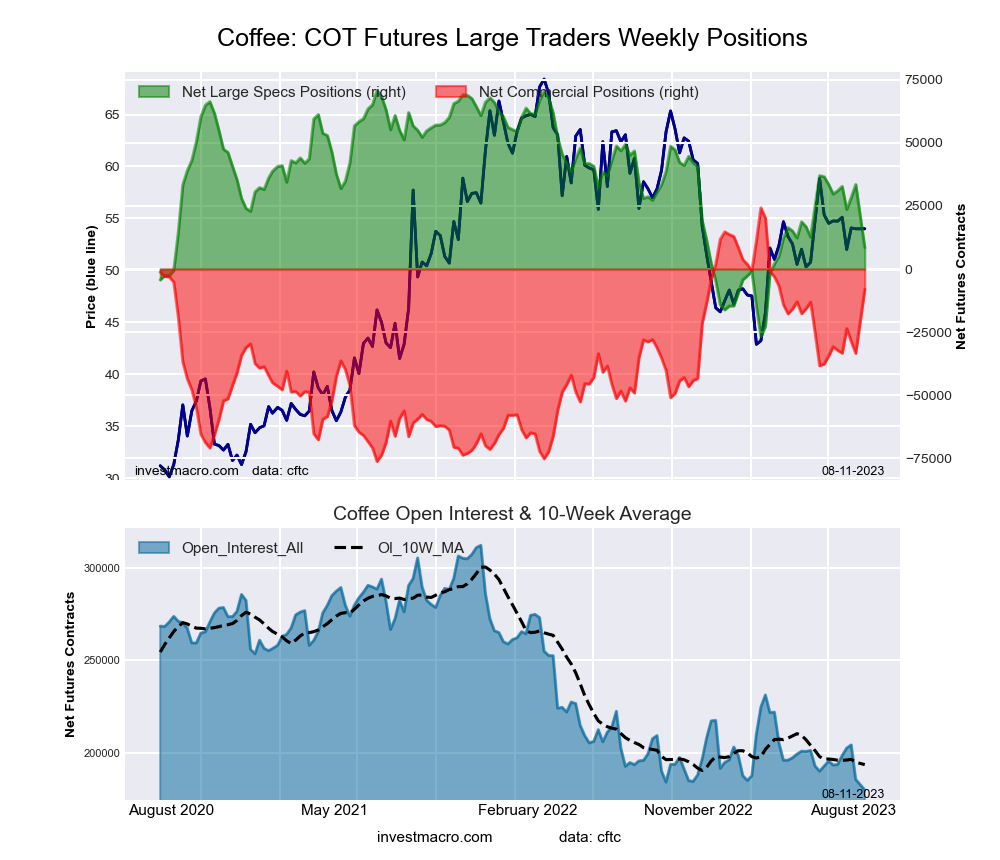
Coffee180,11838,49536-8,05268-4437
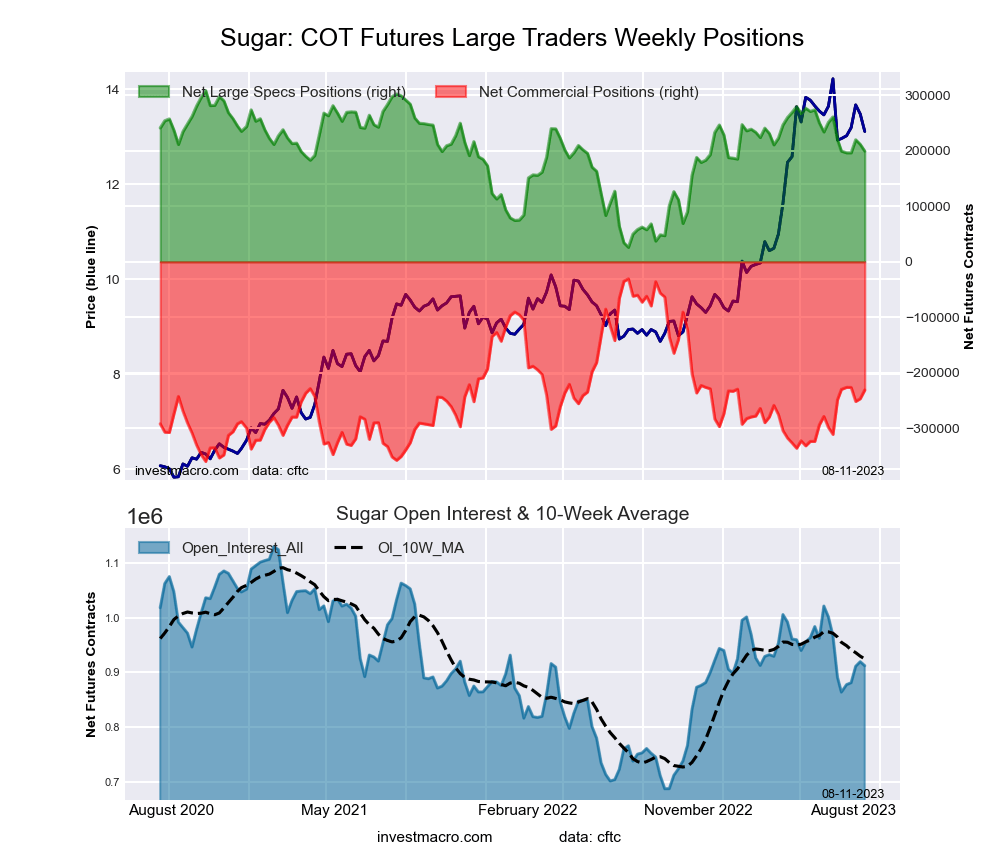
Sugar877,69543196,30460-226,0304129,72641
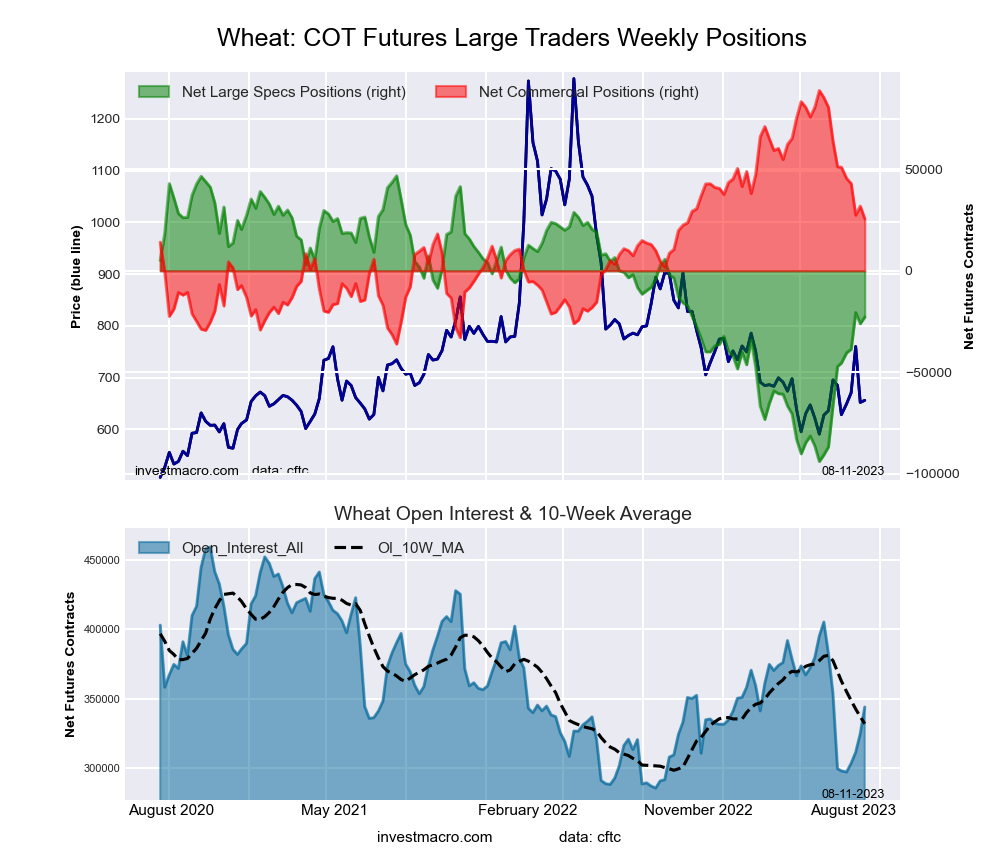
Wheat297,1467-40,4113845,50665-5,09556


Strength Scores

Strength Scores (a normalized measure of Speculator positions over a 3-Year range, from 0 to 100 where above 80 is extreme bullish and below 20 is extreme bearish) show that the Bloomberg Commodity Index (84.3 percent) and Heating Oil (79.0 percent) lead the energy close to the top of their respective ranges. Gasoline (41.9 percent) comes in as the next highest energy market in strength scores.

On the downside, WTI Crude Oil (8.5 percent) and Brent Crude Oil (17.7 percent) come in at the lowest strength scores currently and are in Extreme-Bearish levels (below 20 percent).

Strength Statistics:
WTI Crude Oil (8.5 percent) vs WTI Crude Oil previous week (0.7 percent)
Brent Crude Oil (17.7 percent) vs Brent Crude Oil previous week (34.0 percent)
Natural Gas (37.4 percent) vs Natural Gas previous week (32.6 percent)
Gasoline (41.9 percent) vs Gasoline previous week (29.7 percent)
Heating Oil (79.0 percent) vs Heating Oil previous week (78.4 percent)
Bloomberg Commodity Index (84.3 percent) vs Bloomberg Commodity Index previous week (83.9 percent)

Strength Trends

Strength Score Trends (or move index, calculates the 6-week changes in strength scores) show that Heating Oil (18.2 percent) leads the past six weeks trends for energy this week. Brent Crude Oil (10.5 percent), Gasoline (9.5 percent) and Natural Gas (7.7 percent) fill out the top movers in the latest trends data.

The Bloomberg Commodity Index (-15.0 percent) leads the downside trend scores currently.

Strength Trend Statistics:
WTI Crude Oil (2.6 percent) vs WTI Crude Oil previous week (-12.6 percent)
Brent Crude Oil (10.5 percent) vs Brent Crude Oil previous week (15.8 percent)
Natural Gas (7.7 percent) vs Natural Gas previous week (5.4 percent)
Gasoline (9.5 percent) vs Gasoline previous week (-2.1 percent)
Heating Oil (18.2 percent) vs Heating Oil previous week (35.1 percent)
Bloomberg Commodity Index (-15.0 percent) vs Bloomberg Commodity Index previous week (-15.3 percent)


Individual COT Market Charts:

WTI Crude Oil Futures:

WTI Crude Oil Futures COT ChartThe WTI Crude Oil Futures large speculator standing this week reached a net position of 173,433 contracts in the data reported through Tuesday. This was a weekly increase of 32,004 contracts from the previous week which had a total of 141,429 net contracts.

This week’s current strength score (the trader positioning range over the past three years, measured from 0 to 100) shows the speculators are currently Bearish-Extreme with a score of 8.5 percent. The commercials are Bullish-Extreme with a score of 93.0 percent and the small traders (not shown in chart) are Bearish with a score of 25.5 percent.

Price Trend-Following Model: Weak Downtrend

Our weekly trend-following model classifies the current market price position as: Weak Downtrend. The current action for the model is considered to be: Hold – Maintain Short Position.

WTI Crude Oil Futures StatisticsSPECULATORSCOMMERCIALSSMALL TRADERS
– Percent of Open Interest Longs:18.939.05.0
– Percent of Open Interest Shorts:9.249.93.7
– Net Position:173,433-196,68823,255
– Gross Longs:339,297700,01989,390
– Gross Shorts:165,864896,70766,135
– Long to Short Ratio:2.0 to 10.8 to 11.4 to 1
NET POSITION TREND:
– Strength Index Score (3 Year Range Pct):8.593.025.5
– Strength Index Reading (3 Year Range):Bearish-ExtremeBullish-ExtremeBearish
NET POSITION MOVEMENT INDEX:
– 6-Week Change in Strength Index:2.6-0.9-14.1


Brent Crude Oil Futures:

Brent Last Day Crude Oil Futures COT ChartThe Brent Crude Oil Futures large speculator standing this week reached a net position of -48,031 contracts in the data reported through Tuesday. This was a weekly decline of -8,158 contracts from the previous week which had a total of -39,873 net contracts.

This week’s current strength score (the trader positioning range over the past three years, measured from 0 to 100) shows the speculators are currently Bearish-Extreme with a score of 17.7 percent. The commercials are Bullish-Extreme with a score of 87.4 percent and the small traders (not shown in chart) are Bearish with a score of 28.3 percent.

Price Trend-Following Model: Weak Downtrend

Our weekly trend-following model classifies the current market price position as: Weak Downtrend. The current action for the model is considered to be: Hold – Maintain Short Position.

Brent Crude Oil Futures StatisticsSPECULATORSCOMMERCIALSSMALL TRADERS
– Percent of Open Interest Longs:10.254.15.6
– Percent of Open Interest Shorts:45.819.54.5
– Net Position:-48,03146,6171,414
– Gross Longs:13,70472,8347,524
– Gross Shorts:61,73526,2176,110
– Long to Short Ratio:0.2 to 12.8 to 11.2 to 1
NET POSITION TREND:
– Strength Index Score (3 Year Range Pct):17.787.428.3
– Strength Index Reading (3 Year Range):Bearish-ExtremeBullish-ExtremeBearish
NET POSITION MOVEMENT INDEX:
– 6-Week Change in Strength Index:10.5-4.7-40.2


Natural Gas Futures:

Natural Gas Futures COT ChartThe Natural Gas Futures large speculator standing this week reached a net position of -86,755 contracts in the data reported through Tuesday. This was a weekly increase of 12,020 contracts from the previous week which had a total of -98,775 net contracts.

This week’s current strength score (the trader positioning range over the past three years, measured from 0 to 100) shows the speculators are currently Bearish with a score of 37.4 percent. The commercials are Bullish with a score of 61.5 percent and the small traders (not shown in chart) are Bullish with a score of 54.1 percent.

Price Trend-Following Model: Downtrend

Our weekly trend-following model classifies the current market price position as: Downtrend. The current action for the model is considered to be: Hold – Maintain Short Position.

Natural Gas Futures StatisticsSPECULATORSCOMMERCIALSSMALL TRADERS
– Percent of Open Interest Longs:20.439.25.7
– Percent of Open Interest Shorts:27.434.73.2
– Net Position:-86,75555,55431,201
– Gross Longs:251,784484,75870,705
– Gross Shorts:338,539429,20439,504
– Long to Short Ratio:0.7 to 11.1 to 11.8 to 1
NET POSITION TREND:
– Strength Index Score (3 Year Range Pct):37.461.554.1
– Strength Index Reading (3 Year Range):BearishBullishBullish
NET POSITION MOVEMENT INDEX:
– 6-Week Change in Strength Index:7.7-7.80.0


Gasoline Blendstock Futures:

RBOB Gasoline Energy Futures COT ChartThe Gasoline Blendstock Futures large speculator standing this week reached a net position of 53,407 contracts in the data reported through Tuesday. This was a weekly increase of 7,393 contracts from the previous week which had a total of 46,014 net contracts.

This week’s current strength score (the trader positioning range over the past three years, measured from 0 to 100) shows the speculators are currently Bearish with a score of 41.9 percent. The commercials are Bullish with a score of 56.5 percent and the small traders (not shown in chart) are Bullish with a score of 71.1 percent.

Price Trend-Following Model: Strong Uptrend

Our weekly trend-following model classifies the current market price position as: Strong Uptrend. The current action for the model is considered to be: Hold – Maintain Long Position.

Nasdaq Mini Futures StatisticsSPECULATORSCOMMERCIALSSMALL TRADERS
– Percent of Open Interest Longs:27.844.46.8
– Percent of Open Interest Shorts:12.262.54.3
– Net Position:53,407-62,1648,757
– Gross Longs:95,389152,40723,514
– Gross Shorts:41,982214,57114,757
– Long to Short Ratio:2.3 to 10.7 to 11.6 to 1
NET POSITION TREND:
– Strength Index Score (3 Year Range Pct):41.956.571.1
– Strength Index Reading (3 Year Range):BearishBullishBullish
NET POSITION MOVEMENT INDEX:
– 6-Week Change in Strength Index:9.5-13.823.9


#2 Heating Oil NY-Harbor Futures:

NY Harbor Heating Oil Energy Futures COT ChartThe #2 Heating Oil NY-Harbor Futures large speculator standing this week reached a net position of 28,000 contracts in the data reported through Tuesday. This was a weekly lift of 301 contracts from the previous week which had a total of 27,699 net contracts.

This week’s current strength score (the trader positioning range over the past three years, measured from 0 to 100) shows the speculators are currently Bullish with a score of 79.0 percent. The commercials are Bearish with a score of 30.5 percent and the small traders (not shown in chart) are Bullish with a score of 66.7 percent.

Price Trend-Following Model: Weak Downtrend

Our weekly trend-following model classifies the current market price position as: Weak Downtrend. The current action for the model is considered to be: Hold – Maintain Short Position.

Heating Oil Futures StatisticsSPECULATORSCOMMERCIALSSMALL TRADERS
– Percent of Open Interest Longs:16.346.014.6
– Percent of Open Interest Shorts:7.660.98.5
– Net Position:28,000-47,72819,728
– Gross Longs:52,184147,07646,782
– Gross Shorts:24,184194,80427,054
– Long to Short Ratio:2.2 to 10.8 to 11.7 to 1
NET POSITION TREND:
– Strength Index Score (3 Year Range Pct):79.030.566.7
– Strength Index Reading (3 Year Range):BullishBearishBullish
NET POSITION MOVEMENT INDEX:
– 6-Week Change in Strength Index:18.2-39.552.4


Bloomberg Commodity Index Futures:

Bloomberg Commodity Index Futures COT ChartThe Bloomberg Commodity Index Futures large speculator standing this week reached a net position of -5,651 contracts in the data reported through Tuesday. This was a weekly gain of 95 contracts from the previous week which had a total of -5,746 net contracts.

This week’s current strength score (the trader positioning range over the past three years, measured from 0 to 100) shows the speculators are currently Bullish-Extreme with a score of 84.3 percent. The commercials are Bearish-Extreme with a score of 16.2 percent and the small traders (not shown in chart) are Bullish with a score of 54.1 percent.

Price Trend-Following Model: Weak Downtrend

Our weekly trend-following model classifies the current market price position as: Weak Downtrend. The current action for the model is considered to be: Hold – Maintain Short Position.

Bloomberg Index Futures StatisticsSPECULATORSCOMMERCIALSSMALL TRADERS
– Percent of Open Interest Longs:12.186.60.5
– Percent of Open Interest Shorts:22.276.70.2
– Net Position:-5,6515,508143
– Gross Longs:6,69848,079269
– Gross Shorts:12,34942,571126
– Long to Short Ratio:0.5 to 11.1 to 12.1 to 1
NET POSITION TREND:
– Strength Index Score (3 Year Range Pct):84.316.254.1
– Strength Index Reading (3 Year Range):Bullish-ExtremeBearish-ExtremeBullish
NET POSITION MOVEMENT INDEX:
– 6-Week Change in Strength Index:-15.015.1-0.8


Article By InvestMacroReceive our weekly COT Newsletter

*COT Report: The COT data, released weekly to the public each Friday, is updated through the most recent Tuesday (data is 3 days old) and shows a quick view of how large speculators or non-commercials (for-profit traders) were positioned in the futures markets.

The CFTC categorizes trader positions according to commercial hedgers (traders who use futures contracts for hedging as part of the business), non-commercials (large traders who speculate to realize trading profits) and nonreportable traders (usually small traders/speculators) as well as their open interest (contracts open in the market at time of reporting). See CFTC criteria here.
Goodbye Dollar, Hello Gold

Source: Clive Maund  (7/13/23) 

Technical Analyst Clive Maund takes a look at the jump in the price of gold and the decline of the dollar.

Gold silver and precious metal (PM) stocks staged a major breakout yesterday as the dollar cratered to signal the onset of a major devaluation as its loss of reserve currency status becomes a physical reality. The BRICS are set to introduce an alternative CBDC related gold backed currency of their own that should drive the last nail into the dollar’s coffin. This has been “in the works” for quite a while and this being so it only is surprising that it has taken the dollar this long to break down. We saw all this coming a couple of weeks ago in the article PM SECTOR update – REVERSING TO UPSIDE and the two larger gold stocks featured in the article, Royal Gold and Victoria Gold have soared.

Anyway, the point is that the PM sector – and commodities generally – are embarking on a long and powerful upleg that is still in its earliest stages and this being so you can basically put on a blindfold and throw darts at a list of PM stocks and pick winners although of course we will strive to do somewhat better than that.

Now we will proceed to look at a range of charts showing the dollar breakdown and the PM sector breakouts yesterday that I am confident will “make your day” if you are long the PM sector…

We’ll start with the dollar which is of course the cause of the PM sector breakouts yesterday. The dollar cratered yesterday with a breathtaking 1.2% drop in the dollar index which broke it down from the bear Pennant it has been stuck in since late January.…


Meanwhile, the Canadian dollar, in common with many other currencies, broke higher against the US dollar yesterday, although as we can see, it had already started to break higher against the US dollar by the middle of last month. The Canadian economy is much more resource-based than the US and advancing metals prices should have a beneficial effect. Investors in Canadian mining stocks can therefore expect an additional benefit from relative currency appreciation, relative because all currencies are depreciating in real terms, if not against each other…


On gold’s 1-year chart we can see a quite lovely breakout yesterday from the corrective bullish Falling Wedge that brought it back to an important buy spot at the lower boundary of its larger uptrend channel and as we can clearly see, there is ample upside back up to the top of this channel – and there is nothing to say that, given the enormity of what is going on in the world, that it won’t in due course proceed to accelerate out of the top of this channel…


Silver had a big breakout yesterday too and although its uptrend is not yet as strong as gold’s as its larger uptrend channel is converging, it will probably proceed to rectify this in time by busting out of the top of this channel…


The chart for GDX (PM stocks) not surpringly looks very similar to gold and we can expect a robust by the sector as gold advances. Don’t worry about it having risen a lot yesterday – this chart shows that it has much further to go.


The chart for the Canadian dollar looks strong too, like it is breaking out upside from a long period of consolidation. Its chart will be added to this article later today, so look out for that.

Incidentally there are a string of big white candles in James Turk’s GoldMoney’s chart (XAU.TSX) over the past week, suggesting that investors of piling into physical gold.


Amongst stocks looking good this morning that we will be looking at ASAP are Sierra Madre Gold and Silver Ltd. (SM:TSX.V) that has positive news out this morning and Spey Resources Corp. (SPEY:CSE; SPEYF:OTC; 2JS:FRA) is at a very good entry point too. Away from the PM sector Muscle Maker Inc. (GRIL:NASDAQ) put in a reversal candle at strong support yesterday and looks set to advance.

Posted at 9.30 am EDT on 13th July 23 on CliveMaund.com.

Important Disclosures:

  1. Sierra Madre is a billboard sponsor of Streetwise Reports and pays SWR a monthly sponsorship fee between US$4,000 and US$5,000.
  2.  Spey Resources and Muscle Maker have a consulting relationship with an affiliate of Streetwise Reports, and pays a monthly consulting fee between US$8,000 and US$20,000.
  3. As of the date of this article, officers and/or employees of Streetwise Reports LLC (including members of their household) own securities of Spey Resources and Muscle Maker.
  4. Clive Maund: I, or members of my immediate household or family, own securities of: none. I personally am, or members of my immediate household or family are, paid by none. My company has a financial relationship with none. I determined which companies would be included in this article based on my research and understanding of the sector.
  5. Statements and opinions expressed are the opinions of the author and not of Streetwise Reports or its officers. The author is wholly responsible for the validity of the statements. The author was not paid by Streetwise Reports for this article. Streetwise Reports was not paid by the author to publish or syndicate this article. Streetwise Reports requires contributing authors to disclose any shareholdings in, or economic relationships with, companies that they write about. Streetwise Reports relies upon the authors to accurately provide this information and Streetwise Reports has no means of verifying its accuracy.
  6.  This article does not constitute investment advice. Each reader is encouraged to consult with his or her individual financial professional. By opening this page, each reader accepts and agrees to Streetwise Reports’ terms of use and full legal disclaimer. This article is not a solicitation for investment. Streetwise Reports does not render general or specific investment advice and the information on Streetwise Reports should not be considered a recommendation to buy or sell any security. Streetwise Reports does not endorse or recommend the business, products, services or securities of any company.

For additional disclosures, please click here.

CliveMaund.com Disclosures

The above represents the opinion and analysis of Mr. Maund, based on data available to him, at the time of writing. Mr. Maund’s opinions are his own, and are not a recommendation or an offer to buy or sell securities. Mr. Maund is an independent analyst who receives no compensation of any kind from any groups, individuals or corporations mentioned in his reports. As trading and investing in any financial markets may involve serious risk of loss, Mr. Maund recommends that you consult with a qualified investment advisor, one licensed by appropriate regulatory agencies in your legal jurisdiction and do your own due diligence and research when making any kind of a transaction with financial ramifications. Although a qualified and experienced stock market analyst, Clive Maund is not a Registered Securities Advisor. Therefore Mr. Maund’s opinions on the market and stocks can only be construed as a solicitation to buy and sell securities when they are subject to the prior approval and endorsement of a Registered Securities Advisor operating in accordance with the appropriate regulations in your area of jurisdiction.

Global inflationary pressures continue to ease. The RBA will have a new governor

By JustMarkets

At yesterday’s stock market close, the Dow Jones Index (US30) increased by 0.14%, while the S&P 500 Index (US500) added 0.85%. The NASDAQ Technology Index (US100) closed positive by 1.58% on Thursday.

Factory inflation (PPI) in the US declined over the past month, another sign that overall inflationary pressures are cooling. But the labor market remains resilient, and this could be a trigger for the US Fed to raise rates even higher. The US jobless claims fell by 12,000 to 237,000 over the past week.

Federal Reserve Bank of San Francisco President Mary Daly said it was too early for policymakers to say they had done enough to bring US inflation back to target levels. The policymaker added that although the consumer price data released on Wednesday was “very positive,” she would take a “wait-and-see stance” as the Fed remains firmly committed to bringing inflation down to 2%.

Federal Reserve Bank of St. Louis President James Bullard, an influential US Fed official who called for aggressive interest rate hikes to combat the recent spike in inflation, has stepped down after 15 years in office. Bullard, 62, will step down completely on August 14 to become dean of the School of Business.

Equity markets in Europe were mostly up yesterday. Germany’s DAX (DE30) increased by 0.74%, France’s CAC 40 (FR40) gained 0.52%, Spain’s IBEX 35 (ES35) added 0.33%, and the UK’s FTSE 100 (UK100) closed up by 0.32%.

The ECB’s monetary policy report from its June meeting confirmed that the ECB still believes policy tightening is necessary. As a result, another 25bp rate hike in July is a done deal. For the ECB to stop after that, it needs to see a further improvement in inflation dynamics, a transmission of monetary tightening to the real economy, including the labor market, and a downward revision of inflation forecasts. Committee officials do not consider a decline in inflation to be a sufficient condition for ending the tightening cycle if a robust labor market and strong wage growth prevail at the same time.

Oil prices rose in Asian trading on Friday and traded near 10-week highs on prospects of supply cuts amid disruptions in Libya and Nigeria. Oil markets rose sharply this week, following a decline in the dollar, as softer-than-expected US inflation data spurred bets that the Federal Reserve is close to peaking interest rates. In addition, the Organization of the Petroleum Exporting Countries (OPEC) highlighted rising global oil demand in 2023 in its monthly report released on Thursday.

Asian markets traded higher on Thursday. Japan’s Nikkei 225 (JP225) increased by 1.00% for the day yesterday, China’s FTSE China A50 (CHA50) jumped by 1.58%, Hong Kong’s Hang Seng (HK50) was up by 2.81%, and Australia’s S&P/ASX 200 (AU200) closed positive by 1.08%. On Friday, most Asian stocks continued to rise, ending a positive week amid signs of slowing inflation in the US. Hong Kong’s Hang Seng Index had its best weekly performance, rising nearly 6% as big tech stocks benefited from bets that the Chinese government will loosen its grip on the country’s largest internet companies.

Singapore’s economy grew slightly more than expected in the second quarter. GDP grew by 0.3% in the latest quarter, with Singapore avoiding a technical recession after GDP contracted by 0.4% last quarter. Singapore’s export sector is suffering badly due to slowing demand in China, a major trading partner.

Philip Lowe will not be reappointed as governor of the Reserve Bank of Australia (RBA). Michelle Bullock will take over as RBA governor in September. Ms. Bullock has been deputy governor of the bank since April 2022, having served since 1985.

S&P 500 (F)(US500) 4,510.04 +37.88 (+0.85%)

Dow Jones (US30) 34,395.14 +47.71 (+0.14%)

DAX (DE40)  16,141.03 +118.03 (+0.74%)

FTSE 100 (UK100) 7,440.21 +24.10 (+0.32%)

USD Index  99.43 −0.85 (−0.85%)

Important events for today:
  • – US FOMC Member Waller Speaks at 01:45 (GMT+3);
  • – Japan Industrial Production (m/m) at 07:30 (GMT+3);
  • – Switzerland Producer Price Index (m/m) at 09:30 (GMT+3);
  • – Eurozone Trade Balance (m/m) at 12:00 (GMT+3);
  • – US Michigan Consumer Sentiment (m/m) at 17:00 (GMT+3).

By JustMarkets


This article reflects a personal opinion and should not be interpreted as an investment advice, and/or offer, and/or a persistent request for carrying out financial transactions, and/or a guarantee, and/or a forecast of future events.

Week Ahead: Can GBPUSD Bulls Maintain Hunger For Gains?

By ForexTime 

The explosive price action seen this week continues to highlight how global financial markets remain sensitive to key inflation data!

Currencies, commodities, and stocks were injected with fresh volatility mid-week after the softer-than-expected US inflation figures calmed fears around Fed rate hikes.

  • The US Dollar Index cut through the 100.70 support like a hot knife through butter and is currently on pace for its worst seek since November 2022.
  • Gold prices are trading back around the $1960 level, currently up roughly 1.6% this week.
  • Global stocks are set for their biggest weekly gain since November 2022, with the S&P500 hitting fresh 2023 highs.

Markets may be pumped with more volatility this afternoon due to earnings announcement by Wall Street banks.

And even before things settle down across the board, investors are already bracing for fresh action in the week ahead thanks to top-tier economic reports and key risk events…

Monday, July 17

  • CNH: China key policy rate decision, Q2 GDP, retail sales, industrial production
  • USD: US empire manufacturing

Tuesday, July 18

  • AUD: Reserve Bank of Australia July meeting minutes
  • CAD: CPI, housing starts
  • USD: US retail sales, industrial production
  • SPX500_m: Bank of America, Morgan Stanley earnings

Wednesday, July 19

  • EUR: June CPI (final)
  • GBP: UK June CPI
  • USD: US housing starts
  • SPX500_m: Goldman Sachs, IBM earnings
  • NQ100_m: Tesla, Netflix earnings

Thursday, July 20

  • CNH: China loan prime rates
  • AUD: Australia unemployment
  • EUR: Eurozone consumer confidence
  • USD: US initial jobless claims, existing home sales, University of Michigan Consumer Sentiment Index

Friday, July 21

  • CAD: Canada retail sales
  • JPY: Japan June CPI
  • GBP: UK Retail Sales, Gfk Consumer Confidence

Our focus falls on the GBPUSD which has resembled a speeding train gaining noticeable momentum on the technical charts!

After rallying to a fresh 2023 high at 1.3140 and rising more than 2% this week (as of writing), sterling bulls are certainly in the driving seat. Indeed, the GBPUSD has drawn strength from upbeat UK GDP data and a broadly weaker dollar.

The key question is whether bulls can maintain the appetite for further gains in the week ahead.

Here are 3 reasons why you should keep an eye on the GBPUSD:

  1. UK June Consumer Price Index (CPI)

On Wednesday, July 19th – the latest UK inflation report will be published.

All eyes will be on the incoming UK inflation report which could influence BoE hike expectations. This will be topped off with the latest retail sales figures and Gfk Consumer confidence report on Friday which could provide fresh insight into the health of the UK economy.

Markets are forecasting:

  • CPI year-on-year (June 2023 vs. June 2022) to cool 8.2% from 8.7% in the prior month.
  • Core CPI year-on-year to remain unchanged at 7.1% from 7.1% seen in May.
  • CPI month-on-month (June 2023 vs May 2023) to cool 0.4% from 0.7% in the prior month.

As of writing, traders are pricing in a 73% probability of a 50-basis point BoE hike in August as the central bank continues to battle sticky inflation.

  • Signs of still stubborn inflation may reinforce expectations around the BoE hiking rates by 50 basis points at its August meeting. This development could propel the GBPUSD beyond 1.3200.
  • Should June’s CPI report show signs of cooling inflationary pressures, this could fuel hopes around the BoE opting for a smaller 25 basis point hike in August. Speculation around the BoE slowing down the pace of rate increases may weaken the pound, dragging the GBPUSD back towards 1.3000.
  1. Dollar volatility

Fed hike expectations are likely to influence the US dollar in the week ahead. On top of this, investors will be dished out key US data which may provide fresh insight into the health of the largest economy in the world.

The US empire manufacturing will be under the spotlight on Monday, to key US retail sales and industrial production figures on Tuesday. Much attention will also be directed towards the US initial jobless claims and University of Michigan Consumer Sentiment Index on Thursday.

  • If US economic data disappoints, this could weaken the dollar as expectations mount over the Federal Reserve pausing rate hikes down the road. Dollar weakness is seen pushing the GBPUSD higher.
  • A strong set of economic releases may bolster the case for US rates remaining higher for longer. This is likely to strengthen the dollar, dragging the GBPUSD lower.
  1. Technical forces – bulls

The GBPUSD remains heavily bullish on the daily and weekly timeframe.

There have been consistently higher highs and higher lows in the weekly timeframe with prices slicing through the 200-week Simple Moving Average. Given how the currency pair remains in a healthy weekly bullish channel, the path of least resistance points north. A strong weekly close above 1.3200 may encourage an incline towards the next major resistance at 1.3700. While bulls are clearly in a position of power, the Relative Strength Index (RSI) has reached overbought levels. A technical throwback could be on the table before bull’s attack once again.

Zooming into the daily charts, the GBPUSD remains in a strong uptrend. After hitting a fresh 2023 high at 1.3140, the question is whether bulls have the appetite for more gains? A strong breakout above this point could encourage an incline towards 1.3200 and 1.3250. However, should prices slip back below 1.3000, this may trigger a further decline towards 1.2840.


Forex-Time-LogoArticle by ForexTime

ForexTime Ltd (FXTM) is an award winning international online forex broker regulated by CySEC 185/12 www.forextime.com

Platinum’s May-June Selloff: When the “Fundamental” Chips Fall

In May, a “record supply deficit” should’ve sent platinum prices soaring. So much for the best laid “fundamental” plans.

By Elliott Wave International

If I had a nickel for every time someone asked me what value “fundamentals” serve in navigating financial markets, well… let’s just say I could’ve retired to the Poconos years ago.

And the short answer I give to this question hasn’t changed in 18 years; namely, none.

This can be hard to accept, considering how fundamental “fundamental” market analysis is for mainstream finance. Pick the equivalent “Wall Street” of the country you live in, ask any pundit on that particular “street,” and they’ll insist the main driver of market trends is the news circulating outside those markets. That includes anything from weather patterns, political unrest, earnings reports, and so on.

But the reason I and we as Elliott wave analysts take such a radical stance against the value of “fundamentals” is simple: These news events don’t occur in a vacuum. They’re filtered through the lens of human beings, and very rarely do those humans see eye-to-eye on what a certain event means for a market’s future.

Or whenever there is a consensus on how a certain event will affect prices, the market goes ahead and does the exact opposite of that consensus.

When you start paying attention to this pattern of markets ignoring the news that’s supposed to move them, you can’t un-see it.

What we as Elliott wave analysts do see, however, is that market trends are driven by investor psychology, which unfolds as measurable wave patterns directly on price charts.

A recent example of this comes from platinum. In May, the industrial metal used in everything from catalytic converters to AI medical technology made the front page of major news outlets from The New York Times to Fortune Magazine.

The word “platinum” was practically clickbait, after the Biden administration floated a long-held and longshot Hail Mary idea for the U.S. Treasury to mint a $1 trillion platinum coin to avert the crashing of the debt ceiling.

At the same time on the investment front, platinum bulls were handed the big blue whale of supportive “fundamentals” — not just low supply numbers amidst rising demand, but the lowest supply data on record care of rolling power outages in South Africa, the world’s largest supplier of mined platinum.

The white metal seemed to be prime for a red-hot rally. Wrote Reuters on May 2: “Platinum prices surge as speculators bet supply will run short… We think this is the first year of serial deficits in the platinum market.”

On May 16, Bullion Vault added: “Platinum Investment to Support $1000 Price on ‘Record Deficit.'”

“Fundamental” signs pointed in a straight line going up. Elliott wave signs, however, aimed to help investors and traders manage the risk of participating in the metal’s action.

On May 11, our Metals Pro Service showed this Elliott wave labeled price chart of platinum. There, our primary count was bullish, and called for “a new high.” But that wasn’t the end of our analysis. We then explained the exact steps price must take to confirm an uptrend. From Metals Pro Service:

“You would think it would’ve given us a new high, and yet price has fallen back to the low it achieved just hours ago. I’m going to stay bullish above the .382 retracement level. I’m not eager to call a top, but if it goes under the .382 retracement level of 1150, then the risk begins to become that a top is in place. I am inclined to call it a truncated fifth wave of wave 1 up.

The next day on May 12, platinum accelerated down, confirming that a truncated fifth wave top was in place. Metals Pro Service showed its newly updated chart and said:

“The outlook is bearish while price holds under its 0.382 retracement level. The farther price falls, the more likely it is that wave (a) of ii (circled) is underway.

And from there, platinum continued falling to a 4-month low on June 23.

Metals trading, as all markets, carries risk. And not all Elliott wave interpretations turn out to be accurate. But like this example shows, Elliott analysis does identify critical price levels to help manage the inherent risk.

“Fundamental” analysis can’t say the same.


The Elliott Wave Hotlist: See 5 top market picks — FREE

70+

That’s how many markets Elliott Wave International’s Pro Services cover for subscribers.

But, you might ask, why the “+”? Why not write the exact number?

Well, because month in and month out, Pro Services also look for special opportunities. Sometimes in markets they cover regularly, sometimes something totally wild and unexpected.

In other words, they go where the opportunity is.

And that’s exactly what you’re about to see.

FREE through July 14, the “Elliott Wave Hotlist” shows you 5 top opportunities straight from the desks of EWI’s Pro Services analysts.

See ALL the setups now at elliottwave.com >>

This article was syndicated by Elliott Wave International and was originally published under the headline Platinum’s May-June Selloff: When the “Fundamental” Chips Fall. EWI is the world’s largest market forecasting firm. Its staff of full-time analysts led by Chartered Market Technician Robert Prechter provides 24-hour-a-day market analysis to institutional and private investors around the world.

US inflation is falling sharply. China’s trade balance points to a slowing economy

By JustMarkets

Stock indices closed higher on Wednesday due to cooling inflation in the United States. The consumer price level fell from 4% to 3% (3.1% expected) on an annualized basis. Core inflation (excludes food and energy prices) fell from 5.3% to 4.8% (5.0% expected). The sharp drop in inflation caused the dollar to fall to a 15-month low. Dollar weakness led most risk currencies, gold, and stock indices to rally. At yesterday’s stock market close, the Dow Jones (US30) Index was up by 0.25%, and the S&P 500 Index (US500) increased by 0.74%. The NASDAQ Technology Index (US100) closed positive 1.15% on Wednesday.

The US Treasury yields also declined following a weak inflation reading, as the data combined with signs of a cooling labor market spurred bets that the Fed is likely to soften its hawkish stance in the coming months. The probability of a rate hike at the July West meeting is 92%, while the probability of a hike at the September and November meetings is 14% and 26%, respectively.

On Wednesday, the Bank of Canada raised the overnight interest rate by 25 basis points to 5.00% and also extended its projected timetable for lowering Canada’s inflation rate to its 2% target by mid-2025. The Bank of Canada left little guidance on the way forward. At the press conference, the Bank of Canada Governor indicated that the improvement in overall momentum was largely due to lower energy prices rather than underlying pressures, hinting that restrictive policies will be in place for longer.

Equity markets in Europe were predominantly up yesterday. Germany’s DAX (DE30) jumped by 1.47%, France’s CAC 40 (FR40) gained 1.57%, Spain’s IBEX 35 (ES35) added 1.37%, and the UK’s FTSE 100 (UK100) closed positive by 1.83%.

UK GDP showed no growth for the second quarter of 2023. On an annualized basis, the economy contracted by 0.4%. Manufacturing fell by 0.6% in May 2023 after falling by 0.2% in April 2023. The construction sector fell by 0.2% in May 2023 after falling by 0.9% in April 2023. Services output showed no growth in May 2023 after rising by 0.3% in April 2023. Overall, economic conditions continue to deteriorate, which could pose a challenge for the Bank of England to further fight inflation.

Gold rose sharply yesterday amid a falling dollar and government bond yields. There are good growth prospects for gold as the US Fed is at the end of its tightening cycle. At the same time, silver shows better performance among precious metals.

Asian markets mostly traded higher on Wednesday. Japan’s Nikkei 225 (JP225) decreased by 1.04% yesterday, China’s FTSE China A50 (CHA50) was up by 0.15%, Hong Kong’s Hang Seng (HK50) added 1.14%, and Australia’s S&P/ASX 200 (AU200) closed positive 0.81% for the day.

In Japan, conditions for rising inflation are emerging, which puts pressure on the Bank of Japan to abandon its multi-year soft monetary policy. Markets are already betting on the Bank of Japan’s policy adjustment, which is reflected in the strengthening of the Japanese yen.

Last month, China’s exports contracted at the fastest pace since the COVID-19 pandemic began. Exports contracted by 12.4% year-on-year in June after falling by 7.5% in May. Imports fell by 6.8%, which was stronger than the 4.0% decline expected and the 4.5% drop in the previous month. The data indicate that China’s economic recovery has slowed after a strong first quarter, and analysts are now downgrading their forecasts for the economy for the rest of the year as factory output slows amid continued weak global demand.

S&P 500 (F) (US500) 4,472.16 +32.90 (+0.74%)

Dow Jones (US30) 34,347.43 +86.01 (+0.25%)

DAX (DE40)  16,023.00 +232.66 (+1.47%)

FTSE 100 (UK100) 7,416.11 +133.59 (+1.83%)

USD Index  100.28 −1.08 (−1.07%)

Important events for today:
  • – China Trade Balance (m/m) at 06:00 (GMT+3);
  • – UK GDP (m/m) at 09:00 (GMT+3);
  • – UK Industrial Production (m/m) at 09:00 (GMT+3);
  • – UK Manufacturing Production (m/m) at 09:00 (GMT+3);
  • – UK Trade Balance (m/m) at 09:00 (GMT+3);
  • – Eurozone Industrial Production (m/m) at 12:00 (GMT+3);
  • – Eurozone ECB Monetary Policy Meeting Accounts at 14:30 (GMT+3);
  • – US Initial Jobless Claims (w/w) at 15:30 (GMT+3);
  • – US Producer Price Index (m/m) at 15:30 (GMT+3);
  • – US Natural Gas Storage (w/w) at 17:30 (GMT+3).

By JustMarkets


This article reflects a personal opinion and should not be interpreted as an investment advice, and/or offer, and/or a persistent request for carrying out financial transactions, and/or a guarantee, and/or a forecast of future events.