COT Metals Charts: Speculator Bets led higher by Gold & Platinum

By InvestMacro

Here are the latest charts and statistics for the Commitment of Traders (COT) data published by the Commodities Futures Trading Commission (CFTC).

The latest COT data is updated through Tuesday October 31st and shows a quick view of how large traders (for-profit speculators and commercial entities) were positioned in the futures markets.

Weekly Speculator Changes led by Gold & Platinum

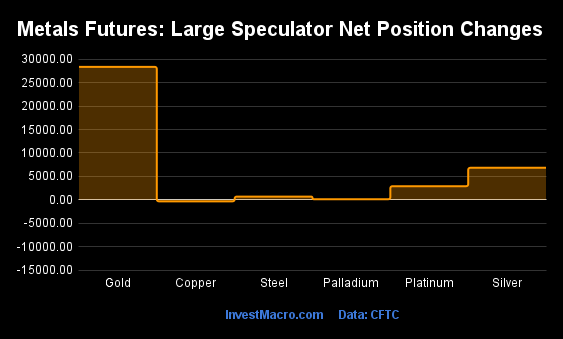
The COT metals markets speculator bets were higher this week as five out of the six metals markets we cover had higher positioning while only one market had lower speculator contracts.

Leading the gains for the metals was Gold (14,040 contracts) with Platinum (11,306 contracts), Copper (3,599 contracts), Steel (2,869 contracts) and Palladium (987 contracts) also coming along with positive weeks.

The market with a decline in speculator bets for the week was Silver with a decrease of -4,121 contracts on the week.


Data Snapshot of Commodity Market Traders | Columns Legend
Oct-31-2023OIOI-IndexSpec-NetSpec-IndexCom-NetCOM-IndexSmalls-NetSmalls-Index
Gold475,80825163,42549-182,7075319,28231
Silver126,5491520,21147-33,1395412,92838
Copper222,56660-17,1611618,39587-1,23411
Palladium22,943100-10,253810,163929047
Platinum74,7686510,82641-14,186643,36013


Strength Scores led by Steel & Gold

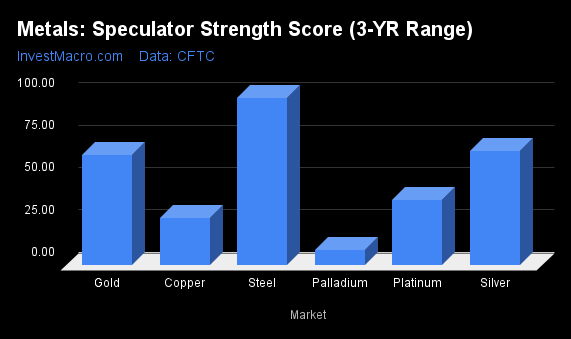
COT Strength Scores (a normalized measure of Speculator positions over a 3-Year range, from 0 to 100 where above 80 is Extreme-Bullish and below 20 is Extreme-Bearish) showed that Steel (89 percent) leads the metals markets this week. Gold (49 percent) comes in as the next highest in the weekly strength scores.

On the downside, Palladium (8.2 percent) and Copper (16 percent) are at the lowest strength levels currently and are in Extreme-Bearish territory (below 20 percent).

Strength Statistics:
Gold (49.0 percent) vs Gold previous week (42.8 percent)
Silver (47.1 percent) vs Silver previous week (53.0 percent)
Copper (16.0 percent) vs Copper previous week (12.9 percent)
Platinum (40.6 percent) vs Platinum previous week (14.5 percent)
Palladium (8.2 percent) vs Palladium previous week (1.7 percent)
Steel (89.3 percent) vs Palladium previous week (77.9 percent)

Gold & Steel top the 6-Week Strength Trends

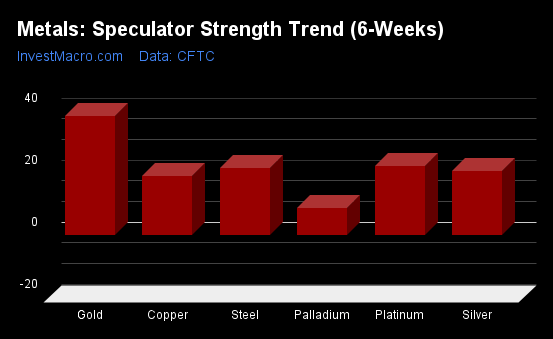
COT Strength Score Trends (or move index, calculates the 6-week changes in strength scores) showed that Gold (12 percent) and Steel (10 percent) lead the past six weeks trends for metals. Silver (7 percent) is the next highest positive mover in the latest trends data.

Copper (-1 percent) leads the downside trend scores currently.

Move Statistics:
Gold (12.4 percent) vs Gold previous week (11.2 percent)
Silver (7.1 percent) vs Silver previous week (9.0 percent)
Copper (-0.7 percent) vs Copper previous week (-7.3 percent)
Platinum (1.9 percent) vs Platinum previous week (-16.6 percent)
Palladium (-0.2 percent) vs Palladium previous week (-3.5 percent)
Steel (10.1 percent) vs Steel previous week (-1.7 percent)


Individual Markets:

Gold Comex Futures:

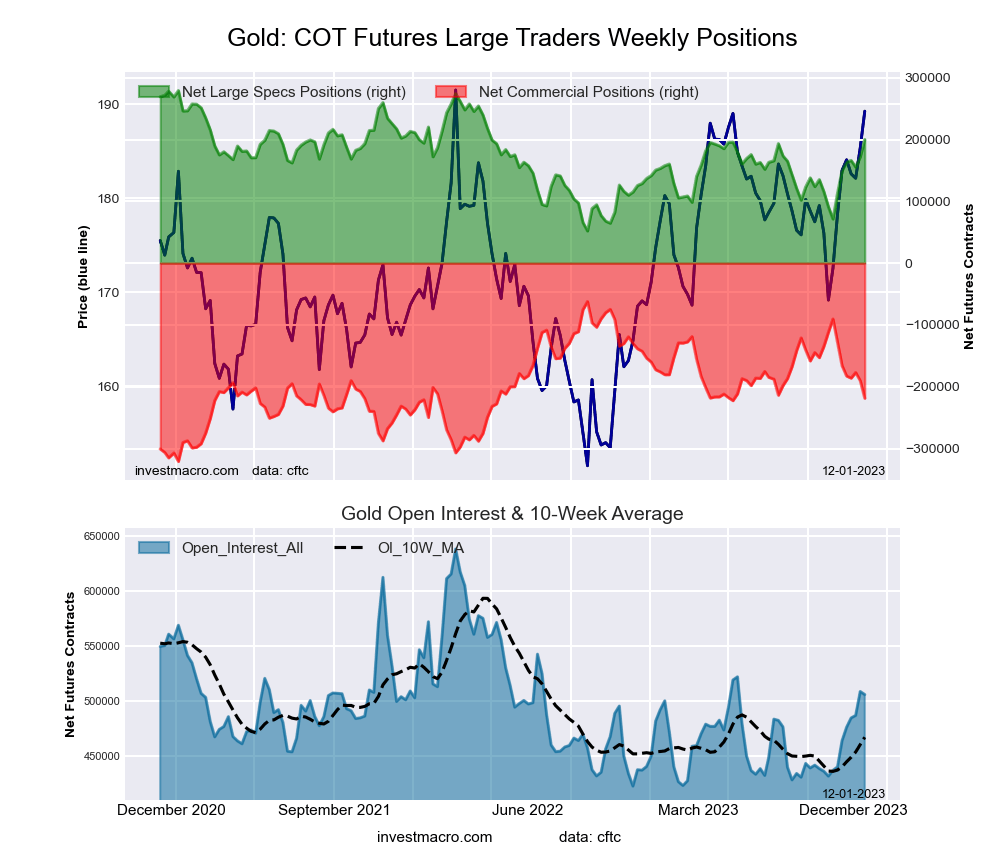
Gold Futures COT ChartThe Gold Comex Futures large speculator standing this week equaled a net position of 163,425 contracts in the data reported through Tuesday. This was a weekly rise of 14,040 contracts from the previous week which had a total of 149,385 net contracts.

This week’s current strength score (the trader positioning range over the past three years, measured from 0 to 100) shows the speculators are currently Bearish with a score of 49.0 percent. The commercials are Bullish with a score of 53.4 percent and the small traders (not shown in chart) are Bearish with a score of 31.2 percent.

Price Trend-Following Model: Strong Uptrend

Our weekly trend-following model classifies the current market price position as: Strong Uptrend. The current action for the model is considered to be: New Buy – Long Position.

Gold Futures StatisticsSPECULATORSCOMMERCIALSSMALL TRADERS
– Percent of Open Interest Longs:54.922.39.4
– Percent of Open Interest Shorts:20.560.75.4
– Net Position:163,425-182,70719,282
– Gross Longs:261,053105,97144,792
– Gross Shorts:97,628288,67825,510
– Long to Short Ratio:2.7 to 10.4 to 11.8 to 1
NET POSITION TREND:
– Strength Index Score (3 Year Range Pct):49.053.431.2
– Strength Index Reading (3 Year Range):BearishBullishBearish
NET POSITION MOVEMENT INDEX:
– 6-Week Change in Strength Index:12.4-11.54.2


Silver Comex Futures:

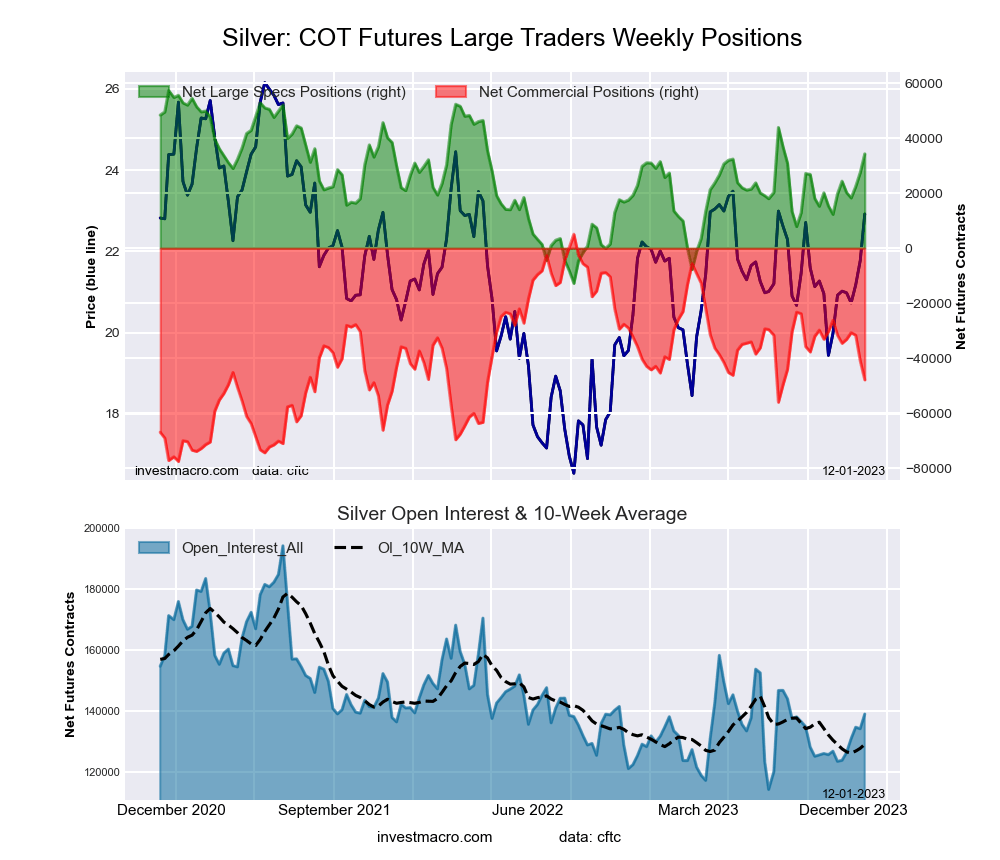
Silver Futures COT ChartThe Silver Comex Futures large speculator standing this week equaled a net position of 20,211 contracts in the data reported through Tuesday. This was a weekly reduction of -4,121 contracts from the previous week which had a total of 24,332 net contracts.

This week’s current strength score (the trader positioning range over the past three years, measured from 0 to 100) shows the speculators are currently Bearish with a score of 47.1 percent. The commercials are Bullish with a score of 53.7 percent and the small traders (not shown in chart) are Bearish with a score of 38.2 percent.

Price Trend-Following Model: Downtrend

Our weekly trend-following model classifies the current market price position as: Downtrend. The current action for the model is considered to be: Hold – Maintain Short Position.

Silver Futures StatisticsSPECULATORSCOMMERCIALSSMALL TRADERS
– Percent of Open Interest Longs:37.932.020.4
– Percent of Open Interest Shorts:22.058.110.2
– Net Position:20,211-33,13912,928
– Gross Longs:48,02540,44125,863
– Gross Shorts:27,81473,58012,935
– Long to Short Ratio:1.7 to 10.5 to 12.0 to 1
NET POSITION TREND:
– Strength Index Score (3 Year Range Pct):47.153.738.2
– Strength Index Reading (3 Year Range):BearishBullishBearish
NET POSITION MOVEMENT INDEX:
– 6-Week Change in Strength Index:7.1-4.1-9.1


Copper Grade #1 Futures:

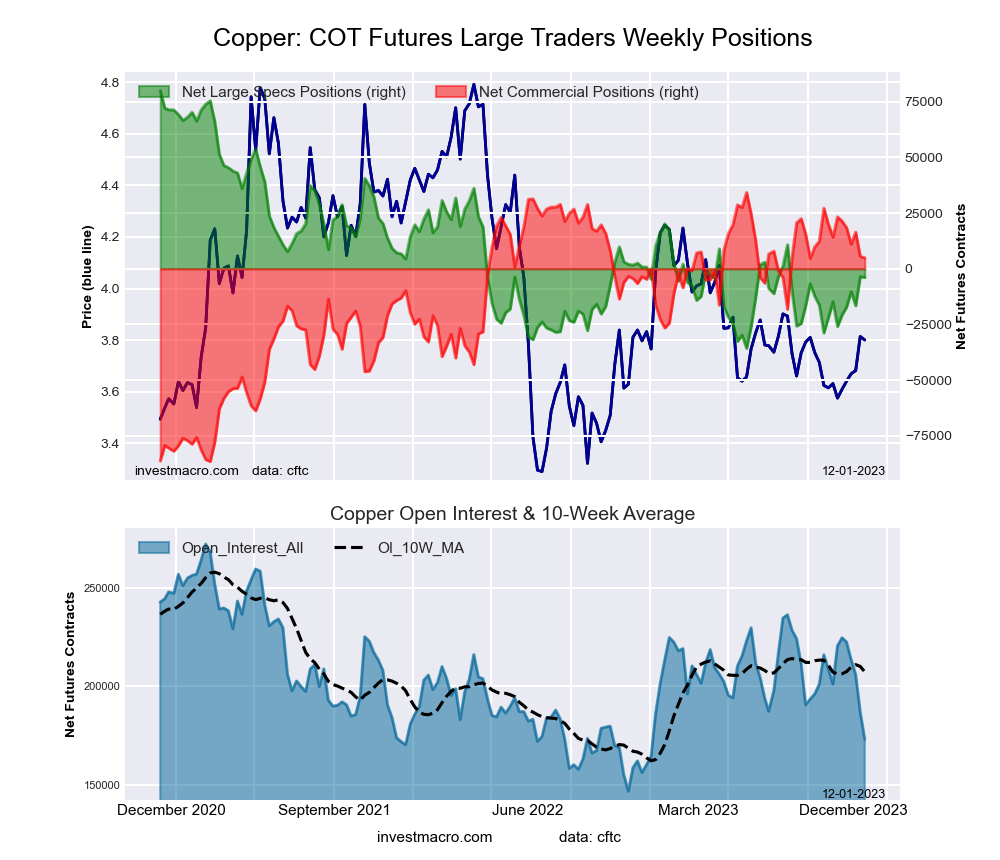
Copper Futures COT ChartThe Copper Grade #1 Futures large speculator standing this week equaled a net position of -17,161 contracts in the data reported through Tuesday. This was a weekly increase of 3,599 contracts from the previous week which had a total of -20,760 net contracts.

This week’s current strength score (the trader positioning range over the past three years, measured from 0 to 100) shows the speculators are currently Bearish-Extreme with a score of 16.0 percent. The commercials are Bullish-Extreme with a score of 86.9 percent and the small traders (not shown in chart) are Bearish-Extreme with a score of 10.7 percent.

Price Trend-Following Model: Downtrend

Our weekly trend-following model classifies the current market price position as: Downtrend. The current action for the model is considered to be: Hold – Maintain Short Position.

Copper Futures StatisticsSPECULATORSCOMMERCIALSSMALL TRADERS
– Percent of Open Interest Longs:31.436.46.6
– Percent of Open Interest Shorts:39.128.17.2
– Net Position:-17,16118,395-1,234
– Gross Longs:69,90981,00014,745
– Gross Shorts:87,07062,60515,979
– Long to Short Ratio:0.8 to 11.3 to 10.9 to 1
NET POSITION TREND:
– Strength Index Score (3 Year Range Pct):16.086.910.7
– Strength Index Reading (3 Year Range):Bearish-ExtremeBullish-ExtremeBearish-Extreme
NET POSITION MOVEMENT INDEX:
– 6-Week Change in Strength Index:-0.75.0-32.9


Platinum Futures:

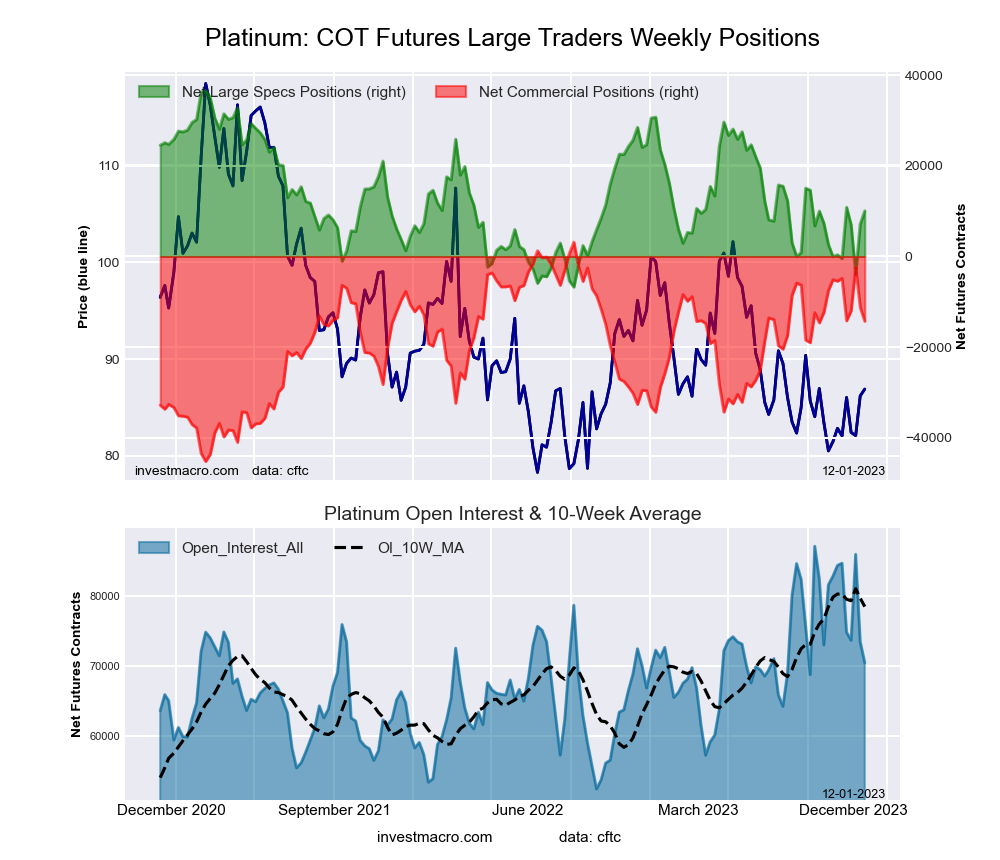
Platinum Futures COT ChartThe Platinum Futures large speculator standing this week equaled a net position of 10,826 contracts in the data reported through Tuesday. This was a weekly boost of 11,306 contracts from the previous week which had a total of -480 net contracts.

This week’s current strength score (the trader positioning range over the past three years, measured from 0 to 100) shows the speculators are currently Bearish with a score of 40.6 percent. The commercials are Bullish with a score of 64.1 percent and the small traders (not shown in chart) are Bearish-Extreme with a score of 13.2 percent.

Price Trend-Following Model: Weak Downtrend (Possible Trend Change)

Our weekly trend-following model classifies the current market price position as: Weak Downtrend. The current action for the model is considered to be: Hold – Maintain Short Position.

Platinum Futures StatisticsSPECULATORSCOMMERCIALSSMALL TRADERS
– Percent of Open Interest Longs:59.222.69.6
– Percent of Open Interest Shorts:44.841.65.1
– Net Position:10,826-14,1863,360
– Gross Longs:44,29116,9257,145
– Gross Shorts:33,46531,1113,785
– Long to Short Ratio:1.3 to 10.5 to 11.9 to 1
NET POSITION TREND:
– Strength Index Score (3 Year Range Pct):40.664.113.2
– Strength Index Reading (3 Year Range):BearishBullishBearish-Extreme
NET POSITION MOVEMENT INDEX:
– 6-Week Change in Strength Index:1.90.9-17.0


Palladium Futures:

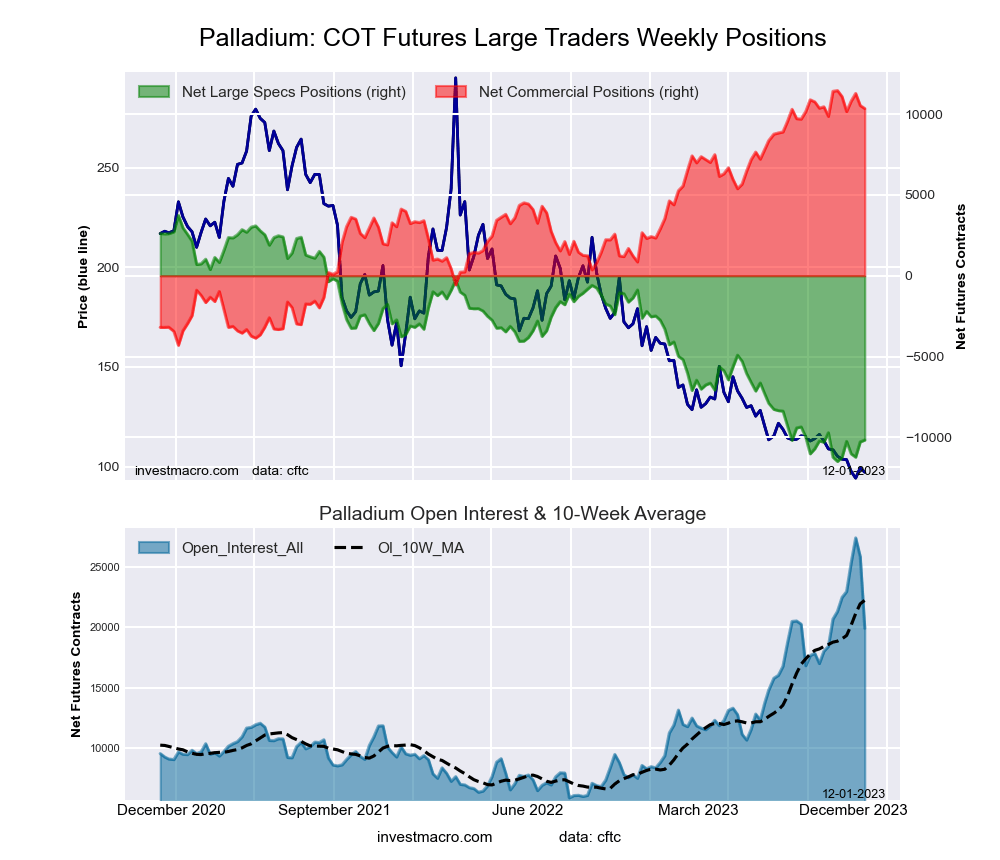
Palladium Futures COT ChartThe Palladium Futures large speculator standing this week equaled a net position of -10,253 contracts in the data reported through Tuesday. This was a weekly boost of 987 contracts from the previous week which had a total of -11,240 net contracts.

This week’s current strength score (the trader positioning range over the past three years, measured from 0 to 100) shows the speculators are currently Bearish-Extreme with a score of 8.2 percent. The commercials are Bullish-Extreme with a score of 91.8 percent and the small traders (not shown in chart) are Bearish with a score of 47.1 percent.

Price Trend-Following Model: Strong Downtrend

Our weekly trend-following model classifies the current market price position as: Strong Downtrend. The current action for the model is considered to be: Hold – Maintain Short Position.

Palladium Futures StatisticsSPECULATORSCOMMERCIALSSMALL TRADERS
– Percent of Open Interest Longs:22.251.97.9
– Percent of Open Interest Shorts:66.97.67.5
– Net Position:-10,25310,16390
– Gross Longs:5,09611,9151,807
– Gross Shorts:15,3491,7521,717
– Long to Short Ratio:0.3 to 16.8 to 11.1 to 1
NET POSITION TREND:
– Strength Index Score (3 Year Range Pct):8.291.847.1
– Strength Index Reading (3 Year Range):Bearish-ExtremeBullish-ExtremeBearish
NET POSITION MOVEMENT INDEX:
– 6-Week Change in Strength Index:-0.2-1.313.9


Steel Futures Futures:

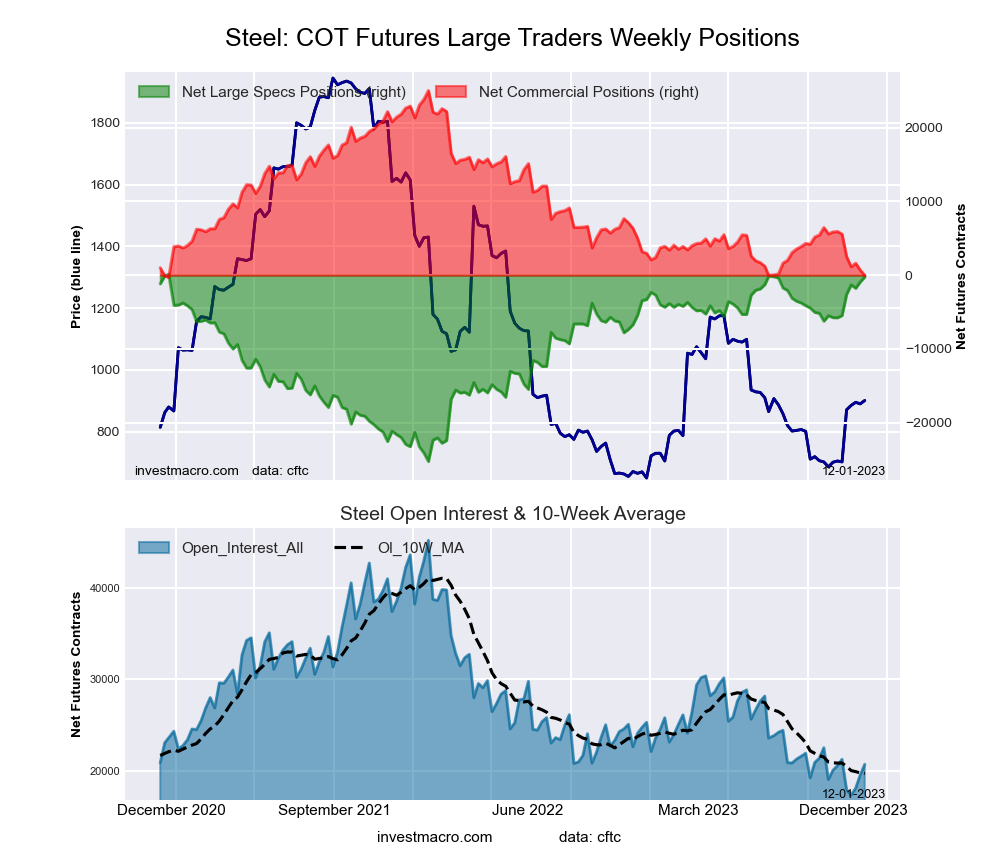
Steel Futures COT ChartThe Steel Futures large speculator standing this week equaled a net position of -2,600 contracts in the data reported through Tuesday. This was a weekly gain of 2,869 contracts from the previous week which had a total of -5,469 net contracts.

This week’s current strength score (the trader positioning range over the past three years, measured from 0 to 100) shows the speculators are currently Bullish-Extreme with a score of 89.3 percent. The commercials are Bearish-Extreme with a score of 11.2 percent and the small traders (not shown in chart) are Bearish with a score of 39.9 percent.

Price Trend-Following Model: Weak Downtrend (Possible Trend Change)

Our weekly trend-following model classifies the current market price position as: Weak Downtrend. The current action for the model is considered to be: Hold – Maintain Short Position.

Steel Futures StatisticsSPECULATORSCOMMERCIALSSMALL TRADERS
– Percent of Open Interest Longs:17.376.72.1
– Percent of Open Interest Shorts:31.762.61.7
– Net Position:-2,6002,53169
– Gross Longs:3,10313,774380
– Gross Shorts:5,70311,243311
– Long to Short Ratio:0.5 to 11.2 to 11.2 to 1
NET POSITION TREND:
– Strength Index Score (3 Year Range Pct):89.311.239.9
– Strength Index Reading (3 Year Range):Bullish-ExtremeBearish-ExtremeBearish
NET POSITION MOVEMENT INDEX:
– 6-Week Change in Strength Index:10.1-11.539.9


Article By InvestMacroReceive our weekly COT Newsletter

*COT Report: The COT data, released weekly to the public each Friday, is updated through the most recent Tuesday (data is 3 days old) and shows a quick view of how large speculators or non-commercials (for-profit traders) were positioned in the futures markets.

The CFTC categorizes trader positions according to commercial hedgers (traders who use futures contracts for hedging as part of the business), non-commercials (large traders who speculate to realize trading profits) and nonreportable traders (usually small traders/speculators) as well as their open interest (contracts open in the market at time of reporting). See CFTC criteria here.


Speculator Extremes: VIX, Steel, DowJones & Soybeans lead Bullish & Bearish Positions

By InvestMacro 

The latest update for the weekly Commitment of Traders (COT) report was released by the Commodity Futures Trading Commission (CFTC) on Friday for data ending on October 31st.

This weekly Extreme Positions report highlights the Most Bullish and Most Bearish Positions for the speculator category. Extreme positioning in these markets can foreshadow strong moves in the underlying market.

To signify an extreme position, we use the Strength Index (also known as the COT Index) of each instrument, a common method of measuring COT data. The Strength Index is simply a comparison of current trader positions against the range of positions over the previous 3 years. We use over 80 percent as extremely bullish and under 20 percent as extremely bearish. (Compare Strength Index scores across all markets in the data table or cot leaders table)


Here Are This Week’s Most Bullish Speculator Positions:

VIX


The VIX speculator position comes in as the most bullish extreme standing this week. The VIX speculator level is currently at a 100.0 percent score of its 3-year range.

The six-week trend for the percent strength score totaled 9.9 this week. The overall net speculator position was a total of -13,979 net contracts this week with a gain of 7,615 contract in the weekly speculator bets.


Speculators or Non-Commercials Notes:

Speculators, classified as non-commercial traders by the CFTC, are made up of large commodity funds, hedge funds and other significant for-profit participants. The Specs are generally regarded as trend-followers in their behavior towards price action – net speculator bets and prices tend to go in the same directions. These traders often look to buy when prices are rising and sell when prices are falling. To illustrate this point, many times speculator contracts can be found at their most extremes (bullish or bearish) when prices are also close to their highest or lowest levels.

These extreme levels can be dangerous for the large speculators as the trade is most crowded, there is less trading ammunition still sitting on the sidelines to push the trend further and prices have moved a significant distance. When the trend becomes exhausted, some speculators take profits while others look to also exit positions when prices fail to continue in the same direction. This process usually plays out over many months to years and can ultimately create a reverse effect where prices start to fall and speculators start a process of selling when prices are falling.


Steel


The Steel speculator position comes next in the extreme standings this week. The Steel speculator level is now at a 89.3 percent score of its 3-year range.

The six-week trend for the percent strength score was 10.1 this week. The speculator position registered -2,600 net contracts this week with a weekly increase of 2,869 contracts in speculator bets.


Bloomberg Commodity Index


The Bloomberg Commodity Index speculator position comes in third this week in the extreme standings. The Bloomberg Commodity Index speculator level resides at a 85.0 percent score of its 3-year range.

The six-week trend for the speculator strength score came in at 3.6 this week. The overall speculator position was -5,465 net contracts this week with a dip of -112 contracts in the weekly speculator bets.


3-Month Secured Overnight Financing Rate


The 3-Month Secured Overnight Financing Rate speculator position comes up number four in the extreme standings this week. The 3-Month Secured Overnight Financing Rate speculator level is at a 84.7 percent score of its 3-year range.

The six-week trend for the speculator strength score totaled a change of -15.3 this week. The overall speculator position was 244,972 net contracts this week with a drop of -38,841 contracts in the speculator bets.


Cocoa Futures


The Cocoa Futures speculator position rounds out the top five in this week’s bullish extreme standings. The Cocoa Futures speculator level sits at a 80.8 percent score of its 3-year range. The six-week trend for the speculator strength score was -19.2 this week.

The speculator position was 69,477 net contracts this week with a decline of -7,543 contracts in the weekly speculator bets.


This Week’s Most Bearish Speculator Positions:

DowJones Mini


The DowJones Mini speculator position comes in as the most bearish extreme standing this week. The DowJones Mini speculator level is at a 0.0 percent score of its 3-year range.

The six-week trend for the speculator strength score was -40.5 this week. The overall speculator position was -36,111 net contracts this week with a small dip of -151 contracts in the speculator bets.


2-Year Bond


The 2-Year Bond speculator position comes in next for the most bearish extreme standing on the week. The 2-Year Bond speculator level is at a 0.0 percent score of its 3-year range.

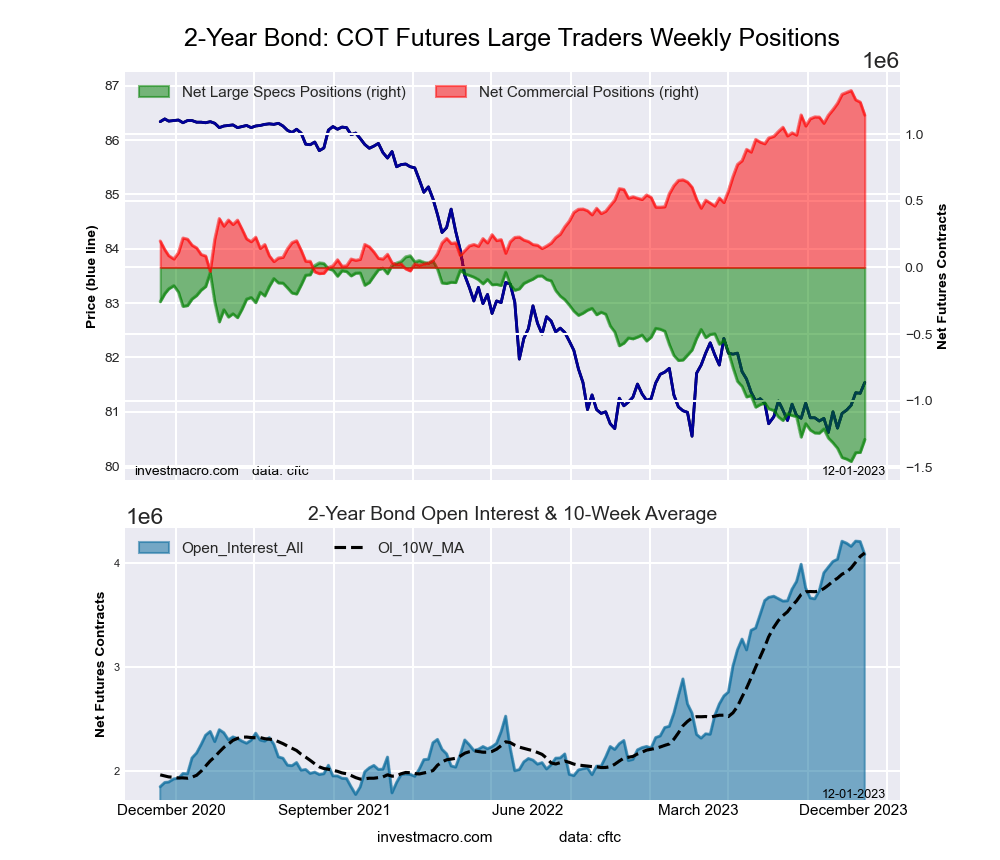
The six-week trend for the speculator strength score was -12.7 this week. The speculator position was -1,435,448 net contracts this week with a decline of -11,136 contracts in the weekly speculator bets.


Soybeans


The Soybeans speculator position comes in as third most bearish extreme standing of the week. The Soybeans speculator level resides at a 0.0 percent score of its 3-year range.

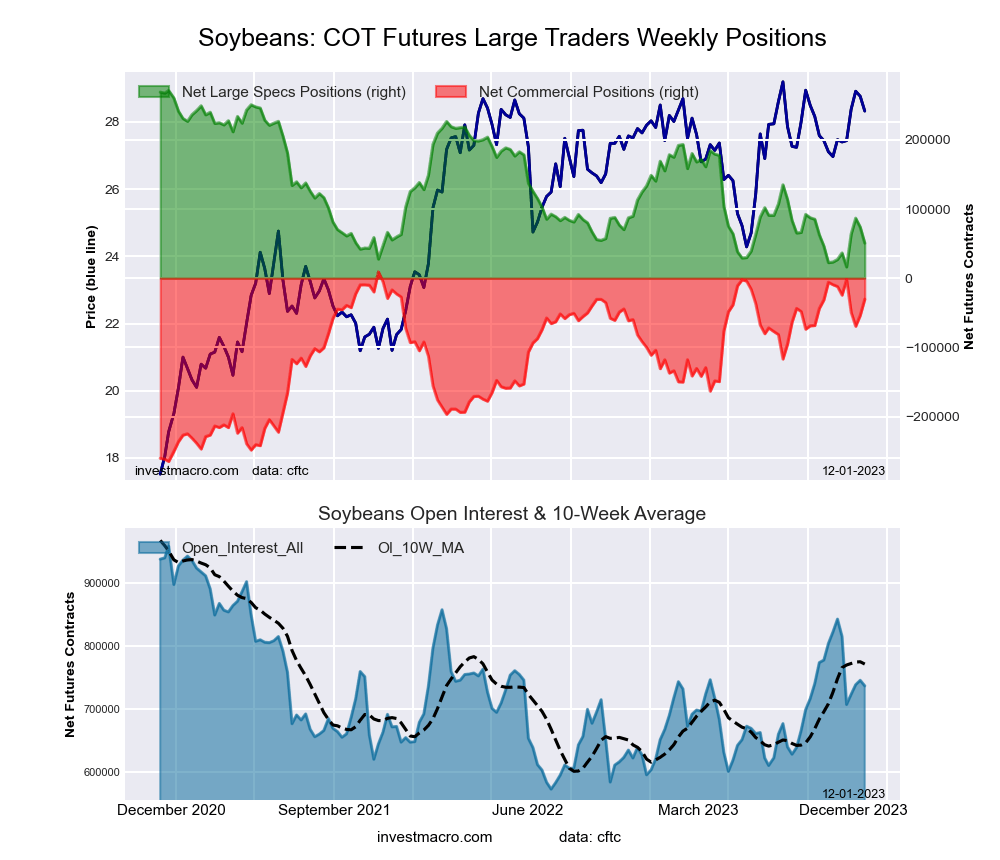
The six-week trend for the speculator strength score was -17.5 this week. The overall speculator position was 16,260 net contracts this week with a drop of -20,194 contracts in the speculator bets.


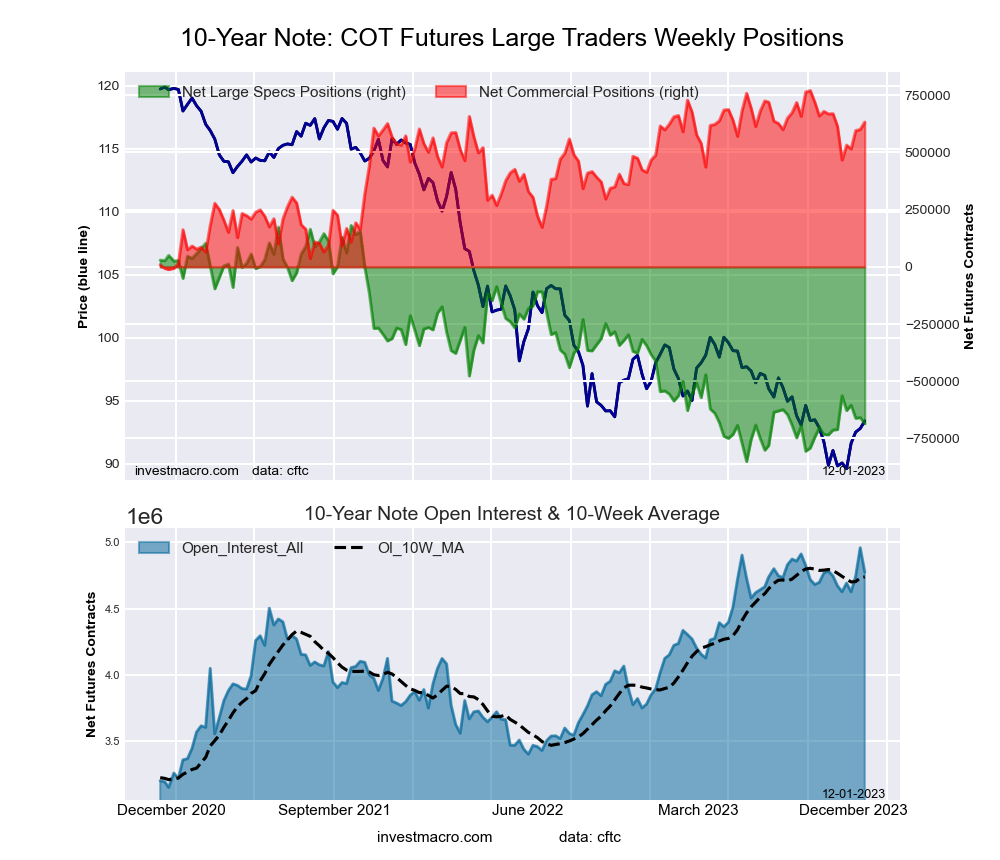
Ultra 10-Year U.S. T-Note


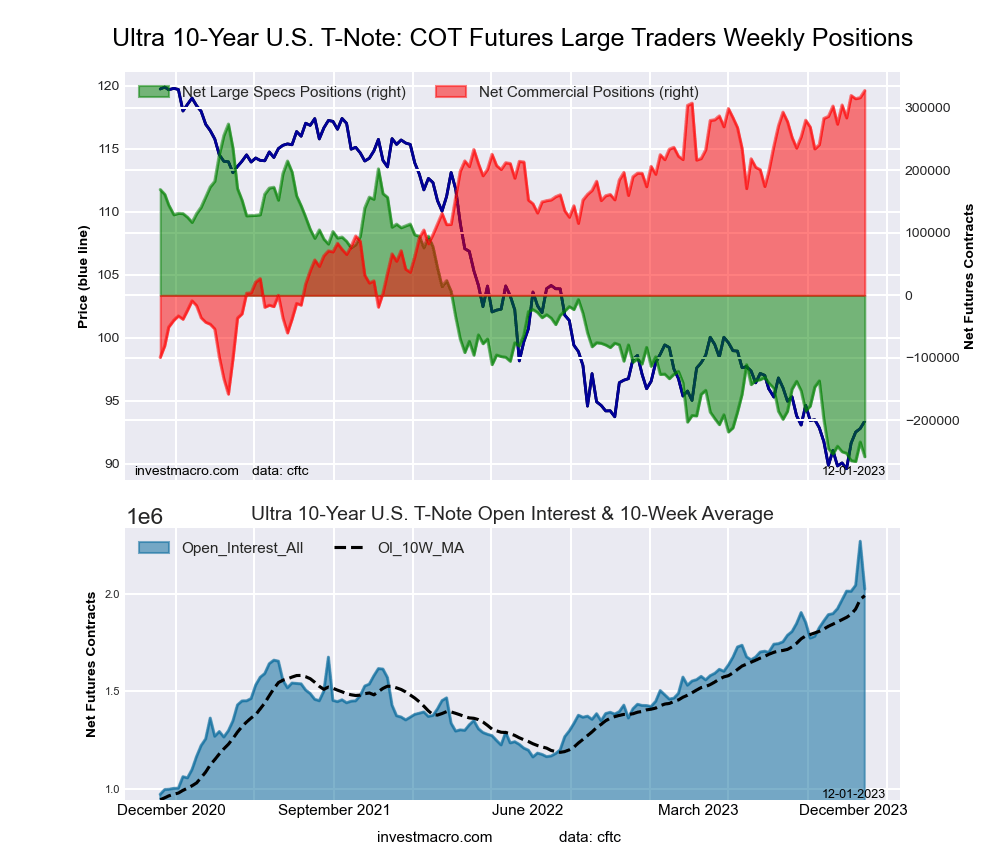
The Ultra 10-Year U.S. T-Note speculator position comes in as this week’s fourth most bearish extreme standing. The Ultra 10-Year U.S. T-Note speculator level is at a 0.2 percent score of its 3-year range.

The six-week trend for the speculator strength score was -21.9 this week. The speculator position was -252,307 net contracts this week with a decrease of -2,438 contracts in the weekly speculator bets.


Corn


Finally, the Corn speculator position comes in as the fifth most bearish extreme standing for this week. The Corn speculator level is at a 4.6 percent score of its 3-year range.

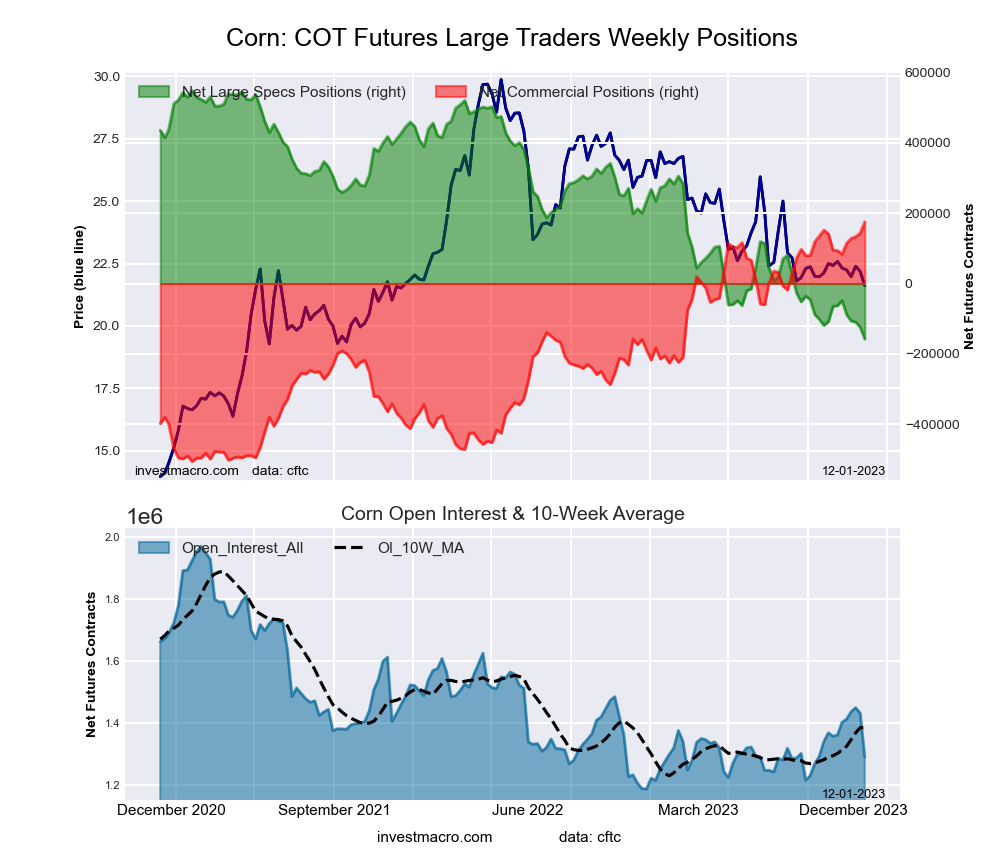
The six-week trend for the speculator strength score was 2.0 this week. The speculator position was -87,696 net contracts this week with a slide of -39,416 contracts in the weekly speculator bets.


Article By InvestMacroReceive our weekly COT Newsletter

*COT Report: The COT data, released weekly to the public each Friday, is updated through the most recent Tuesday (data is 3 days old) and shows a quick view of how large speculators or non-commercials (for-profit traders) were positioned in the futures markets.

The CFTC categorizes trader positions according to commercial hedgers (traders who use futures contracts for hedging as part of the business), non-commercials (large traders who speculate to realize trading profits) and nonreportable traders (usually small traders/speculators) as well as their open interest (contracts open in the market at time of reporting). See CFTC criteria here.

COT Stock Market Charts: Speculator Bets led by VIX & Russell 2000-Mini

By InvestMacro

Here are the latest charts and statistics for the Commitment of Traders (COT) data published by the Commodities Futures Trading Commission (CFTC).

The latest COT data is updated through Tuesday October 31st and shows a quick view of how large traders (for-profit speculators and commercial entities) were positioned in the futures markets.

Weekly Speculator Changes led by VIX & Russell-Mini

The COT stock markets speculator bets were higher this week as four out of the seven stock markets we cover had higher positioning while the other three markets had lower speculator contracts.

Leading the gains for the stock markets was the VIX (7,615 contracts) with the Russell-Mini (4,744 contracts), the Nasdaq-Mini (4,040 contracts) and the Nikkei 225 (253 contracts) also showing positive weeks.

The markets with the declines in speculator bets this week were the MSCI EAFE-Mini (-14,986 contracts), the S&P500-Mini (-5,848 contracts)and DowJones-Mini (-151 contracts) also registering lower bets on the week.


Data Snapshot of Stock Market Traders | Columns Legend
Oct-31-2023OIOI-IndexSpec-NetSpec-IndexCom-NetCOM-IndexSmalls-NetSmalls-Index
S&P500-Mini2,174,689184,33765-33,9763529,63949
Nikkei 22514,80628-1,875531,0844279138
Nasdaq-Mini259,306456,73749-6,59236-14569
DowJones-Mini103,93670-36,111040,621100-4,51022
VIX353,53349-13,97910018,7130-4,73472
Nikkei 225 Yen54,580444,776499,66637-14,44261


Strength Scores led by VIX & S&P500-Mini

COT Strength Scores (a normalized measure of Speculator positions over a 3-Year range, from 0 to 100 where above 80 is Extreme-Bullish and below 20 is Extreme-Bearish) showed that the VIX (100 percent) and the S&P500-Mini (65 percent) lead the stock markets this week. The Nikkei 225 (53 percent) come in as the next highest in the weekly strength scores and above 50 percent.

On the downside, the DowJones-Mini (0 percent) and the MSCI EAFE-Mini (12 percent) come in at the lowest strength level currently and are in Extreme-Bearish territory (below 20 percent).

Strength Statistics:
VIX (100.0 percent) vs VIX previous week (94.9 percent)
S&P500-Mini (65.4 percent) vs S&P500-Mini previous week (66.3 percent)
DowJones-Mini (0.0 percent) vs DowJones-Mini previous week (0.3 percent)
Nasdaq-Mini (49.3 percent) vs Nasdaq-Mini previous week (43.1 percent)
Russell2000-Mini (48.3 percent) vs Russell2000-Mini previous week (45.5 percent)
Nikkei USD (53.2 percent) vs Nikkei USD previous week (51.4 percent)
EAFE-Mini (12.3 percent) vs EAFE-Mini previous week (26.7 percent)


S&P500-Mini & Russell-Mini top the 6-Week Strength Trends

COT Strength Score Trends (or move index, calculates the 6-week changes in strength scores) showed that the S&P500-Mini (21 percent) leads the past six weeks trends for the stock markets. The Russell-Mini (14 percent), the VIX (10 percent) and the Nasdaq-Mini (5 percent) are the next highest positive movers in the latest trends data.

The DowJones-Mini (-40 percent) leads the downside trend scores currently with the MSCI EAFE-Mini (-15 percent) and the Nikkei USD (-10 percent) coming in next with lower trend scores.

Strength Trend Statistics:
VIX (9.9 percent) vs VIX previous week (11.9 percent)
S&P500-Mini (21.4 percent) vs S&P500-Mini previous week (18.9 percent)
DowJones-Mini (-40.5 percent) vs DowJones-Mini previous week (-50.9 percent)
Nasdaq-Mini (5.5 percent) vs Nasdaq-Mini previous week (-9.8 percent)
Russell2000-Mini (14.5 percent) vs Russell2000-Mini previous week (11.7 percent)
Nikkei USD (-10.3 percent) vs Nikkei USD previous week (-18.7 percent)
EAFE-Mini (-14.7 percent) vs EAFE-Mini previous week (26.7 percent)


Individual Stock Market Charts:

VIX Volatility Futures:

VIX Volatility Futures COT ChartThe VIX Volatility large speculator standing this week came in at a net position of -13,979 contracts in the data reported through Tuesday. This was a weekly increase of 7,615 contracts from the previous week which had a total of -21,594 net contracts.

This week’s current strength score (the trader positioning range over the past three years, measured from 0 to 100) shows the speculators are currently Bullish-Extreme with a score of 100.0 percent. The commercials are Bearish-Extreme with a score of 0.0 percent and the small traders (not shown in chart) are Bullish with a score of 72.3 percent.

Price Trend-Following Model: Weak Uptrend

Our weekly trend-following model classifies the current market price position as: Weak Uptrend. The current action for the model is considered to be: Hold – Maintain Long Position.

VIX Volatility Futures StatisticsSPECULATORSCOMMERCIALSSMALL TRADERS
– Percent of Open Interest Longs:26.945.37.7
– Percent of Open Interest Shorts:30.840.09.1
– Net Position:-13,97918,713-4,734
– Gross Longs:95,012160,16327,346
– Gross Shorts:108,991141,45032,080
– Long to Short Ratio:0.9 to 11.1 to 10.9 to 1
NET POSITION TREND:
– Strength Index Score (3 Year Range Pct):100.00.072.3
– Strength Index Reading (3 Year Range):Bullish-ExtremeBearish-ExtremeBullish
NET POSITION MOVEMENT INDEX:
– 6-Week Change in Strength Index:9.9-10.24.3


S&P500 Mini Futures:

SP500 Mini Futures COT ChartThe S&P500 Mini large speculator standing this week came in at a net position of 4,337 contracts in the data reported through Tuesday. This was a weekly decline of -5,848 contracts from the previous week which had a total of 10,185 net contracts.

This week’s current strength score (the trader positioning range over the past three years, measured from 0 to 100) shows the speculators are currently Bullish with a score of 65.4 percent. The commercials are Bearish with a score of 35.2 percent and the small traders (not shown in chart) are Bearish with a score of 49.0 percent.

Price Trend-Following Model: Downtrend

Our weekly trend-following model classifies the current market price position as: Downtrend. The current action for the model is considered to be: Hold – Maintain Short Position.

S&P500 Mini Futures StatisticsSPECULATORSCOMMERCIALSSMALL TRADERS
– Percent of Open Interest Longs:13.072.012.0
– Percent of Open Interest Shorts:12.973.610.6
– Net Position:4,337-33,97629,639
– Gross Longs:283,7931,566,648260,265
– Gross Shorts:279,4561,600,624230,626
– Long to Short Ratio:1.0 to 11.0 to 11.1 to 1
NET POSITION TREND:
– Strength Index Score (3 Year Range Pct):65.435.249.0
– Strength Index Reading (3 Year Range):BullishBearishBearish
NET POSITION MOVEMENT INDEX:
– 6-Week Change in Strength Index:21.4-21.96.1


Dow Jones Mini Futures:

Dow Jones Mini Futures COT ChartThe Dow Jones Mini large speculator standing this week came in at a net position of -36,111 contracts in the data reported through Tuesday. This was a weekly decline of -151 contracts from the previous week which had a total of -35,960 net contracts.

This week’s current strength score (the trader positioning range over the past three years, measured from 0 to 100) shows the speculators are currently Bearish-Extreme with a score of 0.0 percent. The commercials are Bullish-Extreme with a score of 100.0 percent and the small traders (not shown in chart) are Bearish with a score of 21.9 percent.

Price Trend-Following Model: Downtrend

Our weekly trend-following model classifies the current market price position as: Downtrend. The current action for the model is considered to be: Hold – Maintain Short Position.

Dow Jones Mini Futures StatisticsSPECULATORSCOMMERCIALSSMALL TRADERS
– Percent of Open Interest Longs:22.966.110.3
– Percent of Open Interest Shorts:57.627.014.6
– Net Position:-36,11140,621-4,510
– Gross Longs:23,78068,69010,657
– Gross Shorts:59,89128,06915,167
– Long to Short Ratio:0.4 to 12.4 to 10.7 to 1
NET POSITION TREND:
– Strength Index Score (3 Year Range Pct):0.0100.021.9
– Strength Index Reading (3 Year Range):Bearish-ExtremeBullish-ExtremeBearish
NET POSITION MOVEMENT INDEX:
– 6-Week Change in Strength Index:-40.540.7-24.3


Nasdaq Mini Futures:

Nasdaq Mini Futures COT ChartThe Nasdaq Mini large speculator standing this week came in at a net position of 6,737 contracts in the data reported through Tuesday. This was a weekly advance of 4,040 contracts from the previous week which had a total of 2,697 net contracts.

This week’s current strength score (the trader positioning range over the past three years, measured from 0 to 100) shows the speculators are currently Bearish with a score of 49.3 percent. The commercials are Bearish with a score of 36.3 percent and the small traders (not shown in chart) are Bullish with a score of 69.3 percent.

Price Trend-Following Model: Downtrend

Our weekly trend-following model classifies the current market price position as: Downtrend. The current action for the model is considered to be: Hold – Maintain Short Position.

Nasdaq Mini Futures StatisticsSPECULATORSCOMMERCIALSSMALL TRADERS
– Percent of Open Interest Longs:27.955.914.6
– Percent of Open Interest Shorts:25.358.414.6
– Net Position:6,737-6,592-145
– Gross Longs:72,368144,95637,843
– Gross Shorts:65,631151,54837,988
– Long to Short Ratio:1.1 to 11.0 to 11.0 to 1
NET POSITION TREND:
– Strength Index Score (3 Year Range Pct):49.336.369.3
– Strength Index Reading (3 Year Range):BearishBearishBullish
NET POSITION MOVEMENT INDEX:
– 6-Week Change in Strength Index:5.5-5.72.3


Russell 2000 Mini Futures:

Russell 2000 Mini Futures COT ChartThe Russell 2000 Mini large speculator standing this week came in at a net position of -39,427 contracts in the data reported through Tuesday. This was a weekly rise of 4,744 contracts from the previous week which had a total of -44,171 net contracts.

This week’s current strength score (the trader positioning range over the past three years, measured from 0 to 100) shows the speculators are currently Bearish with a score of 48.3 percent. The commercials are Bullish with a score of 53.5 percent and the small traders (not shown in chart) are Bearish with a score of 22.1 percent.

Price Trend-Following Model: Strong Downtrend

Our weekly trend-following model classifies the current market price position as: Strong Downtrend. The current action for the model is considered to be: Hold – Maintain Short Position.

Russell 2000 Mini Futures StatisticsSPECULATORSCOMMERCIALSSMALL TRADERS
– Percent of Open Interest Longs:14.679.84.4
– Percent of Open Interest Shorts:21.872.44.6
– Net Position:-39,42740,876-1,449
– Gross Longs:80,998441,73424,237
– Gross Shorts:120,425400,85825,686
– Long to Short Ratio:0.7 to 11.1 to 10.9 to 1
NET POSITION TREND:
– Strength Index Score (3 Year Range Pct):48.353.522.1
– Strength Index Reading (3 Year Range):BearishBullishBearish
NET POSITION MOVEMENT INDEX:
– 6-Week Change in Strength Index:14.5-11.0-13.8


Nikkei Stock Average (USD) Futures:

Nikkei Stock Average (USD) Futures COT ChartThe Nikkei Stock Average (USD) large speculator standing this week came in at a net position of -1,875 contracts in the data reported through Tuesday. This was a weekly rise of 253 contracts from the previous week which had a total of -2,128 net contracts.

This week’s current strength score (the trader positioning range over the past three years, measured from 0 to 100) shows the speculators are currently Bullish with a score of 53.2 percent. The commercials are Bearish with a score of 42.5 percent and the small traders (not shown in chart) are Bearish with a score of 38.3 percent.

Price Trend-Following Model: Downtrend

Our weekly trend-following model classifies the current market price position as: Downtrend. The current action for the model is considered to be: Hold – Maintain Short Position.

Nikkei Stock Average Futures StatisticsSPECULATORSCOMMERCIALSSMALL TRADERS
– Percent of Open Interest Longs:4.672.622.8
– Percent of Open Interest Shorts:17.265.317.5
– Net Position:-1,8751,084791
– Gross Longs:67910,7453,382
– Gross Shorts:2,5549,6612,591
– Long to Short Ratio:0.3 to 11.1 to 11.3 to 1
NET POSITION TREND:
– Strength Index Score (3 Year Range Pct):53.242.538.3
– Strength Index Reading (3 Year Range):BullishBearishBearish
NET POSITION MOVEMENT INDEX:
– 6-Week Change in Strength Index:-10.312.3-7.1


MSCI EAFE Mini Futures:

MSCI EAFE Mini Futures COT ChartThe MSCI EAFE Mini large speculator standing this week came in at a net position of -45,485 contracts in the data reported through Tuesday. This was a weekly fall of -14,986 contracts from the previous week which had a total of -30,499 net contracts.

This week’s current strength score (the trader positioning range over the past three years, measured from 0 to 100) shows the speculators are currently Bearish-Extreme with a score of 12.3 percent. The commercials are Bullish-Extreme with a score of 90.9 percent and the small traders (not shown in chart) are Bearish with a score of 21.2 percent.

Price Trend-Following Model: Downtrend

Our weekly trend-following model classifies the current market price position as: Downtrend. The current action for the model is considered to be: Hold – Maintain Short Position.

MSCI EAFE Mini Futures StatisticsSPECULATORSCOMMERCIALSSMALL TRADERS
– Percent of Open Interest Longs:5.391.42.5
– Percent of Open Interest Shorts:16.780.22.3
– Net Position:-45,48544,671814
– Gross Longs:21,077363,6939,868
– Gross Shorts:66,562319,0229,054
– Long to Short Ratio:0.3 to 11.1 to 11.1 to 1
NET POSITION TREND:
– Strength Index Score (3 Year Range Pct):12.390.921.2
– Strength Index Reading (3 Year Range):Bearish-ExtremeBullish-ExtremeBearish
NET POSITION MOVEMENT INDEX:
– 6-Week Change in Strength Index:-14.716.6-9.0


Article By InvestMacroReceive our weekly COT Newsletter

*COT Report: The COT data, released weekly to the public each Friday, is updated through the most recent Tuesday (data is 3 days old) and shows a quick view of how large speculators or non-commercials (for-profit traders) were positioned in the futures markets.

The CFTC categorizes trader positions according to commercial hedgers (traders who use futures contracts for hedging as part of the business), non-commercials (large traders who speculate to realize trading profits) and nonreportable traders (usually small traders/speculators) as well as their open interest (contracts open in the market at time of reporting). See CFTC criteria here.

COT Soft Commodities Charts: Speculator Bets led by Soybean Meal & Coffee

By InvestMacro

Here are the latest charts and statistics for the Commitment of Traders (COT) reports data published by the Commodities Futures Trading Commission (CFTC).

The latest COT data is updated through Tuesday October 31st and shows a quick view of how large traders (for-profit speculators and commercial entities) were positioned in the futures markets.

Weekly Speculator Changes led by Soybean Meal & Coffee

The COT soft commodities markets speculator bets were lower this week as just three out of the eleven softs markets we cover had higher positioning while the other eight markets had lower speculator contracts.

Leading the gains for the softs markets was Soybean Meal (13,342 contracts) with Coffee (4,071 contracts) and Lean Hogs (2,532 contracts) also recording a positive week.

The markets with declines in speculator bets this week were Corn (-39,416 contracts), Soybeans (-20,194 contracts), Sugar (-11,106 contracts), Wheat (-9,620 contracts), Cocoa (-7,543 contracts), Live Cattle (-6,671 contracts), Soybean Oil (-6,037 contracts) and Cotton (-16 contracts) also seeing lower bets on the week.


Data Snapshot of Commodity Market Traders | Columns Legend
Oct-31-2023OIOI-IndexSpec-NetSpec-IndexCom-NetCOM-IndexSmalls-NetSmalls-Index
WTI Crude1,671,25524262,25831-308,7676746,50973
Gold475,80825163,42549-182,7075319,28231
Silver126,5491520,21147-33,1395412,92838
Copper222,56660-17,1611618,39587-1,23411
Palladium22,943100-10,253810,163929047
Platinum74,7686510,82641-14,186643,36013
Natural Gas1,186,14046-54,6525339,9245214,72815
Brent139,93319-31,4885128,628512,86050
Heating Oil299,9283631,39180-52,1272720,73666
Soybeans706,9233516,2600-1,81396-14,44769
Corn1,412,10829-87,6965114,05394-26,35798
Coffee203,1302022,27950-21,87654-4038
Sugar865,85940213,58968-258,5873044,99861
Wheat460,210100-69,5671768,5938497472


Strength Scores led by Cocoa & Sugar

COT Strength Scores (a normalized measure of Speculator positions over a 3-Year range, from 0 to 100 where above 80 is Extreme-Bullish and below 20 is Extreme-Bearish) showed that Cocoa (81 percent) and Sugar (68 percent) led the softs markets this week. Soybean Meal (68 percent) and Coffee (50 percent) come in as the next highest with strength scores above 50 percent.

On the downside, Soybeans (0 percent), Corn (5 percent), Lean Hogs (15 percent) and the Wheat (17 percent) come in at the lowest strength levels currently and are in Extreme-Bearish territory (below 20 percent).

Strength Statistics:
Corn (4.6 percent) vs Corn previous week (10.5 percent)
Sugar (67.9 percent) vs Sugar previous week (71.9 percent)
Coffee (50.3 percent) vs Coffee previous week (46.1 percent)
Soybeans (0.0 percent) vs Soybeans previous week (7.6 percent)
Soybean Oil (32.7 percent) vs Soybean Oil previous week (36.2 percent)
Soybean Meal (68.1 percent) vs Soybean Meal previous week (60.6 percent)
Live Cattle (33.1 percent) vs Live Cattle previous week (40.3 percent)
Lean Hogs (14.7 percent) vs Lean Hogs previous week (12.6 percent)
Cotton (25.8 percent) vs Cotton previous week (25.8 percent)
Cocoa (80.8 percent) vs Cocoa previous week (88.5 percent)
Wheat (17.4 percent) vs Wheat previous week (24.2 percent)


Coffee & Soybean Meal top the 6-Week Strength Trends

COT Strength Score Trends (or move index, calculates the 6-week changes in strength scores) showed that Coffee (27 percent) and Soybean Meal (18 percent) lead the past six weeks trends for soft commodities. Corn (2 percent) is the only other positive mover in the latest trends data.

Live Cattle (-53 percent) leads the downside trend scores currently with Cotton (-21 percent), Cocoa (-19 percent), Soybeans (-18 percent) and Soybean Oil (-17 percent) following next with lower trend scores.

Strength Trend Statistics:
Corn (2.0 percent) vs Corn previous week (6.0 percent)
Sugar (-11.1 percent) vs Sugar previous week (-7.1 percent)
Coffee (27.4 percent) vs Coffee previous week (35.7 percent)
Soybeans (-17.5 percent) vs Soybeans previous week (-18.3 percent)
Soybean Oil (-17.1 percent) vs Soybean Oil previous week (-8.6 percent)
Soybean Meal (18.1 percent) vs Soybean Meal previous week (10.0 percent)
Live Cattle (-53.2 percent) vs Live Cattle previous week (-38.5 percent)
Lean Hogs (-16.2 percent) vs Lean Hogs previous week (-16.4 percent)
Cotton (-21.4 percent) vs Cotton previous week (-21.6 percent)
Cocoa (-19.2 percent) vs Cocoa previous week (-10.8 percent)
Wheat (-9.0 percent) vs Wheat previous week (-7.3 percent)


Individual Soft Commodities Markets:

CORN Futures:

CORN Futures COT ChartThe CORN large speculator standing this week recorded a net position of -87,696 contracts in the data reported through Tuesday. This was a weekly decrease of -39,416 contracts from the previous week which had a total of -48,280 net contracts.

This week’s current strength score (the trader positioning range over the past three years, measured from 0 to 100) shows the speculators are currently Bearish-Extreme with a score of 4.6 percent. The commercials are Bullish-Extreme with a score of 94.3 percent and the small traders (not shown in chart) are Bullish-Extreme with a score of 97.9 percent.

Price Trend-Following Model: Downtrend

Our weekly trend-following model classifies the current market price position as: Downtrend. The current action for the model is considered to be: Hold – Maintain Short Position.

CORN Futures StatisticsSPECULATORSCOMMERCIALSSMALL TRADERS
– Percent of Open Interest Longs:19.846.710.2
– Percent of Open Interest Shorts:26.038.612.1
– Net Position:-87,696114,053-26,357
– Gross Longs:278,919659,639144,375
– Gross Shorts:366,615545,586170,732
– Long to Short Ratio:0.8 to 11.2 to 10.8 to 1
NET POSITION TREND:
– Strength Index Score (3 Year Range Pct):4.694.397.9
– Strength Index Reading (3 Year Range):Bearish-ExtremeBullish-ExtremeBullish-Extreme
NET POSITION MOVEMENT INDEX:
– 6-Week Change in Strength Index:2.0-3.212.8


SUGAR Futures:

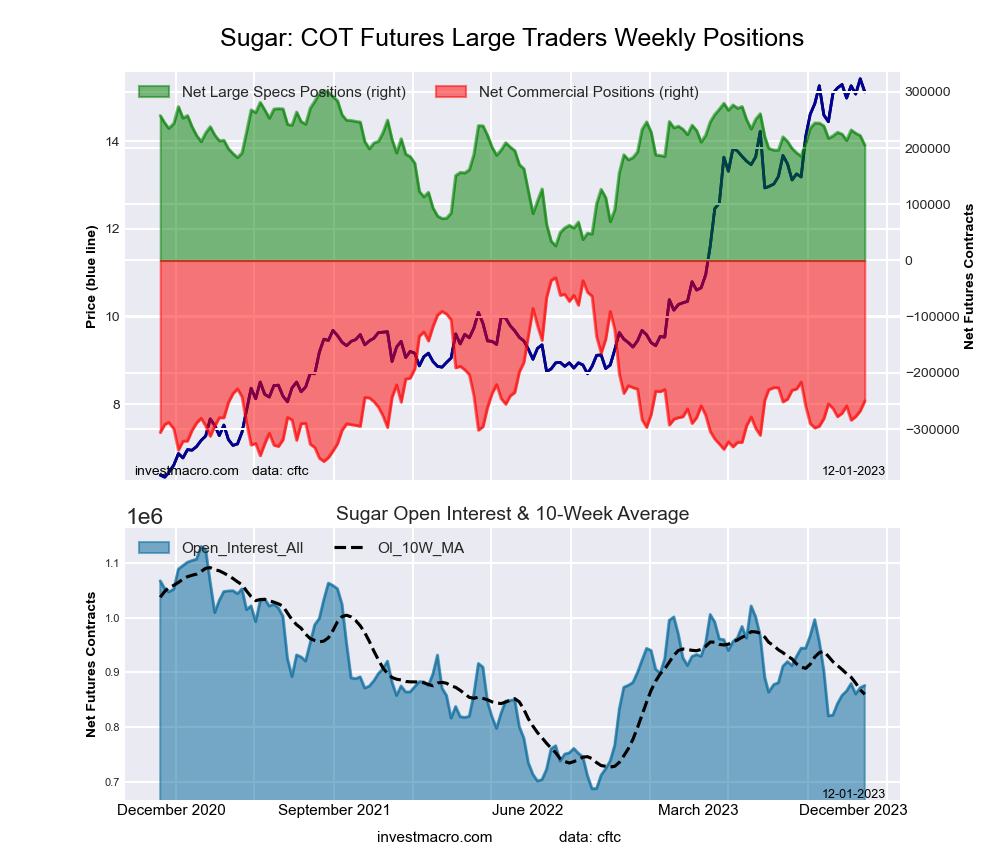
SUGAR Futures COT ChartThe SUGAR large speculator standing this week recorded a net position of 213,589 contracts in the data reported through Tuesday. This was a weekly decrease of -11,106 contracts from the previous week which had a total of 224,695 net contracts.

This week’s current strength score (the trader positioning range over the past three years, measured from 0 to 100) shows the speculators are currently Bullish with a score of 67.9 percent. The commercials are Bearish with a score of 30.2 percent and the small traders (not shown in chart) are Bullish with a score of 61.1 percent.

Price Trend-Following Model: Uptrend

Our weekly trend-following model classifies the current market price position as: Uptrend. The current action for the model is considered to be: Hold – Maintain Long Position.

SUGAR Futures StatisticsSPECULATORSCOMMERCIALSSMALL TRADERS
– Percent of Open Interest Longs:35.938.810.0
– Percent of Open Interest Shorts:11.268.74.8
– Net Position:213,589-258,58744,998
– Gross Longs:310,643336,35786,511
– Gross Shorts:97,054594,94441,513
– Long to Short Ratio:3.2 to 10.6 to 12.1 to 1
NET POSITION TREND:
– Strength Index Score (3 Year Range Pct):67.930.261.1
– Strength Index Reading (3 Year Range):BullishBearishBullish
NET POSITION MOVEMENT INDEX:
– 6-Week Change in Strength Index:-11.111.0-7.0


COFFEE Futures:

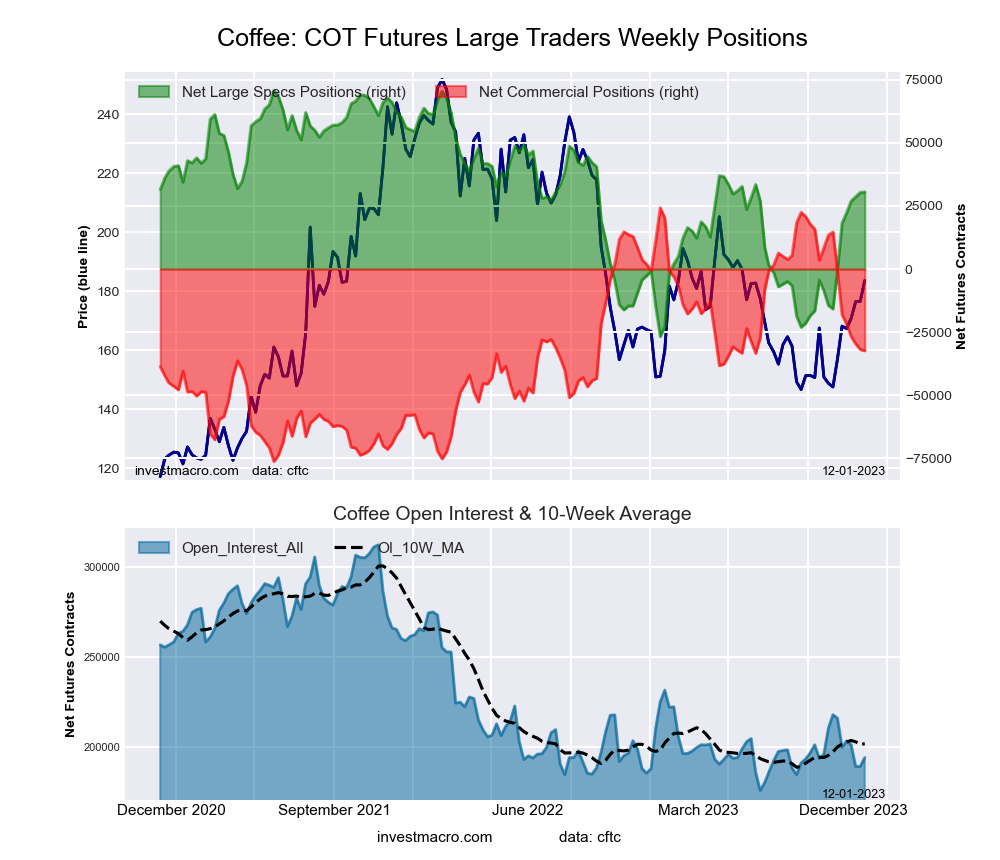
COFFEE Futures COT ChartThe COFFEE large speculator standing this week recorded a net position of 22,279 contracts in the data reported through Tuesday. This was a weekly gain of 4,071 contracts from the previous week which had a total of 18,208 net contracts.

This week’s current strength score (the trader positioning range over the past three years, measured from 0 to 100) shows the speculators are currently Bullish with a score of 50.3 percent. The commercials are Bullish with a score of 54.1 percent and the small traders (not shown in chart) are Bearish-Extreme with a score of 7.7 percent.

Price Trend-Following Model: Weak Downtrend (Possible Trend Change)

Our weekly trend-following model classifies the current market price position as: Weak Downtrend. The current action for the model is considered to be: Hold – Maintain Short Position.

COFFEE Futures StatisticsSPECULATORSCOMMERCIALSSMALL TRADERS
– Percent of Open Interest Longs:26.941.94.8
– Percent of Open Interest Shorts:16.052.65.0
– Net Position:22,279-21,876-403
– Gross Longs:54,72785,0149,706
– Gross Shorts:32,448106,89010,109
– Long to Short Ratio:1.7 to 10.8 to 11.0 to 1
NET POSITION TREND:
– Strength Index Score (3 Year Range Pct):50.354.17.7
– Strength Index Reading (3 Year Range):BullishBullishBearish-Extreme
NET POSITION MOVEMENT INDEX:
– 6-Week Change in Strength Index:27.4-25.3-15.6


SOYBEANS Futures:

SOYBEANS Futures COT ChartThe SOYBEANS large speculator standing this week recorded a net position of 16,260 contracts in the data reported through Tuesday. This was a weekly fall of -20,194 contracts from the previous week which had a total of 36,454 net contracts.

This week’s current strength score (the trader positioning range over the past three years, measured from 0 to 100) shows the speculators are currently Bearish-Extreme with a score of 0.0 percent. The commercials are Bullish-Extreme with a score of 96.2 percent and the small traders (not shown in chart) are Bullish with a score of 69.3 percent.

Price Trend-Following Model: Weak Downtrend (Possible Trend Change)

Our weekly trend-following model classifies the current market price position as: Weak Downtrend. The current action for the model is considered to be: New Sell – Short Position.

SOYBEANS Futures StatisticsSPECULATORSCOMMERCIALSSMALL TRADERS
– Percent of Open Interest Longs:14.757.27.0
– Percent of Open Interest Shorts:12.457.49.0
– Net Position:16,260-1,813-14,447
– Gross Longs:103,628404,12449,384
– Gross Shorts:87,368405,93763,831
– Long to Short Ratio:1.2 to 11.0 to 10.8 to 1
NET POSITION TREND:
– Strength Index Score (3 Year Range Pct):0.096.269.3
– Strength Index Reading (3 Year Range):Bearish-ExtremeBullish-ExtremeBullish
NET POSITION MOVEMENT INDEX:
– 6-Week Change in Strength Index:-17.514.510.8


SOYBEAN OIL Futures:

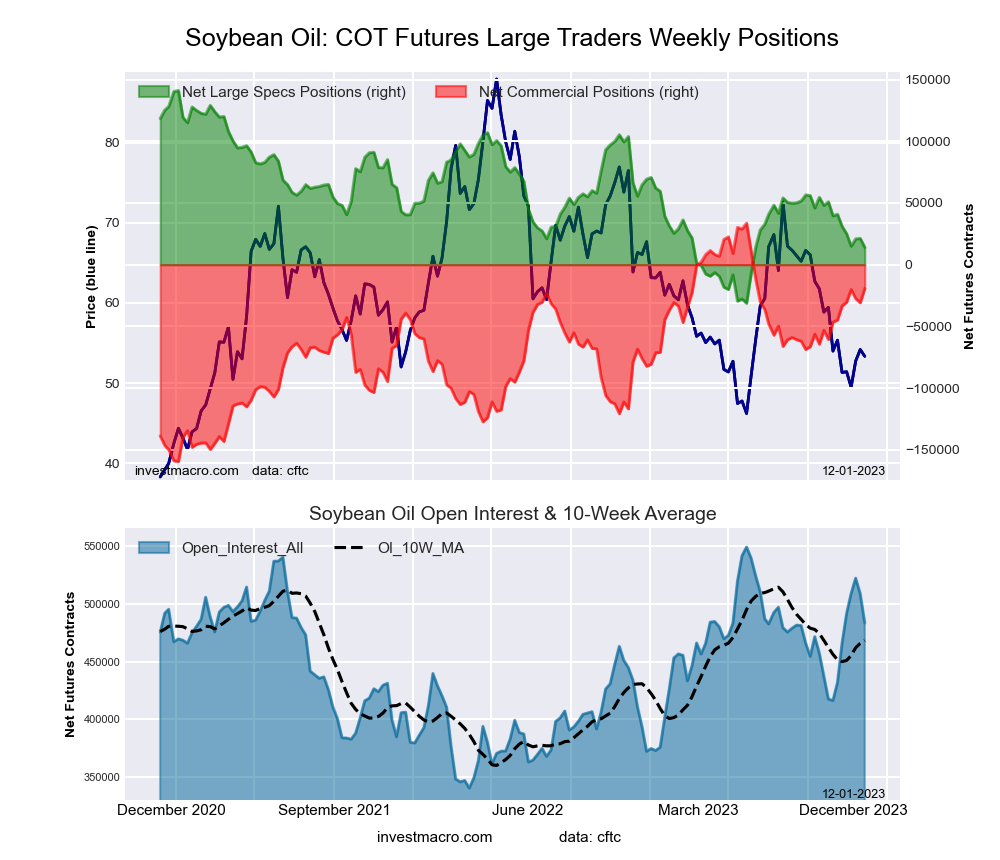
SOYBEAN OIL Futures COT ChartThe SOYBEAN OIL large speculator standing this week recorded a net position of 25,102 contracts in the data reported through Tuesday. This was a weekly lowering of -6,037 contracts from the previous week which had a total of 31,139 net contracts.

This week’s current strength score (the trader positioning range over the past three years, measured from 0 to 100) shows the speculators are currently Bearish with a score of 32.7 percent. The commercials are Bullish with a score of 66.8 percent and the small traders (not shown in chart) are Bearish with a score of 33.4 percent.

Price Trend-Following Model: Strong Downtrend

Our weekly trend-following model classifies the current market price position as: Strong Downtrend. The current action for the model is considered to be: Hold – Maintain Short Position.

SOYBEAN OIL Futures StatisticsSPECULATORSCOMMERCIALSSMALL TRADERS
– Percent of Open Interest Longs:21.149.16.5
– Percent of Open Interest Shorts:16.055.35.5
– Net Position:25,102-30,4345,332
– Gross Longs:103,802241,47032,168
– Gross Shorts:78,700271,90426,836
– Long to Short Ratio:1.3 to 10.9 to 11.2 to 1
NET POSITION TREND:
– Strength Index Score (3 Year Range Pct):32.766.833.4
– Strength Index Reading (3 Year Range):BearishBullishBearish
NET POSITION MOVEMENT INDEX:
– 6-Week Change in Strength Index:-17.117.6-16.8


SOYBEAN MEAL Futures:

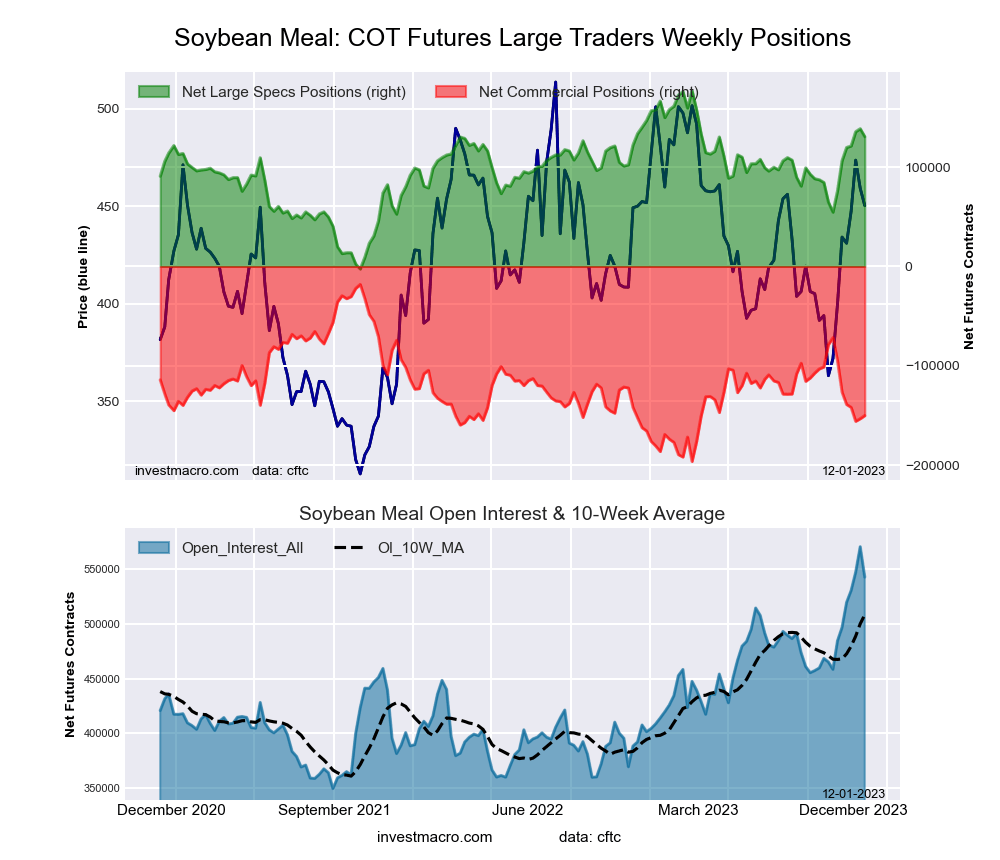
SOYBEAN MEAL Futures COT ChartThe SOYBEAN MEAL large speculator standing this week recorded a net position of 119,668 contracts in the data reported through Tuesday. This was a weekly gain of 13,342 contracts from the previous week which had a total of 106,326 net contracts.

This week’s current strength score (the trader positioning range over the past three years, measured from 0 to 100) shows the speculators are currently Bullish with a score of 68.1 percent. The commercials are Bearish with a score of 32.2 percent and the small traders (not shown in chart) are Bearish with a score of 41.5 percent.

Price Trend-Following Model: Weak Downtrend (Possible Trend Change)

Our weekly trend-following model classifies the current market price position as: Weak Downtrend. The current action for the model is considered to be: Hold – Maintain Short Position.

SOYBEAN MEAL Futures StatisticsSPECULATORSCOMMERCIALSSMALL TRADERS
– Percent of Open Interest Longs:28.836.89.8
– Percent of Open Interest Shorts:5.863.56.1
– Net Position:119,668-138,84219,174
– Gross Longs:149,649191,13451,015
– Gross Shorts:29,981329,97631,841
– Long to Short Ratio:5.0 to 10.6 to 11.6 to 1
NET POSITION TREND:
– Strength Index Score (3 Year Range Pct):68.132.241.5
– Strength Index Reading (3 Year Range):BullishBearishBearish
NET POSITION MOVEMENT INDEX:
– 6-Week Change in Strength Index:18.1-20.114.8


LIVE CATTLE Futures:

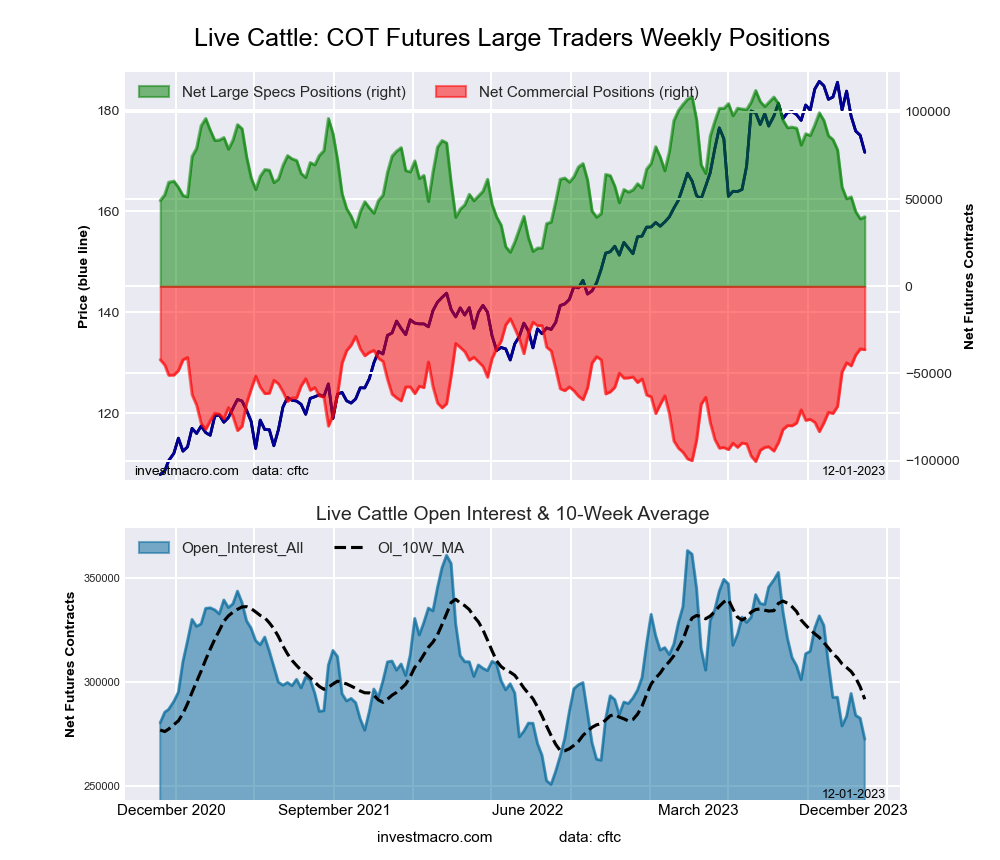
LIVE CATTLE Futures COT ChartThe LIVE CATTLE large speculator standing this week recorded a net position of 50,186 contracts in the data reported through Tuesday. This was a weekly reduction of -6,671 contracts from the previous week which had a total of 56,857 net contracts.

This week’s current strength score (the trader positioning range over the past three years, measured from 0 to 100) shows the speculators are currently Bearish with a score of 33.1 percent. The commercials are Bullish with a score of 69.1 percent and the small traders (not shown in chart) are Bullish with a score of 55.9 percent.

Price Trend-Following Model: Uptrend

Our weekly trend-following model classifies the current market price position as: Uptrend. The current action for the model is considered to be: Hold – Maintain Long Position.

LIVE CATTLE Futures StatisticsSPECULATORSCOMMERCIALSSMALL TRADERS
– Percent of Open Interest Longs:34.035.49.8
– Percent of Open Interest Shorts:16.350.912.0
– Net Position:50,186-43,839-6,347
– Gross Longs:96,331100,46127,680
– Gross Shorts:46,145144,30034,027
– Long to Short Ratio:2.1 to 10.7 to 10.8 to 1
NET POSITION TREND:
– Strength Index Score (3 Year Range Pct):33.169.155.9
– Strength Index Reading (3 Year Range):BearishBullishBullish
NET POSITION MOVEMENT INDEX:
– 6-Week Change in Strength Index:-53.248.252.3


LEAN HOGS Futures:

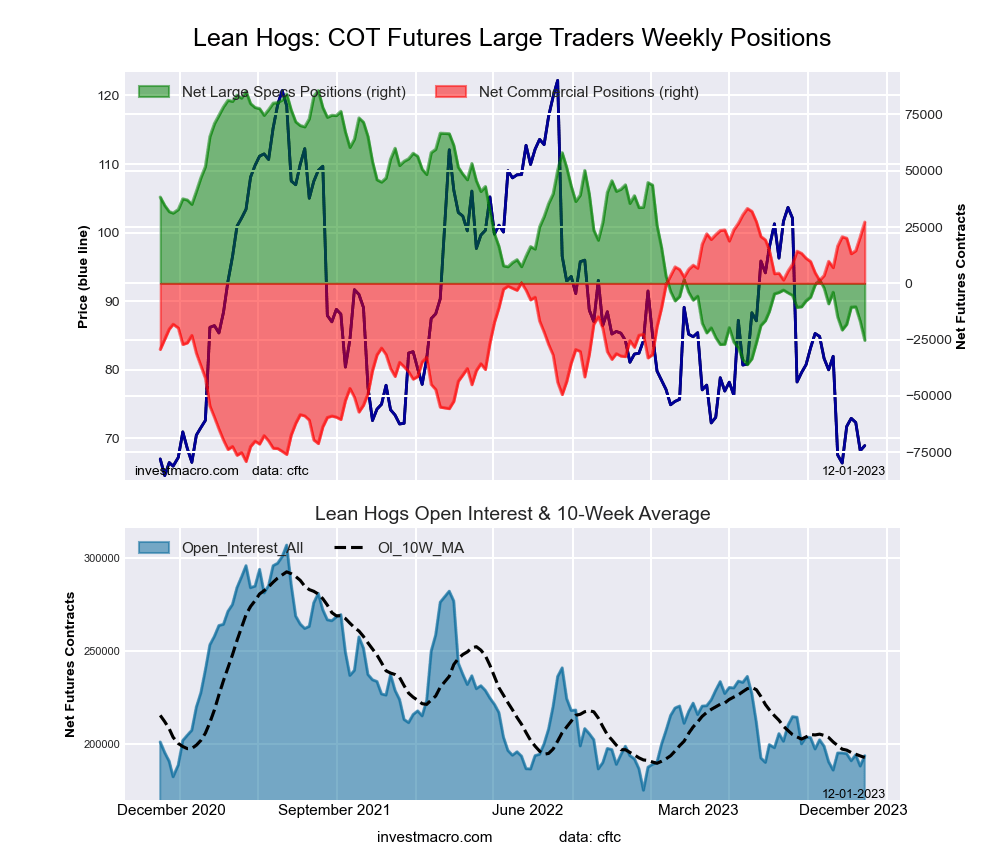
LEAN HOGS Futures COT ChartThe LEAN HOGS large speculator standing this week recorded a net position of -18,189 contracts in the data reported through Tuesday. This was a weekly increase of 2,532 contracts from the previous week which had a total of -20,721 net contracts.

This week’s current strength score (the trader positioning range over the past three years, measured from 0 to 100) shows the speculators are currently Bearish-Extreme with a score of 14.7 percent. The commercials are Bullish-Extreme with a score of 88.2 percent and the small traders (not shown in chart) are Bullish with a score of 75.2 percent.

Price Trend-Following Model: Downtrend

Our weekly trend-following model classifies the current market price position as: Downtrend. The current action for the model is considered to be: Hold – Maintain Short Position.

LEAN HOGS Futures StatisticsSPECULATORSCOMMERCIALSSMALL TRADERS
– Percent of Open Interest Longs:28.039.49.4
– Percent of Open Interest Shorts:37.429.110.3
– Net Position:-18,18920,010-1,821
– Gross Longs:54,52176,62018,275
– Gross Shorts:72,71056,61020,096
– Long to Short Ratio:0.7 to 11.4 to 10.9 to 1
NET POSITION TREND:
– Strength Index Score (3 Year Range Pct):14.788.275.2
– Strength Index Reading (3 Year Range):Bearish-ExtremeBullish-ExtremeBullish
NET POSITION MOVEMENT INDEX:
– 6-Week Change in Strength Index:-16.216.74.8


COTTON Futures:

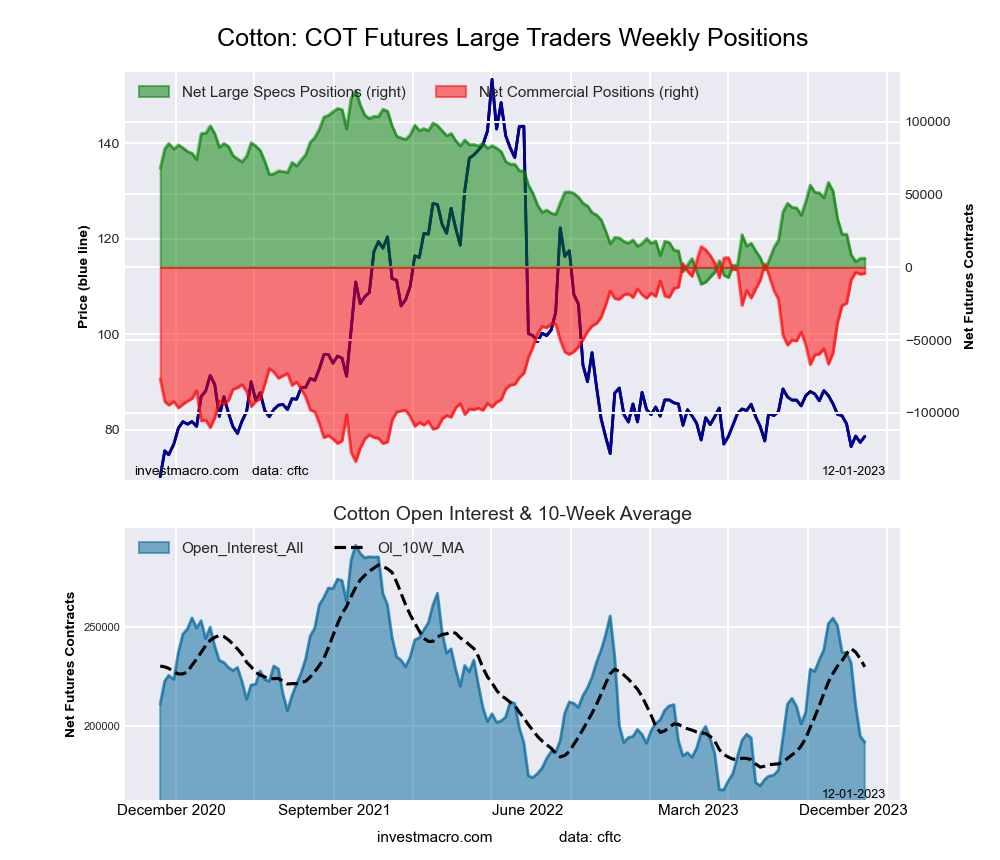
COTTON Futures COT ChartThe COTTON large speculator standing this week recorded a net position of 22,664 contracts in the data reported through Tuesday. This was a weekly lowering of -16 contracts from the previous week which had a total of 22,680 net contracts.

This week’s current strength score (the trader positioning range over the past three years, measured from 0 to 100) shows the speculators are currently Bearish with a score of 25.8 percent. The commercials are Bullish with a score of 73.6 percent and the small traders (not shown in chart) are Bearish with a score of 28.3 percent.

Price Trend-Following Model: Weak Uptrend (Possible Trend Change)

Our weekly trend-following model classifies the current market price position as: Weak Uptrend. The current action for the model is considered to be: Hold – Maintain Long Position.

COTTON Futures StatisticsSPECULATORSCOMMERCIALSSMALL TRADERS
– Percent of Open Interest Longs:26.947.45.7
– Percent of Open Interest Shorts:17.357.84.9
– Net Position:22,664-24,6802,016
– Gross Longs:63,750112,24713,608
– Gross Shorts:41,086136,92711,592
– Long to Short Ratio:1.6 to 10.8 to 11.2 to 1
NET POSITION TREND:
– Strength Index Score (3 Year Range Pct):25.873.628.3
– Strength Index Reading (3 Year Range):BearishBullishBearish
NET POSITION MOVEMENT INDEX:
– 6-Week Change in Strength Index:-21.423.6-39.2


COCOA Futures:

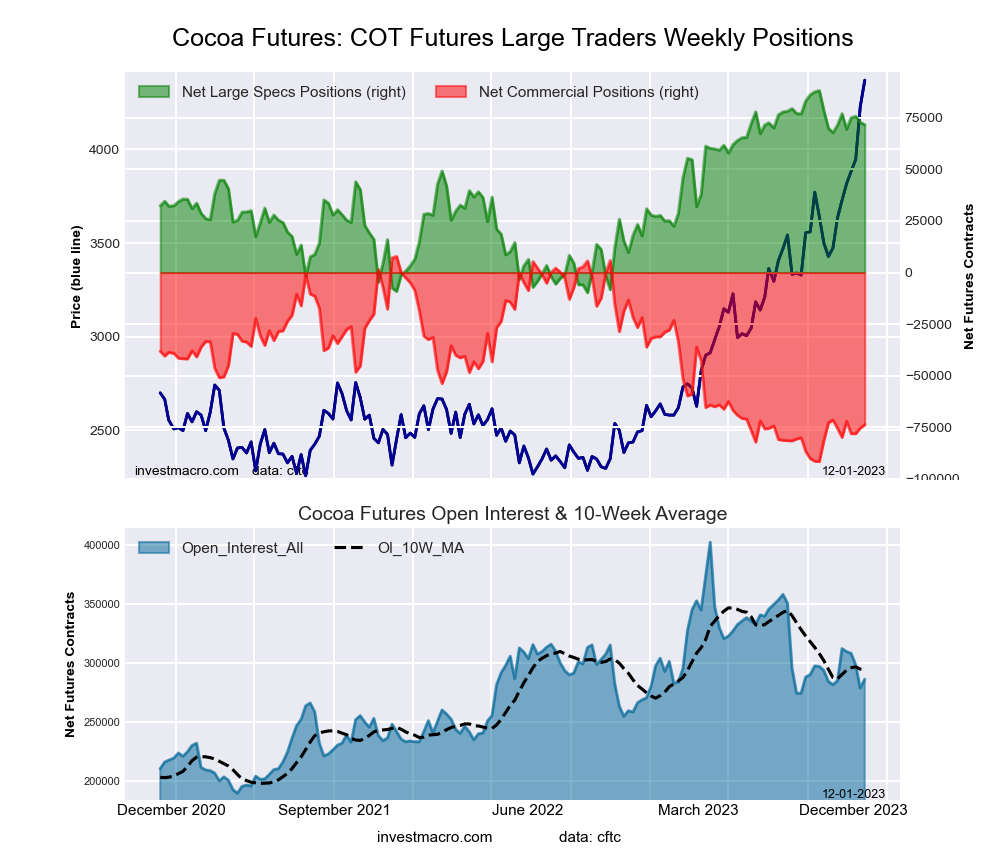
COCOA Futures COT ChartThe COCOA large speculator standing this week recorded a net position of 69,477 contracts in the data reported through Tuesday. This was a weekly decline of -7,543 contracts from the previous week which had a total of 77,020 net contracts.

This week’s current strength score (the trader positioning range over the past three years, measured from 0 to 100) shows the speculators are currently Bullish-Extreme with a score of 80.8 percent. The commercials are Bearish-Extreme with a score of 19.6 percent and the small traders (not shown in chart) are Bearish with a score of 22.8 percent.

Price Trend-Following Model: Strong Uptrend

Our weekly trend-following model classifies the current market price position as: Strong Uptrend. The current action for the model is considered to be: Hold – Maintain Long Position.

COCOA Futures StatisticsSPECULATORSCOMMERCIALSSMALL TRADERS
– Percent of Open Interest Longs:41.426.74.7
– Percent of Open Interest Shorts:18.950.03.9
– Net Position:69,477-72,1062,629
– Gross Longs:128,13682,84814,576
– Gross Shorts:58,659154,95411,947
– Long to Short Ratio:2.2 to 10.5 to 11.2 to 1
NET POSITION TREND:
– Strength Index Score (3 Year Range Pct):80.819.622.8
– Strength Index Reading (3 Year Range):Bullish-ExtremeBearish-ExtremeBearish
NET POSITION MOVEMENT INDEX:
– 6-Week Change in Strength Index:-19.219.6-7.3


WHEAT Futures:

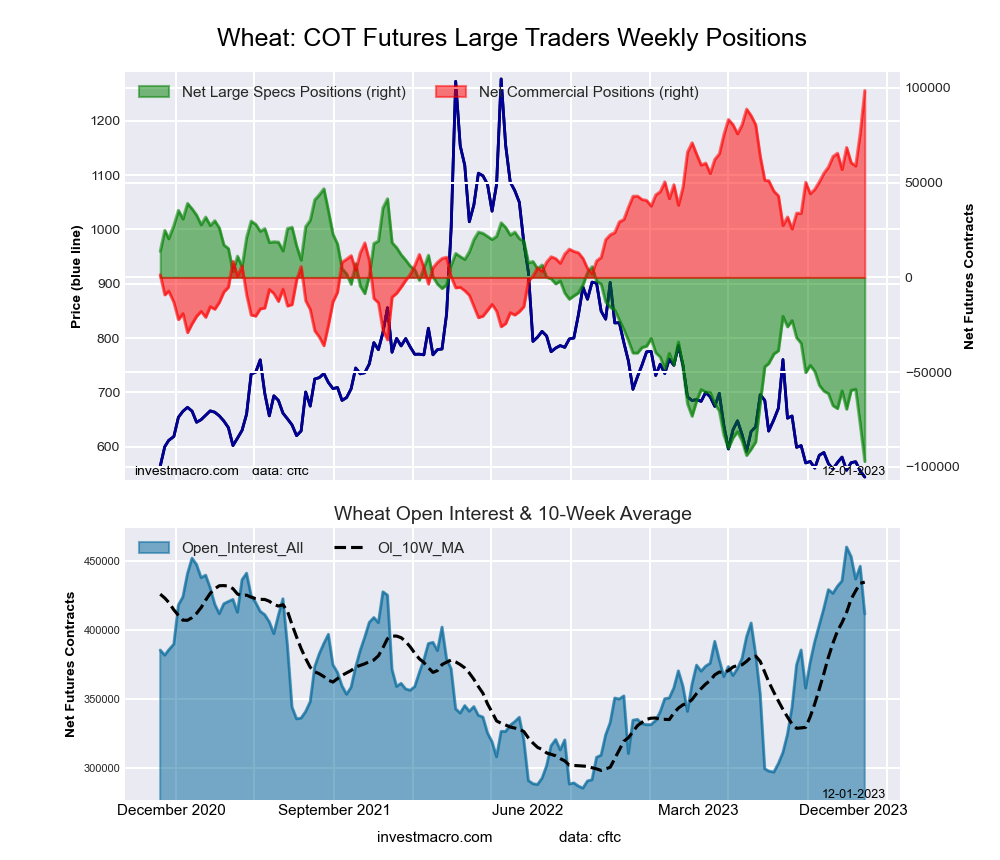
WHEAT Futures COT ChartThe WHEAT large speculator standing this week recorded a net position of -69,567 contracts in the data reported through Tuesday. This was a weekly decline of -9,620 contracts from the previous week which had a total of -59,947 net contracts.

This week’s current strength score (the trader positioning range over the past three years, measured from 0 to 100) shows the speculators are currently Bearish-Extreme with a score of 17.4 percent. The commercials are Bullish-Extreme with a score of 83.8 percent and the small traders (not shown in chart) are Bullish with a score of 71.6 percent.

Price Trend-Following Model: Downtrend

Our weekly trend-following model classifies the current market price position as: Downtrend. The current action for the model is considered to be: Hold – Maintain Short Position.

WHEAT Futures StatisticsSPECULATORSCOMMERCIALSSMALL TRADERS
– Percent of Open Interest Longs:26.734.28.0
– Percent of Open Interest Shorts:41.819.37.8
– Net Position:-69,56768,593974
– Gross Longs:122,955157,36336,998
– Gross Shorts:192,52288,77036,024
– Long to Short Ratio:0.6 to 11.8 to 11.0 to 1
NET POSITION TREND:
– Strength Index Score (3 Year Range Pct):17.483.871.6
– Strength Index Reading (3 Year Range):Bearish-ExtremeBullish-ExtremeBullish
NET POSITION MOVEMENT INDEX:
– 6-Week Change in Strength Index:-9.014.5-22.8


Article By InvestMacroReceive our weekly COT Newsletter

*COT Report: The COT data, released weekly to the public each Friday, is updated through the most recent Tuesday (data is 3 days old) and shows a quick view of how large speculators or non-commercials (for-profit traders) were positioned in the futures markets.

The CFTC categorizes trader positions according to commercial hedgers (traders who use futures contracts for hedging as part of the business), non-commercials (large traders who speculate to realize trading profits) and nonreportable traders (usually small traders/speculators) as well as their open interest (contracts open in the market at time of reporting). See CFTC criteria here.

Week Ahead: EURUSD bear flag waits for fresh catalyst

By ForexTime 

*Note: This report was written before the US NFP data was published*

  • Euro could see volatility next week thanks to EU data dump ​​​​​​
  • Powell remarks could trigger move in USD
  • EURUSD bear flag waits for fresh spark on D1 charts
  • Key levels of interest found at 1.0690, 1.0530 and 1.0450

Caution remains the name of the game as the key US jobs report this afternoon (Friday, 3rd November) approaches.

Even with the growing anticipation, some keen investors may be keeping tab on what’s to come in the week ahead:

Monday, 6th November

  • EUR: Eurozone S&P Global Services PMI, Germany factory orders
  • JPY: BoJ September meeting minutes
  • GBP: BoE chief economic Huw Pill speech

Tuesday, 7th November 

  • CNH: China trade, forex reserves
  • AUD: RBA rate decision
  • EUR: Eurozone PPI, Germany industrial production
  • JPY: Japan household spending
  • USD: US trade, Kansas City Fed President Jeff Schmid speech

Wednesday, 8th November

  • EUR: Eurozone retail sales, Germany CPI
  • GBP: BOE Governor Andrew Bailey speech
  • USD: US wholesale inventories, New York Fed President John Williams speech
  • WSt30_m: Walt Disney earnings

Thursday, 9th November  

  • CNH: China CPI, PPI, money supply, new yuan loans
  • GBP: BOE chief economist Huw Pill speaks
  • USD: US initial jobless claims, Atlanta Fed President Raphael Bostic, Richmond Fed President Tom Barkin, Fed Chair Jerome Powell speech

Friday, 10th November

  • JPY: Japan M2 money stock
  • NZD: New Zealand PMI
  • EUR: ECB President Christine Lagarde speech
  • GBP: UK industrial production, GDP
  • USD: University of Michigan consumer sentiment, Fed speak

Our focus falls on none other than the world’s most traded currency, which is set to be influenced by numerous reports from Europe and the United States, along with speeches from Fed officials including Jerome Powell.

Before we discuss what to expect from the EURUSD next week, it is worth noting that the currency pair is under pressure with a bearish flag pattern in play on the daily charts.

A bearish flag is a candlestick chart pattern that signals the continuation of a downtrend once the technical bounce is finished.

A fresh fundamental spark could be required to trigger a significant technical move on the EURUSD. Here are 3 potential catalysts to keep an eye on in the week ahead:

  1. EU data dump

The euro could see heightened volatility due to top-tier data from Europe in the first half of the week.

Concerns remain elevated over Europe’s outlook with economic growth contracting 0.1% in the third quarter of 2023. However, inflation has fallen to its lowest level in more than two years – strengthening the case for ECB doves and boosting expectations that the ECB will not raise rates further.

Investors will be paying close attention to some key data pieces ranging from Eurozone PMI’s, PPI and retail sales along German factory orders and industrial production among other significant releases from the region.

  • The EURUSD could find itself under fresh selling pressure if overall economic data disappoints and boosts speculation around rate cuts in the first half of 2024.
  • Euro bulls may draw support from strong economic data, especially if this supports expectations around rates remaining higher for longer

As of writing, traders are currently pricing in an 82% probability of a 25-basis point ECB cut by April 2024.

  1. Powell remarks + US data

The Fed not only left interest rates unchanged at its November meeting but Powell also hinted that the central bank could be done with its most aggressive tightening cycle in 40 years.

Powell expressed optimism over the US economy but still warned that there was a long way to go on the inflation fight. Speeches from various Fed officials will be in sharp focus but on Thursday the spotlight shine on Powell as he participates in a panel on monetary policy challenges at the IMF’s annual research conference in Washington. It will be wise to keep an eye on US economic data which could influence monetary policy expectations.

  • Should Fed officials strike a dovish tone and overall US data disappoint, this could strengthen the argument around the Fed being done with hikes – supporting the EURUSD as a result amid dollar weakness.
  • If Powell along with Fed officials sounds more hawkish and US data beats forecasts, expectations could rise around one more Fed hike before the end of 2023, pulling the EURUSD lower as the dollar strengthens.

As of writing, traders are pricing in a 32% probability of a 25 basis point Fed hike by the end of 2023.

  1. Technical forces: bear flag

A bear flag technical pattern could be in play on the daily charts with prices flirting around the 50-day SMA as of writing. Prices are trading below the 100 and 200-day SMA while the MACD trades below zero. Key resistance can be found at 1.0730 and 1.0690. Support may be identified at 1.0530 and 1.0450.

  • Sustained weakness below 1.0730 may encourage prices to slip back towards 1.0530 before targeting the 1.0450 level.
  • Should prices break above 1.0730, this may trigger a move towards the 200-day SMA around 1.0800.

According to Bloomberg’s FX model, there is a 74% chance that the EURUSD will trade between 1.0539 and 1.0768 range over the coming week.


Forex-Time-LogoArticle by ForexTime
ForexTime Ltd (FXTM) is an award winning international online forex broker regulated by CySEC 185/12 www.forextime.com

Canadian Mining Co. An Immediate Speculative Buy

Source: Clive Maund  (11/2/23)

Technical Analyst Clive Maund takes a look at Collective Mining’s 6-month chart to tell you why now is the time to buy this stock.

Collective Mining Ltd. (CNL:TSXV) is rated an Immediate Strong Speculative Buy as close to the open this morning as possible. Its chart is looking very positive and the news came out that it has drilled its best hole to date.

On its latest 6-month chart below, we can see that when it broke down in September and tumbled along with many other gold and silver stocks, its Accumulation line held up well and has even been making new highs. This bodes well for recovery, even without the good news just out.

Right now, it appears to be at the second low of a Double Bottom with the strong Accumulation line already mentioned, still rising 200-day moving average, and positive divergence of momentum (MACD), all pointing to imminent recovery.

Collective Mining is therefore rated an Immediate Strong Speculative Buy as close to the open as possible.

Collective Mining’s website.

Collective Mining Ltd. closed at CA$4.46, $3.19 on October 27, 2023. Collective Mining is thinly traded on the US OTC market, where limit orders should always be employed.

Originally posted at Clivemaund.com at 9.25 EDT on October 30, 2023.


Important Disclosures:

  1. Clive Maund: I determined which companies would be included in this article based on my research and understanding of the sector.
  2. Statements and opinions expressed are the opinions of the author and not of Streetwise Reports or its officers. The author is wholly responsible for the validity of the statements. The author was not paid by Streetwise Reports for this article. Streetwise Reports was not paid by the author to publish or syndicate this article. Streetwise Reports requires contributing authors to disclose any shareholdings in, or economic relationships with, companies that they write about. Streetwise Reports relies upon the authors to accurately provide this information and Streetwise Reports has no means of verifying its accuracy.
  3.  This article does not constitute investment advice. Each reader is encouraged to consult with his or her individual financial professional. By opening this page, each reader accepts and agrees to Streetwise Reports’ terms of use and full legal disclaimer. This article is not a solicitation for investment. Streetwise Reports does not render general or specific investment advice and the information on Streetwise Reports should not be considered a recommendation to buy or sell any security. Streetwise Reports does not endorse or recommend the business, products, services or securities of any company.

For additional disclosures, please click here.

Clivemaund.com Disclosures

The above represents the opinion and analysis of Mr. Maund, based on data available to him, at the time of writing. Mr. Maund’s opinions are his own, and are not a recommendation or an offer to buy or sell securities. Mr. Maund is an independent analyst who receives no compensation of any kind from any groups, individuals or corporations mentioned in his reports. As trading and investing in any financial markets may involve serious risk of loss, Mr. Maund recommends that you consult with a qualified investment advisor, one licensed by appropriate regulatory agencies in your legal jurisdiction and do your own due diligence and research when making any kind of a transaction with financial ramifications. Although a qualified and experienced stock market analyst, Clive Maund is not a Registered Securities Advisor. Therefore Mr. Maund’s opinions on the market and stocks can only be construed as a solicitation to buy and sell securities when they are subject to the prior approval and endorsement of a Registered Securities Advisor operating in accordance with the appropriate regulations in your area of jurisdiction.

Oil and Gas Company Trading at 25% Of Book Value Production Set to Double

Source: Jeffery Hunter  (11/2/23) 

Jeffery Hunter of BullishBriefs shares his thoughts on energy company Avila Energy’s stock.

Avila Energy Corp. (PTRVF:OTCMKTS;VIK:CSE) is an overlooked opportunity trading at a steep discount to book value. After the share price was hit hard after a dramatic SPAC merger breakdown, this diversified energy company currently has a market capitalization under US$5 million, despite having total equity of US$21.3 million on the books. That means Avila Energy’s stock trades at around 25% of its book value per share of US$0.15.

With the price of Western Canadian crude oil sustaining over US$64 per barrel, now could be the ideal time to take advantage of Avila’s discounted share price. The company is focused on ramping up near-term production to capitalize on high commodity prices.

Avila currently produces approximately 570 barrels of oil equivalent per day (boe/d) from its operations in Alberta, Canada. The company plans to double production to 950-1,040 boe/d through a combination of workovers, recompletions, and new drilling. Assuming the lower end of production, US$64 WCS oil and US$3.10 natural gas, my math gives me about 8.1m in annual revenue, considerably higher than their current market cap.

To help fund this growth, Avila Energy is undertaking a US$2.2 million private placement. The capital raised will go directly toward adding barrels and increasing cash flow at a time when market conditions are favorable.

Beyond conventional oil and gas production, Avila Energy is making moves into the clean energy space. The company is developing carbon capture and sequestration technology to reduce the emissions from its upstream operations. Avila is also launching a Vertically Integrated Energy Business using patented micro-turbine technology.

This micro-turbine technology enables modular power generation for homes and businesses. By selling the power directly to consumers, Avila can establish a stable recurring revenue stream. The company estimates each customer could generate around US$500 per month on average.

Avila Energy is positioning itself for the global energy transition. Through a balanced mix of oil and gas production and clean energy sales, the goal is to achieve carbon neutrality by 2024 and net zero emissions by 2027.

With fossil fuel production providing steady cash flow and clean energy initiatives driving future growth, Avila aims to become a unique diversified energy provider. The company has the team and vision to bridge the gap between traditional and renewable energy.

Trading at just a fraction of book value, with near-term production set to double and a pivotal move into clean energy, Avila Energy offers substantial upside for investors. With the CEO owning a whopping 28% of outstanding shares, the opportunity is compelling for those who see the long-term potential in the strategic transition Avila is undertaking.


Important Disclosures:

  1. As of the date of this article, officers and/or employees of Streetwise Reports LLC (including members of their household) own securities of Avila Energy Corp.
  2. Jeffery Hunter: I determined which companies would be included in this article based on my research and understanding of the sector.
  3. Statements and opinions expressed are the opinions of the author and not of Streetwise Reports or its officers. The author is wholly responsible for the validity of the statements. The author was not paid by Streetwise Reports for this article. Streetwise Reports was not paid by the author to publish or syndicate this article. Streetwise Reports requires contributing authors to disclose any shareholdings in, or economic relationships with, companies that they write about. Streetwise Reports relies upon the authors to accurately provide this information and Streetwise Reports has no means of verifying its accuracy.
  4.  This article does not constitute investment advice. Each reader is encouraged to consult with his or her individual financial professional. By opening this page, each reader accepts and agrees to Streetwise Reports’ terms of use and full legal disclaimer. This article is not a solicitation for investment. Streetwise Reports does not render general or specific investment advice and the information on Streetwise Reports should not be considered a recommendation to buy or sell any security. Streetwise Reports does not endorse or recommend the business, products, services or securities of any company.

For additional disclosures, please click here.

Germany’s unemployment rate is on the rise. SNB has reached its inflation target

By JustMarkets

As of Thursday’s stock market close, the Dow Jones Index (US30) increased by 1.70%, while the S&P 500 Index (US500) added 1.89%. The NASDAQ Technology Index (US100) closed positive at 1.78% yesterday. All three indices hit two-week highs. Hopes that the Federal Reserve will not raise interest rates again drove bond yields lower and supported stocks.

Thursday’s economic news out of the US was primarily dovish for Fed policy and bearish for the dollar. Weekly Initial Jobless Claims rose by 5,000 to 217,000, indicating a slightly weaker labor market than expectations of no change at 210,000. Nonfarm labor productivity rose by 4.7% in the third quarter, exceeding expectations of 4.3% and the highest in 3 years.

Apple (AAPL) posted its fourth consecutive loss on revenue of $89.5 billion, down 1% from the previous quarter. The company’s stock fell more than 3.5% on the report. Starbucks (SBUX) closed higher by more than 9% after reporting Q4 comparable sales growth of 8.0%, beating the consensus forecast of 6.31%. Qualcomm (QCOM) closed higher by more than 5% after reporting adjusted Q4 revenue of $8.67 billion. Moderna (MRNA) declined more than 6% and topped the Nasdaq 100 losers list after reporting a third-quarter loss per share of $9.53 after including $3.1 billion in redundancy costs and tax benefits. Airbnb (ABNB) closed down more than 3% after reporting Q4 revenue guidance of $2.13 billion to $2.17 billion, which was worse than expected.

Equity markets in Europe were mainly up yesterday. The German DAX (DE40) rose by 1.48%, the French CAC 40 (FR40) gained 1.85% yesterday, the Spanish IBEX 35 (ES35) added 2.04%, and the British FTSE 100 (UK100) closed positive at 1.42%.

The number of unemployed in Germany for October rose by 30,000, exceeding expectations of 14,000, indicating a weakening labor market. The unemployment rate rose by 0.1% to 5.8% in October, matching expectations and the highest rate in 2 years. Comments from ECB Governing Council spokesman Knott indicate that he favors a pause in ECB rate hikes.

On Thursday, the Bank of England (BOE) voted 6-3 to keep its key interest rate at 5.25%. It said the restrictive policy will likely be needed for an extended period to contain inflation. Bank of England Governor Bailey said policymakers are watching to see if further rate hikes will be required and that it is very early to think about cutting rates.

Swiss inflation remained at 1.7% y/y in October, matching the market consensus. The core rate rose to 1.5% y/y from 1.3%. The Swiss National Bank (SNB) has ensured that inflation is within the 0%-2% target range. One of the reasons the SNB has been able to keep inflation below target is the strong Swiss franc, which has kept inflation from rising. However, the SNB has expressed concern that inflation could exceed the 2% ceiling as electricity, rent, and public transportation costs have increased.

The EIA natural gas inventories report released Thursday showed an increase of 79 Bcf, which was in line with the consensus forecast but above the 5-year average of 57 Bcf. As of October 27, natural gas inventories were up 7.9% y/y and 5.7% above the 5-year seasonal average, indicating ample natural gas reserves ahead of the winter months.

In the Middle East, Israeli soldiers entered Gaza City, completing the encirclement of the urban area that is home to the main forces of the Palestinian militant group Hamas, but now face a host of challenges in fighting in the dense urban environment.

Asian markets were predominantly up yesterday. Japan’s Nikkei 225 (JP225) gained 1.10% yesterday, China’s FTSE China A50 (CHA50) fell by 0.20%, Hong Kong’s Hang Seng (HK50) added 0.75% on the day, and Australia’s ASX 200 (AU200) ended Thursday positive at 0.90%.

Major Australian banks, including ANZ, ING, and Macquarie, raised home loan interest rates in anticipation of the Reserve Bank of Australia (RBA) raising the cash rate by 25 basis points at its next meeting.

S&P 500 (F)(US500) 4,317.78 +79.92 (+1.89%)

Dow Jones (US30) 33,839.08 +564.50 (+1.70%)

DAX (DE40)  15,143.60 +220.33 (+1.48%)

FTSE 100 (UK100) 7,446.53 +104.10 (+1.42%)

USD Index  106.14 −0.75 (−0.70%)

News feed for 2023.11.03:
  • – German Trade Balance (m/m) at 09:00 (GMT+2);
  • – UK Services PMI (m/m) at 11:30 (GMT+2);
  • – Eurozone Unemployment Rate (m/m) at 12:00 (GMT+2);
  • – US Nonfarm Payrolls (m/m) at 14:30 (GMT+2);
  • – US Unemployment Rate (m/m) at 14:30 (GMT+2);
  • – Canada Unemployment Rate (m/m) at 14:30 (GMT+2);
  • – US ISM Services PMI (m/m) at 16:00 (GMT+2).

By JustMarkets


This article reflects a personal opinion and should not be interpreted as an investment advice, and/or offer, and/or a persistent request for carrying out financial transactions, and/or a guarantee, and/or a forecast of future events.

New class of recyclable polymer materials could one day help reduce single-use plastic waste

By Katherine Harry, Colorado State University and Emma Rettner, Colorado State University 

Hundreds of millions of tons of single-use plastic ends up in landfills every year, and even the small percentage of plastic that gets recycled can’t last forever. But our group of materials scientists has developed a new method for creating and deconstructing polymers that could lead to more easily recycled plastics – ones that don’t require you to carefully sort out all your recycling on trash day.

In the century since their conception, people have come to understand the enormous impacts – beneficial as well as detrimental – plastics have on human lives and the environment. As a group of polymer scientists dedicated to inventing sustainable solutions for real-world problems, we set out to tackle this issue by rethinking the way polymers are designed and making plastics with recyclability built right in.

Why use plastics, anyway?

Everyday items including milk jugs, grocery bags, takeout containers and even ropes are made from a class of polymers called polyolefins. Polyolefins make up around half of the plastics produced and disposed of every year.

These polymers are used in plastics commonly labeled as HDPE, LLDPE or PP, or by their recycling codes #2, #4 and #5, respectively. These plastics are incredibly durable because the chemical bonds that make them up are extremely stable. But in a world set up for single-use consumption, this is no longer a design feature but rather a design flaw.

Imagine if half of the plastics used today were recyclable by twice as many processes as they are now. While that wouldn’t get the recycling rate to 100%, a jump from single digits – currently around 9% – to double digits would make a big dent in the plastics produced, the plastics accumulated in the environment and their capacity for recycling and reuse.

Recycling methods we already have

Even the plastics that make it to a recycling facility can’t be reused in exactly the same way they were used before – the recycling process degrades the material, so it loses utility and value. Instead of making a plastic cup that is downgraded each time it gets recycled, manufacturers could potentially make plastics once, collect them and reuse them on and on.

Conventional recycling requires careful sorting of all the collected materials, which can be hard with so many different plastics. Here in the U.S., collection happens mainly through single stream recycling – everything from metal cans, glass bottles, cardboard boxes and plastic cups end up in the same bin. Separating paper from metal doesn’t require complex technology, but sorting a polypropylene container from a polyethylene milk jug is hard to do without the occasional mistake.

When two different plastics are mixed together during recycling, their useful properties are hugely reduced – to the point of making them useless.

But say you can recycle one of these plastics by a different method, so it doesn’t end up contaminating the recycling stream. When we mixed samples of polypropylene with a polymer we made, we were still able to depolymerize – or break down the material – and regain our building blocks without chemically affecting the polypropylene. This indicated that a contaminated waste stream could still recover its value, and the material in it could go on to be recycled, either mechanically or chemically.

Plastics we need − but more recyclable

In a study published in October 2023, our team developed a series of polymers with only two simple building blocks – one soft polymer and one hard polymer – that mimicked polyolefins but could also be chemically recycled.

Connecting two different polymers together multiple times until they form a single, long molecule creates what’s called a multiblock polymer. Just by adjusting how much of each polymer type goes into the multiblock polymer, our team created a wide range of materials with properties that spanned across polyolefin types. But creating these multiblock polymers is easier said than done.

To link these hard and soft polymers, we adapted a technique that had previously been used only on very small molecules. This method is improved relative to traditional methods of making polymers in a step-by-step fashion, developed in the 1920s, where the reactive groups on the end of the molecules need to be exactly matched.

In our method, the reactive groups are now the same as each other, meaning we didn’t have to worry about pairing the ends of each building block to make polymers that can compete with the polyolefins we already use. Using the same strategy, applied in reverse by adding hydrogen, we could disconnect the polymers back into their building blocks and easily separate them to use again.
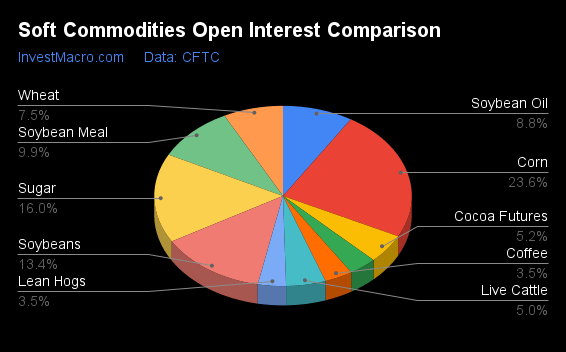
A graph showing a steady increase in single-use plastic use across all plastic types shown, from X to projected in 2050.
Realized and predicted production of commodity plastics through 2050.
International Energy Agency

With an almost twofold increase in annual plastic use projected through 2050, the complexity and quantity of plastic recycling will only increase. It’s an important consideration when designing new materials and products.

Using just two building blocks to make plastics that have a huge variety of properties can go a long way toward reducing and streamlining the number of different plastics used to make the products we need. Instead of needing one plastic to make something pliable, another for something stiff, and a third, fourth and fifth for properties in between, we could control the behavior of plastics by just changing how much of each building block is there.
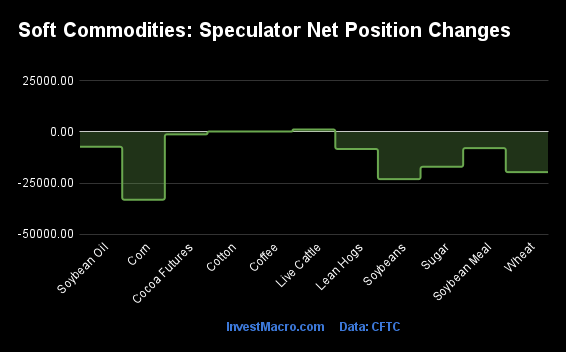
Although we’re still in the process of answering some big questions about these polymers, we believe this work is a step in the right direction toward more sustainable plastics.

We were able to create materials that mimic the properties of plastics the world relies on, and our sights are now set on creating plastic compositions that you couldn’t with existing methods.The Conversation

About the Authors:

Katherine Harry, PhD Student in Chemistry, Colorado State University and Emma Rettner, PhD Candidate in Materials Science and Engineering, Colorado State University

This article is republished from The Conversation under a Creative Commons license. Read the original article.

RoboForex Unveils Commission Schemes for CopyFX Traders on MT5

RoboForex, a well-established financial brokerage company, has unveiled new commission structures designed to empower skilled traders to maximise their potential earnings through the Performance Fee and Subscription Fee models while using the MT5 platform.

RoboForex has expanded its CopyFX service on the MT5 platform with meticulously crafted commission schemes tailored to create a balanced economic framework for the benefit of both traders and investors. The new “Performance Fee” and “Subscription Fee” schemes aim to foster a conducive trading environment where commissions align harmoniously with the profitability of investors’ trades.

Under the Performance Fee scheme, traders earn a portion of the overall profit generated by their subscribed investors from all deals copied for all subscription time. Alternatively, the Subscription Fee scheme ensures traders a fixed commission.
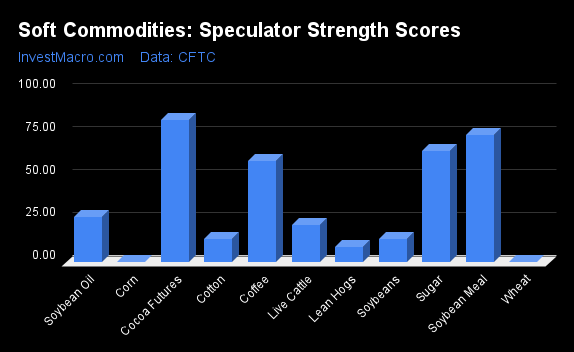
It should be noted that investors only incur the fee if the overall result turns out to be profitable.
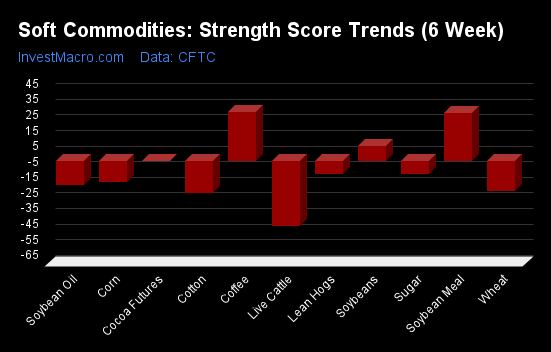
A Symbiotic Relationship Between Traders and Investors

This initiative promotes a mutually beneficial relationship between traders and investors. Skilled traders can explore additional income streams, as their commissions are directly linked to the profits investors earn through copied transactions. In parallel, investors have the flexibility to select traders based on their performance, creating an ecosystem where traders are motivated to enhance their trading strategies. Consequently, higher profits for investors translate into more substantial commissions for traders.

What CopyFX Can Offer Clients on MT5

CopyFX on MT5 offers a combination of cost-effectiveness with a minimal deposit requirement of 100 USD. It also provides a secure, flexible, and user-friendly investment management infrastructure. With just an MT5 hedge account, traders and investors can access one of the most celebrated trading terminals in the market. Traders can use one of the best terminals on the market with cutting-edge analytical tools and lowest ping VPS from MetaQuotes. All the essential tools for copying transactions and acquiring subscribers to MT5 accounts are readily accessible in the Members Area under the “Investments” section. Notably, fees are only charged to investors when trades result in profits.


About CopyFX

Established in 2012, CopyFX is RoboForex’s flagship copy-trading platform, ingeniously designed to bridge the gap between novice investors and experienced traders. This innovative system empowers investors to enhance their trading skills by seamlessly subscribing to and replicating the strategies of seasoned traders. Expert traders, in turn, have the opportunity to earn commissions through followers’ strategic adoption.

CopyFX is available across RoboForex’s MetaTrader 4, MetaTrader 5, and R StocksTrader accounts. It offers an enhanced trading experience by extending its robust functionalities through seamless integration with the R StocksTrader and R MobileTrader applications, ensuring a genuinely versatile, multi-device trading journey.


About RoboForex

RoboForex is a company that delivers brokerage services. The company provides traders who work in financial markets with access to its proprietary trading platforms. RoboForex Ltd operates under brokerage licence FSC 000138/437. View more detailed information about the Company’s products and activities on the official website roboforex.com.