77% of under-40s prefer Bitcoin over gold as investment

By George Prior 

More than three-quarters of under 40s would rather Bitcoin than gold in their investment mix, reveals a new survey by one of the world’s largest independent financial advisory, asset management and fintech organizations.

The deVere Group poll shows that 77% of clients aged under 40 would opt for the cryptocurrency over the precious metal in their portfolios to build their long-term wealth opportunities, indicating a resounding shift in the investment landscape.

While gold has traditionally been considered a safe-haven asset and a store of value, younger generations now see Bitcoin (BTC) as a more dynamic and potentially rewarding investment.

Year-to-date, BTC is up 112.75%.

In comparison, on Wall Street, the S&P 500 is up 13.97%, the Dow Jones 2.79% and the Nasdaq 29.76%.

Of the survey, deVere Group CEO Nigel Green says: “An overwhelming majority of respondents under the age of 40 expressed a clear preference for Bitcoin over gold as an integral part of their investment mix. This trend signals a notable shift away from traditional investment assets towards the digital realm.

“Younger generations are more familiar with digital assets and the tech that underpins them. Bitcoin represents a digital-native investment option that aligns with their understanding of technology and their belief in the future of digital currencies. The rise of online transactions and digital payments also underscores the relevance of digital assets like Bitcoin.

“Respondents also cited the potential for high returns as a driving factor in their preference for Bitcoin. The cryptocurrency’s track record of significant price appreciation seems to have caught the attention of younger generations.”

Large financial institutions and corporations are integrating Bitcoin into their investment strategies and balance sheets. This institutional support lends legitimacy to Bitcoin and can further fuel its adoption, making it more appealing to younger investors.

In addition, its divisibility and ease of transfer across borders make it a versatile asset for individuals looking to diversify their investment portfolios. Liquid markets and 24/7 trading give the cryptocurrency an advantage over gold in terms of flexibility.

“In recent times, concerns about inflation will have likely driven Bitcoin’s appeal to investors too. Bitcoin’s fixed supply of 21 million coins is seen as a potential hedge against the devaluation of fiat currencies, making it a desirable asset for wealth preservation.”

While Bitcoin’s allure is undeniable, individuals should carefully assess their risk tolerance and diversify their investments to manage potential downsides, given the inherent volatility of cryptocurrencies.

This latest survey, with more than 750 clients from around the world, shows that the digitalisation of assets is a reality that the financial services sector can no longer ignore.

“Bitcoin is at the forefront of this paradigm shift, and its unique properties make it a favored investment option for a generation that values innovation, accessibility, and the potential for substantial returns,” concludes Nigel Green.

About:

deVere Group is one of the world’s largest independent advisors of specialist global financial solutions to international, local mass affluent, and high-net-worth clients.  It has a network of offices across the world, over 80,000 clients and $12bn under advisement.

The RBA expectedly raised the rate by 0.25%. OPEC+ countries will maintain crude oil production cuts until the end of the year

By JustMarkets

At Monday’s stock market close, the Dow Jones Index (US30) added 0.10%, while the S&P 500 Index (US500) increased by 0.18%. The NASDAQ Technology Index (US100) closed positive by 0.30% on Monday. Stocks rose on Monday on the back of positive developments from last Friday, when a weaker-than-expected October US jobs report and October ISM services report showed a slowing economy that could keep the Federal Reserve from raising interest rates and even start lowering them by the middle of next year.

On Monday, optimistic comments from Fed Vice Chair Brainard were favorable for stocks when she said the economy is performing exceptionally well and is near the point of sustained growth, with most forecasters dismissing the issue of recession. Currently, markets are pricing in a 10% probability of a 25 bps rate hike at the next FOMC meeting on December 12-13 and an 18% probability of a 25 bps rate hike at the January 30-31, 2024 FOMC meeting.

Booking Holdings (BKNG) shares closed higher by more than 4% after D.A. Davidson upgraded the stock from Neutral to Buy with a price target of $2,400. Airbnb (ABNB) shares were down more than 3% yesterday after Italy’s financial police confiscated €779 million ($835 million) from the company due to failure to pay a portion of taxes.

Growth in Canadian economic activity accelerated slightly in October, while a measure of prices fell to its lowest level in six months. The seasonally adjusted index rose to 53.4 from 53.1 in September. It was the third consecutive month the index exceeded the 50 threshold, indicating the sector is expanding.

Equity markets in Europe were mostly down yesterday. Germany’s DAX (DE40) decreased by 0.35%, France’s CAC 40 (FR40) fell by 0.48% yesterday, Spain’s IBEX 35 (ES35) lost 0.56% and the UK’s FTSE 100 (UK100) closed around its opening price.

According to a survey released on Tuesday, the pace of growth in UK consumer spending last month was the slowest in more than a year, reflecting concerns about the cost of living in the run-up to Christmas. The Bank of England raised interest rates for 14 consecutive meetings until August this year. Last week, it said it planned to keep them at a 15-year high to keep inflation down, although it said the economy was stagnant and so far, the effect of the rate hikes had only been half felt.

Crude oil and gasoline prices closed moderately higher on Monday after Saudi Arabia and Russia confirmed they would maintain crude production cuts through the end of the year. The 23-nation OPEC+ coalition will meet again on November 26 to review oil production policy for 2024.

Asian markets were predominantly up yesterday. Japan’s Nikkei 225 (JP225) jumped by 2.37% on Monday, China’s FTSE China A50 (CHA50) added 0.75%, Hong Kong’s Hang Seng (HK50) was up by 1.71% on the day, and Australia’s ASX 200 (AU200) was positive by 0.28% on Monday.

The Reserve Bank of Australia (RBA) expectedly to raise the interest rate by 0.25%. But the Australian dollar fell more than 0.8% as the rate hike was accompanied by softening language on the need for further increases. The RBA said in a statement that the recent rise in inflation is not material to an increase in the inflation outlook, with the impact of past rate hikes not yet fully reflected in the real economy, so there are reasons not to raise rates further.

Japanese household spending fell by 2.8% year-on-year in September, marking the seventh consecutive monthly decline, as households cut spending on food and other goods amid rising prices with real wages continuing to fall.

Chinese exports contracted more than expected in October amid deteriorating overseas demand, while an unexpected rise in imports caused China’s trade surplus to shrink to its lowest level in 17 months. The trade data showed continued headwinds for the Chinese economy, especially amid deteriorating economic conditions in China’s largest trading countries − Europe and the United States.

S&P 500 (F)(US500) 4,365.98 +7.64 (+0.18%)

Dow Jones (US30) 34,095.86 +34.54 (+0.10%)

DAX (DE40)  15,135.97 −53.28 (−0.35%)

FTSE 100 (UK100) 7,417.76 +0.03 (+0.01%)

USD Index  105.29 +0.27 (+0.26%)

News feed for 2023.11.07:
  • – China Trade Balance (m/m) at 05:00 (GMT+2);
  • – Australia RBA Interest Rate Decision at 05:30 (GMT+2);
  • – Australia RBA Rate Statement at 05:30 (GMT+2);
  • – Switzerland Unemployment Rate (m/m) at 08:45 (GMT+2);
  • – German Industrial Production (m/m) at 09:00 (GMT+2);
  • – Eurozone Producer Price Index (m/m) at 12:00 (GMT+2);
  • – US Trade Balance (m/m) at 15:30 (GMT+2);
  • – Canada Trade Balance (m/m) at 15:30 (GMT+2);
  • – US FOMC Member Williams Speaks at 19:00 (GMT+2).

By JustMarkets


This article reflects a personal opinion and should not be interpreted as an investment advice, and/or offer, and/or a persistent request for carrying out financial transactions, and/or a guarantee, and/or a forecast of future events.

EURUSD Sustains Strength Near Six-Week Highs

By RoboForex Analytical Department

The EUR/USD currency pair remains steadfast near 1.0710 on Tuesday, maintaining proximity to the six-week highs set the previous day.

The U.S. dollar has seen a tempered performance, influenced by recent U.S. labor market statistics for October and the resultant stock market adjustments. The data pointed to pockets of weakness in the employment sector, leading investors to infer that the cooling may be an effect of tighter credit and monetary policies. Consequently, there has been a recalibration of expectations regarding the trajectory of future Federal Reserve rate hikes.

In detail, the U.S. unemployment rate edged up to 3.9%, slightly higher than the previous 3.8%. Nonfarm payrolls showed an increase of 150 thousand, which was shy of the forecasted 178 thousand. Additionally, the average wage increment was a modest 0.2% month-over-month, missing the anticipated mark.

Market sentiment now appears to lean towards the belief that the current interest rates may represent the zenith of the present monetary tightening cycle.

EUR/USD technical analysis

On the H4 chart for EUR/USD, the currency pair has attained the correctional target at 1.0755. The trend now seems to be tilting downwards, with a trajectory set towards the 1.0655 level. A consolidation phase around this mark is probable. A break below this consolidation could signal a further decline to 1.0633, and potentially, should this support give way, a fall to 1.0515 could be on the horizon. The MACD indicator suggests a peak formation, with its signal line at the highs and anticipating a downturn.

The H1 chart reveals a continuation of the downward wave targeting 1.0655. Should the pair touch this level, a corrective move upwards to around 1.0700 might ensue. Subsequent to this correction, the market may witness a renewed descent towards 1.0633. The Stochastic oscillator provides technical affirmation for this bearish outlook, with its signal line dropping below 50 and aiming for the 20 level.

Disclaimer

Any forecasts contained herein are based on the author’s particular opinion. This analysis may not be treated as trading advice. RoboForex bears no responsibility for trading results based on trading recommendations and reviews contained herein.

SPX500 _m in “impasse” after stunning rally

By ForexTime 

  • SPX500_m printed a doji candlestick on Monday
  • Doji candlestick reveals traders’ indecision
  • Bulls see impasse as calm before surge to 4400
  • Countertrend opportunity beckons for bears
  • Benchmark stock index still exposed to US Treasury yields moves


SPX500_m may revert to one of its widely-followed moving averages, following the mute session on Monday 6th November.

Note how this index posted a doji on the daily timeframe yesterday.

 A doji candlestick typically reveals traders’ indecision.

Hence, Monday’s candlestick formation on the daily timeframe implies that traders are on the hunt for a fresh reason, either to extend the recent surge, or pull back.


SPX500_m bulls may have entered an impasse after last Friday’s (November 3rd) breakout of a downward sloping channel drawn from the September 14th close .

The index is currently sitting well above its 21-day simple moving average (SMA) and the bears may see an opportunity to retest these key support areas:

  • 50-day SMA
  • 4339.0: the 78.6 Fibonacci level
  • 4313.7: downward channel resistance (now acting as support)
  • 4289.2: 21-day SMA converging with the golden 61.8 Fibonacci level


A break back into the downward-sloping channel, with a solid close below its golden 61.8 Fibonacci level at 4289.0, may see a further decline in the SPX500_m where bears may set sights on new lows below 4106.0.

The Fibonacci retracement level is drawn from the October 12th high of 4402 to the October 27th low of 4106.0.


From a bullish perspective, this impasse may be the calm before another raging rally.

The S&P 500 may persist with its gains if investors keep hold of the perception that US bond yields have peaked and could unwind further.

A failure to retest the support areas mentioned above, or a failure to hold a close below 4313.7, may see SPX500_m bulls aim for highs above 4400.


Forex-Time-LogoArticle by ForexTime

ForexTime Ltd (FXTM) is an award winning international online forex broker regulated by CySEC 185/12 www.forextime.com

RoboMarkets Wins “Best Trading Conditions” Accolade at World Economic Magazine Awards 2023

European broker RoboMarkets is proud to announce its recent triumph at the prestigious World Economic Magazine Awards 2023 ceremony. The company was honoured with the “Best Trading Conditions (Europe)” award, recognising the unparalleled trading conditions it provides to its clients.

What sets RoboMarkets’ trading conditions ahead in Europe?

A diverse range of trading instruments: RoboMarkets offers an extensive array of US stocks and ETFs comprising over 3,000 trading and investment instruments. The commission for one-way stock and ETF transactions (buying or selling) starts at a mere 0.009 USD per share for standard accounts. Moreover, commission-free accounts are also available.

Cutting-edge trading platforms: RoboMarkets equips its clients with a broad range of advanced trading solutions, including its proprietary web platforms R StocksTrader and R WebTrader, along with the mobile app R MobileTrader. Clients also have the flexibility to harness the industry-leading trading terminals, MetaTrader 4 and MetaTrader 5.

Lightning-fast order execution: RoboMarkets ensures that clients’ transactions are processed in as little as 0.1 seconds, ensuring rapid trade execution.

Tight spreads: The company also offers narrow spreads, starting at 0 points for ECN and Prime accounts.

RoboMarkets takes pride in its continuous dedication to enhancing its trading conditions and commitment, making it possible for clients to achieve their financial goals. The “Best Trading Conditions (Europe)” award from the World Economic Magazine Awards 2023 is an acknowledgement of the company’s remarkable contributions in this field.


About RoboMarkets

RoboMarkets is a financial brokerage company operating under CySEC license No. 191/13. RoboMarkets offers investment services in many European countries and provides traders working in financial markets with access to its proprietary platforms. Visit www.robomarkets.com to find out more about the Company’s products and activities.

“Risk Warning: CFDs are complex instruments and come with a high risk of losing money rapidly due to leverage. 69.88% of retail investor accounts lose money when trading CFDs with this provider. You should consider whether you understand how CFDs work and whether you can afford to take the high risk of losing your money.”

RoboForex Wins “Best Partner Program” Award at World Economic Magazine Awards 2023

RoboForex, a company that offers brokerage services in financial markets, is proud to announce its recent victory at the industry-renowned World Economic Magazine Awards 2023 ceremony. The company has earned the prestigious “Best Partner Program” award for its outstanding achievements in this field.

The RoboForex Partner Programme was acknowledged as the best in its category among several other international businesses, and this recognition is well-deserved. RoboForex Partners enjoy unique advantages that make this programme stand out:

1. VIP and Expert programmes

RoboForex provides access to two types of programmes – VIP and Expert. The VIP programme is designed for Partners who actively attract clients. It allows Partners to earn up to 70% of the company’s income from first-level clients and 10% from sub-partners for the activity of second-level clients they attract. The Expert programme is suitable for those who create a partner network with several levels, allowing earnings from 35% to 10% of the company’s income from various-level sub-partners.

2. Loyalty programme

RoboForex Partners can receive additional payments of up to 20% of the total partner award, depending on its volume from the previous month. Partners can earn up to 84% of the company’s total income, making this offer unique in the market.

3. Affiliate accounts

Affiliate accounts enable Partners to earn up to 70% of RoboForex’s income from trading operations conducted by clients. These accounts are designed for Partners who offer additional services and information to their clients.

RoboForex also has several other advantages, including:

  • Round-the-clock information support for Partner businesses
  • A Personal Members Area with banners, informers, and other advertising content for Partners’ online platforms
  • No restrictions on the maximum size of the Partner reward
  • Partner rewards are paid for all the trades of attracted clients without exception

The “Best Partner Program” award from the World Economic Magazine reaffirms RoboForex’s position as a leader in the industry, committed to delivering quality and innovation in the realm of partner programmes. RoboForex will continue refining its programme, ensuring Partners maximise their profits.

View detailed information about the RoboForex partner programme on our official website.

About RoboForex

RoboForex is a company that delivers brokerage services. The company provides traders who work in financial markets with access to its proprietary trading platforms. RoboForex Ltd operates under brokerage licence FSC 000138/437. View more detailed information about the Company’s products and activities on the official website roboforex.com.

The Bank of Japan is once again adopting a more dovish bias. The Reserve Bank of Australia is preparing to raise the rate

By JustMarkets

At Friday’s close, the Dow Jones Index (US30) added 0.66% (+4.68% for the week), while the S&P 500 Index (US500) was up by 0.94% (+5.29% for the week). The NASDAQ Technology Index (US100) closed positive by 1.38% (+5.71% for the week) on Friday. All three indices closed in positive territory and hit their monthly highs. A weak US unemployment report supported speculation after Wednesday’s FOMC meeting that the Fed’s rate hiking regime is over.

The US unemployment report released on Friday showed weaker-than-expected labor market dynamics. The US employment number for October rose by 150,000, which was weaker than expectations of 180,000. In addition, the September data was revised downward to 297,000 from 336,000. October’s US unemployment rate rose by 0.1 points to a nearly 2-year high of 3.9%, indicating a slight weakening of the labor market versus expectations of an unchanged 3.8%. A positive for inflation was the 0.2% m/m increase in average hourly earnings in October, which was slightly weaker than expectations of 0.3%.

Friday’s ISM Services Business Activity Index for October fell by 1.8 points to 51.8, which was weaker than expectations of a decline to 53.0. At the same time, the final October S&P US services PMI was revised downward. The PMI reports indicate some slowdown in the US services sector.

Equity markets in Europe traded without any unified dynamics on Friday. The German DAX (DE40) rose by 0.30% (+2.83% for the week), the French CAC 40 (FR40) fell by 0.19% (+3.23% for the week) on Friday, the Spanish IBEX 35 (ES35) rose by 0.36% (+3.78% for the week), the British FTSE 100 (UK100) closed negative by 0.39% (+1.73% for the week).

The Eurozone unemployment rate for September rose by 0.1 points to 6.5%, indicating a slightly weaker labor market compared to expectations of an unchanged unemployment rate of 6.4%. Germany’s trade report showed weakness in the economy, with exports for September down by 2.4% m/m and imports down by 1.7% m/m, weaker than expectations of 2.0% and 0.1%, respectively.

Tensions continue to rise not only in the Middle East but globally as the conflict between Israel and the Gaza Strip continues to intensify. As each side continues to call on their potential allies, the likelihood of a larger conflict could increase. If this happens, we could begin to see sell-offs in stock markets and rising oil and gold prices.

Asian markets were predominantly up last week. Japan’s Nikkei 225 (JP225) gained 4.02% for the week, China’s FTSE China A50 (CHA50) added 1.35% over five trading days, Hong Kong’s Hang Seng (HK50) ended the week up by 2.55%, and Australia’s ASX 200 (AU200) ended the week positive by 3.12%. Most Asian indices rose sharply on Monday as weaker-than-expected US jobs data reinforced expectations that the Federal Reserve has ended its rate hike cycle, while attention also shifted to upcoming economic data from China.

The Reserve Bank of Australia is preparing to raise interest rates at its meeting on Tuesday, following signs of renewed inflation and some hawkish comments from central bank officials. The RBA is expected to raise its target money rate by 25 basis points to 4.35% as stronger-than-expected third-quarter inflation data released in October prompted a number of analysts to adjust their expectations. Australian banks ANZ and Westpac pushed back their November rate hike forecasts from December, while UBS and ING also expect a rate hike at the RBA’s November 7 meeting.

Bank of Japan Governor Ueda said on Monday that the central bank needs to have more confidence that wages will continue to rise (rising wages lead to higher prices for services, which will fuel inflation), and as the economy remains strong, it is premature to think about an exit from accommodative policy.

S&P 500 (F)(US500) 4,358.34 +40.56 (+0.94%)

Dow Jones (US30) 34,061.32 +222.24 (+0.66%)

DAX (DE40)  15,189.25 +45.65 (+0.30%)

FTSE 100 (UK100) 7,417.73 −28.80 (−0.39%)

USD Index  105.07 +0.05 (+0.05%)

News feed for 2023.11.06:
  • – Japan Monetary Policy Meeting Minutes at 01:50 (GMT+2);
  • – Japan Services PMI (m/m) at 02:30 (GMT+2);
  • – Japan BOJ Gov Ueda Speaks at 06:10 (GMT+2);
  • – German Services PMI (m/m) at 10:55 (GMT+2);
  • – Eurozone Services PMI (m/m) at 11:00 (GMT+2);
  • – UK Construction PMI (m/m) at 11:30 (GMT+2);
  • – Canada Ivey PMI (m/m) at 17:00 (GMT+2).

By JustMarkets


This article reflects a personal opinion and should not be interpreted as an investment advice, and/or offer, and/or a persistent request for carrying out financial transactions, and/or a guarantee, and/or a forecast of future events.

Trade of the Week: Gold hovers near $2k ahead of Powell

By ForexTime 

  • Gold kicks off Monday on shaky note amid risk-on mood
  • Fed speeches + Powell may influence precious metal
  • Gold bullish but RSI overbought on daily charts
  • Key levels of interest at $1968, $2000 and $2010

Gold prices have kicked off the new week on a wobbly note despite punching above the psychological $2000 level last Friday.

The precious metal jumped almost $15 within minutes after the US jobs report printed weaker than expected last week. With the US economy adding 150,000 jobs in October compared to the 180,000 forecast, and previous months numbers revised lower – bets jumped around the Fed not raising rates further.

While rising hopes around no more Fed hikes is good news for zero-yielding gold, this has also boosted overall risk sentiment – capping upside gains as investors shop for riskier assets.

Nevertheless, gold is still up more than 8% since the Hamas attacks on Israel with prices hovering near the psychological $2000 level. Taking a quick look at the technical picture, prices are bullish on the weekly charts but the Relative Strength Index (RSI) is slowly approaching overbought conditions.

Zooming out on the monthly chart, prices remain in a very wide range with key resistance at $2000 and support at $1800.

Fun fact: Gold has never secured a monthly close above the psychological $2000 level. 

Although this is a much quieter week on the risk calendar, some events could impact gold over the next few days:

  1. Fed speeches + Powell 

The week is jampacked with speeches from numerous Fed speakers, including Chair Jerome Powell on Thursday. 

Investors will be looking for fresh clues on the Fed’s interest rate path, especially when considering how the central bank has not fully ruled out future hikes. While Powell has dropped hints about the Fed done with hikes, he has also warned that there was still much work to be done on inflation.

After last Friday’s jobs report, the probability of a Fed rate hike in December is now at single digits. Interestingly, traders have priced in a rate cut by June 2024.

  • Gold prices may edge higher if Powell and Co. adopt a dovish tone and hint that the Fed is done with hikes. However, gains could be capped if these remarks support risk sentiment.
  • Any unexpected hawkish cues from Fed speeches that spark a rebound in dollar and Treasury yields may drag gold prices away from the psychological $2000 level.
  1. Geopolitical risks 

Ongoing tensions in the Middle East remain a major element of uncertainty for global markets.

Should fears intensify over a potential spillover from the Israel-Hamas conflict, this could spark a fresh wave of risk aversion, sending investors towards safe-haven destinations like gold. It’s not only the developments in the Middle East but also Russia’s invasion of Ukraine that could fan fears about a global recession. Although the focus seems to have shifted back towards interest rates, geopolitics may play a role in shaping gold’s outlook.

  • Should tensions in the Middle East hit risk sentiment, this could provide room for gold to push higher.
  • Any fresh signs of easing geopolitical tensions could boost overall risk sentiment, dragging gold lower as a result.
  1. Technical forces: breakout?

There seems to be a fierce tug of war around the $2000 level as bulls and bears fight for control.

The scales of power swing in favour of bulls on the daily charts with technical indicators signalling further upside. Prices are above the 50, 100, and 200-day SMA while the MACD is trading above zero. However, the Relative Strength Index (RSI) signals that prices are overbought on the daily timeframe. Key support can be found around $1968 with resistance at $2010 but the pivotal level remains at $2000.

  • A strong daily close above $2000 may provide the foundation for bulls to target $2010 and $2018, respectively.
  • Should prices remain capped below $2000, this could trigger a decline back towards $1968 and $1945.

Currently, Bloomberg’s FX model points to a 76% chance that Gold will trade within the $1956.63 –  $2024.73 range this week.


Forex-Time-LogoArticle by ForexTime

ForexTime Ltd (FXTM) is an award winning international online forex broker regulated by CySEC 185/12 www.forextime.com

Currency Speculators push Australian Dollar bets higher as RBA possibly to raise rate

By InvestMacro

Here are the latest charts and statistics for the Commitment of Traders (COT) data published by the Commodities Futures Trading Commission (CFTC).

The latest COT data is updated through Tuesday October 31st and shows a quick view of how large market participants (for-profit speculators and commercial traders) were positioned in the futures markets. All currency positions are in direct relation to the US dollar where, for example, a bet for the euro is a bet that the euro will rise versus the dollar while a bet against the euro will be a bet that the euro will decline versus the dollar.

Weekly Speculator Changes led by Australian Dollar & Brazilian Real

The COT currency market speculator bets were lower this week as five out of the eleven currency markets we cover had higher positioning while the other six markets had lower speculator contracts.

Leading the gains for the currency markets was the Australian Dollar (7,971 contracts) with the Brazilian Real (4,161 contracts), Swiss Franc (185 contracts), the Euro (136 contracts) and the New Zealand Dollar (34 contracts) also showing positive weeks.

The currencies seeing declines in speculator bets on the week were the Mexican Peso (-6,564 contracts), the Japanese Yen (-4,219 contracts), the British Pound (-1,735 contracts), Bitcoin (-1,292 contracts), the Canadian Dollar (-693 contracts) the US Dollar Index (-686 contracts) also registering lower bets on the week.

Speculators push Australian Dollar bets higher as RBA possibly to raise rate

Highlighting the COT currency’s data this week is the boost in the speculator’s positioning for the Australian dollar. Large speculative Aussie currency positions gained this week by almost +8,000 net contracts, the largest weekly gain in six weeks. This improved sentiment has pushed the speculators bets higher for the fourth time out of the past six weeks.

The overall Aussie speculator positioning has been consistently bearish since dropping from a net bullish position to a net bearish position on May 25th of 2021. This week marks the 128th consecutive week of bearish speculator positions with the most bearish level being seen on September 19th at a total of -96,946 contracts.

There is a chance that the worst of the positioning for the AUD has been seen because of a possible divergence in central bank interest rate moves. The Reserve Bank of Australia (RBA) is widely expected to raise their benchmark rate (currently at 4.15 percent) in the next policy meeting on November 7th to combat stubborn inflation that has surpassed expectations of a faster decline.

The US Federal Reserve, meanwhile, held its own rate policy steady at the most recent meeting and the current market expectation (95 percent in CME FedWatch Tool) is for the Fed to hold again at the December 13th meeting.

The Australian dollar (versus the US Dollar) saw a strong rise this week and just got over the 0.6500 psychological level to close out the week. The AUD has been in a long downtrend since reaching a high in 2021 near 0.80 exchange rate and has a long ways to go for a turnaround but so far, the currency has seen strong support at 0.6300 and has been able to avoid dropping to the 2022 lows.


Data Snapshot of Forex Market Traders | Columns Legend
Oct-31-2023OIOI-IndexSpec-NetSpec-IndexCom-NetCOM-IndexSmalls-NetSmalls-Index
USD Index42,8034218,98557-20,096441,11119
EUR694,9623185,38957-109,0314823,64217
GBP229,99155-20,3714234,15465-13,78331
JPY277,27294-103,8488107,56688-3,71846
CHF56,35383-14,9101625,96787-11,05721
CAD198,52860-49,332956,05294-6,7208
AUD196,86655-75,1102086,43282-11,32225
NZD57,67675-12,8172216,23682-3,4199
MXN199,0783731,29758-33,883412,58628
RUB20,93047,54331-7,15069-39324
BRL67,068639,34647-11,022521,67650
Bitcoin19,60399-1,74640903084332


Strength Scores led by Mexican Peso, Euro & US Dollar Index

COT Strength Scores (a normalized measure of Speculator positions over a 3-Year range, from 0 to 100 where above 80 is Extreme-Bullish and below 20 is Extreme-Bearish) showed that the Mexican Peso (58 percent), the Euro (57 percent) and the US Dollar Index (57 percent) lead the currency markets this week.

On the downside, the Japanese Yen (8 percent), the Canadian Dollar (9 percent) and the Swiss Franc (16 percent) come in at the lowest strength levels currently and are in Extreme-Bearish territory (below 20 percent).

Strength Statistics:
US Dollar Index (56.6 percent) vs US Dollar Index previous week (57.7 percent)
EuroFX (56.7 percent) vs EuroFX previous week (56.6 percent)
British Pound Sterling (41.6 percent) vs British Pound Sterling previous week (42.8 percent)
Japanese Yen (8.4 percent) vs Japanese Yen previous week (10.9 percent)
Swiss Franc (15.7 percent) vs Swiss Franc previous week (15.2 percent)
Canadian Dollar (8.6 percent) vs Canadian Dollar previous week (9.2 percent)
Australian Dollar (20.0 percent) vs Australian Dollar previous week (12.7 percent)
New Zealand Dollar (22.0 percent) vs New Zealand Dollar previous week (21.9 percent)
Mexican Peso (58.2 percent) vs Mexican Peso previous week (62.2 percent)
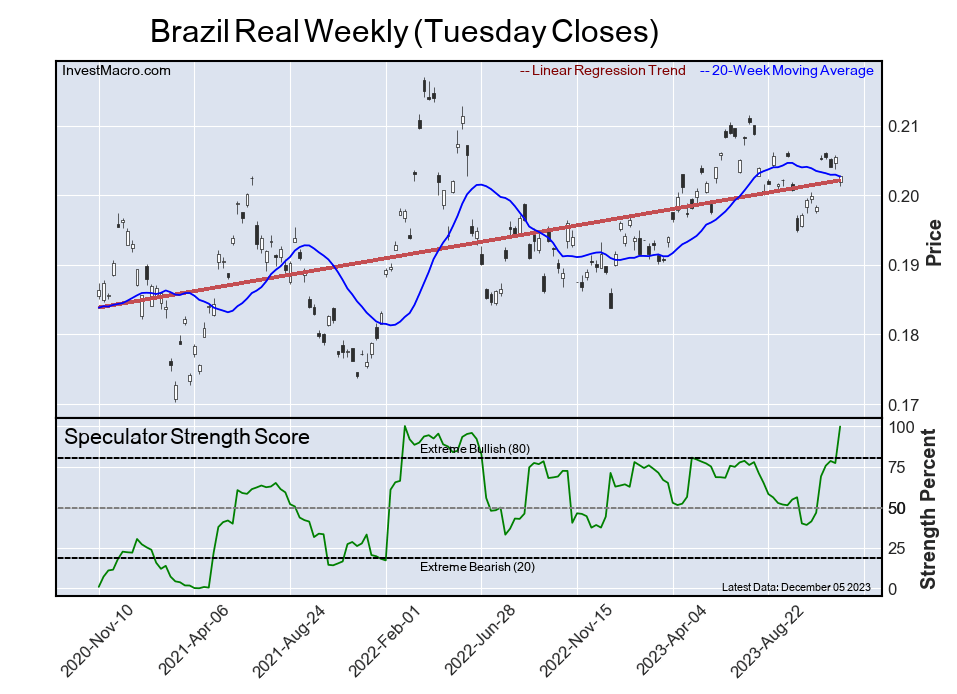
Brazilian Real (46.6 percent) vs Brazilian Real previous week (41.2 percent)
Bitcoin (40.1 percent) vs Bitcoin previous week (59.6 percent)


New Zealand Dollar & Australian Dollar top the 6-Week Strength Trends

COT Strength Score Trends (or move index, calculates the 6-week changes in strength scores) showed that the New Zealand Dollar (22 percent) and the Australian Dollar (20 percent) lead the past six weeks trends for the currencies. The US Dollar Index (6 percent) is the next highest positive mover in the latest trends data.

Bitcoin (-50 percent) leads the downside trend scores currently with the British Pound (-38 percent), the Mexican Peso (-20 percent) and the Swiss Franc (-19 percent) following next with lower trend scores.

Strength Trend Statistics:
US Dollar Index (5.6 percent) vs US Dollar Index previous week (22.7 percent)
EuroFX (-7.1 percent) vs EuroFX previous week (-11.9 percent)
British Pound Sterling (-37.5 percent) vs British Pound Sterling previous week (-45.0 percent)
Japanese Yen (-1.3 percent) vs Japanese Yen previous week (-0.5 percent)
Swiss Franc (-19.1 percent) vs Swiss Franc previous week (-15.8 percent)
Canadian Dollar (-1.2 percent) vs Canadian Dollar previous week (-6.3 percent)
Australian Dollar (20.0 percent) vs Australian Dollar previous week (-3.2 percent)
New Zealand Dollar (22.0 percent) vs New Zealand Dollar previous week (4.6 percent)
Mexican Peso (-19.7 percent) vs Mexican Peso previous week (-17.7 percent)
Brazilian Real (-4.5 percent) vs Brazilian Real previous week (-10.4 percent)
Bitcoin (-50.3 percent) vs Bitcoin previous week (-40.4 percent)


Individual COT Forex Markets:

US Dollar Index Futures:

US Dollar Index Forex Futures COT ChartThe US Dollar Index large speculator standing this week totaled a net position of 18,985 contracts in the data reported through Tuesday. This was a weekly fall of -686 contracts from the previous week which had a total of 19,671 net contracts.

This week’s current strength score (the trader positioning range over the past three years, measured from 0 to 100) shows the speculators are currently Bullish with a score of 56.6 percent. The commercials are Bearish with a score of 43.9 percent and the small traders (not shown in chart) are Bearish-Extreme with a score of 19.0 percent.

Price Trend-Following Model: Uptrend

Our weekly trend-following model classifies the current market price position as: Uptrend. The current action for the model is considered to be: Hold – Maintain Long Position.

US DOLLAR INDEX StatisticsSPECULATORSCOMMERCIALSSMALL TRADERS
– Percent of Open Interest Longs:64.422.610.4
– Percent of Open Interest Shorts:20.169.57.8
– Net Position:18,985-20,0961,111
– Gross Longs:27,5719,6714,441
– Gross Shorts:8,58629,7673,330
– Long to Short Ratio:3.2 to 10.3 to 11.3 to 1
NET POSITION TREND:
– Strength Index Score (3 Year Range Pct):56.643.919.0
– Strength Index Reading (3 Year Range):BullishBearishBearish-Extreme
NET POSITION MOVEMENT INDEX:
– 6-Week Change in Strength Index:5.6-4.4-7.5


Euro Currency Futures:

Euro Currency Futures COT ChartThe Euro Currency large speculator standing this week totaled a net position of 85,389 contracts in the data reported through Tuesday. This was a weekly gain of 136 contracts from the previous week which had a total of 85,253 net contracts.

This week’s current strength score (the trader positioning range over the past three years, measured from 0 to 100) shows the speculators are currently Bullish with a score of 56.7 percent. The commercials are Bearish with a score of 48.4 percent and the small traders (not shown in chart) are Bearish-Extreme with a score of 16.7 percent.

Price Trend-Following Model: Downtrend

Our weekly trend-following model classifies the current market price position as: Downtrend. The current action for the model is considered to be: Hold – Maintain Short Position.

EURO Currency StatisticsSPECULATORSCOMMERCIALSSMALL TRADERS
– Percent of Open Interest Longs:30.356.611.4
– Percent of Open Interest Shorts:18.172.38.0
– Net Position:85,389-109,03123,642
– Gross Longs:210,834393,34879,333
– Gross Shorts:125,445502,37955,691
– Long to Short Ratio:1.7 to 10.8 to 11.4 to 1
NET POSITION TREND:
– Strength Index Score (3 Year Range Pct):56.748.416.7
– Strength Index Reading (3 Year Range):BullishBearishBearish-Extreme
NET POSITION MOVEMENT INDEX:
– 6-Week Change in Strength Index:-7.17.4-5.0


British Pound Sterling Futures:

British Pound Sterling Futures COT ChartThe British Pound Sterling large speculator standing this week totaled a net position of -20,371 contracts in the data reported through Tuesday. This was a weekly fall of -1,735 contracts from the previous week which had a total of -18,636 net contracts.

This week’s current strength score (the trader positioning range over the past three years, measured from 0 to 100) shows the speculators are currently Bearish with a score of 41.6 percent. The commercials are Bullish with a score of 64.8 percent and the small traders (not shown in chart) are Bearish with a score of 31.0 percent.

Price Trend-Following Model: Downtrend

Our weekly trend-following model classifies the current market price position as: Downtrend. The current action for the model is considered to be: Hold – Maintain Short Position.

BRITISH POUND StatisticsSPECULATORSCOMMERCIALSSMALL TRADERS
– Percent of Open Interest Longs:27.759.59.7
– Percent of Open Interest Shorts:36.644.715.7
– Net Position:-20,37134,154-13,783
– Gross Longs:63,712136,88822,325
– Gross Shorts:84,083102,73436,108
– Long to Short Ratio:0.8 to 11.3 to 10.6 to 1
NET POSITION TREND:
– Strength Index Score (3 Year Range Pct):41.664.831.0
– Strength Index Reading (3 Year Range):BearishBullishBearish
NET POSITION MOVEMENT INDEX:
– 6-Week Change in Strength Index:-37.537.4-24.9


Japanese Yen Futures:

Japanese Yen Forex Futures COT ChartThe Japanese Yen large speculator standing this week totaled a net position of -103,848 contracts in the data reported through Tuesday. This was a weekly decline of -4,219 contracts from the previous week which had a total of -99,629 net contracts.

This week’s current strength score (the trader positioning range over the past three years, measured from 0 to 100) shows the speculators are currently Bearish-Extreme with a score of 8.4 percent. The commercials are Bullish-Extreme with a score of 88.1 percent and the small traders (not shown in chart) are Bearish with a score of 45.9 percent.

Price Trend-Following Model: Downtrend

Our weekly trend-following model classifies the current market price position as: Downtrend. The current action for the model is considered to be: Hold – Maintain Short Position.

JAPANESE YEN StatisticsSPECULATORSCOMMERCIALSSMALL TRADERS
– Percent of Open Interest Longs:13.669.815.1
– Percent of Open Interest Shorts:51.031.016.4
– Net Position:-103,848107,566-3,718
– Gross Longs:37,641193,46041,836
– Gross Shorts:141,48985,89445,554
– Long to Short Ratio:0.3 to 12.3 to 10.9 to 1
NET POSITION TREND:
– Strength Index Score (3 Year Range Pct):8.488.145.9
– Strength Index Reading (3 Year Range):Bearish-ExtremeBullish-ExtremeBearish
NET POSITION MOVEMENT INDEX:
– 6-Week Change in Strength Index:-1.3-1.912.4


Swiss Franc Futures:

Swiss Franc Forex Futures COT ChartThe Swiss Franc large speculator standing this week totaled a net position of -14,910 contracts in the data reported through Tuesday. This was a weekly boost of 185 contracts from the previous week which had a total of -15,095 net contracts.

This week’s current strength score (the trader positioning range over the past three years, measured from 0 to 100) shows the speculators are currently Bearish-Extreme with a score of 15.7 percent. The commercials are Bullish-Extreme with a score of 86.6 percent and the small traders (not shown in chart) are Bearish with a score of 21.4 percent.

Price Trend-Following Model: Downtrend

Our weekly trend-following model classifies the current market price position as: Downtrend. The current action for the model is considered to be: Hold – Maintain Short Position.

SWISS FRANC StatisticsSPECULATORSCOMMERCIALSSMALL TRADERS
– Percent of Open Interest Longs:15.867.816.3
– Percent of Open Interest Shorts:42.221.735.9
– Net Position:-14,91025,967-11,057
– Gross Longs:8,88838,2019,178
– Gross Shorts:23,79812,23420,235
– Long to Short Ratio:0.4 to 13.1 to 10.5 to 1
NET POSITION TREND:
– Strength Index Score (3 Year Range Pct):15.786.621.4
– Strength Index Reading (3 Year Range):Bearish-ExtremeBullish-ExtremeBearish
NET POSITION MOVEMENT INDEX:
– 6-Week Change in Strength Index:-19.118.4-11.3


Canadian Dollar Futures:

Canadian Dollar Forex Futures COT ChartThe Canadian Dollar large speculator standing this week totaled a net position of -49,332 contracts in the data reported through Tuesday. This was a weekly lowering of -693 contracts from the previous week which had a total of -48,639 net contracts.

This week’s current strength score (the trader positioning range over the past three years, measured from 0 to 100) shows the speculators are currently Bearish-Extreme with a score of 8.6 percent. The commercials are Bullish-Extreme with a score of 94.3 percent and the small traders (not shown in chart) are Bearish-Extreme with a score of 7.9 percent.

Price Trend-Following Model: Downtrend

Our weekly trend-following model classifies the current market price position as: Downtrend. The current action for the model is considered to be: Hold – Maintain Short Position.

CANADIAN DOLLAR StatisticsSPECULATORSCOMMERCIALSSMALL TRADERS
– Percent of Open Interest Longs:12.867.217.1
– Percent of Open Interest Shorts:37.739.020.5
– Net Position:-49,33256,052-6,720
– Gross Longs:25,418133,43333,889
– Gross Shorts:74,75077,38140,609
– Long to Short Ratio:0.3 to 11.7 to 10.8 to 1
NET POSITION TREND:
– Strength Index Score (3 Year Range Pct):8.694.37.9
– Strength Index Reading (3 Year Range):Bearish-ExtremeBullish-ExtremeBearish-Extreme
NET POSITION MOVEMENT INDEX:
– 6-Week Change in Strength Index:-1.24.9-13.2


Australian Dollar Futures:

Australian Dollar Forex Futures COT ChartThe Australian Dollar large speculator standing this week totaled a net position of -75,110 contracts in the data reported through Tuesday. This was a weekly rise of 7,971 contracts from the previous week which had a total of -83,081 net contracts.

This week’s current strength score (the trader positioning range over the past three years, measured from 0 to 100) shows the speculators are currently Bearish-Extreme with a score of 20.0 percent. The commercials are Bullish-Extreme with a score of 82.2 percent and the small traders (not shown in chart) are Bearish with a score of 24.8 percent.

Price Trend-Following Model: Weak Downtrend

Our weekly trend-following model classifies the current market price position as: Weak Downtrend. The current action for the model is considered to be: Hold – Maintain Short Position.

AUSTRALIAN DOLLAR StatisticsSPECULATORSCOMMERCIALSSMALL TRADERS
– Percent of Open Interest Longs:16.768.911.5
– Percent of Open Interest Shorts:54.825.017.2
– Net Position:-75,11086,432-11,322
– Gross Longs:32,805135,55322,592
– Gross Shorts:107,91549,12133,914
– Long to Short Ratio:0.3 to 12.8 to 10.7 to 1
NET POSITION TREND:
– Strength Index Score (3 Year Range Pct):20.082.224.8
– Strength Index Reading (3 Year Range):Bearish-ExtremeBullish-ExtremeBearish
NET POSITION MOVEMENT INDEX:
– 6-Week Change in Strength Index:20.0-17.84.3


New Zealand Dollar Futures:

New Zealand Dollar Forex Futures COT ChartThe New Zealand Dollar large speculator standing this week totaled a net position of -12,817 contracts in the data reported through Tuesday. This was a weekly increase of 34 contracts from the previous week which had a total of -12,851 net contracts.

This week’s current strength score (the trader positioning range over the past three years, measured from 0 to 100) shows the speculators are currently Bearish with a score of 22.0 percent. The commercials are Bullish-Extreme with a score of 81.7 percent and the small traders (not shown in chart) are Bearish-Extreme with a score of 9.3 percent.

Price Trend-Following Model: Downtrend

Our weekly trend-following model classifies the current market price position as: Downtrend. The current action for the model is considered to be: Hold – Maintain Short Position.

NEW ZEALAND DOLLAR StatisticsSPECULATORSCOMMERCIALSSMALL TRADERS
– Percent of Open Interest Longs:24.868.55.0
– Percent of Open Interest Shorts:47.140.411.0
– Net Position:-12,81716,236-3,419
– Gross Longs:14,33239,5092,907
– Gross Shorts:27,14923,2736,326
– Long to Short Ratio:0.5 to 11.7 to 10.5 to 1
NET POSITION TREND:
– Strength Index Score (3 Year Range Pct):22.081.79.3
– Strength Index Reading (3 Year Range):BearishBullish-ExtremeBearish-Extreme
NET POSITION MOVEMENT INDEX:
– 6-Week Change in Strength Index:22.0-18.3-4.6


Mexican Peso Futures:

Mexican Peso Futures COT ChartThe Mexican Peso large speculator standing this week totaled a net position of 31,297 contracts in the data reported through Tuesday. This was a weekly decrease of -6,564 contracts from the previous week which had a total of 37,861 net contracts.

This week’s current strength score (the trader positioning range over the past three years, measured from 0 to 100) shows the speculators are currently Bullish with a score of 58.2 percent. The commercials are Bearish with a score of 41.1 percent and the small traders (not shown in chart) are Bearish with a score of 27.7 percent.

Price Trend-Following Model: Downtrend

Our weekly trend-following model classifies the current market price position as: Downtrend. The current action for the model is considered to be: Hold – Maintain Short Position.

MEXICAN PESO StatisticsSPECULATORSCOMMERCIALSSMALL TRADERS
– Percent of Open Interest Longs:28.968.02.9
– Percent of Open Interest Shorts:13.185.01.6
– Net Position:31,297-33,8832,586
– Gross Longs:57,470135,2875,745
– Gross Shorts:26,173169,1703,159
– Long to Short Ratio:2.2 to 10.8 to 11.8 to 1
NET POSITION TREND:
– Strength Index Score (3 Year Range Pct):58.241.127.7
– Strength Index Reading (3 Year Range):BullishBearishBearish
NET POSITION MOVEMENT INDEX:
– 6-Week Change in Strength Index:-19.720.1-9.6


Brazilian Real Futures:

Brazil Real Futures COT ChartThe Brazilian Real large speculator standing this week totaled a net position of 9,346 contracts in the data reported through Tuesday. This was a weekly increase of 4,161 contracts from the previous week which had a total of 5,185 net contracts.

This week’s current strength score (the trader positioning range over the past three years, measured from 0 to 100) shows the speculators are currently Bearish with a score of 46.6 percent. The commercials are Bullish with a score of 52.3 percent and the small traders (not shown in chart) are Bullish with a score of 50.1 percent.

Price Trend-Following Model: Weak Downtrend

Our weekly trend-following model classifies the current market price position as: Weak Downtrend. The current action for the model is considered to be: Hold – Maintain Short Position.

BRAZIL REAL StatisticsSPECULATORSCOMMERCIALSSMALL TRADERS
– Percent of Open Interest Longs:44.446.94.9
– Percent of Open Interest Shorts:30.563.32.4
– Net Position:9,346-11,0221,676
– Gross Longs:29,78131,4493,265
– Gross Shorts:20,43542,4711,589
– Long to Short Ratio:1.5 to 10.7 to 12.1 to 1
NET POSITION TREND:
– Strength Index Score (3 Year Range Pct):46.652.350.1
– Strength Index Reading (3 Year Range):BearishBullishBullish
NET POSITION MOVEMENT INDEX:
– 6-Week Change in Strength Index:-4.55.9-10.6


Bitcoin Futures:

Bitcoin Crypto Futures COT ChartThe Bitcoin large speculator standing this week totaled a net position of -1,746 contracts in the data reported through Tuesday. This was a weekly fall of -1,292 contracts from the previous week which had a total of -454 net contracts.

This week’s current strength score (the trader positioning range over the past three years, measured from 0 to 100) shows the speculators are currently Bearish with a score of 40.1 percent. The commercials are Bullish-Extreme with a score of 93.8 percent and the small traders (not shown in chart) are Bearish with a score of 32.1 percent.

Price Trend-Following Model: Strong Uptrend

Our weekly trend-following model classifies the current market price position as: Strong Uptrend. The current action for the model is considered to be: New Buy – Long Position.

BITCOIN StatisticsSPECULATORSCOMMERCIALSSMALL TRADERS
– Percent of Open Interest Longs:79.08.27.5
– Percent of Open Interest Shorts:88.03.63.2
– Net Position:-1,746903843
– Gross Longs:15,4951,5991,468
– Gross Shorts:17,241696625
– Long to Short Ratio:0.9 to 12.3 to 12.3 to 1
NET POSITION TREND:
– Strength Index Score (3 Year Range Pct):40.193.832.1
– Strength Index Reading (3 Year Range):BearishBullish-ExtremeBearish
NET POSITION MOVEMENT INDEX:
– 6-Week Change in Strength Index:-50.378.910.1


Article By InvestMacroReceive our weekly COT Newsletter

*COT Report: The COT data, released weekly to the public each Friday, is updated through the most recent Tuesday (data is 3 days old) and shows a quick view of how large speculators or non-commercials (for-profit traders) were positioned in the futures markets.

The CFTC categorizes trader positions according to commercial hedgers (traders who use futures contracts for hedging as part of the business), non-commercials (large traders who speculate to realize trading profits) and nonreportable traders (usually small traders/speculators) as well as their open interest (contracts open in the market at time of reporting). See CFTC criteria here.

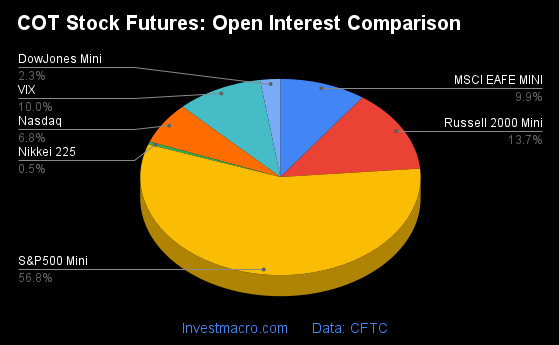
COT Bonds Charts: Speculator Bets led by Fed Funds & Ultra Treasury Bonds

By InvestMacro

Here are the latest charts and statistics for the Commitment of Traders (COT) reports data published by the Commodities Futures Trading Commission (CFTC).

The latest COT data is updated through Tuesday October 31st and shows a quick view of how large traders (for-profit speculators and commercial hedgers) were positioned in the futures markets.

Weekly Speculator Changes led by Fed Funds & Ultra Treasury Bonds

The COT bond market speculator bets were lower this week as just two out of the eight bond markets we cover had higher positioning while the other six markets had lower speculator contracts.

Leading the gains for the bond markets was the Fed Funds (27,807 contracts) with the Ultra Treasury Bonds (27,106 contracts) also recording a positive week.

The bond markets with declines in speculator bets were the 5-Year Bonds (-182,686 contracts), the 10-Year Bonds (-64,336 contracts), the SOFR 3-Months (-38,841 contracts), the US Treasury Bonds (-19,143 contracts), the 2-Year Bonds (-11,136 contracts) and the Ultra 10-Year Bonds (-2,438 contracts) also registering lower bets on the week.


Data Snapshot of Bond Market Traders | Columns Legend
Oct-31-2023OIOI-IndexSpec-NetSpec-IndexCom-NetCOM-IndexSmalls-NetSmalls-Index
SOFR-3-Months10,506,35998244,97285-244,90715-6588
FedFunds2,028,29091-178,02731201,94273-23,91544
2-Year4,188,47399-1,435,44801,312,083100123,36595
Long T-Bond1,377,93883-155,38129101,2374754,14488
10-Year4,691,53688-627,69822531,9477395,75194
5-Year5,746,13798-1,191,58951,110,9419280,64891


Strength Scores led by SOFR 3-Months & Ultra Treasury Bonds

COT Strength Scores (a normalized measure of Speculator positions over a 3-Year range, from 0 to 100 where above 80 is Extreme-Bullish and below 20 is Extreme-Bearish) showed that the SOFR 3-Months (85 percent) leads the bond markets this week and the only market over 50 percent currently.

On the downside, the Ultra 10-Year Bonds (0 percent), the 2-Year Bonds (0 percent) and the 5-Year Bonds (5 percent) come in at the lowest strength levels currently and are in Extreme-Bearish territory (below 20 percent).

Strength Statistics:
Fed Funds (30.5 percent) vs Fed Funds previous week (24.6 percent)
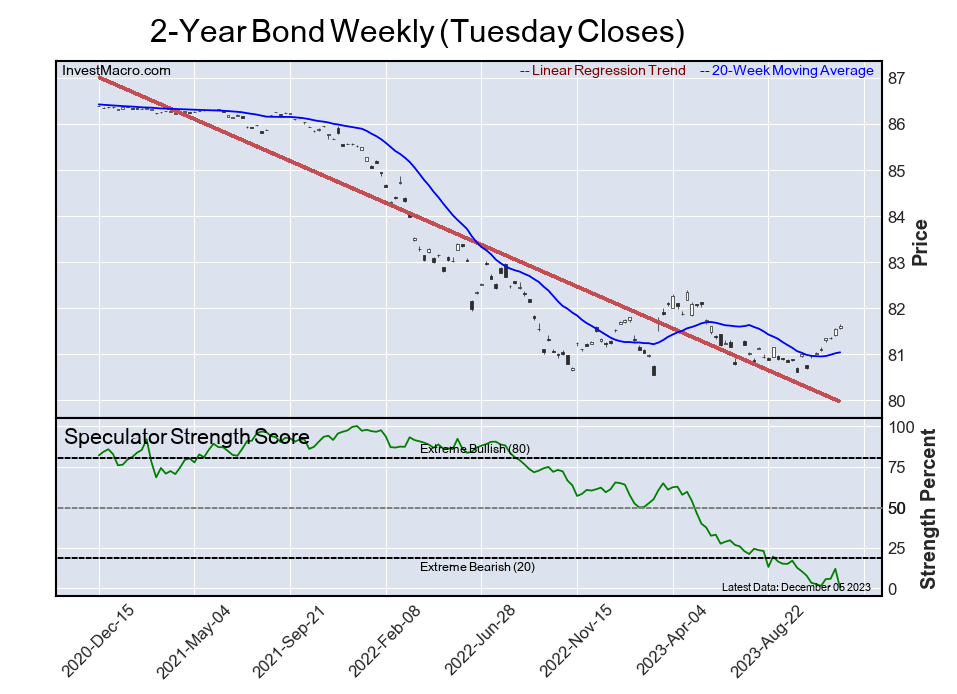
2-Year Bond (0.0 percent) vs 2-Year Bond previous week (0.7 percent)
5-Year Bond (4.8 percent) vs 5-Year Bond previous week (18.3 percent)
10-Year Bond (21.6 percent) vs 10-Year Bond previous week (27.8 percent)
Ultra 10-Year Bond (0.2 percent) vs Ultra 10-Year Bond previous week (0.7 percent)
US Treasury Bond (29.4 percent) vs US Treasury Bond previous week (36.0 percent)
Ultra US Treasury Bond (48.5 percent) vs Ultra US Treasury Bond previous week (37.5 percent)
SOFR 3-Months (84.7 percent) vs SOFR 3-Months previous week (87.1 percent)


Ultra Treasury Bonds & US Treasury Bonds top the 6-Week Strength Trends

COT Strength Score Trends (or move index, calculates the 6-week changes in strength scores) showed that the Ultra Treasury Bonds (22 percent) and the US Treasury Bonds (16 percent) lead the past six weeks trends for bonds. The 10-Year Bond (7 percent) and the Fed Funds (7 percent) are the next positive movers in the latest trends data.

The Ultra 10-Year Bonds (-22 percent) and the SOFR 3-Months (-15 percent) lead the downside trend scores currently with the 5-Year Bonds (-14 percent) and the 2-Year Bonds (-13 percent) following next.

Strength Trend Statistics:
Fed Funds (6.9 percent) vs Fed Funds previous week (-4.5 percent)
2-Year Bond (-12.7 percent) vs 2-Year Bond previous week (-12.1 percent)
5-Year Bond (-13.7 percent) vs 5-Year Bond previous week (1.6 percent)
10-Year Bond (7.2 percent) vs 10-Year Bond previous week (17.5 percent)
Ultra 10-Year Bond (-21.9 percent) vs Ultra 10-Year Bond previous week (-19.6 percent)
US Treasury Bond (15.9 percent) vs US Treasury Bond previous week (19.7 percent)
Ultra US Treasury Bond (22.3 percent) vs Ultra US Treasury Bond previous week (5.4 percent)
SOFR 3-Months (-15.3 percent) vs SOFR 3-Months previous week (-2.0 percent)


Secured Overnight Financing Rate (3-Month) Futures:

SOFR 3-Months Bonds Futures COT ChartThe Secured Overnight Financing Rate (3-Month) large speculator standing this week reached a net position of 244,972 contracts in the data reported through Tuesday. This was a weekly decline of -38,841 contracts from the previous week which had a total of 283,813 net contracts.

This week’s current strength score (the trader positioning range over the past three years, measured from 0 to 100) shows the speculators are currently Bullish-Extreme with a score of 84.7 percent. The commercials are Bearish-Extreme with a score of 14.9 percent and the small traders (not shown in chart) are Bullish-Extreme with a score of 87.8 percent.

Price Trend-Following Model: Weak Uptrend (Possible Trend Change)

Our weekly trend-following model classifies the current market price position as: Weak Uptrend. The current action for the model is considered to be: Hold – Maintain Long Position.

SOFR 3-Months StatisticsSPECULATORSCOMMERCIALSSMALL TRADERS
– Percent of Open Interest Longs:20.656.60.4
– Percent of Open Interest Shorts:18.358.90.4
– Net Position:244,972-244,907-65
– Gross Longs:2,164,9955,947,33342,010
– Gross Shorts:1,920,0236,192,24042,075
– Long to Short Ratio:1.1 to 11.0 to 11.0 to 1
NET POSITION TREND:
– Strength Index Score (3 Year Range Pct):84.714.987.8
– Strength Index Reading (3 Year Range):Bullish-ExtremeBearish-ExtremeBullish-Extreme
NET POSITION MOVEMENT INDEX:
– 6-Week Change in Strength Index:-15.314.93.4


30-Day Federal Funds Futures:

Federal Funds 30-Day Bonds Futures COT ChartThe 30-Day Federal Funds large speculator standing this week reached a net position of -178,027 contracts in the data reported through Tuesday. This was a weekly advance of 27,807 contracts from the previous week which had a total of -205,834 net contracts.

This week’s current strength score (the trader positioning range over the past three years, measured from 0 to 100) shows the speculators are currently Bearish with a score of 30.5 percent. The commercials are Bullish with a score of 72.7 percent and the small traders (not shown in chart) are Bearish with a score of 44.1 percent.

Price Trend-Following Model: Downtrend

Our weekly trend-following model classifies the current market price position as: Downtrend. The current action for the model is considered to be: Hold – Maintain Short Position.

30-Day Federal Funds StatisticsSPECULATORSCOMMERCIALSSMALL TRADERS
– Percent of Open Interest Longs:7.876.01.4
– Percent of Open Interest Shorts:16.666.02.6
– Net Position:-178,027201,942-23,915
– Gross Longs:158,8531,540,62028,230
– Gross Shorts:336,8801,338,67852,145
– Long to Short Ratio:0.5 to 11.2 to 10.5 to 1
NET POSITION TREND:
– Strength Index Score (3 Year Range Pct):30.572.744.1
– Strength Index Reading (3 Year Range):BearishBullishBearish
NET POSITION MOVEMENT INDEX:
– 6-Week Change in Strength Index:6.9-7.33.9


2-Year Treasury Note Futures:

2-Year Treasury Bonds Futures COT ChartThe 2-Year Treasury Note large speculator standing this week reached a net position of -1,435,448 contracts in the data reported through Tuesday. This was a weekly decline of -11,136 contracts from the previous week which had a total of -1,424,312 net contracts.

This week’s current strength score (the trader positioning range over the past three years, measured from 0 to 100) shows the speculators are currently Bearish-Extreme with a score of 0.0 percent. The commercials are Bullish-Extreme with a score of 100.0 percent and the small traders (not shown in chart) are Bullish-Extreme with a score of 94.7 percent.

Price Trend-Following Model: Downtrend

Our weekly trend-following model classifies the current market price position as: Downtrend. The current action for the model is considered to be: Hold – Maintain Short Position.

2-Year Treasury Note StatisticsSPECULATORSCOMMERCIALSSMALL TRADERS
– Percent of Open Interest Longs:9.882.56.4
– Percent of Open Interest Shorts:44.051.13.4
– Net Position:-1,435,4481,312,083123,365
– Gross Longs:408,7623,453,960266,889
– Gross Shorts:1,844,2102,141,877143,524
– Long to Short Ratio:0.2 to 11.6 to 11.9 to 1
NET POSITION TREND:
– Strength Index Score (3 Year Range Pct):0.0100.094.7
– Strength Index Reading (3 Year Range):Bearish-ExtremeBullish-ExtremeBullish-Extreme
NET POSITION MOVEMENT INDEX:
– 6-Week Change in Strength Index:-12.713.63.5


5-Year Treasury Note Futures:

5-Year Treasury Bonds Futures COT ChartThe 5-Year Treasury Note large speculator standing this week reached a net position of -1,191,589 contracts in the data reported through Tuesday. This was a weekly fall of -182,686 contracts from the previous week which had a total of -1,008,903 net contracts.

This week’s current strength score (the trader positioning range over the past three years, measured from 0 to 100) shows the speculators are currently Bearish-Extreme with a score of 4.8 percent. The commercials are Bullish-Extreme with a score of 92.0 percent and the small traders (not shown in chart) are Bullish-Extreme with a score of 91.0 percent.

Price Trend-Following Model: Downtrend

Our weekly trend-following model classifies the current market price position as: Downtrend. The current action for the model is considered to be: Hold – Maintain Short Position.

5-Year Treasury Note StatisticsSPECULATORSCOMMERCIALSSMALL TRADERS
– Percent of Open Interest Longs:8.283.47.0
– Percent of Open Interest Shorts:28.964.05.6
– Net Position:-1,191,5891,110,94180,648
– Gross Longs:469,0454,790,920403,102
– Gross Shorts:1,660,6343,679,979322,454
– Long to Short Ratio:0.3 to 11.3 to 11.3 to 1
NET POSITION TREND:
– Strength Index Score (3 Year Range Pct):4.892.091.0
– Strength Index Reading (3 Year Range):Bearish-ExtremeBullish-ExtremeBullish-Extreme
NET POSITION MOVEMENT INDEX:
– 6-Week Change in Strength Index:-13.713.73.6


10-Year Treasury Note Futures:

10-Year Treasury Notes Bonds Futures COT ChartThe 10-Year Treasury Note large speculator standing this week reached a net position of -627,698 contracts in the data reported through Tuesday. This was a weekly fall of -64,336 contracts from the previous week which had a total of -563,362 net contracts.

This week’s current strength score (the trader positioning range over the past three years, measured from 0 to 100) shows the speculators are currently Bearish with a score of 21.6 percent. The commercials are Bullish with a score of 72.7 percent and the small traders (not shown in chart) are Bullish-Extreme with a score of 94.3 percent.

Price Trend-Following Model: Downtrend

Our weekly trend-following model classifies the current market price position as: Downtrend. The current action for the model is considered to be: Hold – Maintain Short Position.

10-Year Treasury Note StatisticsSPECULATORSCOMMERCIALSSMALL TRADERS
– Percent of Open Interest Longs:12.276.19.8
– Percent of Open Interest Shorts:25.664.77.8
– Net Position:-627,698531,94795,751
– Gross Longs:572,2953,568,418461,152
– Gross Shorts:1,199,9933,036,471365,401
– Long to Short Ratio:0.5 to 11.2 to 11.3 to 1
NET POSITION TREND:
– Strength Index Score (3 Year Range Pct):21.672.794.3
– Strength Index Reading (3 Year Range):BearishBullishBullish-Extreme
NET POSITION MOVEMENT INDEX:
– 6-Week Change in Strength Index:7.2-14.611.5


Ultra 10-Year Notes Futures:

Ultra 10-Year Treasury Notes Bonds Futures COT ChartThe Ultra 10-Year Notes large speculator standing this week reached a net position of -252,307 contracts in the data reported through Tuesday. This was a weekly lowering of -2,438 contracts from the previous week which had a total of -249,869 net contracts.

This week’s current strength score (the trader positioning range over the past three years, measured from 0 to 100) shows the speculators are currently Bearish-Extreme with a score of 0.2 percent. The commercials are Bullish-Extreme with a score of 94.9 percent and the small traders (not shown in chart) are Bullish-Extreme with a score of 95.5 percent.

Price Trend-Following Model: Downtrend

Our weekly trend-following model classifies the current market price position as: Downtrend. The current action for the model is considered to be: Hold – Maintain Short Position.

Ultra 10-Year Notes StatisticsSPECULATORSCOMMERCIALSSMALL TRADERS
– Percent of Open Interest Longs:9.877.311.0
– Percent of Open Interest Shorts:22.363.212.6
– Net Position:-252,307283,428-31,121
– Gross Longs:196,6551,555,303222,295
– Gross Shorts:448,9621,271,875253,416
– Long to Short Ratio:0.4 to 11.2 to 10.9 to 1
NET POSITION TREND:
– Strength Index Score (3 Year Range Pct):0.294.995.5
– Strength Index Reading (3 Year Range):Bearish-ExtremeBullish-ExtremeBullish-Extreme
NET POSITION MOVEMENT INDEX:
– 6-Week Change in Strength Index:-21.99.243.3


US Treasury Bonds Futures:

US Year Treasury Notes Long Bonds Futures COT ChartThe US Treasury Bonds large speculator standing this week reached a net position of -155,381 contracts in the data reported through Tuesday. This was a weekly fall of -19,143 contracts from the previous week which had a total of -136,238 net contracts.

This week’s current strength score (the trader positioning range over the past three years, measured from 0 to 100) shows the speculators are currently Bearish with a score of 29.4 percent. The commercials are Bearish with a score of 47.1 percent and the small traders (not shown in chart) are Bullish-Extreme with a score of 87.9 percent.

Price Trend-Following Model: Downtrend

Our weekly trend-following model classifies the current market price position as: Downtrend. The current action for the model is considered to be: Hold – Maintain Short Position.

US Treasury Bonds StatisticsSPECULATORSCOMMERCIALSSMALL TRADERS
– Percent of Open Interest Longs:7.376.214.7
– Percent of Open Interest Shorts:18.668.810.7
– Net Position:-155,381101,23754,144
– Gross Longs:100,7841,049,386202,248
– Gross Shorts:256,165948,149148,104
– Long to Short Ratio:0.4 to 11.1 to 11.4 to 1
NET POSITION TREND:
– Strength Index Score (3 Year Range Pct):29.447.187.9
– Strength Index Reading (3 Year Range):BearishBearishBullish-Extreme
NET POSITION MOVEMENT INDEX:
– 6-Week Change in Strength Index:15.9-20.17.4


Ultra US Treasury Bonds Futures:

Ultra US Year Treasury Notes Long Bonds Futures COT ChartThe Ultra US Treasury Bonds large speculator standing this week reached a net position of -336,440 contracts in the data reported through Tuesday. This was a weekly advance of 27,106 contracts from the previous week which had a total of -363,546 net contracts.

This week’s current strength score (the trader positioning range over the past three years, measured from 0 to 100) shows the speculators are currently Bearish with a score of 48.5 percent. The commercials are Bearish with a score of 48.8 percent and the small traders (not shown in chart) are Bullish with a score of 65.0 percent.

Price Trend-Following Model: Downtrend

Our weekly trend-following model classifies the current market price position as: Downtrend. The current action for the model is considered to be: Hold – Maintain Short Position.

Ultra US Treasury Bonds StatisticsSPECULATORSCOMMERCIALSSMALL TRADERS
– Percent of Open Interest Longs:5.882.711.3
– Percent of Open Interest Shorts:27.463.09.4
– Net Position:-336,440307,00129,439
– Gross Longs:90,8761,290,048176,509
– Gross Shorts:427,316983,047147,070
– Long to Short Ratio:0.2 to 11.3 to 11.2 to 1
NET POSITION TREND:
– Strength Index Score (3 Year Range Pct):48.548.865.0
– Strength Index Reading (3 Year Range):BearishBearishBullish
NET POSITION MOVEMENT INDEX:
– 6-Week Change in Strength Index:22.3-22.0-9.2


Article By InvestMacroReceive our weekly COT Newsletter

*COT Report: The COT data, released weekly to the public each Friday, is updated through the most recent Tuesday (data is 3 days old) and shows a quick view of how large speculators or non-commercials (for-profit traders) were positioned in the futures markets.

The CFTC categorizes trader positions according to commercial hedgers (traders who use futures contracts for hedging as part of the business), non-commercials (large traders who speculate to realize trading profits) and nonreportable traders (usually small traders/speculators) as well as their open interest (contracts open in the market at time of reporting). See CFTC criteria here.