Speculator Extremes: Silver, Peso & Coffee lead Bullish Positions

By InvestMacro 

The latest update for the weekly Commitment of Traders (COT) report was released by the Commodity Futures Trading Commission (CFTC) on Friday for data ending on April 9th.

This weekly Extreme Positions report highlights the Most Bullish and Most Bearish Positions for the speculator category. Extreme positioning in these markets can foreshadow strong moves in the underlying market.

To signify an extreme position, we use the Strength Index (also known as the COT Index) of each instrument, a common method of measuring COT data. The Strength Index is simply a comparison of current trader positions against the range of positions over the previous 3 years. We use over 80 percent as extremely bullish and under 20 percent as extremely bearish. (Compare Strength Index scores across all markets in the data table or cot leaders table)


Here Are This Week’s Most Bullish Speculator Positions:

Silver
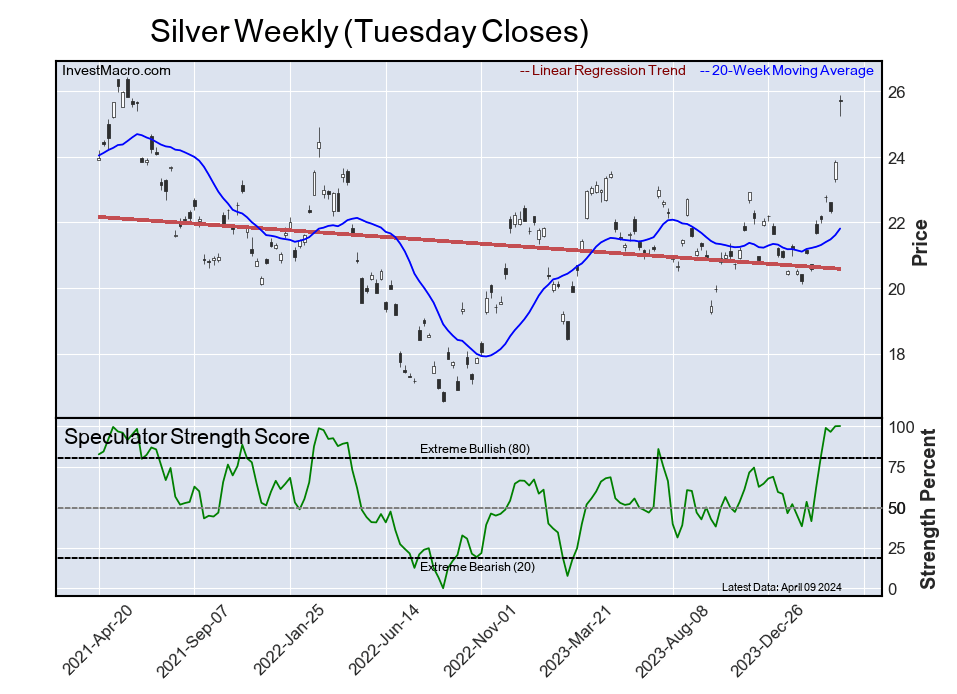

The Silver speculator position comes in as the most bullish extreme standing this week. The Silver speculator level is currently at a 100.0 percent score of its 3-year range.

The six-week trend for the percent strength score totaled 58.7 this week. The overall net speculator position was a total of 53,212 net contracts this week with a slight rise of 65 contract in the weekly speculator bets.


Speculators or Non-Commercials Notes:

Speculators, classified as non-commercial traders by the CFTC, are made up of large commodity funds, hedge funds and other significant for-profit participants. The Specs are generally regarded as trend-followers in their behavior towards price action – net speculator bets and prices tend to go in the same directions. These traders often look to buy when prices are rising and sell when prices are falling. To illustrate this point, many times speculator contracts can be found at their most extremes (bullish or bearish) when prices are also close to their highest or lowest levels.

These extreme levels can be dangerous for the large speculators as the trade is most crowded, there is less trading ammunition still sitting on the sidelines to push the trend further and prices have moved a significant distance. When the trend becomes exhausted, some speculators take profits while others look to also exit positions when prices fail to continue in the same direction. This process usually plays out over many months to years and can ultimately create a reverse effect where prices start to fall and speculators start a process of selling when prices are falling.


Mexican Peso
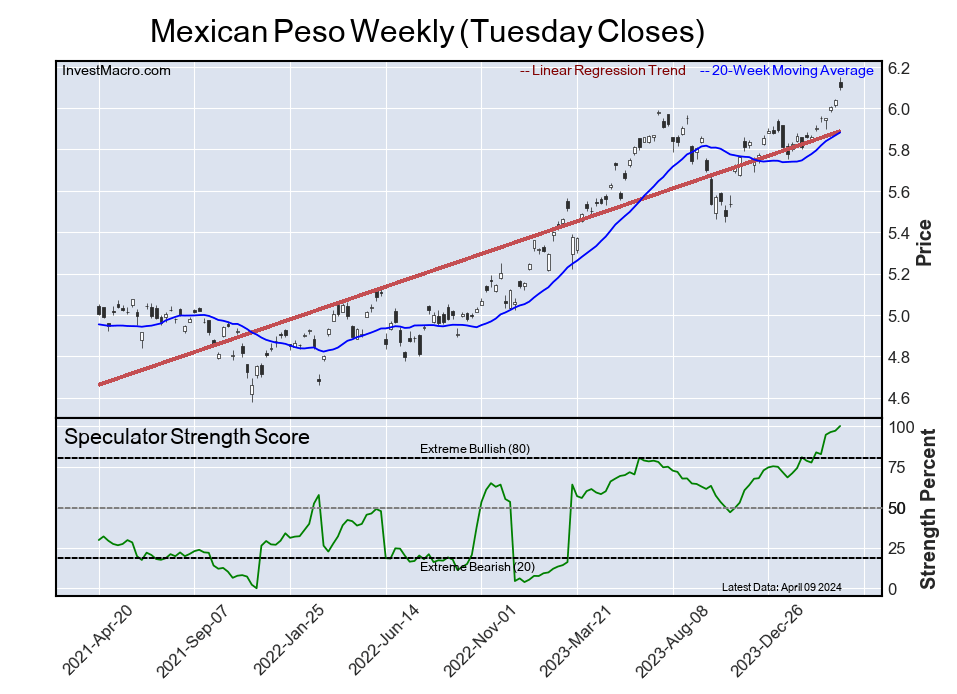

The Mexican Peso speculator position comes next in the extreme standings this week. The Mexican Peso speculator level is now at a 100.0 percent score of its 3-year range.

The six-week trend for the percent strength score was 22.5 this week. The speculator position registered 139,691 net contracts this week with a weekly boost of 5,961 contracts in speculator bets.


Coffee

The Coffee speculator position comes in third this week in the extreme standings. The Coffee speculator level resides at a 100.0 percent score of its 3-year range.

The six-week trend for the speculator strength score came in at 21.8 this week. The overall speculator position was 73,563 net contracts this week with a gain of 6,081 contracts in the weekly speculator bets.


Gasoline
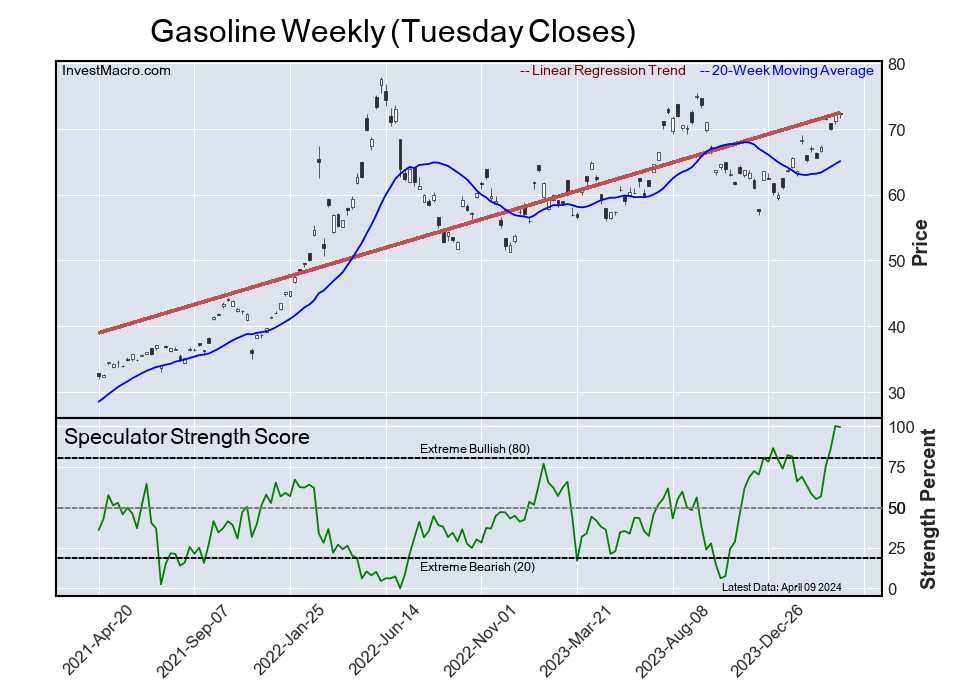

The Gasoline speculator position comes up number four in the extreme standings this week. The Gasoline speculator level is at a 99.3 percent score of its 3-year range.

The six-week trend for the speculator strength score totaled a change of 41.2 this week. The overall speculator position was 83,347 net contracts this week with a small dip of -376 contracts in the speculator bets.


Steel
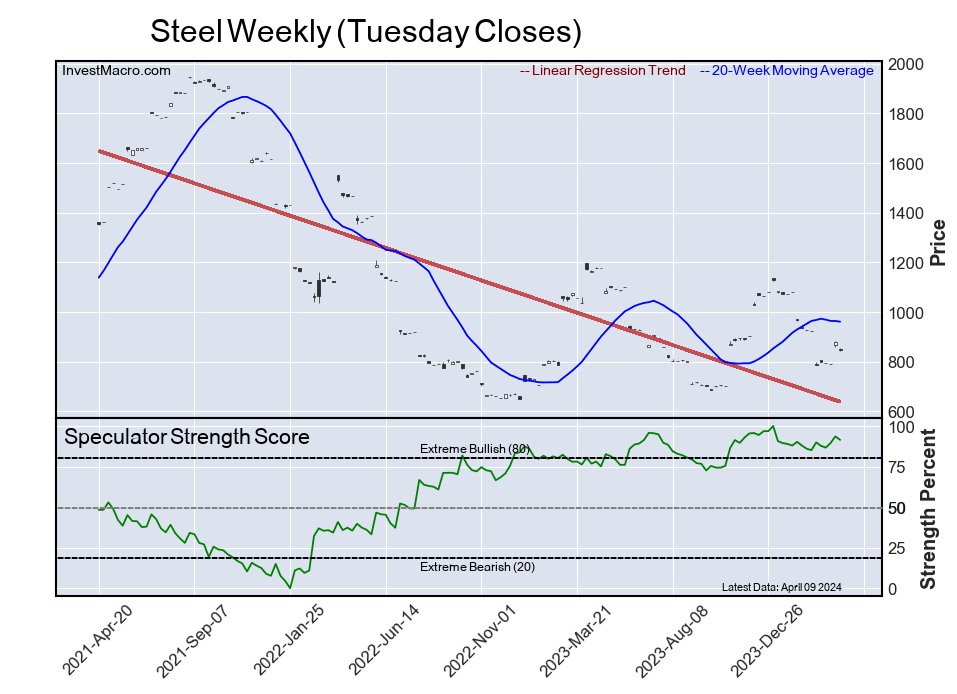

The Steel speculator position rounds out the top five in this week’s bullish extreme standings. The Steel speculator level sits at a 91.5 percent score of its 3-year range. The six-week trend for the speculator strength score was 6.3 this week.

The speculator position was -1,271 net contracts this week with a decline of -557 contracts in the weekly speculator bets.


This Week’s Most Bearish Speculator Positions:

Japanese Yen
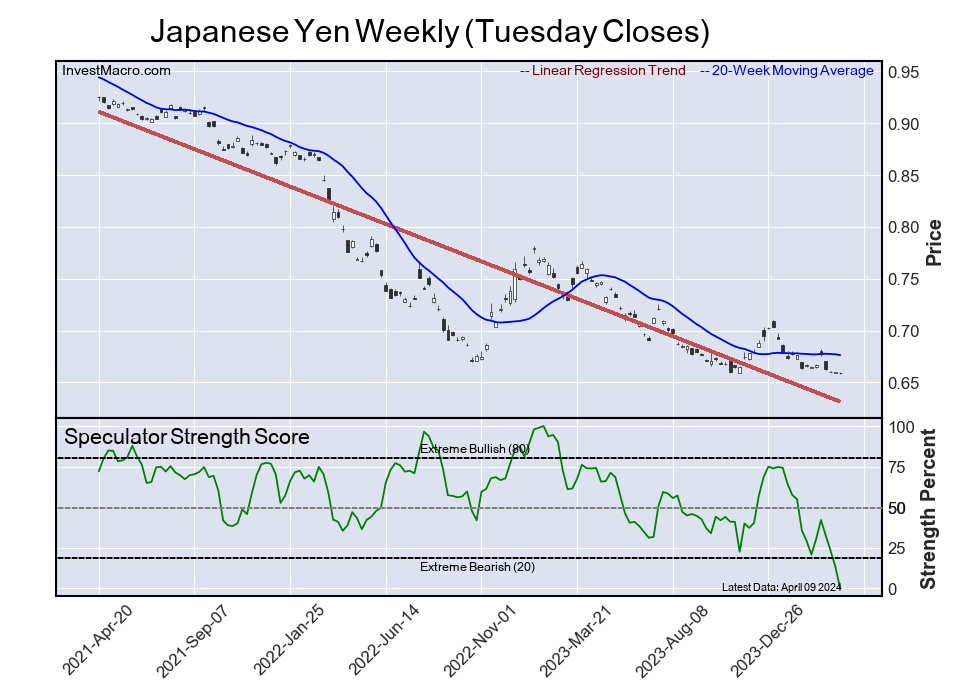

The Japanese Yen speculator position comes in as the most bearish extreme standing this week. The Japanese Yen speculator level is at a 0.0 percent score of its 3-year range.

The six-week trend for the speculator strength score was -20.7 this week. The overall speculator position was -162,151 net contracts this week with a sharp drop by -18,921 contracts in the speculator bets.


Swiss Franc
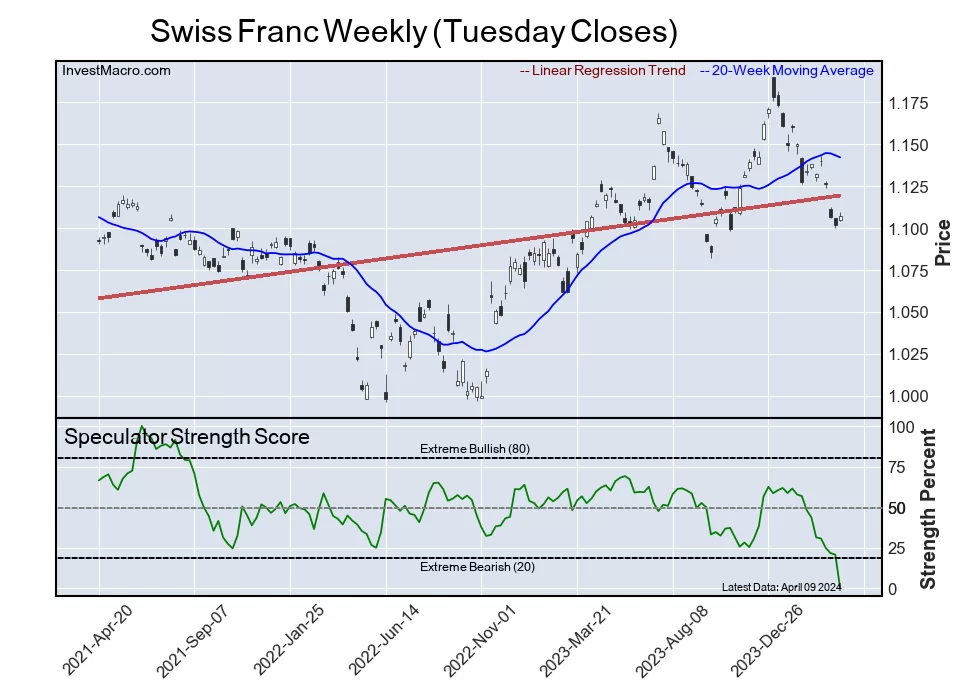

The Swiss Franc speculator position comes in next for the most bearish extreme standing on the week. The Swiss Franc speculator level is also at a 0.0 percent score of its 3-year range.

The six-week trend for the speculator strength score was -43.7 this week. The speculator position was -31,764 net contracts this week with a decrease by -9,394 contracts in the weekly speculator bets.


US Dollar Index
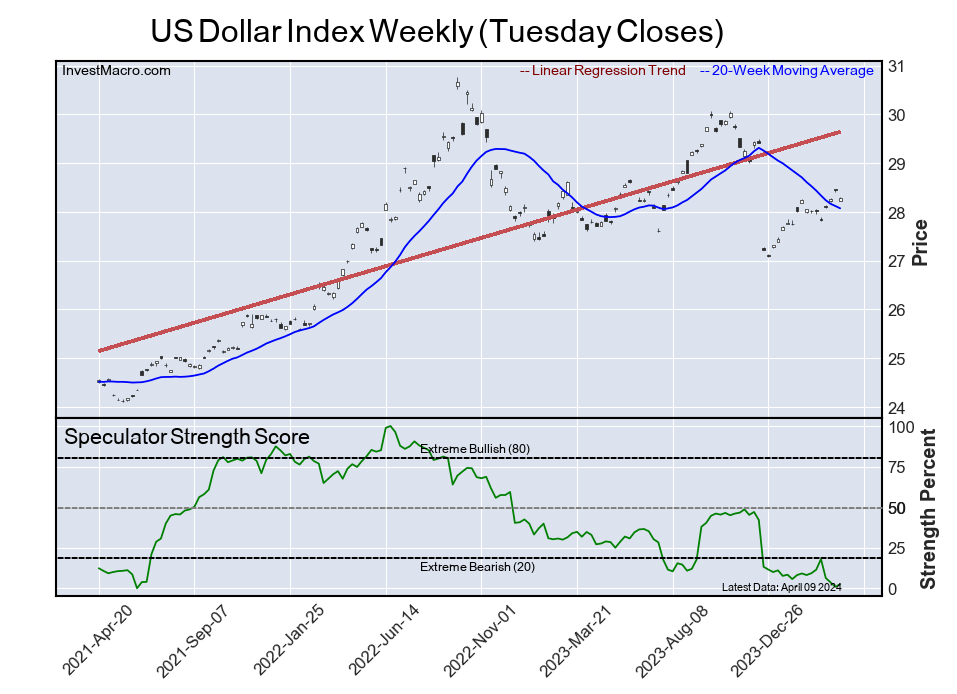

The US Dollar Index speculator position comes in as third most bearish extreme standing of the week. The US Dollar Index speculator level resides at a 2.5 percent score of its 3-year range.

The six-week trend for the speculator strength score was -6.8 this week. The overall speculator position was -1,142 net contracts this week with a rise by 754 contracts in the speculator bets.


Soybeans
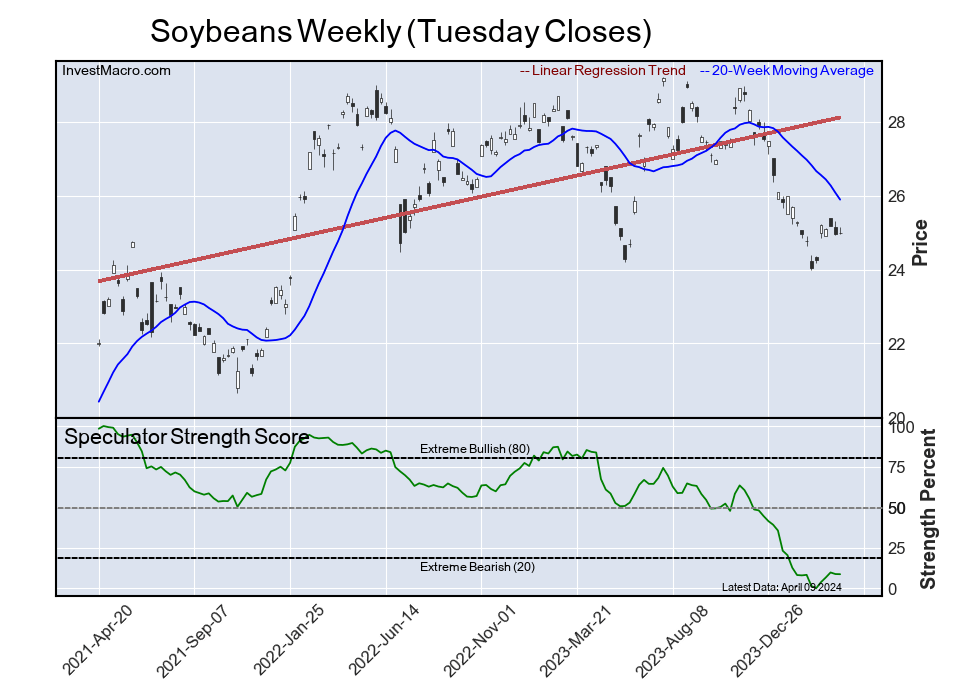

The Soybeans speculator position comes in as this week’s fourth most bearish extreme standing. The Soybeans speculator level is at a 8.7 percent score of its 3-year range.

The six-week trend for the speculator strength score was 7.3 this week. The speculator position was -158,477 net contracts this week with an edge lower by -437 contracts in the weekly speculator bets.


Corn
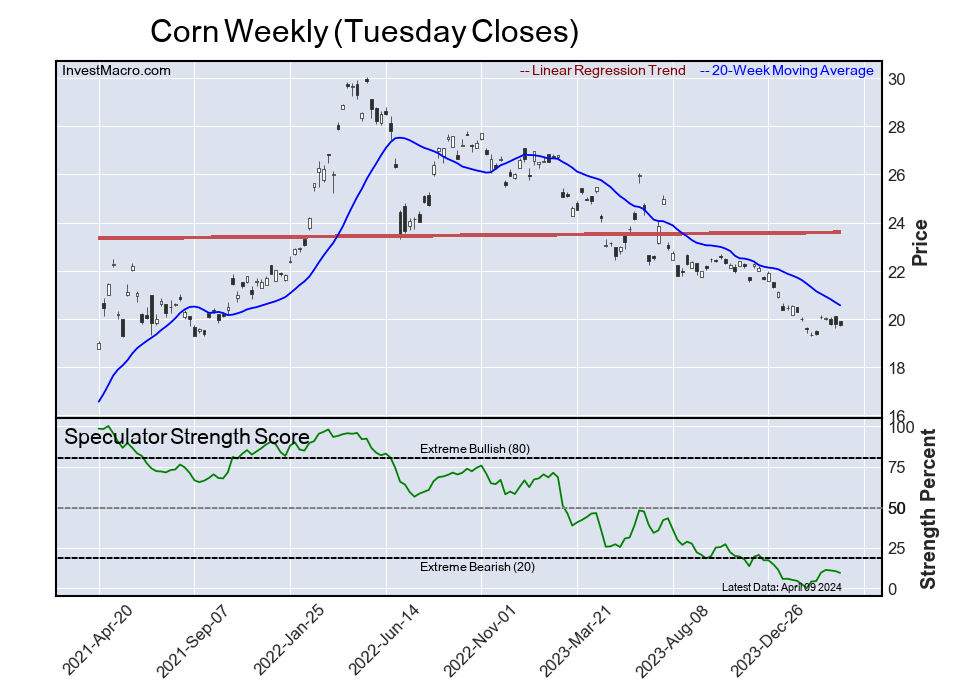

Finally, the Corn speculator position comes in as the fifth most bearish extreme standing for this week. The Corn speculator level is at a 9.5 percent score of its 3-year range.

The six-week trend for the speculator strength score was 5.3 this week. The speculator position was -190,191 net contracts this week with a decline of -8,855 contracts in the weekly speculator bets.


Article By InvestMacroReceive our weekly COT Newsletter

*COT Report: The COT data, released weekly to the public each Friday, is updated through the most recent Tuesday (data is 3 days old) and shows a quick view of how large speculators or non-commercials (for-profit traders) were positioned in the futures markets.

The CFTC categorizes trader positions according to commercial hedgers (traders who use futures contracts for hedging as part of the business), non-commercials (large traders who speculate to realize trading profits) and nonreportable traders (usually small traders/speculators) as well as their open interest (contracts open in the market at time of reporting). See CFTC criteria here.

The backlash against diversity, equity and inclusion in business is in full force − but myths obscure the real value of DEI

By Adia Harvey Wingfield, Arts & Sciences at Washington University in St. Louis 

Few ideas in business are as misunderstood as DEI.

While opposition to DEI – diversity, equity and inclusion – has a long history, it has picked up steam recently.

In 2023, when Silicon Valley Bank collapsed, detractors claimed that the bank’s focus on DEI was responsible – rather than the bank overinvesting in bonds that suddenly lost much of their value.

Not long afterward, when a wall panel detached from an Alaska Airlines flight at 16,000 feet, opponents claimed without evidence that DEI’s corrosive effects were to blame.

More recently, when a cargo ship lost power and slammed into Baltimore’s Key Bridge, critics suggested that DEI was somehow at fault.

In the face of these attacks, many company leaders are troublingly silent about their commitment to DEI. I believe this is a mistake. It allows misrepresentations to take root, and it reinforces the exclusion and marginalization many workers of color already experience.

As a sociologist who focuses on race, gender and work, I believe this is a pivotal moment for companies to reinforce their commitment to DEI.

A history of DEI

For starters, it’s useful to take stock of how American companies moved to DEI in the first place, and how diversity practices are typically structured.

For the overwhelming majority of U.S. history, workers who weren’t white men weren’t just legally banned from leadership roles; they could be barred from holding any role in an organization.

The formal exclusion of women of all races and men of color didn’t become illegal until the passage of the Civil Rights Act of 1964. That means that for nearly 200 years after the country’s founding, white men had virtually unrestricted and exclusive access to the levels of power in all organizations.

The objective, meritocratic past that DEI critics imagine is thus a myth. The centuries-long, systematic exclusion of white women and people of color gives lie to the idea that jobs have historically gone only to the most qualified.

After the Civil Rights Act, companies moved to address the new reality that the racial and gender discrimination that had been practiced with impunity for generations was now illegal. Affirmative action policies were one way organizations sought to address past and ongoing discrimination, and many companies, at least for a time, sought to close racial and gender disparities.

But by the 1980s, backlash to these goals was ascendant. Legal decisions such as the Supreme Court’s 1978 Bakke ruling allowed organizations to consider race as one of many factors when they evaluated applicants but specifically outlawed the use of quotas. Companies could thus consider race as part of a package but, contrary to popular opinion, could not hire candidates simply because they were Black (or from another marginalized group).

They could, however, consider diversity as a compelling interest that justified using race as one of a variety of factors in making decisions about hiring. A company that had no Black workers on its entire staff could thus seek to diversify, taking race into account alongside experience, qualifications, education and other criteria when considering a candidate.

What this hypothetical company could not do is simply hire a Black worker based exclusively on their race.

Diversity initiatives today

In the wake of ongoing backlash, most companies today have moved even further from trying to alleviate ongoing racial and gender disparities. Instead, they embrace the form of DEI that’s under harsh criticism today.

But today’s DEI doesn’t necessarily entail a focus on hiring or promoting more Black workers. It doesn’t even always focus on race. Instead, many DEI managers have sought to focus their efforts more broadly on diversity of thought, region or opinion as a way to avoid the kind of pushback they’re encountering today.

Additionally, companies often rely heavily on DEI practices such as mandatory diversity training or brief workshops with external consultants that actually depress the numbers of Black workers – and other workers of color – in leadership roles.

Today’s critics cast DEI as unfairly advantaging unqualified Black workers, but the reality is that companies stopped focusing on closing racial disparities long ago.

The numbers bear this out. While white men constitute only 30% of the U.S. population, as of 2017 they made up 80% of members of Congress, 85% of corporate executive officers, 95% of Fortune 500 CEOs and 97% of heads of venture capital firms.

The business case for diversity

Clearly, DEI is not reshaping America’s most powerful institutions in a way that places significant numbers of Black workers in leadership roles.

Instead, researchers know that obstacles such as hiring discrimination, wage inequality, hostile organizational cultures and blocked routes to advancement still persist for highly qualified, skilled and motivated Black workers.

The irony is that the data shows very clearly that diversity is correlated with clear benefits to organizations. Companies with more racial and gender diversity among managers boast more profitability and more innovation than those without. They have advantages in recruitment, employee satisfaction and responding to market changes and consumer needs.

Organizations that are genuinely committed to DEI aren’t losing sight of the big picture; rather, they’re investing in their long-term financial success.

For purely self-interested reasons, then, companies should be offering a full-throated defense of DEI. Instead, they’ve been in retreat.

For example, law firms are walking back programs designed to attract lawyers of color, even though the legal profession is overwhelmingly made up of white workers. Similarly, efforts to increase venture capital funding to Black women are under attack, even though in 2018 less than 1% of a total of US$130 billion raised went to firms headed by women of color. And major tech companies are shifting resources away from post-2020 investments in DEI, even though Black workers remain significantly underrepresented in that industry as well.

DEI practices that work

It doesn’t have to be this way. Companies can still rely on evidence-based DEI practices that show results. One approach involves establishing mentoring programs that are open to everyone. Another is cross-training workers so they can build their skills in various parts of a company while at the same time broadening their networks. And a third tack includes investing in flexible, family-friendly workplace policies that send a message to workers that they and their needs matter.

None of these programs are reserved for members of any particular racial group, so they’re within the bounds of the law. The beauty of this approach is that even though these initiatives are race-neutral, research indicates they benefit workers of color more than mandating annual diversity training.

In addition to using measures like these that work, I believe it’s important for corporate leaders to stand up for DEI precisely because it’s under threat.

Some are doing this already. Jamie Dimon of JPMorgan Chase recently described himself as a “full-throated, red-blooded, patriotic, unwoke, capitalist CEO” who still plans to maintain the bank’s commitment to DEI, particularly when it comes to the approaches that are shown to net results. The celebrity businessman Mark Cuban has been similarly outspoken in support of DEI, unequivocally describing it as “good for business.”

Given that research shows workforce diversity helps companies boost profits, it’s surprising to me that more leaders don’t take this approach. The alternative is letting a false narrative that imperils their growth go unchallenged.The Conversation

About the Author:

Adia Harvey Wingfield, Professor of Sociology, Arts & Sciences at Washington University in St. Louis

This article is republished from The Conversation under a Creative Commons license. Read the original article.


Singapore’s central bank (MAS) maintained its monetary policy settings. The ECB hinted at a rate cut soon

By JustMarkets 

At the end of the trading day, the Dow Jones Index (US30) was down 0.01%, while the S&P 500 Index (US500) was up 0.74%. The NASDAQ Technology Index (US100) closed positive at 1.68% yesterday. Strength in technology stocks led the overall market higher on Thursday. Apple (AAPL) climbed more than 4% after it said it plans to upgrade its entire line of Mac computers with its proprietary processors designed for artificial intelligence. In addition, shares of chip companies rose Thursday on speculation that upcoming first-quarter earnings results will show strong demand for microchips.

The US Producer Price Index (displays the inflation rate between factories) for March rose by 0.2% m/m and 2.1% y/y in the US, slightly weaker than expectations of 0.3% m/m and 2.2% y/y. However, the core PPI (excluding food and energy) accelerated to 2.4% y/y from 2.0% y/y in February, slightly stronger than expectations of 2.3% y/y and the largest increase in 7 months. US weekly initial jobless claims fell by 11,000 to a 5-week low of 211,000, indicating a strengthening labor market versus expectations of 215,000. New York Fed President Williams said the Fed has made tremendous progress in balancing inflation and employment, but there is no need to lower interest rates soon. FRB Richmond President Barkin said the Fed still has some work to do to contain price pressures and could take its time in lowering interest rates. FRB Boston President Collins added that recent data has eased concerns about adjusting interest rates, although she still expects rate cuts to begin later this year.

Corporate earnings season for the first quarter begins today with results from major banks, including JPMorgan Chase (JPM), Citigroup (C), and Wells Fargo (WFC). The consensus expects first-quarter earnings for S&P 500 companies to rise an average of 3.8% quarter over quarter.

Equity markets in Europe declined on Thursday. Germany’s DAX (DE40) fell by 0.79% yesterday, France’s CAC 40 (FR40) closed down 0.27% yesterday, Spain’s IBEX 35 (ES35) lost 1.16%, and the UK’s FTSE 100 (UK100) closed negative 0.47% on Thursday.

The European Central Bank left key interest rates unchanged and hinted at the possibility of a rate cut if upcoming forecasts indicate inflationary pressures are easing. Lagarde’s speech was soft and had a dovish bias. Still, the policymaker emphasized that the ECB is not committing to a specific rate trajectory and that future decisions will be data-driven.

WTI crude oil prices rose to $86 a barrel on Friday, recovering most of the previous session’s losses, as the prospect of a wider conflict in the Middle East continued to heighten fears of further supply disruptions. Israel is reportedly preparing for a direct attack from Iran in the next 24-48 hours, as Tehran has previously pledged to retaliate to an alleged Israeli attack on its embassy in Syria. The latest rounds of ceasefire talks between Israel and Hamas have also failed, with Israeli Prime Minister Benjamin Netanyahu saying they will continue the war in Gaza.

Natural gas prices for May fell sharply on Thursday due to a larger-than-expected 24 Bcf increase in EIA natural gas inventories last week, which exceeded expectations of 15 Bcf. As of March 29, the US natural gas inventories were 38.9% above the 5-year seasonal average, indicating an oversupply of natural gas.

Asian markets were mostly down yesterday. Japan’s Nikkei 225 (JP225) was down 0.35%, China’s FTSE China A50 (CHA50) lost 0.16%, Hong Kong’s Hang Seng (HK50) decreased by 0.26% and Australia’s ASX 200 (AU200) was negative 0.44%.

The Monetary Authority of Singapore (MAS) has maintained its April 2024 monetary policy rate target, extending the pause for the fourth straight month amid heightened cost pressures. The Authority said it will maintain the prevailing pace of appreciation in the nominal effective exchange rate of the Singapore dollar. The central bank said it expects the country’s GDP growth to be 1% to 3% this year, supported by a recovery in the manufacturing and financial sectors and normalization in domestic-oriented sectors. Meanwhile, MAS forecasts that the preferred core inflation rate will remain high in the coming quarters before declining in Q4 2024 and 2025. In January-February, core inflation averaged 3.4% on an annualized basis

At its April meeting, the Bank of Korea kept the benchmark rate at 3.5%, as expected. It was the tenth consecutive meeting to keep borrowing costs unchanged, with the central bank emphasizing the need for further progress on price stability before considering monetary easing. Inflation was 3.1% in March, mainly driven by higher agricultural and global oil prices, while core inflation eased to 2.4% from 2.6% in February.

S&P 500 (US500) 5,199.06 +38.42 (+0.74%)

Dow Jones (US30) 38,459.08 −2.43 (−0.01%)

DAX (DE40) 18,097.30 −142.82 (−0.79%)

FTSE 100 (UK100) 7,923.80 −37.41 (−0.47%)

USD Index 105.27 +0.02 (+0.02%)

Important events today:
  • – China Trade Balance (m/m) at 06:00 (GMT+3);
  • – Japan Industrial Production (m/m) at 07:30 (GMT+3);
  • – German Consumer Price Index (m/m) at 09:00 (GMT+3);
  • – UK GDP (m/m) at 09:00 (GMT+3);
  • – UK Industrial Production (m/m) at 09:00 (GMT+3);
  • – UK Manufacturing Production (m/m) at 09:00 (GMT+3);
  • – UK Trade Balance (m/m) at 09:00 (GMT+3);
  • – Indian Inflation Rate (m/m) at 15:00 (GMT+3);
  • – US Michigan Consumer Sentiment (m/m) at 17:00 (GMT+3).

By JustMarkets


This article reflects a personal opinion and should not be interpreted as an investment advice, and/or offer, and/or a persistent request for carrying out financial transactions, and/or a guarantee, and/or a forecast of future events.

Week Ahead: Time for stock index “slowpokes” to catch up?

By ForexTime 

  • UK100 now less than 0.2% away from all-time peak!
  • 3 stock index “laggards” could find reasons to catch up next week
  • MONDAY: US30 (+2% ytd) needs a boost from Goldman Sachs earnings
  • TUESDAY: CN50 (+3.6% ytd) bulls require rosier Chinese economic data
  • WEDNESDAY: UK100 (+3.7% ytd) needs slowing CPI to stay above 8k

REMINDER: 11 of FXTM’s 18 stock indices have reached their respective record highs so far in 2024.

However, we could see that tally reach 12 very soon (hint: the “answer” lies towards the end of this article).


In assessing the various stock indexes around the world, obviously not all are created equal.


Broadly speaking, there are the outperformers:

  • US500: up 9% year-to-date
  • EU50: +10.9%
  • TWN: +11.9%
  • NETH25: +13.4%
  • JAP225: +18.1%


At the other end of the spectrum, there are others that are clearly lagging behind their peers, with more conservative year-to-date gains:

  • US30: +2%
  • UK100: +3.4%
  • CN50: +3.6%


Over the coming week, these 3 events could either boost, or further dampen, the above-listed “laggards”:


1) US30 index: Goldman Sachs earnings (Monday, April 15th)

Wall Street banking giant, Goldman Sachs, is the 3rd-largest member of the US30 stock index.

NOTE: The US30 tracks the benchmark Dow Jones Industrial Average index a.k.a. the Dow

Goldman Sachs alone accounts for 6.8% of the Dow!

And at the time of writing, markets predict that Goldman Sachs’s share prices could move 3.4%, either up or down, once US stock markets reopen after the bank has released its earnings.

Hence, the market’s reaction to Goldman Sachs’s earnings could have a large impact on the US30’s performance.

  • Better-than-expected earnings for Goldman Sachs could lift the US30 towards its 50-day simple moving average (SMA).
  • Worse-than-expected earnings for Goldman Sachs could sink the US30 towards its 100-day SMA, where also lies the psychologically-important 38,000 line.


2) CN50 index: China’s key economic data releases (Tuesday, April 16th)

The world’s second-largest economy is due to release its 1Q GDP data, alongside last month’s performance for industrial production, retail sales, retail sales, and property investment.

Essentially, this coming Tuesday …

Investors and traders are about to be hit with a lot of information on how the Chinese economy is faring right now.

Note that the CN50 index’s performance is very much tied to the overall health of the Chinese economy.

After all, stocks within the financial, consumer staples, and industrials sectors combine to account for two-thirds (67.8%) of the entire CN50 index.

Hence, no surprise that the CN50 has lagged, given the economic challenges that China’s currently facing.

  • If Tuesday’s data releases come in better-than-expected, this could send CN50 back above the psychologically-important 12,000 mark and past its 200-day SMA.
  • However, evidence of a still-sluggish Chinese economy may keep the CN50 index subdued below its 50-day SMA, and potentially on a path towards that end-Feb/early-March low of 11,686.3.


3) UK100 index: UK March consumer price index (Wednesday, April 17th)

NOTE: The consumer price index (CPI) measures inflation in an economy.

Economists predict that the March UK CPI rose by:

  • 2.9% year-on-year (March 2024 vs. March 2023)
  • 0.4% month-on-month (March 2024 vs. February 2024)

Recall that the UK100 index has an inverse relationship with the British Pound (GBP).

NOTE: When GBP goes up, the UK100 tends to fall, and vice versa.

This inverse relationship has been particularly evident over the past month:

The primary reason for the price moves in the above chart (GBPUSD vs. UK100) is because …

Markets are now betting that the Bank of England’s (BOE) interest rate CUTS will be brought forward.

Such revised expectations have dragged GBPUSD to its year-to-date low closer to 1.2500, while the UK100 has made multiple breaches of the psychologically-important 8,000 mark.

  • Higher-than-expected CPI figures, that force the BOE to delay its rate cuts, could strengthen Sterling and drag the UK100 back below the 8k mark.
  • Lower-than-expected CPI figures, that allow the BOE to bring forward its rate cuts, could weaken GBP and help keep the UK100 above 8,000.


At the time of writing (Friday, April 12th) …

The UK100 index is less than 0.2% below its all-time intraday high of 8051.7, registered on February 16th, 2023.

READ MORE: UK100 index teases record high (April 2nd, 2024)


If things go the UK100’s way either later today, or in the Week Ahead …

Then we’d see 12 of FXTM’s stock indices having notched fresh record highs so far this year!


For further consideration, here’s a more comprehensive list of scheduled events that could move various asset classes over the coming week:


Monday, April 15

  • CNH: PBoC rate decision
  • EUR: Eurozone February industrial production
  • USD index: US March retail sales; speeches by Dallas Fed President Lorie Logan, San Francisco Fed President Mary Daly
  • US30 index: Goldman Sachs earnings


Tuesday, April 16

  • CN50 index: China 1Q GDP; March industrial production, retail sales, unemployment, property investment
  • EU50 index: Eurozone April ZEW survey; February trade balance
  • GBP: UK February unemployment
  • RUS2000 index: US March industrial production
  • CAD: Canada March CPI
  • US500 index: Morgan Stanley, Bank of America earnings


Wednesday, April 17

  • NZD: New Zealand 1Q CPI
  • JP225 index: Japan March trade balance
  • SG20 index: Singapore March exports
  • NETH25 index: Eurozone March CPI (final)
  • UK100 index: UK March CPI; speech by BOE Governor Andrew Bailey
  • US400 index: Fed Beige Book; speeches by Cleveland Fed President Loretta Mester, Fed Governor Michelle Bowman


Thursday, April 18

  • AUD: Australia March unemployment; 1Q business confidence
  • TWN index: TSMC earnings
  • USD: US weekly initial jobless claims; speeches by Fed Governor Michelle Bowman, New York Fed President John Williams, Atlanta Fed President Raphael Bostic


Friday, April 19

  • JPY: Japan March national CPI
  • GER40 index: Germany March PPI
  • GBP: UK March retail sales
  • USD: Speech by Chicago Fed President Austan Goolsbee

Forex-Time-LogoArticle by ForexTime

ForexTime Ltd (FXTM) is an award winning international online forex broker regulated by CySEC 185/12 www.forextime.com

Australian dollar struggles amid robust US economic data

By RoboForex Analytical Department

The AUD/USD pair remains under pressure, hovering around 0.6528 on Friday. Earlier this week, the Australian dollar faced significant challenges, with a sharp decline against the USD. Efforts to stabilise the exchange rate have seen limited success thus far.

The stronger-than-expected economic data from the US has dampened hopes for extensive interest rate cuts by the Federal Reserve this year. The capital market currently anticipates only a 40-basis point reduction, a downgrade from the 60-75 basis points expected at the start of the week.

The Reserve Bank of Australia (RBA) is considering initiating its monetary easing policies towards the end of 2024. However, Australia’s robust employment market and persistent consumer inflation complicate these plans. Recent data indicates that the unemployment rate dropped to 3.7% in February, the lowest since September 2023, while inflation remained steady at 3.4% for the third consecutive month.

A recent Westpac report highlights the RBA’s need for greater confidence in the inflation outlook before seriously contemplating a rate cut.

Technical analysis of AUD/USD

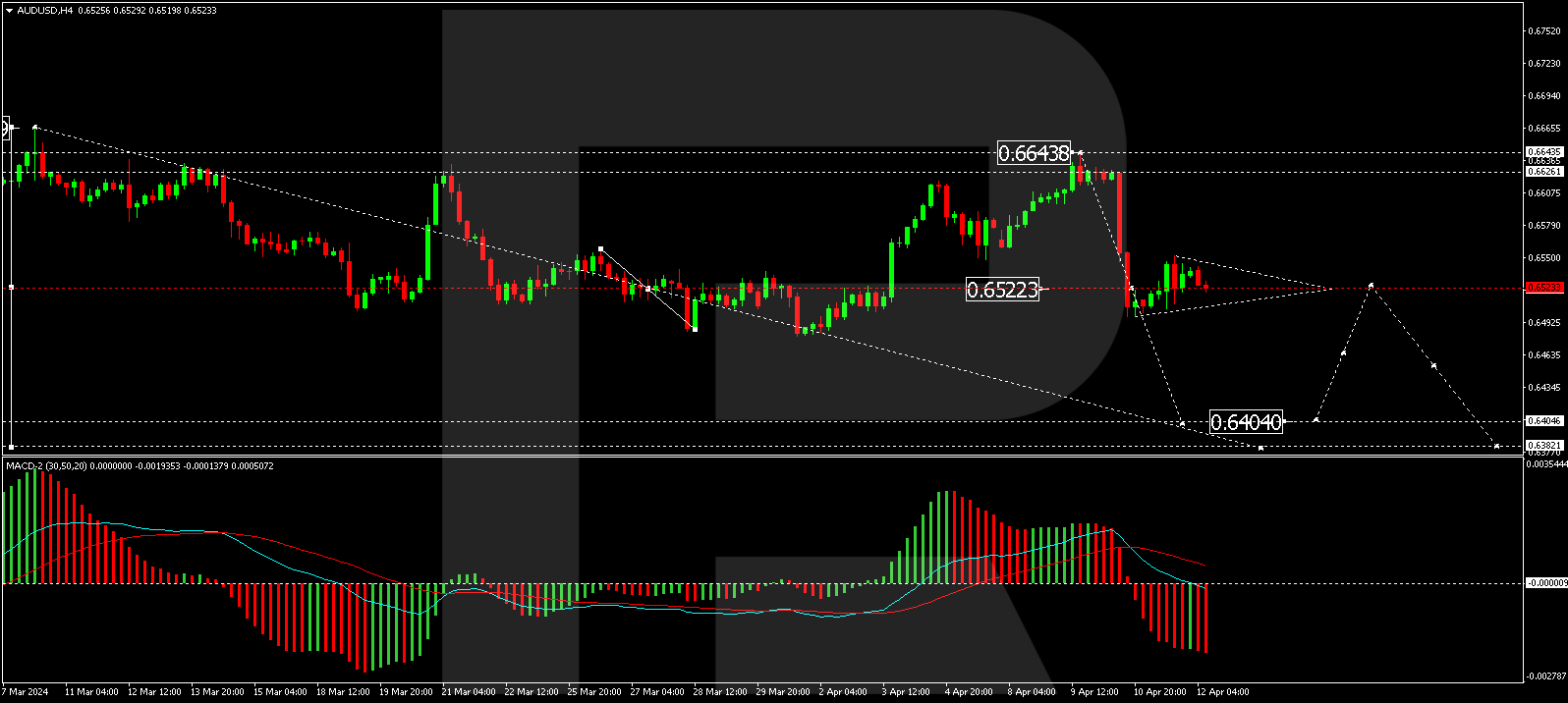
On the H4 chart, the AUD/USD is developing the fifth wave of decline towards 0.6832. The market has recently experienced a decline to 0.6498. A consolidation range is forming above this level today. If the pair exits this range upward, a corrective move to 0.6570 may occur. Conversely, a downward exit could lead to the continuation of the downward wave towards 0.6404. The MACD indicator supports this bearish outlook, with its signal line above zero but trending downwards sharply.

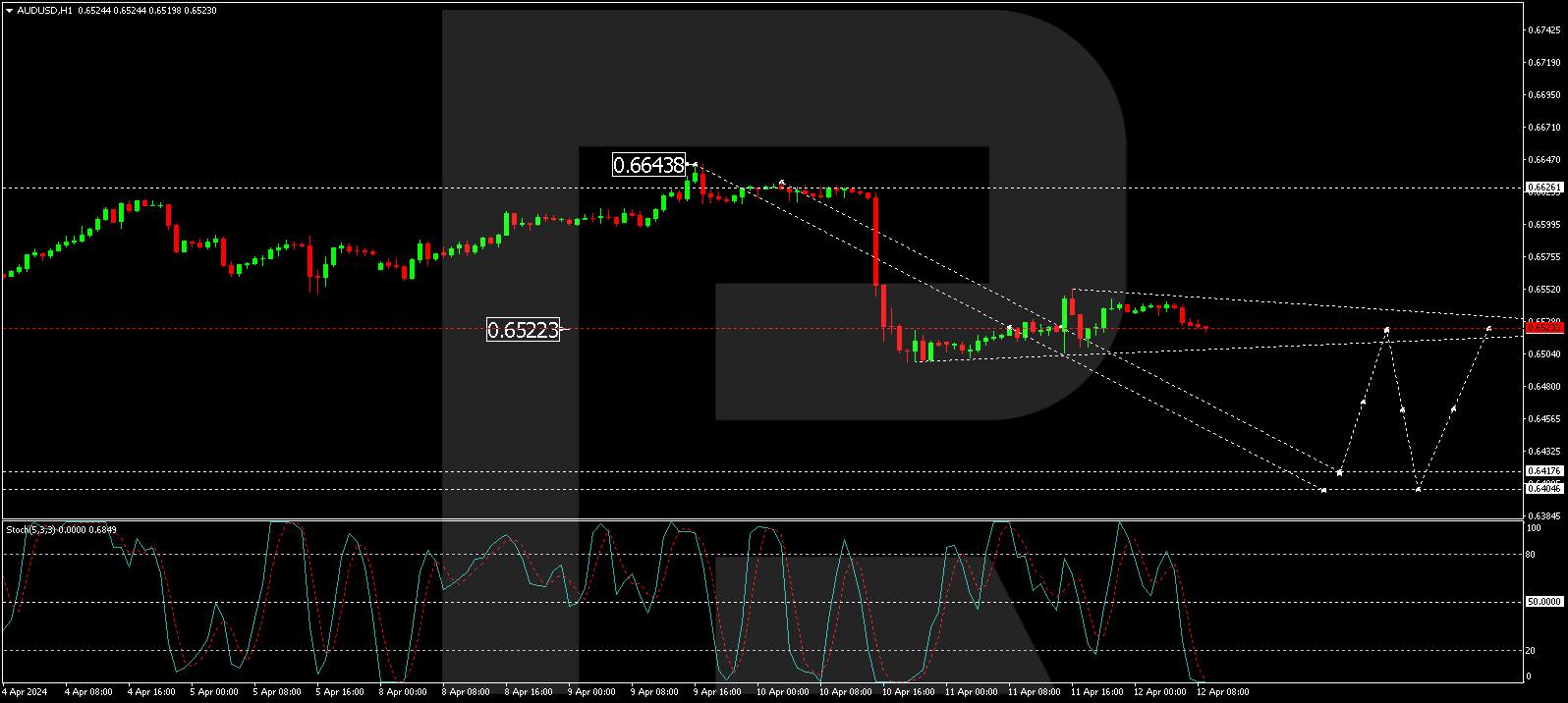
The H1 chart shows a consolidation around 0.6523. An upward breakout could lead to a correction towards 0.6570. A downward move from the range could initiate a further decline to 0.6420, potentially extending to 0.6404. The Stochastic oscillator, currently below 20, suggests a possible rise to 50, indicating potential short-term corrections within a broader downward trend.

Disclaimer

Any forecasts contained herein are based on the author’s particular opinion. This analysis may not be treated as trading advice. RoboForex bears no responsibility for trading results based on trading recommendations and reviews contained herein.

The Bank of Canada maintained its monetary policy settings. The FOMC minutes showed that policymakers will not be in a hurry to cut rates

By JustMarkets

At the end of the trading day, the Dow Jones Index (US30) was down 1.09%, while the S&P 500 Index (US500) lost 0.95%. The NASDAQ Technology Index (US100) closed yesterday negative 0.84%. A sharp rise in bond yields pressured equities yesterday after the March US Consumer Price Index exceeded expectations for the third consecutive month, reinforcing the likelihood that the Federal Reserve will not rush to cut interest rates. The annualized US inflation rate was 3.5% in March 2024, the highest since September, up from 3.2% in February and forecasts of 3.4%. In addition, core CPI (excluding food and energy) rose by 0.4% m/m to 3.8% y/y, stronger than expectations of 0.3% m/m and 3.7% y/y. Fed swap prices are now pricing in only a 50 bps rate cut this year, less than the Fed’s recent 75 bps dot plot. Markets estimate the odds of a 25 bps rate cut at 3% at the next FOMC meeting on May 1 and just 21% (vs. 70% last week) at the next meeting on June 12.

Minutes from the March FOMC meeting showed that the Federal Reserve does not believe it is appropriate to lower the target range until there is confidence that inflation is moving steadily toward 2%. The central bank still closely monitors inflation risks but expects to see some unevenness in monthly inflation readings as inflation returns to target. The so-called dot plot showed policymakers still plan to cut interest rates three times this year, matching quarterly forecasts made in December.

The Bank of Canada (BoC) kept its key rate at 5%, as expected, and refrained from hinting at the start of rate cuts because of lingering upside risks to inflation. The central bank noted that price pressures have eased across a wide range of goods and services since the last meeting but added that an uncertain macroeconomic backdrop and higher-than-expected commodity prices, including oil, prevent disinflation from converging more smoothly. Bank of Canada Governor Macklem added that while recent data indicate some progress in containing core inflation, it is still insufficient to justify monetary easing with confidence. As such, the Bank of Canada expects inflation to remain around 3% in the first half of this year and not reach the 2% target until 2025.

Equity markets in Europe traded without a single dynamic on Wednesday. Germany’s DAX (DE40) rose by 0.11%, France’s CAC 40 (FR40) closed down 0.05%, Spain’s IBEX 35 (ES35) lost 0.38%, and the UK’s FTSE 100 (UK100) closed positive 0.33% on Wednesday.

The European Central Bank (ECB) will hold a monetary policy meeting today. Market participants expect the ECB to leave the key rate unchanged at 4.5%. After last month’s meeting, the Eurozone economy has gained momentum but is still close to recession. Therefore, the ECB will likely want to get an update on inflation and labor market data before embarking on full-blown easing. Most of the central bank’s recent statements hint that a key rate cut in June is a real possibility. Therefore, given current market speculation, there is a risk that Lagarde’s statement and press conference will be less dovish than financial markets expect. In that case, the euro could get a boost to growth. But if Lagarde’s statement is confidently dovish with a hint of a real rate cut in June, the euro will continue to decline.

WTI crude oil prices rose to $85.7 a barrel on Wednesday, breaking a two-day decline, as the market reacted to the news from Gaza. Several important Hamas figures were killed in an Israeli airstrike, which could complicate ceasefire talks. Tensions in the Middle East ran high, with Israel warning OPEC representative Iran that it will attack the Islamic Republic if Tehran strikes Israel, with the US reportedly confident of an imminent strike by Iran or its supporters on Israel. The EIA reported a 5.841 million barrel rise in inventories on Wednesday, beating market expectations for a 2.366 million barrel increase.

Asian markets traded without any unified dynamics. Japan’s Nikkei 225 (JP225) was down 0.48% yesterday, China’s FTSE China A50 (CHA50) lost 0.42%, Hong Kong’s Hang Seng (HK50) was up 1.85% overnight and Australia’s ASX 200 (AU200) was positive 0.31%. Asian equity markets fell on Thursday, following a sharp decline on Wall Street overnight. Investors also priced in data that China’s consumer prices rose less than expected in March, while producer prices fell by the most in four months. Chinese consumer prices were 0.1% y/y in March 2024, compared to market forecasts of 0.4% y/y, after rising to 0.7% in the previous month. China’s lower-than-expected inflation numbers have bolstered bets on further policy easing from the PBoC.

Fitch Ratings revised its outlook on China’s sovereign credit rating to negative from stable while affirming its A+ rating amid growing concerns about the outlook for the country’s public finances. The agency cited large budget deficits and a sharp rise in government debt in recent years as undermining fiscal reserves from a rating perspective.

The Japanese yen hit a new 34-year low. Traders are now expecting currency intervention from the Bank of Japan (BoJ), seeing the 152-153 per dollar exchange rate as a potential catalyst. On Tuesday, Finance Minister Shun’ichi Suzuki said that the authorities do not rule out any measures against excessive yen movement.

S&P 500 (US500) 5,160.64 −49.27 (-0.95%)

Dow Jones (US30) 38,461.51 −422.16 (−1.09%)

DAX (DE40) 18,097.30 +20.61 (+0.11%)

FTSE 100 (UK100) 7,961.21 +26.42 (+0.33%)

USD Index 105.17 +1.03 (+0.99%)

Important events today:
  • – China Consumer Price Index (q/q) at 04:30 (GMT+3);
  • – China Producer Price Index (q/q) at 04:30 (GMT+3);
  • – Eurozone ECB Interest Rate Decision at 15:15 (GMT+3);
  • – Eurozone ECB Monetary Policy Statement at 15:15 (GMT+3);
  • – US Producer Price Index (m/m) at 15:30 (GMT+3);
  • – US Initial Jobless Claims (w/w) at 15:30 (GMT+3);
  • – Eurozone Press Conference at 15:45 (GMT+3);
  • – US Natural Gas Storage (w/w) at 17:30 (GMT+3).

By JustMarkets


This article reflects a personal opinion and should not be interpreted as an investment advice, and/or offer, and/or a persistent request for carrying out financial transactions, and/or a guarantee, and/or a forecast of future events.

Target Thursdays: Bitcoin, US400, RUS2000, and EURGBP

By ForexTime 

  • Bitcoin still climbing this CPI week; up over 2%/$1,600 since Sunday
  • US400 and RUS2000 stock indices showed larger-CPI reactions, as predicted
  • FXTM Trading Signals: EURGBP reaches all 4 Targets


The monthly US CPI release has come and gone.

The highly-anticipated set of US economic data exceeded market expectations by 0.1 percentage points each:

  • Headline CPI in March 2024 vs. March 2023 (year-on-year): 3.5%
    Higher than the forecasted 3.4%; higher than February’s 3.2% year-on-year figure
  • Headline CPI in March 2024 vs. February 2024 (month-on-month): 0.4%
    Higher than the forecasted 0.3%; higher than February’s 0.4% month-on-month figure
  • Core CPI (excluding food and energy prices) year-on-year: 3.8%
    Higher than the forecasted 3.7%; matching February’s 3.8% year-on-year figure
  • Core CPI month-on-month: 0.4%
    Higher than the forecasted 0.3%; matching February’s 0.4% month-on-month figure

The higher-than-expected CPI numbers pushed back bets that the Fed can cut US interest rates as soon as June 2024.


As we’d written about extensively, this CPI numbers certainly jolted various asset classes on Wednesday, April 10th.

Now, we look back at a couple of instruments that performed as per outlined in our recently published Daily Market Analysis articles:


1) Bitcoin still rising so far this CPI week

What we wrote:

So far in 2024, cryptos have risen every week that the highly-anticipated US inflation data is released!

(Trade of the Week: Cryptos to rise again this CPI week?; published Monday, April 8th)


What’s happened since?

At the time of writing, Bitcoin has risen by over 2% (or about $1600) so far this week since Sunday’s closing price of $69,315.13.

Even though other risk assets (such as stocks) fell after the hotter-than-expected US CPI, Bitcoin managed to rebound after its own initial post-CPI selloff.

If Bitcoin can continue shrugging off the US CPI’s impact and adhere to this trend of posting a weekly advance for each week so far in 2024 that has featured a US CPI announcement, that could translate into further gains for Bitcoin bulls for the rest of this week.

Still, the astute trader would note the stubborn resistance region around $71,400 which has capped Bitcoin’s upside since week of March 25th.

The world’s oldest crypto has to vanquish the $71,400 resistance in order to have another shot at posting a new record high.


2) US400 and RUS2000 indices saw massive post-CPI moves

What we wrote:

“On CPI days, the US400 typically sees a 39% larger-than-average move, which translates into 13 index points higher than average (average: 34 index points).
“On CPI days, the RUS2000 typically sees a 27.8% larger-than-average move, which translates into 7 index points higher than average (average: 25 index points).
” … stock markets may be pulled back lower if US inflation is proving stubborn, …”

(“Smaller” US stock indexes, bigger CPI reactions?; published Tuesday, April 9th)


What’s happened since?

  • US400

This mid-sized US stock index posted a 93.8 index point difference between its highest and lowest traded prices in the 1 hour immediately following the US CPI release.

Those 93.8 index points are almost 3x the average daily intraday difference (highest price – lowest price) of 34 index points over the past 12 months.


  • RUS2000

This “small” US stock index posted a 86 index point difference between its highest and lowest traded prices in the 1 hour immediately following the US CPI release.

Those 86 index points are MORE THAN TRIPLE the average daily intraday difference (highest price – lowest price) of 25 index points over the past 12 months.


Given that massive post-CPI move downwards for US stock indices, as was expected in light of the hotter-than-expected US inflation data …

This would’ve been a major payoff for those who had “short” positions (bet that prices would go down) on either the US400 or RUS2000 stock indices!


3) FXTM Trading Signals: EURGBP bags over 100 points

Every week day, we publish the FXTM Trading Signals twice daily:

  • EU session: 6:00AM GMT
  • US session: 12:30PM GMT

This EURGBP signal, published just today (Thursday EU session), has already reached all 4 Targets!

NOTE: FXTM Trading Signals are available for clients under the MyFXTM portal (published within the Trading Services section)


FXTM Signal: EURGBP M15 – how it started …


FXTM Signal: EURGBP M15 – how it ended …


But wait, there could be more volatility ahead for EURGBP!

The European Central Bank (ECB) is due to announce its policy decision at 12:15PM GMT later today (Thursday, April 11th)

To be clear, markets roundly expect the ECB to leave its benchmark rates unchanged at its record high of 4%.

However, markets will be keen to find out if the ECB is now more certain about CUTTING its benchmark rates by 25-basis points in June 2024.

Such clues may be derived out of ECB President Christine Lagarde’s press conference due at 12:45PM GMT, which is 30 minutes after the ECB’s policy announcement.


EURGBP: Potential Post-ECB Scenarios

  • If President Lagarde lends further credence to the thought of a June rate cut by the ECB, that could prompt EURGBP to revisit the 0.8550 level.
  • However, if President Lagarde unexpectedly pushes back against bets for a June rate cut, that should trigger a greater rebound for EURGBP back above the 0.8570 line.


Feel like you missed out on these profits?

You can keep following our “Daily Market Analysis” for fresh trading ideas and opportunities across global financial markets.


Forex-Time-LogoArticle by ForexTime

ForexTime Ltd (FXTM) is an award winning international online forex broker regulated by CySEC 185/12 www.forextime.com

US Dollar strengthens following high inflation data

By RoboForex Analytical Department

The EUR/USD pair has experienced a significant decline, stabilising around 1.0745 by Thursday. This movement follows the US releasing inflation data that exceeded expectations, underscoring the ongoing battle against inflation. The March consumer price index (CPI) increased by 0.4% month-on-month, matching February’s rise but surpassing the anticipated 0.3%. The annual inflation rate intensified to 3.5% from 3.2%, signalling persistent inflationary pressures.

Core inflation, which excludes volatile food and energy prices, also climbed by 0.4% in March, maintaining a year-on-year core 3.8% core CPI. Such elevated inflation levels suggest that the Federal Reserve might delay interest rate cuts, a sentiment reflected in the CME’s FedWatch tool. The likelihood of a rate reduction in June sharply declined to 18% post-CPI announcement, representing a significant drop from the 50% probability seen before the data release. Expectations now lean towards September for potential Federal Reserve actions.

Market predictions have adjusted to foresee a 43-45 basis point rate cut by the Fed within this year, a sharp decline from the 75 basis points expected at the week’s start and the 150 basis points anticipated at the year’s beginning. The minutes from the Federal Reserve’s recent meeting further solidified concerns, revealing policymakers’ dissatisfaction with inflation trends even before the latest price statistics.

This series of developments has bolstered the US dollar’s strength in the currency market.

EUR/USD technical analysis

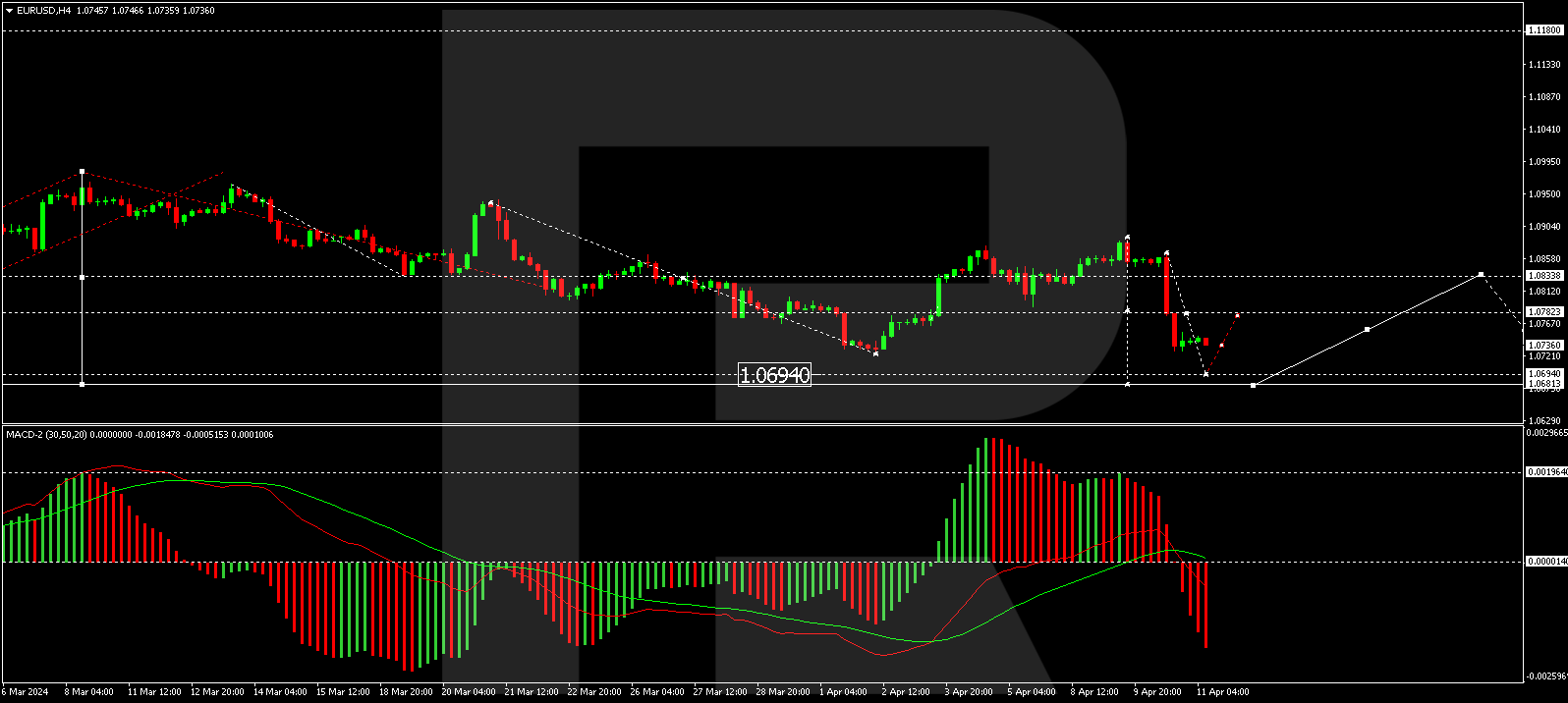
The H4 chart analysis for EUR/USD shows a correction to 1.0883, followed by a downturn to 1.0728 on the back of the recent news. A consolidation range has currently formed around this level, with a potential rise to 1.0784. A downward breakout from this range could lead to a decrease towards 1.0700. The MACD indicator, positioned below zero and trending downward, supports this potential scenario.

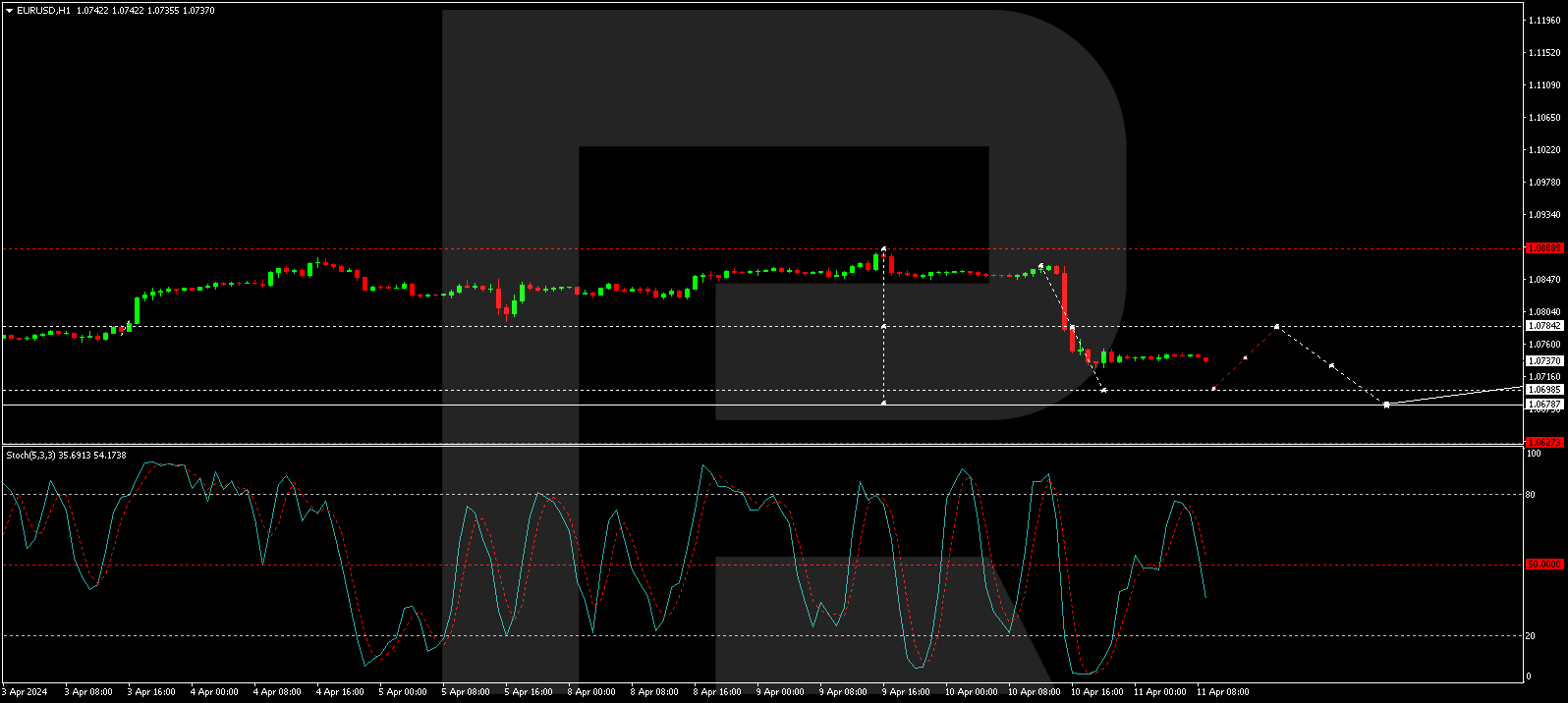
On the H1 chart, the downward trend towards 1.0700 continues, with a possible correction to 1.0780 expected. This may be followed by a further drop to 1.0680, representing an initial phase of a broader downtrend. The Stochastic oscillator, currently below 80, anticipates a continued decline towards 20, reinforcing the bearish outlook for the EUR/USD pair.

Disclaimer

Any forecasts contained herein are based on the author’s particular opinion. This analysis may not be treated as trading advice. RoboForex bears no responsibility for trading results based on trading recommendations and reviews contained herein.

Brain scans of Philly jazz musicians reveal secrets to reaching creative flow

By John Kounios, Drexel University and Yvette Kounios, Widener University 

Flow, or being “in the zone,” is a state of amped-up creativity, enhanced productivity and blissful consciousness that, some psychologists believe, is also the secret to happiness. It’s considered the brain’s fast track to success in business, the arts or any other field.

But in order to achieve flow, a person must first develop a strong foundation of expertise in their craft. That’s according to a new neuroimaging study from Drexel University’s Creativity Research Lab, which recruited Philly-area jazz guitarists to better understand the key brain processes that underlie flow. Once expertise is attained, the study found, this knowledge must be unleashed and not overthought in order for flow to be reached.

As a cognitive neuroscientist who is senior author of this study, and a university writing instructor, we are a husband-and-wife team who collaborated on a book about the science of creative insight. We believe that this new neuroscience research reveals practical strategies for enhancing, as well as elucidating, innovative thinking.

Jazz musicians in flow

The concept of flow has fascinated creative people ever since pioneering psychological scientist Mihály Csíkszentmihályi began investigating the phenomenon in the 1970s.

Yet, a half-century of behavioral research has not answered many basic questions about the brain mechanisms associated with the feeling of effortless attention that exemplifies flow.

The Drexel experiment pitted two conflicting theories of flow against each other to see which better reflects what happens in people’s brains when they generate ideas. One theory proposes that flow is a state of intensive hyperfocus on a task. The other theory hypothesizes that flow involves relaxing one’s focus or conscious control.

The team recruited 32 jazz guitarists from the Philadelphia area. Their level of experience ranged from novice to veteran, as quantified by the number of public performances they had given. The researchers placed electrode caps on their heads to record their EEG brain waves while they improvised to chord sequences and rhythms that were provided to them.

Young man plays guitar while wearing helmet covered in electrodes that measure brain activity
Postdoctoral researcher Yongtaek Oh plays guitar while his EEG is recorded in Drexel University’s Creativity Research Lab.
John Kounios/Creativity Research Lab/Drexel University, CC BY-ND

Jazz improvisation is a favorite vehicle for cognitive psychologists and neuroscientists who study creativity because it is a measurable real-world task that allows for divergent thinking – the generation of multiple ideas over time.

The musicians themselves rated the degree of flow that they experienced during each performance, and those recordings were later played for expert judges who rated them for creativity.

Train intensively, then surrender

As jazz great Charlie Parker is said to have advised, “You’ve got to learn your instrument, then, you practice, practice, practice. And then, when you finally get up there on the bandstand, forget all that and just wail.”

This sentiment aligns with the Drexel study findings. The performances that the musicians self-rated as high in flow were also judged by the outside experts as more creative. Furthermore, the most experienced musicians rated themselves as being in flow more than the novices, suggesting that experience is a precondition for flow. Their brain activity revealed why.

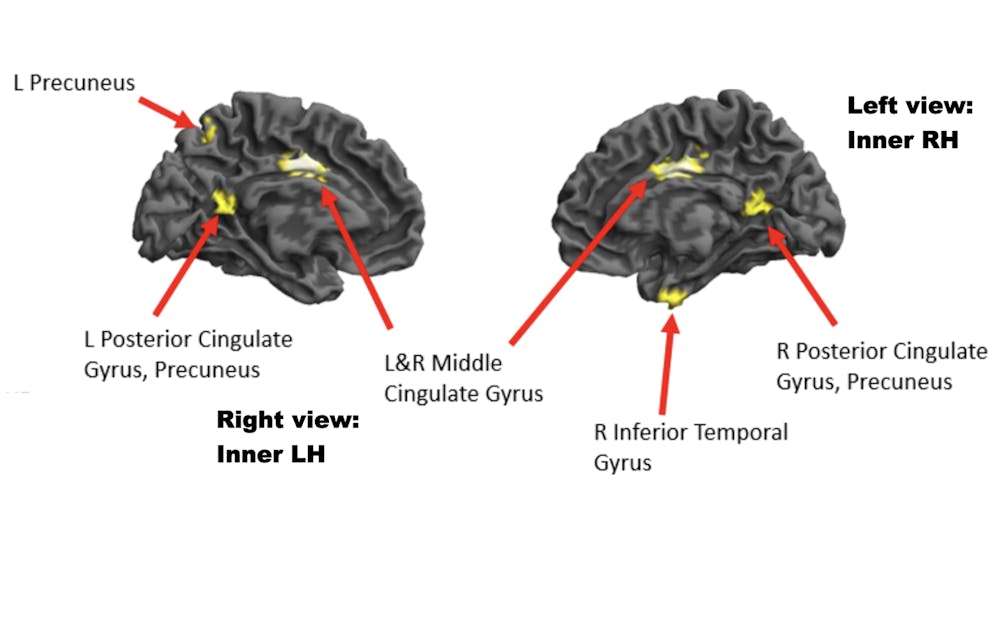
The musicians who were experiencing flow while performing showed reduced activity in parts of their frontal lobes known to be involved in executive function or cognitive control. In other words, flow was associated with relaxing conscious control or supervision over other parts of the brain.

And when the most experienced musicians performed while in a state of flow, their brains showed greater activity in areas known to be involved in hearing and vision, which makes sense given that they were improvising while reading the chord progressions and listening to rhythms provided to them.

In contrast, the least experienced musicians showed very little flow-related brain activity.

Flow vs. nonflow creativity

We were surprised to learn that flow-state creativity is very different from nonflow creativity.

Previous neuroimaging studies suggested that ideas are usually produced by the default-mode network, a group of brain areas involved in introspection, daydreaming and imagining the future. The default-mode network spews ideas like an unattended garden hose spouts water, without direction. The aim is provided by the executive-control network, residing primarily in the brain’s frontal lobe, which acts like a gardener who points the hose to direct the water where it is needed.

Slide showing views of brain with different areas lit
Views of left and right sides of the brain showing reduced brain activity when experienced musicians were in a state of high flow. These areas include key nodes of the brain’s default-mode network.
John Kounios/Creativity Research Lab/Drexel University, CC BY-ND

Creative flow is different: no hose, no gardener. The default-mode and executive-control networks are tamped down so that they cannot interfere with the separate brain network that highly experienced people have built up for producing ideas in their field of expertise.

For example, knowledgeable but relatively inexperienced computer programmers may have to reason their way through every line of code. Veteran coders, however, tapping their specialized brain network for computer programming, may just start writing code fluently without overthinking it until they complete – perhaps in one sitting – a first-draft program.

Coaching can be a help or hindrance

The findings that expertise and the ability to surrender cognitive control are key to reaching flow are supported by a 2019 study from the Creativity Research Lab. For that study, jazz musicians were asked to play “more creatively.” Given that direction, the nonexpert musicians were indeed able to improvise more creatively. That is apparently because their improvisation was largely under conscious control and could therefore be adjusted to meet the demand. For example, during debriefing, one of the novice performers said, “I wouldn’t use these techniques instinctively, so I had to actively choose to play more creatively.”

On the other hand, the expert musicians, whose creative process was baked in through decades of experience, were not able to perform more creatively after being asked to do so. As one of the experts put it, “I felt boxed-in, and trying to think more creatively was a hindrance.”

The takeaway for musicians, writers, designers, inventors and other creatives who want to tap into flow is that training should involve intensive practice followed by learning to step back and let one’s skill take over. Future research may develop possible methods for releasing control once sufficient expertise has been achieved.The Conversation

About the Author:

John Kounios, Professor of Psychological and Brain Sciences, Drexel University and Yvette Kounios, Adjunct Instructor of English and Professional Writing, Widener University

This article is republished from The Conversation under a Creative Commons license. Read the original article.

Boeing: what the next CEO needs to do to ensure quality and turn things around

By Bart MacCarthy, University of Nottingham 

The woes of Boeing show no sign of abating. CEO Dave Calhoun has announced he will step down at the end of the year. Board chair, Larry Kellner and the firm’s head of commercial planes, Stan Deal, are also quitting the aviation giant.

This follows an array of technical failures with Boeing aircraft, including the mid-air blowout of a door plug on an Alaska Airlines Boeing 737 Max 9 in January. It was recently confirmed that the manufacturer has paid US$160 million (£127 million) to the airline in compensation.

The diversity of issues indicates systemic failures in the management of quality in Boeing and its supply base. The Alaska Airlines incident represented a quality tipping point – the point at which fundamental changes in Boeing’s management of quality became imperative and unavoidable.

There were no serious injuries in the Alaska Airlines blowout incident – unlike the two crashes of Boeing’s 737 Max in 2018 and 2019, which killed a total of 346 people. But the aircraft was forced to make an emergency landing.

Among previous failures in design, manufacture and assembly were problems with an automated stabilising system on a new Southwest Airlines Boeing 737 Max in February 2023; a mid-air engine failure on a United 737 Max in November 2023; and Boeing having to ask all operators of the 737-Max a few weeks later to examine installation of a rudder following a loose bolt being reported on one aircraft.

In recent days a Southwest Airlines Boeing 737-800 needed to do an emergency landing shortly after takeoff from Denver because an engine cover came off. The blame here appears to lie with either the engine manufacturers or the airline rather than Boeing.

But the January failure has had severe, if not existential, consequences for Boeing. It has affected the company’s share price, harmed its competitive position with Airbus, and put the firm under intense scrutiny by media, regulators and airlines. Passengers are publicly wondering whether they should avoid flying on a 737 (or indeed any Boeing aircraft), while major airlines including Ryanair and United Airlines are facing uncertainty from delayed aircraft orders that were supposed to be due in time for summer.

The problem for Ryanair

The civil aircraft market in Europe is effectively a duopoly between Airbus and Boeing. For airlines, the costs of switching to another manufacturer are high and lead times from order to delivery are long. As such, there is mutual lock-in in the relationship between Boeing and Ryanair, one of the manufacturer’s largest customers.

Ryanair uses the 737 class across its extensive European fleet. This strategy brings many benefits in the lean business model Ryanair favours: operational flexibility, reduced maintenance costs and faster airport turnarounds. It gives Ryanair substantial leverage with Boeing, though as in many buyer-supplier relationships, there is strong interdependence.

Ryanair’s very vocal CEO, Michael O’Leary, has been outspoken in reporting increased quality issues in the airline’s inspections of Boeing aircraft delivered since the pandemic, including finding spanners under floor panels and missing seat handles. He has still expressed confidence in Boeing, but says it has to get quality right in future.

Reliable aircraft supply from Boeing is critical for Ryanair to take advantage of a resurgent post-pandemic passenger market. Delays to the 737 Max were already hampering Ryanair’s growth, to the extent that the airline offered back in January to take aircraft cancelled by other airlines. O’Leary warned in February that passengers could see a 10% hike in fares in 2024 due to gaps in the Ryanair fleet. Meanwhile, Chicago-based United Airlines has also reportedly asked pilots to take unpaid leave because of delayed aircraft deliveries from Boeing.

So why might ensuring quality be so challenging for an industrial giant such as Boeing?

Ensuring quality

A commercial aircraft is massively complex, with almost infinite potential for variations in component parts. Boeing has the resources and capabilities to tackle these issues. But the reported issue with the January blowout of missing bolts points to a basic quality failure that should never have occurred in a quality-focused organisation.

Many techniques can be deployed to improve quality in manufacturing and assembly operations. For instance, a well proven and commonly used approach is known as “six sigma”. This statistics-based methodology provides a set of steps to identify, investigate and resolve sources of variation to ensure a product or process conforms to specification. It strives for almost zero defects and can be applied with contemporary data science methods to identify root causes, target improvements, and ensure such an issue never recurs.

But viewing quality as just a set of technical, statistical problems misses the major challenges confronting Boeing. As statistician and pioneering business theorist W Edwards Deming argued, quality management has behavioural, organisational and cultural dimensions. Deming laid the responsibility for quality squarely in the hands of top management.

Reported issues in Boeing’s assembly operations include failure to follow procedures, workarounds and inexperienced staff recruited post-pandemic. Flaws in fuselages delivered from a major supplier were tolerated, to be corrected later, in order to maintain a production schedule. This all speaks to deep-seated organisational and cultural issues at Boeing.

Targeted improvement initiatives will help, but are not a panacea. Instilling a culture of quality excellence will need root-and-branch rethinking across the organisation and its massively complex supply base.

Crucially, Boeing needs to ensure that quality procedures are followed every time. In line with one of Deming’s key principles, this will require transformational quality leadership across the organisation, starting from the very top.

Organisations, whether product or service-based, ignore persistent quality issues at their peril. As Boeing demonstrates, if not addressed, they can have severe impacts at every level of an organisation.


A Boeing spokesperson said:

We are squarely focused on implementing changes to strengthen quality across our production system and taking the necessary time to deliver high quality airplanes that meet all regulatory requirements. We continue to stay in close contact with our customers about these issues and our actions to address them.The Conversation


About the Author:

Bart MacCarthy, Professor of Operations Management, University of Nottingham

This article is republished from The Conversation under a Creative Commons license. Read the original article.