The Dow Jones has fallen for 9 consecutive trading sessions. Inflationary pressures are easing in Canada.

By JustMarkets

As of Tuesday’s close, the Dow Jones Index (US30) was down -0.61%, extending its losing streak to nine sessions. The S&P500 index (US500) was down -0.39%. The Nasdaq Technology Index (US100) lost -0.43%. The US stocks declined on Tuesday as markets refrained from opening risky positions ahead of tomorrow’s Federal Reserve decision. After Wednesday’s meeting, the FOMC is expected to cut the target range for the federal funds rate by -25 bps. Markets will also be looking to Fed Chair Powell’s comments after Wednesday’s meeting for clues on the future direction of Fed policy. Jerome Powell’s recent comments noted reduced risks in the labor market, but persistent inflation has led to speculation of a rate cut, with a hawkish stance for the next meeting in 2025. If this scenario were to occur, it would boost the dollar index, which would negatively impact risk assets (euro, British pound, Mexican peso) and pressure precious metals (gold and silver).

The US retail sales report for November published on Tuesday came in stronger than expected, showing a resilient economy with strong consumer spending. However, it could prompt the Federal Reserve to cut interest rates next year when it updates its quarterly dot-com forecasts on Wednesday. The US retail sales for November rose by +0.7% m/m, stronger than expectations of +0.6% m/m. Retail sales excluding motor vehicles for November rose by +0.2% m/m, weaker than expectations of +0.4% m/m. US manufacturing production for November added +0.2% m/m, weaker than expectations of +0.5% m/m.

On Tuesday, shares of healthcare companies that own pharmacy benefit management units declined after Pfizer’s CEO said President-elect Trump is “very committed” to reforming pharmacy benefit management (PBM). As a result, Humana (HUM) closed down more than -10%, topping the list of S&P 500 losers. Meanwhile, Pfizer (PFE) stock price gained more than +4% and topped the list of top gainers in the S&P 500 after reaffirming its 2024 outlook and 2025 adjusted EPS guidance of $2.80-$3.00, above the average consensus estimate of $2.89.

Canada’s annual inflation rate for November 2024 was 1.9%, down from 2% in the previous month and short of market expectations of 2%. The result was in line with the Bank of Canada’s baseline scenario, which sees CPI inflation remaining near the 2% threshold for the foreseeable future. However, the average prime rate remained unchanged at 2.7% instead of expectations of a cut to 2.5%, limiting the extent of rate cuts that can be undertaken by the monetary authorities to promote economic growth.

Equity markets in Europe were mostly down on Tuesday. Germany’s DAX (DE40) fell by -0.33%, France’s CAC 40 (FR 40) closed up +0.12%, Spain’s IBEX 35 (ES35) lost -1.62%, and the UK’s FTSE 100 (UK100) closed down -0.81% yesterday. European equities continued to decline amid new pessimistic economic signals ahead of monetary policy decisions by major central banks this week. In terms of data, the Ifo business climate index for Germany fell more than expected, while the ZEW economic sentiment index unexpectedly rose. Swaps put the odds of a -25bp ECB rate cut at the January 30 meeting at 100% and the odds of a 50bp rate cut at the same meeting at 10%.

WTI crude oil held above $69 a barrel on Wednesday. API data showed that US crude inventories fell by 4.7 million barrels last week, beating forecasts for a 1.9 million barrel decline, which would mark the fourth consecutive decline if confirmed by official data later on Wednesday. Oil prices remain under pressure due to renewed concerns over Chinese demand, driven by unexpectedly weak Chinese consumer spending data. These concerns are compounded by forecasts of a significant rise in non-OPEC+ production next year.

Asian markets traded flat yesterday. Japan’s Nikkei 225 (JP225) fell by -0.24%, China’s FTSE China A50 (CHA50) added +0.67%, Hong Kong’s Hang Seng (HK50) lost -0.48%, and Australia’s ASX 200 (AU200) was positive +0.78% yesterday.

The Westpac-Melbourne Institute of Australia’s leading economic index for November 2024 rose by +0.1% month-on-month after rising +0.2% in the previous month. This was the index’s first positive reading in 2.5 years amid optimism that economic growth will pick up slowly over the next few quarters. Australia’s GDP is forecast to grow from 0.8% y/y currently to 2.2% by the end of 2025.

S&P 500 (US500) 6,050.61 −23.47 (−0.39%)

Dow Jones (US30) 43,449.90 −267.58 (−0.61%)

DAX (DE40) 20,246.37 −67.44 (−0.33%)

FTSE 100 (UK100) 8,195.20 −66.85 (−0.81%)

USD index 106.98 +0.12 (+0.11%)

News feed for: 2024.12.18

  • Australia Westpac Consumer Confidence Index (m/m) at 01:30 (GMT+2);
  • Japan Trade Balance (m/m) at 01:50 (GMT+2);
  • Thailand BoT Interest Rate Decision at 09:00 (GMT+2);
  • UK Consumer Price Index (m/m) at 09:00 (GMT+2);
  • UK Producer Price Index (m/m) at 09:00 (GMT+2);
  • Indonesian BI Interest Rate Decision at 09:30 (GMT+2);
  • Eurozone Consumer Price Index (m/m) at 12:00 (GMT+2);
  • US Building Permits (m/m) at 15:30 (GMT+2);
  • US Crude Oil Reserves (w/w) at 17:30 (GMT+2);
  • US Fed Interest Rate Decision at 21:00 (GMT+2);
  • US FOMC Statement at 21:00 (GMT+2);
  • US FOMC Press Conference at 21:30 (GMT+2);
  • New Zealand GDP (q/q) at 23:45 (GMT+2).

By JustMarkets


This article reflects a personal opinion and should not be interpreted as an investment advice, and/or offer, and/or a persistent request for carrying out financial transactions, and/or a guarantee, and/or a forecast of future events.

Gold Holds Steady as Investors Await Federal Reserve’s Rate Decision

By RoboForex Analytical Department

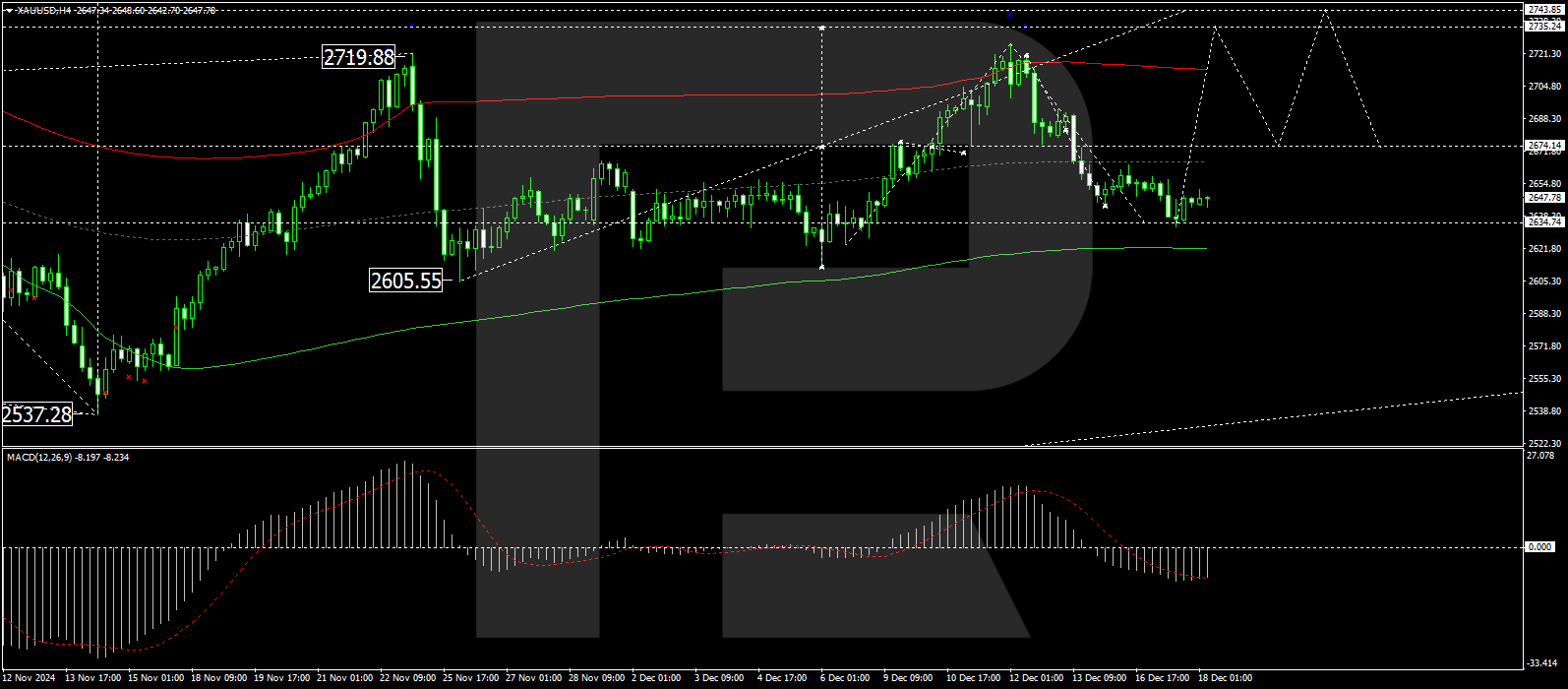
Gold prices are hovering around 2,650 USD per troy ounce as investors remain cautious, conserving their energy for a potential move depending on the US Federal Reserve’s rate decision later tonight. The predominant market expectation is a 25-basis-point cut in interest rates, but there’s significant uncertainty about the Fed’s monetary policy trajectory for 2025, which will be a key focus in today’s announcements.

Recent robust retail sales data from November, showing a 0.7% increase, have stirred discussions among investors that the Fed might decelerate its pace of rate cuts. This surge in retail sales is seen as a pro-inflationary factor, potentially influencing the Fed’s approach towards monetary easing.

A slowdown in rate reductions would likely be unfavourable for Gold, as lower interest rates generally decrease the opportunity cost of holding non-yielding assets like Gold, making it more attractive. Nonetheless, investors should wait for the Federal Reserve’s statement, which could diverge from current market speculations.

Since the start of the year, Gold has appreciated over 28%, potentially ending 2024 with the highest annual gain since 2010.

Technical analysis of XAU/USD

H4 Chart: Gold has established a consolidation range around the 2,675.55 level on the H4 chart. A growth structure has been formed up to 2726.27, and a corrective movement towards 2,635.00 is unfolding. Looking forward, a continuation of the growth wave towards 2743.85 is anticipated. The MACD indicator supports the bullish outlook, with its signal line below zero but pointed sharply upwards.

H1 Chart: On the H1 chart, Gold has completed a correction to 2,633.00 and is now expected to rise towards 2,680.00. After this increase, a potential decline to 2,658.00 may occur. Once this level is reached, a new growth phase towards 2705.70 will likely extend to 2,743.85. This scenario is corroborated by the Stochastic oscillator, whose signal line is currently above 50 and aiming towards 80, indicating upward momentum.


Disclaimer

Any forecasts contained herein are based on the author’s particular opinion. This analysis may not be treated as trading advice. RoboForex bears no responsibility for trading results based on trading recommendations and reviews contained herein.

European indices under pressure amid political and economic weakness in the main countries of the bloc

By JustMarkets

At the end of Monday, the Dow Jones Index (US30) declined by 0.25%. The S&P 500 Index (US500) added 0.38%. The Nasdaq Technology Index (US100) was up 1.45%. Top gainers included Alphabet (+4.4%), Tesla (+5.1%), and Broadcom, which soared after its market value surpassed $1 trillion last week. Apple and Alphabet hit new all-time highs, while Nvidia fell 2%.

Bitcoin (BTC/USD) rose more than 4% to a new record high of $107,000 amid President-elect Trump’s support for digital assets. Trump is seeking to create a favorable regulatory environment for digital assets by lifting restrictions imposed by the outgoing administration of President Biden. The US ETFs investing directly in Bitcoin have attracted $12.2 billion in net inflows since Trump won the November 5 presidential election.

Equity markets in Europe were mostly down on Monday. Germany’s DAX (DE40) fell by 0.45%, France’s CAC 40 (FR40) closed down 0.71%, Spain’s IBEX 35 (ES35) gained 0.23%, and the UK’s FTSE 100 (UK100) closed down 0.46%. The French Index is under pressure after Moody’s unexpected downgrade of France’s credit rating from Aa2 to Aa3, prompted by concerns over deteriorating public finances amid political instability. Meanwhile, on Friday, President Emmanuel Macron named Francois Bayrou as the new prime minister following the collapse of Michel Barnier’s government. In Germany, Chancellor Olaf Scholz lost a confidence vote as expected, confirming elections scheduled for late February. The leaders of the fall on the German stock exchange were the largest automakers: Mercedes Benz, BMW, and Stellantis, which fell in value from 3% to 5%. They were pressured by a weak retail sales report from China and industrial production, which increased competition from the country’s automakers. The UK saw the fastest decline in private sector employment in nearly four years in December, despite a slight increase in output following a payroll tax hike in Labour’s new budget.

WTI crude oil prices fell to below $71 a barrel on Monday. A batch of economic data from China heightened fears of weakening aggregate demand from the world’s top oil importer, adding to the pessimism that the economy will struggle to gain momentum despite Beijing’s promises of fiscal stimulus. The IEA predicts the global oil market will maintain a surplus next year, despite OPEC+ members agreeing to postpone production increases.

The US natural gas (XNG/USD) prices fell to $3.15 per MMBtu, a sharp retreat from a 13-month high of $3.5, as markets lowered their expectations of strong US gas demand. Reports from the EU fueled optimism that European countries could find alternative sources of natural gas supplies after Russian flows through Ukraine were cut off later in the year, and major German companies had already struck LNG deals with Middle Eastern producers.

Asian markets were declining yesterday. Japan’s Nikkei 225 (JP225) was down 0.03%, China’s FTSE China A50 (CHA50) lost 0.03%, Hong Kong’s Hang Seng (HK50) decreased by 0.88% and Australia’s ASX 200 (AU200) was negative 0.56%.

Markets are awaiting a series of economic releases for New Zealand, central among which is Q3 GDP, which is estimated to contract by 0.4% quarter-on-quarter, which could signal a return to recession. The subdued data will provide further evidence in favor of a more aggressive Reserve Bank of New Zealand policy. Meanwhile, the New Zealand Treasury is prognosing a widening budget deficit this year, citing rising unemployment and slowing economic growth, delaying a return to surplus for at least five years.

In Australia, a private survey showed a decline in Consumer Confidence in December as sentiment became more pessimistic about the economic outlook. In addition, traders await the Australian government’s budget update, which is expected to show a widening deficit, partly driven by weakening activity in China, Australia’s largest trading partner.

S&P 500 (US500) 6,074.08 +22.99 (+0.38%)

Dow Jones (US30) 43,717.48 −110.58 (−0.25%)

DAX (DE40) 20,313.81 −92.11 (−0.45%)

FTSE 100 (UK100) 8,262.05 −38.28 (−0.46%)

USD Index 106.86 −0.15 (−0.14%)

News feed for: 2024.12.17

  • UK Unemployment Rate (m/m) at 09:00 (GMT+2);
  • Germany Ifo Business Climate (m/m) at 11:00 (GMT+2);
  • Eurozone Trade Balance (m/m) at 12:00 (GMT+2);
  • German ZEW Economic Sentiment (m/m) at 12:00 (GMT+2);
  • Eurozone ZEW Economic Sentiment (m/m) at 12:00 (GMT+2);
  • US Retail Sales (m/m) at 15:30 (GMT+2);
  • Canada Consumer Price Index (m/m) at 15:30 (GMT+2);
  • US Industrial Production (m/m) at 16:15 (GMT+2).

By JustMarkets


This article reflects a personal opinion and should not be interpreted as an investment advice, and/or offer, and/or a persistent request for carrying out financial transactions, and/or a guarantee, and/or a forecast of future events.

Bitcoin “Santa Rally” coming to town?

By ForexTime 

  • Bitcoin ↑ 152% since start of 2024
  • Over past year Fed triggered moves of ↑ 3.4% & ↓ 3%
  • Gained on average 11.30% in December over past 15 years
  • Technical levels – $110,000, $107,000 & $100,000

Christmas may have come early for investors after Bitcoin surpassed $107,000 for the first time.

The “OG” crypto has been on a tear, recently boosted by growing optimism over its potential role as a US strategic reserve asset.

Prices are up over 10% month-to-date, pushing 2024-year gains beyond 150%.

Bitcoin 2

Bitcoin and other cryptos remain supported by hopes of a more friendly regulatory environment under Trump. And this has attracted almost $10 billion into US exchange-traded funds since Trump’s election win on November 5th.

Another factor exciting bulls could be MicroStrategy…

MicroStrategy is the largest Bitcoin holder among publicly traded companies, accumulating 439,000 bitcoins valued at $47 billion.

The meteoric rise of Bitcoin has pushed MicroStrategy’s market cap to almost $100 billion with its shares up nearly 550% year-to-date.

Why does this matter?

MicroStrategy is set to join the Nasdaq 100 on December 23rd.

This is a major milestone for the company and crypto world given its massive exposure to Bitcoin.

Joining the Nasdaq 100 provides investors an indirect exposure to Bitcoin through investing in MicroStrategy.

In a nutshell, this is a welcome development for the crypto space and could fuel upside gains on both MicroStrategy and Bitcoin.


Bitcoin set for “Santa Rally”?

To be clear, the Santa rally is a phenomenon that happens in the stock market. This is where stock prices experience a rally in the final days of December through the first few days of January.

Historically speaking, Bitcoin has gained on average 11.30% in December over the past 15 years.

Given the positive sentiment toward cryptocurrencies, could a rally be on the horizon?


By the way…

The Fed decision on Wednesday could influence Bitcoin which has shown sensitivity to interest rates.

As discussed in the week ahead, the Fed is widely expected to cut interest rates by 25 bp.

Traders are currently pricing in a 97% probability of a 25 bp rate cut on Wednesday with the odds of another cut by March 2025 at 62%.

Over the past year, the US jobs report has triggered upside moves of as much as 3.4% or declines of 3% in a 6-hour window post-release.

Beyond the Fed decision, the revised US GDP and PCE report among other data could influence prices.


It’s not only Bitcoin that may experience big moves on Wednesday 18th December. 

  • DOGECOIN: ↑ 7.5 % or ↓ 4.1%
  • AVALANCH: ↑ 6.0 % or ↓ 4.0%
  • BITCOINC: ↑ 5.5 % or ↓ 3.0%
  • CARDANO: ↑ 5.3% or ↓ 2.7%
  • CHAINLINK: ↑ 4.7 % or ↓ 2.4%
  • POLYGON: ↑ 4.0% or ↓ 3.0%
  • ETHEREUM: ↑ 3.9% or ↓ 2.4%
  • RIPPLE: ↑ 2.9% or ↓ 2.0%
  • LITECOIN: ↑ 2.8 % or ↓ 1.9%

All cryptos listed above are offered by FXTM as Crypto CFD’s.


Technical outlook…

Bitcoin is firmly bullish on the daily timeframe. Prices are trading above the 21, 50, 100 and 200-day SMA however the Relative Strength Index (RSI) has entered overbought territory.

  • A solid daily close above $107,000 could push prices to fresh all-time highs at $110,000 and beyond.
  • Should prices slip below $105,000, this may encourage a selloff toward the psychological $100.000 level.


Bitcoin 3


Forex-Time-LogoArticle by ForexTime

ForexTime Ltd (FXTM) is an award winning international online forex broker regulated by CySEC 185/12 www.forextime.com

EUR/USD Holds Steady Ahead of Crucial Federal Reserve Meeting

By RoboForex Analytical Department 

The EUR/USD pair is trading neutrally around 1.0510 as market participants adopt a cautious stance ahead of the Federal Reserve’s upcoming decision on interest rates. With the December meeting set to begin tonight and conclude tomorrow, all eyes are on the potential rate adjustment. The prevailing expectation is a 25 basis point cut, with a 94% probability factored by market consensus. Additionally, there’s a 37% chance that this might be the only cut or that rates might not change at all in 2025, contributing to the current market apprehension.

As inflation concerns loom for 2025, influenced by uncertain policy decisions and economic stimulation measures, the Fed is expected to adopt a more cautious tone in its communications. This approach is aimed at providing the flexibility to respond effectively to economic indicators as they evolve.

Today, the market is also focused on the release of November’s retail sales and industrial production data from the US. These indicators are crucial for assessing the current state of the US economy and could influence the Fed’s policy direction.

Technical analysis of EUR/USD

H4 chart: the EUR/USD has recently completed a correction wave at 1.0533 and appears poised for a downward movement towards 1.0420. Following the achievement of this target, a corrective move to 1.0475 is expected. Post-correction, another decline towards 1.0340 may commence. The MACD indicator supports this bearish outlook, with its signal line below zero and trending downwards, suggesting further declines.

H1 chart: on the H1 chart, the pair has retraced from 1.0533 and initiated a downward wave targeting 1.0485. Upon reaching this level, the formation of a consolidation range is anticipated. A breakout below this range could lead to a continued descent towards 1.0440 and potentially extend to 1.0420. The Stochastic oscillator corroborates this scenario, with its signal line currently below 50 and expected to drop further towards 20, indicating a continuation of the bearish momentum.


Disclaimer

Any forecasts contained herein are based on the author’s particular opinion. This analysis may not be treated as trading advice. RoboForex bears no responsibility for trading results based on trading recommendations and reviews contained herein.

Canadian dollar falls to a four-year low. France loses credit rating

By JustMarkets

At the end of Friday, the Dow Jones (US30) Index was down 0.20% (for the week -1.83%). The S&P 500 Index (US500) closed unchanged (for the week -0.52%). The Nasdaq Technology Index (US100) was up 0.76% (for the week +0.96%). The Nasdaq Technology Index hit a new record high on Friday, driven by investor enthusiasm for artificial intelligence and the technology sector. The rally was fueled by Broadcom (AVGO) shares’ impressive 19% gain after the company reported better-than-expected earnings and posted a strong 220% increase in AI-related annual revenue, underscoring the growing demand for artificial intelligence chips. This upbeat report helped boost other semiconductor stocks, including Nvidia (+1.2%) and Micron Technology (+2.7%).

The Canadian dollar fell to 1.42 per USD in December, the lowest since March 2020, amid the Bank of Canada’s (BoC) dovish stance. The Central Bank recently cut its key benchmark rate by a significant 50 bps to 3.25%, reducing the appeal of the loonie and widening the interest rate differential between Canada and the US. The decision followed rising unemployment and slower-than-expected economic growth, prompting the Bank of Canada to take measures to support the economy.

Equity markets in Europe were mostly down on Friday. Germany’s DAX (DE40) fell by 0.01% (for the week -0.27%), France’s CAC 40 (FR40) closed down 0.15% (for the week -1.00%), Spain’s IBEX 35 (ES35) fell 0.11% (for the week -2.82%), and the UK’s FTSE 100 (UK100) closed down 0.14% (for the week -0.10%).

Rating agency Moody’s downgraded France to ‘Aa3’ from ‘Aa2’, citing concerns that the country’s public finances will be significantly weakened by political fragmentation that will limit the scope and scale of large deficit reduction measures for the foreseeable future. On the political front, French President Macron nominated Francois Bayrou as the new Prime Minister and eased the political risks weighing on French assets.

The UK GDP data showed that the UK economy contracted by 0.1% (expectation of +0.1% growth) in October. This unexpected decline was the second consecutive monthly drop and did not match moderate growth expectations. The weak data fueled hopes for an earlier rate cut by the Bank of England next year.

On Friday, WTI crude oil prices rose by 1.8% to settle at $71.30 per barrel, the highest since November 7, and up 6% for the week thanks to tightening global supplies and rising fuel demand. The rally was fueled by expectations of sanctions against Russia and Iran, lower interest rate estimates in the US and Europe, and supportive measures for China’s economy.

The US natural gas prices fell to $3.30 million barrels per ton (MMBtu), retreating from a 13-month-high amid rising supply. Producers are ramping up production, anticipating higher winter demand and increased exports from liquefied natural gas (LNG) plants.

Asian markets traded flat last week. Japan’s Nikkei 225 (JP225) rose by 0.35%, China’s FTSE China A50 (CHA50) declined 0.79%, Hong Kong’s Hang Seng (HK50) gained 1.21%, and Australia’s ASX 200 (AU200) was negative 1.48%.

The director of the People’s Bank of China’s (PBoC) research bureau said China will cut interest rates and reserve requirements next year.  Friday’s data showed Chinese banks issued 580 billion yuan of new loans in November 2024, well below market expectations of 950 billion yuan and less than half of the 1.170 trillion yuan in the corresponding period last year, indicating weak credit demand in the mainland. Last Thursday, China said it would widen its budget deficit, issue more debt, and loosen monetary policy to keep economic growth stable.

S&P 500 (US500) 6,051.09 −0.16 (−0.03%)

Dow Jones (US30) 43,828.06 −86.06 (−0.20%)

DAX (DE40) 20,405.92 −20.35 (−0.10%)

FTSE 100 (UK100) 8,300.33 −11.43 (−0.14%)

USD Index 106.95 −0.01 (−0.01%)

News feed for: 2024.12.16

  • Australia Manufacturing PMI (m/m) at 00:00 (GMT+2);
  • Australia Services PMI (m/m) at 00:00 (GMT+2);
  • Japan Manufacturing PMI (m/m) at 02:30 (GMT+2);
  • Japan Services PMI (m/m) at 02:30 (GMT+2);
  • China Industrial Production (m/m) at 04:00 (GMT+2);
  • China Retail Sales (m/m) at 04:00 (GMT+2);
  • China Unemployment Rate (m/m) at 04:00 (GMT+2);
  • Switzerland Producer Price Index (m/m) at 09:30 (GMT+2);
  • German Manufacturing PMI (m/m) at 10:30 (GMT+2);
  • German Services PMI (m/m) at 10:30 (GMT+2);
  • Eurozone ECB President Lagarde Speaks at 10:35 (GMT+2);
  • Eurozone Manufacturing PMI (m/m) at 11:00 (GMT+2);
  • Eurozone Services PMI (m/m) at 11:00 (GMT+2);
  • UK Manufacturing PMI (m/m) at 11:30 (GMT+2);
  • UK Services PMI (m/m) at 11:30 (GMT+2);
  • US Manufacturing PMI (m/m) at 16:45 (GMT+2);
  • US Services PMI (m/m) at 16:45 (GMT+2);
  • Canada BOC Gov Macklem Speaks at 22:20 (GMT+2).

By JustMarkets


This article reflects a personal opinion and should not be interpreted as an investment advice, and/or offer, and/or a persistent request for carrying out financial transactions, and/or a guarantee, and/or a forecast of future events.

Japanese Yen Hits Three-Week Low as Bank of Japan Holds Rate Steady

By RoboForex Analytical Department

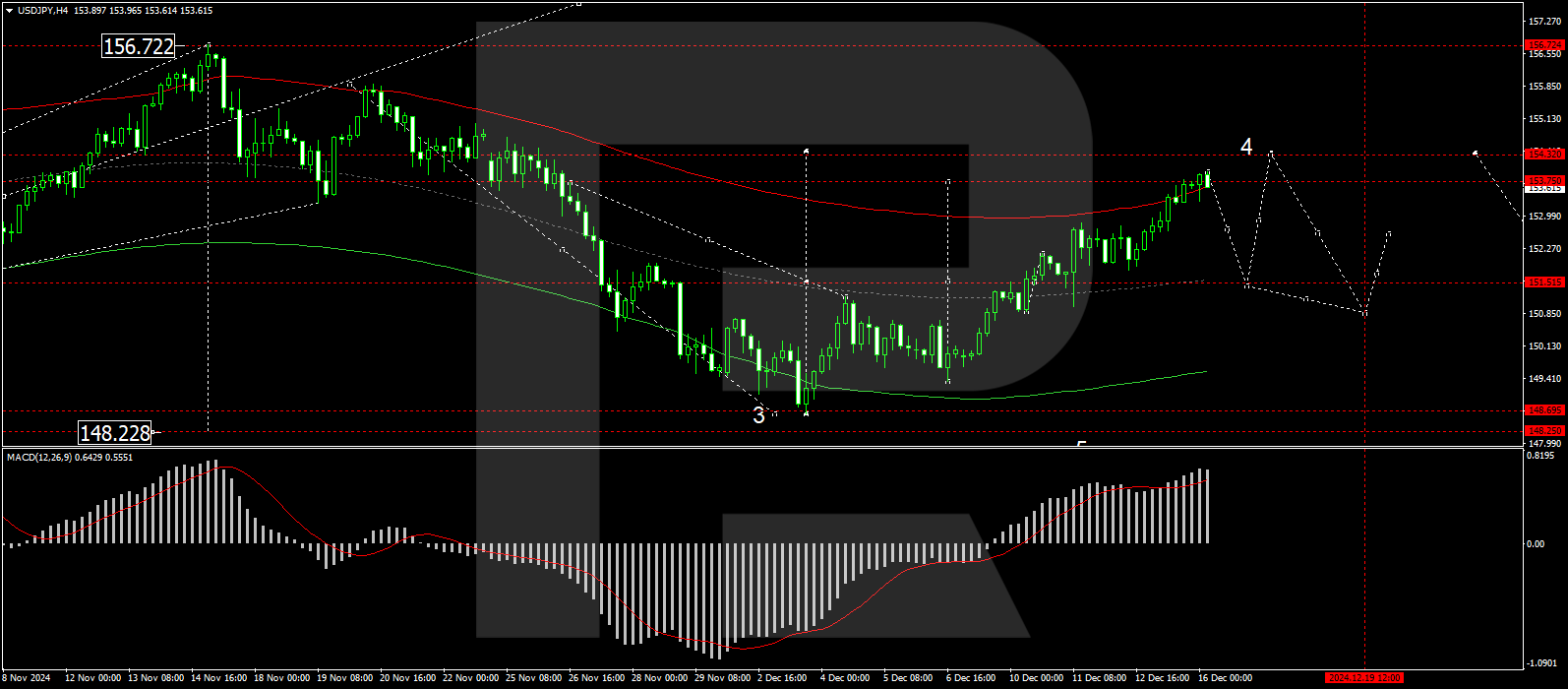
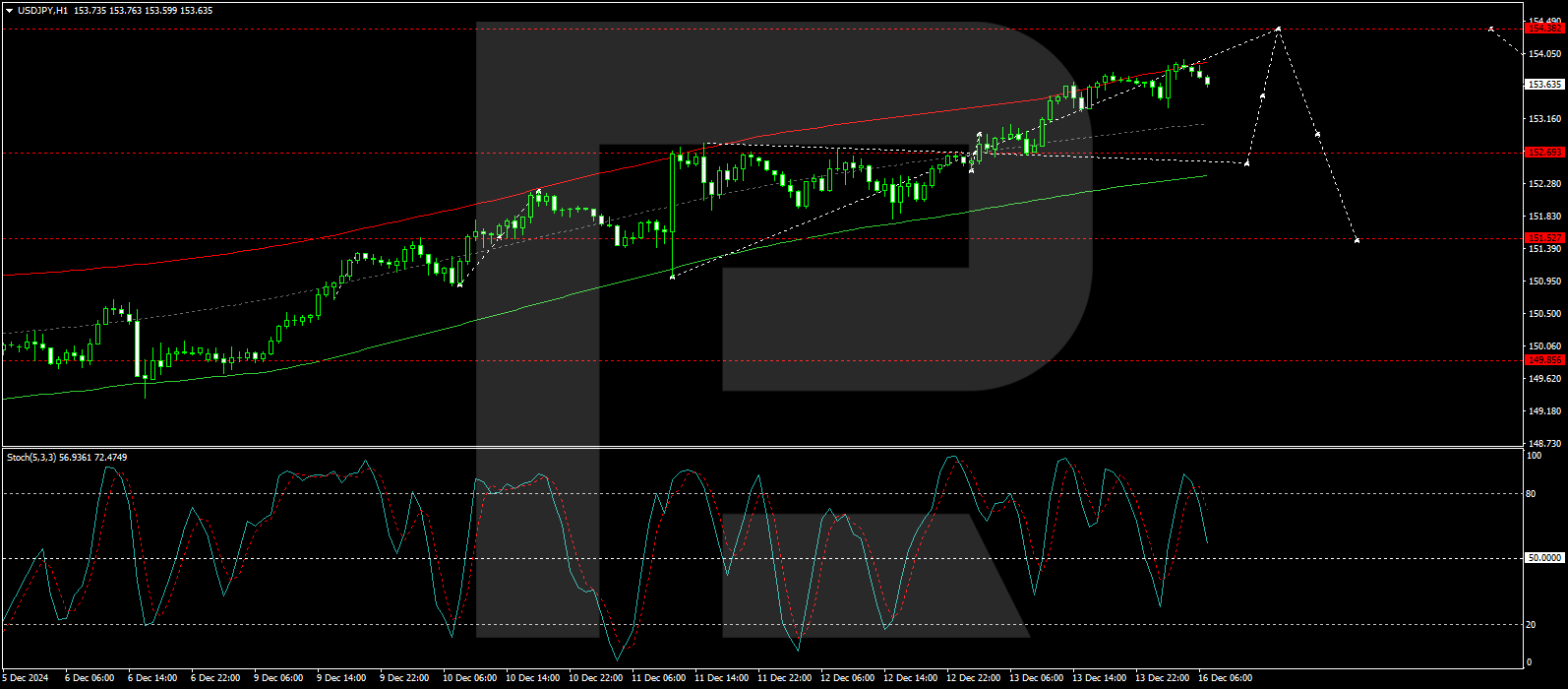
The USD/JPY pair climbed to 153.77 on Monday, reaching a three-week high. This movement reflects growing investor sentiment that the Bank of Japan (BoJ) will maintain its current interest rate level and continue its pause on monetary policy tightening at this week’s meeting. Recent statements from the BoJ have indicated a need for more evidence to substantiate wage increases before considering rate changes.

Expectations of a BoJ rate hike had previously supported the yen, mitigating external pressures. However, confidence in the BoJ’s commitment to tightening seems to wane as time progresses.

Despite this, Japan’s domestic economic indicators appear positive. October’s primary machinery and equipment orders surpassed expectations, and recent reports have shown improvement in both manufacturing and service sector activity in December.

BoJ policymakers are increasingly unconcerned about the weakening yen’s potential to accelerate inflation, which is already at desirable levels. However, further yen depreciation could push inflation higher, a scenario that remains on the central bank’s radar.

Technical analysis of USD/JPY

H4 chart: USD/JPY has established a consolidation range around the 151.51 level, from which it has continued its upward trajectory. The pair recently touched 153.93, and current technical setups suggest a potential consolidation below this peak. Should the price break downward, a corrective movement to retest 151.51 is possible, followed by another potential rise towards 154.40. The MACD indicator supports this view, with its signal line well above zero but indicating readiness for a downward correction.

H1 chart: The shorter-term H1 chart shows the USD/JPY forming a growth structure aimed at 154.40. After completing a consolidation around 152.70 and achieving a local high at 153.93, a correction back to at least 152.70 is anticipated. Following this correction, the market may initiate a new growth phase targeting 154.40. The Stochastic oscillator aligns with this analysis. It is currently positioned below 80 and poised to move down towards 20, suggesting an impending correction before further upward movement.


Disclaimer

Any forecasts contained herein are based on the author’s particular opinion. This analysis may not be treated as trading advice. RoboForex bears no responsibility for trading results based on trading recommendations and reviews contained herein.

Currency Speculators push New Zealand Dollar bets to lowest level since 2019

By InvestMacro

Here are the latest charts and statistics for the Commitment of Traders (COT) data published by the Commodities Futures Trading Commission (CFTC).

The latest COT data is updated through Tuesday December 10th and shows a quick view of how large market participants (for-profit speculators and commercial traders) were positioned in the futures markets. All currency positions are in direct relation to the US dollar where, for example, a bet for the euro is a bet that the euro will rise versus the dollar while a bet against the euro will be a bet that the euro will decline versus the dollar.

Weekly Speculator Changes led by Japanese Yen & British Pound
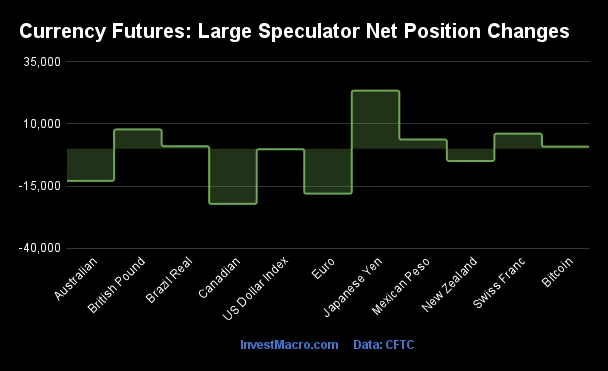
The COT currency market speculator bets were overall higher this week as six out of the eleven currency markets we cover had higher positioning while the other five markets had lower speculator contracts.

Leading the gains for the currency markets was the Japanese Yen (23,418 contracts) with the British Pound (7,799 contracts), the Swiss Franc (6,102 contracts), the Mexican Peso (3,744 contracts), the Brazilian Real (1,021 contracts) and Bitcoin (875 contracts) also showing positive weeks.

The currencies seeing declines in speculator bets on the week were the Canadian Dollar (-22,208 contracts), the EuroFX (-18,084 contracts), the Australian Dollar (-12,916 contracts), the New Zealand Dollar (-4,899 contracts) and the US Dollar Index (-170 contracts) also registering lower bets on the week.

Speculators push New Zealand Dollar bets to lowest level since 2019

Highlighting the COT currency’s data this week is the recent large drop in the speculator’s positioning for the New Zealand ‘Kiwi’ Dollar.

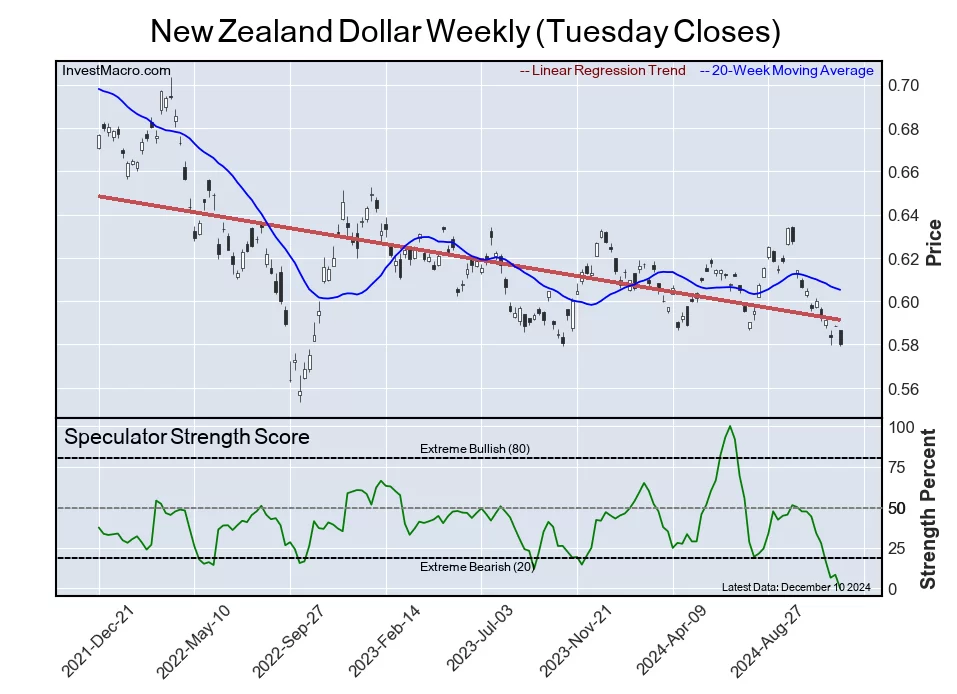
Large speculative New Zealand Dollar (NZD) currency positions fell this week by almost -5,000 net contracts and the NZD net positions have now declined in nine out of the past ten weeks. This ten-week drop totals -30,177 contracts and has taken the NZD from a positive net position of +1,970 contracts on October 1st to this week’s net position of +28,207 contracts.

This shortfall in positions has knocked the NZD down to the most bearish level in the past two hundred and sixty-three weeks, dating back to November 26th of 2019. Our strength indicator, which measures a market’s speculator level compared to it’s past three years, shows the NZD at a 0 percent strength score or at a bottom for the past three year’s range.

Nudging the NZD speculator sentiment lower has been recent cuts in interest rates by the Reserve Bank of New Zealand (RBNZ) and economic weakness. The RBNZ dropped its benchmark interest rate by 50 basis points in November to 4.25 percent as the bank stated, “Economic activity in New Zealand remains subdued and output continues to be below its potential. With excess productive capacity in the economy, inflation pressures have eased.” The RBNZ also reduced the interest rate by 50 basis points in October and by 25 basis points in August. This lowering of interest rates can hurt a currency because lower interest rates can spur traders to sell the currency to find other countries (currencies) with higher interest rates. The higher interest rate will provide a higher interest return and, in turn, if enough traders join in, can help spur the higher interest currency higher as well on a capital gains basis.

The NZD exchange rate versus the US Dollar has been on the decline in tandem with the fall in speculator bets over these past three months. The NZDUSD closed at a multi-year low of 0.5762 this week which marked the lowest level since October of 2022. The NZD had been as high as 0.6385 in September but the rate cuts and economic outlook has pushed the Kiwi lower in ten out of the past eleven weekly closes for an approximate decline by 10 percent versus the US Dollar.


Currencies Net Speculators Leaderboard

Legend: Weekly Speculators Change | Speculators Current Net Position | Speculators Strength Score compared to last 3-Years (0-100 range)


Strength Scores led by Japanese Yen & Australian Dollar

COT Strength Scores (a normalized measure of Speculator positions over a 3-Year range, from 0 to 100 where above 80 is Extreme-Bullish and below 20 is Extreme-Bearish) showed that the Japanese Yen (84 percent) and the Australian Dollar (82 percent) lead the currency markets this week.

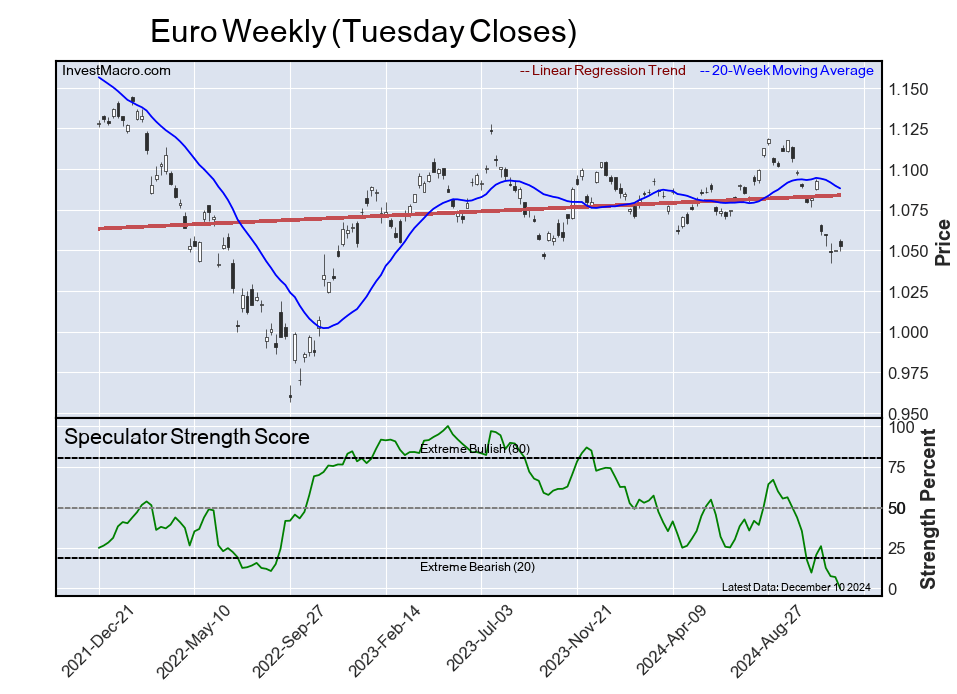
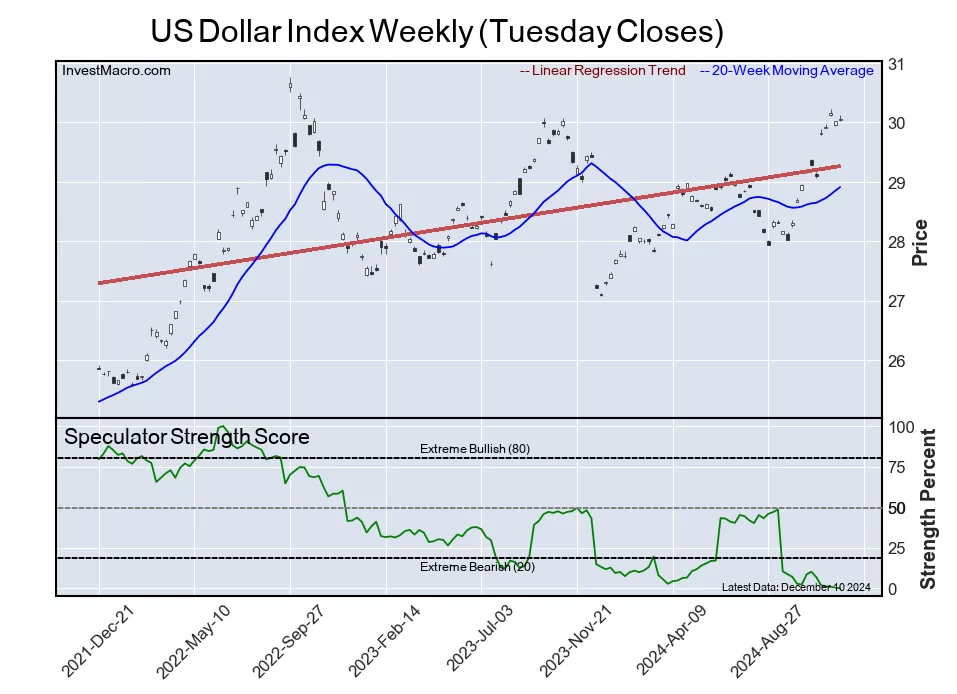
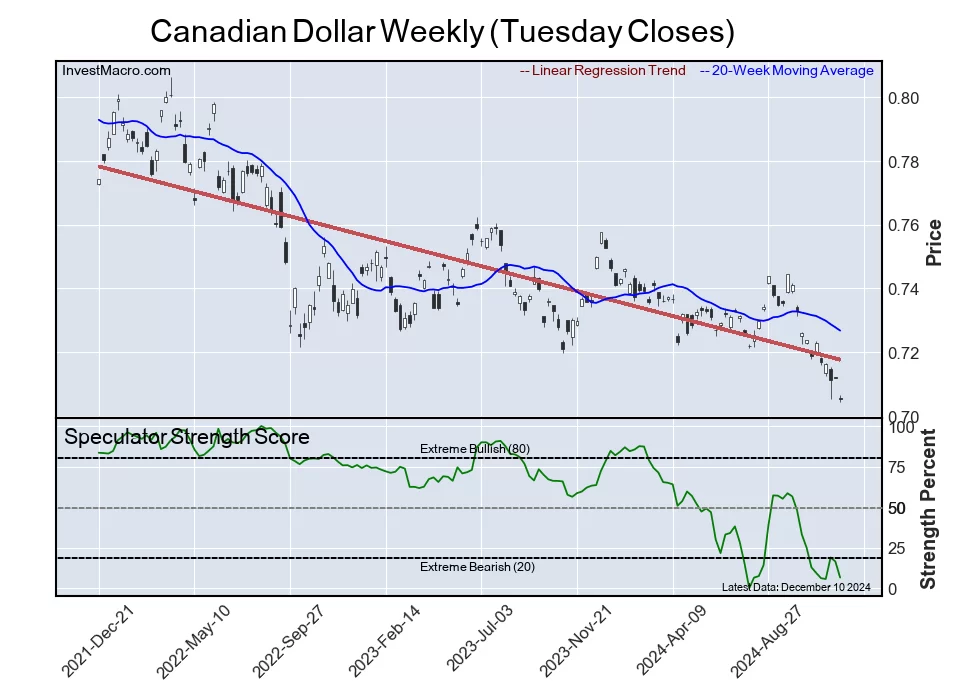
On the downside, the New Zealand Dollar (0 percent), the EuroFX (0 percent), the US Dollar Index (0 percent) and the Canadian Dollar (7 percent) come in at the lowest strength levels currently and are all in Extreme-Bearish territory (below 20 percent).

3-Year Strength Statistics:
US Dollar Index (0.0 percent) vs US Dollar Index previous week (0.4 percent)
EuroFX (0.0 percent) vs EuroFX previous week (6.9 percent)
British Pound Sterling (48.3 percent) vs British Pound Sterling previous week (44.8 percent)
Japanese Yen (83.9 percent) vs Japanese Yen previous week (74.6 percent)
Swiss Franc (30.0 percent) vs Swiss Franc previous week (17.6 percent)
Canadian Dollar (6.6 percent) vs Canadian Dollar previous week (16.5 percent)
Australian Dollar (82.3 percent) vs Australian Dollar previous week (91.5 percent)
New Zealand Dollar (0.0 percent) vs New Zealand Dollar previous week (8.3 percent)
Mexican Peso (32.8 percent) vs Mexican Peso previous week (30.9 percent)
Brazilian Real (36.5 percent) vs Brazilian Real previous week (35.6 percent)
Bitcoin (35.6 percent) vs Bitcoin previous week (16.5 percent)


Bitcoin & Japanese Yen top the 6-Week Strength Trends
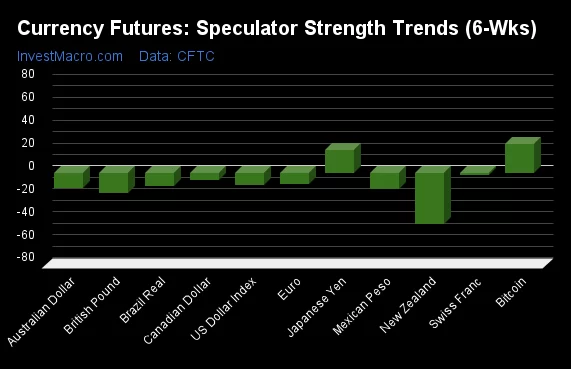
COT Strength Score Trends (or move index, calculates the 6-week changes in strength scores) showed that the Bitcoin (25 percent) and the Japanese Yen (20 percent) lead the past six weeks trends and are the only positive movers for the currencies.

The New Zealand Dollar (-44 percent) leads the downside trend scores currently with the British Pound (-18 percent), Mexican Peso (-14 percent) and the Australian Dollar (-14 percent) following next with lower trend scores.

3-Year Strength Trends:
US Dollar Index (-10.2 percent) vs US Dollar Index previous week (-8.2 percent)
EuroFX (-9.6 percent) vs EuroFX previous week (-11.0 percent)
British Pound Sterling (-17.6 percent) vs British Pound Sterling previous week (-24.8 percent)
Japanese Yen (20.2 percent) vs Japanese Yen previous week (-4.2 percent)
Swiss Franc (-2.0 percent) vs Swiss Franc previous week (-17.1 percent)
Canadian Dollar (-6.3 percent) vs Canadian Dollar previous week (-8.4 percent)
Australian Dollar (-13.5 percent) vs Australian Dollar previous week (-4.5 percent)
New Zealand Dollar (-44.2 percent) vs New Zealand Dollar previous week (-39.0 percent)
Mexican Peso (-13.8 percent) vs Mexican Peso previous week (-10.1 percent)
Brazilian Real (-11.5 percent) vs Brazilian Real previous week (-13.9 percent)
Bitcoin (25.1 percent) vs Bitcoin previous week (1.1 percent)


Individual COT Forex Markets:

US Dollar Index Futures:
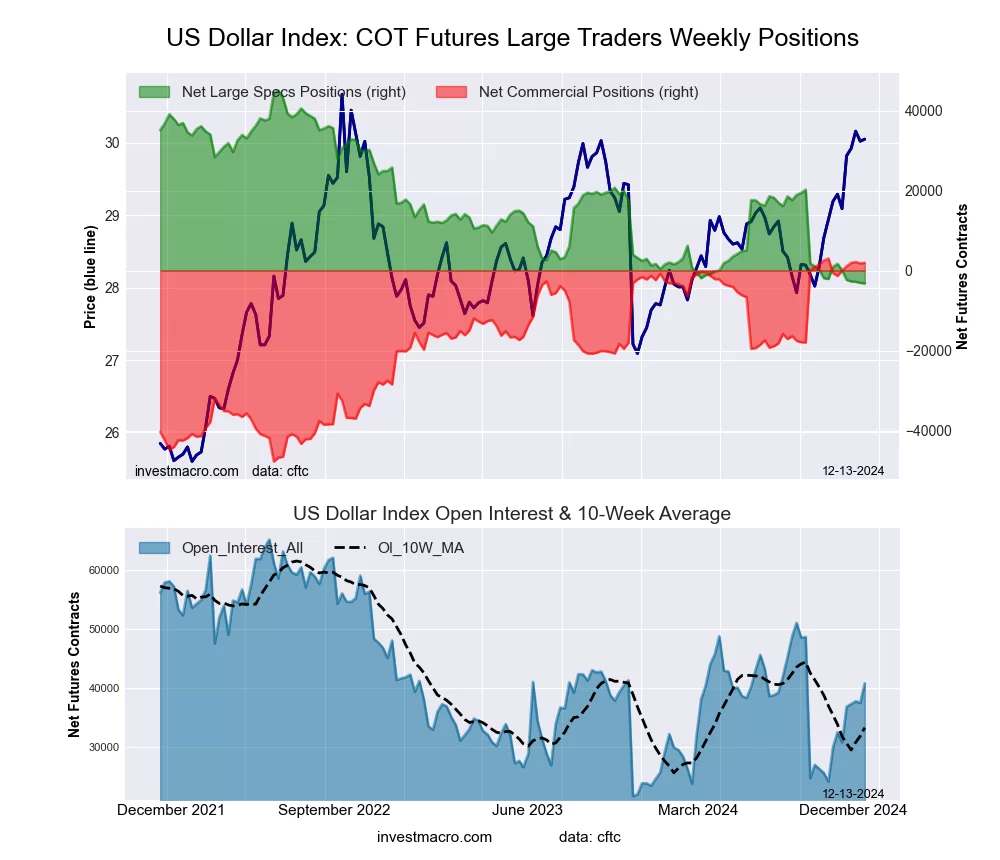
US Dollar Index Forex Futures COT ChartThe US Dollar Index large speculator standing this week came in at a net position of -3,224 contracts in the data reported through Tuesday. This was a weekly reduction of -170 contracts from the previous week which had a total of -3,054 net contracts.

This week’s current strength score (the trader positioning range over the past three years, measured from 0 to 100) shows the speculators are currently Bearish-Extreme with a score of 0.0 percent. The commercials are Bullish-Extreme with a score of 97.9 percent and the small traders (not shown in chart) are Bearish with a score of 36.8 percent.

Price Trend-Following Model: Strong Uptrend

Our weekly trend-following model classifies the current market price position as: Strong Uptrend.

US DOLLAR INDEX StatisticsSPECULATORSCOMMERCIALSSMALL TRADERS
– Percent of Open Interest Longs:56.126.99.9
– Percent of Open Interest Shorts:63.922.26.8
– Net Position:-3,2241,9401,284
– Gross Longs:22,88310,9864,052
– Gross Shorts:26,1079,0462,768
– Long to Short Ratio:0.9 to 11.2 to 11.5 to 1
NET POSITION TREND:
– Strength Index Score (3 Year Range Pct):0.097.936.8
– Strength Index Reading (3 Year Range):Bearish-ExtremeBullish-ExtremeBearish
NET POSITION MOVEMENT INDEX:
– 6-Week Change in Strength Index:-10.26.417.2


Euro Currency Futures:

Euro Currency Futures COT ChartThe Euro Currency large speculator standing this week came in at a net position of -75,573 contracts in the data reported through Tuesday. This was a weekly decline of -18,084 contracts from the previous week which had a total of -57,489 net contracts.

This week’s current strength score (the trader positioning range over the past three years, measured from 0 to 100) shows the speculators are currently Bearish-Extreme with a score of 0.0 percent. The commercials are Bullish-Extreme with a score of 100.0 percent and the small traders (not shown in chart) are Bearish-Extreme with a score of 17.5 percent.

Price Trend-Following Model: Strong Downtrend

Our weekly trend-following model classifies the current market price position as: Strong Downtrend.

EURO Currency StatisticsSPECULATORSCOMMERCIALSSMALL TRADERS
– Percent of Open Interest Longs:21.662.211.6
– Percent of Open Interest Shorts:32.054.78.7
– Net Position:-75,57354,71620,857
– Gross Longs:157,375452,31184,363
– Gross Shorts:232,948397,59563,506
– Long to Short Ratio:0.7 to 11.1 to 11.3 to 1
NET POSITION TREND:
– Strength Index Score (3 Year Range Pct):0.0100.017.5
– Strength Index Reading (3 Year Range):Bearish-ExtremeBullish-ExtremeBearish-Extreme
NET POSITION MOVEMENT INDEX:
– 6-Week Change in Strength Index:-9.67.94.6


British Pound Sterling Futures:

British Pound Sterling Futures COT ChartThe British Pound Sterling large speculator standing this week came in at a net position of 27,125 contracts in the data reported through Tuesday. This was a weekly increase of 7,799 contracts from the previous week which had a total of 19,326 net contracts.

This week’s current strength score (the trader positioning range over the past three years, measured from 0 to 100) shows the speculators are currently Bearish with a score of 48.3 percent. The commercials are Bullish with a score of 52.7 percent and the small traders (not shown in chart) are Bullish with a score of 51.2 percent.

Price Trend-Following Model: Strong Downtrend

Our weekly trend-following model classifies the current market price position as: Strong Downtrend.

BRITISH POUND StatisticsSPECULATORSCOMMERCIALSSMALL TRADERS
– Percent of Open Interest Longs:33.052.38.5
– Percent of Open Interest Shorts:24.359.310.2
– Net Position:27,125-21,904-5,221
– Gross Longs:102,763162,91226,568
– Gross Shorts:75,638184,81631,789
– Long to Short Ratio:1.4 to 10.9 to 10.8 to 1
NET POSITION TREND:
– Strength Index Score (3 Year Range Pct):48.352.751.2
– Strength Index Reading (3 Year Range):BearishBullishBullish
NET POSITION MOVEMENT INDEX:
– 6-Week Change in Strength Index:-17.620.8-27.7


Japanese Yen Futures:

Japanese Yen Forex Futures COT ChartThe Japanese Yen large speculator standing this week came in at a net position of 25,752 contracts in the data reported through Tuesday. This was a weekly advance of 23,418 contracts from the previous week which had a total of 2,334 net contracts.

This week’s current strength score (the trader positioning range over the past three years, measured from 0 to 100) shows the speculators are currently Bullish-Extreme with a score of 83.9 percent. The commercials are Bearish-Extreme with a score of 19.4 percent and the small traders (not shown in chart) are Bullish with a score of 60.9 percent.

Price Trend-Following Model: Strong Downtrend

Our weekly trend-following model classifies the current market price position as: Strong Downtrend.

JAPANESE YEN StatisticsSPECULATORSCOMMERCIALSSMALL TRADERS
– Percent of Open Interest Longs:35.642.913.4
– Percent of Open Interest Shorts:26.351.813.8
– Net Position:25,752-24,598-1,154
– Gross Longs:97,938117,77536,894
– Gross Shorts:72,186142,37338,048
– Long to Short Ratio:1.4 to 10.8 to 11.0 to 1
NET POSITION TREND:
– Strength Index Score (3 Year Range Pct):83.919.460.9
– Strength Index Reading (3 Year Range):Bullish-ExtremeBearish-ExtremeBullish
NET POSITION MOVEMENT INDEX:
– 6-Week Change in Strength Index:20.2-19.45.1


Swiss Franc Futures:

Swiss Franc Forex Futures COT ChartThe Swiss Franc large speculator standing this week came in at a net position of -34,992 contracts in the data reported through Tuesday. This was a weekly boost of 6,102 contracts from the previous week which had a total of -41,094 net contracts.

This week’s current strength score (the trader positioning range over the past three years, measured from 0 to 100) shows the speculators are currently Bearish with a score of 30.0 percent. The commercials are Bullish-Extreme with a score of 84.8 percent and the small traders (not shown in chart) are Bearish-Extreme with a score of 0.0 percent.

Price Trend-Following Model: Strong Downtrend

Our weekly trend-following model classifies the current market price position as: Strong Downtrend.

SWISS FRANC StatisticsSPECULATORSCOMMERCIALSSMALL TRADERS
– Percent of Open Interest Longs:4.481.58.1
– Percent of Open Interest Shorts:36.433.723.9
– Net Position:-34,99252,309-17,317
– Gross Longs:4,79689,1888,877
– Gross Shorts:39,78836,87926,194
– Long to Short Ratio:0.1 to 12.4 to 10.3 to 1
NET POSITION TREND:
– Strength Index Score (3 Year Range Pct):30.084.80.0
– Strength Index Reading (3 Year Range):BearishBullish-ExtremeBearish-Extreme
NET POSITION MOVEMENT INDEX:
– 6-Week Change in Strength Index:-2.017.3-43.2


Canadian Dollar Futures:

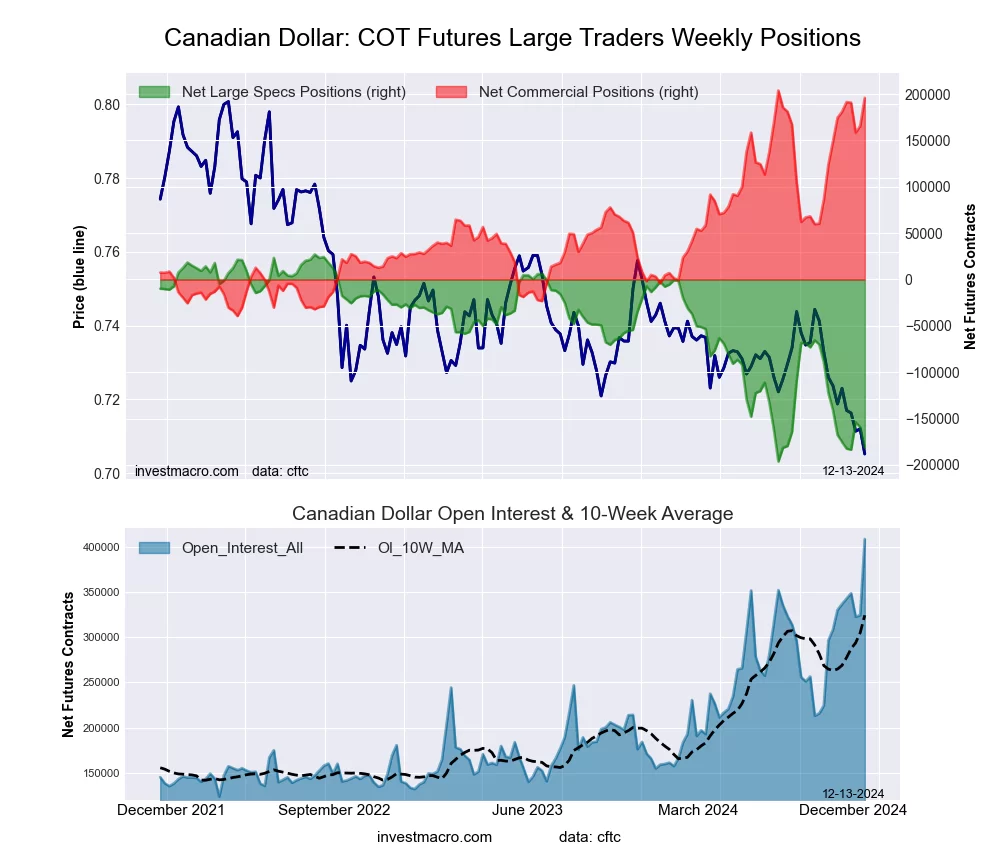
Canadian Dollar Forex Futures COT ChartThe Canadian Dollar large speculator standing this week came in at a net position of -181,554 contracts in the data reported through Tuesday. This was a weekly reduction of -22,208 contracts from the previous week which had a total of -159,346 net contracts.

This week’s current strength score (the trader positioning range over the past three years, measured from 0 to 100) shows the speculators are currently Bearish-Extreme with a score of 6.6 percent. The commercials are Bullish-Extreme with a score of 96.8 percent and the small traders (not shown in chart) are Bearish-Extreme with a score of 0.0 percent.

Price Trend-Following Model: Strong Downtrend

Our weekly trend-following model classifies the current market price position as: Strong Downtrend.

CANADIAN DOLLAR StatisticsSPECULATORSCOMMERCIALSSMALL TRADERS
– Percent of Open Interest Longs:7.181.77.4
– Percent of Open Interest Shorts:51.633.710.9
– Net Position:-181,554195,936-14,382
– Gross Longs:29,034333,50630,191
– Gross Shorts:210,588137,57044,573
– Long to Short Ratio:0.1 to 12.4 to 10.7 to 1
NET POSITION TREND:
– Strength Index Score (3 Year Range Pct):6.696.80.0
– Strength Index Reading (3 Year Range):Bearish-ExtremeBullish-ExtremeBearish-Extreme
NET POSITION MOVEMENT INDEX:
– 6-Week Change in Strength Index:-6.38.9-20.1


Australian Dollar Futures:

Australian Dollar Forex Futures COT ChartThe Australian Dollar large speculator standing this week came in at a net position of 8,485 contracts in the data reported through Tuesday. This was a weekly fall of -12,916 contracts from the previous week which had a total of 21,401 net contracts.

This week’s current strength score (the trader positioning range over the past three years, measured from 0 to 100) shows the speculators are currently Bullish-Extreme with a score of 82.3 percent. The commercials are Bearish with a score of 29.5 percent and the small traders (not shown in chart) are Bearish with a score of 28.7 percent.

Price Trend-Following Model: Strong Downtrend

Our weekly trend-following model classifies the current market price position as: Strong Downtrend.

AUSTRALIAN DOLLAR StatisticsSPECULATORSCOMMERCIALSSMALL TRADERS
– Percent of Open Interest Longs:37.146.811.1
– Percent of Open Interest Shorts:33.647.114.4
– Net Position:8,485-735-7,750
– Gross Longs:88,751111,88426,561
– Gross Shorts:80,266112,61934,311
– Long to Short Ratio:1.1 to 11.0 to 10.8 to 1
NET POSITION TREND:
– Strength Index Score (3 Year Range Pct):82.329.528.7
– Strength Index Reading (3 Year Range):Bullish-ExtremeBearishBearish
NET POSITION MOVEMENT INDEX:
– 6-Week Change in Strength Index:-13.522.1-47.7


New Zealand Dollar Futures:

New Zealand Dollar Forex Futures COT ChartThe New Zealand Dollar large speculator standing this week came in at a net position of -28,207 contracts in the data reported through Tuesday. This was a weekly lowering of -4,899 contracts from the previous week which had a total of -23,308 net contracts.

This week’s current strength score (the trader positioning range over the past three years, measured from 0 to 100) shows the speculators are currently Bearish-Extreme with a score of 0.0 percent. The commercials are Bullish-Extreme with a score of 100.0 percent and the small traders (not shown in chart) are Bearish-Extreme with a score of 7.1 percent.

Price Trend-Following Model: Strong Downtrend

Our weekly trend-following model classifies the current market price position as: Strong Downtrend.

NEW ZEALAND DOLLAR StatisticsSPECULATORSCOMMERCIALSSMALL TRADERS
– Percent of Open Interest Longs:20.071.23.6
– Percent of Open Interest Shorts:48.738.87.3
– Net Position:-28,20731,847-3,640
– Gross Longs:19,60569,8793,520
– Gross Shorts:47,81238,0327,160
– Long to Short Ratio:0.4 to 11.8 to 10.5 to 1
NET POSITION TREND:
– Strength Index Score (3 Year Range Pct):0.0100.07.1
– Strength Index Reading (3 Year Range):Bearish-ExtremeBullish-ExtremeBearish-Extreme
NET POSITION MOVEMENT INDEX:
– 6-Week Change in Strength Index:-44.245.4-28.0


Mexican Peso Futures:

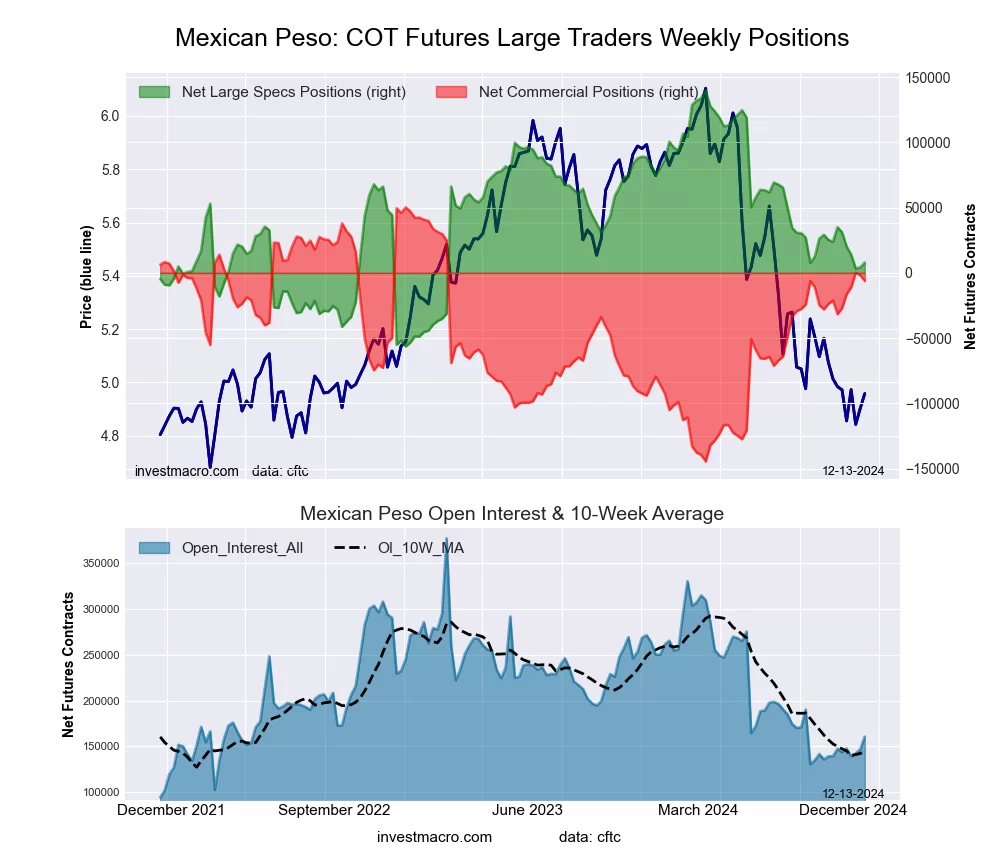
Mexican Peso Futures COT ChartThe Mexican Peso large speculator standing this week came in at a net position of 7,928 contracts in the data reported through Tuesday. This was a weekly rise of 3,744 contracts from the previous week which had a total of 4,184 net contracts.

This week’s current strength score (the trader positioning range over the past three years, measured from 0 to 100) shows the speculators are currently Bearish with a score of 32.8 percent. The commercials are Bullish with a score of 71.0 percent and the small traders (not shown in chart) are Bearish-Extreme with a score of 13.0 percent.

Price Trend-Following Model: Downtrend

Our weekly trend-following model classifies the current market price position as: Downtrend.

MEXICAN PESO StatisticsSPECULATORSCOMMERCIALSSMALL TRADERS
– Percent of Open Interest Longs:38.446.72.5
– Percent of Open Interest Shorts:33.450.53.6
– Net Position:7,928-6,173-1,755
– Gross Longs:61,64375,0134,073
– Gross Shorts:53,71581,1865,828
– Long to Short Ratio:1.1 to 10.9 to 10.7 to 1
NET POSITION TREND:
– Strength Index Score (3 Year Range Pct):32.871.013.0
– Strength Index Reading (3 Year Range):BearishBullishBearish-Extreme
NET POSITION MOVEMENT INDEX:
– 6-Week Change in Strength Index:-13.813.09.5


Brazilian Real Futures:

Brazil Real Futures COT ChartThe Brazilian Real large speculator standing this week came in at a net position of -16,393 contracts in the data reported through Tuesday. This was a weekly rise of 1,021 contracts from the previous week which had a total of -17,414 net contracts.

This week’s current strength score (the trader positioning range over the past three years, measured from 0 to 100) shows the speculators are currently Bearish with a score of 36.5 percent. The commercials are Bullish with a score of 65.3 percent and the small traders (not shown in chart) are Bearish-Extreme with a score of 16.4 percent.

Price Trend-Following Model: Strong Downtrend

Our weekly trend-following model classifies the current market price position as: Strong Downtrend.

BRAZIL REAL StatisticsSPECULATORSCOMMERCIALSSMALL TRADERS
– Percent of Open Interest Longs:45.448.03.2
– Percent of Open Interest Shorts:68.623.74.3
– Net Position:-16,39317,176-783
– Gross Longs:32,18733,9822,279
– Gross Shorts:48,58016,8063,062
– Long to Short Ratio:0.7 to 12.0 to 10.7 to 1
NET POSITION TREND:
– Strength Index Score (3 Year Range Pct):36.565.316.4
– Strength Index Reading (3 Year Range):BearishBullishBearish-Extreme
NET POSITION MOVEMENT INDEX:
– 6-Week Change in Strength Index:-11.512.0-3.7


Bitcoin Futures:

Bitcoin Crypto Futures COT ChartThe Bitcoin large speculator standing this week came in at a net position of -720 contracts in the data reported through Tuesday. This was a weekly boost of 875 contracts from the previous week which had a total of -1,595 net contracts.

This week’s current strength score (the trader positioning range over the past three years, measured from 0 to 100) shows the speculators are currently Bearish with a score of 35.6 percent. The commercials are Bullish with a score of 69.3 percent and the small traders (not shown in chart) are Bearish with a score of 46.1 percent.

Price Trend-Following Model: Strong Uptrend

Our weekly trend-following model classifies the current market price position as: Strong Uptrend.

BITCOIN StatisticsSPECULATORSCOMMERCIALSSMALL TRADERS
– Percent of Open Interest Longs:82.94.64.3
– Percent of Open Interest Shorts:84.84.03.0
– Net Position:-720236484
– Gross Longs:31,1681,7211,627
– Gross Shorts:31,8881,4851,143
– Long to Short Ratio:1.0 to 11.2 to 11.4 to 1
NET POSITION TREND:
– Strength Index Score (3 Year Range Pct):35.669.346.1
– Strength Index Reading (3 Year Range):BearishBullishBearish
NET POSITION MOVEMENT INDEX:
– 6-Week Change in Strength Index:25.1-25.1-10.6


Article By InvestMacroReceive our weekly COT Newsletter

*COT Report: The COT data, released weekly to the public each Friday, is updated through the most recent Tuesday (data is 3 days old) and shows a quick view of how large speculators or non-commercials (for-profit traders) were positioned in the futures markets.

The CFTC categorizes trader positions according to commercial hedgers (traders who use futures contracts for hedging as part of the business), non-commercials (large traders who speculate to realize trading profits) and nonreportable traders (usually small traders/speculators) as well as their open interest (contracts open in the market at time of reporting). See CFTC criteria here.


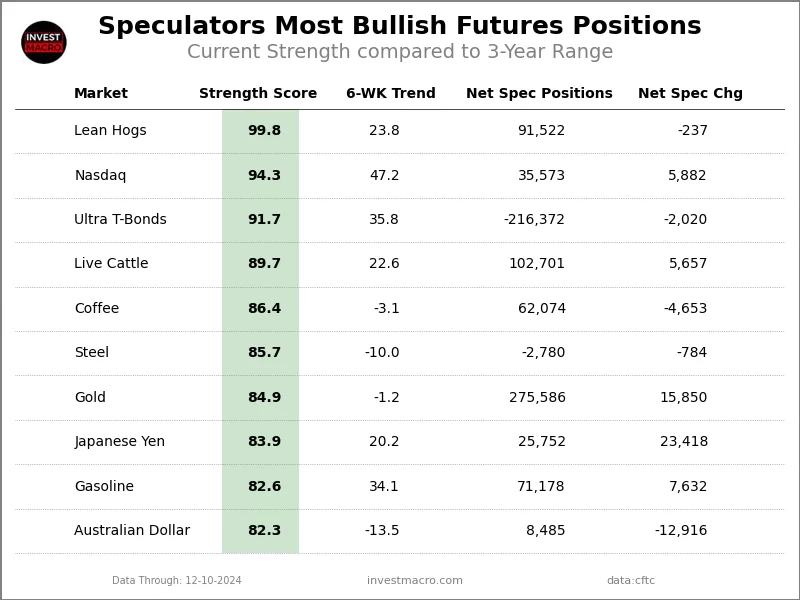
Speculator Extremes: Lean Hogs & Nasdaq lead weekly Bullish Positions

By InvestMacro 

The latest update for the weekly Commitment of Traders (COT) report was released by the Commodity Futures Trading Commission (CFTC) on Friday for data ending on December 10th.

This weekly Extreme Positions report highlights the Most Bullish and Most Bearish Positions for the speculator category. Extreme positioning in these markets can foreshadow strong moves in the underlying market.

To signify an extreme position, we use the Strength Index (also known as the COT Index) of each instrument, a common method of measuring COT data. The Strength Index is simply a comparison of current trader positions against the range of positions over the previous 3 years. We use over 80 percent as extremely bullish and under 20 percent as extremely bearish. (Compare Strength Index scores across all markets in the data table or cot leaders table)


Here Are This Week’s Most Bullish Speculator Positions:

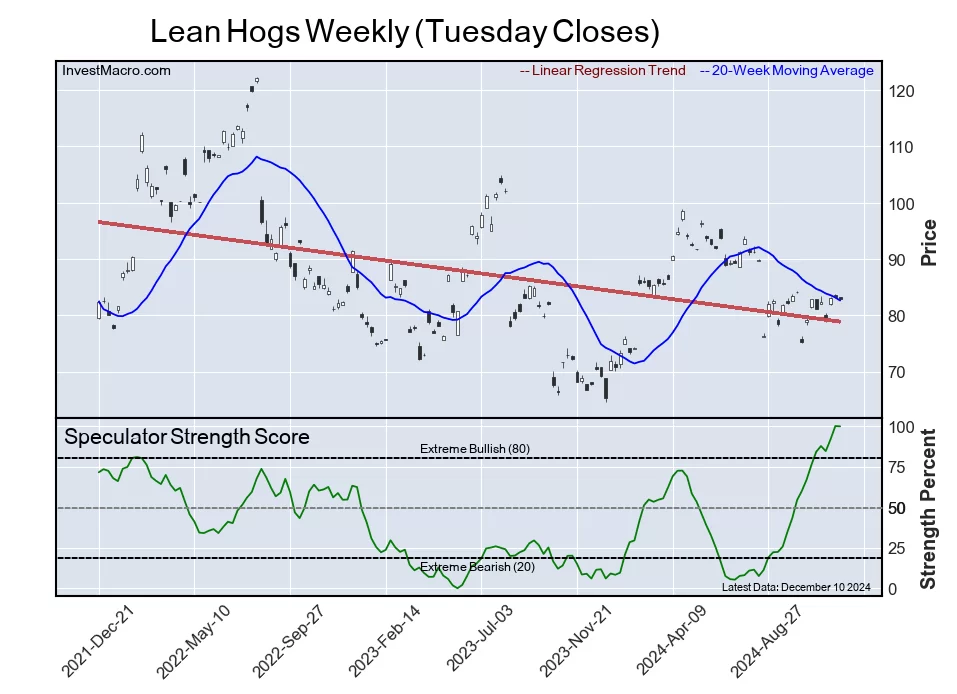
Lean Hogs


The Lean Hogs speculator position comes in as the most bullish extreme standing once again this week. The Lean Hogs speculator level is currently at a 99.8 percent score of its 3-year range.

The six-week trend for the percent strength score totaled 23.8 this week. The overall net speculator position was a total of 91,522 net contracts this week with a small dip of -237 contract in the weekly speculator bets.


Speculators or Non-Commercials Notes:

Speculators, classified as non-commercial traders by the CFTC, are made up of large commodity funds, hedge funds and other significant for-profit participants. The Specs are generally regarded as trend-followers in their behavior towards price action – net speculator bets and prices tend to go in the same directions. These traders often look to buy when prices are rising and sell when prices are falling. To illustrate this point, many times speculator contracts can be found at their most extremes (bullish or bearish) when prices are also close to their highest or lowest levels.

These extreme levels can be dangerous for the large speculators as the trade is most crowded, there is less trading ammunition still sitting on the sidelines to push the trend further and prices have moved a significant distance. When the trend becomes exhausted, some speculators take profits while others look to also exit positions when prices fail to continue in the same direction. This process usually plays out over many months to years and can ultimately create a reverse effect where prices start to fall and speculators start a process of selling when prices are falling.


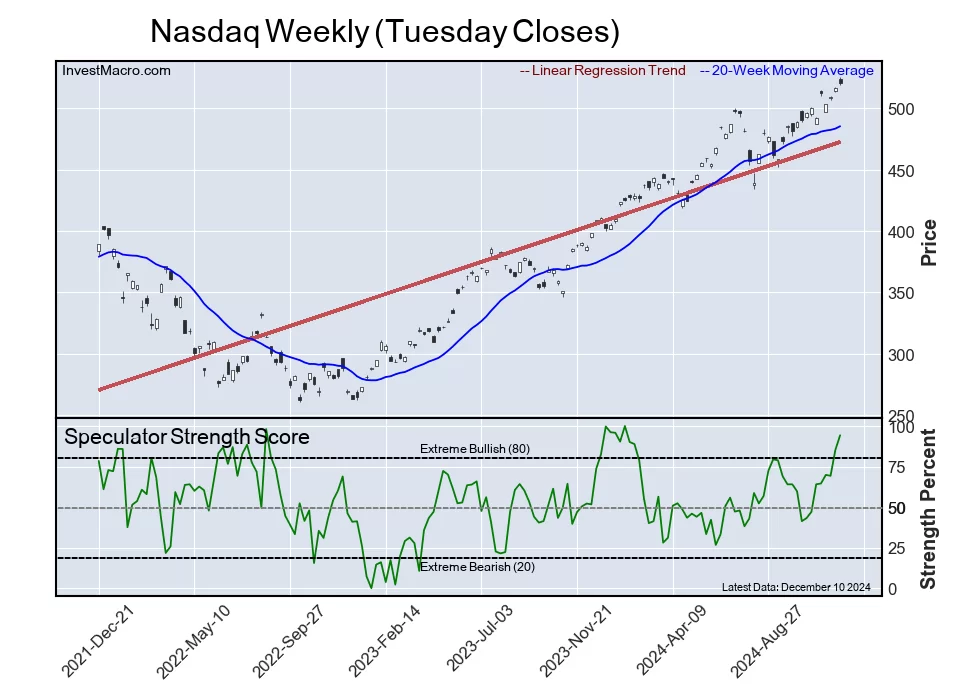
Nasdaq


The Nasdaq speculator position comes next in the extreme standings this week. The Nasdaq speculator level is now at a 94.3 percent score of its 3-year range.

The six-week trend for the percent strength score was 47.2 this week. The speculator position registered 35,573 net contracts this week with a weekly rise of 5,882 contracts in speculator bets.


Ultra U.S. Treasury Bonds


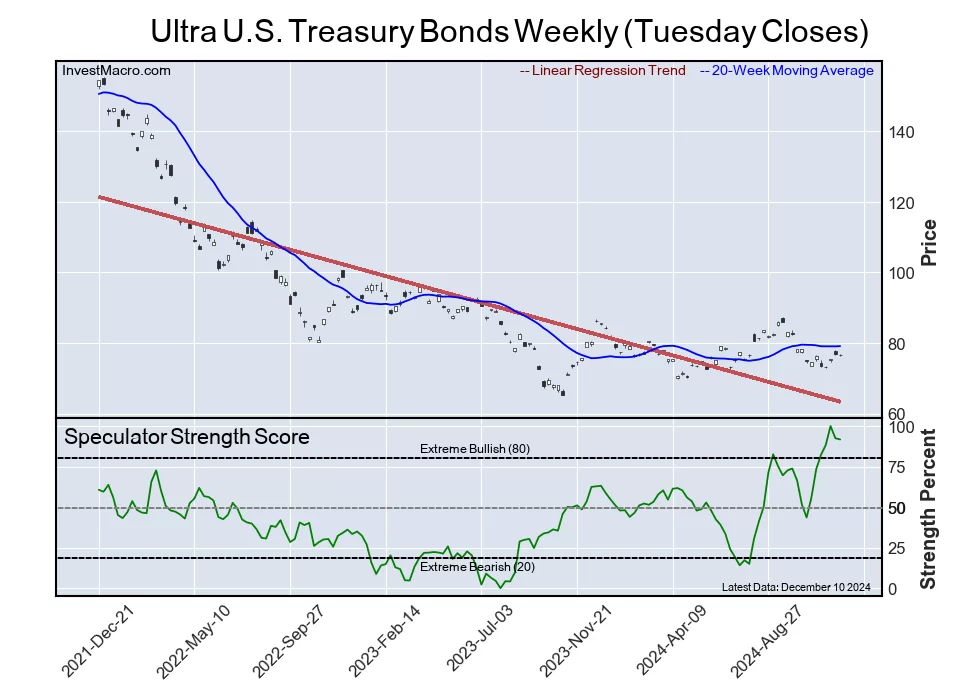
The Ultra U.S. Treasury Bonds speculator position comes in third this week in the extreme standings. The Ultra U.S. Treasury Bonds speculator level resides at a 91.7 percent score of its 3-year range.

The six-week trend for the speculator strength score came in at 35.8 this week. The overall speculator position was -216,372 net contracts this week with a decline of -2,020 contracts in the weekly speculator bets.


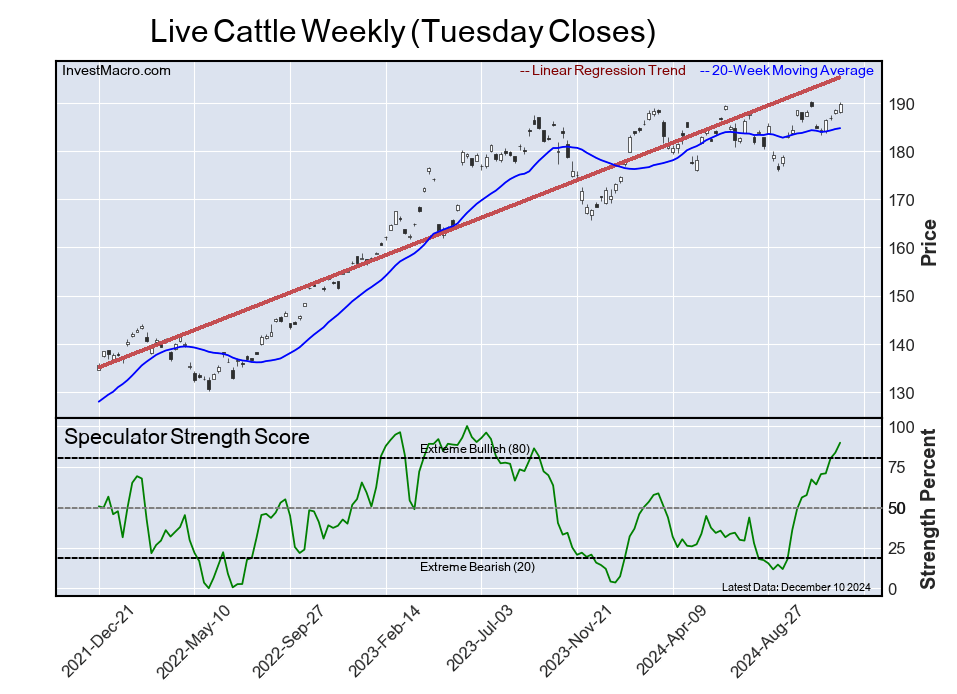
Live Cattle


The Live Cattle speculator position comes up number four in the extreme standings this week. The Live Cattle speculator level is at a 89.7 percent score of its 3-year range.

The six-week trend for the speculator strength score totaled a change of 22.6 this week. The overall speculator position was 102,701 net contracts this week with a gain of 5,657 contracts in the speculator bets.


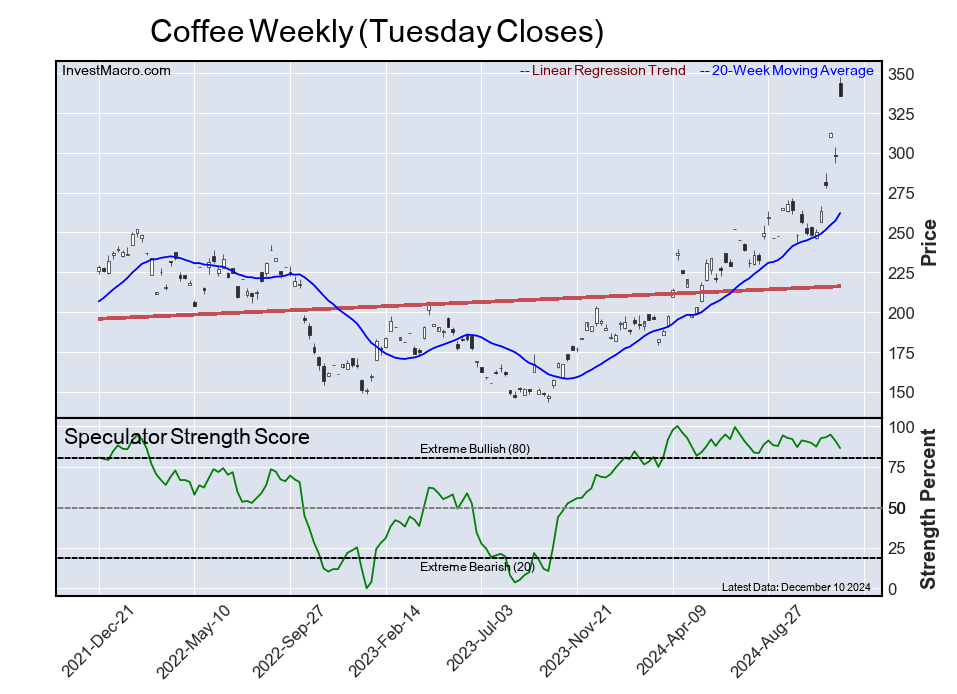
Coffee


The Coffee speculator position rounds out the top five in this week’s bullish extreme standings. The Coffee speculator level sits at a 86.4 percent score of its 3-year range. The six-week trend for the speculator strength score was -3.1 this week.

The speculator position was 62,074 net contracts this week with a decrease by -4,653 contracts in the weekly speculator bets.


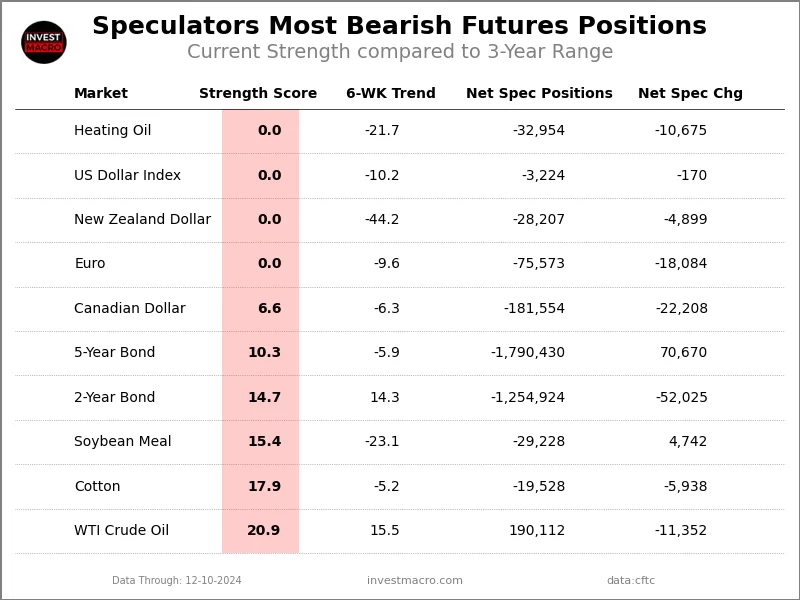
This Week’s Most Bearish Speculator Positions:

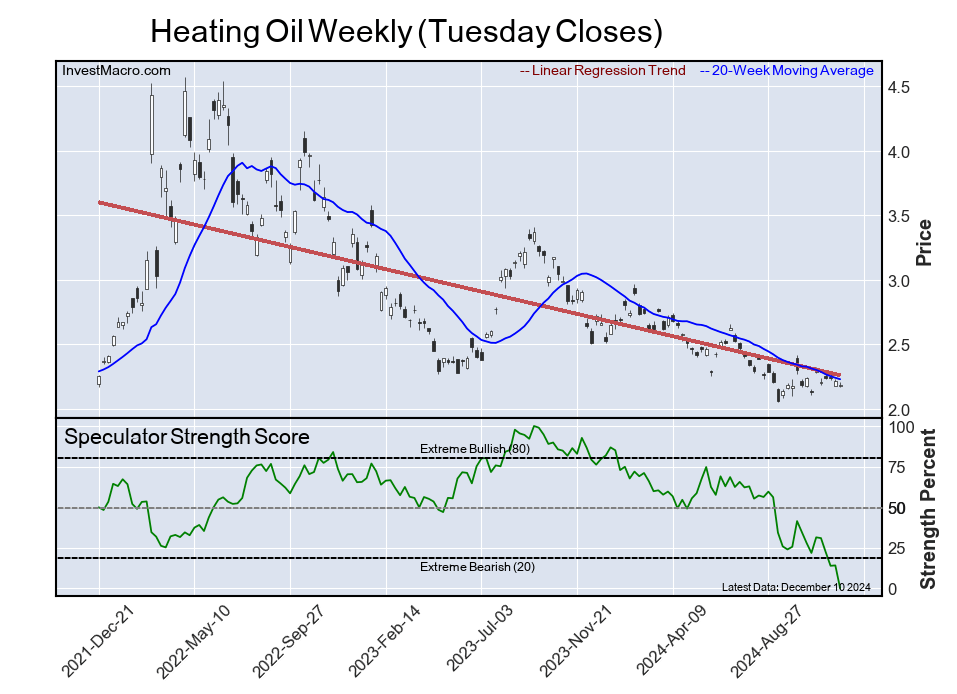
Heating Oil


The Heating Oil speculator position comes in as the most bearish extreme standing this week. The Heating Oil speculator level is at a 0.0 percent score of its 3-year range.

The six-week trend for the speculator strength score was -21.7 this week. The overall speculator position was -32,954 net contracts this week with a drop of -10,675 contracts in the speculator bets.


New Zealand Dollar


The New Zealand Dollar speculator position comes in next for the most bearish extreme standing on the week. The New Zealand Dollar speculator level is at a 0.0 percent score of its 3-year range.

The six-week trend for the speculator strength score was -44.2 this week. The speculator position was -28,207 net contracts this week with a shortfall of -4,899 contracts in the weekly speculator bets.


Euro


The Euro speculator position comes in as third most bearish extreme standing of the week. The Euro speculator level resides at a 0.0 percent score of its 3-year range.

The six-week trend for the speculator strength score was -9.6 this week. The overall speculator position was -75,573 net contracts this week with a decrease by -18,084 contracts in the speculator bets.


US Dollar Index


The US Dollar Index speculator position comes in as this week’s fourth most bearish extreme standing. The US Dollar Index speculator level is at a 0.0 percent score of its 3-year range.

The six-week trend for the speculator strength score was -10.2 this week. The speculator position was -3,224 net contracts this week with a dip of -170 contracts in the weekly speculator bets.


Canadian Dollar


Finally, the Canadian Dollar speculator position comes in as the fifth most bearish extreme standing for this week. The Canadian Dollar speculator level is at a 6.6 percent score of its 3-year range.

The six-week trend for the speculator strength score was -6.3 this week. The speculator position was -181,554 net contracts this week with a decrease of -22,208 contracts in the weekly speculator bets.


Article By InvestMacroReceive our weekly COT Newsletter

*COT Report: The COT data, released weekly to the public each Friday, is updated through the most recent Tuesday (data is 3 days old) and shows a quick view of how large speculators or non-commercials (for-profit traders) were positioned in the futures markets.

The CFTC categorizes trader positions according to commercial hedgers (traders who use futures contracts for hedging as part of the business), non-commercials (large traders who speculate to realize trading profits) and nonreportable traders (usually small traders/speculators) as well as their open interest (contracts open in the market at time of reporting). See CFTC criteria here.
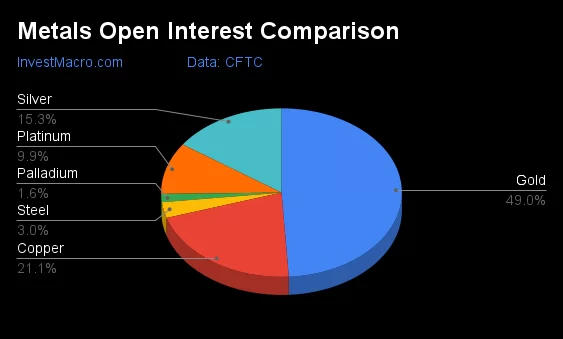
COT Metals Charts: Weekly Speculator Changes led by Gold

By InvestMacro

Here are the latest charts and statistics for the Commitment of Traders (COT) data published by the Commodities Futures Trading Commission (CFTC).

The latest COT data is updated through Tuesday December 10th and shows a quick view of how large traders (for-profit speculators and commercial entities) were positioned in the futures markets.

Weekly Speculator Changes led by Gold

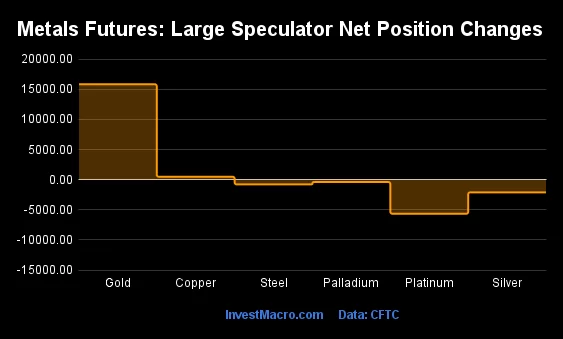
The COT metals markets speculator bets were overall lower this week as two out of the six metals markets we cover had higher positioning while the other four markets had lower speculator contracts.

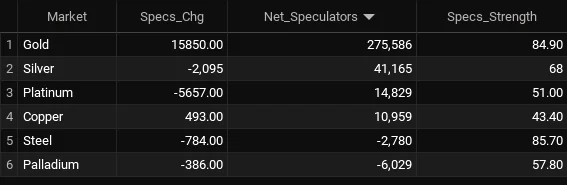
Leading the gains for the metals was Gold (15,850 contracts) with Copper (493 contracts) also recording positive weeks.

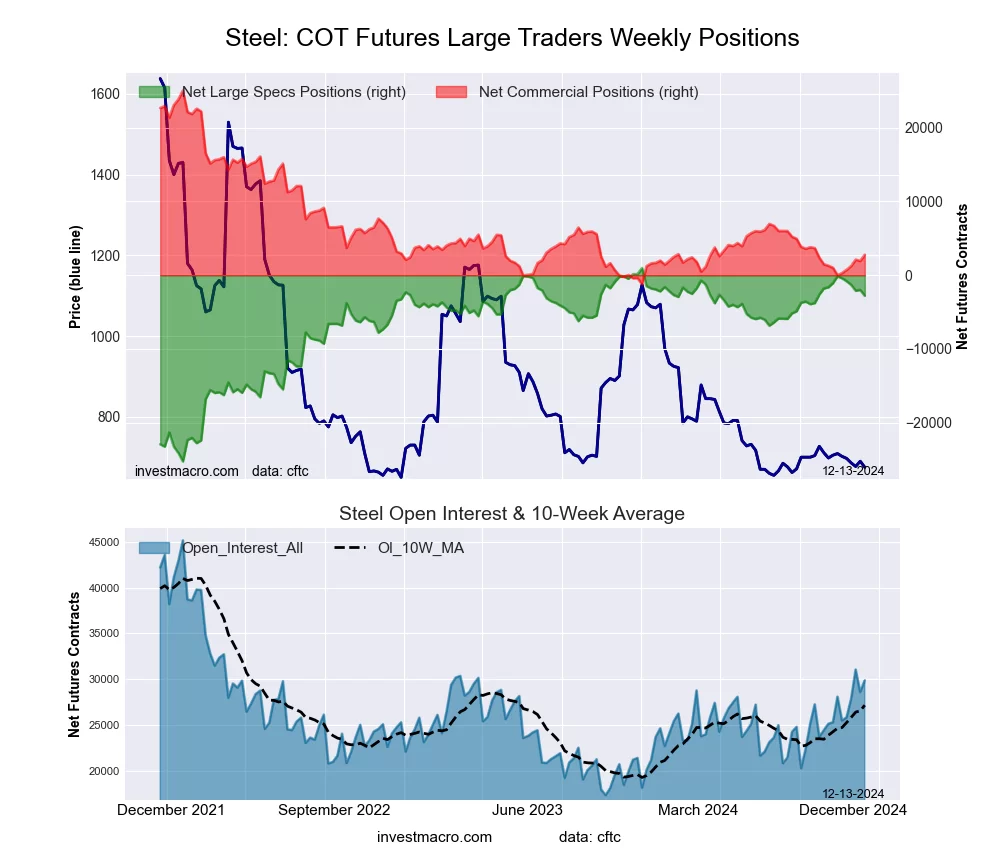
The markets with declines in speculator bets for the week were Platinum (-5,657 contracts), Silver (-2,095 contracts), Palladium (-386 contracts) and with Steel (-784 contracts) also seeing lower bets on the week.


Metals Net Speculators Leaderboard

Legend: Weekly Speculators Change | Speculators Current Net Position | Speculators Strength Score compared to last 3-Years (0-100 range)


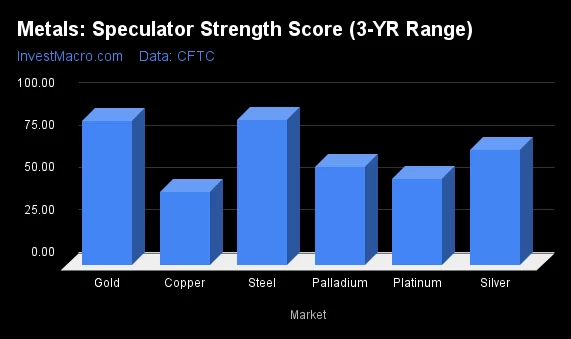
Strength Scores led by Steel & Gold

COT Strength Scores (a normalized measure of Speculator positions over a 3-Year range, from 0 to 100 where above 80 is Extreme-Bullish and below 20 is Extreme-Bearish) showed that Steel (86 percent) and Gold (85 percent) lead the metals markets this week.  comes in as the next highest in the weekly strength scores.

On the downside, Copper (43 percent) comes in at the lowest strength level currently and is the only market that is below the midpoint line (50 percent) of the past three years.

Strength Statistics:
Gold (84.9 percent) vs Gold previous week (78.9 percent)
Silver (68.2 percent) vs Silver previous week (70.8 percent)
Copper (43.4 percent) vs Copper previous week (43.0 percent)
Platinum (51.0 percent) vs Platinum previous week (64.4 percent)
Palladium (57.8 percent) vs Palladium previous week (60.6 percent)
Steel (85.7 percent) vs Palladium previous week (88.7 percent)


Gold & Steel top the 6-Week Strength Trends

COT Strength Score Trends (or move index, calculates the 6-week changes in strength scores) showed that Gold (-1 percent) is leading the past six weeks trends for metals by falling the least in that time period. All of the metals markets are seeing negative 6-week trends with Platinum (-49 percent) recording the largest downside trend score currently.

Move Statistics:
Gold (-1.2 percent) vs Gold previous week (-13.8 percent)
Silver (-24.3 percent) vs Silver previous week (-29.2 percent)
Copper (-11.9 percent) vs Copper previous week (-20.5 percent)
Platinum (-49.0 percent) vs Platinum previous week (-34.0 percent)
Palladium (-26.2 percent) vs Palladium previous week (-4.1 percent)
Steel (-10.0 percent) vs Steel previous week (-3.5 percent)


Individual Markets:

Gold Comex Futures:

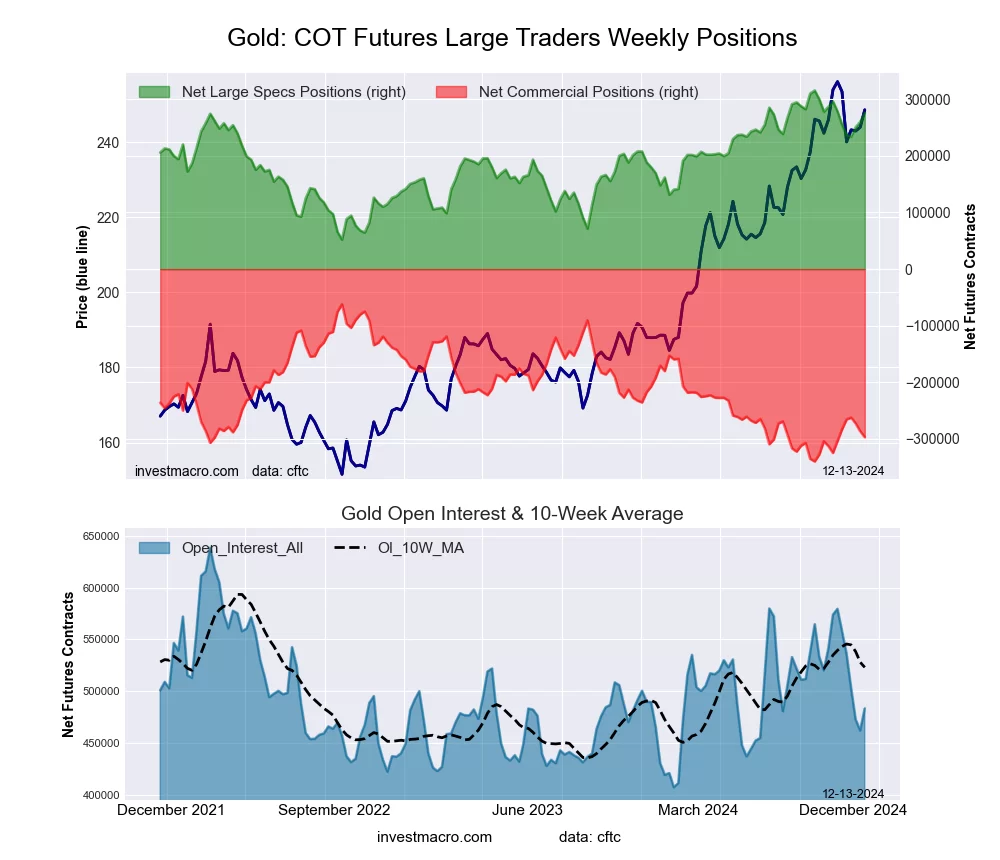
Gold Futures COT ChartThe Gold Comex Futures large speculator standing this week was a net position of 275,586 contracts in the data reported through Tuesday. This was a weekly rise of 15,850 contracts from the previous week which had a total of 259,736 net contracts.

This week’s current strength score (the trader positioning range over the past three years, measured from 0 to 100) shows the speculators are currently Bullish-Extreme with a score of 84.9 percent. The commercials are Bearish-Extreme with a score of 15.4 percent and the small traders (not shown in chart) are Bearish with a score of 47.8 percent.

Price Trend-Following Model: Uptrend

Our weekly trend-following model classifies the current market price position as: Uptrend.

Gold Futures StatisticsSPECULATORSCOMMERCIALSSMALL TRADERS
– Percent of Open Interest Longs:67.113.79.6
– Percent of Open Interest Shorts:10.175.15.2
– Net Position:275,586-296,87121,285
– Gross Longs:324,33266,02546,448
– Gross Shorts:48,746362,89625,163
– Long to Short Ratio:6.7 to 10.2 to 11.8 to 1
NET POSITION TREND:
– Strength Index Score (3 Year Range Pct):84.915.447.8
– Strength Index Reading (3 Year Range):Bullish-ExtremeBearish-ExtremeBearish
NET POSITION MOVEMENT INDEX:
– 6-Week Change in Strength Index:-1.22.4-13.5


Silver Comex Futures:

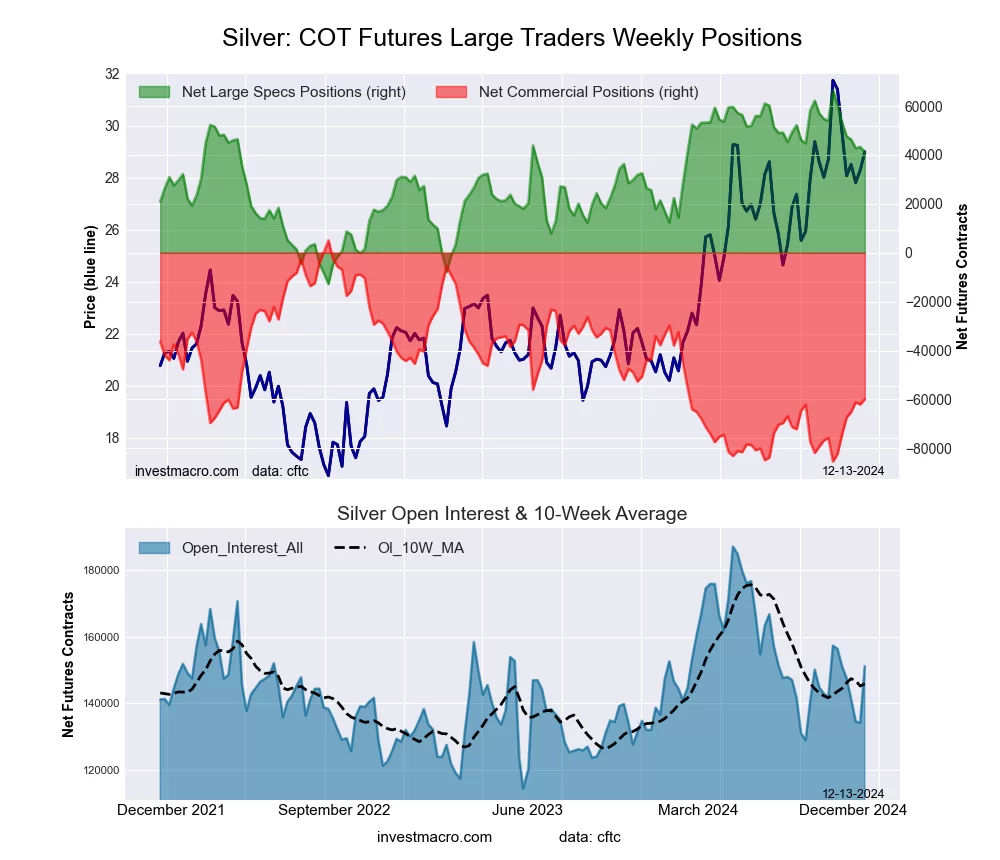
Silver Futures COT ChartThe Silver Comex Futures large speculator standing this week was a net position of 41,165 contracts in the data reported through Tuesday. This was a weekly decline of -2,095 contracts from the previous week which had a total of 43,260 net contracts.

This week’s current strength score (the trader positioning range over the past three years, measured from 0 to 100) shows the speculators are currently Bullish with a score of 68.2 percent. The commercials are Bearish with a score of 28.2 percent and the small traders (not shown in chart) are Bullish with a score of 61.1 percent.

Price Trend-Following Model: Weak Uptrend

Our weekly trend-following model classifies the current market price position as: Weak Uptrend.

Silver Futures StatisticsSPECULATORSCOMMERCIALSSMALL TRADERS
– Percent of Open Interest Longs:48.024.120.2
– Percent of Open Interest Shorts:20.763.77.9
– Net Position:41,165-59,84318,678
– Gross Longs:72,51536,37630,557
– Gross Shorts:31,35096,21911,879
– Long to Short Ratio:2.3 to 10.4 to 12.6 to 1
NET POSITION TREND:
– Strength Index Score (3 Year Range Pct):68.228.261.1
– Strength Index Reading (3 Year Range):BullishBearishBullish
NET POSITION MOVEMENT INDEX:
– 6-Week Change in Strength Index:-24.324.7-15.1


Copper Grade #1 Futures:

Copper Futures COT ChartThe Copper Grade #1 Futures large speculator standing this week was a net position of 10,959 contracts in the data reported through Tuesday. This was a weekly increase of 493 contracts from the previous week which had a total of 10,466 net contracts.

This week’s current strength score (the trader positioning range over the past three years, measured from 0 to 100) shows the speculators are currently Bearish with a score of 43.4 percent. The commercials are Bullish with a score of 55.9 percent and the small traders (not shown in chart) are Bullish with a score of 53.6 percent.

Price Trend-Following Model: Weak Uptrend

Our weekly trend-following model classifies the current market price position as: Weak Uptrend.

Copper Futures StatisticsSPECULATORSCOMMERCIALSSMALL TRADERS
– Percent of Open Interest Longs:40.634.98.1
– Percent of Open Interest Shorts:35.443.15.2
– Net Position:10,959-16,8895,930
– Gross Longs:84,58572,71116,766
– Gross Shorts:73,62689,60010,836
– Long to Short Ratio:1.1 to 10.8 to 11.5 to 1
NET POSITION TREND:
– Strength Index Score (3 Year Range Pct):43.455.953.6
– Strength Index Reading (3 Year Range):BearishBullishBullish
NET POSITION MOVEMENT INDEX:
– 6-Week Change in Strength Index:-11.915.0-27.7


Platinum Futures:

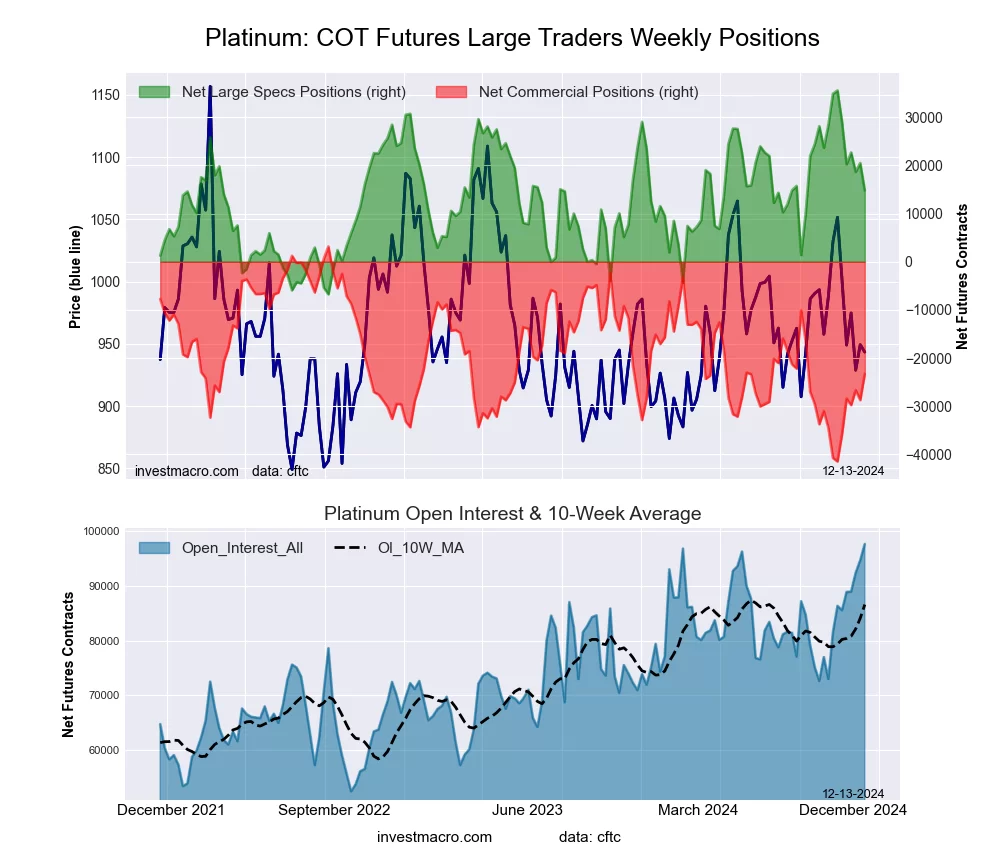
Platinum Futures COT ChartThe Platinum Futures large speculator standing this week was a net position of 14,829 contracts in the data reported through Tuesday. This was a weekly lowering of -5,657 contracts from the previous week which had a total of 20,486 net contracts.

This week’s current strength score (the trader positioning range over the past three years, measured from 0 to 100) shows the speculators are currently Bullish with a score of 51.0 percent. The commercials are Bearish with a score of 40.7 percent and the small traders (not shown in chart) are Bullish-Extreme with a score of 95.4 percent.

Price Trend-Following Model: Weak Uptrend

Our weekly trend-following model classifies the current market price position as: Weak Uptrend.

Platinum Futures StatisticsSPECULATORSCOMMERCIALSSMALL TRADERS
– Percent of Open Interest Longs:55.420.812.4
– Percent of Open Interest Shorts:40.244.63.8
– Net Position:14,829-23,2888,459
– Gross Longs:54,10520,29912,146
– Gross Shorts:39,27643,5873,687
– Long to Short Ratio:1.4 to 10.5 to 13.3 to 1
NET POSITION TREND:
– Strength Index Score (3 Year Range Pct):51.040.795.4
– Strength Index Reading (3 Year Range):BullishBearishBullish-Extreme
NET POSITION MOVEMENT INDEX:
– 6-Week Change in Strength Index:-49.040.739.9


Palladium Futures:

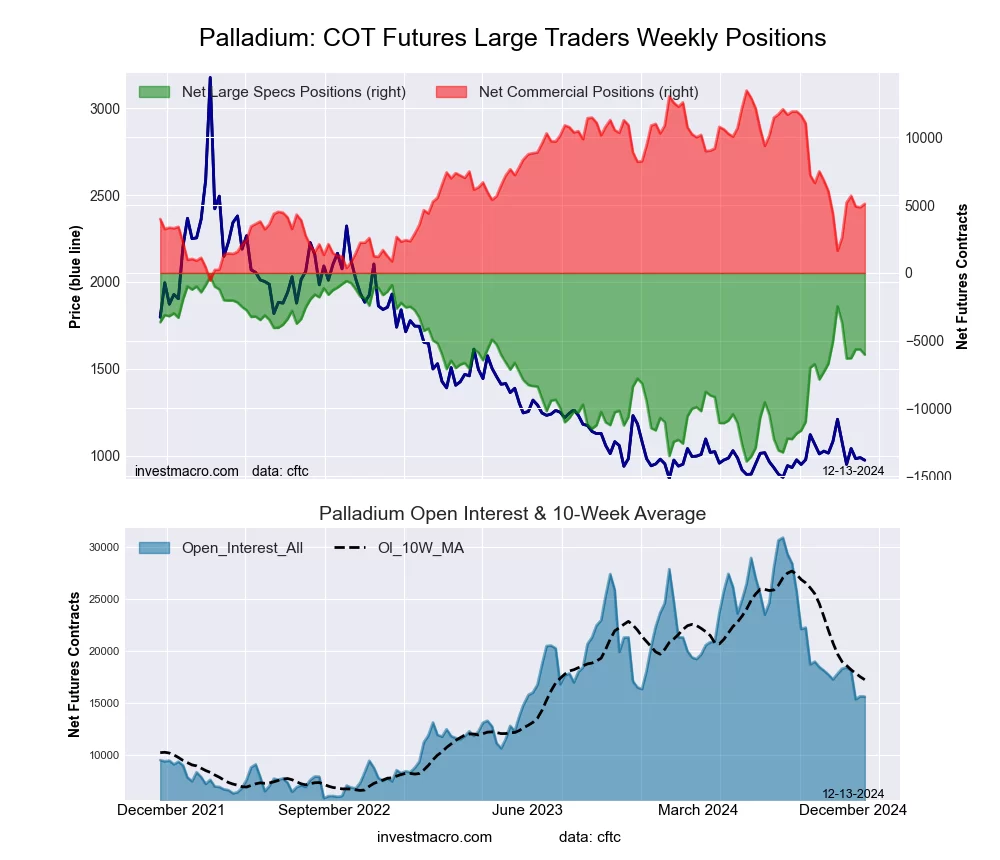
Palladium Futures COT ChartThe Palladium Futures large speculator standing this week was a net position of -6,029 contracts in the data reported through Tuesday. This was a weekly decrease of -386 contracts from the previous week which had a total of -5,643 net contracts.

This week’s current strength score (the trader positioning range over the past three years, measured from 0 to 100) shows the speculators are currently Bullish with a score of 57.8 percent. The commercials are Bearish with a score of 40.4 percent and the small traders (not shown in chart) are Bullish with a score of 78.1 percent.

Price Trend-Following Model: Weak Uptrend

Our weekly trend-following model classifies the current market price position as: Weak Uptrend.

Palladium Futures StatisticsSPECULATORSCOMMERCIALSSMALL TRADERS
– Percent of Open Interest Longs:33.349.814.0
– Percent of Open Interest Shorts:71.917.18.1
– Net Position:-6,0295,105924
– Gross Longs:5,2057,7702,194
– Gross Shorts:11,2342,6651,270
– Long to Short Ratio:0.5 to 12.9 to 11.7 to 1
NET POSITION TREND:
– Strength Index Score (3 Year Range Pct):57.840.478.1
– Strength Index Reading (3 Year Range):BullishBearishBullish
NET POSITION MOVEMENT INDEX:
– 6-Week Change in Strength Index:-26.224.75.2


Steel Futures Futures:

Steel Futures COT ChartThe Steel Futures large speculator standing this week was a net position of -2,780 contracts in the data reported through Tuesday. This was a weekly lowering of -784 contracts from the previous week which had a total of -1,996 net contracts.

This week’s current strength score (the trader positioning range over the past three years, measured from 0 to 100) shows the speculators are currently Bullish-Extreme with a score of 85.7 percent. The commercials are Bearish-Extreme with a score of 15.2 percent and the small traders (not shown in chart) are Bearish with a score of 32.8 percent.

Price Trend-Following Model: Weak Uptrend

Our weekly trend-following model classifies the current market price position as: Weak Uptrend.

Steel Futures StatisticsSPECULATORSCOMMERCIALSSMALL TRADERS
– Percent of Open Interest Longs:24.666.80.8
– Percent of Open Interest Shorts:33.957.50.8
– Net Position:-2,7802,7764
– Gross Longs:7,35419,961250
– Gross Shorts:10,13417,185246
– Long to Short Ratio:0.7 to 11.2 to 11.0 to 1
NET POSITION TREND:
– Strength Index Score (3 Year Range Pct):85.715.232.8
– Strength Index Reading (3 Year Range):Bullish-ExtremeBearish-ExtremeBearish
NET POSITION MOVEMENT INDEX:
– 6-Week Change in Strength Index:-10.010.6-15.8


Article By InvestMacroReceive our weekly COT Newsletter

*COT Report: The COT data, released weekly to the public each Friday, is updated through the most recent Tuesday (data is 3 days old) and shows a quick view of how large speculators or non-commercials (for-profit traders) were positioned in the futures markets.

The CFTC categorizes trader positions according to commercial hedgers (traders who use futures contracts for hedging as part of the business), non-commercials (large traders who speculate to realize trading profits) and nonreportable traders (usually small traders/speculators) as well as their open interest (contracts open in the market at time of reporting). See CFTC criteria here.