Australian dollar falls amid soft inflation data. Natural gas prices fell to a 3-week low

By JustMarkets

The Dow Jones Index (US30) was up 0.31% on Tuesday. The S&P 500 Index (US500) added 0.92%. The Nasdaq Technology Index (US100) jumped 1.59%. The US stocks rose by 1.5%, led by the Nasdaq Index, as technology stocks recovered from Monday’s selloff. Nvidia rose by 8.8%, recovering some of the historic 17% loss in a single session that wiped out a market value of $593 billion. Broadcom and Oracle added 2.6% and 3.6%, respectively, amid general strength in the technology sector. Meanwhile, Royal Caribbean soared 11.9% on optimistic earnings estimates and General Motors fell 8.9% due to earnings concerns and potential US tariffs on imports of microchips, pharmaceuticals and steel.

The FOMC will meet today for its monetary policy meeting. Markets expect the FOMC to keep the target range for the federal funds rate unchanged at 4.25-4.50% when the 2-day FOMC meeting concludes on Wednesday. However, markets will gauge the Fed’s views on growth and inflation in Fed Chair Powell’s comments after the meeting.

Equity markets in Europe traded flat yesterday. The German DAX (DE40) rose by 0.70%, the French CAC 40 (FR40) closed down 0.12%, the Spanish IBEX 35 (ES35) added 1.31%, and the British FTSE 100 (UK100) closed positive 0.35%. The DAX hit a new record high on Tuesday, following yesterday’s losses due to concerns over the high valuations of some companies and the prospects for the growth of artificial intelligence.

WTI crude oil prices are hovering around $73 a barrel, remaining near a two-week low, as traders’ attention turned to President Donald Trump’s wide-ranging set of tariffs. Trump has said he will soon impose tariffs on foreign-made goods such as steel, aluminum and copper, raising concerns about the potential impact on global demand for commodities. In addition, Treasury Secretary Scott Bessent reportedly supports the gradual imposition of universal tariffs on US imports, starting at 2.5%.

The US natural gas (XNG/USD) prices fell below $3.6/MMBtu, nearly to a three-week low, due to warmer-than-expected weather projections for early February. However, analysts still expect 317 Bcf of gas to be withdrawn in the week ended January 24, which could eliminate a gas inventory glut for the first time since early 2022 and boost gas prices. Meanwhile, LNG exports are rising, helped by the restart of Texas-based Freeport LNG.

Asian markets were mostly down yesterday. Japan’s Nikkei 225 (JP225) fell by 1.39%, China’s FTSE China A50 (CHA50) and Hong Kong’s Hang Seng (HK50) were not trading due to holidays, and Australia’s ASX 200 (AU200) was negative 0.12%.

The Australian dollar fell below USD 0.625 on Wednesday, posting a third straight session of losses as weaker-than-expected domestic inflation data fueled expectations of an interest rate cut by the Reserve Bank of Australia (RBA) in February. The data showed Australia’s annual inflation rate slowed to 2.4% in Q4, down from 2.8% in Q3 and below the prognosis of 2.5%. The quarterly figure was also below expectations at 0.2%. Markets are now pricing in an 80% chance that the RBA will cut its monetary rate by 25 basis points to 4.35% at its February 18 meeting. The Australian dollar also faced downward pressure due to escalating tariff threats from US President Donald Trump and ongoing economic problems in China, Australia’s main trading partner.

S&P 500 (US500) 6,067.70 +55.42 (+0.92%)

Dow Jones (US30) 44,850.35 +136.77 (+0.31%)

DAX (DE40) 21,430.58 +148.40 (+0.70%)

FTSE 100 (UK100) 8,533.87 +30.16 (+0.35%)

USD Index 107.91 +0.57 (+0.53%)

News feed for: 2025.01.29

  • Japan Monetary Policy Meeting Minutes at 01:50 (GMT+2);
  • Australia Consumer Price Index (m/m) at 02:30 (GMT+2);
  • Japan Consumer Confidence (m/m) at 07:00 (GMT+2);
  • German GfK German Consumer Climate (m/m) at 09:00 (GMT+2);
  • Sweden Riksbank Interest Rate Decision at 10:30 (GMT+2);
  • UK BOE Gov Bailey Speaks at 16:15 (GMT+2);
  • Canada BoC Interest Rate Decision at 16:45 (GMT+2);
  • Canada BoC Monetary Policy Report at 16:45 (GMT+2);
  • Canada BoC Press Conference at 17:30 (GMT+2);
  • US Crude Oil Reserves (w/w) at 16:30 (GMT+2);
  • US Fed Interest Rate Decision at 21:00 (GMT+2);
  • US FOMC Statement at 21:00 (GMT+2);
  • US Fed Press Conference at 21:30 (GMT+2).

By JustMarkets


This article reflects a personal opinion and should not be interpreted as an investment advice, and/or offer, and/or a persistent request for carrying out financial transactions, and/or a guarantee, and/or a forecast of future events.

DeepSeek sends NVDA into a knockdown. Falling oil prices have a negative impact on commodity currencies

By JustMarkets

At Monday’s close, the Dow Jones Index (US30) was up 0.65%. The S&P 500 Index (US500) decreased by 1.46%. The Nasdaq Technology Index (US100) fell by 2.97%. The fall in technology stocks on Monday impacted the overall market. Shares of chipmakers and artificial intelligence-related companies fell on Monday as Chinese artificial intelligence startup DeepSeek appears to be delivering performance comparable to Western chatbots for less price. DeepSeek’s latest, released last week, is widely considered competing with OpenAI and Meta Platforms and is now ranked number one on the Apple App Store.

Shares of artificial intelligence company Nvidia (NVDA) fell nearly 17% on Monday, wiping out $589 billion in market value and weighing down the Nasdaq Composite Tech Index as a new model from Chinese startup DeepSeek cast doubt on recent investments in AI infrastructure. Much of the current rise has been on the expectation that US companies have an exclusive advantage in AI, and they can dominate the field and make a lot of money accordingly. However, a Chinese startup is shattering this myth by proving that neural networks can be affordable and accessible. This could significantly hit US stock indices, which many experts believe are inflated due to the AI bubble.

Falling prices for crude oil, which plays a key role in Canada’s economy, are adding pressure on the Canadian dollar as market participants fear the broader implications of tariffs imposed on Canada, Mexico and China, which could reduce global energy demand and growth. These risks, combined with the growing interest rate differential between the US and Canada, put additional pressure on the loonie, making it difficult for it to recover in the near term, especially amid expectations of a possible rate cut by the Bank of Canada.

Equity markets in Europe traded yesterday without a single dynamics. German DAX (DE40) fell by 0.53%, French CAC 40 (FR40) closed down by 0.27%, Spanish IBEX 35 (ES35) gained 0.12%, British FTSE 100 (UK100) closed up 0.02%.

On Monday, WTI crude futures fell more than 2% to $73 per barrel, setting a one-month low. Earlier in the session, weak economic data from China, indicating a decline in factory activity, heightened fears of weaker demand from the world’s largest oil importer. These concerns were heightened by the prospect of US tariffs that could exacerbate economic growth and energy demand problems. Despite these concerns, Saudi Arabia has signaled its intention to raise oil prices for Asia, reflecting tightening global supplies due to OPEC+ production cuts and recent US sanctions against Russian oil exports.

Asian markets were predominantly up yesterday. Japan’s Nikkei 225 (JP225) was down 0.92%, China’s FTSE China A50 (CHA50) was up 0.07%, Hong Kong’s Hang Seng (HK50) increased by 0.66% and Australia’s ASX 200 (AU200) was positive 0.36%.

On Tuesday, the New Zealand dollar extended its fall to US$0.565, continuing its retreat from a five-week high as the US dollar recovered from President Donald Trump’s new tariff threats. On Monday, Trump announced plans to impose tariffs on imported microchips, pharmaceuticals, steel, aluminum, and copper to boost domestic production. Traders also remain on edge as the February 1 deadline for the first round of tariffs aimed at countries including China, New Zealand’s biggest trading partner, approaches.

The Australian dollar weakened to US$0.625 on Tuesday, declining for a second straight session as the US dollar gained ground after fresh tariff threats from US President Donald Trump. On the domestic front, data showed business confidence in Australia improved in December. Investors are now focused on upcoming inflation data, which could heighten expectations of a potential rate cut by the Reserve Bank of Australia in February.

S&P 500 (US500) 6,012.28 −88.96 (−1.46%)

Dow Jones (US30) 44,713.58 +289.33 (+0.65%)

DAX (DE40) 21,282.18 −112.75 (−0.53%)

FTSE 100 (UK100) 8,503.71 +1.36 (+0.02%)

USD Index 107.33 (−0.10%)

News feed for: 2025.01.28

  • Australia NAB Business Confidence at 02:30 (GMT+2);
  • US Durable Goods Orders (m/m) at 15:30 (GMT+2);
  • US CB Consumer Confidence (m/m) at 17:00 (GMT+2).

By JustMarkets


This article reflects a personal opinion and should not be interpreted as an investment advice, and/or offer, and/or a persistent request for carrying out financial transactions, and/or a guarantee, and/or a forecast of future events.

DeepSeek set to wipe out over US$ 1 trillion from tech stock valuations

By ForexTime

  • Nvidia flirts with bear market; nearly 20% drop from record high
  • China AI startup, DeepSeek, challenges US AI dominance
  • DeepSeek to dominate Apple, Microsoft, Tesla, Meta earnings this week
  • Stocks selloff adds to market concerns, including  Fed, Trump watch

DeepSeek – China’s rival to ChatGPT – is stoking fear across global financial markets.

  • Nvidia is down 11%, flirting with a bear market (falling almost 20% from its current record high)
  • FXTM’s NAS100 fell as much as 5% pre-market
  • European equities EU50 and NETH225 tumbled as ASML fell as much as 12%.
  • Even Bitcoin tumbled as low as $97720, mirroring the selloff in Western AI stocks.


What is going on?

The answer is DeepSeek – a Chinese artificial intelligence startup that is China’s answer to ChatGPT.


The bigger picture…

Chinese AI company DeepSeek has gatecrashed the AI party by releasing a new product.

But here is the thing, it is just a fraction of the production cost seen in the United States.

This has raised questions about whether the hundreds of billions of dollars invested were required to stay ahead of the AI race.


A deeper dive…

This development could not have come at a worse time for big tech companies scheduled to publish their latest earnings this week.

4 of the 7 magnificent tech stocks namely Tesla, Meta, Microsoft and Apple will be under the spotlight.

DeepSeek has shown the world that it could develop complex AI models that do not cost hundreds of billions of dollars.

So, this may place extra scrutiny on big tech earnings this week as investors focus all their attention on how much was invested in AI last quarter.

  • If the existing AI leaders can convince investors that they’ll be able to fend off DeepSeek, this could trigger a rebound in AI stocks/US stock indices.
  • However, if AI leaders are unable to soothe market fears about DeepSeek’s threat, this could spell more pain for AI stocks.


What next?

Any more positive developments around DeepSeek could fuel fears about US exceptionalism being eroded.

This may translate to more pain in the US tech space as jittery investors book profits.


Forex-Time-LogoArticle by ForexTime

ForexTime Ltd (FXTM) is an award winning international online forex broker regulated by CySEC 185/12 www.forextime.com

Australian Dollar Declines as External Pressures and Rising Risks Weigh

By RoboForex Analytical Department 

The AUD/USD pair fell to 0.6257 on Tuesday, marking its second consecutive session of losses. The Australian dollar remains under pressure due to external factors, including a strengthening US dollar and growing global risks.

Key drivers behind the AUD decline

The US dollar has gained strength following renewed threats from US President Donald Trump to impose trade duties. Trump announced plans to levy tariffs on imported chips, pharmaceutical products, and raw materials such as aluminium, copper, and steel, aiming to stimulate domestic production. These developments have heightened market uncertainty and weighed on risk-sensitive currencies like the Australian dollar.

In addition, global markets are jittery due to a sharp sell-off in the US stock market. The sell-off was driven by concerns over the open-source AI model DeepSeek which poses a potential challenge to the dominance of US companies in the artificial intelligence sector. This risk-off sentiment has further pressured the aussie.

On the domestic front, Australia reported an improvement in business activity metrics for December. However, the focus is now on the upcoming inflation data, which will provide critical insights ahead of the Reserve Bank of Australia’s (RBA) February meeting to review interest rate policy.

AUD/USD technical analysis

On the H4 chart, AUD/USD has executed a downward wave to 0.6245. A correction towards 0.6290 is expected today. Subsequently, another downward wave targeting 0.6250 may develop, with the potential for a consolidation range forming around this level. If the pair breaks upwards from the consolidation, a further correction towards 0.6290 is possible. Conversely, a downward breakout would open the potential for a deeper decline to 0.6190, which serves as a local target. The MACD indicator confirms this scenario, with its signal line above the zero mark but pointing decisively downwards, indicating continued bearish momentum.

On the H1 chart, AUD/USD formed a consolidation range around 0.6290 before breaking downwards to 0.6245. The market is now consolidating at the current lows. An upward breakout could lead to a correction back to 0.6290 (as a test from below). However, a downward breakout would signal a continuation of the decline towards 0.6204, with the trend potentially extending to 0.6190. The Stochastic oscillator supports this outlook, with its signal line below the 20 mark but pointing upwards towards 80, suggesting a possible short-term correction before further declines.

Conclusion

The Australian dollar remains under pressure due to external uncertainties, including US trade policy developments and global risk aversion. While technical analysis suggests potential for a short-term correction, the broader trend remains bearish, with targets at 0.6204 and 0.6190. Upcoming Australian inflation data will play a key role in determining the currency’s near-term trajectory, particularly as the RBA’s February policy meeting approaches.


Disclaimer

Any forecasts contained herein are based on the author’s particular opinion. This analysis may not be treated as trading advice. RoboForex bears no responsibility for trading results based on trading recommendations and reviews contained herein.

The Mexican peso hit a one-month-high. Silver price under pressure from weak data from China and Trump’s tariff policy

By JustMarkets

The Dow Jones Index (US30) was down 0.32% on Friday (+2.57% for the week). The S&P 500 Index (US500) was down 0.29% (week-to-date +1.77%). The Nasdaq Technology Index (US100) fell by 0.58% (week-to-date +1.45%). The stock market traded quietly on Friday, helped by relative stability in the bond market, which has driven much of the activity on Wall Street of late. When worries about inflation and rising US government debt intensified, Treasury yields rose and helped push stock prices lower. When fears subside, such as after last week’s encouraging inflation data, yields fall and help stocks rise.

Earnings season is in full swing, with companies reporting Q4 results. Texas Instruments closed down more than 7% on Friday, topping the chipmaker’s list after estimating weaker-than-expected first-quarter earnings per share. According to Bloomberg Intelligence, analysts estimate S&P 500 earnings growth of 7.5% y/y in Q4, the second-highest preseason projection in three years.

Canadian dollar growth continues to be held back by ongoing tariff threats from the US, including a proposed 25% tariff hike on Canadian imports effective February 1, which could put further pressure on the Bank of Canada to cut its benchmark interest rate by 25 basis points this week. Additionally, crude oil prices, a key driver for commodity-linked longs, extended their decline as Trump threatened tariffs against China, Canada and Mexico, raising concerns about global economic growth and oil demand.

The Mexican peso (USD/MXN) rose to 20.2 per US dollar, hitting a 1-month-high, driven by easing tariff fears amid a lack of immediate tariff action from US President Trump that had previously driven the currency to three-year lows. The country’s economic activity grew at an annualized rate of 0.5% in November, down from an upwardly revised 0.8% in October and below estimates of 0.6%, though it marked the fifth straight month of growth.

Equity markets in Europe were mostly down on Friday. Germany’s DAX (DE40) fell by 0.08% (week-to-date +2.36%), France’s CAC 40 (FR40) closed higher by 0.44% (week-to-date +2.66%), Spain’s IBEX 35 (ES35) fell by 0.07% (week-to-date +0.46%), and the UK’s FTSE 100 (UK100) closed negative 0.73% (week-to-date -0.03%). The French Index marked its ninth consecutive session of gains and remains at its highest level in more than seven months. Companies such as Ryanair, ASML, LVMH, Shell and Roche are all due to report last quarter’s results this week.

WTI crude prices fell to $74 a barrel on Monday, recording the first weekly drop this year, as President Donald Trump stoked trade concerns and demanded OPEC+ cut oil prices. He also warned of sanctions on Russia if it doesn’t strike a deal to end the war in Ukraine. However, OPEC and its allies, including Russia, have yet to respond in any way to Trump’s call, with OPEC+ delegates instead pointing to a plan to increase production from April.

Silver prices (XAG/USD) fell by 1% on Monday, reversing gains from the previous session as the dollar recovered after US President Donald Trump’s threat to impose tariffs and sanctions on Colombia renewed fears of a broader trade conflict. Trump’s warning came after Colombia blocked two US military planes carrying deported migrants as part of a crackdown on illegal immigration. Market sentiment was also worsened by data showing that manufacturing activity in China, the world’s biggest silver consumer, unexpectedly contracted and growth in the services sector slowed sharply.

Asian markets were mostly up last week. Japan’s Nikkei 225 (JP225) added 3.26%, China’s FTSE China A50 (CHA50) was down 0.59%, Hong Kong’s Hang Seng (HK50) was up 1.32%, and Australia’s ASX 200 (AU200) was positive 1.19%.

The New Zealand dollar slid to $0.568 on Monday, retreating from a five-week high, as traders reacted to weak PMI data from China, New Zealand’s largest trading partner. China’s manufacturing output contracted for the first time since last September, the sharpest decline in five months, while services growth slowed sharply from a nine-month high. Domestically, softer Q4 2024 inflation data in New Zealand reinforced expectations of further rate cuts. Swap markets now estimate a 90% probability of a 50bp rate cut next month, with the RBNZ expected to cut rates by 100bp in 2025.

S&P 500 (US500) 6,101.24 −17.47 (−0.29%)

Dow Jones (US30) 44,424.25 −140.82 (−0.32%)

DAX (DE40) 21,394.93 −16.60 (−0.08%)

FTSE 100 (UK100) 8,502.35 −62.85 (−0.73%)

USD Index 107.47 +0.02 (+0.02%)

News feed for: 2025.01.27

  • China Manufacturing PMI (m/m) at 03:30 (GMT+2);
  • China Non-Manufacturing PMI (m/m) at 03:30 (GMT+2);
  • Eurozone ECB President Lagarde Speech at 10:10 (GMT+2);
  • German Ifo Business Climate (m/m) at 11:00 (GMT+2);
  • US New Home Sales (m/m) at 17:00 (GMT+2);
  • Switzerland SNB Chairman Schlegel Speaks at 23:25 (GMT+2).

By JustMarkets


This article reflects a personal opinion and should not be interpreted as an investment advice, and/or offer, and/or a persistent request for carrying out financial transactions, and/or a guarantee, and/or a forecast of future events.

Canadian Dollar Strengthens, But Its Outlook Hinges on Oil Prices and Trade Tariffs

By RoboForex Analytical Department 

The USD/CAD pair settled around 1.4393 after experiencing a volatile start to January. On Monday, the market showed interest in buying the Canadian dollar, which had earlier strengthened to a monthly high against the USD. This movement was driven by a weaker US dollar and a more favourable risk sentiment in global markets.

Factors influencing the Canadian dollar

The Loonie was boosted after US President Donald Trump called for an immediate interest rate cut by the Federal Reserve, which weighed on the USD. Additionally, enhanced risk appetite in the market supported currencies like the CAD.

However, the Canadian dollar’s ability to strengthen further is uncertain due to looming trade policy concerns. The potential of the US imposing 25% tariffs on Canadian imports in February 2025 has raised fears. This move could prompt the Bank of Canada to lower its interest rate by 25 basis points during its meeting.

Adding to the uncertainty is the continued decline in crude oil prices, a critical factor for the Canadian economy, given its reliance on commodities. The oil sector is particularly concerned about the potential impact of tariffs on Canada, Mexico, and China, as well as the broader implications for global energy demand and economic growth.

Technical analysis of USD/CAD

On the H4 chart, USD/CAD is in a broad consolidation range around the 1.4384 level. A short-term growth to 1.4455 is possible. After reaching this level, the pair may reverse and develop a downside wave targeting 1.4255. The MACD indicator supports this outlook, with its signal line positioned below the zero mark and signalling further potential for lower lows.

On the H1 chart, the pair completed a local decline wave to 1.4300 and then rebounded to 1.4377.  The market is forming a consolidation range near 1.4377. If the pair breaks upwards, the range could extend to 1.4455. Conversely, a downward breakout would open the potential for a move towards 1.4255. This scenario is supported by the Stochastic oscillator, which shows its signal line below the 80 mark and trending sharply downwards towards 20, indicating bearish momentum.

Conclusion

The Canadian dollar’s recent gains reflect short-term factors such as a weaker USD and improved market risk sentiment. However, its outlook remains uncertain, with oil prices and potential US trade tariffs presenting significant risks. Technically, the USD/CAD pair is consolidating, with key levels to watch at 1.4455 on the upside and 1.4255 on the downside. Market participants will closely monitor developments in US trade policy and the Bank of Canada’s upcoming rate decision for further direction.


Disclaimer

Any forecasts contained herein are based on the author’s particular opinion. This analysis may not be treated as trading advice. RoboForex bears no responsibility for trading results based on trading recommendations and reviews contained herein.

Speculators raise New Zealand Dollar bets after drop to all-time low

By InvestMacro

Here are the latest charts and statistics for the Commitment of Traders (COT) data published by the Commodities Futures Trading Commission (CFTC).

The latest COT data is updated through Tuesday January 21st and shows a quick view of how large market participants (for-profit speculators and commercial traders) were positioned in the futures markets. All currency positions are in direct relation to the US dollar where, for example, a bet for the euro is a bet that the euro will rise versus the dollar while a bet against the euro will be a bet that the euro will decline versus the dollar.

Weekly Speculator Changes led by New Zealand Dollar & Brazilian Real
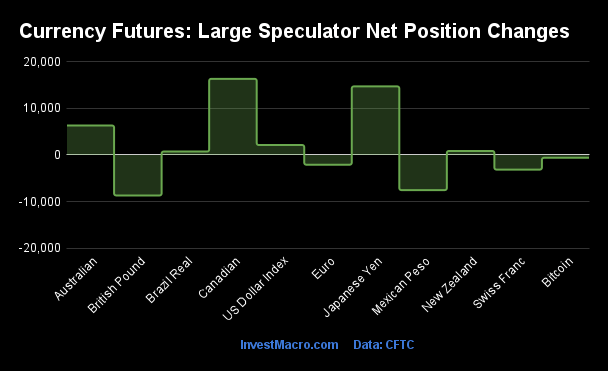
The COT currency market speculator bets were slightly higher this week as six out of the eleven currency markets we cover had higher positioning while the other five markets had lower speculator contracts.

Leading the gains for the currency markets was the Canadian Dollar (16,366 contracts), the Japanese Yen (14,738 contracts), the Australian Dollar (6,335 contracts), the US Dollar Index (2,143 contracts), the New Zealand Dollar (866 contracts) and the Brazilian Real (743 contracts) also showing positive weeks.

The currencies seeing declines in speculator bets on the week were the British Pound (-8,695 contracts), the Mexican Peso (-7,541 contracts), the Swiss Franc (-3,136 contracts), the EuroFX (-2,089 contracts) and with Bitcoin (-596 contracts) also registering lower bets on the week.

Speculators raise New Zealand Dollar bets after drop to all-time low

Highlighting the COT currency’s data this week is the recent speculator’s positioning for the New Zealand ‘Kiwi’ Dollar.

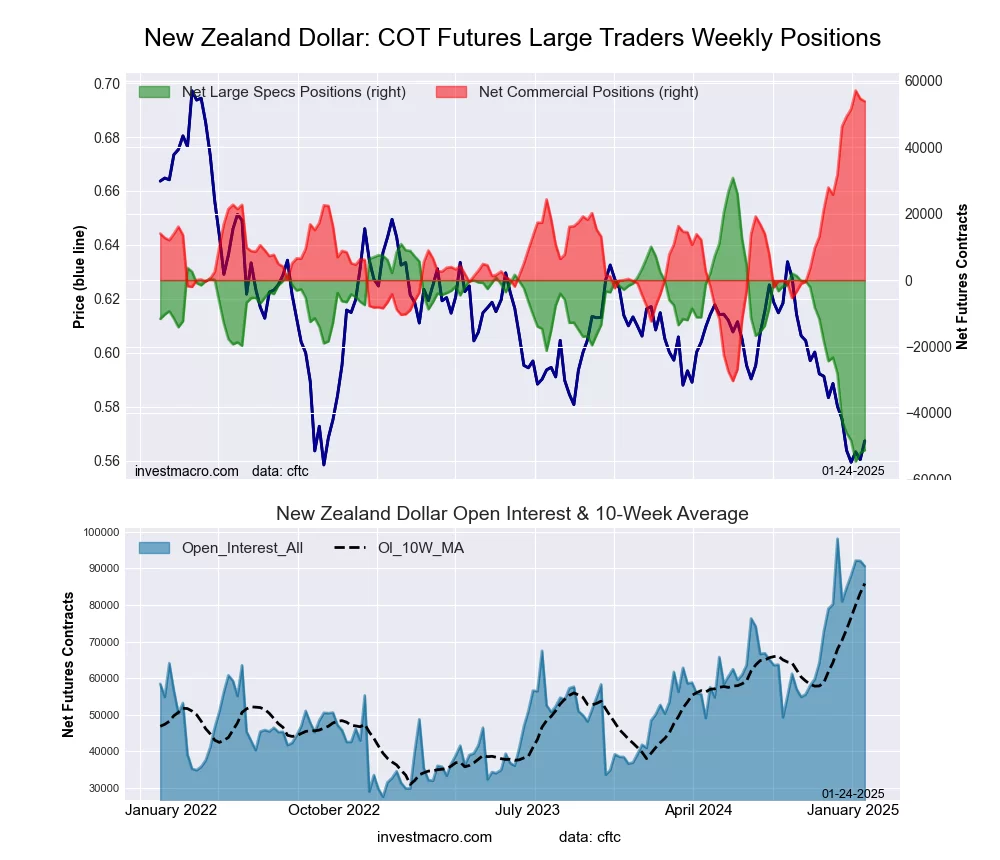
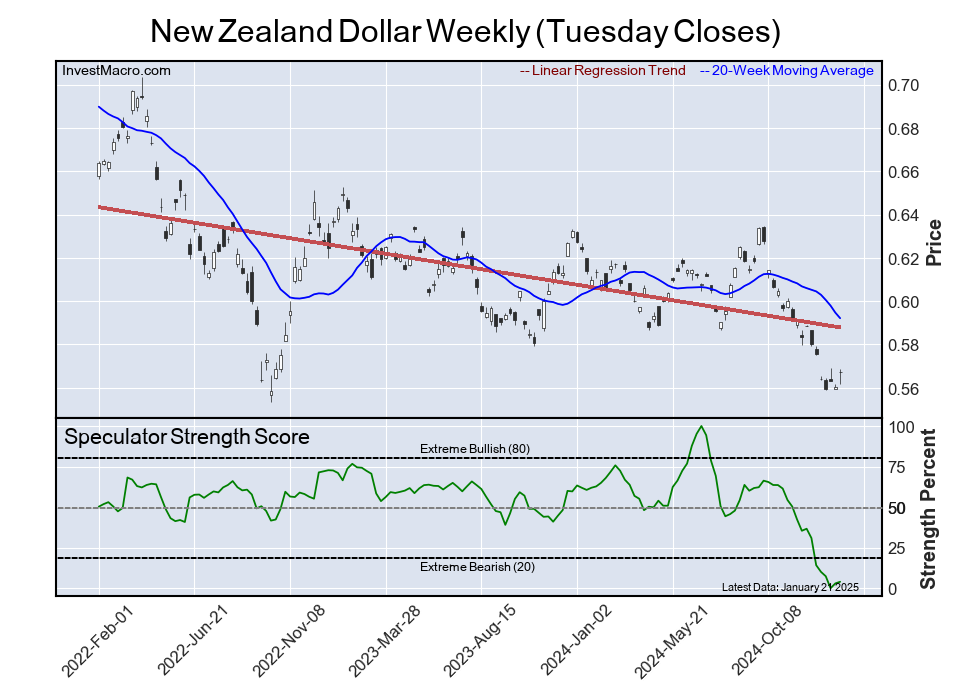
Large speculative New Zealand Dollar (NZD) currency positions rose modestly this week by +866 net contracts and have gained for two consecutive weeks. This follows significant weakness in the position over the past few months. The NZD spec position had declined for the previous five straight weeks and for thirteen out of the prior fourteen weeks for a total decline of -56,594 contracts over that period dating back to October.

This NZD weakness of the fourth quarter and into the first quarter of 2025 dropped the NZD speculator position into the lowest or most bearish level on record at -54,624 contracts on January 7th – surpassing the previous lows in 2019.

The NZD exchange rate versus the US Dollar has been on the decline in tandem with the drop in speculator bets, particularly since September. The NZDUSD started to slide in September and fell through the 0.6000 exchange level in November and continued to fall in December and into January, dropping all the way to the 0.5540 level in early January. This marked the lowest standing for the NZDUSD since October 2022.

This week, the NZD bounced higher by over 2.00 percent and managed to close above the 0.5700 exchange rate for the first time since early December.


Currencies Net Speculators Leaderboard
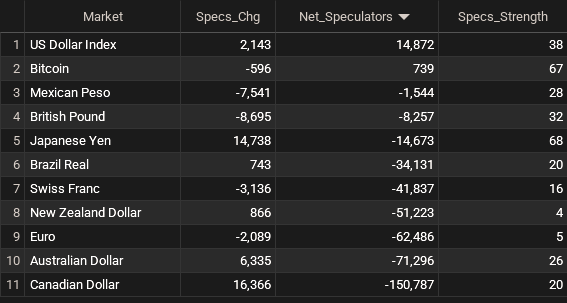
Legend: Weekly Speculators Change | Speculators Current Net Position | Speculators Strength Score compared to last 3-Years (0-100 range)


Strength Scores led by Japanese Yen & Bitcoin
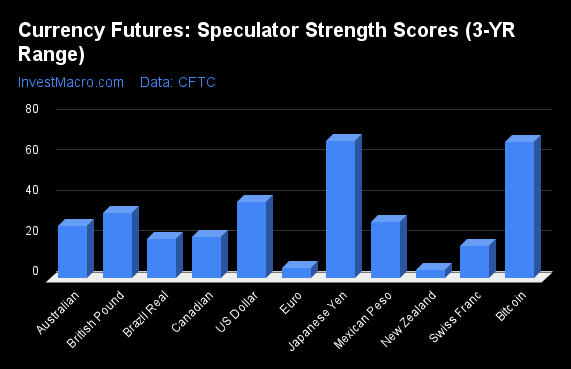
COT Strength Scores (a normalized measure of Speculator positions over a 3-Year range, from 0 to 100 where above 80 is Extreme-Bullish and below 20 is Extreme-Bearish) showed that the Japanese Yen (68 percent) and Bitcoin (67 percent) lead the currency markets this week.

On the downside, the New Zealand Dollar (4 percent), the EuroFX (5 percent), the Swiss Franc (16 percent) and the Brazilian Real (19.7 percent) come in at the lowest strength levels currently and are in Extreme-Bearish territory (below 20 percent).

3-Year Strength Statistics:
US Dollar Index (37.5 percent) vs US Dollar Index previous week (33.1 percent)
EuroFX (5.0 percent) vs EuroFX previous week (5.8 percent)
British Pound Sterling (32.4 percent) vs British Pound Sterling previous week (36.3 percent)
Japanese Yen (67.8 percent) vs Japanese Yen previous week (61.9 percent)
Swiss Franc (16.1 percent) vs Swiss Franc previous week (22.5 percent)
Canadian Dollar (20.4 percent) vs Canadian Dollar previous week (13.0 percent)
Australian Dollar (25.7 percent) vs Australian Dollar previous week (21.2 percent)
New Zealand Dollar (4.0 percent) vs New Zealand Dollar previous week (3.0 percent)
Mexican Peso (28.0 percent) vs Mexican Peso previous week (31.8 percent)
Brazilian Real (19.7 percent) vs Brazilian Real previous week (19.0 percent)
Bitcoin (67.4 percent) vs Bitcoin previous week (80.4 percent)


US Dollar Index & Bitcoin top the 6-Week Strength Trends
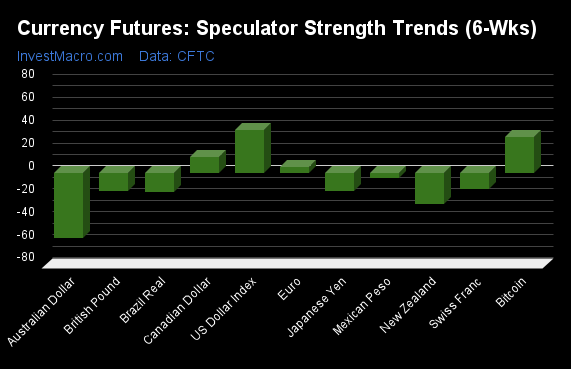
COT Strength Score Trends (or move index, calculates the 6-week changes in strength scores) showed that the US Dollar Index (38 percent) and Bitcoin (32 percent) lead the past six weeks trends for the currencies. The Canadian Dollar (14 percent) is the next highest positive movers in the 3-Year trends data.

The Australian Dollar (-57 percent) leads the downside trend scores currently with the New Zealand Dollar (-27 percent), Brazilian Real (-17 percent) and the Japanese Yen (-16 percent) following next with lower trend scores.

3-Year Strength Trends:
US Dollar Index (37.5 percent) vs US Dollar Index previous week (32.7 percent)
EuroFX (5.0 percent) vs EuroFX previous week (-1.1 percent)
British Pound Sterling (-15.9 percent) vs British Pound Sterling previous week (-8.5 percent)
Japanese Yen (-16.2 percent) vs Japanese Yen previous week (-12.7 percent)
Swiss Franc (-13.9 percent) vs Swiss Franc previous week (4.8 percent)
Canadian Dollar (13.8 percent) vs Canadian Dollar previous week (-3.5 percent)
Australian Dollar (-56.6 percent) vs Australian Dollar previous week (-70.3 percent)
New Zealand Dollar (-27.0 percent) vs New Zealand Dollar previous week (-33.7 percent)
Mexican Peso (-4.8 percent) vs Mexican Peso previous week (0.9 percent)
Brazilian Real (-16.8 percent) vs Brazilian Real previous week (-16.6 percent)
Bitcoin (31.8 percent) vs Bitcoin previous week (63.9 percent)


Individual COT Forex Markets:

US Dollar Index Futures:
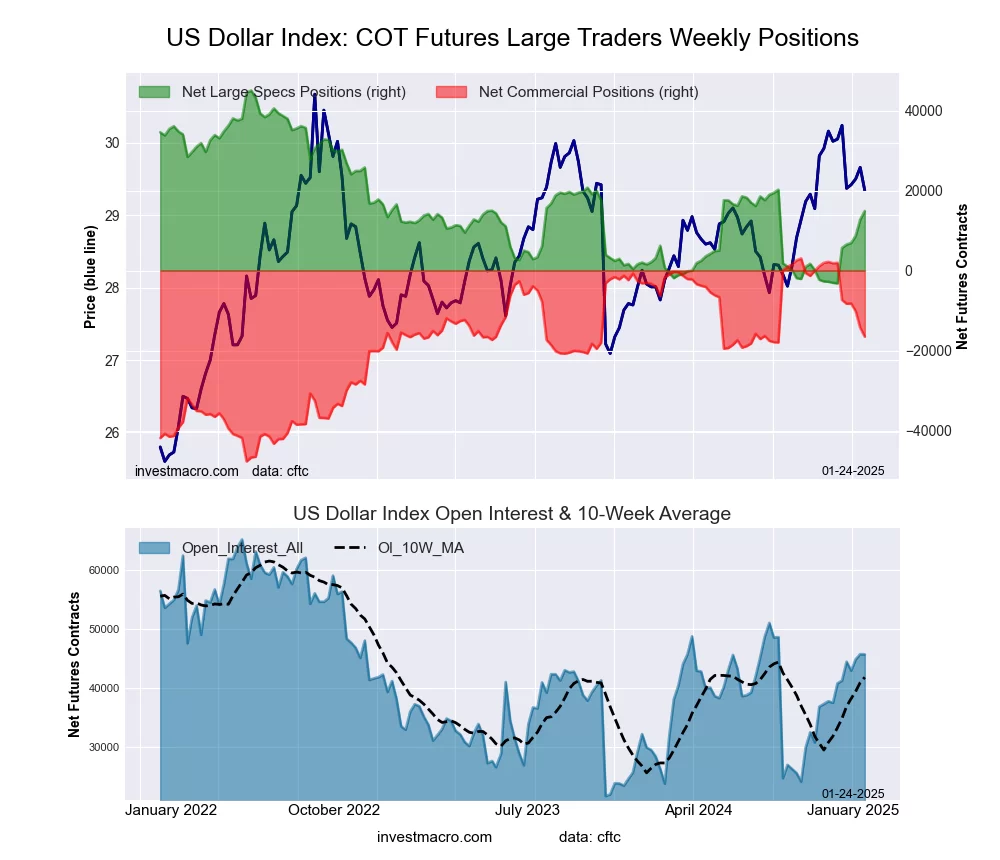
US Dollar Index Forex Futures COT ChartThe US Dollar Index large speculator standing this week reached a net position of 14,872 contracts in the data reported through Tuesday. This was a weekly increase of 2,143 contracts from the previous week which had a total of 12,729 net contracts.

This week’s current strength score (the trader positioning range over the past three years, measured from 0 to 100) shows the speculators are currently Bearish with a score of 37.5 percent. The commercials are Bullish with a score of 61.5 percent and the small traders (not shown in chart) are Bearish with a score of 40.6 percent.

Price Trend-Following Model: Weak Uptrend

Our weekly trend-following model classifies the current market price position as: Weak Uptrend.

US DOLLAR INDEX StatisticsSPECULATORSCOMMERCIALSSMALL TRADERS
– Percent of Open Interest Longs:63.024.69.0
– Percent of Open Interest Shorts:30.560.75.4
– Net Position:14,872-16,5201,648
– Gross Longs:28,81111,2474,133
– Gross Shorts:13,93927,7672,485
– Long to Short Ratio:2.1 to 10.4 to 11.7 to 1
NET POSITION TREND:
– Strength Index Score (3 Year Range Pct):37.561.540.6
– Strength Index Reading (3 Year Range):BearishBullishBearish
NET POSITION MOVEMENT INDEX:
– 6-Week Change in Strength Index:37.5-36.43.8


Euro Currency Futures:

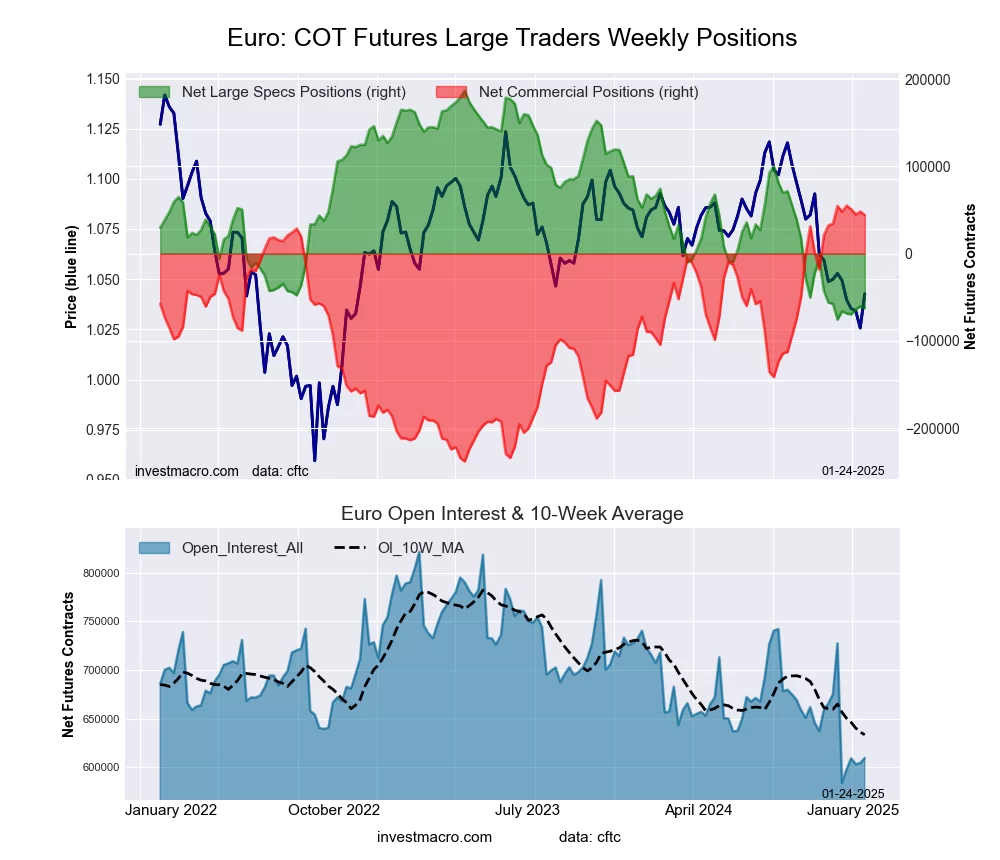
Euro Currency Futures COT ChartThe Euro Currency large speculator standing this week reached a net position of -62,486 contracts in the data reported through Tuesday. This was a weekly reduction of -2,089 contracts from the previous week which had a total of -60,397 net contracts.

This week’s current strength score (the trader positioning range over the past three years, measured from 0 to 100) shows the speculators are currently Bearish-Extreme with a score of 5.0 percent. The commercials are Bullish-Extreme with a score of 96.3 percent and the small traders (not shown in chart) are Bearish-Extreme with a score of 13.6 percent.

Price Trend-Following Model: Downtrend

Our weekly trend-following model classifies the current market price position as: Downtrend.

EURO Currency StatisticsSPECULATORSCOMMERCIALSSMALL TRADERS
– Percent of Open Interest Longs:27.555.612.4
– Percent of Open Interest Shorts:37.848.39.4
– Net Position:-62,48644,29518,191
– Gross Longs:167,665338,71975,560
– Gross Shorts:230,151294,42457,369
– Long to Short Ratio:0.7 to 11.2 to 11.3 to 1
NET POSITION TREND:
– Strength Index Score (3 Year Range Pct):5.096.313.6
– Strength Index Reading (3 Year Range):Bearish-ExtremeBullish-ExtremeBearish-Extreme
NET POSITION MOVEMENT INDEX:
– 6-Week Change in Strength Index:5.0-3.6-5.9


British Pound Sterling Futures:

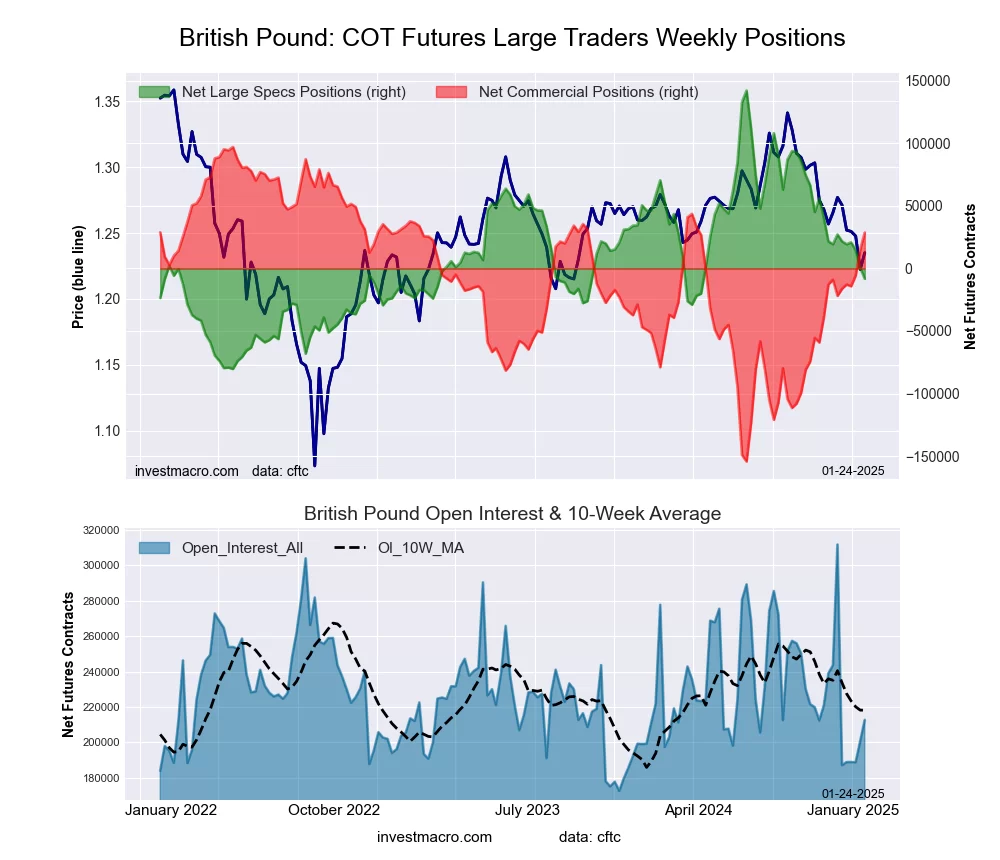
British Pound Sterling Futures COT ChartThe British Pound Sterling large speculator standing this week reached a net position of -8,257 contracts in the data reported through Tuesday. This was a weekly fall of -8,695 contracts from the previous week which had a total of 438 net contracts.

This week’s current strength score (the trader positioning range over the past three years, measured from 0 to 100) shows the speculators are currently Bearish with a score of 32.4 percent. The commercials are Bullish with a score of 72.8 percent and the small traders (not shown in chart) are Bearish-Extreme with a score of 19.1 percent.

Price Trend-Following Model: Downtrend

Our weekly trend-following model classifies the current market price position as: Downtrend.

BRITISH POUND StatisticsSPECULATORSCOMMERCIALSSMALL TRADERS
– Percent of Open Interest Longs:35.652.610.3
– Percent of Open Interest Shorts:39.539.119.9
– Net Position:-8,25728,749-20,492
– Gross Longs:75,696111,96821,903
– Gross Shorts:83,95383,21942,395
– Long to Short Ratio:0.9 to 11.3 to 10.5 to 1
NET POSITION TREND:
– Strength Index Score (3 Year Range Pct):32.472.819.1
– Strength Index Reading (3 Year Range):BearishBullishBearish-Extreme
NET POSITION MOVEMENT INDEX:
– 6-Week Change in Strength Index:-15.920.2-32.1


Japanese Yen Futures:

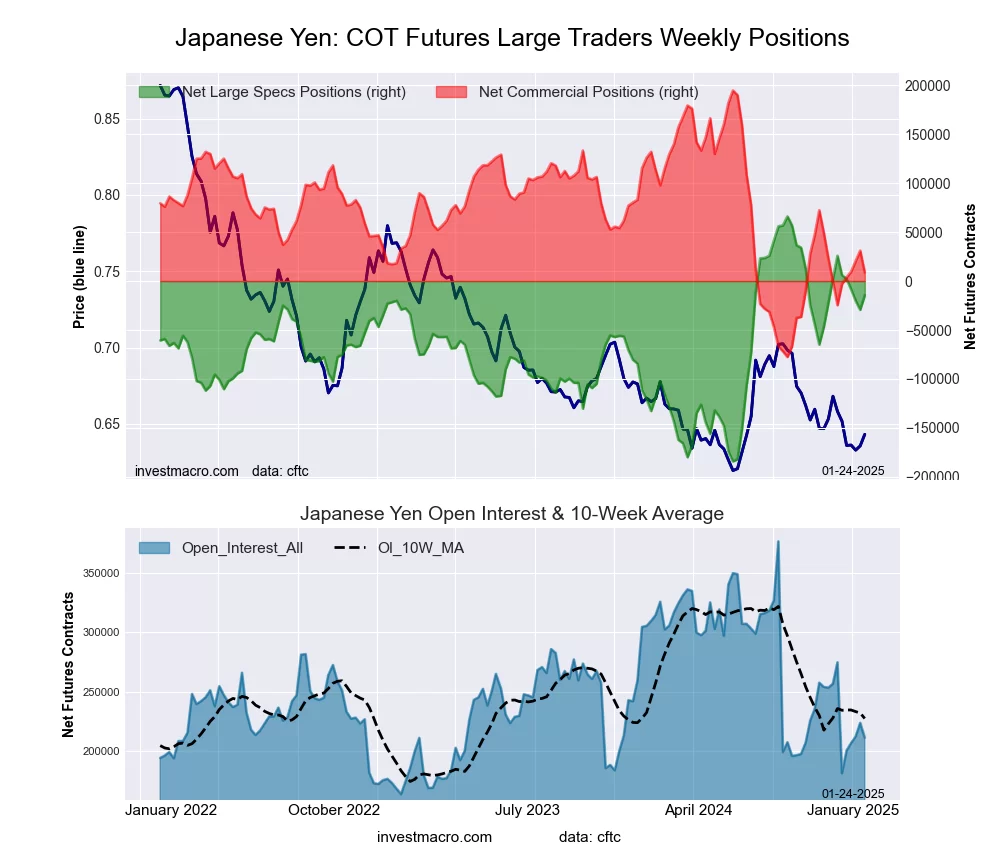
Japanese Yen Forex Futures COT ChartThe Japanese Yen large speculator standing this week reached a net position of -14,673 contracts in the data reported through Tuesday. This was a weekly lift of 14,738 contracts from the previous week which had a total of -29,411 net contracts.

This week’s current strength score (the trader positioning range over the past three years, measured from 0 to 100) shows the speculators are currently Bullish with a score of 67.8 percent. The commercials are Bearish with a score of 31.7 percent and the small traders (not shown in chart) are Bullish with a score of 77.8 percent.

Price Trend-Following Model: Downtrend

Our weekly trend-following model classifies the current market price position as: Downtrend.

JAPANESE YEN StatisticsSPECULATORSCOMMERCIALSSMALL TRADERS
– Percent of Open Interest Longs:44.532.520.6
– Percent of Open Interest Shorts:51.428.417.9
– Net Position:-14,6738,8295,844
– Gross Longs:94,15768,86843,642
– Gross Shorts:108,83060,03937,798
– Long to Short Ratio:0.9 to 11.1 to 11.2 to 1
NET POSITION TREND:
– Strength Index Score (3 Year Range Pct):67.831.777.8
– Strength Index Reading (3 Year Range):BullishBearishBullish
NET POSITION MOVEMENT INDEX:
– 6-Week Change in Strength Index:-16.212.316.9


Swiss Franc Futures:

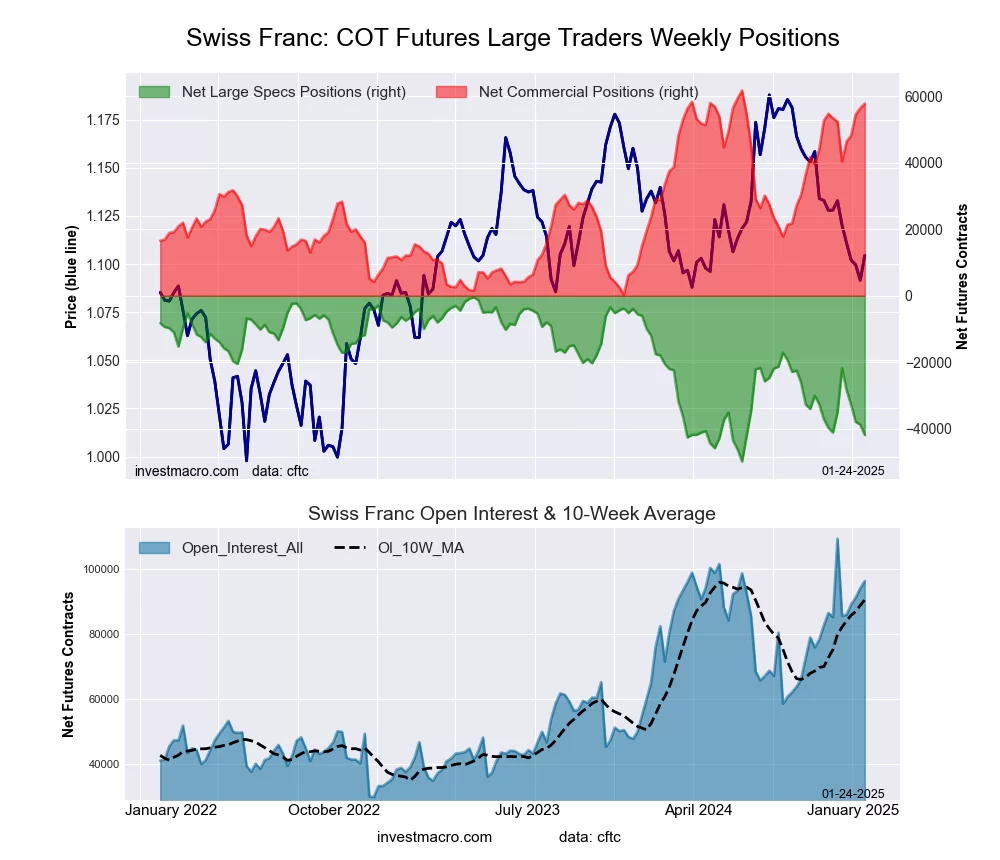
Swiss Franc Forex Futures COT ChartThe Swiss Franc large speculator standing this week reached a net position of -41,837 contracts in the data reported through Tuesday. This was a weekly decline of -3,136 contracts from the previous week which had a total of -38,701 net contracts.

This week’s current strength score (the trader positioning range over the past three years, measured from 0 to 100) shows the speculators are currently Bearish-Extreme with a score of 16.1 percent. The commercials are Bullish-Extreme with a score of 93.6 percent and the small traders (not shown in chart) are Bearish-Extreme with a score of 11.3 percent.

Price Trend-Following Model: Downtrend

Our weekly trend-following model classifies the current market price position as: Downtrend.

SWISS FRANC StatisticsSPECULATORSCOMMERCIALSSMALL TRADERS
– Percent of Open Interest Longs:6.884.28.6
– Percent of Open Interest Shorts:50.224.325.1
– Net Position:-41,83757,758-15,921
– Gross Longs:6,52681,1608,255
– Gross Shorts:48,36323,40224,176
– Long to Short Ratio:0.1 to 13.5 to 10.3 to 1
NET POSITION TREND:
– Strength Index Score (3 Year Range Pct):16.193.611.3
– Strength Index Reading (3 Year Range):Bearish-ExtremeBullish-ExtremeBearish-Extreme
NET POSITION MOVEMENT INDEX:
– 6-Week Change in Strength Index:-13.98.95.9


Canadian Dollar Futures:

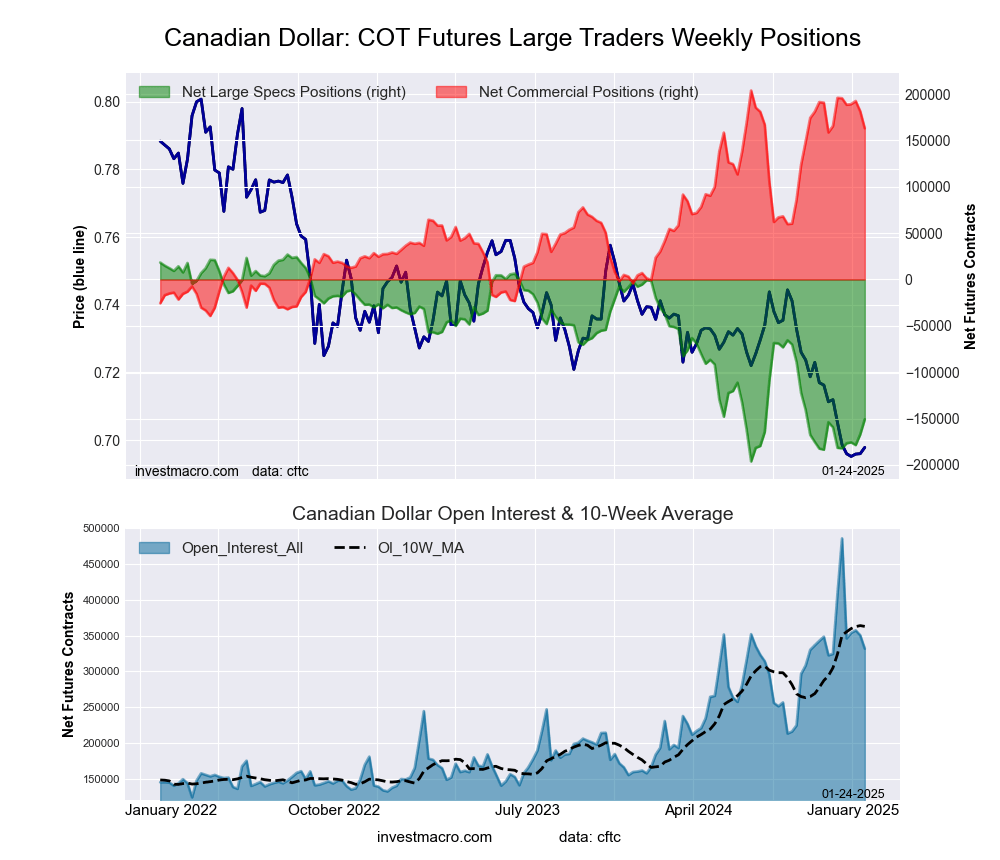
Canadian Dollar Forex Futures COT ChartThe Canadian Dollar large speculator standing this week reached a net position of -150,787 contracts in the data reported through Tuesday. This was a weekly gain of 16,366 contracts from the previous week which had a total of -167,153 net contracts.

This week’s current strength score (the trader positioning range over the past three years, measured from 0 to 100) shows the speculators are currently Bearish with a score of 20.4 percent. The commercials are Bullish-Extreme with a score of 83.3 percent and the small traders (not shown in chart) are Bearish-Extreme with a score of 5.5 percent.

Price Trend-Following Model: Downtrend

Our weekly trend-following model classifies the current market price position as: Downtrend.

CANADIAN DOLLAR StatisticsSPECULATORSCOMMERCIALSSMALL TRADERS
– Percent of Open Interest Longs:5.984.08.2
– Percent of Open Interest Shorts:51.334.811.9
– Net Position:-150,787163,078-12,291
– Gross Longs:19,503278,53527,246
– Gross Shorts:170,290115,45739,537
– Long to Short Ratio:0.1 to 12.4 to 10.7 to 1
NET POSITION TREND:
– Strength Index Score (3 Year Range Pct):20.483.35.5
– Strength Index Reading (3 Year Range):BearishBullish-ExtremeBearish-Extreme
NET POSITION MOVEMENT INDEX:
– 6-Week Change in Strength Index:13.8-13.55.5


Australian Dollar Futures:

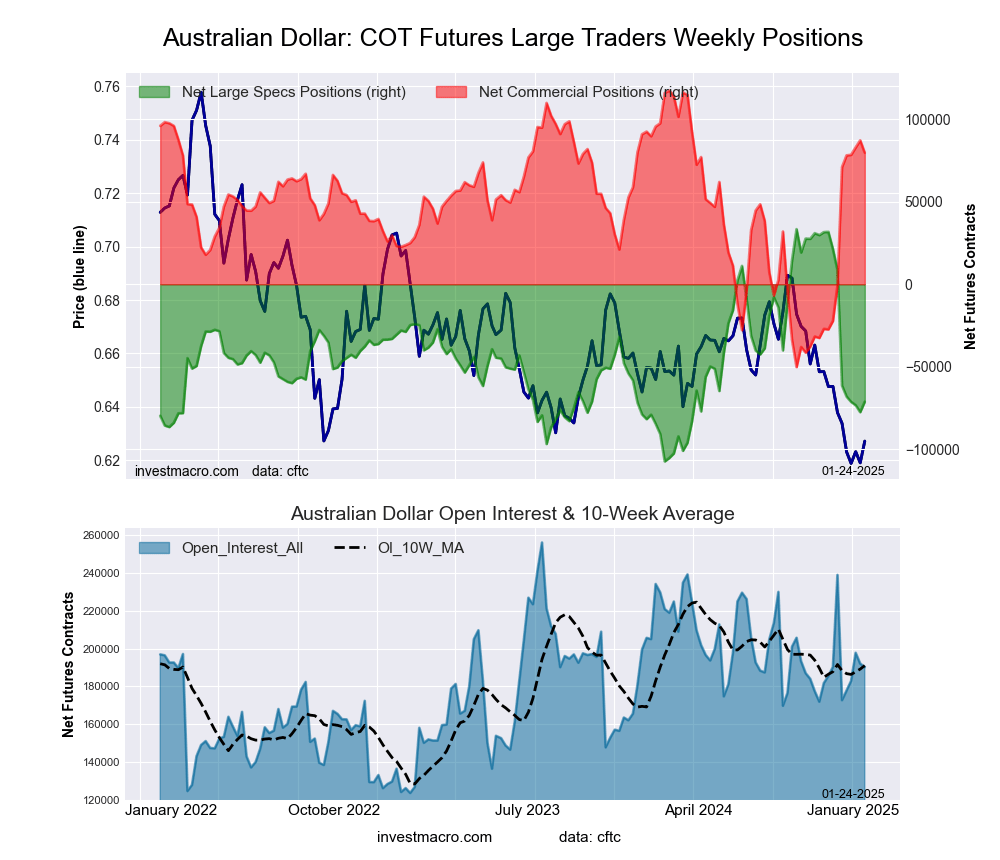
Australian Dollar Forex Futures COT ChartThe Australian Dollar large speculator standing this week reached a net position of -71,296 contracts in the data reported through Tuesday. This was a weekly gain of 6,335 contracts from the previous week which had a total of -77,631 net contracts.

This week’s current strength score (the trader positioning range over the past three years, measured from 0 to 100) shows the speculators are currently Bearish with a score of 25.7 percent. The commercials are Bullish with a score of 77.5 percent and the small traders (not shown in chart) are Bearish with a score of 26.7 percent.

Price Trend-Following Model: Downtrend

Our weekly trend-following model classifies the current market price position as: Downtrend.

AUSTRALIAN DOLLAR StatisticsSPECULATORSCOMMERCIALSSMALL TRADERS
– Percent of Open Interest Longs:16.467.012.7
– Percent of Open Interest Shorts:53.925.017.2
– Net Position:-71,29679,799-8,503
– Gross Longs:31,179127,37524,195
– Gross Shorts:102,47547,57632,698
– Long to Short Ratio:0.3 to 12.7 to 10.7 to 1
NET POSITION TREND:
– Strength Index Score (3 Year Range Pct):25.777.526.7
– Strength Index Reading (3 Year Range):BearishBullishBearish
NET POSITION MOVEMENT INDEX:
– 6-Week Change in Strength Index:-56.648.0-2.0


New Zealand Dollar Futures:

New Zealand Dollar Forex Futures COT ChartThe New Zealand Dollar large speculator standing this week reached a net position of -51,223 contracts in the data reported through Tuesday. This was a weekly lift of 866 contracts from the previous week which had a total of -52,089 net contracts.

This week’s current strength score (the trader positioning range over the past three years, measured from 0 to 100) shows the speculators are currently Bearish-Extreme with a score of 4.0 percent. The commercials are Bullish-Extreme with a score of 96.3 percent and the small traders (not shown in chart) are Bearish with a score of 20.1 percent.

Price Trend-Following Model: Downtrend

Our weekly trend-following model classifies the current market price position as: Downtrend.

NEW ZEALAND DOLLAR StatisticsSPECULATORSCOMMERCIALSSMALL TRADERS
– Percent of Open Interest Longs:9.985.83.9
– Percent of Open Interest Shorts:66.426.46.8
– Net Position:-51,22353,841-2,618
– Gross Longs:8,93877,7763,551
– Gross Shorts:60,16123,9356,169
– Long to Short Ratio:0.1 to 13.2 to 10.6 to 1
NET POSITION TREND:
– Strength Index Score (3 Year Range Pct):4.096.320.1
– Strength Index Reading (3 Year Range):Bearish-ExtremeBullish-ExtremeBearish
NET POSITION MOVEMENT INDEX:
– 6-Week Change in Strength Index:-27.025.113.0


Mexican Peso Futures:

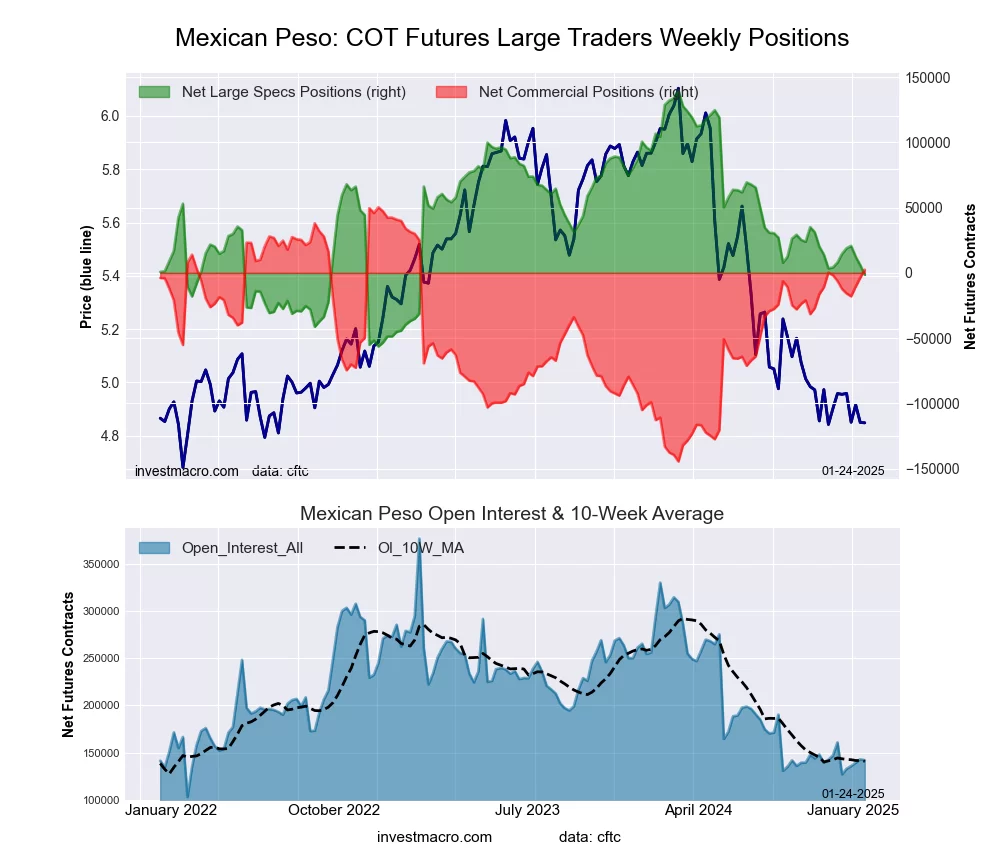
Mexican Peso Futures COT ChartThe Mexican Peso large speculator standing this week reached a net position of -1,544 contracts in the data reported through Tuesday. This was a weekly fall of -7,541 contracts from the previous week which had a total of 5,997 net contracts.

This week’s current strength score (the trader positioning range over the past three years, measured from 0 to 100) shows the speculators are currently Bearish with a score of 28.0 percent. The commercials are Bullish with a score of 75.4 percent and the small traders (not shown in chart) are Bearish-Extreme with a score of 17.9 percent.

Price Trend-Following Model: Downtrend

Our weekly trend-following model classifies the current market price position as: Downtrend.

MEXICAN PESO StatisticsSPECULATORSCOMMERCIALSSMALL TRADERS
– Percent of Open Interest Longs:33.960.52.7
– Percent of Open Interest Shorts:34.958.83.4
– Net Position:-1,5442,423-879
– Gross Longs:47,98585,7633,886
– Gross Shorts:49,52983,3404,765
– Long to Short Ratio:1.0 to 11.0 to 10.8 to 1
NET POSITION TREND:
– Strength Index Score (3 Year Range Pct):28.075.417.9
– Strength Index Reading (3 Year Range):BearishBullishBearish-Extreme
NET POSITION MOVEMENT INDEX:
– 6-Week Change in Strength Index:-4.84.44.9


Brazilian Real Futures:

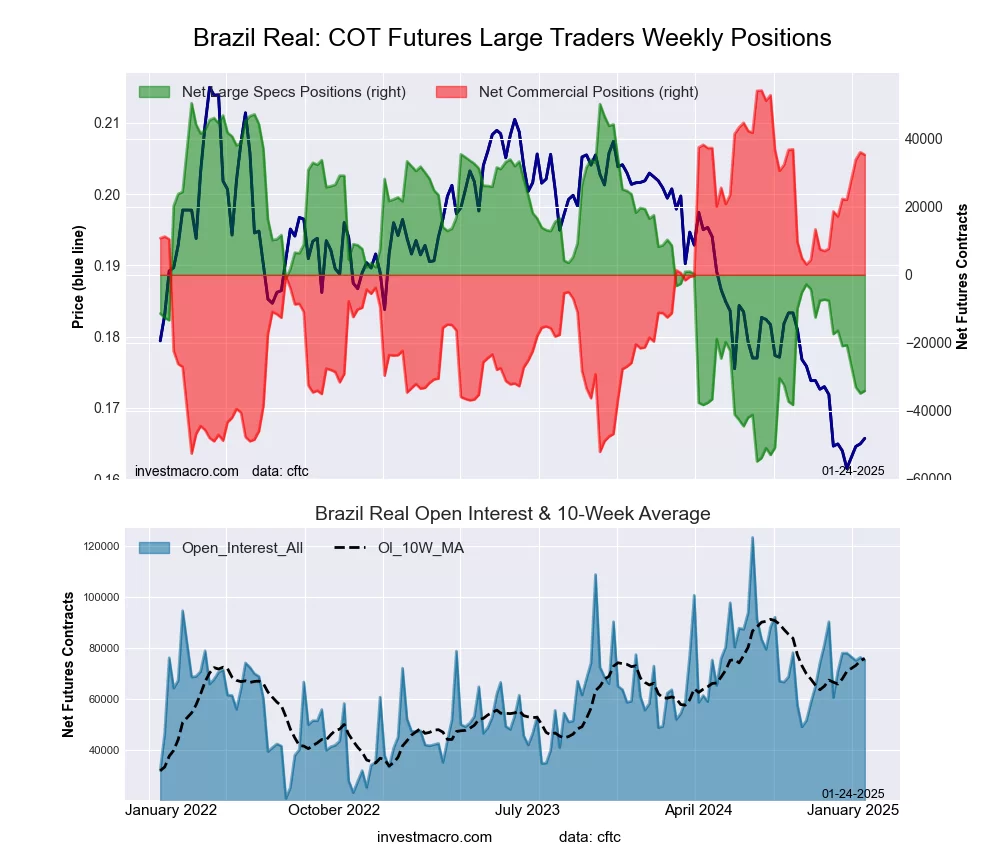
Brazil Real Futures COT ChartThe Brazilian Real large speculator standing this week reached a net position of -34,131 contracts in the data reported through Tuesday. This was a weekly increase of 743 contracts from the previous week which had a total of -34,874 net contracts.

This week’s current strength score (the trader positioning range over the past three years, measured from 0 to 100) shows the speculators are currently Bearish-Extreme with a score of 19.7 percent. The commercials are Bullish-Extreme with a score of 82.3 percent and the small traders (not shown in chart) are Bearish-Extreme with a score of 14.3 percent.

Price Trend-Following Model: Downtrend

Our weekly trend-following model classifies the current market price position as: Downtrend.

BRAZIL REAL StatisticsSPECULATORSCOMMERCIALSSMALL TRADERS
– Percent of Open Interest Longs:27.469.62.7
– Percent of Open Interest Shorts:72.822.64.3
– Net Position:-34,13135,292-1,161
– Gross Longs:20,60552,3032,046
– Gross Shorts:54,73617,0113,207
– Long to Short Ratio:0.4 to 13.1 to 10.6 to 1
NET POSITION TREND:
– Strength Index Score (3 Year Range Pct):19.782.314.3
– Strength Index Reading (3 Year Range):Bearish-ExtremeBullish-ExtremeBearish-Extreme
NET POSITION MOVEMENT INDEX:
– 6-Week Change in Strength Index:-16.817.0-2.1


Bitcoin Futures:

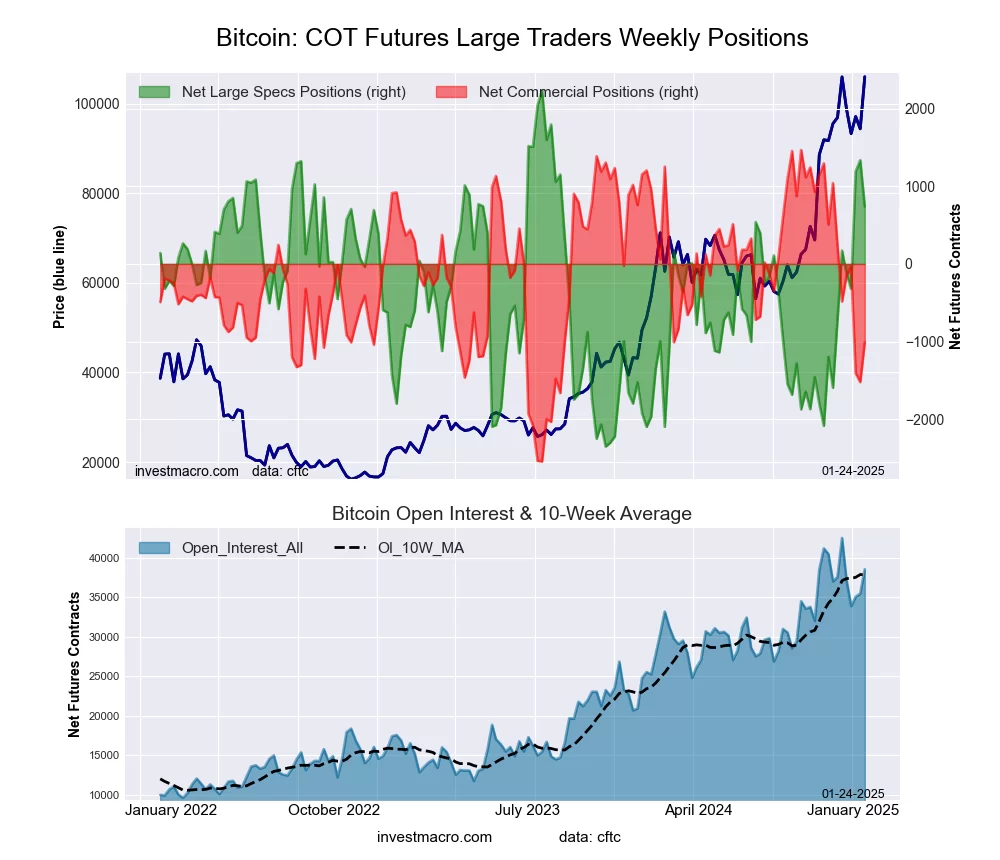
Bitcoin Crypto Futures COT ChartThe Bitcoin large speculator standing this week reached a net position of 739 contracts in the data reported through Tuesday. This was a weekly fall of -596 contracts from the previous week which had a total of 1,335 net contracts.

This week’s current strength score (the trader positioning range over the past three years, measured from 0 to 100) shows the speculators are currently Bullish with a score of 67.4 percent. The commercials are Bearish with a score of 38.3 percent and the small traders (not shown in chart) are Bearish with a score of 30.1 percent.

Price Trend-Following Model: Uptrend

Our weekly trend-following model classifies the current market price position as: Uptrend.

BITCOIN StatisticsSPECULATORSCOMMERCIALSSMALL TRADERS
– Percent of Open Interest Longs:75.54.23.9
– Percent of Open Interest Shorts:73.66.83.2
– Net Position:739-1,007268
– Gross Longs:29,1211,6251,486
– Gross Shorts:28,3822,6321,218
– Long to Short Ratio:1.0 to 10.6 to 11.2 to 1
NET POSITION TREND:
– Strength Index Score (3 Year Range Pct):67.438.330.1
– Strength Index Reading (3 Year Range):BullishBearishBearish
NET POSITION MOVEMENT INDEX:
– 6-Week Change in Strength Index:31.8-31.0-16.0


Article By InvestMacroReceive our weekly COT Newsletter

*COT Report: The COT data, released weekly to the public each Friday, is updated through the most recent Tuesday (data is 3 days old) and shows a quick view of how large speculators or non-commercials (for-profit traders) were positioned in the futures markets.

The CFTC categorizes trader positions according to commercial hedgers (traders who use futures contracts for hedging as part of the business), non-commercials (large traders who speculate to realize trading profits) and nonreportable traders (usually small traders/speculators) as well as their open interest (contracts open in the market at time of reporting). See CFTC criteria here.


COT Metals Charts: Weekly Speculator Bets led higher by Gold & Copper

By InvestMacro

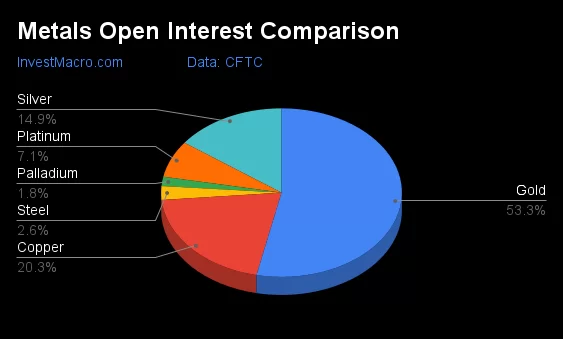
Here are the latest charts and statistics for the Commitment of Traders (COT) data published by the Commodities Futures Trading Commission (CFTC).

The latest COT data is updated through Tuesday January 21st and shows a quick view of how large traders (for-profit speculators and commercial entities) were positioned in the futures markets.

Weekly Speculator Changes led by Gold & Copper

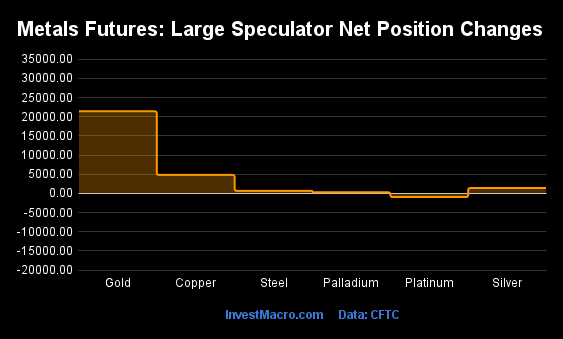
The COT metals markets speculator bets were overall higher this week as five out of the six metals markets we cover had higher positioning while the other one markets had lower speculator contracts.

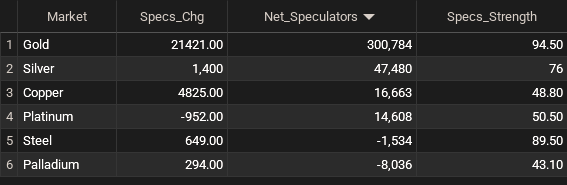
Leading the gains for the metals was Gold (21,421 contracts) with Copper (4,825 contracts), Silver (1,400 contracts), Steel (649 contracts) and Palladium (294 contracts) also seeing positive weeks.

The only market with a decline in speculator bets this week was Platinum with a decrease by -952 contracts.


Metals Net Speculators Leaderboard

Legend: Weekly Speculators Change | Speculators Current Net Position | Speculators Strength Score compared to last 3-Years (0-100 range)


Strength Scores led by Gold & Steel

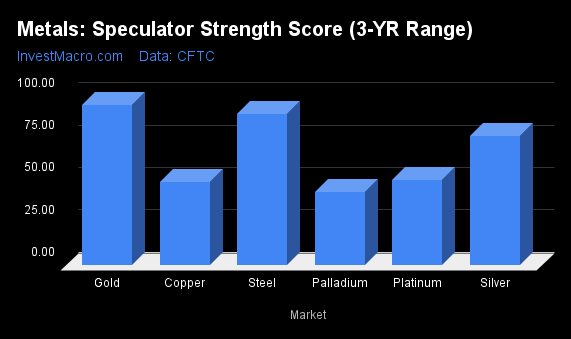
COT Strength Scores (a normalized measure of Speculator positions over a 3-Year range, from 0 to 100 where above 80 is Extreme-Bullish and below 20 is Extreme-Bearish) showed that Gold (94 percent) and Steel (89 percent) lead the metals markets this week.

On the downside, Palladium (43 percent) comes in at the lowest strength level currently.

Strength Statistics:
Gold (94.5 percent) vs Gold previous week (86.3 percent)
Silver (76.1 percent) vs Silver previous week (74.4 percent)
Copper (48.8 percent) vs Copper previous week (44.3 percent)
Platinum (50.5 percent) vs Platinum previous week (52.8 percent)
Palladium (43.1 percent) vs Palladium previous week (40.9 percent)
Steel (89.5 percent) vs Palladium previous week (86.7 percent)


Gold & Silver top the 6-Week Strength Trends

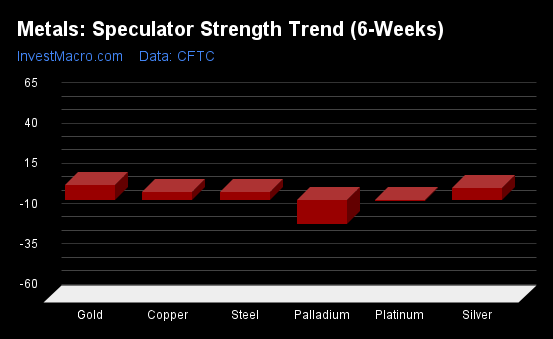
COT Strength Score Trends (or move index, calculates the 6-week changes in strength scores) showed that Gold (10 percent) and Silver (8 percent) lead the past six weeks trends for metals.

Palladium (-15 percent) leads the downside trend scores currently.

Move Statistics:
Gold (9.6 percent) vs Gold previous week (7.5 percent)
Silver (8.0 percent) vs Silver previous week (3.6 percent)
Copper (5.3 percent) vs Copper previous week (1.3 percent)
Platinum (-0.5 percent) vs Platinum previous week (-11.6 percent)
Palladium (-14.7 percent) vs Palladium previous week (-19.7 percent)
Steel (5.3 percent) vs Steel previous week (-0.8 percent)


Individual Markets:

Gold Comex Futures:

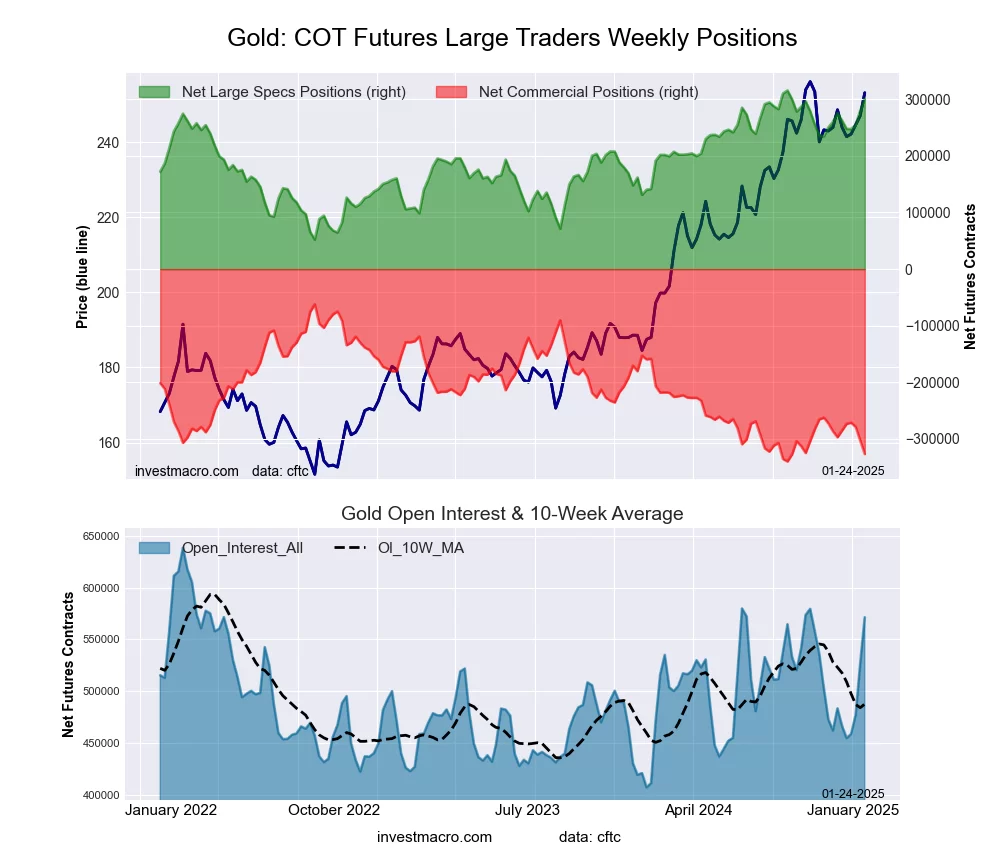
Gold Futures COT ChartThe Gold Comex Futures large speculator standing this week recorded a net position of 300,784 contracts in the data reported through Tuesday. This was a weekly advance of 21,421 contracts from the previous week which had a total of 279,363 net contracts.

This week’s current strength score (the trader positioning range over the past three years, measured from 0 to 100) shows the speculators are currently Bullish-Extreme with a score of 94.5 percent. The commercials are Bearish-Extreme with a score of 4.7 percent and the small traders (not shown in chart) are Bullish with a score of 64.1 percent.

Price Trend-Following Model: Strong Uptrend

Our weekly trend-following model classifies the current market price position as: Strong Uptrend.

Gold Futures StatisticsSPECULATORSCOMMERCIALSSMALL TRADERS
– Percent of Open Interest Longs:59.016.68.9
– Percent of Open Interest Shorts:6.473.84.3
– Net Position:300,784-326,60825,824
– Gross Longs:337,28995,11650,638
– Gross Shorts:36,505421,72424,814
– Long to Short Ratio:9.2 to 10.2 to 12.0 to 1
NET POSITION TREND:
– Strength Index Score (3 Year Range Pct):94.54.764.1
– Strength Index Reading (3 Year Range):Bullish-ExtremeBearish-ExtremeBullish
NET POSITION MOVEMENT INDEX:
– 6-Week Change in Strength Index:9.6-10.716.4


Silver Comex Futures:

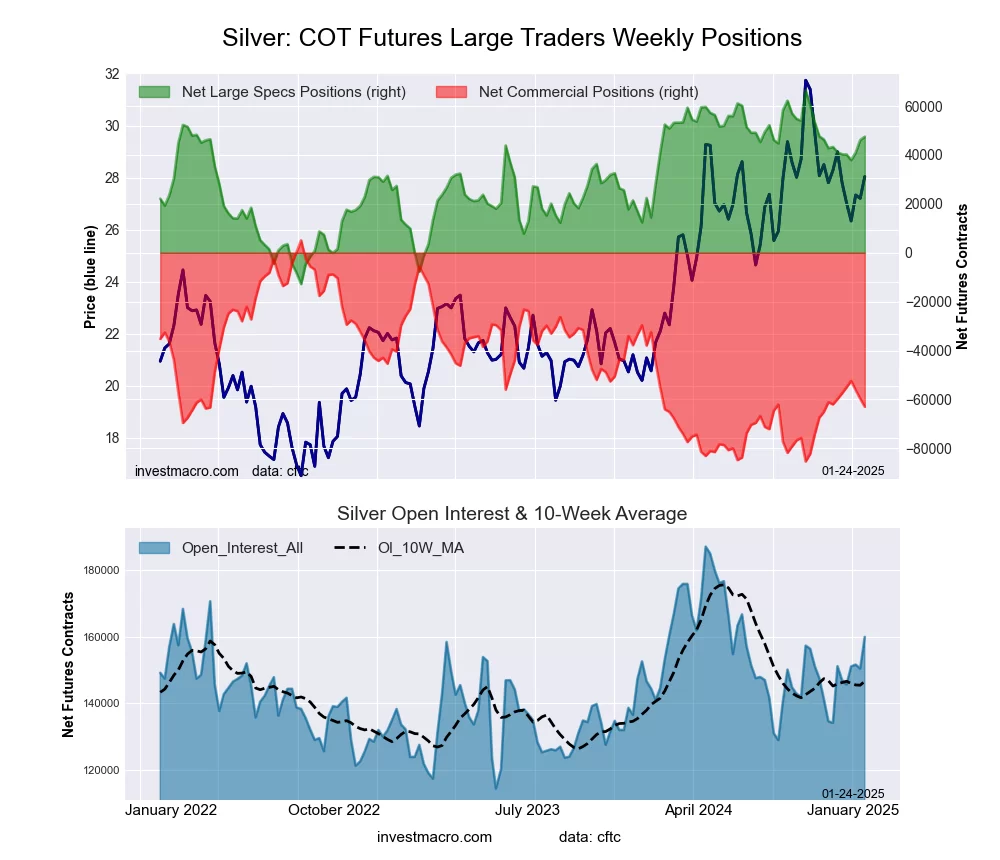
Silver Futures COT ChartThe Silver Comex Futures large speculator standing this week recorded a net position of 47,480 contracts in the data reported through Tuesday. This was a weekly lift of 1,400 contracts from the previous week which had a total of 46,080 net contracts.

This week’s current strength score (the trader positioning range over the past three years, measured from 0 to 100) shows the speculators are currently Bullish with a score of 76.1 percent. The commercials are Bearish with a score of 24.8 percent and the small traders (not shown in chart) are Bearish with a score of 45.6 percent.

Price Trend-Following Model: Weak Downtrend

Our weekly trend-following model classifies the current market price position as: Weak Downtrend.

Silver Futures StatisticsSPECULATORSCOMMERCIALSSMALL TRADERS
– Percent of Open Interest Longs:47.320.917.4
– Percent of Open Interest Shorts:17.660.37.8
– Net Position:47,480-62,97715,497
– Gross Longs:75,66033,47627,898
– Gross Shorts:28,18096,45312,401
– Long to Short Ratio:2.7 to 10.3 to 12.2 to 1
NET POSITION TREND:
– Strength Index Score (3 Year Range Pct):76.124.845.6
– Strength Index Reading (3 Year Range):BullishBearishBearish
NET POSITION MOVEMENT INDEX:
– 6-Week Change in Strength Index:8.0-3.5-15.4


Copper Grade #1 Futures:

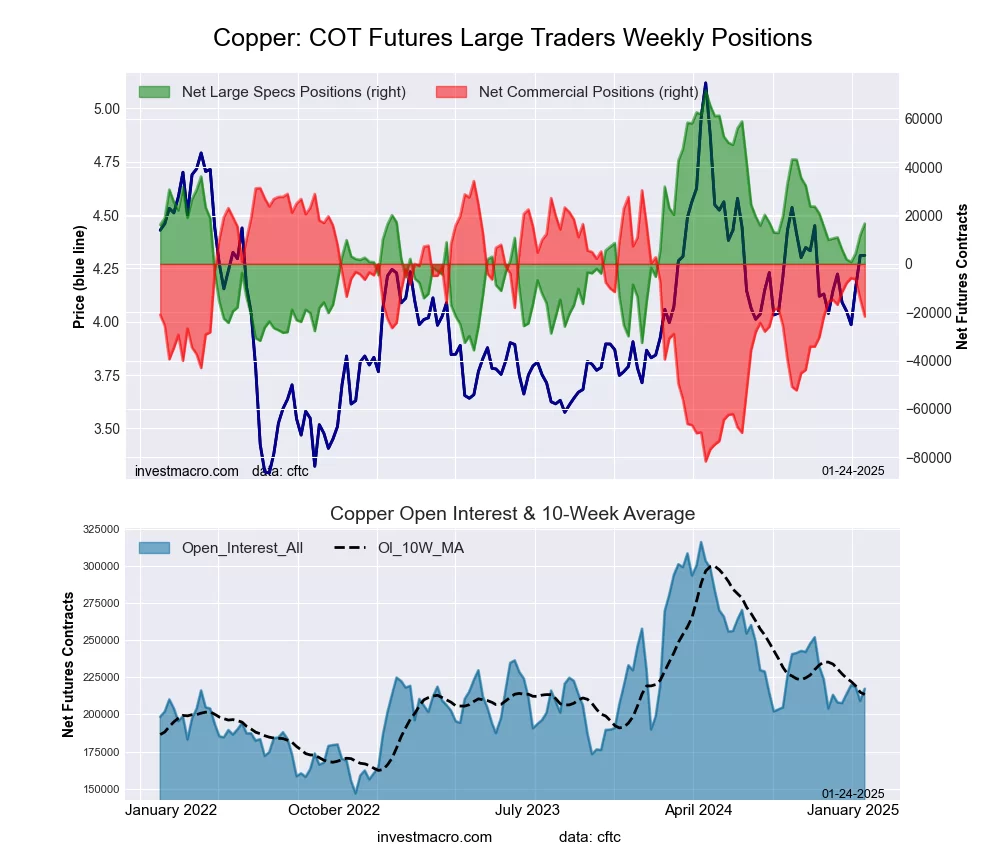
Copper Futures COT ChartThe Copper Grade #1 Futures large speculator standing this week recorded a net position of 16,663 contracts in the data reported through Tuesday. This was a weekly advance of 4,825 contracts from the previous week which had a total of 11,838 net contracts.

This week’s current strength score (the trader positioning range over the past three years, measured from 0 to 100) shows the speculators are currently Bearish with a score of 48.8 percent. The commercials are Bullish with a score of 51.7 percent and the small traders (not shown in chart) are Bearish with a score of 48.4 percent.

Price Trend-Following Model: Weak Downtrend

Our weekly trend-following model classifies the current market price position as: Weak Downtrend.

Copper Futures StatisticsSPECULATORSCOMMERCIALSSMALL TRADERS
– Percent of Open Interest Longs:40.933.87.6
– Percent of Open Interest Shorts:33.243.85.3
– Net Position:16,663-21,7295,066
– Gross Longs:88,85573,47016,520
– Gross Shorts:72,19295,19911,454
– Long to Short Ratio:1.2 to 10.8 to 11.4 to 1
NET POSITION TREND:
– Strength Index Score (3 Year Range Pct):48.851.748.4
– Strength Index Reading (3 Year Range):BearishBullishBearish
NET POSITION MOVEMENT INDEX:
– 6-Week Change in Strength Index:5.3-4.2-5.2


Platinum Futures:

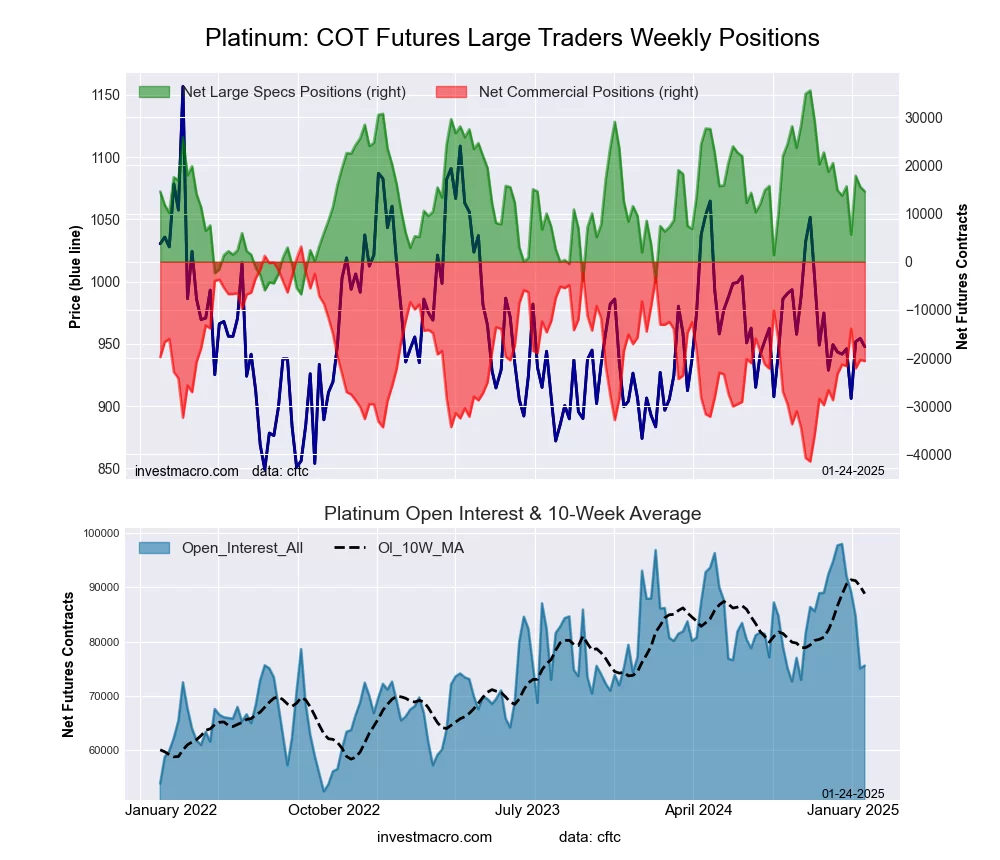
Platinum Futures COT ChartThe Platinum Futures large speculator standing this week recorded a net position of 14,608 contracts in the data reported through Tuesday. This was a weekly decline of -952 contracts from the previous week which had a total of 15,560 net contracts.

This week’s current strength score (the trader positioning range over the past three years, measured from 0 to 100) shows the speculators are currently Bullish with a score of 50.5 percent. The commercials are Bearish with a score of 46.7 percent and the small traders (not shown in chart) are Bullish with a score of 56.9 percent.

Price Trend-Following Model: Downtrend

Our weekly trend-following model classifies the current market price position as: Downtrend.

Platinum Futures StatisticsSPECULATORSCOMMERCIALSSMALL TRADERS
– Percent of Open Interest Longs:64.319.412.9
– Percent of Open Interest Shorts:45.046.75.0
– Net Position:14,608-20,6106,002
– Gross Longs:48,60514,6519,765
– Gross Shorts:33,99735,2613,763
– Long to Short Ratio:1.4 to 10.4 to 12.6 to 1
NET POSITION TREND:
– Strength Index Score (3 Year Range Pct):50.546.756.9
– Strength Index Reading (3 Year Range):BullishBearishBullish
NET POSITION MOVEMENT INDEX:
– 6-Week Change in Strength Index:-0.56.0-38.5


Palladium Futures:

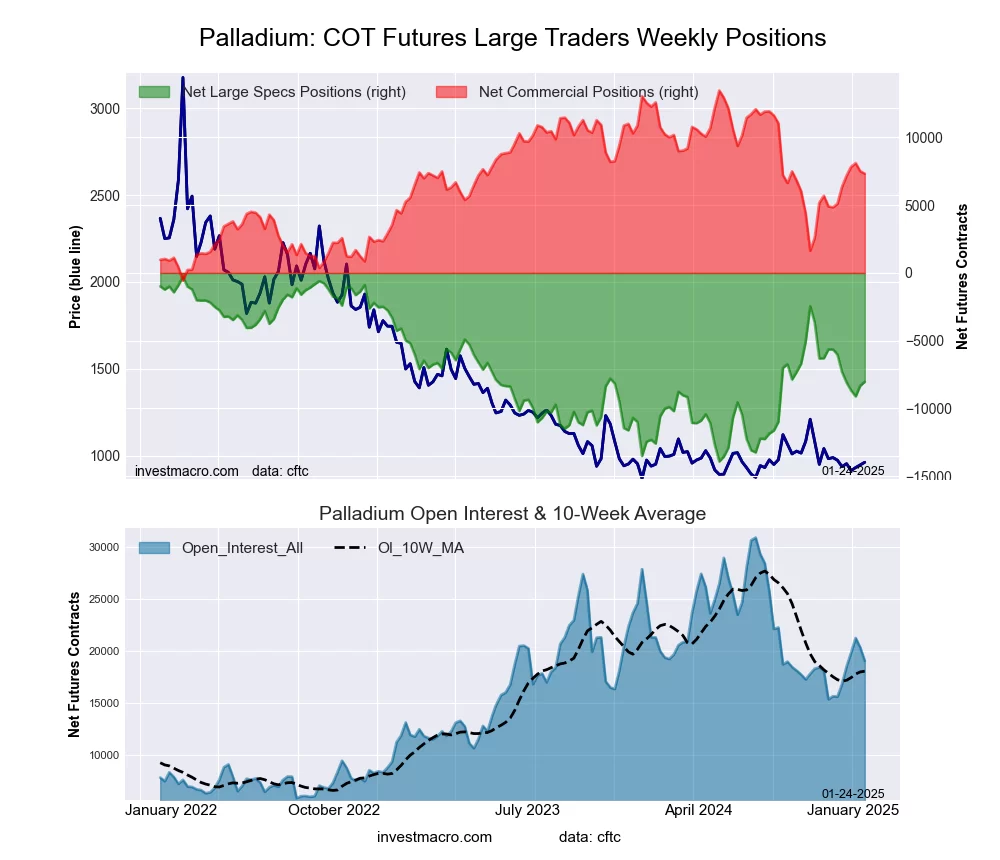
Palladium Futures COT ChartThe Palladium Futures large speculator standing this week recorded a net position of -8,036 contracts in the data reported through Tuesday. This was a weekly advance of 294 contracts from the previous week which had a total of -8,330 net contracts.

This week’s current strength score (the trader positioning range over the past three years, measured from 0 to 100) shows the speculators are currently Bearish with a score of 43.1 percent. The commercials are Bullish with a score of 56.2 percent and the small traders (not shown in chart) are Bullish with a score of 67.8 percent.

Price Trend-Following Model: Downtrend

Our weekly trend-following model classifies the current market price position as: Downtrend.

Palladium Futures StatisticsSPECULATORSCOMMERCIALSSMALL TRADERS
– Percent of Open Interest Longs:37.445.111.6
– Percent of Open Interest Shorts:79.66.77.9
– Net Position:-8,0367,326710
– Gross Longs:7,1218,5932,213
– Gross Shorts:15,1571,2671,503
– Long to Short Ratio:0.5 to 16.8 to 11.5 to 1
NET POSITION TREND:
– Strength Index Score (3 Year Range Pct):43.156.267.8
– Strength Index Reading (3 Year Range):BearishBullishBullish
NET POSITION MOVEMENT INDEX:
– 6-Week Change in Strength Index:-14.715.8-10.3


Steel Futures Futures:

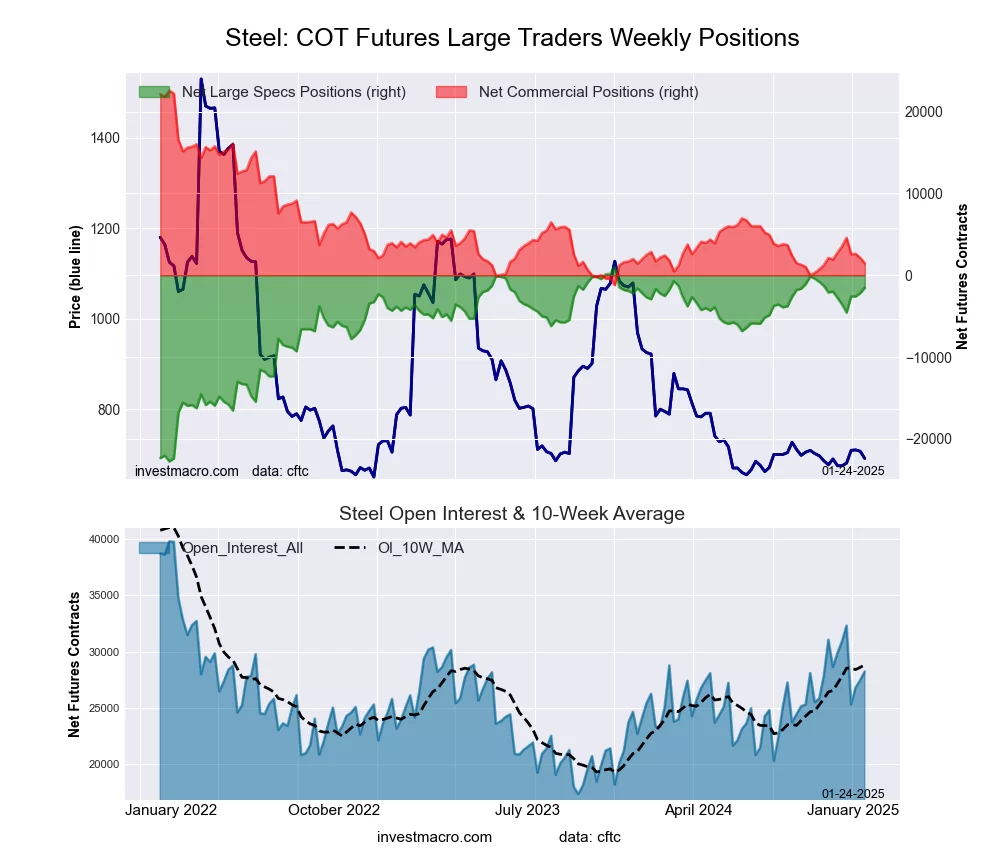
Steel Futures COT ChartThe Steel Futures large speculator standing this week recorded a net position of -1,534 contracts in the data reported through Tuesday. This was a weekly advance of 649 contracts from the previous week which had a total of -2,183 net contracts.

This week’s current strength score (the trader positioning range over the past three years, measured from 0 to 100) shows the speculators are currently Bullish-Extreme with a score of 89.5 percent. The commercials are Bearish-Extreme with a score of 11.2 percent and the small traders (not shown in chart) are Bearish with a score of 40.8 percent.

Price Trend-Following Model: Strong Downtrend

Our weekly trend-following model classifies the current market price position as: Strong Downtrend.

Steel Futures StatisticsSPECULATORSCOMMERCIALSSMALL TRADERS
– Percent of Open Interest Longs:25.667.11.0
– Percent of Open Interest Shorts:31.061.90.7
– Net Position:-1,5341,45777
– Gross Longs:7,22318,936281
– Gross Shorts:8,75717,479204
– Long to Short Ratio:0.8 to 11.1 to 11.4 to 1
NET POSITION TREND:
– Strength Index Score (3 Year Range Pct):89.511.240.8
– Strength Index Reading (3 Year Range):Bullish-ExtremeBearish-ExtremeBearish
NET POSITION MOVEMENT INDEX:
– 6-Week Change in Strength Index:5.3-5.58.0


Article By InvestMacroReceive our weekly COT Newsletter

*COT Report: The COT data, released weekly to the public each Friday, is updated through the most recent Tuesday (data is 3 days old) and shows a quick view of how large speculators or non-commercials (for-profit traders) were positioned in the futures markets.

The CFTC categorizes trader positions according to commercial hedgers (traders who use futures contracts for hedging as part of the business), non-commercials (large traders who speculate to realize trading profits) and nonreportable traders (usually small traders/speculators) as well as their open interest (contracts open in the market at time of reporting). See CFTC criteria here.

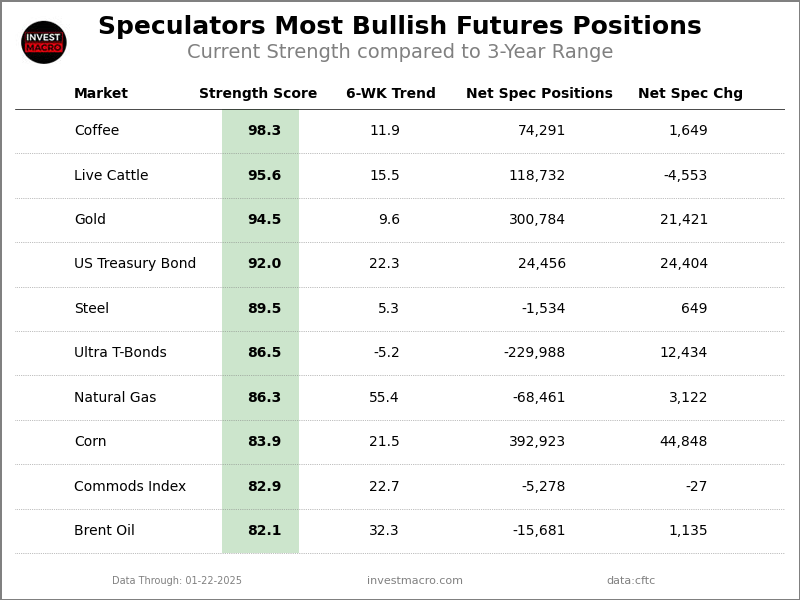
Speculator Extremes: Coffee, Live Cattle & Gold lead weekly Bullish Positions

By InvestMacro 

The latest update for the weekly Commitment of Traders (COT) report was released by the Commodity Futures Trading Commission (CFTC) on Friday for data ending on January 21st.

This weekly Extreme Positions report highlights the Most Bullish and Most Bearish Positions for the speculator category. Extreme positioning in these markets can foreshadow strong moves in the underlying market.

To signify an extreme position, we use the Strength Index (also known as the COT Index) of each instrument, a common method of measuring COT data. The Strength Index is simply a comparison of current trader positions against the range of positions over the previous 3 years. We use over 80 percent as extremely bullish and under 20 percent as extremely bearish. (Compare Strength Index scores across all markets in the data table or cot leaders table)


Here Are This Week’s Most Bullish Speculator Positions:

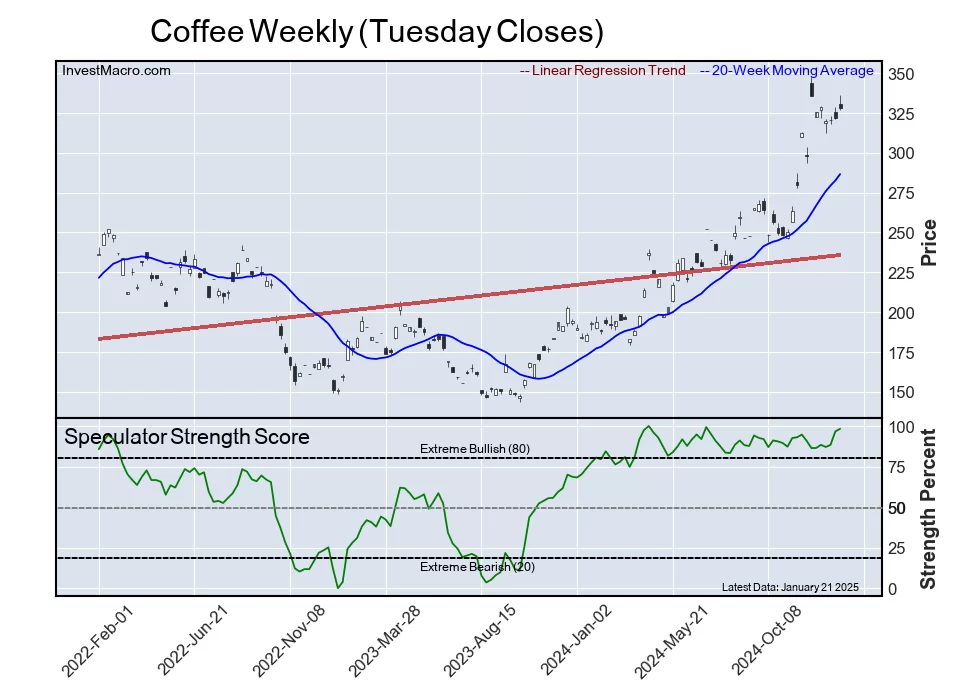
Coffee


The Coffee speculator position comes in as the most bullish extreme standing this week. The Coffee speculator level is currently at a 98.3 percent score of its 3-year range.

The six-week trend for the percent strength score totaled 11.9 this week. The overall net speculator position was a total of 74,291 net contracts this week with an edge higher by 1,649 contract in the weekly speculator bets.


Speculators or Non-Commercials Notes:

Speculators, classified as non-commercial traders by the CFTC, are made up of large commodity funds, hedge funds and other significant for-profit participants. The Specs are generally regarded as trend-followers in their behavior towards price action – net speculator bets and prices tend to go in the same directions. These traders often look to buy when prices are rising and sell when prices are falling. To illustrate this point, many times speculator contracts can be found at their most extremes (bullish or bearish) when prices are also close to their highest or lowest levels.

These extreme levels can be dangerous for the large speculators as the trade is most crowded, there is less trading ammunition still sitting on the sidelines to push the trend further and prices have moved a significant distance. When the trend becomes exhausted, some speculators take profits while others look to also exit positions when prices fail to continue in the same direction. This process usually plays out over many months to years and can ultimately create a reverse effect where prices start to fall and speculators start a process of selling when prices are falling.


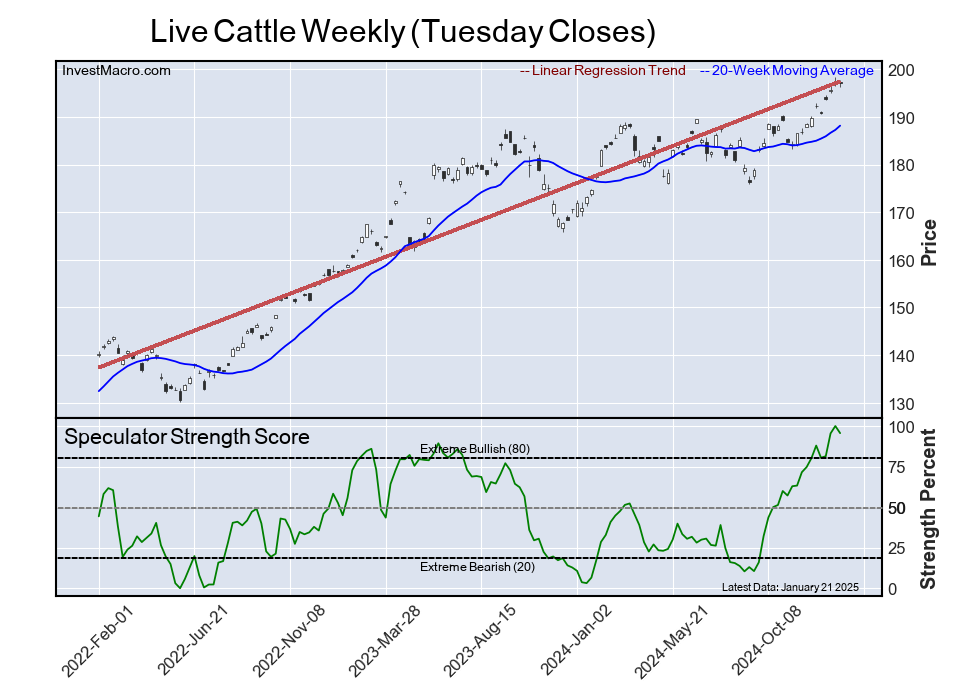
Live Cattle


The Live Cattle speculator position comes next in the extreme standings this week. The Live Cattle speculator level is now at a 95.6 percent score of its 3-year range.

The six-week trend for the percent strength score was 15.5 this week. The speculator position registered 118,732 net contracts this week with a weekly decline of -4,553 contracts in speculator bets.


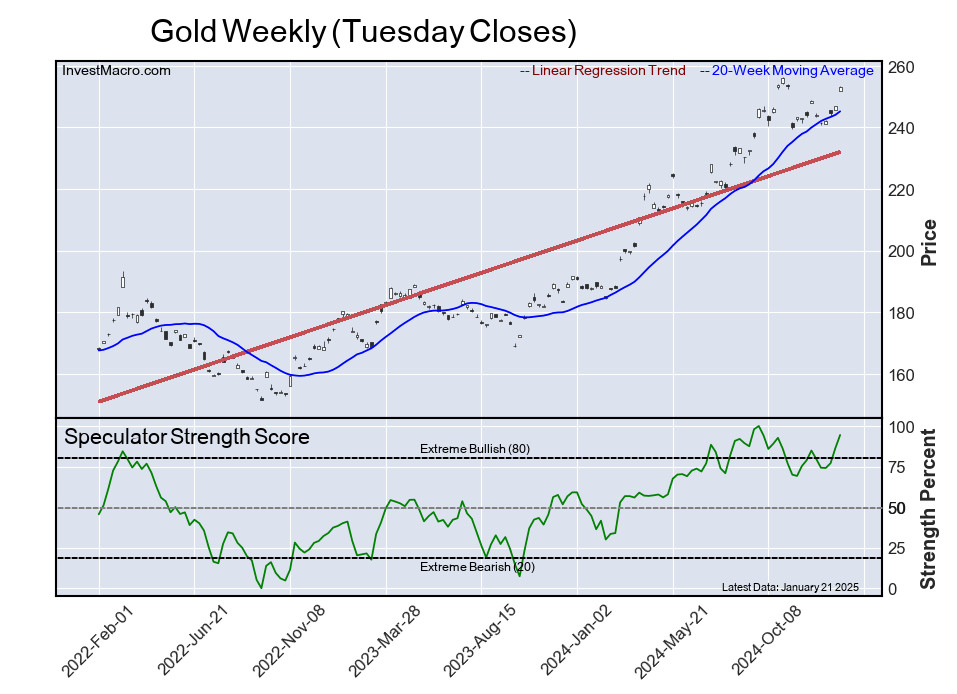
Gold


The Gold speculator position comes in third this week in the extreme standings. The Gold speculator level resides at a 94.5 percent score of its 3-year range.

The six-week trend for the speculator strength score came in at 9.6 this week. The overall speculator position was 300,784 net contracts this week with a gain by 21,421 contracts in the weekly speculator bets.


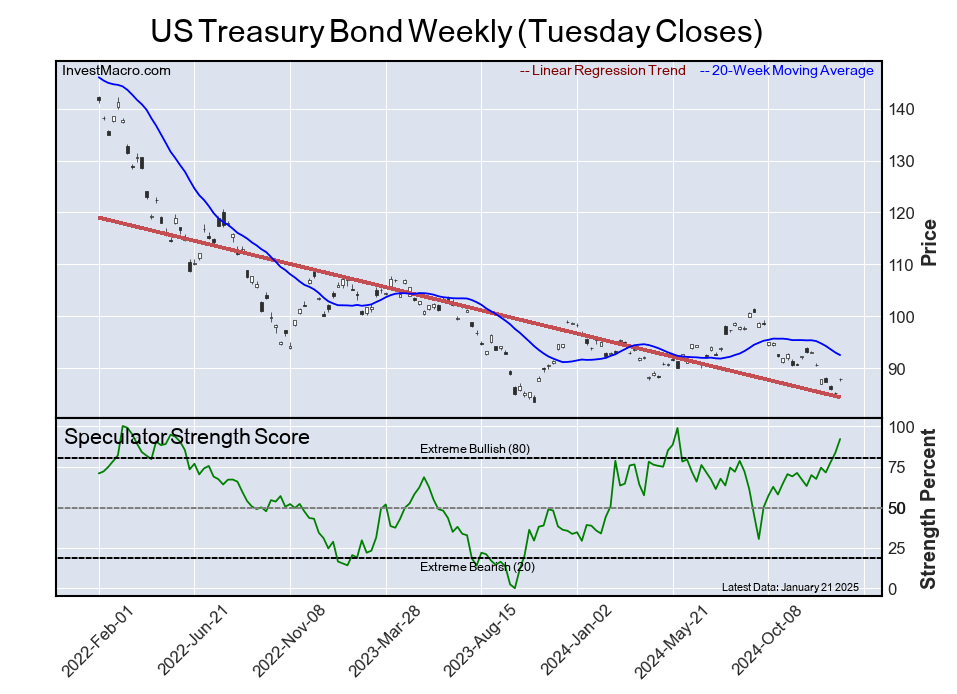
US Treasury Bond


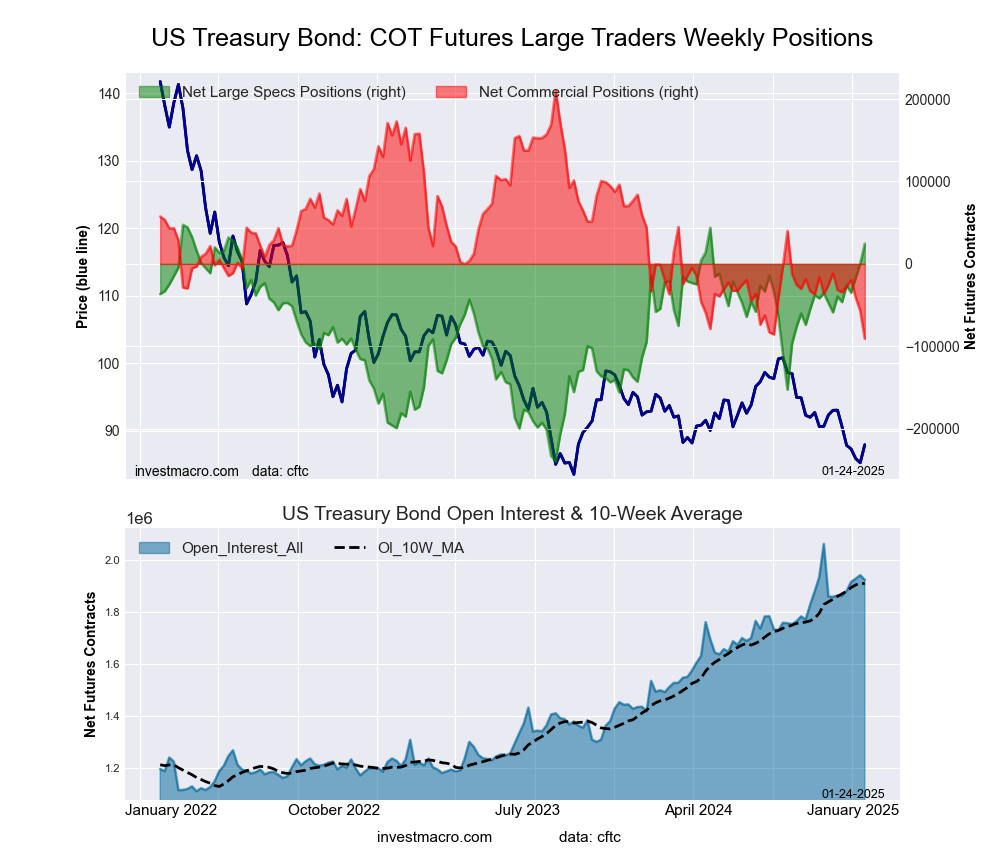
The US Treasury Bond speculator position comes up number four in the extreme standings this week. The US Treasury Bond speculator level is at a 92.0 percent score of its 3-year range.

The six-week trend for the speculator strength score totaled a change of 22.3 this week. The overall speculator position was 24,456 net contracts this week with a boost of 24,404 contracts in the speculator bets.


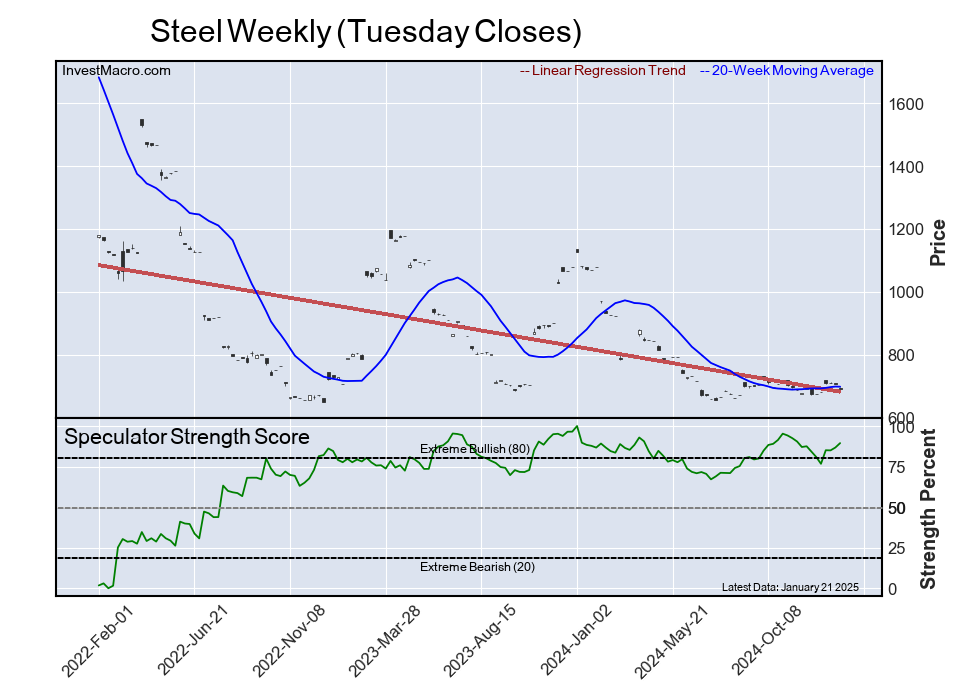
Steel


The Steel speculator position rounds out the top five in this week’s bullish extreme standings. The Steel speculator level sits at a 89.5 percent score of its 3-year range. The six-week trend for the speculator strength score was 5.3 this week.

The speculator position was -1,534 net contracts this week with a rise of 649 contracts in the weekly speculator bets.


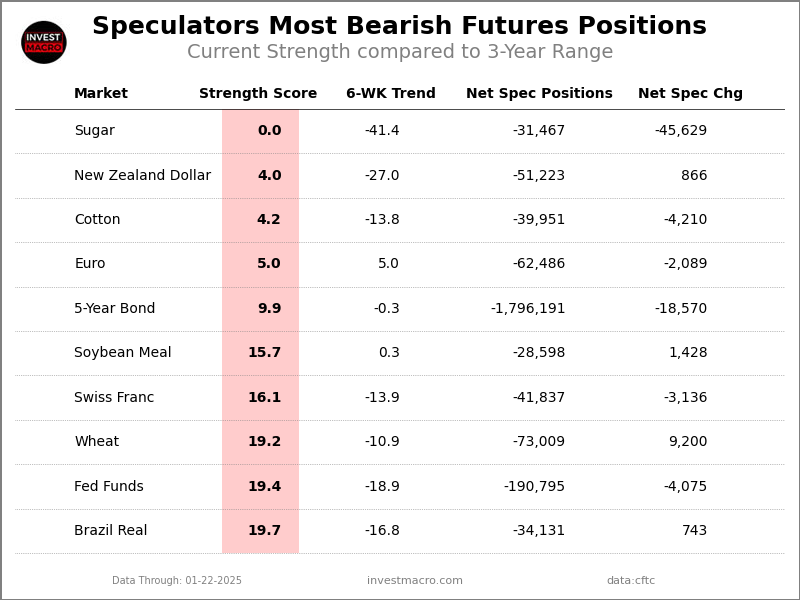
This Week’s Most Bearish Speculator Positions:

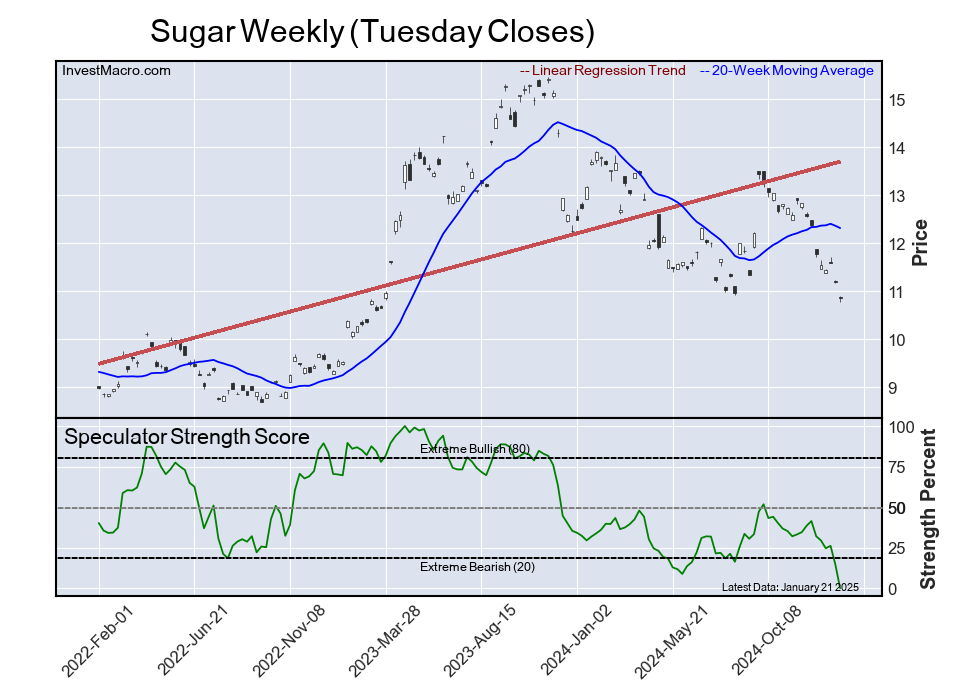
Sugar


The Sugar speculator position comes in as the most bearish extreme standing this week. The Sugar speculator level is at a 0.0 percent score of its 3-year range.

The six-week trend for the speculator strength score was -41.4 this week. The overall speculator position was -31,467 net contracts this week with a drop of -45,629 contracts in the speculator bets.


New Zealand Dollar


The New Zealand Dollar speculator position comes in next for the most bearish extreme standing on the week. The New Zealand Dollar speculator level is at a 4.0 percent score of its 3-year range.

The six-week trend for the speculator strength score was -27.0 this week. The speculator position was -51,223 net contracts this week with an edge higher by 866 contracts in the weekly speculator bets.


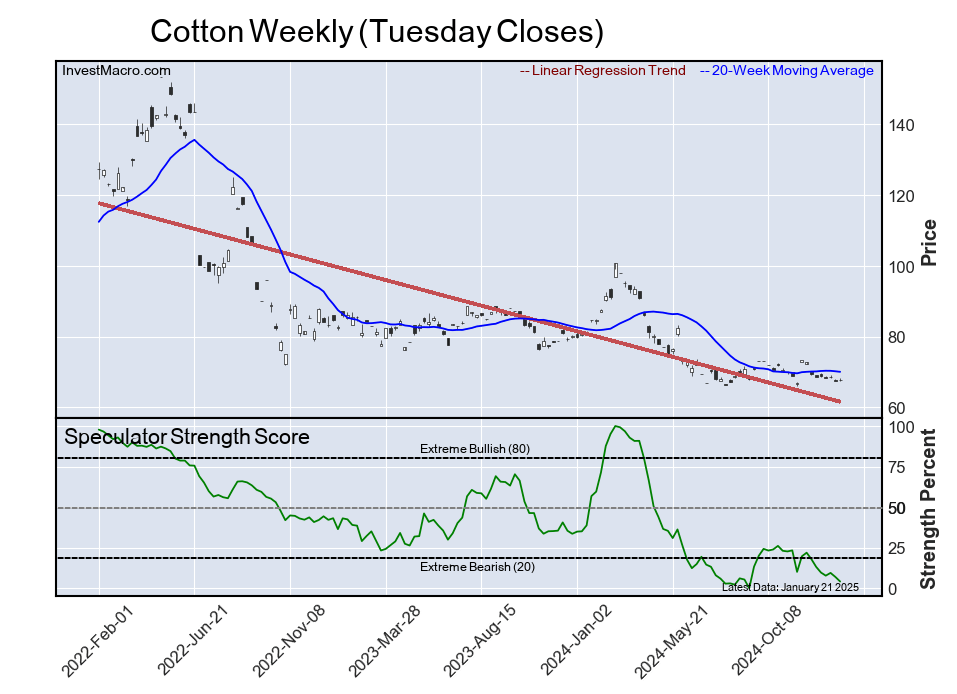
Cotton


The Cotton speculator position comes in as third most bearish extreme standing of the week. The Cotton speculator level resides at a 4.2 percent score of its 3-year range.

The six-week trend for the speculator strength score was -13.8 this week. The overall speculator position was -39,951 net contracts this week with a decrease of -4,210 contracts in the speculator bets.


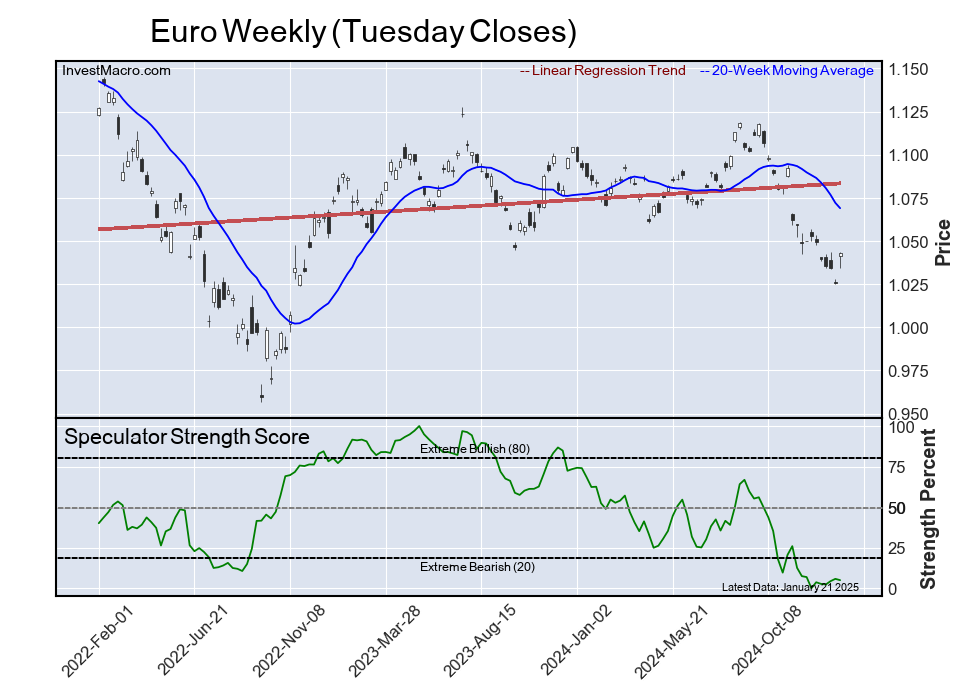
Euro


The Euro speculator position comes in as this week’s fourth most bearish extreme standing. The Euro speculator level is at a 5.0 percent score of its 3-year range.

The six-week trend for the speculator strength score was 5.0 this week. The speculator position was -62,486 net contracts this week with a decline by -2,089 contracts in the weekly speculator bets.

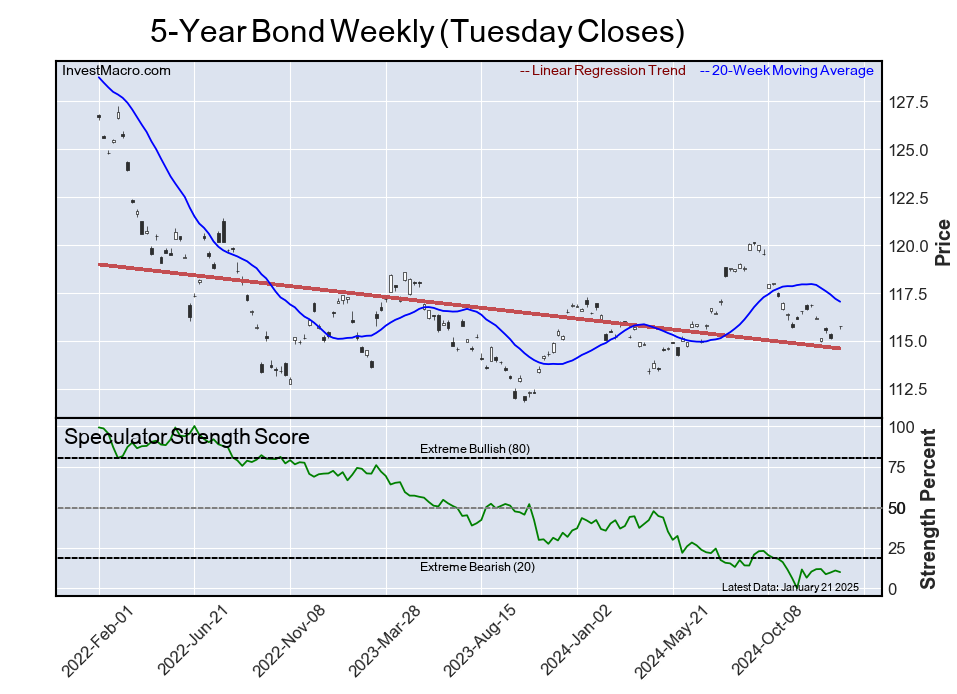
5-Year Bond


Finally, the 5-Year Bond speculator position comes in as the fifth most bearish extreme standing for this week. The 5-Year Bond speculator level is at a 9.9 percent score of its 3-year range.

The six-week trend for the speculator strength score was -0.3 this week. The speculator position was -1,796,191 net contracts this week with a shortfall by -18,570 contracts in the weekly speculator bets.

Article By InvestMacroReceive our weekly COT Newsletter

*COT Report: The COT data, released weekly to the public each Friday, is updated through the most recent Tuesday (data is 3 days old) and shows a quick view of how large speculators or non-commercials (for-profit traders) were positioned in the futures markets.

The CFTC categorizes trader positions according to commercial hedgers (traders who use futures contracts for hedging as part of the business), non-commercials (large traders who speculate to realize trading profits) and nonreportable traders (usually small traders/speculators) as well as their open interest (contracts open in the market at time of reporting). See CFTC criteria here.

COT Bonds Charts: Speculator Bets led by 2-Year Bonds & SOFR 3-Months
By InvestMacro
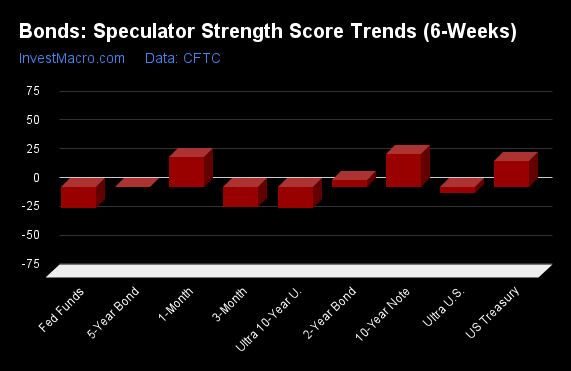
Here are the latest charts and statistics for the Commitment of Traders (COT) reports data published by the Commodities Futures Trading Commission (CFTC).

The latest COT data is updated through Tuesday January 21st and shows a quick view of how large traders (for-profit speculators and commercial hedgers) were positioned in the futures markets.

Weekly Speculator Changes led by 2-Year Bonds & SOFR 3-Months

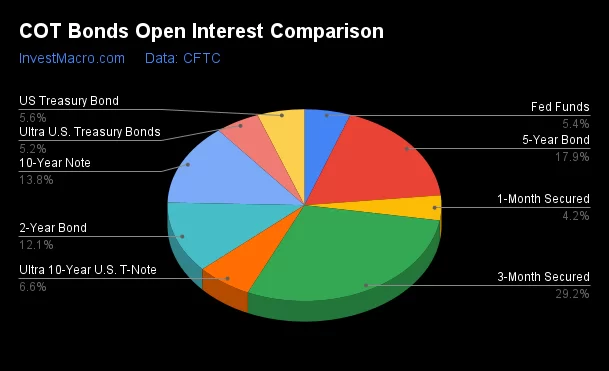
The COT bond market speculator bets were higher this week as five out of the nine bond markets we cover had higher positioning while the other four markets had lower speculator contracts.

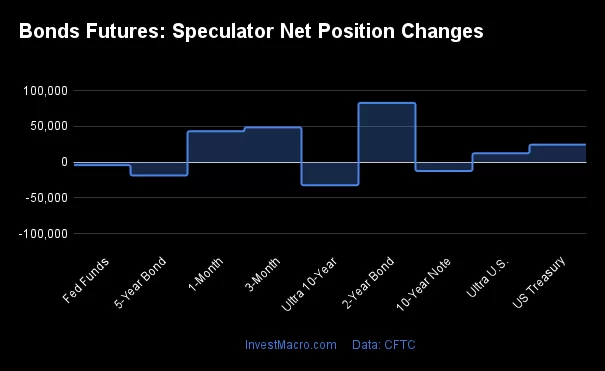
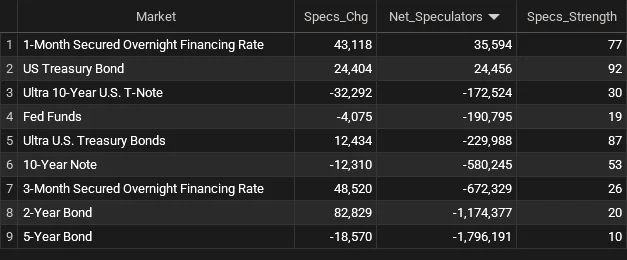
Leading the gains for the bond markets was the 2-Year Bonds (82,829 contracts) with the SOFR 3-Months (48,520 contracts), the SOFR 1-Month (43,118 contracts), the US Treasury Bonds (24,404 contracts) and the Ultra Treasury Bonds (12,434 contracts) also recording positive weeks.

The bond markets with declines in speculator bets for the week were the Ultra 10-Year Bonds (-32,292 contracts), the 5-Year Bonds (-18,570 contracts), the 10-Year Bonds (-12,310 contracts) and with the Fed Funds (-4,075 contracts) also registering lower bets on the week.


Bonds Net Speculators Leaderboard

Legend: Weekly Speculators Change | Speculators Current Net Position | Speculators Strength Score compared to last 3-Years (0-100 range)


Strength Scores led by US Treasury Bonds & Ultra Treasury Bonds

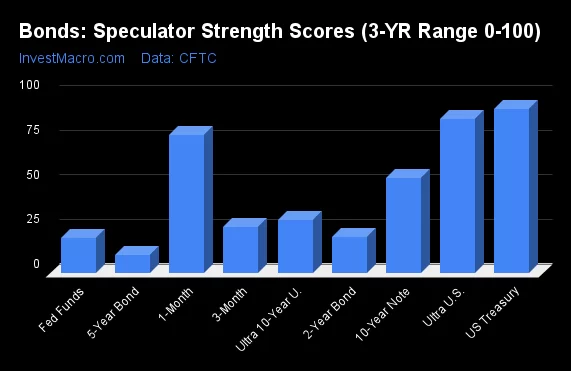
COT Strength Scores (a normalized measure of Speculator positions over a 3-Year range, from 0 to 100 where above 80 is Extreme-Bullish and below 20 is Extreme-Bearish) showed that the US Treasury Bonds (92 percent) and the Ultra Treasury Bonds (87 percent) lead the bond markets this week. The SOFR 1-Month (77 percent) comes in as the next highest in the weekly strength scores.

On the downside, the Fed Funds (19 percent) and the 5-Year Bonds (10 percent) come in at the lowest strength level currently and are in Extreme-Bearish territory (below 20 percent).

Strength Statistics:
Fed Funds (19.4 percent) vs Fed Funds previous week (20.1 percent)
2-Year Bond (20.3 percent) vs 2-Year Bond previous week (14.9 percent)
5-Year Bond (9.9 percent) vs 5-Year Bond previous week (10.9 percent)
10-Year Bond (53.3 percent) vs 10-Year Bond previous week (54.4 percent)
Ultra 10-Year Bond (29.7 percent) vs Ultra 10-Year Bond previous week (38.8 percent)
US Treasury Bond (92.0 percent) vs US Treasury Bond previous week (83.5 percent)
Ultra US Treasury Bond (86.5 percent) vs Ultra US Treasury Bond previous week (81.8 percent)
SOFR 1-Month (77.3 percent) vs SOFR 1-Month previous week (66.6 percent)
SOFR 3-Months (25.5 percent) vs SOFR 3-Months previous week (23.0 percent)


10-Year Bonds & SOFR 1-Month top the 6-Week Strength Trends

COT Strength Score Trends (or move index, calculates the 6-week changes in strength scores) showed that the 10-Year Bonds (28 percent) and the SOFR 1-Month (26 percent) lead the past six weeks trends for bonds. The US Treasury Bonds (22 percent) are the next highest positive movers in the latest trends data.

The Fed Funds (-19 percent) and the SOFR 3-Months (-18 percent) lead the downside trend scores currently.

Strength Trend Statistics:
Fed Funds (-18.9 percent) vs Fed Funds previous week (-29.2 percent)
2-Year Bond (5.3 percent) vs 2-Year Bond previous week (-3.5 percent)
5-Year Bond (-0.3 percent) vs 5-Year Bond previous week (4.4 percent)
10-Year Bond (27.9 percent) vs 10-Year Bond previous week (30.6 percent)
Ultra 10-Year Bond (-18.7 percent) vs Ultra 10-Year Bond previous week (6.5 percent)
US Treasury Bond (22.3 percent) vs US Treasury Bond previous week (20.5 percent)
Ultra US Treasury Bond (-5.2 percent) vs Ultra US Treasury Bond previous week (-10.7 percent)
SOFR 1-Month (25.8 percent) vs SOFR 1-Month previous week (26.9 percent)
SOFR 3-Months (-17.8 percent) vs SOFR 3-Months previous week (-9.5 percent)


30-Day Federal Funds Futures:

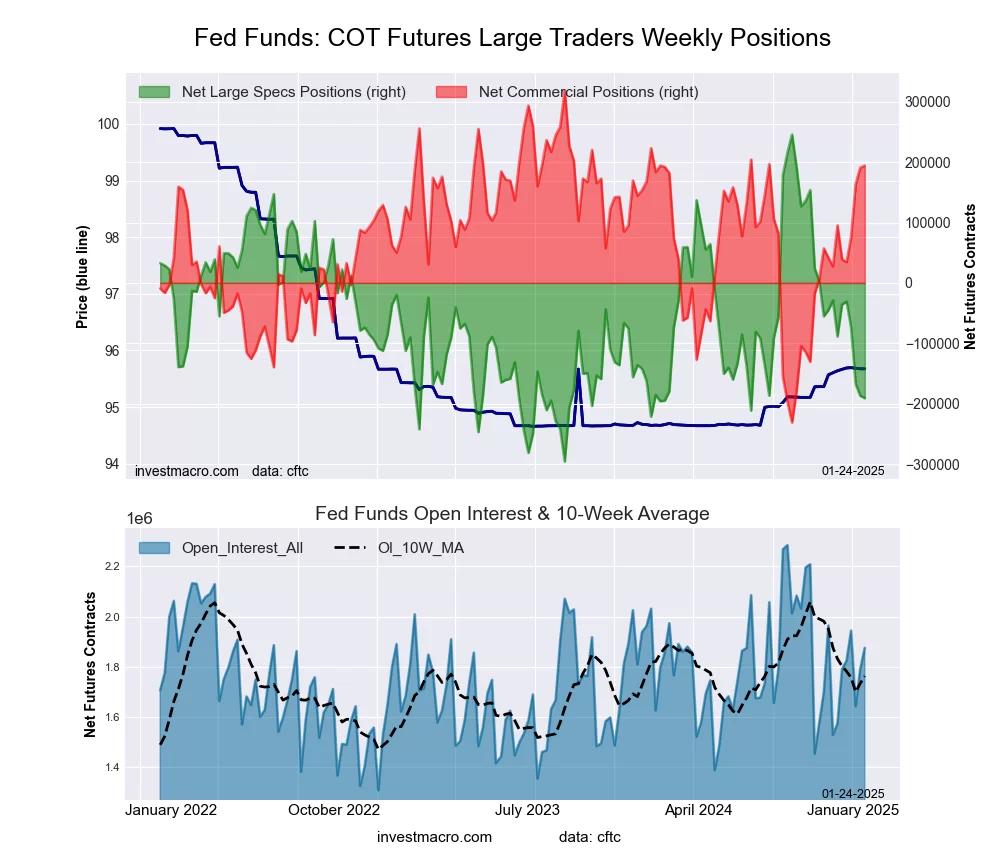
Federal Funds 30-Day Bonds Futures COT ChartThe 30-Day Federal Funds large speculator standing this week reached a net position of -190,795 contracts in the data reported through Tuesday. This was a weekly lowering of -4,075 contracts from the previous week which had a total of -186,720 net contracts.

This week’s current strength score (the trader positioning range over the past three years, measured from 0 to 100) shows the speculators are currently Bearish-Extreme with a score of 19.4 percent. The commercials are Bullish with a score of 77.4 percent and the small traders (not shown in chart) are Bullish with a score of 78.7 percent.

Price Trend-Following Model: Downtrend

Our weekly trend-following model classifies the current market price position as: Downtrend. The current action for the model is considered to be: Hold – Maintain Short Position.

30-Day Federal Funds StatisticsSPECULATORSCOMMERCIALSSMALL TRADERS
– Percent of Open Interest Longs:10.070.91.8
– Percent of Open Interest Shorts:20.260.62.0
– Net Position:-190,795194,312-3,517
– Gross Longs:187,4011,329,52733,875
– Gross Shorts:378,1961,135,21537,392
– Long to Short Ratio:0.5 to 11.2 to 10.9 to 1
NET POSITION TREND:
– Strength Index Score (3 Year Range Pct):19.477.478.7
– Strength Index Reading (3 Year Range):Bearish-ExtremeBullishBullish
NET POSITION MOVEMENT INDEX:
– 6-Week Change in Strength Index:-18.918.05.8


Secured Overnight Financing Rate (3-Month) Futures:

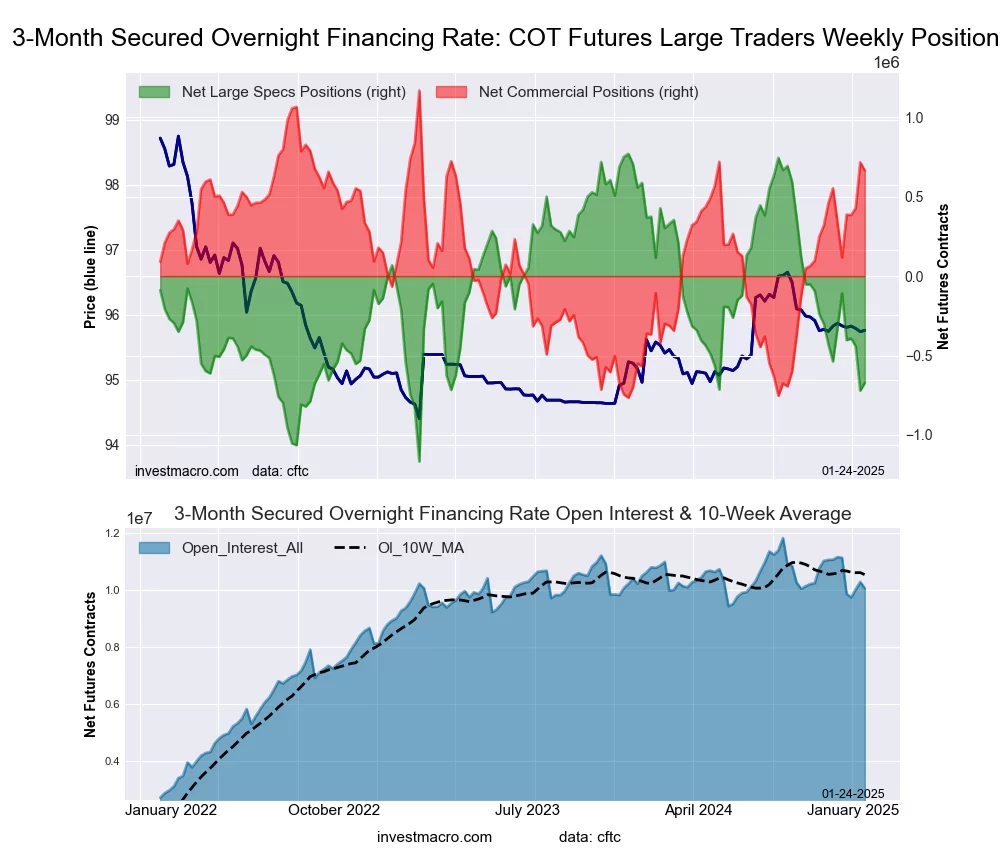
SOFR 3-Months Bonds Futures COT ChartThe Secured Overnight Financing Rate (3-Month) large speculator standing this week reached a net position of -672,329 contracts in the data reported through Tuesday. This was a weekly lift of 48,520 contracts from the previous week which had a total of -720,849 net contracts.

This week’s current strength score (the trader positioning range over the past three years, measured from 0 to 100) shows the speculators are currently Bearish with a score of 25.5 percent. The commercials are Bullish with a score of 74.0 percent and the small traders (not shown in chart) are Bullish-Extreme with a score of 91.9 percent.

Price Trend-Following Model: Weak Uptrend

Our weekly trend-following model classifies the current market price position as: Weak Uptrend. The current action for the model is considered to be: Hold – Maintain Long Position.

SOFR 3-Months StatisticsSPECULATORSCOMMERCIALSSMALL TRADERS
– Percent of Open Interest Longs:12.362.60.3
– Percent of Open Interest Shorts:18.956.00.2
– Net Position:-672,329664,9387,391
– Gross Longs:1,234,1116,304,51028,896
– Gross Shorts:1,906,4405,639,57221,505
– Long to Short Ratio:0.6 to 11.1 to 11.3 to 1
NET POSITION TREND:
– Strength Index Score (3 Year Range Pct):25.574.091.9
– Strength Index Reading (3 Year Range):BearishBullishBullish-Extreme
NET POSITION MOVEMENT INDEX:
– 6-Week Change in Strength Index:-17.817.09.4


Individual Bond Markets:

Secured Overnight Financing Rate (1-Month) Futures:

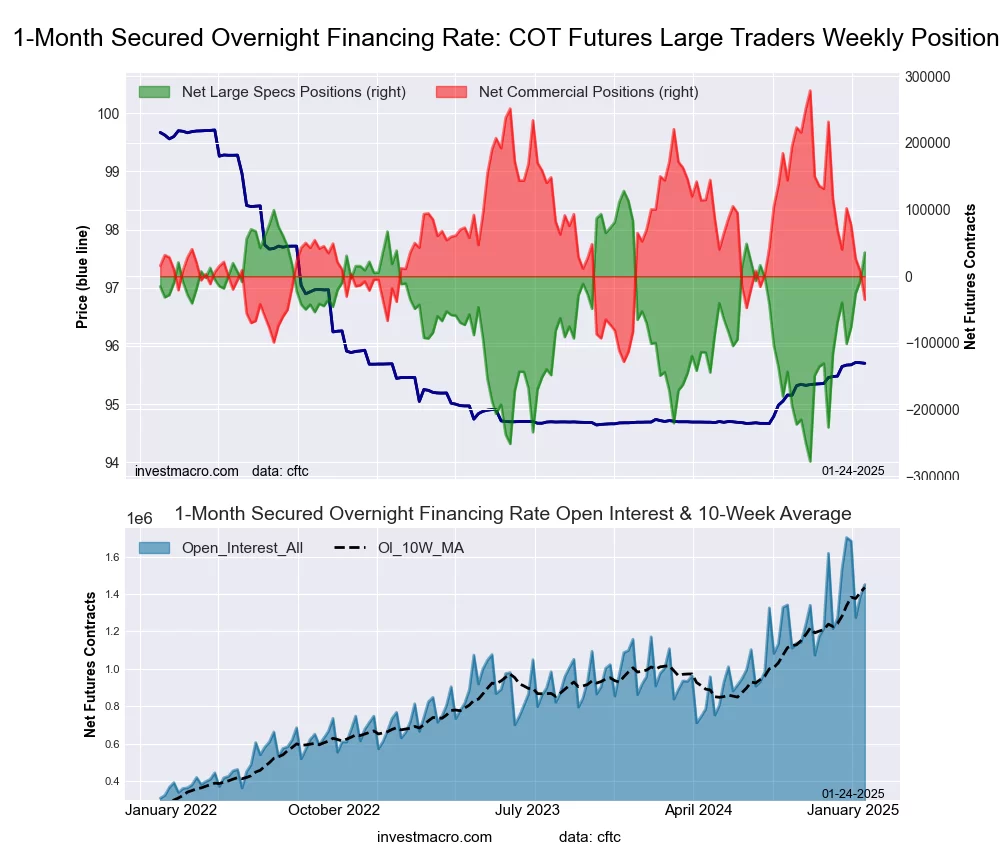
SOFR 1-Month Bonds Futures COT ChartThe Secured Overnight Financing Rate (1-Month) large speculator standing this week reached a net position of 35,594 contracts in the data reported through Tuesday. This was a weekly advance of 43,118 contracts from the previous week which had a total of -7,524 net contracts.

This week’s current strength score (the trader positioning range over the past three years, measured from 0 to 100) shows the speculators are currently Bullish with a score of 77.3 percent. The commercials are Bearish with a score of 22.9 percent and the small traders (not shown in chart) are Bullish with a score of 54.0 percent.

Price Trend-Following Model: Uptrend

Our weekly trend-following model classifies the current market price position as: Uptrend.

SOFR 1-Month StatisticsSPECULATORSCOMMERCIALSSMALL TRADERS
– Percent of Open Interest Longs:24.859.60.0
– Percent of Open Interest Shorts:22.462.10.0
– Net Position:35,594-35,351-243
– Gross Longs:360,259866,138165
– Gross Shorts:324,665901,489408
– Long to Short Ratio:1.1 to 11.0 to 10.4 to 1
NET POSITION TREND:
– Strength Index Score (3 Year Range Pct):77.322.954.0
– Strength Index Reading (3 Year Range):BullishBearishBullish
NET POSITION MOVEMENT INDEX:
– 6-Week Change in Strength Index:25.8-25.80.6


2-Year Treasury Note Futures:

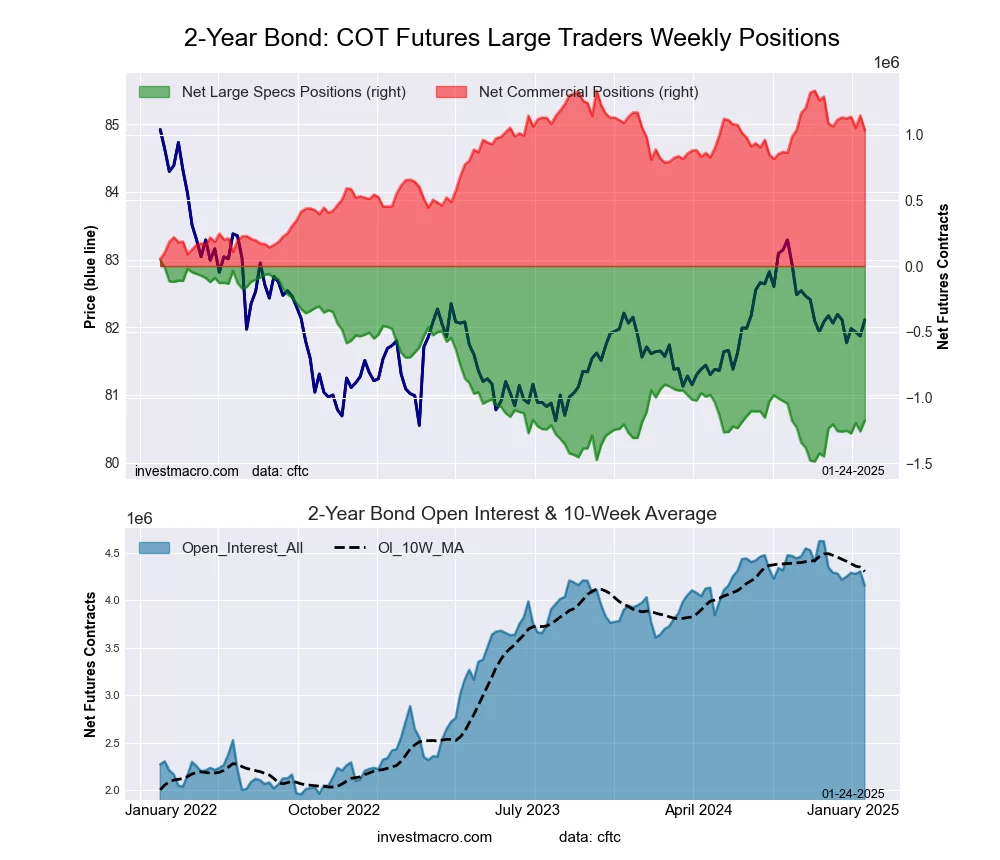
2-Year Treasury Bonds Futures COT ChartThe 2-Year Treasury Note large speculator standing this week reached a net position of -1,174,377 contracts in the data reported through Tuesday. This was a weekly advance of 82,829 contracts from the previous week which had a total of -1,257,206 net contracts.

This week’s current strength score (the trader positioning range over the past three years, measured from 0 to 100) shows the speculators are currently Bearish with a score of 20.3 percent. The commercials are Bullish with a score of 76.6 percent and the small traders (not shown in chart) are Bullish-Extreme with a score of 80.1 percent.

Price Trend-Following Model: Downtrend

Our weekly trend-following model classifies the current market price position as: Downtrend.

2-Year Treasury Note StatisticsSPECULATORSCOMMERCIALSSMALL TRADERS
– Percent of Open Interest Longs:13.276.86.3
– Percent of Open Interest Shorts:41.451.92.9
– Net Position:-1,174,3771,034,903139,474
– Gross Longs:547,5403,191,555260,164
– Gross Shorts:1,721,9172,156,652120,690
– Long to Short Ratio:0.3 to 11.5 to 12.2 to 1
NET POSITION TREND:
– Strength Index Score (3 Year Range Pct):20.376.680.1
– Strength Index Reading (3 Year Range):BearishBullishBullish-Extreme
NET POSITION MOVEMENT INDEX:
– 6-Week Change in Strength Index:5.3-6.2-0.6


5-Year Treasury Note Futures:

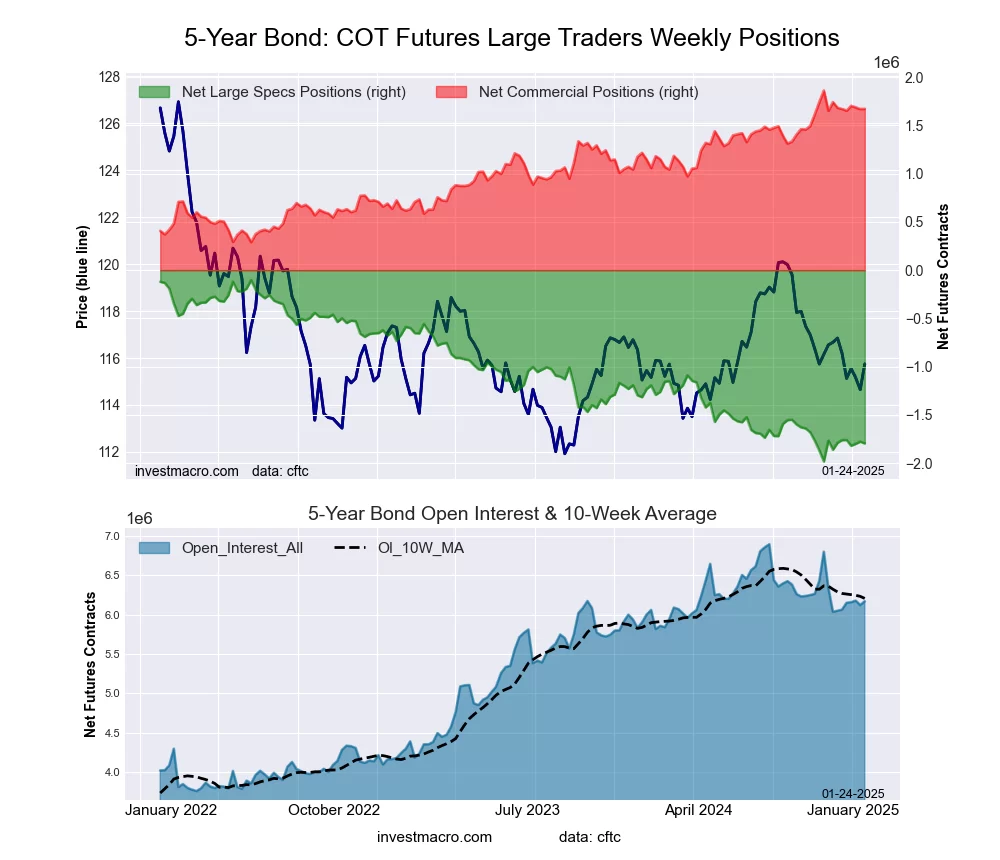
5-Year Treasury Bonds Futures COT ChartThe 5-Year Treasury Note large speculator standing this week reached a net position of -1,796,191 contracts in the data reported through Tuesday. This was a weekly decline of -18,570 contracts from the previous week which had a total of -1,777,621 net contracts.

This week’s current strength score (the trader positioning range over the past three years, measured from 0 to 100) shows the speculators are currently Bearish-Extreme with a score of 9.9 percent. The commercials are Bullish-Extreme with a score of 87.9 percent and the small traders (not shown in chart) are Bullish with a score of 76.6 percent.

Price Trend-Following Model: Downtrend

Our weekly trend-following model classifies the current market price position as: Downtrend.

5-Year Treasury Note StatisticsSPECULATORSCOMMERCIALSSMALL TRADERS
– Percent of Open Interest Longs:5.985.06.9
– Percent of Open Interest Shorts:35.057.94.9
– Net Position:-1,796,1911,671,310124,881
– Gross Longs:362,7685,245,706424,184
– Gross Shorts:2,158,9593,574,396299,303
– Long to Short Ratio:0.2 to 11.5 to 11.4 to 1
NET POSITION TREND:
– Strength Index Score (3 Year Range Pct):9.987.976.6
– Strength Index Reading (3 Year Range):Bearish-ExtremeBullish-ExtremeBullish
NET POSITION MOVEMENT INDEX:
– 6-Week Change in Strength Index:-0.3-0.73.1


10-Year Treasury Note Futures:

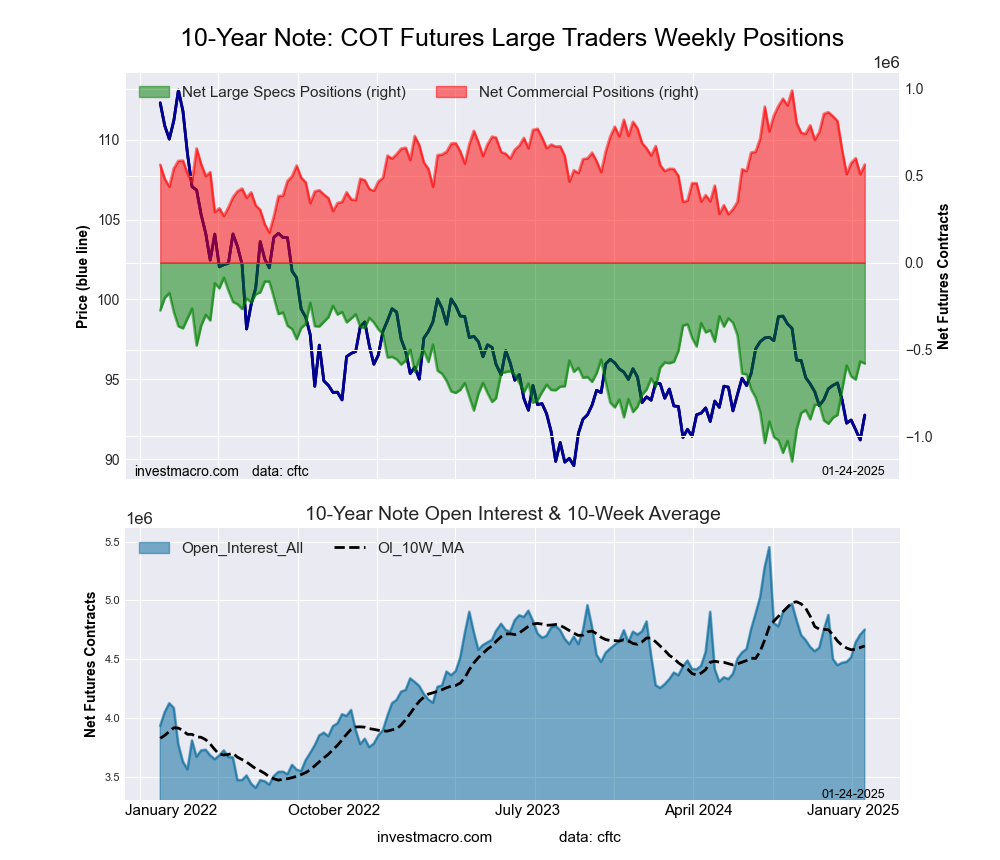
10-Year Treasury Notes Bonds Futures COT ChartThe 10-Year Treasury Note large speculator standing this week reached a net position of -580,245 contracts in the data reported through Tuesday. This was a weekly lowering of -12,310 contracts from the previous week which had a total of -567,935 net contracts.

This week’s current strength score (the trader positioning range over the past three years, measured from 0 to 100) shows the speculators are currently Bullish with a score of 53.3 percent. The commercials are Bearish with a score of 48.0 percent and the small traders (not shown in chart) are Bullish with a score of 67.9 percent.

Price Trend-Following Model: Downtrend

Our weekly trend-following model classifies the current market price position as: Downtrend.

10-Year Treasury Note StatisticsSPECULATORSCOMMERCIALSSMALL TRADERS
– Percent of Open Interest Longs:13.875.38.9
– Percent of Open Interest Shorts:26.063.48.6
– Net Position:-580,245565,04015,205
– Gross Longs:654,1813,575,799422,956
– Gross Shorts:1,234,4263,010,759407,751
– Long to Short Ratio:0.5 to 11.2 to 11.0 to 1
NET POSITION TREND:
– Strength Index Score (3 Year Range Pct):53.348.067.9
– Strength Index Reading (3 Year Range):BullishBearishBullish
NET POSITION MOVEMENT INDEX:
– 6-Week Change in Strength Index:27.9-30.6-10.1


Ultra 10-Year Notes Futures:

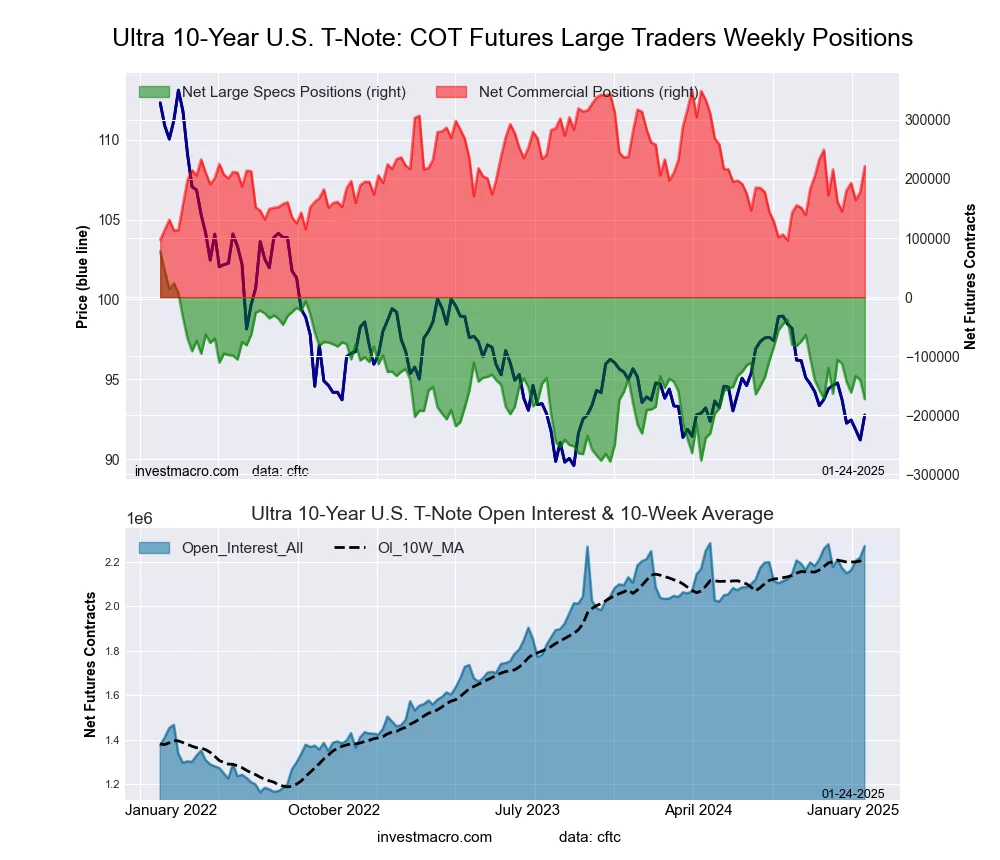
Ultra 10-Year Treasury Notes Bonds Futures COT ChartThe Ultra 10-Year Notes large speculator standing this week reached a net position of -172,524 contracts in the data reported through Tuesday. This was a weekly decline of -32,292 contracts from the previous week which had a total of -140,232 net contracts.

This week’s current strength score (the trader positioning range over the past three years, measured from 0 to 100) shows the speculators are currently Bearish with a score of 29.7 percent. The commercials are Bearish with a score of 49.5 percent and the small traders (not shown in chart) are Bullish-Extreme with a score of 81.7 percent.

Price Trend-Following Model: Weak Downtrend

Our weekly trend-following model classifies the current market price position as: Weak Downtrend.

Ultra 10-Year Notes StatisticsSPECULATORSCOMMERCIALSSMALL TRADERS
– Percent of Open Interest Longs:13.575.89.8
– Percent of Open Interest Shorts:21.166.012.0
– Net Position:-172,524221,503-48,979
– Gross Longs:306,0921,721,192223,196
– Gross Shorts:478,6161,499,689272,175
– Long to Short Ratio:0.6 to 11.1 to 10.8 to 1
NET POSITION TREND:
– Strength Index Score (3 Year Range Pct):29.749.581.7
– Strength Index Reading (3 Year Range):BearishBearishBullish-Extreme
NET POSITION MOVEMENT INDEX:
– 6-Week Change in Strength Index:-18.723.74.1


US Treasury Bonds Futures:

US Year Treasury Notes Long Bonds Futures COT ChartThe US Treasury Bonds large speculator standing this week reached a net position of 24,456 contracts in the data reported through Tuesday. This was a weekly boost of 24,404 contracts from the previous week which had a total of 52 net contracts.

This week’s current strength score (the trader positioning range over the past three years, measured from 0 to 100) shows the speculators are currently Bullish-Extreme with a score of 92.0 percent. The commercials are Bearish-Extreme with a score of 0.0 percent and the small traders (not shown in chart) are Bullish with a score of 64.4 percent.

Price Trend-Following Model: Downtrend

Our weekly trend-following model classifies the current market price position as: Downtrend.

US Treasury Bonds StatisticsSPECULATORSCOMMERCIALSSMALL TRADERS
– Percent of Open Interest Longs:23.764.011.2
– Percent of Open Interest Shorts:22.568.77.7
– Net Position:24,456-90,69966,243
– Gross Longs:456,1881,230,439214,843
– Gross Shorts:431,7321,321,138148,600
– Long to Short Ratio:1.1 to 10.9 to 11.4 to 1
NET POSITION TREND:
– Strength Index Score (3 Year Range Pct):92.00.064.4
– Strength Index Reading (3 Year Range):Bullish-ExtremeBearish-ExtremeBullish
NET POSITION MOVEMENT INDEX:
– 6-Week Change in Strength Index:22.3-19.7-3.2


Ultra US Treasury Bonds Futures:

Ultra US Year Treasury Notes Long Bonds Futures COT ChartThe Ultra US Treasury Bonds large speculator standing this week reached a net position of -229,988 contracts in the data reported through Tuesday. This was a weekly lift of 12,434 contracts from the previous week which had a total of -242,422 net contracts.

This week’s current strength score (the trader positioning range over the past three years, measured from 0 to 100) shows the speculators are currently Bullish-Extreme with a score of 86.5 percent. The commercials are Bearish-Extreme with a score of 18.3 percent and the small traders (not shown in chart) are Bearish-Extreme with a score of 11.5 percent.

Price Trend-Following Model: Downtrend

Our weekly trend-following model classifies the current market price position as: Downtrend.

Ultra US Treasury Bonds StatisticsSPECULATORSCOMMERCIALSSMALL TRADERS
– Percent of Open Interest Longs:8.281.49.8
– Percent of Open Interest Shorts:21.068.69.8
– Net Position:-229,988229,344644
– Gross Longs:147,4111,459,353175,998
– Gross Shorts:377,3991,230,009175,354
– Long to Short Ratio:0.4 to 11.2 to 11.0 to 1
NET POSITION TREND:
– Strength Index Score (3 Year Range Pct):86.518.311.5
– Strength Index Reading (3 Year Range):Bullish-ExtremeBearish-ExtremeBearish-Extreme
NET POSITION MOVEMENT INDEX:
– 6-Week Change in Strength Index:-5.216.8-32.3


Article By InvestMacroReceive our weekly COT Newsletter

*COT Report: The COT data, released weekly to the public each Friday, is updated through the most recent Tuesday (data is 3 days old) and shows a quick view of how large speculators or non-commercials (for-profit traders) were positioned in the futures markets.

The CFTC categorizes trader positions according to commercial hedgers (traders who use futures contracts for hedging as part of the business), non-commercials (large traders who speculate to realize trading profits) and nonreportable traders (usually small traders/speculators) as well as their open interest (contracts open in the market at time of reporting). See CFTC criteria here.