COT Stock Market Charts: Speculator bets led by S&P500 & MSCI EAFE

By InvestMacro

Here are the latest charts and statistics for the Commitment of Traders (COT) data published by the Commodities Futures Trading Commission (CFTC).

The latest COT data is updated through Tuesday December 10th and shows a quick view of how large traders (for-profit speculators and commercial entities) were positioned in the futures markets.

Weekly Speculator Changes led by S&P500 & MSCI EAFE

The COT stock markets speculator bets were higher this week as five out of the seven stock markets we cover had higher positioning while the other two markets had lower speculator contracts.

Leading the gains for the stock markets was the S&P500-Mini (25,277 contracts) with the MSCI EAFE-Mini (13,237 contracts), the Russell-Mini (9,417 contracts), the Nasdaq-Mini (5,882 contracts) and the DowJones-Mini (571 contracts) also showing positive weeks.

The markets with the declines in speculator bets this week were the VIX (-11,968 contracts) and with the Nikkei 225 (-139 contracts) also seeing lower bets on the week.


Stock Market Net Speculators Leaderboard

Legend: Weekly Speculators Change | Speculators Current Net Position | Speculators Strength Score compared to last 3-Years (0-100 range)


Strength Scores led by Nasdaq-Mini & Russell-Mini

COT Strength Scores (a normalized measure of Speculator positions over a 3-Year range, from 0 to 100 where above 80 is Extreme-Bullish and below 20 is Extreme-Bearish) showed that the Nasdaq-Mini (94 percent) and the Russell-Mini (81 percent) lead the stock markets this week. The DowJones-Mini (78 percent) comes in as the next highest in the weekly strength scores.

On the downside, the MSCI EAFE-Mini (49 percent) comes in at the lowest strength level currently.

Strength Statistics:
VIX (55.4 percent) vs VIX previous week (66.3 percent)
S&P500-Mini (52.3 percent) vs S&P500-Mini previous week (48.5 percent)
DowJones-Mini (78.3 percent) vs DowJones-Mini previous week (77.4 percent)
Nasdaq-Mini (94.3 percent) vs Nasdaq-Mini previous week (85.2 percent)
Russell2000-Mini (80.5 percent) vs Russell2000-Mini previous week (74.1 percent)
Nikkei USD (58.0 percent) vs Nikkei USD previous week (59.2 percent)
EAFE-Mini (49.4 percent) vs EAFE-Mini previous week (35.3 percent)


Nasdaq-Mini tops the 6-Week Strength Trends

COT Strength Score Trends (or move index, calculates the 6-week changes in strength scores) showed that the Nasdaq-Mini (47 percent) leads the past six weeks trends for the stock markets. The MSCI EAFE-Mini (18 percent) and the DowJones-Mini (2 percent) are the next highest positive movers in the latest trends data.

The VIX (-40 percent) leads the downside trend scores currently with the Nikkei 225 (-22 percent) coming in as the next market with lower trend scores.

Strength Trend Statistics:
VIX (-39.5 percent) vs VIX previous week (-33.7 percent)
S&P500-Mini (-21.8 percent) vs S&P500-Mini previous week (-19.6 percent)
DowJones-Mini (2.4 percent) vs DowJones-Mini previous week (-2.8 percent)
Nasdaq-Mini (47.2 percent) vs Nasdaq-Mini previous week (41.9 percent)
Russell2000-Mini (-9.6 percent) vs Russell2000-Mini previous week (-20.8 percent)
Nikkei USD (-21.6 percent) vs Nikkei USD previous week (-6.3 percent)
EAFE-Mini (18.1 percent) vs EAFE-Mini previous week (3.8 percent)


Individual Stock Market Charts:

VIX Volatility Futures:

VIX Volatility Futures COT ChartThe VIX Volatility large speculator standing this week totaled a net position of -45,170 contracts in the data reported through Tuesday. This was a weekly decline of -11,968 contracts from the previous week which had a total of -33,202 net contracts.

This week’s current strength score (the trader positioning range over the past three years, measured from 0 to 100) shows the speculators are currently Bullish with a score of 55.4 percent. The commercials are Bearish with a score of 46.9 percent and the small traders (not shown in chart) are Bullish with a score of 75.6 percent.

Price Trend-Following Model: Strong Downtrend

Our weekly trend-following model classifies the current market price position as: Strong Downtrend.

VIX Volatility Futures StatisticsSPECULATORSCOMMERCIALSSMALL TRADERS
– Percent of Open Interest Longs:19.445.98.6
– Percent of Open Interest Shorts:32.233.08.7
– Net Position:-45,17045,739-569
– Gross Longs:68,746162,47230,353
– Gross Shorts:113,916116,73330,922
– Long to Short Ratio:0.6 to 11.4 to 11.0 to 1
NET POSITION TREND:
– Strength Index Score (3 Year Range Pct):55.446.975.6
– Strength Index Reading (3 Year Range):BullishBearishBullish
NET POSITION MOVEMENT INDEX:
– 6-Week Change in Strength Index:-39.541.1-19.6


S&P500 Mini Futures:

SP500 Mini Futures COT ChartThe S&P500 Mini large speculator standing this week totaled a net position of -83,333 contracts in the data reported through Tuesday. This was a weekly lift of 25,277 contracts from the previous week which had a total of -108,610 net contracts.

This week’s current strength score (the trader positioning range over the past three years, measured from 0 to 100) shows the speculators are currently Bullish with a score of 52.3 percent. The commercials are Bearish with a score of 30.7 percent and the small traders (not shown in chart) are Bullish-Extreme with a score of 98.7 percent.

Price Trend-Following Model: Uptrend

Our weekly trend-following model classifies the current market price position as: Uptrend.

S&P500 Mini Futures StatisticsSPECULATORSCOMMERCIALSSMALL TRADERS
– Percent of Open Interest Longs:12.471.212.9
– Percent of Open Interest Shorts:16.074.16.4
– Net Position:-83,333-66,801150,134
– Gross Longs:288,8761,654,888299,379
– Gross Shorts:372,2091,721,689149,245
– Long to Short Ratio:0.8 to 11.0 to 12.0 to 1
NET POSITION TREND:
– Strength Index Score (3 Year Range Pct):52.330.798.7
– Strength Index Reading (3 Year Range):BullishBearishBullish-Extreme
NET POSITION MOVEMENT INDEX:
– 6-Week Change in Strength Index:-21.815.314.2


Dow Jones Mini Futures:

Dow Jones Mini Futures COT ChartThe Dow Jones Mini large speculator standing this week totaled a net position of 11,071 contracts in the data reported through Tuesday. This was a weekly lift of 571 contracts from the previous week which had a total of 10,500 net contracts.

This week’s current strength score (the trader positioning range over the past three years, measured from 0 to 100) shows the speculators are currently Bullish with a score of 78.3 percent. The commercials are Bearish-Extreme with a score of 14.6 percent and the small traders (not shown in chart) are Bullish-Extreme with a score of 91.9 percent.

Price Trend-Following Model: Uptrend

Our weekly trend-following model classifies the current market price position as: Uptrend.

Dow Jones Mini Futures StatisticsSPECULATORSCOMMERCIALSSMALL TRADERS
– Percent of Open Interest Longs:26.351.319.2
– Percent of Open Interest Shorts:14.069.413.4
– Net Position:11,071-16,3015,230
– Gross Longs:23,61445,99717,256
– Gross Shorts:12,54362,29812,026
– Long to Short Ratio:1.9 to 10.7 to 11.4 to 1
NET POSITION TREND:
– Strength Index Score (3 Year Range Pct):78.314.691.9
– Strength Index Reading (3 Year Range):BullishBearish-ExtremeBullish-Extreme
NET POSITION MOVEMENT INDEX:
– 6-Week Change in Strength Index:2.4-4.912.6


Nasdaq Mini Futures:

Nasdaq Mini Futures COT ChartThe Nasdaq Mini large speculator standing this week totaled a net position of 35,573 contracts in the data reported through Tuesday. This was a weekly rise of 5,882 contracts from the previous week which had a total of 29,691 net contracts.

This week’s current strength score (the trader positioning range over the past three years, measured from 0 to 100) shows the speculators are currently Bullish-Extreme with a score of 94.3 percent. The commercials are Bearish-Extreme with a score of 0.0 percent and the small traders (not shown in chart) are Bullish-Extreme with a score of 81.8 percent.

Price Trend-Following Model: Strong Uptrend

Our weekly trend-following model classifies the current market price position as: Strong Uptrend.

Nasdaq Mini Futures StatisticsSPECULATORSCOMMERCIALSSMALL TRADERS
– Percent of Open Interest Longs:31.452.114.6
– Percent of Open Interest Shorts:19.269.29.7
– Net Position:35,573-49,86414,291
– Gross Longs:91,735152,03542,649
– Gross Shorts:56,162201,89928,358
– Long to Short Ratio:1.6 to 10.8 to 11.5 to 1
NET POSITION TREND:
– Strength Index Score (3 Year Range Pct):94.30.081.8
– Strength Index Reading (3 Year Range):Bullish-ExtremeBearish-ExtremeBullish-Extreme
NET POSITION MOVEMENT INDEX:
– 6-Week Change in Strength Index:47.2-36.16.1


Russell 2000 Mini Futures:

Russell 2000 Mini Futures COT ChartThe Russell 2000 Mini large speculator standing this week totaled a net position of -2,157 contracts in the data reported through Tuesday. This was a weekly gain of 9,417 contracts from the previous week which had a total of -11,574 net contracts.

This week’s current strength score (the trader positioning range over the past three years, measured from 0 to 100) shows the speculators are currently Bullish-Extreme with a score of 80.5 percent. The commercials are Bearish-Extreme with a score of 9.0 percent and the small traders (not shown in chart) are Bullish-Extreme with a score of 99.2 percent.

Price Trend-Following Model: Uptrend

Our weekly trend-following model classifies the current market price position as: Uptrend.

Russell 2000 Mini Futures StatisticsSPECULATORSCOMMERCIALSSMALL TRADERS
– Percent of Open Interest Longs:14.274.98.5
– Percent of Open Interest Shorts:14.679.63.4
– Net Position:-2,157-24,30026,457
– Gross Longs:74,100390,12744,304
– Gross Shorts:76,257414,42717,847
– Long to Short Ratio:1.0 to 10.9 to 12.5 to 1
NET POSITION TREND:
– Strength Index Score (3 Year Range Pct):80.59.099.2
– Strength Index Reading (3 Year Range):Bullish-ExtremeBearish-ExtremeBullish-Extreme
NET POSITION MOVEMENT INDEX:
– 6-Week Change in Strength Index:-9.61.731.9


Nikkei Stock Average (USD) Futures:

Nikkei Stock Average (USD) Futures COT ChartThe Nikkei Stock Average (USD) large speculator standing this week totaled a net position of -2,603 contracts in the data reported through Tuesday. This was a weekly decline of -139 contracts from the previous week which had a total of -2,464 net contracts.

This week’s current strength score (the trader positioning range over the past three years, measured from 0 to 100) shows the speculators are currently Bullish with a score of 58.0 percent. The commercials are Bearish with a score of 39.3 percent and the small traders (not shown in chart) are Bullish with a score of 57.7 percent.

Price Trend-Following Model: Uptrend

Our weekly trend-following model classifies the current market price position as: Uptrend.

Nikkei Stock Average Futures StatisticsSPECULATORSCOMMERCIALSSMALL TRADERS
– Percent of Open Interest Longs:1.558.119.3
– Percent of Open Interest Shorts:18.745.914.3
– Net Position:-2,6031,844759
– Gross Longs:2248,7862,919
– Gross Shorts:2,8276,9422,160
– Long to Short Ratio:0.1 to 11.3 to 11.4 to 1
NET POSITION TREND:
– Strength Index Score (3 Year Range Pct):58.039.357.7
– Strength Index Reading (3 Year Range):BullishBearishBullish
NET POSITION MOVEMENT INDEX:
– 6-Week Change in Strength Index:-21.611.317.3


MSCI EAFE Mini Futures:

MSCI EAFE Mini Futures COT ChartThe MSCI EAFE Mini large speculator standing this week totaled a net position of -17,963 contracts in the data reported through Tuesday. This was a weekly advance of 13,237 contracts from the previous week which had a total of -31,200 net contracts.

This week’s current strength score (the trader positioning range over the past three years, measured from 0 to 100) shows the speculators are currently Bearish with a score of 49.4 percent. The commercials are Bearish with a score of 49.1 percent and the small traders (not shown in chart) are Bearish with a score of 44.0 percent.

Price Trend-Following Model: Strong Downtrend

Our weekly trend-following model classifies the current market price position as: Strong Downtrend.

MSCI EAFE Mini Futures StatisticsSPECULATORSCOMMERCIALSSMALL TRADERS
– Percent of Open Interest Longs:9.088.12.6
– Percent of Open Interest Shorts:13.085.31.4
– Net Position:-17,96312,5465,417
– Gross Longs:40,742397,68711,784
– Gross Shorts:58,705385,1416,367
– Long to Short Ratio:0.7 to 11.0 to 11.9 to 1
NET POSITION TREND:
– Strength Index Score (3 Year Range Pct):49.449.144.0
– Strength Index Reading (3 Year Range):BearishBearishBearish
NET POSITION MOVEMENT INDEX:
– 6-Week Change in Strength Index:18.1-20.111.9


Article By InvestMacroReceive our weekly COT Newsletter

*COT Report: The COT data, released weekly to the public each Friday, is updated through the most recent Tuesday (data is 3 days old) and shows a quick view of how large speculators or non-commercials (for-profit traders) were positioned in the futures markets.

The CFTC categorizes trader positions according to commercial hedgers (traders who use futures contracts for hedging as part of the business), non-commercials (large traders who speculate to realize trading profits) and nonreportable traders (usually small traders/speculators) as well as their open interest (contracts open in the market at time of reporting). See CFTC criteria here.

The SNB unexpectedly cut the interest rate by 0.5%. Natural gas prices reached a two-week-high

By JustMarkets 

The Dow Jones Industrial Average (US30) was down 0.53% on Thursday. The S&P 500 Index (US500) decreased by 0.54%. The Nasdaq Technology Index (US100) fell by 0.68%. The losses came amid signs of stagflation after US weekly jobless claims unexpectedly rose to an 8-week high, and November Producer Prices rose faster than expected, the fastest pace in nearly 2 years.

US weekly jobless claims unexpectedly rose by 17,000 to an 8-week high of 242,000, indicating a weaker labor market than expected down to 220,000. The US final Consumption Goods and Services Price Index for November rose by 3.0% y/y, exceeding expectations of 2.6% y/y and the largest increase in over a year. In addition, the November Price Index, excluding food and energy, was unchanged from October at 3.4% y/y, exceeding expectations of 3.2% y/y. Markets estimate the odds of a 25 bps rate cut at the December 17–18 FOMC meeting at 95%.

Adobe (ADBE) fell more than 13%, topping the list of losers in the S&P 500 and Nasdaq 100, after estimating 2025 revenue of $23.30-$23.55 bln, weaker than the consensus projections of $23.78 bln.

Equity markets in Europe were mostly flat yesterday. Germany’s DAX (DE40) rose by 0.13%, France’s CAC 40 (FR40) closed down 0.03%, Spain’s IBEX 35 (ES35) fell by 0.21%, and the UK’s FTSE 100 (UK100) closed up 0.12%. The ECB, as expected, cut the deposit rate by 25 bps to 3.00% from 3.25% and abandoned previous language that monetary policy will remain “sufficiently restrictive for as long as necessary.” The ECB lowered its 2024 eurozone GDP estimate to 0.7% from a previous projection of 0.8% and its 2024 Eurozone inflation prognosis to 2.4% from a previous one of 2.5%. ECB President Lagarde said the latest information indicates that the eurozone economy is losing momentum and will strengthen more slowly than expected.

The Swiss National Bank (SNB) cut its key rate by 50bps to 0.5% in December 2024, beating market expectations for a smaller 25bps cut. This is the fourth consecutive rate cut and the sharpest since January 2015, bringing borrowing costs to the lowest since November 2022. The decision came amid a decline in inflation from 1.1% in August to 0.7% in November. Inflation is projected to average 1.1% in 2024, 0.3% in 2025, and 0.8% in 2026, staying within the SNB’s target range. Swiss GDP growth is expected to be around 1% this year, rising slightly to 1–1.5% in 2025, supported by recent rate cuts.

Oil prices are targeting their first weekly rise in three weeks, helped by the prospect of tighter sanctions and hopes for improved Chinese demand following Beijing’s pledge to ease monetary policy next year. OPEC also cut its 2024 demand growth prognosis again, the fifth consecutive month of lower demand growth.

The US natural gas prices (XNG/USD) climbed above $3.4/MMBtu to the highest level in more than two weeks, driven by larger-than-expected withdrawals from storage reported by the EIA. For the week ending December 6, US utilities withdrew 190 billion cubic feet of gas from storage, well above the 170 billion cubic feet prognosis. This withdrawal was well above last year’s 72 Bcf and the five-year average of 71 Bcf for the same period.

Asian markets traded flat yesterday. Japan’s Nikkei 225 (JP225) fell by 1.09%, China’s FTSE China A50 (CHA50) rose by 1.38%, Hong Kong’s Hang Seng (HK50) gained 1.28%, and Australia’s ASX 200 (AU200) was negative 1.37%.

The New Zealand dollar fell as low as 0.575 USD on Friday, ending at its weakest level in two years under pressure from a strong US dollar. The US dollar strengthened after US Producer Inflation rose more than expected, pushing Treasury yields higher. Domestically, expectations of a significant rate cut by the Reserve Bank of New Zealand have further weighed on the local currency. Markets currently see a 66% chance of a 50bp rate cut at the central bank’s February meeting, with the rate prognosis to fall to 3.10% by the end of 2025.

S&P 500 (US500) 6,051.25 −32.94 (−0.54%)

Dow Jones (US30) 43,914.12 −234.44 (−0.53%)

DAX (DE40) 20,426.27 +27.11 (+0.13%)

FTSE 100 (UK100) 8,311.76 +10.14 (+0.12%)

USD Index 106.97 +0.26 (+0.25%)

News feed for: 2024.12.13

  • Japan Tankan Manufacturing (q/q) at 01:50 (GMT+2);
  • Japan Non-Tankan Manufacturing (q/q) at 01:50 (GMT+2);
  • German Trade Balance (m/m) at 09:00 (GMT+2);
  • UK GDP (m/m) at 09:00 (GMT+2);
  • UK Industrial Production (m/m) at 09:00 (GMT+2);
  • UK Manufacturing Production (m/m) at 09:00 (GMT+2);
  • Eurozone Industrial Production (m/m) at 12:00 (GMT+2).

By JustMarkets


This article reflects a personal opinion and should not be interpreted as an investment advice, and/or offer, and/or a persistent request for carrying out financial transactions, and/or a guarantee, and/or a forecast of future events.

Week Ahead: USDJPY braced for central bank showdown

By ForexTime 

  • Yen expected to be most volatile in G10 space vs USD
  • Fed seen cutting rates, BoJ to hold rates
  • Over past year Fed triggered moves of ↑ 0.5% & ↓ 1.3%
  • Over past year BoJ triggered moves of ↑ 1.1% & ↓ 0.7%
  • Bloomberg FX model: USDJPY has 72% of trading within 150.49 – 156.11 over 1-week period

Brace yourself!

Major central bank decisions could spark fresh trading opportunities across FX markets.

Our focus falls on the Yen which is expected to be the most volatile G10 currency versus the USD over the next one-week!

vol

The one-week implied volatility for the USDJPY has jumped to its highest level since early November, in the lead-up to the Thursday 19th BoJ meeting.

To be clear, traders are only expecting a 15% probability of a BoJ rate hike. However, any clues or confirmation of future moves could move the Yen.

yen 2

Rate decisions from the Federal Reserve and Bank of England coupled with high-impact data could make next week one to remember:


Monday, 16th December

  • CAD: Canada existing home sales, housing starts
  • CN50: China retail sales, property prices, industrial production
  • GER40: Germany HCOB Manufacturing and Services PMI, ECB President Christine Lagarde
  • JP225: Japan Jibun Bank Manufacturing and Services PMI, tertiary index, machinery orders
  • NZD: New Zealand food prices
  • UK100: UK S&P Global Manufacturing and Services PMI
  • USDInd: US Empire manufacturing index

Tuesday, 17th December

  • AU200: Australia consumer confidence
  • CAD: Canada CPI
  • GER40: Germany IFO business climate, ZEW survey
  • SG20: Singapore trade
  • UK100: UK jobless claims, unemployment
  • US500: US retail sales, industrial production, business inventories

Wednesday, 18th December

  • EUR: Eurozone CPI
  • GBP: UK CPI
  • USDInd: Fed rate decision

Thursday, 19th December

  • JPY: BoJ rate decision
  • SEK: Sweden rate decision
  • TWN: Taiwan rate decision
  • GBP: BOE rate decision
  • US30: US revised GDP, existing home sales, initial jobless claims, Nike earnings

Friday, 20th December

  • CAD: Canada retail sales
  • CN50: China loan prime rates
  • EU50: Eurozone consumer confidence
  • JP225: Japan CPI
  • USDInd: US personal income, spending & PCE inflation; University of Michigan consumer sentiment


Looking at the charts, the USDJPY is pushing higher on the daily timeframe. The recent break above the 200-day SMA has provided a platform for bulls to challenge 153.50.

usdhoy 2

A super central bank combo featuring the Federal Reserve and Bank of Japan may ignite significant prices swings in the USDJPY.

Here is what you need to know:


    1) Fed rate decision

The Federal Reserve is expected to cut interest rates by 25 bps at its meeting on 18th December.

This is based around a cooling US labour market and recent inflation data matching expectations.

Traders are currently pricing in a 97% probability of a 25-basis point cut by December with the odds of another cut by March 2025 currently at 75%.

Note: Over the past 12 months, the Fed decision has triggered upside moves of as much as 0.5%, or as much as 1.3% in declines in a 6-hour window post-release.

  • The USDJPY may slip if the Fed moves ahead with a rate cut and signals further cuts in 2025.
  • If the Fed cuts rates but strikes a hawkish note, this may limit the USDJPY’s downside.


    2) BoJ rate decision

Markets widely expect the BoJ to leave interest rateS unchanged at its meeting on 19th December.

So, investors will be more concerned with any fresh clues on future policy moves in 2025.

Traders are currently pricing in a 15% probability of a 25-basis point hike by December with the odds jumping to 70% by January 2025.

Note: Over the past 12 months, the BoJ decision has triggered upside moves of as much as 1.1%, or as much as 0.7% in declines in a 6-hour window post-release.

  • The USDJPY could tumble if the BoJ signals that rates will be hiked in January 2025.
  • Should the central bank sound dovish, the USDJPY is likely to rise as the Yen weakens.


    3) Technical forces

The USDJPY has gained over 2% month-to-date with prices trading above the 21, 50, 100 and 200-day SMA. However, the Relative Strength Index (RSI) is approaching overbought territory, suggesting that a technical throwback could be in the making.

  • A solid breakout and daily close above 153.50 may open a path toward 155.0. and 156.00.
  • Should 153.50 prove to be reliable resistance, this may trigger a selloff back toward the 200-day SMA and 150.50

usdjpy

Bloomberg’s FX model forecasts a 72% chance that USDJPY will trade within the 150.49 – 156.11 range, using current levels as a base, over the next one-week period.


Forex-Time-LogoArticle by ForexTime

ForexTime Ltd (FXTM) is an award winning international online forex broker regulated by CySEC 185/12 www.forextime.com

Gold Prices Recovered, But Future Hinges on USD Trends

By RoboForex Analytical Department 

Gold prices stabilised around 2,690.00 USD per troy ounce on Friday. The quotes fell by almost 1% in the previous session, as investors assessed the latest US economic data. The statistics prompted a rally in the yields of US treasury bonds.

US manufacturing prices rose more than expected in November, fuelling concerns about the future trajectory of inflation, which could climb further and remain above the Federal Reserve’s 2025 target.

Meanwhile, initial claims for unemployment benefits reached a two-month high, significantly exceeding forecasts and underscoring risks of a deterioration in the US labour market.

Investors continue to expect the US Federal Reserve to lower interest rates by 25 basis points next week. They also anticipate future rate cuts in 2025, although their magnitude is uncertain.

A Federal Reserve rate cut is a positive signal for Gold. As the precious metal does not generate coupon yield, rate reductions lower the opportunity cost of holding Gold, making such investments more attractive for traders.

Technical analysis of XAU/USD

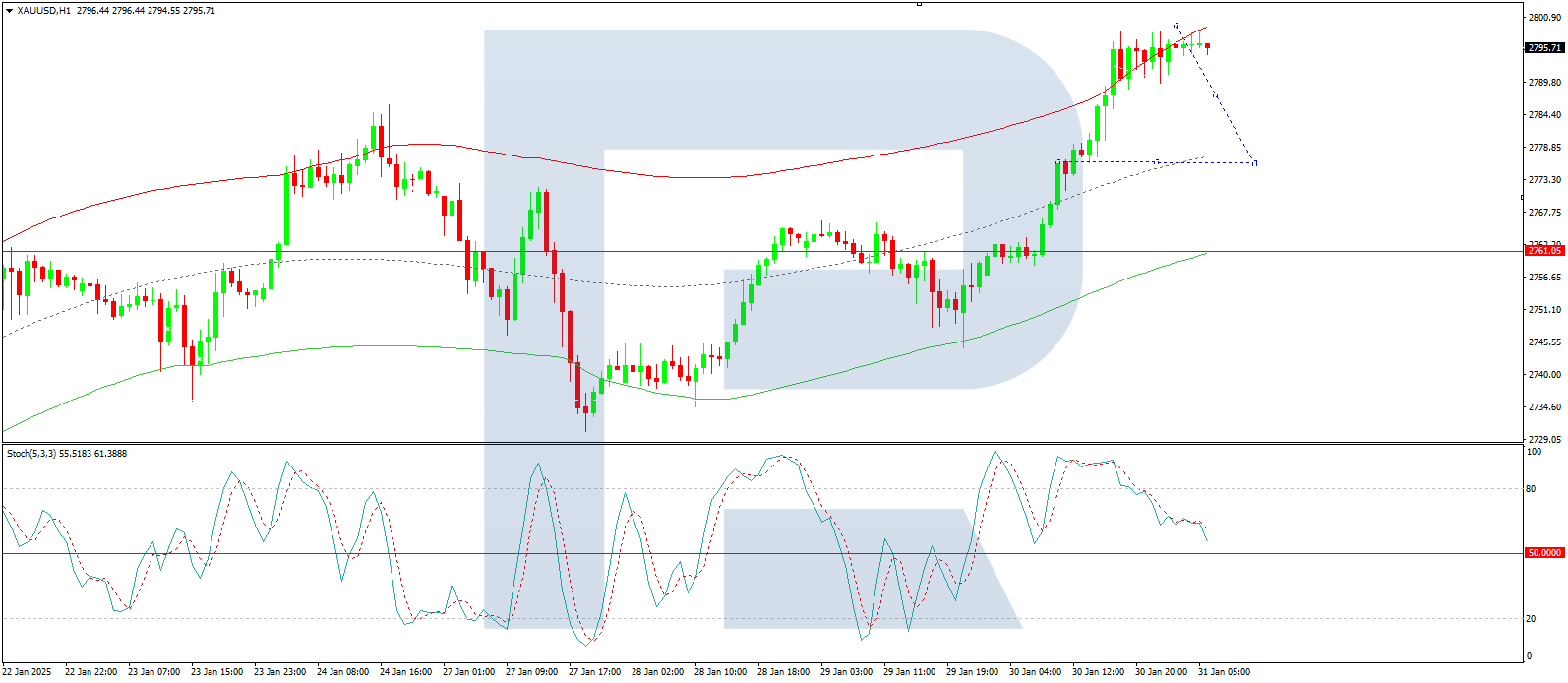
The Gold market has established a consolidation range around the level of 2,675.55. Following an upward breakout, a growth wave pushed the price to 2,726.26. A corrective movement towards 2670.66 is unfolding, after which another upward movement towards 2,743.85 is anticipated. This bullish scenario is supported by the MACD indicator, with its signal line positioned above zero and indicating upward momentum.

On the H1 chart, Gold is undergoing a correction towards 2,670.66. A rise to 2,697.77 could occur shortly, followed by a potential decline to the same level. Once this target is achieved, the possibility of initiating a new growth wave to 2,735.70 is expected, with a possible further extension to 2743.85. This analysis is corroborated by the Stochastic oscillator, whose signal line is currently above 50 and moving towards 80, suggesting continued upward potential.


Disclaimer

Any forecasts contained herein are based on the author’s particular opinion. This analysis may not be treated as trading advice. RoboForex bears no responsibility for trading results based on trading recommendations and reviews contained herein.

The Bank of Canada cut the rate again by 0.5%. Today, traders’ attention is directed to the SNB meeting

By JustMarkets

At the end of Wednesday, the Dow Jones Index (US30) fell by 0.22%. The S&P 500 Index (US500) is up 0.82%. The Nasdaq Technology Index (US100) jumped 1.85% to an all-time high. The US stocks extended early gains, reversing earlier session declines this week as inflation data offered no surprises and bolstered bets that the US Federal Reserve will cut rates next week. Markets rate the odds of a 25bp rate cut at the December 17–18 FOMC meeting at 95%. The US Consumer Price Index for November rose by 0.3% m/m and 2.7% y/y, which aligns with expectations. In addition, the Consumer Price Index, excluding food and energy, rose by 0.3% m/m and 3.3% y/y, which aligns with expectations.

Technology stocks led the gains, helped by low bond yields and bets that the incoming Trump administration may reduce sector regulation. Tesla (TSLA) jumped 3.6%, up nearly 70% since the November election, while Meta (META) added 5.3%, Nvidia (NVDA) jumped 2.6%, and Broadcom (AVGO) gained 5%.

At its December meeting, the Bank of Canada (BoC) cut its key interest rate by 50 bps for the second consecutive time, as expected by the markets. This brought the cumulative rate cut to 175 bps from this cycle’s peak of 5%. Nevertheless, the rhetoric of Central Bank policymakers suggests that there will be no more aggressive rate cuts next year, and officials have backtracked on the statement that borrowing costs will be reduced if the base case scenario continues. The sharp interest rate cut followed data that Canada’s GDP grew at a 1% annualized rate in the third quarter, below the Central Bank’s projections, and fourth-quarter growth risks also falling short of estimates.

Equity markets in Europe were mostly up yesterday. Germany’s DAX (DE40) rose by 0.34%, France’s CAC 40 (FR40) closed higher by 0.39%, Spain’s IBEX 35 (ES35) fell by 1.47%, and the UK’s FTSE 100 (UK100) closed up 0.26%.

The Swiss National Bank (SNB) is expected to meet today. Most economists expect a 25bps rate cut, but some economists expect a 0.5% rate cut. This is even though the current rate is at 1%. The Swiss franc has declined slightly over the past few months, but mainly because markets expect a significant rate cut towards the lower boundary of zero. A 0.25% rate cut is already factored into the price, so it will only add volatility to currency pairs with the CHF. But if the SNB surprises and goes for a 0.5% rate cut, the franc could come under selling pressure.

WTI crude oil prices jumped 2.5% to $70.29 a barrel on Wednesday, driven by the European Union’s approval of a new package of sanctions targeting Russian oil flows, adding to supply concerns. However, gains were tempered as the US EIA reported a larger-than-expected increase in gasoline and distillate inventories, signaling weak domestic fuel demand. Adding to market uncertainty, OPEC cut its estimates for global oil demand growth in 2024 and 2025 for the fifth consecutive month, citing weak demand in China and rising non-OPEC+ supply. OPEC+ had earlier postponed plans to increase production, reflecting cautious market dynamics.

The US natural gas prices (XNGUSD) climbed above $3.25/MMBtu, the highest in more than a week, mainly due to projections of colder weather and increased heating demand. In addition, export liquefied natural gas (LNG) plants are receiving more natural gas, averaging 14.0 Bcf/d in December compared to 13.6 in November.

Asian markets were relatively flat yesterday. Japan’s Nikkei 225 (JP225) rose by 0.01%, China’s FTSE China A50 (CHA50) gained 0.44%, Hong Kong’s Hang Seng (HK50) fell by 0.77%, and Australia’s ASX 200 (AU200) was negative 0.47%.

Australia’s seasonally adjusted unemployment rate fell to 3.9% in November 2024 from 4.1% in the previous three months, defying market estimates of 4.2%. It was the lowest unemployment rate since March as the number of jobless fell by 27,000 to an 8-month low. Market sentiment shifted sharply after the data release, as the implied probability of a February rate cut fell to around 50% from 68% before publication.

S&P 500 (US500) 6,084.19 +49.28 (+0.82%)

Dow Jones (US30) 44,148.56 −99.27 (−0.22%)

DAX (DE40) 20,399.16 +70.00 (+0.34%)

FTSE 100 (UK100) 8,301.62 +21.26 (+0.26%)

USD Index 106.65 +0.25 (+0.23%)

News feed for: 2024.12.12

  • Australia Unemployment Rate (m/m) at 02:30 (GMT+2);
  • Sweden Inflation Rate (m/m) at 09:00 (GMT+2);
  • Switzerland SNB Interest Rate Decision at 10:30 (GMT+2);
  • Switzerland SNB Monetary Policy Assessment at 10:30 (GMT+2);
  • Switzerland SNB Press Conference at 11:00 (GMT+2);
  • Eurozone ECB Interest Rate Decision at 15:15 (GMT+2);
  • Eurozone ECB Monetary Policy Statement at 15:15 (GMT+2);
  • US Producer Price Index (m/m) at 15:30 (GMT+2);
  • US Initial Jobless Claims (w/w) at 15:30 (GMT+2);
  • Eurozone ECB Press Conference at 15:45 (GMT+2);
  • US Natural Gas Storage (w/w) at 17:30 (GMT+2).

By JustMarkets


This article reflects a personal opinion and should not be interpreted as an investment advice, and/or offer, and/or a persistent request for carrying out financial transactions, and/or a guarantee, and/or a forecast of future events.

EURUSD Under Pressure US inflation, France, and ECB Rate

By RoboForex Analytical Department

The EUR/USD pair declined to 1.0504 on Thursday, influenced by investor reactions to the latest US inflation data. The November US Consumer Price Index (CPI) showed a rise of 0.3% month-over-month, aligning with forecasts but indicating a slight acceleration from the previous 0.2% increase. This recent uptick has adjusted market expectations significantly, reducing hopes for a substantial interest rate cut by the Federal Reserve in the upcoming meeting. According to CME Watch, the likelihood of a 25-basis-point cut is now pegged at 94%.

US inflation stands at 2.7% year-on-year, slightly up from 2.6%, suggesting persistent inflationary pressures despite elevated interest rates. This scenario indicates that consumers remain active, which could complicate the Federal Reserve’s monetary policy strategy.

Meanwhile, the political situation in France has been factored into the EUR/USD rates, though some underlying tensions persist.

Attention now turns to the European Central Bank (ECB), whose interest rate is 3.4%. Market participants are keenly awaiting whether the ECB will adjust rates in its upcoming meeting.

Technical analysis of EUR/USD

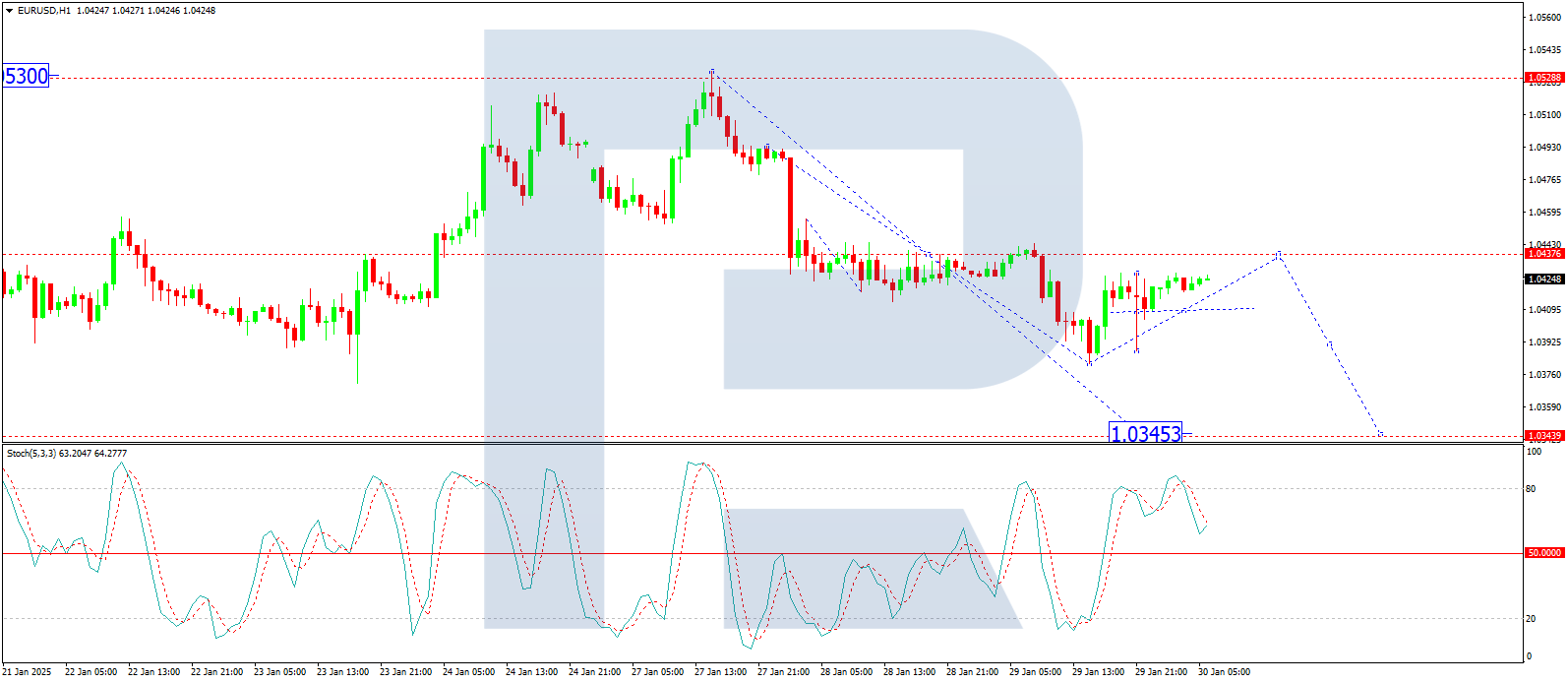
H4 chart: the EUR/USD has recently completed a decline to the level of 1.0479 and appears poised to continue this downward trend towards 1.0470. Following this, a corrective move to 1.0535 is anticipated, and once this is complete, another decline to 1.0444 could follow. This bearish outlook is supported by the MACD indicator, with its signal line positioned below zero and trending downwards, indicating continued selling pressure.

H1 chart: the pair is developing a downward structure towards 1.0470, currently consolidating around 1.0505. A breakout below this level could lead to reaching the target level of 1.0470. Subsequently, a rebound to 1.0535 might occur, followed by a further decline to 1.0444. This scenario is supported by the Stochastic Oscillator, with its signal line above 80 but poised to drop towards 20, suggesting a potential shift from overbought conditions to lower levels.


Disclaimer

Any forecasts contained herein are based on the author’s particular opinion. This analysis may not be treated as trading advice. RoboForex bears no responsibility for trading results based on trading recommendations and reviews contained herein.

Inflation is rising in Germany. Silver prices hit a one-month high

By JustMarkets

The Dow Jones (US30) was down 0.35% on Tuesday. The S&P 500 Index (US500) closed negative 0.30%. The Nasdaq Technology Index (US100) fell by 0.34%. Investors were cautious ahead of Wednesday’s expected consumer inflation report, which could significantly impact Federal Reserve policy. Despite the market decline, the indices remain near record highs, driven by optimism that the inflation data could reinforce expectations of a soft landing and pave the way for a Fed rate cut in December. The Consumer Price Index is expected to rise slightly to 2.7% y/y in November from 2.6% y/y in October. Meanwhile, the Core CPI (excluding food and energy) is expected to be unchanged from October at 3.3% y/y in November.

Oracle (ORCL) is down more than 6% after reporting adjusted second-quarter revenue of $14.06 billion, below the consensus estimate of $14.12 billion. EBay (EBAY) shares are down more than 2% after Jefferies downgraded the stock to “unweighted” from “hold” with a $52 price target. Alphabet (GOOG) is up more than 5% and led the Nasdaq 100 stocks higher after it disclosed a breakthrough in quantum computing with its new Willow quantum chip.

Equity markets in Europe were mostly down yesterday. Germany’s DAX (DE40) fell by 0.08%, France’s CAC 40 (FR40) closed down 1.14%, Spain’s IBEX 35 (ES35) dropped 0.38%, and the UK’s FTSE 100 (UK100) closed down 0.86%. Investor sentiment was dampened by disappointing trade data from China, which partially offset optimism from China’s announcement of fiscal and monetary policy easing for next year. Traders also refrained from making big bets ahead of tomorrow’s release of the US Consumer Price Index and Thursday’s ECB monetary policy decision.

German annual inflation rose to 2.2% in November 2024 from 2% in October, which is in line with preliminary estimates and the highest in four months. Core inflation, which excludes volatile food and energy prices, hit a six-month high of 3% in November. Norway’s annualized consumer inflation rate fell to 2.4% in November 2024 from 2.6% in the previous month. Meanwhile, the tax-adjusted Consumer Price Index excluding energy (CPI-ATE) rose to 3% year-over-year in November after rising 2.7% in October.

Silver prices (XAG/USD) traded near $32 an ounce on Tuesday, remaining near one-month highs as Chinese policymakers unveiled plans for additional economic stimulus, boosting demand prospects in the world’s top metals consumer. Like other precious metals, Silver also benefited from rising expectations that the US Federal Reserve will cut interest rates again this month.

WTI crude oil prices rose to around $69 a barrel on Wednesday, rising for the third consecutive session amid an improved demand outlook. This came after China announced plans to implement a sufficiently loose monetary policy next year to revitalize its economy, which could boost energy demand from the world’s largest oil importer. In support of that projection, China’s crude oil imports rose in November for the first time in seven months, rising more than 14% year-on-year.

Asian markets traded flat yesterday. Japan’s Nikkei 225 (JP225) rose by 0.53%, China’s FTSE China A50 (CHA50) gained 1.04%, Hong Kong’s Hang Seng (HK50) fell by 0.50%, and Australia’s ASX 200 (AU200) was negative 0.36%. In Asia, market attention turned to China’s annual Central Economic Work Conference, which began today. This closed-door meeting, which usually lasts two to three days, is an opportunity for China’s top leaders to assess the state of the economy and set priorities for the coming year.

The Reserve Bank of New Zealand (RBNZ) has already cut the official money rate by 125 bps this year to 4.25%. Markets are now pricing in a 59% chance of another 50bp rate cut at the Central Bank’s next meeting in February, further weighing on the local currency.

S&P 500 (US500) 6,034.91 −17.94 (−0.30%)

Dow Jones (US30) 44,247.83 −154.10 (−0.35%)

DAX (DE40) 20,329.16 −16.80 (−0.08%)

FTSE 100 (UK100) 8,280.36 −71.72 (−0.86%)

USD Index 106.41 +0.26 (+0.24%)

News feed for: 2024.12.11

  • US Consumer Price Index (m/m) at 15:30 (GMT+2);
  • Canada BoC Interest Rate Decision at 16:45 (GMT+2);
  • Canada BoC Monetary Policy Statement at 16:45 (GMT+2);
  • Canada BoC Press Conference at 17:30 (GMT+2);
  • US Crude Oil Reserves (w/w) at 17:30 (GMT+2).

By JustMarkets


This article reflects a personal opinion and should not be interpreted as an investment advice, and/or offer, and/or a persistent request for carrying out financial transactions, and/or a guarantee, and/or a forecast of future events.

Australian Dollar Hits Four-Week Low Amid RBA Stance and US Dollar Strength

By RoboForex Analytical Department 

The AUD/USD pair continues its downward trajectory, reaching a four-week low of 0.6386 on Wednesday. This decline is primarily influenced by the Reserve Bank of Australia’s (RBA) decision to maintain interest rates at 4.35% per annum for the ninth consecutive meeting. This decision, which was widely expected, reflects the central bank’s cautious approach despite ongoing inflation concerns.

RBA Governor Michelle Bullock emphasised that the central bank’s current stance on inflation is deliberate, aiming to signal responsiveness to softening economic indicators. The market currently anticipates a high likelihood of an RBA rate cut in February, with a 63% probability of a 25-basis-point reduction. Expectations are set for further cuts at subsequent meetings through May as investors and analysts factor in potential easing measures.

AUD supporters’ focus is shifting towards Thursday’s release of Australian employment data, which could provide further clues about the economic outlook and influence RBA policy decisions.

The Australian dollar is also experiencing significant pressure from a strengthening US dollar, which adds to its challenges.

Technical analysis of AUD/USD

H4 chart: the AUD/USD is navigating a wide consolidation range centred around 0.6450. The pair is currently forming a downward movement towards 0.6347. Upon reaching this level, a corrective rise to 0.6450 is expected, potentially testing this resistance from below before possibly initiating a new decline towards 0.6215. This bearish outlook is supported by the MACD indicator, whose signal line is below zero and continues to trend downwards.

H1 chart: the market is actively developing a downward wave towards 0.6347. After hitting this target, a corrective movement towards 0.6450 could occur. The Stochastic oscillator, with its signal line below 50 and moving towards 20, confirms this scenario, indicating the potential for further downward pressure before any corrective rebound.


Disclaimer

Any forecasts contained herein are based on the author’s particular opinion. This analysis may not be treated as trading advice. RoboForex bears no responsibility for trading results based on trading recommendations and reviews contained herein.

The RBA kept the rate at 4.35%. China plans to actively stimulate the economy in 2025

By JustMarkets

At Monday’s close, the Dow Jones Index (US30) was down 0.54%. The S&P 500 Index (US500) fell by 0.61%. The Nasdaq Technology Index (US100) lost 0.84%. Stocks in the US started the week lower as Nvidia shares fell amid an antitrust investigation in China, and investors were cautious ahead of a crucial inflation report. The Consumer Price Index is expected to rise slightly to 2.7% y/y in November from 2.6% y/y in October. Meanwhile, the Consumer Price Index, excluding food and energy, is expected to be unchanged from October at 3.3% y/y in November.

Advanced Micro Devices (AMD) shares closed down more than 5% after Bank of America Global Research downgraded the stock to “Neutral” from “Buy,” citing downside risks to the company’s 2025 expectations. Nvidia (NVDA) fell more than 2% after China Central Television reported that China’s State Administration of Market Regulation has begun inspecting the company over suspected antitrust violations.

In Mexico, November inflation fell short of expectations, with core inflation falling to 4.55% year-on-year, the lowest in eight months, and core inflation falling to 3.58%, the lowest since April 2020. With economists expecting a sharper decline, the report came out positive for the Mexican peso (MXN) as it maintains flexibility in the Bank of Mexico’s rate-cut cycle.

Equity markets in Europe traded flat yesterday. Germany’s DAX (DE40) fell by 0.19%, France’s CAC 40 (FR40) closed higher by 0.72%, Spain’s IBEX 35 (ES35) lost 0.50%, and the UK’s FTSE 100 (UK100) closed up 0.52%. The DAX Index (DE40) retreated from a record high on Monday as traders await Thursday’s decision by the ECB, which is expected to announce a fourth rate cut of 25 basis points. Swaps discount the odds of a 25 bps ECB rate cut at the Dec. 12 meeting by 100% and a 50 bps rate cut at the same meeting by 7%.

WTI crude oil prices rose above $68 a barrel amid optimism over China’s move to looser monetary policy and geopolitical uncertainty in the Middle East. China, the world’s largest oil importer, signaled a “moderately loose” monetary policy for 2025, marking the first major turn toward faster economic growth in over a decade. The move boosted risk sentiment and helped crude oil prices. Geopolitical tensions also provided support as reports of Syrian President Bashar al-Assad’s ouster raised fears of further instability in the Middle East.

Asian markets were predominantly rising yesterday. Japan’s Nikkei 225 (JP225) rose by 0.18%, China’s FTSE China A50 (CHA50) gained 1.31%, Hong Kong’s Hang Seng (HK50) rose by 2.76%, and Australia’s ASX 200 (AU200) gained 0.03%. On Monday, Asian stock markets received support from China’s monetary policy changes. China’s Politburo, the 24 most senior officials of the ruling Communist Party led by President Xi Jinping, announced today that it would pursue a “moderately loose” monetary policy strategy next year and promised to be “more active” on fiscal policy, signaling further easing is coming. Investors will now turn their attention to this week’s Central Economic Work Conference, where China is expected to outline its economic priorities and targets for 2025.

The ASX 200 Index (AU200) fell by 0.36% on Tuesday to close at 8,393 after the Reserve Bank of Australia (RBA) left the rate unchanged at 4.35% for the ninth consecutive meeting, as expected. However, the central bank said it had “some confidence” that inflation was returning to target. RBA chief Michele Bullock also emphasized that the change in the wording of the statement was intentional and reflected softening economic data. The RBA added that it will continue to base its decisions on the data and its evolving assessment of risks, including geopolitical uncertainty.

S&P 500 (US500) 6,052.85 −37.42 (−0.61%)

Dow Jones (US30) 44,401.93 −240.59 (−0.54%)

DAX (DE40) 20,345.96 −38.65 (−0.19%)

FTSE 100 (UK100) 8,352.08 +43.47 (+0.52%)

USD Index 106.15 +0.10 (+0.09%)

News feed for: 2024.12.10

  • Australia NAB Business Confidence (m/m) at 02:30 (GMT+2);
  • China Trade Balance (m/m) at 05:00 (GMT+2);
  • Australia RBA Interest Rate Decision at 05:30 (GMT+2);
  • Australia RBA Monetary Policy Statement at 05:30 (GMT+2);
  • Australia RBA Press Conference at 06:30 (GMT+2);
  • German Consumer Price Index (m/m) at 09:00 (GMT+2).

By JustMarkets


This article reflects a personal opinion and should not be interpreted as an investment advice, and/or offer, and/or a persistent request for carrying out financial transactions, and/or a guarantee, and/or a forecast of future events.

USDInd steady ahead of US CPI report

By ForexTime 

  • USDInd ↑ 0.3% WTD, trapped in range
  • Over past year US CPI triggered moves of ↑ 0.7% & ↓ 0.4%
  • ECB decision could spark more volatility
  • Technical levels = 105.50 & 106.80

FXTM’s USDInd is on standby mode ahead of the US inflation report on Wednesday 11th December.

Bulls have held their ground despite last Friday’s soft US jobs report boosting Fed cut bets.

DXY

Note: FXTM’s USDInd tracks the US Dollar Index.  This measures how the dollar performs against a basket of six different G10 currencies, including the Euro, British Pound, Japanese Yen, and Canadian dollar.


The US November job report revealed:

  • Nonfarm payrolls increased 227,000 last month from 12,000 in October.
  • The unemployment rate edged to 4.2% from 4.1%.
  • Average hourly wages unchanged at 4.0% YoY and 0.4% MoM.

This report reinforced bets around lower US rates with traders now pricing in an 86% probability of a 25-bps cut in December.

Still, FXTM’s USDInd is up roughly 0.3% week-to-date and trading around 106.30 as of writing.

Geopolitical risk in the Middle East and political uncertainty in Korea could be factors supporting the dollar.

In addition, the European Central Bank, Bank of Canada and Swiss National Bank are expected to cut interest rates this week.

Note: The Euro accounts for almost 60% of the USDInd weighting, 9% of the Cad and roughly 4% of the Franc.

A weaker euro, cad and franc could push the dollar index higher and vice versa.


Redirecting our attention back toward the inflation reading:

US November CPI report

The November US Consumer Price Index (CPI) report on Wednesday, December 11th may impact bets around how aggressively the Fed cuts rates in the new year.

  • CPI is projected to rise 0.3% month-on-month in November from 0.2% prior.
  • Rise 2.7% year-over-year from the 2.6% prior.
  • Core: to remain unchanged at 0.3% month-on-month.
  • Core: unchanged at 3.3% year-on-year.

Over the past year, the US CPI report has triggered upside moves of as much as 0.7% or declines of 0.4% in a 6-hour window post-release.

  • The USDInd could slip on signs of cooling price pressures.
  • A hotter-than-expected CPI report could push the USDInd higher.


Keep an eye on the technicals

Prices remain in a range on the daily charts with support at 105.50 and resistance at 106.80.

  • A sold breakout above 106.40 may signal a move toward 106.80 and 107.60.
  • Should prices slip below 105.80, bears may be encouraged to target 105.50 and the 50-day SMA at 104.80.

USDInd9


Forex-Time-LogoArticle by ForexTime

ForexTime Ltd (FXTM) is an award winning international online forex broker regulated by CySEC 185/12 www.forextime.com