Yen’s rally stalls but may resume soon

By RoboForex Analytical Department

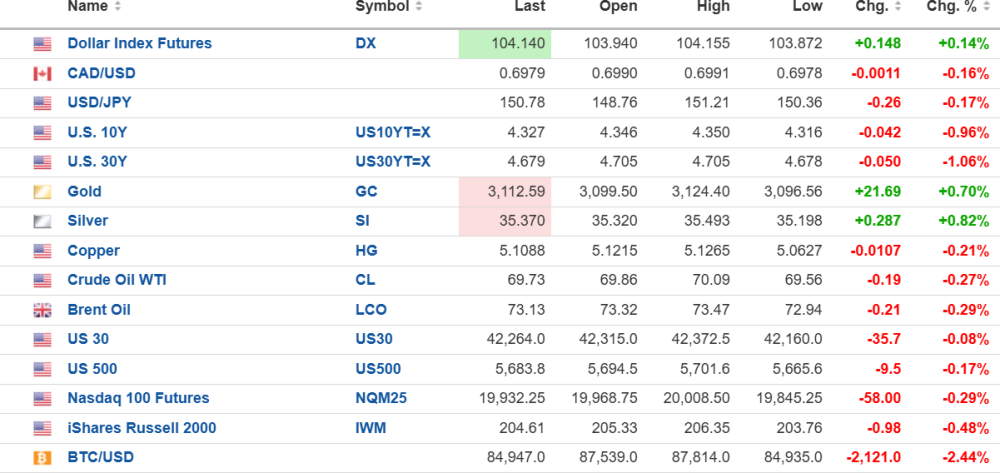
USD/JPY is consolidating near 151.96 after a temporary pause in the yen’s recent strength.

Key market factors

At the beginning of the week, the Japanese yen weakened against the US dollar as the greenback reacted to fresh US trade tariffs.

US President Donald Trump recently signed an executive order imposing a 25% tariff on steel and aluminium imports, with no exemptions for partner countries. This decision has triggered fears of a global trade war, which could, in turn, limit the Federal Reserve’s ability to cut interest rates further.

Despite this, the yen appreciated by 2% against the USD last week, driven by increasing market expectations that the Bank of Japan (BoJ) will continue its monetary tightening cycle.

BoJ policymaker Naoki Tamura reinforced this view last Thursday by suggesting that the central bank should move towards an interest rate of at least 1% in the second half of fiscal 2025. Recent Japanese economic data supports this hawkish stance, with rising wages and household spending providing a solid foundation for further rate hikes.

Technical analysis of USD/JPY

On the H4 chart, USD/JPY formed a consolidation range around 151.90 after a downward move. A break below this range is expected, targeting 148.80, with a potential continuation to 148.38. This level serves as a local target. Once the wave completes, a corrective move towards 151.90 is possible before the broader downtrend resumes, aiming for 145.50. The MACD indicator confirms this scenario, with its signal line below zero and sharply downwards, suggesting ongoing bearish momentum.

On the H1 chart, the market is developing a downward wave towards 148.40, with consolidation around 151.90. A downside breakout would confirm the continuation of the second phase of the decline. After reaching 148.40, a corrective move back to 151.90 could materialise. The Stochastic oscillator supports this outlook, with its signal line below 80 and sharply downward, indicating bearish pressure.

Conclusion

The Japanese yen’s rally has paused, but further gains remain likely, supported by expectations of continued BoJ tightening. Technical indicators suggest that USD/JPY may break lower towards 148.40, with further downside potential towards 145.50. The yen’s trajectory will depend on BoJ policy signals and further developments in US trade policy, particularly how global markets respond to Trump’s tariffs.


Disclaimer

Any forecasts contained herein are based on the author’s particular opinion. This analysis may not be treated as trading advice. RoboForex bears no responsibility for trading results based on trading recommendations and reviews contained herein.

Trump’s tariff intimidation continues to rattle markets

By JustMarkets

At Friday’s close, the Dow Jones Index (US30) decreased by 0.99% (for the week +0.08%). The S&P 500 Index (US500) lost 0.95% (for the week +0.94%). The Nasdaq Technology Index (US100) fell by 1.30% (for the week +1.93%). Stocks in the US declined during the afternoon session as investors grappled with new tariff concerns, inflation worries and the latest jobs report. Markets moved sharply lower following reports that President Trump is considering retaliatory tariffs, which could lead to higher rates for US trading partners. Investors were further worried by the University of Michigan’s consumer sentiment report, which showed that annual inflation expectations rose to 4.3%, the highest since November 2023. Meanwhile, the January jobs report showed that the US economy added 143,000 jobs, slightly below expectations, but the unemployment rate fell to 4.0%.

The US President Donald Trump said on Sunday he would announce additional 25% tariffs on all US steel and aluminum imports, as well as impose retaliatory duties on what he considers unfair trade practices. Canada, Brazil, Mexico, Mexico, South Korea and Vietnam are the largest exporters of steel to the US, government data show. Canada is also the largest exporter of aluminum to the United States.

The Canadian dollar traded near 1.43 per US dollar, rebounding from 22-year lows of 1.455 hit on January 31, as strong labor market data limited the need for the Bank of Canada to cut rates. Canada’s unemployment rate fell to 6.6% in January from 6.7% in December, defying expectations of a rise to 6.8% and easing fears of labor market weakness highlighted by the Bank of Canada. However, Ivey’s PMI fell to 47.1 from 54.7, well below expectations of 53, the lowest reading since December 2020 and reinforcing expectations of policy easing. In addition to the dovish outlook, the Bank of Canada plans to resume asset purchases in March, aiming to reinstate bond purchases in the secondary market by 2026.

Mexico’s annual inflation rate slowed for a third month in January 2025, hitting a four-year low of 3.59%, slightly below market projections of 3.61%. The rate is now below the top end of the Central Bank’s target range of 2% to 4%. The annualized core inflation rate rose to 3.66% in January from December’s 3.65%, but fell short of market estimates of 3.70%.

Equity markets in Europe were mostly down on Friday. Germany’s DAX (DE40) fell by 0.53% (for the week +2.28%), France’s CAC 40 (FR40) closed down 0.43% (for the week +2.40%), Spain’s IBEX 35 (ES35) lost 0.33% (for the week +4.67%), and the UK’s FTSE 100 (UK100) closed negative 0.31% (for the week +0.31%). German industrial production fell more than expected at the end of 2024, recording the largest decline in five months. On the Eurozone corporate front, L’Oréal fell more than 4% after reporting its slowest quarterly sales growth since the pandemic. Porsche also fell nearly 7% after announcing asset impairments and a 2025 sales estimates that fell short of expectations.

Silver rose to $32.5 an ounce on Friday, its highest in three months, on the prospect of weaker financial conditions, higher demand for inputs and tight supply. Traders remain bullish on multiple Fed rate cuts this year. The ECB, BoE, RBNZ and RBI are also on a softer policy stance.

WTI crude oil prices rose 0.5% to reach $71/bbl on Friday after new sanctions were imposed on Iran’s oil exports, but gains were limited by US President Donald Trump’s escalating trade dispute with China and the threat of new tariffs against other countries. Despite these gains, the benchmark recorded its third consecutive weekly decline, down around 2%, mainly due to escalating trade tensions caused by President Trump’s recent announcements of imposing tariffs against China and other countries. Analysts have expressed concerns that these trade disputes could dampen global economic growth and consequently reduce oil demand.

The US natural gas prices (XNG/USD) were down slightly at $3.35/MMBtu on Friday, but are up nearly 10% this week. The increase was driven by higher LNG exports and prognoses of colder weather expected to boost heating demand. Gas flows to LNG export plants also increased to 15.1 Bcf/d in February from 14.6 Bcf/d in January, close to December’s record.

Asian markets were mostly falling last week. Japan’s Nikkei 225 (JP225) fell by 0.37%, China’s FTSE China A50 (CHA50) rose by 1.92%, Hong Kong’s Hang Seng (HK50) gained 5.41%, and Australia’s ASX 200 (AU200) was negative 0.24%.

China’s annualized inflation rate for January 2025 rose to 0.5% from 0.1% in December, beating the market consensus expectations of 0.4%. This is the highest rate since August 2024, driven by seasonal effects associated with the Lunar New Year celebrations at the end of the month. The latest result also reflected the impact of recent government stimulus measures and the Central Bank’s supportive monetary policy aimed at helping the economy. Core consumer prices excluding food and energy rose by 0.6% y/y, the highest in 7 months. Producer prices in China were 2.3% y/y in January 2025, maintaining the same pace as the previous month and beating market estimates of 2.1%. This was the 28th consecutive month of producer price deflation.

S&P 500 (US500) 6,025.99 −57.58 (−0.95%)

Dow Jones (US30) 44,303.40 −444.23 (−0.99%)

DAX (DE40) 21,787.00 −115.42 (−0.53%)

FTSE 100 (UK100) 8,700.53 −26.75 (−0.31%)

USD Index 108.10 +0.41 (+0.38%)

News feed for: 2025.02.10

  • Norway Inflation Rate (m/m) at 09:00 (GMT+2);
  • Eurozone ECB President Lagarde Speech at 16:00 (GMT+2).

By JustMarkets


This article reflects a personal opinion and should not be interpreted as an investment advice, and/or offer, and/or a persistent request for carrying out financial transactions, and/or a guarantee, and/or a forecast of future events.

Japanese Yen Speculators push yen bets into new bullish position

By InvestMacro

Here are the latest charts and statistics for the Commitment of Traders (COT) data published by the Commodities Futures Trading Commission (CFTC).

The latest COT data is updated through Tuesday February 4th and shows a quick view of how large market participants (for-profit speculators and commercial traders) were positioned in the futures markets. All currency positions are in direct relation to the US dollar where, for example, a bet for the euro is a bet that the euro will rise versus the dollar while a bet against the euro will be a bet that the euro will decline versus the dollar.

Weekly Speculator Changes led by Brazilian Real & Japanese Yen

The COT currency market speculator bets were higher this week as seven out of the eleven currency markets we cover had higher positioning while the other four markets had lower speculator contracts.

Leading the gains for the currency markets was the Brazilian Real (38,736 contracts) with the Japanese Yen (19,727 contracts), the British Pound (10,349 contracts), the EuroFX (7,990 contracts), the Mexican Peso (7,038 contracts), the Swiss Franc (742 contracts) and the US Dollar Index (339 contracts) also showing positive weeks.

The currencies seeing declines in speculator bets on the week were the Canadian Dollar (-12,843 contracts), the Australian Dollar (-3,478 contracts), the New Zealand Dollar (-2,059 contracts) and with Bitcoin (-379 contracts) also registering lower bets on the week.

Japanese Yen Speculators push yen bets into new bullish position

Highlighting the COT currency’s data this week is the renewal in bullish bets for the Japanese yen speculators. Large speculative yen positions gained for a third consecutive week this week and has risen by a total of +48,179 contracts over these past three weeks.

This renewed sentiment for the yen has pushed the net position (currently at +18,768 contracts) to the most positive level in the past eight weeks. The yen speculator bets had recently spent four weeks in bullish territory in December before dropping back into negative territory in January.

The yen has had extremely bearish speculator positioning over the past four years (basically since March of 2021) and very often had over -100,000 net speculator weekly contracts as policy divergences between the US Federal Reserve and the Bank of Japan caused the yen exchange rate to drop to multi-decade lows versus the American currency.

The BOJ recently raised their interest rate by 25 basis points in January from 0.25 percent to 0.50 percent as inflation is poised to pickup, according to the BOJ. This increase moved the rate to the highest level since 2008, underscoring the rare move.

The yen exchange rate, overall, has continued to trend near the bottom of its range from the past few years but has managed to gain versus the US Dollar for the past four weeks in a row. The USDJPY currency pair trades at 151.42 to end the week after hitting support right below 159.00 in late-January. Since then, the USDJPY has seen yen strength with a break below support at 155.00 and currently trades around a major support/resistance level around 152.00 that could determine the short-term direction of the pair.


Currencies Net Speculators Leaderboard

Legend: Weekly Speculators Change | Speculators Current Net Position | Speculators Strength Score compared to last 3-Years (0-100 range)


Strength Scores led by Japanese Yen & Bitcoin

COT Strength Scores (a normalized measure of Speculator positions over a 3-Year range, from 0 to 100 where above 80 is Extreme-Bullish and below 20 is Extreme-Bearish) showed that the Japanese Yen (81 percent) and the Bitcoin (68 percent) lead the currency markets this week. The Brazilian Real (52 percent), US Dollar Index (37 percent) and the Mexican Peso (35 percent) come in as the next highest in the weekly strength scores.

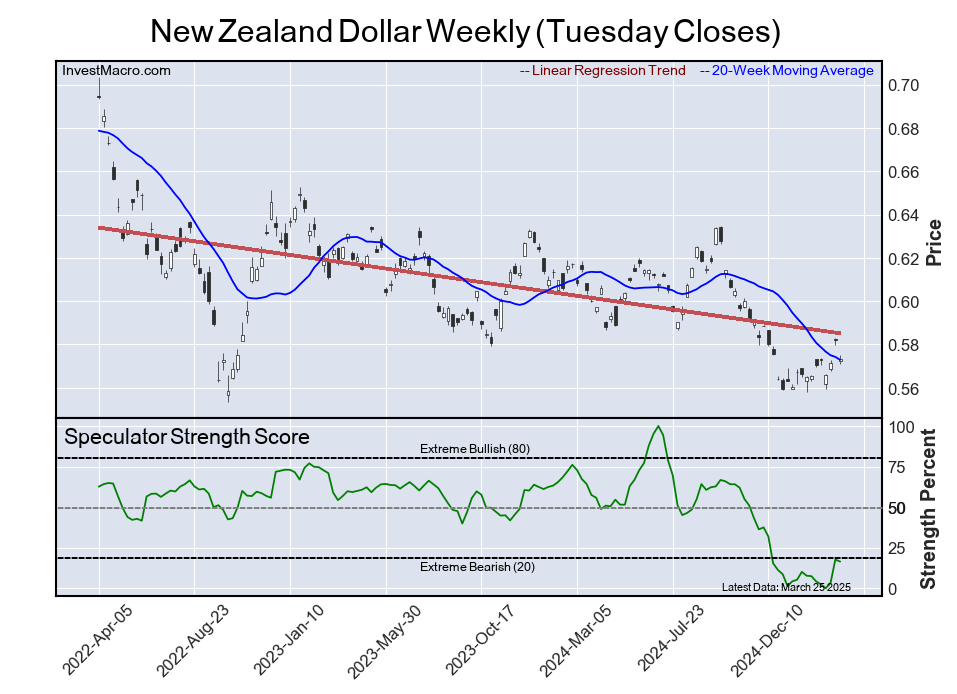
On the downside, the New Zealand Dollar (6 percent), the EuroFX (6 percent), the Swiss Franc (15 percent) and the Canadian Dollar (16 percent) come in at the lowest strength levels currently and are in Extreme-Bearish territory (below 20 percent).

3-Year Strength Statistics:
US Dollar Index (36.8 percent) vs US Dollar Index previous week (36.1 percent)
EuroFX (6.5 percent) vs EuroFX previous week (3.4 percent)
British Pound Sterling (31.0 percent) vs British Pound Sterling previous week (26.4 percent)
Japanese Yen (81.1 percent) vs Japanese Yen previous week (73.2 percent)
Swiss Franc (15.3 percent) vs Swiss Franc previous week (13.8 percent)
Canadian Dollar (16.1 percent) vs Canadian Dollar previous week (21.8 percent)
Australian Dollar (22.9 percent) vs Australian Dollar previous week (25.3 percent)
New Zealand Dollar (6.5 percent) vs New Zealand Dollar previous week (8.9 percent)
Mexican Peso (35.0 percent) vs Mexican Peso previous week (31.4 percent)
Brazilian Real (52.3 percent) vs Brazilian Real previous week (15.6 percent)
Bitcoin (68.4 percent) vs Bitcoin previous week (76.7 percent)


Brazilian Real & Bitcoin top the 6-Week Strength Trends

COT Strength Score Trends (or move index, calculates the 6-week changes in strength scores) showed that the Brazilian Real (20 percent) and the Bitcoin (20 percent) lead the past six weeks trends for the currencies. The US Dollar Index (17 percent), the Japanese Yen (7 percent) and the Canadian Dollar (7 percent) are the next highest positive movers in the 3-Year trends data.

The Swiss Franc (-28 percent) leads the downside trend scores currently with the British Pound (-14 percent), Australian Dollar (-5 percent) and the New Zealand Dollar (-4 percent) following next with lower trend scores.

3-Year Strength Trends:
US Dollar Index (16.7 percent) vs US Dollar Index previous week (17.7 percent)
EuroFX (3.8 percent) vs EuroFX previous week (-0.3 percent)
British Pound Sterling (-13.8 percent) vs British Pound Sterling previous week (-19.5 percent)
Japanese Yen (6.6 percent) vs Japanese Yen previous week (-2.8 percent)
Swiss Franc (-28.1 percent) vs Swiss Franc previous week (-43.0 percent)
Canadian Dollar (7.3 percent) vs Canadian Dollar previous week (15.4 percent)
Australian Dollar (-5.1 percent) vs Australian Dollar previous week (-7.3 percent)
New Zealand Dollar (-3.6 percent) vs New Zealand Dollar previous week (-5.3 percent)
Mexican Peso (-3.4 percent) vs Mexican Peso previous week (-4.8 percent)
Brazilian Real (19.9 percent) vs Brazilian Real previous week (-16.7 percent)
Bitcoin (20.0 percent) vs Bitcoin previous week (21.7 percent)


Individual COT Forex Markets:

US Dollar Index Futures:

US Dollar Index Forex Futures COT ChartThe US Dollar Index large speculator standing this week equaled a net position of 14,539 contracts in the data reported through Tuesday. This was a weekly advance of 339 contracts from the previous week which had a total of 14,200 net contracts.

This week’s current strength score (the trader positioning range over the past three years, measured from 0 to 100) shows the speculators are currently Bearish with a score of 36.8 percent. The commercials are Bullish with a score of 62.7 percent and the small traders (not shown in chart) are Bearish with a score of 41.7 percent.

Price Trend-Following Model: Weak Uptrend

Our weekly trend-following model classifies the current market price position as: Weak Uptrend.

US DOLLAR INDEX StatisticsSPECULATORSCOMMERCIALSSMALL TRADERS
– Percent of Open Interest Longs:63.524.39.8
– Percent of Open Interest Shorts:26.964.36.3
– Net Position:14,539-15,9141,375
– Gross Longs:25,2039,6303,885
– Gross Shorts:10,66425,5442,510
– Long to Short Ratio:2.4 to 10.4 to 11.5 to 1
NET POSITION TREND:
– Strength Index Score (3 Year Range Pct):36.862.741.7
– Strength Index Reading (3 Year Range):BearishBullishBearish
NET POSITION MOVEMENT INDEX:
– 6-Week Change in Strength Index:16.7-15.0-5.0


Euro Currency Futures:

Euro Currency Futures COT ChartThe Euro Currency large speculator standing this week equaled a net position of -58,614 contracts in the data reported through Tuesday. This was a weekly increase of 7,990 contracts from the previous week which had a total of -66,604 net contracts.

This week’s current strength score (the trader positioning range over the past three years, measured from 0 to 100) shows the speculators are currently Bearish-Extreme with a score of 6.5 percent. The commercials are Bullish-Extreme with a score of 93.6 percent and the small traders (not shown in chart) are Bearish with a score of 22.4 percent.

Price Trend-Following Model: Downtrend

Our weekly trend-following model classifies the current market price position as: Downtrend.

EURO Currency StatisticsSPECULATORSCOMMERCIALSSMALL TRADERS
– Percent of Open Interest Longs:26.456.512.1
– Percent of Open Interest Shorts:35.950.68.5
– Net Position:-58,61436,47122,143
– Gross Longs:162,554348,35474,337
– Gross Shorts:221,168311,88352,194
– Long to Short Ratio:0.7 to 11.1 to 11.4 to 1
NET POSITION TREND:
– Strength Index Score (3 Year Range Pct):6.593.622.4
– Strength Index Reading (3 Year Range):Bearish-ExtremeBullish-ExtremeBearish
NET POSITION MOVEMENT INDEX:
– 6-Week Change in Strength Index:3.8-6.419.5


British Pound Sterling Futures:

British Pound Sterling Futures COT ChartThe British Pound Sterling large speculator standing this week equaled a net position of -11,323 contracts in the data reported through Tuesday. This was a weekly lift of 10,349 contracts from the previous week which had a total of -21,672 net contracts.

This week’s current strength score (the trader positioning range over the past three years, measured from 0 to 100) shows the speculators are currently Bearish with a score of 31.0 percent. The commercials are Bullish with a score of 71.3 percent and the small traders (not shown in chart) are Bearish with a score of 33.4 percent.

Price Trend-Following Model: Downtrend

Our weekly trend-following model classifies the current market price position as: Downtrend.

BRITISH POUND StatisticsSPECULATORSCOMMERCIALSSMALL TRADERS
– Percent of Open Interest Longs:32.054.511.2
– Percent of Open Interest Shorts:37.542.317.9
– Net Position:-11,32325,029-13,706
– Gross Longs:65,442111,61922,951
– Gross Shorts:76,76586,59036,657
– Long to Short Ratio:0.9 to 11.3 to 10.6 to 1
NET POSITION TREND:
– Strength Index Score (3 Year Range Pct):31.071.333.4
– Strength Index Reading (3 Year Range):BearishBullishBearish
NET POSITION MOVEMENT INDEX:
– 6-Week Change in Strength Index:-13.815.1-15.2


Japanese Yen Futures:

Japanese Yen Forex Futures COT ChartThe Japanese Yen large speculator standing this week equaled a net position of 18,768 contracts in the data reported through Tuesday. This was a weekly rise of 19,727 contracts from the previous week which had a total of -959 net contracts.

This week’s current strength score (the trader positioning range over the past three years, measured from 0 to 100) shows the speculators are currently Bullish-Extreme with a score of 81.1 percent. The commercials are Bearish-Extreme with a score of 17.2 percent and the small traders (not shown in chart) are Bullish-Extreme with a score of 92.5 percent.

Price Trend-Following Model: Weak Downtrend

Our weekly trend-following model classifies the current market price position as: Weak Downtrend.

JAPANESE YEN StatisticsSPECULATORSCOMMERCIALSSMALL TRADERS
– Percent of Open Interest Longs:45.130.421.2
– Percent of Open Interest Shorts:37.043.616.1
– Net Position:18,768-30,68311,915
– Gross Longs:104,68470,41849,277
– Gross Shorts:85,916101,10137,362
– Long to Short Ratio:1.2 to 10.7 to 11.3 to 1
NET POSITION TREND:
– Strength Index Score (3 Year Range Pct):81.117.292.5
– Strength Index Reading (3 Year Range):Bullish-ExtremeBearish-ExtremeBullish-Extreme
NET POSITION MOVEMENT INDEX:
– 6-Week Change in Strength Index:6.6-12.643.4


Swiss Franc Futures:

Swiss Franc Forex Futures COT ChartThe Swiss Franc large speculator standing this week equaled a net position of -42,258 contracts in the data reported through Tuesday. This was a weekly gain of 742 contracts from the previous week which had a total of -43,000 net contracts.

This week’s current strength score (the trader positioning range over the past three years, measured from 0 to 100) shows the speculators are currently Bearish-Extreme with a score of 15.3 percent. The commercials are Bullish-Extreme with a score of 89.6 percent and the small traders (not shown in chart) are Bearish with a score of 23.5 percent.

Price Trend-Following Model: Downtrend

Our weekly trend-following model classifies the current market price position as: Downtrend.

SWISS FRANC StatisticsSPECULATORSCOMMERCIALSSMALL TRADERS
– Percent of Open Interest Longs:5.485.68.6
– Percent of Open Interest Shorts:48.529.221.9
– Net Position:-42,25855,303-13,045
– Gross Longs:5,24283,8738,424
– Gross Shorts:47,50028,57021,469
– Long to Short Ratio:0.1 to 12.9 to 10.4 to 1
NET POSITION TREND:
– Strength Index Score (3 Year Range Pct):15.389.623.5
– Strength Index Reading (3 Year Range):Bearish-ExtremeBullish-ExtremeBearish
NET POSITION MOVEMENT INDEX:
– 6-Week Change in Strength Index:-28.114.521.0


Canadian Dollar Futures:

Canadian Dollar Forex Futures COT ChartThe Canadian Dollar large speculator standing this week equaled a net position of -160,444 contracts in the data reported through Tuesday. This was a weekly reduction of -12,843 contracts from the previous week which had a total of -147,601 net contracts.

This week’s current strength score (the trader positioning range over the past three years, measured from 0 to 100) shows the speculators are currently Bearish-Extreme with a score of 16.1 percent. The commercials are Bullish-Extreme with a score of 86.4 percent and the small traders (not shown in chart) are Bearish-Extreme with a score of 12.8 percent.

Price Trend-Following Model: Downtrend

Our weekly trend-following model classifies the current market price position as: Downtrend.

CANADIAN DOLLAR StatisticsSPECULATORSCOMMERCIALSSMALL TRADERS
– Percent of Open Interest Longs:5.984.57.4
– Percent of Open Interest Shorts:52.135.310.4
– Net Position:-160,444170,842-10,398
– Gross Longs:20,421293,32325,707
– Gross Shorts:180,865122,48136,105
– Long to Short Ratio:0.1 to 12.4 to 10.7 to 1
NET POSITION TREND:
– Strength Index Score (3 Year Range Pct):16.186.412.8
– Strength Index Reading (3 Year Range):Bearish-ExtremeBullish-ExtremeBearish-Extreme
NET POSITION MOVEMENT INDEX:
– 6-Week Change in Strength Index:7.3-7.23.3


Australian Dollar Futures:

Australian Dollar Forex Futures COT ChartThe Australian Dollar large speculator standing this week equaled a net position of -75,309 contracts in the data reported through Tuesday. This was a weekly lowering of -3,478 contracts from the previous week which had a total of -71,831 net contracts.

This week’s current strength score (the trader positioning range over the past three years, measured from 0 to 100) shows the speculators are currently Bearish with a score of 22.9 percent. The commercials are Bullish with a score of 79.7 percent and the small traders (not shown in chart) are Bearish with a score of 27.5 percent.

Price Trend-Following Model: Downtrend

Our weekly trend-following model classifies the current market price position as: Downtrend.

AUSTRALIAN DOLLAR StatisticsSPECULATORSCOMMERCIALSSMALL TRADERS
– Percent of Open Interest Longs:17.268.111.0
– Percent of Open Interest Shorts:54.027.315.0
– Net Position:-75,30983,501-8,192
– Gross Longs:35,330139,49422,568
– Gross Shorts:110,63955,99330,760
– Long to Short Ratio:0.3 to 12.5 to 10.7 to 1
NET POSITION TREND:
– Strength Index Score (3 Year Range Pct):22.979.727.5
– Strength Index Reading (3 Year Range):BearishBullishBearish
NET POSITION MOVEMENT INDEX:
– 6-Week Change in Strength Index:-5.13.24.8


New Zealand Dollar Futures:

New Zealand Dollar Forex Futures COT ChartThe New Zealand Dollar large speculator standing this week equaled a net position of -49,090 contracts in the data reported through Tuesday. This was a weekly decline of -2,059 contracts from the previous week which had a total of -47,031 net contracts.

This week’s current strength score (the trader positioning range over the past three years, measured from 0 to 100) shows the speculators are currently Bearish-Extreme with a score of 6.5 percent. The commercials are Bullish-Extreme with a score of 93.8 percent and the small traders (not shown in chart) are Bearish with a score of 20.6 percent.

Price Trend-Following Model: Downtrend

Our weekly trend-following model classifies the current market price position as: Downtrend.

NEW ZEALAND DOLLAR StatisticsSPECULATORSCOMMERCIALSSMALL TRADERS
– Percent of Open Interest Longs:9.985.74.1
– Percent of Open Interest Shorts:68.424.27.2
– Net Position:-49,09051,675-2,585
– Gross Longs:8,32771,9893,459
– Gross Shorts:57,41720,3146,044
– Long to Short Ratio:0.1 to 13.5 to 10.6 to 1
NET POSITION TREND:
– Strength Index Score (3 Year Range Pct):6.593.820.6
– Strength Index Reading (3 Year Range):Bearish-ExtremeBullish-ExtremeBearish
NET POSITION MOVEMENT INDEX:
– 6-Week Change in Strength Index:-3.62.88.2


Mexican Peso Futures:

Mexican Peso Futures COT ChartThe Mexican Peso large speculator standing this week equaled a net position of 12,262 contracts in the data reported through Tuesday. This was a weekly rise of 7,038 contracts from the previous week which had a total of 5,224 net contracts.

This week’s current strength score (the trader positioning range over the past three years, measured from 0 to 100) shows the speculators are currently Bearish with a score of 35.0 percent. The commercials are Bullish with a score of 69.3 percent and the small traders (not shown in chart) are Bearish-Extreme with a score of 7.5 percent.

Price Trend-Following Model: Downtrend

Our weekly trend-following model classifies the current market price position as: Downtrend.

MEXICAN PESO StatisticsSPECULATORSCOMMERCIALSSMALL TRADERS
– Percent of Open Interest Longs:42.354.02.1
– Percent of Open Interest Shorts:33.860.64.0
– Net Position:12,262-9,518-2,744
– Gross Longs:61,45978,5643,020
– Gross Shorts:49,19788,0825,764
– Long to Short Ratio:1.2 to 10.9 to 10.5 to 1
NET POSITION TREND:
– Strength Index Score (3 Year Range Pct):35.069.37.5
– Strength Index Reading (3 Year Range):BearishBullishBearish-Extreme
NET POSITION MOVEMENT INDEX:
– 6-Week Change in Strength Index:-3.43.21.6


Brazilian Real Futures:

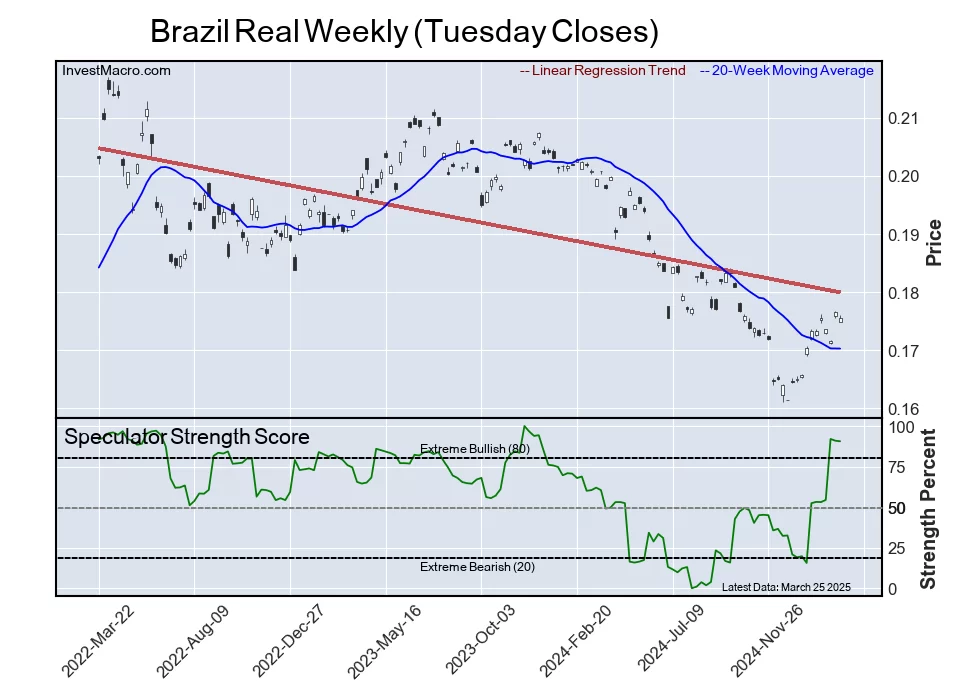
Brazil Real Futures COT ChartThe Brazilian Real large speculator standing this week equaled a net position of 242 contracts in the data reported through Tuesday. This was a weekly rise of 38,736 contracts from the previous week which had a total of -38,494 net contracts.

This week’s current strength score (the trader positioning range over the past three years, measured from 0 to 100) shows the speculators are currently Bullish with a score of 52.3 percent. The commercials are Bearish with a score of 48.5 percent and the small traders (not shown in chart) are Bearish with a score of 23.6 percent.

Price Trend-Following Model: Weak Downtrend

Our weekly trend-following model classifies the current market price position as: Weak Downtrend.

BRAZIL REAL StatisticsSPECULATORSCOMMERCIALSSMALL TRADERS
– Percent of Open Interest Longs:56.836.95.1
– Percent of Open Interest Shorts:56.438.14.3
– Net Position:242-723481
– Gross Longs:33,40221,6713,007
– Gross Shorts:33,16022,3942,526
– Long to Short Ratio:1.0 to 11.0 to 11.2 to 1
NET POSITION TREND:
– Strength Index Score (3 Year Range Pct):52.348.523.6
– Strength Index Reading (3 Year Range):BullishBearishBearish
NET POSITION MOVEMENT INDEX:
– 6-Week Change in Strength Index:19.9-21.310.4


Bitcoin Futures:

Bitcoin Crypto Futures COT ChartThe Bitcoin large speculator standing this week equaled a net position of 786 contracts in the data reported through Tuesday. This was a weekly decrease of -379 contracts from the previous week which had a total of 1,165 net contracts.

This week’s current strength score (the trader positioning range over the past three years, measured from 0 to 100) shows the speculators are currently Bullish with a score of 68.4 percent. The commercials are Bearish with a score of 40.5 percent and the small traders (not shown in chart) are Bearish with a score of 20.0 percent.

Price Trend-Following Model: Uptrend

Our weekly trend-following model classifies the current market price position as: Uptrend.

BITCOIN StatisticsSPECULATORSCOMMERCIALSSMALL TRADERS
– Percent of Open Interest Longs:83.84.74.0
– Percent of Open Interest Shorts:81.47.53.6
– Net Position:786-918132
– Gross Longs:27,5701,5441,329
– Gross Shorts:26,7842,4621,197
– Long to Short Ratio:1.0 to 10.6 to 11.1 to 1
NET POSITION TREND:
– Strength Index Score (3 Year Range Pct):68.440.520.0
– Strength Index Reading (3 Year Range):BullishBearishBearish
NET POSITION MOVEMENT INDEX:
– 6-Week Change in Strength Index:20.0-19.3-10.6


Article By InvestMacroReceive our weekly COT Newsletter

*COT Report: The COT data, released weekly to the public each Friday, is updated through the most recent Tuesday (data is 3 days old) and shows a quick view of how large speculators or non-commercials (for-profit traders) were positioned in the futures markets.

The CFTC categorizes trader positions according to commercial hedgers (traders who use futures contracts for hedging as part of the business), non-commercials (large traders who speculate to realize trading profits) and nonreportable traders (usually small traders/speculators) as well as their open interest (contracts open in the market at time of reporting). See CFTC criteria here.

COT Metals Charts: Speculator Bets led higher by Silver, Platinum & Gold

By InvestMacro

Here are the latest charts and statistics for the Commitment of Traders (COT) data published by the Commodities Futures Trading Commission (CFTC).

The latest COT data is updated through Tuesday February 4th and shows a quick view of how large traders (for-profit speculators and commercial entities) were positioned in the futures markets.

Weekly Speculator Changes led higher by Silver, Platinum & Gold

The COT metals markets speculator bets were decisively higher this week as all six out of the six metals markets we cover had higher positioning.

Leading the gains for the metals was Silver (5,993 contracts) with Platinum (5,602 contracts), Gold (3,099 contracts), Copper (2,376 contracts), Palladium (960 contracts) and with Steel (22 contracts) also seeing positive weeks.


Metals Net Speculators Leaderboard

Legend: Weekly Speculators Change | Speculators Current Net Position | Speculators Strength Score compared to last 3-Years (0-100 range)


Strength Scores led by Gold & Steel

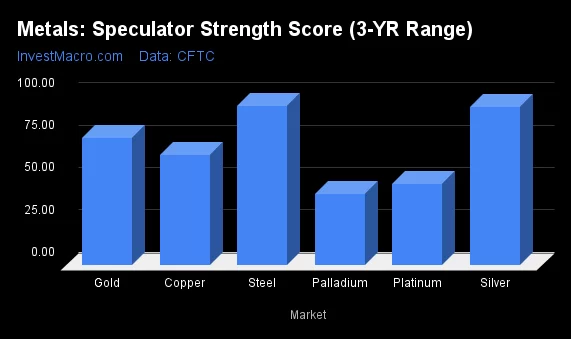
COT Strength Scores (a normalized measure of Speculator positions over a 3-Year range, from 0 to 100 where above 80 is Extreme-Bullish and below 20 is Extreme-Bearish) showed that Gold (95 percent) and Steel (89 percent) lead the metals markets this week. Silver (80 percent) comes in as the next highest in the weekly strength scores.

On the downside, Copper (48 percent) and Palladium (57 percent) come in at the lowest strength level currently.

Strength Statistics:
Gold (95.1 percent) vs Gold previous week (93.9 percent)
Silver (79.8 percent) vs Silver previous week (72.2 percent)
Copper (47.6 percent) vs Copper previous week (45.4 percent)
Platinum (60.8 percent) vs Platinum previous week (47.6 percent)
Palladium (57.1 percent) vs Palladium previous week (50.1 percent)
Steel (88.5 percent) vs Palladium previous week (88.4 percent)


Gold & Palladium top the 6-Week Strength Trends

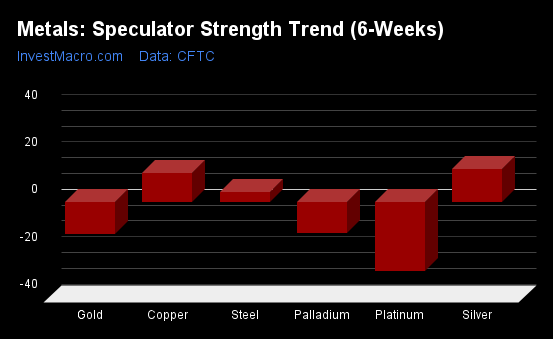
COT Strength Score Trends (or move index, calculates the 6-week changes in strength scores) showed that Gold (21 percent) and Palladium (14 percent) lead the past six weeks trends for metals. Copper (13 percent), Silver (13 percent) and Steel (12 percent) are the next highest positive mover in the latest trends data.

There are no lower or negative trend scores this week underscoring the positive sentiment for metals currently.

Move Statistics:
Gold (20.8 percent) vs Gold previous week (14.2 percent)
Silver (12.9 percent) vs Silver previous week (5.2 percent)
Copper (12.7 percent) vs Copper previous week (6.6 percent)
Platinum (7.9 percent) vs Platinum previous week (-0.9 percent)
Palladium (14.4 percent) vs Palladium previous week (1.7 percent)
Steel (11.8 percent) vs Steel previous week (7.5 percent)


Individual Markets:

Gold Comex Futures:

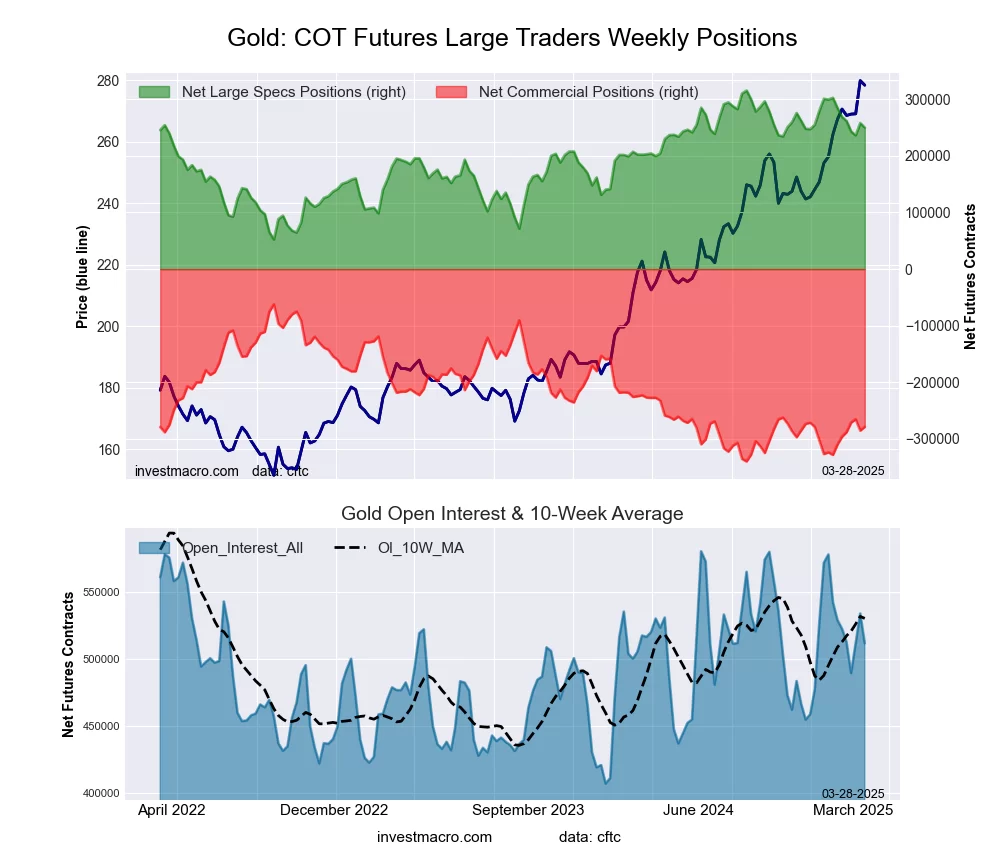
Gold Futures COT ChartThe Gold Comex Futures large speculator standing this week equaled a net position of 302,508 contracts in the data reported through Tuesday. This was a weekly advance of 3,099 contracts from the previous week which had a total of 299,409 net contracts.

This week’s current strength score (the trader positioning range over the past three years, measured from 0 to 100) shows the speculators are currently Bullish-Extreme with a score of 95.1 percent. The commercials are Bearish-Extreme with a score of 4.2 percent and the small traders (not shown in chart) are Bullish with a score of 63.6 percent.

Price Trend-Following Model: Strong Uptrend

Our weekly trend-following model classifies the current market price position as: Strong Uptrend.

Gold Futures StatisticsSPECULATORSCOMMERCIALSSMALL TRADERS
– Percent of Open Interest Longs:65.813.79.1
– Percent of Open Interest Shorts:10.074.34.4
– Net Position:302,508-328,17525,667
– Gross Longs:356,50074,37849,522
– Gross Shorts:53,992402,55323,855
– Long to Short Ratio:6.6 to 10.2 to 12.1 to 1
NET POSITION TREND:
– Strength Index Score (3 Year Range Pct):95.14.263.6
– Strength Index Reading (3 Year Range):Bullish-ExtremeBearish-ExtremeBullish
NET POSITION MOVEMENT INDEX:
– 6-Week Change in Strength Index:20.8-19.8-0.1


Silver Comex Futures:

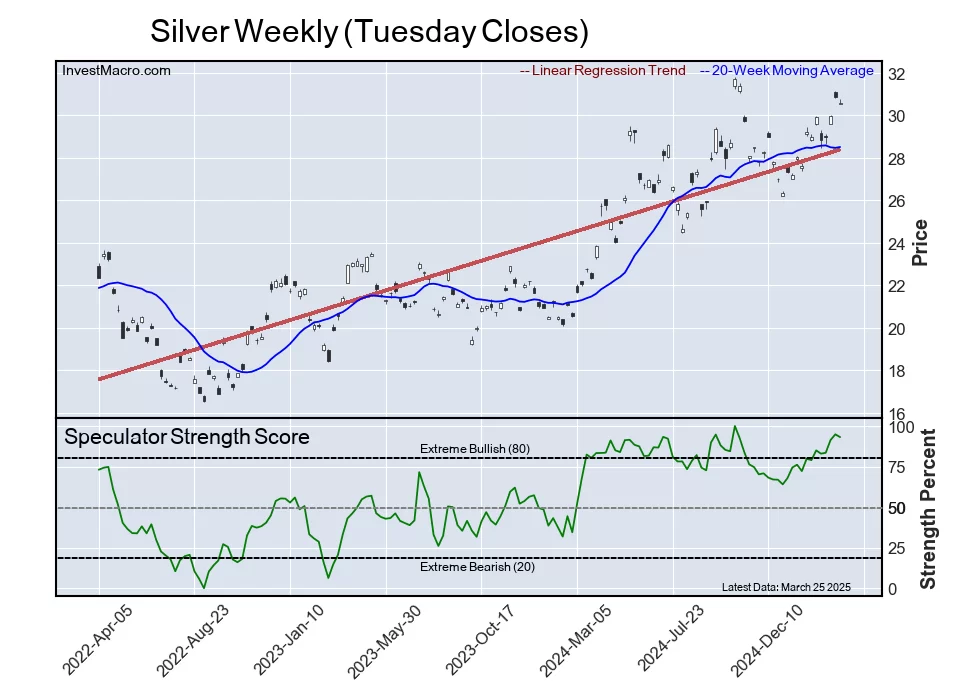
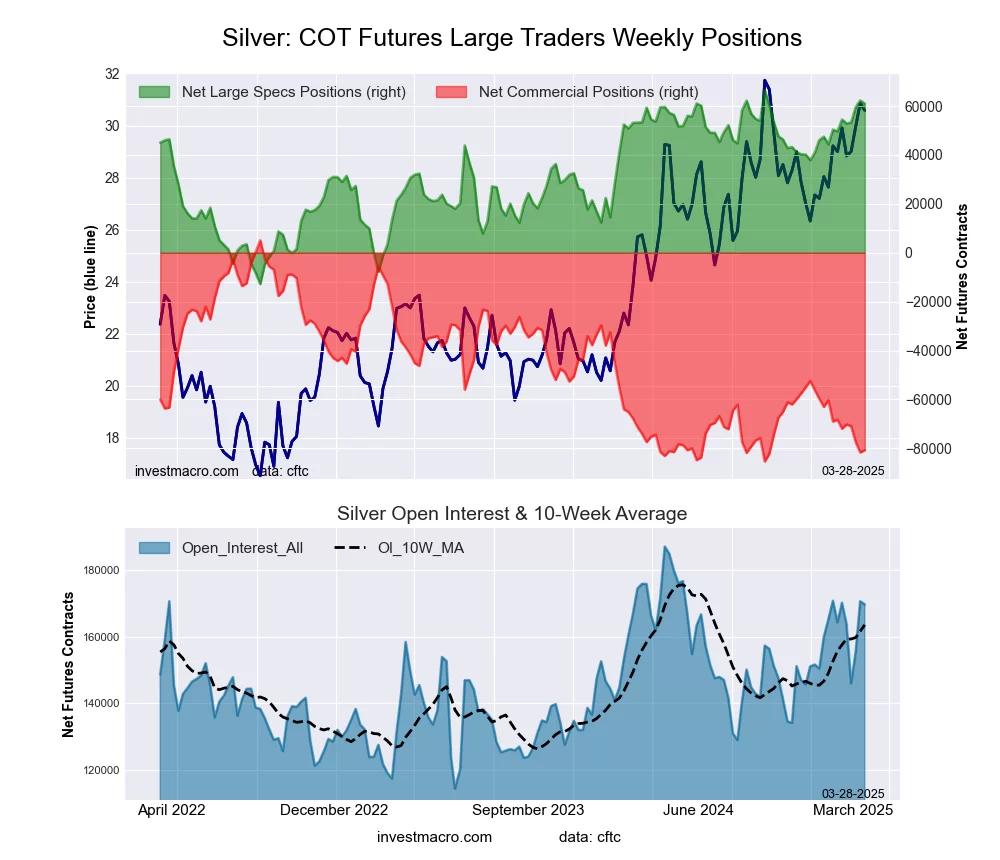
Silver Futures COT ChartThe Silver Comex Futures large speculator standing this week equaled a net position of 50,361 contracts in the data reported through Tuesday. This was a weekly boost of 5,993 contracts from the previous week which had a total of 44,368 net contracts.

This week’s current strength score (the trader positioning range over the past three years, measured from 0 to 100) shows the speculators are currently Bullish with a score of 79.8 percent. The commercials are Bearish-Extreme with a score of 18.1 percent and the small traders (not shown in chart) are Bullish with a score of 60.9 percent.

Price Trend-Following Model: Weak Downtrend

Our weekly trend-following model classifies the current market price position as: Weak Downtrend.

Silver Futures StatisticsSPECULATORSCOMMERCIALSSMALL TRADERS
– Percent of Open Interest Longs:48.717.318.6
– Percent of Open Interest Shorts:19.257.77.7
– Net Position:50,361-69,00718,646
– Gross Longs:83,12029,56431,821
– Gross Shorts:32,75998,57113,175
– Long to Short Ratio:2.5 to 10.3 to 12.4 to 1
NET POSITION TREND:
– Strength Index Score (3 Year Range Pct):79.818.160.9
– Strength Index Reading (3 Year Range):BullishBearish-ExtremeBullish
NET POSITION MOVEMENT INDEX:
– 6-Week Change in Strength Index:12.9-15.518.4


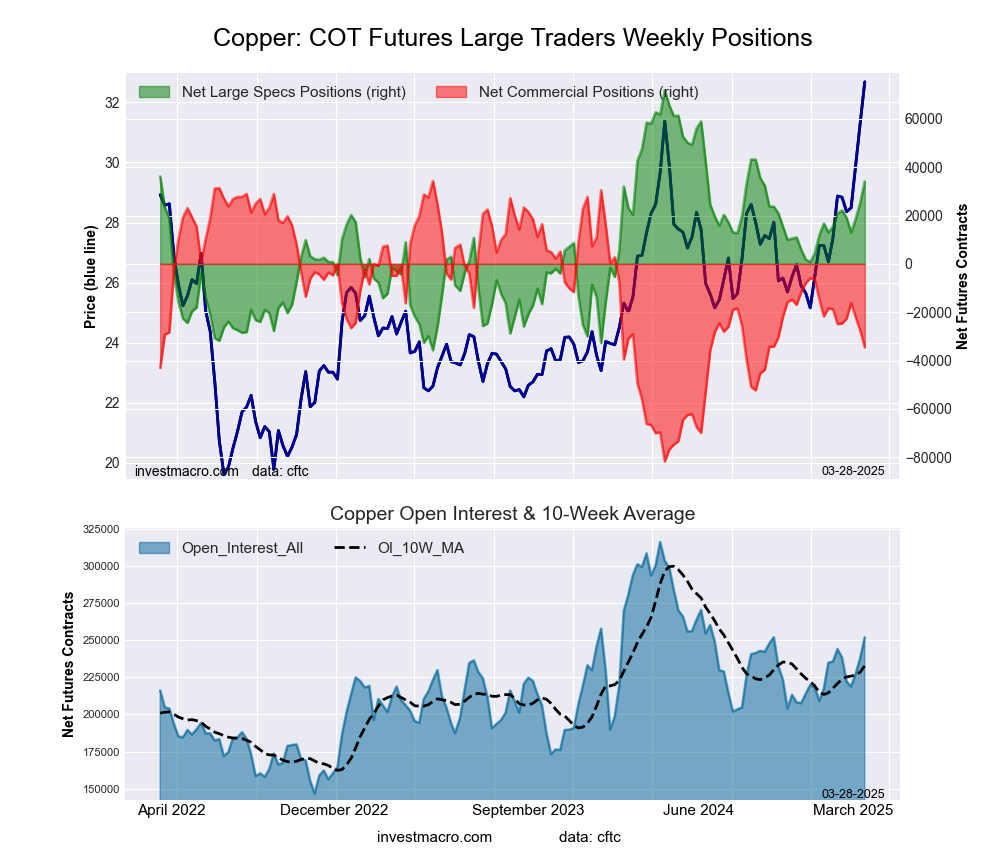
Copper Grade #1 Futures:

Copper Futures COT ChartThe Copper Grade #1 Futures large speculator standing this week equaled a net position of 15,421 contracts in the data reported through Tuesday. This was a weekly increase of 2,376 contracts from the previous week which had a total of 13,045 net contracts.

This week’s current strength score (the trader positioning range over the past three years, measured from 0 to 100) shows the speculators are currently Bearish with a score of 47.6 percent. The commercials are Bullish with a score of 54.3 percent and the small traders (not shown in chart) are Bearish with a score of 37.6 percent.

Price Trend-Following Model: Weak Downtrend

Our weekly trend-following model classifies the current market price position as: Weak Downtrend.

Copper Futures StatisticsSPECULATORSCOMMERCIALSSMALL TRADERS
– Percent of Open Interest Longs:39.135.56.7
– Percent of Open Interest Shorts:32.543.55.3
– Net Position:15,421-18,7103,289
– Gross Longs:92,00283,74515,692
– Gross Shorts:76,581102,45512,403
– Long to Short Ratio:1.2 to 10.8 to 11.3 to 1
NET POSITION TREND:
– Strength Index Score (3 Year Range Pct):47.654.337.6
– Strength Index Reading (3 Year Range):BearishBullishBearish
NET POSITION MOVEMENT INDEX:
– 6-Week Change in Strength Index:12.7-9.2-17.6


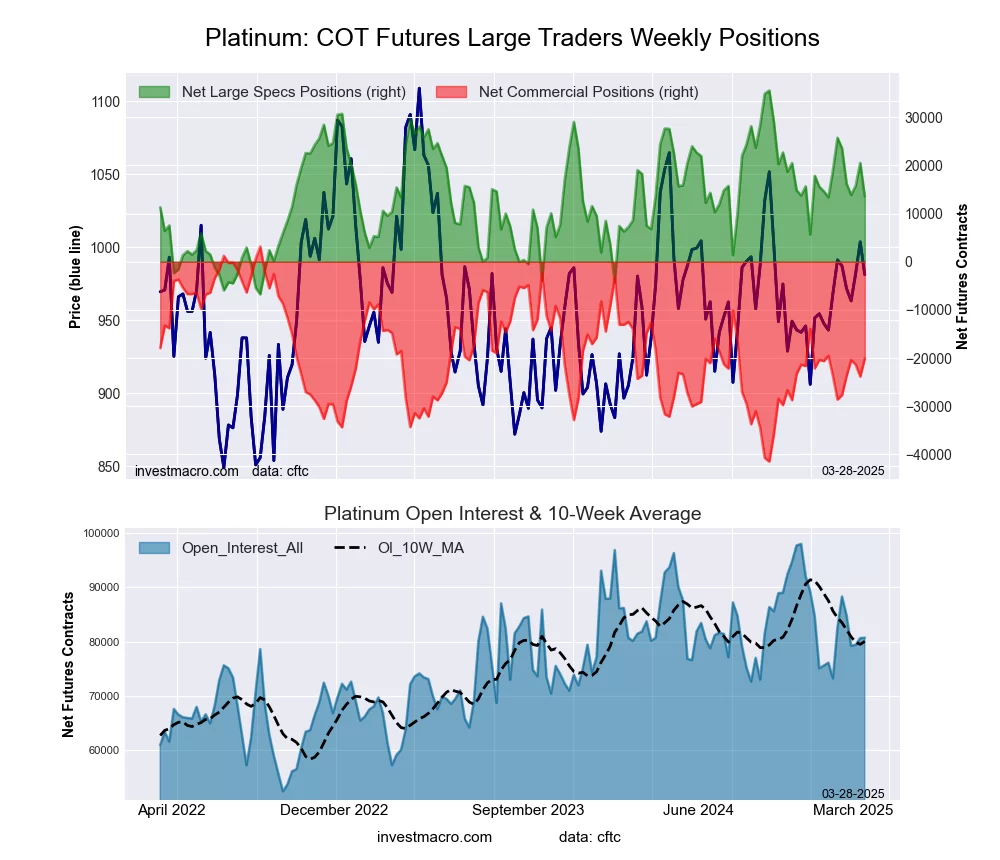
Platinum Futures:

Platinum Futures COT ChartThe Platinum Futures large speculator standing this week equaled a net position of 18,975 contracts in the data reported through Tuesday. This was a weekly boost of 5,602 contracts from the previous week which had a total of 13,373 net contracts.

This week’s current strength score (the trader positioning range over the past three years, measured from 0 to 100) shows the speculators are currently Bullish with a score of 60.8 percent. The commercials are Bearish with a score of 39.7 percent and the small traders (not shown in chart) are Bearish with a score of 37.6 percent.

Price Trend-Following Model: Weak Downtrend

Our weekly trend-following model classifies the current market price position as: Weak Downtrend.

Platinum Futures StatisticsSPECULATORSCOMMERCIALSSMALL TRADERS
– Percent of Open Interest Longs:62.419.512.1
– Percent of Open Interest Shorts:36.551.95.6
– Net Position:18,975-23,7394,764
– Gross Longs:45,67614,2768,882
– Gross Shorts:26,70138,0154,118
– Long to Short Ratio:1.7 to 10.4 to 12.2 to 1
NET POSITION TREND:
– Strength Index Score (3 Year Range Pct):60.839.737.6
– Strength Index Reading (3 Year Range):BullishBearishBearish
NET POSITION MOVEMENT INDEX:
– 6-Week Change in Strength Index:7.9-4.7-19.1


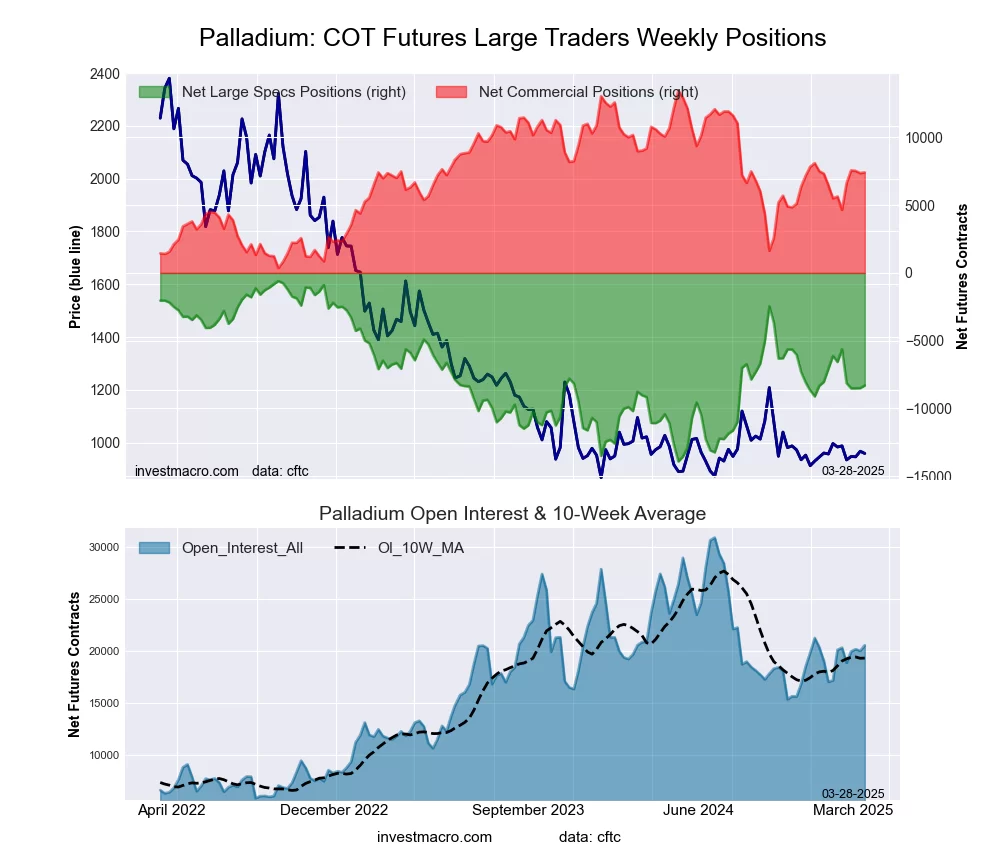
Palladium Futures:

Palladium Futures COT ChartThe Palladium Futures large speculator standing this week equaled a net position of -6,124 contracts in the data reported through Tuesday. This was a weekly advance of 960 contracts from the previous week which had a total of -7,084 net contracts.

This week’s current strength score (the trader positioning range over the past three years, measured from 0 to 100) shows the speculators are currently Bullish with a score of 57.1 percent. The commercials are Bearish with a score of 43.3 percent and the small traders (not shown in chart) are Bullish with a score of 63.3 percent.

Price Trend-Following Model: Downtrend

Our weekly trend-following model classifies the current market price position as: Downtrend.

Palladium Futures StatisticsSPECULATORSCOMMERCIALSSMALL TRADERS
– Percent of Open Interest Longs:34.144.711.4
– Percent of Open Interest Shorts:69.812.67.8
– Net Position:-6,1245,506618
– Gross Longs:5,8537,6711,955
– Gross Shorts:11,9772,1651,337
– Long to Short Ratio:0.5 to 13.5 to 11.5 to 1
NET POSITION TREND:
– Strength Index Score (3 Year Range Pct):57.143.363.3
– Strength Index Reading (3 Year Range):BullishBearishBullish
NET POSITION MOVEMENT INDEX:
– 6-Week Change in Strength Index:14.4-11.9-14.5


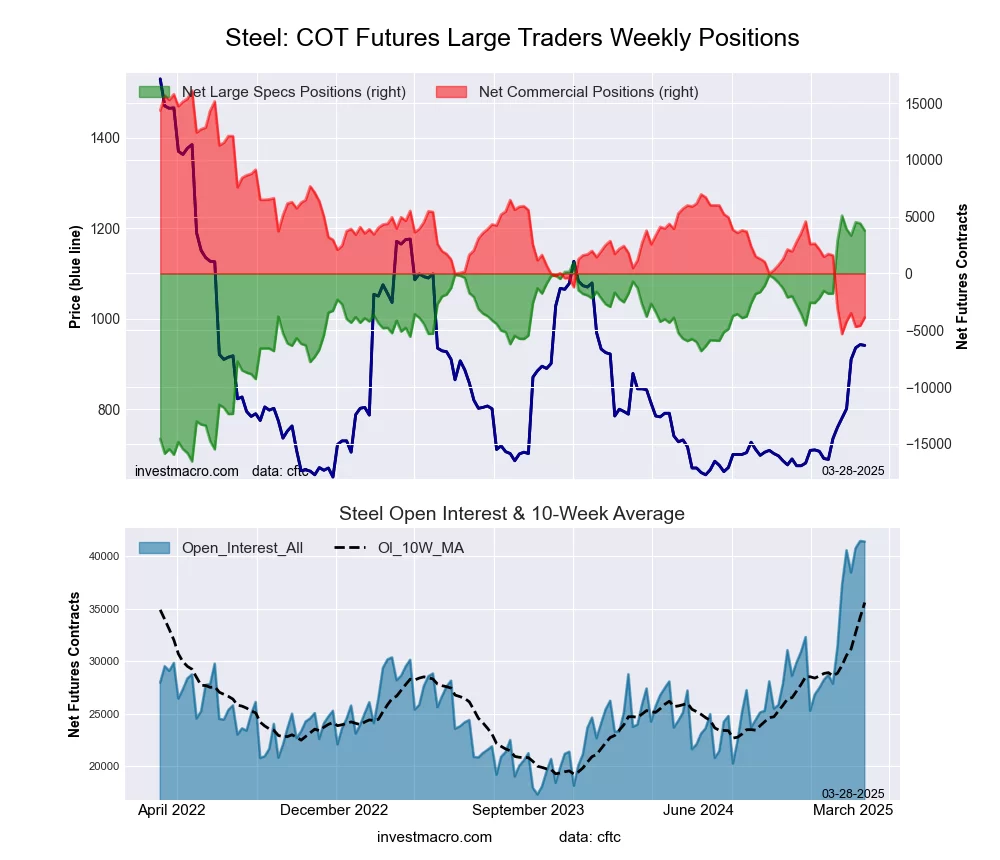
Steel Futures Futures:

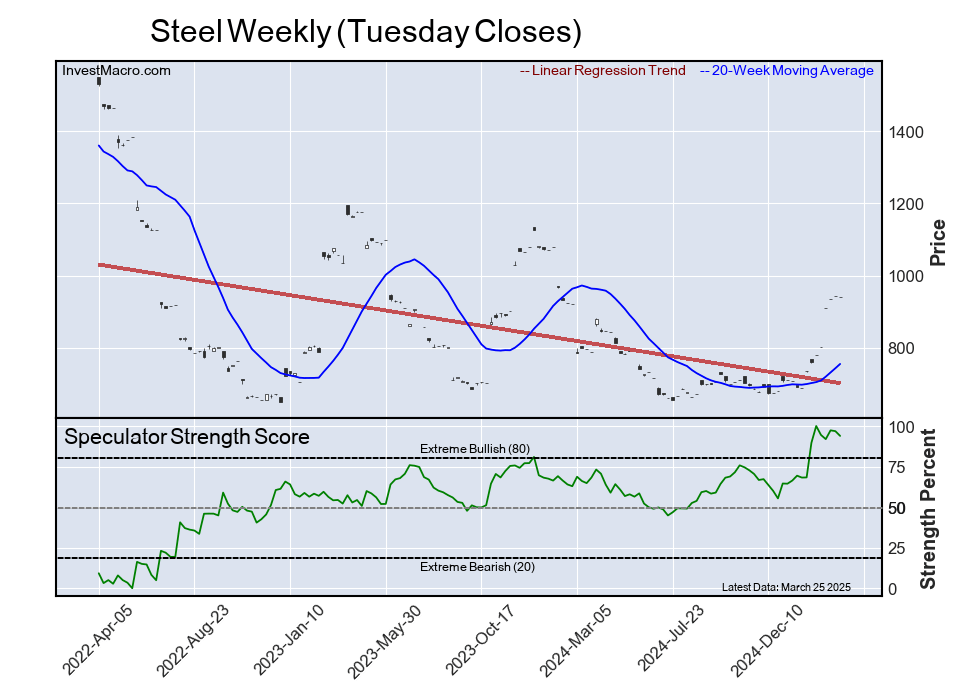
Steel Futures COT ChartThe Steel Futures large speculator standing this week equaled a net position of -1,763 contracts in the data reported through Tuesday. This was a weekly boost of 22 contracts from the previous week which had a total of -1,785 net contracts.

This week’s current strength score (the trader positioning range over the past three years, measured from 0 to 100) shows the speculators are currently Bullish-Extreme with a score of 88.5 percent. The commercials are Bearish-Extreme with a score of 11.8 percent and the small traders (not shown in chart) are Bullish with a score of 52.2 percent.

Price Trend-Following Model: Uptrend

Our weekly trend-following model classifies the current market price position as: Uptrend.

Steel Futures StatisticsSPECULATORSCOMMERCIALSSMALL TRADERS
– Percent of Open Interest Longs:24.066.11.3
– Percent of Open Interest Shorts:30.360.40.6
– Net Position:-1,7631,582181
– Gross Longs:6,67318,417355
– Gross Shorts:8,43616,835174
– Long to Short Ratio:0.8 to 11.1 to 12.0 to 1
NET POSITION TREND:
– Strength Index Score (3 Year Range Pct):88.511.852.2
– Strength Index Reading (3 Year Range):Bullish-ExtremeBearish-ExtremeBullish
NET POSITION MOVEMENT INDEX:
– 6-Week Change in Strength Index:11.8-12.620.7


Article By InvestMacroReceive our weekly COT Newsletter

*COT Report: The COT data, released weekly to the public each Friday, is updated through the most recent Tuesday (data is 3 days old) and shows a quick view of how large speculators or non-commercials (for-profit traders) were positioned in the futures markets.

The CFTC categorizes trader positions according to commercial hedgers (traders who use futures contracts for hedging as part of the business), non-commercials (large traders who speculate to realize trading profits) and nonreportable traders (usually small traders/speculators) as well as their open interest (contracts open in the market at time of reporting). See CFTC criteria here.

COT Bonds Charts: Speculator Bets led lower by 5-Year Bonds & SOFR 3-Months

By InvestMacro

Here are the latest charts and statistics for the Commitment of Traders (COT) reports data published by the Commodities Futures Trading Commission (CFTC).

The latest COT data is updated through Tuesday February 4th and shows a quick view of how large traders (for-profit speculators and commercial hedgers) were positioned in the futures markets.

Weekly Speculator Changes led lower by 5-Year Bonds & SOFR 3-Months

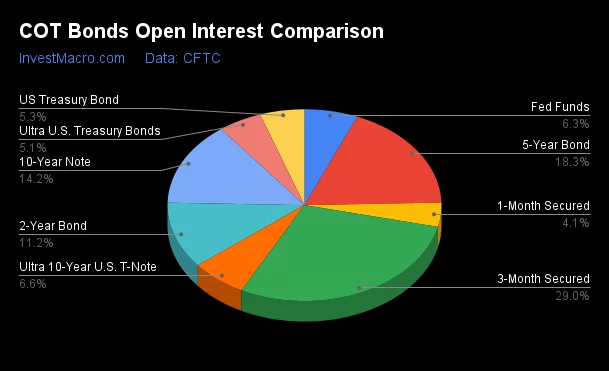
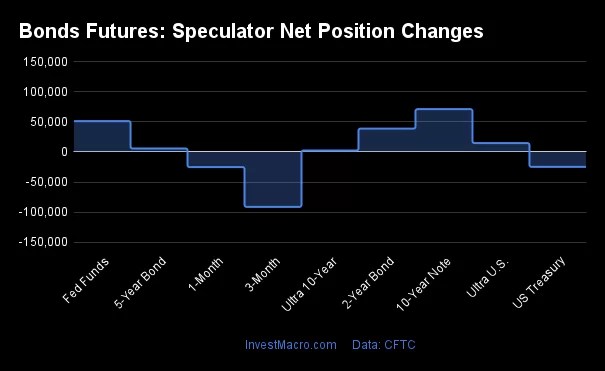
The COT bond market speculator bets were decisively lower this week as just one out of the nine bond markets we cover had higher positioning while the other eight markets had lower speculator contracts.

The only market to gain this week for the bond markets was the Fed Funds with a gain of 30,143 contracts on the week.

The bond markets with declines in speculator bets for the week were the 5-Year Bonds (-151,611 contracts), the SOFR 3-Months (-102,586 contracts), the US Treasury Bonds (-33,511 contracts), the SOFR 1-Month (-32,506 contracts), the 2-Year Bonds (-17,065 contracts), the 10-Year Bonds (-7,061 contracts), the Ultra 10-Year Bonds (-6,084 contracts) and the Ultra Treasury Bonds (-2,024 contracts) also registering lower bets on the week.


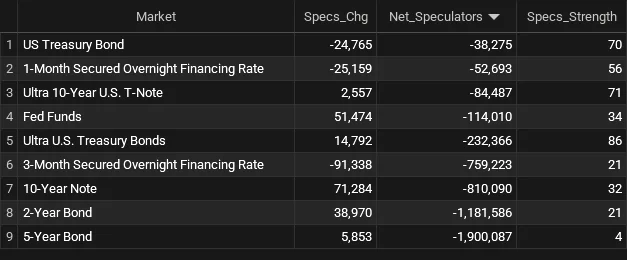
Bonds Net Speculators Leaderboard

Legend: Weekly Speculators Change | Speculators Current Net Position | Speculators Strength Score compared to last 3-Years (0-100 range)


Strength Scores led by SOFR 1-Month & US Treasury Bonds

COT Strength Scores (a normalized measure of Speculator positions over a 3-Year range, from 0 to 100 where above 80 is Extreme-Bullish and below 20 is Extreme-Bearish) showed that the SOFR 1-Month (88 percent) and the US Treasury Bonds (82 percent) lead the bond markets this week. The Ultra Treasury Bonds (81 percent) comes in as the next highest in the weekly strength scores.

On the downside, the 5-Year Bond (3 percent), the Fed Funds (17 percent) and the 2-Year Bonds (18 percent) come in at the lowest strength level currently and are in Extreme-Bearish territory (below 20 percent). The next lowest strength scores were the SOFR 3-Months (22 percent) and the 10-Year Bonds (41 percent).

Strength Statistics:
Fed Funds (17.3 percent) vs Fed Funds previous week (11.8 percent)
2-Year Bond (18.3 percent) vs 2-Year Bond previous week (19.4 percent)
5-Year Bond (2.9 percent) vs 5-Year Bond previous week (11.0 percent)
10-Year Bond (41.2 percent) vs 10-Year Bond previous week (41.9 percent)
Ultra 10-Year Bond (53.9 percent) vs Ultra 10-Year Bond previous week (55.9 percent)
US Treasury Bond (81.8 percent) vs US Treasury Bond previous week (93.5 percent)
Ultra US Treasury Bond (81.3 percent) vs Ultra US Treasury Bond previous week (82.1 percent)
SOFR 1-Month (88.3 percent) vs SOFR 1-Month previous week (96.3 percent)
SOFR 3-Months (21.7 percent) vs SOFR 3-Months previous week (27.0 percent)


SOFR 1-Month & Ultra 10-Year Bonds top the 6-Week Strength Trends

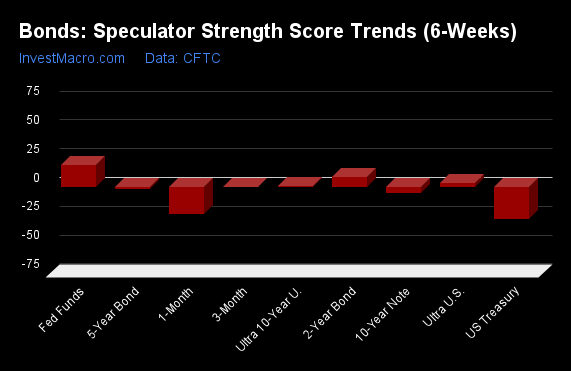
COT Strength Score Trends (or move index, calculates the 6-week changes in strength scores) showed that the SOFR 1-Month (45 percent) and the Ultra 10-Year Bonds (9 percent) lead the past six weeks trends for bonds.

The Fed Funds (-32 percent), the SOFR 3-Months (-18 percent) and the Ultra Treasury Bonds (-15 percent) lead the downside trend scores currently.

Strength Trend Statistics:
Fed Funds (-31.6 percent) vs Fed Funds previous week (-36.3 percent)
2-Year Bond (2.3 percent) vs 2-Year Bond previous week (3.9 percent)
5-Year Bond (-8.9 percent) vs 5-Year Bond previous week (-0.7 percent)
10-Year Bond (-11.0 percent) vs 10-Year Bond previous week (3.1 percent)
Ultra 10-Year Bond (9.2 percent) vs Ultra 10-Year Bond previous week (1.0 percent)
US Treasury Bond (7.5 percent) vs US Treasury Bond previous week (26.1 percent)
Ultra US Treasury Bond (-15.0 percent) vs Ultra US Treasury Bond previous week (-8.5 percent)
SOFR 1-Month (44.8 percent) vs SOFR 1-Month previous week (37.6 percent)
SOFR 3-Months (-17.8 percent) vs SOFR 3-Months previous week (-27.7 percent)


30-Day Federal Funds Futures:

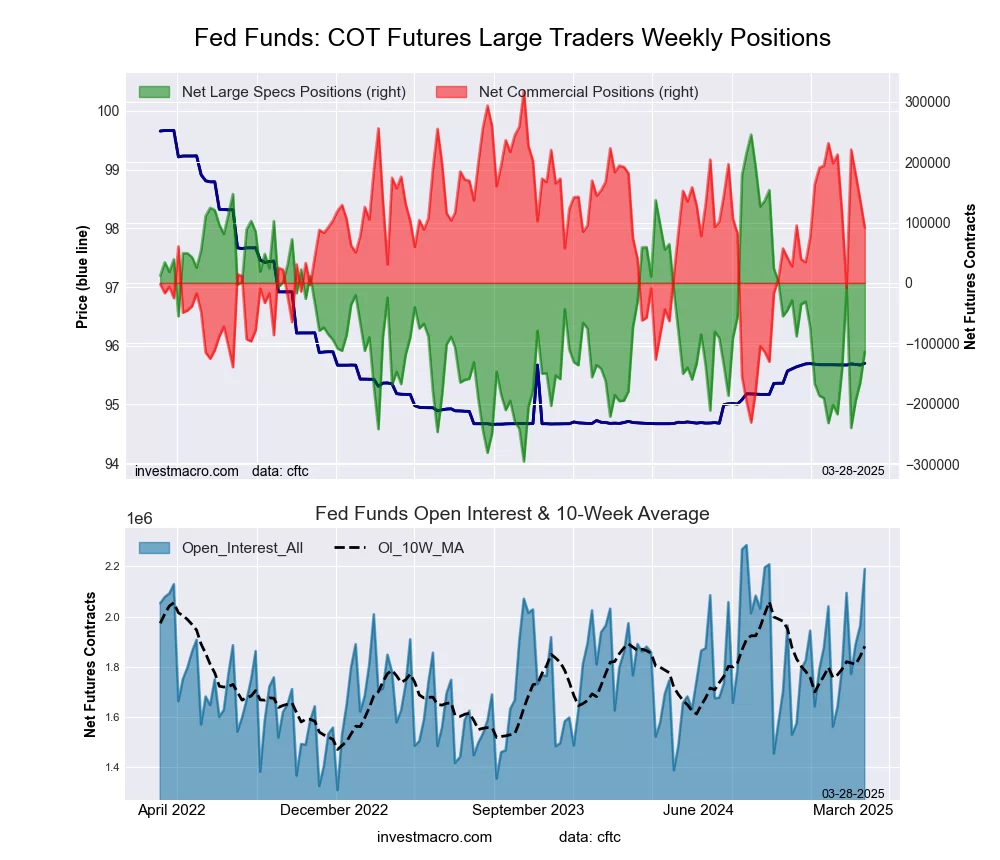
Federal Funds 30-Day Bonds Futures COT ChartThe 30-Day Federal Funds large speculator standing this week resulted in a net position of -201,853 contracts in the data reported through Tuesday. This was a weekly increase of 30,143 contracts from the previous week which had a total of -231,996 net contracts.

This week’s current strength score (the trader positioning range over the past three years, measured from 0 to 100) shows the speculators are currently Bearish-Extreme with a score of 17.3 percent. The commercials are Bullish with a score of 78.1 percent and the small traders (not shown in chart) are Bullish-Extreme with a score of 91.8 percent.

Price Trend-Following Model: Downtrend

Our weekly trend-following model classifies the current market price position as: Downtrend.

30-Day Federal Funds StatisticsSPECULATORSCOMMERCIALSSMALL TRADERS
– Percent of Open Interest Longs:9.971.82.3
– Percent of Open Interest Shorts:22.859.12.1
– Net Position:-201,853198,2023,651
– Gross Longs:154,5111,121,07936,072
– Gross Shorts:356,364922,87732,421
– Long to Short Ratio:0.4 to 11.2 to 11.1 to 1
NET POSITION TREND:
– Strength Index Score (3 Year Range Pct):17.378.191.8
– Strength Index Reading (3 Year Range):Bearish-ExtremeBullishBullish-Extreme
NET POSITION MOVEMENT INDEX:
– 6-Week Change in Strength Index:-31.629.813.3


Secured Overnight Financing Rate (3-Month) Futures:

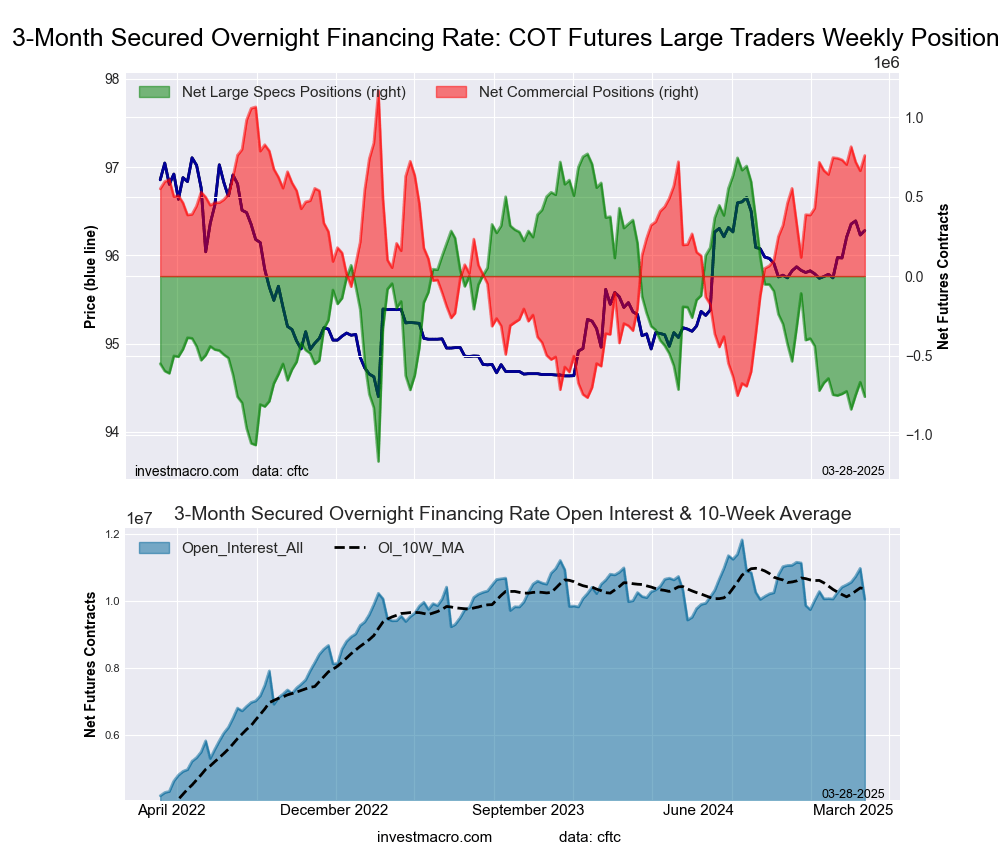
SOFR 3-Months Bonds Futures COT ChartThe Secured Overnight Financing Rate (3-Month) large speculator standing this week resulted in a net position of -746,850 contracts in the data reported through Tuesday. This was a weekly decline of -102,586 contracts from the previous week which had a total of -644,264 net contracts.

This week’s current strength score (the trader positioning range over the past three years, measured from 0 to 100) shows the speculators are currently Bearish with a score of 21.7 percent. The commercials are Bullish with a score of 78.1 percent and the small traders (not shown in chart) are Bullish-Extreme with a score of 88.8 percent.

Price Trend-Following Model: Weak Uptrend

Our weekly trend-following model classifies the current market price position as: Weak Uptrend.

SOFR 3-Months StatisticsSPECULATORSCOMMERCIALSSMALL TRADERS
– Percent of Open Interest Longs:11.764.80.2
– Percent of Open Interest Shorts:19.157.40.2
– Net Position:-746,850745,2001,650
– Gross Longs:1,176,7786,523,57523,679
– Gross Shorts:1,923,6285,778,37522,029
– Long to Short Ratio:0.6 to 11.1 to 11.1 to 1
NET POSITION TREND:
– Strength Index Score (3 Year Range Pct):21.778.188.8
– Strength Index Reading (3 Year Range):BearishBullishBullish-Extreme
NET POSITION MOVEMENT INDEX:
– 6-Week Change in Strength Index:-17.818.6-8.1


Individual Bond Markets:

Secured Overnight Financing Rate (1-Month) Futures:

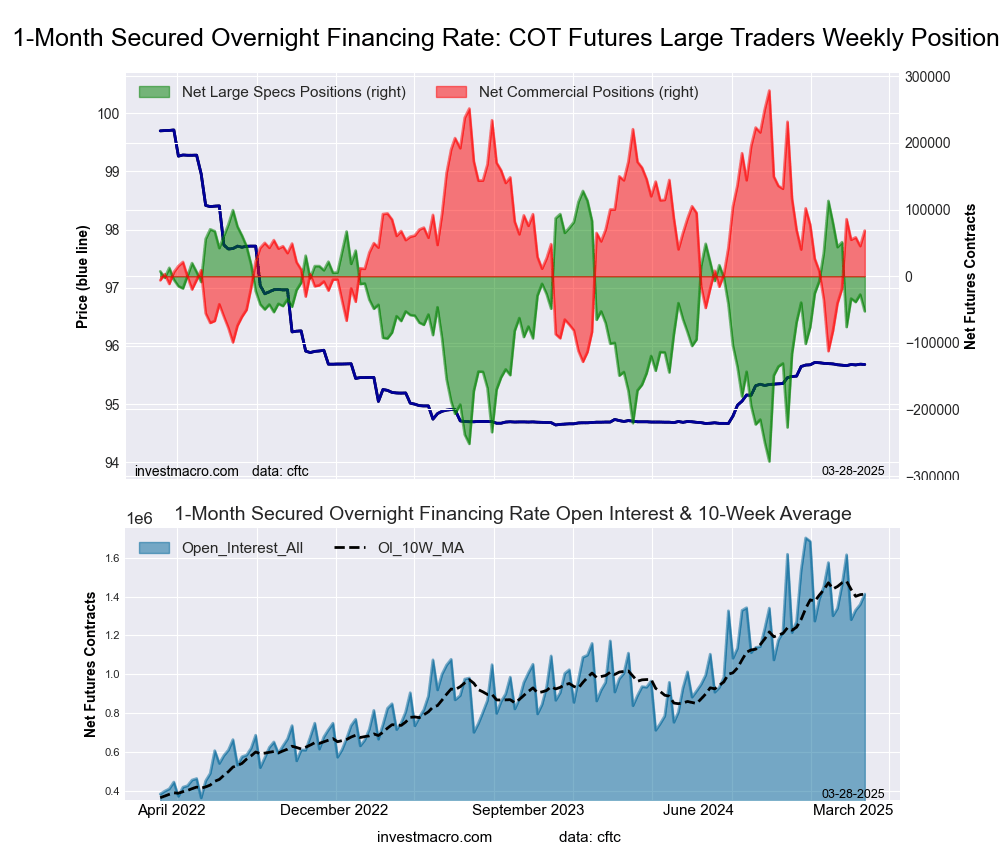
SOFR 1-Month Bonds Futures COT ChartThe Secured Overnight Financing Rate (1-Month) large speculator standing this week resulted in a net position of 80,461 contracts in the data reported through Tuesday. This was a weekly decline of -32,506 contracts from the previous week which had a total of 112,967 net contracts.

This week’s current strength score (the trader positioning range over the past three years, measured from 0 to 100) shows the speculators are currently Bullish-Extreme with a score of 88.3 percent. The commercials are Bearish-Extreme with a score of 11.3 percent and the small traders (not shown in chart) are Bullish with a score of 70.5 percent.

Price Trend-Following Model: Uptrend

Our weekly trend-following model classifies the current market price position as: Uptrend.

SOFR 1-Month StatisticsSPECULATORSCOMMERCIALSSMALL TRADERS
– Percent of Open Interest Longs:23.157.40.2
– Percent of Open Interest Shorts:16.963.70.0
– Net Position:80,461-82,2761,815
– Gross Longs:300,031746,8472,155
– Gross Shorts:219,570829,123340
– Long to Short Ratio:1.4 to 10.9 to 16.3 to 1
NET POSITION TREND:
– Strength Index Score (3 Year Range Pct):88.311.370.5
– Strength Index Reading (3 Year Range):Bullish-ExtremeBearish-ExtremeBullish
NET POSITION MOVEMENT INDEX:
– 6-Week Change in Strength Index:44.8-45.216.6


2-Year Treasury Note Futures:

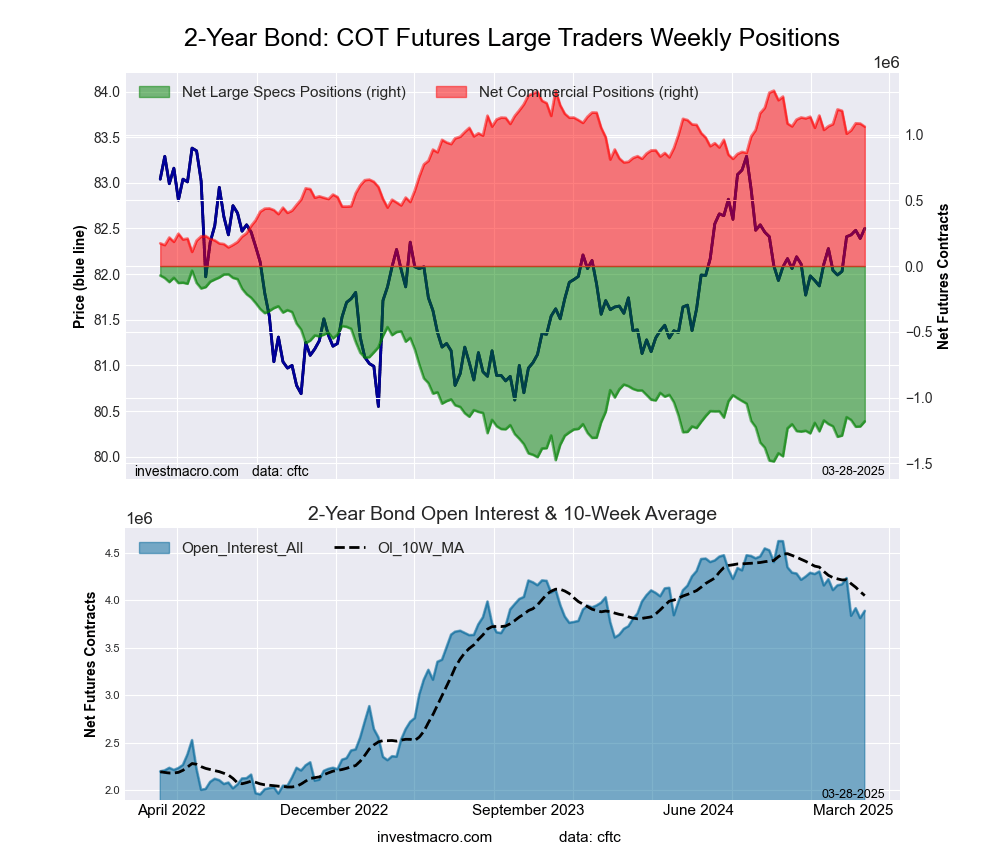
2-Year Treasury Bonds Futures COT ChartThe 2-Year Treasury Note large speculator standing this week resulted in a net position of -1,218,624 contracts in the data reported through Tuesday. This was a weekly lowering of -17,065 contracts from the previous week which had a total of -1,201,559 net contracts.

This week’s current strength score (the trader positioning range over the past three years, measured from 0 to 100) shows the speculators are currently Bearish-Extreme with a score of 18.3 percent. The commercials are Bullish with a score of 79.5 percent and the small traders (not shown in chart) are Bullish-Extreme with a score of 80.1 percent.

Price Trend-Following Model: Downtrend

Our weekly trend-following model classifies the current market price position as: Downtrend.

2-Year Treasury Note StatisticsSPECULATORSCOMMERCIALSSMALL TRADERS
– Percent of Open Interest Longs:14.476.56.1
– Percent of Open Interest Shorts:44.150.22.7
– Net Position:-1,218,6241,079,136139,488
– Gross Longs:592,2173,141,260250,760
– Gross Shorts:1,810,8412,062,124111,272
– Long to Short Ratio:0.3 to 11.5 to 12.3 to 1
NET POSITION TREND:
– Strength Index Score (3 Year Range Pct):18.379.580.1
– Strength Index Reading (3 Year Range):Bearish-ExtremeBullishBullish-Extreme
NET POSITION MOVEMENT INDEX:
– 6-Week Change in Strength Index:2.3-3.52.9


5-Year Treasury Note Futures:

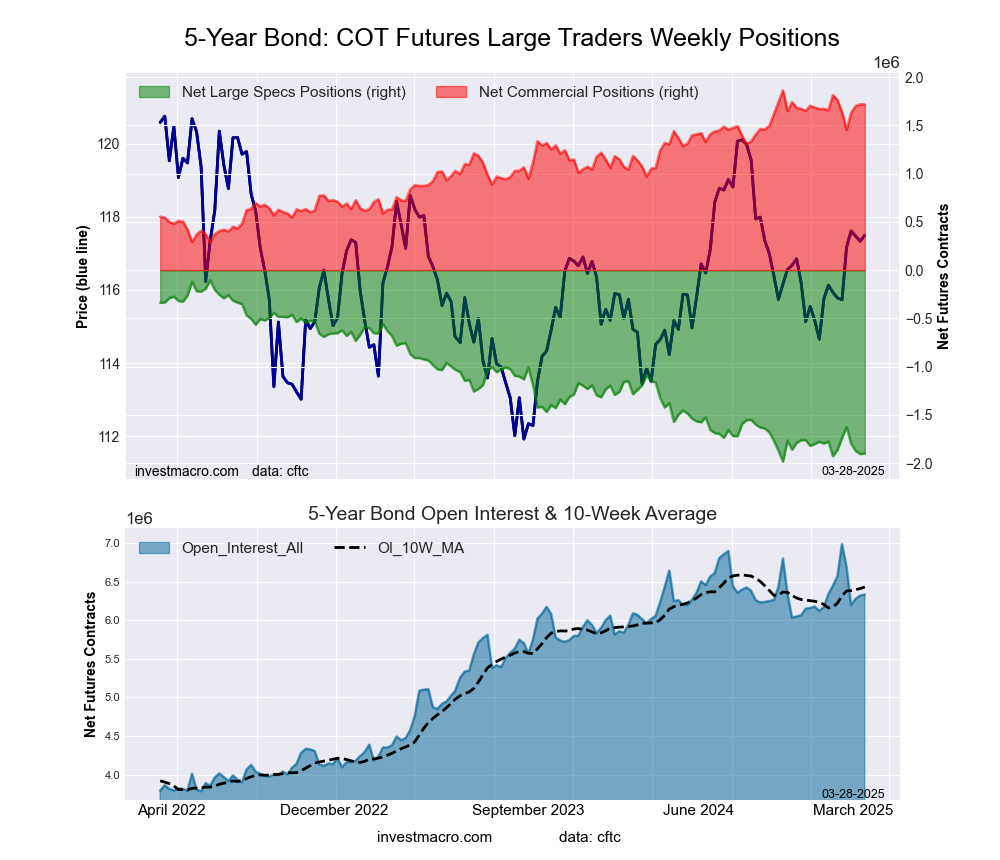
5-Year Treasury Bonds Futures COT ChartThe 5-Year Treasury Note large speculator standing this week resulted in a net position of -1,927,666 contracts in the data reported through Tuesday. This was a weekly reduction of -151,611 contracts from the previous week which had a total of -1,776,055 net contracts.

This week’s current strength score (the trader positioning range over the past three years, measured from 0 to 100) shows the speculators are currently Bearish-Extreme with a score of 2.9 percent. The commercials are Bullish-Extreme with a score of 96.9 percent and the small traders (not shown in chart) are Bullish with a score of 73.2 percent.

Price Trend-Following Model: Downtrend

Our weekly trend-following model classifies the current market price position as: Downtrend.

5-Year Treasury Note StatisticsSPECULATORSCOMMERCIALSSMALL TRADERS
– Percent of Open Interest Longs:5.785.16.7
– Percent of Open Interest Shorts:35.657.04.9
– Net Position:-1,927,6661,813,533114,133
– Gross Longs:366,6385,485,200430,333
– Gross Shorts:2,294,3043,671,667316,200
– Long to Short Ratio:0.2 to 11.5 to 11.4 to 1
NET POSITION TREND:
– Strength Index Score (3 Year Range Pct):2.996.973.2
– Strength Index Reading (3 Year Range):Bearish-ExtremeBullish-ExtremeBullish
NET POSITION MOVEMENT INDEX:
– 6-Week Change in Strength Index:-8.910.31.1


10-Year Treasury Note Futures:

10-Year Treasury Notes Bonds Futures COT ChartThe 10-Year Treasury Note large speculator standing this week resulted in a net position of -707,703 contracts in the data reported through Tuesday. This was a weekly decrease of -7,061 contracts from the previous week which had a total of -700,642 net contracts.

This week’s current strength score (the trader positioning range over the past three years, measured from 0 to 100) shows the speculators are currently Bearish with a score of 41.2 percent. The commercials are Bullish with a score of 58.5 percent and the small traders (not shown in chart) are Bullish with a score of 75.5 percent.

Price Trend-Following Model: Downtrend

Our weekly trend-following model classifies the current market price position as: Downtrend.

10-Year Treasury Note StatisticsSPECULATORSCOMMERCIALSSMALL TRADERS
– Percent of Open Interest Longs:15.274.08.6
– Percent of Open Interest Shorts:29.660.77.5
– Net Position:-707,703651,56656,137
– Gross Longs:743,4053,628,286422,857
– Gross Shorts:1,451,1082,976,720366,720
– Long to Short Ratio:0.5 to 11.2 to 11.2 to 1
NET POSITION TREND:
– Strength Index Score (3 Year Range Pct):41.258.575.5
– Strength Index Reading (3 Year Range):BearishBullishBullish
NET POSITION MOVEMENT INDEX:
– 6-Week Change in Strength Index:-11.017.3-5.9


Ultra 10-Year Notes Futures:

Ultra 10-Year Treasury Notes Bonds Futures COT ChartThe Ultra 10-Year Notes large speculator standing this week resulted in a net position of -115,563 contracts in the data reported through Tuesday. This was a weekly decline of -6,084 contracts from the previous week which had a total of -109,479 net contracts.

This week’s current strength score (the trader positioning range over the past three years, measured from 0 to 100) shows the speculators are currently Bullish with a score of 53.9 percent. The commercials are Bearish with a score of 27.9 percent and the small traders (not shown in chart) are Bullish with a score of 76.6 percent.

Price Trend-Following Model: Downtrend

Our weekly trend-following model classifies the current market price position as: Downtrend.

Ultra 10-Year Notes StatisticsSPECULATORSCOMMERCIALSSMALL TRADERS
– Percent of Open Interest Longs:14.275.39.8
– Percent of Open Interest Shorts:19.268.112.0
– Net Position:-115,563166,490-50,927
– Gross Longs:327,9821,740,156226,814
– Gross Shorts:443,5451,573,666277,741
– Long to Short Ratio:0.7 to 11.1 to 10.8 to 1
NET POSITION TREND:
– Strength Index Score (3 Year Range Pct):53.927.976.6
– Strength Index Reading (3 Year Range):BullishBearishBullish
NET POSITION MOVEMENT INDEX:
– 6-Week Change in Strength Index:9.2-5.7-10.3


US Treasury Bonds Futures:

US Year Treasury Notes Long Bonds Futures COT ChartThe US Treasury Bonds large speculator standing this week resulted in a net position of -4,927 contracts in the data reported through Tuesday. This was a weekly lowering of -33,511 contracts from the previous week which had a total of 28,584 net contracts.

This week’s current strength score (the trader positioning range over the past three years, measured from 0 to 100) shows the speculators are currently Bullish-Extreme with a score of 81.8 percent. The commercials are Bearish-Extreme with a score of 8.2 percent and the small traders (not shown in chart) are Bullish with a score of 71.5 percent.

Price Trend-Following Model: Downtrend

Our weekly trend-following model classifies the current market price position as: Downtrend.

US Treasury Bonds StatisticsSPECULATORSCOMMERCIALSSMALL TRADERS
– Percent of Open Interest Longs:23.264.011.2
– Percent of Open Interest Shorts:23.467.67.3
– Net Position:-4,927-71,66176,588
– Gross Longs:455,7771,259,191219,800
– Gross Shorts:460,7041,330,852143,212
– Long to Short Ratio:1.0 to 10.9 to 11.5 to 1
NET POSITION TREND:
– Strength Index Score (3 Year Range Pct):81.88.271.5
– Strength Index Reading (3 Year Range):Bullish-ExtremeBearish-ExtremeBullish
NET POSITION MOVEMENT INDEX:
– 6-Week Change in Strength Index:7.5-14.415.5


Ultra US Treasury Bonds Futures:

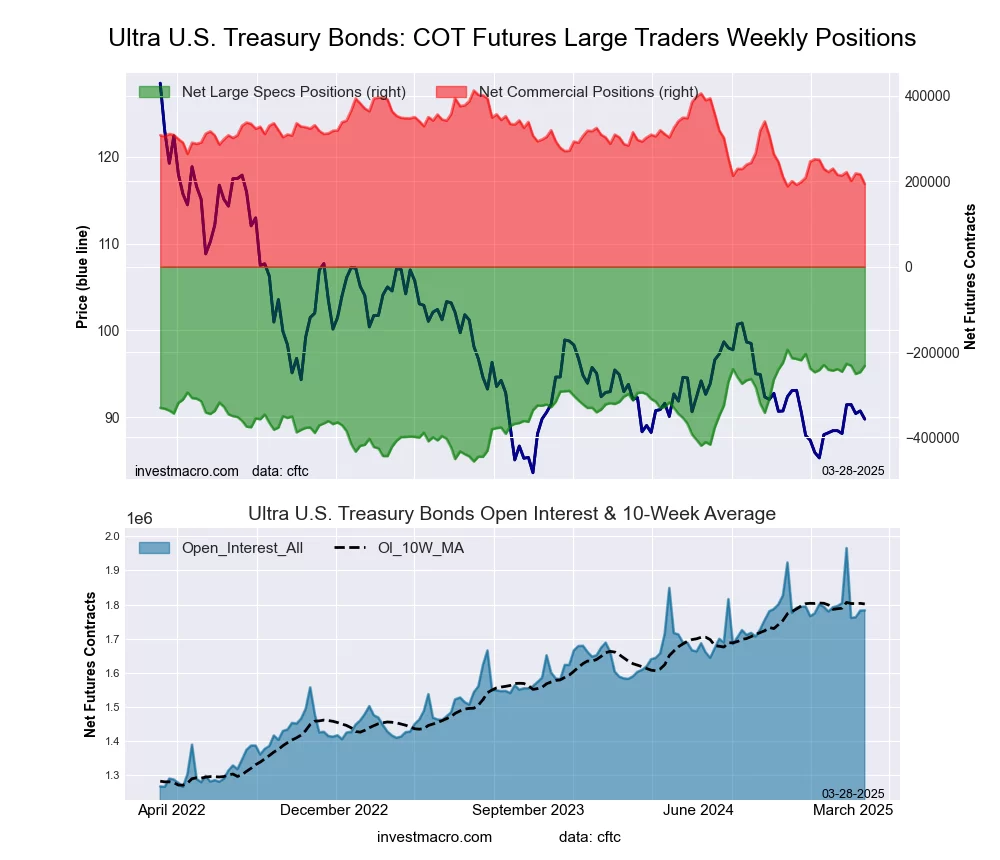
Ultra US Year Treasury Notes Long Bonds Futures COT ChartThe Ultra US Treasury Bonds large speculator standing this week resulted in a net position of -243,616 contracts in the data reported through Tuesday. This was a weekly fall of -2,024 contracts from the previous week which had a total of -241,592 net contracts.

This week’s current strength score (the trader positioning range over the past three years, measured from 0 to 100) shows the speculators are currently Bullish-Extreme with a score of 81.3 percent. The commercials are Bearish-Extreme with a score of 18.5 percent and the small traders (not shown in chart) are Bearish with a score of 29.3 percent.

Price Trend-Following Model: Downtrend

Our weekly trend-following model classifies the current market price position as: Downtrend.

Ultra US Treasury Bonds StatisticsSPECULATORSCOMMERCIALSSMALL TRADERS
– Percent of Open Interest Longs:8.181.69.8
– Percent of Open Interest Shorts:21.768.89.0
– Net Position:-243,616229,73713,879
– Gross Longs:144,8381,463,002175,978
– Gross Shorts:388,4541,233,265162,099
– Long to Short Ratio:0.4 to 11.2 to 11.1 to 1
NET POSITION TREND:
– Strength Index Score (3 Year Range Pct):81.318.529.3
– Strength Index Reading (3 Year Range):Bullish-ExtremeBearish-ExtremeBearish
NET POSITION MOVEMENT INDEX:
– 6-Week Change in Strength Index:-15.09.424.6


Article By InvestMacroReceive our weekly COT Newsletter

*COT Report: The COT data, released weekly to the public each Friday, is updated through the most recent Tuesday (data is 3 days old) and shows a quick view of how large speculators or non-commercials (for-profit traders) were positioned in the futures markets.

The CFTC categorizes trader positions according to commercial hedgers (traders who use futures contracts for hedging as part of the business), non-commercials (large traders who speculate to realize trading profits) and nonreportable traders (usually small traders/speculators) as well as their open interest (contracts open in the market at time of reporting). See CFTC criteria here.

COT Soft Commodities Charts: Speculator Bets led by Soybean Meal, Wheat & Corn

By InvestMacro

Here are the latest charts and statistics for the Commitment of Traders (COT) reports data published by the Commodities Futures Trading Commission (CFTC).

The latest COT data is updated through Tuesday February 4th and shows a quick view of how large traders (for-profit speculators and commercial entities) were positioned in the futures markets.

Weekly Speculator Changes led by Soybean Meal, Wheat & Corn

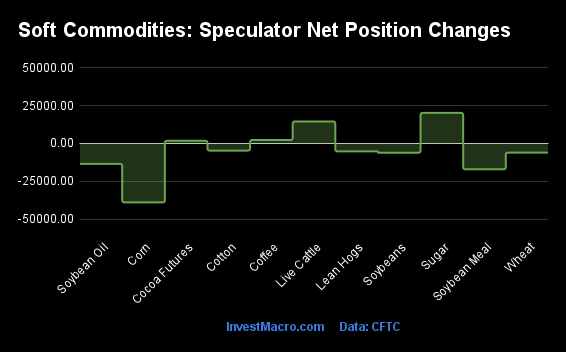
The COT soft commodities markets speculator bets were slightly higher this week as six out of the eleven softs markets we cover had higher positioning while the other five markets had lower speculator contracts.

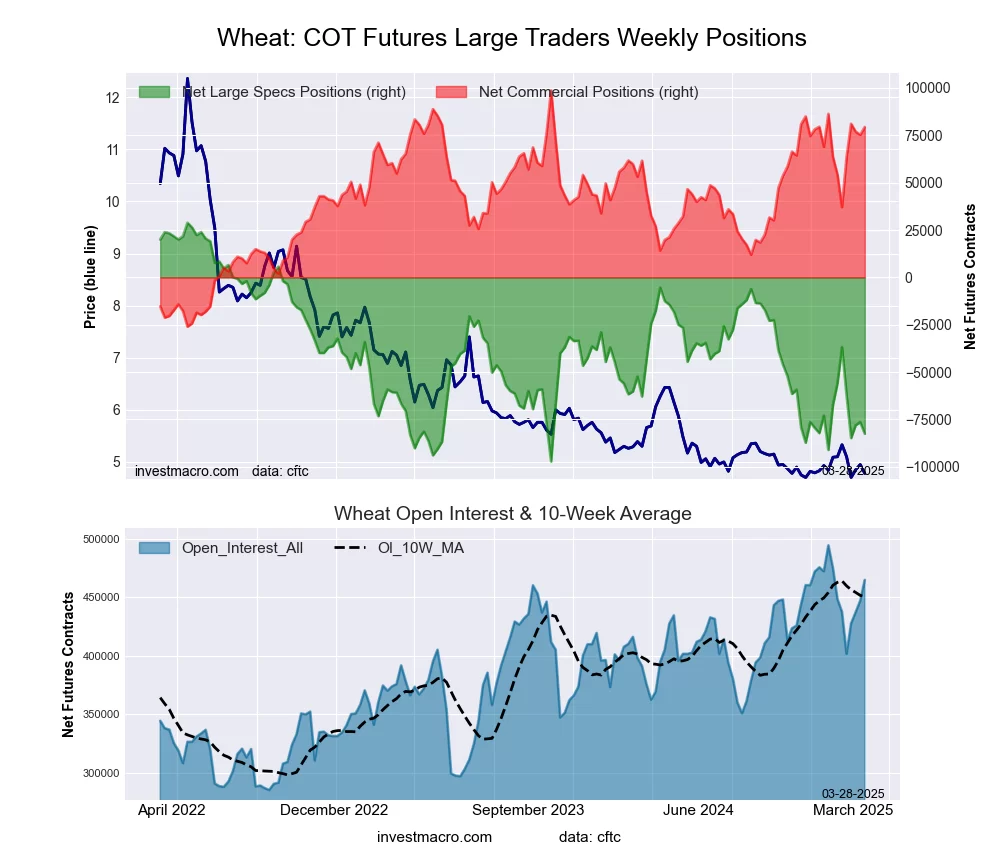
Leading the gains for the softs markets was Soybean Meal (23,817 contracts) with Wheat (23,756 contracts), Corn (18,506 contracts), Soybeans (5,815 contracts), Soybean Oil (5,428 contracts) and Lean Hogs (3,384 contracts) also showing positive weeks.

The markets with the declines in speculator bets this week were Cotton (-8,339 contracts), Coffee (-4,642 contracts), Sugar (-3,675 contracts), Live Cattle (-2,605 contracts) and with Cocoa (-1,578 contracts) also registering lower bets on the week.


Soft Commodities Net Speculators Leaderboard
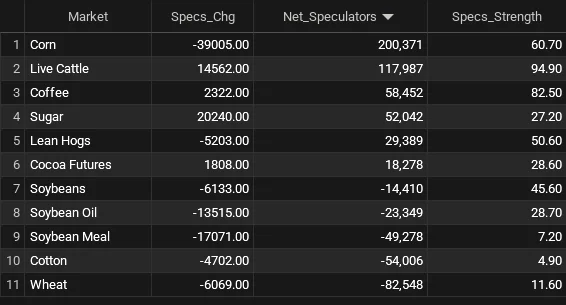
Legend: Weekly Speculators Change | Speculators Current Net Position | Speculators Strength Score compared to last 3-Years (0-100 range)


Strength Scores led by Coffee, Live Cattle & Corn

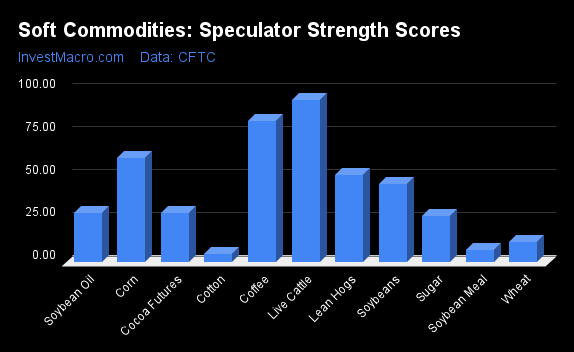
COT Strength Scores (a normalized measure of Speculator positions over a 3-Year range, from 0 to 100 where above 80 is Extreme-Bullish and below 20 is Extreme-Bearish) showed that Coffee (96 percent), Live Cattle (93 percent) and Corn (93 percent) lead the softs markets this week. Lean Hogs (81 percent) and Soybean Oil (71 percent) come in as the next highest in the weekly strength scores.

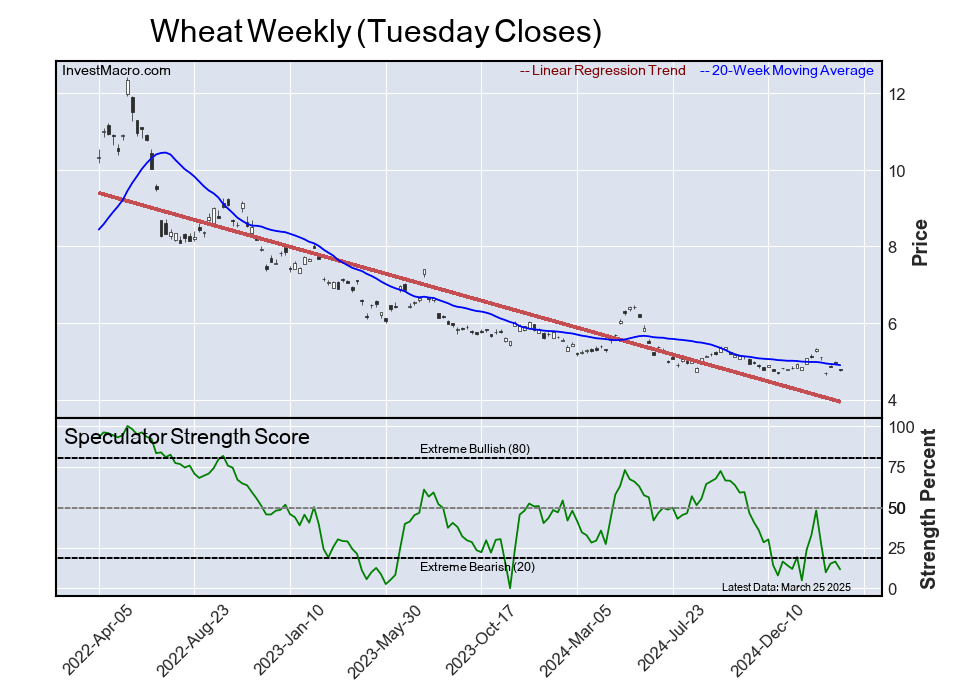
On the downside, Cotton (0 percent) and Sugar (0 percent) come in at the lowest strength levels currently and are in Extreme-Bearish territory (below 20 percent). The next lowest strength scores are Wheat (24 percent) and Soybean Meal (27 percent).

Strength Statistics:
Corn (92.7 percent) vs Corn previous week (90.4 percent)
Sugar (0.0 percent) vs Sugar previous week (1.2 percent)
Coffee (95.5 percent) vs Coffee previous week (100.0 percent)
Soybeans (55.3 percent) vs Soybeans previous week (54.0 percent)
Soybean Oil (70.8 percent) vs Soybean Oil previous week (67.8 percent)
Soybean Meal (27.1 percent) vs Soybean Meal previous week (17.4 percent)
Live Cattle (93.4 percent) vs Live Cattle previous week (95.9 percent)
Lean Hogs (81.5 percent) vs Lean Hogs previous week (78.9 percent)
Cotton (0.0 percent) vs Cotton previous week (5.4 percent)
Cocoa (46.1 percent) vs Cocoa previous week (47.7 percent)
Wheat (23.7 percent) vs Wheat previous week (4.8 percent)


Soybeans & Corn top the 6-Week Strength Trends

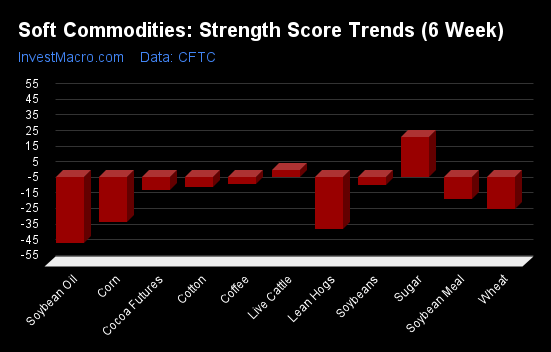
COT Strength Score Trends (or move index, calculates the 6-week changes in strength scores) showed that Soybeans (34 percent) and Corn (30 percent) lead the past six weeks trends for soft commodities. Soybean Oil (21 percent), Soybean Meal (19 percent) and Wheat (16 percent) are the next highest positive movers in the latest trends data.

Sugar (-30 percent) leads the downside trend scores currently with Lean Hogs (-14 percent), Cotton (-12 percent) and Cocoa (-1 percent) following next with lower trend scores.

Strength Trend Statistics:
Corn (30.1 percent) vs Corn previous week (28.3 percent)
Sugar (-29.8 percent) vs Sugar previous week (-31.2 percent)
Coffee (7.5 percent) vs Coffee previous week (13.9 percent)
Soybeans (33.5 percent) vs Soybeans previous week (33.2 percent)
Soybean Oil (20.7 percent) vs Soybean Oil previous week (8.1 percent)
Soybean Meal (18.9 percent) vs Soybean Meal previous week (8.3 percent)
Live Cattle (13.0 percent) vs Live Cattle previous week (8.0 percent)
Lean Hogs (-13.8 percent) vs Lean Hogs previous week (-21.1 percent)
Cotton (-12.4 percent) vs Cotton previous week (-10.3 percent)
Cocoa (-1.2 percent) vs Cocoa previous week (1.7 percent)
Wheat (15.8 percent) vs Wheat previous week (-9.3 percent)


Individual Soft Commodities Markets:

CORN Futures:
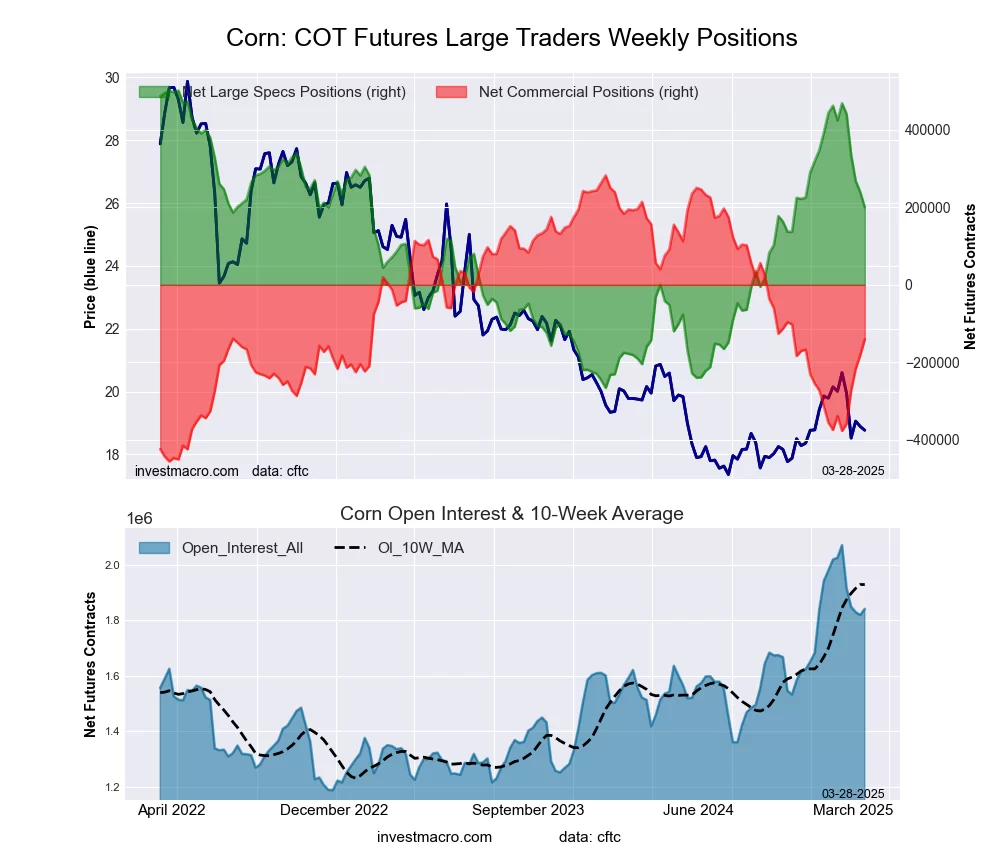
CORN Futures COT ChartThe CORN large speculator standing this week recorded a net position of 462,381 contracts in the data reported through Tuesday. This was a weekly rise of 18,506 contracts from the previous week which had a total of 443,875 net contracts.

This week’s current strength score (the trader positioning range over the past three years, measured from 0 to 100) shows the speculators are currently Bullish-Extreme with a score of 92.7 percent. The commercials are Bearish-Extreme with a score of 12.8 percent and the small traders (not shown in chart) are Bearish-Extreme with a score of 0.1 percent.

Price Trend-Following Model: Strong Uptrend

Our weekly trend-following model classifies the current market price position as: Strong Uptrend.

CORN Futures StatisticsSPECULATORSCOMMERCIALSSMALL TRADERS
– Percent of Open Interest Longs:31.038.35.9
– Percent of Open Interest Shorts:8.156.910.2
– Net Position:462,381-374,564-87,817
– Gross Longs:626,001773,870118,268
– Gross Shorts:163,6201,148,434206,085
– Long to Short Ratio:3.8 to 10.7 to 10.6 to 1
NET POSITION TREND:
– Strength Index Score (3 Year Range Pct):92.712.80.1
– Strength Index Reading (3 Year Range):Bullish-ExtremeBearish-ExtremeBearish-Extreme
NET POSITION MOVEMENT INDEX:
– 6-Week Change in Strength Index:30.1-27.5-35.9


SUGAR Futures:

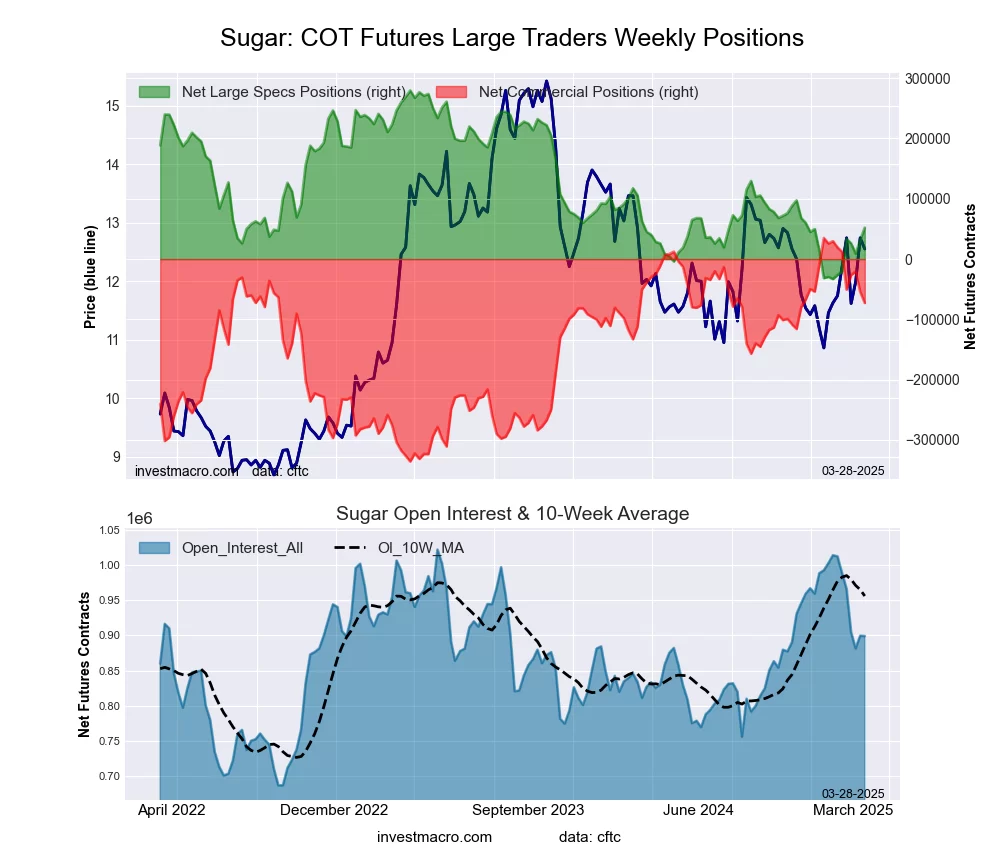
SUGAR Futures COT ChartThe SUGAR large speculator standing this week recorded a net position of -33,109 contracts in the data reported through Tuesday. This was a weekly decline of -3,675 contracts from the previous week which had a total of -29,434 net contracts.

This week’s current strength score (the trader positioning range over the past three years, measured from 0 to 100) shows the speculators are currently Bearish-Extreme with a score of 0.0 percent. The commercials are Bullish-Extreme with a score of 98.6 percent and the small traders (not shown in chart) are Bearish with a score of 24.0 percent.

Price Trend-Following Model: Downtrend

Our weekly trend-following model classifies the current market price position as: Downtrend.

SUGAR Futures StatisticsSPECULATORSCOMMERCIALSSMALL TRADERS
– Percent of Open Interest Longs:22.453.87.3
– Percent of Open Interest Shorts:25.750.87.0
– Net Position:-33,10929,7453,364
– Gross Longs:227,314544,96074,415
– Gross Shorts:260,423515,21571,051
– Long to Short Ratio:0.9 to 11.1 to 11.0 to 1
NET POSITION TREND:
– Strength Index Score (3 Year Range Pct):0.098.624.0
– Strength Index Reading (3 Year Range):Bearish-ExtremeBullish-ExtremeBearish
NET POSITION MOVEMENT INDEX:
– 6-Week Change in Strength Index:-29.826.2-4.9


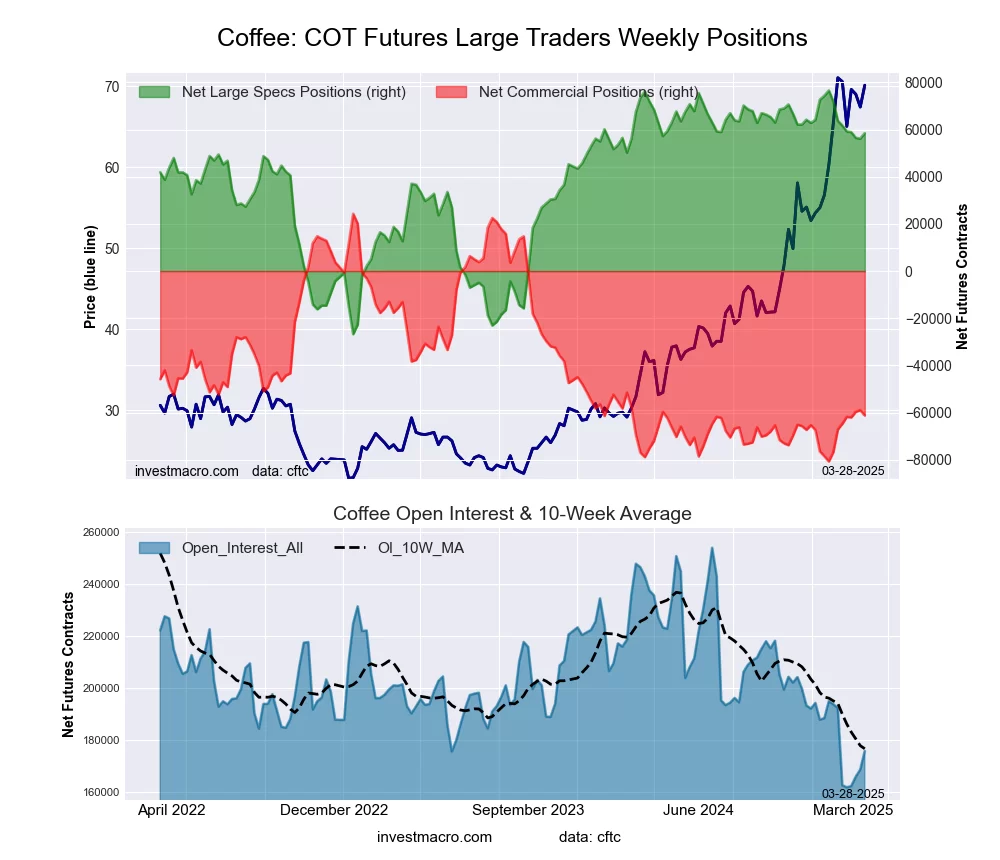
COFFEE Futures:

COFFEE Futures COT ChartThe COFFEE large speculator standing this week recorded a net position of 71,878 contracts in the data reported through Tuesday. This was a weekly lowering of -4,642 contracts from the previous week which had a total of 76,520 net contracts.

This week’s current strength score (the trader positioning range over the past three years, measured from 0 to 100) shows the speculators are currently Bullish-Extreme with a score of 95.5 percent. The commercials are Bearish-Extreme with a score of 3.8 percent and the small traders (not shown in chart) are Bullish-Extreme with a score of 98.4 percent.

Price Trend-Following Model: Strong Uptrend

Our weekly trend-following model classifies the current market price position as: Strong Uptrend.

COFFEE Futures StatisticsSPECULATORSCOMMERCIALSSMALL TRADERS
– Percent of Open Interest Longs:42.931.55.8
– Percent of Open Interest Shorts:5.871.13.3
– Net Position:71,878-76,7284,850
– Gross Longs:83,06660,96411,225
– Gross Shorts:11,188137,6926,375
– Long to Short Ratio:7.4 to 10.4 to 11.8 to 1
NET POSITION TREND:
– Strength Index Score (3 Year Range Pct):95.53.898.4
– Strength Index Reading (3 Year Range):Bullish-ExtremeBearish-ExtremeBullish-Extreme
NET POSITION MOVEMENT INDEX:
– 6-Week Change in Strength Index:7.5-9.028.6


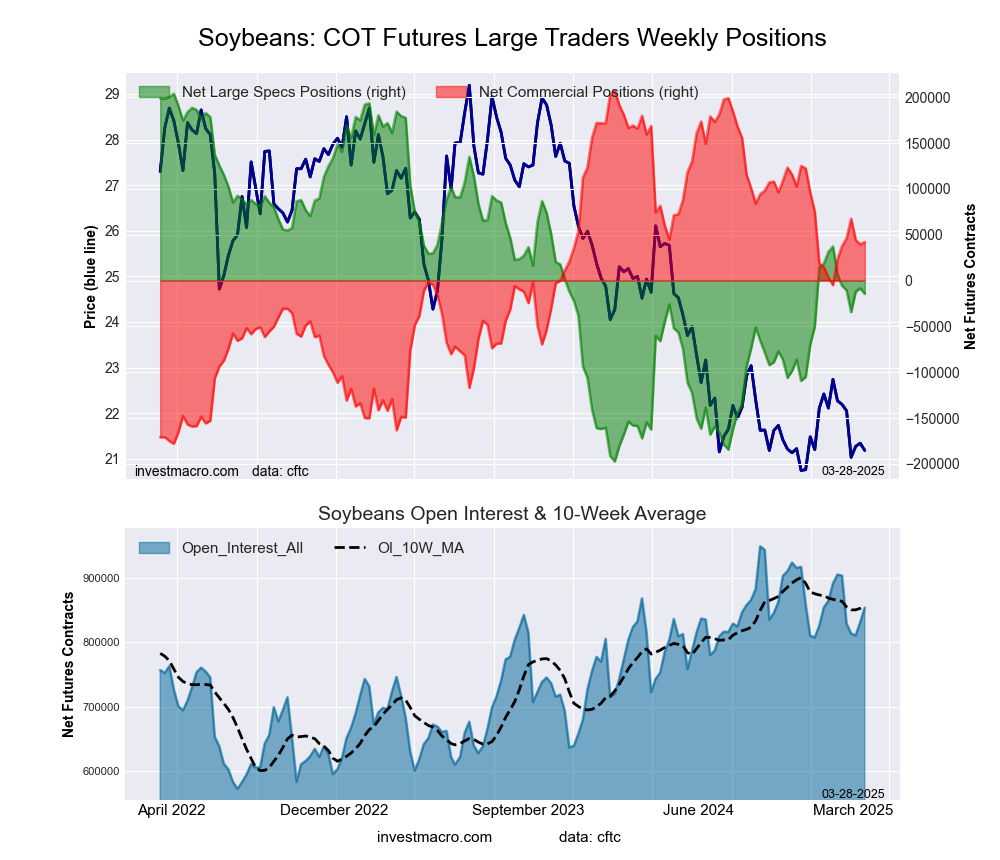
SOYBEANS Futures:

SOYBEANS Futures COT ChartThe SOYBEANS large speculator standing this week recorded a net position of 37,166 contracts in the data reported through Tuesday. This was a weekly increase of 5,815 contracts from the previous week which had a total of 31,351 net contracts.

This week’s current strength score (the trader positioning range over the past three years, measured from 0 to 100) shows the speculators are currently Bullish with a score of 55.3 percent. The commercials are Bearish with a score of 47.5 percent and the small traders (not shown in chart) are Bearish with a score of 28.4 percent.

Price Trend-Following Model: Weak Downtrend

Our weekly trend-following model classifies the current market price position as: Weak Downtrend.

SOYBEANS Futures StatisticsSPECULATORSCOMMERCIALSSMALL TRADERS
– Percent of Open Interest Longs:20.455.74.8
– Percent of Open Interest Shorts:16.356.28.5
– Net Position:37,166-4,926-32,240
– Gross Longs:182,119495,67243,118
– Gross Shorts:144,953500,59875,358
– Long to Short Ratio:1.3 to 11.0 to 10.6 to 1
NET POSITION TREND:
– Strength Index Score (3 Year Range Pct):55.347.528.4
– Strength Index Reading (3 Year Range):BullishBearishBearish
NET POSITION MOVEMENT INDEX:
– 6-Week Change in Strength Index:33.5-31.5-38.8


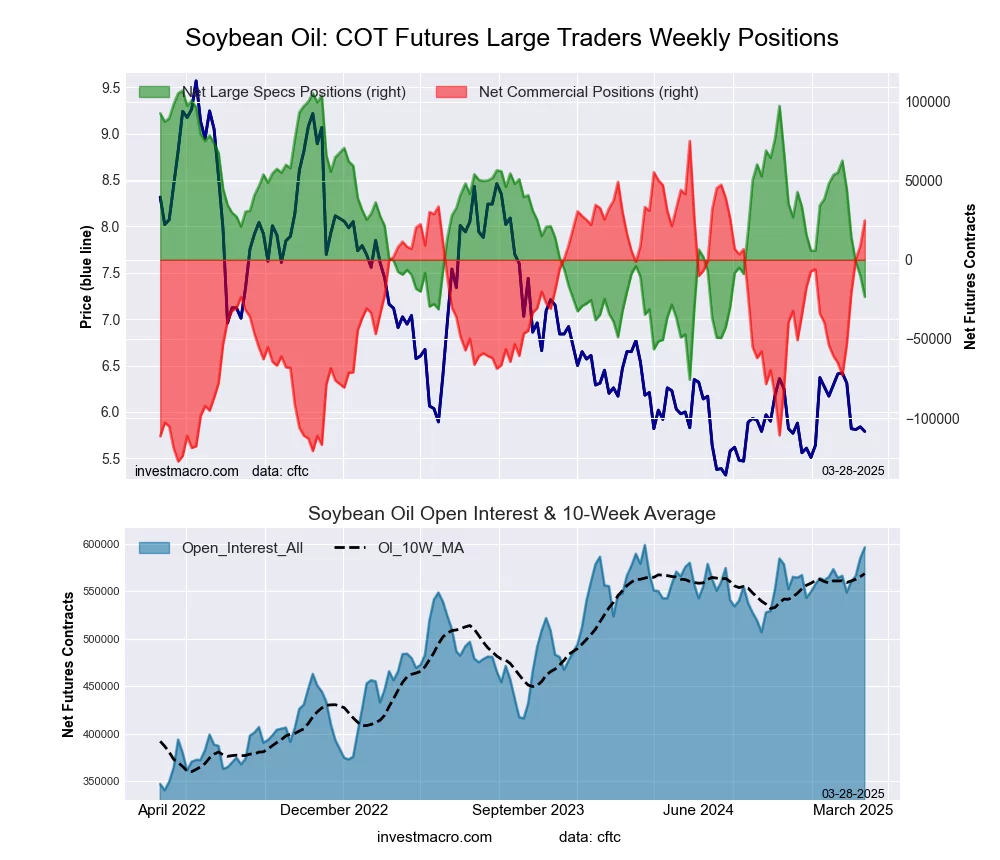
SOYBEAN OIL Futures:

SOYBEAN OIL Futures COT ChartThe SOYBEAN OIL large speculator standing this week recorded a net position of 53,595 contracts in the data reported through Tuesday. This was a weekly lift of 5,428 contracts from the previous week which had a total of 48,167 net contracts.

This week’s current strength score (the trader positioning range over the past three years, measured from 0 to 100) shows the speculators are currently Bullish with a score of 70.8 percent. The commercials are Bearish with a score of 33.0 percent and the small traders (not shown in chart) are Bearish with a score of 41.5 percent.

Price Trend-Following Model: Strong Uptrend

Our weekly trend-following model classifies the current market price position as: Strong Uptrend.

SOYBEAN OIL Futures StatisticsSPECULATORSCOMMERCIALSSMALL TRADERS
– Percent of Open Interest Longs:21.254.35.7
– Percent of Open Interest Shorts:11.864.94.4
– Net Position:53,595-60,6797,084
– Gross Longs:121,346311,28332,530
– Gross Shorts:67,751371,96225,446
– Long to Short Ratio:1.8 to 10.8 to 11.3 to 1
NET POSITION TREND:
– Strength Index Score (3 Year Range Pct):70.833.041.5
– Strength Index Reading (3 Year Range):BullishBearishBearish
NET POSITION MOVEMENT INDEX:
– 6-Week Change in Strength Index:20.7-21.521.7


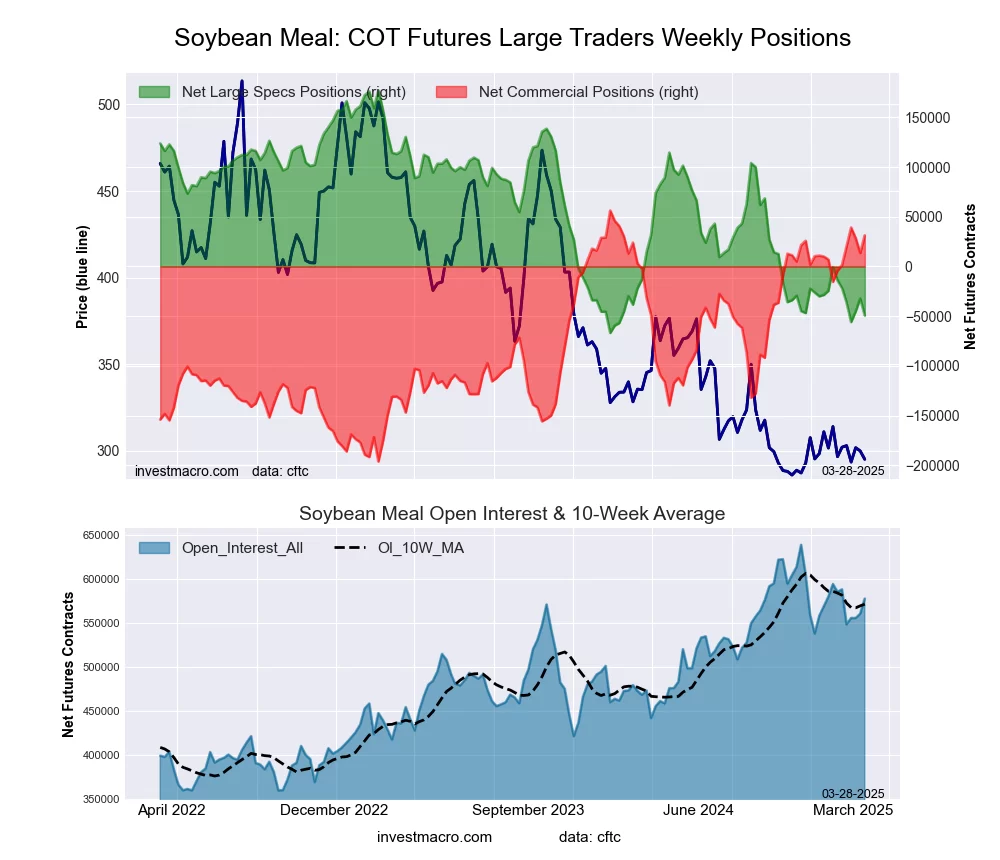
SOYBEAN MEAL Futures:

SOYBEAN MEAL Futures COT ChartThe SOYBEAN MEAL large speculator standing this week recorded a net position of -691 contracts in the data reported through Tuesday. This was a weekly advance of 23,817 contracts from the previous week which had a total of -24,508 net contracts.

This week’s current strength score (the trader positioning range over the past three years, measured from 0 to 100) shows the speculators are currently Bearish with a score of 27.1 percent. The commercials are Bullish with a score of 71.6 percent and the small traders (not shown in chart) are Bearish with a score of 28.5 percent.

Price Trend-Following Model: Weak Downtrend

Our weekly trend-following model classifies the current market price position as: Weak Downtrend.

SOYBEAN MEAL Futures StatisticsSPECULATORSCOMMERCIALSSMALL TRADERS
– Percent of Open Interest Longs:17.450.18.3
– Percent of Open Interest Shorts:17.552.75.6
– Net Position:-691-15,51316,204
– Gross Longs:103,159297,38849,293
– Gross Shorts:103,850312,90133,089
– Long to Short Ratio:1.0 to 11.0 to 11.5 to 1
NET POSITION TREND:
– Strength Index Score (3 Year Range Pct):27.171.628.5
– Strength Index Reading (3 Year Range):BearishBullishBearish
NET POSITION MOVEMENT INDEX:
– 6-Week Change in Strength Index:18.9-16.4-21.5


LIVE CATTLE Futures:

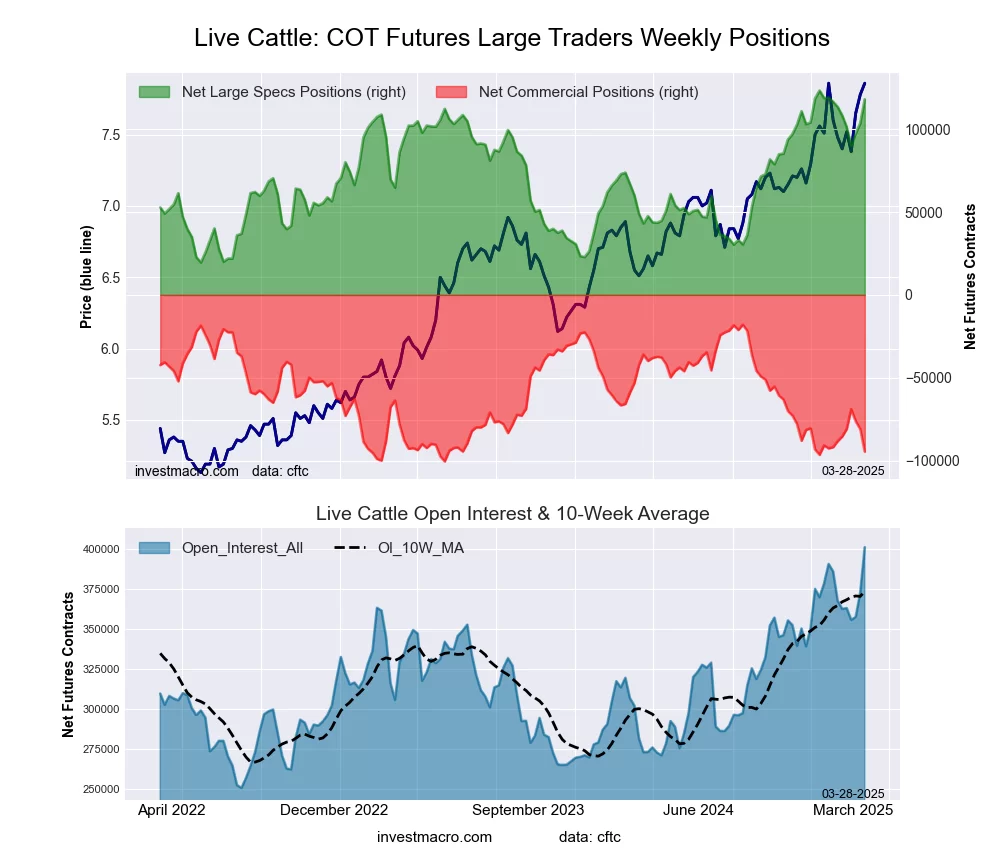
LIVE CATTLE Futures COT ChartThe LIVE CATTLE large speculator standing this week recorded a net position of 116,439 contracts in the data reported through Tuesday. This was a weekly decline of -2,605 contracts from the previous week which had a total of 119,044 net contracts.

This week’s current strength score (the trader positioning range over the past three years, measured from 0 to 100) shows the speculators are currently Bullish-Extreme with a score of 93.4 percent. The commercials are Bearish-Extreme with a score of 10.4 percent and the small traders (not shown in chart) are Bearish-Extreme with a score of 11.3 percent.

Price Trend-Following Model: Strong Uptrend

Our weekly trend-following model classifies the current market price position as: Strong Uptrend.

LIVE CATTLE Futures StatisticsSPECULATORSCOMMERCIALSSMALL TRADERS
– Percent of Open Interest Longs:51.628.27.0
– Percent of Open Interest Shorts:21.552.013.4
– Net Position:116,439-91,888-24,551
– Gross Longs:199,414109,04027,075
– Gross Shorts:82,975200,92851,626
– Long to Short Ratio:2.4 to 10.5 to 10.5 to 1
NET POSITION TREND:
– Strength Index Score (3 Year Range Pct):93.410.411.3
– Strength Index Reading (3 Year Range):Bullish-ExtremeBearish-ExtremeBearish-Extreme
NET POSITION MOVEMENT INDEX:
– 6-Week Change in Strength Index:13.0-12.6-10.1


LEAN HOGS Futures:

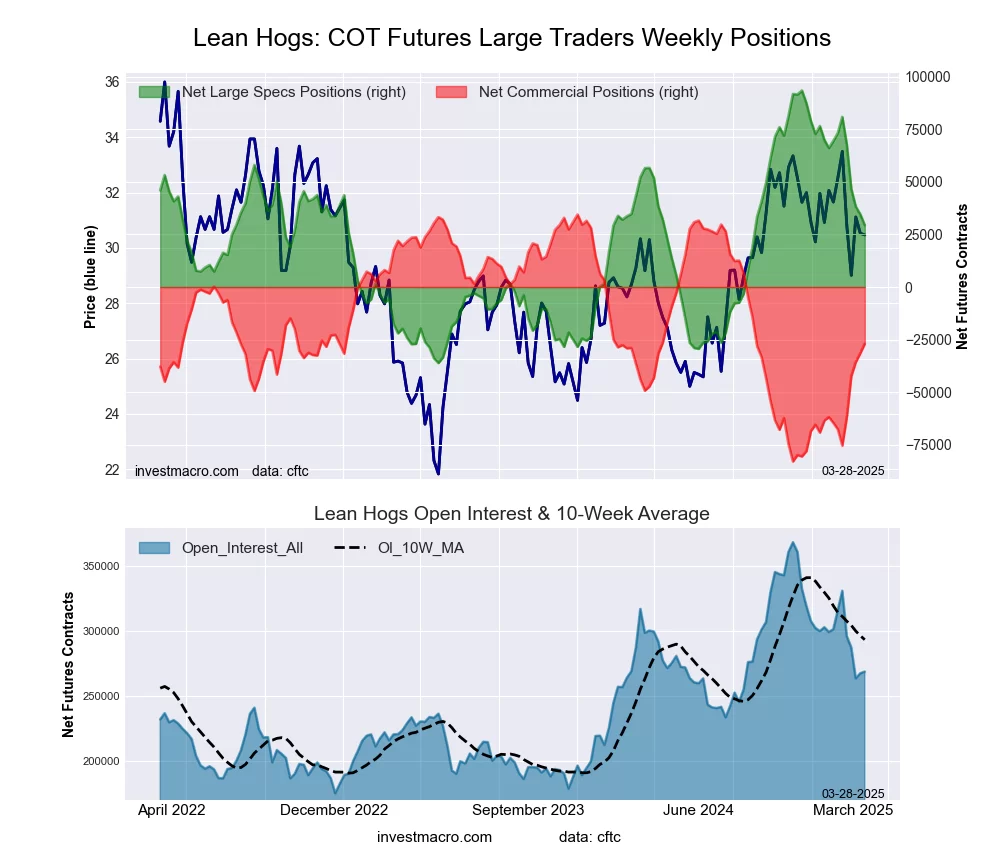
LEAN HOGS Futures COT ChartThe LEAN HOGS large speculator standing this week recorded a net position of 69,445 contracts in the data reported through Tuesday. This was a weekly lift of 3,384 contracts from the previous week which had a total of 66,061 net contracts.

This week’s current strength score (the trader positioning range over the past three years, measured from 0 to 100) shows the speculators are currently Bullish-Extreme with a score of 81.5 percent. The commercials are Bearish-Extreme with a score of 15.6 percent and the small traders (not shown in chart) are Bearish with a score of 48.2 percent.

Price Trend-Following Model: Strong Uptrend

Our weekly trend-following model classifies the current market price position as: Strong Uptrend.

LEAN HOGS Futures StatisticsSPECULATORSCOMMERCIALSSMALL TRADERS
– Percent of Open Interest Longs:42.833.27.4
– Percent of Open Interest Shorts:19.854.69.0
– Net Position:69,445-64,565-4,880
– Gross Longs:129,010100,20422,404
– Gross Shorts:59,565164,76927,284
– Long to Short Ratio:2.2 to 10.6 to 10.8 to 1
NET POSITION TREND:
– Strength Index Score (3 Year Range Pct):81.515.648.2
– Strength Index Reading (3 Year Range):Bullish-ExtremeBearish-ExtremeBearish
NET POSITION MOVEMENT INDEX:
– 6-Week Change in Strength Index:-13.811.526.8


COTTON Futures:

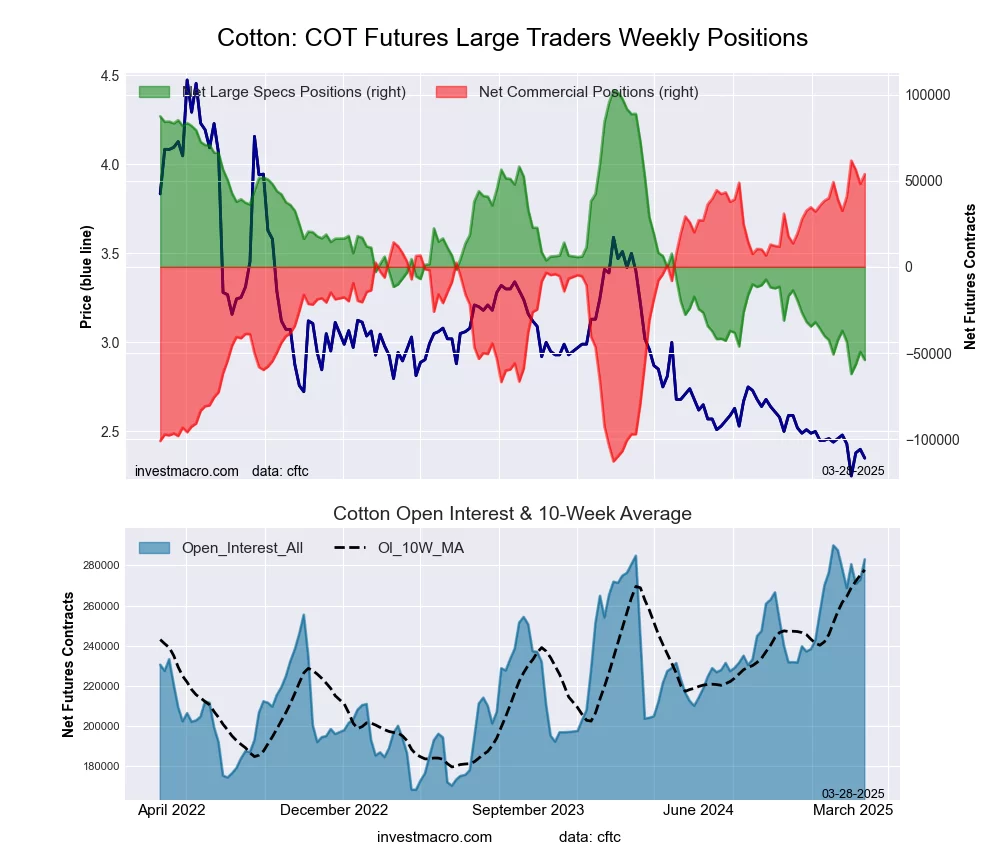
COTTON Futures COT ChartThe COTTON large speculator standing this week recorded a net position of -50,767 contracts in the data reported through Tuesday. This was a weekly lowering of -8,339 contracts from the previous week which had a total of -42,428 net contracts.

This week’s current strength score (the trader positioning range over the past three years, measured from 0 to 100) shows the speculators are currently Bearish-Extreme with a score of 0.0 percent. The commercials are Bullish-Extreme with a score of 100.0 percent and the small traders (not shown in chart) are Bearish with a score of 26.0 percent.

Price Trend-Following Model: Strong Downtrend

Our weekly trend-following model classifies the current market price position as: Strong Downtrend.

COTTON Futures StatisticsSPECULATORSCOMMERCIALSSMALL TRADERS
– Percent of Open Interest Longs:22.450.35.5
– Percent of Open Interest Shorts:39.933.34.9
– Net Position:-50,76749,2141,553
– Gross Longs:64,897145,91215,822
– Gross Shorts:115,66496,69814,269
– Long to Short Ratio:0.6 to 11.5 to 11.1 to 1
NET POSITION TREND:
– Strength Index Score (3 Year Range Pct):0.0100.026.0
– Strength Index Reading (3 Year Range):Bearish-ExtremeBullish-ExtremeBearish
NET POSITION MOVEMENT INDEX:
– 6-Week Change in Strength Index:-12.410.314.5


COCOA Futures:

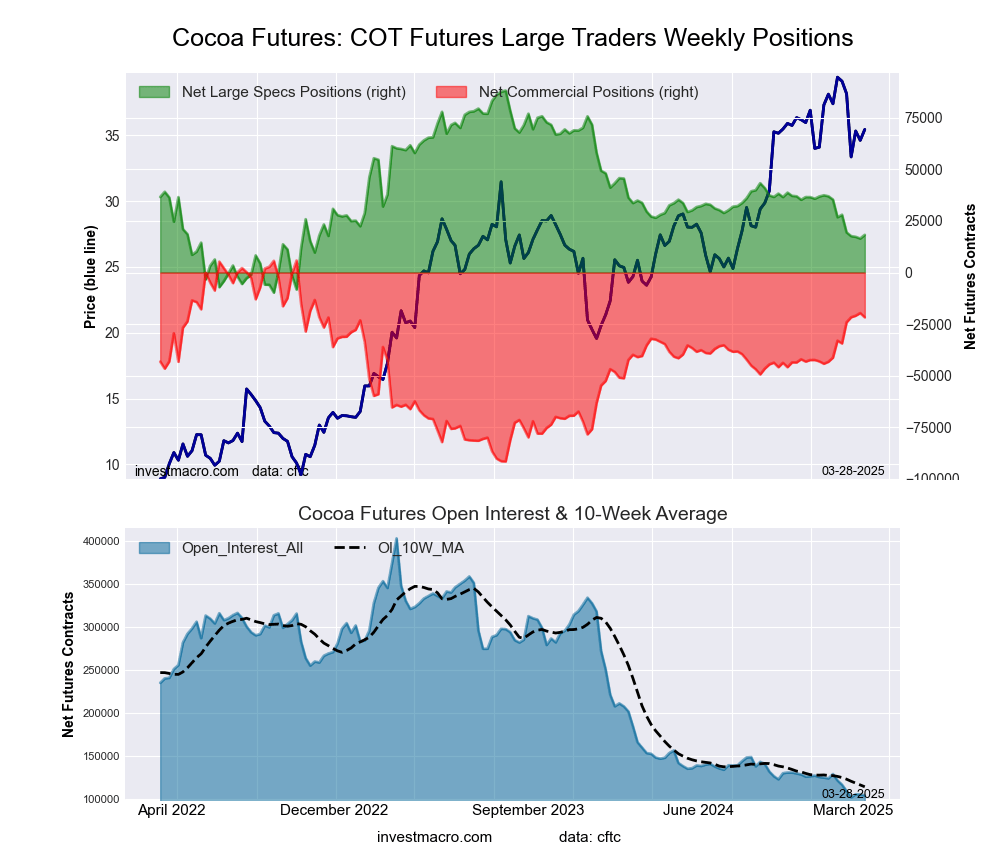
COCOA Futures COT ChartThe COCOA large speculator standing this week recorded a net position of 35,390 contracts in the data reported through Tuesday. This was a weekly lowering of -1,578 contracts from the previous week which had a total of 36,968 net contracts.

This week’s current strength score (the trader positioning range over the past three years, measured from 0 to 100) shows the speculators are currently Bearish with a score of 46.1 percent. The commercials are Bullish with a score of 51.6 percent and the small traders (not shown in chart) are Bullish with a score of 62.6 percent.

Price Trend-Following Model: Uptrend

Our weekly trend-following model classifies the current market price position as: Uptrend.

COCOA Futures StatisticsSPECULATORSCOMMERCIALSSMALL TRADERS
– Percent of Open Interest Longs:37.735.28.5
– Percent of Open Interest Shorts:10.267.43.9
– Net Position:35,390-41,3095,919
– Gross Longs:48,47345,21010,952
– Gross Shorts:13,08386,5195,033
– Long to Short Ratio:3.7 to 10.5 to 12.2 to 1
NET POSITION TREND:
– Strength Index Score (3 Year Range Pct):46.151.662.6
– Strength Index Reading (3 Year Range):BearishBullishBullish
NET POSITION MOVEMENT INDEX:
– 6-Week Change in Strength Index:-1.22.0-6.0


WHEAT Futures:

WHEAT Futures COT ChartThe WHEAT large speculator standing this week recorded a net position of -67,355 contracts in the data reported through Tuesday. This was a weekly lift of 23,756 contracts from the previous week which had a total of -91,111 net contracts.

This week’s current strength score (the trader positioning range over the past three years, measured from 0 to 100) shows the speculators are currently Bearish with a score of 23.7 percent. The commercials are Bullish with a score of 72.0 percent and the small traders (not shown in chart) are Bullish with a score of 76.9 percent.

Price Trend-Following Model: Weak Downtrend

Our weekly trend-following model classifies the current market price position as: Weak Downtrend.

WHEAT Futures StatisticsSPECULATORSCOMMERCIALSSMALL TRADERS
– Percent of Open Interest Longs:27.533.57.5
– Percent of Open Interest Shorts:41.720.16.8
– Net Position:-67,35563,6813,674
– Gross Longs:130,876159,16035,860
– Gross Shorts:198,23195,47932,186
– Long to Short Ratio:0.7 to 11.7 to 11.1 to 1
NET POSITION TREND:
– Strength Index Score (3 Year Range Pct):23.772.076.9
– Strength Index Reading (3 Year Range):BearishBullishBullish
NET POSITION MOVEMENT INDEX:
– 6-Week Change in Strength Index:15.8-17.17.6


Article By InvestMacroReceive our weekly COT Newsletter

*COT Report: The COT data, released weekly to the public each Friday, is updated through the most recent Tuesday (data is 3 days old) and shows a quick view of how large speculators or non-commercials (for-profit traders) were positioned in the futures markets.

The CFTC categorizes trader positions according to commercial hedgers (traders who use futures contracts for hedging as part of the business), non-commercials (large traders who speculate to realize trading profits) and nonreportable traders (usually small traders/speculators) as well as their open interest (contracts open in the market at time of reporting). See CFTC criteria here.

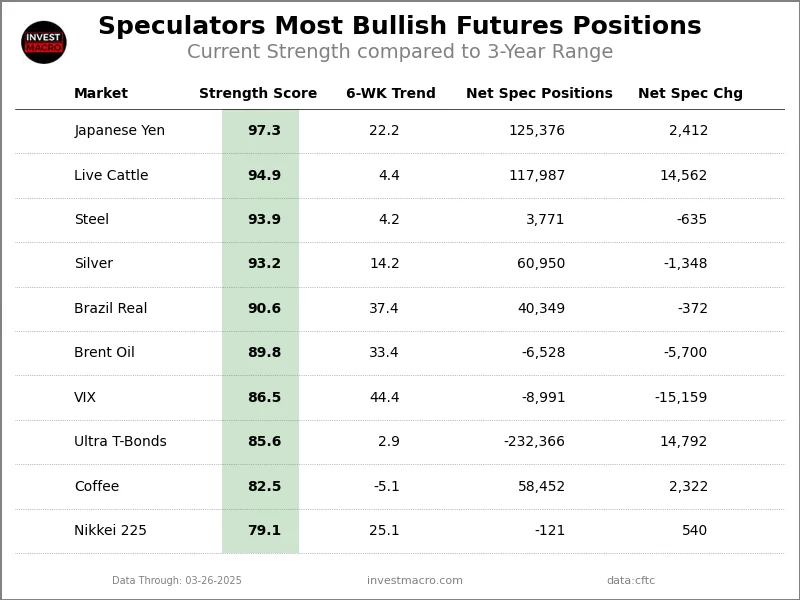
COT Stock Market Charts: Speculator Changes led by S&P500 & MSCI EAFE

By InvestMacro

Here are the latest charts and statistics for the Commitment of Traders (COT) data published by the Commodities Futures Trading Commission (CFTC).

The latest COT data is updated through Tuesday February 4th and shows a quick view of how large traders (for-profit speculators and commercial entities) were positioned in the futures markets.

Weekly Speculator Changes led by S&P500-Mini & MSCI EAFE-Mini

The COT stock markets speculator bets were hgher this week as four out of the seven stock markets we cover had higher positioning while the other three markets had lower speculator contracts.

Leading the gains for the stock markets was the S&P500-Mini (51,337 contracts) with the MSCI EAFE-Mini (13,909 contracts), the VIX (915 contracts) and the Nikkei 225 (863 contracts) also showing positive weeks.

The markets with the declines in speculator bets this week were the Nasdaq-Mini (-11,713 contracts), the Russell-Mini (-5,463 contracts) and with the DowJones-Mini (-13 contracts) also registering lower bets on the week.


Stock Market Net Speculators Leaderboard

Legend: Weekly Speculators Change | Speculators Current Net Position | Speculators Strength Score compared to last 3-Years (0-100 range)


Strength Scores led by Nasdaq-Mini & S&P500-Mini

COT Strength Scores (a normalized measure of Speculator positions over a 3-Year range, from 0 to 100 where above 80 is Extreme-Bullish and below 20 is Extreme-Bearish) showed that the Nasdaq-Mini (69 percent) and the S&P500-Mini (64 percent) lead the stock markets this week. The MSCI EAFE-Mini (64 percent) and DowJones-Mini (63 percent) come in as the next highest in the weekly strength scores.

On the downside, the VIX (52 percent) comes in at the lowest strength level currently.

Strength Statistics:
VIX (52.4 percent) vs VIX previous week (51.6 percent)
S&P500-Mini (64.0 percent) vs S&P500-Mini previous week (56.4 percent)
DowJones-Mini (63.1 percent) vs DowJones-Mini previous week (63.1 percent)
Nasdaq-Mini (68.6 percent) vs Nasdaq-Mini previous week (86.7 percent)
Russell2000-Mini (63.2 percent) vs Russell2000-Mini previous week (66.9 percent)
Nikkei USD (61.4 percent) vs Nikkei USD previous week (54.1 percent)
EAFE-Mini (64.2 percent) vs EAFE-Mini previous week (46.2 percent)


MSCI EAFE-Mini & S&P500-Mini top the 6-Week Strength Trends

COT Strength Score Trends (or move index, calculates the 6-week changes in strength scores) showed that the MSCI EAFE-Mini (20 percent) leads the past six weeks trends for the stock markets. The S&P500-Mini (9 percent) and the Nikkei 225 (3 percent) are the next highest positive movers in the latest trends data.

The VIX (-28 percent) leads the downside trend scores currently with the Russell-Mini (-18 percent) coming in as the next market with lower trend scores.

Strength Trend Statistics:
VIX (-28.3 percent) vs VIX previous week (-0.4 percent)
S&P500-Mini (8.8 percent) vs S&P500-Mini previous week (-2.4 percent)
DowJones-Mini (-6.9 percent) vs DowJones-Mini previous week (-9.4 percent)
Nasdaq-Mini (-12.8 percent) vs Nasdaq-Mini previous week (-8.4 percent)
Russell2000-Mini (-17.7 percent) vs Russell2000-Mini previous week (-14.8 percent)
Nikkei USD (3.4 percent) vs Nikkei USD previous week (-5.1 percent)
EAFE-Mini (20.2 percent) vs EAFE-Mini previous week (4.1 percent)


Individual Stock Market Charts:

VIX Volatility Futures:

VIX Volatility Futures COT ChartThe VIX Volatility large speculator standing this week reached a net position of -48,530 contracts in the data reported through Tuesday. This was a weekly lift of 915 contracts from the previous week which had a total of -49,445 net contracts.

This week’s current strength score (the trader positioning range over the past three years, measured from 0 to 100) shows the speculators are currently Bullish with a score of 52.4 percent. The commercials are Bearish with a score of 47.4 percent and the small traders (not shown in chart) are Bullish-Extreme with a score of 86.9 percent.

Price Trend-Following Model: Downtrend

Our weekly trend-following model classifies the current market price position as: Downtrend.

VIX Volatility Futures StatisticsSPECULATORSCOMMERCIALSSMALL TRADERS
– Percent of Open Interest Longs:19.648.18.8
– Percent of Open Interest Shorts:34.533.88.1
– Net Position:-48,53046,3672,163
– Gross Longs:63,875156,54328,653
– Gross Shorts:112,405110,17626,490
– Long to Short Ratio:0.6 to 11.4 to 11.1 to 1
NET POSITION TREND:
– Strength Index Score (3 Year Range Pct):52.447.486.9
– Strength Index Reading (3 Year Range):BullishBearishBullish-Extreme
NET POSITION MOVEMENT INDEX:
– 6-Week Change in Strength Index:-28.321.524.7


S&P500 Mini Futures:

SP500 Mini Futures COT ChartThe S&P500 Mini large speculator standing this week reached a net position of -4,817 contracts in the data reported through Tuesday. This was a weekly increase of 51,337 contracts from the previous week which had a total of -56,154 net contracts.

This week’s current strength score (the trader positioning range over the past three years, measured from 0 to 100) shows the speculators are currently Bullish with a score of 64.0 percent. The commercials are Bearish-Extreme with a score of 17.2 percent and the small traders (not shown in chart) are Bullish-Extreme with a score of 88.1 percent.

Price Trend-Following Model: Uptrend

Our weekly trend-following model classifies the current market price position as: Uptrend.

S&P500 Mini Futures StatisticsSPECULATORSCOMMERCIALSSMALL TRADERS
– Percent of Open Interest Longs:14.868.713.1
– Percent of Open Interest Shorts:15.074.76.9
– Net Position:-4,817-123,461128,278
– Gross Longs:306,7411,423,400271,788
– Gross Shorts:311,5581,546,861143,510
– Long to Short Ratio:1.0 to 10.9 to 11.9 to 1
NET POSITION TREND:
– Strength Index Score (3 Year Range Pct):64.017.288.1
– Strength Index Reading (3 Year Range):BullishBearish-ExtremeBullish-Extreme
NET POSITION MOVEMENT INDEX:
– 6-Week Change in Strength Index:8.8-8.90.4


Dow Jones Mini Futures:

Dow Jones Mini Futures COT ChartThe Dow Jones Mini large speculator standing this week reached a net position of 1,721 contracts in the data reported through Tuesday. This was a weekly reduction of -13 contracts from the previous week which had a total of 1,734 net contracts.

This week’s current strength score (the trader positioning range over the past three years, measured from 0 to 100) shows the speculators are currently Bullish with a score of 63.1 percent. The commercials are Bearish with a score of 29.4 percent and the small traders (not shown in chart) are Bullish with a score of 79.9 percent.

Price Trend-Following Model: Strong Uptrend

Our weekly trend-following model classifies the current market price position as: Strong Uptrend.

Dow Jones Mini Futures StatisticsSPECULATORSCOMMERCIALSSMALL TRADERS
– Percent of Open Interest Longs:16.063.518.1
– Percent of Open Interest Shorts:13.970.912.9
– Net Position:1,721-6,0834,362
– Gross Longs:13,20552,40914,969
– Gross Shorts:11,48458,49210,607
– Long to Short Ratio:1.1 to 10.9 to 11.4 to 1
NET POSITION TREND:
– Strength Index Score (3 Year Range Pct):63.129.479.9
– Strength Index Reading (3 Year Range):BullishBearishBullish
NET POSITION MOVEMENT INDEX:
– 6-Week Change in Strength Index:-6.97.2-4.0


Nasdaq Mini Futures:

Nasdaq Mini Futures COT ChartThe Nasdaq Mini large speculator standing this week reached a net position of 18,978 contracts in the data reported through Tuesday. This was a weekly fall of -11,713 contracts from the previous week which had a total of 30,691 net contracts.

This week’s current strength score (the trader positioning range over the past three years, measured from 0 to 100) shows the speculators are currently Bullish with a score of 68.6 percent. The commercials are Bearish with a score of 20.4 percent and the small traders (not shown in chart) are Bullish with a score of 77.1 percent.

Price Trend-Following Model: Uptrend

Our weekly trend-following model classifies the current market price position as: Uptrend.

Nasdaq Mini Futures StatisticsSPECULATORSCOMMERCIALSSMALL TRADERS
– Percent of Open Interest Longs:29.354.115.2
– Percent of Open Interest Shorts:21.966.010.7
– Net Position:18,978-30,81111,833
– Gross Longs:75,804140,04839,452
– Gross Shorts:56,826170,85927,619
– Long to Short Ratio:1.3 to 10.8 to 11.4 to 1
NET POSITION TREND:
– Strength Index Score (3 Year Range Pct):68.620.477.1
– Strength Index Reading (3 Year Range):BullishBearishBullish
NET POSITION MOVEMENT INDEX:
– 6-Week Change in Strength Index:-12.811.4-4.6


Russell 2000 Mini Futures:

Russell 2000 Mini Futures COT ChartThe Russell 2000 Mini large speculator standing this week reached a net position of -27,498 contracts in the data reported through Tuesday. This was a weekly reduction of -5,463 contracts from the previous week which had a total of -22,035 net contracts.

This week’s current strength score (the trader positioning range over the past three years, measured from 0 to 100) shows the speculators are currently Bullish with a score of 63.2 percent. The commercials are Bearish with a score of 31.4 percent and the small traders (not shown in chart) are Bullish with a score of 67.6 percent.

Price Trend-Following Model: Weak Uptrend

Our weekly trend-following model classifies the current market price position as: Weak Uptrend.

Russell 2000 Mini Futures StatisticsSPECULATORSCOMMERCIALSSMALL TRADERS
– Percent of Open Interest Longs:10.577.68.8
– Percent of Open Interest Shorts:17.074.75.2
– Net Position:-27,49812,18615,312
– Gross Longs:44,118326,37137,173
– Gross Shorts:71,616314,18521,861
– Long to Short Ratio:0.6 to 11.0 to 11.7 to 1
NET POSITION TREND:
– Strength Index Score (3 Year Range Pct):63.231.467.6
– Strength Index Reading (3 Year Range):BullishBearishBullish
NET POSITION MOVEMENT INDEX:
– 6-Week Change in Strength Index:-17.720.8-22.7


Nikkei Stock Average (USD) Futures:

Nikkei Stock Average (USD) Futures COT ChartThe Nikkei Stock Average (USD) large speculator standing this week reached a net position of -2,200 contracts in the data reported through Tuesday. This was a weekly increase of 863 contracts from the previous week which had a total of -3,063 net contracts.

This week’s current strength score (the trader positioning range over the past three years, measured from 0 to 100) shows the speculators are currently Bullish with a score of 61.4 percent. The commercials are Bearish with a score of 42.0 percent and the small traders (not shown in chart) are Bearish with a score of 42.6 percent.

Price Trend-Following Model: Downtrend

Our weekly trend-following model classifies the current market price position as: Downtrend.

Nikkei Stock Average Futures StatisticsSPECULATORSCOMMERCIALSSMALL TRADERS
– Percent of Open Interest Longs:7.972.319.8
– Percent of Open Interest Shorts:26.853.220.0
– Net Position:-2,2002,229-29
– Gross Longs:9238,4382,311
– Gross Shorts:3,1236,2092,340
– Long to Short Ratio:0.3 to 11.4 to 11.0 to 1
NET POSITION TREND:
– Strength Index Score (3 Year Range Pct):61.442.042.6
– Strength Index Reading (3 Year Range):BullishBearishBearish
NET POSITION MOVEMENT INDEX:
– 6-Week Change in Strength Index:3.42.7-15.1


MSCI EAFE Mini Futures:

MSCI EAFE Mini Futures COT ChartThe MSCI EAFE Mini large speculator standing this week reached a net position of -14,606 contracts in the data reported through Tuesday. This was a weekly gain of 13,909 contracts from the previous week which had a total of -28,515 net contracts.

This week’s current strength score (the trader positioning range over the past three years, measured from 0 to 100) shows the speculators are currently Bullish with a score of 64.2 percent. The commercials are Bearish with a score of 40.3 percent and the small traders (not shown in chart) are Bearish with a score of 31.5 percent.

Price Trend-Following Model: Weak Downtrend

Our weekly trend-following model classifies the current market price position as: Weak Downtrend.

MSCI EAFE Mini Futures StatisticsSPECULATORSCOMMERCIALSSMALL TRADERS
– Percent of Open Interest Longs:10.486.92.6
– Percent of Open Interest Shorts:13.884.11.9
– Net Position:-14,60611,7102,896
– Gross Longs:44,985376,34511,105
– Gross Shorts:59,591364,6358,209
– Long to Short Ratio:0.8 to 11.0 to 11.4 to 1
NET POSITION TREND:
– Strength Index Score (3 Year Range Pct):64.240.331.5
– Strength Index Reading (3 Year Range):BullishBearishBearish
NET POSITION MOVEMENT INDEX:
– 6-Week Change in Strength Index:20.2-18.2-2.2


Article By InvestMacroReceive our weekly COT Newsletter

*COT Report: The COT data, released weekly to the public each Friday, is updated through the most recent Tuesday (data is 3 days old) and shows a quick view of how large speculators or non-commercials (for-profit traders) were positioned in the futures markets.

The CFTC categorizes trader positions according to commercial hedgers (traders who use futures contracts for hedging as part of the business), non-commercials (large traders who speculate to realize trading profits) and nonreportable traders (usually small traders/speculators) as well as their open interest (contracts open in the market at time of reporting). See CFTC criteria here.
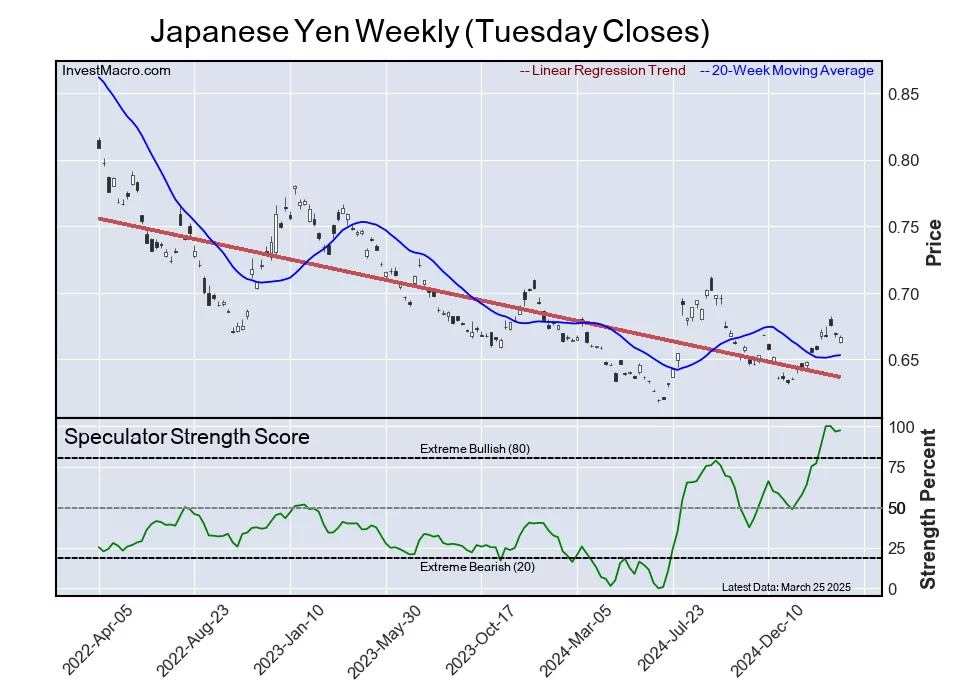
Speculator Extremes: Cotton, Sugar & 5-Year lead Bearish Positions

By InvestMacro 

The latest update for the weekly Commitment of Traders (COT) report was released by the Commodity Futures Trading Commission (CFTC) on Friday for data ending on February 4th.

This weekly Extreme Positions report highlights the Most Bullish and Most Bearish Positions for the speculator category. Extreme positioning in these markets can foreshadow strong moves in the underlying market.

To signify an extreme position, we use the Strength Index (also known as the COT Index) of each instrument, a common method of measuring COT data. The Strength Index is simply a comparison of current trader positions against the range of positions over the previous 3 years. We use over 80 percent as extremely bullish and under 20 percent as extremely bearish. (Compare Strength Index scores across all markets in the data table or cot leaders table)


Here Are This Week’s Most Bullish Speculator Positions:

Coffee


The Coffee speculator position comes in as the most bullish extreme standing this week. The Coffee speculator level is currently at a 95.5 percent score of its 3-year range.

The six-week trend for the percent strength score totaled 7.5 this week. The overall net speculator position was a total of 71,878 net contracts this week with a decline of -4,642 contracts in the weekly speculator bets.


Speculators or Non-Commercials Notes:

Speculators, classified as non-commercial traders by the CFTC, are made up of large commodity funds, hedge funds and other significant for-profit participants. The Specs are generally regarded as trend-followers in their behavior towards price action – net speculator bets and prices tend to go in the same directions. These traders often look to buy when prices are rising and sell when prices are falling. To illustrate this point, many times speculator contracts can be found at their most extremes (bullish or bearish) when prices are also close to their highest or lowest levels.

These extreme levels can be dangerous for the large speculators as the trade is most crowded, there is less trading ammunition still sitting on the sidelines to push the trend further and prices have moved a significant distance. When the trend becomes exhausted, some speculators take profits while others look to also exit positions when prices fail to continue in the same direction. This process usually plays out over many months to years and can ultimately create a reverse effect where prices start to fall and speculators start a process of selling when prices are falling.


Gold


The Gold speculator position comes next in the extreme standings this week. The Gold speculator level is now at a 95.1 percent score of its 3-year range.

The six-week trend for the percent strength score was 20.8 this week. The speculator position registered 302,508 net contracts this week with a weekly gain of 3,099 contracts in speculator bets.


Live Cattle


The Live Cattle speculator position comes in third this week in the extreme standings. The Live Cattle speculator level resides at a 93.4 percent score of its 3-year range.

The six-week trend for the speculator strength score came in at 13.0 this week. The overall speculator position was 116,439 net contracts this week with a decrease of -2,605 contracts in the weekly speculator bets.


Corn


The Corn speculator position comes up number four in the extreme standings this week. The Corn speculator level is at a 92.7 percent score of its 3-year range.

The six-week trend for the speculator strength score totaled a change of 30.1 this week. The overall speculator position was 462,381 net contracts this week with a boost of 18,506 contracts in the speculator bets.


Steel


The Steel speculator position rounds out the top five in this week’s bullish extreme standings. The Steel speculator level sits at a 88.5 percent score of its 3-year range. The six-week trend for the speculator strength score was 11.8 this week.

The speculator position was -1,763 net contracts this week with a small increase of 22 contracts in the weekly speculator bets.


This Week’s Most Bearish Speculator Positions:

Cotton


The Cotton speculator position comes in as the most bearish extreme standing this week. The Cotton speculator level is at a 0.0 percent score of its 3-year range.

The six-week trend for the speculator strength score was -12.4 this week. The overall speculator position was -50,767 net contracts this week with a drop of -8,339 contracts in the speculator bets.


Sugar


The Sugar speculator position comes in next for the most bearish extreme standing on the week. The Sugar speculator level is at a 0.0 percent score of its 3-year range.

The six-week trend for the speculator strength score was -29.8 this week. The speculator position was -33,109 net contracts this week with a decline of -3,675 contracts in the weekly speculator bets.


5-Year Bond


The 5-Year Bond speculator position comes in as third most bearish extreme standing of the week. The 5-Year Bond speculator level resides at a 2.9 percent score of its 3-year range.

The six-week trend for the speculator strength score was -8.9 this week. The overall speculator position was -1,927,666 net contracts this week with a drop of -151,611 contracts in the speculator bets.


Euro


The Euro speculator position comes in as this week’s fourth most bearish extreme standing. The Euro speculator level is at a 6.5 percent score of its 3-year range.

The six-week trend for the speculator strength score was 3.8 this week. The speculator position was -58,614 net contracts this week with a rise of 7,990 contracts in the weekly speculator bets.


New Zealand Dollar


Finally, the New Zealand Dollar speculator position comes in as the fifth most bearish extreme standing for this week. The New Zealand Dollar speculator level is at a 6.5 percent score of its 3-year range.

The six-week trend for the speculator strength score was -3.6 this week. The speculator position was -49,090 net contracts this week with a dip of -2,059 contracts in the weekly speculator bets.


Article By InvestMacroReceive our weekly COT Newsletter

*COT Report: The COT data, released weekly to the public each Friday, is updated through the most recent Tuesday (data is 3 days old) and shows a quick view of how large speculators or non-commercials (for-profit traders) were positioned in the futures markets.

The CFTC categorizes trader positions according to commercial hedgers (traders who use futures contracts for hedging as part of the business), non-commercials (large traders who speculate to realize trading profits) and nonreportable traders (usually small traders/speculators) as well as their open interest (contracts open in the market at time of reporting). See CFTC criteria here.
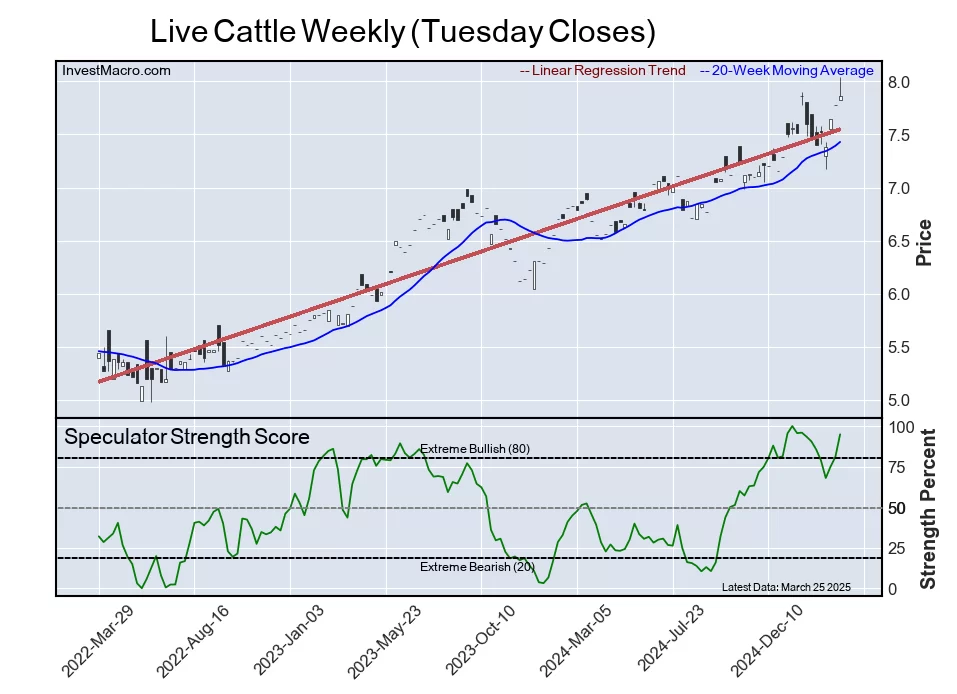
How AI can help in the creative design process

By Tilanka Chandrasekera, Oklahoma State University 

Generative artificial intelligence tools can help design students by making hard tasks easier, cutting down on stress, and allowing the students more time to explore innovative ideas, according to new research I published with my colleagues in the International Journal of Architectural Computing.

I study how people think about design and use technology, and my research focuses on how tools such as AI can help make the design process more efficient and creative.

A student works on a design in a fashion merchandising lab.
Fashion Merchandising Labs at Oklahoma State University, CC BY-ND

Why it matters

Our study found that AI design tools didn’t just make the designs better – they also made the process easier and less stressful for students.

Imagine trying to come up with a cool idea in response to a design assignment, but it’s hard to picture it in your head. These tools step in and quickly show what your idea could look like, so you can focus on being creative instead of worrying about little details. This made it easier for students to brainstorm and come up with new ideas. The AI tools also made more design variations by introducing new and unexpected details, such as natural shapes and textures.

Turquoise love seats surrounded by lily pads. A more polished version, with green lily pads and blue water, is juxtaposed with a sketched version of the image.
A design fueled by artificial intelligence: The left image is the result of the text-to-image technology, and the image on the right is the design completed by the student.
Oklahoma State University, CC BY-ND
A rudimentary seat design sketched on pencil and paper.
A design by a student without using artificial intelligence.
Oklahoma State University, CC BY-ND

How we did our work

My colleagues and I worked with 40 design students and split them into two groups.

One group used AI to help design urban furniture, such as benches and seating for public spaces, while the other group didn’t use AI. The AI tool created pictures of the first group’s design ideas from simple text descriptions. Both groups refined their ideas by either sketching them by hand or with design software.
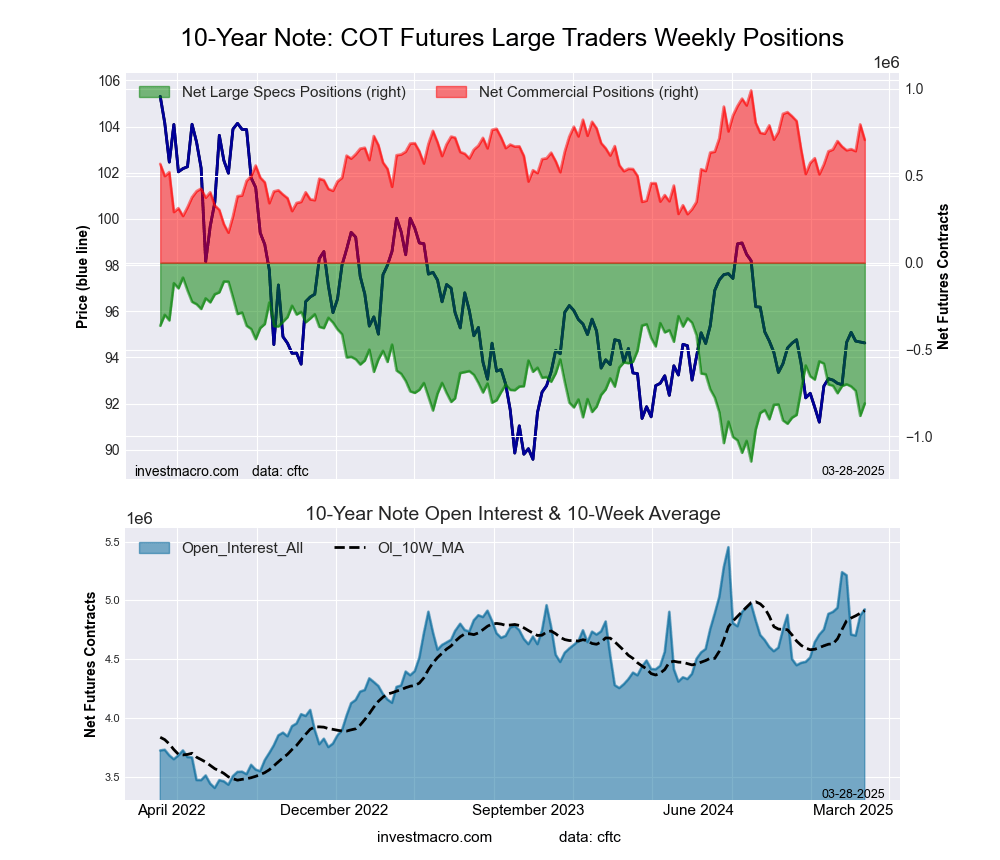
Next, the two groups were given a second design task. This time, neither group was allowed to use AI. We wanted to see whether the first task helped them learn how to develop a design concept.

My colleagues and I evaluated the students’ creativity on three criteria: the novelty of their ideas, the effectiveness of their designs in solving the problem, and the level of detail and completeness in their work. We also wanted to see how hard the tasks felt for them, so we measured something called cognitive load using a well-known tool called the NASA task load index. This tool checks how much mental effort and frustration the students experienced.

The group of students who used AI in the first task had an easier time in the second task, feeling less overwhelmed compared with those who didn’t use AI.

The final designs of the AI group also showed a more creative design process in the second task, likely because they learned from using AI in the first task, which helped them think and develop better ideas.

What’s next

Future research will look at how AI tools can be used in more parts of design education and how they might affect the way professionals work.

One challenge is making sure students don’t rely too much on AI, which could hurt their ability to think critically and solve problems on their own.

Another goal is to make sure as many design students as possible have access to these tools.

The Research Brief is a short take on interesting academic work.The Conversation

About the Author:

Tilanka Chandrasekera, Professor of Interior Design, Oklahoma State University

This article is republished from The Conversation under a Creative Commons license. Read the original article.
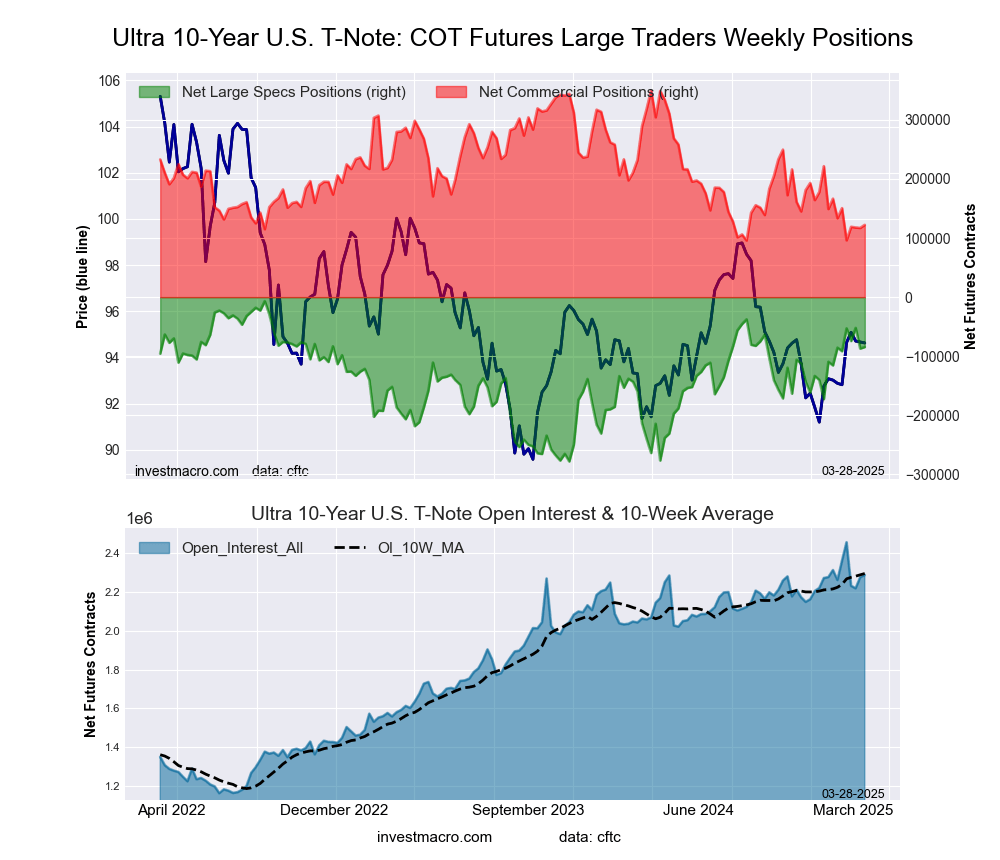
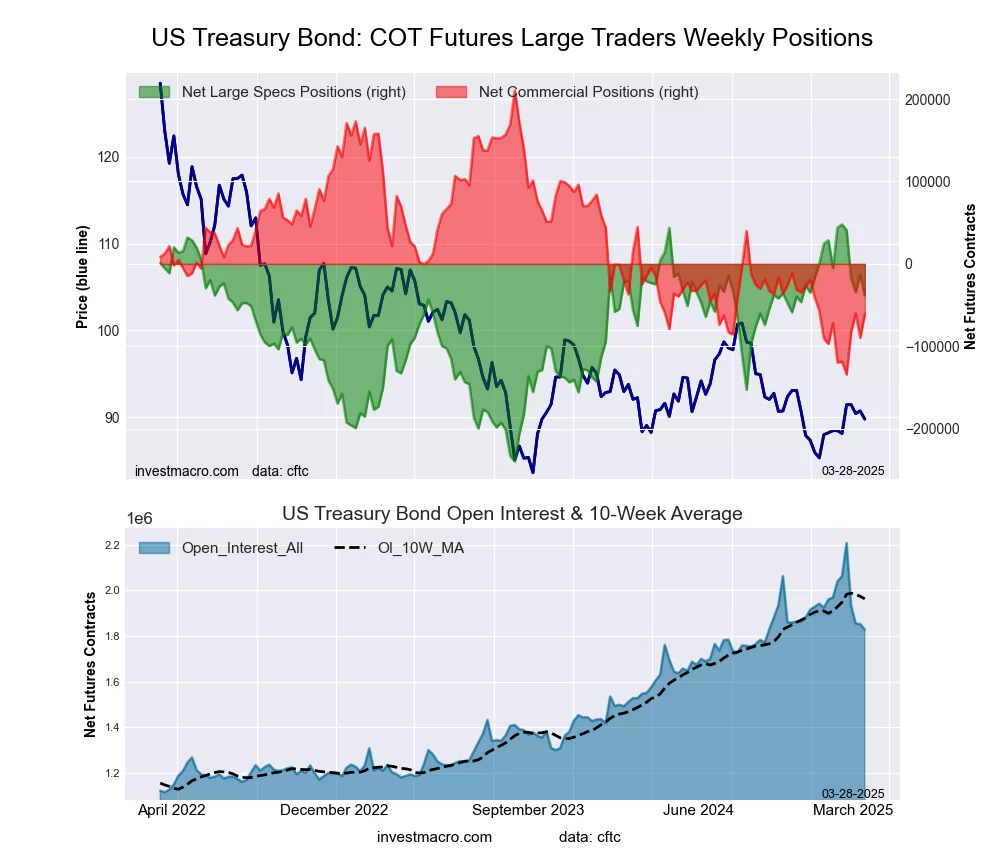
 

The Reserve Bank of India cut rates for the first time in 5 years. The Bank of Mexico continued monetary policy easing

By JustMarkets

At the end of Thursday, the Dow Jones Index (US30) was down 0.28%. The S&P 500 Index (US500) was up 0.36%. The Nasdaq Technology Index (US100) added 0.51%. Initial jobless claims came in slightly above projections but remained in line with recent months, while labor costs and productivity rose less than expected. The long-awaited Non-Farm report will be released today. Economists estimate that the US added 154,000 jobs last month, up from an impressive 256,000 in December. The unemployment rate will come in at 4.1%, the same as last month. Average hourly earnings growth will be 0.3%, also in line with December. Trump’s tariff policy and a strong labor market will support the US dollar, which will put pressure on risk assets such as EUR, GBP and especially CAD and MXN. Gold and silver may also come under pressure amid rising government bond yields. The dollar will be under pressure if the labor market data comes out unexpectedly worse than expected. In this case, risk sentiment may be reevaluated. In such a scenario, stock indices will continue to grow steadily, and gold will continue to renew its historical highs.

The Bank of Mexico cut its benchmark interest rate by 50 bps to 9.50%. This is in line with the global downward trend in inflation, although inflation persists in major economies, especially in services. Domestically, economic activity contracted in Q4 2024 and is expected to weaken in 2025, with employment growth slowing and downside risks persisting. Core inflation fell to 3.69% in mid-January 2025 and core inflation was 3.72%. While core inflation continues to decline, persistent service sector inflation has led Banxico to maintain its inflation prognoses, expecting core inflation to converge to the 3% target by Q3 2026. The bank said further rate cuts may be appropriate depending on the pace of disinflation and the economic outlook.

The Canadian dollar traded above 1.43 per dollar, pausing a rally that led to a seven-week high of 1.431 hit on January 5, as recent economic data shifted focus to the Bank of Canada’s increasingly soft outlook. Canada’s key economic indicator showed a sharp contraction in buying activity, with Ivey’s January 2025 PMI falling to 47.1 from 54.7 in December, well below market expectations of 53.

Equity markets in Europe were mostly up yesterday. Germany’s DAX (DE40) rose by 1.47% to set a new record high. France’s CAC 40 (FR40) closed 1.47% higher, Spain’s IBEX 35 (ES35) gained 1.55%, and the UK’s FTSE 100 (UK100) closed 1.21% higher. The growth of indices was supported by good corporate reports. Despite mixed results from Dutch giant ING, growth was led by banks, with BBVA, Santander and UniCredit shares up 3-6%. Traders put aside fears of a trade war and the impact of tariffs, focusing on a new round of corporate earnings and the next moves by central banks. Rumors of a peace plan for Ukraine due next week also helped improve market sentiment.

The US natural gas (XNG/USD) prices rose above $3.35/MMBtu, helped by a larger-than-expected drawdown in storage inventories. The EIA reported a withdrawal of 174 billion cubic feet (bcf) from storage for the week ended January 31, slightly above analysts’ expectations of 168 bcf. The volume also exceeded last year’s 110 bcf decline and was in line with the five-year average. Colder-than-normal conditions February 10-14 are expected to boost heating demand.

Asian markets are predominantly steady yesterday. Japan’s Nikkei 225 (JP225) rose by 0.61%, China’s FTSE China A50 (CHA50) gained 0.99%, Hong Kong’s Hang Seng (HK50) jumped 1.43%, and Australia’s ASX 200 (AU200) gained 1.23%.

The Reserve Bank of India (RBI) cut its key repo rate by 25bps to 6.25%, marking the first-rate cut since May 2020 during its February meeting. The move came amid slowing economic growth and global trade uncertainty, as expected. The Central Bank expects GDP growth of 6.7% in FY 2025-26, maintaining its inflation estimates at 4.2%, with estimates of 4.5% in Q1, 4.0% in Q2 and 3.8% in Q3.

S&P 500 (US500) 6,083.57 +22.09 (+0.36%)

Dow Jones (US30) 44,747.63 −125.65 (−0.28%)

DAX (DE40) 21,902.42 +316.49 (+1.47%)

FTSE 100 (UK100) 8,727.28 +103.99 (+1.21%)

USD Index 107.68 +0.10 (+0.09%)

News feed for: 2025.02.07

  • India RBI Interest Rate Decision at 06:30 (GMT+2);
  • German Trade Balance at 09:00 (GMT+2);
  • Canada Unemployment Rate (m/m) at 15:30 (GMT+2);
  • US Non Farm Payrolls (m/m) at 15:30 (GMT+2);
  • US Unemployment Rate (m/m) at 15:30 (GMT+2);
  • US Michigan Inflation Expectations at 17:00 (GMT+2).

By JustMarkets


This article reflects a personal opinion and should not be interpreted as an investment advice, and/or offer, and/or a persistent request for carrying out financial transactions, and/or a guarantee, and/or a forecast of future events.