Archive for Opinions – Page 83

Will faster federal reviews speed up the clean energy shift? Two legal scholars explain what the National Environmental Policy Act does and doesn’t do

By J.B. Ruhl, Vanderbilt University and James Salzman, University of California, Los Angeles 

The National Environmental Policy Act, enacted in 1970, is widely viewed as a keystone U.S. environmental law. For any major federal action that affects the environment, such as building an interstate highway or licensing a nuclear power plant, NEPA requires relevant agencies to analyze environmental impacts, consider reasonable alternatives and accept public input. It also allows citizens to sue if they believe government has not complied.

Critics argue that NEPA reviews delay projects and drive up costs. In May 2023 negotiations over raising the federal debt ceiling, President Joe Biden agreed to certain changes to NEPA reviews, which both the White House and congressional Republicans said would streamline permitting for infrastructure projects. Legal scholars J.B. Ruhl and James Salzman explain these changes and what they mean for protecting the environment and expanding clean energy production.

What kinds of projects typically require NEPA reviews?

The statutory text of NEPA is quite sparse and open-ended. When people speak of what NEPA requires, they really are talking about how the White House Council on Environmental Quality, or CEQ, federal agencies and the courts have implemented the law over the past 50 years.

The simple requirement is for agencies to create a detailed statement on the impacts of any major federal action that significantly affects the environment. A whole body of law and policy creates filters that sort projects into different NEPA buckets.

NEPA requires all federal agencies to analyze the environmental impacts of their major actions, consider alternatives and receive public comment.

First, only projects that will be carried out, funded or authorized by a federal agency are subject to NEPA. That’s a pretty big universe, but it also excludes a lot. For example, a wind farm built on private land by a private utility might not require any federal funding or approval. That means it wouldn’t be subject to NEPA.

If a project is subject to NEPA, the federal agency that has primary oversight assesses its impacts to decide how much analysis is needed. Many agencies use a classification known as categorical exclusions to winnow out minor actions that they know have no significant impacts, either individually or cumulatively. For example, the Interior Department categorically excludes planned burns to clear brush on areas smaller than 4,500 acres.

If the expected impacts are more extensive, but it’s not clear by how much, the agency can prepare an environmental assessment. If that assessment finds the impacts to the human environment will not be significant, that’s the end of the NEPA process.

If the impacts are significant, the agency will prepare a full-blown environmental impact statement, or EIS, which is a far more intensive process. CEQ guidelines establish an elaborate template of topics agencies must evaluate, and the public has opportunities to comment on a draft version.

A CEQ review of EISs prepared by all federal agencies from 2010 through 2018 found that, on average, it took about four and a half years to issue an EIS, not including added time if someone sued. The lengths of these reviews ranged widely but averaged 575 pages.

Flow chart showing numerous steps in the NEPA process.
A schematic of the NEPA process.
NASA

If an agency conducts lots of the same actions under a particular program, such as timber leasing on federal land, it might conduct a high-level programmatic EIS to cover the large-scale issues and then follow up with individual NEPA analyses for specific projects.

Decisions not to issue an EIS can be challenged in court. So can the EIS itself if critics believe that it’s inadequate.

What are NEPA critics’ central arguments?

Critiques of NEPA come from many different interests. The law mainly affects land development, industry and resource extraction activities such as logging, mining and drilling for oil and gas, particularly on federal public lands.

NEPA requires an impact assessment, but it doesn’t prescribe any particular outcome. Still, it unquestionably can add substantial time and cost to any significant project. If a project is controversial, interested parties can submit public comments that get their views on the record. If opponents aren’t happy with the final EIS, they can sue the agency responsible for the decision in federal court.

Between agency review and litigation, NEPA can add many years to a project’s development timeline before it is “shovel ready.” For example, it takes roughly four to seven years to complete environmental reviews for prescribed burns that the U.S. Forest Service carries out to reduce wildfire risks.

Supporters argue that NEPA reviews have avoided many bad decisions. In our view, the NEPA process is an important feature of the country’s stewardship of its natural resources. But we also share the growing concern that it can be used to delay building renewable energy infrastructure that the U.S. urgently needs to mitigate climate change.

Did the debt ceiling agreement significantly change the NEPA process?

Many of the changes are little more than tweaks. Others codify long-standing practices based on how the Council on Environmental Quality, agencies and courts implement the law.

One notable change is requiring a single lead agency and a single environmental impact statement for projects, even when those projects require multiple agency approvals. There also are some new time and page limits. For example, environmental impact statements will be required to be completed within two years and be no more that 150 pages long for most projects, and 300 pages for the most complex projects.

There also are some changes to definitions, such as what constitutes a “major federal action,” that narrow NEPA’s scope to some degree, although it will take time to sort out their meaning. Overall, we do not see these changes as a major overhaul of NEPA.

Will the changes speed up work on clean energy systems?

Maybe, but not nearly as much as needed. First, NEPA applies to projects that need federal funding or approval, such as under the Endangered Species Act. Getting that money or agency green light can also involve delays and litigation independent of the NEPA review.

Second, many state and local laws can affect large renewable energy projects, and those statutes can also be used to slow projects down. The bottom line is that to move the needle, politicians will have to do more to reform the project review process.

The debt ceiling agreement left several big questions unaddressed. They include where to build high-voltage electric transmission lines; which federal public lands and offshore waters can be used for power lines and renewable power production; and where to mine for essential minerals.
Beyond those immediate priorities, if carbon sequestration technology can be developed and scaled up, the U.S. will need an enormous buildout of carbon capture and storage infrastructure to meet net-zero goals.

As renewable energy scales up in the U.S., local opposition could impede some utility-scale projects.

All of these involve incredibly complex permitting processes, and tweaking NEPA won’t change that. Other hot-button issues – including federal preemption of state and local laws, impacts on Native American cultural lands, and environmental justice – will make further permitting reforms politically difficult.

Even this first small measure was hotly contested, and happened now only because it was tied to the debt limit legislation. As the inclusion of federal approval for the Mountain Valley gas pipeline in the debt ceiling agreement shows, in politics you need a quid in exchange for a quo. We expect to see a lot more deal-making if Congress takes permitting reform seriously.The Conversation

About the Authors:

J.B. Ruhl, Professor of Law, Director, Program on Law and Innovation, and Co-director, Energy, Environment and Land Use Program, Vanderbilt University and James Salzman, Professor of Environmental Law, University of California, Los Angeles

This article is republished from The Conversation under a Creative Commons license. Read the original article.

Stock markets likely to get ‘wide boost’ this week: deVere CEO

By George Prior

Global stock markets are likely to experience a wide boost this week – not just the mega cap tech stocks – as the US Federal Reserve is expected to pause interest rate hikes, says the CEO and founder of one of the world’s largest independent financial advisory, asset management and fintech organizations.

The bullish analysis from Nigel Green of deVere Group comes as investors worldwide wait for the latest inflation data Tuesday when the consumer price index report for the world’s largest economy is released. On Wednesday, the US central bank will issue its latest monetary policy decision.

He says: “Mega cap tech stocks – namely Apple, Microsoft, Nvidia, Amazon, Meta, Tesla and Alphabet – have made up around 90% of gains on Walls Street’s S&P 500 this year.

“But we expect that other sectors which have been outperformed so far in 2023 are likely to get a boost should the Fed, as we anticipate, pause rate hikes this week.”

The deVere CEO continues: “Despite a stubbornly robust labor market and still too-sticky inflation, the markets now expect the world’s most influential central bank to pause its interest hike agenda this month.

“This will firmly signal that progress is being made in the battle to cool inflation and this will buoy investors across the board, finally providing a boost to sectors which have been unloved so far this year.”

Last week, Nigel Green warned investors against exclusively buying into the hype of the tech titans, or so-called Magnificent Seven.

“The volume is getting louder and the frenzy is reaching fever pitch. This hype is dangerous as it could lead investors to assume that these stocks are a silver bullet to build long-term wealth – and they are not, at least not on their own,” he noted.

“While I believe that exposure to these mega-cap tech stocks should be part of almost every investor’s portfolio, as they have robust fundamentals and are future-focused, especially in AI, they should not be exclusive.”

Easing inflation – as would be indicated by a Fed pause this week – would, says the CEO, stimulate a “wider global stock market rally” that would be “positive across a broad sweep of asset classes, sectors and regions.”

Diversification, as Nigel Green stresses, remains investors’ best tool for long-term financial success. As a strategy it has been proven to reduce risk, smooth-out volatility, exploit differing market conditions, maximise long-term returns and protect against unforeseen external events.

The comments about a fresh rally come as stocks rose just enough last Thursday for Wall Street to run into a new bull market as the S&P 500 keeps rallying off its low from last autumn.

The index rose 0.6% to carry it 20% above a bottom hit in October. This means Wall Street’s main measure has climbed out of a challenging bear market, which saw it drop 25.4% over roughly nine months.

Meanwhile, the Dow Jones Industrial Average added 168 points, or 0.5%. The Nasdaq composite, meanwhile, led the market with a 1% rise.

He concludes: “Investors should be speaking to an advisor about the possibility of an opportunity-packed new rally if the Fed, as is expected, pauses rate hikes this week.”

About:

deVere Group is one of the world’s largest independent advisors of specialist global financial solutions to international, local mass affluent, and high-net-worth clients.  It has a network of more than 70 offices across the world, over 80,000 clients and $12bn under advisement.

Trade Of The Week: XAUUSD Gearing Up For Breakout?

By ForexTime 

Don’t be fooled by Gold’s current state of calm.

This could be an explosively volatile week for the precious metal due to key economic reports and high-risk events.

Over the past few weeks, gold has found itself trapped within a range with support at $1938 and resistance at $1983. A major breakout could be around the corner and here are reasons why….

  1. Key US inflation data

On Tuesday, 13th June the latest US CPI report will be released. 

US inflation is expected to have slowed again in May after slightly easing in April. Markets forecast the MoM print to rise 0.2% after the 0.4% increase in April while the annual headline reading is seen falling to 4.1% from 4.9%. When keeping in mind that CPI hit 9.1% in June 2022, the drop in inflation has been a welcome development, driven by falling energy and commodity prices.

However, much attention will be on the Core CPI reading which excludes volatile food and energy prices. Core inflation is expected to remain unchanged at 0.4% MoM while the annual reading is seen cooling to 5.2% from 5.5% in April.

  • Fresh signs of cooling inflationary pressures may reinforce expectations around the Federal Reserve ending its hiking campaign. This development could inject gold bulls with renewed confidence ahead of the Fed decision on Wednesday.
  • If US inflation continues to run hot, rising more than market forecasts this could drag gold prices lower as bets rise over the Fed keeping interest rates higher for longer.


  1. Federal Reserve rate decision 

All eyes will be on the Federal Reserve interest rate decision on Wednesday, 14th June.

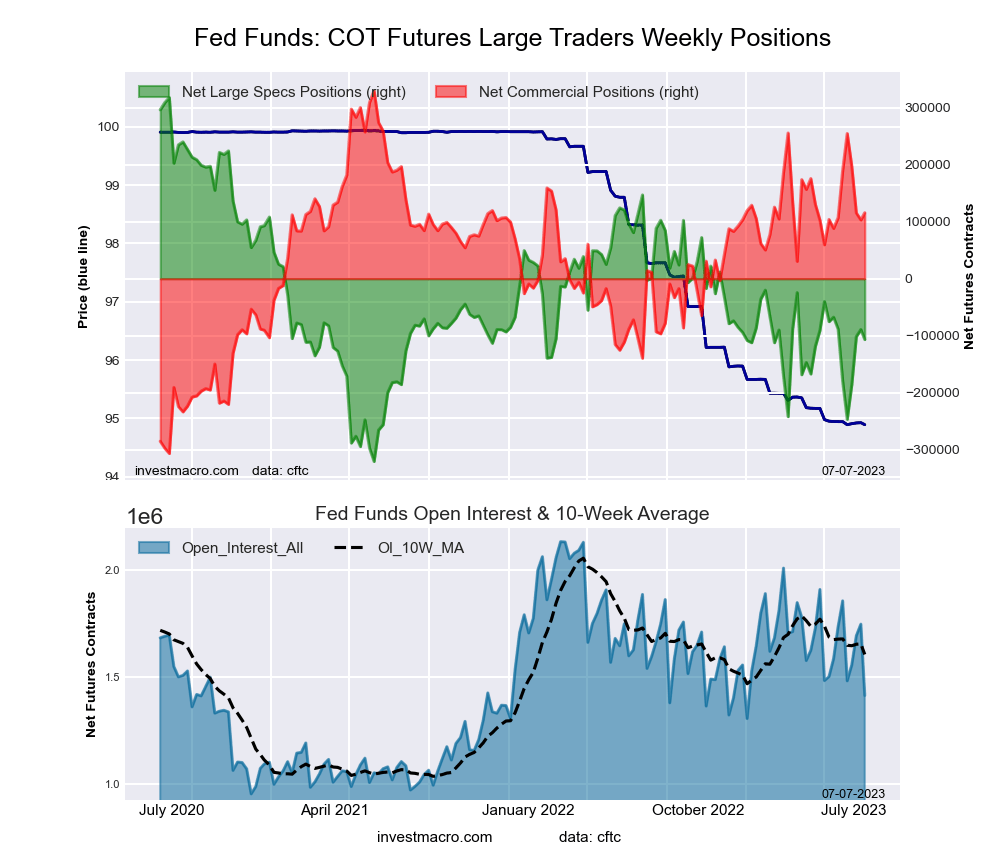
Markets widely expect the Fed to leave interest rates unchanged with traders currently pricing in a 23% probability of a 25bps hike on Wednesday, according to Fed fund futures. Nevertheless, the unexpected rate hikes from the Bank of Canada (BoC) and Reserve Bank of Australia (RBA) have created some element of uncertainty over what to expect from the Fed. Investors are likely to closely scrutinize the updated dot plots, Fed Chair Jerome Powell’s press conference for fresh clues on the central bank’s next move.

  • If the Fed moves ahead with a hawkish hold and signals one more rate hike in July, this could weaken gold prices – especially if the dollar rises along with Treasury yields.
  • An unexpected rate hike may deal with a heavy blow toward zero-yielding gold, potentially sending prices tumbling to levels not seen since mid-March 2023 around $1900.


  1. Gold in breakout mode?

After swinging within a range since mid-May 2023, gold could be ready to break out. 

A strong daily close and breakout above $1983 may inspire an incline toward the $2000 psychological level and $2018, respectively. Should prices breach the $1938 support, where the 100-day SMA resides – this could open a path back toward $1900. Ultimately, how gold concludes this week will be heavily influenced by the US inflation data and Fed decision.


Forex-Time-LogoArticle by ForexTime

ForexTime Ltd (FXTM) is an award winning international online forex broker regulated by CySEC 185/12 www.forextime.com

Euro Speculators cut their bullish bets for 3rd straight week

By InvestMacro

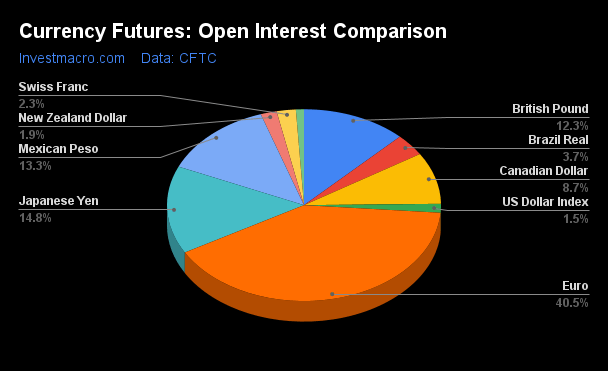
Here are the latest charts and statistics for the Commitment of Traders (COT) data published by the Commodities Futures Trading Commission (CFTC).

The latest COT data is updated through Tuesday June 6th and shows a quick view of how large market participants (for-profit speculators and commercial traders) were positioned in the futures markets. All currency positions are in direct relation to the US dollar where, for example, a bet for the euro is a bet that the euro will rise versus the dollar while a bet against the euro will be a bet that the euro will decline versus the dollar.

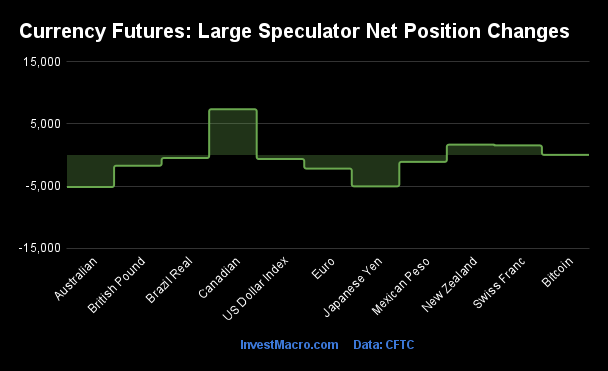
Weekly Speculator Changes led by Mexican Peso & Bitcoin

The COT currency market speculator bets were lower this week as two out of the eleven currency markets we cover had higher positioning while the other nine markets had lower speculator contracts.

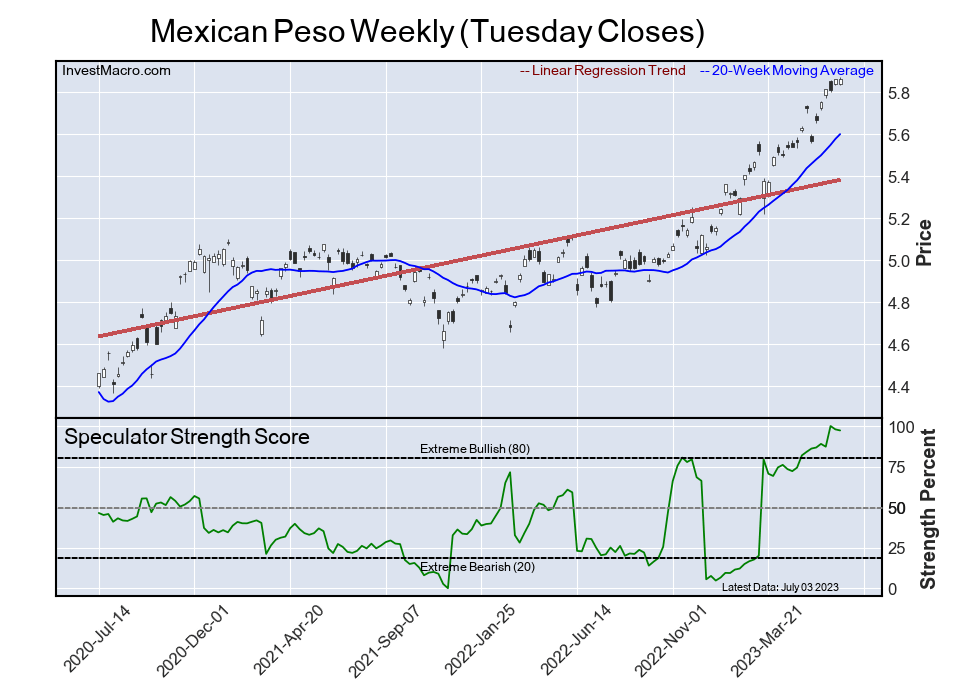
Leading the gains for the currency markets was the Mexican Peso (3,665 contracts) with Bitcoin (582 contracts) also showing a positive week.

The currencies seeing declines in speculator bets on the week were the Australian Dollar (-12,342 contracts), Japanese Yen (-8,624 contracts), Canadian Dollar (-8,415 contracts), EuroFX (-7,304 contracts), Brazilian Real (-5,094 contracts), Swiss Franc (-879 contracts), British Pound (-751 contracts), New Zealand Dollar (-573 contracts) and the US Dollar Index (-549 contracts) also registering lower bets on the week.

Euro Speculators cut their bullish bets for 3rd straight week

Highlighting the COT currency’s data this week is the declining sentiment of the speculator’s positioning in the Euro Currency.

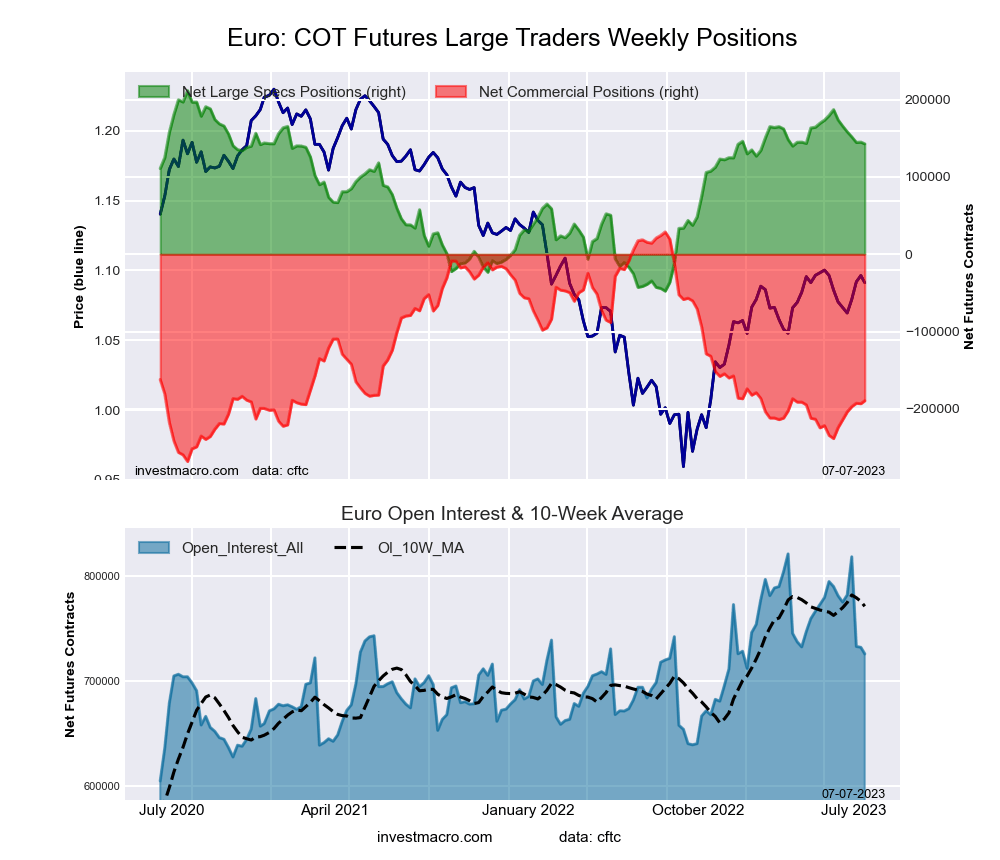
Large speculative Euro positions dropped by over -7,000 contracts this week and fell for a third consecutive week. Euro weekly positions have now decreased by a total of -28,668 contracts over these past three weeks to bring the bullish position to a total of +158,421 contracts, a nine week low. Previously, speculator bets had risen for six straight weeks from April 11th to May 16th and pushed the overall bullish speculative level to the highest standing in the past 137-weeks, dating back to late-September of 2020.

The Euro exchange rate against the US Dollar (EUR/USD) hit over a 12-month high in May above the 1.1000 level and speculators were sharply positioning themselves for it to go higher. This was helped out this year by the interest rate hiking schedule of European Central Bank (ECB) which was raising their rates while the US Federal Reserve was being seen as nearing the end of its own rate hiking campaign.

However, this one-way dynamic has become more cloudy with some recent data-points.

The Eurozone has fallen into a technical recession (2 quarters of negative growth), inflation has started to trend downwards (although still above 6 percent) and there is an expectation there will be possibly only 2 more ECB rate hikes before a pause. Meanwhile, rates traders are expecting (at this moment) the Fed to raise the US interest rate by 25 basis points once again at the July 26th meeting.

The Euro’s market strength recently hit a roadblock at the May high and the psychological level of 1.1000. The Euro has now tumbled in four out of the past five weeks and dropped all the way down to the 1.0635 exchange by the end of May. This week, the Euro rebounded modestly and the weekly closing price was near 1.0750. If speculators continue to further shed Euro positions, it is possible we could see a short-squeeze bring the currency lower still and challenge the 1.0500 level.


Data Snapshot of Forex Market Traders | Columns Legend
Jun-06-2023OIOI-IndexSpec-NetSpec-IndexCom-NetCOM-IndexSmalls-NetSmalls-Index
USD Index33,9303212,21945-15,163522,94449
EUR781,96784158,42179-203,9162245,49552
GBP242,1176312,48480-14,124241,64061
JPY245,33276-104,8174113,73691-8,91935
CHF44,08750-1,314517,04857-5,73438
CAD168,02542-38,3291938,45682-12723
AUD209,68098-56,4683267,49669-11,02826
NZD41,66539-703522,85653-2,15324
MXN235,9945081,670100-87,77706,10787
RUB20,93047,54331-7,15069-39324
BRL46,6863526,18169-25,72133-46040
Bitcoin13,0265676990-1,196042723


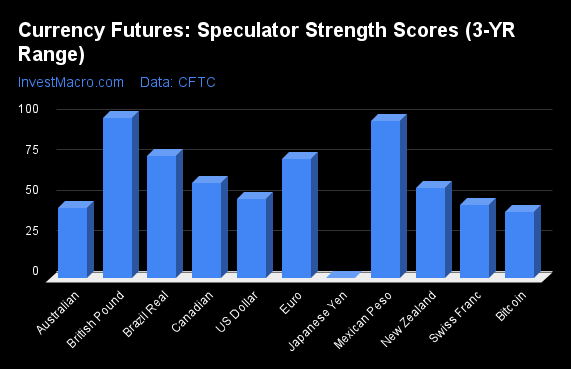
Strength Scores led by Mexican Peso & Bitcoin

COT Strength Scores (a normalized measure of Speculator positions over a 3-Year range, from 0 to 100 where above 80 is Extreme-Bullish and below 20 is Extreme-Bearish) showed that the Mexican Peso (100 percent), Bitcoin (90 percent) and the British Pound (80 percent) led the currency markets this week. The EuroFX (79 percent) and the Brazilian Real (69 percent) come in as the next highest in the weekly strength scores.

On the downside, the Japanese Yen (4 percent) and the Canadian Dollar (19 percent) come in at the lowest strength levels currently and are in Extreme-Bearish territory (below 20 percent). The next lowest strength scores are the Australian Dollar (32 percent) and the US Dollar Index (45 percent).

Strength Statistics:
US Dollar Index (45.3 percent) vs US Dollar Index previous week (46.2 percent)
EuroFX (79.4 percent) vs EuroFX previous week (82.3 percent)
British Pound Sterling (79.7 percent) vs British Pound Sterling previous week (80.4 percent)
Japanese Yen (4.3 percent) vs Japanese Yen previous week (9.6 percent)
Swiss Franc (51.1 percent) vs Swiss Franc previous week (53.5 percent)
Canadian Dollar (18.8 percent) vs Canadian Dollar previous week (26.7 percent)
Australian Dollar (32.5 percent) vs Australian Dollar previous week (43.9 percent)
New Zealand Dollar (51.7 percent) vs New Zealand Dollar previous week (53.2 percent)
Mexican Peso (100.0 percent) vs Mexican Peso previous week (97.5 percent)
Brazilian Real (69.1 percent) vs Brazilian Real previous week (75.6 percent)
Bitcoin (90.4 percent) vs Bitcoin previous week (80.2 percent)


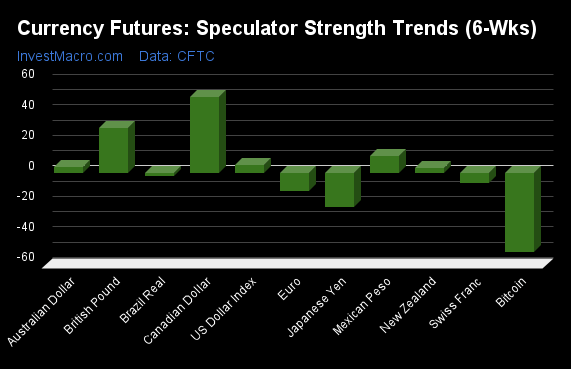
Mexican Peso & Bitcoin top the 6-Week Strength Trends

COT Strength Score Trends (or move index, calculates the 6-week changes in strength scores) showed that the Mexican Peso (19 percent) and the Bitcoin (19 percent) lead the past six weeks trends for the currencies. The Brazilian Real (12 percent), the New Zealand Dollar (7 percent) and the British Pound (6 percent) are the next highest positive movers in the latest trends data.

The Japanese Yen (-22 percent) leads the downside trend scores currently with the Australian Dollar (-16 percent) and the EuroFX (-4 percent) following next with lower trend scores.

Strength Trend Statistics:
US Dollar Index (2.5 percent) vs US Dollar Index previous week (3.8 percent)
EuroFX (-4.2 percent) vs EuroFX previous week (0.5 percent)
British Pound Sterling (5.7 percent) vs British Pound Sterling previous week (10.2 percent)
Japanese Yen (-22.2 percent) vs Japanese Yen previous week (-24.2 percent)
Swiss Franc (6.2 percent) vs Swiss Franc previous week (11.3 percent)
Canadian Dollar (5.1 percent) vs Canadian Dollar previous week (15.2 percent)
Australian Dollar (-15.8 percent) vs Australian Dollar previous week (-1.6 percent)
New Zealand Dollar (6.9 percent) vs New Zealand Dollar previous week (10.2 percent)
Mexican Peso (18.9 percent) vs Mexican Peso previous week (15.0 percent)
Brazilian Real (11.9 percent) vs Brazilian Real previous week (22.5 percent)
Bitcoin (18.5 percent) vs Bitcoin previous week (11.8 percent)


Individual COT Forex Markets:

US Dollar Index Futures:
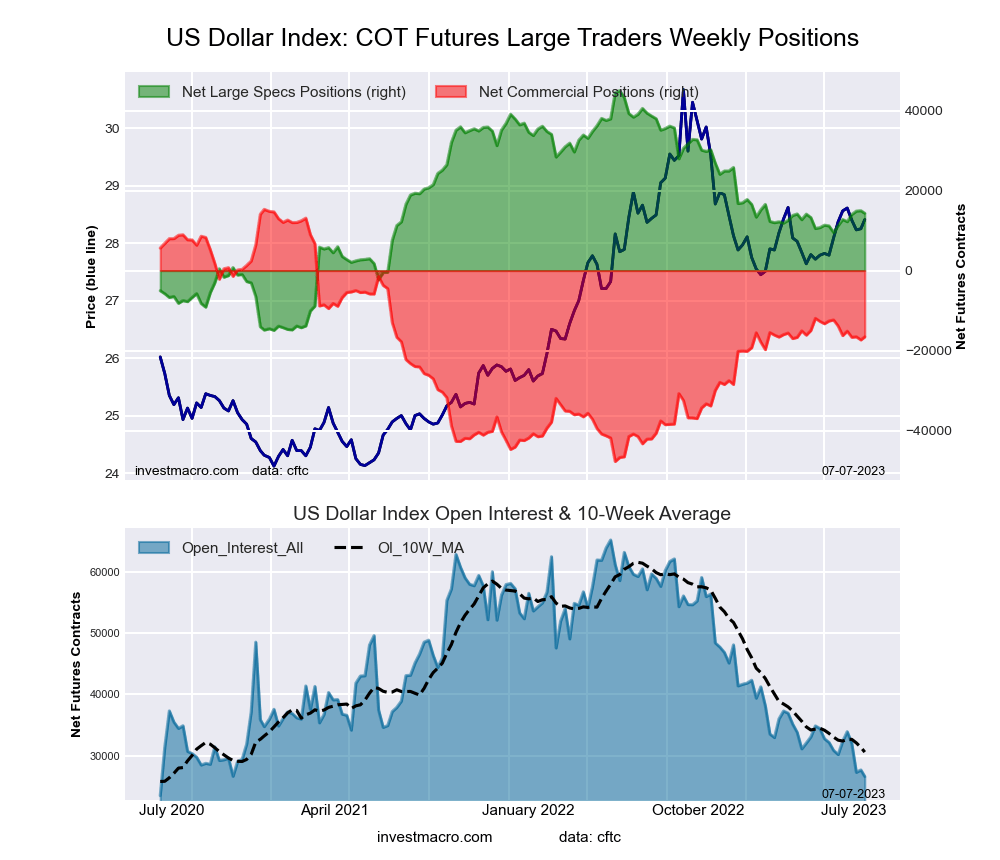
US Dollar Index Forex Futures COT ChartThe US Dollar Index large speculator standing this week reached a net position of 12,219 contracts in the data reported through Tuesday. This was a weekly fall of -549 contracts from the previous week which had a total of 12,768 net contracts.

This week’s current strength score (the trader positioning range over the past three years, measured from 0 to 100) shows the speculators are currently Bearish with a score of 45.3 percent. The commercials are Bullish with a score of 51.7 percent and the small traders (not shown in chart) are Bearish with a score of 48.7 percent.

US DOLLAR INDEX StatisticsSPECULATORSCOMMERCIALSSMALL TRADERS
– Percent of Open Interest Longs:73.13.816.8
– Percent of Open Interest Shorts:37.148.58.1
– Net Position:12,219-15,1632,944
– Gross Longs:24,7911,2805,698
– Gross Shorts:12,57216,4432,754
– Long to Short Ratio:2.0 to 10.1 to 12.1 to 1
NET POSITION TREND:
– Strength Index Score (3 Year Range Pct):45.351.748.7
– Strength Index Reading (3 Year Range):BearishBullishBearish
NET POSITION MOVEMENT INDEX:
– 6-Week Change in Strength Index:2.5-3.910.6


Euro Currency Futures:

Euro Currency Futures COT ChartThe Euro Currency large speculator standing this week reached a net position of 158,421 contracts in the data reported through Tuesday. This was a weekly lowering of -7,304 contracts from the previous week which had a total of 165,725 net contracts.

This week’s current strength score (the trader positioning range over the past three years, measured from 0 to 100) shows the speculators are currently Bullish with a score of 79.4 percent. The commercials are Bearish with a score of 21.6 percent and the small traders (not shown in chart) are Bullish with a score of 51.6 percent.

EURO Currency StatisticsSPECULATORSCOMMERCIALSSMALL TRADERS
– Percent of Open Interest Longs:30.253.712.2
– Percent of Open Interest Shorts:9.979.76.4
– Net Position:158,421-203,91645,495
– Gross Longs:236,060419,53295,766
– Gross Shorts:77,639623,44850,271
– Long to Short Ratio:3.0 to 10.7 to 11.9 to 1
NET POSITION TREND:
– Strength Index Score (3 Year Range Pct):79.421.651.6
– Strength Index Reading (3 Year Range):BullishBearishBullish
NET POSITION MOVEMENT INDEX:
– 6-Week Change in Strength Index:-4.26.9-15.2


British Pound Sterling Futures:

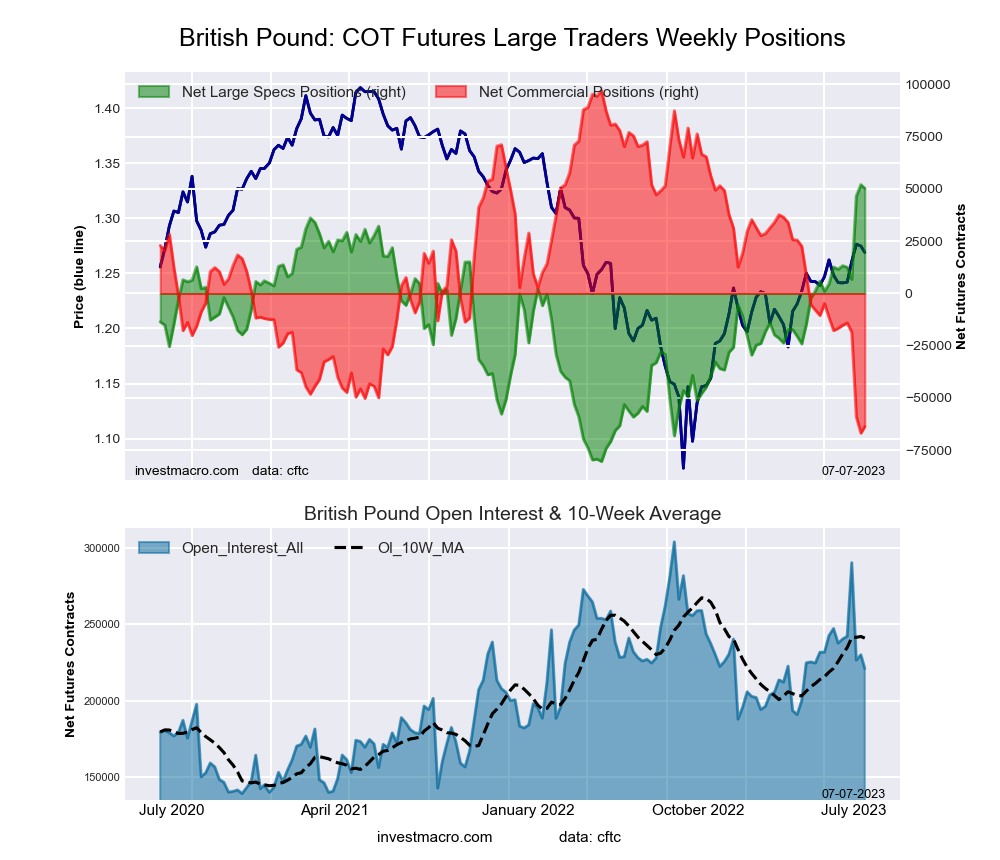
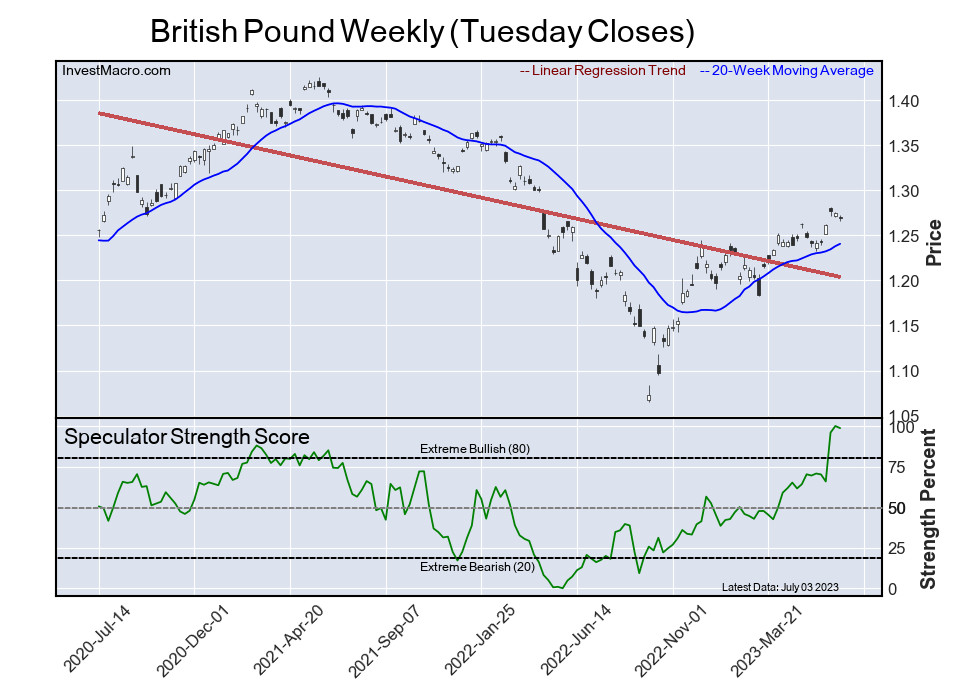
British Pound Sterling Futures COT ChartThe British Pound Sterling large speculator standing this week reached a net position of 12,484 contracts in the data reported through Tuesday. This was a weekly reduction of -751 contracts from the previous week which had a total of 13,235 net contracts.

This week’s current strength score (the trader positioning range over the past three years, measured from 0 to 100) shows the speculators are currently Bullish with a score of 79.7 percent. The commercials are Bearish with a score of 24.5 percent and the small traders (not shown in chart) are Bullish with a score of 61.2 percent.

BRITISH POUND StatisticsSPECULATORSCOMMERCIALSSMALL TRADERS
– Percent of Open Interest Longs:26.953.012.1
– Percent of Open Interest Shorts:21.758.911.4
– Net Position:12,484-14,1241,640
– Gross Longs:65,063128,44129,200
– Gross Shorts:52,579142,56527,560
– Long to Short Ratio:1.2 to 10.9 to 11.1 to 1
NET POSITION TREND:
– Strength Index Score (3 Year Range Pct):79.724.561.2
– Strength Index Reading (3 Year Range):BullishBearishBullish
NET POSITION MOVEMENT INDEX:
– 6-Week Change in Strength Index:5.7-2.4-6.0


Japanese Yen Futures:

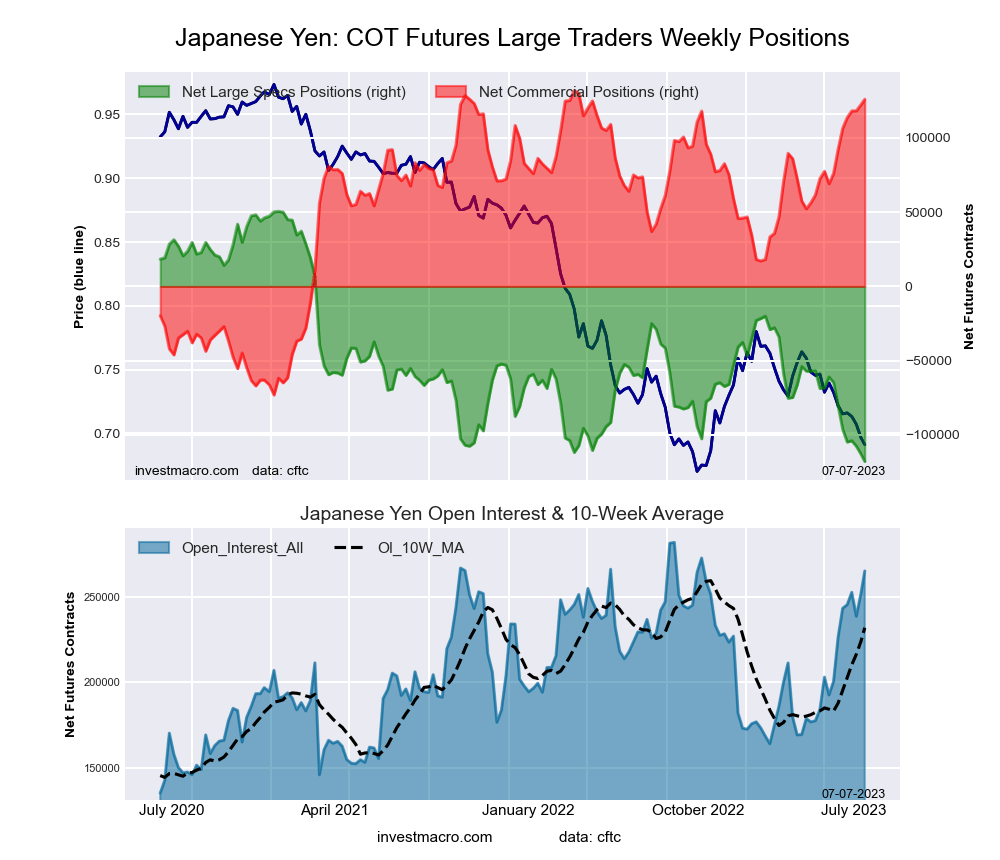
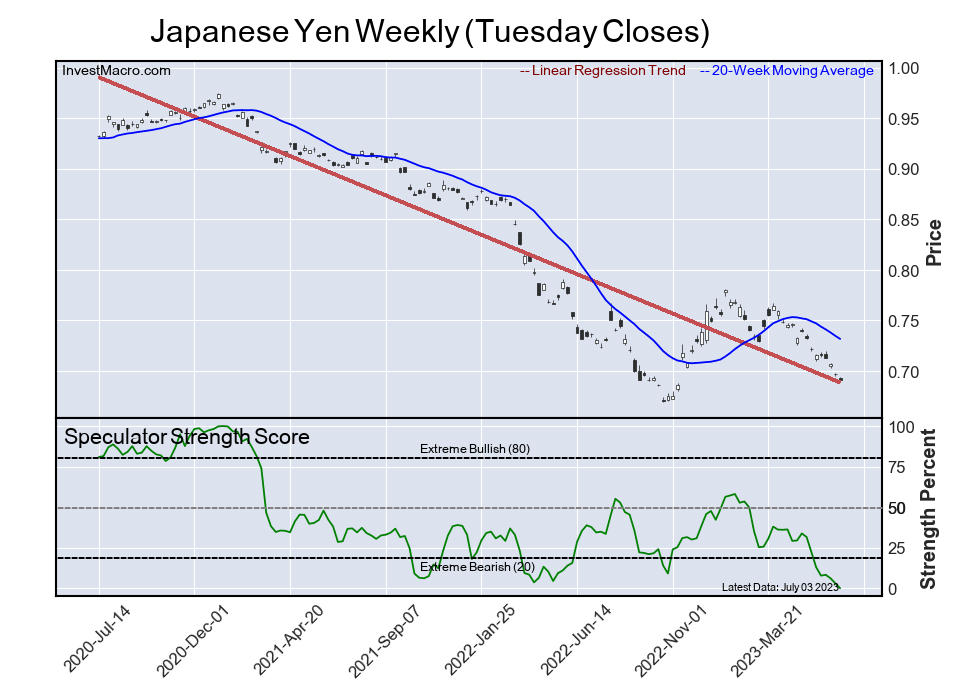
Japanese Yen Forex Futures COT ChartThe Japanese Yen large speculator standing this week reached a net position of -104,817 contracts in the data reported through Tuesday. This was a weekly decline of -8,624 contracts from the previous week which had a total of -96,193 net contracts.

This week’s current strength score (the trader positioning range over the past three years, measured from 0 to 100) shows the speculators are currently Bearish-Extreme with a score of 4.3 percent. The commercials are Bullish-Extreme with a score of 91.1 percent and the small traders (not shown in chart) are Bearish with a score of 35.3 percent.

JAPANESE YEN StatisticsSPECULATORSCOMMERCIALSSMALL TRADERS
– Percent of Open Interest Longs:13.971.112.5
– Percent of Open Interest Shorts:56.624.816.2
– Net Position:-104,817113,736-8,919
– Gross Longs:34,151174,46130,731
– Gross Shorts:138,96860,72539,650
– Long to Short Ratio:0.2 to 12.9 to 10.8 to 1
NET POSITION TREND:
– Strength Index Score (3 Year Range Pct):4.391.135.3
– Strength Index Reading (3 Year Range):Bearish-ExtremeBullish-ExtremeBearish
NET POSITION MOVEMENT INDEX:
– 6-Week Change in Strength Index:-22.220.1-10.2


Swiss Franc Futures:

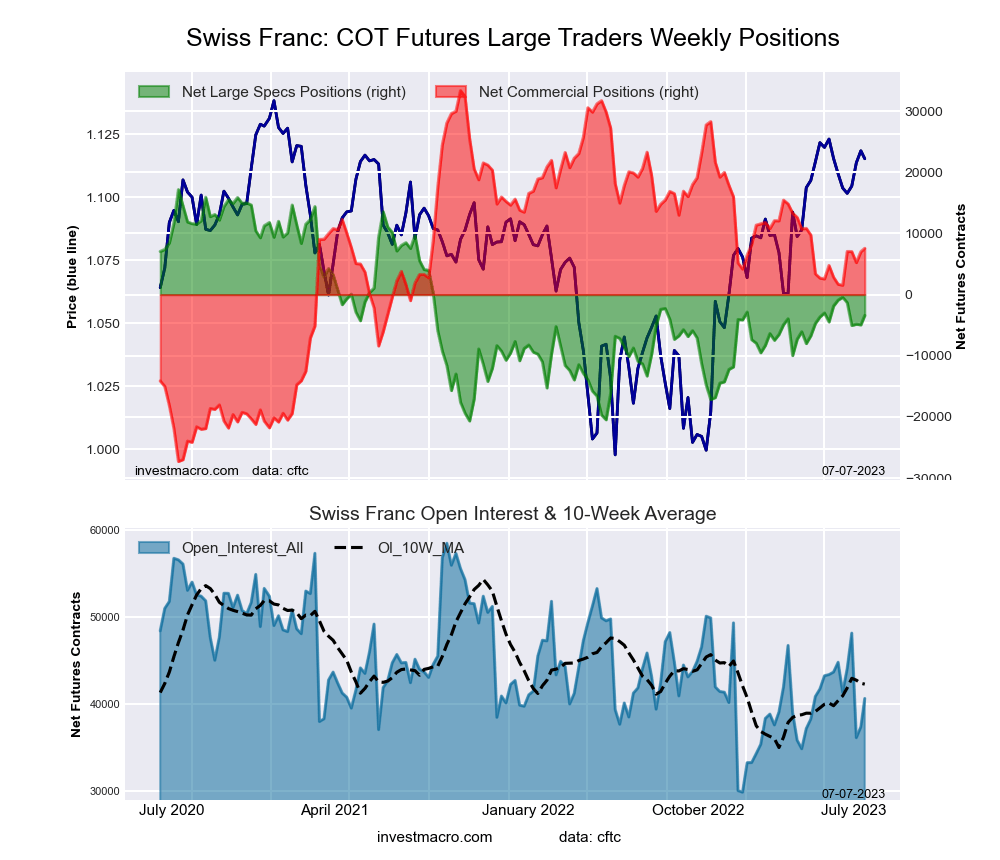
Swiss Franc Forex Futures COT ChartThe Swiss Franc large speculator standing this week reached a net position of -1,314 contracts in the data reported through Tuesday. This was a weekly decline of -879 contracts from the previous week which had a total of -435 net contracts.

This week’s current strength score (the trader positioning range over the past three years, measured from 0 to 100) shows the speculators are currently Bullish with a score of 51.1 percent. The commercials are Bullish with a score of 56.6 percent and the small traders (not shown in chart) are Bearish with a score of 38.1 percent.

SWISS FRANC StatisticsSPECULATORSCOMMERCIALSSMALL TRADERS
– Percent of Open Interest Longs:26.347.025.7
– Percent of Open Interest Shorts:29.231.038.7
– Net Position:-1,3147,048-5,734
– Gross Longs:11,57920,72611,309
– Gross Shorts:12,89313,67817,043
– Long to Short Ratio:0.9 to 11.5 to 10.7 to 1
NET POSITION TREND:
– Strength Index Score (3 Year Range Pct):51.156.638.1
– Strength Index Reading (3 Year Range):BullishBullishBearish
NET POSITION MOVEMENT INDEX:
– 6-Week Change in Strength Index:6.27.2-22.6


Canadian Dollar Futures:

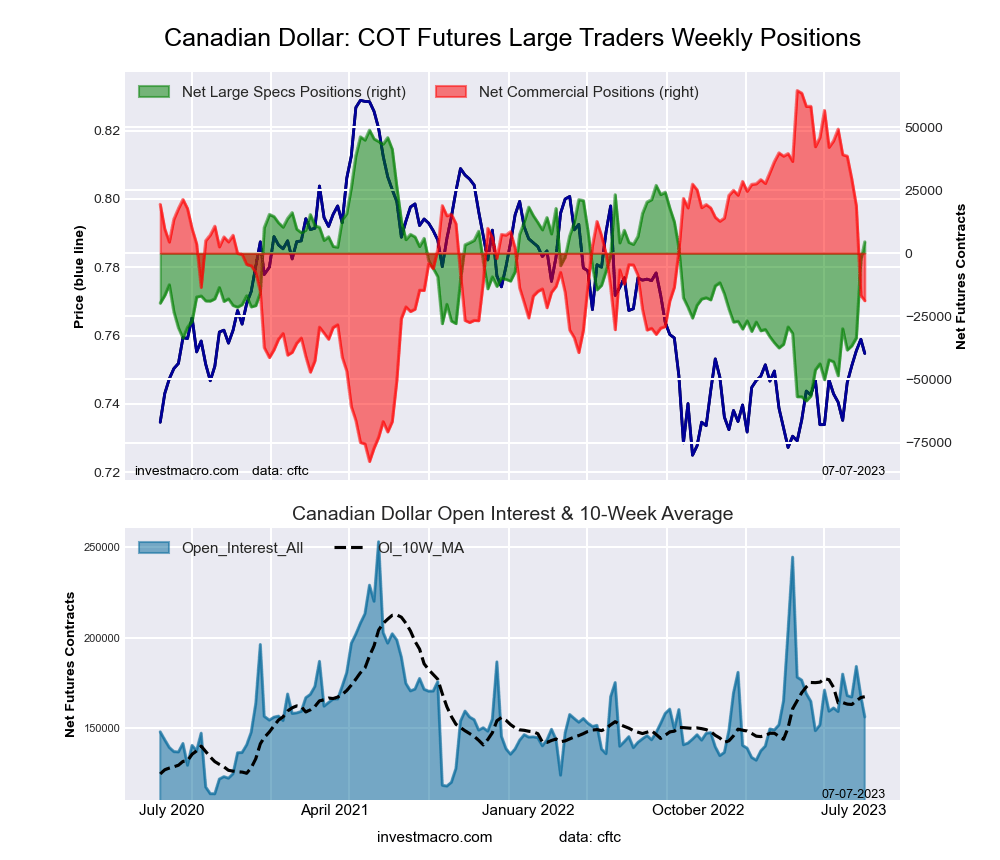
Canadian Dollar Forex Futures COT ChartThe Canadian Dollar large speculator standing this week reached a net position of -38,329 contracts in the data reported through Tuesday. This was a weekly decline of -8,415 contracts from the previous week which had a total of -29,914 net contracts.

This week’s current strength score (the trader positioning range over the past three years, measured from 0 to 100) shows the speculators are currently Bearish-Extreme with a score of 18.8 percent. The commercials are Bullish-Extreme with a score of 82.3 percent and the small traders (not shown in chart) are Bearish with a score of 22.5 percent.

CANADIAN DOLLAR StatisticsSPECULATORSCOMMERCIALSSMALL TRADERS
– Percent of Open Interest Longs:12.963.118.7
– Percent of Open Interest Shorts:35.740.218.7
– Net Position:-38,32938,456-127
– Gross Longs:21,709106,00331,338
– Gross Shorts:60,03867,54731,465
– Long to Short Ratio:0.4 to 11.6 to 11.0 to 1
NET POSITION TREND:
– Strength Index Score (3 Year Range Pct):18.882.322.5
– Strength Index Reading (3 Year Range):Bearish-ExtremeBullish-ExtremeBearish
NET POSITION MOVEMENT INDEX:
– 6-Week Change in Strength Index:5.1-5.14.4


Australian Dollar Futures:

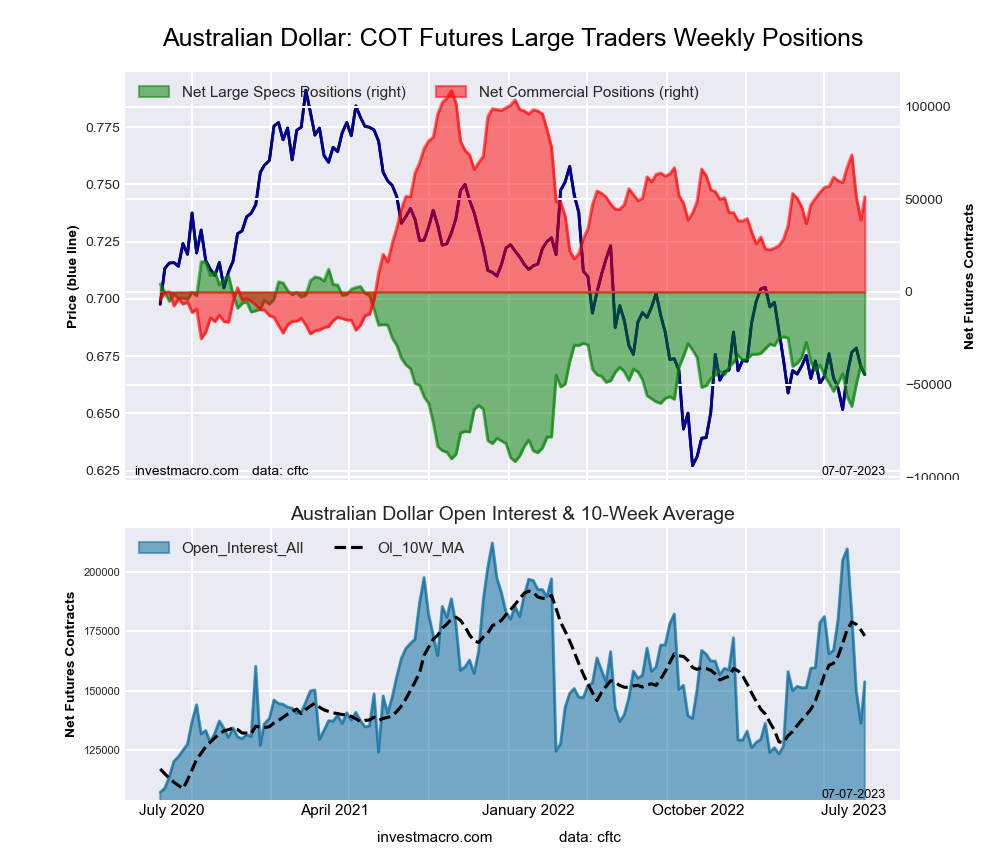
Australian Dollar Forex Futures COT ChartThe Australian Dollar large speculator standing this week reached a net position of -56,468 contracts in the data reported through Tuesday. This was a weekly reduction of -12,342 contracts from the previous week which had a total of -44,126 net contracts.

This week’s current strength score (the trader positioning range over the past three years, measured from 0 to 100) shows the speculators are currently Bearish with a score of 32.5 percent. The commercials are Bullish with a score of 69.2 percent and the small traders (not shown in chart) are Bearish with a score of 25.5 percent.

AUSTRALIAN DOLLAR StatisticsSPECULATORSCOMMERCIALSSMALL TRADERS
– Percent of Open Interest Longs:26.057.19.2
– Percent of Open Interest Shorts:52.924.914.5
– Net Position:-56,46867,496-11,028
– Gross Longs:54,501119,77519,365
– Gross Shorts:110,96952,27930,393
– Long to Short Ratio:0.5 to 12.3 to 10.6 to 1
NET POSITION TREND:
– Strength Index Score (3 Year Range Pct):32.569.225.5
– Strength Index Reading (3 Year Range):BearishBullishBearish
NET POSITION MOVEMENT INDEX:
– 6-Week Change in Strength Index:-15.810.37.9


New Zealand Dollar Futures:

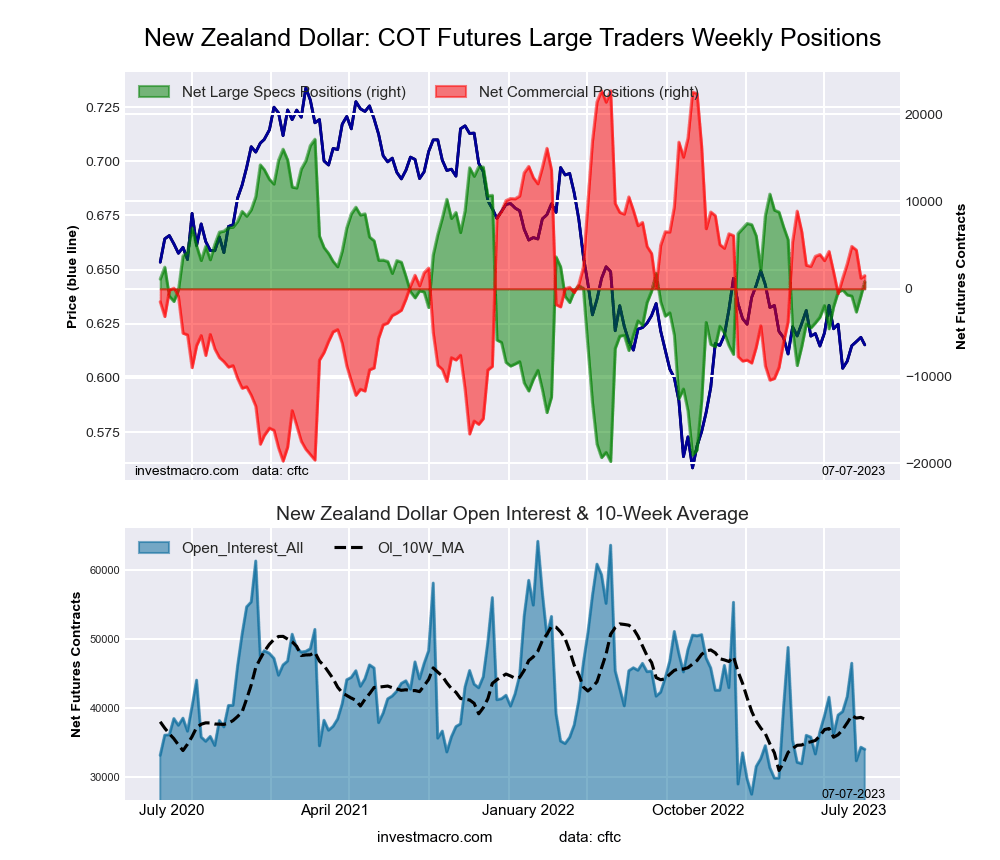
New Zealand Dollar Forex Futures COT ChartThe New Zealand Dollar large speculator standing this week reached a net position of -703 contracts in the data reported through Tuesday. This was a weekly reduction of -573 contracts from the previous week which had a total of -130 net contracts.

This week’s current strength score (the trader positioning range over the past three years, measured from 0 to 100) shows the speculators are currently Bullish with a score of 51.7 percent. The commercials are Bullish with a score of 53.2 percent and the small traders (not shown in chart) are Bearish with a score of 24.4 percent.

NEW ZEALAND DOLLAR StatisticsSPECULATORSCOMMERCIALSSMALL TRADERS
– Percent of Open Interest Longs:38.745.58.4
– Percent of Open Interest Shorts:40.438.613.6
– Net Position:-7032,856-2,153
– Gross Longs:16,10918,9543,502
– Gross Shorts:16,81216,0985,655
– Long to Short Ratio:1.0 to 11.2 to 10.6 to 1
NET POSITION TREND:
– Strength Index Score (3 Year Range Pct):51.753.224.4
– Strength Index Reading (3 Year Range):BullishBullishBearish
NET POSITION MOVEMENT INDEX:
– 6-Week Change in Strength Index:6.9-2.5-17.6


Mexican Peso Futures:

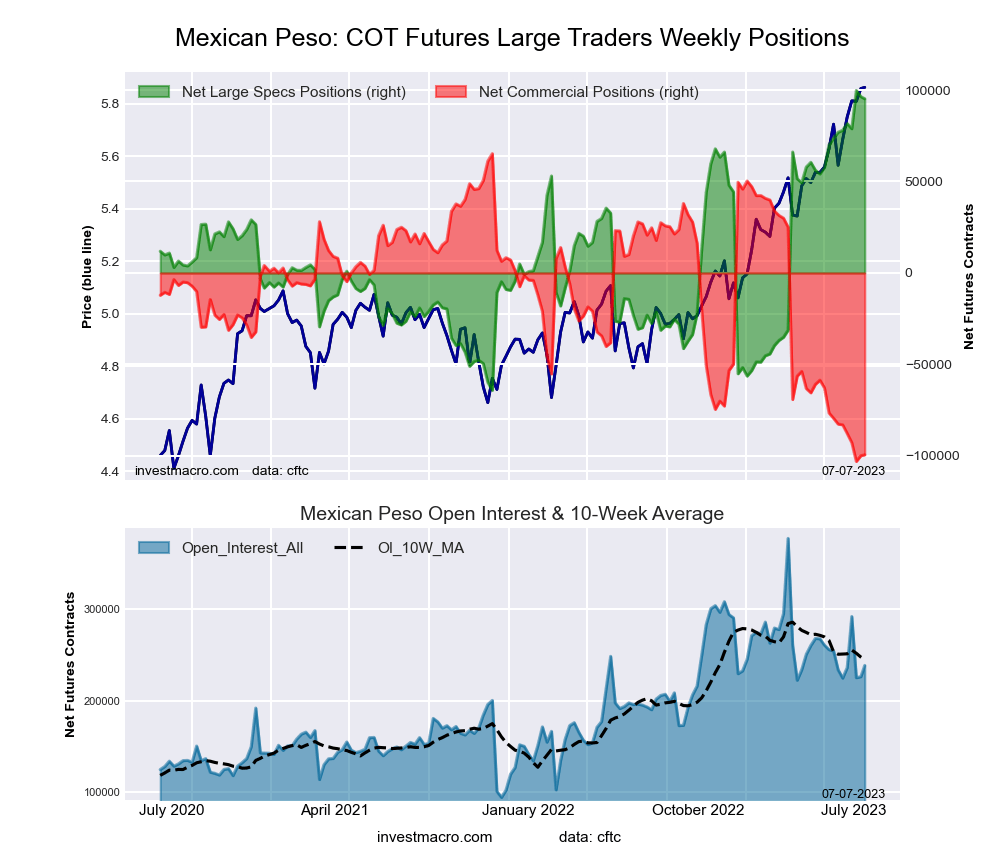
Mexican Peso Futures COT ChartThe Mexican Peso large speculator standing this week reached a net position of 81,670 contracts in the data reported through Tuesday. This was a weekly advance of 3,665 contracts from the previous week which had a total of 78,005 net contracts.

This week’s current strength score (the trader positioning range over the past three years, measured from 0 to 100) shows the speculators are currently Bullish-Extreme with a score of 100.0 percent. The commercials are Bearish-Extreme with a score of 0.0 percent and the small traders (not shown in chart) are Bullish-Extreme with a score of 87.4 percent.

MEXICAN PESO StatisticsSPECULATORSCOMMERCIALSSMALL TRADERS
– Percent of Open Interest Longs:52.341.63.9
– Percent of Open Interest Shorts:17.778.81.3
– Net Position:81,670-87,7776,107
– Gross Longs:123,44798,2619,230
– Gross Shorts:41,777186,0383,123
– Long to Short Ratio:3.0 to 10.5 to 13.0 to 1
NET POSITION TREND:
– Strength Index Score (3 Year Range Pct):100.00.087.4
– Strength Index Reading (3 Year Range):Bullish-ExtremeBearish-ExtremeBullish-Extreme
NET POSITION MOVEMENT INDEX:
– 6-Week Change in Strength Index:18.9-19.118.1


Brazilian Real Futures:

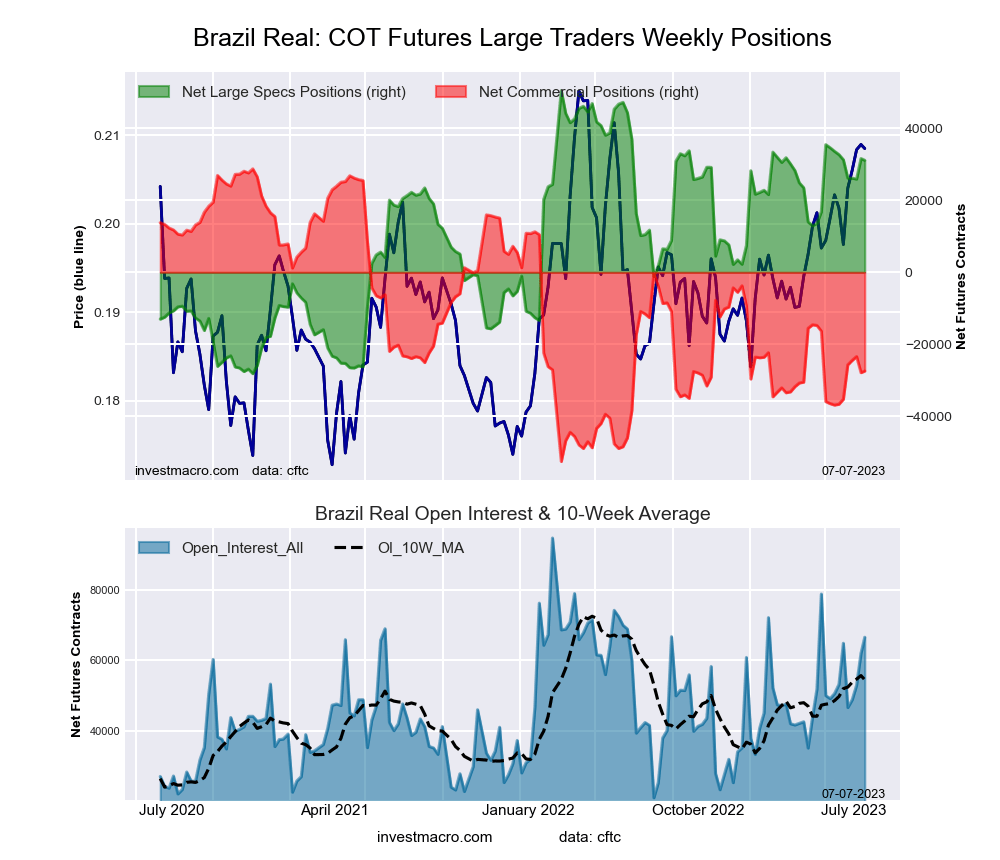
Brazil Real Futures COT ChartThe Brazilian Real large speculator standing this week reached a net position of 26,181 contracts in the data reported through Tuesday. This was a weekly reduction of -5,094 contracts from the previous week which had a total of 31,275 net contracts.

This week’s current strength score (the trader positioning range over the past three years, measured from 0 to 100) shows the speculators are currently Bullish with a score of 69.1 percent. The commercials are Bearish with a score of 33.0 percent and the small traders (not shown in chart) are Bearish with a score of 40.3 percent.

BRAZIL REAL StatisticsSPECULATORSCOMMERCIALSSMALL TRADERS
– Percent of Open Interest Longs:68.421.310.3
– Percent of Open Interest Shorts:12.376.411.2
– Net Position:26,181-25,721-460
– Gross Longs:31,9309,9474,791
– Gross Shorts:5,74935,6685,251
– Long to Short Ratio:5.6 to 10.3 to 10.9 to 1
NET POSITION TREND:
– Strength Index Score (3 Year Range Pct):69.133.040.3
– Strength Index Reading (3 Year Range):BullishBearishBearish
NET POSITION MOVEMENT INDEX:
– 6-Week Change in Strength Index:11.9-11.50.1


Bitcoin Futures:

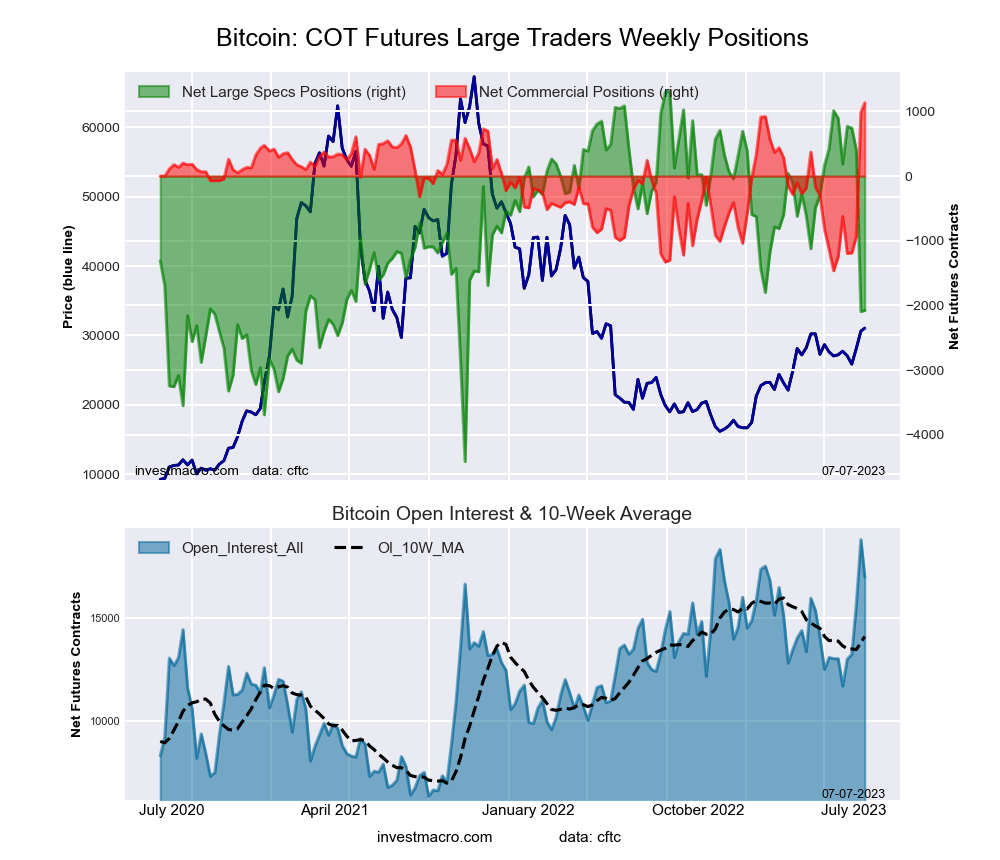
Bitcoin Crypto Futures COT ChartThe Bitcoin large speculator standing this week reached a net position of 769 contracts in the data reported through Tuesday. This was a weekly gain of 582 contracts from the previous week which had a total of 187 net contracts.

This week’s current strength score (the trader positioning range over the past three years, measured from 0 to 100) shows the speculators are currently Bullish-Extreme with a score of 90.4 percent. The commercials are Bearish-Extreme with a score of 11.2 percent and the small traders (not shown in chart) are Bearish with a score of 22.6 percent.

BITCOIN StatisticsSPECULATORSCOMMERCIALSSMALL TRADERS
– Percent of Open Interest Longs:77.61.49.0
– Percent of Open Interest Shorts:71.710.65.7
– Net Position:769-1,196427
– Gross Longs:10,1061871,172
– Gross Shorts:9,3371,383745
– Long to Short Ratio:1.1 to 10.1 to 11.6 to 1
NET POSITION TREND:
– Strength Index Score (3 Year Range Pct):90.411.222.6
– Strength Index Reading (3 Year Range):Bullish-ExtremeBearish-ExtremeBearish
NET POSITION MOVEMENT INDEX:
– 6-Week Change in Strength Index:18.5-37.8-3.7


Article By InvestMacroReceive our weekly COT Newsletter

*COT Report: The COT data, released weekly to the public each Friday, is updated through the most recent Tuesday (data is 3 days old) and shows a quick view of how large speculators or non-commercials (for-profit traders) were positioned in the futures markets.

The CFTC categorizes trader positions according to commercial hedgers (traders who use futures contracts for hedging as part of the business), non-commercials (large traders who speculate to realize trading profits) and nonreportable traders (usually small traders/speculators) as well as their open interest (contracts open in the market at time of reporting). See CFTC criteria here.

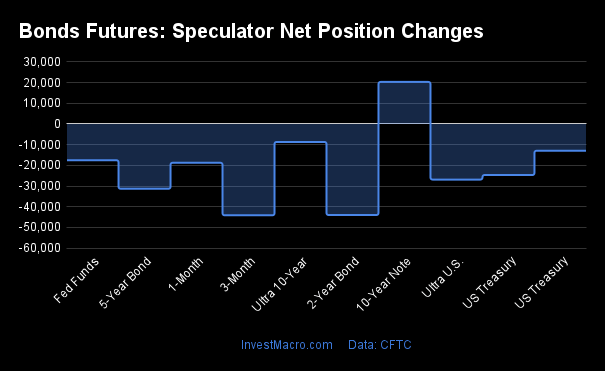
Speculator Extremes: Live Cattle, SOFR, Japanese Yen lead weekly Bullish & Bearish Positions

By InvestMacro

The latest update for the weekly Commitment of Traders (COT) report was released by the Commodity Futures Trading Commission (CFTC) on Friday for data ending on June 6th.

This weekly Extreme Positions report highlights the Most Bullish and Most Bearish Positions for the speculator category. Extreme positioning in these markets can foreshadow strong moves in the underlying market.

To signify an extreme position, we use the Strength Index (also known as the COT Index) of each instrument, a common method of measuring COT data. The Strength Index is simply a comparison of current trader positions against the range of positions over the previous 3 years. We use over 80 percent as extremely bullish and under 20 percent as extremely bearish. (Compare Strength Index scores across all markets in the data table or cot leaders table)


Here Are This Week’s Most Bullish Speculator Positions:

Bloomberg Commodity Index


The Bloomberg Commodity Index speculator position comes in as the most bullish extreme standing this week. The Bloomberg Commodity Index speculator level is currently at a 100.0 percent score of its 3-year range.

The six-week trend for the percent strength score totaled 2.1 this week. The overall net speculator position was a total of -1,487 net contracts this week with a change of 181 contract in the weekly speculator bets.


Mexican Peso


The Mexican Peso speculator position comes next in the extreme standings this week. The Mexican Peso speculator level is now at a 100.0 percent score of its 3-year range.

The six-week trend for the percent strength score was 18.9 this week. The speculator position registered 81,670 net contracts this week with a weekly change of 3,665 contracts in speculator bets.


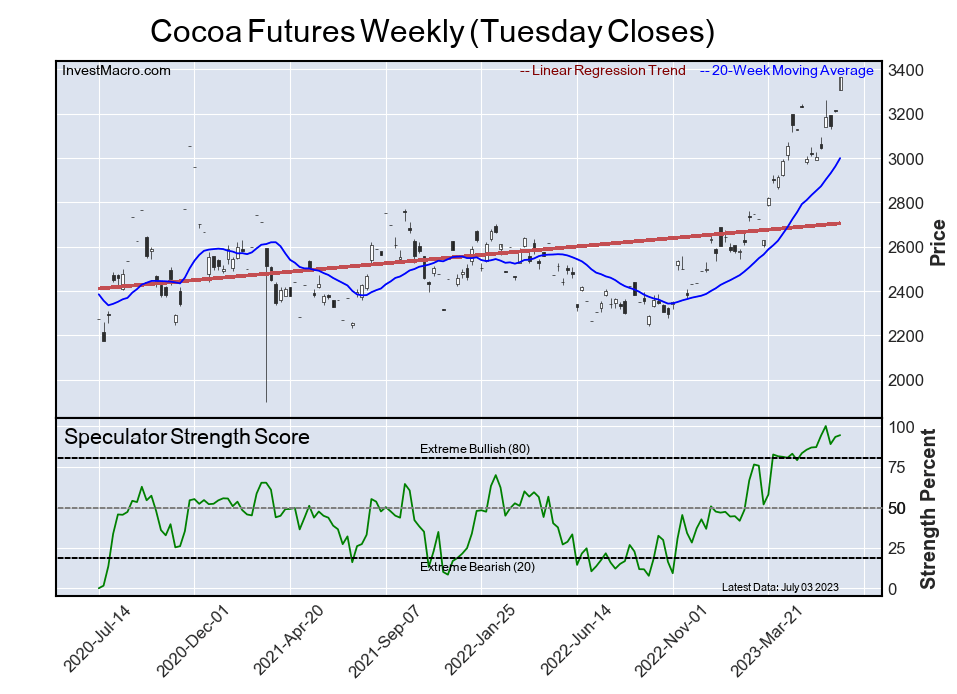
Cocoa Futures


The Cocoa Futures speculator position comes in third this week in the extreme standings. The Cocoa Futures speculator level resides at a 100.0 percent score of its 3-year range.

The six-week trend for the speculator strength score came in at 11.8 this week. The overall speculator position was 72,234 net contracts this week with a change of 6,661 contracts in the weekly speculator bets.


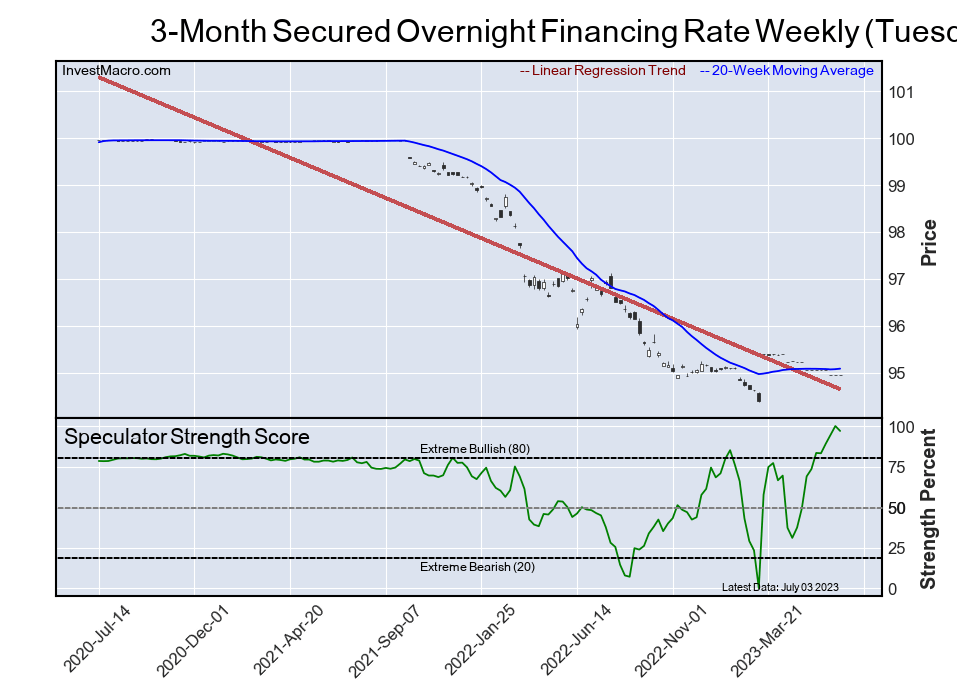
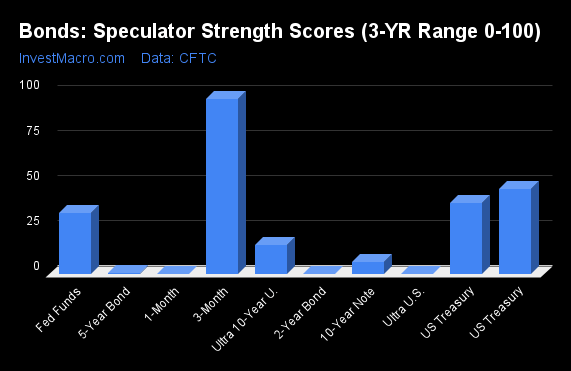
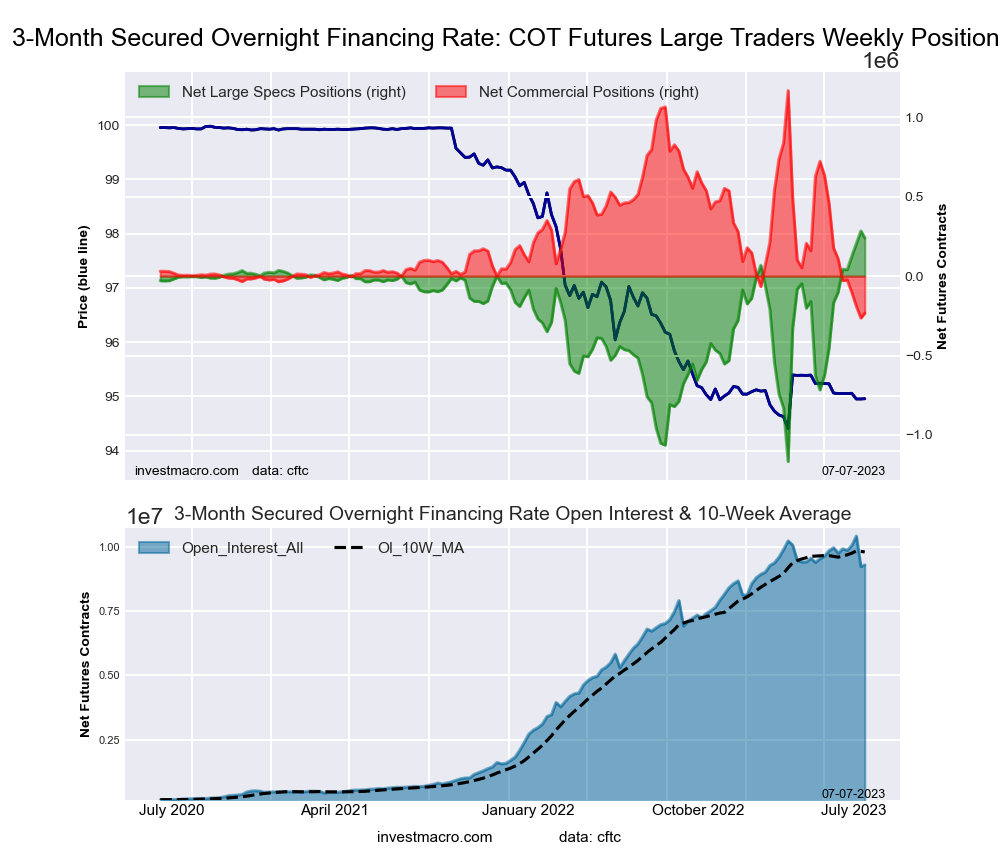
3-Month Secured Overnight Financing Rate


The 3-Month Secured Overnight Financing Rate speculator position comes up number four in the extreme standings this week. The 3-Month Secured Overnight Financing Rate speculator level is at a 97.8 percent score of its 3-year range.

The six-week trend for the speculator strength score totaled a change of 61.3 this week. The overall speculator position was 40,305 net contracts this week with a change of -2,917 contracts in the speculator bets.


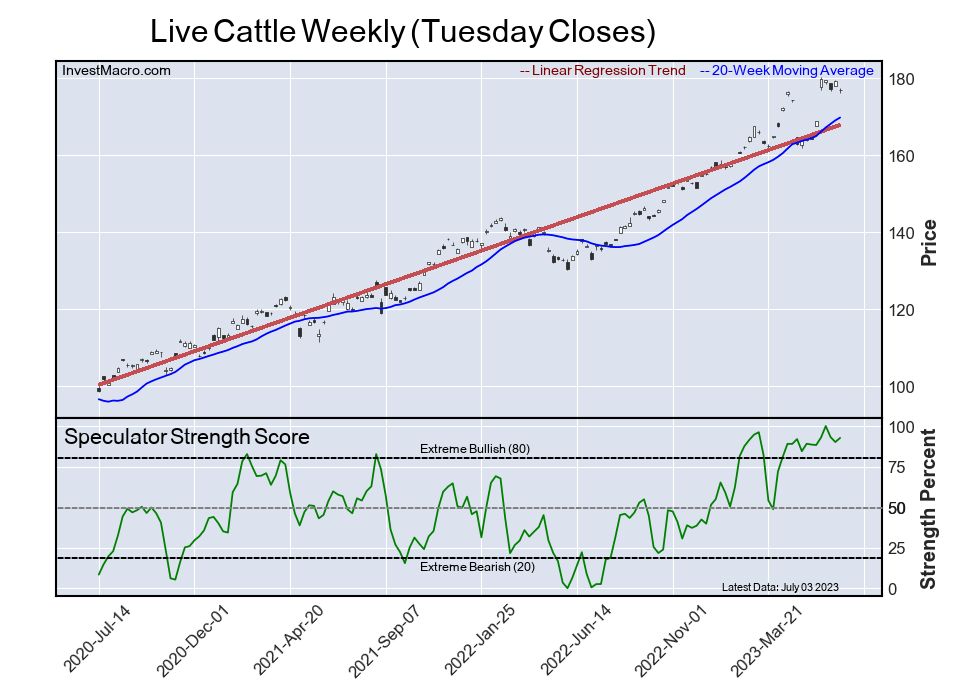
Live Cattle


The Live Cattle speculator position rounds out the top five in this week’s bullish extreme standings. The Live Cattle speculator level sits at a 96.5 percent score of its 3-year range. The six-week trend for the speculator strength score was 4.0 this week.

The speculator position was 105,621 net contracts this week with a change of 4,243 contracts in the weekly speculator bets.


This Week’s Most Bearish Speculator Positions:

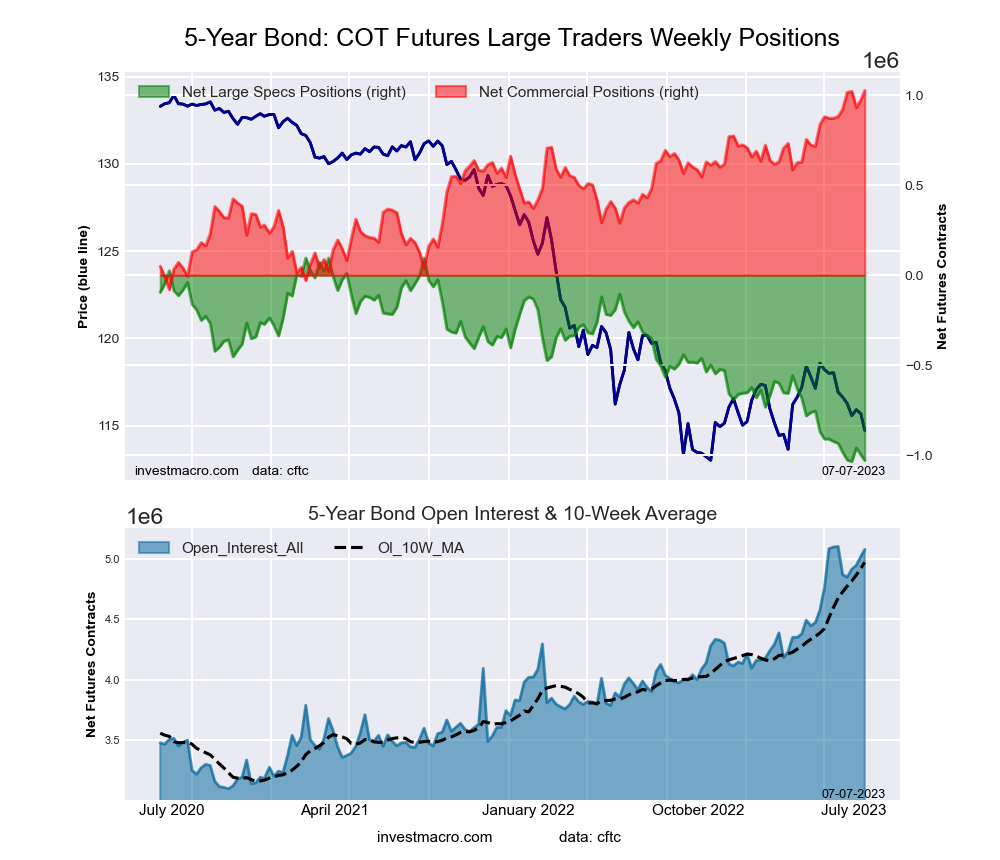
5-Year Bond


The 5-Year Bond speculator position comes in as the most bearish extreme standing this week. The 5-Year Bond speculator level is at a 0.0 percent score of its 3-year range.

The six-week trend for the speculator strength score was -14.1 this week. The overall speculator position was -1,027,059 net contracts this week with a change of -43,222 contracts in the speculator bets.


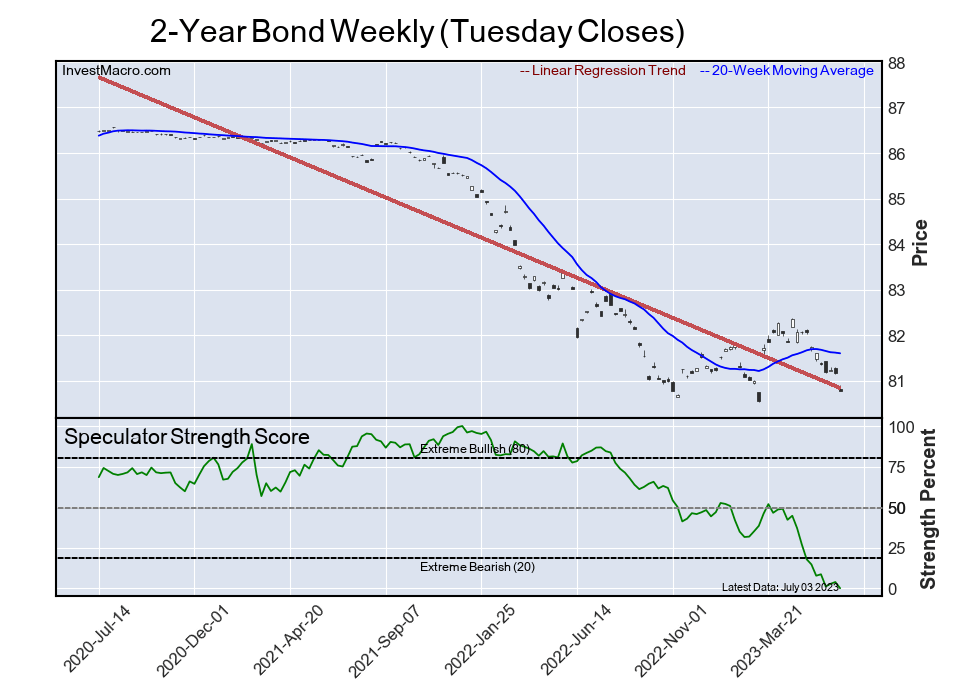
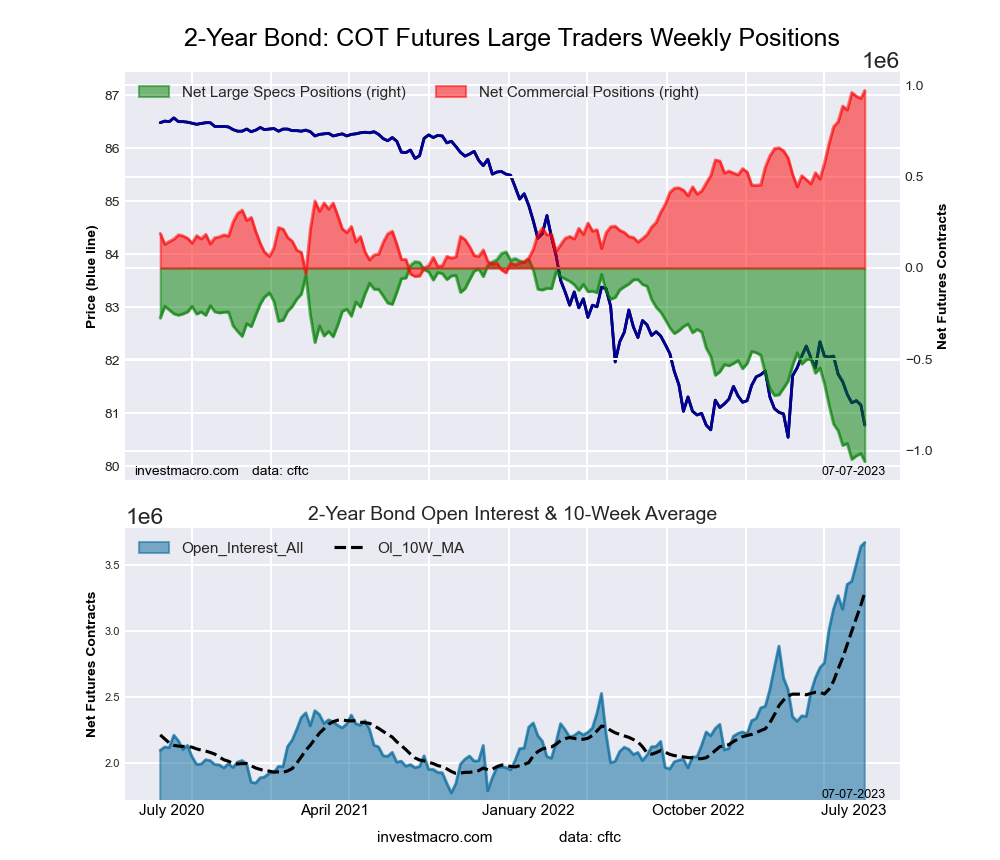
2-Year Bond


The 2-Year Bond speculator position comes in next for the most bearish extreme standing on the week. The 2-Year Bond speculator level is at a 0.9 percent score of its 3-year range.

The six-week trend for the speculator strength score was -39.1 this week. The speculator position was -959,901 net contracts this week with a change of 9,962 contracts in the weekly speculator bets.


Lean Hogs


The Lean Hogs speculator position comes in as third most bearish extreme standing of the week. The Lean Hogs speculator level resides at a 2.1 percent score of its 3-year range.

The six-week trend for the speculator strength score was -5.3 this week. The overall speculator position was -33,503 net contracts this week with a change of 2,611 contracts in the speculator bets.


Wheat

The Wheat speculator position comes in as this week’s fourth most bearish extreme standing. The Wheat speculator level is at a 2.4 percent score of its 3-year range.

The six-week trend for the speculator strength score was -5.3 this week. The speculator position was -90,684 net contracts this week with a change of 3,312 contracts in the weekly speculator bets.


Japanese Yen


Finally, the Japanese Yen speculator position comes in as the fifth most bearish extreme standing for this week. The Japanese Yen speculator level is at a 4.3 percent score of its 3-year range.

The six-week trend for the speculator strength score was -22.2 this week. The speculator position was -104,817 net contracts this week with a change of -8,624 contracts in the weekly speculator bets.


Article By InvestMacroReceive our weekly COT Newsletter

Speculators or Non-Commercials Notes:

Speculators, classified as non-commercial traders by the CFTC, are made up of large commodity funds, hedge funds and other significant for-profit participants. The Specs are generally regarded as trend-followers in their behavior towards price action – net speculator bets and prices tend to go in the same directions. These traders often look to buy when prices are rising and sell when prices are falling. To illustrate this point, many times speculator contracts can be found at their most extremes (bullish or bearish) when prices are also close to their highest or lowest levels.

These extreme levels can be dangerous for the large speculators as the trade is most crowded, there is less trading ammunition still sitting on the sidelines to push the trend further and prices have moved a significant distance. When the trend becomes exhausted, some speculators take profits while others look to also exit positions when prices fail to continue in the same direction. This process usually plays out over many months to years and can ultimately create a reverse effect where prices start to fall and speculators start a process of selling when prices are falling.

*COT Report: The COT data, released weekly to the public each Friday, is updated through the most recent Tuesday (data is 3 days old) and shows a quick view of how large speculators or non-commercials (for-profit traders) were positioned in the futures markets.

The CFTC categorizes trader positions according to commercial hedgers (traders who use futures contracts for hedging as part of the business), non-commercials (large traders who speculate to realize trading profits) and nonreportable traders (usually small traders/speculators) as well as their open interest (contracts open in the market at time of reporting). See CFTC criteria here.

Savvy investors pile into semiconductors to build personal wealth

By George Prior 

Semiconductors, or chips, should be included in your investment portfolio if you’re serious about growing your wealth over the next decade, says the CEO and founder of one of the world’s largest independent financial advisory, asset management and fintech organizations.

The observation from Nigel Green of deVere Group comes against an escalating, trillion-dollar chip battle between geopolitical superpower rivals, the US and China.

It also follows this week the Japanese government overhauling its chip strategy to triple sales of domestically produced semiconductors to over $108 billion by 2030; as France confirms it is to plough $3.1 billion of public money into a factory to make microchips; and as Europe and the United States have both passed so-called Chips Acts.

In addition, chipmaker Nvidia this week briefly broke into the club of companies with a $1 trillion market cap.

The deVere CEO says: “Semiconductors are tiny, but these mighty chips power our world. They are fuelling this current industrial revolution.

“Semiconductors are at the forefront of technological progress. As our reliance on electronic devices continues to grow, the demand for semiconductors is skyrocketing – and will continue to do.

“From smartphones and computers to automobiles and advanced infrastructure, semiconductors are indispensable in powering our daily lives. This ever-increasing demand has created a fiercely competitive market, with companies vying to capture larger market shares and gain technological superiority.”

He continues: “Beyond their technological significance, semiconductors have also become critical strategic assets. They are vital for national security, defense applications, and emerging technologies such as artificial intelligence, 5G, and the Internet of Things (IoT).

“The ability to control semiconductor manufacturing and develop cutting-edge chip designs has become a matter of top level strategic importance for countries and companies alike.”

Against this backdrop, Nigel Green says that investors looking to create and build wealth for the long-term should include exposure to chips in their portfolios.

“Their far-reaching – and growing – impact on our lives makes it a no-brainer for almost everyone to have semiconductors within a well-diversified portfolio.”

However, his bullish approach does come with a warning.

“But, with every boom, there will be winners and losers. A good fund manager will be critical in helping you make informed decisions.”

Seeking advice, it could be reasonably argued, is perhaps particularly important considering that semiconductors have become entangled in geopolitical tensions and economic considerations.

Major powers such as the US and China are engaged in a race for technological supremacy, with semiconductors at the forefront.

Concerns about intellectual property theft, national security risks, and economic dominance through control over semiconductor technology have prompted trade restrictions, export controls, and investment scrutiny, further fuelling the battleground.

“Semiconductors will remain a fiercely contested battleground for market dominance and technological advancements.

“Their strategic importance is what makes them such an attractive, a potentially hugely rewarding, proposition. Savvy investors keen to build wealth over the next decade will pile in,” concludes the deVere Group CEO.

About:

deVere Group is one of the world’s largest independent advisors of specialist global financial solutions to international, local mass affluent, and high-net-worth clients.  It has a network of more than 70 offices across the world, over 80,000 clients and $12bn under advisement.

Week Ahead: EURUSD Braces For Fed-ECB Combo

By ForexTime 

This period of market calm could come to an abrupt end next week. A long list of high-risk events is likely to see volatility return with a vengeance and keep investors well-occupied.

A long list of high-risk events ranging from interest-rate decision at the Federal Reserve (Fed), European Central Bank (ECB), Bank of Japan (BoJ) to top-tier data from major economies will be in focus.

But before we discuss what asset to keep an eye on amid the expected volatility, here is a list of key economic releases and events for the coming week:

Monday, June 12

  • JPY: Japan May PPI

Tuesday, June 13

  • AUD: June Consumer confidence
  • EUR: Germany CPI, ZEW survey expectations
  • GBP: UK jobless claims, unemployment
  • OIL: OPEC monthly oil market report
  • USD: US May CPI

Wednesday, June 14

  • EUR: Eurozone industrial production
  • GBP: UK monthly GDP, industrial production
  • USD: Fed rate decision, PPI

Thursday, June 15

  • CNY: China retail sales, industrial production
  • AUD: Australia unemployment
  • CAD: Canada housing starts, existing home sales
  • EUR: ECB rate decision
  • USD: US initial jobless claims, retail sales, empire manufacturing

Friday, June 16

  • JPY: BoJ rate decision
  • EUR: Eurozone CPI (final)
  • GBP: Bank of England inflation expectations survey
  • USD: University of Michigan consumer sentiment

The scheduled data releases and events could translate to fresh opportunities across global financial markets. Our focus lands on the world’s most popular traded currency pair which is set to be heavily influenced by central bank decisions and economic data.

Here are 3 reasons why the EURUSD is on our radar:

  1. Super central bank combo 

A super central bank mashup featuring the Fed and ECB could inject the EURUSD with explosive levels of volatility.

Markets widely expect the Federal Reserve to leave interests unchanged in June with traders currently pricing in a 28% probability of a 25bps hike, according to Fed fund futures. However, the recent hawkish surprise from the Reserve Bank of Australia (RBA) and Bank of Canada (BoC) has left investors questioning the Fed’s next move. All eyes will also be on the updated dot plot, as well as Fed Chair Jerome Powell’s remarks at the press conference. If the Fed moves ahead with a hawkish hold and signals one more hike in July, this could support the dollar. Should the central bank surprise markets by raising rates, dollar bulls are likely to run rampant – rocking the FX arena.

In regards to the ECB, it is expected to raise interest rates by 25 basis points on Thursday, bringing the deposit rate to 3.50 from 3.25%. However, given how the Eurozone has slipped into a recession coupled with the weak economic data and signs of cooling inflation, the central bank could be close to ending its rate hike cycle. ECB President Christine Lagarde’s press conference will be closely scrutinized for fresh clues. Much focus will also be on the ECB’s staff economists fresh forecast for GDP and inflation, which may support the expectations around the hiking cycle coming to an end.

Whatever the outcome of both central bank decisions, expect the impacts to be reflected in the EURUSD.

  1. Top-tier economic data 

Throughout the week, investors will be dished out a generous serving of key economic reports from the United States and Europe. This will range from US CPI, Germany ZEW survey expectations, Eurozone industrial production, US retail sales, and Eurozone CPI (final) among other important economic reports. Given how these releases are likely to influence central bank expectations, we could see increased volatility in the respective currencies.

  • Should the pending US/Eurozone inflation report show signs of cooling inflation and other data releases point to slowing economic growth, this could fuel speculation around the hiking cycles coming to an end. Such a development may weaken the respective currency.
  • If US/Eurozone inflation runs hot and economic data beat market expectations, bets may jump around interest rates remaining higher for longer – lending support to the currencies.
  1. Technical forces 

It has been a choppy affair for the EURUSD over the past two weeks but bulls could be making a move.

The recent breakout and daily close above the 1.0760 resistance level could signal further upside in the week ahead. However, the journey north could be challenging for bulls given the multiple levels of resistance, especially the first barrier at 1.0811 where the 100-day SMA resides. A strong daily close above this point could signal a move towards 1.0840 and 1.0900, respectively. Should prices slip back below 1.0760, the EURUSD may test support at 1.0686 before potentially challenging 1.0635 and levels not seen since March 2023 at 1.0550.

At the time of writing Bloomberg’s FX model forecasts a 73% chance that EURUSD will trade within the 1.0640 – 1.0896 range over the upcoming week.


Forex-Time-LogoArticle by ForexTime
ForexTime Ltd (FXTM) is an award winning international online forex broker regulated by CySEC 185/12 www.forextime.com
Bear Rallies in Equities and Crypto Currencies Have About Run Their Course

Don’t be fooled by just seven stocks propelling the S&P bear rally and the Crypto bear rally top is in. Quite often, there are summer rallies in gold so check out Centerra Gold, New Found Gold, and Zonte Metals. 

Source: Ron Struthers  (6/7/23)

I have been reluctant to make new picks in this flat-to-down market, but there is some opportunity. What we are seeing in markets is unprecedented. This has a lot to do with the Covid-19 policy hangover, the green energy scam with the attack on oil and gas along with government manipulation and corruption at unprecedented levels.

These topics do cause controversy, but they are real. Just two recent examples of the green energy scam is Biden’s use of the SPR to influence energy prices ahead of the election and Trudeau’s relentless attack on oil and gas with carbon taxes. I touched on this yesterday, but the carbon tax will increase to US$170/tonne by 2030 from today’s US$30.

What is slimy about this, it is an automatic increase each year, and the Trudeau government is doing this with other tax increases. This way, the tax increase does not have to be debated in the annual government budget. This tax will add over 35 cents/liter to gasoline, and if you think that does not affect consumers, economies, and markets, think again.

And a recent survey says 73% of Canadians say David Johnston is unfit to be Special Rapporteu. Western government’s push to totalitarianism is affected markets and investments like never before; we just can’t ignore it. I usually use a chart of the S&P 500 with my support and resistance levels, but I will use this version today. There is much talk about this bear rally almost reaching new bull market status with a +20% gain.

Don’t get sucked in by this. This bear rally is simply seven stocks, as shown below. We are in a flat market at best, and I have zero confidence in this rally.

I am not saying this is market manipulation, but it is way easier to manipulate seven stocks to create a bear rally mirage than the whole market. I updated my FAANG stocks short barometer, and the pros are not buying this rally as their short positions remain about the same.

However, the $ value of the shorts has increased by about US$8 billion in the last two months because of their price increase shown in the above chart.

The Russel 2000 fell about 33% and has only rallied about 12%. However, in Canada, what has been pure torture and unprecedented in history is the destruction of the juniors and small-cap sector.

The barometer of the small-cap sector is the TSX Venture index, and on average, it has traded about 90 million shares per day with spikes higher during good rallies.

Since April 2022, the volume has been very sick and unprecedented in history, with a mere 20 million shares per day. Take out the computer trading, and there is virtually zero interest in Canada’s small-cap sector.

With the current government, investment money has fled the country in droves like never before. Foreign investors ditched US$19.1 billion in March 2023 alone for a net investment outflow of US$13.5 billion (last Statcan data available). These numbers don’t include US$100s of billions that fled with U.S. firms selling Canadian assets, especially in the oil patch.

Canadians are voting with their feet as they invested record amounts outside Canada, $US59.661 billion in Q1 2023. This is the second highest on record, with US$67,096 in Q4 2021 a record. If you don’t believe the current government policy is not destroying this country, you are fooling yourself.

In general, these numbers have been on the rise since 2016, soon after the liberals came to power. A longer-term view from Q1 2021 Canadian direct investment abroad is US$271,788 billion compared to foreign direct investment in Canada of US$146,811.

These numbers include mergers and acquisitions. Canada had record foreign investment pre-2008 and another strong period from 2012 to early 2015. These occurred with rising oil prices except in the 2022 oil price rise as negative government oil and gas policy negated that. For things being so negative, in the past ten years, we have seen gold and gold stocks bottom in summer and have summer rallies in six years.

In 2016 and 2017, there were summer rallies, and very strong ones in 2019 and 2020. There was a bottom in the summer of 2018 and the end of summer 2022. In 2023, gold prices peaked in early May, and the jury is still out. We either have a summer rally from the late May lows, or gold goes lower still and bottoms in the summer. Either way, it is not a long wait.

All things considered, I expect these boring sideways markets to continue through the summer with perhaps some upward bias. The bulls can keep markets afloat easier in thin summer trading. I expect a significant market correction in late Q3 and Q4; remember that September and October are the scary months for general equity markets.

Gold can sometimes buck these corrections but sometimes sells off in sympathy at the start of these corrections. The real big mover will be when the Fed pivots. Inflation and the economy have been resilient, but I expect these both will soften in the second half of 2023 and the first half of 2024 sometime.

Two Morgan Stanley analysts, Mike Wilson and Andrew Sheets, are bucking the bulls and consensus of 1.8% earnings growth in 2023, calling for a 16% drop. Their year-end price target for the S&P 500 is 3,900 — approximately 9% below the current level. I think we could see 3,800 and possibly lower.

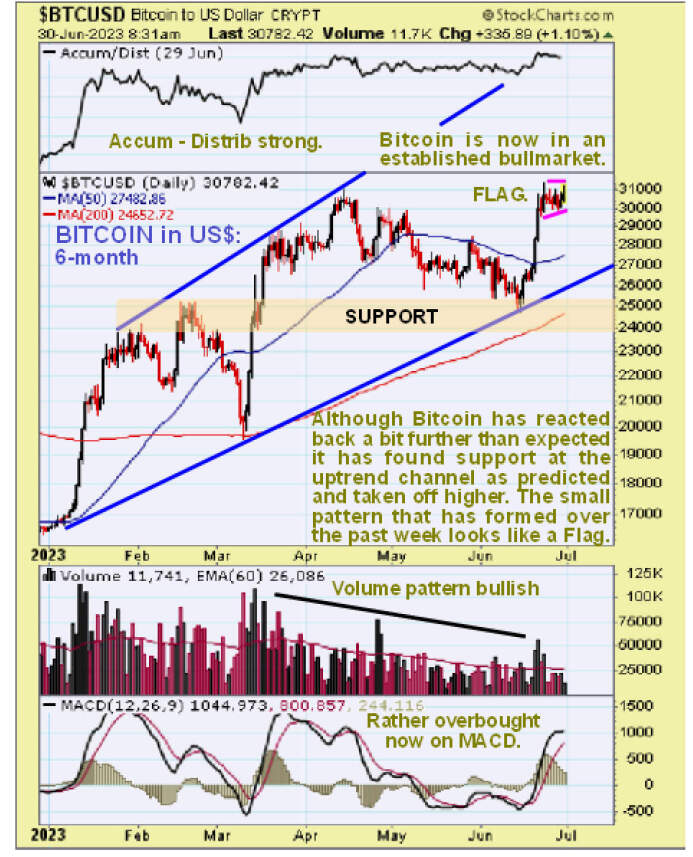
It is looking more so that my call on April 8 to sell crypto again was within days of the top, and my prediction of a US$30k peak was very close, with bitcoin hitting 30,492 on April 14.

Back then, I said a major risk factor was a regulatory crackdown.

“It is not very healthy to have so much trading volume in one place, especially now that Binance is in the gun sights of the regulators. If regulators shut this down and/or prove corruption, it would be disastrous for the crypto market. Is this a risk you should just wait out?”

Bitcoin hit new lows since the April peak, with others on news Monday that the SEC has sued cryptocurrency exchange Binance and its CEO Changpeng Zhao for allegedly violating U.S. securities regulations. The news pushed cryptocurrency prices lower, with Bitcoin (BTC-USD) down 3.8% at US$25.78K and ether (ETHUSD) 2.7% lower at US$1.82K.

Thirteen charges were filed against Binance and CZ, as he is known, including deceiving investors about the sufficiency of its systems to detect and control manipulative trading. The SEC also accused the platform of taking insufficient steps to prohibit U.S. investors from accessing its unregulated exchange.

The Securities Exchange Commission is filing a lawsuit against Coinbase Global Inc. (COIN:NASDAQ) just a day after suing Binance. While the allegations are different — Coinbase centers around the registration of securities and market functions, while Binance includes fraud and efforts to evade — the two are similar in other ways.

“The investing public has the benefit of U.S. securities laws, crypto should be no different, and these platforms and intermediaries need to come into compliance,” SEC Chair Gary Gensler declared. “Frankly, the public should really be more careful . . . We don’t need more digital currency. We already have digital currency. It’s called the U.S. dollar. It’s called the euro, or it’s called the yen; they’re all digital right now.”

Crypto is in the firing sights of the government and regulators. I maintain my US$10,000 target for Bitcoin. The coin is in a new downtrend with next support of about US$24k. A significant break below this would be a bad sign.

The other thing of interest is the commodity cycle. All major commodity bull markets are driven by investment buying, not the supply/demand fundamentals.

A Fed pivot will likely mean a weaker US$ and hence stronger commodity prices. There is no sign the current commodity bull cycle has ended.

My plan is to take some profits and sell some stocks as the opportunity presents itself in the next two or threee months, with the idea of scooping up some good deals in Q4. I have some very good quality companies on my watch list, more senior-type stocks. The juniors will have their day again, but the big guys have to move first.

Centerra Gold TSX:CG NY:CCAU

Recent Price – CA$8.22
Buy around – US$8.00

With that in mind, check out Centerra Gold Inc. (CG:TSX; CADGF:OTCPK).

We got stopped out of Centarra Gold in 2021 at US$11.00 and can now buy back around US$8.00. The stock was on a very good rally, hitting US$10.00 in April. However, it got hammered after May 15 when Q1 2023 financial statements were released.

Net loss for the quarter of US$73.5 million, or 34 cents per common share, including (net of tax) a non-cash reclamation expense at the care and maintenance sites of US$15.6 million, or seven cents per common share. Also, exploration and evaluation costs at the Goldfield project of US$11.7 million, or six cents per common share. And standby cash costs at the Oksut mine of US$7.8 million, or four cents per common share. Mining costs at the Oksut mine were expensed in the period due to the focus on waste-stripping activities with limited mining, crushing, and stacking of ore. Adjusted net loss for the quarter was US$52.9 million, or 24 cents per common share.

The market seemed surprised, but their Oksut mine activity had been sidelined since August 2022 as they had to upgrade the plant and renew permits. They were processing limiting amounts of stockpiled ore. Eventually, this had to hit the financial numbers, and it did. However, this is now resolved as on May 31, they announced the Turkish Ministry of Environment, Urbanization, and Climate Change had approved Centerra Gold Inc.’s amended environmental impact assessment (EIA) for the Oksut mine in Turkey.

With the EIA approval in hand, along with the receipt of regulatory approvals for the mercury abatement retrofit to the adsorption, desorption, and recovery plant (ADR plant), the company expects to restart full operations at Oksut in the coming weeks.

CEO Tomory commented in the May 15 financial release: “In the first quarter of 2023, the company continued to demonstrate that safety remains Centerra’s top priority, with a number of our sites achieving milestones without a lost time or reportable injury. In Turkey, I’m pleased to announce that we have completed the mercury abatement retrofit to the Oksut mine’s ADR plant and that the system has been tested under the supervision of the Turkish ministry. The regulatory review of Oksut mine’s amended EIA remains on track; all review steps have been completed, and it has been submitted for final ministry approval. Subject to receipt of the final approvals of the EIA and ADR plant, the company will be well-positioned to begin processing the approximately 100,000 recoverable ounces of gold-in-carbon inventory on hand. We will then be able to shift our focus to the additional approximately 200,000 recoverable ounces of gold in the Oksut mine’s gold-in-ore stockpiles and on the heap leach pad.”
Oksut is a major asset for the company and just had its first full year of commercial production in 2021 before the ADR plant issue in 2022. In 2021 Oksut produced 111,703 ounces gold and was projected to double that in 2022, so the ADR plant setback was very significant to the company. The 2Q results will still be impacted by the Oksut mine.

Given the shutdown for most of the quarter, Centerra will be able to liberate cash from inventory over time and generate more cash from Oksut going forward, as noted by the CEO above with a large stockpile of ore to process. Centerra offers investors exposure to gold and copper while generating solid cash flow. Centerra also has a strong balance sheet and huge future potential with three molybdenum assets, which offer leverage on molybdenum prices and may be sold for significant value.

On the chart, there is support around US$8.00, and the stock had a gap below this and a gap above it on the surprise news flow. Or what was taken as a surprise. The first resistance is just above US$9, and once that is broken, I expect the up trend can continue to around US$13, the 2022 highs before the Oksut mine issue.

Silver Bull Resources Inc. (SVB:TSX; SVBL:NYSE.MKT) is a junior we sold in 2022, and it dropped lower, but I am still following the company. They were negatively impacted by an illegal blockade at the Sierra Mojada project in Mexico, but we also got a spin-out company called Arras Minerals Corp. (ARRKF:OTCMKTS), and it trades for around US$0.30.

Today SVB announced significant steps in its pursuit of compensation regarding the Sierra Mojada Project. On March 2, 2023, the company served a Notice of Intent with Mexico to initiate a legacy NAFTA claim, seeking damages resulting from the unlawful blockade of its project. In conformity with NAFTA’s dispute resolution provisions, Mexico extended an invitation for company representatives to a meeting held in Mexico City on May 30, 2023.

The purpose of the meeting was to explore the possibility of reaching an amicable settlement and avoid arbitration. Under NAFTA, the parties had 90 days to mutually resolve the matter, which expired on June 2, 2023. The next phase of the process entails the Company filing a Request for Arbitration in mid-June, formally commencing the arbitration proceedings.

The claim filed by Silver Bull will be for not less than US$178 million dollars. This has now become a legal play, and these court issues take time, but if the stock drops this fall, I might suggest buying again. These NAFTA suits don’t seem to take as long as other lawsuits. I believe this would fall under Chapter 11 of investment disputes.

To the start of 2003, 23 cases had been initiated under Chapter 11. Nine were filed against Canada, nine against Mexico, and five against the United States. Of the eight cases settled, the initiating “claimant” investor has won four and the government defendant or “respondent” four as well. At 20 cents, Silver Bull has a market cap of just CA$7 million. If they end up settling for just one-third of US$178 million, that is about CA$80 million or ten times the current market value. Given these things take time, I am watching for a drop in the stock to buy and just sit on it.

Two other juniors with significant news this week:

Zonte Metals TSXV:ZON OTC:EREPF

Recent Price – US$0.08

Entry Price – US$0.12

Opinion – Buy 

I believe Zonte Metals Inc.’s (ZON:TSX.V) Cross Hills project is one of the most misunderstood exploration plays out there. If this was better understood, I think the stock could be between US$0.50 and US$1.00. I am planning another video interview with Terry to explain IOCGs and these targets. IOCGs are different, and Cross Hills is likely a whole new copper belt, not just one deposit. Remember that NFLD was the world’s number three copper producer back in the war era and previously. Tilt Cove was at times one of the world’s largest producers of copper. The recent mining rush in NFLD has been gold, so copper is not at the forefront with investors.

Tuesday, Zonte announced it had discovered two large gravity anomalies at the K10 target on its Cross Hills copper project in Newfoundland, each anomaly spatially coincident with copper mineralization. My bolding in Terry’s comments. When I spoke to him about this news, he indicated that he thinks K10 is the best target found on the property so far.

Terry Christopher, president and chief executive officer, commented: “The K10 area comprises the previously discovered K10S and K10N targets. These targets are defined by copper in bedrock and coincident Cu-in-soil anomalies sitting in significant alteration zones. The recent gravity survey was completed over the large K10 area and has resulted in the discovery of two large residual gravity anomalies, one at each of the K10S and K10N targets. These gravity anomalies measure 1,300 by 400 meters and 1,800 by 500 meters for K10N and K10S, respectively. The K10N anomaly is potentially open along strike at both ends, while the K10S residual gravity signature is the strongest discovered on the project to date. These targets will be further advanced to drill stage with the completion of detailed geochemical surveys and a magnetic survey. With these targets, Zonte now has six targets that are near or at the drill stage.”

Zonte has six targets drill ready or close to it. The K10 anomalies are located within a larger four-kilometer-bysix-kilometer area that hosts numerous targets, including the K6, K6S, K7, K8, and K9 targets.

Results dependent, both K6 and K6S will be drilled in the same coming drill program. The K6 drill permit is in hand. Sampling over the new K6S target is completed, and the company is awaiting results.

New Found Gold TSXV:NFG

Recent Price – US$6.50

Entry Price – US$8.40

Opinion – Buy, Strong Buy below US$6.50

It is amazing and reflects how bad this market is with New Found Gold Corp. (NFG:TSX.V; NFGC:NYSE.American) at these prices and reporting drill holes that can only be described as spectacular. It reminds me of Kirkland’s Fosterville discovery, which is the lowest-cost gold mine in the world because the grade is very high at 23.19 g/t.

Monday, NFG released the results from one diamond drill hole at 105 g/t over 27.1 meters. It was completed as part of a follow-up drill program at the new Iceberg discovery, a high-grade zone located 300 meters northeast of Keats Main along the highly prospective Appleton fault zone (AFZ). NFGC-23-1210 intersected 105 grams per tonne gold over 27.05 meters at Iceberg, just 35 m from surface. High-grade mineralization is well distributed throughout the composite, with nine individual sample intervals registering over 100 g/t Au.

  • The hole is located 32 m along strike of previously reported 49.7 g/t Au over 29.85 m in NFGC-23- 1120 (March 13, 2023) and 30 m down dip of previously reported 15.3 g/t Au over 10.75 m in NFGC22-1084 (March 1, 2023).
  • Iceberg is currently drill-defined over a strike length of 550 m and represents the fault-displaced eastern extent of the Keats-Baseline fault zone (KBFZ), the same fault that hosts Keats Main.

Melissa Render, vice president of exploration of New Found, stated: “Discovering high-grade gold mineralization of this magnitude over such a thick interval is rare in nature, and yet, Queensway has produced several of these high-caliber hits across a multitude of zones. NFGC-23-1210 runs 27 m in length with several distinct areas of strong quartz veining laden with visible gold. Logging of the hole identified 1,153 counts of visible gold, which ranks as one of the highest seen at Queensway to date. “The Keats-Baseline fault has proven its potential time and time again and is now defined over a strike length of 1.8 km. With the majority of drilling at Queensway focused in the top 250 m and with the seismic program well underway, we look forward to exploration drilling later in 2023 when we can use the drill bit to target the deeper plumbing along the Appleton fault zone, with an eye towards finding feeder zones and repetitions in mineralization.”

I don’t know how long we can buy NFG at these cheap prices. The stock did pop about US$0.70 on the news, so there might be a pull back, and why I have a Strong Buy below US$6.50.


Important Disclosures:

  1. Ron Struthers: I, or members of my immediate household or family, own securities of: Centerra Gold, Zonte Metals, New Found Gold. I determined which companies would be included in this article based on my research and understanding of the sector.
  2. Statements and opinions expressed are the opinions of the author and not of Streetwise Reports or its officers. The author is wholly responsible for the validity of the statements. The author was not paid by Streetwise Reports for this article. Streetwise Reports was not paid by the author to publish or syndicate this article. Streetwise Reports requires contributing authors to disclose any shareholdings in, or economic relationships with, companies that they write about. Streetwise Reports relies upon the authors to accurately provide this information and Streetwise Reports has no means of verifying its accuracy.
  3.  This article does not constitute investment advice. Each reader is encouraged to consult with his or her individual financial professional. By opening this page, each reader accepts and agrees to Streetwise Reports’ terms of use and full legal disclaimer. This article is not a solicitation for investment. Streetwise Reports does not render general or specific investment advice and the information on Streetwise Reports should not be considered a recommendation to buy or sell any security. Streetwise Reports does not endorse or recommend the business, products, services or securities of any company.

For additional disclosures, please click here.

Struthers Resource Stock Report Disclosures

All forecasts and recommendations are based on opinion. Markets change direction with consensus beliefs, which may change at any time and without notice. The author/publisher of this publication has taken every precaution to provide the most accurate information possible. The information & data were obtained from sources believed to be reliable, but because the information & data source are beyond the author’s control, no representation or guarantee is made that it is complete or accurate. The reader accepts information on the condition that errors or omissions shall not be made the basis for any claim, demand or cause for action. Because of the ever-changing nature of information & statistics the author/publisher strongly encourages the reader to communicate directly with the company and/or with their personal investment adviser to obtain up to date information. Past results are not necessarily indicative of future results. Any statements non-factual in nature constitute only current opinions, which are subject to change. The author/publisher may or may not have a position in the securities and/or options relating thereto, & may make purchases and/or sales of these securities relating thereto from time to time in the open market or otherwise. Neither the information, nor opinions expressed, shall be construed as a solicitation to buy or sell any stock, futures or options contract mentioned herein. The author/publisher of this letter is not a qualified financial adviser & is not acting as such in this publication

Blockchain is a key technology – a computer scientist explains why the post-crypto-crash future is bright

By Yu Chen, Binghamton University, State University of New York 

People hear a lot about blockchain technology in relation to cryptocurrencies like bitcoin, which rely on blockchain systems to keep records of financial transactions between people and businesses. But a crash in public trust in cryptocurrencies like TerraUSD – and therefore a massive drop in their market value – doesn’t mean their underlying technology is also worthless.

In fact, there are plenty of other uses for this type of system, which does not rely on centralized storage and where many people can participate securely, even if they don’t all know each other.

As a computer scientist exploring new technologies for future smart communication network technologies, I, along with many engineers and developers, have shown that blockchain technology is a promising solution to many challenging problems in trust and security of next-generation network-based applications. I see several ways blockchains are proving themselves useful that aren’t tied to cryptocurrency.

Supply chains

Modern global supply chains require a huge amount of information for the massive number of products being shipped around the world. They suffer from limits on data storage capacity, inefficient paper processes, disjointed data systems and incompatible data formats. These traditional centralized data storage methods cannot efficiently trace the origin of problems, like where a poor-quality product came from.

Storing information on a blockchain improves integrity, accountability and traceability. For example, IBM’s Food Trust uses a blockchain system to track food items from the field to retailers. The participants in the food supply chain record transactions in the shared blockchain, which simplifies keeping track.

Health care

Data ownership and privacy are top concerns in the health care industry. Current centralized systems cannot meet all the diverse needs of patients, health service providers, insurance companies and governmental agencies. Blockchain technology enables a decentralized system for access control of medical records where all stakeholders’ interests are protected.

Blockchain systems not only allow health care service providers to securely share patients’ medical records but also enable patients to track who has accessed their records and determine who is authorized to do so.

Banking and finance

Banking and finance benefit from integrating blockchain networks into their business operations. Instead of trying to develop cryptocurrencies with new or different capabilities, the financial sector has recognized that blockchain systems are a reliable way to store information about traditional currencies like the dollar, euro and yen, as well as financial products.

Blockchains provide consumers with the convenience of being able to monitor their transactions as they are processed, almost in real time from anywhere. Banks also benefit from blockchains, with the opportunity to conduct business between institutions more efficiently and securely.

Property records

Today’s manual process of recording property rights is burdensome and inefficient. Traditional paper documentation is time-consuming, labor intensive, not transparent and vulnerable to loss. Blockchain technology eliminates inconvenience, inefficiency and errors, and reduces the cost by migrating the entire process into a digital form.

Blockchain systems allow owners to trust that their deed is accurate and permanently recorded. Remote access is particularly meaningful to people living in areas without sufficient governmental or financial infrastructure.

Voting

Validating votes and maintaining voter privacy seem like conflicting requirements. Blockchain systems hold promise as a means to facilitate a fair and transparent modern voting system. Because it’s almost impossible to tamper with a blockchain-enabled voting system, it can maintain a transparent electoral process.

In the November 2018 midterm elections in West Virginia, a blockchain-based voting system was used and found to be secure and reliable.

Smart cities

A smart city embeds information and communication technologies into its facilities, infrastructure and services to provide its residents a convenient, intelligent and comfortable living space. A smart city is essentially a network of many devices that can communicate with each other to share data. Connected devices can include people’s smartphones, vehicles, electrical meters, public safety monitoring systems and even homes.

These systems have performance, security and privacy requirements that centralized information systems cannot handle. Blockchain is a key networking technology for building smart cities because it’s able to optimize operations, enhance security guarantees and increase mutual trust among participants.

The future of information technology is all about decentralization. Today’s centralized architecture fails to meet the increasingly diverse needs of people who want freedom to personalize their own services, control their digital assets and more easily participate in democratic processes. Blockchain is a key enabling technology for building any secure and durable decentralized information system.The Conversation

About the Author:

Yu Chen, Professor of Electrical and Computer Engineering, Binghamton University, State University of New York

This article is republished from The Conversation under a Creative Commons license. Read the original article.

Want to “Intimidate Everybody”? Be a Bond Market

By Elliott Wave International

Back in October 2021, we showed subscribers a chart of the “Bond Universe” — ALL bonds, from around the world, in ONE chart. Since then, as yields spiked and prices fell, the bond market has indeed been “intimidating everybody.” Watch our monthly Global Market Perspective contributor, Murray Gunn, explain more.

If a picture is worth 1,000 words, a price chart is worth 1,000 Fed statements.

On May 4, at the MoneyShow Virtual Expo, EWI’s Head of Global Research, Murray Gunn, showed an eager audience 30+ charts — many going back decades.

Murray’s point was simple: Let the charts do the talking.

And boy, do they.

We are in a Great Unwinding.

Do not miss this. (You can’t afford to.)

30 mins, free to EWI subscribers and Club members.

You can join Club EWI for free and get instant access to the video.

This article was syndicated by Elliott Wave International and was originally published under the headline Want to “Intimidate Everybody”? Be a Bond Market. EWI is the world’s largest market forecasting firm. Its staff of full-time analysts led by Chartered Market Technician Robert Prechter provides 24-hour-a-day market analysis to institutional and private investors around the world.