Archive for Opinions – Page 108

Pound, bonds to judge if UK Autumn Statement restores market credibility

By George Prior

The movement of the pound and bonds on Thursday will be the first major economic test of Prime Minister Rishi Sunak’s government as UK inflation accelerates to a 41-year high of 11.1%.

The reaction by markets could prove to be instrumental in the PM’s longer-term leadership success, says the CEO of one of the world’s largest independent financial advisory organizations.

The comments from Nigel Green, chief executive of deVere Group, come ahead of Chancellor of the Exchequer Jeremy Hunt delivering the Autumn statement, – a Budget in all but name.

He says: “Hunt has the difficult job of trying to plug a gaping hole in the UK’s finances – reportedly £50 billion – and to tame inflation which is now running at a 41-year high, without pushing the economy battling into the abyss of a painful recession.

“With Prime Minister Rishi Sunak’s backing, he will use the Autumn Statement to set out an agenda to raise taxes and squeeze public spending.”

The deVere CEO continues: “However, arguably one of the most critical things Hunt has to try and achieve is to get the markets on-side and restore credibility and stability.

“Financial markets are unforgiving — as we saw after Liz Truss’s disastrous mini-budget when the pound hit historic lows against the dollar, gilt yields jumped, and stock markets fell due to reckless economic policies.

“The reaction of the pound and the bond market on Thursday will be seen as a critical test on whether Hunt and Sunak have got the agenda right.

“Liz Truss was forced to quit largely because she got on the wrong side of bond markets, which sets the rate at the government can borrow money to fund all the things it needs to do.

“If the pound rallies and the cost of government borrowing falls it will be a win for Sunak’s government.”

But with the intensifying cost of living crisis and screaming headlines about 11.1% inflation, what might please financial markets, might not be good for political careers and voters.

“Hunt and Sunak are walking a fine line,” says Nigel Green. “There’s a long history of financial markets flexing their muscle in politics and Thursday is another key test for the government and how the Conservatives will be viewed at the next election, likely in two years from now.”

He concludes: “The Chancellor’s Autumn Statement will instantly be judged by the value of the pound and gilt yields.

“It could also determine the fate of this government in two years’ time by voters.”

About:

deVere Group is one of the world’s largest independent advisors of specialist global financial solutions to international, local mass affluent, and high-net-worth clients.  It has a network of more than 70 offices across the world, over 80,000 clients and $12bn under advisement.


Currency Speculators raised Mexican Peso bullish bets for 6th week to 139-week high

By InvestMacro

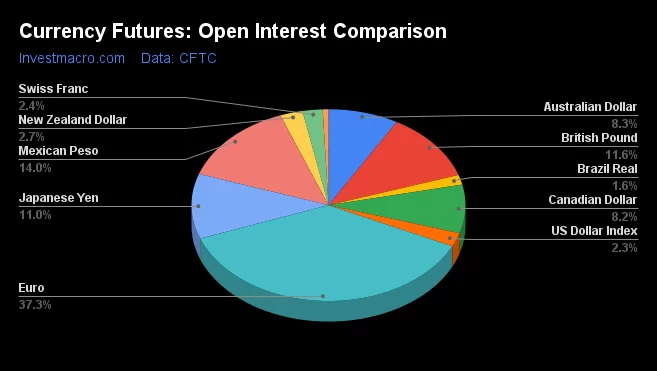
Here are the latest charts and statistics for the Commitment of Traders (COT) data published by the Commodities Futures Trading Commission (CFTC). The COT release was delayed due to a Federal Holiday last week.

The latest COT data is updated through Tuesday November 8th and shows a quick view of how large market participants (for-profit speculators and commercial traders) were positioned in the futures markets. All currency positions are in direct relation to the US dollar where, for example, a bet for the euro is a bet that the euro will rise versus the dollar while a bet against the euro will be a bet that the euro will decline versus the dollar.

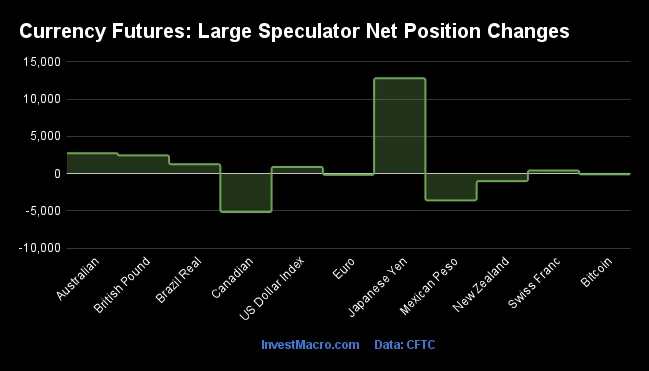
Weekly Speculator Changes led by Mexican peso & Pound Sterling

The COT currency market speculator bets were higher last week as seven out of the eleven currency markets we cover had higher positioning while the other four markets had lower speculator contracts.

Leading the gains for the currency markets was the Mexican peso (15,569 contracts) with the British pound sterling (5,101 contracts), the Australian dollar (3,849 contracts), the Japanese yen (2,362 contracts), the Euro (1,809 contracts), Bitcoin (470 contracts) and the US Dollar Index (405 contracts) also showing a positive week.

The currencies leading the declines in speculator bets last week were the Brazilian real (-24,656 contracts) with the New Zealand dollar (-2,520 contracts), the Swiss franc (-2,370 contracts) and the Canadian dollar (-815 contracts) also registering lower bets on the week.

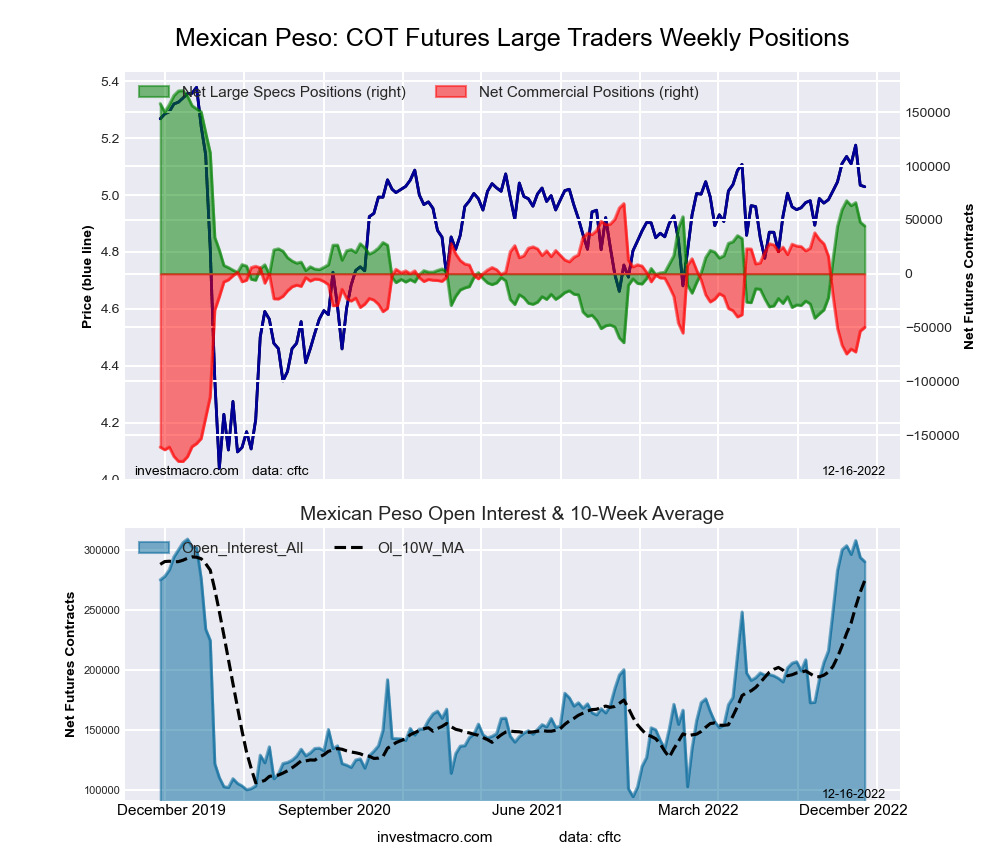
Highlighting the COT currencies data last week was the strong gains for the Mexican peso. The large speculators raised their bullish bets for the peso by over +15,000 contracts and for the sixth consecutive week last week. These gains add up to a total rise of +100,936 net contracts over the latest six-week period and brought the overall peso positioning all the way from -41,322 contracts on September 27th to a total of +59,614 contracts on November 8th. This latest speculator level (+59,614 contracts) is the highest speculator standing since March 10th of 2020, a span of 139-weeks.

The peso’s sentiment has been boosted by the Bank of Mexico’s consistent interest rate hiking campaign to tame inflation. The Bank raised the interest rate by 75 basis points last week to a new level of 10 percent. These higher rates have helped the peso rise this year versus the US dollar as most other major currencies have been on the defensive versus the USD. The peso has climbed by over 6 percent (vs USD) while the Euro, GBP, AUD, CAD, JPY and the NZD have all declined sharply against the American currency over the year.


Data Snapshot of Forex Market Traders | Columns Legend
Nov-08-2022OIOI-IndexSpec-NetSpec-IndexCom-NetCOM-IndexSmalls-NetSmalls-Index
USD Index56,3408130,19375-33,851223,65857
EUR667,90263107,59968-131,7633924,16418
GBP237,33460-39,7353556,25572-16,52026
JPY251,37881-75,2582388,98079-13,72226
CHF49,90741-17,1541328,27689-11,12220
CAD147,55529-18,4642017,9308453431
AUD162,52354-46,6834255,22360-8,54032
NZD45,80839-6,367568,79249-2,42524
MXN300,0209659,61453-66,356456,74272
RUB20,93047,54331-7,15069-39324
BRL28,046114,50155-7,773443,272100
Bitcoin14,439841877-449043123


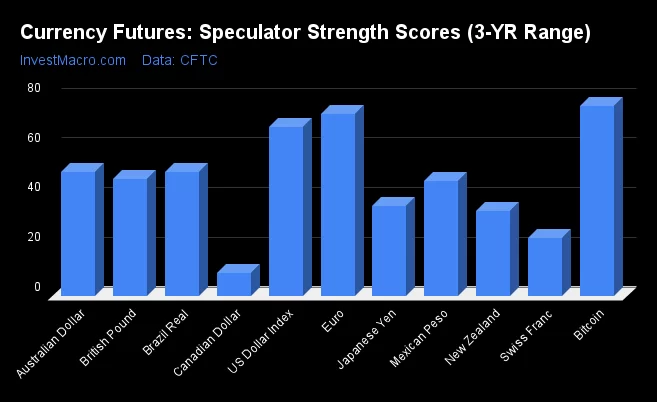
Strength Scores led by Bitcoin & US Dollar Index last week

Strength Scores (a normalized measure of Speculator positions over a 3-Year range, from 0 to 100 where above 80 is extreme bullish and below 20 is extreme bearish) showed that Bitcoin (77.3 percent) and the US Dollar Index (75.3 percent) led the currency markets last week. The EuroFX (68.0 percent), the New Zealand Dollar (55.6 percent) and the Brazilian Real (54.8 percent) came in as the next highest in the currency markets for strength scores.

On the downside, the Swiss Franc (13.0 percent) and the Canadian Dollar (19.8 percent) were the lowest strength levels and were both in bearish extreme positions below 20 percent.

Strength Statistics:
US Dollar Index (75.3 percent) vs US Dollar Index previous week (74.6 percent)
EuroFX (68.0 percent) vs EuroFX previous week (67.5 percent)
British Pound Sterling (34.9 percent) vs British Pound Sterling previous week (30.5 percent)
Japanese Yen (22.5 percent) vs Japanese Yen previous week (21.1 percent)
Swiss Franc (13.0 percent) vs Swiss Franc previous week (19.0 percent)
Canadian Dollar (19.8 percent) vs Canadian Dollar previous week (20.8 percent)
Australian Dollar (41.6 percent) vs Australian Dollar previous week (38.0 percent)
New Zealand Dollar (55.6 percent) vs New Zealand Dollar previous week (60.4 percent)
Mexican Peso (52.8 percent) vs Mexican Peso previous week (46.1 percent)
Brazilian Real (54.8 percent) vs Brazilian Real previous week (79.0 percent)
Bitcoin (77.3 percent) vs Bitcoin previous week (69.1 percent)

Mexican Peso topped the Strength Trends last week

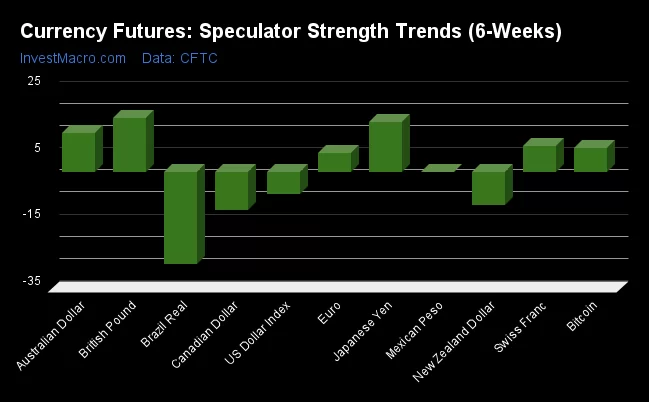
Strength Score Trends (or move index, calculates the 6-week changes in strength scores) showed that the Mexican Peso (43.0 percent) led the past six weeks trends for the currency markets. The EuroFX (22.7 percent), the New Zealand Dollar (9.6 percent) and the British Pound Sterling (5.7 percent) were the next top movers in the latest trends data.

The Swiss Franc (-29.0 percent) and the Brazilian Real (-28.8 percent) led the downside trend scores followed by Bitcoin (-17.5 percent) and the Australian Dollar (-11.2 percent).

Strength Trend Statistics:
US Dollar Index (-0.6 percent) vs US Dollar Index previous week (3.1 percent)
EuroFX (22.7 percent) vs EuroFX previous week (22.2 percent)
British Pound Sterling (5.7 percent) vs British Pound Sterling previous week (8.6 percent)
Japanese Yen (4.5 percent) vs Japanese Yen previous week (2.3 percent)
Swiss Franc (-29.0 percent) vs Swiss Franc previous week (-20.4 percent)
Canadian Dollar (-1.0 percent) vs Canadian Dollar previous week (-23.5 percent)
Australian Dollar (-11.2 percent) vs Australian Dollar previous week (-9.3 percent)
New Zealand Dollar (9.6 percent) vs New Zealand Dollar previous week (16.5 percent)
Mexican Peso (43.0 percent) vs Mexican Peso previous week (30.7 percent)
Brazilian Real (-28.8 percent) vs Brazilian Real previous week (-3.2 percent)
Bitcoin (-17.5 percent) vs Bitcoin previous week (-17.9 percent)


Individual COT Forex Markets:

US Dollar Index Futures:

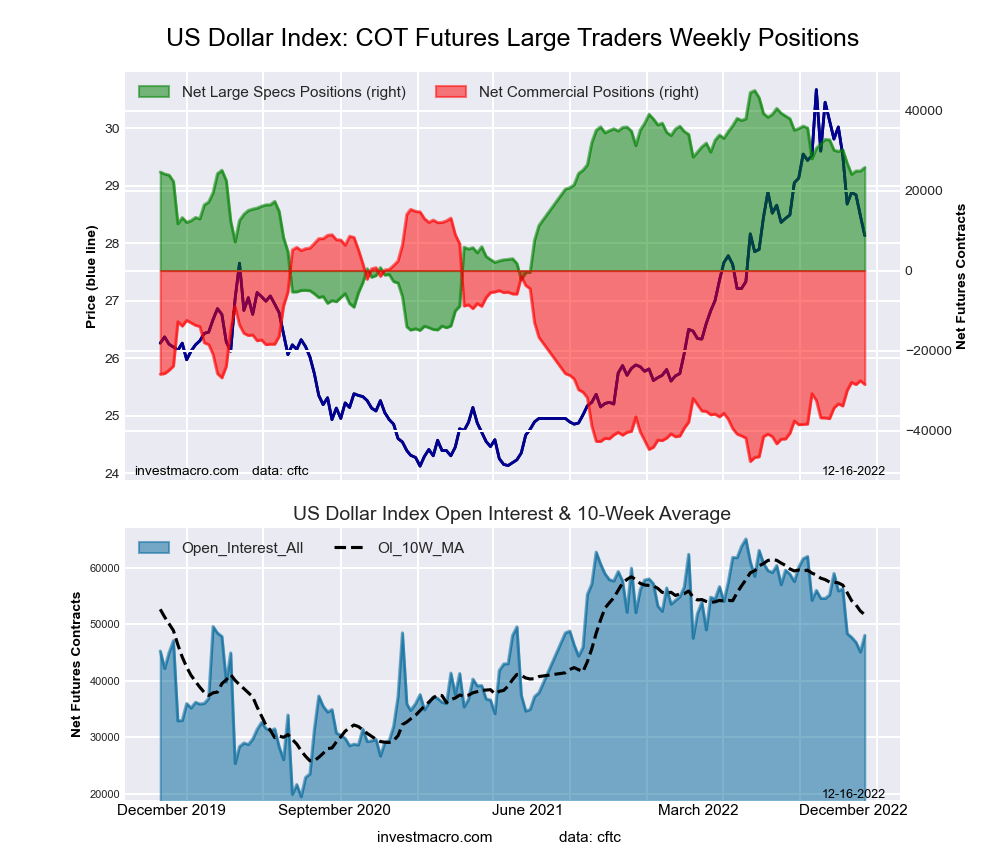
US Dollar Index Forex Futures COT ChartThe US Dollar Index large speculator standing this week reached a net position of 30,193 contracts in the data reported through Tuesday. This was a weekly advance of 405 contracts from the previous week which had a total of 29,788 net contracts.

This week’s current strength score (the trader positioning range over the past three years, measured from 0 to 100) shows the speculators are currently Bullish with a score of 75.3 percent. The commercials are Bearish with a score of 22.0 percent and the small traders (not shown in chart) are Bullish with a score of 56.5 percent.

US DOLLAR INDEX StatisticsSPECULATORSCOMMERCIALSSMALL TRADERS
– Percent of Open Interest Longs:76.19.711.2
– Percent of Open Interest Shorts:22.569.74.7
– Net Position:30,193-33,8513,658
– Gross Longs:42,8875,4426,327
– Gross Shorts:12,69439,2932,669
– Long to Short Ratio:3.4 to 10.1 to 12.4 to 1
NET POSITION TREND:
– Strength Index Score (3 Year Range Pct):75.322.056.5
– Strength Index Reading (3 Year Range):BullishBearishBullish
NET POSITION MOVEMENT INDEX:
– 6-Week Change in Strength Index:-0.6-2.219.0


Euro Currency Futures:

Euro Currency Futures COT ChartThe Euro Currency large speculator standing this week reached a net position of 107,599 contracts in the data reported through Tuesday. This was a weekly rise of 1,809 contracts from the previous week which had a total of 105,790 net contracts.

This week’s current strength score (the trader positioning range over the past three years, measured from 0 to 100) shows the speculators are currently Bullish with a score of 68.0 percent. The commercials are Bearish with a score of 38.6 percent and the small traders (not shown in chart) are Bearish-Extreme with a score of 17.5 percent.

EURO Currency StatisticsSPECULATORSCOMMERCIALSSMALL TRADERS
– Percent of Open Interest Longs:34.850.811.7
– Percent of Open Interest Shorts:18.770.58.1
– Net Position:107,599-131,76324,164
– Gross Longs:232,317339,21878,139
– Gross Shorts:124,718470,98153,975
– Long to Short Ratio:1.9 to 10.7 to 11.4 to 1
NET POSITION TREND:
– Strength Index Score (3 Year Range Pct):68.038.617.5
– Strength Index Reading (3 Year Range):BullishBearishBearish-Extreme
NET POSITION MOVEMENT INDEX:
– 6-Week Change in Strength Index:22.7-20.8-0.8


British Pound Sterling Futures:

British Pound Sterling Futures COT ChartThe British Pound Sterling large speculator standing this week reached a net position of -39,735 contracts in the data reported through Tuesday. This was a weekly lift of 5,101 contracts from the previous week which had a total of -44,836 net contracts.

This week’s current strength score (the trader positioning range over the past three years, measured from 0 to 100) shows the speculators are currently Bearish with a score of 34.9 percent. The commercials are Bullish with a score of 72.3 percent and the small traders (not shown in chart) are Bearish with a score of 25.6 percent.

BRITISH POUND StatisticsSPECULATORSCOMMERCIALSSMALL TRADERS
– Percent of Open Interest Longs:15.474.47.9
– Percent of Open Interest Shorts:32.250.714.8
– Net Position:-39,73556,255-16,520
– Gross Longs:36,630176,56018,714
– Gross Shorts:76,365120,30535,234
– Long to Short Ratio:0.5 to 11.5 to 10.5 to 1
NET POSITION TREND:
– Strength Index Score (3 Year Range Pct):34.972.325.6
– Strength Index Reading (3 Year Range):BearishBullishBearish
NET POSITION MOVEMENT INDEX:
– 6-Week Change in Strength Index:5.7-6.14.5


Japanese Yen Futures:

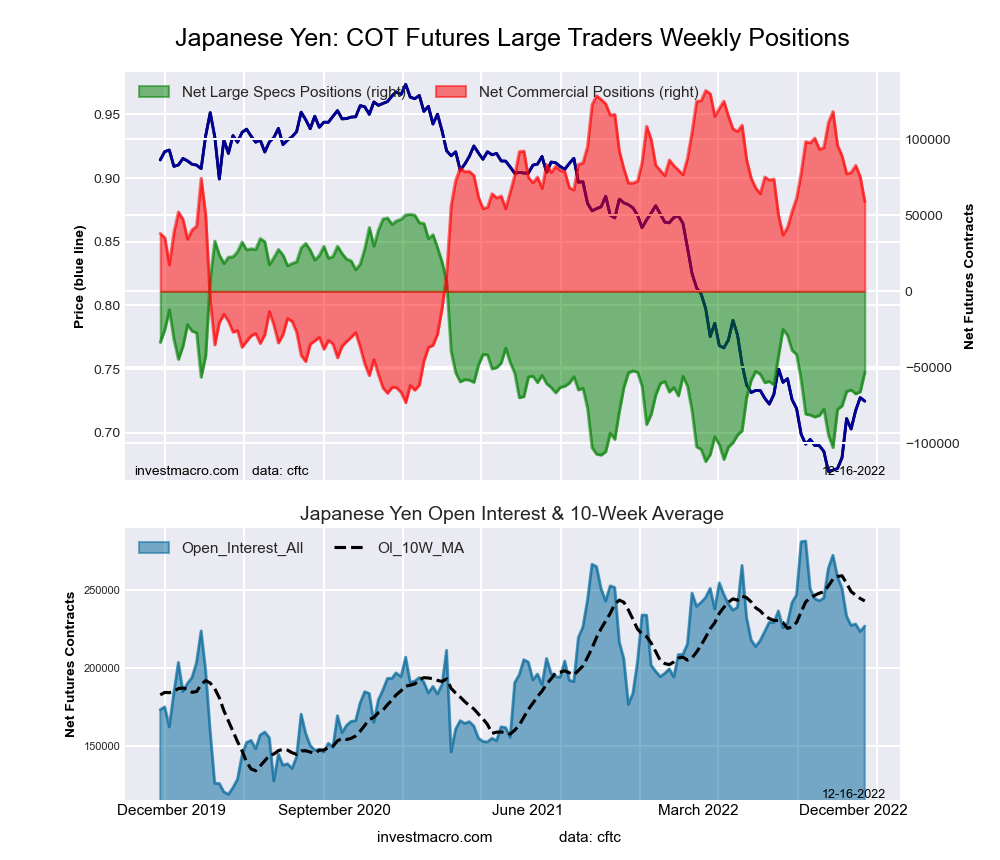
Japanese Yen Forex Futures COT ChartThe Japanese Yen large speculator standing this week reached a net position of -75,258 contracts in the data reported through Tuesday. This was a weekly boost of 2,362 contracts from the previous week which had a total of -77,620 net contracts.

This week’s current strength score (the trader positioning range over the past three years, measured from 0 to 100) shows the speculators are currently Bearish with a score of 22.5 percent. The commercials are Bullish with a score of 79.1 percent and the small traders (not shown in chart) are Bearish with a score of 25.6 percent.

JAPANESE YEN StatisticsSPECULATORSCOMMERCIALSSMALL TRADERS
– Percent of Open Interest Longs:14.873.010.5
– Percent of Open Interest Shorts:44.737.616.0
– Net Position:-75,25888,980-13,722
– Gross Longs:37,201183,53926,462
– Gross Shorts:112,45994,55940,184
– Long to Short Ratio:0.3 to 11.9 to 10.7 to 1
NET POSITION TREND:
– Strength Index Score (3 Year Range Pct):22.579.125.6
– Strength Index Reading (3 Year Range):BearishBullishBearish
NET POSITION MOVEMENT INDEX:
– 6-Week Change in Strength Index:4.5-5.78.8


Swiss Franc Futures:

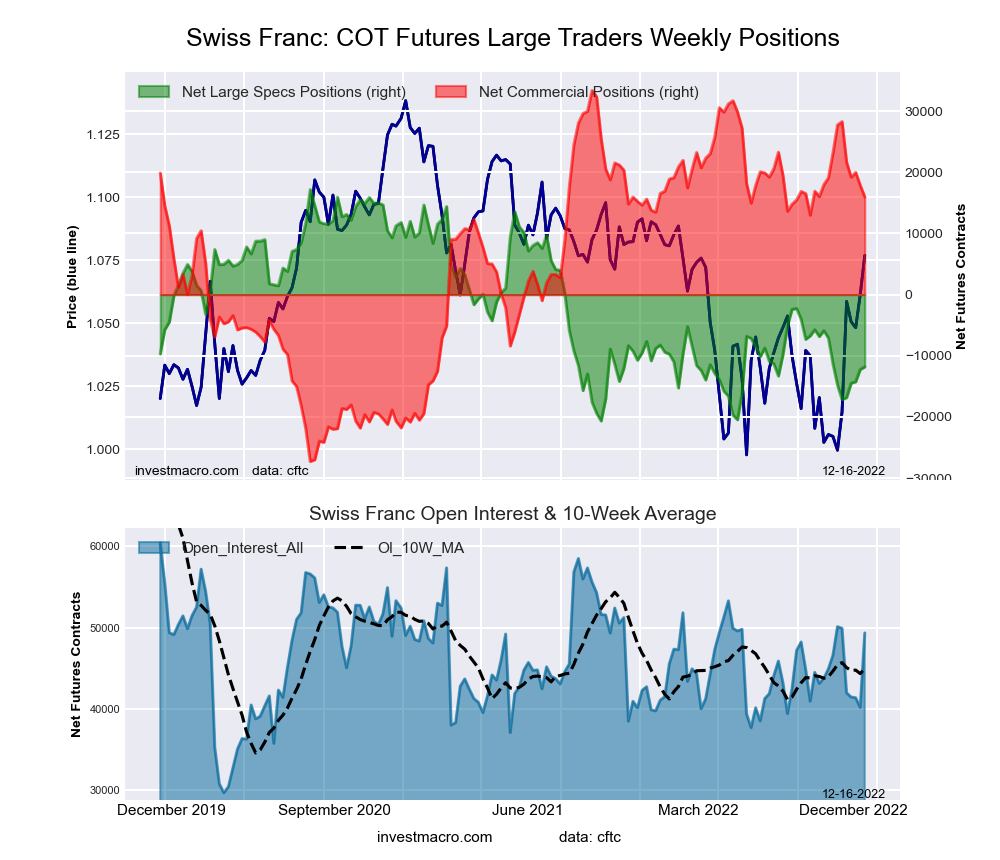
Swiss Franc Forex Futures COT ChartThe Swiss Franc large speculator standing this week reached a net position of -17,154 contracts in the data reported through Tuesday. This was a weekly fall of -2,370 contracts from the previous week which had a total of -14,784 net contracts.

This week’s current strength score (the trader positioning range over the past three years, measured from 0 to 100) shows the speculators are currently Bearish-Extreme with a score of 13.0 percent. The commercials are Bullish-Extreme with a score of 88.6 percent and the small traders (not shown in chart) are Bearish-Extreme with a score of 19.9 percent.

SWISS FRANC StatisticsSPECULATORSCOMMERCIALSSMALL TRADERS
– Percent of Open Interest Longs:9.771.318.3
– Percent of Open Interest Shorts:44.114.740.6
– Net Position:-17,15428,276-11,122
– Gross Longs:4,86535,6039,156
– Gross Shorts:22,0197,32720,278
– Long to Short Ratio:0.2 to 14.9 to 10.5 to 1
NET POSITION TREND:
– Strength Index Score (3 Year Range Pct):13.088.619.9
– Strength Index Reading (3 Year Range):Bearish-ExtremeBullish-ExtremeBearish-Extreme
NET POSITION MOVEMENT INDEX:
– 6-Week Change in Strength Index:-29.018.10.2


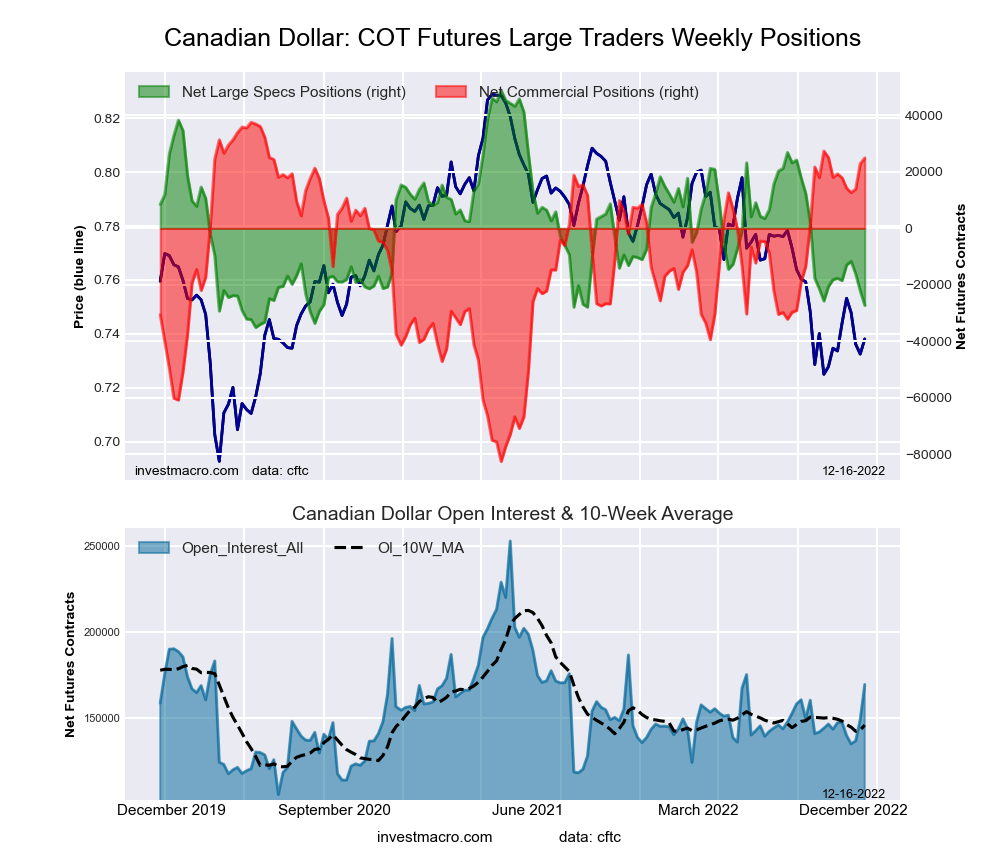
Canadian Dollar Futures:

Canadian Dollar Forex Futures COT ChartThe Canadian Dollar large speculator standing this week reached a net position of -18,464 contracts in the data reported through Tuesday. This was a weekly fall of -815 contracts from the previous week which had a total of -17,649 net contracts.

This week’s current strength score (the trader positioning range over the past three years, measured from 0 to 100) shows the speculators are currently Bearish-Extreme with a score of 19.8 percent. The commercials are Bullish-Extreme with a score of 83.7 percent and the small traders (not shown in chart) are Bearish with a score of 31.2 percent.

CANADIAN DOLLAR StatisticsSPECULATORSCOMMERCIALSSMALL TRADERS
– Percent of Open Interest Longs:26.851.320.6
– Percent of Open Interest Shorts:39.339.220.2
– Net Position:-18,46417,930534
– Gross Longs:39,58675,75030,370
– Gross Shorts:58,05057,82029,836
– Long to Short Ratio:0.7 to 11.3 to 11.0 to 1
NET POSITION TREND:
– Strength Index Score (3 Year Range Pct):19.883.731.2
– Strength Index Reading (3 Year Range):Bearish-ExtremeBullish-ExtremeBearish
NET POSITION MOVEMENT INDEX:
– 6-Week Change in Strength Index:-1.0-3.19.2


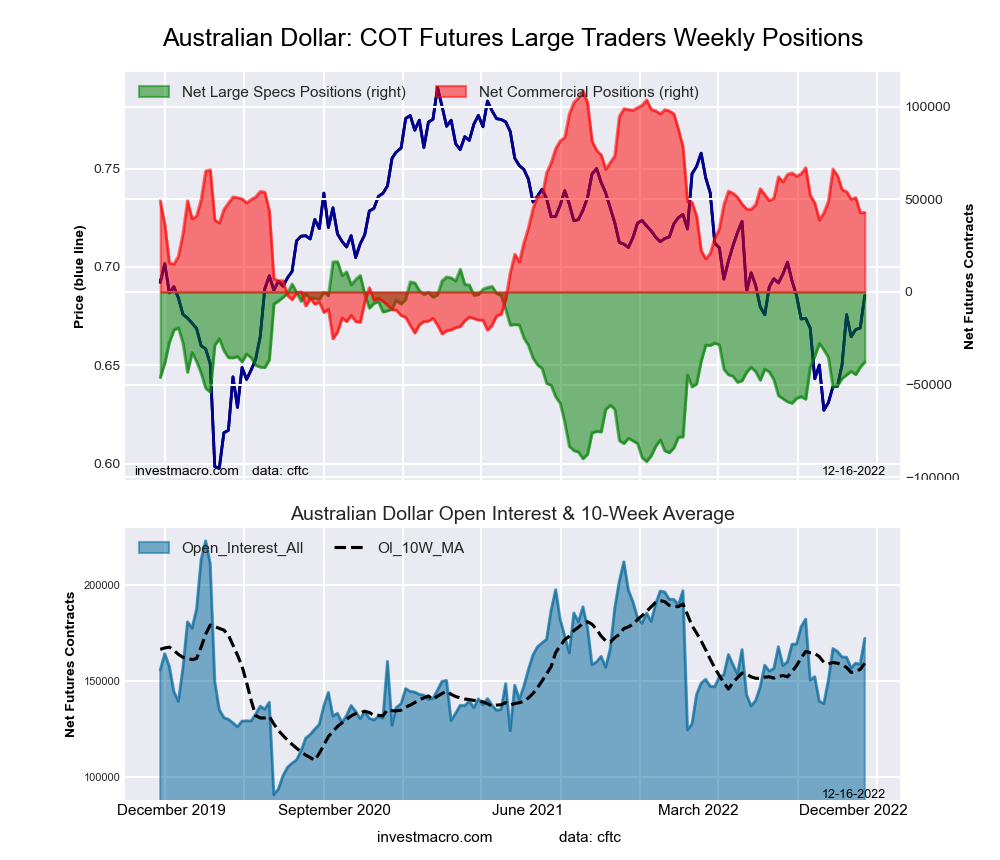
Australian Dollar Futures:

Australian Dollar Forex Futures COT ChartThe Australian Dollar large speculator standing this week reached a net position of -46,683 contracts in the data reported through Tuesday. This was a weekly boost of 3,849 contracts from the previous week which had a total of -50,532 net contracts.

This week’s current strength score (the trader positioning range over the past three years, measured from 0 to 100) shows the speculators are currently Bearish with a score of 41.6 percent. The commercials are Bullish with a score of 60.1 percent and the small traders (not shown in chart) are Bearish with a score of 31.6 percent.

AUSTRALIAN DOLLAR StatisticsSPECULATORSCOMMERCIALSSMALL TRADERS
– Percent of Open Interest Longs:20.566.810.2
– Percent of Open Interest Shorts:49.232.815.5
– Net Position:-46,68355,223-8,540
– Gross Longs:33,288108,58416,602
– Gross Shorts:79,97153,36125,142
– Long to Short Ratio:0.4 to 12.0 to 10.7 to 1
NET POSITION TREND:
– Strength Index Score (3 Year Range Pct):41.660.131.6
– Strength Index Reading (3 Year Range):BearishBullishBearish
NET POSITION MOVEMENT INDEX:
– 6-Week Change in Strength Index:-11.25.411.7


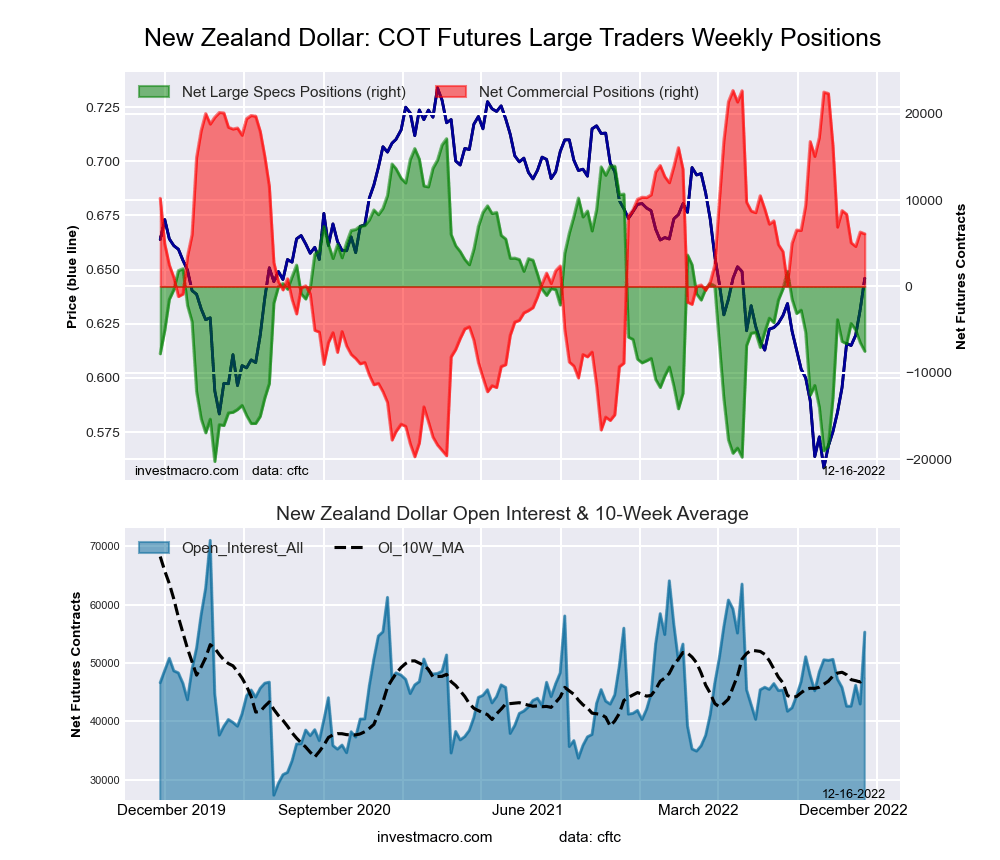
New Zealand Dollar Futures:

New Zealand Dollar Forex Futures COT ChartThe New Zealand Dollar large speculator standing this week reached a net position of -6,367 contracts in the data reported through Tuesday. This was a weekly reduction of -2,520 contracts from the previous week which had a total of -3,847 net contracts.

This week’s current strength score (the trader positioning range over the past three years, measured from 0 to 100) shows the speculators are currently Bullish with a score of 55.6 percent. The commercials are Bearish with a score of 49.0 percent and the small traders (not shown in chart) are Bearish with a score of 23.8 percent.

NEW ZEALAND DOLLAR StatisticsSPECULATORSCOMMERCIALSSMALL TRADERS
– Percent of Open Interest Longs:39.554.45.5
– Percent of Open Interest Shorts:53.435.210.8
– Net Position:-6,3678,792-2,425
– Gross Longs:18,08524,9232,532
– Gross Shorts:24,45216,1314,957
– Long to Short Ratio:0.7 to 11.5 to 10.5 to 1
NET POSITION TREND:
– Strength Index Score (3 Year Range Pct):55.649.023.8
– Strength Index Reading (3 Year Range):BullishBearishBearish
NET POSITION MOVEMENT INDEX:
– 6-Week Change in Strength Index:9.6-10.813.5


Mexican Peso Futures:

Mexican Peso Futures COT ChartThe Mexican Peso large speculator standing this week reached a net position of 59,614 contracts in the data reported through Tuesday. This was a weekly advance of 15,569 contracts from the previous week which had a total of 44,045 net contracts.

This week’s current strength score (the trader positioning range over the past three years, measured from 0 to 100) shows the speculators are currently Bullish with a score of 52.8 percent. The commercials are Bearish with a score of 45.1 percent and the small traders (not shown in chart) are Bullish with a score of 71.6 percent.

MEXICAN PESO StatisticsSPECULATORSCOMMERCIALSSMALL TRADERS
– Percent of Open Interest Longs:64.032.43.0
– Percent of Open Interest Shorts:44.154.50.8
– Net Position:59,614-66,3566,742
– Gross Longs:192,02497,2559,069
– Gross Shorts:132,410163,6112,327
– Long to Short Ratio:1.5 to 10.6 to 13.9 to 1
NET POSITION TREND:
– Strength Index Score (3 Year Range Pct):52.845.171.6
– Strength Index Reading (3 Year Range):BullishBearishBullish
NET POSITION MOVEMENT INDEX:
– 6-Week Change in Strength Index:43.0-43.514.5


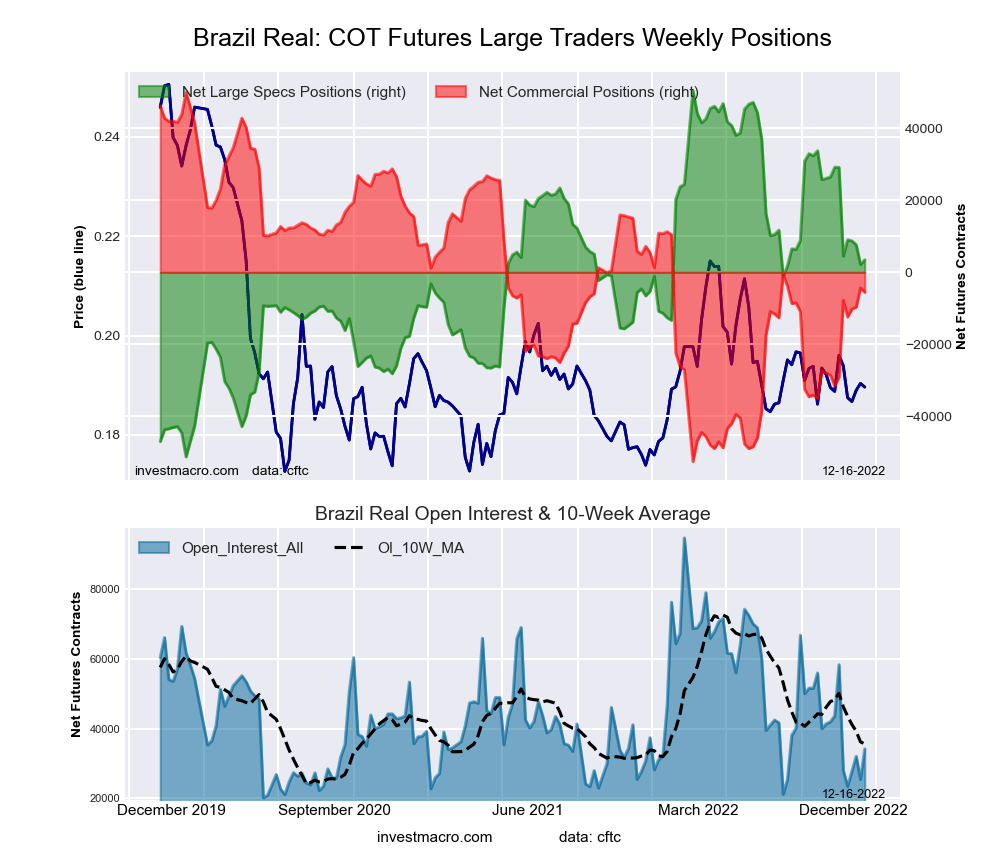
Brazilian Real Futures:

Brazil Real Futures COT ChartThe Brazilian Real large speculator standing this week reached a net position of 4,501 contracts in the data reported through Tuesday. This was a weekly decline of -24,656 contracts from the previous week which had a total of 29,157 net contracts.

This week’s current strength score (the trader positioning range over the past three years, measured from 0 to 100) shows the speculators are currently Bullish with a score of 54.8 percent. The commercials are Bearish with a score of 43.7 percent and the small traders (not shown in chart) are Bullish-Extreme with a score of 100.0 percent.

BRAZIL REAL StatisticsSPECULATORSCOMMERCIALSSMALL TRADERS
– Percent of Open Interest Longs:65.318.616.1
– Percent of Open Interest Shorts:49.246.34.4
– Net Position:4,501-7,7733,272
– Gross Longs:18,3065,2194,502
– Gross Shorts:13,80512,9921,230
– Long to Short Ratio:1.3 to 10.4 to 13.7 to 1
NET POSITION TREND:
– Strength Index Score (3 Year Range Pct):54.843.7100.0
– Strength Index Reading (3 Year Range):BullishBearishBullish-Extreme
NET POSITION MOVEMENT INDEX:
– 6-Week Change in Strength Index:-28.826.622.8


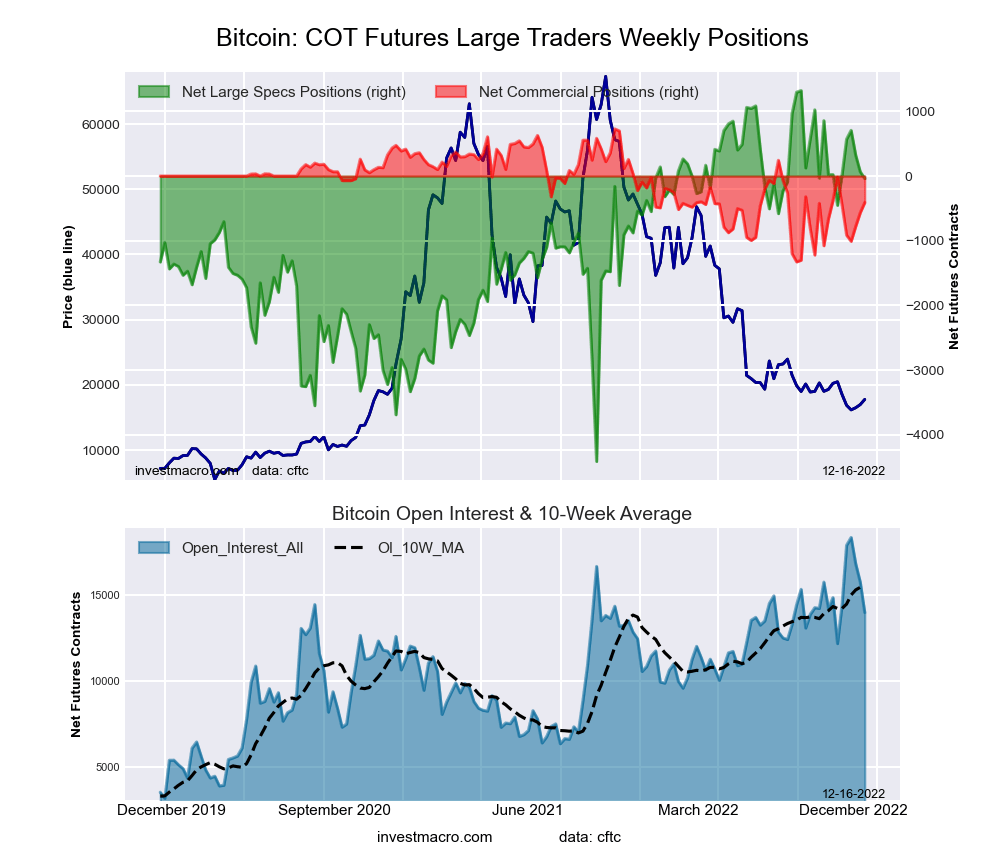
Bitcoin Futures:

Bitcoin Crypto Futures COT ChartThe Bitcoin large speculator standing this week reached a net position of 18 contracts in the data reported through Tuesday. This was a weekly rise of 470 contracts from the previous week which had a total of -452 net contracts.

This week’s current strength score (the trader positioning range over the past three years, measured from 0 to 100) shows the speculators are currently Bullish with a score of 77.3 percent. The commercials are Bearish with a score of 42.7 percent and the small traders (not shown in chart) are Bearish with a score of 22.7 percent.

BITCOIN StatisticsSPECULATORSCOMMERCIALSSMALL TRADERS
– Percent of Open Interest Longs:78.31.48.8
– Percent of Open Interest Shorts:78.24.55.8
– Net Position:18-449431
– Gross Longs:11,3032001,269
– Gross Shorts:11,285649838
– Long to Short Ratio:1.0 to 10.3 to 11.5 to 1
NET POSITION TREND:
– Strength Index Score (3 Year Range Pct):77.342.722.7
– Strength Index Reading (3 Year Range):BullishBearishBearish
NET POSITION MOVEMENT INDEX:
– 6-Week Change in Strength Index:-17.537.55.3


Article By InvestMacroReceive our weekly COT Newsletter

*COT Report: The COT data, released weekly to the public each Friday, is updated through the most recent Tuesday (data is 3 days old) and shows a quick view of how large speculators or non-commercials (for-profit traders) were positioned in the futures markets.

The CFTC categorizes trader positions according to commercial hedgers (traders who use futures contracts for hedging as part of the business), non-commercials (large traders who speculate to realize trading profits) and nonreportable traders (usually small traders/speculators) as well as their open interest (contracts open in the market at time of reporting). See CFTC criteria here.

Trade Of The Week: USD Bears Mark Their Territory

By ForexTime 

– Last week we questioned whether the mighty dollar would continue dominating the FX space after its shaky performance since the start of Q4.

Our question was partially answered last Thursday after official reports showed annual inflation in the United States slowed to 7.7% in October. Not only was this the lowest level seen since January 2022 but well below the 8.2% figure seen in September. Given how this development significantly reduced the pressure on the Fed to keep raising interest rates aggressively, the dollar collapsed like a house of cards.

With the dollar falling for a fourth straight week in its worst performance since 2020, it is safe to say that bears are in the building and ready to rumble.

Even the equally-weighted USD index collapsed, dipping below the 1.2000 support level for the first time since mid-September.

Given how the fundamentals are swinging in favour of USD bears and the technicals are singing a similar note, dollar weakness could become a key theme for the rest of 2022. Such a development may even set the stage for renewed USD weakness in 2023 as easing inflationary pressures bring Fed doves back into the scene.

This could be another big week for the greenback thanks to numerous speeches from Fed officials, key US economic data, and a big announcement from Former US President Donald Trump on Tuesday. In the meantime, the trend remains a trader’s friend with the path of least resistance on the USD pointing south.

The low down…

One only needs to look at the DXY daily chart to see that bears are back in town.

The dollar’s extreme reaction to last Thursday’s inflation data confirms how sensitive the currency remains to anything concerning inflation and rate hike expectations. Over the past few months, the fundamental forces supporting the almighty dollar have been diminishing slowly. Initially, the greenback drew ample strength from the risk-off mood, confidence in the US economy, and bets for aggressive interest rate hikes by the Fed. Over time, these themes have changed – slowly stripping the dollar of its regal strength and dominance in the FX space.

With roughly six weeks until the New Year, the dollar’s fortunes seem to be changing rapidly as bears enter the scene. If US economic data and Fed officials fuel speculation around slower rate hikes, the dollar could find itself on a slippery decline over the next few weeks.

The week ahead…

Price action could be the primary force influencing the dollar as investors closely scrutinize speeches from Fed officials and US economic data.

There could be a burst of dollar volatility on Tuesday thanks to Donald Trump’s big announcement, where he is expected to announce a second bid for re-election. Mid-week, Fed’s John Williams, and Lael Brainard will be under the spotlight. On Thursday, Fed’s Neel Kashkari and Loretta Mester speak with the US Conference Board leading index and existing home sales published on Friday. It will be interesting to see whether the pending economic reports and Fed speeches fuel or limit the dollar’s downside momentum.

Dollar bears march into the scene

The equally weighted dollar index remains under intense pressure on the daily charts. After cutting through the 1.2400 level like a hot knife through butter, prices dipped below 1.2000 for the first time since September. Bears are clearly in a position of power and may drag the index lower over the next few days to weeks. The current downside momentum may drag prices toward the 1.2900 support level. Below this point prices could test 1.2800 and 1.2700, respectively.  If prices can break above 1.2184, a rebound back towards 1.2400 could be on the cards.


Forex-Time-LogoArticle by ForexTime

ForexTime Ltd (FXTM) is an award winning international online forex broker regulated by CySEC 185/12 www.forextime.com

Expert Says, ‘Oil Prices Looking Set To Follow Stocks Higher’

Source: Clive Maund  (11/10/22)

As the prices of oil stocks are running ahead of oil prices, expert Clive Maund reviews the 7-month, 3-year, and 20-year charts of the oil index to tell you where he believes the commodity is headed. 

A key point to bear in mind with respect to the outlook for oil prices going forward is that the powers that be intend to bankrupt the population at large and reduce them to a state of dependency in order to force them into the Universal Basic Income (UBI) and have already said so (“You will own nothing and be happy”) and a key plank to achieving this will be making the prices of the basics of life exorbitantly expensive.

A high oil price makes everything more expensive since oil is generally used to create and distribute food and products. Even if demand collapses, it will be possible to maintain high oil prices by engineering supply chain problems that may include sabotage and the effects of war.

The entire commodity sector looks set to rally, not least oil, in which case, emboldened by having just made new highs, it may simply continue to advance and may even accelerate. Its moving averages are in strongly bullish alignment, which helps.

Anticipation of higher oil prices may explain why the prices of oil stocks are running ahead of oil prices as we will now proceed to see as we review the charts.

In the last Oil Market update posted toward the end of August, we were prematurely bullish on oil, as it went on to drop further to hit bottom a month later towards the end of September, the decline being largely due to the strong dollar as was the case with many other commodities.

What was taken to be a breakout from a downtrend turned out to be the right side of the Left Shoulder of the now completed Head-and-Shoulders bottom that is shown on the latest 7-month chart for Light Crude below.

At the time, I was fooled by the strong Accumulation line, but as it turns out, it was just starting the basing process. In any event, oil’s chart now looks most promising, especially as other commodities such as copper, palladium, and Precious Metals appear to be breaking out at this time as the dollar looks increasingly vulnerable to a severe decline.

On the 3-year chart for Light Crude, it is immediately clear why the oil price corrected through the Summer – it had gotten ahead of itself with a dramatic spike to become extremely overbought early in the year.

Whilst the pattern that formed from March through June could mark a final high, a Double Top, that is not thought likely because of the way most commodities appear to be setting up for a major rally in the facing of rapidly mounting inflation, and also, as mentioned at the outset, because the powers that be want a high price to further their nefarious purposes, which they also happen to benefit from as they are the major stakeholders in the oil sector.

Overall this chart still looks positive, with oil having reacted back to a key support level where it appears to be turning up with momentum (MACD) swinging positive, suggesting renewed advance, and the oil stocks index, shown at the top of this chart, already starting to make new highs which is a sign that they are expecting higher oil prices. If we do see renewed advance soon, the moving averages will quickly swing back into strongly bullish alignment.

The moves shown on the long-term 20-year chart for Light Crude, at first sight, look random and chaotic, and they can only be understood in the context of the fundamental situations that generated them.

Commodities are looking set to take off higher as the dollar drops.

Thus, the plunge in 2008 – 2009 was directly attributable to the general market crash at that time, while the absurd lows of Spring 2020 were the result of Covid, and oil spiked early this year around the time of the Russian invasion of Ukraine.

The recent reaction has brought it back to the zone of significant support shown above the 2019 highs, which is turning it higher again.

As mentioned above, the positive divergence of oil stocks, whose index is shown at the top of this chart, strongly suggests a rising oil price going forward as oil stocks tend to lead oil itself and the position of the MACD indicator, which is closet to neutrality, shows that there is plenty of scope for a rally.

Turning now to the oil stocks, we see on the 7-month chart for the XOI oil index that it has been gyrating around rather wildly this year and has advanced strongly over the past six weeks or so, way outperforming oil itself, so that it is now overbought on its MACD indicator.

However, this may not stop it because the entire commodity sector looks set to rally, not least oil, in which case, emboldened by having just made new highs, it may simply continue to advance and may even accelerate. Its moving averages are in strongly bullish alignment, which helps.

On the 3-year chart for the XOI index, we can see that the oil sector has way outperformed the broad stock market this year — the S&P500 index is shown at the top of this chart — with the broad market putting in a dismal performance while oil stocks are now nudging new highs.

Whilst the oil index is now overbought, and thus in some danger of forming a Double Top with its June highs, this is not considered likely to the reasons already given, namely that commodities are looking set to take off higher as the dollar drops.

Instead, it looks set to advance to clear new highs and then continue to ascend for a while before a correction perhaps sets in.

The long-term 20-year chart for the XOI oil index is interesting as it shows that it has this year broken above a line of tops extending back to 2008.

Whilst the break to new highs is still not yet by a convincing margin, which means that it could slump back into the larger pattern, the outlook for the commodities sector here and the associated outlook for the dollar and for inflation implies that the sector could soon break higher and advance away from all those previous tops, which is not so surprising when you take into account that if you factor in inflation even if only up to now, it would have to rise quite a long way above its 2008 highs to attain the same inflation-adjusted value.


CliveMaund.com Disclosures

The above represents the opinion and analysis of Mr. Maund, based on data available to him, at the time of writing. Mr. Maund’s opinions are his own, and are not a recommendation or an offer to buy or sell securities. Mr. Maund is an independent analyst who receives no compensation of any kind from any groups, individuals or corporations mentioned in his reports. As trading and investing in any financial markets may involve serious risk of loss, Mr. Maund recommends that you consult with a qualified investment advisor, one licensed by appropriate regulatory agencies in your legal jurisdiction and do your own due diligence and research when making any kind of a transaction with financial ramifications. Although a qualified and experienced stock market analyst, Clive Maund is not a Registered Securities Advisor. Therefore Mr. Maund’s opinions on the market and stocks can only be construed as a solicitation to buy and sell securities when they are subject to the prior approval and endorsement of a Registered Securities Advisor operating in accordance with the appropriate regulations in your area of jurisdiction.

Disclosures:
1) Statements and opinions expressed are the opinions of Clive Maund and not of Streetwise Reports or its officers. The author is wholly responsible for the validity of the statements. Streetwise Reports was not involved in any aspect of the article preparation. The author was not paid by Streetwise Reports LLC for this article. Streetwise Reports was not paid by the author to publish or syndicate this article.

2) This article does not constitute investment advice. Each reader is encouraged to consult with his or her individual financial professional and any action a reader takes as a result of information presented here is his or her own responsibility. By opening this page, each reader accepts and agrees to Streetwise Reports’ terms of use and full legal disclaimer. This article is not a solicitation for investment. Streetwise Reports does not render general or specific investment advice and the information on Streetwise Reports should not be considered a recommendation to buy or sell any security. Streetwise Reports does not endorse or recommend the business, products, services or securities of any company mentioned on Streetwise Reports.

3) From time to time, Streetwise Reports LLC and its directors, officers, employees or members of their families, as well as persons interviewed for articles and interviews on the site, may have a long or short position in securities mentioned. Directors, officers, employees or members of their immediate families are prohibited from making purchases and/or sales of those securities in the open market or otherwise from the time of the decision to publish an article until three business days after the publication of the article. The foregoing prohibition does not apply to articles that in substance only restate previously published company releases.

Eight Resource Companies You Need To Pay Attention to

Source: Adrian Day  (11/8/22) 

Several companies on expert Adrian Day’s list have either reported quarterly earnings or had other news. In the case of the larger companies, most have already pre-announced production or sales.

Barrick Gold Corp. (ABX:TSX; GOLD:NYSE) reported results in line with expectations, though free cash flows were weak. The company had pre-announced production, as well as overall costs.

The weaker-than-expected free cash flows reduced the net cash balance and, therefore, the dividend, part of which is based on the company’s excess cash balance, to US$0.15 rather than last quarter’s US$0.20.

Nonetheless, the stock price decline — it fell over US$2 from Wednesday to Thursday, to as low as US$13, before a partial recovery Friday as gold jumped — appears grossly overdone and is as much a reflection of investor concern about the gold market, and general concerns about the increase in costs at large miners, than about Barrick in particular.

Organic Growth Beats M&A

CEO Mark Bristow said the company was on track to meet annual guidance at the low end of the range for gold and mid-range for copper.

He emphasized that the company was pursuing organic growth, even though it continues to look at M&A opportunities, adding that those that meet the company’s investment criteria remain “few and far between.”

Barrick has several large-scale organic opportunities, including the Pueblo Viejo expansion, the restart of Porgera, and the new Reko Diq copper project in Pakistan. The company expects to increase reserves, net of depletion, at year-end.

So far this year, it has bought back 1% of its outstanding shares and, together with dividends, has returned over US$1.2 billion to shareholders.

Bristow said the company would buy its own shares when they were materially below intrinsic value, and in comments, he was almost chomping at the bit to start buying shares again, “more, significantly more.”

We should join him; buy.

Another Solid Quarter for Wheaton

Wheaton Precious Metals Corp. (WPM:TSX; WPM:NYSE) saw sales somewhat down, partly a reflection of two modest streams terminated during the quarter and partly a matter of the timing of sales. Ongoing bottlenecks affected sales, though these are being cleared up.

One major positive was the report that Phase 3 at Vale’s Salobo is now 98% complete. Other development projects appear on the track, while a handful of new mines are scheduled to begin construction in 2023.

Given that the last two quarters saw weak results at Salobo, which is Wheaton’s largest single asset, there had been concern that the expansion was being delayed. The company has nearly half a billion in cash, no debt, and US$2 billion on an unused line of credit.

A strong multi-year growth profile, rock-solid balance sheet, and conservative management make Wheaton a top pick. Given the jump in the stock price on Friday, we would hold off adding to positions, though you can take new positions here.

Royal Is on Track for a Strong End of Year

Royal Gold Inc. (RGLD:NASDAQ; RGL:TSX) had pre-released sales, which showed a minor miss of estimates largely due to a weak quarter at Cortez. Access to high-grade ore at that mine is now expected this quarter and will help Royal with a strong end of the year.

The company is maintaining its full-year guidance. This quarter is also expected to include the first royalties from its new Cortez royalty, which were not factored into the company’s full-year estimates. Note that Royal has two royalties on Cortez.

In addition, the Khoemacau copper mine in Botswana, on which royal has a silver stream, expects to have completed its ramp-up by the end of this year or early next. Most importantly, the mine life of oft-troubled Mount Milligan, Royal’s largest asset, has been extended another four years to 2033.

Average annual production is projected at 175,000 oz of gold and 68 million lbs of copper. Royal has streams on both metals.

This had been announced by operator Centerra last month. Royal has US$122 million cash and about $550 million available on its credit facility after paying down another US$50 million during the quarter. It intends to pay down debt further from ongoing cash flow. Royal has some quality assets and near-term growth. It is a buy at this price.

Lara Is a Must Own as the End Game Approaches

Lara Exploration Ltd. (LRA:TSX.V) announced that partner Capstone Copper had earned 49% in the Planalto Copper Project in Brazil after investing more than US$5 million in exploration expenditures. Capstone can move to 51% and become the operator by a US$400,000 payment to Lara, and then move to 61% by delivering a feasibility study.

This news follows the commencement of a new drilling campaign (see Bulletin 838); there is every indication that Capstone intends to continue in the joint venture and potentially look to buy the entire project.

As discussed previously, Planalto is not the only “company maker” that Lara holds. It also controls the Liberdade copper project, also in Brazil, on which it recently won a favorable court ruling in a dispute with Vale; and it owns 70% of the Mantaro phosphate project in Peru, each of which is arguably worth the company’s entire market cap., and potentially far more.

With solid management running a lean operation, Lara is one of my all-time very favorite junior companies. (You can assume that clients of my money management hold all the stocks which I discuss favorably in this unaffiliated newsletter. I should disclose, however, that clients own over 16% of Lara.)

This will be a big winner, but in exploration, things take time. Just as I did with Virginia Gold and then with Reservoir Minerals, I have been thumping the table on Lara repeatedly for a while now. This is one you need to own, and I strongly suspect that the outcome will be just as pleasurable as the outcome was for those other two.

The stock is thinly traded, and you don’t want to drive it up with your own buying. But a year from now, I suspect, it won’t really matter whether you paid US$0.65 or US$0.75, or even more; the important thing is that you own it.

Orogen Implements Strategy While Revenue Increases

Orogen Royalties Inc. (OGN:TSX.V) has optioned the Pearl String gold project in Nevada’s Walker Lane Trend to Barrick, giving it the right to earn 100% of the project in return for a US$1.5 million payment and US$4 million in exploration expenditures.

Orogen will retain a 2% royalty. The often neglected Walker Lane trend in southwestern Nevada hosts Anglo’s Silicon deposit on which Orogen (and Altius) hold royalties.

Separately, Orogen and Altius have signed a generative exploration alliance, looking for new targets geologically similar to Silicon. Altius will make the initial funding, while Orogen will make available its database and exploration team. Altius holds over 16% of Orogen as well as some warrants.

In Mexico, First Majestic announced a production record at its Santa Elena mine, with “strong production” from the Ermitaño deposit on which Orogen holds a royalty. First Majestic, noting that Ermitaño has higher grades than the Santa Elena mine, said it was processing a higher percentage of ore from Ermitaño.

As with Lara, Orogen is a junior you need to own. Closing Friday at 0.40 x 0.42, it is just above its 6-month average price, where it remains a solid buy.

Midland Continues Exploration Success

Midland Exploration Inc. (MD:TSX.V) reported encouraging success from its recent exploration program in the Labrador Trough, part of a strategic alliance with SOQUEM. Several new mineralized horizons were discovered at surface, with very attractive grab samples. The companies will continue their work over the winter, seeking to understand the geologic setting. We would expect the team to be back in the field next summer.

With strong management, a solid balance sheet, and the activity of multiple projects, many with first-class partners, Midland remains a buy.

Vista Cuts Costs as Deal Process Takes Time

Vista Gold Corp. (VGZ:NYSE.MKT; VGZ:TSX), in its third-quarter report, noted that it was advancing work to maximize value on its Mt Todd project, focusing on controlling costs while the process was ongoing. Fixed-cost spending is running 15% under the US$7 million budgeted for the full year; most of those reductions have been in personnel costs.

And the company also expects a reduction in discretionary spending now the feasibility study and drilling programs are complete; it spent just under US$1 million at Mt Todd in the quarter.

However, even at the reduced rate, its US$9.6 million cash as of the end of the quarter, healthy though that is, represents little more than one year’s worth of expenses. Hold.

Gladstone Performs Well in Difficult Environment

Gladstone Investment Corp. (GAIN: NASDAQ) reported a strong quarter with adjusted Net Investment Income, a key metric for Business Development Companies, of US$0.29, up from US$0.25, and total investments valued at US$738 million, up from US$690 million at the end of June.

The company made one new investment of US$39 million, and it recapitalized an existing investment adding another net of US$20 million. The portfolio suffered a small decline in valuations, largely the result of lower multiples being assigned.

Gladstone reported that its portfolio companies were meeting the challenges of the economic environment and higher interest rates, and in fact one company came off non-accrual status, leaving just two companies on non-accrual.

New Dividend Equals Over 10% Yield

As a result of the strong performance, the company increased its monthly dividend by almost 7%, and it announced another supplement distribution of US$0.12. If the company can make similar extra distributions in the coming 12 months, the forward yield would be over 10%. It yields a healthy 6.9% just on the monthly dividends.

With a high yield, a strong balance sheet and low leverage, and growth opportunities, Gladstone remains a long-term holding. However, with the stock price up sharply after its results — and it is up from under US$12 a share three weeks ago — we are holding.

BEST BUYS this week are few; given that the markets have rallied recently, and the gold and resource stocks in particularly jumped sharply on Friday, we are not chasing, even though many of the prices remain attractive on a longer-term basis. In addition to those above, buys this week include Agnico Eagle Mines Ltd. (AEM:TSX; AEM:NYSE) and Nestle SA (NESN:VX; NSRGY:OTC).

Adrian Day Disclosures:

Adrian Day’s Global Analyst is distributed for $990 per year by Investment Consultants International, Ltd., P.O. Box 6644, Annapolis, MD 21401. (410) 224-8885. www.AdrianDayGlobalAnalyst.com. Publisher: Adrian Day. Owner: Investment Consultants International, Ltd. Staff may have positions in securities discussed herein. Adrian Day is also President of Global Strategic Management (GSM), a registered investment advisor, and a separate company from this service. In his capacity as GSM president, Adrian Day may be buying or selling for clients securities recommended herein concurrently, before or after recommendations herein, and may be acting for clients in a manner contrary to recommendations herein. This is not a solicitation for GSM. Views herein are the editor’s opinion and not fact. All information is believed to be correct, but its accuracy cannot be guaranteed. The owner and editor are not responsible for errors and omissions. © 2022. Adrian Day’s Global Analyst. Information and advice herein are intended purely for the subscriber’s own account. Under no circumstances may any part of a Global Analyst e-mail be copied or distributed without prior written permission of the editor. Given the nature of this service, we will pursue any violations aggressively.

Disclosures:

1) Adrian Day: I, or members of my immediate household or family, own securities of the following companies mentioned in this article: All. I personally am, or members of my immediate household or family are, paid by the following companies mentioned in this article: None. My company has a financial relationship with the following companies mentioned in this article: None. Funds controlled by Adrian Day Asset Management, which is unaffiliated with Adrian Day’s newsletter, hold shares of the following companies mentioned in this article: All. I determined which companies would be included in this article based on my research and understanding of the sector.

2) The following companies mentioned in this article are billboard sponsors of Streetwise Reports: None. Click here for important disclosures about sponsor fees. The information provided above is for informational purposes only and is not a recommendation to buy or sell any security.

3) Statements and opinions expressed are the opinions of the author and not of Streetwise Reports or its officers. The author is wholly responsible for the validity of the statements. The author was not paid by Streetwise Reports for this article. Streetwise Reports was not paid by the author to publish or syndicate this article. Streetwise Reports requires contributing authors to disclose any shareholdings in, or economic relationships with, companies that they write about. Streetwise Reports relies upon the authors to accurately provide this information and Streetwise Reports has no means of verifying its accuracy.

4) This article does not constitute investment advice. Each reader is encouraged to consult with his or her individual financial professional and any action a reader takes as a result of information presented here is his or her own responsibility. By opening this page, each reader accepts and agrees to Streetwise Reports’ terms of use and full legal disclaimer. This article is not a solicitation for investment. Streetwise Reports does not render general or specific investment advice and the information on Streetwise Reports should not be considered a recommendation to buy or sell any security. Streetwise Reports does not endorse or recommend the business, products, services, or securities of any company mentioned on Streetwise Reports.

5) From time to time, Streetwise Reports LLC and its directors, officers, employees, or members of their families, as well as persons interviewed for articles and interviews on the site, may have a long or short position in the securities mentioned. Directors, officers, employees, or members of their immediate families are prohibited from making purchases and/or sales of those securities in the open market or otherwise from the time of the decision to publish an article until three business days after the publication of the article. The foregoing prohibition does not apply to articles that in substance only restate previously published company release. As of the date of this article, officers and/or employees of Streetwise Reports LLC (including members of their household) own securities of  Wheaton Precious Metals Corp. and Agnico Eagle Mines Ltd., companies mentioned in this article.
Nine Stocks Expert Says Should Pique Your Interest

Source: Clive Maund  (11/9/22) 

Expert Clive Maund reviews the 6-month charts of nine companies he believes are worth keeping an eye on. 

Aldeyra Therapeutics

After hitting a cyclical low back in February Aldeyra Therapeutics Inc. (ALDX:NASDAQ) rallied strongly to break clear above its 200-day moving average, which has now turned up.

After becoming very overbought early in August, it has reacted back in a normal manner towards this average above, which what looks like a base pattern has formed over the past six weeks.

With its volume pattern and volume indicators positive, it is in position to begin an uptrend, and the largish white candle about a week ago may mark the start of it.

Action since this candle looks like a tiny bull Flag suggesting renewed advance soon. Buyers here should place a stop below US$5.00.

Dakota Gold

Dakota Gold Corp. (DC:NYSE American) is in a position to advance out of a base pattern that has formed over the past couple of months.

Its volume pattern is positive, and its Accumulation line is strongly positive, with momentum (MACD) now swinging positive.

The initial target for an advance will be this year’s highs in the US$4.70 area, which is the upper boundary of the large trading range that has formed since last Spring.

Danavation Tech Corp.

A large Head-and-Shoulders bottom appears to be completing in Danavation Technologies Corp. (DVN:CSE; DVNCF:OTCQB), with the price having reacted back since August to what is believed to be the Right Shoulder low.

If so, it is at a great entry point here. The Accumulation line is very strong and making new highs despite the dip and with its MACD indicator below the zero line, it has plenty of upside potential from here.

It should start higher soon.

Buyers should place a stop at CA$0.244.

Data Communications Management Corp.

After a sharp rally early in August, Data Communications Management Corp. (DCM:TSX; DCMDF:OTCQX) has been moving sideways, consolidating in a pattern that resembles a bullish Rising Triangle that has allowed the 50-day moving average to catch up to the price which it is now nudging higher toward an upside breakout.

With volume indicators overall positive, momentum-swinging positive again, and moving averages in quite strongly bullish alignment, it is in a position to break into another upleg imminently.

Phenom Resources Corp.

Phenom Resources Corp. (PHNM:TSX.V; PHNMF:OTCQX; 1PY:FSE) has continued to strengthen since it was recommended on the site in the Market Notebook article of the 16th October, and a week ago, it advanced again on very strong volume that this time drove its Accumulation line sharply higher with its On-balance Volume line trending higher for months despite the price being in a downtrend.

The persistent heavy volume of the past month suggests that it is building up to something possibly big.

So we stay long and it remains a buy here and especially on any minor dips.

Reliq Health Technologies

Reliq Health Technologies Inc. (RHT:TSX.V; RQHTF:OTCQB; A2AJTB:WKN) is believed to have been in a basing process since last May, marking out what can either be described as a Head-and-Shoulders bottom or a Cup & Handle base.

It attempted to break higher on an increased volume about a week ago, but with its 200-day moving average still dropping toward the price overhead, it was not quite ready. With the dip of recent days presenting us with a better entry point, this looks like a good time to buy.

There is a clear line of support at CA$0.50, so a good point to place stops would be at about CA$0.485.

Silver Hammer Mining Corp.

Silver Hammer Mining Corp. (HAMR:CSE; HAMRF:OTCQB) has been trundling sideways since June, marking out what is believed to be a low Pan base, especially given the now positive outlook for silver.

Whilst it could break lower from this pattern, this is only likely if a market crash forces the sector temporarily lower.

Otherwise, it looks set to break higher.

However, we should note that it may take some more time to do so, given that the falling 200-day moving average is still some way above the price. Positives are that the Accumulation line has held up quite well on the decline from the peak last April, and downside momentum (MACD) has dropped out.

Thought best for new buyers to wait to see if the price can hold in this area until the 200-day moving average has dropped down closer to the price, watching out for an influx of upside volume as a sign that it is ready to advance.

Slave Lake Zinc Corp.

Slave Lake Zinc Corp. (SLZ:CSE) popped higher on strong volume yesterday on good news out of the company that it deems it worthwhile to proceed with prospecting at O’Connor Lake.

With the company looking set to move forward, the move yesterday looks like the beginning of a new uptrend following the tedious downtrend from the highs of last April, and it is viewed as a speculative buy here and especially on any near-term dips.

Wealth Minerals

October saw a strong advance by Wealth Minerals Ltd. (WML:TSX.V; WMLLF:OTCQB) from a low at about CA$0.165 early in the month to touch CA$0.335 two weeks later. This impressive move was accompanied by persistent heavy upside volume, which is bullish.

Not surprisingly, this advance “hit the wall” when it became very overbought at a zone of quite strong resistance near a still falling 200-day moving average, so after several days of churning, it has dropped back over the past couple of days.

However, the volume pattern and volume indicators remain strongly positive, with volume dying right back as it has reacted, which suggests that it will soon turn higher again, so it is rated an immediate buy here.


CliveMaund.com Disclosures

The above represents the opinion and analysis of Mr. Maund, based on data available to him, at the time of writing. Mr. Maund’s opinions are his own, and are not a recommendation or an offer to buy or sell securities. Mr. Maund is an independent analyst who receives no compensation of any kind from any groups, individuals or corporations mentioned in his reports. As trading and investing in any financial markets may involve serious risk of loss, Mr. Maund recommends that you consult with a qualified investment advisor, one licensed by appropriate regulatory agencies in your legal jurisdiction and do your own due diligence and research when making any kind of a transaction with financial ramifications. Although a qualified and experienced stock market analyst, Clive Maund is not a Registered Securities Advisor. Therefore Mr. Maund’s opinions on the market and stocks can only be construed as a solicitation to buy and sell securities when they are subject to the prior approval and endorsement of a Registered Securities Advisor operating in accordance with the appropriate regulations in your area of jurisdiction.

Disclosures:
1) Clive Maund: I, or members of my immediate household or family, own securities of the following companies mentioned in this article: None. I personally am, or members of my immediate household or family are, paid by the following companies mentioned in this article: None.

2) The following companies mentioned in this article are billboard sponsors of Streetwise Reports: Dakota Gold Corp., Danavation Technologies Corp., Data Communications Management Corp., Reliq Health Technologies Inc., and Wealth Minerals Ltd. Click here for important disclosures about sponsor fees. As of the date of this article, an affiliate of Streetwise Reports has a consulting relationship with Danavation Technologies Corp. and Slave Lake Zinc Corp. Please click here for more information.

3) Statements and opinions expressed are the opinions of the author and not of Streetwise Reports or its officers. The author is wholly responsible for the validity of the statements. The author was not paid by Streetwise Reports for this article. Streetwise Reports was not paid by the author to publish or syndicate this article. Streetwise Reports requires contributing authors to disclose any shareholdings in, or economic relationships with, companies that they write about. Streetwise Reports relies upon the authors to accurately provide this information and Streetwise Reports has no means of verifying its accuracy.

4) This article does not constitute investment advice. Each reader is encouraged to consult with his or her individual financial professional and any action a reader takes as a result of information presented here is his or her own responsibility. By opening this page, each reader accepts and agrees to Streetwise Reports’ terms of use and full legal disclaimer. This article is not a solicitation for investment. Streetwise Reports does not render general or specific investment advice and the information on Streetwise Reports should not be considered a recommendation to buy or sell any security. Streetwise Reports does not endorse or recommend the business, products, services or securities of any company mentioned on Streetwise Reports.

5) From time to time, Streetwise Reports LLC and its directors, officers, employees or members of their families, as well as persons interviewed for articles and interviews on the site, may have a long or short position in securities mentioned. Directors, officers, employees or members of their immediate families are prohibited from making purchases and/or sales of those securities in the open market or otherwise from the time of the decision to publish an article until three business days after the publication of the article. The foregoing prohibition does not apply to articles that in substance only restate previously published company releases. As of the date of this article, officers and/or employees of Streetwise Reports LLC (including members of their household) own securities of Aldeyra Therapeutics Inc., Dakota Gold Corp., Phenom Resources Corp., and Silver Hammer Mining Corp., companies mentioned in this article.
6) This article does not constitute medical advice. Officers, employees and contributors to Streetwise Reports are not licensed medical professionals. Readers should always contact their healthcare professionals for medical advice.

Mid-Week Technical Outlook: Market Gems & Jewels

By ForexTime 

Global stocks struggled for direction on Wednesday as investors focused on the US midterm election results.

Republicans and Democrats remain in a tight race for control but Republicans appear on course to win a majority in the House of Representatives with 198 seats as of writing. However, the Senate fight is too close to call. The growing anticipation and tension from the US midterms have left market players cautious – stimulating some appetite for safe-haven assets. The dollar edged higher as risk sentiment took a hit while sterling slipped back below 1.1500. Looking at commodities, gold remains above $1700 while oil has found itself back under $95. Things could turn volatile for financial markets over the next few days thanks to the US inflation report and other key reports from major economies. When volatility strikes, this presents potential trading opportunities and there are a couple of gems hidden under all the noise.

USD Index breakdown on horizon?

The FXTM Equally-weighted USD Index remains under pressure with prices wobbling around 1.2400 as of writing. There have been consistently lower lows and lower highs in the H4 timeframe with prices trading below the 50,100 and 200 SMA. Sustained weakness below 1.2400 could trigger a selloff towards 1.2340 and 1.2300, respectively. A move back above 1.2400 may open a path towards 1.2650.

EURUSD tests strong resistance

After pushing back above parity earlier this week, the EURUSD has found itself trapped within another range with resistance at 1.0100 and support at 1.0000. Given how prices are trading above the 50 and 100 SMA coupled with the fact that the MACD is trading above zero, bulls have some control. A strong move above 1.0100 could spark an incline towards 1.0190. Should 1.0100 prove to be strong resistance, the EURUSD may retest parity.

GBPUSD waits for fresh spark

If one word comes to mind when looking at the GBPUSD, it will be “noisy”. The currency pair is pretty choppy and trapped within multiple layers of support and resistance. Bulls or bears need to breakout of this noisy region for the GBPUSD to push higher or lower. A strong move above 1.1500 may trigger an incline towards 1.1600, 1.1750, and 1.1850, respectively. A breakdown under 1.1400 could open a path towards 1.1200.

USDJPY wobbles above 145.00

After creating consistently higher highs and higher lows, the USDJPY bullish trend could be coming to an end in the daily timeframe. Prices are trading above the 50-day SMA which is where the 145.00 support level resides. A strong breakdown below this level could encourage a selloff towards 142.00 and 139.50, respectively. Another rebound from 145.00 is seen opening a path back to 149.00.

S&P 500 respecting bearish channel

A picture says 1000 words. Much can be said for the S&P 500 on the weekly timeframe which continues to respect a bearish channel. There have been consistently lower lows and lower highs on the weekly charts while the MACD trades lower. Prices may test 3650.0 which is just above the 200-week SMA. A breakdown and weekly close under this point may trigger a further decline towards 3450.


Forex-Time-LogoArticle by ForexTime

ForexTime Ltd (FXTM) is an award winning international online forex broker regulated by CySEC 185/12 www.forextime.com

The Fed-induced recessions

By Dan Steinbock

After unwarranted trade wars, a pandemic depression, proxy wars, energy and food crises, global economic prospects will be further penalized by the US Federal Reserve’s aggressive hikes and collateral damage worldwide.

From early 2020 to early 2021, the Fed funds rate had been at 0.25%. Though the inflation rate in the US slowed for the third month to 8.2% in September 2022, it remained above market forecasts.

The energy index increased almost 20%, while the increase in the cost of food (over 11%) was close to its highest since 1979. Moreover, the core rate which excludes volatile food and energy, rose to 6.6%, the highest since August of 1982, and above market expectations. Inflationary pressures remain elevated (Figure).

Figure US Inflation and interest rate

Source: TradingEconomics, DifferenceGroup


Recently, the Fed raised the rate to 3.75%-4%. It was a sixth consecutive hike and the fourth straight three-quarter point increase, pushing borrowing costs to a new high since 2008.

Downplayed risks

Since the onset of 2020, the Fed has made two cardinal mistakes. Ignoring the WHO’s warnings about the international spread of the Covid-19, it began to cut rates only belatedly in March 2020. The second mistake ensued after mid-year 2021, when inflation started to climb rapidly. Instead of a timely response, the Fed chairman Jerome Powell downplayed the threat of soaring prices calling them “transitionary.”

Despite multiple red flags since then, the rate hikes’ net effects continue to be underestimated. Last January, I warned that US inflation is the global risk of 2022. Until then, the Fed had largely ignored soaring inflation. Due to the belated response, I expected the ensuing risks to penalize the ailing global recovery.

In February, after the disastrous failure of international diplomacy over Ukraine, I cautioned that global recovery is fading and the world economy must cope with the risk of stagflationary recession.

In the first week of March, I predicted that the unwarranted proxy war in Ukraine would “severely penalize Ukraine, Russia, the US and the NATO, Europe, developing countries and the global economy” which would compound the threats of energy and food inflation.

The Fed’s rampage toward 5%

In September, I predicted that US inflation and aggressive rate hikes are pushing the West into recession territory, while collateral damage is derailing development elsewhere.

As I projected then, the Fed was preparing another 75-point hike, followed by another 50-points hike. That would take the year-end rate to 4.5%.

What next? While the markets hoped for a smaller hike in December, Fed chair Powell noted the ultimate level of interest rates will be higher than previously expected.

Assuming still another 50 points hike in the first quarter of 2023, the Fed seems to be aiming at a rate of 5%. But will that prove “terminal”?

Trade wars, deglobalization and unwarranted conflicts tend to foster inflation. Will their impact really diminish by March 31, 2023? And what about energy and food inflation, and the new pandemic variants?

If assumptions are flawed, corrections ensue in the markets.

Toward an inclusive global monetary system

If the Fed’s monetary pain isn’t enough, the White House’s foreign policy fosters runaway inflation and elevated uncertainty. The net effect has been the lethal mix of a global energy crisis and what the UN Secretary-General Antonio Guterres has called the “meltdown of the global food system.”

As aggressive rate hikes continue to push the US, the UK, and Europe toward a stagflationary recession, peace talks are avoided in Ukraine whereas war rhetoric is gaining in Taiwan and several other international “hot spots.”

Indeed, a rapid, proactive diplomacy has not been the objective in Ukraine. Instead, as US defense secretary Lloyd Austin acknowledged in late April: “We want to see Russia weakened.” Today it seems that the effective strategic objective is to undermine China’s economy, even at the expense of Chinese, Asian and global economic prospects.

Aggressive rate hikes are predicated on greater unemployment and income polarization in America and worldwide. It is the 1980s déjà vu all over again, but with lost years in many advanced and emerging economies, and lost decades in developing countries. The difference is that today’s international environment is far more dire.

That’s what happens when the monetary policy of a single major country dominates the global economic prospects. Effectively, 332 million people dictate the future of 8 billion people. It is a system mired in conflicts of interests; and a system that fosters unwarranted suffering worldwide.
What we need is a monetary system that prioritizes peace and stability, full employment and steady prices – an inclusive system that looks like the world population it is supposed to serve.
About the Author:

Dr. Dan Steinbock is an internationally recognized strategist of the multipolar world and the founder of Difference Group. He has served at the India, China and America Institute (USA), Shanghai Institutes for International Studies (China) and the EU Center (Singapore). For more, see https://www.differencegroup.net

How might 2022 US midterm elections affect stocks? Here are 3 scenarios.

By ForexTime 

  • Since 1946, US stocks typically fared better in 6-month period after midterms elections, than six months prior.
  • Democrats retaining control of Congress may be deemed negative for US stocks, while Republicans wresting control of Congress could be seen as positive for equities.
  • However, any reaction to this midterm election could be relatively modest compared to the larger driver that is the Fed’s attempts to cool still-hot inflation (and possible trigger a US recession).


History has been kind for US stock markets following the midterm elections.

According to Bloomberg data, for 16 out of the past 19 midterms since 1946, stocks have fared better in the 6-month period after a midterms than the six months before the elections.

Also, take into account the year-end seasonality which typically heralds stock gains.

Over the past three decades, the month of November has seen an average monthly gain of 1.84% for the S&P 500.

That’s the second-highest monthly average gain going back to 1993, after first-placed April’s 2.28% average monthly climb over that three-decade span.


However, this year could be different.

The US pollical landscape has since changed drastically, with the chasm seemingly growing more polarized with the passage of time.

Also, the macroeconomic backdrop and the resultant central bank response has been unkind to risk assets, to say the least.

After all:

  • US core inflation (consumer prices that exclude more-volatile food and energy prices) is at its highest since 1982, pending this Thursday’s (Nov. 10th) US inflation data release.

    At 6.6% as of September 2022, that core CPI print is still more than triple the Fed’s 2% target (though the Fed’s preferred inflation gauge is the Core PCE).

  • The US Federal Reserve has already hiked its benchmark interest rates by 375 basis points so far this year, bringing the upper bound of its rates range now to 4% = a level not seen since 2008.

    Using current market forecasts, US rates are expected to peak at 5.1% by mid-2023, though that peak could move even higher if US inflation is shown to be stubbornly elevated.


A reminder of what’s at stake in today’s midterm elections: control of the US Congress.

NOTE: Senate + House = US Congress

Up for grabs today:

  • 435 seats in House of Representatives
  • 35 of the 100 Senate seats
  • 36 governorships

Going into this election, Democrats have control of both chambers of Congress, as well as the White House (US President Joe Biden is a Democrat).

Republicans only need to take on 5 seats to claim a House-majority, while only one more seat is needed to take control of the Senate.


Ultimately, markets want to know how the political makeup of Congress would set the incoming fiscal policies, and how such policies would feed into the current inflation outlook as well as the Fed’s expected response.

After all, inflation woes as well as recession fears are very much framing voters’ mindsets as they cast their ballots today.

Such worries have already seen a notable shift away from Democrats, with President Biden’s approval ratings falling in the lead up to today’s elections.


3 scenarios for US stocks

But as for investors and traders around the world, here are some broad outcomes that they might have to content with over the next 24 hours:

  1. If Republicans control both the House and the Senate = S&P 500 may extend recent gains

    Republicans are typically associated with tighter fiscal spending.

    Less government spending could work in tandem with the Fed rate hikes in subduing red-hot consumer prices.

    Hence, we may see immediate gains for US stocks based on the above assumptions, as a Republican stronghold on Congress (and tighter fiscal spending) implies that the Fed may have less work to do in subduing inflationary pressures.

    Though whether or not Republicans can actually rein in government spending, especially if the US economy threatens to enter a recession in 2023, would be a different matter.

  2. If Democrats retain control of the House and Senate = S&P 500 may fall further

    Democrats are typically associated with looser fiscal spending plans/larger government spending.
    Already in the lead up to today’s elections, the party has touted boosting healthcare and childcare subsidies and wage hikes for workers.

    These types of measures tend to fan inflationary pressures, which implies the Fed has to raise US interest rates even higher.
    As we know, Fed rate hikes have essentially been enemy #1 for US stocks this year.

    Hence the simplistic assumption here would be:

    More government spending by Democrats = more Fed rate hikes = more pain for US stocks.

  3. Political uncertainty / unclear or contested outcome = S&P 500 could revel amidst the ambiguity and hang on to recent gains

    Markets generally dislike uncertainty.
    However, uncertainty that preserves the way things are (the status quo) may not be such a bad thing for stocks.

    Additionally, US stocks have proven resilient to political unrest, judging by recent history.
    Recall how even amidst the January 2021 riots at the US Capitol, the S&P 500 barely budged, going about its merry way towards its all-time high just a hair below 4820 (intraday prices) at the start of 2022.

    Still, one could argue how any chaos in Congress might yet trigger a knee-jerk selloff across stocks, with investors potentially entering into risk-off mode and seeking refuge in safe havens (e.g. gold, US dollar, US Treasuries).


Looking at the charts …

To be clear, the S&P 500 remains very much in a downtrend on the weekly timeframe.


And with the S&P 500 already headed for its worst year since the Global Financial Crisis, today’s midterm elections may influence whether its:

  • year-to-date losses of 20% can be trimmed, or …
  • the ongoing bear market will be extended in 2023


Heightened macro fears (and downward earnings revisions) may yet see the S&P 500 ultimately retesting its 200-week SMA for support in the mid-3000 region.


Key Resistance and Support levels for S&P 500 after 2022 US midterm elections:

  • IMMEDIATE RESISTANCE: 3920
    (late-October/early-November cycle high, also around its 100-day simple moving average)
  • STRONGER RESISTANCE: 4000 psychologically-important mark
  • IMMEDIATE SUPPORT: 3700 region
    (last week’s low)
  • STRONGER SUPPORT: around 3637
    (mid-June cycle low)


Overall, I’m inclined to think that any reaction to the US midterm elections are expected to be relatively muted compared to the bigger driver that is the Fed’s ongoing rate hikes which in turn are ramping up recession risks for the world’s largest economy.

Noting that the final tally for this US midterm elections could take days before reaching a conclusive ending, then should leave Thursday’s US inflation report in the driver’s seat for dictating how the S&P 500 would fare over the immediate term.


Forex-Time-LogoArticle by ForexTime

ForexTime Ltd (FXTM) is an award winning international online forex broker regulated by CySEC 185/12 www.forextime.com

Why Meta’s share price collapse is good news for the future of social media

By Renaud Foucart, Lancaster University 

Facebook may not be the original social media platform but it has stood the test of time – until recently. Meta, the company that owns Facebook, Instagram and WhatsApp, saw its value plummet by around $80 billion (£69 billion) in just one day at the end of October, after its third-quarter profits halved amid the global slowdown. Meta is now valued at around $270 billion compared with more than $1 trillion last year.

Several issues have caused investors to turn away from the social media giant, including falling advertising revenue, a conflict with Apple over its app store charging policy, and competition for younger audiences from newer platforms such as TikTok.

Meta’s chief-executive Mark Zuckerberg has also used his majority control to double down on his ambitions for the “metaverse”, a virtual reality project on which he has already spent more than $100 billion – with questionable results according to initial investor and media reaction. Zuckerberg has promised even more investment in the metaverse next year.

It’s tempting to describe this spending spree as a billionaire’s “insane fantasy”, but there is a simpler explanation. As dominant platforms compete for a limited amount of advertising revenue, regulation – particularly when it differs between countries or regions – has created space for more competitors. This is good news for new social media companies, but it also means that the only way Meta is likely to be able to keep its dominant position is by placing a massive bet on the technology of the future. Zuckerberg believes that means the metaverse, but this remains to be seen.

Tech’s changing fortunes

Even with its recent troubles, Meta owns the largest social network in the world. Those recent results that caused investors to flee in their droves still showed total revenues of $27 billion and profits of $4.4 billion.

To maintain its position as market leader in the past, Meta has typically bought its most promising competitors as early as possible. Integrating these newly acquired startups into the company’s ecosystem helped to maximise advertising revenue and preclude competition.

Research shows that digital markets are typically dominated by a single firm, but also that these firms tend to be much more specialised than the major companies of the past. Meta is only active in social media and makes money almost exclusively by selling advertising.

Attempts by such firms to expand into other areas typically fail – know anyone with a Facebook phone? And while you may not remember Google’s attempt at social media, iPhone users are probably at least aware of Apple’s maps app.

So Facebook relies on consumers using devices produced by other tech companies to make money. But as global social media advertising revenue slows down, this is becoming more difficult. Apple has begun charging Meta for the revenue it makes from iPhone users, for example. And research shows that, when two companies compete to make money from the same captive source, their successive markups not only push prices higher for consumers but also keep profits lower for both firms.

Global domination fail

Meta’s strategy has, until recently, allowed it to rule social media in western markets – but not in China, a country of more than 300 million social media users. Since 2009, Facebook has been blocked by the country’s “great firewall”, the largest and most sophisticated system of censorship in the world.

Reported attempts to adapt Facebook to suit Chinese government media control have never been successful. And so, Chinese company ByteDance was able to launch a news platform called Toutiao in 2012 without having to compete with a dominant social network. In 2016, ByteDance launched Douyin, a social media platform for publishing short videos which was subsequently released to the rest of the world in 2018 as TikTok.

Despite not being profitable, ByteDance’s market capitalisation is now estimated at around $300 billion – versus Meta’s current £270 billion valuation. It is also popular among younger users that tend to be much more avid social media users.

Meta cannot simply buy TikTok: it is too big, not publicly traded and under tight control by the Chinese government. Zuckerberg’s firm has instead tried to compete by launching similar features on Instagram. Ironically, the only large market where this strategy is really working is India, a country that banned TikTok in 2021 due to a military conflict with China.

Fair competition

At the same time that TikTok has been expanding beyond Meta’s reach, western regulators have also started to examine the impact of the lack of competition in digital markets on innovation. While research shows that the winner-take-all nature of highly innovative markets is typically good for consumers, this is only true when all companies get a fair chance to become dominant.

In addition to recent rulings against tech company dominance by its highest court, the European Union also recently introduced the Digital Markets Act. This outlaws many practices used by dominant firms to preserve their status in a market.

Similar legislation is expected from the US after the November midterm elections, while the UK has forced Meta to sell gif library Giphy to ensure it doesn’t decrease competition in the online advertising sector.

All of this means that, for Facebook to remain dominant, Meta needs to invest in its own products. To be the market leader of tomorrow, the company cannot simply count on buying up promising startups.

But its metaverse is a nebulous project and an odd bet. After all, Google has already failed to drum up interest in Google Glass, even though the technology behind it was successful. What has changed to convince normal people to regularly wear virtual reality headsets?

The only alternative for Meta may be to find a better idea in which to invest. In the meantime, regulation continues to protect potential competitors. This is great news for consumers and creators alike: now might be the best moment to launch an innovative social media format that can actually compete with giants like Meta to become the market leader.

The Conversation

About the Author:

Renaud Foucart, Senior Lecturer in Economics, Lancaster University Management School, Lancaster University

This article is republished from The Conversation under a Creative Commons license. Read the original article.