Archive for Opinions – Page 109

Trade Of The Week: Will USD continue to reign supreme?

By ForexTime 

After dominating the FX space this year, could the dollar’s reign be coming to an end?

The past few weeks have been rough for the greenback thanks to renewed risk sentiment and markets scaling back bets for further aggressive Federal Reserve interest rate increases. Since the start of Q4, the dollar has depreciated against almost every single G10 currency – shedding more than 6% against the Norwegian Krone and over 5.7% versus the New Zealand Dollar.

Since hitting a fresh 20-year high above 114.50 back in late September, the Dollar Index (DXY) seems to be respecting a bearish channel, creating fresh lower lows and lower highs. With prices trading below the MACD and approaching the 110.00 support, a breakdown could be on the horizon.

There was a similar move on the equally-weighted dollar index which is wobbling above 1.2400 as of writing.

With the path of least resistance on the technical charts pointing south and the fundamentals slowly swinging in favour of bears as investors trim Fed hike bets, the dollar could end Q4 on a negative note. However, there are a couple of key US economic reports and one more Fed meeting in December which could heavily influence the dollar’s medium to longer-term outlook.

In the meantime, the dollar may be waiting for a fresh fundamental spark…and this could be the US inflation report on Thursday.

The low down…

Last week, king dollar surrendered its gains thanks to the improving market mood and growing expectations around the Federal Reserve delivering smaller rate hikes.

The Fed hiked interest rates by 75bps for the 4th straight time and Jerome Powell sent a clear message to markets about the potential for rates to peak higher than expected. Given how this move poured cold water around a dovish pivot, dollar bulls were injected with renewed confidence.

However, the jobs report for October sent mixed signals about the US labour market. Although the Nonfarm payrolls surged by 261k in October, above market forecasts of 200k – the unemployment rate rose to 3.7%, still close to a 50-year high. The mixed jobs report combined with soft economic data prompted market players to price in smaller rate hikes in the future. According to Bloomberg, traders have priced in a 50bps rate hike in December with the probability of a 75bps move only at 25%.

These reduced Fed hike bets may keep the dollar subdued ahead of the next major risk event. On a technical front, the damage is already being done on the equally weighted USD index which is struggling to keep above 1.2400. A breakdown below this point could trigger a selloff towards 1.2340 in the near term.

Will CPI data revive USD bulls?

The greenback is set to remain choppy and shaky ahead of the latest US inflation reading on Thursday.

Markets expect the headline CPI to have increased 8% year-on-year in October, down from 8.2% in September. In regards to Core CPI, which strips out the volatility from food and energy prices, it is expected to remain at a 40-year high of 6.6%. If the US inflation data exceeds market expectations, this may rekindle expectations around the Fed delivering jumbo hikes – resulting in a strong US dollar. Although a scenario where prices begin to slow may weaken the dollar and reduce rate hike expectations, inflation is still well above the Federal Reserve’s safe zone.

Time for dollar to sell off?

The equally weighted dollar index could be preparing to tumble lower if 1.2400 proves to be unreliable support. Prices remain in a bullish channel on the weekly charts but the heavily bearish candle printed last week signals a potential breakdown. Such a development could open the doors back towards 1.2184 and 1.1900, respectively. Should 1.2400 prove to be solid support, prices may rebound back towards 1.2500, 1.2750, and 1.2800, respectively.


Forex-Time-LogoArticle by ForexTime
ForexTime Ltd (FXTM) is an award winning international online forex broker regulated by CySEC 185/12 www.forextime.com

A brief history of the mortgage, from its roots in ancient Rome to the English ‘dead pledge’ and its rebirth in America

By Michael J. Highfield, Mississippi State University 

The average interest rate for a new U.S. 30-year fixed-rate mortgage topped 7% in late October 2022 for the first time in more than two decades. It’s a sharp increase from one year earlier, when lenders were charging homebuyers only 3.09% for the same kind of loan.

Several factors, including inflation rates and the general economic outlook, influence mortgage rates. A primary driver of the ongoing upward spiral is the Federal Reserve’s series of interest rate hikes intended to tame inflation. Its decision to increase the benchmark rate by 0.75 percentage points on Nov. 2, 2022, to as much as 4% will propel the cost of mortgage borrowing even higher.

Even if you have had mortgage debt for years, you might be unfamiliar with the history of these loans – a subject I cover in my mortgage financing course for undergraduate business students at Mississippi State University.

The term dates back to medieval England. But the roots of these legal contracts, in which land is pledged for a debt and will become the property of the lender if the loan is not repaid, go back thousands of years.

Ancient roots

Historians trace the origins of mortgage contracts to the reign of King Artaxerxes of Persia, who ruled modern-day Iran in the fifth century B.C. The Roman Empire formalized and documented the legal process of pledging collateral for a loan.

Often using the forum and temples as their base of operations, mensarii, which is derived from the word mensa or “bank” in Latin, would set up loans and charge borrowers interest. These government-appointed public bankers required the borrower to put up collateral, whether real estate or personal property, and their agreement regarding the use of the collateral would be handled in one of three ways.

First, the Fiducia, Latin for “trust” or “confidence,” required the transfer of both ownership and possession to lenders until the debt was repaid in full. Ironically, this arrangement involved no trust at all.

Second, the Pignus, Latin for “pawn,” allowed borrowers to retain ownership while sacrificing possession and use until they repaid their debts.

Finally, the Hypotheca, Latin for “pledge,” let borrowers retain both ownership and possession while repaying debts.

The living-versus-dead pledge

Emperor Claudius brought Roman law and customs to Britain in A.D. 43. Over the next four centuries of Roman rule and the subsequent 600 years known as the Dark Ages, the British adopted another Latin term for a pledge of security or collateral for loans: Vadium.

If given as collateral for a loan, real estate could be offered as “Vivum Vadium.” The literal translation of this term is “living pledge.” Land would be temporarily pledged to the lender who used it to generate income to pay off the debt. Once the lender had collected enough income to cover the debt and some interest, the land would revert back to the borrower.

With the alternative, the “Mortuum Vadium” or “dead pledge,” land was pledged to the lender until the borrower could fully repay the debt. It was, essentially, an interest-only loan with full principal payment from the borrower required at a future date. When the lender demanded repayment, the borrower had to pay off the loan or lose the land.

Lenders would keep proceeds from the land, be it income from farming, selling timber or renting the property for housing. In effect, the land was dead to the debtor during the term of the loan because it provided no benefit to the borrower.

Following William the Conqueror’s victory at the Battle of Hastings in 1066, the English language was heavily influenced by Norman French – William’s language.

That is how the Latin term “Mortuum Vadium” morphed into “Mort Gage,” Norman French for “dead” and “pledge.” “Mortgage,” a mashup of the two words, then entered the English vocabulary.

Establishing rights of borrowers

Unlike today’s mortgages, which are usually due within 15 or 30 years, English loans in the 11th-16th centuries were unpredictable. Lenders could demand repayment at any time. If borrowers couldn’t comply, lenders could seek a court order, and the land would be forfeited by the borrower to the lender.

Unhappy borrowers could petition the king regarding their predicament. He could refer the case to the lord chancellor, who could rule as he saw fit.

Sir Francis Bacon, England’s lord chancellor from 1618 to 1621, established the Equitable Right of Redemption.

This new right allowed borrowers to pay off debts, even after default.

The official end of the period to redeem the property was called foreclosure, which is derived from an Old French word that means “to shut out.” Today, foreclosure is a legal process in which lenders to take possession of property used as collateral for a loan.

Early US housing history

The English colonization of what’s now the United States didn’t immediately transplant mortgages across the pond.

But eventually, U.S. financial institutions were offering mortgages.

Before 1930, they were small – generally amounting to at most half of a home’s market value.

These loans were generally short-term, maturing in under 10 years, with payments due only twice a year. Borrowers either paid nothing toward the principal at all or made a few such payments before maturity.

Borrowers would have to refinance loans if they couldn’t pay them off.

Rescuing the housing market

Once America fell into the Great Depression, the banking system collapsed.

With most homeowners unable to pay off or refinance their mortgages, the housing market crumbled. The number of foreclosures grew to over 1,000 per day by 1933, and housing prices fell precipitously.

The federal government responded by establishing new agencies to stabilize the housing market.

They included the Federal Housing Administration. It provides mortgage insurance – borrowers pay a small fee to protect lenders in the case of default.

Another new agency, the Home Owners’ Loan Corp., established in 1933, bought defaulted short-term, semiannual, interest-only mortgages and transformed them into new long-term loans lasting 15 years.

Payments were monthly and self-amortizing – covering both principal and interest. They were also fixed-rate, remaining steady for the life of the mortgage. Initially they skewed more heavily toward interest and later defrayed more principal. The corporation made new loans for three years, tending to them until it closed in 1951. It pioneered long-term mortgages in the U.S.

In 1938 Congress established the Federal National Mortgage Association, better known as Fannie Mae. This government-sponsored enterprise made fixed-rate long-term mortgage loans viable through a process called securitization – selling debt to investors and using the proceeds to purchase these long-term mortgage loans from banks. This process reduced risks for banks and encouraged long-term mortgage lending.

Fixed- versus adjustable-rate mortgages

After World War II, Congress authorized the Federal Housing Administration to insure 30-year loans on new construction and, a few years later, purchases of existing homes. But then, the credit crunch of 1966 and the years of high inflation that followed made adjustable-rate mortgages more popular.

Known as ARMs, these mortgages have stable rates for only a few years. Typically, the initial rate is significantly lower than it would be for 15- or 30-year fixed-rate mortgages. Once that initial period ends, interest rates on ARMs get adjusted up or down annually – along with monthly payments to lenders.

Unlike the rest of the world, where ARMs prevail, Americans still prefer the 30-year fixed-rate mortgage.

About 61% of American homeowners have mortgages today – with fixed rates the dominant type.

But as interest rates rise, demand for ARMs is growing again. If the Federal Reserve fails to slow inflation and interest rates continue to climb, unfortunately for some ARM borrowers, the term “dead pledge” may live up to its name.The Conversation

About the Author:

Michael J. Highfield, Professor of Finance and Warren Chair of Real Estate Finance, Mississippi State University

This article is republished from The Conversation under a Creative Commons license. Read the original article.

Mexican Peso & Euro Currency Speculators sharply boost their bullish bets

By InvestMacro

Here are the latest charts and statistics for the Commitment of Traders (COT) data published by the Commodities Futures Trading Commission (CFTC).

The latest COT data is updated through Tuesday November 1st and shows a quick view of how large market participants (for-profit speculators and commercial traders) were positioned in the futures markets. All currency positions are in direct relation to the US dollar where, for example, a bet for the euro is a bet that the euro will rise versus the dollar while a bet against the euro will be a bet that the euro will decline versus the dollar.

Weekly Speculator Changes led by Peso & Euro bets

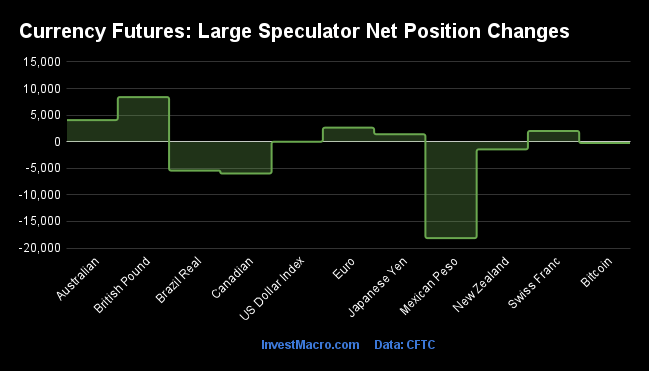
The COT currency market speculator bets were overall higher this week as seven out of the eleven currency markets we cover had higher positioning while the other four markets had lower speculator contracts.

Leading the gains for the currency markets were the Mexican peso (31,471 contracts), the Euro (30,881 contracts) and the Japanese yen (24,998 contracts) with the New Zealand dollar (9,037 contracts), the British pound sterling (2,969 contracts), the Australian dollar (914 contracts) and the Canadian dollar (506 contracts) also showing positive weeks.

The currencies leading the declines in speculator bets this week was the Swiss franc (-3,484 contracts) with Bitcoin (-475 contracts), the US Dollar Index (-310 contracts) and the Brazilian real (-22 contracts) also registering lower bets on the week.

Highlighting the COT currency data this week is the strong gains in the Mexican peso positioning since the start of October. Peso speculative positions jumped by over +30,000 contracts for a second straight week this week and have now been higher by at least +10,000 contracts in each of the past three weeks. Overall, the peso position has gained for five consecutive weeks and by a total of +85,367 contracts over that five-week period.

The renewed speculator optimism has brought the peso positioning from out of the bearish level it was in for nineteen straight weeks (from June 14th to October 18th) into a new bullish standing and to most bullish level since March 8th. The peso’s futures price has also been on the rise with a gain by over 1.50 percent this week. Peso prices have now risen in five out of the past six weeks and have reached their best level since early June.

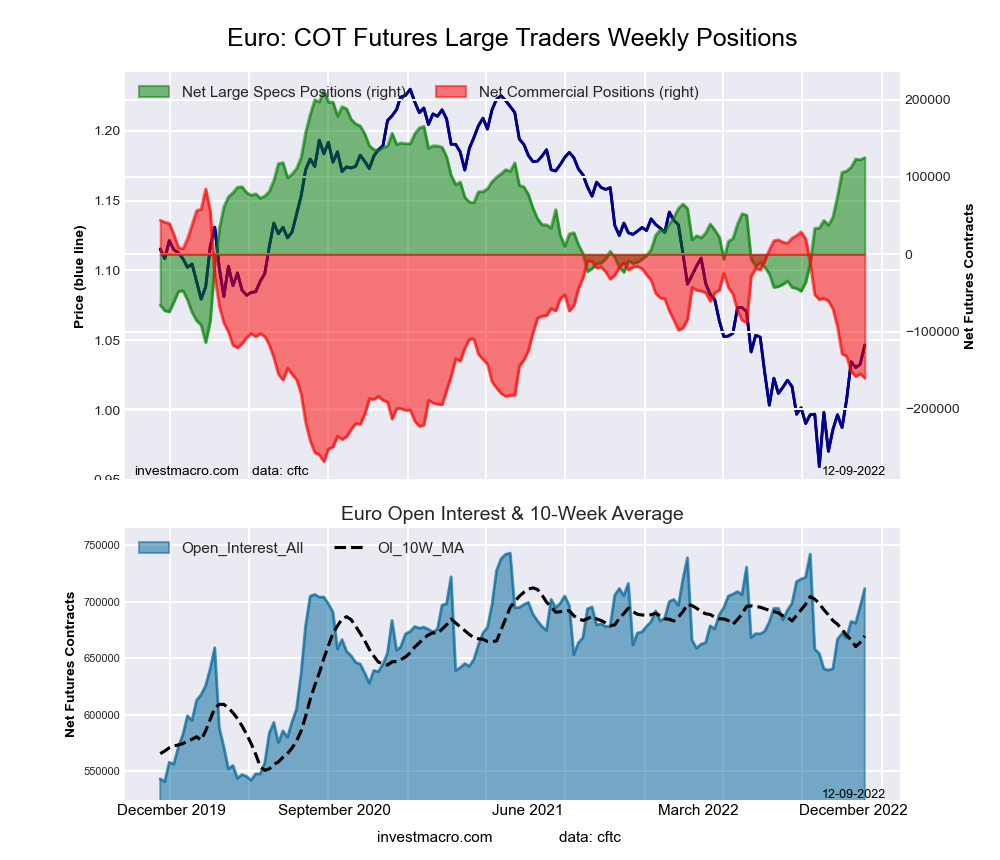
Another highlight of this week’s COT data is the Euro’s continued gains in speculator positions. The large speculator contracts rose strongly yet again this week as the Euro position has now climbed for a third straight week and for the eighth time in the past nine weeks. The nine-week speculator’s total increase now stands at a whopping +153,466 contracts. The Euro position was in bearish territory as recently as September 13th (total of -11,837 contracts) and now the total speculator position is at +105,790 contracts (a 72-week high). However, despite this strong speculator sentiment, the Euro exchange rate versus the US dollar continues to only trade around parity or the 1.000 level. The speculators are usually reliable trend-followers (buying when prices rises and selling when prices fall) and this divergence between the price and speculator contracts is growing quite large and could foretell a possible strong future movement in the Euro one way or the other.


Data Snapshot of Forex Market Traders | Columns Legend
Nov-01-2022OIOI-IndexSpec-NetSpec-IndexCom-NetCOM-IndexSmalls-NetSmalls-Index
USD Index55,9428029,78875-33,331233,54355
EUR671,72965105,79067-128,8193923,02916
GBP243,54963-44,8363165,37778-20,54118
JPY258,90686-77,6202195,77482-18,15417
CHF50,10741-14,7841927,73188-12,94714
CAD147,17028-17,6492119,27585-1,62627
AUD165,41156-50,5323862,72666-12,19423
NZD47,21938-3,847616,88145-3,03417
MXN282,8648844,04546-50,512526,46770
RUB20,93047,54331-7,15069-39324
BRL58,2895129,15779-29,13923-1865
Bitcoin12,18367-45269-16046824


Brazilian Real & US Dollar Index lead Strength Scores

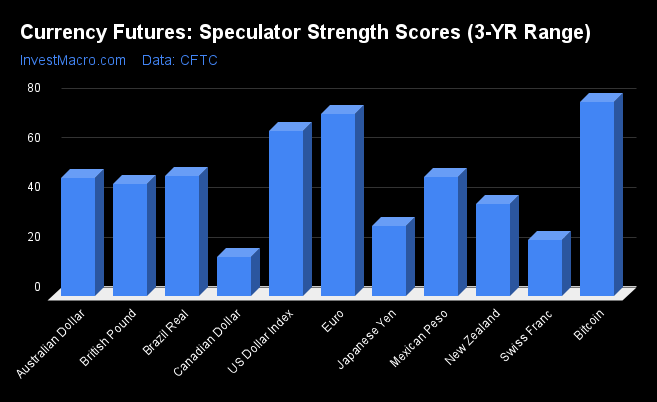
Strength Scores (a normalized measure of Speculator positions over a 3-Year range, from 0 to 100 where above 80 is extreme bullish and below 20 is extreme bearish) showed that the Brazilian Real (79.0 percent) and the US Dollar Index (74.6 percent) lead the currency markets currently. Bitcoin (69.1 percent) and the EuroFX (67.5 percent) come in as the next highest in the currency markets in strength scores.

On the downside, the Swiss Franc (19.0 percent) comes in at the lowest strength level currently and is in a bearish extreme position under 20 percent. The Canadian Dollar (20.8 percent), the Japanese Yen (21.1 percent) and the British Pound Sterling (30.5 percent) come in as the next lowest scores.

Strength Statistics:
US Dollar Index (74.6 percent) vs US Dollar Index previous week (75.1 percent)
EuroFX (67.5 percent) vs EuroFX previous week (58.0 percent)
British Pound Sterling (30.5 percent) vs British Pound Sterling previous week (28.0 percent)
Japanese Yen (21.1 percent) vs Japanese Yen previous week (5.7 percent)
Swiss Franc (19.0 percent) vs Swiss Franc previous week (27.8 percent)
Canadian Dollar (20.8 percent) vs Canadian Dollar previous week (20.2 percent)
Australian Dollar (38.0 percent) vs Australian Dollar previous week (37.1 percent)
New Zealand Dollar (60.7 percent) vs New Zealand Dollar previous week (43.8 percent)
Mexican Peso (46.1 percent) vs Mexican Peso previous week (32.7 percent)
Brazilian Real (79.0 percent) vs Brazilian Real previous week (79.1 percent)
Bitcoin (69.1 percent) vs Bitcoin previous week (77.3 percent)

Peso & Euro top the Strength Trends

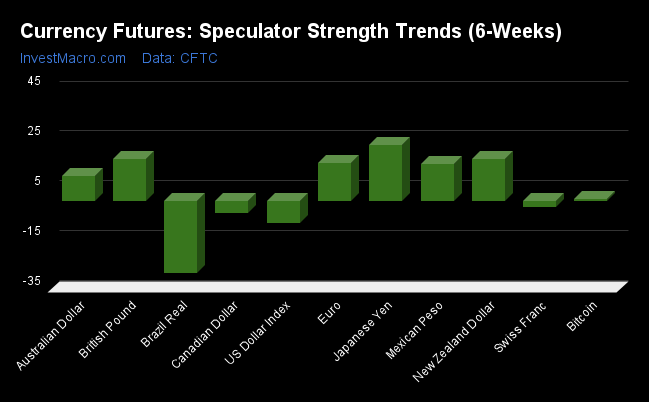
Strength Score Trends (or move index, calculates the 6-week changes in strength scores) showed that the Mexican Peso (30.7 percent) and the EuroFX (22.2 percent) lead the past six weeks trends for the currency markets this week. The New Zealand Dollar (16.4 percent) and the British Pound Sterling (8.6 percent) fill out the next top movers in the latest trends data.

The Canadian Dollar (-23.5 percent) leads the downside trend scores currently while the next markets with lower trend scores were the Swiss Franc (-20.4 percent) followed by Bitcoin (-17.9 percent).

Strength Trend Statistics:
US Dollar Index (3.1 percent) vs US Dollar Index previous week (-9.3 percent)
EuroFX (22.2 percent) vs EuroFX previous week (26.6 percent)
British Pound Sterling (8.6 percent) vs British Pound Sterling previous week (17.4 percent)
Japanese Yen (2.3 percent) vs Japanese Yen previous week (-13.5 percent)
Swiss Franc (-20.4 percent) vs Swiss Franc previous week (-10.1 percent)
Canadian Dollar (-23.5 percent) vs Canadian Dollar previous week (-36.5 percent)
Australian Dollar (-9.3 percent) vs Australian Dollar previous week (5.9 percent)
New Zealand Dollar (16.4 percent) vs New Zealand Dollar previous week (-14.2 percent)
Mexican Peso (30.7 percent) vs Mexican Peso previous week (16.2 percent)
Brazilian Real (-3.2 percent) vs Brazilian Real previous week (-3.7 percent)
Bitcoin (-17.9 percent) vs Bitcoin previous week (-1.8 percent)


Individual COT Forex Markets:

US Dollar Index Futures:

US Dollar Index Forex Futures COT ChartThe US Dollar Index large speculator standing this week came in at a net position of 29,788 contracts in the data reported through Tuesday. This was a weekly reduction of -310 contracts from the previous week which had a total of 30,098 net contracts.

This week’s current strength score (the trader positioning range over the past three years, measured from 0 to 100) shows the speculators are currently Bullish with a score of 74.6 percent. The commercials are Bearish with a score of 22.9 percent and the small traders (not shown in chart) are Bullish with a score of 55.3 percent.

US DOLLAR INDEX StatisticsSPECULATORSCOMMERCIALSSMALL TRADERS
– Percent of Open Interest Longs:75.610.311.5
– Percent of Open Interest Shorts:22.469.95.2
– Net Position:29,788-33,3313,543
– Gross Longs:42,3045,7616,460
– Gross Shorts:12,51639,0922,917
– Long to Short Ratio:3.4 to 10.1 to 12.2 to 1
NET POSITION TREND:
– Strength Index Score (3 Year Range Pct):74.622.955.3
– Strength Index Reading (3 Year Range):BullishBearishBullish
NET POSITION MOVEMENT INDEX:
– 6-Week Change in Strength Index:3.1-4.17.6


Euro Currency Futures:

Euro Currency Futures COT ChartThe Euro Currency large speculator standing this week came in at a net position of 105,790 contracts in the data reported through Tuesday. This was a weekly advance of 30,881 contracts from the previous week which had a total of 74,909 net contracts.

This week’s current strength score (the trader positioning range over the past three years, measured from 0 to 100) shows the speculators are currently Bullish with a score of 67.5 percent. The commercials are Bearish with a score of 39.5 percent and the small traders (not shown in chart) are Bearish-Extreme with a score of 15.7 percent.

EURO Currency StatisticsSPECULATORSCOMMERCIALSSMALL TRADERS
– Percent of Open Interest Longs:35.750.511.5
– Percent of Open Interest Shorts:19.969.78.0
– Net Position:105,790-128,81923,029
– Gross Longs:239,770339,36477,062
– Gross Shorts:133,980468,18354,033
– Long to Short Ratio:1.8 to 10.7 to 11.4 to 1
NET POSITION TREND:
– Strength Index Score (3 Year Range Pct):67.539.515.7
– Strength Index Reading (3 Year Range):BullishBearishBearish-Extreme
NET POSITION MOVEMENT INDEX:
– 6-Week Change in Strength Index:22.2-21.76.6


British Pound Sterling Futures:

British Pound Sterling Futures COT ChartThe British Pound Sterling large speculator standing this week came in at a net position of -44,836 contracts in the data reported through Tuesday. This was a weekly rise of 2,969 contracts from the previous week which had a total of -47,805 net contracts.

This week’s current strength score (the trader positioning range over the past three years, measured from 0 to 100) shows the speculators are currently Bearish with a score of 30.5 percent. The commercials are Bullish with a score of 78.5 percent and the small traders (not shown in chart) are Bearish-Extreme with a score of 17.7 percent.

BRITISH POUND StatisticsSPECULATORSCOMMERCIALSSMALL TRADERS
– Percent of Open Interest Longs:14.475.28.0
– Percent of Open Interest Shorts:32.848.416.4
– Net Position:-44,83665,377-20,541
– Gross Longs:34,979183,21019,464
– Gross Shorts:79,815117,83340,005
– Long to Short Ratio:0.4 to 11.6 to 10.5 to 1
NET POSITION TREND:
– Strength Index Score (3 Year Range Pct):30.578.517.7
– Strength Index Reading (3 Year Range):BearishBullishBearish-Extreme
NET POSITION MOVEMENT INDEX:
– 6-Week Change in Strength Index:8.6-5.5-3.7


Japanese Yen Futures:

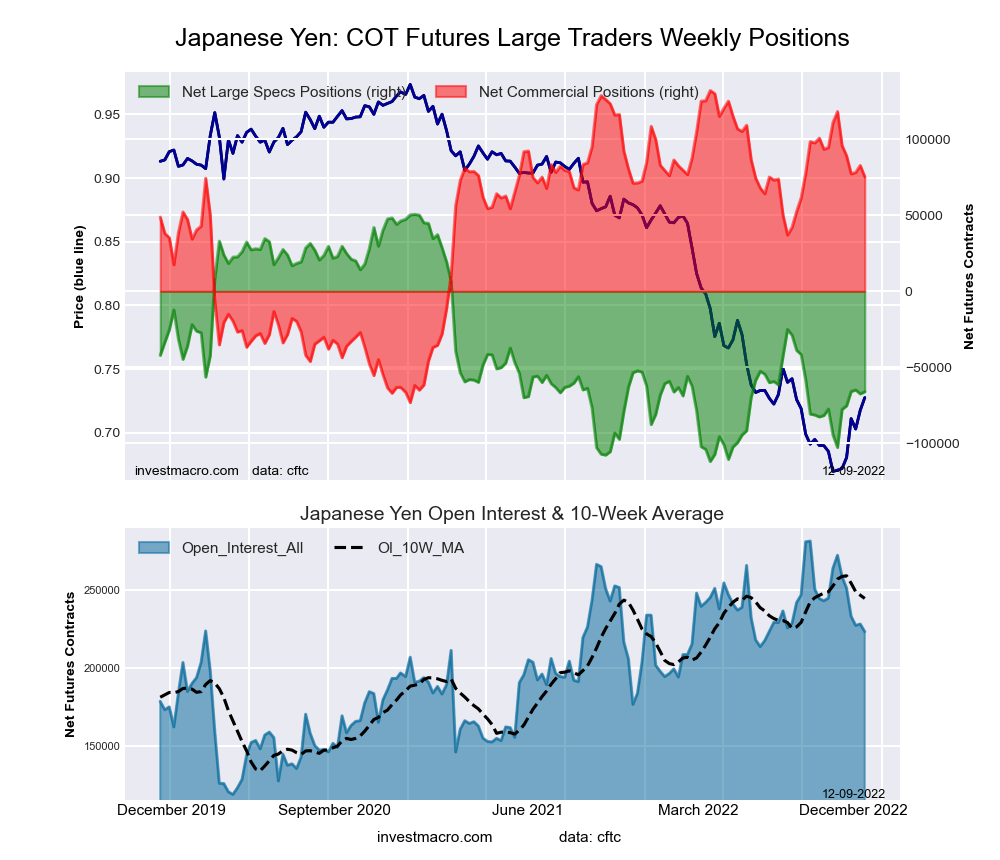
Japanese Yen Forex Futures COT ChartThe Japanese Yen large speculator standing this week came in at a net position of -77,620 contracts in the data reported through Tuesday. This was a weekly advance of 24,998 contracts from the previous week which had a total of -102,618 net contracts.

This week’s current strength score (the trader positioning range over the past three years, measured from 0 to 100) shows the speculators are currently Bearish with a score of 21.1 percent. The commercials are Bullish-Extreme with a score of 82.4 percent and the small traders (not shown in chart) are Bearish-Extreme with a score of 16.6 percent.

JAPANESE YEN StatisticsSPECULATORSCOMMERCIALSSMALL TRADERS
– Percent of Open Interest Longs:15.673.98.9
– Percent of Open Interest Shorts:45.636.915.9
– Net Position:-77,62095,774-18,154
– Gross Longs:40,460191,22123,021
– Gross Shorts:118,08095,44741,175
– Long to Short Ratio:0.3 to 12.0 to 10.6 to 1
NET POSITION TREND:
– Strength Index Score (3 Year Range Pct):21.182.416.6
– Strength Index Reading (3 Year Range):BearishBullish-ExtremeBearish-Extreme
NET POSITION MOVEMENT INDEX:
– 6-Week Change in Strength Index:2.3-0.8-3.9


Swiss Franc Futures:

Swiss Franc Forex Futures COT ChartThe Swiss Franc large speculator standing this week came in at a net position of -14,784 contracts in the data reported through Tuesday. This was a weekly decrease of -3,484 contracts from the previous week which had a total of -11,300 net contracts.

This week’s current strength score (the trader positioning range over the past three years, measured from 0 to 100) shows the speculators are currently Bearish-Extreme with a score of 19.0 percent. The commercials are Bullish-Extreme with a score of 87.7 percent and the small traders (not shown in chart) are Bearish-Extreme with a score of 13.7 percent.

SWISS FRANC StatisticsSPECULATORSCOMMERCIALSSMALL TRADERS
– Percent of Open Interest Longs:13.271.515.1
– Percent of Open Interest Shorts:42.716.140.9
– Net Position:-14,78427,731-12,947
– Gross Longs:6,61235,8227,559
– Gross Shorts:21,3968,09120,506
– Long to Short Ratio:0.3 to 14.4 to 10.4 to 1
NET POSITION TREND:
– Strength Index Score (3 Year Range Pct):19.087.713.7
– Strength Index Reading (3 Year Range):Bearish-ExtremeBullish-ExtremeBearish-Extreme
NET POSITION MOVEMENT INDEX:
– 6-Week Change in Strength Index:-20.423.5-22.7


Canadian Dollar Futures:

Canadian Dollar Forex Futures COT ChartThe Canadian Dollar large speculator standing this week came in at a net position of -17,649 contracts in the data reported through Tuesday. This was a weekly boost of 506 contracts from the previous week which had a total of -18,155 net contracts.

This week’s current strength score (the trader positioning range over the past three years, measured from 0 to 100) shows the speculators are currently Bearish with a score of 20.8 percent. The commercials are Bullish-Extreme with a score of 84.8 percent and the small traders (not shown in chart) are Bearish with a score of 26.8 percent.

CANADIAN DOLLAR StatisticsSPECULATORSCOMMERCIALSSMALL TRADERS
– Percent of Open Interest Longs:26.250.521.2
– Percent of Open Interest Shorts:38.237.422.3
– Net Position:-17,64919,275-1,626
– Gross Longs:38,52274,35231,212
– Gross Shorts:56,17155,07732,838
– Long to Short Ratio:0.7 to 11.3 to 11.0 to 1
NET POSITION TREND:
– Strength Index Score (3 Year Range Pct):20.884.826.8
– Strength Index Reading (3 Year Range):BearishBullish-ExtremeBearish
NET POSITION MOVEMENT INDEX:
– 6-Week Change in Strength Index:-23.515.32.7


Australian Dollar Futures:

Australian Dollar Forex Futures COT ChartThe Australian Dollar large speculator standing this week came in at a net position of -50,532 contracts in the data reported through Tuesday. This was a weekly lift of 914 contracts from the previous week which had a total of -51,446 net contracts.

This week’s current strength score (the trader positioning range over the past three years, measured from 0 to 100) shows the speculators are currently Bearish with a score of 38.0 percent. The commercials are Bullish with a score of 65.7 percent and the small traders (not shown in chart) are Bearish with a score of 22.7 percent.

AUSTRALIAN DOLLAR StatisticsSPECULATORSCOMMERCIALSSMALL TRADERS
– Percent of Open Interest Longs:20.667.59.3
– Percent of Open Interest Shorts:51.229.616.6
– Net Position:-50,53262,726-12,194
– Gross Longs:34,148111,63815,301
– Gross Shorts:84,68048,91227,495
– Long to Short Ratio:0.4 to 12.3 to 10.6 to 1
NET POSITION TREND:
– Strength Index Score (3 Year Range Pct):38.065.722.7
– Strength Index Reading (3 Year Range):BearishBullishBearish
NET POSITION MOVEMENT INDEX:
– 6-Week Change in Strength Index:-9.37.9-1.5


New Zealand Dollar Futures:

New Zealand Dollar Forex Futures COT ChartThe New Zealand Dollar large speculator standing this week came in at a net position of -3,847 contracts in the data reported through Tuesday. This was a weekly increase of 9,037 contracts from the previous week which had a total of -12,884 net contracts.

This week’s current strength score (the trader positioning range over the past three years, measured from 0 to 100) shows the speculators are currently Bullish with a score of 60.7 percent. The commercials are Bearish with a score of 45.4 percent and the small traders (not shown in chart) are Bearish-Extreme with a score of 16.8 percent.

NEW ZEALAND DOLLAR StatisticsSPECULATORSCOMMERCIALSSMALL TRADERS
– Percent of Open Interest Longs:44.748.95.7
– Percent of Open Interest Shorts:52.934.412.2
– Net Position:-3,8476,881-3,034
– Gross Longs:21,11523,1032,707
– Gross Shorts:24,96216,2225,741
– Long to Short Ratio:0.8 to 11.4 to 10.5 to 1
NET POSITION TREND:
– Strength Index Score (3 Year Range Pct):60.745.416.8
– Strength Index Reading (3 Year Range):BullishBearishBearish-Extreme
NET POSITION MOVEMENT INDEX:
– 6-Week Change in Strength Index:16.4-16.913.4


Mexican Peso Futures:

Mexican Peso Futures COT ChartThe Mexican Peso large speculator standing this week came in at a net position of 44,045 contracts in the data reported through Tuesday. This was a weekly boost of 31,471 contracts from the previous week which had a total of 12,574 net contracts.

This week’s current strength score (the trader positioning range over the past three years, measured from 0 to 100) shows the speculators are currently Bearish with a score of 46.1 percent. The commercials are Bullish with a score of 51.7 percent and the small traders (not shown in chart) are Bullish with a score of 70.4 percent.

MEXICAN PESO StatisticsSPECULATORSCOMMERCIALSSMALL TRADERS
– Percent of Open Interest Longs:64.532.13.0
– Percent of Open Interest Shorts:48.950.00.7
– Net Position:44,045-50,5126,467
– Gross Longs:182,31690,8118,464
– Gross Shorts:138,271141,3231,997
– Long to Short Ratio:1.3 to 10.6 to 14.2 to 1
NET POSITION TREND:
– Strength Index Score (3 Year Range Pct):46.151.770.4
– Strength Index Reading (3 Year Range):BearishBullishBullish
NET POSITION MOVEMENT INDEX:
– 6-Week Change in Strength Index:30.7-31.09.2


Brazilian Real Futures:

Brazil Real Futures COT ChartThe Brazilian Real large speculator standing this week came in at a net position of 29,157 contracts in the data reported through Tuesday. This was a weekly fall of -22 contracts from the previous week which had a total of 29,179 net contracts.

This week’s current strength score (the trader positioning range over the past three years, measured from 0 to 100) shows the speculators are currently Bullish with a score of 79.0 percent. The commercials are Bearish with a score of 22.9 percent and the small traders (not shown in chart) are Bullish with a score of 64.6 percent.

BRAZIL REAL StatisticsSPECULATORSCOMMERCIALSSMALL TRADERS
– Percent of Open Interest Longs:65.722.910.7
– Percent of Open Interest Shorts:15.772.910.7
– Net Position:29,157-29,139-18
– Gross Longs:38,32513,3286,246
– Gross Shorts:9,16842,4676,264
– Long to Short Ratio:4.2 to 10.3 to 11.0 to 1
NET POSITION TREND:
– Strength Index Score (3 Year Range Pct):79.022.964.6
– Strength Index Reading (3 Year Range):BullishBearishBullish
NET POSITION MOVEMENT INDEX:
– 6-Week Change in Strength Index:-3.24.8-20.2


Bitcoin Futures:

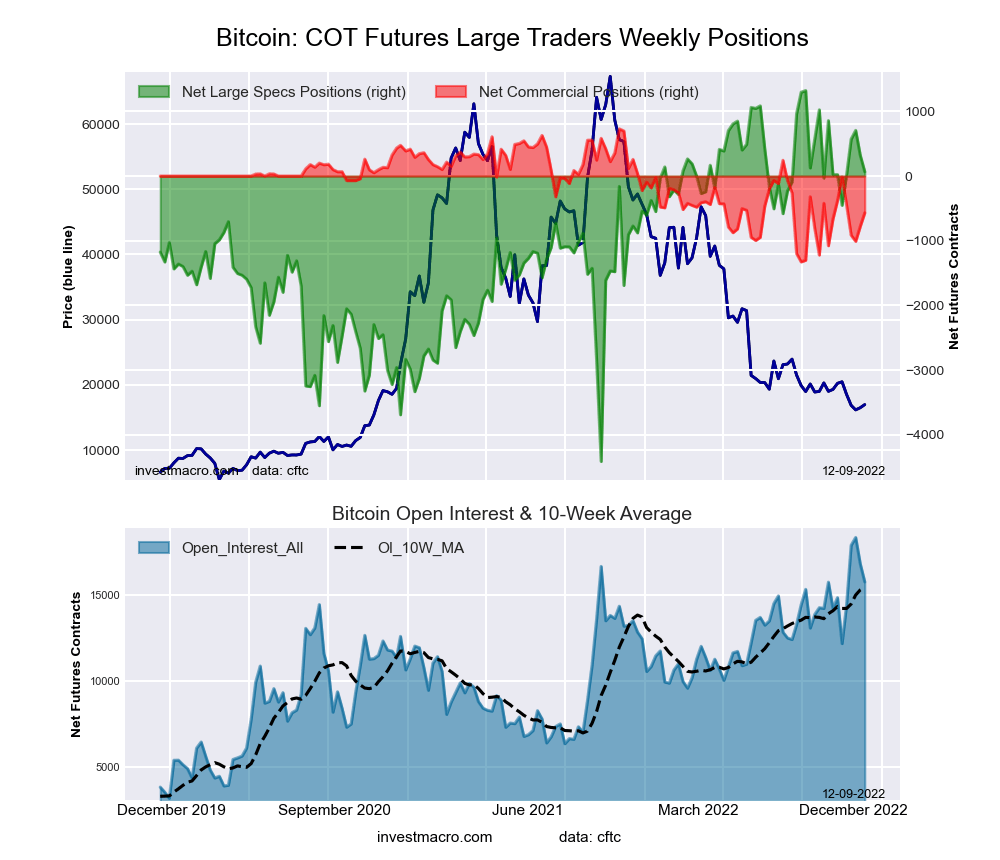
Bitcoin Crypto Futures COT ChartThe Bitcoin large speculator standing this week came in at a net position of -452 contracts in the data reported through Tuesday. This was a weekly lowering of -475 contracts from the previous week which had a total of 23 net contracts.

This week’s current strength score (the trader positioning range over the past three years, measured from 0 to 100) shows the speculators are currently Bullish with a score of 69.1 percent. The commercials are Bullish with a score of 63.8 percent and the small traders (not shown in chart) are Bearish with a score of 23.6 percent.

BITCOIN StatisticsSPECULATORSCOMMERCIALSSMALL TRADERS
– Percent of Open Interest Longs:73.63.310.0
– Percent of Open Interest Shorts:77.33.56.2
– Net Position:-452-16468
– Gross Longs:8,9674061,218
– Gross Shorts:9,419422750
– Long to Short Ratio:1.0 to 11.0 to 11.6 to 1
NET POSITION TREND:
– Strength Index Score (3 Year Range Pct):69.163.823.6
– Strength Index Reading (3 Year Range):BullishBullishBearish
NET POSITION MOVEMENT INDEX:
– 6-Week Change in Strength Index:-17.938.75.3


Article By InvestMacroReceive our weekly COT Newsletter

*COT Report: The COT data, released weekly to the public each Friday, is updated through the most recent Tuesday (data is 3 days old) and shows a quick view of how large speculators or non-commercials (for-profit traders) were positioned in the futures markets.

The CFTC categorizes trader positions according to commercial hedgers (traders who use futures contracts for hedging as part of the business), non-commercials (large traders who speculate to realize trading profits) and nonreportable traders (usually small traders/speculators) as well as their open interest (contracts open in the market at time of reporting). See CFTC criteria here.

Speculator Extremes: Soybean Meal, Wheat lead weekly COT Bullish & Bearish Positions

By InvestMacro

The latest update for the weekly Commitment of Traders (COT) report was released by the Commodity Futures Trading Commission (CFTC) on Friday for data ending on November 1st.

This weekly Extreme Positions report highlights the Top Most Bullish and Top Most Bearish Positions for the speculator category. Extreme positioning in these markets can foreshadow strong moves in the underlying market.

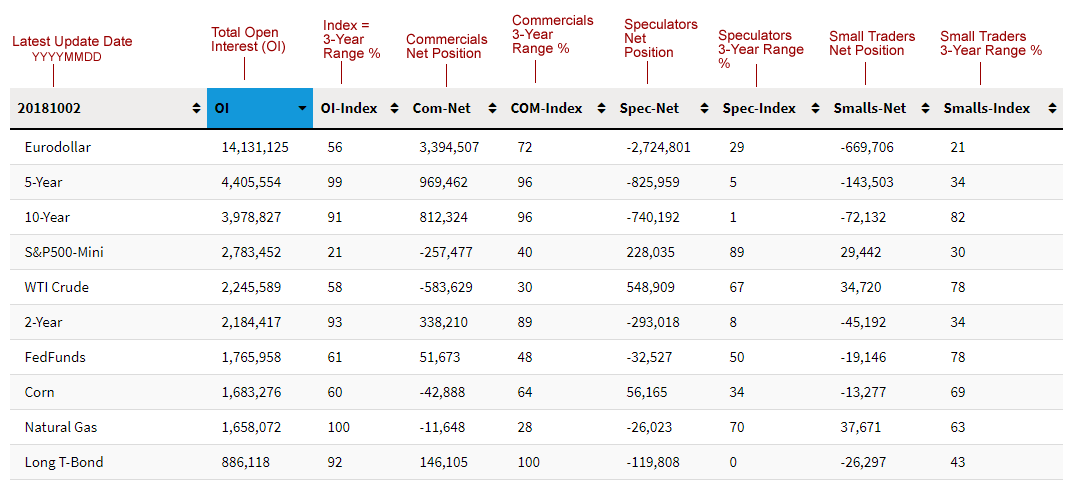
To signify an extreme position, we use the Strength Index (also known as the COT Index) of each instrument, a common method of measuring COT data. The Strength Index is simply a comparison of current trader positions against the range of positions over the previous 3 years. We use over 80 percent as extremely bullish and under 20 percent as extremely bearish.

Compare Strength Index scores across all markets in the COT data table or COT leaders table.


Here Are This Week’s Most Bullish Speculator Positions:

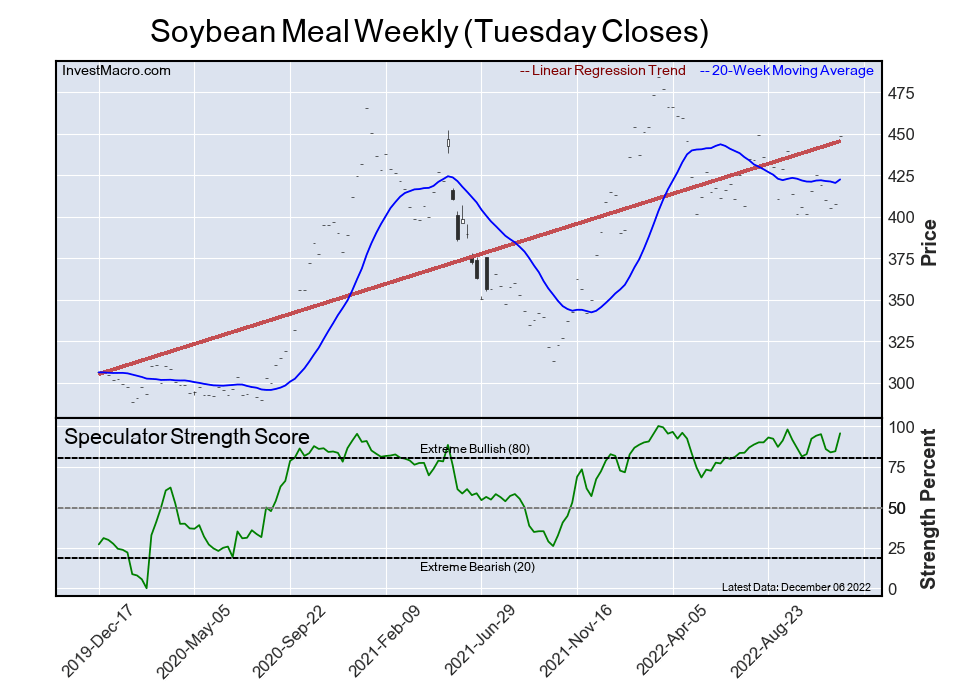
Soybean Meal

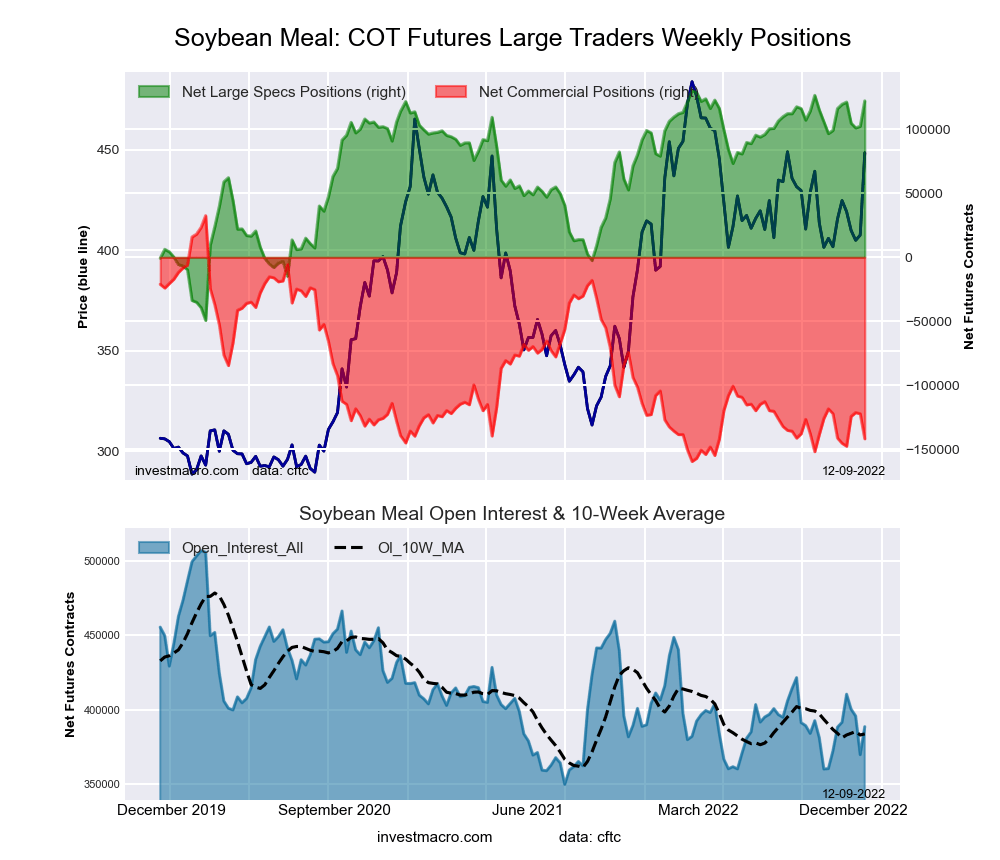
The Soybean Meal speculator position comes in as the most bullish extreme standing this week. The Soybean Meal speculator level is currently at a 94.0 percent score of its 3-year range.

The overall net speculator position totaled 119,508 net contracts this week and has been over the +100,000 net contract level in fifteen out of the past seventeen weeks.


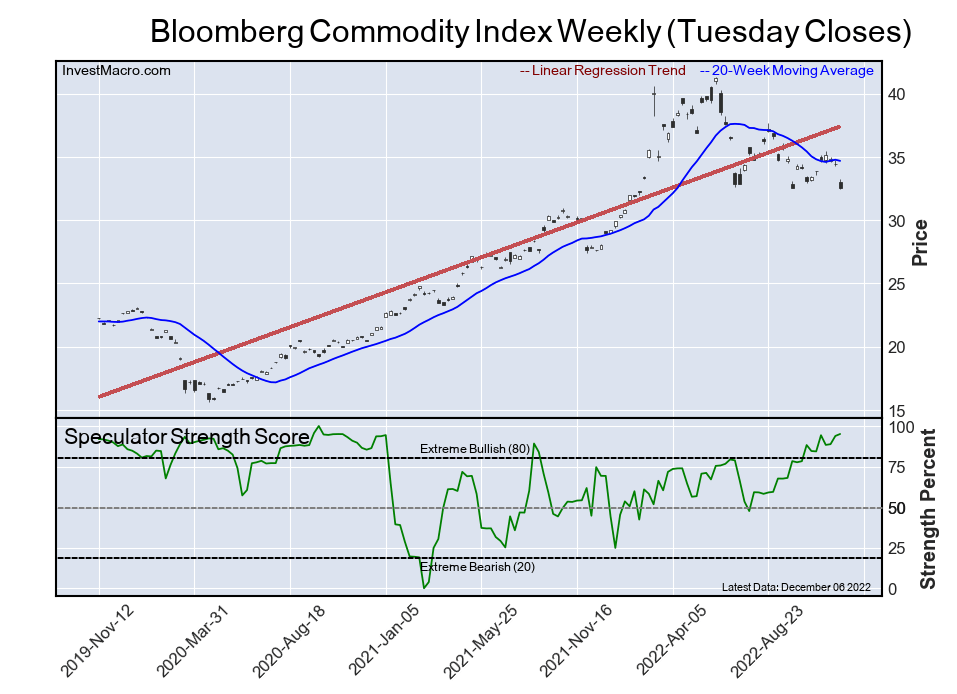
Bloomberg Commodity Index

The Bloomberg Commodity Index speculator position comes in as the only other market above 80 percent in the extreme standings this week. The Bloomberg Commodity Index speculator level is now at a 84.3 percent score of its 3-year range.

The speculator position was a total of -6,047 net contracts this week. This market usually has an overall bearish positioning for speculators and this week’s position is near the lowest levels of the past three years.


This Week’s Most Bearish Speculator Positions:

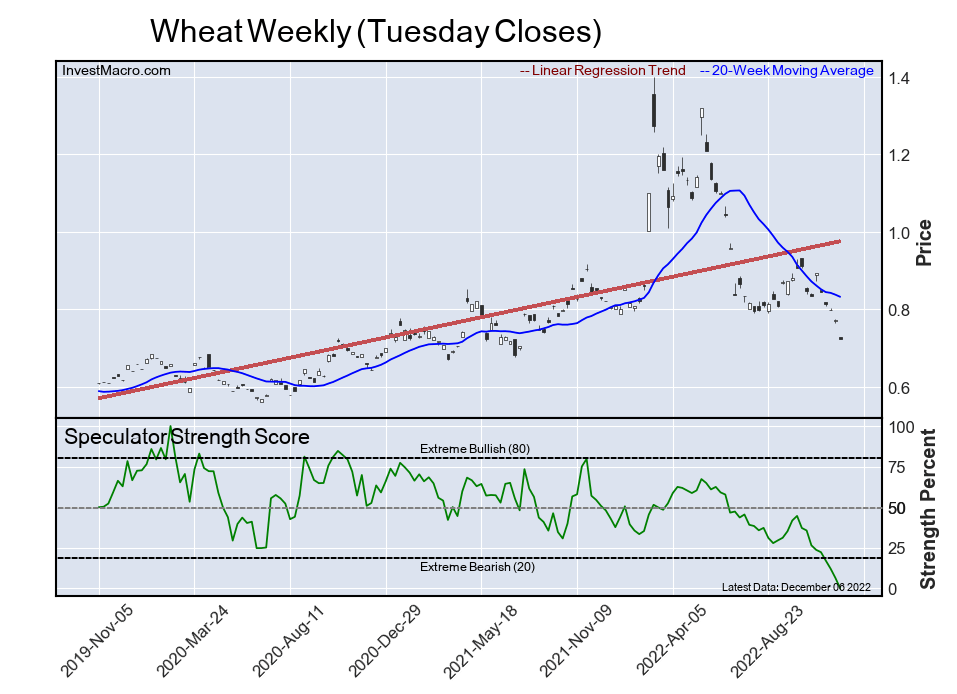
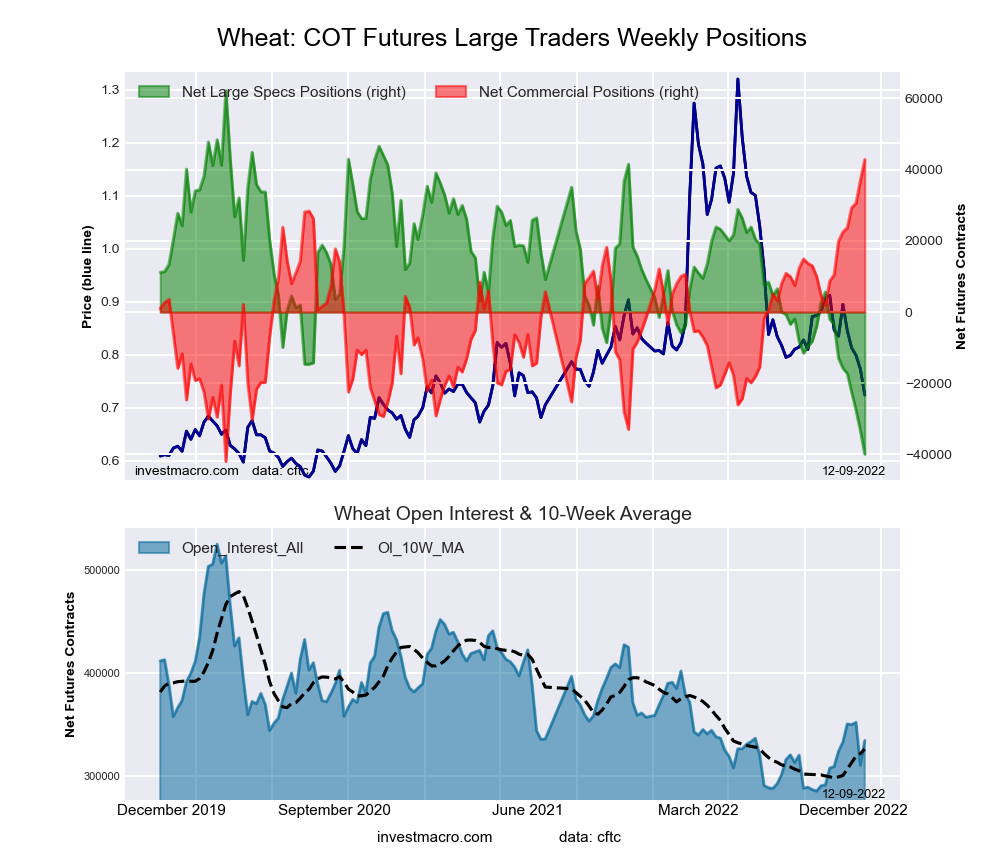
Wheat

The Wheat speculator position comes in as the most bearish extreme standing this week. The Wheat speculator level is at 0.0 percent score or at the absolute bottom of its 3-year range.

The speculator position was -15,766 net contracts this week and the overall position is in bearish territory for the twelfth time out of the past fourteen weeks. Wheat prices continue to be in an uptrend but the speculator sentiment has fallen sharply from earlier in the year.


2-Year Bond

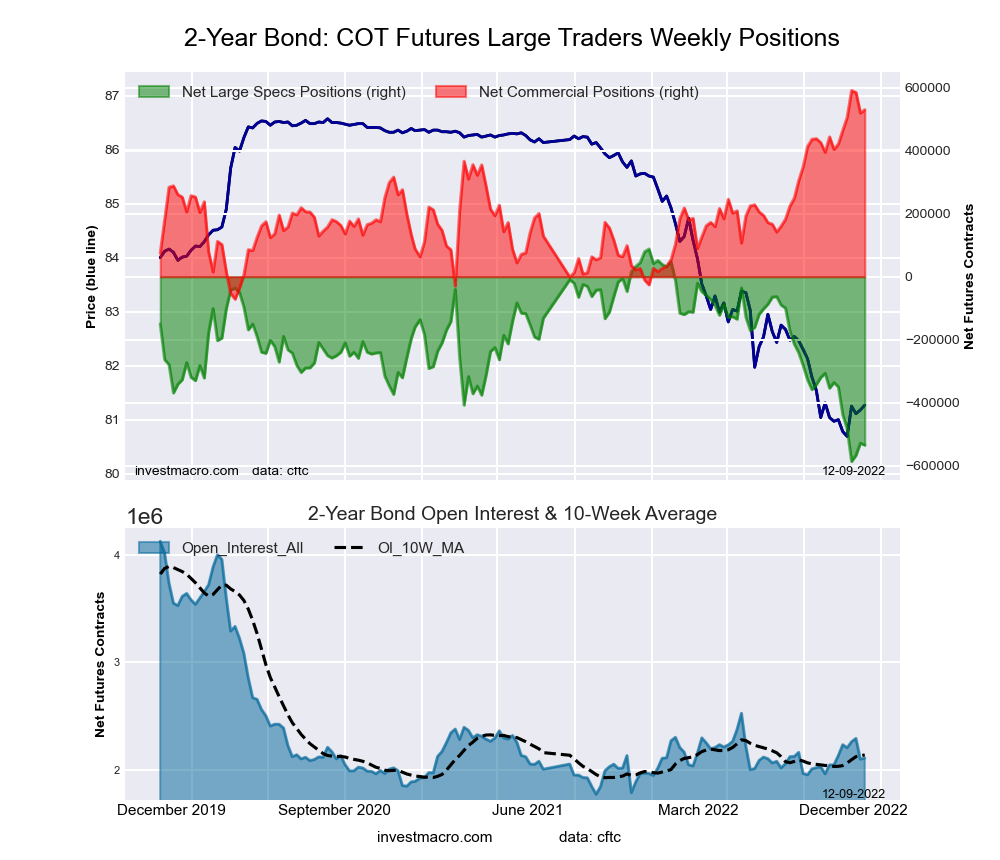
The 2-Year Bond speculator position comes in as the most bearish extreme standing this week as well. The 2-Year Bond speculator level is at the 0.0 percent score of its 3-year range.

The speculator position was a total of -437,785 net contracts this week and hit the most bearish level on record this week as the US Federal Reserve continued to raise its benchmark interest rate.


Gold

The Gold speculator position comes in next for the most bearish extreme standing on the week. The Gold speculator level is at a 4.2 percent score of its 3-year range.

The speculator position was 64,623 net contracts this week and has now been under +100,000 net contracts for eight straight weeks which has not happened since 2018.


5-Year Bond

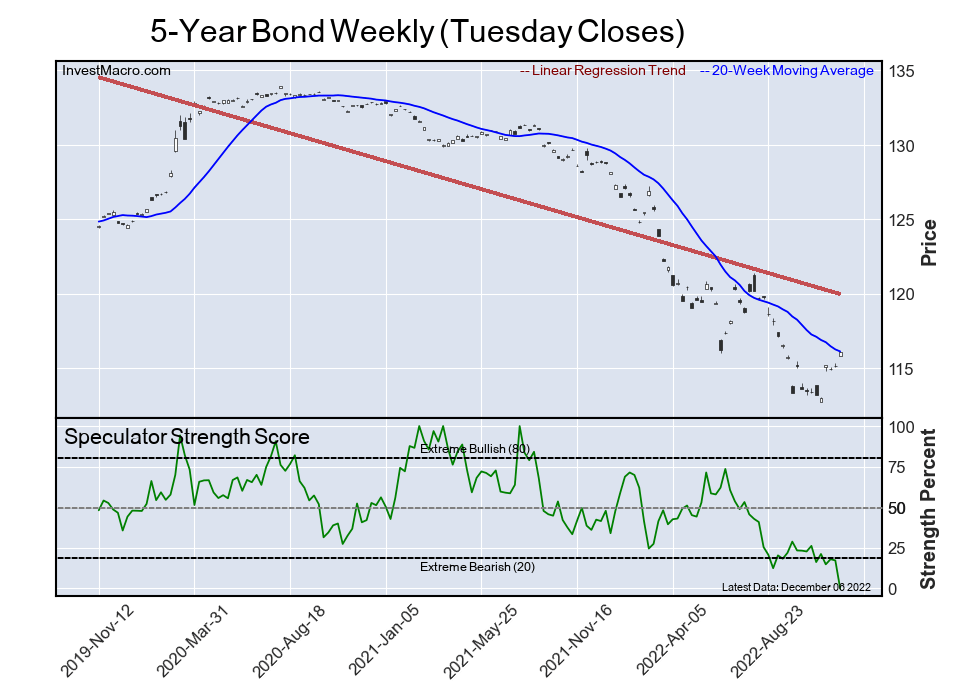
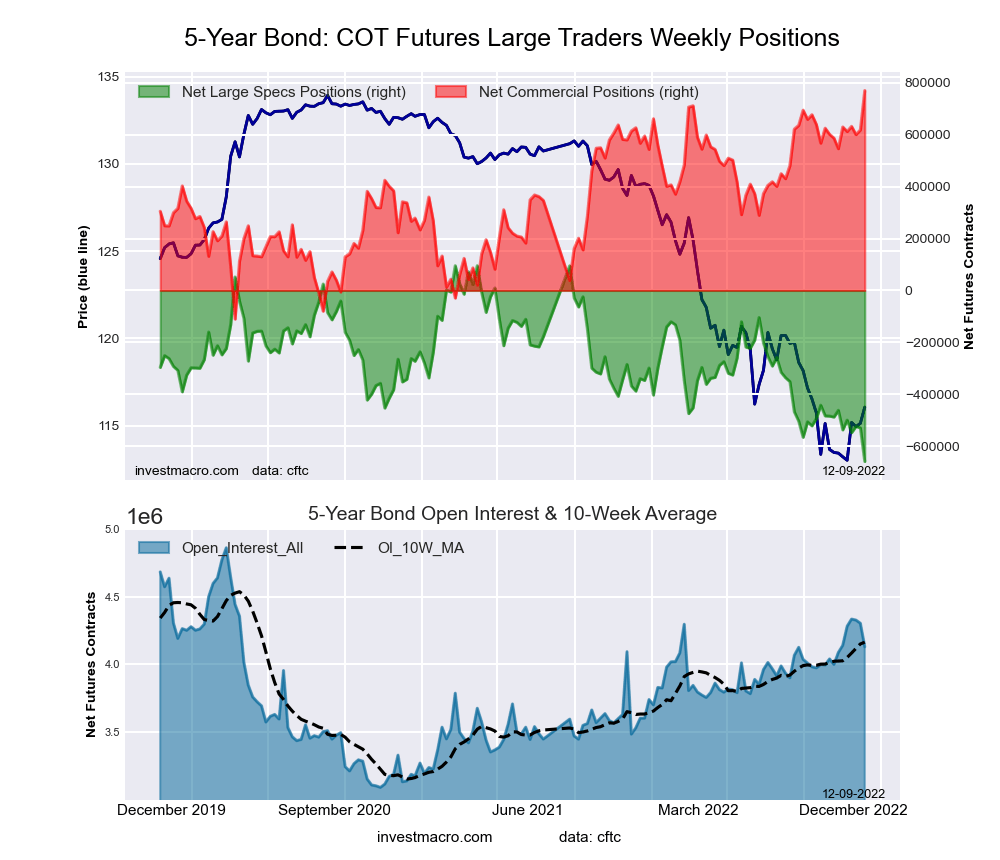
The 5-Year Bond speculator position comes in as the most bearish extreme standing this week. The 5-Year Bond speculator level is at 4.3 percent score of its 3-year range.

The speculator position was -536,987 net contracts this week and joins all the other bond markets we cover that have negative or bearish net positioning at the moment.


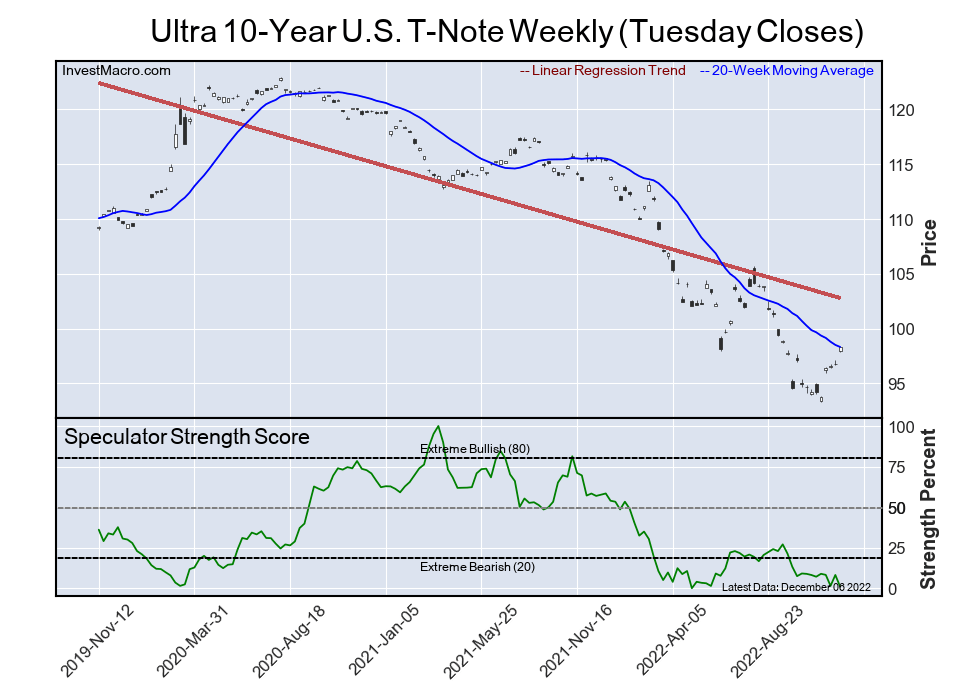
Ultra 10-Year U.S. T-Note

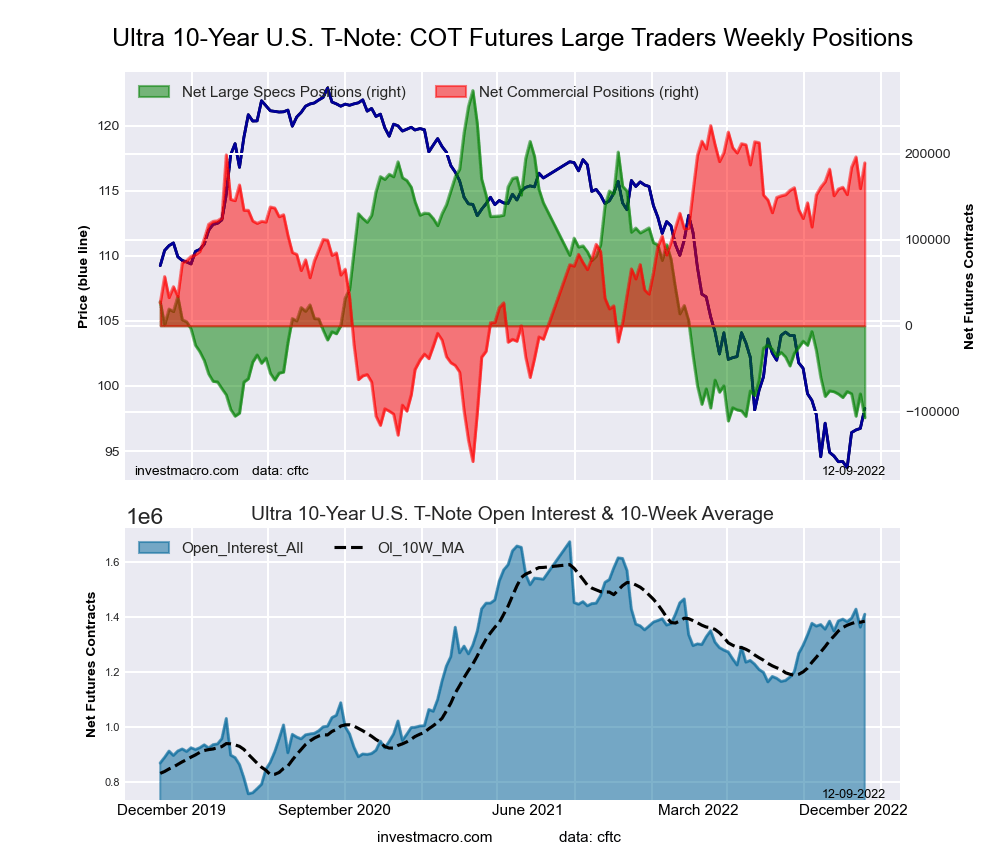
The Ultra 10-Year U.S. T-Note speculator position comes in as the next market in the most bearish extreme standing. The Ultra 10-Year U.S. T-Note speculator level is at a 7.1 percent score of its 3-year range.

The speculator position was -83,431 net contracts this week.


Article By InvestMacroReceive our weekly COT Newsletter

*COT Report: The COT data, released weekly to the public each Friday, is updated through the most recent Tuesday (data is 3 days old) and shows a quick view of how large speculators or non-commercials (for-profit traders) were positioned in the futures markets.

The CFTC categorizes trader positions according to commercial hedgers (traders who use futures contracts for hedging as part of the business), non-commercials (large traders who speculate to realize trading profits) and nonreportable traders (usually small traders/speculators) as well as their open interest (contracts open in the market at time of reporting). See CFTC criteria here.

Copper Speculators trim their Bearish bets to 21-week low

By InvestMacro

Here are the latest charts and statistics for the Commitment of Traders (COT) data published by the Commodities Futures Trading Commission (CFTC).

The latest COT data is updated through Tuesday November 1st and shows a quick view of how large traders (for-profit speculators and commercial entities) were positioned in the futures markets.

Copper & Platinum lead Weekly Speculator Changes

The COT precious metals speculator bets were slightly higher this week as three out of the five metals markets we cover had higher positioning this week while two markets had lower contracts.

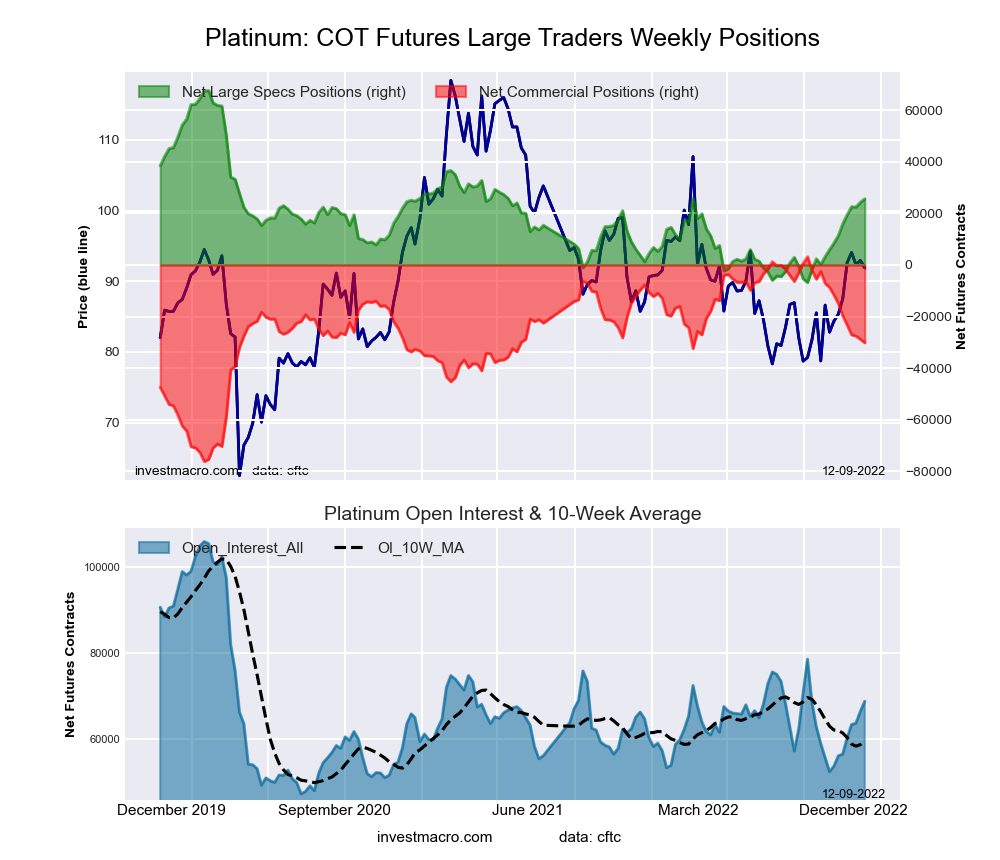
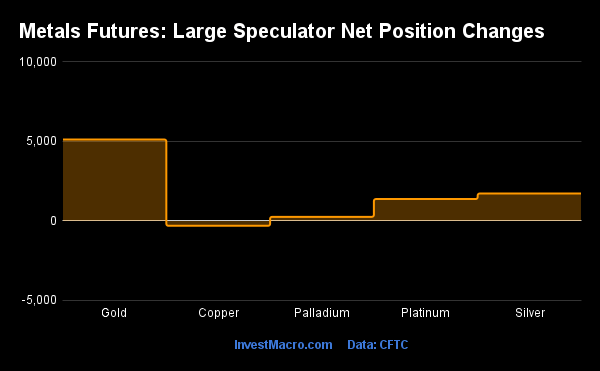
Leading the gains for the precious metals markets was Copper (9,435 contracts) with Platinum (4,606 contracts) and Silver (1,625 contracts) also showing a positive week.

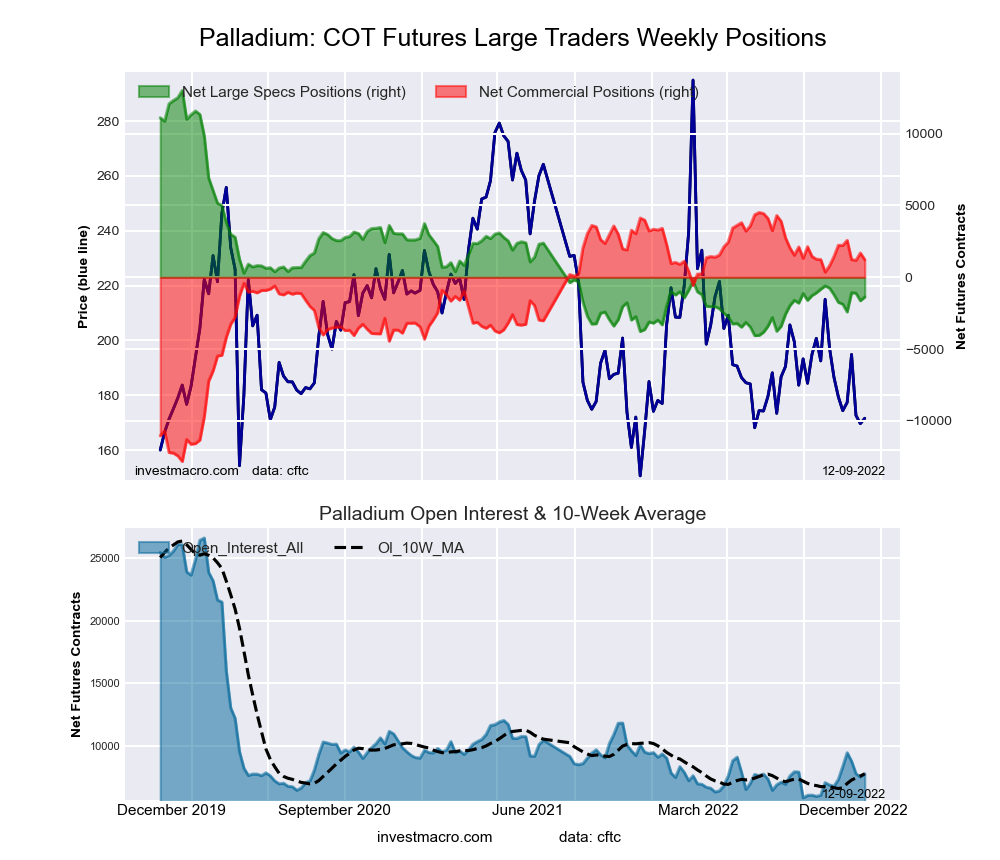
The metals markets leading the declines in speculator bets this week was Gold (-3,409 contracts) with Palladium (-122 contracts) also registering lower bets on the week.

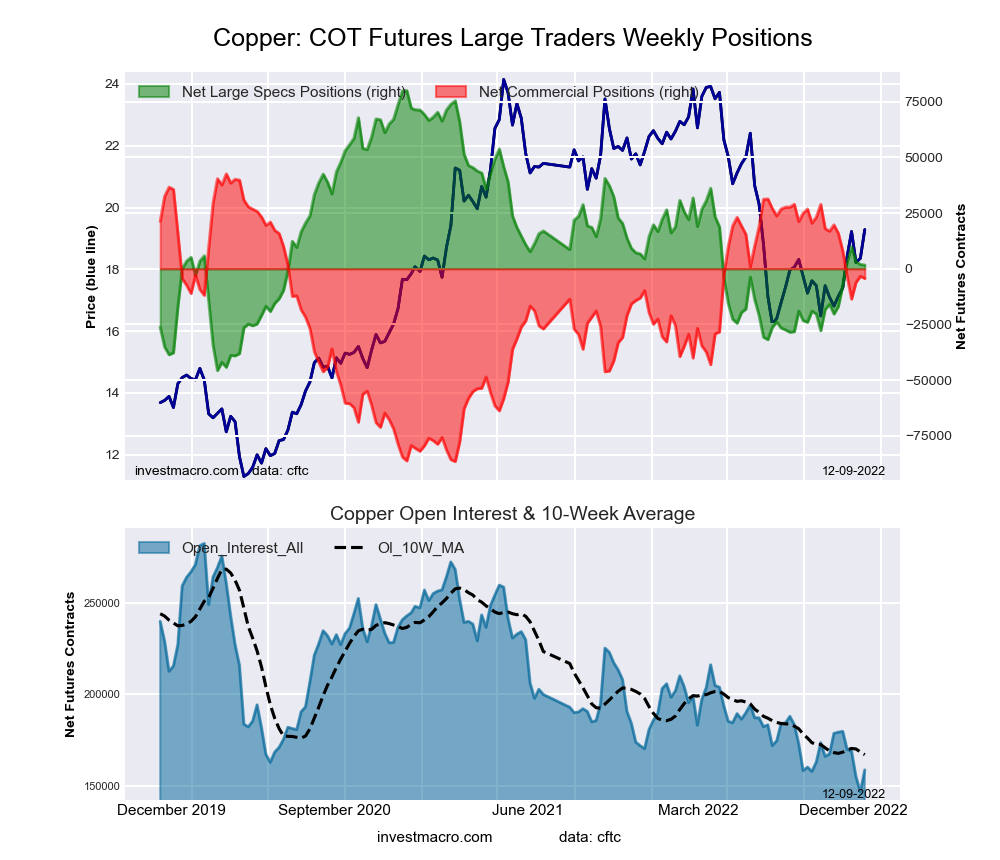
Highlighting the COT metals data this week is the improvement in the Copper speculators positioning over the past few months. The large speculators raised their Copper bets for the second straight week this week and for the fourth time out of the past five weeks. Copper spec positions have been in an overall bearish standing since April (currently in a 28-week streak of bearish contracts) with the lowest level of -31,796 contracts coming in July. However, the bearish bets have been lightening up of late and this week’s total of -7,484 contracts marks the least bearish level of the past twenty-one weeks, dating back to June 7th.

Copper prices were sharply on the rise this week as well with gains for the week climbing by over 7.50 percent. Helping Copper prices go higher this week were the rumors that China will potentially ease their COVID-related restrictions as well as some supply issues out of South America.


Data Snapshot of Commodity Market Traders | Columns Legend
Nov-01-2022OIOI-IndexSpec-NetSpec-IndexCom-NetCOM-IndexSmalls-NetSmalls-Index
WTI Crude1,459,0522254,80912-275,7619020,95235
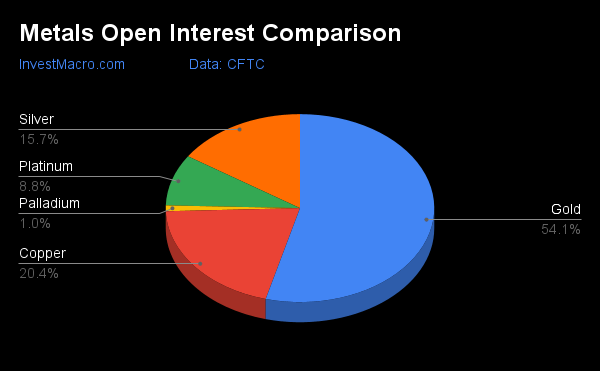
Gold467,2761064,6234-74,7829610,1595
Silver138,875121,52416-10,363858,83913
Copper179,80118-7,484307,99873-51422
Palladium8,37212-1,867132,22187-35420
Platinum56,5341615,98731-19,690713,70318
Natural Gas986,1167-148,65334127,5017121,15230
Brent134,0100-21,9087417,423224,48570
Heating Oil268,0252321,38074-41,2952719,91567
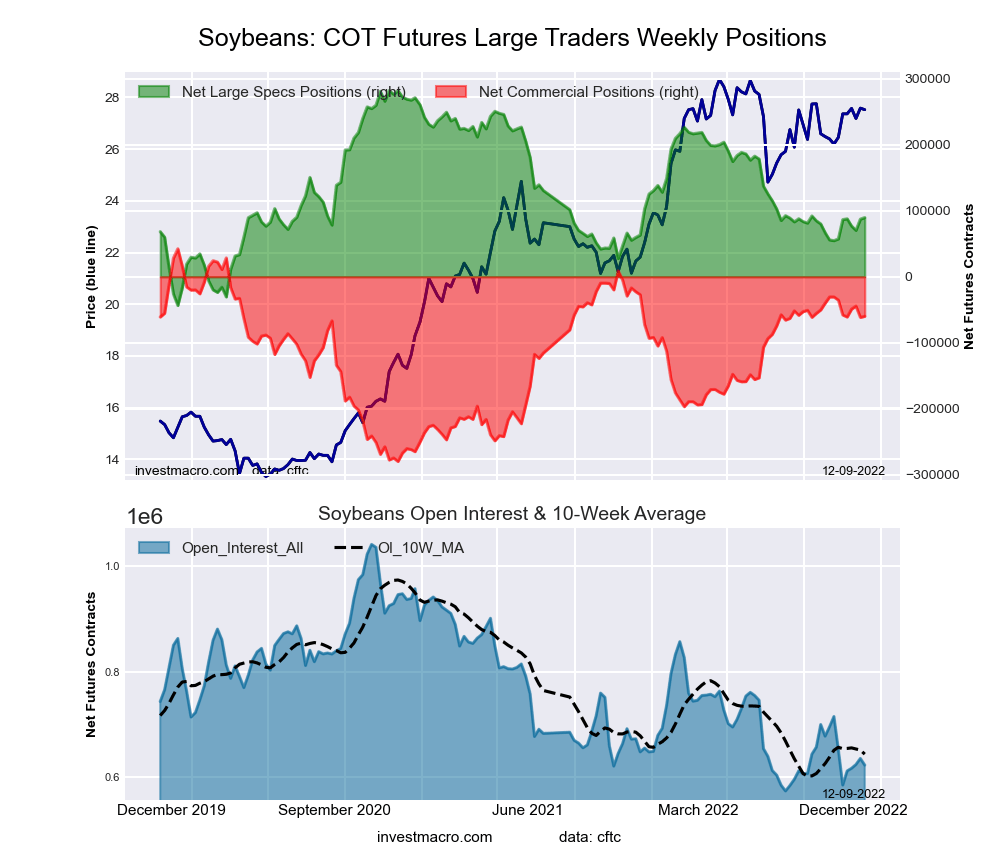
Soybeans584,073286,52240-57,88669-28,63623
Corn1,472,51729340,78874-286,79031-53,99812
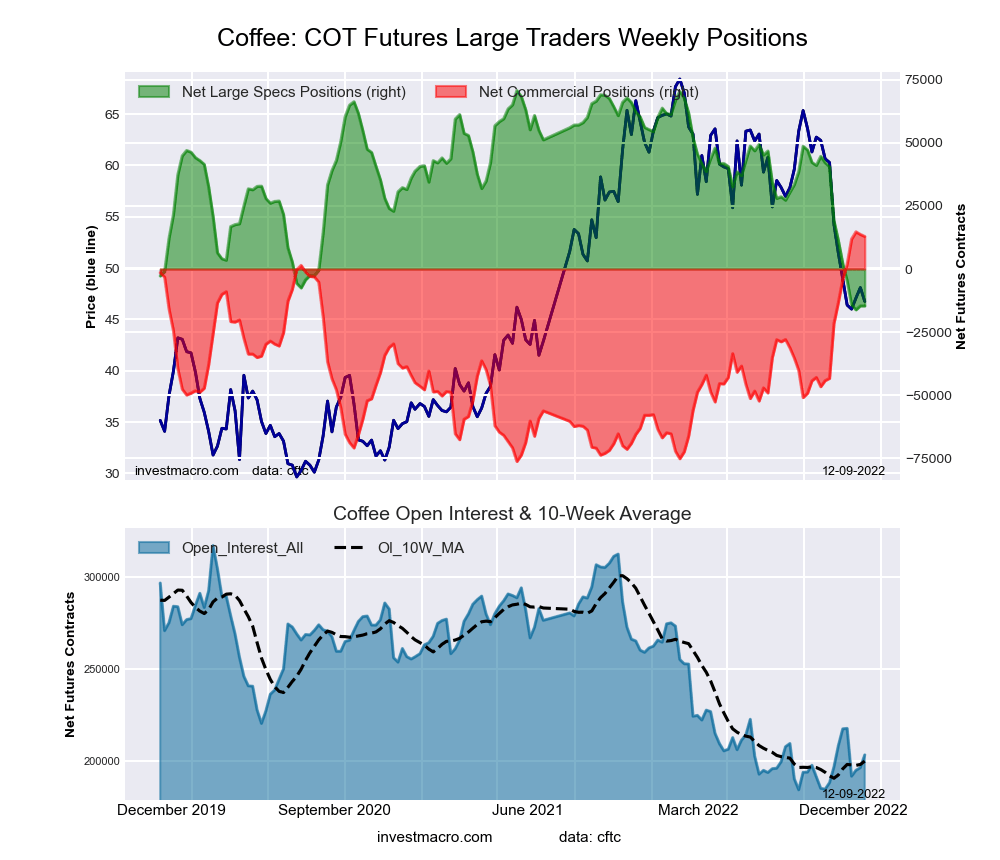
Coffee217,400252,18312-4,162931,97927
Sugar737,846969,09346-90,5765621,48334
Wheat333,06120-15,766022,49392-6,72775


Strength Scores led by Copper & Platinum

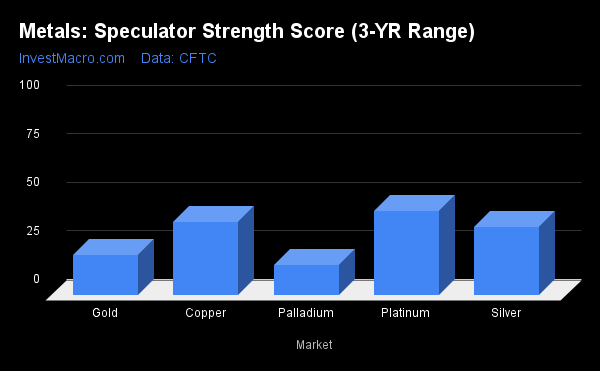
Strength scores (a measure of the 3-Year range of Speculator positions, from 0 to 100 where above 80 is extreme bullish and below 20 is extreme bearish) showed that Platinum (30.6 percent) and Copper (30.4 percent) lead the metals category.

On the downside, Gold (4.2 percent) continues to be at the lowest strength level currently and is followed by Palladium (12.8 percent) and Silver (15.8 percent). All three of these markets remain in a bearish extreme position with scores below 20 percent.

Strength Statistics:
Gold (4.2 percent) vs Gold previous week (5.3 percent)
Silver (15.8 percent) vs Silver previous week (14.0 percent)
Copper (30.4 percent) vs Copper previous week (22.9 percent)
Platinum (30.6 percent) vs Platinum previous week (24.4 percent)
Palladium (12.8 percent) vs Palladium previous week (13.6 percent)

Strength Trends topped by Platinum

Strength Score Trends (or move index, calculates the 6-week changes in strength scores) show that Platinum (18.3 percent) leads the past six weeks trends for metals this week. Copper (10.2 percent) and Silver (3.5 percent) fill out the other positive movers in the latest trends data.

Palladium (-4.6 percent) leads the downside trend scores currently while the next market with lower trend scores was Gold (-0.4 percent).

Move Statistics:
Gold (-0.4 percent) vs Gold previous week (-9.7 percent)
Silver (3.5 percent) vs Silver previous week (5.0 percent)
Copper (10.2 percent) vs Copper previous week (1.6 percent)
Platinum (18.3 percent) vs Platinum previous week (17.8 percent)
Palladium (-4.6 percent) vs Palladium previous week (-2.8 percent)


Individual Markets:

Gold Comex Futures:

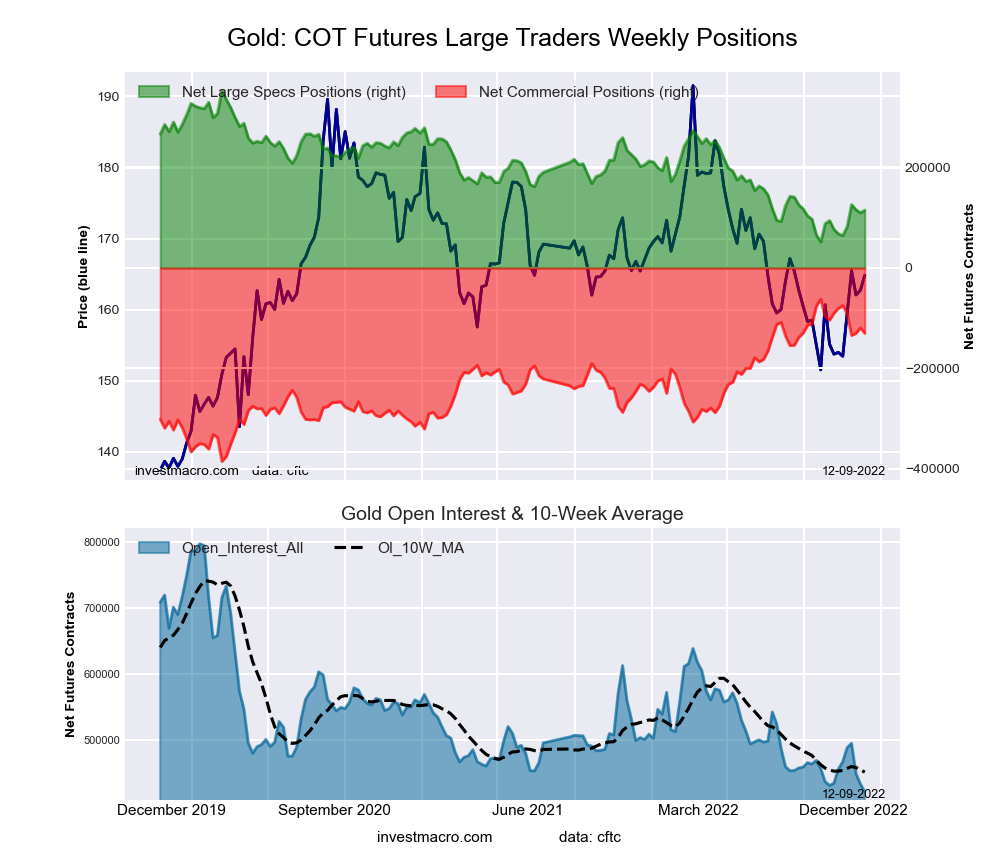
Gold Futures COT ChartThe Gold Comex Futures large speculator standing this week equaled a net position of 64,623 contracts in the data reported through Tuesday. This was a weekly reduction of -3,409 contracts from the previous week which had a total of 68,032 net contracts.

This week’s current strength score (the trader positioning range over the past three years, measured from 0 to 100) shows the speculators are currently Bearish-Extreme with a score of 4.2 percent. The commercials are Bullish-Extreme with a score of 96.1 percent and the small traders (not shown in chart) are Bearish-Extreme with a score of 5.0 percent.

Gold Futures StatisticsSPECULATORSCOMMERCIALSSMALL TRADERS
– Percent of Open Interest Longs:46.326.98.3
– Percent of Open Interest Shorts:32.542.96.1
– Net Position:64,623-74,78210,159
– Gross Longs:216,341125,68938,559
– Gross Shorts:151,718200,47128,400
– Long to Short Ratio:1.4 to 10.6 to 11.4 to 1
NET POSITION TREND:
– Strength Index Score (3 Year Range Pct):4.296.15.0
– Strength Index Reading (3 Year Range):Bearish-ExtremeBullish-ExtremeBearish-Extreme
NET POSITION MOVEMENT INDEX:
– 6-Week Change in Strength Index:-0.40.21.1


Silver Comex Futures:

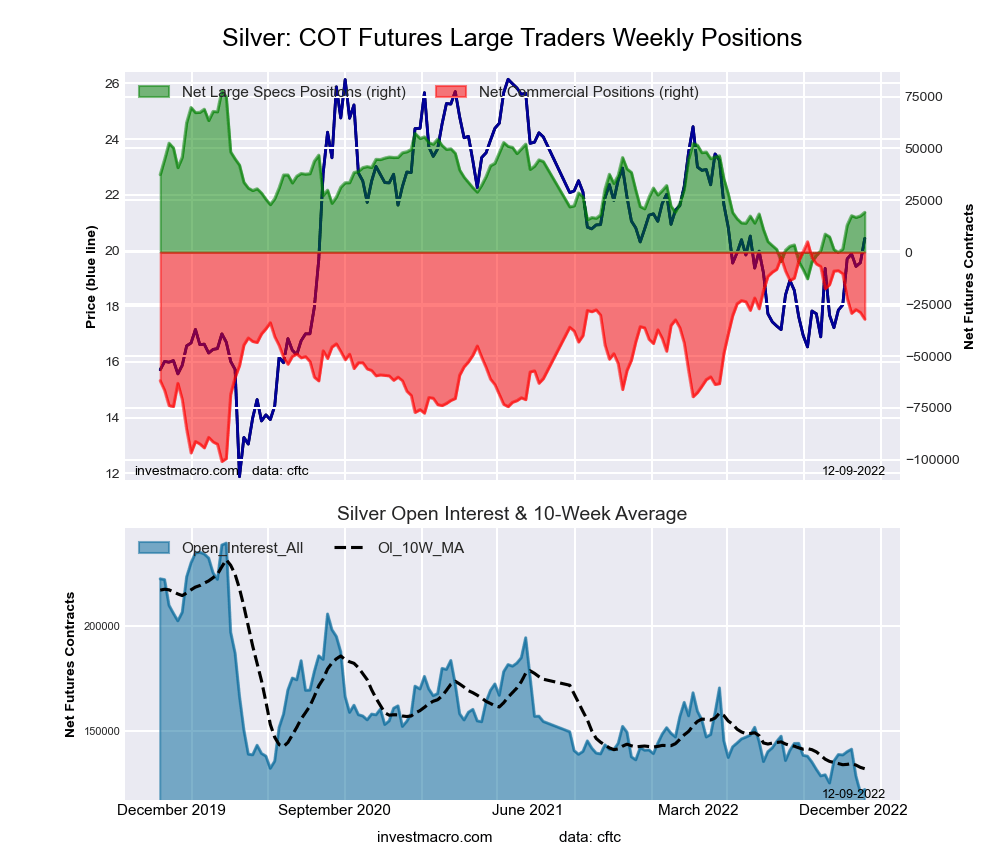
Silver Futures COT ChartThe Silver Comex Futures large speculator standing this week equaled a net position of 1,524 contracts in the data reported through Tuesday. This was a weekly boost of 1,625 contracts from the previous week which had a total of -101 net contracts.

This week’s current strength score (the trader positioning range over the past three years, measured from 0 to 100) shows the speculators are currently Bearish-Extreme with a score of 15.8 percent. The commercials are Bullish-Extreme with a score of 85.4 percent and the small traders (not shown in chart) are Bearish-Extreme with a score of 13.1 percent.

Silver Futures StatisticsSPECULATORSCOMMERCIALSSMALL TRADERS
– Percent of Open Interest Longs:36.937.315.9
– Percent of Open Interest Shorts:35.844.89.5
– Net Position:1,524-10,3638,839
– Gross Longs:51,28651,80222,076
– Gross Shorts:49,76262,16513,237
– Long to Short Ratio:1.0 to 10.8 to 11.7 to 1
NET POSITION TREND:
– Strength Index Score (3 Year Range Pct):15.885.413.1
– Strength Index Reading (3 Year Range):Bearish-ExtremeBullish-ExtremeBearish-Extreme
NET POSITION MOVEMENT INDEX:
– 6-Week Change in Strength Index:3.5-4.57.5


Copper Grade #1 Futures:

Copper Futures COT ChartThe Copper Grade #1 Futures large speculator standing this week equaled a net position of -7,484 contracts in the data reported through Tuesday. This was a weekly lift of 9,435 contracts from the previous week which had a total of -16,919 net contracts.

This week’s current strength score (the trader positioning range over the past three years, measured from 0 to 100) shows the speculators are currently Bearish with a score of 30.4 percent. The commercials are Bullish with a score of 73.2 percent and the small traders (not shown in chart) are Bearish with a score of 22.3 percent.

Copper Futures StatisticsSPECULATORSCOMMERCIALSSMALL TRADERS
– Percent of Open Interest Longs:28.242.57.8
– Percent of Open Interest Shorts:32.438.08.1
– Net Position:-7,4847,998-514
– Gross Longs:50,73876,39414,103
– Gross Shorts:58,22268,39614,617
– Long to Short Ratio:0.9 to 11.1 to 11.0 to 1
NET POSITION TREND:
– Strength Index Score (3 Year Range Pct):30.473.222.3
– Strength Index Reading (3 Year Range):BearishBullishBearish
NET POSITION MOVEMENT INDEX:
– 6-Week Change in Strength Index:10.2-11.814.0


Platinum Futures:

Platinum Futures COT ChartThe Platinum Futures large speculator standing this week equaled a net position of 15,987 contracts in the data reported through Tuesday. This was a weekly gain of 4,606 contracts from the previous week which had a total of 11,381 net contracts.

This week’s current strength score (the trader positioning range over the past three years, measured from 0 to 100) shows the speculators are currently Bearish with a score of 30.6 percent. The commercials are Bullish with a score of 71.2 percent and the small traders (not shown in chart) are Bearish-Extreme with a score of 17.8 percent.

Platinum Futures StatisticsSPECULATORSCOMMERCIALSSMALL TRADERS
– Percent of Open Interest Longs:50.631.912.7
– Percent of Open Interest Shorts:22.366.76.1
– Net Position:15,987-19,6903,703
– Gross Longs:28,61118,0417,159
– Gross Shorts:12,62437,7313,456
– Long to Short Ratio:2.3 to 10.5 to 12.1 to 1
NET POSITION TREND:
– Strength Index Score (3 Year Range Pct):30.671.217.8
– Strength Index Reading (3 Year Range):BearishBullishBearish-Extreme
NET POSITION MOVEMENT INDEX:
– 6-Week Change in Strength Index:18.3-17.97.9


Palladium Futures:

Palladium Futures COT ChartThe Palladium Futures large speculator standing this week equaled a net position of -1,867 contracts in the data reported through Tuesday. This was a weekly decline of -122 contracts from the previous week which had a total of -1,745 net contracts.

This week’s current strength score (the trader positioning range over the past three years, measured from 0 to 100) shows the speculators are currently Bearish-Extreme with a score of 12.8 percent. The commercials are Bullish-Extreme with a score of 86.8 percent and the small traders (not shown in chart) are Bearish with a score of 20.4 percent.

Palladium Futures StatisticsSPECULATORSCOMMERCIALSSMALL TRADERS
– Percent of Open Interest Longs:22.854.113.6
– Percent of Open Interest Shorts:45.127.617.9
– Net Position:-1,8672,221-354
– Gross Longs:1,9064,5321,141
– Gross Shorts:3,7732,3111,495
– Long to Short Ratio:0.5 to 12.0 to 10.8 to 1
NET POSITION TREND:
– Strength Index Score (3 Year Range Pct):12.886.820.4
– Strength Index Reading (3 Year Range):Bearish-ExtremeBullish-ExtremeBearish
NET POSITION MOVEMENT INDEX:
– 6-Week Change in Strength Index:-4.65.5-10.5


Article By InvestMacroReceive our weekly COT Newsletter

*COT Report: The COT data, released weekly to the public each Friday, is updated through the most recent Tuesday (data is 3 days old) and shows a quick view of how large speculators or non-commercials (for-profit traders) were positioned in the futures markets.

The CFTC categorizes trader positions according to commercial hedgers (traders who use futures contracts for hedging as part of the business), non-commercials (large traders who speculate to realize trading profits) and nonreportable traders (usually small traders/speculators) as well as their open interest (contracts open in the market at time of reporting). See CFTC criteria here.

COT Bonds Speculators drop their 2-Year Bond bets to record low level

By InvestMacro

Here are the latest charts and statistics for the Commitment of Traders (COT) reports data published by the Commodities Futures Trading Commission (CFTC).

The latest COT data is updated through Tuesday November 1st and shows a quick view of how large traders (for-profit speculators and commercial hedgers) were positioned in the futures markets.

Weekly Speculator Changes led lower by Fed Funds, 2-Year & 5-Year

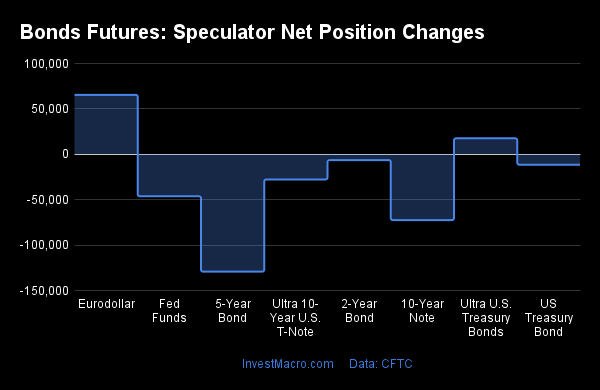
The COT bond market speculator bets were lower across the board this week as all eight of the bond markets we cover had lower positioning this week.

The bond markets leading the weekly declines in speculator bets this week were the Fed Funds (-89,356 contracts), the 2-Year Bond (-88,189 contracts) and the 5-Year Bond (-75,242 contracts) with the Eurodollar (-54,038 contracts), the 10-Year Bond (-50,568 contracts), the Ultra US Bond (-37,144 contracts), the Long US Bond (-18,746 contracts) and the Ultra 10-Year (-4,085 contracts) also registering lower bets on the week.

Highlighting the COT bonds data this week is the historic weakness of the 2-Year Bond speculators positioning. Large speculators dropped their bets this week for a second straight week and by the largest weekly amount since May with this week’s decline numbering -88,189 contracts. The sentiment drop has now brought the overall 2-Year Bond speculator standing to its lowest level on record at a total of -437,785 contracts, eclipsing the previous record low of -417,237 contracts registered on December 11th of 2018.

The bond markets overall were on the defensive this week as the US Federal Reserve raised their benchmark interest rate by 75 basis points for the fourth straight meeting. The 2-Year Bond, being near the short end of the yield curve, is especially sensitive to the rate change. The 2-Year front month futures price decreased to the lowest level since 2007 this week while the yield for the 2-Year hit above 5 percent (yields rise as prices fall), the highest threshold since 2007 as well.


Data Snapshot of Bond Market Traders | Columns Legend
Nov-01-2022OIOI-IndexSpec-NetSpec-IndexCom-NetCOM-IndexSmalls-NetSmalls-Index
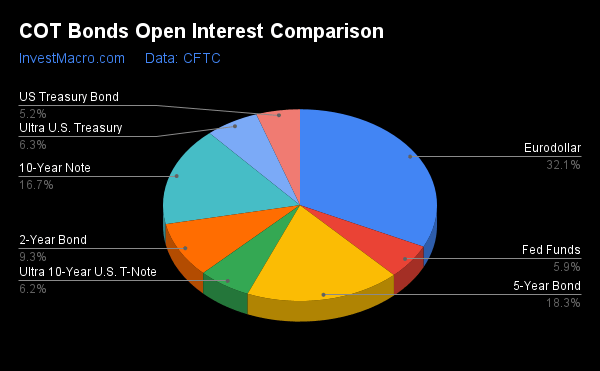
Eurodollar7,921,8650-1,950,696172,217,45781-266,76146
FedFunds1,364,70332-17,0053830,79664-13,79125
2-Year2,234,14820-437,7850464,387100-26,60240
Long T-Bond1,193,68742-95,3055464,9063430,39977
10-Year3,952,20561-298,31627343,55463-45,23869
5-Year4,140,76059-536,9874629,89790-92,91056


Strength Scores led by US Treasury Bond

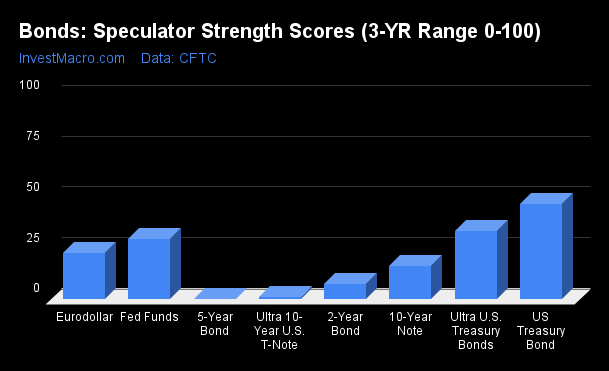
Strength Scores (a normalized measure of Speculator positions over a 3-Year range, from 0 to 100 where above 80 is extreme bullish and below 20 is extreme bearish) show that the US Treasury Bond (53.6 percent) leads the bonds category this week. The Fed Funds (37.5 percent) comes in as the next highest bonds market in strength scores but is down from 48.6 percent from last week.

On the downside, the 2-Year Bond (0.0 percent) comes in at the lowest strength level currently and is followed by the 5-Year Bond (4.3 percent), the Ultra 10-Year Bond (7.1 percent) and the Eurodollar (17.2 percent). All four of these markets currently are in bearish extreme positioning compared to the past three years of speculator positions with scores below 20 percent.

Strength Statistics:
Fed Funds (37.5 percent) vs Fed Funds previous week (48.6 percent)
2-Year Bond (0.0 percent) vs 2-Year Bond previous week (16.8 percent)
5-Year Bond (4.3 percent) vs 5-Year Bond previous week (15.7 percent)
10-Year Bond (27.1 percent) vs 10-Year Bond previous week (34.8 percent)
Ultra 10-Year Bond (7.1 percent) vs Ultra 10-Year Bond previous week (8.2 percent)
US Treasury Bond (53.6 percent) vs US Treasury Bond previous week (59.7 percent)
Ultra US Treasury Bond (26.9 percent) vs Ultra US Treasury Bond previous week (42.0 percent)
Eurodollar (17.2 percent) vs Eurodollar previous week (18.2 percent)

Eurodollar & US Treasury Bond show positive Strength Trends

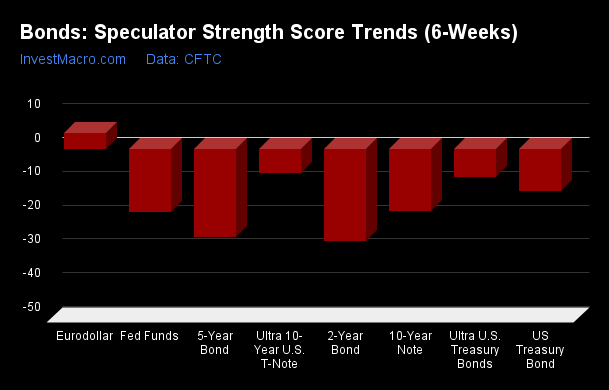
Strength Score Trends (or move index, calculates the 6-week changes in strength scores) show that the Eurodollar (5.0 percent) leads the past six weeks trends for bonds this week. The US Treasury Bond (1.4 percent) is the only other positive mover in the latest trends data.

The 2-Year Bond (-18.1 percent) leads the downside trend scores currently followed by the Ultra 10-Year Bond (-14.2 percent), 10-Year Bond (-10.4 percent), the Ultra US Treasury Bond (-9.1 percent) and the 5-Year Bond (-6.5 percent).

Strength Trend Statistics:
Fed Funds (-5.1 percent) vs Fed Funds previous week (3.0 percent)
2-Year Bond (-18.1 percent) vs 2-Year Bond previous week (1.6 percent)
5-Year Bond (-6.5 percent) vs 5-Year Bond previous week (9.0 percent)
10-Year Bond (-10.4 percent) vs 10-Year Bond previous week (16.0 percent)
Ultra 10-Year Bond (-14.2 percent) vs Ultra 10-Year Bond previous week (-18.9 percent)
US Treasury Bond (1.4 percent) vs US Treasury Bond previous week (6.0 percent)
Ultra US Treasury Bond (-9.1 percent) vs Ultra US Treasury Bond previous week (-1.8 percent)
Eurodollar (5.0 percent) vs Eurodollar previous week (18.1 percent)


Individual Bond Markets:

3-Month Eurodollars Futures:

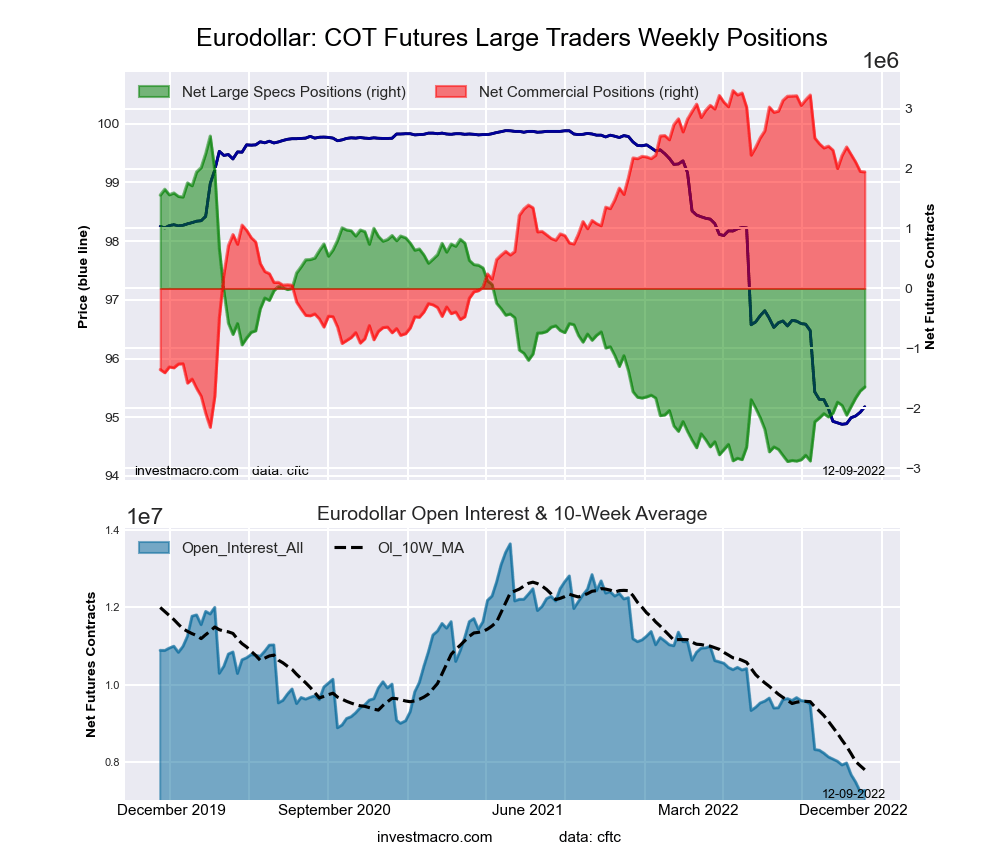
Eurodollar Bonds Futures COT ChartThe 3-Month Eurodollars large speculator standing this week reached a net position of -1,950,696 contracts in the data reported through Tuesday. This was a weekly reduction of -54,038 contracts from the previous week which had a total of -1,896,658 net contracts.

This week’s current strength score (the trader positioning range over the past three years, measured from 0 to 100) shows the speculators are currently Bearish-Extreme with a score of 17.2 percent. The commercials are Bullish-Extreme with a score of 80.7 percent and the small traders (not shown in chart) are Bearish with a score of 45.7 percent.

3-Month Eurodollars StatisticsSPECULATORSCOMMERCIALSSMALL TRADERS
– Percent of Open Interest Longs:7.467.74.7
– Percent of Open Interest Shorts:32.139.78.1
– Net Position:-1,950,6962,217,457-266,761
– Gross Longs:589,4715,361,762371,189
– Gross Shorts:2,540,1673,144,305637,950
– Long to Short Ratio:0.2 to 11.7 to 10.6 to 1
NET POSITION TREND:
– Strength Index Score (3 Year Range Pct):17.280.745.7
– Strength Index Reading (3 Year Range):Bearish-ExtremeBullish-ExtremeBearish
NET POSITION MOVEMENT INDEX:
– 6-Week Change in Strength Index:5.0-5.24.3


30-Day Federal Funds Futures:

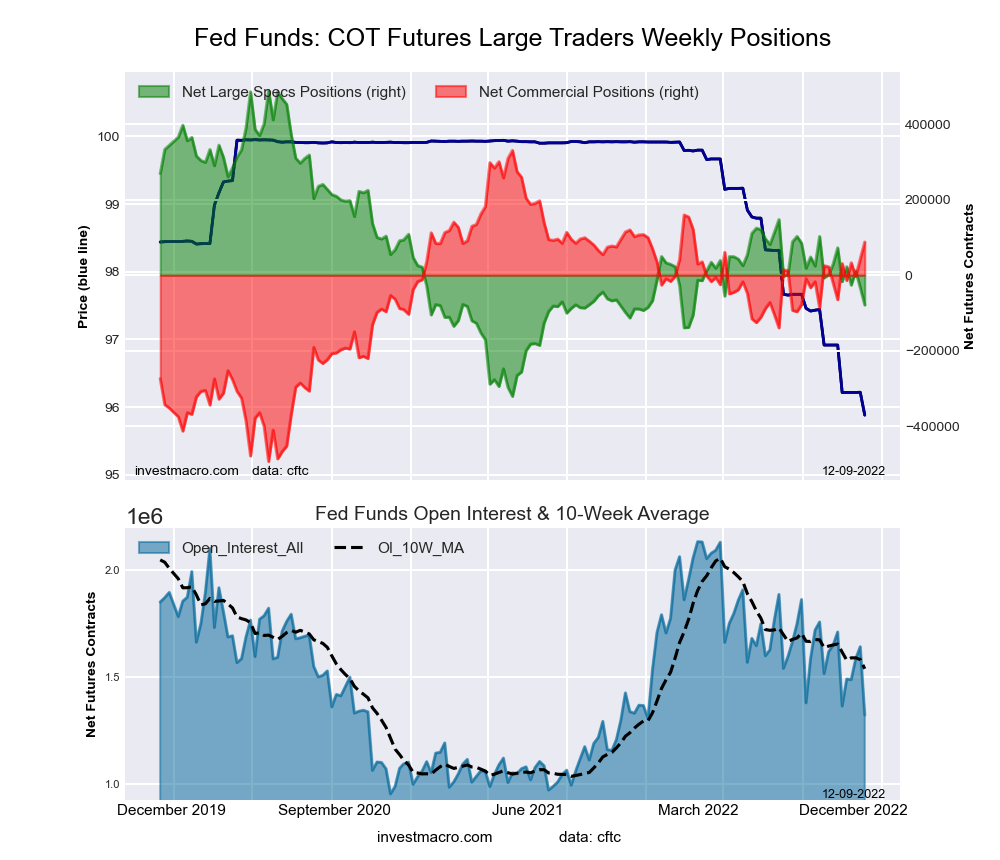
Federal Funds 30-Day Bonds Futures COT ChartThe 30-Day Federal Funds large speculator standing this week reached a net position of -17,005 contracts in the data reported through Tuesday. This was a weekly decline of -89,356 contracts from the previous week which had a total of 72,351 net contracts.

This week’s current strength score (the trader positioning range over the past three years, measured from 0 to 100) shows the speculators are currently Bearish with a score of 37.5 percent. The commercials are Bullish with a score of 63.6 percent and the small traders (not shown in chart) are Bearish with a score of 24.5 percent.

30-Day Federal Funds StatisticsSPECULATORSCOMMERCIALSSMALL TRADERS
– Percent of Open Interest Longs:10.373.51.8
– Percent of Open Interest Shorts:11.671.22.8
– Net Position:-17,00530,796-13,791
– Gross Longs:140,9201,002,68925,091
– Gross Shorts:157,925971,89338,882
– Long to Short Ratio:0.9 to 11.0 to 10.6 to 1
NET POSITION TREND:
– Strength Index Score (3 Year Range Pct):37.563.624.5
– Strength Index Reading (3 Year Range):BearishBullishBearish
NET POSITION MOVEMENT INDEX:
– 6-Week Change in Strength Index:-5.15.8-17.6


2-Year Treasury Note Futures:

2-Year Treasury Bonds Futures COT ChartThe 2-Year Treasury Note large speculator standing this week reached a net position of -437,785 contracts in the data reported through Tuesday. This was a weekly decline of -88,189 contracts from the previous week which had a total of -349,596 net contracts.

This week’s current strength score (the trader positioning range over the past three years, measured from 0 to 100) shows the speculators are currently Bearish-Extreme with a score of 0.0 percent. The commercials are Bullish-Extreme with a score of 100.0 percent and the small traders (not shown in chart) are Bearish with a score of 40.2 percent.

2-Year Treasury Note StatisticsSPECULATORSCOMMERCIALSSMALL TRADERS
– Percent of Open Interest Longs:7.482.07.6
– Percent of Open Interest Shorts:27.061.28.8
– Net Position:-437,785464,387-26,602
– Gross Longs:164,9821,831,669169,031
– Gross Shorts:602,7671,367,282195,633
– Long to Short Ratio:0.3 to 11.3 to 10.9 to 1
NET POSITION TREND:
– Strength Index Score (3 Year Range Pct):0.0100.040.2
– Strength Index Reading (3 Year Range):Bearish-ExtremeBullish-ExtremeBearish
NET POSITION MOVEMENT INDEX:
– 6-Week Change in Strength Index:-18.14.930.9


5-Year Treasury Note Futures:

5-Year Treasury Bonds Futures COT ChartThe 5-Year Treasury Note large speculator standing this week reached a net position of -536,987 contracts in the data reported through Tuesday. This was a weekly decrease of -75,242 contracts from the previous week which had a total of -461,745 net contracts.

This week’s current strength score (the trader positioning range over the past three years, measured from 0 to 100) shows the speculators are currently Bearish-Extreme with a score of 4.3 percent. The commercials are Bullish-Extreme with a score of 90.1 percent and the small traders (not shown in chart) are Bullish with a score of 55.5 percent.

5-Year Treasury Note StatisticsSPECULATORSCOMMERCIALSSMALL TRADERS
– Percent of Open Interest Longs:5.186.07.6
– Percent of Open Interest Shorts:18.170.89.8
– Net Position:-536,987629,897-92,910
– Gross Longs:213,1793,559,701313,942
– Gross Shorts:750,1662,929,804406,852
– Long to Short Ratio:0.3 to 11.2 to 10.8 to 1
NET POSITION TREND:
– Strength Index Score (3 Year Range Pct):4.390.155.5
– Strength Index Reading (3 Year Range):Bearish-ExtremeBullish-ExtremeBullish
NET POSITION MOVEMENT INDEX:
– 6-Week Change in Strength Index:-6.5-1.214.5


10-Year Treasury Note Futures:

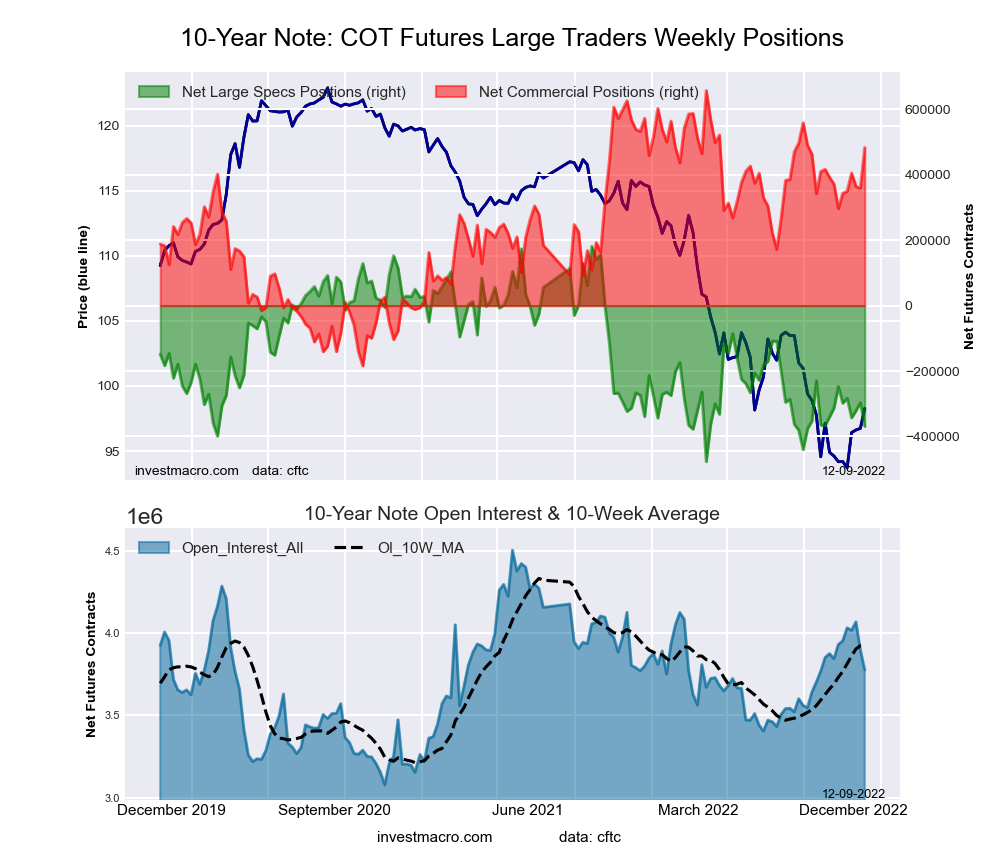
10-Year Treasury Notes Bonds Futures COT ChartThe 10-Year Treasury Note large speculator standing this week reached a net position of -298,316 contracts in the data reported through Tuesday. This was a weekly fall of -50,568 contracts from the previous week which had a total of -247,748 net contracts.

This week’s current strength score (the trader positioning range over the past three years, measured from 0 to 100) shows the speculators are currently Bearish with a score of 27.1 percent. The commercials are Bullish with a score of 62.7 percent and the small traders (not shown in chart) are Bullish with a score of 69.3 percent.

10-Year Treasury Note StatisticsSPECULATORSCOMMERCIALSSMALL TRADERS
– Percent of Open Interest Longs:11.976.59.1
– Percent of Open Interest Shorts:19.567.810.2
– Net Position:-298,316343,554-45,238
– Gross Longs:471,1663,021,952357,967
– Gross Shorts:769,4822,678,398403,205
– Long to Short Ratio:0.6 to 11.1 to 10.9 to 1
NET POSITION TREND:
– Strength Index Score (3 Year Range Pct):27.162.769.3
– Strength Index Reading (3 Year Range):BearishBullishBullish
NET POSITION MOVEMENT INDEX:
– 6-Week Change in Strength Index:-10.40.116.0


Ultra 10-Year Notes Futures:

Ultra 10-Year Treasury Notes Bonds Futures COT ChartThe Ultra 10-Year Notes large speculator standing this week reached a net position of -83,431 contracts in the data reported through Tuesday. This was a weekly decline of -4,085 contracts from the previous week which had a total of -79,346 net contracts.

This week’s current strength score (the trader positioning range over the past three years, measured from 0 to 100) shows the speculators are currently Bearish-Extreme with a score of 7.1 percent. The commercials are Bullish-Extreme with a score of 81.6 percent and the small traders (not shown in chart) are Bullish with a score of 75.4 percent.

Ultra 10-Year Notes StatisticsSPECULATORSCOMMERCIALSSMALL TRADERS
– Percent of Open Interest Longs:7.980.411.0
– Percent of Open Interest Shorts:13.968.816.6
– Net Position:-83,431161,124-77,693
– Gross Longs:109,5131,118,917153,574
– Gross Shorts:192,944957,793231,267
– Long to Short Ratio:0.6 to 11.2 to 10.7 to 1
NET POSITION TREND:
– Strength Index Score (3 Year Range Pct):7.181.675.4
– Strength Index Reading (3 Year Range):Bearish-ExtremeBullish-ExtremeBullish
NET POSITION MOVEMENT INDEX:
– 6-Week Change in Strength Index:-14.22.330.2


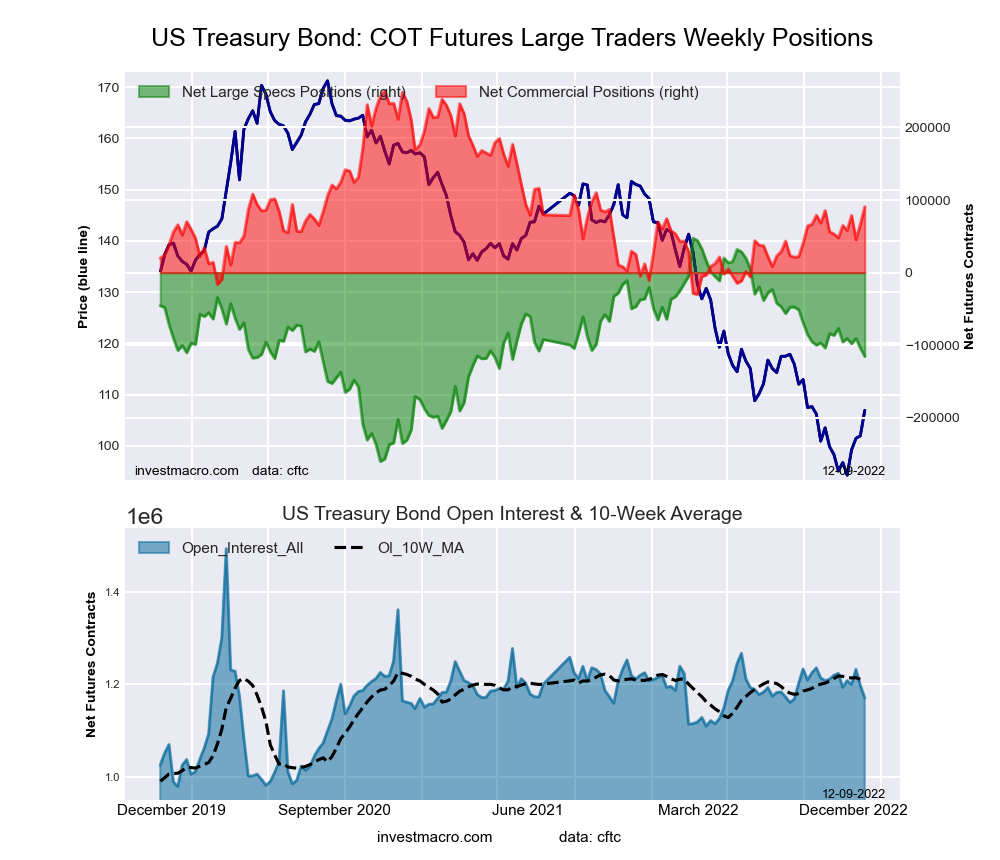
US Treasury Bonds Futures:

US Year Treasury Notes Long Bonds Futures COT ChartThe US Treasury Bonds large speculator standing this week reached a net position of -95,305 contracts in the data reported through Tuesday. This was a weekly lowering of -18,746 contracts from the previous week which had a total of -76,559 net contracts.

This week’s current strength score (the trader positioning range over the past three years, measured from 0 to 100) shows the speculators are currently Bullish with a score of 53.6 percent. The commercials are Bearish with a score of 33.8 percent and the small traders (not shown in chart) are Bullish with a score of 76.7 percent.

US Treasury Bonds StatisticsSPECULATORSCOMMERCIALSSMALL TRADERS
– Percent of Open Interest Longs:5.679.214.3
– Percent of Open Interest Shorts:13.673.711.7
– Net Position:-95,30564,90630,399
– Gross Longs:67,408945,230170,536
– Gross Shorts:162,713880,324140,137
– Long to Short Ratio:0.4 to 11.1 to 11.2 to 1
NET POSITION TREND:
– Strength Index Score (3 Year Range Pct):53.633.876.7
– Strength Index Reading (3 Year Range):BullishBearishBullish
NET POSITION MOVEMENT INDEX:
– 6-Week Change in Strength Index:1.4-5.07.8


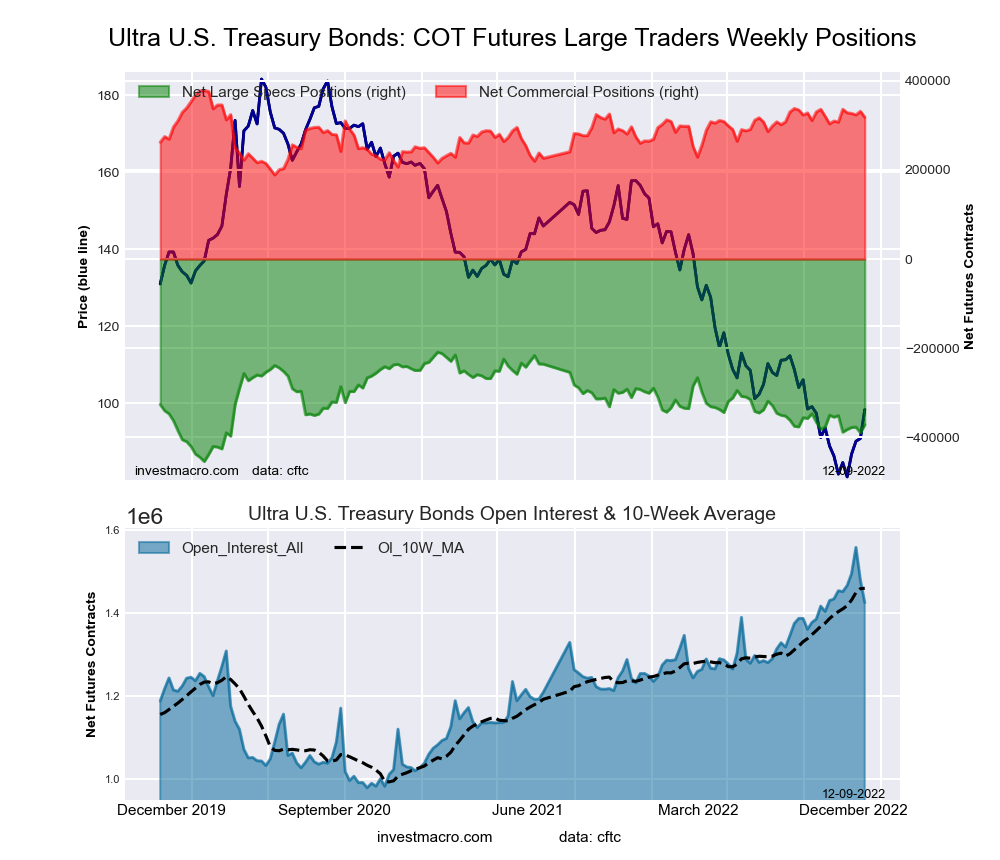
Ultra US Treasury Bonds Futures:

Ultra US Year Treasury Notes Long Bonds Futures COT ChartThe Ultra US Treasury Bonds large speculator standing this week reached a net position of -388,166 contracts in the data reported through Tuesday. This was a weekly lowering of -37,144 contracts from the previous week which had a total of -351,022 net contracts.

This week’s current strength score (the trader positioning range over the past three years, measured from 0 to 100) shows the speculators are currently Bearish with a score of 26.9 percent. The commercials are Bullish with a score of 77.8 percent and the small traders (not shown in chart) are Bullish with a score of 74.7 percent.

Ultra US Treasury Bonds StatisticsSPECULATORSCOMMERCIALSSMALL TRADERS
– Percent of Open Interest Longs:5.982.611.4
– Percent of Open Interest Shorts:32.759.47.8
– Net Position:-388,166335,89252,274
– Gross Longs:85,6811,198,023165,861
– Gross Shorts:473,847862,131113,587
– Long to Short Ratio:0.2 to 11.4 to 11.5 to 1
NET POSITION TREND:
– Strength Index Score (3 Year Range Pct):26.977.874.7
– Strength Index Reading (3 Year Range):BearishBullishBullish
NET POSITION MOVEMENT INDEX:
– 6-Week Change in Strength Index:-9.13.013.5


Article By InvestMacroReceive our weekly COT Newsletter

*COT Report: The COT data, released weekly to the public each Friday, is updated through the most recent Tuesday (data is 3 days old) and shows a quick view of how large speculators or non-commercials (for-profit traders) were positioned in the futures markets.

The CFTC categorizes trader positions according to commercial hedgers (traders who use futures contracts for hedging as part of the business), non-commercials (large traders who speculate to realize trading profits) and nonreportable traders (usually small traders/speculators) as well as their open interest (contracts open in the market at time of reporting). See CFTC criteria here.

Fed faces twin threats of recession and financial crisis as its inflation fight raises risks of both

By D. Brian Blank, Mississippi State University 

There is wide agreement among economists and market observers that the Federal Reserve’s aggressive interest rate hikes will cause economic growth to grind to a halt, leading to a recession. Less talked about is the risk of a financial crisis as the U.S. central bank simultaneously tries to shrink its massive balance sheet.

As expected, the Fed on Nov. 2, 2022, lifted borrowing costs by 0.75 percentage pointits fourth straight hike of that size, which brings its benchmark rate to as high as 4%.

At the same time as it’s been raising rates, the Fed has been quietly trimming down its balance sheet, which swelled after the COVID-19 pandemic began in 2020. It reached a high of US$9 trillion in April 2022 and has since declined by about $240 billion as the Fed reduces its holdings of Treasury securities and other debt that it bought to avoid an economic meltdown early in the pandemic.

As a finance expert, I have been studying financial decisions and markets for over a decade. I’m already seeing signs of distress that could snowball into a financial crisis, compounding the Fed’s woes as it struggles to contain soaring inflation.

Fed balance sheet basics

As part of its mandate, the Federal Reserve maintains a balance sheet, which includes securities, such as bonds, as well as other instruments it uses to pump money into the economy and support financial institutions.

The balance sheet has grown substantially over the last two decades as the Fed began experimenting in 2008 with a policy known as quantitative easing – in essence, printing money – to buy debt to help support financial markets that were in turmoil. The Fed again expanded its balance sheet drastically in 2020 to provide support, or liquidity, to banks and other financial institutions so the financial system didn’t run short on cash. Liquidity refers to the efficiency with which a security can be converted into cash without affecting the price.

But in March 2022, the Fed switched gears. It stopped purchasing new securities and began reducing its holdings of debt in a policy known as quantitative tightening. The current balance is $8.7 trillion, two-thirds of which are Treasury securities issued by the U.S. government.

The result is that there is one less buyer in the $24 trillion treasury market, one of the largest and most important markets in the world. And that means less liquidity.

Loss of liquidity

Markets work best when there’s plenty of liquidity. But when it dries up, that’s when financial crises happen, with investors having trouble selling securities or other assets. This can lead to a fire sale of financial assets and plunging prices.

Treasury markets have been unusually volatile this year – resulting in the biggest
losses in decades – as prices drop and yields shoot up. This is partly due to the Fed rate hikes, but another factor is the sharp loss of liquidity as the central bank pares its balance sheet. A drop in liquidity increases risks for investors, who then demand higher returns for financial assets. This leads to lower prices.

The loss of liquidity not only adds additional uncertainty into markets but could also destabilize financial markets. For example, the most recent quantitative tightening cycle, in 2019, led to a crisis in overnight lending markets, which are used by banks and other financial institutions to lend each other money for very short periods.

Given the sheer size of the Treasury market, problems there are likely to leak into virtually every other market in the world. This could start with money market funds, which are held as low-risk investments for individuals. Since these investments are considered risk-free, any possible risk has substantial consequences – as happened in 2008 and 2020.

Other markets are also directly affected since the Fed holds more than just Treasuries. It also holds mortgages, which means its balance sheet reduction could hurt liquidity in that market too. Quantitative tightening also decreases bank reserves in the financial system, which is another manner in which financial stability could be threatened and increase the risk of a crisis.

The last time the Fed tried to reduce its balance sheet, it caused what was known as a “taper tantrum” as debt investors reacted by selling bonds, causing bond yields to rise sharply, and forced the central bank to reverse course. The long and short of it is that if the Fed continues to reduce its holdings, it could stack a financial crisis on top of a recession, which could lead to unforeseen problems for the U.S. economy – and economies around the globe.

A two-front war

For the moment, Fed Chair Jerome Powell has said he believes markets are handling its balance sheet rundown effectively. And on Nov. 2, the Fed said it would continue reducing its balance sheet – to the tune of about $1.1 trillion a year.

Obviously, not everyone agrees, including the U.S. Treasury, which said that the lower liquidity is raising government borrowing costs.

The risks of a major crisis will only grow as the U.S. economy continues to slow as a result of the rate hikes. While the fight against inflation is hard enough, the Fed may soon have a two-front war on its hands.The Conversation

About the Author:

D. Brian Blank, Assistant Professor of Finance, Mississippi State University

This article is republished from The Conversation under a Creative Commons license. Read the original article.

What did the Fed say?

By ForexTime 

In our Daily Market Analysis, we often allude to the US Federal Reserve being the most influential central bank in the world.

And if we ever needed a reminder, just consider the wild price action across asset classes surrounding the Fed’s latest policy clues delivered overnight.

To illustrate, the following chart shows the wild gyrations recently in the DXY (the benchmark index used to measure the US dollar’s performance versus a select few major G10 currencies = EUR, JPY, GBP, CAD, SEK, and CHF):


Markets were clearly whipsawed as they reacted to the latest FOMC policy statement as well as Fed Chair Jerome Powell’s commentary.

What did the Fed do and say on Wednesday (Nov 2)?

As widely expected, the FOMC decided with yet another 75-basis point (bps) hike, marking its fourth-consecutive move of such a jumbo-sized hike.

NOTE: The FOMC is the 12-person group within the Fed that actually votes on monetary policy (i.e. what moves to make in order to help the central bank achieve its economic goals pertaining to inflation and the jobs market).

BUT, the FOMC’s latest policy statement also included this new sentence …

In determining the pace of future increases in the target range, the Committee will take into account the cumulative tightening of monetary policy, the lags with which monetary policy affects economic activity and inflation, and economic and financial developments.”

In simpler words, markets interpreted this to mean that the Fed is entering into the final phase of its rate hikes that have been ongoing since March.

As markets initially took this to be a relatively “dovish” statement:

  • The USD weakened …
  • Gold bounced higher …
  • The S&P 500 (benchmark index measuring overall performance of US stocks) also climbed

Then … Ka-Pow(ell).

Half an hour after the FOMC statement was released, Fed Chair Jerome Powell began addressing the media and the rest of the watching world (including yours truly) during his scheduled press conference.

Powell quickly quashed any notion that the Fed is ready for the so-called “pivot”.

What is the “Fed pivot”?

This is the idea that the Fed is close to being done with its rate hikes and could make a u-turn and start lowering interest rates in 2023.

3 takeaways from Powell

Powell pushed back against this “pivot” narrative by emphasizing these 3 key points:

  1. The Fed still has “a ways to go” and still has “some ground to cover” before the rate hikes are over.
  2. “It is very premature to be thinking about pausing” (although Powell did leave the door open for smaller-than-75bps hikes for the December meeting and beyond).
  3. The risk of not raising interest rates high enough to combat inflation is far greater than doing too many rate hikes.

    With the latter, should the Fed send the US economy into a deep recession, the Fed has proven its ability to help restore the economy as the US central bank did during the pandemic.

Markets then duly ramped up their expected peak for US interest rates to 5.17% by May 2023, higher than the prior forecasts at the start of this week for a 4.8% peak by March.

As a result, spot gold and the S&P 500 swiftly unwound its knee-jerk gains and stumbled substantially lower.


Going into 2023, what does all this mean for:

  • EURUSD: The US dollar is set to remain at these elevated levels going into next year. On the other side of the world’s most-popular FX pair, the euro currency is beset by the economic woes for the Eurozone.

    In other words, the USD should have an easier path climbing higher then falling lower, and should at least be maintained at current levels. That should make it harder for other major currencies to embark on a significant recovery versus the greenback anytime soon.

    According to models, from current levels:

  • EURUSD has a 68% chance of touching 0.95 by Q1 2023
  • EURUSD has a mere 10.6% chance of touching 1.10 by Q1 2023
  • Gold: The precious metal is expected to remain suppressed.

    ​​After all, spot gold’s 11.5% year-to-date drop (at the time of writing) has been primarily due to its year-long nemesis of rising US interest rates.

    According to models, from current levels:

  • XAUUSD has a 48% chance of touching $1550 before 31 December 2022.
  • XAUUSD has a relatively lower chance of 25.5% of touching $1750 by year-end.

To be clear, the Fed’s ongoing rate hikes are having a major impact across other major asset classes as well.

US stocks are unlikely to stage a sustained recovery until markets know for certain when the Fed is done (or close to being done) with its rate hikes. Even Chair Powell himself confessed that he himself doesn’t know where or when US rates will reach its peak.

Key things to look out for in deciphering the path forward for US interest rates:

  • November 4 (tomorrow): October nonfarm payrolls (NFP a.k.a jobs report)
  • November 10: October consumer price index (CPI a.k.a. inflation)
  • December 2: November NFP
  • December 13: November CPI
  • December 14: next FOMC meeting

Recall that the Fed’s two main goals pertain to inflation and the US jobs market.

Hence, the Fed wants to see US inflation come down, perhaps by way of a softer (or weaker) hiring in the world’s largest economy.

If the US economic data does reveal signs that the Fed rate hikes are indeed having the intended effect (slower hiring, slowing inflation) that could herald much rejoicing in battered asset classes (think stocks, gold, and even cryptos).

Until then, the guessing game continues for investors, traders, and even Fed officials, as to where the peak for US interest rates lies, with potentially a lot more volatility in the interim.


Forex-Time-LogoArticle by ForexTime
ForexTime Ltd (FXTM) is an award winning international online forex broker regulated by CySEC 185/12 www.forextime.com

Precious Metals Sector Believed To Be Close to Major Uptrend

Source: Clive Maund  (10/31/22)

With the possibility of a Fed pivot looming, expert Clive Maund touches on his views of the precious metals sector and why he believes you should invest in it sooner rather than later.

On the 1-year chart for gold shown below, we can see precisely why it has been in a quite severe downtrend from its peak last March. It is because the dollar and interest rates, shown at the top and bottom of the chart, have been in strong uptrends during this period.

A very important point to note is that while gold has dropped about $400 from its March peak, in real terms, this decline is much more serious because of the robust inflation during this period.

So if the Fed does pivot soon, that is to say, it stops raising rates and starts lowering them, or other Central Banks start raising rates, thus reducing the dollar’s appeal.

It will mean a reversal to the downside in the dollar and to the upside in gold and commodities and risk-on assets generally, and as we saw on Friday 21st, even talk of a pivot is enough to generate a recovery.

Gold

A very important point to note is that while gold has dropped about $400 from its March peak, in real terms, this decline is much more serious because of the robust inflation during this period.

So when you talk about $1600 gold now, it means that in, say, 2019 prices, it’s probably about $1200. This gives us more of an idea about how undervalued gold and especially silver are now. Before leaving this chart, observe that gold may be making a Double Bottom here with its September lows.

The next chart, the 1-year chart for PM sector proxy GDX, is most interesting as it makes plain that, even on a log chart as this is, the downtrend in the sector from its April highs has been decelerating steadily to the point that the MACD indicator has recovered back almost to the zero line.

If this interpretation is correct, then we are at a point of huge opportunity to buy the sector before it breaks out.

This is the sort of behavior that usually precedes a reversal to the upside, so it is not surprising to see that a small Head-and-Shoulders appears to be completed within the downtrend channel, whose validity is endorsed by the bullish volume pattern that has accompanied it, with strong volume on the rise to form the right side of the Head of the pattern and again on the rise late last week as it completes what is believed to be the Right Shoulder of the pattern.

If this interpretation is correct, then we are at a point of huge opportunity to buy the sector before it breaks out.

In the context of the foregoing, it’s useful for us to consider the extent to which the PM sector has markedly underperformed even the frail stock market in recent months.

Silver is regarded as probably the most undervalued asset in the world.

On the 1-year chart for GDX over the S&P500 index, we can see that it has seriously underperformed due, of course, to the strong rise in the dollar and interest rates.

This is important because it means that the PM sector is even better value here compared to the broad market.

Alright, so if we are at or close to a bottom in gold and the PM sector, then we would expect to see the normally wrong Large Specs having Little interest in gold, and that is exactly what we see on the latest COT chart for gold, which shows that they have pretty much given up on it.

This COT chart alone augurs well for a new bull market phase in gold . . .

Silver

What about silver?

On its 1-year chart, we can see that it has dropped back from its March highs for the same reasons that gold has, the strong uptrends in the dollar, and interest rates.

This is looking like a great place to load up on the better gold and silver stocks.

However, since July, a potential base pattern has been building out that is now starting to look like a completing Triple Bottom, and with the steadily uptrending momentum (MACD) now about to swing positive, the outlook is brightening and the strong volume on the rally out of the low in the middle of the month, better seen on a 6-month chart, looks like the beginnings of a rally up towards the resistance at the upper boundary of the pattern.

Silver is regarded as probably the most undervalued asset in the world, and in the dark times that we are headed towards, physical silver is probably the best asset to have in your possession, along with some firearms to make sure that it stays in your possession.

If silver is close to an optimum point to buy, then we would expect to see the dumb Large Specs having no interest in it all, and that is exactly what we see on silver’s latest COT chart, which shows the Large Specs net long positions to be virtually non-existent . . .

It’s useful here to take a quick look at the 5-year chart for the dollar index because, on this chart, we see that it has gone parabolic in recent months, and it’s possible that it just topped out.

Two possible reasons for it to turn and break down that have already been mentioned are a “Fed pivot” and other countries or trading blocs, such as the European Union, following the Fed’s lead and raising rates too.

The U.S. Dollar and British Pound

Just for laughs, let’s take a quick look at the 5-year chart for the British Pound.

It shows that it has been terribly weak, dropping an incredible 40% in less than 18 months . . .

For U.S. readers who’ve always wanted to see the sights in Britain, and have the time and money, now is a good time to vacation there while the exchange rate is good before the Winter.

If you want ideas on what to visit, I can give you a list as long as your arm.

The Risk of a Market Crash

Finally, what about the ongoing risk of an all-out market crash? Would that not drag gold and silver, and PM stocks down even further?

Well, it could, although it may not because, this time, there will be no hiding place for investors in the Treasury market, which is already on the rocks.

So with this option closed off, funk money will probably flee into gold and silver instead. This time round is very different in that the powers that be fully intend to destroy the world economy kill off most of the population, and turn the survivors into cyborg-like slaves, and have made their intentions very clear to anyone with more than a few functioning brain cells.

This would best be achieved by a state of hyperinflation, Venezuela style, that would render the population destitute and totally at the mercy of the State (except for some preppers, who will probably be identified and rounded up anyway).

Following this logic, they will continue to create money to defer the debt market collapse for as long as possible, and the hyperinflation that will result, which we are already close to, must mean an exponential rise in the price of hard assets like gold and silver, with physical being very highly prized and hard to obtain.

The charts that we have reviewed in this update strongly suggest that, whatever the broad market does from here, the PM sector has bottomed out and is going to rally soon. An important article posted by Adam Hamilton a couple of days ago, Gold Stocks’ Winter Rally 7, strongly supports this contention.

Although long, this common sense article presents reasoned arguments based on his many years of experience with this sector and should thus be taken seriously.

Conclusion — This is looking like a great place to load up on the better gold and silver stocks.

CliveMaund.com Disclosures

The above represents the opinion and analysis of Mr. Maund, based on data available to him, at the time of writing. Mr. Maund’s opinions are his own, and are not a recommendation or an offer to buy or sell securities. Mr. Maund is an independent analyst who receives no compensation of any kind from any groups, individuals or corporations mentioned in his reports. As trading and investing in any financial markets may involve serious risk of loss, Mr. Maund recommends that you consult with a qualified investment advisor, one licensed by appropriate regulatory agencies in your legal jurisdiction and do your own due diligence and research when making any kind of a transaction with financial ramifications. Although a qualified and experienced stock market analyst, Clive Maund is not a Registered Securities Advisor. Therefore Mr. Maund’s opinions on the market and stocks can only be construed as a solicitation to buy and sell securities when they are subject to the prior approval and endorsement of a Registered Securities Advisor operating in accordance with the appropriate regulations in your area of jurisdiction.

Disclosures:
1) Statements and opinions expressed are the opinions of Clive Maund and not of Streetwise Reports or its officers. The author is wholly responsible for the validity of the statements. Streetwise Reports was not involved in any aspect of the article preparation. The author was not paid by Streetwise Reports LLC for this article. Streetwise Reports was not paid by the author to publish or syndicate this article.

2) This article does not constitute investment advice. Each reader is encouraged to consult with his or her individual financial professional and any action a reader takes as a result of information presented here is his or her own responsibility. By opening this page, each reader accepts and agrees to Streetwise Reports’ terms of use and full legal disclaimer. This article is not a solicitation for investment. Streetwise Reports does not render general or specific investment advice and the information on Streetwise Reports should not be considered a recommendation to buy or sell any security. Streetwise Reports does not endorse or recommend the business, products, services or securities of any company mentioned on Streetwise Reports.

3) From time to time, Streetwise Reports LLC and its directors, officers, employees or members of their families, as well as persons interviewed for articles and interviews on the site, may have a long or short position in securities mentioned. Directors, officers, employees or members of their immediate families are prohibited from making purchases and/or sales of those securities in the open market or otherwise from the time of the decision to publish an article until three business days after the publication of the article. The foregoing prohibition does not apply to articles that in substance only restate previously published company releases.

Mid-Week Technical Outlook: Major Indices

By ForexTime 

An uneasy calm settled across financial markets ahead of the Federal Reserve’s policy meeting this evening. Equities struggled for direction; the dollar index remained static while gold prices were little changed.

Sentiment in general remains shaky and fragile thanks to concerns over slowing global growth with investors adopting a guarded approach ahead of what could be a volatile event. Markets widely expect the Federal Reserve to raise interest rates by 75bp in November but much attention will be directed towards the press conference which could offer fresh clues into monetary policy.

Our focus this afternoon will be directed toward the global equity arena, especially US indices which remain highly reactive to Fed rate hike expectations.

S&P 500 tangled between MA’s

After failing to secure a daily close above the 100-day SMA, the S&P 500 has the potential to trade lower if the 50-day SMA is breached. A strong breakdown below 3810 could trigger a selloff towards 3760 and 3700, respectively. Should 3810 prove to be reliable support, prices could rebound towards 3945 and 4000. It is worth keeping in mind that the short-term outlook will be influenced by the Fed meeting this evening and the US jobs report on Friday.

Nasdaq trapped below 11650?

It looks like the Nasdaq could gearing up for a selloff. After failing to break above the 11650 resistances, prices have tumbled with bears eyeing the 11037 supports. The Fed rate decision and press conference may influence the Nasdaq’s short-term outlook. Technical levels to watch out for are 11037 and 10716. Given how prices are trading below the 50, 100, and 200 Simple Moving Average – bears still have some power. A strong break under 10716 could signal a selloff towards 10436.

FTSE100 lingers below resistance

Since punching above the 7200-resistance level, prices have struggled to push higher as the 100-day Simple Moving Average offered another line of resistance. Although the FTSE100 has staged a rebound from the 6705 regions, prices still remain in a bearish channel. Should 7200 prove to be a tough nut to crack for bulls, prices could sink back towards 7000. Alternatively, a strong breakout above 7200 may open the doors towards 7340 – a level where the 200-day SMA resides.

EURO STOXX 50 breakout or fakeout?

This index remains in an uptrend on the daily charts as there have been consistently higher highs and higher lows. Prices are trading above the 50 and 100-day SMA but below the 200-day which could offer strong resistance. If bulls lose momentum and secure a solid daily close below 3650, this may trigger a selloff back towards 3550 – a level just above the 100-day SMA. Alternatively, a strong daily close above the 3685 regions could inject bulls with enough confidence to push above the 200-day SMA. Such a development may result in an incline towards 3700, 3770, and 3820, respectively.


Forex-Time-LogoArticle by ForexTime
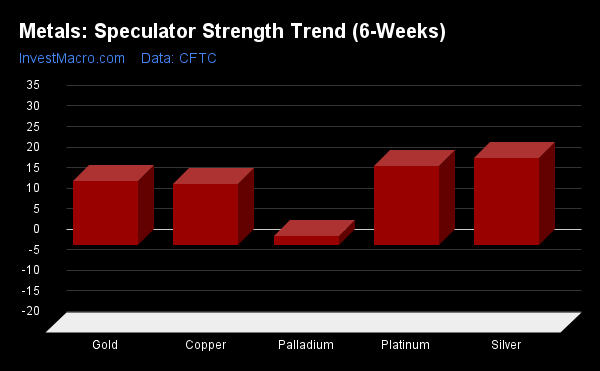
ForexTime Ltd (FXTM) is an award winning international online forex broker regulated by CySEC 185/12 www.forextime.com