Archive for Financial News – Page 56

COT Metals Charts: Weekly Speculator Changes led higher by Gold & Silver

By InvestMacro

Metals Open Interest COT Chart
Here are the latest charts and statistics for the Commitment of Traders (COT) data published by the Commodities Futures Trading Commission (CFTC).

The latest COT data is updated through Tuesday June 3rd and shows a quick view of how large traders (for-profit speculators and commercial entities) were positioned in the futures markets.

Weekly Speculator Changes led higher by Gold & Silver

Metals Net Positions COT Chart
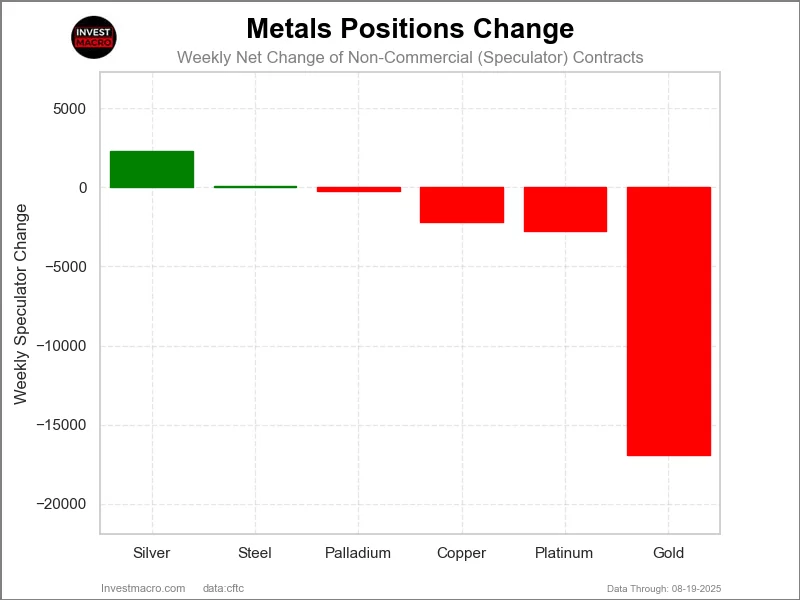
The COT metals markets speculator bets were higher this week as four out of the six metals markets we cover had higher positioning while the other two markets had lower speculator contracts.

Leading the gains for the metals was Gold (13,721 contracts) with Silver (7,758 contracts), Copper (1,513 contracts) and Palladium (233 contracts) having positive weeks.

The markets with declines in speculator bets for the week were Platinum (-5,294 contracts) and with Steel (-1,279 contracts) also registering lower bets on the week.

Gold bets rose this week for the third straight this week after having fallen in the previous four weeks. Currently, the gold speculator bets are up to their highest level in the past seven weeks. Silver bets meanwhile, also rose for the third straight week and they are now at their highest level in the past ten weeks, dating back to March 25th.


Metals Price Performance in last 5-Days:

– Platinum was the big riser with a 10% gain.
– Silver was up by 9%.
– Palladium over 7.5%.
– Copper rose by 3%.
– Gold was up by 0.5%.
– Steel was down by 9% in the last 5 days.
– All of the metals markets have been up by at least 5% or more in the last 90 days, with platinum & gold up by approximately 20% and steel up by almost 20%.


Metals Data:

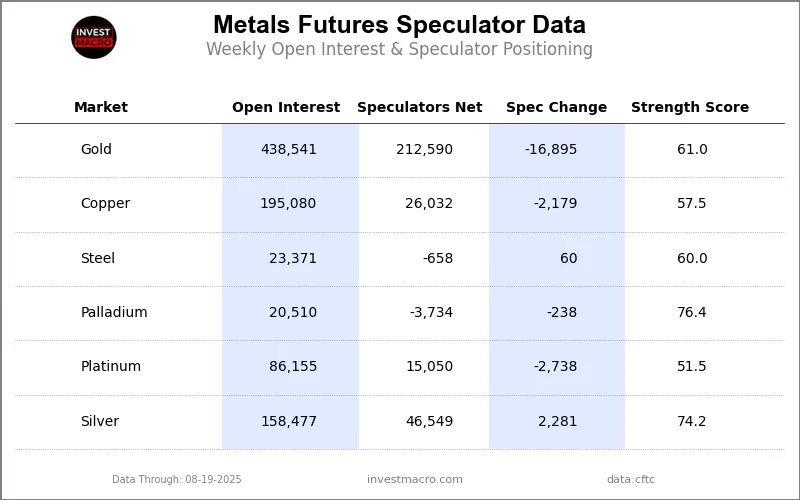
Metals Table COT Chart
Legend: Weekly Speculators Change | Speculators Current Net Position | Speculators Strength Score compared to last 3-Years (0-100 range)


Strength Scores led by Silver

Metals Strength Scores COT Chart

COT Strength Scores (a normalized measure of Speculator positions over a 3-Year range, from 0 to 100 where above 80 is Extreme-Bullish and below 20 is Extreme-Bearish) showed that Silver (93 percent) leads the metals markets this week. Steel (68 percent) and Platinum (63 percent) come in as the next highest in the weekly strength scores.

On the downside, Palladium (50 percent) and Gold (52 percent) come in at the lowest strength level currently.

Strength Statistics:
Gold (51.6 percent) vs Gold previous week (46.4 percent)
Silver (92.9 percent) vs Silver previous week (83.1 percent)
Copper (55.7 percent) vs Copper previous week (54.3 percent)
Platinum (63.4 percent) vs Platinum previous week (75.9 percent)
Palladium (49.7 percent) vs Palladium previous week (48.0 percent)
Steel (67.7 percent) vs Palladium previous week (74.0 percent)


Platinum & Palladium top the 6-Week Strength Trends

Metals Trends COT Chart

COT Strength Score Trends (or move index, calculates the 6-week changes in strength scores) showed that Platinum (34 percent) and Palladium (27 percent) lead the past six weeks trends for metals.

Steel (-13 percent) leads the downside trend scores currently with Copper (-1 percent) as the next market with lower trend scores.

Move Statistics:
Gold (4.8 percent) vs Gold previous week (-10.6 percent)
Silver (20.3 percent) vs Silver previous week (11.5 percent)
Copper (-0.6 percent) vs Copper previous week (2.9 percent)
Platinum (34.0 percent) vs Platinum previous week (45.7 percent)
Palladium (26.7 percent) vs Palladium previous week (18.6 percent)
Steel (-12.9 percent) vs Steel previous week (-8.3 percent)


Individual Markets:

Gold Comex Futures:

Gold Futures COT ChartThe Gold Comex Futures large speculator standing this week came in at a net position of 187,905 contracts in the data reported through Tuesday. This was a weekly lift of 13,721 contracts from the previous week which had a total of 174,184 net contracts.

This week’s current strength score (the trader positioning range over the past three years, measured from 0 to 100) shows the speculators are currently Bullish with a score of 51.6 percent. The commercials are Bearish with a score of 42.8 percent and the small traders (not shown in chart) are Bullish-Extreme with a score of 97.1 percent.

Price Trend-Following Model: Uptrend

Our weekly trend-following model classifies the current market price position as: Uptrend.

Gold Futures StatisticsSPECULATORSCOMMERCIALSSMALL TRADERS
– Percent of Open Interest Longs:59.417.012.5
– Percent of Open Interest Shorts:14.270.14.6
– Net Position:187,905-220,82632,921
– Gross Longs:246,98270,90551,996
– Gross Shorts:59,077291,73119,075
– Long to Short Ratio:4.2 to 10.2 to 12.7 to 1
NET POSITION TREND:
– Strength Index Score (3 Year Range Pct):51.642.897.1
– Strength Index Reading (3 Year Range):BullishBearishBullish-Extreme
NET POSITION MOVEMENT INDEX:
– 6-Week Change in Strength Index:4.8-6.723.5


Silver Comex Futures:

Silver Futures COT ChartThe Silver Comex Futures large speculator standing this week came in at a net position of 60,770 contracts in the data reported through Tuesday. This was a weekly advance of 7,758 contracts from the previous week which had a total of 53,012 net contracts.

This week’s current strength score (the trader positioning range over the past three years, measured from 0 to 100) shows the speculators are currently Bullish-Extreme with a score of 92.9 percent. The commercials are Bearish-Extreme with a score of 6.9 percent and the small traders (not shown in chart) are Bullish with a score of 59.6 percent.

Price Trend-Following Model: Strong Uptrend

Our weekly trend-following model classifies the current market price position as: Strong Uptrend.

Silver Futures StatisticsSPECULATORSCOMMERCIALSSMALL TRADERS
– Percent of Open Interest Longs:50.220.018.3
– Percent of Open Interest Shorts:13.068.57.1
– Net Position:60,770-79,14118,371
– Gross Longs:81,98132,68929,969
– Gross Shorts:21,211111,83011,598
– Long to Short Ratio:3.9 to 10.3 to 12.6 to 1
NET POSITION TREND:
– Strength Index Score (3 Year Range Pct):92.96.959.6
– Strength Index Reading (3 Year Range):Bullish-ExtremeBearish-ExtremeBullish
NET POSITION MOVEMENT INDEX:
– 6-Week Change in Strength Index:20.3-16.3-6.2


Copper Grade #1 Futures:

Copper Futures COT ChartThe Copper Grade #1 Futures large speculator standing this week came in at a net position of 24,094 contracts in the data reported through Tuesday. This was a weekly gain of 1,513 contracts from the previous week which had a total of 22,581 net contracts.

This week’s current strength score (the trader positioning range over the past three years, measured from 0 to 100) shows the speculators are currently Bullish with a score of 55.7 percent. The commercials are Bearish with a score of 47.2 percent and the small traders (not shown in chart) are Bearish with a score of 35.4 percent.

Price Trend-Following Model: Strong Uptrend

Our weekly trend-following model classifies the current market price position as: Strong Uptrend.

Copper Futures StatisticsSPECULATORSCOMMERCIALSSMALL TRADERS
– Percent of Open Interest Longs:33.630.56.9
– Percent of Open Interest Shorts:22.343.35.5
– Net Position:24,094-27,0132,919
– Gross Longs:71,24964,63914,562
– Gross Shorts:47,15591,65211,643
– Long to Short Ratio:1.5 to 10.7 to 11.3 to 1
NET POSITION TREND:
– Strength Index Score (3 Year Range Pct):55.747.235.4
– Strength Index Reading (3 Year Range):BullishBearishBearish
NET POSITION MOVEMENT INDEX:
– 6-Week Change in Strength Index:-0.6-2.924.4


Platinum Futures:

Platinum Futures COT ChartThe Platinum Futures large speculator standing this week came in at a net position of 20,049 contracts in the data reported through Tuesday. This was a weekly decrease of -5,294 contracts from the previous week which had a total of 25,343 net contracts.

This week’s current strength score (the trader positioning range over the past three years, measured from 0 to 100) shows the speculators are currently Bullish with a score of 63.4 percent. The commercials are Bearish with a score of 40.8 percent and the small traders (not shown in chart) are Bearish with a score of 35.3 percent.

Price Trend-Following Model: Strong Uptrend

Our weekly trend-following model classifies the current market price position as: Strong Uptrend.

Platinum Futures StatisticsSPECULATORSCOMMERCIALSSMALL TRADERS
– Percent of Open Interest Longs:62.017.110.9
– Percent of Open Interest Shorts:40.941.57.5
– Net Position:20,049-23,2333,184
– Gross Longs:59,01916,29310,349
– Gross Shorts:38,97039,5267,165
– Long to Short Ratio:1.5 to 10.4 to 11.4 to 1
NET POSITION TREND:
– Strength Index Score (3 Year Range Pct):63.440.835.3
– Strength Index Reading (3 Year Range):BullishBearishBearish
NET POSITION MOVEMENT INDEX:
– 6-Week Change in Strength Index:34.0-26.0-32.1


Palladium Futures:

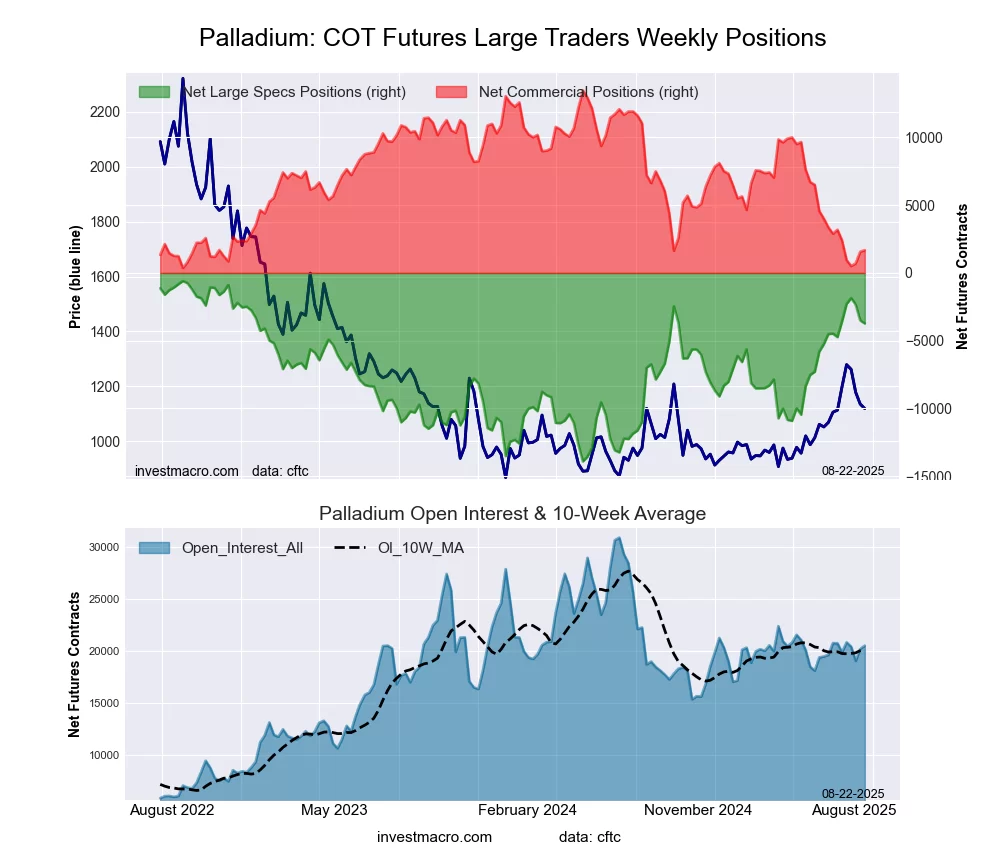
Palladium Futures COT ChartThe Palladium Futures large speculator standing this week came in at a net position of -7,293 contracts in the data reported through Tuesday. This was a weekly lift of 233 contracts from the previous week which had a total of -7,526 net contracts.

This week’s current strength score (the trader positioning range over the past three years, measured from 0 to 100) shows the speculators are currently Bearish with a score of 49.7 percent. The commercials are Bearish with a score of 46.9 percent and the small traders (not shown in chart) are Bullish with a score of 67.3 percent.

Price Trend-Following Model: Strong Uptrend

Our weekly trend-following model classifies the current market price position as: Strong Uptrend.

Palladium Futures StatisticsSPECULATORSCOMMERCIALSSMALL TRADERS
– Percent of Open Interest Longs:36.346.912.9
– Percent of Open Interest Shorts:76.511.08.5
– Net Position:-7,2936,502791
– Gross Longs:6,5708,4982,336
– Gross Shorts:13,8631,9961,545
– Long to Short Ratio:0.5 to 14.3 to 11.5 to 1
NET POSITION TREND:
– Strength Index Score (3 Year Range Pct):49.746.967.3
– Strength Index Reading (3 Year Range):BearishBearishBullish
NET POSITION MOVEMENT INDEX:
– 6-Week Change in Strength Index:26.7-26.0-6.3


Steel Futures Futures:

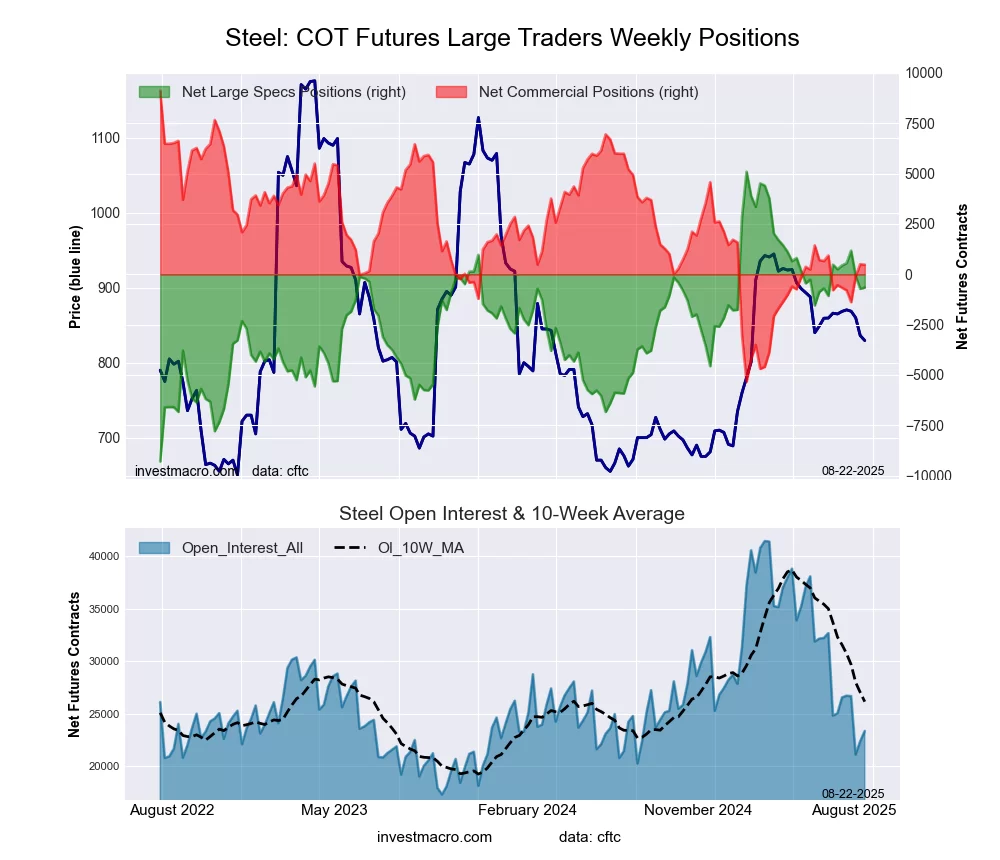
Steel Futures COT ChartThe Steel Futures large speculator standing this week came in at a net position of -1,544 contracts in the data reported through Tuesday. This was a weekly reduction of -1,279 contracts from the previous week which had a total of -265 net contracts.

This week’s current strength score (the trader positioning range over the past three years, measured from 0 to 100) shows the speculators are currently Bullish with a score of 67.7 percent. The commercials are Bearish with a score of 33.1 percent and the small traders (not shown in chart) are Bearish with a score of 49.0 percent.

Price Trend-Following Model: Weak Uptrend

Our weekly trend-following model classifies the current market price position as: Weak Uptrend.

Steel Futures StatisticsSPECULATORSCOMMERCIALSSMALL TRADERS
– Percent of Open Interest Longs:24.269.90.9
– Percent of Open Interest Shorts:29.065.40.5
– Net Position:-1,5441,434110
– Gross Longs:7,69822,265274
– Gross Shorts:9,24220,831164
– Long to Short Ratio:0.8 to 11.1 to 11.7 to 1
NET POSITION TREND:
– Strength Index Score (3 Year Range Pct):67.733.149.0
– Strength Index Reading (3 Year Range):BullishBearishBearish
NET POSITION MOVEMENT INDEX:
– 6-Week Change in Strength Index:-12.912.123.6


Article By InvestMacroReceive our weekly COT Newsletter

*COT Report: The COT data, released weekly to the public each Friday, is updated through the most recent Tuesday (data is 3 days old) and shows a quick view of how large speculators or non-commercials (for-profit traders) were positioned in the futures markets.

The CFTC categorizes trader positions according to commercial hedgers (traders who use futures contracts for hedging as part of the business), non-commercials (large traders who speculate to realize trading profits) and nonreportable traders (usually small traders/speculators) as well as their open interest (contracts open in the market at time of reporting). See CFTC criteria here.

COT Bonds Charts: Speculator Bets led by SOFR-3M, Fed Funds & 10-Year Bonds

By InvestMacro

Bonds Market Open Interest Comparison
Here are the latest charts and statistics for the Commitment of Traders (COT) reports data published by the Commodities Futures Trading Commission (CFTC).

The latest COT data is updated through Tuesday June 3rd and shows a quick view of how large traders (for-profit speculators and commercial hedgers) were positioned in the futures markets.

Weekly Speculator Changes led by SOFR-3M, Fed Funds & 10-Year Bonds

Bonds Market Net Speculators Positions
The COT bond market speculator bets were slightly lower this week as four out of the nine bond markets we cover had higher positioning while the other five markets had lower speculator contracts.

Leading the gains for the bond markets was the SOFR 3-Months (124,899 contracts) with the Fed Funds (119,342 contracts), the 10-Year Bonds (64,348 contracts) and the Ultra Treasury Bonds (5,029 contracts) also recording positive weeks.

The bond markets with declines in speculator bets for the week were the Ultra 10-Year Bonds (-73,325 contracts), the SOFR 1-Month (-69,131 contracts), the 5-Year Bonds (-63,299 contracts), the US Treasury Bonds (-48,483 contracts) and with the 2-Year Bonds (-24,022 contracts) also registering lower bets on the week.


Price Performance Bonds last 5-Days:

– Fed funds were virtually unchanged.

– The 3-month secured overnight financing rate was down by -0.5%.

– The 2-year bond was down by -0.5%.

– The 5-year bond was down by approximately -0.90%.

– The longer bonds, the 10-year and the U.S. Treasury bonds were down by approximately -1%.


Bonds Data:

Bonds Market Speculators Data Table
Legend: Open Interest | Speculators Current Net Position | Weekly Specs Change | Specs Strength Score compared to last 3-Years (0-100 range)


Strength Scores led by Ultra Treasury Bonds & SOFR 1-Month

Bonds Market Strength Index Comparison
COT Strength Scores (a normalized measure of Speculator positions over a 3-Year range, from 0 to 100 where above 80 is Extreme-Bullish and below 20 is Extreme-Bearish) showed that the Ultra Treasury Bonds (87 percent) and the SOFR 1-Month (63 percent) lead the bond markets this week.

On the downside, the 5-Year Bonds (0 percent), the Ultra 10-Year Bond (0.0 percent) and the SOFR 3-Months (12 percent) come in at the lowest strength level currently and are in Extreme-Bearish territory (below 20 percent). The next lowest strength scores were the 2-Year Bonds (24 percent) and the Fed Funds (28 percent).

Strength Statistics:
Fed Funds (27.9 percent) vs Fed Funds previous week (5.8 percent)
2-Year Bond (24.1 percent) vs 2-Year Bond previous week (25.7 percent)
5-Year Bond (0.0 percent) vs 5-Year Bond previous week (2.8 percent)
10-Year Bond (42.4 percent) vs 10-Year Bond previous week (36.1 percent)
Ultra 10-Year Bond (0.0 percent) vs Ultra 10-Year Bond previous week (20.1 percent)
US Treasury Bond (47.8 percent) vs US Treasury Bond previous week (64.6 percent)
Ultra US Treasury Bond (87.1 percent) vs Ultra US Treasury Bond previous week (85.2 percent)
SOFR 1-Month (63.4 percent) vs SOFR 1-Month previous week (80.4 percent)
SOFR 3-Months (12.2 percent) vs SOFR 3-Months previous week (5.8 percent)


10-Year Bonds & SOFR 1-Month top the 6-Week Strength Trends

Bonds Market Trend Index Comparison
COT Strength Score Trends (or move index, calculates the 6-week changes in strength scores) showed that the 10-Year Bonds (19 percent) and the SOFR 1-Month (15 percent) lead the past six weeks trends for bonds. The 2-Year Bonds (11 percent) and  are the next highest positive movers in the latest trends data.

The Ultra 10-Year Bond (-56 percent), the SOFR 3-Months (-26 percent) and the Fed Funds (-24 percent) leads the downside trend scores currently.

Strength Trend Statistics:
Fed Funds (-24.4 percent) vs Fed Funds previous week (-47.5 percent)
2-Year Bond (10.8 percent) vs 2-Year Bond previous week (9.5 percent)
5-Year Bond (-8.9 percent) vs 5-Year Bond previous week (-11.9 percent)
10-Year Bond (19.4 percent) vs 10-Year Bond previous week (16.2 percent)
Ultra 10-Year Bond (-55.8 percent) vs Ultra 10-Year Bond previous week (-41.1 percent)
US Treasury Bond (1.8 percent) vs US Treasury Bond previous week (16.3 percent)
Ultra US Treasury Bond (7.3 percent) vs Ultra US Treasury Bond previous week (-5.1 percent)
SOFR 1-Month (14.8 percent) vs SOFR 1-Month previous week (37.6 percent)
SOFR 3-Months (-26.2 percent) vs SOFR 3-Months previous week (-29.9 percent)


30-Day Federal Funds Futures:

Federal Funds 30-Day Bonds Futures COT ChartThe 30-Day Federal Funds large speculator standing this week resulted in a net position of -144,721 contracts in the data reported through Tuesday. This was a weekly increase of 119,342 contracts from the previous week which had a total of -264,063 net contracts.

This week’s current strength score (the trader positioning range over the past three years, measured from 0 to 100) shows the speculators are currently Bearish with a score of 27.9 percent. The commercials are Bullish with a score of 66.2 percent and the small traders (not shown in chart) are Bullish with a score of 77.3 percent.

Price Trend-Following Model: Weak Uptrend

Our weekly trend-following model classifies the current market price position as: Weak Uptrend.

30-Day Federal Funds StatisticsSPECULATORSCOMMERCIALSSMALL TRADERS
– Percent of Open Interest Longs:12.569.42.5
– Percent of Open Interest Shorts:21.561.11.8
– Net Position:-144,721133,09511,626
– Gross Longs:199,8941,110,99840,360
– Gross Shorts:344,615977,90328,734
– Long to Short Ratio:0.6 to 11.1 to 11.4 to 1
NET POSITION TREND:
– Strength Index Score (3 Year Range Pct):27.966.277.3
– Strength Index Reading (3 Year Range):BearishBullishBullish
NET POSITION MOVEMENT INDEX:
– 6-Week Change in Strength Index:-24.423.63.6


Secured Overnight Financing Rate (3-Month) Futures:

SOFR 3-Months Bonds Futures COT ChartThe Secured Overnight Financing Rate (3-Month) large speculator standing this week resulted in a net position of -930,067 contracts in the data reported through Tuesday. This was a weekly boost of 124,899 contracts from the previous week which had a total of -1,054,966 net contracts.

This week’s current strength score (the trader positioning range over the past three years, measured from 0 to 100) shows the speculators are currently Bearish-Extreme with a score of 12.2 percent. The commercials are Bullish-Extreme with a score of 86.7 percent and the small traders (not shown in chart) are Bullish-Extreme with a score of 94.1 percent.

Price Trend-Following Model: Weak Uptrend

Our weekly trend-following model classifies the current market price position as: Weak Uptrend.

SOFR 3-Months StatisticsSPECULATORSCOMMERCIALSSMALL TRADERS
– Percent of Open Interest Longs:11.662.20.5
– Percent of Open Interest Shorts:19.854.20.3
– Net Position:-930,067910,32919,738
– Gross Longs:1,318,9957,061,97255,811
– Gross Shorts:2,249,0626,151,64336,073
– Long to Short Ratio:0.6 to 11.1 to 11.5 to 1
NET POSITION TREND:
– Strength Index Score (3 Year Range Pct):12.286.794.1
– Strength Index Reading (3 Year Range):Bearish-ExtremeBullish-ExtremeBullish-Extreme
NET POSITION MOVEMENT INDEX:
– 6-Week Change in Strength Index:-26.225.38.6


Individual Bond Markets:

Secured Overnight Financing Rate (1-Month) Futures:

SOFR 1-Month Bonds Futures COT ChartThe Secured Overnight Financing Rate (1-Month) large speculator standing this week resulted in a net position of -20,851 contracts in the data reported through Tuesday. This was a weekly fall of -69,131 contracts from the previous week which had a total of 48,280 net contracts.

This week’s current strength score (the trader positioning range over the past three years, measured from 0 to 100) shows the speculators are currently Bullish with a score of 63.4 percent. The commercials are Bearish with a score of 37.6 percent and the small traders (not shown in chart) are Bullish with a score of 58.7 percent.

Price Trend-Following Model: Weak Downtrend

Our weekly trend-following model classifies the current market price position as: Weak Downtrend.

SOFR 1-Month StatisticsSPECULATORSCOMMERCIALSSMALL TRADERS
– Percent of Open Interest Longs:17.259.80.1
– Percent of Open Interest Shorts:19.057.60.5
– Net Position:-20,85124,789-3,938
– Gross Longs:192,954671,8221,242
– Gross Shorts:213,805647,0335,180
– Long to Short Ratio:0.9 to 11.0 to 10.2 to 1
NET POSITION TREND:
– Strength Index Score (3 Year Range Pct):63.437.658.7
– Strength Index Reading (3 Year Range):BullishBearishBullish
NET POSITION MOVEMENT INDEX:
– 6-Week Change in Strength Index:14.8-13.7-8.3


2-Year Treasury Note Futures:

2-Year Treasury Bonds Futures COT ChartThe 2-Year Treasury Note large speculator standing this week resulted in a net position of -1,143,925 contracts in the data reported through Tuesday. This was a weekly lowering of -24,022 contracts from the previous week which had a total of -1,119,903 net contracts.

This week’s current strength score (the trader positioning range over the past three years, measured from 0 to 100) shows the speculators are currently Bearish with a score of 24.1 percent. The commercials are Bullish with a score of 74.0 percent and the small traders (not shown in chart) are Bullish with a score of 67.3 percent.

Price Trend-Following Model: Weak Uptrend

Our weekly trend-following model classifies the current market price position as: Weak Uptrend.

2-Year Treasury Note StatisticsSPECULATORSCOMMERCIALSSMALL TRADERS
– Percent of Open Interest Longs:15.077.26.1
– Percent of Open Interest Shorts:44.950.53.0
– Net Position:-1,143,9251,024,516119,409
– Gross Longs:574,6942,957,205233,429
– Gross Shorts:1,718,6191,932,689114,020
– Long to Short Ratio:0.3 to 11.5 to 12.0 to 1
NET POSITION TREND:
– Strength Index Score (3 Year Range Pct):24.174.067.3
– Strength Index Reading (3 Year Range):BearishBullishBullish
NET POSITION MOVEMENT INDEX:
– 6-Week Change in Strength Index:10.8-13.20.9


5-Year Treasury Note Futures:

5-Year Treasury Bonds Futures COT ChartThe 5-Year Treasury Note large speculator standing this week resulted in a net position of -2,396,536 contracts in the data reported through Tuesday. This was a weekly fall of -63,299 contracts from the previous week which had a total of -2,333,237 net contracts.

This week’s current strength score (the trader positioning range over the past three years, measured from 0 to 100) shows the speculators are currently Bearish-Extreme with a score of 0.0 percent. The commercials are Bullish-Extreme with a score of 100.0 percent and the small traders (not shown in chart) are Bullish-Extreme with a score of 82.1 percent.

Price Trend-Following Model: Weak Uptrend

Our weekly trend-following model classifies the current market price position as: Weak Uptrend.

5-Year Treasury Note StatisticsSPECULATORSCOMMERCIALSSMALL TRADERS
– Percent of Open Interest Longs:7.184.36.1
– Percent of Open Interest Shorts:42.251.63.5
– Net Position:-2,396,5362,224,020172,516
– Gross Longs:480,6715,740,780412,729
– Gross Shorts:2,877,2073,516,760240,213
– Long to Short Ratio:0.2 to 11.6 to 11.7 to 1
NET POSITION TREND:
– Strength Index Score (3 Year Range Pct):0.0100.082.1
– Strength Index Reading (3 Year Range):Bearish-ExtremeBullish-ExtremeBullish-Extreme
NET POSITION MOVEMENT INDEX:
– 6-Week Change in Strength Index:-8.911.7-4.8


10-Year Treasury Note Futures:

10-Year Treasury Notes Bonds Futures COT ChartThe 10-Year Treasury Note large speculator standing this week resulted in a net position of -705,256 contracts in the data reported through Tuesday. This was a weekly boost of 64,348 contracts from the previous week which had a total of -769,604 net contracts.

This week’s current strength score (the trader positioning range over the past three years, measured from 0 to 100) shows the speculators are currently Bearish with a score of 42.4 percent. The commercials are Bullish with a score of 56.3 percent and the small traders (not shown in chart) are Bullish with a score of 69.8 percent.

Price Trend-Following Model: Weak Uptrend

Our weekly trend-following model classifies the current market price position as: Weak Uptrend.

10-Year Treasury Note StatisticsSPECULATORSCOMMERCIALSSMALL TRADERS
– Percent of Open Interest Longs:10.778.38.7
– Percent of Open Interest Shorts:25.465.17.2
– Net Position:-705,256633,32071,936
– Gross Longs:509,0343,739,243415,931
– Gross Shorts:1,214,2903,105,923343,995
– Long to Short Ratio:0.4 to 11.2 to 11.2 to 1
NET POSITION TREND:
– Strength Index Score (3 Year Range Pct):42.456.369.8
– Strength Index Reading (3 Year Range):BearishBullishBullish
NET POSITION MOVEMENT INDEX:
– 6-Week Change in Strength Index:19.4-16.0-19.6


Ultra 10-Year Notes Futures:

Ultra 10-Year Treasury Notes Bonds Futures COT ChartThe Ultra 10-Year Notes large speculator standing this week resulted in a net position of -371,588 contracts in the data reported through Tuesday. This was a weekly decline of -73,325 contracts from the previous week which had a total of -298,263 net contracts.

This week’s current strength score (the trader positioning range over the past three years, measured from 0 to 100) shows the speculators are currently Bearish-Extreme with a score of 0.0 percent. The commercials are Bullish-Extreme with a score of 100.0 percent and the small traders (not shown in chart) are Bullish with a score of 54.6 percent.

Price Trend-Following Model: Weak Uptrend

Our weekly trend-following model classifies the current market price position as: Weak Uptrend.

Ultra 10-Year Notes StatisticsSPECULATORSCOMMERCIALSSMALL TRADERS
– Percent of Open Interest Longs:9.679.99.0
– Percent of Open Interest Shorts:25.860.612.2
– Net Position:-371,588444,200-72,612
– Gross Longs:221,6971,838,381207,577
– Gross Shorts:593,2851,394,181280,189
– Long to Short Ratio:0.4 to 11.3 to 10.7 to 1
NET POSITION TREND:
– Strength Index Score (3 Year Range Pct):0.0100.054.6
– Strength Index Reading (3 Year Range):Bearish-ExtremeBullish-ExtremeBullish
NET POSITION MOVEMENT INDEX:
– 6-Week Change in Strength Index:-55.872.3-34.2


US Treasury Bonds Futures:

US Year Treasury Notes Long Bonds Futures COT ChartThe US Treasury Bonds large speculator standing this week resulted in a net position of -102,373 contracts in the data reported through Tuesday. This was a weekly decrease of -48,483 contracts from the previous week which had a total of -53,890 net contracts.

This week’s current strength score (the trader positioning range over the past three years, measured from 0 to 100) shows the speculators are currently Bearish with a score of 47.8 percent. The commercials are Bearish with a score of 43.2 percent and the small traders (not shown in chart) are Bullish with a score of 77.5 percent.

Price Trend-Following Model: Strong Downtrend

Our weekly trend-following model classifies the current market price position as: Strong Downtrend.

US Treasury Bonds StatisticsSPECULATORSCOMMERCIALSSMALL TRADERS
– Percent of Open Interest Longs:10.875.012.9
– Percent of Open Interest Shorts:16.674.18.0
– Net Position:-102,37314,70287,671
– Gross Longs:190,6071,322,293228,215
– Gross Shorts:292,9801,307,591140,544
– Long to Short Ratio:0.7 to 11.0 to 11.6 to 1
NET POSITION TREND:
– Strength Index Score (3 Year Range Pct):47.843.277.5
– Strength Index Reading (3 Year Range):BearishBearishBullish
NET POSITION MOVEMENT INDEX:
– 6-Week Change in Strength Index:1.8-4.57.4


Ultra US Treasury Bonds Futures:

Ultra US Year Treasury Notes Long Bonds Futures COT ChartThe Ultra US Treasury Bonds large speculator standing this week resulted in a net position of -228,443 contracts in the data reported through Tuesday. This was a weekly gain of 5,029 contracts from the previous week which had a total of -233,472 net contracts.

This week’s current strength score (the trader positioning range over the past three years, measured from 0 to 100) shows the speculators are currently Bullish-Extreme with a score of 87.1 percent. The commercials are Bearish with a score of 30.4 percent and the small traders (not shown in chart) are Bearish-Extreme with a score of 6.7 percent.

Price Trend-Following Model: Strong Downtrend

Our weekly trend-following model classifies the current market price position as: Strong Downtrend.

Ultra US Treasury Bonds StatisticsSPECULATORSCOMMERCIALSSMALL TRADERS
– Percent of Open Interest Longs:6.682.19.3
– Percent of Open Interest Shorts:18.670.09.4
– Net Position:-228,443230,330-1,887
– Gross Longs:125,0061,564,328177,487
– Gross Shorts:353,4491,333,998179,374
– Long to Short Ratio:0.4 to 11.2 to 11.0 to 1
NET POSITION TREND:
– Strength Index Score (3 Year Range Pct):87.130.46.7
– Strength Index Reading (3 Year Range):Bullish-ExtremeBearishBearish-Extreme
NET POSITION MOVEMENT INDEX:
– 6-Week Change in Strength Index:7.35.4-36.7


Article By InvestMacroReceive our weekly COT Newsletter

*COT Report: The COT data, released weekly to the public each Friday, is updated through the most recent Tuesday (data is 3 days old) and shows a quick view of how large speculators or non-commercials (for-profit traders) were positioned in the futures markets.

The CFTC categorizes trader positions according to commercial hedgers (traders who use futures contracts for hedging as part of the business), non-commercials (large traders who speculate to realize trading profits) and nonreportable traders (usually small traders/speculators) as well as their open interest (contracts open in the market at time of reporting). See CFTC criteria here.

COT Soft Commodities Charts: Speculator Bets led lower by Corn, Sugar & Soybean Oil

By InvestMacro

Speculators OI Softs
Here are the latest charts and statistics for the Commitment of Traders (COT) reports data published by the Commodities Futures Trading Commission (CFTC).

The latest COT data is updated through Tuesday June 3rd and shows a quick view of how large traders (for-profit speculators and commercial entities) were positioned in the futures markets.

Weekly Speculator Changes led lower by Corn, Sugar & Soybean Oil

Speculators Nets Softs
The COT soft commodities markets speculator bets were overall lower this week as just three out of the eleven softs markets we cover had higher positioning while the other eight markets had lower speculator contracts.

Leading the gains for the softs markets was Lean Hogs (7,873 contracts) with Live Cattle (2,639 contracts) and Wheat (1,681 contracts) also seeing positive weeks.

The markets with declines in speculator bets this week were Corn (-60,726 contracts), Sugar (-23,347 contracts), Soybean Oil (-19,146 contracts), Soybeans (-12,614 contracts), Coffee (-5,498 contracts), Soybean Meal (-5,366 contracts), Cotton (-2,876 contracts) and with Cocoa (-1,642 contracts) also having lower bets on the week.


The Soft Commodities Price Performance last 5 days:

– Coffee was the leader with a gain of over 5%.

– Live cattle and wheat rose by over 3%.

– Cotton rose by over 2%.

– Lean hogs, soybeans, and soybean oil all increased by 1% or more.

– On the downside, soybean meal and sugar fell by over 1 percent, while cocoa fell by 4%.


Soft Commodities Data:

Speculators Table Softs
Legend: Weekly Speculators Change | Speculators Current Net Position | Speculators Strength Score compared to last 3-Years (0-100 range)


Strength Scores led by Live Cattle & Lean Hogs

Speculators Strength Softs
COT Strength Scores (a normalized measure of Speculator positions over a 3-Year range, from 0 to 100 where above 80 is Extreme-Bullish and below 20 is Extreme-Bearish) showed that Live Cattle (80 percent) and Lean Hogs (79 percent) lead the softs markets this week. Soybeans (66 percent), Soybean Oil (65 percent) and Coffee (60 percent) come in as the next highest in the weekly strength scores.

On the downside, Soybean Meal (5 percent), Sugar (9 percent), Wheat (15 percent) and Cotton (18 percent) come in at the lowest strength levels currently and are in Extreme-Bearish territory (below 20 percent).

Strength Statistics:
Corn (25.2 percent) vs Corn previous week (33.4 percent)
Sugar (9.4 percent) vs Sugar previous week (16.8 percent)
Coffee (59.8 percent) vs Coffee previous week (65.1 percent)
Soybeans (65.9 percent) vs Soybeans previous week (69.1 percent)
Soybean Oil (65.0 percent) vs Soybean Oil previous week (75.6 percent)
Soybean Meal (5.0 percent) vs Soybean Meal previous week (7.2 percent)
Live Cattle (80.3 percent) vs Live Cattle previous week (77.8 percent)
Lean Hogs (79.3 percent) vs Lean Hogs previous week (73.2 percent)
Cotton (18.2 percent) vs Cotton previous week (19.9 percent)
Cocoa (29.8 percent) vs Cocoa previous week (31.5 percent)
Wheat (15.2 percent) vs Wheat previous week (14.0 percent)


Lean Hogs & Cocoa top the 6-Week Strength Trends

Speculators Trend Softs
COT Strength Score Trends (or move index, calculates the 6-week changes in strength scores) showed that Lean Hogs (27 percent), Live Cattle (4 percent) and Cocoa (4 percent) lead the past six weeks trends for soft commodities.

Corn (-41 percent) leads the downside trend scores currently with Sugar (-12 percent), Soybean Oil (-10 percent) and Soybean Meal (-10 percent) following next with lower trend scores.

Strength Trend Statistics:
Corn (-41.0 percent) vs Corn previous week (-34.6 percent)
Sugar (-11.9 percent) vs Sugar previous week (-3.3 percent)
Coffee (-5.8 percent) vs Coffee previous week (0.6 percent)
Soybeans (1.1 percent) vs Soybeans previous week (5.7 percent)
Soybean Oil (-10.2 percent) vs Soybean Oil previous week (3.0 percent)
Soybean Meal (-9.7 percent) vs Soybean Meal previous week (-10.3 percent)
Live Cattle (4.1 percent) vs Live Cattle previous week (8.7 percent)
Lean Hogs (27.2 percent) vs Lean Hogs previous week (31.4 percent)
Cotton (-4.4 percent) vs Cotton previous week (-0.6 percent)
Cocoa (4.0 percent) vs Cocoa previous week (6.6 percent)
Wheat (-2.2 percent) vs Wheat previous week (-7.5 percent)


Individual Soft Commodities Markets:

CORN Futures:

CORN Futures COT ChartThe CORN large speculator standing this week equaled a net position of -81,059 contracts in the data reported through Tuesday. This was a weekly reduction of -60,726 contracts from the previous week which had a total of -20,333 net contracts.

This week’s current strength score (the trader positioning range over the past three years, measured from 0 to 100) shows the speculators are currently Bearish with a score of 25.2 percent. The commercials are Bullish with a score of 73.1 percent and the small traders (not shown in chart) are Bullish with a score of 79.0 percent.

Price Trend-Following Model: Downtrend

Our weekly trend-following model classifies the current market price position as: Downtrend.

CORN Futures StatisticsSPECULATORSCOMMERCIALSSMALL TRADERS
– Percent of Open Interest Longs:19.047.28.6
– Percent of Open Interest Shorts:23.940.910.0
– Net Position:-81,059104,725-23,666
– Gross Longs:317,410788,104143,729
– Gross Shorts:398,469683,379167,395
– Long to Short Ratio:0.8 to 11.2 to 10.9 to 1
NET POSITION TREND:
– Strength Index Score (3 Year Range Pct):25.273.179.0
– Strength Index Reading (3 Year Range):BearishBullishBullish
NET POSITION MOVEMENT INDEX:
– 6-Week Change in Strength Index:-41.040.340.5


SUGAR Futures:

SUGAR Futures COT ChartThe SUGAR large speculator standing this week equaled a net position of -3,844 contracts in the data reported through Tuesday. This was a weekly fall of -23,347 contracts from the previous week which had a total of 19,503 net contracts.

This week’s current strength score (the trader positioning range over the past three years, measured from 0 to 100) shows the speculators are currently Bearish-Extreme with a score of 9.4 percent. The commercials are Bullish-Extreme with a score of 93.5 percent and the small traders (not shown in chart) are Bearish-Extreme with a score of 11.3 percent.

Price Trend-Following Model: Strong Downtrend

Our weekly trend-following model classifies the current market price position as: Strong Downtrend.

SUGAR Futures StatisticsSPECULATORSCOMMERCIALSSMALL TRADERS
– Percent of Open Interest Longs:24.450.77.1
– Percent of Open Interest Shorts:24.849.57.9
– Net Position:-3,84410,707-6,863
– Gross Longs:214,220445,07862,137
– Gross Shorts:218,064434,37169,000
– Long to Short Ratio:1.0 to 11.0 to 10.9 to 1
NET POSITION TREND:
– Strength Index Score (3 Year Range Pct):9.493.511.3
– Strength Index Reading (3 Year Range):Bearish-ExtremeBullish-ExtremeBearish-Extreme
NET POSITION MOVEMENT INDEX:
– 6-Week Change in Strength Index:-11.911.7-8.4


COFFEE Futures:

COFFEE Futures COT ChartThe COFFEE large speculator standing this week equaled a net position of 35,017 contracts in the data reported through Tuesday. This was a weekly fall of -5,498 contracts from the previous week which had a total of 40,515 net contracts.

This week’s current strength score (the trader positioning range over the past three years, measured from 0 to 100) shows the speculators are currently Bullish with a score of 59.8 percent. The commercials are Bearish with a score of 41.6 percent and the small traders (not shown in chart) are Bullish with a score of 52.4 percent.

Price Trend-Following Model: Weak Uptrend

Our weekly trend-following model classifies the current market price position as: Weak Uptrend.

COFFEE Futures StatisticsSPECULATORSCOMMERCIALSSMALL TRADERS
– Percent of Open Interest Longs:30.242.05.6
– Percent of Open Interest Shorts:8.165.44.3
– Net Position:35,017-37,0652,048
– Gross Longs:47,81066,3858,810
– Gross Shorts:12,793103,4506,762
– Long to Short Ratio:3.7 to 10.6 to 11.3 to 1
NET POSITION TREND:
– Strength Index Score (3 Year Range Pct):59.841.652.4
– Strength Index Reading (3 Year Range):BullishBearishBullish
NET POSITION MOVEMENT INDEX:
– 6-Week Change in Strength Index:-5.86.0-3.9


SOYBEANS Futures:

SOYBEANS Futures COT ChartThe SOYBEANS large speculator standing this week equaled a net position of 59,947 contracts in the data reported through Tuesday. This was a weekly fall of -12,614 contracts from the previous week which had a total of 72,561 net contracts.

This week’s current strength score (the trader positioning range over the past three years, measured from 0 to 100) shows the speculators are currently Bullish with a score of 65.9 percent. The commercials are Bearish with a score of 32.1 percent and the small traders (not shown in chart) are Bullish with a score of 71.8 percent.

Price Trend-Following Model: Weak Downtrend

Our weekly trend-following model classifies the current market price position as: Weak Downtrend.

SOYBEANS Futures StatisticsSPECULATORSCOMMERCIALSSMALL TRADERS
– Percent of Open Interest Longs:21.949.45.6
– Percent of Open Interest Shorts:15.154.47.3
– Net Position:59,947-44,377-15,570
– Gross Longs:191,916432,65048,642
– Gross Shorts:131,969477,02764,212
– Long to Short Ratio:1.5 to 10.9 to 10.8 to 1
NET POSITION TREND:
– Strength Index Score (3 Year Range Pct):65.932.171.8
– Strength Index Reading (3 Year Range):BullishBearishBullish
NET POSITION MOVEMENT INDEX:
– 6-Week Change in Strength Index:1.1-3.522.6


SOYBEAN OIL Futures:

SOYBEAN OIL Futures COT ChartThe SOYBEAN OIL large speculator standing this week equaled a net position of 41,939 contracts in the data reported through Tuesday. This was a weekly lowering of -19,146 contracts from the previous week which had a total of 61,085 net contracts.

This week’s current strength score (the trader positioning range over the past three years, measured from 0 to 100) shows the speculators are currently Bullish with a score of 65.0 percent. The commercials are Bearish with a score of 37.3 percent and the small traders (not shown in chart) are Bearish with a score of 49.6 percent.

Price Trend-Following Model: Uptrend

Our weekly trend-following model classifies the current market price position as: Uptrend.

SOYBEAN OIL Futures StatisticsSPECULATORSCOMMERCIALSSMALL TRADERS
– Percent of Open Interest Longs:22.148.65.3
– Percent of Open Interest Shorts:15.156.64.4
– Net Position:41,939-47,7895,850
– Gross Longs:131,752289,54731,814
– Gross Shorts:89,813337,33625,964
– Long to Short Ratio:1.5 to 10.9 to 11.2 to 1
NET POSITION TREND:
– Strength Index Score (3 Year Range Pct):65.037.349.6
– Strength Index Reading (3 Year Range):BullishBearishBearish
NET POSITION MOVEMENT INDEX:
– 6-Week Change in Strength Index:-10.29.8-3.4


SOYBEAN MEAL Futures:

SOYBEAN MEAL Futures COT ChartThe SOYBEAN MEAL large speculator standing this week equaled a net position of -54,519 contracts in the data reported through Tuesday. This was a weekly decrease of -5,366 contracts from the previous week which had a total of -49,153 net contracts.

This week’s current strength score (the trader positioning range over the past three years, measured from 0 to 100) shows the speculators are currently Bearish-Extreme with a score of 5.0 percent. The commercials are Bullish-Extreme with a score of 89.8 percent and the small traders (not shown in chart) are Bullish with a score of 78.4 percent.

Price Trend-Following Model: Downtrend

Our weekly trend-following model classifies the current market price position as: Downtrend.

SOYBEAN MEAL Futures StatisticsSPECULATORSCOMMERCIALSSMALL TRADERS
– Percent of Open Interest Longs:20.547.99.4
– Percent of Open Interest Shorts:29.542.95.4
– Net Position:-54,51930,44724,072
– Gross Longs:124,108290,01456,843
– Gross Shorts:178,627259,56732,771
– Long to Short Ratio:0.7 to 11.1 to 11.7 to 1
NET POSITION TREND:
– Strength Index Score (3 Year Range Pct):5.089.878.4
– Strength Index Reading (3 Year Range):Bearish-ExtremeBullish-ExtremeBullish
NET POSITION MOVEMENT INDEX:
– 6-Week Change in Strength Index:-9.76.736.9


LIVE CATTLE Futures:

LIVE CATTLE Futures COT ChartThe LIVE CATTLE large speculator standing this week equaled a net position of 103,283 contracts in the data reported through Tuesday. This was a weekly advance of 2,639 contracts from the previous week which had a total of 100,644 net contracts.

This week’s current strength score (the trader positioning range over the past three years, measured from 0 to 100) shows the speculators are currently Bullish-Extreme with a score of 80.3 percent. The commercials are Bearish with a score of 21.0 percent and the small traders (not shown in chart) are Bearish with a score of 26.1 percent.

Price Trend-Following Model: Strong Uptrend

Our weekly trend-following model classifies the current market price position as: Strong Uptrend.

LIVE CATTLE Futures StatisticsSPECULATORSCOMMERCIALSSMALL TRADERS
– Percent of Open Interest Longs:49.228.57.9
– Percent of Open Interest Shorts:24.148.712.8
– Net Position:103,283-83,165-20,118
– Gross Longs:202,063116,85132,540
– Gross Shorts:98,780200,01652,658
– Long to Short Ratio:2.0 to 10.6 to 10.6 to 1
NET POSITION TREND:
– Strength Index Score (3 Year Range Pct):80.321.026.1
– Strength Index Reading (3 Year Range):Bullish-ExtremeBearishBearish
NET POSITION MOVEMENT INDEX:
– 6-Week Change in Strength Index:4.1-5.81.6


LEAN HOGS Futures:

LEAN HOGS Futures COT ChartThe LEAN HOGS large speculator standing this week equaled a net position of 66,576 contracts in the data reported through Tuesday. This was a weekly lift of 7,873 contracts from the previous week which had a total of 58,703 net contracts.

This week’s current strength score (the trader positioning range over the past three years, measured from 0 to 100) shows the speculators are currently Bullish with a score of 79.3 percent. The commercials are Bearish-Extreme with a score of 17.5 percent and the small traders (not shown in chart) are Bullish with a score of 52.4 percent.

Price Trend-Following Model: Weak Downtrend

Our weekly trend-following model classifies the current market price position as: Weak Downtrend.

LEAN HOGS Futures StatisticsSPECULATORSCOMMERCIALSSMALL TRADERS
– Percent of Open Interest Longs:40.128.77.1
– Percent of Open Interest Shorts:21.046.68.3
– Net Position:66,576-62,402-4,174
– Gross Longs:139,54199,65424,579
– Gross Shorts:72,965162,05628,753
– Long to Short Ratio:1.9 to 10.6 to 10.9 to 1
NET POSITION TREND:
– Strength Index Score (3 Year Range Pct):79.317.552.4
– Strength Index Reading (3 Year Range):BullishBearish-ExtremeBullish
NET POSITION MOVEMENT INDEX:
– 6-Week Change in Strength Index:27.2-27.9-15.0


COTTON Futures:

COTTON Futures COT ChartThe COTTON large speculator standing this week equaled a net position of -32,240 contracts in the data reported through Tuesday. This was a weekly fall of -2,876 contracts from the previous week which had a total of -29,364 net contracts.

This week’s current strength score (the trader positioning range over the past three years, measured from 0 to 100) shows the speculators are currently Bearish-Extreme with a score of 18.2 percent. The commercials are Bullish-Extreme with a score of 83.9 percent and the small traders (not shown in chart) are Bearish-Extreme with a score of 13.4 percent.

Price Trend-Following Model: Downtrend

Our weekly trend-following model classifies the current market price position as: Downtrend.

COTTON Futures StatisticsSPECULATORSCOMMERCIALSSMALL TRADERS
– Percent of Open Interest Longs:26.448.85.1
– Percent of Open Interest Shorts:39.934.85.6
– Net Position:-32,24033,480-1,240
– Gross Longs:63,272116,83712,169
– Gross Shorts:95,51283,35713,409
– Long to Short Ratio:0.7 to 11.4 to 10.9 to 1
NET POSITION TREND:
– Strength Index Score (3 Year Range Pct):18.283.913.4
– Strength Index Reading (3 Year Range):Bearish-ExtremeBullish-ExtremeBearish-Extreme
NET POSITION MOVEMENT INDEX:
– 6-Week Change in Strength Index:-4.43.49.6


COCOA Futures:

COCOA Futures COT ChartThe COCOA large speculator standing this week equaled a net position of 19,470 contracts in the data reported through Tuesday. This was a weekly fall of -1,642 contracts from the previous week which had a total of 21,112 net contracts.

This week’s current strength score (the trader positioning range over the past three years, measured from 0 to 100) shows the speculators are currently Bearish with a score of 29.8 percent. The commercials are Bullish with a score of 67.8 percent and the small traders (not shown in chart) are Bullish-Extreme with a score of 83.4 percent.

Price Trend-Following Model: Downtrend

Our weekly trend-following model classifies the current market price position as: Downtrend.

COCOA Futures StatisticsSPECULATORSCOMMERCIALSSMALL TRADERS
– Percent of Open Interest Longs:31.535.911.7
– Percent of Open Interest Shorts:12.161.45.6
– Net Position:19,470-25,6026,132
– Gross Longs:31,56735,93811,764
– Gross Shorts:12,09761,5405,632
– Long to Short Ratio:2.6 to 10.6 to 12.1 to 1
NET POSITION TREND:
– Strength Index Score (3 Year Range Pct):29.867.883.4
– Strength Index Reading (3 Year Range):BearishBullishBullish-Extreme
NET POSITION MOVEMENT INDEX:
– 6-Week Change in Strength Index:4.0-6.830.1


WHEAT Futures:

WHEAT Futures COT ChartThe WHEAT large speculator standing this week equaled a net position of -97,074 contracts in the data reported through Tuesday. This was a weekly rise of 1,681 contracts from the previous week which had a total of -98,755 net contracts.

This week’s current strength score (the trader positioning range over the past three years, measured from 0 to 100) shows the speculators are currently Bearish-Extreme with a score of 15.2 percent. The commercials are Bullish-Extreme with a score of 87.2 percent and the small traders (not shown in chart) are Bullish with a score of 63.7 percent.

Price Trend-Following Model: Downtrend

Our weekly trend-following model classifies the current market price position as: Downtrend.

WHEAT Futures StatisticsSPECULATORSCOMMERCIALSSMALL TRADERS
– Percent of Open Interest Longs:23.838.87.8
– Percent of Open Interest Shorts:44.418.57.5
– Net Position:-97,07495,7781,296
– Gross Longs:112,261182,99036,752
– Gross Shorts:209,33587,21235,456
– Long to Short Ratio:0.5 to 12.1 to 11.0 to 1
NET POSITION TREND:
– Strength Index Score (3 Year Range Pct):15.287.263.7
– Strength Index Reading (3 Year Range):Bearish-ExtremeBullish-ExtremeBullish
NET POSITION MOVEMENT INDEX:
– 6-Week Change in Strength Index:-2.23.9-10.7


Article By InvestMacroReceive our weekly COT Newsletter

*COT Report: The COT data, released weekly to the public each Friday, is updated through the most recent Tuesday (data is 3 days old) and shows a quick view of how large speculators or non-commercials (for-profit traders) were positioned in the futures markets.

The CFTC categorizes trader positions according to commercial hedgers (traders who use futures contracts for hedging as part of the business), non-commercials (large traders who speculate to realize trading profits) and nonreportable traders (usually small traders/speculators) as well as their open interest (contracts open in the market at time of reporting). See CFTC criteria here.

COT Stock Market Charts: Weekly Speculator Bets led by VIX & MSCI EAFE-Mini

By InvestMacro

Speculators OI Stocks COT Chart

Here are the latest charts and statistics for the Commitment of Traders (COT) data published by the Commodities Futures Trading Commission (CFTC).

The latest COT data is updated through Tuesday June 3rd and shows a quick view of how large traders (for-profit speculators and commercial entities) were positioned in the futures markets.

Weekly Speculator Changes led by VIX & MSCI EAFE-Mini

Speculators Nets Stocks COT Chart

The COT stock markets speculator bets were overall lower this week as just two out of the seven stock markets we cover had higher positioning while the other five markets had lower speculator contracts.

Leading the gains for the stock markets was the VIX (2,367 contracts) with the MSCI EAFE-Mini (2,337 contracts) also showing a positive week.

The markets with the declines in speculator bets this week were the S&P500-Mini (-16,445 contracts), the Russell-Mini (-7,588 contracts), the Nasdaq-Mini (-2,362 contracts), the Nikkei 225 Yen (-679 contracts) and with the DowJones-Mini (-201 contracts) also registering lower bets on the week.

* Note: The Nikkei 225 (USD) has not been updated by the CFTC recently – likely due to lack of open interest. The Nikkei 225 levels on the charts this week reflect the last updated data. We will look to swap in the Nikkei 225 Yen contracts in future updates which has a higher open interest.


Stock Markets Price Performance:

Last 5 days:
– Russell 2000 and Emerging Markets: gains over 2%
– NASDAQ, S&P 500, Dow Jones, and EAFE: gains over 1%
– VIX: down by over 3%

Last 30 days:
– All markets have gained except VIX
– VIX: down over 30%

Last 90 days:
– Emerging markets, EAFE, and Nikkei 225 are leading the markets higher
– VIX: up approximately 16% while US Markets around breakeven


Stock Market Data:

Speculators Table Stocks COT Chart

Legend: Weekly Speculators Change | Speculators Current Net Position | Speculators Strength Score compared to last 3-Years (0-100 range)


Strength Scores led by MSCI EAFE-Mini

Speculators Strength Stocks COT Chart

COT Strength Scores (a normalized measure of Speculator positions over a 3-Year range, from 0 to 100 where above 80 is Extreme-Bullish and below 20 is Extreme-Bearish) showed that the MSCI EAFE-Mini (92 percent) leads the stock markets this week. The VIX (88 percent) and DowJones-Mini (78 percent) come in as the next highest in the weekly strength scores.

On the downside, the Nikkei 225 Yen (37 percent) comes in at the lowest strength level currently.

Strength Statistics:
VIX (87.8 percent) vs VIX previous week (85.8 percent)
S&P500-Mini (66.6 percent) vs S&P500-Mini previous week (69.6 percent)
DowJones-Mini (78.2 percent) vs DowJones-Mini previous week (78.5 percent)
Nasdaq-Mini (61.9 percent) vs Nasdaq-Mini previous week (65.6 percent)
Russell2000-Mini (73.8 percent) vs Russell2000-Mini previous week (79.0 percent)
EAFE-Mini (92.4 percent) vs EAFE-Mini previous week (89.2 percent)


MSCI EAFE-Mini tops the 6-Week Strength Trends

Speculators Trend Stocks COT Chart

COT Strength Score Trends (or move index, calculates the 6-week changes in strength scores) showed that the MSCI EAFE-Mini (18 percent) leads the past six weeks trends for the stock markets. The DowJones-Mini (16 percent) and the Nikkei 225 Yen (15 percent) are the next highest positive movers in the latest trends data.

The Nasdaq-Mini (-36 percent) leads the downside trend scores currently with the Russell-Mini (-4 percent) coming in as the next market with lower trend scores.

Strength Trend Statistics:
VIX (2.0 percent) vs VIX previous week (9.8 percent)
S&P500-Mini (1.2 percent) vs S&P500-Mini previous week (1.8 percent)
DowJones-Mini (16.4 percent) vs DowJones-Mini previous week (17.8 percent)
Nasdaq-Mini (-35.7 percent) vs Nasdaq-Mini previous week (-22.9 percent)
Russell2000-Mini (-3.6 percent) vs Russell2000-Mini previous week (-3.5 percent)
EAFE-Mini (18.5 percent) vs EAFE-Mini previous week (36.4 percent)


Individual Stock Market Charts:

VIX Volatility Futures:

VIX Volatility Futures COT ChartThe VIX Volatility large speculator standing this week reached a net position of -3,398 contracts in the data reported through Tuesday. This was a weekly lift of 2,367 contracts from the previous week which had a total of -5,765 net contracts.

This week’s current strength score (the trader positioning range over the past three years, measured from 0 to 100) shows the speculators are currently Bullish-Extreme with a score of 87.8 percent. The commercials are Bearish-Extreme with a score of 13.9 percent and the small traders (not shown in chart) are Bullish with a score of 66.6 percent.

Price Trend-Following Model: Weak Uptrend

Our weekly trend-following model classifies the current market price position as: Weak Uptrend.

VIX Volatility Futures StatisticsSPECULATORSCOMMERCIALSSMALL TRADERS
– Percent of Open Interest Longs:28.742.28.9
– Percent of Open Interest Shorts:29.941.08.9
– Net Position:-3,3983,419-21
– Gross Longs:81,723120,14025,406
– Gross Shorts:85,121116,72125,427
– Long to Short Ratio:1.0 to 11.0 to 11.0 to 1
NET POSITION TREND:
– Strength Index Score (3 Year Range Pct):87.813.966.6
– Strength Index Reading (3 Year Range):Bullish-ExtremeBearish-ExtremeBullish
NET POSITION MOVEMENT INDEX:
– 6-Week Change in Strength Index:2.00.3-14.9


S&P500 Mini Futures:

SP500 Mini Futures COT ChartThe S&P500 Mini large speculator standing this week reached a net position of -69,415 contracts in the data reported through Tuesday. This was a weekly reduction of -16,445 contracts from the previous week which had a total of -52,970 net contracts.

This week’s current strength score (the trader positioning range over the past three years, measured from 0 to 100) shows the speculators are currently Bullish with a score of 66.6 percent. The commercials are Bearish with a score of 36.2 percent and the small traders (not shown in chart) are Bullish with a score of 61.2 percent.

Price Trend-Following Model: Weak Downtrend

Our weekly trend-following model classifies the current market price position as: Weak Downtrend.

S&P500 Mini Futures StatisticsSPECULATORSCOMMERCIALSSMALL TRADERS
– Percent of Open Interest Longs:11.973.811.6
– Percent of Open Interest Shorts:15.273.48.7
– Net Position:-69,4159,04660,369
– Gross Longs:253,1981,567,386245,466
– Gross Shorts:322,6131,558,340185,097
– Long to Short Ratio:0.8 to 11.0 to 11.3 to 1
NET POSITION TREND:
– Strength Index Score (3 Year Range Pct):66.636.261.2
– Strength Index Reading (3 Year Range):BullishBearishBullish
NET POSITION MOVEMENT INDEX:
– 6-Week Change in Strength Index:1.2-4.18.2


Dow Jones Mini Futures:

Dow Jones Mini Futures COT ChartThe Dow Jones Mini large speculator standing this week reached a net position of 10,977 contracts in the data reported through Tuesday. This was a weekly lowering of -201 contracts from the previous week which had a total of 11,178 net contracts.

This week’s current strength score (the trader positioning range over the past three years, measured from 0 to 100) shows the speculators are currently Bullish with a score of 78.2 percent. The commercials are Bearish with a score of 24.3 percent and the small traders (not shown in chart) are Bearish with a score of 45.5 percent.

Price Trend-Following Model: Weak Downtrend

Our weekly trend-following model classifies the current market price position as: Weak Downtrend.

Dow Jones Mini Futures StatisticsSPECULATORSCOMMERCIALSSMALL TRADERS
– Percent of Open Interest Longs:21.157.413.2
– Percent of Open Interest Shorts:7.869.014.9
– Net Position:10,977-9,577-1,400
– Gross Longs:17,45947,55210,908
– Gross Shorts:6,48257,12912,308
– Long to Short Ratio:2.7 to 10.8 to 10.9 to 1
NET POSITION TREND:
– Strength Index Score (3 Year Range Pct):78.224.345.5
– Strength Index Reading (3 Year Range):BullishBearishBearish
NET POSITION MOVEMENT INDEX:
– 6-Week Change in Strength Index:16.4-14.2-1.8


Nasdaq Mini Futures:

Nasdaq Mini Futures COT ChartThe Nasdaq Mini large speculator standing this week reached a net position of 14,670 contracts in the data reported through Tuesday. This was a weekly reduction of -2,362 contracts from the previous week which had a total of 17,032 net contracts.

This week’s current strength score (the trader positioning range over the past three years, measured from 0 to 100) shows the speculators are currently Bullish with a score of 61.9 percent. The commercials are Bearish with a score of 43.4 percent and the small traders (not shown in chart) are Bearish with a score of 44.4 percent.

Price Trend-Following Model: Weak Downtrend

Our weekly trend-following model classifies the current market price position as: Weak Downtrend.

Nasdaq Mini Futures StatisticsSPECULATORSCOMMERCIALSSMALL TRADERS
– Percent of Open Interest Longs:29.954.313.5
– Percent of Open Interest Shorts:24.657.715.3
– Net Position:14,670-9,454-5,216
– Gross Longs:82,789150,50737,275
– Gross Shorts:68,119159,96142,491
– Long to Short Ratio:1.2 to 10.9 to 10.9 to 1
NET POSITION TREND:
– Strength Index Score (3 Year Range Pct):61.943.444.4
– Strength Index Reading (3 Year Range):BullishBearishBearish
NET POSITION MOVEMENT INDEX:
– 6-Week Change in Strength Index:-35.729.8-9.1


Russell 2000 Mini Futures:

Russell 2000 Mini Futures COT ChartThe Russell 2000 Mini large speculator standing this week reached a net position of -12,045 contracts in the data reported through Tuesday. This was a weekly fall of -7,588 contracts from the previous week which had a total of -4,457 net contracts.

This week’s current strength score (the trader positioning range over the past three years, measured from 0 to 100) shows the speculators are currently Bullish with a score of 73.8 percent. The commercials are Bearish with a score of 33.9 percent and the small traders (not shown in chart) are Bearish-Extreme with a score of 12.6 percent.

Price Trend-Following Model: Weak Downtrend

Our weekly trend-following model classifies the current market price position as: Weak Downtrend.

Russell 2000 Mini Futures StatisticsSPECULATORSCOMMERCIALSSMALL TRADERS
– Percent of Open Interest Longs:17.971.45.6
– Percent of Open Interest Shorts:20.767.86.5
– Net Position:-12,04516,193-4,148
– Gross Longs:79,926318,07124,826
– Gross Shorts:91,971301,87828,974
– Long to Short Ratio:0.9 to 11.1 to 10.9 to 1
NET POSITION TREND:
– Strength Index Score (3 Year Range Pct):73.833.912.6
– Strength Index Reading (3 Year Range):BullishBearishBearish-Extreme
NET POSITION MOVEMENT INDEX:
– 6-Week Change in Strength Index:-3.612.9-44.3


MSCI EAFE Mini Futures:

MSCI EAFE Mini Futures COT ChartThe MSCI EAFE Mini large speculator standing this week reached a net position of 2,201 contracts in the data reported through Tuesday. This was a weekly advance of 2,337 contracts from the previous week which had a total of -136 net contracts.

This week’s current strength score (the trader positioning range over the past three years, measured from 0 to 100) shows the speculators are currently Bullish-Extreme with a score of 92.4 percent. The commercials are Bearish-Extreme with a score of 16.2 percent and the small traders (not shown in chart) are Bearish with a score of 47.8 percent.

Price Trend-Following Model: Strong Uptrend

Our weekly trend-following model classifies the current market price position as: Strong Uptrend.

MSCI EAFE Mini Futures StatisticsSPECULATORSCOMMERCIALSSMALL TRADERS
– Percent of Open Interest Longs:9.288.32.3
– Percent of Open Interest Shorts:8.890.11.0
– Net Position:2,201-8,3886,187
– Gross Longs:44,626427,94611,119
– Gross Shorts:42,425436,3344,932
– Long to Short Ratio:1.1 to 11.0 to 12.3 to 1
NET POSITION TREND:
– Strength Index Score (3 Year Range Pct):92.416.247.8
– Strength Index Reading (3 Year Range):Bullish-ExtremeBearish-ExtremeBearish
NET POSITION MOVEMENT INDEX:
– 6-Week Change in Strength Index:18.5-18.39.9


Article By InvestMacroReceive our weekly COT Newsletter

*COT Report: The COT data, released weekly to the public each Friday, is updated through the most recent Tuesday (data is 3 days old) and shows a quick view of how large speculators or non-commercials (for-profit traders) were positioned in the futures markets.

The CFTC categorizes trader positions according to commercial hedgers (traders who use futures contracts for hedging as part of the business), non-commercials (large traders who speculate to realize trading profits) and nonreportable traders (usually small traders/speculators) as well as their open interest (contracts open in the market at time of reporting). See CFTC criteria here.
Week Ahead: USDJPY set for volatile price swings?

By ForexTime

  • Yen expected to be the most volatile in G10 space vs USD
  • Ongoing US-Japan talks, geopolitics & data could rock JPY
  • Over the past year US CPI triggered moves of ↑ 0.7% & ↓ 1.7%
  • Bloomberg FX model: USDJPY has 72% of trading within 141.26 – 146.52 over 1-week period
  • Technical level: 142.30 & 145.00

Even as we await the US jobs report later today (Friday, 6 June), investors are keenly aware of the string of key data points over the coming week.

The Japanese Yen is expected to be the most volatile G10 currency versus the USD over the next one-week.

Imagen
JPY vol

This could be based on ongoing US-Japan trade talks, geopolitical risk and high-impact economic data.

And these key data releases from major economies could present fresh trading opportunities in the week ahead:

Sunday, 7th June 

  • CNH: China forex reserves
  • EUR: ECB President Christine Lagarde speech
  • JPY: BOJ Deputy Governor Shinichi Uchida speech
  • Fed’s pre-decision communications blackout

Monday, 9th June 

  • CN50: China trade, CPI, PPI
  • JPY: Japan GDP (final), current account
  • TWN: Taiwan trade
  • RUS2000: US wholesale inventories

Tuesday, 10th June 

  • AUD: Australia Westpac consumer confidence, NAB business confidence
  • JPY: Japan money stock
  • ZAR: South Africa manufacturing
  • GBP: UK jobless claims, unemployment

Wednesday, 11th June

  • JPY: Japan PPI
  • USDInd: US May CPI, federal budget balance
  • GBP: UK government spending review 2025

Thursday, 12th June

  • UK100: Monthly GDP, UK industrial production, trade
  • US500: US PPI, jobless claims

Friday, 13th June

  • EU50: Eurozone industrial production
  • GER40: Germany CPI
  • JPY: Japan tertiary industry, industrial production (final)
  • NZD: New Zealand Business manufacturing PMI
  • USDInd: US University of Michigan consumer sentiment

At the time of writing, the Yen is the worst-performing G10 currency versus the USD month-to-date, barely moving against the greenback.

Indeed, prices have been trapped within a range on the daily timeframe with support at 142.30 and resistance at 145.00. 

Imagen
USDJPY 34

A breakout could be on the horizon, but this may require a fresh fundamental catalyst. 

Here is what you need to know:


1) Ongoing US-Japan trade talks

Japan and the United States have been engaged in trade talks since mid-April following Trump’s liberation day tariffs.

The country has been hit with a 25% tariff on autos and parts, a 10% universal tariff that will rise to 24% in early July, in addition to Trump’s 50% tariff on steel and aluminum. 

This week, Japan’s top trade negotiator met with US Commerce Secretary Howard Lutnick.

  • Any positive news or signs that a deal could be reached may boost sentiment toward the Japanese economy, supporting the Yen.
  • Should talks drag on with no sign of a deal being reached, this fuel concerns over Japan’s economic outlook – hitting the Yen as a result.


2) BoJ deputy governor speech + Japan economic data

Over the weekend, a speech by the BoJ deputy governor may provide some clues about future policy moves. 

To be clear, the incoming data from Japan will be the most finalized estimates, so this market reaction may be muted. However, any major upside or downside surprises could spark some action and influence BoJ rate expectations.

Traders are currently pricing in a 70% probability of a 25-basis point BoJ hike by the end of 2025.

3) US May CPI report

The May Consumer Price Index (CPI) that will be published on Wednesday, 11th June, could influence Fed cut bets.

Markets are forecasting: 

  • CPI year-on-year (May 2024 vs. May 2025) is expected to rise 2.5% from 2.3%.
  • Core CPI year-on-year to rise 2.9% from 2.8%.
  • CPI month-on-month (May 2025 vs April 2025) to remain unchanged at 0.2%
  • Core CPI month-on-month to rise 0.3% from 0.2% in the prior month

Over the past 12 months, the US CPI has triggered upside moves of as much as 0.7% or declines of 1.7% in a 6-hour window post-release.

  • A hotter-than-expected US CPI print could push the USDJPY higher as Fed cut bets cool.
  • Should the inflation report print below forecasts, this may drag the USDJPY lower.

Traders are currently pricing in 2 Fed rate cuts by the end of 2025, with the odds of a third one at 20%.

4) Technical forces

The USDJPY remains in a range on the daily charts with key support at 142.30 and resistance at 145.00. Prices are trading below the 200, 100 and 50-day SMA.

  • A breakout and daily close above the 50-day SMA at 144.60, may open a path toward 145.00 and 146.52– the upper limit of the Bloomberg FX model.
  • Sustained weakness below 143.00 could trigger a selloff back toward support at 142.30 and 141.26 – the lower limit of the Bloomberg FX model.
Imagen
USDJPY 6

Bloomberg’s FX model forecasts a 72% chance that USDJPY will trade within the 141.26 – 146.52 range, using current levels as a base, over the next one-week period.


Forex-Time-LogoArticle by ForexTime

ForexTime Ltd (FXTM) is an award winning international online forex broker regulated by CySEC 185/12 www.forextime.com

A public feud between Trump and Musk has begun in the US. RBI shifted its policy from accommodative to neutral

By JustMarkets

Wall Street closed lower on Thursday as investors grappled with the public feud between President Trump and Elon Musk, renewed trade uncertainty between the US and China, and growing signs of weakness in the labor market. At the end of Thursday, the Dow Jones Industrial Average (US30) index fell by 0.25%. The S&P 500 (US500) Index fell by 0.53%. The Nasdaq (US100) technology index closed down 0.80%. Tesla shares fell by 14.3% after Trump criticized Musk for his disagreement with a major tax and spending bill, suggesting that he could revoke government contracts and subsidies for Musk’s companies. Meanwhile, the number of applications for unemployment benefits rose to 247,000 last week, the highest in eight months, heightening concerns about a slowdown in labor market growth. Economists expect the May employment report to show an increase of 125,000 jobs, which is lower than the previous month and will keep the three-month average at 162,000.

Stock markets in Europe traded without a single trend yesterday. The German DAX (DE40) rose by 0.19%, the French CAC 40 (FR40) closed down 0.18%, the Spanish IBEX35 (ES35) added 0.73%, and the British FTSE 100 (UK100) closed 0.11% on Thursday. European stocks rose on Thursday after the European Central Bank (ECB) cut interest rates for the eighth time this year. The ECB lowered borrowing costs by 25 basis points and revised its inflation forecasts for 2025 and 2026 downward. Although the rate cut was largely anticipated, the sharper-than-expected downward revision of the inflation forecast for 2026 took some market participants by surprise. ECB President Lagarde acknowledged that the inflation outlook remains more uncertain than usual.

WTI crude oil prices traded around $63 per barrel on Friday, targeting a weekly gain of 4% — the first in three years — thanks to optimism about peak seasonal demand despite lingering concerns about oversupply. However, the bullish momentum weakened after Saudi Arabia signaled the need for a significant increase in production, calling on OPEC+ to raise output by at least 411,000 barrels per day in August and possibly in September to meet summer demand.

Silver prices (XAG/USD) held steady at around $36 per ounce on Friday, trading at their highest levels since February 2012, as weak US economic data and the Federal Reserve’s “dovish” outlook continued to stimulate demand for safe-haven assets. Expectations for a Fed rate cut in September have intensified after a series of disappointing indicators. The latest data showed an increase in jobless claims, a decline in private sector employment, and an unexpected slowdown in service sector activity, all pointing to signs of a softening labor market. Investors will now turn their attention to the upcoming non-farm payrolls report for further clarity on the economic outlook.

Asian markets traded without a clear trend yesterday. Japan’s Nikkei 225 (JP225) fell by 0.51%, China’s FTSE China A50 (CHA50) jumped 0.17%, Hong Kong’s Hang Seng (HK50) added 1.07%, and Australia’s ASX 200 (AU200) showed a negative result of 0.03% on Thursday.

On Friday, the New Zealand dollar held onto its recent gains, reaching $0.604 and remaining close to an eight-month high, thanks to renewed optimism about easing trade tensions, which reduced risks for the export-dependent currency. A telephone conversation between US President Donald Trump and Chinese President Xi Jinping, during which the two leaders agreed to resume trade talks, contributed to the positive sentiment. Domestically, markets expect the RBNZ to hold rates steady in July, while the probability of a rate cut in August is around 70%, potentially the last cut in this easing cycle.

Vietnam’s annual inflation rate rose to 3.24% in May 2025, a four-month high, from 3.12% in April. Meanwhile, core inflation, which excludes volatile items, rose to 3.33% from 3.14%, the highest since October 2023.

The Reserve Bank of India (RBI) unexpectedly cut its key repo rate by 50 basis points to 5.50% at its May meeting — more than the market had expected, which was anticipating a 25-basis-point cut — and shifted its policy stance from accommodative to neutral. As a result of Friday’s meeting, the total rate cut since February amounted to 100 basis points, bringing borrowing costs to their lowest level since August 2022. This decision was driven by lower inflation and ongoing uncertainty regarding global trade tensions.

S&P 500 (US500) 5,939.30 −31.51 (−0.53%)

Dow Jones (US30) 42,319.74 −108.00 (−0.25%)

DAX (DE40) 24,323.58 +47.10 (+0.19%)

FTSE 100 (UK100) 8,811.04 +9.75 (+0.11%)

USD index 98.73 −0.06 (−0.06%)

News feed for: 2025.06.06

  • German Industrial Production (m/m) at 09:00 (GMT+3);
  • German Trade Balance (m/m) at 09:00 (GMT+3);
  • Eurozone GDP (q/q) at 12:00 (GMT+3);ʼ
  • US Nonfarm Payrolls (m/m) at 15:30 (GMT+3);
  • US Unemployment Rate (m/m) at 15:30 (GMT+3);
  • Canada Unemployment Rate (m/m) at 15:30 (GMT+3).

By JustMarkets


This article reflects a personal opinion and should not be interpreted as an investment advice, and/or offer, and/or a persistent request for carrying out financial transactions, and/or a guarantee, and/or a forecast of future events.

Japanese yen weakens as markets await US employment data

By RoboForex Analytical Department

The USD/JPY pair rose to 143.80 on  Friday, marking a second consecutive day of yen depreciation. The decline comes as traders adopt a wait-and-see stance ahead of a key report on US employment figures.

Market cautious ahead of NFP; political factors also in play

Investors are focused on the imminent US non-farm payrolls (NFP) report, which may influence expectations regarding the Federal Reserve’s next policy move. In the meantime, the market has turned cautious, favouring the US dollar.

Political developments have also contributed. US President Donald Trump and Chinese President Xi Jinping held a telephone conversation and agreed to continue trade negotiations. However, no concrete outcomes or details were disclosed, offering only limited clarity to the geopolitical picture.

Weak domestic data adds pressure on the yen

On the domestic front, Japan posted an unexpected decline in consumer spending for April. Household spending fell by 0.1% y/y, reversing the 1.4% growth in March and missing the 1.0% increase forecast. The drop highlights the impact of rising prices on domestic demand, adding to uncertainty over the pace of the Bank of Japan’s (BoJ) monetary tightening.

Nonetheless, BoJ Governor Kazuo Ueda reiterated that the central bank remains prepared to raise interest rates if the economic and inflation outlook warrants it. The BoJ continues to pursue a measured yet steady approach to policy normalisation.

Technical analysis of USD/JPY

On the H4 chart, USD/JPY continues to consolidate around 143.33. The current move is heading towards 144.23. A downward breakout from this range would pave the way for a decline to 142.20, with a possible extension to 140.50. Conversely, an upward breakout could trigger a bullish move towards 146.25. The MACD indicator supports this scenario, with its signal line below zero and pointing sharply upwards, indicating growing bullish potential.

On the H1 chart, the market is forming a broad consolidation range around 143.33. The structure features a completed growth wave to 143.96, followed by a correction (test from above) to 143.33. The next likely move is an upward push to 144.23, expected to occur today. This may then be followed by a decline to 142.20 and potentially further to 140.50. The Stochastic oscillator supports this setup, with its signal line above 50 and trending towards 80, indicating strong short-term buying pressure.

Conclusion

The yen remains under pressure amid cautious market positioning ahead of US labour data and lingering trade-related uncertainty. Meanwhile, weak Japanese spending data raises questions over the timing of the next BoJ rate hike. Technically, 144.23 is the next key resistance, while 142.20 and 140.50 serve as potential support levels in the event of a reversal. The market’s direction will likely hinge on the outcome of the US NFP report.

 

Disclaimer

Any forecasts contained herein are based on the author’s particular opinion. This analysis may not be treated as trading advice. RoboForex bears no responsibility for trading results based on trading recommendations and reviews contained herein.

The Bank of Canada unexpectedly kept its rate at 2.75%. A private report on the US labor market points to weakness

By JustMarkets 

At the end of Wednesday, the Dow Jones Index (US30) fell by 0.22%. The S&P 500 Index (US500) rose by 0.01%. The Nasdaq (US100) Tech Index closed up 0.32%. Investors digested a sharp slowdown in private sector employment growth, as the ADP report showed only 37,000 new jobs in May, significantly below expectations and the lowest figure in two years. This data cast a shadow over the upcoming nonfarm payrolls report, raising concerns that trade policy uncertainty is putting pressure on the labor market. Activity in the services sector also declined in May, further heightening concerns about the broader economic outlook. Meanwhile, President Trump doubled tariffs on steel and aluminum imports to 50% and lashed out at Fed Chairman Powell, renewing pressure for interest rate cuts. Hopes for a resolution to trade relations between the US and China dimmed as Trump called Xi Jinping “extremely difficult to work with.”

The Bank of Canada unexpectedly left its base interest rate unchanged at 2.75% in its June 2025 decision (more than 60% of correspondents expected a 0.25% rate cut), which was the second rate hold after a 2.25% point cut in seven consecutive decisions. The Governing Council noted that the ongoing increase and decrease in various US tariffs, combined with the highly uncertain outcome of bilateral trade negotiations and tariff rates remaining significantly above early 2025 levels, create risks of slower growth and raise inflation expectations, which requires caution regarding the continuation of monetary policy easing. The Canadian dollar strengthened to $1.37 per US dollar, its highest level in nearly eight months.

European stock markets traded without a single trend yesterday. The German DAX (DE40) rose by 0.77%, the French CAC 40 (FR40) closed up 0.53%, the Spanish IBEX35 (ES35) lost 0.19%, and the British FTSE 100 (UK100) closed positive 0.16%. European stocks rose on Wednesday, thanks to new tax stimulus measures and progress in trade negotiations between the EU and the US. The German DAX Index rose to a new record high after the government approved a €46 billion tax relief package for the period 2025–2029, aimed at supporting businesses and reviving economic growth. In corporate news, Airbus shares soared more than 4% after reports that Chinese airlines are considering ordering up to 300 aircraft, with a potential deal likely to be concluded as early as next month during a planned visit by European leaders to Beijing.

Silver prices held steady at around $34.50 per ounce on Thursday, reaching their highest level in seven months, as a wave of disappointing economic data from the US put pressure on the dollar and increased demand for safe-haven assets.

WTI oil prices fell more than 1% to below $63 per barrel as Saudi Arabia said it may demand a significant increase in production, heightening concerns about oversupply in the global oil market. The kingdom is reportedly seeking for OPEC+ to increase production by at least 411,000 barrels per day in August and possibly September, seeking to capture market share during peak summer demand. This comes after an increase in production for July was announced over the weekend.

Asian markets were mostly up yesterday. Japan’s Nikkei 225 (JP225) rose by 0.80%, China’s FTSE China A50 (CHA50) added 0.11%, Hong Kong’s Hang Seng (HK50) increased by 0. 60%, and Australia’s ASX 200 (AU200) showed a positive result of 0.89%.

Nominal wages in Japan rose 2.3% year-on-year in April 2025, in line with the pace seen in March but below market expectations of 2.6% growth. Meanwhile, real wages, adjusted for inflation and a key indicator of consumer purchasing power, fell by 1.8%, marking the fourth consecutive month of decline. The weak real wage data underscores the ongoing problem of persistent inflation, which continues to outpace wage growth.

Australia’s trade surplus narrowed to 5.41 billion Australian dollars compared to a slightly revised figure of 6.89 billion Australian dollars in the previous month and below market expectations of 5.90 billion Australian dollars, as exports declined and imports rose. Exports fell 2.4% from the previous month to 44.08 billion Australian dollars. Meanwhile, imports rose by 1.1% to 38.66 billion Australian dollars, recovering from a revised 2.4% decline in the previous month.

S&P 500 (US500) 5,970.81 +0.44 (+0.0074%)

Dow Jones (US30) 42,427.74 −91.90 (−0.22%)

DAX (DE40) 24,276.48 +184.86 (+0.77%)

FTSE 100 (UK100) 8,801.29 +14.27 (+0.16%)

USD Index 98.81 −0.42 (−0.42%)

News feed for: 2025.06.05

  • Australia Trade Balance (m/m) at 04:30 (GMT+3);
  • Caixin China Services PMI (m/m) at 04:45 (GMT+3);
  • Switzerland Unemployment Rate (m/m) at 08:45 (GMT+3);
  • Eurozone ECB Interest Rate Decision at 15:15 (GMT+3);
  • Eurozone ECB Rate Statement at 15:15 (GMT+3);
  • US Trade Balance (m/m) at 15:30 (GMT+3);
  • Canada Trade Balance (m/m) at 15:30 (GMT+3);
  • US Initial Jobless Claims (w/w) at 15:30 (GMT+3);
  • Eurozone ECB Press Conference at 15:45 (GMT+3);
  • Canada Ivey PMI (m/m) at 17:00 (GMT+3);
  • US Natural Gas Storage (w/w) at 17:30 (GMT+3).

By JustMarkets


This article reflects a personal opinion and should not be interpreted as an investment advice, and/or offer, and/or a persistent request for carrying out financial transactions, and/or a guarantee, and/or a forecast of future events.

Gold poised for further gains as US economic outlook deteriorates

By RoboForex Analytical Department 

Gold prices held firm at 3,373 USD per troy ounce on Thursday, remaining near a four-week high. The metal’s strength is being fuelled by mounting concerns over the US economic slowdown, boosting demand for non-yielding safe-haven assets.

US data signals economic distress

The latest reports revealed a contraction in the US service sector for the first time in nearly a year – an alarming sign of broader weakness.

Additionally, the ADP employment report indicated a notable slowdown in private-sector hiring. In May, only 37,000 new jobs were added, far below the expected 111,000 and lower than April’s figure of 60,000.

These weak indicators have bolstered expectations that the Federal Reserve will cut interest rates at least twice this year. Such prospects typically favour gold, as the metal becomes more attractive in a low-rate environment.

Despite Donald Trump’s repeated calls for rate cuts, Fed officials remain cautious, especially in light of persistent trade risks and volatile global conditions.

Attention now shifts to the US non-farm payrolls report, due on Friday, which could provide further clarity on the Fed’s policy path.

Technical analysis of XAU/USD

On the H4 chart, gold is forming the fifth wave of growth, targeting 3,415 USD. The entire structure is viewed as a corrective phase following the previous decline. Once this wave is complete, a new downtrend towards 3,060 USD is anticipated. The MACD indicator supports this scenario, with its signal line above zero and pointing sharply upwards, indicating continued bullish momentum for now.

On the H1 chart, gold formed a consolidation range around 3,331 USD, then broke out upwards, reaching the local target of 3,391 USD. A correction to 3,333 USD has already played out. Currently, the market is developing the final leg of the fifth wave towards 3,417 USD, with a compact consolidation zone forming around 3,374 USD. If gold breaks upwards, the next resistance will be at 3,404 USD, followed by a pullback to 3,374 USD, and then further growth to the 3,417 USD target. The Stochastic oscillator confirms this scenario, with its signal line below 20 and moving sharply upwards towards 80, signalling the potential for near-term upward continuation.


Conclusion

Gold remains well-supported by deteriorating US economic data and expectations of monetary easing by the Fed. As long as concerns over employment, services activity, and trade uncertainty persist, gold’s upward momentum is likely to continue. Key technical levels include support at 3,333 USD and resistance at 3,404-3,417 USD, with broader downside risk emerging only after the current bullish wave concludes.


Disclaimer

Any forecasts contained herein are based on the author’s particular opinion. This analysis may not be treated as trading advice. RoboForex bears no responsibility for trading results based on trading recommendations and reviews contained herein.

The focus is on the BoC meeting. The OECD has lowered its expectations for global economic growth

By JustMarkets 

US stocks rose on Tuesday, thanks to higher tech prices and strong labor market data. At the end of Tuesday, the Dow Jones (US30) Index rose by 0.51%. The S&P 500 (US500) Index added 0.58%. The Nasdaq (US100) Tech Index closed up 0.79%. A stronger-than-expected JOLTS report showed that the number of job openings in April rose by 191,000 to 7.391 million, indicating a resilient labor market despite trade factors. However, the OECD lowered its US economic growth expectations for 2025 to 1.6% from 2.2%, citing political uncertainty and ongoing tariff tensions.

The OECD expects that global economic growth will slow this year, reaching 2.9% in 2025 and 2026, compared to 3.3% last year. The group attributes the downgrade to increased global uncertainty, mainly caused by changes in US trade policy under President Trump.

Today, the Bank of Canada will hold a meeting on monetary policy. Analysts at major financial institutions believe that the continuing softness of the labor market could pave the way for the Bank of Canada to make two additional rate cuts this year, despite recent inflationary pressures. In the context of ongoing trade tensions with the US, economists argue that two 25 basis point rate cuts could provide modest economic support without significantly increasing inflation risks. This implies a potential reduction in the policy rate from the current level of 2.75% to 2.25% by the end of the year. A rate cut, accompanied by a signal of a pause until the fall, could provide moderate support for the Canadian dollar. If the Bank of Canada decides at its meeting to keep the current rate at 2.75%, this is likely to be perceived as a hawkish stance.

European stock markets traded without a single trend yesterday. The German DAX (DE40) rose by 0.67%, the French CAC 40 (FR40) closed up 0.34%, and the Spanish IBEX35 (ES35) fell by 0.52%, and the British FTSE 100 (UK100) closed up 0.15%. The Frankfurt DAX Index added 0.7% and closed at a weekly high of 24,092 on Tuesday, recovering from yesterday’s losses and outperforming its regional competitors. Market sentiment improved as weaker-than-expected inflation data in the Eurozone reinforced expectations of a 25 basis point ECB rate cut later this week. However, the gains were tempered by renewed concerns about global growth after the OECD lowered its economic expectations and political uncertainty in the Netherlands intensified following the collapse of the ruling coalition.

WTI crude oil prices fell to $63 per barrel on Wednesday, extending losses from the previous session, as markets weighed OPEC+ plans to increase production against growing economic concerns over tariffs. On Tuesday, the OECD lowered its global growth expectations, citing growing pressure on the US economy due to escalating trade tensions. Further losses were limited by industrial data showing a larger-than-expected decline in US crude oil inventories: last week, inventories fell by 3.3 million barrels, much more than the expected decline of 0.9 million barrels.

Asian markets traded without a single trend yesterday. Japan’s Nikkei 225 (JP225) fell by 0.06%, China’s FTSE China A50 (CHA50) lost 0.43%, Hong Kong’s Hang Seng (HK50) rose by 1.53%, and Australia’s ASX 200 (AU200) showed a positive result of 0.63% on Tuesday. Shares in Hong Kong rose by 114 points to 23,626 around midday on Wednesday, marking the second consecutive session of gains amid a strengthening of mainly consumer and technology sectors. Hong Kong intends to issue infrastructure and “green” bonds in offshore yuan, Hong Kong dollars, euros, and US dollars as part of a government sustainable bond program.

Australia’s GDP in the first quarter was only 0.2%, significantly below expectations and previous quarters, which reinforced prognoses of further RBA rate cuts. The Reserve Bank of Australia, which has already cut rates twice this year and even considered a more significant cut in May, is expected to downgrade its economic expectations further, and markets now estimate the probability of another rate cut in July at 80%.

S&P 500 (US500) 5,970.37 +34.43 (+0.58%)

Dow Jones (US30) 42,519.64 +214.16 (+0.51%)

DAX (DE40) 24,091.62 +160.95 (+0.67%)

FTSE 100 (UK100) 8,787.02 +12.76 (+0.15%)

USD Index 99.25 −0.54 (−0.55%)

News feed for: 2025.06.04

  • Australia Services PMI (m/m) at 02:00 (GMT+3);
  • Japan Services PMI (m/m) at 03:30 (GMT+3);
  • Australia GDP (q/q) at 04:30 (GMT+3);
  • German Services PMI (m/m) at 10:55 (GMT+3);
  • Eurozone Services PMI (m/m) at 11:00 (GMT+3);
  • UK Services PMI (m/m) at 11:30 (GMT+3);
  • US ADP Nonfarm Employment Change (m/m) at 15:15 (GMT+3);
  • Canada BoC Interest Rate Decision at 16:45 (GMT+3);
  • Canada BoC Rate Statement at 16:45 (GMT+3);
  • US ISM Services PMI (m/m) at 17:00 (GMT+3);
  • Canada Press Conference at 17:30 (GMT+3);
  • US Crude Oil Reserves (w/w) at 17:30 (GMT+3).

By JustMarkets


This article reflects a personal opinion and should not be interpreted as an investment advice, and/or offer, and/or a persistent request for carrying out financial transactions, and/or a guarantee, and/or a forecast of future events.