Archive for Financial News – Page 55

Risk appetite has fallen sharply amid the conflict between Israel and Iran

By JustMarkets 

The US stocks fell sharply on Friday amid weakening risk appetite after Iran condemned Israel’s airstrikes as a “declaration of war” and responded with missile strikes. The strikes targeted Iran’s nuclear and military facilities, significantly increasing geopolitical tensions and causing concern in global markets. At the end of Friday, the Dow Jones Index (US30) fell by 1.79% (-1.38% for the week). The S&P 500 (US500) Index fell by 1.13% (-0.46% for the week). The Nasdaq (US100) Technology Index closed lower by 1.29% (-0.68% for the week). Financial and technology companies led the losses: Nvidia fell by 2.1%, Apple declined by 1.4%, and Visa and Mastercard fell by more than 4%. Airline stocks also fell: American, Delta, and United declined by 4.5–5%. Meanwhile, energy and defense stocks did well as oil prices jumped nearly 7%. On the other hand, inflation expectations showed a noticeable improvement: inflation expectations for the year ahead fell sharply to 5.1% in June from 6.6% in May, while long-term inflation expectations fell for the second month in a row, dropping to 4.1% from 4.2%.

European stock markets were mostly down on Friday. The German DAX (DE40) fell by 1.07% (-3.03% for the week), the French CAC 40 (FR40) closed down 1.04% (-1.43% for the week), the Spanish IBEX35 (ES35) lost 1.27% (-2.23% for the week), and the British FTSE 100 (UK100) closed down 0.39% (+0.14% for the week). The Eurozone trade surplus in April 2025 fell to €9.9 billion from €13.6 billion a year earlier and was below market expectations of €18.2 billion. This also marked a sharp decline from March’s record high of €37.3 billion, with the decline mainly due to a sharp reduction in the chemical products surplus following the introduction of new US tariffs. European stock markets opened cautiously on Monday as investors monitored the escalating conflict between Israel and Iran, which risks escalating into a broader regional crisis. Military action continued over the weekend, with both countries striking energy infrastructure, causing oil prices to rise further. Iran also warned that it could block the Strait of Hormuz, a key bottleneck for global oil supplies.

The Swiss franc traded at around 0.81 per US dollar, close to its highest levels since 2011, amid a broad flight to safety triggered by escalating tensions in the Middle East. In addition to geopolitical risk, several other factors contributed to the strengthening of the franc, which has risen by about 10% this year. These include uncertainty over President Trump’s trade policy and a broad weakening of the dollar caused by lower inflation data and growing concerns about the US economic and fiscal outlook. Domestically, the Swiss National Bank (SNB) may soon reintroduce negative interest rates. Markets widely expect the SNB to cut its key rate this week.

WTI oil prices jumped by 7.2% on Friday and settled just below $73 per barrel on Friday. On Monday, oil prices continued to rise to $75 per barrel. Israel launched an attack on the giant South Pars gas field in the Persian Gulf over the weekend, forcing the production platform to shut down, following airstrikes on Iran’s nuclear facilities and military leadership last week. Although the strikes have not yet led to a halt in Iranian oil exports, markets fear the worst-case scenario, in which Tehran disrupts supplies through the Strait of Hormuz, a vital shipping route.

Asian markets were mostly down last week. Japan’s Nikkei 225 (JP225) fell 0.51%, China’s FTSE China A50 (CHA50) declined 0.29%, Hong Kong’s Hang Seng (HK50) fell 0.35%, and Australia’s ASX 200 (AU200) showed a positive result of 0.10% over the past week. Hong Kong stocks are down for the third consecutive session, despite strong economic data from China. Mainland retail sales in May grew at their fastest pace in 15 months, while industrial production grew at its slowest pace in six months, and the unemployment rate fell to a six-month low.

S&P 500 (US500) 5,976.97 −68.29 (−1.13%)

Dow Jones (US30) 42,197.79 −769.83 (−1.79%)

DAX (DE40) 23,516.23 −255.22 (−1.07%)

FTSE 100 (UK100) 8,850.63 −34.29 (−0.39%)

USD Index 98.14 +0.22 (+0.22%)

News feed for: 2025.06.16

  • China Industrial Production (m/m) at 05:00 (GMT+3);
  • China Retail Sales (m/m) at 05:00 (GMT+3);
  • China Unemployment Rate (m/m) at 05:00 (GMT+3);
  • Switzerland Producer Price Index (m/m) at 09:30 (GMT+3).

By JustMarkets


This article reflects a personal opinion and should not be interpreted as an investment advice, and/or offer, and/or a persistent request for carrying out financial transactions, and/or a guarantee, and/or a forecast of future events.

COT Metals Charts: Bets led higher by Platinum & Silver

By InvestMacro

Metals Open Interest COT Chart
Here are the latest charts and statistics for the Commitment of Traders (COT) data published by the Commodities Futures Trading Commission (CFTC).

The latest COT data is updated through Tuesday June 10th and shows a quick view of how large traders (for-profit speculators and commercial entities) were positioned in the futures markets.

Weekly Speculator Changes led by Platinum & Silver

Metals Net Positions COT Chart
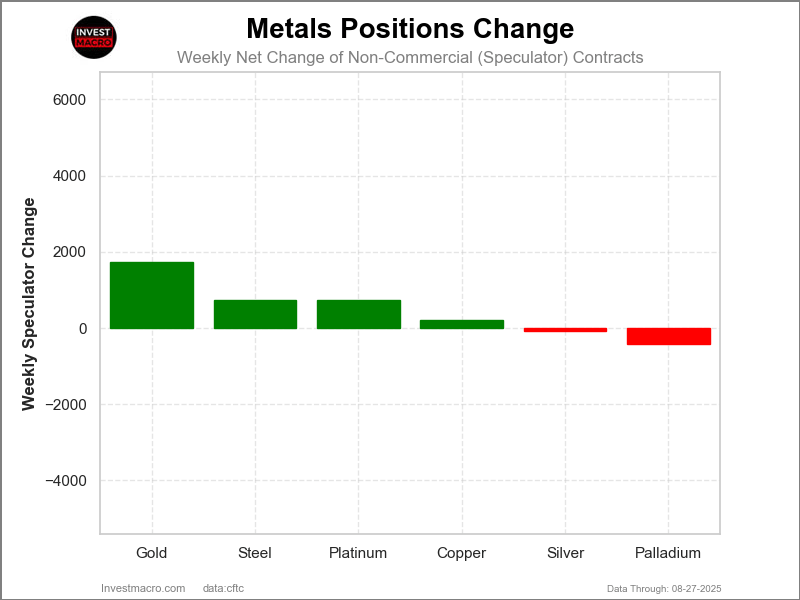
The COT metals markets speculator bets were overall higher this week as five out of the six metals markets we cover had higher positioning while one market had lower speculator contracts.

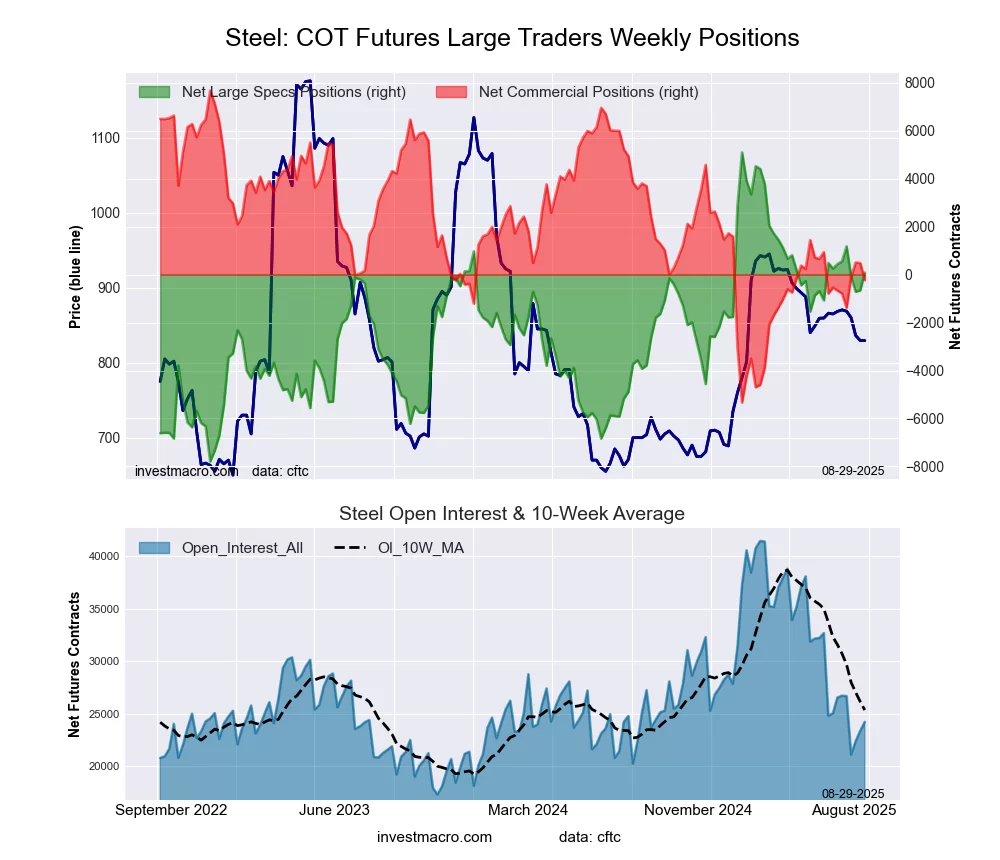
Leading the gains for the metals was Platinum (6,930 contracts) with Silver (5,880 contracts), Copper (2,257 contracts), Palladium (1,485 contracts) and also Steel (666 contracts) showing positive weeks.

The market with declines in speculator bets for the week was Gold with a small decline of -424 contracts on the week.

Metals Markets Price Changes:

In the metals market prices, platinum rose strongly with a gain of over 5%. Gold followed with an increase of more than 3.5%, and silver edged up by nearly 1%. Conversely, palladium and copper saw declines of 1% and 1.5%, respectively, while steel dropped significantly by over 6%.


Metals Data:

Metals Table COT Chart
Legend: Weekly Speculators Change | Speculators Current Net Position | Speculators Strength Score compared to last 3-Years (0-100 range)


Strength Scores led by Silver & Platinum

Metals Strength Scores COT Chart

COT Strength Scores (a normalized measure of Speculator positions over a 3-Year range, from 0 to 100 where above 80 is Extreme-Bullish and below 20 is Extreme-Bearish) showed that Silver (100 percent) and Platinum (80 percent) lead the metals markets this week. Steel (71 percent) comes in as the next highest in the weekly strength scores.

Gold (51 percent) comes in at the lowest strength level currently but is above the 3-Year midpoint of 50 percent.

Strength Statistics:
Gold (51.4 percent) vs Gold previous week (51.6 percent)
Silver (100.0 percent) vs Silver previous week (92.6 percent)
Copper (57.8 percent) vs Copper previous week (55.7 percent)
Platinum (79.8 percent) vs Platinum previous week (63.4 percent)
Palladium (60.9 percent) vs Palladium previous week (49.7 percent)
Steel (71.0 percent) vs Palladium previous week (67.7 percent)


Platinum & Palladium top the 6-Week Strength Trends

Metals Trends COT Chart

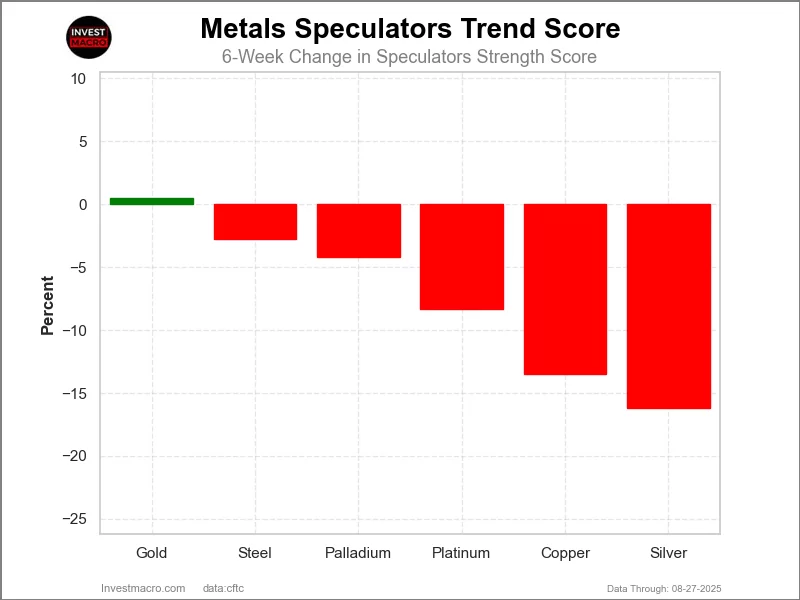
COT Strength Score Trends (or move index, calculates the 6-week changes in strength scores) showed that Platinum (40 percent) and Palladium (38 percent) lead the past six weeks trends for metals. Silver (21 percent), Gold (9 percent) and Copper (7 percent) are the next highest positive movers in the latest trends data.

Steel (-7 percent) leads the downside trend scores currently.

Move Statistics:
Gold (9.2 percent) vs Gold previous week (4.8 percent)
Silver (21.0 percent) vs Silver previous week (20.2 percent)
Copper (6.5 percent) vs Copper previous week (-0.6 percent)
Platinum (40.2 percent) vs Platinum previous week (34.0 percent)
Palladium (38.4 percent) vs Palladium previous week (26.7 percent)
Steel (-7.5 percent) vs Steel previous week (-12.9 percent)


Individual Markets:

Gold Comex Futures:

Gold Futures COT ChartThe Gold Comex Futures large speculator standing this week resulted in a net position of 187,481 contracts in the data reported through Tuesday. This was a weekly lowering of -424 contracts from the previous week which had a total of 187,905 net contracts.

This week’s current strength score (the trader positioning range over the past three years, measured from 0 to 100) shows the speculators are currently Bullish with a score of 51.4 percent. The commercials are Bearish with a score of 42.1 percent and the small traders (not shown in chart) are Bullish-Extreme with a score of 100.0 percent.

Price Trend-Following Model: Strong Uptrend

Our weekly trend-following model classifies the current market price position as: Strong Uptrend.

Gold Futures StatisticsSPECULATORSCOMMERCIALSSMALL TRADERS
– Percent of Open Interest Longs:59.016.412.9
– Percent of Open Interest Shorts:14.069.84.5
– Net Position:187,481-222,71835,237
– Gross Longs:245,99568,43254,008
– Gross Shorts:58,514291,15018,771
– Long to Short Ratio:4.2 to 10.2 to 12.9 to 1
NET POSITION TREND:
– Strength Index Score (3 Year Range Pct):51.442.1100.0
– Strength Index Reading (3 Year Range):BullishBearishBullish-Extreme
NET POSITION MOVEMENT INDEX:
– 6-Week Change in Strength Index:9.2-11.528.7


Silver Comex Futures:

Silver Futures COT ChartThe Silver Comex Futures large speculator standing this week resulted in a net position of 66,650 contracts in the data reported through Tuesday. This was a weekly lift of 5,880 contracts from the previous week which had a total of 60,770 net contracts.

This week’s current strength score (the trader positioning range over the past three years, measured from 0 to 100) shows the speculators are currently Bullish-Extreme with a score of 100.0 percent. The commercials are Bearish-Extreme with a score of 0.0 percent and the small traders (not shown in chart) are Bullish with a score of 62.7 percent.

Price Trend-Following Model: Strong Uptrend

Our weekly trend-following model classifies the current market price position as: Strong Uptrend.

Silver Futures StatisticsSPECULATORSCOMMERCIALSSMALL TRADERS
– Percent of Open Interest Longs:48.920.019.1
– Percent of Open Interest Shorts:10.669.28.2
– Net Position:66,650-85,66119,011
– Gross Longs:85,19234,87133,366
– Gross Shorts:18,542120,53214,355
– Long to Short Ratio:4.6 to 10.3 to 12.3 to 1
NET POSITION TREND:
– Strength Index Score (3 Year Range Pct):100.00.062.7
– Strength Index Reading (3 Year Range):Bullish-ExtremeBearish-ExtremeBullish
NET POSITION MOVEMENT INDEX:
– 6-Week Change in Strength Index:21.0-18.1-1.5


Copper Grade #1 Futures:

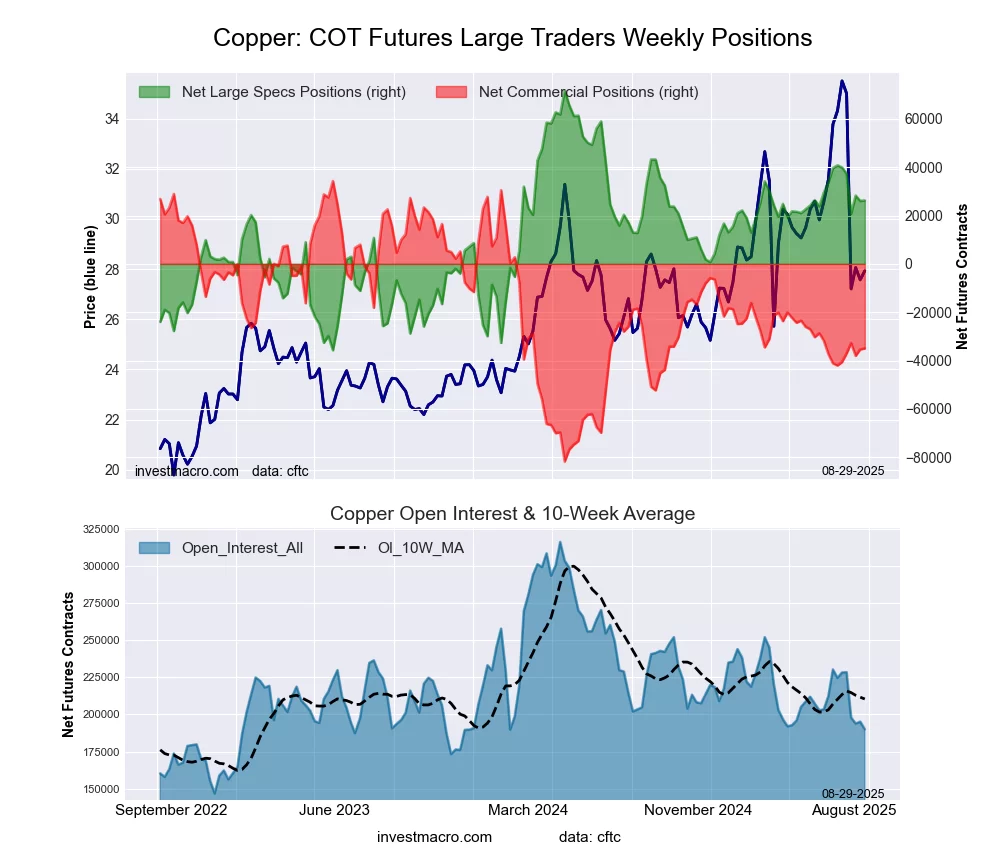
Copper Futures COT ChartThe Copper Grade #1 Futures large speculator standing this week resulted in a net position of 26,351 contracts in the data reported through Tuesday. This was a weekly gain of 2,257 contracts from the previous week which had a total of 24,094 net contracts.

This week’s current strength score (the trader positioning range over the past three years, measured from 0 to 100) shows the speculators are currently Bullish with a score of 57.8 percent. The commercials are Bearish with a score of 44.3 percent and the small traders (not shown in chart) are Bearish with a score of 41.5 percent.

Price Trend-Following Model: Uptrend

Our weekly trend-following model classifies the current market price position as: Uptrend.

Copper Futures StatisticsSPECULATORSCOMMERCIALSSMALL TRADERS
– Percent of Open Interest Longs:34.829.88.0
– Percent of Open Interest Shorts:22.144.46.1
– Net Position:26,351-30,2843,933
– Gross Longs:72,10161,69116,679
– Gross Shorts:45,75091,97512,746
– Long to Short Ratio:1.6 to 10.7 to 11.3 to 1
NET POSITION TREND:
– Strength Index Score (3 Year Range Pct):57.844.341.5
– Strength Index Reading (3 Year Range):BullishBearishBearish
NET POSITION MOVEMENT INDEX:
– 6-Week Change in Strength Index:6.5-8.819.6


Platinum Futures:

Platinum Futures COT ChartThe Platinum Futures large speculator standing this week resulted in a net position of 26,979 contracts in the data reported through Tuesday. This was a weekly gain of 6,930 contracts from the previous week which had a total of 20,049 net contracts.

This week’s current strength score (the trader positioning range over the past three years, measured from 0 to 100) shows the speculators are currently Bullish with a score of 79.8 percent. The commercials are Bearish with a score of 21.5 percent and the small traders (not shown in chart) are Bullish with a score of 55.1 percent.

Price Trend-Following Model: Strong Uptrend

Our weekly trend-following model classifies the current market price position as: Strong Uptrend.

Platinum Futures StatisticsSPECULATORSCOMMERCIALSSMALL TRADERS
– Percent of Open Interest Longs:62.916.211.3
– Percent of Open Interest Shorts:35.848.26.4
– Net Position:26,979-31,8814,902
– Gross Longs:62,72816,16911,302
– Gross Shorts:35,74948,0506,400
– Long to Short Ratio:1.8 to 10.3 to 11.8 to 1
NET POSITION TREND:
– Strength Index Score (3 Year Range Pct):79.821.555.1
– Strength Index Reading (3 Year Range):BullishBearishBullish
NET POSITION MOVEMENT INDEX:
– 6-Week Change in Strength Index:40.2-38.20.5


Palladium Futures:

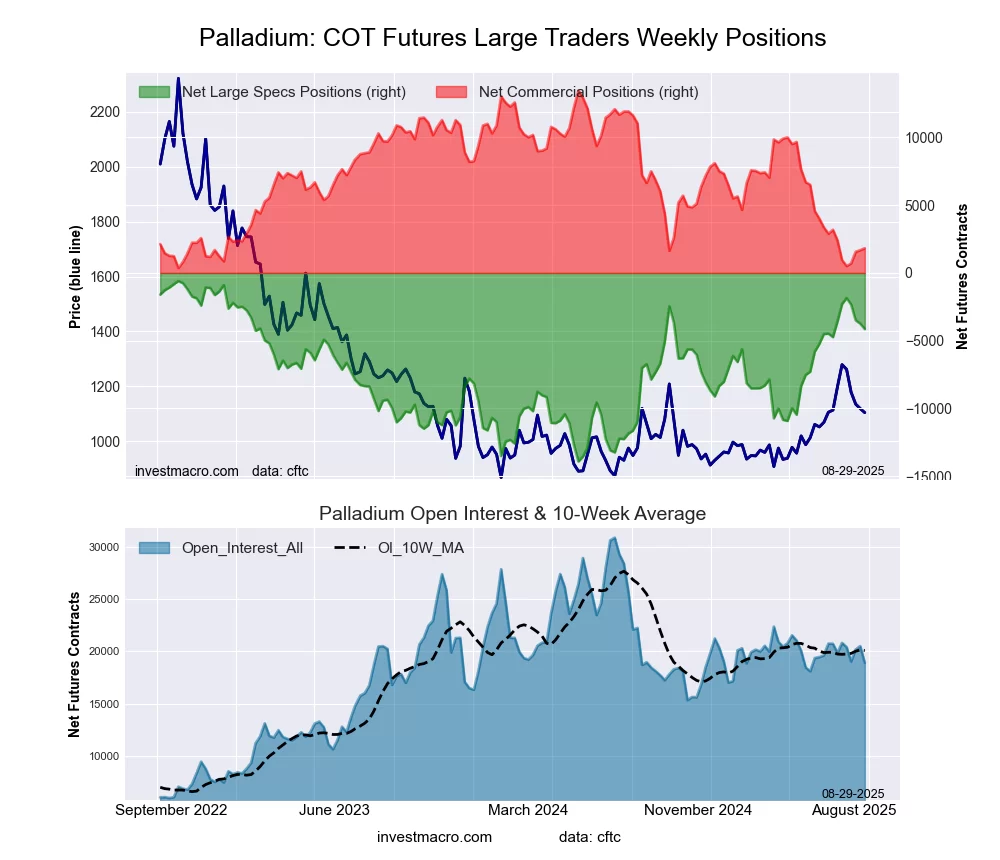
Palladium Futures COT ChartThe Palladium Futures large speculator standing this week resulted in a net position of -5,808 contracts in the data reported through Tuesday. This was a weekly boost of 1,485 contracts from the previous week which had a total of -7,293 net contracts.

This week’s current strength score (the trader positioning range over the past three years, measured from 0 to 100) shows the speculators are currently Bullish with a score of 60.9 percent. The commercials are Bearish with a score of 32.1 percent and the small traders (not shown in chart) are Bullish-Extreme with a score of 87.5 percent.

Price Trend-Following Model: Strong Uptrend

Our weekly trend-following model classifies the current market price position as: Strong Uptrend.

Palladium Futures StatisticsSPECULATORSCOMMERCIALSSMALL TRADERS
– Percent of Open Interest Longs:41.939.513.7
– Percent of Open Interest Shorts:71.916.07.3
– Net Position:-5,8084,5701,238
– Gross Longs:8,1247,6612,653
– Gross Shorts:13,9323,0911,415
– Long to Short Ratio:0.6 to 12.5 to 11.9 to 1
NET POSITION TREND:
– Strength Index Score (3 Year Range Pct):60.932.187.5
– Strength Index Reading (3 Year Range):BullishBearishBullish-Extreme
NET POSITION MOVEMENT INDEX:
– 6-Week Change in Strength Index:38.4-41.514.5


Steel Futures Futures:

Steel Futures COT ChartThe Steel Futures large speculator standing this week resulted in a net position of -878 contracts in the data reported through Tuesday. This was a weekly increase of 666 contracts from the previous week which had a total of -1,544 net contracts.

This week’s current strength score (the trader positioning range over the past three years, measured from 0 to 100) shows the speculators are currently Bullish with a score of 71.0 percent. The commercials are Bearish with a score of 29.5 percent and the small traders (not shown in chart) are Bullish with a score of 57.9 percent.

Price Trend-Following Model: Weak Uptrend

Our weekly trend-following model classifies the current market price position as: Weak Uptrend.

Steel Futures StatisticsSPECULATORSCOMMERCIALSSMALL TRADERS
– Percent of Open Interest Longs:25.369.60.9
– Percent of Open Interest Shorts:28.067.40.4
– Net Position:-878707171
– Gross Longs:8,13522,383298
– Gross Shorts:9,01321,676127
– Long to Short Ratio:0.9 to 11.0 to 12.3 to 1
NET POSITION TREND:
– Strength Index Score (3 Year Range Pct):71.029.557.9
– Strength Index Reading (3 Year Range):BullishBearishBullish
NET POSITION MOVEMENT INDEX:
– 6-Week Change in Strength Index:-7.56.427.2


Article By InvestMacroReceive our weekly COT Newsletter

*COT Report: The COT data, released weekly to the public each Friday, is updated through the most recent Tuesday (data is 3 days old) and shows a quick view of how large speculators or non-commercials (for-profit traders) were positioned in the futures markets.

The CFTC categorizes trader positions according to commercial hedgers (traders who use futures contracts for hedging as part of the business), non-commercials (large traders who speculate to realize trading profits) and nonreportable traders (usually small traders/speculators) as well as their open interest (contracts open in the market at time of reporting). See CFTC criteria here.


COT Bonds Charts: Fed Funds and Ultra Treasury Bonds lead Speculator Bets this week

By InvestMacro

Bonds Market Open Interest Comparison
Here are the latest charts and statistics for the Commitment of Traders (COT) reports data published by the Commodities Futures Trading Commission (CFTC).

The latest COT data is updated through Tuesday June 10th and shows a quick view of how large traders (for-profit speculators and commercial hedgers) were positioned in the futures markets.

Weekly Speculator Changes led by Fed Funds & Ultra Treasury Bonds

Bonds Market Net Speculators Positions
The COT bond market speculator bets were slightly lower this week as four out of the nine bond markets we cover had higher positioning while the other five markets had lower speculator contracts.

Leading the gains for the bond markets was the Fed Funds (38,246 contracts) with the Ultra Treasury Bonds (24,696 contracts), the US Treasury Bonds (22,628 contracts) and the Ultra 10-Year Bonds (2,306 contracts) also seeing positive weeks.

The bond markets with declines in speculator bets for the week were the SOFR 3-Months (-202,389 contracts), the 5-Year Bonds (-74,384 contracts), the SOFR 1-Month (-53,898 contracts), the 2-Year Bonds (-36,591 contracts) and with the 10-Year Bonds (-18,845 contracts) also having lower bets on the week.

Bonds Price Changes:

– US Treasury Long bonds: up over 1%
– 10-year bond: up just under 1%
– 5-year bond: up 0.5%
– 2-year bond: up 0.25%
– Fed bonds and shorter duration bonds: basically unchanged


Bonds Data:

Bonds Market Speculators Data Table
Legend: Open Interest | Speculators Current Net Position | Weekly Specs Change | Specs Strength Score compared to last 3-Years (0-100 range)


Strength Scores led by Ultra Treasury Bonds & US Treasury Bonds

Bonds Market Strength Index Comparison
COT Strength Scores (a normalized measure of Speculator positions over a 3-Year range, from 0 to 100 where above 80 is Extreme-Bullish and below 20 is Extreme-Bearish) showed that the Ultra Treasury Bonds (97 percent) and the US Treasury Bonds (56 percent) lead the bond markets this week. The SOFR 1-Month (50 percent) comes in as the next highest in the weekly strength scores.

On the downside, the 5-Year Bond (0 percent), the Ultra 10-Year Bonds (1 percent) and the SOFR 3-Months (2 percent) come in at the lowest strength level currently and are in Extreme-Bearish territory (below 20 percent).

Strength Statistics:
Fed Funds (34.9 percent) vs Fed Funds previous week (27.9 percent)
2-Year Bond (21.5 percent) vs 2-Year Bond previous week (24.1 percent)
5-Year Bond (0.0 percent) vs 5-Year Bond previous week (3.1 percent)
10-Year Bond (40.5 percent) vs 10-Year Bond previous week (42.4 percent)
Ultra 10-Year Bond (0.6 percent) vs Ultra 10-Year Bond previous week (0.0 percent)
US Treasury Bond (55.6 percent) vs US Treasury Bond previous week (47.8 percent)
Ultra US Treasury Bond (96.5 percent) vs Ultra US Treasury Bond previous week (87.1 percent)
SOFR 1-Month (50.1 percent) vs SOFR 1-Month previous week (63.4 percent)
SOFR 3-Months (1.8 percent) vs SOFR 3-Months previous week (12.2 percent)


Ultra Treasury Bonds & 10-Year Bonds top the 6-Week Strength Trends

Bonds Market Trend Index Comparison
COT Strength Score Trends (or move index, calculates the 6-week changes in strength scores) showed that the Ultra Treasury Bonds (18 percent) and the 10-Year Bonds (14 percent) lead the past six weeks trends for bonds.

The Ultra 10-Year Bond (-41 percent), the SOFR 3-Months (-29 percent) and the SOFR 1-Month (-14 percent) leads the downside trend scores currently.

Strength Trend Statistics:
Fed Funds (0.2 percent) vs Fed Funds previous week (-24.4 percent)
2-Year Bond (1.8 percent) vs 2-Year Bond previous week (10.8 percent)
5-Year Bond (-7.5 percent) vs 5-Year Bond previous week (-8.7 percent)
10-Year Bond (14.2 percent) vs 10-Year Bond previous week (19.4 percent)
Ultra 10-Year Bond (-40.5 percent) vs Ultra 10-Year Bond previous week (-55.8 percent)
US Treasury Bond (2.0 percent) vs US Treasury Bond previous week (1.8 percent)
Ultra US Treasury Bond (18.2 percent) vs Ultra US Treasury Bond previous week (7.3 percent)
SOFR 1-Month (-13.6 percent) vs SOFR 1-Month previous week (14.8 percent)
SOFR 3-Months (-29.3 percent) vs SOFR 3-Months previous week (-26.2 percent)


30-Day Federal Funds Futures:

Federal Funds 30-Day Bonds Futures COT ChartThe 30-Day Federal Funds large speculator standing this week recorded a net position of -106,475 contracts in the data reported through Tuesday. This was a weekly lift of 38,246 contracts from the previous week which had a total of -144,721 net contracts.

This week’s current strength score (the trader positioning range over the past three years, measured from 0 to 100) shows the speculators are currently Bearish with a score of 34.9 percent. The commercials are Bullish with a score of 59.0 percent and the small traders (not shown in chart) are Bullish with a score of 79.5 percent.

Price Trend-Following Model: Downtrend

Our weekly trend-following model classifies the current market price position as: Downtrend.

30-Day Federal Funds StatisticsSPECULATORSCOMMERCIALSSMALL TRADERS
– Percent of Open Interest Longs:13.667.72.9
– Percent of Open Interest Shorts:19.962.22.1
– Net Position:-106,47593,22313,252
– Gross Longs:230,8491,149,92249,699
– Gross Shorts:337,3241,056,69936,447
– Long to Short Ratio:0.7 to 11.1 to 11.4 to 1
NET POSITION TREND:
– Strength Index Score (3 Year Range Pct):34.959.079.5
– Strength Index Reading (3 Year Range):BearishBullishBullish
NET POSITION MOVEMENT INDEX:
– 6-Week Change in Strength Index:0.20.1-2.5


Secured Overnight Financing Rate (3-Month) Futures:

SOFR 3-Months Bonds Futures COT ChartThe Secured Overnight Financing Rate (3-Month) large speculator standing this week recorded a net position of -1,132,456 contracts in the data reported through Tuesday. This was a weekly decline of -202,389 contracts from the previous week which had a total of -930,067 net contracts.

This week’s current strength score (the trader positioning range over the past three years, measured from 0 to 100) shows the speculators are currently Bearish-Extreme with a score of 1.8 percent. The commercials are Bullish-Extreme with a score of 97.5 percent and the small traders (not shown in chart) are Bullish-Extreme with a score of 91.0 percent.

Price Trend-Following Model: Weak Uptrend

Our weekly trend-following model classifies the current market price position as: Weak Uptrend.

SOFR 3-Months StatisticsSPECULATORSCOMMERCIALSSMALL TRADERS
– Percent of Open Interest Longs:11.063.20.4
– Percent of Open Interest Shorts:20.653.70.3
– Net Position:-1,132,4561,118,67313,783
– Gross Longs:1,291,1497,445,46651,781
– Gross Shorts:2,423,6056,326,79337,998
– Long to Short Ratio:0.5 to 11.2 to 11.4 to 1
NET POSITION TREND:
– Strength Index Score (3 Year Range Pct):1.897.591.0
– Strength Index Reading (3 Year Range):Bearish-ExtremeBullish-ExtremeBullish-Extreme
NET POSITION MOVEMENT INDEX:
– 6-Week Change in Strength Index:-29.328.67.4


Individual Bond Markets:

Secured Overnight Financing Rate (1-Month) Futures:

SOFR 1-Month Bonds Futures COT ChartThe Secured Overnight Financing Rate (1-Month) large speculator standing this week recorded a net position of -74,749 contracts in the data reported through Tuesday. This was a weekly fall of -53,898 contracts from the previous week which had a total of -20,851 net contracts.

This week’s current strength score (the trader positioning range over the past three years, measured from 0 to 100) shows the speculators are currently Bullish with a score of 50.1 percent. The commercials are Bullish with a score of 50.9 percent and the small traders (not shown in chart) are Bullish with a score of 58.7 percent.

Price Trend-Following Model: Strong Uptrend

Our weekly trend-following model classifies the current market price position as: Strong Uptrend.

SOFR 1-Month StatisticsSPECULATORSCOMMERCIALSSMALL TRADERS
– Percent of Open Interest Longs:15.861.50.1
– Percent of Open Interest Shorts:22.154.80.5
– Net Position:-74,74978,663-3,914
– Gross Longs:186,662725,8341,456
– Gross Shorts:261,411647,1715,370
– Long to Short Ratio:0.7 to 11.1 to 10.3 to 1
NET POSITION TREND:
– Strength Index Score (3 Year Range Pct):50.150.958.7
– Strength Index Reading (3 Year Range):BullishBullishBullish
NET POSITION MOVEMENT INDEX:
– 6-Week Change in Strength Index:-13.614.0-3.8


2-Year Treasury Note Futures:

2-Year Treasury Bonds Futures COT ChartThe 2-Year Treasury Note large speculator standing this week recorded a net position of -1,180,516 contracts in the data reported through Tuesday. This was a weekly reduction of -36,591 contracts from the previous week which had a total of -1,143,925 net contracts.

This week’s current strength score (the trader positioning range over the past three years, measured from 0 to 100) shows the speculators are currently Bearish with a score of 21.5 percent. The commercials are Bullish with a score of 76.2 percent and the small traders (not shown in chart) are Bullish with a score of 70.4 percent.

Price Trend-Following Model: Weak Uptrend

Our weekly trend-following model classifies the current market price position as: Weak Uptrend.

2-Year Treasury Note StatisticsSPECULATORSCOMMERCIALSSMALL TRADERS
– Percent of Open Interest Longs:14.877.66.1
– Percent of Open Interest Shorts:44.651.12.8
– Net Position:-1,180,5161,050,501130,015
– Gross Longs:585,3983,073,993242,461
– Gross Shorts:1,765,9142,023,492112,446
– Long to Short Ratio:0.3 to 11.5 to 12.2 to 1
NET POSITION TREND:
– Strength Index Score (3 Year Range Pct):21.576.270.4
– Strength Index Reading (3 Year Range):BearishBullishBullish
NET POSITION MOVEMENT INDEX:
– 6-Week Change in Strength Index:1.8-1.9-1.0


5-Year Treasury Note Futures:

5-Year Treasury Bonds Futures COT ChartThe 5-Year Treasury Note large speculator standing this week recorded a net position of -2,470,920 contracts in the data reported through Tuesday. This was a weekly fall of -74,384 contracts from the previous week which had a total of -2,396,536 net contracts.

This week’s current strength score (the trader positioning range over the past three years, measured from 0 to 100) shows the speculators are currently Bearish-Extreme with a score of 0.0 percent. The commercials are Bullish-Extreme with a score of 100.0 percent and the small traders (not shown in chart) are Bullish-Extreme with a score of 80.9 percent.

Price Trend-Following Model: Uptrend

Our weekly trend-following model classifies the current market price position as: Uptrend.

5-Year Treasury Note StatisticsSPECULATORSCOMMERCIALSSMALL TRADERS
– Percent of Open Interest Longs:6.185.46.1
– Percent of Open Interest Shorts:42.551.53.6
– Net Position:-2,470,9202,303,366167,554
– Gross Longs:416,3955,797,061414,640
– Gross Shorts:2,887,3153,493,695247,086
– Long to Short Ratio:0.1 to 11.7 to 11.7 to 1
NET POSITION TREND:
– Strength Index Score (3 Year Range Pct):0.0100.080.9
– Strength Index Reading (3 Year Range):Bearish-ExtremeBullish-ExtremeBullish-Extreme
NET POSITION MOVEMENT INDEX:
– 6-Week Change in Strength Index:-7.511.1-10.4


10-Year Treasury Note Futures:

10-Year Treasury Notes Bonds Futures COT ChartThe 10-Year Treasury Note large speculator standing this week recorded a net position of -724,101 contracts in the data reported through Tuesday. This was a weekly decline of -18,845 contracts from the previous week which had a total of -705,256 net contracts.

This week’s current strength score (the trader positioning range over the past three years, measured from 0 to 100) shows the speculators are currently Bearish with a score of 40.5 percent. The commercials are Bullish with a score of 57.8 percent and the small traders (not shown in chart) are Bullish with a score of 71.6 percent.

Price Trend-Following Model: Weak Uptrend

Our weekly trend-following model classifies the current market price position as: Weak Uptrend.

10-Year Treasury Note StatisticsSPECULATORSCOMMERCIALSSMALL TRADERS
– Percent of Open Interest Longs:11.477.59.1
– Percent of Open Interest Shorts:26.863.97.5
– Net Position:-724,101645,72678,375
– Gross Longs:541,6923,667,589431,976
– Gross Shorts:1,265,7933,021,863353,601
– Long to Short Ratio:0.4 to 11.2 to 11.2 to 1
NET POSITION TREND:
– Strength Index Score (3 Year Range Pct):40.557.871.6
– Strength Index Reading (3 Year Range):BearishBullishBullish
NET POSITION MOVEMENT INDEX:
– 6-Week Change in Strength Index:14.2-8.6-21.7


Ultra 10-Year Notes Futures:

Ultra 10-Year Treasury Notes Bonds Futures COT ChartThe Ultra 10-Year Notes large speculator standing this week recorded a net position of -369,282 contracts in the data reported through Tuesday. This was a weekly gain of 2,306 contracts from the previous week which had a total of -371,588 net contracts.

This week’s current strength score (the trader positioning range over the past three years, measured from 0 to 100) shows the speculators are currently Bearish-Extreme with a score of 0.6 percent. The commercials are Bullish-Extreme with a score of 92.0 percent and the small traders (not shown in chart) are Bullish with a score of 72.9 percent.

Price Trend-Following Model: Weak Uptrend

Our weekly trend-following model classifies the current market price position as: Weak Uptrend.

Ultra 10-Year Notes StatisticsSPECULATORSCOMMERCIALSSMALL TRADERS
– Percent of Open Interest Longs:10.379.09.6
– Percent of Open Interest Shorts:26.161.211.6
– Net Position:-369,282416,219-46,937
– Gross Longs:238,8721,840,747223,564
– Gross Shorts:608,1541,424,528270,501
– Long to Short Ratio:0.4 to 11.3 to 10.8 to 1
NET POSITION TREND:
– Strength Index Score (3 Year Range Pct):0.692.072.9
– Strength Index Reading (3 Year Range):Bearish-ExtremeBullish-ExtremeBullish
NET POSITION MOVEMENT INDEX:
– 6-Week Change in Strength Index:-40.551.2-21.9


US Treasury Bonds Futures:

US Year Treasury Notes Long Bonds Futures COT ChartThe US Treasury Bonds large speculator standing this week recorded a net position of -79,745 contracts in the data reported through Tuesday. This was a weekly increase of 22,628 contracts from the previous week which had a total of -102,373 net contracts.

This week’s current strength score (the trader positioning range over the past three years, measured from 0 to 100) shows the speculators are currently Bullish with a score of 55.6 percent. The commercials are Bearish with a score of 36.2 percent and the small traders (not shown in chart) are Bullish with a score of 78.6 percent.

Price Trend-Following Model: Strong Downtrend

Our weekly trend-following model classifies the current market price position as: Strong Downtrend.

US Treasury Bonds StatisticsSPECULATORSCOMMERCIALSSMALL TRADERS
– Percent of Open Interest Longs:10.375.513.3
– Percent of Open Interest Shorts:14.976.18.1
– Net Position:-79,745-9,50389,248
– Gross Longs:177,3281,304,982229,114
– Gross Shorts:257,0731,314,485139,866
– Long to Short Ratio:0.7 to 11.0 to 11.6 to 1
NET POSITION TREND:
– Strength Index Score (3 Year Range Pct):55.636.278.6
– Strength Index Reading (3 Year Range):BullishBearishBullish
NET POSITION MOVEMENT INDEX:
– 6-Week Change in Strength Index:2.0-0.5-3.0


Ultra US Treasury Bonds Futures:

Ultra US Year Treasury Notes Long Bonds Futures COT ChartThe Ultra US Treasury Bonds large speculator standing this week recorded a net position of -203,747 contracts in the data reported through Tuesday. This was a weekly boost of 24,696 contracts from the previous week which had a total of -228,443 net contracts.

This week’s current strength score (the trader positioning range over the past three years, measured from 0 to 100) shows the speculators are currently Bullish-Extreme with a score of 96.5 percent. The commercials are Bearish with a score of 23.8 percent and the small traders (not shown in chart) are Bearish-Extreme with a score of 0.0 percent.

Price Trend-Following Model: Strong Downtrend

Our weekly trend-following model classifies the current market price position as: Strong Downtrend.

Ultra US Treasury Bonds StatisticsSPECULATORSCOMMERCIALSSMALL TRADERS
– Percent of Open Interest Longs:7.282.28.8
– Percent of Open Interest Shorts:17.971.09.3
– Net Position:-203,747213,290-9,543
– Gross Longs:136,9211,562,597167,180
– Gross Shorts:340,6681,349,307176,723
– Long to Short Ratio:0.4 to 11.2 to 10.9 to 1
NET POSITION TREND:
– Strength Index Score (3 Year Range Pct):96.523.80.0
– Strength Index Reading (3 Year Range):Bullish-ExtremeBearishBearish-Extreme
NET POSITION MOVEMENT INDEX:
– 6-Week Change in Strength Index:18.2-1.7-46.8


Article By InvestMacroReceive our weekly COT Newsletter

*COT Report: The COT data, released weekly to the public each Friday, is updated through the most recent Tuesday (data is 3 days old) and shows a quick view of how large speculators or non-commercials (for-profit traders) were positioned in the futures markets.

The CFTC categorizes trader positions according to commercial hedgers (traders who use futures contracts for hedging as part of the business), non-commercials (large traders who speculate to realize trading profits) and nonreportable traders (usually small traders/speculators) as well as their open interest (contracts open in the market at time of reporting). See CFTC criteria here.

COT Soft Commodities Charts: Lean Hogs & Live Cattle lead Speculator Bets

By InvestMacro

Speculators OI Softs
Here are the latest charts and statistics for the Commitment of Traders (COT) reports data published by the Commodities Futures Trading Commission (CFTC).

The latest COT data is updated through Tuesday June 10th and shows a quick view of how large traders (for-profit speculators and commercial entities) were positioned in the futures markets.

Weekly Speculator Changes led by Lean Hogs & Live Cattle

Speculators Nets Softs
The COT soft commodities markets speculator bets were slightly higher this week as six out of the eleven softs markets we cover had higher positioning while the other five markets had lower speculator contracts.

Leading the gains for the softs markets was Lean Hogs (13,426 contracts) with Live Cattle (11,892 contracts), Soybeans (10,449 contracts), Soybean Meal (6,403 contracts), Wheat (3,211 contracts) and Coffee (2,289 contracts) also showing positive weeks.

The markets with the declines in speculator bets this week were Sugar (-15,671 contracts), Corn (-14,435 contracts), Cotton (-4,430 contracts), Soybean Oil (-685 contracts) and with Cocoa (-232 contracts) also registering lower bets on the week.

Price changes for the week:

– Soybean oil: up almost 6%
– Soybeans: higher by almost 2%
– Lean hogs: rose 1.4%
– Soybean meal: up 1%
– Coffee: down almost 4%
– Cocoa: down almost 3.5%
– Sugar, live cattle, wheat, corn: down over 1%
– Cotton: down almost half a percent


Soft Commodities Data:

Speculators Table Softs
Legend: Weekly Speculators Change | Speculators Current Net Position | Speculators Strength Score compared to last 3-Years (0-100 range)


Strength Scores led by Live Cattle & Lean Hogs

Speculators Strength Softs
COT Strength Scores (a normalized measure of Speculator positions over a 3-Year range, from 0 to 100 where above 80 is Extreme-Bullish and below 20 is Extreme-Bearish) showed that Live Cattle (92 percent) and Lean Hogs (90 percent) lead the softs markets this week. Soybeans (69 percent), Soybean Oil (65 percent) and Coffee (62 percent) come in as the next highest in the weekly strength scores.

On the downside, Sugar (4 percent), Soybean Meal (8 percent), Cotton (15 percent) and the Wheat (18 percent) come in at the lowest strength levels currently and are in Extreme-Bearish territory (below 20 percent).

Strength Statistics:
Corn (23.2 percent) vs Corn previous week (25.2 percent)
Sugar (4.3 percent) vs Sugar previous week (9.4 percent)
Coffee (62.0 percent) vs Coffee previous week (59.8 percent)
Soybeans (68.5 percent) vs Soybeans previous week (65.9 percent)
Soybean Oil (64.6 percent) vs Soybean Oil previous week (65.0 percent)
Soybean Meal (7.7 percent) vs Soybean Meal previous week (5.0 percent)
Live Cattle (91.8 percent) vs Live Cattle previous week (80.3 percent)
Lean Hogs (89.6 percent) vs Lean Hogs previous week (79.3 percent)
Cotton (15.5 percent) vs Cotton previous week (18.2 percent)
Cocoa (29.6 percent) vs Cocoa previous week (29.8 percent)
Wheat (17.7 percent) vs Wheat previous week (15.3 percent)


Lean Hogs & Wheat top the 6-Week Strength Trends

Speculators Trend Softs
COT Strength Score Trends (or move index, calculates the 6-week changes in strength scores) showed that Lean Hogs (35 percent) and Wheat (17 percent) lead the past six weeks trends for soft commodities. Live Cattle (12 percent), Soybeans (3 percent) and Soybean Meal (2 percent) are the next highest positive movers in the latest trends data.

Corn (-37 percent) leads the downside trend scores currently with Sugar (-19 percent), Soybean Oil (-16 percent) and Cotton (-15 percent) following next with lower trend scores.

Strength Trend Statistics:
Corn (-36.9 percent) vs Corn previous week (-41.0 percent)
Sugar (-18.6 percent) vs Sugar previous week (-11.9 percent)
Coffee (-11.6 percent) vs Coffee previous week (-5.8 percent)
Soybeans (2.8 percent) vs Soybeans previous week (1.1 percent)
Soybean Oil (-16.0 percent) vs Soybean Oil previous week (-10.2 percent)
Soybean Meal (2.3 percent) vs Soybean Meal previous week (-9.7 percent)
Live Cattle (11.7 percent) vs Live Cattle previous week (4.1 percent)
Lean Hogs (34.9 percent) vs Lean Hogs previous week (27.2 percent)
Cotton (-15.2 percent) vs Cotton previous week (-4.4 percent)
Cocoa (1.9 percent) vs Cocoa previous week (4.0 percent)
Wheat (16.7 percent) vs Wheat previous week (-2.3 percent)


Individual Soft Commodities Markets:

CORN Futures:

CORN Futures COT ChartThe CORN large speculator standing this week resulted in a net position of -95,494 contracts in the data reported through Tuesday. This was a weekly lowering of -14,435 contracts from the previous week which had a total of -81,059 net contracts.

This week’s current strength score (the trader positioning range over the past three years, measured from 0 to 100) shows the speculators are currently Bearish with a score of 23.2 percent. The commercials are Bullish with a score of 74.5 percent and the small traders (not shown in chart) are Bullish-Extreme with a score of 84.4 percent.

Price Trend-Following Model: Downtrend

Our weekly trend-following model classifies the current market price position as: Downtrend.

CORN Futures StatisticsSPECULATORSCOMMERCIALSSMALL TRADERS
– Percent of Open Interest Longs:19.945.99.5
– Percent of Open Interest Shorts:25.938.810.7
– Net Position:-95,494114,551-19,057
– Gross Longs:321,967740,542153,928
– Gross Shorts:417,461625,991172,985
– Long to Short Ratio:0.8 to 11.2 to 10.9 to 1
NET POSITION TREND:
– Strength Index Score (3 Year Range Pct):23.274.584.4
– Strength Index Reading (3 Year Range):BearishBullishBullish-Extreme
NET POSITION MOVEMENT INDEX:
– 6-Week Change in Strength Index:-36.936.932.3


SUGAR Futures:

SUGAR Futures COT ChartThe SUGAR large speculator standing this week resulted in a net position of -19,515 contracts in the data reported through Tuesday. This was a weekly lowering of -15,671 contracts from the previous week which had a total of -3,844 net contracts.

This week’s current strength score (the trader positioning range over the past three years, measured from 0 to 100) shows the speculators are currently Bearish-Extreme with a score of 4.3 percent. The commercials are Bullish-Extreme with a score of 97.7 percent and the small traders (not shown in chart) are Bearish-Extreme with a score of 11.3 percent.

Price Trend-Following Model: Strong Downtrend

Our weekly trend-following model classifies the current market price position as: Strong Downtrend.

SUGAR Futures StatisticsSPECULATORSCOMMERCIALSSMALL TRADERS
– Percent of Open Interest Longs:24.151.47.9
– Percent of Open Interest Shorts:26.248.58.7
– Net Position:-19,51526,368-6,853
– Gross Longs:217,346464,70671,741
– Gross Shorts:236,861438,33878,594
– Long to Short Ratio:0.9 to 11.1 to 10.9 to 1
NET POSITION TREND:
– Strength Index Score (3 Year Range Pct):4.397.711.3
– Strength Index Reading (3 Year Range):Bearish-ExtremeBullish-ExtremeBearish-Extreme
NET POSITION MOVEMENT INDEX:
– 6-Week Change in Strength Index:-18.616.5-3.9


COFFEE Futures:

COFFEE Futures COT ChartThe COFFEE large speculator standing this week resulted in a net position of 37,306 contracts in the data reported through Tuesday. This was a weekly advance of 2,289 contracts from the previous week which had a total of 35,017 net contracts.

This week’s current strength score (the trader positioning range over the past three years, measured from 0 to 100) shows the speculators are currently Bullish with a score of 62.0 percent. The commercials are Bearish with a score of 38.9 percent and the small traders (not shown in chart) are Bullish with a score of 60.8 percent.

Price Trend-Following Model: Strong Downtrend

Our weekly trend-following model classifies the current market price position as: Strong Downtrend.

COFFEE Futures StatisticsSPECULATORSCOMMERCIALSSMALL TRADERS
– Percent of Open Interest Longs:30.840.95.9
– Percent of Open Interest Shorts:7.366.04.3
– Net Position:37,306-39,8462,540
– Gross Longs:48,93165,0479,338
– Gross Shorts:11,625104,8936,798
– Long to Short Ratio:4.2 to 10.6 to 11.4 to 1
NET POSITION TREND:
– Strength Index Score (3 Year Range Pct):62.038.960.8
– Strength Index Reading (3 Year Range):BullishBearishBullish
NET POSITION MOVEMENT INDEX:
– 6-Week Change in Strength Index:-11.611.8-6.2


SOYBEANS Futures:

SOYBEANS Futures COT ChartThe SOYBEANS large speculator standing this week resulted in a net position of 70,396 contracts in the data reported through Tuesday. This was a weekly advance of 10,449 contracts from the previous week which had a total of 59,947 net contracts.

This week’s current strength score (the trader positioning range over the past three years, measured from 0 to 100) shows the speculators are currently Bullish with a score of 68.5 percent. The commercials are Bearish with a score of 28.4 percent and the small traders (not shown in chart) are Bullish-Extreme with a score of 80.4 percent.

Price Trend-Following Model: Weak Downtrend

Our weekly trend-following model classifies the current market price position as: Weak Downtrend.

SOYBEANS Futures StatisticsSPECULATORSCOMMERCIALSSMALL TRADERS
– Percent of Open Interest Longs:22.248.46.1
– Percent of Open Interest Shorts:14.055.27.5
– Net Position:70,396-58,118-12,278
– Gross Longs:190,383415,95152,035
– Gross Shorts:119,987474,06964,313
– Long to Short Ratio:1.6 to 10.9 to 10.8 to 1
NET POSITION TREND:
– Strength Index Score (3 Year Range Pct):68.528.480.4
– Strength Index Reading (3 Year Range):BullishBearishBullish-Extreme
NET POSITION MOVEMENT INDEX:
– 6-Week Change in Strength Index:2.8-5.221.4


SOYBEAN OIL Futures:

SOYBEAN OIL Futures COT ChartThe SOYBEAN OIL large speculator standing this week resulted in a net position of 41,254 contracts in the data reported through Tuesday. This was a weekly fall of -685 contracts from the previous week which had a total of 41,939 net contracts.

This week’s current strength score (the trader positioning range over the past three years, measured from 0 to 100) shows the speculators are currently Bullish with a score of 64.6 percent. The commercials are Bearish with a score of 37.6 percent and the small traders (not shown in chart) are Bearish with a score of 49.2 percent.

Price Trend-Following Model: Strong Uptrend

Our weekly trend-following model classifies the current market price position as: Strong Uptrend.

SOYBEAN OIL Futures StatisticsSPECULATORSCOMMERCIALSSMALL TRADERS
– Percent of Open Interest Longs:21.149.85.6
– Percent of Open Interest Shorts:14.057.94.6
– Net Position:41,254-47,0325,778
– Gross Longs:122,719289,84032,315
– Gross Shorts:81,465336,87226,537
– Long to Short Ratio:1.5 to 10.9 to 11.2 to 1
NET POSITION TREND:
– Strength Index Score (3 Year Range Pct):64.637.649.2
– Strength Index Reading (3 Year Range):BullishBearishBearish
NET POSITION MOVEMENT INDEX:
– 6-Week Change in Strength Index:-16.017.2-24.6


SOYBEAN MEAL Futures:

SOYBEAN MEAL Futures COT ChartThe SOYBEAN MEAL large speculator standing this week resulted in a net position of -48,116 contracts in the data reported through Tuesday. This was a weekly boost of 6,403 contracts from the previous week which had a total of -54,519 net contracts.

This week’s current strength score (the trader positioning range over the past three years, measured from 0 to 100) shows the speculators are currently Bearish-Extreme with a score of 7.7 percent. The commercials are Bullish-Extreme with a score of 88.4 percent and the small traders (not shown in chart) are Bullish with a score of 62.6 percent.

Price Trend-Following Model: Downtrend

Our weekly trend-following model classifies the current market price position as: Downtrend.

SOYBEAN MEAL Futures StatisticsSPECULATORSCOMMERCIALSSMALL TRADERS
– Percent of Open Interest Longs:19.649.69.1
– Percent of Open Interest Shorts:27.645.25.6
– Net Position:-48,11626,91021,206
– Gross Longs:119,357301,66455,209
– Gross Shorts:167,473274,75434,003
– Long to Short Ratio:0.7 to 11.1 to 11.6 to 1
NET POSITION TREND:
– Strength Index Score (3 Year Range Pct):7.788.462.6
– Strength Index Reading (3 Year Range):Bearish-ExtremeBullish-ExtremeBullish
NET POSITION MOVEMENT INDEX:
– 6-Week Change in Strength Index:2.3-3.416.7


LIVE CATTLE Futures:

LIVE CATTLE Futures COT ChartThe LIVE CATTLE large speculator standing this week resulted in a net position of 115,175 contracts in the data reported through Tuesday. This was a weekly boost of 11,892 contracts from the previous week which had a total of 103,283 net contracts.

This week’s current strength score (the trader positioning range over the past three years, measured from 0 to 100) shows the speculators are currently Bullish-Extreme with a score of 91.8 percent. The commercials are Bearish-Extreme with a score of 7.3 percent and the small traders (not shown in chart) are Bearish with a score of 24.2 percent.

Price Trend-Following Model: Strong Uptrend

Our weekly trend-following model classifies the current market price position as: Strong Uptrend.

LIVE CATTLE Futures StatisticsSPECULATORSCOMMERCIALSSMALL TRADERS
– Percent of Open Interest Longs:51.227.08.4
– Percent of Open Interest Shorts:21.551.413.8
– Net Position:115,175-94,472-20,703
– Gross Longs:198,415104,79332,758
– Gross Shorts:83,240199,26553,461
– Long to Short Ratio:2.4 to 10.5 to 10.6 to 1
NET POSITION TREND:
– Strength Index Score (3 Year Range Pct):91.87.324.2
– Strength Index Reading (3 Year Range):Bullish-ExtremeBearish-ExtremeBearish
NET POSITION MOVEMENT INDEX:
– 6-Week Change in Strength Index:11.7-14.1-1.8


LEAN HOGS Futures:

LEAN HOGS Futures COT ChartThe LEAN HOGS large speculator standing this week resulted in a net position of 80,002 contracts in the data reported through Tuesday. This was a weekly gain of 13,426 contracts from the previous week which had a total of 66,576 net contracts.

This week’s current strength score (the trader positioning range over the past three years, measured from 0 to 100) shows the speculators are currently Bullish-Extreme with a score of 89.6 percent. The commercials are Bearish-Extreme with a score of 6.1 percent and the small traders (not shown in chart) are Bullish with a score of 51.7 percent.

Price Trend-Following Model: Strong Uptrend

Our weekly trend-following model classifies the current market price position as: Strong Uptrend.

LEAN HOGS Futures StatisticsSPECULATORSCOMMERCIALSSMALL TRADERS
– Percent of Open Interest Longs:42.527.47.1
– Percent of Open Interest Shorts:20.548.28.3
– Net Position:80,002-75,715-4,287
– Gross Longs:154,80699,96726,019
– Gross Shorts:74,804175,68230,306
– Long to Short Ratio:2.1 to 10.6 to 10.9 to 1
NET POSITION TREND:
– Strength Index Score (3 Year Range Pct):89.66.151.7
– Strength Index Reading (3 Year Range):Bullish-ExtremeBearish-ExtremeBullish
NET POSITION MOVEMENT INDEX:
– 6-Week Change in Strength Index:34.9-35.1-23.9


COTTON Futures:

COTTON Futures COT ChartThe COTTON large speculator standing this week resulted in a net position of -36,670 contracts in the data reported through Tuesday. This was a weekly lowering of -4,430 contracts from the previous week which had a total of -32,240 net contracts.

This week’s current strength score (the trader positioning range over the past three years, measured from 0 to 100) shows the speculators are currently Bearish-Extreme with a score of 15.5 percent. The commercials are Bullish-Extreme with a score of 85.8 percent and the small traders (not shown in chart) are Bearish with a score of 20.6 percent.

Price Trend-Following Model: Downtrend

Our weekly trend-following model classifies the current market price position as: Downtrend.

COTTON Futures StatisticsSPECULATORSCOMMERCIALSSMALL TRADERS
– Percent of Open Interest Longs:27.248.25.8
– Percent of Open Interest Shorts:43.132.35.9
– Net Position:-36,67036,928-258
– Gross Longs:63,049111,61013,415
– Gross Shorts:99,71974,68213,673
– Long to Short Ratio:0.6 to 11.5 to 11.0 to 1
NET POSITION TREND:
– Strength Index Score (3 Year Range Pct):15.585.820.6
– Strength Index Reading (3 Year Range):Bearish-ExtremeBullish-ExtremeBearish
NET POSITION MOVEMENT INDEX:
– 6-Week Change in Strength Index:-15.212.917.6


COCOA Futures:

COCOA Futures COT ChartThe COCOA large speculator standing this week resulted in a net position of 19,238 contracts in the data reported through Tuesday. This was a weekly decrease of -232 contracts from the previous week which had a total of 19,470 net contracts.

This week’s current strength score (the trader positioning range over the past three years, measured from 0 to 100) shows the speculators are currently Bearish with a score of 29.6 percent. The commercials are Bullish with a score of 67.9 percent and the small traders (not shown in chart) are Bullish-Extreme with a score of 84.0 percent.

Price Trend-Following Model: Downtrend

Our weekly trend-following model classifies the current market price position as: Downtrend.

COCOA Futures StatisticsSPECULATORSCOMMERCIALSSMALL TRADERS
– Percent of Open Interest Longs:32.936.611.9
– Percent of Open Interest Shorts:13.662.05.7
– Net Position:19,238-25,4286,190
– Gross Longs:32,87736,61311,881
– Gross Shorts:13,63962,0415,691
– Long to Short Ratio:2.4 to 10.6 to 12.1 to 1
NET POSITION TREND:
– Strength Index Score (3 Year Range Pct):29.667.984.0
– Strength Index Reading (3 Year Range):BearishBullishBullish-Extreme
NET POSITION MOVEMENT INDEX:
– 6-Week Change in Strength Index:1.9-3.820.1


WHEAT Futures:

WHEAT Futures COT ChartThe WHEAT large speculator standing this week resulted in a net position of -93,863 contracts in the data reported through Tuesday. This was a weekly gain of 3,211 contracts from the previous week which had a total of -97,074 net contracts.

This week’s current strength score (the trader positioning range over the past three years, measured from 0 to 100) shows the speculators are currently Bearish-Extreme with a score of 17.7 percent. The commercials are Bullish-Extreme with a score of 85.2 percent and the small traders (not shown in chart) are Bullish with a score of 58.1 percent.

Price Trend-Following Model: Downtrend

Our weekly trend-following model classifies the current market price position as: Downtrend.

WHEAT Futures StatisticsSPECULATORSCOMMERCIALSSMALL TRADERS
– Percent of Open Interest Longs:24.638.28.4
– Percent of Open Interest Shorts:45.817.08.3
– Net Position:-93,86393,573290
– Gross Longs:108,768168,70437,049
– Gross Shorts:202,63175,13136,759
– Long to Short Ratio:0.5 to 12.2 to 11.0 to 1
NET POSITION TREND:
– Strength Index Score (3 Year Range Pct):17.785.258.1
– Strength Index Reading (3 Year Range):Bearish-ExtremeBullish-ExtremeBullish
NET POSITION MOVEMENT INDEX:
– 6-Week Change in Strength Index:16.7-12.5-38.4


Article By InvestMacroReceive our weekly COT Newsletter

*COT Report: The COT data, released weekly to the public each Friday, is updated through the most recent Tuesday (data is 3 days old) and shows a quick view of how large speculators or non-commercials (for-profit traders) were positioned in the futures markets.

The CFTC categorizes trader positions according to commercial hedgers (traders who use futures contracts for hedging as part of the business), non-commercials (large traders who speculate to realize trading profits) and nonreportable traders (usually small traders/speculators) as well as their open interest (contracts open in the market at time of reporting). See CFTC criteria here.

The World Bank downgraded its global economic growth expectations. The Australian Index renewed its historical maximum

By JustMarkets 

At the end of the trading day, the Dow Jones Index (US30) rose by 0.25%. The S&P 500 Index (US500) gained 0.55%. The Nasdaq Technology Index (US100) closed higher by 0.66%. The US stocks rose on Tuesday as investors kept a close eye on trade talks between the US and China, boosted by comments from Commerce Secretary Howard Lutnick, who said the talks were going “very, very well”. Energy led sector gains, followed by consumer staples and health care, while industrials lagged. Technology stocks were strong, with Tesla jumping 5.7% and leading the large-company gains.

The World Bank downgraded its 2025 global growth expectations to 2.3% from 2.7% projected in January, which would be the weakest in 17 years except for the 2009 and 2020 recessions. For 2026, global growth is expected at 2.4%, also below the 2.7% previously expected. According to the bank, global growth is slowing due to a significant increase in trade barriers and the pervasive impact of global policy uncertainty. The US GDP growth expectations for 2025 was revised downward to 1.4% from 2.3% in January. Projections for China were left unchanged at 4.5%. The Eurozone and Japan are expected to grow by 0.7%, down 0.3 pp and 0.5 pp respectively. India’s GDP is expected to grow by 6.3% (vs. 6.7%), while Mexico’s growth has also been revised down to 0.2% from 1.5%.

Equity markets in Europe traded flat yesterday. Germany’s DAX (DE40) fell by 0.77%, France’s CAC 40 (FR40) closed higher by 0.17%, Spain’s IBEX35 (ES35) lost 0.21%, and the UK’s FTSE 100 (UK100) closed positive 0.24%.

WTI crude oil prices fell below $65 a barrel on Wednesday, extending losses from the previous session, pressured by higher expectations for global inventory growth. In its latest short-term prognosis, the EIA predicts oil inventories growth will average 0.8 million barrels per day in 2025, up 0.4 million barrels per day from last month. According to the EIA, slowing oil demand growth combined with rising production is expected to cause global production to exceed consumption.

Asian markets traded flat yesterday. Japan’s Nikkei 225 (JP225) was up 0.32%, China’s FTSE China A50 (CHA50) was down 0.18%, Hong Kong’s Hang Seng (HK50) was 0.08% cheaper and Australia’s ASX 200 (AU200) was positive 0.84%.

The ASX 200 Index (AU200) rose 0.4% to 8,620 on Wednesday, hitting a new record high amid optimism over US-China trade talks and hopes of further RBA rate cuts. Markets now estimate a 97% chance of a 25bp rate cut in July, with futures suggesting an overall rate easing of 75bp to 3.1% by the end of the year. This sentiment came after a string of weak economic data, including GDP growth of just 0.2%. Additional pressure came from a strengthening US dollar ahead of key US inflation data due for release today, which could affect the Fed’s rate outlook.

S&P 500 (US500) 6,038.81 +32.93 (+0.55%)

Dow Jones (US30) 42,866.87 +105.11 (+0.25%)

DAX (DE40) 23,987.56 −186.76 (−0.77%)

FTSE 100 (UK100) 8,853.08 +20.80 (+0.24%)

USD Index 99.04 +0.10 (+0.10%)

News feed for: 2025.06.11

  • Japan Producer Price Index (m/m) at 02:50 (GMT+3);
  • US Consumer Price Index (m/m) at 15:30 (GMT+3);
  • US Crude Oil Inventories (w/w) at 17:30 (GMT+3).

By JustMarkets


This article reflects a personal opinion and should not be interpreted as an investment advice, and/or offer, and/or a persistent request for carrying out financial transactions, and/or a guarantee, and/or a forecast of future events.

USD/JPY continues to climb: the yen loses its safe-haven appeal

By RoboForex Analytical Department 

The USD/JPY pair remains in an uptrend, trading around 145.00 on Wednesday and nearing a two-week low for the yen. The Japanese currency is under continued pressure as demand for safe-haven assets fades, fuelled by growing optimism over US-China trade negotiations.

Trade optimism undermines yen demand

Positive signals from the US-China trade talks have eased market tensions. After two days of meetings, both delegations described the dialogue as productive, with discussions expected to continue today. Reports suggest that diplomats have reached a preliminary agreement on implementing the Geneva Consensus. Under the agreement, China could ease export restrictions on rare earth metals, while the US might loosen controls on advanced technology sales to China.

This improving external backdrop has diminished the appeal of the yen as a safe-haven asset, contributing to the continued strength of the dollar against it.

Domestically, Japan’s producer price inflation rose 3.2% y/y in May, marking the slowest growth in eight months. This suggests easing cost pressures in production, which could reduce the urgency for aggressive monetary tightening.

Still, Bank of Japan Governor Kazuo Ueda reaffirmed in parliament on Tuesday that the central bank remains prepared to implement a new rate hike, provided there is confidence in the sustainability of core inflation around the 2% target.

Technical analysis of USD/JPY

On the H4 chart, USD/JPY is moving upwards from support at 144.00, targeting 145.50, which is expected to be reached today. After hitting this level, a pullback to 144.00 is anticipated. Should the pair break below 144.00, the next move may extend to 142.20, with the possibility of continuing further to 140.50. A breakout above 145.50 would open the door to 146.25. The MACD indicator supports the bullish view, with its signal line above zero and pointing sharply upwards within the histogram zone.

On the H1 chart, the pair is building an upward wave structure towards 145.50, which is likely to be fulfilled today. A corrective move to 144.00 is expected to follow. The pair remains in a broad consolidation range around these levels. The Stochastic oscillator also confirms this scenario, with its signal line above 50 and heading towards 80, indicating continued upward momentum in the short term.

Conclusion

USD/JPY continues to rise as risk appetite grows, and trade-related optimism diminishes the appeal of the yen. While positive domestic data and a willing BoJ support the yen longer term, the near-term technical setup remains bullish. Key resistance lies at 145.50 and 146.25, while a potential pullback could find support at 144.00, with deeper levels at 142.20 and 140.50 if the trend reverses.


Disclaimer

Any forecasts contained herein are based on the author’s particular opinion. This analysis may not be treated as trading advice. RoboForex bears no responsibility for trading results based on trading recommendations and reviews contained herein.

The Mexican peso rose to a nine-month high. WTI crude oil is trading above $65 per barrel

By JustMarkets 

The US stocks closed mostly higher on Monday as trade talks between the US and China began in London, reviving hopes for a tariff truce. At the end of the trading day, the Dow Jones Index (US30) fell by 0.03%. The S&P 500 Index (US500) rose by 0.09%. The Nasdaq technology Index (US100) closed higher by 0.31%. The prospect of a breakthrough contributed to improved market sentiment: consumer, commodity, and technology stocks rose, while financial companies lagged behind.

The US consumer inflation expectations for the coming year fell to 3.2% in May 2025 from 3.6% in April, the lowest level in the last three months. At the same time, inflation expectations for the three-year horizon fell by 0.2% to 3.0%, and inflation expectations for the five-year horizon fell by 0.1% to 2.6%.

The Mexican peso rose to 19.10 per US dollar, its strongest level in the last nine months, thanks to the Bank of Mexico’s hawkish expectations and a softer US dollar. In May, core inflation rose to 4.42%, the highest level in six months, while headline inflation accelerated to 4.06%, an 11-year high, limiting the possibility of a rate cut in the near future.

European stock markets were mostly lower yesterday. The German DAX (DE40) fell by 0.54%, the French CAC 40 (FR40) closed down 0.17%, the Spanish IBEX35 (ES35) added 0.03%, and the British FTSE 100 (UK100) closed down 0.06%. In Europe, markets are preparing for a tense week, with the release of US inflation data and final CPI data for Germany, France, Spain, and Italy, which could influence expectations regarding Central Bank actions. In May 2025, UK retail sales rose by only 0.6% in comparable prices, significantly below market expectations of 2.7% growth, compared to April’s 6.8% increase. This is the slowest pace of growth in the last six months, as rising prices and higher monthly bills continue to put pressure on household budgets.

On Monday, WTI crude oil prices rose to $65 per barrel, the highest in two months, thanks to optimism about trade talks between the US and China and seasonal demand growth. The peak summer travel season is approaching, which typically increases fuel consumption and supports prices. Geopolitical tensions added pressure to prices as Russia launched major drone and missile strikes on Kyiv after Ukraine struck Russian air bases, increasing the risk of expanded sanctions on Russian energy exports.

Asian markets traded without a single trend yesterday. Japan’s Nikkei 225 (JP225) rose by 0.92%, China’s FTSE China A50 (CHA50) lost 0.17%, Hong Kong’s Hang Seng (HK50) added 1.63%, and the Australian ASX 200 (AU200) showed a negative result of 0.27%.

On Tuesday, the New Zealand dollar fell to 0.603 US dollars, reversing the previous session’s gains, as the US dollar regained strength on optimism about trade negotiations between the US and China. It is widely expected that the Reserve Bank of New Zealand (RBNZ) will slow the pace of rate cuts despite the deterioration in economic expectations. The policy decision in May signaled that the easing cycle may be coming to an end, and markets now expect the RBNZ to keep rates on hold in July and possibly make a final cut in August.

The NAB Business Confidence Index in Australia rose to 2 in May 2025 from negative 1 in April, turning positive for the first time since January and reaching its highest level in four months. Sentiment improved in most sectors, except for manufacturing, mining, and wholesale trade. However, business conditions deteriorated again (0 vs. 2 in April). The Westpac-Melbourne Institute’s Consumer Sentiment Index rose 0.5% month-on-month to 92.6 in June 2025, slowing sharply from 2.2% growth in May amid ongoing uncertainty over global trade. Nevertheless, this is the fourth increase this year, driven by the Reserve Bank’s May rate cut and signs of easing inflation.

S&P 500 (US500) 6,005.88 +5.52 (+0.09%)

Dow Jones (US30) 42,761.76 −1.11 (−0.03%)

DAX (DE40) 24,174.32 24,174.32 −130.14 (−0.54%)

FTSE 100 (UK100) 8,832.28 −5.63 (−0.06%)

USD Index 99.02 −0.17 (−0.17%)

News feed for: 2025.06.10

  • Australia Westpac Consumer Confidence at 03:30 (GMT+3);
  • Australia NAB Business Confidence at 04:30 (GMT+3);
  • Norway Inflation Rate (m/m) at 09:00 (GMT+3);
  • UK Average Earnings Index (m/m) at 09:00 (GMT+3);
  • UK Claimant Count Change (m/m) at 09:00 (GMT+3);
  • UK Unemployment Rate (m/m) at 09:00 (GMT+3).

By JustMarkets


This article reflects a personal opinion and should not be interpreted as an investment advice, and/or offer, and/or a persistent request for carrying out financial transactions, and/or a guarantee, and/or a forecast of future events.

Gold under pressure again as risk appetite improves

By RoboForex Analytical Department 

The price of gold declined to 3,307 USD per troy ounce on Tuesday as investor appetite for risk increased amid growing optimism over a potential de-escalation in US-China trade tensions.

Trade optimism weakens demand for safe-haven assets

The improvement in market sentiment stems from the high-level trade talks between the US and China, which began in London on Monday and continue today. Both sides are working to stabilise a fragile truce, with discussions now extending beyond tariffs to include strategic materials such as rare earth elements.

US Treasury Secretary Scott Bessent described Monday’s session as “a good meeting”, while Commerce Secretary Howard Lutnick called the talks “fruitful”. These positive signals are fuelling hopes for a normalisation of relations between the world’s two largest economies, thereby reducing the appeal of defensive assets like gold.

Investors are also closely watching upcoming US inflation reports, which will include both consumer and producer price indices. These data points could provide crucial insight into the Federal Reserve’s future monetary policy stance.

Meanwhile, a survey by the Federal Reserve Bank of New York, released on Monday, showed that Americans’ inflation expectations declined in May while confidence in personal finances improved, adding to the overall risk-on sentiment.

Technical analysis of XAU/USD

On the H4 chart, XAU/USD is developing a corrective structure targeting 3,263 USD. Once this correction is complete, a new upward wave towards 3,419 USD is expected. The MACD indicator supports this view, with its signal line positioned below zero and pointing sharply downwards, indicating a short-term bearish phase within a broader bullish setup.

On the H1 chart, the market formed a consolidation range around 3,331 USD, then broke downwards, reaching the local target at 3,294 USD. A subsequent correction to 3,333 USD has now been fulfilled. Today, the development of a fifth-wave structure is anticipated to reach 3,263 USD. Following this move, gold is expected to resume its growth towards 3,419 USD. The Stochastic oscillator confirms the current outlook, with its signal line below 50 and heading sharply towards 20, signalling continued downward momentum in the short term.

Conclusion

Gold remains under pressure as improving geopolitical sentiment and a better economic outlook dampen demand for safe-haven assets. Near-term technicals indicate further downside towards 3,263 USD, followed by a potential bullish reversal targeting 3,419 USD. Key drivers in the coming sessions will include US inflation data and progress in the US-China trade negotiations.


Disclaimer

Any forecasts contained herein are based on the author’s particular opinion. This analysis may not be treated as trading advice. RoboForex bears no responsibility for trading results based on trading recommendations and reviews contained herein.

The US labor market remains stable. Oil rose to $64.6 per barrel

By JustMarkets 

The US stocks rose on Friday. This was helped by a stronger-than-expected employment report and renewed optimism about trade negotiations between the US and China. At the end of Friday, the Dow Jones Index (US30) rose by 1.05% (+1.30% for the week). The S&P 500 (US500) rose by 1.30% (+1.76% for the week). The Nasdaq (US100) technology Index closed higher by 0.99% (+2.31% for the week). The labor market added 139,000 jobs in May, exceeding forecasts and easing concerns about an imminent slowdown in growth. Meanwhile, Trump offered a glimmer of optimism on the trade front, announcing that US-China talks would resume next week in London. Nevertheless, President Donald Trump called on Fed Chairman Powell to cut interest rates by a full percentage point, calling it “rocket fuel” for the economy.

In May, only 8,800 jobs were added to the Canadian labor market, and the unemployment rate rose to 7%, the highest since late 2021, indicating that manufacturers are beginning to feel the impact of US tariffs on aluminum, steel, and automobiles. This tension in the labor market contrasts sharply with earlier signs of resilience, such as 2.2% GDP growth in the first quarter and a steady increase in retail sales, which prompted the Bank of Canada to keep its benchmark rate at 2.75% with no signs of an imminent cut.

European stock markets were mostly up on Friday. The German DAX (DE40) fell by 0.08% (+1.84% for the week), while the French CAC 40 (FR40) closed up 0.19% (+1.17% for the week), the Spanish IBEX35 (ES35) rose by 0.31% (+0.97% for the week), and the British FTSE 100 (UK100) closed 0.30% (+0.75% for the week). In Europe, the ECB cut rates as expected, but President Christine Lagarde signaled that the easing cycle may be nearing its end. Meanwhile, disappointing data on exports and industrial production from Germany weighed on sentiment.

WTI oil prices rose 1.9% to $64.60 per barrel on Friday, rising more than 6.5% for the first time in three weeks. The rally was fueled by renewed optimism after the resumption of trade talks between US President Donald Trump and Chinese President Xi Jinping, which raised hopes for stronger global demand. Sentiment also improved after news that Canada had also entered into direct trade talks with the US.

Asian markets rose last week. Japan’s Nikkei 225 (JP225) rose by 0.24%, China’s FTSE China A50 (CHA50) added 0.17%, Hong Kong’s Hang Seng (HK50) increased by 3.25%, and Australia’s ASX 200 (AU200) showed a positive result of 0.96% over the past week.

China’s trade surplus rose sharply to US$103.22 billion in May 2025, compared to US$81.74 billion in the same period a year earlier, exceeding market expectations of US$101.3 billion, as exports rose and imports fell more than expected. Exports rose 4.8% year-on-year to US$316.1 billion, slightly below market expectations of 5.0%, and down sharply from the 8. Meanwhile, imports fell to 3.4% y/y to US$212.9 billion, which was stronger than the expected decline of 0.9%, following a decline in April. Meanwhile, imports fell 3.4% y/y to US$212.9 billion, which was stronger than the expected decline of 0.9%, following a 0.2% decline in April.

The Australian dollar rose to $0.651 on Monday, continuing its rise from the previous week amid optimism about trade talks between the US and China. The talks come at a critical time for both economies, as China struggles with deflation and ongoing trade uncertainty continues to dampen business and consumer confidence in the US. In Australia, a leading economist called on the central bank to make a bold 35 basis point interest rate cut at its July meeting, exceeding the standard 25 basis point cut made in February and May. This recommendation came amid sluggish economic growth and low consumer spending, which are hindering a more robust recovery in the private sector.

Japan’s service sector business activity index rose to 44.4 in May 2025 from 42.6 in the previous month, exceeding market expectations of 43.9. Despite the increase, the overall decline has continued for the fifth consecutive month. The corporate trends index also declined, driven by weakness in the manufacturing sector. Meanwhile, the economic outlook index rose to 44.8 in May from 42.7 in April, supported by expectations of summer bonuses and wage increases.

S&P 500 (US500) 6,000.36 +61.06 (+1.03%)

Dow Jones (US30) 42,762.87 +443.13 (+1.05%)

DAX (DE40) 24,304.46 −19.12 (−0.08%)

FTSE 100 (UK100) 8,837.91 +26.87 (+0.30%)

USD index 99.14 −0.05 (−0.05%)

News feed for: 2025.06.09

  • Japan GDP (m/m) at 02:50 (GMT+3);
  • China Consumer Price Index (q/q) at 04:30 (GMT+3);
  • China Producer Price Index (q/q) at 04:30 (GMT+3);
  • China Trade Balance (m/m) at 06:00 (GMT+3);
  • Mexico Inflation Rate (m/m) at 15:00 (GMT+3).

By JustMarkets


This article reflects a personal opinion and should not be interpreted as an investment advice, and/or offer, and/or a persistent request for carrying out financial transactions, and/or a guarantee, and/or a forecast of future events.

US Dollar faces pivotal week: politics and economic data in focus

By RoboForex Analytical Department 

EUR/USD opened the week steady, trading near 1.1418, as markets brace for a series of key economic reports and political developments.

Markets eye trade talks and macro indicators

Investor sentiment remains cautiously optimistic ahead of the US-China trade meeting, set to take place in London today, following President Donald Trump’s announcement last week. Hopes for progress in trade negotiations are helping stabilise the market mood.

On the economic front, a heavy data calendar lies ahead. Markets are closely watching the release of several US macroeconomic indicators:

  • Consumer Price Index (CPI) on Wednesday
  • Producer Price Index (PPI) and the University of Michigan Consumer Sentiment Index on Friday

These reports are expected to provide clearer insights into the effects of tariffs on inflation and the overall direction of the US economy.

Last Friday, the US dollar gained strength following an upbeat employment report for May, which showed stronger-than-expected job growth. However, the broader picture remains mixed, with recent readings on private employment, unemployment claims, and the services PMI pointing to ongoing economic fragility.

Technical analysis of EUR/USD

On the H4 chart, EUR/USD has reached the growth wave target at 1.1494. A correction phase is currently unfolding, with the first target at 1.1365. After touching this level, a rebound to 1.1438 is possible. This could be followed by a new downward wave towards 1.1275, with a longer-term prospect of a decline to 1.1210. The MACD indicator supports this scenario, with its signal line above zero but pointing sharply downwards, indicating a shift towards bearish momentum.

On the H1 chart, the pair has completed the first downward wave, reaching a local target at 1.1372. A corrective bounce to 1.1438 (a test from below) is now on the radar. This move will determine whether EUR/USD resumes its upward correction or extends its decline.


Conclusion

EUR/USD is entering a critical week, with US economic data and trade talks in the spotlight. A corrective move to 1.1438 appears likely in the short term, but further downside towards 1.1365, 1.1275, and 1.1210 remains on the table depending on data outcomes and broader risk sentiment. Technical indicators suggest a shift in momentum, with consolidation and correction likely before the next directional move.


Disclaimer

Any forecasts contained herein are based on the author’s particular opinion. This analysis may not be treated as trading advice. RoboForex bears no responsibility for trading results based on trading recommendations and reviews contained herein.