COT Metals Charts: Speculator Bets led lower by Gold, Copper & Silver

By InvestMacro

Here are the latest charts and statistics for the Commitment of Traders (COT) data published by the Commodities Futures Trading Commission (CFTC).

The latest COT data is updated through Tuesday April 1st and shows a quick view of how large traders (for-profit speculators and commercial entities) were positioned in the futures markets.

Weekly Speculator Changes led lower by Gold, Copper & Silver

The COT metals markets speculator bets were lower this week (through Tuesday) as just two out of the six metals markets we cover had higher positioning while the other four markets had lower speculator contracts.

Leading the gains for the metals was Platinum (1,417 contracts) with Palladium (445 contracts) also showing a modest positive week.

The markets with declines in speculator bets for the week were Gold (-11,362 contracts), Copper (-4,079 contracts), Silver (-3,692 contracts) and with Steel (-1,749 contracts) also seeing lower bets on the week.


Metals Net Speculators Leaderboard

Legend: Weekly Speculators Change | Speculators Current Net Position | Speculators Strength Score compared to last 3-Years (0-100 range)


Strength Scores led by Silver & Steel

COT Strength Scores (a normalized measure of Speculator positions over a 3-Year range, from 0 to 100 where above 80 is Extreme-Bullish and below 20 is Extreme-Bearish) showed that Silver (89 percent) and Steel (86 percent) lead the metals markets this week. Gold (71 percent) comes in as the next highest in the weekly strength scores.

On the downside, Palladium (45 percent) comes in at the lowest strength level currently.

Strength Statistics:
Gold (70.8 percent) vs Gold previous week (75.1 percent)
Silver (88.5 percent) vs Silver previous week (93.2 percent)
Copper (61.2 percent) vs Copper previous week (65.0 percent)
Platinum (51.4 percent) vs Platinum previous week (48.0 percent)
Palladium (45.4 percent) vs Palladium previous week (42.1 percent)
Steel (85.8 percent) vs Palladium previous week (93.9 percent)


Copper & Silver top the 6-Week Strength Trends

COT Strength Score Trends (or move index, calculates the 6-week changes in strength scores) showed that Copper (7 percent) and Silver (4 percent) lead the past six weeks trends for metals and are the only markets with positive scores.

Platinum (-20 percent) leads the downside trend scores currently with Palladium (-17 percent) as the next market with lower trend scores.

Move Statistics:
Gold (-11.5 percent) vs Gold previous week (-13.2 percent)
Silver (3.5 percent) vs Silver previous week (14.2 percent)
Copper (7.4 percent) vs Copper previous week (12.3 percent)
Platinum (-20.2 percent) vs Platinum previous week (-28.8 percent)
Palladium (-16.8 percent) vs Palladium previous week (-13.0 percent)
Steel (-14.2 percent) vs Steel previous week (4.2 percent)


Individual Markets:

Gold Comex Futures:

Gold Futures COT ChartThe Gold Comex Futures large speculator standing this week was a net position of 238,434 contracts in the data reported through Tuesday. This was a weekly fall of -11,362 contracts from the previous week which had a total of 249,796 net contracts.

This week’s current strength score (the trader positioning range over the past three years, measured from 0 to 100) shows the speculators are currently Bullish with a score of 70.8 percent. The commercials are Bearish with a score of 26.9 percent and the small traders (not shown in chart) are Bullish with a score of 67.0 percent.

Price Trend-Following Model: Strong Uptrend

Our weekly trend-following model classifies the current market price position as: Strong Uptrend.

Gold Futures StatisticsSPECULATORSCOMMERCIALSSMALL TRADERS
– Percent of Open Interest Longs:65.813.810.2
– Percent of Open Interest Shorts:17.967.04.8
– Net Position:238,434-265,06126,627
– Gross Longs:327,93668,87550,688
– Gross Shorts:89,502333,93624,061
– Long to Short Ratio:3.7 to 10.2 to 12.1 to 1
NET POSITION TREND:
– Strength Index Score (3 Year Range Pct):70.826.967.0
– Strength Index Reading (3 Year Range):BullishBearishBullish
NET POSITION MOVEMENT INDEX:
– 6-Week Change in Strength Index:-11.511.2-2.8


Silver Comex Futures:

Silver Futures COT ChartThe Silver Comex Futures large speculator standing this week was a net position of 57,258 contracts in the data reported through Tuesday. This was a weekly fall of -3,692 contracts from the previous week which had a total of 60,950 net contracts.

This week’s current strength score (the trader positioning range over the past three years, measured from 0 to 100) shows the speculators are currently Bullish-Extreme with a score of 88.5 percent. The commercials are Bearish-Extreme with a score of 9.9 percent and the small traders (not shown in chart) are Bullish with a score of 63.3 percent.

Price Trend-Following Model: Weak Uptrend

Our weekly trend-following model classifies the current market price position as: Weak Uptrend.

Silver Futures StatisticsSPECULATORSCOMMERCIALSSMALL TRADERS
– Percent of Open Interest Longs:50.320.418.4
– Percent of Open Interest Shorts:16.765.27.1
– Net Position:57,258-76,40519,147
– Gross Longs:85,60934,64131,243
– Gross Shorts:28,351111,04612,096
– Long to Short Ratio:3.0 to 10.3 to 12.6 to 1
NET POSITION TREND:
– Strength Index Score (3 Year Range Pct):88.59.963.3
– Strength Index Reading (3 Year Range):Bullish-ExtremeBearish-ExtremeBullish
NET POSITION MOVEMENT INDEX:
– 6-Week Change in Strength Index:3.5-4.98.0


Copper Grade #1 Futures:

Copper Futures COT ChartThe Copper Grade #1 Futures large speculator standing this week was a net position of 30,025 contracts in the data reported through Tuesday. This was a weekly fall of -4,079 contracts from the previous week which had a total of 34,104 net contracts.

This week’s current strength score (the trader positioning range over the past three years, measured from 0 to 100) shows the speculators are currently Bullish with a score of 61.2 percent. The commercials are Bearish with a score of 43.6 percent and the small traders (not shown in chart) are Bearish with a score of 24.3 percent.

Price Trend-Following Model: Weak Uptrend

Our weekly trend-following model classifies the current market price position as: Weak Uptrend.

Copper Futures StatisticsSPECULATORSCOMMERCIALSSMALL TRADERS
– Percent of Open Interest Longs:38.432.46.6
– Percent of Open Interest Shorts:26.145.06.2
– Net Position:30,025-31,1091,084
– Gross Longs:94,10179,34316,304
– Gross Shorts:64,076110,45215,220
– Long to Short Ratio:1.5 to 10.7 to 11.1 to 1
NET POSITION TREND:
– Strength Index Score (3 Year Range Pct):61.243.624.3
– Strength Index Reading (3 Year Range):BullishBearishBearish
NET POSITION MOVEMENT INDEX:
– 6-Week Change in Strength Index:7.4-5.5-9.5


Platinum Futures:

Platinum Futures COT ChartThe Platinum Futures large speculator standing this week was a net position of 14,975 contracts in the data reported through Tuesday. This was a weekly boost of 1,417 contracts from the previous week which had a total of 13,558 net contracts.

This week’s current strength score (the trader positioning range over the past three years, measured from 0 to 100) shows the speculators are currently Bullish with a score of 51.4 percent. The commercials are Bearish with a score of 49.4 percent and the small traders (not shown in chart) are Bearish with a score of 32.8 percent.

Price Trend-Following Model: Weak Uptrend

Our weekly trend-following model classifies the current market price position as: Weak Uptrend.

Platinum Futures StatisticsSPECULATORSCOMMERCIALSSMALL TRADERS
– Percent of Open Interest Longs:62.721.510.7
– Percent of Open Interest Shorts:43.746.25.1
– Net Position:14,975-19,4374,462
– Gross Longs:49,44916,9768,456
– Gross Shorts:34,47436,4133,994
– Long to Short Ratio:1.4 to 10.5 to 12.1 to 1
NET POSITION TREND:
– Strength Index Score (3 Year Range Pct):51.449.432.8
– Strength Index Reading (3 Year Range):BullishBearishBearish
NET POSITION MOVEMENT INDEX:
– 6-Week Change in Strength Index:-20.218.45.3


Palladium Futures:

Palladium Futures COT ChartThe Palladium Futures large speculator standing this week was a net position of -7,864 contracts in the data reported through Tuesday. This was a weekly lift of 445 contracts from the previous week which had a total of -8,309 net contracts.

This week’s current strength score (the trader positioning range over the past three years, measured from 0 to 100) shows the speculators are currently Bearish with a score of 45.4 percent. The commercials are Bullish with a score of 50.9 percent and the small traders (not shown in chart) are Bullish with a score of 68.9 percent.

Price Trend-Following Model: Strong Downtrend

Our weekly trend-following model classifies the current market price position as: Strong Downtrend.

Palladium Futures StatisticsSPECULATORSCOMMERCIALSSMALL TRADERS
– Percent of Open Interest Longs:39.945.511.0
– Percent of Open Interest Shorts:79.210.36.9
– Net Position:-7,8647,036828
– Gross Longs:7,9649,0882,197
– Gross Shorts:15,8282,0521,369
– Long to Short Ratio:0.5 to 14.4 to 11.6 to 1
NET POSITION TREND:
– Strength Index Score (3 Year Range Pct):45.450.968.9
– Strength Index Reading (3 Year Range):BearishBullishBullish
NET POSITION MOVEMENT INDEX:
– 6-Week Change in Strength Index:-16.818.2-6.6


Steel Futures Futures:

Steel Futures COT ChartThe Steel Futures large speculator standing this week was a net position of 2,022 contracts in the data reported through Tuesday. This was a weekly reduction of -1,749 contracts from the previous week which had a total of 3,771 net contracts.

This week’s current strength score (the trader positioning range over the past three years, measured from 0 to 100) shows the speculators are currently Bullish-Extreme with a score of 85.8 percent. The commercials are Bearish-Extreme with a score of 15.2 percent and the small traders (not shown in chart) are Bearish with a score of 38.9 percent.

Price Trend-Following Model: Strong Uptrend

Our weekly trend-following model classifies the current market price position as: Strong Uptrend.

Steel Futures StatisticsSPECULATORSCOMMERCIALSSMALL TRADERS
– Percent of Open Interest Longs:32.259.40.8
– Percent of Open Interest Shorts:26.465.30.6
– Net Position:2,022-2,08260
– Gross Longs:11,34420,920286
– Gross Shorts:9,32223,002226
– Long to Short Ratio:1.2 to 10.9 to 11.3 to 1
NET POSITION TREND:
– Strength Index Score (3 Year Range Pct):85.815.238.9
– Strength Index Reading (3 Year Range):Bullish-ExtremeBearish-ExtremeBearish
NET POSITION MOVEMENT INDEX:
– 6-Week Change in Strength Index:-14.215.2-20.0


Article By InvestMacroReceive our weekly COT Newsletter

*COT Report: The COT data, released weekly to the public each Friday, is updated through the most recent Tuesday (data is 3 days old) and shows a quick view of how large speculators or non-commercials (for-profit traders) were positioned in the futures markets.

The CFTC categorizes trader positions according to commercial hedgers (traders who use futures contracts for hedging as part of the business), non-commercials (large traders who speculate to realize trading profits) and nonreportable traders (usually small traders/speculators) as well as their open interest (contracts open in the market at time of reporting). See CFTC criteria here.

COT Bonds Charts: Speculator Bets led by SOFR 1-Month & US Treasury Bonds

By InvestMacro

Here are the latest charts and statistics for the Commitment of Traders (COT) reports data published by the Commodities Futures Trading Commission (CFTC).

The latest COT data is updated through Tuesday April 1st and shows a quick view of how large traders (for-profit speculators and commercial hedgers) were positioned in the futures markets.

Weekly Speculator Changes led by SOFR 1-Month & US Treasury Bonds

The COT bond market speculator bets were overall lower this week (through Tuesday) as just two out of the nine bond markets we cover had higher positioning while the other seven markets had lower speculator contracts.

Leading the gains for the bond markets was the SOFR 1-Month (12,366 contracts) with the US Treasury Bonds (5,627 contracts) also showing a small positive week.

The bond markets with declines in speculator bets for the week were the 5-Year Bonds (-121,590 contracts), the SOFR 3-Months (-92,060 contracts), the 10-Year Bonds (-53,173 contracts), the 2-Year Bonds (-44,805 contracts), the Fed Funds (-35,833 contracts), the Ultra Treasury Bonds (-21,663 contracts) and the Ultra 10-Year Bonds (-21,496 contracts) also registering lower bets on the week.


Bonds Net Speculators Leaderboard

Legend: Weekly Speculators Change | Speculators Current Net Position | Speculators Strength Score compared to last 3-Years (0-100 range)


Strength Scores led by Ultra Treasury Bonds & US Treasury Bonds

COT Strength Scores (a normalized measure of Speculator positions over a 3-Year range, from 0 to 100 where above 80 is Extreme-Bullish and below 20 is Extreme-Bearish) showed that the Ultra Treasury Bonds (77 percent) and the US Treasury Bonds (72 percent) lead the bond markets this week. The Ultra 10-Year Bonds (63 percent) comes in as the next highest in the weekly strength scores.

On the downside, the 5-Year Bond (0.0 percent), the SOFR 3-Months (16 percent) and the 2-Year Bonds (18 percent) come in at the lowest strength level currently and are in Extreme-Bearish territory (below 20 percent).

Strength Statistics:
Fed Funds (26.9 percent) vs Fed Funds previous week (33.6 percent)
2-Year Bond (17.9 percent) vs 2-Year Bond previous week (21.0 percent)
5-Year Bond (0.0 percent) vs 5-Year Bond previous week (6.3 percent)
10-Year Bond (26.5 percent) vs 10-Year Bond previous week (31.6 percent)
Ultra 10-Year Bond (63.4 percent) vs Ultra 10-Year Bond previous week (71.4 percent)
US Treasury Bond (72.0 percent) vs US Treasury Bond previous week (70.1 percent)
Ultra US Treasury Bond (77.3 percent) vs Ultra US Treasury Bond previous week (85.6 percent)
SOFR 1-Month (58.6 percent) vs SOFR 1-Month previous week (55.5 percent)
SOFR 3-Months (16.3 percent) vs SOFR 3-Months previous week (21.0 percent)


2-Year Bonds & Fed Funds top the 6-Week Strength Trends

COT Strength Score Trends (or move index, calculates the 6-week changes in strength scores) showed that the 2-Year Bonds (4 percent) lead the past six weeks trends for bonds and are the only market with a positive score at the moment.

The US Treasury Bonds (-28 percent), the SOFR 1-Month (-23 percent), the 5-Year Bonds (-15 percent) and the 10-Year Bonds (-15 percent) lead the downside trend scores currently.

Strength Trend Statistics:
Fed Funds (-1.0 percent) vs Fed Funds previous week (19.1 percent)
2-Year Bond (4.4 percent) vs 2-Year Bond previous week (8.1 percent)
5-Year Bond (-14.8 percent) vs 5-Year Bond previous week (-2.0 percent)
10-Year Bond (-14.5 percent) vs 10-Year Bond previous week (-5.6 percent)
Ultra 10-Year Bond (-5.4 percent) vs Ultra 10-Year Bond previous week (0.4 percent)
US Treasury Bond (-28.0 percent) vs US Treasury Bond previous week (-28.6 percent)
Ultra US Treasury Bond (-3.0 percent) vs Ultra US Treasury Bond previous week (2.9 percent)
SOFR 1-Month (-22.5 percent) vs SOFR 1-Month previous week (-23.7 percent)
SOFR 3-Months (-5.7 percent) vs SOFR 3-Months previous week (-0.4 percent)


30-Day Federal Funds Futures:
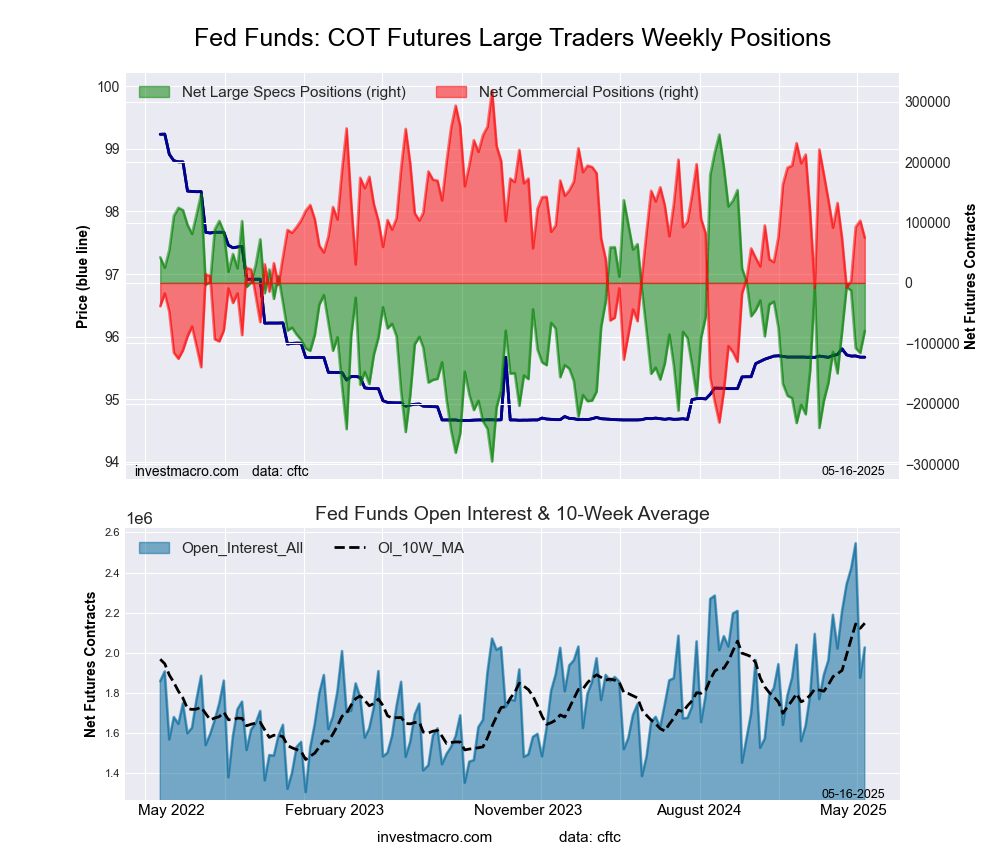
Federal Funds 30-Day Bonds Futures COT ChartThe 30-Day Federal Funds large speculator standing this week totaled a net position of -149,843 contracts in the data reported through Tuesday. This was a weekly fall of -35,833 contracts from the previous week which had a total of -114,010 net contracts.

This week’s current strength score (the trader positioning range over the past three years, measured from 0 to 100) shows the speculators are currently Bearish with a score of 26.9 percent. The commercials are Bullish with a score of 66.1 percent and the small traders (not shown in chart) are Bullish-Extreme with a score of 85.2 percent.

Price Trend-Following Model: Downtrend

Our weekly trend-following model classifies the current market price position as: Downtrend.

30-Day Federal Funds StatisticsSPECULATORSCOMMERCIALSSMALL TRADERS
– Percent of Open Interest Longs:22.858.62.5
– Percent of Open Interest Shorts:30.252.01.7
– Net Position:-149,843132,30517,538
– Gross Longs:459,9121,184,07650,922
– Gross Shorts:609,7551,051,77133,384
– Long to Short Ratio:0.8 to 11.1 to 11.5 to 1
NET POSITION TREND:
– Strength Index Score (3 Year Range Pct):26.966.185.2
– Strength Index Reading (3 Year Range):BearishBullishBullish-Extreme
NET POSITION MOVEMENT INDEX:
– 6-Week Change in Strength Index:-1.03.0-14.8


Secured Overnight Financing Rate (3-Month) Futures:
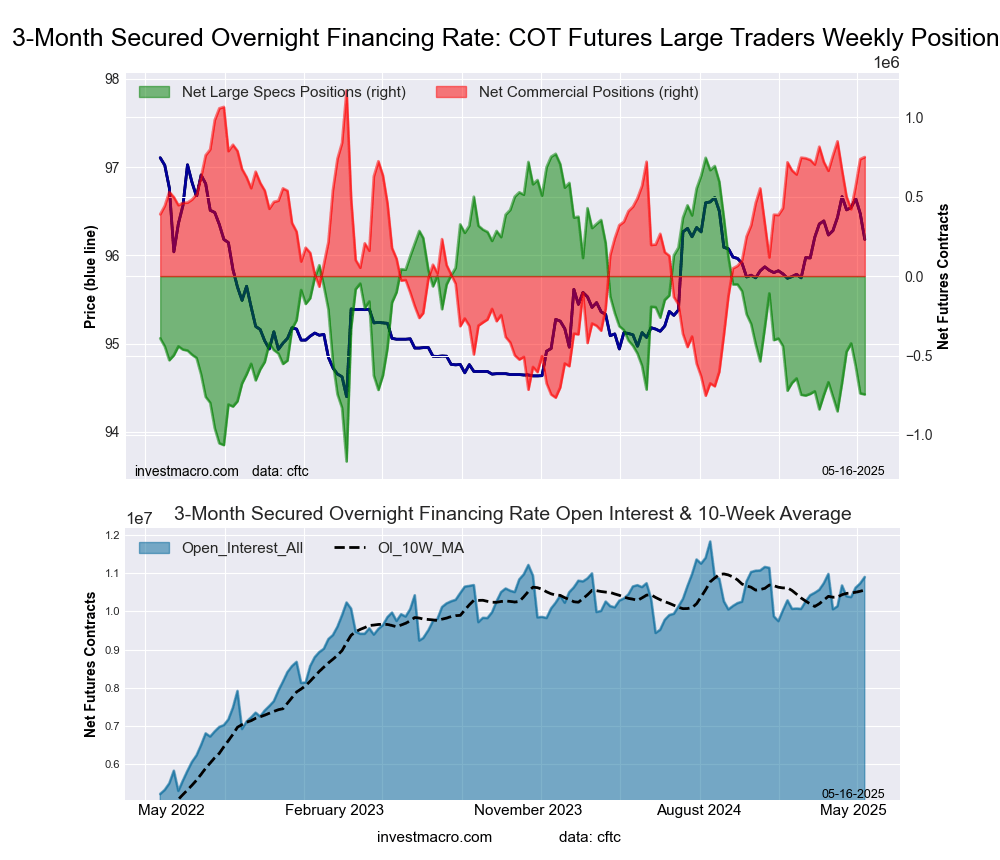
SOFR 3-Months Bonds Futures COT ChartThe Secured Overnight Financing Rate (3-Month) large speculator standing this week totaled a net position of -851,283 contracts in the data reported through Tuesday. This was a weekly decrease of -92,060 contracts from the previous week which had a total of -759,223 net contracts.

This week’s current strength score (the trader positioning range over the past three years, measured from 0 to 100) shows the speculators are currently Bearish-Extreme with a score of 16.3 percent. The commercials are Bullish-Extreme with a score of 83.5 percent and the small traders (not shown in chart) are Bullish-Extreme with a score of 85.4 percent.

Price Trend-Following Model: Weak Uptrend

Our weekly trend-following model classifies the current market price position as: Weak Uptrend.

SOFR 3-Months StatisticsSPECULATORSCOMMERCIALSSMALL TRADERS
– Percent of Open Interest Longs:12.360.20.2
– Percent of Open Interest Shorts:20.751.90.2
– Net Position:-851,283848,2163,067
– Gross Longs:1,242,6876,104,42021,116
– Gross Shorts:2,093,9705,256,20418,049
– Long to Short Ratio:0.6 to 11.2 to 11.2 to 1
NET POSITION TREND:
– Strength Index Score (3 Year Range Pct):16.383.585.4
– Strength Index Reading (3 Year Range):Bearish-ExtremeBullish-ExtremeBullish-Extreme
NET POSITION MOVEMENT INDEX:
– 6-Week Change in Strength Index:-5.76.0-3.6


Individual Bond Markets:

Secured Overnight Financing Rate (1-Month) Futures:

SOFR 1-Month Bonds Futures COT ChartThe Secured Overnight Financing Rate (1-Month) large speculator standing this week totaled a net position of -40,327 contracts in the data reported through Tuesday. This was a weekly advance of 12,366 contracts from the previous week which had a total of -52,693 net contracts.

This week’s current strength score (the trader positioning range over the past three years, measured from 0 to 100) shows the speculators are currently Bullish with a score of 58.6 percent. The commercials are Bearish with a score of 43.6 percent and the small traders (not shown in chart) are Bullish with a score of 62.2 percent.

Price Trend-Following Model: Uptrend

Our weekly trend-following model classifies the current market price position as: Uptrend.

SOFR 1-Month StatisticsSPECULATORSCOMMERCIALSSMALL TRADERS
– Percent of Open Interest Longs:32.854.20.0
– Percent of Open Interest Shorts:36.150.20.8
– Net Position:-40,32749,126-8,799
– Gross Longs:401,686664,780500
– Gross Shorts:442,013615,6549,299
– Long to Short Ratio:0.9 to 11.1 to 10.1 to 1
NET POSITION TREND:
– Strength Index Score (3 Year Range Pct):58.643.662.2
– Strength Index Reading (3 Year Range):BullishBearishBullish
NET POSITION MOVEMENT INDEX:
– 6-Week Change in Strength Index:-22.516.762.2


2-Year Treasury Note Futures:

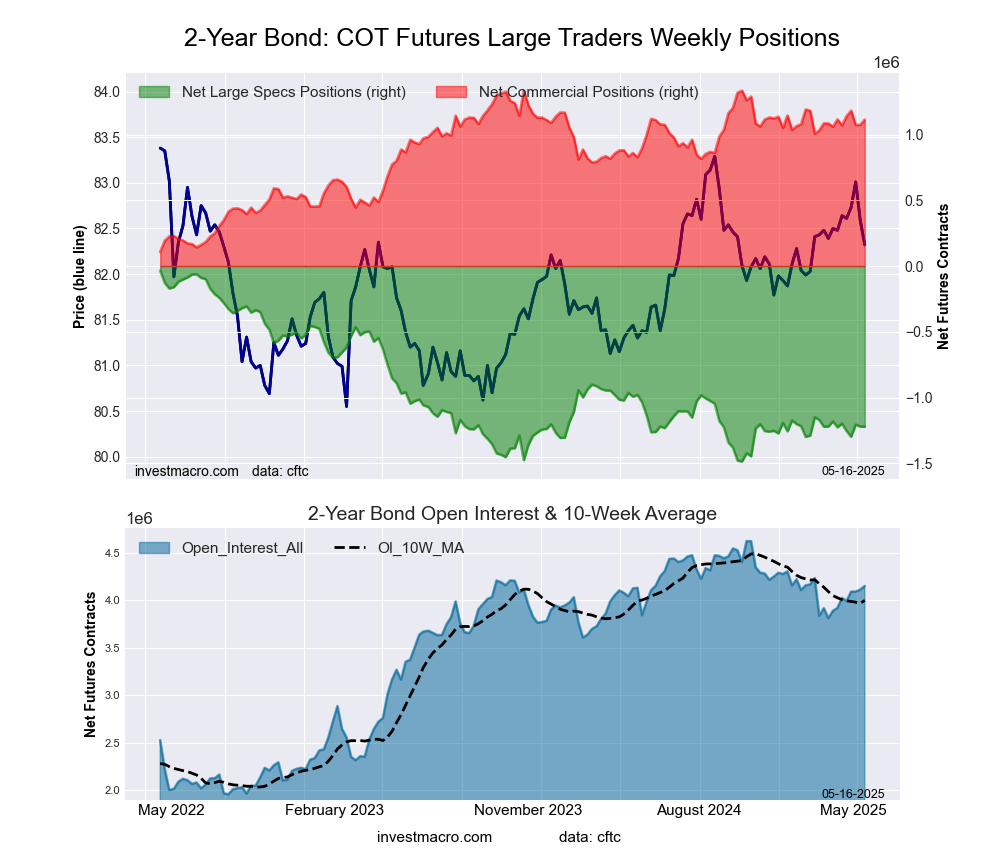
2-Year Treasury Bonds Futures COT ChartThe 2-Year Treasury Note large speculator standing this week totaled a net position of -1,226,391 contracts in the data reported through Tuesday. This was a weekly fall of -44,805 contracts from the previous week which had a total of -1,181,586 net contracts.

This week’s current strength score (the trader positioning range over the past three years, measured from 0 to 100) shows the speculators are currently Bearish-Extreme with a score of 17.9 percent. The commercials are Bullish-Extreme with a score of 82.1 percent and the small traders (not shown in chart) are Bullish with a score of 71.4 percent.

Price Trend-Following Model: Strong Uptrend

Our weekly trend-following model classifies the current market price position as: Strong Uptrend.

2-Year Treasury Note StatisticsSPECULATORSCOMMERCIALSSMALL TRADERS
– Percent of Open Interest Longs:13.976.85.8
– Percent of Open Interest Shorts:45.248.43.0
– Net Position:-1,226,3911,114,768111,623
– Gross Longs:544,0943,010,463228,193
– Gross Shorts:1,770,4851,895,695116,570
– Long to Short Ratio:0.3 to 11.6 to 12.0 to 1
NET POSITION TREND:
– Strength Index Score (3 Year Range Pct):17.982.171.4
– Strength Index Reading (3 Year Range):Bearish-ExtremeBullish-ExtremeBullish
NET POSITION MOVEMENT INDEX:
– 6-Week Change in Strength Index:4.4-5.40.8


5-Year Treasury Note Futures:

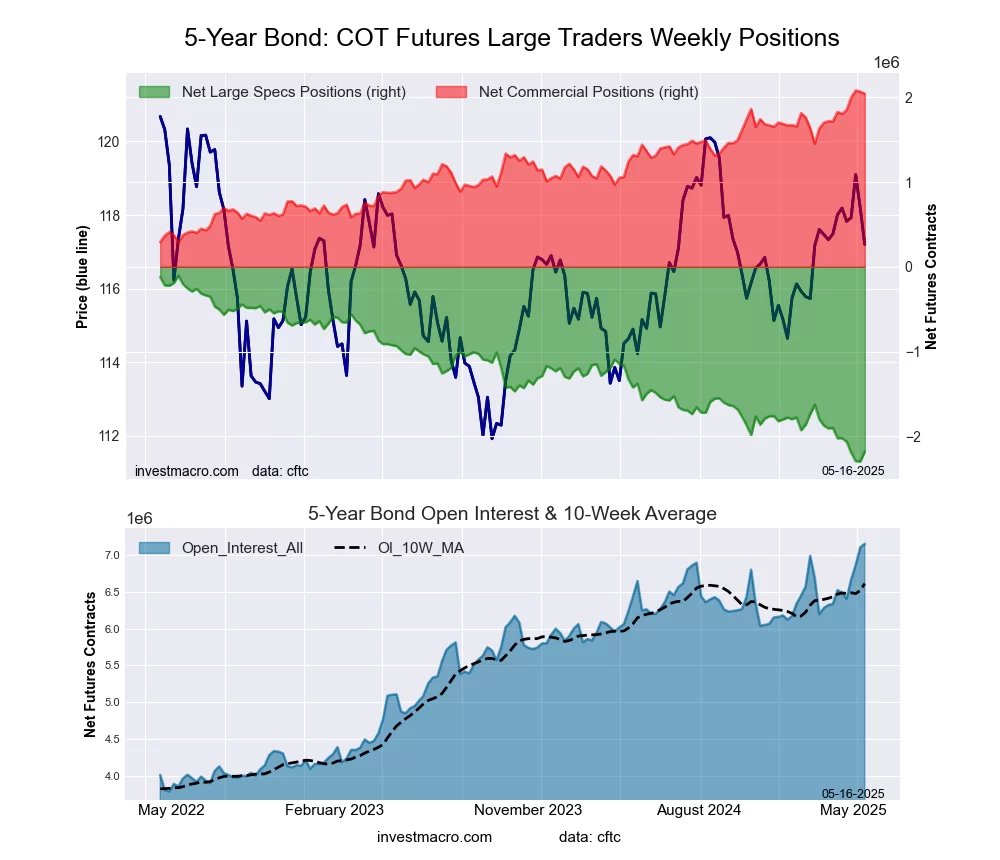
5-Year Treasury Bonds Futures COT ChartThe 5-Year Treasury Note large speculator standing this week totaled a net position of -2,021,677 contracts in the data reported through Tuesday. This was a weekly fall of -121,590 contracts from the previous week which had a total of -1,900,087 net contracts.

This week’s current strength score (the trader positioning range over the past three years, measured from 0 to 100) shows the speculators are currently Bearish-Extreme with a score of 0.0 percent. The commercials are Bullish-Extreme with a score of 97.8 percent and the small traders (not shown in chart) are Bullish-Extreme with a score of 87.9 percent.

Price Trend-Following Model: Strong Uptrend

Our weekly trend-following model classifies the current market price position as: Strong Uptrend.

5-Year Treasury Note StatisticsSPECULATORSCOMMERCIALSSMALL TRADERS
– Percent of Open Interest Longs:8.082.96.6
– Percent of Open Interest Shorts:39.054.93.6
– Net Position:-2,021,6771,826,517195,160
– Gross Longs:522,9745,403,429429,442
– Gross Shorts:2,544,6513,576,912234,282
– Long to Short Ratio:0.2 to 11.5 to 11.8 to 1
NET POSITION TREND:
– Strength Index Score (3 Year Range Pct):0.097.887.9
– Strength Index Reading (3 Year Range):Bearish-ExtremeBullish-ExtremeBullish-Extreme
NET POSITION MOVEMENT INDEX:
– 6-Week Change in Strength Index:-14.812.319.7


10-Year Treasury Note Futures:

10-Year Treasury Notes Bonds Futures COT ChartThe 10-Year Treasury Note large speculator standing this week totaled a net position of -863,263 contracts in the data reported through Tuesday. This was a weekly reduction of -53,173 contracts from the previous week which had a total of -810,090 net contracts.

This week’s current strength score (the trader positioning range over the past three years, measured from 0 to 100) shows the speculators are currently Bearish with a score of 26.5 percent. The commercials are Bullish with a score of 69.8 percent and the small traders (not shown in chart) are Bullish-Extreme with a score of 88.9 percent.

Price Trend-Following Model: Strong Uptrend

Our weekly trend-following model classifies the current market price position as: Strong Uptrend.

10-Year Treasury Note StatisticsSPECULATORSCOMMERCIALSSMALL TRADERS
– Percent of Open Interest Longs:11.575.99.8
– Percent of Open Interest Shorts:29.160.77.3
– Net Position:-863,263743,611119,652
– Gross Longs:562,2583,712,025478,662
– Gross Shorts:1,425,5212,968,414359,010
– Long to Short Ratio:0.4 to 11.3 to 11.3 to 1
NET POSITION TREND:
– Strength Index Score (3 Year Range Pct):26.569.888.9
– Strength Index Reading (3 Year Range):BearishBullishBullish-Extreme
NET POSITION MOVEMENT INDEX:
– 6-Week Change in Strength Index:-14.59.221.9


Ultra 10-Year Notes Futures:

Ultra 10-Year Treasury Notes Bonds Futures COT ChartThe Ultra 10-Year Notes large speculator standing this week totaled a net position of -105,983 contracts in the data reported through Tuesday. This was a weekly reduction of -21,496 contracts from the previous week which had a total of -84,487 net contracts.

This week’s current strength score (the trader positioning range over the past three years, measured from 0 to 100) shows the speculators are currently Bullish with a score of 63.4 percent. The commercials are Bearish-Extreme with a score of 14.3 percent and the small traders (not shown in chart) are Bullish-Extreme with a score of 96.1 percent.

Price Trend-Following Model: Strong Uptrend

Our weekly trend-following model classifies the current market price position as: Strong Uptrend.

Ultra 10-Year Notes StatisticsSPECULATORSCOMMERCIALSSMALL TRADERS
– Percent of Open Interest Longs:16.173.69.7
– Percent of Open Interest Shorts:20.767.910.9
– Net Position:-105,983131,932-25,949
– Gross Longs:373,8691,709,712226,120
– Gross Shorts:479,8521,577,780252,069
– Long to Short Ratio:0.8 to 11.1 to 10.9 to 1
NET POSITION TREND:
– Strength Index Score (3 Year Range Pct):63.414.396.1
– Strength Index Reading (3 Year Range):BullishBearish-ExtremeBullish-Extreme
NET POSITION MOVEMENT INDEX:
– 6-Week Change in Strength Index:-5.4-7.325.8


US Treasury Bonds Futures:

US Year Treasury Notes Long Bonds Futures COT ChartThe US Treasury Bonds large speculator standing this week totaled a net position of -32,648 contracts in the data reported through Tuesday. This was a weekly rise of 5,627 contracts from the previous week which had a total of -38,275 net contracts.

This week’s current strength score (the trader positioning range over the past three years, measured from 0 to 100) shows the speculators are currently Bullish with a score of 72.0 percent. The commercials are Bearish-Extreme with a score of 18.4 percent and the small traders (not shown in chart) are Bullish-Extreme with a score of 89.3 percent.

Price Trend-Following Model: Strong Uptrend

Our weekly trend-following model classifies the current market price position as: Strong Uptrend.

US Treasury Bonds StatisticsSPECULATORSCOMMERCIALSSMALL TRADERS
– Percent of Open Interest Longs:13.972.012.4
– Percent of Open Interest Shorts:15.675.86.8
– Net Position:-32,648-70,892103,540
– Gross Longs:256,3141,329,948229,567
– Gross Shorts:288,9621,400,840126,027
– Long to Short Ratio:0.9 to 10.9 to 11.8 to 1
NET POSITION TREND:
– Strength Index Score (3 Year Range Pct):72.018.489.3
– Strength Index Reading (3 Year Range):BullishBearish-ExtremeBullish-Extreme
NET POSITION MOVEMENT INDEX:
– 6-Week Change in Strength Index:-28.013.823.4


Ultra US Treasury Bonds Futures:

Ultra US Year Treasury Notes Long Bonds Futures COT ChartThe Ultra US Treasury Bonds large speculator standing this week totaled a net position of -254,029 contracts in the data reported through Tuesday. This was a weekly reduction of -21,663 contracts from the previous week which had a total of -232,366 net contracts.

This week’s current strength score (the trader positioning range over the past three years, measured from 0 to 100) shows the speculators are currently Bullish with a score of 77.3 percent. The commercials are Bearish-Extreme with a score of 15.4 percent and the small traders (not shown in chart) are Bullish with a score of 52.7 percent.

Price Trend-Following Model: Strong Uptrend

Our weekly trend-following model classifies the current market price position as: Strong Uptrend.

Ultra US Treasury Bonds StatisticsSPECULATORSCOMMERCIALSSMALL TRADERS
– Percent of Open Interest Longs:7.882.09.7
– Percent of Open Interest Shorts:21.869.78.0
– Net Position:-254,029222,69231,337
– Gross Longs:142,2421,487,582176,801
– Gross Shorts:396,2711,264,890145,464
– Long to Short Ratio:0.4 to 11.2 to 11.2 to 1
NET POSITION TREND:
– Strength Index Score (3 Year Range Pct):77.315.452.7
– Strength Index Reading (3 Year Range):BullishBearish-ExtremeBullish
NET POSITION MOVEMENT INDEX:
– 6-Week Change in Strength Index:-3.04.0-1.6


Article By InvestMacroReceive our weekly COT Newsletter

*COT Report: The COT data, released weekly to the public each Friday, is updated through the most recent Tuesday (data is 3 days old) and shows a quick view of how large speculators or non-commercials (for-profit traders) were positioned in the futures markets.

The CFTC categorizes trader positions according to commercial hedgers (traders who use futures contracts for hedging as part of the business), non-commercials (large traders who speculate to realize trading profits) and nonreportable traders (usually small traders/speculators) as well as their open interest (contracts open in the market at time of reporting). See CFTC criteria here.

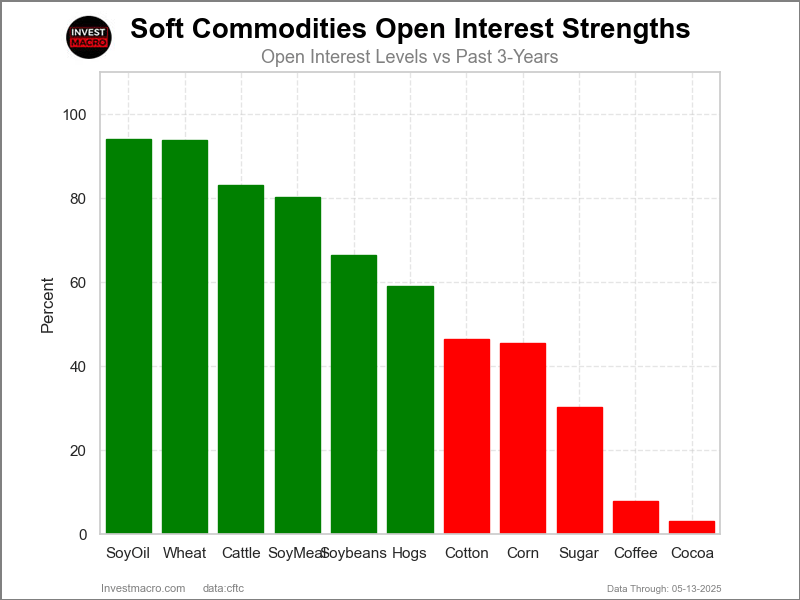
COT Soft Commodities Charts: Speculator Bets led by Soybean Oil, Cotton & Soybeans

By InvestMacro

Here are the latest charts and statistics for the Commitment of Traders (COT) reports data published by the Commodities Futures Trading Commission (CFTC).

The latest COT data is updated through Tuesday April 1st and shows a quick view of how large traders (for-profit speculators and commercial entities) were positioned in the futures markets.

Weekly Speculator Changes led by Soybean Oil, Cotton & Soybeans

The COT soft commodities markets speculator bets were overall higher this week (through Tuesday) as seven out of the eleven softs markets we cover had higher positioning while the other four markets had lower speculator contracts.

Leading the gains for the softs markets was Soybean Oil (35,433 contracts) with Cotton (12,027 contracts), Soybeans (10,898 contracts), Live Cattle (5,659 contracts), Lean Hogs (1,088 contracts), Sugar (1,031 contracts) and Cocoa (323 contracts) also showing positive weeks.

The markets with the declines in speculator bets this week were Corn (-33,502 contracts), Wheat (-20,252 contracts), Soybean Meal (-5,022 contracts) and Coffee (-4,389 contracts) also recording lower bets on the week.


Soft Commodities Net Speculators Leaderboard

Legend: Weekly Speculators Change | Speculators Current Net Position | Speculators Strength Score compared to last 3-Years (0-100 range)


Strength Scores led by Live Cattle & Coffee

COT Strength Scores (a normalized measure of Speculator positions over a 3-Year range, from 0 to 100 where above 80 is Extreme-Bullish and below 20 is Extreme-Bearish) showed that Live Cattle (100 percent) and Coffee (78 percent) lead the softs markets this week. Corn (56 percent) and Lean Hogs (51 percent) come in as the next highest in the weekly strength scores.

On the downside, Wheat (0 percent), Soybean Meal (5 percent) and Cotton (12 percent) come in at the lowest strength levels currently and are in Extreme-Bearish territory (below 20 percent).

Strength Statistics:
Corn (56.4 percent) vs Corn previous week (60.7 percent)
Sugar (27.6 percent) vs Sugar previous week (27.2 percent)
Coffee (78.3 percent) vs Coffee previous week (82.5 percent)
Soybeans (48.3 percent) vs Soybeans previous week (45.6 percent)
Soybean Oil (48.1 percent) vs Soybean Oil previous week (28.7 percent)
Soybean Meal (5.1 percent) vs Soybean Meal previous week (7.2 percent)
Live Cattle (100.0 percent) vs Live Cattle previous week (94.6 percent)
Lean Hogs (51.4 percent) vs Lean Hogs previous week (50.6 percent)
Cotton (12.3 percent) vs Cotton previous week (4.9 percent)
Cocoa (28.9 percent) vs Cocoa previous week (28.6 percent)
Wheat (0.0 percent) vs Wheat previous week (15.4 percent)


Sugar & Live Cattle top the 6-Week Strength Trends

COT Strength Score Trends (or move index, calculates the 6-week changes in strength scores) showed that Sugar (24 percent) and Live Cattle (15 percent) lead the past six weeks trends for soft commodities. Soybeans (1 percent) are the next highest and the only other positive mover in the latest trends data.

Wheat (-50 percent) leads the downside trend scores currently with Lean Hogs (-39 percent), Corn (-39 percent) and Soybean Oil (-28 percent) following next with lower trend scores.

Strength Trend Statistics:
Corn (-39.3 percent) vs Corn previous week (-29.2 percent)
Sugar (23.6 percent) vs Sugar previous week (25.1 percent)
Coffee (-7.4 percent) vs Coffee previous week (-5.1 percent)
Soybeans (0.5 percent) vs Soybeans previous week (-5.3 percent)
Soybean Oil (-27.7 percent) vs Soybean Oil previous week (-43.0 percent)
Soybean Meal (-13.4 percent) vs Soybean Meal previous week (-14.5 percent)
Live Cattle (14.8 percent) vs Live Cattle previous week (4.4 percent)
Lean Hogs (-38.9 percent) vs Lean Hogs previous week (-33.8 percent)
Cotton (-3.0 percent) vs Cotton previous week (-7.0 percent)
Cocoa (-9.6 percent) vs Cocoa previous week (-8.7 percent)
Wheat (-50.2 percent) vs Wheat previous week (-20.2 percent)


Individual Soft Commodities Markets:

CORN Futures:

CORN Futures COT ChartThe CORN large speculator standing this week totaled a net position of 166,869 contracts in the data reported through Tuesday. This was a weekly lowering of -33,502 contracts from the previous week which had a total of 200,371 net contracts.

This week’s current strength score (the trader positioning range over the past three years, measured from 0 to 100) shows the speculators are currently Bullish with a score of 56.4 percent. The commercials are Bearish with a score of 46.7 percent and the small traders (not shown in chart) are Bearish with a score of 41.9 percent.

Price Trend-Following Model: Weak Uptrend

Our weekly trend-following model classifies the current market price position as: Weak Uptrend.

CORN Futures StatisticsSPECULATORSCOMMERCIALSSMALL TRADERS
– Percent of Open Interest Longs:22.042.76.8
– Percent of Open Interest Shorts:13.148.69.8
– Net Position:166,869-111,384-55,485
– Gross Longs:412,771801,895128,660
– Gross Shorts:245,902913,279184,145
– Long to Short Ratio:1.7 to 10.9 to 10.7 to 1
NET POSITION TREND:
– Strength Index Score (3 Year Range Pct):56.446.741.9
– Strength Index Reading (3 Year Range):BullishBearishBearish
NET POSITION MOVEMENT INDEX:
– 6-Week Change in Strength Index:-39.336.041.9


SUGAR Futures:

SUGAR Futures COT ChartThe SUGAR large speculator standing this week totaled a net position of 53,073 contracts in the data reported through Tuesday. This was a weekly advance of 1,031 contracts from the previous week which had a total of 52,042 net contracts.

This week’s current strength score (the trader positioning range over the past three years, measured from 0 to 100) shows the speculators are currently Bearish with a score of 27.6 percent. The commercials are Bullish with a score of 71.3 percent and the small traders (not shown in chart) are Bearish with a score of 43.7 percent.

Price Trend-Following Model: Strong Uptrend

Our weekly trend-following model classifies the current market price position as: Strong Uptrend.

SUGAR Futures StatisticsSPECULATORSCOMMERCIALSSMALL TRADERS
– Percent of Open Interest Longs:23.849.48.0
– Percent of Open Interest Shorts:17.957.45.9
– Net Position:53,073-71,58318,510
– Gross Longs:212,886441,58271,472
– Gross Shorts:159,813513,16552,962
– Long to Short Ratio:1.3 to 10.9 to 11.3 to 1
NET POSITION TREND:
– Strength Index Score (3 Year Range Pct):27.671.343.7
– Strength Index Reading (3 Year Range):BearishBullishBearish
NET POSITION MOVEMENT INDEX:
– 6-Week Change in Strength Index:23.6-22.612.8


COFFEE Futures:

COFFEE Futures COT ChartThe COFFEE large speculator standing this week totaled a net position of 54,063 contracts in the data reported through Tuesday. This was a weekly decline of -4,389 contracts from the previous week which had a total of 58,452 net contracts.

This week’s current strength score (the trader positioning range over the past three years, measured from 0 to 100) shows the speculators are currently Bullish with a score of 78.3 percent. The commercials are Bearish with a score of 22.9 percent and the small traders (not shown in chart) are Bullish with a score of 61.8 percent.

Price Trend-Following Model: Uptrend

Our weekly trend-following model classifies the current market price position as: Uptrend.

COFFEE Futures StatisticsSPECULATORSCOMMERCIALSSMALL TRADERS
– Percent of Open Interest Longs:38.136.95.2
– Percent of Open Interest Shorts:7.768.93.7
– Net Position:54,063-56,6632,600
– Gross Longs:67,66965,5499,234
– Gross Shorts:13,606122,2126,634
– Long to Short Ratio:5.0 to 10.5 to 11.4 to 1
NET POSITION TREND:
– Strength Index Score (3 Year Range Pct):78.322.961.8
– Strength Index Reading (3 Year Range):BullishBearishBullish
NET POSITION MOVEMENT INDEX:
– 6-Week Change in Strength Index:-7.47.7-8.1


SOYBEANS Futures:

SOYBEANS Futures COT ChartThe SOYBEANS large speculator standing this week totaled a net position of -3,512 contracts in the data reported through Tuesday. This was a weekly boost of 10,898 contracts from the previous week which had a total of -14,410 net contracts.

This week’s current strength score (the trader positioning range over the past three years, measured from 0 to 100) shows the speculators are currently Bearish with a score of 48.3 percent. The commercials are Bullish with a score of 52.8 percent and the small traders (not shown in chart) are Bullish with a score of 54.9 percent.

Price Trend-Following Model: Weak Uptrend

Our weekly trend-following model classifies the current market price position as: Weak Uptrend.

SOYBEANS Futures StatisticsSPECULATORSCOMMERCIALSSMALL TRADERS
– Percent of Open Interest Longs:18.652.95.0
– Percent of Open Interest Shorts:19.049.97.6
– Net Position:-3,51225,581-22,069
– Gross Longs:158,653451,51443,113
– Gross Shorts:162,165425,93365,182
– Long to Short Ratio:1.0 to 11.1 to 10.7 to 1
NET POSITION TREND:
– Strength Index Score (3 Year Range Pct):48.352.854.9
– Strength Index Reading (3 Year Range):BearishBullishBullish
NET POSITION MOVEMENT INDEX:
– 6-Week Change in Strength Index:0.5-3.125.8


SOYBEAN OIL Futures:

SOYBEAN OIL Futures COT ChartThe SOYBEAN OIL large speculator standing this week totaled a net position of 12,084 contracts in the data reported through Tuesday. This was a weekly gain of 35,433 contracts from the previous week which had a total of -23,349 net contracts.

This week’s current strength score (the trader positioning range over the past three years, measured from 0 to 100) shows the speculators are currently Bearish with a score of 48.1 percent. The commercials are Bullish with a score of 54.8 percent and the small traders (not shown in chart) are Bearish with a score of 30.6 percent.

Price Trend-Following Model: Strong Uptrend

Our weekly trend-following model classifies the current market price position as: Strong Uptrend.

SOYBEAN OIL Futures StatisticsSPECULATORSCOMMERCIALSSMALL TRADERS
– Percent of Open Interest Longs:21.452.95.3
– Percent of Open Interest Shorts:19.455.64.6
– Net Position:12,084-16,3384,254
– Gross Longs:127,743315,80631,759
– Gross Shorts:115,659332,14427,505
– Long to Short Ratio:1.1 to 11.0 to 11.2 to 1
NET POSITION TREND:
– Strength Index Score (3 Year Range Pct):48.154.830.6
– Strength Index Reading (3 Year Range):BearishBullishBearish
NET POSITION MOVEMENT INDEX:
– 6-Week Change in Strength Index:-27.728.0-23.4


SOYBEAN MEAL Futures:

SOYBEAN MEAL Futures COT ChartThe SOYBEAN MEAL large speculator standing this week totaled a net position of -54,300 contracts in the data reported through Tuesday. This was a weekly lowering of -5,022 contracts from the previous week which had a total of -49,278 net contracts.

This week’s current strength score (the trader positioning range over the past three years, measured from 0 to 100) shows the speculators are currently Bearish-Extreme with a score of 5.1 percent. The commercials are Bullish-Extreme with a score of 91.3 percent and the small traders (not shown in chart) are Bearish with a score of 45.3 percent.

Price Trend-Following Model: Weak Uptrend

Our weekly trend-following model classifies the current market price position as: Weak Uptrend.

SOYBEAN MEAL Futures StatisticsSPECULATORSCOMMERCIALSSMALL TRADERS
– Percent of Open Interest Longs:17.950.08.5
– Percent of Open Interest Shorts:26.944.35.2
– Net Position:-54,30034,38219,918
– Gross Longs:108,052301,21151,126
– Gross Shorts:162,352266,82931,208
– Long to Short Ratio:0.7 to 11.1 to 11.6 to 1
NET POSITION TREND:
– Strength Index Score (3 Year Range Pct):5.191.345.3
– Strength Index Reading (3 Year Range):Bearish-ExtremeBullish-ExtremeBearish
NET POSITION MOVEMENT INDEX:
– 6-Week Change in Strength Index:-13.413.0-0.9


LIVE CATTLE Futures:

LIVE CATTLE Futures COT ChartThe LIVE CATTLE large speculator standing this week totaled a net position of 123,646 contracts in the data reported through Tuesday. This was a weekly lift of 5,659 contracts from the previous week which had a total of 117,987 net contracts.

This week’s current strength score (the trader positioning range over the past three years, measured from 0 to 100) shows the speculators are currently Bullish-Extreme with a score of 100.0 percent. The commercials are Bearish-Extreme with a score of 3.0 percent and the small traders (not shown in chart) are Bearish-Extreme with a score of 7.5 percent.

Price Trend-Following Model: Uptrend

Our weekly trend-following model classifies the current market price position as: Uptrend.

LIVE CATTLE Futures StatisticsSPECULATORSCOMMERCIALSSMALL TRADERS
– Percent of Open Interest Longs:49.326.27.9
– Percent of Open Interest Shorts:18.850.414.2
– Net Position:123,646-97,973-25,673
– Gross Longs:200,105106,51131,867
– Gross Shorts:76,459204,48457,540
– Long to Short Ratio:2.6 to 10.5 to 10.6 to 1
NET POSITION TREND:
– Strength Index Score (3 Year Range Pct):100.03.07.5
– Strength Index Reading (3 Year Range):Bullish-ExtremeBearish-ExtremeBearish-Extreme
NET POSITION MOVEMENT INDEX:
– 6-Week Change in Strength Index:14.8-15.1-9.7


LEAN HOGS Futures:

LEAN HOGS Futures COT ChartThe LEAN HOGS large speculator standing this week totaled a net position of 30,477 contracts in the data reported through Tuesday. This was a weekly increase of 1,088 contracts from the previous week which had a total of 29,389 net contracts.

This week’s current strength score (the trader positioning range over the past three years, measured from 0 to 100) shows the speculators are currently Bullish with a score of 51.4 percent. The commercials are Bearish with a score of 47.3 percent and the small traders (not shown in chart) are Bullish with a score of 59.1 percent.

Price Trend-Following Model: Strong Downtrend

Our weekly trend-following model classifies the current market price position as: Strong Downtrend.

LEAN HOGS Futures StatisticsSPECULATORSCOMMERCIALSSMALL TRADERS
– Percent of Open Interest Longs:34.436.76.7
– Percent of Open Interest Shorts:23.446.67.8
– Net Position:30,477-27,410-3,067
– Gross Longs:94,942101,26418,487
– Gross Shorts:64,465128,67421,554
– Long to Short Ratio:1.5 to 10.8 to 10.9 to 1
NET POSITION TREND:
– Strength Index Score (3 Year Range Pct):51.447.359.1
– Strength Index Reading (3 Year Range):BullishBearishBullish
NET POSITION MOVEMENT INDEX:
– 6-Week Change in Strength Index:-38.940.814.8


COTTON Futures:

COTTON Futures COT ChartThe COTTON large speculator standing this week totaled a net position of -41,979 contracts in the data reported through Tuesday. This was a weekly advance of 12,027 contracts from the previous week which had a total of -54,006 net contracts.

This week’s current strength score (the trader positioning range over the past three years, measured from 0 to 100) shows the speculators are currently Bearish-Extreme with a score of 12.3 percent. The commercials are Bullish-Extreme with a score of 87.2 percent and the small traders (not shown in chart) are Bearish with a score of 33.5 percent.

Price Trend-Following Model: Strong Downtrend

Our weekly trend-following model classifies the current market price position as: Strong Downtrend.

COTTON Futures StatisticsSPECULATORSCOMMERCIALSSMALL TRADERS
– Percent of Open Interest Longs:24.449.65.0
– Percent of Open Interest Shorts:38.936.04.1
– Net Position:-41,97939,2672,712
– Gross Longs:70,529143,53114,587
– Gross Shorts:112,508104,26411,875
– Long to Short Ratio:0.6 to 11.4 to 11.2 to 1
NET POSITION TREND:
– Strength Index Score (3 Year Range Pct):12.387.233.5
– Strength Index Reading (3 Year Range):Bearish-ExtremeBullish-ExtremeBearish
NET POSITION MOVEMENT INDEX:
– 6-Week Change in Strength Index:-3.03.9-11.9


COCOA Futures:

COCOA Futures COT ChartThe COCOA large speculator standing this week totaled a net position of 18,601 contracts in the data reported through Tuesday. This was a weekly boost of 323 contracts from the previous week which had a total of 18,278 net contracts.

This week’s current strength score (the trader positioning range over the past three years, measured from 0 to 100) shows the speculators are currently Bearish with a score of 28.9 percent. The commercials are Bullish with a score of 71.5 percent and the small traders (not shown in chart) are Bullish with a score of 52.9 percent.

Price Trend-Following Model: Strong Downtrend

Our weekly trend-following model classifies the current market price position as: Strong Downtrend.

COCOA Futures StatisticsSPECULATORSCOMMERCIALSSMALL TRADERS
– Percent of Open Interest Longs:28.244.19.4
– Percent of Open Interest Shorts:11.164.26.4
– Net Position:18,601-21,9563,355
– Gross Longs:30,74748,18210,295
– Gross Shorts:12,14670,1386,940
– Long to Short Ratio:2.5 to 10.7 to 11.5 to 1
NET POSITION TREND:
– Strength Index Score (3 Year Range Pct):28.971.552.9
– Strength Index Reading (3 Year Range):BearishBullishBullish
NET POSITION MOVEMENT INDEX:
– 6-Week Change in Strength Index:-9.612.8-33.5


WHEAT Futures:

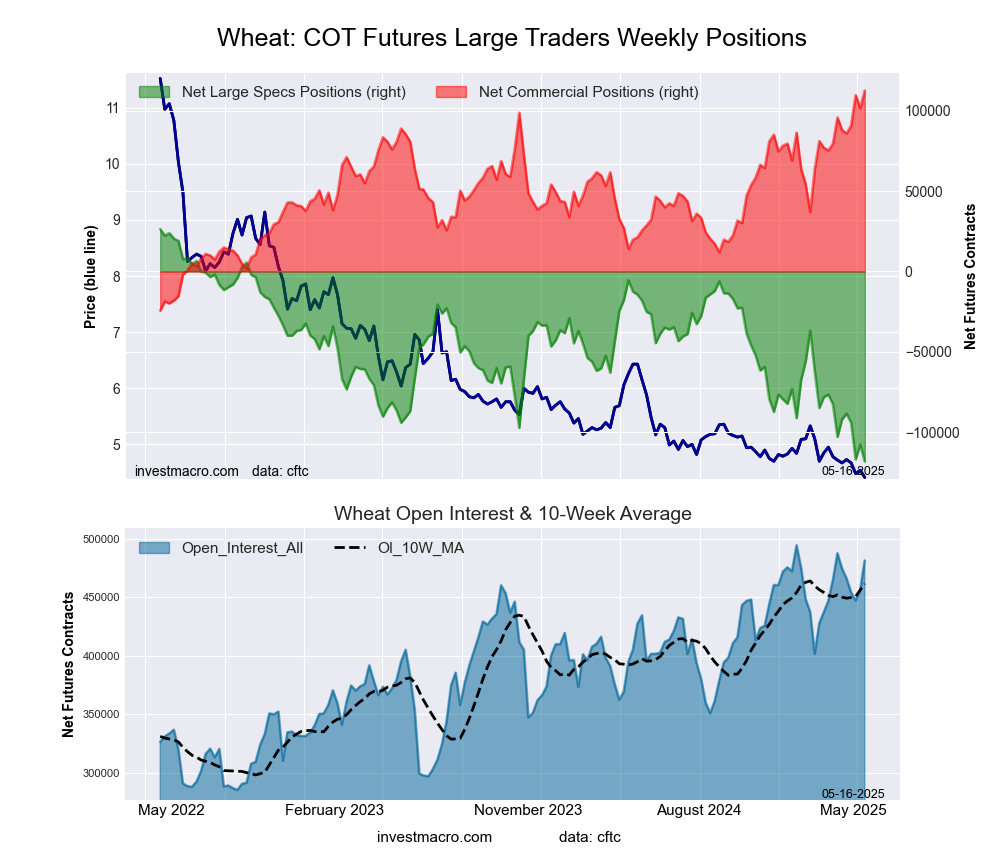
WHEAT Futures COT ChartThe WHEAT large speculator standing this week totaled a net position of -102,800 contracts in the data reported through Tuesday. This was a weekly decrease of -20,252 contracts from the previous week which had a total of -82,548 net contracts.

This week’s current strength score (the trader positioning range over the past three years, measured from 0 to 100) shows the speculators are currently Bearish-Extreme with a score of 0.0 percent. The commercials are Bullish-Extreme with a score of 97.6 percent and the small traders (not shown in chart) are Bullish-Extreme with a score of 96.4 percent.

Price Trend-Following Model: Weak Uptrend

Our weekly trend-following model classifies the current market price position as: Weak Uptrend.

WHEAT Futures StatisticsSPECULATORSCOMMERCIALSSMALL TRADERS
– Percent of Open Interest Longs:24.537.48.3
– Percent of Open Interest Shorts:45.617.86.8
– Net Position:-102,80095,6367,164
– Gross Longs:119,598182,31240,256
– Gross Shorts:222,39886,67633,092
– Long to Short Ratio:0.5 to 12.1 to 11.2 to 1
NET POSITION TREND:
– Strength Index Score (3 Year Range Pct):0.097.696.4
– Strength Index Reading (3 Year Range):Bearish-ExtremeBullish-ExtremeBullish-Extreme
NET POSITION MOVEMENT INDEX:
– 6-Week Change in Strength Index:-50.247.041.6


Article By InvestMacroReceive our weekly COT Newsletter

*COT Report: The COT data, released weekly to the public each Friday, is updated through the most recent Tuesday (data is 3 days old) and shows a quick view of how large speculators or non-commercials (for-profit traders) were positioned in the futures markets.

The CFTC categorizes trader positions according to commercial hedgers (traders who use futures contracts for hedging as part of the business), non-commercials (large traders who speculate to realize trading profits) and nonreportable traders (usually small traders/speculators) as well as their open interest (contracts open in the market at time of reporting). See CFTC criteria here.

COT Stock Market Charts: Speculator Bets led by S&P500 & Nasdaq

By InvestMacro

Here are the latest charts and statistics for the Commitment of Traders (COT) data published by the Commodities Futures Trading Commission (CFTC).

The latest COT data is updated through Tuesday April 1st and shows a quick view of how large traders (for-profit speculators and commercial entities) were positioned in the futures markets.

Weekly Speculator Changes led by S&P500 & Nasdaq

The COT stock markets speculator bets were higher this week (through Tuesday) as five out of the seven stock markets we cover had higher positioning while the other three markets had lower speculator contracts.

Leading the gains for the stock markets was the S&P500-Mini (34,340 contracts) with the Nasdaq-Mini (6,489 contracts), the MSCI EAFE-Mini (2,410 contracts), the DowJones-Mini (1,602 contracts) and the Nikkei 225 (540 contracts) also having positive weeks.

The markets with the declines in speculator bets this week were the Russell-Mini (-1,826 contracts) with the VIX (-1,367 contracts) also seeing lower bets on the week.


Stock Market Net Speculators Leaderboard

Legend: Weekly Speculators Change | Speculators Current Net Position | Speculators Strength Score compared to last 3-Years (0-100 range)


Strength Scores led by VIX & Nikkei 225

COT Strength Scores (a normalized measure of Speculator positions over a 3-Year range, from 0 to 100 where above 80 is Extreme-Bullish and below 20 is Extreme-Bearish) showed that the VIX (85 percent) and the Nikkei 225 (79 percent) lead the stock markets this week. The MSCI EAFE-Mini (76 percent) and S&P500-Mini (75 percent) come in as the next highest in the weekly strength scores.

On the downside, the DowJones-Mini (56 percent) comes in at the lowest strength level currently.

Strength Statistics:
VIX (85.3 percent) vs VIX previous week (86.5 percent)
S&P500-Mini (74.5 percent) vs S&P500-Mini previous week (68.4 percent)
DowJones-Mini (56.1 percent) vs DowJones-Mini previous week (53.5 percent)
Nasdaq-Mini (62.7 percent) vs Nasdaq-Mini previous week (52.6 percent)
Russell2000-Mini (70.3 percent) vs Russell2000-Mini previous week (71.5 percent)
Nikkei USD (79.1 percent) vs Nikkei USD previous week (74.5 percent)
EAFE-Mini (76.0 percent) vs EAFE-Mini previous week (72.6 percent)


VIX & Nikkei 225 top the 6-Week Strength Trends

COT Strength Score Trends (or move index, calculates the 6-week changes in strength scores) showed that the VIX (42 percent) leads the past six weeks trends for the stock markets. The Nikkei 225 (25 percent), the Russell-Mini (9 percent) and the Nasdaq-Mini (8 percent) are the next highest positive movers in the latest trends data.

The DowJones-Mini (-3 percent) leads the downside trend scores currently with the EAFE-Mini (-2 percent) coming in as the next market with lower trend scores.

Strength Trend Statistics:
VIX (42.0 percent) vs VIX previous week (44.4 percent)
S&P500-Mini (3.8 percent) vs S&P500-Mini previous week (-6.5 percent)
DowJones-Mini (-2.5 percent) vs DowJones-Mini previous week (-11.5 percent)
Nasdaq-Mini (8.3 percent) vs Nasdaq-Mini previous week (-7.4 percent)
Russell2000-Mini (8.6 percent) vs Russell2000-Mini previous week (11.7 percent)
Nikkei USD (25.1 percent) vs Nikkei USD previous week (17.9 percent)
EAFE-Mini (-2.4 percent) vs EAFE-Mini previous week (-14.2 percent)


Individual Stock Market Charts:

VIX Volatility Futures:

VIX Volatility Futures COT ChartThe VIX Volatility large speculator standing this week equaled a net position of -10,358 contracts in the data reported through Tuesday. This was a weekly reduction of -1,367 contracts from the previous week which had a total of -8,991 net contracts.

This week’s current strength score (the trader positioning range over the past three years, measured from 0 to 100) shows the speculators are currently Bullish-Extreme with a score of 85.3 percent. The commercials are Bearish-Extreme with a score of 14.8 percent and the small traders (not shown in chart) are Bullish with a score of 79.2 percent.

Price Trend-Following Model: Strong Uptrend

Our weekly trend-following model classifies the current market price position as: Strong Uptrend.

VIX Volatility Futures StatisticsSPECULATORSCOMMERCIALSSMALL TRADERS
– Percent of Open Interest Longs:29.442.89.0
– Percent of Open Interest Shorts:32.640.38.3
– Net Position:-10,3588,0552,303
– Gross Longs:94,853138,09329,211
– Gross Shorts:105,211130,03826,908
– Long to Short Ratio:0.9 to 11.1 to 11.1 to 1
NET POSITION TREND:
– Strength Index Score (3 Year Range Pct):85.314.879.2
– Strength Index Reading (3 Year Range):Bullish-ExtremeBearish-ExtremeBullish
NET POSITION MOVEMENT INDEX:
– 6-Week Change in Strength Index:42.0-40.51.4


S&P500 Mini Futures:

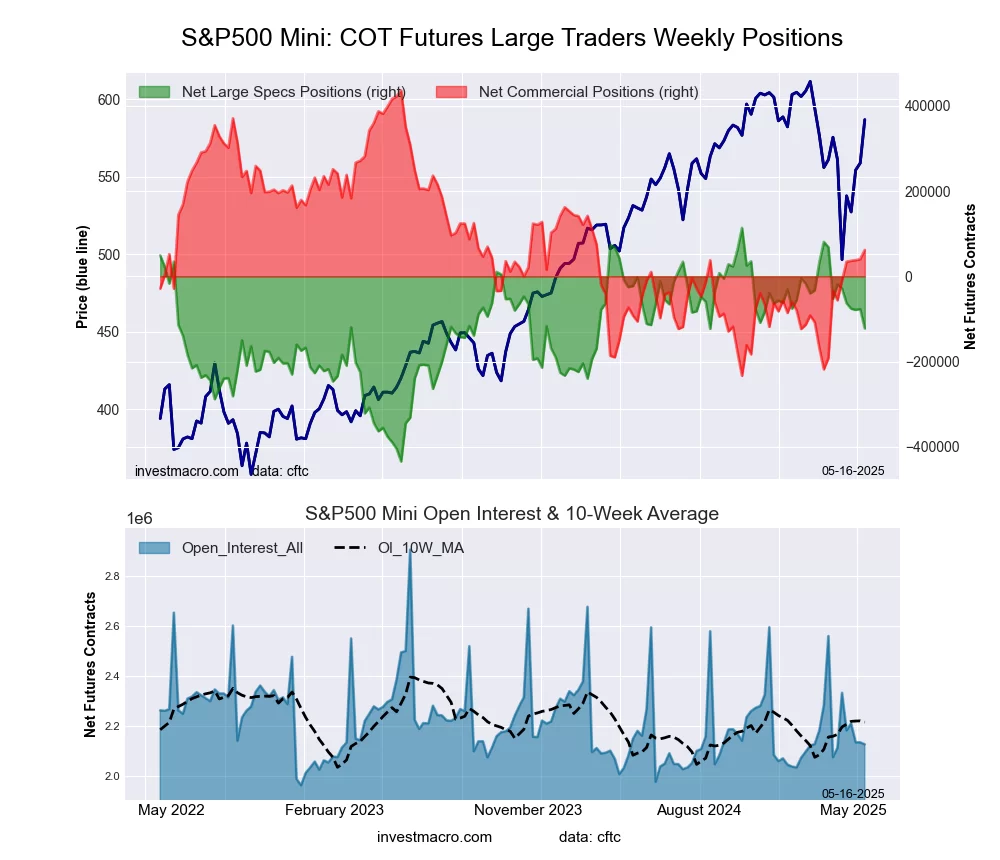
SP500 Mini Futures COT ChartThe S&P500 Mini large speculator standing this week equaled a net position of -19,022 contracts in the data reported through Tuesday. This was a weekly advance of 34,340 contracts from the previous week which had a total of -53,362 net contracts.

This week’s current strength score (the trader positioning range over the past three years, measured from 0 to 100) shows the speculators are currently Bullish with a score of 74.5 percent. The commercials are Bearish with a score of 26.5 percent and the small traders (not shown in chart) are Bullish with a score of 67.1 percent.

Price Trend-Following Model: Strong Downtrend

Our weekly trend-following model classifies the current market price position as: Strong Downtrend.

S&P500 Mini Futures StatisticsSPECULATORSCOMMERCIALSSMALL TRADERS
– Percent of Open Interest Longs:14.271.311.8
– Percent of Open Interest Shorts:15.173.98.2
– Net Position:-19,022-56,19975,221
– Gross Longs:300,3661,504,785249,432
– Gross Shorts:319,3881,560,984174,211
– Long to Short Ratio:0.9 to 11.0 to 11.4 to 1
NET POSITION TREND:
– Strength Index Score (3 Year Range Pct):74.526.567.1
– Strength Index Reading (3 Year Range):BullishBearishBullish
NET POSITION MOVEMENT INDEX:
– 6-Week Change in Strength Index:3.85.4-22.5


Dow Jones Mini Futures:

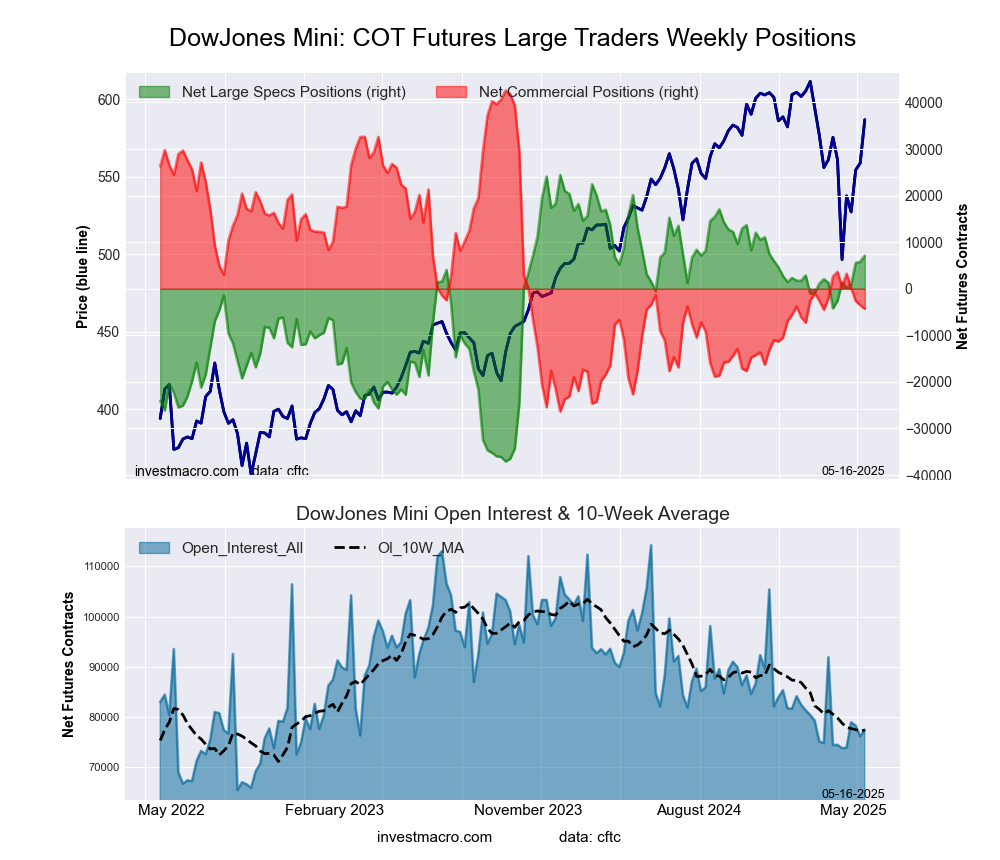
Dow Jones Mini Futures COT ChartThe Dow Jones Mini large speculator standing this week equaled a net position of -2,604 contracts in the data reported through Tuesday. This was a weekly boost of 1,602 contracts from the previous week which had a total of -4,206 net contracts.

This week’s current strength score (the trader positioning range over the past three years, measured from 0 to 100) shows the speculators are currently Bullish with a score of 56.1 percent. The commercials are Bearish with a score of 43.5 percent and the small traders (not shown in chart) are Bearish with a score of 47.7 percent.

Price Trend-Following Model: Strong Downtrend

Our weekly trend-following model classifies the current market price position as: Strong Downtrend.

Dow Jones Mini Futures StatisticsSPECULATORSCOMMERCIALSSMALL TRADERS
– Percent of Open Interest Longs:13.263.214.3
– Percent of Open Interest Shorts:16.758.315.7
– Net Position:-2,6043,625-1,021
– Gross Longs:9,84647,04510,660
– Gross Shorts:12,45043,42011,681
– Long to Short Ratio:0.8 to 11.1 to 10.9 to 1
NET POSITION TREND:
– Strength Index Score (3 Year Range Pct):56.143.547.7
– Strength Index Reading (3 Year Range):BullishBearishBearish
NET POSITION MOVEMENT INDEX:
– 6-Week Change in Strength Index:-2.58.9-27.4


Nasdaq Mini Futures:

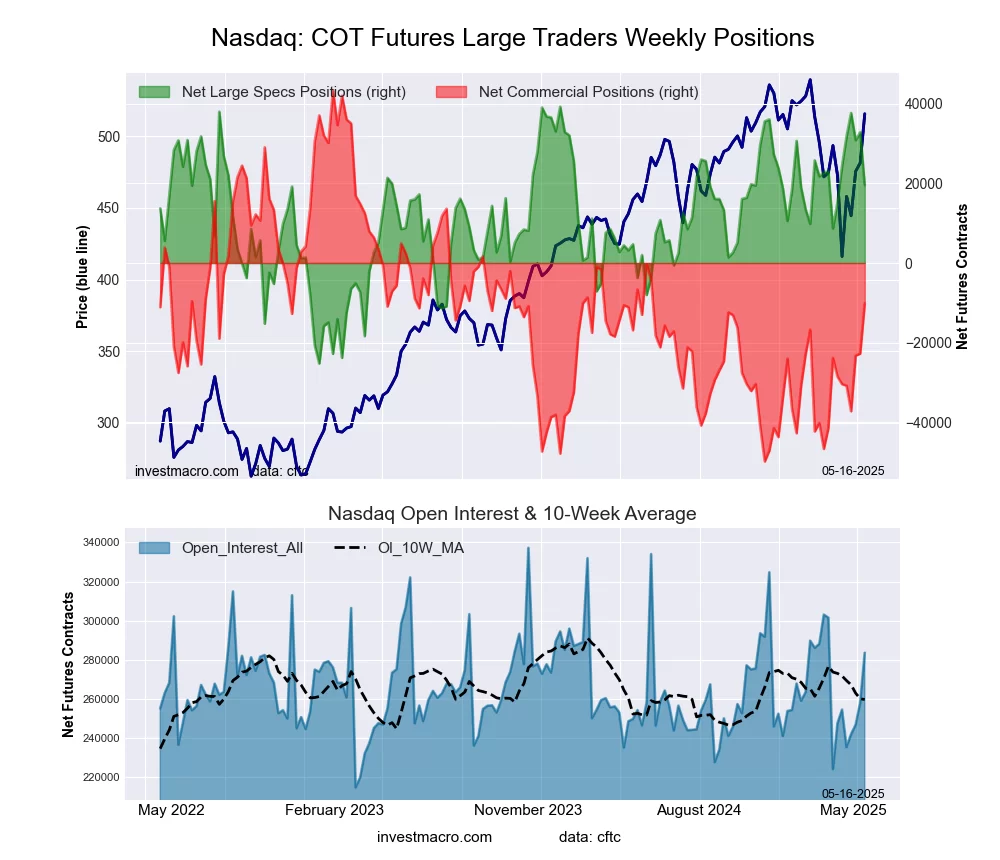
Nasdaq Mini Futures COT ChartThe Nasdaq Mini large speculator standing this week equaled a net position of 15,178 contracts in the data reported through Tuesday. This was a weekly lift of 6,489 contracts from the previous week which had a total of 8,689 net contracts.

This week’s current strength score (the trader positioning range over the past three years, measured from 0 to 100) shows the speculators are currently Bullish with a score of 62.7 percent. The commercials are Bearish with a score of 22.9 percent and the small traders (not shown in chart) are Bullish with a score of 79.7 percent.

Price Trend-Following Model: Strong Downtrend

Our weekly trend-following model classifies the current market price position as: Strong Downtrend.

Nasdaq Mini Futures StatisticsSPECULATORSCOMMERCIALSSMALL TRADERS
– Percent of Open Interest Longs:28.454.216.6
– Percent of Open Interest Shorts:22.365.711.3
– Net Position:15,178-28,51213,334
– Gross Longs:70,420134,32341,232
– Gross Shorts:55,242162,83527,898
– Long to Short Ratio:1.3 to 10.8 to 11.5 to 1
NET POSITION TREND:
– Strength Index Score (3 Year Range Pct):62.722.979.7
– Strength Index Reading (3 Year Range):BullishBearishBullish
NET POSITION MOVEMENT INDEX:
– 6-Week Change in Strength Index:8.3-12.612.2


Russell 2000 Mini Futures:

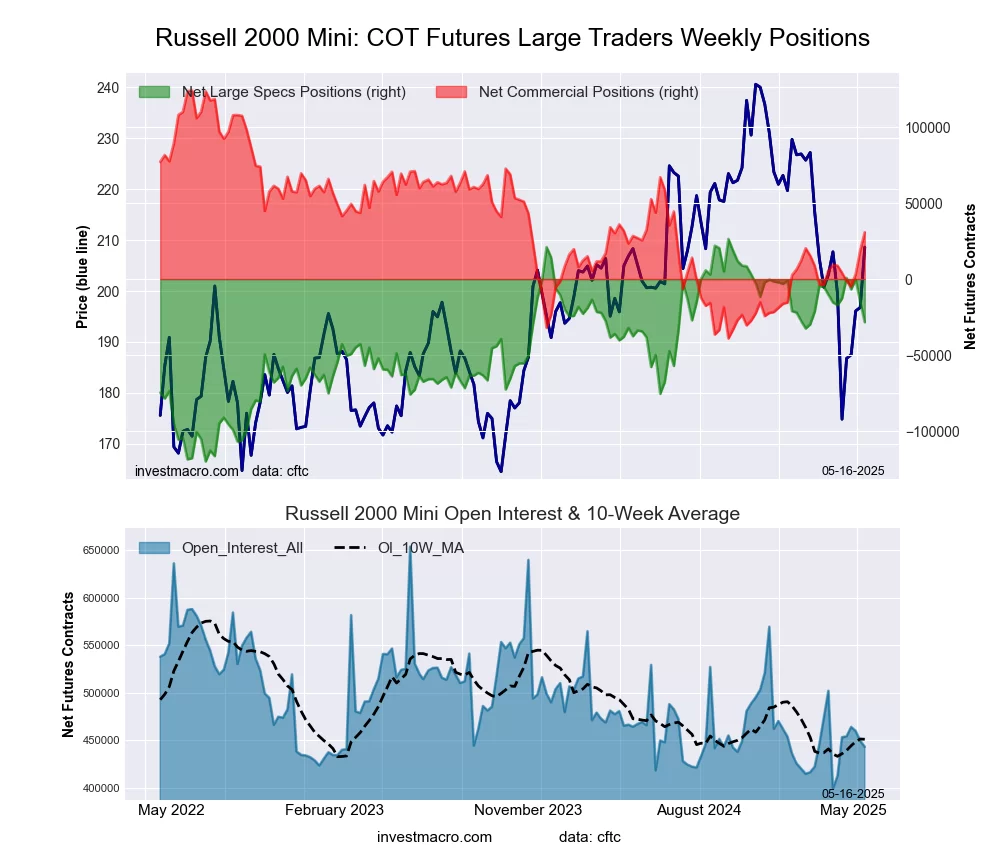
Russell 2000 Mini Futures COT ChartThe Russell 2000 Mini large speculator standing this week equaled a net position of -17,171 contracts in the data reported through Tuesday. This was a weekly decline of -1,826 contracts from the previous week which had a total of -15,345 net contracts.

This week’s current strength score (the trader positioning range over the past three years, measured from 0 to 100) shows the speculators are currently Bullish with a score of 70.3 percent. The commercials are Bearish with a score of 29.4 percent and the small traders (not shown in chart) are Bearish with a score of 47.8 percent.

Price Trend-Following Model: Strong Downtrend

Our weekly trend-following model classifies the current market price position as: Strong Downtrend.

Russell 2000 Mini Futures StatisticsSPECULATORSCOMMERCIALSSMALL TRADERS
– Percent of Open Interest Longs:17.069.98.7
– Percent of Open Interest Shorts:21.167.86.7
– Net Position:-17,1718,8568,315
– Gross Longs:70,029288,40335,994
– Gross Shorts:87,200279,54727,679
– Long to Short Ratio:0.8 to 11.0 to 11.3 to 1
NET POSITION TREND:
– Strength Index Score (3 Year Range Pct):70.329.447.8
– Strength Index Reading (3 Year Range):BullishBearishBearish
NET POSITION MOVEMENT INDEX:
– 6-Week Change in Strength Index:8.6-4.0-17.2


Nikkei Stock Average (USD) Futures:

Nikkei Stock Average (USD) Futures COT ChartThe Nikkei Stock Average (USD) large speculator standing this week equaled a net position of -121 contracts in the data reported through Tuesday. This was a weekly boost of 540 contracts from the previous week which had a total of -661 net contracts.

This week’s current strength score (the trader positioning range over the past three years, measured from 0 to 100) shows the speculators are currently Bullish with a score of 79.1 percent. The commercials are Bearish with a score of 26.1 percent and the small traders (not shown in chart) are Bearish with a score of 46.3 percent.

Price Trend-Following Model: Strong Downtrend

Our weekly trend-following model classifies the current market price position as: Strong Downtrend.

Nikkei Stock Average Futures StatisticsSPECULATORSCOMMERCIALSSMALL TRADERS
– Percent of Open Interest Longs:7.469.019.5
– Percent of Open Interest Shorts:8.269.318.4
– Net Position:-121-46167
– Gross Longs:1,0689,9522,817
– Gross Shorts:1,1899,9982,650
– Long to Short Ratio:0.9 to 11.0 to 11.1 to 1
NET POSITION TREND:
– Strength Index Score (3 Year Range Pct):79.126.146.3
– Strength Index Reading (3 Year Range):BullishBearishBearish
NET POSITION MOVEMENT INDEX:
– 6-Week Change in Strength Index:25.1-18.4-5.9


MSCI EAFE Mini Futures:

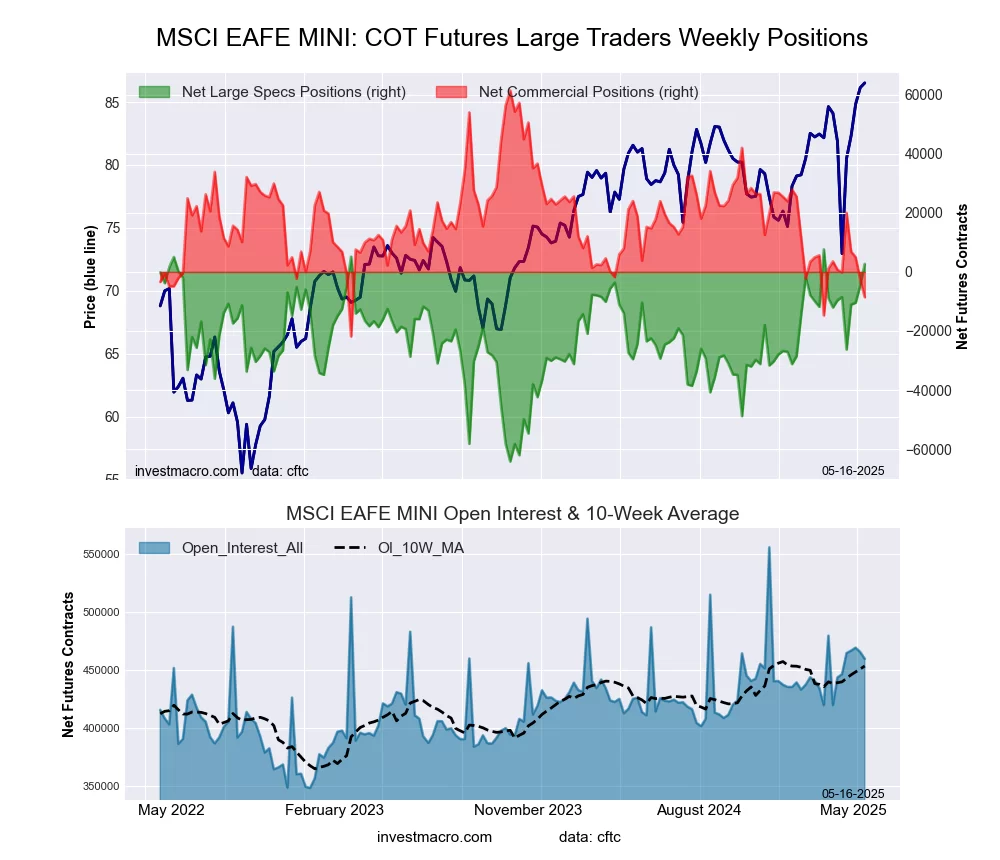
MSCI EAFE Mini Futures COT ChartThe MSCI EAFE Mini large speculator standing this week equaled a net position of -9,613 contracts in the data reported through Tuesday. This was a weekly gain of 2,410 contracts from the previous week which had a total of -12,023 net contracts.

This week’s current strength score (the trader positioning range over the past three years, measured from 0 to 100) shows the speculators are currently Bullish with a score of 76.0 percent. The commercials are Bearish with a score of 27.1 percent and the small traders (not shown in chart) are Bullish with a score of 61.3 percent.

Price Trend-Following Model: Weak Uptrend

Our weekly trend-following model classifies the current market price position as: Weak Uptrend.

MSCI EAFE Mini Futures StatisticsSPECULATORSCOMMERCIALSSMALL TRADERS
– Percent of Open Interest Longs:11.285.62.9
– Percent of Open Interest Shorts:13.485.50.9
– Net Position:-9,6137218,892
– Gross Longs:49,736380,09312,869
– Gross Shorts:59,349379,3723,977
– Long to Short Ratio:0.8 to 11.0 to 13.2 to 1
NET POSITION TREND:
– Strength Index Score (3 Year Range Pct):76.027.161.3
– Strength Index Reading (3 Year Range):BullishBearishBullish
NET POSITION MOVEMENT INDEX:
– 6-Week Change in Strength Index:-2.4-3.322.3


Article By InvestMacroReceive our weekly COT Newsletter

*COT Report: The COT data, released weekly to the public each Friday, is updated through the most recent Tuesday (data is 3 days old) and shows a quick view of how large speculators or non-commercials (for-profit traders) were positioned in the futures markets.

The CFTC categorizes trader positions according to commercial hedgers (traders who use futures contracts for hedging as part of the business), non-commercials (large traders who speculate to realize trading profits) and nonreportable traders (usually small traders/speculators) as well as their open interest (contracts open in the market at time of reporting). See CFTC criteria here.

New modelling reveals full impact of Trump’s ‘Liberation Day’ tariffs – with the US hit hardest

By Niven Winchester, Auckland University of Technology 

We now have a clearer picture of Donald Trump’s “Liberation Day” tariffs and how they will affect other trading nations, including the United States itself.

The US administration claims these tariffs on imports will reduce the US trade deficit and address what it views as unfair and non-reciprocal trade practices. Trump said this would

forever be remembered as the day American industry was reborn, the day America’s destiny was reclaimed.

The “reciprocal” tariffs are designed to impose charges on other countries equivalent to half the costs they supposedly inflict on US exporters through tariffs, currency manipulation and non-tariff barriers levied on US goods.

Each nation received a tariff number that will apply to most goods. Notable sectors exempt include steel, aluminium and motor vehicles, which are already subject to new tariffs.

The minimum baseline tariff for each country is 10%. But many countries received higher numbers, including Vietnam (46%), Thailand (36%), China (34%), Indonesia (32%), Taiwan (32%) and Switzerland (31%).

The tariff number for China is in addition to an existing 20% tariff, so the total tariff applied to Chinese imports is 54%. Countries assigned 10% tariffs include Australia, New Zealand and the United Kingdom.

Canada and Mexico are exempt from the reciprocal tariffs, for now, but goods from those nations are subject to a 25% tariff under a separate executive order.

Although some countries do charge higher tariffs on US goods than the US imposes on their exports, and the “Liberation Day” tariffs are allegedly only half the full reciprocal rate, the calculations behind them are open to challenge.

For example, non-tariff measures are notoriously difficult to estimate and “subject to much uncertainty”, according to one recent study.

GDP impacts with retaliation

Other countries are now likely to respond with retaliatory tariffs on US imports. Canada (the largest destination for US exports), the EU and China have all said they will respond in kind.

To estimate the impacts of this tit-for-tat trade standoff, I use a global model of the production, trade and consumption of goods and services. Similar simulation tools – known as “computable general equilibrium models” – are widely used by governments, academics and consultancies to evaluate policy changes.

The first model simulates a scenario in which the US imposes reciprocal and other new tariffs, and other countries respond with equivalent tariffs on US goods. Estimated changes in GDP due to US reciprocal tariffs and retaliatory tariffs by other nations are shown in the table below.


The tariffs decrease US GDP by US$438.4 billion (1.45%). Divided among the nation’s 126 million households, GDP per household decreases by $3,487 per year. That is larger than the corresponding decreases in any other country. (All figures are in US dollars.)

Proportional GDP decreases are largest in Mexico (2.24%) and Canada (1.65%) as these nations ship more than 75% of their exports to the US. Mexican households are worse off by $1,192 per year and Canadian households by $2,467.

Other nations that experience relatively large decreases in GDP include Vietnam (0.99%) and Switzerland (0.32%).

Some nations gain from the trade war. Typically, these face relatively low US tariffs (and consequently also impose relatively low tariffs on US goods). New Zealand (0.29%) and Brazil (0.28%) experience the largest increases in GDP. New Zealand households are better off by $397 per year.

Aggregate GDP for the rest of the world (all nations except the US) decreases by $62 billion.

At the global level, GDP decreases by $500 billion (0.43%). This result confirms the well-known rule that trade wars shrink the global economy.

GDP impacts without retaliation

In the second scenario, the modelling depicts what happens if other nations do not react to the US tariffs. The changes in the GDP of selected countries are presented in the table below.


Countries that face relatively high US tariffs and ship a large proportion of their exports to the US experience the largest proportional decreases in GDP. These include Canada, Mexico, Vietnam, Thailand, Taiwan, Switzerland, South Korea and China.

Countries that face relatively low new tariffs gain, with the UK experiencing the largest GDP increase.

The tariffs decrease US GDP by $149 billion (0.49%) because the tariffs increase production costs and consumer prices in the US.

Aggregate GDP for the rest of the world decreases by $155 billion, more than twice the corresponding decrease when there was retaliation. This indicates that the rest of the world can reduce losses by retaliating. At the same time, retaliation leads to a worse outcome for the US.

Previous tariff announcements by the Trump administration dropped sand into the cogs of international trade. The reciprocal tariffs throw a spanner into the works. Ultimately, the US may face the largest damages.The Conversation

About the Author:

Niven Winchester, Professor of Economics, Auckland University of Technology

This article is republished from The Conversation under a Creative Commons license. Read the original article.


Week Ahead: S&P 500 to flirt with “bear market”?

By ForexTime 

  • US500 plummets to lowest since August; after Thursday’s biggest 1-day drop since pandemic
  • China announces tariff retaliation ahead of Friday’s NFP, Powell speech
  • Week Ahead: EU retaliation, US CPI, and earnings season could trigger more big moves!
  • Markets may not find comfort from Fed speakers next week
  • Technical rebound likely not sustained, barring stunning risk turnaround
  • Wall Street still forecasting new record high for S&P 500 over next 12 months
  • US500 would officially enter “bear market” if it falls to 4921.04.


US stock indices are extending their steep drop on Friday!

This comes after just posting their biggest one-day drop since the pandemic on Thursday, April 3rd, 2025 when the:

  • S&P 500 (tracked by FXTM’s US500) fell 4.84%.
  • Dow Jones Industrial Average a.k.a. the Dow (tracked by FXTM’s US30) fell 3.98%.
  • S&P Midcap 400 index (tracked by FXTM’s US400) fell 6.66%.
  • Russell 2000 (tracked by FXTM’s RUS2000) fell 6.59%.

Thursday’s declines marked their largest one-day drop (in % terms) for each of these US stock indices since June 11th, 2020!

As for the tech-heavy Nasdaq 100 (tracked by FXTM’s NAS100), it fell 5.41% yesterday – nearly matching its 5.54% plummet on September 13th, 2022.

READ MORE: Trump’s “Liberation Day” Tariffs: How are markets reacting? (published Thursday, April 3rd, 2025)


Why are US stock markets falling on Friday (April 4th)?

In a tit-for-tat move, China has just responded to US President Donald Trump’s “liberation day” tariff hike earlier this week (Wednesday, April 2nd).

Today, China announced 34% tariffs on all US imports starting April 10th!

Although the 34% number is lower than the 54% rate imposed by President Trump on Chinese shipments …

This has clearly escalated the trade war between the world’s two largest economies! 

This has left investors and traders worldwide outright fearful about the impact from an escalating global trade war, potentially sending the world into a recession!

And there could be even more volatility today for US stock indices.

Note that these steep declines at the time of writing are happening even before the release of the monthly US jobs report (NFP – nonfarm payrolls) as Fed Chair Jerome Powell’s speech due later today (Friday, April 4th).


And that’s before we enter the week ahead which features these key scheduled economic events:

Monday, April 7

  • XAU: China foreign reserves
  • GER40 index: Germany February industrial production, external trade
  • EUR: EU trade minister to discuss reaction to Trump tariffs; Eurozone February retail sales
  • USDInd: Speech by Dallas Fed President Lorie Logan

Tuesday, April 8

  • AUD: Australia April consumer confidence; March business confidence
  • TWN index: Taiwan March CPI, PPI
  • USDInd: Speech by San Franscisco Fed President Mary Daly

Wednesday, April 9

  • NZD: RBNZ rate decision
  • MXN: Mexico March CPI
  • USDInd: FOMC meeting minutes; speech by Richmond Fed President Tom Barkin
  • US “reciprocal” tariffs go into effect

Thursday, April 10

  • JP225 index: Japan March PPI
  • CN50 index: China March CPI, PPI
  • TWN index: Taiwan March trade balance
  • US500 index: US March CPI
  • RUS2000 index: US initial weekly jobless claims; speeches by Chicago Fed President Austan Goolsbee, Philadelphia Fed President Patrick Harker, Dallas Fed President Lorie Logan
  • China’s retaliatory 34% tariffs against US go into effect

Friday, April 11

  • NZD: New Zealand March manufacturing PMI
  • GBP: UK February GDP, industrial production, trade balance
  • US400 index: US April consumer sentiment; March PPI
  • USDInd: Speeches by New York Fed President John Williams, St. Louis Fed President Alberto Musalem
  • US30 index: US earnings season kicks off with JPMorgan Chase, Morgan Stanley, Wells Fargo etc.


3 things to look out for next week (April 7– 11):


1) Monday, April 7th: Tariff Retaliation

EU trade ministers are set to gather in Luxembourg for a closely-watched meeting.

The agenda?

To formulate the EU’s reaction to President Trump’s tariff salvo.

  • BEARISH: US stock indexes could fall further if the EU adopts an aggressive stance, emulating China, and retaliates in a tit-for-tat manner.
  • BULLISH: US stock indexes could rebound if the EU adopts a more conciliatory tone with the US administration, looking to swiftly strike a trade deal instead.


2) Thursday, April 10th: US March consumer price index (CPI)

Here’s what economists predict for the upcoming inflation report (CPI measures inflation)

  • CPI month-on-month (March 2025 vs. February 2025): 0.1%

If so, this would be lower than February’s 0.2% month-on-month number.

  • CPI year-on-year (March 2025 vs. March 2024): 2.6%

If so, this would be lower than February’s 2.8% year-on-year number.

  • Core CPI (excluding volatile food and energy prices) month-on-month: 0.3%

If so, this would be higher than February’s 0.2% core month-on-month number.

  • Core CPI year-on-year: 3.0%

If so, this would be lower than February’s 3.1% core year-on-year number.

US stagflation fears are running rampant across US stock markets as we head into the weekend and is set to persist into the coming week.

NOTE: Stagflation is when inflation remains high, at a time when economic growth is sluggish.

  • BEARISH: US stock indexes could fall further if the CPI numbers come in higher-than-expected, lending credence to a stagflation scenario.
  • BULLISH: US stock indexes could rebound if the CPI numbers come in lower-than-expected, easing stagflation fears.


3) Friday, April 11th: US earnings season kicks off with Wall Street banks

Banking titans such as JPMorgan Chase, Bank of New York Mellon, Morgan Stanley, and Wells Fargo are due to report their respective Q1 earnings a week from today.

However, markets are set to look past the backward-looking reported figures, and instead focus on the earnings outlook for these major US banks, in light of stagflation/recession risks.

  • BEARISH: US stock indexes could fall further if these banking giants sound the alarm about a looming stagflation/recession for the world’s largest economy.
  • BULLISH: US stock indexes could rebound if these banking giants remain confident about their respective earnings and the broader US economic growth narrative, despite President Trump’s tariff shocker.


But wait, there’s more.

Beyond the 3 above-listed events, note that the coming week will also be peppered with Fed Speak.

At least 7 different Fed officials are set to make scheduled speeches in the week ahead.

  • BEARISH: US stock indexes could fall further if these Fed officials, especially those speaking after the CPI print, say they are more hesitant to cut interest rates this year as tariffs may reignite US inflation.
  • BULLISH: US stock indexes could rebound if these Fed officials view the potential inflationary impact from US tariffs as being “transitory”, in turn allowing the Fed to eventually cut rates later this year.


US500 in focus

FXTM’s US500 tracks the S&P 500 – the most widely-used benchmark for US stock markets.

At the time of writing, the US500 is testing support around the big 5,200 level.

From a technical perspective, it appears to have met the textbook threshold for “oversold” conditions, as its 14-day relative strength has dropped below the 30 line.
This suggests a near-term technical pullback could be in order (depending on how today’s NFP and Powell speech pan out).

Imagen
S&P 500 falls sharply further into technical correction


  • BEARISH: If the downside momentum persists over the coming week, the US500 may fall to the big, round 5k level – a level last seen 12 months ago (April 2024).

The US500 at the 5,000 level would put it within spitting distance of a ‘bear market”!

NOTE: A “bear market” is when prices have fallen 20% from its recent peak. 
A 20% drop from the US500’s all-time intraday high of 6151.3 (on February 19th, 2025) would be 4921.04.


  • BULLISH: If there’s an abrupt turnaround in risk sentiment, perhaps by way of an easing of trade war/stagflation/recession fears, that could see the US500 recover back to 5400.


Over the long term …

Wall Street experts still predict the US stock markets to recover eventually by this time next year, with the aggregated 12-month target price for the S&P 500 now standing at 6822.87.

If those long-term predictions come true …

That would mark a new record high for the S&P 500/US500, and a whopping 26.4% in potential upside over the coming year.

However, before it can presumably get there, traders must first battle through the twists and turns in the days ahead pertaining to the Trump-led trade war.

Although market fears are still running high, and risks still aplenty, there are bound to be sizeable trading opportunities amidst all the market volatility expected in the coming week.


Forex-Time-LogoArticle by ForexTime

ForexTime Ltd (FXTM) is an award winning international online forex broker regulated by CySEC 185/12 www.forextime.com

Today, investors focus on the Non-Farm Payrolls labor market report

By JustMarkets

The Dow Jones Index (US30) fell by 3.98% on Thursday. The S&P 500 Index (US500) lost 4.84%. The Nasdaq Technology Index (US100) closed negative 5.97%. The US indices suffered their biggest one-day drop since 2020 after US President Donald Trump announced comprehensive trade tariffs, sparking fears of an all-out trade war that could lead to a global recession. On Wednesday, President Trump announced sweeping new tariffs, imposing a 10% levy on all imports and significantly raising rates for countries deemed “bad players.” China will face an additional 34% tariffs on top of the 20% duties already in place. For the European Union, Japan, and other countries, tariffs will range from 20% to 49%. The broad tariffs will go into effect on April 5, and the country-specific tariff increases will begin on April 9. Trump has justified the tariffs by citing unfair trade practices and currency manipulation, arguing that the measures will rejuvenate American industry and reduce the national debt.

Today, the US will release important data on the US labor market, namely the Non-Farm Payrolls report. Analysts expect that the number of new jobs (NFP) will amount to 139k (slowing down from 151k last month). The unemployment rate will remain at 4.1%, and average wage growth will be 4.1% y/y, the same as in February. If the data comes out in line with analysts’ expectations, then a slight weakening of the US dollar, moderate support for gold, and a neutral/positive stock market would be the most likely scenario. A dovish scenario will occur if NFP data shows a sharp decline, with unemployment rising. Such data will indicate a sharp cooling of the labor market, and the market will expect a more aggressive Fed rate cut. In such a scenario, the US dollar would weaken sharply, which would have a positive impact on risk assets such as the euro and British pound sterling, as well as on carry trade currencies — the Japanese yen and the Swiss franc.

The Mexican peso strengthened to 19.97 per US dollar, thanks to Mexico’s exemption from the broader reciprocal tariffs announced by US President Trump. The exemption gives Mexico a comparative advantage over major trading partners such as China, the EU, and Japan, which face high duties, reducing trade uncertainty and boosting investor confidence.

Equity markets in Europe mostly fell yesterday. Germany’s DAX (DE40) fell by 3.01%, France’s CAC 40 (FR40) closed down 3.31%, Spain’s IBEX 35 (ES35) Index lost 1.19%, and the UK’s FTSE 100 (UK100) closed down 1.55%. Frankfurt’s DAX Index lost 3% on Thursday, the biggest daily decline since July 2024, as sharp losses in European and global markets. The global sell-off was triggered by US President Donald Trump’s sweeping tariff policy. The new “reciprocal tariffs” include a 10% prime rate on all imports from the United States, a 20% tariff on goods from the European Union, and a 25 percent levy on imported cars. Most sectors saw significant falls, with sportswear giants Adidas and Puma leading the way, falling more than 11%. Banks, technology companies, and auto stocks also came under significant pressure.

The Swiss franc strengthened to 0.87 per US dollar, the highest level since early November 2024, as investors rushed into safe-haven assets in response to US President Donald Trump’s more aggressive-than-expected tariffs on major trading partners. As part of his “retaliatory tariffs” strategy, President Trump imposed a 31% tax on Swiss imports, with the US accounting for a significant 19% of Swiss exports. The new tariffs are likely to hurt economic growth and inflation in Switzerland, increasing the likelihood that the Swiss National Bank (SNB) will cut its discount rate to zero in June, compared to previous expectations of keeping it at 0.25%.

WTI crude oil prices fell to $66 a barrel on Friday, extending a more than 6% drop from the previous session, amid continued pressure from OPEC+ and concerns over global trade. Eight key OPEC+ producers agreed to raise output by 411,000 barrels a day next month, well above the expected 140,000 and faster than planned. The group called the increase “equivalent to three monthly increases.” It comes amid broader market turmoil caused by higher-than-expected US tariffs announced on Wednesday, which prompted retaliatory measures from major economies. While energy imports remain unaffected, fears of a global trade war could slow economic growth and reduce fuel demand.

Asian markets were also trading lower yesterday. Japan’s Nikkei 225 (JP225) fell by 2.77%, China’s FTSE China A50 (CHA50) decreased by 0.13%, Hong Kong’s Hang Seng (HK50) lost 1.52%, and Australia’s ASX 200 (AU200) was negative 0.94%.

S&P 500 (US500) 5,396.52 −274.45 (−4.84%)

Dow Jones (US30) 40,545.93 −1,679.39 (−3.98%)

DAX (DE40) 21,717.39 −673.45 (−3.01%)

FTSE 100 (UK100) 8,474.74 −133.74 (−1.55%)

USD Index 101.94 −1.87 (−1.80%)

News feed for: 2025.04.04

  • Switzerland Unemployment Rate (m/m) at 08:45 (GMT+3);
  • US Nonfarm Payrolls (m/m) at 15:30 (GMT+3);
  • US Unemployment Rate (m/m) at 15:30 (GMT+3);
  • Canada Unemployment Rate (m/m) at 15:30 (GMT+3);
  • US Fed Chair Powell Speaks at 18:25 (GMT+3).

By JustMarkets


This article reflects a personal opinion and should not be interpreted as an investment advice, and/or offer, and/or a persistent request for carrying out financial transactions, and/or a guarantee, and/or a forecast of future events.

USD/JPY collapses to a 6-month low: safe-haven assets in demand

By RoboForex Analytical Department 

USD/JPY is at a six-month low near 145.57 on Friday after posting a 2% gain in the previous session.

Key factors driving the USD/JPY movement

US President Donald Trump’s sweeping duties have fuelled demand for safe-haven assets. This week, Trump announced a 10% base tariff on all imports, set to take effect on 5 April. Around 60 countries are expected to face higher duties, including China (54% tariff), the EU (20%), Japan (24%), India (27%) and Vietnam (46%).

The market reacted quickly and powerfully. A new wave of tariff measures signals potentially uncontained inflation and sluggish global GDP growth. At the same time, demand increased across the full spectrum of safe-haven assets, including the yen.

Statistics from Japan showed that personal spending fell less than expected in February, suggesting some resilience in the economy.

The 2025 baseline scenario suggests that the Bank of Japan will raise interest rates this year, although uncertainty surrounding global trade and domestic economic conditions casts a shadow over the outlook.

Technical outlook: USD/JPY

On the H4 chart, the USD/JPY pair has breached the 147.60 level to the downside and continues to form a wave towards the 144.76 level. The target is local. After reaching it, a correction to 147.60 is possible. Once the correction is complete, a further wave down to 144.12 is likely. Technically, this scenario is confirmed by the MACD indicator. Its signal line is below the zero level and is pointing sharply downwards.

On the H1 chart, USD/JPY has formed a consolidation range around 147.60. Following the downside breakout, the development of the third wave is underway. The target is at 144.76. Once this is reached, a corrective wave is likely. The first correction target is at 146.06. Technically, this scenario is confirmed by the Stochastic oscillator. Its signal line is below 50 and heading directly towards 20.

Conclusion

With trade war fears escalating and demand for safe-haven assets surging, USD/JPY remains under pressure. Technical indicators suggest further downside, though a short-term correction is possible. Traders should monitor 144.76 as the next key support, with BoJ policy signals and global trade developments likely to determine the pair’s next significant move.


Disclaimer

Any forecasts contained herein are based on the author’s particular opinion. This analysis may not be treated as trading advice. RoboForex bears no responsibility for trading results based on trading recommendations and reviews contained herein.


GBP/USD Hits 21-Week High: The Pound Outperforms Its Peers

By RoboForex Analytical Department 

The GBP/USD pair climbed to 1.3064 on Thursday, marking a 2.46% gain over the past four weeks and a 2.87% increase against the US dollar over the last 12 months. The British pound continues to strengthen, outperforming many of its major counterparts.

Key factors driving the GBP/USD rally

The UK is closely monitoring developments in US tariffs, which could have significant implications for its economy. While the new tariffs potentially threaten global trade, the UK remains in a relatively favourable position compared to the EU, Canada, China, and Mexico.

Reasons for the UK’s advantage:

  • The US baseline tariff rate for the UK is just 10% – the lowest among major US trading partners
  • The UK’s trade relationship with the US is relatively balanced, with a smaller share of reciprocal trade, reducing immediate risks

However, uncertainty looms. Policymakers anticipate a possible reversal of US tariffs, but the broader impact remains unpredictable, whether on inflation, global GDP, or trade dynamics.

Technical analysis of GBP/USD 

H4 chart perspective

  • The pair has broken through 1.2988, surging towards 1.3095
  • A pullback to retest 1.2988 (now acting as support) could occur before another upward push towards 1.3103.
  • MACD confirmation: the signal line remains above zero and is trending upwards, supporting bullish momentum

H1 chart perspective

  • After consolidating around 1.2988, the pair broke higher, targeting 1.3095
  • Once this level is reached, a correction back to 1.2988 could follow
  • Stochastic indicator: the signal line is above 80 but turning downwards, suggesting a potential near-term exhaustion.

Conclusion

The pound’s resilience against the dollar reflects both fundamental strength and technical momentum. While the UK benefits from a less exposed trade stance, traders should watch tariff developments and key technical levels to gauge the next significant move.

interest rate decisions.


Disclaimer

Any forecasts contained herein are based on the author’s particular opinion. This analysis may not be treated as trading advice. RoboForex bears no responsibility for trading results based on trading recommendations and reviews contained herein.


Most of the tariffs imposed by the Trump administration take effect today

By JustMarkets

On Tuesday, the Dow Jones (US30) Index was down 0.03%. The S&P 500 Index (US500) was up 0.38%. The Nasdaq Technology Index (US100) added 0.82%. Uncertainty over President Trump’s upcoming tariffs and weak economic data have kept investors on edge. On Wednesday, the White House will announce retaliatory tariffs and other fees. The possibility of 20% tariffs on most US imports has raised concerns, and analysts warn that the market may underestimate trade risks.

Despite ongoing trade uncertainty, the Mexican peso (MXN) is showing resilience, supported by easing US recession fears and President Sheinbaum’s success in securing a softer tariff stance from Washington. While the recent 50bps rate cut by the Bank of Mexico and signals of further easing could put pressure on the currency, stable local macroeconomic indicators such as business confidence holding above contractionary levels and stable gross fixed investment are keeping downside risks in check.

Equity markets in Europe were mostly up yesterday. Germany’s DAX (DE40) rose by 1.70%, France’s CAC 40 (FR40) closed 1.10% higher, Spain’s IBEX 35 (ES35) gained 1.23%, and the UK’s FTSE 100 (UK100) closed positive 0.61%. Eurozone inflation eased to 2.2% y/y, which may support expectations of an ECB rate cut, though risks from trade tensions remain.

Silver prices (XAG/USD) fell to $33.8 an ounce, retreating from a five-month high of $34.58 reached on March 28, as investors awaited President Donald Trump’s announcement of retaliatory tariffs to take effect on Wednesday. Market participants weighed fears of an escalating global trade war that could dampen industrial demand for silver against its appeal as a safe-haven source amid growing concerns about slowing economic growth.

WTI crude oil prices fell to around $71.2 a barrel on Tuesday amid concerns that President Donald Trump’s widening trade war will dampen energy demand. Trump has said the retaliatory tariffs he will announce on Wednesday will apply to all countries, not just those with the biggest trade imbalance with the US. However, potential supply risks could cushion oil’s fall after Trump’s latest threats against Russia and Iran.

Asian markets were predominantly up yesterday. Japan’s Nikkei 225 (JP225) was up 0.02%, China’s FTSE China A50 (CHA50) decreased by 0.27%, Hong Kong’s Hang Seng (HK50) was up 0.38%, and Australia’s ASX 200 (AU200) was positive 1.04%. Analysts at Goldman Sachs warned that manufacturing activity in China could come under pressure in the coming months due to additional trade barriers.

The New Zealand Dollar rose to USD 0.572 on Wednesday, posting gains for the second consecutive session despite the upcoming US announcement of retaliatory tariffs today. While New Zealand’s direct trade with the US is minimal, its economy remains highly sensitive to fluctuations in global trade due to its heavy reliance on exports. Domestically, expectations of further policy easing by the Reserve Bank of New Zealand remain, with markets expecting at least two rate cuts before the end of the year.

S&P 500 (US500) 5,633.07 +21.22 (+0.38%)

Dow Jones (US30) 41,989.96 −11.80 (−0.03%)

DAX (DE40) 22,539.98 +376.49 (+1.70%)

FTSE 100 (UK100) 8,634.80 +51.99 (+0.61%)

USD Index 104.22 +0.01 (+0.01%)

News feed for: 2025.04.02

  • US ADP Nonfarm Employment Change (m/m) at 15:15 (GMT+3);
  • US Crude Oil Reserves (w/w) at 17:30 (GMT+3).


By JustMarkets


This article reflects a personal opinion and should not be interpreted as an investment advice, and/or offer, and/or a persistent request for carrying out financial transactions, and/or a guarantee, and/or a forecast of future events.