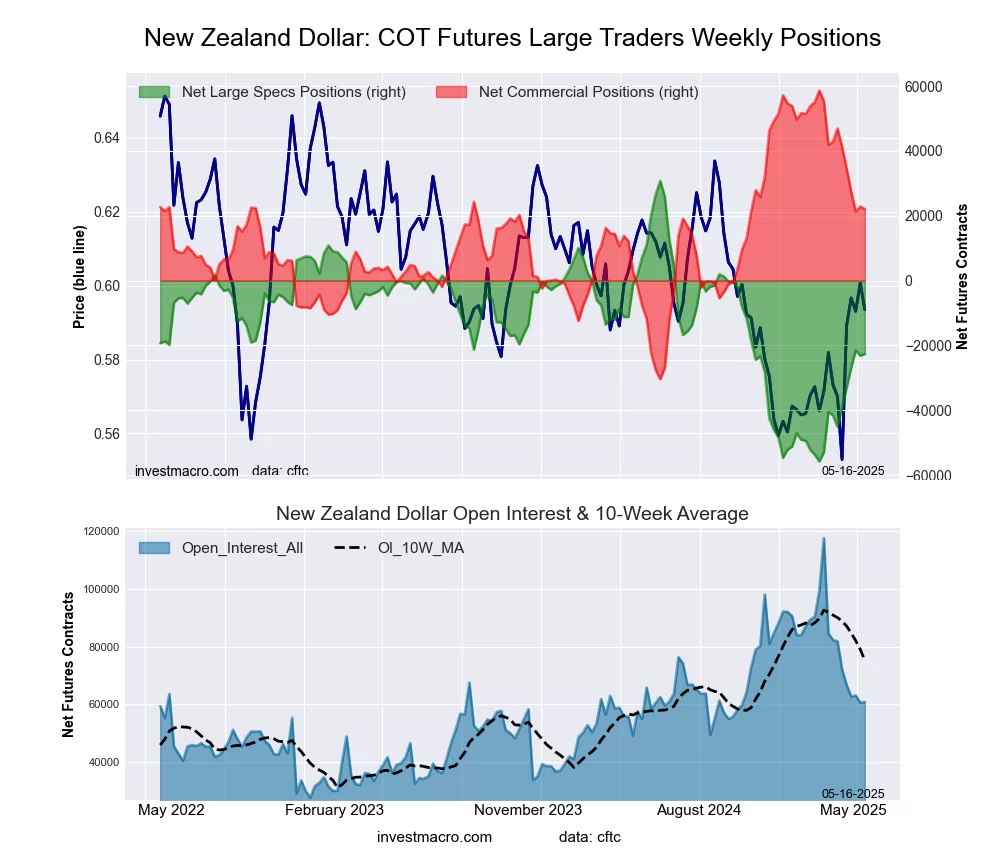
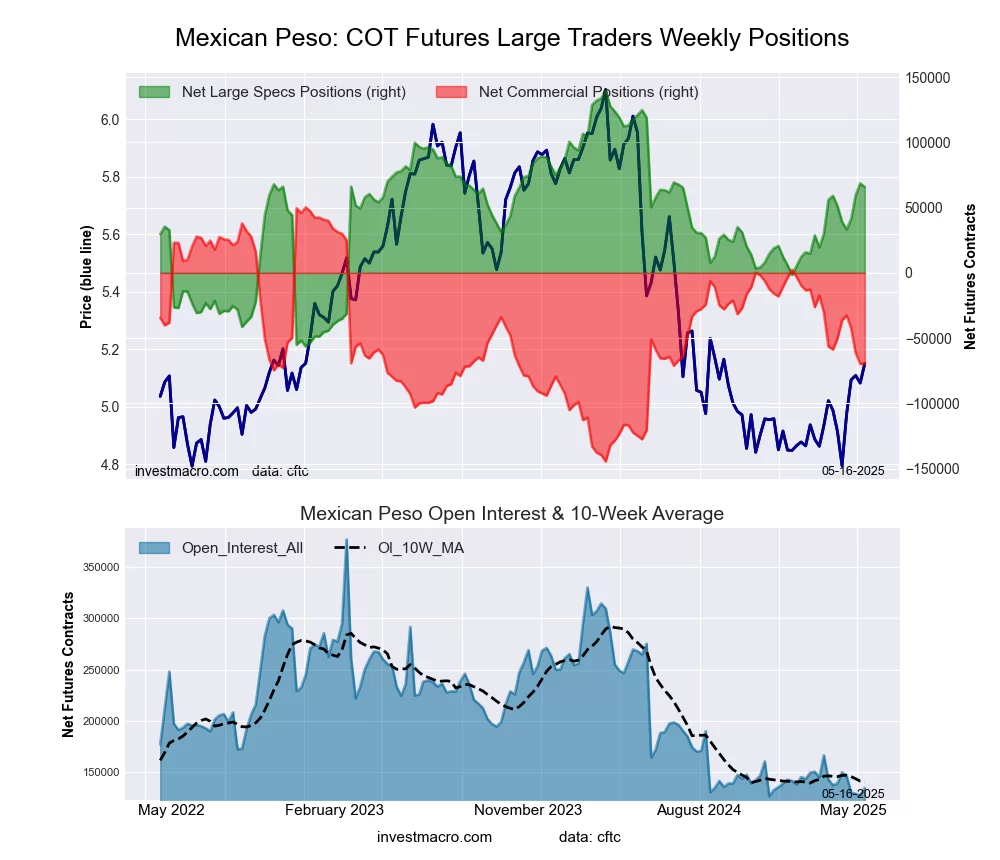
Speculator Extremes: Yen, Ultra T-Bonds, 5-Year & WTI Crude lead Bullish & Bearish Positions

By InvestMacro 

The latest update for the weekly Commitment of Traders (COT) report was released by the Commodity Futures Trading Commission (CFTC) on Friday for data ending on April 8th.

This weekly Extreme Positions report highlights the Most Bullish and Most Bearish Positions for the speculator category. Extreme positioning in these markets can foreshadow strong moves in the underlying market.

To signify an extreme position, we use the Strength Index (also known as the COT Index) of each instrument, a common method of measuring COT data. The Strength Index is simply a comparison of current trader positions against the range of positions over the previous 3 years. We use over 80 percent as extremely bullish and under 20 percent as extremely bearish. (Compare Strength Index scores across all markets in the data table or cot leaders table)


Here Are This Week’s Most Bullish Speculator Positions:

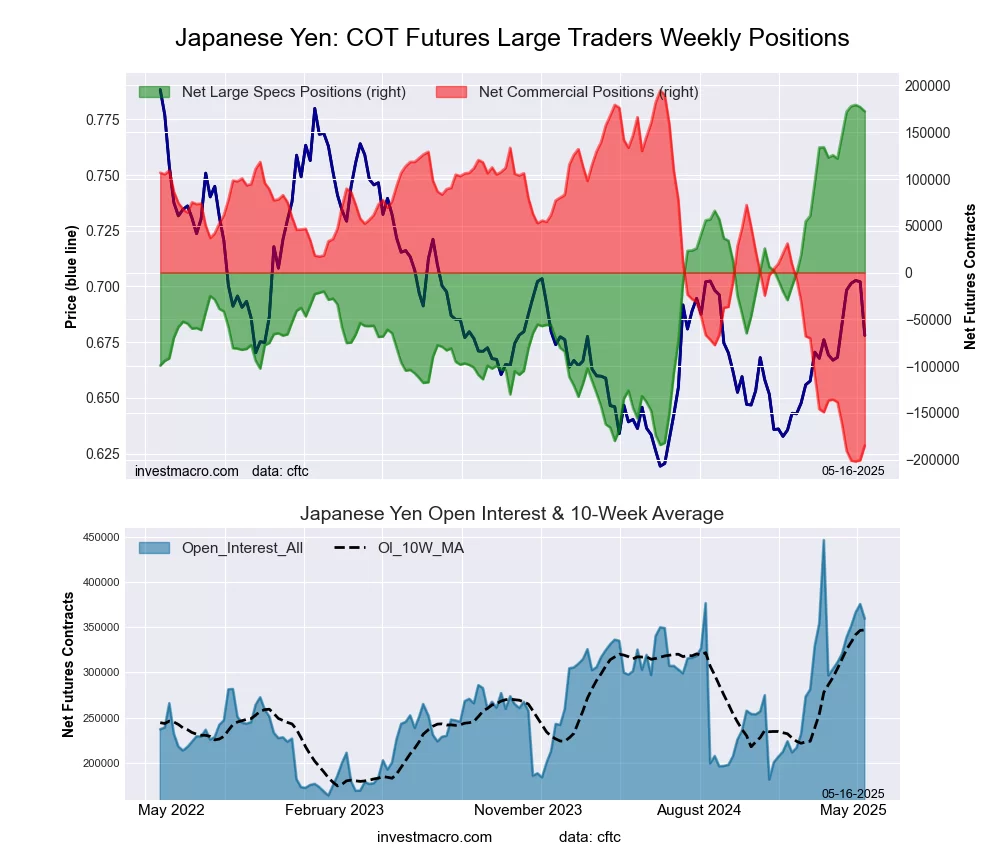
Japanese Yen


The Japanese Yen speculator position comes in as the most bullish extreme standing this week as the Yen’s safe haven status has been in demand with the recent market turmoil. The Japanese Yen speculator level is currently at a maximum 100.0 percent score of its 3-year range.

The six-week trend change for the percent strength score totaled a gain of 15.4 this week. The overall net speculator position rose to a new all-time record high at a total of 147,067 net contracts this week with a boost of 25,293 contract in the weekly speculator bets.


Speculators or Non-Commercials Notes:

Speculators, classified as non-commercial traders by the CFTC, are made up of large commodity funds, hedge funds and other significant for-profit participants. The Specs are generally regarded as trend-followers in their behavior towards price action – net speculator bets and prices tend to go in the same directions. These traders often look to buy when prices are rising and sell when prices are falling. To illustrate this point, many times speculator contracts can be found at their most extremes (bullish or bearish) when prices are also close to their highest or lowest levels.

These extreme levels can be dangerous for the large speculators as the trade is most crowded, there is less trading ammunition still sitting on the sidelines to push the trend further and prices have moved a significant distance. When the trend becomes exhausted, some speculators take profits while others look to also exit positions when prices fail to continue in the same direction. This process usually plays out over many months to years and can ultimately create a reverse effect where prices start to fall and speculators start a process of selling when prices are falling.


Ultra U.S. Treasury Bonds


The Ultra U.S. Treasury Bonds speculator position comes next in the extreme standings this week a the Ultra U.S. Treasury Bonds speculator level is at a 97.9 percent score of its 3-year range.

The six-week trend for the percent strength score rose by 10.5 points this week. The speculator position registered -200,310 net contracts this week with a weekly gain of 53,719 contracts in speculator bets.


Nikkei 225


The Nikkei 225 speculator position comes in third this week in the extreme standings. The Nikkei 225 speculator level resides at a 96.4 percent score of its 3-year range.

The six-week trend for the speculator strength score increased by 35.0 this week. The overall speculator position was 1,904 net contracts this week with an increase by 2,025 contracts in the weekly speculator bets.


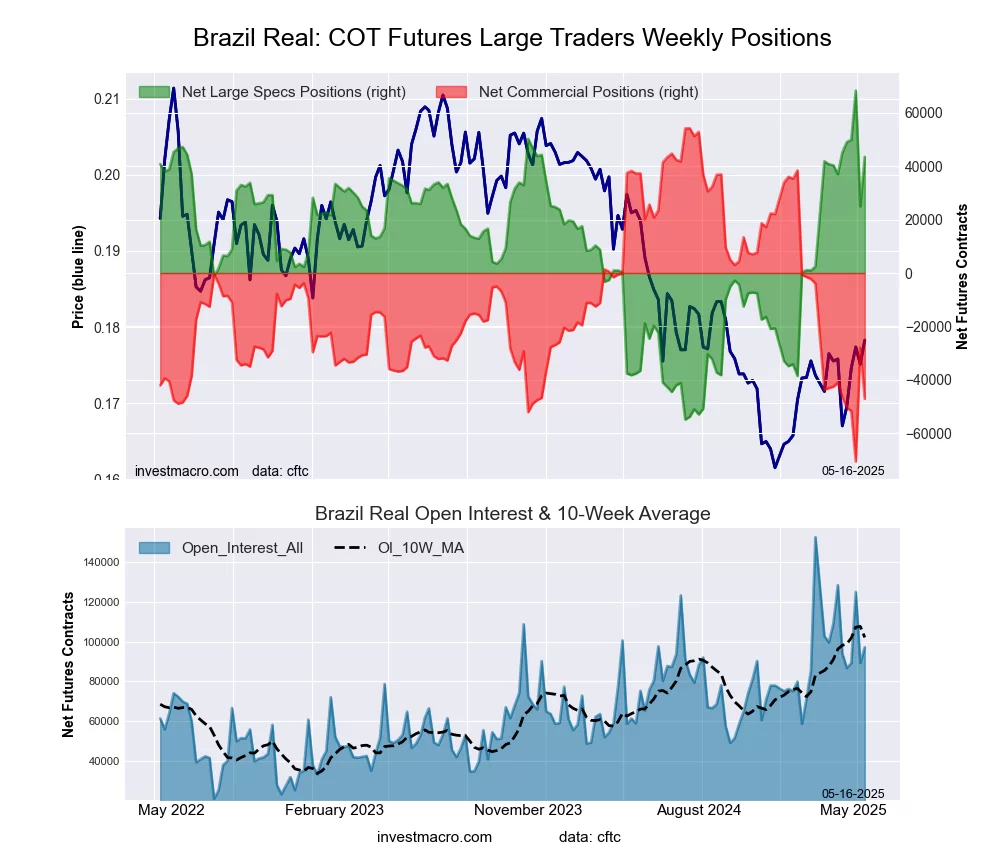
Brazil Real


The Brazil Real speculator position comes up number four in the extreme standings this week as the Brazil Real speculator level is at a 95.1 percent score of its 3-year range.

The six-week trend for the speculator strength score jumped by 40.7 this week. The overall speculator position was 45,115 net contracts this week with an advance by 8,080 contracts in the speculator bets.


Brent Oil


The Brent Oil speculator position rounds out the top five in this week’s bullish extreme standings. The Brent Oil speculator level sits at a 89.3 percent score of its 3-year range. The six-week trend for the speculator strength score was 38.5 this week.

The speculator position was -6,838 net contracts this week with a decline of -3,995 contracts in the weekly speculator bets.


This Week’s Most Bearish Speculator Positions:

5-Year Bond


The 5-Year Bond speculator position comes in as the most bearish extreme standing this week a the 5-Year Bond speculator level is at a 0.0 percent score or the lowest of its 3-year range.

The six-week trend for the speculator strength score was -20.6 this week. The overall speculator position was -2,021,575 net contracts this week with a tiny rise by 102 contracts in the speculator bets.


WTI Crude Oil


The WTI Crude Oil speculator position comes in next for the most bearish extreme standing on the week. The WTI Crude Oil speculator level is at just a 0.6 percent score of its 3-year range.

The six-week trend for the speculator strength score was -14.9 this week. The speculator position was 139,595 net contracts this week with a drop of -28,090 contracts in the weekly speculator bets.


10-Year Note


The 10-Year Note speculator position comes in as third most bearish extreme standing of the week. The 10-Year Note speculator level resides at a 6.2 percent score of its 3-year range.

The six-week trend for the speculator strength score was -35.8 this week while the overall speculator position was -1,078,470 net contracts this week with a decrease by -215,207 contracts in the speculator bets.


Wheat


The Wheat speculator position comes in as this week’s fourth most bearish extreme standing with the Wheat speculator level at 8.3 percent score of its 3-year range.

The six-week trend for the speculator strength score was -22.7 this week. The speculator position was -91,924 net contracts this week with a gain of 10,876 contracts in the weekly speculator bets.


Soybean Meal


Finally, the Soybean Meal speculator position comes in as the fifth most bearish extreme standing for this week. The Soybean Meal speculator level is at a 8.7 percent score of its 3-year range.

The six-week trend for the speculator strength score was -3.9 this week. The speculator position was -45,715 net contracts this week with a rise by 8,585 contracts in the weekly speculator bets.


Article By InvestMacroReceive our weekly COT Newsletter

*COT Report: The COT data, released weekly to the public each Friday, is updated through the most recent Tuesday (data is 3 days old) and shows a quick view of how large speculators or non-commercials (for-profit traders) were positioned in the futures markets.

The CFTC categorizes trader positions according to commercial hedgers (traders who use futures contracts for hedging as part of the business), non-commercials (large traders who speculate to realize trading profits) and nonreportable traders (usually small traders/speculators) as well as their open interest (contracts open in the market at time of reporting). See CFTC criteria here.

COT Metals Charts: Speculator Bets led lower by Gold, Platinum & Silver

By InvestMacro

Here are the latest charts and statistics for the Commitment of Traders (COT) data published by the Commodities Futures Trading Commission (CFTC).

The latest COT data is updated through Tuesday April 8th and shows a quick view of how large traders (for-profit speculators and commercial entities) were positioned in the futures markets.

Weekly Speculator Changes led lower by Gold, Platinum & Silver

The COT metals markets speculator bets were decisively lower this week as all of the six metals markets we cover had lower positioning.

The markets with declines in speculator bets for the week were Gold (-37,719 contracts), Platinum (-15,769 contracts), Silver (-10,742 contracts), Copper (-5,784 contracts), Palladium (-2,864 contracts) and with Steel (-318 contracts) also registering lower bets on the week.


Metals Data:

Legend: Weekly Speculators Change | Speculators Current Net Position | Speculators Strength Score compared to last 3-Years (0-100 range)


Strength Scores led by Steel & Silver

COT Strength Scores (a normalized measure of Speculator positions over a 3-Year range, from 0 to 100 where above 80 is Extreme-Bullish and below 20 is Extreme-Bearish) showed that Steel (84 percent) and Silver (75 percent) lead the metals markets this week.

On the downside, Platinum (14 percent) and Palladium (24 percent) comes in at the lowest strength level currently and is in Extreme-Bearish territory (below 20 percent).

Strength Statistics:
Gold (56.4 percent) vs Gold previous week (70.8 percent)
Silver (74.9 percent) vs Silver previous week (88.5 percent)
Copper (55.8 percent) vs Copper previous week (61.2 percent)
Platinum (14.1 percent) vs Platinum previous week (51.4 percent)
Palladium (23.9 percent) vs Palladium previous week (45.4 percent)
Steel (84.3 percent) vs Palladium previous week (85.8 percent)


Copper tops the 6-Week Strength Trends

COT Strength Score Trends (or move index, calculates the 6-week changes in strength scores) showed that Copper (5 percent) leads the past six weeks trends for metals and is the only positive mover in the latest trends data.

Platinum (-40 percent) leads the downside trend scores currently with Gold (-23 percent) and Palladium (-20 percent) as the next markets with lower trend scores.

Move Statistics:
Gold (-23.1 percent) vs Gold previous week (-11.5 percent)
Silver (-8.0 percent) vs Silver previous week (3.5 percent)
Copper (4.9 percent) vs Copper previous week (7.4 percent)
Platinum (-40.1 percent) vs Platinum previous week (-20.2 percent)
Palladium (-19.5 percent) vs Palladium previous week (-16.8 percent)
Steel (-10.1 percent) vs Steel previous week (-14.2 percent)


Individual Markets:

Gold Comex Futures:

Gold Futures COT ChartThe Gold Comex Futures large speculator standing this week totaled a net position of 200,715 contracts in the data reported through Tuesday. This was a weekly fall of -37,719 contracts from the previous week which had a total of 238,434 net contracts.

This week’s current strength score (the trader positioning range over the past three years, measured from 0 to 100) shows the speculators are currently Bullish with a score of 56.4 percent. The commercials are Bearish with a score of 38.7 percent and the small traders (not shown in chart) are Bullish-Extreme with a score of 84.5 percent.

Price Trend-Following Model: Strong Uptrend

Our weekly trend-following model classifies the current market price position as: Strong Uptrend.

Gold Futures StatisticsSPECULATORSCOMMERCIALSSMALL TRADERS
– Percent of Open Interest Longs:60.615.511.3
– Percent of Open Interest Shorts:15.567.74.3
– Net Position:200,715-232,18331,468
– Gross Longs:269,83369,21450,486
– Gross Shorts:69,118301,39719,018
– Long to Short Ratio:3.9 to 10.2 to 12.7 to 1
NET POSITION TREND:
– Strength Index Score (3 Year Range Pct):56.438.784.5
– Strength Index Reading (3 Year Range):BullishBearishBullish-Extreme
NET POSITION MOVEMENT INDEX:
– 6-Week Change in Strength Index:-23.120.118.0


Silver Comex Futures:

Silver Futures COT ChartThe Silver Comex Futures large speculator standing this week totaled a net position of 46,516 contracts in the data reported through Tuesday. This was a weekly fall of -10,742 contracts from the previous week which had a total of 57,258 net contracts.

This week’s current strength score (the trader positioning range over the past three years, measured from 0 to 100) shows the speculators are currently Bullish with a score of 74.9 percent. The commercials are Bearish with a score of 23.6 percent and the small traders (not shown in chart) are Bullish with a score of 55.4 percent.

Price Trend-Following Model: Uptrend

Our weekly trend-following model classifies the current market price position as: Uptrend.

Silver Futures StatisticsSPECULATORSCOMMERCIALSSMALL TRADERS
– Percent of Open Interest Longs:44.322.920.1
– Percent of Open Interest Shorts:14.264.48.7
– Net Position:46,516-64,02217,506
– Gross Longs:68,42635,32030,989
– Gross Shorts:21,91099,34213,483
– Long to Short Ratio:3.1 to 10.4 to 12.3 to 1
NET POSITION TREND:
– Strength Index Score (3 Year Range Pct):74.923.655.4
– Strength Index Reading (3 Year Range):BullishBearishBullish
NET POSITION MOVEMENT INDEX:
– 6-Week Change in Strength Index:-8.06.80.9


Copper Grade #1 Futures:

Copper Futures COT ChartThe Copper Grade #1 Futures large speculator standing this week totaled a net position of 24,241 contracts in the data reported through Tuesday. This was a weekly lowering of -5,784 contracts from the previous week which had a total of 30,025 net contracts.

This week’s current strength score (the trader positioning range over the past three years, measured from 0 to 100) shows the speculators are currently Bullish with a score of 55.8 percent. The commercials are Bullish with a score of 52.0 percent and the small traders (not shown in chart) are Bearish-Extreme with a score of 0.7 percent.

Price Trend-Following Model: Weak Uptrend

Our weekly trend-following model classifies the current market price position as: Weak Uptrend.

Copper Futures StatisticsSPECULATORSCOMMERCIALSSMALL TRADERS
– Percent of Open Interest Longs:36.832.27.5
– Percent of Open Interest Shorts:25.941.98.7
– Net Position:24,241-21,429-2,812
– Gross Longs:81,21370,98816,422
– Gross Shorts:56,97292,41719,234
– Long to Short Ratio:1.4 to 10.8 to 10.9 to 1
NET POSITION TREND:
– Strength Index Score (3 Year Range Pct):55.852.00.7
– Strength Index Reading (3 Year Range):BullishBullishBearish-Extreme
NET POSITION MOVEMENT INDEX:
– 6-Week Change in Strength Index:4.91.0-38.7


Platinum Futures:

Platinum Futures COT ChartThe Platinum Futures large speculator standing this week totaled a net position of -794 contracts in the data reported through Tuesday. This was a weekly decline of -15,769 contracts from the previous week which had a total of 14,975 net contracts.

This week’s current strength score (the trader positioning range over the past three years, measured from 0 to 100) shows the speculators are currently Bearish-Extreme with a score of 14.1 percent. The commercials are Bullish with a score of 75.0 percent and the small traders (not shown in chart) are Bullish-Extreme with a score of 100.0 percent.

Price Trend-Following Model: Weak Uptrend

Our weekly trend-following model classifies the current market price position as: Weak Uptrend.

Platinum Futures StatisticsSPECULATORSCOMMERCIALSSMALL TRADERS
– Percent of Open Interest Longs:53.424.415.9
– Percent of Open Interest Shorts:54.434.25.1
– Net Position:-794-8,0118,805
– Gross Longs:43,76319,99213,005
– Gross Shorts:44,55728,0034,200
– Long to Short Ratio:1.0 to 10.7 to 13.1 to 1
NET POSITION TREND:
– Strength Index Score (3 Year Range Pct):14.175.0100.0
– Strength Index Reading (3 Year Range):Bearish-ExtremeBullishBullish-Extreme
NET POSITION MOVEMENT INDEX:
– 6-Week Change in Strength Index:-40.135.120.5


Palladium Futures:

Palladium Futures COT ChartThe Palladium Futures large speculator standing this week totaled a net position of -10,728 contracts in the data reported through Tuesday. This was a weekly decline of -2,864 contracts from the previous week which had a total of -7,864 net contracts.

This week’s current strength score (the trader positioning range over the past three years, measured from 0 to 100) shows the speculators are currently Bearish with a score of 23.9 percent. The commercials are Bullish with a score of 72.4 percent and the small traders (not shown in chart) are Bullish with a score of 71.2 percent.

Price Trend-Following Model: Strong Downtrend

Our weekly trend-following model classifies the current market price position as: Strong Downtrend.

Palladium Futures StatisticsSPECULATORSCOMMERCIALSSMALL TRADERS
– Percent of Open Interest Longs:35.049.911.1
– Percent of Open Interest Shorts:83.05.97.2
– Net Position:-10,7289,849879
– Gross Longs:7,83211,1632,479
– Gross Shorts:18,5601,3141,600
– Long to Short Ratio:0.4 to 18.5 to 11.5 to 1
NET POSITION TREND:
– Strength Index Score (3 Year Range Pct):23.972.471.2
– Strength Index Reading (3 Year Range):BearishBullishBullish
NET POSITION MOVEMENT INDEX:
– 6-Week Change in Strength Index:-19.524.7-28.8


Steel Futures Futures:

Steel Futures COT ChartThe Steel Futures large speculator standing this week totaled a net position of 1,704 contracts in the data reported through Tuesday. This was a weekly fall of -318 contracts from the previous week which had a total of 2,022 net contracts.

This week’s current strength score (the trader positioning range over the past three years, measured from 0 to 100) shows the speculators are currently Bullish-Extreme with a score of 84.3 percent. The commercials are Bearish-Extreme with a score of 16.9 percent and the small traders (not shown in chart) are Bearish with a score of 32.1 percent.

Price Trend-Following Model: Uptrend

Our weekly trend-following model classifies the current market price position as: Uptrend.

Steel Futures StatisticsSPECULATORSCOMMERCIALSSMALL TRADERS
– Percent of Open Interest Longs:31.260.70.7
– Percent of Open Interest Shorts:26.365.50.7
– Net Position:1,704-1,701-3
– Gross Longs:10,94721,324231
– Gross Shorts:9,24323,025234
– Long to Short Ratio:1.2 to 10.9 to 11.0 to 1
NET POSITION TREND:
– Strength Index Score (3 Year Range Pct):84.316.932.1
– Strength Index Reading (3 Year Range):Bullish-ExtremeBearish-ExtremeBearish
NET POSITION MOVEMENT INDEX:
– 6-Week Change in Strength Index:-10.111.8-37.0


Article By InvestMacroReceive our weekly COT Newsletter

*COT Report: The COT data, released weekly to the public each Friday, is updated through the most recent Tuesday (data is 3 days old) and shows a quick view of how large speculators or non-commercials (for-profit traders) were positioned in the futures markets.

The CFTC categorizes trader positions according to commercial hedgers (traders who use futures contracts for hedging as part of the business), non-commercials (large traders who speculate to realize trading profits) and nonreportable traders (usually small traders/speculators) as well as their open interest (contracts open in the market at time of reporting). See CFTC criteria here.

COT Bonds Charts: Speculator Bets led by SOFR-3M, Fed Funds & Ultra Treasury Bonds

By InvestMacro

Here are the latest charts and statistics for the Commitment of Traders (COT) reports data published by the Commodities Futures Trading Commission (CFTC).

The latest COT data is updated through Tuesday April 8th and shows a quick view of how large traders (for-profit speculators and commercial hedgers) were positioned in the futures markets.

Weekly Speculator Changes led by SOFR 3-Months, Fed Funds & Ultra Treasury Bonds

The COT bond market speculator bets were overall higher this week as six out of the nine bond markets we cover had higher positioning while the other three markets had lower speculator contracts.

Leading the gains for the bond markets was the SOFR 3-Months (178,241 contracts) with the Fed Funds (68,611 contracts), the Ultra Treasury Bonds (53,719 contracts), the 2-Year Bonds (28,282 contracts), the US Treasury Bonds (14,494 contracts) and the 5-Year Bonds (102 contracts) also showing positive weeks.

The bond markets with declines in speculator bets for the week were the 10-Year Bonds (-215,207 contracts), the Ultra 10-Year Bonds (-46,367 contracts) and with the SOFR 1-Month (-35,300 contracts) also registering lower bets on the week.


Bonds Data:

Legend: Weekly Speculators Change | Speculators Current Net Position | Speculators Strength Score compared to last 3-Years (0-100 range)


Strength Scores led by Ultra Treasury Bonds & US Treasury Bonds

COT Strength Scores (a normalized measure of Speculator positions over a 3-Year range, from 0 to 100 where above 80 is Extreme-Bullish and below 20 is Extreme-Bearish) showed that the Ultra Treasury Bonds (98 percent) and the US Treasury Bonds (77 percent) lead the bond markets this week. The SOFR 1-Month (50 percent) comes in as the next highest in the weekly strength scores.

On the downside, the 5-Year Bond (0 percent), the 10-Year Bonds (6 percent) and the 2-Year Bonds (19.9 percent) come in at the lowest strength level currently and are in Extreme-Bearish territory (below 20 percent). The next lowest strength scores were the SOFR 3-Months (26 percent) and the Fed Funds (40 percent).

Strength Statistics:
Fed Funds (39.6 percent) vs Fed Funds previous week (26.9 percent)
2-Year Bond (19.9 percent) vs 2-Year Bond previous week (17.9 percent)
5-Year Bond (0.0 percent) vs 5-Year Bond previous week (0.0 percent)
10-Year Bond (6.2 percent) vs 10-Year Bond previous week (26.5 percent)
Ultra 10-Year Bond (46.3 percent) vs Ultra 10-Year Bond previous week (63.4 percent)
US Treasury Bond (77.1 percent) vs US Treasury Bond previous week (72.0 percent)
Ultra US Treasury Bond (97.9 percent) vs Ultra US Treasury Bond previous week (77.3 percent)
SOFR 1-Month (49.9 percent) vs SOFR 1-Month previous week (58.6 percent)
SOFR 3-Months (25.5 percent) vs SOFR 3-Months previous week (16.3 percent)


Ultra Treasury Bonds & SOFR 3-Months top the 6-Week Strength Trends

COT Strength Score Trends (or move index, calculates the 6-week changes in strength scores) showed that the Ultra Treasury Bonds (10 percent) and the SOFR 3-Months (3 percent) lead the past six weeks trends for bonds.

The Ultra 10-Year Bonds (-37 percent), the 10-Year Bonds (-36 percent), the 5-Year Bonds (-21 percent) and the US Treasury Bonds (-21 percent) lead the downside trend scores currently.

Strength Trend Statistics:
Fed Funds (-13.8 percent) vs Fed Funds previous week (-1.0 percent)
2-Year Bond (-3.4 percent) vs 2-Year Bond previous week (4.4 percent)
5-Year Bond (-20.6 percent) vs 5-Year Bond previous week (-14.8 percent)
10-Year Bond (-35.8 percent) vs 10-Year Bond previous week (-14.5 percent)
Ultra 10-Year Bond (-36.6 percent) vs Ultra 10-Year Bond previous week (-5.4 percent)
US Treasury Bond (-20.5 percent) vs US Treasury Bond previous week (-28.0 percent)
Ultra US Treasury Bond (10.5 percent) vs Ultra US Treasury Bond previous week (-3.0 percent)
SOFR 1-Month (0.2 percent) vs SOFR 1-Month previous week (-22.5 percent)
SOFR 3-Months (2.7 percent) vs SOFR 3-Months previous week (-5.7 percent)


30-Day Federal Funds Futures:

Federal Funds 30-Day Bonds Futures COT ChartThe 30-Day Federal Funds large speculator standing this week equaled a net position of -81,232 contracts in the data reported through Tuesday. This was a weekly lift of 68,611 contracts from the previous week which had a total of -149,843 net contracts.

This week’s current strength score (the trader positioning range over the past three years, measured from 0 to 100) shows the speculators are currently Bearish with a score of 39.6 percent. The commercials are Bullish with a score of 55.5 percent and the small traders (not shown in chart) are Bullish with a score of 71.5 percent.

Price Trend-Following Model: Uptrend

Our weekly trend-following model classifies the current market price position as: Uptrend.

30-Day Federal Funds StatisticsSPECULATORSCOMMERCIALSSMALL TRADERS
– Percent of Open Interest Longs:18.666.41.9
– Percent of Open Interest Shorts:22.363.11.6
– Net Position:-81,23273,9597,273
– Gross Longs:409,7471,465,59843,016
– Gross Shorts:490,9791,391,63935,743
– Long to Short Ratio:0.8 to 11.1 to 11.2 to 1
NET POSITION TREND:
– Strength Index Score (3 Year Range Pct):39.655.571.5
– Strength Index Reading (3 Year Range):BearishBullishBullish
NET POSITION MOVEMENT INDEX:
– 6-Week Change in Strength Index:-13.815.0-10.0


Secured Overnight Financing Rate (3-Month) Futures:

SOFR 3-Months Bonds Futures COT ChartThe Secured Overnight Financing Rate (3-Month) large speculator standing this week equaled a net position of -673,042 contracts in the data reported through Tuesday. This was a weekly advance of 178,241 contracts from the previous week which had a total of -851,283 net contracts.

This week’s current strength score (the trader positioning range over the past three years, measured from 0 to 100) shows the speculators are currently Bearish with a score of 25.5 percent. The commercials are Bullish with a score of 74.1 percent and the small traders (not shown in chart) are Bullish-Extreme with a score of 86.5 percent.

Price Trend-Following Model: Weak Uptrend

Our weekly trend-following model classifies the current market price position as: Weak Uptrend.

SOFR 3-Months StatisticsSPECULATORSCOMMERCIALSSMALL TRADERS
– Percent of Open Interest Longs:11.960.50.3
– Percent of Open Interest Shorts:18.254.20.3
– Net Position:-673,042667,8635,179
– Gross Longs:1,272,6166,456,44132,612
– Gross Shorts:1,945,6585,788,57827,433
– Long to Short Ratio:0.7 to 11.1 to 11.2 to 1
NET POSITION TREND:
– Strength Index Score (3 Year Range Pct):25.574.186.5
– Strength Index Reading (3 Year Range):BearishBullishBullish-Extreme
NET POSITION MOVEMENT INDEX:
– 6-Week Change in Strength Index:2.7-1.7-9.4


Individual Bond Markets:

Secured Overnight Financing Rate (1-Month) Futures:

SOFR 1-Month Bonds Futures COT ChartThe Secured Overnight Financing Rate (1-Month) large speculator standing this week equaled a net position of -75,627 contracts in the data reported through Tuesday. This was a weekly decrease of -35,300 contracts from the previous week which had a total of -40,327 net contracts.

This week’s current strength score (the trader positioning range over the past three years, measured from 0 to 100) shows the speculators are currently Bearish with a score of 49.9 percent. The commercials are Bullish with a score of 50.6 percent and the small traders (not shown in chart) are Bullish-Extreme with a score of 80.5 percent.

Price Trend-Following Model: Uptrend

Our weekly trend-following model classifies the current market price position as: Uptrend.

SOFR 1-Month StatisticsSPECULATORSCOMMERCIALSSMALL TRADERS
– Percent of Open Interest Longs:21.864.30.1
– Percent of Open Interest Shorts:27.458.60.2
– Net Position:-75,62777,506-1,879
– Gross Longs:295,104871,6511,010
– Gross Shorts:370,731794,1452,889
– Long to Short Ratio:0.8 to 11.1 to 10.3 to 1
NET POSITION TREND:
– Strength Index Score (3 Year Range Pct):49.950.680.5
– Strength Index Reading (3 Year Range):BearishBullishBullish-Extreme
NET POSITION MOVEMENT INDEX:
– 6-Week Change in Strength Index:0.2-2.019.6


2-Year Treasury Note Futures:

2-Year Treasury Bonds Futures COT ChartThe 2-Year Treasury Note large speculator standing this week equaled a net position of -1,198,109 contracts in the data reported through Tuesday. This was a weekly gain of 28,282 contracts from the previous week which had a total of -1,226,391 net contracts.

This week’s current strength score (the trader positioning range over the past three years, measured from 0 to 100) shows the speculators are currently Bearish-Extreme with a score of 19.9 percent. The commercials are Bullish with a score of 78.5 percent and the small traders (not shown in chart) are Bullish with a score of 76.5 percent.

Price Trend-Following Model: Uptrend

Our weekly trend-following model classifies the current market price position as: Uptrend.

2-Year Treasury Note StatisticsSPECULATORSCOMMERCIALSSMALL TRADERS
– Percent of Open Interest Longs:15.176.36.0
– Percent of Open Interest Shorts:44.949.72.8
– Net Position:-1,198,1091,070,287127,822
– Gross Longs:606,6243,069,452240,732
– Gross Shorts:1,804,7331,999,165112,910
– Long to Short Ratio:0.3 to 11.5 to 12.1 to 1
NET POSITION TREND:
– Strength Index Score (3 Year Range Pct):19.978.576.5
– Strength Index Reading (3 Year Range):Bearish-ExtremeBullishBullish
NET POSITION MOVEMENT INDEX:
– 6-Week Change in Strength Index:-3.45.2-4.7


5-Year Treasury Note Futures:

5-Year Treasury Bonds Futures COT ChartThe 5-Year Treasury Note large speculator standing this week equaled a net position of -2,021,575 contracts in the data reported through Tuesday. This was a weekly rise of 102 contracts from the previous week which had a total of -2,021,677 net contracts.

This week’s current strength score (the trader positioning range over the past three years, measured from 0 to 100) shows the speculators are currently Bearish-Extreme with a score of 0.0 percent. The commercials are Bullish-Extreme with a score of 96.4 percent and the small traders (not shown in chart) are Bullish-Extreme with a score of 92.4 percent.

Price Trend-Following Model: Uptrend

Our weekly trend-following model classifies the current market price position as: Uptrend.

5-Year Treasury Note StatisticsSPECULATORSCOMMERCIALSSMALL TRADERS
– Percent of Open Interest Longs:7.284.26.5
– Percent of Open Interest Shorts:38.356.43.2
– Net Position:-2,021,5751,805,555216,020
– Gross Longs:466,8125,463,500422,475
– Gross Shorts:2,488,3873,657,945206,455
– Long to Short Ratio:0.2 to 11.5 to 12.0 to 1
NET POSITION TREND:
– Strength Index Score (3 Year Range Pct):0.096.492.4
– Strength Index Reading (3 Year Range):Bearish-ExtremeBullish-ExtremeBullish-Extreme
NET POSITION MOVEMENT INDEX:
– 6-Week Change in Strength Index:-20.622.59.3


10-Year Treasury Note Futures:

10-Year Treasury Notes Bonds Futures COT ChartThe 10-Year Treasury Note large speculator standing this week equaled a net position of -1,078,470 contracts in the data reported through Tuesday. This was a weekly lowering of -215,207 contracts from the previous week which had a total of -863,263 net contracts.

This week’s current strength score (the trader positioning range over the past three years, measured from 0 to 100) shows the speculators are currently Bearish-Extreme with a score of 6.2 percent. The commercials are Bullish-Extreme with a score of 90.9 percent and the small traders (not shown in chart) are Bullish-Extreme with a score of 100.0 percent.

Price Trend-Following Model: Weak Uptrend

Our weekly trend-following model classifies the current market price position as: Weak Uptrend.

10-Year Treasury Note StatisticsSPECULATORSCOMMERCIALSSMALL TRADERS
– Percent of Open Interest Longs:9.378.010.0
– Percent of Open Interest Shorts:31.359.26.7
– Net Position:-1,078,470916,013162,457
– Gross Longs:452,4963,813,010489,903
– Gross Shorts:1,530,9662,896,997327,446
– Long to Short Ratio:0.3 to 11.3 to 11.5 to 1
NET POSITION TREND:
– Strength Index Score (3 Year Range Pct):6.290.9100.0
– Strength Index Reading (3 Year Range):Bearish-ExtremeBullish-ExtremeBullish-Extreme
NET POSITION MOVEMENT INDEX:
– 6-Week Change in Strength Index:-35.832.931.1


Ultra 10-Year Notes Futures:

Ultra 10-Year Treasury Notes Bonds Futures COT ChartThe Ultra 10-Year Notes large speculator standing this week equaled a net position of -152,350 contracts in the data reported through Tuesday. This was a weekly fall of -46,367 contracts from the previous week which had a total of -105,983 net contracts.

This week’s current strength score (the trader positioning range over the past three years, measured from 0 to 100) shows the speculators are currently Bearish with a score of 46.3 percent. The commercials are Bearish with a score of 25.8 percent and the small traders (not shown in chart) are Bullish-Extreme with a score of 100.0 percent.

Price Trend-Following Model: Weak Uptrend

Our weekly trend-following model classifies the current market price position as: Weak Uptrend.

Ultra 10-Year Notes StatisticsSPECULATORSCOMMERCIALSSMALL TRADERS
– Percent of Open Interest Longs:15.274.010.4
– Percent of Open Interest Shorts:21.667.110.7
– Net Position:-152,350161,266-8,916
– Gross Longs:357,0351,741,444244,020
– Gross Shorts:509,3851,580,178252,936
– Long to Short Ratio:0.7 to 11.1 to 11.0 to 1
NET POSITION TREND:
– Strength Index Score (3 Year Range Pct):46.325.8100.0
– Strength Index Reading (3 Year Range):BearishBearishBullish-Extreme
NET POSITION MOVEMENT INDEX:
– 6-Week Change in Strength Index:-36.625.724.4


US Treasury Bonds Futures:

US Year Treasury Notes Long Bonds Futures COT ChartThe US Treasury Bonds large speculator standing this week equaled a net position of -18,154 contracts in the data reported through Tuesday. This was a weekly gain of 14,494 contracts from the previous week which had a total of -32,648 net contracts.

This week’s current strength score (the trader positioning range over the past three years, measured from 0 to 100) shows the speculators are currently Bullish with a score of 77.1 percent. The commercials are Bearish-Extreme with a score of 15.5 percent and the small traders (not shown in chart) are Bullish-Extreme with a score of 85.9 percent.

Price Trend-Following Model: Strong Downtrend

Our weekly trend-following model classifies the current market price position as: Strong Downtrend.

US Treasury Bonds StatisticsSPECULATORSCOMMERCIALSSMALL TRADERS
– Percent of Open Interest Longs:14.571.712.5
– Percent of Open Interest Shorts:15.476.07.2
– Net Position:-18,154-80,68998,843
– Gross Longs:266,4491,321,385230,900
– Gross Shorts:284,6031,402,074132,057
– Long to Short Ratio:0.9 to 10.9 to 11.7 to 1
NET POSITION TREND:
– Strength Index Score (3 Year Range Pct):77.115.585.9
– Strength Index Reading (3 Year Range):BullishBearish-ExtremeBullish-Extreme
NET POSITION MOVEMENT INDEX:
– 6-Week Change in Strength Index:-20.515.54.0


Ultra US Treasury Bonds Futures:

Ultra US Year Treasury Notes Long Bonds Futures COT ChartThe Ultra US Treasury Bonds large speculator standing this week equaled a net position of -200,310 contracts in the data reported through Tuesday. This was a weekly boost of 53,719 contracts from the previous week which had a total of -254,029 net contracts.

This week’s current strength score (the trader positioning range over the past three years, measured from 0 to 100) shows the speculators are currently Bullish-Extreme with a score of 97.9 percent. The commercials are Bearish-Extreme with a score of 0.0 percent and the small traders (not shown in chart) are Bullish with a score of 65.5 percent.

Price Trend-Following Model: Strong Downtrend

Our weekly trend-following model classifies the current market price position as: Strong Downtrend.

Ultra US Treasury Bonds StatisticsSPECULATORSCOMMERCIALSSMALL TRADERS
– Percent of Open Interest Longs:7.681.09.7
– Percent of Open Interest Shorts:18.572.37.5
– Net Position:-200,310159,48640,824
– Gross Longs:138,3041,483,087178,385
– Gross Shorts:338,6141,323,601137,561
– Long to Short Ratio:0.4 to 11.1 to 11.3 to 1
NET POSITION TREND:
– Strength Index Score (3 Year Range Pct):97.90.065.5
– Strength Index Reading (3 Year Range):Bullish-ExtremeBearish-ExtremeBullish
NET POSITION MOVEMENT INDEX:
– 6-Week Change in Strength Index:10.5-24.546.4


Article By InvestMacroReceive our weekly COT Newsletter

*COT Report: The COT data, released weekly to the public each Friday, is updated through the most recent Tuesday (data is 3 days old) and shows a quick view of how large speculators or non-commercials (for-profit traders) were positioned in the futures markets.

The CFTC categorizes trader positions according to commercial hedgers (traders who use futures contracts for hedging as part of the business), non-commercials (large traders who speculate to realize trading profits) and nonreportable traders (usually small traders/speculators) as well as their open interest (contracts open in the market at time of reporting). See CFTC criteria here.
COT Soft Commodities Charts: Speculator Bets led by Soybean Oil & Wheat

By InvestMacro

Here are the latest charts and statistics for the Commitment of Traders (COT) reports data published by the Commodities Futures Trading Commission (CFTC).

The latest COT data is updated through Tuesday April 8th and shows a quick view of how large traders (for-profit speculators and commercial entities) were positioned in the futures markets.

Weekly Speculator Changes led by Soybean Oil & Wheat

The COT soft commodities markets speculator bets were overall lower this week as five out of the eleven softs markets we cover had higher positioning while the other six markets had lower speculator contracts.

Leading the gains for the softs markets was Soybean Oil (36,626 contracts) with Wheat (10,876 contracts), Soybean Meal (8,585 contracts), Cotton (6,953 contracts) and Corn (6,013 contracts) also showing positive weeks.

The markets with the declines in speculator bets this week were Live Cattle (-15,926 contracts), Soybeans (-13,336 contracts), Lean Hogs (-12,418 contracts), Coffee (-10,584 contracts), Sugar (-8,246 contracts) and with Cocoa (-803 contracts) also registering lower bets on the week.


Soft Commodities Data:

Legend: Weekly Speculators Change | Speculators Current Net Position | Speculators Strength Score compared to last 3-Years (0-100 range)


Strength Scores led by Live Cattle & Coffee

COT Strength Scores (a normalized measure of Speculator positions over a 3-Year range, from 0 to 100 where above 80 is Extreme-Bullish and below 20 is Extreme-Bearish) showed that Live Cattle (85 percent) and Coffee (68 percent) lead the softs markets this week. Soybean Oil (68 percent) and Corn (57 percent) come in as the next highest in the weekly strength scores.

On the downside, Wheat (8 percent), Soybean Meal (9 percent) and Cotton (16 percent) come in at the lowest strength levels currently and are in Extreme-Bearish territory (below 20 percent).

Strength Statistics:
Corn (57.2 percent) vs Corn previous week (56.4 percent)
Sugar (24.9 percent) vs Sugar previous week (27.6 percent)
Coffee (68.0 percent) vs Coffee previous week (78.3 percent)
Soybeans (45.0 percent) vs Soybeans previous week (48.3 percent)
Soybean Oil (68.1 percent) vs Soybean Oil previous week (48.1 percent)
Soybean Meal (8.7 percent) vs Soybean Meal previous week (5.1 percent)
Live Cattle (84.7 percent) vs Live Cattle previous week (100.0 percent)
Lean Hogs (41.8 percent) vs Lean Hogs previous week (51.4 percent)
Cotton (16.5 percent) vs Cotton previous week (12.3 percent)
Cocoa (28.1 percent) vs Cocoa previous week (28.9 percent)
Wheat (8.3 percent) vs Wheat previous week (0.0 percent)


Live Cattle & Cotton top the 6-Week Strength Trends

COT Strength Score Trends (or move index, calculates the 6-week changes in strength scores) showed that Live Cattle (6 percent) and Cotton (5 percent) lead the past six weeks trends for soft commodities. Sugar (4 percent) and Soybean Oil (2 percent) are the next highest positive movers in the latest trends data.

Lean Hogs (-38 percent) leads the downside trend scores currently with Corn (-35 percent), Wheat (-23 percent) and Coffee (-15 percent) following next with lower trend scores.

Strength Trend Statistics:
Corn (-34.9 percent) vs Corn previous week (-39.3 percent)
Sugar (3.6 percent) vs Sugar previous week (23.6 percent)
Coffee (-15.2 percent) vs Coffee previous week (-7.4 percent)
Soybeans (-1.6 percent) vs Soybeans previous week (0.5 percent)
Soybean Oil (2.4 percent) vs Soybean Oil previous week (-27.7 percent)
Soybean Meal (-3.9 percent) vs Soybean Meal previous week (-13.4 percent)
Live Cattle (6.2 percent) vs Live Cattle previous week (14.8 percent)
Lean Hogs (-38.4 percent) vs Lean Hogs previous week (-38.9 percent)
Cotton (5.1 percent) vs Cotton previous week (-3.0 percent)
Cocoa (-1.7 percent) vs Cocoa previous week (-9.6 percent)
Wheat (-22.7 percent) vs Wheat previous week (-50.2 percent)


Individual Soft Commodities Markets:

CORN Futures:

CORN Futures COT ChartThe CORN large speculator standing this week recorded a net position of 172,882 contracts in the data reported through Tuesday. This was a weekly advance of 6,013 contracts from the previous week which had a total of 166,869 net contracts.

This week’s current strength score (the trader positioning range over the past three years, measured from 0 to 100) shows the speculators are currently Bullish with a score of 57.2 percent. The commercials are Bearish with a score of 44.7 percent and the small traders (not shown in chart) are Bullish with a score of 51.7 percent.

Price Trend-Following Model: Uptrend

Our weekly trend-following model classifies the current market price position as: Uptrend.

CORN Futures StatisticsSPECULATORSCOMMERCIALSSMALL TRADERS
– Percent of Open Interest Longs:23.143.67.4
– Percent of Open Interest Shorts:13.550.610.0
– Net Position:172,882-125,804-47,078
– Gross Longs:418,031789,352134,781
– Gross Shorts:245,149915,156181,859
– Long to Short Ratio:1.7 to 10.9 to 10.7 to 1
NET POSITION TREND:
– Strength Index Score (3 Year Range Pct):57.244.751.7
– Strength Index Reading (3 Year Range):BullishBearishBullish
NET POSITION MOVEMENT INDEX:
– 6-Week Change in Strength Index:-34.931.541.3


SUGAR Futures:

SUGAR Futures COT ChartThe SUGAR large speculator standing this week recorded a net position of 44,827 contracts in the data reported through Tuesday. This was a weekly decline of -8,246 contracts from the previous week which had a total of 53,073 net contracts.

This week’s current strength score (the trader positioning range over the past three years, measured from 0 to 100) shows the speculators are currently Bearish with a score of 24.9 percent. The commercials are Bullish with a score of 76.0 percent and the small traders (not shown in chart) are Bearish with a score of 33.5 percent.

Price Trend-Following Model: Weak Uptrend

Our weekly trend-following model classifies the current market price position as: Weak Uptrend.

SUGAR Futures StatisticsSPECULATORSCOMMERCIALSSMALL TRADERS
– Percent of Open Interest Longs:22.552.48.0
– Percent of Open Interest Shorts:17.358.66.9
– Net Position:44,827-54,1039,276
– Gross Longs:196,237457,83869,937
– Gross Shorts:151,410511,94160,661
– Long to Short Ratio:1.3 to 10.9 to 11.2 to 1
NET POSITION TREND:
– Strength Index Score (3 Year Range Pct):24.976.033.5
– Strength Index Reading (3 Year Range):BearishBullishBearish
NET POSITION MOVEMENT INDEX:
– 6-Week Change in Strength Index:3.6-0.9-10.8


COFFEE Futures:

COFFEE Futures COT ChartThe COFFEE large speculator standing this week recorded a net position of 43,479 contracts in the data reported through Tuesday. This was a weekly decrease of -10,584 contracts from the previous week which had a total of 54,063 net contracts.

This week’s current strength score (the trader positioning range over the past three years, measured from 0 to 100) shows the speculators are currently Bullish with a score of 68.0 percent. The commercials are Bearish with a score of 34.0 percent and the small traders (not shown in chart) are Bearish with a score of 44.2 percent.

Price Trend-Following Model: Uptrend

Our weekly trend-following model classifies the current market price position as: Uptrend.

COFFEE Futures StatisticsSPECULATORSCOMMERCIALSSMALL TRADERS
– Percent of Open Interest Longs:34.241.44.7
– Percent of Open Interest Shorts:9.167.43.8
– Net Position:43,479-45,0411,562
– Gross Longs:59,13471,4848,121
– Gross Shorts:15,655116,5256,559
– Long to Short Ratio:3.8 to 10.6 to 11.2 to 1
NET POSITION TREND:
– Strength Index Score (3 Year Range Pct):68.034.044.2
– Strength Index Reading (3 Year Range):BullishBearishBearish
NET POSITION MOVEMENT INDEX:
– 6-Week Change in Strength Index:-15.216.0-18.0


SOYBEANS Futures:

SOYBEANS Futures COT ChartThe SOYBEANS large speculator standing this week recorded a net position of -16,848 contracts in the data reported through Tuesday. This was a weekly decrease of -13,336 contracts from the previous week which had a total of -3,512 net contracts.

This week’s current strength score (the trader positioning range over the past three years, measured from 0 to 100) shows the speculators are currently Bearish with a score of 45.0 percent. The commercials are Bullish with a score of 56.2 percent and the small traders (not shown in chart) are Bullish with a score of 55.6 percent.

Price Trend-Following Model: Downtrend

Our weekly trend-following model classifies the current market price position as: Downtrend.

SOYBEANS Futures StatisticsSPECULATORSCOMMERCIALSSMALL TRADERS
– Percent of Open Interest Longs:18.751.25.4
– Percent of Open Interest Shorts:20.646.77.9
– Net Position:-16,84838,620-21,772
– Gross Longs:162,286444,50047,252
– Gross Shorts:179,134405,88069,024
– Long to Short Ratio:0.9 to 11.1 to 10.7 to 1
NET POSITION TREND:
– Strength Index Score (3 Year Range Pct):45.056.255.6
– Strength Index Reading (3 Year Range):BearishBullishBullish
NET POSITION MOVEMENT INDEX:
– 6-Week Change in Strength Index:-1.6-1.935.8


SOYBEAN OIL Futures:

SOYBEAN OIL Futures COT ChartThe SOYBEAN OIL large speculator standing this week recorded a net position of 48,710 contracts in the data reported through Tuesday. This was a weekly increase of 36,626 contracts from the previous week which had a total of 12,084 net contracts.

This week’s current strength score (the trader positioning range over the past three years, measured from 0 to 100) shows the speculators are currently Bullish with a score of 68.1 percent. The commercials are Bearish with a score of 35.6 percent and the small traders (not shown in chart) are Bearish with a score of 39.5 percent.

Price Trend-Following Model: Uptrend

Our weekly trend-following model classifies the current market price position as: Uptrend.

SOYBEAN OIL Futures StatisticsSPECULATORSCOMMERCIALSSMALL TRADERS
– Percent of Open Interest Longs:21.850.45.7
– Percent of Open Interest Shorts:13.359.94.6
– Net Position:48,710-55,2726,562
– Gross Longs:125,853291,21333,176
– Gross Shorts:77,143346,48526,614
– Long to Short Ratio:1.6 to 10.8 to 11.2 to 1
NET POSITION TREND:
– Strength Index Score (3 Year Range Pct):68.135.639.5
– Strength Index Reading (3 Year Range):BullishBearishBearish
NET POSITION MOVEMENT INDEX:
– 6-Week Change in Strength Index:2.4-1.1-8.2


SOYBEAN MEAL Futures:

SOYBEAN MEAL Futures COT ChartThe SOYBEAN MEAL large speculator standing this week recorded a net position of -45,715 contracts in the data reported through Tuesday. This was a weekly advance of 8,585 contracts from the previous week which had a total of -54,300 net contracts.

This week’s current strength score (the trader positioning range over the past three years, measured from 0 to 100) shows the speculators are currently Bearish-Extreme with a score of 8.7 percent. The commercials are Bullish-Extreme with a score of 86.6 percent and the small traders (not shown in chart) are Bullish with a score of 60.0 percent.

Price Trend-Following Model: Weak Uptrend

Our weekly trend-following model classifies the current market price position as: Weak Uptrend.

SOYBEAN MEAL Futures StatisticsSPECULATORSCOMMERCIALSSMALL TRADERS
– Percent of Open Interest Longs:18.949.18.9
– Percent of Open Interest Shorts:26.245.55.2
– Net Position:-45,71522,53623,179
– Gross Longs:117,689306,00455,308
– Gross Shorts:163,404283,46832,129
– Long to Short Ratio:0.7 to 11.1 to 11.7 to 1
NET POSITION TREND:
– Strength Index Score (3 Year Range Pct):8.786.660.0
– Strength Index Reading (3 Year Range):Bearish-ExtremeBullish-ExtremeBullish
NET POSITION MOVEMENT INDEX:
– 6-Week Change in Strength Index:-3.90.833.8


LIVE CATTLE Futures:

LIVE CATTLE Futures COT ChartThe LIVE CATTLE large speculator standing this week recorded a net position of 107,720 contracts in the data reported through Tuesday. This was a weekly decrease of -15,926 contracts from the previous week which had a total of 123,646 net contracts.

This week’s current strength score (the trader positioning range over the past three years, measured from 0 to 100) shows the speculators are currently Bullish-Extreme with a score of 84.7 percent. The commercials are Bearish-Extreme with a score of 16.1 percent and the small traders (not shown in chart) are Bearish with a score of 24.6 percent.

Price Trend-Following Model: Uptrend

Our weekly trend-following model classifies the current market price position as: Uptrend.

LIVE CATTLE Futures StatisticsSPECULATORSCOMMERCIALSSMALL TRADERS
– Percent of Open Interest Longs:46.729.58.7
– Percent of Open Interest Shorts:16.653.914.4
– Net Position:107,720-87,154-20,566
– Gross Longs:167,089105,59030,987
– Gross Shorts:59,369192,74451,553
– Long to Short Ratio:2.8 to 10.5 to 10.6 to 1
NET POSITION TREND:
– Strength Index Score (3 Year Range Pct):84.716.124.6
– Strength Index Reading (3 Year Range):Bullish-ExtremeBearish-ExtremeBearish
NET POSITION MOVEMENT INDEX:
– 6-Week Change in Strength Index:6.2-7.6-0.9


LEAN HOGS Futures:

LEAN HOGS Futures COT ChartThe LEAN HOGS large speculator standing this week recorded a net position of 18,059 contracts in the data reported through Tuesday. This was a weekly fall of -12,418 contracts from the previous week which had a total of 30,477 net contracts.

This week’s current strength score (the trader positioning range over the past three years, measured from 0 to 100) shows the speculators are currently Bearish with a score of 41.8 percent. The commercials are Bullish with a score of 57.2 percent and the small traders (not shown in chart) are Bullish with a score of 63.7 percent.

Price Trend-Following Model: Strong Downtrend

Our weekly trend-following model classifies the current market price position as: Strong Downtrend.

LEAN HOGS Futures StatisticsSPECULATORSCOMMERCIALSSMALL TRADERS
– Percent of Open Interest Longs:32.638.07.4
– Percent of Open Interest Shorts:26.043.78.3
– Net Position:18,059-15,757-2,302
– Gross Longs:89,040103,64620,242
– Gross Shorts:70,981119,40322,544
– Long to Short Ratio:1.3 to 10.9 to 10.9 to 1
NET POSITION TREND:
– Strength Index Score (3 Year Range Pct):41.857.263.7
– Strength Index Reading (3 Year Range):BearishBullishBullish
NET POSITION MOVEMENT INDEX:
– 6-Week Change in Strength Index:-38.439.322.1


COTTON Futures:

COTTON Futures COT ChartThe COTTON large speculator standing this week recorded a net position of -35,026 contracts in the data reported through Tuesday. This was a weekly advance of 6,953 contracts from the previous week which had a total of -41,979 net contracts.

This week’s current strength score (the trader positioning range over the past three years, measured from 0 to 100) shows the speculators are currently Bearish-Extreme with a score of 16.5 percent. The commercials are Bullish-Extreme with a score of 85.9 percent and the small traders (not shown in chart) are Bearish-Extreme with a score of 4.4 percent.

Price Trend-Following Model: Downtrend

Our weekly trend-following model classifies the current market price position as: Downtrend.

COTTON Futures StatisticsSPECULATORSCOMMERCIALSSMALL TRADERS
– Percent of Open Interest Longs:25.051.15.9
– Percent of Open Interest Shorts:38.237.16.7
– Net Position:-35,02637,043-2,017
– Gross Longs:66,636135,87015,733
– Gross Shorts:101,66298,82717,750
– Long to Short Ratio:0.7 to 11.4 to 10.9 to 1
NET POSITION TREND:
– Strength Index Score (3 Year Range Pct):16.585.94.4
– Strength Index Reading (3 Year Range):Bearish-ExtremeBullish-ExtremeBearish-Extreme
NET POSITION MOVEMENT INDEX:
– 6-Week Change in Strength Index:5.1-2.1-30.2


COCOA Futures:

COCOA Futures COT ChartThe COCOA large speculator standing this week recorded a net position of 17,798 contracts in the data reported through Tuesday. This was a weekly decrease of -803 contracts from the previous week which had a total of 18,601 net contracts.

This week’s current strength score (the trader positioning range over the past three years, measured from 0 to 100) shows the speculators are currently Bearish with a score of 28.1 percent. The commercials are Bullish with a score of 71.6 percent and the small traders (not shown in chart) are Bullish with a score of 60.8 percent.

Price Trend-Following Model: Strong Downtrend

Our weekly trend-following model classifies the current market price position as: Strong Downtrend.

COCOA Futures StatisticsSPECULATORSCOMMERCIALSSMALL TRADERS
– Percent of Open Interest Longs:28.141.210.4
– Percent of Open Interest Shorts:9.464.16.2
– Net Position:17,798-21,8784,080
– Gross Longs:26,81539,3929,986
– Gross Shorts:9,01761,2705,906
– Long to Short Ratio:3.0 to 10.6 to 11.7 to 1
NET POSITION TREND:
– Strength Index Score (3 Year Range Pct):28.171.660.8
– Strength Index Reading (3 Year Range):BearishBullishBullish
NET POSITION MOVEMENT INDEX:
– 6-Week Change in Strength Index:-1.72.3-6.7


WHEAT Futures:

WHEAT Futures COT ChartThe WHEAT large speculator standing this week recorded a net position of -91,924 contracts in the data reported through Tuesday. This was a weekly lift of 10,876 contracts from the previous week which had a total of -102,800 net contracts.

This week’s current strength score (the trader positioning range over the past three years, measured from 0 to 100) shows the speculators are currently Bearish-Extreme with a score of 8.3 percent. The commercials are Bullish-Extreme with a score of 91.4 percent and the small traders (not shown in chart) are Bullish with a score of 78.5 percent.

Price Trend-Following Model: Weak Uptrend

Our weekly trend-following model classifies the current market price position as: Weak Uptrend.

WHEAT Futures StatisticsSPECULATORSCOMMERCIALSSMALL TRADERS
– Percent of Open Interest Longs:25.235.68.6
– Percent of Open Interest Shorts:44.617.17.8
– Net Position:-91,92487,9693,955
– Gross Longs:119,544168,96241,011
– Gross Shorts:211,46880,99337,056
– Long to Short Ratio:0.6 to 12.1 to 11.1 to 1
NET POSITION TREND:
– Strength Index Score (3 Year Range Pct):8.391.478.5
– Strength Index Reading (3 Year Range):Bearish-ExtremeBullish-ExtremeBullish
NET POSITION MOVEMENT INDEX:
– 6-Week Change in Strength Index:-22.719.629.9


Article By InvestMacroReceive our weekly COT Newsletter

*COT Report: The COT data, released weekly to the public each Friday, is updated through the most recent Tuesday (data is 3 days old) and shows a quick view of how large speculators or non-commercials (for-profit traders) were positioned in the futures markets.

The CFTC categorizes trader positions according to commercial hedgers (traders who use futures contracts for hedging as part of the business), non-commercials (large traders who speculate to realize trading profits) and nonreportable traders (usually small traders/speculators) as well as their open interest (contracts open in the market at time of reporting). See CFTC criteria here.
COT Stock Market Charts: Speculator Bets led higher by Nasdaq, Russell & DowJones

By InvestMacro

Here are the latest charts and statistics for the Commitment of Traders (COT) data published by the Commodities Futures Trading Commission (CFTC).

The latest COT data is updated through Tuesday April 8th and shows a quick view of how large traders (for-profit speculators and commercial entities) were positioned in the futures markets.

Weekly Speculator Changes led by Nasdaq, Russell & DowJones

The COT stock markets speculator bets were overall higher this week as five out of the seven stock markets we cover had higher positioning while the other two markets had lower speculator contracts.

Leading the gains for the stock markets was the Nasdaq-Mini (9,086 contracts) with the Russell-Mini (4,426 contracts), the DowJones-Mini (3,924 contracts), the Nikkei 225 (2,025 contracts) and the MSCI EAFE-Mini (1,117 contracts) also showing positive weeks.

The market leading the declines in speculator bets this week was with the S&P500-Mini (-9,665 contracts) and with the VIX (-3,615 contracts) also registering lower bets on the week.


Stocks Data:

Legend: Open Interest | Weekly Speculators Change | Speculators Current Net Position | Strength Score compared to last 3-Years (0-100 range)


Strength Scores led by Nikkei 225 & VIX

COT Strength Scores (a normalized measure of Speculator positions over a 3-Year range, from 0 to 100 where above 80 is Extreme-Bullish and below 20 is Extreme-Bearish) showed that the Nikkei 225 (96 percent) and the VIX (82 percent) lead the stock markets this week. The MSCI EAFE-Mini (78 percent) and Nasdaq-Mini (77 percent) come in as the next highest in the weekly strength scores.

The DowJones-Mini (62 percent) comes in at the lowest strength level currently but is above 50 percent which is the mid-point for the past 3 years.

Strength Statistics:
VIX (82.1 percent) vs VIX previous week (85.3 percent)
S&P500-Mini (72.8 percent) vs S&P500-Mini previous week (74.5 percent)
DowJones-Mini (62.4 percent) vs DowJones-Mini previous week (56.1 percent)
Nasdaq-Mini (76.8 percent) vs Nasdaq-Mini previous week (62.7 percent)
Russell2000-Mini (73.3 percent) vs Russell2000-Mini previous week (70.3 percent)
Nikkei USD (96.4 percent) vs Nikkei USD previous week (79.1 percent)
EAFE-Mini (77.5 percent) vs EAFE-Mini previous week (76.0 percent)


VIX & Nikkei 225 top the 6-Week Strength Trends

COT Strength Score Trends (or move index, calculates the 6-week changes in strength scores) showed that the VIX (49 percent) leads the past six weeks trends for the stock markets. The Nikkei 225 (35 percent) and the Russell-Mini (6 percent) are the next highest positive movers in the latest trends data.

The Nasdaq-Mini (-2 percent) is the only market with a lower trend score currently.

Strength Trend Statistics:
VIX (49.0 percent) vs VIX previous week (42.0 percent)
S&P500-Mini (0.7 percent) vs S&P500-Mini previous week (3.8 percent)
DowJones-Mini (3.6 percent) vs DowJones-Mini previous week (-2.5 percent)
Nasdaq-Mini (-2.3 percent) vs Nasdaq-Mini previous week (8.3 percent)
Russell2000-Mini (5.9 percent) vs Russell2000-Mini previous week (8.6 percent)
Nikkei USD (35.0 percent) vs Nikkei USD previous week (25.1 percent)
EAFE-Mini (2.0 percent) vs EAFE-Mini previous week (-2.4 percent)


Individual Stock Market Charts:

VIX Volatility Futures:

VIX Volatility Futures COT ChartThe VIX Volatility large speculator standing this week recorded a net position of -13,973 contracts in the data reported through Tuesday. This was a weekly fall of -3,615 contracts from the previous week which had a total of -10,358 net contracts.

This week’s current strength score (the trader positioning range over the past three years, measured from 0 to 100) shows the speculators are currently Bullish-Extreme with a score of 82.1 percent. The commercials are Bearish-Extreme with a score of 19.1 percent and the small traders (not shown in chart) are Bullish with a score of 71.2 percent.

Price Trend-Following Model: Strong Uptrend

Our weekly trend-following model classifies the current market price position as: Strong Uptrend.

VIX Volatility Futures StatisticsSPECULATORSCOMMERCIALSSMALL TRADERS
– Percent of Open Interest Longs:28.244.49.3
– Percent of Open Interest Shorts:31.940.99.1
– Net Position:-13,97313,134839
– Gross Longs:106,385167,48435,156
– Gross Shorts:120,358154,35034,317
– Long to Short Ratio:0.9 to 11.1 to 11.0 to 1
NET POSITION TREND:
– Strength Index Score (3 Year Range Pct):82.119.171.2
– Strength Index Reading (3 Year Range):Bullish-ExtremeBearish-ExtremeBullish
NET POSITION MOVEMENT INDEX:
– 6-Week Change in Strength Index:49.0-46.8-0.9


S&P500 Mini Futures:

SP500 Mini Futures COT ChartThe S&P500 Mini large speculator standing this week recorded a net position of -28,687 contracts in the data reported through Tuesday. This was a weekly fall of -9,665 contracts from the previous week which had a total of -19,022 net contracts.

This week’s current strength score (the trader positioning range over the past three years, measured from 0 to 100) shows the speculators are currently Bullish with a score of 72.8 percent. The commercials are Bearish with a score of 33.4 percent and the small traders (not shown in chart) are Bullish with a score of 52.6 percent.

Price Trend-Following Model: Strong Downtrend

Our weekly trend-following model classifies the current market price position as: Strong Downtrend.

S&P500 Mini Futures StatisticsSPECULATORSCOMMERCIALSSMALL TRADERS
– Percent of Open Interest Longs:13.871.910.8
– Percent of Open Interest Shorts:15.072.39.2
– Net Position:-28,687-9,95138,638
– Gross Longs:321,4511,677,831252,928
– Gross Shorts:350,1381,687,782214,290
– Long to Short Ratio:0.9 to 11.0 to 11.2 to 1
NET POSITION TREND:
– Strength Index Score (3 Year Range Pct):72.833.452.6
– Strength Index Reading (3 Year Range):BullishBearishBullish
NET POSITION MOVEMENT INDEX:
– 6-Week Change in Strength Index:0.714.6-40.4


Dow Jones Mini Futures:

Dow Jones Mini Futures COT ChartThe Dow Jones Mini large speculator standing this week recorded a net position of 1,320 contracts in the data reported through Tuesday. This was a weekly lift of 3,924 contracts from the previous week which had a total of -2,604 net contracts.

This week’s current strength score (the trader positioning range over the past three years, measured from 0 to 100) shows the speculators are currently Bullish with a score of 62.4 percent. The commercials are Bearish with a score of 38.8 percent and the small traders (not shown in chart) are Bearish with a score of 43.4 percent.

Price Trend-Following Model: Strong Downtrend

Our weekly trend-following model classifies the current market price position as: Strong Downtrend.

Dow Jones Mini Futures StatisticsSPECULATORSCOMMERCIALSSMALL TRADERS
– Percent of Open Interest Longs:12.465.812.5
– Percent of Open Interest Shorts:10.765.214.8
– Net Position:1,320419-1,739
– Gross Longs:9,19248,5499,211
– Gross Shorts:7,87248,13010,950
– Long to Short Ratio:1.2 to 11.0 to 10.8 to 1
NET POSITION TREND:
– Strength Index Score (3 Year Range Pct):62.438.843.4
– Strength Index Reading (3 Year Range):BullishBearishBearish
NET POSITION MOVEMENT INDEX:
– 6-Week Change in Strength Index:3.62.1-21.8


Nasdaq Mini Futures:

Nasdaq Mini Futures COT ChartThe Nasdaq Mini large speculator standing this week recorded a net position of 24,264 contracts in the data reported through Tuesday. This was a weekly rise of 9,086 contracts from the previous week which had a total of 15,178 net contracts.

This week’s current strength score (the trader positioning range over the past three years, measured from 0 to 100) shows the speculators are currently Bullish with a score of 76.8 percent. The commercials are Bearish with a score of 20.9 percent and the small traders (not shown in chart) are Bullish with a score of 66.1 percent.

Price Trend-Following Model: Strong Downtrend

Our weekly trend-following model classifies the current market price position as: Strong Downtrend.

Nasdaq Mini Futures StatisticsSPECULATORSCOMMERCIALSSMALL TRADERS
– Percent of Open Interest Longs:28.956.413.8
– Percent of Open Interest Shorts:19.468.411.4
– Net Position:24,264-30,4316,167
– Gross Longs:73,557143,67635,189
– Gross Shorts:49,293174,10729,022
– Long to Short Ratio:1.5 to 10.8 to 11.2 to 1
NET POSITION TREND:
– Strength Index Score (3 Year Range Pct):76.820.966.1
– Strength Index Reading (3 Year Range):BullishBearishBullish
NET POSITION MOVEMENT INDEX:
– 6-Week Change in Strength Index:-2.312.8-19.7


Russell 2000 Mini Futures:

Russell 2000 Mini Futures COT ChartThe Russell 2000 Mini large speculator standing this week recorded a net position of -12,745 contracts in the data reported through Tuesday. This was a weekly advance of 4,426 contracts from the previous week which had a total of -17,171 net contracts.

This week’s current strength score (the trader positioning range over the past three years, measured from 0 to 100) shows the speculators are currently Bullish with a score of 73.3 percent. The commercials are Bearish with a score of 26.4 percent and the small traders (not shown in chart) are Bearish with a score of 48.9 percent.

Price Trend-Following Model: Strong Downtrend

Our weekly trend-following model classifies the current market price position as: Strong Downtrend.

Russell 2000 Mini Futures StatisticsSPECULATORSCOMMERCIALSSMALL TRADERS
– Percent of Open Interest Longs:18.971.45.9
– Percent of Open Interest Shorts:21.770.54.0
– Net Position:-12,7454,0578,688
– Gross Longs:85,645323,66726,618
– Gross Shorts:98,390319,61017,930
– Long to Short Ratio:0.9 to 11.0 to 11.5 to 1
NET POSITION TREND:
– Strength Index Score (3 Year Range Pct):73.326.448.9
– Strength Index Reading (3 Year Range):BullishBearishBearish
NET POSITION MOVEMENT INDEX:
– 6-Week Change in Strength Index:5.9-2.8-11.4


Nikkei Stock Average (USD) Futures:

Nikkei Stock Average (USD) Futures COT ChartThe Nikkei Stock Average (USD) large speculator standing this week recorded a net position of 1,904 contracts in the data reported through Tuesday. This was a weekly advance of 2,025 contracts from the previous week which had a total of -121 net contracts.

This week’s current strength score (the trader positioning range over the past three years, measured from 0 to 100) shows the speculators are currently Bullish-Extreme with a score of 96.4 percent. The commercials are Bearish-Extreme with a score of 15.4 percent and the small traders (not shown in chart) are Bearish with a score of 37.1 percent.

Price Trend-Following Model: Strong Downtrend

Our weekly trend-following model classifies the current market price position as: Strong Downtrend.

Nikkei Stock Average Futures StatisticsSPECULATORSCOMMERCIALSSMALL TRADERS
– Percent of Open Interest Longs:20.360.519.2
– Percent of Open Interest Shorts:2.575.422.1
– Net Position:1,904-1,590-314
– Gross Longs:2,1696,4802,056
– Gross Shorts:2658,0702,370
– Long to Short Ratio:8.2 to 10.8 to 10.9 to 1
NET POSITION TREND:
– Strength Index Score (3 Year Range Pct):96.415.437.1
– Strength Index Reading (3 Year Range):Bullish-ExtremeBearish-ExtremeBearish
NET POSITION MOVEMENT INDEX:
– 6-Week Change in Strength Index:35.0-26.7-5.5


MSCI EAFE Mini Futures:

MSCI EAFE Mini Futures COT ChartThe MSCI EAFE Mini large speculator standing this week recorded a net position of -8,496 contracts in the data reported through Tuesday. This was a weekly rise of 1,117 contracts from the previous week which had a total of -9,613 net contracts.

This week’s current strength score (the trader positioning range over the past three years, measured from 0 to 100) shows the speculators are currently Bullish with a score of 77.5 percent. The commercials are Bearish with a score of 26.0 percent and the small traders (not shown in chart) are Bullish with a score of 60.1 percent.

Price Trend-Following Model: Strong Downtrend

Our weekly trend-following model classifies the current market price position as: Strong Downtrend.

MSCI EAFE Mini Futures StatisticsSPECULATORSCOMMERCIALSSMALL TRADERS
– Percent of Open Interest Longs:9.387.33.2
– Percent of Open Interest Shorts:11.287.31.3
– Net Position:-8,496-1688,664
– Gross Longs:41,546389,65514,324
– Gross Shorts:50,042389,8235,660
– Long to Short Ratio:0.8 to 11.0 to 12.5 to 1
NET POSITION TREND:
– Strength Index Score (3 Year Range Pct):77.526.060.1
– Strength Index Reading (3 Year Range):BullishBearishBullish
NET POSITION MOVEMENT INDEX:
– 6-Week Change in Strength Index:2.0-6.118.4


Article By InvestMacroReceive our weekly COT Newsletter

*COT Report: The COT data, released weekly to the public each Friday, is updated through the most recent Tuesday (data is 3 days old) and shows a quick view of how large speculators or non-commercials (for-profit traders) were positioned in the futures markets.

The CFTC categorizes trader positions according to commercial hedgers (traders who use futures contracts for hedging as part of the business), non-commercials (large traders who speculate to realize trading profits) and nonreportable traders (usually small traders/speculators) as well as their open interest (contracts open in the market at time of reporting). See CFTC criteria here.

The US stocks are back to selling off. The US raised tariffs on China to 145%

By JustMarkets 

The Dow Jones index (US30) was down 2.50% at Thursday’s close. The S&P500 Index (US500) was down 3.46%. The Nasdaq Technology Index (US100) fell by 4.19%. The White House announced it would raise tariffs on China to 145%, adding uncertainty and fueling fears that trade wars could lead the US into recession. Technology giants led the decline, with Tesla falling 10% and Nvidia, Apple, and Amazon losing more than 6.5%. Oil producers also declined amid falling energy prices, with Chevron and Exxon Mobil falling -6% each. After yesterday’s rally sparked by Trump’s tariff pause, investors’ concerns about economic growth came to the forefront despite evidence of disinflation in today’s CPI data. The annualized US inflation rate fell for the second consecutive month to 2.4% in March 2025, the lowest since September, down from 2.8% in February and below forecasts of 2.6%. Meanwhile, annual core inflation fell to 2.8%, the lowest since March 2021 and below forecasts of 3%.

The Mexican peso (MXN) weakened to 20.5 per dollar, hitting its lowest since March 2022, as continued uncertainty over US trade policy renewed risk aversion and pressured emerging markets. For Mexico, whose economy is closely intertwined with US supply chains, the lack of clarity on the trajectory of global trade poses a direct threat to industrial activity and capital flows. Without a near-term solution, investors shift to safer assets, putting pressure on the peso as markets navigate a highly volatile and fragmented trade situation. Tariffs have already led to plant shutdowns in Mexico. With the looming threat of recession in the US, Mexico’s export prospects have deteriorated.

Equity markets in Europe were mostly down on Thursday. Germany’s DAX (DE40) rose by 4.53%, France’s CAC 40 (FR40) closed up 3.83%, Spain’s IBEX 35 (ES35) gained 4.32%, and the UK’s FTSE 100 (UK100) closed up 3.04% on Thursday. The suspension of tariffs by the EU and the US helped ease fears of a slowing global economy and rising inflation. On Thursday, the European Union announced a 90-day suspension of new tariffs on the US to allow for trade talks, following US President Trump’s decision to slap tariffs on countries that failed to retaliate to his initial trade sanctions. Currently, the US maintains base tariffs of 10% on imports from all countries, including the EU, with some exceptions, while automobiles are still subject to a 25% duty.

The US natural gas prices fell more than 6.5% to $3.55/MMBtu amid a larger-than-expected increase in storage inventories and forecasts of mild weather and lower demand. The EIA reported pumping 57 Bcf into storage last week, well above the five-year average of 17 Bcf.

WTI crude prices fell by 3.7% to $60.1 a barrel on Thursday after rising 4.6% in the previous session as escalating trade tensions between the US and China renewed demand concerns. President Trump raised tariffs on China to 145% just a day after a 104% increase took effect. Although he suspended imposing new tariffs on other countries for 90 days, the sharply escalating relationship with China, the world’s top oil importer, has raised fears of reduced demand for fuel. China has raised tariffs on US goods to 84% and is expected to unveil stimulus measures to support sectors such as housing and consumption.

Asian markets traded flat yesterday. Japan’s Nikkei 225 (JP225) gained 9.13% over yesterday, China’s FTSE China A50 (CHA50) added 0.86%, Hong Kong’s Hang Seng (HK50) rose 2.06%, and Australia’s ASX 200 (AU200) was positive 4.54%. The White House announced that US tariffs on China now stand at 145%, a day after markets rose on President Trump’s decision to delay the imposition of some duties. The Hang Seng Index is on track for its fifth weekly decline, down nearly 10% this week. Traders are awaiting China’s March trade data due over the weekend amid concerns that exports and imports may start to feel the strain of rising tariffs. However, losses were tempered by hopes of new stimulus, with reports on Thursday of a meeting of China’s top leaders to discuss new support measures.

Reserve Bank of Australia (RBA) Governor Michelle Bullock declined to recommend an early interest rate cut, saying, “It is too early for us to determine what the path of interest rates will be.” The RBA emphasized that it continues to monitor domestic and global markets, including exchange rate movements and the reaction of trading partners. While markets have priced in the possibility of a 50 bps rate cut in May and even called for an emergency rate cut ahead of the board’s next meeting, Bullock reiterated that its focus remains on its dual mandate of price stability and full employment.

S&P 500 (US500) 5,268.05 −188.85 (−3.46%)

Dow Jones (US30) 39,593.66 −1,014.79 (−2.50%)

DAX (DE40) 20,562.73 +891.85 (+4.53%)

FTSE 100 (UK100) 7,913.25 +233.77 (+3.04%)

USD index 101.05 −1.85 (−1.80%)

News feed for: 2025.04.11

  • UK GDP (m/m) at 09:00 (GMT+3);
  • UK Industrial Production (m/m) at 09:00 (GMT+3);
  • UK Manufacturing Production (m/m) at 09:00 (GMT+3);
  • UK Trade Balance (m/m) at 09:00 (GMT+3);
  • US Producer Price Index (m/m) at 15:30 (GMT+3);
  • US Michigan Consumer Sentiment (m/m) at 17:00 (GMT+3).

By JustMarkets


This article reflects a personal opinion and should not be interpreted as an investment advice, and/or offer, and/or a persistent request for carrying out financial transactions, and/or a guarantee, and/or a forecast of future events.

Week Ahead: Dollar threatened by Trump’s tariff chaos

By ForexTime 

  • USDInd ↓ 4.5% MTD
  • Trump’s tariff chaos drags USDInd to lowest level since April 2022
  • US data + ECB meeting + BoC meeting = heightened volatility?
  • ECB meeting sparked moves of ↑ 0.3% & ↓ 0.3% over past year
  • Technical levels – 100.00, 99.30 & 98.00

The dollar is being slammed by US recession fears as confusion reigns over Trump’s tariff play.

It has weakened against most G10 currencies in April with FXTM’s USDInd sinking levels not seen since April 2022. 

Washington recently clarified that the new tariff rate on most Chinese imports is in fact 145%, not 125% initially reported. 

Given how the two largest economies in the world are locked in a tit-for-tat battle of soaring tariffs, this remains a threat to the global economy.

Much focus will be on the US-China trade war, central bank decisions, top-tier data and major US bank earnings in the week ahead:

Monday, 14th April

  • CN50: China trade
  • JP225: Japan industrial production
  • SG20: Singapore GDP, central bank decision
  • US30: Goldman Sachs earnings, Fed speech

Tuesday, 15th April 

  • CAD: Canada CPI
  • EUR: Eurozone ZEW survey, industrial production
  • GER40: Germany ZEW survey
  • NZD: New Zealand food prices
  • UK100: UK jobless claims, unemployment
  • US500: US Empire manufacturing, Citigroup, Bank of America earnings

Wednesday, 16th April  

  • CN50: China GDP, property prices, retail sales, industrial production
  • CAD: BoC rate decision
  • EU50: Eurozone CPI, ASML earnings
  • GBP: UK CPI
  • USDInd: US retail sales, industrial production, Fed Chair Powell speech
  • WTO releases global trade forecasts

Thursday, 17th April  

  • AUD: Australia unemployment
  • EUR: ECB rate decision
  • NZD: New Zealand CPI
  • TWN: Taiwan Semiconductor Manufacturing Company (TSMC) earnings
  • USDInd: Jobless claims, Philadelphia Fed manufacturing index

Friday, 18th April

  • US markets closed: Good Friday holiday
  • JP225: Japan CPI
  • USDInd: San Francisco Fed President Mary Daly speech

Investor confidence in the US economy and government continues to dwindle amid the constant back and forth on tariffs. This has weakened the dollar and raised bets around lower US interest rates in the face of slowing growth.

Looking at the charts, the USDInd is trading below the psychological 100.00 for the first time since July 2023.

Imagen
USDInd 3

FXTM’s USDInd measures how the dollar performs against a basket of six different G10 currencies, including the Euro, British Pound, Japanese Yen, and Canadian dollar.

Beyond the ongoing US-China trade war, here are 4 more reasons why the USDInd could see heightened volatility:


1) US data dump + Powell speech

The incoming data could offer fresh insight into the health of the largest economy in the world. A speech by Fed Chair Jerome Powell and other policymakers could provide clues into the Fed’s next policy move.

On Tuesday, the US empire manufacturing will be published. Wednesday sees the latest US retail sales, industrial production and speech by Fed Chair Powell. On Thursday, the latest jobless claims and Philadelphia Fed manufacturing index will be in focus.

  • The USDInd could appreciate if overall data prints better than expected and Powell along with other Fed speakers strike a hawkish note.
  • If economic data disappoints and Fed officials adopt a dovish stance, the USDInd could sink as Fed cut bets jump. 


2) ECB rate decision

The ECB is widely expected to cut interest rates by 25 basis points at its meeting on Thursday, April 17th.

Growing concerns over the impacts of Trump’s tariffs on the global economy may force the central bank to signal more rate cuts down the road.

Note: The Euro accounts for almost 60% of the USDInd weighting. A weaker euro tends to push the index higher and vice versa.

As of writing, traders have fully three ECB rate cuts in 2025 with the odds of a fourth one by December at 25%.

  • The USDInd could jump if the ECB cuts rates and signals more down the road.
  • If the ECB sounds less dovish than expected on future rate cuts, this could drag the USDInd lower as the Euro appreciates.

Note: Over the past 12 months, the ECB rate decision has sparked upside moves as much as 0.3% or declines of 0.3% in the 6 hours post-release.


3) BoC rate decision

Traders are currently pricing in a 30% probability that the Bank of Canada will cut rates in April.

But this could easily be influenced by the March CPI report published a day before the BoC rate decision. Back in February, the annual inflation rate in Canada jumped to 2.6% from 1.9% in the previous month. 

A hotter than expected inflation report may force the BoC to stand pat on cutting interest rates while a signs of cooling price pressures may provide the breathing room for a cut.

Note: The Canadian Dollar accounts for roughly 9% of the USDInd weighting. A weaker CAD may push the index higher and vice versa.

  • The USDInd may edge higher if the BoC cuts rates and signals more cuts in 2025.
  • If the BoC decides to leave rates unchanged, this may weigh on the USDInd as the CAD appreciates. 

Note: Over the past 12 months, the BoC rate decision has sparked upside moves as much as 0.2% or declines of 0.3% in the 6 hours post-release.


4) Technical forces

The USDInd is under intense pressure on the daily charts with prices trading below the 50, 100 and 200-day SMA. However, the Relative Strength Index (RSI) is trading near oversold levels.

  • A daily close below 100.00 may encourage a decline toward 99.30 and 98.00
  • Should 100.00 prove to be reliable support, this may trigger a rebound back toward 101.00 and 101.80. 
Imagen
DXY daily

Forex-Time-LogoArticle by ForexTime

ForexTime Ltd (FXTM) is an award winning international online forex broker regulated by CySEC 185/12 www.forextime.com

EUR/USD Hits Three-Year High as the US Dollar Suffers Heavy Losses

By RoboForex Analytical Department

The EUR/USD pair is in strong demand, surging to a three-year peak near 1.1330.

Key factors driving EUR/USD Movements

The market remains highly sensitive to growing investor concerns over the US economic outlook. Declining confidence in US assets continues to weigh on the USD.

Fears persist over the potential fallout from Donald Trump’s tariff policies. Although the imposition of steep tariffs has been delayed by 90 days, concerns about a slowdown in economic activity remain acute.

Current tariffs on Chinese goods stand at 145%, escalating trade tensions between the US and China and further dampening market sentiment. Meanwhile, the European Union has opted to suspend its retaliatory measures for the same 90-day period, with negotiators seeking a compromise.

The US dollar came under further pressure following the latest inflation data. The core consumer price index (CPI) rose by 2.8% year-on-year in March – the slowest pace since spring 2021. These figures have reinforced expectations of an imminent Federal Reserve rate cut.

Technical Analysis: EUR/USD

H4 Chart Outlook

  • The pair found support at 1.1155 before rallying to 1.1380
  • A correction towards 1.1155 is possible in the near term
  • Once this pullback concludes, another upside move towards 1.1400 may follow, marking the end of the current bullish wave
  • This scenario is supported by the MACD indicator, with its signal line above zero and pointing firmly upwards

H1 Chart Outlook

  • The market has achieved its local bullish target at 1.1380
  • A corrective phase is forming, with 1.1155 as the next key level
  • A rebound towards 1.1400 could occur later today, but a subsequent decline to 1.0900 could then come into play
  • The Stochastic oscillator aligns with this view, as its signal line sits below 50 and is trending downwards towards 20


Conclusion

The EUR/USD rally reflects broad USD weakness, driven by economic concerns, trade tensions, and softening inflation. While a short-term correction is likely, the pair could extend gains towards 1.1400 before a deeper pullback materialises.


Disclaimer

Any forecasts contained herein are based on the author’s particular opinion. This analysis may not be treated as trading advice. RoboForex bears no responsibility for trading results based on trading recommendations and reviews contained herein.

Markets rallied sharply on the back of a 90-day tariff postponement. China became an exception with tariffs of 125%

By JustMarkets 

By Wednesday’s close, the Dow Jones Index (US30) was up 7.87%, its biggest gain since March 2020. The S&P 500 Index (US500) was up 9.52%, posting its most significant jump since 2008. The Nasdaq Technology Index (US100) flew 12.02%, the biggest one-day gain since 2001. The sharp rise in the indices came after President Trump announced that the US would suspend retaliatory tariffs against countries that failed to retaliate for 90 days. This policy change helped defuse the uncertainty that had gripped global markets in recent weeks, restored risk appetite, and relieved investors. In turn, the US President has heightened tensions with China by raising his tariffs to 125% in response to China’s retaliatory measures.

Minutes from the FOMC meeting underscored concerns about tariff-related inflation. Fed policymakers expect inflation to pick up this year due to the impact of tariff increases, although they recognize considerable uncertainty about the magnitude and sustainability of these effects. At the same time, most officials noted the possibility that inflationary pressures from a variety of sources might be more persistent than previously thought. Almost all participants viewed inflation risks as upside risks and employment risks as downside risks.

The Mexican peso strengthened to 20.2 per dollar, amid easing fears of a global recession and a marked improvement in the demand outlook for Mexican exports, especially in the US, its largest trading partner. Mexican inflation rose to 3.80% in March 2025 from 3.77% in the previous month, in line with market expectations and the highest this year, but remained below the upper threshold of the Bank of Mexico’s 4% inflation target.

Equity markets in Europe were mostly down on Wednesday. Germany’s DAX (DE40) fell by 3.00%, France’s CAC 40 (FR40) closed down 3.34%, Spain’s IBEX 35 (ES35) lost 2.22%, and the UK’s FTSE 100 (UK100) closed down 2.92%. Frankfurt’s DAX Index closed 3% lower on Wednesday, the lowest since late November, reflecting negative sentiment in European markets. China’s announcement of 84% tariffs on US goods escalated the trade war with President Donald Trump and added to selling pressure. Investors have already reacted to retaliatory US tariffs, including a 20% levy on EU imports that took effect today, while the EU approved its first countermeasures against US tariffs.

WTI crude futures rose sharply on Wednesday, climbing more than 4% to trade above $62 a barrel, amid easing recession fears and an improving outlook for energy demand. While China remains off suspension, tariffs on its exports have now been raised to 125% in response to its latest round of retaliatory measures — the broader easing of trade tensions has helped restore confidence in commodity markets. The rally was further supported by the latest EIA report, which showed a larger-than-expected decline in gasoline and distillate inventories, which helped offset a modest rise in crude oil inventories.

Asian markets traded flat yesterday. Japan’s Nikkei 225 (JP225) fell by 3.93%, China’s FTSE China A50 (CHA50) added 0.29%, Hong Kong’s Hang Seng (HK50) gained 0.68%, and Australia’s ASX 200 (AU200) was negative 1.80%. Asian equity markets soared on Thursday, following a historic rally on Wall Street after President Trump reduced new tariffs on imports from most US trading partners to 10% for 90 days to allow for trade negotiations. This is a significant reduction from previous duties applied to Japan (24%) and South Korea (25%), although China faces a higher rate of 125% amid escalating trade relations with the US.

The offshore yuan depreciated to around 7.36 per dollar, pressured by rising deflationary fears amid escalating trade tensions between the US and China. China’s inflation data for March showed consumer prices declined for the second consecutive month, falling 0.1% year-on-year, down from February’s 0.7% drop and short of expectations. Producer prices also continued to decline, falling 2.5%, down 2.2% from February and beating expectations. These data indicate continued deflationary pressures, raising concerns about China’s economic recovery and strengthening the case for further monetary easing amid increased tariff risks.

S&P 500 (US500) 5,456.90 +474.13 (+9.52%)

Dow Jones (US30) 40,608.45 +2,962.86 (+7.87%)

DAX (DE40) 19,670.88 −609.38 (−3.00%)

FTSE 100 (UK100) 7,679.48 −231.05 (−2.92%)

USD Index 102.97 0.0 (0.0%)

News feed for: 2025.04.10

  • Japan Producer Price Index (m/m) at 02:50 (GMT+3);
  • China Consumer Price Index (q/q) at 04:30 (GMT+3);
  • China Producer Price Index (q/q) at 04:30 (GMT+3);
  • Norway Inflation Rate (m/m) at 09:00 (GMT+3);
  • Australia RBA Gov Bullock Speaks at 13:00 (GMT+3);
  • US Consumer Price Index (m/m) at 15:30 (GMT+3);
  • US Initial Jobless Claims (w/w) at 15:30 (GMT+3);
  • US Natural Gas Storage (w/w) at 17:30 (GMT+3).

By JustMarkets


This article reflects a personal opinion and should not be interpreted as an investment advice, and/or offer, and/or a persistent request for carrying out financial transactions, and/or a guarantee, and/or a forecast of future events.

Pound Rallies Sharply Weak Dollar Boosts GBP, but BoE Rate Outlook May Complicate Future Gains

By RoboForex Analytical Department 

GBP/USD has risen for the third consecutive session, reaching 1.2857, primarily driven by a weaker US Dollar amid escalating US-China trade tensions.

Key factors influencing GBP/USD movements

China has raised tariffs on US goods to 84%, effective 10 April, in retaliation for the US increasing duties on Chinese imports to 104%.

Bank of England Deputy Governor Clare Lombardelli warned that these tariffs could dampen UK economic growth, though their impact on inflation remains uncertain.

Markets are now pricing in a high probability of a 50-basis-point rate cut in May, with expectations shifting to four cuts by the end of 2025 – up from three previously forecast. Investors are nearly 100% confident in a second cut in June, while a third reduction in September is already fully priced in.

Technical Outlook: GBP/USD

H4 Chart Analysis

  • GBP/USD is consolidating around 1.2825, with the potential for an upward extension to 1.2875
  • A downward wave towards 1.2660 remains plausible, with further downside risk to 1.2450
  • The MACD indicator supports this outlook, with its signal line below zero and pointing sharply downward


H1 Chart Analysis

  • The pair has formed a tight consolidation range near 1.2794, with scope for a rise to 1.2880 to complete the current growth wave
  • A subsequent decline back to 1.2794 is likely, potentially forming a new consolidation range
  • A breakout upwards could see a correction towards 1.2934, while a downward exit may extend the downtrend to 1.2450
  • The Stochastic oscillator aligns with this view, as its signal line sits above 80 but is trending downward towards 20

Conclusion

While the Pound benefits from Dollar weakness, the BoE’s evolving rate-cut trajectory and external trade risks could challenge further gains. Traders should monitor technical levels and central bank signals closely.


Disclaimer

Any forecasts contained herein are based on the author’s particular opinion. This analysis may not be treated as trading advice. RoboForex bears no responsibility for trading results based on trading recommendations and reviews contained herein.