Popular AIs head-to-head: OpenAI beats DeepSeek on sentence-level reasoning

By Manas Gaur, University of Maryland, Baltimore County 

ChatGPT and other AI chatbots based on large language models are known to occasionally make things up, including scientific and legal citations. It turns out that measuring how accurate an AI model’s citations are is a good way of assessing the model’s reasoning abilities.

An AI model “reasons” by breaking down a query into steps and working through them in order. Think of how you learned to solve math word problems in school.

Ideally, to generate citations an AI model would understand the key concepts in a document, generate a ranked list of relevant papers to cite, and provide convincing reasoning for how each suggested paper supports the corresponding text. It would highlight specific connections between the text and the cited research, clarifying why each source matters.

The question is, can today’s models be trusted to make these connections and provide clear reasoning that justifies their source choices? The answer goes beyond citation accuracy to address how useful and accurate large language models are for any information retrieval purpose.

I’m a computer scientist. My colleagues − researchers from the AI Institute at the University of South Carolina, Ohio State University and University of Maryland Baltimore County − and I have developed the Reasons benchmark to test how well large language models can automatically generate research citations and provide understandable reasoning.

We used the benchmark to compare the performance of two popular AI reasoning models, DeepSeek’s R1 and OpenAI’s o1. Though DeepSeek made headlines with its stunning efficiency and cost-effectiveness, the Chinese upstart has a way to go to match OpenAI’s reasoning performance.

Sentence specific

The accuracy of citations has a lot to do with whether the AI model is reasoning about information at the sentence level rather than paragraph or document level. Paragraph-level and document-level citations can be thought of as throwing a large chunk of information into a large language model and asking it to provide many citations.

In this process, the large language model overgeneralizes and misinterprets individual sentences. The user ends up with citations that explain the whole paragraph or document, not the relatively fine-grained information in the sentence.

Further, reasoning suffers when you ask the large language model to read through an entire document. These models mostly rely on memorizing patterns that they typically are better at finding at the beginning and end of longer texts than in the middle. This makes it difficult for them to fully understand all the important information throughout a long document.

Large language models get confused because paragraphs and documents hold a lot of information, which affects citation generation and the reasoning process. Consequently, reasoning from large language models over paragraphs and documents becomes more like summarizing or paraphrasing.

The Reasons benchmark addresses this weakness by examining large language models’ citation generation and reasoning.

How DeepSeek R1 and OpenAI o1 compare generally on logic problems.

Testing citations and reasoning

Following the release of DeepSeek R1 in January 2025, we wanted to examine its accuracy in generating citations and its quality of reasoning and compare it with OpenAI’s o1 model. We created a paragraph that had sentences from different sources, gave the models individual sentences from this paragraph, and asked for citations and reasoning.

To start our test, we developed a small test bed of about 4,100 research articles around four key topics that are related to human brains and computer science: neurons and cognition, human-computer interaction, databases and artificial intelligence. We evaluated the models using two measures: F-1 score, which measures how accurate the provided citation is, and hallucination rate, which measures how sound the model’s reasoning is − that is, how often it produces an inaccurate or misleading response.

Our testing revealed significant performance differences between OpenAI o1 and DeepSeek R1 across different scientific domains. OpenAI’s o1 did well connecting information between different subjects, such as understanding how research on neurons and cognition connects to human-computer interaction and then to concepts in artificial intelligence, while remaining accurate. Its performance metrics consistently outpaced DeepSeek R1’s across all evaluation categories, especially in reducing hallucinations and successfully completing assigned tasks.

OpenAI o1 was better at combining ideas semantically, whereas R1 focused on making sure it generated a response for every attribution task, which in turn increased hallucination during reasoning. OpenAI o1 had a hallucination rate of approximately 35% compared with DeepSeek R1’s rate of nearly 85% in the attribution-based reasoning task.

In terms of accuracy and linguistic competence, OpenAI o1 scored about 0.65 on the F-1 test, which means it was right about 65% of the time when answering questions. It also scored about 0.70 on the BLEU test, which measures how well a language model writes in natural language. These are pretty good scores.

DeepSeek R1 scored lower, with about 0.35 on the F-1 test, meaning it was right about 35% of the time. However, its BLEU score was only about 0.2, which means its writing wasn’t as natural-sounding as OpenAI’s o1. This shows that o1 was better at presenting that information in clear, natural language.

OpenAI holds the advantage

On other benchmarks, DeepSeek R1 performs on par with OpenAI o1 on math, coding and scientific reasoning tasks. But the substantial difference on our benchmark suggests that o1 provides more reliable information, while R1 struggles with factual consistency.

Though we included other models in our comprehensive testing, the performance gap between o1 and R1 specifically highlights the current competitive landscape in AI development, with OpenAI’s offering maintaining a significant advantage in reasoning and knowledge integration capabilities.

These results suggest that OpenAI still has a leg up when it comes to source attribution and reasoning, possibly due to the nature and volume of the data it was trained on. The company recently announced its deep research tool, which can create reports with citations, ask follow-up questions and provide reasoning for the generated response.

The jury is still out on the tool’s value for researchers, but the caveat remains for everyone: Double-check all citations an AI gives you.The Conversation

About the Author:

Manas Gaur, Assistant Professor of Computer Science and Electrical Engineering, University of Maryland, Baltimore County

This article is republished from The Conversation under a Creative Commons license. Read the original article.


The Bank of Canada kept the interest rate unchanged. In New Zealand, there is an increase in inflation

By JustMarkets 

At the end of Wednesday, the Dow Jones Index (US30) fell by 1.73%. The S&P 500 Index (US500) was down 2.24%. The Nasdaq Technology Index (US100) lost 3.04%. Wall Street faced a broad sell-off on Wednesday, led by a sharp drop in technology stocks amid escalating trade tensions and cautious remarks from Federal Reserve Chairman Jerome Powell. Nvidia fell by 6.9% after the chipmaker said it will have to pay $5.5 billion because of new restrictions on US exports of artificial intelligence chips destined for China. Other chipmakers followed: AMD (-7.3%) and Micron Technology (-2.4%) fell amid cost warnings and weak demand. Powell’s speech in Chicago added to market worries, warning that tariffs could push up inflation and slow growth, creating a dilemma for the Fed’s dual mandate. Investors were frustrated by the lack of a clear signal of future rate cuts, causing major indexes to fall to session lows.

The Bank of Canada kept its benchmark rate at 2.75%, its first pause after a cumulative 2.25 percentage point cut over seven meetings, citing the unclear outlook for tariffs in the US, which could either support solid growth with inflation near 2% or, if tariffs intensify, trigger a recession and higher inflation. This cautious stance has reinforced expectations of stable monetary policy in Canada, which has supported the Canadian dollar, while the US dollar is weakening under the weight of potential new tariffs on critical minerals, adding further uncertainty to the US growth outlook.

The World Trade Organization (WTO) warned that global trade could contract by 1.5% in 2025 if Donald Trump’s aggressive tariff policies cause widespread trade uncertainty, in sharp contrast to the previous expectations of 2.7% growth.

Equity markets in Europe were mostly up yesterday. Germany’s DAX (DE40) rose by 0.27%, France’s CAC 40 (FR40) closed 0.07% higher, Spain’s IBEX 35 (ES35) added 0.49%, and the UK’s FTSE 100 (UK100) closed positive 0.32%.

WTI crude oil prices hit $63 per barrel as new US sanctions against Chinese importers of Iranian oil renewed supply concerns. The sanctions are aimed at reducing Iran’s oil exports as nuclear talks resume, fueling fears of dwindling global supplies. Prices were further supported by an OPEC report that Iraq, Kazakhstan, and other countries are planning additional production cuts to offset previous overproduction.

Asian markets were predominantly falling yesterday. Japan’s Nikkei 225 (JP225) was down 1.01%, China’s FTSE China A50 (CHA50) added 0.48%, Hong Kong’s Hang Seng (HK50) was down 1.91%, and Australia’s ASX 200 (AU200) was negative 0.04%.

New Zealand’s annualized inflation rate rose to 2.5% in the first quarter, slightly above market expectations of 2.3%, up from 2.2% in the previous quarter. Despite the rise, the rate was within the Reserve Bank of New Zealand’s target range of 1-3% for the third consecutive quarter, reinforcing the view that this will not prevent further rate cuts. Markets still expect another 25bp rate cut at the next RBNZ meeting in May, with rates likely to reach the 2.75% level by the end of the year.

On Thursday, the Australian dollar slipped to USD 0.635, breaking a six-day winning streak, as weaker-than-expected employment data fueled expectations of further monetary easing by the Reserve Bank of Australia. While the unemployment rate remained at a low 4.1%, employment growth in March came in below expectations. This boosted bets that the RBA would cut interest rates by 25 basis points in May, with some even speculating a possible 50 basis point hike amid growing fears of a tariff-induced slowdown in the global economy.

S&P 500 (US500) 5,275.70 −120.93 (−2.24%)

Dow Jones (US30) 39,669.39 −699.57 (−1.73%)

DAX (DE40) 21,311.02 +57.32 (+0.27%)

FTSE 100 (UK100) 8,275.60 +26.48 (+0.32%)

USD Index 99.31 −0.91 (−0.90%)

News feed for: 2025.04.17

  • New Zealand Consumer Price Index (q/q) at 01:45 (GMT+3);
  • Japan Trade Balance (m/m) at 02:50 (GMT+3);
  • Australia Unemployment Rate (m/m) at 04:30 (GMT+3);
  • Eurozone ECB Rate Statement at 15:15 (GMT+3);
  • Eurozone ECB Monetary Policy Report at 15:15 (GMT+3);
  • US Initial Jobless Claims (w/w) at 15:30 (GMT+3);
  • US Philadelphia Fed Manufacturing Index (m/m) at 15:30 (GMT+3);
  • US Building Permits (m/m) at 15:30 (GMT+3);
  • Eurozone ECB Press Conference at 15:45 (GMT+3);
  • US Natural Gas Storage (w/w) at 17:30 (GMT+3).

By JustMarkets


This article reflects a personal opinion and should not be interpreted as an investment advice, and/or offer, and/or a persistent request for carrying out financial transactions, and/or a guarantee, and/or a forecast of future events.

Pound Among the Winners Boosted by US Dollar Weakness and Rate Cut Prospects

By RoboForex Analytical Department 

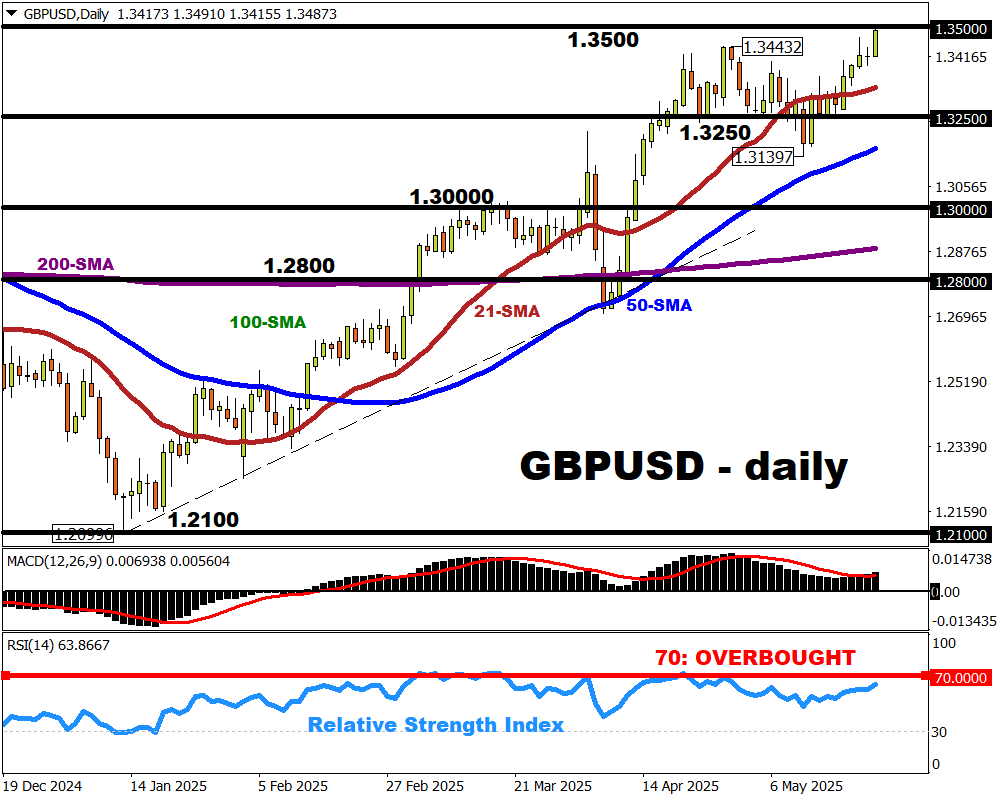
The GBP/USD pair climbed for seven consecutive days, reaching 1.3210, before experiencing a slight dip on Thursday. This marks the longest sustained rise for the currency pair since July last year, with the pound’s strength primarily driven by a weakening US dollar.

Key factors influencing GBP/USD movements

Fundamentally, the outlook remains mixed. The UK’s Consumer Price Index (CPI) fell more than anticipated in March, with annual inflation dropping to 2.6% and services sector inflation easing to 4.7%. This has alleviated some pressure on the Bank of England (BoE), prompting markets to adjust their expectations for monetary policy easing.

Traders are now pricing in rate cuts of around 85 basis points by year-end, with the first reduction widely expected in the coming months. By December, there is a greater than 50% probability of a further cut, as slowing inflation could give the BoE more flexibility to support the economy and households amid ongoing trade uncertainties.

Technical analysis: GBP/USD outlook

H4 Chart Perspective


  • The GBP/USD pair recently completed an upward wave, peaking near 1.3290
  • A downward impulse is now unfolding, targeting 1.3165
  • A potential rebound towards 1.3222 may follow before a possible decline to 1.2990
  • This outlook is supported by the MACD indicator, where the signal line has exited the histogram area and is trending sharply downward

H1 Chart Perspective

  • The pair consolidated around 1.3222 before breaking lower
  • The immediate downside target is 1.2880, followed by a potential retest of 1.3222 from below
  • The Stochastic oscillator reinforces this view, with its signal line below 50 and descending towards 20


Conclusion

While the pound benefits from a softer dollar and shifting rate expectations, technical indicators suggest potential near-term volatility. Traders should monitor both macroeconomic developments and key technical levels for further directional cues.


Disclaimer

Any forecasts contained herein are based on the author’s particular opinion. This analysis may not be treated as trading advice. RoboForex bears no responsibility for trading results based on trading recommendations and reviews contained herein.

China data beat expectations. Inflationary pressures in Canada continue to ease

By JustMarkets

At the end of Tuesday, the Dow Jones Index (US30) was down 0.38%. The S&P 500 Index (US500) decreased by 0.17%. The Nasdaq Technology Index (US100) jumped by 0.18%. The three major US stock indices ended mixed on Tuesday as investors weighed a fresh batch of corporate earnings and lingering concerns over tariffs and trade policy uncertainty. President Trump said China should return to the negotiating table to ease tariffs, emphasizing the importance of US consumer demand. Markets rose on Monday on hopes of a pause in tariffs on automobiles and exemptions for some technology goods. Meanwhile, the Commerce Department has begun inspecting imports of semiconductors and pharmaceuticals, signaling that new tariffs may be imposed.

Canada’s annualized inflation rate for March 2025 fell to 2.3% from an eight-month high of 2.6% in the previous month, below market expectations, which had expected inflation to remain at 2.6%, and below the Central Bank’s projections of 2.5%. The decline marked the beginning of a normalization of the Bank of England’s inflation prognoses for this year, after the end of the Goods and Services Tax (GST) and Harmonized Tax (HST) exemptions in the middle of last month caused core inflation to rise 0.6 percentage points. Gasoline prices declined (-1.6% vs. 5.1% in February) amid an aggressive fall in crude oil prices after OPEC+ confirmed plans to increase production, leading to a slowdown in transportation inflation (1.2% vs. 3%).

Equity markets in Europe were mostly up yesterday. Germany’s DAX (DE40) rose by 1.43%, France’s CAC 40 (FR40) closed 0.86% higher, Spain’s IBEX 35 (ES35) gained 2.14%, and the UK’s FTSE 100 (UK100) closed positive 1.41%. European equities closed solidly higher on Tuesday, extending last session’s sharp gains, after the prospect that the US may suspend the imposition of tariffs on cars and parts supported key sectors of the European economy.

WTI crude oil prices slipped toward $61 a barrel amid signs of weakening demand and a potential supply glut. The International Energy Agency sharply lowered its demand expectations for 2025, warning that the global glut could persist until 2026. OPEC and EIA also lowered their estimates due to slowing growth, trade tensions, and lower fuel consumption. Trump’s tariff war has raised concerns about slowing global growth, especially in the US and China, major oil consumers.

Asian markets were predominantly rising yesterday. Japan’s Nikkei 225 (JP225) gained 0.84% yesterday, China’s FTSE China A50 (CHA50) climbed 0.50%, Hong Kong’s Hang Seng (HK50) rose by 0.23%, and Australia’s ASX 200 (AU200) gained 0.17%.

The Reuters Tankan Sentiment Index for manufacturers in Japan jumped to positive 9 in April 2025 from negative 1 in March, the highest reading since August last year. Despite favorable current sentiment, the outlook for the next three months has deteriorated due to growing concerns over US trade policy. The index is expected to fall to zero as Japan prepares to impose 10% tariffs on US exports and 25% tariffs on automobiles. Export-oriented industries, especially automobile and machinery, are bracing for falling orders and rising customer caution.

China’s economy grew at an annualized rate of 5.4% in the first quarter of 2025, maintaining the same pace as in the fourth quarter and exceeding market expectations of 5.1%. This was the highest annualized growth rate in the past 1.5 years amid Beijing’s continued economic stimulus. China’s industrial production in March 2025 grew 7.7% y/y, exceeding market expectations of 5.6% and accelerating from the 5.9% growth recorded in January-February. This was the strongest growth in industrial production since June 2021. In addition, retail sales posted the fastest growth since December 2023 and beat market projections. On the labor side, the unemployment rate declined in March 2025 from the two-year high recorded in the previous month. These positive results were largely underpinned by ongoing stimulus policies aimed at strengthening the Chinese economy. Despite the positive data, escalating trade tensions between the US and China are clouding the outlook. Recently, US President Trump launched an investigation into new tariffs on imports of key minerals that are largely sourced from China, raising fresh concerns.

India’s annual inflation rate for March 2025 fell to 3.34% from 3.61% in the previous month, well below market expectations for an unchanged rate, and marked the fifth consecutive slowdown in inflation to its lowest level since August 2019. The decline pushed inflation further below the Reserve Bank of India’s average target of 4%.

S&P 500 (US500) 5,396.63 −9.34 (−0.17%)

Dow Jones (US30) 40,368.96 −155.83 (−0.38%)

DAX (DE40) 21,253.70 +298.87 (+1.43%)

FTSE 100 (UK100) 8,249.12 +114.78 (+1.41%)

USD Index 100.15 +0.51 (+0.51%)

News feed for: 2025.04.16

  • China GDP (q/q) at 05:00 (GMT+3);
  • China Industrial Production (y/y) at 05:00 (GMT+3);
  • China Unemployment Rate (m/m) at 05:00 (GMT+3);
  • China Retail Sales (m/m) at 05:00 (GMT+3);
  • UK Consumer Price Index (m/m) at 09:00 (GMT+3);
  • Eurozone Consumer Price Index (m/m) at 12:00 (GMT+3);
  • US Retail Sales (m/m) at 15:30 (GMT+3);
  • US Industrial Production (m/m) at 16:15 (GMT+3);
  • Canada BoC Rate Statement at 16:45 (GMT+3);
  • Canada Monetary Policy Report at 16:45 (GMT+3);
  • Canada BOC Press Conference at 17:30 (GMT+3);
  • US Crude Oil Reserves (w/w) at 17:30 (GMT+3).

By JustMarkets


This article reflects a personal opinion and should not be interpreted as an investment advice, and/or offer, and/or a persistent request for carrying out financial transactions, and/or a guarantee, and/or a forecast of future events.

Japanese Yen Surges as Weak US Dollar Fuels Momentum

By RoboForex Analytical Department 

The USD/JPY pair extended its decline on Wednesday, dropping to 142.36 amid sustained dollar weakness.

Key factors driving USD/JPY Movements

The Japanese yen’s appreciation is being propelled by broad-based US dollar softness. The greenback faced selling pressure as concerns grew over the economic fallout from proposed new US tariffs.

In a fresh escalation of trade tensions, US President Donald Trump has called for an investigation into imposing tariffs on critical mineral imports – many of which originate from China. This move has heightened investor anxiety, further weighing on the dollar.

Meanwhile, market attention is turning to the upcoming US-Japan trade talks, where Tokyo is expected to push for the complete removal of US tariffs.

On the domestic front, Japan’s latest economic data revealed an eight-month high in manufacturing sector optimism for April. However, the outlook remains cautious due to lingering risks surrounding US trade policy.

Technical Analysis: USD/JPY

The USD/JPY pair continues to consolidate around 143.20. A downside breakout could signal a further decline towards 141.70, marking the third wave of the downtrend. Conversely, an upside breakout may trigger a technical correction towards 145.00. This scenario is supported by the MACD indicator, with its signal line below zero but pointing firmly upwards.

The pair has formed a broader consolidation range between 142.46 and 144.07, with a triangle pattern emerging. A breakout above this range could initiate a corrective rally towards 145.00. The Stochastic oscillator reinforces this view, as its signal line – currently below 20 – is trending sharply upwards towards 80.

Conclusion

The yen’s rapid appreciation reflects both dollar weakness and cautious optimism in Japan’s manufacturing sector. However, trade policy uncertainties and technical patterns suggest continued volatility, with key levels at 141.70 (downside) and 145.00 (upside) in focus.


Disclaimer

Any forecasts contained herein are based on the author’s particular opinion. This analysis may not be treated as trading advice. RoboForex bears no responsibility for trading results based on trading recommendations and reviews contained herein.

Investors welcome tariff reliefs. Demand for safe assets is decreasing

By JustMarkets

At the end of Monday, the Dow Jones Index (US30) rose by 0.78%. The S&P 500 Index (US500) was up 0.79%. The Nasdaq Technology Index (US100) jumped by 0.57%. The US stocks rose on Monday after a volatile week as investors welcomed temporary tariff relief. Apple and Dell shares rose by 2.2% and 4%, respectively. Automakers also rose after Trump signaled a potential easing of 25% tariffs on cars, noting that companies need more time to move production to the US. Shares of Ford, GM, Stellantis, and Rivian jumped 3–6%, Tesla rose, and Toyota and Honda added more than 1%. Goldman Sachs added 1.9% after reporting strong quarterly earnings.

Equity markets in Europe were mostly up yesterday. Germany’s DAX (DE40) rose by 2.85%, France’s CAC 40 (FR 40) closed 2.37% higher, Spain’s IBEX 35 (ES35) gained 2.64%, and the UK’s FTSE 100 (UK100) closed 2.14% higher. European stocks rose sharply on Monday after US President Trump announced a temporary pause in imposing retaliatory tariffs on a range of computers and consumer electronics products. Banks and insurance companies rose as Eurozone bonds rose and yield spreads between its members narrowed, with BNP Paribas, UniCredit, Santander, and Munich Re up 6.5–4%.

Swiss producer and import prices fell by 0.1% year-on-year in March 2025, the same pace as the previous month. This marked the 23rd consecutive period of producer price deflation and the softest pace in the sequence.

WTI crude oil prices hovered near $61.5 a barrel on Tuesday amid news of a possible easing of restrictions on Iranian oil and a temporary postponement of tariffs imposed by the US Nuclear talks between the US and Iran, which have been described as “constructive,” have raised hopes of increased Iranian oil exports, putting downward pressure on prices. However, OPEC revised its 2025–26 demand growth projections downward by 100,000 bpd to reflect lower consumption due to US tariffs, although it still expects growth of 1.3 million bpd a year.

Silver prices fell to around $32 an ounce on Monday, breaking a three-day rally, as easing trade tensions reduced demand for safe-haven assets. Market attention is now focused on upcoming trade talks between the US and key partners, including Japan, India, and South Korea. Silver has gained over 8% in the previous three sessions as heightened trade tensions and concerns over the US economic outlook have caused investors to turn to alternative assets.

Asian markets were predominantly up yesterday. Japan’s Nikkei 225 (JP225) gained 1.18%, China’s FTSE China A50 (CHA50) climbed 0.34%, Hong Kong’s Hang Seng (HK50) rose by 2.40%, and Australia’s ASX 200 (AU200) gained 1.34%.

On Tuesday, the Australian dollar climbed as high as USD 0.635, posting a fifth consecutive session of gains as improving global risk appetite fueled the rally. On the domestic front, minutes from the Reserve Bank of Australia’s (RBA) April meeting failed to provide clarity on the timing of the next interest rate change. Policymakers pointed to heightened uncertainty both at home and abroad, making future policy decisions data-driven.

The New Zealand dollar rose to around 0.590 of the US dollar on Tuesday, rising for a sixth straight session and hitting its highest level since early December 2024, as risk sentiment continued to improve. Investors await the release of key economic data this week, including the first-quarter consumer inflation report and the March trade balance, to gain a better understanding of price pressures and overall economic conditions. Following the RBNZ’s recent rate cut to 3.5%, investors are expecting further signs of a slowing economy.

S&P 500 (US500) 5,405.97 +42.61 (+0.79%)

Dow Jones (US30) 40,524.79 +312.08 (+0.78%)

DAX (DE40) 20,954.83 +580.73 (+2.85%)

FTSE 100 (UK100) 8,134.34 +170.16 (+2.14%)

USD Index 99.71 −0.40 (−0.40%)

News feed for: 2025.04.15

  • Australia Monetary Policy Meeting Minutes at 04:30 (GMT+3);
  • UK Average Earnings Index (m/m) at 09:00 (GMT+3);
  • UK Claimant Count Change (m/m) at 09:00 (GMT+3);
  • UK Unemployment Rate (m/m) at 09:00 (GMT+3);
  • German ZEW Economic Sentiment (m/m) at 12:00 (GMT+3);
  • Eurozone ZEW Economic Sentiment (m/m) at 12:00 (GMT+3);
  • Eurozone Industrial Production (m/m) at 12:00 (GMT+3);
  • Canada Consumer Price Index (m/m) at 15:30 (GMT+3).

By JustMarkets


This article reflects a personal opinion and should not be interpreted as an investment advice, and/or offer, and/or a persistent request for carrying out financial transactions, and/or a guarantee, and/or a forecast of future events.

CN50 waits on key China data

By ForexTime 

  • CN50 rebounds over 10% from 2025 low 
  • China GDP expected to slow to 5.2% in Q1
  • Index remains influenced by US-China trade war 
  • Technical levels: 13,180, 13,000 and 12,600

European shares flashed green on Tuesday as investors welcomed Donald Trump’s hints of a potential pause in auto tariffs.

Some stability is returning to markets after the chaos witnessed last week, with Trump’s tariff exemptions on consumer electronics from China helping sentiment. However, caution lingers due to conflicting messages after Commerce Secretary Lutnick stated the exemptions as short-term.

Nevertheless, the two largest economies in the world remain in an aggressive tit-for-tat battle of rising tariffs. Any fresh escalation may spark another wave of risk aversion with equities in the firing line.

In Asia, FXTM’s CN50 index may see heightened volatility on Wednesday morning due to key China data.

Note: The CN50 tracks the benchmark FTSE China A50 Index

The CN50 index’s performance is very much tied to the overall health of the Chinese economy.

This is because stocks within the financial, consumer, and industrial sectors account for roughly two-thirds of the CN50’s weight.

Note: Back in February 2025, Trump imposed a 10% tariff on all Chinese goods before raising it by another 10% in March – bringing the total to 20% in Q1.

China Q1 GDP – Wednesday 16th April – 02:00 AM GMT)

China’s economy may have lost speed in Q1 as the country headed into a sharp escalation in trade tensions with the United States.

Q1 GDP is expected to have cooled to 5.2% versus the 5.4% in the previous quarter. 

Note: Over the past 12 months, the China GDP report has triggered upside moves on the CN50 of as much as 3.1% or declines of 0.9% in a 6-hour window post-release.

The incoming retail sales report and industrial production may provide fresh insight into the world’s second-largest economy.


POTENTIAL SCENARIOS:

The CN50 has rebounded over 10% from its 2025 low with prices testing resistance at 13,000.

  • If the data comes in better than expected, this could boost the CN50 index higher. A solid breakout and daily above 13,000 may open a path toward the 100-day SMA at 13,180 and 13,500.
  • However, a set of disappointing data could drag the CN50 index lower. A move below the 200-day SMA at 12,810 may trigger a decline toward 12,600.


Imagen
cn50

Forex-Time-LogoArticle by ForexTime

ForexTime Ltd (FXTM) is an award winning international online forex broker regulated by CySEC 185/12 www.forextime.com

Gold Prices Remain Elevated Amid Concerns Over Trump’s Tariffs

By RoboForex Analytical Department 

On Tuesday, the price of gold climbed to 3,220 USD per troy ounce as market uncertainty surrounding US President Donald Trump’s tariff policies continued to support demand for safe-haven assets.

Key factors driving gold’s movement

The precious metal’s stability is closely tied to lingering uncertainty over Trump’s tariffs. After temporarily exempting technology products from reciprocal duties, his administration is now considering similar exemptions for auto parts.

However, the White House heightened tensions on Monday by launching a national security probe into pharmaceutical and semiconductor imports – a move that could pave the way for additional tariffs.

Further supporting gold prices were comments from Christopher Waller, a member of the Federal Reserve Board of Governors, who suggested that interest rates could be cut soon if Trump’s sweeping tariffs remain in place.

Markets are currently pricing in an 86-basis-point rate cut by the end of the year, though most investors expect the Fed to hold rates steady in May.

Technical analysis: XAU/USD

H4 Chart Overview

  • The market saw an upward wave, peaking at 3,245, followed by a correction to 3,194
  • Today, consolidation is expected around 3,220. A downside breakout could trigger a further correction towards 3,175, after which a rebound towards 3,253 may follow
  • Conversely, an upside breakout may extend the rally to 3,253, the primary target of this growth wave
  • A subsequent decline towards 3,105 is anticipated
  • The MACD indicator supports this outlook, with its signal line at extreme highs and poised for a pullback towards zero

H1 Chart Overview

  • The market completed a third-wave advance to 3,245, with consolidation now likely beneath this level
  • A downside exit may initiate a correction towards 3,175, while an upside exit could extend gains to 3,253, where the uptrend may exhaust itself
  • Beyond this, a deeper corrective decline towards 3,105 is possible
  • The Stochastic oscillator aligns with this view, with its signal line above 80 and showing signs of an impending reversal


Conclusion

Gold remains buoyed by geopolitical and monetary policy uncertainty, with technical indicators suggesting near-term consolidation before potential further upside, followed by a corrective pullback.

Закрепить


Disclaimer

Any forecasts contained herein are based on the author’s particular opinion. This analysis may not be treated as trading advice. RoboForex bears no responsibility for trading results based on trading recommendations and reviews contained herein.

Trump announces exemption of key tech goods from imposed tariffs

By JustMarkets

At Friday’s close, the Dow Jones Index (US30) was up 1.56% (for the week +6.16%). The S&P 500 Index (US500) gained 1.81% (for the week +8.27%). The Nasdaq Technology Index (US100) jumped 1.89% (for the week +11.44%). The US stocks rose on Friday, ending a turbulent week on a high note, with hopes of a possible trade deal between the US and China lifting investor sentiment. Trump is optimistic about striking a deal with China even as trade tensions escalate, with Trump raising tariffs on Chinese goods to 145% and China retaliating by imposing 125% duties on imports from the US. On the economic front, a University of Michigan survey showed that consumer sentiment is at its lowest level since 2022, and inflation expectations have reached a peak not seen since 1981. Meanwhile, earnings season got off to a mixed start with mixed banking results. For example, Wells Fargo Bank shares fell 1%, while Morgan Stanley added 1.4% and JPMorgan rose by 4% after posting record earnings.

The Canadian dollar strengthened to $1.39 in April, hitting a five-month high, driven by a marked weakening of the US dollar as investors exited US assets amid growing fears of recession and high inflation. Escalating trade tensions between the US and China further undermined confidence in the outlook for the US economy. While the 90-day truce announced by President Trump briefly raised hopes of renewed trade talks, growing concerns about the US outlook led capital to return to Canada, helping to drive the Lonnie higher.

Equity markets in Europe were mostly down on Friday. Germany’s DAX (DE40) fell by 0.92% (for the week +5.98%), France’s CAC 40 (FR40) closed 0.30% lower (for the week +3.60%), Spain’s IBEX 35 (ES35) lost 0.18% (for the week +5.57%), and the UK’s FTSE 100 (UK100) closed positive 0.64% (for the week -1.13%). European stock markets reversed early gains and closed lower, ending a turbulent week dominated by escalating trade tensions between the US and China. The EU confirmed that it will not compromise on its digital regulatory framework as part of any potential trade agreement with the US. As for domestic data, Germany’s annual inflation rate for March 2025 was confirmed at 2.2%, down slightly from 2.3%, the lowest since last November. European stock markets are expecting a strong start to Monday after US President Donald Trump announced the exemption of key technology goods from recently imposed tariffs, boosting global investor sentiment.

Sweden’s annual inflation rate for March 2025 fell to 0.5%, confirming initial estimates, from 1.3% in February. This is the lowest since December 2020 and marks the eighth consecutive month inflation has remained below the Riksbank’s 2% target. Meanwhile, the fixed-rate Consumer Price Index, the Riksbank’s target variable, rose 2.3% in March, matching the preliminary reading and down from February’s annualized high of 2.9%.

Silver (XAG/USD) rose above $31.20 an ounce on Friday, posting gains for the third consecutive session, as a generally weaker US dollar and renewed economic concerns spurred demand for alternative assets. The metal also benefited from rising safe haven flows as the dollar lost some of its traditional safe haven appeal.

WTI crude oil prices rose by 2.4% to settle at $61.50 a barrel on Friday after US Energy Secretary Chris Wright said the US could block Iranian oil exports as part of efforts to pressure Tehran over its nuclear program. Nevertheless, concerns over the US-China trade dispute continued to weigh on demand expectations. Meanwhile, OPEC+ surprised markets by accelerating plans to increase production, raising concerns about oversupply.

Asian markets were predominantly up last week. Japan’s Nikkei 225 (JP225) rose by 7.75% for the week, China’s FTSE China A50 (CHA50) climbed 3.16%, Hong Kong’s Hang Seng (HK50) gained 0.89%, and Australia’s ASX 200 (AU200) was positive 6.04%.

Exports from China rose 12.4% year-on-year to US$313.9 billion in March 2025, well above market expectations of 4.4% and sharply accelerating from a 2.3% increase in January-February. This is the fastest growth in overseas sales since last October, reflecting an expected increase in US tariffs under Trump that will take effect in April. In the first quarter of 2025, exports rose 5.8% from the same period in 2024 to US $853.7 billion.

The Australian dollar strengthened to around $0.63 on Monday, posting a fourth straight session of gains as US President Donald Trump exempted key technology goods from his new “retaliatory” tariffs, boosting risk sentiment globally. The exemption applies to goods that are largely made in China, including smartphones, computers, semiconductors, solar panels, and flat-panel displays. China’s Ministry of Commerce called the duty exemption a “small step” but urged the US to eliminate the broader 145% tax on Chinese goods. China remains Australia’s largest trading partner and a major buyer of its goods, so the Australian dollar is particularly sensitive to the developing trade relationship between the US and China.

S&P 500 (US500) 5,363.36 +95.31 (+1.81%)

Dow Jones (US30) 40,212.71 +619.05 (+1.56%)

DAX (DE40) 20,374.10 −188.63 (−0.92%)

FTSE 100 (UK100) 7,964.18 +50.93 (+0.64%)

USD Index 99.78 −1.08 (−1.07%)

News feed for: 2025.04.14

  • China Trade Balance (q/q) at 06:00 (GMT+3);
  • Japan Industrial Production (m/m) at 07:30 (GMT+3);
  • Switzerland Producer Price Index (m/m) at 09:30 (GMT+3).

By JustMarkets


This article reflects a personal opinion and should not be interpreted as an investment advice, and/or offer, and/or a persistent request for carrying out financial transactions, and/or a guarantee, and/or a forecast of future events.

FX Speculators push Japanese Yen bullish bets to new record high

By InvestMacro

Here are the latest charts and statistics for the Commitment of Traders (COT) data published by the Commodities Futures Trading Commission (CFTC).

The latest COT data is updated through Tuesday April 8th and shows a quick view of how large market participants (for-profit speculators and commercial traders) were positioned in the futures markets. All currency positions are in direct relation to the US dollar where, for example, a bet for the euro is a bet that the euro will rise versus the dollar while a bet against the euro will be a bet that the euro will decline versus the dollar.

Weekly Speculator Changes led by Japanese Yen, Australian Dollar & Swiss Franc

The COT currency market speculator bets were overall higher this week as eight out of the eleven currency markets we cover had higher positioning while the other three markets had lower speculator contracts.

Leading the gains for the currency markets was the Japanese Yen (25,293 contracts) with the Australian Dollar (12,563 contracts), the Swiss Franc (12,487 contracts), the Canadian Dollar (10,775 contracts), the EuroFX (8,145 contracts), the Brazilian Real (8,080 contracts), the New Zealand Dollar (5,896 contracts) and Bitcoin (841 contracts) also showing positive weeks.

The currencies seeing declines in speculator bets on the week were the British Pound (-17,316 contracts), the Mexican Peso (-11,998 contracts) and with the US Dollar Index (-4,128 contracts) also recording lower bets on the week.

Japanese Yen Speculators push bullish bets to new record high

Highlighting the COT currency’s data this week is the continued push higher in bullish bets for the Japanese yen speculators.

Large speculative yen positions surged higher by +25,293 contracts this week and have now advanced in ten out of the past twelve weeks. Over these past twelve weeks, the speculator position has gained by a total of +176,478 contracts and gone from a bearish position on January 14th (-29,411 contracts) to a new all-time high this week (+147,067 contracts). The new record high surpasses the most recent record reached on March 11th at a total of +133,902 contracts.

The yen exchange rate has been on the move higher as well with the JPY rising this week to the best level against the US Dollar since September of 2024. The USDJPY currency pair is currently trading around 143.50 and further USD weakness/JPY strength with set up a test of the major support level at 140.00.

Tariff turmoil boosts Swiss Franc & Euro, hits USD

Elsewhere, the Swiss franc has been the recipient of safe haven flows and saw speculators sharply boost their bets this week by +12,487 contracts. The overall franc position remains bearish and has been since 2021 – so there is a lot of room for speculator bets to turn around. The Swiss franc (CHF) exchange rate has been on a sharp upward move since the Tariff turmoil hit the markets. This week, the franc rose by over 5 percent and the currency is up over 10 percent in just the past 30 days. The franc closed at the highest level versus the USD since 2011 on Friday.

The Euro speculators raised their bullish bets this week for the seventh time out of the past eight weeks. This has added a total of +46,335 contracts to the Euro position in the past eight weeks. The overall bullish standing at the moment for the Euro is at approximately +60,000 contracts which is right down the middle of its 3-year range (strength score of 51 percent). The Euro exchange rate versus the USD has been moving higher and closed this week at its highest level since 2022 at over 1.1350. The Euro move has seen a gain by almost 10 percent in the past 30 days.

The US Dollar Index (DXY) has been on the opposite side of the Tariff turmoil and has been sold off strongly in the past couple of weeks. The DXY closed this week under the 100.00 for the first time since July of 2023 and has also closed firmly under its 200-week moving average. Speculators reduced their positions for the USD Index by -4,128 contracts this week and brought the overall bullish position down to +2,913 contracts, the lowest level since December.


Currency Data:

Legend: Weekly Speculators Change | Speculators Current Net Position | Speculators Strength Score compared to last 3-Years (0-100 range)


Strength Scores led by Japanese Yen & Brazilian Real

COT Strength Scores (a normalized measure of Speculator positions over a 3-Year range, from 0 to 100 where above 80 is Extreme-Bullish and below 20 is Extreme-Bearish) showed that the Japanese Yen (100 percent) and the Brazilian Real (95 percent) lead the currency markets this week. Bitcoin (80 percent) and the EuroFX (52 percent) come in as the next highest in the weekly strength scores.

On the downside, the US Dollar Index (13 percent) and the New Zealand Dollar (19 percent) come in at the lowest strength levels currently and are in Extreme-Bearish territory (below 20 percent). The next lowest strength scores are the Australian Dollar (31 percent) and the Canadian Dollar (35 percent).

3-Year Strength Statistics:
US Dollar Index (12.7 percent) vs US Dollar Index previous week (21.3 percent)
EuroFX (51.6 percent) vs EuroFX previous week (48.5 percent)
British Pound Sterling (43.9 percent) vs British Pound Sterling previous week (51.7 percent)
Japanese Yen (100.0 percent) vs Japanese Yen previous week (92.4 percent)
Swiss Franc (39.5 percent) vs Swiss Franc previous week (14.2 percent)
Canadian Dollar (34.5 percent) vs Canadian Dollar previous week (29.7 percent)
Australian Dollar (31.4 percent) vs Australian Dollar previous week (22.5 percent)
New Zealand Dollar (19.2 percent) vs New Zealand Dollar previous week (12.4 percent)
Mexican Peso (48.7 percent) vs Mexican Peso previous week (54.8 percent)
Brazilian Real (95.1 percent) vs Brazilian Real previous week (87.4 percent)
Bitcoin (80.4 percent) vs Bitcoin previous week (62.0 percent)


Brazilian Real & EuroFX top the 6-Week Strength Trends

COT Strength Score Trends (or move index, calculates the 6-week changes in strength scores) showed that the Brazilian Real (41 percent) and the EuroFX (33 percent) lead the past six weeks trends for the currencies. Bitcoin (25 percent), the Swiss Franc (19 percent) and the New Zealand Dollar (17 percent) are the next highest positive movers in the 3-Year trends data.

The US Dollar Index (-27 percent) leads the downside trend scores currently with the Australian Dollar (-13 percent) following next with a lower trend score.

3-Year Strength Trends:
US Dollar Index (-26.6 percent) vs US Dollar Index previous week (-20.2 percent)
EuroFX (32.5 percent) vs EuroFX previous week (39.3 percent)
British Pound Sterling (5.8 percent) vs British Pound Sterling previous week (15.8 percent)
Japanese Yen (15.4 percent) vs Japanese Yen previous week (18.5 percent)
Swiss Franc (18.6 percent) vs Swiss Franc previous week (-8.9 percent)
Canadian Dollar (8.4 percent) vs Canadian Dollar previous week (6.6 percent)
Australian Dollar (-12.6 percent) vs Australian Dollar previous week (-13.6 percent)
New Zealand Dollar (16.8 percent) vs New Zealand Dollar previous week (8.2 percent)
Mexican Peso (5.3 percent) vs Mexican Peso previous week (18.6 percent)
Brazilian Real (40.7 percent) vs Brazilian Real previous week (34.3 percent)
Bitcoin (24.6 percent) vs Bitcoin previous week (18.7 percent)


Individual COT Forex Markets:

US Dollar Index Futures:

US Dollar Index Forex Futures COT ChartThe US Dollar Index large speculator standing this week was a net position of 2,913 contracts in the data reported through Tuesday. This was a weekly decrease of -4,128 contracts from the previous week which had a total of 7,041 net contracts.

This week’s current strength score (the trader positioning range over the past three years, measured from 0 to 100) shows the speculators are currently Bearish-Extreme with a score of 12.7 percent. The commercials are Bullish-Extreme with a score of 88.9 percent and the small traders (not shown in chart) are Bearish with a score of 26.1 percent.

Price Trend-Following Model: Strong Downtrend

Our weekly trend-following model classifies the current market price position as: Strong Downtrend.

US DOLLAR INDEX StatisticsSPECULATORSCOMMERCIALSSMALL TRADERS
– Percent of Open Interest Longs:68.015.710.9
– Percent of Open Interest Shorts:55.227.112.3
– Net Position:2,913-2,601-312
– Gross Longs:15,4873,5802,479
– Gross Shorts:12,5746,1812,791
– Long to Short Ratio:1.2 to 10.6 to 10.9 to 1
NET POSITION TREND:
– Strength Index Score (3 Year Range Pct):12.788.926.1
– Strength Index Reading (3 Year Range):Bearish-ExtremeBullish-ExtremeBearish
NET POSITION MOVEMENT INDEX:
– 6-Week Change in Strength Index:-26.626.1-6.0


Euro Currency Futures:

Euro Currency Futures COT ChartThe Euro Currency large speculator standing this week was a net position of 59,980 contracts in the data reported through Tuesday. This was a weekly increase of 8,145 contracts from the previous week which had a total of 51,835 net contracts.

This week’s current strength score (the trader positioning range over the past three years, measured from 0 to 100) shows the speculators are currently Bullish with a score of 51.6 percent. The commercials are Bullish with a score of 50.4 percent and the small traders (not shown in chart) are Bearish with a score of 40.9 percent.

Price Trend-Following Model: Strong Uptrend

Our weekly trend-following model classifies the current market price position as: Strong Uptrend.

EURO Currency StatisticsSPECULATORSCOMMERCIALSSMALL TRADERS
– Percent of Open Interest Longs:27.357.611.6
– Percent of Open Interest Shorts:18.770.57.2
– Net Position:59,980-90,41630,436
– Gross Longs:190,296401,85880,668
– Gross Shorts:130,316492,27450,232
– Long to Short Ratio:1.5 to 10.8 to 11.6 to 1
NET POSITION TREND:
– Strength Index Score (3 Year Range Pct):51.650.440.9
– Strength Index Reading (3 Year Range):BullishBullishBearish
NET POSITION MOVEMENT INDEX:
– 6-Week Change in Strength Index:32.5-30.69.7


British Pound Sterling Futures:

British Pound Sterling Futures COT ChartThe British Pound Sterling large speculator standing this week was a net position of 17,310 contracts in the data reported through Tuesday. This was a weekly decline of -17,316 contracts from the previous week which had a total of 34,626 net contracts.

This week’s current strength score (the trader positioning range over the past three years, measured from 0 to 100) shows the speculators are currently Bearish with a score of 43.9 percent. The commercials are Bullish with a score of 55.1 percent and the small traders (not shown in chart) are Bullish with a score of 59.0 percent.

Price Trend-Following Model: Uptrend

Our weekly trend-following model classifies the current market price position as: Uptrend.

BRITISH POUND StatisticsSPECULATORSCOMMERCIALSSMALL TRADERS
– Percent of Open Interest Longs:51.933.813.6
– Percent of Open Interest Shorts:42.142.714.5
– Net Position:17,310-15,795-1,515
– Gross Longs:91,73359,71924,131
– Gross Shorts:74,42375,51425,646
– Long to Short Ratio:1.2 to 10.8 to 10.9 to 1
NET POSITION TREND:
– Strength Index Score (3 Year Range Pct):43.955.159.0
– Strength Index Reading (3 Year Range):BearishBullishBullish
NET POSITION MOVEMENT INDEX:
– 6-Week Change in Strength Index:5.8-8.719.2


Japanese Yen Futures:

Japanese Yen Forex Futures COT ChartThe Japanese Yen large speculator standing this week was a net position of 147,067 contracts in the data reported through Tuesday. This was a weekly increase of 25,293 contracts from the previous week which had a total of 121,774 net contracts.

This week’s current strength score (the trader positioning range over the past three years, measured from 0 to 100) shows the speculators are currently Bullish-Extreme with a score of 100.0 percent. The commercials are Bearish-Extreme with a score of 0.0 percent and the small traders (not shown in chart) are Bullish-Extreme with a score of 94.5 percent.

Price Trend-Following Model: Strong Uptrend

Our weekly trend-following model classifies the current market price position as: Strong Uptrend.

JAPANESE YEN StatisticsSPECULATORSCOMMERCIALSSMALL TRADERS
– Percent of Open Interest Longs:55.031.112.3
– Percent of Open Interest Shorts:9.281.57.8
– Net Position:147,067-161,66914,602
– Gross Longs:176,55599,65939,600
– Gross Shorts:29,488261,32824,998
– Long to Short Ratio:6.0 to 10.4 to 11.6 to 1
NET POSITION TREND:
– Strength Index Score (3 Year Range Pct):100.00.094.5
– Strength Index Reading (3 Year Range):Bullish-ExtremeBearish-ExtremeBullish-Extreme
NET POSITION MOVEMENT INDEX:
– 6-Week Change in Strength Index:15.4-14.84.2


Swiss Franc Futures:

Swiss Franc Forex Futures COT ChartThe Swiss Franc large speculator standing this week was a net position of -30,277 contracts in the data reported through Tuesday. This was a weekly boost of 12,487 contracts from the previous week which had a total of -42,764 net contracts.

This week’s current strength score (the trader positioning range over the past three years, measured from 0 to 100) shows the speculators are currently Bearish with a score of 39.5 percent. The commercials are Bullish with a score of 61.1 percent and the small traders (not shown in chart) are Bearish with a score of 46.9 percent.

Price Trend-Following Model: Strong Uptrend

Our weekly trend-following model classifies the current market price position as: Strong Uptrend.

SWISS FRANC StatisticsSPECULATORSCOMMERCIALSSMALL TRADERS
– Percent of Open Interest Longs:5.779.613.9
– Percent of Open Interest Shorts:45.330.223.8
– Net Position:-30,27737,800-7,523
– Gross Longs:4,34860,87210,659
– Gross Shorts:34,62523,07218,182
– Long to Short Ratio:0.1 to 12.6 to 10.6 to 1
NET POSITION TREND:
– Strength Index Score (3 Year Range Pct):39.561.146.9
– Strength Index Reading (3 Year Range):BearishBullishBearish
NET POSITION MOVEMENT INDEX:
– 6-Week Change in Strength Index:18.6-21.116.0


Canadian Dollar Futures:

Canadian Dollar Forex Futures COT ChartThe Canadian Dollar large speculator standing this week was a net position of -119,241 contracts in the data reported through Tuesday. This was a weekly lift of 10,775 contracts from the previous week which had a total of -130,016 net contracts.

This week’s current strength score (the trader positioning range over the past three years, measured from 0 to 100) shows the speculators are currently Bearish with a score of 34.5 percent. The commercials are Bullish with a score of 69.4 percent and the small traders (not shown in chart) are Bearish-Extreme with a score of 14.7 percent.

Price Trend-Following Model: Weak Downtrend

Our weekly trend-following model classifies the current market price position as: Weak Downtrend.

CANADIAN DOLLAR StatisticsSPECULATORSCOMMERCIALSSMALL TRADERS
– Percent of Open Interest Longs:6.284.87.9
– Percent of Open Interest Shorts:52.434.611.9
– Net Position:-119,241129,460-10,219
– Gross Longs:16,029218,92320,529
– Gross Shorts:135,27089,46330,748
– Long to Short Ratio:0.1 to 12.4 to 10.7 to 1
NET POSITION TREND:
– Strength Index Score (3 Year Range Pct):34.569.414.7
– Strength Index Reading (3 Year Range):BearishBullishBearish-Extreme
NET POSITION MOVEMENT INDEX:
– 6-Week Change in Strength Index:8.4-5.5-15.2


Australian Dollar Futures:

Australian Dollar Forex Futures COT ChartThe Australian Dollar large speculator standing this week was a net position of -63,300 contracts in the data reported through Tuesday. This was a weekly gain of 12,563 contracts from the previous week which had a total of -75,863 net contracts.

This week’s current strength score (the trader positioning range over the past three years, measured from 0 to 100) shows the speculators are currently Bearish with a score of 31.4 percent. The commercials are Bullish with a score of 71.8 percent and the small traders (not shown in chart) are Bearish with a score of 30.9 percent.

Price Trend-Following Model: Downtrend

Our weekly trend-following model classifies the current market price position as: Downtrend.

AUSTRALIAN DOLLAR StatisticsSPECULATORSCOMMERCIALSSMALL TRADERS
– Percent of Open Interest Longs:14.765.613.0
– Percent of Open Interest Shorts:47.229.516.6
– Net Position:-63,30070,205-6,905
– Gross Longs:28,493127,54625,334
– Gross Shorts:91,79357,34132,239
– Long to Short Ratio:0.3 to 12.2 to 10.8 to 1
NET POSITION TREND:
– Strength Index Score (3 Year Range Pct):31.471.830.9
– Strength Index Reading (3 Year Range):BearishBullishBearish
NET POSITION MOVEMENT INDEX:
– 6-Week Change in Strength Index:-12.610.7-0.4


New Zealand Dollar Futures:

New Zealand Dollar Forex Futures COT ChartThe New Zealand Dollar large speculator standing this week was a net position of -39,152 contracts in the data reported through Tuesday. This was a weekly increase of 5,896 contracts from the previous week which had a total of -45,048 net contracts.

This week’s current strength score (the trader positioning range over the past three years, measured from 0 to 100) shows the speculators are currently Bearish-Extreme with a score of 19.2 percent. The commercials are Bullish-Extreme with a score of 80.5 percent and the small traders (not shown in chart) are Bearish with a score of 26.2 percent.

Price Trend-Following Model: Downtrend

Our weekly trend-following model classifies the current market price position as: Downtrend.

NEW ZEALAND DOLLAR StatisticsSPECULATORSCOMMERCIALSSMALL TRADERS
– Percent of Open Interest Longs:11.084.64.1
– Percent of Open Interest Shorts:65.327.47.1
– Net Position:-39,15241,292-2,140
– Gross Longs:7,93561,0222,947
– Gross Shorts:47,08719,7305,087
– Long to Short Ratio:0.2 to 13.1 to 10.6 to 1
NET POSITION TREND:
– Strength Index Score (3 Year Range Pct):19.280.526.2
– Strength Index Reading (3 Year Range):Bearish-ExtremeBullish-ExtremeBearish
NET POSITION MOVEMENT INDEX:
– 6-Week Change in Strength Index:16.8-15.5-10.2


Mexican Peso Futures:

Mexican Peso Futures COT ChartThe Mexican Peso large speculator standing this week was a net position of 39,082 contracts in the data reported through Tuesday. This was a weekly lowering of -11,998 contracts from the previous week which had a total of 51,080 net contracts.

This week’s current strength score (the trader positioning range over the past three years, measured from 0 to 100) shows the speculators are currently Bearish with a score of 48.7 percent. The commercials are Bullish with a score of 55.6 percent and the small traders (not shown in chart) are Bearish-Extreme with a score of 7.1 percent.

Price Trend-Following Model: Downtrend

Our weekly trend-following model classifies the current market price position as: Downtrend.

MEXICAN PESO StatisticsSPECULATORSCOMMERCIALSSMALL TRADERS
– Percent of Open Interest Longs:53.441.22.1
– Percent of Open Interest Shorts:27.465.44.0
– Net Position:39,082-36,259-2,823
– Gross Longs:80,16761,8313,195
– Gross Shorts:41,08598,0906,018
– Long to Short Ratio:2.0 to 10.6 to 10.5 to 1
NET POSITION TREND:
– Strength Index Score (3 Year Range Pct):48.755.67.1
– Strength Index Reading (3 Year Range):BearishBullishBearish-Extreme
NET POSITION MOVEMENT INDEX:
– 6-Week Change in Strength Index:5.3-5.2-1.7


Brazilian Real Futures:

Brazil Real Futures COT ChartThe Brazilian Real large speculator standing this week was a net position of 45,115 contracts in the data reported through Tuesday. This was a weekly boost of 8,080 contracts from the previous week which had a total of 37,035 net contracts.

This week’s current strength score (the trader positioning range over the past three years, measured from 0 to 100) shows the speculators are currently Bullish-Extreme with a score of 95.1 percent. The commercials are Bearish-Extreme with a score of 5.3 percent and the small traders (not shown in chart) are Bearish with a score of 28.5 percent.

Price Trend-Following Model: Weak Uptrend

Our weekly trend-following model classifies the current market price position as: Weak Uptrend.

BRAZIL REAL StatisticsSPECULATORSCOMMERCIALSSMALL TRADERS
– Percent of Open Interest Longs:71.424.43.8
– Percent of Open Interest Shorts:23.473.92.4
– Net Position:45,115-46,4731,358
– Gross Longs:67,07922,9603,599
– Gross Shorts:21,96469,4332,241
– Long to Short Ratio:3.1 to 10.3 to 11.6 to 1
NET POSITION TREND:
– Strength Index Score (3 Year Range Pct):95.15.328.5
– Strength Index Reading (3 Year Range):Bullish-ExtremeBearish-ExtremeBearish
NET POSITION MOVEMENT INDEX:
– 6-Week Change in Strength Index:40.7-40.0-1.3


Bitcoin Futures:

Bitcoin Crypto Futures COT ChartThe Bitcoin large speculator standing this week was a net position of 1,332 contracts in the data reported through Tuesday. This was a weekly gain of 841 contracts from the previous week which had a total of 491 net contracts.

This week’s current strength score (the trader positioning range over the past three years, measured from 0 to 100) shows the speculators are currently Bullish-Extreme with a score of 80.4 percent. The commercials are Bearish with a score of 41.1 percent and the small traders (not shown in chart) are Bearish-Extreme with a score of 0.0 percent.

Price Trend-Following Model: Strong Downtrend

Our weekly trend-following model classifies the current market price position as: Strong Downtrend.

BITCOIN StatisticsSPECULATORSCOMMERCIALSSMALL TRADERS
– Percent of Open Interest Longs:83.22.23.7
– Percent of Open Interest Shorts:78.25.55.3
– Net Position:1,332-897-435
– Gross Longs:22,388591985
– Gross Shorts:21,0561,4881,420
– Long to Short Ratio:1.1 to 10.4 to 10.7 to 1
NET POSITION TREND:
– Strength Index Score (3 Year Range Pct):80.441.10.0
– Strength Index Reading (3 Year Range):Bullish-ExtremeBearishBearish-Extreme
NET POSITION MOVEMENT INDEX:
– 6-Week Change in Strength Index:24.6-15.9-29.9


Article By InvestMacroReceive our weekly COT Newsletter

*COT Report: The COT data, released weekly to the public each Friday, is updated through the most recent Tuesday (data is 3 days old) and shows a quick view of how large speculators or non-commercials (for-profit traders) were positioned in the futures markets.

The CFTC categorizes trader positions according to commercial hedgers (traders who use futures contracts for hedging as part of the business), non-commercials (large traders who speculate to realize trading profits) and nonreportable traders (usually small traders/speculators) as well as their open interest (contracts open in the market at time of reporting). See CFTC criteria here.