Inflation, unemployment, the housing crisis and a possible recession: Two economists forecast what’s ahead in 2023

By D. Brian Blank, Mississippi State University and Rodney Ramcharan, University of Southern California 

With the current U.S. inflation rate at 7.1%, interest rates rising and housing costs up, many Americans are wondering if a recession is looming.

Two economists discussed that and more in a recent wide-ranging and exclusive interview for The Conversation.
Brian Blank is a finance professor at Mississippi State University who specializes in the study of corporations and how they respond to economic downturns. Rodney Ramcharan is an economist at the University of Southern California who previously held posts with the Federal Reserve and the International Monetary Fund.

Both were interviewed by Bryan Keogh, deputy managing editor and senior editor of economy and business for The Conversation.

Below are some highlights from the discussion. Answers have been edited for brevity and clarity.

Brian Blank and Rodney Ramcharan talk about the economic outlook for 2023.

Are we headed for a recession in 2023?

Brian Blank: The consensus view among most forecasters is that there is a recession coming at some point, maybe in the middle of next year. I’m a little bit more optimistic than that consensus.

People have been calling for a recession for months now, and this seems to be the most anticipated recession on record. I think that it could still be a ways off. Consumer balance sheets are still relatively strong, stronger than we’ve seen them for most periods.

I think that the labor market is going to remain hotter than people have expected. Right now, over the last eight months, the labor market has added more jobs than anticipated, which is one of the strongest streaks on record. And I think that until consumer balance sheets weaken considerably, we can expect consumer spending, which is the largest part of the economy, to continue to grow quickly.

[But this] doesn’t mean that a recession is not coming. There’s always a recession somewhere down the road.

Rodney Ramcharan: Indeed, yes, there’s a likelihood that the economy is going to contract in the next nine months. The president of the New York Fed expects the unemployment rate to go up from 3.5% currently to somewhere between 4% to 5% in the next year. And I think that will be consistent with a recession.

In terms of how much worse it can be beyond that, it’s going to depend on a number of things. It could depend on whether the Fed is going to accept a higher inflation rate over the medium term or whether it’s really committed to getting the inflation rate down to the 2% rate. So I think that’s the trade-off.

Will unemployment go up?

Blank: [Unemployment] hasn’t risen much, and maybe it’ll pick up to somewhere close to 4%. Many are expecting something like four and a half percent. And I think that’s certainly possible. And I think that we can see small upticks in the coming months.

But I don’t think it’s going to rise as quickly as some people are expecting, in part because what we’ve seen so far is a lack of labor force participation. Until more people enter the labor market, I think there are going to be plenty of jobs to go around.

What is your outlook on interest rates?

Ramcharan: As people find it more and more difficult to find jobs, or to get jobs as they begin to lose jobs, I think that’s going to dampen spending. And we’re seeing that now as the cost of borrowing has gone up sharply, and the Fed is expecting that.

The expectation is the federal funds rate will go up to 5% by next year. If you tack on another couple of points, because of the risk involved, then the cost to borrow to buy a home could potentially get up to 8% for some people. And that could be very expensive.

And the flip side of this for businesses is there’s potentially going to be a slowdown in cash flow. If consumers are not spending, then the revenues that businesses depend on to make investments might not be there.

The additional piece in this puzzle is what the banks will then do. I think banks are going to begin to curtail the extension of credit. So not only will interest rates go up for the typical consumer and the typical business, it’s also likely that they are more likely to experience denial of credit, and so that should together begin to slow spending quite a bit.

After massive increases in housing prices, what caused them to suddenly drop?

Ramcharan: As the Fed lowered interest rates, there was a massive shift among the population for various reasons. They decided that housing was the right investment or the right thing. And so when 50 million people all collectively decide to buy homes, the supply of homes is reasonably constrained in the short run. And so that led to this massive increase in house prices and in rents.

In the last three months, the housing market has cooled sharply. We’re now seeing house prices beginning to fall. I would imagine, going forward, the housing market cooling is going to be a major driver behind the slowdown in the inflation rate and in real estate investment trusts. So that’s positive.

Our recent election just changed the composition of Congress. How will that affect the economy?

Blank: Certainly, when we have a divided Congress, we’re less likely to see decisions made that involve passing legislation that might support the economy. And I think it’s likely the Republican House is going to become a little bit more conservative with spending.

And so if we do start to see a downturn, I think you’re less likely to see legislation that might help support an economy that could be in need of it. That is going to make the job of the Federal Reserve more important.

How certain are these predictions?

Ramcharan: I just want to be careful here and let your viewers know that we’re making these statements based on theory, because the inflation that we’re experiencing now comes about from a pandemic, and there really is no evidence, there’s no data available, that people can look to to say, “What happens to an economy after a pandemic?” That data does not exist.

So we’re trying to piece together the data we do have with the theories we do have, but there’s a huge band of uncertainty about what’s going to happen.

Watch the full interview here.The Conversation

About the Author:

D. Brian Blank, Assistant Professor of Finance, Mississippi State University and Rodney Ramcharan, Professor of Finance and Business Economics, University of Southern California

This article is republished from The Conversation under a Creative Commons license. Read the original article.
 

The Analytical Overview of the Main Currency Pairs on 2023.01.03

By JustMarkets

The EUR/USD currency pair

Technical indicators of the currency pair:
  • Prev Open: 1.0696
  • Prev Close: 1.0658
  • % chg. over the last day: -0.35 %

The ECB is expected to go against the trend of most other major central banks early this year and continue its aggressive pace of rate hikes, even though inflationary pressures across Europe are forecast to ease this week. The ECB was the last of the big central banks to start raising rates, which means Europe’s Central Bank has more “room” to continue tightening. Moreover, the index of business activity in the manufacturing sector indicates that the European industry has already adapted to high prices, the recession in manufacturing activity in the euro area is probably over, and supply chains are recovering.

Trading recommendations
  • Support levels: 1.0638, 1.0589, 1.0483, 1.0361, 1.0332, 1.0284, 1.0193
  • Resistance levels: 1.0689

The EUR/USD currency pair trend on the hourly time frame is still bullish. The price is still trading in a wide price corridor. The MACD indicator has become negative. Volatility remains low. Under such market conditions, buy trades are best considered from the support level of 1.0638 on intraday time frames. Sell deals can be considered from the resistance level of 1.0689, but better with confirmation in the form of a reverse initiative or a false breakout since the level has already been tested.

Alternative scenario: if the price breaks down through the support level of 1.0549 and fixes below it, the downtrend will likely resume.

EUR/USD
News feed for 2023.01.02:
  • – German Unemployment Rate (m/m) at 10:55 (GMT+2);
  • – German Consumer Price index (m/m) at 15:00 (GMT+2);
  • – US Manufacturing PMI (m/m) at 16:45 (GMT+2).

The GBP/USD currency pair

Technical indicators of the currency pair:
  • Prev Open: 1.2061
  • Prev Close: 1.2044
  • % chg. over the last day: -0.14 %

The Bank of England is expected to start slowing the pace of rate hikes as inflation declines, as UK economic indicators point to a recessionary scenario. The Resolution Foundation has warned that the cost-of-living crisis, which has led to a sharp drop in living standards, will continue into the new year. Income is expected to fall another 3.8%, and households will continue to struggle with soaring energy prices and tax increases.

Trading recommendations
  • Support levels: 1.2057, 1.1999, 1.1979, 1.1684, 1.1476, 1.1418
  • Resistance levels: 1.2167, 1.2218, 1.2308, 1.2431, 1.2519

From the technical point of view, the trend on the GBP/USD currency pair on the hourly time frame is bearish. The MACD indicator has become inactive, and the price is trading in a narrow price corridor, but there are signs of buying strength inside the day. Under such market conditions, it is better to look for buy trades on intraday time frames from the support level of 1.2057, but with confirmation. Sell trades are best sought from the resistance level of 1.2167 but also better with confirmation.

Alternative scenario: if the price breaks out through the 1.2308 resistance level and fixes above it, the uptrend will likely resume.

GBP/USD
News feed for 2023.01.03:
  • – UK Manufacturing PMI (m/m) at 11:30 (GMT+2).

The USD/JPY currency pair

Technical indicators of the currency pair:
  • Prev Open: 130.91
  • Prev Close: 130.61
  • % chg. over the last day: -0.23 %

The Japanese yen has strengthened by about 16% from its October low amid Bank of Japan intervention, as well as hopes of a slowdown in US interest rate hikes and speculation about possible Bank of Japan policy changes this year. The Bank of Japan’s unexpected December decision to change the parameters for managing the yield curve is still seen by many as a sign that ultra-easy monetary policy may soon come to an end. But traders should not expect any changes before the spring of 2023.

Trading recommendations
  • Support levels: 129.65, 128.33
  • Resistance levels: 131.24, 133.58, 134.45, 135.88, 137.03, 138.00, 139.09

From the technical point of view, the medium-term trend on the currency pair USD/JPY is bearish. The price is now trading below the moving averages, while the MACD indicator is in the negative zone, but there is a divergence. There is selling pressure inside the day. Buy trades are best considered on intraday time frames from support at 129.65, but only with confirmation. Sell deals can be sought from the resistance level of 131.22, provided there is a reversal.

Alternative scenario: If the price fixes above 133.58, the uptrend will likely resume.

USD/JPY
There is no news feed for today.

The USD/CAD currency pair

Technical indicators of the currency pair:
  • Prev Open: 1.3550
  • Prev Close: 1.3570
  • % chg. over the last day: +0.14 %

The USD/CAD currency pair gained 7% over 2022 primarily due to the US Federal Reserve’s tightening of monetary policy, which led to a 7.61% rise in the dollar index. WTI crude oil price rose by 4.57% over the year, which helped keep the Canadian dollar from plummeting. It should also be noted that the Bank of Canada was one of the first to begin tightening monetary policy but did it less aggressively than the US Fed, so now the US Fed rate (4.5%) is slightly higher than the Bank of Canada rate (4.25%). The Bank of Canada is projected to schedule another 0.25% rate hike in January and then keep rates at 4.5% through the end of 2023. With the US Fed starting to slow the rate hikes and Canada’s economic outlook now more optimistic, this could play for the Canadian currency’s strength in the first half of 2023.

Trading recommendations
  • Support levels: 1.3437, 1.3386, 1.3360, 1.3281, 1.3212
  • Resistance levels: 1.3583, 1.3614, 1.3656, 1.3700, 1.3776, 1.3855

From the point of view of technical analysis, the trend on the USD/CAD currency pair is still bullish. The price forms a wide price corridor. The MACD indicator is in the positive zone, but sales prevail during the day. Buy trades should be considered from the support level of 1.3537, but with confirmation. Sell deals are best to look for on intraday time frames from the resistance level of 1.3583, but with confirmation in the form of reverse initiative on the lower time frames.

Alternative scenario: if the price breaks down and consolidates below the support level of 1.3529, the downtrend will likely resume.

USD/CAD
News feed for 2023.01.03:
  • – OPEC+ Meeting (m/m) at 12:00 (GMT+2);
  • – Canada Manufacturing PMI (m/m) at 16:30 (GMT+2).

By JustMarkets


This article reflects a personal opinion and should not be interpreted as an investment advice, and/or offer, and/or a persistent request for carrying out financial transactions, and/or a guarantee, and/or a forecast of future events.

2023 Outlook: Is the worst behind us?

By ForexTime

As we emerge out of a rough year dominated by soaring inflation, slowing global growth, heightened geopolitical risks and Covid-19, the early part of 2023 looks like it could be more of the same story.

Financial markets were hit by negative market themes in 2022, with the S&P 500 shedding almost 20%. We also witnessed the dollar experience a sharp change of fortune during the fourth quarter after dominating the FX space for most of the year. Even cryptocurrencies were treated without mercy, including Bitcoin which depreciated by 64%!

The harsh reality is that markets and investors across the world have accepted the idea of a global recession in 2023. Financial heavyweights like the IMF and World Bank have all lowered their world growth forecasts amid the uncertain outlook. The United States is expected to sink into a recession while things remain gloomy for China due to surging Covid-19 cases. On top of this, Britain may already be in a recession along with the Eurozone as they pay the expensive price of taming inflation.

Beware of China Covid threat…

2023 may kick of on a cautious note as countries across the globe express unease over China’s growing Covid-19 threat. The Covid menace has torn through the world’s second largest economy after the government’s decision to relax its zero covid policy back in early December. With cases exploding in China, countries such as the United States, Italy and Japan among others have announced mandatory tests for Chinese travellers. Regardless, the threat of infections spreading across the world and resulting in disruptions may weigh heavily on sentiment as painful memories of 2020 & 2021 resurface.

Inflation beast tamed?

Has inflation truly peaked? This is the 20 trillion-dollar question and a central theme that will influence global financial markets in the new year. It is worth keeping in mind that US inflation slowed for a fifth straight month to 7.1% in November, the lowest level since December 2021. We saw a similar pattern in the United Kingdom, Europe, and China among other countries across the globe. Should consumer prices continue to cool well into 2023, this may set the stage for a series of major developments that impact currency, commodity, and equity markets.

Will Central Banks be forced to pivot?

Persistent signs of cooling inflation could encourage central banks to slow down their pace of hikes, pause, and then eventually start cutting interest rates by the end of 2023 to promote growth. Despite concluding the year on a hawkish note, the Federal Reserve has already shifted into lower gear on rates, hiking by only 50bps in December. We saw the same development with the Bank of England who concluded their last policy meeting of 2022 by slowing the pace of rate hikes. It may be wise to keep a close eye on the Bank of Japan (BoJ) which sent shockwaves across markets in December by tweaking its monetary policy. This fuelled speculation around a hawkish policy pivot down the road – ultimately boosting the Yen. Should the BoJ pivot from ultra-dovish in 2023, Yen bulls could dominate the scene.

USD: Even the mighty fall

King dollar could be in store for further pain in the New Year as fundamental forces work against the world’s reserve currency. During the final quarter of 2022, the dollar weakened against every single G10 currency as cooling inflation reduced the pressure for the Fed to remain aggressive on rates. Concerns over the US economy along with falling Treasury yields left the currency unloved and depressed. Dollar weakness has the potential to become a key theme in 2023 as rate hikes slow and eventually become rate cuts in the face of cooling inflation.

A vulnerable dollar should provide an opportunity for G10 and emerging market currencies to fight back after many months of oppression. Although each currency will have its domestic trials to overcome, a depreciating dollar could provide a breath of fresh air, creating potential reversals across currency and commodity markets.

The Euro’s great rebound

Since we are talking FX, how can we leave out the most popular and liquid currency pair? After dipping below parity in 2022, EURUSD has staged an impressive rebound. Upside momentum remains powered by a weaker dollar which has taken prices back above 1.0600 after sinking as low as 0.9535 in late September. However, with both the ECB and Fed shifting into different gears on rate hikes, things could get choppy in the medium term. Should geopolitical risk and the energy crisis in Europe remain a major theme, this could cap EURUSD’s bullish momentum. However, further dollar weakness could propel the pair to levels not seen since 2021.

S&P 500 to experience major reversal?

Things could become even more interesting for global equity markets as shifting fundamental themes influence sentiment. In 2022, stock markets were a battleground with the S&P 500 concluding almost 20% lower thanks to rising interest rates and growth concerns. Equity bulls could fight back with a vengeance in the second half of 2023 as slowing inflation encourages central banks to pivot. Any signs of rates being cut down the road could sweeten appetite for stocks, with the S&P500 and Nasdaq among others experiencing bullish reversals. Falling interest rates would offer consumers some relief, by encouraging spending and investment, and ultimately stimulating economic activity. Looking at the technicals, the S&P 500 remains in a bearish channel on the monthly charts. A solid breakout above 4,300 could open a path back to towards the all-time high at 4,819.5.

Watch out for 2024 presidential buzz

We expect some buzz around the 2024 US presidential elections, especially after Donald Trump announced his presidential bid, “In order to make America great and glorious again”. The news flow around the US elections may intensify with every passing quarter, translating into bursts of volatility across global financial markets. With Elon Musk reinstating Trump’s account on Twitter in November, the former President’s tweets have the potential to influence markets. In the past, price action has displayed high sensitivity to Trump’s tweets and history could repeat itself as the focus slowly turns to the 2024 elections.

Oil markets battleground for bulls & bears

Looking at commodities, it could be a volatile year for oil if the supply and demand dynamics clash. OPEC expect to see robust global oil demand growth in 2023 with potential economic upside coming from a relaxation of China’s zero Covid policies. Indeed, back in December, the world’s largest energy consumer issued new guidelines lifting its most severe Covid policies. To global investors, these guidelines represented a fresh of breath air and offered hope for strong future China demand. On the supply side, the European Union has capped Russian crude oil in an attempt to limit its earnings, ultimately impacting Moscow’s budget. Given how this could have uncertain effects on the price of oil as concerns over lost supply through the price cap clash with lingering fears over gloomy demand outlook, volatility may become a major theme. Interestingly, both brent and crude concluded 2022 higher, will the story be different in the New Year?

Watch out for gold!

Gold could be one of the biggest winners in 2023 as cooling rate hike bets hit the dollar along with Treasury yields. Possible geopolitical flare-ups and concerns over world growth could stimulate appetite for the zero-yielding metal. If Chinese economic growth improves, this could also boost consumer demand, adding to the growing list of positive themes supporting gold bugs. After ending 2022 practically flat, gold has the potential to shine with the fundamentals potential elevating prices towards the psychological $2000 level.

In a nutshell…

The overall outlook for 2023 may heavily depend on the interaction between inflation and central bank intervention.  While other fundamental forces and themes are expected to influence global sentiment, if central banks successfully tame the inflation beast, the worst could be behind us.


Forex-Time-LogoArticle by ForexTime

ForexTime Ltd (FXTM) is an award winning international online forex broker regulated by CySEC 185/12 www.forextime.com

Oil & Gas Co. To Expand Its Portfolio of Assets

Source: Bill Newman  (12/29/22)

The transformational acquisition of interests in various oilfield-holding licenses is expected to generate “substantial free cash flow,” noted a Research Capital Corp. report.

Valeura Energy Inc. (VLE:TSX; PNWRF:OTCMKTS) will acquire offshore oil assets in the Gulf of Thailand, “a transformational action that provides a huge boost to cash flow,” reported Research Capital Corp. analyst Bill Newman in a Dec. 6 research note.

To reflect the deal, Research Capital increased its target price on the Canadian oil and gas company to CA$8.25 per share from CA$1.45, its current share price. From here, the target represents a possible 469% return for investors.

“We expect the assets will generate substantial free cash flow to fund development and appraisal projects to extend the life of the reserves, help to fund the company’s other Thailand assets, and provide capital for additional acquisitions,” wrote Newman.

Research Capital Corp. maintains its Speculative Buy rating on Valeura.

Valeura’s management team forecasts 2023 pretax annual cash flow of US$360 million (US$360M) from the new assets, Newman noted; Research Capital estimates funds flow forecast next year to be US$206M.

The three assets Valeura is to acquire, relayed Newman, are:

  • an operated 100% interest in the B5/27 license holding the Jasmine and Ban Yen oilfields
  • an operated 90% working interest in the G11/48 license holding the Nong Yao oilfield
  • a 70% interest in the G1/48 license holding the Manora oilfield

Newman noted these concessions have a current combined net oil production of about 21,200 barrels per day.

“The oilfields are midlife to mature assets but with additional development opportunities that can significantly extend the life,” he added.

For the acquisition, Valeura will pay US$10.4M in cash plus a possible maximum contingent payment of US$50M, due only if oil prices are high. Specifically, this payment is based on average oil prices in 2022, 2023, and 2024 and kicks in when the Dubai benchmark average exceeds US$100 per barrel. The Calgary, Alberta-based company will make the purchase through Valeura Energy Asia Pte. Ltd., a subsidiary and special purpose vehicle.

“In our conservative scenario, which includes the max contingent payment and our estimated discounted decommission costs of US$168.4M, the transaction metrics remain compelling at US$9.47 per barrel and $10,774 per flowing barrel,” Newman highlighted.

Research Capital Corp. maintains its Speculative Buy rating on Valeura.

Disclosures:
1) Doresa Banning wrote this article for Streetwise Reports LLC and provides services to Streetwise Reports as an independent contractor. She or members of her household own securities of the following companies mentioned in the article: None. She or members of her household are paid by the following companies mentioned in this article: None.

2) The following companies mentioned in this article are billboard sponsors of Streetwise Reports: None. Click here for important disclosures about sponsor fees. The information provided above is for informational purposes only and is not a recommendation to buy or sell any security.

3) Statements and opinions expressed are the opinions of the author and not of Streetwise Reports or its officers. The author is wholly responsible for the validity of the statements. The author was not paid by Streetwise Reports for this article. Streetwise Reports was not paid by the author to publish or syndicate this article. Streetwise Reports requires contributing authors to disclose any shareholdings in, or economic relationships with, companies that they write about. Streetwise Reports relies upon the authors to accurately provide this information and Streetwise Reports has no means of verifying its accuracy.

4) This article does not constitute investment advice. Each reader is encouraged to consult with his or her individual financial professional and any action a reader takes as a result of information presented here is his or her own responsibility. By opening this page, each reader accepts and agrees to Streetwise Reports’ terms of use and full legal disclaimer. This article is not a solicitation for investment. Streetwise Reports does not render general or specific investment advice and the information on Streetwise Reports should not be considered a recommendation to buy or sell any security. Streetwise Reports does not endorse or recommend the business, products, services or securities of any company mentioned on Streetwise Reports.

5) From time to time, Streetwise Reports LLC and its directors, officers, employees or members of their families, as well as persons interviewed for articles and interviews on the site, may have a long or short position in securities mentioned. Directors, officers, employees or members of their immediate families are prohibited from making purchases and/or sales of those securities in the open market or otherwise from the time of the decision to publish an article until three business days after the publication of the article. The foregoing prohibition does not apply to articles that in substance only restate previously published company releases.

Disclosures For Research Capital Corp., Valeura Energy Inc.

Analyst Certification: I, Bill Newman, CFA, certify the views expressed in this report were formed by my review of relevant company data and industry investigation, and accurately reflect my opinion about the investment merits of the securities mentioned in the report. I also certify that my compensation is not related to specific recommendations or views expressed in this report. Research Capital Corporation publishes research and investment recommendations for the use of its clients. Information regarding our categories of recommendations, quarterly summaries of the percentage of our recommendations which fall into each category and our policies regarding the release of our research reports is available at www.researchcapital.com or may be requested by contacting the analyst. Each analyst of Research Capital Corporation whose name appears in this report hereby certifies that (i) the recommendations and opinions expressed in this research report accurately reflect the analyst’s personal views and (ii) no part of the research analyst’s compensation was or will be directly or indirectly related to the specific conclusions or recommendations expressed in this research report.

General Disclosures: The opinions, estimates and projections contained in all Research Reports published by Research Capital Corporation (“RCC”) are those of RCC as of the date of publication and are subject to change without notice. RCC makes every effort to ensure that the contents have been compiled or derived from sources believed to be reliable and that contain information and opinions that are accurate and complete; RCC makes no representation or warranty, express or implied, in respect thereof, takes no responsibility for any errors and omissions which may be contained therein and accepts no liability whatsoever for any loss arising from any use of or reliance on its Research Reports or its contents. Information may be available to RCC that is not contained therein. Research Reports disseminated by RCC are not a solicitation to buy or sell. All securities not available in all jurisdictions.

Potential Conflicts of Interest: All Research Capital Corporation (“RCC”) Analysts are compensated based in part on the overall revenues of RCC, a portion of which are generated by investment banking activities. RCC may have had, or seek to have, an investment banking relationship with companies mentioned in this report. RCC and/or its officers, directors and employees may from time to time acquire, hold or sell securities mentioned in our Research Reports as principal or agent. RCC makes every effort possible to avoid conflicts of interest, however readers should assume that a conflict might exist, and therefore not rely solely on this report when evaluating whether or not to buy or sell the securities of subject companies.

RCC USA: Information about Research Capital Corporation’s Rating System, the distribution of our research to clients and the percentage of recommendations which are in each of our rating categories is available on our website at www.researchcapital.ca. The information contained in this report has been drawn from sources believed to be reliable but its accuracy or completeness is not guaranteed, nor in providing it does Research Capital Corporation assume any responsibility or liability. Research Capital Corporation, its directors, officers and other employees may, from time to time, have positions in the securities mentioned herein. Contents of this report cannot be reproduced in whole or in part without the express permission of Research Capital Corporation. US Institutional Clients – Research Capital USA Inc., a wholly owned subsidiary of Research Capital Corporation, accepts responsibility for the contents of this report subject to the terms and limitations set out above. US firms or institutions receiving this report should effect transactions in securities discussed in the report through Research Capital USA Inc., a Broker – Dealer registered with the Financial Industry Regulatory Authority (FINRA).

Ichimoku Cloud Analysis 30.12.2022 (GBPUSD, GOLD, NZDUSD)

By RoboForex.com

GBPUSD, “Great Britain Pound vs US Dollar”

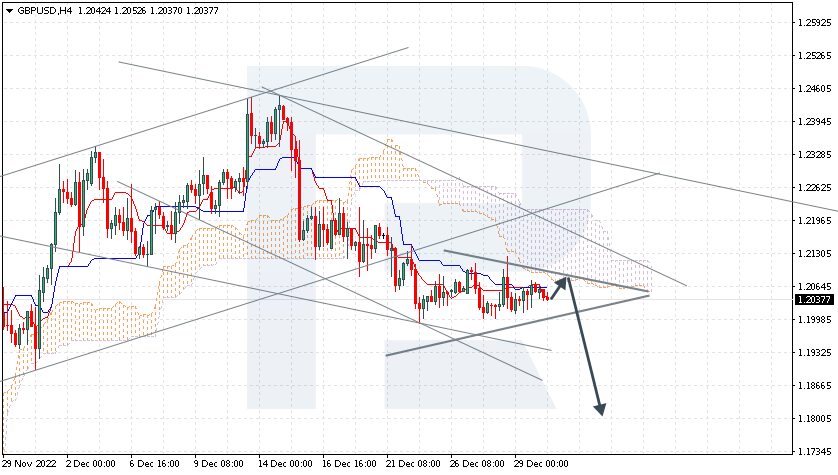
The currency pair is correcting by a Triangle pattern. The pair is going under the Ichimoku Cloud, which indicates prevalence of a downtrend. A test of the lower border of the Cloud is expected at 1.2065, followed by falling to 1.1805. An additional signal confirming the decline will be a bounce off the upper border of the Triangle pattern. The scenario can be cancelled by a breakaway of the upper border of the Cloud and securing above 1.2265, which will mean further growth to 1.2355. The decline can be confirmed by a breakaway of the lower border of the Triangle pattern and securing under 1.1975.

GBPUSD
Risk Warning: the result of previous trading operations do not guarantee the same results in the future

XAUUSD, “Gold vs US Dollar”

Gold is testing the resistance level. The instrument is going above the Ichimoku Cloud, which indicates an uptrend. A test of the lower border of the Cloud is expected at 1805, followed by growth to 1860. An additional signal confirming the growth will be a bounce off the lower border of the bullish channel. The scenario can be cancelled by a breakaway of the lower border of the Cloud and securing under 1790, which will mean further falling to 1755.

XAUUSD
Risk Warning: the result of previous trading operations do not guarantee the same results in the future

NZDUSD, “New Zealand Dollar vs US Dollar”

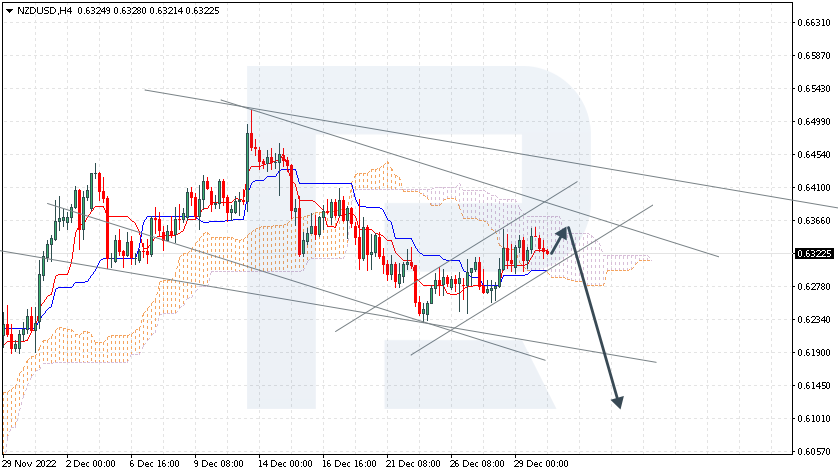
The currency pair is declining in a bullish correction channel. The instrument is going inside the Ichimoku Cloud, which means a flat. A test of the upper border of the Cloud at 0.6355 is expected, followed by falling to 0.6105. An signal confirming the decline will be a bounce off the upper border of the descending channel. The scenario can be cancelled by a breakaway of the upper border of the Cloud and securing above 0.6405, which will mean further growth to 0.6505. The decline can be confirmed by a breakaway of the lower border of the bullish channel and securing under 0.6270.

NZDUSD

Article By RoboForex.com

Attention!
Forecasts presented in this section only reflect the author’s private opinion and should not be considered as guidance for trading. RoboForex LP bears no responsibility for trading results based on trading recommendations described in these analytical reviews.

Murrey Math Lines 30.12.2022 (Brent, S&P 500)

By RoboForex.com

BRENT

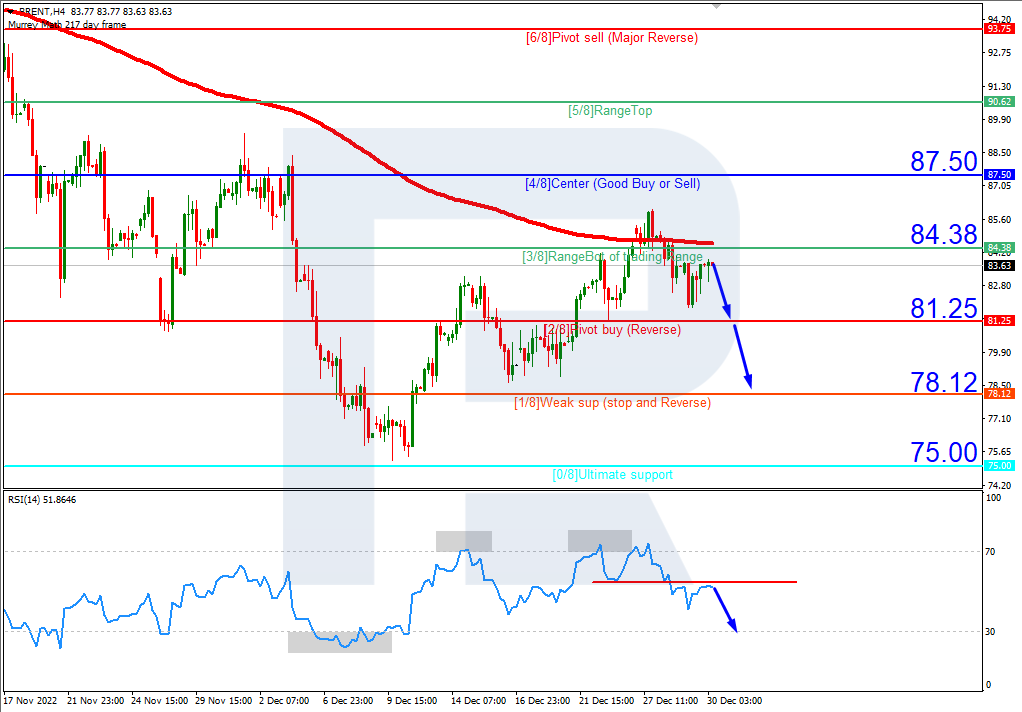
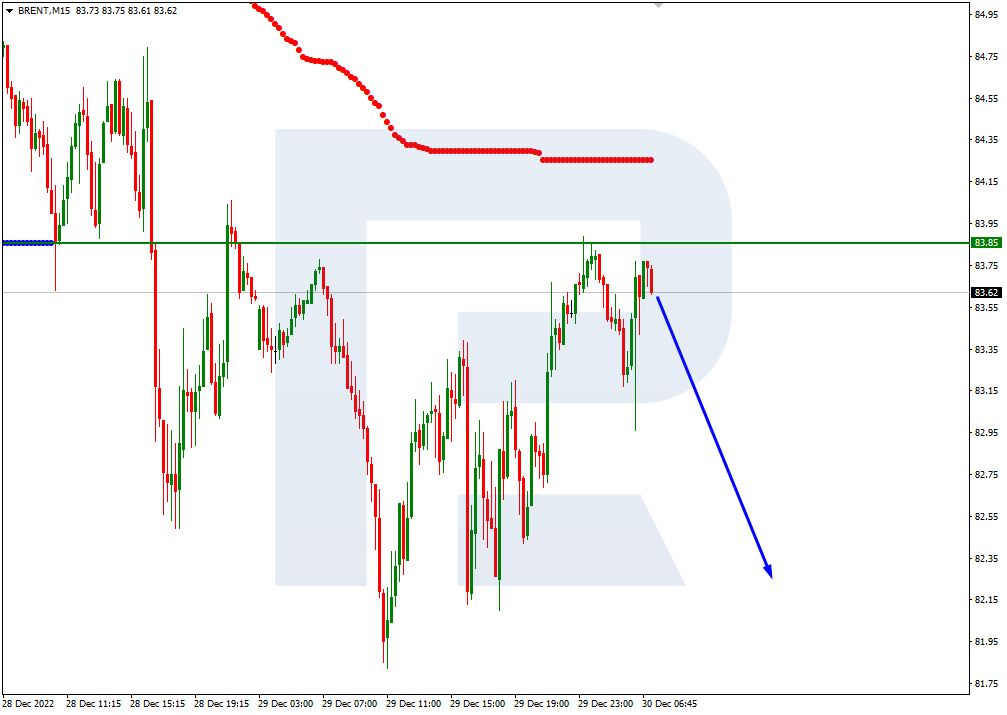
On H4, Brent quotes are under the 200-day Moving Average, which indicates prevalence of a downtrend. The RSI is testing the resistance line. A test of 2/8 (81.25) should be expected, followed by a breakaway and falling to the support level of 1/8 (78.12). The scenario can be cancelled by rising over the resistance level of 3/8 (84.38), which might lead to a trend reversal and growth of the quotes to the resistance level of 4/8 (87.50).

BRENTH4
Risk Warning: the result of previous trading operations do not guarantee the same results in the future

On M15, the lower line of VoltyChannel is broken away, which confirms the downtrend and increases the probability of further falling.

BRENT_M15
Risk Warning: the result of previous trading operations do not guarantee the same results in the future

S&P 500

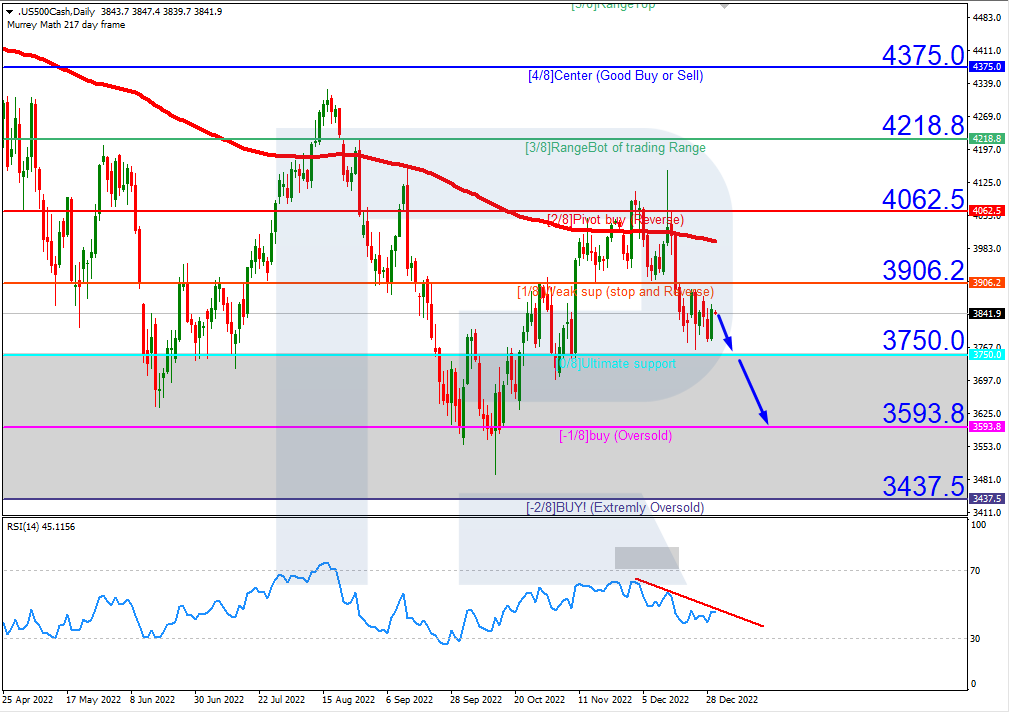
On H4, the quotes are under the 200-day Moving Average, which indicates prevalence of a downtrend. The RSI is testing the descending trendline that acts as a resistance level for the price. As a result, a breakaway of 0/8 (3750.0) is expected, followed by falling to the support level of -1/8 (3593.8). The scenario can be cancelled by rising over the resistance level of 1/8 (3906.2). In this case, the S&P 500 index may rise to 2/8 (4062.5).

S&P 500_H4
Risk Warning: the result of previous trading operations do not guarantee the same results in the future

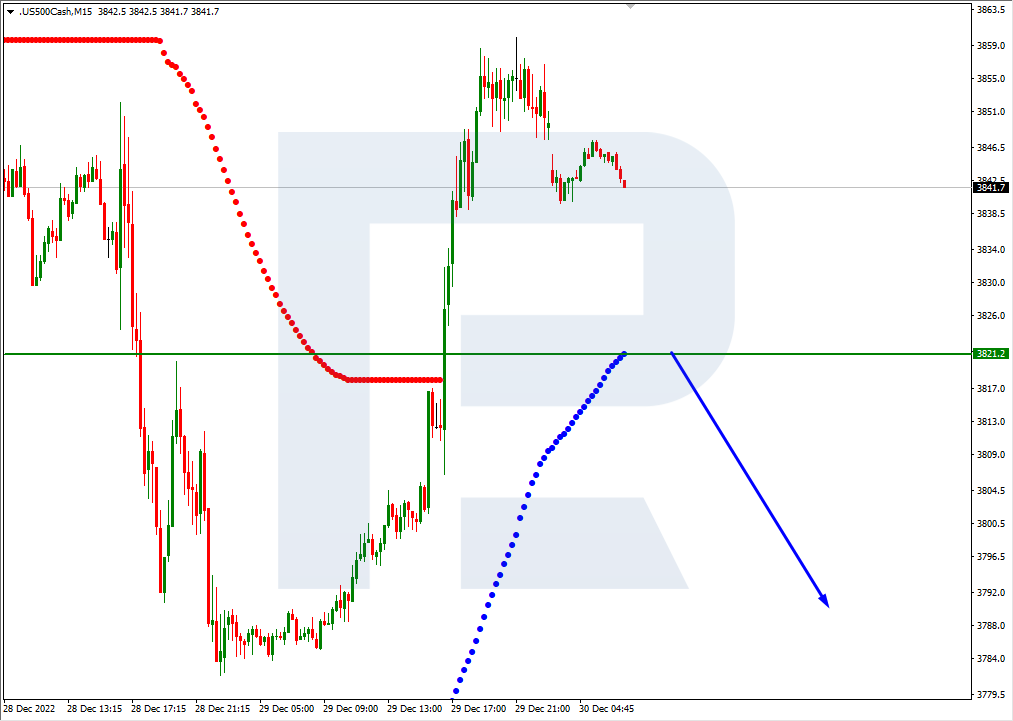
On M15, an additional signal confirming the decline will be a breakaway of the lower line of VoltyChannel.

S&P 500_M15

Article By RoboForex.com

Attention!
Forecasts presented in this section only reflect the author’s private opinion and should not be considered as guidance for trading. RoboForex LP bears no responsibility for trading results based on trading recommendations described in these analytical reviews.

Week Ahead: Dollar to falter at onset of 2023?

By ForexTime

As we make fresh resolutions (especially those that pertain to trading/investing), here’s a head start on the potential opportunities ahead, starting with these key economic events and data releases in the first week of the new year:
Monday, January 2

  • EUR: Eurozone December manufacturing PMI (final)
  • US, UK markets closed

Tuesday, January 3

  • CNH: China December Caixin manufacturing PMI
  • EUR: Germany December unemployment and inflation (CPI)
  • GBP: UK December manufacturing PMI (final)
  • CAD: Canada December manufacturing PMI
  • USD: US December manufacturing PMI (final)

Wednesday, January 4

  • EUR: Eurozone December services PMI (final)
  • USD: FOMC meeting minutes, US December ISM manufacturing

Thursday, January 5

  • AUD: Australia December composite and services PMIs (final)
  • CNH: China December Caixin services PMI
  • JPY: Japan December consumer confidence
  • EUR: Eurozone November PPI\
  • USD: US weekly initial jobless claims

Friday, January 6

  • EUR: Germany November factory orders
  • EUR: Eurozone December inflation, consumer confidence (final); November retail sales
  • CAD: Canada December employment data, jobless rate
  • USD: US December nonfarm payrolls report


As is the case on the first Friday of every month, markets will be primed to react to the monthly US jobs report.

At the time of writing, markets are forecasting an NFP (nonfarm payrolls) headline figure of 200,000 US jobs added in December, while the unemployment rate stays at 3.7%.

  • If that 200k estimate proves true, that would be the fewest number of jobs added to the US labour market since December 2019.
  • At 3.7%, that would mean that unemployment is still stubbornly around pre-pandemic lows, despite the Fed already having triggered many a supersized rate hike with hopes of incurring some demand destruction to rein in inflationary pressures.


Dollar to react to what US jobs market portends for Fed rate hikes

  • Should the US labour market continue to show signs of resilience, either by way of a higher-than-expected headline NFP figure (>200k) or a lower-than-expected unemployment rate (<3.7%), that may translate into a rebound for the US Dollar.

Relief for dollar bulls would be based on the notion that the Fed has to send its benchmark rates even higher in 2023 to cause more demand destruction and quell US inflation.

  • However, if we are shown signs of widening cracks in the US jobs market, either by way of a lower-than-200k headline NFP figure or a higher-than-3.7% unemployment rate, that may extend the Dollar’s declines from Q4 2022.


Also, pay attention to the latest minutes from the Fed’s December policy meeting, to be released on Thursday.

If there are signs that voting members on the FOMC are losing their collective zeal for sending US interest rates much higher in 2023, then dollar bears (those hoping the US dollar will fall) could pounce on such dovish signals to send the greenback lower.


Notice how this equally-weighted USD Index (as opposed to the benchmark DXY) has been trading around two key Fibonacci levels for all of December.

The longer it consolidates around this region, the more explosive the potential breakout from all that pent-up indecision.


USD Index: Immediate support and resistance levels

  • Support: 1.170 region (23.6% Fibonacci line from the USD Index’s 2022 peak-to-trough retracement)
  • Resistance: 1.190 (200-day simple moving average)
  • Resistance: 1.19467 (50% retracement) – 1.19754 (previous cycle high)


To be fair to dollar bulls, markets are positioned for more US dollar gains against most of its G10 peers, except against the Japanese Yen, over the next one week.


Still, from a fundamental perspective, a dollar rebound may well require further proof that the Federal Reserve can afford to send US interest rates past 5% (from the current 4.5%) as 2023 rolls along, starting with next week’s US jobs report and the incoming FOMC meeting minutes.

Otherwise, markets are likely to continue expecting this Fed pivot: that the Fed is much closer to being done with rate hikes are could actually lower US rates to offset a potential recession later in 2023.

Rising expectations for an eventual “Fed pivot” are then likely to drag the US dollar even lower.


Forex-Time-LogoArticle by ForexTime

ForexTime Ltd (FXTM) is an award winning international online forex broker regulated by CySEC 185/12 www.forextime.com

Stock indices are rising on the eve of the New Year holidays

By JustMarkets

The shadow of a Santa Claus rally has returned to the markets. At the close of the stock market on Thursday, the Dow Jones (US30) increased by 1.05%, and the S&P 500 (US500) added 1.75%. Technology Index NASDAQ (US100) jumped by 2.39%.

According to the US Department of Labor, the number of Americans filing for unemployment insurance rose in line with expectations last week. Seasonally adjusted initial jobless claims for the week rose from 216,000 to 225,000.

Stock markets in Europe were mostly up yesterday. Germany’s DAX (DE30) gained 1.05%, France’s CAC 40 (FR40) added 0.97%, Spain’s IBEX 35 (ES35) closed up by 0.68%, and Britain’s FTSE 100 (UK100) gained 0.22%.

The European Union’s Health Safety Committee called for joint action on a potential spike in COVID-19 cases as China begins to lift its long-standing strict restrictions on the pandemic. The statement came after the US and Italy on Wednesday joined a list of countries, including Japan, India, South Korea, and Taiwan, requiring confirmation of negative COVID tests for arriving air passengers from China. Shares of German Deutsche Lufthansa (LHAG), as well as other airlines Air France KLM (AIRF) and International Consolidated Airlines Group (ICAG), fell sharply on the trading day.

Inflation data will be released today in Spain. Annualized consumer prices are expected to fall from 6.8% to 6.1%. Spain is one of the few European countries that have seen a monthly and gradual decline in inflationary pressures.

China’s loosening of the Covid Zero policy has led to a significant increase in oil prices over the past few weeks, but the recent rise in cases has raised concerns worldwide. There are fears that Covid could start to spread again, as some countries are already announcing special requirements for Chinese travelers. In addition, crude oil inventories increased by 700 thousand barrels last week, which put further pressure on oil prices yesterday.

Asian indices were mostly down yesterday. Japan’s Nikkei 225 (JP225) decreased by 0.94%, China’s FTSE China A50 (CHA50) fell by 0.68%, India’s NIFTY 50 (IND50) gained 0.38%, Hong Kong’s Hang Seng (HK50) decreased by 0.79%, and S&P/ASX 200 (AU200) closed down by 0.94%.

The Bank of Japan announced two additional rounds of unscheduled bond purchases, suggesting that measures aimed at doubling the yield cap on government bonds are leading to continued stimulus rather than a change in the trajectory of monetary policy. On the other hand, a broader and more frequent Bank of Japan presence in the market risks damaging liquidity and further distorting the yield curve. Analysts believe that control of the yield curve is approaching its limit, but the central bank does not acknowledge this.

Hong Kong’s exports fell to their lowest levels in nearly seven decades in November as China’s economic slowdown and global demand worsened. Shipments overseas last month fell by 24.1% from a year earlier. Imports fell by 20.3% in November from a year earlier, the biggest drop since 2009.

S&P 500 (F) (US500) 3,849.32 +66.10 (+1.75%)

Dow Jones (US30) 33,220.87 +345.16 (+1.05%)

DAX (DE40) 14,071.72 146.12 (+1.05%)

FTSE 100 (UK100) 7,512.72 +15.53 (+0.21%)

USD Index 103.89 -0.57 (-0.55%)

Important events for today:
  • – Switzerland KOF Leading Indicators (m/m) at 10:00 (GMT+2);
  • – Spanish Consumer Price Index (m/m) at 10:00 (GMT+2).

By JustMarkets


This article reflects a personal opinion and should not be interpreted as an investment advice, and/or offer, and/or a persistent request for carrying out financial transactions, and/or a guarantee, and/or a forecast of future events.

Major Fed Myth: Debunked

The Fed is reactive in setting rates – not proactive

By Elliott Wave International

The days of near-zero interest rates are long gone — at least for now.

As we look back on 2022, we know that it’s been a year of rising interest rates, and many observers say it’s all due to the Fed.

But it’s a flat-out myth that the Fed determines the trend of interest rates. The market does. The Fed merely follows.

Here’s a chart and commentary from the December Elliott Wave Theorist, a monthly publication since 1979 which covers major financial and cultural trends:

The chart updates the Fed’s interest-rate activity since mid-2021. As you can see, the Fed’s rate changes have continued to lag rate changes in T-bills as set by the market. The Board’s decisions are not magical or even thoughtful. They look at the market rate, and they adjust the Fed Funds Rate accordingly. That’s all there is to it. That’s all there ever has been to it.

So, given that the market sets rates and the Fed follows, a key takeaway is that the Fed’s interest-rate actions produce no outcomes (for example, “stepping on the brakes” of the economy) that wouldn’t have happened through regular market forces.

Other central banks around the world also lag the market. Consider the European Union. Here’s a historical snapshot from Robert Prechter’s book, The Socionomic Theory of Finance:

The chart plots monthly data for the interest rate of the freely-traded, 3-month euro generic government bond versus the European Central Bank’s (ECB’s) main refinancing operations rate, which is Europe’s equivalent to the U.S. federal funds rate. As these graphs show, rate-setting actions by the ECB have lagged the freely traded debt market at all seven major turning points in interest rates since 1999. The lags vary from one to ten months, and the average lag is 5.3 months.

You can find the same principle at work in the United Kingdom, Australia and other global central banks.

It may be difficult for central bank watchers to latch onto the idea that markets guide central banks rather than the other way around. Yet, no data show otherwise.

The December Elliott Wave Theorist provides you with more financial insights, including warning signs about the stock market.

And, speaking of warning signs about the stock market, you may want to become familiar with the Dow Industrials’ Elliott wave pattern — which can help you to anticipate what’s next.

As Frost & Prechter’s Wall Street classic, Elliott Wave Principle: Key to Market Behavior, notes:

The Wave Principle often indicates in advance the relative magnitude of the next period of market progress or regress. Living in harmony with those trends can make the difference between success and failures in financial affairs.

If you’d like to learn the details of the Wave Principle, here’s good news: You can access the entire online version of the book for free once you become a member of Club EWI, the world’s largest Elliott wave educational community.

Joining Club EWI is a great way to start 2023 because all the free Elliott wave resources which accompany a Club EWI membership will help to provide you with an independent perspective on financial markets which you may not be getting from other sources.

And, by the way, a Club EWI membership itself is also free.

So, get started now by following this link: Elliott Wave Principle: Key to Market Behavior.

This article was syndicated by Elliott Wave International and was originally published under the headline Major Fed Myth: Debunked. EWI is the world’s largest market forecasting firm. Its staff of full-time analysts led by Chartered Market Technician Robert Prechter provides 24-hour-a-day market analysis to institutional and private investors around the world.

Which Precious Metal Has Chen Excited for 2023?

Source: Streetwise Reports  (12/28/22)

It’s valued the world over as a precious metal, and now it’s in demand for the green economy. Which element has asset manager Chen Lin looking forward to the New Year?

What is Chen buying? Right now, silver. Lots of silver.

The asset manager and author of the What is Chen Buying? What is Chen Selling? newsletter said he is bullish on the precious metal because the push for greener energy will lead to the adoption of more solar energy, a technology that requires large amounts of it.

“The rising silver loading factor times explosive growth of solar panel demand will create a silver tsunami,” Chen wrote.

“The rising silver loading factor times explosive growth of solar panel demand will create a silver tsunami,” Chen wrote in his newsletter in December.

“Silver mine production, mostly as a by-product, has been very stable for the past decade. As we know, it takes years to explore, then years to permit and build a new mine. So, it will likely take a decade to bring up the production even as the demand explodes.”

The Silver Institute has predicted that global silver demand will reach a new high of 1.21 billion ounces in 2022, up 16% from last year. Industrial demand is on course to grow to 539 million ounces (Moz). And it won’t be just for solar panels.

Chen also suggests that those who wish to have a happy new year invest in companies specializing in rare metals, biotech, and/or energy stocks.

“Developments such as ongoing vehicle electrification (despite sluggish vehicle sales), growing adoption of 5G technologies, and government commitments to green infrastructure will have industrial demand overcome macro-economic headwinds and weaker consumer electronics demand,” the report said.

The global silver market is forecasted to record a second consecutive deficit between supply and demand this year, the Institute said. At 194 Moz, it will be a multi-decade high and four times 2021’s level.

Chen also suggests that those who wish to have a happy new year invest in companies specializing in rare metals, biotech, and/or energy stocks.

SilverCrest

Chen says he has a collection of silver companies, large and small, in his portfolio, but he is especially interested in SilverCrest Metals Inc. (SIL:TSX.V; SILV:NYSE.American).

SilverCrest is developing a 1,250-tonne-per-day processing plant at its Las Chispas Mine located in Sonora, Mexico, with initial proven and probable reserves of 94.7 million ounces (94.7 Moz silver equivalent (AgEq), placing it among the highest-grade primary silver projects in the world.

“I think 2023 could be the year for SILV as it advances the mine production,” Chen said.

The mine would have an initial life of 8.5 years. Analyst Phil Ker of PI Financial Inc. wrote on Dec. 8 that Las Chispas was expected to produce 9.9 Moz AgEq in 2023. Ker rated the stock Buy with a CA$14 target price.

“We believe a premium valuation is warranted and suggest investors continue to accumulate shares ahead of achieving positive cash flow from Las Chispas,” he wrote.

Sprott Asset Management LP owns 5.75% of the company, Gilder Gagnon Howe & Co. LLC owns 5%, Van Eck Associates Corp. owns 4.38%, ETF Managers Group LLC owns 3.46%, and Sprott Asset Management USA Inc. owns 2.94%, according to Reuters.

It has a market cap of US$934.66 million with 146.5 million shares outstanding, 140.6 million of them free-floating. It trades in a 52-week range of US$10.13 and US$4.58.

Chen says he also has other silver producers in Mexico, including MAG Silver Corp. (MAG:TSX; MAG:NYSE American) and GoGold Resources Inc. (GGD:TSX).

First Tellurium Corp.

Another element critical to solar panels is tellurium, one of the planet’s rarest elements. First Tellurium Corp. (FTEL:CSE) has two important tellurium resources at its Deer Horn project in British Columbia and its Klondike Tellurium project in Colorado.

“Governments are just starting to understand the importance of tellurium,” said First Tellurium President and Chief Executive Officer Tyrone Docherty. “It has flown largely under the radar, even though it’s essential for cadmium-telluride solar panels and new lithium-tellurium (Li-Te) batteries that could revolutionize energy storage.”

Chen said that North America is too dependent on foreign sources for the element.

“This metal can be in demand, this is a pure-play, and management just a lot of (its) own money in the stock,” Chen said.

Reuters has Docherty as the top shareholder in the company with 10.46%, Josef Anthony Steve Fogarassy has 1.38%, and Lyle Allen Schwabe owns 0.85%.

Its market cap is CA$9.44 million, with 72.7 million shares outstanding, 63.4 million of them free-floating. It trades in a 52-week range of CA$0.71 and CA$0.085.

Amyris Inc.

A returning favorite of Chen’s is Amyris, Inc. (AMRS:NASDAQ), a synthetic biotech company that “programs” cells to create sustainable ingredients.

The company has begun production at its new precision sugar fermentation plant in Brazil. The plant comprises five precision fermentation “mini-factories” that can produce 13 of Amyris’ molecules, which are used in everything from health and beauty products to flavors and fragrances.

Amyris is a frontrunner for the US$1 billion the U.S. Department of Defense will be investing in the bioindustrial domestic manufacturing infrastructure over the next five years. It’s part of the US$2 billion the U.S. government plans to spend to boost biomanufacturing under an executive order announced last month.
Amyris on Tuesday announced a US$500 million contract to supply two of its ingredients.

“If the stock is over US$5, I wouldn’t buy it,” Chen told Streetwise Reports. “But if it’s two and change . . .  it’s very good risk-reward.”

Amyris’ top shareholders include Foris Ventures LLC at 22.39%, The Vanguard Group Inc. at 5.98%, Koninklijke DSM NV at 5.06%, BlackRock Institutional Trust Co. N.A. at 3.57%, and Vivo Capital LLC at 2.35%, according to Reuters.

Its market cap is US$564.57 million, and it has 330.2 million shares outstanding, 234.2 million of them free-floating. It trades in a 52-week range of US$6.37 and US$1.44.

Viking Therapeutics Inc.

Viking Therapeutics Inc (VKTX:NASD) saw its stock price rise nearly 75% earlier this month when another company, Madrigal Pharmaceuticals Inc. (MDGL:NASDAQ), reported positive results from its Phase 3 clinical trial of its nonalcoholic steatohepatitis (NASH) treatment.

Viking is working on its own NASH drug and is holding a Phase 2b clinical trial. Shareholders are hoping for similar success.

The “situation is very good,” Chen said. “Most fund managers are on vacation. So, if you can get in before the end of the year when they come back . . .  they will start buying, and you can sell.”

The company is also running a Phase 1 clinical trial to develop a drug that could treat various metabolic disorders.

Ligand Pharmaceuticals Inc. owns 8.76% of Viking, the Vanguard Group Inc. owns 4.34%, Millennium Management LLC owns 4.05%, Balyasny Asset Management LP owns 3.49%, and Two Sigma Investments LP owns 2.47%, Reuters said.

Its market cap is US$651.47 million. It has 76.7 million shares outstanding, with 67.8 million free-floating. It trades in a 52-week range of US$8.63 and US$2.02.

TAG Oil Ltd.

In the energy world, Chen likes TAG Oil Ltd. (TAO:TSX) if you can take the risk that its projects are in the volatile Middle East and North Africa.

The company is initiating Phase 1 of a fracking program in Egypt in Q1 2023. It anticipates providing results as early as March.

“This seems to be a relatively low-risk fracking play,” Chen said. “The market value could increase at least tenfold.”

Askar Alshinbayev owns 10.99% of TAG Oil, YF Finance Ltd. owns 8.42%, Abdel Fattah Z. Badwi owns 2.06%, Shawn Reynolds owns 1.54%, and Suneel Gupta owns 1.03%, according to Reuters.

It has a market cap of CA$83.71 million with 154.6 million shares outstanding and 113.2 million free-floating. It trades in a 52-week range of CA$0.70 and CA$0.195.

Canacol Energy Ltd.

Another company returning to Chen’s list is Calgary-based Canacol Energy Ltd. (CNE:TSX; CNNEF:OTCQX), which is a major player in natural gas production and exploration in Colombia. Its stock dipped earlier this year when the country elected its first leftist leader, Gustavo Petro.

While Petro is against new oil and gas exploration, favoring elements needed for the green economy like copper and silver, the company has natural gas contracts that give it a dependable income.

BTG Pactual Affiliate Research analyst Daniel Guardiola rated the stock a Buy with a CA$5.50 target in November.

Canacol said it’s the largest independent onshore conventional natural gas exploration and production company in Colombia and that it supplies about 20% of the country’s natural gas.

Fourth Sail Capital LP owns 20.49% of Canacol, Cavengas Holdings S.R.L. owns 19.12%, Cobas Asset Management SGIIC SA owns 3.12%, Dimensional Fund Advisors LP owns 0.96%, and Abaco Capital Investments owns 0.27%, according to Reuters.

Canacol has a market cap of CA$353 million and 170.6 million outstanding shares, including 137.7 million free-floating. It trades in a 52-week range of CA$3.62 and CA$1.75.

Sign up for our FREE newsletter

Disclosures

1) Steve Sobek wrote this article for Streetwise Reports LLC and provides services to Streetwise Reports. He or members of his household own securities of the following companies mentioned in the article: None. He or members of his household are paid by the following companies mentioned in this article: None.

2) The following companies mentioned in this article are billboard sponsors of Streetwise Reports: MAG Silver Corp. Click here for important disclosures about sponsor fees. As of the date of this article, an affiliate of Streetwise Reports has a consulting relationship with First Tellurium Inc. Please click here for more information.

3) The article does not constitute investment advice. Each reader is encouraged to consult with his or her individual financial professional and any action a reader takes as a result of information presented here is his or her own responsibility. By opening this page, each reader accepts and agrees to Streetwise Reports’ terms of use and full legal disclaimer. This article is not a solicitation for investment. Streetwise Reports does not render general or specific investment advice and the information on Streetwise Reports should not be considered a recommendation to buy or sell any security. Streetwise Reports does not endorse or recommend the business, products, services or securities of any company mentioned on Streetwise Reports.

4) From time to time, Streetwise Reports LLC and its directors, officers, employees or members of their families, as well as persons interviewed for articles and interviews on the site, may have a long or short position in securities mentioned. Directors, officers, employees or members of their immediate families are prohibited from making purchases and/or sales of those securities in the open market or otherwise from the time of the decision to publish an article until three business days after the publication of the article. The foregoing prohibition does not apply to articles that in substance only restate previously published company releases. As of the date of this article, officers and/or employees of Streetwise Reports LLC (including members of their household) own securities of First Tellurium Corp., a company mentioned in this article.

5) This article does not constitute medical advice. Officers, employees and contributors to Streetwise Reports are not licensed medical professionals. Readers should always contact their healthcare professionals for medical advice.