Silicon Valley Bank’s bankruptcy could be a trigger for the financial crisis. The US Federal Reserve may stop rate hikes

By JustMarkets

SVB shares fell by 44% on Friday, adding to a 60% drop in the previous session. Meanwhile, larger US banks JPMorgan (JPM), Citigroup (C), and Morgan Stanley (MS) were also down. The fall of SVB shares, which began on Thursday, spread to other American and European banks. According to Reuters, US banks lost more than $100 billion in the stock market, and European banks lost another $50 billion over the past two trading days. This has caused panic among investors, and that panic could intensify if people start withdrawing their deposits from banks on Monday, fearing a 2008 scenario. At the close of the stock market on Friday, the Dow Jones Index (US30) decreased by 1.07% (-4.53% for the week), and the S&P 500 (US500) lost 1.45% (-4.77% for the week). The NASDAQ Technology Index (US100) fell by 1.76% on Friday (-5.09% for the week).

According to analysts at JPMorgan, the recent sell-off in big bank stocks is an “exaggeration,” mainly because of the stronger monetary position of these lenders compared to their smaller peers.

The Board of Governors of the Federal Reserve has announced that it will hold an emergency closed-door meeting at 4:30 p.m. (GMT+2) on March 13, 2023. It is likely that the sudden collapse and FDIC seizure of SVB Financial Group (SIVB) on Friday was the reason for the Fed’s accelerated meeting. SVB was the largest bank failure since the 2008 financial crisis. Its collapse shook the entire banking system.

Following news of the SVB Financial Group (SIVB) bankruptcy, investors limited their bets on a 50 basis point rate hike in March to 40% from about 80%. The threat that something systemic may be brewing in the banking system, forcing many regional banks out of business, will not be well received by the government. And the likely response could be intense political pressure on Federal Reserve Chairman Jerome Powell to stop raising rates.

The British clearing bank The Bank of London is considering an application to rescue the British division of the bankrupt US bank Silicon Valley Bank. The news of the British bank’s interest comes a day after the Bank of England said it was seeking a court order to put SVB UK into bankruptcy proceedings after US regulators seized control of its parent SVB Financial Group earlier Friday.

The Labor Department reported that Nonfarm payrolls rose by 311,000, well above the consensus forecast of 205,000 but below the revised 507,000 in January. The labor market remains too strong for the Fed to consider stopping rate hikes and cutting rates. But payrolls data indicate that the first signs of a “cooling off” are on the horizon.

Stock markets in Europe were mostly down on Friday. German DAX (DE30) was 1.32% lower (-1.09% for the week), French CAC 40 (FR40) fell by 1.30% (-2.24% for the week), Spanish IBEX 35 (ES35) decreased by 1.47% (-2.24% for the week), British FTSE 100 (UK100) was 1.67% lower (-2.50% for the week).

British Prime Minister Rishi Sunak said on Friday that he was in talks with the United States and the European Union to bring down inflation amid fears that it could make European markets uncompetitive. Europe fears that $369 billion in US subsidies for electric cars and other clean technologies could disadvantage companies on the continent.
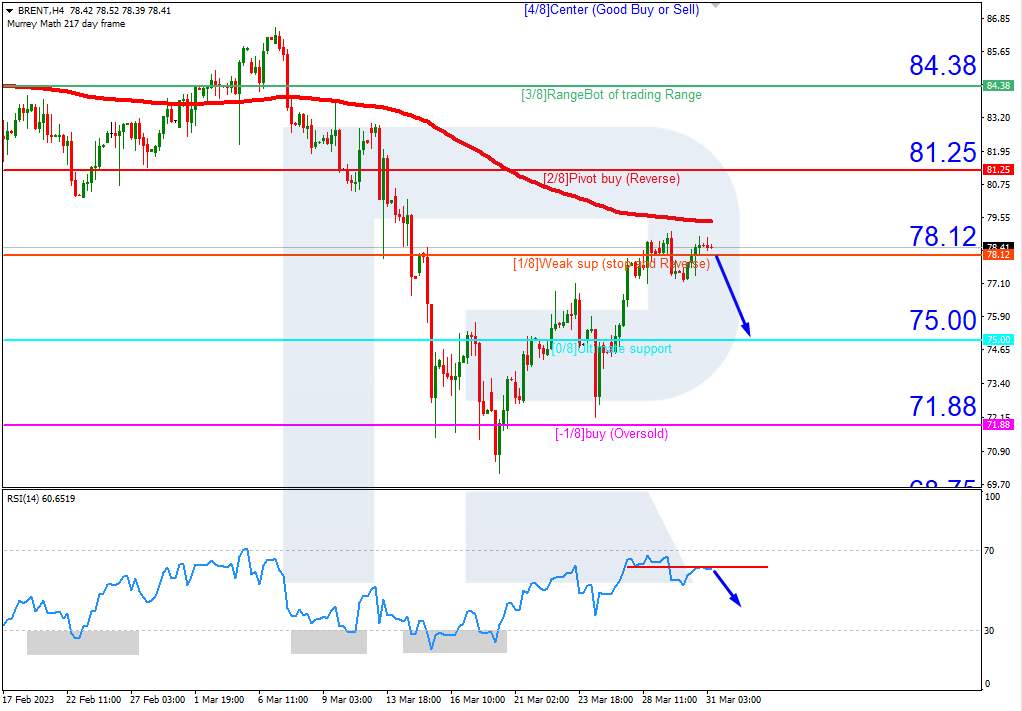
Saudi oil giant Aramco on Sunday reported record net income in 2022, helped by higher energy prices, higher sales, and better oil product margins.

Asian markets were mostly down last week. Japan’s Nikkei 225 (JP225) decreased by 0.14% for the week, China’s FTSE China A50 (CHA50) lost 4.34% for the week, Hong Kong’s Hang Seng (HK50) fell by 5.47% for the week, India’s NIFTY 50 (IND50) was down 0.31%, and Australia’s S&P/ASX 200 (AU200) closed negative 2.01% for the week.

China’s legislature confirmed the continued leadership roles in the central bank and finance ministry for Yi Gang and Liu Kun. China plans to redouble efforts to overcome persistent financial risks and technological bottlenecks in President Xi Jinping’s third five-year term.

In the commodities market, futures on orange juice (+6.85%) and lumber (+2.36%) showed the biggest gains last week. Futures on natural gas (-19.04%), cotton (-7.12%), palladium (-5.59%), gasoline (-3.94%), WTI oil (-3.77%), Brent oil (-3.72%), wheat (-3.6%), corn (-3.36%) and silver (-2.98%) showed the biggest drop.

S&P 500 (F) (US500) 3,861.59 −56.73 (−1.45%)

Dow Jones (US30)31,909.64 −345.22 (−1.07%)

DAX (DE40) 15,427.97 −205.24 (−1.31%)

FTSE 100 (UK100) 7,748.35 −131.63 (−1.67%)

USD Index 104.64 −0.67 (−0.67%)

Important events for today:
  • – Indian Consumer Price Index (m/m) at 14:00 (GMT+2);
  • – Fed emergency closed-door meeting at 17:30 (GMT+2).

By JustMarkets


This article reflects a personal opinion and should not be interpreted as an investment advice, and/or offer, and/or a persistent request for carrying out financial transactions, and/or a guarantee, and/or a forecast of future events.

Week’s main events (March 13 – March 17)

By JustMarkets

On Friday, startup-focused lender SVB Financial Group became the largest bank to collapse since the 2008 financial crisis. The decline in SVB stock, which began Thursday, has spread to other US and European banks. This caused panic among investors, which could intensify if people start withdrawing their deposits from banks on Monday, fearing a 2008 scenario. Therefore, this week the main investors’ attention will be focused on how the situation in the banking sector will develop further. Also, this week, important inflation data will be released in the United States and Europe. The main focus will be on the core CPI data. The UK and Australia will publish their labor market reports, which may affect central banks’ monetary policy. On Thursday, the ECB will hold its monetary policy meeting, at which a 0.5% rate hike is expected.

Monday, March 13
On Monday, the main event will be an emergency meeting of the Federal Open Market Committee concerning the situation with Silicon Valley Bank and the US banking system. There may be unpopular decisions. The Fed may suspend rate hikes due to the deteriorating situation in the banking sector.
Main events of the day:
  • – Indian Consumer Price Index (m/m) at 14:00 (GMT+2);
  • – Fed emergency closed-door meeting at 17:30 (GMT+2).
Tuesday, March 14
Various statistics for many countries are expected on Tuesday. The most important event will be the US consumer inflation data. Analysts forecast that annual inflation will fall from 6.4% to 6.0%, but the focus will be on core inflation. Traders should also pay attention to the unemployment rate in the United Kingdom. This indicator is taken into account by the Bank of England to regulate monetary policy.
Main events of the day:
  • – UK Average Earnings Index (m/m) at 09:00 (GMT+2);
  • – UK Claimant Count Change (m/m) at 09:00 (GMT+2);
  • – UK Unemployment Rate (m/m) at 09:00 (GMT+2);
  • – Switzerland Producer Price Index (m/m) at 09:30 (GMT+2);
  • – Spanish Consumer Price Index (m/m) at 10:00 (GMT+2);
  • – US Consumer Price Index (m/m) at 14:30 (GMT+2);
  • – US FOMC Member Bowman Speaks at 23:20 (GMT+2).
Wednesday, March 15
On Wednesday, essential macro statistics on China will be released, affecting Asian indices. The Bank of Japan will publish last month’s monetary policy meeting minutes. There will be no surprises, but volatility in currency pairs with the yen might rise as the report is released. Investors should also keep a close eye on US factory inflation data (PPI), which is considered a leading indicator of consumer inflation. Britain will publish its annual budget, which might give some hints about the economic forecasts for 2023.
Main events of the day:
  • – Japan BoJ Monetary Policy Meeting Minutes at 01:50 (GMT+2);
  • – China Retail Sales (m/m) at 04:00 (GMT+2);
  • – China Industrial Production (m/m) at 04:00 (GMT+2);
  • – China Unemployment Rate (m/m) at 04:00 (GMT+2);
  • – French Consumer Price Index (m/m) at 12:00 (GMT+2);
  • – Eurozone Industrial Production (m/m) at 12:00 (GMT+2);
  • – UK Annual Budget Release at 14:30 (GMT+2);
  • – US Producer Price Index (m/m) at 14:30 (GMT+2);
  • – US Retail Sales (m/m) at 14:30 (GMT+2);
  • – US NY Empire State Manufacturing Index (m/m) at 14:30 (GMT+2);
  • – US Crude Oil Reserves (w/w) at 16:30 (GMT+2);
  • – New Zealand GDP (q/q) at 23:45 (GMT+2).
Thursday, March 16
Thursday’s main event will be the interest rate decision from the European Central Bank. Analysts are predicting a 0.5% rate hike, but the most important will be the press conference, where investors will look for clues regarding the ECB’s next steps. Traders should also pay attention to the Australian labor market data. The RBA is on its way to raising rates, but weak labor market data could affect further RBA decisions.
Main events of the day:
  • – Japan Trade Balance (m/m) at 01:50 (GMT+2);
  • – Australia Unemployment Rate (m/m) at 02:30 (GMT+2);
  • – Italian Consumer Price Index (m/m) at 11:00 (GMT+2);
  • – US Building Permits (m/m) at 14:30 (GMT+2);
  • – US Initial Jobless Claims (w/w) at 14:30 (GMT+2);
  • – US Philadelphia Fed Manufacturing Index (m/m) at 14:30 (GMT+2);
  • – Eurozone ECB Interest Rate Decision at 15:15 (GMT+2);
  • – Eurozone ECB Monetary Policy Statement at 15:15 (GMT+2);
  • – Eurozone ECB Press Conference at 15:45 (GMT+2);
  • – US Natural Gas Storage (w/w) at 16:30 (GMT+2).
Friday, March 17
Friday’s most important release for investors will be the Eurozone Consumer Price Index. The focus will be on core inflation, which excludes food and energy prices. ECB policymakers have repeatedly said to moderate their hawkishness if core inflation begins to decline. Traders will also keep a close eye on consumer sentiment data. This report is a good indicator of how consumers feel about the current economic situation.
Main events of the day:
  • – Eurozone Consumer Price Index (m/m) at 12:00 (GMT+2);
  • – US Industrial Production (m/m) at 15:15 (GMT+2);
  • – US Michigan Consumer Sentiment (m/m) at 16:00 (GMT+2).

by JustMarkets, 2023.03.13

We advise you to get acquainted with the daily forecasts for the major currency pairs.

This article reflects a personal opinion and should not be interpreted as an investment advice, and/or offer, and/or a persistent request for carrying out financial transactions, and/or a guarantee, and/or a forecast of future events.

By JustMarkets


This article reflects a personal opinion and should not be interpreted as an investment advice, and/or offer, and/or a persistent request for carrying out financial transactions, and/or a guarantee, and/or a forecast of future events.

Trade Of The Week: What’s Next For The EURUSD?

By ForexTime 

Fasten your seatbelts, because the next few days could be wild for the world’s most traded FX pair.

Prices have already kicked off the new trading week in a volatile fashion, gapping higher thanks to potent fundamental forces.

We witnessed EURUSD bulls dominate the scene last Friday following the mixed US jobs report which tempered expectations around more aggressive policy tightening by the Federal Reserve (Fed). NFP revealed that 311k new jobs were created in February, substantially below the previous month’s downwardly revised figure of 504k. To rub salt into the wound, the jobless rate unexpectedly rose to 3.6% whiles wages missed expectations by rising 0.2% for the month. With the dollar bashed by investors, the currency pair staged a sharp rebound – gaining 0.6% for the day.

Zooming out, it has certainly been a choppy affair with prices trapped within a messy range on the weekly charts. Major resistance can be found around 1.0900 and support at 1.0500. Fundamentally, the pendulum swings in favour of bulls due to the narrowing divergence between the European Central Bank and the Fed. However, these dynamics could be rattled in the week ahead thanks to key economic reports and major risk events.

Regarding the technical picture, prices are back within a range on the weekly charts. Bull and bears are likely to remain entangled in a tough tug of war until a fundamental spark shifts the balance.

The low down…

The euro has appreciated most G10 currencies since the start of 2023.

Euro bulls continue to draw strength from rate hike bets with markets expecting a 50bp rate hike in March and a 70% probability of another move in April. This comes in contrast to the rapidly shifting expectations around what the Fed will do in March and beyond. Earlier last week, a hawkish Jerome Powell boosted dollar bulls and speculation intensified over the Fed holding rates higher for longer. However, these bets were tempered by last Friday’s mixed jobs report.

It does not end here. The recent collapse of Silicon Valley Bank (SVB) dealt another heavy blow to Fed hike expectations. Given how the US central bank may be forced to shift into lower gear on rates to limit the contagion from the SVB fallout, this is bad news for dollar bulls.

The week ahead…

It is safe to say that the pending US inflation report and ECB meeting could set the tone for the EURUSD ahead of the Fed decision next week.

Tuesday see’s the latest US CPI figures which are expected to show price pressures easing to 6% last month compared to the 6.4% witnessed in January. Inflation is expected to cool thanks to falling energy prices but all eyes will be on the core inflation rate which could rock markets. If inflation figures print higher than expected, this could throw the dollar a lifeline – limiting downside losses. However, a figure that meets or prints below the 6% level may boost speculation around the Fed adopting a less aggressive stance.

It’s all about the European Central Bank meeting on Thursday which is widely expected to conclude with a 50-basis point rate hike, especially after the record-high Eurozone core CPI figures in February. Much focus will be on the messaging on the size of rate increases beyond the March meeting. It will be wise to keep a close eye on the updated ECB staff projections which may offer fresh insight into inflation expectations for 2024 and 2025. On top of this, the new growth estimates could also provide insight into how the central bank sees the economy faring this year. Ultimately, if the ECB strikes a hawkish stance this will support euro bulls, while a dovish stance may promote fresh euro weakness.

Looking beyond the US CPI and ECB meeting, there are other data points and market developments that could add some more spice and flavour to the EURUSD this week. On Wednesday, Eurozone January Industrial production figures and US retail sales for February will be published. Thursday, see the US weekly jobless claims and on Friday, US February industrial production coupled with consumer sentiment for March will be revealed.

EURUSD: Noisy and choppy as ever

There is much activity on the EURUSD with prices oscillating within a very wide range. There are two layers of resistance on the daily chart at 1.0750 and 1.0800 and support around 1.0500. A breakout could be on the horizon but such may require a major fundamental catalyst. In the meantime, A breakout above 1.0750 could suggest an incline towards 1.0800 and 1.0900. Alternatively, if prices sink back below 1.0650, euro bears could target 1.0500.


Forex-Time-LogoArticle by ForexTime

ForexTime Ltd (FXTM) is an award winning international online forex broker regulated by CySEC 185/12 www.forextime.com

The collapse of Silicon Valley Bank rocks banking sector: Three takeaways

By George Prior

The collapse of Silicon Valley Bank (SVB) threatened to prompt a wider financial crisis and the authorities had no choice but to roll out emergency measures, says the CEO of one of the world’s largest independent financial advisory, asset management and fintech organizations.

The observation from Nigel Green of deVere Group comes as US regulators said that from Monday the failed bank’s customers will have access to all their deposits, and that they have set up a new facility to give banks access to emergency funds. The Federal Reserve has also taken steps to make it easier for banks to borrow from the central bank in emergencies.

He says there are three key takeaways from the SVB’s collapse.

First, “The authorities will get some stick, especially from the shareholders of SVB investors. The asset value of the bank itself is zero, and there’s no chance of a government bailout for shareholders.

“But the hands of the Fed, the Treasury and regulators, were forced into taking action in order to break the doom loop hitting the banking sector.

“A failure to act would have to be a dereliction of duty. If they hadn’t given customers access to their deposits from Monday, it would have resulted in a loss of confidence in the banking system, leading to a ‘run on the banks’ which, in turn, would have caused a liquidity crisis in the banking and broader financial system, potentially triggering a full-blown global financial crisis. The authorities couldn’t let this happen,” he explains.

Second, “It brings into question the Trump-era deregulation of banks. The decision to roll back Dodd-Frank’s ‘too big to fail’ rules, reducing both oversight and capital requirements, seems to have contributed to SVB’s collapse.

“It appears that the deregulation has allowed banks like SVB to take reckless risks. Now there needs to be a serious conversation about reversing the law to shore-up confidence and to avoid further collapses.”

Third, “It is now doubtful that the Fed will continue with its plan for aggressive interest rate hikes. The next hike was widely expected on March 22 following robust jobs data in January and February.

“We expect the stress in the banking sector, and the wider impact on confidence, now will give the central bank cause for pause on its rate hike program.

“Many will be asking: Was SVB – a major source of funding for US tech start-ups –  the first high profile victim of the Fed’s higher interest rates agenda?

The deVere CEO concludes: “The situation is moving quickly and despite the action taken by authorities, it isn’t over yet.

“Amongst other issues, there remain fears about contagion and there are real concerns that startups may be unable to pay their bills and salaries in coming days, venture investors may now find it hard to raise funds, and an already-pummelled sector could face a long rout.”

About:

deVere Group is one of the world’s largest independent advisors of specialist global financial solutions to international, local mass affluent, and high-net-worth clients.  It has a network of offices across the world, over 80,000 clients and $12bn under advisement.

Currency COT Charts: February 21st data shows Speculator bets led by Australian Dollar & Mexican Peso

By InvestMacro

Here are the latest charts and statistics for the Commitment of Traders (COT) data published by the Commodities Futures Trading Commission (CFTC).

The latest COT data is updated through Tuesday February 21st and shows a quick view of how large market participants (for-profit speculators and commercial traders) were positioned in the futures markets. All currency positions are in direct relation to the US dollar where, for example, a bet for the euro is a bet that the euro will rise versus the dollar while a bet against the euro will be a bet that the euro will decline versus the dollar.

*** This data is still a few weeks behind the current data because the CFTC up-to-date data has been delayed due to a cybersecurity event that happened in early February to ION Cleared Derivatives (a subsidiary of ION Markets). This hack of ION has created a problem for the large trader positions to be reported and reconciled. The CFTC has back-filled some data over the past few weeks and will get the data back up to date in the coming weeks.

Weekly Speculator Changes led by Australian Dollar & Mexican Peso

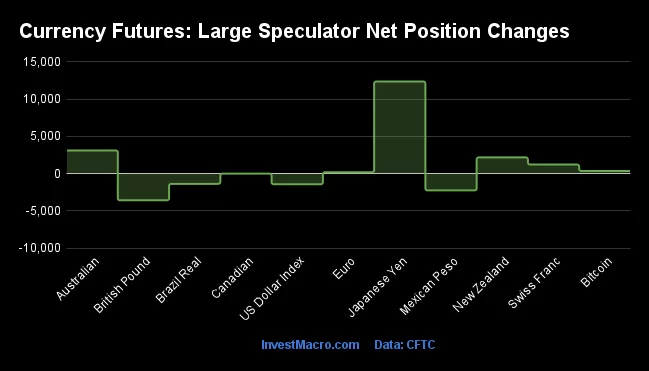
The COT currency market speculator bets were lower through February 21st as five out of the eleven currency markets we cover had higher positioning while the other six markets had lower speculator contracts.

Leading the gains for the currency markets was the Australian Dollar (4,119 contracts) with the Mexican Peso (2,794 contracts), EuroFX (1,162 contracts), the US Dollar Index (224 contracts) and the Swiss Franc (948 contracts) also showing positive weeks.

The currencies seeing declines in speculator bets on the week were the Japanese Yen (-6,186 contracts), Canadian Dollar (-2,009 contracts), Brazilian Real (-1,409 contracts), the British Pound (-1,621 contracts), the New Zealand Dollar (-215 contracts) and Bitcoin (-29 contracts) also registering lower bets on the week.


Data Snapshot of Forex Market Traders | Columns Legend
Feb-21-2023OIOI-IndexSpec-NetSpec-IndexCom-NetCOM-IndexSmalls-NetSmalls-Index
USD Index36,0223612,19845-16,640494,44265
EUR789,89897165,06884-213,8181748,75057
GBP213,50245-21,4165137,64160-16,22526
JPY186,10041-34,0294846,88959-12,86027
CHF39,08733-6,5203712,05865-5,53839
CAD151,89632-37,503039,753100-2,25026
AUD123,45625-24,7886225,04938-26152
NZD29,88868,78878-9,0242523654
MXN277,35386-36,8731431,458835,41590
RUB20,93047,54331-7,15069-39324
BRL47,2473630,53379-32,115211,58280
Bitcoin16,50187-81263438037421


Strength Scores led by EuroFX & Brazilian Real

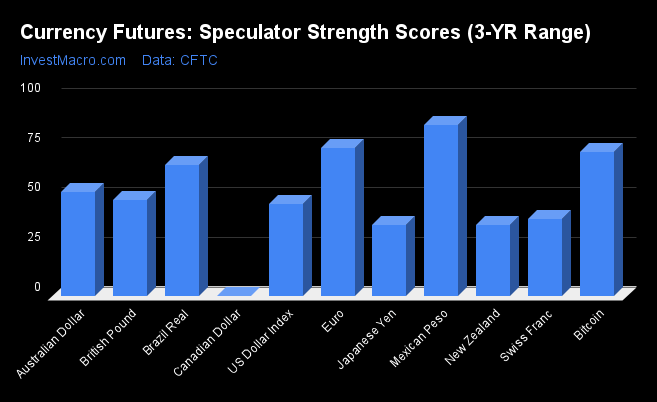
COT Strength Scores (a normalized measure of Speculator positions over a 3-Year range, from 0 to 100 where above 80 is Extreme-Bullish and below 20 is Extreme-Bearish) showed that the EuroFX (84 percent) and the Brazilian Real (79 percent) lead the currency markets through February 21st. The New Zealand Dollar (78 percent), Bitcoin (63 percent) and the Australian Dollar (62 percent) come in as the next highest in the weekly strength scores.

On the downside, the Canadian Dollar (0 percent) and the Mexican Peso (14 percent) come in at the lowest strength levels currently and are in Extreme-Bearish territory (below 20 percent). The next lowest strength scores are the Swiss Franc (37 percent) and the US Dollar Index (45 percent).

Strength Statistics:
US Dollar Index (45.3 percent) vs US Dollar Index previous week (44.9 percent)
EuroFX (84.4 percent) vs EuroFX previous week (84.0 percent)
British Pound Sterling (50.6 percent) vs British Pound Sterling previous week (52.0 percent)
Japanese Yen (47.9 percent) vs Japanese Yen previous week (51.7 percent)
Swiss Franc (37.4 percent) vs Swiss Franc previous week (34.9 percent)
Canadian Dollar (0.0 percent) vs Canadian Dollar previous week (2.3 percent)
Australian Dollar (61.9 percent) vs Australian Dollar previous week (58.0 percent)
New Zealand Dollar (77.7 percent) vs New Zealand Dollar previous week (78.3 percent)
Mexican Peso (14.0 percent) vs Mexican Peso previous week (12.5 percent)
Brazilian Real (78.6 percent) vs Brazilian Real previous week (80.1 percent)
Bitcoin (62.8 percent) vs Bitcoin previous week (63.3 percent)


EuroFX & Brazilian Real top the 6-Week Strength Trends

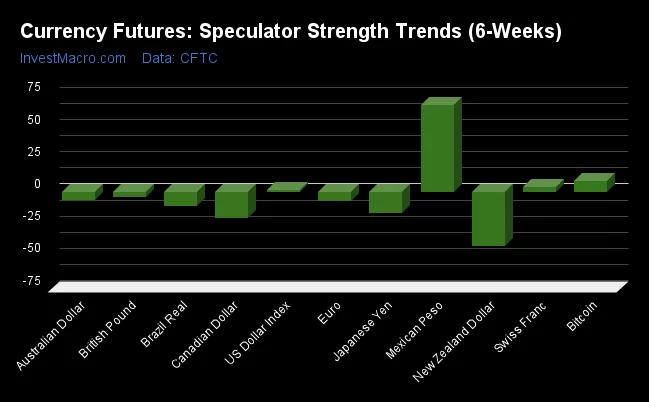
COT Strength Score Trends (or move index, calculates the 6-week changes in strength scores) showed that the EuroFX (10 percent) and the Brazilian Real (9 percent) led the past six weeks trends for the currencies through February 21st. The Australian Dollar (8 percent), the Mexican Peso (8 percent) and the British Pound (7 percent) were the next highest positive movers in the latest trends data.

The Canadian Dollar (-8 percent) led the downside trend scores currently with the US Dollar Index (-7 percent), Bitcoin (-4 percent) and the Japanese Yen (1 percent) following next with lower trend scores.

Strength Trend Statistics:
US Dollar Index (-7.2 percent) vs US Dollar Index previous week (-9.7 percent)
EuroFX (10.1 percent) vs EuroFX previous week (11.4 percent)
British Pound Sterling (6.9 percent) vs British Pound Sterling previous week (0.4 percent)
Japanese Yen (0.8 percent) vs Japanese Yen previous week (11.7 percent)
Swiss Franc (2.2 percent) vs Swiss Franc previous week (-12.2 percent)
Canadian Dollar (-7.6 percent) vs Canadian Dollar previous week (-10.1 percent)
Australian Dollar (8.3 percent) vs Australian Dollar previous week (6.8 percent)
New Zealand Dollar (3.8 percent) vs New Zealand Dollar previous week (4.1 percent)
Mexican Peso (8.5 percent) vs Mexican Peso previous week (8.6 percent)
Brazilian Real (9.5 percent) vs Brazilian Real previous week (4.0 percent)
Bitcoin (-3.8 percent) vs Bitcoin previous week (-20.4 percent)


Individual COT Forex Markets:

US Dollar Index Futures:

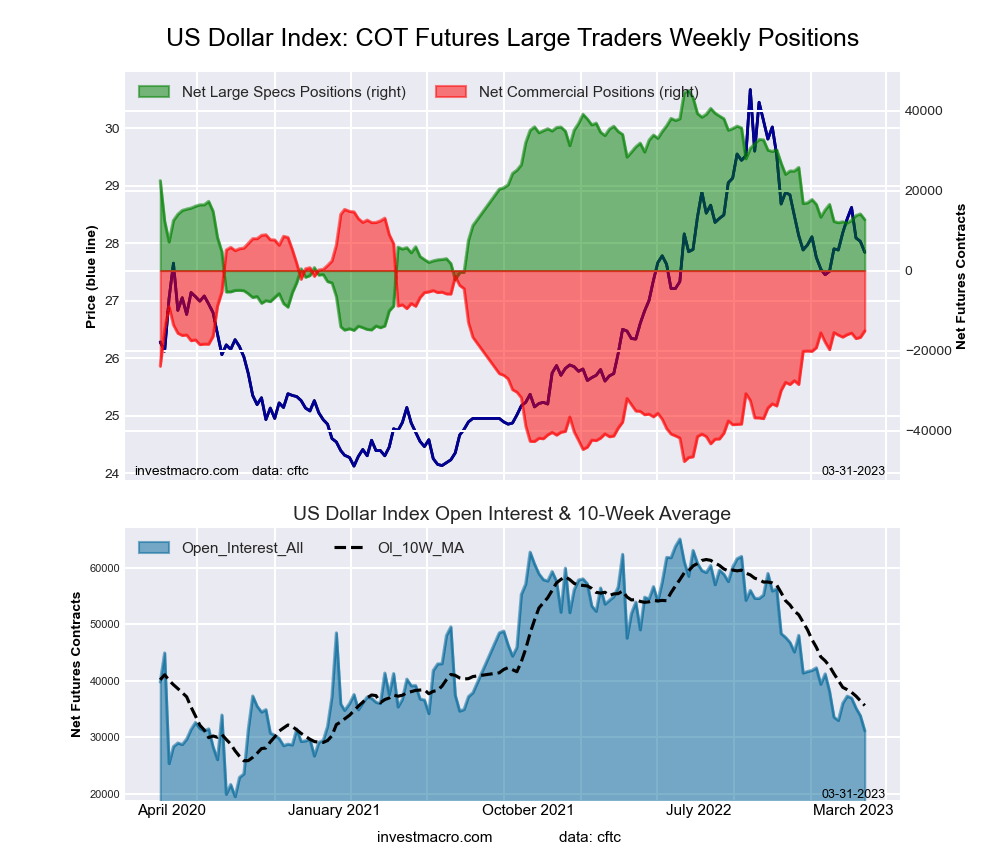
US Dollar Index Forex Futures COT ChartThe US Dollar Index large speculator standing equaled a net position of 12,198 contracts in the data reported through Tuesday February 21st. This was a weekly lift of 224 contracts from the previous week which had a total of 11,974 net contracts.

The week’s current strength score (the trader positioning range over the past three years, measured from 0 to 100) shows the speculators are currently Bearish with a score of 45.3 percent. The commercials are Bearish with a score of 49.3 percent and the small traders (not shown in chart) are Bullish with a score of 65.1 percent.

US DOLLAR INDEX StatisticsSPECULATORSCOMMERCIALSSMALL TRADERS
– Percent of Open Interest Longs:73.52.519.0
– Percent of Open Interest Shorts:39.648.76.6
– Net Position:12,198-16,6404,442
– Gross Longs:26,4699096,832
– Gross Shorts:14,27117,5492,390
– Long to Short Ratio:1.9 to 10.1 to 12.9 to 1
NET POSITION TREND:
– Strength Index Score (3 Year Range Pct):45.349.365.1
– Strength Index Reading (3 Year Range):BearishBearishBullish
NET POSITION MOVEMENT INDEX:
– 6-Week Change in Strength Index:-7.24.218.6


Euro Currency Futures:

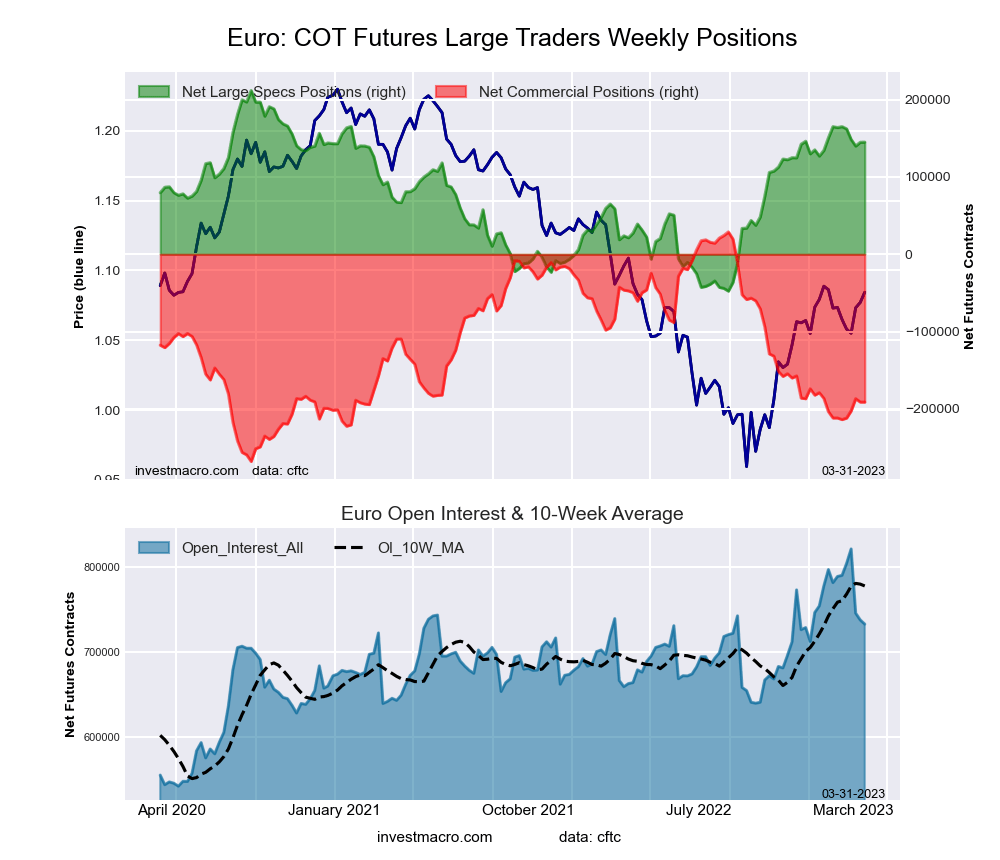
Euro Currency Futures COT ChartThe Euro Currency large speculator standing equaled a net position of 165,068 contracts in the data reported through Tuesday February 21st. This was a weekly boost of 1,162 contracts from the previous week which had a total of 163,906 net contracts.

The week’s current strength score (the trader positioning range over the past three years, measured from 0 to 100) shows the speculators are currently Bullish-Extreme with a score of 84.4 percent. The commercials are Bearish-Extreme with a score of 16.7 percent and the small traders (not shown in chart) are Bullish with a score of 56.8 percent.

EURO Currency StatisticsSPECULATORSCOMMERCIALSSMALL TRADERS
– Percent of Open Interest Longs:29.956.311.6
– Percent of Open Interest Shorts:9.083.45.4
– Net Position:165,068-213,81848,750
– Gross Longs:236,414444,65891,704
– Gross Shorts:71,346658,47642,954
– Long to Short Ratio:3.3 to 10.7 to 12.1 to 1
NET POSITION TREND:
– Strength Index Score (3 Year Range Pct):84.416.756.8
– Strength Index Reading (3 Year Range):Bullish-ExtremeBearish-ExtremeBullish
NET POSITION MOVEMENT INDEX:
– 6-Week Change in Strength Index:10.1-9.82.4


British Pound Sterling Futures:

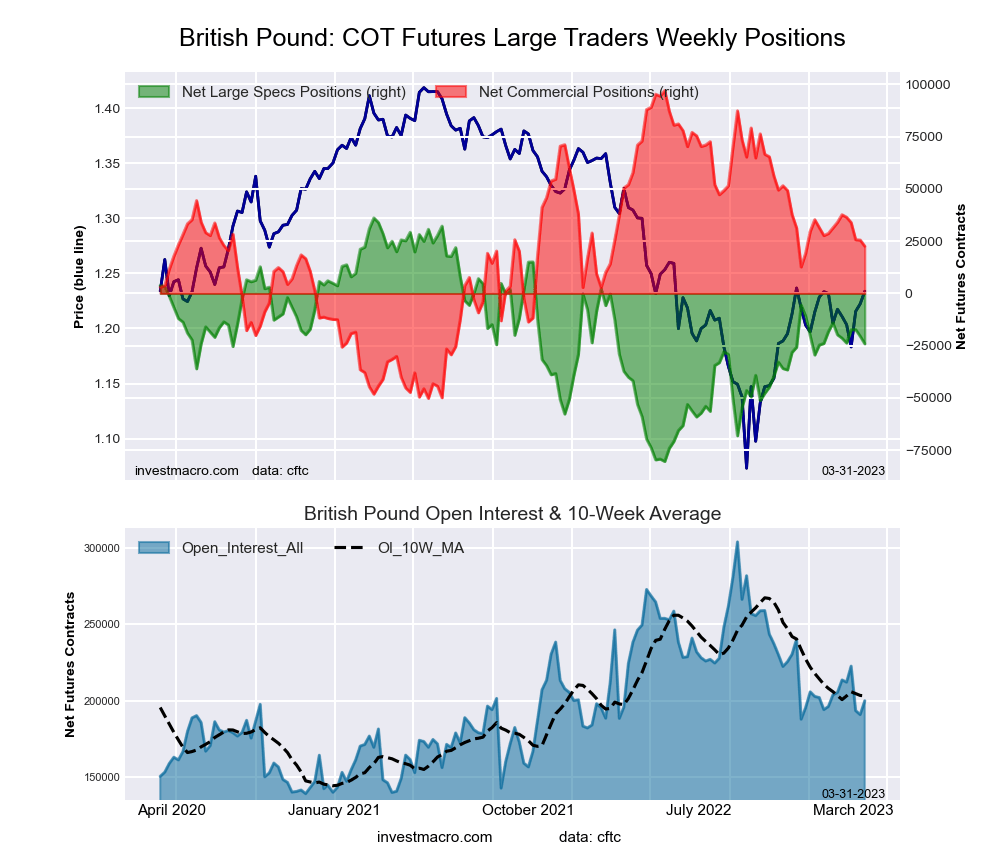
British Pound Sterling Futures COT ChartThe British Pound Sterling large speculator standing equaled a net position of -21,416 contracts in the data reported through Tuesday February 21st. This was a weekly lowering of -1,621 contracts from the previous week which had a total of -19,795 net contracts.

The week’s current strength score (the trader positioning range over the past three years, measured from 0 to 100) shows the speculators are currently Bullish with a score of 50.6 percent. The commercials are Bullish with a score of 59.7 percent and the small traders (not shown in chart) are Bearish with a score of 26.2 percent.

BRITISH POUND StatisticsSPECULATORSCOMMERCIALSSMALL TRADERS
– Percent of Open Interest Longs:21.367.09.5
– Percent of Open Interest Shorts:31.349.417.1
– Net Position:-21,41637,641-16,225
– Gross Longs:45,475143,07720,231
– Gross Shorts:66,891105,43636,456
– Long to Short Ratio:0.7 to 11.4 to 10.6 to 1
NET POSITION TREND:
– Strength Index Score (3 Year Range Pct):50.659.726.2
– Strength Index Reading (3 Year Range):BullishBullishBearish
NET POSITION MOVEMENT INDEX:
– 6-Week Change in Strength Index:6.91.6-20.4


Japanese Yen Futures:

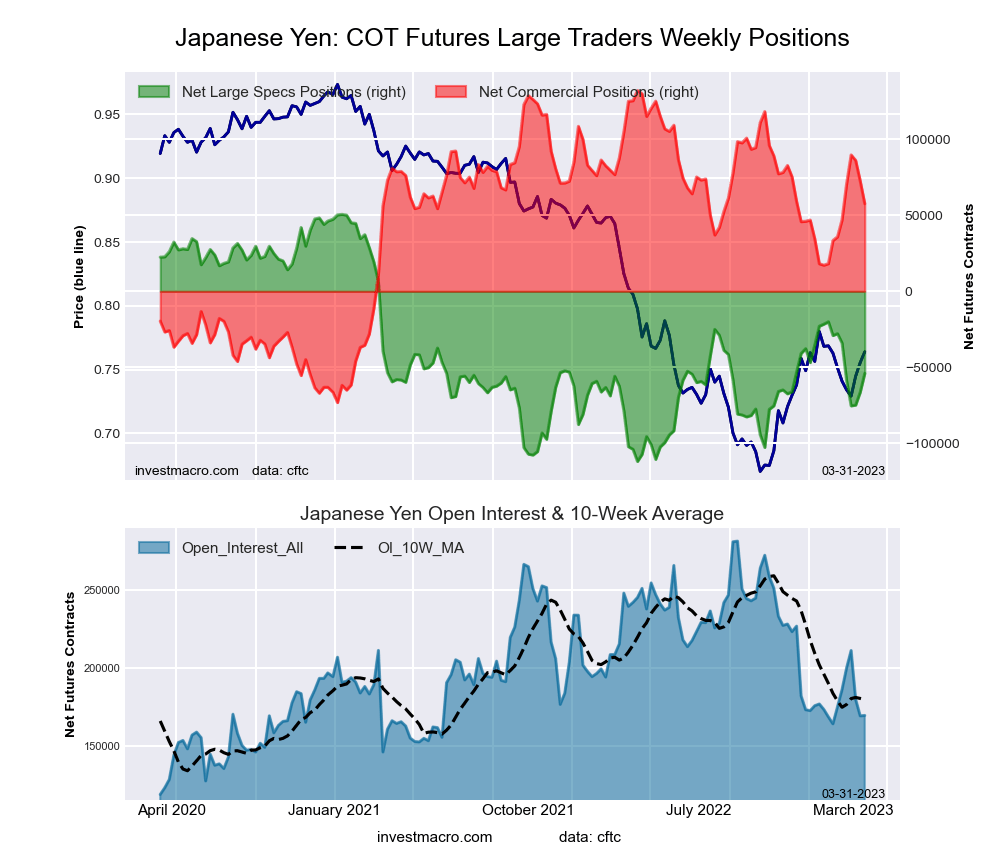
Japanese Yen Forex Futures COT ChartThe Japanese Yen large speculator standing totaled a net position of -34,029 contracts in the data reported through Tuesday February 21st. This was a weekly lowering of -6,186 contracts from the previous week which had a total of -27,843 net contracts.

The week’s current strength score (the trader positioning range over the past three years, measured from 0 to 100) shows the speculators are currently Bearish with a score of 47.9 percent. The commercials are Bullish with a score of 58.5 percent and the small traders (not shown in chart) are Bearish with a score of 27.3 percent.

JAPANESE YEN StatisticsSPECULATORSCOMMERCIALSSMALL TRADERS
– Percent of Open Interest Longs:17.568.112.4
– Percent of Open Interest Shorts:35.742.919.3
– Net Position:-34,02946,889-12,860
– Gross Longs:32,486126,77723,044
– Gross Shorts:66,51579,88835,904
– Long to Short Ratio:0.5 to 11.6 to 10.6 to 1
NET POSITION TREND:
– Strength Index Score (3 Year Range Pct):47.958.527.3
– Strength Index Reading (3 Year Range):BearishBullishBearish
NET POSITION MOVEMENT INDEX:
– 6-Week Change in Strength Index:0.86.0-27.9


Swiss Franc Futures:

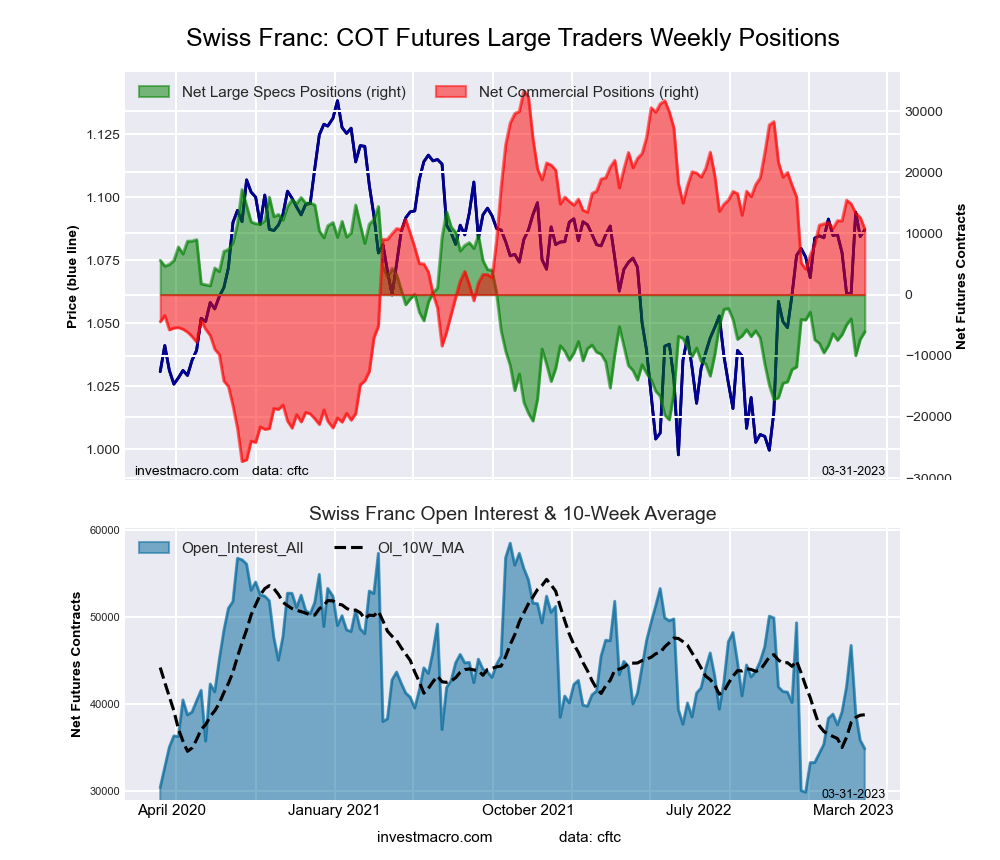
Swiss Franc Forex Futures COT ChartThe Swiss Franc large speculator standing amounted to a net position of -6,520 contracts in the data reported through Tuesday February 21st. This was a weekly rise of 948 contracts from the previous week which had a total of -7,468 net contracts.

The week’s current strength score (the trader positioning range over the past three years, measured from 0 to 100) shows the speculators are currently Bearish with a score of 37.4 percent. The commercials are Bullish with a score of 64.9 percent and the small traders (not shown in chart) are Bearish with a score of 38.8 percent.

SWISS FRANC StatisticsSPECULATORSCOMMERCIALSSMALL TRADERS
– Percent of Open Interest Longs:18.558.023.3
– Percent of Open Interest Shorts:35.227.137.5
– Net Position:-6,52012,058-5,538
– Gross Longs:7,24322,6689,110
– Gross Shorts:13,76310,61014,648
– Long to Short Ratio:0.5 to 12.1 to 10.6 to 1
NET POSITION TREND:
– Strength Index Score (3 Year Range Pct):37.464.938.8
– Strength Index Reading (3 Year Range):BearishBullishBearish
NET POSITION MOVEMENT INDEX:
– 6-Week Change in Strength Index:2.26.4-15.9


Canadian Dollar Futures:

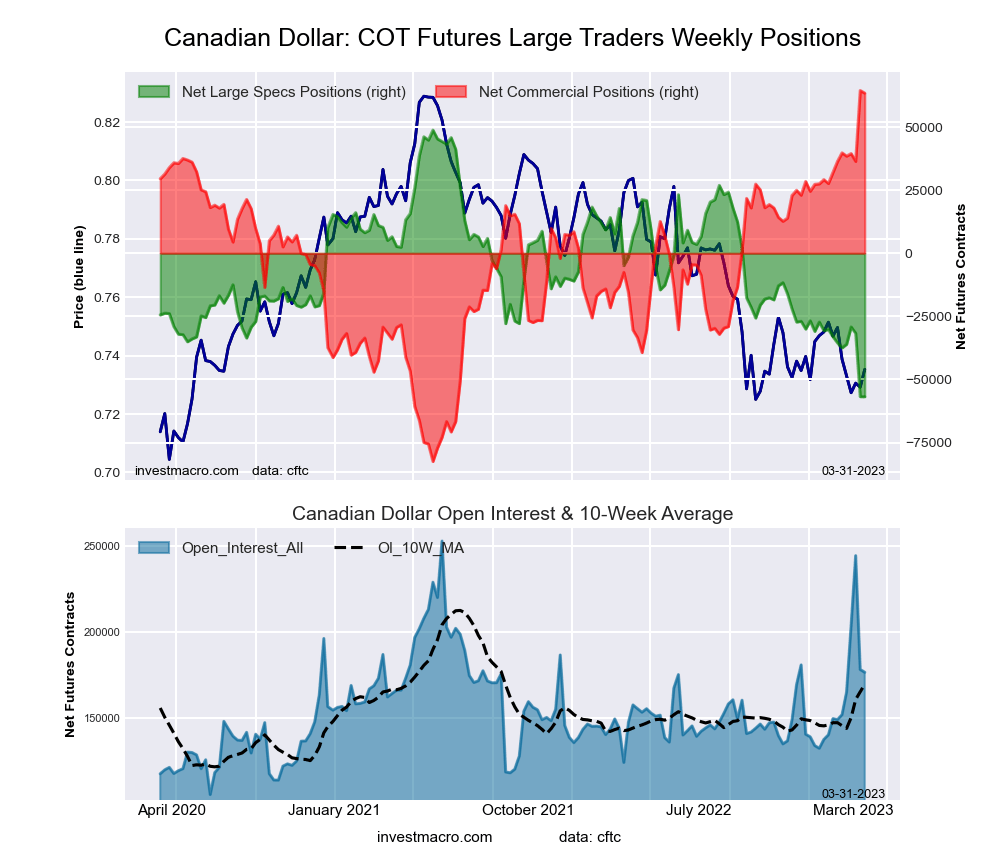
Canadian Dollar Forex Futures COT ChartThe Canadian Dollar large speculator standing totaled a net position of -37,503 contracts in the data reported through Tuesday February 21st. This was a weekly reduction of -2,009 contracts from the previous week which had a total of -35,494 net contracts.

The week’s current strength score (the trader positioning range over the past three years, measured from 0 to 100) shows the speculators are currently Bearish-Extreme with a score of 0.0 percent. The commercials are Bullish-Extreme with a score of 100.0 percent and the small traders (not shown in chart) are Bearish with a score of 25.6 percent.

CANADIAN DOLLAR StatisticsSPECULATORSCOMMERCIALSSMALL TRADERS
– Percent of Open Interest Longs:14.459.623.0
– Percent of Open Interest Shorts:39.133.424.5
– Net Position:-37,50339,753-2,250
– Gross Longs:21,88990,48934,967
– Gross Shorts:59,39250,73637,217
– Long to Short Ratio:0.4 to 11.8 to 10.9 to 1
NET POSITION TREND:
– Strength Index Score (3 Year Range Pct):0.0100.025.6
– Strength Index Reading (3 Year Range):Bearish-ExtremeBullish-ExtremeBearish
NET POSITION MOVEMENT INDEX:
– 6-Week Change in Strength Index:-7.610.2-11.9


Australian Dollar Futures:

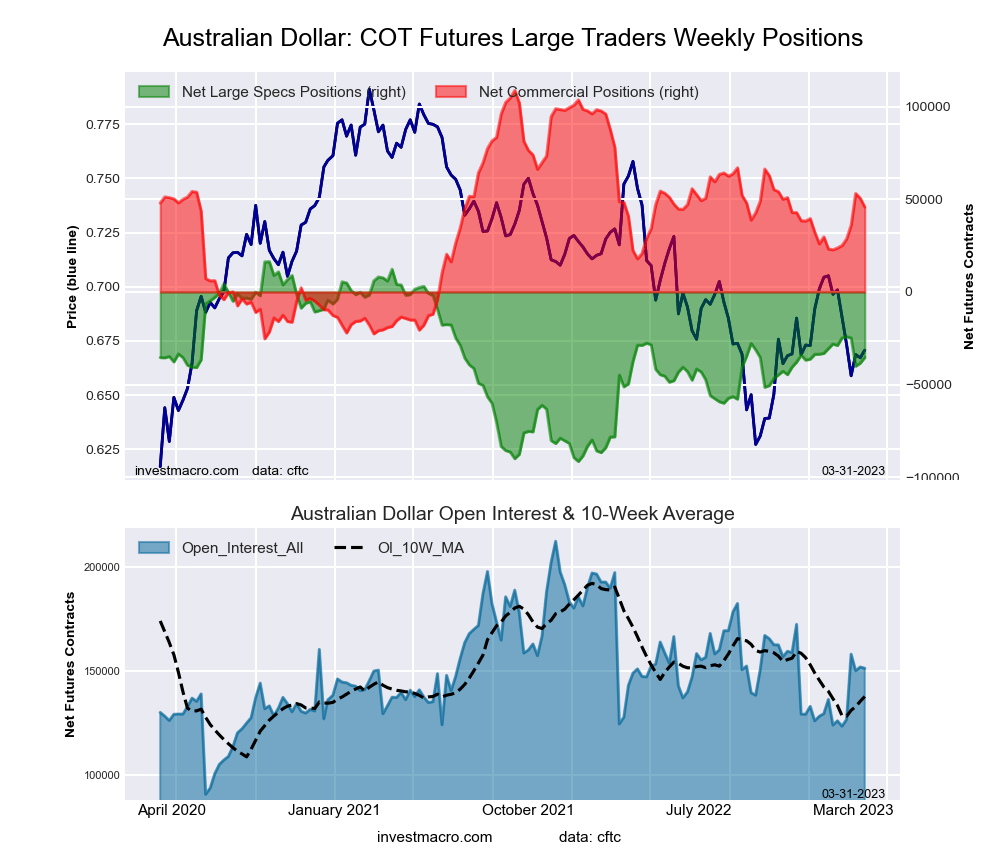
Australian Dollar Forex Futures COT ChartThe Australian Dollar large speculator standing was a net position of -24,788 contracts in the data reported through Tuesday February 21st. This was a weekly boost of 4,119 contracts from the previous week which had a total of -28,907 net contracts.

The week’s current strength score (the trader positioning range over the past three years, measured from 0 to 100) shows the speculators are currently Bullish with a score of 61.9 percent. The commercials are Bearish with a score of 37.6 percent and the small traders (not shown in chart) are Bullish with a score of 51.8 percent.

AUSTRALIAN DOLLAR StatisticsSPECULATORSCOMMERCIALSSMALL TRADERS
– Percent of Open Interest Longs:31.249.017.8
– Percent of Open Interest Shorts:51.328.818.0
– Net Position:-24,78825,049-261
– Gross Longs:38,49260,54321,994
– Gross Shorts:63,28035,49422,255
– Long to Short Ratio:0.6 to 11.7 to 11.0 to 1
NET POSITION TREND:
– Strength Index Score (3 Year Range Pct):61.937.651.8
– Strength Index Reading (3 Year Range):BullishBearishBullish
NET POSITION MOVEMENT INDEX:
– 6-Week Change in Strength Index:8.3-5.3-4.2


New Zealand Dollar Futures:

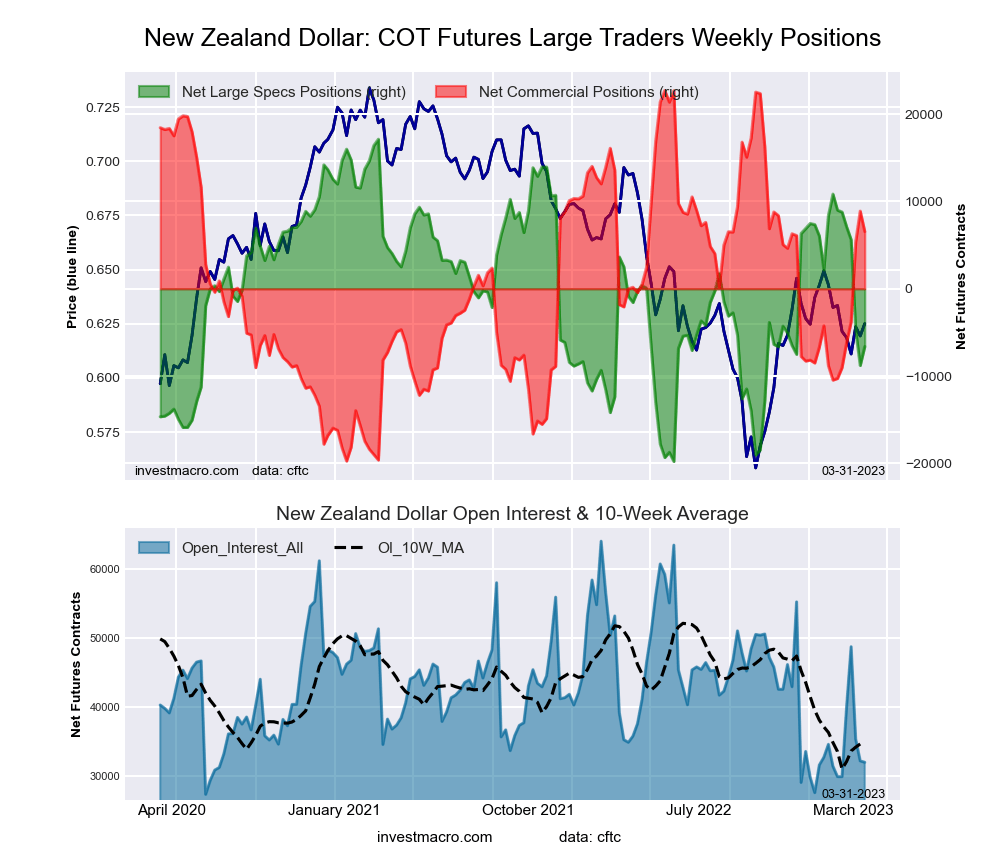
New Zealand Dollar Forex Futures COT ChartThe New Zealand Dollar large speculator standing amounted to a net position of 8,788 contracts in the data reported through Tuesday February 21st. This was a weekly fall of -215 contracts from the previous week which had a total of 9,003 net contracts.

The week’s current strength score (the trader positioning range over the past three years, measured from 0 to 100) shows the speculators are currently Bullish with a score of 77.7 percent. The commercials are Bearish with a score of 25.2 percent and the small traders (not shown in chart) are Bullish with a score of 54.4 percent.

NEW ZEALAND DOLLAR StatisticsSPECULATORSCOMMERCIALSSMALL TRADERS
– Percent of Open Interest Longs:52.130.013.5
– Percent of Open Interest Shorts:22.760.212.7
– Net Position:8,788-9,024236
– Gross Longs:15,5618,9654,026
– Gross Shorts:6,77317,9893,790
– Long to Short Ratio:2.3 to 10.5 to 11.1 to 1
NET POSITION TREND:
– Strength Index Score (3 Year Range Pct):77.725.254.4
– Strength Index Reading (3 Year Range):BullishBearishBullish
NET POSITION MOVEMENT INDEX:
– 6-Week Change in Strength Index:3.8-1.2-10.5


Mexican Peso Futures:

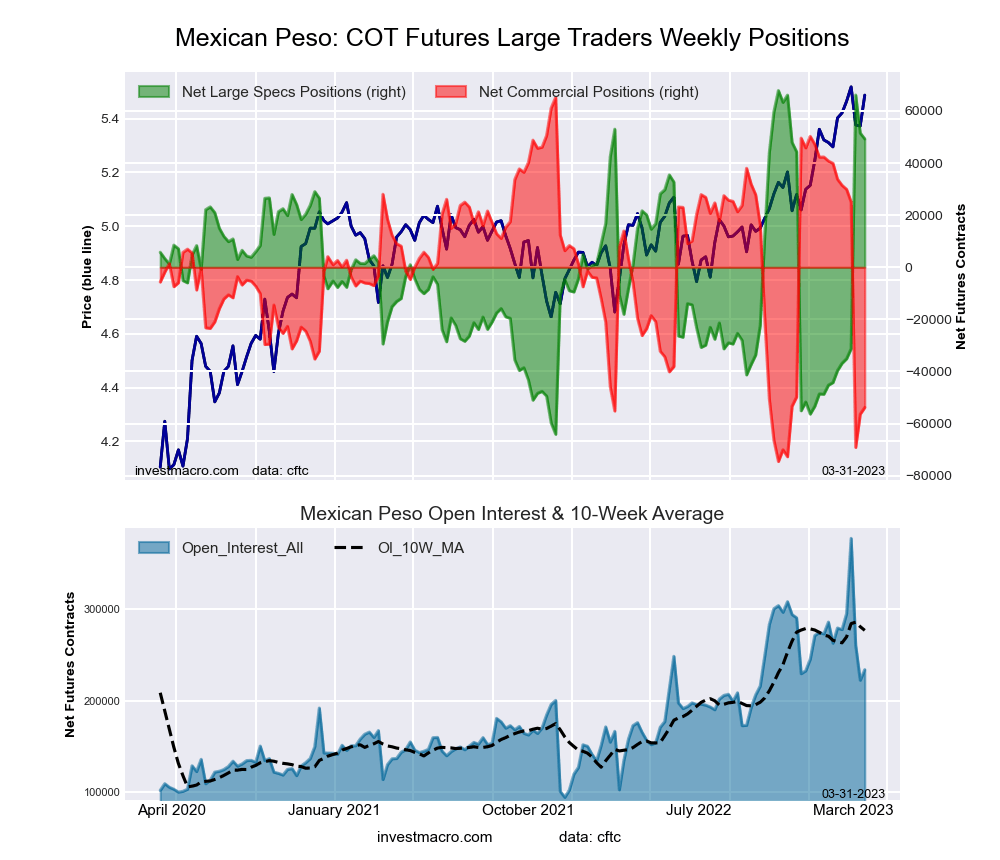
Mexican Peso Futures COT ChartThe Mexican Peso large speculator standing equaled a net position of -36,873 contracts in the data reported through Tuesday February 21st. This was a weekly advance of 2,794 contracts from the previous week which had a total of -39,667 net contracts.

The week’s current strength score (the trader positioning range over the past three years, measured from 0 to 100) shows the speculators are currently Bearish-Extreme with a score of 14.0 percent. The commercials are Bullish-Extreme with a score of 83.0 percent and the small traders (not shown in chart) are Bullish-Extreme with a score of 89.5 percent.

MEXICAN PESO StatisticsSPECULATORSCOMMERCIALSSMALL TRADERS
– Percent of Open Interest Longs:55.041.03.1
– Percent of Open Interest Shorts:68.329.71.2
– Net Position:-36,87331,4585,415
– Gross Longs:152,675113,8168,689
– Gross Shorts:189,54882,3583,274
– Long to Short Ratio:0.8 to 11.4 to 12.7 to 1
NET POSITION TREND:
– Strength Index Score (3 Year Range Pct):14.083.089.5
– Strength Index Reading (3 Year Range):Bearish-ExtremeBullish-ExtremeBullish-Extreme
NET POSITION MOVEMENT INDEX:
– 6-Week Change in Strength Index:8.5-7.9-4.4


Brazilian Real Futures:

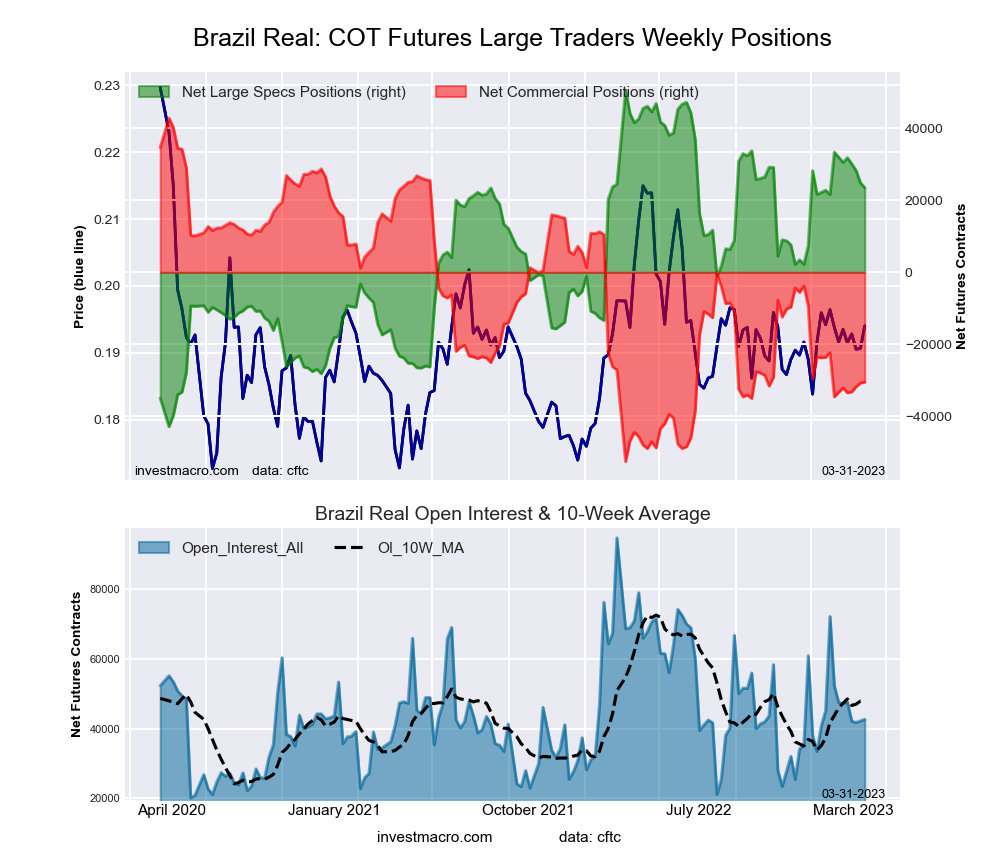
Brazil Real Futures COT ChartThe Brazilian Real large speculator standing equaled a net position of 30,533 contracts in the data reported through Tuesday February 21st. This was a weekly lowering of -1,409 contracts from the previous week which had a total of 31,942 net contracts.

The week’s current strength score (the trader positioning range over the past three years, measured from 0 to 100) shows the speculators are currently Bullish with a score of 78.6 percent. The commercials are Bearish with a score of 21.4 percent and the small traders (not shown in chart) are Bullish with a score of 79.8 percent.

BRAZIL REAL StatisticsSPECULATORSCOMMERCIALSSMALL TRADERS
– Percent of Open Interest Longs:74.417.77.9
– Percent of Open Interest Shorts:9.785.74.6
– Net Position:30,533-32,1151,582
– Gross Longs:35,1378,3573,733
– Gross Shorts:4,60440,4722,151
– Long to Short Ratio:7.6 to 10.2 to 11.7 to 1
NET POSITION TREND:
– Strength Index Score (3 Year Range Pct):78.621.479.8
– Strength Index Reading (3 Year Range):BullishBearishBullish
NET POSITION MOVEMENT INDEX:
– 6-Week Change in Strength Index:9.5-9.0-3.3


Bitcoin Futures:

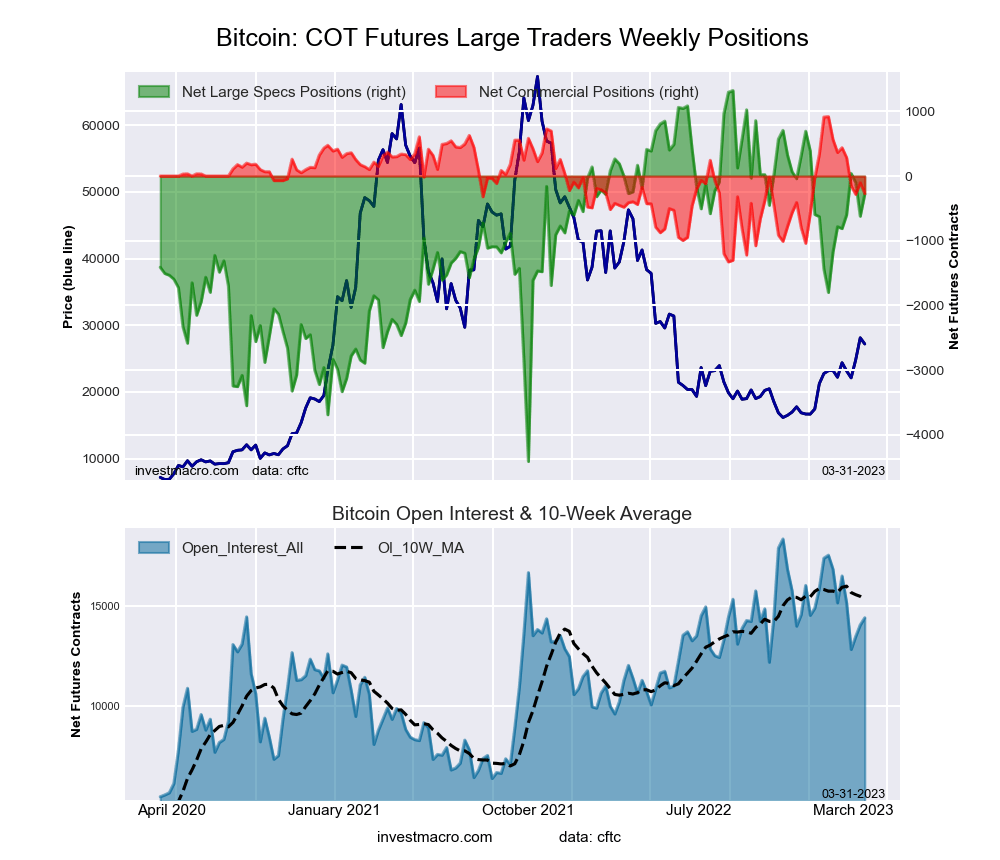
Bitcoin Crypto Futures COT ChartThe Bitcoin large speculator standing was a net position of -812 contracts in the data reported through Tuesday February 21st. This was a weekly lowering of -29 contracts from the previous week which had a total of -783 net contracts.

The week’s current strength score (the trader positioning range over the past three years, measured from 0 to 100) shows the speculators are currently Bullish with a score of 62.8 percent. The commercials are Bullish with a score of 78.5 percent and the small traders (not shown in chart) are Bearish with a score of 21.4 percent.

BITCOIN StatisticsSPECULATORSCOMMERCIALSSMALL TRADERS
– Percent of Open Interest Longs:73.94.98.5
– Percent of Open Interest Shorts:78.82.36.2
– Net Position:-812438374
– Gross Longs:12,1888101,398
– Gross Shorts:13,0003721,024
– Long to Short Ratio:0.9 to 12.2 to 11.4 to 1
NET POSITION TREND:
– Strength Index Score (3 Year Range Pct):62.878.521.4
– Strength Index Reading (3 Year Range):BullishBullishBearish
NET POSITION MOVEMENT INDEX:
– 6-Week Change in Strength Index:-3.820.8-5.7


Article By InvestMacroReceive our weekly COT Newsletter

*COT Report: The COT data, released weekly to the public each Friday, is updated through the most recent Tuesday (data is 3 days old) and shows a quick view of how large speculators or non-commercials (for-profit traders) were positioned in the futures markets.

The CFTC categorizes trader positions according to commercial hedgers (traders who use futures contracts for hedging as part of the business), non-commercials (large traders who speculate to realize trading profits) and nonreportable traders (usually small traders/speculators) as well as their open interest (contracts open in the market at time of reporting). See CFTC criteria here.

COT Metals Charts: February 21st data showed Speculator bets led by Copper & Gold

By InvestMacro

Here are the latest charts and statistics for the Commitment of Traders (COT) data published by the Commodities Futures Trading Commission (CFTC).

The latest COT data is updated through Tuesday February 21st and shows a quick view of how large traders (for-profit speculators and commercial entities) were positioned in the futures markets.

*** This data is still a few weeks behind the current data because the CFTC up-to-date data has been delayed due to a cybersecurity event that happened in early February to ION Cleared Derivatives (a subsidiary of ION Markets). This hack of ION has created a problem for the large trader positions to be reported and reconciled. The CFTC has back-filled some data over the past few weeks and will get the data back up to date in the coming weeks.

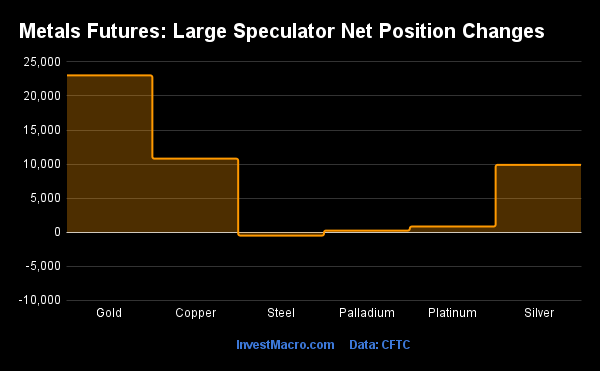
Weekly Speculator Changes led by Copper & Gold

The COT metals markets speculator bets were lower through February 21st as two out of the five precious metals markets we cover had higher positioning while the other three markets had lower speculator contracts.

Leading the gains for the metals was Copper (7,560 contracts) with Gold (1,572 contracts) also seeing a positive week.

The markets with declines in speculator bets for the week were Platinum (-3,093 contracts), Silver (-1,604 contracts) and Palladium (-199 contracts) with also having lower bets through February 21st.


Data Snapshot of Commodity Market Traders | Columns Legend
Feb-21-2023OIOI-IndexSpec-NetSpec-IndexCom-NetCOM-IndexSmalls-NetSmalls-Index
Gold422,6480107,10121-129,3557722,25436
Silver123,90639,90232-23,0506613,14839
Copper219,205582,04935-8,510626,46163
Palladium11,94384-5,18805,552100-36420
Platinum67,499582,90522-8,394765,48942


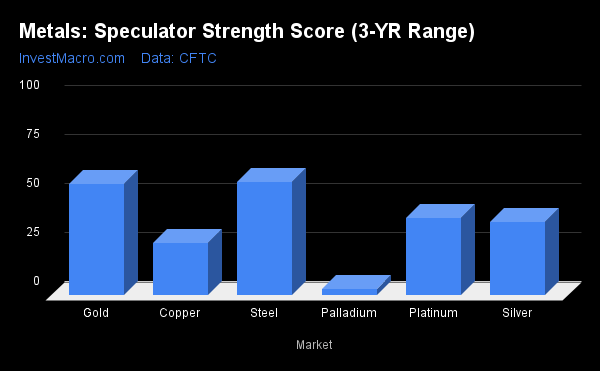
Strength Scores led by Copper & Silver

COT Strength Scores (a normalized measure of Speculator positions over a 3-Year range, from 0 to 100 where above 80 is Extreme-Bullish and below 20 is Extreme-Bearish) showed that the Copper (35 percent) led the metals markets through February 21st. Silver (32 percent) came in as the next highest in the weekly strength scores.

On the downside, Palladium (0 percent) comes in at the lowest strength level currently and is in Extreme-Bearish territory (below 20 percent). The next lowest strength score was Gold (21 percent).

Strength Statistics:
Gold (20.6 percent) vs Gold previous week (20.0 percent)
Silver (32.4 percent) vs Silver previous week (34.7 percent)
Copper (34.5 percent) vs Copper previous week (28.2 percent)
Platinum (22.3 percent) vs Platinum previous week (29.4 percent)
Palladium (0.0 percent) vs Palladium previous week (2.2 percent)

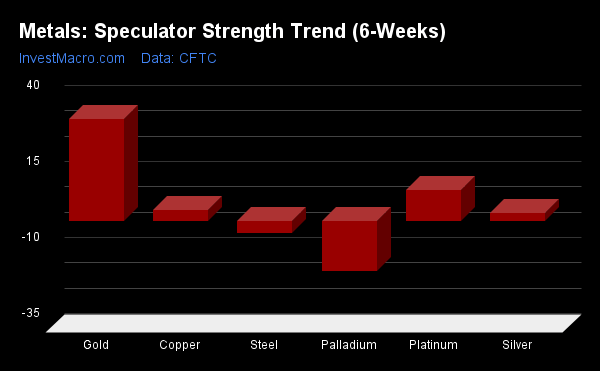
Copper & Gold top the 6-Week Strength Trends

COT Strength Score Trends (or move index, calculates the 6-week changes in strength scores) showed that Copper (-7 percent) led the past six weeks trends for metals through February 21st as all metals were in negative trend territory.

Platinum (-64 percent) led the downside trend scores with Palladium (-30 percent) as the next market with lower trend scores.

Move Statistics:
Gold (-16.2 percent) vs Gold previous week (-13.5 percent)
Silver (-27.3 percent) vs Silver previous week (-27.7 percent)
Copper (-6.9 percent) vs Copper previous week (-0.7 percent)
Platinum (-64.2 percent) vs Platinum previous week (-56.6 percent)
Palladium (-30.2 percent) vs Palladium previous week (-27.4 percent)


Individual Markets:

Gold Comex Futures:

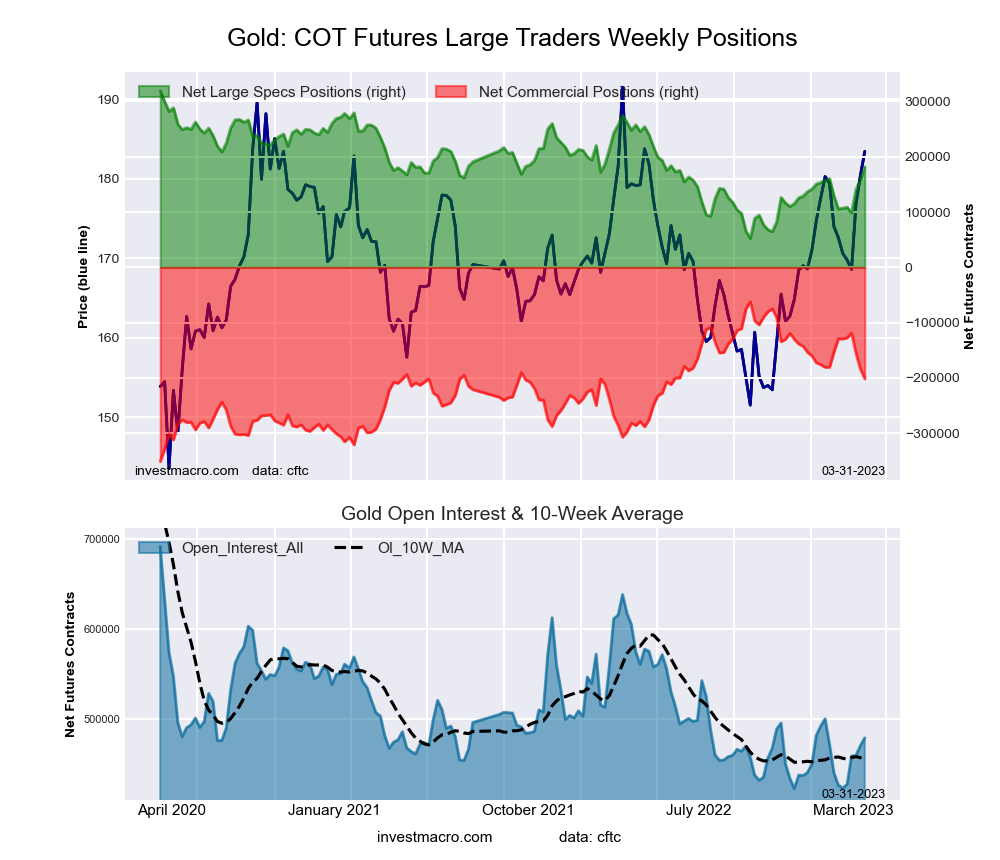
Gold Futures COT ChartThe Gold Comex Futures large speculator standing that week equaled a net position of 107,101 contracts in the data reported through Tuesday February 21st. This was a weekly rise of 1,572 contracts from the previous week which had a total of 105,529 net contracts.

The week’s current strength score (the trader positioning range over the past three years, measured from 0 to 100) shows the speculators are currently Bearish with a score of 20.6 percent. The commercials are Bullish with a score of 76.7 percent and the small traders (not shown in chart) are Bearish with a score of 35.7 percent.

Gold Futures StatisticsSPECULATORSCOMMERCIALSSMALL TRADERS
– Percent of Open Interest Longs:49.728.210.4
– Percent of Open Interest Shorts:24.458.85.1
– Net Position:107,101-129,35522,254
– Gross Longs:210,185119,04043,956
– Gross Shorts:103,084248,39521,702
– Long to Short Ratio:2.0 to 10.5 to 12.0 to 1
NET POSITION TREND:
– Strength Index Score (3 Year Range Pct):20.676.735.7
– Strength Index Reading (3 Year Range):BearishBullishBearish
NET POSITION MOVEMENT INDEX:
– 6-Week Change in Strength Index:-16.214.90.8


Silver Comex Futures:

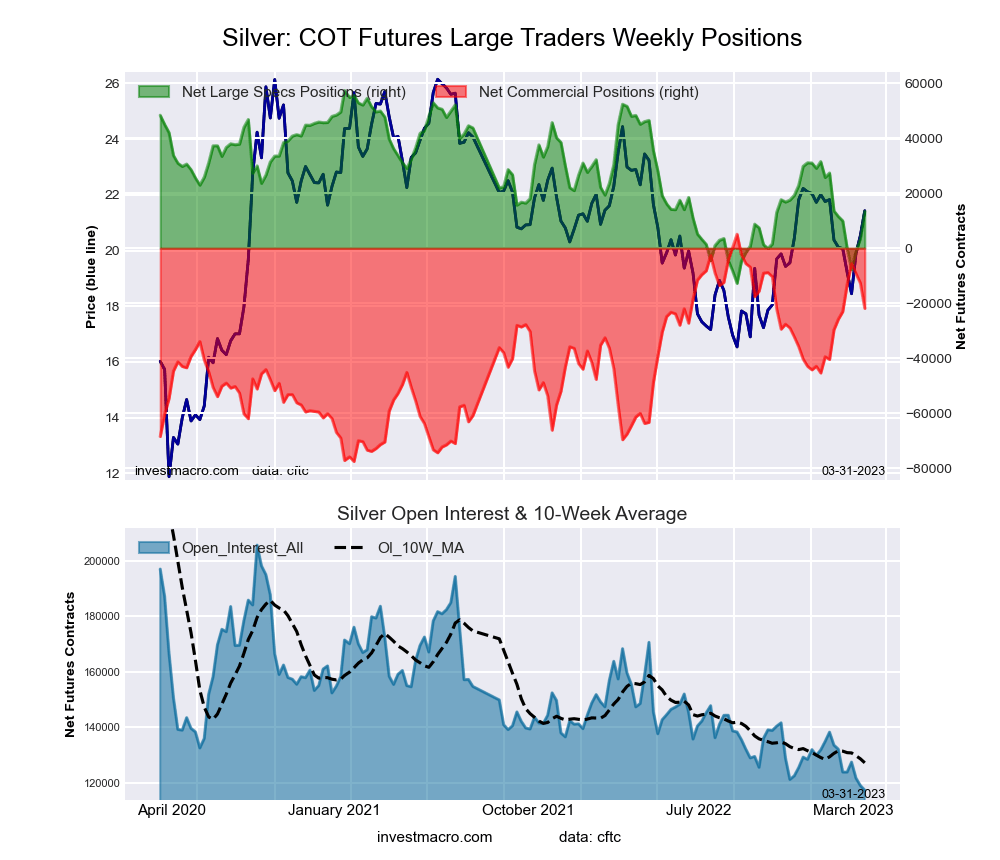
Silver Futures COT ChartThe Silver Comex Futures large speculator standing equaled a net position of 9,902 contracts in the data reported through Tuesday February 21st. This was a weekly reduction of -1,604 contracts from the previous week which had a total of 11,506 net contracts.

The week’s current strength score (the trader positioning range over the past three years, measured from 0 to 100) shows the speculators are currently Bearish with a score of 32.4 percent. The commercials are Bullish with a score of 66.0 percent and the small traders (not shown in chart) are Bearish with a score of 39.4 percent.

Silver Futures StatisticsSPECULATORSCOMMERCIALSSMALL TRADERS
– Percent of Open Interest Longs:36.336.619.9
– Percent of Open Interest Shorts:28.355.29.3
– Net Position:9,902-23,05013,148
– Gross Longs:44,98545,38824,663
– Gross Shorts:35,08368,43811,515
– Long to Short Ratio:1.3 to 10.7 to 12.1 to 1
NET POSITION TREND:
– Strength Index Score (3 Year Range Pct):32.466.039.4
– Strength Index Reading (3 Year Range):BearishBullishBearish
NET POSITION MOVEMENT INDEX:
– 6-Week Change in Strength Index:-27.324.1-4.3


Copper Grade #1 Futures:

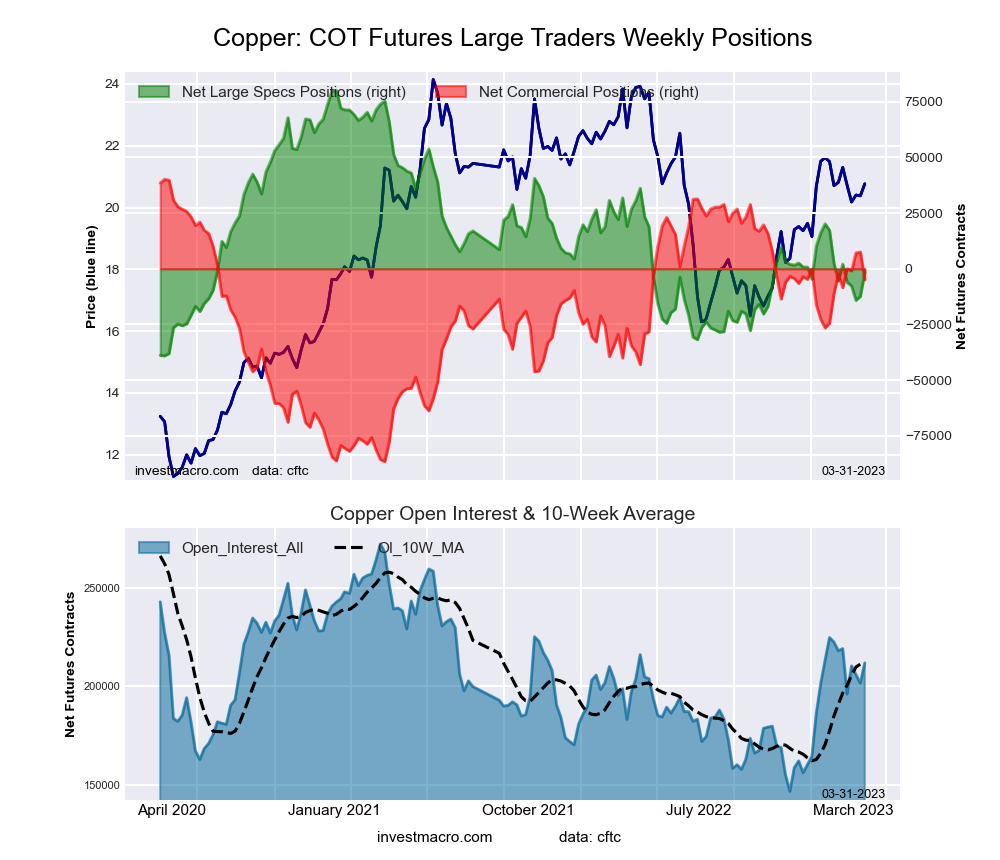
Copper Futures COT ChartThe Copper Grade #1 Futures large speculator standing equaled a net position of 2,049 contracts in the data reported through Tuesday February 21st. This was a weekly boost of 7,560 contracts from the previous week which had a total of -5,511 net contracts.

The week’s current strength score (the trader positioning range over the past three years, measured from 0 to 100) shows the speculators are currently Bearish with a score of 34.5 percent. The commercials are Bullish with a score of 61.6 percent and the small traders (not shown in chart) are Bullish with a score of 62.6 percent.

Copper Futures StatisticsSPECULATORSCOMMERCIALSSMALL TRADERS
– Percent of Open Interest Longs:33.542.99.4
– Percent of Open Interest Shorts:32.546.86.4
– Net Position:2,049-8,5106,461
– Gross Longs:73,39594,04720,560
– Gross Shorts:71,346102,55714,099
– Long to Short Ratio:1.0 to 10.9 to 11.5 to 1
NET POSITION TREND:
– Strength Index Score (3 Year Range Pct):34.561.662.6
– Strength Index Reading (3 Year Range):BearishBullishBullish
NET POSITION MOVEMENT INDEX:
– 6-Week Change in Strength Index:-6.96.12.5


Platinum Futures:

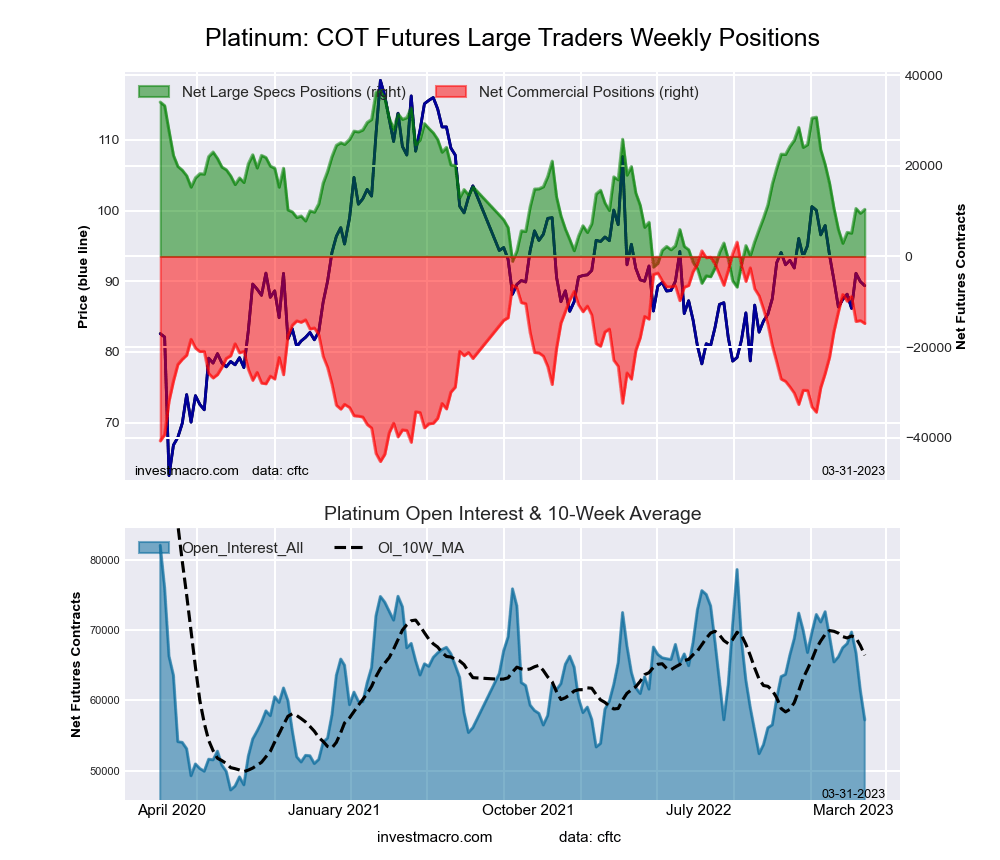
Platinum Futures COT ChartThe Platinum Futures large speculator standing equaled a net position of 2,905 contracts in the data reported through Tuesday February 21st. This was a weekly decrease of -3,093 contracts from the previous week which had a total of 5,998 net contracts.

The week’s current strength score (the trader positioning range over the past three years, measured from 0 to 100) shows the speculators are currently Bearish with a score of 22.3 percent. The commercials are Bullish with a score of 76.1 percent and the small traders (not shown in chart) are Bearish with a score of 41.6 percent.

Platinum Futures StatisticsSPECULATORSCOMMERCIALSSMALL TRADERS
– Percent of Open Interest Longs:41.638.012.8
– Percent of Open Interest Shorts:37.350.44.7
– Net Position:2,905-8,3945,489
– Gross Longs:28,05825,6388,655
– Gross Shorts:25,15334,0323,166
– Long to Short Ratio:1.1 to 10.8 to 12.7 to 1
NET POSITION TREND:
– Strength Index Score (3 Year Range Pct):22.376.141.6
– Strength Index Reading (3 Year Range):BearishBullishBearish
NET POSITION MOVEMENT INDEX:
– 6-Week Change in Strength Index:-64.253.724.5


Palladium Futures:

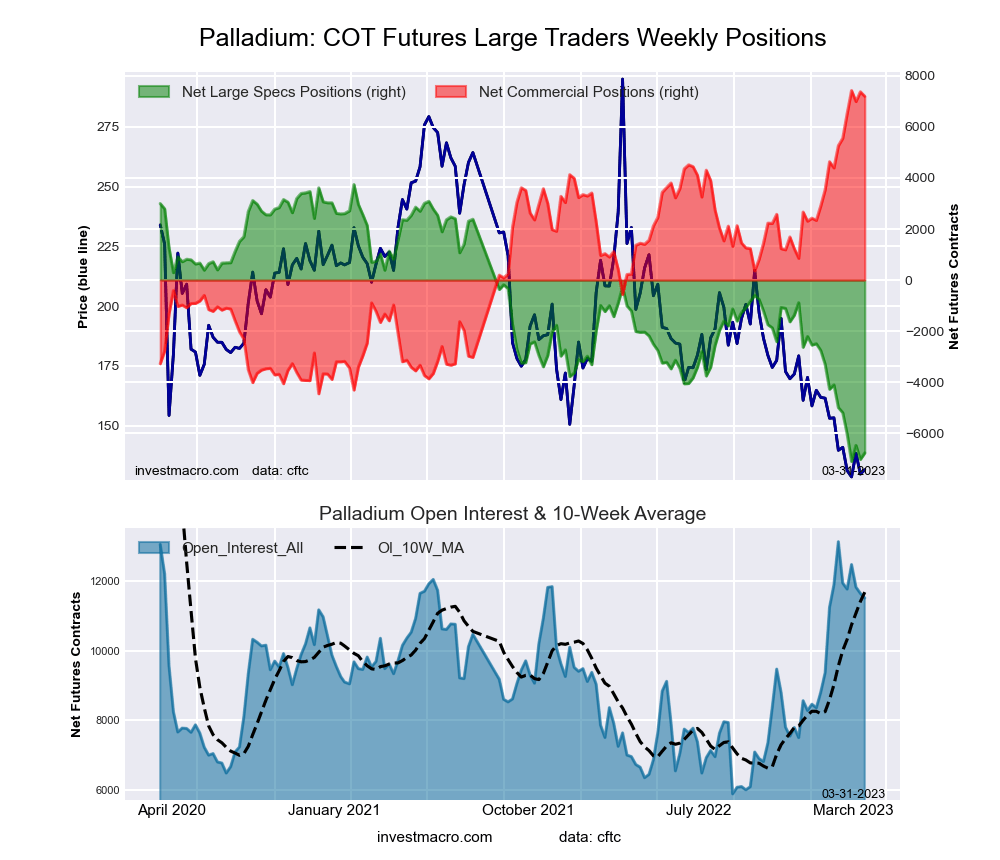
Palladium Futures COT ChartThe Palladium Futures large speculator standing equaled a net position of -5,188 contracts in the data reported through Tuesday February 21st. This was a weekly decrease of -199 contracts from the previous week which had a total of -4,989 net contracts.

The week’s current strength score (the trader positioning range over the past three years, measured from 0 to 100) shows the speculators are currently Bearish-Extreme with a score of 0.0 percent. The commercials are Bullish-Extreme with a score of 100.0 percent and the small traders (not shown in chart) are Bearish-Extreme with a score of 19.8 percent.

Palladium Futures StatisticsSPECULATORSCOMMERCIALSSMALL TRADERS
– Percent of Open Interest Longs:16.068.311.5
– Percent of Open Interest Shorts:59.521.814.5
– Net Position:-5,1885,552-364
– Gross Longs:1,9138,1591,372
– Gross Shorts:7,1012,6071,736
– Long to Short Ratio:0.3 to 13.1 to 10.8 to 1
NET POSITION TREND:
– Strength Index Score (3 Year Range Pct):0.0100.019.8
– Strength Index Reading (3 Year Range):Bearish-ExtremeBullish-ExtremeBearish-Extreme
NET POSITION MOVEMENT INDEX:
– 6-Week Change in Strength Index:-30.232.2-31.1


Article By InvestMacroReceive our weekly COT Newsletter

*COT Report: The COT data, released weekly to the public each Friday, is updated through the most recent Tuesday (data is 3 days old) and shows a quick view of how large speculators or non-commercials (for-profit traders) were positioned in the futures markets.

The CFTC categorizes trader positions according to commercial hedgers (traders who use futures contracts for hedging as part of the business), non-commercials (large traders who speculate to realize trading profits) and nonreportable traders (usually small traders/speculators) as well as their open interest (contracts open in the market at time of reporting). See CFTC criteria here.

Bonds COT Charts: February 21st data shows Speculator bets led by 10-Year Bonds & US Treasury Bonds

By InvestMacro

Here are the latest charts and statistics for the Commitment of Traders (COT) reports data published by the Commodities Futures Trading Commission (CFTC).

The latest COT data is updated through Tuesday February 21st and shows a quick view of how large traders (for-profit speculators and commercial hedgers) were positioned in the futures markets.

*** This data is still a few weeks behind the current data because the CFTC up-to-date data has been delayed due to a cybersecurity event that happened in early February to ION Cleared Derivatives (a subsidiary of ION Markets). This hack of ION has created a problem for the large trader positions to be reported and reconciled. The CFTC has back-filled some data over the past few weeks and will get the data back up to date in the coming weeks.

Weekly Speculator Changes led by 10-Year Bonds & US Treasury Bonds

The COT bond market speculator bets were higher through February 21st as six out of the eight bond markets we cover had higher positioning while the other two markets had lower speculator contracts.

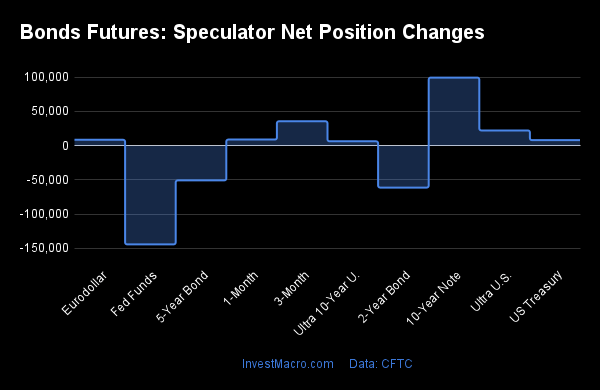
Leading the gains for the bond markets was the 10-Year Bonds (62,275 contracts) with the US Treasury Bonds (30,404 contracts), the Fed Funds (22,320 contracts), the Ultra Treasury Bonds (14,048 contracts), Eurodollar (24,267 contracts) and the 2-Year Bonds (3,194 contracts) also showing positive weeks.

The bond markets with declines in speculator bets for the week were the Ultra 10-Year Bonds (-18,345 contracts) and the 5-Year Bonds (-9,858 contracts) also registering lower bets on the week.


Data Snapshot of Bond Market Traders | Columns Legend
Feb-21-2023OIOI-IndexSpec-NetSpec-IndexCom-NetCOM-IndexSmalls-NetSmalls-Index
Eurodollar5,785,4340-1,008,528351,260,81664-252,28849
FedFunds1,810,07473-90,02429104,96973-14,94544
2-Year2,884,05371-693,4920657,11610036,37668
Long T-Bond1,307,31786-154,81634125,2855529,53186
10-Year4,335,63488-500,66011590,35792-89,69759
5-Year4,387,85184-599,24916631,38184-32,13272


Strength Scores led by Eurodollar & US Treasury Bonds

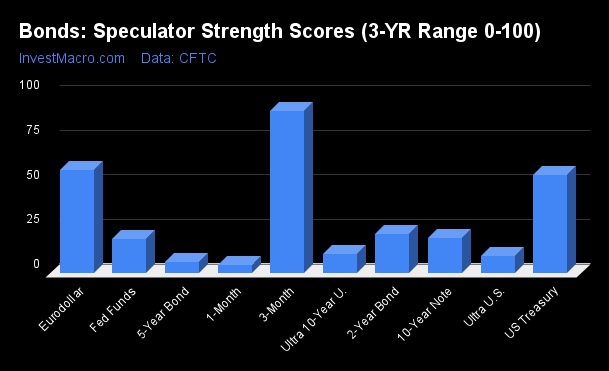
COT Strength Scores (a normalized measure of Speculator positions over a 3-Year range, from 0 to 100 where above 80 is Extreme-Bullish and below 20 is Extreme-Bearish) showed that the Eurodollar (35 percent) and the US Treasury Bonds (34 percent) led the bond markets through February 21st. The Fed Funds (29 percent) comes in as the next highest in the weekly strength scores.

On the downside, the Ultra 10-Year Bonds (0 percent), 2-Year Bonds (0 percent), 10-Year Bonds (11 percent), Ultra US Treasury Bond (13.4 percent) and the 5-Year Bond (16.1 percent) came in at the lowest strength levels and were in Extreme-Bearish territory (below 20 percent).

Strength Statistics:
Fed Funds (28.5 percent) vs Fed Funds previous week (25.8 percent)
2-Year Bond (0.4 percent) vs 2-Year Bond previous week (0.0 percent)
5-Year Bond (16.1 percent) vs 5-Year Bond previous week (17.3 percent)
10-Year Bond (11.1 percent) vs 10-Year Bond previous week (3.0 percent)
Ultra 10-Year Bond (0.0 percent) vs Ultra 10-Year Bond previous week (4.4 percent)
US Treasury Bond (34.2 percent) vs US Treasury Bond previous week (24.3 percent)
Ultra US Treasury Bond (13.4 percent) vs Ultra US Treasury Bond previous week (7.1 percent)
Eurodollar (34.6 percent) vs Eurodollar previous week (34.1 percent)


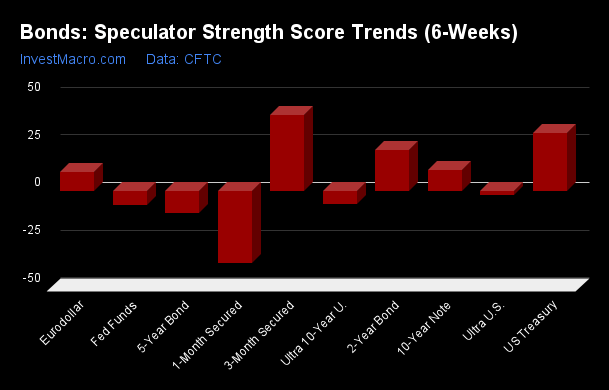
Fed Funds & 5-Year Bonds top the 6-Week Strength Trends

COT Strength Score Trends (or move index, calculates the 6-week changes in strength scores) showed that the Fed Funds (3 percent) and the 5-Year Bonds (3 percent) led the past six weeks trends for bonds through February 21st. The Eurodollar (1 percent) is the next highest positive movers in the latest trends data.

The 2-Year Bonds (-30 percent) leads the downside trend scores currently with the Ultra Treasury Bonds (-14 percent) and the 10-Year Bonds (-12 percent) following next with lower trend scores.

Strength Trend Statistics:
Fed Funds (2.8 percent) vs Fed Funds previous week (-0.5 percent)
2-Year Bond (-30.3 percent) vs 2-Year Bond previous week (-22.3 percent)
5-Year Bond (2.9 percent) vs 5-Year Bond previous week (7.7 percent)
10-Year Bond (-11.6 percent) vs 10-Year Bond previous week (-23.4 percent)
Ultra 10-Year Bond (-10.0 percent) vs Ultra 10-Year Bond previous week (-2.0 percent)
US Treasury Bond (0.8 percent) vs US Treasury Bond previous week (-5.2 percent)
Ultra US Treasury Bond (-14.2 percent) vs Ultra US Treasury Bond previous week (-23.4 percent)
Eurodollar (0.9 percent) vs Eurodollar previous week (-0.9 percent)


Individual Bond Markets:

3-Month Eurodollars Futures:

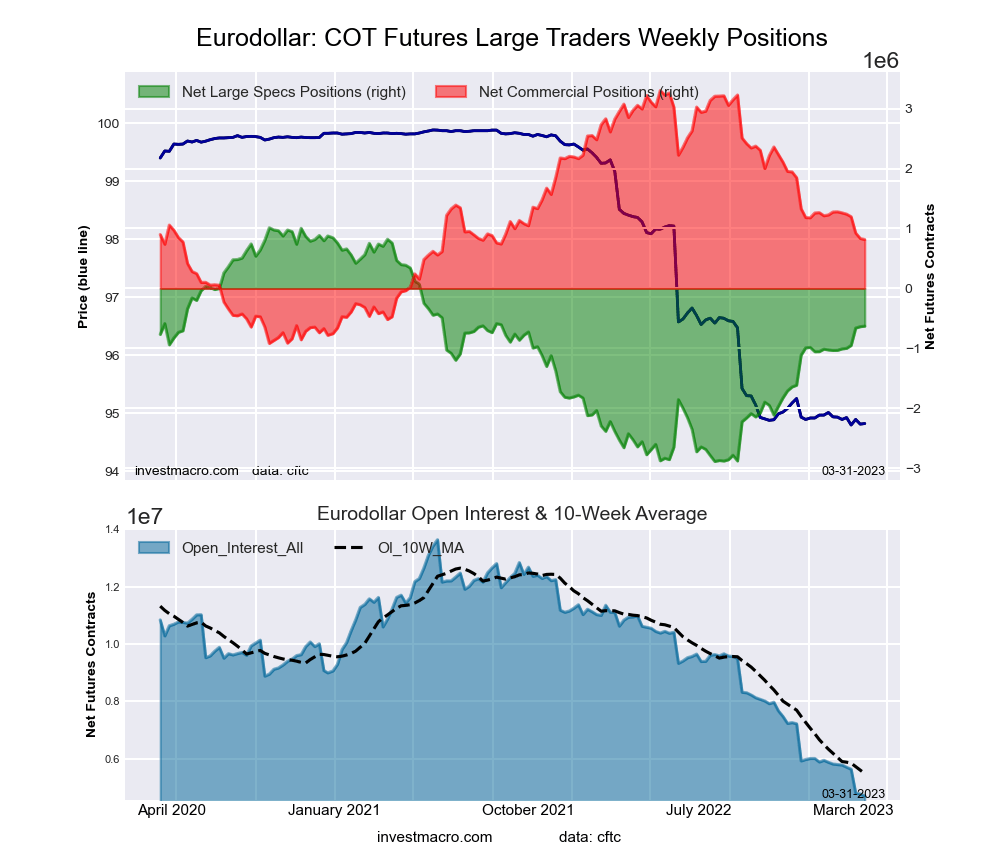
Eurodollar Bonds Futures COT ChartThe 3-Month Eurodollars large speculator standing the week came in at a net position of -1,008,528 contracts in the data reported through Tuesday February 21st. This was a weekly advance of 24,267 contracts from the previous week which had a total of -1,032,795 net contracts.

The week’s current strength score (the trader positioning range over the past three years, measured from 0 to 100) shows the speculators are currently Bearish with a score of 34.6 percent. The commercials are Bullish with a score of 63.7 percent and the small traders (not shown in chart) are Bearish with a score of 48.9 percent.

3-Month Eurodollars StatisticsSPECULATORSCOMMERCIALSSMALL TRADERS
– Percent of Open Interest Longs:9.767.84.6
– Percent of Open Interest Shorts:27.146.18.9
– Net Position:-1,008,5281,260,816-252,288
– Gross Longs:561,3433,925,149263,818
– Gross Shorts:1,569,8712,664,333516,106
– Long to Short Ratio:0.4 to 11.5 to 10.5 to 1
NET POSITION TREND:
– Strength Index Score (3 Year Range Pct):34.663.748.9
– Strength Index Reading (3 Year Range):BearishBullishBearish
NET POSITION MOVEMENT INDEX:
– 6-Week Change in Strength Index:0.90.0-10.8


30-Day Federal Funds Futures:

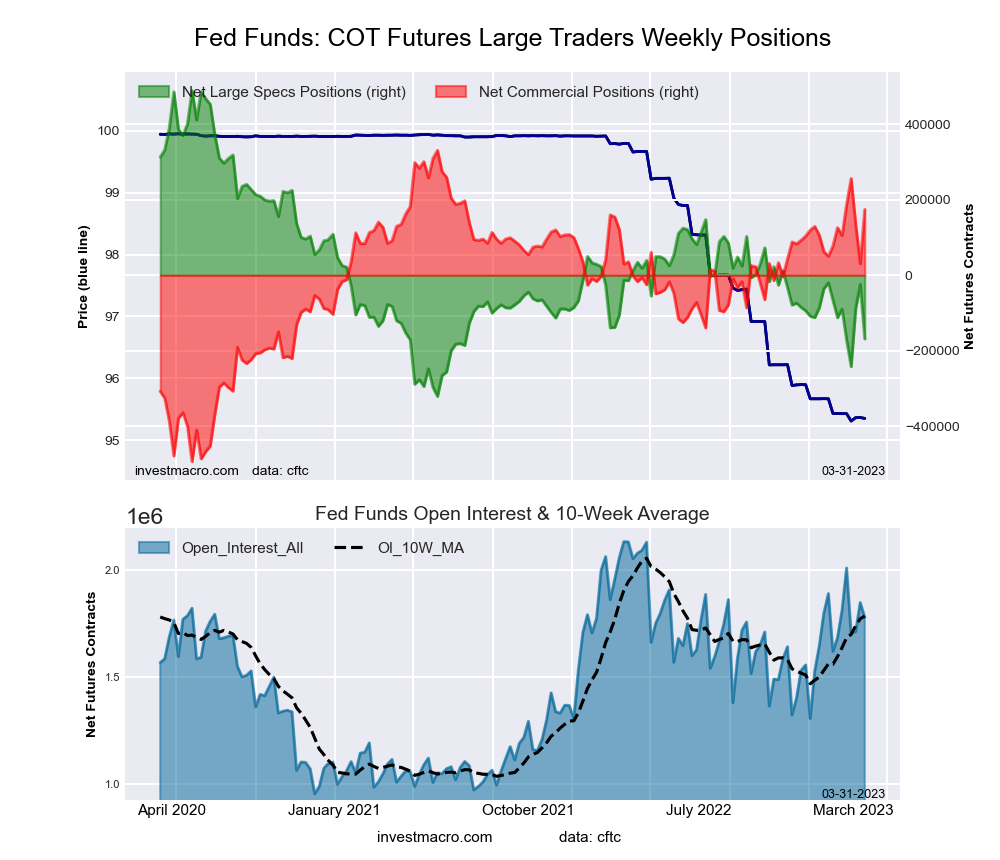
Federal Funds 30-Day Bonds Futures COT ChartThe 30-Day Federal Funds large speculator standing the week came in at a net position of -90,024 contracts in the data reported through Tuesday February 21st. This was a weekly increase of 22,320 contracts from the previous week which had a total of -112,344 net contracts.

The week’s current strength score (the trader positioning range over the past three years, measured from 0 to 100) shows the speculators are currently Bearish with a score of 28.5 percent. The commercials are Bullish with a score of 72.6 percent and the small traders (not shown in chart) are Bearish with a score of 44.1 percent.

30-Day Federal Funds StatisticsSPECULATORSCOMMERCIALSSMALL TRADERS
– Percent of Open Interest Longs:8.175.02.0
– Percent of Open Interest Shorts:13.169.22.9
– Net Position:-90,024104,969-14,945
– Gross Longs:146,3861,357,91036,925
– Gross Shorts:236,4101,252,94151,870
– Long to Short Ratio:0.6 to 11.1 to 10.7 to 1
NET POSITION TREND:
– Strength Index Score (3 Year Range Pct):28.572.644.1
– Strength Index Reading (3 Year Range):BearishBullishBearish
NET POSITION MOVEMENT INDEX:
– 6-Week Change in Strength Index:2.8-2.95.1


2-Year Treasury Note Futures:

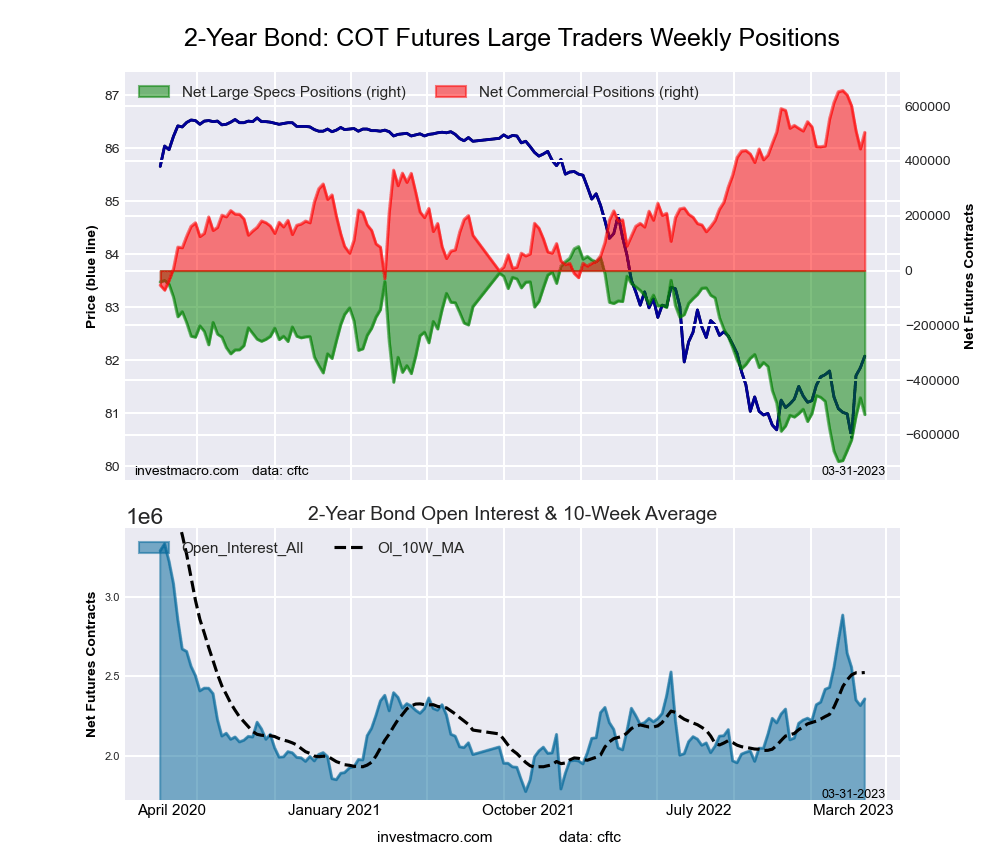
2-Year Treasury Bonds Futures COT ChartThe 2-Year Treasury Note large speculator standing the week came in at a net position of -693,492 contracts in the data reported through Tuesday February 21st. This was a weekly increase of 3,194 contracts from the previous week which had a total of -696,686 net contracts.

The week’s current strength score (the trader positioning range over the past three years, measured from 0 to 100) shows the speculators are currently Bearish-Extreme with a score of 0.4 percent. The commercials are Bullish-Extreme with a score of 100.0 percent and the small traders (not shown in chart) are Bullish with a score of 68.3 percent.

2-Year Treasury Note StatisticsSPECULATORSCOMMERCIALSSMALL TRADERS
– Percent of Open Interest Longs:6.779.411.3
– Percent of Open Interest Shorts:30.856.610.0
– Net Position:-693,492657,11636,376
– Gross Longs:193,9282,288,617325,019
– Gross Shorts:887,4201,631,501288,643
– Long to Short Ratio:0.2 to 11.4 to 11.1 to 1
NET POSITION TREND:
– Strength Index Score (3 Year Range Pct):0.4100.068.3
– Strength Index Reading (3 Year Range):Bearish-ExtremeBullish-ExtremeBullish
NET POSITION MOVEMENT INDEX:
– 6-Week Change in Strength Index:-30.328.114.6


5-Year Treasury Note Futures:

5-Year Treasury Bonds Futures COT ChartThe 5-Year Treasury Note large speculator standing the week came in at a net position of -599,249 contracts in the data reported through TuesdayFebruary 21st. This was a weekly decrease of -9,858 contracts from the previous week which had a total of -589,391 net contracts.

The week’s current strength score (the trader positioning range over the past three years, measured from 0 to 100) shows the speculators are currently Bearish-Extreme with a score of 16.1 percent. The commercials are Bullish-Extreme with a score of 83.9 percent and the small traders (not shown in chart) are Bullish with a score of 72.2 percent.

5-Year Treasury Note StatisticsSPECULATORSCOMMERCIALSSMALL TRADERS
– Percent of Open Interest Longs:7.680.59.2
– Percent of Open Interest Shorts:21.266.29.9
– Net Position:-599,249631,381-32,132
– Gross Longs:331,3293,534,403401,556
– Gross Shorts:930,5782,903,022433,688
– Long to Short Ratio:0.4 to 11.2 to 10.9 to 1
NET POSITION TREND:
– Strength Index Score (3 Year Range Pct):16.183.972.2
– Strength Index Reading (3 Year Range):Bearish-ExtremeBullish-ExtremeBullish
NET POSITION MOVEMENT INDEX:
– 6-Week Change in Strength Index:2.9-3.00.6


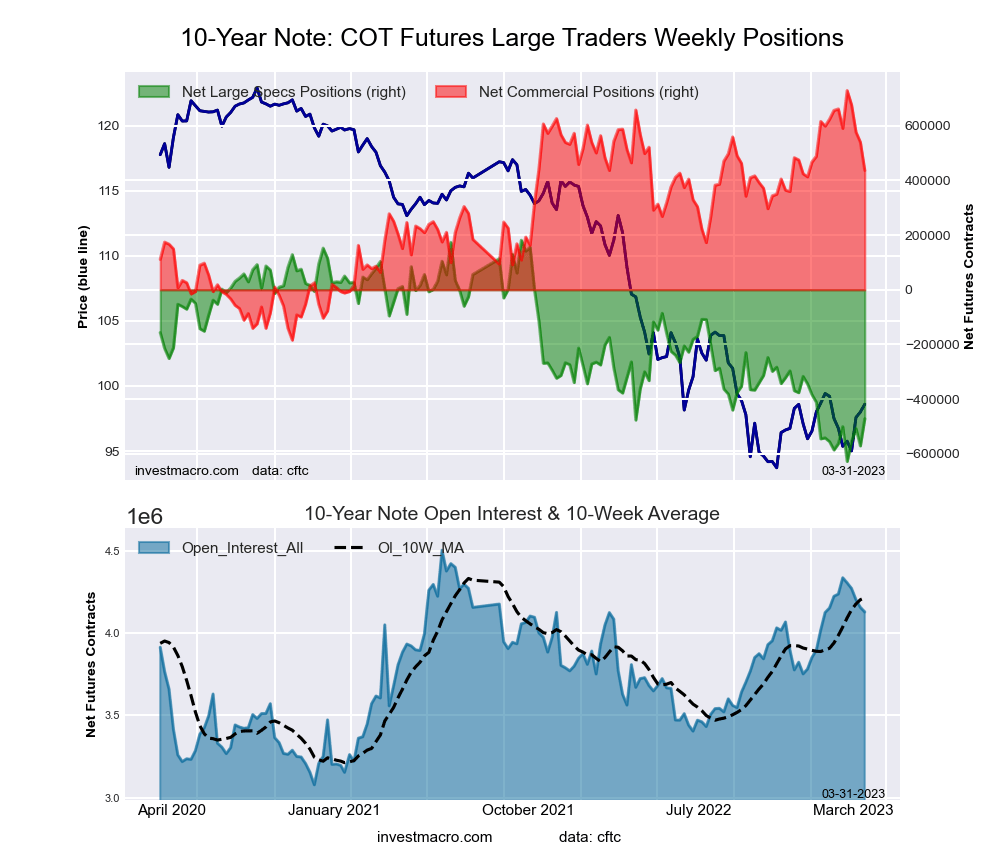
10-Year Treasury Note Futures:

10-Year Treasury Notes Bonds Futures COT ChartThe 10-Year Treasury Note large speculator standing the week came in at a net position of -500,660 contracts in the data reported through Tuesday February 21st. This was a weekly rise of 62,275 contracts from the previous week which had a total of -562,935 net contracts.

The week’s current strength score (the trader positioning range over the past three years, measured from 0 to 100) shows the speculators are currently Bearish-Extreme with a score of 11.1 percent. The commercials are Bullish-Extreme with a score of 91.6 percent and the small traders (not shown in chart) are Bullish with a score of 58.8 percent.

10-Year Treasury Note StatisticsSPECULATORSCOMMERCIALSSMALL TRADERS
– Percent of Open Interest Longs:9.877.09.8
– Percent of Open Interest Shorts:21.363.411.9
– Net Position:-500,660590,357-89,697
– Gross Longs:423,1673,337,222425,774
– Gross Shorts:923,8272,746,865515,471
– Long to Short Ratio:0.5 to 11.2 to 10.8 to 1
NET POSITION TREND:
– Strength Index Score (3 Year Range Pct):11.191.658.8
– Strength Index Reading (3 Year Range):Bearish-ExtremeBullish-ExtremeBullish
NET POSITION MOVEMENT INDEX:
– 6-Week Change in Strength Index:-11.612.0-3.0


Ultra 10-Year Notes Futures:

Ultra 10-Year Treasury Notes Bonds Futures COT ChartThe Ultra 10-Year Notes large speculator standing the week came in at a net position of -139,776 contracts in the data reported through Tuesday February 21st. This was a weekly decline of -18,345 contracts from the previous week which had a total of -121,431 net contracts.

The week’s current strength score (the trader positioning range over the past three years, measured from 0 to 100) shows the speculators are currently Bearish-Extreme with a score of 0.0 percent. The commercials are Bullish-Extreme with a score of 95.0 percent and the small traders (not shown in chart) are Bullish with a score of 75.8 percent.

Ultra 10-Year Notes StatisticsSPECULATORSCOMMERCIALSSMALL TRADERS
– Percent of Open Interest Longs:9.774.713.2
– Percent of Open Interest Shorts:18.660.918.1
– Net Position:-139,776216,868-77,092
– Gross Longs:152,3551,175,266207,505
– Gross Shorts:292,131958,398284,597
– Long to Short Ratio:0.5 to 11.2 to 10.7 to 1
NET POSITION TREND:
– Strength Index Score (3 Year Range Pct):0.095.075.8
– Strength Index Reading (3 Year Range):Bearish-ExtremeBullish-ExtremeBullish
NET POSITION MOVEMENT INDEX:
– 6-Week Change in Strength Index:-10.06.011.9


US Treasury Bonds Futures:

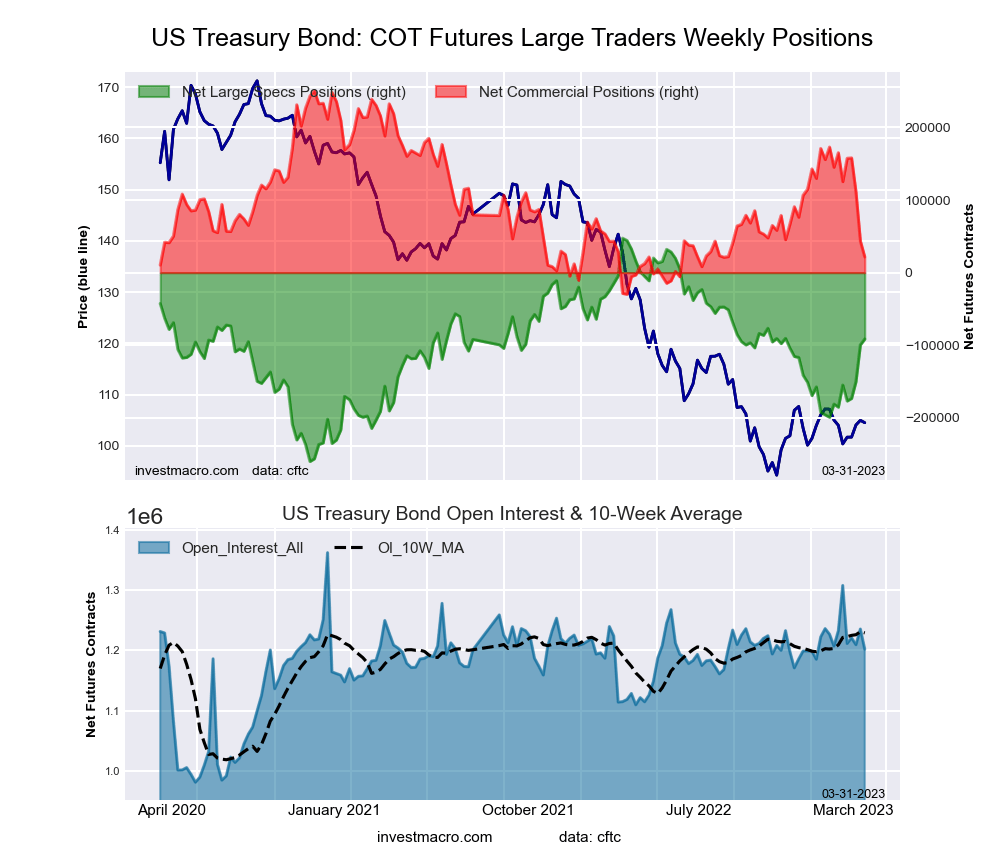
US Year Treasury Notes Long Bonds Futures COT ChartThe US Treasury Bonds large speculator standing the week came in at a net position of -154,816 contracts in the data reported through Tuesday February 21st. This was a weekly boost of 30,404 contracts from the previous week which had a total of -185,220 net contracts.

The week’s current strength score (the trader positioning range over the past three years, measured from 0 to 100) shows the speculators are currently Bearish with a score of 34.2 percent. The commercials are Bullish with a score of 55.3 percent and the small traders (not shown in chart) are Bullish-Extreme with a score of 86.1 percent.

US Treasury Bonds StatisticsSPECULATORSCOMMERCIALSSMALL TRADERS
– Percent of Open Interest Longs:6.674.315.5
– Percent of Open Interest Shorts:18.564.713.2
– Net Position:-154,816125,28529,531
– Gross Longs:86,475971,509202,158
– Gross Shorts:241,291846,224172,627
– Long to Short Ratio:0.4 to 11.1 to 11.2 to 1
NET POSITION TREND:
– Strength Index Score (3 Year Range Pct):34.255.386.1
– Strength Index Reading (3 Year Range):BearishBullishBullish-Extreme
NET POSITION MOVEMENT INDEX:
– 6-Week Change in Strength Index:0.8-1.61.7


Ultra US Treasury Bonds Futures:

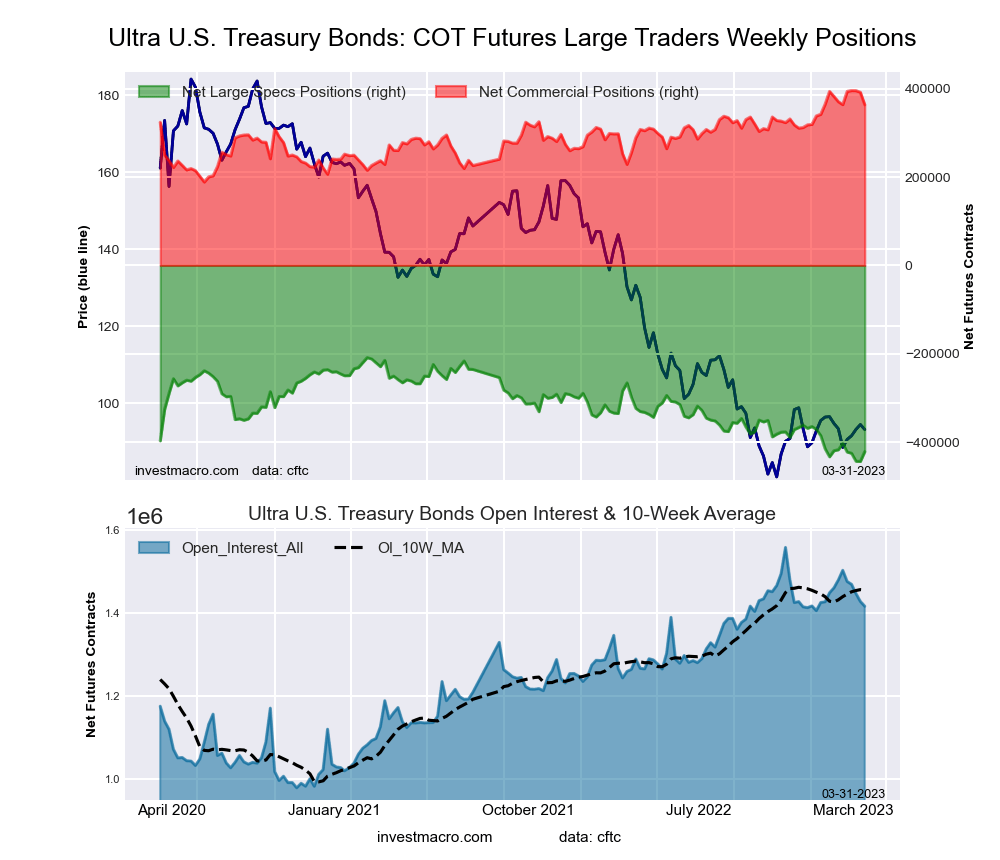
Ultra US Year Treasury Notes Long Bonds Futures COT ChartThe Ultra US Treasury Bonds large speculator standing the week came in at a net position of -403,372 contracts in the data reported through Tuesday February 21st. This was a weekly lift of 14,048 contracts from the previous week which had a total of -417,420 net contracts.

The week’s current strength score (the trader positioning range over the past three years, measured from 0 to 100) shows the speculators are currently Bearish-Extreme with a score of 13.4 percent. The commercials are Bullish-Extreme with a score of 85.4 percent and the small traders (not shown in chart) are Bullish with a score of 68.3 percent.

Ultra US Treasury Bonds StatisticsSPECULATORSCOMMERCIALSSMALL TRADERS
– Percent of Open Interest Longs:5.481.812.0
– Percent of Open Interest Shorts:32.357.69.4
– Net Position:-403,372363,97439,398
– Gross Longs:81,1671,228,622180,433
– Gross Shorts:484,539864,648141,035
– Long to Short Ratio:0.2 to 11.4 to 11.3 to 1
NET POSITION TREND:
– Strength Index Score (3 Year Range Pct):13.485.468.3
– Strength Index Reading (3 Year Range):Bearish-ExtremeBullish-ExtremeBullish
NET POSITION MOVEMENT INDEX:
– 6-Week Change in Strength Index:-14.212.55.5


Article By InvestMacroReceive our weekly COT Newsletter

*COT Report: The COT data, released weekly to the public each Friday, is updated through the most recent Tuesday (data is 3 days old) and shows a quick view of how large speculators or non-commercials (for-profit traders) were positioned in the futures markets.

The CFTC categorizes trader positions according to commercial hedgers (traders who use futures contracts for hedging as part of the business), non-commercials (large traders who speculate to realize trading profits) and nonreportable traders (usually small traders/speculators) as well as their open interest (contracts open in the market at time of reporting). See CFTC criteria here.

COT Stock Market Charts: February 21st Speculator Changes led by S&P500-Mini & Russell-Mini

By InvestMacro

Here are the latest charts and statistics for the Commitment of Traders (COT) data published by the Commodities Futures Trading Commission (CFTC).

The latest COT data is updated through Tuesday February 21st and shows a quick view of how large traders (for-profit speculators and commercial entities) were positioned in the futures markets.

*** This data is still a few weeks behind the current data because the CFTC up-to-date data has been delayed due to a cybersecurity event that happened in early February to ION Cleared Derivatives (a subsidiary of ION Markets). This hack of ION has created a problem for the large trader positions to be reported and reconciled. The CFTC has back-filled some data over the past few weeks and will get the data back up to date in the coming weeks.

Weekly Speculator Changes led by S&P500-Mini & Russell-Mini

The COT stock markets speculator bets were higher through February 21st as six out of the seven stock markets we cover had higher positioning while the other one market had lower speculator contracts.

Leading the gains for the stock markets was S&P500-Mini (12,163 contracts), Russell-Mini (9,360 contracts), Nasdaq-Mini (8,755 contracts), MSCI EAFE-Mini (3,092 contracts), Nikkei 225 (260 contracts) and VIX (89 contracts) showing positive weeks.

The market with the declines in speculator bets was DowJones-Mini (-9,507 contracts).


Data Snapshot of Stock Market Traders | Columns Legend
Feb-21-2023OIOI-IndexSpec-NetSpec-IndexCom-NetCOM-IndexSmalls-NetSmalls-Index
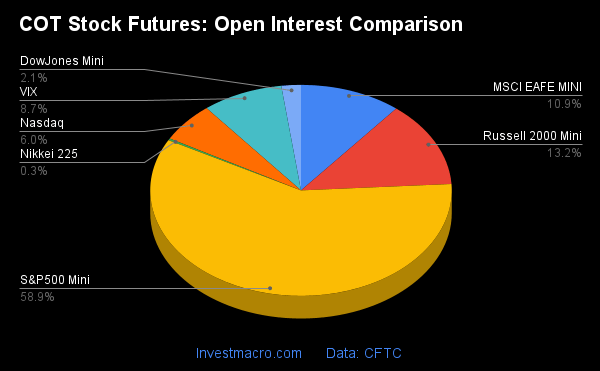
S&P500-Mini2,074,4864-234,29113241,15383-6,86225
Nikkei 22512,8496-2,022681,8243919831
Nasdaq-Mini268,29753-14,0696734,62048-20,55113
DowJones-Mini91,28858-16,2452817,59474-1,34934
VIX333,08251-56,1087462,40827-6,30061
Nikkei 225 Yen41,9572512,0057143112-12,43651


Strength Scores led by VIX & Nikkei 225 Yen

COT Strength Scores (a normalized measure of Speculator positions over a 3-Year range, from 0 to 100 where above 80 is Extreme-Bullish and below 20 is Extreme-Bearish) showed that the VIX (74 percent) and the Nikkei 225 Yen (71 percent) led the stock markets through February 21st. The Nikkei 225 (68 percent) and Nasdaq-Mini (67 percent) came in as the next highest in the weekly strength scores.

On the downside, the S&P500-Mini (13 percent) came in at the lowest strength level currently and is in Extreme-Bearish territory (below 20 percent). The next lowest strength score is the MSCI EAFE-Mini (26 percent).

Strength Statistics:
VIX (74.0 percent) vs VIX previous week (73.9 percent)
S&P500-Mini (12.8 percent) vs S&P500-Mini previous week (10.5 percent)
DowJones-Mini (28.0 percent) vs DowJones-Mini previous week (49.3 percent)
Nasdaq-Mini (67.2 percent) vs Nasdaq-Mini previous week (62.3 percent)
Russell2000-Mini (39.2 percent) vs Russell2000-Mini previous week (33.6 percent)
Nikkei USD (67.9 percent) vs Nikkei USD previous week (66.6 percent)
EAFE-Mini (26.0 percent) vs EAFE-Mini previous week (22.2 percent)


VIX & Nikkei 225 Yen top the 6-Week Strength Trends

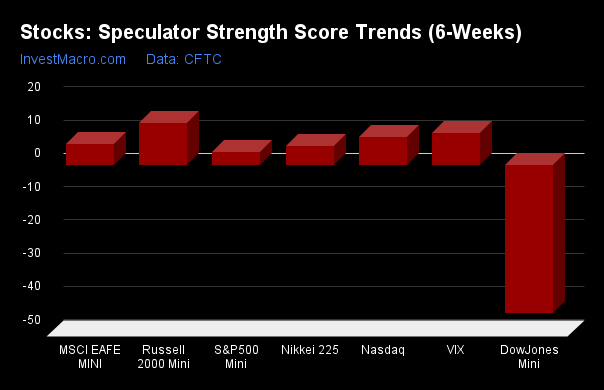
COT Strength Score Trends (or move index, calculates the 6-week changes in strength scores) showed that the VIX (12 percent) led the six weeks trends for the stock markets. The Nikkei 225 Yen (9 percent), the Nikkei 225 (3 percent) and the Russell-Mini (2 percent) are the next highest positive movers in the latest trends data.

The DowJones-Mini (-16 percent) led the downside trend scores with the S&P500-Mini (-4 percent) coming in as the next market with lower trend scores.

Strength Trend Statistics:
VIX (11.5 percent) vs VIX previous week (8.1 percent)
S&P500-Mini (-3.9 percent) vs S&P500-Mini previous week (-14.7 percent)
DowJones-Mini (-15.9 percent) vs DowJones-Mini previous week (11.5 percent)
Nasdaq-Mini (-3.3 percent) vs Nasdaq-Mini previous week (-13.5 percent)
Russell2000-Mini (2.1 percent) vs Russell2000-Mini previous week (0.9 percent)
Nikkei USD (3.3 percent) vs Nikkei USD previous week (3.3 percent)
EAFE-Mini (-1.9 percent) vs EAFE-Mini previous week (-14.8 percent)


Individual Stock Market Charts:

VIX Volatility Futures:

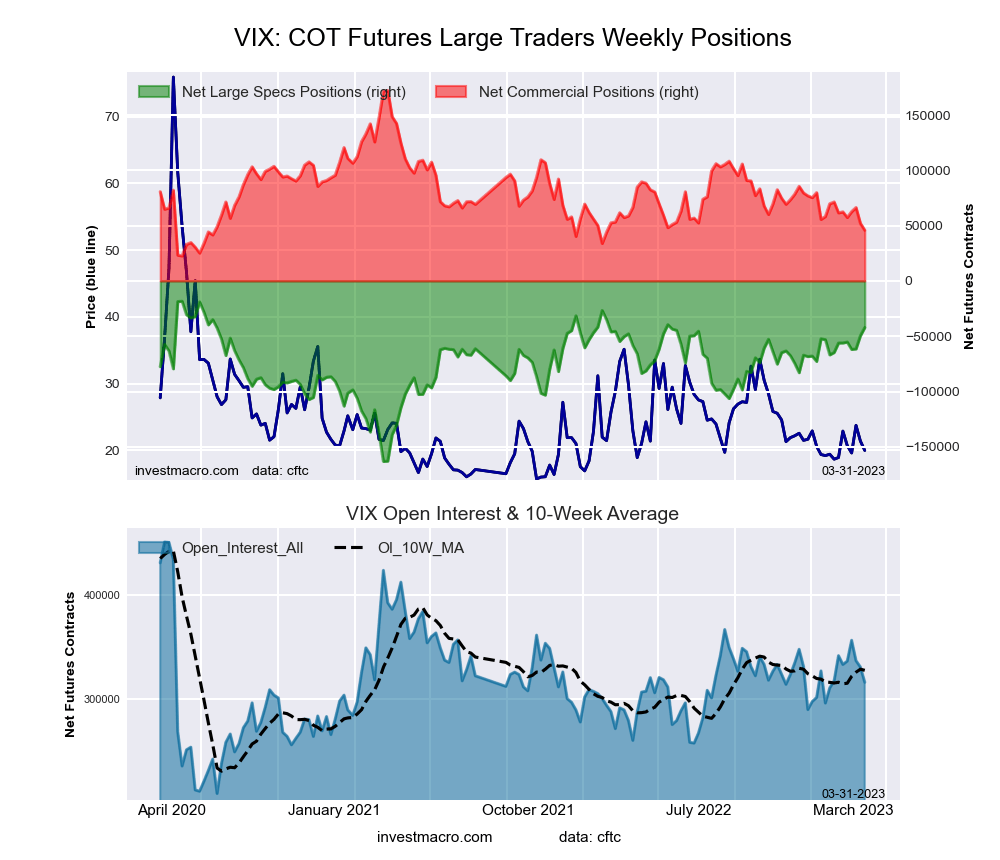
VIX Volatility Futures COT ChartThe VIX Volatility large speculator standing the week reached a net position of -56,108 contracts in the data reported through Tuesday February 21st. This was a weekly lift of 89 contracts from the previous week which had a total of -56,197 net contracts.

The week’s current strength score (the trader positioning range over the past three years, measured from 0 to 100) shows the speculators are currently Bullish with a score of 74.0 percent. The commercials are Bearish with a score of 26.7 percent and the small traders (not shown in chart) are Bullish with a score of 60.8 percent.

VIX Volatility Futures StatisticsSPECULATORSCOMMERCIALSSMALL TRADERS
– Percent of Open Interest Longs:15.455.57.0
– Percent of Open Interest Shorts:32.236.88.9
– Net Position:-56,10862,408-6,300
– Gross Longs:51,233184,96823,405
– Gross Shorts:107,341122,56029,705
– Long to Short Ratio:0.5 to 11.5 to 10.8 to 1
NET POSITION TREND:
– Strength Index Score (3 Year Range Pct):74.026.760.8
– Strength Index Reading (3 Year Range):BullishBearishBullish
NET POSITION MOVEMENT INDEX:
– 6-Week Change in Strength Index:11.5-11.63.4


S&P500 Mini Futures:

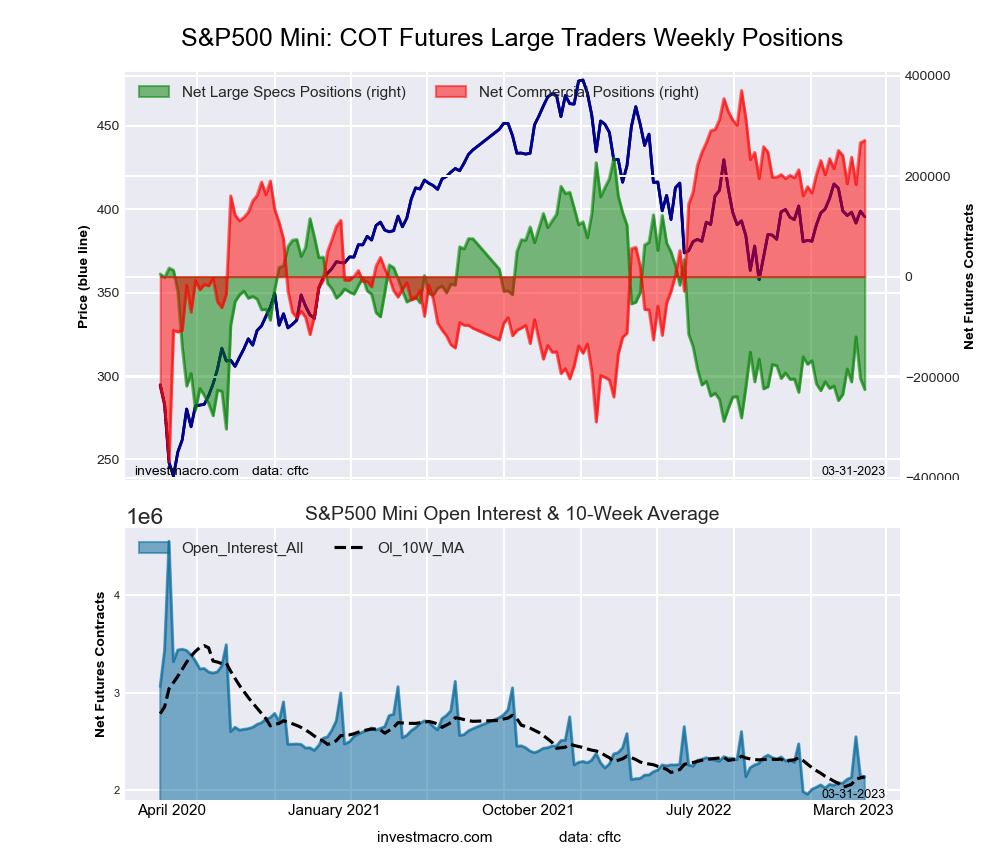
SP500 Mini Futures COT ChartThe S&P500 Mini large speculator standing the week reached a net position of -234,291 contracts in the data reported through Tuesday February 21st. This was a weekly gain of 12,163 contracts from the previous week which had a total of -246,454 net contracts.

The week’s current strength score (the trader positioning range over the past three years, measured from 0 to 100) shows the speculators are currently Bearish-Extreme with a score of 12.8 percent. The commercials are Bullish-Extreme with a score of 82.5 percent and the small traders (not shown in chart) are Bearish with a score of 24.9 percent.

S&P500 Mini Futures StatisticsSPECULATORSCOMMERCIALSSMALL TRADERS
– Percent of Open Interest Longs:11.274.412.1
– Percent of Open Interest Shorts:22.562.712.5
– Net Position:-234,291241,153-6,862
– Gross Longs:231,8081,542,524251,654
– Gross Shorts:466,0991,301,371258,516
– Long to Short Ratio:0.5 to 11.2 to 11.0 to 1
NET POSITION TREND:
– Strength Index Score (3 Year Range Pct):12.882.524.9
– Strength Index Reading (3 Year Range):Bearish-ExtremeBullish-ExtremeBearish
NET POSITION MOVEMENT INDEX:
– 6-Week Change in Strength Index:-3.95.2-3.6


Dow Jones Mini Futures:

Dow Jones Mini Futures COT ChartThe Dow Jones Mini large speculator standing the week reached a net position of -16,245 contracts in the data reported through Tuesday February 21st. This was a weekly reduction of -9,507 contracts from the previous week which had a total of -6,738 net contracts.

The week’s current strength score (the trader positioning range over the past three years, measured from 0 to 100) shows the speculators are currently Bearish with a score of 28.0 percent. The commercials are Bullish with a score of 73.6 percent and the small traders (not shown in chart) are Bearish with a score of 33.9 percent.

Dow Jones Mini Futures StatisticsSPECULATORSCOMMERCIALSSMALL TRADERS
– Percent of Open Interest Longs:30.050.415.2
– Percent of Open Interest Shorts:47.731.116.7
– Net Position:-16,24517,594-1,349
– Gross Longs:27,34445,98213,918
– Gross Shorts:43,58928,38815,267
– Long to Short Ratio:0.6 to 11.6 to 10.9 to 1
NET POSITION TREND:
– Strength Index Score (3 Year Range Pct):28.073.633.9
– Strength Index Reading (3 Year Range):BearishBullishBearish
NET POSITION MOVEMENT INDEX:
– 6-Week Change in Strength Index:-15.910.111.1


Nasdaq Mini Futures:

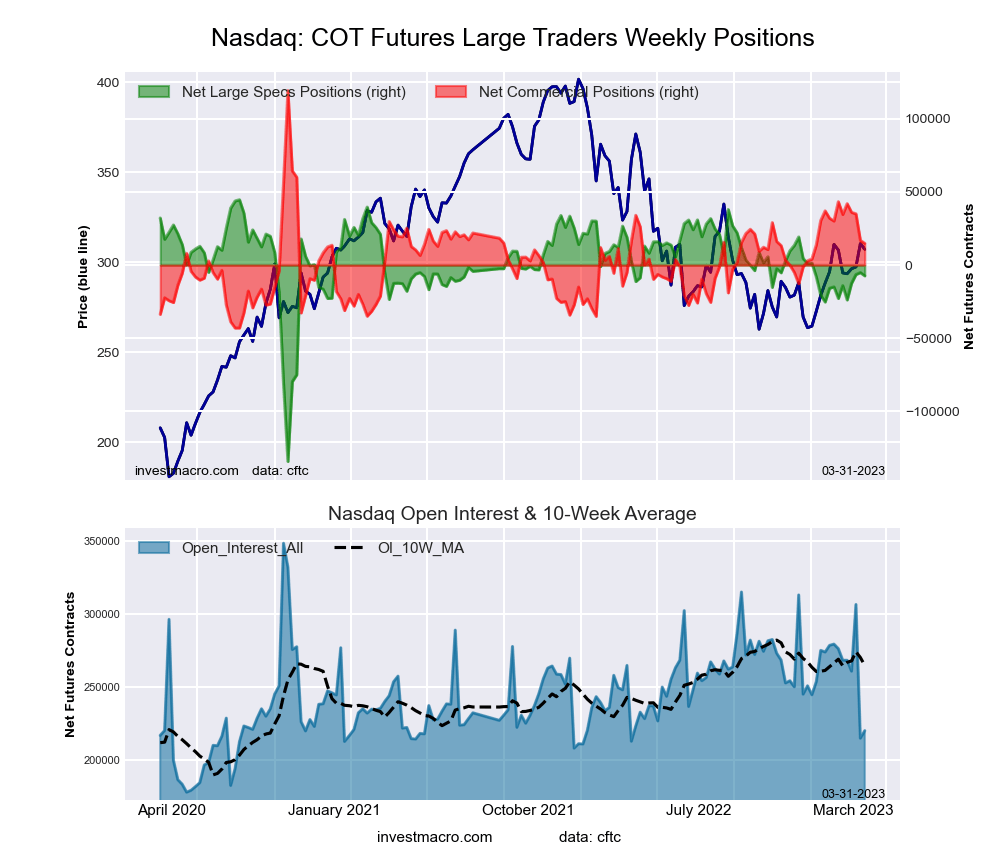
Nasdaq Mini Futures COT ChartThe Nasdaq Mini large speculator standing the week reached a net position of -14,069 contracts in the data reported through Tuesday February 21st. This was a weekly gain of 8,755 contracts from the previous week which had a total of -22,824 net contracts.

The week’s current strength score (the trader positioning range over the past three years, measured from 0 to 100) shows the speculators are currently Bullish with a score of 67.2 percent. The commercials are Bearish with a score of 47.8 percent and the small traders (not shown in chart) are Bearish-Extreme with a score of 13.0 percent.

Nasdaq Mini Futures StatisticsSPECULATORSCOMMERCIALSSMALL TRADERS
– Percent of Open Interest Longs:21.663.513.0
– Percent of Open Interest Shorts:26.850.620.7
– Net Position:-14,06934,620-20,551
– Gross Longs:57,849170,38634,896
– Gross Shorts:71,918135,76655,447
– Long to Short Ratio:0.8 to 11.3 to 10.6 to 1
NET POSITION TREND:
– Strength Index Score (3 Year Range Pct):67.247.813.0
– Strength Index Reading (3 Year Range):BullishBearishBearish-Extreme
NET POSITION MOVEMENT INDEX:
– 6-Week Change in Strength Index:-3.312.7-28.2


Russell 2000 Mini Futures:

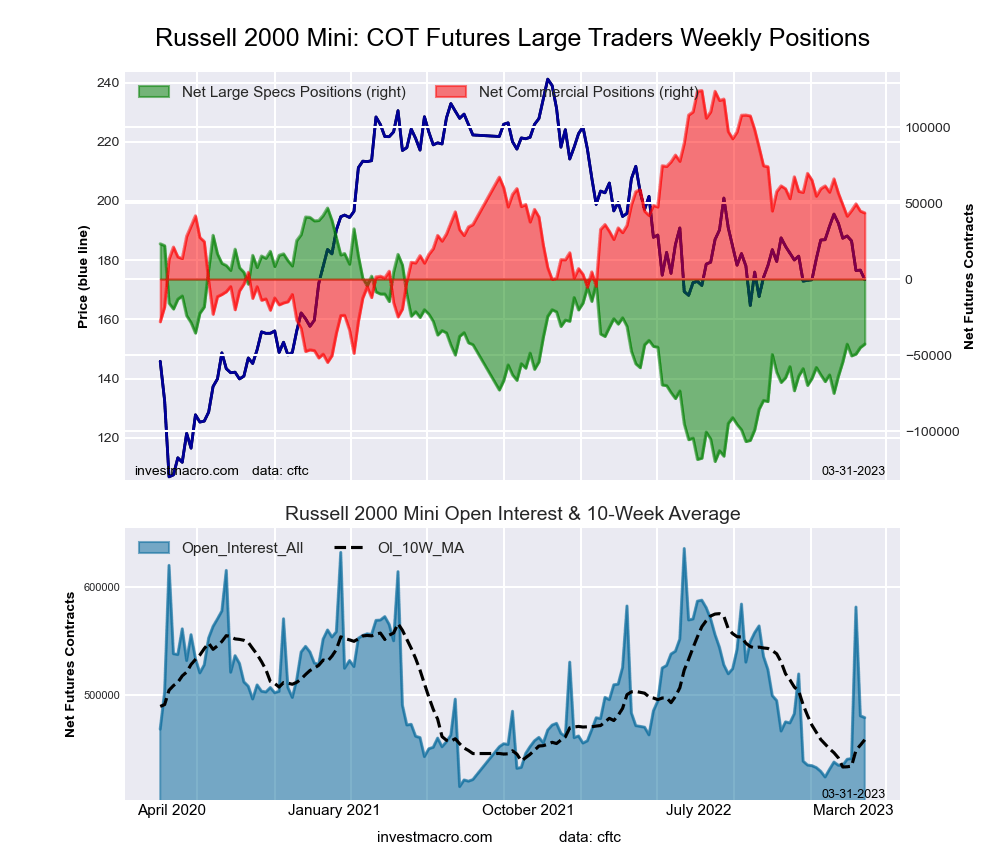
Russell 2000 Mini Futures COT ChartThe Russell 2000 Mini large speculator standing reached a net position of -54,548 contracts in the data reported through Tuesday February 21st. This was a weekly rise of 9,360 contracts from the previous week which had a total of -63,908 net contracts.

The week’s current strength score (the trader positioning range over the past three years, measured from 0 to 100) shows the speculators are currently Bearish with a score of 39.2 percent. The commercials are Bullish with a score of 58.0 percent and the small traders (not shown in chart) are Bearish with a score of 44.2 percent.

Russell 2000 Mini Futures StatisticsSPECULATORSCOMMERCIALSSMALL TRADERS
– Percent of Open Interest Longs:10.381.75.8
– Percent of Open Interest Shorts:22.970.54.5
– Net Position:-54,54848,8585,690
– Gross Longs:44,927355,13525,214
– Gross Shorts:99,475306,27719,524
– Long to Short Ratio:0.5 to 11.2 to 11.3 to 1
NET POSITION TREND:
– Strength Index Score (3 Year Range Pct):39.258.044.2
– Strength Index Reading (3 Year Range):BearishBullishBearish
NET POSITION MOVEMENT INDEX:
– 6-Week Change in Strength Index:2.1-3.26.5


Nikkei Stock Average (USD) Futures:

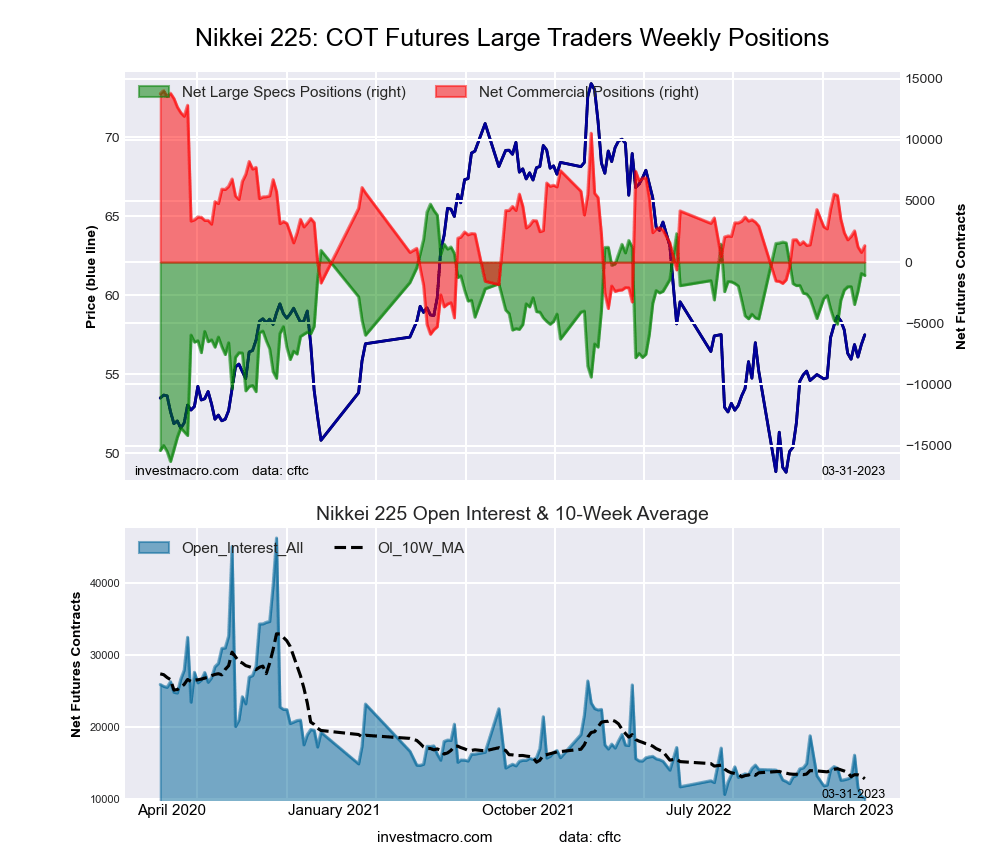
Nikkei Stock Average (USD) Futures COT ChartThe Nikkei Stock Average (USD) large speculator standing the week reached a net position of -2,022 contracts in the data reported through Tuesday February 21st. This was a weekly rise of 260 contracts from the previous week which had a total of -2,282 net contracts.

The week’s current strength score (the trader positioning range over the past three years, measured from 0 to 100) shows the speculators are currently Bullish with a score of 67.9 percent. The commercials are Bearish with a score of 38.8 percent and the small traders (not shown in chart) are Bearish with a score of 30.8 percent.

Nikkei Stock Average Futures StatisticsSPECULATORSCOMMERCIALSSMALL TRADERS
– Percent of Open Interest Longs:25.149.025.9
– Percent of Open Interest Shorts:40.834.824.4
– Net Position:-2,0221,824198
– Gross Longs:3,2256,2963,328
– Gross Shorts:5,2474,4723,130
– Long to Short Ratio:0.6 to 11.4 to 11.1 to 1
NET POSITION TREND:
– Strength Index Score (3 Year Range Pct):67.938.830.8
– Strength Index Reading (3 Year Range):BullishBearishBearish
NET POSITION MOVEMENT INDEX:
– 6-Week Change in Strength Index:3.3-4.52.5


MSCI EAFE Mini Futures:

MSCI EAFE Mini Futures COT ChartThe MSCI EAFE Mini large speculator standing the week reached a net position of -14,968 contracts in the data reported through Tuesday February 21st. This was a weekly gain of 3,092 contracts from the previous week which had a total of -18,060 net contracts.

The week’s current strength score (the trader positioning range over the past three years, measured from 0 to 100) shows the speculators are currently Bearish with a score of 26.0 percent. The commercials are Bullish with a score of 69.2 percent and the small traders (not shown in chart) are Bullish with a score of 56.7 percent.

MSCI EAFE Mini Futures StatisticsSPECULATORSCOMMERCIALSSMALL TRADERS
– Percent of Open Interest Longs:8.188.33.1
– Percent of Open Interest Shorts:11.986.21.5
– Net Position:-14,9688,4606,508
– Gross Longs:32,258350,49612,286
– Gross Shorts:47,226342,0365,778
– Long to Short Ratio:0.7 to 11.0 to 12.1 to 1
NET POSITION TREND:
– Strength Index Score (3 Year Range Pct):26.069.256.7
– Strength Index Reading (3 Year Range):BearishBullishBullish
NET POSITION MOVEMENT INDEX:
– 6-Week Change in Strength Index:-1.91.80.4


Article By InvestMacroReceive our weekly COT Newsletter

*COT Report: The COT data, released weekly to the public each Friday, is updated through the most recent Tuesday (data is 3 days old) and shows a quick view of how large speculators or non-commercials (for-profit traders) were positioned in the futures markets.

The CFTC categorizes trader positions according to commercial hedgers (traders who use futures contracts for hedging as part of the business), non-commercials (large traders who speculate to realize trading profits) and nonreportable traders (usually small traders/speculators) as well as their open interest (contracts open in the market at time of reporting). See CFTC criteria here.

Soft Commodities COT Charts: February 21st data showed Speculators boosted bets of Cocoa & Lean Hogs

By InvestMacro

Here are the latest charts and statistics for the Commitment of Traders (COT) reports data published by the Commodities Futures Trading Commission (CFTC).

The latest COT data is updated through Tuesday February 21st and shows a quick view of how large traders (for-profit speculators and commercial entities) were positioned in the futures markets.

*** This data is still a few weeks behind the current data because the CFTC up-to-date data has been delayed due to a cybersecurity event that happened in early February to ION Cleared Derivatives (a subsidiary of ION Markets). This hack of ION has created a problem for the large trader positions to be reported and reconciled. The CFTC has back-filled some data over the past few weeks and will get the data back up to date in the coming weeks.

Weekly Speculator Changes led by Cocoa & Lean Hogs

The COT soft commodities markets speculator bets were higher that week as seven out of the eleven softs markets we cover had higher positioning while the other four markets had lower speculator contracts.

Leading the gains for the softs markets was Cocoa (17,227 contracts), Lean Hogs (7,584 contracts) with Coffee (7,266 contracts), Soybean Oil (7,105 contracts), Soybean Meal (3,600 contracts), Live Cattle (3,446 contracts) and Soybeans (1,374 contracts) also showing positive weeks.

The markets with the declines in speculator bets were Corn (-21,689 contracts) with Wheat (-13,364 contracts), Cotton (-14,119 contracts) and Sugar (-5,488 contracts) also registering lower bets on the week.


Data Snapshot of Commodity Market Traders | Columns Legend
Feb-21-2023OIOI-IndexSpec-NetSpec-IndexCom-NetCOM-IndexSmalls-NetSmalls-Index
WTI Crude1,756,02932219,6714-241,2979621,62635
Gold422,6480107,10121-129,3557722,25436
Silver123,90639,90232-23,0506613,14839
Copper219,205582,04935-8,510626,46163
Palladium11,94384-5,18805,552100-36420
Platinum67,499582,90522-8,394765,48942
Natural Gas1,270,68663-179,26417141,5158237,74969
Brent150,90712-39,9003336,847653,05351
Heating Oil259,5582017,56567-26,091458,52628
Soybeans731,52934193,26067-150,14145-43,1190
Corn1,340,32220283,02366-209,63542-73,3886
Coffee196,128912,31640-14,198621,88226
Sugar926,55353233,33874-277,7422344,40463
Wheat359,36042-47,488147,55297-64100


Strength Scores were led by Soybean Meal & Live Cattle

COT Strength Scores (a normalized measure of Speculator positions over a 3-Year range, from 0 to 100 where above 80 is Extreme-Bullish and below 20 is Extreme-Bearish) showed that Soybean Meal (100 percent) and Live Cattle (100 percent) led the softs markets on February 21st. Sugar (74 percent), Cocoa (69 percent) and Soybeans (67 percent) come in as the next highest in the weekly strength scores.

On the downside, Wheat (1 percent), Cotton (5 percent) and Lean Hogs (10 percent) came in at the lowest strength levels and are in Extreme-Bearish territory (below 20 percent). The next lowest strength score was Soybean Oil (28 percent).

Strength Statistics:
Corn (66.2 percent) vs Corn previous week (69.0 percent)
Sugar (74.2 percent) vs Sugar previous week (76.0 percent)
Coffee (40.1 percent) vs Coffee previous week (32.6 percent)
Soybeans (67.2 percent) vs Soybeans previous week (66.7 percent)
Soybean Oil (27.8 percent) vs Soybean Oil previous week (23.0 percent)
Soybean Meal (100.0 percent) vs Soybean Meal previous week (98.1 percent)
Live Cattle (100.0 percent) vs Live Cattle previous week (96.1 percent)
Lean Hogs (10.2 percent) vs Lean Hogs previous week (2.0 percent)
Cotton (5.0 percent) vs Cotton previous week (15.8 percent)
Cocoa (69.4 percent) vs Cocoa previous week (50.4 percent)
Wheat (0.9 percent) vs Wheat previous week (14.9 percent)


Coffee & Live Cattle topped the 6-Week Strength Trends

COT Strength Score Trends (or move index, calculates the 6-week changes in strength scores) showed that Coffee (28 percent) and Live Cattle (28 percent) led the past six weeks trends for soft commodities. Cocoa (21 percent), Soybeans (20 percent) and Sugar (16 percent) were the next highest positive movers in the latest trends data.

Lean Hogs (-26 percent) led the downside trend scores that week with Soybean Oil (-18 percent), Cotton (-16 percent) and Wheat (-8 percent) following next with lower trend scores.

Strength Trend Statistics:
Corn (6.3 percent) vs Corn previous week (4.8 percent)
Sugar (15.7 percent) vs Sugar previous week (3.6 percent)
Coffee (27.7 percent) vs Coffee previous week (6.0 percent)
Soybeans (19.6 percent) vs Soybeans previous week (16.0 percent)
Soybean Oil (-17.8 percent) vs Soybean Oil previous week (-28.6 percent)
Soybean Meal (9.6 percent) vs Soybean Meal previous week (8.3 percent)
Live Cattle (27.6 percent) vs Live Cattle previous week (34.5 percent)
Lean Hogs (-25.8 percent) vs Lean Hogs previous week (-53.0 percent)
Cotton (-16.0 percent) vs Cotton previous week (-4.1 percent)
Cocoa (20.7 percent) vs Cocoa previous week (1.1 percent)
Wheat (-8.2 percent) vs Wheat previous week (-1.9 percent)


Individual Soft Commodities Markets:

CORN Futures:

CORN Futures COT ChartThe CORN large speculator standing equaled a net position of 283,023 contracts in the data reported through Tuesday February 21st. This was a weekly decrease of -21,689 contracts from the previous week which had a total of 304,712 net contracts.

The week’s current strength score (the trader positioning range over the past three years, measured from 0 to 100) shows the speculators are currently Bullish with a score of 66.2 percent. The commercials are Bearish with a score of 42.0 percent and the small traders (not shown in chart) are Bearish-Extreme with a score of 5.6 percent.

CORN Futures StatisticsSPECULATORSCOMMERCIALSSMALL TRADERS
– Percent of Open Interest Longs:30.941.98.5
– Percent of Open Interest Shorts:9.857.514.0
– Net Position:283,023-209,635-73,388
– Gross Longs:414,502561,129114,376
– Gross Shorts:131,479770,764187,764
– Long to Short Ratio:3.2 to 10.7 to 10.6 to 1
NET POSITION TREND:
– Strength Index Score (3 Year Range Pct):66.242.05.6
– Strength Index Reading (3 Year Range):BullishBearishBearish-Extreme
NET POSITION MOVEMENT INDEX:
– 6-Week Change in Strength Index:6.3-3.8-16.1


SUGAR Futures:

SUGAR Futures COT ChartThe SUGAR large speculator standing equaled a net position of 233,338 contracts in the data reported through Tuesday February 21st. This was a weekly fall of -5,488 contracts from the previous week which had a total of 238,826 net contracts.

The week’s current strength score (the trader positioning range over the past three years, measured from 0 to 100) shows the speculators are currently Bullish with a score of 74.2 percent. The commercials are Bearish with a score of 23.5 percent and the small traders (not shown in chart) are Bullish with a score of 62.8 percent.

SUGAR Futures StatisticsSPECULATORSCOMMERCIALSSMALL TRADERS
– Percent of Open Interest Longs:34.339.510.3
– Percent of Open Interest Shorts:9.169.55.6
– Net Position:233,338-277,74244,404
– Gross Longs:317,876366,00195,884
– Gross Shorts:84,538643,74351,480
– Long to Short Ratio:3.8 to 10.6 to 11.9 to 1
NET POSITION TREND:
– Strength Index Score (3 Year Range Pct):74.223.562.8
– Strength Index Reading (3 Year Range):BullishBearishBullish
NET POSITION MOVEMENT INDEX:
– 6-Week Change in Strength Index:15.7-13.0-0.5


COFFEE Futures:

COFFEE Futures COT ChartThe COFFEE large speculator standing the week equaled a net position of 12,316 contracts in the data reported through Tuesday February 21st. This was a weekly rise of 7,266 contracts from the previous week which had a total of 5,050 net contracts.

The week’s current strength score (the trader positioning range over the past three years, measured from 0 to 100) shows the speculators are currently Bearish with a score of 40.1 percent. The commercials are Bullish with a score of 61.8 percent and the small traders (not shown in chart) are Bearish with a score of 25.6 percent.

COFFEE Futures StatisticsSPECULATORSCOMMERCIALSSMALL TRADERS
– Percent of Open Interest Longs:22.546.25.1
– Percent of Open Interest Shorts:16.253.54.1
– Net Position:12,316-14,1981,882
– Gross Longs:44,12290,64010,018
– Gross Shorts:31,806104,8388,136
– Long to Short Ratio:1.4 to 10.9 to 11.2 to 1
NET POSITION TREND:
– Strength Index Score (3 Year Range Pct):40.161.825.6
– Strength Index Reading (3 Year Range):BearishBullishBearish
NET POSITION MOVEMENT INDEX:
– 6-Week Change in Strength Index:27.7-25.4-21.6


SOYBEANS Futures:

SOYBEANS Futures COT ChartThe SOYBEANS large speculator standing the week equaled a net position of 193,260 contracts in the data reported through Tuesday February 21st. This was a weekly rise of 1,374 contracts from the previous week which had a total of 191,886 net contracts.

The week’s current strength score (the trader positioning range over the past three years, measured from 0 to 100) shows the speculators are currently Bullish with a score of 67.2 percent. The commercials are Bearish with a score of 44.9 percent and the small traders (not shown in chart) are Bearish-Extreme with a score of 0.0 percent.

SOYBEANS Futures StatisticsSPECULATORSCOMMERCIALSSMALL TRADERS
– Percent of Open Interest Longs:32.845.26.5
– Percent of Open Interest Shorts:6.365.712.4
– Net Position:193,260-150,141-43,119
– Gross Longs:239,615330,71947,851
– Gross Shorts:46,355480,86090,970
– Long to Short Ratio:5.2 to 10.7 to 10.5 to 1
NET POSITION TREND:
– Strength Index Score (3 Year Range Pct):67.244.90.0
– Strength Index Reading (3 Year Range):BullishBearishBearish-Extreme
NET POSITION MOVEMENT INDEX:
– 6-Week Change in Strength Index:19.6-15.9-11.6


SOYBEAN OIL Futures:

SOYBEAN OIL Futures COT ChartThe SOYBEAN OIL large speculator standing the week equaled a net position of 36,282 contracts in the data reported through Tuesday February 21st. This was a weekly boost of 7,105 contracts from the previous week which had a total of 29,177 net contracts.

The week’s current strength score (the trader positioning range over the past three years, measured from 0 to 100) shows the speculators are currently Bearish with a score of 27.8 percent. The commercials are Bullish with a score of 70.7 percent and the small traders (not shown in chart) are Bullish with a score of 53.0 percent.

SOYBEAN OIL Futures StatisticsSPECULATORSCOMMERCIALSSMALL TRADERS
– Percent of Open Interest Longs:18.952.87.5
– Percent of Open Interest Shorts:10.963.15.2
– Net Position:36,282-46,88710,605
– Gross Longs:86,110240,46134,271
– Gross Shorts:49,828287,34823,666
– Long to Short Ratio:1.7 to 10.8 to 11.4 to 1
NET POSITION TREND:
– Strength Index Score (3 Year Range Pct):27.870.753.0
– Strength Index Reading (3 Year Range):BearishBullishBullish
NET POSITION MOVEMENT INDEX:
– 6-Week Change in Strength Index:-17.815.45.0


SOYBEAN MEAL Futures:

SOYBEAN MEAL Futures COT ChartThe SOYBEAN MEAL large speculator standing the week equaled a net position of 175,951 contracts in the data reported through Tuesday February 21st. This was a weekly rise of 3,600 contracts from the previous week which had a total of 172,351 net contracts.

The week’s current strength score (the trader positioning range over the past three years, measured from 0 to 100) shows the speculators are currently Bullish-Extreme with a score of 100.0 percent. The commercials are Bearish-Extreme with a score of 0.0 percent and the small traders (not shown in chart) are Bearish-Extreme with a score of 14.7 percent.

SOYBEAN MEAL Futures StatisticsSPECULATORSCOMMERCIALSSMALL TRADERS
– Percent of Open Interest Longs:41.533.810.5
– Percent of Open Interest Shorts:3.175.67.0
– Net Position:175,951-191,70815,757
– Gross Longs:190,333154,81748,064
– Gross Shorts:14,382346,52532,307
– Long to Short Ratio:13.2 to 10.4 to 11.5 to 1
NET POSITION TREND:
– Strength Index Score (3 Year Range Pct):100.00.014.7
– Strength Index Reading (3 Year Range):Bullish-ExtremeBearish-ExtremeBearish-Extreme
NET POSITION MOVEMENT INDEX:
– 6-Week Change in Strength Index:9.6-6.0-36.7


LIVE CATTLE Futures:

LIVE CATTLE Futures COT ChartThe LIVE CATTLE large speculator standing the week equaled a net position of 104,274 contracts in the data reported through Tuesday February 21st. This was a weekly lift of 3,446 contracts from the previous week which had a total of 100,828 net contracts.

The week’s current strength score (the trader positioning range over the past three years, measured from 0 to 100) shows the speculators are currently Bullish-Extreme with a score of 100.0 percent. The commercials are Bearish-Extreme with a score of 0.0 percent and the small traders (not shown in chart) are Bearish with a score of 38.8 percent.

LIVE CATTLE Futures StatisticsSPECULATORSCOMMERCIALSSMALL TRADERS
– Percent of Open Interest Longs:45.023.310.4
– Percent of Open Interest Shorts:14.051.613.1
– Net Position:104,274-95,188-9,086
– Gross Longs:151,31078,36835,012
– Gross Shorts:47,036173,55644,098
– Long to Short Ratio:3.2 to 10.5 to 10.8 to 1
NET POSITION TREND:
– Strength Index Score (3 Year Range Pct):100.00.038.8
– Strength Index Reading (3 Year Range):Bullish-ExtremeBearish-ExtremeBearish
NET POSITION MOVEMENT INDEX:
– 6-Week Change in Strength Index:27.6-26.0-11.4


LEAN HOGS Futures:

LEAN HOGS Futures COT ChartThe LEAN HOGS large speculator standing the week equaled a net position of 1,704 contracts in the data reported through Tuesday February 21st. This was a weekly boost of 7,584 contracts from the previous week which had a total of -5,880 net contracts.

The week’s current strength score (the trader positioning range over the past three years, measured from 0 to 100) shows the speculators are currently Bearish-Extreme with a score of 10.2 percent. The commercials are Bullish-Extreme with a score of 94.8 percent and the small traders (not shown in chart) are Bullish with a score of 74.0 percent.

LEAN HOGS Futures StatisticsSPECULATORSCOMMERCIALSSMALL TRADERS
– Percent of Open Interest Longs:31.135.110.8
– Percent of Open Interest Shorts:30.333.812.9
– Net Position:1,7042,763-4,467
– Gross Longs:65,67874,07022,814
– Gross Shorts:63,97471,30727,281
– Long to Short Ratio:1.0 to 11.0 to 10.8 to 1
NET POSITION TREND:
– Strength Index Score (3 Year Range Pct):10.294.874.0
– Strength Index Reading (3 Year Range):Bearish-ExtremeBullish-ExtremeBullish
NET POSITION MOVEMENT INDEX:
– 6-Week Change in Strength Index:-25.825.610.2


COTTON Futures:

COTTON Futures COT ChartThe COTTON large speculator standing the week equaled a net position of -2,969 contracts in the data reported through Tuesday February 21st. This was a weekly decrease of -14,119 contracts from the previous week which had a total of 11,150 net contracts.

The week’s current strength score (the trader positioning range over the past three years, measured from 0 to 100) shows the speculators are currently Bearish-Extreme with a score of 5.0 percent. The commercials are Bullish-Extreme with a score of 94.7 percent and the small traders (not shown in chart) are Bearish-Extreme with a score of 13.0 percent.

COTTON Futures StatisticsSPECULATORSCOMMERCIALSSMALL TRADERS
– Percent of Open Interest Longs:27.851.26.6
– Percent of Open Interest Shorts:29.449.96.4
– Net Position:-2,9692,542427
– Gross Longs:51,46094,93812,306
– Gross Shorts:54,42992,39611,879
– Long to Short Ratio:0.9 to 11.0 to 11.0 to 1
NET POSITION TREND:
– Strength Index Score (3 Year Range Pct):5.094.713.0
– Strength Index Reading (3 Year Range):Bearish-ExtremeBullish-ExtremeBearish-Extreme
NET POSITION MOVEMENT INDEX:
– 6-Week Change in Strength Index:-16.015.7-10.1


COCOA Futures:

COCOA Futures COT ChartThe COCOA large speculator standing the week equaled a net position of 46,085 contracts in the data reported through Tuesday February 21st. This was a weekly increase of 17,227 contracts from the previous week which had a total of 28,858 net contracts.

The week’s current strength score (the trader positioning range over the past three years, measured from 0 to 100) shows the speculators are currently Bullish with a score of 69.4 percent. The commercials are Bearish with a score of 27.1 percent and the small traders (not shown in chart) are Bullish with a score of 51.7 percent.

COCOA Futures StatisticsSPECULATORSCOMMERCIALSSMALL TRADERS
– Percent of Open Interest Longs:35.839.94.9
– Percent of Open Interest Shorts:20.257.43.0
– Net Position:46,085-51,5945,509
– Gross Longs:105,772117,96714,353
– Gross Shorts:59,687169,5618,844
– Long to Short Ratio:1.8 to 10.7 to 11.6 to 1
NET POSITION TREND:
– Strength Index Score (3 Year Range Pct):69.427.151.7
– Strength Index Reading (3 Year Range):BullishBearishBullish
NET POSITION MOVEMENT INDEX:
– 6-Week Change in Strength Index:20.7-23.215.4


WHEAT Futures:

WHEAT Futures COT ChartThe WHEAT large speculator standing the week equaled a net position of -47,488 contracts in the data reported through Tuesday February 21st. This was a weekly reduction of -13,364 contracts from the previous week which had a total of -34,124 net contracts.

The week’s current strength score (the trader positioning range over the past three years, measured from 0 to 100) shows the speculators are currently Bearish-Extreme with a score of 0.9 percent. The commercials are Bullish-Extreme with a score of 96.7 percent and the small traders (not shown in chart) are Bullish-Extreme with a score of 100.0 percent.

WHEAT Futures StatisticsSPECULATORSCOMMERCIALSSMALL TRADERS
– Percent of Open Interest Longs:25.739.010.3
– Percent of Open Interest Shorts:38.925.810.3
– Net Position:-47,48847,552-64
– Gross Longs:92,453140,22436,892
– Gross Shorts:139,94192,67236,956
– Long to Short Ratio:0.7 to 11.5 to 11.0 to 1
NET POSITION TREND:
– Strength Index Score (3 Year Range Pct):0.996.7100.0
– Strength Index Reading (3 Year Range):Bearish-ExtremeBullish-ExtremeBullish-Extreme
NET POSITION MOVEMENT INDEX:
– 6-Week Change in Strength Index:-8.24.717.7


Article By InvestMacroReceive our weekly COT Newsletter

*COT Report: The COT data, released weekly to the public each Friday, is updated through the most recent Tuesday (data is 3 days old) and shows a quick view of how large speculators or non-commercials (for-profit traders) were positioned in the futures markets.

The CFTC categorizes trader positions according to commercial hedgers (traders who use futures contracts for hedging as part of the business), non-commercials (large traders who speculate to realize trading profits) and nonreportable traders (usually small traders/speculators) as well as their open interest (contracts open in the market at time of reporting). See CFTC criteria here.

Economic growth doesn’t have to mean ‘more’ – consuming ‘better’ will also protect the planet

By Renaud Foucart, Lancaster University 

Around 30 years ago, many developed countries started a process of absolute decoupling of their emissions of CO₂ and energy use from economic growth. This means keeping emissions stable, or better yet, shrinking them, while still growing the economy.

As a result, GDP is now much higher than it was in 1990 in the UK, France, Germany and the US, but CO2 emissions are lower. This is not just because of the deindustrialisation of the west: emissions decrease even if we include our imports from countries like China.

This trend may be too little too late to avoid the worst consequences of climate change and the destruction of wildlife. But it is a testimony of perhaps the biggest misunderstanding about economics: that growth is a measure of how much an economy produces, rather than an imperfect account of the value of this production.

Emissions versus GDP

Fighting climate change requires a radical transformation of the economy to use less energy and resources. This means it could cause economic growth by making us consume “better”, not more. Putting a monetary value on protecting the Earth means people will pay the true cost of their consumption.

“Better” consumption of goods and services

The things we buy typically become more valuable if the perceived quality of a product increases. And research shows that consumers are willing to pay more if they believe a brand is more valuable, for example, because it is more ethical or environmentally friendly. This is the case for low-carbon energy sources, fairtrade chocolate, organic and local products – and it’s even more the case for people that care about how others see them. So if this means replacing a £1.89 pack of beef burgers with £12 bean and mushroom patties, economic growth will certainly be good for the planet.

The same can be said for the services people spend money on. In fact, as the economy becomes more dependent on services than products, this part of our consumption is even more important to “green”.

This is because much of today’s economic growth is not about measuring the value of the objects we buy. Two-thirds of the world’s GDP is constituted of services, and those are increasingly provided from our own homes as we work remotely. The environmental cost is then almost entirely composed of the energy needed to make the internet work – and there is a way to make that greener.

Sci-fi authors and futurists of the 1960s correctly predicted that we would live in a world of wireless communications, flat-screen TVs and sophisticated kitchen appliances, while fewer foresaw that younger generations would celebrate the return of sleeper trains in Europe. They would probably also be surprised at how many people find love via their phone, using online dating services. The fact that Match.com is worth more than car companies Mitsubishi and Mazda combined shows how our economy is changing towards consumption of services rather than traditional goods.

This does not mean that free markets and technology alone can save the world from climate change. Government intervention is also needed. In fact, one of the oldest and most accepted ideas in economics is the principle that consumers should not only pay for the cost of producing what they buy, but also for its cost to society. This means taxing pollution, the destruction of wildlife, unhealthy food, traffic congestion and the depletion of natural resources, rather than raising the same amount by taxing income.

This could also be a source of economic growth. Research shows taxing pollution generates a “double dividend”: it restores fair competition between polluting and non-polluting products, and it generates tax revenue to invest for everyone’s benefit. If the prohibitive cost of pollution and limited natural resources forces us to innovate, we can actually create value instead of destroying it.

Green policies as the future of growth

In this kind of world, sustained growth for the next century would mean the phasing out of fossil fuels and increased energy efficiency, and largely replacing meat production with plant and lab-based alternatives. But also more value created by services, addressing wellbeing, and creating cleaner air and water, healthier food and safer cities.

Indeed, 15-minute cities are more of an economist’s dream than a socialist utopia. Charging for the true cost of car use by heavily taxing noise and air pollution is textbook introductory economics. Reallocating public land towards humans and public transport saves time for everyone. On the other hand, adding roads simply creates more congestion, while public transport gets more efficient as more people use it. Less time spent in a car means more time for work and leisure.

And when it comes to artificial intelligence, just like machines and robots in the past, it will not kill jobs but give us more time and money to spend on leisure. This is economic growth.

The real challenge for growth is not defying the laws of physics with technology that magically allows us to produce more with the same or fewer resources. It is the ability of our societies to tax polluting activities and regulate the use of land and natural resources, while still being able to redistribute wealth. This is the ability to do better with less.

We also need to work out how to correctly account for everything we value. What is counted under GDP figures has already started to change over time to include things not directly measured by traditional markets.

Making the case for the preservation of nature means being able to put a number on it: taxing social costs but also recording the value of the use of our parks, forests and mountains. If those who care about protecting the environment do not fight to put the highest possible number on nature because they find the idea of valuing it in monetary terms repugnant, someone who does not care will do it.The Conversation

About the Author:

Renaud Foucart, Senior Lecturer in Economics, Lancaster University Management School, Lancaster University

This article is republished from The Conversation under a Creative Commons license. Read the original article.