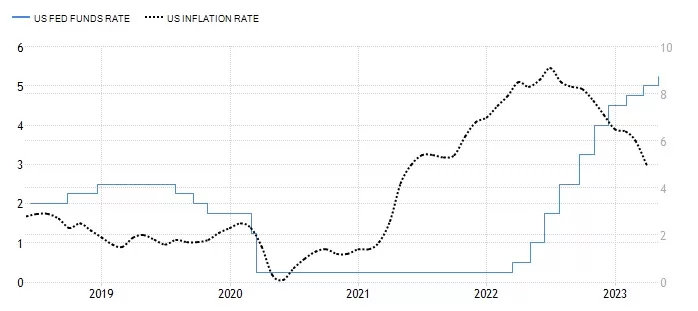
Rising US government bond yields put negative pressure on stock indices

By JustMarkets

At Monday’s close, the Dow Jones Index (US30) increased by 0.30%, and the S&P 500 Index (US500) added 0.33%. The Technology Index NASDAQ (US100) gained 0.28% yesterday. But despite the gains in the indices, sentiment for growth sectors, including technology, was dampened by a jump in Treasury yields amid growing fears of further Federal Reserve rate hikes.

Shares in Charles Schwab (SCHW) rose by almost 4% after the publication of mixed first-quarter results. The company’s profit beat economists’ expectations, but revenue fell short of forecasts. The brokerage also reported a drop in deposits and said it was suspending its share buyback program. Alphabet (GOOGL) shares fell by 2% on reports that Samsung can abandon Google search in favor of Microsoft’s Bing (MSFT) as the default search engine on its devices, threatening around $3 billion in annual revenues. Apple (AAPL) has announced that it will open a savings account for Apple Card users.

Equity markets in Europe traded flat yesterday. German DAX (DE30) decreased by 0.11%, French CAC 40 (FR40) fell by 0.28%, Spanish IBEX 35 (ES35) gained 0.17%, and British FTSE 100 (UK100) closed on Monday with a 0.10% gain.

ECB head Christine Lagarde warned yesterday that changes in the global economy caused by geopolitics pose a challenge to the European Central Bank and its colleagues. A key finding of leading democracies is that there is a need for greater “resilience” in supply chains – so that they are better insulated from risks ranging from war and pandemics to attempts at coercion by authoritarian regimes.

Oil prices were down by 2% yesterday. The US dollar is strengthening along with rising government bond yields, making dollar-denominated oil more expensive for holders of other currencies. Traders are betting that the Fed will raise its lending rate by another quarter percentage point in May and have pushed back expectations of a rate cut until later this year, as it usually does during a slowdown in economic growth. The IEA also warned in its monthly report that production cuts announced by OPEC+ producers could exacerbate the oil supply shortfall expected in the second half of this year and could hurt consumers and the global economic recovery.

Asian markets mostly rallied yesterday. Japan’s Nikkei 225 (JP225) gained 0.07%, China’s FTSE China A50 (CHA50) jumped by 1.90%, Hong Kong’s Hang Seng (HK50) ended the day up by 1.68%, India’s NIFTY 50 (IND50) fell by 0.68%, and Australia’s S&P/ASX 200 (AU200) was positive by 0.27% by Monday’s end. According to analysts, the prospect of higher interest rates from the US does not bode well for Asian markets, given that it limits the amount of foreign liquidity flowing into the region. But given that most Asian central banks have suspended their respective rate hike cycles, Asian indices could find some support in the short term.

China’s economy grew by 4.5% in the latest quarter, helped largely by the lifting of restrictions against COVID. But other economic indicators were mixed. Industrial production in March was worse than forecast for the second month in a row, indicating that the country’s manufacturing sector is still recovering and has not gained momentum. Nevertheless, strong retail sales data showed that China’s consumption-driven economic recovery is largely on track, which is likely to benefit the country’s exporters in the near term.

The RBA’s March monetary policy minutes showed strong reasons to pause and reassess the need for tightening at future meetings. The board had considered a rate hike in April before deciding to pause. But as inflation remains high, further assessment of data on inflation, jobs, consumer spending, and business conditions is needed.

S&P 500 (F) (US500) 4,151.32 +13.68 (+0.33%)

Dow Jones (US30)33,987.18 +100.71 (+0.30%)

DAX (DE40) 15,789.53 −17.97 (−0.11%)

FTSE 100 (UK100) 7,879.51 +7.60  (+0.097%)

USD Index 102.10 +0.55 +0.54%

Important events for today:
  • – Australia RBA Meeting Minutes (m/m) at 04:30 (GMT+3);
  • – China GDP (q/q) at 05:00 (GMT+3);
  • – China Industrial Production (y/y) at 05:00 (GMT+3);
  • – China Unemployment Rate (m/m) at 05:00 (GMT+3);
  • – China Retail Sales (m/m) at 05:00 (GMT+3);
  • – UK Average Earnings Index (m/m) at 09:00 (GMT+3);
  • – UK Claimant Count Change (m/m) at 09:00 (GMT+3);
  • – UK Unemployment Rate (m/m) at 09:00 (GMT+3);
  • – German ZEW Economic Sentiment (m/m) at 12:00 (GMT+3);
  • – Eurozone ZEW Economic Sentiment (m/m) at 12:00 (GMT+3);
  • – Eurozone Trade Balance (m/m) at 12:00 (GMT+3);
  • – US Building Permits (m/m) at 15:30 (GMT+3);
  • – Canada Consumer Price Index (m/m) at 15:30 (GMT+3);
  • – Canada BoC Gov Macklem Speaks at 18:00 (GMT+3);
  • – US FOMC Member Bowman Speaks at 20:00 (GMT+3).

By JustMarkets


This article reflects a personal opinion and should not be interpreted as an investment advice, and/or offer, and/or a persistent request for carrying out financial transactions, and/or a guarantee, and/or a forecast of future events.

Trade Of The Week: Time For The SPX500_m To Breakout?

By ForexTime 

The next few days promise to be volatile for the S&P 500 thanks to fundamental and technical forces.

After bouncing within a range for the past two weeks, the index could be waiting for a fresh catalyst to trigger a major bullish or bearish breakout.

Taking a brief look at the technical picture, prices remain in an uptrend despite the period of consolidation with support at 4070 and resistance at 4160. Although the index is trading comfortably above the 50,100 and 200-day SMA, the Relative Strength Index (RSI) signals that prices are flirting near overbought conditions.

Here are 3 reasons why the SPX500_m could breakout this week…

  1. US earnings season kicks off

It’s that time of the year again!

First quarter earnings season kicked off last week, led by banking giants JPMorgan Chase, Wells Fargo, and Citigroup who all comfortably beat expectations for earnings. Given the recent chaos revolving around the banking sector, these results were certainly a welcome development. Nevertheless, fears about a US recession still loom. This could encourage investors to closely scrutinize pending results from the likes of Charles Schwab, Goldman Sachs, and Bank of America among many others this week. When factoring in how financial stocks account for nearly 13% of the S&P 500, their results are likely to trigger volatility.

This week also see’s the release of Tesla’s Q1 results which are expected to show a decline in earnings due to aggressive price cuts. When considering how Tesla is within the top 10 holdings in the S&P 500 and accounts for roughly 1.43% of the total index, its results could spark some action.

Ultimately, if the earnings impress and boost risk sentiment, this may inspire bulls to breakout above the 4160 resistances. However, a set of disappointing earnings could see the S&P500 slip back towards 4070.

  1. Key US economic data and Fed speeches

There are some key US economic releases and Fed speeches that could influence the S&P 500 this week.

On Monday, Richmond Fed President Thomas Barkin will be under the spotlight after stating last week that policymakers still have a long way to go to tame prices. Later in the week, there will be a host of Fed speeches from other policymakers which may influence the S&P 500.

All eyes will be on the Fed Beige Book on Wednesday. If the Beige Book suggests that US economic conditions may be deteriorating, this may prompt the Fed to switch into lower gear on rate hikes. Alternatively, if the Beige Book reiterates its previous release by suggesting that the US economy remains resilient, this hawkish development may enforce pressure on the S&P 500. Attention will also be directed on the US weekly initial jobless claims and US PMI figures for April at the end of the week.

The SPX500_m may find itself under renewed pressure if US economic data beat expectations, the Fed Beige book suggests that the US economy remains on a firm footing and policymakers strike an overall hawkish tone. Alternatively, SPX500_m bulls could attack if US data disappoints, policymakers sound cautious and the Fed Beige book adds to the overall caution.

  1. Technicals are pointing to potential SPX500_m breakout

As highlighted earlier, the SPX500_m could be gearing for a major breakout on the daily timeframe. Although the overall trend looks to be bullish, it may take a potent fundamental spark to conquer the 4160 resistance which was last tested in February 2023. A solid breakout above this point could encourage an incline towards 4200 and levels not seen since August 2022 around 4315. Alternatively, should 4160 prove to be a tough nut to crack, this may open the doors back toward 4070 and 4035 – where the 50-say SMA resides.


Forex-Time-LogoArticle by ForexTime

ForexTime Ltd (FXTM) is an award winning international online forex broker regulated by CySEC 185/12 www.forextime.com

Reports from major banks give investors optimism about the stock market

By JustMarkets 

At the close of the stock market on Friday, Dow Jones Index (US30) decreased by 0.42% (+1.38% for the week), while S&P 500 (US500) lost 0.21% (+1.28% for the week). The NASDAQ Technology Index (US100) fell by 0.35% on Friday (+1.24% for the week).

Short-term inflation expectations in the US jumped to a nearly two-year high at the start of April on the back of higher gas prices, but consumer sentiment did rise. These patterns show that consumers are fully aware that inflation is down from its peak, but high prices still make them feel less financially secure. Despite the minutes of the central bank’s March meeting acknowledging an increased risk of recession later this year, most investors are betting that the Fed will still raise rates by another 25 basis points at its next policy meeting on May 3rd.

The big Wall Street banks started the quarterly reporting season with better-than-expected results. JPMorgan Chase & Co (JPM) jumped +7% after it reported first-quarter results that beat analysts’ top and bottom line estimates. Citigroup Inc (C) and Wells Fargo & Company (WFC) also reported better-than-expected results. The first-quarter reporting season is heating up, and results from Goldman Sachs (GS), Morgan Stanley (MS), and Bank of America (BAC), as well as Netflix (NFLX), Tesla (TSLA), IBM (IBM) and Johnson & Johnson (JNJ), are expected in this week. According to Refinitiv, analysts expect S&P 500 earnings to fall by -4.8% in the first quarter compared with the same period last year.

Equity markets in Europe rose on Friday. The German DAX (DE30) gained 0.50% (+2.61% for the week), the French CAC 40 (FR40) added 0.52% on Friday (+2.61% for the week), the Spanish IBEX 35 index (ES35) increased by 0.33% (+0.95% for the week), the British FTSE 100 (UK100) closed Friday up by 0.36% (+2.73% for the week).

ECB Governing Council spokesman Mario Centeno, who is Portugal’s central bank governor, said on Friday that a quarter-point interest rate hike is the maximum that the European Central Bank should announce at its next meeting. Beyond that, either a pause or a slowdown in the pace of increases is possible. François Villrois de Galleau from the Governing Council of the European Central Bank of France reiterated his view that the cycle of aggressive interest rate rises is coming to an end. But their comments contradict the other ECB officials who are still considering a fourth consecutive 0.5% hike to combat core inflation. The core CPI, in contrast to the overall figure, continues to rise slowly.

The dollar index jumped sharply on Friday as FOMC member Christopher Waller, one of the biggest hawks, said he wanted further monetary policy tightening, despite evidence that inflation in the United States has steadily declined from the highs of recent months. The rise in the dollar has led to a rise in government bond yields. Gold is known to have an inverse correlation to government bond yields, so there has been a collapse in the price of the yellow metal. In the short-term, gold could remain very volatile. But the medium-term outlook points to a renewed historical high.

Oil markets are rising for the fourth week in a row thanks to higher demand forecasts by the IEA global energy agency for 2023. But crude oil prices lost much of Friday’s upward momentum after Fed Chief Waller spoke out in favor of further rate hikes.

Asian markets mostly rallied last week. Japan’s Nikkei 225 (JP225) gained 3.02%, China’s FTSE China A50 (CHA50) declined by 1.06%, Hong Kong’s Hang Seng (HK50) added 1.45%, India’s NIFTY 50 (IND50) jumped by 1.68%, and Australia’s S&P/ASX 200 (AU200) was positive by 1.72%.

The People’s Bank of China kept its medium-term lending rate at 2.75%, keeping monetary policy stable ahead of the key first-quarter GDP figure due to be released on Tuesday.

In the commodities market, futures on coffee (+13.17%), WTI oil (+9.26%), lumber (+9.09%), sugar (+8.45%), Brent oil (+8.44%), gasoline (+5.74%), platinum (+5.52%), silver (+5.42%), orange juice (+2.5%) and palladium (+2.45%) showed the biggest gains last week. Futures on natural gas (-4.96%) and cocoa (-1.5%) showed the biggest drop.

S&P 500 (F) (US500) 4,137.64 −8.58 (−0.21%)

Dow Jones (US30)33,886.47 −143.22 (−0.42%)

DAX (DE40) 15,807.50 +78.04 (+0.50%)

FTSE 100 (UK100) 7,871.91 +28.53 (+0.36%)

USD Index 101.58 +0.57 +0.56%

Important events for today:
  • – Italian Consumer Price Index (m/m) at 15:30 (GMT+3);
  • – US NY Empire State Manufacturing Index (m/m) at 15:30 (GMT+3);
  • – Canada Wholesale Sales (m/m) at 15:30 (GMT+3);
  • – Eurozone ECB President Lagarde Speaks at 18:00 (GMT+3).

By JustMarkets


This article reflects a personal opinion and should not be interpreted as an investment advice, and/or offer, and/or a persistent request for carrying out financial transactions, and/or a guarantee, and/or a forecast of future events.

Large Currency Speculators push Euro bullish bets higher to 7-week high

By InvestMacro

Here are the latest charts and statistics for the Commitment of Traders (COT) data published by the Commodities Futures Trading Commission (CFTC).

The latest COT data is updated through Tuesday April 11th and shows a quick view of how large market participants (for-profit speculators and commercial traders) were positioned in the futures markets. All currency positions are in direct relation to the US dollar where, for example, a bet for the euro is a bet that the euro will rise versus the dollar while a bet against the euro will be a bet that the euro will decline versus the dollar.

Weekly Speculator Changes led by Euro & British Pound

The COT currency market speculator bets were lower this week as five out of the eleven currency markets we cover had higher positioning while the other six markets had lower speculator contracts.

Leading the gains for the currency markets was the EuroFX (19,945 contracts) with the British Pound (12,395 contracts), Mexican Peso (2,564 contracts), Canadian Dollar (1,930 contracts) and the Swiss Franc (1,269 contracts) also showing positive weeks.

The currencies seeing declines in speculator bets on the week were the Australian Dollar (-10,704 contracts), the Brazilian Real (-1,058 contracts), the Japanese Yen (-171 contracts), the New Zealand Dollar (-450 contracts), the US Dollar Index (-842 contracts) and Bitcoin (-507 contracts) also registering lower bets on the week.

Euro bullish bets go higher to 7-week high

Highlighting the COT currency’s data this week is the continued strength of the speculator’s positioning for the Euro. Large speculative Euro currency positions jumped this week by over +19,000 net contracts, marking the highest one-week gain since September. This is the third time Euro positions have risen in the past four weeks and places the current net position at the best level in the past seven weeks.

The Euro, overall, has now been in a continuous bullish standing for the past 30 weeks, dating back to September 20th when the net position flipped from bearish to bullish. It was also in September when the Euro exchange rate hit a multi-decade low against the US Dollar. The Euro fell below the parity level for the first time since 2002 and bottomed out near the 0.9600 exchange level in late-September. Since that bottom, the Euro has bounced back above parity and has risen by over 14 percent to close this week above the 1.1030 exchange rate.

Helping the Euro gain ground against the US Dollar has been the interest rate differential. Last year, the rate differential was in favor of the US Dollar as the Federal Reserve hiked consistently and sharply while the European Central Bank (ECB) lagged behind. This year, investor’s are forecasting an end to the Fed’s hiking campaign while the ECB seeks to continue raising their interest rate to further combat inflation and triggering further Euro bullish calls.


Data Snapshot of Forex Market Traders | Columns Legend
Apr-11-2023OIOI-IndexSpec-NetSpec-IndexCom-NetCOM-IndexSmalls-NetSmalls-Index
USD Index33,0763013,26447-15,012521,74836
EUR759,43978163,33881-212,0651948,72757
GBP225,29252-2,39867-5,341307,73973
JPY176,82232-57,2073456,3496385855
CHF38,27229-6,734379,73661-3,00247
CAD164,87540-56,579258,20596-1,62619
AUD159,44157-37,9375047,07054-9,13330
NZD35,80623-4,481412,571531,91074
MXN260,0535960,47794-65,51565,03887
RUB20,93047,54331-7,15069-39324
BRL43,9863112,94552-14,593471,64857
Bitcoin15,97781-1,12257373074930


Strength Scores led by Mexican Peso & EuroFX

COT Strength Scores (a normalized measure of Speculator positions over a 3-Year range, from 0 to 100 where above 80 is Extreme-Bullish and below 20 is Extreme-Bearish) showed that the Mexican Peso (94 percent) and the EuroFX (81 percent) lead the currency markets this week. The British Pound (67 percent), Bitcoin (57 percent) and the Brazilian Real (52 percent) come in as the next highest in the weekly strength scores.

On the downside, the Canadian Dollar (2 percent) comes in at the lowest strength levels currently and is in Extreme-Bearish territory (below 20 percent). The next lowest strength scores are the Japanese Yen (34 percent) and the Swiss Franc (37 percent).

Strength Statistics:
US Dollar Index (47.1 percent) vs US Dollar Index previous week (48.5 percent)
EuroFX (81.3 percent) vs EuroFX previous week (73.7 percent)
British Pound Sterling (67.0 percent) vs British Pound Sterling previous week (56.3 percent)
Japanese Yen (33.6 percent) vs Japanese Yen previous week (33.7 percent)
Swiss Franc (36.8 percent) vs Swiss Franc previous week (33.4 percent)
Canadian Dollar (1.8 percent) vs Canadian Dollar previous week (0.0 percent)
Australian Dollar (49.7 percent) vs Australian Dollar previous week (59.6 percent)
New Zealand Dollar (41.4 percent) vs New Zealand Dollar previous week (42.7 percent)
Mexican Peso (94.4 percent) vs Mexican Peso previous week (92.5 percent)
Brazilian Real (52.3 percent) vs Brazilian Real previous week (53.6 percent)
Bitcoin (57.4 percent) vs Bitcoin previous week (66.2 percent)


Mexican Peso & British Pound top the 6-Week Strength Trends

COT Strength Score Trends (or move index, calculates the 6-week changes in strength scores) showed that the Mexican Peso (72 percent) and the British Pound (18 percent) lead the past six weeks trends for the currencies. The US Dollar Index (2 percent) and the Japanese Yen (1 percent) are the next highest positive movers in the latest trends data.

The New Zealand Dollar (-31 percent) leads the downside trend scores currently with the Brazilian Real (-24 percent), Canadian Dollar (-19 percent) and the Australian Dollar (-13 percent) following next with lower trend scores.

Strength Trend Statistics:
US Dollar Index (2.3 percent) vs US Dollar Index previous week (3.2 percent)
EuroFX (0.4 percent) vs EuroFX previous week (-8.4 percent)
British Pound Sterling (18.3 percent) vs British Pound Sterling previous week (5.7 percent)
Japanese Yen (0.9 percent) vs Japanese Yen previous week (-14.2 percent)
Swiss Franc (-4.8 percent) vs Swiss Franc previous week (-3.9 percent)
Canadian Dollar (-19.1 percent) vs Canadian Dollar previous week (-19.6 percent)
Australian Dollar (-12.8 percent) vs Australian Dollar previous week (-2.3 percent)
New Zealand Dollar (-31.4 percent) vs New Zealand Dollar previous week (-34.7 percent)
Mexican Peso (72.5 percent) vs Mexican Peso previous week (71.8 percent)
Brazilian Real (-24.0 percent) vs Brazilian Real previous week (-21.0 percent)
Bitcoin (-9.1 percent) vs Bitcoin previous week (3.4 percent)


Individual COT Forex Markets:

US Dollar Index Futures:

US Dollar Index Forex Futures COT ChartThe US Dollar Index large speculator standing this week totaled a net position of 13,264 contracts in the data reported through Tuesday. This was a weekly lowering of -842 contracts from the previous week which had a total of 14,106 net contracts.

This week’s current strength score (the trader positioning range over the past three years, measured from 0 to 100) shows the speculators are currently Bearish with a score of 47.1 percent. The commercials are Bullish with a score of 51.9 percent and the small traders (not shown in chart) are Bearish with a score of 35.6 percent.

US DOLLAR INDEX StatisticsSPECULATORSCOMMERCIALSSMALL TRADERS
– Percent of Open Interest Longs:78.93.014.0
– Percent of Open Interest Shorts:38.848.48.7
– Net Position:13,264-15,0121,748
– Gross Longs:26,0901,0064,626
– Gross Shorts:12,82616,0182,878
– Long to Short Ratio:2.0 to 10.1 to 11.6 to 1
NET POSITION TREND:
– Strength Index Score (3 Year Range Pct):47.151.935.6
– Strength Index Reading (3 Year Range):BearishBullishBearish
NET POSITION MOVEMENT INDEX:
– 6-Week Change in Strength Index:2.31.6-26.3


Euro Currency Futures:

Euro Currency Futures COT ChartThe Euro Currency large speculator standing this week totaled a net position of 163,338 contracts in the data reported through Tuesday. This was a weekly boost of 19,945 contracts from the previous week which had a total of 143,393 net contracts.

This week’s current strength score (the trader positioning range over the past three years, measured from 0 to 100) shows the speculators are currently Bullish-Extreme with a score of 81.3 percent. The commercials are Bearish-Extreme with a score of 18.8 percent and the small traders (not shown in chart) are Bullish with a score of 56.7 percent.

EURO Currency StatisticsSPECULATORSCOMMERCIALSSMALL TRADERS
– Percent of Open Interest Longs:32.254.211.8
– Percent of Open Interest Shorts:10.682.15.3
– Net Position:163,338-212,06548,727
– Gross Longs:244,180411,45689,357
– Gross Shorts:80,842623,52140,630
– Long to Short Ratio:3.0 to 10.7 to 12.2 to 1
NET POSITION TREND:
– Strength Index Score (3 Year Range Pct):81.318.856.7
– Strength Index Reading (3 Year Range):Bullish-ExtremeBearish-ExtremeBullish
NET POSITION MOVEMENT INDEX:
– 6-Week Change in Strength Index:0.4-0.1-1.6


British Pound Sterling Futures:

British Pound Sterling Futures COT ChartThe British Pound Sterling large speculator standing this week totaled a net position of -2,398 contracts in the data reported through Tuesday. This was a weekly advance of 12,395 contracts from the previous week which had a total of -14,793 net contracts.

This week’s current strength score (the trader positioning range over the past three years, measured from 0 to 100) shows the speculators are currently Bullish with a score of 67.0 percent. The commercials are Bearish with a score of 30.5 percent and the small traders (not shown in chart) are Bullish with a score of 73.2 percent.

BRITISH POUND StatisticsSPECULATORSCOMMERCIALSSMALL TRADERS
– Percent of Open Interest Longs:24.455.813.9
– Percent of Open Interest Shorts:25.458.110.4
– Net Position:-2,398-5,3417,739
– Gross Longs:54,928125,63431,221
– Gross Shorts:57,326130,97523,482
– Long to Short Ratio:1.0 to 11.0 to 11.3 to 1
NET POSITION TREND:
– Strength Index Score (3 Year Range Pct):67.030.573.2
– Strength Index Reading (3 Year Range):BullishBearishBullish
NET POSITION MOVEMENT INDEX:
– 6-Week Change in Strength Index:18.3-28.440.1


Japanese Yen Futures:

Japanese Yen Forex Futures COT ChartThe Japanese Yen large speculator standing this week totaled a net position of -57,207 contracts in the data reported through Tuesday. This was a weekly fall of -171 contracts from the previous week which had a total of -57,036 net contracts.

This week’s current strength score (the trader positioning range over the past three years, measured from 0 to 100) shows the speculators are currently Bearish with a score of 33.6 percent. The commercials are Bullish with a score of 63.1 percent and the small traders (not shown in chart) are Bullish with a score of 55.2 percent.

JAPANESE YEN StatisticsSPECULATORSCOMMERCIALSSMALL TRADERS
– Percent of Open Interest Longs:6.775.017.2
– Percent of Open Interest Shorts:39.143.116.7
– Net Position:-57,20756,349858
– Gross Longs:11,933132,60430,405
– Gross Shorts:69,14076,25529,547
– Long to Short Ratio:0.2 to 11.7 to 11.0 to 1
NET POSITION TREND:
– Strength Index Score (3 Year Range Pct):33.663.155.2
– Strength Index Reading (3 Year Range):BearishBullishBullish
NET POSITION MOVEMENT INDEX:
– 6-Week Change in Strength Index:0.9-6.925.8


Swiss Franc Futures:

Swiss Franc Forex Futures COT ChartThe Swiss Franc large speculator standing this week totaled a net position of -6,734 contracts in the data reported through Tuesday. This was a weekly increase of 1,269 contracts from the previous week which had a total of -8,003 net contracts.

This week’s current strength score (the trader positioning range over the past three years, measured from 0 to 100) shows the speculators are currently Bearish with a score of 36.8 percent. The commercials are Bullish with a score of 61.0 percent and the small traders (not shown in chart) are Bearish with a score of 47.4 percent.

SWISS FRANC StatisticsSPECULATORSCOMMERCIALSSMALL TRADERS
– Percent of Open Interest Longs:10.952.031.5
– Percent of Open Interest Shorts:28.526.639.3
– Net Position:-6,7349,736-3,002
– Gross Longs:4,15519,92012,050
– Gross Shorts:10,88910,18415,052
– Long to Short Ratio:0.4 to 12.0 to 10.8 to 1
NET POSITION TREND:
– Strength Index Score (3 Year Range Pct):36.861.047.4
– Strength Index Reading (3 Year Range):BearishBullishBearish
NET POSITION MOVEMENT INDEX:
– 6-Week Change in Strength Index:-4.8-9.425.5


Canadian Dollar Futures:

Canadian Dollar Forex Futures COT ChartThe Canadian Dollar large speculator standing this week totaled a net position of -56,579 contracts in the data reported through Tuesday. This was a weekly advance of 1,930 contracts from the previous week which had a total of -58,509 net contracts.

This week’s current strength score (the trader positioning range over the past three years, measured from 0 to 100) shows the speculators are currently Bearish-Extreme with a score of 1.8 percent. The commercials are Bullish-Extreme with a score of 95.8 percent and the small traders (not shown in chart) are Bearish-Extreme with a score of 19.2 percent.

CANADIAN DOLLAR StatisticsSPECULATORSCOMMERCIALSSMALL TRADERS
– Percent of Open Interest Longs:10.370.717.6
– Percent of Open Interest Shorts:44.635.418.6
– Net Position:-56,57958,205-1,626
– Gross Longs:16,914116,53729,091
– Gross Shorts:73,49358,33230,717
– Long to Short Ratio:0.2 to 12.0 to 10.9 to 1
NET POSITION TREND:
– Strength Index Score (3 Year Range Pct):1.895.819.2
– Strength Index Reading (3 Year Range):Bearish-ExtremeBullish-ExtremeBearish-Extreme
NET POSITION MOVEMENT INDEX:
– 6-Week Change in Strength Index:-19.113.41.7


Australian Dollar Futures:

Australian Dollar Forex Futures COT ChartThe Australian Dollar large speculator standing this week totaled a net position of -37,937 contracts in the data reported through Tuesday. This was a weekly lowering of -10,704 contracts from the previous week which had a total of -27,233 net contracts.

This week’s current strength score (the trader positioning range over the past three years, measured from 0 to 100) shows the speculators are currently Bearish with a score of 49.7 percent. The commercials are Bullish with a score of 54.0 percent and the small traders (not shown in chart) are Bearish with a score of 30.2 percent.

AUSTRALIAN DOLLAR StatisticsSPECULATORSCOMMERCIALSSMALL TRADERS
– Percent of Open Interest Longs:28.554.213.5
– Percent of Open Interest Shorts:52.324.719.3
– Net Position:-37,93747,070-9,133
– Gross Longs:45,48186,46821,588
– Gross Shorts:83,41839,39830,721
– Long to Short Ratio:0.5 to 12.2 to 10.7 to 1
NET POSITION TREND:
– Strength Index Score (3 Year Range Pct):49.754.030.2
– Strength Index Reading (3 Year Range):BearishBullishBearish
NET POSITION MOVEMENT INDEX:
– 6-Week Change in Strength Index:-12.813.8-11.5


New Zealand Dollar Futures:

New Zealand Dollar Forex Futures COT ChartThe New Zealand Dollar large speculator standing this week totaled a net position of -4,481 contracts in the data reported through Tuesday. This was a weekly fall of -450 contracts from the previous week which had a total of -4,031 net contracts.

This week’s current strength score (the trader positioning range over the past three years, measured from 0 to 100) shows the speculators are currently Bearish with a score of 41.4 percent. The commercials are Bullish with a score of 52.5 percent and the small traders (not shown in chart) are Bullish with a score of 73.6 percent.

NEW ZEALAND DOLLAR StatisticsSPECULATORSCOMMERCIALSSMALL TRADERS
– Percent of Open Interest Longs:36.649.613.4
– Percent of Open Interest Shorts:49.142.48.1
– Net Position:-4,4812,5711,910
– Gross Longs:13,09717,7584,811
– Gross Shorts:17,57815,1872,901
– Long to Short Ratio:0.7 to 11.2 to 11.7 to 1
NET POSITION TREND:
– Strength Index Score (3 Year Range Pct):41.452.573.6
– Strength Index Reading (3 Year Range):BearishBullishBullish
NET POSITION MOVEMENT INDEX:
– 6-Week Change in Strength Index:-31.420.632.7


Mexican Peso Futures:

Mexican Peso Futures COT ChartThe Mexican Peso large speculator standing this week totaled a net position of 60,477 contracts in the data reported through Tuesday. This was a weekly gain of 2,564 contracts from the previous week which had a total of 57,913 net contracts.

This week’s current strength score (the trader positioning range over the past three years, measured from 0 to 100) shows the speculators are currently Bullish-Extreme with a score of 94.4 percent. The commercials are Bearish-Extreme with a score of 6.5 percent and the small traders (not shown in chart) are Bullish-Extreme with a score of 87.4 percent.

MEXICAN PESO StatisticsSPECULATORSCOMMERCIALSSMALL TRADERS
– Percent of Open Interest Longs:52.444.42.9
– Percent of Open Interest Shorts:29.269.61.0
– Net Position:60,477-65,5155,038
– Gross Longs:136,355115,4997,520
– Gross Shorts:75,878181,0142,482
– Long to Short Ratio:1.8 to 10.6 to 13.0 to 1
NET POSITION TREND:
– Strength Index Score (3 Year Range Pct):94.46.587.4
– Strength Index Reading (3 Year Range):Bullish-ExtremeBearish-ExtremeBullish-Extreme
NET POSITION MOVEMENT INDEX:
– 6-Week Change in Strength Index:72.5-68.3-0.9


Brazilian Real Futures:

Brazil Real Futures COT ChartThe Brazilian Real large speculator standing this week totaled a net position of 12,945 contracts in the data reported through Tuesday. This was a weekly lowering of -1,058 contracts from the previous week which had a total of 14,003 net contracts.

This week’s current strength score (the trader positioning range over the past three years, measured from 0 to 100) shows the speculators are currently Bullish with a score of 52.3 percent. The commercials are Bearish with a score of 46.7 percent and the small traders (not shown in chart) are Bullish with a score of 57.1 percent.

BRAZIL REAL StatisticsSPECULATORSCOMMERCIALSSMALL TRADERS
– Percent of Open Interest Longs:70.020.39.4
– Percent of Open Interest Shorts:40.653.45.6
– Net Position:12,945-14,5931,648
– Gross Longs:30,7958,9164,132
– Gross Shorts:17,85023,5092,484
– Long to Short Ratio:1.7 to 10.4 to 11.7 to 1
NET POSITION TREND:
– Strength Index Score (3 Year Range Pct):52.346.757.1
– Strength Index Reading (3 Year Range):BullishBearishBullish
NET POSITION MOVEMENT INDEX:
– 6-Week Change in Strength Index:-24.023.2-0.0


Bitcoin Futures:

Bitcoin Crypto Futures COT ChartThe Bitcoin large speculator standing this week totaled a net position of -1,122 contracts in the data reported through Tuesday. This was a weekly lowering of -507 contracts from the previous week which had a total of -615 net contracts.

This week’s current strength score (the trader positioning range over the past three years, measured from 0 to 100) shows the speculators are currently Bullish with a score of 57.4 percent. The commercials are Bullish with a score of 75.7 percent and the small traders (not shown in chart) are Bearish with a score of 30.0 percent.

BITCOIN StatisticsSPECULATORSCOMMERCIALSSMALL TRADERS
– Percent of Open Interest Longs:76.55.49.7
– Percent of Open Interest Shorts:83.53.05.0
– Net Position:-1,122373749
– Gross Longs:12,2168571,542
– Gross Shorts:13,338484793
– Long to Short Ratio:0.9 to 11.8 to 11.9 to 1
NET POSITION TREND:
– Strength Index Score (3 Year Range Pct):57.475.730.0
– Strength Index Reading (3 Year Range):BullishBullishBearish
NET POSITION MOVEMENT INDEX:
– 6-Week Change in Strength Index:-9.13.99.9


Article By InvestMacroReceive our weekly COT Newsletter

*COT Report: The COT data, released weekly to the public each Friday, is updated through the most recent Tuesday (data is 3 days old) and shows a quick view of how large speculators or non-commercials (for-profit traders) were positioned in the futures markets.

The CFTC categorizes trader positions according to commercial hedgers (traders who use futures contracts for hedging as part of the business), non-commercials (large traders who speculate to realize trading profits) and nonreportable traders (usually small traders/speculators) as well as their open interest (contracts open in the market at time of reporting). See CFTC criteria here.

COT Bonds Speculators raise 3-Month SOFR bets as Eurodollars are phased out

By InvestMacro

Here are the latest charts and statistics for the Commitment of Traders (COT) reports data published by the Commodities Futures Trading Commission (CFTC).

The latest COT data is updated through Tuesday April 11th and shows a quick view of how large traders (for-profit speculators and commercial hedgers) were positioned in the futures markets.

Weekly Speculator Changes led by SOFR 3-Months & 5-Year Bonds

The COT bond market speculator bets were lower this week as four out of the nine bond markets we cover had higher positioning while the other five markets had lower speculator contracts.

Leading the gains for the bond markets was the SOFR 3-Months (41,837 contracts) with the 5-Year Bonds (19,258 contracts), the Ultra Treasury Bonds (8,480 contracts) and the 2-Year Bonds (5,214 contracts) also showing positive weeks.

The bond markets with declines in speculator bets for the week were the Fed Funds (-20,036 contracts), the 10-Year Bonds (-18,006 contracts), the Eurodollar (-2,166 contracts), the US Treasury Bonds (-2,938 contracts) and the Ultra 10-Year Bonds (-10,494 contracts) also registering lower bets on the week.

SOFR contracts to replace Eurodollar contracts this week

Highlighting the COT bond’s data this week is an important week for the Secured Overnight Financing Rate (3-Months) or SOFR contracts. The SOFR contracts are relatively new on the scene as these futures only started in 2020. The SOFR contracts are in the process of taking the place of the Eurodollar contracts as the Eurodollars are being phased out and this week marks the last week for traders to use the Eurodollars contracts. Going forward, the Eurodollars contracts will be converted into 3-Month SOFRs and we will cease to have a Eurodollars futures contract.

The Eurodollars were the most traded and the highest open interest contract in the futures market for many years because it was a way for investors to express a view on short-term interest rates based on the London Interbank Offered Rate (LIBOR). However, LIBOR was fraught with controversy as it was a survey based on banks and was caught up in a manipulation scandal in 2012. In that scandal, bank participants colluded to move the LIBOR rate higher or lower and use that to their advantage.

The SOFR has taken precedence because it is calculated using actually market data (provided by the NY Fed Bank) instead of survey data. The SOFR data is from the US Dollar Treasury overnight repurchase agreement (REPO) transactions which are essentially loans between banks that are backed and collateralized by Treasury securities.

The SOFR contracts now have the highest open interest levels with these contracts exceeding over 10 million in open interest in March. To read more on the SOFRs and how to imply the SOFR interest rate from the futures contracts, see here.


Data Snapshot of Bond Market Traders | Columns Legend
Apr-11-2023OIOI-IndexSpec-NetSpec-IndexCom-NetCOM-IndexSmalls-NetSmalls-Index
Eurodollar4,630,6510-649,48557801,07341-151,58871
FedFunds1,624,73057-167,27619175,87581-8,59974
2-Year2,531,96968-496,84125460,4137236,42873
Long T-Bond1,179,82352-132,5844169,5083563,07695
10-Year4,275,29384-639,0370622,6618816,37687
5-Year4,446,56697-761,9812722,7029439,27992


Strength Scores led by SOFR 3-Months & Eurodollar

COT Strength Scores (a normalized measure of Speculator positions over a 3-Year range, from 0 to 100 where above 80 is Extreme-Bullish and below 20 is Extreme-Bearish) showed that the SOFR 3-Months (82 percent) and the Eurodollar (57 percent) lead the bond markets this week. The US Treasury Bonds (41 percent) comes in as the next highest in the weekly strength scores.

On the downside, the 10-Year Bonds (0 percent) and the Ultra 10-Year Bonds (1 percent) come in at the lowest strength level currently and are in Extreme-Bearish territory (below 20 percent). The next lowest strength scores were the 5-Year Bonds (2 percent) and the Ultra Treasury Bonds (19 percent).

Strength Statistics:
Fed Funds (19.0 percent) vs Fed Funds previous week (21.4 percent)
2-Year Bond (25.5 percent) vs 2-Year Bond previous week (24.8 percent)
5-Year Bond (2.2 percent) vs 5-Year Bond previous week (0.0 percent)
10-Year Bond (0.0 percent) vs 10-Year Bond previous week (2.2 percent)
Ultra 10-Year Bond (1.2 percent) vs Ultra 10-Year Bond previous week (3.4 percent)
US Treasury Bond (41.4 percent) vs US Treasury Bond previous week (42.4 percent)
Ultra US Treasury Bond (19.0 percent) vs Ultra US Treasury Bond previous week (15.4 percent)
Eurodollar (57.4 percent) vs Eurodollar previous week (57.4 percent)
SOFR 3-Months (81.6 percent) vs SOFR 3-Months previous week (78.2 percent)


SOFR 3-Months & 2-Year Bonds top the 6-Week Strength Trends

COT Strength Score Trends (or move index, calculates the 6-week changes in strength scores) showed that the SOFR 3-Months (54 percent) and the 2-Year Bonds (20 percent) lead the past six weeks trends for bonds. The US Treasury Bonds (14 percent) and the 5-Year Bonds (-12 percent) are the next highest positive movers in the latest trends data.

The 10-Year Bonds (-1 percent) leads the downside trend scores currently with the Fed Funds (0 percent) and the Ultra 10-Year Bonds (1 percent) following next with lower trend scores.

Strength Trend Statistics:
Fed Funds (0.5 percent) vs Fed Funds previous week (-7.1 percent)
2-Year Bond (20.4 percent) vs 2-Year Bond previous week (24.4 percent)
5-Year Bond (-12.4 percent) vs 5-Year Bond previous week (-20.8 percent)
10-Year Bond (-1.4 percent) vs 10-Year Bond previous week (-14.7 percent)
Ultra 10-Year Bond (1.2 percent) vs Ultra 10-Year Bond previous week (-9.8 percent)
US Treasury Bond (14.4 percent) vs US Treasury Bond previous week (8.2 percent)
Ultra US Treasury Bond (9.9 percent) vs Ultra US Treasury Bond previous week (-1.9 percent)
Eurodollar (9.0 percent) vs Eurodollar previous week (9.3 percent)
SOFR 3-Months (54.2 percent) vs SOFR 3-Months previous week (43.9 percent)


Individual Bond Markets:

3-Month Eurodollars Futures:

Eurodollar Bonds Futures COT ChartThe 3-Month Eurodollars large speculator standing this week recorded a net position of -649,485 contracts in the data reported through Tuesday. This was a weekly reduction of -2,166 contracts from the previous week which had a total of -647,319 net contracts.

This week’s current strength score (the trader positioning range over the past three years, measured from 0 to 100) shows the speculators are currently Bullish with a score of 57.4 percent. The commercials are Bearish with a score of 40.7 percent and the small traders (not shown in chart) are Bullish with a score of 71.1 percent.

3-Month Eurodollars StatisticsSPECULATORSCOMMERCIALSSMALL TRADERS
– Percent of Open Interest Longs:6.267.74.5
– Percent of Open Interest Shorts:20.350.47.7
– Net Position:-649,485801,073-151,588
– Gross Longs:288,6503,134,754207,022
– Gross Shorts:938,1352,333,681358,610
– Long to Short Ratio:0.3 to 11.3 to 10.6 to 1
NET POSITION TREND:
– Strength Index Score (3 Year Range Pct):57.440.771.1
– Strength Index Reading (3 Year Range):BullishBearishBullish
NET POSITION MOVEMENT INDEX:
– 6-Week Change in Strength Index:9.0-10.419.5


Secured Overnight Financing Rate (3-Month) Futures:

SOFR 3-Months Bonds Futures COT ChartThe Secured Overnight Financing Rate (3-Month) large speculator standing this week recorded a net position of -159,440 contracts in the data reported through Tuesday. This was a weekly advance of 41,837 contracts from the previous week which had a total of -201,277 net contracts.

This week’s current strength score (the trader positioning range over the past three years, measured from 0 to 100) shows the speculators are currently Bullish-Extreme with a score of 81.6 percent. The commercials are Bearish-Extreme with a score of 18.3 percent and the small traders (not shown in chart) are Bullish-Extreme with a score of 88.0 percent.

SOFR 3-Months StatisticsSPECULATORSCOMMERCIALSSMALL TRADERS
– Percent of Open Interest Longs:20.157.70.5
– Percent of Open Interest Shorts:21.856.00.5
– Net Position:-159,440159,269171
– Gross Longs:1,920,6375,513,37548,102
– Gross Shorts:2,080,0775,354,10647,931
– Long to Short Ratio:0.9 to 11.0 to 11.0 to 1
NET POSITION TREND:
– Strength Index Score (3 Year Range Pct):81.618.388.0
– Strength Index Reading (3 Year Range):Bullish-ExtremeBearish-ExtremeBullish-Extreme
NET POSITION MOVEMENT INDEX:
– 6-Week Change in Strength Index:54.2-55.04.8


30-Day Federal Funds Futures:

Federal Funds 30-Day Bonds Futures COT ChartThe 30-Day Federal Funds large speculator standing this week recorded a net position of -167,276 contracts in the data reported through Tuesday. This was a weekly decline of -20,036 contracts from the previous week which had a total of -147,240 net contracts.

This week’s current strength score (the trader positioning range over the past three years, measured from 0 to 100) shows the speculators are currently Bearish-Extreme with a score of 19.0 percent. The commercials are Bullish-Extreme with a score of 81.2 percent and the small traders (not shown in chart) are Bullish with a score of 74.1 percent.

30-Day Federal Funds StatisticsSPECULATORSCOMMERCIALSSMALL TRADERS
– Percent of Open Interest Longs:2.382.12.4
– Percent of Open Interest Shorts:12.671.32.9
– Net Position:-167,276175,875-8,599
– Gross Longs:37,1001,334,56938,360
– Gross Shorts:204,3761,158,69446,959
– Long to Short Ratio:0.2 to 11.2 to 10.8 to 1
NET POSITION TREND:
– Strength Index Score (3 Year Range Pct):19.081.274.1
– Strength Index Reading (3 Year Range):Bearish-ExtremeBullish-ExtremeBullish
NET POSITION MOVEMENT INDEX:
– 6-Week Change in Strength Index:0.5-1.314.0


2-Year Treasury Note Futures:

2-Year Treasury Bonds Futures COT ChartThe 2-Year Treasury Note large speculator standing this week recorded a net position of -496,841 contracts in the data reported through Tuesday. This was a weekly advance of 5,214 contracts from the previous week which had a total of -502,055 net contracts.

This week’s current strength score (the trader positioning range over the past three years, measured from 0 to 100) shows the speculators are currently Bearish with a score of 25.5 percent. The commercials are Bullish with a score of 72.0 percent and the small traders (not shown in chart) are Bullish with a score of 73.3 percent.

2-Year Treasury Note StatisticsSPECULATORSCOMMERCIALSSMALL TRADERS
– Percent of Open Interest Longs:8.782.38.1
– Percent of Open Interest Shorts:28.464.26.7
– Net Position:-496,841460,41336,428
– Gross Longs:221,1392,084,824205,672
– Gross Shorts:717,9801,624,411169,244
– Long to Short Ratio:0.3 to 11.3 to 11.2 to 1
NET POSITION TREND:
– Strength Index Score (3 Year Range Pct):25.572.073.3
– Strength Index Reading (3 Year Range):BearishBullishBullish
NET POSITION MOVEMENT INDEX:
– 6-Week Change in Strength Index:20.4-25.79.9


5-Year Treasury Note Futures:

5-Year Treasury Bonds Futures COT ChartThe 5-Year Treasury Note large speculator standing this week recorded a net position of -761,981 contracts in the data reported through Tuesday. This was a weekly gain of 19,258 contracts from the previous week which had a total of -781,239 net contracts.

This week’s current strength score (the trader positioning range over the past three years, measured from 0 to 100) shows the speculators are currently Bearish-Extreme with a score of 2.2 percent. The commercials are Bullish-Extreme with a score of 94.0 percent and the small traders (not shown in chart) are Bullish-Extreme with a score of 91.8 percent.

5-Year Treasury Note StatisticsSPECULATORSCOMMERCIALSSMALL TRADERS
– Percent of Open Interest Longs:7.083.48.2
– Percent of Open Interest Shorts:24.267.27.3
– Net Position:-761,981722,70239,279
– Gross Longs:312,0763,708,958365,278
– Gross Shorts:1,074,0572,986,256325,999
– Long to Short Ratio:0.3 to 11.2 to 11.1 to 1
NET POSITION TREND:
– Strength Index Score (3 Year Range Pct):2.294.091.8
– Strength Index Reading (3 Year Range):Bearish-ExtremeBullish-ExtremeBullish-Extreme
NET POSITION MOVEMENT INDEX:
– 6-Week Change in Strength Index:-12.41.925.4


10-Year Treasury Note Futures:

10-Year Treasury Notes Bonds Futures COT ChartThe 10-Year Treasury Note large speculator standing this week recorded a net position of -639,037 contracts in the data reported through Tuesday. This was a weekly reduction of -18,006 contracts from the previous week which had a total of -621,031 net contracts.

This week’s current strength score (the trader positioning range over the past three years, measured from 0 to 100) shows the speculators are currently Bearish-Extreme with a score of 0.0 percent. The commercials are Bullish-Extreme with a score of 88.4 percent and the small traders (not shown in chart) are Bullish-Extreme with a score of 87.4 percent.

10-Year Treasury Note StatisticsSPECULATORSCOMMERCIALSSMALL TRADERS
– Percent of Open Interest Longs:9.879.78.7
– Percent of Open Interest Shorts:24.765.18.3
– Net Position:-639,037622,66116,376
– Gross Longs:418,0803,405,619371,253
– Gross Shorts:1,057,1172,782,958354,877
– Long to Short Ratio:0.4 to 11.2 to 11.0 to 1
NET POSITION TREND:
– Strength Index Score (3 Year Range Pct):0.088.487.4
– Strength Index Reading (3 Year Range):Bearish-ExtremeBullish-ExtremeBullish-Extreme
NET POSITION MOVEMENT INDEX:
– 6-Week Change in Strength Index:-1.4-11.628.9


Ultra 10-Year Notes Futures:

Ultra 10-Year Treasury Notes Bonds Futures COT ChartThe Ultra 10-Year Notes large speculator standing this week recorded a net position of -196,971 contracts in the data reported through Tuesday. This was a weekly fall of -10,494 contracts from the previous week which had a total of -186,477 net contracts.

This week’s current strength score (the trader positioning range over the past three years, measured from 0 to 100) shows the speculators are currently Bearish-Extreme with a score of 1.2 percent. The commercials are Bullish-Extreme with a score of 94.3 percent and the small traders (not shown in chart) are Bullish with a score of 64.4 percent.

Ultra 10-Year Notes StatisticsSPECULATORSCOMMERCIALSSMALL TRADERS
– Percent of Open Interest Longs:7.981.19.7
– Percent of Open Interest Shorts:20.363.414.9
– Net Position:-196,971280,480-83,509
– Gross Longs:126,5171,290,288153,890
– Gross Shorts:323,4881,009,808237,399
– Long to Short Ratio:0.4 to 11.3 to 10.6 to 1
NET POSITION TREND:
– Strength Index Score (3 Year Range Pct):1.294.364.4
– Strength Index Reading (3 Year Range):Bearish-ExtremeBullish-ExtremeBullish
NET POSITION MOVEMENT INDEX:
– 6-Week Change in Strength Index:1.2-4.910.3


US Treasury Bonds Futures:

US Year Treasury Notes Long Bonds Futures COT ChartThe US Treasury Bonds large speculator standing this week recorded a net position of -132,584 contracts in the data reported through Tuesday. This was a weekly decrease of -2,938 contracts from the previous week which had a total of -129,646 net contracts.

This week’s current strength score (the trader positioning range over the past three years, measured from 0 to 100) shows the speculators are currently Bearish with a score of 41.4 percent. The commercials are Bearish with a score of 35.4 percent and the small traders (not shown in chart) are Bullish-Extreme with a score of 95.1 percent.

US Treasury Bonds StatisticsSPECULATORSCOMMERCIALSSMALL TRADERS
– Percent of Open Interest Longs:5.979.014.7
– Percent of Open Interest Shorts:17.273.19.4
– Net Position:-132,58469,50863,076
– Gross Longs:69,855932,461173,415
– Gross Shorts:202,439862,953110,339
– Long to Short Ratio:0.3 to 11.1 to 11.6 to 1
NET POSITION TREND:
– Strength Index Score (3 Year Range Pct):41.435.495.1
– Strength Index Reading (3 Year Range):BearishBearishBullish-Extreme
NET POSITION MOVEMENT INDEX:
– 6-Week Change in Strength Index:14.4-31.332.2


Ultra US Treasury Bonds Futures:

Ultra US Year Treasury Notes Long Bonds Futures COT ChartThe Ultra US Treasury Bonds large speculator standing this week recorded a net position of -399,278 contracts in the data reported through Tuesday. This was a weekly rise of 8,480 contracts from the previous week which had a total of -407,758 net contracts.

This week’s current strength score (the trader positioning range over the past three years, measured from 0 to 100) shows the speculators are currently Bearish-Extreme with a score of 19.0 percent. The commercials are Bullish with a score of 77.2 percent and the small traders (not shown in chart) are Bullish-Extreme with a score of 90.4 percent.

Ultra US Treasury Bonds StatisticsSPECULATORSCOMMERCIALSSMALL TRADERS
– Percent of Open Interest Longs:5.583.011.3
– Percent of Open Interest Shorts:33.858.37.7
– Net Position:-399,278348,66950,609
– Gross Longs:78,0231,172,982159,503
– Gross Shorts:477,301824,313108,894
– Long to Short Ratio:0.2 to 11.4 to 11.5 to 1
NET POSITION TREND:
– Strength Index Score (3 Year Range Pct):19.077.290.4
– Strength Index Reading (3 Year Range):Bearish-ExtremeBullishBullish-Extreme
NET POSITION MOVEMENT INDEX:
– 6-Week Change in Strength Index:9.9-21.821.9


Article By InvestMacroReceive our weekly COT Newsletter

*COT Report: The COT data, released weekly to the public each Friday, is updated through the most recent Tuesday (data is 3 days old) and shows a quick view of how large speculators or non-commercials (for-profit traders) were positioned in the futures markets.

The CFTC categorizes trader positions according to commercial hedgers (traders who use futures contracts for hedging as part of the business), non-commercials (large traders who speculate to realize trading profits) and nonreportable traders (usually small traders/speculators) as well as their open interest (contracts open in the market at time of reporting). See CFTC criteria here.

COT Metals Speculators raise their Silver bets for 5th week to a 10-week high

By InvestMacro

Here are the latest charts and statistics for the Commitment of Traders (COT) data published by the Commodities Futures Trading Commission (CFTC).

The latest COT data is updated through Tuesday April 11th and shows a quick view of how large traders (for-profit speculators and commercial entities) were positioned in the futures markets.

Weekly Speculator Changes led by Silver

The COT metals markets speculator bets were lower this week as just one out of the six metals markets we cover had higher positioning while the other five markets had lower speculator contracts.

Leading the gains for the metals was Silver with a rise of 2,435 contracts this week.

The markets with declines in speculator bets for the week were Gold (-2,471 contracts) with Platinum (-2,090 contracts), Copper (-1,349 contracts), Steel (-970 contracts) and Palladium (-427 contracts) also having lower bets on the week.

Silver speculator bets rise for 5th week to 10-week high

Highlighting the COT metals data this week is the continued bullishness for the Silver speculative positions. The large speculator position in Silver futures climbed this week for a fifth straight week. Silver spec bets have now jumped by a total of +31,500 contracts over the past five weeks. This recent speculator sentiment bump has taken the Silver position from a total of -1,219 contracts on March 14th to a total of +23,718 contracts this week, leveling at the most bullish standing for Silver in ten weeks.

The Silver futures price has continued to enjoy a bullish run and has now increased for five consecutive weeks. The futures price has risen by over 20 percent in these past five weeks and touched the highest level since last April before closing this week at almost $25.50.


Data Snapshot of Commodity Market Traders | Columns Legend
Apr-11-2023OIOI-IndexSpec-NetSpec-IndexCom-NetCOM-IndexSmalls-NetSmalls-Index
Gold476,56725192,74562-216,5484023,80340
Silver142,6992923,71852-36,2555012,53736
Copper209,50150-4,30325-1,217725,52053
Palladium12,29088-7,07307,491100-41817
Platinum60,1154113,33346-18,511555,17837


Strength Scores led by Gold & Steel

COT Strength Scores (a normalized measure of Speculator positions over a 3-Year range, from 0 to 100 where above 80 is Extreme-Bullish and below 20 is Extreme-Bearish) showed that Gold (62 percent) and Steel (58 percent) lead the metals markets this week.

On the downside, Palladium (0.2 percent) comes in at the lowest strength level currently and is in Extreme-Bearish territory (below 20 percent).

Strength Statistics:
Gold (61.9 percent) vs Gold previous week (63.0 percent)
Silver (52.1 percent) vs Silver previous week (48.6 percent)
Copper (24.6 percent) vs Copper previous week (25.8 percent)
Platinum (46.4 percent) vs Platinum previous week (51.2 percent)
Palladium (0.2 percent) vs Palladium previous week (4.2 percent)
Steel (58.4 percent) vs Palladium previous week (61.2 percent)


Gold & Silver top the 6-Week Strength Trends

COT Strength Score Trends (or move index, calculates the 6-week changes in strength scores) showed that Gold (37 percent) and Silver (34 percent) lead the past six weeks trends for metals. Platinum (18.5 percent) is the next highest positive mover in the latest trends data.

Palladium (-10 percent) leads the downside trend scores currently with Steel (-4 percent) as the next market with lower trend scores.

Move Statistics:
Gold (37.0 percent) vs Gold previous week (38.8 percent)
Silver (33.9 percent) vs Silver previous week (16.2 percent)
Copper (1.6 percent) vs Copper previous week (-4.5 percent)
Platinum (18.5 percent) vs Platinum previous week (28.9 percent)
Palladium (-9.7 percent) vs Palladium previous week (-13.5 percent)
Steel (-4.1 percent) vs Steel previous week (0.2 percent)


Individual Markets:

Gold Comex Futures:

Gold Futures COT ChartThe Gold Comex Futures large speculator standing this week resulted in a net position of 192,745 contracts in the data reported through Tuesday. This was a weekly decline of -2,471 contracts from the previous week which had a total of 195,216 net contracts.

This week’s current strength score (the trader positioning range over the past three years, measured from 0 to 100) shows the speculators are currently Bullish with a score of 61.9 percent. The commercials are Bearish with a score of 40.3 percent and the small traders (not shown in chart) are Bearish with a score of 39.6 percent.

Gold Futures StatisticsSPECULATORSCOMMERCIALSSMALL TRADERS
– Percent of Open Interest Longs:54.625.110.3
– Percent of Open Interest Shorts:14.170.65.3
– Net Position:192,745-216,54823,803
– Gross Longs:260,165119,71049,102
– Gross Shorts:67,420336,25825,299
– Long to Short Ratio:3.9 to 10.4 to 11.9 to 1
NET POSITION TREND:
– Strength Index Score (3 Year Range Pct):61.940.339.6
– Strength Index Reading (3 Year Range):BullishBearishBearish
NET POSITION MOVEMENT INDEX:
– 6-Week Change in Strength Index:37.0-34.412.3


Silver Comex Futures:

Silver Futures COT ChartThe Silver Comex Futures large speculator standing this week resulted in a net position of 23,718 contracts in the data reported through Tuesday. This was a weekly advance of 2,435 contracts from the previous week which had a total of 21,283 net contracts.

This week’s current strength score (the trader positioning range over the past three years, measured from 0 to 100) shows the speculators are currently Bullish with a score of 52.1 percent. The commercials are Bearish with a score of 50.0 percent and the small traders (not shown in chart) are Bearish with a score of 36.0 percent.

Silver Futures StatisticsSPECULATORSCOMMERCIALSSMALL TRADERS
– Percent of Open Interest Longs:39.033.417.7
– Percent of Open Interest Shorts:22.358.88.9
– Net Position:23,718-36,25512,537
– Gross Longs:55,58347,62925,218
– Gross Shorts:31,86583,88412,681
– Long to Short Ratio:1.7 to 10.6 to 12.0 to 1
NET POSITION TREND:
– Strength Index Score (3 Year Range Pct):52.150.036.0
– Strength Index Reading (3 Year Range):BullishBearishBearish
NET POSITION MOVEMENT INDEX:
– 6-Week Change in Strength Index:33.9-28.0-3.7


Copper Grade #1 Futures:

Copper Futures COT ChartThe Copper Grade #1 Futures large speculator standing this week resulted in a net position of -4,303 contracts in the data reported through Tuesday. This was a weekly decline of -1,349 contracts from the previous week which had a total of -2,954 net contracts.

This week’s current strength score (the trader positioning range over the past three years, measured from 0 to 100) shows the speculators are currently Bearish with a score of 24.6 percent. The commercials are Bullish with a score of 72.4 percent and the small traders (not shown in chart) are Bullish with a score of 53.3 percent.

Copper Futures StatisticsSPECULATORSCOMMERCIALSSMALL TRADERS
– Percent of Open Interest Longs:26.843.69.0
– Percent of Open Interest Shorts:28.844.26.3
– Net Position:-4,303-1,2175,520
– Gross Longs:56,06391,39918,793
– Gross Shorts:60,36692,61613,273
– Long to Short Ratio:0.9 to 11.0 to 11.4 to 1
NET POSITION TREND:
– Strength Index Score (3 Year Range Pct):24.672.453.3
– Strength Index Reading (3 Year Range):BearishBullishBullish
NET POSITION MOVEMENT INDEX:
– 6-Week Change in Strength Index:1.6-1.0-3.5


Platinum Futures:

Platinum Futures COT ChartThe Platinum Futures large speculator standing this week resulted in a net position of 13,333 contracts in the data reported through Tuesday. This was a weekly lowering of -2,090 contracts from the previous week which had a total of 15,423 net contracts.

This week’s current strength score (the trader positioning range over the past three years, measured from 0 to 100) shows the speculators are currently Bearish with a score of 46.4 percent. The commercials are Bullish with a score of 55.2 percent and the small traders (not shown in chart) are Bearish with a score of 37.4 percent.

Platinum Futures StatisticsSPECULATORSCOMMERCIALSSMALL TRADERS
– Percent of Open Interest Longs:49.234.512.6
– Percent of Open Interest Shorts:27.065.34.0
– Net Position:13,333-18,5115,178
– Gross Longs:29,57020,7687,569
– Gross Shorts:16,23739,2792,391
– Long to Short Ratio:1.8 to 10.5 to 13.2 to 1
NET POSITION TREND:
– Strength Index Score (3 Year Range Pct):46.455.237.4
– Strength Index Reading (3 Year Range):BearishBullishBearish
NET POSITION MOVEMENT INDEX:
– 6-Week Change in Strength Index:18.5-17.98.0


Palladium Futures:

Palladium Futures COT ChartThe Palladium Futures large speculator standing this week resulted in a net position of -7,073 contracts in the data reported through Tuesday. This was a weekly decline of -427 contracts from the previous week which had a total of -6,646 net contracts.

This week’s current strength score (the trader positioning range over the past three years, measured from 0 to 100) shows the speculators are currently Bearish-Extreme with a score of 0.2 percent. The commercials are Bullish-Extreme with a score of 100.0 percent and the small traders (not shown in chart) are Bearish-Extreme with a score of 16.6 percent.

Palladium Futures StatisticsSPECULATORSCOMMERCIALSSMALL TRADERS
– Percent of Open Interest Longs:11.971.710.7
– Percent of Open Interest Shorts:69.510.814.1
– Net Position:-7,0737,491-418
– Gross Longs:1,4638,8141,319
– Gross Shorts:8,5361,3231,737
– Long to Short Ratio:0.2 to 16.7 to 10.8 to 1
NET POSITION TREND:
– Strength Index Score (3 Year Range Pct):0.2100.016.6
– Strength Index Reading (3 Year Range):Bearish-ExtremeBullish-ExtremeBearish-Extreme
NET POSITION MOVEMENT INDEX:
– 6-Week Change in Strength Index:-9.78.24.2


Steel Futures Futures:

Steel Futures COT ChartThe Steel Futures large speculator standing this week resulted in a net position of -5,108 contracts in the data reported through Tuesday. This was a weekly lowering of -970 contracts from the previous week which had a total of -4,138 net contracts.

This week’s current strength score (the trader positioning range over the past three years, measured from 0 to 100) shows the speculators are currently Bullish with a score of 58.4 percent. The commercials are Bearish with a score of 41.4 percent and the small traders (not shown in chart) are Bearish with a score of 39.8 percent.

Steel Futures StatisticsSPECULATORSCOMMERCIALSSMALL TRADERS
– Percent of Open Interest Longs:12.076.41.1
– Percent of Open Interest Shorts:29.859.10.6
– Net Position:-5,1084,951157
– Gross Longs:3,42821,857317
– Gross Shorts:8,53616,906160
– Long to Short Ratio:0.4 to 11.3 to 12.0 to 1
NET POSITION TREND:
– Strength Index Score (3 Year Range Pct):58.441.439.8
– Strength Index Reading (3 Year Range):BullishBearishBearish
NET POSITION MOVEMENT INDEX:
– 6-Week Change in Strength Index:-4.14.4-10.3


Article By InvestMacroReceive our weekly COT Newsletter

*COT Report: The COT data, released weekly to the public each Friday, is updated through the most recent Tuesday (data is 3 days old) and shows a quick view of how large speculators or non-commercials (for-profit traders) were positioned in the futures markets.

The CFTC categorizes trader positions according to commercial hedgers (traders who use futures contracts for hedging as part of the business), non-commercials (large traders who speculate to realize trading profits) and nonreportable traders (usually small traders/speculators) as well as their open interest (contracts open in the market at time of reporting). See CFTC criteria here.

Soft Commodities Speculators boost their Coffee bets to best level in 26-Weeks

By InvestMacro

Here are the latest charts and statistics for the Commitment of Traders (COT) reports data published by the Commodities Futures Trading Commission (CFTC).

The latest COT data is updated through Tuesday April 11th and shows a quick view of how large traders (for-profit speculators and commercial entities) were positioned in the futures markets.

Weekly Speculator Changes led by Corn & Sugar

The COT soft commodities markets speculator bets were higher this week as seven out of the eleven softs markets we cover had higher positioning while the other four markets had lower speculator contracts.

Leading the gains for the softs markets was Corn (17,619 contracts) with Sugar (13,137 contracts), Coffee (12,229 contracts), Live Cattle (8,442 contracts), Cotton (3,464 contracts), Soybean Oil (2,969 contracts) and Soybean Meal (2,810 contracts) also showing positive weeks.

The markets with the declines in speculator bets this week were Wheat (-5,883 contracts) with Lean Hogs (-4,303 contracts), Soybeans (-4,999 contracts) and Cocoa (-332 contracts) also registering lower bets on the week.

Coffee bets rebound to best level in 26-Weeks

Highlighting the COT soft commodities data this week is the rebound in the Coffee speculator’s positioning. The large speculator bets for Coffee jumped this week by over +12,000 contracts after having fallen in the previous two weeks. Coffee’s speculative positioning is showing positive trends again with the net position back in bullish territory for each of the past ten weeks. This follows a streak of thirteen straight weeks of bearish Coffee positions that took place from November 8th to January 31st.

Coffee speculative bets had experienced a strong few years with positions rising strongly in the second half of 2020 and maintaining that momentum through 2021 and most of 2022. The end of 2022 saw the shine fall off the Coffee positions and the Coffee price as well with the Coffee futures price dropping over 35 percent from September to January.

The Coffee price hit a recent bottom in January and has been back on a bullish trend with prices gaining by more than 30 percent since that bottom compared to this week’s close. This week saw the Coffee futures price rise for a second straight week and with a 2-week total gain of over +10 percent.

The speculator’s net position, meanwhile, is now at the most bullish level of the past 26 weeks, dating back to October 11th of 2022.


Data Snapshot of Commodity Market Traders | Columns Legend
Apr-11-2023OIOI-IndexSpec-NetSpec-IndexCom-NetCOM-IndexSmalls-NetSmalls-Index
WTI Crude1,875,14043235,63219-255,4118219,77932
Gold476,56725192,74562-216,5484023,80340
Silver142,6992923,71852-36,2555012,53736
Copper209,50150-4,30325-1,217725,52053
Palladium12,29088-7,07307,491100-41817
Platinum60,1154113,33346-18,511555,17837
Natural Gas1,355,67279-140,89516111,1818429,71451
Brent146,90511-42,6102237,056745,55484
Heating Oil268,008239,69444-30,7705321,07671
Soybeans716,90631179,34660-148,51145-30,83520
Corn1,338,48419103,30943-45,28365-58,02619
Coffee192,988724,87753-25,2415136417
Sugar992,08669259,78883-317,3081257,52079
Wheat391,89961-66,682562,318924,36494


Strength Scores led by Cocoa & Live Cattle

COT Strength Scores (a normalized measure of Speculator positions over a 3-Year range, from 0 to 100 where above 80 is Extreme-Bullish and below 20 is Extreme-Bearish) showed that Cocoa (98 percent), Live Cattle (84 percent) and Sugar (83 percent) lead the softs markets this week are all in Extreme-Bullish levels.  Soybean Meal (68 percent) and Soybeans (60 percent) come in as the next highest in the weekly strength scores.

On the downside, Lean Hogs (0 percent), Soybean Oil (2 percent), Wheat (5 percent) and the Cotton (6 percent) come in at the lowest strength levels currently and are in Extreme-Bearish territory (below 20 percent).

Strength Statistics:
Corn (43.2 percent) vs Corn previous week (41.0 percent)
Sugar (83.3 percent) vs Sugar previous week (78.7 percent)
Coffee (52.9 percent) vs Coffee previous week (40.4 percent)
Soybeans (59.6 percent) vs Soybeans previous week (61.6 percent)
Soybean Oil (2.0 percent) vs Soybean Oil previous week (0.0 percent)
Soybean Meal (68.1 percent) vs Soybean Meal previous week (66.7 percent)
Live Cattle (84.2 percent) vs Live Cattle previous week (74.7 percent)
Lean Hogs (0.0 percent) vs Lean Hogs previous week (3.9 percent)
Cotton (6.2 percent) vs Cotton previous week (3.6 percent)
Cocoa (98.3 percent) vs Cocoa previous week (98.7 percent)
Wheat (5.5 percent) vs Wheat previous week (10.4 percent)


Sugar & Coffee top the 6-Week Strength Trends

COT Strength Score Trends (or move index, calculates the 6-week changes in strength scores) showed that Sugar (12 percent) and Coffee (9 percent) lead the past six weeks trends for soft commodities. Soybeans (8 percent) and Cocoa (6 percent) are the next highest positive movers in the latest trends data.

Soybean Oil (-23 percent) leads the downside trend scores currently with Soybean Meal (-23 percent), Lean Hogs (-18 percent) and Live Cattle (-14 percent) following next with lower trend scores.

Strength Trend Statistics:
Corn (-5.1 percent) vs Corn previous week (-25.2 percent)
Sugar (12.4 percent) vs Sugar previous week (4.6 percent)
Coffee (8.7 percent) vs Coffee previous week (0.3 percent)
Soybeans (8.2 percent) vs Soybeans previous week (-3.5 percent)
Soybean Oil (-22.5 percent) vs Soybean Oil previous week (-30.3 percent)
Soybean Meal (-22.7 percent) vs Soybean Meal previous week (-32.8 percent)
Live Cattle (-14.2 percent) vs Live Cattle previous week (-20.3 percent)
Lean Hogs (-18.4 percent) vs Lean Hogs previous week (-19.6 percent)
Cotton (-3.8 percent) vs Cotton previous week (-2.8 percent)
Cocoa (5.7 percent) vs Cocoa previous week (18.1 percent)
Wheat (0.1 percent) vs Wheat previous week (-11.1 percent)


Individual Soft Commodities Markets:

CORN Futures:

CORN Futures COT ChartThe CORN large speculator standing this week was a net position of 103,309 contracts in the data reported through Tuesday. This was a weekly boost of 17,619 contracts from the previous week which had a total of 85,690 net contracts.

This week’s current strength score (the trader positioning range over the past three years, measured from 0 to 100) shows the speculators are currently Bearish with a score of 43.2 percent. The commercials are Bullish with a score of 65.4 percent and the small traders (not shown in chart) are Bearish-Extreme with a score of 19.0 percent.

CORN Futures StatisticsSPECULATORSCOMMERCIALSSMALL TRADERS
– Percent of Open Interest Longs:25.147.98.6
– Percent of Open Interest Shorts:17.451.313.0
– Net Position:103,309-45,283-58,026
– Gross Longs:336,195640,896115,312
– Gross Shorts:232,886686,179173,338
– Long to Short Ratio:1.4 to 10.9 to 10.7 to 1
NET POSITION TREND:
– Strength Index Score (3 Year Range Pct):43.265.419.0
– Strength Index Reading (3 Year Range):BearishBullishBearish-Extreme
NET POSITION MOVEMENT INDEX:
– 6-Week Change in Strength Index:-5.14.38.0


SUGAR Futures:

SUGAR Futures COT ChartThe SUGAR large speculator standing this week was a net position of 259,788 contracts in the data reported through Tuesday. This was a weekly boost of 13,137 contracts from the previous week which had a total of 246,651 net contracts.

This week’s current strength score (the trader positioning range over the past three years, measured from 0 to 100) shows the speculators are currently Bullish-Extreme with a score of 83.3 percent. The commercials are Bearish-Extreme with a score of 12.1 percent and the small traders (not shown in chart) are Bullish with a score of 79.0 percent.

SUGAR Futures StatisticsSPECULATORSCOMMERCIALSSMALL TRADERS
– Percent of Open Interest Longs:34.439.010.9
– Percent of Open Interest Shorts:8.270.95.1
– Net Position:259,788-317,30857,520
– Gross Longs:341,373386,564108,381
– Gross Shorts:81,585703,87250,861
– Long to Short Ratio:4.2 to 10.5 to 12.1 to 1
NET POSITION TREND:
– Strength Index Score (3 Year Range Pct):83.312.179.0
– Strength Index Reading (3 Year Range):Bullish-ExtremeBearish-ExtremeBullish
NET POSITION MOVEMENT INDEX:
– 6-Week Change in Strength Index:12.4-15.321.4


COFFEE Futures:

COFFEE Futures COT ChartThe COFFEE large speculator standing this week was a net position of 24,877 contracts in the data reported through Tuesday. This was a weekly increase of 12,229 contracts from the previous week which had a total of 12,648 net contracts.

This week’s current strength score (the trader positioning range over the past three years, measured from 0 to 100) shows the speculators are currently Bullish with a score of 52.9 percent. The commercials are Bullish with a score of 50.8 percent and the small traders (not shown in chart) are Bearish-Extreme with a score of 17.0 percent.

COFFEE Futures StatisticsSPECULATORSCOMMERCIALSSMALL TRADERS
– Percent of Open Interest Longs:23.646.34.4
– Percent of Open Interest Shorts:10.759.44.2
– Net Position:24,877-25,241364
– Gross Longs:45,50389,3398,467
– Gross Shorts:20,626114,5808,103
– Long to Short Ratio:2.2 to 10.8 to 11.0 to 1
NET POSITION TREND:
– Strength Index Score (3 Year Range Pct):52.950.817.0
– Strength Index Reading (3 Year Range):BullishBullishBearish-Extreme
NET POSITION MOVEMENT INDEX:
– 6-Week Change in Strength Index:8.7-7.4-12.0


SOYBEANS Futures:

SOYBEANS Futures COT ChartThe SOYBEANS large speculator standing this week was a net position of 179,346 contracts in the data reported through Tuesday. This was a weekly decline of -4,999 contracts from the previous week which had a total of 184,345 net contracts.

This week’s current strength score (the trader positioning range over the past three years, measured from 0 to 100) shows the speculators are currently Bullish with a score of 59.6 percent. The commercials are Bearish with a score of 45.4 percent and the small traders (not shown in chart) are Bearish with a score of 20.4 percent.

SOYBEANS Futures StatisticsSPECULATORSCOMMERCIALSSMALL TRADERS
– Percent of Open Interest Longs:29.944.16.5
– Percent of Open Interest Shorts:4.964.810.8
– Net Position:179,346-148,511-30,835
– Gross Longs:214,620316,23446,749
– Gross Shorts:35,274464,74577,584
– Long to Short Ratio:6.1 to 10.7 to 10.6 to 1
NET POSITION TREND:
– Strength Index Score (3 Year Range Pct):59.645.420.4
– Strength Index Reading (3 Year Range):BullishBearishBearish
NET POSITION MOVEMENT INDEX:
– 6-Week Change in Strength Index:8.2-10.616.1


SOYBEAN OIL Futures:

SOYBEAN OIL Futures COT ChartThe SOYBEAN OIL large speculator standing this week was a net position of -6,356 contracts in the data reported through Tuesday. This was a weekly boost of 2,969 contracts from the previous week which had a total of -9,325 net contracts.

This week’s current strength score (the trader positioning range over the past three years, measured from 0 to 100) shows the speculators are currently Bearish-Extreme with a score of 2.0 percent. The commercials are Bullish-Extreme with a score of 98.1 percent and the small traders (not shown in chart) are Bearish-Extreme with a score of 1.1 percent.

SOYBEAN OIL Futures StatisticsSPECULATORSCOMMERCIALSSMALL TRADERS
– Percent of Open Interest Longs:14.858.76.4
– Percent of Open Interest Shorts:16.157.06.7
– Net Position:-6,3568,180-1,824
– Gross Longs:71,655284,39230,877
– Gross Shorts:78,011276,21232,701
– Long to Short Ratio:0.9 to 11.0 to 10.9 to 1
NET POSITION TREND:
– Strength Index Score (3 Year Range Pct):2.098.11.1
– Strength Index Reading (3 Year Range):Bearish-ExtremeBullish-ExtremeBearish-Extreme
NET POSITION MOVEMENT INDEX:
– 6-Week Change in Strength Index:-22.524.9-33.9


SOYBEAN MEAL Futures:

SOYBEAN MEAL Futures COT ChartThe SOYBEAN MEAL large speculator standing this week was a net position of 115,912 contracts in the data reported through Tuesday. This was a weekly lift of 2,810 contracts from the previous week which had a total of 113,102 net contracts.

This week’s current strength score (the trader positioning range over the past three years, measured from 0 to 100) shows the speculators are currently Bullish with a score of 68.1 percent. The commercials are Bearish with a score of 32.6 percent and the small traders (not shown in chart) are Bearish with a score of 29.4 percent.

SOYBEAN MEAL Futures StatisticsSPECULATORSCOMMERCIALSSMALL TRADERS
– Percent of Open Interest Longs:31.438.211.1
– Percent of Open Interest Shorts:4.868.96.9
– Net Position:115,912-134,05218,140
– Gross Longs:136,621166,24648,190
– Gross Shorts:20,709300,29830,050
– Long to Short Ratio:6.6 to 10.6 to 11.6 to 1
NET POSITION TREND:
– Strength Index Score (3 Year Range Pct):68.132.629.4
– Strength Index Reading (3 Year Range):BullishBearishBearish
NET POSITION MOVEMENT INDEX:
– 6-Week Change in Strength Index:-22.719.729.4


LIVE CATTLE Futures:

LIVE CATTLE Futures COT ChartThe LIVE CATTLE large speculator standing this week was a net position of 94,616 contracts in the data reported through Tuesday. This was a weekly gain of 8,442 contracts from the previous week which had a total of 86,174 net contracts.

This week’s current strength score (the trader positioning range over the past three years, measured from 0 to 100) shows the speculators are currently Bullish-Extreme with a score of 84.2 percent. The commercials are Bearish-Extreme with a score of 14.8 percent and the small traders (not shown in chart) are Bullish with a score of 51.1 percent.

LIVE CATTLE Futures StatisticsSPECULATORSCOMMERCIALSSMALL TRADERS
– Percent of Open Interest Longs:43.126.410.5
– Percent of Open Interest Shorts:14.952.612.5
– Net Position:94,616-87,749-6,867
– Gross Longs:144,36288,30135,140
– Gross Shorts:49,746176,05042,007
– Long to Short Ratio:2.9 to 10.5 to 10.8 to 1
NET POSITION TREND:
– Strength Index Score (3 Year Range Pct):84.214.851.1
– Strength Index Reading (3 Year Range):Bullish-ExtremeBearish-ExtremeBullish
NET POSITION MOVEMENT INDEX:
– 6-Week Change in Strength Index:-14.213.68.3


LEAN HOGS Futures:

LEAN HOGS Futures COT ChartThe LEAN HOGS large speculator standing this week was a net position of -24,092 contracts in the data reported through Tuesday. This was a weekly fall of -4,303 contracts from the previous week which had a total of -19,789 net contracts.

This week’s current strength score (the trader positioning range over the past three years, measured from 0 to 100) shows the speculators are currently Bearish-Extreme with a score of 0.0 percent. The commercials are Bullish-Extreme with a score of 99.6 percent and the small traders (not shown in chart) are Bullish-Extreme with a score of 100.0 percent.

LEAN HOGS Futures StatisticsSPECULATORSCOMMERCIALSSMALL TRADERS
– Percent of Open Interest Longs:28.536.212.2
– Percent of Open Interest Shorts:39.026.711.2
– Net Position:-24,09221,6232,469
– Gross Longs:65,09782,73327,981
– Gross Shorts:89,18961,11025,512
– Long to Short Ratio:0.7 to 11.4 to 11.1 to 1
NET POSITION TREND:
– Strength Index Score (3 Year Range Pct):0.099.6100.0
– Strength Index Reading (3 Year Range):Bearish-ExtremeBullish-ExtremeBullish-Extreme
NET POSITION MOVEMENT INDEX:
– 6-Week Change in Strength Index:-18.415.322.5


COTTON Futures:

COTTON Futures COT ChartThe COTTON large speculator standing this week was a net position of -3,279 contracts in the data reported through Tuesday. This was a weekly gain of 3,464 contracts from the previous week which had a total of -6,743 net contracts.

This week’s current strength score (the trader positioning range over the past three years, measured from 0 to 100) shows the speculators are currently Bearish-Extreme with a score of 6.2 percent. The commercials are Bullish-Extreme with a score of 92.4 percent and the small traders (not shown in chart) are Bearish-Extreme with a score of 17.4 percent.

COTTON Futures StatisticsSPECULATORSCOMMERCIALSSMALL TRADERS
– Percent of Open Interest Longs:27.548.86.7
– Percent of Open Interest Shorts:29.347.16.6
– Net Position:-3,2793,057222
– Gross Longs:51,25590,94112,514
– Gross Shorts:54,53487,88412,292
– Long to Short Ratio:0.9 to 11.0 to 11.0 to 1
NET POSITION TREND:
– Strength Index Score (3 Year Range Pct):6.292.417.4
– Strength Index Reading (3 Year Range):Bearish-ExtremeBullish-ExtremeBearish-Extreme
NET POSITION MOVEMENT INDEX:
– 6-Week Change in Strength Index:-3.83.9-4.7


COCOA Futures:

COCOA Futures COT ChartThe COCOA large speculator standing this week was a net position of 59,913 contracts in the data reported through Tuesday. This was a weekly fall of -332 contracts from the previous week which had a total of 60,245 net contracts.

This week’s current strength score (the trader positioning range over the past three years, measured from 0 to 100) shows the speculators are currently Bullish-Extreme with a score of 98.3 percent. The commercials are Bearish-Extreme with a score of 0.4 percent and the small traders (not shown in chart) are Bearish with a score of 48.2 percent.

COCOA Futures StatisticsSPECULATORSCOMMERCIALSSMALL TRADERS
– Percent of Open Interest Longs:36.334.74.7
– Percent of Open Interest Shorts:19.153.53.3
– Net Position:59,913-65,0755,162
– Gross Longs:126,337120,83816,466
– Gross Shorts:66,424185,91311,304
– Long to Short Ratio:1.9 to 10.6 to 11.5 to 1
NET POSITION TREND:
– Strength Index Score (3 Year Range Pct):98.30.448.2
– Strength Index Reading (3 Year Range):Bullish-ExtremeBearish-ExtremeBearish
NET POSITION MOVEMENT INDEX:
– 6-Week Change in Strength Index:5.7-6.77.6


WHEAT Futures:

WHEAT Futures COT ChartThe WHEAT large speculator standing this week was a net position of -66,682 contracts in the data reported through Tuesday. This was a weekly decline of -5,883 contracts from the previous week which had a total of -60,799 net contracts.

This week’s current strength score (the trader positioning range over the past three years, measured from 0 to 100) shows the speculators are currently Bearish-Extreme with a score of 5.5 percent. The commercials are Bullish-Extreme with a score of 91.8 percent and the small traders (not shown in chart) are Bullish-Extreme with a score of 94.2 percent.

WHEAT Futures StatisticsSPECULATORSCOMMERCIALSSMALL TRADERS
– Percent of Open Interest Longs:28.034.410.8
– Percent of Open Interest Shorts:45.018.59.7
– Net Position:-66,68262,3184,364
– Gross Longs:109,545134,82642,293
– Gross Shorts:176,22772,50837,929
– Long to Short Ratio:0.6 to 11.9 to 11.1 to 1
NET POSITION TREND:
– Strength Index Score (3 Year Range Pct):5.591.894.2
– Strength Index Reading (3 Year Range):Bearish-ExtremeBullish-ExtremeBullish-Extreme
NET POSITION MOVEMENT INDEX:
– 6-Week Change in Strength Index:0.1-3.613.7


Article By InvestMacroReceive our weekly COT Newsletter

*COT Report: The COT data, released weekly to the public each Friday, is updated through the most recent Tuesday (data is 3 days old) and shows a quick view of how large speculators or non-commercials (for-profit traders) were positioned in the futures markets.

The CFTC categorizes trader positions according to commercial hedgers (traders who use futures contracts for hedging as part of the business), non-commercials (large traders who speculate to realize trading profits) and nonreportable traders (usually small traders/speculators) as well as their open interest (contracts open in the market at time of reporting). See CFTC criteria here.

Stock Speculator Changes led by Nasdaq-Mini & S&P500-Mini this week

By InvestMacro

Here are the latest charts and statistics for the Commitment of Traders (COT) data published by the Commodities Futures Trading Commission (CFTC).

The latest COT data is updated through Tuesday April 11th and shows a quick view of how large traders (for-profit speculators and commercial entities) were positioned in the futures markets.

Weekly Speculator Changes led by Nasdaq-Mini & S&P500-Mini

The COT stock markets speculator bets were higher this week as six out of the seven stock markets we cover had higher positioning while the other two markets had lower speculator contracts.

Leading the gains for the stock markets was the Nasdaq-Mini (16,255 contracts) with the S&P500-Mini (13,847 contracts), Russell-Mini (11,825 contracts), VIX (7,720 contracts), DowJones-Mini (1,979 contracts) and the Nikkei 225 (1,165 contracts) also showing positive weeks.

The markets with the declines in speculator bets this week were the MSCI EAFE-Mini (-1,874 contracts) and the Nikkei 225 Yen (-627 contracts) also registering lower bets on the week.


Data Snapshot of Stock Market Traders | Columns Legend
Apr-11-2023OIOI-IndexSpec-NetSpec-IndexCom-NetCOM-IndexSmalls-NetSmalls-Index
S&P500-Mini2,248,46919-307,6122342,01296-34,40020
Nikkei 22511,0352-2,114641,6734044134
Nasdaq-Mini237,47034-2,130747,92031-5,79043
DowJones-Mini90,26348-21,6461928,08591-6,43912
VIX360,85371-49,3667949,2521611492
Nikkei 225 Yen39,569195,9685214,54950-20,51737


Strength Scores led by VIX & Nasdaq-Mini

COT Strength Scores (a normalized measure of Speculator positions over a 3-Year range, from 0 to 100 where above 80 is Extreme-Bullish and below 20 is Extreme-Bearish) showed that the VIX (79 percent) and the Nasdaq-Mini (74 percent) lead the stock markets this week. The Nikkei 225 (64 percent) and Nikkei 225 Yen (52 percent) come in as the next highest in the weekly strength scores.

On the downside, the S&P500-Mini (2 percent) and the DowJones-Mini (19 percent) come in at the lowest strength levels currently and are in Extreme-Bearish territory (below 20 percent).

Strength Statistics:
VIX (78.9 percent) vs VIX previous week (73.6 percent)
S&P500-Mini (2.5 percent) vs S&P500-Mini previous week (0.0 percent)
DowJones-Mini (18.7 percent) vs DowJones-Mini previous week (13.5 percent)
Nasdaq-Mini (73.8 percent) vs Nasdaq-Mini previous week (64.8 percent)
Russell2000-Mini (44.9 percent) vs Russell2000-Mini previous week (37.8 percent)
Nikkei USD (63.8 percent) vs Nikkei USD previous week (57.6 percent)
EAFE-Mini (21.8 percent) vs EAFE-Mini previous week (24.1 percent)


Nasdaq-Mini & VIX top the 6-Week Strength Trends

COT Strength Score Trends (or move index, calculates the 6-week changes in strength scores) showed that the Nasdaq-Mini (12 percent) leads the past six weeks trends for the stock markets.

The S&P500-Mini (-22 percent) leads the downside trend scores currently with the DowJones-Mini (-15 percent) coming in as the next market with lower trend scores.

Strength Trend Statistics:
VIX (4.1 percent) vs VIX previous week (-0.7 percent)
S&P500-Mini (-22.2 percent) vs S&P500-Mini previous week (-15.6 percent)
DowJones-Mini (-14.9 percent) vs DowJones-Mini previous week (-19.4 percent)
Nasdaq-Mini (12.1 percent) vs Nasdaq-Mini previous week (-2.4 percent)
Russell2000-Mini (-1.4 percent) vs Russell2000-Mini previous week (-1.4 percent)
Nikkei USD (-0.6 percent) vs Nikkei USD previous week (-6.6 percent)
EAFE-Mini (-7.1 percent) vs EAFE-Mini previous week (-1.9 percent)


Individual Stock Market Charts:

VIX Volatility Futures:

VIX Volatility Futures COT ChartThe VIX Volatility large speculator standing this week was a net position of -49,366 contracts in the data reported through Tuesday. This was a weekly increase of 7,720 contracts from the previous week which had a total of -57,086 net contracts.

This week’s current strength score (the trader positioning range over the past three years, measured from 0 to 100) shows the speculators are currently Bullish with a score of 78.9 percent. The commercials are Bearish-Extreme with a score of 16.4 percent and the small traders (not shown in chart) are Bullish-Extreme with a score of 91.8 percent.

VIX Volatility Futures StatisticsSPECULATORSCOMMERCIALSSMALL TRADERS
– Percent of Open Interest Longs:21.152.37.1
– Percent of Open Interest Shorts:34.738.67.0
– Net Position:-49,36649,252114
– Gross Longs:76,020188,60625,538
– Gross Shorts:125,386139,35425,424
– Long to Short Ratio:0.6 to 11.4 to 11.0 to 1
NET POSITION TREND:
– Strength Index Score (3 Year Range Pct):78.916.491.8
– Strength Index Reading (3 Year Range):BullishBearish-ExtremeBullish-Extreme
NET POSITION MOVEMENT INDEX:
– 6-Week Change in Strength Index:4.1-5.510.4


S&P500 Mini Futures:

SP500 Mini Futures COT ChartThe S&P500 Mini large speculator standing this week was a net position of -307,612 contracts in the data reported through Tuesday. This was a weekly rise of 13,847 contracts from the previous week which had a total of -321,459 net contracts.

This week’s current strength score (the trader positioning range over the past three years, measured from 0 to 100) shows the speculators are currently Bearish-Extreme with a score of 2.5 percent. The commercials are Bullish-Extreme with a score of 95.7 percent and the small traders (not shown in chart) are Bearish-Extreme with a score of 19.7 percent.

S&P500 Mini Futures StatisticsSPECULATORSCOMMERCIALSSMALL TRADERS
– Percent of Open Interest Longs:9.277.810.1
– Percent of Open Interest Shorts:22.962.611.6
– Net Position:-307,612342,012-34,400
– Gross Longs:207,0071,749,879227,253
– Gross Shorts:514,6191,407,867261,653
– Long to Short Ratio:0.4 to 11.2 to 10.9 to 1
NET POSITION TREND:
– Strength Index Score (3 Year Range Pct):2.595.719.7
– Strength Index Reading (3 Year Range):Bearish-ExtremeBullish-ExtremeBearish-Extreme
NET POSITION MOVEMENT INDEX:
– 6-Week Change in Strength Index:-22.223.8-7.2


Dow Jones Mini Futures:

Dow Jones Mini Futures COT ChartThe Dow Jones Mini large speculator standing this week was a net position of -21,646 contracts in the data reported through Tuesday. This was a weekly advance of 1,979 contracts from the previous week which had a total of -23,625 net contracts.

This week’s current strength score (the trader positioning range over the past three years, measured from 0 to 100) shows the speculators are currently Bearish-Extreme with a score of 18.7 percent. The commercials are Bullish-Extreme with a score of 90.8 percent and the small traders (not shown in chart) are Bearish-Extreme with a score of 12.5 percent.

Dow Jones Mini Futures StatisticsSPECULATORSCOMMERCIALSSMALL TRADERS
– Percent of Open Interest Longs:19.367.312.7
– Percent of Open Interest Shorts:43.336.219.8
– Net Position:-21,64628,085-6,439
– Gross Longs:17,41060,76511,475
– Gross Shorts:39,05632,68017,914
– Long to Short Ratio:0.4 to 11.9 to 10.6 to 1
NET POSITION TREND:
– Strength Index Score (3 Year Range Pct):18.790.812.5
– Strength Index Reading (3 Year Range):Bearish-ExtremeBullish-ExtremeBearish-Extreme
NET POSITION MOVEMENT INDEX:
– 6-Week Change in Strength Index:-14.921.7-24.6


Nasdaq Mini Futures:

Nasdaq Mini Futures COT ChartThe Nasdaq Mini large speculator standing this week was a net position of -2,130 contracts in the data reported through Tuesday. This was a weekly gain of 16,255 contracts from the previous week which had a total of -18,385 net contracts.

This week’s current strength score (the trader positioning range over the past three years, measured from 0 to 100) shows the speculators are currently Bullish with a score of 73.8 percent. The commercials are Bearish with a score of 31.4 percent and the small traders (not shown in chart) are Bearish with a score of 42.5 percent.

Nasdaq Mini Futures StatisticsSPECULATORSCOMMERCIALSSMALL TRADERS
– Percent of Open Interest Longs:21.761.115.5
– Percent of Open Interest Shorts:22.657.718.0
– Net Position:-2,1307,920-5,790
– Gross Longs:51,607144,97636,868
– Gross Shorts:53,737137,05642,658
– Long to Short Ratio:1.0 to 11.1 to 10.9 to 1
NET POSITION TREND:
– Strength Index Score (3 Year Range Pct):73.831.442.5
– Strength Index Reading (3 Year Range):BullishBearishBearish
NET POSITION MOVEMENT INDEX:
– 6-Week Change in Strength Index:12.1-21.023.1


Russell 2000 Mini Futures:

Russell 2000 Mini Futures COT ChartThe Russell 2000 Mini large speculator standing this week was a net position of -45,131 contracts in the data reported through Tuesday. This was a weekly advance of 11,825 contracts from the previous week which had a total of -56,956 net contracts.

This week’s current strength score (the trader positioning range over the past three years, measured from 0 to 100) shows the speculators are currently Bearish with a score of 44.9 percent. The commercials are Bullish with a score of 56.8 percent and the small traders (not shown in chart) are Bearish with a score of 21.4 percent.

Russell 2000 Mini Futures StatisticsSPECULATORSCOMMERCIALSSMALL TRADERS
– Percent of Open Interest Longs:10.683.24.4
– Percent of Open Interest Shorts:19.873.74.7
– Net Position:-45,13146,801-1,670
– Gross Longs:51,942408,76421,546
– Gross Shorts:97,073361,96323,216
– Long to Short Ratio:0.5 to 11.1 to 10.9 to 1
NET POSITION TREND:
– Strength Index Score (3 Year Range Pct):44.956.821.4
– Strength Index Reading (3 Year Range):BearishBullishBearish
NET POSITION MOVEMENT INDEX:
– 6-Week Change in Strength Index:-1.43.0-9.7


Nikkei Stock Average (USD) Futures:

Nikkei Stock Average (USD) Futures COT ChartThe Nikkei Stock Average (USD) large speculator standing this week was a net position of -2,114 contracts in the data reported through Tuesday. This was a weekly increase of 1,165 contracts from the previous week which had a total of -3,279 net contracts.

This week’s current strength score (the trader positioning range over the past three years, measured from 0 to 100) shows the speculators are currently Bullish with a score of 63.8 percent. The commercials are Bearish with a score of 40.4 percent and the small traders (not shown in chart) are Bearish with a score of 33.9 percent.

Nikkei Stock Average Futures StatisticsSPECULATORSCOMMERCIALSSMALL TRADERS
– Percent of Open Interest Longs:19.249.731.1
– Percent of Open Interest Shorts:38.434.527.1
– Net Position:-2,1141,673441
– Gross Longs:2,1215,4823,432
– Gross Shorts:4,2353,8092,991
– Long to Short Ratio:0.5 to 11.4 to 11.1 to 1
NET POSITION TREND:
– Strength Index Score (3 Year Range Pct):63.840.433.9
– Strength Index Reading (3 Year Range):BullishBearishBearish
NET POSITION MOVEMENT INDEX:
– 6-Week Change in Strength Index:-0.6-2.36.9


MSCI EAFE Mini Futures:

MSCI EAFE Mini Futures COT ChartThe MSCI EAFE Mini large speculator standing this week was a net position of -18,360 contracts in the data reported through Tuesday. This was a weekly fall of -1,874 contracts from the previous week which had a total of -16,486 net contracts.

This week’s current strength score (the trader positioning range over the past three years, measured from 0 to 100) shows the speculators are currently Bearish with a score of 21.8 percent. The commercials are Bullish with a score of 72.6 percent and the small traders (not shown in chart) are Bullish with a score of 52.6 percent.

MSCI EAFE Mini Futures StatisticsSPECULATORSCOMMERCIALSSMALL TRADERS
– Percent of Open Interest Longs:7.789.02.9
– Percent of Open Interest Shorts:12.386.21.1
– Net Position:-18,36011,2117,149
– Gross Longs:30,279352,14911,449
– Gross Shorts:48,639340,9384,300
– Long to Short Ratio:0.6 to 11.0 to 12.7 to 1
NET POSITION TREND:
– Strength Index Score (3 Year Range Pct):21.872.652.6
– Strength Index Reading (3 Year Range):BearishBullishBullish
NET POSITION MOVEMENT INDEX:
– 6-Week Change in Strength Index:-7.15.36.8


Article By InvestMacroReceive our weekly COT Newsletter

*COT Report: The COT data, released weekly to the public each Friday, is updated through the most recent Tuesday (data is 3 days old) and shows a quick view of how large speculators or non-commercials (for-profit traders) were positioned in the futures markets.

The CFTC categorizes trader positions according to commercial hedgers (traders who use futures contracts for hedging as part of the business), non-commercials (large traders who speculate to realize trading profits) and nonreportable traders (usually small traders/speculators) as well as their open interest (contracts open in the market at time of reporting). See CFTC criteria here.

The Colorado River drought crisis: 5 essential reads

By Jennifer Weeks, The Conversation 

A 23-year western drought has drastically shrunk the Colorado River, which provides water for drinking and irrigation for Wyoming, Colorado, Utah, New Mexico, Arizona, Nevada, California and two states in Mexico. Under a 1922 compact, these jurisdictions receive fixed allocations of water from the river – but now there’s not enough water to provide them.

As states try to negotiate ways to share the decreasing flow, the U.S. Department of the Interior is considering cuts of up to 25% in allotments for California, Nevada and Arizona. The federal government can regulate these states’ water shares because they come mainly from Lake Mead, the largest U.S. reservoir, which was created when the Hoover Dam was built on the Colorado River near Las Vegas.

These five articles from The Conversation’s archive explain what’s happening and what’s at stake in the Colorado River basin’s drought crisis.

The Colorado River provides water to 40 million people and some of the fastest-growing cities in the U.S., but its flow is dwindling.

1. A faulty river compact

The idea of negotiating a legally binding agreement to share river water among states was innovative in the 1920s. But the Colorado River Compact made some critical assumptions that have proved to be fatal flaws.

The lawyers who wrote the compact knew that the Colorado’s flow could vary and that they didn’t have enough data for long-term planning. But they still allocated fixed quantities of water to each participating state. “We know now that they used optimistic flow numbers measured during a particularly wet period,” wrote Patricia J. Rettig, head archivist of Colorado State University’s Water Resources Archive.

Nor did the compact encourage conservation as the West’s population grew. “When settlers developed the West, their prevailing attitude was that water reaching the sea was wasted, so people aimed to use it all,” Rettig observed.

2. Temporary cuts aren’t big enough

Western states have known for years that they were taking more water from the Colorado than nature was putting in. But reducing water use is politically charged, since it means imposing limits on such powerful constituencies as farmers and developers.

In 2019, officials from the U.S. government and the seven Colorado Basin states signed a seven-year drought contingency plan that temporarily reduced states’ water allocations. But the plan did not propose long-term strategies for addressing climate change or overuse of water in the region.

“Since 2000, Colorado River flows have been 16% below the 20th-century average,” wrote water policy experts Brad Udall, Douglas Kenney and John Fleck. “Temperatures across the Colorado River Basin are now over 2 degrees Fahrenheit (1.1 degrees Celsius) warmer than the 20th-century average, and are certain to continue rising. Scientists have begun using the term ‘aridification’ to describe the hotter, drier climate in the basin, rather than ‘drought,’ which implies a temporary condition.”

3. The looming threat of dead pool

Lake Mead and Lake Powell, the other major reservoir on the lower Colorado River, were created to provide water for irrigation and to generate hydropower, which is produced by the force of water flowing through large turbines in the lakes’ dams. If water in either lake drops below the intakes for the turbines, the lake will fall below “minimum power pool” and stop producing electricity.

If water in the lakes dropped even further, they could reach “dead pool,” the point at which water is too low to flow through the dam. This is an extreme scenario, but it can’t be ruled out, University of Arizona water expert Robert Glennon warned. In addition to drought and climate change, he noted, both lakes lie in canyons that “are V-shaped, like martini glasses – wide at the rim and narrow at the bottom. As levels in the lakes decline, each foot of elevation holds less water.”

Infographic of Hoover Dam and water levels where power general and then water flow would stop.
This graphic shows the water level in Lake Powell as of November 2022 and the levels that represent minimum power pool and dead pool.
Arizona Department of Water Resources

4. Why hydropower matters

Climate change and drought are stressing hydropower generation throughout the U.S. West by reducing snowpack and precipitation and drying up rivers. This could create serious stress for regional electric grid operators, according to Penn State civil engineers Caitlin Grady and Lauren Dennis.

“Because it can quickly be turned on and off, hydroelectric power can help control minute-to-minute supply and demand changes,” they wrote. “It can also help power grids quickly bounce back when blackouts occur. Hydropower makes up about 40% of U.S. electric grid facilities that can be started without an additional power supply during a blackout, in part because the fuel needed to generate power is simply the water held in the reservoir behind the turbine.”

While most hydropower dams are likely here to stay, in Grady’s and Dennis’ view, “climate change will change how these plants are used and managed.”

5. The resurrection of Glen Canyon

Lake Powell was created by flooding Glen Canyon, a spectacular swath of canyons on the Utah-Arizona border. As the lake’s water level drops, many side canyons have reemerged. Effectively, climate change is draining the lake.

A boat trip into zones of Glen Canyon that have been uncovered as water levels drop.

This is a once-in-a-lifetime opportunity to recover a unique landscape, wrote University of Utah political scientist Dan McCool. “But managing this emergent landscape also presents serious political and environmental challenges.”

In McCool’s view, a key priority should be to give Native American tribes a meaningful role in managing those lands – including cultural sites and artifacts that were flooded when the river was dammed. The river has also deposited massive quantities of sediments in the canyon behind the dam, some of which are contaminated. And as visitors flock to newly accessible side canyons, the area will need staff to manage visitors and protect fragile resources.

“Other landscapes are likely to emerge across the West as climate change reshapes the region and numerous reservoirs decline. With proper planning, Glen Canyon can provide a lesson in how to manage them,” McCool observed.The Conversation

About the Author:

Jennifer Weeks, Senior Environment + Energy Editor, The Conversation

This article is republished from The Conversation under a Creative Commons license. Read the original article.


Boosting EV market share to 67% of US car sales is a huge leap – but automakers can meet EPA’s tough new standards

By Alan Jenn, University of California, Davis 

One big question keeps surfacing after the Biden administration announced plans to raise auto standards so sharply they would likely boost electric vehicle production to 67% of all new passenger vehicle sales in under a decade: Can automakers pull that off?

The proposal would require a huge change in production and consumer choice. To put it in perspective, in 2022 about 6% of U.S. passenger vehicle sales were all-electric.

I study the electric vehicle industry and policy. Here’s why I think the Environmental Protection Agency’s plan can succeed.

Automakers have met tough targets before

Automakers typically push back against tougher rules and often lobby to get standards relaxed. However, U.S. car companies have also shown that they can meet ambitious goals.

When California began requiring that car companies sell a certain percentage of zero-emissions vehicles, its initial target translated to about 15% of all new car sales by 2025. Automakers quickly exceeded that goal. By 2022, nearly 19% of California’s new light-duty vehicle sales were electric. In response, the rules were ramped up last year to 100% of all new cars by 2035.

U.S. automakers are already ramping up to meet the California rules, as well as aggressive requirements in Europe and China.

The U.S. Environmental Protection Agency can’t set quotas for EV sales, but it can require automakers to progressively lower total greenhouse gas emissions from the vehicles they sell. Emission rates are inherently tied to fuel economy – more fuel-efficient vehicles emit less carbon dioxide, a greenhouse gas that is warming the planet.

The new federal proposal, which still faces a comments period and could change before being finalized, would set emissions restrictions tight enough that it will effectively result in about two-thirds of new light-duty vehicles sold by 2032 being electric. That’s almost as aggressive as rules in the European Union. A second EPA proposal, also announced April 12, 2023, affects heavy-duty vehicles in the same way, but sets a lower target.

The government is offering lots of incentives

While the proposed rules are strict, the federal government has provided unprecedented support over the last year and a half to help meet demand for EV battery parts and production, computer chips and charging infrastructure.

The Bipartisan Infrastructure Law, in conjunction with 2022’s Inflation Reduction Act, are providing billions of dollars in grants and loans for EV and battery manufacturing, plus tax breaks for EV buyers. The infrastructure law also allocated US$7.5 billion to build a network of EV chargers throughout the country under the National Electric Vehicle Infrastructure program.

In an ideal world, “carrots” like these would be enough to encourage automakers to embrace the technological shift. But the EPA’s new greenhouse gas emissions standards represent the “stick” designed to guarantee the shift happens.

EVs aren’t just luxury anymore

Making EVs affordable will be crucial to success. Tightening fuel economy and greenhouse gas emission standards is known to increase the average price of new vehicles. For now, EVs have a higher sticker price than gasoline vehicles, which is a major barrier to their adoption.

The cost of batteries is one reason EV prices are higher. But there’s another important reason, and it may be changing: the types of electric vehicles being produced.

Many of the current EV models are large or luxury vehicles. Those vehicle classes have higher profit margins, meaning automakers make more money off the sales, which helps them invest in production.

But more entry-level EVs are coming on the market soon. And many of them, such as the Chevrolet Bolt, are already fairly cost competitive with comparable gas cars – and cheaper overall when taking into account lower energy and maintenance costs.

Increasing EV production will bring down costs over time as manufacturing processes improve and sales and competition grow.

In the meantime, the Inflation Reduction Act’s tax credits can help narrow the current price gap between certain EVs and gas vehicles. Buyers can get up to $7,500 for qualifying new electric vehicles.

Investments are already underway

Meeting the EPA’s standards won’t be easy, and the industry will face other challenges. For example, the U.S. needs to train workers in new skills, both for auto production and for charger installation, and it will need to boost renewable energy production to power EVs cleanly.

The ramp-up will also come with costs. Ford announced in early 2023 that its EV division had lost $3 billion in each of the previous two years and would likely lose a similar amount in 2023 as it invested in new production.

But Ford also said it expects to see an 8% profit margin by 2026 and to boost production that year to 2 million electric vehicles. Ford and several other automakers have announced large investments in electric vehicle capabilities. A recent Reuters analysis found that 37 global automakers expected to invest $1.2 trillion in EVs, batteries and materials through 2030.

John Bozzella, CEO of the industry trade group Alliance for Automotive Innovation, said automakers were committed to the EV transition and would work with U.S. regulators, but he also called the EPA plan “aggressive by any measure.” Whether it’s feasible, he said, will depend in part on how the U.S. manages charging infrastructure, supply chains and the resilience of the power grid.

The proposed rules provide clear targets

The aggressive nature of the EPA’s proposed regulation is a major departure from the norm. Efficiency standards have traditionally meant incremental improvements in vehicle technologies, like increasing engine efficiency. The proposed rule likely will be challenged once finalized, and since it isn’t written into law, there’s a chance it could be reversed by future administrations.

But these standards can help companies set goals for the future by providing clear targets. Failing to meet EPA rules can come with tough penalties, up to $45,000 per vehicle per day in some cases. That’s enough to very rapidly put any automaker out of business.

In my view, the updated standards are necessary to ensure that the U.S. can keep pace with EV adoption around the world.The Conversation

About the Author:

Alan Jenn, Associate Professional Researcher in Transportation, University of California, Davis

This article is republished from The Conversation under a Creative Commons license. Read the original article.