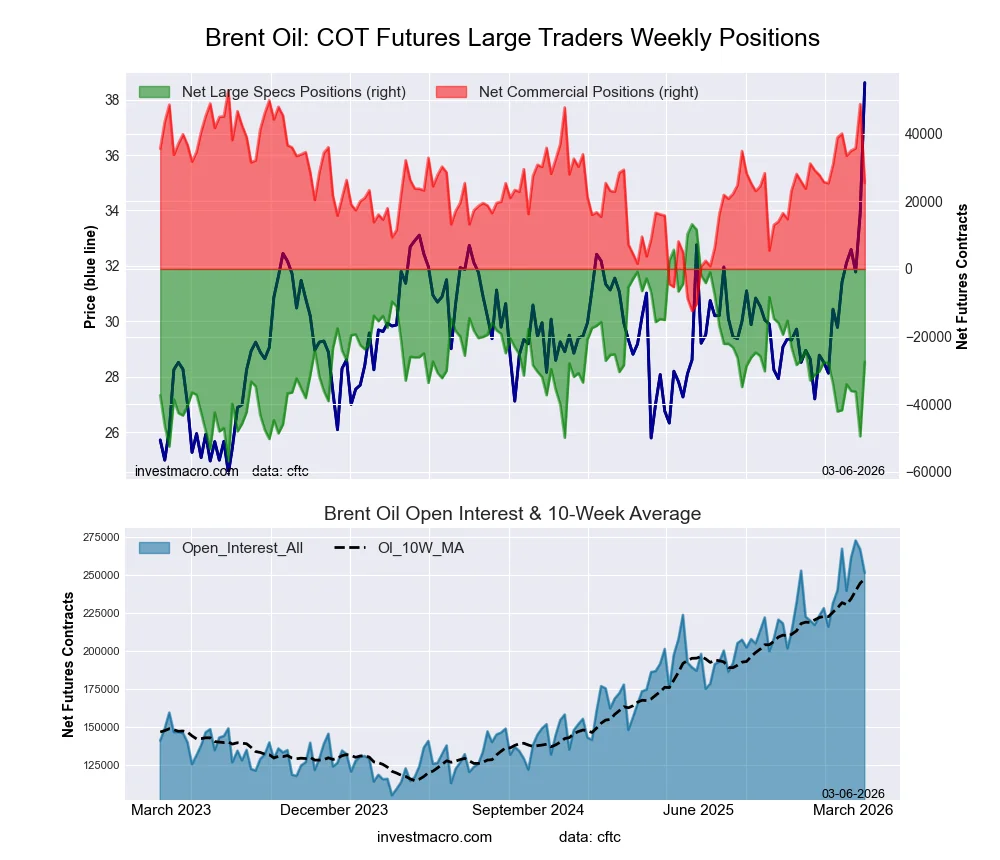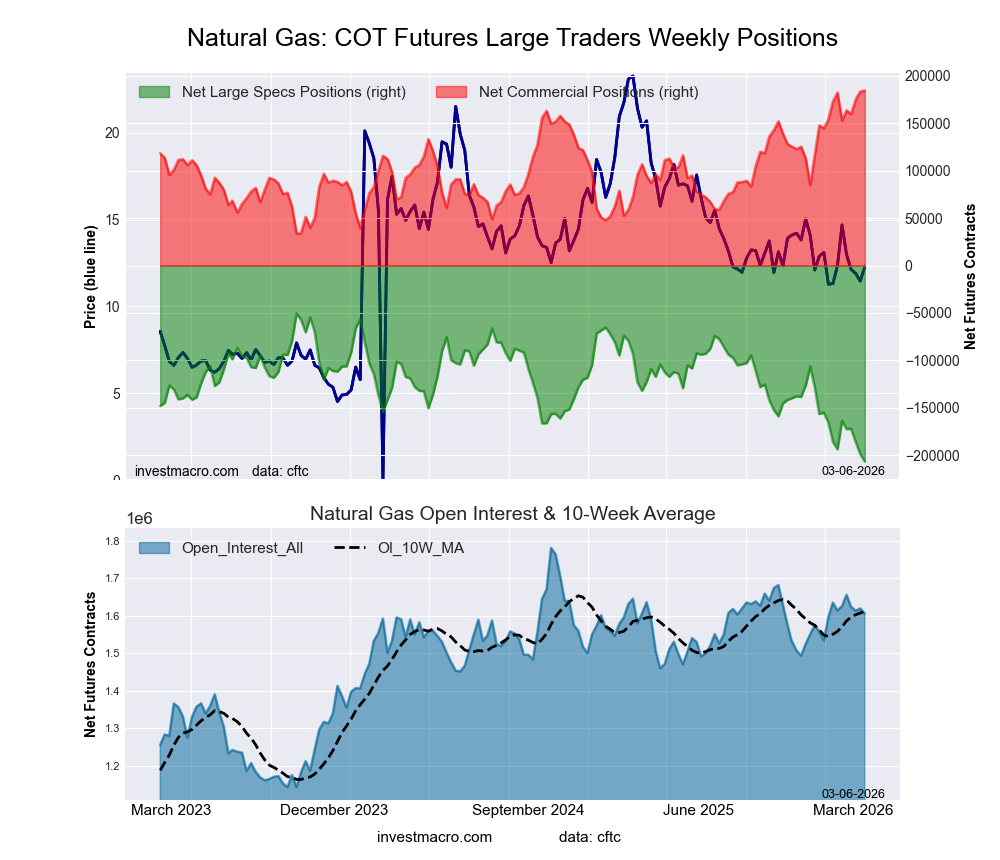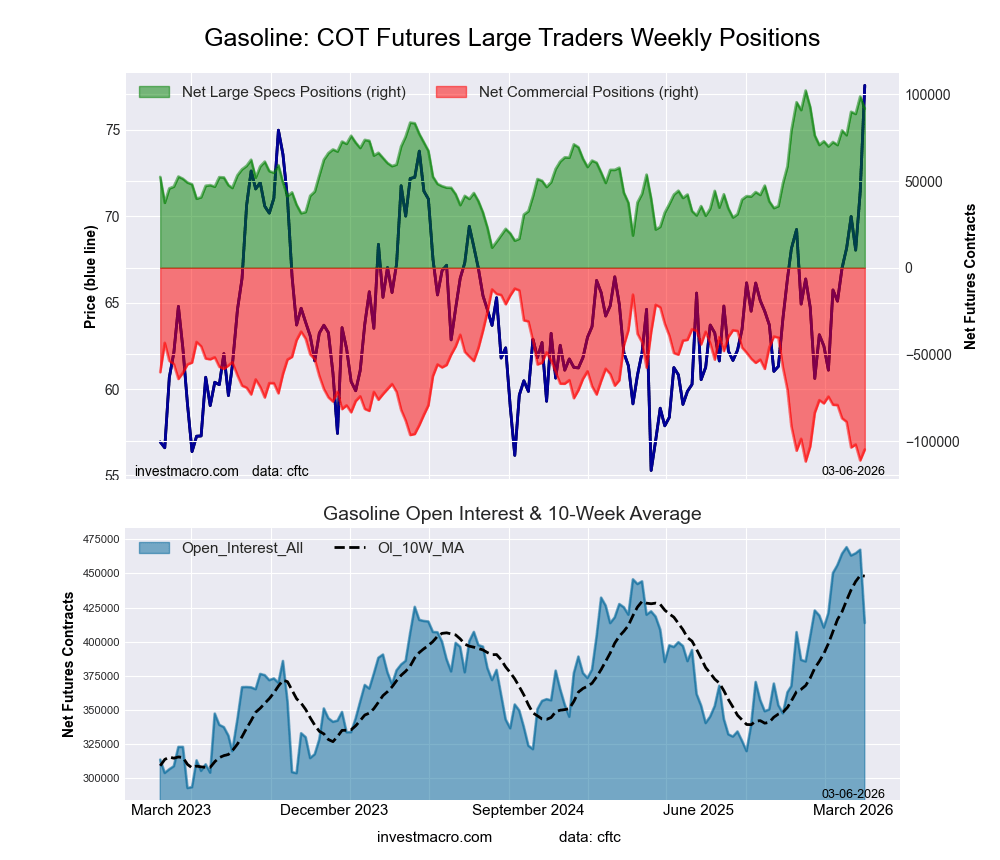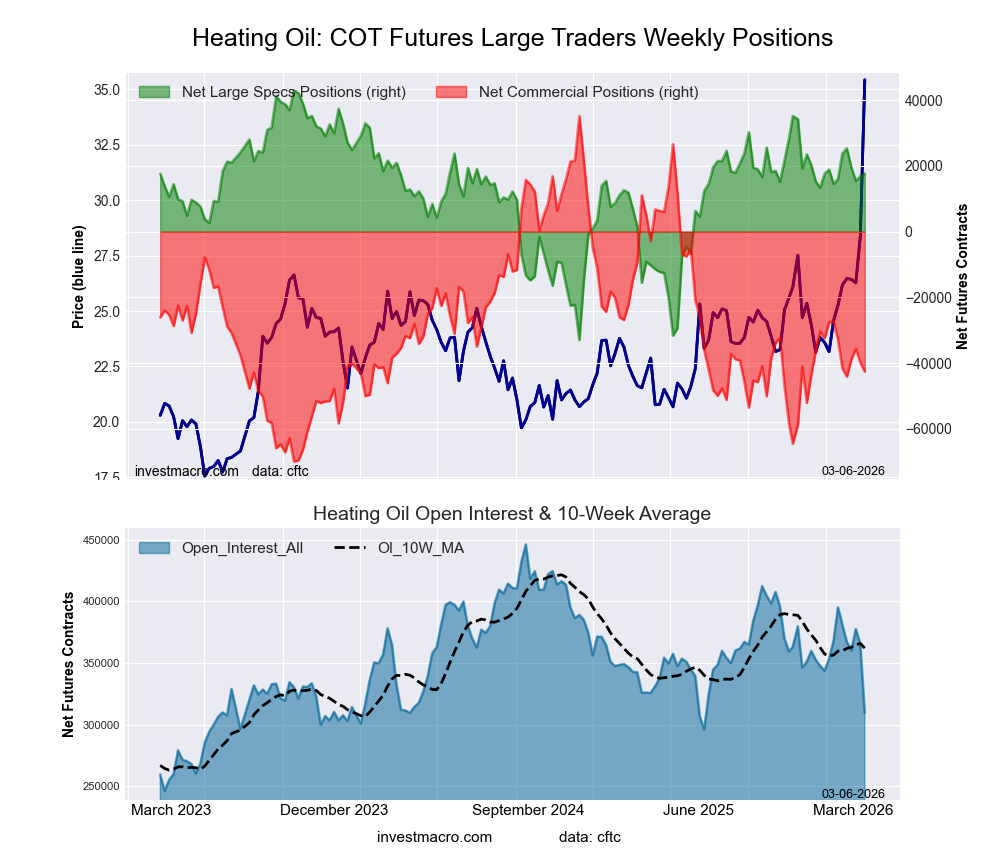
War in Middle East brings uncertainty and higher energy costs to already weakening US economy

By Michael Klein, Tufts University 

The “fog of war” refers to confusion and uncertainty on the battlefield and the attendant possibility of fatal error. This principle has a parallel when it comes to the economic consequences of wars as well, especially when they occur in a region that is a chokepoint for the production and shipment of one-fifth of the world’s oil and a third of its natural gas.

Although no one really knows how deeply the ripple effects of the joint U.S.-Israeli strikes on Iran will impair the global economy, the Gulf kingdom of Qatar issued a dire warning on March 6, 2026, that reflects those concerns: “This will bring down the economies of the world,” Qatar’s energy minister said.

As for the U.S. economy, it was already showing signs of weakness. Data released on March 6 showed an unexpected loss in jobs in February.

As an economist, I expect the biggest economic risks of this war to be inflationary pressures and slowing growth due to the rising price of oil. In addition, uncertainty from the “economic fog of war” could make consumers reticent to spend and businesses hesitant about hiring and investing. These conditions will make it challenging for policymakers to steer the economy.

Uncertainty and risks

There is currently, and likely to be for some time, great uncertainty about the length of the war in Iran, the range of countries involved and its costs. All of these factors will determine how much the war hurts economies in the U.S. and across the globe.

We do know there will be disruptions to the supply of oil and liquefied natural gas, which is difficult to ship through the Strait of Hormuz, and from the fiscal costs associated with this military action.

The price of crude oil has jumped by about 25% since the U.S. and Israel began bombing Iran on Feb. 28, which has driven up gasoline prices across the U.S. The majority of oil and liquefied natural gas produced in the Middle East travels through the Strait of Hormuz – but the threat of attack has made travel through this waterway uninsurable, which has brought shipping through this vital passage to a virtual halt.

This is also an expensive military campaign for the United States, which has already seen the loss of aircraft and a depletion of its stock of missiles. Early estimates of the cost of the war were nearly US$1 billion a day.

Challenges managing a supply shock

The 1979 Iranian Revolution also brought about a spike in the price of oil, which was an important contributing factor to the United States and Europe experiencing an economic phenomenon called “stagflation” – a portmanteau of stagnant growth and high inflation.

This is unlikely to be repeated to the same extent now. Economies are less dependent upon oil and natural gas than they were in the late 1970s and early ’80s. And the U.S. is not beginning the war with a previous decade of high inflation that made it more difficult to reduce price pressures, since expectations of inflation feed into actual inflation.

Still, supply shocks are challenging to address, as the world saw with the COVID-19 pandemic, and policymakers will likely have to make some difficult choices that involve hard trade-offs.

Trade-off between fighting inflation or recession

One of the questions arising from supply shocks is whether a central bank should raise interest rates to combat inflation or lower them to offset weakness in the economy and rising unemployment. Lifting rates brings down inflation by reducing demand for loans and curbing growth, while lowering rates has the opposite effect.

In both the late 1970s and during the onset of the pandemic, the Federal Reserve opted to keep rates low to help support the economy and the job market. In both cases, this led to a spike in inflation.

The inflation of the late 1970s and early ’80s was brought down by a strong reversal of monetary policy with high interest rates, causing a recession that was, at that time, the deepest since the 1930s. Notably, the reduction of inflation in the wake of COVID-19 did not require a similar economic downturn to achieve that goal. An important reason for that is the long history of low inflation in the decades before the 2020s and the “anchoring” of inflation expectations.

Risks on the horizon

But there are reasons to be concerned.

While the Fed now has a well-deserved anti-inflation reputation, its credibility with financial markets is at risk because of President Donald Trump’s attacks on Chairman Jerome Powell, the prosecution of Federal Reserve Board member Lisa Cook and the appointment of a new chair who many suspect will push for lower rates because that’s what the president wants.

Concerns that these actions could lead to higher inflation can become a self-fullfilling prophecy that brings about the very thing that people are worried about. Seeds of new inflation pressures may be falling on fertile soil.

Uncertainty triggered by the war is not the only negative economic signal. Tariff policy, cuts to government employment, rising federal debt and the possibility of financial vulnerabilities are all weighing on the U.S. economy. A spike in the price of oil could very well set off greater weakness, and even a recession, as consumers and businesses pull back from spending.The Conversation

About the Author:

Michael Klein, Professor of International Economic Affairs at The Fletcher School, Tufts University

This article is republished from The Conversation under a Creative Commons license. Read the original article.


Prices push oil above $100 per barrel

By JustMarkets 

  • The Canadian dollar rose above 1.37 against the US dollar, reaching a one-month high and leading performance among G7 currencies.
  • Mexican peso slid to 17.8 per dollar, a seven-week low and its weakest weekly result since summer 2024.
  • Swiss franc trades near historic highs at 0.78 per USD, supported by safe-haven demand amid escalating tensions in the Middle East.
  • Natural gas prices reached $3.4 per MMBtu, the highest in a month, on supply fears linked to Ras Laffan.

Oil prices surge above $100 per barrel

Trading on the US stock market ended lower. By the close of Friday, the Dow Jones (US30) fell by 0.95% (-2.27% for the week). The S&P 500 (US500) shed 1.33% (-1.41% for the week), and the tech-heavy NASDAQ (US100) closed down 1.59% (-0.60% for the week). This unanimous negative trend was driven by a dangerous combination of a geopolitical crisis and weak macroeconomic data, which heightened fears of stagflation. Washington’s ultimatum to Tehran and warnings from Middle Eastern exporters regarding force majeure circumstances propelled WTI oil prices to critical levels. Against this backdrop, the shocking contraction of 92,000 jobs in the US and the jump in the unemployment rate to 4.4% confirmed investor fears that high energy costs have begun to undermine the real economy and consumer activity.

The Canadian dollar (CAD) strengthened to a one-month high above 1.37 against the US dollar, demonstrating the best performance among G7 currencies. The primary driver of the rally was the surge in WTI oil prices above $92 per barrel, which provided a massive influx of foreign exchange earnings into the Canadian economy amid the blockade of the Strait of Hormuz.

The Mexican peso (MXN) weakened to a seven-week low of 17.8 per dollar, showing its worst weekly performance since the summer of 2024. The main trigger for the decline was the shock contraction of US jobs, which amplified fears of an economic cooldown in Mexico’s largest trading partner. Despite a local weakening of the dollar index, the peso fell victim to a mass exodus of investors from risky emerging market assets, triggered by the escalation in the Middle East and the threat of global stagflation.

Equity markets in Europe mostly declined. The German DAX (DE40) fell by 0.94% (-4.80% for the week), the French CAC 40 (FR40) closed down 0.65% (-5.53% for the week), the Spanish IBEX 35 (ES35) lost 0.99% (-4.57% for the week), and the British FTSE 100 (UK100) finished 1.24% lower (-5.33% for the week).

The Swiss franc (CHF) continues to trade near historical highs at 0.78 against the US dollar. Investors view the currency as the primary safe-haven asset amid the catastrophic escalation in the Middle East. However, further strengthening of the franc is limited by the hawkish rhetoric of the SNB. Vice President Antoine Martin confirmed that the regulator is ready for active currency interventions to prevent a deflationary spiral.

Silver prices (XAG) made a sharp move on Friday, consolidating above the $32.5 per ounce level. The main driver was the shocking US labor market report: the loss of 92,000 jobs and the rise in unemployment to 4.4% forced investors to urgently revise their anticipations. While the market had been preparing all week for a “higher-for-longer” interest rate scenario due to oil-driven inflationary pressure, Friday’s data sharply increased the likelihood of early Fed policy easing, reducing the opportunity cost of holding the metal.

WTI oil prices demonstrated historic volatility: after a 31% surge, quotes stabilized above $100 per barrel (+13% for the day). This is the most powerful daily jump since the 2020 pandemic, caused by the paralysis of production in the Persian Gulf. In Iraq, production at southern fields collapsed by 70%, and Kuwait declared force majeure, which, combined with disruptions in Qatar, created a critical supply deficit on the global market. The situation is exacerbated by the risk of technical production halts in the UAE and Saudi Arabia; due to the blockade of the Strait of Hormuz, exports are impossible, and domestic storage facilities are filling up critically fast. Against this background, a power transition occurred in Tehran. Mojtaba Khamenei, the son of the late Ali Khamenei, became the new Supreme Leader of Iran, adding uncertainty regarding further escalation or the possibility of negotiations.

The US natural gas prices (XNG) rose to $3.4 per MMBtu, reaching a one-month high amid critical global supply disruptions. The main factor behind the panic was the production halt at the Qatari giant Ras Laffan following Iranian drone strikes and the declaration of force majeure. Since the Strait of Hormuz is effectively closed to commercial shipping, approximately 20% of global LNG trade has been blocked, sharply increasing demand for American gas as the only stable alternative for Europe and Asia. The situation is further complicated by the war entering its second week: Israel and the US are striking Iranian fuel depots, while Tehran attacks the energy infrastructure of its neighbors.

Asian markets were also under a sell-off last week. The Japanese Nikkei 225 (JP225) fell by 3.70% over the trading week, the FTSE China A50 (CHA50) declined 0.98%, the Hong Kong Hang Seng (HK50) shed 2.23%, and the Australian ASX 200 (AU200) showed a negative result of 2.95% over the 5 days.

On Monday, the Nikkei 225 (JP225) plummeted by 6%, dropping to 32,000 points – its lowest level in two months. The massive sell-off was triggered by the jump in WTI oil prices above $100 per barrel (briefly reaching $119) amid the escalation of the war involving the US, Israel, and Iran. For the tech-oriented Japanese market, this served as a “fire siren,” as investors began pricing in the inevitable rise in production costs and the risk of global stagflation. Japan finds itself in a critical situation due to its unprecedented energy dependency: the country receives about 95% of its oil from the Middle East, with 70% of those supplies physically passing through the now-blocked Strait of Hormuz.

The New Zealand dollar (NZD) fell to $0.587, ending the week in the red amid the escalation in the Middle East and a flight to safe-haven assets. The energy shock and the blockade of supply routes make the New Zealand economy extremely vulnerable, as the country is totally dependent on imported oil. A conflict of expectations is brewing in the market: traders estimate the probability of an RBNZ rate hike in September at 80%, predicting a 40-basis-point tightening, while the regulator itself maintains a much softer rhetoric.

S&P 500 (US500) 6,740.02 −90.69 (−1.33%)

Dow Jones (US30) 47,501.55 −453.19 (−0.95%)

DAX (DE40) 23,591.03 −224.72 (−0.94%)

FTSE 100 (UK100) 10,284.75 −129.19 (−1.24%)

USD Index 98.86 -0.46% (−0.47%)

News feed for: 2026.03.09

  • China Inflation Rate (m/m) at 03:30 (GMT+2); – CHA50, HK50 (MED)
  • German Industrial Production (m/m) at 09:00 (GMT+2); – EUR (MED)
  • Mexico Inflation Rate (m/m) at 14:00 (GMT+2). – MXN (MED)

By JustMarkets


This article reflects a personal opinion and should not be interpreted as an investment advice, and/or offer, and/or a persistent request for carrying out financial transactions, and/or a guarantee, and/or a forecast of future events.

Currency Speculator Positions see AUD, BRL Bets rise. Yen, Euro Bets drop

By InvestMacro

Speculators OI FX Futures COT Chart

Here are the latest charts and statistics for the Commitment of Traders (COT) data published by the Commodities Futures Trading Commission (CFTC).

The latest COT data is updated through Tuesday March 3rd and shows a quick view of how large market participants (for-profit speculators and commercial traders) were positioned in the futures markets. All currency positions are in direct relation to the US dollar where, for example, a bet for the euro is a bet that the euro will rise versus the dollar while a bet against the euro will be a bet that the euro will decline versus the dollar.

Weekly Speculator Changes led by Australian Dollar & Brazilian Real
Speculators Nets FX Futures COT Chart

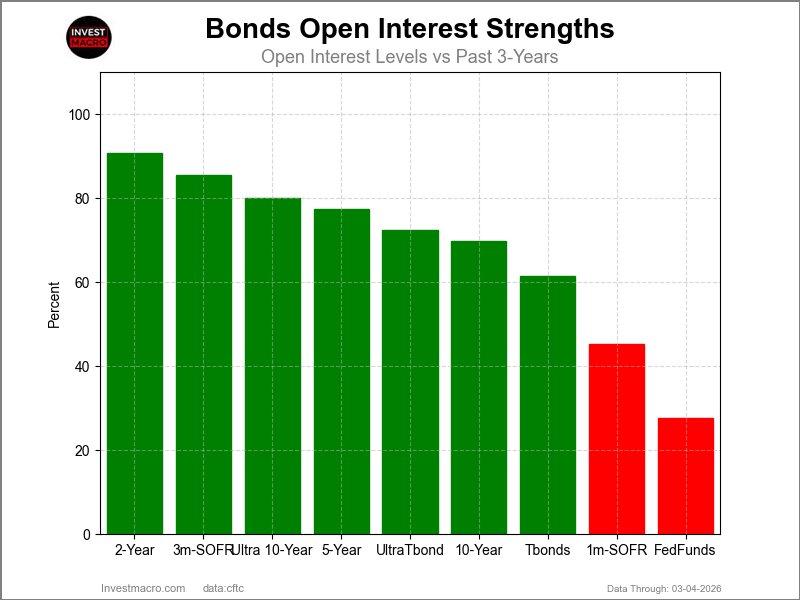
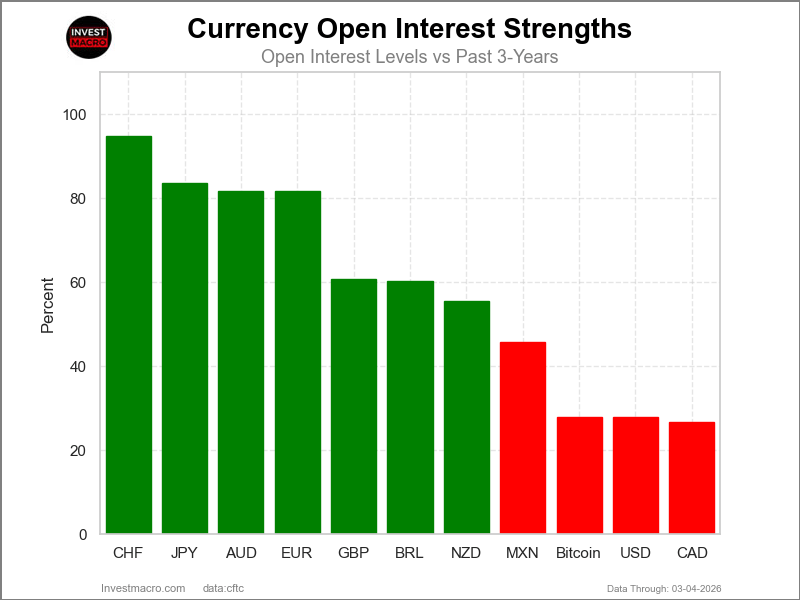
Open Interest Strength Levels show where current Open Futures Contracts are highest and lowest (higher interest can fuel trends and setup for more potential moves & vice versa) for currency markets.

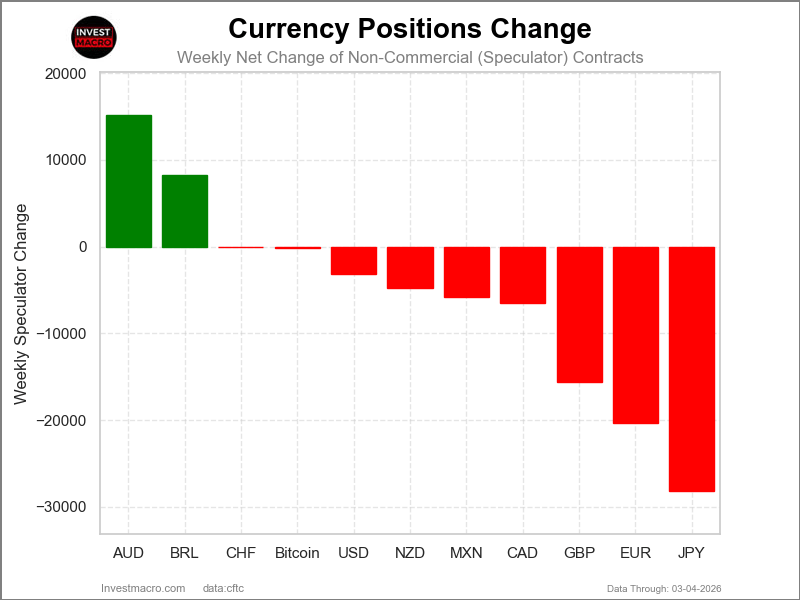
The COT currency market speculator bets were overall lower this week as just two out of the eleven currency markets we cover had higher positioning while the other nine markets had lower speculator contracts.

Leading the gains for the currency markets was the Australian Dollar (15,118 contracts) with the Brazilian Real (8,296 contracts) also having a positive week.

The currencies seeing declines in speculator bets on the week were the Japanese Yen (-28,114 contracts), the EuroFX (-20,358 contracts), the British Pound (-15,614 contracts), the Canadian Dollar (-6,528 contracts), Mexican Peso (-5,837 contracts), the New Zealand Dollar (-4,767 contracts), the US Dollar Index (-3,200 contracts), Bitcoin (-161 contracts) and with the Swiss Franc (-97 contracts) also registering lower bets on the week.

Weekly Currency Speculator Positions see AUD, BRL bets rise. Yen, Euro bets drop

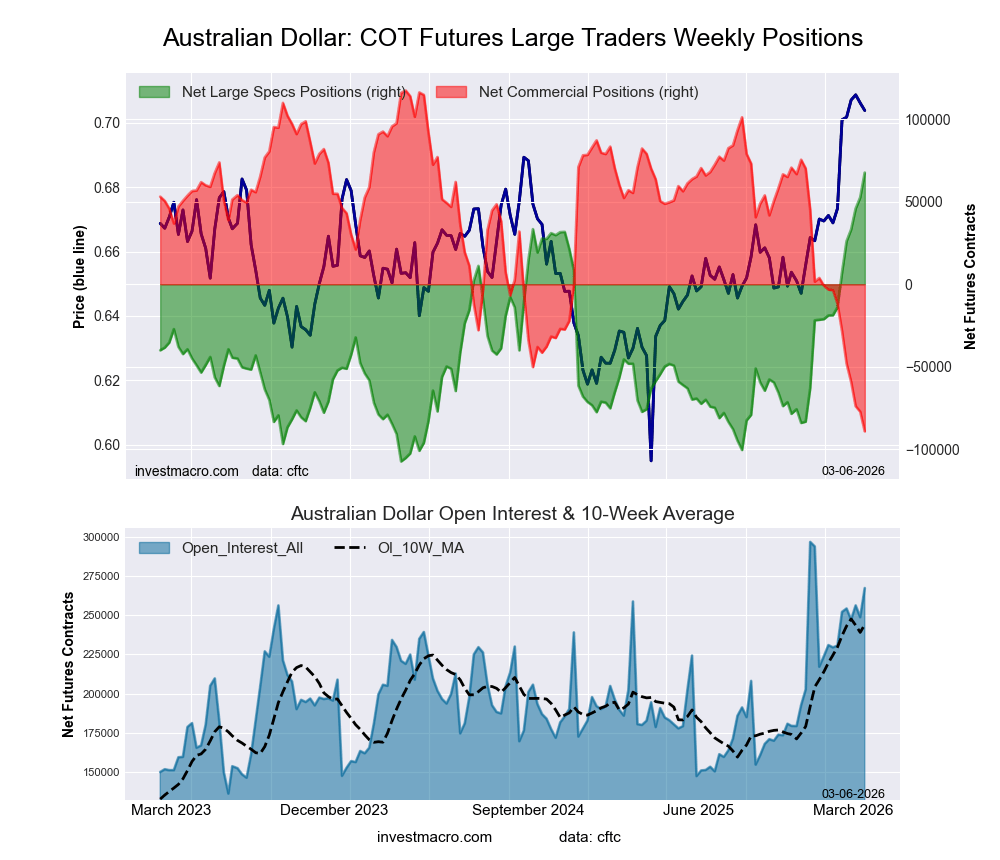
The Australian Dollar speculator position continued to surge higher this week. It rose over 15,000 contracts and is now higher for the fourteenth consecutive week. Over these last 14 weeks, speculators have added 151,938 net contracts to the Aussie position. This has taken the overall position from highly bearish in November to a total of +67,762 contracts this week and the current positioning continues to be at its highest levels since 2017. In the currency spot market, however, with the Iran war breaking out this week, the Aussie dipped this week after touching its highest levels since 2023 in previous weeks. The Aussie made a bearish doji candlestick on the weekly charts and has been overbought for many weeks on the weekly Relative Strength Index (RSI) indicator. The Australian Dollar has not traditionally been a safe haven currency—actually the opposite, so caution is warranted going forward with this currency.

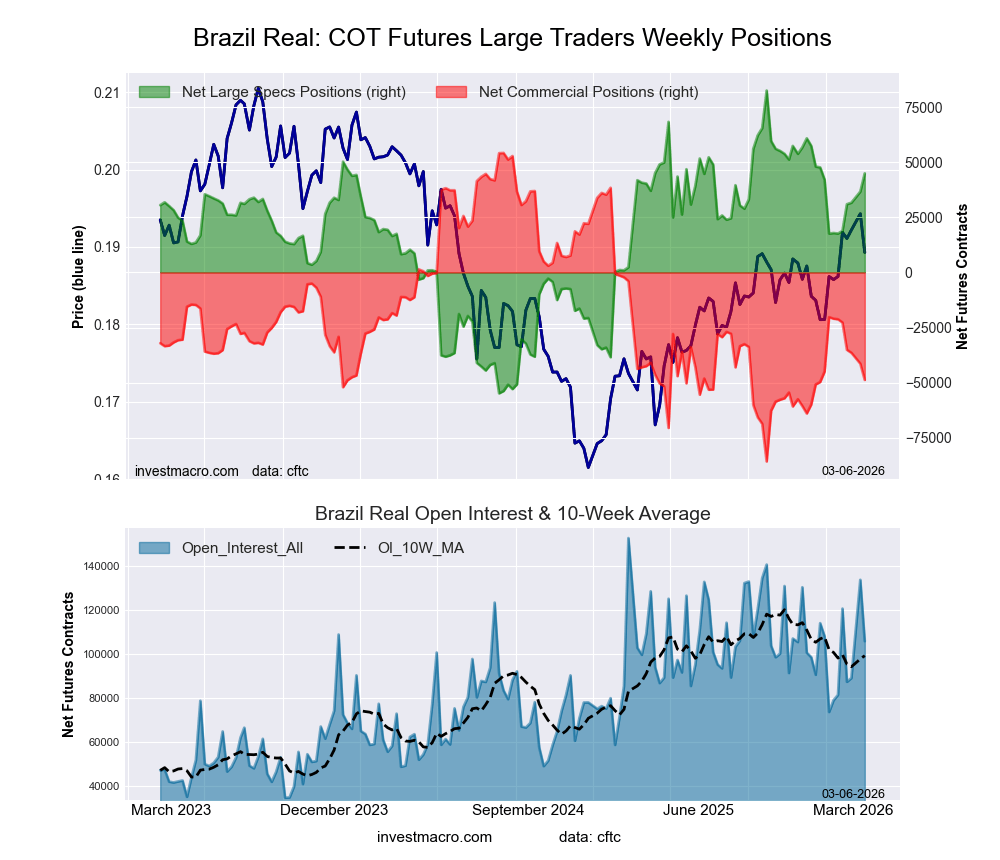
The Brazilian Real was the next highest gainer this week with a rise of over 8,000 contracts. The Real now has been up in seven out of the past eight weeks for an eight-week gain of 27,353 net contracts. The Real position currently sits at a +44,970 contract net position, which is the highest level since December. In the currency spot market, the Real saw a strong dip (-2.63%) this week after a recent strong run that had brought the BRL to the highest level since 2024 against the US Dollar. The Real is also not considered a safe haven currency, so this currency also bears watching.

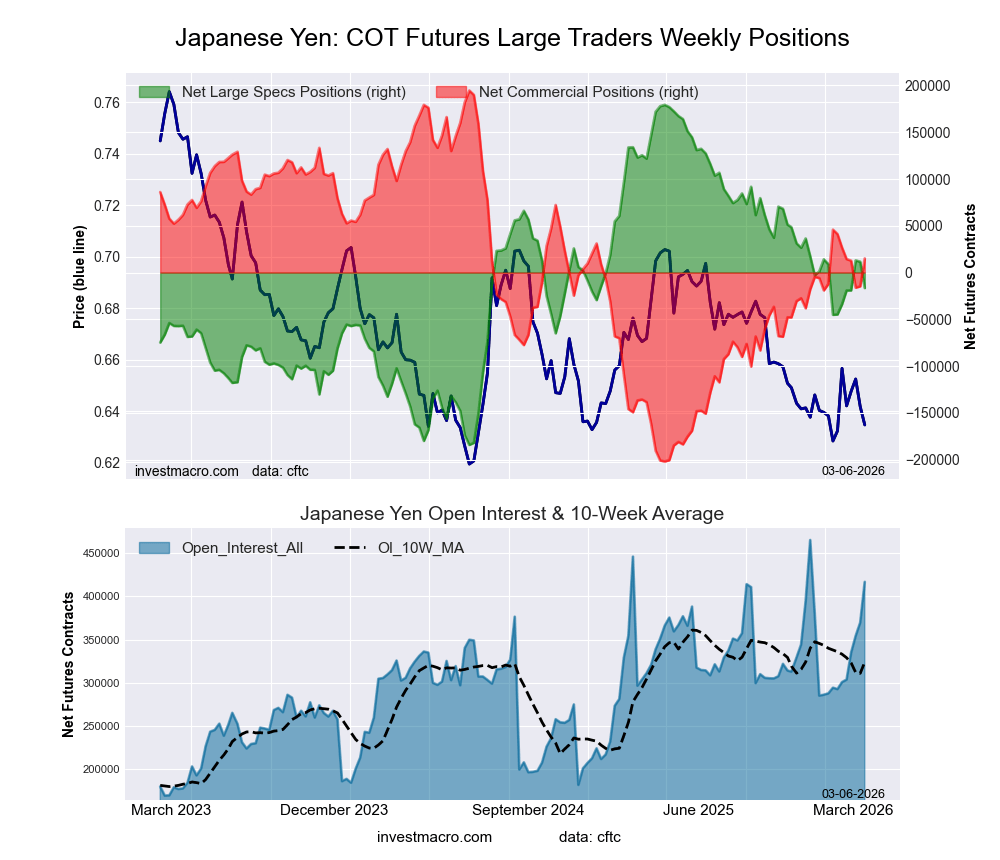
The Japanese Yen was the biggest loser on the week in terms of speculator changes in positions. The Yen lost -28,114 contracts this week and fell for a second consecutive week. This has pulled the Yen back into an overall negative or bearish territory with a total net position, as of Tuesday, at -16,575 contracts. In the forex market, the Yen has typically been a safe haven currency but did not receive safe haven flows this week as the currency fell by over 1%. It continued to lose ground to the US Dollar for the third consecutive week as the USD/JPY trades at the 157.82 exchange rate in the spot currency markets, which is a historically strong rate for the US Dollar versus the Yen.

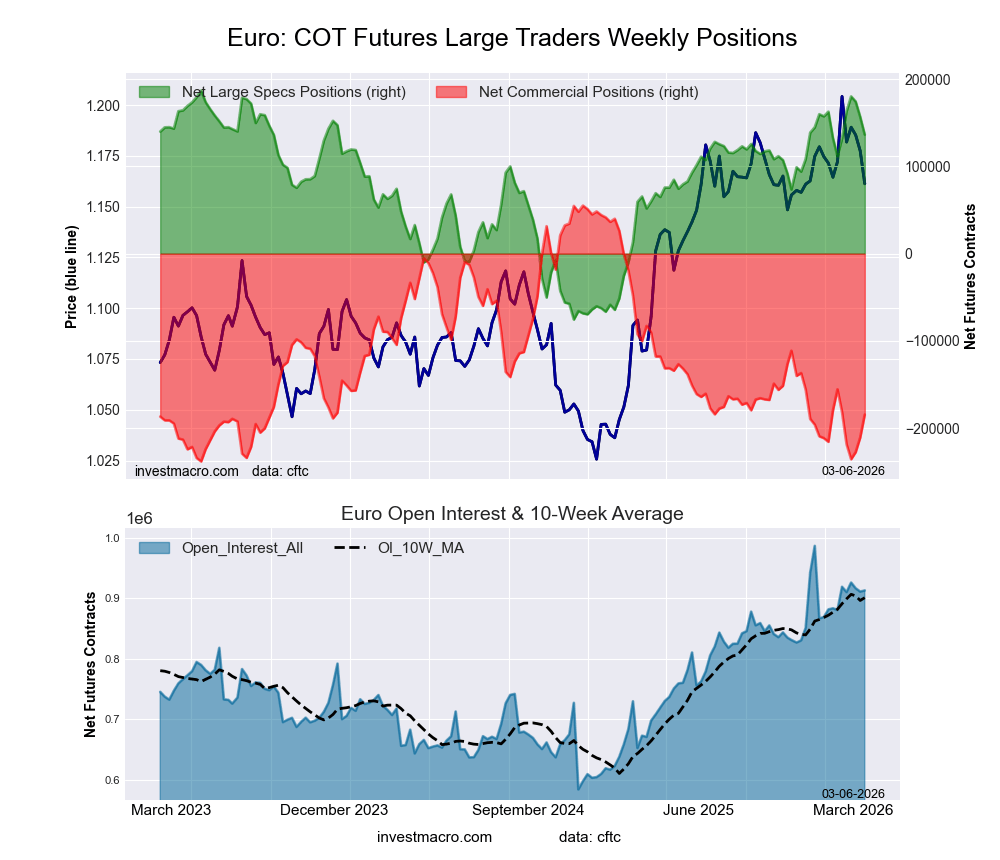
The Euro positions also took a strong hit this week, and the Euro positioning has now dropped for three consecutive weeks with a total of -43,807 net contracts taken off the bullish position. Overall, the Euro currency has been in a strong speculative bullish position, with the position being over +100,000 contracts for fourteen consecutive weeks and for thirty-four out of the past thirty-eight weeks dating back to June 2025. In the currency spot market this week, the Euro fell by almost 2% as the Iran war raged, and the Euro closed at 1.1605. Just about six weeks ago, the Euro touched a high of 1.2110 against the US Dollar but has now dipped back into its range from 1.15 to about 1.19 that the currency has traded in since June.

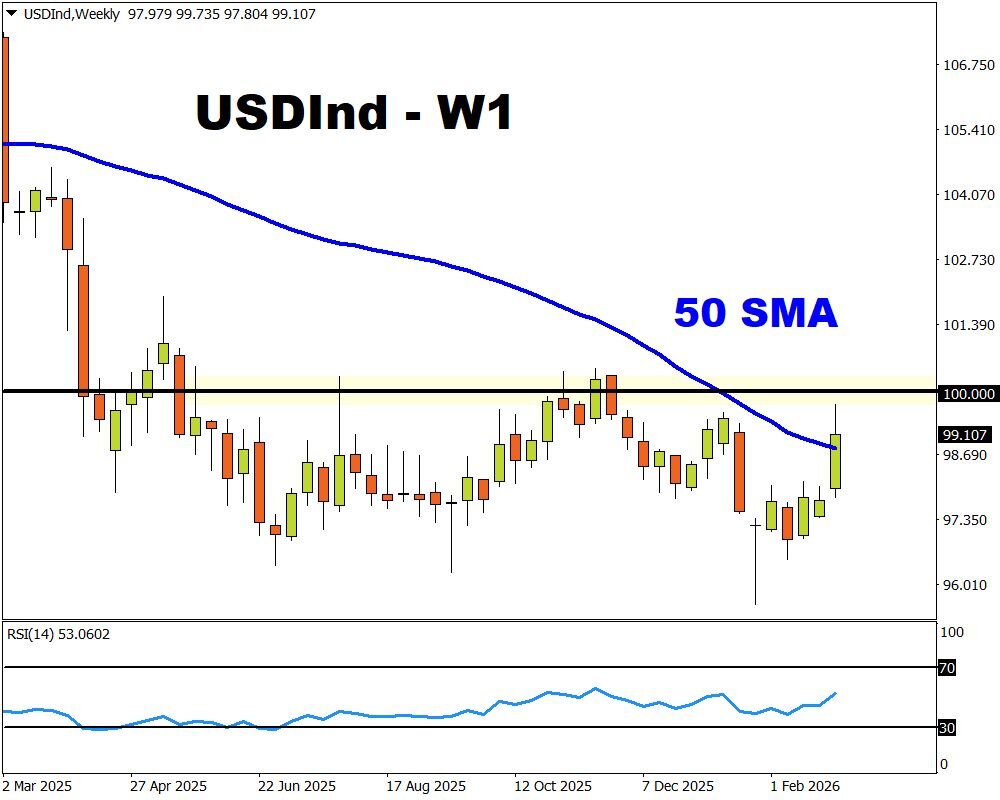
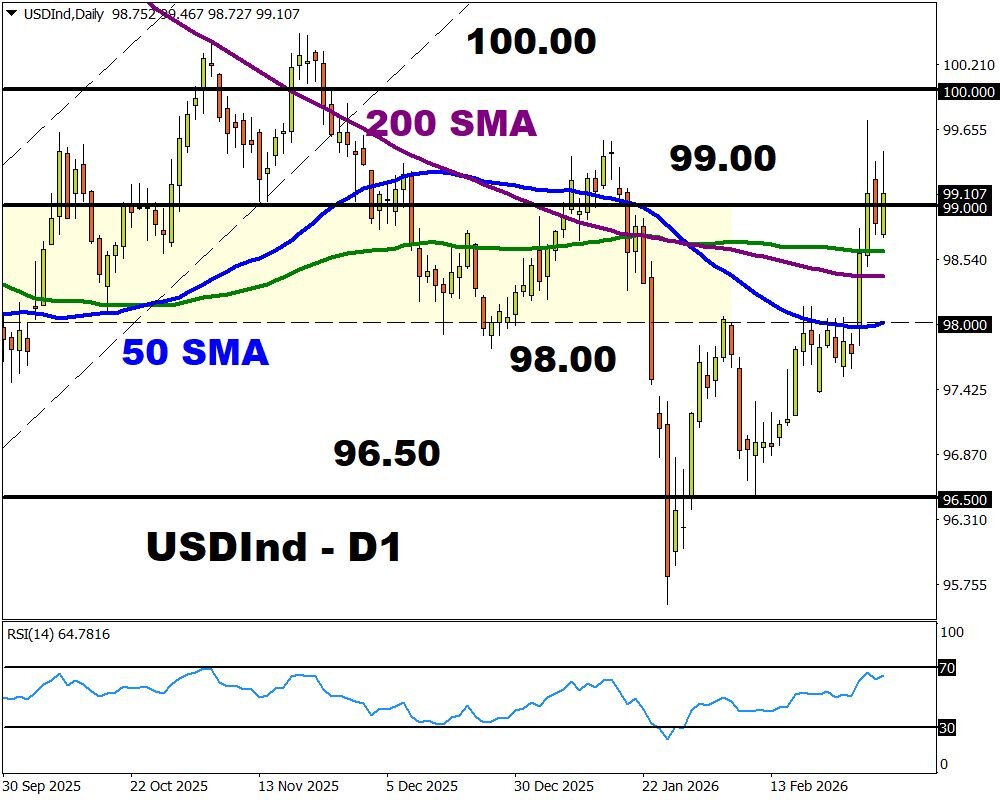
The US Dollar Index speculator positions fell for a second straight week this week and continue to be in an smallish overall net bearish position at -4,989 contracts. However, in the Forex market, the US Dollar Index started to see some strength as the week grew on, and the US Dollar is a traditional safe haven currency (along with the Swiss Franc and the Japanese Yen). The speculator data is through Tuesday and the speculator contracts may see an abrupt shift next week as the war drags on. Currently, the US Dollar Index trades at the 98.98 level, which is its highest close in about six weeks and there is the 100.00 psychological price level waiting above to test on further gains.

Bitcoin and the US Dollar Index lead Price Performance this week

Bitcoin saw a bit of a rebound this week with a 3.81% gain and led in the weekly price performances. The US Dollar Index was higher this week by 1.52% and received safe haven bids due to the Iran war. The Canadian Dollar was higher by 0.36% and undoubtedly received some strength off of the oil price going higher.

On the downside, the British Pound Sterling was lower by -0.71% followed by the Swiss Franc which fell by -1.13%. The Japanese Yen was next with a -1.19% shortfall while the Australian Dollar was lower by -1.35% and the New Zealand Dollar was lower by -1.69%. The Euro dropped a little less than 2% with a -1.84% 5-day decline. The Brazilian Real had a sharp decline at -2.63% and the Mexican Peso was the biggest loser on the week with a -3.28% decrease.


Currencies Data:
Speculators FX Futures COT Data Table
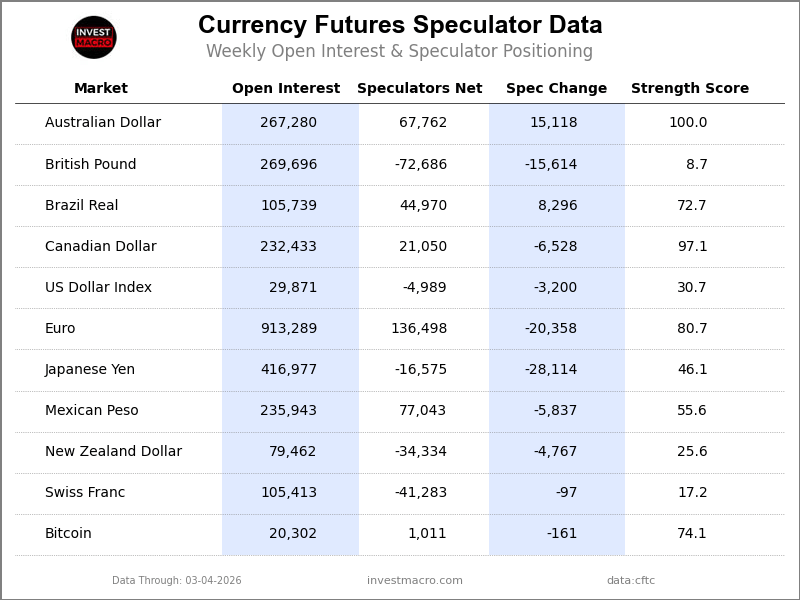
Legend: Open Interest | Speculators Current Net Position | Weekly Specs Change | Specs Strength Score compared to last 3-Years (0-100 range)


Strength Scores led by Australian Dollar & Canadian Dollar
Speculators Strength Scores FX Futures COT Chart
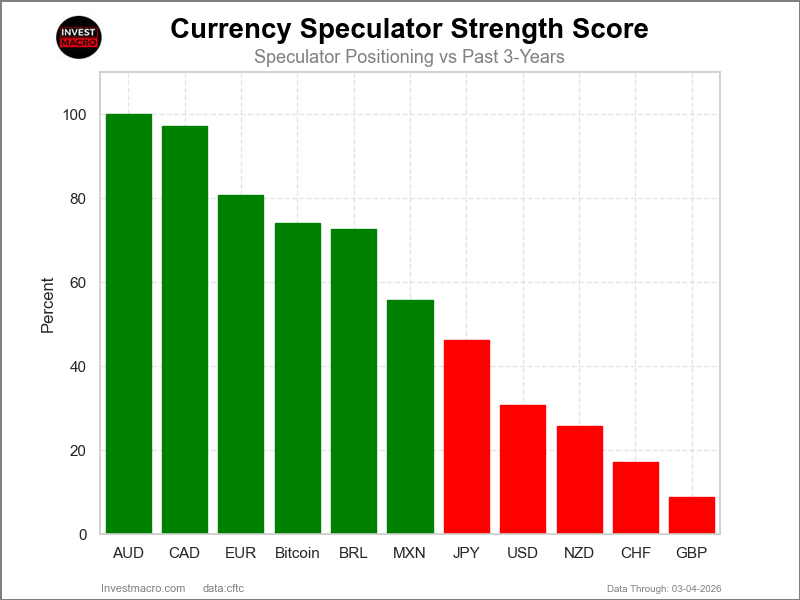
COT Strength Scores (a normalized measure of Speculator positions over a 3-Year range, from 0 to 100 where above 80 is Extreme-Bullish and below 20 is Extreme-Bearish) showed that the Australian Dollar (100 percent) and the Canadian Dollar (97 percent) lead the currency markets this week. The EuroFX (81 percent), Bitcoin (74 percent) and the Brazilian Real (73 percent) come in as the next highest in the weekly strength scores.

On the downside, the British Pound (9 percent) and the Swiss Franc (17 percent) come in at the lowest strength levels currently and are in Extreme-Bearish territory (below 20 percent). The next lowest strength scores are the New Zealand Dollar (26 percent) and the US Dollar Index (31 percent).

3-Year Strength Statistics:
US Dollar Index (30.7 percent) vs US Dollar Index previous week (39.3 percent)
EuroFX (80.7 percent) vs EuroFX previous week (88.5 percent)
British Pound Sterling (8.7 percent) vs British Pound Sterling previous week (15.4 percent)
Japanese Yen (46.1 percent) vs Japanese Yen previous week (53.9 percent)
Swiss Franc (17.2 percent) vs Swiss Franc previous week (17.4 percent)
Canadian Dollar (97.1 percent) vs Canadian Dollar previous week (100.0 percent)
Australian Dollar (100.0 percent) vs Australian Dollar previous week (91.4 percent)
New Zealand Dollar (25.6 percent) vs New Zealand Dollar previous week (31.1 percent)
Mexican Peso (55.6 percent) vs Mexican Peso previous week (59.8 percent)
Brazilian Real (72.7 percent) vs Brazilian Real previous week (66.6 percent)
Bitcoin (74.1 percent) vs Bitcoin previous week (77.5 percent)


Australian Dollar & Canadian Dollar top the 6-Week Strength Trends
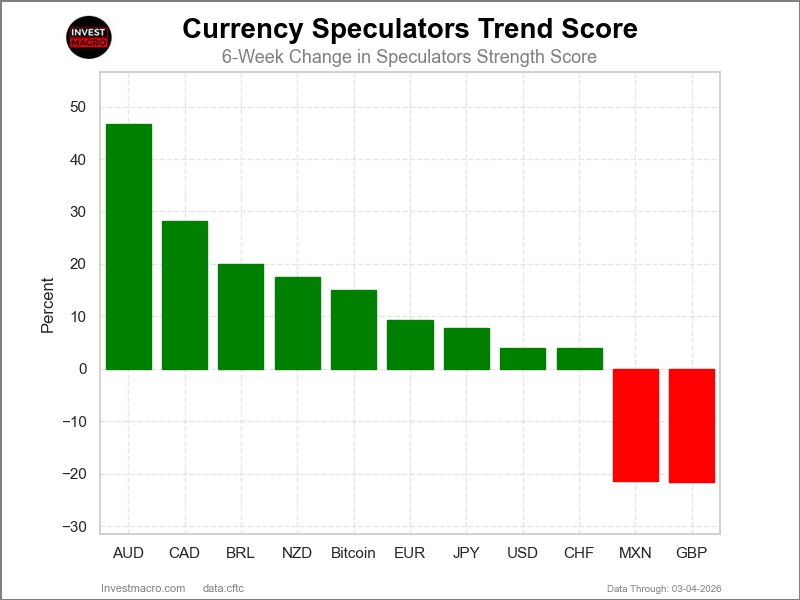
Speculators Trends FX Futures COT Chart
COT Strength Score Trends (or move index, calculates the 6-week changes in strength scores) showed that the Australian Dollar (47 percent) and the Canadian Dollar (28 percent) lead the past six weeks trends for the currencies. The Brazilian Real (20 percent), the New Zealand Dollar (17 percent) and Bitcoin (15 percent) are the next highest positive movers in the 3-Year trends data.

The British Pound (-22 percent) leads the downside trend scores currently with the Mexican Peso (-21 percent) following next with lower trend scores.

3-Year Strength Trends:
US Dollar Index (3.9 percent) vs US Dollar Index previous week (5.2 percent)
EuroFX (9.4 percent) vs EuroFX previous week (9.2 percent)
British Pound Sterling (-21.5 percent) vs British Pound Sterling previous week (-13.5 percent)
Japanese Yen (7.8 percent) vs Japanese Yen previous week (15.6 percent)
Swiss Franc (3.9 percent) vs Swiss Franc previous week (4.5 percent)
Canadian Dollar (28.1 percent) vs Canadian Dollar previous week (31.2 percent)
Australian Dollar (46.6 percent) vs Australian Dollar previous week (40.8 percent)
New Zealand Dollar (17.5 percent) vs New Zealand Dollar previous week (22.0 percent)
Mexican Peso (-21.3 percent) vs Mexican Peso previous week (-14.6 percent)
Brazilian Real (19.9 percent) vs Brazilian Real previous week (13.7 percent)
Bitcoin (15.1 percent) vs Bitcoin previous week (23.4 percent)


Individual COT Forex Markets:

US Dollar Index Futures:
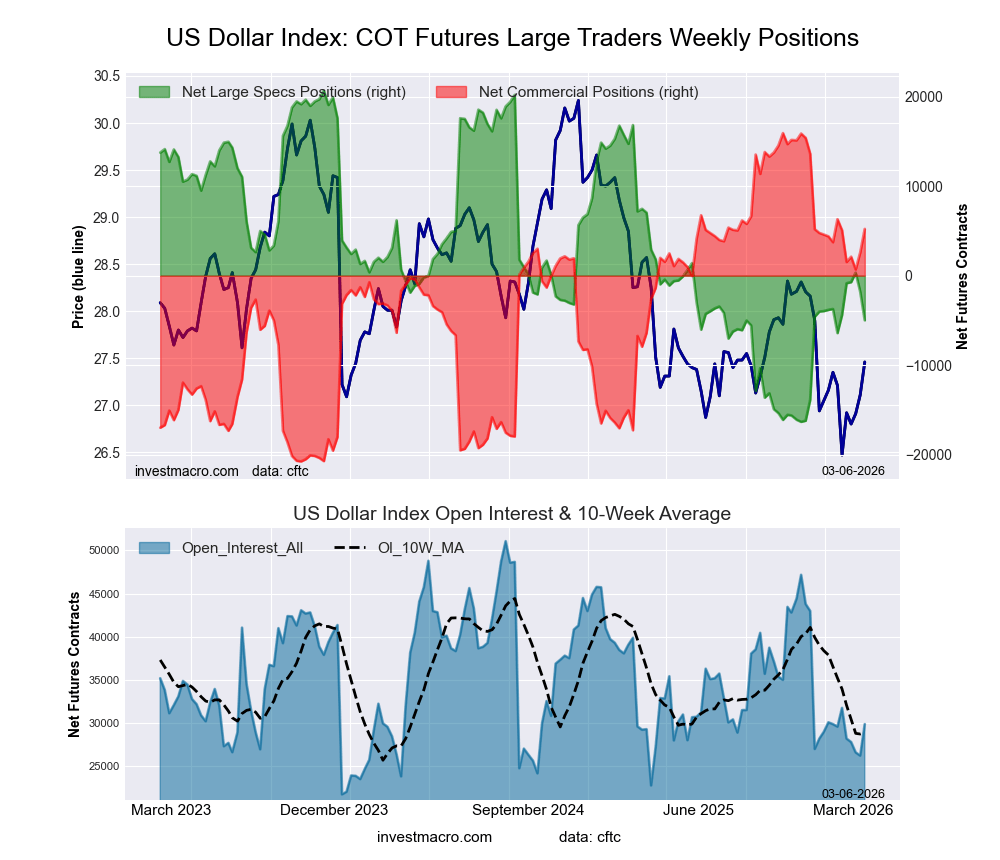
US Dollar Index Forex Futures COT ChartThe US Dollar Index large speculator standing this week equaled a net position of -4,989 contracts in the data reported through Tuesday. This was a weekly decline of -3,200 contracts from the previous week which had a total of -1,789 net contracts.

This week’s current strength score (the trader positioning range over the past three years, measured from 0 to 100) shows the speculators are currently Bearish with a score of 30.7 percent. The commercials are Bullish with a score of 70.8 percent and the small traders (not shown in chart) are Bearish with a score of 34.9 percent.

Price Trend-Following Model: Weak Downtrend

Our weekly trend-following model classifies the current market price position as: Weak Downtrend.

US DOLLAR INDEX StatisticsSPECULATORSCOMMERCIALSSMALL TRADERS
– Percent of Open Interest Longs:50.429.711.8
– Percent of Open Interest Shorts:67.112.212.5
– Net Position:-4,9895,223-234
– Gross Longs:15,0618,8823,513
– Gross Shorts:20,0503,6593,747
– Long to Short Ratio:0.8 to 12.4 to 10.9 to 1
NET POSITION TREND:
– Strength Index Score (3 Year Range Pct):30.770.834.9
– Strength Index Reading (3 Year Range):BearishBullishBearish
NET POSITION MOVEMENT INDEX:
– 6-Week Change in Strength Index:3.9-2.9-6.1


Euro Currency Futures:

Euro Currency Futures COT ChartThe Euro Currency large speculator standing this week equaled a net position of 136,498 contracts in the data reported through Tuesday. This was a weekly reduction of -20,358 contracts from the previous week which had a total of 156,856 net contracts.

This week’s current strength score (the trader positioning range over the past three years, measured from 0 to 100) shows the speculators are currently Bullish-Extreme with a score of 80.7 percent. The commercials are Bearish-Extreme with a score of 18.3 percent and the small traders (not shown in chart) are Bullish with a score of 76.0 percent.

Price Trend-Following Model: Weak Uptrend

Our weekly trend-following model classifies the current market price position as: Weak Uptrend.

EURO Currency StatisticsSPECULATORSCOMMERCIALSSMALL TRADERS
– Percent of Open Interest Longs:32.353.210.1
– Percent of Open Interest Shorts:17.373.44.8
– Net Position:136,498-184,59348,095
– Gross Longs:294,586485,71391,926
– Gross Shorts:158,088670,30643,831
– Long to Short Ratio:1.9 to 10.7 to 12.1 to 1
NET POSITION TREND:
– Strength Index Score (3 Year Range Pct):80.718.376.0
– Strength Index Reading (3 Year Range):Bullish-ExtremeBearish-ExtremeBullish
NET POSITION MOVEMENT INDEX:
– 6-Week Change in Strength Index:9.4-9.98.8


British Pound Sterling Futures:

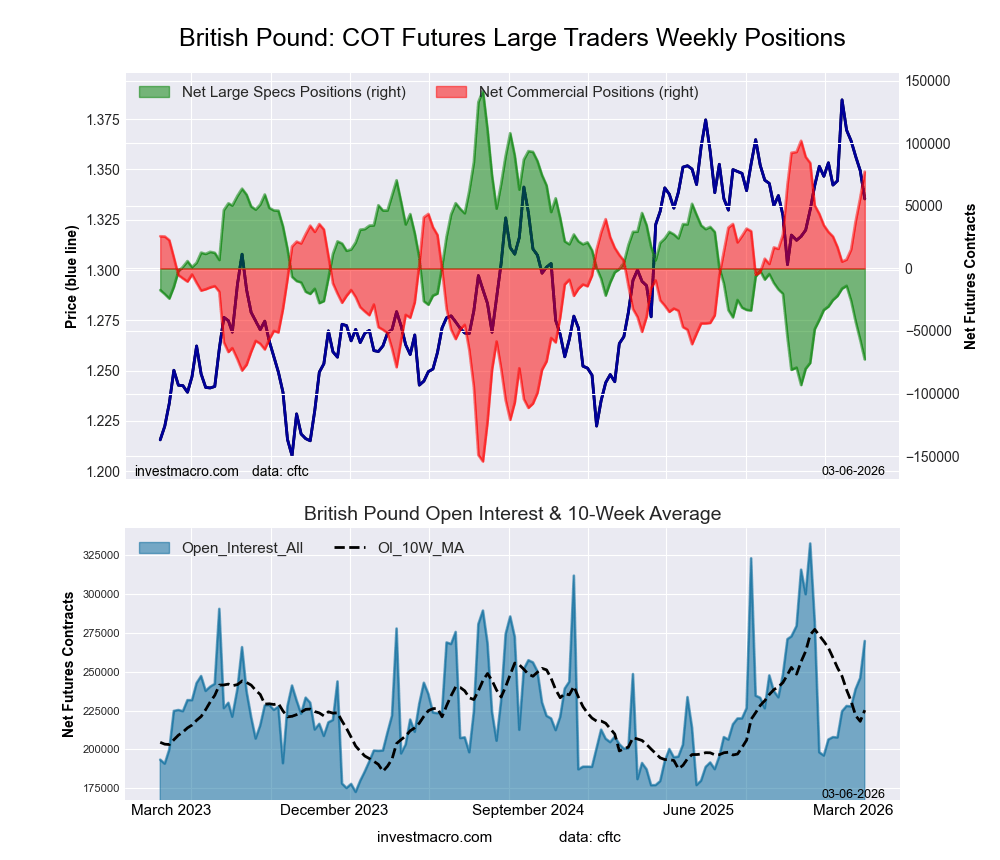
British Pound Sterling Futures COT ChartThe British Pound Sterling large speculator standing this week equaled a net position of -72,686 contracts in the data reported through Tuesday. This was a weekly decrease of -15,614 contracts from the previous week which had a total of -57,072 net contracts.

This week’s current strength score (the trader positioning range over the past three years, measured from 0 to 100) shows the speculators are currently Bearish-Extreme with a score of 8.7 percent. The commercials are Bullish-Extreme with a score of 90.4 percent and the small traders (not shown in chart) are Bearish with a score of 41.2 percent.

Price Trend-Following Model: Weak Uptrend

Our weekly trend-following model classifies the current market price position as: Weak Uptrend.

BRITISH POUND StatisticsSPECULATORSCOMMERCIALSSMALL TRADERS
– Percent of Open Interest Longs:22.160.59.6
– Percent of Open Interest Shorts:49.031.811.4
– Net Position:-72,68677,305-4,619
– Gross Longs:59,499163,15626,010
– Gross Shorts:132,18585,85130,629
– Long to Short Ratio:0.5 to 11.9 to 10.8 to 1
NET POSITION TREND:
– Strength Index Score (3 Year Range Pct):8.790.441.2
– Strength Index Reading (3 Year Range):Bearish-ExtremeBullish-ExtremeBearish
NET POSITION MOVEMENT INDEX:
– 6-Week Change in Strength Index:-21.523.5-24.7


Japanese Yen Futures:

Japanese Yen Forex Futures COT ChartThe Japanese Yen large speculator standing this week equaled a net position of -16,575 contracts in the data reported through Tuesday. This was a weekly decline of -28,114 contracts from the previous week which had a total of 11,539 net contracts.

This week’s current strength score (the trader positioning range over the past three years, measured from 0 to 100) shows the speculators are currently Bearish with a score of 46.1 percent. The commercials are Bullish with a score of 54.7 percent and the small traders (not shown in chart) are Bearish with a score of 40.8 percent.

Price Trend-Following Model: Strong Downtrend

Our weekly trend-following model classifies the current market price position as: Strong Downtrend.

JAPANESE YEN StatisticsSPECULATORSCOMMERCIALSSMALL TRADERS
– Percent of Open Interest Longs:32.444.69.5
– Percent of Open Interest Shorts:36.341.09.1
– Net Position:-16,57515,0071,568
– Gross Longs:134,945186,02739,530
– Gross Shorts:151,520171,02037,962
– Long to Short Ratio:0.9 to 11.1 to 11.0 to 1
NET POSITION TREND:
– Strength Index Score (3 Year Range Pct):46.154.740.8
– Strength Index Reading (3 Year Range):BearishBullishBearish
NET POSITION MOVEMENT INDEX:
– 6-Week Change in Strength Index:7.8-6.6-5.5


Swiss Franc Futures:

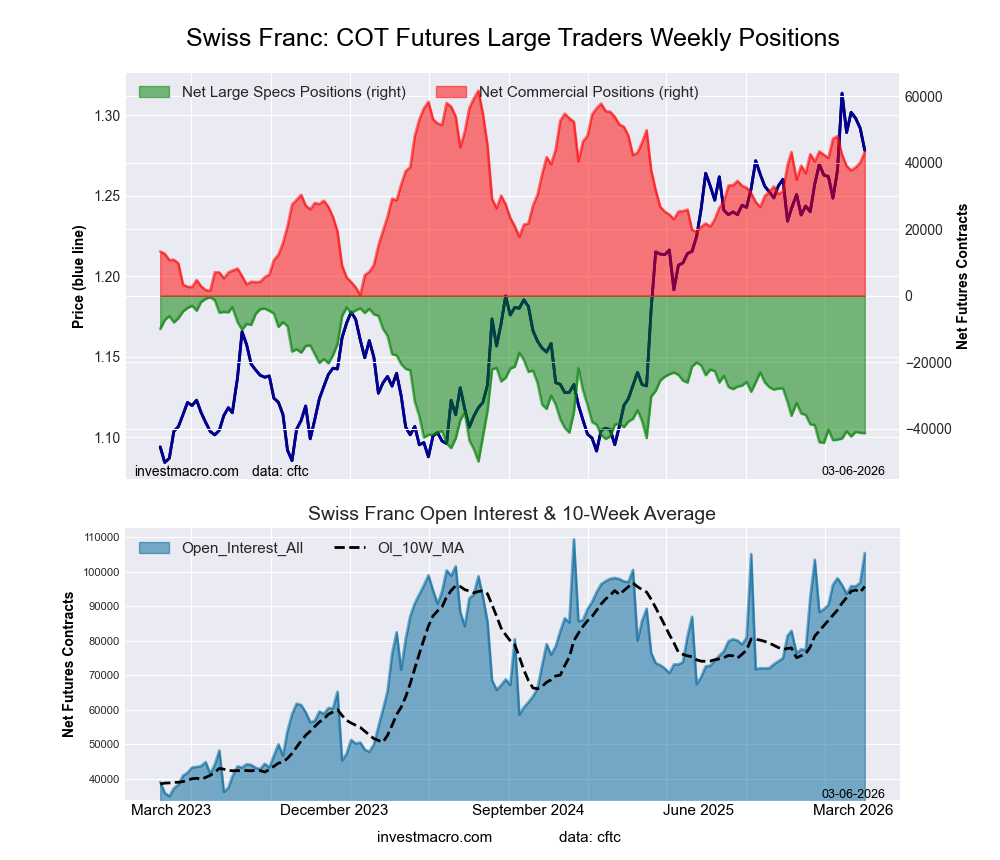
Swiss Franc Forex Futures COT ChartThe Swiss Franc large speculator standing this week equaled a net position of -41,283 contracts in the data reported through Tuesday. This was a weekly fall of -97 contracts from the previous week which had a total of -41,186 net contracts.

This week’s current strength score (the trader positioning range over the past three years, measured from 0 to 100) shows the speculators are currently Bearish-Extreme with a score of 17.2 percent. The commercials are Bullish with a score of 70.0 percent and the small traders (not shown in chart) are Bullish with a score of 70.3 percent.

Price Trend-Following Model: Uptrend

Our weekly trend-following model classifies the current market price position as: Uptrend.

SWISS FRANC StatisticsSPECULATORSCOMMERCIALSSMALL TRADERS
– Percent of Open Interest Longs:11.868.614.6
– Percent of Open Interest Shorts:50.927.616.5
– Net Position:-41,28343,280-1,997
– Gross Longs:12,39072,32415,357
– Gross Shorts:53,67329,04417,354
– Long to Short Ratio:0.2 to 12.5 to 10.9 to 1
NET POSITION TREND:
– Strength Index Score (3 Year Range Pct):17.270.070.3
– Strength Index Reading (3 Year Range):Bearish-ExtremeBullishBullish
NET POSITION MOVEMENT INDEX:
– 6-Week Change in Strength Index:3.9-7.611.7


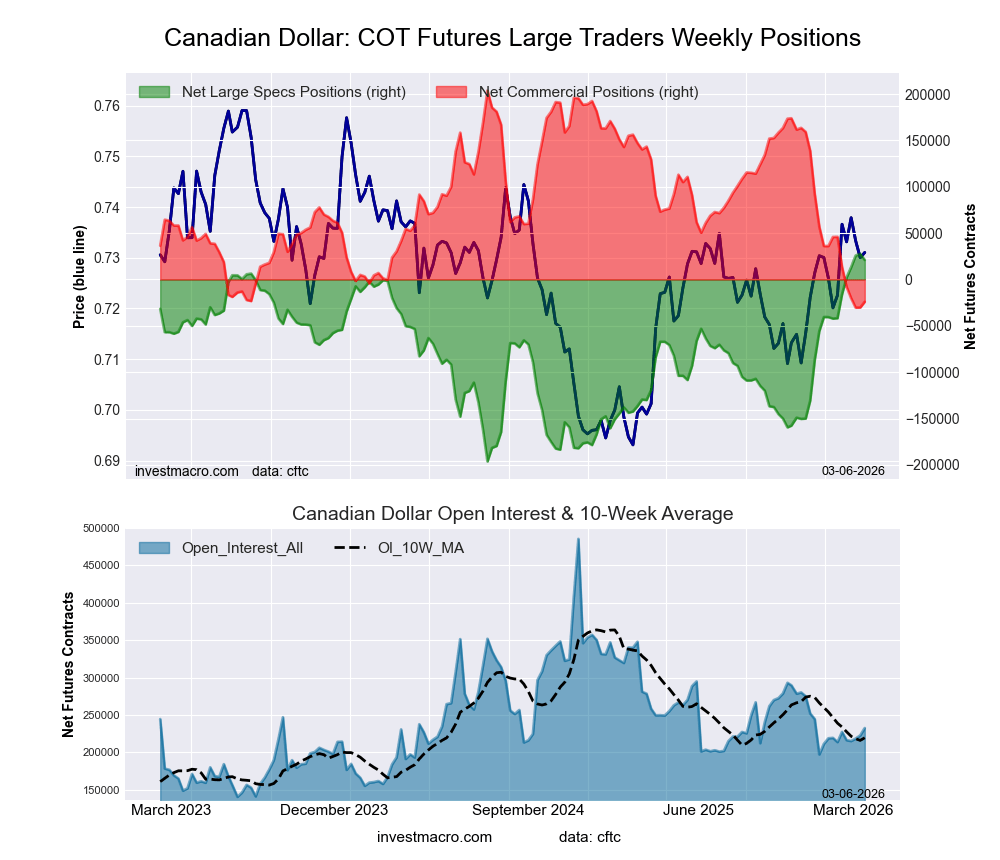
Canadian Dollar Futures:

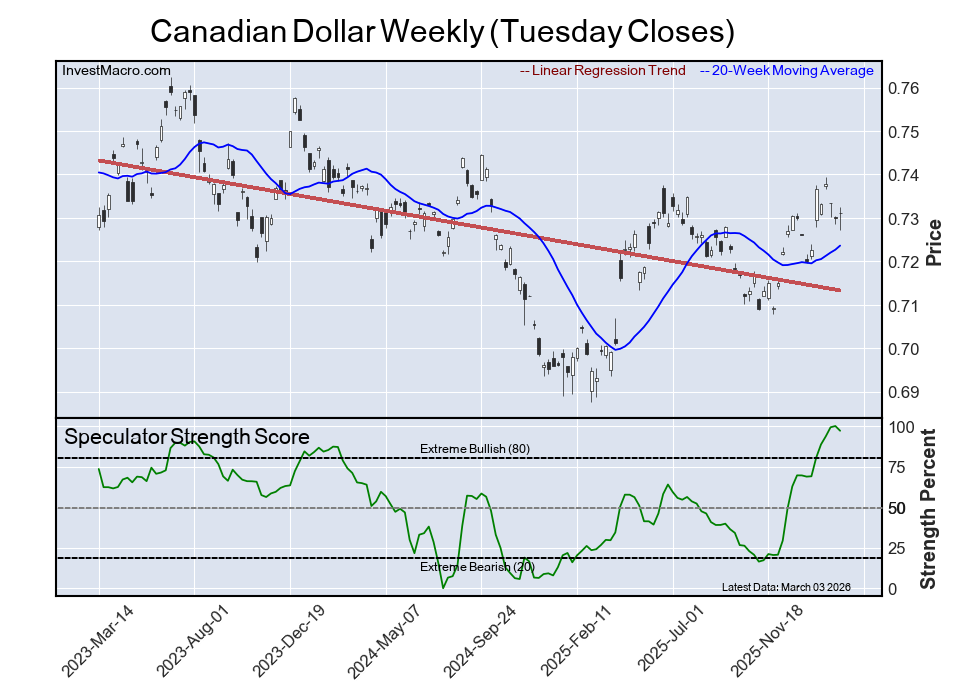
Canadian Dollar Forex Futures COT ChartThe Canadian Dollar large speculator standing this week equaled a net position of 21,050 contracts in the data reported through Tuesday. This was a weekly decline of -6,528 contracts from the previous week which had a total of 27,578 net contracts.

This week’s current strength score (the trader positioning range over the past three years, measured from 0 to 100) shows the speculators are currently Bullish-Extreme with a score of 97.1 percent. The commercials are Bearish-Extreme with a score of 2.7 percent and the small traders (not shown in chart) are Bullish with a score of 53.7 percent.

Price Trend-Following Model: Strong Uptrend

Our weekly trend-following model classifies the current market price position as: Strong Uptrend.

CANADIAN DOLLAR StatisticsSPECULATORSCOMMERCIALSSMALL TRADERS
– Percent of Open Interest Longs:40.443.512.9
– Percent of Open Interest Shorts:31.453.811.6
– Net Position:21,050-24,0563,006
– Gross Longs:94,008101,02930,071
– Gross Shorts:72,958125,08527,065
– Long to Short Ratio:1.3 to 10.8 to 11.1 to 1
NET POSITION TREND:
– Strength Index Score (3 Year Range Pct):97.12.753.7
– Strength Index Reading (3 Year Range):Bullish-ExtremeBearish-ExtremeBullish
NET POSITION MOVEMENT INDEX:
– 6-Week Change in Strength Index:28.1-29.920.1


Australian Dollar Futures:

Australian Dollar Forex Futures COT ChartThe Australian Dollar large speculator standing this week equaled a net position of 67,762 contracts in the data reported through Tuesday. This was a weekly increase of 15,118 contracts from the previous week which had a total of 52,644 net contracts.

This week’s current strength score (the trader positioning range over the past three years, measured from 0 to 100) shows the speculators are currently Bullish-Extreme with a score of 100.0 percent. The commercials are Bearish-Extreme with a score of 0.0 percent and the small traders (not shown in chart) are Bullish-Extreme with a score of 85.9 percent.

Price Trend-Following Model: Uptrend

Our weekly trend-following model classifies the current market price position as: Uptrend.

AUSTRALIAN DOLLAR StatisticsSPECULATORSCOMMERCIALSSMALL TRADERS
– Percent of Open Interest Longs:51.127.315.2
– Percent of Open Interest Shorts:25.760.77.1
– Net Position:67,762-89,24921,487
– Gross Longs:136,51572,99140,551
– Gross Shorts:68,753162,24019,064
– Long to Short Ratio:2.0 to 10.4 to 12.1 to 1
NET POSITION TREND:
– Strength Index Score (3 Year Range Pct):100.00.085.9
– Strength Index Reading (3 Year Range):Bullish-ExtremeBearish-ExtremeBullish-Extreme
NET POSITION MOVEMENT INDEX:
– 6-Week Change in Strength Index:46.6-37.5-9.2


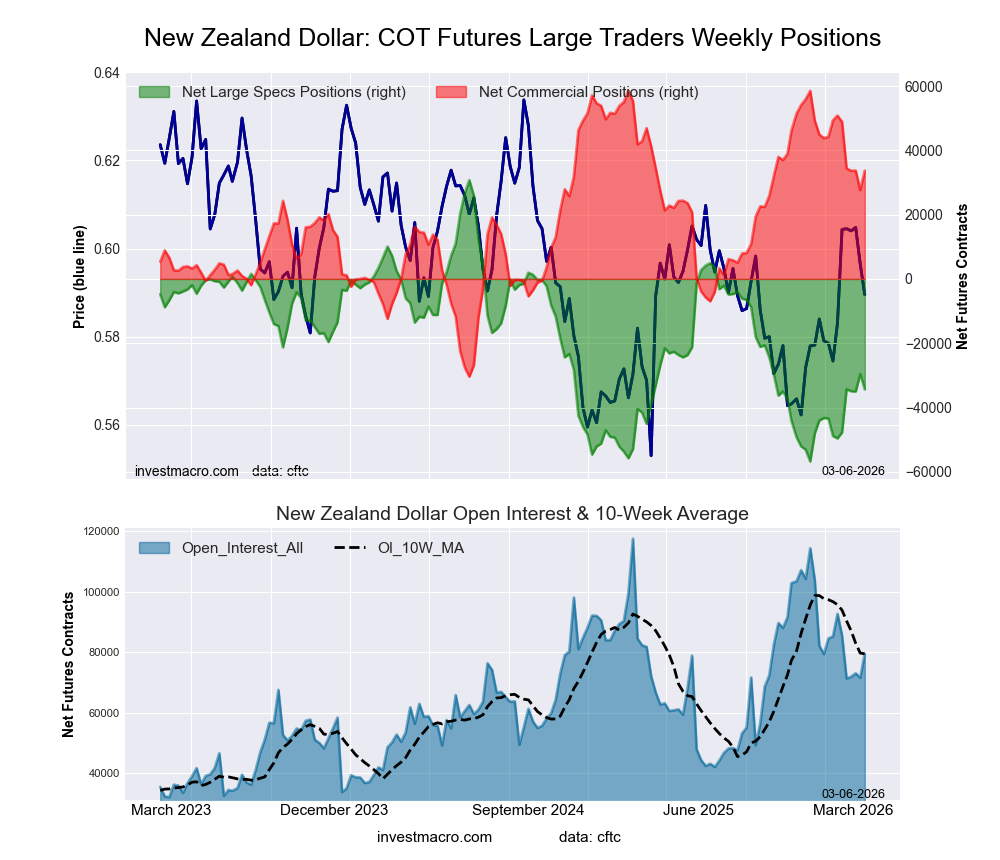
New Zealand Dollar Futures:

New Zealand Dollar Forex Futures COT ChartThe New Zealand Dollar large speculator standing this week equaled a net position of -34,334 contracts in the data reported through Tuesday. This was a weekly lowering of -4,767 contracts from the previous week which had a total of -29,567 net contracts.

This week’s current strength score (the trader positioning range over the past three years, measured from 0 to 100) shows the speculators are currently Bearish with a score of 25.6 percent. The commercials are Bullish with a score of 72.0 percent and the small traders (not shown in chart) are Bullish with a score of 60.7 percent.

Price Trend-Following Model: Weak Uptrend

Our weekly trend-following model classifies the current market price position as: Weak Uptrend.

NEW ZEALAND DOLLAR StatisticsSPECULATORSCOMMERCIALSSMALL TRADERS
– Percent of Open Interest Longs:16.669.65.5
– Percent of Open Interest Shorts:59.827.24.7
– Net Position:-34,33433,689645
– Gross Longs:13,17655,3244,396
– Gross Shorts:47,51021,6353,751
– Long to Short Ratio:0.3 to 12.6 to 11.2 to 1
NET POSITION TREND:
– Strength Index Score (3 Year Range Pct):25.672.060.7
– Strength Index Reading (3 Year Range):BearishBullishBullish
NET POSITION MOVEMENT INDEX:
– 6-Week Change in Strength Index:17.5-19.224.0


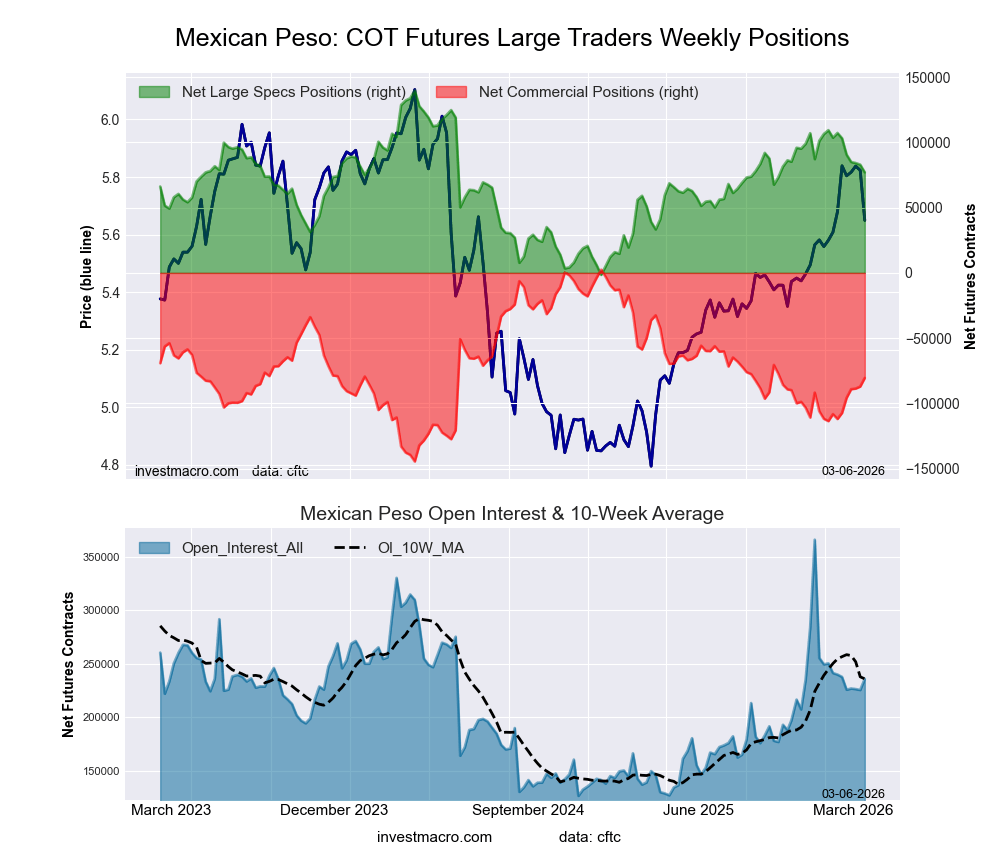
Mexican Peso Futures:

Mexican Peso Futures COT ChartThe Mexican Peso large speculator standing this week equaled a net position of 77,043 contracts in the data reported through Tuesday. This was a weekly decline of -5,837 contracts from the previous week which had a total of 82,880 net contracts.

This week’s current strength score (the trader positioning range over the past three years, measured from 0 to 100) shows the speculators are currently Bullish with a score of 55.6 percent. The commercials are Bearish with a score of 43.5 percent and the small traders (not shown in chart) are Bearish with a score of 42.0 percent.

Price Trend-Following Model: Uptrend

Our weekly trend-following model classifies the current market price position as: Uptrend.

MEXICAN PESO StatisticsSPECULATORSCOMMERCIALSSMALL TRADERS
– Percent of Open Interest Longs:53.638.02.5
– Percent of Open Interest Shorts:21.072.11.0
– Net Position:77,043-80,5163,473
– Gross Longs:126,53189,6365,852
– Gross Shorts:49,488170,1522,379
– Long to Short Ratio:2.6 to 10.5 to 12.5 to 1
NET POSITION TREND:
– Strength Index Score (3 Year Range Pct):55.643.542.0
– Strength Index Reading (3 Year Range):BullishBearishBearish
NET POSITION MOVEMENT INDEX:
– 6-Week Change in Strength Index:-21.321.4-7.3


Brazilian Real Futures:

Brazil Real Futures COT ChartThe Brazilian Real large speculator standing this week equaled a net position of 44,970 contracts in the data reported through Tuesday. This was a weekly advance of 8,296 contracts from the previous week which had a total of 36,674 net contracts.

This week’s current strength score (the trader positioning range over the past three years, measured from 0 to 100) shows the speculators are currently Bullish with a score of 72.7 percent. The commercials are Bearish with a score of 26.4 percent and the small traders (not shown in chart) are Bearish with a score of 42.4 percent.

Price Trend-Following Model: Uptrend

Our weekly trend-following model classifies the current market price position as: Uptrend.

BRAZIL REAL StatisticsSPECULATORSCOMMERCIALSSMALL TRADERS
– Percent of Open Interest Longs:67.427.54.5
– Percent of Open Interest Shorts:24.973.60.9
– Net Position:44,970-48,7933,823
– Gross Longs:71,26729,0324,810
– Gross Shorts:26,29777,825987
– Long to Short Ratio:2.7 to 10.4 to 14.9 to 1
NET POSITION TREND:
– Strength Index Score (3 Year Range Pct):72.726.442.4
– Strength Index Reading (3 Year Range):BullishBearishBearish
NET POSITION MOVEMENT INDEX:
– 6-Week Change in Strength Index:19.9-19.71.1


Bitcoin Futures:

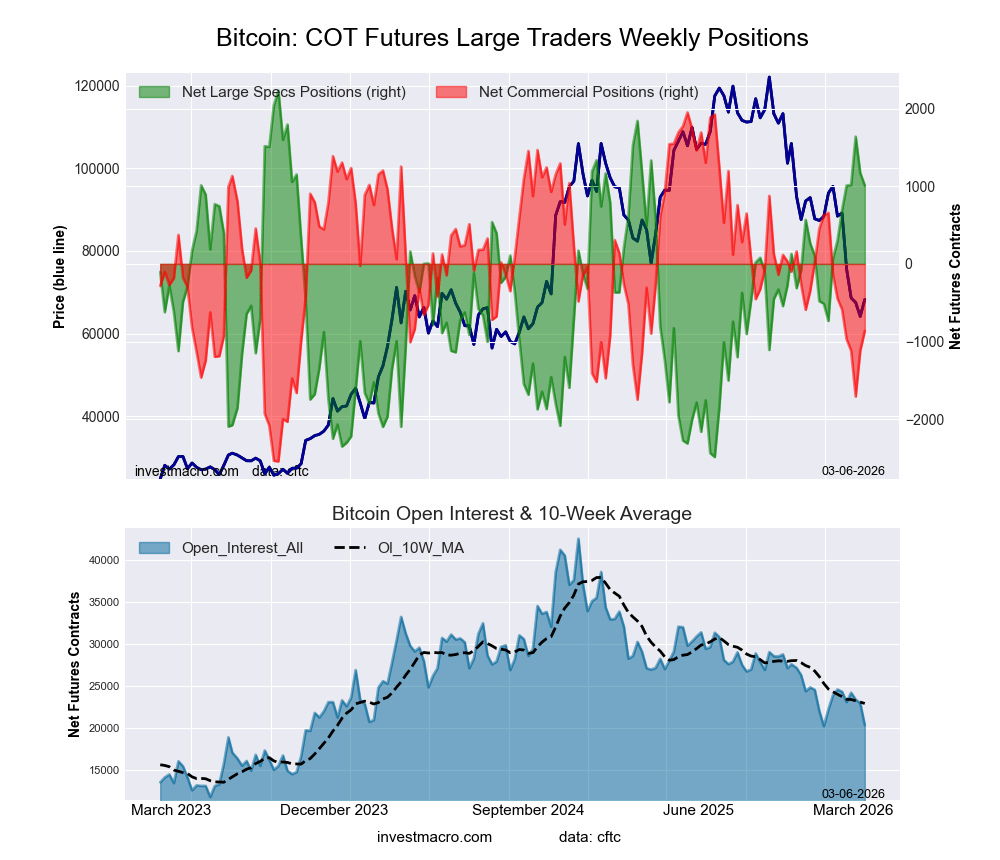
Bitcoin Crypto Futures COT ChartThe Bitcoin large speculator standing this week equaled a net position of 1,011 contracts in the data reported through Tuesday. This was a weekly fall of -161 contracts from the previous week which had a total of 1,172 net contracts.

This week’s current strength score (the trader positioning range over the past three years, measured from 0 to 100) shows the speculators are currently Bullish with a score of 74.1 percent. The commercials are Bearish with a score of 37.4 percent and the small traders (not shown in chart) are Bearish with a score of 29.6 percent.

Price Trend-Following Model: Strong Downtrend

Our weekly trend-following model classifies the current market price position as: Strong Downtrend.

BITCOIN StatisticsSPECULATORSCOMMERCIALSSMALL TRADERS
– Percent of Open Interest Longs:76.83.75.7
– Percent of Open Interest Shorts:71.87.96.4
– Net Position:1,011-862-149
– Gross Longs:15,5857511,149
– Gross Shorts:14,5741,6131,298
– Long to Short Ratio:1.1 to 10.5 to 10.9 to 1
NET POSITION TREND:
– Strength Index Score (3 Year Range Pct):74.137.429.6
– Strength Index Reading (3 Year Range):BullishBearishBearish
NET POSITION MOVEMENT INDEX:
– 6-Week Change in Strength Index:15.1-9.3-15.3


Article By InvestMacroReceive our weekly COT Newsletter

*COT Report: The COT data, released weekly to the public each Friday, is updated through the most recent Tuesday (data is 3 days old) and shows a quick view of how large speculators or non-commercials (for-profit traders) were positioned in the futures markets.

The CFTC categorizes trader positions according to commercial hedgers (traders who use futures contracts for hedging as part of the business), non-commercials (large traders who speculate to realize trading profits) and nonreportable traders (usually small traders/speculators) as well as their open interest (contracts open in the market at time of reporting). See CFTC criteria here.

Speculator Extremes: AUD, CAD, Steel, Natural Gas, Cocoa & Sugar lead Bullish & Bearish Positions

By InvestMacro 

The latest update for the weekly Commitment of Traders (COT) report was released by the Commodity Futures Trading Commission (CFTC) on Friday for data ending on March 3rd.

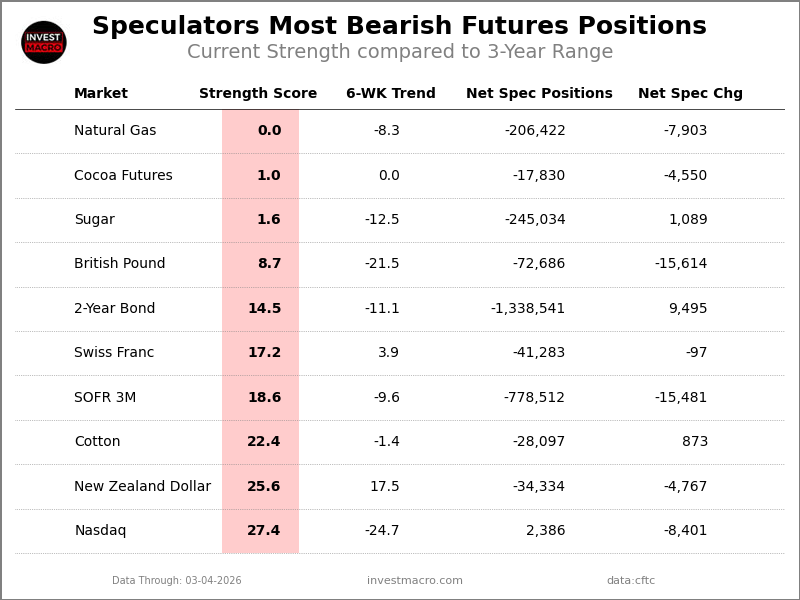
This weekly Extreme Positions report highlights the Most Bullish and Most Bearish Positions for the speculator category and is a current snapshot of how speculators were positioned as of Tuesday. Extreme positioning in these markets can foreshadow strong moves in the underlying market.

To signify an extreme position, we use the Strength Index (also known as the COT Index) of each instrument, a common method of measuring COT data. The Strength Index is simply a comparison of current trader positions against the range of positions over the previous 3 years. We use over 80 percent as extremely bullish and under 20 percent as extremely bearish. (Compare Strength Index scores across all markets in the data table or cot leaders table)


Extreme Bullish Speculator Table


Here Are This Week’s Most Bullish Speculator Positions:

Australian Dollar

Extreme Bullish Leader
The Australian Dollar speculator position comes in as the most bullish extreme standing this week with the AUD speculator level maintaining a maximum 100 percent score of its 3-year range.

The six-week trend for the percent strength score totaled a rise by 47 percentage points this week. The overall net speculator position was a total of 67,762 net contracts this week with a boost by 15,118 contract in the weekly speculator bets.


Speculators or Non-Commercials Notes:

Speculators, classified as non-commercial traders by the CFTC, are made up of large commodity funds, hedge funds and other significant for-profit participants. The Specs are generally regarded as trend-followers in their behavior towards price action – net speculator bets and prices tend to go in the same directions. These traders often look to buy when prices are rising and sell when prices are falling. To illustrate this point, many times speculator contracts can be found at their most extremes (bullish or bearish) when prices are also close to their highest or lowest levels.

These extreme levels can be dangerous for the large speculators as the trade is most crowded, there is less trading ammunition still sitting on the sidelines to push the trend further and prices have moved a significant distance. When the trend becomes exhausted, some speculators take profits while others look to also exit positions when prices fail to continue in the same direction. This process usually plays out over many months to years and can ultimately create a reverse effect where prices start to fall and speculators start a process of selling when prices are falling.


Canadian Dollar

Extreme Bullish Leader
The Canadian Dollar speculator position comes in second for the extreme standings this week. The CAD speculator level is now at a 97 percent score of its 3-year range.

The six-week trend for the percent strength score was a rise by 28 percentage points this week while the speculator position registered 21,050 net contracts this week with a weekly change of -6,528 contracts in speculator bets.


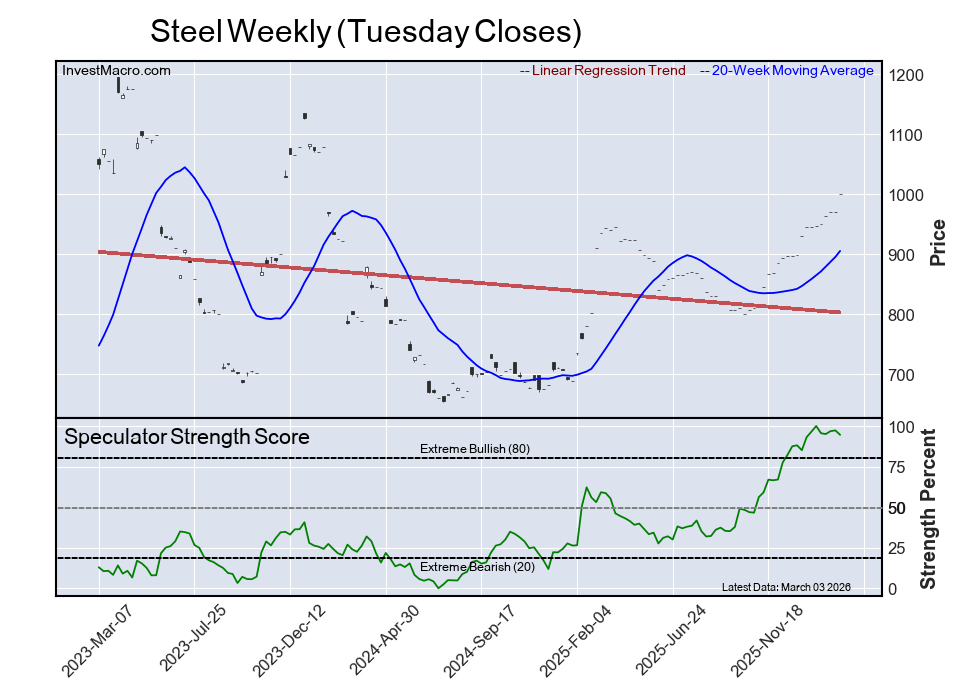
Steel

Extreme Bullish Leader
The Steel speculator position comes in third this week in the extreme standings as the Steel speculator level resides at a 95 percent score of its 3-year range.

The six-week trend for the speculator strength score came in at a dip by -2 percentage points this week. The overall speculator position was 11,298 net contracts this week with a decline of -526 contracts in the weekly speculator bets.


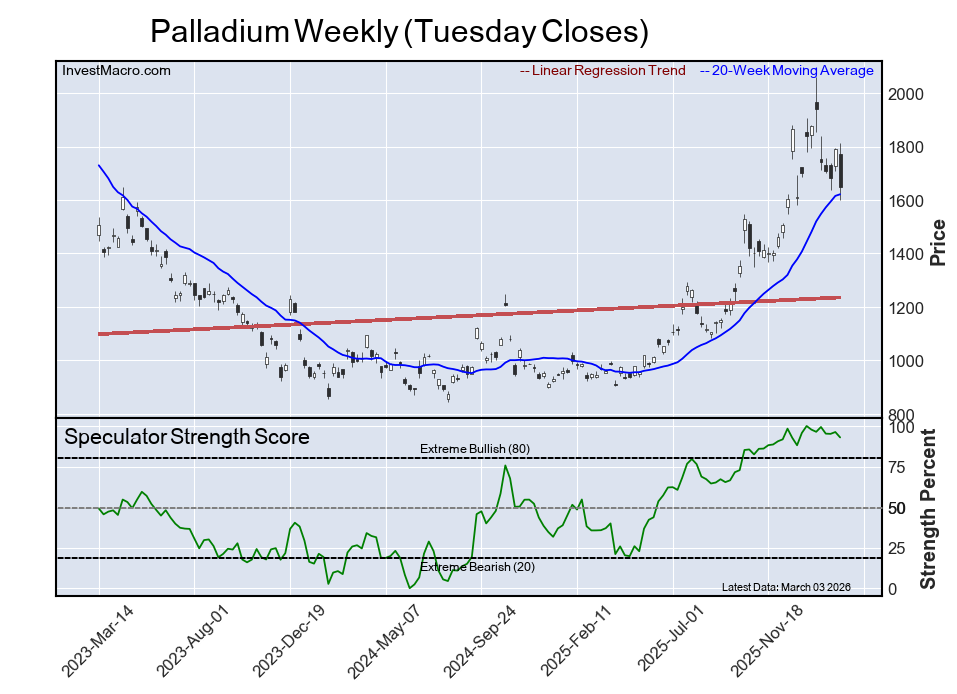
Palladium

Extreme Bullish Leader
The Palladium speculator position comes up number four in the extreme standings this week. The Palladium speculator level is at a 93 percent score of its 3-year range.

The six-week trend for the speculator strength score totaled a decrease by -5 percentage points this week. The overall speculator position was 161 net contracts this week with a dip of -503 contracts in the speculator bets.


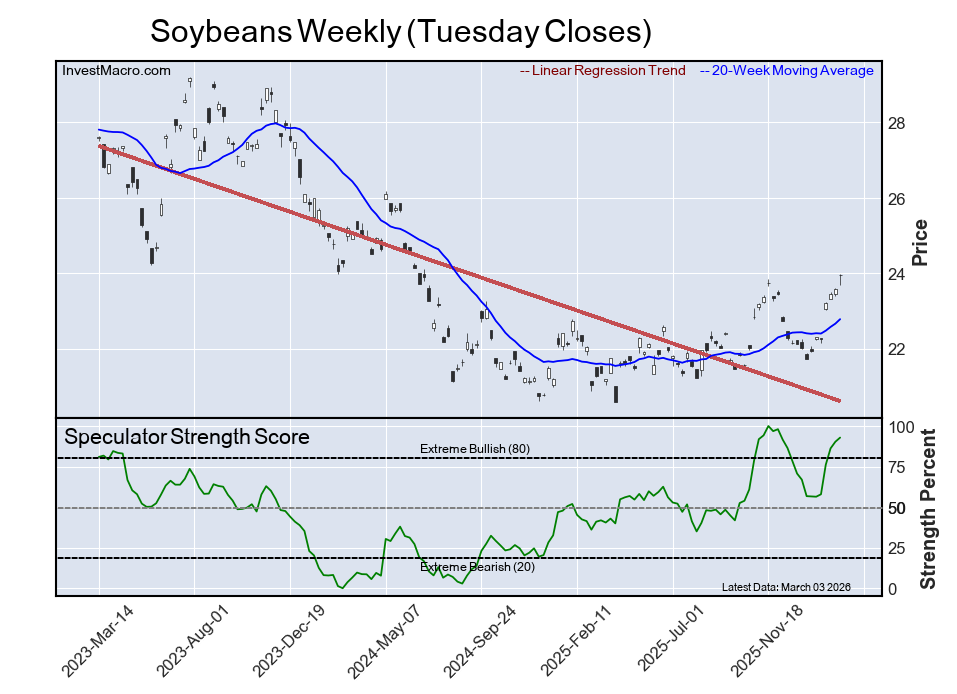
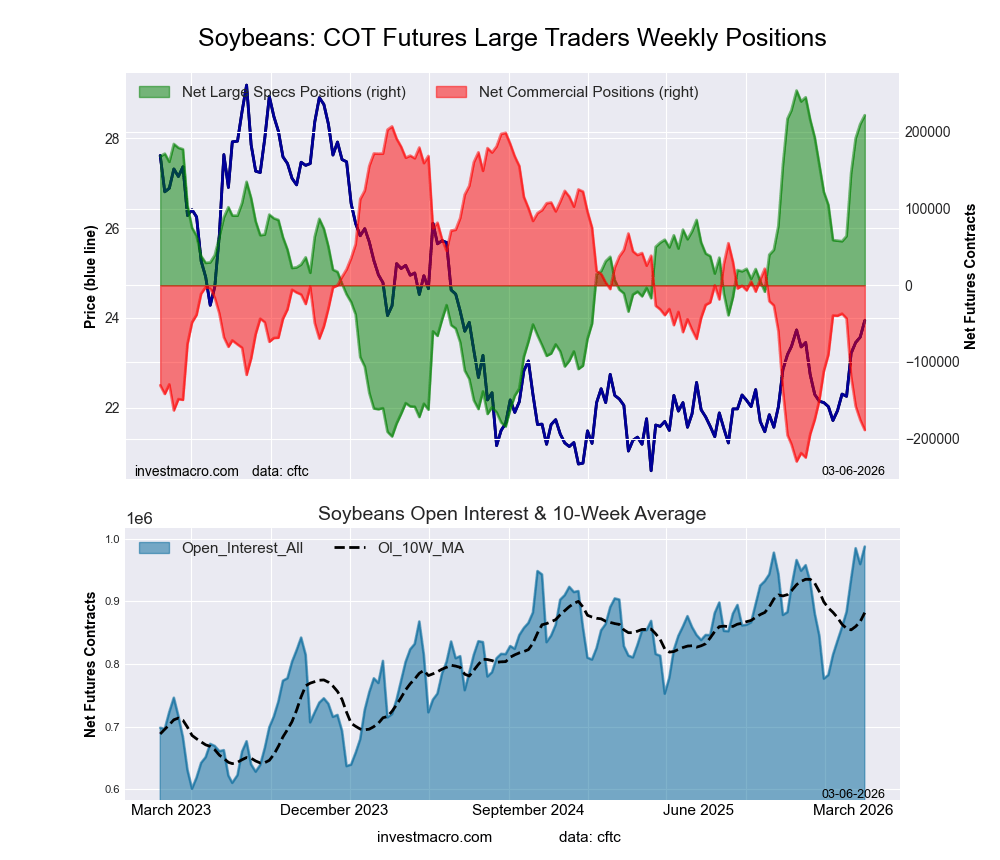
Soybeans

Extreme Bullish Leader
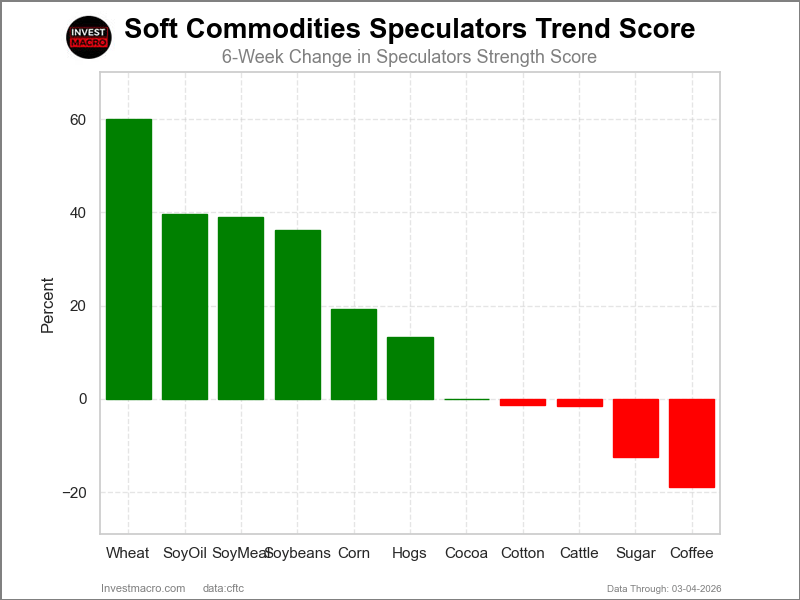
The Soybeans speculator position rounds out the top five in this week’s bullish extreme standings as the Soybeans speculator level sits at a 93 percent score of its 3-year range. The six-week trend for the speculator strength score was a boost by 36 percentage points this week.

The speculator position was 221,902 net contracts this week with an increase of 11,630 contracts in the weekly speculator bets.


The Most Bearish Speculator Positions of the Week:

Extreme Bearish Speculator Table


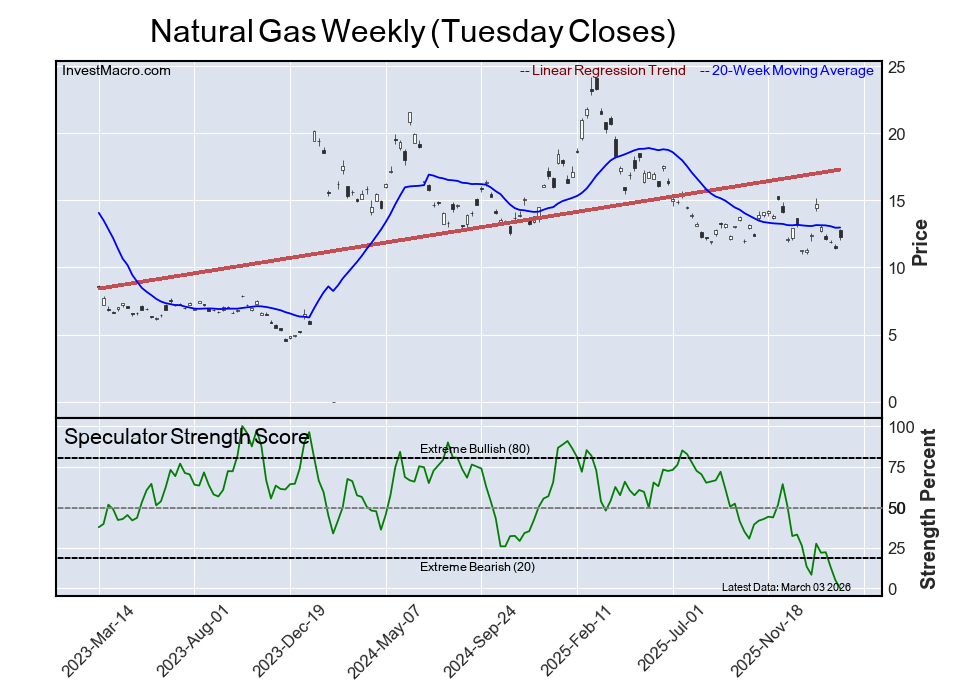
Natural Gas

Extreme Bearish Leader
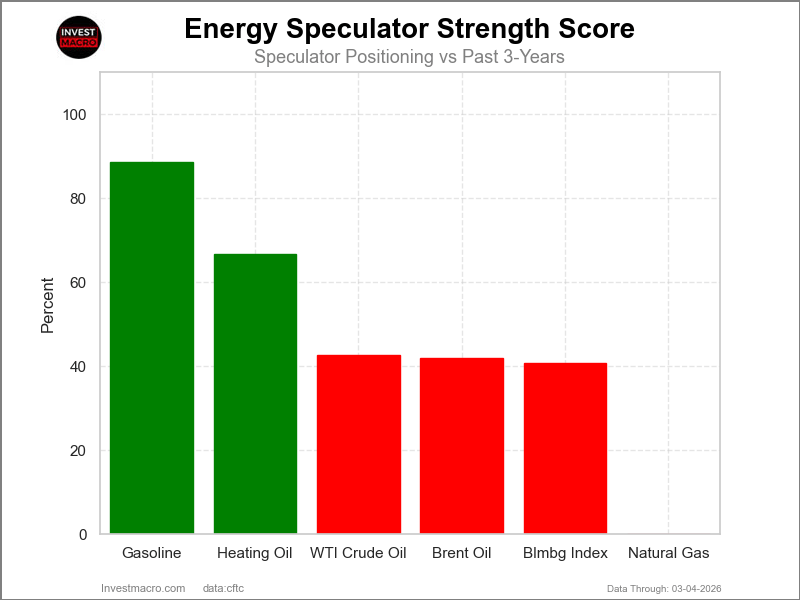
The Natural Gas speculator position comes in as the most bearish extreme standing this week with he Natural Gas speculator level sitting at a minimum 0 percent score of its 3-year range.

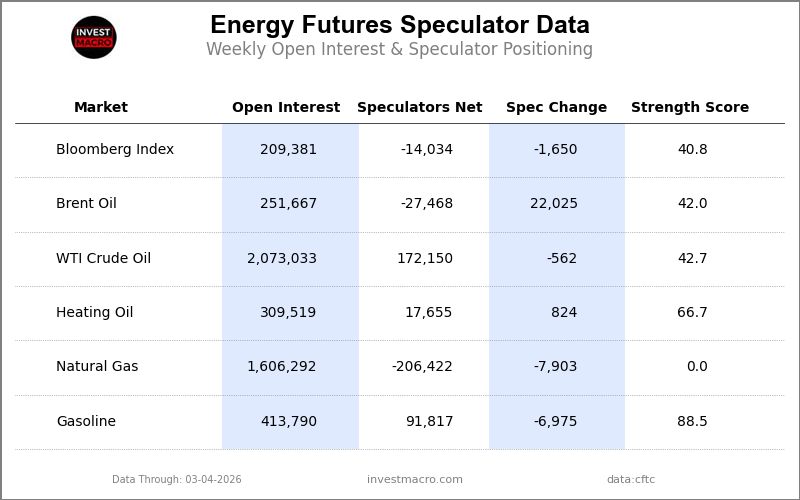
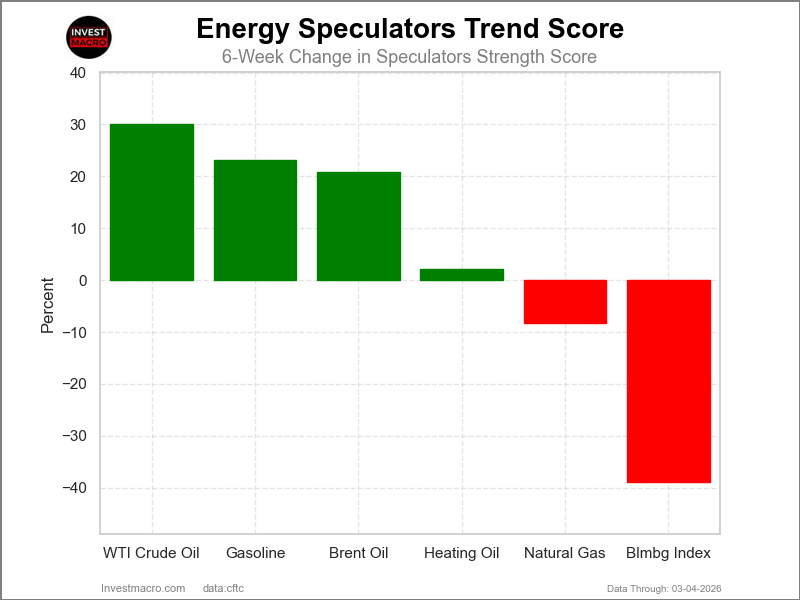
The six-week trend for the speculator strength score was a decline by -8 percentage points this week while the overall speculator position was -206,422 net contracts this week with a change of -7,903 contracts in the speculator bets.


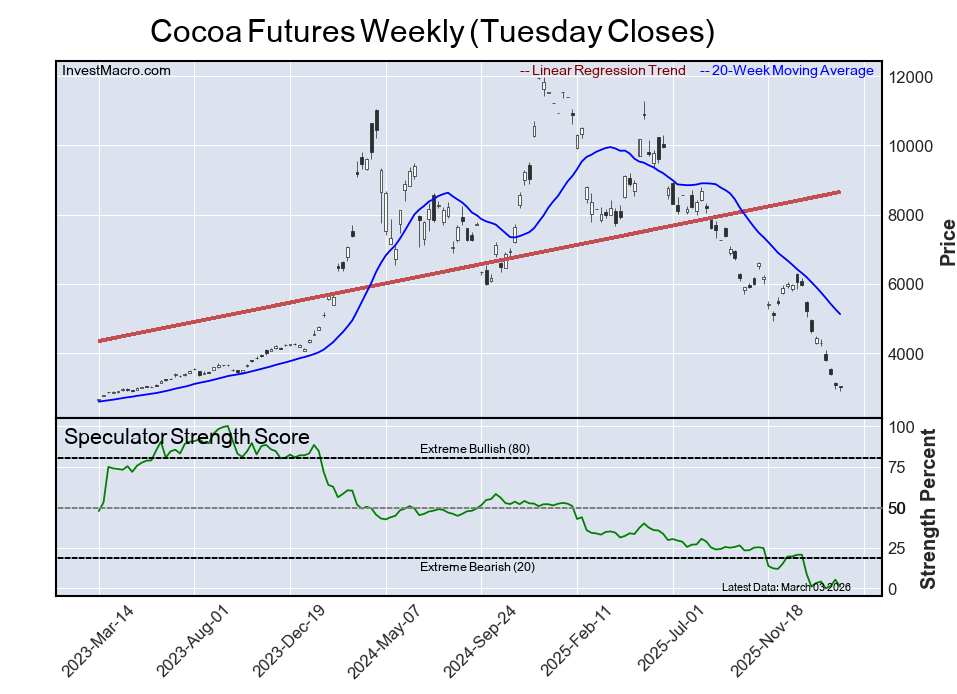
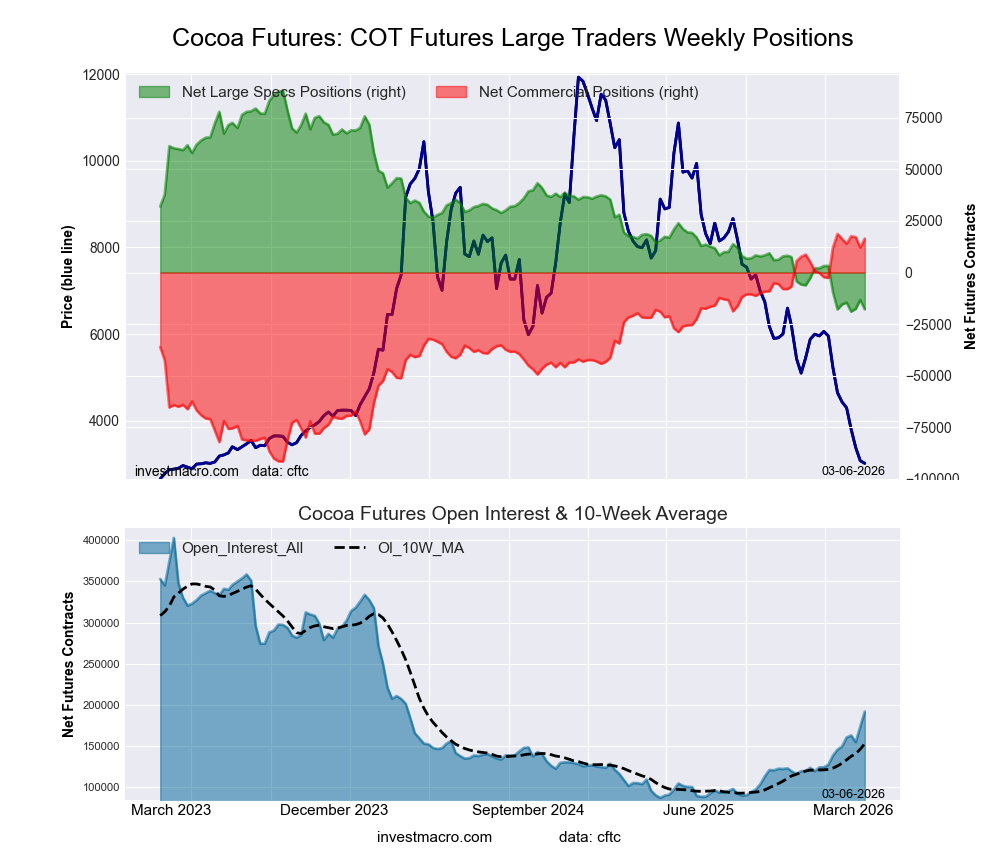
Cocoa Futures

Extreme Bearish Leader
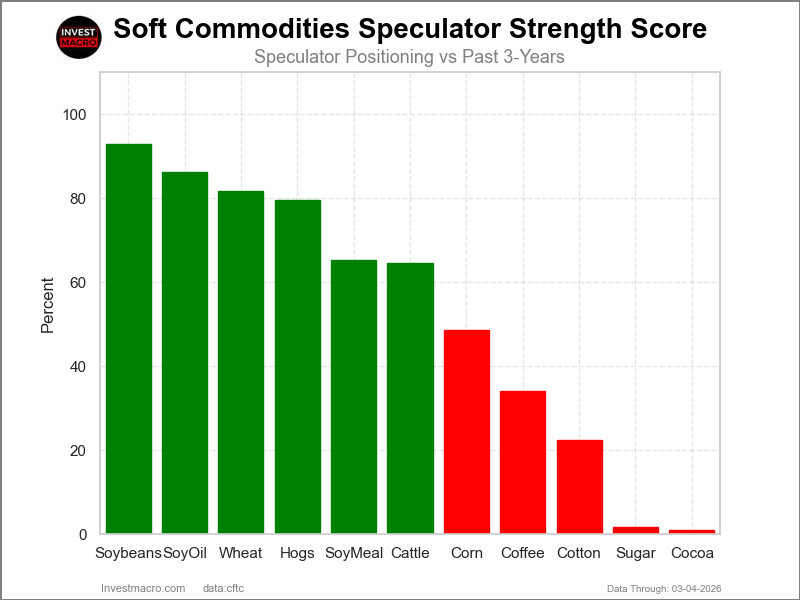
The Cocoa Futures speculator position comes in next for the most bearish extreme standing on the week. The Cocoa speculator level is at just a 1 percent score of its 3-year range.

The six-week trend for the speculator strength score showed no change this week while the speculator position was -17,830 net contracts this week with a change of -4,550 contracts in the weekly speculator bets.


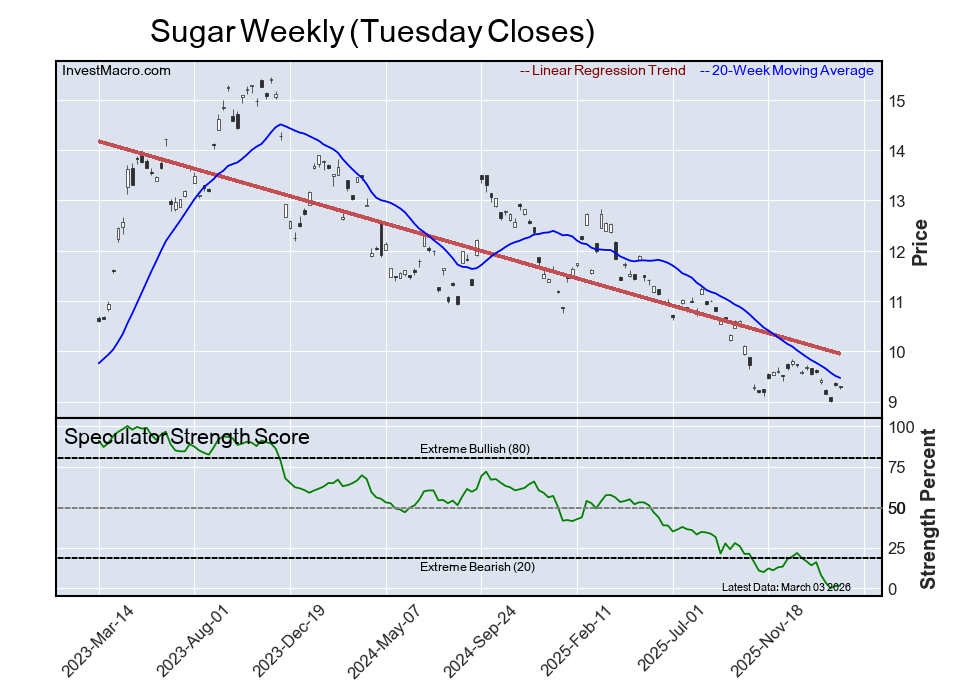
Sugar

Extreme Bearish Leader
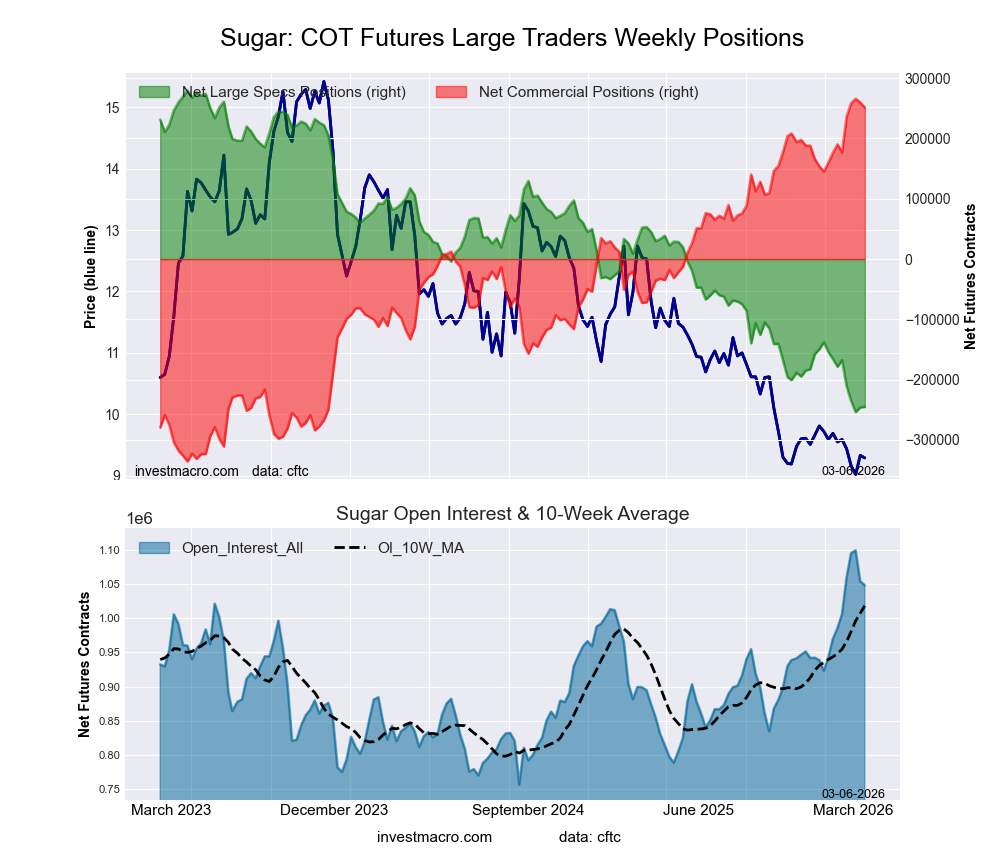
The Sugar speculator position comes in as third most bearish extreme standing of the week as the Sugar speculator level resides at a 2 percent score of its 3-year range.

The six-week trend for the speculator strength score was a drop by -13 percentage points this week and the overall speculator position was -245,034 net contracts this week with a small gain of 1,089 contracts in the speculator bets.


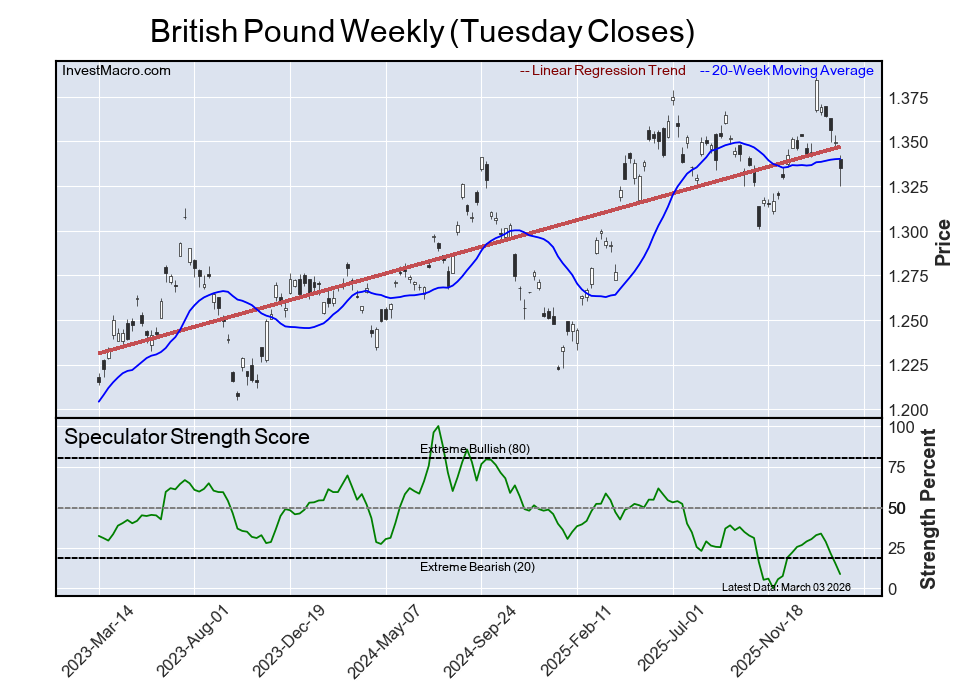
British Pound

Extreme Bearish Leader
The British Pound speculator position comes in as this week’s fourth most bearish extreme standing. The GBP speculator level is at a 9 percent score of its 3-year range.

The six-week trend for the speculator strength score was a decline by -22 percentage points this week and the speculator position was a total of -72,686 net contracts with a drop of -15,614 contracts in the weekly speculator bets.


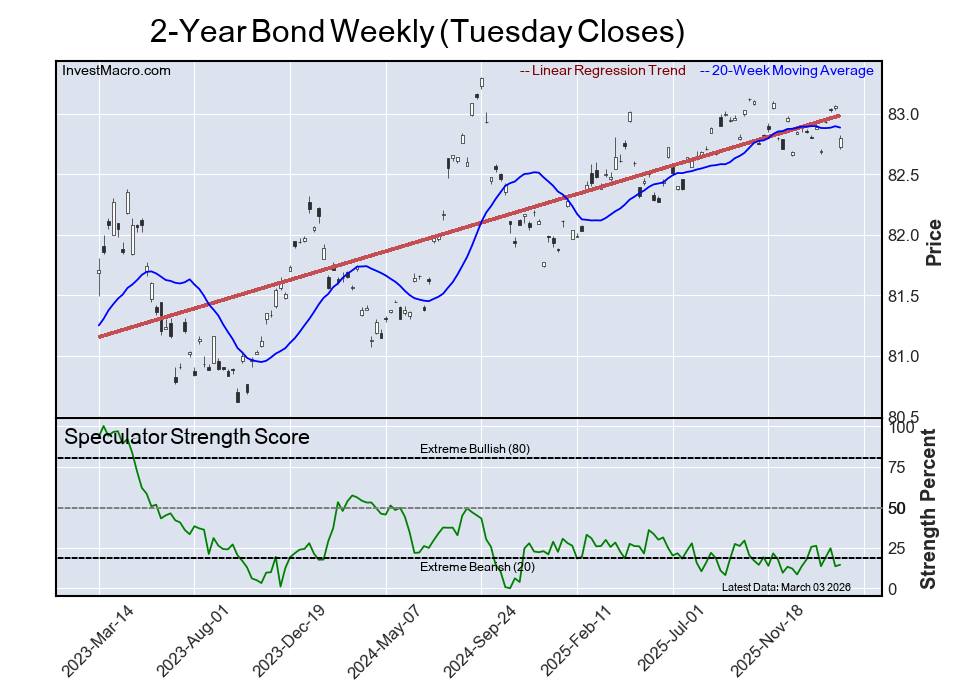
2-Year Bond

Extreme Bearish Leader
Next, the 2-Year Bond speculator position comes in as the fifth most bearish extreme standing for this week with the 2-Year speculator level sitting at just a 14 percent score of its 3-year range.

The six-week trend for the speculator strength score was a reduction by -11 percentage points this week and the speculator position was -1,338,541 net contracts this week with a small gain of 9,495 contracts in the weekly speculator bets.


Article By InvestMacroReceive our weekly COT Newsletter

*COT Report: The COT data, released weekly to the public each Friday, is updated through the most recent Tuesday (data is 3 days old) and shows a quick view of how large speculators or non-commercials (for-profit traders) were positioned in the futures markets.

The CFTC categorizes trader positions according to commercial hedgers (traders who use futures contracts for hedging as part of the business), non-commercials (large traders who speculate to realize trading profits) and nonreportable traders (usually small traders/speculators) as well as their open interest (contracts open in the market at time of reporting). See CFTC criteria here.

COT Metals Charts: Speculator Bets led by Silver, Gold & Platinum

By InvestMacro

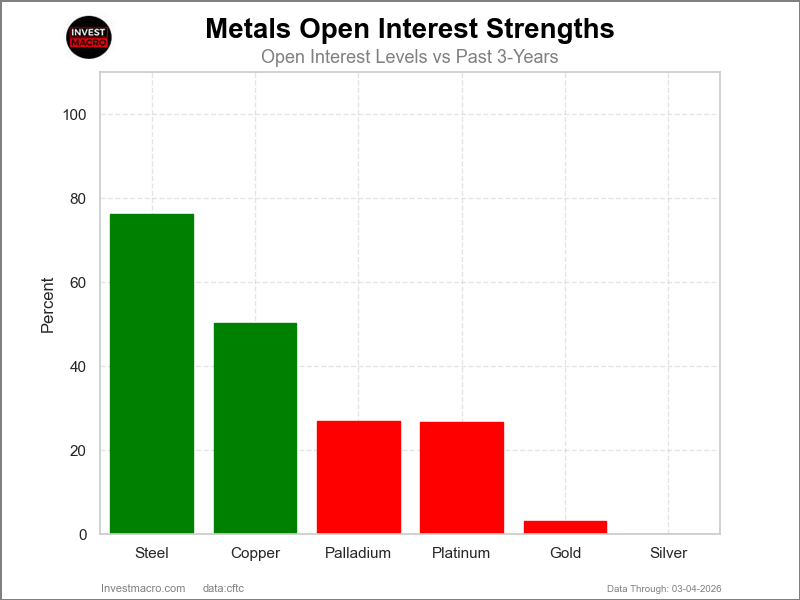
Metals Open Interest COT Chart
Here are the latest charts and statistics for the Commitment of Traders (COT) data published by the Commodities Futures Trading Commission (CFTC).

The latest COT data is updated through Tuesday March 3rd and shows a quick view of how large traders (for-profit speculators and commercial entities) were positioned in the futures markets.

Weekly Speculator Changes led by Silver, Gold & Platinum

Metals Net Positions COT Chart
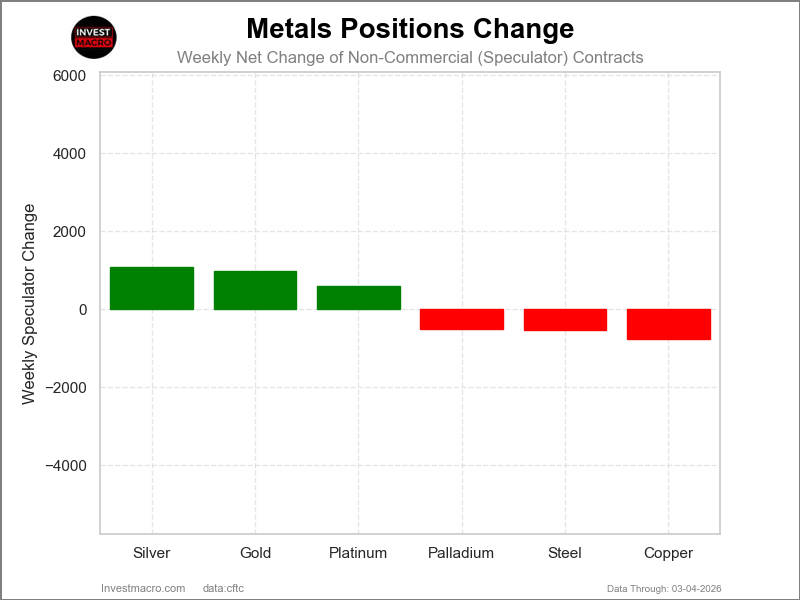
The COT metals markets speculator bets were mixed this week as three out of the six metals markets we cover had higher positioning while the other three markets had lower speculator contracts.

Leading the gains for the metals was Silver (1,078 contracts) with Gold (968 contracts) and Platinum (592 contracts) also showing modestly positive weeks.

The markets with declines in speculator bets for the week were Copper (-759 contracts), Steel (-526 contracts) and with Palladium (-503 contracts) also registering lower bets on the week.

Steel leads Metal Markets price performance this week

Steel had the highest five-day price change for the Metals Markets this week with a 2.67% gain. Gold was lower by -2.09% and Copper was down by -3.34% over the past five days. Palladium saw a sharp decline by -8.78% and was followed by Platinum which saw a -9.85% drop. The biggest decliner on the week was Silver with a -10.23% shortfall.

The cool-off in the Metals Markets can be seen over the past thirty days returns with only Steel (17.72%) and Gold (4.81%) having higher price returns over the past thirty days while Copper (-0.08%), Palladium( -19.67%), Platinum (-23.28%), and Silver (-12.84%) all have now moved into negative territory over the past thirty days.

Over the past ninety days, all six of our Metal Markets are up by at least 12% with Copper being the lowest gainer with a 12.79% gain over the past ninety days while Silver still leads with a 72.63% rise over the past ninety days. Steel (43.06%), Platinum (33.63%), Gold (25.43%) and Palladium (16.12%) are still seeing strong returns over the past 90-days as well.


Metals Data:

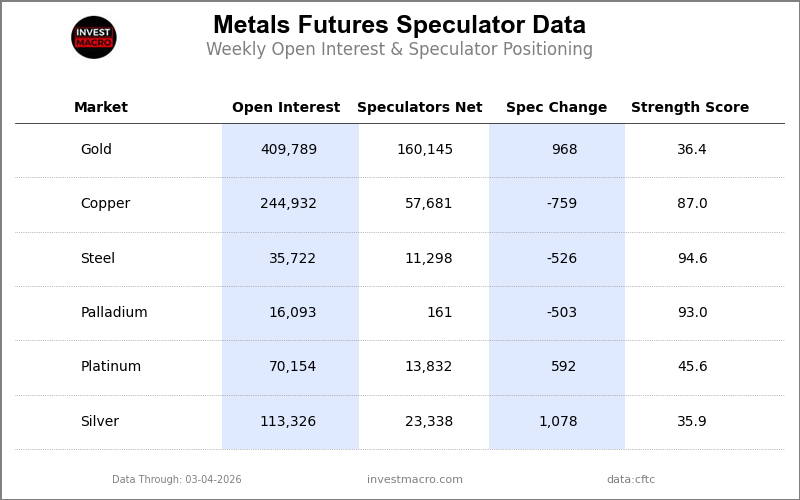
Metals Table COT Chart
Legend: Weekly Speculators Change | Speculators Current Net Position | Speculators Strength Score compared to last 3-Years (0-100 range)


Strength Scores led by Steel, Palladium & Copper

Metals Strength Scores COT Chart
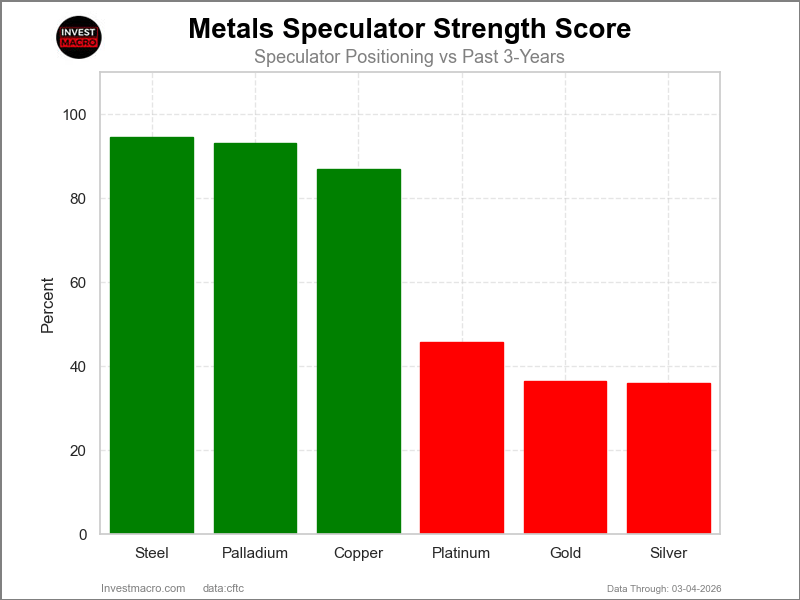
COT Strength Scores (a normalized measure of Speculator positions over a 3-Year range, from 0 to 100 where above 80 is Extreme-Bullish and below 20 is Extreme-Bearish) showed that Steel (95 percent) and Palladium (93 percent) lead the metals markets this week. Copper (87 percent) comes in as the next highest in the weekly strength scores.

On the downside, Silver (36 percent) and Gold (36 percent) come in at the lowest strength levels currently followed by Platinum (46 percent).

Strength Statistics:
Gold (36.4 percent) vs Gold previous week (36.0 percent)
Silver (35.9 percent) vs Silver previous week (34.3 percent)
Copper (87.0 percent) vs Copper previous week (87.7 percent)
Platinum (45.6 percent) vs Platinum previous week (44.1 percent)
Palladium (93.0 percent) vs Palladium previous week (96.3 percent)
Steel (94.6 percent) vs Steel previous week (97.3 percent)


Copper tops the 6-Week Strength Trends

Metals Trends COT Chart
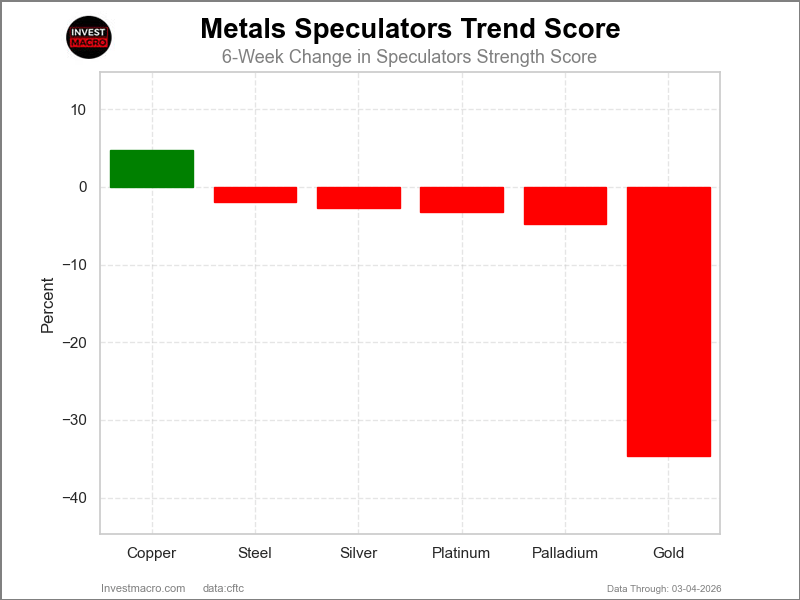
COT Strength Score Trends (or move index, calculates the 6-week changes in strength scores) showed that Copper (5 percent) leads the past six weeks trends for metals.

Gold (-35 percent) leads the downside trend scores currently with Palladium (-5 percent) as the next market with lower trend scores.

Move Statistics:
Gold (-34.7 percent) vs Gold previous week (-37.7 percent)
Silver (-2.7 percent) vs Silver previous week (-14.3 percent)
Copper (4.8 percent) vs Copper previous week (4.7 percent)
Platinum (-3.2 percent) vs Platinum previous week (-10.9 percent)
Palladium (-4.8 percent) vs Palladium previous week (-3.7 percent)
Steel (-1.9 percent) vs Steel previous week (4.2 percent)


Individual Markets:

Gold Comex Futures:

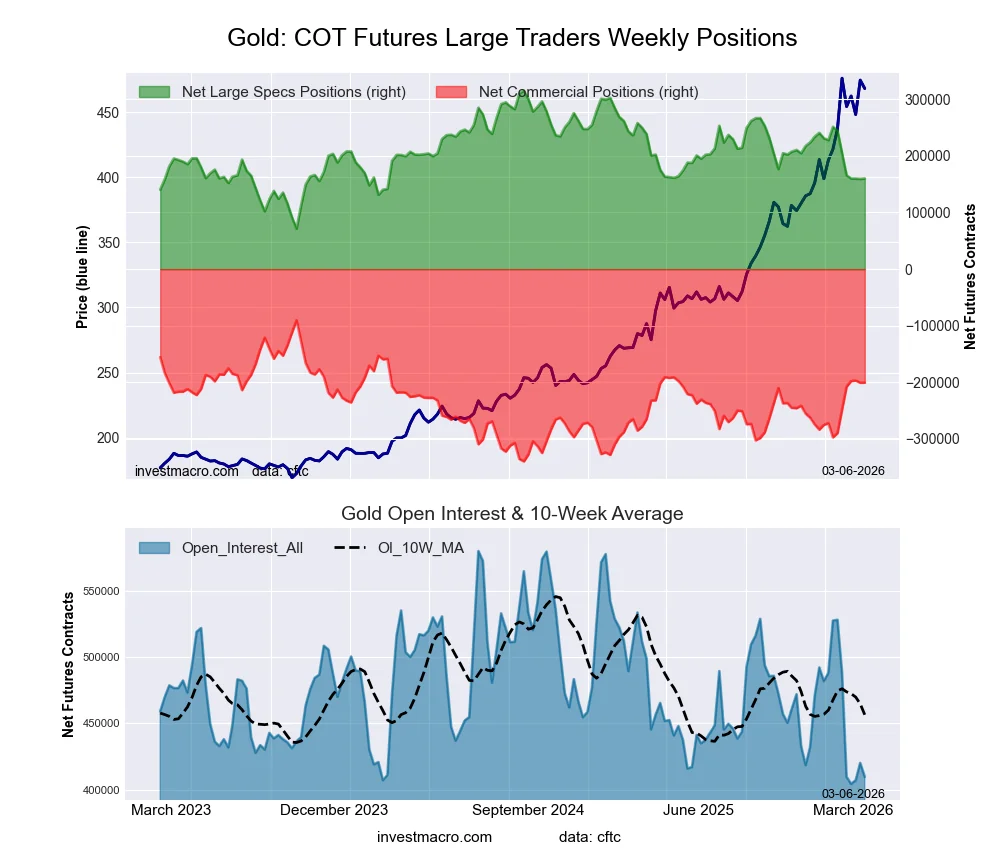
Gold Futures COT ChartThe Gold Comex Futures large speculator standing this week totaled a net position of 160,145 contracts in the data reported through Tuesday. This was a weekly boost of 968 contracts from the previous week which had a total of 159,177 net contracts.

This week’s current strength score (the trader positioning range over the past three years, measured from 0 to 100) shows the speculators are currently Bearish with a score of 36.4 percent. The commercials are Bullish with a score of 55.8 percent and the small traders (not shown in chart) are Bullish-Extreme with a score of 84.1 percent.

Price Trend-Following Model: Uptrend

Our weekly trend-following model classifies the current market price position as: Uptrend.

Gold Futures StatisticsSPECULATORSCOMMERCIALSSMALL TRADERS
– Percent of Open Interest Longs:52.220.713.5
– Percent of Open Interest Shorts:13.169.63.6
– Net Position:160,145-200,58340,438
– Gross Longs:213,75284,83455,126
– Gross Shorts:53,607285,41714,688
– Long to Short Ratio:4.0 to 10.3 to 13.8 to 1
NET POSITION TREND:
– Strength Index Score (3 Year Range Pct):36.455.884.1
– Strength Index Reading (3 Year Range):BearishBullishBullish-Extreme
NET POSITION MOVEMENT INDEX:
– 6-Week Change in Strength Index:-34.735.7-13.1


Silver Comex Futures:

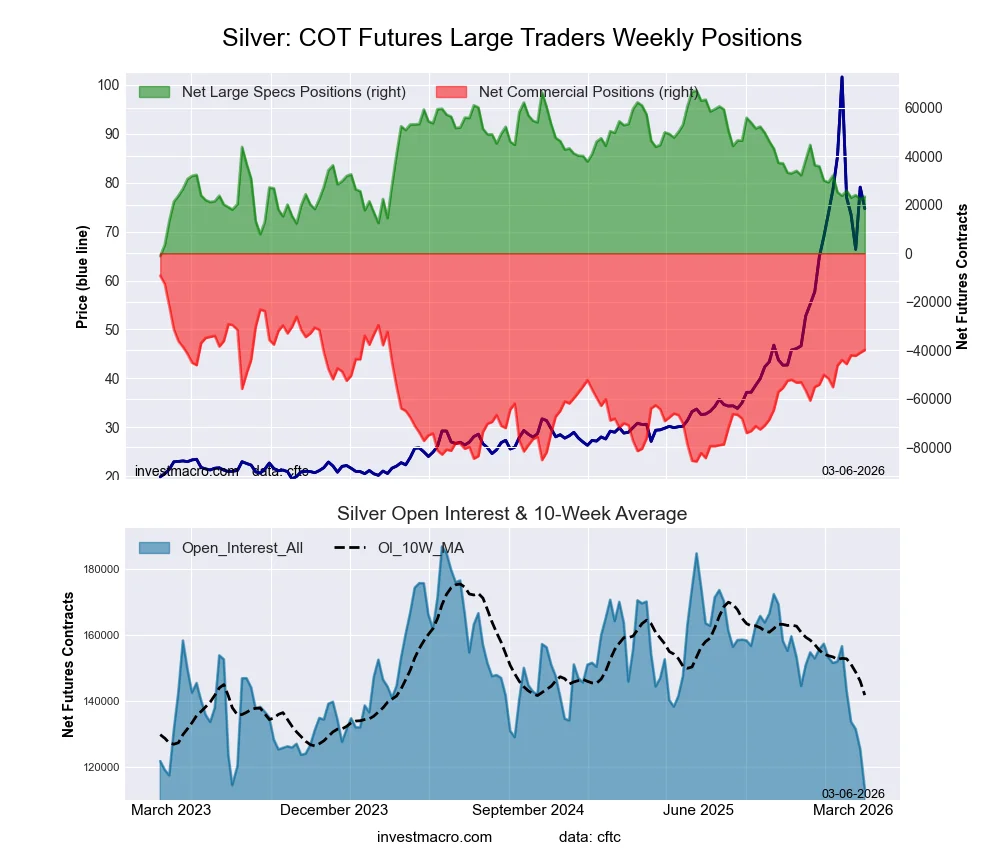
Silver Futures COT ChartThe Silver Comex Futures large speculator standing this week totaled a net position of 23,338 contracts in the data reported through Tuesday. This was a weekly increase of 1,078 contracts from the previous week which had a total of 22,260 net contracts.

This week’s current strength score (the trader positioning range over the past three years, measured from 0 to 100) shows the speculators are currently Bearish with a score of 35.9 percent. The commercials are Bullish with a score of 59.9 percent and the small traders (not shown in chart) are Bearish with a score of 44.6 percent.

Price Trend-Following Model: Uptrend

Our weekly trend-following model classifies the current market price position as: Uptrend.

Silver Futures StatisticsSPECULATORSCOMMERCIALSSMALL TRADERS
– Percent of Open Interest Longs:30.227.323.0
– Percent of Open Interest Shorts:9.662.58.3
– Net Position:23,338-39,96616,628
– Gross Longs:34,22630,89326,079
– Gross Shorts:10,88870,8599,451
– Long to Short Ratio:3.1 to 10.4 to 12.8 to 1
NET POSITION TREND:
– Strength Index Score (3 Year Range Pct):35.959.944.6
– Strength Index Reading (3 Year Range):BearishBullishBearish
NET POSITION MOVEMENT INDEX:
– 6-Week Change in Strength Index:-2.78.4-25.0


Copper Grade #1 Futures:

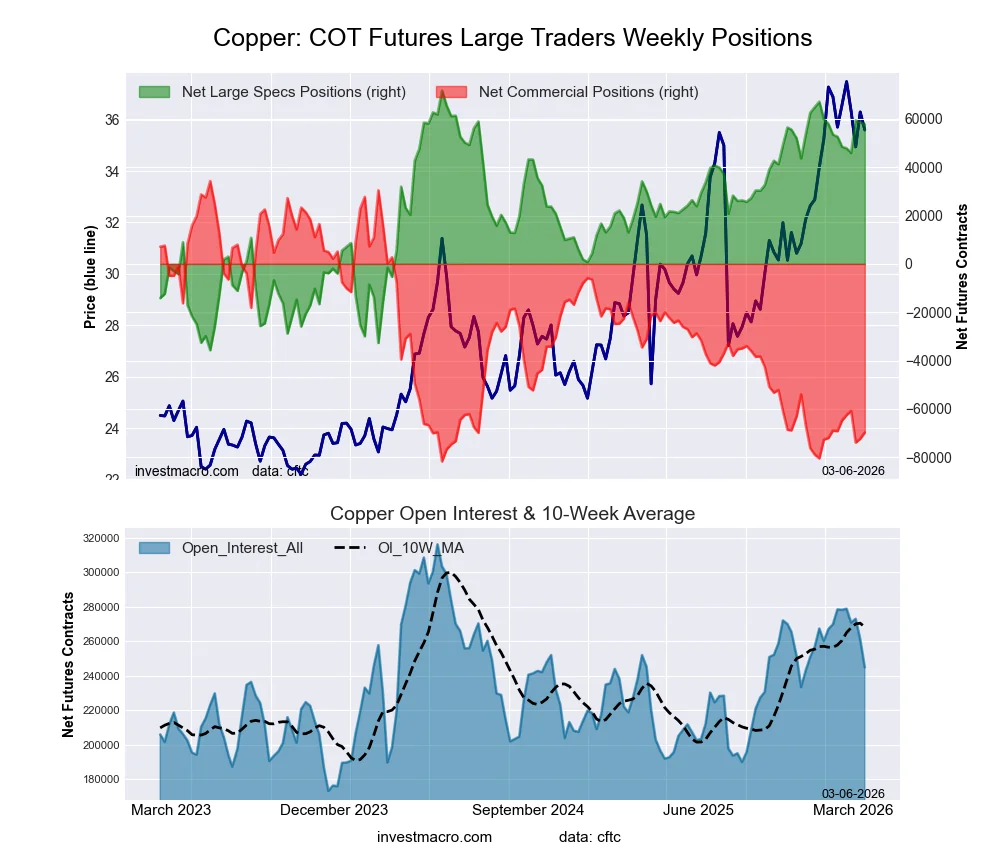
Copper Futures COT ChartThe Copper Grade #1 Futures large speculator standing this week totaled a net position of 57,681 contracts in the data reported through Tuesday. This was a weekly reduction of -759 contracts from the previous week which had a total of 58,440 net contracts.

This week’s current strength score (the trader positioning range over the past three years, measured from 0 to 100) shows the speculators are currently Bullish-Extreme with a score of 87.0 percent. The commercials are Bearish-Extreme with a score of 10.3 percent and the small traders (not shown in chart) are Bullish with a score of 76.6 percent.

Price Trend-Following Model: Uptrend

Our weekly trend-following model classifies the current market price position as: Uptrend.

Copper Futures StatisticsSPECULATORSCOMMERCIALSSMALL TRADERS
– Percent of Open Interest Longs:36.434.98.4
– Percent of Open Interest Shorts:12.863.43.4
– Net Position:57,681-69,74412,063
– Gross Longs:89,10385,48120,481
– Gross Shorts:31,422155,2258,418
– Long to Short Ratio:2.8 to 10.6 to 12.4 to 1
NET POSITION TREND:
– Strength Index Score (3 Year Range Pct):87.010.376.6
– Strength Index Reading (3 Year Range):Bullish-ExtremeBearish-ExtremeBullish
NET POSITION MOVEMENT INDEX:
– 6-Week Change in Strength Index:4.8-0.5-23.4


Platinum Futures:

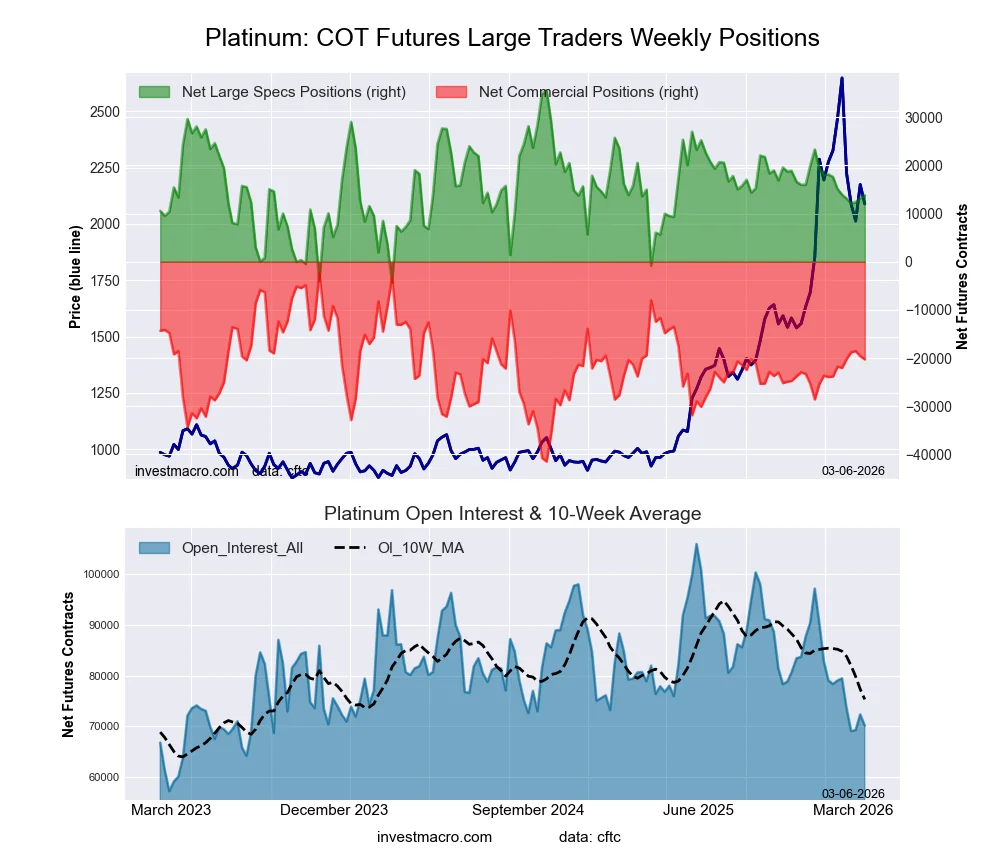
Platinum Futures COT ChartThe Platinum Futures large speculator standing this week totaled a net position of 13,832 contracts in the data reported through Tuesday. This was a weekly advance of 592 contracts from the previous week which had a total of 13,240 net contracts.

This week’s current strength score (the trader positioning range over the past three years, measured from 0 to 100) shows the speculators are currently Bearish with a score of 45.6 percent. The commercials are Bullish with a score of 54.2 percent and the small traders (not shown in chart) are Bullish with a score of 72.7 percent.

Price Trend-Following Model: Uptrend

Our weekly trend-following model classifies the current market price position as: Uptrend.

Platinum Futures StatisticsSPECULATORSCOMMERCIALSSMALL TRADERS
– Percent of Open Interest Longs:45.029.213.2
– Percent of Open Interest Shorts:25.358.04.0
– Net Position:13,832-20,2706,438
– Gross Longs:31,57920,4519,257
– Gross Shorts:17,74740,7212,819
– Long to Short Ratio:1.8 to 10.5 to 13.3 to 1
NET POSITION TREND:
– Strength Index Score (3 Year Range Pct):45.654.272.7
– Strength Index Reading (3 Year Range):BearishBullishBullish
NET POSITION MOVEMENT INDEX:
– 6-Week Change in Strength Index:-3.23.9-2.5


Palladium Futures:

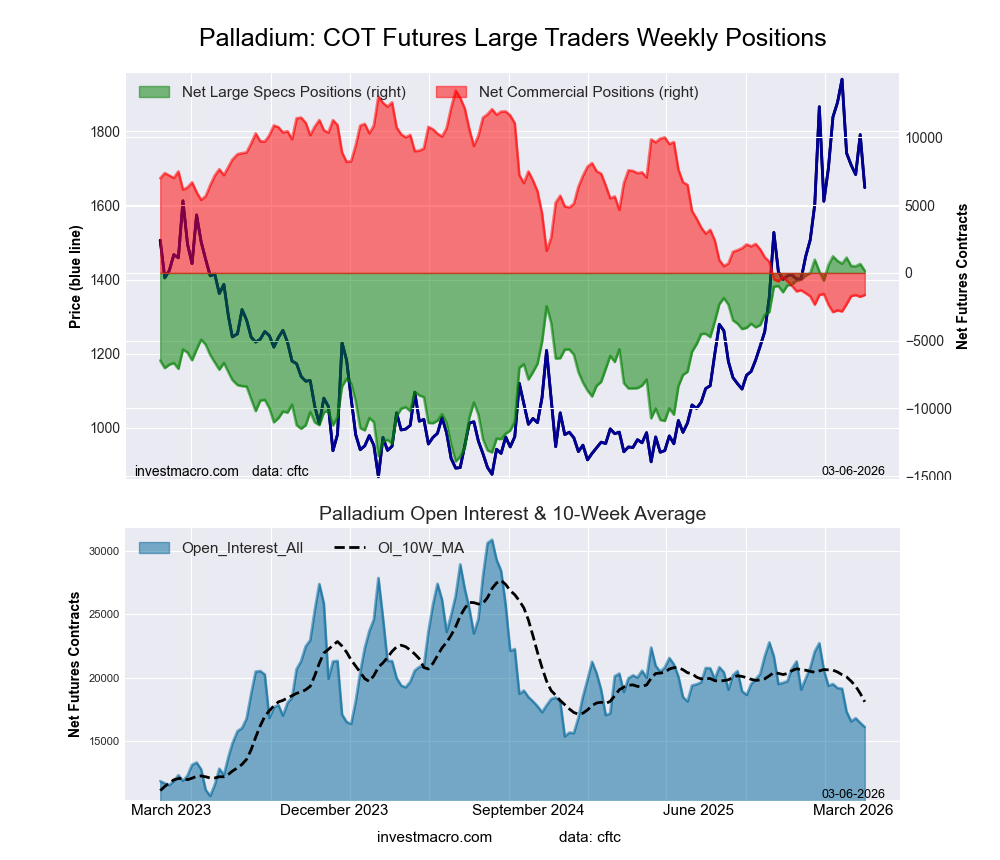
Palladium Futures COT ChartThe Palladium Futures large speculator standing this week totaled a net position of 161 contracts in the data reported through Tuesday. This was a weekly fall of -503 contracts from the previous week which had a total of 664 net contracts.

This week’s current strength score (the trader positioning range over the past three years, measured from 0 to 100) shows the speculators are currently Bullish-Extreme with a score of 93.0 percent. The commercials are Bearish-Extreme with a score of 7.7 percent and the small traders (not shown in chart) are Bullish with a score of 70.8 percent.

Price Trend-Following Model: Weak Uptrend

Our weekly trend-following model classifies the current market price position as: Weak Uptrend.

Palladium Futures StatisticsSPECULATORSCOMMERCIALSSMALL TRADERS
– Percent of Open Interest Longs:48.333.815.7
– Percent of Open Interest Shorts:47.344.06.5
– Net Position:161-1,6311,470
– Gross Longs:7,7685,4462,519
– Gross Shorts:7,6077,0771,049
– Long to Short Ratio:1.0 to 10.8 to 12.4 to 1
NET POSITION TREND:
– Strength Index Score (3 Year Range Pct):93.07.770.8
– Strength Index Reading (3 Year Range):Bullish-ExtremeBearish-ExtremeBullish
NET POSITION MOVEMENT INDEX:
– 6-Week Change in Strength Index:-4.86.9-13.9


Steel Futures Futures:

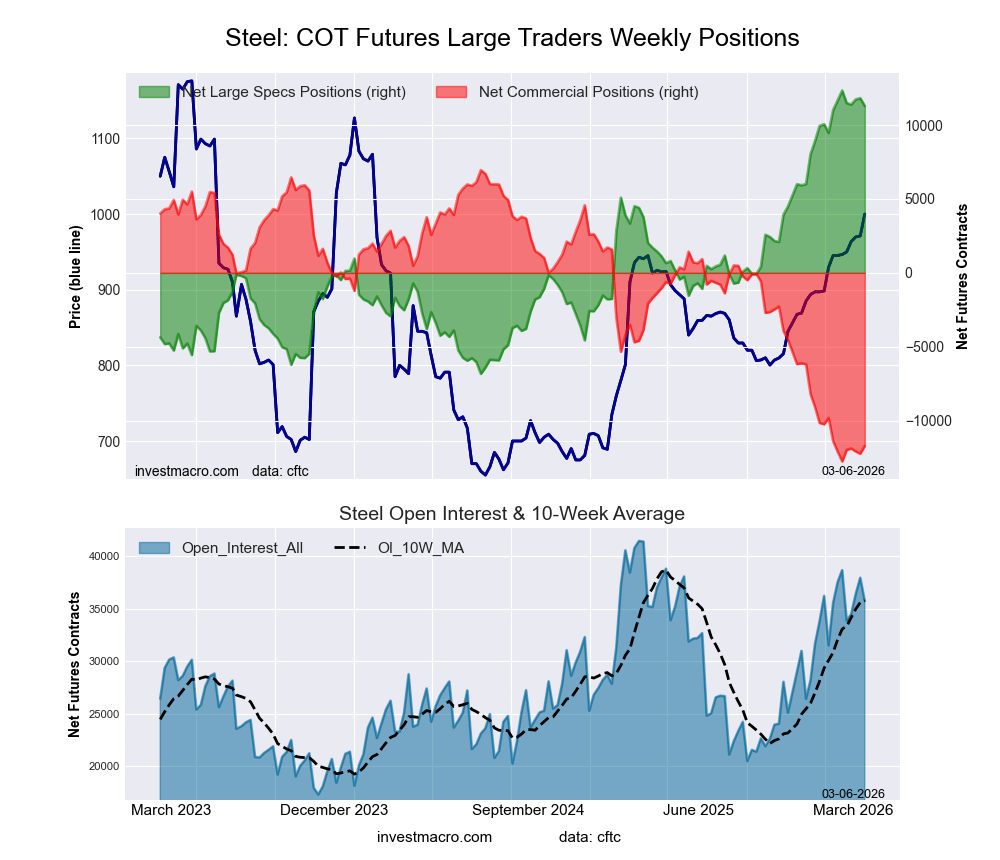
Steel Futures COT ChartThe Steel Futures large speculator standing this week totaled a net position of 11,298 contracts in the data reported through Tuesday. This was a weekly decrease of -526 contracts from the previous week which had a total of 11,824 net contracts.

This week’s current strength score (the trader positioning range over the past three years, measured from 0 to 100) shows the speculators are currently Bullish-Extreme with a score of 94.6 percent. The commercials are Bearish-Extreme with a score of 5.3 percent and the small traders (not shown in chart) are Bullish-Extreme with a score of 88.3 percent.

Price Trend-Following Model: Strong Uptrend

Our weekly trend-following model classifies the current market price position as: Strong Uptrend.

Steel Futures StatisticsSPECULATORSCOMMERCIALSSMALL TRADERS
– Percent of Open Interest Longs:37.359.21.5
– Percent of Open Interest Shorts:5.792.00.3
– Net Position:11,298-11,714416
– Gross Longs:13,32121,158519
– Gross Shorts:2,02332,872103
– Long to Short Ratio:6.6 to 10.6 to 15.0 to 1
NET POSITION TREND:
– Strength Index Score (3 Year Range Pct):94.65.388.3
– Strength Index Reading (3 Year Range):Bullish-ExtremeBearish-ExtremeBullish-Extreme
NET POSITION MOVEMENT INDEX:
– 6-Week Change in Strength Index:-1.91.9-1.4


Article By InvestMacroReceive our weekly COT Newsletter

*COT Report: The COT data, released weekly to the public each Friday, is updated through the most recent Tuesday (data is 3 days old) and shows a quick view of how large speculators or non-commercials (for-profit traders) were positioned in the futures markets.

The CFTC categorizes trader positions according to commercial hedgers (traders who use futures contracts for hedging as part of the business), non-commercials (large traders who speculate to realize trading profits) and nonreportable traders (usually small traders/speculators) as well as their open interest (contracts open in the market at time of reporting). See CFTC criteria here.

COT Bonds Charts: Speculator Bets led by 10-Year Bonds & Fed Funds

By InvestMacro

Bonds Market Open Interest Comparison
Here are the latest charts and statistics for the Commitment of Traders (COT) reports data published by the Commodities Futures Trading Commission (CFTC).

The latest COT data is updated through Tuesday March 3rd and shows a quick view of how large traders (for-profit speculators and commercial hedgers) were positioned in the futures markets.

Weekly Speculator Changes led by 10-Year Bonds & Fed Funds

Bonds Market Net Speculators Positions
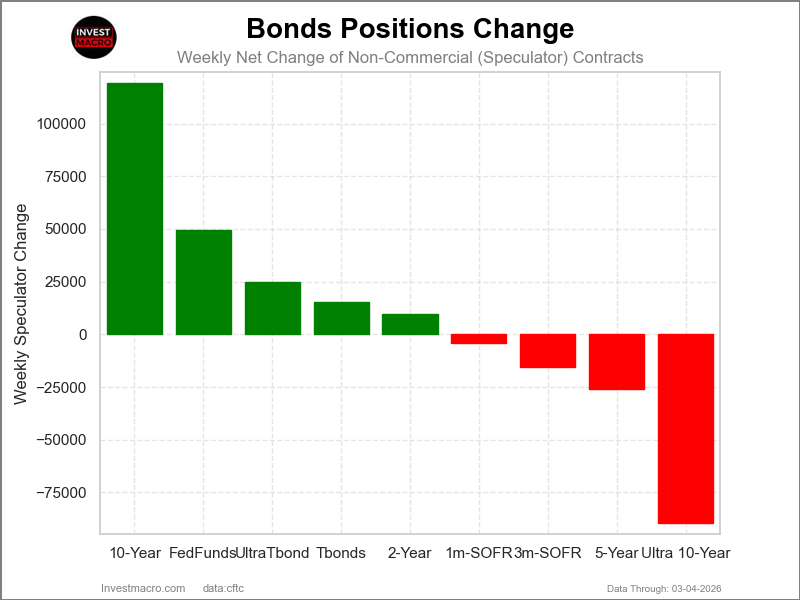
The COT bond market speculator bets were slightly higher this week as five out of the nine bond markets we cover had higher positioning while the other four markets had lower speculator contracts.

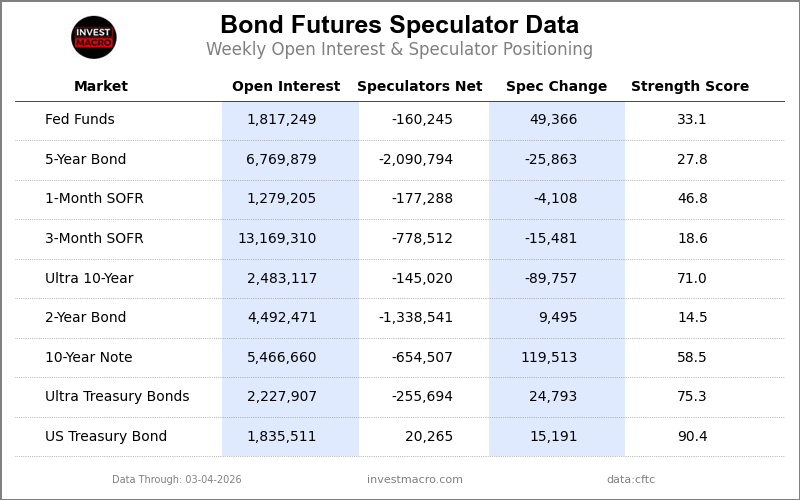
Leading the gains for the bond markets was the 10-Year Bonds (119,513 contracts) with the Fed Funds (49,366 contracts), the Ultra Treasury Bonds (24,793 contracts), the US Treasury Bonds (15,191 contracts) and the 2-Year Bonds (9,495 contracts) also showed a positive week.

The bond markets with declines in speculator bets for the week were the Ultra 10-Year Bonds (-89,757 contracts), the 5-Year Bonds (-25,863 contracts), the SOFR 3-Months (-15,481 contracts) and with the SOFR 1-Month (-4,108 contracts) also recording lower bets on the week.

Bond Markets Price Performances were lower across the board this week

The Fed Funds was the only market this week that did not see a dip in price performance as the Fed Funds were approximately unchanged on the week. The one-month Secured Overnight Financing Rate was lower by -0.01%, while the three-month Secured Overnight Financing Rate was also lower by -0.01%.

The 2-Year Bond fell by -0.55% on the week, while the 5-Year Bond was lower by -1.09% and the 10-Year Note was down by -1.58%.  The long US Treasury Bond was the largest decliner on the week with a drop lower by -2.5%.


Bonds Data:

Bonds Market Speculators Data Table
Legend: Open Interest | Speculators Current Net Position | Weekly Specs Change | Specs Strength Score compared to last 3-Years (0-100 range)


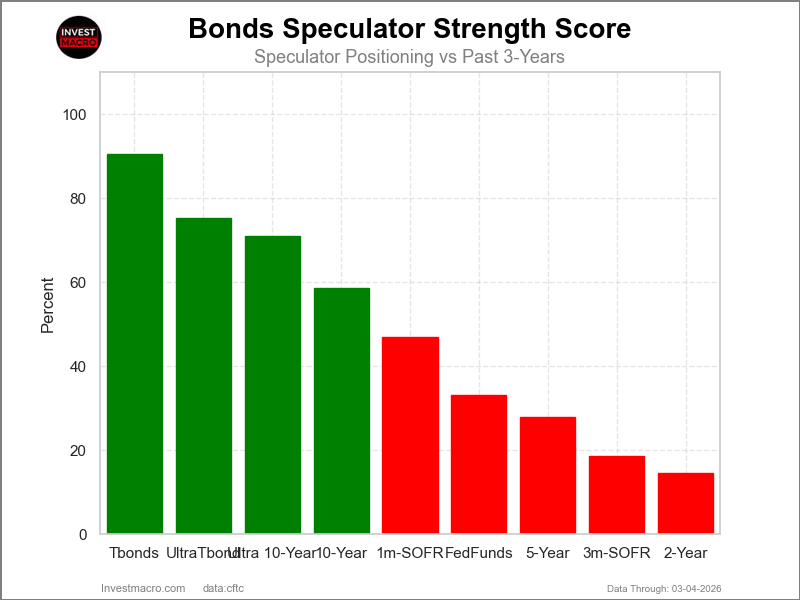
Strength Scores led by US Treasury Bonds & Ultra Treasury Bonds

Bonds Market Strength Index Comparison
COT Strength Scores (a normalized measure of Speculator positions over a 3-Year range, from 0 to 100 where above 80 is Extreme-Bullish and below 20 is Extreme-Bearish) showed that the US Treasury Bonds (90 percent) and the Ultra Treasury Bonds (75 percent) lead the bond markets this week. The Ultra 10-Year Bonds (71 percent) comes in as the next highest in the weekly strength scores.

On the downside, the 2-Year Bonds (15 percent) and the SOFR 3-Months (19 percent) come in at the lowest strength level currently and are in Extreme-Bearish territory (below 20 percent). The next lowest strength score was the 5-Year Bonds (28 percent).

Strength Statistics:
Fed Funds (33.1 percent) vs Fed Funds previous week (26.1 percent)
2-Year Bond (14.5 percent) vs 2-Year Bond previous week (13.5 percent)
5-Year Bond (27.8 percent) vs 5-Year Bond previous week (29.0 percent)
10-Year Bond (58.5 percent) vs 10-Year Bond previous week (44.2 percent)
Ultra 10-Year Bond (71.0 percent) vs Ultra 10-Year Bond previous week (95.3 percent)
US Treasury Bond (90.4 percent) vs US Treasury Bond previous week (85.1 percent)
Ultra US Treasury Bond (75.3 percent) vs Ultra US Treasury Bond previous week (66.0 percent)
SOFR 1-Month (46.8 percent) vs SOFR 1-Month previous week (47.5 percent)
SOFR 3-Months (18.6 percent) vs SOFR 3-Months previous week (19.4 percent)


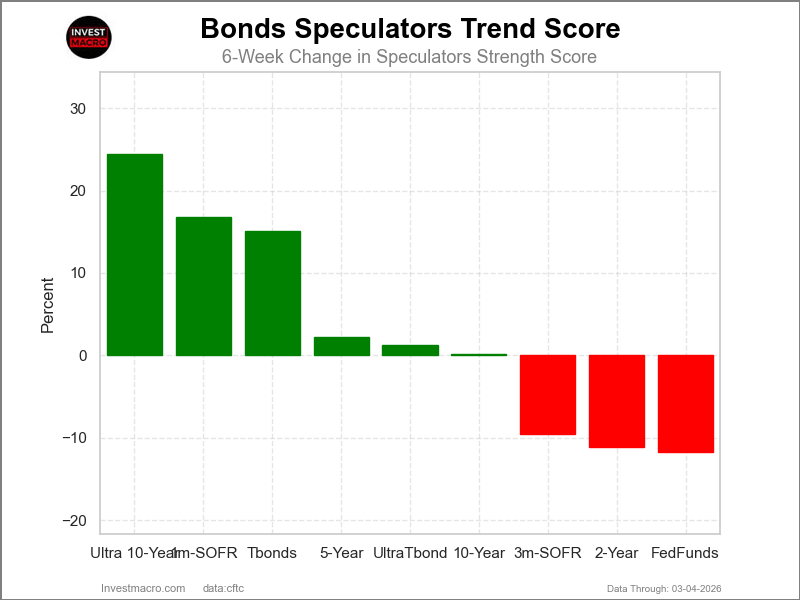
Ultra 10-Year Bonds & SOFR 1-Month top the 6-Week Strength Trends

Bonds Market Trend Index Comparison
COT Strength Score Trends (or move index, calculates the 6-week changes in strength scores) showed that the Ultra 10-Year Bonds (24 percent) and the SOFR 1-Month (17 percent) lead the past six weeks trends for bonds. The US Treasury Bonds (15 percent) are the next highest positive movers in the latest trends data.

The Fed Funds (-12 percent), the 2-Year Bonds (-11 percent) and the SOFR 3-Months (-10 percent) leads the downside trend scores currently.

Strength Trend Statistics:
Fed Funds (-11.7 percent) vs Fed Funds previous week (-38.2 percent)
2-Year Bond (-11.1 percent) vs 2-Year Bond previous week (-4.2 percent)
5-Year Bond (2.2 percent) vs 5-Year Bond previous week (9.6 percent)
10-Year Bond (0.1 percent) vs 10-Year Bond previous week (11.5 percent)
Ultra 10-Year Bond (24.4 percent) vs Ultra 10-Year Bond previous week (52.3 percent)
US Treasury Bond (15.1 percent) vs US Treasury Bond previous week (-3.0 percent)
Ultra US Treasury Bond (1.2 percent) vs Ultra US Treasury Bond previous week (-17.0 percent)
SOFR 1-Month (16.8 percent) vs SOFR 1-Month previous week (17.4 percent)
SOFR 3-Months (-9.6 percent) vs SOFR 3-Months previous week (-12.5 percent)


30-Day Federal Funds Futures:

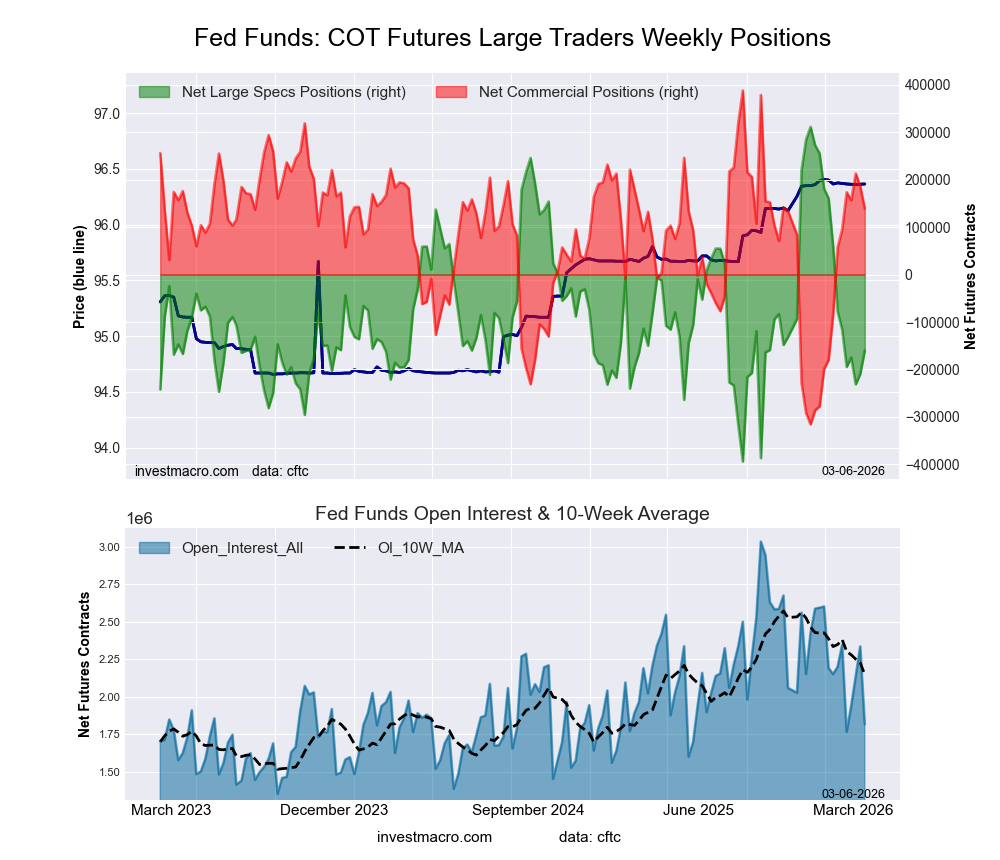
Federal Funds 30-Day Bonds Futures COT ChartThe 30-Day Federal Funds large speculator standing this week totaled a net position of -160,245 contracts in the data reported through Tuesday. This was a weekly boost of 49,366 contracts from the previous week which had a total of -209,611 net contracts.

This week’s current strength score (the trader positioning range over the past three years, measured from 0 to 100) shows the speculators are currently Bearish with a score of 33.1 percent. The commercials are Bullish with a score of 64.7 percent and the small traders (not shown in chart) are Bullish-Extreme with a score of 90.0 percent.

Price Trend-Following Model: Weak Uptrend

Our weekly trend-following model classifies the current market price position as: Weak Uptrend.

30-Day Federal Funds StatisticsSPECULATORSCOMMERCIALSSMALL TRADERS
– Percent of Open Interest Longs:12.567.42.5
– Percent of Open Interest Shorts:21.359.71.3
– Net Position:-160,245139,11521,130
– Gross Longs:227,0081,224,03845,288
– Gross Shorts:387,2531,084,92324,158
– Long to Short Ratio:0.6 to 11.1 to 11.9 to 1
NET POSITION TREND:
– Strength Index Score (3 Year Range Pct):33.164.790.0
– Strength Index Reading (3 Year Range):BearishBullishBullish-Extreme
NET POSITION MOVEMENT INDEX:
– 6-Week Change in Strength Index:-11.711.61.0


Secured Overnight Financing Rate (3-Month) Futures:

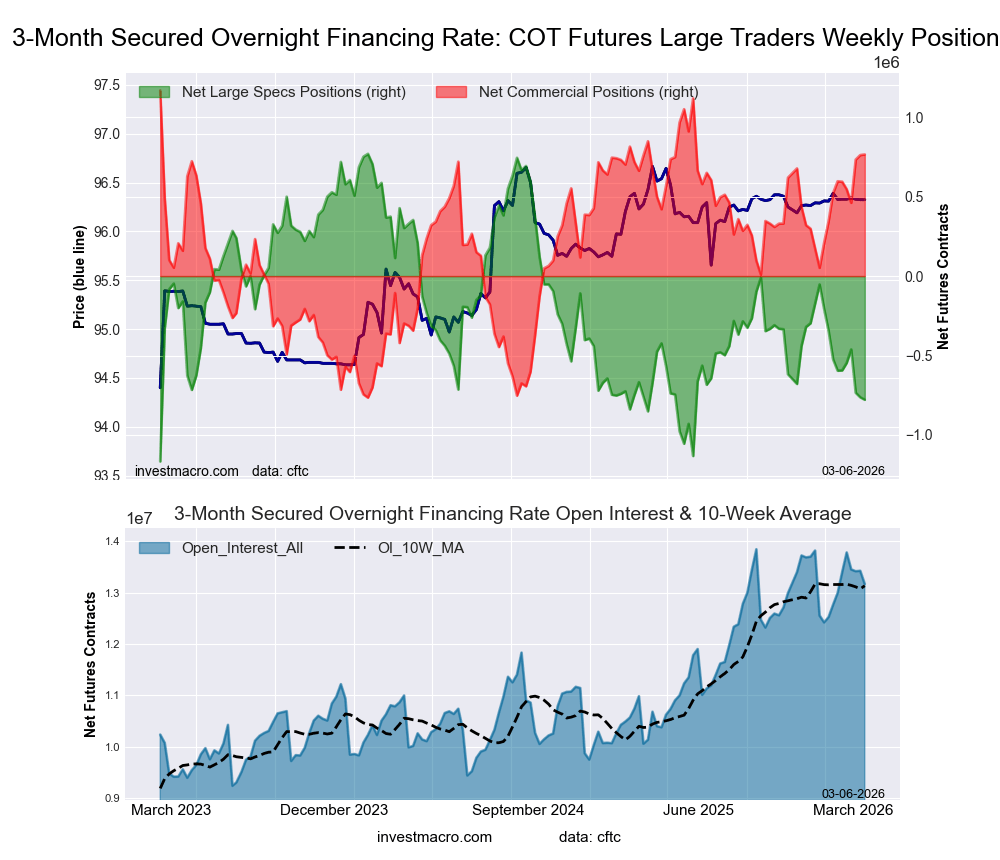
SOFR 3-Months Bonds Futures COT ChartThe Secured Overnight Financing Rate (3-Month) large speculator standing this week totaled a net position of -778,512 contracts in the data reported through Tuesday. This was a weekly decline of -15,481 contracts from the previous week which had a total of -763,031 net contracts.

This week’s current strength score (the trader positioning range over the past three years, measured from 0 to 100) shows the speculators are currently Bearish-Extreme with a score of 18.6 percent. The commercials are Bullish-Extreme with a score of 81.2 percent and the small traders (not shown in chart) are Bullish-Extreme with a score of 84.7 percent.

Price Trend-Following Model: Weak Uptrend

Our weekly trend-following model classifies the current market price position as: Weak Uptrend.

SOFR 3-Months StatisticsSPECULATORSCOMMERCIALSSMALL TRADERS
– Percent of Open Interest Longs:13.157.40.5
– Percent of Open Interest Shorts:19.051.60.4
– Net Position:-778,512765,40413,108
– Gross Longs:1,729,3847,557,16264,763
– Gross Shorts:2,507,8966,791,75851,655
– Long to Short Ratio:0.7 to 11.1 to 11.3 to 1
NET POSITION TREND:
– Strength Index Score (3 Year Range Pct):18.681.284.7
– Strength Index Reading (3 Year Range):Bearish-ExtremeBullish-ExtremeBullish-Extreme
NET POSITION MOVEMENT INDEX:
– 6-Week Change in Strength Index:-9.69.06.9


Individual Bond Markets:

Secured Overnight Financing Rate (1-Month) Futures:

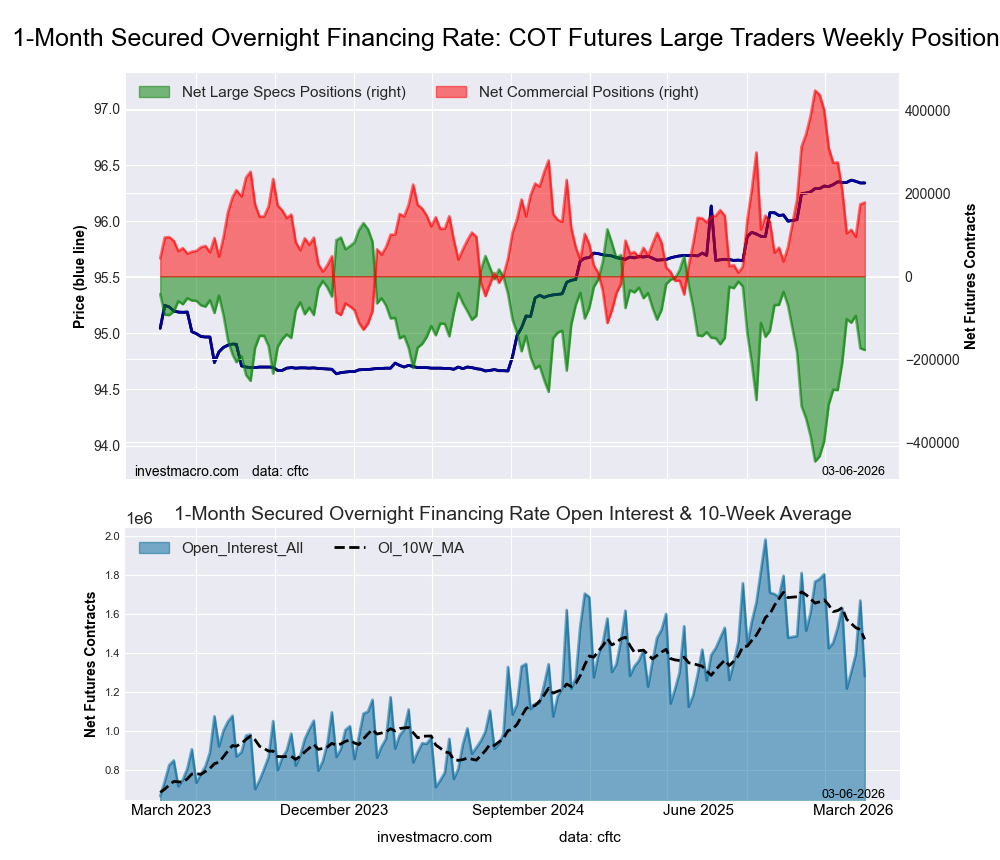
SOFR 1-Month Bonds Futures COT ChartThe Secured Overnight Financing Rate (1-Month) large speculator standing this week totaled a net position of -177,288 contracts in the data reported through Tuesday. This was a weekly reduction of -4,108 contracts from the previous week which had a total of -173,180 net contracts.

This week’s current strength score (the trader positioning range over the past three years, measured from 0 to 100) shows the speculators are currently Bearish with a score of 46.8 percent. The commercials are Bullish with a score of 53.2 percent and the small traders (not shown in chart) are Bullish with a score of 66.5 percent.

Price Trend-Following Model: Weak Uptrend

Our weekly trend-following model classifies the current market price position as: Weak Uptrend.

SOFR 1-Month StatisticsSPECULATORSCOMMERCIALSSMALL TRADERS
– Percent of Open Interest Longs:23.360.00.0
– Percent of Open Interest Shorts:37.246.20.0
– Net Position:-177,288177,472-184
– Gross Longs:298,453767,910160
– Gross Shorts:475,741590,438344
– Long to Short Ratio:0.6 to 11.3 to 10.5 to 1
NET POSITION TREND:
– Strength Index Score (3 Year Range Pct):46.853.266.5
– Strength Index Reading (3 Year Range):BearishBullishBullish
NET POSITION MOVEMENT INDEX:
– 6-Week Change in Strength Index:16.8-16.8-0.2


2-Year Treasury Note Futures:

2-Year Treasury Bonds Futures COT ChartThe 2-Year Treasury Note large speculator standing this week totaled a net position of -1,338,541 contracts in the data reported through Tuesday. This was a weekly lift of 9,495 contracts from the previous week which had a total of -1,348,036 net contracts.

This week’s current strength score (the trader positioning range over the past three years, measured from 0 to 100) shows the speculators are currently Bearish-Extreme with a score of 14.5 percent. The commercials are Bullish-Extreme with a score of 88.6 percent and the small traders (not shown in chart) are Bearish with a score of 41.3 percent.

Price Trend-Following Model: Weak Uptrend

Our weekly trend-following model classifies the current market price position as: Weak Uptrend.

2-Year Treasury Note StatisticsSPECULATORSCOMMERCIALSSMALL TRADERS
– Percent of Open Interest Longs:14.875.55.3
– Percent of Open Interest Shorts:44.648.13.0
– Net Position:-1,338,5411,232,909105,632
– Gross Longs:666,3773,393,548238,612
– Gross Shorts:2,004,9182,160,639132,980
– Long to Short Ratio:0.3 to 11.6 to 11.8 to 1
NET POSITION TREND:
– Strength Index Score (3 Year Range Pct):14.588.641.3
– Strength Index Reading (3 Year Range):Bearish-ExtremeBullish-ExtremeBearish
NET POSITION MOVEMENT INDEX:
– 6-Week Change in Strength Index:-11.113.2-1.8


5-Year Treasury Note Futures:

5-Year Treasury Bonds Futures COT ChartThe 5-Year Treasury Note large speculator standing this week totaled a net position of -2,090,794 contracts in the data reported through Tuesday. This was a weekly lowering of -25,863 contracts from the previous week which had a total of -2,064,931 net contracts.

This week’s current strength score (the trader positioning range over the past three years, measured from 0 to 100) shows the speculators are currently Bearish with a score of 27.8 percent. The commercials are Bullish with a score of 71.3 percent and the small traders (not shown in chart) are Bullish with a score of 63.1 percent.

Price Trend-Following Model: Weak Uptrend

Our weekly trend-following model classifies the current market price position as: Weak Uptrend.

5-Year Treasury Note StatisticsSPECULATORSCOMMERCIALSSMALL TRADERS
– Percent of Open Interest Longs:7.581.96.5
– Percent of Open Interest Shorts:38.453.24.3
– Net Position:-2,090,7941,942,942147,852
– Gross Longs:510,6625,547,849438,288
– Gross Shorts:2,601,4563,604,907290,436
– Long to Short Ratio:0.2 to 11.5 to 11.5 to 1
NET POSITION TREND:
– Strength Index Score (3 Year Range Pct):27.871.363.1
– Strength Index Reading (3 Year Range):BearishBullishBullish
NET POSITION MOVEMENT INDEX:
– 6-Week Change in Strength Index:2.2-2.50.7


10-Year Treasury Note Futures:

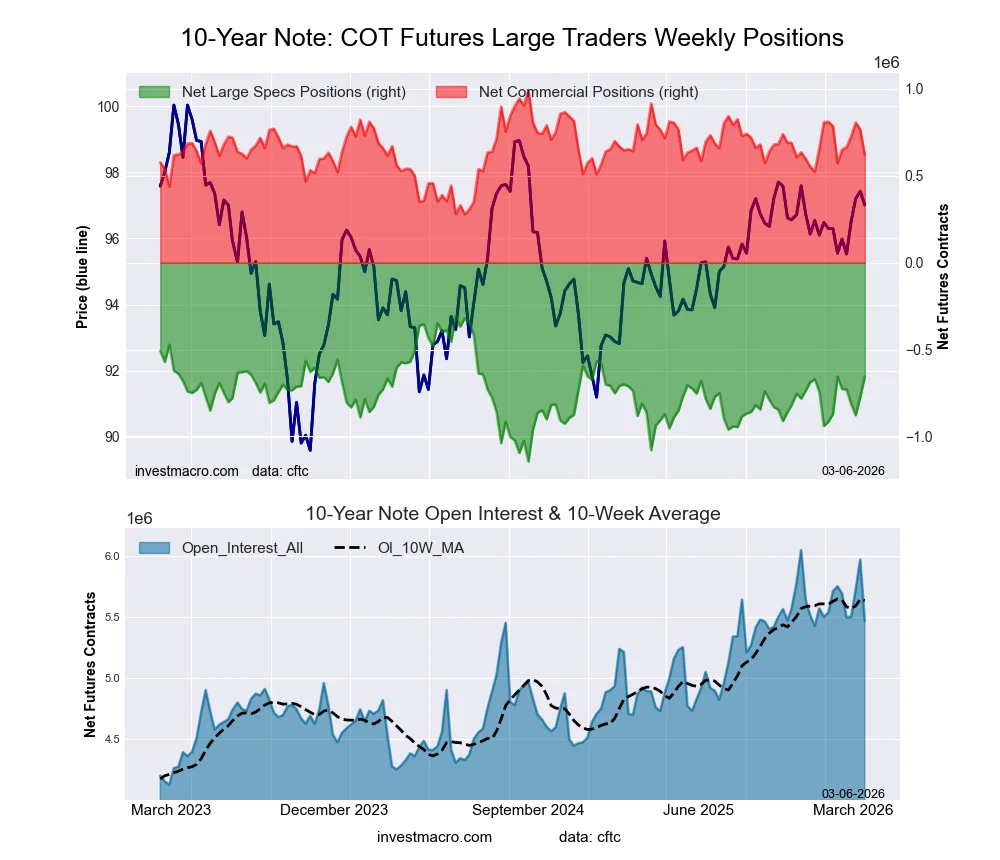
10-Year Treasury Notes Bonds Futures COT ChartThe 10-Year Treasury Note large speculator standing this week totaled a net position of -654,507 contracts in the data reported through Tuesday. This was a weekly advance of 119,513 contracts from the previous week which had a total of -774,020 net contracts.

This week’s current strength score (the trader positioning range over the past three years, measured from 0 to 100) shows the speculators are currently Bullish with a score of 58.5 percent. The commercials are Bearish with a score of 47.9 percent and the small traders (not shown in chart) are Bearish with a score of 41.7 percent.

Price Trend-Following Model: Weak Uptrend

Our weekly trend-following model classifies the current market price position as: Weak Uptrend.

10-Year Treasury Note StatisticsSPECULATORSCOMMERCIALSSMALL TRADERS
– Percent of Open Interest Longs:11.277.77.9
– Percent of Open Interest Shorts:23.266.37.3
– Net Position:-654,507620,30534,202
– Gross Longs:611,9654,244,872431,657
– Gross Shorts:1,266,4723,624,567397,455
– Long to Short Ratio:0.5 to 11.2 to 11.1 to 1
NET POSITION TREND:
– Strength Index Score (3 Year Range Pct):58.547.941.7
– Strength Index Reading (3 Year Range):BullishBearishBearish
NET POSITION MOVEMENT INDEX:
– 6-Week Change in Strength Index:0.16.6-19.4


Ultra 10-Year Notes Futures:

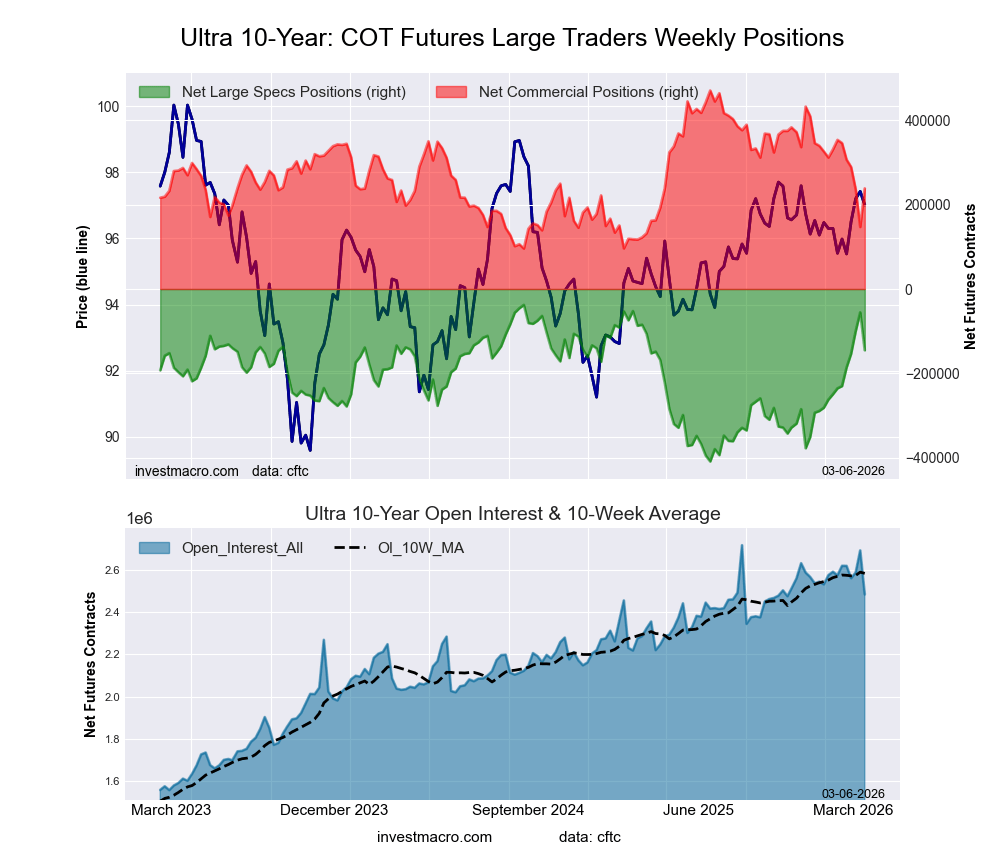
Ultra 10-Year Treasury Notes Bonds Futures COT ChartThe Ultra 10-Year Notes large speculator standing this week totaled a net position of -145,020 contracts in the data reported through Tuesday. This was a weekly lowering of -89,757 contracts from the previous week which had a total of -55,263 net contracts.

This week’s current strength score (the trader positioning range over the past three years, measured from 0 to 100) shows the speculators are currently Bullish with a score of 71.0 percent. The commercials are Bearish with a score of 38.1 percent and the small traders (not shown in chart) are Bearish with a score of 34.0 percent.

Price Trend-Following Model: Weak Uptrend

Our weekly trend-following model classifies the current market price position as: Weak Uptrend.

Ultra 10-Year Notes StatisticsSPECULATORSCOMMERCIALSSMALL TRADERS
– Percent of Open Interest Longs:9.878.59.6
– Percent of Open Interest Shorts:15.668.913.3
– Net Position:-145,020238,200-93,180
– Gross Longs:243,4461,948,642237,999
– Gross Shorts:388,4661,710,442331,179
– Long to Short Ratio:0.6 to 11.1 to 10.7 to 1
NET POSITION TREND:
– Strength Index Score (3 Year Range Pct):71.038.134.0
– Strength Index Reading (3 Year Range):BullishBearishBearish
NET POSITION MOVEMENT INDEX:
– 6-Week Change in Strength Index:24.4-30.719.2


US Treasury Bonds Futures:

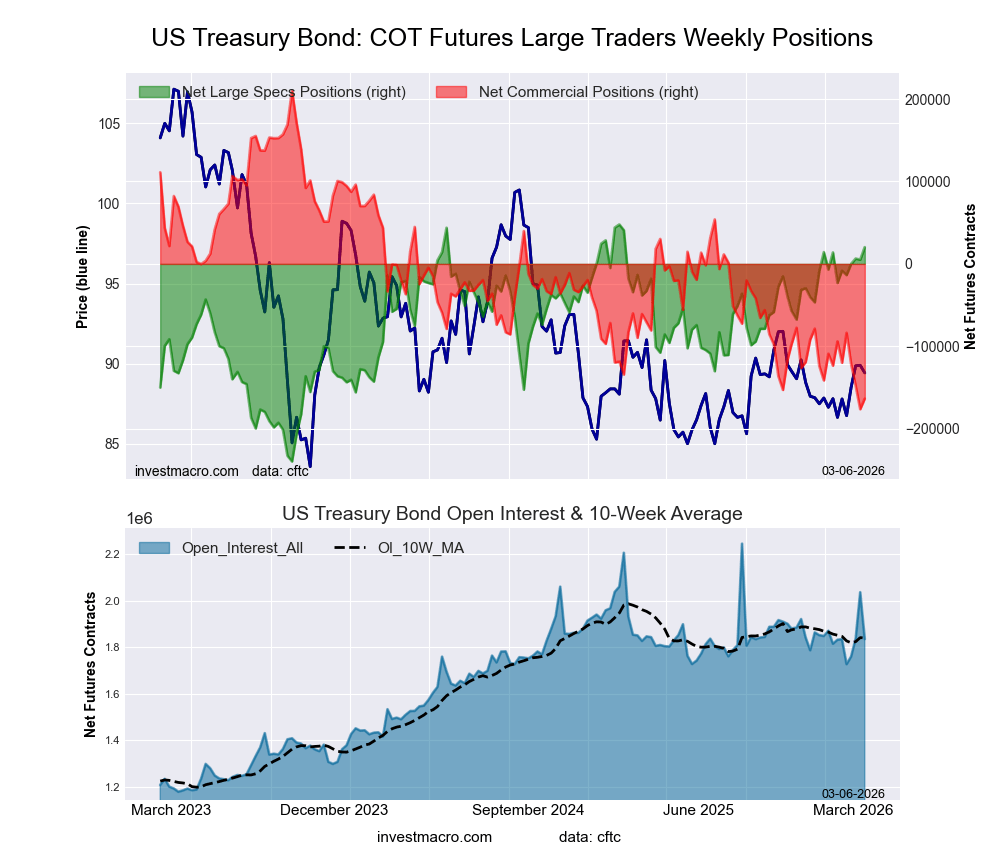
US Year Treasury Notes Long Bonds Futures COT ChartThe US Treasury Bonds large speculator standing this week totaled a net position of 20,265 contracts in the data reported through Tuesday. This was a weekly increase of 15,191 contracts from the previous week which had a total of 5,074 net contracts.

This week’s current strength score (the trader positioning range over the past three years, measured from 0 to 100) shows the speculators are currently Bullish-Extreme with a score of 90.4 percent. The commercials are Bearish-Extreme with a score of 3.3 percent and the small traders (not shown in chart) are Bullish-Extreme with a score of 80.5 percent.

Price Trend-Following Model: Downtrend

Our weekly trend-following model classifies the current market price position as: Downtrend.

US Treasury Bonds StatisticsSPECULATORSCOMMERCIALSSMALL TRADERS
– Percent of Open Interest Longs:11.670.313.8
– Percent of Open Interest Shorts:10.579.26.0
– Net Position:20,265-163,455143,190
– Gross Longs:212,3131,289,561253,391
– Gross Shorts:192,0481,453,016110,201
– Long to Short Ratio:1.1 to 10.9 to 12.3 to 1
NET POSITION TREND:
– Strength Index Score (3 Year Range Pct):90.43.380.5
– Strength Index Reading (3 Year Range):Bullish-ExtremeBearish-ExtremeBullish-Extreme
NET POSITION MOVEMENT INDEX:
– 6-Week Change in Strength Index:15.1-18.018.2


Ultra US Treasury Bonds Futures:

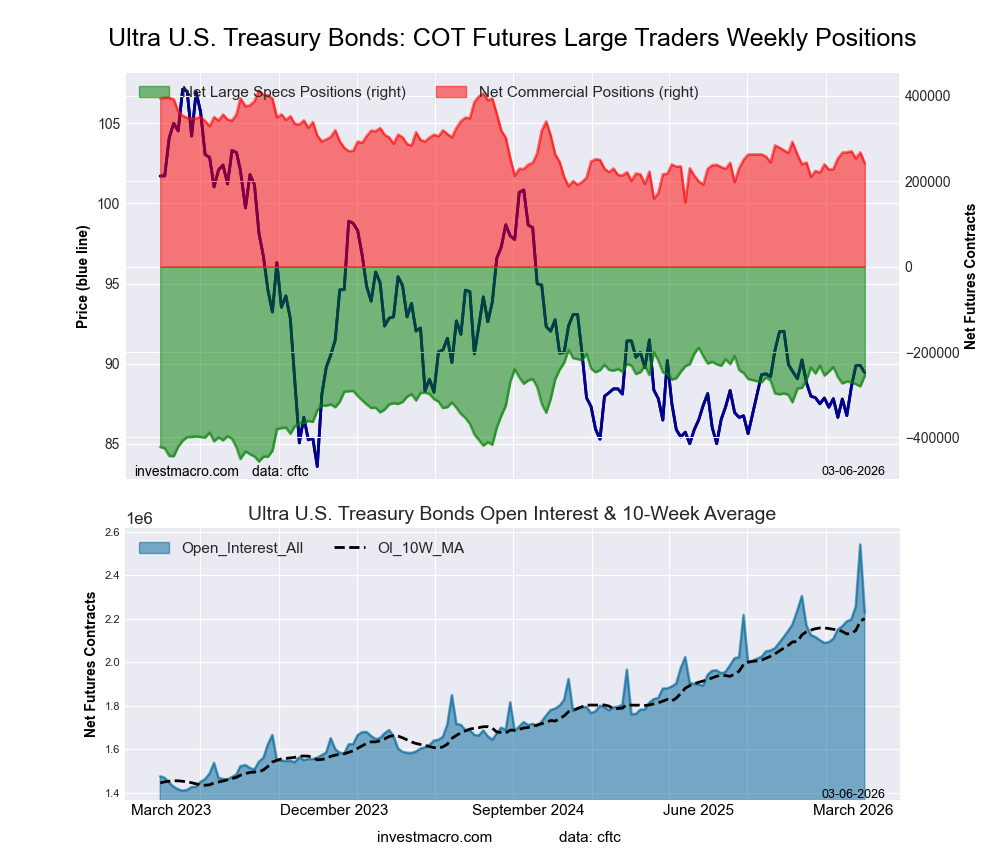
Ultra US Year Treasury Notes Long Bonds Futures COT ChartThe Ultra US Treasury Bonds large speculator standing this week totaled a net position of -255,694 contracts in the data reported through Tuesday. This was a weekly boost of 24,793 contracts from the previous week which had a total of -280,487 net contracts.

This week’s current strength score (the trader positioning range over the past three years, measured from 0 to 100) shows the speculators are currently Bullish with a score of 75.3 percent. The commercials are Bearish with a score of 34.8 percent and the small traders (not shown in chart) are Bearish with a score of 29.2 percent.

Price Trend-Following Model: Downtrend

Our weekly trend-following model classifies the current market price position as: Downtrend.

Ultra US Treasury Bonds StatisticsSPECULATORSCOMMERCIALSSMALL TRADERS
– Percent of Open Interest Longs:6.883.58.4
– Percent of Open Interest Shorts:18.372.67.8
– Net Position:-255,694241,96513,729
– Gross Longs:152,5141,860,020187,508
– Gross Shorts:408,2081,618,055173,779
– Long to Short Ratio:0.4 to 11.1 to 11.1 to 1
NET POSITION TREND:
– Strength Index Score (3 Year Range Pct):75.334.829.2
– Strength Index Reading (3 Year Range):BullishBearishBearish
NET POSITION MOVEMENT INDEX:
– 6-Week Change in Strength Index:1.2-4.38.4


Article By InvestMacroReceive our weekly COT Newsletter

*COT Report: The COT data, released weekly to the public each Friday, is updated through the most recent Tuesday (data is 3 days old) and shows a quick view of how large speculators or non-commercials (for-profit traders) were positioned in the futures markets.

The CFTC categorizes trader positions according to commercial hedgers (traders who use futures contracts for hedging as part of the business), non-commercials (large traders who speculate to realize trading profits) and nonreportable traders (usually small traders/speculators) as well as their open interest (contracts open in the market at time of reporting). See CFTC criteria here.
COT Energy Charts: Speculator Bets led by Brent Oil & Heating Oil 

By InvestMacro

Speculators OI Energy Futures COT Chart
Here are the latest charts and statistics for the Commitment of Traders (COT) data published by the Commodities Futures Trading Commission (CFTC).

The latest COT data is updated through Tuesday March 3rd and shows a quick view of how large traders (for-profit speculators and commercial entities) were positioned in the futures markets.

Weekly Speculator Changes led by Brent Oil & Heating Oil

Speculators Nets Energy Futures COT Chart
The COT energy market speculator bets were overall lower this week as just two out of the six energy markets we cover had higher positioning while the other four markets had lower speculator contracts.

Leading the gains for the energy markets through Tuesday was Brent Oil (22,025 contracts) with Heating Oil (824 contracts) also having a small positive week.

The markets with declines in speculator bets for the week were Natural Gas (-7,903 contracts), Gasoline (-6,975 contracts), the Bloomberg Index (-1,650 contracts) and with WTI Crude (-562 contracts) also seeing lower bets on the week.

Oil Markets lead Price Performance this week as all 6 Markets saw strong gains on Iran War

Leading the Energy markets this week was WTI Crude Oil, which jumped by approximately 33% over the last five days due to the Iran war. Following next was Heating Oil, which also jumped by over 30%. And Brent Crude Oil was not to be outdone with a gain of 26.17% over that period. Gasoline rose sharply by 20% in the past five days, while Natural Gas was up by 10.73%, and the Bloomberg Commodity Index rose by a strong 8.69%.

These sharp increases in the past week have now pushed all of these six Energy markets higher over the past 30 days and over the past 90 days, with the exception of Natural Gas, which is down by -5.06% in the past 30 days and is also lower by -1.70% in the past 90 days.


Energy Data:

Speculators Table Energy Futures COT Chart
Legend: Weekly Speculators Change | Speculators Current Net Position | Speculators Strength Score compared to last 3-Years (0-100 range)


Strength Scores led by Gasoline & Heating Oil

Speculators Strength Energy Futures COT Chart
COT Strength Scores (a normalized measure of Speculator positions over a 3-Year range, from 0 to 100 where above 80 is Extreme-Bullish and below 20 is Extreme-Bearish) showed that Gasoline (88.5 percent) and Heating Oil (66.7 percent) lead the energy markets this week.

On the downside, Natural Gas (0.0 percent) comes in at the lowest strength level currently and is in Extreme-Bearish territory (below 20 percent). The next lowest strength score was the Bloomberg Commodity Index (40.8 percent).

Strength Statistics:
WTI Crude Oil (42.7 percent) vs WTI Crude Oil previous week (42.8 percent)
Brent Crude Oil (42.0 percent) vs Brent Crude Oil previous week (10.6 percent)
Natural Gas (0.0 percent) vs Natural Gas previous week (5.1 percent)
Gasoline (88.5 percent) vs Gasoline previous week (96.2 percent)
Heating Oil (66.7 percent) vs Heating Oil previous week (65.6 percent)
Bloomberg Commodity Index (40.8 percent) vs Bloomberg Commodity Index previous week (48.6 percent)


WTI Crude & Gasoline top the 6-Week Strength Trends

Speculators Trend Energy Futures COT Chart
COT Strength Score Trends (or move index, calculates the 6-week changes in strength scores) showed that WTI Crude (30.1 percent) and Gasoline (23.2 percent) lead the past six weeks trends for the energy markets.

The Bloomberg Index (-38.9 percent) leads the downside trend scores currently with Natural Gas (-8.3 percent) as the next market with lower trend scores.

Move Statistics:
WTI Crude Oil (30.1 percent) vs WTI Crude Oil previous week (36.9 percent)
Brent Crude Oil (20.9 percent) vs Brent Crude Oil previous week (-22.3 percent)
Natural Gas (-8.3 percent) vs Natural Gas previous week (-8.3 percent)
Gasoline (23.2 percent) vs Gasoline previous week (29.0 percent)
Heating Oil (2.1 percent) vs Heating Oil previous week (3.1 percent)
Bloomberg Commodity Index (-38.9 percent) vs Bloomberg Commodity Index previous week (-31.0 percent)


Individual COT Market Charts:

WTI Crude Oil Futures:

WTI Crude Oil Futures COT ChartThe WTI Crude Oil Futures large speculator standing this week reached a net position of 172,150 contracts in the data reported through Tuesday. This was a weekly decline of -562 contracts from the previous week which had a total of 172,712 net contracts.

This week’s current strength score (the trader positioning range over the past three years, measured from 0 to 100) shows the speculators are currently Bearish with a score of 42.7 percent. The commercials are Bearish with a score of 48.8 percent and the small traders (not shown in chart) are Bullish-Extreme with a score of 100.0 percent.

Price Trend-Following Model: Strong Uptrend

Our weekly trend-following model classifies the current market price position as: Strong Uptrend.

WTI Crude Oil Futures StatisticsSPECULATORSCOMMERCIALSSMALL TRADERS
– Percent of Open Interest Longs:17.140.74.3
– Percent of Open Interest Shorts:8.851.41.9
– Net Position:172,150-222,32750,177
– Gross Longs:355,158842,95789,225
– Gross Shorts:183,0081,065,28439,048
– Long to Short Ratio:1.9 to 10.8 to 12.3 to 1
NET POSITION TREND:
– Strength Index Score (3 Year Range Pct):42.748.8100.0
– Strength Index Reading (3 Year Range):BearishBearishBullish-Extreme
NET POSITION MOVEMENT INDEX:
– 6-Week Change in Strength Index:30.1-38.363.0


Brent Crude Oil Futures:

Brent Last Day Crude Oil Futures COT ChartThe Brent Crude Oil Futures large speculator standing this week reached a net position of -27,468 contracts in the data reported through Tuesday. This was a weekly increase of 22,025 contracts from the previous week which had a total of -49,493 net contracts.

This week’s current strength score (the trader positioning range over the past three years, measured from 0 to 100) shows the speculators are currently Bearish with a score of 42.0 percent. The commercials are Bullish with a score of 58.1 percent and the small traders (not shown in chart) are Bullish with a score of 59.3 percent.

Price Trend-Following Model: Strong Uptrend

Our weekly trend-following model classifies the current market price position as: Strong Uptrend.

Brent Crude Oil Futures StatisticsSPECULATORSCOMMERCIALSSMALL TRADERS
– Percent of Open Interest Longs:25.439.53.4
– Percent of Open Interest Shorts:36.429.42.6
– Net Position:-27,46825,4002,068
– Gross Longs:64,04099,3388,498
– Gross Shorts:91,50873,9386,430
– Long to Short Ratio:0.7 to 11.3 to 11.3 to 1
NET POSITION TREND:
– Strength Index Score (3 Year Range Pct):42.058.159.3
– Strength Index Reading (3 Year Range):BearishBullishBullish
NET POSITION MOVEMENT INDEX:
– 6-Week Change in Strength Index:20.9-20.7-14.1


Natural Gas Futures:

Natural Gas Futures COT ChartThe Natural Gas Futures large speculator standing this week reached a net position of -206,422 contracts in the data reported through Tuesday. This was a weekly decline of -7,903 contracts from the previous week which had a total of -198,519 net contracts.

This week’s current strength score (the trader positioning range over the past three years, measured from 0 to 100) shows the speculators are currently Bearish-Extreme with a score of 0.0 percent. The commercials are Bullish-Extreme with a score of 100.0 percent and the small traders (not shown in chart) are Bullish with a score of 58.9 percent.

Price Trend-Following Model: Downtrend

Our weekly trend-following model classifies the current market price position as: Downtrend.

Natural Gas Futures StatisticsSPECULATORSCOMMERCIALSSMALL TRADERS
– Percent of Open Interest Longs:13.137.83.9
– Percent of Open Interest Shorts:26.026.42.5
– Net Position:-206,422184,36022,062
– Gross Longs:210,477607,90762,972
– Gross Shorts:416,899423,54740,910
– Long to Short Ratio:0.5 to 11.4 to 11.5 to 1
NET POSITION TREND:
– Strength Index Score (3 Year Range Pct):0.0100.058.9
– Strength Index Reading (3 Year Range):Bearish-ExtremeBullish-ExtremeBullish
NET POSITION MOVEMENT INDEX:
– 6-Week Change in Strength Index:-8.31.526.9


Gasoline Blendstock Futures:

RBOB Gasoline Energy Futures COT ChartThe Gasoline Blendstock Futures large speculator standing this week reached a net position of 91,817 contracts in the data reported through Tuesday. This was a weekly decrease of -6,975 contracts from the previous week which had a total of 98,792 net contracts.

This week’s current strength score (the trader positioning range over the past three years, measured from 0 to 100) shows the speculators are currently Bullish-Extreme with a score of 88.5 percent. The commercials are Bearish-Extreme with a score of 6.9 percent and the small traders (not shown in chart) are Bullish-Extreme with a score of 96.2 percent.

Price Trend-Following Model: Strong Uptrend

Our weekly trend-following model classifies the current market price position as: Strong Uptrend.

Nasdaq Mini Futures StatisticsSPECULATORSCOMMERCIALSSMALL TRADERS
– Percent of Open Interest Longs:26.942.86.1
– Percent of Open Interest Shorts:4.768.22.9
– Net Position:91,817-104,85013,033
– Gross Longs:111,324177,26325,236
– Gross Shorts:19,507282,11312,203
– Long to Short Ratio:5.7 to 10.6 to 12.1 to 1
NET POSITION TREND:
– Strength Index Score (3 Year Range Pct):88.56.996.2
– Strength Index Reading (3 Year Range):Bullish-ExtremeBearish-ExtremeBullish-Extreme
NET POSITION MOVEMENT INDEX:
– 6-Week Change in Strength Index:23.2-25.726.3


#2 Heating Oil NY-Harbor Futures:

NY Harbor Heating Oil Energy Futures COT ChartThe #2 Heating Oil NY-Harbor Futures large speculator standing this week reached a net position of 17,655 contracts in the data reported through Tuesday. This was a weekly increase of 824 contracts from the previous week which had a total of 16,831 net contracts.

This week’s current strength score (the trader positioning range over the past three years, measured from 0 to 100) shows the speculators are currently Bullish with a score of 66.7 percent. The commercials are Bearish with a score of 26.0 percent and the small traders (not shown in chart) are Bullish-Extreme with a score of 86.3 percent.

Price Trend-Following Model: Strong Uptrend

Our weekly trend-following model classifies the current market price position as: Strong Uptrend.

Heating Oil Futures StatisticsSPECULATORSCOMMERCIALSSMALL TRADERS
– Percent of Open Interest Longs:18.345.415.4
– Percent of Open Interest Shorts:12.659.17.3
– Net Position:17,655-42,60224,947
– Gross Longs:56,514140,46347,560
– Gross Shorts:38,859183,06522,613
– Long to Short Ratio:1.5 to 10.8 to 12.1 to 1
NET POSITION TREND:
– Strength Index Score (3 Year Range Pct):66.726.086.3
– Strength Index Reading (3 Year Range):BullishBearishBullish-Extreme
NET POSITION MOVEMENT INDEX:
– 6-Week Change in Strength Index:2.1-9.222.0


Bloomberg Commodity Index Futures:

Bloomberg Commodity Index Futures COT ChartThe Bloomberg Commodity Index Futures large speculator standing this week reached a net position of -14,034 contracts in the data reported through Tuesday. This was a weekly reduction of -1,650 contracts from the previous week which had a total of -12,384 net contracts.

This week’s current strength score (the trader positioning range over the past three years, measured from 0 to 100) shows the speculators are currently Bearish with a score of 40.8 percent. The commercials are Bullish with a score of 58.1 percent and the small traders (not shown in chart) are Bearish with a score of 49.9 percent.

Price Trend-Following Model: Strong Uptrend

Our weekly trend-following model classifies the current market price position as: Strong Uptrend.

Bloomberg Index Futures StatisticsSPECULATORSCOMMERCIALSSMALL TRADERS
– Percent of Open Interest Longs:31.666.90.4
– Percent of Open Interest Shorts:38.360.50.0
– Net Position:-14,03413,355679
– Gross Longs:66,250140,036759
– Gross Shorts:80,284126,68180
– Long to Short Ratio:0.8 to 11.1 to 19.5 to 1
NET POSITION TREND:
– Strength Index Score (3 Year Range Pct):40.858.149.9
– Strength Index Reading (3 Year Range):BearishBullishBearish
NET POSITION MOVEMENT INDEX:
– 6-Week Change in Strength Index:-38.939.21.9


Article By InvestMacroReceive our weekly COT Newsletter

*COT Report: The COT data, released weekly to the public each Friday, is updated through the most recent Tuesday (data is 3 days old) and shows a quick view of how large speculators or non-commercials (for-profit traders) were positioned in the futures markets.

The CFTC categorizes trader positions according to commercial hedgers (traders who use futures contracts for hedging as part of the business), non-commercials (large traders who speculate to realize trading profits) and nonreportable traders (usually small traders/speculators) as well as their open interest (contracts open in the market at time of reporting). See CFTC criteria here.
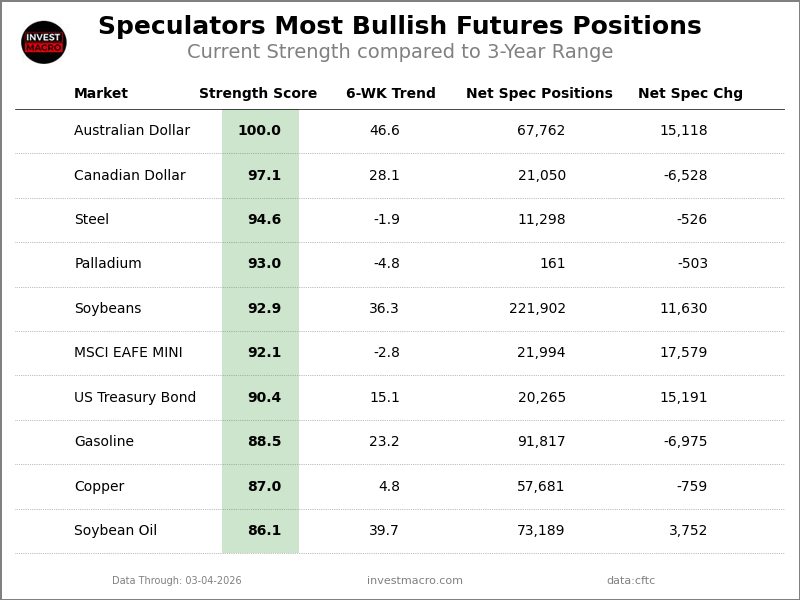
COT Soft Commodities Charts: Speculator Bets led by Corn & Soybean Meal

By InvestMacro

Speculators OI Softs
Here are the latest charts and statistics for the Commitment of Traders (COT) reports data published by the Commodities Futures Trading Commission (CFTC).

The latest COT data is updated through Tuesday March 3rd and shows a quick view of how large traders (for-profit speculators and commercial entities) were positioned in the futures markets.

Weekly Speculator Changes led by Corn & Soybean Meal

Speculators Nets Softs
The COT soft commodities markets speculator bets were overall higher this week as seven out of the eleven softs markets we cover had higher positioning while the other four markets had lower speculator contracts.

Leading the gains for the softs markets was Corn (81,231 contracts) with Soybean Meal (21,920 contracts), Soybeans (11,630 contracts), Lean Hogs (6,052 contracts), Soybean Oil (3,752 contracts), Sugar (1,089 contracts) and Cotton (873 contracts) also showing positive weeks.

The markets with the declines in speculator bets this week were Wheat (-9,920 contracts), Cocoa (-4,550 contracts), Live Cattle (-3,896 contracts) and with Coffee (-2,014 contracts) also registering lower bets on the week.

Soybean Oil leads the Soft Commodities price performance this week

Leading the soft commodities price performance this week was Soybean Oil with a strong 7.13% gain over the past five days. Coffee rose this week by 4.67%, followed by Wheat, which rose by 4.61%. Corn was higher by 3.64%. Soybeans were up by 2.54%, and Sugar was higher by approximately 2% on the week. Live Cattle was up by 1.77%, and Lean Hogs advanced by 0.32%.

On the downside, the biggest loser on the week was Soybean Meal with a -3.78% decline, followed by Cotton, which dipped by -2.28%. And Cocoa was virtually unchanged with a small decline of -0.26%.


Soft Commodities Data:

Speculators Table Softs
Legend: Weekly Speculators Change | Speculators Current Net Position | Speculators Strength Score compared to last 3-Years (0-100 range)


Strength Scores led by Soybeans & Soybean Oil

Speculators Strength Softs
COT Strength Scores (a normalized measure of Speculator positions over a 3-Year range, from 0 to 100 where above 80 is Extreme-Bullish and below 20 is Extreme-Bearish) showed that Soybeans (93 percent) and Soybean Oil (86 percent) lead the softs markets this week. Wheat (82 percent), Lean Hogs (80 percent) and Soybean Meal (65 percent) come in as the next highest in the weekly strength scores.

On the downside, Cocoa (1 percent) and Sugar (2 percent) come in at the lowest strength levels currently and are in Extreme-Bearish territory (below 20 percent). The next lowest strength scores are the Cotton (22 percent) and the Coffee (34 percent).

Strength Statistics:
Corn (48.5 percent) vs Corn previous week (37.4 percent)
Sugar (1.6 percent) vs Sugar previous week (1.4 percent)
Coffee (34.0 percent) vs Coffee previous week (36.0 percent)
Soybeans (92.9 percent) vs Soybeans previous week (90.3 percent)
Soybean Oil (86.1 percent) vs Soybean Oil previous week (83.9 percent)
Soybean Meal (65.3 percent) vs Soybean Meal previous week (56.3 percent)
Live Cattle (64.5 percent) vs Live Cattle previous week (68.4 percent)
Lean Hogs (79.6 percent) vs Lean Hogs previous week (75.3 percent)
Cotton (22.4 percent) vs Cotton previous week (21.8 percent)
Cocoa (1.0 percent) vs Cocoa previous week (5.3 percent)
Wheat (81.7 percent) vs Wheat previous week (90.5 percent)


Wheat & Soybean Oil top the 6-Week Strength Trends

Speculators Trend Softs
COT Strength Score Trends (or move index, calculates the 6-week changes in strength scores) showed that Wheat (60 percent) and Soybean Oil (40 percent) lead the past six weeks trends for soft commodities. Soybean Meal (39 percent), Soybeans (36 percent) and Corn (19 percent) are the next highest positive movers in the latest trends data.

Coffee (-19 percent) leads the downside trend scores currently with Sugar (-13 percent) following next with a lower trend score.

Strength Trend Statistics:
Corn (19.3 percent) vs Corn previous week (5.8 percent)
Sugar (-12.5 percent) vs Sugar previous week (-15.1 percent)
Coffee (-19.0 percent) vs Coffee previous week (-20.0 percent)
Soybeans (36.3 percent) vs Soybeans previous week (33.5 percent)
Soybean Oil (39.7 percent) vs Soybean Oil previous week (54.7 percent)
Soybean Meal (39.1 percent) vs Soybean Meal previous week (20.5 percent)
Live Cattle (-1.5 percent) vs Live Cattle previous week (5.8 percent)
Lean Hogs (13.3 percent) vs Lean Hogs previous week (19.7 percent)
Cotton (-1.4 percent) vs Cotton previous week (-0.9 percent)
Cocoa (0.0 percent) vs Cocoa previous week (-3.5 percent)
Wheat (60.1 percent) vs Wheat previous week (62.1 percent)


Individual Soft Commodities Markets:

CORN Futures:

CORN Futures COT ChartThe CORN large speculator standing this week recorded a net position of 90,059 contracts in the data reported through Tuesday. This was a huge weekly increase of 81,231 contracts from the previous week which had a total of 8,828 net contracts.

This week’s current strength score (the trader positioning range over the past three years, measured from 0 to 100) shows the speculators are currently Bearish with a score of 48.5 percent. The commercials are Bearish with a score of 48.1 percent and the small traders (not shown in chart) are Bullish with a score of 71.3 percent.

Price Trend-Following Model: Strong Uptrend

Our weekly trend-following model classifies the current market price position as: Strong Uptrend.

CORN Futures StatisticsSPECULATORSCOMMERCIALSSMALL TRADERS
– Percent of Open Interest Longs:20.845.68.2
– Percent of Open Interest Shorts:15.249.310.1
– Net Position:90,059-59,782-30,277
– Gross Longs:336,624738,095132,844
– Gross Shorts:246,565797,877163,121
– Long to Short Ratio:1.4 to 10.9 to 10.8 to 1
NET POSITION TREND:
– Strength Index Score (3 Year Range Pct):48.548.171.3
– Strength Index Reading (3 Year Range):BearishBearishBullish
NET POSITION MOVEMENT INDEX:
– 6-Week Change in Strength Index:19.3-19.4-16.3


SUGAR Futures:

SUGAR Futures COT ChartThe SUGAR large speculator standing this week recorded a net position of -245,034 contracts in the data reported through Tuesday. This was a weekly increase of 1,089 contracts from the previous week which had a total of -246,123 net contracts.

This week’s current strength score (the trader positioning range over the past three years, measured from 0 to 100) shows the speculators are currently Bearish-Extreme with a score of 1.6 percent. The commercials are Bullish-Extreme with a score of 97.6 percent and the small traders (not shown in chart) are Bearish with a score of 23.4 percent.

Price Trend-Following Model: Downtrend

Our weekly trend-following model classifies the current market price position as: Downtrend.

SUGAR Futures StatisticsSPECULATORSCOMMERCIALSSMALL TRADERS
– Percent of Open Interest Longs:18.453.27.2
– Percent of Open Interest Shorts:41.829.27.8
– Net Position:-245,034251,319-6,285
– Gross Longs:193,313557,89275,220
– Gross Shorts:438,347306,57381,505
– Long to Short Ratio:0.4 to 11.8 to 10.9 to 1
NET POSITION TREND:
– Strength Index Score (3 Year Range Pct):1.697.623.4
– Strength Index Reading (3 Year Range):Bearish-ExtremeBullish-ExtremeBearish
NET POSITION MOVEMENT INDEX:
– 6-Week Change in Strength Index:-12.510.26.7


COFFEE Futures:

COFFEE Futures COT ChartThe COFFEE large speculator standing this week recorded a net position of 10,800 contracts in the data reported through Tuesday. This was a weekly decrease of -2,014 contracts from the previous week which had a total of 12,814 net contracts.

This week’s current strength score (the trader positioning range over the past three years, measured from 0 to 100) shows the speculators are currently Bearish with a score of 34.0 percent. The commercials are Bullish with a score of 67.7 percent and the small traders (not shown in chart) are Bearish-Extreme with a score of 18.4 percent.

Price Trend-Following Model: Strong Downtrend

Our weekly trend-following model classifies the current market price position as: Strong Downtrend.

COFFEE Futures StatisticsSPECULATORSCOMMERCIALSSMALL TRADERS
– Percent of Open Interest Longs:28.242.54.2
– Percent of Open Interest Shorts:21.848.94.1
– Net Position:10,800-10,84040
– Gross Longs:47,70472,0717,071
– Gross Shorts:36,90482,9117,031
– Long to Short Ratio:1.3 to 10.9 to 11.0 to 1
NET POSITION TREND:
– Strength Index Score (3 Year Range Pct):34.067.718.4
– Strength Index Reading (3 Year Range):BearishBullishBearish-Extreme
NET POSITION MOVEMENT INDEX:
– 6-Week Change in Strength Index:-19.018.7-5.9


SOYBEANS Futures:

SOYBEANS Futures COT ChartThe SOYBEANS large speculator standing this week recorded a net position of 221,902 contracts in the data reported through Tuesday. This was a weekly lift of 11,630 contracts from the previous week which had a total of 210,272 net contracts.

This week’s current strength score (the trader positioning range over the past three years, measured from 0 to 100) shows the speculators are currently Bullish-Extreme with a score of 92.9 percent. The commercials are Bearish-Extreme with a score of 9.4 percent and the small traders (not shown in chart) are Bearish-Extreme with a score of 13.6 percent.

Price Trend-Following Model: Strong Uptrend

Our weekly trend-following model classifies the current market price position as: Strong Uptrend.

SOYBEANS Futures StatisticsSPECULATORSCOMMERCIALSSMALL TRADERS
– Percent of Open Interest Longs:30.742.34.9
– Percent of Open Interest Shorts:8.261.58.2
– Net Position:221,902-188,859-33,043
– Gross Longs:303,059418,11948,014
– Gross Shorts:81,157606,97881,057
– Long to Short Ratio:3.7 to 10.7 to 10.6 to 1
NET POSITION TREND:
– Strength Index Score (3 Year Range Pct):92.99.413.6
– Strength Index Reading (3 Year Range):Bullish-ExtremeBearish-ExtremeBearish-Extreme
NET POSITION MOVEMENT INDEX:
– 6-Week Change in Strength Index:36.3-34.1-44.9


SOYBEAN OIL Futures:

SOYBEAN OIL Futures COT ChartThe SOYBEAN OIL large speculator standing this week recorded a net position of 73,189 contracts in the data reported through Tuesday. This was a weekly lift of 3,752 contracts from the previous week which had a total of 69,437 net contracts.

This week’s current strength score (the trader positioning range over the past three years, measured from 0 to 100) shows the speculators are currently Bullish-Extreme with a score of 86.1 percent. The commercials are Bearish-Extreme with a score of 13.5 percent and the small traders (not shown in chart) are Bullish-Extreme with a score of 81.0 percent.

Price Trend-Following Model: Strong Uptrend

Our weekly trend-following model classifies the current market price position as: Strong Uptrend.

SOYBEAN OIL Futures StatisticsSPECULATORSCOMMERCIALSSMALL TRADERS
– Percent of Open Interest Longs:23.846.05.5
– Percent of Open Interest Shorts:13.558.03.7
– Net Position:73,189-85,77912,590
– Gross Longs:169,509327,39039,288
– Gross Shorts:96,320413,16926,698
– Long to Short Ratio:1.8 to 10.8 to 11.5 to 1
NET POSITION TREND:
– Strength Index Score (3 Year Range Pct):86.113.581.0
– Strength Index Reading (3 Year Range):Bullish-ExtremeBearish-ExtremeBullish-Extreme
NET POSITION MOVEMENT INDEX:
– 6-Week Change in Strength Index:39.7-43.460.1


SOYBEAN MEAL Futures:

SOYBEAN MEAL Futures COT ChartThe SOYBEAN MEAL large speculator standing this week recorded a net position of 72,755 contracts in the data reported through Tuesday. This was a weekly advance of 21,920 contracts from the previous week which had a total of 50,835 net contracts.

This week’s current strength score (the trader positioning range over the past three years, measured from 0 to 100) shows the speculators are currently Bullish with a score of 65.3 percent. The commercials are Bearish with a score of 35.7 percent and the small traders (not shown in chart) are Bearish with a score of 42.0 percent.

Price Trend-Following Model: Downtrend

Our weekly trend-following model classifies the current market price position as: Downtrend.

SOYBEAN MEAL Futures StatisticsSPECULATORSCOMMERCIALSSMALL TRADERS
– Percent of Open Interest Longs:27.547.88.7
– Percent of Open Interest Shorts:13.665.25.3
– Net Position:72,755-90,22617,471
– Gross Longs:143,508249,23545,080
– Gross Shorts:70,753339,46127,609
– Long to Short Ratio:2.0 to 10.7 to 11.6 to 1
NET POSITION TREND:
– Strength Index Score (3 Year Range Pct):65.335.742.0
– Strength Index Reading (3 Year Range):BullishBearishBearish
NET POSITION MOVEMENT INDEX:
– 6-Week Change in Strength Index:39.1-41.016.3


LIVE CATTLE Futures:

LIVE CATTLE Futures COT ChartThe LIVE CATTLE large speculator standing this week recorded a net position of 87,850 contracts in the data reported through Tuesday. This was a weekly decline of -3,896 contracts from the previous week which had a total of 91,746 net contracts.

This week’s current strength score (the trader positioning range over the past three years, measured from 0 to 100) shows the speculators are currently Bullish with a score of 64.5 percent. The commercials are Bearish with a score of 31.5 percent and the small traders (not shown in chart) are Bullish with a score of 51.4 percent.

Price Trend-Following Model: Uptrend

Our weekly trend-following model classifies the current market price position as: Uptrend.

LIVE CATTLE Futures StatisticsSPECULATORSCOMMERCIALSSMALL TRADERS
– Percent of Open Interest Longs:42.929.88.1
– Percent of Open Interest Shorts:17.251.612.0
– Net Position:87,850-74,493-13,357
– Gross Longs:146,655102,03327,700
– Gross Shorts:58,805176,52641,057
– Long to Short Ratio:2.5 to 10.6 to 10.7 to 1
NET POSITION TREND:
– Strength Index Score (3 Year Range Pct):64.531.551.4
– Strength Index Reading (3 Year Range):BullishBearishBullish
NET POSITION MOVEMENT INDEX:
– 6-Week Change in Strength Index:-1.53.6-5.2


LEAN HOGS Futures:

LEAN HOGS Futures COT ChartThe LEAN HOGS large speculator standing this week recorded a net position of 74,970 contracts in the data reported through Tuesday. This was a weekly rise of 6,052 contracts from the previous week which had a total of 68,918 net contracts.

This week’s current strength score (the trader positioning range over the past three years, measured from 0 to 100) shows the speculators are currently Bullish with a score of 79.6 percent. The commercials are Bearish with a score of 24.0 percent and the small traders (not shown in chart) are Bearish-Extreme with a score of 19.3 percent.

Price Trend-Following Model: Uptrend

Our weekly trend-following model classifies the current market price position as: Uptrend.

LEAN HOGS Futures StatisticsSPECULATORSCOMMERCIALSSMALL TRADERS
– Percent of Open Interest Longs:40.529.55.4
– Percent of Open Interest Shorts:20.646.98.0
– Net Position:74,970-65,300-9,670
– Gross Longs:152,501111,25320,445
– Gross Shorts:77,531176,55330,115
– Long to Short Ratio:2.0 to 10.6 to 10.7 to 1
NET POSITION TREND:
– Strength Index Score (3 Year Range Pct):79.624.019.3
– Strength Index Reading (3 Year Range):BullishBearishBearish-Extreme
NET POSITION MOVEMENT INDEX:
– 6-Week Change in Strength Index:13.3-12.4-14.0


COTTON Futures:

COTTON Futures COT ChartThe COTTON large speculator standing this week recorded a net position of -28,097 contracts in the data reported through Tuesday. This was a weekly lift of 873 contracts from the previous week which had a total of -28,970 net contracts.

This week’s current strength score (the trader positioning range over the past three years, measured from 0 to 100) shows the speculators are currently Bearish with a score of 22.4 percent. The commercials are Bullish with a score of 75.8 percent and the small traders (not shown in chart) are Bearish with a score of 48.7 percent.

Price Trend-Following Model: Strong Downtrend

Our weekly trend-following model classifies the current market price position as: Strong Downtrend.

COTTON Futures StatisticsSPECULATORSCOMMERCIALSSMALL TRADERS
– Percent of Open Interest Longs:34.242.24.7
– Percent of Open Interest Shorts:42.734.73.6
– Net Position:-28,09724,5233,574
– Gross Longs:112,260138,60515,326
– Gross Shorts:140,357114,08211,752
– Long to Short Ratio:0.8 to 11.2 to 11.3 to 1
NET POSITION TREND:
– Strength Index Score (3 Year Range Pct):22.475.848.7
– Strength Index Reading (3 Year Range):BearishBullishBearish
NET POSITION MOVEMENT INDEX:
– 6-Week Change in Strength Index:-1.40.68.5


COCOA Futures:

COCOA Futures COT ChartThe COCOA large speculator standing this week recorded a net position of -17,830 contracts in the data reported through Tuesday. This was a weekly decline of -4,550 contracts from the previous week which had a total of -13,280 net contracts.

This week’s current strength score (the trader positioning range over the past three years, measured from 0 to 100) shows the speculators are currently Bearish-Extreme with a score of 1.0 percent. The commercials are Bullish-Extreme with a score of 98.0 percent and the small traders (not shown in chart) are Bearish with a score of 40.1 percent.

Price Trend-Following Model: Strong Downtrend

Our weekly trend-following model classifies the current market price position as: Strong Downtrend.

COCOA Futures StatisticsSPECULATORSCOMMERCIALSSMALL TRADERS
– Percent of Open Interest Longs:21.947.15.7
– Percent of Open Interest Shorts:31.238.55.0
– Net Position:-17,83016,4801,350
– Gross Longs:41,97490,28010,890
– Gross Shorts:59,80473,8009,540
– Long to Short Ratio:0.7 to 11.2 to 11.1 to 1
NET POSITION TREND:
– Strength Index Score (3 Year Range Pct):1.098.040.1
– Strength Index Reading (3 Year Range):Bearish-ExtremeBullish-ExtremeBearish
NET POSITION MOVEMENT INDEX:
– 6-Week Change in Strength Index:0.0-2.020.9


WHEAT Futures:

WHEAT Futures COT ChartThe WHEAT large speculator standing this week recorded a net position of -26,008 contracts in the data reported through Tuesday. This was a weekly reduction of -9,920 contracts from the previous week which had a total of -16,088 net contracts.

This week’s current strength score (the trader positioning range over the past three years, measured from 0 to 100) shows the speculators are currently Bullish-Extreme with a score of 81.7 percent. The commercials are Bearish-Extreme with a score of 15.5 percent and the small traders (not shown in chart) are Bearish with a score of 45.5 percent.

Price Trend-Following Model: Strong Uptrend

Our weekly trend-following model classifies the current market price position as: Strong Uptrend.

WHEAT Futures StatisticsSPECULATORSCOMMERCIALSSMALL TRADERS
– Percent of Open Interest Longs:27.232.87.4
– Percent of Open Interest Shorts:33.026.77.7
– Net Position:-26,00827,472-1,464
– Gross Longs:121,504146,56932,849
– Gross Shorts:147,512119,09734,313
– Long to Short Ratio:0.8 to 11.2 to 11.0 to 1
NET POSITION TREND:
– Strength Index Score (3 Year Range Pct):81.715.545.5
– Strength Index Reading (3 Year Range):Bullish-ExtremeBearish-ExtremeBearish
NET POSITION MOVEMENT INDEX:
– 6-Week Change in Strength Index:60.1-63.0-25.5


Article By InvestMacroReceive our weekly COT Newsletter

*COT Report: The COT data, released weekly to the public each Friday, is updated through the most recent Tuesday (data is 3 days old) and shows a quick view of how large speculators or non-commercials (for-profit traders) were positioned in the futures markets.

The CFTC categorizes trader positions according to commercial hedgers (traders who use futures contracts for hedging as part of the business), non-commercials (large traders who speculate to realize trading profits) and nonreportable traders (usually small traders/speculators) as well as their open interest (contracts open in the market at time of reporting). See CFTC criteria here.
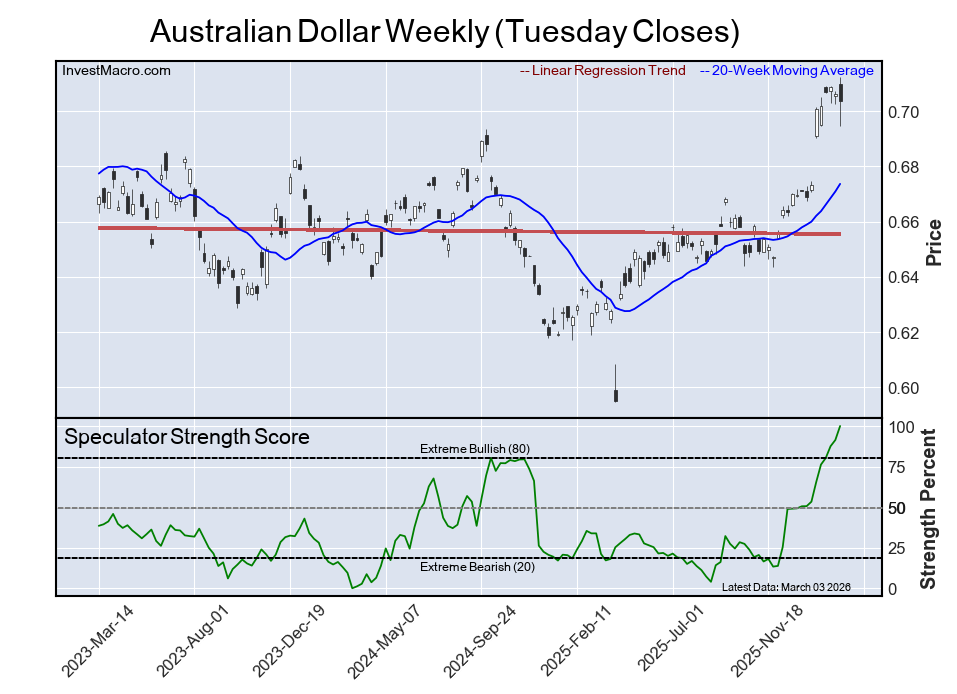
Week Ahead: Dollar set to tighten grip on FX throne?

By ForexTime 

  • FXTM’s USDInd ↑ 2% MTD 
  • Dollar best performing G10 currency MTD
  • Geopolitical risk + US CPI combo = fresh volatility?
  • Over past year US CPI decision triggered moves of ↑ 0.2% & ↓ 0.6% 
  • Technical levels: 98.00, 99.00 and 100.00

Global markets have been thrown into turmoil due to the deepening conflict in the Middle East.

As the confrontation between the US, Israel and Iran rages on, investor sentiment remains fragile with fears intensifying of a wider conflict in the region.

Mounting geopolitical risk and top-tier data could provide fresh trading opportunities in the week ahead:

Monday, 9th March

  • CN50: China PPI, CPI
  • EUR: Germany industrial production
  • TWN: Taiwan trade

Tuesday, 10th March

  • AUD: Australia Westpac consumer confidence
  • JPY: Japan GDP, money stock
  • EUR: EU finance ministers meet in Brussels to discuss policy
  • ZAR: South Africa GDP
  • Saudi Aramco earnings.

Wednesday, 11th March

  • EUR: Germany CPI
  • JPY: Japan PPI
  • USDInd: US CPI, federal budget balance

Thursday, 12th March

  • ZAR: South Africa manufacturing production
  • USDInd: US housing starts, trade, initial jobless claims
  • GBP: BOE Governor Andrew Bailey speech


Friday, 13th June

  • CAD: Canada unemployment
  • EUR: Eurozone industrial production
  • NZD: New Zealand BusinessNZ manufacturing PMI
  • GBP: UK industrial production, trade balance
  • USDInd: US consumer income, PCE price index, GDP, University of Michigan consumer sentiment

The spotlight shines on FXTM’s USDInd which has surged on safe haven flows as investors scrambled to price in the chaos.

Note: FXTM’s USDInd measures how the dollar performs against a basket of six different G10 currencies, including the Euro, British Pound, Japanese Yen, and Canadian dollar, Swedish krona & Swiss franc.

Here is how they are weighted:

  • Euro: 57.6%
  • JPY: 13.6%
  • GBP: 11.9%
  • CAD: 9.1%
  • SEK: 4.2%
  • CHF: 3.6%

Geopolitical conflict and key US data could spell fresh volatility for the USDInd.

Here are 4 reasons why:

1.  US-Israel war with Iran

The ongoing US-Israeli offensive against Iran has jolted financial markets, sparking a wave of risk aversion.

This has sent investors sprinting toward safe-haven destinations, including the US dollar.

  • Should the situation worsen and risk spilling over into a wider conflict, the dollar may be boosted further by safe-haven flows.
  • Signs of easing tensions may boost the market mood, weakening the dollar as appetite for safe-haven assets cools.

2. US CPI + PCE combo

The latest US inflation reports are likely to shape expectations around the Fed’s future policy moves.

  • Wednesday 11th March – US Feb CPI
  • CPI year-on-year (Feb 2025 vs. Feb 2026) to rise 2.5%

———————————————————————————————————

  • Friday 13th March – US Jan PCE – Fed’s preferred inflation gauge
  • Core PCE year-on-year to rise 3.1% from 3.0%.

This week alone, aggressively rising energy prices have raised inflationary fears – forcing markets to push back against bets around lower US rates.

  • The USDInd could jump if the incoming inflation reports reveal signs of rising price pressures.
  • Any signs of cooling prices pressures may support the argument around lower US rates.

Over the past 12 months, the US CPI has triggered upside moves on the USDInd of as much as 0.2% or declines of 0.6% in a 6-hour window post-release.
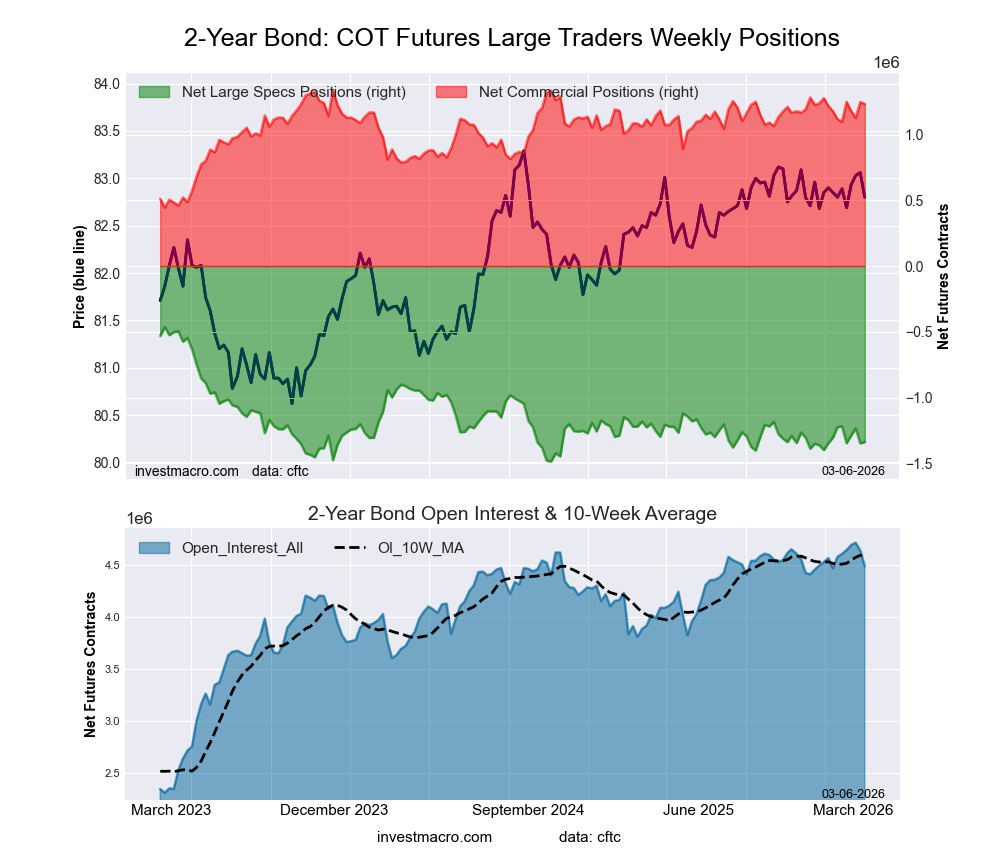
Traders are currently pricing a 60% chance that the Fed cuts rates at least twice in 2025.
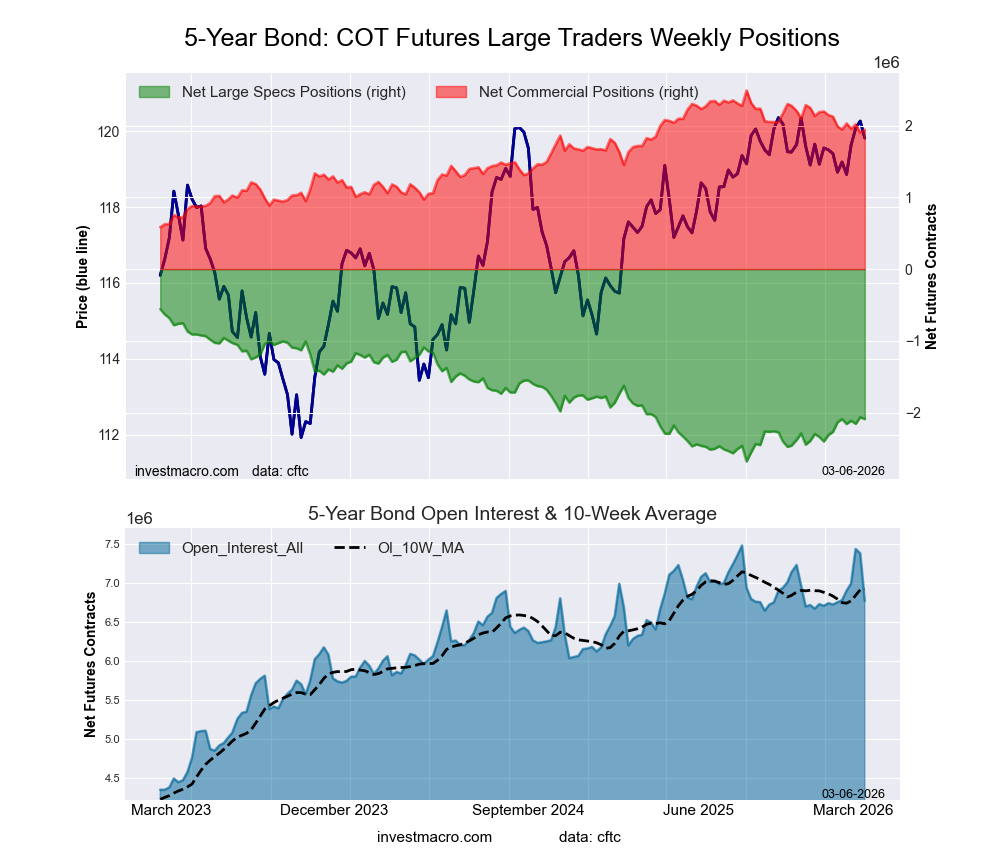
3.  Europe data dump

A string of key data across Europe including, German industrial production and CPI could influence sentiment toward the European economy and the Euro.

It is worth noting that the EUR makes up roughly 58% of the USDInd weight.

  • Stronger than expected data from Europe may weigh on the USDInd as the euro appreciates.
  • Disappointing data from Europe could boost the USDInd as the euro weakens.

4. Technical forces

FXTM’s USDInd is pushing higher on the daily charts. However, the Relative Strength Index is close to 70 – signalling that prices are nearly overbought.

  •  A solid breakout and weekly close above 99.00 could signal a move back toward 100.00 and 100.50.
  •  Sustained weakness below 99.00 could see price decline back toward the 200-day SMA and the 50-day SMA at 98.00.


Forex-Time-LogoArticle by ForexTime


ForexTime Ltd (FXTM) is an award winning international online forex broker regulated by CySEC 185/12 www.forextime.com

Investors run to safe-haven assets amid Middle East escalation

By JustMarkets 

The US stock market concluded Thursday’s session in the red as the escalating Middle East conflict pushed WTI oil prices above $80 per barrel. By the end of the day, the Dow Jones (US30) fell by 1.61%. The S&P 500 (US500) shed 0.56%, and the tech-heavy Nasdaq (US100) closed down 0.29%. Fearing stagflation and new logistical disruptions in the Strait of Hormuz, investors actively offloaded industrial sector holdings. Simultaneously, the financial sector faced massive sell-offs; banking giants Goldman Sachs and Morgan Stanley lost between 3% and 3.7% in value amid volatile bond yields. The current dynamics reflect growing market pessimism regarding global economic growth prospects during a prolonged confrontation. The combination of inflationary pressure and the threat of energy shortages is forcing traders to reassess their portfolios.

European markets demonstrated a broad decline on Thursday. The German DAX (DE40) dropped 1.61%, the French CAC 40 (FR40) closed down 1.49%, the Spanish IBEX 35 (ES35) lost 1.38%, and the British FTSE 100 (UK100) finished down 1.45%. Ongoing strikes between Iran and Israel on infrastructure targets in the Persian Gulf are provoking an uncontrolled surge in resource prices. The spike in natural gas prices was particularly painful for European equities, pushing bond yields higher and triggering a new wave of sell-offs in the banking sector, where shares of giants like Santander and Deutsche Bank fell nearly 3%. Investors seriously fear that a protracted conflict and energy shock will lead to industrial stagnation in Europe, forcing them to rotate capital from cyclical stocks into defensive instruments.

Benchmark oil prices made a powerful leap, gaining over 8% and consolidating above $80 per barrel – a level not seen since the summer of 2024. The rally was driven by a critical breakdown in global supply chains following the near-total halt of tanker traffic through the Strait of Hormuz after an Iranian missile attack on a commercial vessel. The situation was further exacerbated by Beijing’s decision to ban its largest refineries from exporting diesel and gasoline, intensifying the fuel product deficit and neutralizing international efforts to calm investors via insurance measures and military escorts. Despite the panic, a counterweight emerged from fresh US Energy Information Administration (EIA) data, which recorded an unexpected 3.5-million-barrel increase in commercial crude inventories. Total reserves of 439.3 million barrels provide a safety cushion capable of partially absorbing supply shocks in a prolonged conflict.

The US natural gas prices (XNG) corrected to $2.98 per MMBtu, partially offsetting previous gains after Washington announced upcoming measures to stabilize the energy market. Despite this local pullback, quotes maintain a positive weekly trend of approximately 4%, reacting to the unprecedented operational halt at Qatar’s Ras Laffan hub and the blockade of the Strait of Hormuz. Investors are deeply concerned about a global LNG shortage, as the force majeure in Qatar, one of the world’s largest exporters, creates systemic risks for supplies to Europe and Asia.

Asian markets traded lower yesterday, though with mixed results. The Japanese Nikkei 225 (JP225) rose by 1.90% during the session, while the FTSE China A50 (CHA50) declined 0.65%. The Hang Seng (HK50) edged up 0.28%, and the Australian ASX 200 (AU200) posted a positive result of 0.44%.

The New Zealand dollar (NZD) recovered to $0.590, yet it is ending the week in the red due to the flight to safe-haven assets. As an economy heavily dependent on energy imports, New Zealand has proven highly vulnerable to fuel price spikes, increasing pressure on the “kiwi.” Domestically, a serious dissonance is emerging between market expectations and official rhetoric; traders now price in an 80% probability of an RBNZ rate hike in September, expecting a total tightening of 40 basis points by year-end.

S&P 500 (US500) 6,830.71 −38.79 (−0.56%)

Dow Jones (US30) 47,954.74 −784.67 (−1.61%)

DAX (DE40) 23,815.75 −389.61 (−1.61%)

FTSE 100 10,413.94 −153.71 (−1.45%)

USD Index 99.06 +0.29% (+0.30%)

News feed for: 2026.03.06

  • Eurozone ECB President Lagarde Speaks at 12:00 (GMT+2); – EUR (LOW)
  • US Retail Sales (m/m) at 15:30 (GMT+2); – USD (MED)
  • US Nonfarm Payrolls (m/m) at 15:30 (GMT+2); – USD (HIGH)
  • US Unemployment Rate (m/m) at 15:30 (GMT+2); – USD (HIGH)
  • Canada Ivey PMI (m/m) at 17:00 (GMT+2). – CAD (MED)

By JustMarkets


This article reflects a personal opinion and should not be interpreted as an investment advice, and/or offer, and/or a persistent request for carrying out financial transactions, and/or a guarantee, and/or a forecast of future events.