Most people don’t know what they don’t know, but think they do – correcting your metaknowledge can make you a better teacher and learner

By Tommy Blanchard, Tufts University 

Do you know what the Apple logo looks like?

Chances are, you think you do. It’s ubiquitous and iconic. How could you not know it?

But when tested, it turns out very few people can remember all the features of the logo. One study of 85 people found that only about half could pick the correct logo out of a lineup of similar ones. And only one person could correctly draw it.

This isn’t an isolated example. A classic study from 1979 found that people similarly couldn’t draw a penny accurately or pick out a correctly drawn penny from incorrect ones.

People aren’t just bad at remembering things they see all the time, but also in actually knowing how they work. In a 2006 study, many people made significant errors when drawing a bicycle, like putting the chain around the front wheel as well as the back wheel. More than just a forgotten detail, putting the chain around both wheels shows a deeper misunderstanding of how a bicycle works. A bicycle with a chain around both wheels wouldn’t be able to turn.

Illustration of bike with different components labeled
Do you truly know how a bicycle works?
Al2/Grandiose via Wikimedia Commons, CC BY-SA

It turns out people’s knowledge of how the world works is often fragmented and sketchy at best. They systematically overestimate their understanding of everyday devices and natural phenomena. People will tend to give themselves high ratings on how well they understand something, such as how bicycles or zippers work. But when they’re asked to actually explain the mechanics of these objects, their ratings of their understanding typically drop.

Just like how your knowledge of the world around you is imperfect, your knowledge about your own knowledge – also called metaknowledge – is often flawed. My field of cognitive science has been uncovering various gaps in human metaknowledge for decades.

If people are systematically overconfident about how well they understand things, why don’t they notice when they don’t understand something? And what can people do to better recognize the limits of their own knowledge?

The ability to say ‘I know that I know nothing’ could be considered a sign of wisdom.
Nicolas-André Monsiau/Pushkin Museum of Fine Arts via Wikimedia Commons

Why you think you know more than you do

Researchers have identified several factors behind people’s overconfidence in their knowledge.

One is that people confuse environmental support with understanding: The information is out in the world but not actually in your head. With a bicycle or a zipper, all of the parts are visible to you, and you may confuse this transparency for an internal understanding of how they work. But until you go to use that knowledge by attempting to explain how they work, you may not recognize that you don’t understand how those parts interact.

A second factor is confusing different levels of analysis. People can often describe how something works at a very high level. You know that the engine of a car makes the car go, and the brakes slow and stop the vehicle. But confidence in your high-level understanding of the car may bias you to think you also have a good grasp of the finer details, like how the engine pistons and brake pads work.

Additionally, people can be blind to the ways their knowledge shapes their own perception. In one study, researchers had participants tap out the tune to a popular song. On average, the tappers thought listeners would be able to identify the song about 50% of the time. But when listeners had to identify the tapped song, they actually could identify it only 2.5% of the time. The tappers didn’t realize how much their knowledge was making identifying the song seem easy to them.

A teacher talks to a student before a chalkboard wall filled with equations, chemical structures and graphs
Intellectual humility can help you see your expert blind spot.
Vitaly Gariev/Unsplash, CC BY-SA

This disconnect has consequences beyond whether someone else can understand your Morse code version of a song. When teaching people, whether in formal classroom settings or through casual mentorship, you can sometimes have an expert blind spot: the inability to recognize the difficulties beginners face when learning something you have expertise in.

Building expertise often involves internalizing knowledge to the point where it becomes invisible to you. You draw on knowledge you don’t realize you have, making it hard to relate to learners who lack this knowledge – and, of course, hard for learners to relate to your teaching. You might have experienced this when you’ve gotten partway through explaining something, only to realize you’ve been using jargon you forgot isn’t common knowledge and lost your listener.

How to address metaknowledge failures

Your metaknowledge can fail in two directions: You can think you know more than you do, and you can be blind to how much you’re relying on knowledge you do have. Each calls for a different response to correct it.

When you’re overconfident in your knowledge, the remedy is using that knowledge. You’ll quickly realize how much you actually understand and dial down your confidence. Challenging yourself to actually try to walk through how something works is a great exercise in intellectual humility – that is, recognizing that you may be wrong – and can keep you from getting out over your skis.

Building a greater appreciation for what you know is more difficult. You can’t simply unlearn what you’ve internalized. But what this challenge shows is that, to some extent, knowing a subject and knowing how to teach it are two separate skills. Some experts are great teachers, but not simply by virtue of being experts. Recognizing that you have to approach teaching with humility, and that your expertise doesn’t automatically make you a skilled teacher, can go a long way toward making you a better teacher and mentor.

These aren’t easy and quick fixes to failures of metaknowledge. Both require ongoing intellectual humility and a willingness to distrust your own confidence. But acknowledging the fallibility of your own metaknowledge is a good place to start.The Conversation

About the Author:

Tommy Blanchard, Research Associate in Cognitive Science, Tufts University

This article is republished from The Conversation under a Creative Commons license. Read the original article.


How does your brain decide between the road not taken or the same old route? Resolving conflicting memories is key to navigation

By Paulina Maxim, Georgia Institute of Technology 

When was the last time you paid attention to your commute? And I don’t mean a couple of feet in front of you, at the car merging into your lane without a blinker. I mean really paid attention to the route you take.

Did you see the landmarks in the distance that make up the city skyline? Did you drive right past the grocery store you promised to stop by at the corner of this Peachtree Street or that Peachtree Street, a struggle Atlanta locals know well?

“Oops! Force of habit,” you might say to yourself as you miss your turn and begin to think about when and where you can turn around.

Relying on familiarity can either facilitate or impede daily navigation. As a researcher studying memory and navigation, I aim to understand how the brain supports spatial navigation and what happens if the cognitive mechanisms for choosing the best route home begin to decline, such as during stress or with aging.

Humans are creatures of habit – at least that’s what people tell themselves when wary of trying something new. But what if a new route is faster or safer than the one you usually take? Would you try it?

Research from my team suggests that people balance between exploration and habit – that is, trying something new or sticking with the familiar – when deciding what route to take. Which navigation strategy someone chooses depends not only on their spatial abilities but on their network of brain regions that support navigation.

A spatial blueprint

Spatial navigation refers to the cognitive ability that helps you travel from one location to another. It may sound simple, but it requires using cognitive functions such as memory, attention, decision-making and assessing potential rewards – never mind the ability to simply perceive the environment itself.

Spatial navigation uses memories of things you consciously experienced. Two types of memory relevant to navigation are what scientists call episodic and semantic.

For example, you might retrieve an episodic memory about a specific event: remembering a detour you took a week ago to drop a package off at the post office, including the traffic and weather that day.

You might also retrieve a semantic memory that’s more factual and knowledge-based: remembering how many blocks away the post office is from the park and the turns you need to make to get there.

Together, these kinds of memory inform your spatial memory, which allows you to retrieve location information. This could be where buildings are in relation to each other or where objects are situated in your house. Spatial memories help form your cognitive map, which is essential for getting around in the world.

Often, these different ways of remembering interact, and you can use one type of memory to inform the other. For example, you’ve become accustomed to your commute to work and know it’s relatively short (semantic memory), but over the past three days you’ve been arriving late due to heavy traffic (episodic memory), so you choose to take a different route next time.

Research from my team has found that disagreements in your brain over possible routes can happen. Different types of memory can come up with different solutions for what route you can take, and this conflict is a big factor in how hard your brain needs to work when navigating an environment.

Responding to new and familiar memories

Habits stem from what researchers call stimulus-response memories. These include the knee-jerk reaction you might have to familiar landmarks – when you perceive these places, your brain signals you to make a turn along your commute without needing to consciously think about it.

Habits are rigid, but they can also be beneficial: By taking care of the navigation for you, habit frees up your brain to have a conversation with someone or plan what to make for dinner when you get home.

When navigating less familiar routes or environments, where habit doesn’t kick in automatically, you rely on brain regions such as the hippocampus to call on detailed memories from recent experiences to help guide the way.

But let’s say you’re shopping at a new grocery store where most things are where you expect them to be, even though you’ve never been in this particular store before. What happens when your brain experiences both something new and something familiar about an environment?

Researchers have shown that when something about an environment is familiar and aligns with your prior experiences, the prefrontal regions of your brain – those responsible for executive functions such as decision-making – become more active. They can bypass or even inhibit your hippocampus’s ability to form new memories about specific events.

In other words, your brain can weave information about a new experience into your database of existing knowledge, rather than storing it as completely new information with little relation to the past. This process may help fast-track your understanding about new experiences.

Updating cognitive maps

Researchers know that cognitive maps of the environment depend on the hippocampus and its database of memories about specific events. However, I and other researchers argue these maps can also function as a schema – a collection of memories made up of associations between environmental details. You can add new information to these collections and use it to infer new relationships.

Say a new pedestrian bridge is built between the park and the post office. Your brain can more easily weave this new route information into your existing memories compared with learning a new environment from scratch. Similarly, if you just moved to a new town and know very little about the spatial layout, you might rely on your past experiences of towns to infer where something is.

Schemas help you interpret and incorporate new information more quickly.

Using neuroimaging techniques as well as virtual reality programs designed to test a participant’s ability to navigate different routes, my team found that there is likely an interdependent relationship between the brain areas that store memories of specific events and areas that store related information across memories when planning to navigate less familiar places.

New routes are more difficult to follow when they differ from your prior experiences. Thus, a stronger schema helps integrate your knowledge of the spatial relationships between locations and landmarks (such as the distance between the post office and the park) with more general knowledge (such as prior route difficulty). This all informs how you choose to navigate.

Navigating daily life

These memory principles help explain why inconsistencies with your previous experiences can make it so difficult to navigate many aspects of daily life.

Imagine you woke up tomorrow and the GPS on your smartphone was no longer available. How will you plan your route to get to your destination?

You might be used to navigating north from your home to the grocery store – but have you ever tried to navigate to that grocery story from a different location? It’s much harder!

Factors such as stress, aging and general cognitive decline can affect brain function and human behavior. Imagine how much harder that new route to the grocery store is for an older adult.

Relating new information to your prior experiences may help strengthen your schema and make navigation easier. And understanding what processes the brain needs to go through to solve these navigation problems can help you understand why getting around can be challenging.The Conversation

About the Author:

Paulina Maxim, Ph.D. Candidate in Psychology, Georgia Institute of Technology

This article is republished from The Conversation under a Creative Commons license. Read the original article.


European stock markets declined amid rising concerns about an energy crisis

By JustMarkets 

The US market ended the session with a moderate decline, although by the close, the main indices had managed to significantly reduce their intraday losses. By the end of the day, the Dow Jones (US30) rose by 0.11%. The S&P 500 (US500) fell by 0.16%. The Technology Index Nasdaq (US100) closed lower by 0.71%. The US market ended the session with a moderate decline, although by the close, the main indices had managed to significantly reduce their intraday losses. Investor sentiment was pressured by the April US inflation report, which heightened concerns that high energy prices amid the conflict in the Middle East could worsen corporate profits and force the Federal Reserve to keep interest rates high for longer. Against this backdrop, shares of major technology companies, including Alphabet, Amazon, Microsoft, and Tesla, came under pressure, although Nvidia and Apple managed to close higher. Additional pressure hit the semiconductor sector after reports that South Korea is considering introducing a universal dividend tax, which worsened sentiment around companies linked to artificial‑intelligence infrastructure.

On Tuesday, European stock markets fell sharply amid rising concerns about an energy crisis and increasing inflationary pressure. The failure of negotiations between the US and Iran heightened risks of further escalation and another spike in oil and gas prices, which is particularly painful for the European economy, heavily dependent on energy imports. By the end of the day, Germany’s DAX (DE40) fell by 1.62%, France’s CAC 40 (FR40) closed down by 0.95%, Spain’s IBEX 35 (ES35) declined by 1.56%, and the UK’s FTSE 100 (UK100) ended the session down by 0.04%. Additional pressure on markets came from accelerating US inflation and political instability in the UK, which triggered a rise in European government‑bond yields and worsened investor sentiment. Meanwhile, Germany’s ZEW Economic Sentiment Index for May rose to 10.2 points, significantly exceeding market expectations and recovering from a more than three‑year low, although the indicator remains in negative territory due to ongoing geopolitical uncertainty. The weakest performance came from the financial and technology sectors. Shares of Banco Santander, BNP Paribas, and ING Group fell sharply amid rising borrowing costs.

On Tuesday, WTI crude prices rose sharply and approached 102 dollars per barrel amid growing fears that the crisis around the Strait of Hormuz may last much longer than markets previously expected. Additional upward momentum came from statements by Donald Trump that the ceasefire between the US and Iran is on “artificial life support,” after Washington rejected Tehran’s new proposal. Investors fear that the effective blockade of the Strait of Hormuz, a key route for global oil and LNG shipments, may persist for an extended period, continuing to create a severe supply deficit in the global energy market.
In Asia on Friday, Japan’s Nikkei 225 (JP225) rose by 0.53%, China’s FTSE China A50 closed up by 0.42%, Hong Kong’s Hang Seng (HK50) fell by 0.22%, and Australia’s ASX 200 (AU200) declined by 0.36%.

The Australian dollar (AUD) fell to 0.72 US dollars but continues to hold near four‑year highs, as investors still expect further tightening by the Reserve Bank of Australia (RBA) amid persistent inflation and high energy prices. The budget for the 2026/27 fiscal year includes deficit reduction and changes to housing taxation, but the main responsibility for containing inflation effectively remains with the central bank. Markets estimate the probability of a June rate hike to 4.35% at around 20%, while the probability of a further increase to 4.6% in August already exceeds 80%.

A Reserve Bank of New Zealand (RBNZ) survey showed rising inflation expectations among businesses in the second quarter of 2026. Expected inflation for the next two years rose to 2.53% from 2.37% a quarter earlier, reaching its highest level since late 2023. The main factor remains rising fuel prices, which are expected to continue increasing price pressure in the economy. Respondents also expect further monetary tightening: the expectations for the official cash rate (OCR) suggest an increase to 2.34% by the end of June and to 3.01% over the next year. The data strengthen expectations of a more hawkish stance from the RBNZ ahead of the May rate meeting. Additional investor attention is focused on New Zealand’s upcoming 2026 budget, which will be presented on May 28. Prime Minister Christopher Luxon confirmed the government’s intention to return the budget to surplus by 2028-2029 and reduce public debt to 40% of GDP.

S&P 500 (US500) 7,400.96 −11.88 (−0.16%)

Dow Jones (US30) 49,760.56 +56.09 (+0.11%)

DAX (DE40) 23,954.93 −395.35 (−1.62%)

FTSE 100 (UK100) 10,265.32 −4.11 (−0.04%)

USD Index 98.32 +0.36 (+0.37%)

News feed for: 2026.05.13

  • Australia Wage Price Index (q/q) at 04:30 (GMT+3) – AUD (MED)
  • New Zealand Inflation Expectations (m/m) at 06:00 (GMT+3) – NZD (MED)
  • Eurozone GDP (q/q) at 12:00 (GMT+3) – EUR (MED)
  • Eurozone Industrial Production (m/m) at 12:00 (GMT+3) – EUR (LOW)
  • US Producer Price Index (m/m) at 15:30 (GMT+3) – USD (MED)
  • US Crude Oil Reserves (w/w) at 17:30 (GMT+3) – WTI (HIGH)

By JustMarkets


This article reflects a personal opinion and should not be interpreted as an investment advice, and/or offer, and/or a persistent request for carrying out financial transactions, and/or a guarantee, and/or a forecast of future events.

USD/JPY Continues to Climb Amid External and Domestic Pressures

By Analytical Department RoboForex

USD/JPY rose to 157.65 on Wednesday, marking a third consecutive day of gains. The yen came under pressure following stronger-than-expected US inflation data, reinforcing expectations that the Federal Reserve will maintain its hawkish stance.

Market focus remains on the Bank of Japan. Following its April meeting, some policymakers signalled the possibility of a further rate hike. Rising global oil prices are adding to inflationary pressures in Japan. The OECD forecasts that the BoJ’s key rate could reach 2% by the end of 2027.

Currency markets are also watching for potential interventions. US Treasury Secretary Scott Bessent noted that Washington and Tokyo view excessive currency volatility as undesirable, which was seen as indirect support for Japan’s efforts to stabilise the yen.

Technical Analysis

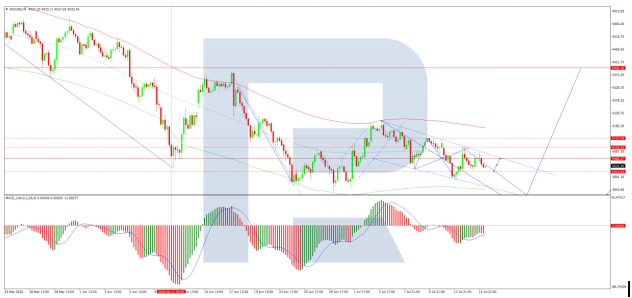
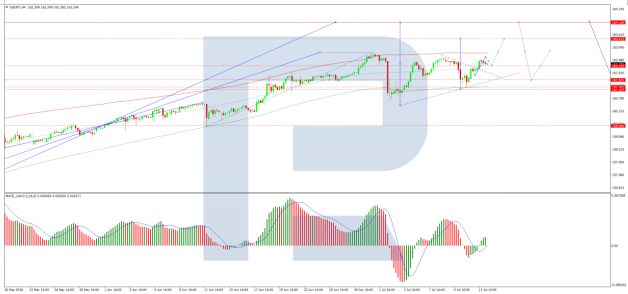
On the H4 chart, USD/JPY is trading around 157.33, with a breakout suggesting further upside towards 157.97. A short-term correction to 156.50 is possible before a potential move higher resumes. The MACD indicator, above zero and pointing firmly upwards, supports further gains.

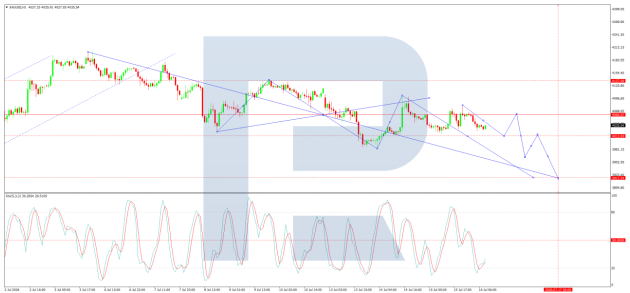
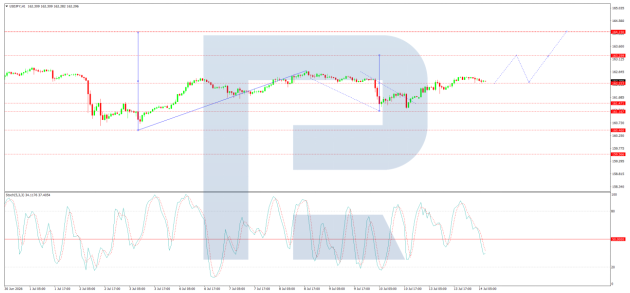
On the H1 chart, USD/JPY has reached 157.77 and is moving lower towards 157.30. A subsequent rise towards 157.97 is possible. The Stochastic oscillator confirms short-term bullish momentum, although a pullback may develop, indicating some near-term downside risk.

Conclusion

USD/JPY is advancing under both external and domestic influences, supported by technical indicators. While short-term corrections are possible, the broader trend remains upward.


Disclaimer

Any forecasts contained herein are based on the author’s particular opinion. This analysis may not be treated as trading advice. RoboForex bears no responsibility for trading results based on trading recommendations and reviews contained herein.

You can change your emotions – but it’s a 2‑step process that takes some effort

By Christian Waugh, Wake Forest University 

Picture Gigi, having a chat with her boss, when the meeting takes a sharp turn. Gigi’s boss tells her that her work has been lacking recently and that maybe she needs to stay late a couple of evenings to make it up. Surprised by her boss’s remarks, she feels the rumblings of anxiety rising in her mind and body. Psychology research suggests that Gigi feels anxious because she interpreted her boss’s remarks as something threatening that perhaps she can’t handle.

Just as Gigi starts frantically looking online for new jobs, she spies the “employee of the month” plaque on her desk from last year. She thinks to herself that maybe she can get back to her old form. She has changed her initial view of the situation (need to run away from a threat) to a new one (let’s rise to the challenge), causing her anxiety to subside. Psychologists call this process reappraisal.

Studies show that reappraising emotional situations is a powerful way to change how you feel. When you find the silver linings in bad situations or give others and yourself the benefit of the doubt, it can help you feel better.

I’m a psychology researcher who’s interested in how people change their emotions. Gigi may feel a little less anxious in the moment, but does she truly believe that she can make up the work on time and regain her former glory? My colleagues and I set out to investigate whether it’s possible to start the process of reappraisal without going all the way through with it. Are people getting the full benefit from trying to think differently about their emotions?

Reappraisal has multiple steps

When my colleague Kateri McRae and I first started thinking about what it means to fully reappraise emotional experiences, we were struck by something we saw in the emotion regulation research. Almost all of the studies treated reappraisal as a one-step process. Researchers would ask participants to “reappraise this to make yourself feel better” and then measure the effects.

However, theories about how people regulate their emotions suggest that, like any effortful psychological process, reappraisal involves multiple steps.

When you want to change how you’re feeling, you first generate a reappraisal. You bend and stretch your mind to come up with some alternative way to look at the situation. For Gigi, seeing the employee of the month plaque helped. She could have also thought of her boss’s previous compliments or how it felt to get projects done early.

After you generate a reappraisal, it might seem like you’re done, but you’re not. That alternative interpretation is fragile and must compete with your original take that’s driving your emotion. Somehow you need to strengthen that reappraisal so it can stick.

We call this implementation – when you focus and elaborate on that reappraisal to really change your mind about the situation. For Gigi, she may continue to think about all the ways that she can be a great employee so that it lodges firmly in her mind and makes her anxiety truly disappear.

We tested this idea in a study. We showed 89 undergraduate participants images of negative situations and asked them to first just generate a reappraisal of the image that could help them feel better about it. For example, they might see a picture of a frail man in a hospital bed and tell themselves that the man is getting good treatment and will be better soon. Then, we showed them the image again and asked them to focus and elaborate in their mind on their reappraisal.

Participants felt a little better after generating a reappraisal, but they felt much better after implementing it by focusing and fleshing out the details. In a follow-up study, we showed that these emotional boosts persisted when viewing the images later.

Choosing to commit to feeling better

So we experimentally showed that people reappraise their feelings in two steps. So what? That’s probably what everyone does naturally, anyway, right?

This was the next question we sought to answer. We conducted a study with 52 undergraduate participants like the earlier one, but with a twist. This time, after participants generated a reappraisal, we gave them a choice to continue the reappraisal process by implementing it or to stop the process by distracting themselves.

Participants chose to continue reappraising their emotions only about half the time. Even though reappraisal made participants feel better about the emotional images, there were still many times when they stopped the process prematurely and did not enjoy its full benefits.

In real life

These studies showing the benefits of fully following through on emotional reappraisals are lab experiments, but they have implications for how people try to help themselves feel better in real life.

First, it’s hard to intentionally change how you think about something, and people tend to dislike continuing to do hard things. Indeed, in our choice study, people opted to give up on reappraising when they weren’t feeling its benefits early on. Knowing this human tendency might give you the best chance of continuing reappraisal even when it doesn’t feel like it’s working or is hard.

Second, people often get reappraisals from others, and it’s tempting to think that hearing a new perspective is all you need. Indeed, we have unpublished data that shows that participants feel pretty good when receiving a reappraisal from someone else about their own situation. But other people cannot change your mind for you. You must do that yourself if you want to truly feel better.

Next time you’re in an unpleasant situation like Gigi’s, don’t just cursorily think that you can rise to the challenge. Really think through the situation and let your new perspective become your only one.The Conversation

About the Author:

Christian Waugh, Professor of Psychology, Wake Forest University

This article is republished from The Conversation under a Creative Commons license. Read the original article.


Mythos AI is a cybersecurity threat, but it doesn’t rewrite the rules of the game

By Mohammad Ahmad, West Virginia University 

The cybersecurity community went on alert when Anthropic announced on April 7, 2026, that its latest and most capable general-purpose large language model, Claude Mythos Preview, had demonstrated remarkable – and unintended – capabilities. The artifical intelligence system was able to find and exploit software vulnerabilities – the most serious type of software bugs – at a rate not seen before.

The news ignited concern among the public, world governments and the information technology sector about the capabilities of today’s AI to undermine cybersecurity, with some people framing the model as a global cybersecurity threat.

Claiming that it would be too risky to release the model, and that the company had the moral responsibility to disclose these vulnerabilities, Anthropic said it would not immediately offer the model to the public. Instead, it granted exclusive access to tech giants to test the model’s capabilities, a process Anthropic dubbed Project Glasswing.

As a cybersecurity researcher, I think Mythos’ capabilities are impressive, but the AI system does not represent a radical departure. Mythos is less a new threat than a mirror reflecting how people behave and how fragile modern systems already are.

What Mythos did

During a controlled evaluation, engineers with minimal security experience prompted Mythos to scan thousands of software codebases for vulnerabilities. The model showed striking capabilities in conducting multistep, autonomous attacks that take experts weeks or even months to put together. Mythos was not only able to discover 271 vulnerabilities in Mozilla’s Firefox, it also developed exploits to take advantage of 181 of those.

Overall, Anthropic’s red team, which takes on the role of an attacker to test defenses, and the United Kingdom’s AI Security Institute reported that Mythos found thousands of zero-day, or previously unreported, vulnerabilities in major operating systems, web browsers and other applications – software flaws that have not yet been patched and can be turned into exploits immediately. National Security Agency officials testing Mythos have been impressed by the tool’s speed and efficiency in finding software vulnerabilities, according to a news report.

Anthropic’s announcement of Mythos and the cybersecurity threat it poses garnered widespread media attention.

Among the most widely reported were Mythos’ ability to identify a dormant 27-year-old security flaw in OpenBSD, a security-focused operating system, and a 16-year-old bug in FFmpeg, a video/audio processing tool. Some of these flaws allow unauthenticated users to gain control of the machines hosting these applications.

Even more striking, the relatively inexperienced engineers running Mythos’ evaluations were able to use Mythos to complete attacks overnight, from finding vulnerabilities to exploiting them – something that can take human experts weeks to do. The model’s ability to chain multiple steps is what surprised Anthropic and organizations that tried it. In an evaluation by the AI Security Institute, Mythos was able to take over a simulated corporate network in three out of 10 tries, the first AI model to succeed at the task.

These results are real. They also paint an incomplete picture in ways that matter.

Where is the breakthrough?

At first glance, Mythos’ breakthrough sounds novel and could signal a new class of cyber threats. However, a closer look suggests something different. The vulnerabilities Mythos found are not new in nature. They generally don’t belong to unknown security flaws, and in many cases they are variations of well-known and well-understood classes of software vulnerabilities.

In cybersecurity, finding new instances of known types of flaws is not unusual. The most successful attacks rely on known, well-defined vulnerabilities that stay overlooked or unpatched. What concerned the researchers was not Mythos changing the nature of finding and exploiting vulnerabilities, but rather the intense scale and speed with which it was able to find and exploit those vulnerabilities.

This is not a breakthrough per se but rather a result of decades of research in both cybersecurity and AI. In that sense, Mythos is the natural – and expected – result of powerful automation and AI integration because it follows the same fundamental procedures used in standard offensive cybersecurity practices. These include scanning for vulnerabilities, identifying patterns and testing exploitability. Mythos and similar emerging models make it possible to chain these steps together at a speed that is hard to fathom.

So why were these vulnerabilities missed in the first place?

It is crucial to understand that not all vulnerabilities are cost effective to fix, and not all vulnerabilities are a priority. Mythos did not discover a new kind of weakness – it exposed the limits of how cybersecurity practitioners search for them.

New tech, age-old dynamic

Mythos highlights an important fact about the reality of cybersecurity threats. System defenders are always at a disadvantage because they need to always succeed. Attackers, however, need to succeed only once to break the security of a system. This cat-and-mouse game will always be the same, and Mythos does not change that – it simply reinforces it.

Mythos follows a familiar dynamic: A tool created to protect can also be used to attack and harm.

“The same improvements that make the model substantially more effective at patching vulnerabilities also make it substantially more effective at exploiting them,” Anthropic officials wrote in a blog post about Mythos.

What once may have required highly specialized skills can now be achieved with significantly less effort, which raises the most important question: Who will benefit first by using tools like Mythos – defenders or attackers?The Conversation

About the Author:

Mohammad Ahmad, Assistant Professor of Management Information Systems, West Virginia University

This article is republished from The Conversation under a Creative Commons license. Read the original article.


The United States rejected Iran’s proposal for resolving the conflict. Oil prices surged again

By JustMarkets 

On Monday, US stock markets rose moderately. By the end of the day, the Dow Jones (US30) increased by 0.19%. The S&P 500 (US500) rose by 0.19%. The Technology Index NASDAQ (US100) closed higher by 0.10%. The S&P 500 and NASDAQ once again renewed historical highs thanks to strong growth in semiconductor stocks amid ongoing optimism around demand related to the development of artificial intelligence. Among the top gainers were major technology companies and chip manufacturers. Shares of Micron Technology rose particularly sharply, supported by expectations of a memory‑market shortage due to supply issues and labor disputes among competitors. The energy, industrial, and materials sectors also showed solid performance.

European stock indices ended the session lower for the third consecutive day amid continued pressure from geopolitical tensions in the Middle East and related risks to global energy supplies. By the end of the day, Germany’s DAX (DE40) rose by 0.05%, France’s CAC 40 (FR40) closed down by 0.69%, Spain’s IBEX 35 (ES35) declined by 0.21%, and the UK’s FTSE 100 (UK100) ended the session up by 0.36%. Market pressure intensified after US President Donald Trump stated that Washington had rejected Iran’s latest counterproposal for resolving the conflict. This increased investor concerns about further escalation and prolonged disruptions to oil and gas exports from the region. The consumer‑goods sector, which is sensitive to geopolitical risks, showed the weakest performance.

WTI oil prices continued to rise, climbing toward 98 dollars per barrel after statements by US President Donald Trump that the current ceasefire between the US and Iran remains extremely unstable. This heightened market fears of possible escalation and the risk of a larger war that could lead to further disruptions in oil supplies from the region. Additional pressure came from the US refusal to accept Iran’s counterproposal for a peace settlement, which reduced expectations of a quick diplomatic resolution. The near‑complete halt of shipping through the Strait of Hormuz continues to severely disrupt global supplies of crude oil, LNG, and petroleum products, supporting rising energy prices and intensifying inflation risks.

On Tuesday, silver prices (XAG) fell to 85 dollars per ounce, losing part of the gains achieved earlier in the trading session. The market came under pressure from persistent geopolitical tensions in the Middle East and ongoing disruptions in the Strait of Hormuz, which support high oil prices and increase inflation concerns. Despite the current decline, silver remains one of the leaders among precious metals. The day before, prices rose more than 7%, reaching a two‑month high. The market is supported not only by demand for safe‑haven assets but also by expectations of rising industrial consumption of silver, given its wide use in manufacturing and high‑tech industries.

The US natural gas prices (XNG) rose to 2.92 dollars per MMBtu, reaching the highest level in more than six weeks amid reduced production and the restoration of the liquefaction line at the Freeport LNG export terminal. The market is supported by the ongoing decline in production across the 48 US states. Several major producers, including EQT, have reduced output in recent weeks due to low spot prices, gradually tightening supply in the domestic market.
In Asia on Friday, Japan’s Nikkei 225 (JP225) fell by 0.47%, China’s FTSE China A50 closed up by 1.38%, Hong Kong’s Hang Seng (HK50) rose by 0.05%, and Australia’s ASX 200 (AU200) declined by 0.49%.

The Business Confidence Index from the NAB showed that Australia’s economy continues to face serious pressure from high energy prices and tight monetary policy. Although the confidence indicator in April rose slightly to 24 below zero from the record‑weak 29 below zero a month earlier, business conditions deteriorated to one of the lowest levels since 2020, indicating a slowdown in activity, reduced investment, and worsening business expectations.

S&P 500 (US500) 7,412.84 +13.91 (+0.19%)

Dow Jones (US30) 49,704.47 +95.31 (+0.19%)

DAX (DE40) 24,350.28 +11.65 (+0.05%)

FTSE 100 (UK100) 10,269.43 +36.36 (+0.36%)

USD Index 97.93 +0.03 (+0.03%)

News feed for: 2026.05.12

  • Australia Westpac Consumer Confidence (m/m) at 03:30 (GMT+3) – AUD (LOW)
  • Australia NAB Business Confidence (m/m) at 04:30 (GMT+3) – AUD (MED)
  • German Inflation Rate (m/m) at 09:00 (GMT+3) – EUR (MED)
  • Switzerland Producer Price Index (m/m) at 09:30 (GMT+3) – CHF (LOW)
  • German ZEW Economic Sentiment (m/m) at 12:00 (GMT+3) – EUR (MED)
  • Eurozone ZEW Economic Sentiment (m/m) at 12:00 (GMT+3) – EUR (MED)
  • US Consumer Price Index (m/m) at 15:30 (GMT+3) – USD (HIGH)

By JustMarkets


This article reflects a personal opinion and should not be interpreted as an investment advice, and/or offer, and/or a persistent request for carrying out financial transactions, and/or a guarantee, and/or a forecast of future events.

EUR/USD on Edge: Middle East and China in Focus

By Analytical Department RoboForex

EUR/USD dipped slightly on Tuesday, retreating to 1.1762. The US dollar has returned to favour as a defensive asset after US President Donald Trump questioned the sustainability of the truce with Iran and rejected Tehran’s latest peace proposal.

Trump also plans to convene a meeting with his national security team to discuss a potential resumption of military operations and a review of plans to escort commercial vessels through the Strait of Hormuz.

The ongoing conflict continues to keep oil prices elevated, fuelling inflationary pressures and expectations that interest rates may remain higher for longer to contain price pressures.

Investors are now turning their attention to US inflation data for April, which is expected to indicate how the Iran conflict is impacting the economy and help guide potential Federal Reserve decisions.

An additional market factor is the expected meeting later this week between Donald Trump and Chinese President Xi Jinping, which is likely to focus on trade relations and the development of artificial intelligence.

Technical Analysis

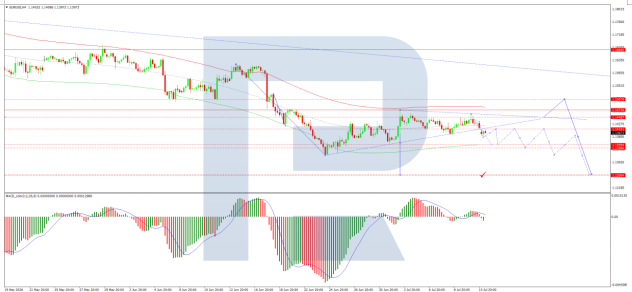
On the H4 chart, EUR/USD is trading within a consolidation range around 1.1755, with potential downside towards 1.1688. At the same time, a move higher towards 1.1818 remains possible, with further upside to 1.1870. This scenario is supported by the MACD indicator, with its signal line above zero and pointing firmly upwards, indicating continued bullish momentum.

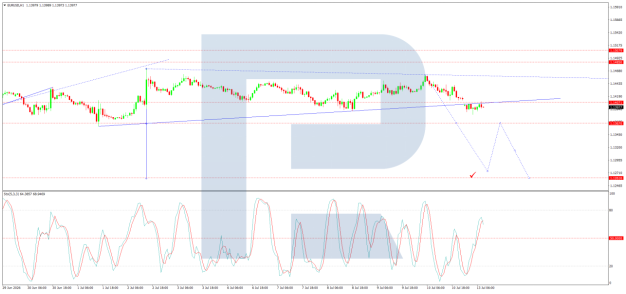
On the H1 chart, EUR/USD has reached 1.1786. A decline towards 1.1740 is likely, followed by a possible rebound to 1.1760 and further upside towards 1.1818. This scenario is confirmed by the Stochastic oscillator, with its signal line near 20 and pointing firmly upwards.

Conclusion

EUR/USD remains sensitive to geopolitical developments in the Middle East and upcoming US–China discussions. Strong inflation data could support the US dollar, while positive diplomatic progress may ease pressure on the pair and support further euro gains.


Disclaimer

Any forecasts contained herein are based on the author’s particular opinion. This analysis may not be treated as trading advice. RoboForex bears no responsibility for trading results based on trading recommendations and reviews contained herein.

The US stock indices continue to set new records. China’s exports showed a sharp increase

By JustMarkets 

On Friday, the US stock indices once again renewed their record highs. By the end of the day, the Dow Jones (US30) rose by 0.03% (weekly result +0.39%). The S&P 500 (US500) increased by 0.84% (weekly result +2.36%). The Technology Index Nasdaq (US100) closed higher by 1.71% (weekly result +2.35%). The markets were supported by strong US labor‑market data: the number of new jobs in April exceeded expectations, and the unemployment rate remained unchanged. Over the week, all major indices showed solid growth, supported by strong corporate earnings and the ongoing rally in technology stocks.

The Canadian dollar (CAD) weakened to around 1.37 per US dollar, continuing its decline after reaching late‑April highs. Pressure on the currency came from weak Canadian labor‑market data: employment unexpectedly fell, and the unemployment rate rose to its highest level in six months. This strengthened expectations that the Bank of Canada (BoC) will focus on supporting the economy and avoid tightening monetary policy in the near future. The hawkish tone of Banxico is linked to rising inflation risks amid high energy prices caused by the conflict in the Middle East.

The Mexican peso (MXN) strengthened to around 17.2 per US dollar, approaching its highest levels in nearly two years after signals from the Bank of Mexico about the end of the rate‑cutting cycle. The regulator lowered the rate by 25 basis points to 6.5%, although part of the market expected more aggressive easing. At the same time, the central bank made it clear that further rate cuts are unlikely in the near future.

On Friday, European stock markets continued to decline for the second session in a row amid a new wave of tensions between the US and Iran, which increased concerns about disruptions to Europe’s energy supplies. By the end of the day, Germany’s DAX (DE40) fell by 1.32% (weekly result +0.26%), France’s CAC 40 (FR40) closed down by 1.09% (weekly result -0.12%), Spain’s IBEX 35 (ES35) declined by 0.95% (weekly result +0.34%), and the UK’s FTSE 100 (UK100) ended the session down by 0.43% (weekly result -1.38%). Key European indices finished in negative territory as reports of attacks on tankers and military vessels undermined investor hopes for a quick diplomatic resolution of the conflict.

On Friday, WTI oil prices remained around $95 per barrel, showing almost no change, as new clashes between the US and Iran increased doubts about the durability of the current ceasefire and reduced expectations of a quick diplomatic settlement. Despite this, oil still fell by about 7% for the week. The main factor for the market remains the situation around the Strait of Hormuz, which has been operating under severe restrictions since late February, disrupting global oil supplies and intensifying the supply deficit.

Platinum prices (XPT) held above $2000 per ounce, remaining near their highest levels since late April, as the ongoing supply deficit continued to support the market despite rising inflation risks due to renewed tensions in the Middle East. Clashes between the US and Iran near the Strait of Hormuz once again cast doubt on the stability of the current ceasefire and increased concerns about disruptions to energy supplies.

In Asia on Friday, Japan’s Nikkei 225 (JP225) fell by 0.19% (weekly result +3.60%), China’s FTSE China A50 closed down by 0.90% (weekly result -0.88%), Hong Kong’s Hang Seng (HK50) declined by 0.87% (weekly result +0.98%), and Australia’s ASX 200 (AU200) dropped by 1.51% (weekly result +0.22%).
On Monday, the offshore yuan was holding at 6.79 per dollar, which is the strongest level for the Chinese currency since February 2023. The market is positively assessing the resilience of China’s economy: despite the logistics crisis in the Strait of Hormuz, exports in April surged by 14.1% to a record 359.44 billion dollars, while imports, driven by strong domestic demand and semiconductor purchases, jumped by 25.3%. Domestic indicators also signal a revival – consumer inflation (CPI) reached 1.2%, and the Producer Price Index (PPI) remained in positive territory at 2.8%, indicating a recovery in industrial activity. All global market attention is now focused on Beijing, where the Donald Trump-Xi Jinping summit will take place on May 14-15. Investors expect the leaders to agree on a “roadmap” for unblocking the Strait of Hormuz, discuss the status of Taiwan, and lay the foundation for a new trade agreement that may include a dialogue on AI security.

On Friday, the New Zealand dollar (NZD) strengthened again to a two‑month high near 0.596 US dollars, recovering after a decline in the previous session. Employment statistics in New Zealand, published earlier, did not give markets a clear signal and barely changed rate expectations. Investors still assess the probability of a near‑term rate hike as moderate, although a July tightening is already priced in due to rising inflation risks from expensive energy.
In Australia, markets currently assess the probability of a June rate hike by the Reserve Bank (RBA) as low after a series of previous increases. At the same time, expectations of further tightening by the end of the summer remain fairly high, and the projected peak rate is almost fully priced in. The Australian dollar held around 0.72 US dollars after declining in the previous session.

S&P 500 (US500) 7,398.93 +61.82 (+0.84%)

Dow Jones (US30) 49,609.16 +12.19 (+0.03%)

DAX (DE40) 24,338.63 −324.98 (−1.32%)

FTSE 100 (UK100) 10,233.07 −43.88 (−0.43%)

USD Index 97.84 −0.22 (−0.23%)

News feed for: 2026.05.11

  • China Consumer Price Index (m/m) at 04:30 (GMT+3) – CHA50, HK50 (HIGH)
  • China Producer Price Index (m/m) at 04:30 (GMT+3) – CHA50, HK50 (HIGH)
  • Norway Inflation Rate (m/m) at 09:00 (GMT+3) HIGH – NOK (MED)
  • US Existing Home Sales (m/m) at 17:00 (GMT+3) – USD (MED)

By JustMarkets


This article reflects a personal opinion and should not be interpreted as an investment advice, and/or offer, and/or a persistent request for carrying out financial transactions, and/or a guarantee, and/or a forecast of future events.

Yen Speculator Bets jump after intervention, CAD & AUD Bets continue higher as USD Index Bets fall

By InvestMacro

Speculators OI FX Futures COT Chart

Here are the latest charts and statistics for the Commitment of Traders (COT) data published by the Commodities Futures Trading Commission (CFTC).

The latest COT data is updated through Tuesday May 5th and shows a quick view of how large market participants (for-profit speculators and commercial traders) were positioned in the futures markets. All currency positions are in direct relation to the US dollar where, for example, a bet for the euro is a bet that the euro will rise versus the dollar while a bet against the euro will be a bet that the euro will decline versus the dollar.

Weekly Speculator Changes led by Japanese Yen & Canadian Dollar

Speculators Nets FX Futures COT Chart
The COT currency market speculator bets were overall slightly lower this week as five out of the eleven currency markets we cover had higher positioning while the other six markets had lower speculator contracts.

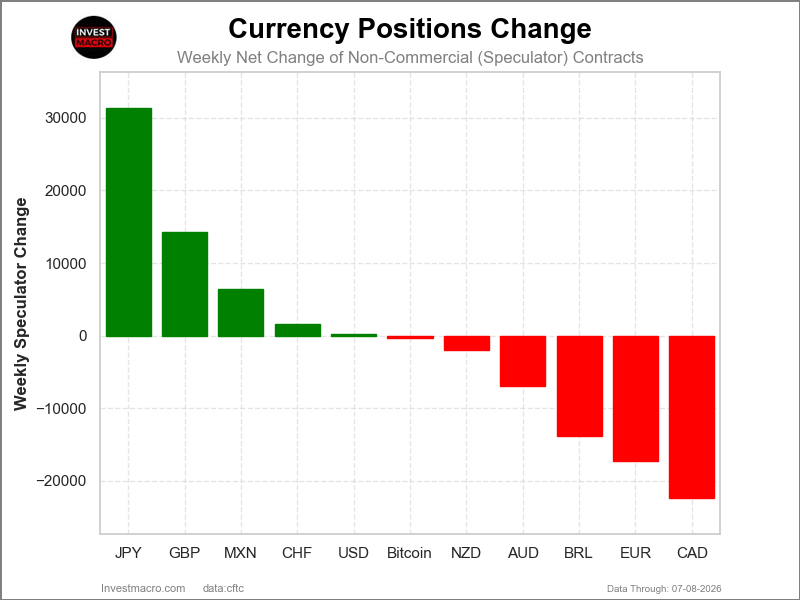
Leading the gains for the currency markets was the Japanese Yen (40,321 contracts) with the Canadian Dollar (23,817 contracts), the Brazilian Real (20,354 contracts), the Australian Dollar (6,805 contracts) and the Swiss Franc (700 contracts) also showing positive weeks.

The currencies seeing declines in speculator bets on the week were the Mexican Peso (-5,696 contracts), the US Dollar Index (-3,815 contracts), the EuroFX (-3,510 contracts), the British Pound (-3,269 contracts), the New Zealand Dollar (-1,929 contracts) and Bitcoin (-951 contracts) also registering lower bets on the week.

Yen Speculator Bets jump after intervention, CAD & AUD Bets continue higher as USD Index Bets fall

Highlighting the Currency speculator positions this week was a boost in the Japanese Yen, the Canadian Dollar, and the Brazilian Real positions while the US Dollar Index bets fell by the most since the fall.

First off, the Japanese Yen speculator position jumped by over 40,000 contracts this week after it had previously fallen in four out of the previous five weeks. This has a lot to do with the Bank of Japan intervening in the Currency market last week, as the BOJ has been trying to arrest the Japanese Yen’s fall. Currently, the speculator net position for the Japanese Yen contracts remains in a bearish level for a 10th straight week, with the total net position this week at -61,738 net contracts. The BOJ currency intervention has stemmed the slide in the yen for the time being, but this week’s USD/JPY currency pair closed out the week at 156.68.

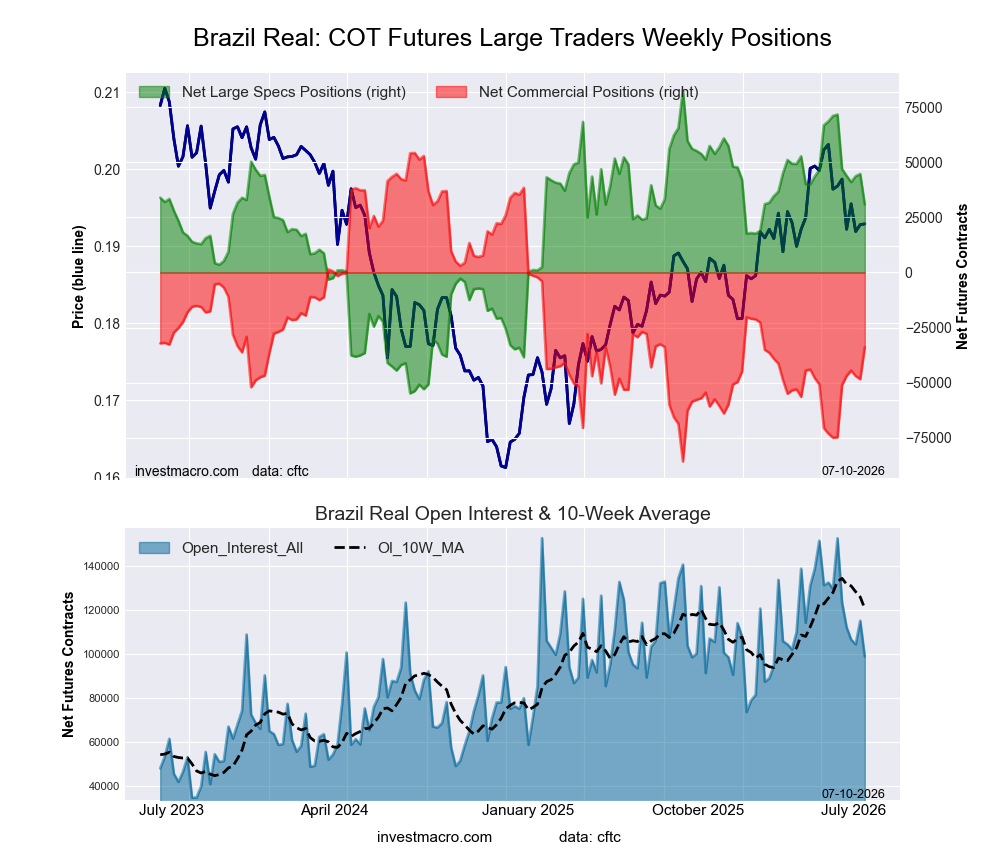
The Brazilian Real saw its speculator bets jump this week by over 20,000 net contracts. This is a third consecutive week of positive changes and this week’s boost has pushed the net position over 66,000 bullish contracts. This is the highest level for the Brazilian Real contracts since September 30th of 2025, a span of 31 weeks. In the Futures market, the Brazilian Real continues to be on a strong bullish uptrend against the US Dollar, and this week closed at the highest level since February of 2024.

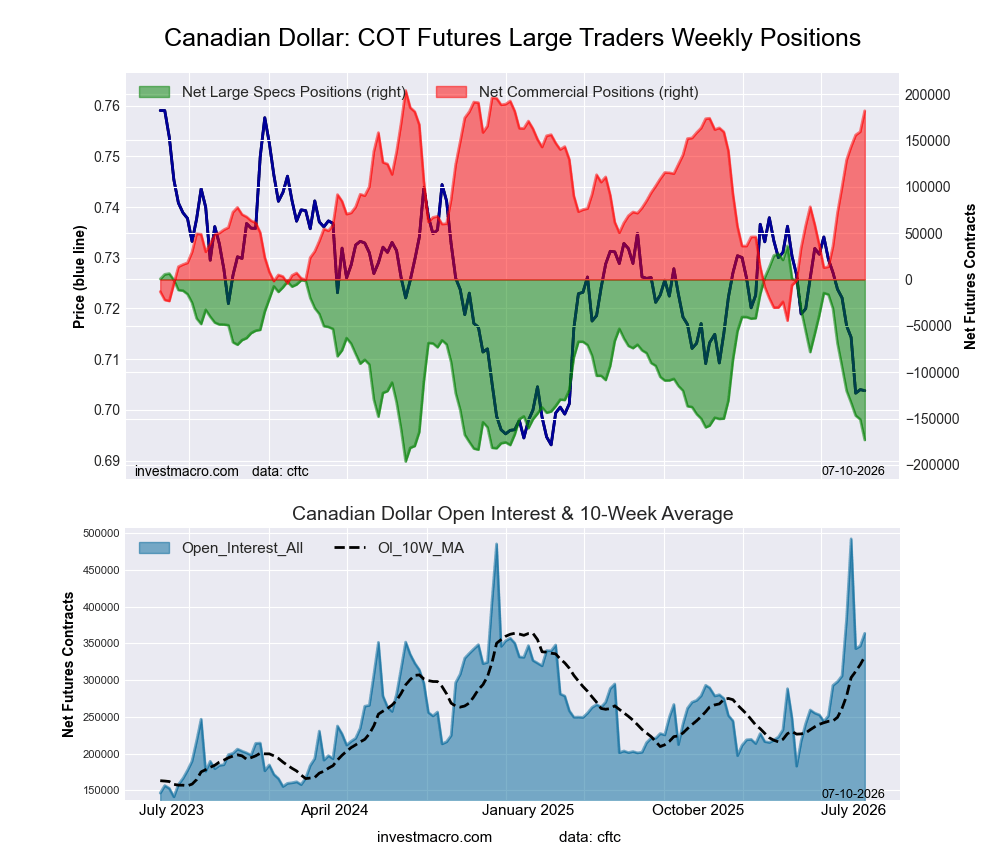
Canadian Dollar contracts continued their strong weekly gains with a third consecutive weekly rise and a boost by over 23,000 contracts this week. This recent positive sentiment for the Canadian Dollar has taken the net speculator bearish standing down to a total of -14,659 net contracts — the best position (least bearish) of the past six weeks. In the Foreign Exchange markets this week, the Canadian Dollar cooled off after four consecutive gaining weeks, and this week closed out at a 0.7321 exchange level. The CAD is still in an ascending triangle pattern and would need to rise clean above 0.7400 to the upside for a further bullish break out.

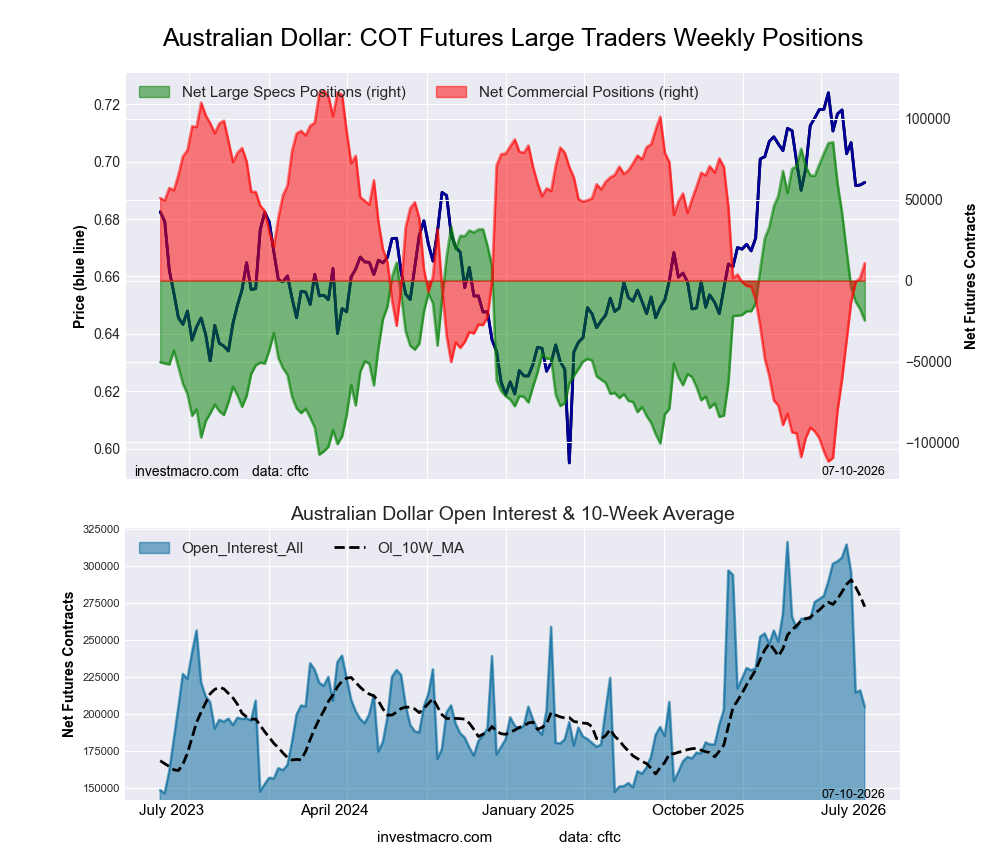
The Australian Dollar net position saw a second straight weekly gain and is now at the highest speculator position of the past five weeks. Overall, the Australian Dollar speculator positioning is in a super strong position, considering it’s near the top of its three-year range with a strength score of 98.5%. The Australian Dollar bets have now been in bullish territory for 15 consecutive weeks. In the Foreign Exchange market, the Australian Dollar has continued on a strong uptrend after falling as low as 0.5920 in April of 2025. Since that low, the AUD has ascended by over 20% and now trades at 0.7237 against the US Dollar, the highest level since 2022.

The US Dollar Index saw speculator bets dropped this week by -3,815 contracts and marks the biggest one-week fall since September. The US Dollar Index speculator bets have now declined for four consecutive weeks and have taken the overall net position to a virtual neutral level at just 693 net contracts. The US Dollar Index in the Foreign Exchange markets dipped this week for a second consecutive week, however, it remains in its range that has persisted for almost a year with a low support level of 96.50 and a high resistance level of 100.00 (the USD Index is currently trading at 97.78).

Bitcoin, Mexican Peso, and Brazilian Real lead major Currency price performances.

This week saw Bitcoin lead the pack in price gains with a modest 1.98% rise on the week. The Mexican Peso came in second with a 1.50% gain, while the Brazilian Real was also higher by 1% with a 1.17% uptick. The New Zealand Dollar was higher by approximately 1% this week, while the Swiss Franc rose by 0.58%.

The Euro gained by 0.47%. The Australian Dollar was higher by 0.41%, and the British Pound Sterling rounded out the gainers with a modest uptick of 0.27% on the week.

On the downside, the US Dollar Index tripped by -0.17% this week, while the Japanese Yen was lower by -0.30%. The Canadian Dollar was the biggest negative returner with a -0.67% shortfall.


Currencies Data:

Speculators FX Futures COT Data Table
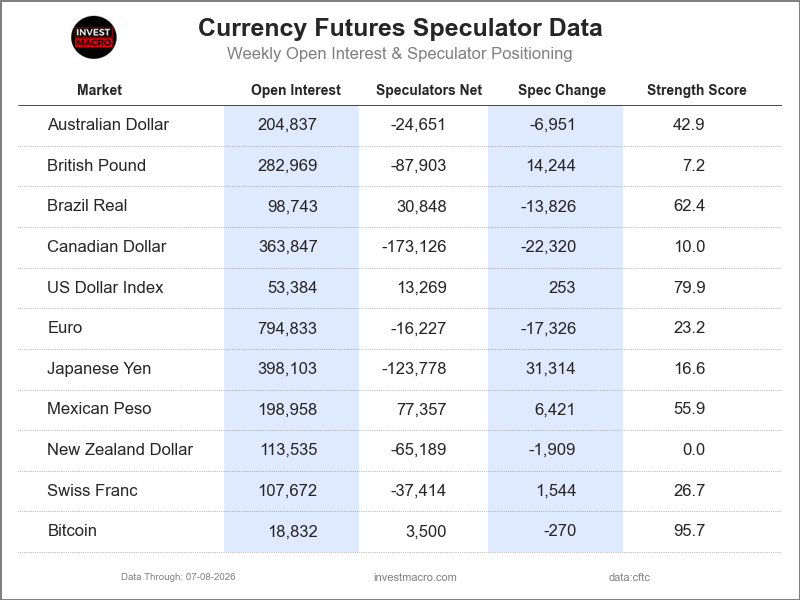
Legend: Open Interest | Speculators Current Net Position | Weekly Specs Change | Specs Strength Score compared to last 3-Years (0-100 range)


Strength Scores led by Australian Dollar & Brazilian Real

Speculators Strength Scores FX Futures COT Chart
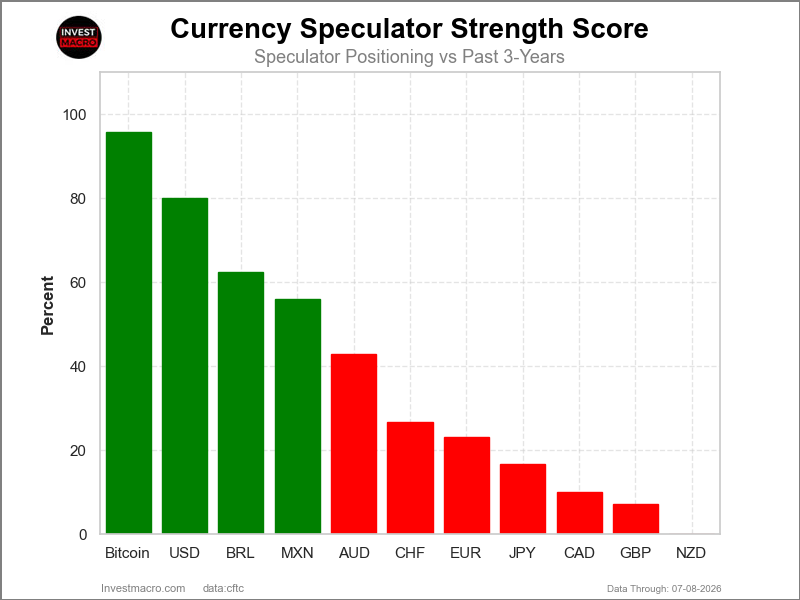
COT Strength Scores (a normalized measure of Speculator positions over a 3-Year range, from 0 to 100 where above 80 is Extreme-Bullish and below 20 is Extreme-Bearish) showed that the Australian Dollar (99 percent) and the Brazilian Real (89 percent) lead the currency markets this week. The Canadian Dollar (78 percent) and Bitcoin (78 percent) come in as the next highest in the weekly strength scores.

On the downside, the New Zealand Dollar (10 percent) and the British Pound (12 percent) come in at the lowest strength levels currently and are in Extreme-Bearish territory (below 20 percent). The next lowest strength scores are the Swiss Franc (31 percent) and the Japanese Yen (34 percent).

3-Year Strength Statistics:
US Dollar Index (46.0 percent) vs US Dollar Index previous week (56.3 percent)
EuroFX (41.0 percent) vs EuroFX previous week (42.4 percent)
British Pound Sterling (12.5 percent) vs British Pound Sterling previous week (13.8 percent)
Japanese Yen (33.7 percent) vs Japanese Yen previous week (22.6 percent)
Swiss Franc (30.9 percent) vs Swiss Franc previous week (29.5 percent)
Canadian Dollar (78.1 percent) vs Canadian Dollar previous week (67.9 percent)
Australian Dollar (98.5 percent) vs Australian Dollar previous week (94.9 percent)
New Zealand Dollar (9.7 percent) vs New Zealand Dollar previous week (11.9 percent)
Mexican Peso (45.1 percent) vs Mexican Peso previous week (49.1 percent)
Brazilian Real (88.5 percent) vs Brazilian Real previous week (73.7 percent)
Bitcoin (78.1 percent) vs Bitcoin previous week (97.1 percent)


Brazilian Real & EuroFX top the 6-Week Strength Trends

Speculators Trends FX Futures COT Chart
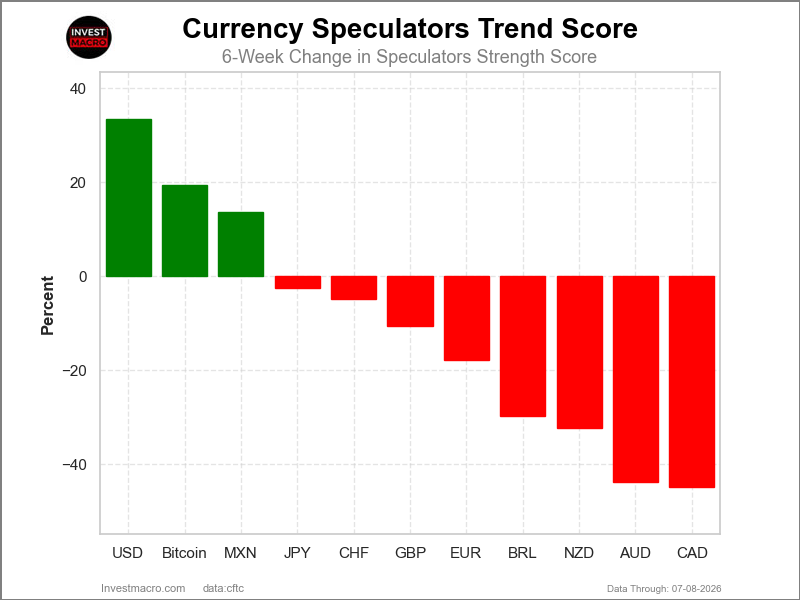
COT Strength Score Trends (or move index, calculates the 6-week changes in strength scores) showed that the Brazilian Real (13 percent) and the EuroFX (9 percent) lead the past six weeks trends for the currencies. The Australian Dollar (4 percent) is the next highest positive mover in the 3-Year trends data.

The New Zealand Dollar (-24 percent) leads the downside trend scores currently with the Swiss Franc (-15 percent), Bitcoin (-13 percent) and the Mexican Peso (-8 percent) following next with lower trend scores.

3-Year Strength Trends:
US Dollar Index (-7.9 percent) vs US Dollar Index previous week (2.2 percent)
EuroFX (8.7 percent) vs EuroFX previous week (5.6 percent)
British Pound Sterling (-2.3 percent) vs British Pound Sterling previous week (2.1 percent)
Japanese Yen (0.3 percent) vs Japanese Yen previous week (-9.4 percent)
Swiss Franc (-15.0 percent) vs Swiss Franc previous week (-20.3 percent)
Canadian Dollar (-5.6 percent) vs Canadian Dollar previous week (-16.9 percent)
Australian Dollar (4.1 percent) vs Australian Dollar previous week (1.5 percent)
New Zealand Dollar (-24.3 percent) vs New Zealand Dollar previous week (-26.6 percent)
Mexican Peso (-8.5 percent) vs Mexican Peso previous week (-0.5 percent)
Brazilian Real (12.8 percent) vs Brazilian Real previous week (-2.1 percent)
Bitcoin (-13.2 percent) vs Bitcoin previous week (12.3 percent)


Individual COT Forex Markets:

US Dollar Index Futures:
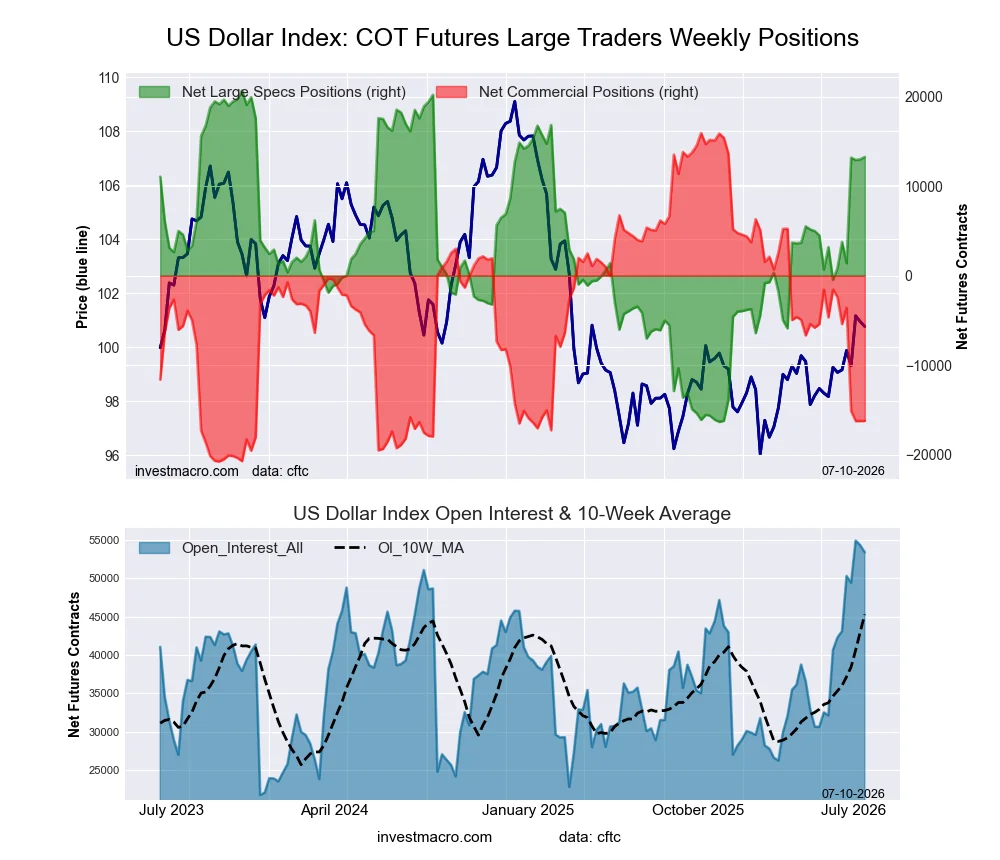
US Dollar Index Forex Futures COT ChartPositioning Notes:

  • US Dollar Index large speculator standing this week equaled a net position of 693 contracts in the data reported through Tuesday.
  • Weekly Speculator position decline of -3,815 contracts from the previous week which had a total of 4,508 net contracts.
  • This week’s current strength score (range over the past 3 years, measured from 0 to 100) shows the speculators are currently Bearish with a score of 46.0 percent.
  • The Commercials are Bullish with a score of 52.3 percent.
  • The Small Traders (not shown in chart) are Bullish with a score of 54.3 percent.

Price Trend-Following Model: Weak Uptrend

Our weekly trend-following model classifies the current market price position as: Weak Uptrend.

US DOLLAR INDEX StatisticsSPECULATORSCOMMERCIALSSMALL TRADERS
– Percent of Open Interest Longs:52.530.98.1
– Percent of Open Interest Shorts:50.335.75.4
– Net Position:693-1,569876
– Gross Longs:17,04810,0352,634
– Gross Shorts:16,35511,6041,758
– Long to Short Ratio:1.0 to 10.9 to 11.5 to 1
NET POSITION TREND:
– Strength Index Score (3 Year Range Pct):46.052.354.3
– Strength Index Reading (3 Year Range):BearishBullishBullish
NET POSITION MOVEMENT INDEX:
– 6-Week Change in Strength Index:-7.98.3-2.1


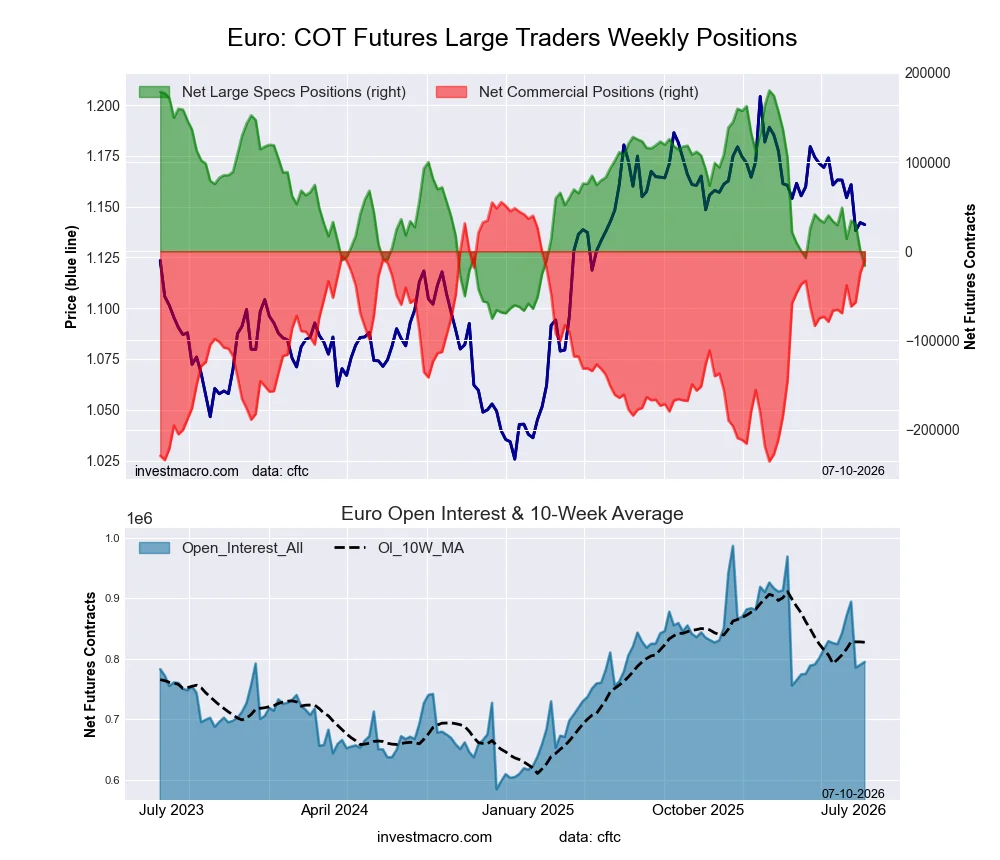
Euro Currency Futures:

Euro Currency Futures COT ChartPositioning Notes:

  • Euro Currency large speculator standing this week equaled a net position of 32,202 contracts in the data reported through Tuesday.
  • Weekly Speculator position fall of -3,510 contracts from the previous week which had a total of 35,712 net contracts.
  • This week’s current strength score (range over the past 3 years, measured from 0 to 100) shows the speculators are currently Bearish with a score of 41.0 percent.
  • The Commercials are Bullish with a score of 56.2 percent.
  • The Small Traders (not shown in chart) are Bullish with a score of 61.4 percent.

Price Trend-Following Model: Weak Downtrend

Our weekly trend-following model classifies the current market price position as: Weak Downtrend.

EURO Currency StatisticsSPECULATORSCOMMERCIALSSMALL TRADERS
– Percent of Open Interest Longs:26.758.910.8
– Percent of Open Interest Shorts:22.767.95.8
– Net Position:32,202-73,37941,177
– Gross Longs:217,474480,88688,156
– Gross Shorts:185,272554,26546,979
– Long to Short Ratio:1.2 to 10.9 to 11.9 to 1
NET POSITION TREND:
– Strength Index Score (3 Year Range Pct):41.056.261.4
– Strength Index Reading (3 Year Range):BearishBullishBullish
NET POSITION MOVEMENT INDEX:
– 6-Week Change in Strength Index:8.7-9.17.8


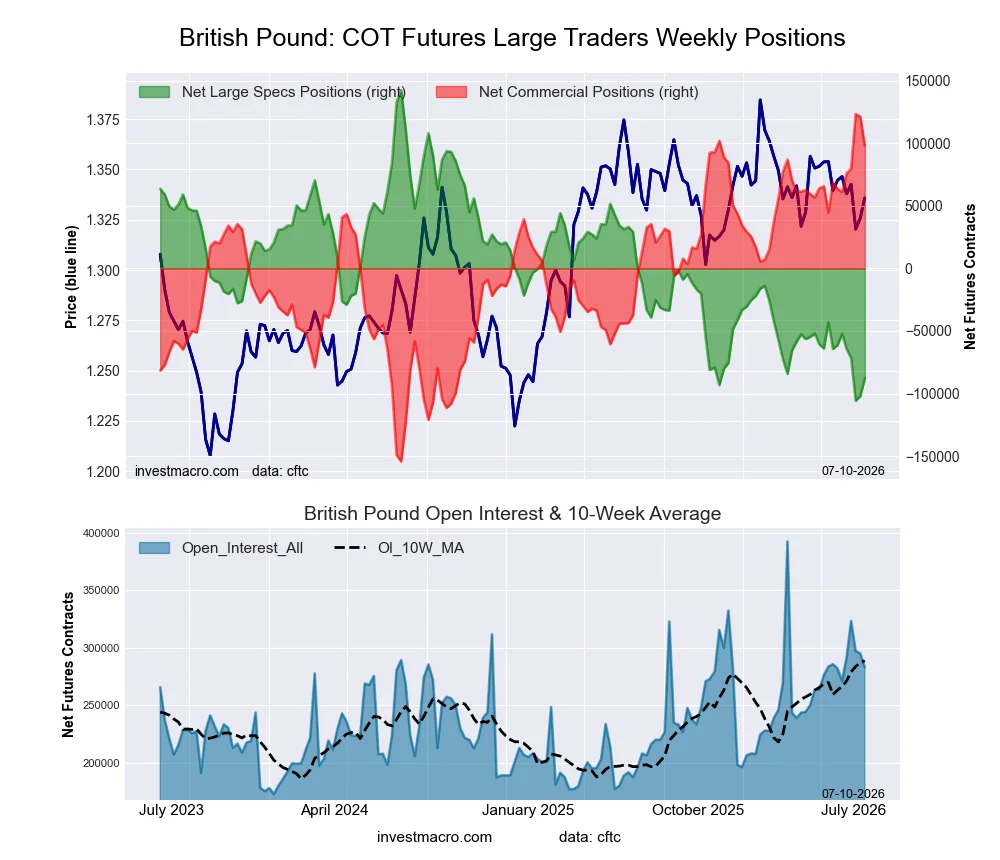
British Pound Sterling Futures:

British Pound Sterling Futures COT ChartPositioning Notes:

  • British Pound Sterling large speculator standing this week equaled a net position of -63,908 contracts in the data reported through Tuesday.
  • Weekly Speculator position lowering of -3,269 contracts from the previous week which had a total of -60,639 net contracts.
  • This week’s current strength score (range over the past 3 years, measured from 0 to 100) shows the speculators are currently Bearish-Extreme with a score of 12.5 percent.
  • The Commercials are Bullish-Extreme with a score of 85.8 percent.
  • The Small Traders (not shown in chart) are Bearish with a score of 48.6 percent.

Price Trend-Following Model: Weak Downtrend

Our weekly trend-following model classifies the current market price position as: Weak Downtrend.

BRITISH POUND StatisticsSPECULATORSCOMMERCIALSSMALL TRADERS
– Percent of Open Interest Longs:22.765.59.3
– Percent of Open Interest Shorts:45.841.79.9
– Net Position:-63,90865,684-1,776
– Gross Longs:62,573180,93225,560
– Gross Shorts:126,481115,24827,336
– Long to Short Ratio:0.5 to 11.6 to 10.9 to 1
NET POSITION TREND:
– Strength Index Score (3 Year Range Pct):12.585.848.6
– Strength Index Reading (3 Year Range):Bearish-ExtremeBullish-ExtremeBearish
NET POSITION MOVEMENT INDEX:
– 6-Week Change in Strength Index:-2.31.82.6


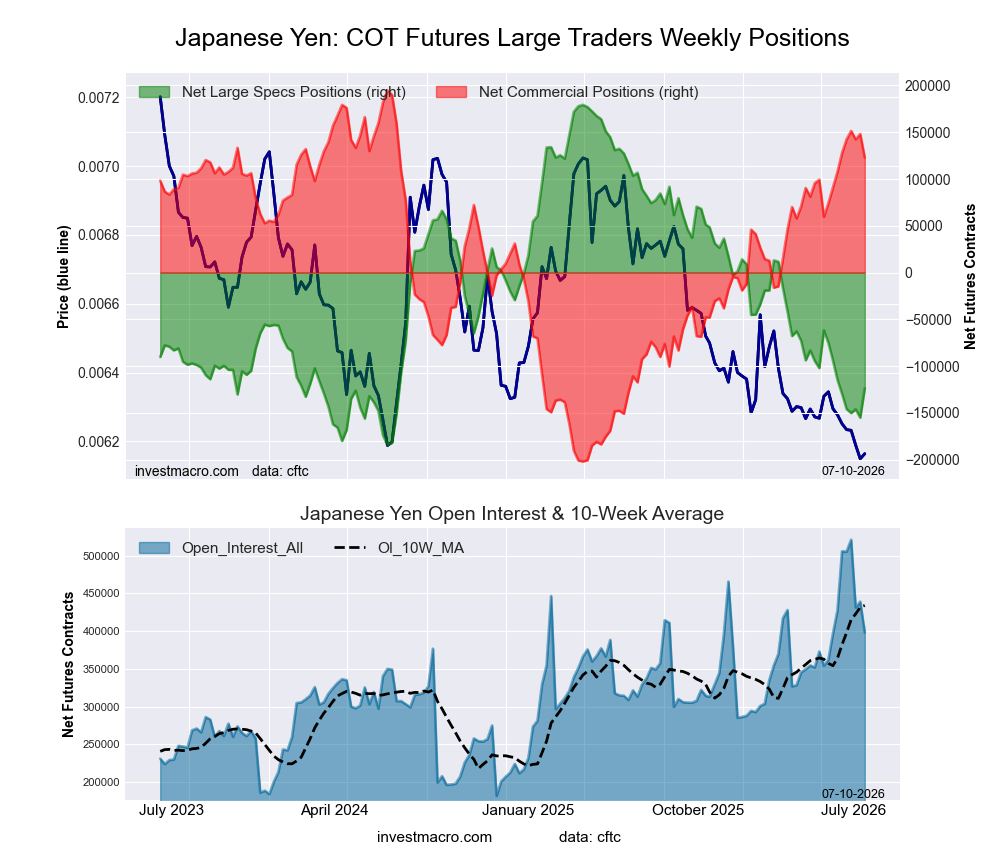
Japanese Yen Futures:

Japanese Yen Forex Futures COT ChartPositioning Notes:

  • Japanese Yen large speculator standing this week equaled a net position of -61,738 contracts in the data reported through Tuesday.
  • Weekly Speculator position rise of 40,321 contracts from the previous week which had a total of -102,059 net contracts.
  • This week’s current strength score (range over the past 3 years, measured from 0 to 100) shows the speculators are currently Bearish with a score of 33.7 percent.
  • The Commercials are Bullish with a score of 66.0 percent.
  • The Small Traders (not shown in chart) are Bearish with a score of 42.1 percent.

Price Trend-Following Model: Weak Downtrend

Our weekly trend-following model classifies the current market price position as: Weak Downtrend.

JAPANESE YEN StatisticsSPECULATORSCOMMERCIALSSMALL TRADERS
– Percent of Open Interest Longs:30.852.710.7
– Percent of Open Interest Shorts:48.235.810.1
– Net Position:-61,73859,6502,088
– Gross Longs:109,035186,54437,725
– Gross Shorts:170,773126,89435,637
– Long to Short Ratio:0.6 to 11.5 to 11.1 to 1
NET POSITION TREND:
– Strength Index Score (3 Year Range Pct):33.766.042.1
– Strength Index Reading (3 Year Range):BearishBullishBearish
NET POSITION MOVEMENT INDEX:
– 6-Week Change in Strength Index:0.30.4-7.3


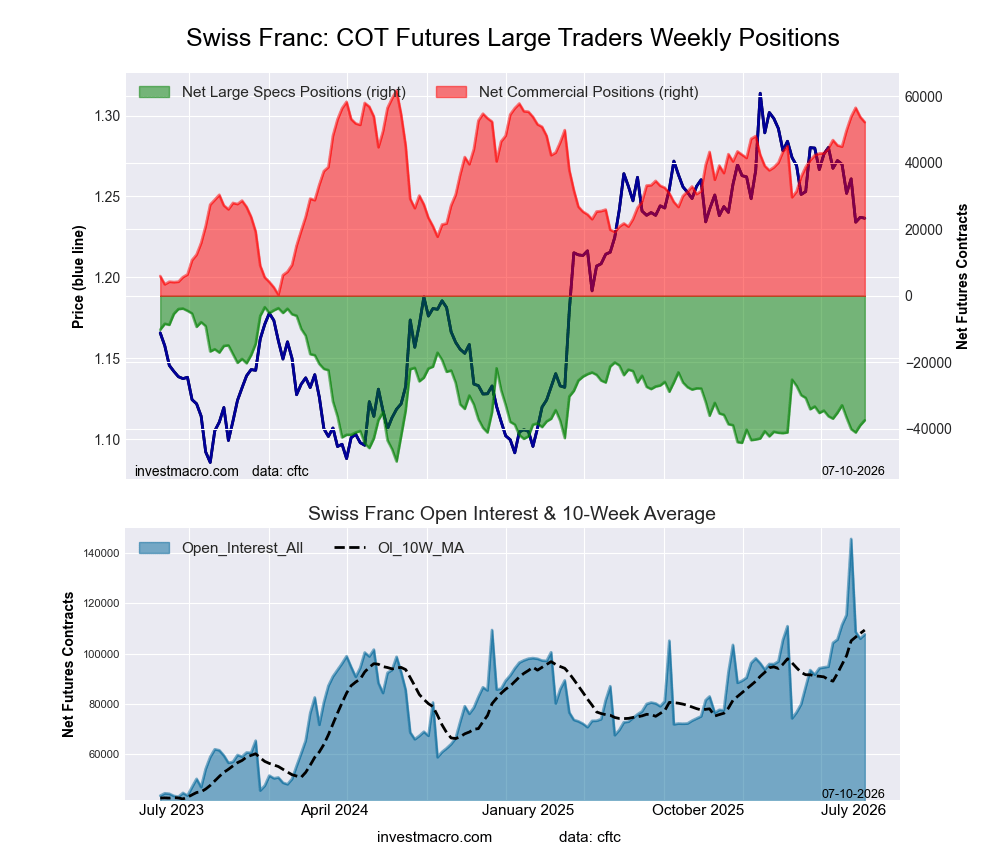
Swiss Franc Futures:

Swiss Franc Forex Futures COT ChartPositioning Notes:

  • Swiss Franc large speculator standing this week equaled a net position of -34,521 contracts in the data reported through Tuesday.
  • Weekly Speculator position boost of 700 contracts from the previous week which had a total of -35,221 net contracts.
  • This week’s current strength score (range over the past 3 years, measured from 0 to 100) shows the speculators are currently Bearish with a score of 30.9 percent.
  • The Commercials are Bullish with a score of 69.4 percent.
  • The Small Traders (not shown in chart) are Bearish with a score of 43.4 percent.

Price Trend-Following Model: Strong Uptrend

Our weekly trend-following model classifies the current market price position as: Strong Uptrend.

SWISS FRANC StatisticsSPECULATORSCOMMERCIALSSMALL TRADERS
– Percent of Open Interest Longs:7.680.511.7
– Percent of Open Interest Shorts:44.135.220.5
– Net Position:-34,52142,861-8,340
– Gross Longs:7,14576,07611,018
– Gross Shorts:41,66633,21519,358
– Long to Short Ratio:0.2 to 12.3 to 10.6 to 1
NET POSITION TREND:
– Strength Index Score (3 Year Range Pct):30.969.443.4
– Strength Index Reading (3 Year Range):BearishBullishBearish
NET POSITION MOVEMENT INDEX:
– 6-Week Change in Strength Index:-15.018.7-17.3


Canadian Dollar Futures:

Canadian Dollar Forex Futures COT ChartPositioning Notes:

  • Canadian Dollar large speculator standing this week equaled a net position of -14,659 contracts in the data reported through Tuesday.
  • Weekly Speculator position advance of 23,817 contracts from the previous week which had a total of -38,476 net contracts.
  • This week’s current strength score (range over the past 3 years, measured from 0 to 100) shows the speculators are currently Bullish with a score of 78.1 percent.
  • The Commercials are Bearish with a score of 23.0 percent.
  • The Small Traders (not shown in chart) are Bullish with a score of 50.5 percent.

Price Trend-Following Model: Strong Uptrend

Our weekly trend-following model classifies the current market price position as: Strong Uptrend.

CANADIAN DOLLAR StatisticsSPECULATORSCOMMERCIALSSMALL TRADERS
– Percent of Open Interest Longs:30.255.112.7
– Percent of Open Interest Shorts:36.249.911.9
– Net Position:-14,65912,7941,865
– Gross Longs:73,650134,38330,958
– Gross Shorts:88,309121,58929,093
– Long to Short Ratio:0.8 to 11.1 to 11.1 to 1
NET POSITION TREND:
– Strength Index Score (3 Year Range Pct):78.123.050.5
– Strength Index Reading (3 Year Range):BullishBearishBullish
NET POSITION MOVEMENT INDEX:
– 6-Week Change in Strength Index:-5.65.7-3.1


Australian Dollar Futures:

Australian Dollar Forex Futures COT ChartPositioning Notes:

  • Australian Dollar large speculator standing this week equaled a net position of 78,674 contracts in the data reported through Tuesday.
  • Weekly Speculator position gain of 6,805 contracts from the previous week which had a total of 71,869 net contracts.
  • This week’s current strength score (range over the past 3 years, measured from 0 to 100) shows the speculators are currently Bullish-Extreme with a score of 98.5 percent.
  • The Commercials are Bearish-Extreme with a score of 1.5 percent.
  • The Small Traders (not shown in chart) are Bullish-Extreme with a score of 96.8 percent.

Price Trend-Following Model: Strong Uptrend

Our weekly trend-following model classifies the current market price position as: Strong Uptrend.

AUSTRALIAN DOLLAR StatisticsSPECULATORSCOMMERCIALSSMALL TRADERS
– Percent of Open Interest Longs:51.233.015.1
– Percent of Open Interest Shorts:23.170.85.4
– Net Position:78,674-105,54526,871
– Gross Longs:143,21492,27242,086
– Gross Shorts:64,540197,81715,215
– Long to Short Ratio:2.2 to 10.5 to 12.8 to 1
NET POSITION TREND:
– Strength Index Score (3 Year Range Pct):98.51.596.8
– Strength Index Reading (3 Year Range):Bullish-ExtremeBearish-ExtremeBullish-Extreme
NET POSITION MOVEMENT INDEX:
– 6-Week Change in Strength Index:4.1-4.97.2


New Zealand Dollar Futures:

New Zealand Dollar Forex Futures COT ChartPositioning Notes:

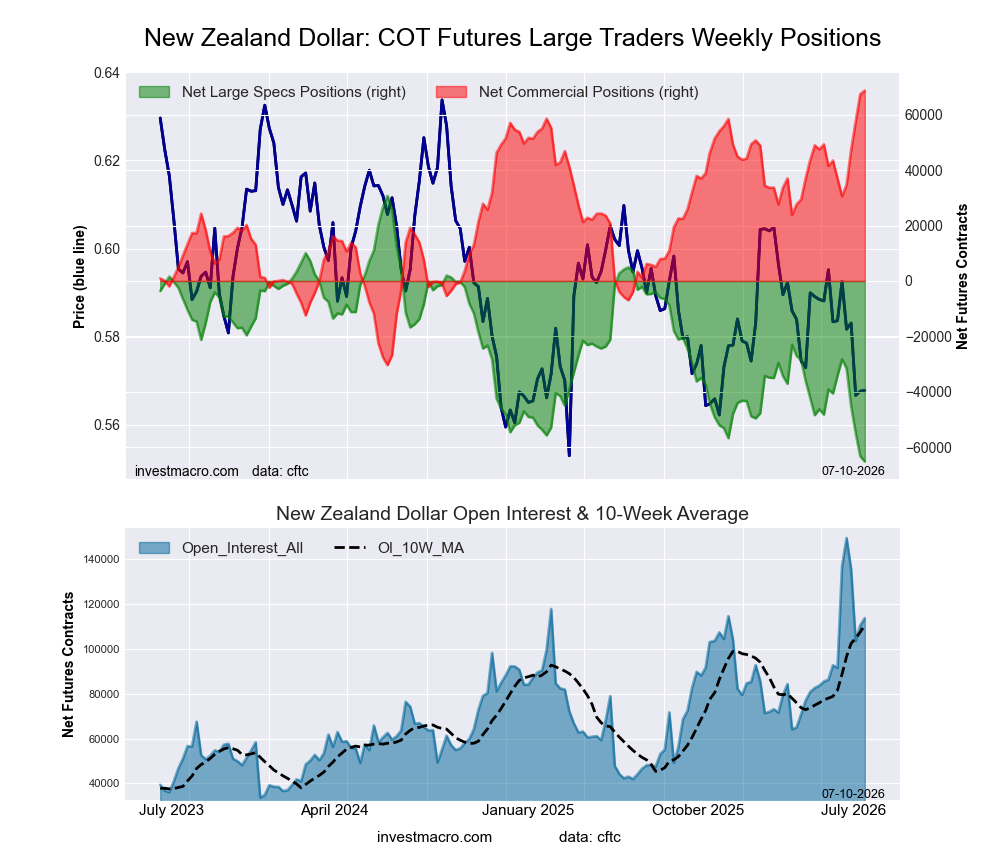
  • New Zealand Dollar large speculator standing this week equaled a net position of -48,251 contracts in the data reported through Tuesday.
  • Weekly Speculator position decline of -1,929 contracts from the previous week which had a total of -46,322 net contracts.
  • This week’s current strength score (range over the past 3 years, measured from 0 to 100) shows the speculators are currently Bearish-Extreme with a score of 9.7 percent.
  • The Commercials are Bullish-Extreme with a score of 89.6 percent.
  • The Small Traders (not shown in chart) are Bearish with a score of 38.3 percent.

Price Trend-Following Model: Strong Uptrend

Our weekly trend-following model classifies the current market price position as: Strong Uptrend.

NEW ZEALAND DOLLAR StatisticsSPECULATORSCOMMERCIALSSMALL TRADERS
– Percent of Open Interest Longs:10.685.04.1
– Percent of Open Interest Shorts:67.227.25.3
– Net Position:-48,25149,327-1,076
– Gross Longs:9,06372,5813,486
– Gross Shorts:57,31423,2544,562
– Long to Short Ratio:0.2 to 13.1 to 10.8 to 1
NET POSITION TREND:
– Strength Index Score (3 Year Range Pct):9.789.638.3
– Strength Index Reading (3 Year Range):Bearish-ExtremeBullish-ExtremeBearish
NET POSITION MOVEMENT INDEX:
– 6-Week Change in Strength Index:-24.324.3-5.0


Mexican Peso Futures:

Mexican Peso Futures COT ChartPositioning Notes:

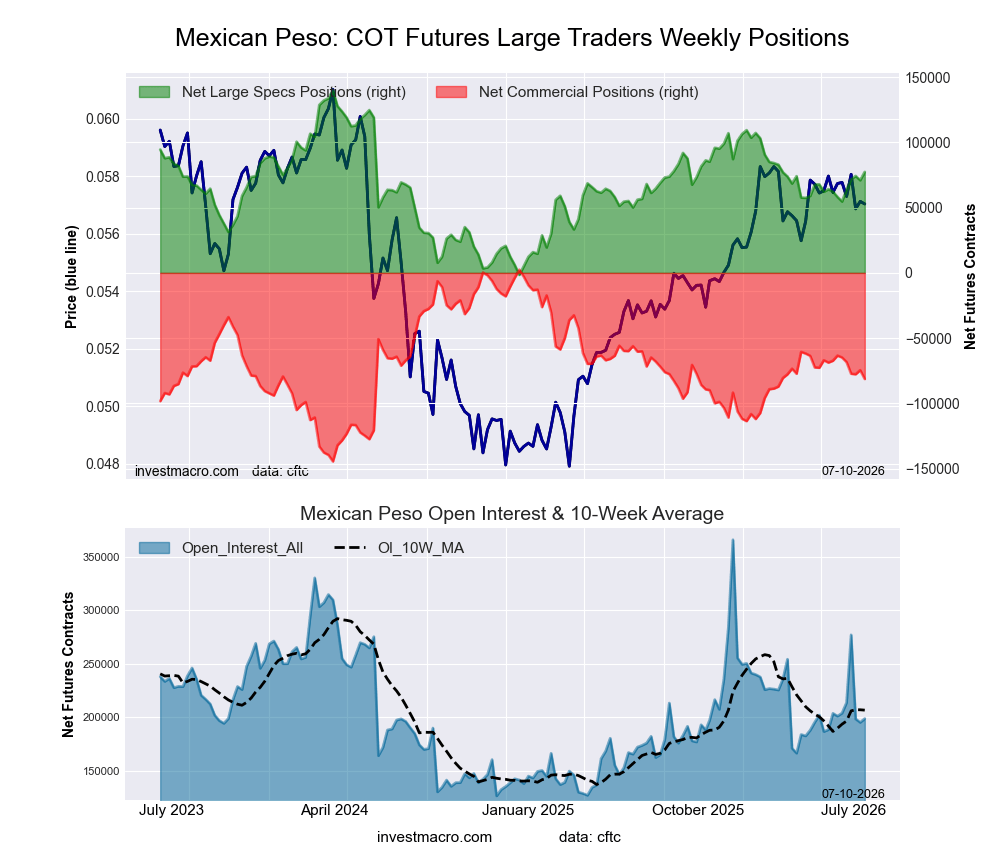
  • Mexican Peso large speculator standing this week equaled a net position of 62,127 contracts in the data reported through Tuesday.
  • Weekly Speculator position lowering of -5,696 contracts from the previous week which had a total of 67,823 net contracts.
  • This week’s current strength score (range over the past 3 years, measured from 0 to 100) shows the speculators are currently Bearish with a score of 45.1 percent.
  • The Commercials are Bullish with a score of 52.8 percent.
  • The Small Traders (not shown in chart) are Bearish with a score of 49.5 percent.

Price Trend-Following Model: Strong Uptrend

Our weekly trend-following model classifies the current market price position as: Strong Uptrend.

MEXICAN PESO StatisticsSPECULATORSCOMMERCIALSSMALL TRADERS
– Percent of Open Interest Longs:49.046.93.5
– Percent of Open Interest Shorts:15.882.71.0
– Net Position:62,127-66,9444,817
– Gross Longs:91,59287,6366,627
– Gross Shorts:29,465154,5801,810
– Long to Short Ratio:3.1 to 10.6 to 13.7 to 1
NET POSITION TREND:
– Strength Index Score (3 Year Range Pct):45.152.849.5
– Strength Index Reading (3 Year Range):BearishBullishBearish
NET POSITION MOVEMENT INDEX:
– 6-Week Change in Strength Index:-8.57.09.2


Brazilian Real Futures:

Brazil Real Futures COT ChartPositioning Notes:

  • Brazilian Real large speculator standing this week equaled a net position of 66,797 contracts in the data reported through Tuesday.
  • Weekly Speculator position gain of 20,354 contracts from the previous week which had a total of 46,443 net contracts.
  • This week’s current strength score (range over the past 3 years, measured from 0 to 100) shows the speculators are currently Bullish-Extreme with a score of 88.5 percent.
  • The Commercials are Bearish-Extreme with a score of 10.8 percent.
  • The Small Traders (not shown in chart) are Bearish with a score of 42.6 percent.

Price Trend-Following Model: Strong Uptrend

Our weekly trend-following model classifies the current market price position as: Strong Uptrend.

BRAZIL REAL StatisticsSPECULATORSCOMMERCIALSSMALL TRADERS
– Percent of Open Interest Longs:71.324.23.9
– Percent of Open Interest Shorts:20.478.11.0
– Net Position:66,797-70,6483,851
– Gross Longs:93,50031,7435,099
– Gross Shorts:26,703102,3911,248
– Long to Short Ratio:3.5 to 10.3 to 14.1 to 1
NET POSITION TREND:
– Strength Index Score (3 Year Range Pct):88.510.842.6
– Strength Index Reading (3 Year Range):Bullish-ExtremeBearish-ExtremeBearish
NET POSITION MOVEMENT INDEX:
– 6-Week Change in Strength Index:12.8-12.60.2


Bitcoin Futures:

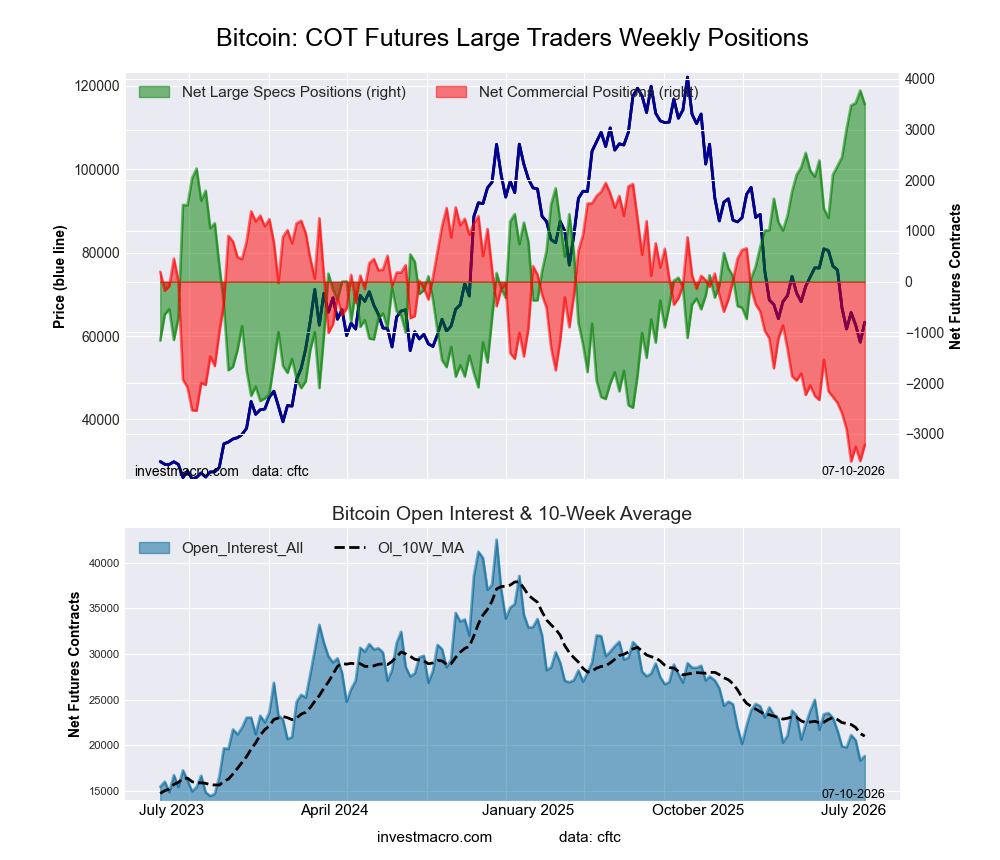
Bitcoin Crypto Futures COT ChartPositioning Notes:

  • Bitcoin large speculator standing this week equaled a net position of 1,441 contracts in the data reported through Tuesday.
  • Weekly Speculator position decline of -951 contracts from the previous week which had a total of 2,392 net contracts.
  • This week’s current strength score (range over the past 3 years, measured from 0 to 100) shows the speculators are currently Bullish with a score of 78.1 percent.
  • The Commercials are Bearish with a score of 22.4 percent.
  • The Small Traders (not shown in chart) are Bearish with a score of 42.4 percent.

Price Trend-Following Model: Weak Downtrend

Our weekly trend-following model classifies the current market price position as: Weak Downtrend.

BITCOIN StatisticsSPECULATORSCOMMERCIALSSMALL TRADERS
– Percent of Open Interest Longs:82.51.55.1
– Percent of Open Interest Shorts:76.38.14.6
– Net Position:1,441-1,53998
– Gross Longs:19,3013491,184
– Gross Shorts:17,8601,8881,086
– Long to Short Ratio:1.1 to 10.2 to 11.1 to 1
NET POSITION TREND:
– Strength Index Score (3 Year Range Pct):78.122.442.4
– Strength Index Reading (3 Year Range):BullishBearishBearish
NET POSITION MOVEMENT INDEX:
– 6-Week Change in Strength Index:-13.29.113.2


Article By InvestMacroReceive our weekly COT Newsletter

*COT Report: The COT data, released weekly to the public each Friday, is updated through the most recent Tuesday (data is 3 days old) and shows a quick view of how large speculators or non-commercials (for-profit traders) were positioned in the futures markets.

The CFTC categorizes trader positions according to commercial hedgers (traders who use futures contracts for hedging as part of the business), non-commercials (large traders who speculate to realize trading profits) and nonreportable traders (usually small traders/speculators) as well as their open interest (contracts open in the market at time of reporting). See CFTC criteria here.