China surprises with rate cut, US retail sales in focus

By ForexTime

China’s central bank hijacked the headlines on Tuesday morning after unexpectedly reducing a key rate by the most since 2020 to shore up its weak economy. However, Asian markets displayed a mixed reaction with sentiment whacked by a barrage of disappointing China data published after the rate decision.

European futures are pointing to a positive open ahead of the German August ZEW survey. In the currency space, the yuan slipped to its weakest level since November while the British Pound received a boost after reports showed wages grew at a record pace in the second quarter of 2023.

Looking at commodities, gold is wobbling above the $1900 support level while oil prices remain vulnerable as China growth fears hit the demand outlook.

USD and retail sales in focus

As we move deeper into the second half of 2023, dollar weakness could become a major theme if the Fed signals that it has truly concluded its rate hiking cycle.

Despite US inflation edging up in July after 12 straight months of decline, the core figures were encouraging and signal that the Fed’s aggressive hikes are starting to tame the inflation beast. Should price pressures continue to ease and US economic data show signs of weakness, this may eliminate the odds of another hike, especially when factoring in the Fed’s current data dependence stance.

All eyes will be on the US retail sales figures later today which could add another piece to the puzzle that determines whether the Fed hikes one more time in 2023 or not. On Wednesday, the Fed minutes might also offer key clues on the central bank’s next policy move. Traders are currently pricing in only an 11% probability of a 25-basis point hike at September’s FOMC meeting, with this rising to 40% by November, according to Fed funds futures. The dollar is likely to weaken if the data is softer or the minutes strike a dovish tone. Any hint from the hawks or signals of more hikes down the road could boost the dollar.

Talking technical, the US Dollar Index is lingering below the 200-day Simple Moving Average on the daily charts. If bulls are unable to conquer this resistance, prices may slip back below 103.00. Should the current upside momentum hold, the next key level of interest can be found at 104.00.


Forex-Time-LogoArticle by ForexTime

ForexTime Ltd (FXTM) is an award winning international online forex broker regulated by CySEC 185/12 www.forextime.com

EURUSD is stuck awaiting the FED’s actions

By RoboForex Analytical Department

This Monday, 14 August, the major currency pair is hovering near 1.0940.

The market is focused on the future actions of the Federal Reserve System. Last weekend, major US investment houses made their forecasts on the prospects of the interest rate. The Federal Reserve is expected to start bringing the rate down by June 2024, making quarterly decreases from then on. It means that inflation is forecast to reach the target mark of 2% by that moment.

It is a curious position that coincides with the actual state of affairs.

This week, the Fed will publish the minutes of its latest meeting. In them, as usual, market participants will be looking for hints and indications of the reasons and facts on which the regulator will base its September interest rate decisions.

Technical analysis of EUR/USD currency pair:

On the H4 chart, EURUSD performed a corrective wave to the 1.1064 level, where a new decline started. Today, the market reached 1.0940. At the moment, a consolidation range is forming around this mark. The price is expected to break downwards, heading for 1.0880, after which it might rise to 1.0940 (testing this level from below). Next, a decline to 1.0820 could follow. It is the first target. Technically, the MACD, whose signal line is below zero, could confirm such a scenario. The indicator is expected to go on declining to new lows.

On the H1 chart, EURUSD is forming a consolidation range around 1.0940. Escaping it upwards, the price could start a correction link to 1.0966 and drop to 1.0880 later. It is a local target. Technically, this scenario is confirmed by the Stochastic oscillator, whose signal line has broken the 20 mark upwards and continues growing to 50. The line is expected to rebound from this mark and fall to 20.

Disclaimer

Any predictions contained herein are based on the author’s particular opinion. This analysis shall not be treated as trading advice. RoboForex shall not be held liable for the results of the trades arising from relying upon trading recommendations and reviews contained herein.

Is Bitcoin’s lack of volatility a blessing or a curse for investors?

By George Prior

Bitcoin, previously known for its ‘wild price swings’, is now trading sideways which is both a blessing and a curse for investors, affirms the CEO of one of the world’s largest independent financial advisory, asset management and fintech organizations.

The analysis from deVere Group’s Nigel Green comes as volatility for major cryptocurrencies including Bitcoin and Ether are at multi-year lows – and have been for several months now.

He comments: “The price of Bitcoin, the world’s largest cryptocurrency by market cap, is still hovering around $29,400 which is a major combat zone between bulls and bears.

“Until recently, crypto was typically characterised for its wild price swings.  But in recent months it’s been trading pretty flat, which is both a blessing and a curse for investors.”

The deVere CEO explains that as the cryptocurrency market matures, a decrease in extreme price fluctuations lends a sense of stability that is “crucial for its integration” into traditional financial systems.

“This newfound stability attracts institutional investors, who have been historically wary of entering the market due to its extreme price swings.”

He continues: “This stability is also a boon for businesses and consumers looking for a reliable store of value or medium of exchange.

“As Bitcoin’s price becomes more predictable, it becomes a more viable option for everyday transactions. Businesses can confidently accept Bitcoin as a payment method without the fear of losing significant value between the time of purchase and conversion to fiat currency.”

While stability is beneficial for mainstream adoption, the reduction in volatility has raised concerns among investors seeking quick, higher risk, higher reward opportunities.

Bitcoin’s earlier reputation as a highly volatile asset attracted traders who thrived on rapid price swings. With the decrease in volatility, such opportunities for substantial short-term gains have become less common.

“For investors who thrive on volatility, the calmer waters of the Bitcoin market can feel limiting. They must adapt their strategies to the new normal, focusing on longer-term trends and holding positions for extended periods. This shift can be challenging for those accustomed to quick turnarounds and constant market action,” says Nigel Green.

To harness the benefits of Bitcoin’s stability while mitigating the drawbacks, investors are advised to adopt a diversified approach.

While Bitcoin’s reduced volatility might limit short-term gains, it also reduces the risk of significant losses. By allocating a portion of their portfolios to Bitcoin, investors can potentially benefit from its long-term growth prospects while managing overall risk.

Earlier this month, the deVere CEO included Bitcoin as one of three areas in which he is continuing to put his money this summer.  He said: “Not only does Bitcoin remain one of the best performing asset classes of the decade, I believe its performance will further strengthen. Both institutional and retail investors are increasingly seeing the value of a digital, global, borderless and tamper-proof currency and store of value.

“This trend will increase as adoption picks up further and as confidence grows again in the global economy.”

One potential catalyst that will increase volatility into the market is if, as Nigel Green now believes is likely, the US financial regulator approves spot Bitcoin Exchange-Traded Funds (ETFs).

This prediction comes amid media reports that the US Securities and Exchange Commission (SEC) could imminently give the green light to a swathe of applications from various major asset managers.

Spot ETFs invest directly in underlying assets, typically stocks or bonds, at the current market price (spot price). They aim to replicate the performance of a specific index or asset class by holding a portfolio of the actual securities that make up the index.

He says: “Should the SEC approve these filings, I expect the Bitcoin price will skyrocket.”

The deVere CEO concludes: “While the lack of short-term volatility can be frustrating for some investors accustomed to making quick returns, in the longer-term it will help drive sustainable price growth.”

About:

deVere Group is one of the world’s largest independent advisors of specialist global financial solutions to international, local mass affluent, and high-net-worth clients.  It has a network of offices across the world, over 80,000 clients and $12bn under advisement.

Energy anxiety has returned to Europe. Drag metals are under pressure again because of the rising government bond yields

By JustMarkets

At Friday’s close, the Dow Jones (US30) index increased by 0.30% (+0.44% for the week), while the S&P 500 (US500) index was down 0.11% (-0.61% for the week). The NASDAQ Technology Index (US100) closed Friday negative 0.36% (-2.99% for the week).

Friday’s Producer Price Index (PPI) data released on Friday came in slightly higher at 0.3% in July, up from the previously revised reading of 0%. This was likely another reason why the dollar held on to its high ground at the end of the week, as the PPI index is usually a precursor to a rising CPI index as price pressures trickle down from manufacturing to the final consumer. Friday also saw the release of the University of Michigan’s consumer sentiment data. The report showed a slight improvement in one-year inflation expectations, which fell to 3.3% from the previous reading of 3.4%. Current conditions improved, but the expectations index fell to 67.3 from 68.3.

Bankruptcy filings are on the rise in the US, and the index has already reached the peak area of 2008. What does this mean? There is the following procedure in the United States: first, a company files a petition to the court, and only then the court decides on the company’s bankruptcy. So this is a leading indicator of the bankruptcy rate. In the previous severe recession of 2008, it was the same thing – bankruptcies started rising before the recession, and during the recession, the bankruptcy rate rose even more.

This week, the July Federal Open Market Committee (FOMC) meeting protocols will be released. Analysts expect the FOMC minutes to show a hawkish sentiment as policymakers all continue to say in one voice that there is more work to be done. The Fed’s next major event will be the Jackson Hole Symposium on August 24-26, and analysts expect to hear more hints and guidance from Fed Chairman Jerome Powell on potential near-term interest rate developments.

Equity markets in Europe were mostly down on Friday. Germany’s DAX (DE40) decreased by 1.03% (-0.29% for the week), France’s CAC 40 (FR40) was down 1.26% (+0.68% for the week) on Friday, Spain’s IBEX 35 (ES35) lost 0.77% (+0.89% for the week), and the UK’s FTSE 100 (UK100) closed negative 1.24% (-0.53% for the week).

Energy worries are returning to Europe. Europe’s dependence on imports of liquefied natural gas has intensified since Russia invaded Ukraine last year. The withdrawal of energy supplies from Russia is fueling inflation and risks, adding to future price pressures as the region remains highly vulnerable to any disruption in global energy markets. Spot natural gas prices jumped nearly 30% in one single day after investors became alarmed by threats of a strike in Australia. ING Groep NV, Rabobank, and Saxo Bank A/S recommend preparing for a rise in hawkish sentiment from the European Central Bank as energy prices rise again and officials will seek to keep long-term inflation expectations from rising further.

Precious metals came under pressure from higher real yields amid a growing view that interest rates will remain high for a long time given stubbornly high inflation. As long as the risk of further tightening by the US Federal Reserve remains, gold and silver will be pressured by rising government bond yields. Investors should wait for the US Fed to complete the current tightening cycle. And that will happen either in September or November this year.

Thanks to forecasts of record global oil demand this month and supply cuts, oil prices rose for the seventh straight week. This is the longest winning streak for oil bulls since June 2022. The IEA estimates that global oil demand hit a record 103 million bpd in June and could reach another peak this month. Analysts say growth shows no signs of depletion. But technical traders expect a pause in growth and a temporary correction in oil prices.

Asian markets traded flat last week. Japan’s Nikkei 225 (JP225) gained 1.42% for the week, China’s FTSE China A50 (CHA50) fell by 2.49%, Hong Kong’s Hang Seng (HK50) ended the week down 2.05%, and Australia’s S&P/ASX 200 (AU200) ended the week positive on 0.20%. Most Asian stock markets opened lower on Monday, with Chinese indices leading the way due to lingering concerns over slowing economic growth. Also, another default in China’s real estate market portends new headwinds for the country’s key economic engines. Government officials have not provided details on how additional economic support will be provided.

S&P 500 (F)(US500) 4,464.05 −4.78 (−0.11%)

Dow Jones (US30) 35,281.40 +105.25 (+0.30%)

DAX (DE40)  15,832.17 −164.35 (−1.03%)

FTSE 100 (UK100) 7,524.16 −94.44 (−1.24%)

USD Index  102.85 +0.33 (+0.32%)

There are no important events for today.

By JustMarkets


This article reflects a personal opinion and should not be interpreted as an investment advice, and/or offer, and/or a persistent request for carrying out financial transactions, and/or a guarantee, and/or a forecast of future events.

Trade Of The Week: GBPUSD Major Breakout Imminent?

By ForexTime 

Fasten your seatbelts because this could be another rollercoaster week for the GBPUSD!

The mid-month UK data dump featuring wage growth and the latest inflation figures among other key reports could result in heightened volatility for Sterling. Across the Atlantic, it’s all about the Fed minutes that could offer clues on the central bank’s next monetary policy move.

With volatility likely to become the name of the game for the GBPUSD, a major breakout could be on the horizon.

Taking a quick peek at the technical picture, prices remain trapped within a range on the weekly charts with support at 1.2600 and resistance at 1.2850.

The lowdown…

The British Pound has appreciated against most G10 currencies since the start of August.

Sterling bulls continue to draw strength from growing bets around further BoE rate hikes, with the better-than-expected Q2 GDP data strengthening the rate hike argument.

Traders are currently pricing in an 87% probability of a 25-basis point hike in September’s policy meeting and a 50% chance of another hike by November.

This could be a big week for the GBPUSD and here are 4 reasons why:

     1. UK data dump

The incoming data could offer fresh insight into the health of the economy and influence expectations around the BoE’s next policy move.

  • Tuesday, August 15: UK June unemployment report

The unemployment rate is expected to remain unchanged at 4.0% in Q2 from Q1. Annual wage growth (excluding bonuses) is forecast to rise to 7.4%, from 7.3%.

  • Wednesday, August 15: UK July CPI

UK inflation is forecast to hit 6.7% year on year in July, down from 7.9% in June.

  • Friday, August 18: UK July retail sales

UK retail sales excluding auto-fuel are forecast to slump -2.2% year-on-year in July compared to -0.9% in the precious month.

Potential GBP scenarios:

  • The British Pound could appreciate if overall data prints better than expected and inflation figures exceed market forecasts – fuelling BoE hike bets.
  • Should overall data disappoint, and UK inflation print below forecasts, this could drag the Pound lower as BoE hike bets cool.

     2. Fed minutes

The Fed minutes of the July 25-25 policy meeting could offer key clues on the central bank’s next policy move.

  • Wednesday, August 16: FOMC meeting minutes

Taking a trip down memory lane, the Fed raised rates by 25 basis points last month and left the doors open to another hike in September. The minutes may help investors evaluate how keen the central bank is on another hike, despite traders only pricing in an 11% probability of such a move next month.

The dollar is likely to weaken if the minutes strike a dovish tone. Any hint of hawks or signal of more hikes down the road could boost the dollar.

     3. US economic data

When factoring in the Fed’s shift to data dependence, every US data point moving forward will act as a key piece in determining whether the Fed hikes rates one final time in 2023 or not.

  • Tuesday, August 15: US July retail sales
  • Wednesday, August 16: US July industrial production
  • Thursday, August 17: US weekly initial jobless claims

Potential USD scenarios:

  • A strong set of economic reports is likely to rekindle speculation around the Fed raising rates once again in 2023.
  • Should overall data disappoint, this may strengthen the argument around the Fed being done with rate hikes in 2023, weakening the dollar as a result.

     4. Technical forces

After swinging within a 200-pip range since the start of August, the GBPUSD could be gearing up for a major breakout.

  • A solid breakdown and daily close below 1.2600 could encourage a decline toward 1.2490 and 1.2380.
  • Should prices push back above 1.2800, this may open the doors towards 1.3000 – a level not since July 2023.


Forex-Time-LogoArticle by ForexTime

ForexTime Ltd (FXTM) is an award winning international online forex broker regulated by CySEC 185/12 www.forextime.com

US Dollar Index Speculator Bets drop for 6th straight week to new 2-year low

By InvestMacro

Here are the latest charts and statistics for the Commitment of Traders (COT) data published by the Commodities Futures Trading Commission (CFTC).

The latest COT data is updated through Tuesday August 8th and shows a quick view of how large market participants (for-profit speculators and commercial traders) were positioned in the futures markets. All currency positions are in direct relation to the US dollar where, for example, a bet for the euro is a bet that the euro will rise versus the dollar while a bet against the euro will be a bet that the euro will decline versus the dollar.

Weekly Speculator Changes led by Australian Dollar & Swiss Franc

The COT currency market speculator bets were lower this week as just two out of the eleven currency markets we cover had higher positioning while the other nine markets had lower speculator contracts.

Leading the gains for the currency markets was the Australian Dollar (8,600 contracts) with the Swiss Franc (3,295 contracts) also showing a positive week.

The currencies seeing declines in speculator bets on the week were the EuroFX (-22,251 contracts) with the Canadian Dollar (-6,988 contracts), the Brazilian Real (-5,312 contracts), the Mexican Peso (-4,897 contracts), the Japanese Yen (-3,964 contracts), the British Pound (-2,542 contracts), the New Zealand Dollar (-1,954 contracts), Bitcoin (-610 contracts) and the US Dollar Index (-491 contracts) also registering lower bets on the week.

US Dollar Index Bullish Bets drop for 6th straight week to new 2-year low

Highlighting the COT currency’s data this week is the continued decreasing nature of the speculator’s positioning in the US Dollar Index.

The large speculative US Dollar Index positions fell for a sixth straight week this week with the speculator position now declining by a total of -12,344 contracts over this last six-week span.

This bearishness has brought the US Dollar Index speculator net position (currently at just a total of +2,624 contracts) to a new 110-week low, dating back to June 29th of 2021 when the speculator’s net position was last in negative territory at a total of -448 contracts.

Despite the speculator’s pessimism in the US Dollar Index contracts, the futures price has been on the rise for a fourth consecutive week. The USD futures price advanced by approximately 1 percent this week with a Friday close right around the 102.70 level, it’s highest close level since June. The USD Index futures had fallen to a price of 99.22 on July 18th before rebounding and starting back on it’s current trend higher.


Data Snapshot of Forex Market Traders | Columns Legend
Aug-08-2023OIOI-IndexSpec-NetSpec-IndexCom-NetCOM-IndexSmalls-NetSmalls-Index
USD Index28,93062,62429-2,678715416
EUR760,96869149,81176-195,4502445,63952
GBP206,9544147,02088-57,8791310,85979
JPY229,84962-83,1802189,12179-5,94141
CHF43,12246-5,452424,092511,36062
CAD140,96020-62354-4,617535,24034
AUD182,84267-43,1924555,84561-12,65322
NZD40,98637-368531,45450-1,08637
MXN227,7454783,65190-86,640102,98930
RUB20,93047,54331-7,15069-39324
BRL45,7093328,03971-27,26931-77038
Bitcoin16,74383-1,14957456069329


Strength Scores led by Mexican Peso & British Pound

COT Strength Scores (a normalized measure of Speculator positions over a 3-Year range, from 0 to 100 where above 80 is Extreme-Bullish and below 20 is Extreme-Bearish) showed that the Mexican Peso (90 percent) and the British Pound (88 percent) lead the currency markets this week and are in Extreme-Bullish levels. The EuroFX (76 percent), Brazilian Real (71 percent) and the Bitcoin (57 percent) come in as the next highest in the weekly strength scores.

On the downside, the Japanese Yen (21 percent) and the US Dollar Index (29 percent) come in at the lowest strength levels currently. The next lowest strength scores are the Swiss Franc (42 percent) and the Australian Dollar (45 percent).

Strength Statistics:
US Dollar Index (29.3 percent) vs US Dollar Index previous week (30.1 percent)
EuroFX (76.1 percent) vs EuroFX previous week (84.7 percent)
British Pound Sterling (88.4 percent) vs British Pound Sterling previous week (90.2 percent)
Japanese Yen (20.6 percent) vs Japanese Yen previous week (23.0 percent)
Swiss Franc (41.6 percent) vs Swiss Franc previous week (32.5 percent)
Canadian Dollar (54.0 percent) vs Canadian Dollar previous week (60.5 percent)
Australian Dollar (44.8 percent) vs Australian Dollar previous week (36.8 percent)
New Zealand Dollar (52.6 percent) vs New Zealand Dollar previous week (57.9 percent)
Mexican Peso (90.2 percent) vs Mexican Peso previous week (93.2 percent)
Brazilian Real (71.4 percent) vs Brazilian Real previous week (78.2 percent)
Bitcoin (56.9 percent) vs Bitcoin previous week (67.5 percent)


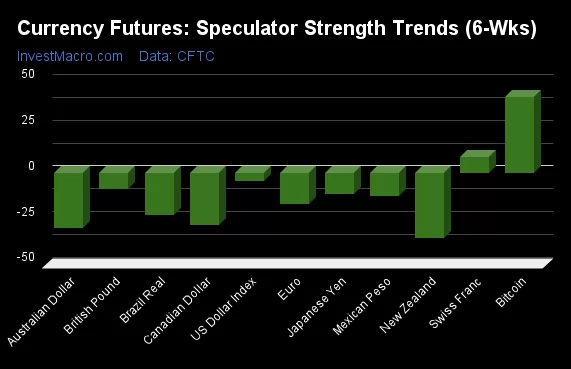
Japanese Yen & Bitcoin top the 6-Week Strength Trends

COT Strength Score Trends (or move index, calculates the 6-week changes in strength scores) showed that the Japanese Yen (18 percent) and the Bitcoin (16 percent) lead the past six weeks trends for the currencies. The EuroFX (2 percent) and the Canadian Dollar (2 percent) are the next highest positive movers in the latest trends data.

The US Dollar Index (-21 percent) leads the downside trend scores currently with the Mexican Peso (-8 percent), Brazilian Real (-5 percent) and the Australian Dollar (-3 percent) following next with lower trend scores.

Strength Trend Statistics:
US Dollar Index (-20.6 percent) vs US Dollar Index previous week (-19.6 percent)
EuroFX (1.8 percent) vs EuroFX previous week (10.6 percent)
British Pound Sterling (-3.5 percent) vs British Pound Sterling previous week (2.0 percent)
Japanese Yen (17.6 percent) vs Japanese Yen previous week (16.9 percent)
Swiss Franc (-1.4 percent) vs Swiss Franc previous week (-10.7 percent)
Canadian Dollar (2.1 percent) vs Canadian Dollar previous week (37.2 percent)
Australian Dollar (-3.5 percent) vs Australian Dollar previous week (-2.0 percent)
New Zealand Dollar (1.3 percent) vs New Zealand Dollar previous week (11.5 percent)
Mexican Peso (-7.8 percent) vs Mexican Peso previous week (-6.8 percent)
Brazilian Real (-4.5 percent) vs Brazilian Real previous week (9.5 percent)
Bitcoin (16.5 percent) vs Bitcoin previous week (-16.3 percent)


Individual COT Forex Markets:

US Dollar Index Futures:
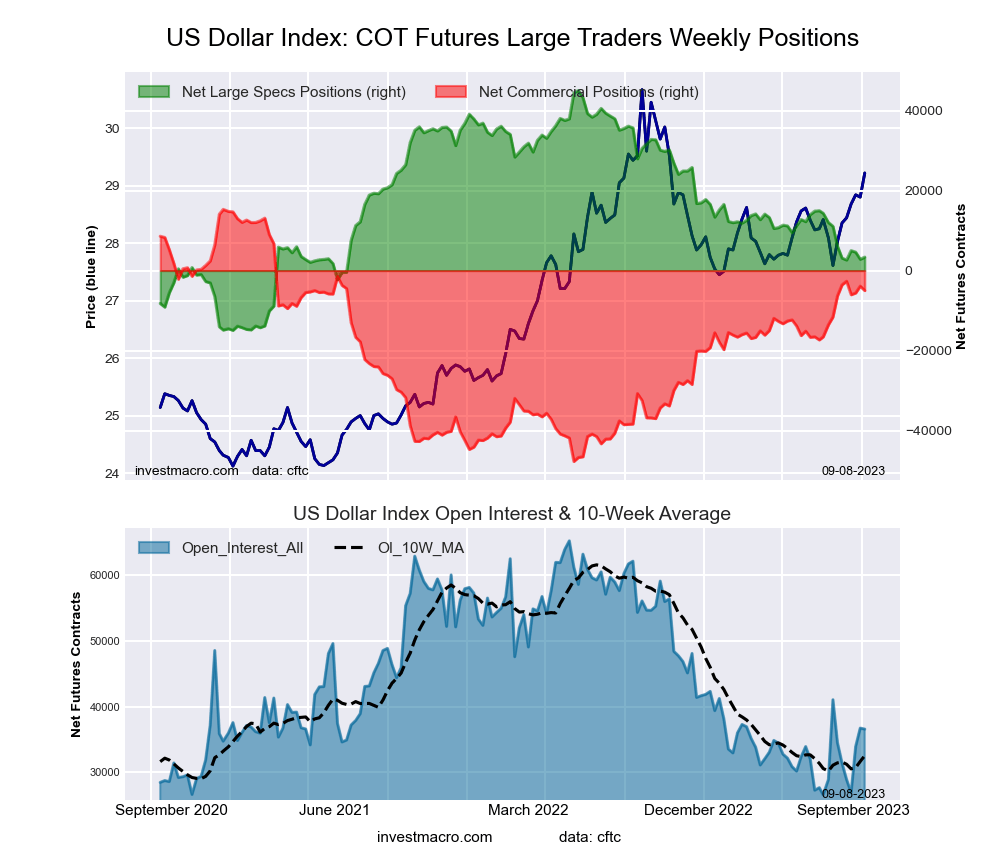
US Dollar Index Forex Futures COT ChartThe US Dollar Index large speculator standing this week recorded a net position of 2,624 contracts in the data reported through Tuesday. This was a weekly decrease of -491 contracts from the previous week which had a total of 3,115 net contracts.

This week’s current strength score (the trader positioning range over the past three years, measured from 0 to 100) shows the speculators are currently Bearish with a score of 29.3 percent. The commercials are Bullish with a score of 71.5 percent and the small traders (not shown in chart) are Bearish-Extreme with a score of 16.4 percent.

Price Trend-Following Model: New Uptrend

Our weekly trend-following model classifies the current market price position as: New Uptrend. The current action for the model is considered to be: Hold – Maintain Long Position.

US DOLLAR INDEX StatisticsSPECULATORSCOMMERCIALSSMALL TRADERS
– Percent of Open Interest Longs:59.622.111.3
– Percent of Open Interest Shorts:50.531.411.2
– Net Position:2,624-2,67854
– Gross Longs:17,2476,3953,283
– Gross Shorts:14,6239,0733,229
– Long to Short Ratio:1.2 to 10.7 to 11.0 to 1
NET POSITION TREND:
– Strength Index Score (3 Year Range Pct):29.371.516.4
– Strength Index Reading (3 Year Range):BearishBullishBearish-Extreme
NET POSITION MOVEMENT INDEX:
– 6-Week Change in Strength Index:-20.623.3-25.7


Euro Currency Futures:

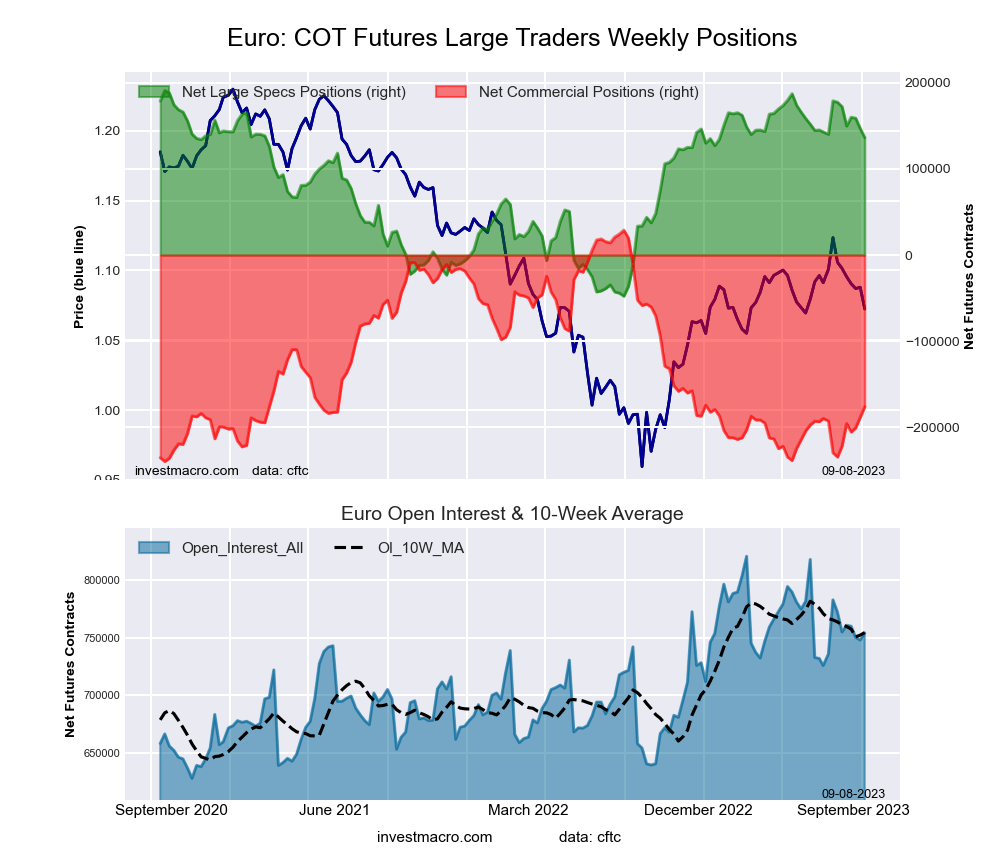
Euro Currency Futures COT ChartThe Euro Currency large speculator standing this week recorded a net position of 149,811 contracts in the data reported through Tuesday. This was a weekly drop of -22,251 contracts from the previous week which had a total of 172,062 net contracts.

This week’s current strength score (the trader positioning range over the past three years, measured from 0 to 100) shows the speculators are currently Bullish with a score of 76.1 percent. The commercials are Bearish with a score of 24.4 percent and the small traders (not shown in chart) are Bullish with a score of 51.8 percent.

Price Trend-Following Model: Uptrend

Our weekly trend-following model classifies the current market price position as: Uptrend. The current action for the model is considered to be: Hold – Maintain Long Position.

EURO Currency StatisticsSPECULATORSCOMMERCIALSSMALL TRADERS
– Percent of Open Interest Longs:30.056.012.1
– Percent of Open Interest Shorts:10.381.66.1
– Net Position:149,811-195,45045,639
– Gross Longs:228,048425,87592,240
– Gross Shorts:78,237621,32546,601
– Long to Short Ratio:2.9 to 10.7 to 12.0 to 1
NET POSITION TREND:
– Strength Index Score (3 Year Range Pct):76.124.451.8
– Strength Index Reading (3 Year Range):BullishBearishBullish
NET POSITION MOVEMENT INDEX:
– 6-Week Change in Strength Index:1.8-0.7-4.1


British Pound Sterling Futures:

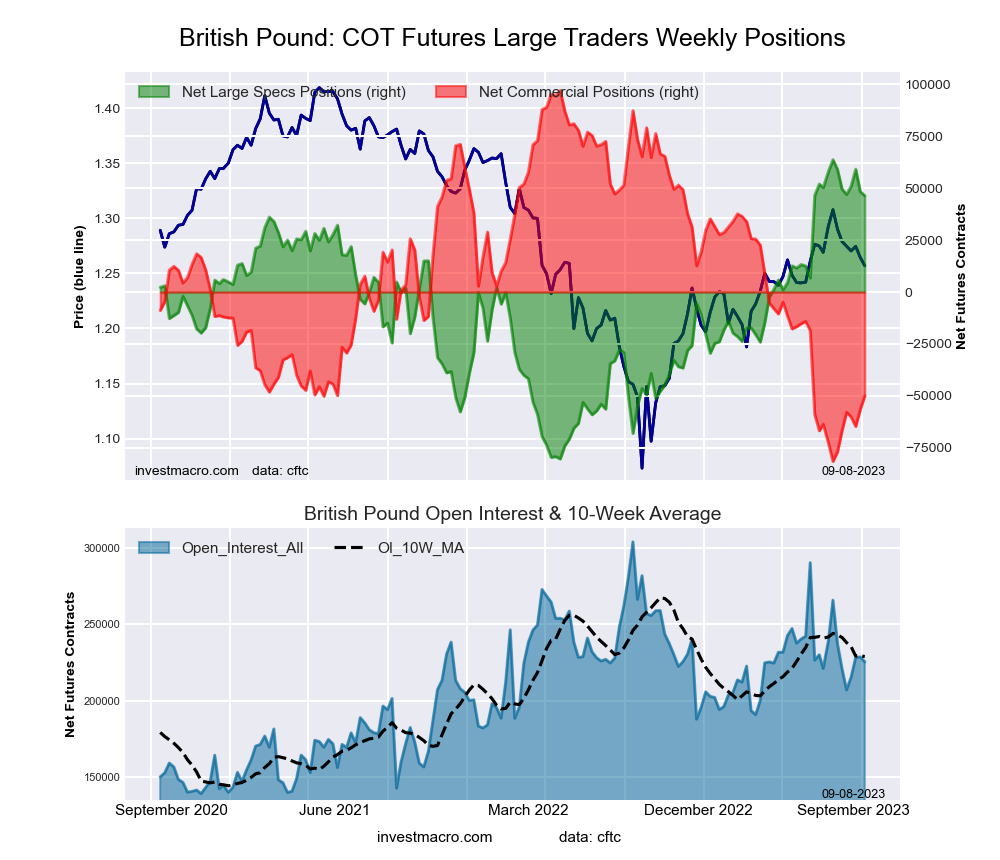
British Pound Sterling Futures COT ChartThe British Pound Sterling large speculator standing this week recorded a net position of 47,020 contracts in the data reported through Tuesday. This was a weekly lowering of -2,542 contracts from the previous week which had a total of 49,562 net contracts.

This week’s current strength score (the trader positioning range over the past three years, measured from 0 to 100) shows the speculators are currently Bullish-Extreme with a score of 88.4 percent. The commercials are Bearish-Extreme with a score of 13.3 percent and the small traders (not shown in chart) are Bullish with a score of 79.3 percent.

Price Trend-Following Model: Uptrend

Our weekly trend-following model classifies the current market price position as: Uptrend. The current action for the model is considered to be: Hold – Maintain Long Position.

BRITISH POUND StatisticsSPECULATORSCOMMERCIALSSMALL TRADERS
– Percent of Open Interest Longs:40.236.716.7
– Percent of Open Interest Shorts:17.564.711.4
– Net Position:47,020-57,87910,859
– Gross Longs:83,23975,99034,505
– Gross Shorts:36,219133,86923,646
– Long to Short Ratio:2.3 to 10.6 to 11.5 to 1
NET POSITION TREND:
– Strength Index Score (3 Year Range Pct):88.413.379.3
– Strength Index Reading (3 Year Range):Bullish-ExtremeBearish-ExtremeBullish
NET POSITION MOVEMENT INDEX:
– 6-Week Change in Strength Index:-3.55.0-7.7


Japanese Yen Futures:

Japanese Yen Forex Futures COT ChartThe Japanese Yen large speculator standing this week recorded a net position of -83,180 contracts in the data reported through Tuesday. This was a weekly decrease of -3,964 contracts from the previous week which had a total of -79,216 net contracts.

This week’s current strength score (the trader positioning range over the past three years, measured from 0 to 100) shows the speculators are currently Bearish with a score of 20.6 percent. The commercials are Bullish with a score of 79.1 percent and the small traders (not shown in chart) are Bearish with a score of 41.4 percent.

Price Trend-Following Model: Strong Downtrend

Our weekly trend-following model classifies the current market price position as: Strong Downtrend. The current action for the model is considered to be: Hold – Maintain Short Position.

JAPANESE YEN StatisticsSPECULATORSCOMMERCIALSSMALL TRADERS
– Percent of Open Interest Longs:10.173.814.5
– Percent of Open Interest Shorts:46.335.017.1
– Net Position:-83,18089,121-5,941
– Gross Longs:23,135169,52833,411
– Gross Shorts:106,31580,40739,352
– Long to Short Ratio:0.2 to 12.1 to 10.8 to 1
NET POSITION TREND:
– Strength Index Score (3 Year Range Pct):20.679.141.4
– Strength Index Reading (3 Year Range):BearishBullishBearish
NET POSITION MOVEMENT INDEX:
– 6-Week Change in Strength Index:17.6-16.27.2


Swiss Franc Futures:

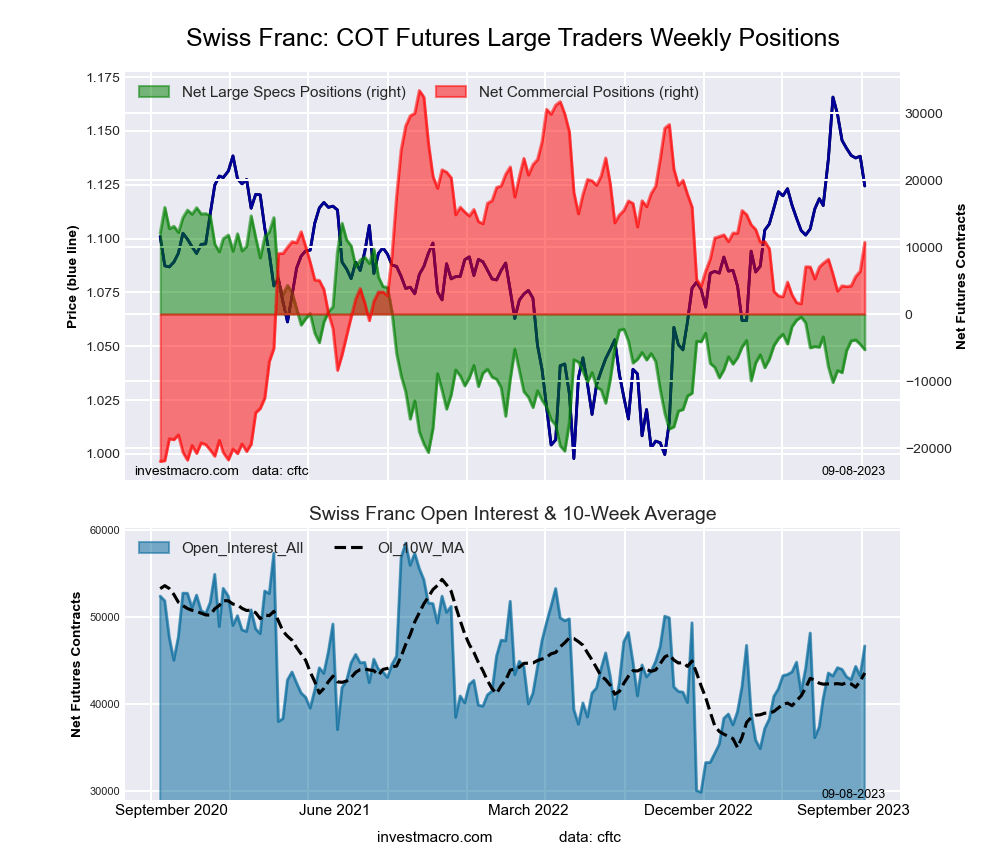
Swiss Franc Forex Futures COT ChartThe Swiss Franc large speculator standing this week recorded a net position of -5,452 contracts in the data reported through Tuesday. This was a weekly increase of 3,295 contracts from the previous week which had a total of -8,747 net contracts.

This week’s current strength score (the trader positioning range over the past three years, measured from 0 to 100) shows the speculators are currently Bearish with a score of 41.6 percent. The commercials are Bullish with a score of 51.5 percent and the small traders (not shown in chart) are Bullish with a score of 62.1 percent.

Price Trend-Following Model: Uptrend

Our weekly trend-following model classifies the current market price position as: Uptrend. The current action for the model is considered to be: Hold – Maintain Long Position.

SWISS FRANC StatisticsSPECULATORSCOMMERCIALSSMALL TRADERS
– Percent of Open Interest Longs:19.744.035.4
– Percent of Open Interest Shorts:32.434.632.2
– Net Position:-5,4524,0921,360
– Gross Longs:8,50918,99115,265
– Gross Shorts:13,96114,89913,905
– Long to Short Ratio:0.6 to 11.3 to 11.1 to 1
NET POSITION TREND:
– Strength Index Score (3 Year Range Pct):41.651.562.1
– Strength Index Reading (3 Year Range):BearishBullishBullish
NET POSITION MOVEMENT INDEX:
– 6-Week Change in Strength Index:-1.4-4.811.6


Canadian Dollar Futures:

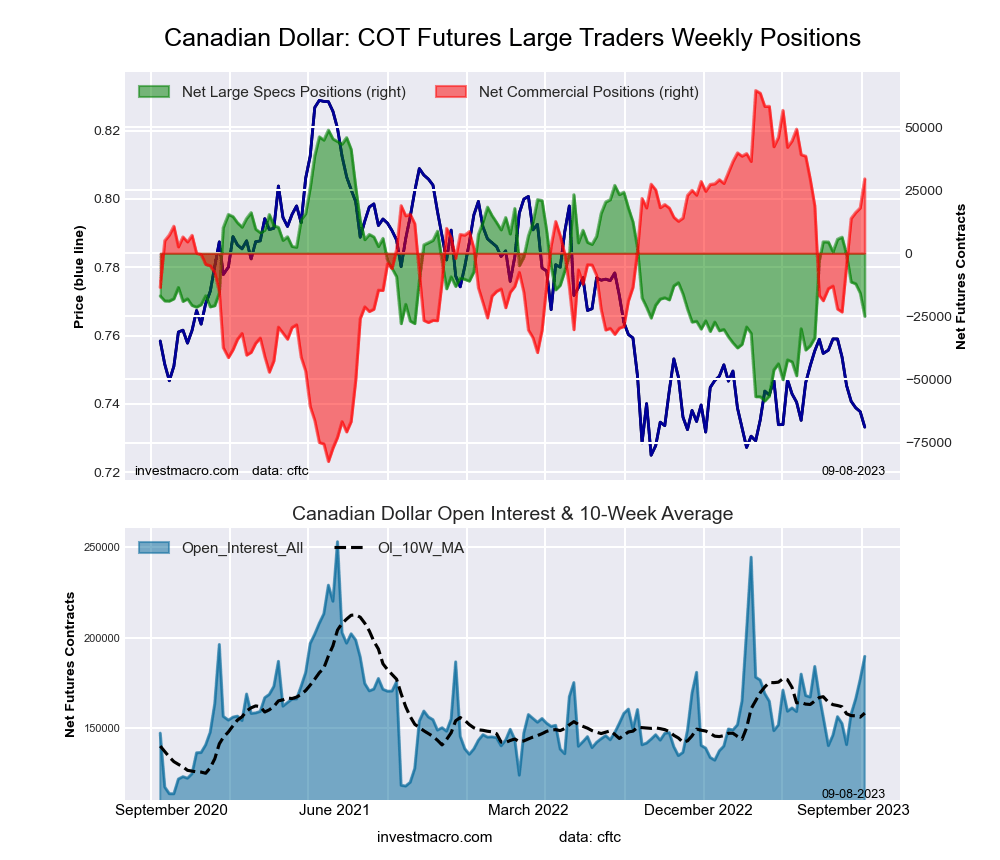
Canadian Dollar Forex Futures COT ChartThe Canadian Dollar large speculator standing this week recorded a net position of -623 contracts in the data reported through Tuesday. This was a weekly decline of -6,988 contracts from the previous week which had a total of 6,365 net contracts.

This week’s current strength score (the trader positioning range over the past three years, measured from 0 to 100) shows the speculators are currently Bullish with a score of 54.0 percent. The commercials are Bullish with a score of 53.0 percent and the small traders (not shown in chart) are Bearish with a score of 34.4 percent.

Price Trend-Following Model: Weak Uptrend

Our weekly trend-following model classifies the current market price position as: Weak Uptrend. The current action for the model is considered to be: Hold – Maintain Long Position.

CANADIAN DOLLAR StatisticsSPECULATORSCOMMERCIALSSMALL TRADERS
– Percent of Open Interest Longs:20.952.024.0
– Percent of Open Interest Shorts:21.455.320.2
– Net Position:-623-4,6175,240
– Gross Longs:29,48173,30133,774
– Gross Shorts:30,10477,91828,534
– Long to Short Ratio:1.0 to 10.9 to 11.2 to 1
NET POSITION TREND:
– Strength Index Score (3 Year Range Pct):54.053.034.4
– Strength Index Reading (3 Year Range):BullishBullishBearish
NET POSITION MOVEMENT INDEX:
– 6-Week Change in Strength Index:2.18.2-31.9


Australian Dollar Futures:

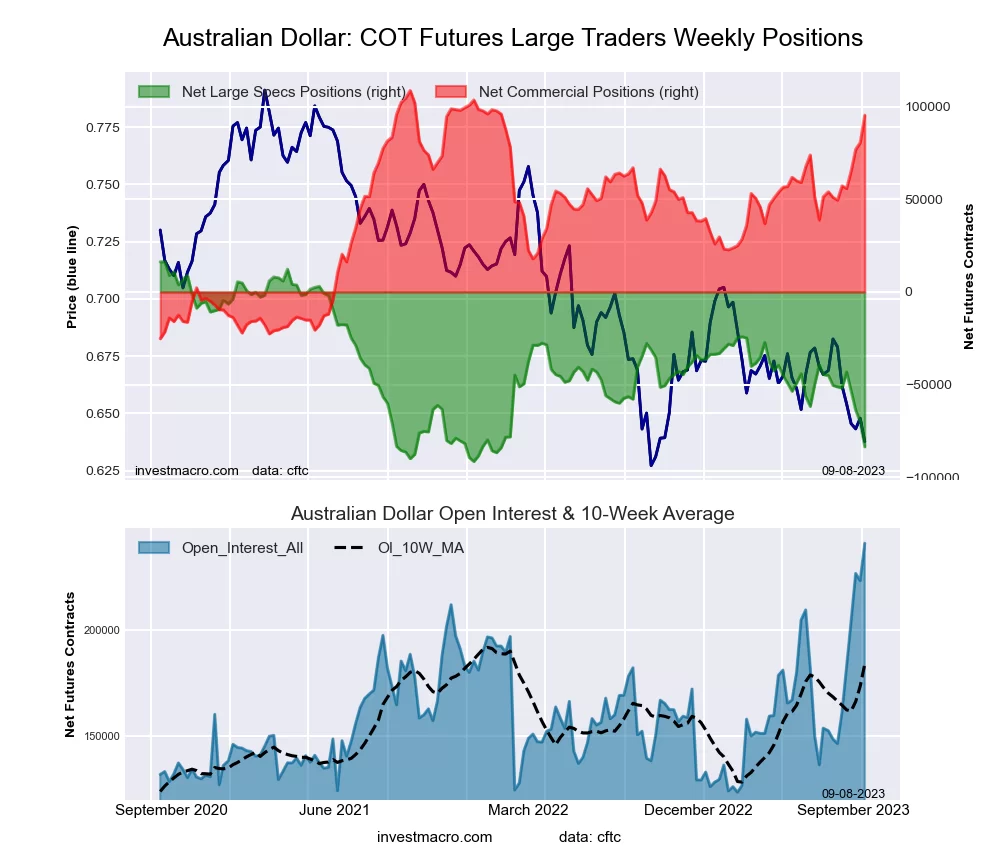
Australian Dollar Forex Futures COT ChartThe Australian Dollar large speculator standing this week recorded a net position of -43,192 contracts in the data reported through Tuesday. This was a weekly increase of 8,600 contracts from the previous week which had a total of -51,792 net contracts.

This week’s current strength score (the trader positioning range over the past three years, measured from 0 to 100) shows the speculators are currently Bearish with a score of 44.8 percent. The commercials are Bullish with a score of 60.5 percent and the small traders (not shown in chart) are Bearish with a score of 21.6 percent.

Price Trend-Following Model: Strong Downtrend

Our weekly trend-following model classifies the current market price position as: Strong Downtrend. The current action for the model is considered to be: New Sell – Short Position.

AUSTRALIAN DOLLAR StatisticsSPECULATORSCOMMERCIALSSMALL TRADERS
– Percent of Open Interest Longs:33.453.110.3
– Percent of Open Interest Shorts:57.022.517.3
– Net Position:-43,19255,845-12,653
– Gross Longs:61,09196,99918,900
– Gross Shorts:104,28341,15431,553
– Long to Short Ratio:0.6 to 12.4 to 10.6 to 1
NET POSITION TREND:
– Strength Index Score (3 Year Range Pct):44.860.521.6
– Strength Index Reading (3 Year Range):BearishBullishBearish
NET POSITION MOVEMENT INDEX:
– 6-Week Change in Strength Index:-3.512.7-32.3


New Zealand Dollar Futures:

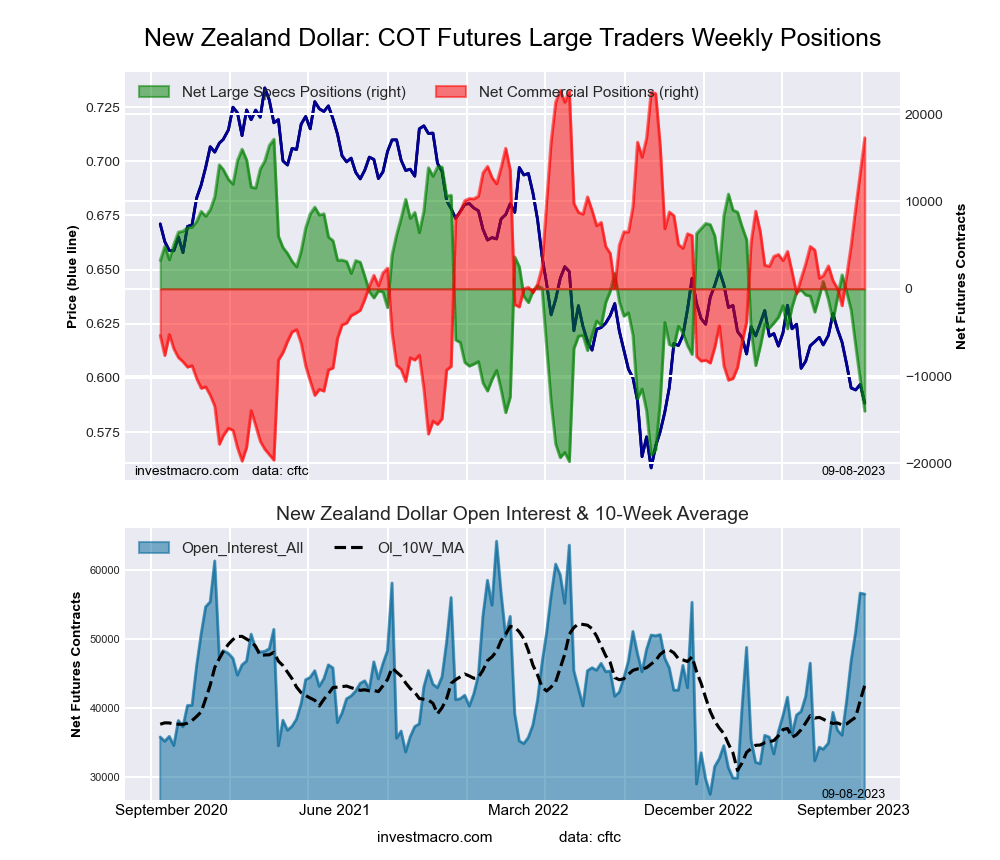
New Zealand Dollar Forex Futures COT ChartThe New Zealand Dollar large speculator standing this week recorded a net position of -368 contracts in the data reported through Tuesday. This was a weekly reduction of -1,954 contracts from the previous week which had a total of 1,586 net contracts.

This week’s current strength score (the trader positioning range over the past three years, measured from 0 to 100) shows the speculators are currently Bullish with a score of 52.6 percent. The commercials are Bearish with a score of 49.9 percent and the small traders (not shown in chart) are Bearish with a score of 37.1 percent.

Price Trend-Following Model: Strong Downtrend

Our weekly trend-following model classifies the current market price position as: Strong Downtrend. The current action for the model is considered to be: Hold – Maintain Short Position.

NEW ZEALAND DOLLAR StatisticsSPECULATORSCOMMERCIALSSMALL TRADERS
– Percent of Open Interest Longs:45.846.08.1
– Percent of Open Interest Shorts:46.742.510.7
– Net Position:-3681,454-1,086
– Gross Longs:18,75818,8743,306
– Gross Shorts:19,12617,4204,392
– Long to Short Ratio:1.0 to 11.1 to 10.8 to 1
NET POSITION TREND:
– Strength Index Score (3 Year Range Pct):52.649.937.1
– Strength Index Reading (3 Year Range):BullishBearishBearish
NET POSITION MOVEMENT INDEX:
– 6-Week Change in Strength Index:1.30.6-8.3


Mexican Peso Futures:

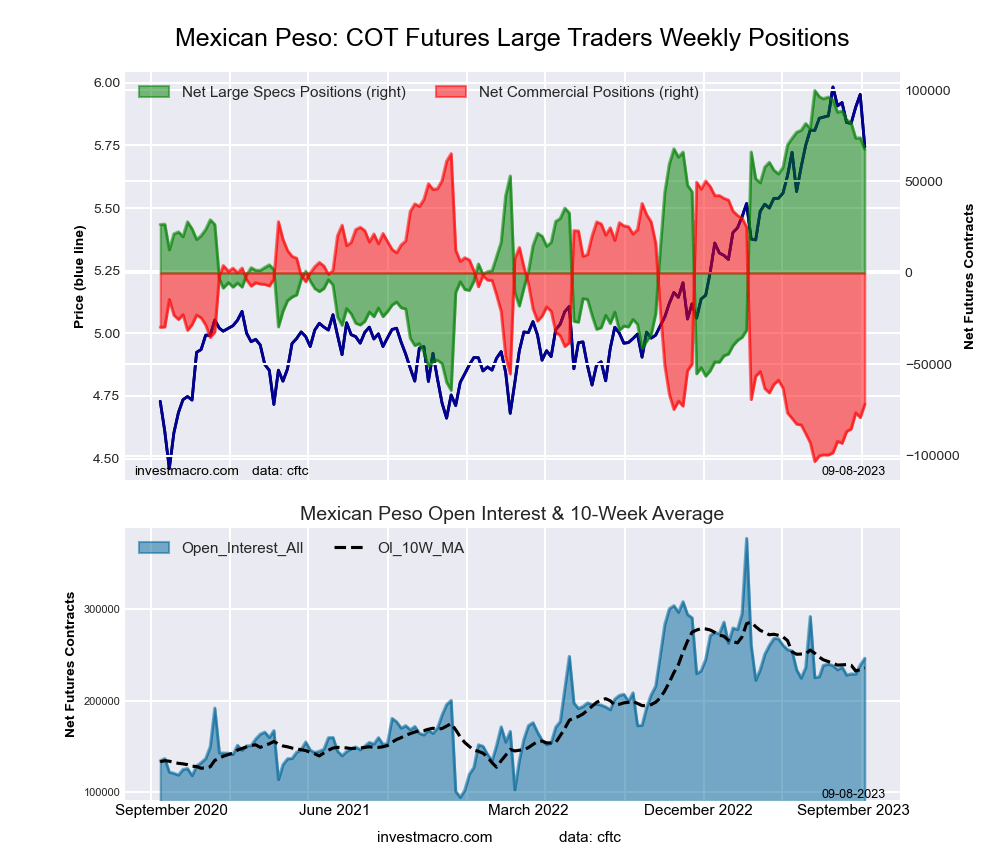
Mexican Peso Futures COT ChartThe Mexican Peso large speculator standing this week recorded a net position of 83,651 contracts in the data reported through Tuesday. This was a weekly drop of -4,897 contracts from the previous week which had a total of 88,548 net contracts.

This week’s current strength score (the trader positioning range over the past three years, measured from 0 to 100) shows the speculators are currently Bullish-Extreme with a score of 90.2 percent. The commercials are Bearish-Extreme with a score of 9.7 percent and the small traders (not shown in chart) are Bearish with a score of 30.2 percent.

Price Trend-Following Model: Uptrend

Our weekly trend-following model classifies the current market price position as: Uptrend. The current action for the model is considered to be: Hold – Maintain Long Position.

MEXICAN PESO StatisticsSPECULATORSCOMMERCIALSSMALL TRADERS
– Percent of Open Interest Longs:48.347.93.2
– Percent of Open Interest Shorts:11.685.91.9
– Net Position:83,651-86,6402,989
– Gross Longs:110,008109,0287,344
– Gross Shorts:26,357195,6684,355
– Long to Short Ratio:4.2 to 10.6 to 11.7 to 1
NET POSITION TREND:
– Strength Index Score (3 Year Range Pct):90.29.730.2
– Strength Index Reading (3 Year Range):Bullish-ExtremeBearish-ExtremeBearish
NET POSITION MOVEMENT INDEX:
– 6-Week Change in Strength Index:-7.87.9-3.6


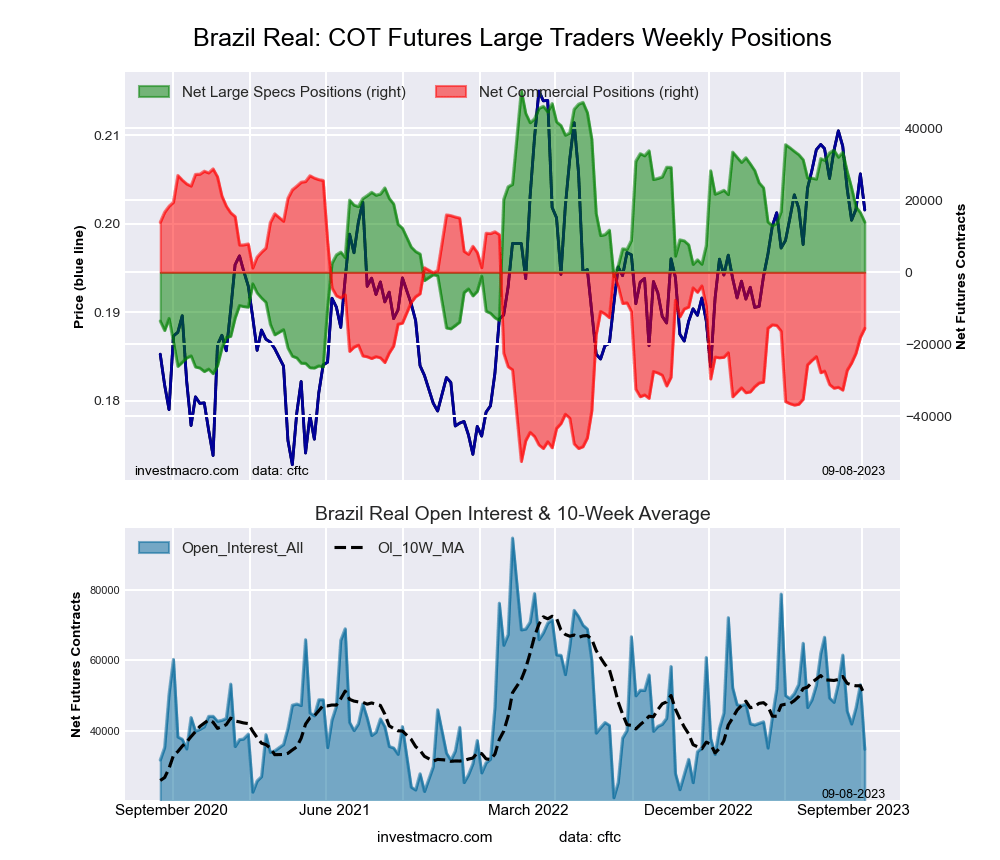
Brazilian Real Futures:

Brazil Real Futures COT ChartThe Brazilian Real large speculator standing this week recorded a net position of 28,039 contracts in the data reported through Tuesday. This was a weekly decrease of -5,312 contracts from the previous week which had a total of 33,351 net contracts.

This week’s current strength score (the trader positioning range over the past three years, measured from 0 to 100) shows the speculators are currently Bullish with a score of 71.4 percent. The commercials are Bearish with a score of 31.1 percent and the small traders (not shown in chart) are Bearish with a score of 37.9 percent.

Price Trend-Following Model: Uptrend

Our weekly trend-following model classifies the current market price position as: Uptrend. The current action for the model is considered to be: Hold – Maintain Long Position.

BRAZIL REAL StatisticsSPECULATORSCOMMERCIALSSMALL TRADERS
– Percent of Open Interest Longs:71.819.08.0
– Percent of Open Interest Shorts:10.478.79.7
– Net Position:28,039-27,269-770
– Gross Longs:32,8158,7063,663
– Gross Shorts:4,77635,9754,433
– Long to Short Ratio:6.9 to 10.2 to 10.8 to 1
NET POSITION TREND:
– Strength Index Score (3 Year Range Pct):71.431.137.9
– Strength Index Reading (3 Year Range):BullishBearishBearish
NET POSITION MOVEMENT INDEX:
– 6-Week Change in Strength Index:-4.50.823.3


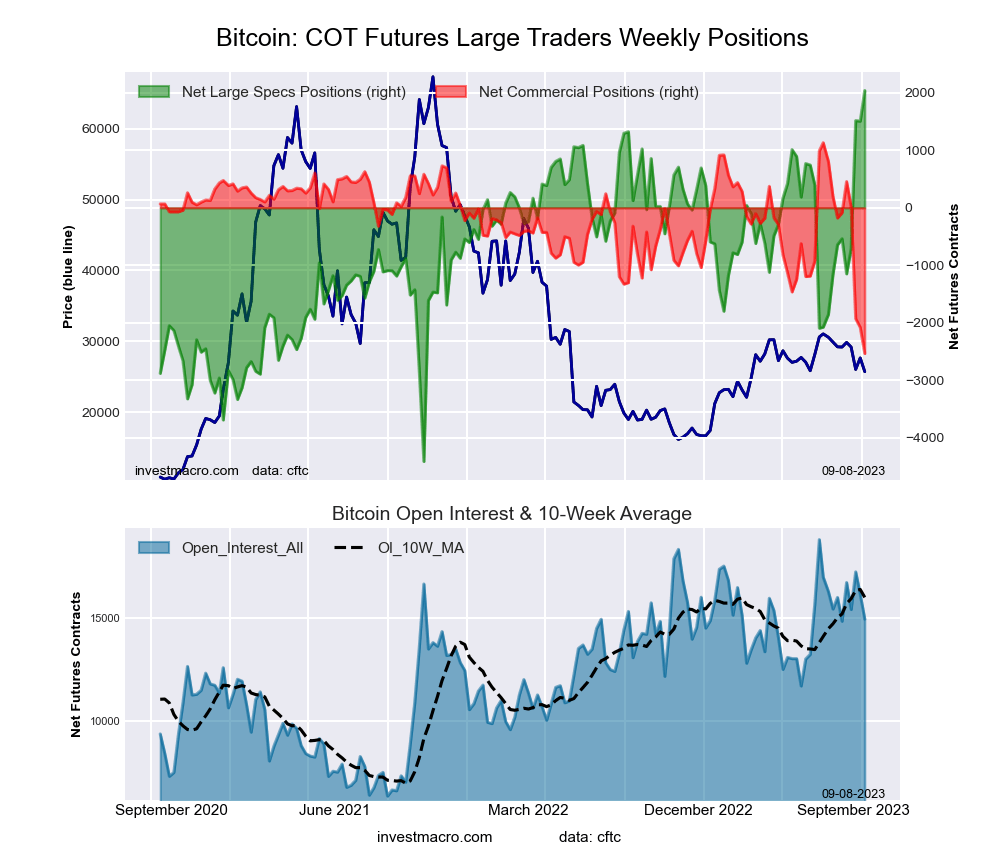
Bitcoin Futures:

Bitcoin Crypto Futures COT ChartThe Bitcoin large speculator standing this week recorded a net position of -1,149 contracts in the data reported through Tuesday. This was a weekly decline by -610 contracts from the previous week which had a total of -539 net contracts.

This week’s current strength score (the trader positioning range over the past three years, measured from 0 to 100) shows the speculators are currently Bullish with a score of 56.9 percent. The commercials are Bullish with a score of 73.9 percent and the small traders (not shown in chart) are Bearish with a score of 28.7 percent.

Price Trend-Following Model: Strong Uptrend

Our weekly trend-following model classifies the current market price position as: Strong Uptrend. The current action for the model is considered to be: Hold – Maintain Long Position.

BITCOIN StatisticsSPECULATORSCOMMERCIALSSMALL TRADERS
– Percent of Open Interest Longs:77.66.57.5
– Percent of Open Interest Shorts:84.43.73.3
– Net Position:-1,149456693
– Gross Longs:12,9851,0821,250
– Gross Shorts:14,134626557
– Long to Short Ratio:0.9 to 11.7 to 12.2 to 1
NET POSITION TREND:
– Strength Index Score (3 Year Range Pct):56.973.928.7
– Strength Index Reading (3 Year Range):BullishBullishBearish
NET POSITION MOVEMENT INDEX:
– 6-Week Change in Strength Index:16.5-20.6-9.3


Article By InvestMacroReceive our weekly COT Newsletter

*COT Report: The COT data, released weekly to the public each Friday, is updated through the most recent Tuesday (data is 3 days old) and shows a quick view of how large speculators or non-commercials (for-profit traders) were positioned in the futures markets.

The CFTC categorizes trader positions according to commercial hedgers (traders who use futures contracts for hedging as part of the business), non-commercials (large traders who speculate to realize trading profits) and nonreportable traders (usually small traders/speculators) as well as their open interest (contracts open in the market at time of reporting). See CFTC criteria here.


Speculator Extremes: Cocoa & Palladium lead COT Bullish & Bearish Positions

By InvestMacro

The latest update for the weekly Commitment of Traders (COT) report was released by the Commodity Futures Trading Commission (CFTC) on Friday for data ending on August 8th.

This weekly Extreme Positions report highlights the Most Bullish and Most Bearish Positions for the speculator category. Extreme positioning in these markets can foreshadow strong moves in the underlying market.

To signify an extreme position, we use the Strength Index (also known as the COT Index) of each instrument, a common method of measuring COT data. The Strength Index is simply a comparison of current trader positions against the range of positions over the previous 3 years. We use over 80 percent as extremely bullish and under 20 percent as extremely bearish. (Compare Strength Index scores across all markets in the data table or cot leaders table).


Here Are This Week’s Most Bullish Speculator Positions:

Cocoa Futures


The Cocoa Futures speculator position comes in as the most bullish extreme standing this week. The Cocoa Futures speculator level is currently at a 100.0 percent score of its 3-year range.

The six-week trend for the percent strength score totaled 8.9 this week. The overall net speculator position was a total of 79,502 net contracts this week with a change of 1,288 contract in the weekly speculator bets.


Mexican Peso


The Mexican Peso speculator position comes next in the extreme standings this week. The Mexican Peso speculator level is now at a 90.2 percent score of its 3-year range.

The six-week trend for the percent strength score was -7.8 this week. The speculator position registered 83,651 net contracts this week with a weekly change of -4,897 contracts in speculator bets.


Speculators or Non-Commercials Notes:

Speculators, classified as non-commercial traders by the CFTC, are made up of large commodity funds, hedge funds and other significant for-profit participants. The Specs are generally regarded as trend-followers in their behavior towards price action – net speculator bets and prices tend to go in the same directions. These traders often look to buy when prices are rising and sell when prices are falling. To illustrate this point, many times speculator contracts can be found at their most extremes (bullish or bearish) when prices are also close to their highest or lowest levels.

These extreme levels can be dangerous for the large speculators as the trade is most crowded, there is less trading ammunition still sitting on the sidelines to push the trend further and prices have moved a significant distance. When the trend becomes exhausted, some speculators take profits while others look to also exit positions when prices fail to continue in the same direction. This process usually plays out over many months to years and can ultimately create a reverse effect where prices start to fall and speculators start a process of selling when prices are falling.


British Pound


The British Pound speculator position comes in third this week in the extreme standings. The British Pound speculator level resides at a 88.4 percent score of its 3-year range.

The six-week trend for the speculator strength score came in at -3.5 this week. The overall speculator position was 47,020 net contracts this week with a change of -2,542 contracts in the weekly speculator bets.


VIX


The VIX speculator position comes up number four in the extreme standings this week. The VIX speculator level is at a 87.1 percent score of its 3-year range.

The six-week trend for the speculator strength score totaled a change of 14.9 this week. The overall speculator position was -44,404 net contracts this week with a change of -2,238 contracts in the speculator bets.


DowJones Mini


The DowJones Mini speculator position rounds out the top five in this week’s bullish extreme standings. The DowJones Mini speculator level sits at a 85.3 percent score of its 3-year range. The six-week trend for the speculator strength score was 65.0 this week.

The speculator position was 4,031 net contracts this week with a change of 2,451 contracts in the weekly speculator bets.


This Week’s Most Bearish Speculator Positions:

Palladium


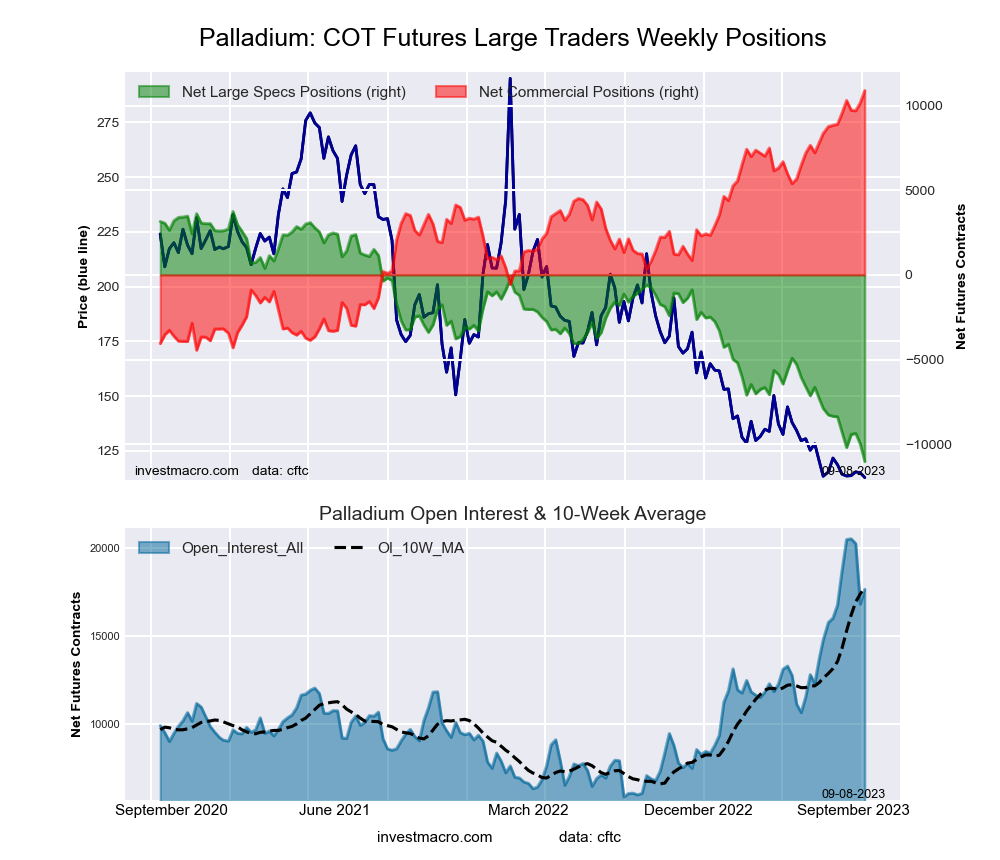
The Palladium speculator position comes in as the most bearish extreme standing this week. The Palladium speculator level is at a 0.0 percent score of its 3-year range.

The six-week trend for the speculator strength score was -20.6 this week. The overall speculator position was -10,192 net contracts this week with a change of -895 contracts in the speculator bets.


5-Year Bond


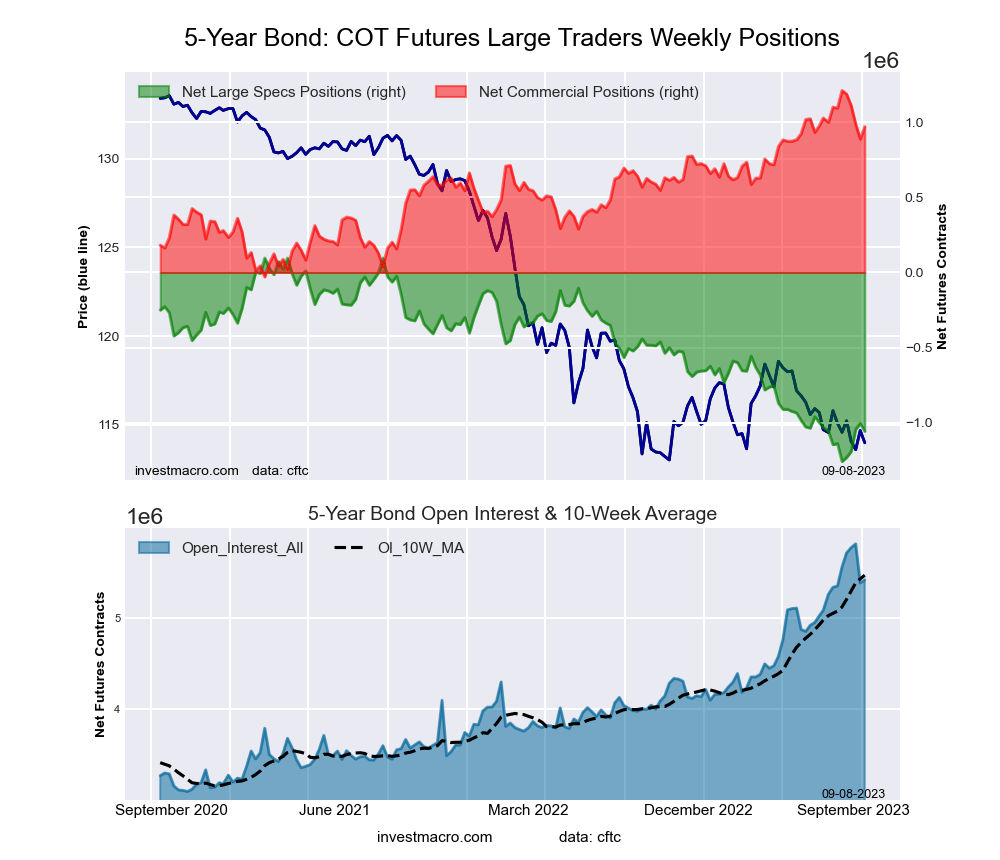
The 5-Year Bond speculator position comes in next for the most bearish extreme standing on the week. The 5-Year Bond speculator level is at a 2.0 percent score of its 3-year range.

The six-week trend for the speculator strength score was -17.1 this week. The speculator position was -1,230,307 net contracts this week with a change of 26,739 contracts in the weekly speculator bets.


2-Year Bond


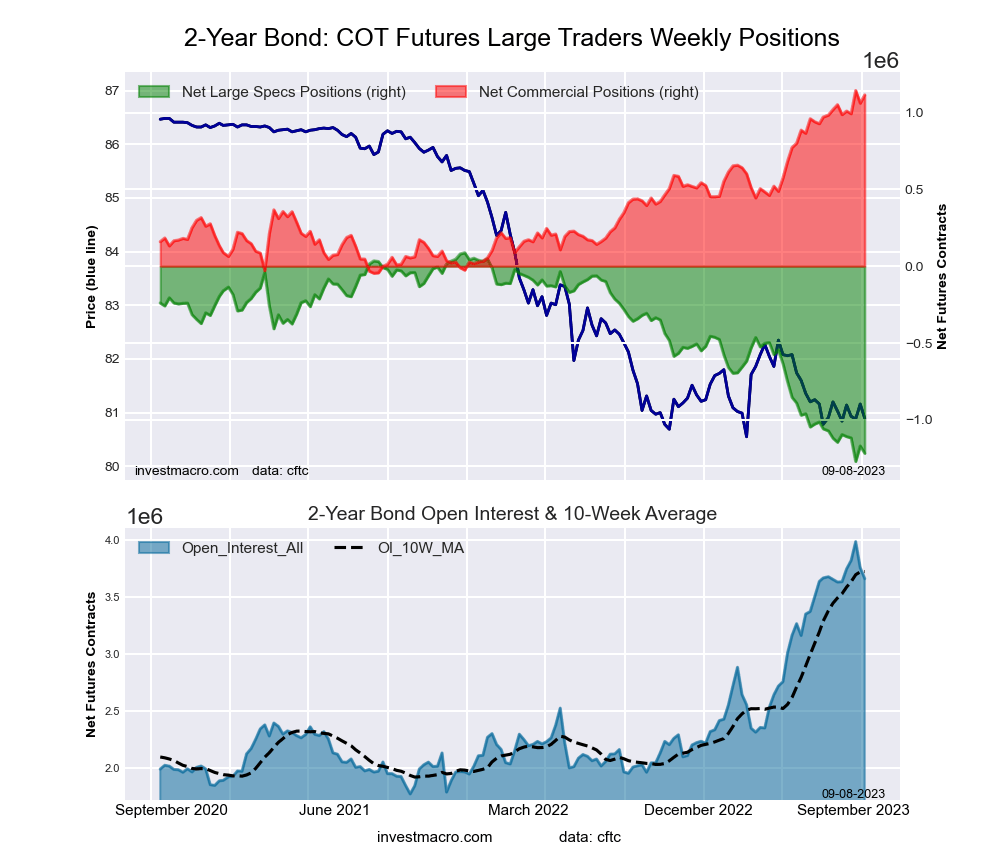
The 2-Year Bond speculator position comes in as third most bearish extreme standing of the week. The 2-Year Bond speculator level resides at a 3.0 percent score of its 3-year range.

The six-week trend for the speculator strength score was -7.7 this week. The overall speculator position was -1,109,126 net contracts this week with a change of -13,463 contracts in the speculator bets.


Ultra U.S. Treasury Bonds


The Ultra U.S. Treasury Bonds speculator position comes in as this week’s fourth most bearish extreme standing. The Ultra U.S. Treasury Bonds speculator level is at a 4.6 percent score of its 3-year range.

The six-week trend for the speculator strength score was -8.6 this week. The speculator position was -445,088 net contracts this week with a change of 11,341 contracts in the weekly speculator bets.


Ultra 10-Year U.S. T-Note


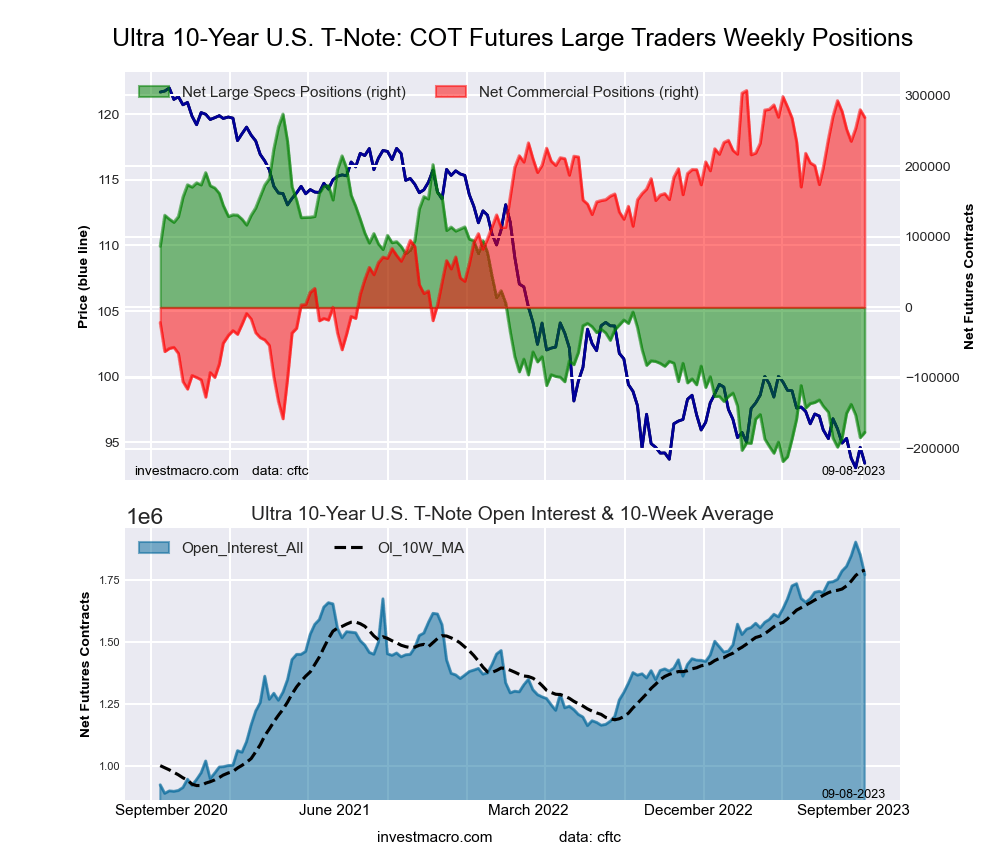
Finally, the Ultra 10-Year U.S. T-Note speculator position comes in as the fifth most bearish extreme standing for this week. The Ultra 10-Year U.S. T-Note speculator level is at a 13.9 percent score of its 3-year range.

The six-week trend for the speculator strength score was -3.8 this week. The speculator position was -149,951 net contracts this week with a change of 35,286 contracts in the weekly speculator bets.


Article By InvestMacroReceive our weekly COT Newsletter

*COT Report: The COT data, released weekly to the public each Friday, is updated through the most recent Tuesday (data is 3 days old) and shows a quick view of how large speculators or non-commercials (for-profit traders) were positioned in the futures markets.

The CFTC categorizes trader positions according to commercial hedgers (traders who use futures contracts for hedging as part of the business), non-commercials (large traders who speculate to realize trading profits) and nonreportable traders (usually small traders/speculators) as well as their open interest (contracts open in the market at time of reporting). See CFTC criteria here.

COT Metals Charts: Weekly Speculator Bets drop this week led by Gold & Copper

By InvestMacro

Here are the latest charts and statistics for the Commitment of Traders (COT) data published by the Commodities Futures Trading Commission (CFTC).

The latest COT data is updated through Tuesday August 8th and shows a quick view of how large traders (for-profit speculators and commercial entities) were positioned in the futures markets.

Weekly Speculator Bets drop this week led by Gold & Copper

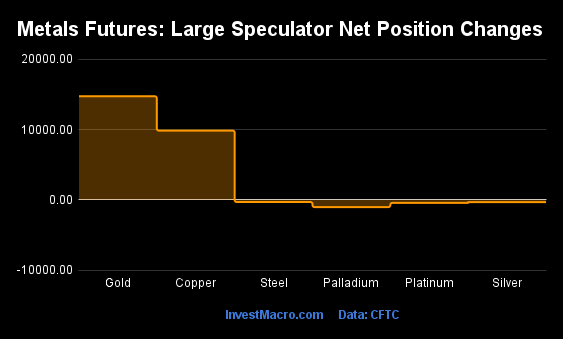
The COT metals markets speculator bets were lower this week as all of the six markets we follow had lower speculator contracts.

The markets leading the declines in speculator bets for the week were Gold (-21,939 contracts) with Copper (-20,801 contracts), Silver (-17,507 contracts), Platinum (-9,298 contracts), Steel (-1,065 contracts) with Palladium (-895 contracts) also registering lower bets on the week.


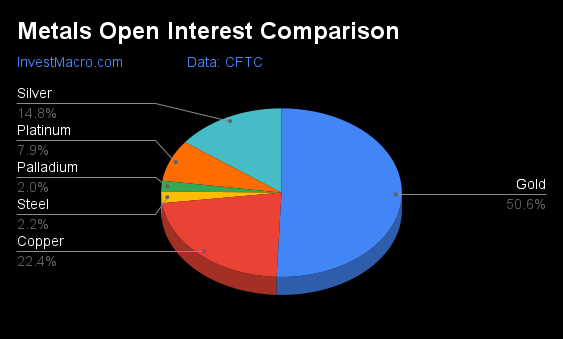
Data Snapshot of Commodity Market Traders | Columns Legend
Aug-08-2023OIOI-IndexSpec-NetSpec-IndexCom-NetCOM-IndexSmalls-NetSmalls-Index
Gold427,7593142,98540-167,5545924,56942
Silver137,6312913,32437-30,3495717,02561
Copper228,53765-10,057224,908765,14951
Palladium20,470100-10,192010,299100-10735
Platinum79,9891002,99222-8,591765,59943


Strength Scores led by Steel & Gold

COT Strength Scores (a normalized measure of Speculator positions over a 3-Year range, from 0 to 100 where above 80 is Extreme-Bullish and below 20 is Extreme-Bearish) showed that Steel (64 percent) and Gold (40 percent) lead the metals markets this week. Silver (37 percent) comes in as the next highest in the weekly strength scores.

On the downside, Palladium (0.0 percent) comes in at the lowest strength level currently and is in Extreme-Bearish territory (below 20 percent).

Strength Statistics:
Gold (40.0 percent) vs Gold previous week (49.7 percent)
Silver (37.3 percent) vs Silver previous week (62.2 percent)
Copper (22.2 percent) vs Copper previous week (40.1 percent)
Platinum (22.5 percent) vs Platinum previous week (43.9 percent)
Palladium (0.0 percent) vs Palladium previous week (6.4 percent)
Steel (64.1 percent) vs Palladium previous week (67.2 percent)


Gold & Steel are the least negative in the 6-Week Strength Trends

COT Strength Score Trends (or move index, calculates the 6-week changes in strength scores) showed that Gold (-4 percent) and Steel (-5 percent) topped the past six weeks trends for metals but were in negative trends.

Platinum (-21 percent) and Palladium (-21 percent) lead and show the most negative trends currently.

Move Statistics:
Gold (-3.9 percent) vs Gold previous week (0.9 percent)
Silver (-8.2 percent) vs Silver previous week (15.4 percent)
Copper (-11.2 percent) vs Copper previous week (7.7 percent)
Platinum (-21.2 percent) vs Platinum previous week (-16.6 percent)
Palladium (-20.6 percent) vs Palladium previous week (-19.1 percent)
Steel (-5.3 percent) vs Steel previous week (-0.6 percent)


Individual Markets:

Gold Comex Futures:

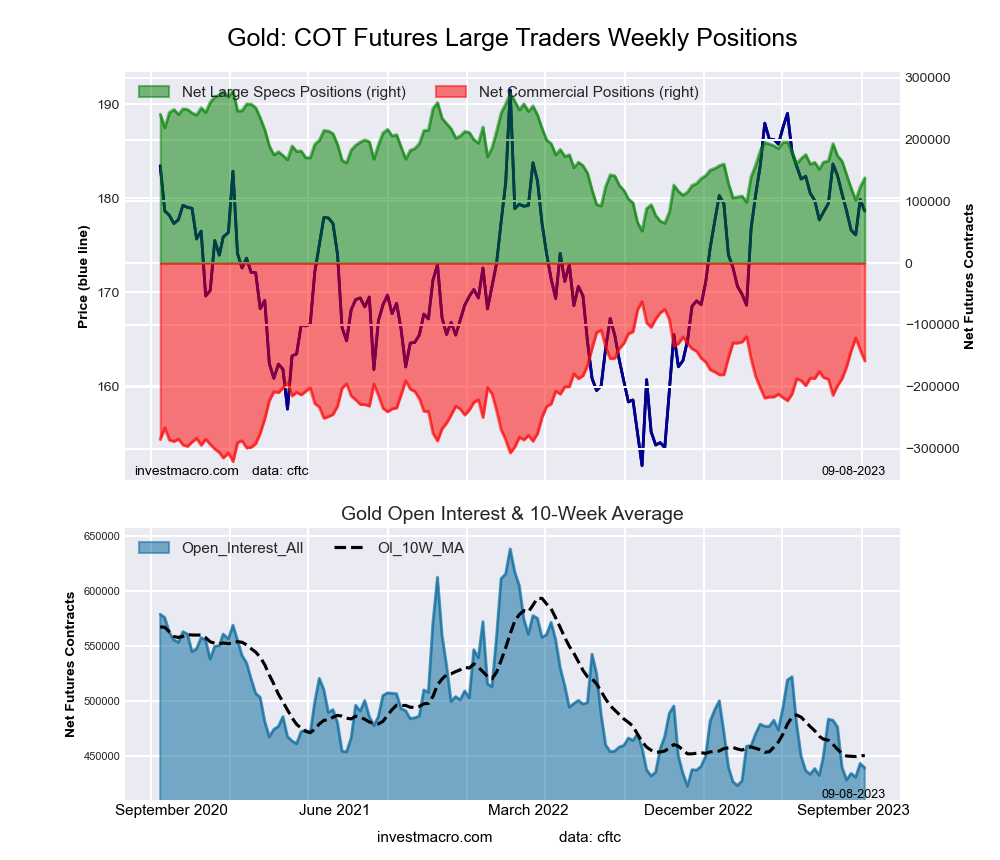
Gold Futures COT ChartThe Gold Comex Futures large speculator standing this week resulted in a net position of 142,985 contracts in the data reported through Tuesday. This was a weekly decline of -21,939 contracts from the previous week which had a total of 164,924 net contracts.

This week’s current strength score (the trader positioning range over the past three years, measured from 0 to 100) shows the speculators are currently Bearish with a score of 40.0 percent. The commercials are Bullish with a score of 59.3 percent and the small traders (not shown in chart) are Bearish with a score of 41.5 percent.

Price Trend-Following Model: Strong Downtrend

Our weekly trend-following model classifies the current market price position as: Strong Downtrend. The current action for the model is considered to be: Hold – Maintain Short Position.

Gold Futures StatisticsSPECULATORSCOMMERCIALSSMALL TRADERS
– Percent of Open Interest Longs:53.526.610.5
– Percent of Open Interest Shorts:20.165.84.8
– Net Position:142,985-167,55424,569
– Gross Longs:228,846113,89044,996
– Gross Shorts:85,861281,44420,427
– Long to Short Ratio:2.7 to 10.4 to 12.2 to 1
NET POSITION TREND:
– Strength Index Score (3 Year Range Pct):40.059.341.5
– Strength Index Reading (3 Year Range):BearishBullishBearish
NET POSITION MOVEMENT INDEX:
– 6-Week Change in Strength Index:-3.93.02.9


Silver Comex Futures:

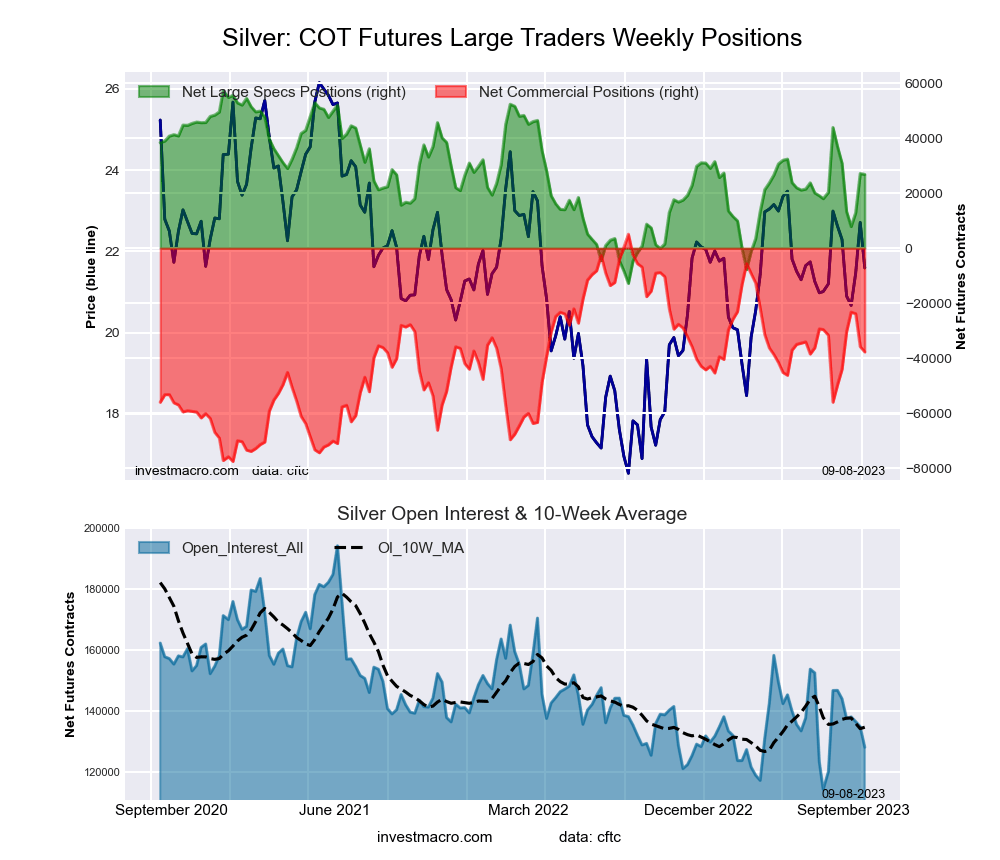
Silver Futures COT ChartThe Silver Comex Futures large speculator standing this week resulted in a net position of 13,324 contracts in the data reported through Tuesday. This was a weekly decline of -17,507 contracts from the previous week which had a total of 30,831 net contracts.

This week’s current strength score (the trader positioning range over the past three years, measured from 0 to 100) shows the speculators are currently Bearish with a score of 37.3 percent. The commercials are Bullish with a score of 57.1 percent and the small traders (not shown in chart) are Bullish with a score of 61.1 percent.

Price Trend-Following Model: Strong Downtrend

Our weekly trend-following model classifies the current market price position as: Strong Downtrend. The current action for the model is considered to be: Hold – Maintain Short Position.

Silver Futures StatisticsSPECULATORSCOMMERCIALSSMALL TRADERS
– Percent of Open Interest Longs:39.130.319.9
– Percent of Open Interest Shorts:29.452.37.5
– Net Position:13,324-30,34917,025
– Gross Longs:53,78141,63627,349
– Gross Shorts:40,45771,98510,324
– Long to Short Ratio:1.3 to 10.6 to 12.6 to 1
NET POSITION TREND:
– Strength Index Score (3 Year Range Pct):37.357.161.1
– Strength Index Reading (3 Year Range):BearishBullishBullish
NET POSITION MOVEMENT INDEX:
– 6-Week Change in Strength Index:-8.2-1.237.8


Copper Grade #1 Futures:

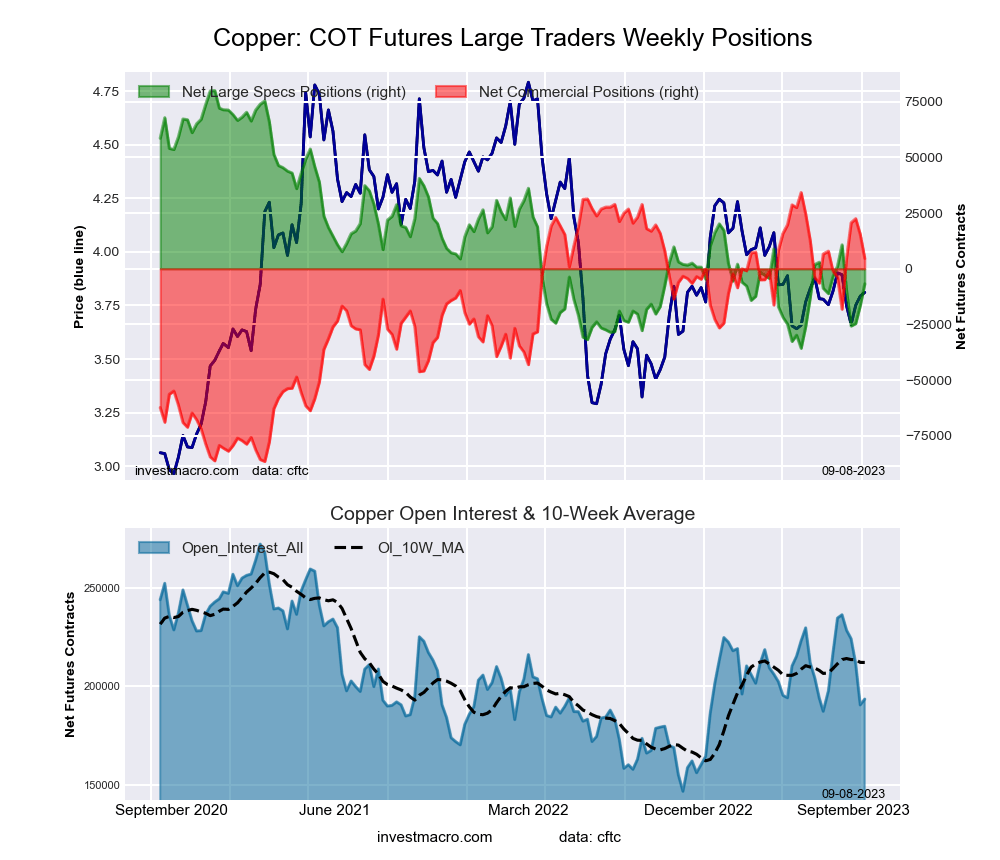
Copper Futures COT ChartThe Copper Grade #1 Futures large speculator standing this week resulted in a net position of -10,057 contracts in the data reported through Tuesday. This was a weekly reduction of -20,801 contracts from the previous week which had a total of 10,744 net contracts.

This week’s current strength score (the trader positioning range over the past three years, measured from 0 to 100) shows the speculators are currently Bearish with a score of 22.2 percent. The commercials are Bullish with a score of 75.7 percent and the small traders (not shown in chart) are Bullish with a score of 51.0 percent.

Price Trend-Following Model: Downtrend

Our weekly trend-following model classifies the current market price position as: Downtrend. The current action for the model is considered to be: Hold – Maintain Short Position.

Copper Futures StatisticsSPECULATORSCOMMERCIALSSMALL TRADERS
– Percent of Open Interest Longs:31.242.37.9
– Percent of Open Interest Shorts:35.640.25.6
– Net Position:-10,0574,9085,149
– Gross Longs:71,24796,72817,983
– Gross Shorts:81,30491,82012,834
– Long to Short Ratio:0.9 to 11.1 to 11.4 to 1
NET POSITION TREND:
– Strength Index Score (3 Year Range Pct):22.275.751.0
– Strength Index Reading (3 Year Range):BearishBullishBullish
NET POSITION MOVEMENT INDEX:
– 6-Week Change in Strength Index:-11.29.410.4


Platinum Futures:

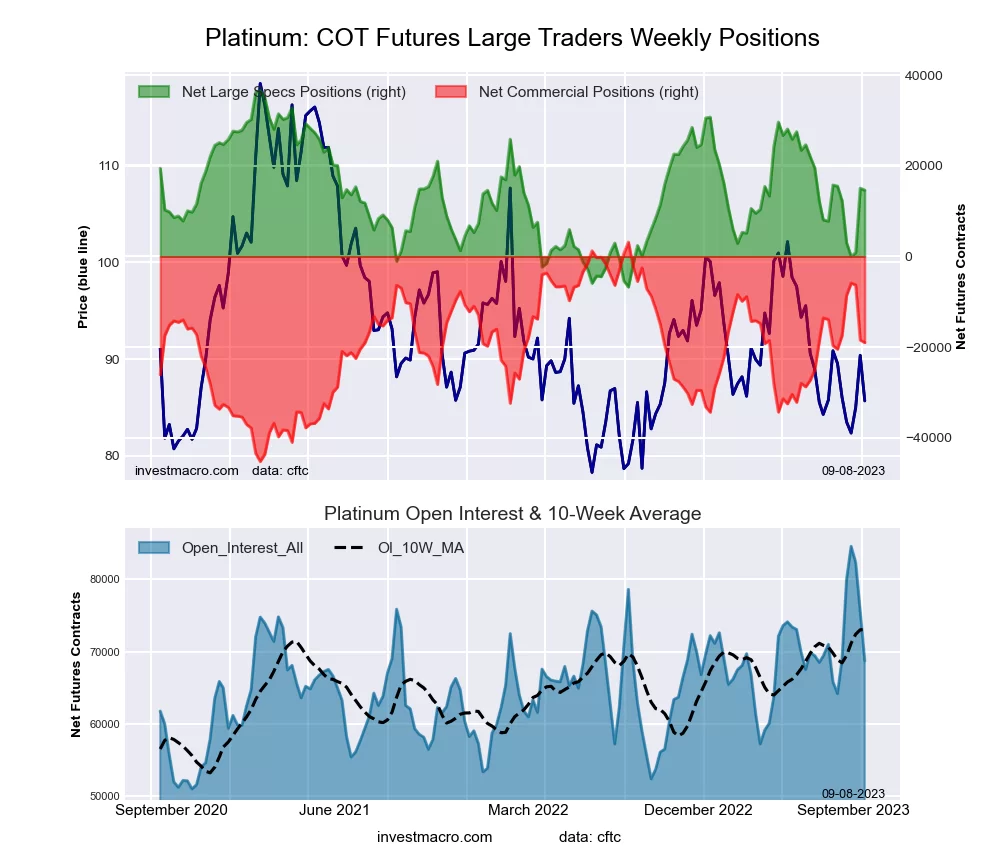
Platinum Futures COT ChartThe Platinum Futures large speculator standing this week resulted in a net position of 2,992 contracts in the data reported through Tuesday. This was a weekly decrease of -9,298 contracts from the previous week which had a total of 12,290 net contracts.

This week’s current strength score (the trader positioning range over the past three years, measured from 0 to 100) shows the speculators are currently Bearish with a score of 22.5 percent. The commercials are Bullish with a score of 75.7 percent and the small traders (not shown in chart) are Bearish with a score of 43.0 percent.

Price Trend-Following Model: Strong Downtrend

Our weekly trend-following model classifies the current market price position as: Strong Downtrend. The current action for the model is considered to be: Hold – Maintain Short Position.

Platinum Futures StatisticsSPECULATORSCOMMERCIALSSMALL TRADERS
– Percent of Open Interest Longs:52.527.412.0
– Percent of Open Interest Shorts:48.838.15.0
– Net Position:2,992-8,5915,599
– Gross Longs:42,00721,8999,574
– Gross Shorts:39,01530,4903,975
– Long to Short Ratio:1.1 to 10.7 to 12.4 to 1
NET POSITION TREND:
– Strength Index Score (3 Year Range Pct):22.575.743.0
– Strength Index Reading (3 Year Range):BearishBullishBearish
NET POSITION MOVEMENT INDEX:
– 6-Week Change in Strength Index:-21.220.8-11.5


Palladium Futures:

Palladium Futures COT ChartThe Palladium Futures large speculator standing this week resulted in a net position of -10,192 contracts in the data reported through Tuesday. This was a weekly fall of -895 contracts from the previous week which had a total of -9,297 net contracts.

This week’s current strength score (the trader positioning range over the past three years, measured from 0 to 100) shows the speculators are currently Bearish-Extreme with a score of 0.0 percent. The commercials are Bullish-Extreme with a score of 100.0 percent and the small traders (not shown in chart) are Bearish with a score of 35.3 percent.

Price Trend-Following Model: Downtrend

Our weekly trend-following model classifies the current market price position as: Downtrend. The current action for the model is considered to be: Hold – Maintain Short Position.

Palladium Futures StatisticsSPECULATORSCOMMERCIALSSMALL TRADERS
– Percent of Open Interest Longs:20.560.28.1
– Percent of Open Interest Shorts:70.39.88.6
– Net Position:-10,19210,299-107
– Gross Longs:4,19812,3131,659
– Gross Shorts:14,3902,0141,766
– Long to Short Ratio:0.3 to 16.1 to 10.9 to 1
NET POSITION TREND:
– Strength Index Score (3 Year Range Pct):0.0100.035.3
– Strength Index Reading (3 Year Range):Bearish-ExtremeBullish-ExtremeBearish
NET POSITION MOVEMENT INDEX:
– 6-Week Change in Strength Index:-20.616.724.0


Steel Futures Futures:

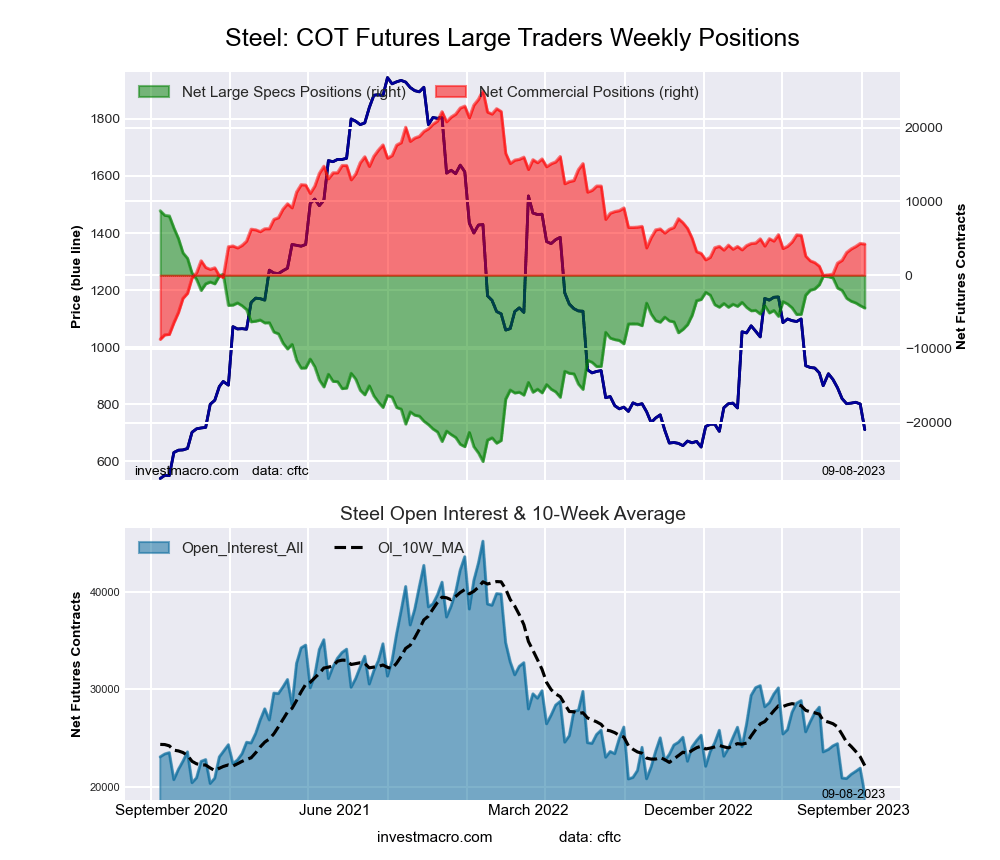
Steel Futures COT ChartThe Steel Futures large speculator standing this week resulted in a net position of -3,121 contracts in the data reported through Tuesday. This was a weekly reduction of -1,065 contracts from the previous week which had a total of -2,056 net contracts.

This week’s current strength score (the trader positioning range over the past three years, measured from 0 to 100) shows the speculators are currently Bullish with a score of 64.1 percent. The commercials are Bearish with a score of 36.0 percent and the small traders (not shown in chart) are Bearish with a score of 26.2 percent.

Price Trend-Following Model: Downtrend

Our weekly trend-following model classifies the current market price position as: Downtrend. The current action for the model is considered to be: Hold – Maintain Short Position.

Steel Futures StatisticsSPECULATORSCOMMERCIALSSMALL TRADERS
– Percent of Open Interest Longs:8.586.21.1
– Percent of Open Interest Shorts:23.571.40.9
– Net Position:-3,1213,07447
– Gross Longs:1,78017,968227
– Gross Shorts:4,90114,894180
– Long to Short Ratio:0.4 to 11.2 to 11.3 to 1
NET POSITION TREND:
– Strength Index Score (3 Year Range Pct):64.136.026.2
– Strength Index Reading (3 Year Range):BullishBearishBearish
NET POSITION MOVEMENT INDEX:
– 6-Week Change in Strength Index:-5.35.4-1.6


Article By InvestMacroReceive our weekly COT Newsletter

*COT Report: The COT data, released weekly to the public each Friday, is updated through the most recent Tuesday (data is 3 days old) and shows a quick view of how large speculators or non-commercials (for-profit traders) were positioned in the futures markets.

The CFTC categorizes trader positions according to commercial hedgers (traders who use futures contracts for hedging as part of the business), non-commercials (large traders who speculate to realize trading profits) and nonreportable traders (usually small traders/speculators) as well as their open interest (contracts open in the market at time of reporting). See CFTC criteria here.
COT Bonds Charts: Weekly Speculator Bets led by SOFR 3-Months & Ultra 10-Year Bonds

By InvestMacro

Here are the latest charts and statistics for the Commitment of Traders (COT) reports data published by the Commodities Futures Trading Commission (CFTC).

The latest COT data is updated through Tuesday August 8th and shows a quick view of how large traders (for-profit speculators and commercial hedgers) were positioned in the futures markets.

Weekly Speculator Changes led by SOFR 3-Months & Ultra 10-Year Bonds

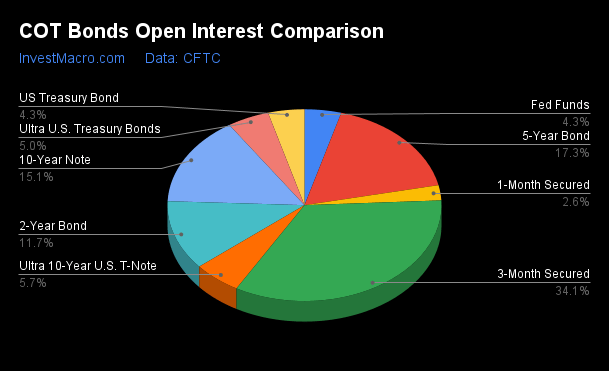
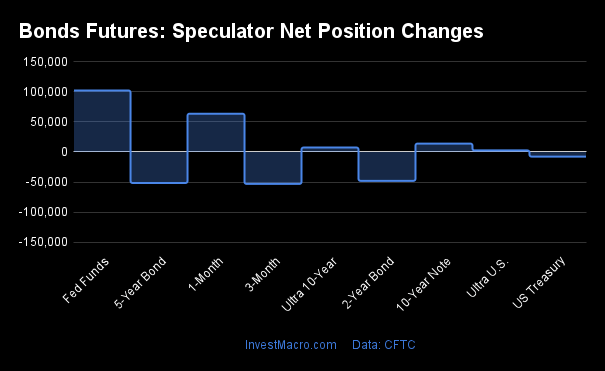
The COT bond market speculator bets were mixed this week as four out of the eight bond markets we cover had higher positioning while the other four markets had lower speculator contracts.

Leading the gains for the bond markets was the SOFR 3-Months (154,318 contracts) with the Ultra 10-Year Bonds (35,286 contracts), the 5-Year Bonds (26,739 contracts) and the Ultra Treasury Bonds (11,341 contracts) also showing positive weeks.

The bond markets with declines in speculator bets for the week were the Fed Funds (-62,065 contracts), the 10-Year Bonds (-46,540 contracts), the 2-Year Bonds (-13,463 contracts) and the US Treasury Bonds (-12,879 contracts) also registering lower bets on the week.


Data Snapshot of Bond Market Traders | Columns Legend
Aug-08-2023OIOI-IndexSpec-NetSpec-IndexCom-NetCOM-IndexSmalls-NetSmalls-Index
SOFR-3-Months10,208,50598-54,1137769,34623-15,23380
FedFunds1,496,41146-193,34123200,41977-7,07877
2-Year3,746,749100-1,109,12631,009,3369699,79096
Long T-Bond1,333,06789-199,55520155,1166644,43981
10-Year4,872,43398-691,72615673,5539118,17377
5-Year5,711,857100-1,230,30721,185,8769844,43193


Strength Scores led by SOFR 3-Months & Fed Funds

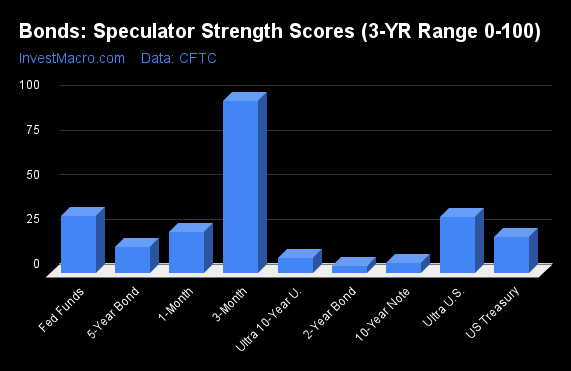
COT Strength Scores (a normalized measure of Speculator positions over a 3-Year range, from 0 to 100 where above 80 is Extreme-Bullish and below 20 is Extreme-Bearish) showed that the SOFR 3-Months (77 percent) and the Fed Funds (23 percent) lead the bond markets this week.

On the downside, the 5-Year Bonds (2 percent), the 2-Year Bonds (3 percent), the Ultra Treasury Bonds (5 percent), the Ultra 10-Year Bonds (14 percent), the 10-Year Bond (15.4 percent) and the  US Treasury Bond (19.7 percent) come in at the lowest strength level currently and all are in Extreme-Bearish territory (below 20 percent).

Strength Statistics:
Fed Funds (22.7 percent) vs Fed Funds previous week (33.8 percent)
2-Year Bond (3.0 percent) vs 2-Year Bond previous week (4.1 percent)
5-Year Bond (2.0 percent) vs 5-Year Bond previous week (0.0 percent)
10-Year Bond (15.4 percent) vs 10-Year Bond previous week (19.9 percent)
Ultra 10-Year Bond (13.9 percent) vs Ultra 10-Year Bond previous week (6.7 percent)
US Treasury Bond (19.7 percent) vs US Treasury Bond previous week (23.8 percent)
Ultra US Treasury Bond (4.6 percent) vs Ultra US Treasury Bond previous week (0.0 percent)
SOFR 3-Months (76.7 percent) vs SOFR 3-Months previous week (66.1 percent)


10-Year Bonds & Ultra 10-Year Bonds top the 6-Week Strength Trends

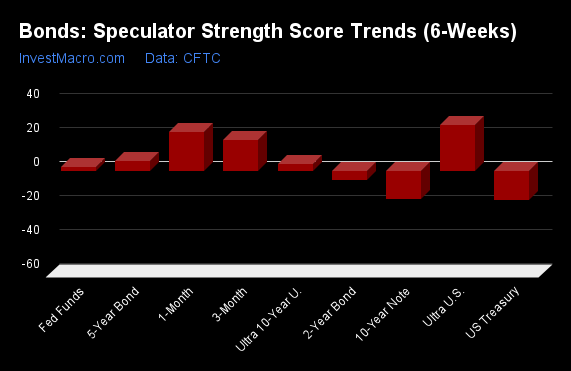
COT Strength Score Trends (or move index, calculates the 6-week changes in strength scores) showed that the 10-Year Bonds (11 percent) lead the past six weeks trends for bonds. The 2-Year Bonds (-8 percent) and the are the next highest positive movers in the latest trends data.

The US Treasury Bonds (-27 percent), the SOFR 3-Months (-23 percent) and the Fed Funds (-19 percent) lead the downside trend scores currently.

Strength Trend Statistics:
Fed Funds (-18.6 percent) vs Fed Funds previous week (-5.3 percent)
2-Year Bond (-7.7 percent) vs 2-Year Bond previous week (-5.5 percent)
5-Year Bond (-17.1 percent) vs 5-Year Bond previous week (-22.1 percent)
10-Year Bond (10.6 percent) vs 10-Year Bond previous week (10.2 percent)
Ultra 10-Year Bond (-3.8 percent) vs Ultra 10-Year Bond previous week (-10.3 percent)
US Treasury Bond (-27.4 percent) vs US Treasury Bond previous week (-27.5 percent)
Ultra US Treasury Bond (-8.6 percent) vs Ultra US Treasury Bond previous week (-21.4 percent)
SOFR 3-Months (-23.3 percent) vs SOFR 3-Months previous week (-28.5 percent)


Secured Overnight Financing Rate (3-Month) Futures:

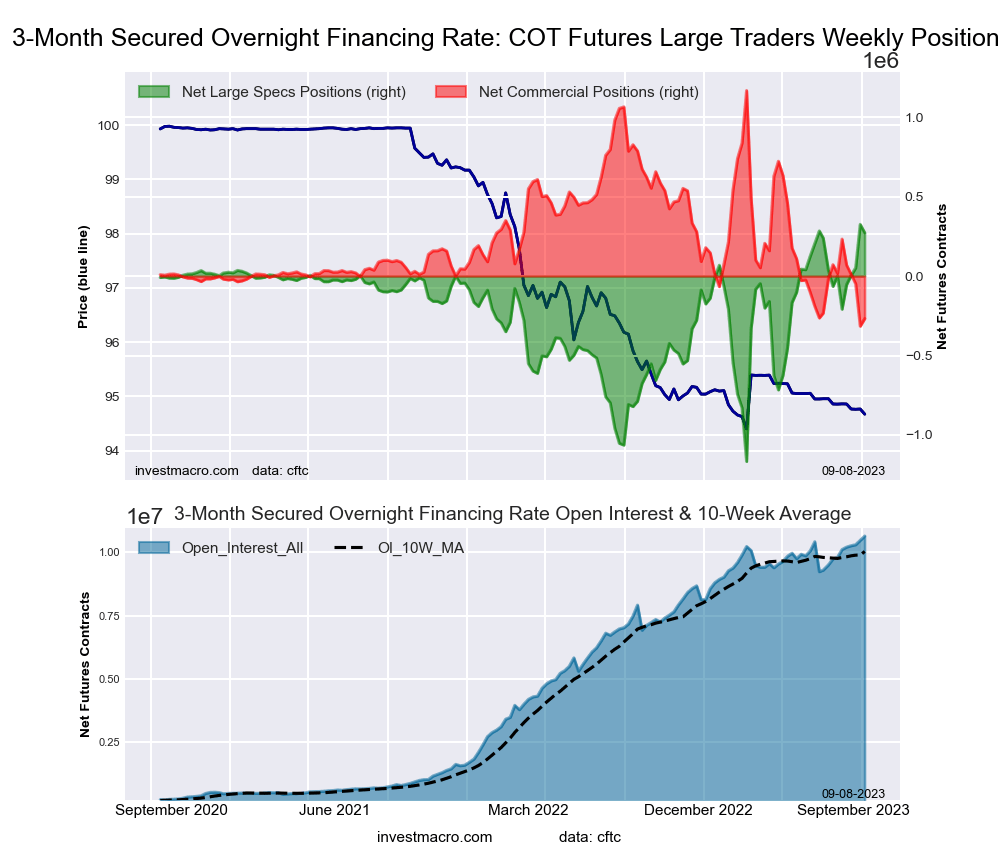
SOFR 3-Months Bonds Futures COT ChartThe Secured Overnight Financing Rate (3-Month) large speculator standing this week equaled a net position of -54,113 contracts in the data reported through Tuesday. This was a weekly advance of 154,318 contracts from the previous week which had a total of -208,431 net contracts.

This week’s current strength score (the trader positioning range over the past three years, measured from 0 to 100) shows the speculators are currently Bullish with a score of 76.7 percent. The commercials are Bearish with a score of 23.3 percent and the small traders (not shown in chart) are Bullish with a score of 79.5 percent.

Price Trend-Following Model: Weak Uptrend

Our weekly trend-following model classifies the current market price position as: Weak Uptrend. The current action for the model is considered to be: Hold – Maintain Long Position.

SOFR 3-Months StatisticsSPECULATORSCOMMERCIALSSMALL TRADERS
– Percent of Open Interest Longs:17.560.30.2
– Percent of Open Interest Shorts:18.059.60.4
– Net Position:-54,11369,346-15,233
– Gross Longs:1,782,3726,153,81721,947
– Gross Shorts:1,836,4856,084,47137,180
– Long to Short Ratio:1.0 to 11.0 to 10.6 to 1
NET POSITION TREND:
– Strength Index Score (3 Year Range Pct):76.723.379.5
– Strength Index Reading (3 Year Range):BullishBearishBullish
NET POSITION MOVEMENT INDEX:
– 6-Week Change in Strength Index:-23.323.32.9


30-Day Federal Funds Futures:

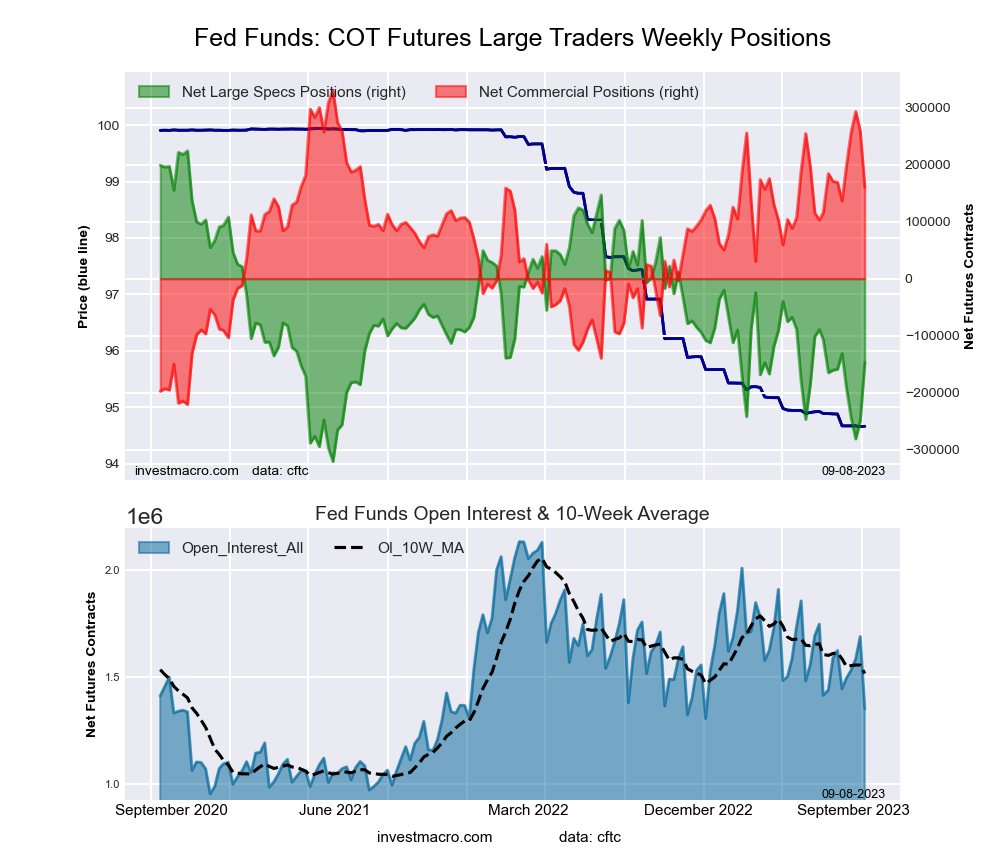
Federal Funds 30-Day Bonds Futures COT ChartThe 30-Day Federal Funds large speculator standing this week equaled a net position of -193,341 contracts in the data reported through Tuesday. This was a weekly decline of -62,065 contracts from the previous week which had a total of -131,276 net contracts.

This week’s current strength score (the trader positioning range over the past three years, measured from 0 to 100) shows the speculators are currently Bearish with a score of 22.7 percent. The commercials are Bullish with a score of 77.0 percent and the small traders (not shown in chart) are Bullish with a score of 77.1 percent.

Price Trend-Following Model: Downtrend

Our weekly trend-following model classifies the current market price position as: Downtrend. The current action for the model is considered to be: Hold – Maintain Short Position.

30-Day Federal Funds StatisticsSPECULATORSCOMMERCIALSSMALL TRADERS
– Percent of Open Interest Longs:3.675.42.3
– Percent of Open Interest Shorts:16.562.02.8
– Net Position:-193,341200,419-7,078
– Gross Longs:53,1831,127,66834,533
– Gross Shorts:246,524927,24941,611
– Long to Short Ratio:0.2 to 11.2 to 10.8 to 1
NET POSITION TREND:
– Strength Index Score (3 Year Range Pct):22.777.077.1
– Strength Index Reading (3 Year Range):BearishBullishBullish
NET POSITION MOVEMENT INDEX:
– 6-Week Change in Strength Index:-18.617.213.8


2-Year Treasury Note Futures:

2-Year Treasury Bonds Futures COT ChartThe 2-Year Treasury Note large speculator standing this week equaled a net position of -1,109,126 contracts in the data reported through Tuesday. This was a weekly lowering of -13,463 contracts from the previous week which had a total of -1,095,663 net contracts.

This week’s current strength score (the trader positioning range over the past three years, measured from 0 to 100) shows the speculators are currently Bearish-Extreme with a score of 3.0 percent. The commercials are Bullish-Extreme with a score of 96.2 percent and the small traders (not shown in chart) are Bullish-Extreme with a score of 95.7 percent.

Price Trend-Following Model: Downtrend

Our weekly trend-following model classifies the current market price position as: Downtrend. The current action for the model is considered to be: Hold – Maintain Short Position.

2-Year Treasury Note StatisticsSPECULATORSCOMMERCIALSSMALL TRADERS
– Percent of Open Interest Longs:9.981.76.7
– Percent of Open Interest Shorts:39.554.74.0
– Net Position:-1,109,1261,009,33699,790
– Gross Longs:370,3163,060,298251,275
– Gross Shorts:1,479,4422,050,962151,485
– Long to Short Ratio:0.3 to 11.5 to 11.7 to 1
NET POSITION TREND:
– Strength Index Score (3 Year Range Pct):3.096.295.7
– Strength Index Reading (3 Year Range):Bearish-ExtremeBullish-ExtremeBullish-Extreme
NET POSITION MOVEMENT INDEX:
– 6-Week Change in Strength Index:-7.77.55.5


5-Year Treasury Note Futures:

5-Year Treasury Bonds Futures COT ChartThe 5-Year Treasury Note large speculator standing this week equaled a net position of -1,230,307 contracts in the data reported through Tuesday. This was a weekly increase of 26,739 contracts from the previous week which had a total of -1,257,046 net contracts.

This week’s current strength score (the trader positioning range over the past three years, measured from 0 to 100) shows the speculators are currently Bearish-Extreme with a score of 2.0 percent. The commercials are Bullish-Extreme with a score of 98.1 percent and the small traders (not shown in chart) are Bullish-Extreme with a score of 93.2 percent.

Price Trend-Following Model: Strong Downtrend

Our weekly trend-following model classifies the current market price position as: Strong Downtrend. The current action for the model is considered to be: Hold – Maintain Short Position.

5-Year Treasury Note StatisticsSPECULATORSCOMMERCIALSSMALL TRADERS
– Percent of Open Interest Longs:7.784.36.7
– Percent of Open Interest Shorts:29.363.65.9
– Net Position:-1,230,3071,185,87644,431
– Gross Longs:442,0344,816,393383,036
– Gross Shorts:1,672,3413,630,517338,605
– Long to Short Ratio:0.3 to 11.3 to 11.1 to 1
NET POSITION TREND:
– Strength Index Score (3 Year Range Pct):2.098.193.2
– Strength Index Reading (3 Year Range):Bearish-ExtremeBullish-ExtremeBullish-Extreme
NET POSITION MOVEMENT INDEX:
– 6-Week Change in Strength Index:-17.117.05.7


10-Year Treasury Note Futures:

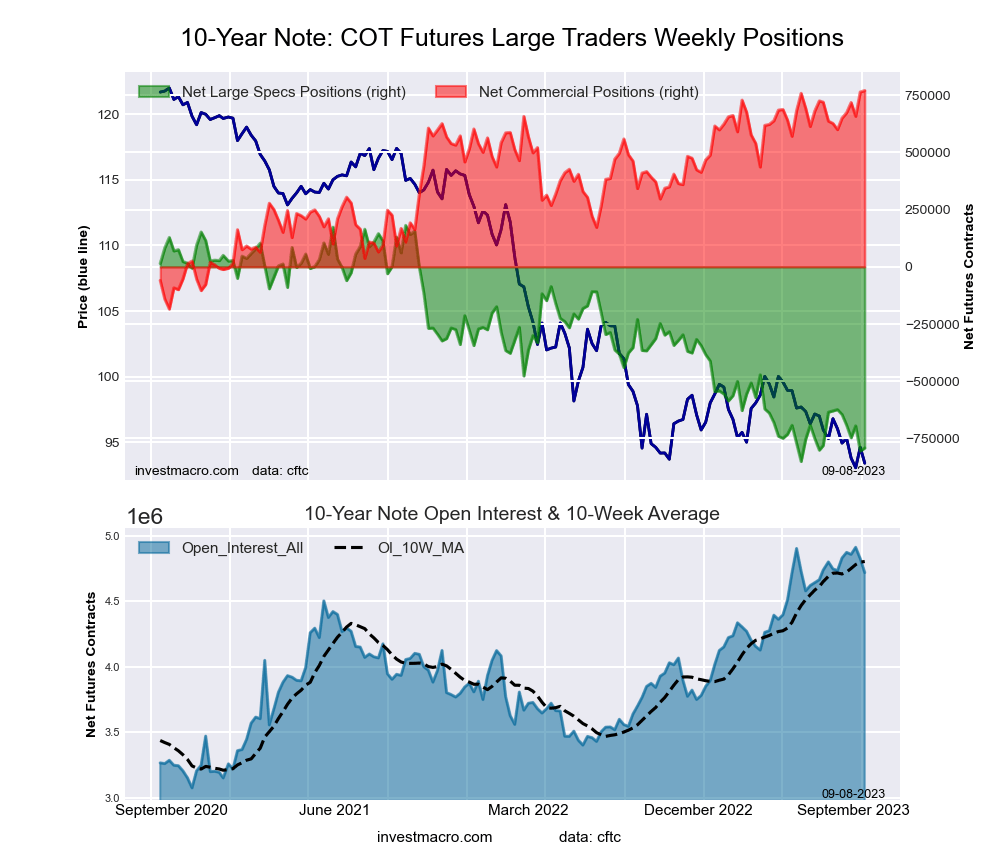
The 10-Year Treasury Note large speculator standing this week equaled a net position of -691,726 contracts in the data reported through Tuesday. This was a weekly decrease of -46,540 contracts from the previous week which had a total of -645,186 net contracts.

This week’s current strength score (the trader positioning range over the past three years, measured from 0 to 100) shows the speculators are currently Bearish-Extreme with a score of 15.4 percent. The commercials are Bullish-Extreme with a score of 91.0 percent and the small traders (not shown in chart) are Bullish with a score of 77.5 percent.

Price Trend-Following Model: Strong Downtrend

Our weekly trend-following model classifies the current market price position as: Strong Downtrend. The current action for the model is considered to be: Hold – Maintain Short Position.

10-Year Treasury Note StatisticsSPECULATORSCOMMERCIALSSMALL TRADERS
– Percent of Open Interest Longs:10.878.28.5
– Percent of Open Interest Shorts:25.064.48.2
– Net Position:-691,726673,55318,173
– Gross Longs:524,6943,810,443415,794
– Gross Shorts:1,216,4203,136,890397,621
– Long to Short Ratio:0.4 to 11.2 to 11.0 to 1
NET POSITION TREND:
– Strength Index Score (3 Year Range Pct):15.491.077.5
– Strength Index Reading (3 Year Range):Bearish-ExtremeBullish-ExtremeBullish
NET POSITION MOVEMENT INDEX:
– 6-Week Change in Strength Index:10.6-5.5-12.5


Ultra 10-Year Notes Futures:

Ultra 10-Year Treasury Notes Bonds Futures COT ChartThe Ultra 10-Year Notes large speculator standing this week equaled a net position of -149,951 contracts in the data reported through Tuesday. This was a weekly boost of 35,286 contracts from the previous week which had a total of -185,237 net contracts.

This week’s current strength score (the trader positioning range over the past three years, measured from 0 to 100) shows the speculators are currently Bearish-Extreme with a score of 13.9 percent. The commercials are Bullish-Extreme with a score of 88.3 percent and the small traders (not shown in chart) are Bullish with a score of 53.2 percent.

Price Trend-Following Model: Weak Uptrend

Our weekly trend-following model classifies the current market price position as: Weak Uptrend. The current action for the model is considered to be: Hold – Maintain Long Position.

Ultra 10-Year Notes StatisticsSPECULATORSCOMMERCIALSSMALL TRADERS
– Percent of Open Interest Longs:11.377.79.3
– Percent of Open Interest Shorts:19.663.715.0
– Net Position:-149,951252,369-102,418
– Gross Longs:203,9581,402,515167,668
– Gross Shorts:353,9091,150,146270,086
– Long to Short Ratio:0.6 to 11.2 to 10.6 to 1
NET POSITION TREND:
– Strength Index Score (3 Year Range Pct):13.988.353.2
– Strength Index Reading (3 Year Range):Bearish-ExtremeBullish-ExtremeBullish
NET POSITION MOVEMENT INDEX:
– 6-Week Change in Strength Index:-3.816.9-35.5


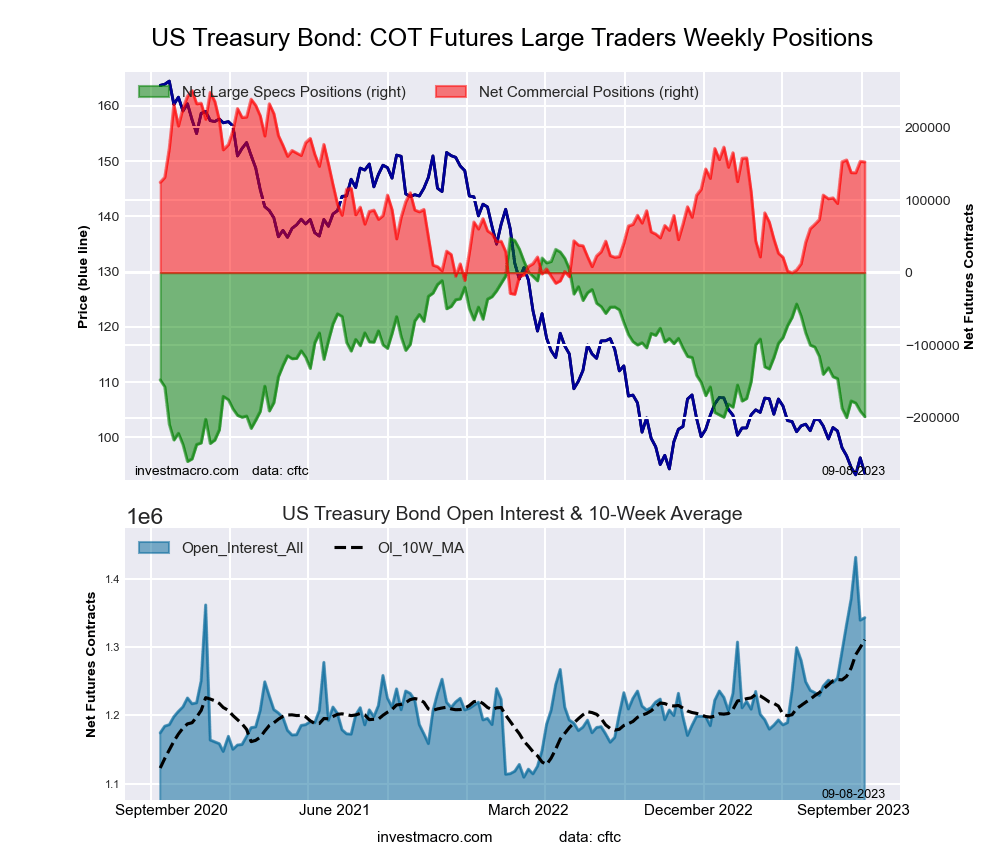
US Treasury Bonds Futures:

US Year Treasury Notes Long Bonds Futures COT ChartThe US Treasury Bonds large speculator standing this week equaled a net position of -199,555 contracts in the data reported through Tuesday. This was a weekly decrease of -12,879 contracts from the previous week which had a total of -186,676 net contracts.

This week’s current strength score (the trader positioning range over the past three years, measured from 0 to 100) shows the speculators are currently Bearish-Extreme with a score of 19.7 percent. The commercials are Bullish with a score of 65.9 percent and the small traders (not shown in chart) are Bullish-Extreme with a score of 80.8 percent.

Price Trend-Following Model: Strong Downtrend

Our weekly trend-following model classifies the current market price position as: Strong Downtrend. The current action for the model is considered to be: Hold – Maintain Short Position.

US Treasury Bonds StatisticsSPECULATORSCOMMERCIALSSMALL TRADERS
– Percent of Open Interest Longs:5.876.914.7
– Percent of Open Interest Shorts:20.865.211.3
– Net Position:-199,555155,11644,439
– Gross Longs:77,1321,024,818195,687
– Gross Shorts:276,687869,702151,248
– Long to Short Ratio:0.3 to 11.2 to 11.3 to 1
NET POSITION TREND:
– Strength Index Score (3 Year Range Pct):19.765.980.8
– Strength Index Reading (3 Year Range):Bearish-ExtremeBullishBullish-Extreme
NET POSITION MOVEMENT INDEX:
– 6-Week Change in Strength Index:-27.429.31.6


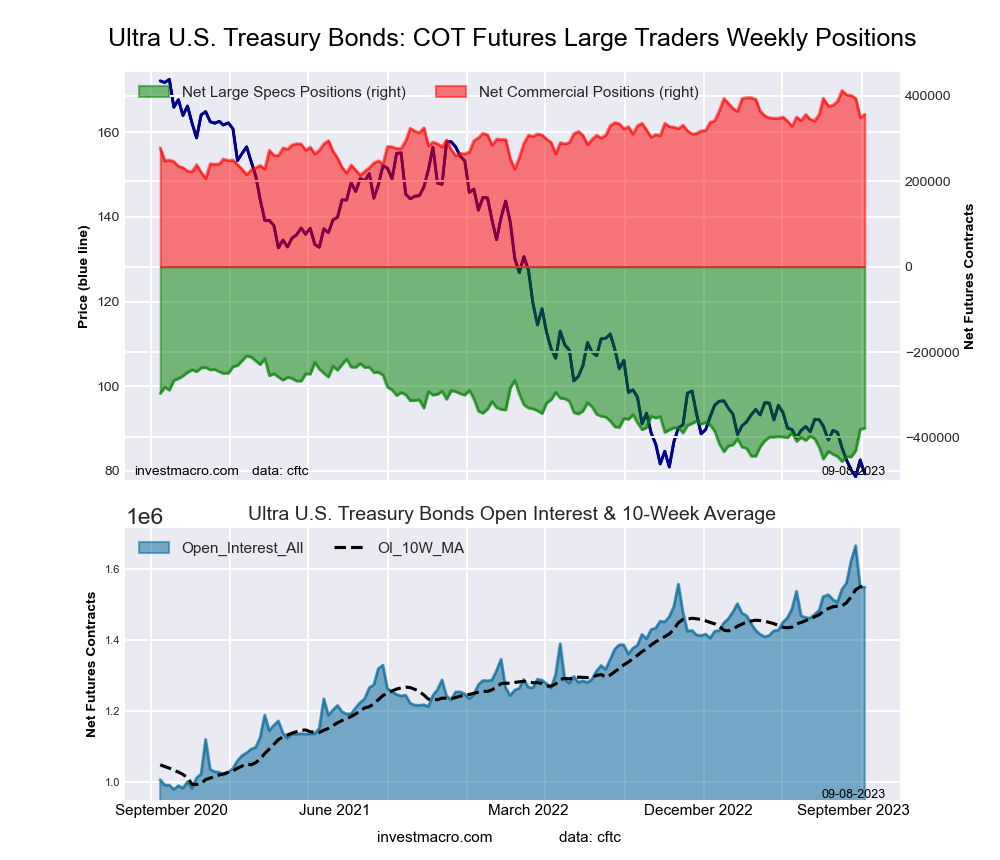
Ultra US Treasury Bonds Futures:

Ultra US Year Treasury Notes Long Bonds Futures COT ChartThe Ultra US Treasury Bonds large speculator standing this week equaled a net position of -445,088 contracts in the data reported through Tuesday. This was a weekly boost of 11,341 contracts from the previous week which had a total of -456,429 net contracts.

This week’s current strength score (the trader positioning range over the past three years, measured from 0 to 100) shows the speculators are currently Bearish-Extreme with a score of 4.6 percent. The commercials are Bullish-Extreme with a score of 95.0 percent and the small traders (not shown in chart) are Bullish with a score of 77.6 percent.

Price Trend-Following Model: Strong Downtrend

Our weekly trend-following model classifies the current market price position as: Strong Downtrend. The current action for the model is considered to be: Hold – Maintain Short Position.

Ultra US Treasury Bonds StatisticsSPECULATORSCOMMERCIALSSMALL TRADERS
– Percent of Open Interest Longs:5.782.711.0
– Percent of Open Interest Shorts:34.257.08.3
– Net Position:-445,088402,28642,802
– Gross Longs:88,2651,291,140172,047
– Gross Shorts:533,353888,854129,245
– Long to Short Ratio:0.2 to 11.5 to 11.3 to 1
NET POSITION TREND:
– Strength Index Score (3 Year Range Pct):4.695.077.6
– Strength Index Reading (3 Year Range):Bearish-ExtremeBullish-ExtremeBullish
NET POSITION MOVEMENT INDEX:
– 6-Week Change in Strength Index:-8.621.9-22.4


Article By InvestMacroReceive our weekly COT Newsletter

*COT Report: The COT data, released weekly to the public each Friday, is updated through the most recent Tuesday (data is 3 days old) and shows a quick view of how large speculators or non-commercials (for-profit traders) were positioned in the futures markets.

The CFTC categorizes trader positions according to commercial hedgers (traders who use futures contracts for hedging as part of the business), non-commercials (large traders who speculate to realize trading profits) and nonreportable traders (usually small traders/speculators) as well as their open interest (contracts open in the market at time of reporting). See CFTC criteria here.
COT Stock Market Charts: Weekly Speculator Changes led by S&P500-Mini

By InvestMacro

Here are the latest charts and statistics for the Commitment of Traders (COT) data published by the Commodities Futures Trading Commission (CFTC).

The latest COT data is updated through Tuesday August 8th and shows a quick view of how large traders (for-profit speculators and commercial entities) were positioned in the futures markets.

Weekly Speculator Changes led by S&P500-Mini

The COT stock markets speculator bets were higher this week as six out of the seven stock markets we cover had higher positioning while only one market had lower speculator contracts.

Leading the gains for the stock markets was the S&P500-Mini (40,478 contracts) with the DowJones-Mini (2,451 contracts), MSCI EAFE-Mini (1,279 contracts), Nasdaq-Mini (526 contracts), Nikkei 225 (180 contracts) and the Russell-Mini (1,780 contracts) also showing positive weeks.

The market with a decline in speculator bets this week was the VIX with a drop of -2,238 contracts on the week.


Data Snapshot of Stock Market Traders | Columns Legend
Aug-08-2023OIOI-IndexSpec-NetSpec-IndexCom-NetCOM-IndexSmalls-NetSmalls-Index
S&P500-Mini2,221,70923-159,57041139,8955919,67551
Nikkei 22516,18717-66665-453331,11942
Nasdaq-Mini267,79743-10,8797113,62732-2,74848
DowJones-Mini106,566754,03185-2,46729-1,56436
VIX376,60461-44,4048748,88211-4,47873
Nikkei 225 Yen48,866335,8315215,50453-21,33538


Strength Scores led by VIX & DowJones-Mini

COT Strength Scores (a normalized measure of Speculator positions over a 3-Year range, from 0 to 100 where above 80 is Extreme-Bullish and below 20 is Extreme-Bearish) showed that the VIX (87 percent) and the DowJones-Mini (85 percent) lead the stock markets this week. The Nasdaq-Mini (71 percent) and Nikkei 225 (65 percent) come in as the next highest in the weekly strength scores.

On the downside, the MSCI EAFE-Mini (16 percent) comes in at the lowest strength level currently and is in Extreme-Bearish territory (below 20 percent). The next lowest strength score is the Russell-Mini (33 percent).

Strength Statistics:
VIX (87.1 percent) vs VIX previous week (88.7 percent)
S&P500-Mini (40.9 percent) vs S&P500-Mini previous week (34.9 percent)
DowJones-Mini (85.3 percent) vs DowJones-Mini previous week (78.4 percent)
Nasdaq-Mini (70.9 percent) vs Nasdaq-Mini previous week (70.6 percent)
Russell2000-Mini (33.3 percent) vs Russell2000-Mini previous week (32.2 percent)
Nikkei USD (64.7 percent) vs Nikkei USD previous week (63.6 percent)
EAFE-Mini (16.3 percent) vs EAFE-Mini previous week (14.7 percent)


DowJones-Mini & Nikkei 225 top the 6-Week Strength Trends

COT Strength Score Trends (or move index, calculates the 6-week changes in strength scores) showed that the DowJones-Mini (65 percent) leads the past six weeks trends for the stock markets. The Nikkei 225 (36 percent), the VIX (15 percent) and the S&P500-Mini (7 percent) are the next highest positive movers in the latest trends data.

The Nasdaq-Mini (-16 percent) leads the downside trend scores currently with the EAFE-Mini (-8.5 percent) coming in as the next market with lower trend scores.

Strength Trend Statistics:
VIX (14.9 percent) vs VIX previous week (13.8 percent)
S&P500-Mini (7.3 percent) vs S&P500-Mini previous week (5.9 percent)
DowJones-Mini (65.0 percent) vs DowJones-Mini previous week (49.4 percent)
Nasdaq-Mini (-16.2 percent) vs Nasdaq-Mini previous week (-15.7 percent)
Russell 2000-Mini (-0.5 percent) vs Russell 2000-Mini previous week (3.9 percent)
Nikkei USD (36.4 percent) vs Nikkei USD previous week (40.3 percent)
EAFE-Mini (-8.5 percent) vs EAFE-Mini previous week (-10.1 percent)


Individual Stock Market Charts:

VIX Volatility Futures:

VIX Volatility Futures COT ChartThe VIX Volatility large speculator standing this week was a net position of -44,404 contracts in the data reported through Tuesday. This was a weekly lowering of -2,238 contracts from the previous week which had a total of -42,166 net contracts.

This week’s current strength score (the trader positioning range over the past three years, measured from 0 to 100) shows the speculators are currently Bullish-Extreme with a score of 87.1 percent. The commercials are Bearish-Extreme with a score of 10.8 percent and the small traders (not shown in chart) are Bullish with a score of 73.1 percent.

Price Trend-Following Model: Weak Downtrend

Our weekly trend-following model classifies the current market price position as: Weak Downtrend. The current action for the model is considered to be: Hold – Maintain Short Position.

VIX Volatility Futures StatisticsSPECULATORSCOMMERCIALSSMALL TRADERS
– Percent of Open Interest Longs:25.245.36.4
– Percent of Open Interest Shorts:37.032.37.6
– Net Position:-44,40448,882-4,478
– Gross Longs:95,022170,48124,125
– Gross Shorts:139,426121,59928,603
– Long to Short Ratio:0.7 to 11.4 to 10.8 to 1
NET POSITION TREND:
– Strength Index Score (3 Year Range Pct):87.110.873.1
– Strength Index Reading (3 Year Range):Bullish-ExtremeBearish-ExtremeBullish
NET POSITION MOVEMENT INDEX:
– 6-Week Change in Strength Index:14.9-12.8-13.6


S&P500 Mini Futures:

SP500 Mini Futures COT ChartThe S&P500 Mini large speculator standing this week was a net position of -159,570 contracts in the data reported through Tuesday. This was a weekly increase of 40,478 contracts from the previous week which had a total of -200,048 net contracts.

This week’s current strength score (the trader positioning range over the past three years, measured from 0 to 100) shows the speculators are currently Bearish with a score of 40.9 percent. The commercials are Bullish with a score of 59.2 percent and the small traders (not shown in chart) are Bullish with a score of 51.1 percent.

Price Trend-Following Model: Uptrend

Our weekly trend-following model classifies the current market price position as: Uptrend. The current action for the model is considered to be: Hold – Maintain Long Position.

S&P500 Mini Futures StatisticsSPECULATORSCOMMERCIALSSMALL TRADERS
– Percent of Open Interest Longs:10.874.511.8
– Percent of Open Interest Shorts:18.068.210.9
– Net Position:-159,570139,89519,675
– Gross Longs:240,9131,654,088261,201
– Gross Shorts:400,4831,514,193241,526
– Long to Short Ratio:0.6 to 11.1 to 11.1 to 1
NET POSITION TREND:
– Strength Index Score (3 Year Range Pct):40.959.251.1
– Strength Index Reading (3 Year Range):BearishBullishBullish
NET POSITION MOVEMENT INDEX:
– 6-Week Change in Strength Index:7.3-9.05.7


Dow Jones Mini Futures:

Dow Jones Mini Futures COT ChartThe Dow Jones Mini large speculator standing this week was a net position of 4,031 contracts in the data reported through Tuesday. This was a weekly increase of 2,451 contracts from the previous week which had a total of 1,580 net contracts.

This week’s current strength score (the trader positioning range over the past three years, measured from 0 to 100) shows the speculators are currently Bullish-Extreme with a score of 85.3 percent. The commercials are Bearish with a score of 28.8 percent and the small traders (not shown in chart) are Bearish with a score of 36.3 percent.

Price Trend-Following Model: Strong Uptrend

Our weekly trend-following model classifies the current market price position as: Strong Uptrend. The current action for the model is considered to be: Hold – Maintain Long Position.

Dow Jones Mini Futures StatisticsSPECULATORSCOMMERCIALSSMALL TRADERS
– Percent of Open Interest Longs:31.051.313.5
– Percent of Open Interest Shorts:27.253.614.9
– Net Position:4,031-2,467-1,564
– Gross Longs:33,02754,69314,336
– Gross Shorts:28,99657,16015,900
– Long to Short Ratio:1.1 to 11.0 to 10.9 to 1
NET POSITION TREND:
– Strength Index Score (3 Year Range Pct):85.328.836.3
– Strength Index Reading (3 Year Range):Bullish-ExtremeBearishBearish
NET POSITION MOVEMENT INDEX:
– 6-Week Change in Strength Index:65.0-45.9-1.6


Nasdaq Mini Futures:

Nasdaq Mini Futures COT ChartThe Nasdaq Mini large speculator standing this week was a net position of -10,879 contracts in the data reported through Tuesday. This was a weekly gain of 526 contracts from the previous week which had a total of -11,405 net contracts.

This week’s current strength score (the trader positioning range over the past three years, measured from 0 to 100) shows the speculators are currently Bullish with a score of 70.9 percent. The commercials are Bearish with a score of 31.5 percent and the small traders (not shown in chart) are Bearish with a score of 48.2 percent.

Price Trend-Following Model: Uptrend

Our weekly trend-following model classifies the current market price position as: Uptrend. The current action for the model is considered to be: Hold – Maintain Long Position.

Nasdaq Mini Futures StatisticsSPECULATORSCOMMERCIALSSMALL TRADERS
– Percent of Open Interest Longs:26.256.714.8
– Percent of Open Interest Shorts:30.351.715.8
– Net Position:-10,87913,627-2,748
– Gross Longs:70,170151,96939,533
– Gross Shorts:81,049138,34242,281
– Long to Short Ratio:0.9 to 11.1 to 10.9 to 1
NET POSITION TREND:
– Strength Index Score (3 Year Range Pct):70.931.548.2
– Strength Index Reading (3 Year Range):BullishBearishBearish
NET POSITION MOVEMENT INDEX:
– 6-Week Change in Strength Index:-16.216.25.8


Russell 2000 Mini Futures:

Russell 2000 Mini Futures COT ChartThe Russell 2000 Mini large speculator standing this week was a net position of -64,511 contracts in the data reported through Tuesday. This was a weekly boost of 1,780 contracts from the previous week which had a total of -66,291 net contracts.

This week’s current strength score (the trader positioning range over the past three years, measured from 0 to 100) shows the speculators are currently Bearish with a score of 33.3 percent. The commercials are Bullish with a score of 66.0 percent and the small traders (not shown in chart) are Bearish with a score of 30.5 percent.

Price Trend-Following Model: Uptrend

Our weekly trend-following model classifies the current market price position as: Uptrend. The current action for the model is considered to be: Hold – Maintain Long Position.

Russell 2000 Mini Futures StatisticsSPECULATORSCOMMERCIALSSMALL TRADERS
– Percent of Open Interest Longs:9.583.84.8
– Percent of Open Interest Shorts:22.071.54.5
– Net Position:-64,51163,2531,258
– Gross Longs:48,700430,72624,588
– Gross Shorts:113,211367,47323,330
– Long to Short Ratio:0.4 to 11.2 to 11.1 to 1
NET POSITION TREND:
– Strength Index Score (3 Year Range Pct):33.366.030.5
– Strength Index Reading (3 Year Range):BearishBullishBearish
NET POSITION MOVEMENT INDEX:
– 6-Week Change in Strength Index:-0.52.0-8.4


Nikkei Stock Average (USD) Futures:

Nikkei Stock Average (USD) Futures COT ChartThe Nikkei Stock Average (USD) large speculator standing this week was a net position of -666 contracts in the data reported through Tuesday. This was a weekly increase of 180 contracts from the previous week which had a total of -846 net contracts.

This week’s current strength score (the trader positioning range over the past three years, measured from 0 to 100) shows the speculators are currently Bullish with a score of 64.7 percent. The commercials are Bearish with a score of 33.1 percent and the small traders (not shown in chart) are Bearish with a score of 42.4 percent.

Price Trend-Following Model: Uptrend

Our weekly trend-following model classifies the current market price position as: Uptrend. The current action for the model is considered to be: Hold – Maintain Long Position.

Nikkei Stock Average Futures StatisticsSPECULATORSCOMMERCIALSSMALL TRADERS
– Percent of Open Interest Longs:9.265.725.2
– Percent of Open Interest Shorts:13.368.518.2
– Net Position:-666-4531,119
– Gross Longs:1,48310,6314,073
– Gross Shorts:2,14911,0842,954
– Long to Short Ratio:0.7 to 11.0 to 11.4 to 1
NET POSITION TREND:
– Strength Index Score (3 Year Range Pct):64.733.142.4
– Strength Index Reading (3 Year Range):BullishBearishBearish
NET POSITION MOVEMENT INDEX:
– 6-Week Change in Strength Index:36.4-30.5-7.1


MSCI EAFE Mini Futures:

MSCI EAFE Mini Futures COT ChartThe MSCI EAFE Mini large speculator standing this week was a net position of -22,909 contracts in the data reported through Tuesday. This was a weekly gain of 1,279 contracts from the previous week which had a total of -24,188 net contracts.

This week’s current strength score (the trader positioning range over the past three years, measured from 0 to 100) shows the speculators are currently Bearish-Extreme with a score of 16.3 percent. The commercials are Bullish with a score of 76.7 percent and the small traders (not shown in chart) are Bullish with a score of 58.3 percent.

Price Trend-Following Model: Weak Uptrend

Our weekly trend-following model classifies the current market price position as: Weak Uptrend. The current action for the model is considered to be: Hold – Maintain Long Position.

MSCI EAFE Mini Futures StatisticsSPECULATORSCOMMERCIALSSMALL TRADERS
– Percent of Open Interest Longs:6.689.63.1
– Percent of Open Interest Shorts:12.385.91.0
– Net Position:-22,90914,6128,297
– Gross Longs:26,299357,20212,404
– Gross Shorts:49,208342,5904,107
– Long to Short Ratio:0.5 to 11.0 to 13.0 to 1
NET POSITION TREND:
– Strength Index Score (3 Year Range Pct):16.376.758.3
– Strength Index Reading (3 Year Range):Bearish-ExtremeBullishBullish
NET POSITION MOVEMENT INDEX:
– 6-Week Change in Strength Index:-8.50.133.9


Article By InvestMacroReceive our weekly COT Newsletter

*COT Report: The COT data, released weekly to the public each Friday, is updated through the most recent Tuesday (data is 3 days old) and shows a quick view of how large speculators or non-commercials (for-profit traders) were positioned in the futures markets.

The CFTC categorizes trader positions according to commercial hedgers (traders who use futures contracts for hedging as part of the business), non-commercials (large traders who speculate to realize trading profits) and nonreportable traders (usually small traders/speculators) as well as their open interest (contracts open in the market at time of reporting). See CFTC criteria here.