COT Soft Commodities Charts: Weekly Speculator Bets led lower by Corn & Soybeans

By InvestMacro

Here are the latest charts and statistics for the Commitment of Traders (COT) reports data published by the Commodities Futures Trading Commission (CFTC).

The latest COT data is updated through Tuesday August 8th and shows a quick view of how large traders (for-profit speculators and commercial entities) were positioned in the futures markets.

Weekly Speculator Bets led lower by Corn & Soybeans

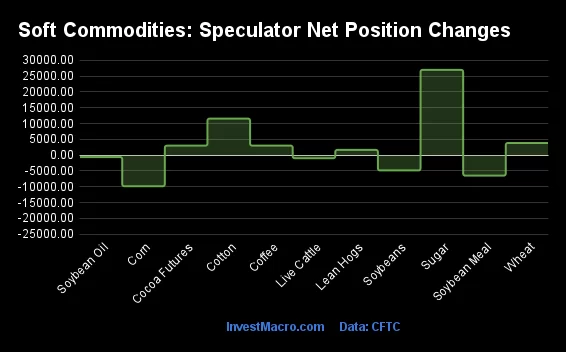
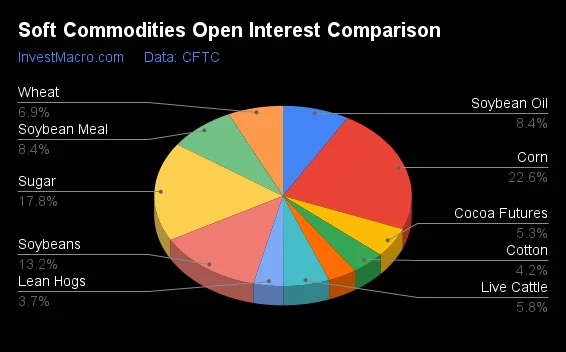
The COT soft commodities markets speculator bets were lower this week as three out of the eleven softs markets we cover had higher positioning while the other eight markets had lower speculator contracts.

Leading the gains for the softs markets was Wheat (3,283 contracts) with Cocoa (1,288 contracts) and Live Cattle (348 contracts) also showing positive weeks.

The markets with the declines in speculator bets this week were Corn (-54,347 contracts) with Soybeans (-30,297 contracts), Lean Hogs (-1,122 contracts), Sugar (-12,378 contracts), Coffee (-18,522 contracts), Soybean Meal (-2,539 contracts), Cotton (-2,736 contracts) and Soybean Oil (-658 contracts) also registering lower bets on the week.


Data Snapshot of Commodity Market Traders | Columns Legend
Aug-08-2023OIOI-IndexSpec-NetSpec-IndexCom-NetCOM-IndexSmalls-NetSmalls-Index
WTI Crude1,703,71127255,92829-278,3387422,41024
Gold427,7593142,98540-167,5545924,56942
Silver137,6312913,32437-30,3495717,02561
Copper228,53765-10,057224,908765,14951
Palladium20,470100-10,192010,299100-10735
Platinum79,9891002,99222-8,591765,59943
Natural Gas1,183,14646-107,8432981,7177226,12642
Brent121,5940-34,7404432,092582,64845
Heating Oil324,9344630,88184-57,5161526,63591
Soybeans628,1821283,46322-63,65275-19,81154
Corn1,284,4331225,7271626,79486-52,52140
Coffee180,11838,49536-8,05268-4437
Sugar912,26051199,22361-230,7693931,54643
Wheat343,98234-22,7945125,57849-2,78463


Strength Scores led by Cocoa & Live Cattle

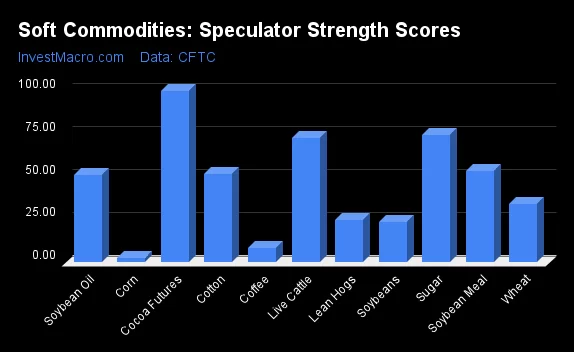
COT Strength Scores (a normalized measure of Speculator positions over a 3-Year range, from 0 to 100 where above 80 is Extreme-Bullish and below 20 is Extreme-Bearish) showed that Cocoa (100 percent) and Live Cattle (77 percent) lead the softs markets this week. Sugar (61 percent), Soybean Meal (61 percent) and Wheat (51 percent) come in as the next highest in the weekly strength scores.

On the downside, Corn (16 percent) and Soybeans (22 percent) come in at the lowest strength levels currently. The next lowest strength scores are the Lean Hogs (25 percent) and the Coffee (36 percent).

Strength Statistics:
Corn (16.5 percent) vs Corn previous week (25.2 percent)
Sugar (61.3 percent) vs Sugar previous week (65.7 percent)
Coffee (36.1 percent) vs Coffee previous week (61.8 percent)
Soybeans (22.0 percent) vs Soybeans previous week (33.9 percent)
Soybean Oil (47.0 percent) vs Soybean Oil previous week (47.4 percent)
Soybean Meal (61.0 percent) vs Soybean Meal previous week (62.4 percent)
Live Cattle (77.4 percent) vs Live Cattle previous week (77.0 percent)
Lean Hogs (25.3 percent) vs Lean Hogs previous week (26.2 percent)
Cotton (39.7 percent) vs Cotton previous week (41.7 percent)
Cocoa (100.0 percent) vs Cocoa previous week (98.6 percent)
Wheat (50.6 percent) vs Wheat previous week (48.2 percent)


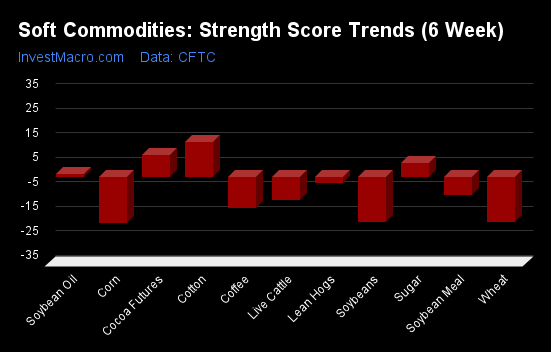
Cotton & Wheat top the 6-Week Strength Trends

COT Strength Score Trends (or move index, calculates the 6-week changes in strength scores) showed that Cotton (32 percent) and Wheat (17 percent) lead the past six weeks trends for soft commodities. Soybean Oil (10 percent), Cocoa (9 percent) and Lean Hogs (9 percent) are the next highest positive movers in the latest trends data.

Coffee (-23 percent) leads the downside trend scores currently with Corn (-14 percent), Live Cattle (-13 percent) and Sugar (-7 percent) following next with lower trend scores.

Strength Trend Statistics:
Corn (-14.0 percent) vs Corn previous week (-6.2 percent)
Sugar (-7.4 percent) vs Sugar previous week (-17.5 percent)
Coffee (-23.1 percent) vs Coffee previous week (-0.0 percent)
Soybeans (-7.2 percent) vs Soybeans previous week (9.9 percent)
Soybean Oil (9.9 percent) vs Soybean Oil previous week (13.0 percent)
Soybean Meal (4.3 percent) vs Soybean Meal previous week (1.0 percent)
Live Cattle (-12.7 percent) vs Live Cattle previous week (-16.2 percent)
Lean Hogs (9.2 percent) vs Lean Hogs previous week (11.9 percent)
Cotton (32.2 percent) vs Cotton previous week (28.0 percent)
Cocoa (8.9 percent) vs Cocoa previous week (12.2 percent)
Wheat (17.3 percent) vs Wheat previous week (28.6 percent)


Individual Soft Commodities Markets:

CORN Futures:

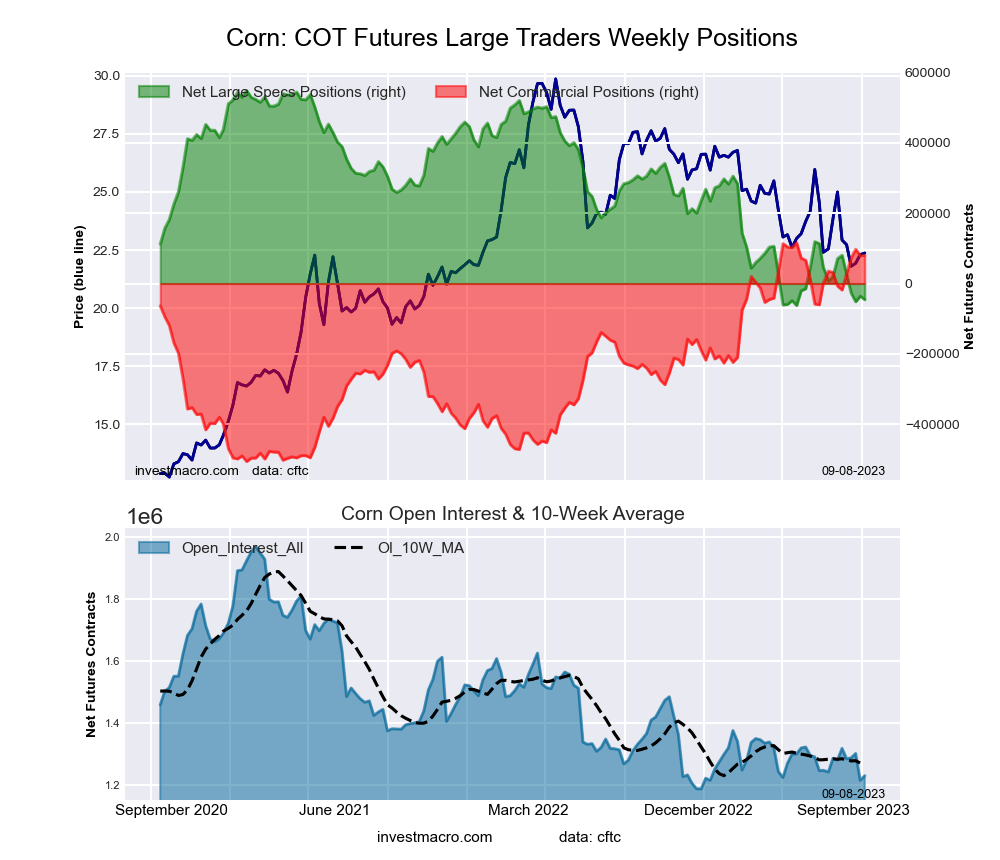
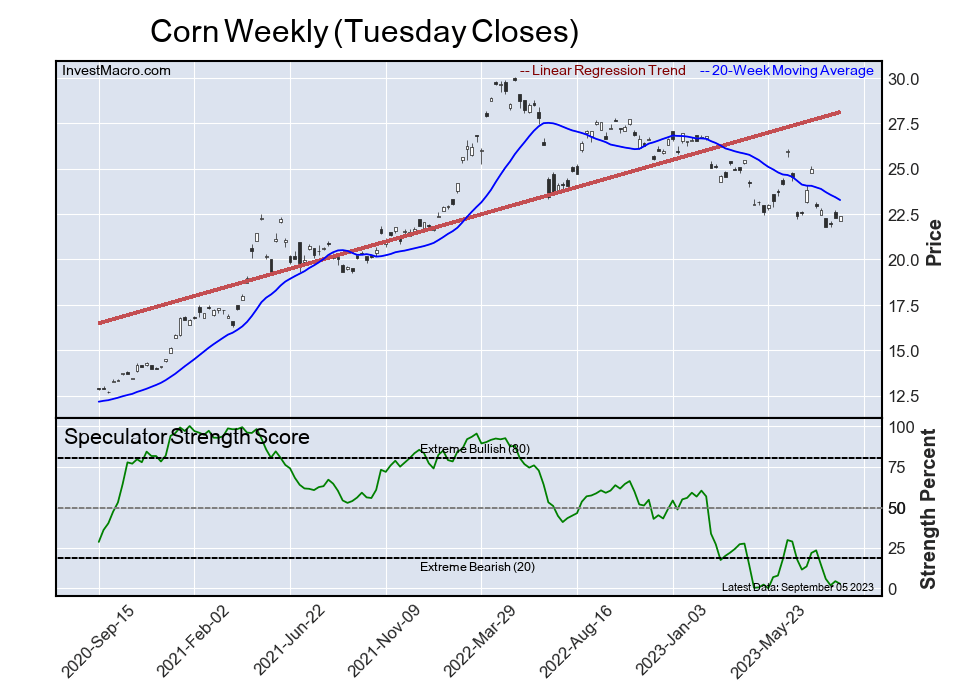
CORN Futures COT ChartThe CORN large speculator standing this week was a net position of 25,727 contracts in the data reported through Tuesday. This was a weekly decrease of -54,347 contracts from the previous week which had a total of 80,074 net contracts.

This week’s current strength score (the trader positioning range over the past three years, measured from 0 to 100) shows the speculators are currently Bearish-Extreme with a score of 16.5 percent. The commercials are Bullish-Extreme with a score of 85.7 percent and the small traders (not shown in chart) are Bearish with a score of 40.2 percent.

Price Trend-Following Model: Strong Downtrend

Our weekly trend-following model classifies the current market price position as: Strong Downtrend. The current action for the model is considered to be: Hold – Maintain Short Position.

CORN Futures StatisticsSPECULATORSCOMMERCIALSSMALL TRADERS
– Percent of Open Interest Longs:22.648.39.6
– Percent of Open Interest Shorts:20.646.213.7
– Net Position:25,72726,794-52,521
– Gross Longs:290,414619,891123,007
– Gross Shorts:264,687593,097175,528
– Long to Short Ratio:1.1 to 11.0 to 10.7 to 1
NET POSITION TREND:
– Strength Index Score (3 Year Range Pct):16.585.740.2
– Strength Index Reading (3 Year Range):Bearish-ExtremeBullish-ExtremeBearish
NET POSITION MOVEMENT INDEX:
– 6-Week Change in Strength Index:-14.014.01.2


SUGAR Futures:

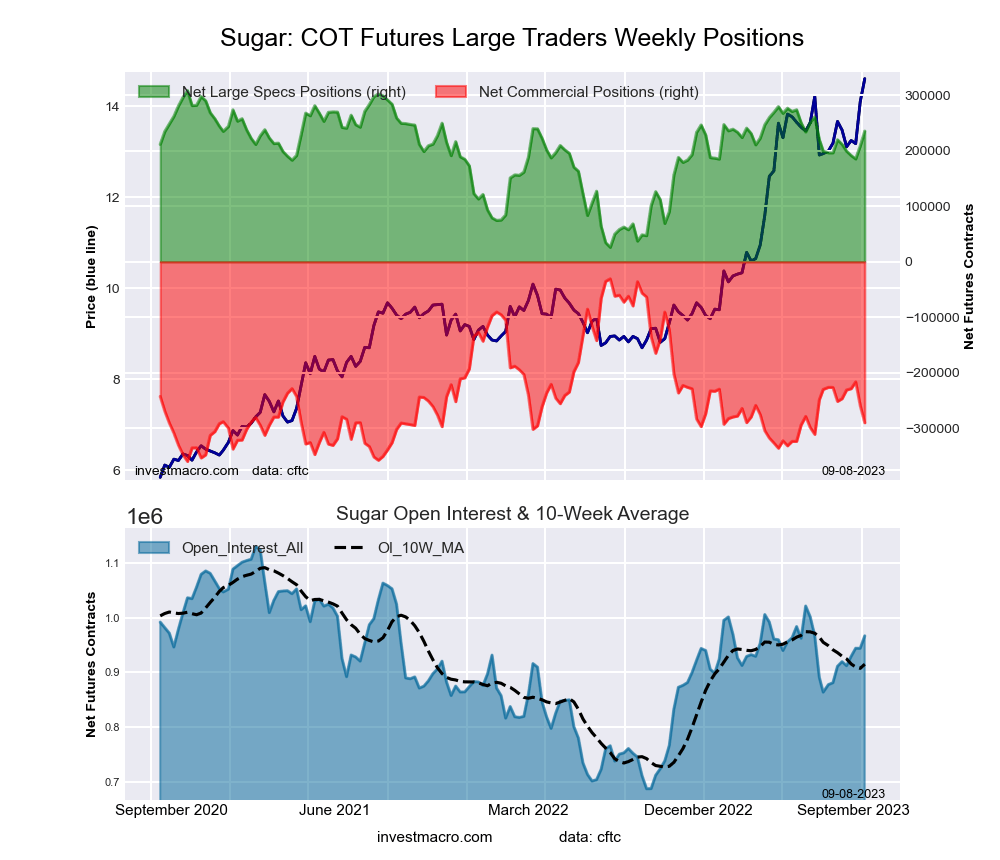
SUGAR Futures COT ChartThe SUGAR large speculator standing this week was a net position of 199,223 contracts in the data reported through Tuesday. This was a weekly reduction of -12,378 contracts from the previous week which had a total of 211,601 net contracts.

This week’s current strength score (the trader positioning range over the past three years, measured from 0 to 100) shows the speculators are currently Bullish with a score of 61.3 percent. The commercials are Bearish with a score of 39.1 percent and the small traders (not shown in chart) are Bearish with a score of 43.4 percent.

Price Trend-Following Model: Uptrend

Our weekly trend-following model classifies the current market price position as: Uptrend. The current action for the model is considered to be: Hold – Maintain Long Position.

SUGAR Futures StatisticsSPECULATORSCOMMERCIALSSMALL TRADERS
– Percent of Open Interest Longs:31.245.58.4
– Percent of Open Interest Shorts:9.470.84.9
– Net Position:199,223-230,76931,546
– Gross Longs:284,974414,85676,675
– Gross Shorts:85,751645,62545,129
– Long to Short Ratio:3.3 to 10.6 to 11.7 to 1
NET POSITION TREND:
– Strength Index Score (3 Year Range Pct):61.339.143.4
– Strength Index Reading (3 Year Range):BullishBearishBearish
NET POSITION MOVEMENT INDEX:
– 6-Week Change in Strength Index:-7.45.44.4


COFFEE Futures:

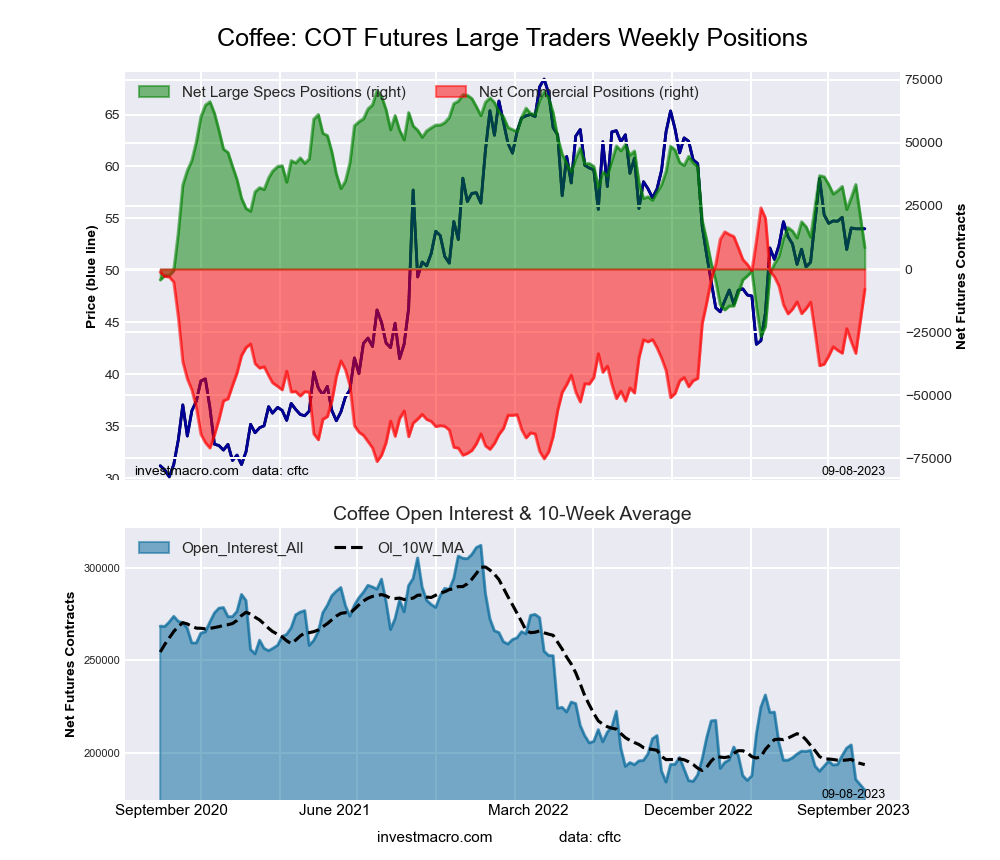
COFFEE Futures COT ChartThe COFFEE large speculator standing this week was a net position of 8,495 contracts in the data reported through Tuesday. This was a weekly reduction of -18,522 contracts from the previous week which had a total of 33,494 net contracts.

This week’s current strength score (the trader positioning range over the past three years, measured from 0 to 100) shows the speculators are currently Bearish with a score of 36.1 percent. The commercials are Bullish with a score of 67.9 percent and the small traders (not shown in chart) are Bearish-Extreme with a score of 7.3 percent.

Price Trend-Following Model: Uptrend

Our weekly trend-following model classifies the current market price position as: Uptrend. The current action for the model is considered to be: Hold – Maintain Long Position.

COFFEE Futures StatisticsSPECULATORSCOMMERCIALSSMALL TRADERS
– Percent of Open Interest Longs:23.447.03.7
– Percent of Open Interest Shorts:18.751.43.9
– Net Position:8,495-8,052-443
– Gross Longs:42,19084,6066,662
– Gross Shorts:33,69592,6587,105
– Long to Short Ratio:1.3 to 10.9 to 10.9 to 1
NET POSITION TREND:
– Strength Index Score (3 Year Range Pct):36.167.97.3
– Strength Index Reading (3 Year Range):BearishBullishBearish-Extreme
NET POSITION MOVEMENT INDEX:
– 6-Week Change in Strength Index:-23.124.0-19.8


SOYBEANS Futures:

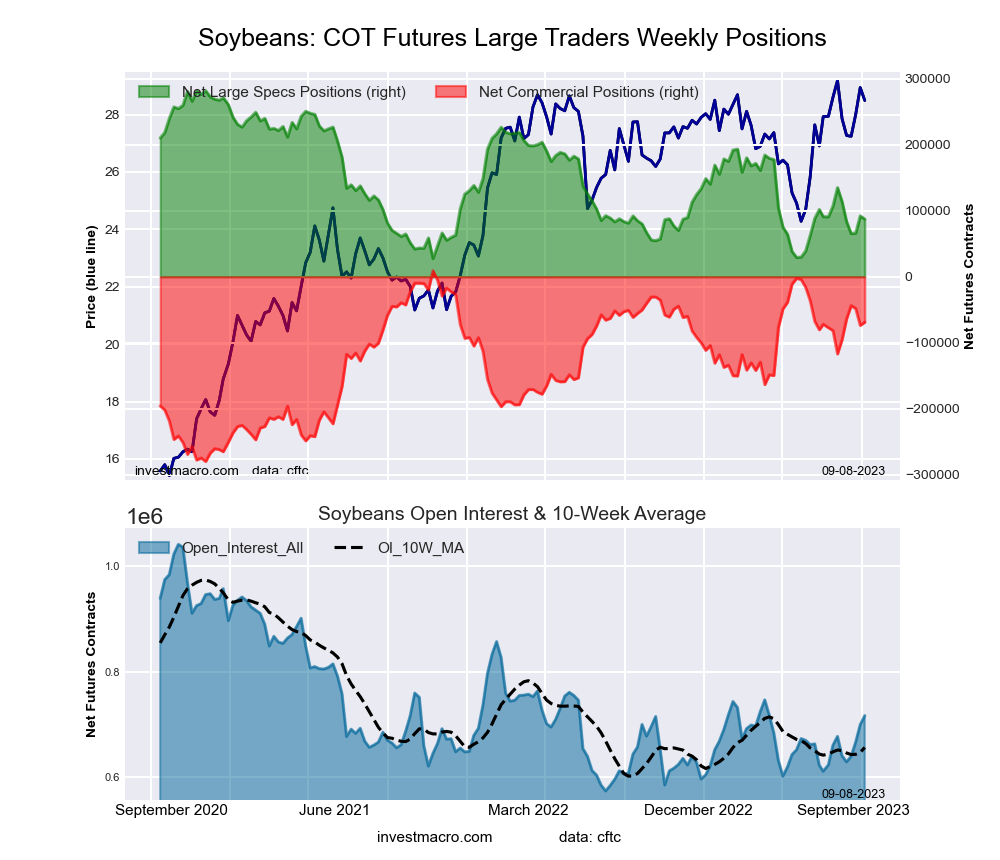
SOYBEANS Futures COT ChartThe SOYBEANS large speculator standing this week was a net position of 83,463 contracts in the data reported through Tuesday. This was a weekly decline of -30,297 contracts from the previous week which had a total of 113,760 net contracts.

This week’s current strength score (the trader positioning range over the past three years, measured from 0 to 100) shows the speculators are currently Bearish with a score of 22.0 percent. The commercials are Bullish with a score of 74.8 percent and the small traders (not shown in chart) are Bullish with a score of 53.5 percent.

Price Trend-Following Model: Uptrend

Our weekly trend-following model classifies the current market price position as: Uptrend. The current action for the model is considered to be: Hold – Maintain Long Position.

SOYBEANS Futures StatisticsSPECULATORSCOMMERCIALSSMALL TRADERS
– Percent of Open Interest Longs:23.952.96.8
– Percent of Open Interest Shorts:10.663.110.0
– Net Position:83,463-63,652-19,811
– Gross Longs:150,115332,61042,925
– Gross Shorts:66,652396,26262,736
– Long to Short Ratio:2.3 to 10.8 to 10.7 to 1
NET POSITION TREND:
– Strength Index Score (3 Year Range Pct):22.074.853.5
– Strength Index Reading (3 Year Range):BearishBullishBullish
NET POSITION MOVEMENT INDEX:
– 6-Week Change in Strength Index:-7.25.74.2


SOYBEAN OIL Futures:

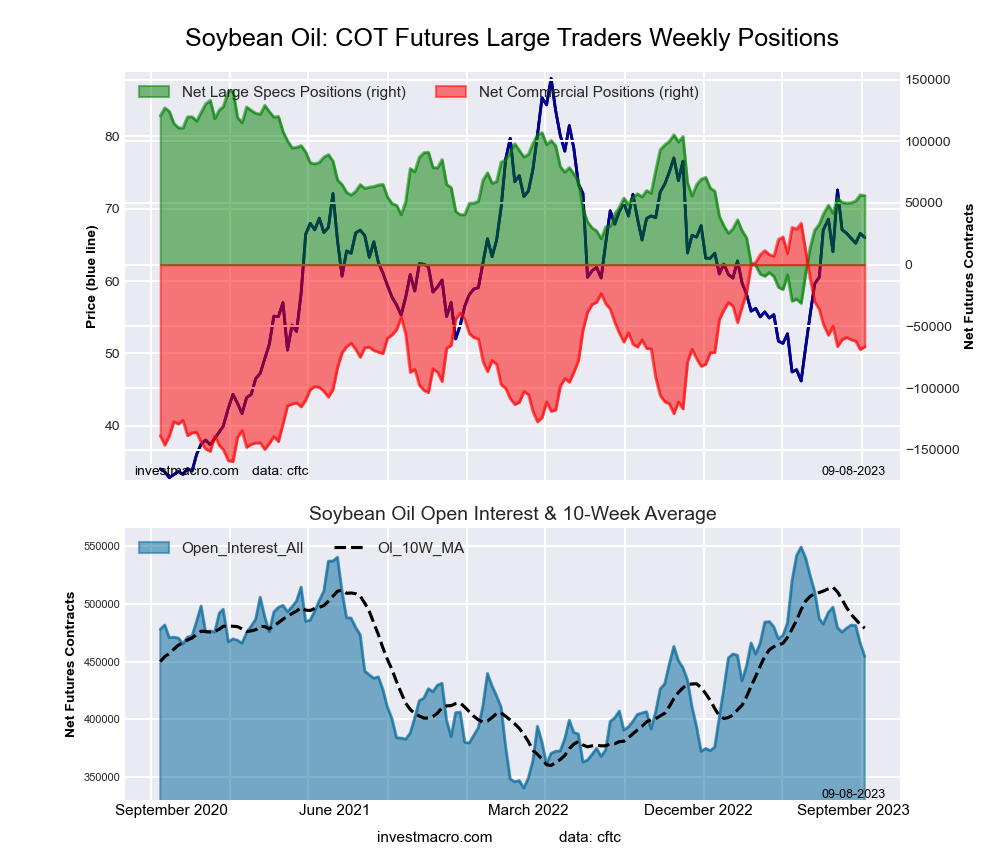
SOYBEAN OIL Futures COT ChartThe SOYBEAN OIL large speculator standing this week was a net position of 49,836 contracts in the data reported through Tuesday. This was a weekly lowering of -658 contracts from the previous week which had a total of 50,494 net contracts.

This week’s current strength score (the trader positioning range over the past three years, measured from 0 to 100) shows the speculators are currently Bearish with a score of 47.0 percent. The commercials are Bullish with a score of 52.0 percent and the small traders (not shown in chart) are Bearish with a score of 47.7 percent.

Price Trend-Following Model: Uptrend

Our weekly trend-following model classifies the current market price position as: Uptrend. The current action for the model is considered to be: Hold – Maintain Long Position.

SOYBEAN OIL Futures StatisticsSPECULATORSCOMMERCIALSSMALL TRADERS
– Percent of Open Interest Longs:20.352.97.0
– Percent of Open Interest Shorts:9.965.25.1
– Net Position:49,836-59,0019,165
– Gross Longs:97,041253,12433,351
– Gross Shorts:47,205312,12524,186
– Long to Short Ratio:2.1 to 10.8 to 11.4 to 1
NET POSITION TREND:
– Strength Index Score (3 Year Range Pct):47.052.047.7
– Strength Index Reading (3 Year Range):BearishBullishBearish
NET POSITION MOVEMENT INDEX:
– 6-Week Change in Strength Index:9.9-11.821.3


SOYBEAN MEAL Futures:

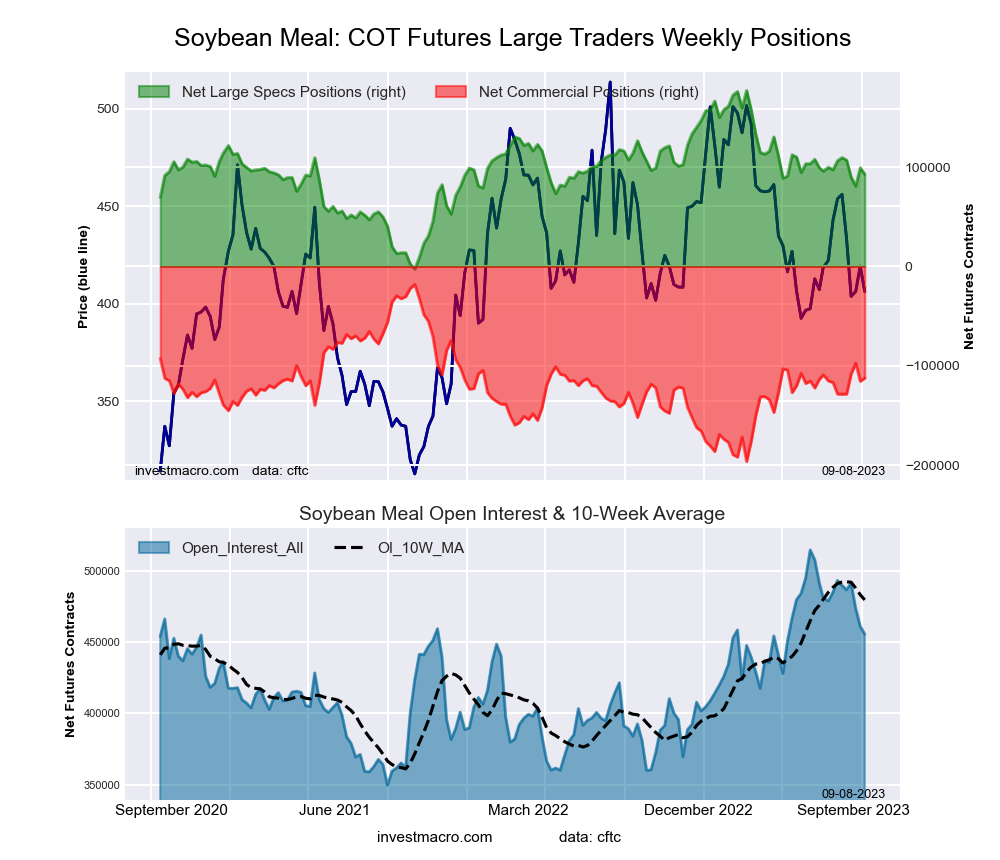
SOYBEAN MEAL Futures COT ChartThe SOYBEAN MEAL large speculator standing this week was a net position of 106,964 contracts in the data reported through Tuesday. This was a weekly fall of -2,539 contracts from the previous week which had a total of 109,503 net contracts.

This week’s current strength score (the trader positioning range over the past three years, measured from 0 to 100) shows the speculators are currently Bullish with a score of 61.0 percent. The commercials are Bearish with a score of 38.1 percent and the small traders (not shown in chart) are Bullish with a score of 51.2 percent.

Price Trend-Following Model: Weak Downtrend

Our weekly trend-following model classifies the current market price position as: Weak Downtrend. The current action for the model is considered to be: Hold – Maintain Short Position.

SOYBEAN MEAL Futures StatisticsSPECULATORSCOMMERCIALSSMALL TRADERS
– Percent of Open Interest Longs:26.036.710.0
– Percent of Open Interest Shorts:4.063.15.7
– Net Position:106,964-128,31321,349
– Gross Longs:126,380178,84048,850
– Gross Shorts:19,416307,15327,501
– Long to Short Ratio:6.5 to 10.6 to 11.8 to 1
NET POSITION TREND:
– Strength Index Score (3 Year Range Pct):61.038.151.2
– Strength Index Reading (3 Year Range):BullishBearishBullish
NET POSITION MOVEMENT INDEX:
– 6-Week Change in Strength Index:4.3-8.331.7


LIVE CATTLE Futures:

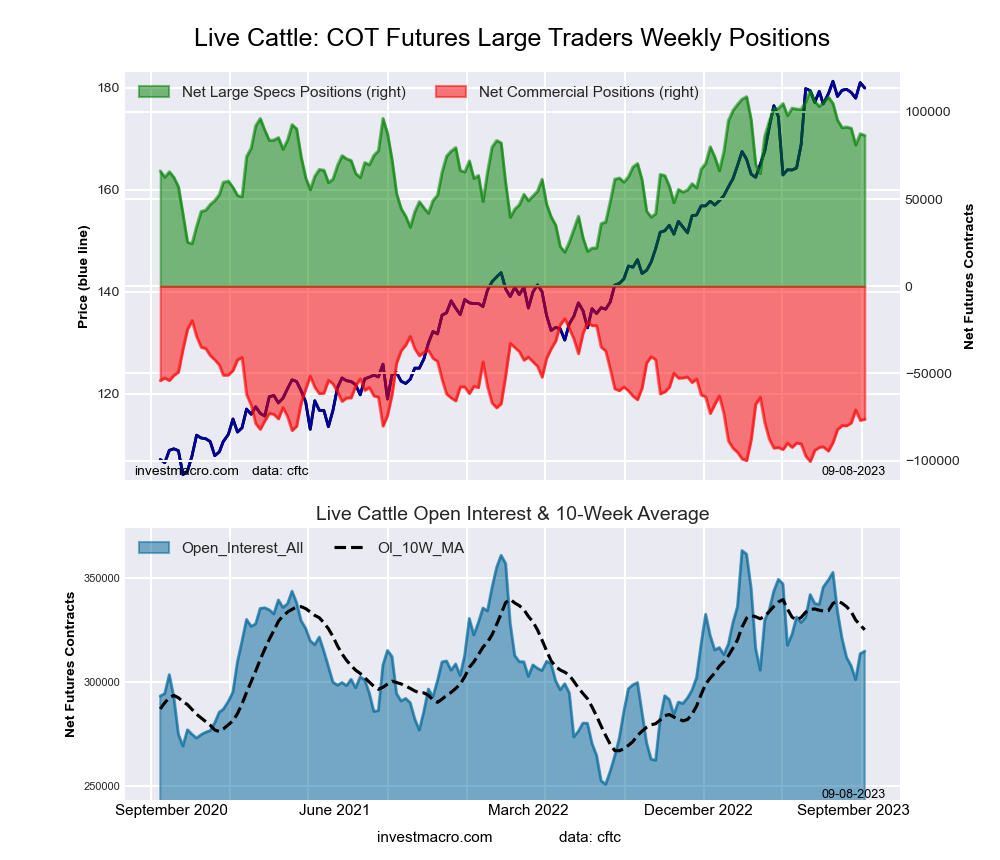
LIVE CATTLE Futures COT ChartThe LIVE CATTLE large speculator standing this week was a net position of 91,300 contracts in the data reported through Tuesday. This was a weekly lift of 348 contracts from the previous week which had a total of 90,952 net contracts.

This week’s current strength score (the trader positioning range over the past three years, measured from 0 to 100) shows the speculators are currently Bullish with a score of 77.4 percent. The commercials are Bearish with a score of 25.0 percent and the small traders (not shown in chart) are Bearish with a score of 26.4 percent.

Price Trend-Following Model: Uptrend

Our weekly trend-following model classifies the current market price position as: Uptrend. The current action for the model is considered to be: Hold – Maintain Long Position.

LIVE CATTLE Futures StatisticsSPECULATORSCOMMERCIALSSMALL TRADERS
– Percent of Open Interest Longs:43.929.39.5
– Percent of Open Interest Shorts:14.654.913.2
– Net Position:91,300-79,969-11,331
– Gross Longs:136,91991,27729,710
– Gross Shorts:45,619171,24641,041
– Long to Short Ratio:3.0 to 10.5 to 10.7 to 1
NET POSITION TREND:
– Strength Index Score (3 Year Range Pct):77.425.026.4
– Strength Index Reading (3 Year Range):BullishBearishBearish
NET POSITION MOVEMENT INDEX:
– 6-Week Change in Strength Index:-12.715.1-3.4


LEAN HOGS Futures:

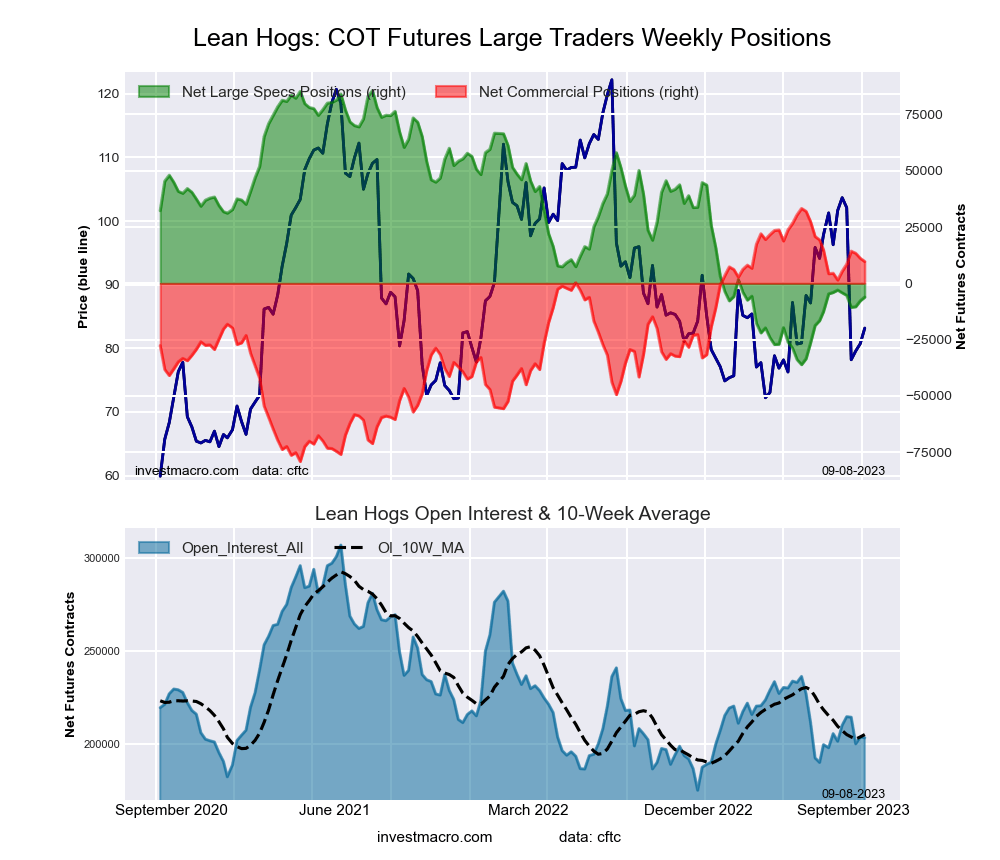
LEAN HOGS Futures COT ChartThe LEAN HOGS large speculator standing this week was a net position of -5,350 contracts in the data reported through Tuesday. This was a weekly fall of -1,122 contracts from the previous week which had a total of -4,228 net contracts.

This week’s current strength score (the trader positioning range over the past three years, measured from 0 to 100) shows the speculators are currently Bearish with a score of 25.3 percent. The commercials are Bullish with a score of 78.0 percent and the small traders (not shown in chart) are Bullish with a score of 69.3 percent.

Price Trend-Following Model: Uptrend

Our weekly trend-following model classifies the current market price position as: Uptrend. The current action for the model is considered to be: Hold – Maintain Long Position.

LEAN HOGS Futures StatisticsSPECULATORSCOMMERCIALSSMALL TRADERS
– Percent of Open Interest Longs:32.838.89.5
– Percent of Open Interest Shorts:35.334.911.0
– Net Position:-5,3508,478-3,128
– Gross Longs:70,43683,30020,389
– Gross Shorts:75,78674,82223,517
– Long to Short Ratio:0.9 to 11.1 to 10.9 to 1
NET POSITION TREND:
– Strength Index Score (3 Year Range Pct):25.378.069.3
– Strength Index Reading (3 Year Range):BearishBullishBullish
NET POSITION MOVEMENT INDEX:
– 6-Week Change in Strength Index:9.2-9.6-1.9


COTTON Futures:

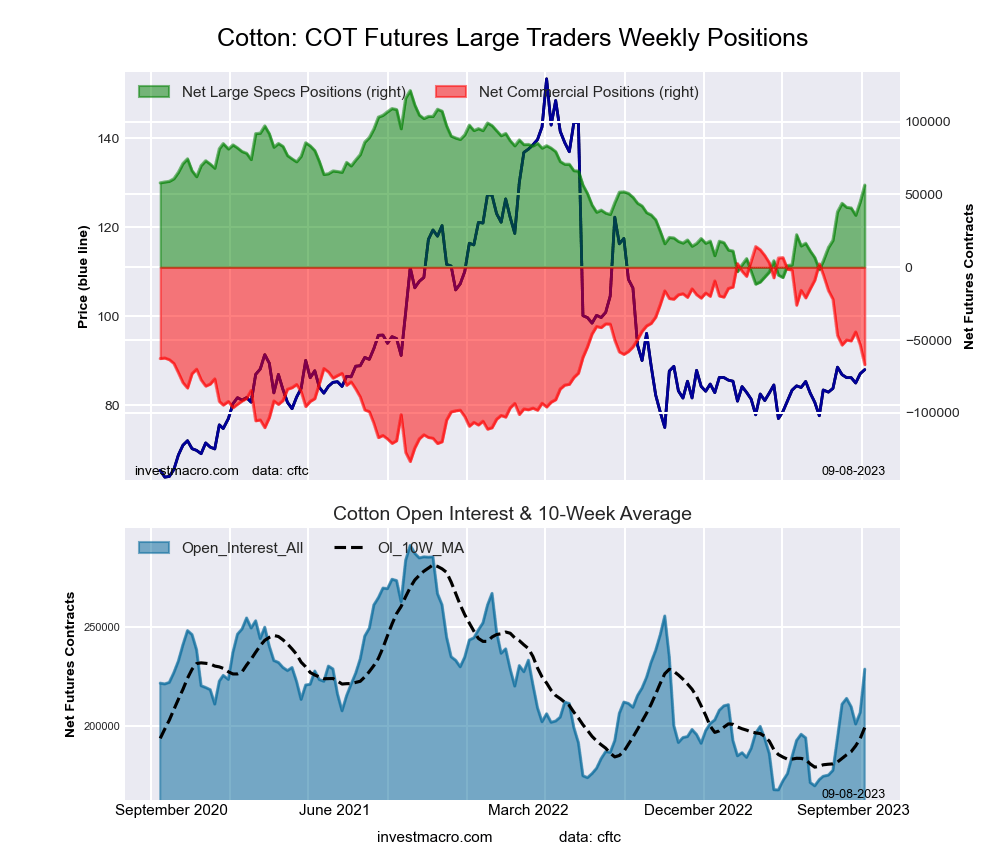
COTTON Futures COT ChartThe COTTON large speculator standing this week was a net position of 41,144 contracts in the data reported through Tuesday. This was a weekly lowering of -2,736 contracts from the previous week which had a total of 43,880 net contracts.

This week’s current strength score (the trader positioning range over the past three years, measured from 0 to 100) shows the speculators are currently Bearish with a score of 39.7 percent. The commercials are Bullish with a score of 56.5 percent and the small traders (not shown in chart) are Bullish with a score of 69.5 percent.

Price Trend-Following Model: Strong Uptrend

Our weekly trend-following model classifies the current market price position as: Strong Uptrend. The current action for the model is considered to be: Hold – Maintain Long Position.

COTTON Futures StatisticsSPECULATORSCOMMERCIALSSMALL TRADERS
– Percent of Open Interest Longs:36.044.77.5
– Percent of Open Interest Shorts:16.868.03.3
– Net Position:41,144-49,9598,815
– Gross Longs:77,07895,59115,971
– Gross Shorts:35,934145,5507,156
– Long to Short Ratio:2.1 to 10.7 to 12.2 to 1
NET POSITION TREND:
– Strength Index Score (3 Year Range Pct):39.756.569.5
– Strength Index Reading (3 Year Range):BearishBullishBullish
NET POSITION MOVEMENT INDEX:
– 6-Week Change in Strength Index:32.2-35.457.3


COCOA Futures:

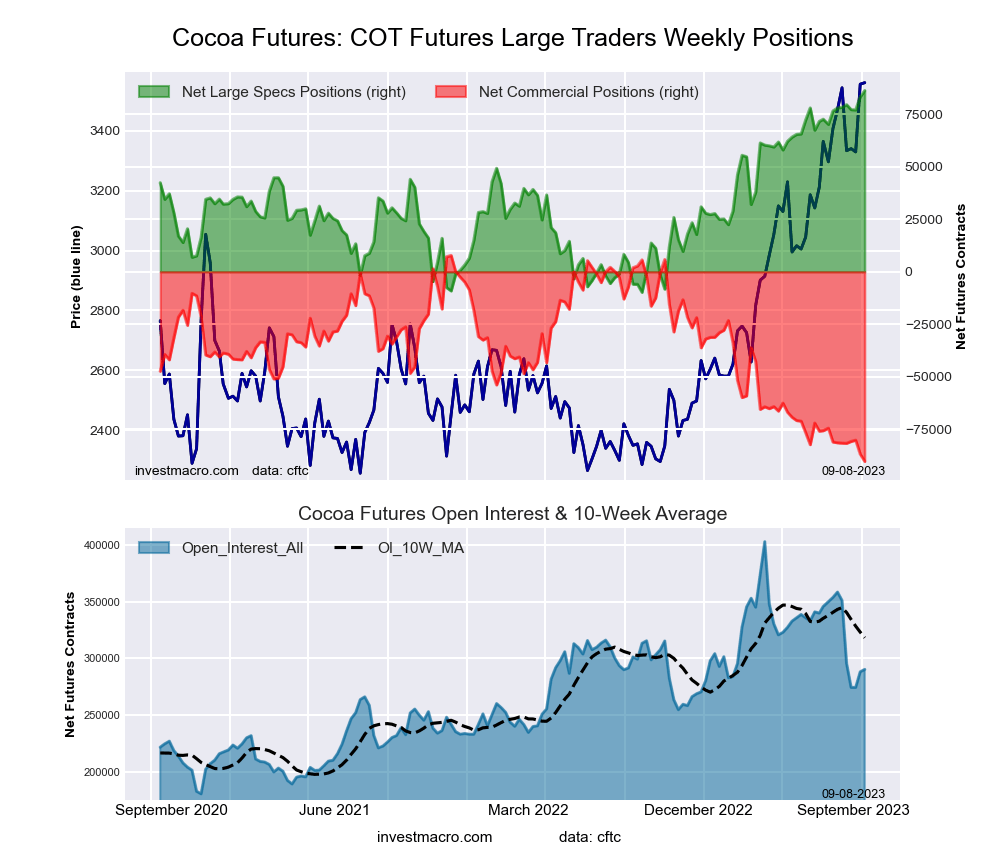
COCOA Futures COT ChartThe COCOA large speculator standing this week was a net position of 79,502 contracts in the data reported through Tuesday. This was a weekly rise of 1,288 contracts from the previous week which had a total of 78,214 net contracts.

This week’s current strength score (the trader positioning range over the past three years, measured from 0 to 100) shows the speculators are currently Bullish-Extreme with a score of 100.0 percent. The commercials are Bearish-Extreme with a score of 0.7 percent and the small traders (not shown in chart) are Bearish-Extreme with a score of 17.5 percent.

Price Trend-Following Model: Uptrend

Our weekly trend-following model classifies the current market price position as: Uptrend. The current action for the model is considered to be: Hold – Maintain Long Position.

COCOA Futures StatisticsSPECULATORSCOMMERCIALSSMALL TRADERS
– Percent of Open Interest Longs:46.726.63.5
– Percent of Open Interest Shorts:19.854.22.8
– Net Position:79,502-81,6012,099
– Gross Longs:138,10778,50610,371
– Gross Shorts:58,605160,1078,272
– Long to Short Ratio:2.4 to 10.5 to 11.3 to 1
NET POSITION TREND:
– Strength Index Score (3 Year Range Pct):100.00.717.5
– Strength Index Reading (3 Year Range):Bullish-ExtremeBearish-ExtremeBearish-Extreme
NET POSITION MOVEMENT INDEX:
– 6-Week Change in Strength Index:8.9-6.4-21.7


WHEAT Futures:

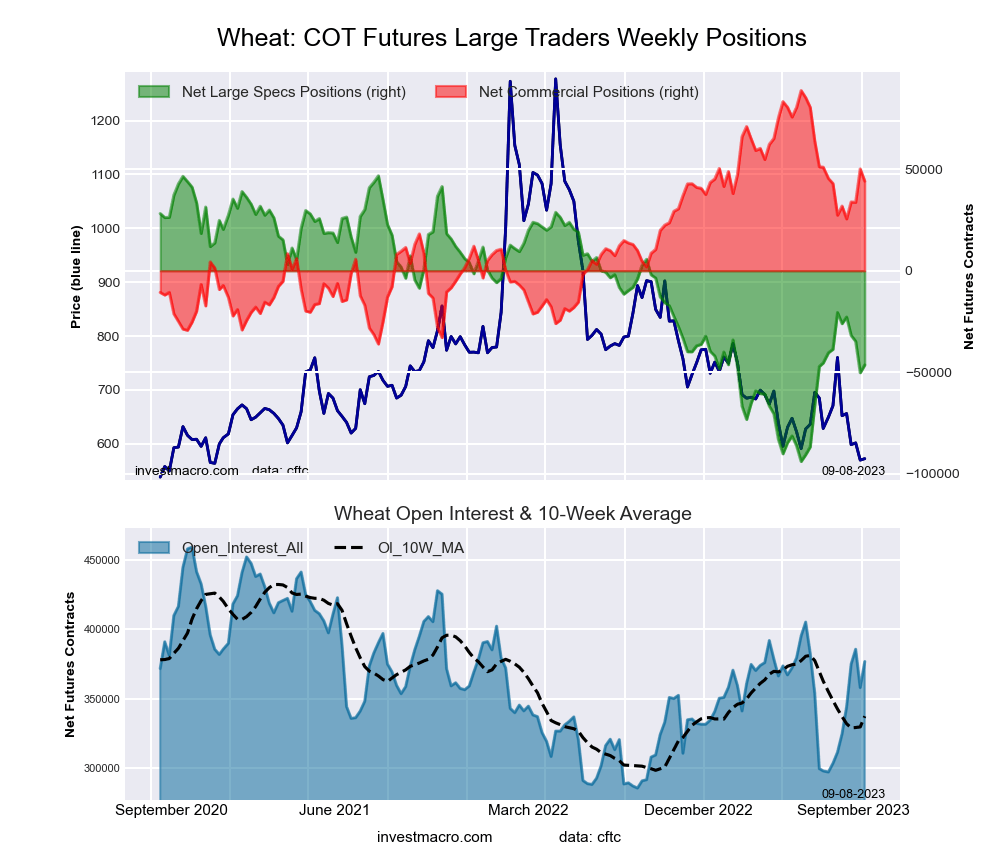
WHEAT Futures COT ChartThe WHEAT large speculator standing this week was a net position of -22,794 contracts in the data reported through Tuesday. This was a weekly advance of 3,283 contracts from the previous week which had a total of -26,077 net contracts.

This week’s current strength score (the trader positioning range over the past three years, measured from 0 to 100) shows the speculators are currently Bullish with a score of 50.6 percent. The commercials are Bearish with a score of 49.4 percent and the small traders (not shown in chart) are Bullish with a score of 62.6 percent.

Price Trend-Following Model: Strong Downtrend

Our weekly trend-following model classifies the current market price position as: Strong Downtrend. The current action for the model is considered to be: Hold – Maintain Short Position.

WHEAT Futures StatisticsSPECULATORSCOMMERCIALSSMALL TRADERS
– Percent of Open Interest Longs:30.837.09.6
– Percent of Open Interest Shorts:37.429.510.4
– Net Position:-22,79425,578-2,784
– Gross Longs:105,903127,10732,948
– Gross Shorts:128,697101,52935,732
– Long to Short Ratio:0.8 to 11.3 to 10.9 to 1
NET POSITION TREND:
– Strength Index Score (3 Year Range Pct):50.649.462.6
– Strength Index Reading (3 Year Range):BullishBearishBullish
NET POSITION MOVEMENT INDEX:
– 6-Week Change in Strength Index:17.3-20.64.7


Article By InvestMacroReceive our weekly COT Newsletter

*COT Report: The COT data, released weekly to the public each Friday, is updated through the most recent Tuesday (data is 3 days old) and shows a quick view of how large speculators or non-commercials (for-profit traders) were positioned in the futures markets.

The CFTC categorizes trader positions according to commercial hedgers (traders who use futures contracts for hedging as part of the business), non-commercials (large traders who speculate to realize trading profits) and nonreportable traders (usually small traders/speculators) as well as their open interest (contracts open in the market at time of reporting). See CFTC criteria here.

Murrey Math Lines 11.08.2023 (Brent, S&P 500)

By RoboForex.com

BRENT

Brent quotes are above the 200-day Moving Average on H4, indicating a prevailing uptrend. The RSI is testing the support line. In these circumstances, the quotes are expected to break the 4/8 (87.50) level and reach the resistance level at 5/8 (90.62). The scenario can be cancelled by a downward breakout of the support at 3/8 (84.38). In this case, the quotes could drop to 2/8 (81.25).

BRENTH4
Risk Warning: the result of previous trading operations do not guarantee the same results in the future

On M15, price growth might be additionally supported by a breakout of the upper line of the VoltyChannel.

BRENT_M15
Risk Warning: the result of previous trading operations do not guarantee the same results in the future

S&P 500

S&P 500 quotes have broken the 200-day Moving Average on H4 and are now below it, which indicates a potential downtrend. The RSI has rebounded from the resistance line. In this situation, the price is expected to test the 2/8 (4453.1) level, break it, and fall to the support at 1/8 (4414.1). The scenario can be cancelled by a breakout of the resistance at 3/8 (4492.2). In this case, the S&P 500 index could return to 4/8 (4531.2).

S&P 500_H4
Risk Warning: the result of previous trading operations do not guarantee the same results in the future

On M15, the lower line of the VoltyChannel is broken, which increases the probability of a further price decline.

S&P 500_M15

Article By RoboForex.com

Attention!
Forecasts presented in this section only reflect the author s private opinion and should not be considered as guidance for trading. RoboForex LP bears no responsibility for trading results based on trading recommendations described in these analytical reviews.

The latest US inflation data added more uncertainty. Investors are awaiting UK GDP data

By JustMarkets

At yesterday’s stock market close, the Dow Jones Index (US30) increased by 0.15%, while the S&P 500 Index (US500) added 0.03%. The NASDAQ Technology Index (US100) closed positive by 0.12% on Thursday.

US inflation data came out better than expected. The overall annualized inflation rate rose from 3% to 3.2% (forecast 3.3%), while core inflation (excluding food and energy prices) fell from 4.8% to 4.7% (forecast 4.8%). Year-on-year inflation rose for the first time since July 2022, and oil prices, which have risen 27% in a month and a half, will do nothing to further reduce inflation. There is a lot of uncertainty on the economic front right now, but what is clear is that the Fed plans to keep rates high. Before the September meeting of the Fed, the market will see another publication of macro statistics on the labor market and inflation, so investors are in no hurry to make bets and open new positions. Therefore, the end of August is likely to pass on lower volatility.

Fed San Francisco President Mary Daly expressed a cautious tone, saying that while the latest inflation data is moving in the right direction, more progress is needed before it is clear that the central bank has done enough.

Wynn Resorts Limited (WYNN) reported quarterly results that beat Wall Street estimates for both top-line and net income, helped by the continued strength of its Macau business. Alibaba Group Holdings (BABA) shares rose more than 4% after reporting quarterly earnings that notably beat analysts’ estimates.

Equity markets in Europe were mostly up yesterday. Germany’s DAX (DE40) rose by 0.91%, France’s CAC 40 (FR40) gained 1.52% on Thursday, Spain’s IBEX 35 (ES35) jumped by 1.52%, and the UK’s FTSE 100 (UK100) closed up by 0.41%.

UK GDP data will be released today. The economy is expected to grow by 0.2% for the quarter, while on an annualized basis, the economy is expected to remain at 0.5%. This data could have an impact on the outlook for the Pound and the UK100 Index. UK inflation data is expected next week, which should give a clearer picture of the Bank of England’s (BoE) stance on monetary policy. The latest market estimates put the probability of a 25 basis point rate hike on September 21 at nearly 70%, with the final rate expected to be 5.75% next March.

The US Treasury yields initially fell on the release of CPI below the fixed line and then recovered as a deeper analysis of the inflation report noted rising services inflation. Gold has an inverse correlation to government bond yields, so it was sold off at the end of the trading session yesterday.

Oil prices declined on Thursday, with Brent crude holding close to January highs. Speculation of another US interest rate hike subsided after inflation data and OPEC maintained positive oil demand forecasts.

Asian markets traded flat yesterday. Japan’s Nikkei 225 (JP225) gained 0.84%, China’s FTSE China A50 (CHA50) fell by 0.13%, Hong Kong’s Hang Seng (HK50) gained 0.01% on the day, and Australia’s S&P/ASX 200 (AU200) was positive by 0.26% on Thursday.

Fears of a collapse in China’s real estate market are renewed amid reports that the country’s largest real estate developers are having trouble meeting their debt obligations. Shares in China’s major real estate companies faced a fresh wave of selling on Friday after Country Garden Holdings, one of the country’s largest real estate companies, warned of huge losses in the first half of 2023.

S&P 500 (F)(US500) 4,468.83 +1.12 (+0.03%)

Dow Jones (US30) 35,176.15 +52.79  (+0.15%)

DAX (DE40)  15,996.52 +143.94 (+0.91%)

FTSE 100 (UK100) 7,618.60 +31.30 (+0.41%)

USD Index  102.64 +0.15 (+0.15%)

Important events for today:
  • – UK GDP (m/m) at 09:00 (GMT+3);
  • – UK Industrial Production (m/m) at 09:00 (GMT+3);
  • – UK Manufacturing Production (m/m) at 09:00 (GMT+3);
  • – US Producer Price Index (m/m) at 15:30 (GMT+3);
  • – US Michigan Consumer Sentiment (m/m) at 17:00 (GMT+3).

By JustMarkets


This article reflects a personal opinion and should not be interpreted as an investment advice, and/or offer, and/or a persistent request for carrying out financial transactions, and/or a guarantee, and/or a forecast of future events.

Week Ahead: NZDUSD to set new 2023 low?

By ForexTime 

Earlier this week, we featured the best-performing G10 currency (Swiss Franc) against the US dollar so far in 2023 in our Trade of the Week, published on Mondays.

Time to switch gears and look at the other end of the spectrum …

The New Zealand dollar is the second worst-performing G10 currency against the US dollar so far this year, with NZDUSD having shed 5.2% during the period.

NOTE: The Japanese Yen still stands as the worst-performing G10 currency versus the US dollar so far in 2023, with USDJPY having climbed by over 10% year-to-date.


Traders will be monitoring the Reserve Bank of New Zealand’s (RBNZ) upcoming policy decision, nestled within a week that also features these major economic data releases and events:

* No tier-1 data scheduled out of major economies on Monday, August 14

Tuesday, August 15

  • JPY: Japan 2Q GDP
  • AUD: RBA meeting minutes
  • CNH: China July industrial production, retail sales, unemployment
  • EUR: Germany/Eurozone August ZEW survey
  • GBP: UK June unemployment
  • USD: US July retail sales; speech by Federal Reserve Bank of Minneapolis President Neel Kashkari
  • CAD: Canada July CPI


Wednesday, August 16

  • CNH: China July new home prices
  • NZD: RBNZ rate decision
  • EUR: Eurozone 2Q GDP and employment data; June industrial production
  • GBP: UK July CPI
  • USD: FOMC meeting minutes; US July industrial production


Thursday, August 17

  • JPY: Japan July external trade
  • AUD: Australia July unemployment
  • NOK: Central Bank of Norway rate decision
  • EUR: Eurozone June trade balance
  • USD: US weekly initial jobless claims


Friday, August 18

  • JPY: Japan July CPI
  • EUR: Eurozone July CPI (final)
  • GBP: UK July retail sales


What to expect from the RBNZ?

The RBNZ is expected to maintain its Official Cash Rate at 5.5%.

Markets are also predicting a greater-than-even chance (59% odds) that the RBNZ is already finished with its rate hikes.

This antipodean central bank has already tightened by 525 basis points since its first hike in October 2021, as the RBNZ got a head start on the Fed and other major central bankers.

After all, New Zealand is in a technical recession!

Its GDP fell for two consecutive quarters, contracting by 0.1% quarter-on-quarter in 1Q23, following the 0.7% decline in 4Q22.

That suggests that the RBNZ can’t keep raising its benchmark interest rate any further for fear of incurring further damage on the economy.

To buffer the fact, just today (Friday, August 11th), it was announced that New Zealand’s food prices fell by 0.5% in July compared to June 2023. This is its first decline since February 2022!

And that’s dragging the Kiwi dollar lower, being the sole G10 currency to be losing against the US dollar today (Friday, August 11th) as of the time of writing, with NZDUSD testing support around the psychologically-important 0.6000 mark.


In short, the NZD is set to be weighed down by the thought of no further RBNZ rate hikes along with the dour economic outlook.


Over to the US Dollar side of NZDUSD …

Next week, the world’s largest economy is set to unveil the following:

  • Tuesday, August 15: July retail sales data
  • Wednesday, August 16: minutes from the FOMC’s previous meeting in July.

The US dollar’s resilience may be buffered by a higher-than-0.4% retail sales print, showing that spending by US consumers remain robust, as well as more hawkish cues out of the FOMC meeting minutes.

The weekly jobless claims data, due out every Thursday, as well the Fed speak due over the coming week, may trigger more volatility for USD pairs as well.


Potential USD scenarios:

  • Overall, the US dollar should remain supported if the economic data points to yet another Fed rate hike later this year, with such a notion potentially dragging NZDUSD lower.
  • On the other hand, the US dollar may finally wilt at the thought that peak US interest rates are already at hand, especially on signs of waning US economic momentum, which may offer some relief to the Kiwi.


The Bloomberg FX model now forecasts a 71% chance that NZDUSD will trade within the 0.5913 – 0.6119 range through next week.


From a technical perspective …

Here are some key levels to look out for on the NZDUSD price charts:


POTENTIAL SUPPORT

  • 0.59850: year-to-date low
  • 0.59728: 23.6% Fibonacci level from NZDUSD’s February 2021 – October 2022 plummet
  • 0.5913: lower bound of Bloomberg model forecasted range


POTENTIAL RESISTANCE

  • 0.6050 – 0.6060: late-June/early-august cycle lows
  • 0.6119: upper bound of Bloomberg model forecasted range / resistance area for NZDUSD highs this week (August 7-11)


Brace for technical rebound!

NZDUSD’s 14-day relative strength index (RSI) is flirting with the 30 mark, which denotes oversold levels.

Further declines may then spur a technical rebound in the week ahead, as was the case on June 1st.


Forex-Time-LogoArticle by ForexTime

ForexTime Ltd (FXTM) is an award winning international online forex broker regulated by CySEC 185/12 www.forextime.com

US CPI: The two takeaways for investors

By George Prior

The US Consumer Price Index (CPI) is out today but it is the core inflation data, not the headline, that investors will be pouring over, affirms the CEO and founder of one of the world’s largest independent financial advisory organizations.

The comments from deVere Group’s Nigel Green come as the latest CPI shows a monthly increase of 0.2% for July and a 12-month rate of just 3.3%. A year ago, the annual rate was a staggering 8.5%, which was short of the highest level in more than 40 years.

Core CPI, a measure which strips out the volatile food and energy sectors, is at 4.7%.

The deVere CEO says: “Overall, the CPI data is pretty good news, with inflationary pressures substantially easing from their 2022 levels.

“But there are two main takeaways from today’s inflation report for investors.

“First, core inflation remains sticky – and this is critical to investors.

“High core inflation increases costs for businesses, including wages and raw material costs. If businesses struggle to pass these increased costs onto consumers through higher prices, their profit margins become squeezed. This then leads to reduced earnings expectations and consequently impact stock prices.”

He continues: “Second, even though the battle to tame inflation is being won, it’s not over yet.

“The Fed will want to be completely sure that inflation is fully under control and heading back to target before it even thinks about cutting interest rates – and we’re not there currently.”

On today’s CPI data, Nigel Green now predicts a pause in the Federal Reserve’s interest rate hike agenda following the next meeting of the central bank’s FOMC.

“The officials won’t and can’t say we’re completely done, but they also cannot ignore that the data clearly shows that things are going in the right direction. Therefore, we now expect there to be a pause in September.”

However, the deVere CEO goes on to add that he believes this is the time for the Fed to stop, not pause, rate hikes.

“The time lag for monetary policies is incredibly lengthy. It takes around 18 months for the full effect of rate hikes to make their way into the economy – and that’s where we are.

“We’re now starting to see the drag effects on the US economy with households and businesses becoming considerably more prudent. In addition, investors are becoming more and more concerned that additional hikes could steer the US economy into a major recession.”

He concludes: “Despite marginally good news from the data, it is core inflation that remains the major concern for investors.”

About:

deVere Group is one of the world’s largest independent advisors of specialist global financial solutions to international, local mass affluent, and high-net-worth clients.  It has a network of offices across the world, over 80,000 clients and $12bn under advisement.

Investors are cautious ahead of key US inflation data. Relations between the US and China are deteriorating again

By JustMarkets

At yesterday’s stock market close, the Dow Jones Index (US30) decreased by 0.54%, while the S&P 500 Index (US500) was down by 0.70%. The NASDAQ Technology Index (US100) closed negative by 1.17% on Wednesday. Shares of chip and semiconductor companies declined, dragging down the tech sector. Investors remain wary of making bullish bets on tech companies ahead of inflation data to be released today. The annualized inflation rate is expected to rise slightly from 3.0% to 3.3%, with core inflation (which excludes food and energy prices) falling from 4.8% to 4.7%. Core inflation and services inflation will be the main focus of economists.

The US expected inflation indicator, closely watched in the bond market, rose to a nine-year high, signaling that inflationary pressures could return with renewed vigor and the Federal Reserve may continue to combat the increased pressure by raising rates further.

Disney’s ESPN television channel struck a $2 billion deal with bookmaker PENN Entertainment to launch ESPN Bet, a sports betting company. PENN is up more than 7%. Walt Disney on Wednesday missed Wall Street expectations for quarterly revenue but said it was on track to cut costs by more than the $5.5 billion promised to investors in February. Shares fell about 1% in after-hours trading following the release of the results.

Equity markets in Europe were mostly up yesterday. Germany’s DAX (DE40) increased by 0.49%, France’s CAC 40 (FR40) gained by 0.72% on Wednesday, Spain’s IBEX 35 (ES35) rose by 0.57%, and the UK’s FTSE 100 (UK100) closed up by 0.80%.

Over the past week, crude oil inventories rose by 5.851 million barrels after a historic drop of 17.049 million barrels last week. But disregarding the fundamental shift in US oil supply, oil traders are more encouraged by Saudi Arabia’s promised production cuts, bringing crude prices to their highest level in nine months.

Asian markets traded flat yesterday. Japan’s Nikkei 225 (JP225) decreased by 0.53%, China’s FTSE China A50 (CHA50) was down by 0.07%, Hong Kong’s Hang Seng (HK50) added 0.32% on the day, and Australia’s S&P/ASX 200 (AU200) was positive by 0.37% on Wednesday. Investor sentiment towards Chinese stocks deteriorated after US President Joe Biden signed an executive order outlining additional restrictions on US investment in China’s technology sector. On Wednesday, President Joe Biden signed an executive order banning some new US investments in China in sectors such as semiconductors and microelectronics, quantum information technology, and some artificial intelligence systems. The decree aims to prevent US capital and expertise from helping China develop technologies that could support its military modernization and undermine US national security. China said Thursday it was “seriously concerned” about the order and reserved the right to take action. China urged the US that it had no intention of alienating China or hindering its economic development.

S&P 500 (F)(US500) 4,467.71 −31.67 (−0.70%)

Dow Jones (US30) 35,123.36 −191.13 (−0.54%)

DAX (DE40)  15,852.58 +77.65 (+0.49%)

FTSE 100 (UK100) 7,587.30 +59.88 (+0.80%)

USD Index  102.51 -0.02 (-0.02%)

Important events for today:
  • – Japan Producer Price Index (m/m) at 02:50 (GMT+3);
  • – Norway Inflation Rate (m/m) at 09:00 (GMT+3);
  • – US Consumer Price Index (m/m) at 15:30 (GMT+3);
  • – US Initial Jobless Claims (w/w) at 15:30 (GMT+3);
  • – US Natural Gas Storage (w/w) at 17:30 (GMT+3);
  • – FOMC Member Harker Speaks at 23:15 (GMT+3).

By JustMarkets


This article reflects a personal opinion and should not be interpreted as an investment advice, and/or offer, and/or a persistent request for carrying out financial transactions, and/or a guarantee, and/or a forecast of future events.

The Bond Market Has the Blues, Oil Breaks to the Upside and Moderna to the Downside

Source: Ron Struthers  (8/7/23)

The long end of the bond market is starting to price in sticky inflation, and Ron Struthers of Struthers’ Stock Reports expects interest rates to rise further. Higher energy prices will start adding to inflation again, adding to the problem. Moderna has broken down on the chart and will be reporting red ink in the next few years. Time to go short.

*Disclaimer: The article is the opinion of Ron Struthers and not of Streetwise Reports. Topics discussed may be controversial to some readers.*

Us old-school analysts remember the days of higher inflation, and the bond market would discount that by wanting higher yields for longer maturities. In this recent bout of inflation, first, the narrative was it was transitory. The next narrative, it would come down with higher interest rates, and then interest rates would drop.

Now headline inflation has fallen to 3.0% YoY, but interest rates are going up, especially at the long end of the bond market. This chart of the 10 Year treasury showed a yield of 4.2% Thursday, and rates are back to the level we saw at last year’s inflation peak.

As you know. I have been commenting for some time that this inflation drop is temporary because of the YoY energy price comparison, and inflation would head back up this fall. It appears the bond market is starting to price in sticky inflation plus supply issues with Bidenomics relentless spending.

Bill Ackman now agrees as the legendary investor is getting ready to cash in on what he says is an imminent repricing of long-term U.S. bonds; he has been preparing for a world where U.S. inflation lingers around 3%.

“If long-term inflation is 3% instead of 2% and history holds, then we could see the 30-year T yield = 3% + 0.5% (the real rate) + 2% (term premium), or 5.5%, and it can happen soon,” he said. “There are many times in history where the bond market reprices the long end of the curve in a matter of weeks, and this seems like one of those times.”

The current yield on a 30-year U.S. Treasury is approximately 4.3%, and it increased after Fitch downgraded the U.S. triple-A credit rating last Tuesday. There has been a lot of news on the U.S. debt downgrade, and no surprise that Biden and his gang blame Trump. Of course, the opposite is true.

According to the non-partisan “market,” the creditworthiness of U.S. Treasury debt improved almost constantly under President Trump and worsened dramatically almost immediately upon President Biden’s inauguration: You can track credit risk via credit default swaps here.

It was understandable that Covid-19 policies of unprecedented stimulus would be short-term, but it has continued under Bidenomics.

BofA’s Michael Hartnett calls it “The Era Of Fiscal Excess,” and BofA provides this chart below on government spending. The excess will mean higher interest rates.

The Biden Administration does not appear willing to change and fix the problem. They would rather blame Trump. Sadly the market is going to give Bidenomics a very harsh lesson, something that has not happened for a long time. I have been amazed for the past 15 years at how the market has gone along with excess stimulus and QE. It is looking like the day or reckoning is arriving. Interest rates are going much higher, and at the very least, government borrowing will squeeze corporations out of the market.

The Treasury published its quarter refunding statement, in which the U.S. boosted the size of its quarterly sale of longer-term debt for the first time in over 2 1/2 years. The bigger-than-expected jump in issuance showcases the rising borrowing needs that contributed to Tuesday’s decision by Fitch Ratings to lower the sovereign U.S. credit rating by one level to AA+.

Fitch said it expects U.S. finances to deteriorate over the next three years, and that’s using old and outdated assumptions. The current and future reality is much worse. It will mean structurally higher yields, and it is only a matter of time before the buyer of last resort, the Fed will be forced to step in with another round of QE.

What will be the next manufactured crisis that the Fed says they have to come to the rescue for?

As you know, I have been watching the US$82 level on oil, and on Friday, the Oil Market broke out with a close at US$82.82, so we have the higher high and now about a +24% move off the US$67 bottom. A new bull market. The coordinated supply-side management of Saudi Arabia and Russia has set oil prices for a sixth weekly gain, with the two OPEC+ heavyweights extending their production and export cuts into September.

I have commented numerous times that I believe that government energy policies to go electric will cause havoc in energy markets and end up with fossil fuel shortages.

Gasoline inventories have been making new lows, and the next chart on gasoline prices shows new highs this year and are now a little above last August’s prices. And as I have been commenting, energy will soon be adding to inflation again instead of reducing inflation rates. Look out if hurricane season this year hits gulf oil production and refining.

Time to short Moderna again NY:MRNA Recent Price – US$108

We did very well with Moderna Inc. (MRNA:NASDAQ) Put options last January; let’s do it again. The stock broke down on the chart, and their revenues are plummeting with losses taking hold. And vaccine hesitancy continues to rise.

On August 3rd, Moderna reported Q2 results:

  • Second quarter 2023 revenues of US$0.3 billion with a net loss of US$1.4 billion and loss per share of US$3.62;
  • Covid-19 vaccine sales are now US$2.1 billion for the first half of the year;
  • Company expects 2023 COVID-19 vaccine sales of US$6 billion to US$8 billion, dependent on U.S. vaccination rates.

“Second quarter sales were on target, given the seasonal nature of Covid. I am pleased with the progress our U.S. commercial team has made to get new contracts in place for fall 2023. We are on track to deliver 2023 sales between US$6 billion to US$8 billion, depending on Covid vaccination rates in the U.S.,” said Stéphane Bancel, CEO of Moderna. “Our late-stage clinical pipeline is firing on all cylinders with four infectious disease vaccines in Phase 3, including RSV, which was recently submitted to regulators for approval. Our individualized neoantigen therapy is now in Phase 3 for melanoma, and our lead rare disease program for PA is in dose confirmation. We believe that all these products should launch in 2024, 2025, or 2026, and we are continuing to invest in scaling Moderna to bring forward an unprecedented number of innovative mRNA medicines for patients.”

Moderna will be totally reliant on Covid-19 vaccine sales to drive revenues for the next 12 months. I believe they have zero chance of making their US$6 to US$8 billion targets. If they did hit, say mid, way at US$7 billion, it would likely mean no profits. Their cost of sales in Q2 was US$731 million, and the R&D expense was over US$1 billion.

This will likely stay high with their pipeline of development vaccines. General Administration expense was US$332 million in Q2, and this will not likely drop much. Their expenses are running over US$2 billion per quarter, so another US$4 or US$5 billion in sales for the rest of the year will not generate profits.

How long can the stock stay over US$100 with a market cap of around US$40 billion, with mounting losses and no profits in sight?

That said, what if they disappoint as I expect they will?

This year, the UK has followed other European countries and is not recommending Covid-19 shots for those under 50. I expect this trend will continue as the risk/reward does not make sense for younger people. As more and more independent studies come out, we find that the risk or adverse events with these shots are much higher than we were led to believe. Also, the effectiveness of the shots is very questionable.

Some examples –

Example One – Eight people who died suddenly after receiving a messenger RNA (mRNA) COVID-19 vaccine died due to a type of vaccine-induced heart inflammation called myocarditis, South Korean authorities said after reviewing the autopsies. The study was published by the European Heart Journal on June 2 and was funded by the South Korean government. Myocarditis wasn’t suspected as a clinical diagnosis or cause of death before the autopsies, researchers said. And another key factor is that, in general, very few autopsies have been done in any country.

Example 2 – A new study released in mid-May indicates the more shots you get, the more you are susceptible to Covid and other diseases because there is harm done to your immune system. Something I and many expert doctors and scientists have been warning about. Now proof is mounting with this independent study that received no external funding, and the scientists indicate no conflict of interest. Of course, it is scientific in nature, but here is most of the abstract that summarizes it.

Increasing evidence has shown that, as with many other vaccines, they do not produce sterilizing immunity, allowing people to suffer frequent re-infections. Additionally, recent investigations have found abnormally high levels of IgG4 in people who were administered two or more injections of the mRNA vaccines. HIV, Malaria, and Pertussis vaccines have also been reported to induce higher-than-normal IgG4 synthesis. It has been suggested that an increase in IgG4 levels could have a protecting role.

However, emerging evidence suggests that the reported increase in IgG4 levels detected after repeated vaccination with the mRNA vaccines may not be a protective mechanism; rather, it constitutes an immune tolerance mechanism to the spike protein that could promote unopposed SARSCoV2 infection and replication by suppressing natural antiviral responses.

Example 3 – A new study recently published in Burns shows a sudden increase in StevensJohnson syndrome (SJS)—a rare and potentially fatal skin disorder. It appears to be triggered by COVID-19, increased vaccination rates, or a lowered threshold (immune response) caused by vaccines or previous infection, according to a large case series. Researchers with the burns unit at Concord Repatriation General Hospital in Australia saw two to four cases of SJS, or toxic epidermal necrolysis, per year prior to COVID-19. In the first six months of 2022 alone, the same burn center observed a seven-fold rise in cases.

Example 4 – Since the shots, disability numbers have skyrocketed in the Fed’s monthly jobs report.

As of June – there are over 4 million disabled American workers. To put this in a numbers perspective — three standard deviations only happen 0.03% of the time, and what we are seeing here is eight deviations and higher. These are called ‘black swan’ events, which are very very rare.

Market analysts Ed Dowd has been tracking this info and he is challenging the medical institutions that make $billions — to investigate the cause. However, most of us have a very good idea of what the cause is.

Example 5 – Under the Freedom of Information act, documents were released by BioNTech to the European Medicines Agency (EMA) in late June. They reveal tens of thousands of serious adverse events and thousands of deaths among people who received the Pfizer-BioNTech mRNA COVID-19 vaccine.

The documents show that cumulatively, during the clinical trials and post-marketing period up to June 18, 2022, a total of 4,964,106 adverse events were recorded, yes almost 5 million. Among children under age 17, 189 deaths and thousands of serious adverse events were reported. According to an analysis by commentator and author Daniel Horowitz, the percentage of adverse events classified as serious was “well above the standard for safety signals usually pegged at 15%,” and women reported adverse events at three times the rate of men. 60% of cases were reported with either “outcome unknown” or “not recovered,” suggesting many of the injuries “were not transient,” Horowitz said.

Example 6 – I pointed out earlier that a Texas Federal Judge in May ordered the accelerated release from the FDA of the Moderna trial data, requiring all documents to be made public by mid-2025 rather than, as the FDA wanted, over the course of about 23.5 years.

Well, the first 15,000 pages or so of data released by DTR add to the growing body of evidence suggesting that the COVID-19 vaccines may not be as safe as advertised.

The pages also included a rat study on pregnancy and fetuses. The findings of this study are troubling. The mRNA vaccine altered the skeletal variations of the rat fetuses, and the “female pregnancy index” of the vaccinated rats was significantly lower than the control group. I could go on with more examples, but I have no doubt that vaccine hesitancy will continue to rise. Plummeting Trust in the narrative and public health sector.

Zero healthy individuals under the age of 50 have died of COVID-19 in Israel, according to newly released data.

“Zero deceased of 18–49 years of age with no underlying morbidities,” the Israel Ministry of Health (MOH) said in response to a formal request from an attorney. The information was sparked by a freedom of information request filed by attorney Ori Xabi, who has been filing several such requests as he seeks to obtain information from the MOH regarding the COVID-19 pandemic and COVID-19 policies.” That only means that what we were told for three years was not true,” he said.

Big Tech firms were asked to censor COVID-19 information that ended up being true, Meta CEO Mark Zuckerberg has assessed. “Just take some of the stuff around COVID earlier in the pandemic where there were real health implications, but there hadn’t been time to fully vet a bunch of the scientific assumptions,” Zuckerberg, whose company is the parent of Facebook and Instagram, said during a discussion with podcaster Lex Fridman that was released on June 8.

According to a report by the Public Health Agency of Canada (PHAC). The report, based on questionnaires with 2,088 Canadians and 16 focus groups nationwide, noted that less than one quarter (22 percent) of those surveyed said they were more likely to trust federal agencies since the pandemic. I wonder why!

In the U.S., a study conducted by Pew Research found that post-pandemic, there was a smaller percentage of Americans expressing the belief that children should be required to be vaccinated in order to attend schools. In prior studies, 82% had supported vaccine requirements, which fell to approximately 70% in the recent report. The report also found that fewer than half of U.S. adults consider the preventative health benefits of COVID-19 vaccines to be high, with a majority also perceiving the risk of side effects as being at least medium.

Overall, 62% of those questioned believed the COVID-19 vaccines’ benefits did outweigh their risks — though this is far below other childhood vaccines, with MMR vaccines seeing support levels of 88%. Conclusion More and more information becomes available that questions the safety and effectiveness of the shots. What is more troublesome is a lot of this information has to come out with court action. What are they trying to hide? It certainly just causes more distrust by the public and more vaccine hesitancy. I expect Moderna has little chance of meeting its revenue targets with Covid-19 vaccine sales, and any other potential products are at least one or two years away.

According to 24 analyst ratings, the average is overweight, with an average target price of US$182.72. However, the average earnings estimates are all negative for the next three years, around -$4/share. There are only two sell ratings, and given the outlook, there will probably be many downgrades. The technical view on the chart looks quite bearish. The stock fell through support around US$115 goes back over two years, and I see the next target around US$70.

The next earnings report is November 2, so if we go with the November 17 put options, we can catch what I expect will be another negative quarterly report.

I like the November US$115 Put for around US$8.50, and it is about US$7 in the money. You could go for more leverage and go with the November US$105 Put for around US$3.00. It is out of the money, but if the stock drops to my target of US$70 by then, it will have a bigger percentage gain than the November US$115 Put.


Important Disclosures:

  1. Statements and opinions expressed are the opinions of the author and not of Streetwise Reports or its officers. The author is wholly responsible for the validity of the statements. The author was not paid by Streetwise Reports for this article. Streetwise Reports was not paid by the author to publish or syndicate this article. Streetwise Reports requires contributing authors to disclose any shareholdings in, or economic relationships with, companies that they write about. Streetwise Reports relies upon the authors to accurately provide this information and Streetwise Reports has no means of verifying its accuracy.
  2.  This article does not constitute investment advice. Each reader is encouraged to consult with his or her individual financial professional. By opening this page, each reader accepts and agrees to Streetwise Reports’ terms of use and full legal disclaimer. This article is not a solicitation for investment. Streetwise Reports does not render general or specific investment advice and the information on Streetwise Reports should not be considered a recommendation to buy or sell any security. Streetwise Reports does not endorse or recommend the business, products, services or securities of any company.
  3.  This article does not constitute medical advice. Officers, employees and contributors to Streetwise Reports are not licensed medical professionals. Readers should always contact their healthcare professionals for medical advice.

For additional disclosures, please click here.

Struthers Resource Stock Report Disclosures

All forecasts and recommendations are based on opinion. Markets change direction with consensus beliefs, which may change at any time and without notice. The author/publisher of this publication has taken every precaution to provide the most accurate information possible. The information & data were obtained from sources believed to be reliable, but because the information & data source are beyond the author’s control, no representation or guarantee is made that it is complete or accurate. The reader accepts information on the condition that errors or omissions shall not be made the basis for any claim, demand or cause for action. Because of the ever-changing nature of information & statistics the author/publisher strongly encourages the reader to communicate directly with the company and/or with their personal investment adviser to obtain up to date information. Past results are not necessarily indicative of future results. Any statements non-factual in nature constitute only current opinions, which are subject to change. The author/publisher may or may not have a position in the securities and/or options relating thereto, & may make purchases and/or sales of these securities relating thereto from time to time in the open market or otherwise. Neither the information, nor opinions expressed, shall be construed as a solicitation to buy or sell any stock, futures or options contract mentioned herein. The author/publisher of this letter is not a qualified financial adviser & is not acting as such in this publication.

US Agency Places US$2.6M Order With Drone Firm

Source: Streetwise Reports  (8/8/23)

News Update The U.S. Defense Logistics Agency (DLA) is buying 172 drones for US$2.6 million from this company, which one analyst says builds “best-in-class” unmanned aircraft systems.

Red Cat Holdings Inc. (RCAT:NASDAQ) announced that the U.S. Defense Logistics Agency (DLA) is buying 172 Teal 2 drones for US$2.6 million from subsidiary Teal Drones.

The order was requested by the U.S. Air Force Security Forces for defending bases and installations and was sourced by global operations support company Noble Supply & Logistics LLC.

The Teal 2, designed as a leading unmanned aircraft system (UAS) for night operations, has been approved through the U.S. Department of Defense and is equipped with advanced high-resolution thermal imaging.

“The Teal 2’s industry-leading night-vision capabilities will be a strong asset in helping the Air Force to secure airfields and bases after dark,” said Red Cat Chief Executive Officer Jeff Thompson.

“Looking forward, ThinkEquity expects Red Cat’s revenue and operating income to increase,” ThinkEquity analyst Ashok Kumar wrote in March. “The investment bank estimates revenue will reach US$11.9 million in FY23 and then more than triple to US$37 million in FY24.”

Puerto-Rican-based Red Cat has deployed 200 new high-speed drones on behalf of Ukraine and is also in an ongoing US$90 million deal to provide drones for the U.S. Customs and Border Patrol (CBP).

Drone technology is changing military dynamics worldwide. The Ukraine conflict has raised awareness of their capabilities on the battlefield and has increased defense spending in the West.

The company’s increased entrenchment within U.S. military complex bodes well for additional large contract awards going forward, especially the SSR Tranche 2 program that is expected to be worth over US$300 million and awarded within 12 months.

“Looking forward, ThinkEquity expects Red Cat’s revenue and operating income to increase,” ThinkEquity analyst Ashok Kumar wrote in March. “The investment bank estimates revenue will reach US$11.9 million in FY23 and then more than triple to US$37 million in FY24.”

The Catalyst: A ‘Best-in-Class’ Drone

The firm finished building out its state-of-the-art facility in Salt Lake City, Utah, and invested in raw materials, drones in production, analyst Kumar wrote. This “should support strong sales over 2023,” he wrote.

“Revenue drivers include the infrastructure opportunity, current and future contracts with the [U.S.] Border Patrol and the Short Range Reconnaissance program,” Kumar explained.

“It is thought very likely that it will do so before much longer, and this being so, the stock is believed to be at another favorable buy spot right now,” Technical Analyst Clive Maund wrote on July 27, and said he was staying long, and he “regarded it as a very good point to add positions.”

“Red Cat’s current inventory of chips is big enough to build thousands of drones, and the company has the capacity to manufacture this many in a month,” Kumar wrote. “Now, with a developed and trained salesforce in place, Red Cat is continuing to build its sales pipeline.”

The company’s drone is “best-in-class,” he wrote, and it is getting positive responses from the military and first responders, its target market.

Red Cat “should benefit from new and repeat orders over calendar 2023,” he noted.

Technical Analyst Clive Maund said the stock “continues to have the prospect of winning some very big orders for its drones.”

“It is thought very likely that it will do so before much longer, and this being so, the stock is believed to be at another favorable buy spot right now,” he wrote on July 27.

Maund said he was staying long, and he “regarded it as a very good point to add positions.”

“It’s worth keeping in mind the strongly bullish implications of the big high-volume rally in the middle of June because it could very well make such a move again, which is a growing probability given the strong Accumulation line and the way that moving averages are swinging into positive alignment with a bullish moving average cross pending — so next time it makes such a move more of the gains are likely to stick,” Maund wrote.

High-End Thermal Imaging in Small Form Factor

The Teal 2 is equipped with Teledyne FLIR’s new Hadron 640R sensor, providing end-users with the highest resolution thermal imaging in a small form factor. Other technology partners in the Teal 2 project include Athena AIReveal Technology, and Tomahawk Robotics.

It’s not just on the battlefield that the drones are shining. Red Cat has signed on to provide two drones to the Bureau of Land Management for resource management and fire control coordination roles. That authorization includes another prospective 14 purchases in the future.

Red Cat’s Skypersonic division uses the company’s drones to examine difficult or dangerous-to-reach infrastructure. It should benefit from the US$1 trillion U.S. Federal Infrastructure Bill passed in 2021 that will create demand for drone inspection services across many civil improvement projects, including roads, bridges, and towers.

The company may also benefit from the United States’ announcement of a US$300 million arms package for Ukraine, which includes air defense systems.

Ownership and Share Structure

According to Red Cat, 37.27% of the stock is held by management and insiders. Reuters notes that CEO Thompson owns 22.13%. CEO of Fat Shark RC Vision Systems Gregory Ralph French has 8.67%. COO Allan Thomas Evans has 2.41%. Director Nicholas Liuzza has 1.76%. CFO Joseph Hernon has 0.47%, and CEO of Teal Drones George Matus has 0.58%.

Institutional investors have 9.01%. The Vanguard Group Inc. has 2.3%. Pelion Venture Partners has 1.62%. BlackRock Institutional Trust has 0.61%, and Geode Capital Management LLC has 0.49%.

The rest is in retail.

Red Cat Holdings has a market cap of US$53.59 million, with 55.54 million shares outstanding, and trades in a 52-week range of US$2.65 and US$0.7676.


Important Disclosures:

  1. As of the date of this article, officers and/or employees of Streetwise Reports LLC (including members of their household) own securities of Red Cat Holdings Inc.
  2. Steve Sobek wrote this article for Streetwise Reports LLC and provides services to Streetwise Reports as an employee.
  3. The article does not constitute investment advice. Each reader is encouraged to consult with his or her individual financial professional. By opening this page, each reader accepts and agrees to Streetwise Reports’ terms of use and full legal disclaimer. This article is not a solicitation for investment. Streetwise Reports does not render general or specific investment advice and the information on Streetwise Reports should not be considered a recommendation to buy or sell any security. Streetwise Reports does not endorse or recommend the business, products, services or securities of any company mentioned on Streetwise Reports.

For additional disclosures, please click here.

China is experiencing deflation. Moody’s downgraded the credit ratings of US banks

By JustMarkets

At yesterday’s stock market close, the Dow Jones Index (US30) decreased by 0.42%, while the S&P 500 Index (US500) lost 0.42%. The NASDAQ Technology Index (US100) closed negative by 0.79% on Tuesday.

Moody’s downgraded the credit ratings of several small and mid-sized US banks and said it may downgrade some of the nation’s largest lenders. The agency warned that the sector’s credit strength is likely to be tested by funding risks and declining profitability.

The US dollar may maintain its upward trend, helped by favorable seasonal trends. According to analysts of JP Morgan, the dollar will not suffer from the downgrade of the rating agency’s rating of US debt obligations. According to analysts of the investment bank, the dollar’s prospects are also supported by a favorable macroeconomic situation, including higher interest rates in the US and continued positive US economic indicators. Not only does the US dollar benefit from its reserve currency status, but previous downgrades in the past have not resulted in currency weakness or reduced foreign sponsorship without major domestic events.

Equity markets in Europe were mostly down yesterday. Germany’s DAX (DE40) decreased by 1.10%, France’s CAC 40 (FR40) fell by 0.69%, Spain’s IBEX 35 (ES35) fell by 0.68%, and the UK’s FTSE 100 (UK100) closed down by 0.36%.

German inflation in July 2023 was up by 6.2% on an annualized basis. In June 2023, inflation was up by 6.4% y/y. The report indicates that high food prices continue to have an upward impact on inflation. In addition, the increase in energy prices was again slightly more significant than in the previous two months. Especially noticeable was the dynamics of electricity prices. In July 2023, consumers had to pay 17.6% more for electricity than in July 2022. In June 2023, the growth was 10.5%. Such a significant increase is mainly due to the abolition of the electricity tariff surcharge on July 1.

Disappointing PMI data for the manufacturing sector in Germany and the EU continues the trend of deteriorating fundamentals in Europe. After the single market narrowly avoided a technical recession in the first quarter, the outlook for the euro area remains uncertain. The recent rise in core inflation leads to a scenario that the ECB wants to avoid at all costs: high sustained inflation and stagnant growth. If inflation rises, the Governing Council would have to raise rates or keep them elevated, risking a recession in Europe.

China’s export and import data continues to deteriorate, hitting oil markets. On Tuesday, prices for US West Texas Intermediate crude and UK Brent crude initially fell by 2% after China’s July trade data showed exports contracted at the fastest pace in 3.5 years. However, oil prices returned to positive territory by the close of trading amid renewed excitement over Saudi Arabia’s production cuts.

Asian markets traded yesterday without any unified dynamics. Japan’s Nikkei 225 (JP225) gained 0.38% yesterday, China’s FTSE China A50 (CHA50) fell by 0.16%, Hong Kong’s Hang Seng (HK50) lost 1.81% on the day, and Australia’s S&P/ASX 200 (AU200) gained 0.03%. Most Asian stocks declined on Wednesday as weak Chinese inflation data added to concerns about the region’s largest economy.

China’s inflation rate moved into deflationary territory to minus 0.3% year-on-year. Factory inflation rose slightly to minus 4.4% from minus 5.4% in annualized terms. The decline in consumer inflation is associated with a slowdown in China’s manufacturing sector. Weak economic trends are likely to lead to more stimulus from Beijing as the government seeks to support the economic recovery.

S&P 500 (F)(US500) 4,499.38 −19.06 (−0.42%)

Dow Jones (US30) 35,314.49 −158.64 (−0.45%)

DAX (DE40)  15,774.93 −175.83 (−1.10%)

FTSE 100 (UK100) 7,527.42 −27.07 (−0.36%)

USD Index  102.56 +0.51 (+0.50%)

Important events for today:
  • – China Consumer Price Index (m/m) at 04:30 (GMT+3);
  • – China Producer Price Index (m/m) at 04:30 (GMT+3);
  • – New Zealand Inflation Expectations (q/q) at 06:00 (GMT+3);
  • – Canada Building Permits (m/m) at 15:30 (GMT+3);
  • – US Crude Oil Reserves (w/w) at 17:30 (GMT+3).

By JustMarkets


This article reflects a personal opinion and should not be interpreted as an investment advice, and/or offer, and/or a persistent request for carrying out financial transactions, and/or a guarantee, and/or a forecast of future events.

US CPI to restore NQ100_m closer to 16,000?

By ForexTime 

Astute traders would have noticed some interesting price action on the NQ100_m of late.

After breaking out of an ascending triangle which was in formed from 9th June to 11th July ( 23 trading days), current price action sees NQ100_m bouncing off the support area of a bullish flag.

A flag is a short channel that usually slopes in the opposite direction of a trend, and is usually a continuation pattern.

This support area coincides with the former ascending triangle resistance, which is now support.

Worthy of note is the fact that this support area (former ascending triangle resistance) has held the fort since the 3rd of August.

Interestingly, yesterday’s price action also saw the 50-day SMA on the daily chart act as a dynamic support with a rejection of price at the 15151.3 low to close within the flag pattern.


From a fundamental perspective …

Tomorrow’s (Thursday, August 10th) US inflation report could be a major catalyst for NQ100_m’s next big move!

Inflation is typically measured by the consumer price index (CPI), which measures the change over time in the prices paid by consumers for a basket of goods and services.

The upcoming print is expected to show that both headline and core CPI rose by 0.2% in July 2023 compared to June 2023 (month-on-month). This would match June’s 0.2% month-on-month readings as well.

However, for the year-on-year figures (July 2023 vs. July 2022), this is where the action may stem from.

The headline CPI is expected to tick back higher to 3.3%, versus June’s 3% year-on-year number.

Meanwhile, the core CPI (which excludes more volatile food and energy prices) is expected to moderate slightly down to 4.7% from June’s 4.8%.

Looking further out to Friday, August 11th, the measures of consumer inflation expectations over the next 1-10 years could also influence markets.


Ultimately, if these CPI prints come in well below market expectations, this should signal that the Fed’s rate hikes are having the desired effect, and should further dampen any notion of additional rate hikes for the remainder of the year.

The narrative above should see NQ100_m’s prices rally to test and possibly break the flag resistance. (see above chart)

If the flag’s resistance is breached, the measured move objective would be the distance of the flagpole which is more than 10,000 points (measuring from 10th Julys low of 14933.8 to 19th, Julys high of 15947.7)

A strong upside breakout may even push this tech-heavy index back closer to the psychologically-important 16,000 mark.

On the other hand, bears are set to look out for a set of stronger-than-expected CPI prints for the NQ100_m to test and possibly break the flag’s support.

This would mean the past ascending triangles resistance, which is now acting as support at 15270, would have to give way first.

After that, bears will be targeting the crucial support lines seen at its 50-day SMA as well as the lower bound of this current “flag”.


Forex-Time-LogoArticle by ForexTime

ForexTime Ltd (FXTM) is an award winning international online forex broker regulated by CySEC 185/12 www.forextime.com