Speculator Extremes: Steel, Palladium, EAFE & CAD lead Bullish Positions

By InvestMacro

The latest update for the weekly Commitment of Traders (COT) report was released by the Commodity Futures Trading Commission (CFTC) on Friday for data ending on January 27th.

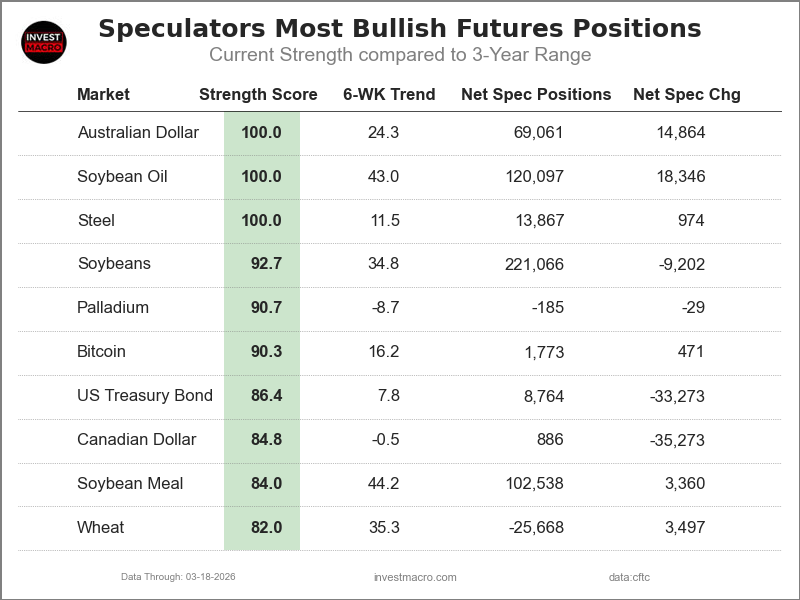
This weekly Extreme Positions report highlights the Most Bullish and Most Bearish Positions for the speculator category. Extreme positioning in these markets can foreshadow strong moves in the underlying market.

To signify an extreme position, we use the Strength Index (also known as the COT Index) of each instrument, a common method of measuring COT data. The Strength Index is simply a comparison of current trader positions against the range of positions over the previous 3 years. We use over 80 percent as extremely bullish and under 20 percent as extremely bearish. (Compare Strength Index scores across all markets in the data table or cot leaders table)


Extreme Bullish Speculator Table


Here Are This Week’s Most Bullish Speculator Positions:

Steel

Extreme Bullish Leader
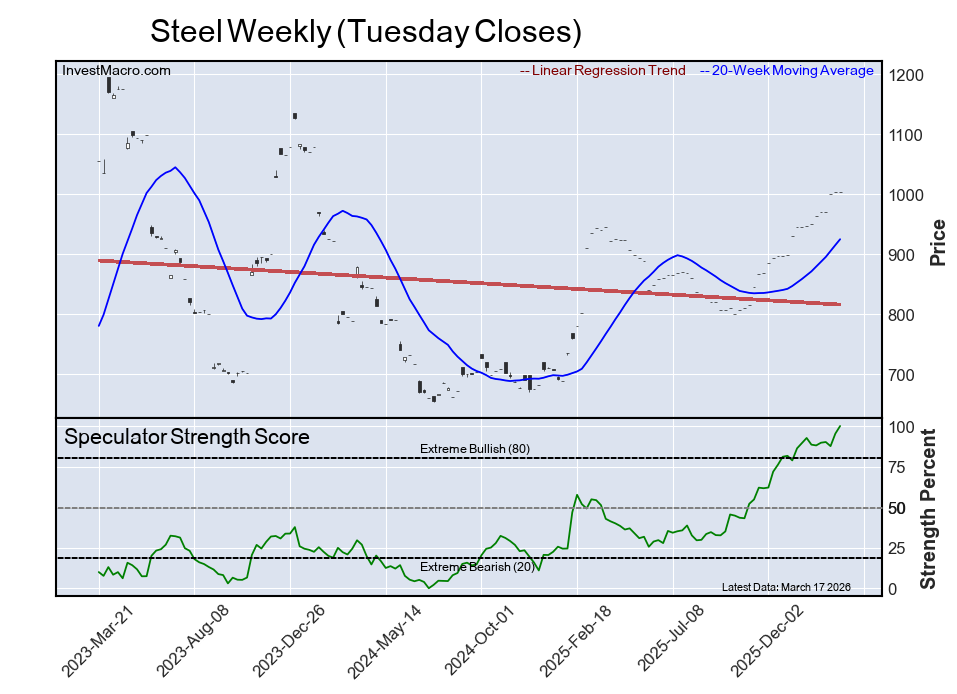
The Steel speculator position comes in once again this week as the most bullish extreme standing as the Steel speculator level is currently at a maximum 100 percent score of its 3-year range.

The six-week trend for the strength score totaled a gain of 18 percentage points this week. The overall net speculator position was a total of 12,340 net contracts this week with a rise of 669 contract in the weekly speculator bets.


Speculators or Non-Commercials Notes:

Speculators, classified as non-commercial traders by the CFTC, are made up of large commodity funds, hedge funds and other significant for-profit participants. The Specs are generally regarded as trend-followers in their behavior towards price action – net speculator bets and prices tend to go in the same directions. These traders often look to buy when prices are rising and sell when prices are falling. To illustrate this point, many times speculator contracts can be found at their most extremes (bullish or bearish) when prices are also close to their highest or lowest levels.

These extreme levels can be dangerous for the large speculators as the trade is most crowded, there is less trading ammunition still sitting on the sidelines to push the trend further and prices have moved a significant distance. When the trend becomes exhausted, some speculators take profits while others look to also exit positions when prices fail to continue in the same direction. This process usually plays out over many months to years and can ultimately create a reverse effect where prices start to fall and speculators start a process of selling when prices are falling.


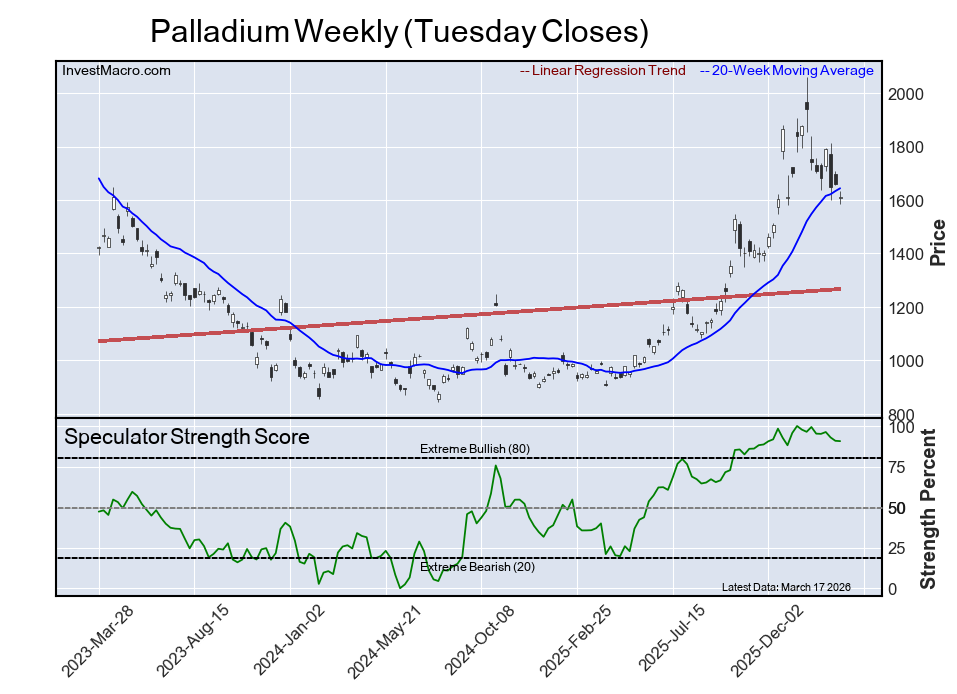
Palladium

Extreme Bullish Leader
The Palladium speculator position comes up next in the extreme standings this week. The Palladium speculator level is now at a 96 percent score of its 3-year range and the six-week trend for the strength score was a dip by -2 percentage points this week.

The speculator position registered 684 net contracts this week with a weekly decline of -204 contracts in speculator bets.


MSCI EAFE MINI

Extreme Bullish Leader
The MSCI EAFE MINI speculator position is third this week in the extreme standings with the MSCI EAFE-Mini speculator level residing at a 94 percent score of its 3-year range.

The six-week trend for the speculator strength score came in at plus 11 percentage points this week. The overall speculator position was 23,890 net contracts this week with a small dip of -679 contracts in the weekly speculator bets.


Canadian Dollar

Extreme Bullish Leader
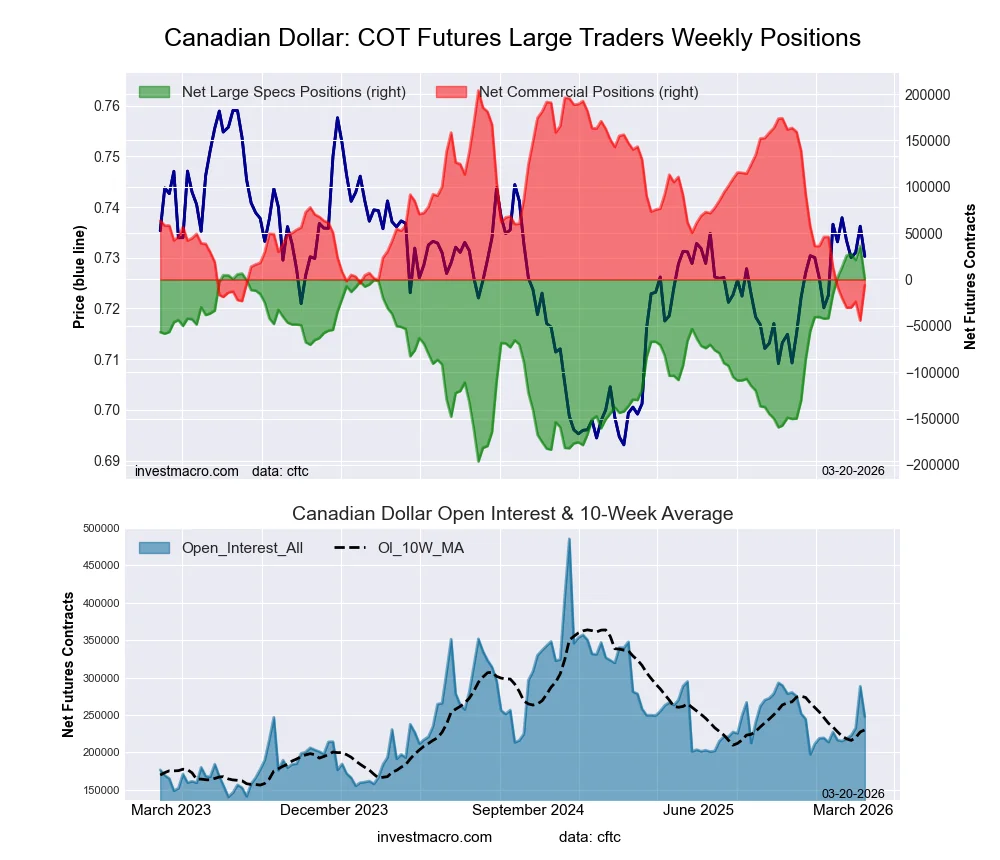
The Canadian Dollar speculator position comes up number four in the extreme standings this week. The CAD speculator level is at a 89 percent score of its 3-year range.

The six-week trend for the speculator strength score jumped by a total of 35 percentage points this week while the overall speculator position was -16,046 net contracts this week with a strong gain of 25,739 contracts in the speculator bets.


Russell 2000 Mini

Extreme Bullish Leader
The Russell 2000 Mini speculator position rounds out the top five in this week’s bullish extreme standings. The Russell-Mini speculator level sits at a 88 percent score of its 3-year range. The six-week trend for the speculator strength score was a slight gain by 2 percentage points this week.

The speculator position was 12,327 net contracts this week but showed a drop of -8,236 contracts in the weekly speculator bets.


The Most Bearish Speculator Positions of the Week:

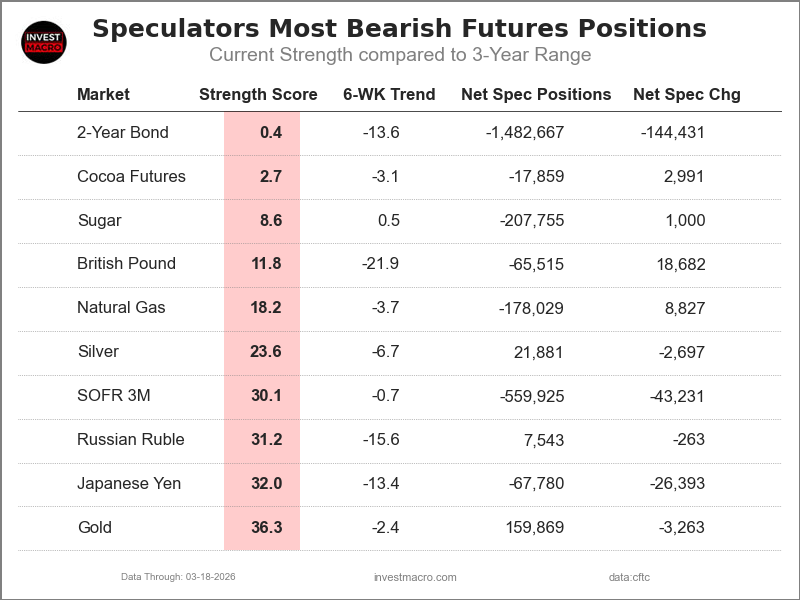
Extreme Bearish Speculator Table


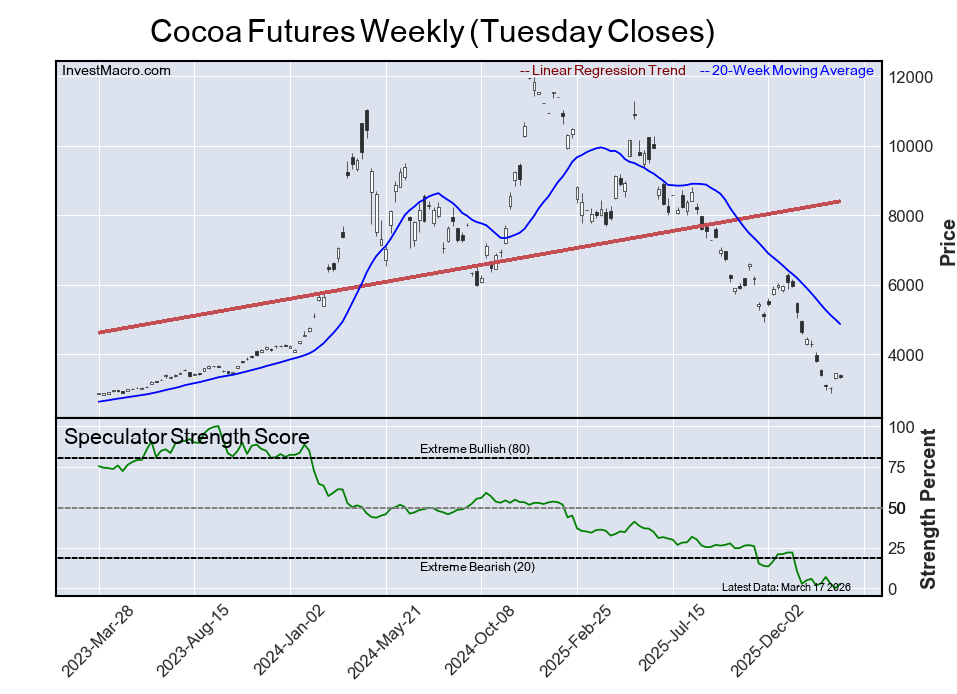
Cocoa Futures

The Cocoa Futures speculator position comes in as the most bearish extreme standing this week as the Cocoa speculator level is at just a 2 percent score of its 3-year range.

The six-week trend for the speculator strength score was a drop by -17 percentage points while the overall speculator position was -15,502 net contracts this week after an increase of 2,372 contracts in the speculator bets.


Sugar

Extreme Bearish Leader
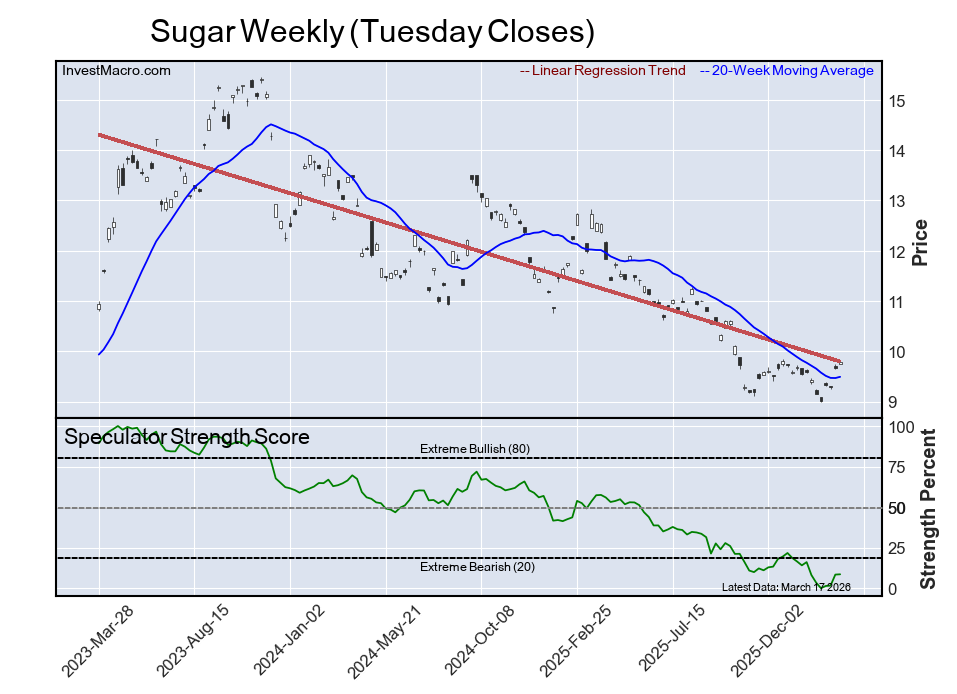
The Sugar speculator position comes in next for the most bearish extreme standing on the week at a 7 percent score of its 3-year range.

The six-week trend for the speculator strength score was a decrease by -2 percentage points while the speculator position was -167,753 net contracts this week with a gain of 10,595 contracts in the weekly speculator bets.


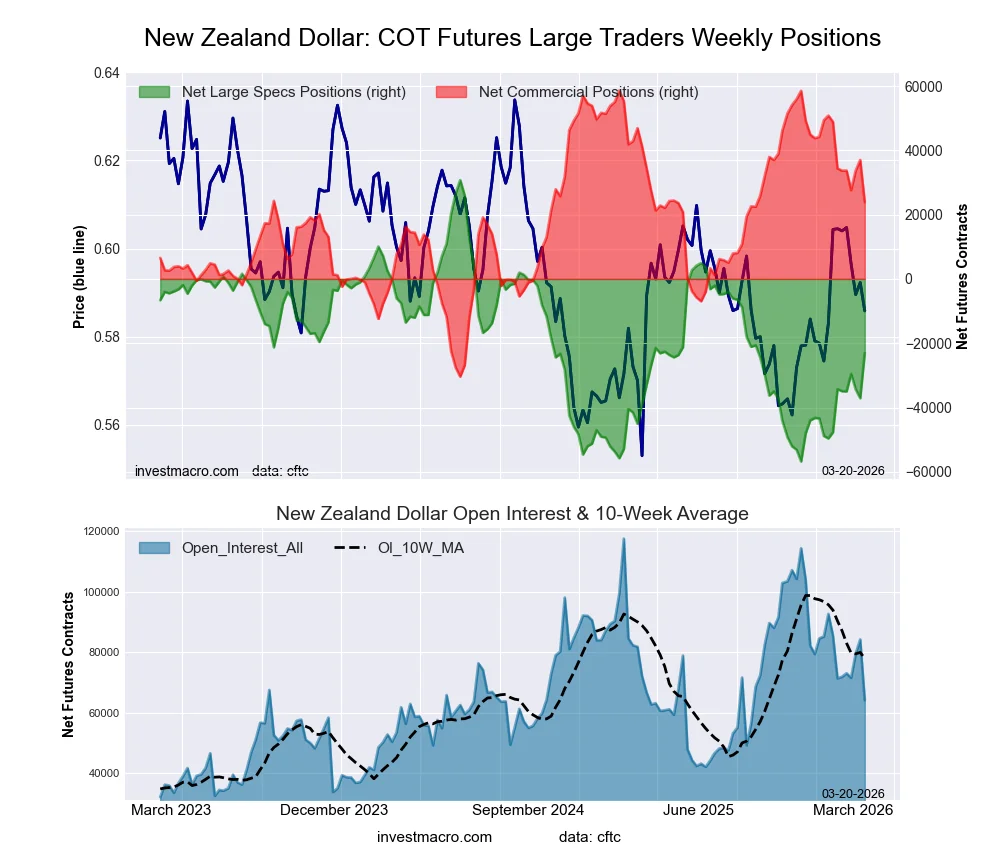
New Zealand Dollar

Extreme Bearish Leader
The New Zealand Dollar speculator position comes in as third most bearish extreme standing of the week. The NZD speculator level resides at a 10 percent score of its 3-year range while the six-week trend for the speculator strength score showed no change this week. The overall speculator position was -47,745 net contracts with a rise of 1,865 contracts in the speculator bets.


Swiss Franc

Extreme Bearish Leader
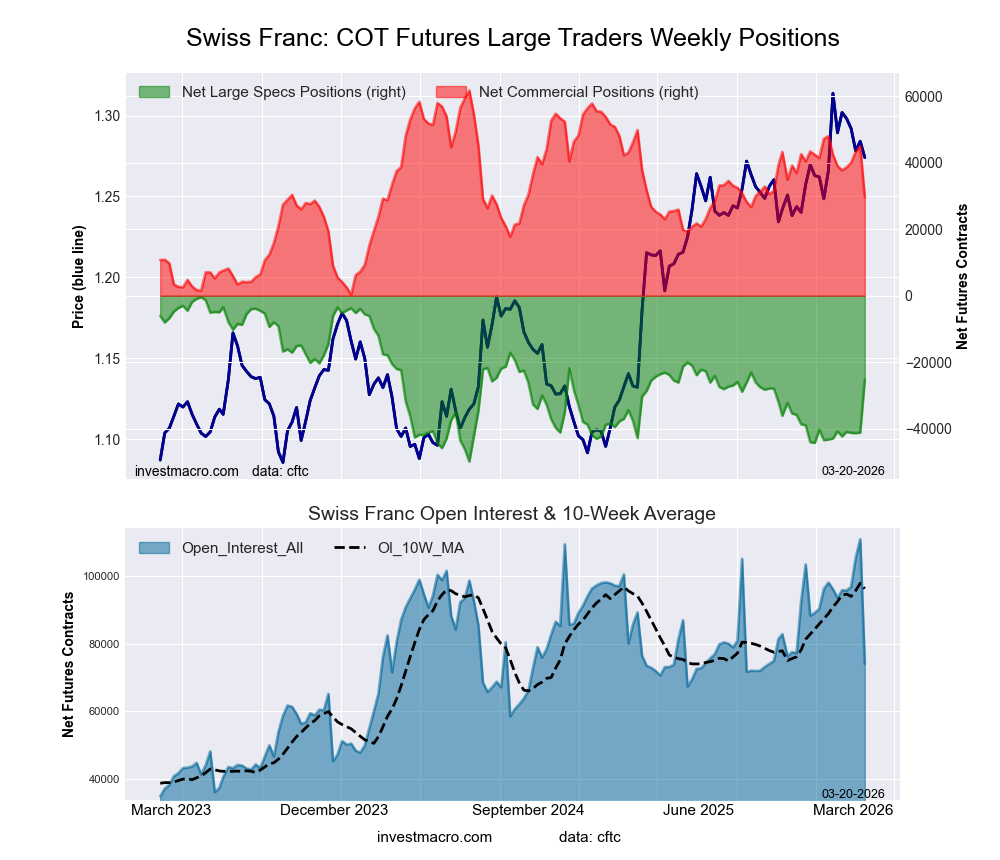
The Swiss Franc speculator position comes in as this week’s fourth most bearish extreme standing with the CHF speculator level at a 14 percent score of its 3-year range.

The six-week trend for the speculator strength score was a decrease of -8 percentage points this week and the speculator position was -42,893 net contracts this week with a slight increase of 314 contracts in the weekly speculator bets.


Cotton

Extreme Bearish Leader
Finally, the Cotton speculator position comes in as the fifth most bearish extreme standing for this week as the Cotton speculator level stands at a 16 percent score of its 3-year range.

The six-week trend for the speculator strength score showed no change on the week while the overall speculator position was -38,967 net contracts this week with a drop by -13,143 contracts in the weekly speculator bets.


Article By InvestMacroReceive our weekly COT Newsletter

*COT Report: The COT data, released weekly to the public each Friday, is updated through the most recent Tuesday (data is 3 days old) and shows a quick view of how large speculators or non-commercials (for-profit traders) were positioned in the futures markets.

The CFTC categorizes trader positions according to commercial hedgers (traders who use futures contracts for hedging as part of the business), non-commercials (large traders who speculate to realize trading profits) and nonreportable traders (usually small traders/speculators) as well as their open interest (contracts open in the market at time of reporting). See CFTC criteria here.

COT Metals Charts: Speculator Changes led lower by Gold & Copper

By InvestMacro

Metals Open Interest COT Chart
Here are the latest charts and statistics for the Commitment of Traders (COT) data published by the Commodities Futures Trading Commission (CFTC).

The latest COT data is updated through Tuesday January 27th and shows a quick view of how large traders (for-profit speculators and commercial entities) were positioned in the futures markets.

Weekly Speculator Changes led lower by Gold & Copper

Metals Net Positions COT Chart
The COT metals markets speculator bets were overall lower this week as just one out of the six metals markets we cover had higher positioning while the other five markets had lower speculator contracts.

Leading the gains for the metals was Steel with a rise by 669 contracts on the week.

The markets with declines in speculator bets for the week were Gold (-39,374 contracts), Copper (-4,185 contracts), Silver (-1,511 contracts), Platinum (-1,202 contracts) and with Palladium (-204 contracts) also registering lower bets on the week.

Steel is only price gainer for Metals Markets that saw a sell-off this week

The metals markets were overall lower on the week as the metals saw a steep and sharp selloff to close out the week. Steel was the only market that saw a weekly gain as Steel rose by over 5.50% and is now up by 9.30% in the past 30 days, and higher by approximately 40% in the past 90 days.

Copper was lower by -0.25% on the past five days, followed by Gold which saw a shortfall by -2.85%. Palladium dropped by -16.5% and Silver saw a strong decline lower by -18.86% on the week. Platinum was the biggest loser on the week with a sharp -22.45% decline.

Over the past 30 days, the metals markets have all been higher, led by Silver which has been up by 30.59%, while in the past 90 days all of these markets have been at least 27% higher, with Silver up by 88.29%, Platinum up by 45.87%, Palladium higher by 40.39%, and Steel, which has risen by 40.22%. Gold has seen a 28.95% gain in the past 90 days while Copper has risen by 27.29% in that timeframe.


Metals Data:

Metals Table COT Chart
Legend: Weekly Speculators Change | Speculators Current Net Position | Speculators Strength Score compared to last 3-Years (0-100 range)


Strength Scores led by Steel & Palladium

Metals Strength Scores COT Chart
COT Strength Scores (a normalized measure of Speculator positions over a 3-Year range, from 0 to 100 where above 80 is Extreme-Bullish and below 20 is Extreme-Bearish) showed that Steel (100 percent) and Palladium (96 percent) lead the metals markets this week. Copper (78 percent) comes in as the next highest in the weekly strength scores.

On the downside, Silver (42 percent) and Platinum (46 percent) come in at the lowest strength level currently.

Strength Statistics:
Gold (54.9 percent) vs Gold previous week (71.1 percent)
Silver (42.0 percent) vs Silver previous week (44.0 percent)
Copper (78.3 percent) vs Copper previous week (82.2 percent)
Platinum (45.8 percent) vs Platinum previous week (48.8 percent)
Palladium (96.4 percent) vs Palladium previous week (97.8 percent)
Steel (100.0 percent) vs Steel previous week (96.5 percent)


Steel top the 6-Week Strength Trends

Metals Trends COT Chart
COT Strength Score Trends (or move index, calculates the 6-week changes in strength scores) showed that Steel (18 percent) leads the past six weeks trends for metals.

Platinum (-23 percent), Silver (-17 percent) and Copper (-15 percent) lead the downside trend scores currently.

Move Statistics:
Gold (-11.7 percent) vs Gold previous week (8.6 percent)
Silver (-16.9 percent) vs Silver previous week (-26.0 percent)
Copper (-15.3 percent) vs Copper previous week (-9.2 percent)
Platinum (-23.5 percent) vs Platinum previous week (-11.9 percent)
Palladium (-1.9 percent) vs Palladium previous week (6.0 percent)
Steel (17.8 percent) vs Steel previous week (19.0 percent)


Individual Markets: (Weekly Tuesday Closes)

Gold Comex Futures:

Gold Futures COT ChartThe Gold Comex Futures large speculator standing this week resulted in a net position of 205,396 contracts in the data reported through Tuesday. This was a weekly reduction of -39,374 contracts from the previous week which had a total of 244,770 net contracts.

This week’s current strength score (the trader positioning range over the past three years, measured from 0 to 100) shows the speculators are currently Bullish with a score of 54.9 percent. The commercials are Bearish with a score of 36.7 percent and the small traders (not shown in chart) are Bullish-Extreme with a score of 91.3 percent.

Price Trend-Following Model: Strong Uptrend

Our weekly trend-following model classifies the current market price position as: Strong Uptrend.

Gold Futures StatisticsSPECULATORSCOMMERCIALSSMALL TRADERS
– Percent of Open Interest Longs:51.619.712.8
– Percent of Open Interest Shorts:9.670.54.1
– Net Position:205,396-248,28542,889
– Gross Longs:252,10096,20062,677
– Gross Shorts:46,704344,48519,788
– Long to Short Ratio:5.4 to 10.3 to 13.2 to 1
NET POSITION TREND:
– Strength Index Score (3 Year Range Pct):54.936.791.3
– Strength Index Reading (3 Year Range):BullishBearishBullish-Extreme
NET POSITION MOVEMENT INDEX:
– 6-Week Change in Strength Index:-11.710.57.3


Silver Comex Futures:

Silver Futures COT ChartThe Silver Comex Futures large speculator standing this week resulted in a net position of 23,703 contracts in the data reported through Tuesday. This was a weekly lowering of -1,511 contracts from the previous week which had a total of 25,214 net contracts.

This week’s current strength score (the trader positioning range over the past three years, measured from 0 to 100) shows the speculators are currently Bearish with a score of 42.0 percent. The commercials are Bullish with a score of 52.1 percent and the small traders (not shown in chart) are Bullish with a score of 65.1 percent.

Price Trend-Following Model: Uptrend

Our weekly trend-following model classifies the current market price position as: Uptrend.

Silver Futures StatisticsSPECULATORSCOMMERCIALSSMALL TRADERS
– Percent of Open Interest Longs:27.828.622.0
– Percent of Open Interest Shorts:12.656.79.0
– Net Position:23,703-44,05620,353
– Gross Longs:43,47544,78834,444
– Gross Shorts:19,77288,84414,091
– Long to Short Ratio:2.2 to 10.5 to 12.4 to 1
NET POSITION TREND:
– Strength Index Score (3 Year Range Pct):42.052.165.1
– Strength Index Reading (3 Year Range):BearishBullishBullish
NET POSITION MOVEMENT INDEX:
– 6-Week Change in Strength Index:-16.913.98.3


Copper Grade #1 Futures:

Copper Futures COT ChartThe Copper Grade #1 Futures large speculator standing this week resulted in a net position of 48,390 contracts in the data reported through Tuesday. This was a weekly lowering of -4,185 contracts from the previous week which had a total of 52,575 net contracts.

This week’s current strength score (the trader positioning range over the past three years, measured from 0 to 100) shows the speculators are currently Bullish with a score of 78.3 percent. The commercials are Bearish-Extreme with a score of 14.6 percent and the small traders (not shown in chart) are Bullish-Extreme with a score of 99.0 percent.

Price Trend-Following Model: Uptrend

Our weekly trend-following model classifies the current market price position as: Uptrend.

Copper Futures StatisticsSPECULATORSCOMMERCIALSSMALL TRADERS
– Percent of Open Interest Longs:36.431.69.2
– Percent of Open Interest Shorts:19.154.93.3
– Net Position:48,390-64,81216,422
– Gross Longs:101,40087,98925,663
– Gross Shorts:53,010152,8019,241
– Long to Short Ratio:1.9 to 10.6 to 12.8 to 1
NET POSITION TREND:
– Strength Index Score (3 Year Range Pct):78.314.699.0
– Strength Index Reading (3 Year Range):BullishBearish-ExtremeBullish-Extreme
NET POSITION MOVEMENT INDEX:
– 6-Week Change in Strength Index:-15.312.112.2


Platinum Futures:

Platinum Futures COT ChartThe Platinum Futures large speculator standing this week resulted in a net position of 13,922 contracts in the data reported through Tuesday. This was a weekly decline of -1,202 contracts from the previous week which had a total of 15,124 net contracts.

This week’s current strength score (the trader positioning range over the past three years, measured from 0 to 100) shows the speculators are currently Bearish with a score of 45.8 percent. The commercials are Bearish with a score of 49.7 percent and the small traders (not shown in chart) are Bullish-Extreme with a score of 91.9 percent.

Price Trend-Following Model: Uptrend

Our weekly trend-following model classifies the current market price position as: Uptrend.

Platinum Futures StatisticsSPECULATORSCOMMERCIALSSMALL TRADERS
– Percent of Open Interest Longs:45.826.014.1
– Percent of Open Interest Shorts:28.353.73.9
– Net Position:13,922-22,0268,104
– Gross Longs:36,41920,65411,173
– Gross Shorts:22,49742,6803,069
– Long to Short Ratio:1.6 to 10.5 to 13.6 to 1
NET POSITION TREND:
– Strength Index Score (3 Year Range Pct):45.849.791.9
– Strength Index Reading (3 Year Range):BearishBearishBullish-Extreme
NET POSITION MOVEMENT INDEX:
– 6-Week Change in Strength Index:-23.516.732.6


Palladium Futures:

Palladium Futures COT ChartThe Palladium Futures large speculator standing this week resulted in a net position of 684 contracts in the data reported through Tuesday. This was a weekly fall of -204 contracts from the previous week which had a total of 888 net contracts.

This week’s current strength score (the trader positioning range over the past three years, measured from 0 to 100) shows the speculators are currently Bullish-Extreme with a score of 96.4 percent. The commercials are Bearish-Extreme with a score of 0.3 percent and the small traders (not shown in chart) are Bullish-Extreme with a score of 94.4 percent.

Price Trend-Following Model: Uptrend

Our weekly trend-following model classifies the current market price position as: Uptrend.

Palladium Futures StatisticsSPECULATORSCOMMERCIALSSMALL TRADERS
– Percent of Open Interest Longs:49.328.717.8
– Percent of Open Interest Shorts:45.843.56.5
– Net Position:684-2,8402,156
– Gross Longs:9,4365,4873,396
– Gross Shorts:8,7528,3271,240
– Long to Short Ratio:1.1 to 10.7 to 12.7 to 1
NET POSITION TREND:
– Strength Index Score (3 Year Range Pct):96.40.394.4
– Strength Index Reading (3 Year Range):Bullish-ExtremeBearish-ExtremeBullish-Extreme
NET POSITION MOVEMENT INDEX:
– 6-Week Change in Strength Index:-1.9-3.127.3


Steel Futures Futures:

Steel Futures COT ChartThe Steel Futures large speculator standing this week resulted in a net position of 12,340 contracts in the data reported through Tuesday. This was a weekly rise of 669 contracts from the previous week which had a total of 11,671 net contracts.

This week’s current strength score (the trader positioning range over the past three years, measured from 0 to 100) shows the speculators are currently Bullish-Extreme with a score of 100.0 percent. The commercials are Bearish-Extreme with a score of 0.0 percent and the small traders (not shown in chart) are Bullish-Extreme with a score of 89.2 percent.

Price Trend-Following Model: Strong Uptrend

Our weekly trend-following model classifies the current market price position as: Strong Uptrend.

Steel Futures StatisticsSPECULATORSCOMMERCIALSSMALL TRADERS
– Percent of Open Interest Longs:38.457.61.6
– Percent of Open Interest Shorts:6.590.70.5
– Net Position:12,340-12,763423
– Gross Longs:14,85622,286635
– Gross Shorts:2,51635,049212
– Long to Short Ratio:5.9 to 10.6 to 13.0 to 1
NET POSITION TREND:
– Strength Index Score (3 Year Range Pct):100.00.089.2
– Strength Index Reading (3 Year Range):Bullish-ExtremeBearish-ExtremeBullish-Extreme
NET POSITION MOVEMENT INDEX:
– 6-Week Change in Strength Index:17.8-18.632.5


Article By InvestMacroReceive our weekly COT Newsletter

*COT Report: The COT data, released weekly to the public each Friday, is updated through the most recent Tuesday (data is 3 days old) and shows a quick view of how large speculators or non-commercials (for-profit traders) were positioned in the futures markets.

The CFTC categorizes trader positions according to commercial hedgers (traders who use futures contracts for hedging as part of the business), non-commercials (large traders who speculate to realize trading profits) and nonreportable traders (usually small traders/speculators) as well as their open interest (contracts open in the market at time of reporting). See CFTC criteria here.

COT Bonds Charts: Speculator Changes led by SOFR 1-Month & 5-Year Bonds

By InvestMacro

Bonds Market Open Interest Comparison
Here are the latest charts and statistics for the Commitment of Traders (COT) reports data published by the Commodities Futures Trading Commission (CFTC).

The latest COT data is updated through Tuesday January 27th and shows a quick view of how large traders (for-profit speculators and commercial hedgers) were positioned in the futures markets.

Weekly Speculator Changes led by SOFR 1-Month & 5-Year Bonds

Bonds Market Net Speculators Positions
The COT bond market speculator bets were overall higher this week as six out of the nine bond markets we cover had higher positioning while the other three markets had lower speculator contracts.

Leading the gains for the bond markets was the SOFR 1-Month (65,833 contracts) with the 5-Year Bonds (45,473 contracts), the US Treasury Bonds (14,903 contracts), the 2-Year Bonds (6,123 contracts), the Ultra 10-Year Bonds (5,408 contracts) and the SOFR 3-Months (1,559 contracts) also showing positive weeks.

The bond markets with declines in speculator bets for the week were the 10-Year Bonds (-70,511 contracts), the Fed Funds (-38,218 contracts), and with the Ultra Treasury Bonds (-14,649 contracts) also registering lower bets on the week.

5-Year Bonds lead Weekly Price Performance

The bond markets this week were led higher by the 5-Year Bonds which saw an edge higher by 0.21%, followed by the 2-Year Bonds, which inched up by 0.18%. The SOFR 1-Month was higher by 0.06%, followed by the SOFR 3-Months, which edged up by 0.04%.

The 10-Year Bonds were virtually unchanged at a -0.01% decline, followed by the Fed Funds which dipped by -0.03%. The US Treasury bond was the biggest loser on the week with a -0.91% shortfall.


Bonds Data:

Bonds Market Speculators Data Table
Legend: Open Interest | Speculators Current Net Position | Weekly Specs Change | Specs Strength Score compared to last 3-Years (0-100 range)


Strength Scores led by US Treasury Bonds & Ultra Treasury Bonds

Bonds Market Strength Index Comparison
COT Strength Scores (a normalized measure of Speculator positions over a 3-Year range, from 0 to 100 where above 80 is Extreme-Bullish and below 20 is Extreme-Bearish) showed that the US Treasury Bonds (81 percent) and the Ultra Treasury Bonds (69 percent) lead the bond markets this week. The 10-Year Bonds (50 percent) comes in as the next highest in the weekly strength scores.

On the downside, the 2-Year Bond (26.2 percent), the 5-Year Bonds (28 percent) and the SOFR 3-Months (30 percent) come in at the lowest strength levels currently.

Strength Statistics:
Fed Funds (39.4 percent) vs Fed Funds previous week (44.8 percent)
2-Year Bond (26.2 percent) vs 2-Year Bond previous week (25.6 percent)
5-Year Bond (27.8 percent) vs 5-Year Bond previous week (25.7 percent)
10-Year Bond (50.0 percent) vs 10-Year Bond previous week (58.4 percent)
Ultra 10-Year Bond (48.1 percent) vs Ultra 10-Year Bond previous week (46.7 percent)
US Treasury Bond (80.5 percent) vs US Treasury Bond previous week (75.3 percent)
Ultra US Treasury Bond (68.6 percent) vs Ultra US Treasury Bond previous week (74.1 percent)
SOFR 1-Month (41.4 percent) vs SOFR 1-Month previous week (30.0 percent)
SOFR 3-Months (29.6 percent) vs SOFR 3-Months previous week (29.5 percent)


SOFR 1-Month & Ultra 10-Year Bonds top the 6-Week Strength Trends

Bonds Market Trend Index Comparison
COT Strength Score Trends (or move index, calculates the 6-week changes in strength scores) showed that the SOFR 1-Month (41 percent) and the Ultra 10-Year Bonds (17 percent) lead the past six weeks trends for bonds. The US Treasury Bond (13 percent) and the 2-Year Bonds (13 percent) are the next highest positive movers in the latest trends data.

The Fed Funds (-55.1 percent), the SOFR 3-Months (-22 percent) and the Ultra Treasury Bonds (-9 percent) leads the downside trend scores currently.

Strength Trend Statistics:
Fed Funds (-55.1 percent) vs Fed Funds previous week (-55.2 percent)
2-Year Bond (12.9 percent) vs 2-Year Bond previous week (16.0 percent)
5-Year Bond (9.7 percent) vs 5-Year Bond previous week (12.2 percent)
10-Year Bond (-6.7 percent) vs 10-Year Bond previous week (3.7 percent)
Ultra 10-Year Bond (17.0 percent) vs Ultra 10-Year Bond previous week (31.0 percent)
US Treasury Bond (13.4 percent) vs US Treasury Bond previous week (6.0 percent)
Ultra US Treasury Bond (-8.7 percent) vs Ultra US Treasury Bond previous week (-8.6 percent)
SOFR 1-Month (41.4 percent) vs SOFR 1-Month previous week (19.3 percent)
SOFR 3-Months (-21.7 percent) vs SOFR 3-Months previous week (-15.4 percent)


30-Day Federal Funds Futures:

Federal Funds 30-Day Bonds Futures COT ChartThe 30-Day Federal Funds large speculator standing this week resulted in a net position of -116,029 contracts in the data reported through Tuesday. This was a weekly reduction of -38,218 contracts from the previous week which had a total of -77,811 net contracts.

This week’s current strength score (the trader positioning range over the past three years, measured from 0 to 100) shows the speculators are currently Bearish with a score of 39.4 percent. The commercials are Bullish with a score of 58.4 percent and the small traders (not shown in chart) are Bullish-Extreme with a score of 90.0 percent.

Price Trend-Following Model: Uptrend

Our weekly trend-following model classifies the current market price position as: Uptrend.

30-Day Federal Funds StatisticsSPECULATORSCOMMERCIALSSMALL TRADERS
– Percent of Open Interest Longs:17.761.72.2
– Percent of Open Interest Shorts:22.757.71.3
– Net Position:-116,02994,93321,096
– Gross Longs:416,3441,448,08651,172
– Gross Shorts:532,3731,353,15330,076
– Long to Short Ratio:0.8 to 11.1 to 11.7 to 1
NET POSITION TREND:
– Strength Index Score (3 Year Range Pct):39.458.490.0
– Strength Index Reading (3 Year Range):BearishBullishBullish-Extreme
NET POSITION MOVEMENT INDEX:
– 6-Week Change in Strength Index:-55.154.210.0


Secured Overnight Financing Rate (3-Month) Futures:

SOFR 3-Months Bonds Futures COT ChartThe Secured Overnight Financing Rate (3-Month) large speculator standing this week resulted in a net position of -594,042 contracts in the data reported through Tuesday. This was a weekly boost of 1,559 contracts from the previous week which had a total of -595,601 net contracts.

This week’s current strength score (the trader positioning range over the past three years, measured from 0 to 100) shows the speculators are currently Bearish with a score of 29.6 percent. The commercials are Bullish with a score of 70.3 percent and the small traders (not shown in chart) are Bullish with a score of 78.4 percent.

Price Trend-Following Model: Weak Uptrend

Our weekly trend-following model classifies the current market price position as: Weak Uptrend.

SOFR 3-Months StatisticsSPECULATORSCOMMERCIALSSMALL TRADERS
– Percent of Open Interest Longs:13.057.30.3
– Percent of Open Interest Shorts:17.552.90.3
– Net Position:-594,042593,783259
– Gross Longs:1,746,3867,681,33741,889
– Gross Shorts:2,340,4287,087,55441,630
– Long to Short Ratio:0.7 to 11.1 to 11.0 to 1
NET POSITION TREND:
– Strength Index Score (3 Year Range Pct):29.670.378.4
– Strength Index Reading (3 Year Range):BearishBullishBullish
NET POSITION MOVEMENT INDEX:
– 6-Week Change in Strength Index:-21.721.70.1


Individual Bond Markets:

Secured Overnight Financing Rate (1-Month) Futures:

SOFR 1-Month Bonds Futures COT ChartThe Secured Overnight Financing Rate (1-Month) large speculator standing this week resulted in a net position of -208,039 contracts in the data reported through Tuesday. This was a weekly gain of 65,833 contracts from the previous week which had a total of -273,872 net contracts.

This week’s current strength score (the trader positioning range over the past three years, measured from 0 to 100) shows the speculators are currently Bearish with a score of 41.4 percent. The commercials are Bullish with a score of 58.5 percent and the small traders (not shown in chart) are Bullish with a score of 66.7 percent.

Price Trend-Following Model: Uptrend

Our weekly trend-following model classifies the current market price position as: Uptrend.

SOFR 1-Month StatisticsSPECULATORSCOMMERCIALSSMALL TRADERS
– Percent of Open Interest Longs:20.066.50.0
– Percent of Open Interest Shorts:32.853.70.0
– Net Position:-208,039208,128-89
– Gross Longs:325,8161,084,095158
– Gross Shorts:533,855875,967247
– Long to Short Ratio:0.6 to 11.2 to 10.6 to 1
NET POSITION TREND:
– Strength Index Score (3 Year Range Pct):41.458.566.7
– Strength Index Reading (3 Year Range):BearishBullishBullish
NET POSITION MOVEMENT INDEX:
– 6-Week Change in Strength Index:41.4-41.52.2


2-Year Treasury Note Futures:

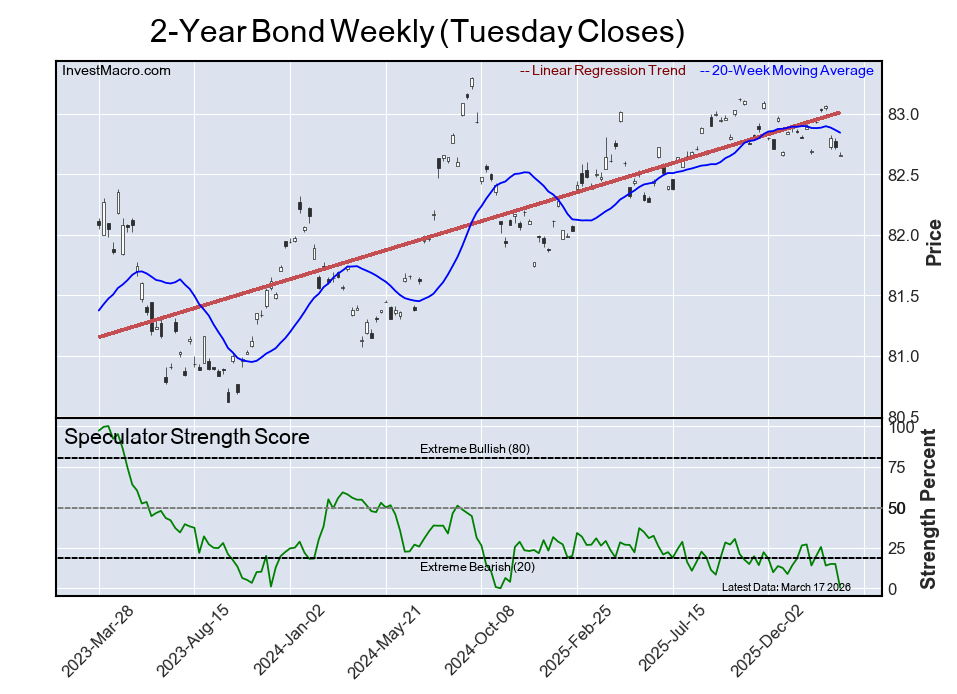
2-Year Treasury Bonds Futures COT ChartThe 2-Year Treasury Note large speculator standing this week resulted in a net position of -1,218,999 contracts in the data reported through Tuesday. This was a weekly gain of 6,123 contracts from the previous week which had a total of -1,225,122 net contracts.

This week’s current strength score (the trader positioning range over the past three years, measured from 0 to 100) shows the speculators are currently Bearish with a score of 26.2 percent. The commercials are Bullish with a score of 73.4 percent and the small traders (not shown in chart) are Bearish with a score of 49.5 percent.

Price Trend-Following Model: Weak Downtrend

Our weekly trend-following model classifies the current market price position as: Weak Downtrend.

2-Year Treasury Note StatisticsSPECULATORSCOMMERCIALSSMALL TRADERS
– Percent of Open Interest Longs:16.674.25.4
– Percent of Open Interest Shorts:43.150.42.8
– Net Position:-1,218,9991,097,684121,315
– Gross Longs:766,6383,420,919248,233
– Gross Shorts:1,985,6372,323,235126,918
– Long to Short Ratio:0.4 to 11.5 to 12.0 to 1
NET POSITION TREND:
– Strength Index Score (3 Year Range Pct):26.273.449.5
– Strength Index Reading (3 Year Range):BearishBullishBearish
NET POSITION MOVEMENT INDEX:
– 6-Week Change in Strength Index:12.9-14.2-2.6


5-Year Treasury Note Futures:

5-Year Treasury Bonds Futures COT ChartThe 5-Year Treasury Note large speculator standing this week resulted in a net position of -2,091,046 contracts in the data reported through Tuesday. This was a weekly gain of 45,473 contracts from the previous week which had a total of -2,136,519 net contracts.

This week’s current strength score (the trader positioning range over the past three years, measured from 0 to 100) shows the speculators are currently Bearish with a score of 27.8 percent. The commercials are Bullish with a score of 71.5 percent and the small traders (not shown in chart) are Bullish with a score of 67.6 percent.

Price Trend-Following Model: Downtrend

Our weekly trend-following model classifies the current market price position as: Downtrend.

5-Year Treasury Note StatisticsSPECULATORSCOMMERCIALSSMALL TRADERS
– Percent of Open Interest Longs:8.481.86.6
– Percent of Open Interest Shorts:39.353.14.4
– Net Position:-2,091,0461,946,525144,521
– Gross Longs:570,8215,546,181446,080
– Gross Shorts:2,661,8673,599,656301,559
– Long to Short Ratio:0.2 to 11.5 to 11.5 to 1
NET POSITION TREND:
– Strength Index Score (3 Year Range Pct):27.871.567.6
– Strength Index Reading (3 Year Range):BearishBullishBullish
NET POSITION MOVEMENT INDEX:
– 6-Week Change in Strength Index:9.7-10.0-5.2


10-Year Treasury Note Futures:

10-Year Treasury Notes Bonds Futures COT ChartThe 10-Year Treasury Note large speculator standing this week resulted in a net position of -726,151 contracts in the data reported through Tuesday. This was a weekly decrease of -70,511 contracts from the previous week which had a total of -655,640 net contracts.

This week’s current strength score (the trader positioning range over the past three years, measured from 0 to 100) shows the speculators are currently Bearish with a score of 50.0 percent. The commercials are Bullish with a score of 52.2 percent and the small traders (not shown in chart) are Bullish with a score of 65.3 percent.

Price Trend-Following Model: Strong Downtrend

Our weekly trend-following model classifies the current market price position as: Strong Downtrend.

10-Year Treasury Note StatisticsSPECULATORSCOMMERCIALSSMALL TRADERS
– Percent of Open Interest Longs:11.877.37.6
– Percent of Open Interest Shorts:24.565.96.3
– Net Position:-726,151650,76475,387
– Gross Longs:668,7464,400,390434,438
– Gross Shorts:1,394,8973,749,626359,051
– Long to Short Ratio:0.5 to 11.2 to 11.2 to 1
NET POSITION TREND:
– Strength Index Score (3 Year Range Pct):50.052.265.3
– Strength Index Reading (3 Year Range):BearishBullishBullish
NET POSITION MOVEMENT INDEX:
– 6-Week Change in Strength Index:-6.717.8-23.5


Ultra 10-Year Notes Futures:

Ultra 10-Year Treasury Notes Bonds Futures COT ChartThe Ultra 10-Year Notes large speculator standing this week resulted in a net position of -229,874 contracts in the data reported through Tuesday. This was a weekly increase of 5,408 contracts from the previous week which had a total of -235,282 net contracts.

This week’s current strength score (the trader positioning range over the past three years, measured from 0 to 100) shows the speculators are currently Bearish with a score of 48.1 percent. The commercials are Bullish with a score of 66.8 percent and the small traders (not shown in chart) are Bearish-Extreme with a score of 1.8 percent.

Price Trend-Following Model: Strong Downtrend

Our weekly trend-following model classifies the current market price position as: Strong Downtrend.

Ultra 10-Year Notes StatisticsSPECULATORSCOMMERCIALSSMALL TRADERS
– Percent of Open Interest Longs:11.479.58.1
– Percent of Open Interest Shorts:20.266.312.5
– Net Position:-229,874345,568-115,694
– Gross Longs:298,1012,080,438211,533
– Gross Shorts:527,9751,734,870327,227
– Long to Short Ratio:0.6 to 11.2 to 10.6 to 1
NET POSITION TREND:
– Strength Index Score (3 Year Range Pct):48.166.81.8
– Strength Index Reading (3 Year Range):BearishBullishBearish-Extreme
NET POSITION MOVEMENT INDEX:
– 6-Week Change in Strength Index:17.00.1-58.4


US Treasury Bonds Futures:

US Year Treasury Notes Long Bonds Futures COT ChartThe US Treasury Bonds large speculator standing this week resulted in a net position of -8,167 contracts in the data reported through Tuesday. This was a weekly boost of 14,903 contracts from the previous week which had a total of -23,070 net contracts.

This week’s current strength score (the trader positioning range over the past three years, measured from 0 to 100) shows the speculators are currently Bullish-Extreme with a score of 80.5 percent. The commercials are Bearish-Extreme with a score of 9.1 percent and the small traders (not shown in chart) are Bullish with a score of 73.9 percent.

Price Trend-Following Model: Strong Downtrend

Our weekly trend-following model classifies the current market price position as: Strong Downtrend.

US Treasury Bonds StatisticsSPECULATORSCOMMERCIALSSMALL TRADERS
– Percent of Open Interest Longs:9.375.513.8
– Percent of Open Interest Shorts:9.882.16.8
– Net Position:-8,167-119,909128,076
– Gross Longs:171,2381,385,781252,582
– Gross Shorts:179,4051,505,690124,506
– Long to Short Ratio:1.0 to 10.9 to 12.0 to 1
NET POSITION TREND:
– Strength Index Score (3 Year Range Pct):80.59.173.9
– Strength Index Reading (3 Year Range):Bullish-ExtremeBearish-ExtremeBullish
NET POSITION MOVEMENT INDEX:
– 6-Week Change in Strength Index:13.4-11.41.9


Ultra US Treasury Bonds Futures:

Ultra US Year Treasury Notes Long Bonds Futures COT ChartThe Ultra US Treasury Bonds large speculator standing this week resulted in a net position of -273,471 contracts in the data reported through Tuesday. This was a weekly decrease of -14,649 contracts from the previous week which had a total of -258,822 net contracts.

This week’s current strength score (the trader positioning range over the past three years, measured from 0 to 100) shows the speculators are currently Bullish with a score of 68.6 percent. The commercials are Bearish with a score of 44.4 percent and the small traders (not shown in chart) are Bearish with a score of 21.8 percent.

Price Trend-Following Model: Strong Downtrend

Our weekly trend-following model classifies the current market price position as: Strong Downtrend.

Ultra US Treasury Bonds StatisticsSPECULATORSCOMMERCIALSSMALL TRADERS
– Percent of Open Interest Longs:6.683.78.7
– Percent of Open Interest Shorts:19.371.48.4
– Net Position:-273,471266,9806,491
– Gross Longs:143,9231,812,928188,177
– Gross Shorts:417,3941,545,948181,686
– Long to Short Ratio:0.3 to 11.2 to 11.0 to 1
NET POSITION TREND:
– Strength Index Score (3 Year Range Pct):68.644.421.8
– Strength Index Reading (3 Year Range):BullishBearishBearish
NET POSITION MOVEMENT INDEX:
– 6-Week Change in Strength Index:-8.716.3-20.0


Article By InvestMacroReceive our weekly COT Newsletter

*COT Report: The COT data, released weekly to the public each Friday, is updated through the most recent Tuesday (data is 3 days old) and shows a quick view of how large speculators or non-commercials (for-profit traders) were positioned in the futures markets.

The CFTC categorizes trader positions according to commercial hedgers (traders who use futures contracts for hedging as part of the business), non-commercials (large traders who speculate to realize trading profits) and nonreportable traders (usually small traders/speculators) as well as their open interest (contracts open in the market at time of reporting). See CFTC criteria here.

COT Energy Charts: Speculator Weekly Changes led by Natural Gas & WTI Crude Oil

By InvestMacro

Speculators OI Energy Futures COT Chart
Here are the latest charts and statistics for the Commitment of Traders (COT) data published by the Commodities Futures Trading Commission (CFTC).

The latest COT data is updated through Tuesday January 27th and shows a quick view of how large traders (for-profit speculators and commercial entities) were positioned in the futures markets.

Weekly Speculator Changes led by Natural Gas & WTI Crude Oil

Speculators Nets Energy Futures COT Chart
The COT energy market speculator bets were overall higher this week as five out of the six energy markets we cover had higher positioning while only one market had lower speculator contracts.

Leading the gains for the energy markets was Natural Gas (29,884 contracts) with WTI Crude (18,190 contracts), Gasoline (8,433 contracts), Heating Oil (7,791 contracts) and Brent Oil (402 contracts) also recording positive weeks.

The market with a decline in speculator bets was the Bloomberg Commodity Index with a drop by -294 contracts on the week.

Energy Markets Price Performance led by Natural Gas

The energy markets this week were all higher in price performance and led by Natural Gas, which rose by approximately 21%. Heating Oil was next up with a 9.14% gain in the past five days, followed by WTI Crude Oil which rose by 7.53%, and then Brent Oil which rose by 7.36%. Gasoline was higher by 4.61% on the week and the Bloomberg Commodity Index rounded out the gainers with a 1.83% rise on the week.

All these markets are higher over the past 30 days, with Natural Gas up by approximately 40%, followed by Heating Oil, WTI Crude Oil, and Brent Oil all seeing gains by more than 20% in the past 30 days.


Energy Data:

Speculators Table Energy Futures COT Chart
Legend: Weekly Speculators Change | Speculators Current Net Position | Speculators Strength Score compared to last 3-Years (0-100 range)


Strength Scores led by Bloomberg Index & Heating Oil

Speculators Strength Energy Futures COT Chart
COT Strength Scores (a normalized measure of Speculator positions over a 3-Year range, from 0 to 100 where above 80 is Extreme-Bullish and below 20 is Extreme-Bearish) showed that the Bloomberg Index (78.3 percent) and Heating Oil (74.9 percent) lead the energy markets this week.

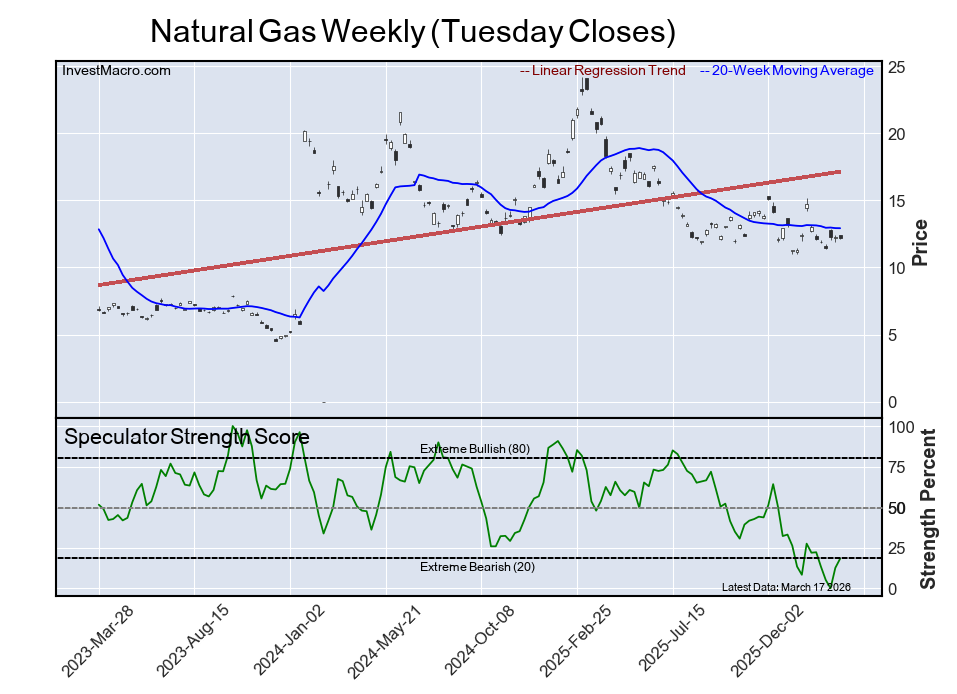
On the downside, WTI Crude (18.4 percent) comes in at the lowest strength level currently and is in Extreme-Bearish territory (below 20 percent). The next lowest strength scores were Natural Gas (20.9 percent) and Brent Oil (21.6 percent).

Strength Statistics:
WTI Crude Oil (18.4 percent) vs WTI Crude Oil previous week (12.6 percent)
Brent Crude Oil (21.6 percent) vs Brent Crude Oil previous week (21.1 percent)
Natural Gas (20.9 percent) vs Natural Gas previous week (0.0 percent)
Gasoline (74.6 percent) vs Gasoline previous week (65.3 percent)
Heating Oil (74.9 percent) vs Heating Oil previous week (64.6 percent)
Bloomberg Commodity Index (78.3 percent) vs Bloomberg Commodity Index previous week (79.7 percent)


Bloomberg Index & WTI Crude top the 6-Week Strength Trends

Speculators Trend Energy Futures COT Chart
COT Strength Score Trends (or move index, calculates the 6-week changes in strength scores) showed that the Bloomberg Index (72.1 percent) and WTI Crude (13.6 percent) lead the past six weeks trends for the energy markets.

Natural Gas (-24.9 percent) leads the downside trend scores currently with Brent Oil (-14.9 percent) as the next market with lower trend scores.

Move Statistics:
WTI Crude Oil (13.6 percent) vs WTI Crude Oil previous week (6.6 percent)
Brent Crude Oil (-14.9 percent) vs Brent Crude Oil previous week (-13.1 percent)
Natural Gas (-24.9 percent) vs Natural Gas previous week (-60.9 percent)
Gasoline (3.1 percent) vs Gasoline previous week (-24.1 percent)
Heating Oil (11.2 percent) vs Heating Oil previous week (-5.5 percent)
Bloomberg Commodity Index (72.1 percent) vs Bloomberg Commodity Index previous week (74.3 percent)


Individual COT Market Charts:

WTI Crude Oil Futures:

WTI Crude Oil Futures COT ChartThe WTI Crude Oil Futures large speculator standing this week resulted in a net position of 96,982 contracts in the data reported through Tuesday. This was a weekly boost of 18,190 contracts from the previous week which had a total of 78,792 net contracts.

This week’s current strength score (the trader positioning range over the past three years, measured from 0 to 100) shows the speculators are currently Bearish-Extreme with a score of 18.4 percent. The commercials are Bullish-Extreme with a score of 81.6 percent and the small traders (not shown in chart) are Bearish with a score of 38.3 percent.

Price Trend-Following Model: Weak Downtrend

Our weekly trend-following model classifies the current market price position as: Weak Downtrend.

WTI Crude Oil Futures StatisticsSPECULATORSCOMMERCIALSSMALL TRADERS
– Percent of Open Interest Longs:14.541.33.3
– Percent of Open Interest Shorts:9.747.02.5
– Net Position:96,982-115,04818,066
– Gross Longs:295,247840,87568,113
– Gross Shorts:198,265955,92350,047
– Long to Short Ratio:1.5 to 10.9 to 11.4 to 1
NET POSITION TREND:
– Strength Index Score (3 Year Range Pct):18.481.638.3
– Strength Index Reading (3 Year Range):Bearish-ExtremeBullish-ExtremeBearish
NET POSITION MOVEMENT INDEX:
– 6-Week Change in Strength Index:13.6-13.00.8


Brent Crude Oil Futures:

Brent Last Day Crude Oil Futures COT ChartThe Brent Crude Oil Futures large speculator standing this week resulted in a net position of -41,748 contracts in the data reported through Tuesday. This was a weekly lift of 402 contracts from the previous week which had a total of -42,150 net contracts.

This week’s current strength score (the trader positioning range over the past three years, measured from 0 to 100) shows the speculators are currently Bearish with a score of 21.6 percent. The commercials are Bullish-Extreme with a score of 80.5 percent and the small traders (not shown in chart) are Bullish with a score of 55.3 percent.

Price Trend-Following Model: Weak Downtrend

Our weekly trend-following model classifies the current market price position as: Weak Downtrend.

Brent Crude Oil Futures StatisticsSPECULATORSCOMMERCIALSSMALL TRADERS
– Percent of Open Interest Longs:21.437.63.0
– Percent of Open Interest Shorts:37.022.72.3
– Net Position:-41,74840,0261,722
– Gross Longs:57,294100,6937,911
– Gross Shorts:99,04260,6676,189
– Long to Short Ratio:0.6 to 11.7 to 11.3 to 1
NET POSITION TREND:
– Strength Index Score (3 Year Range Pct):21.680.555.3
– Strength Index Reading (3 Year Range):BearishBullish-ExtremeBullish
NET POSITION MOVEMENT INDEX:
– 6-Week Change in Strength Index:-14.916.7-4.7


Natural Gas Futures:

Natural Gas Futures COT ChartThe Natural Gas Futures large speculator standing this week resulted in a net position of -163,606 contracts in the data reported through Tuesday. This was a weekly lift of 29,884 contracts from the previous week which had a total of -193,490 net contracts.

This week’s current strength score (the trader positioning range over the past three years, measured from 0 to 100) shows the speculators are currently Bearish with a score of 20.9 percent. The commercials are Bullish-Extreme with a score of 80.3 percent and the small traders (not shown in chart) are Bearish with a score of 30.2 percent.

Price Trend-Following Model: Strong Uptrend

Our weekly trend-following model classifies the current market price position as: Strong Uptrend.

Natural Gas Futures StatisticsSPECULATORSCOMMERCIALSSMALL TRADERS
– Percent of Open Interest Longs:13.337.03.2
– Percent of Open Interest Shorts:23.427.62.5
– Net Position:-163,606152,76710,839
– Gross Longs:216,112601,09551,823
– Gross Shorts:379,718448,32840,984
– Long to Short Ratio:0.6 to 11.3 to 11.3 to 1
NET POSITION TREND:
– Strength Index Score (3 Year Range Pct):20.980.330.2
– Strength Index Reading (3 Year Range):BearishBullish-ExtremeBearish
NET POSITION MOVEMENT INDEX:
– 6-Week Change in Strength Index:-24.924.8-3.2


Gasoline Blendstock Futures:

RBOB Gasoline Energy Futures COT ChartThe Gasoline Blendstock Futures large speculator standing this week resulted in a net position of 79,213 contracts in the data reported through Tuesday. This was a weekly gain of 8,433 contracts from the previous week which had a total of 70,780 net contracts.

This week’s current strength score (the trader positioning range over the past three years, measured from 0 to 100) shows the speculators are currently Bullish with a score of 74.6 percent. The commercials are Bearish with a score of 25.0 percent and the small traders (not shown in chart) are Bullish with a score of 65.7 percent.

Price Trend-Following Model: Strong Uptrend

Our weekly trend-following model classifies the current market price position as: Strong Uptrend.

Nasdaq Mini Futures StatisticsSPECULATORSCOMMERCIALSSMALL TRADERS
– Percent of Open Interest Longs:25.547.05.5
– Percent of Open Interest Shorts:8.565.73.8
– Net Position:79,213-86,8347,621
– Gross Longs:118,536218,24425,419
– Gross Shorts:39,323305,07817,798
– Long to Short Ratio:3.0 to 10.7 to 11.4 to 1
NET POSITION TREND:
– Strength Index Score (3 Year Range Pct):74.625.065.7
– Strength Index Reading (3 Year Range):BullishBearishBullish
NET POSITION MOVEMENT INDEX:
– 6-Week Change in Strength Index:3.1-3.21.7


#2 Heating Oil NY-Harbor Futures:

NY Harbor Heating Oil Energy Futures COT ChartThe #2 Heating Oil NY-Harbor Futures large speculator standing this week resulted in a net position of 23,835 contracts in the data reported through Tuesday. This was a weekly rise of 7,791 contracts from the previous week which had a total of 16,044 net contracts.

This week’s current strength score (the trader positioning range over the past three years, measured from 0 to 100) shows the speculators are currently Bullish with a score of 74.9 percent. The commercials are Bearish with a score of 26.9 percent and the small traders (not shown in chart) are Bullish with a score of 66.9 percent.

Price Trend-Following Model: Strong Uptrend

Our weekly trend-following model classifies the current market price position as: Strong Uptrend.

Heating Oil Futures StatisticsSPECULATORSCOMMERCIALSSMALL TRADERS
– Percent of Open Interest Longs:17.846.011.9
– Percent of Open Interest Shorts:11.557.07.3
– Net Position:23,835-41,66317,828
– Gross Longs:67,848175,38045,533
– Gross Shorts:44,013217,04327,705
– Long to Short Ratio:1.5 to 10.8 to 11.6 to 1
NET POSITION TREND:
– Strength Index Score (3 Year Range Pct):74.926.966.9
– Strength Index Reading (3 Year Range):BullishBearishBullish
NET POSITION MOVEMENT INDEX:
– 6-Week Change in Strength Index:11.2-5.1-8.6


Bloomberg Commodity Index Futures:

Bloomberg Commodity Index Futures COT ChartThe Bloomberg Commodity Index Futures large speculator standing this week resulted in a net position of -6,075 contracts in the data reported through Tuesday. This was a weekly lowering of -294 contracts from the previous week which had a total of -5,781 net contracts.

This week’s current strength score (the trader positioning range over the past three years, measured from 0 to 100) shows the speculators are currently Bullish with a score of 78.3 percent. The commercials are Bearish with a score of 20.1 percent and the small traders (not shown in chart) are Bearish with a score of 48.9 percent.

Price Trend-Following Model: Strong Uptrend

Our weekly trend-following model classifies the current market price position as: Strong Uptrend.

Bloomberg Index Futures StatisticsSPECULATORSCOMMERCIALSSMALL TRADERS
– Percent of Open Interest Longs:27.070.20.4
– Percent of Open Interest Shorts:30.267.30.0
– Net Position:-6,0755,405670
– Gross Longs:50,840132,086705
– Gross Shorts:56,915126,68135
– Long to Short Ratio:0.9 to 11.0 to 120.1 to 1
NET POSITION TREND:
– Strength Index Score (3 Year Range Pct):78.320.148.9
– Strength Index Reading (3 Year Range):BullishBearishBearish
NET POSITION MOVEMENT INDEX:
– 6-Week Change in Strength Index:72.1-73.53.2


Article By InvestMacroReceive our weekly COT Newsletter

*COT Report: The COT data, released weekly to the public each Friday, is updated through the most recent Tuesday (data is 3 days old) and shows a quick view of how large speculators or non-commercials (for-profit traders) were positioned in the futures markets.

The CFTC categorizes trader positions according to commercial hedgers (traders who use futures contracts for hedging as part of the business), non-commercials (large traders who speculate to realize trading profits) and nonreportable traders (usually small traders/speculators) as well as their open interest (contracts open in the market at time of reporting). See CFTC criteria here.

COT Soft Commodities Charts: Speculator Bets led by Soybean Oil & Corn

By InvestMacro

Speculators OI Softs
Here are the latest charts and statistics for the Commitment of Traders (COT) reports data published by the Commodities Futures Trading Commission (CFTC).

The latest COT data is updated through Tuesday January 27th and shows a quick view of how large traders (for-profit speculators and commercial entities) were positioned in the futures markets.

Weekly Speculator Changes led by Soybean Oil & Corn

Speculators Nets Softs
The COT soft commodities markets speculator bets were overall higher this week as eight out of the eleven softs markets we cover had higher positioning while the other three markets had lower speculator contracts.

Leading the gains for the softs markets was Soybean Oil (36,733 contracts) with Corn (20,033 contracts), Soybean Meal (14,496 contracts), Wheat (14,340 contracts), Sugar (10,595 contracts), Lean Hogs (9,539 contracts), Coffee (2,971 contracts) and Cocoa (2,372 contracts) also showing positive weeks.

The markets with the declines in speculator bets this week were Cotton (-13,143 contracts), Soybeans (-698 contracts) and with Live Cattle (-371 contracts) also seeing slightly lower bets on the week.

Live Cattle lead price performance this week

The soft commodities price performance this week was led by Live Cattle, which rose by 1.34 percent, followed by Wheat, which increased by 1.06 percent in the last five days. Corn was the only other market that saw a rise with a 0.34 percent gain.

On the downside, Coffee led the decreases on the week with a -5.58 percent decline, followed by Soybean Meal, which fell by -3.35 percent, and Sugar, which also fell a similar -3.25 percent. Cotton saw a shortfall of -1.36 percent while Soybean Oil (-0.95%), Lean Hogs (-0.90%), and Cocoa (-0.86%) all fell by just under one percent. Soybeans were virtually unchanged with a -0.13 percent decline on the week.


Soft Commodities Data:

Speculators Table Softs
Legend: Weekly Speculators Change | Speculators Current Net Position | Speculators Strength Score compared to last 3-Years (0-100 range)


Strength Scores led by Lean Hogs & Soybean Oil

Speculators Strength Softs
COT Strength Scores (a normalized measure of Speculator positions over a 3-Year range, from 0 to 100 where above 80 is Extreme-Bullish and below 20 is Extreme-Bearish) showed that Lean Hogs (73 percent) and Soybean Oil (68 percent) lead the softs markets this week. Live Cattle (66 percent), Soybeans (56 percent) and Coffee (56 percent) come in as the next highest in the weekly strength scores.

On the downside, Cocoa (2 percent), Sugar (7 percent) and Cotton (16 percent) come in at the lowest strength levels currently and are in Extreme-Bearish territory (below 20 percent). The next lowest strength scores are Soybean Meal (30 percent).

Strength Statistics:
Corn (31.9 percent) vs Corn previous week (29.2 percent)
Sugar (6.8 percent) vs Sugar previous week (4.6 percent)
Coffee (56.0 percent) vs Coffee previous week (53.0 percent)
Soybeans (56.4 percent) vs Soybeans previous week (56.6 percent)
Soybean Oil (67.7 percent) vs Soybean Oil previous week (46.4 percent)
Soybean Meal (29.8 percent) vs Soybean Meal previous week (24.3 percent)
Live Cattle (65.6 percent) vs Live Cattle previous week (66.0 percent)
Lean Hogs (73.2 percent) vs Lean Hogs previous week (66.3 percent)
Cotton (15.9 percent) vs Cotton previous week (23.7 percent)
Cocoa (2.2 percent) vs Cocoa previous week (0.0 percent)
Wheat (34.4 percent) vs Wheat previous week (21.6 percent)


Soybean Oil & Lean Hogs top the 6-Week Strength Trends

Speculators Trend Softs
COT Strength Score Trends (or move index, calculates the 6-week changes in strength scores) showed that Soybean Oil (43 percent) and Lean Hogs (24 percent) lead the past six weeks trends for soft commodities. Live Cattle (13 percent) and Coffee (3 percent) are the next highest positive movers in the latest trends data.

Soybeans (-30 percent) leads the downside trend scores currently with Wheat (-26 percent), Cocoa (-17 percent) and Soybean Meal (-9 percent) following next with lower trend scores.

Strength Trend Statistics:
Corn (-6.3 percent) vs Corn previous week (-16.2 percent)
Sugar (-2.1 percent) vs Sugar previous week (0.9 percent)
Coffee (2.8 percent) vs Coffee previous week (-5.0 percent)
Soybeans (-30.0 percent) vs Soybeans previous week (-35.0 percent)
Soybean Oil (42.7 percent) vs Soybean Oil previous week (-2.5 percent)
Soybean Meal (-8.5 percent) vs Soybean Meal previous week (-18.6 percent)
Live Cattle (12.9 percent) vs Live Cattle previous week (13.1 percent)
Lean Hogs (24.1 percent) vs Lean Hogs previous week (24.2 percent)
Cotton (-0.2 percent) vs Cotton previous week (6.2 percent)
Cocoa (-16.5 percent) vs Cocoa previous week (-14.3 percent)
Wheat (-25.9 percent) vs Wheat previous week (-57.4 percent)


Individual Soft Commodities Markets:

CORN Futures:

CORN Futures COT ChartThe CORN large speculator standing this week resulted in a net position of -31,671 contracts in the data reported through Tuesday. This was a weekly gain of 20,033 contracts from the previous week which had a total of -51,704 net contracts.

This week’s current strength score (the trader positioning range over the past three years, measured from 0 to 100) shows the speculators are currently Bearish with a score of 31.9 percent. The commercials are Bullish with a score of 65.2 percent and the small traders (not shown in chart) are Bullish-Extreme with a score of 82.1 percent.

Price Trend-Following Model: Strong Downtrend

Our weekly trend-following model classifies the current market price position as: Strong Downtrend.

CORN Futures StatisticsSPECULATORSCOMMERCIALSSMALL TRADERS
– Percent of Open Interest Longs:20.045.48.2
– Percent of Open Interest Shorts:21.942.39.5
– Net Position:-31,67152,691-21,020
– Gross Longs:341,576774,514140,713
– Gross Shorts:373,247721,823161,733
– Long to Short Ratio:0.9 to 11.1 to 10.9 to 1
NET POSITION TREND:
– Strength Index Score (3 Year Range Pct):31.965.282.1
– Strength Index Reading (3 Year Range):BearishBullishBullish-Extreme
NET POSITION MOVEMENT INDEX:
– 6-Week Change in Strength Index:-6.36.53.8


SUGAR Futures:

SUGAR Futures COT ChartThe SUGAR large speculator standing this week resulted in a net position of -167,753 contracts in the data reported through Tuesday. This was a weekly lift of 10,595 contracts from the previous week which had a total of -178,348 net contracts.

This week’s current strength score (the trader positioning range over the past three years, measured from 0 to 100) shows the speculators are currently Bearish-Extreme with a score of 6.8 percent. The commercials are Bullish-Extreme with a score of 94.2 percent and the small traders (not shown in chart) are Bearish-Extreme with a score of 8.3 percent.

Price Trend-Following Model: Strong Downtrend

Our weekly trend-following model classifies the current market price position as: Strong Downtrend.

SUGAR Futures StatisticsSPECULATORSCOMMERCIALSSMALL TRADERS
– Percent of Open Interest Longs:15.256.27.6
– Percent of Open Interest Shorts:31.938.78.5
– Net Position:-167,753176,753-9,000
– Gross Longs:153,423565,90176,260
– Gross Shorts:321,176389,14885,260
– Long to Short Ratio:0.5 to 11.5 to 10.9 to 1
NET POSITION TREND:
– Strength Index Score (3 Year Range Pct):6.894.28.3
– Strength Index Reading (3 Year Range):Bearish-ExtremeBullish-ExtremeBearish-Extreme
NET POSITION MOVEMENT INDEX:
– 6-Week Change in Strength Index:-2.12.0-0.9


COFFEE Futures:

COFFEE Futures COT ChartThe COFFEE large speculator standing this week resulted in a net position of 32,734 contracts in the data reported through Tuesday. This was a weekly boost of 2,971 contracts from the previous week which had a total of 29,763 net contracts.

This week’s current strength score (the trader positioning range over the past three years, measured from 0 to 100) shows the speculators are currently Bullish with a score of 56.0 percent. The commercials are Bearish with a score of 45.2 percent and the small traders (not shown in chart) are Bearish with a score of 40.6 percent.

Price Trend-Following Model: Strong Downtrend

Our weekly trend-following model classifies the current market price position as: Strong Downtrend.

COFFEE Futures StatisticsSPECULATORSCOMMERCIALSSMALL TRADERS
– Percent of Open Interest Longs:32.740.34.4
– Percent of Open Interest Shorts:13.959.83.6
– Net Position:32,734-34,0821,348
– Gross Longs:57,11870,4877,625
– Gross Shorts:24,384104,5696,277
– Long to Short Ratio:2.3 to 10.7 to 11.2 to 1
NET POSITION TREND:
– Strength Index Score (3 Year Range Pct):56.045.240.6
– Strength Index Reading (3 Year Range):BullishBearishBearish
NET POSITION MOVEMENT INDEX:
– 6-Week Change in Strength Index:2.8-3.39.8


SOYBEANS Futures:

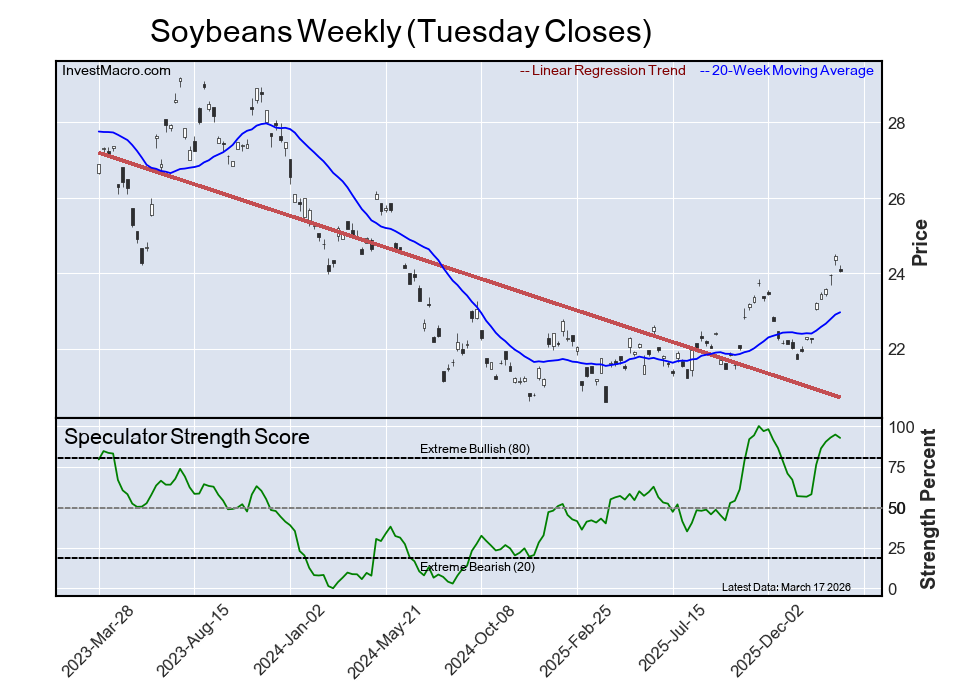
SOYBEANS Futures COT ChartThe SOYBEANS large speculator standing this week resulted in a net position of 57,431 contracts in the data reported through Tuesday. This was a weekly reduction of -698 contracts from the previous week which had a total of 58,129 net contracts.

This week’s current strength score (the trader positioning range over the past three years, measured from 0 to 100) shows the speculators are currently Bullish with a score of 56.4 percent. The commercials are Bearish with a score of 44.1 percent and the small traders (not shown in chart) are Bullish with a score of 59.3 percent.

Price Trend-Following Model: Weak Uptrend

Our weekly trend-following model classifies the current market price position as: Weak Uptrend.

SOYBEANS Futures StatisticsSPECULATORSCOMMERCIALSSMALL TRADERS
– Percent of Open Interest Longs:19.551.76.1
– Percent of Open Interest Shorts:12.856.08.5
– Net Position:57,431-37,074-20,357
– Gross Longs:167,074444,21652,360
– Gross Shorts:109,643481,29072,717
– Long to Short Ratio:1.5 to 10.9 to 10.7 to 1
NET POSITION TREND:
– Strength Index Score (3 Year Range Pct):56.444.159.3
– Strength Index Reading (3 Year Range):BullishBearishBullish
NET POSITION MOVEMENT INDEX:
– 6-Week Change in Strength Index:-30.031.6-7.1


SOYBEAN OIL Futures:

SOYBEAN OIL Futures COT ChartThe SOYBEAN OIL large speculator standing this week resulted in a net position of 41,276 contracts in the data reported through Tuesday. This was a weekly gain of 36,733 contracts from the previous week which had a total of 4,543 net contracts.

This week’s current strength score (the trader positioning range over the past three years, measured from 0 to 100) shows the speculators are currently Bullish with a score of 67.7 percent. The commercials are Bearish with a score of 35.1 percent and the small traders (not shown in chart) are Bearish with a score of 40.0 percent.

Price Trend-Following Model: Strong Uptrend

Our weekly trend-following model classifies the current market price position as: Strong Uptrend.

SOYBEAN OIL Futures StatisticsSPECULATORSCOMMERCIALSSMALL TRADERS
– Percent of Open Interest Longs:21.146.95.1
– Percent of Open Interest Shorts:14.853.84.4
– Net Position:41,276-45,6164,340
– Gross Longs:139,537310,53133,483
– Gross Shorts:98,261356,14729,143
– Long to Short Ratio:1.4 to 10.9 to 11.1 to 1
NET POSITION TREND:
– Strength Index Score (3 Year Range Pct):67.735.140.0
– Strength Index Reading (3 Year Range):BullishBearishBearish
NET POSITION MOVEMENT INDEX:
– 6-Week Change in Strength Index:42.7-43.232.2


SOYBEAN MEAL Futures:

SOYBEAN MEAL Futures COT ChartThe SOYBEAN MEAL large speculator standing this week resulted in a net position of -8,294 contracts in the data reported through Tuesday. This was a weekly boost of 14,496 contracts from the previous week which had a total of -22,790 net contracts.

This week’s current strength score (the trader positioning range over the past three years, measured from 0 to 100) shows the speculators are currently Bearish with a score of 29.8 percent. The commercials are Bullish with a score of 72.2 percent and the small traders (not shown in chart) are Bearish with a score of 35.8 percent.

Price Trend-Following Model: Weak Uptrend

Our weekly trend-following model classifies the current market price position as: Weak Uptrend.

SOYBEAN MEAL Futures StatisticsSPECULATORSCOMMERCIALSSMALL TRADERS
– Percent of Open Interest Longs:21.651.08.6
– Percent of Open Interest Shorts:23.152.55.5
– Net Position:-8,294-8,06916,363
– Gross Longs:115,053271,98445,638
– Gross Shorts:123,347280,05329,275
– Long to Short Ratio:0.9 to 11.0 to 11.6 to 1
NET POSITION TREND:
– Strength Index Score (3 Year Range Pct):29.872.235.8
– Strength Index Reading (3 Year Range):BearishBullishBearish
NET POSITION MOVEMENT INDEX:
– 6-Week Change in Strength Index:-8.57.911.1


LIVE CATTLE Futures:

LIVE CATTLE Futures COT ChartThe LIVE CATTLE large speculator standing this week resulted in a net position of 88,978 contracts in the data reported through Tuesday. This was a weekly decline of -371 contracts from the previous week which had a total of 89,349 net contracts.

This week’s current strength score (the trader positioning range over the past three years, measured from 0 to 100) shows the speculators are currently Bullish with a score of 65.6 percent. The commercials are Bearish with a score of 27.8 percent and the small traders (not shown in chart) are Bullish with a score of 58.1 percent.

Price Trend-Following Model: Strong Uptrend

Our weekly trend-following model classifies the current market price position as: Strong Uptrend.

LIVE CATTLE Futures StatisticsSPECULATORSCOMMERCIALSSMALL TRADERS
– Percent of Open Interest Longs:44.532.98.8
– Percent of Open Interest Shorts:17.756.212.2
– Net Position:88,978-77,526-11,452
– Gross Longs:147,788109,33029,206
– Gross Shorts:58,810186,85640,658
– Long to Short Ratio:2.5 to 10.6 to 10.7 to 1
NET POSITION TREND:
– Strength Index Score (3 Year Range Pct):65.627.858.1
– Strength Index Reading (3 Year Range):BullishBearishBullish
NET POSITION MOVEMENT INDEX:
– 6-Week Change in Strength Index:12.9-17.44.6


LEAN HOGS Futures:

LEAN HOGS Futures COT ChartThe LEAN HOGS large speculator standing this week resulted in a net position of 65,936 contracts in the data reported through Tuesday. This was a weekly gain of 9,539 contracts from the previous week which had a total of 56,397 net contracts.

This week’s current strength score (the trader positioning range over the past three years, measured from 0 to 100) shows the speculators are currently Bullish with a score of 73.2 percent. The commercials are Bearish with a score of 29.9 percent and the small traders (not shown in chart) are Bearish with a score of 27.5 percent.

Price Trend-Following Model: Strong Uptrend

Our weekly trend-following model classifies the current market price position as: Strong Uptrend.

LEAN HOGS Futures StatisticsSPECULATORSCOMMERCIALSSMALL TRADERS
– Percent of Open Interest Longs:42.031.76.6
– Percent of Open Interest Shorts:23.547.98.9
– Net Position:65,936-57,624-8,312
– Gross Longs:149,861113,36723,425
– Gross Shorts:83,925170,99131,737
– Long to Short Ratio:1.8 to 10.7 to 10.7 to 1
NET POSITION TREND:
– Strength Index Score (3 Year Range Pct):73.229.927.5
– Strength Index Reading (3 Year Range):BullishBearishBearish
NET POSITION MOVEMENT INDEX:
– 6-Week Change in Strength Index:24.1-23.6-15.1


COTTON Futures:

COTTON Futures COT ChartThe COTTON large speculator standing this week resulted in a net position of -38,967 contracts in the data reported through Tuesday. This was a weekly fall of -13,143 contracts from the previous week which had a total of -25,824 net contracts.

This week’s current strength score (the trader positioning range over the past three years, measured from 0 to 100) shows the speculators are currently Bearish-Extreme with a score of 15.9 percent. The commercials are Bullish-Extreme with a score of 83.6 percent and the small traders (not shown in chart) are Bearish with a score of 24.8 percent.

Price Trend-Following Model: Downtrend

Our weekly trend-following model classifies the current market price position as: Downtrend.

COTTON Futures StatisticsSPECULATORSCOMMERCIALSSMALL TRADERS
– Percent of Open Interest Longs:26.648.93.9
– Percent of Open Interest Shorts:37.338.23.8
– Net Position:-38,96738,648319
– Gross Longs:96,472177,24114,078
– Gross Shorts:135,439138,59313,759
– Long to Short Ratio:0.7 to 11.3 to 11.0 to 1
NET POSITION TREND:
– Strength Index Score (3 Year Range Pct):15.983.624.8
– Strength Index Reading (3 Year Range):Bearish-ExtremeBullish-ExtremeBearish
NET POSITION MOVEMENT INDEX:
– 6-Week Change in Strength Index:-0.2-0.914.4


COCOA Futures:

The COCOA large speculator standing this week resulted in a net position of -15,502 contracts in the data reported through Tuesday. This was a weekly advance of 2,372 contracts from the previous week which had a total of -17,874 net contracts.

This week’s current strength score (the trader positioning range over the past three years, measured from 0 to 100) shows the speculators are currently Bearish-Extreme with a score of 2.2 percent. The commercials are Bullish-Extreme with a score of 97.8 percent and the small traders (not shown in chart) are Bearish-Extreme with a score of 19.7 percent.

Price Trend-Following Model: Uptrend

Our weekly trend-following model classifies the current market price position as: Uptrend.

COCOA Futures StatisticsSPECULATORSCOMMERCIALSSMALL TRADERS
– Percent of Open Interest Longs:18.448.26.7
– Percent of Open Interest Shorts:28.837.37.2
– Net Position:-15,50216,293-791
– Gross Longs:27,45272,0669,984
– Gross Shorts:42,95455,77310,775
– Long to Short Ratio:0.6 to 11.3 to 10.9 to 1
NET POSITION TREND:
– Strength Index Score (3 Year Range Pct):2.297.819.7
– Strength Index Reading (3 Year Range):Bearish-ExtremeBullish-ExtremeBearish-Extreme
NET POSITION MOVEMENT INDEX:
– 6-Week Change in Strength Index:-16.514.019.7


WHEAT Futures:

WHEAT Futures COT ChartThe WHEAT large speculator standing this week resulted in a net position of -79,390 contracts in the data reported through Tuesday. This was a weekly rise of 14,340 contracts from the previous week which had a total of -93,730 net contracts.

This week’s current strength score (the trader positioning range over the past three years, measured from 0 to 100) shows the speculators are currently Bearish with a score of 34.4 percent. The commercials are Bullish with a score of 65.1 percent and the small traders (not shown in chart) are Bullish with a score of 66.0 percent.

Price Trend-Following Model: Weak Downtrend

Our weekly trend-following model classifies the current market price position as: Weak Downtrend.

WHEAT Futures StatisticsSPECULATORSCOMMERCIALSSMALL TRADERS
– Percent of Open Interest Longs:22.436.56.1
– Percent of Open Interest Shorts:37.222.15.7
– Net Position:-79,39077,3632,027
– Gross Longs:119,821195,72132,444
– Gross Shorts:199,211118,35830,417
– Long to Short Ratio:0.6 to 11.7 to 11.1 to 1
NET POSITION TREND:
– Strength Index Score (3 Year Range Pct):34.465.166.0
– Strength Index Reading (3 Year Range):BearishBullishBullish
NET POSITION MOVEMENT INDEX:
– 6-Week Change in Strength Index:-25.924.824.9


Article By InvestMacroReceive our weekly COT Newsletter

*COT Report: The COT data, released weekly to the public each Friday, is updated through the most recent Tuesday (data is 3 days old) and shows a quick view of how large speculators or non-commercials (for-profit traders) were positioned in the futures markets.

The CFTC categorizes trader positions according to commercial hedgers (traders who use futures contracts for hedging as part of the business), non-commercials (large traders who speculate to realize trading profits) and nonreportable traders (usually small traders/speculators) as well as their open interest (contracts open in the market at time of reporting). See CFTC criteria here.

Week Ahead: Not every glitter is gold…

By ForexTime 

  • Silver ↑ 40% since start of 2025
  • 83% correlation with gold over past 2 years
  • Supported by industrial demand, ETFs and weaker USD
  • Over past year US NFP triggered moves of ↑ 1.5% & ↓ 2.0%
  • Bloomberg FX model – 70% – ($100.22 – $131.27)

Precious metals are taking a beating as the dollar strengthens on reports that Trump may nominate Kevin Warsh for Federal Reserve chair.

Nevertheless, Silver remains the champion in the commodity space, gaining 400% year-to-date versus golds 17% return.

Note: Although gold/silver crashed yesterday, most losses have been clawed back with bulls greedily eyeing fresh records.

Precious metals have been boosted by geopolitical risk, speculative demand from Chinese investors, ETF inflows and a broadly weaker dollar.

But silver is also drawing strength from rising industrial demand in the face of supply deficits.

These solid fundamental forces point to further gains for silver which has moved in tandem with gold 83% of the time in any given 5-day period over the past 2 years.

Before we cover themes that could impact silver, here is a list of events for the week ahead:

Sunday, 1st February

  • OIL: OPEC+ ministers meeting


Monday, 2nd February

  • CNY: China RatingDog Manufacturing PMI (Jan)
  • EUR: Germany Retail Sales (Dec)
  • GBP: UK S&P Global manufacturing PMI, Nationwide house prices
  • USD: US ISM Manufacturing PMI (Jan); ISM Manufacturing Employment (Jan)

Tuesday, 3rd February

  • AUD: RBA Interest Rate Decision
  • FRA40: France Inflation Rate (Jan)
  • MXN: Mexico Business Confidence (Jan)
  • USD: JOLTs Job Openings (Dec)
  • WTI/Brent: US API Crude Oil Stock Change (w/e Jan 30)


Wednesday, 4th February

  • CNY: China RatingDog Services PMI (Jan)
  • EUR: Eurozone Inflation Rate (Jan)
  • USD: US ISM Services PMI (Jan); ADP Employment Change (Jan)
  • WTI/Brent: US EIA Crude Oil Stocks Change (w/e Jan 30); EIA Gasoline Stocks Change (w/e Jan 30)
  • NAS100: Alphabet earnings, US Treasury quarterly refunding announcement


Thursday, 5th February

  • AUD: Balance of Trade (Dec)
  • GBP: BoE Interest Rate Decision; MPC Meeting Minutes; UK S&P Global Construction PMI (Jan)
  • EUR: ECB Interest Rate Decision
  • MXN: BoM Interest Rate Decision
  • US500: Amazon earnings


Friday, 6th February

  • EUR: Germany Balance of Trade (Dec); Germany Industrial Production (Dec); France Balance of Trade (Dec)
  • CAD: Canada Unemployment Rate (Jan); Canada Ivey PMI s.a. (Jan)
  • USD: US Non-Farm Payrolls (Jan); Unemployment Rate (Jan); Michigan Consumer Sentiment (Feb)

There are a couple of high-level themes that may shape the outlook for Silver as we enter February:

Note: President Donald Trump will announce his nominee for Federal Chair on Friday 30th January.

According to Polymarket, there is an 83% chance that he will pick former Fed governor Kevin Warsh which is a long-term critic of ultra-loose monetary policy.

So, this raises questions about whether he will yield to Trump and cut rates or reassert policy discipline.


1) Geopolitical risk

In the latest developments, Trump has threatened to attack Iran while saying he will impose tariffs on countries that supply oil to Cuba. He has also threatened to decertify all aircrafts made in Canada and threatened 50% tariffs on those planes.

Mounting geopolitical tensions may accelerate the flight to safety, boosting safe-haven assets like Silver.

2) US January NFP report

The incoming NFP report could shape the metals outlook for February.

What are the market forecasts for the January NFP report?

  • 78,000 jobs added in January (higher than the 50,000 added in December)
  • Unemployment rate to remain unchanged at 4.4%
  •  Average hourly earnings to slip to 0.3% month-on-month
  • Average hourly earnings to slip 3.6% year-on-year (3.8% in January)

Traders are currently pricing a 15% probability of a 25bp Fed cut by March with this jumping to only 30% by April.

  • Silver prices could push higher if a soft NFP report weakens the dollar and supports the case for lower US rates.
  • A stronger-than-expected jobs report could weaken silver, especially if this results in a stronger dollar and reduced expectations over lower US rates.

3) Technical forces

Silver is aggressively bullish on the daily charts prices above the 21, 50, 100 and 200-day SMA.

However, the Relative Strength Index (RSI) is well above 70 – indicating that prices are extremely overbought.

  • A solid breakout above $121.664 may open doors to fresh all-time highs at $125 and $131.27 – the upper bound of the Bloomberg FX model.
  • Sustained weakness below $112.50 may encourage a decline toward $106.72 and $100.


Forex-Time-LogoArticle by ForexTime


ForexTime Ltd (FXTM) is an award winning international online forex broker regulated by CySEC 185/12 www.forextime.com

The US and European stock indices are under a sell-off

By JustMarkets 

The US stock indices closed mixed on Thursday. By the end of the day, the Dow Jones (US30) rose by 0.11%. The S&P 500 (US500) decreased by 0.13%. The tech-heavy Nasdaq (US100) closed lower by 0.72%. The primary pressure on the market came from a large-scale sell-off in tech stocks as investors began to reassess the valuation of AI-related companies amid a busy corporate earnings season. The hardest hit was the high-tech sector after Microsoft’s shares plummeted by 10%. The company reported a slowdown in cloud business growth alongside a sharp increase in capital expenditures for AI infrastructure, triggering a chain reaction of selling in the sector and putting heavy pressure on the Nasdaq. At the same time, individual corporate reports supported the market: Meta shares soared 10% due to a revenue prognoses that exceeded expectations, IBM added 5%, and Caterpillar rose by 3.5% following strong results.

Bitcoin (BTC/USD) weakened by 2.8%, dropping to $82,100 and hitting its lowest level since November 21, 2025. Market pressure was driven by several factors, the key one being a sustained capital outflow from spot Bitcoin ETFs. From January 20 to 26, ETFs recorded a net outflow of approximately $1.14 billion, marking the largest weekly decline in inflows since the beginning of January. The bulk of the redemptions came from major funds, Fidelity’s FBTC, Grayscale’s GBTC, BlackRock’s IBIT, and Ark 21Shares’ ARKB, which collectively accounted for about 92% of all outflows. Notably, BlackRock’s iShares Bitcoin Trust, the largest Bitcoin ETF on the market, fell behind the same management company’s Gold ETF in terms of asset volume, highlighting a shift in investor interest toward more traditional safe-haven instruments.

Equity markets in Europe traded with no single trend on Thursday. The German DAX (DE40) fell by 2.07%, the French CAC 40 (FR40) closed up 0.06%, the Spanish IBEX 35 (ES35) dropped 0.10%, and the British FTSE 100 (UK100) closed higher 0.17%. European stock markets ended Thursday’s session lower overall amid weak reports from several of the region’s largest companies.

In Sweden, the Riksbank’s key interest rate was left unchanged at 1.75% for the third consecutive time following the first monetary policy meeting of 2026, which was fully in line with market expectations. The central bank noted that the rate is likely to remain at its current level for some time while the regulator assesses the impact of measures already taken, which are expected to support a recovery in economic activity and stabilize inflation.

On Friday, WTI crude oil prices declined to around $64 per barrel; however, for the month as a whole, they continue to show their best performance since July 2023, supported by a rising geopolitical premium. Investors remain cautious amid renewed tensions between the US and Iran after President Donald Trump called on Tehran to return to negotiations regarding the nuclear program. The market is particularly focused on risks to shipping through the Strait of Hormuz – a strategically vital narrow route between Iran and the Arabian Peninsula, through which a significant portion of global oil and LNG supplies passes daily. Any escalation in the region could lead to serious disruptions in global energy flows.

On Thursday, silver (XAG) dropped more than 6%, falling to around $110 per ounce, retreating from a record high of $120 amid active profit-taking by investors following a sharp price rally. Additional pressure on the market was exerted by ongoing geopolitical tensions: Iran stated it would “defend and respond as never before” to new threats from the US.

Asian markets mostly rose yesterday. The Japanese Nikkei 225 (JP225) grew by 0.03%, the Chinese FTSE China A50 (CHA50) rose by 1.34%, Hong Kong’s Hang Seng (HK50) increased by 0.51%, while the Australian ASX 200 (AU200) showed a negative result of 0.07%.

On Friday, the New Zealand dollar (NZD) declined to around 0.604 USD, but for the month, it maintained steady growth supported by increasing expectations of monetary policy tightening. The momentum for the “kiwi” was set by a series of strong macroeconomic data, specifically an unexpected acceleration of inflation last week, which boosted market confidence that the Reserve Bank of New Zealand (RBNZ) may move to raise rates toward the end of the year. Against this backdrop, the currency rose to a seven-month high on Thursday. Additional support came from fresh data showing consumer confidence in January reached its highest level since August 2021, as well as a trade surplus increase that exceeded expectations.

S&P 500 (US500) 6,969.01 −9.02 (−0.13%)

Dow Jones (US30) 49,071.56 +55.96 (+0.11%)

DAX (DE40) 24,309.46 −513.33 (−2.07%)

FTSE 100 (UK100) 10,171.76 +17.33 (+0.17%)

USD Index 96.20 −0.25% (−0.26%)

News feed for: 2026.01.30

  • Japan Tokyo Core CPI (m/m) at 01:30 (GMT+2); – JPY (MED)
  • Japan Unemployment Rate (m/m) at 01:30 (GMT+2); – JPY (MED)
  • Japan Retail Sales (m/m) at 01:50 (GMT+2); – JPY (LOW)
  • Australia Producer Price Index (m/m) at 02:30 (GMT+2); – AUD (MED)
  • Switzerland KOF Leading Indicators (m/m) at 10:00 (GMT+2); – CHF (LOW)
  • Eurozone GDP (m/m) at 12:00 (GMT+2); – EUR (MED)
  • German Inflation Rate (m/m) at 15:00 (GMT+2); – EUR (MED)
  • Canada GDP (m/m) at 15:30 (GMT+2); – CAD (MED)
  • US Producer Price Index (m/m) at 15:30 (GMT+2); – USD (HIGH)
  • US Chicago PMI (m/m) at 16:45 (GMT+2). – USD (LOW)

By JustMarkets


This article reflects a personal opinion and should not be interpreted as an investment advice, and/or offer, and/or a persistent request for carrying out financial transactions, and/or a guarantee, and/or a forecast of future events.

EUR/USD Moves Away from High but Remains Strong

By RoboForex Analytical Department

EUR/USD fell to 1.1919 on Friday.  Despite this movement, the week ends with the US dollar experiencing its second consecutive decline. Pressure on the USD is driven by heightened geopolitical tensions and uncertainty about economic policy in Washington, which is reducing investor confidence in the dollar.

The focus is on recent statements by US President Donald Trump. He threatened tariffs against countries supplying oil to Cuba and also warned Iran of possible military strikes if it refused to sign a nuclear agreement. An additional source of uncertainty was Trump’s promise to announce the candidacy of a new Fed chair on Friday morning, following sustained pressure on Jerome Powell to cut rates more aggressively.

In parallel, the White House and Senate Democrats reached a preliminary agreement that avoids a government shutdown. This partially reduced short-term fiscal risks.

Earlier in the week, the dollar fell to levels not seen in almost four years after Trump expressed no concern about its weakening. Later, the US currency was supported by statements from US Treasury Secretary Scott Bessent, who remains committed to a strong dollar policy.

Technical Analysis

On the H4 chart, EUR/USD has formed a wave of growth towards 1.2080. A repeated breakdown of this resistance level may signal a continuation of the uptrend. At this stage, the pair is continuing the correction wave towards the support level of 1.1875. Technically, the correction scenario is confirmed by the MACD indicator, with its histogram and signal line both above zero, forming a downward wave. Upon completion of the correction, we anticipate the uptrend continuing towards 1.2045 and subsequently to 1.2200, with possible corrections along the way.

On the H1 chart, the pair is forming a correction after testing the resistance level. A rebound from the support level of 1.1860 would signal the formation of a new growth wave. The Stochastic oscillator’s signal lines are pointing towards level 80, suggesting the uptrend may continue. Subsequently, the target for growth may be 1.2045.

Conclusion

In summary, while the EUR/USD pair has experienced a corrective pullback, the fundamental backdrop of geopolitical tensions and policy uncertainty continues to weigh on the US dollar, underpinning the euro’s relative strength. Technically, the correction appears poised to complete near key support levels, with indicators on both the H4 and H1 timeframes suggesting a high probability of resuming the prevailing upward trend. The overall bias remains bullish for a potential test of higher resistance zones.


Disclaimer

Any forecasts contained herein are based on the author’s particular opinion. This analysis may not be treated as trading advice. RoboForex bears no responsibility for trading results based on trading recommendations and reviews contained herein.

Americans want heat pumps – but high electricity prices may get in the way

By Roxana Shafiee, Harvard University; Harvard Kennedy School 

Heat pumps can reduce carbon emissions associated with heating buildings, and many states have set aggressive targets to increase their use in the coming decades. But while heat pumps are often cheaper choices for new buildings, getting homeowners to install them in existing homes isn’t so easy.

Current energy prices, including the rising cost of electricity, mean that homeowners may experience higher heating bills by replacing their current heating systems with heat pumps – at least in some regions of the country.

Heat pumps, which use electricity to move heat from the outside in, are used in only 14% of U.S. households. They are common primarily in warm southern states such as Florida where winter heating needs are relatively low. In the Northeast, where winters are colder and longer, only about 5% of households use a heat pump.

In our new study, my co-author Dan Schrag and I examined how heat pump adoption would change annual heating bills for the average-size household in each county across the U.S. We wanted to understand where heat pumps may already be cost-effective and where other factors may be preventing households from making the switch.

Wide variation in home heating

Across the U.S., people heat their homes with a range of fuels, mainly because of differences in climate, pricing and infrastructure. In colder regions – northern states and states across the Rocky Mountains – most people use natural gas or propane to provide reliable winter heating. In California, most households also use natural gas for heating.

In warmer, southern states, including Florida and Texas, where electricity prices are cheaper, most households use electricity for heating – either in electric furnaces, baseboard resistance heating or to run heat pumps. In the Pacific northwest, where electricity prices are low due to abundant hydropower, electricity is also a dominant heating fuel.

The type of community also affects homes’ fuel choices. Homes in cities are more likely to use natural gas relative to rural areas, where natural gas distribution networks are not as well developed. In rural areas, homes are more likely to use heating oil and propane, which can be stored on property in tanks. Oil is also more commonly used in the Northeast, where properties are older – particularly in New England, where a third of households still rely on oil for heating.

Why heat pumps?

Instead of generating heat by burning fuels such as natural gas that directly emit carbon, heat pumps use electricity to move heat from one place to another. Air-source heat pumps extract the heat of outside air, and ground-source heat pumps, sometimes called geothermal heat pumps, extract heat stored in the ground.

Heat pump efficiency depends on the local climate: A heat pump operated in Florida will provide more heat per unit of electricity used than one in colder northern states such as Minnesota or Massachusetts.

But they are highly efficient: An air-source heat pump can reduce household heating energy use by roughly 30% to 50% relative to existing fossil-based systems and up to 75% relative to inefficient electric systems such as baseboard heaters.

Heat pumps can also reduce emissions of greenhouse gases, although that depends on how their electricity is generated – whether from fossil fuels or cleaner energy, such as wind and solar.

Heat pumps can lower heating bills

We found that for households currently using oil, propane or non-heat pump forms of electric heating – such as electric furnaces or baseboard resistive heaters – installing a heat pump would reduce heating bills across all parts of the country.

The amount a household can save on energy costs with a heat pump depends on region and heating type, averaging between $200 and $500 a year for the average-size household currently using propane or oil.

However, savings can be significantly greater: We found the greatest opportunity for savings in households using inefficient forms of electric heating in northern regions. High electricity prices in the Northeast, for example, mean that heat pumps can save consumers up to $3,000 a year over what they would pay to heat with an electric furnace or to use baseboard heating.

A challenge in converting homes using natural gas

Unfortunately for the households that use natural gas in colder, northern regions – making up around half of the country’s annual heating needs – installing a heat pump could raise their annual heating bills. Our analysis shows that bills could increase by as much as $1,200 per year in northern regions, where electricity costs are as much as five times greater than natural gas per kilowatt-hour.

Even households that install ground-source heat pumps, the most efficient type of heat pump, would still see bill increases in regions with the highest electricity prices relative to natural gas.

Installation costs

In parts of the country where households would see their energy costs drop after installing a heat pump, the savings would eventually offset the upfront costs. But those costs can be significant and discourage people from buying.

On average, it costs $17,000 to install an air-source heat pump and typically at least $30,000 to install a ground-source heat pump.

Some homes may also need upgrades to their electrical systems, which can increase the total installation price even more, by tens of thousands of dollars in some cases, if costly service upgrades are required.

In places where air conditioning is typical, homes may be able to offset some costs by using heat pumps to replace their air conditioning units as well as their heating systems. For instance, a new program in California aims to encourage homeowners who are installing central air conditioning or replacing broken AC systems to get energy-efficient heat pumps that provide both heating and cooling.

Rising costs of electricity

A main finding of our analysis was that the cost of electricity is key to encouraging people to install heat pumps.

Electricity prices have risen sharply across the U.S. in recent years, driven by factors such as extreme weather, aging infrastructure and increasing demand for electric power. New data center demand has added further pressure and raised questions about who bears these costs.

Heat pump installations will also increase electricity demand on the grid: The full electrification of home heating across the country would increase peak electricity demand by about 70%. But heat pumps – when used in concert with other technologies such as hot-water storage – can provide opportunities for grid balancing and be paired with discounted or time-of-use rate structures to reduce overall operating costs. In some states, regulators have ordered utilities to discount electricity costs for homes that use heat pumps.

But ultimately, encouraging households to embrace heat pumps and broader economy-wide electrification, including electric vehicles, will require more than just technological fixes and a lot more electricity – it will require lower power prices.The Conversation

About the Author:

Roxana Shafiee, Environmental Fellow, Center for the Environment, Harvard University; Harvard Kennedy School

This article is republished from The Conversation under a Creative Commons license. Read the original article.


20,000 Meters Into a Strategic Metal as Tungsten Drilling Accelerates in Europe

Source: Streetwise Reports (1/28/26)

Allied Critical Metals Inc. (ACM:CSE; ACMIF:OTCQB; 0VJ0:FSE) has launched a fully funded 20,000 meter drill campaign at its Borralha Tungsten Project in northern Portugal. Read how the 2026 program builds on expanded resources and targets multiple breccia zones ahead of planned economic studies.

Allied Critical Metals Inc. (ACM:CSE; ACMIF:OTCQB; 0VJ0:FSE) has commenced a 20,000 meter drill campaign at its 100%-owned Borralha Tungsten Project in northern Portugal. According to the company, this fully funded 2026 exploration program will target multiple zones within the Borralha property, building on the 2025 drill results and a significantly expanded Mineral Resource Estimate (MRE) announced in late 2025.

The 2026 drill program includes core and reverse circulation drilling and is intended to support multiple objectives. These include step-out and infill drilling to upgrade the current resource estimate, further testing of the Santa Helena Breccia, and exploration of other mineralized zones. The program will also provide material for metallurgical test work and generate data to support the company’s anticipated Preliminary Economic Assessment, which is targeted for completion in Q1 2026.

The company stated that drilling will also target the Venise Breccia, located north of Santa Helena, which is historically known for high-grade wolframite and molybdenum mineralization.

“We are excited to launch our most ambitious drill program to date at Borralha,” said Roy Bonnell, CEO and Director of Allied, in a company news release. “With tungsten designated a strategic critical material in the European Union and the United States, this expanded 20,000-meter program will be a cornerstone of our efforts to define Borralha’s resource potential and support advancing the project toward economic evaluation.”

The Borralha project includes bulk mineralization zones as well as high-grade breccia corridors, and has already received regulatory milestones allowing progression through engineering and permitting phases. The company noted that recent work confirmed the system’s scale and resource growth potential.

Tungsten’s Role in Defense Supply Chains, Strategic Metals, and Institutional Allocation

In a January 21 sector analysis published by Tungsten for Stainless: Canada Minerals in 2026 – Driving the Future of Critical Technology & Industry, tungsten was described as a foundational input in advanced sectors such as defense, aerospace, electronics, and stainless steel manufacturing. The report stated that “tungsten accounts for over 90% of stainless steel’s hardness additives in Canada’s high-tech exports as of 2026,” and emphasized the metal’s role in corrosion resistance, extreme heat durability, and wear tolerance. Tungsten was identified as indispensable for applications ranging from cutting tools and turbine components to protective armor and radiation shielding. According to the report, Canada’s tungsten reserves contribute significantly to global aerospace and defense output, with estimated contributions of up to 20% in those categories.

From a January 23 article from InvestorNews, tungsten’s rise to the top of global strategic materials discussions was attributed to decades of stockpile depletion and new geopolitical realities. Christopher Ecclestone of Hallgarten + Company said that “Western governments… fell asleep at the wheel,” allowing critical inventories to run down while attention shifted elsewhere. He described tungsten as “extraordinarily dense, extremely hard, essential for armor-piercing munitions and high-end tooling.” Lewis Black noted that tungsten’s value was “availability-driven,” stating, “the amount of tungsten in an end product is so small that the consumer barely notices the cost; what matters is whether any reliable non-Chinese supply exists at all.” The report also quoted Ecclestone saying that China had effectively told the world, “No more tungsten for you,” in reference to recent export restrictions affecting global access.

Muflih Hidayat, in a January 27 report, reported that institutional investment behavior in the tungsten sector was examined through the lens of capital allocation psychology. The report stated that portfolio managers viewed tungsten exposure as a strategic hedge, noting that “risk premiums that exceed traditional commodity investment frameworks” were being applied due to supply chain concerns. Tungsten’s “dual-use nature” in both military and civilian applications was described as generating “recession-resistant revenue streams,” contributing to strong institutional interest. The article noted that “institutional confidence that long-term value creation would exceed immediate discount impacts” was evident in recent oversubscribed placements, underscoring a shift toward long-term positioning over short-term valuation sensitivity.

Updated Borralha Resource and Preliminary Assessment Plans

According to a December 9 Caesar’s report titled Allied Critical Metals increases Borralha tungsten resource, Allied Critical Metals released an updated mineral resource estimate for its fully owned Borralha tungsten project in Portugal. The report stated that the project contained “13 million tonnes in the measured and indicated resource category at an average grade of 0.21% WO3, with an additional 7.7 million tonnes in the inferred resource category at an average grade of 0.18% WO3.” It further noted that the measured and indicated resources hosted “27,000 tonnes of WO3, which represents approximately 2.7 million mtu,” while the inferred category hosted “approximately 1.4 million mtu.”

The same report commented on the development context, stating that “the resource remains open in multiple directions, so it will be interesting to see how many tonnes can be added further down the road.” It also noted that the updated resource would be used for a Preliminary Economic Assessment, which “will be published in the first quarter of next year.” Regarding the mine design, the report stated that “the mine plan will likely be based on a long-hole stoping approach,” and that this was how “the 0.09% WO3 cutoff grade was established.”

In terms of processing assumptions, the report said that “initial metallurgical results indicate a low-cost gravity flow sheet with a recovery rate of 75-85%.” It also mentioned that “there is a chance to recover copper, tin, and silver as potential by-product credits,” and added that “the impact of these by-products will hopefully already be visible in the Preliminary Economic Assessment.”

Advancing Toward Economic Evaluation with Multiple 2026 Workstreams

Allied’s 2026 drill campaign at Borralha is designed to complete approximately 20,000 meters of drilling across multiple target zones. Program objectives include expanding and upgrading the current Mineral Resource Estimate through step-out and infill drilling, collecting metallurgical material to support prefeasibility analysis, and generating data to support the company’s Preliminary Economic Assessment, which is expected in Q1 2026.

Streetwise Ownership Overview*

Retail: 53%
Management & Insiders: 31%
Institutions: 16%
*Share Structure as of 1/28/2026


Drilling will also test extensions of the Santa Helena Breccia and target the Venise Breccia, a historically recognized high-grade tungsten and molybdenum structure located to the north. These efforts follow a 2025 program that yielded significant intercepts, including what the company described as some of the largest tungsten intervals ever recorded.

According to the company, updates, including initial drill results and revised resource modeling, will be released as data becomes available throughout the campaign.

Ownership and Share Structure1

Insiders own approximately 31% of Allied. About 16% is held by institutions and institutional investors, and the rest is held by retail shareholders.

The company has 170 million common shares issued and outstanding and 214 million common shares on a fully diluted basis. Its market cap is ~CA$180 million. Its 52-week range is CA$0.20–CA$1.20 per share.


Important Disclosures:

  1. Allied Critical Metals Inc. has a consulting relationship with Street Smart an affiliate of Streetwise Reports. Street Smart Clients pay a monthly consulting fee between US$8,000 and US$20,000.
  2. As of the date of this article, officers, contractors, shareholders, and/or employees of Streetwise Reports LLC (including members of their household) own securities of Allied Critical Metals Inc.
  3. James Guttman wrote this article for Streetwise Reports LLC and provides services to Streetwise Reports as an employee.
  4. This article does not constitute investment advice and is not a solicitation for any investment. Streetwise Reports does not render general or specific investment advice and the information on Streetwise Reports should not be considered a recommendation to buy or sell any security. Each reader is encouraged to consult with his or her personal financial adviser and perform their own comprehensive investment research. By opening this page, each reader accepts and agrees to Streetwise Reports’ terms of use and full legal disclaimer. Streetwise Reports does not endorse or recommend the business, products, services or securities of any company.

For additional disclosures, please click here.

1. Ownership and Share Structure Information

The information listed above was updated on the date this article was published and was compiled from information from the company and various other data providers.