COT Soft Commodities Charts: Speculator Bets led by Cotton & Corn

By InvestMacro

Here are the latest charts and statistics for the Commitment of Traders (COT) reports data published by the Commodities Futures Trading Commission (CFTC).

The latest COT data is updated through Tuesday October 3rd and shows a quick view of how large traders (for-profit speculators and commercial entities) were positioned in the futures markets.

Weekly Speculator Changes led by Cotton & Corn

The COT soft commodities markets speculator bets were lower this week as three out of the eleven softs markets we cover had higher positioning while the other eight markets had lower speculator contracts.

Leading the gains for the softs markets was Corn (10,996 contracts) with Cotton (10,382 contracts) and Soybean Oil (2,936 contracts) also showing positive weeks.

The markets with the declines in speculator bets this week were Soybeans (-23,985 contracts) with Sugar (-21,858 contracts), Soybean Meal (-19,769 contracts), Live Cattle (-8,766 contracts), Cocoa (-8,605 contracts) and Lean Hogs (-6,998 contracts), Coffee (-5,787 contracts) and Wheat (-1,333 contracts) also registering lower bets on the week.


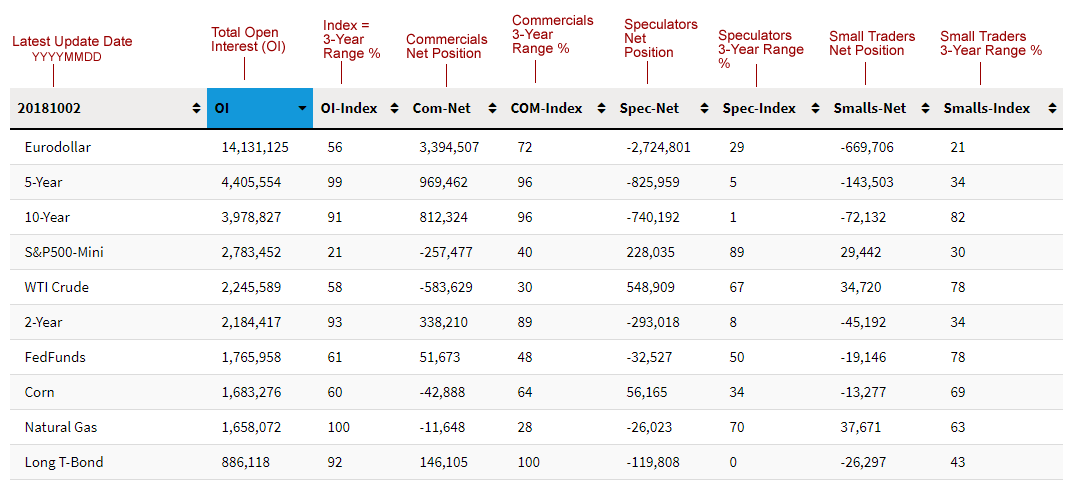
Data Snapshot of Commodity Market Traders | Columns Legend
Oct-03-2023OIOI-IndexSpec-NetSpec-IndexCom-NetCOM-IndexSmalls-NetSmalls-Index
WTI Crude1,787,49535349,56053-381,9465032,38645
Gold431,226491,22617-111,9828120,75632
Silver125,8471415,34440-30,3585715,01450
Copper208,79549-21,9121219,952881,96031
Palladium18,42186-9,71899,86193-14333
Platinum81,529852,61622-7,514784,89834
Natural Gas1,174,38644-79,2004061,7636417,43722
Brent118,9260-36,5434135,9216562218
Heating Oil330,8254838,94693-66,348527,40293
Soybeans803,4394922,5030-5,88095-16,62364
Corn1,367,90423-107,5442140,80398-33,25986
Coffee210,21525-14,4491313,4748997524
Sugar820,46830217,38268-255,1293237,74752
Wheat429,33383-61,3472358,242763,10582


Strength Scores led by Cocoa & Live Cattle

COT Strength Scores (a normalized measure of Speculator positions over a 3-Year range, from 0 to 100 where above 80 is Extreme-Bullish and below 20 is Extreme-Bearish) showed that Cocoa (81 percent) and Live Cattle (72 percent) lead the softs markets this week. Sugar (68 percent), Cotton (52 percent) and Soybean Oil (48 percent) come in as the next highest in the weekly strength scores.

On the downside, Soybeans (0 percent), Corn (2 percent) and Coffee (13 percent) come in at the lowest strength levels currently and are in Extreme-Bearish territory (below 20 percent).

Strength Statistics:
Corn (1.7 percent) vs Corn previous week (0.0 percent)
Sugar (67.7 percent) vs Sugar previous week (75.5 percent)
Coffee (12.6 percent) vs Coffee previous week (18.5 percent)
Soybeans (0.0 percent) vs Soybeans previous week (9.2 percent)
Soybean Oil (47.7 percent) vs Soybean Oil previous week (46.0 percent)
Soybean Meal (37.5 percent) vs Soybean Meal previous week (48.5 percent)
Live Cattle (72.1 percent) vs Live Cattle previous week (81.5 percent)
Lean Hogs (22.2 percent) vs Lean Hogs previous week (28.0 percent)
Cotton (52.5 percent) vs Cotton previous week (44.7 percent)
Cocoa (81.3 percent) vs Cocoa previous week (90.1 percent)
Wheat (23.2 percent) vs Wheat previous week (24.1 percent)


Cotton & Sugar top the 6-Week Strength Trends

COT Strength Score Trends (or move index, calculates the 6-week changes in strength scores) showed that Cotton (17 percent) and Sugar (11 percent) lead the past six weeks trends for soft commodities. Coffee (9 percent), Live Cattle (6 percent) and Lean Hogs (1 percent) are the next highest positive movers in the latest trends data.

Wheat (-19 percent) leads the downside trend scores currently with Soybeans (-17 percent), Soybean Meal (-9 percent) and Corn (-8 percent) following next with lower trend scores.

Strength Trend Statistics:
Corn (-8.4 percent) vs Corn previous week (-13.7 percent)
Sugar (11.4 percent) vs Sugar previous week (16.9 percent)
Coffee (8.8 percent) vs Coffee previous week (10.3 percent)
Soybeans (-16.8 percent) vs Soybeans previous week (-7.3 percent)
Soybean Oil (-0.4 percent) vs Soybean Oil previous week (-1.2 percent)
Soybean Meal (-9.0 percent) vs Soybean Meal previous week (-2.9 percent)
Live Cattle (5.7 percent) vs Live Cattle previous week (4.8 percent)
Lean Hogs (1.1 percent) vs Lean Hogs previous week (7.1 percent)
Cotton (16.9 percent) vs Cotton previous week (5.3 percent)
Cocoa (-7.2 percent) vs Cocoa previous week (1.4 percent)
Wheat (-18.9 percent) vs Wheat previous week (-20.0 percent)


Individual Soft Commodities Markets:

CORN Futures:

CORN Futures COT ChartThe CORN large speculator standing this week reached a net position of -107,544 contracts in the data reported through Tuesday. This was a weekly increase of 10,996 contracts from the previous week which had a total of -118,540 net contracts.

This week’s current strength score (the trader positioning range over the past three years, measured from 0 to 100) shows the speculators are currently Bearish-Extreme with a score of 1.7 percent. The commercials are Bullish-Extreme with a score of 98.4 percent and the small traders (not shown in chart) are Bullish-Extreme with a score of 85.6 percent.

Price Trend-Following Model: Downtrend

Our weekly trend-following model classifies the current market price position as: Downtrend. The current action for the model is considered to be: Hold – Maintain Short Position.

CORN Futures StatisticsSPECULATORSCOMMERCIALSSMALL TRADERS
– Percent of Open Interest Longs:20.649.210.0
– Percent of Open Interest Shorts:28.438.912.5
– Net Position:-107,544140,803-33,259
– Gross Longs:281,318672,709137,063
– Gross Shorts:388,862531,906170,322
– Long to Short Ratio:0.7 to 11.3 to 10.8 to 1
NET POSITION TREND:
– Strength Index Score (3 Year Range Pct):1.798.485.6
– Strength Index Reading (3 Year Range):Bearish-ExtremeBullish-ExtremeBullish-Extreme
NET POSITION MOVEMENT INDEX:
– 6-Week Change in Strength Index:-8.46.721.7


SUGAR Futures:

SUGAR Futures COT ChartThe SUGAR large speculator standing this week reached a net position of 217,382 contracts in the data reported through Tuesday. This was a weekly lowering of -21,858 contracts from the previous week which had a total of 239,240 net contracts.

This week’s current strength score (the trader positioning range over the past three years, measured from 0 to 100) shows the speculators are currently Bullish with a score of 67.7 percent. The commercials are Bearish with a score of 31.7 percent and the small traders (not shown in chart) are Bullish with a score of 51.6 percent.

Price Trend-Following Model: Strong Uptrend

Our weekly trend-following model classifies the current market price position as: Strong Uptrend. The current action for the model is considered to be: Hold – Maintain Long Position.

SUGAR Futures StatisticsSPECULATORSCOMMERCIALSSMALL TRADERS
– Percent of Open Interest Longs:37.239.010.4
– Percent of Open Interest Shorts:10.770.15.8
– Net Position:217,382-255,12937,747
– Gross Longs:305,051320,29485,730
– Gross Shorts:87,669575,42347,983
– Long to Short Ratio:3.5 to 10.6 to 11.8 to 1
NET POSITION TREND:
– Strength Index Score (3 Year Range Pct):67.731.751.6
– Strength Index Reading (3 Year Range):BullishBearishBullish
NET POSITION MOVEMENT INDEX:
– 6-Week Change in Strength Index:11.4-11.88.9


COFFEE Futures:

COFFEE Futures COT ChartThe COFFEE large speculator standing this week reached a net position of -14,449 contracts in the data reported through Tuesday. This was a weekly decline of -5,787 contracts from the previous week which had a total of -8,662 net contracts.

This week’s current strength score (the trader positioning range over the past three years, measured from 0 to 100) shows the speculators are currently Bearish-Extreme with a score of 12.6 percent. The commercials are Bullish-Extreme with a score of 89.3 percent and the small traders (not shown in chart) are Bearish with a score of 24.4 percent.

Price Trend-Following Model: Downtrend

Our weekly trend-following model classifies the current market price position as: Downtrend. The current action for the model is considered to be: Hold – Maintain Short Position.

COFFEE Futures StatisticsSPECULATORSCOMMERCIALSSMALL TRADERS
– Percent of Open Interest Longs:25.745.84.8
– Percent of Open Interest Shorts:32.539.44.3
– Net Position:-14,44913,474975
– Gross Longs:53,92696,21710,119
– Gross Shorts:68,37582,7439,144
– Long to Short Ratio:0.8 to 11.2 to 11.1 to 1
NET POSITION TREND:
– Strength Index Score (3 Year Range Pct):12.689.324.4
– Strength Index Reading (3 Year Range):Bearish-ExtremeBullish-ExtremeBearish
NET POSITION MOVEMENT INDEX:
– 6-Week Change in Strength Index:8.8-8.94.5


SOYBEANS Futures:

SOYBEANS Futures COT ChartThe SOYBEANS large speculator standing this week reached a net position of 22,503 contracts in the data reported through Tuesday. This was a weekly fall of -23,985 contracts from the previous week which had a total of 46,488 net contracts.

This week’s current strength score (the trader positioning range over the past three years, measured from 0 to 100) shows the speculators are currently Bearish-Extreme with a score of 0.0 percent. The commercials are Bullish-Extreme with a score of 94.8 percent and the small traders (not shown in chart) are Bullish with a score of 64.0 percent.

Price Trend-Following Model: Weak Uptrend

Our weekly trend-following model classifies the current market price position as: Weak Uptrend. The current action for the model is considered to be: Hold – Maintain Long Position.

SOYBEANS Futures StatisticsSPECULATORSCOMMERCIALSSMALL TRADERS
– Percent of Open Interest Longs:15.450.96.5
– Percent of Open Interest Shorts:12.651.68.6
– Net Position:22,503-5,880-16,623
– Gross Longs:123,800408,74252,183
– Gross Shorts:101,297414,62268,806
– Long to Short Ratio:1.2 to 11.0 to 10.8 to 1
NET POSITION TREND:
– Strength Index Score (3 Year Range Pct):0.094.864.0
– Strength Index Reading (3 Year Range):Bearish-ExtremeBullish-ExtremeBullish
NET POSITION MOVEMENT INDEX:
– 6-Week Change in Strength Index:-16.814.63.3


SOYBEAN OIL Futures:

SOYBEAN OIL Futures COT ChartThe SOYBEAN OIL large speculator standing this week reached a net position of 50,941 contracts in the data reported through Tuesday. This was a weekly boost of 2,936 contracts from the previous week which had a total of 48,005 net contracts.

This week’s current strength score (the trader positioning range over the past three years, measured from 0 to 100) shows the speculators are currently Bearish with a score of 47.7 percent. The commercials are Bullish with a score of 51.2 percent and the small traders (not shown in chart) are Bearish with a score of 49.8 percent.

Price Trend-Following Model: Weak Uptrend

Our weekly trend-following model classifies the current market price position as: Weak Uptrend. The current action for the model is considered to be: Hold – Maintain Long Position.

SOYBEAN OIL Futures StatisticsSPECULATORSCOMMERCIALSSMALL TRADERS
– Percent of Open Interest Longs:23.246.97.4
– Percent of Open Interest Shorts:11.061.45.0
– Net Position:50,941-60,6579,716
– Gross Longs:96,922195,66530,768
– Gross Shorts:45,981256,32221,052
– Long to Short Ratio:2.1 to 10.8 to 11.5 to 1
NET POSITION TREND:
– Strength Index Score (3 Year Range Pct):47.751.249.8
– Strength Index Reading (3 Year Range):BearishBullishBearish
NET POSITION MOVEMENT INDEX:
– 6-Week Change in Strength Index:-0.40.7-2.4


SOYBEAN MEAL Futures:

SOYBEAN MEAL Futures COT ChartThe SOYBEAN MEAL large speculator standing this week reached a net position of 64,775 contracts in the data reported through Tuesday. This was a weekly lowering of -19,769 contracts from the previous week which had a total of 84,544 net contracts.

This week’s current strength score (the trader positioning range over the past three years, measured from 0 to 100) shows the speculators are currently Bearish with a score of 37.5 percent. The commercials are Bullish with a score of 66.0 percent and the small traders (not shown in chart) are Bearish-Extreme with a score of 17.6 percent.

Price Trend-Following Model: Strong Downtrend

Our weekly trend-following model classifies the current market price position as: Strong Downtrend. The current action for the model is considered to be: Hold – Maintain Short Position.

SOYBEAN MEAL Futures StatisticsSPECULATORSCOMMERCIALSSMALL TRADERS
– Percent of Open Interest Longs:22.443.68.9
– Percent of Open Interest Shorts:8.560.55.9
– Net Position:64,775-78,58913,814
– Gross Longs:104,312203,00041,307
– Gross Shorts:39,537281,58927,493
– Long to Short Ratio:2.6 to 10.7 to 11.5 to 1
NET POSITION TREND:
– Strength Index Score (3 Year Range Pct):37.566.017.6
– Strength Index Reading (3 Year Range):BearishBullishBearish-Extreme
NET POSITION MOVEMENT INDEX:
– 6-Week Change in Strength Index:-9.010.5-11.9


LIVE CATTLE Futures:

LIVE CATTLE Futures COT ChartThe LIVE CATTLE large speculator standing this week reached a net position of 86,338 contracts in the data reported through Tuesday. This was a weekly reduction of -8,766 contracts from the previous week which had a total of 95,104 net contracts.

This week’s current strength score (the trader positioning range over the past three years, measured from 0 to 100) shows the speculators are currently Bullish with a score of 72.1 percent. The commercials are Bearish with a score of 34.5 percent and the small traders (not shown in chart) are Bearish-Extreme with a score of 14.6 percent.

Price Trend-Following Model: Uptrend

Our weekly trend-following model classifies the current market price position as: Uptrend. The current action for the model is considered to be: Hold – Maintain Long Position.

LIVE CATTLE Futures StatisticsSPECULATORSCOMMERCIALSSMALL TRADERS
– Percent of Open Interest Longs:44.830.48.4
– Percent of Open Interest Shorts:16.953.712.9
– Net Position:86,338-72,244-14,094
– Gross Longs:138,41993,82525,803
– Gross Shorts:52,081166,06939,897
– Long to Short Ratio:2.7 to 10.6 to 10.6 to 1
NET POSITION TREND:
– Strength Index Score (3 Year Range Pct):72.134.514.6
– Strength Index Reading (3 Year Range):BullishBearishBearish-Extreme
NET POSITION MOVEMENT INDEX:
– 6-Week Change in Strength Index:5.7-1.6-21.2


LEAN HOGS Futures:

LEAN HOGS Futures COT ChartThe LEAN HOGS large speculator standing this week reached a net position of -9,091 contracts in the data reported through Tuesday. This was a weekly fall of -6,998 contracts from the previous week which had a total of -2,093 net contracts.

This week’s current strength score (the trader positioning range over the past three years, measured from 0 to 100) shows the speculators are currently Bearish with a score of 22.2 percent. The commercials are Bullish with a score of 79.1 percent and the small traders (not shown in chart) are Bullish-Extreme with a score of 80.4 percent.

Price Trend-Following Model: Strong Downtrend

Our weekly trend-following model classifies the current market price position as: Strong Downtrend. The current action for the model is considered to be: Hold – Maintain Short Position.

LEAN HOGS Futures StatisticsSPECULATORSCOMMERCIALSSMALL TRADERS
– Percent of Open Interest Longs:29.237.810.5
– Percent of Open Interest Shorts:34.032.710.8
– Net Position:-9,0919,750-659
– Gross Longs:55,65672,01219,895
– Gross Shorts:64,74762,26220,554
– Long to Short Ratio:0.9 to 11.2 to 11.0 to 1
NET POSITION TREND:
– Strength Index Score (3 Year Range Pct):22.279.180.4
– Strength Index Reading (3 Year Range):BearishBullishBullish-Extreme
NET POSITION MOVEMENT INDEX:
– 6-Week Change in Strength Index:1.1-3.210.1


COTTON Futures:

COTTON Futures COT ChartThe COTTON large speculator standing this week reached a net position of 58,162 contracts in the data reported through Tuesday. This was a weekly gain of 10,382 contracts from the previous week which had a total of 47,780 net contracts.

This week’s current strength score (the trader positioning range over the past three years, measured from 0 to 100) shows the speculators are currently Bullish with a score of 52.5 percent. The commercials are Bearish with a score of 45.3 percent and the small traders (not shown in chart) are Bullish with a score of 66.4 percent.

Price Trend-Following Model: Uptrend

Our weekly trend-following model classifies the current market price position as: Uptrend. The current action for the model is considered to be: Hold – Maintain Long Position.

COTTON Futures StatisticsSPECULATORSCOMMERCIALSSMALL TRADERS
– Percent of Open Interest Longs:35.242.66.5
– Percent of Open Interest Shorts:12.069.03.2
– Net Position:58,162-66,4718,309
– Gross Longs:88,465107,18016,235
– Gross Shorts:30,303173,6517,926
– Long to Short Ratio:2.9 to 10.6 to 12.0 to 1
NET POSITION TREND:
– Strength Index Score (3 Year Range Pct):52.545.366.4
– Strength Index Reading (3 Year Range):BullishBearishBullish
NET POSITION MOVEMENT INDEX:
– 6-Week Change in Strength Index:16.9-15.0-2.4


COCOA Futures:

COCOA Futures COT ChartThe COCOA large speculator standing this week reached a net position of 69,933 contracts in the data reported through Tuesday. This was a weekly decrease of -8,605 contracts from the previous week which had a total of 78,538 net contracts.

This week’s current strength score (the trader positioning range over the past three years, measured from 0 to 100) shows the speculators are currently Bullish-Extreme with a score of 81.3 percent. The commercials are Bearish-Extreme with a score of 18.9 percent and the small traders (not shown in chart) are Bearish with a score of 25.8 percent.

Price Trend-Following Model: Uptrend

Our weekly trend-following model classifies the current market price position as: Uptrend. The current action for the model is considered to be: Hold – Maintain Long Position.

COCOA Futures StatisticsSPECULATORSCOMMERCIALSSMALL TRADERS
– Percent of Open Interest Longs:41.329.74.5
– Percent of Open Interest Shorts:16.755.43.5
– Net Position:69,933-72,8612,928
– Gross Longs:117,41984,48812,822
– Gross Shorts:47,486157,3499,894
– Long to Short Ratio:2.5 to 10.5 to 11.3 to 1
NET POSITION TREND:
– Strength Index Score (3 Year Range Pct):81.318.925.8
– Strength Index Reading (3 Year Range):Bullish-ExtremeBearish-ExtremeBearish
NET POSITION MOVEMENT INDEX:
– 6-Week Change in Strength Index:-7.27.3-2.0


WHEAT Futures:

WHEAT Futures COT ChartThe WHEAT large speculator standing this week reached a net position of -61,347 contracts in the data reported through Tuesday. This was a weekly decline of -1,333 contracts from the previous week which had a total of -60,014 net contracts.

This week’s current strength score (the trader positioning range over the past three years, measured from 0 to 100) shows the speculators are currently Bearish with a score of 23.2 percent. The commercials are Bullish with a score of 75.5 percent and the small traders (not shown in chart) are Bullish-Extreme with a score of 81.6 percent.

Price Trend-Following Model: Strong Downtrend

Our weekly trend-following model classifies the current market price position as: Strong Downtrend. The current action for the model is considered to be: Hold – Maintain Short Position.

WHEAT Futures StatisticsSPECULATORSCOMMERCIALSSMALL TRADERS
– Percent of Open Interest Longs:28.633.89.0
– Percent of Open Interest Shorts:42.920.28.3
– Net Position:-61,34758,2423,105
– Gross Longs:122,733144,90738,732
– Gross Shorts:184,08086,66535,627
– Long to Short Ratio:0.7 to 11.7 to 11.1 to 1
NET POSITION TREND:
– Strength Index Score (3 Year Range Pct):23.275.581.6
– Strength Index Reading (3 Year Range):BearishBullishBullish-Extreme
NET POSITION MOVEMENT INDEX:
– 6-Week Change in Strength Index:-18.919.68.1


Article By InvestMacroReceive our weekly COT Newsletter

*COT Report: The COT data, released weekly to the public each Friday, is updated through the most recent Tuesday (data is 3 days old) and shows a quick view of how large speculators or non-commercials (for-profit traders) were positioned in the futures markets.

The CFTC categorizes trader positions according to commercial hedgers (traders who use futures contracts for hedging as part of the business), non-commercials (large traders who speculate to realize trading profits) and nonreportable traders (usually small traders/speculators) as well as their open interest (contracts open in the market at time of reporting). See CFTC criteria here.


COT Stock Market Charts: Speculator Bets led by VIX & S&P500

By InvestMacro

Here are the latest charts and statistics for the Commitment of Traders (COT) data published by the Commodities Futures Trading Commission (CFTC).

The latest COT data is updated through Tuesday October 3rd and shows a quick view of how large traders (for-profit speculators and commercial entities) were positioned in the futures markets.

Weekly Speculator Changes led by VIX & S&P500-Mini

The COT stock markets speculator bets were higher this week as five out of the seven stock markets we cover had higher positioning while the other three markets had lower speculator contracts.

Leading the gains for the stock markets was the VIX (18,642 contracts) with the S&P500-Mini (16,046 contracts), the MSCI EAFE-Mini (6,365 contracts), the Nasdaq-Mini (589 contracts) and the Nikkei 225 (567 contracts) also showing positive weeks.

The leading market with the declines in speculator bets this week was the DowJones-Mini (-10,829 contracts) with the Russell-Mini (-1,706 contracts) also recording lower bets on the week.


Data Snapshot of Stock Market Traders | Columns Legend
Oct-03-2023OIOI-IndexSpec-NetSpec-IndexCom-NetCOM-IndexSmalls-NetSmalls-Index
S&P500-Mini2,138,03415-73,2355446,1154627,12048
Nikkei 22516,37617-4366-1,058291,10142
Nasdaq-Mini254,924411,435411,64647-3,08159
DowJones-Mini100,82365-32,447029,549942,89858
VIX381,16263-34,1939440,5336-6,34064
Nikkei 225 Yen52,277403,042438,41834-11,46070


Strength Scores led by VIX & Nikkei 225

COT Strength Scores (a normalized measure of Speculator positions over a 3-Year range, from 0 to 100 where above 80 is Extreme-Bullish and below 20 is Extreme-Bearish) showed that the VIX (94 percent) and the Nikkei 225 (66 percent) lead the stock markets this week. The S&P500-Mini (54 percent) and Nikkei 225 Yen (43 percent) come in as the next highest in the weekly strength scores.

On the downside, the DowJones-Mini (0 percent) comes in at the lowest strength level currently and is in Extreme-Bearish territory (below 20 percent). The next lowest strength score is the Russell-Mini (34 percent).

Strength Statistics:
VIX (94.0 percent) vs VIX previous week (80.4 percent)
S&P500-Mini (53.8 percent) vs S&P500-Mini previous week (51.4 percent)
DowJones-Mini (0.0 percent) vs DowJones-Mini previous week (26.0 percent)
Nasdaq-Mini (41.1 percent) vs Nasdaq-Mini previous week (40.2 percent)
Russell2000-Mini (34.0 percent) vs Russell2000-Mini previous week (35.0 percent)
Nikkei USD (66.4 percent) vs Nikkei USD previous week (62.4 percent)
EAFE-Mini (37.9 percent) vs EAFE-Mini previous week (31.7 percent)


S&P500-Mini & Nikkei 225 top the 6-Week Strength Trends

COT Strength Score Trends (or move index, calculates the 6-week changes in strength scores) showed that the S&P500-Mini (9 percent) leads the past six weeks trends for the stock markets. The Nikkei 225 (3 percent) and the MSCI EAFE-Mini (1 percent) are the next highest positive movers in the latest trends data.

The DowJones-Mini (-43 percent) leads the downside trend scores currently with the Nasdaq-Mini (-19 percent) coming in as the next market with lower trend scores.

Strength Trend Statistics:
VIX (-4.7 percent) vs VIX previous week (-19.6 percent)
S&P500-Mini (9.0 percent) vs S&P500-Mini previous week (4.3 percent)
DowJones-Mini (-42.6 percent) vs DowJones-Mini previous week (-44.2 percent)
Nasdaq-Mini (-19.1 percent) vs Nasdaq-Mini previous week (-6.7 percent)
Russell2000-Mini (-0.9 percent) vs Russell2000-Mini previous week (5.8 percent)
Nikkei USD (3.0 percent) vs Nikkei USD previous week (0.6 percent)
EAFE-Mini (0.5 percent) vs EAFE-Mini previous week (-1.8 percent)


Individual Stock Market Charts:

VIX Volatility Futures:

VIX Volatility Futures COT ChartThe VIX Volatility large speculator standing this week resulted in a net position of -34,193 contracts in the data reported through Tuesday. This was a weekly rise of 18,642 contracts from the previous week which had a total of -52,835 net contracts.

This week’s current strength score (the trader positioning range over the past three years, measured from 0 to 100) shows the speculators are currently Bullish-Extreme with a score of 94.0 percent. The commercials are Bearish-Extreme with a score of 6.5 percent and the small traders (not shown in chart) are Bullish with a score of 63.6 percent.

Price Trend-Following Model: Strong Uptrend

Our weekly trend-following model classifies the current market price position as: Strong Uptrend. The current action for the model is considered to be: Hold – Maintain Long Position.

VIX Volatility Futures StatisticsSPECULATORSCOMMERCIALSSMALL TRADERS
– Percent of Open Interest Longs:24.946.76.4
– Percent of Open Interest Shorts:33.836.18.1
– Net Position:-34,19340,533-6,340
– Gross Longs:94,830178,11224,423
– Gross Shorts:129,023137,57930,763
– Long to Short Ratio:0.7 to 11.3 to 10.8 to 1
NET POSITION TREND:
– Strength Index Score (3 Year Range Pct):94.06.563.6
– Strength Index Reading (3 Year Range):Bullish-ExtremeBearish-ExtremeBullish
NET POSITION MOVEMENT INDEX:
– 6-Week Change in Strength Index:-4.76.5-13.3


S&P500 Mini Futures:

SP500 Mini Futures COT ChartThe S&P500 Mini large speculator standing this week resulted in a net position of -73,235 contracts in the data reported through Tuesday. This was a weekly gain of 16,046 contracts from the previous week which had a total of -89,281 net contracts.

This week’s current strength score (the trader positioning range over the past three years, measured from 0 to 100) shows the speculators are currently Bullish with a score of 53.8 percent. The commercials are Bearish with a score of 46.3 percent and the small traders (not shown in chart) are Bearish with a score of 48.0 percent.

Price Trend-Following Model: Weak Uptrend

Our weekly trend-following model classifies the current market price position as: Weak Uptrend. The current action for the model is considered to be: Hold – Maintain Long Position.

S&P500 Mini Futures StatisticsSPECULATORSCOMMERCIALSSMALL TRADERS
– Percent of Open Interest Longs:11.274.011.8
– Percent of Open Interest Shorts:14.671.810.5
– Net Position:-73,23546,11527,120
– Gross Longs:239,4421,582,012252,547
– Gross Shorts:312,6771,535,897225,427
– Long to Short Ratio:0.8 to 11.0 to 11.1 to 1
NET POSITION TREND:
– Strength Index Score (3 Year Range Pct):53.846.348.0
– Strength Index Reading (3 Year Range):BullishBearishBearish
NET POSITION MOVEMENT INDEX:
– 6-Week Change in Strength Index:9.0-7.7-1.8


Dow Jones Mini Futures:

Dow Jones Mini Futures COT ChartThe Dow Jones Mini large speculator standing this week resulted in a net position of -32,447 contracts in the data reported through Tuesday. This was a weekly decline of -10,829 contracts from the previous week which had a total of -21,618 net contracts.

This week’s current strength score (the trader positioning range over the past three years, measured from 0 to 100) shows the speculators are currently Bearish-Extreme with a score of 0.0 percent. The commercials are Bullish-Extreme with a score of 93.8 percent and the small traders (not shown in chart) are Bullish with a score of 58.0 percent.

Price Trend-Following Model: Weak Uptrend

Our weekly trend-following model classifies the current market price position as: Weak Uptrend. The current action for the model is considered to be: Hold – Maintain Long Position.

Dow Jones Mini Futures StatisticsSPECULATORSCOMMERCIALSSMALL TRADERS
– Percent of Open Interest Longs:19.364.714.9
– Percent of Open Interest Shorts:51.535.412.0
– Net Position:-32,44729,5492,898
– Gross Longs:19,48065,20015,041
– Gross Shorts:51,92735,65112,143
– Long to Short Ratio:0.4 to 11.8 to 11.2 to 1
NET POSITION TREND:
– Strength Index Score (3 Year Range Pct):0.093.858.0
– Strength Index Reading (3 Year Range):Bearish-ExtremeBullish-ExtremeBullish
NET POSITION MOVEMENT INDEX:
– 6-Week Change in Strength Index:-42.635.70.6


Nasdaq Mini Futures:

Nasdaq Mini Futures COT ChartThe Nasdaq Mini large speculator standing this week resulted in a net position of 1,435 contracts in the data reported through Tuesday. This was a weekly boost of 589 contracts from the previous week which had a total of 846 net contracts.

This week’s current strength score (the trader positioning range over the past three years, measured from 0 to 100) shows the speculators are currently Bearish with a score of 41.1 percent. The commercials are Bearish with a score of 46.8 percent and the small traders (not shown in chart) are Bullish with a score of 58.6 percent.

Price Trend-Following Model: Weak Uptrend

Our weekly trend-following model classifies the current market price position as: Weak Uptrend. The current action for the model is considered to be: Hold – Maintain Long Position.

Nasdaq Mini Futures StatisticsSPECULATORSCOMMERCIALSSMALL TRADERS
– Percent of Open Interest Longs:25.957.915.1
– Percent of Open Interest Shorts:25.457.216.3
– Net Position:1,4351,646-3,081
– Gross Longs:66,087147,54438,421
– Gross Shorts:64,652145,89841,502
– Long to Short Ratio:1.0 to 11.0 to 10.9 to 1
NET POSITION TREND:
– Strength Index Score (3 Year Range Pct):41.146.858.6
– Strength Index Reading (3 Year Range):BearishBearishBullish
NET POSITION MOVEMENT INDEX:
– 6-Week Change in Strength Index:-19.120.5-8.5


Russell 2000 Mini Futures:

Russell 2000 Mini Futures COT ChartThe Russell 2000 Mini large speculator standing this week resulted in a net position of -63,308 contracts in the data reported through Tuesday. This was a weekly decrease of -1,706 contracts from the previous week which had a total of -61,602 net contracts.

This week’s current strength score (the trader positioning range over the past three years, measured from 0 to 100) shows the speculators are currently Bearish with a score of 34.0 percent. The commercials are Bullish with a score of 65.6 percent and the small traders (not shown in chart) are Bearish with a score of 29.3 percent.

Price Trend-Following Model: Strong Downtrend

Our weekly trend-following model classifies the current market price position as: Strong Downtrend. The current action for the model is considered to be: New Sell – Short Position.

Russell 2000 Mini Futures StatisticsSPECULATORSCOMMERCIALSSMALL TRADERS
– Percent of Open Interest Longs:9.583.75.3
– Percent of Open Interest Shorts:22.570.85.1
– Net Position:-63,30862,415893
– Gross Longs:46,209406,77525,724
– Gross Shorts:109,517344,36024,831
– Long to Short Ratio:0.4 to 11.2 to 11.0 to 1
NET POSITION TREND:
– Strength Index Score (3 Year Range Pct):34.065.629.3
– Strength Index Reading (3 Year Range):BearishBullishBearish
NET POSITION MOVEMENT INDEX:
– 6-Week Change in Strength Index:-0.92.8-10.9


Nikkei Stock Average (USD) Futures:

Nikkei Stock Average (USD) Futures COT ChartThe Nikkei Stock Average (USD) large speculator standing this week resulted in a net position of -43 contracts in the data reported through Tuesday. This was a weekly rise of 567 contracts from the previous week which had a total of -610 net contracts.

This week’s current strength score (the trader positioning range over the past three years, measured from 0 to 100) shows the speculators are currently Bullish with a score of 66.4 percent. The commercials are Bearish with a score of 29.4 percent and the small traders (not shown in chart) are Bearish with a score of 42.2 percent.

Price Trend-Following Model: Strong Downtrend

Our weekly trend-following model classifies the current market price position as: Strong Downtrend. The current action for the model is considered to be: Hold – Maintain Short Position.

Nikkei Stock Average Futures StatisticsSPECULATORSCOMMERCIALSSMALL TRADERS
– Percent of Open Interest Longs:14.562.223.3
– Percent of Open Interest Shorts:14.868.716.6
– Net Position:-43-1,0581,101
– Gross Longs:2,37310,1853,818
– Gross Shorts:2,41611,2432,717
– Long to Short Ratio:1.0 to 10.9 to 11.4 to 1
NET POSITION TREND:
– Strength Index Score (3 Year Range Pct):66.429.442.2
– Strength Index Reading (3 Year Range):BullishBearishBearish
NET POSITION MOVEMENT INDEX:
– 6-Week Change in Strength Index:3.0-2.70.3


MSCI EAFE Mini Futures:

MSCI EAFE Mini Futures COT ChartThe MSCI EAFE Mini large speculator standing this week resulted in a net position of -18,963 contracts in the data reported through Tuesday. This was a weekly boost of 6,365 contracts from the previous week which had a total of -25,328 net contracts.

This week’s current strength score (the trader positioning range over the past three years, measured from 0 to 100) shows the speculators are currently Bearish with a score of 37.9 percent. The commercials are Bullish with a score of 62.4 percent and the small traders (not shown in chart) are Bearish with a score of 34.7 percent.

Price Trend-Following Model: Strong Downtrend

Our weekly trend-following model classifies the current market price position as: Strong Downtrend. The current action for the model is considered to be: Hold – Maintain Short Position.

MSCI EAFE Mini Futures StatisticsSPECULATORSCOMMERCIALSSMALL TRADERS
– Percent of Open Interest Longs:8.787.92.9
– Percent of Open Interest Shorts:13.683.92.0
– Net Position:-18,96315,4183,545
– Gross Longs:34,410345,96611,231
– Gross Shorts:53,373330,5487,686
– Long to Short Ratio:0.6 to 11.0 to 11.5 to 1
NET POSITION TREND:
– Strength Index Score (3 Year Range Pct):37.962.434.7
– Strength Index Reading (3 Year Range):BearishBullishBearish
NET POSITION MOVEMENT INDEX:
– 6-Week Change in Strength Index:0.50.9-7.2


Article By InvestMacroReceive our weekly COT Newsletter

*COT Report: The COT data, released weekly to the public each Friday, is updated through the most recent Tuesday (data is 3 days old) and shows a quick view of how large speculators or non-commercials (for-profit traders) were positioned in the futures markets.

The CFTC categorizes trader positions according to commercial hedgers (traders who use futures contracts for hedging as part of the business), non-commercials (large traders who speculate to realize trading profits) and nonreportable traders (usually small traders/speculators) as well as their open interest (contracts open in the market at time of reporting). See CFTC criteria here.

Markets are expecting a strong Nonfarm Payrolls report. Natural gas prices jumped to an 8-month high

By JustMarkets

At yesterday’s stock market close, the Dow Jones Index (US30) decreased by 0.03%, while the S&P 500 Index (US500) lost 0.13%. The NASDAQ Technology Index (US100) closed negative 0.12% on Thursday. Weekly jobless claims rose less than expected, a sign of a strengthening labor market that is hawkish for Fed policy.

The US weekly initial jobless claims rose by 2,000 to 207,000, a sign of a resilient labor market versus expectations of 210,000.

Today, market attention will focus on the monthly US Nonfarm Payrolls employment report, which is expected to show a 170,000 increase and a 0.1 decline in the September unemployment rate to 3.7%. A stronger-than-expected reading would indicate a strong and resilient labor market. In turn, this would emphasize the Fed’s stance of “holding rates longer,” and this would directly pressure risk assets such as the euro, pound, stock indices, and even gold. But any hints of a slowing labor market or any unexpected jumps in unemployment will be seen as a negative interest rate impact by the economy, which will weaken the dollar, lower government bond yields, and put confidence back into risk assets, gold, and indices.

Markets are currently pricing in a 22% probability that the FOMC will raise rates by 25 bps at its next meeting on November 1 and a 35% probability that the rate will be raised by 25 bps at its December 13 meeting.

The Canadian dollar rose in September despite the overall strengthening of the US dollar. Given that the Bank of Canada (BoC) left the rate unchanged in early September and expressed concerns about the sustainability of core inflation, it is clear that the Bank of Canada has a desire to keep the possibility of an additional rate hike alive.

Equity markets in Europe traded flat on Thursday. Germany’s DAX (DE40) fell by 0.20%, France’s CAC 40 (FR40) closed around the opening price, Spain’s IBEX 35 (ES35) added 0.67%, and the UK’s FTSE 100 (UK100) closed positive by 0.53%. ECB Vice President de Guindos said yesterday that with inflation still high, it is “premature” to discuss the possibility of cutting interest rates. Economists regard this stance by the ECB as hawkish. German exports fell by 1.2% m/m in August, worse than forecasts of 0.6% m/m. Imports in August also unexpectedly fell by 0.4% m/m vs. expectations of 0.5% m/m growth. Germany’s construction PMI for September fell by 2.2 to 39.3, the sharpest decline since the data series began in 2020. The economic outlook for the Eurozone’s largest economy remains sluggish.

Oil and gasoline prices continued to fall on Thursday, with oil falling to a 5-week low and gasoline falling to a 9-month low. Oil prices have been falling on concerns that slowing global growth will reduce energy demand and consumption. But a weaker dollar on Thursday limited the decline in energy prices. Tension in the oil market is expected to continue as the OPEC+ agreement to cut production is extended. Saudi Arabia recently said it will maintain its unilateral 1.0 million BPD oil production cut through December. The move will keep Saudi oil production at around 9 million BPD, the lowest in three years.

Natural gas prices jumped to an 8-month high on Thursday amid a smaller-than-expected rise in weekly natural gas inventories at the EIA. EIA natural gas inventories rose by 86 Bcf, below expectations of 94 Bcf. The natural gas market is also supported by forecasts that cooler temperatures in the US will increase demand for gas for heating. As of October 2, European natural gas storage inventories were 96% full, above the 5-year seasonal average of 88% for this time of year. The US natural gas inventories as of September 29 were 5.3% above the 5-year seasonal average.

Asian markets were mostly down yesterday. Japan’s Nikkei 225 (JP225) increased by 1.80% on Thursday, China’s FTSE China A50 (CHA50) will not trade for the rest of the week due to holidays, Hong Kong’s Hang Seng (HK50) added 0.10%, and Australia’s ASX200 (AU200) was positive by 0.51%.

S&P 500 (F)(US500) 4,258.19 −5.56 (−0.13%)

Dow Jones (US30) 33,119.57 −9.98 (−0.030%)

DAX (DE40)  15,070.22 −29.70 (−0.20%)

FTSE 100 (UK100) 7,451.54 +39.09 (+0.53%)

USD Index  106.35 −0.45 (−0.42%)

News feed for 2023.10.03:
  • – Australia Retail Sales (m/m) at 03:30 (GMT+3);
  • – Switzerland Unemployment Rate (m/m) at 08:45 (GMT+3);
  • – US Nonfarm Payrolls (m/m) at 15:30 (GMT+3);
  • – US Unemployment Rate (m/m) at 15:30 (GMT+3);
  • – Canada Unemployment Rate (m/m) at 15:30 (GMT+3);
  • – US FOMC Member Waller Speaks (m/m) at 19:00 (GMT+3).

By JustMarkets


This article reflects a personal opinion and should not be interpreted as an investment advice, and/or offer, and/or a persistent request for carrying out financial transactions, and/or a guarantee, and/or a forecast of future events.

Week Ahead: SPX500_m primed for heavy event week

By ForexTime 

  • Big week for SPX500_m thanks to host of key risk events
  • Watch out for US CPI, Fed speeches & big bank earnings
  • SPX500_m bearish but RSI flirting around oversold territory
  • Fresh fundamental spark could trigger big move
  • Keep eye on strong support above 200-day SMA

Even as the countdown looms to the highly anticipated US jobs report this afternoon (Friday 6th October), investors are bracing for even more market volatility in the week ahead!

The incoming US inflation data, speeches from various Fed officials, FOMC minutes as well as earnings announcements by US banks could rock the S&P 500 next week.

Monday, October 9

  • CNH: China aggregate financing, money supply, new yuan loans
  • EUR: Germany industrial production
  • USD: Fed Vice Chair Michael Barr, Dallas Fed President Lorie Logan, Fed Governor Philip Jefferson speech
  • World Bank-IMF annual meetings open in Marrakech

Tuesday, October 10  

  • AUD: Australia Westpac consumer confidence
  • JPY: Japan balance of payments
  • NZD: New Zealand home sales
  • USD: Atlantic Fed President Raphael Bostic, Fed Governor Christopher Waller,  Minneapolis Fed President Neel Kashkari, San Francisco Fed President Mary Daly speech
  • IMF issues its latest world economic outlook

Wednesday, October 11

  • EUR: Germany CPI
  • USD: FOMC minutes, PPI, Fed Governor Michelle Bowman, Atlanta Fed President Raphael Bostic speech

Thursday, October 12

  • JPY: Japan machinery orders, PPI
  • EUR: ECB September meeting minutes
  • NZD: New Zealand food prices
  • GBP: UK industrial production
  • USD: US September CPI report, initial jobless claims, Atlanta Fed President Raphael Bostic speech

Friday, October 13

  • CAD: Canada existing home sales
  • CNH: China CPI, PPI, trade
  • EUR: Eurozone industrial production
  • USD: US University of Michigan consumer sentiment
  • SPX500_m: Citigroup, JPMorgan, Wells Fargo, BlackRock results

The September US Consumer Price Index (CPI) report published on Thursday, October 12 will most likely influence expectations around whether the Fed hikes rates one more time in 2023.

Markets are forecasting:

  • CPI year-on-year (September 2023 vs. September 2022) to cool 3.6% from 3.7% in the prior month.
  • Core CPI year-on-year to cool 4.1% from 4.3% seen in August.
  • CPI month-on-month (September 2023 vs August 2023) to cool 0.3% from 0.6% in the prior month.
  • Core CPI month-on-month to remain unchanged at 0.3% from 0.3% seen in August.

Back in August, US headline inflation accelerated thanks to higher oil prices, but core inflation fell to the lowest level since September 2021. Should September’s CPI report show evidence of cooling prices, this is likely to boost bets around the Fed pausing hikes for the rest of 2023.

US CPI report may rock the SPX500_m…

The S&P 500 has a handful of tech stocks that remain sensitive to Fed hike expectations.

Given how tech stocks account for roughly 28% of the index’s value, the incoming CPI report could trigger volatility.

In a nutshell, tech stocks are pressured by higher interest rates because their value is based on earnings forecasted in the future.

  • The SPX500_m is likely to trade lower if the inflation numbers are hot and sticky.
  • Should the CPI report print below market forecasts, the SPX500_m may receive a boost higher.

US earnings season kicks off…

Third quarter earnings season kicks off on Friday 13th October, led by US banking giants JPMorgan, Citigroup, Wells Fargo and BlackRock. Investors will comb through the earnings for fresh insight into the health of US banks which can be used to gauge the health of the US economy.

When considering how financial stocks account for around 12.7% of the S&P 500, the market reaction to these big bank earnings on Friday is likely to impact the index.

  • The SPX500_m could push higher if the bank earnings exceed forecasts.
  • If the earnings disappoint, this could drag the SPX500_m lower

Conflicting technical signals 

The SPX500_m remains in a bearish trend on the daily charts as there have been consistently lower lows and lower highs. However, strong support can be found just above the 200-day SMA with the Relative Strength Index (RSI) flirting around oversold territory – suggesting a potential pullback down the road. These conflicting signals may keep the SPX500_m trapped within a range until a fresh fundamental catalyst triggers a breakout. In the meantime, support can be found at 4210 and resistance at 4332.

  • A solid breakout above 4332 could open a path towards 4410 where the 100-day SMA resides.
  • Should prices break below 4210, this could encourage a decline towards levels not seen since May at 4130.


Forex-Time-LogoArticle by ForexTime

ForexTime Ltd (FXTM) is an award winning international online forex broker regulated by CySEC 185/12 www.forextime.com

Big 3 Automaker Stellantis Invests $90M in Lithium Triangle Explorer

Source: Streetwise Reports  (10/4/23)

Shares of this lithium explorer jumped after an announcement that big-three automaker Stellantis is investing US$90 million in the company. One analyst said other major companies are watching.

Shares of lithium explorer Argentina Lithium & Energy Corp. (LIT:TSX.V; PNXLF:OTC; OAY3:FSE) jumped 111% after it announced that big-three automaker Stellantis (formerly Chrysler) had invested US$90 million to acquire shares in the company.

The Stellantis umbrella includes iconic brands like Chrysler, Alfa Romeo, Citroen, Dodge, Fiat, Jeep, Maserati, and Peugeot. Under the agreement, Peugeot Citroen Argentina SA, a Stellantis subsidiary, will own 19.9% of the company’s issued and outstanding shares, and Argentina Lithium will own 80.1%.

Argentina Lithium President and Chief Executive Officer Nikolaos Cacos said it highlights the shortage approaching for the metal needed for electric vehicle (EV) batteries.

Stellantis is reaching down to exploration companies like Argentina Lithium to make sure they have the lithium needed “for the electric vehicle transition, which is coming fast and furious,” Cacos said in an interview with Proactive Investors.

Research Corp. analyst Sid Rajeev rated the stock a Buy with a fair value target price of CA$0.52.

The lithium market is expected to grow globally from US$37.8 billion in 2022 to US$89.9 billion in 2030, according to a report by Fortune Business Insights.

“The growing adoption of hybrid and electric vehicles (EVs), high-drain portable electronics, and energy storage systems has had a huge impact on the growth of the overall market,” the report said.

LIT’s share price went from CA$0.23 to CA$0.485 on the day of the announcement.

The news is also bound to attract the attention of other major companies.

“As LIT’s projects are close to well-known projects held by majors, the company can be subject to M&A events if it is able to delineate a resource in one or more of its assets,” noted Fundamental Research Corp. analyst Sid Rajeev while initiating coverage on the company in July.

Rajeev rated the stock a Buy with a fair value target price of CA$0.52.

After an advance late in September 2022, Technical Analyst Clive Maund noted that “something is going on” with the stock and that it should see a larger move.

The Catalyst: Fueling the New Green Economy

Cacos said having a partner like Stellantis validates the projects and the exploration work that Argentina Lithium has done so far in the Lithium Triangle to find the battery metal that could fuel the new green economy.

The company has acquired resource properties across the Americas, with a considerable focus on Argentina and the Lithium Triangle. Its current projects include Rincon West, Antofalla North, Pocitos, and Incahuasi.

After an advance late in September 2022, Technical Analyst Clive Maund noted that “something is going on” with the stock and that it should see a larger move.

The Rincon West Project includes three mining concessions covering 3,742 hectares at the Rincon Salar, west and north of Rio Tinto Plc’s (RIO:NYSE; RIO:ASX; RIO:LSE; RTPPF:OTCPK) adjacent Rincon Project.

At its Antofalla North site, the firm controls 10,050 hectares 25 kilometers west of Salar de Hombre Muerto, the “Salt Pan of the Dead Man.”

The Pocitos property includes 26,000 hectares, the company said, and the company’s Incahuasi Project involves a 100% interest in 25,000 hectares of granted mineral rights properties in the Incahuasi Salar basin in Catamarca Province, Argentina.

Funding to Advance All Projects

Stellantis’ investment “allows us to not think about funding anymore as an exploration company,” Cacos said. “I think we can advance all our projects over the next three years, right up to the announcement, define resources and pre-feasibility studies just before, … (and) announcing making a decision or going forward and commercial production.”

After the issuance of exchange shares and at the close of the transaction, on or about October 4, Stellantis will own at most 19.9% of the common shares (on an undiluted basis) of Argentina Lithium, the company said.

The exchange agreement also provides Stellantis with observer rights to attend Argentina Lithium’s board meetings for as long as Stellantis owns at least 10% of the company and allows it to nominate one director to the Board of Directors.

The companies will enter into a lithium offtake agreement in which Stellantis will buy up to 15,000 tonnes per year of lithium produced by LIT over a seven-year period. The agreement may be extended by the companies.

The supply obligation of the agreement is conditional on the start of commercial lithium production at one or more of Argentina Lithium’s projects, as well as other terms, including Stellantis having a first right of first refusal on the sale of lithium products to third parties after production starts.

North American Demand to Drive Lithium Shortfalls

Lithium is a major component of EV batteries, where it is used as a cathode and electrolyte. The soft, silvery metal with highly reactive and flammable properties is also used to strengthen alloys, as a high-temperature lubricant, and as a drug to treat bipolar disorder.

Analysts from Eight Capital predicted that lithium market deficits will widen this decade, and the shortfalls will be driven by demand in North America.

The United States’ EV penetration of 6% lags China’s 26% and Europe’s 20%, analysts Anoop Prihar and Alex Riazanov of Eight Capital wrote in a recent research note. But President Joe Biden’s administration has committed to a target of 50% of new vehicle sales being EVs by 2030

“We estimate North American lithium nameplate production capacity will be 262,900 LCE (million tonnes lithium carbonate) in 2026 based on projects that currently have completed a Definitive Feasibility Study (DFS),” Prihar and Riazanov wrote.

Retail: 63%
Strategic Investors: 37%
63%
37%
*Share Structure as of 9/29/2023


“Although this is a significant increase from the current North American production capacity of 6,000 tonnes LCE, it’s still more than 128,000 tonnes short of what we anticipate will be required by the battery plants. As such, we anticipate the fundamentals underlying lithium demand to remain robust.”

Ownership and Share Structure

The company doesn’t officially share any information regarding management or institutional ownership, but Reuters reported that about 37% was owned by strategic institutions in the most recent reporting.

Its largest shareholders are Lithium Investment Partners LP with 17.68%, Jack Yetiv with 15.24%, Joseph J. Grosso with 3.05%, and the CEO Cacos with 1.04%, according to Reuters.

Its market cap is CA$59.83 million, with 130 million shares outstanding. It trades in a 52-week range of CA$0.60 and CA$0.19.


Important Disclosures:

  1. As of the date of this article, officers and/or employees of Streetwise Reports LLC (including members of their household) own securities of Argentina Lithium & Energy Corp.
  2. Steve Sobek wrote this article for Streetwise Reports LLC and provides services to Streetwise Reports as an employee.
  3. The article does not constitute investment advice. Each reader is encouraged to consult with his or her individual financial professional. By opening this page, each reader accepts and agrees to Streetwise Reports’ terms of use and full legal disclaimer. This article is not a solicitation for investment. Streetwise Reports does not render general or specific investment advice and the information on Streetwise Reports should not be considered a recommendation to buy or sell any security. Streetwise Reports does not endorse or recommend the business, products, services or securities of any company mentioned on Streetwise Reports.

For additional disclosures, please click here.

Interest rates: Monetary policy is always political as central banks opt to back the financial sector

By Dan Cohen, Queen’s University, Ontario; Emily Rosenman, Penn State, and Martine August, University of Waterloo

As the Bank of Canada prepared to announce its decision on interest rates in early September, Tiff Macklem, the bank’s governor, received imploring letters from premiers spanning both the country and the political spectrum.

New Democrat David Eby of British Columbia wrote to the Bank of Canada, followed by Ontario’s Doug Ford, a Conservative, and by Liberal Andrew Furey of Newfoundland and Labrador.

In their letters, the premiers urged the bank against raising rates again and to think of the “human impact of rate increases” on Canadians already burdened by rising mortgage payments and financial pain.

When Macklem announced he was holding the rate at five per cent, Finance Minister Chrystia Freeland called the decision “a welcome relief for Canadians.”

Facing subsequent accusations from economists and journalists that she was meddling, Freeland made clear a few hours later that she respected the independence of the Bank of Canada.

Social impact of monetary policy

But the criticism raises important questions. Is monetary policy really outside the realm of politics? What are the social ramifications of our current monetary policy system?

The view that central banks should be independent of politics has shifted many times over the history of central banks.

While central bank decision-making is independent from government, the banks follow mandates set by governments. These mandates vary in different countries.

The United States Federal Reserve (the Fed), for example, has a dual mandate: to manage inflation and pursue maximum stable employment. The Bank of Canada’s mandate, by contrast, is focused entirely on managing inflation, with an arbitrary target of two per cent.

In theory, central banks pursue these goals without interference from government.

But we don’t believe political debates over monetary policy should be off limits.

Ties between politics and monetary policy

In the 1970s, Fed chairman Paul Volcker famously used monetary policy — specifically a campaign of rapid interest rate increases — to erode the bargaining power of labour as a means of taming inflation.

That decision had wide-ranging effects — including a reduction in union membership — that continue to have an impact on American society and placed the burden of fighting inflation onto the working class.

This logic continues, crudely captured in a recent viral video when Australian real estate developer Tim Gurner argued:

“We need to see unemployment rise, we need to see pain in the economy … to remind people that they work for the employer, not the other way around.”

In more polite language, Phillip Lowe, outgoing governor of Australia’s central bank, recently acknowledged that the effects of monetary policy are “felt unevenly across the community.”

The scene in Canada

According to our research, monetary policy likewise has an impact on wealth inequality in Canada by supporting the financial sector over other parts of the economy.

Indeed, the overt goal of monetary policy is to stabilize the financial system, a priority that disproportionately benefits those in the financial sector.

This has become clear in recent decades, beginning with the 2008 global financial crisis and continuing to the COVID-19 pandemic, when central banks around the world began to use “quantitative easing” to stimulate the economy.

While monetary policy had previously centred on setting the rates at which regulated banks could borrow, central banks expanded their role by undertaking massive asset purchasing campaigns via quantitative easing.

Central banks began supporting not just regulated banks but investment funds, hedge funds and other “non-bank financial intermediaries” — also known as shadow banks — that are largely unregulated.

This involved tactics like purchasing corporate bonds to stabilize the corporate debt market.

Investors benefit

These new Bank of Canada policies grant “infrastructural power” over how monetary policy is implemented to the financial sector, buttressing the profits of investors with public dollars. This allows investors to determine how the capital provided by the bank will be invested — with little regulation or public oversight.

Acknowledging this shift, Bank of Canada deputy governor Toni Gravelle said the bank has moved from its traditional role as “lender of last resort” to “liquidity provider of last resort,” promising to “resolve market-wide stresses when the financial system cannot find its footing.”

When the working class cannot “find its footing,” however, the Bank of Canada doesn’t extend a helping hand. In 2022, for example, Macklem told employers not to increase wages despite rampant inflation, and told unionized workers not to ask for a raise.

The central bank’s decision to support the financial sector is, in fact, political. It benefits some — financial sector executives and investors — at the expense of others, and tilts economic decision-making in their favour.

When a public institution buys hundreds of billions in assets as the Bank of Canada did in March 2020, Canadians are right to ask questions about its impact, and politicians should respond.

Enriching the already rich

The premiers’ letters to the Bank of Canada, while described as unprecedented, expose how monetary policy involves fundamentally political questions about the distribution of wealth in our society.

As we demonstrated in our research, the Bank of Canada’s quantitative easing tactics during the pandemic had a vastly uneven impact, driving up house prices and enriching already wealthier homeowners, while lower-income households and renters faced higher rents and precarity.

It also helped investors who took advantage of cheap capital and rising asset values to scoop up multi-family apartments and houses in Canada.

The impact doesn’t stop at housing. As inflation rose, central banks hiked interest rates, assuming that would boost unemployment, reduce labour costs and slow the economy so that inflation would fall.

But at a time when the causes of inflation are highly contested (there are ongoing debates around supply chain disruptions and “sellers inflation,” for example) choosing to focus on wages is political.

What should central banks do?

Where does this leave us in terms of the politics of monetary policy and central bank independence?

While central bank decisions may need to be independent of government influence, the factors banks consider are determined by our political systems.

Central banks could consider factors that benefit workers and people who don’t own assets — from maximizing employment to promoting housing affordability and addressing climate change risks.

European Central Bank president Christine Lagarde, for example, has said climate change should factor into central bank decision-making.

Others argue monetary policy can be used to fund the green transition, building on the European Central Bank’s practice of using targeted loans to influence the financial sector rather than leaving decision-making in the hands of financial institutions.

Given the connection between monetary policy and inequality, it’s time for a serious debate on why central banks use public institutions to support private finance — and what they should be doing differently.


The authors would like to acknowledge and thank research assistant Yun Liu for her work on this article.The Conversation

Dan Cohen, Assistant Professor, Queen’s University, Ontario; Emily Rosenman, Assistant Professor of Geography, Penn State, and Martine August, Associate Professor, School of Planning, University of Waterloo

This article is republished from The Conversation under a Creative Commons license. Read the original article.

USDInd: Can dollar bulls sustain momentum?

By ForexTime

  • USDInd textbook uptrend approaches weekly resistance
  • 4 potential targets, if uptrend persists
  • Warning: Bearish divergence spotted
  • Bullish scenario is invalid if prices go below 105.672
  • Upcoming US jobs data may dictate USDInd’s next moves

The bulls in the USD Index on the D1 chart have been riding high.

The underlying US dollar index has climbed by 3.2% so far in 2023, with this textbook uptrend evident since mid-July as it posted consecutive higher tops and higher bottoms.

Although the bears are currently busy with a correction wave within that uptrend, the bulls seem to be gathering in numbers already.

Will they be able to sustain their momentum and start a new impulse wave?


Let us use the fractal nature of the market structure and look at the H4 chart to see what the market is saying.

The H4 chart reveals more details, with the most glaring being the bearish divergence between USDInd’s price chart and the MACD (Moving Average Convergence Divergence) Oscillator.

  • Looking at prices, note the higher top at ”a” followed by another higher top at “b”.
  • Meanwhile on the MACD, note that the ‘d’ top is lower than the top at “c”.

This suggests that a warning light might be flashing.

However, with the price being above the 50 Linear Weighted Moving Average, along with Momentum as well as the MACD Oscillator that are still in bullish territory, the uptrend may well prevail on the H4 timeframe.

Attaching a modified Fibonacci tool to a trigger level at 107.371 and dragging it to a stop loss just below a last proper swing at 105.672, four possible targets can be established:

  • Potential Target 1: 108.051
  • Potential Target 2: 108.390
  • Potential Target 3: 109.070
  • Potential Target 4: 109.919

However, take note, if the price at 105.672 is broken, this upward-looking scenario is no longer relevant.


From a fundamental perspective …

The incoming US jobs data could also influence this US Dollar index’s price movements going into the weekend:

  • Thursday, October 5th:
    US weekly initial jobless claims (forecast: 210k; higher than prior week’s 204k)
  • Friday, October 6th:
    US September nonfarm payrolls report (forecast: 170k; lower than August’s 187k)
    US September unemployment rate (forecast: 3.7%; lower than August’s 3.8%)
    US September average hourly earnings (forecast: rose 0.3% between August till September; higher than August’s 0.2% month-on-month)


Potential Scenarios

  • The USDInd may resume its uptrend if shown stronger-than-expected US jobs data, that allows the Fed to trigger another rate hike by end-2023 and keep benchmark US rates higher for longer.
  • However, the USDInd may pare recent gains if shown weaker-than-expected US jobs data, that prevents the Fed from another rate hike by end-2023 while perhaps paving the way for an eventual rate cut in the second half of 2024.

Forex-Time-LogoArticle by ForexTime

ForexTime Ltd (FXTM) is an award winning international online forex broker regulated by CySEC 185/12 www.forextime.com

Weak ADP employment data supported stock indices. Australia has seen an increase in exports

By JustMarkets

At yesterday’s stock market close, the Dow Jones Index (US30) increased by 0.39%, while the S&P 500 Index (US500) added 0.81%. The NASDAQ Technology Index (US100) closed positive by 1.35% on Wednesday. Stocks closed modestly higher on Wednesday as lower bond yields temporarily eased interest rate concerns and supported gains in equities. Bond yields fell after the monthly ADP employment report showed fewer jobs than expected, a dovish factor for Fed policy.

The ADP US employment change for September came in at an 89,000 increase, weaker than expectations of 150,000 and the lowest increase in 2.5 years. The ISM Services Business Activity Index for September fell from 0.9 to 53.6, stronger than expectations of 53.5. Factory orders in the US for August rose by 1.2% m/m, stronger than expectations of 0.3% m/m.

Alphabet (GOOGL) closed higher by more than 2% after introducing the new Pixel 8 and Pixel 8 pro phones, as well as the new Pixel Watch. The company also said it will release a version of its Bard artificial intelligence-powered virtual assistant. Palantir Technologies (PLTR) closed higher by more than 5% as the company emerged as the top bidder for a contract to modernize the UK’s National Health Service.

Equity markets in Europe were mostly down on Tuesday. Germany’s DAX (DE40) added 0.10%, France’s CAC 40 (FR 40) closed at its opening price, Spain’s IBEX 35 (ES35) fell by 0.58%, and the UK’s FTSE 100 (UK100) closed down by 0.77%. Eurozone retail sales fell by 1.2% m/m in August, weaker than expectations of 0.5% m/m and the largest decline in 8 months. The eurozone goods and services price index came in at a record drop of 11.5% y/y in August after 7.6% y/y in July, which was in line with expectations.

ECB President Lagarde said yesterday that future ECB decisions “will ensure that interest rates are set at sufficiently restrictive levels for as long as necessary.” Investors viewed this ECB stance as hawkish.

On Wednesday, Saudi Arabia and Russia announced they would maintain their oil production cuts through the end of the year. But oil prices fell by nearly 6%, marking the biggest one-day sell-off since September 2022. The collapse in oil prices on Wednesday came amid several factors. Chief among them was concern about the state of the global economy, especially the most vulnerable Europe versus the relatively robust US economy. Another driving force behind Wednesday’s drop in oil prices was the seasonal slowdown in US demand, a fact that seems to have been missed by those betting that the last quarter’s oil rally would continue indefinitely.

Asian markets were mostly down yesterday. Japan’s Nikkei 225 (JP225) decreased by 2.28% on Wednesday, China’s FTSE China A50 (CHA50) will not trade for the rest of the week due to holidays, Hong Kong’s Hang Seng (HK50) fell by 0.78%, and Australia’s ASX200 (AU200) was negative 0.77%.

The Australian Bureau of Statistics released the trade balance data for August, which showed a significant increase in Australian exports (+4% for the month while -2% was expected), which may provide temporary support to the Australian dollar (AUD). Why temporary? Because the AUD is being dovishly supported by the Reserve Bank of Australia (RBA).

S&P 500 (F)(US500) 4,263.75 +34.30 (+0.81%)

Dow Jones (US30) 33,129.55 +127.17 (+0.39%)

DAX (DE40)  15,099.92 +14.71 (+0.10%)

FTSE 100 (UK100) 7,412.45 −57.71 (−0.77%)

USD Index  106.78 −0.21 (−0.20%)

News feed for 2023.10.03:
  • – Australia Trade Balance (m/m) at 03:30 (GMT+3);
  • – German Trade Balance (m/m) at 09:00 (GMT+3);
  • – UK Construction PMI (m/m) at 11:30 (GMT+3);
  • – Canada Trade Balance (m/m) at 15:30 (GMT+3);
  • – US Trade Balance (m/m) at 15:30 (GMT+3);
  • – US Initial Jobless Claims (w/w) at 15:30 (GMT+3);
  • – Canada Ivey PMI (m/m) at 17:00 (GMT+3);
  • – US Natural Gas Storage (w/w) at 17:30 (GMT+3);
  • – US FOMC Member Daly Speaks (m/m) at 18:30 (GMT+3);
  • – US FOMC Member Barr Speaks (m/m) at 19:15 (GMT+3).

By JustMarkets


This article reflects a personal opinion and should not be interpreted as an investment advice, and/or offer, and/or a persistent request for carrying out financial transactions, and/or a guarantee, and/or a forecast of future events.

Global bond rout: complacency could hit your wealth

By George Prior 

Investors need to pay attention to the dramatic global bond market rout to safeguard their wealth despite the sell-off stablising, warns the CEO and founder of one of the world’s largest independent financial advisory organizations.

The warning from deVere Group’s Nigel Green comes as the US, European, and Japanese bond rout deepens.

US bonds maturing in 10 years or more have fallen 46% since peaking in March 2020, according to Bloomberg.

European bonds are following in the footsteps of the US rout, with yields on Germany’s 10-year debt rising above 3% for the first time since 2011, earlier this week. Meanwhile, Japan’s 10-year yield, rose to a decade high, despite the Bank of Japan being prepared to buy $4.5 billion worth of bonds.

Also surging this week have been Australian, Canadian and British government bond yields.

Nigel Green says: “The sell-off began after the US Federal Reserve insisted that interest rates would be kept higher for longer.

“Investors need to be ‘on it’ when it comes to the global bond market rout as it could have far-reaching consequences, impacting various asset classes and investment portfolios, despite the situation having stabilised somewhat for the time being.”

He continues: “Diversification is a cornerstone of a sound investment strategy. However, bond market turbulence can challenge this diversification by affecting both the bond and equity parts of a portfolio.

“When bond prices fall and yields rise, investors can experience losses in their fixed-income holdings.

“At the same time, the shift in investor preferences towards higher-yielding bonds can influence stock markets, potentially leading to equity market declines.

“As such, the bond market’s trajectory may require investors to adjust their asset allocation to mitigate potential losses.”

Many investors turn to bonds for stability and income generation. However, during a bond market rout, even traditionally safe investments, such as government and corporate bonds, can face significant price declines.

“Investors who rely on these bonds for capital preservation and regular income should closely monitor their bond holdings with their financial advisor and perhaps consider diversifying into other assets, such as dividend-paying stocks or alternative investments,” observes the deVere CEO.

Some alternative investments to consider could include precious metal; real assets, such as real estate and infrastructure investments; commodities like oil, natural gas, or agricultural products, and Structured products, such as structured notes which can be customised to offer capital protection or enhanced returns based on specific market conditions.

“To grow and protect their money, I would urge investors to avoid complacency over the global bond rout as we doubt this is the end to the turbulence,” concludes the deVere Group CEO.

About:

deVere Group is one of the world’s largest independent advisors of specialist global financial solutions to international, local mass affluent, and high-net-worth clients.  It has a network of offices across the world, over 80,000 clients and $12bn under advisement.

Gold Has Fallen but Stocks Are Cheap

Source: Adrian Day  (10/4/23) 

Global Analyst Adrian Day looks at why gold has fallen and suggests it may have further to go. Meanwhile, he takes a look at some gold stocks, which are currently very inexpensive. 

The sharp drop in the gold price last week dragged the stocks down even further to where many are compelling value (as indicated by the length of the “best buys” list below). In last week’s Bulletin, I wrote that the widening gap between bullion and gold stocks could be closed by gold declining. “I would argue that in a global environment which has seen interest rates shoot up rapidly with continuing tightening in the outlook as well as a deteriorating economic environment, gold ‘should’ be lower.”

I hope I didn’t jinx it and provoke the one-week, $78 drop! The market finally seems to have given some credence to Jerome Powell and the Federal Reserve.

At the last meeting, though there was no rate hike, Powell reiterated his hawkish stance, while the Fed members (in the so-called “dot-plot”) are still projecting another rate hike this year, and they increased their estimates for rates next year.

This seems to have got the market’s attention, as the Fed Funds Futures are now more weighted to a hike this year. More importantly, perhaps, market rates have moved up, along with a stronger dollar.

Bond Yields Must Go Higher

Market rates are likely to move up further. The Treasury is still playing catch up in bond issuance after the debt ceiling agreement in June, with perhaps as much as half-a-trillion additional bonds to be issued this year. That will withdraw liquidity from the economy, hurting gold. This comes as traditional key buyers, including the Federal Reserve itself, and China, Japan, and Russia are not buying, requiring higher rates to attract new buyers. In addition, almost one-third oof all Treasuries outstanding will mature over the next 12 months, requiring the Treasury to issue new bonds at today’s higher rates.

The report Friday that Saudi Arabia was seeking a stronger military agreement with the U.S. led to suggestions that this could mean more cooperation on the oil price and, potentially, a stalling of the advance to de-dollarization of global trade. Both of these would be gold-negative.

If the Fed blinks even as the inflation numbers are moving back up, that would be very positive for gold.

There are certainly factors that could see gold even lower before the end of the year. Another Fed rate hike would likely hurt gold, despite the Fed Funds Futures. On the other hand, the Fed is unlikely to hike during a government shutdown, while the automobile strike might suggest caution. And, of course, if inflation numbers move down again, that would provide a reason to pause

What we can say, however, is that we are getting very close to the point where conditions will favor gold. The U.S. economy is moving towards a recession, while the recent jump in the oil price will flow through to most goods in the stores, boosting the CPI numbers in the months ahead. That combination — stagflation — is positive for gold.

A slowing economy ahead of the election, even as payments on the Federal debt rise sharply, will also suggest the end of hiking. If the Fed blinks even as the inflation numbers are moving back up, that would be very positive for gold.

Stocks Very Low Amid Weak Sentiment

Meanwhile, investor sentiment is extremely negative; gold ETFs continue to see larger outflows. From a contrarian point of view, that suggests that the eventual rally will be all the more strong. Retail interest is higher, as evidenced by Costco now selling one-ounce gold bars, which the company says typically sell out “within a few hours.”

The gold stocks remain very undervalued. We could look at many indicators of value. For one, the GDXJ fund is four standard deviations below the level implied by a 10-year regression model, a measure of price rather than value to be sure of a very unusual occurrence.

The seniors are at multi-decade low valuations as well. Of course, the stocks will fall further if the gold price does, but we are close, in terms of price and time, to the lows, and today’s prices will look very low a year or two from now.

More Trouble in Panama for Franco

Franco-Nevada Corp. (FNV:TSX; FNV:NYSE) sees more uncertainty over its largest asset, the stream on First Quantum’s Cobre Panama mine, less than a year after the mine was temporarily shut down amid rancorous renegotiations of its agreement with the government. That agreement was in the news again when the National Assembly suspended debate on its ratification amid demonstrations by a workers union protesting against the proposed agreement.

However, this may be a tempest in a teapot: the union does not represent any mine workers, while the Assembly’s objections to the new agreement do not appear to concern any central financial issues.

A resolution in the near term is likely. Meanwhile, the mine continues to operate.

We do not expect this new dispute to have a meaningful impact on Franco’s share price, which is at a good buying price in any event.

Nestlé Sells Troubled Asset, Buys Another

Nestle SA (NESN:VX; NSRGY:OTC) has sold Palforzia, its troubled peanut-allergy treatment, to a Swiss biopharmaceutical company specializing in the treatment of allergies. The price was not disclosed, though it is widely thought that Nestlé lost a significant amount of the $2.6 billion it paid to acquire the business in 2020 amid hopes of a blockbuster therapy.

Demand from both patients and doctors was disappointing. Earlier this year, Nestlé took a $2.1 billion impairment on the medication. Mitigating the loss, Nestlé will receive milestone payments and ongoing royalties. In other news, Nestlé has acquired the majority stake in Grupo CRM, a premium chocolate company in Brazil, which operates more than 1,000 chocolate boutiques, including under the Kopenhagen name, ubiquitous at the country’s large airports and malls.

As with the Palforzia sale, this transaction was with a private company, and financial terms were not disclosed. Separately, Nestlé ranked first in coffee sustainability in the new Coffee Brew Index, with the report recognizing the company’s comprehensive coffee sustainability strategy, which includes help in modern techniques for coffee growers.

Despite its large portfolio of businesses, Nestlé has shown itself to be flexible while achieving consistent returns. With a solid balance sheet and forward yield of almost 3%, it’s a long-term Buy.

BEST BUYS THIS WEEK include, in addition to above, Agnico Eagle Mines Ltd. (AEM:TSX; AEM:NYSE), Barrick Gold Corp. (ABX:TSX; GOLD:NYSE), Wheaton Precious Metals Corp. (WPM:TSX; WPM:NYSE), Pan American Silver Corp. (PAAS:TSX; PAAS:NASDAQ), Fortuna Silver Mines Inc. (FSM:NYSE; FVI:TSX; FVI:BVL; F4S:FSE), Lara Exploration Ltd. (LRA:TSX.V), Orogen Royalties Inc. (OGN:TSX.V), Midland Exploration Inc. (MD:TSX.V), and Nova Royalty Corp. (NOVR:TSX.V).

UPCOMING APPEARANCES November 1st to 4th is the annual New Orleans Investment Conference. Always educational, challenging, and fun, it is a must-event on my annual calendar. Speakers, too many to list, include Peter Boockvar, a walking almanac of all things economic; Robert Prechter, George Gammon, and the alwayscontroversial Prof. Dave Collum.

One recent addition to the line-up is Russian-born, U.K.-based satirist Konstantin Kisin, whose speech on cancel culture at the Oxford Union went viral. I am honored to say that I’ll be interviewing him. Details can be found here.


Important Disclosures:

  1. As of the date of this article, officers and/or employees of Streetwise Reports LLC (including members of their household) own securities of Franco-Nevada Corp., Agnico Eagle Mines Ltd., Barrick Gold Corp., Pan American Silver Corp., Fortuna Silver Mines Inc., Lara Exploration Ltd., Orogen Royalties Inc., Midland Exploration Inc., and Nova Royalty Corp.
  2. Adrian Day: I, or members of my immediate household or family, own securities of: All. My company has a financial relationship with: All. I determined which companies would be included in this article based on my research and understanding of the sector.
  3. Statements and opinions expressed are the opinions of the author and not of Streetwise Reports or its officers. The author is wholly responsible for the validity of the statements. The author was not paid by Streetwise Reports for this article. Streetwise Reports was not paid by the author to publish or syndicate this article. Streetwise Reports requires contributing authors to disclose any shareholdings in, or economic relationships with, companies that they write about. Streetwise Reports relies upon the authors to accurately provide this information and Streetwise Reports has no means of verifying its accuracy.
  4.  This article does not constitute investment advice. Each reader is encouraged to consult with his or her individual financial professional. By opening this page, each reader accepts and agrees to Streetwise Reports’ terms of use and full legal disclaimer. This article is not a solicitation for investment. Streetwise Reports does not render general or specific investment advice and the information on Streetwise Reports should not be considered a recommendation to buy or sell any security. Streetwise Reports does not endorse or recommend the business, products, services or securities of any company.

For additional disclosures, please click here.

Adrian Day Disclosures

Adrian Day’s Global Analyst is distributed for $990 per year by Investment Consultants International, Ltd., P.O. Box 6644, Annapolis, MD 21401. (410) 224-8885. www.AdrianDayGlobalAnalyst.com. Publisher: Adrian Day. Owner: Investment Consultants International, Ltd. Staff may have positions in securities discussed herein. Adrian Day is also President of Global Strategic Management (GSM), a registered investment advisor, and a separate company from this service. In his capacity as GSM president, Adrian Day may be buying or selling for clients securities recommended herein concurrently, before or after recommendations herein, and may be acting for clients in a manner contrary to recommendations herein. This is not a solicitation for GSM. Views herein are the editor’s opinion and not fact. All information is believed to be correct, but its accuracy cannot be guaranteed. The owner and editor are not responsible for errors and omissions. © 2023. Adrian Day’s Global Analyst. Information and advice herein are intended purely for the subscriber’s own account. Under no circumstances may any part of a Global Analyst e-mail be copied or distributed without prior written permission of the editor. Given the nature of this service, we will pursue any violations aggressively.