COT Metals Charts: Speculator Bets topped by Gold & Copper

By InvestMacro

Here are the latest charts and statistics for the Commitment of Traders (COT) data published by the Commodities Futures Trading Commission (CFTC).

The latest COT data is updated through Tuesday July 16th and shows a quick view of how large traders (for-profit speculators and commercial entities) were positioned in the futures markets.

Weekly Speculator Bets led by Gold & Copper

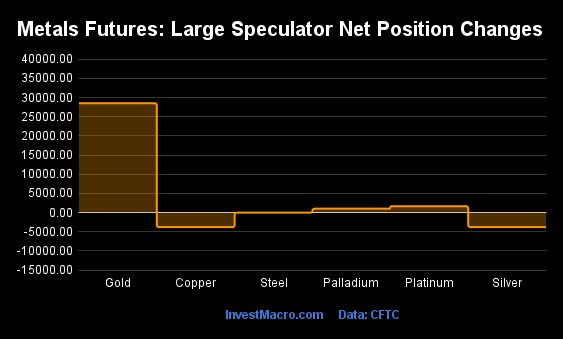
The COT metals markets speculator bets were lower this week as just two out of the six metals markets we cover had higher positioning while the other four markets had lower speculator contracts.

Leading the gains for the metals was Gold (30,249 contracts) with Copper (2,869 contracts) also showing a positive week.

The markets with declines in speculator bets for the week were Palladium (-894 contracts), Silver (-891 contracts), Steel (-802 contracts) and with Platinum (-718 contracts) also registering lower bets on the week.


Metals Net Speculators Leaderboard

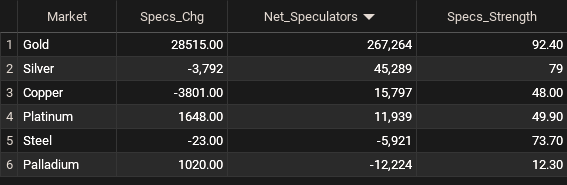
Legend: Weekly Speculators Change | Speculators Current Net Position | Speculators Strength Score compared to last 3-Years (0-100 range)


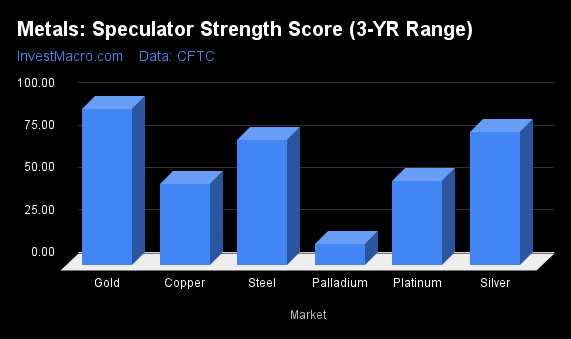
Strength Scores led by Gold & Silver

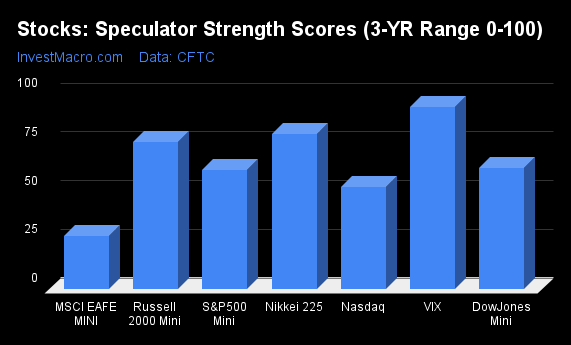
COT Strength Scores (a normalized measure of Speculator positions over a 3-Year range, from 0 to 100 where above 80 is Extreme-Bullish and below 20 is Extreme-Bearish) showed that Gold (100 percent) and Silver (99 percent) lead the metals markets this week. Copper (88 percent), Platinum (77 percent) and Steel (70 percent) come in as the next highest in the weekly strength scores.

On the downside, Palladium (22 percent) comes in at the lowest strength level currently.

Strength Statistics:
Gold (100.0 percent) vs Gold previous week (87.0 percent)
Silver (98.8 percent) vs Silver previous week (100.0 percent)
Copper (88.1 percent) vs Copper previous week (85.4 percent)
Platinum (76.6 percent) vs Platinum previous week (78.5 percent)
Palladium (22.5 percent) vs Palladium previous week (28.3 percent)
Steel (70.2 percent) vs Palladium previous week (73.3 percent)


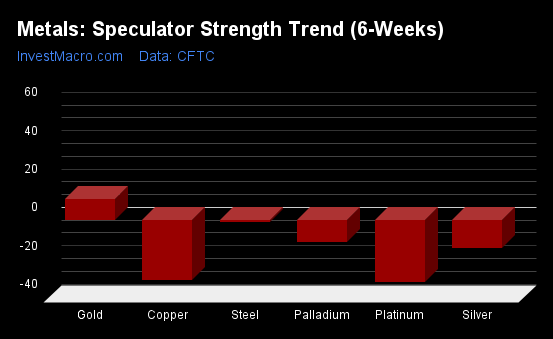
Gold & Palladium top the 6-Week Strength Trends

COT Strength Score Trends (or move index, calculates the 6-week changes in strength scores) showed that Gold (20 percent) and Palladium (14 percent) lead the past six weeks trends for metals.

Steel (-11 percent) leads the downside trend scores currently with Copper (-2 percent) and Platinum (-2 percent) as the next markets with lower trend scores.

Move Statistics:
Gold (20.5 percent) vs Gold previous week (7.8 percent)
Silver (5.1 percent) vs Silver previous week (5.2 percent)
Copper (-2.1 percent) vs Copper previous week (-8.8 percent)
Platinum (-1.7 percent) vs Platinum previous week (-13.1 percent)
Palladium (14.4 percent) vs Palladium previous week (9.9 percent)
Steel (-11.2 percent) vs Steel previous week (-6.5 percent)


Individual Markets:

Gold Comex Futures:

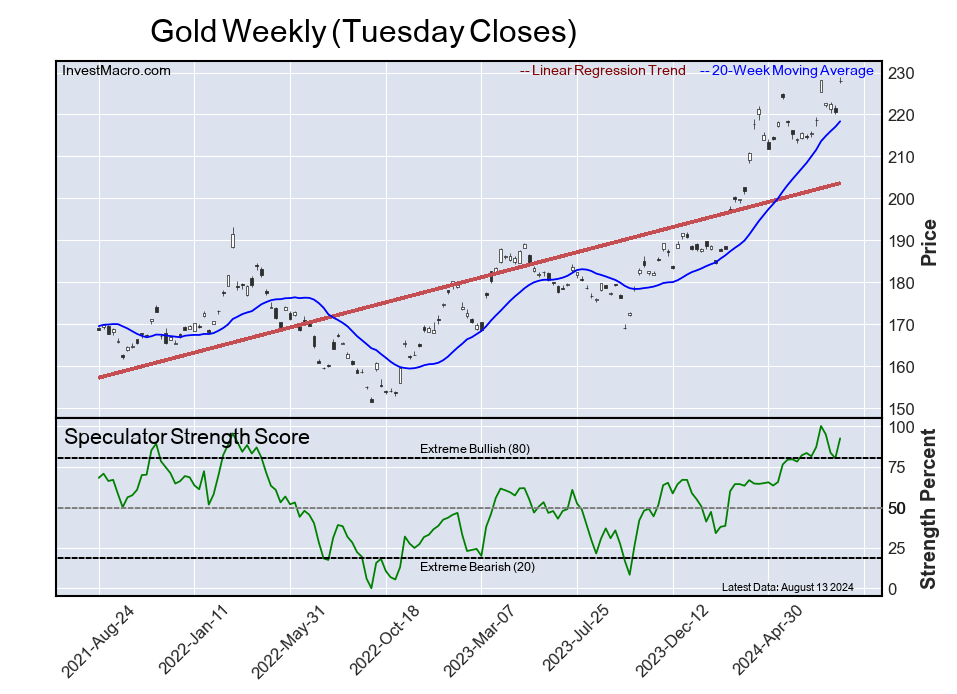
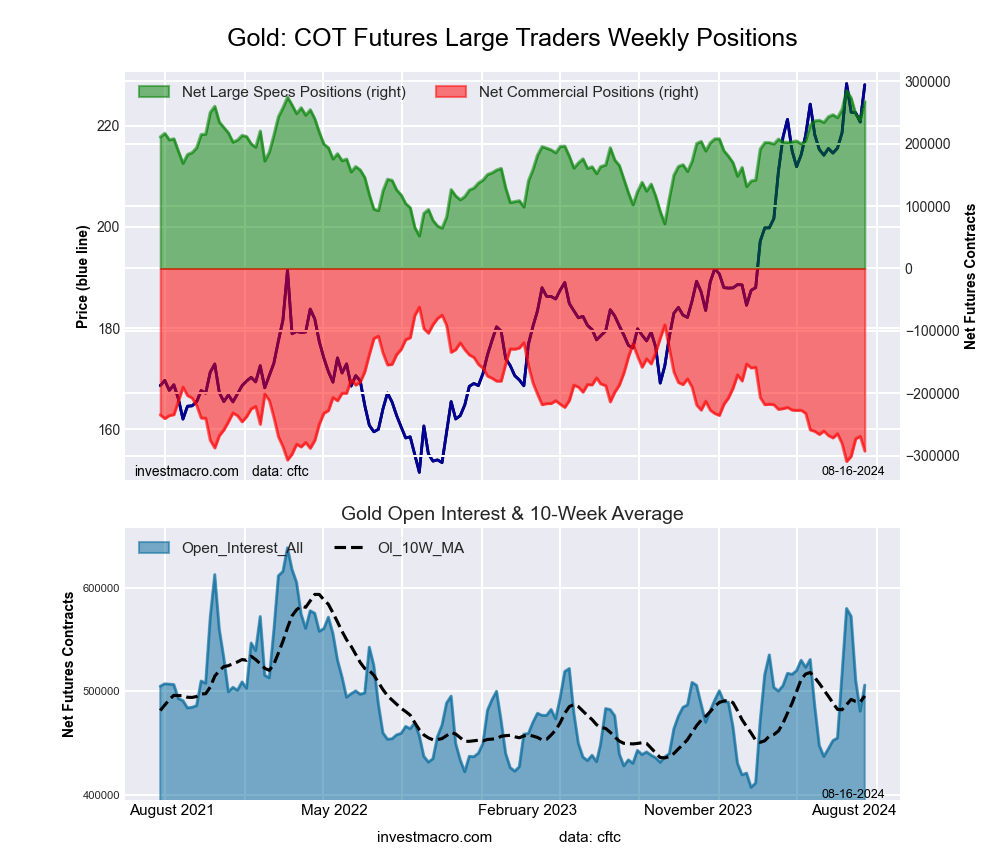
Gold Futures COT ChartThe Gold Comex Futures large speculator standing this week recorded a net position of 285,024 contracts in the data reported through Tuesday. This was a weekly rise of 30,249 contracts from the previous week which had a total of 254,775 net contracts.

This week’s current strength score (the trader positioning range over the past three years, measured from 0 to 100) shows the speculators are currently Bullish-Extreme with a score of 100.0 percent. The commercials are Bearish-Extreme with a score of 0.0 percent and the small traders (not shown in chart) are Bullish with a score of 58.6 percent.

Price Trend-Following Model: Uptrend

Our weekly trend-following model classifies the current market price position as: Uptrend. The current action for the model is considered to be: Hold – Maintain Long Position.

Gold Futures StatisticsSPECULATORSCOMMERCIALSSMALL TRADERS
– Percent of Open Interest Longs:60.319.09.3
– Percent of Open Interest Shorts:11.272.35.1
– Net Position:285,024-309,30424,280
– Gross Longs:349,827110,04153,814
– Gross Shorts:64,803419,34529,534
– Long to Short Ratio:5.4 to 10.3 to 11.8 to 1
NET POSITION TREND:
– Strength Index Score (3 Year Range Pct):100.00.058.6
– Strength Index Reading (3 Year Range):Bullish-ExtremeBearish-ExtremeBullish
NET POSITION MOVEMENT INDEX:
– 6-Week Change in Strength Index:20.5-17.5-15.7


Silver Comex Futures:

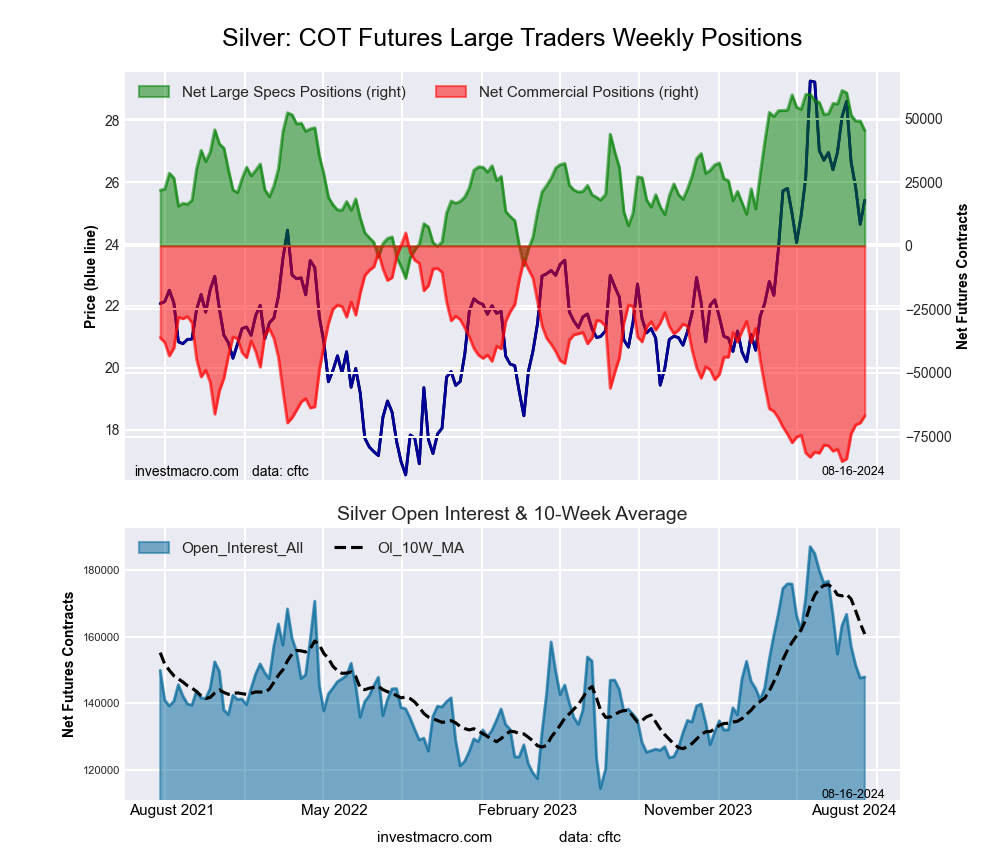
Silver Futures COT ChartThe Silver Comex Futures large speculator standing this week recorded a net position of 60,165 contracts in the data reported through Tuesday. This was a weekly decline of -891 contracts from the previous week which had a total of 61,056 net contracts.

This week’s current strength score (the trader positioning range over the past three years, measured from 0 to 100) shows the speculators are currently Bullish-Extreme with a score of 98.8 percent. The commercials are Bearish-Extreme with a score of 1.2 percent and the small traders (not shown in chart) are Bullish-Extreme with a score of 84.8 percent.

Price Trend-Following Model: Uptrend

Our weekly trend-following model classifies the current market price position as: Uptrend. The current action for the model is considered to be: Hold – Maintain Long Position.

Silver Futures StatisticsSPECULATORSCOMMERCIALSSMALL TRADERS
– Percent of Open Interest Longs:51.019.920.1
– Percent of Open Interest Shorts:14.970.25.9
– Net Position:60,165-83,73523,570
– Gross Longs:85,00533,18133,426
– Gross Shorts:24,840116,9169,856
– Long to Short Ratio:3.4 to 10.3 to 13.4 to 1
NET POSITION TREND:
– Strength Index Score (3 Year Range Pct):98.81.284.8
– Strength Index Reading (3 Year Range):Bullish-ExtremeBearish-ExtremeBullish-Extreme
NET POSITION MOVEMENT INDEX:
– 6-Week Change in Strength Index:5.1-2.5-7.5


Copper Grade #1 Futures:

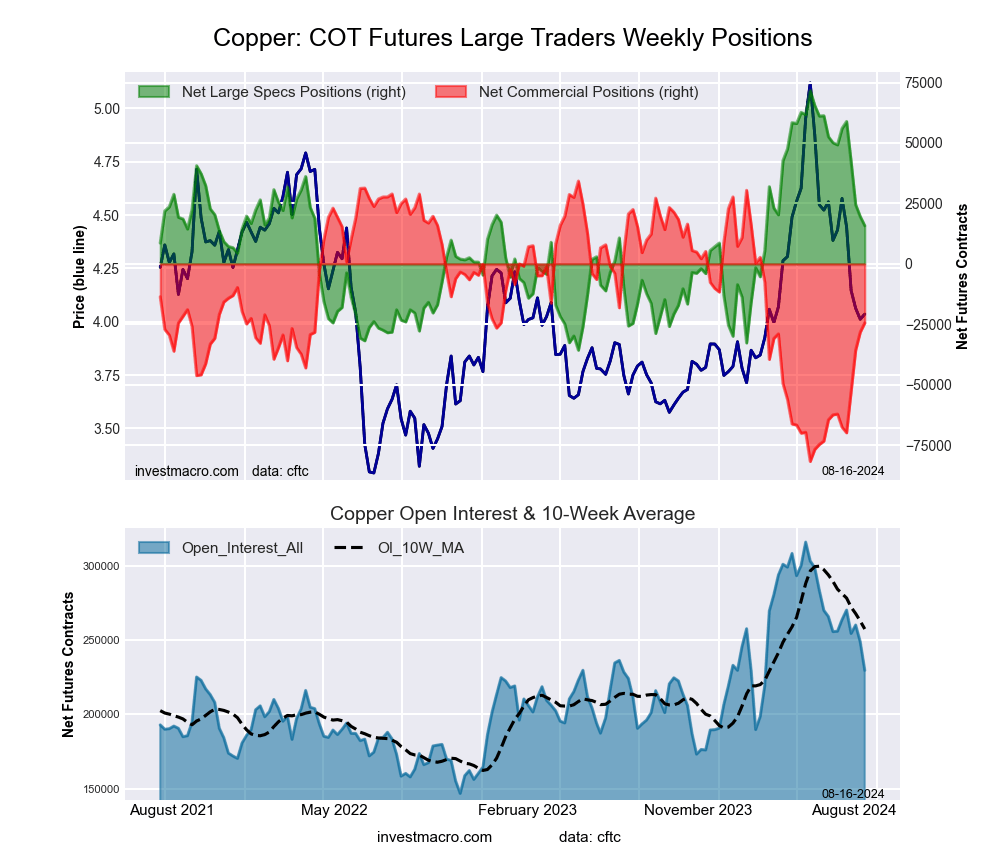
Copper Futures COT ChartThe Copper Grade #1 Futures large speculator standing this week recorded a net position of 58,900 contracts in the data reported through Tuesday. This was a weekly lift of 2,869 contracts from the previous week which had a total of 56,031 net contracts.

This week’s current strength score (the trader positioning range over the past three years, measured from 0 to 100) shows the speculators are currently Bullish-Extreme with a score of 88.1 percent. The commercials are Bearish-Extreme with a score of 10.2 percent and the small traders (not shown in chart) are Bullish-Extreme with a score of 84.1 percent.

Price Trend-Following Model: Weak Uptrend

Our weekly trend-following model classifies the current market price position as: Weak Uptrend. The current action for the model is considered to be: Hold – Maintain Long Position.

Copper Futures StatisticsSPECULATORSCOMMERCIALSSMALL TRADERS
– Percent of Open Interest Longs:51.724.38.0
– Percent of Open Interest Shorts:29.950.23.9
– Net Position:58,900-69,85810,958
– Gross Longs:139,77465,73221,526
– Gross Shorts:80,874135,59010,568
– Long to Short Ratio:1.7 to 10.5 to 12.0 to 1
NET POSITION TREND:
– Strength Index Score (3 Year Range Pct):88.110.284.1
– Strength Index Reading (3 Year Range):Bullish-ExtremeBearish-ExtremeBullish-Extreme
NET POSITION MOVEMENT INDEX:
– 6-Week Change in Strength Index:-2.14.2-15.9


Platinum Futures:

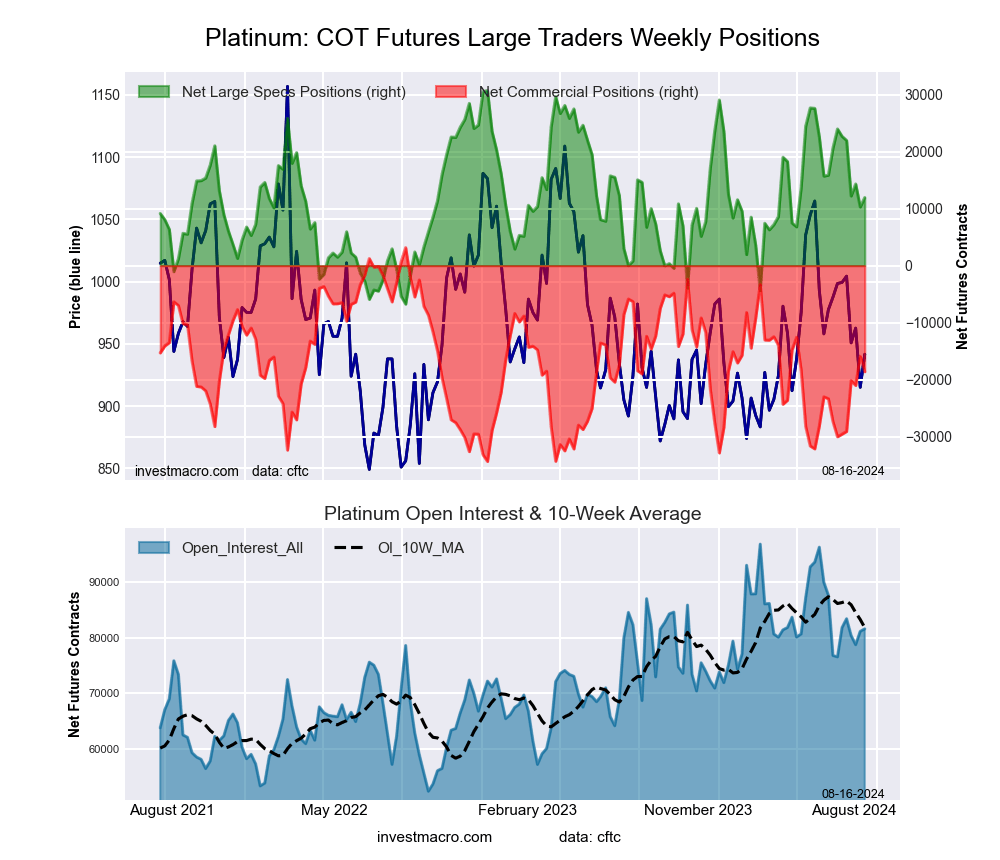
Platinum Futures COT ChartThe Platinum Futures large speculator standing this week recorded a net position of 21,948 contracts in the data reported through Tuesday. This was a weekly decrease of -718 contracts from the previous week which had a total of 22,666 net contracts.

This week’s current strength score (the trader positioning range over the past three years, measured from 0 to 100) shows the speculators are currently Bullish with a score of 76.6 percent. The commercials are Bearish-Extreme with a score of 14.0 percent and the small traders (not shown in chart) are Bullish-Extreme with a score of 85.7 percent.

Price Trend-Following Model: Weak Uptrend

Our weekly trend-following model classifies the current market price position as: Weak Uptrend. The current action for the model is considered to be: Hold – Maintain Long Position.

Platinum Futures StatisticsSPECULATORSCOMMERCIALSSMALL TRADERS
– Percent of Open Interest Longs:58.720.712.0
– Percent of Open Interest Shorts:32.455.53.4
– Net Position:21,948-29,0837,135
– Gross Longs:48,96217,2289,985
– Gross Shorts:27,01446,3112,850
– Long to Short Ratio:1.8 to 10.4 to 13.5 to 1
NET POSITION TREND:
– Strength Index Score (3 Year Range Pct):76.614.085.7
– Strength Index Reading (3 Year Range):BullishBearish-ExtremeBullish-Extreme
NET POSITION MOVEMENT INDEX:
– 6-Week Change in Strength Index:-1.7-2.628.4


Palladium Futures:

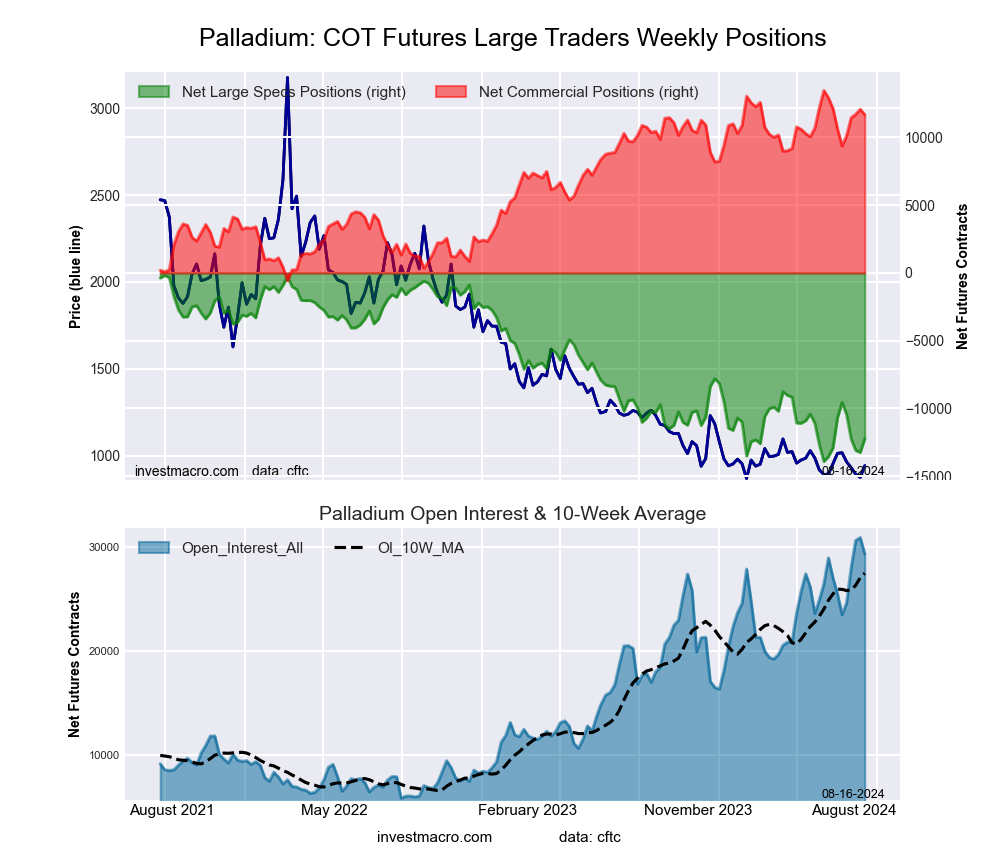
Palladium Futures COT ChartThe Palladium Futures large speculator standing this week recorded a net position of -10,451 contracts in the data reported through Tuesday. This was a weekly decrease of -894 contracts from the previous week which had a total of -9,557 net contracts.

This week’s current strength score (the trader positioning range over the past three years, measured from 0 to 100) shows the speculators are currently Bearish with a score of 22.5 percent. The commercials are Bullish with a score of 78.5 percent and the small traders (not shown in chart) are Bullish with a score of 60.6 percent.

Price Trend-Following Model: Strong Downtrend

Our weekly trend-following model classifies the current market price position as: Strong Downtrend. The current action for the model is considered to be: Hold – Maintain Short Position.

Palladium Futures StatisticsSPECULATORSCOMMERCIALSSMALL TRADERS
– Percent of Open Interest Longs:24.154.68.0
– Percent of Open Interest Shorts:66.613.56.7
– Net Position:-10,45110,136315
– Gross Longs:5,93813,4481,964
– Gross Shorts:16,3893,3121,649
– Long to Short Ratio:0.4 to 14.1 to 11.2 to 1
NET POSITION TREND:
– Strength Index Score (3 Year Range Pct):22.578.560.6
– Strength Index Reading (3 Year Range):BearishBullishBullish
NET POSITION MOVEMENT INDEX:
– 6-Week Change in Strength Index:14.4-13.3-10.1


Steel Futures Futures:

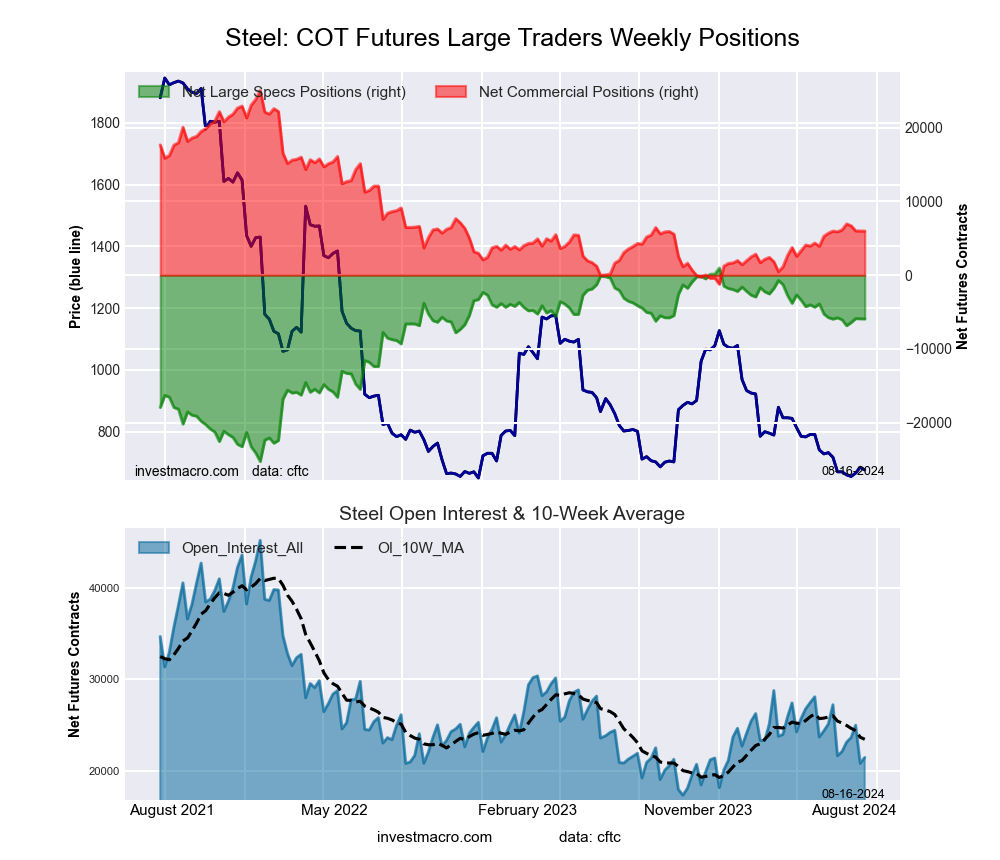
Steel Futures COT ChartThe Steel Futures large speculator standing this week recorded a net position of -6,835 contracts in the data reported through Tuesday. This was a weekly decrease of -802 contracts from the previous week which had a total of -6,033 net contracts.

This week’s current strength score (the trader positioning range over the past three years, measured from 0 to 100) shows the speculators are currently Bullish with a score of 70.2 percent. The commercials are Bearish with a score of 31.1 percent and the small traders (not shown in chart) are Bearish-Extreme with a score of 19.7 percent.

Price Trend-Following Model: Strong Downtrend

Our weekly trend-following model classifies the current market price position as: Strong Downtrend. The current action for the model is considered to be: Hold – Maintain Short Position.

Steel Futures StatisticsSPECULATORSCOMMERCIALSSMALL TRADERS
– Percent of Open Interest Longs:11.880.60.9
– Percent of Open Interest Shorts:41.450.51.4
– Net Position:-6,8356,951-116
– Gross Longs:2,73618,631199
– Gross Shorts:9,57111,680315
– Long to Short Ratio:0.3 to 11.6 to 10.6 to 1
NET POSITION TREND:
– Strength Index Score (3 Year Range Pct):70.231.119.7
– Strength Index Reading (3 Year Range):BullishBearishBearish-Extreme
NET POSITION MOVEMENT INDEX:
– 6-Week Change in Strength Index:-11.211.5-9.0


Article By InvestMacroReceive our weekly COT Newsletter

*COT Report: The COT data, released weekly to the public each Friday, is updated through the most recent Tuesday (data is 3 days old) and shows a quick view of how large speculators or non-commercials (for-profit traders) were positioned in the futures markets.

The CFTC categorizes trader positions according to commercial hedgers (traders who use futures contracts for hedging as part of the business), non-commercials (large traders who speculate to realize trading profits) and nonreportable traders (usually small traders/speculators) as well as their open interest (contracts open in the market at time of reporting). See CFTC criteria here.


COT Bonds Charts: Speculator Bets led by Fed Funds & 2-Year Bonds 

By InvestMacro

Here are the latest charts and statistics for the Commitment of Traders (COT) reports data published by the Commodities Futures Trading Commission (CFTC).

The latest COT data is updated through Tuesday July 16th and shows a quick view of how large traders (for-profit speculators and commercial hedgers) were positioned in the futures markets.

Weekly Speculator Bets led by Fed Funds & 2-Year Bonds

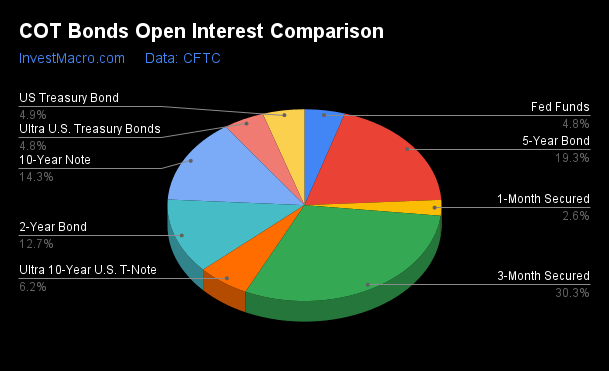
The COT bond market speculator bets were mixed evenly this week as four out of the eight bond markets we cover had higher positioning while the other four markets had lower speculator contracts.

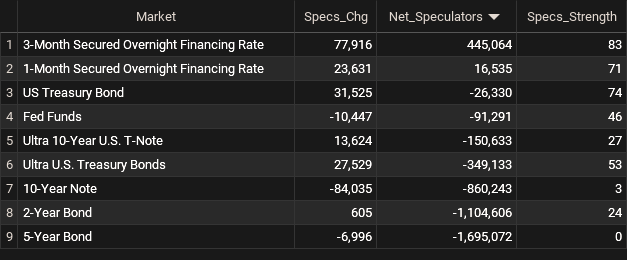
Leading the gains for the bond markets was the Fed Funds (48,140 contracts) with the 2-Year Bonds (47,328 contracts), the SOFR 3-Months (28,119 contracts) and the Ultra 10-Year Bonds (6,777 contracts) also having positive weeks.

The bond markets with declines in speculator bets for the week were the 10-Year Bonds (-219,582 contracts), the Ultra Treasury Bonds (-13,438 contracts), the US Treasury Bonds (-12,729 contracts) and with the 5-Year Bonds (-9,573 contracts) also registering lower bets on the week.


Bonds Net Speculators Leaderboard

Legend: Weekly Speculators Change | Speculators Current Net Position | Speculators Strength Score compared to last 3-Years (0-100 range)


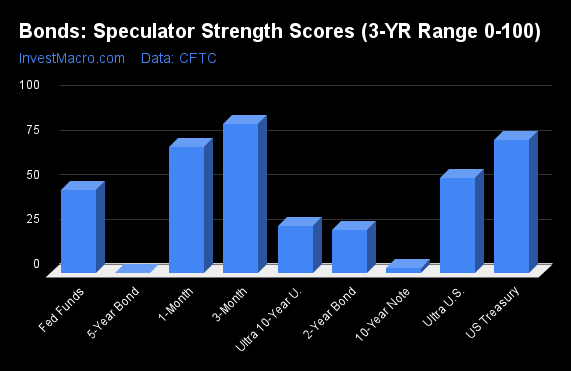
Strength Scores led by US Treasury Bonds & SOFR 3-Months

COT Strength Scores (a normalized measure of Speculator positions over a 3-Year range, from 0 to 100 where above 80 is Extreme-Bullish and below 20 is Extreme-Bearish) showed that the US Treasury Bonds (67 percent) and the SOFR 3-Months (54 percent) lead the bond markets this week.

On the downside, the 5-Year Bonds (0 percent), the Ultra Treasury Bonds (17 percent) and the 2-Year Bonds (19 percent) come in at the lowest strength level currently and are in Extreme-Bearish territory (below 20 percent).

Strength Statistics:
Fed Funds (47.5 percent) vs Fed Funds previous week (36.6 percent)
2-Year Bond (18.6 percent) vs 2-Year Bond previous week (15.6 percent)
5-Year Bond (0.0 percent) vs 5-Year Bond previous week (0.6 percent)
10-Year Bond (23.5 percent) vs 10-Year Bond previous week (44.0 percent)
Ultra 10-Year Bond (31.5 percent) vs Ultra 10-Year Bond previous week (30.1 percent)
US Treasury Bond (67.1 percent) vs US Treasury Bond previous week (71.5 percent)
Ultra US Treasury Bond (16.7 percent) vs Ultra US Treasury Bond previous week (22.8 percent)
SOFR 3-Months (54.0 percent) vs SOFR 3-Months previous week (52.5 percent)


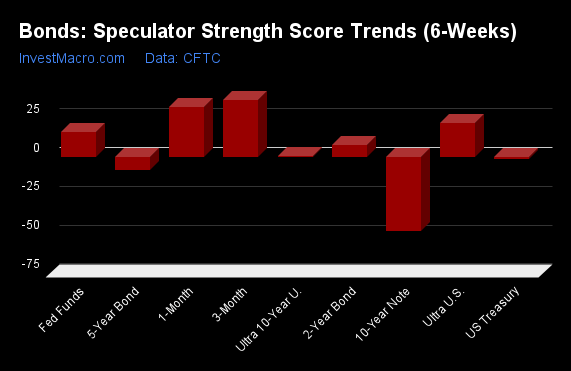
SOFR 3-Months & Ultra 10-Year Bonds top the 6-Week Strength Trends

COT Strength Score Trends (or move index, calculates the 6-week changes in strength scores) showed that the SOFR 3-Months (23 percent) and the Ultra 10-Year Bonds (15 percent) lead the past six weeks trends for bonds.

The Ultra Treasury Bonds (-40 percent) leads the downside trend scores currently with the 10-Year Bonds (-17 percent) and the Fed Funds (-16 percent) following next with lower trend scores.

Strength Trend Statistics:
Fed Funds (-16.4 percent) vs Fed Funds previous week (-44.7 percent)
2-Year Bond (-9.6 percent) vs 2-Year Bond previous week (-16.1 percent)
5-Year Bond (-0.2 percent) vs 5-Year Bond previous week (-11.3 percent)
10-Year Bond (-17.1 percent) vs 10-Year Bond previous week (-2.8 percent)
Ultra 10-Year Bond (14.7 percent) vs Ultra 10-Year Bond previous week (20.3 percent)
US Treasury Bond (-11.0 percent) vs US Treasury Bond previous week (-27.3 percent)
Ultra US Treasury Bond (-40.1 percent) vs Ultra US Treasury Bond previous week (-39.7 percent)
SOFR 3-Months (22.9 percent) vs SOFR 3-Months previous week (17.4 percent)


Secured Overnight Financing Rate (3-Month) Futures:

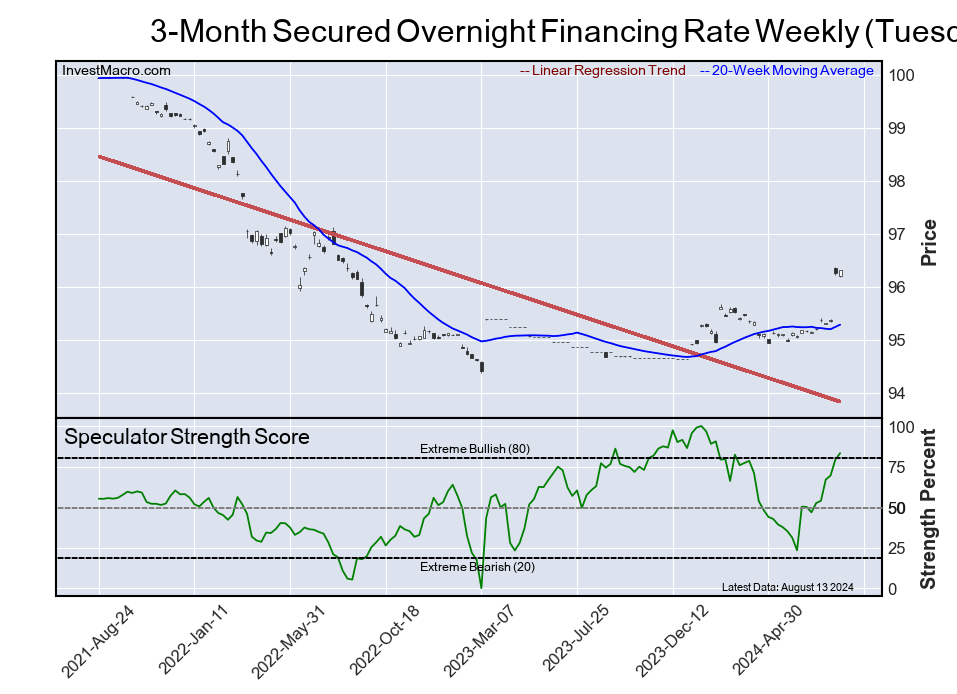
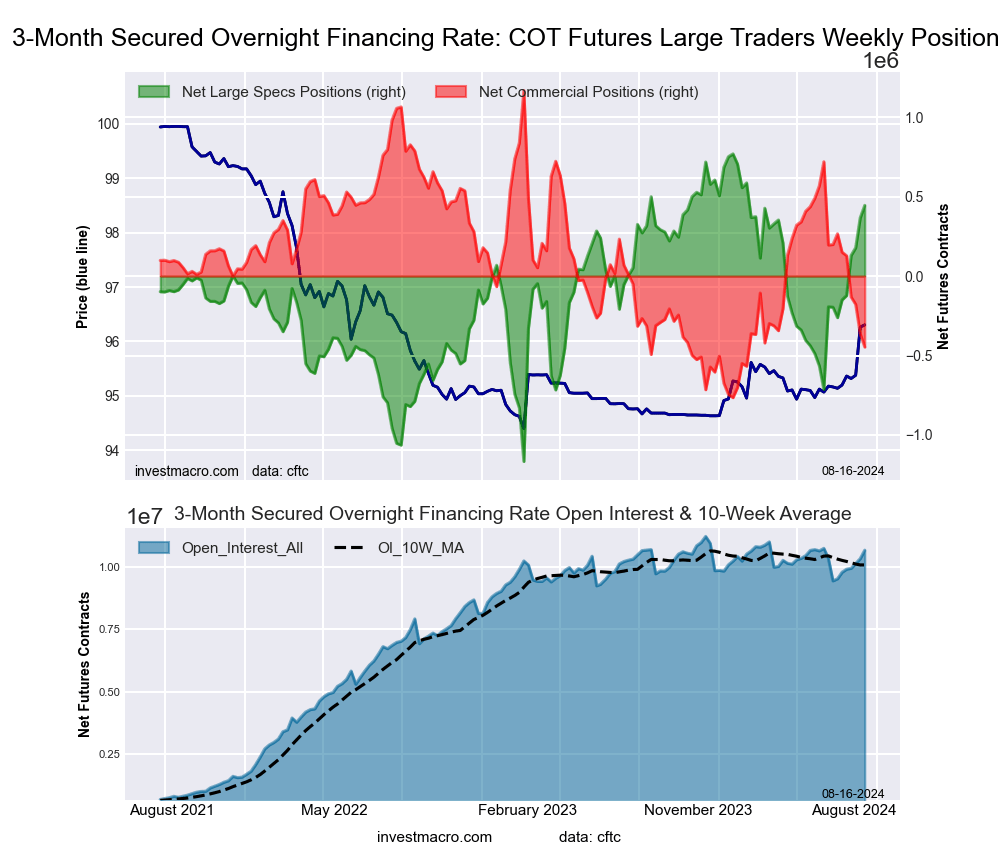
SOFR 3-Months Bonds Futures COT ChartThe Secured Overnight Financing Rate (3-Month) large speculator standing this week was a net position of -122,278 contracts in the data reported through Tuesday. This was a weekly lift of 28,119 contracts from the previous week which had a total of -150,397 net contracts.

This week’s current strength score (the trader positioning range over the past three years, measured from 0 to 100) shows the speculators are currently Bullish with a score of 54.0 percent. The commercials are Bearish with a score of 46.2 percent and the small traders (not shown in chart) are Bullish-Extreme with a score of 84.7 percent.

Price Trend-Following Model: Weak Uptrend

Our weekly trend-following model classifies the current market price position as: Weak Uptrend. The current action for the model is considered to be: Hold – Maintain Long Position.

SOFR 3-Months StatisticsSPECULATORSCOMMERCIALSSMALL TRADERS
– Percent of Open Interest Longs:16.157.50.3
– Percent of Open Interest Shorts:17.356.20.4
– Net Position:-122,278128,027-5,749
– Gross Longs:1,592,6765,689,60131,635
– Gross Shorts:1,714,9545,561,57437,384
– Long to Short Ratio:0.9 to 11.0 to 10.8 to 1
NET POSITION TREND:
– Strength Index Score (3 Year Range Pct):54.046.284.7
– Strength Index Reading (3 Year Range):BullishBearishBullish-Extreme
NET POSITION MOVEMENT INDEX:
– 6-Week Change in Strength Index:22.9-22.7-1.5


30-Day Federal Funds Futures:

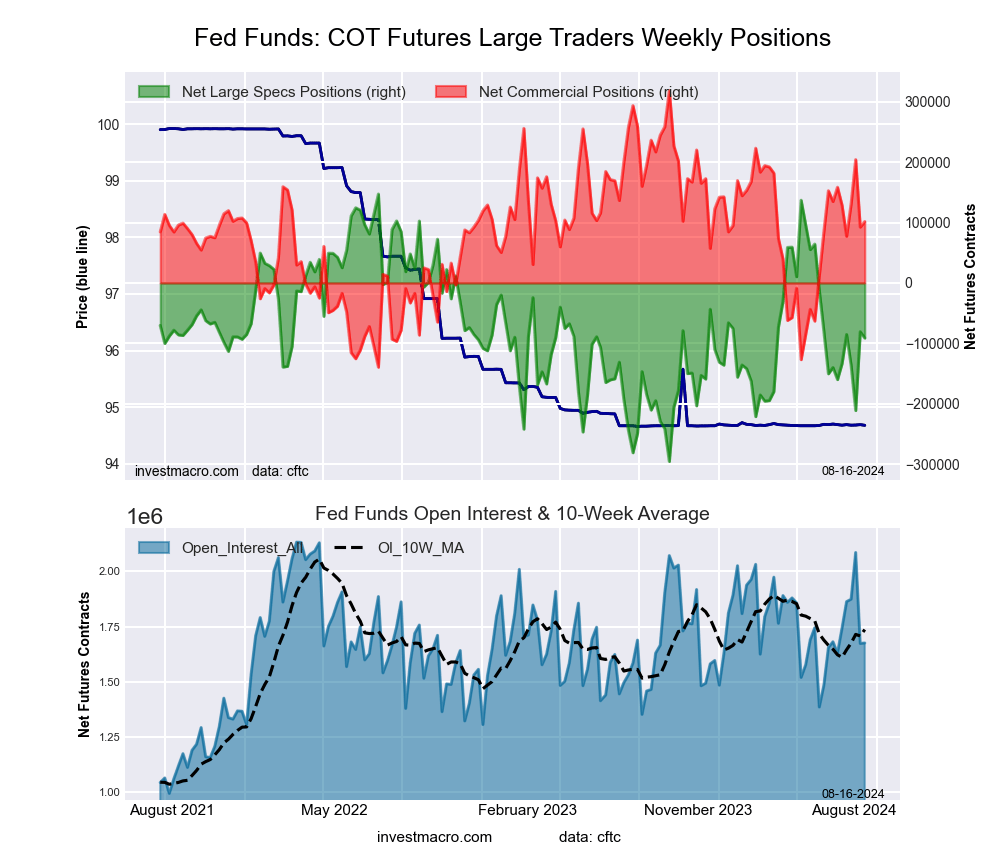
Federal Funds 30-Day Bonds Futures COT ChartThe 30-Day Federal Funds large speculator standing this week was a net position of -85,414 contracts in the data reported through Tuesday. This was a weekly lift of 48,140 contracts from the previous week which had a total of -133,554 net contracts.

This week’s current strength score (the trader positioning range over the past three years, measured from 0 to 100) shows the speculators are currently Bearish with a score of 47.5 percent. The commercials are Bearish with a score of 47.3 percent and the small traders (not shown in chart) are Bullish-Extreme with a score of 100.0 percent.

Price Trend-Following Model: Downtrend

Our weekly trend-following model classifies the current market price position as: Downtrend. The current action for the model is considered to be: Hold – Maintain Short Position.

30-Day Federal Funds StatisticsSPECULATORSCOMMERCIALSSMALL TRADERS
– Percent of Open Interest Longs:14.966.62.2
– Percent of Open Interest Shorts:19.562.51.8
– Net Position:-85,41477,3058,109
– Gross Longs:277,4101,240,80541,240
– Gross Shorts:362,8241,163,50033,131
– Long to Short Ratio:0.8 to 11.1 to 11.2 to 1
NET POSITION TREND:
– Strength Index Score (3 Year Range Pct):47.547.3100.0
– Strength Index Reading (3 Year Range):BearishBearishBullish-Extreme
NET POSITION MOVEMENT INDEX:
– 6-Week Change in Strength Index:-16.414.213.8


2-Year Treasury Note Futures:

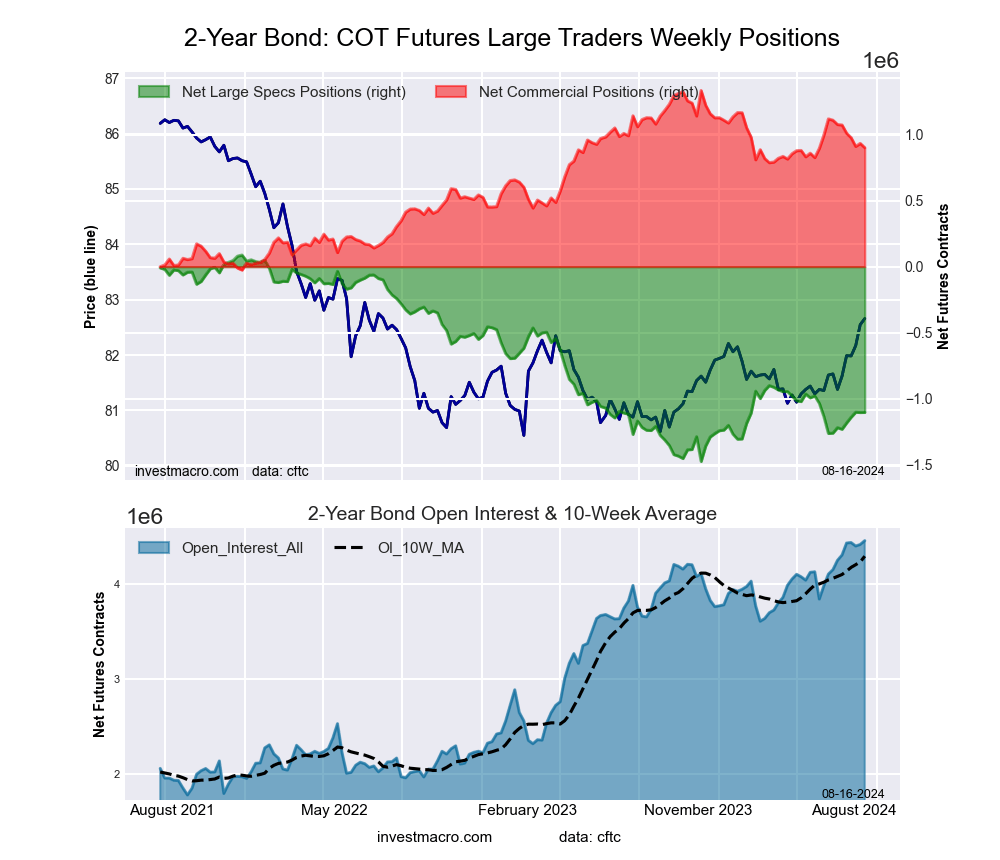
2-Year Treasury Bonds Futures COT ChartThe 2-Year Treasury Note large speculator standing this week was a net position of -1,184,987 contracts in the data reported through Tuesday. This was a weekly advance of 47,328 contracts from the previous week which had a total of -1,232,315 net contracts.

This week’s current strength score (the trader positioning range over the past three years, measured from 0 to 100) shows the speculators are currently Bearish-Extreme with a score of 18.6 percent. The commercials are Bullish with a score of 76.6 percent and the small traders (not shown in chart) are Bullish-Extreme with a score of 100.0 percent.

Price Trend-Following Model: Strong Uptrend

Our weekly trend-following model classifies the current market price position as: Strong Uptrend. The current action for the model is considered to be: Hold – Maintain Long Position.

2-Year Treasury Note StatisticsSPECULATORSCOMMERCIALSSMALL TRADERS
– Percent of Open Interest Longs:15.675.76.6
– Percent of Open Interest Shorts:42.452.92.7
– Net Position:-1,184,9871,011,202173,785
– Gross Longs:693,0993,355,786294,011
– Gross Shorts:1,878,0862,344,584120,226
– Long to Short Ratio:0.4 to 11.4 to 12.4 to 1
NET POSITION TREND:
– Strength Index Score (3 Year Range Pct):18.676.6100.0
– Strength Index Reading (3 Year Range):Bearish-ExtremeBullishBullish-Extreme
NET POSITION MOVEMENT INDEX:
– 6-Week Change in Strength Index:-9.68.311.8


5-Year Treasury Note Futures:

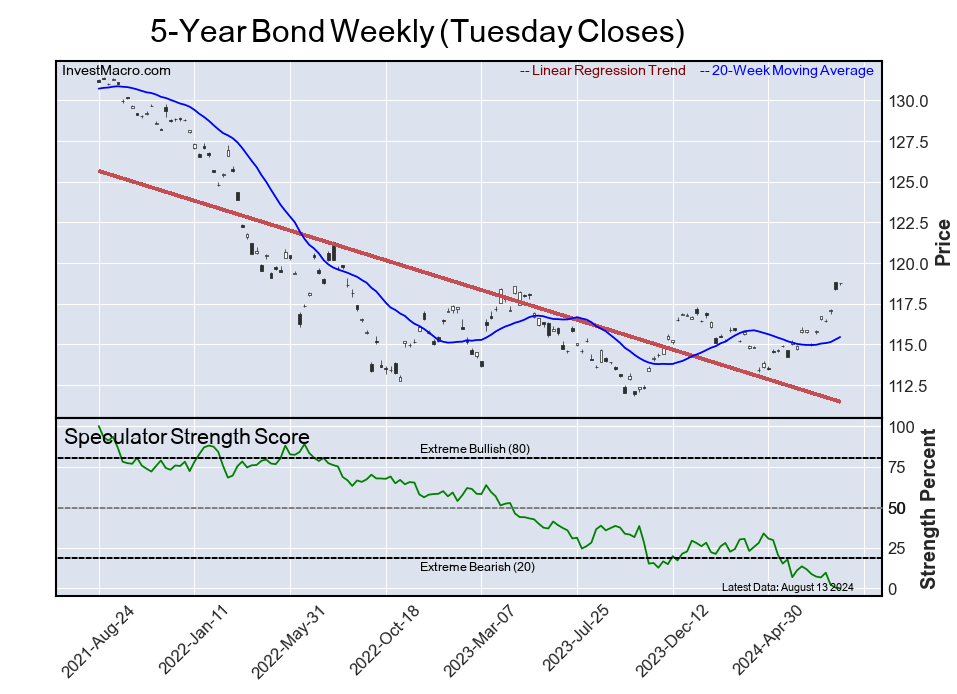
5-Year Treasury Bonds Futures COT ChartThe 5-Year Treasury Note large speculator standing this week was a net position of -1,576,174 contracts in the data reported through Tuesday. This was a weekly decline of -9,573 contracts from the previous week which had a total of -1,566,601 net contracts.

This week’s current strength score (the trader positioning range over the past three years, measured from 0 to 100) shows the speculators are currently Bearish-Extreme with a score of 0.0 percent. The commercials are Bullish-Extreme with a score of 98.6 percent and the small traders (not shown in chart) are Bullish-Extreme with a score of 95.9 percent.

Price Trend-Following Model: Strong Uptrend

Our weekly trend-following model classifies the current market price position as: Strong Uptrend. The current action for the model is considered to be: Hold – Maintain Long Position.

5-Year Treasury Note StatisticsSPECULATORSCOMMERCIALSSMALL TRADERS
– Percent of Open Interest Longs:7.684.06.8
– Percent of Open Interest Shorts:31.862.24.4
– Net Position:-1,576,1741,420,117156,057
– Gross Longs:494,8735,464,162444,751
– Gross Shorts:2,071,0474,044,045288,694
– Long to Short Ratio:0.2 to 11.4 to 11.5 to 1
NET POSITION TREND:
– Strength Index Score (3 Year Range Pct):0.098.695.9
– Strength Index Reading (3 Year Range):Bearish-ExtremeBullish-ExtremeBullish-Extreme
NET POSITION MOVEMENT INDEX:
– 6-Week Change in Strength Index:-0.2-1.44.9


10-Year Treasury Note Futures:

10-Year Treasury Notes Bonds Futures COT ChartThe 10-Year Treasury Note large speculator standing this week was a net position of -637,486 contracts in the data reported through Tuesday. This was a weekly decrease of -219,582 contracts from the previous week which had a total of -417,904 net contracts.

This week’s current strength score (the trader positioning range over the past three years, measured from 0 to 100) shows the speculators are currently Bearish with a score of 23.5 percent. The commercials are Bullish with a score of 63.7 percent and the small traders (not shown in chart) are Bullish-Extreme with a score of 95.2 percent.

Price Trend-Following Model: Strong Uptrend

Our weekly trend-following model classifies the current market price position as: Strong Uptrend. The current action for the model is considered to be: New Buy – Long Position.

10-Year Treasury Note StatisticsSPECULATORSCOMMERCIALSSMALL TRADERS
– Percent of Open Interest Longs:8.379.310.1
– Percent of Open Interest Shorts:22.367.58.0
– Net Position:-637,486537,64799,839
– Gross Longs:378,5313,614,914462,170
– Gross Shorts:1,016,0173,077,267362,331
– Long to Short Ratio:0.4 to 11.2 to 11.3 to 1
NET POSITION TREND:
– Strength Index Score (3 Year Range Pct):23.563.795.2
– Strength Index Reading (3 Year Range):BearishBullishBullish-Extreme
NET POSITION MOVEMENT INDEX:
– 6-Week Change in Strength Index:-17.112.019.3


Ultra 10-Year Notes Futures:

Ultra 10-Year Treasury Notes Bonds Futures COT ChartThe Ultra 10-Year Notes large speculator standing this week was a net position of -126,580 contracts in the data reported through Tuesday. This was a weekly gain of 6,777 contracts from the previous week which had a total of -133,357 net contracts.

This week’s current strength score (the trader positioning range over the past three years, measured from 0 to 100) shows the speculators are currently Bearish with a score of 31.5 percent. The commercials are Bullish with a score of 57.2 percent and the small traders (not shown in chart) are Bullish with a score of 75.2 percent.

Price Trend-Following Model: Weak Uptrend

Our weekly trend-following model classifies the current market price position as: Weak Uptrend. The current action for the model is considered to be: Hold – Maintain Long Position.

Ultra 10-Year Notes StatisticsSPECULATORSCOMMERCIALSSMALL TRADERS
– Percent of Open Interest Longs:12.476.49.8
– Percent of Open Interest Shorts:18.567.212.9
– Net Position:-126,580191,888-65,308
– Gross Longs:258,1261,592,656203,687
– Gross Shorts:384,7061,400,768268,995
– Long to Short Ratio:0.7 to 11.1 to 10.8 to 1
NET POSITION TREND:
– Strength Index Score (3 Year Range Pct):31.557.275.2
– Strength Index Reading (3 Year Range):BearishBullishBullish
NET POSITION MOVEMENT INDEX:
– 6-Week Change in Strength Index:14.7-20.83.7


US Treasury Bonds Futures:

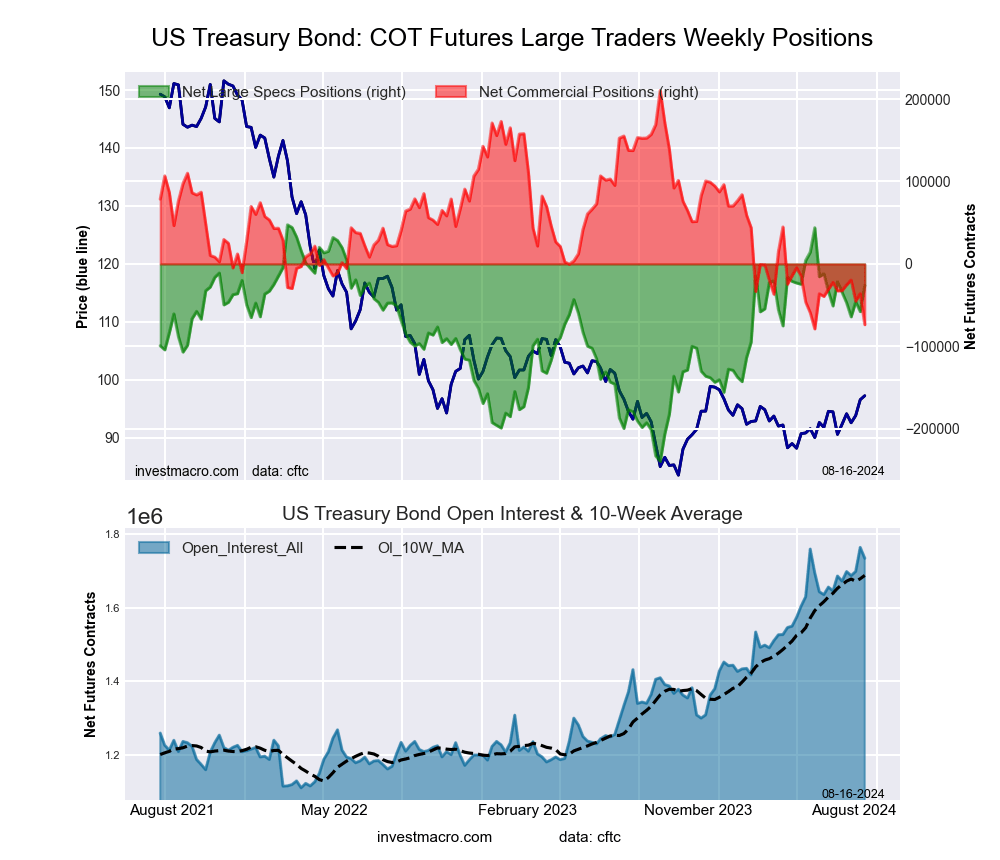
US Year Treasury Notes Long Bonds Futures COT ChartThe US Treasury Bonds large speculator standing this week was a net position of -47,150 contracts in the data reported through Tuesday. This was a weekly reduction of -12,729 contracts from the previous week which had a total of -34,421 net contracts.

This week’s current strength score (the trader positioning range over the past three years, measured from 0 to 100) shows the speculators are currently Bullish with a score of 67.1 percent. The commercials are Bearish-Extreme with a score of 18.4 percent and the small traders (not shown in chart) are Bullish-Extreme with a score of 99.2 percent.

Price Trend-Following Model: Weak Downtrend

Our weekly trend-following model classifies the current market price position as: Weak Downtrend. The current action for the model is considered to be: Hold – Maintain Short Position.

US Treasury Bonds StatisticsSPECULATORSCOMMERCIALSSMALL TRADERS
– Percent of Open Interest Longs:18.167.913.1
– Percent of Open Interest Shorts:20.969.48.9
– Net Position:-47,150-25,46672,616
– Gross Longs:307,5741,153,768223,318
– Gross Shorts:354,7241,179,234150,702
– Long to Short Ratio:0.9 to 11.0 to 11.5 to 1
NET POSITION TREND:
– Strength Index Score (3 Year Range Pct):67.118.499.2
– Strength Index Reading (3 Year Range):BullishBearish-ExtremeBullish-Extreme
NET POSITION MOVEMENT INDEX:
– 6-Week Change in Strength Index:-11.03.720.5


Ultra US Treasury Bonds Futures:

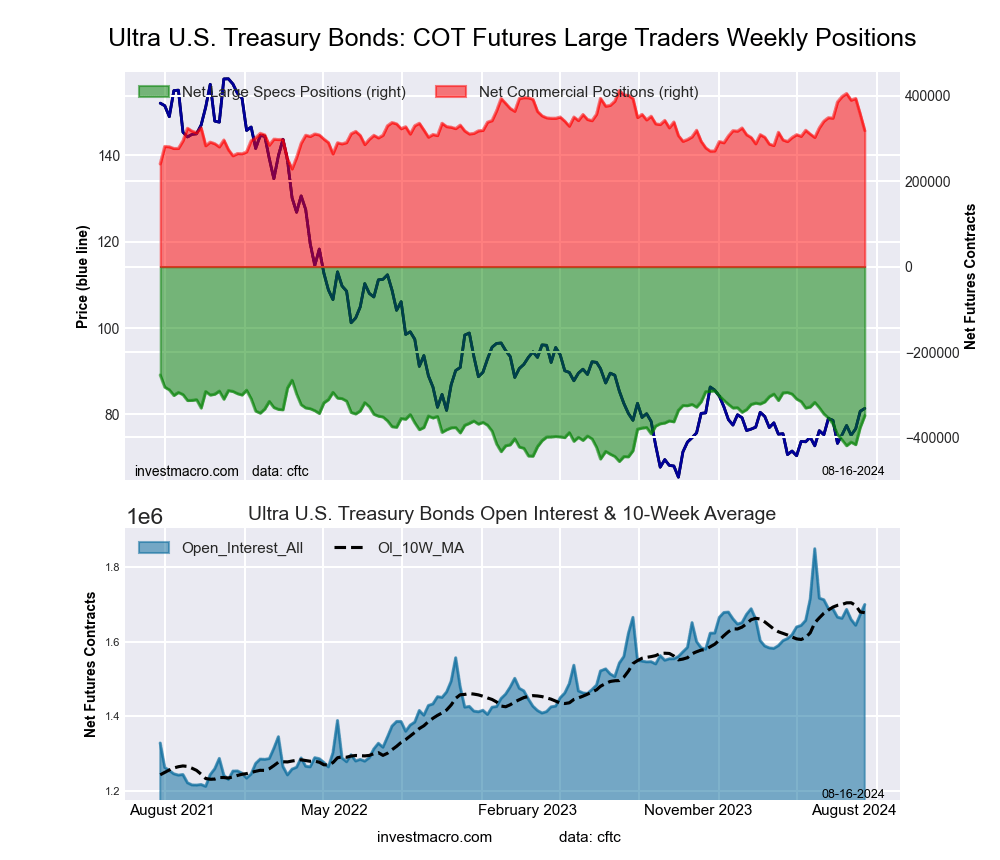
Ultra US Year Treasury Notes Long Bonds Futures COT ChartThe Ultra US Treasury Bonds large speculator standing this week was a net position of -419,398 contracts in the data reported through Tuesday. This was a weekly decline of -13,438 contracts from the previous week which had a total of -405,960 net contracts.

This week’s current strength score (the trader positioning range over the past three years, measured from 0 to 100) shows the speculators are currently Bearish-Extreme with a score of 16.7 percent. The commercials are Bullish-Extreme with a score of 96.3 percent and the small traders (not shown in chart) are Bearish with a score of 31.5 percent.

Price Trend-Following Model: Weak Downtrend

Our weekly trend-following model classifies the current market price position as: Weak Downtrend. The current action for the model is considered to be: Hold – Maintain Short Position.

Ultra US Treasury Bonds StatisticsSPECULATORSCOMMERCIALSSMALL TRADERS
– Percent of Open Interest Longs:8.780.510.5
– Percent of Open Interest Shorts:33.656.49.7
– Net Position:-419,398405,63513,763
– Gross Longs:146,6031,357,495176,513
– Gross Shorts:566,001951,860162,750
– Long to Short Ratio:0.3 to 11.4 to 11.1 to 1
NET POSITION TREND:
– Strength Index Score (3 Year Range Pct):16.796.331.5
– Strength Index Reading (3 Year Range):Bearish-ExtremeBullish-ExtremeBearish
NET POSITION MOVEMENT INDEX:
– 6-Week Change in Strength Index:-40.142.610.7


Article By InvestMacroReceive our weekly COT Newsletter

*COT Report: The COT data, released weekly to the public each Friday, is updated through the most recent Tuesday (data is 3 days old) and shows a quick view of how large speculators or non-commercials (for-profit traders) were positioned in the futures markets.

The CFTC categorizes trader positions according to commercial hedgers (traders who use futures contracts for hedging as part of the business), non-commercials (large traders who speculate to realize trading profits) and nonreportable traders (usually small traders/speculators) as well as their open interest (contracts open in the market at time of reporting). See CFTC criteria here.

COT Soft Commodities Charts: Speculator Bets led lower by Soybean Meal & Soybeans

By InvestMacro

Here are the latest charts and statistics for the Commitment of Traders (COT) reports data published by the Commodities Futures Trading Commission (CFTC).

The latest COT data is updated through Tuesday July 16th and shows a quick view of how large traders (for-profit speculators and commercial entities) were positioned in the futures markets.

Weekly Speculator Bets led lower by Soybean Meal & Soybeans

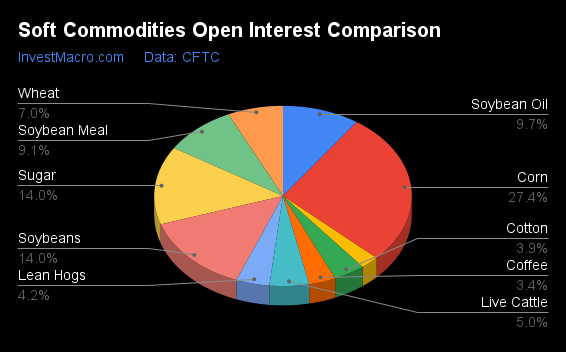
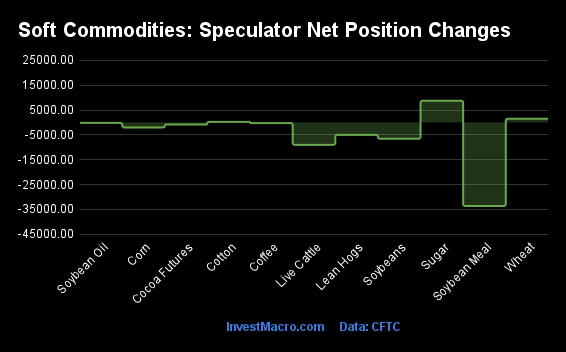
The COT soft commodities markets speculator bets were overall lower this week as only three out of the eleven softs markets we cover had higher positioning while the other eight markets had lower speculator contracts.

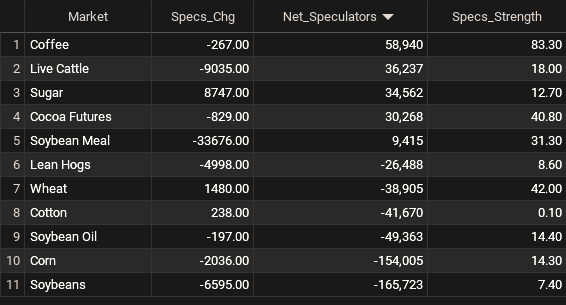
Leading the gains for the softs markets was Lean Hogs (2,955 contracts) with Corn (1,125 contracts) and Cocoa (538 contracts) also showing positive weeks.

The markets with the declines in speculator bets this week were Soybean Meal (-32,730 contracts), Soybeans (-11,353 contracts), Soybean Oil (-4,446 contracts), Coffee (-4,441 contracts), Live Cattle (-4,065 contracts), Cotton (-1,998 contracts), Wheat (-1,281 contracts) and with Sugar (-430 contracts) also registering lower bets on the week.


Soft Commodities Net Speculators Leaderboard

Legend: Weekly Speculators Change | Speculators Current Net Position | Speculators Strength Score compared to last 3-Years (0-100 range)


Strength Scores led by Coffee & Soybean Oil

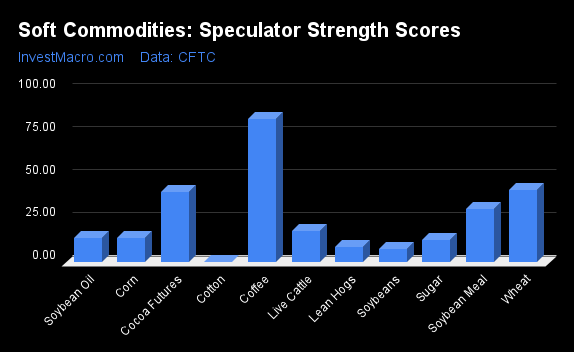
COT Strength Scores (a normalized measure of Speculator positions over a 3-Year range, from 0 to 100 where above 80 is Extreme-Bullish and below 20 is Extreme-Bearish) showed that Coffee (95 percent) leads the softs markets this week.

On the downside, Cotton (1 percent), Corn (3 percent), Lean Hogs (8 percent) and Soybeans (8 percent) come in at the lowest strength levels currently and are in Extreme-Bearish territory (below 20 percent).

Strength Statistics:
Corn (3.5 percent) vs Corn previous week (3.3 percent)
Sugar (23.4 percent) vs Sugar previous week (23.5 percent)
Coffee (95.0 percent) vs Coffee previous week (99.4 percent)
Soybeans (8.4 percent) vs Soybeans previous week (11.1 percent)
Soybean Oil (42.6 percent) vs Soybean Oil previous week (45.0 percent)
Soybean Meal (41.2 percent) vs Soybean Meal previous week (54.6 percent)
Live Cattle (29.8 percent) vs Live Cattle previous week (34.2 percent)
Lean Hogs (8.0 percent) vs Lean Hogs previous week (5.6 percent)
Cotton (0.8 percent) vs Cotton previous week (2.2 percent)
Cocoa (42.9 percent) vs Cocoa previous week (42.3 percent)
Wheat (42.5 percent) vs Wheat previous week (43.3 percent)


Sugar & Soybean Oil top the 6-Week Strength Trends

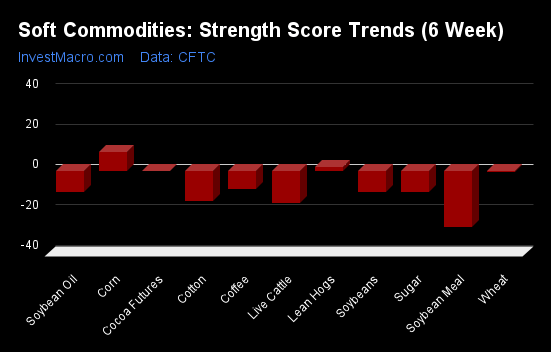
COT Strength Score Trends (or move index, calculates the 6-week changes in strength scores) showed that Sugar (23 percent) and Soybean Oil (21 percent) lead the past six weeks trends for soft commodities. Coffee (3 percent) is the next highest positive mover in the latest trends data.

Lean Hogs (-26 percent), Soybean Meal (-26 percent) and Soybeans (-26 percent) lead the downside trend scores currently with Corn (-15 percent) following next with in lower trend scores.

Strength Trend Statistics:
Corn (-15.1 percent) vs Corn previous week (-24.0 percent)
Sugar (23.4 percent) vs Sugar previous week (20.5 percent)
Coffee (3.2 percent) vs Coffee previous week (12.0 percent)
Soybeans (-25.8 percent) vs Soybeans previous week (-29.3 percent)
Soybean Oil (21.1 percent) vs Soybean Oil previous week (19.0 percent)
Soybean Meal (-26.2 percent) vs Soybean Meal previous week (-19.8 percent)
Live Cattle (-7.5 percent) vs Live Cattle previous week (-10.3 percent)
Lean Hogs (-26.2 percent) vs Lean Hogs previous week (-35.3 percent)
Cotton (-13.3 percent) vs Cotton previous week (-21.6 percent)
Cocoa (-1.4 percent) vs Cocoa previous week (-0.8 percent)
Wheat (-12.5 percent) vs Wheat previous week (-14.2 percent)


Individual Soft Commodities Markets:

CORN Futures:

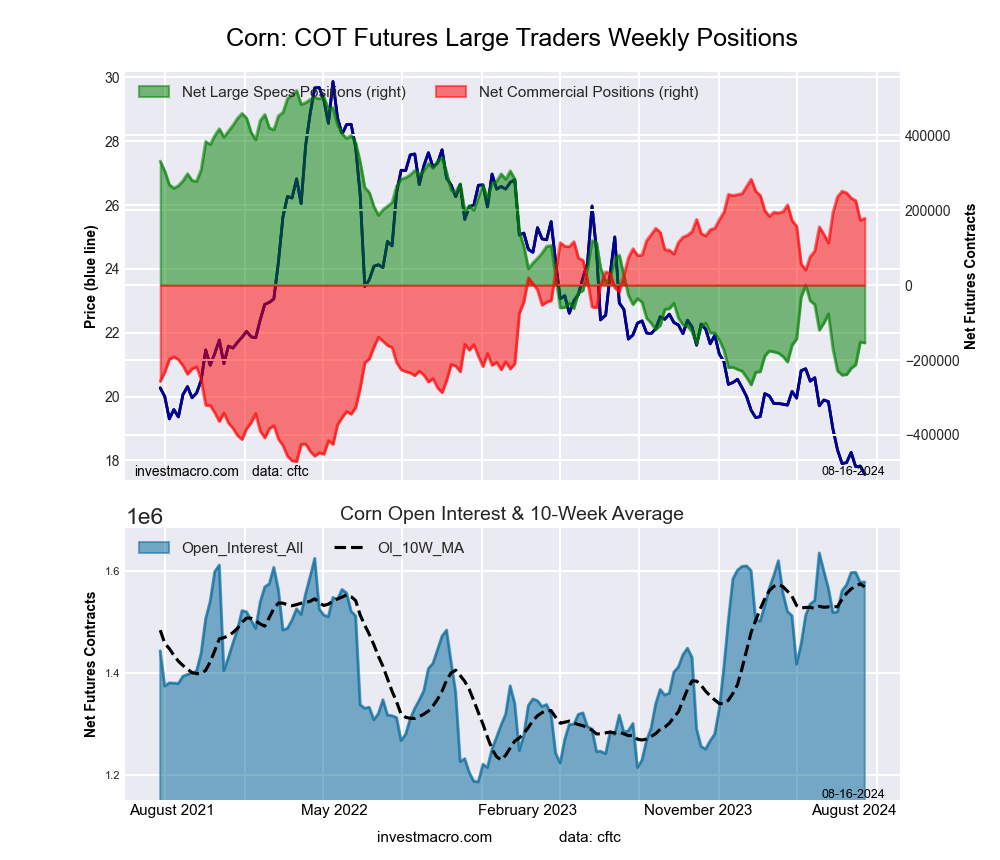
CORN Futures COT ChartThe CORN large speculator standing this week was a net position of -238,816 contracts in the data reported through Tuesday. This was a weekly advance of 1,125 contracts from the previous week which had a total of -239,941 net contracts.

This week’s current strength score (the trader positioning range over the past three years, measured from 0 to 100) shows the speculators are currently Bearish-Extreme with a score of 3.5 percent. The commercials are Bullish-Extreme with a score of 95.2 percent and the small traders (not shown in chart) are Bullish-Extreme with a score of 97.7 percent.

Price Trend-Following Model: Strong Downtrend

Our weekly trend-following model classifies the current market price position as: Strong Downtrend. The current action for the model is considered to be: Hold – Maintain Short Position.

CORN Futures StatisticsSPECULATORSCOMMERCIALSSMALL TRADERS
– Percent of Open Interest Longs:19.645.59.7
– Percent of Open Interest Shorts:34.729.910.1
– Net Position:-238,816246,223-7,407
– Gross Longs:307,784716,565152,114
– Gross Shorts:546,600470,342159,521
– Long to Short Ratio:0.6 to 11.5 to 11.0 to 1
NET POSITION TREND:
– Strength Index Score (3 Year Range Pct):3.595.297.7
– Strength Index Reading (3 Year Range):Bearish-ExtremeBullish-ExtremeBullish-Extreme
NET POSITION MOVEMENT INDEX:
– 6-Week Change in Strength Index:-15.112.137.0


SUGAR Futures:

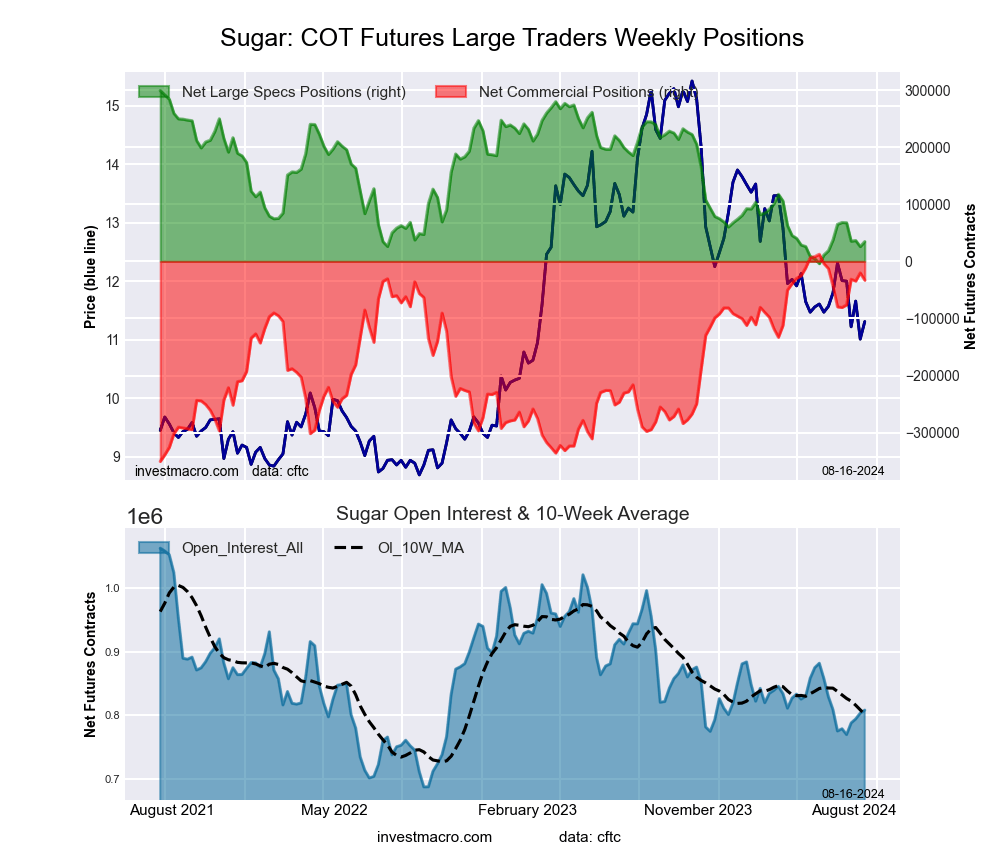
SUGAR Futures COT ChartThe SUGAR large speculator standing this week was a net position of 67,589 contracts in the data reported through Tuesday. This was a weekly lowering of -430 contracts from the previous week which had a total of 68,019 net contracts.

This week’s current strength score (the trader positioning range over the past three years, measured from 0 to 100) shows the speculators are currently Bearish with a score of 23.4 percent. The commercials are Bullish with a score of 76.0 percent and the small traders (not shown in chart) are Bearish with a score of 31.0 percent.

Price Trend-Following Model: Downtrend

Our weekly trend-following model classifies the current market price position as: Downtrend. The current action for the model is considered to be: Hold – Maintain Short Position.

SUGAR Futures StatisticsSPECULATORSCOMMERCIALSSMALL TRADERS
– Percent of Open Interest Longs:23.155.18.6
– Percent of Open Interest Shorts:14.365.17.4
– Net Position:67,589-76,3288,739
– Gross Longs:177,958424,39565,838
– Gross Shorts:110,369500,72357,099
– Long to Short Ratio:1.6 to 10.8 to 11.2 to 1
NET POSITION TREND:
– Strength Index Score (3 Year Range Pct):23.476.031.0
– Strength Index Reading (3 Year Range):BearishBullishBearish
NET POSITION MOVEMENT INDEX:
– 6-Week Change in Strength Index:23.4-24.022.2


COFFEE Futures:

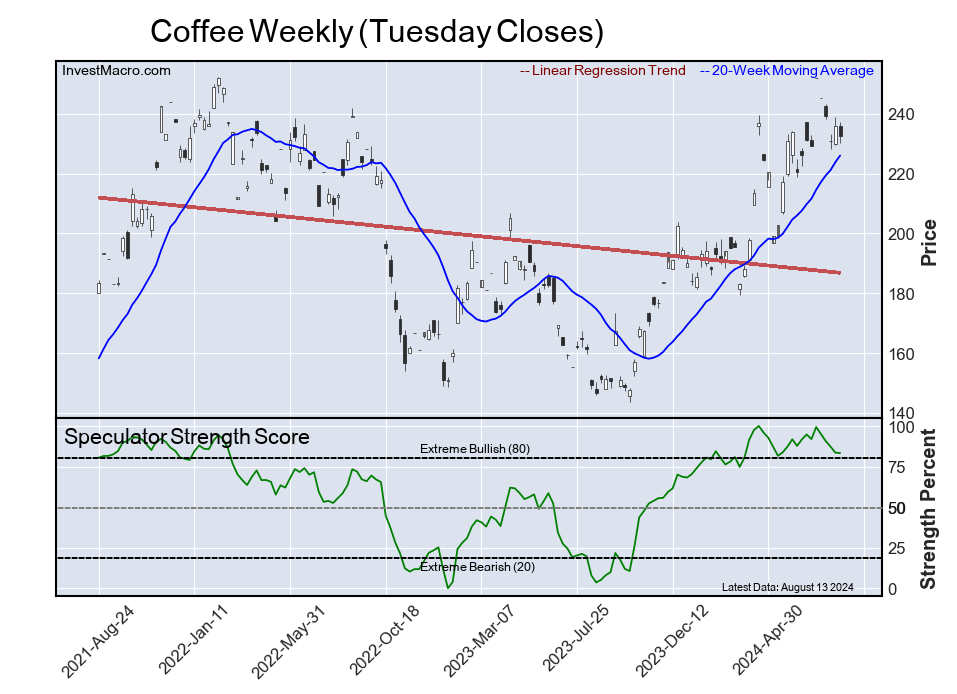
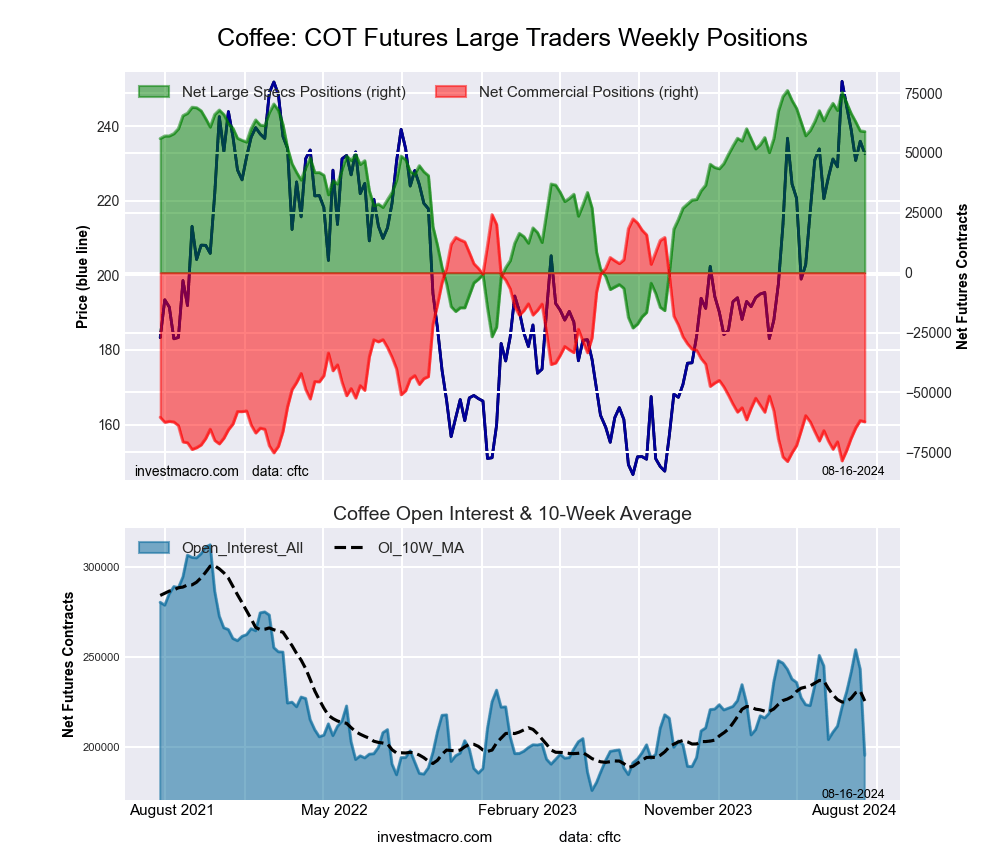
COFFEE Futures COT ChartThe COFFEE large speculator standing this week was a net position of 70,979 contracts in the data reported through Tuesday. This was a weekly decline of -4,441 contracts from the previous week which had a total of 75,420 net contracts.

This week’s current strength score (the trader positioning range over the past three years, measured from 0 to 100) shows the speculators are currently Bullish-Extreme with a score of 95.0 percent. The commercials are Bearish-Extreme with a score of 4.4 percent and the small traders (not shown in chart) are Bullish with a score of 68.2 percent.

Price Trend-Following Model: Strong Uptrend

Our weekly trend-following model classifies the current market price position as: Strong Uptrend. The current action for the model is considered to be: Hold – Maintain Long Position.

COFFEE Futures StatisticsSPECULATORSCOMMERCIALSSMALL TRADERS
– Percent of Open Interest Longs:37.436.33.7
– Percent of Open Interest Shorts:6.668.52.2
– Net Position:70,979-74,3263,347
– Gross Longs:86,15183,5138,486
– Gross Shorts:15,172157,8395,139
– Long to Short Ratio:5.7 to 10.5 to 11.7 to 1
NET POSITION TREND:
– Strength Index Score (3 Year Range Pct):95.04.468.2
– Strength Index Reading (3 Year Range):Bullish-ExtremeBearish-ExtremeBullish
NET POSITION MOVEMENT INDEX:
– 6-Week Change in Strength Index:3.2-3.911.0


SOYBEANS Futures:

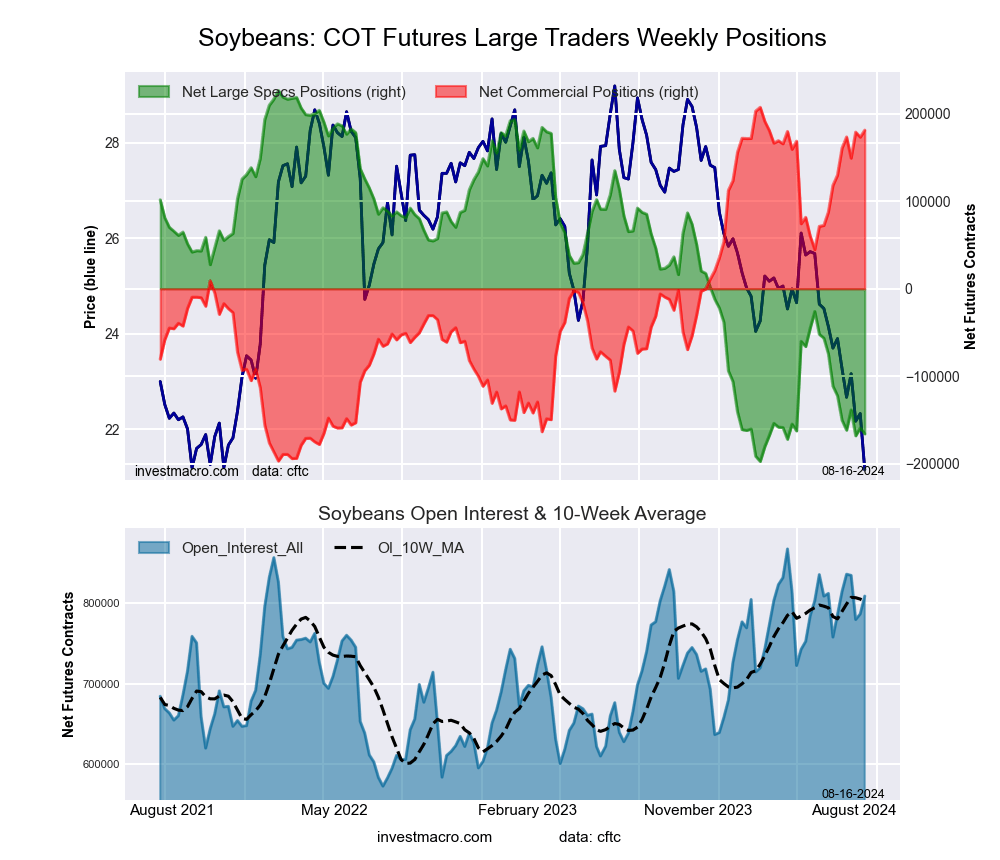
SOYBEANS Futures COT ChartThe SOYBEANS large speculator standing this week was a net position of -161,503 contracts in the data reported through Tuesday. This was a weekly reduction of -11,353 contracts from the previous week which had a total of -150,150 net contracts.

This week’s current strength score (the trader positioning range over the past three years, measured from 0 to 100) shows the speculators are currently Bearish-Extreme with a score of 8.4 percent. The commercials are Bullish-Extreme with a score of 91.6 percent and the small traders (not shown in chart) are Bullish-Extreme with a score of 81.4 percent.

Price Trend-Following Model: Strong Downtrend

Our weekly trend-following model classifies the current market price position as: Strong Downtrend. The current action for the model is considered to be: Hold – Maintain Short Position.

SOYBEANS Futures StatisticsSPECULATORSCOMMERCIALSSMALL TRADERS
– Percent of Open Interest Longs:16.259.35.9
– Percent of Open Interest Shorts:35.538.67.3
– Net Position:-161,503173,410-11,907
– Gross Longs:135,252496,31049,082
– Gross Shorts:296,755322,90060,989
– Long to Short Ratio:0.5 to 11.5 to 10.8 to 1
NET POSITION TREND:
– Strength Index Score (3 Year Range Pct):8.491.681.4
– Strength Index Reading (3 Year Range):Bearish-ExtremeBullish-ExtremeBullish-Extreme
NET POSITION MOVEMENT INDEX:
– 6-Week Change in Strength Index:-25.825.319.3


SOYBEAN OIL Futures:

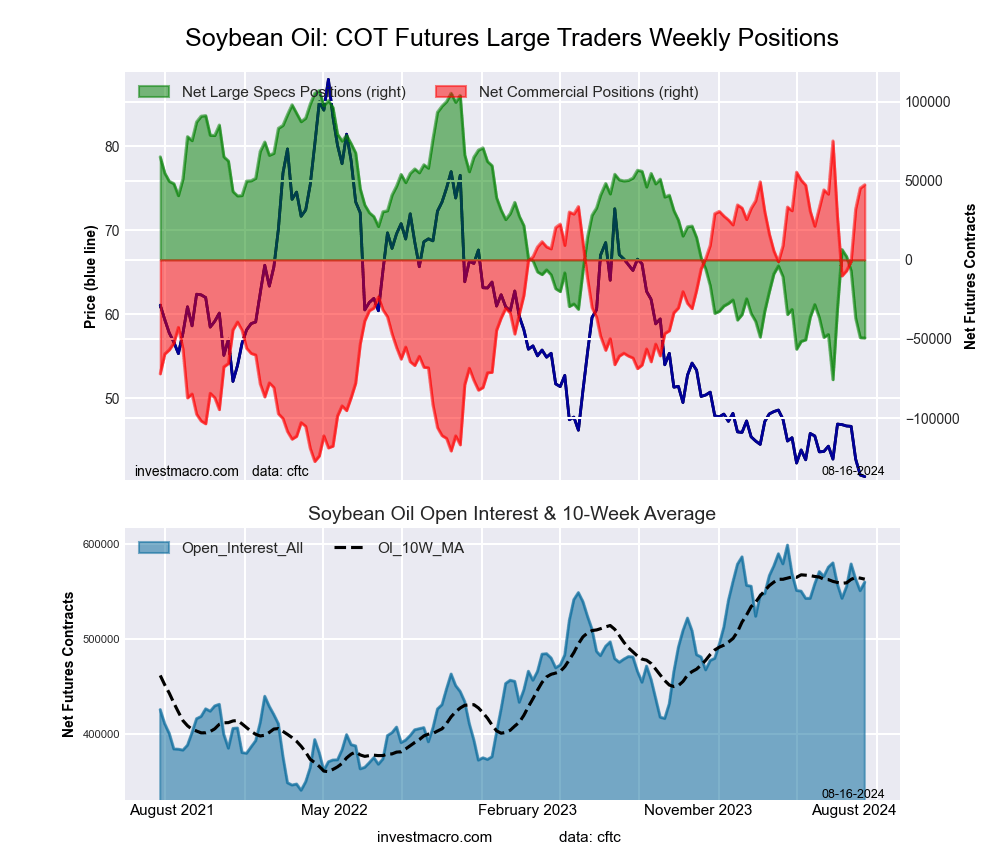
SOYBEAN OIL Futures COT ChartThe SOYBEAN OIL large speculator standing this week was a net position of 2,031 contracts in the data reported through Tuesday. This was a weekly decrease of -4,446 contracts from the previous week which had a total of 6,477 net contracts.

This week’s current strength score (the trader positioning range over the past three years, measured from 0 to 100) shows the speculators are currently Bearish with a score of 42.6 percent. The commercials are Bullish with a score of 59.5 percent and the small traders (not shown in chart) are Bearish with a score of 33.1 percent.

Price Trend-Following Model: Weak Downtrend

Our weekly trend-following model classifies the current market price position as: Weak Downtrend. The current action for the model is considered to be: Hold – Maintain Short Position.

SOYBEAN OIL Futures StatisticsSPECULATORSCOMMERCIALSSMALL TRADERS
– Percent of Open Interest Longs:20.352.15.5
– Percent of Open Interest Shorts:19.953.34.6
– Net Position:2,031-6,9294,898
– Gross Longs:112,712289,02330,362
– Gross Shorts:110,681295,95225,464
– Long to Short Ratio:1.0 to 11.0 to 11.2 to 1
NET POSITION TREND:
– Strength Index Score (3 Year Range Pct):42.659.533.1
– Strength Index Reading (3 Year Range):BearishBullishBearish
NET POSITION MOVEMENT INDEX:
– 6-Week Change in Strength Index:21.1-19.63.9


SOYBEAN MEAL Futures:

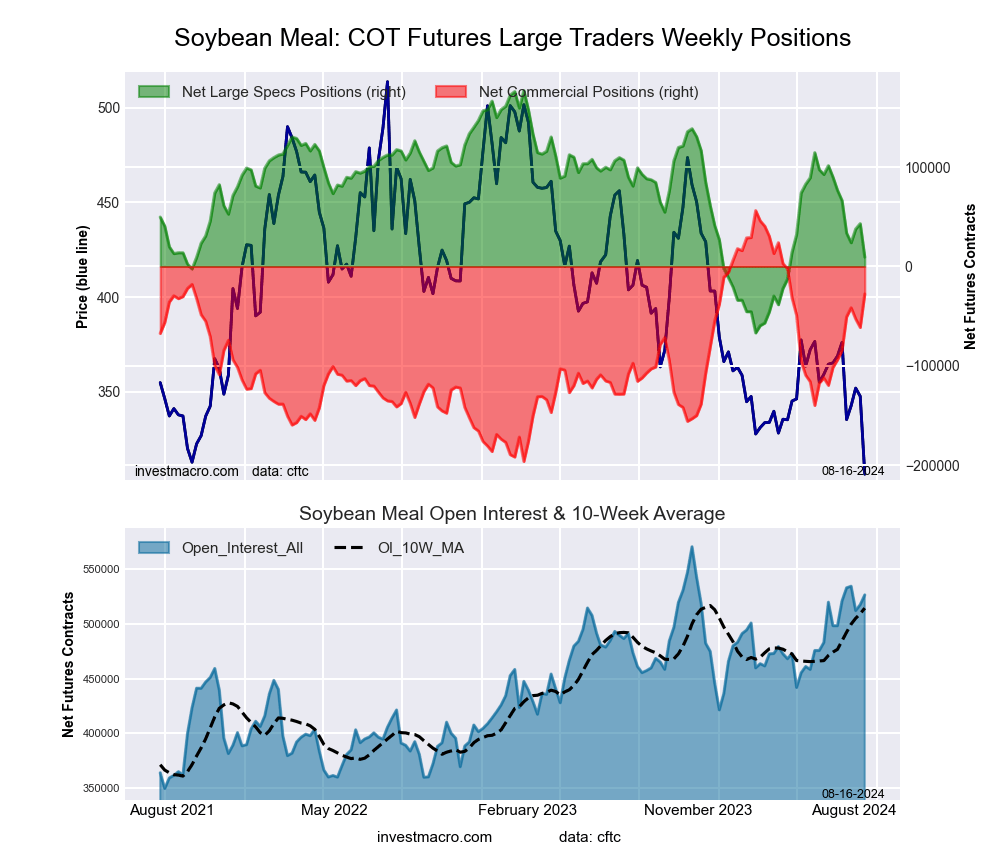
SOYBEAN MEAL Futures COT ChartThe SOYBEAN MEAL large speculator standing this week was a net position of 33,624 contracts in the data reported through Tuesday. This was a weekly fall of -32,730 contracts from the previous week which had a total of 66,354 net contracts.

This week’s current strength score (the trader positioning range over the past three years, measured from 0 to 100) shows the speculators are currently Bearish with a score of 41.2 percent. The commercials are Bullish with a score of 57.6 percent and the small traders (not shown in chart) are Bearish with a score of 32.5 percent.

Price Trend-Following Model: Weak Uptrend

Our weekly trend-following model classifies the current market price position as: Weak Uptrend. The current action for the model is considered to be: Hold – Maintain Long Position.

SOYBEAN MEAL Futures StatisticsSPECULATORSCOMMERCIALSSMALL TRADERS
– Percent of Open Interest Longs:24.641.49.1
– Percent of Open Interest Shorts:18.350.95.9
– Net Position:33,624-50,70217,078
– Gross Longs:131,194220,88948,465
– Gross Shorts:97,570271,59131,387
– Long to Short Ratio:1.3 to 10.8 to 11.5 to 1
NET POSITION TREND:
– Strength Index Score (3 Year Range Pct):41.257.632.5
– Strength Index Reading (3 Year Range):BearishBullishBearish
NET POSITION MOVEMENT INDEX:
– 6-Week Change in Strength Index:-26.226.4-12.8


LIVE CATTLE Futures:

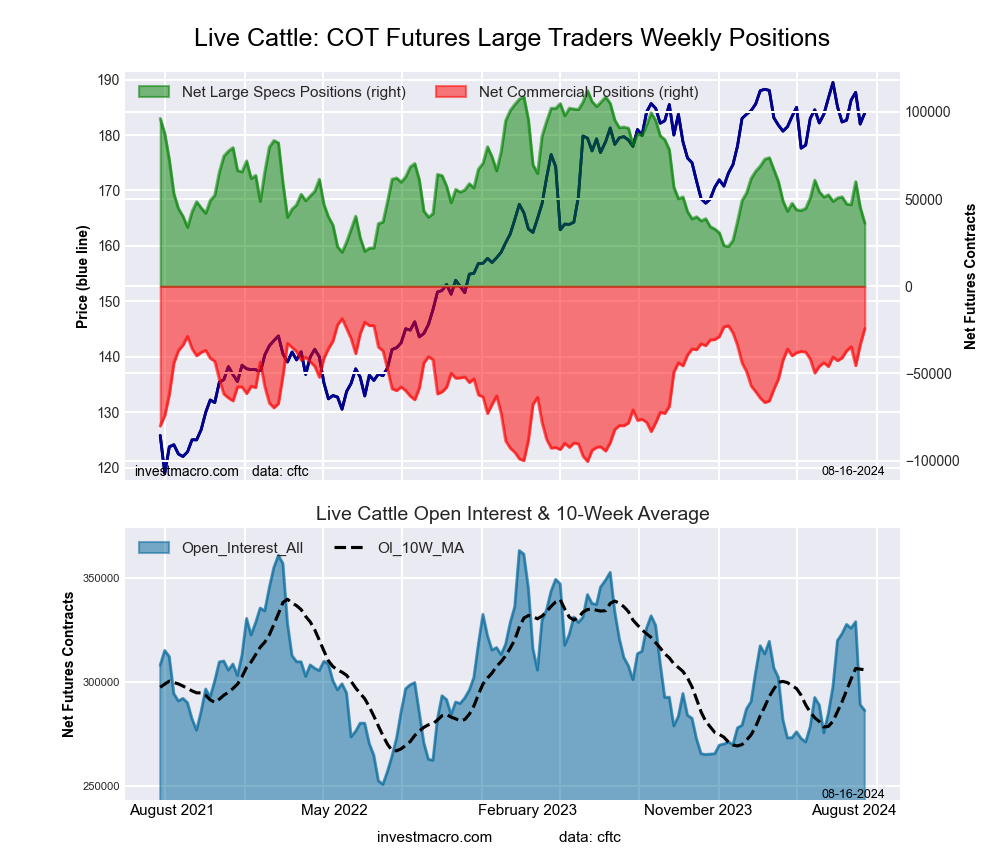
LIVE CATTLE Futures COT ChartThe LIVE CATTLE large speculator standing this week was a net position of 47,212 contracts in the data reported through Tuesday. This was a weekly decline of -4,065 contracts from the previous week which had a total of 51,277 net contracts.

This week’s current strength score (the trader positioning range over the past three years, measured from 0 to 100) shows the speculators are currently Bearish with a score of 29.8 percent. The commercials are Bullish with a score of 77.5 percent and the small traders (not shown in chart) are Bearish with a score of 35.3 percent.

Price Trend-Following Model: Weak Uptrend

Our weekly trend-following model classifies the current market price position as: Weak Uptrend. The current action for the model is considered to be: Hold – Maintain Long Position.

LIVE CATTLE Futures StatisticsSPECULATORSCOMMERCIALSSMALL TRADERS
– Percent of Open Interest Longs:37.932.29.4
– Percent of Open Interest Shorts:23.543.512.5
– Net Position:47,212-37,003-10,209
– Gross Longs:124,193105,59330,807
– Gross Shorts:76,981142,59641,016
– Long to Short Ratio:1.6 to 10.7 to 10.8 to 1
NET POSITION TREND:
– Strength Index Score (3 Year Range Pct):29.877.535.3
– Strength Index Reading (3 Year Range):BearishBullishBearish
NET POSITION MOVEMENT INDEX:
– 6-Week Change in Strength Index:-7.510.8-10.5


LEAN HOGS Futures:

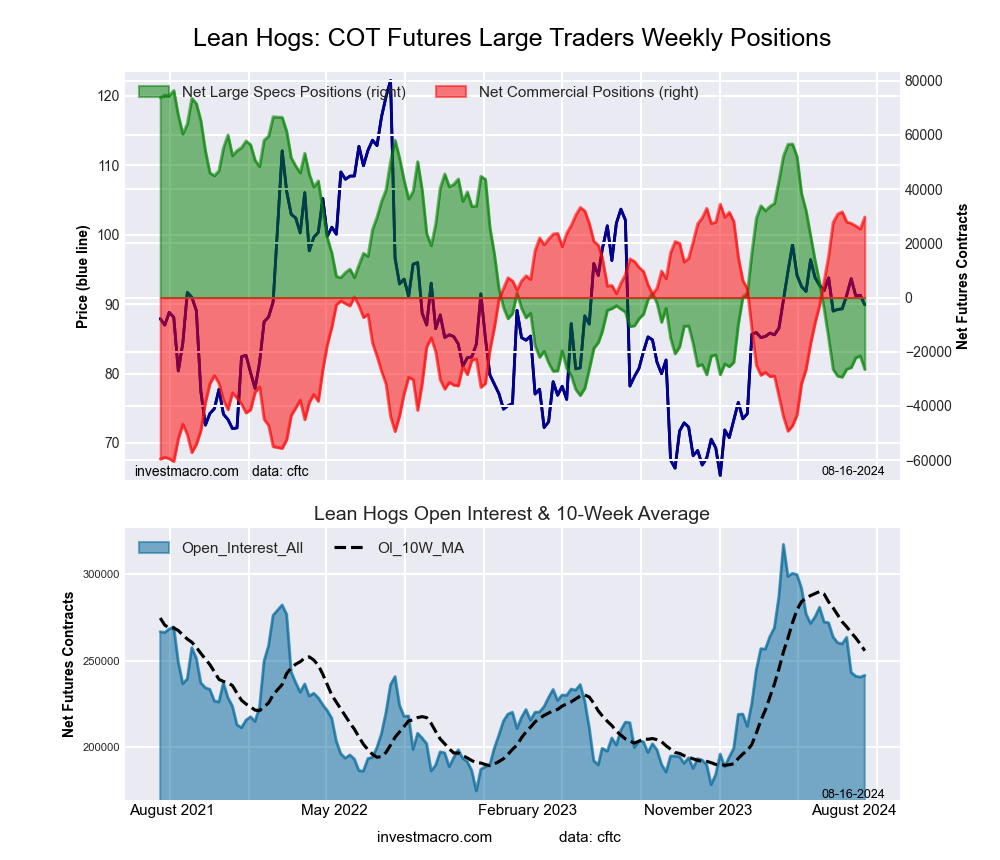
LEAN HOGS Futures COT ChartThe LEAN HOGS large speculator standing this week was a net position of -26,393 contracts in the data reported through Tuesday. This was a weekly gain of 2,955 contracts from the previous week which had a total of -29,348 net contracts.

This week’s current strength score (the trader positioning range over the past three years, measured from 0 to 100) shows the speculators are currently Bearish-Extreme with a score of 8.0 percent. The commercials are Bullish-Extreme with a score of 93.8 percent and the small traders (not shown in chart) are Bullish with a score of 76.7 percent.

Price Trend-Following Model: Uptrend

Our weekly trend-following model classifies the current market price position as: Uptrend. The current action for the model is considered to be: Hold – Maintain Long Position.

LEAN HOGS Futures StatisticsSPECULATORSCOMMERCIALSSMALL TRADERS
– Percent of Open Interest Longs:30.937.87.5
– Percent of Open Interest Shorts:40.927.38.0
– Net Position:-26,39327,877-1,484
– Gross Longs:81,37299,72319,711
– Gross Shorts:107,76571,84621,195
– Long to Short Ratio:0.8 to 11.4 to 10.9 to 1
NET POSITION TREND:
– Strength Index Score (3 Year Range Pct):8.093.876.7
– Strength Index Reading (3 Year Range):Bearish-ExtremeBullish-ExtremeBullish
NET POSITION MOVEMENT INDEX:
– 6-Week Change in Strength Index:-26.229.15.4


COTTON Futures:

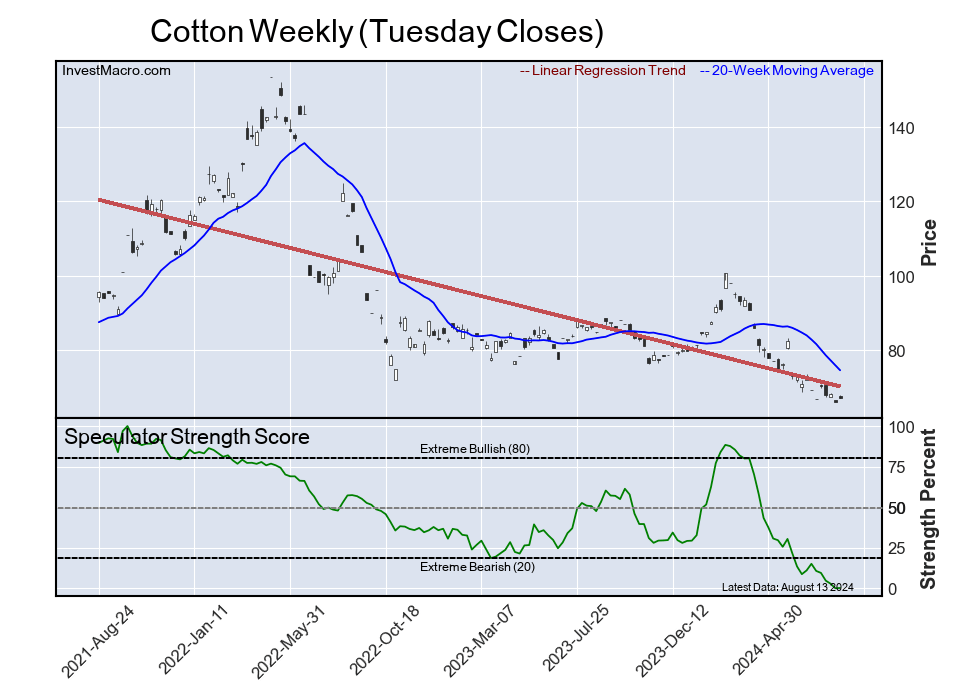
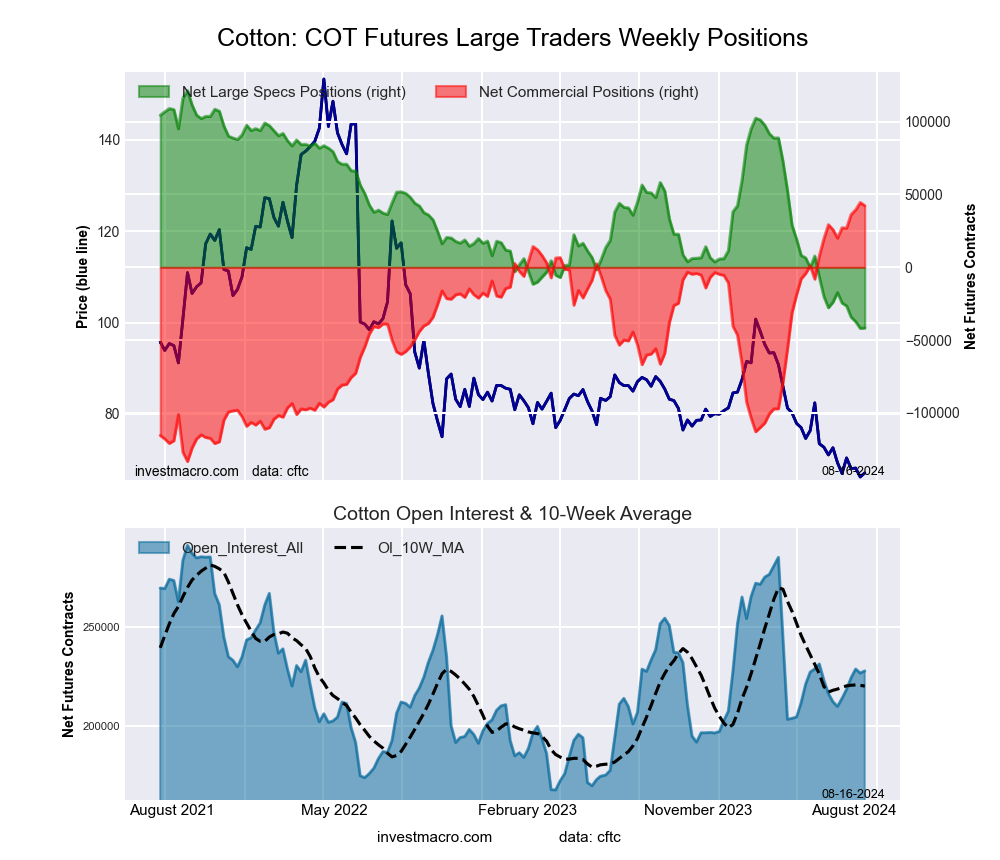
COTTON Futures COT ChartThe COTTON large speculator standing this week was a net position of -26,507 contracts in the data reported through Tuesday. This was a weekly fall of -1,998 contracts from the previous week which had a total of -24,509 net contracts.

This week’s current strength score (the trader positioning range over the past three years, measured from 0 to 100) shows the speculators are currently Bearish-Extreme with a score of 0.8 percent. The commercials are Bullish-Extreme with a score of 98.6 percent and the small traders (not shown in chart) are Bearish-Extreme with a score of 13.8 percent.

Price Trend-Following Model: Downtrend

Our weekly trend-following model classifies the current market price position as: Downtrend. The current action for the model is considered to be: Hold – Maintain Short Position.

COTTON Futures StatisticsSPECULATORSCOMMERCIALSSMALL TRADERS
– Percent of Open Interest Longs:27.948.25.8
– Percent of Open Interest Shorts:40.035.96.0
– Net Position:-26,50726,921-414
– Gross Longs:61,011105,42412,713
– Gross Shorts:87,51878,50313,127
– Long to Short Ratio:0.7 to 11.3 to 11.0 to 1
NET POSITION TREND:
– Strength Index Score (3 Year Range Pct):0.898.613.8
– Strength Index Reading (3 Year Range):Bearish-ExtremeBullish-ExtremeBearish-Extreme
NET POSITION MOVEMENT INDEX:
– 6-Week Change in Strength Index:-13.311.83.9


COCOA Futures:

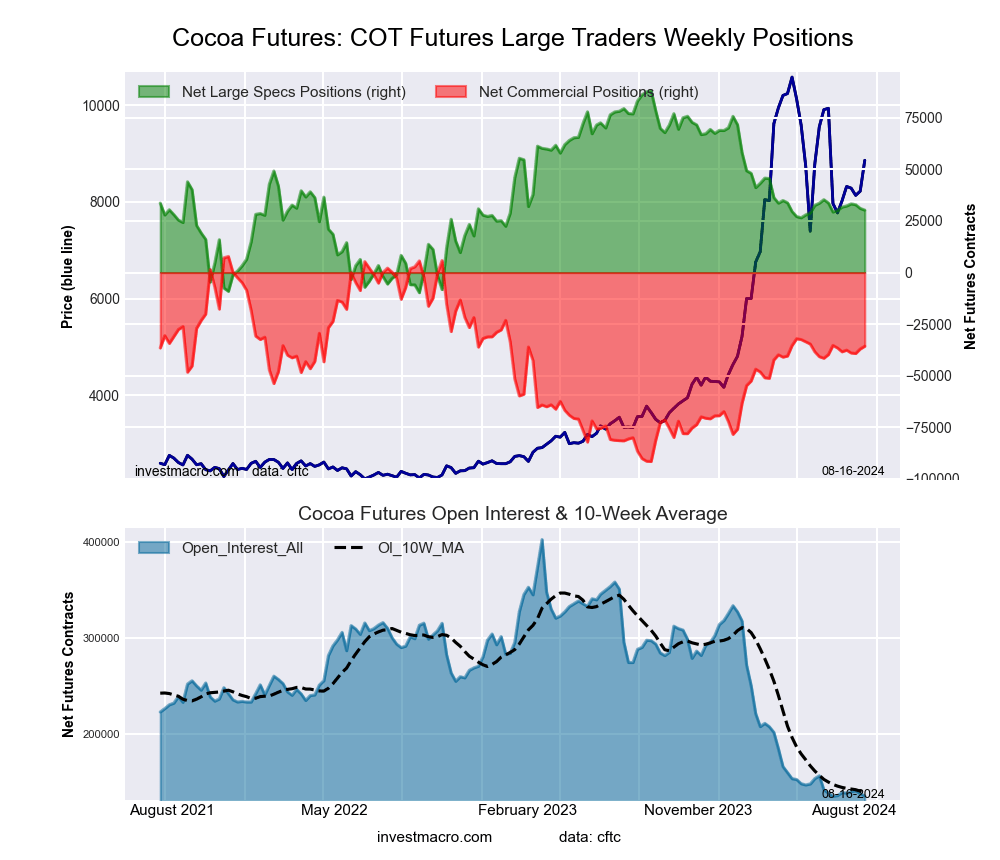
COCOA Futures COT ChartThe COCOA large speculator standing this week was a net position of 32,278 contracts in the data reported through Tuesday. This was a weekly rise of 538 contracts from the previous week which had a total of 31,740 net contracts.

This week’s current strength score (the trader positioning range over the past three years, measured from 0 to 100) shows the speculators are currently Bearish with a score of 42.9 percent. The commercials are Bullish with a score of 54.3 percent and the small traders (not shown in chart) are Bullish with a score of 57.9 percent.

Price Trend-Following Model: Strong Downtrend

Our weekly trend-following model classifies the current market price position as: Strong Downtrend. The current action for the model is considered to be: New Sell – Short Position.

COCOA Futures StatisticsSPECULATORSCOMMERCIALSSMALL TRADERS
– Percent of Open Interest Longs:34.433.58.3
– Percent of Open Interest Shorts:11.060.94.4
– Net Position:32,278-37,6435,365
– Gross Longs:47,38346,22211,372
– Gross Shorts:15,10583,8656,007
– Long to Short Ratio:3.1 to 10.6 to 11.9 to 1
NET POSITION TREND:
– Strength Index Score (3 Year Range Pct):42.954.357.9
– Strength Index Reading (3 Year Range):BearishBullishBullish
NET POSITION MOVEMENT INDEX:
– 6-Week Change in Strength Index:-1.43.2-15.2


WHEAT Futures:

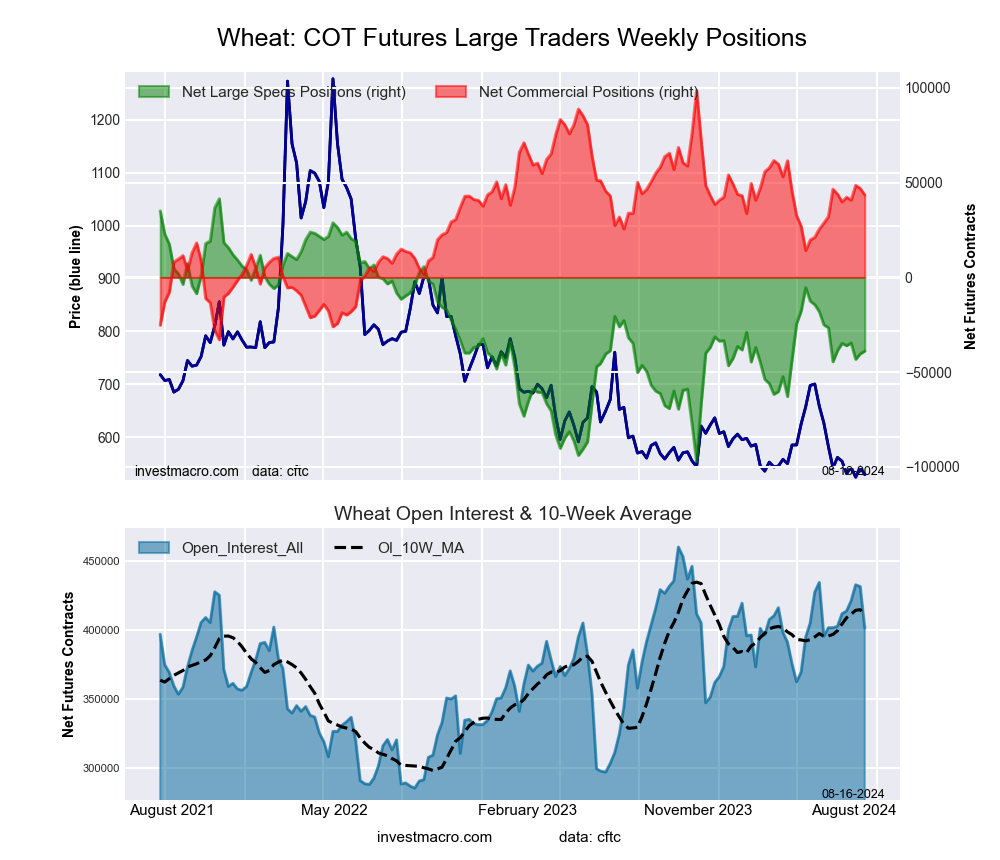
WHEAT Futures COT ChartThe WHEAT large speculator standing this week was a net position of -36,067 contracts in the data reported through Tuesday. This was a weekly fall of -1,281 contracts from the previous week which had a total of -34,786 net contracts.

This week’s current strength score (the trader positioning range over the past three years, measured from 0 to 100) shows the speculators are currently Bearish with a score of 42.5 percent. The commercials are Bullish with a score of 58.2 percent and the small traders (not shown in chart) are Bearish with a score of 33.2 percent.

Price Trend-Following Model: Weak Uptrend

Our weekly trend-following model classifies the current market price position as: Weak Uptrend. The current action for the model is considered to be: Hold – Maintain Long Position.

WHEAT Futures StatisticsSPECULATORSCOMMERCIALSSMALL TRADERS
– Percent of Open Interest Longs:30.939.37.7
– Percent of Open Interest Shorts:39.629.19.2
– Net Position:-36,06742,315-6,248
– Gross Longs:127,750162,86131,934
– Gross Shorts:163,817120,54638,182
– Long to Short Ratio:0.8 to 11.4 to 10.8 to 1
NET POSITION TREND:
– Strength Index Score (3 Year Range Pct):42.558.233.2
– Strength Index Reading (3 Year Range):BearishBullishBearish
NET POSITION MOVEMENT INDEX:
– 6-Week Change in Strength Index:-12.512.45.6


Article By InvestMacroReceive our weekly COT Newsletter

*COT Report: The COT data, released weekly to the public each Friday, is updated through the most recent Tuesday (data is 3 days old) and shows a quick view of how large speculators or non-commercials (for-profit traders) were positioned in the futures markets.

The CFTC categorizes trader positions according to commercial hedgers (traders who use futures contracts for hedging as part of the business), non-commercials (large traders who speculate to realize trading profits) and nonreportable traders (usually small traders/speculators) as well as their open interest (contracts open in the market at time of reporting). See CFTC criteria here.

COT Stock Market Charts: Speculator Bets led by Russell-2000 & DowJones

By InvestMacro

Here are the latest charts and statistics for the Commitment of Traders (COT) data published by the Commodities Futures Trading Commission (CFTC).

The latest COT data is updated through Tuesday July 16thand shows a quick view of how large traders (for-profit speculators and commercial entities) were positioned in the futures markets.

Weekly Speculator Bets led by Russell & DowJones

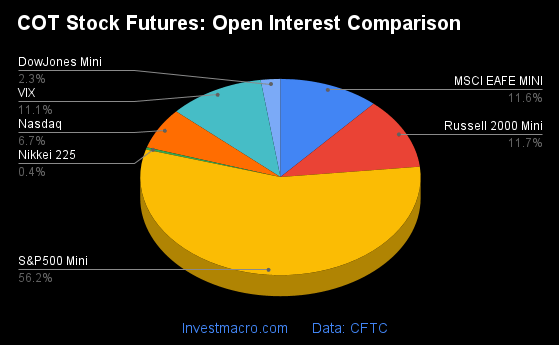
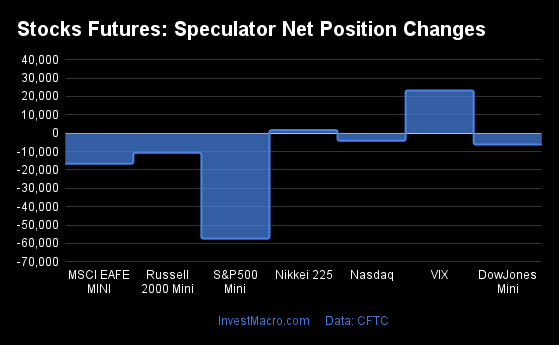
The COT stock markets speculator bets were higher this week as four out of the seven stock markets we cover had higher positioning while the other remaining markets had lower speculator contracts.

Leading the gains for the stock markets was the Russell-Mini (20,289 contracts) with the DowJones-Mini (7,446 contracts), the MSCI EAFE-Mini (837 contracts) and the Nasdaq-Mini (465 contracts) also showing positive weeks.

The markets with the declines in speculator bets this week were the S&P500-Mini (-10,433 contracts), the VIX (-827 contracts) and the Nikkei 225 (-501 contracts) also seeing lower bets on the week.


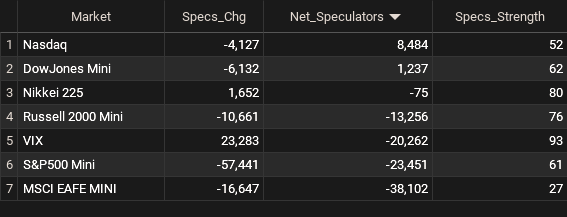
Stock Market Net Speculators Leaderboard

Legend: Weekly Speculators Change | Speculators Current Net Position | Speculators Strength Score compared to last 3-Years (0-100 range)


Strength Scores led by DowJones-Mini

COT Strength Scores (a normalized measure of Speculator positions over a 3-Year range, from 0 to 100 where above 80 is Extreme-Bullish and below 20 is Extreme-Bearish) showed that the DowJones-Mini (85 percent) leads the stock markets this week. The S&P500-Mini (55 percent) and Russell-Mini (52 percent) come in as the next highest in the weekly strength scores.

On the downside, the Nikkei 225 (35 percent) comes in at the lowest strength level currently. The next lowest strength score is the MSCI EAFE-Mini (42 percent).

Strength Statistics:
VIX (47.7 percent) vs VIX previous week (48.6 percent)
S&P500-Mini (55.0 percent) vs S&P500-Mini previous week (56.5 percent)
DowJones-Mini (85.1 percent) vs DowJones-Mini previous week (73.0 percent)
Nasdaq-Mini (48.0 percent) vs Nasdaq-Mini previous week (47.2 percent)
Russell2000-Mini (51.5 percent) vs Russell2000-Mini previous week (37.1 percent)
Nikkei USD (35.0 percent) vs Nikkei USD previous week (39.3 percent)
EAFE-Mini (41.8 percent) vs EAFE-Mini previous week (40.9 percent)


DowJones-Mini & Nasdaq-Mini top the 6-Week Strength Trends

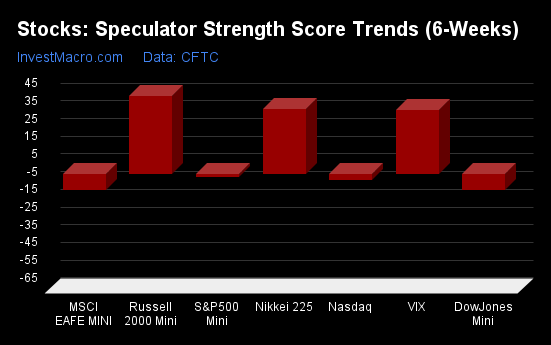
COT Strength Score Trends (or move index, calculates the 6-week changes in strength scores) showed that the DowJones-Mini (11 percent) leads the past six weeks trends for the stock markets. The Nasdaq-Mini (6 percent) is the next highest positive mover in the latest trends data.

The Nikkei 225 (-32 percent) leads the downside trend scores currently with the VIX (-23 percent) coming in as the next market with lower trend scores.

Strength Trend Statistics:
VIX (-22.8 percent) vs VIX previous week (-20.3 percent)
S&P500-Mini (-0.1 percent) vs S&P500-Mini previous week (-7.9 percent)
DowJones-Mini (11.3 percent) vs DowJones-Mini previous week (-8.7 percent)
Nasdaq-Mini (5.7 percent) vs Nasdaq-Mini previous week (13.9 percent)
Russell2000-Mini (-9.2 percent) vs Russell2000-Mini previous week (-24.0 percent)
Nikkei USD (-31.8 percent) vs Nikkei USD previous week (-26.9 percent)
EAFE-Mini (-13.8 percent) vs EAFE-Mini previous week (-0.2 percent)


Individual Stock Market Charts:

VIX Volatility Futures:

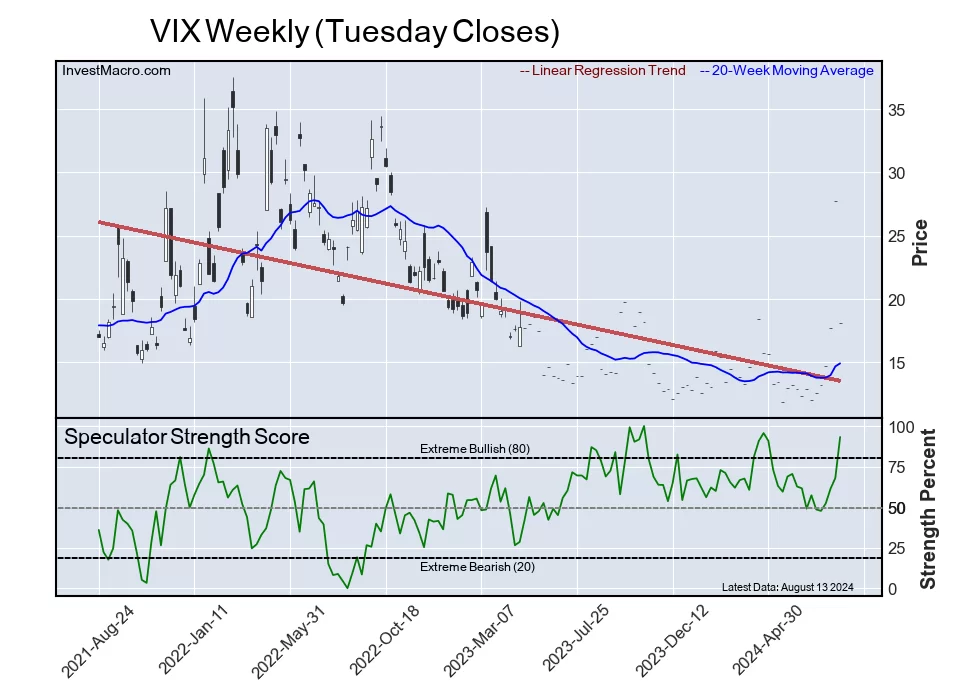
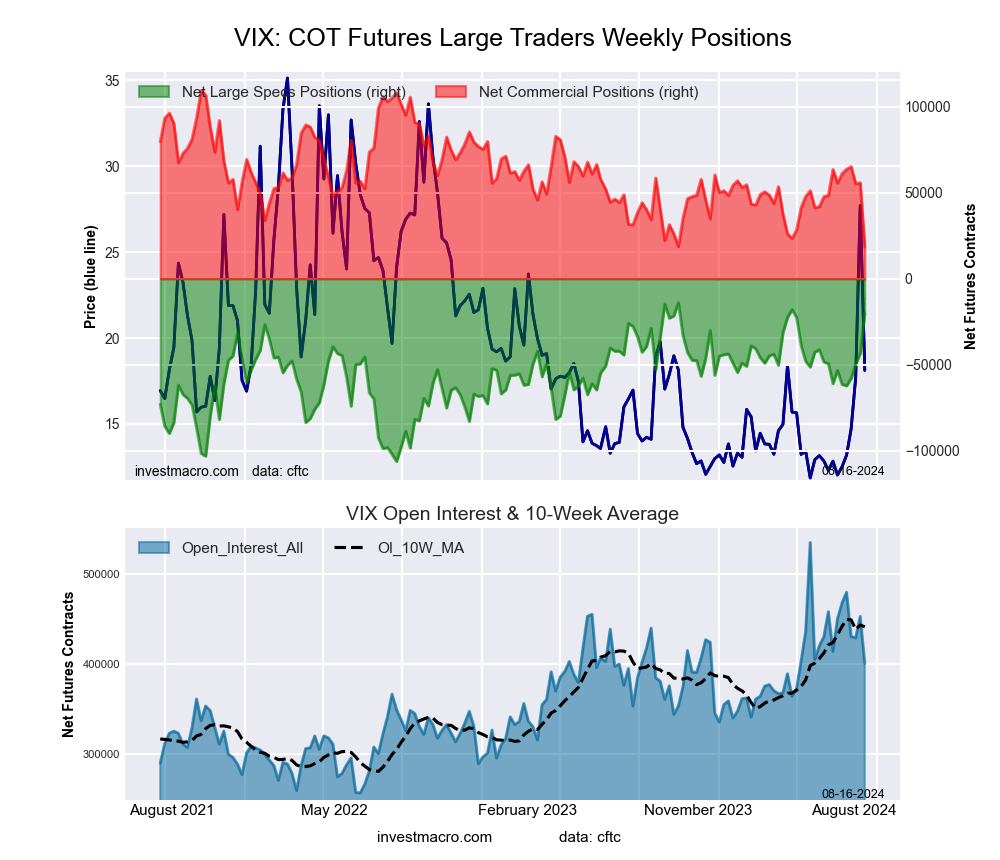
VIX Volatility Futures COT ChartThe VIX Volatility large speculator standing this week recorded a net position of -62,305 contracts in the data reported through Tuesday. This was a weekly lowering of -827 contracts from the previous week which had a total of -61,478 net contracts.

This week’s current strength score (the trader positioning range over the past three years, measured from 0 to 100) shows the speculators are currently Bearish with a score of 47.7 percent. The commercials are Bearish with a score of 49.6 percent and the small traders (not shown in chart) are Bullish-Extreme with a score of 86.3 percent.

Price Trend-Following Model: Weak Downtrend

Our weekly trend-following model classifies the current market price position as: Weak Downtrend. The current action for the model is considered to be: Hold – Maintain Short Position.

VIX Volatility Futures StatisticsSPECULATORSCOMMERCIALSSMALL TRADERS
– Percent of Open Interest Longs:18.350.05.7
– Percent of Open Interest Shorts:31.236.76.0
– Net Position:-62,30563,725-1,420
– Gross Longs:87,625240,03727,308
– Gross Shorts:149,930176,31228,728
– Long to Short Ratio:0.6 to 11.4 to 11.0 to 1
NET POSITION TREND:
– Strength Index Score (3 Year Range Pct):47.749.686.3
– Strength Index Reading (3 Year Range):BearishBearishBullish-Extreme
NET POSITION MOVEMENT INDEX:
– 6-Week Change in Strength Index:-22.823.9-3.5


S&P500 Mini Futures:

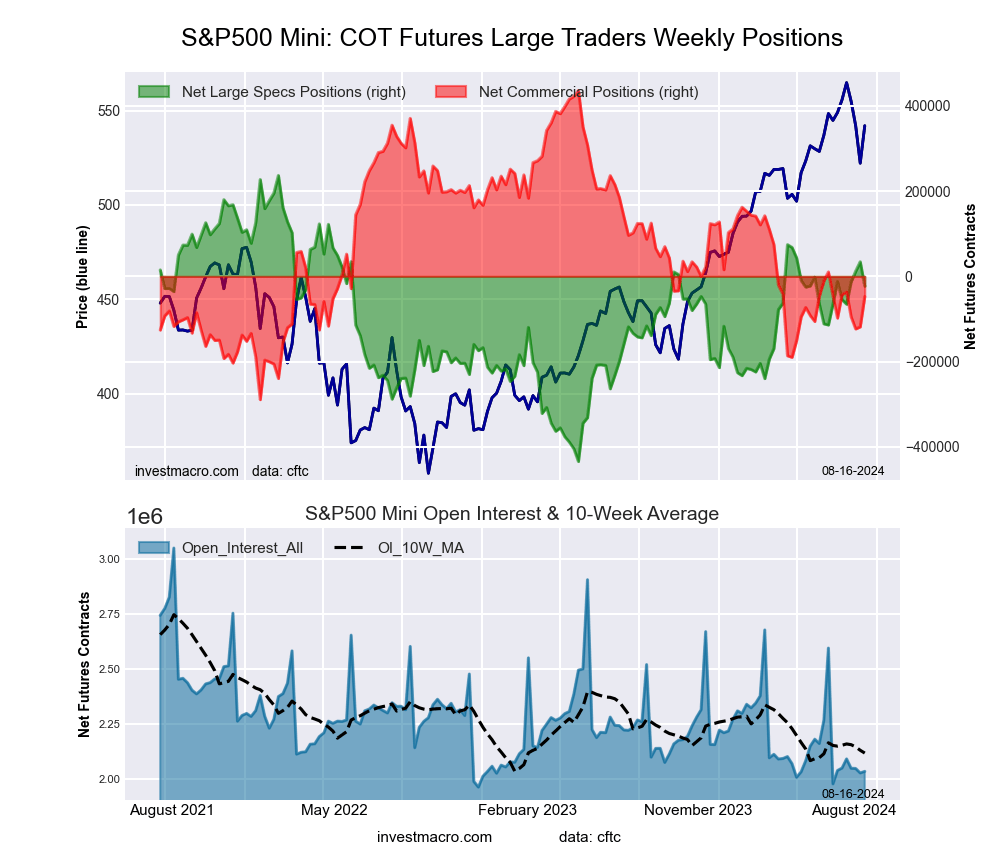
SP500 Mini Futures COT ChartThe S&P500 Mini large speculator standing this week recorded a net position of -65,444 contracts in the data reported through Tuesday. This was a weekly fall of -10,433 contracts from the previous week which had a total of -55,011 net contracts.

This week’s current strength score (the trader positioning range over the past three years, measured from 0 to 100) shows the speculators are currently Bullish with a score of 55.0 percent. The commercials are Bearish with a score of 34.8 percent and the small traders (not shown in chart) are Bullish with a score of 79.5 percent.

Price Trend-Following Model: Uptrend

Our weekly trend-following model classifies the current market price position as: Uptrend. The current action for the model is considered to be: Hold – Maintain Long Position.

S&P500 Mini Futures StatisticsSPECULATORSCOMMERCIALSSMALL TRADERS
– Percent of Open Interest Longs:16.069.412.9
– Percent of Open Interest Shorts:19.171.18.0
– Net Position:-65,444-37,170102,614
– Gross Longs:333,8661,449,475269,625
– Gross Shorts:399,3101,486,645167,011
– Long to Short Ratio:0.8 to 11.0 to 11.6 to 1
NET POSITION TREND:
– Strength Index Score (3 Year Range Pct):55.034.879.5
– Strength Index Reading (3 Year Range):BullishBearishBullish
NET POSITION MOVEMENT INDEX:
– 6-Week Change in Strength Index:-0.11.4-3.8


Dow Jones Mini Futures:

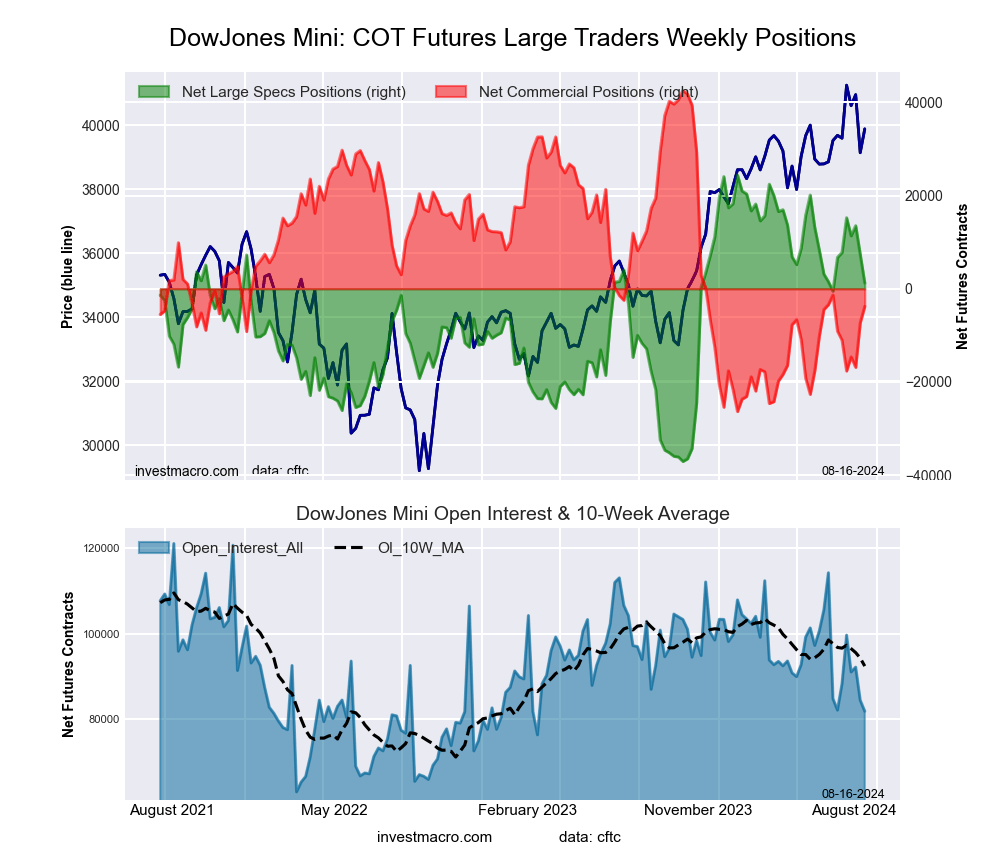
Dow Jones Mini Futures COT ChartThe Dow Jones Mini large speculator standing this week recorded a net position of 15,241 contracts in the data reported through Tuesday. This was a weekly gain of 7,446 contracts from the previous week which had a total of 7,795 net contracts.

This week’s current strength score (the trader positioning range over the past three years, measured from 0 to 100) shows the speculators are currently Bullish-Extreme with a score of 85.1 percent. The commercials are Bearish-Extreme with a score of 12.6 percent and the small traders (not shown in chart) are Bullish with a score of 60.1 percent.

Price Trend-Following Model: Strong Uptrend

Our weekly trend-following model classifies the current market price position as: Strong Uptrend. The current action for the model is considered to be: Hold – Maintain Long Position.

Dow Jones Mini Futures StatisticsSPECULATORSCOMMERCIALSSMALL TRADERS
– Percent of Open Interest Longs:30.750.415.0
– Percent of Open Interest Shorts:15.468.112.5
– Net Position:15,241-17,6612,420
– Gross Longs:30,56850,24414,925
– Gross Shorts:15,32767,90512,505
– Long to Short Ratio:2.0 to 10.7 to 11.2 to 1
NET POSITION TREND:
– Strength Index Score (3 Year Range Pct):85.112.660.1
– Strength Index Reading (3 Year Range):Bullish-ExtremeBearish-ExtremeBullish
NET POSITION MOVEMENT INDEX:
– 6-Week Change in Strength Index:11.3-10.82.7


Nasdaq Mini Futures:

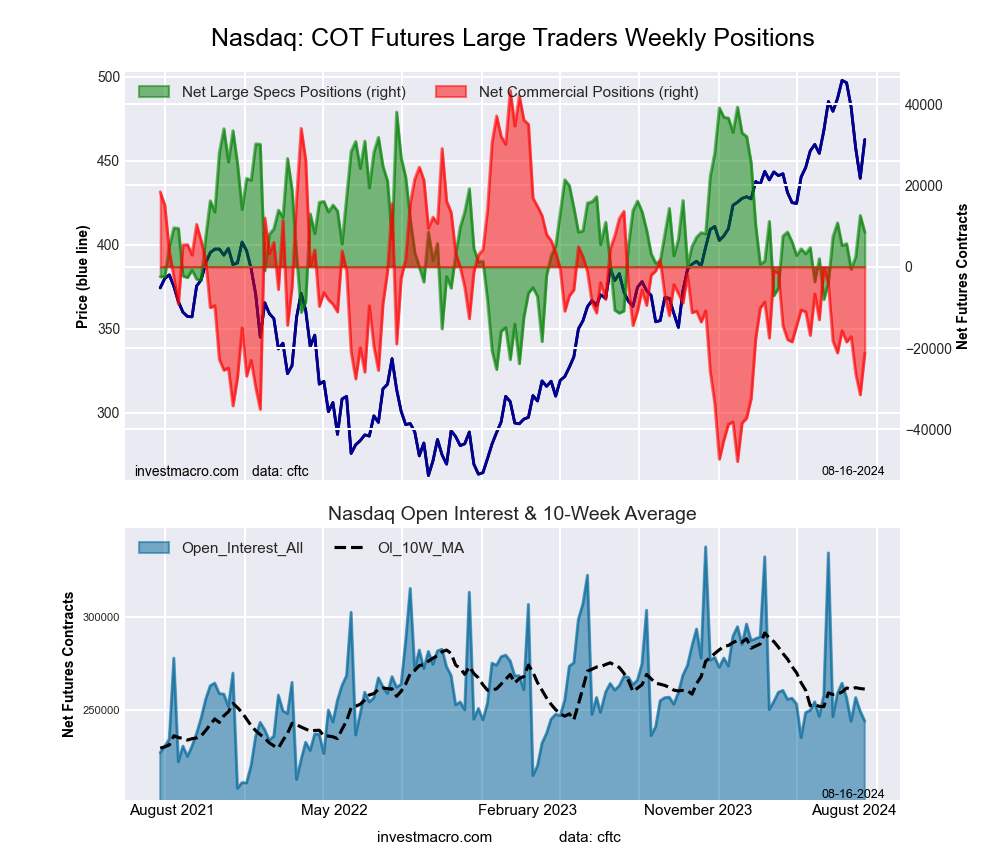
Nasdaq Mini Futures COT ChartThe Nasdaq Mini large speculator standing this week recorded a net position of 5,682 contracts in the data reported through Tuesday. This was a weekly lift of 465 contracts from the previous week which had a total of 5,217 net contracts.

This week’s current strength score (the trader positioning range over the past three years, measured from 0 to 100) shows the speculators are currently Bearish with a score of 48.0 percent. The commercials are Bearish with a score of 32.2 percent and the small traders (not shown in chart) are Bullish-Extreme with a score of 100.0 percent.

Price Trend-Following Model: Uptrend

Our weekly trend-following model classifies the current market price position as: Uptrend. The current action for the model is considered to be: Hold – Maintain Long Position.

Nasdaq Mini Futures StatisticsSPECULATORSCOMMERCIALSSMALL TRADERS
– Percent of Open Interest Longs:25.355.016.6
– Percent of Open Interest Shorts:23.162.211.6
– Net Position:5,682-18,50012,818
– Gross Longs:64,830141,02642,513
– Gross Shorts:59,148159,52629,695
– Long to Short Ratio:1.1 to 10.9 to 11.4 to 1
NET POSITION TREND:
– Strength Index Score (3 Year Range Pct):48.032.2100.0
– Strength Index Reading (3 Year Range):BearishBearishBullish-Extreme
NET POSITION MOVEMENT INDEX:
– 6-Week Change in Strength Index:5.7-6.04.3


Russell 2000 Mini Futures:

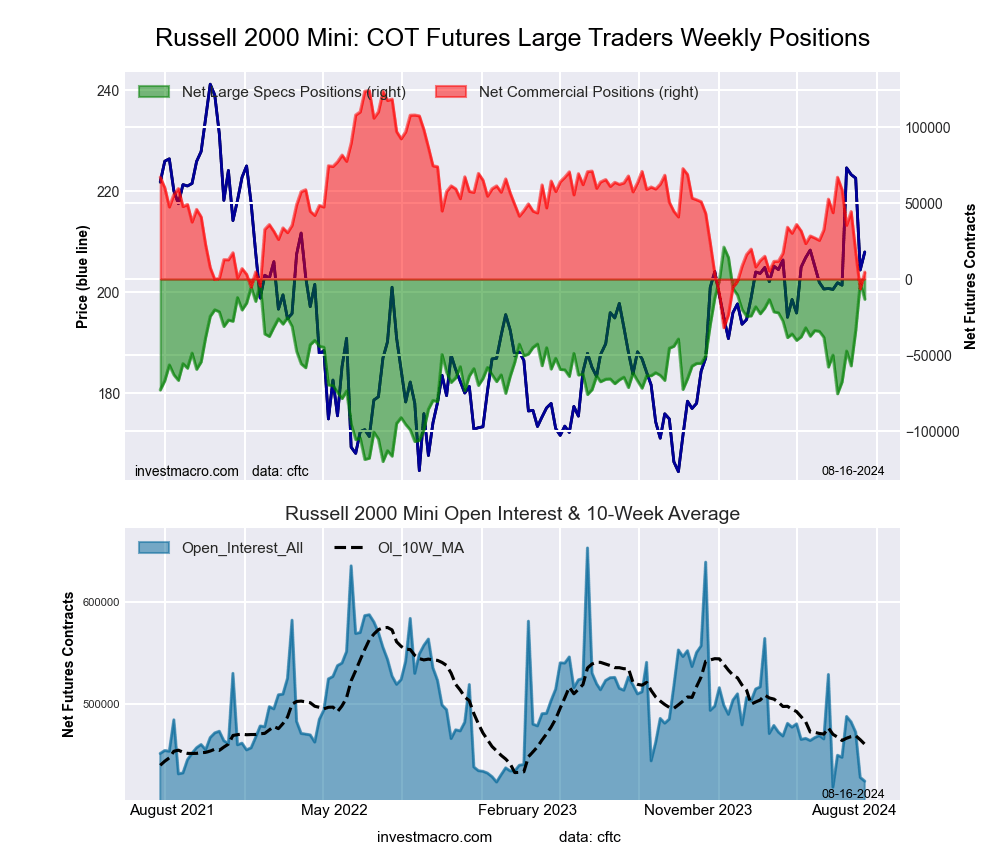
Russell 2000 Mini Futures COT ChartThe Russell 2000 Mini large speculator standing this week recorded a net position of -47,337 contracts in the data reported through Tuesday. This was a weekly rise of 20,289 contracts from the previous week which had a total of -67,626 net contracts.

This week’s current strength score (the trader positioning range over the past three years, measured from 0 to 100) shows the speculators are currently Bullish with a score of 51.5 percent. The commercials are Bearish with a score of 43.2 percent and the small traders (not shown in chart) are Bullish with a score of 69.3 percent.

Price Trend-Following Model: Strong Uptrend

Our weekly trend-following model classifies the current market price position as: Strong Uptrend. The current action for the model is considered to be: New Buy – Long Position.

Russell 2000 Mini Futures StatisticsSPECULATORSCOMMERCIALSSMALL TRADERS
– Percent of Open Interest Longs:18.472.77.3
– Percent of Open Interest Shorts:28.165.54.8
– Net Position:-47,33735,37311,964
– Gross Longs:89,656354,85835,432
– Gross Shorts:136,993319,48523,468
– Long to Short Ratio:0.7 to 11.1 to 11.5 to 1
NET POSITION TREND:
– Strength Index Score (3 Year Range Pct):51.543.269.3
– Strength Index Reading (3 Year Range):BullishBearishBullish
NET POSITION MOVEMENT INDEX:
– 6-Week Change in Strength Index:-9.26.310.4


Nikkei Stock Average (USD) Futures:

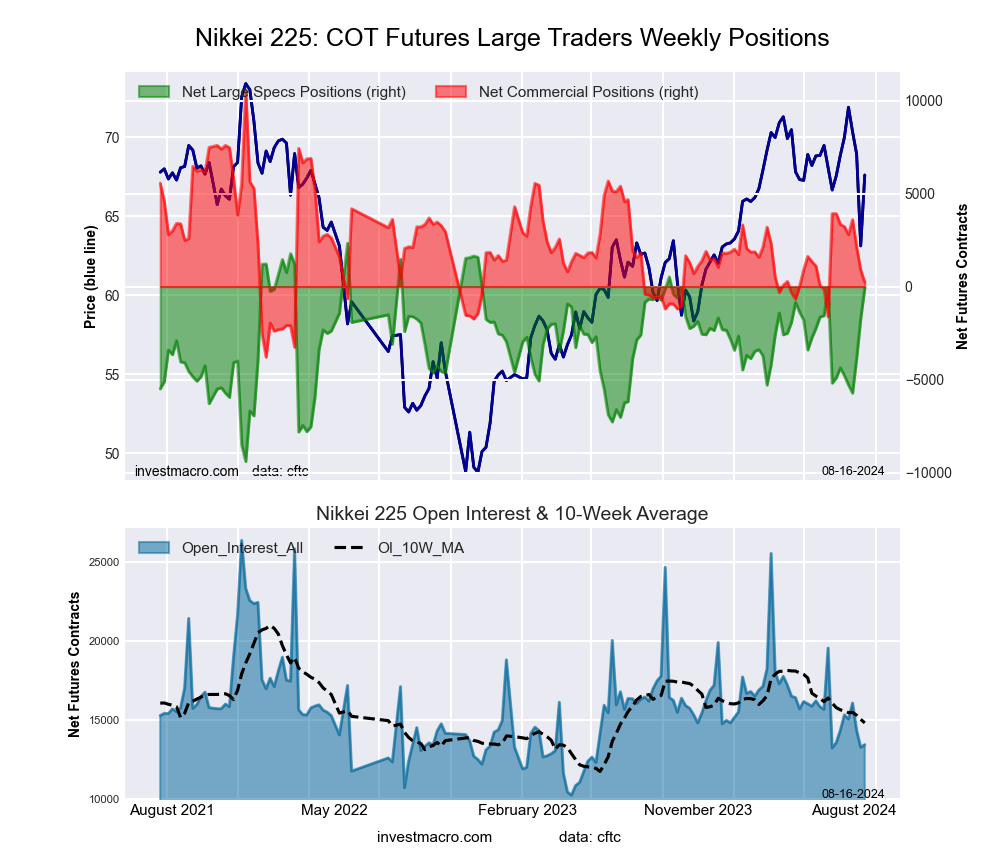
Nikkei Stock Average (USD) Futures COT ChartThe Nikkei Stock Average (USD) large speculator standing this week recorded a net position of -5,293 contracts in the data reported through Tuesday. This was a weekly decline of -501 contracts from the previous week which had a total of -4,792 net contracts.

This week’s current strength score (the trader positioning range over the past three years, measured from 0 to 100) shows the speculators are currently Bearish with a score of 35.0 percent. The commercials are Bearish with a score of 46.0 percent and the small traders (not shown in chart) are Bullish-Extreme with a score of 91.0 percent.

Price Trend-Following Model: Uptrend

Our weekly trend-following model classifies the current market price position as: Uptrend. The current action for the model is considered to be: Hold – Maintain Long Position

Nikkei Stock Average Futures StatisticsSPECULATORSCOMMERCIALSSMALL TRADERS
– Percent of Open Interest Longs:6.063.830.2
– Percent of Open Interest Shorts:41.245.313.6
– Net Position:-5,2932,7942,499
– Gross Longs:9019,6074,539
– Gross Shorts:6,1946,8132,040
– Long to Short Ratio:0.1 to 11.4 to 12.2 to 1
NET POSITION TREND:
– Strength Index Score (3 Year Range Pct):35.046.091.0
– Strength Index Reading (3 Year Range):BearishBearishBullish-Extreme
NET POSITION MOVEMENT INDEX:
– 6-Week Change in Strength Index:-31.820.415.5


MSCI EAFE Mini Futures:

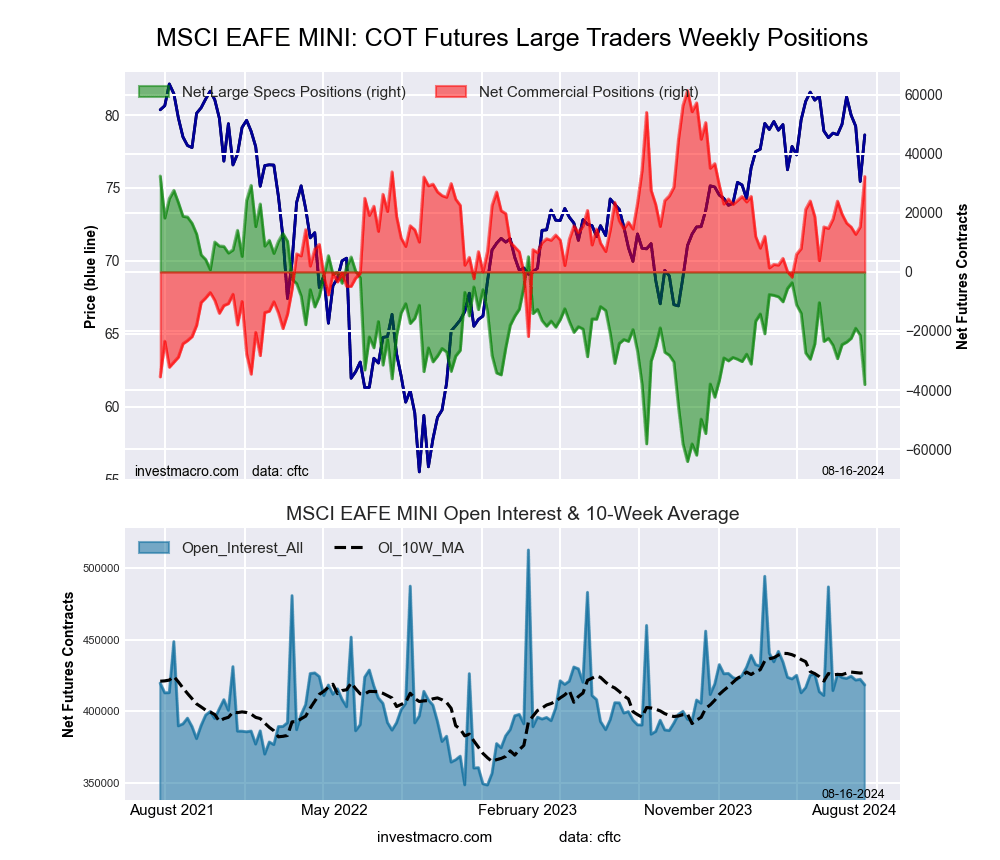
MSCI EAFE Mini Futures COT ChartThe MSCI EAFE Mini large speculator standing this week recorded a net position of -23,771 contracts in the data reported through Tuesday. This was a weekly increase of 837 contracts from the previous week which had a total of -24,608 net contracts.

This week’s current strength score (the trader positioning range over the past three years, measured from 0 to 100) shows the speculators are currently Bearish with a score of 41.8 percent. The commercials are Bullish with a score of 53.7 percent and the small traders (not shown in chart) are Bullish with a score of 53.0 percent.

Price Trend-Following Model: Uptrend

Our weekly trend-following model classifies the current market price position as: Uptrend. The current action for the model is considered to be: Hold – Maintain Long Position.

MSCI EAFE Mini Futures StatisticsSPECULATORSCOMMERCIALSSMALL TRADERS
– Percent of Open Interest Longs:7.788.73.2
– Percent of Open Interest Shorts:13.384.81.5
– Net Position:-23,77116,5457,226
– Gross Longs:32,588375,32713,605
– Gross Shorts:56,359358,7826,379
– Long to Short Ratio:0.6 to 11.0 to 12.1 to 1
NET POSITION TREND:
– Strength Index Score (3 Year Range Pct):41.853.753.0
– Strength Index Reading (3 Year Range):BearishBullishBullish
NET POSITION MOVEMENT INDEX:
– 6-Week Change in Strength Index:-13.813.13.2


Article By InvestMacroReceive our weekly COT Newsletter

*COT Report: The COT data, released weekly to the public each Friday, is updated through the most recent Tuesday (data is 3 days old) and shows a quick view of how large speculators or non-commercials (for-profit traders) were positioned in the futures markets.

The CFTC categorizes trader positions according to commercial hedgers (traders who use futures contracts for hedging as part of the business), non-commercials (large traders who speculate to realize trading profits) and nonreportable traders (usually small traders/speculators) as well as their open interest (contracts open in the market at time of reporting). See CFTC criteria here.

Want to Learn How to “Read” a Price Chart? Start Here.

See how Elliott wave patterns “subsume” other technical analysis chart patterns

By Elliott Wave International

Some investors who are fans of technical analysis may not realize that another way to look at many classic chart patterns — for example, Head and Shoulders — is to describe them in terms of Elliott waves.

What this means is that once you’ve learned Elliott wave analysis, by proxy you’ve learned most other technical analysis chart patterns that simply go by different names!

It’s a huge time saver.

In August and October 2005, as well as February 2006, Robert Prechter’s Elliott Wave Theorist discussed several chart patterns and showed two examples (with an introductory quote from the August 2005 Elliott Wave Theorist):

The acknowledged “bible” of traditional chart interpretation is Technical Analysis of Stock Trends (1948) by Robert Edwards and MIT alumnus John Magee. … The discussion here utilizes the fifth edition (1966).

Edwards and Magee collected others’ observations about chart patterns and added their own, producing a comprehensive list of forms against which we may compare related aspects of the Wave Principle. It may not be necessary that we undergo this exercise, as these authors observed and displayed these patterns exclusively in charts of individual stocks, not in the averages where the Wave Principle is deemed best to apply. Nevertheless, because many chartists use the same forms for general market interpretation and since the Wave Principle has some applicability to individual stocks, this exercise is important in order to determine if there are any valid market patterns outside the forms of the Wave Principle.

Head and Shoulders Top

Figure 8a shows Edwards and Magee’s depiction of a head and shoulders top, and Figure 8b is Figure 7-4 from Elliott Wave Principle. In a normal wave development, wave five of 3 and wave 4 form the “left shoulder” of the pattern, wave 5 and wave A form the “head,” and wave B and wave one of C form the “right shoulder.” Wave two of C creates the return to the neckline that is typical of the pattern.

Symmetrical Triangle

The Wave Principle covers the chartist’s “symmetrical triangle.” As you can see in Figures 11a and 11b, Edwards and Magee’s example is a perfect rendition of Elliott’s description, right down to the five subwaves.

Edwards and Magee claim, “Prices may move out of a Symmetrical Triangle either up or down. There is seldom if ever…any clue as to the direction….” Elliott’s form is more specifically defined, and its position in the market structure and therefore its implications are more definite.

Even though just two examples were shown here, hopefully, you get a flavor of what was presented in 2005 and 2006 — and an idea of the quality of analysis which our Financial Forecast Service regularly offers.

Realize that a chart pattern — even though it’s “classic” — offers no guarantees — and the same with the Wave Principle.

Yet, keep in mind this adaptation of a Q&A with Robert Prechter from an issue of The Elliott Wave Theorist:

Q: Do you believe that the Wave Principle provides for an objective form of analysis? Two different people can look at the same chart and derive very different wave counts. There are market watchers who say that applying wave theory is very subjective.

A: I always ask, “compared to what?” There is no group more subjective than conventional analysts who look at the same “fundamental” news event [like] a war, the level of interest rates, the P/E ratio, GDP reports, the President’s economic policy, the Fed’s monetary policy, you name it and come up with countless opposing conclusions. They generally don’t even bother to study the data. The Wave Principle is an excellent basis for assessing probabilities regarding future market movement. Probabilities are by nature different from certainties. Some people misinterpret this aspect of analysis as subjectivity, but all probabilities may be put in order objectively according to the rules and guidelines of wave formation.

If you’re unfamiliar with Elliott wave analysis, read Frost & Prechter’s Elliott Wave Principle: Key to Market Behavior, which is the definitive text on the subject. Here’s a quote from the book:

[Ralph N.] Elliott recognized that not news, but something else forms the patterns evident in the market. Generally speaking, the important analytical question is not the news per se, but the importance the market places or appears to place on the news. In periods of increasing optimism, the market’s apparent reaction to an item of news is often different from what it would have been if the market were in a downtrend. It is easy to label the progression of Elliott waves on a historical price chart, but it is impossible to pick out, say, the occurrences of war, the most dramatic of human activities, on the basis of recorded stock market action. The psychology of the market in relation to the news, then, is sometimes useful, especially when the market acts contrarily to what one would “normally” expect.

If you’d like to read the entire online version of Elliott Wave Principle: Key to Market Behavior, you can get complimentary access by following this link: Elliott Wave Principle: Key to Market Behavior.

This article was syndicated by Elliott Wave International and was originally published under the headline Want to Learn How to “Read” a Price Chart? Start Here.. EWI is the world’s largest market forecasting firm. Its staff of full-time analysts led by Chartered Market Technician Robert Prechter provides 24-hour-a-day market analysis to institutional and private investors around the world.

Natural gas prices bounced off the lows. Malaysia’s GDP is well ahead of estimates

By JustMarkets

The Dow Jones Index (US30) fell by 1.29% yesterday, while the S&P 500 Index (US500) went down 0.78%. The NASDAQ Technology Index (US100) closed negative 0.70%. Stocks initially opened higher on Thursday, with the Dow Jones Industrials Index (US30) setting a new record high amid a rebound in chip maker stocks after Taiwan Semiconductor Manufacturing Co, a supplier of chips to Apple (AAPL) and Nvidia (NVDA), reported better-than-expected second-quarter results and raised revenue growth estimates for 2024. But by the end of the trading day, stock indices gave up their early gains and retreated, with the S&P 500 (US500) posting a two-week low and the Nasdaq 100 (US100) falling to a three-week low. Falling shares of technology companies and large-cap banks weighed on the overall market.

Dovish comments from Chicago Fed President Goolsbee supported stocks yesterday when he said the Fed may have to cut interest rates soon to avoid a sharp deterioration in a labor market that has been cooling in recent months. Weekly US initial jobless claims rose by 20,000 to 243,000, indicating a weaker labor market than expectations of 229,000.

Equity markets in Europe traded mixed on Thursday. Germany’s DAX (DE40) decreased by 0.45%, France’s CAC 40 (FR40) closed up 0.21%, Spain’s IBEX 35 (ES35) was up 0.38%, and the UK’s FTSE 100 (UK100) closed positive 0.21%.

German producer prices fell by 1.6% y/y in June 2024, softer than the 2.2% decline in the previous month and in line with market estimates. This is the 12th consecutive month of producer price deflation, but the softest on record, amid falling energy prices (-5.9%), particularly natural gas (-14.8%) and electricity (-11.0%). UK retail sales in June 2024 declined 1.2% on the previous month, following a 2.9% rise in May, worse than market prognoses expecting a 0.4% drop.

On Friday, WTI crude oil prices fell to $82 per barrel, extending losses from the previous session, driven by a broad sell-off in risk assets and a stronger US dollar. On Thursday, US stocks and commodities declined and the dollar recovered as investors took a more cautious stance in assessing the global economic outlook.

The US natural gas prices (XNGUSD) rose more than 3.5% to above $2.1 per mmbbl, rebounding from a 10-week low after the EIA reported a smaller-than-expected injection into storage. The US utilities added 10 billion cubic feet (Bcf) of gas to storage last week, below the expected 28 Bcf increase, bringing total inventories to 3,209 Bcf, 16.9% above the 5-year average.

Asian markets traded mixed yesterday. Japan’s Nikkei 225 (JP225) was down 2.36%, China’s FTSE China A50 (CHA50) was up 0.46%, Hong Kong’s Hang Seng (HK50) was up 0.22% and Australia’s ASX 200 (AU200) was negative 0.27%.

A growing number of economists are pushing back the timing of interest rate cuts to the RBNZ’s August meeting. Earlier in the week, data emerged that the country’s annual inflation rate fell to a three-year low of 3.3% in the second quarter, down from 4% in the previous period. This spurred expectations of three rate cuts by the Reserve Bank of New Zealand, with markets estimating an overall rate easing of 70 basis points before the end of the year.

The increase in Australian jobs in June points to a tight labor market, adding to concerns about a possible interest rate hike by the Reserve Bank of Australia (RBA). However, the unemployment rate rose to 4.1% from 4%. The probability of a rate hike by the Central Bank in August now stands at 20%, up from 12% earlier this week. The RBA is also expected to ease policy much later than other major central banks. Against the kiwi, the Australian dollar is set to rise for a fifth consecutive week amid growing divergence in the monetary policy outlook between New Zealand and Australia.

According to preliminary data, Malaysia’s economy grew to an annualized rate of 5.8% in Q2 2024, significantly higher than the growth of 4.2% in Q1. This was the highest GDP growth since Q4 2022, helped by expansion in all sectors. The services sector accelerated (5.6% vs. 4.7% in Q1), aided by wholesale and retail trade.

S&P 500 (US500) 5,544.59 −43.68 (−0.78%)

Dow Jones (US30) 40,665.02 −533.06 (−1.29%)

DAX (DE40) 18,354.76 −82.54 (−0.45%)

FTSE 100 (UK100) 8,204.89 +17.43 (+0.21%)

USD Index 104.19 +0.45 (+0.43%)

Important events today:
  • – Japan National Core Consumer Price Index at 02:30 (GMT+3);
  • – UK Retail Sales (m/m) at 09:00 (GMT+3);
  • – German Producer Price Index (m/m) at 09:00 (GMT+3);
  • – Canada Retail Sales  (m/m) at 15:30 (GMT+3);
  • – US FOMC Willaams Speaks at 17:40 (GMT+3);
  • – US FOMC Bostic Speaks at 19:45 (GMT+3).

By JustMarkets


This article reflects a personal opinion and should not be interpreted as an investment advice, and/or offer, and/or a persistent request for carrying out financial transactions, and/or a guarantee, and/or a forecast of future events.

Week Ahead: Alphabet to kick-start Big Tech earnings

By ForexTime 

  • Alphabet ↑ 27% year-to-date
  • Pay close attention to updates on AI innovations
  • Technical levels = $183, $177 & $170 (Alphabet)
  • Tesla earnings also in focus, stocks ↑ 26% MTD

The week ahead is packed with high-impact data releases and a slew of corporate earnings from the largest companies in the world:

Monday, 22nd July

  • CN50: China loan prime rates
  • TWN: Taiwan jobless rate

Tuesday, 23rd July  

  • EU50: Eurozone consumer confidence
  • SG20: Singapore CPI
  • TWN: Taiwan industrial production
  • NAS100: Alphabet, Tesla earnings
  • FRA40: LVMH earnings

Wednesday, 24th July  

  • CAD: Bank of Canada rate decision
  • EU50: Eurozone, Germany PMI
  • UK100: UK S&P Global PMI
  • US30: IBM earnings, US S&P Global PMI
  • GER40: Deutsche Bank earnings

Thursday, 25th July

  • GER40: Germany IFO business climate
  • US500: US Q2 GDP, initial jobless claims
  • Bitcoin: Crypto 2024 conference in Nashville

Friday, 26th July

  • JP225: Japan Tokyo CPI
  • SG20: Singapore industrial production
  • USDInd: US June PCE report, University of Michigan consumer sentiment

Although earnings season is in full swing, the excitement levels could jump next week when big tech companies report their results. Expectations remain high around whether these AI giants can keep up the bullish momentum that has propelled US markets to record highs this year.

Two of the so-called “Magnificent” 7 tech titans will be under the spotlight.  Here’s what you need to know.

    1) Alphabet

Google parent company Alphabet reports its second-quarter earnings on Tuesday 23rd July after US markets close.

Its shares have gained 27% in 2024 thanks to investor hype around artificial intelligence translating to big gains in the tech space. Still, investors will be looking for another round of exceptional results to justify the solid gains fuelled by the A.I. frenzy.

Beyond the revenue growth and earnings-per-share, updates on AI innovations will be in focus.

Markets are forecasting a 5.8% move, either Up or Down, for Alphabet stocks post earnings.

Talking technicals, Alphabet stocks have shed roughly 6% this week with prices wobbling above the 50-day SMA. The past few days have been rough for tech stocks due to reports of the US mulling tougher restrictions on trading chips with China.

  • A solid breakdown below $177 may open a path towards $170.
  • Should the 50-day SMA prove reliable support, prices may retest $183 and $188.50.


    2) Tesla

Tesla is also set to release its second-quarter earnings on Tuesday after the close of US trading.

Despite gaining over 25% in July thanks to a strong delivery report, Tesla stocks are just barely in positive territory year-to-date. The company’s revenues, any mention of affordable vehicles, and the full self-driving software update will be scrutinized by investors to gauge its business outlook.

Quarterly revenues are seen slipping to $24.6 billion from $24.9 billion in the prior year, equating to a 1.2% decline.

Markets are forecasting an 8% move, either Up or Down, for Tesla stocks post-earnings.

Looking at the technical picture, Tesla stocks remain in a wide range on the daily charts with support at $232.50 and resistance at $270. Given the potential 8% move either up or down, a breakout could be on the horizon.


Forex-Time-LogoArticle by ForexTime
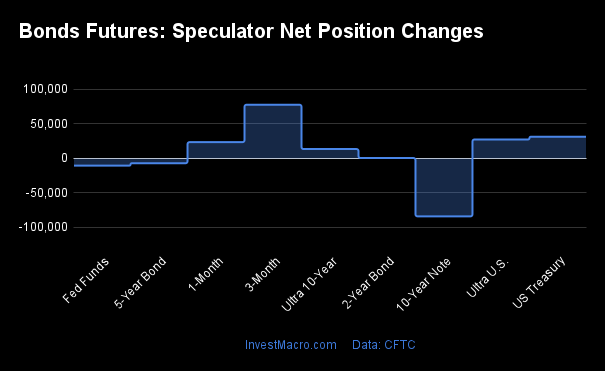
ForexTime Ltd (FXTM) is an award winning international online forex broker regulated by CySEC 185/12 www.forextime.com
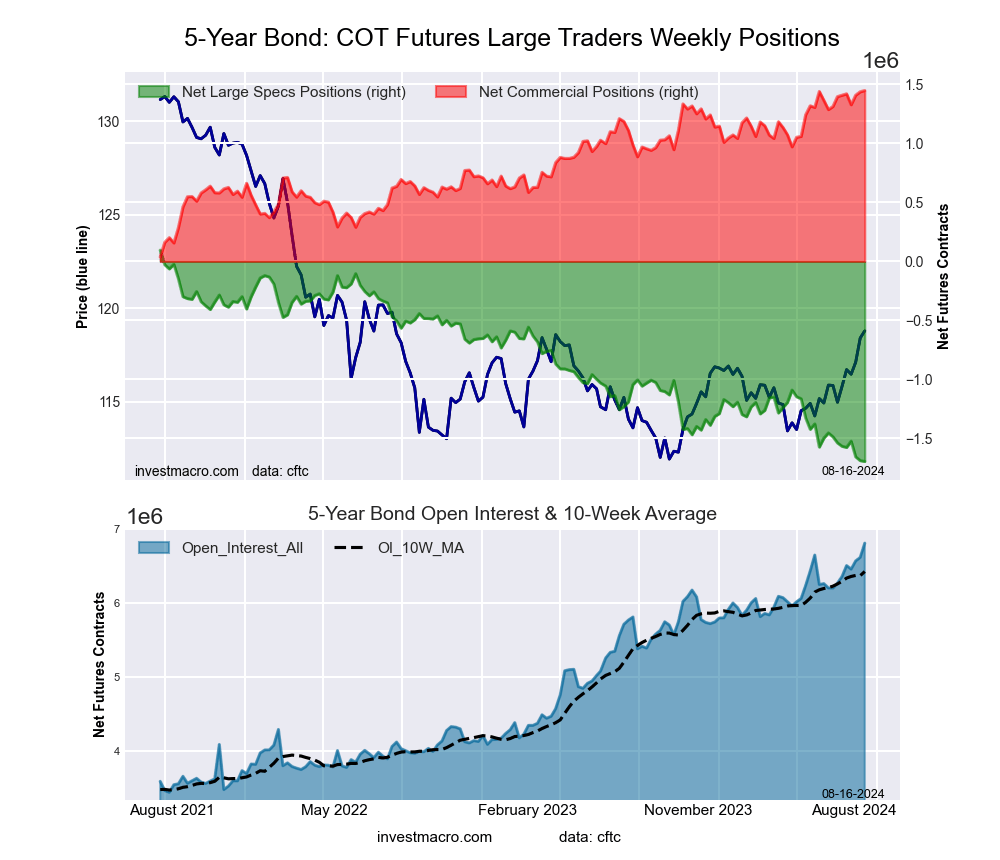
EUR/USD Experiences Sharp Decline: Risk Appetite Heightens

By RoboForex Analytical Department

The EUR/USD pair fell sharply to 1.0888, with investors speculating on the future of US interest rates and the potential implications of the upcoming presidential election, particularly as Donald Trump’s chances appear to be improving. These factors contribute to a heightened risk appetite, leading to a retreat in the USD.

As the Federal Reserve approaches its meeting at the end of the month, a quiet period will begin this Saturday, during which the Fed will make no further comments.

Concurrently, the European Central Bank (ECB) recently held its meeting, maintaining the current interest rates as anticipated. This decision aligns with recent economic indicators corroborating the ECB’s inflation forecasts, prompting a cautious approach. The ECB emphasised that the prevailing high rates are instrumental in managing the consumer price index and reiterated the necessity to maintain these rates, given the expected inflation to remain above the 2% target into 2025.

This perspective is reinforced by sustained price pressures, particularly in the services sector, highlighting ongoing inflationary concerns.
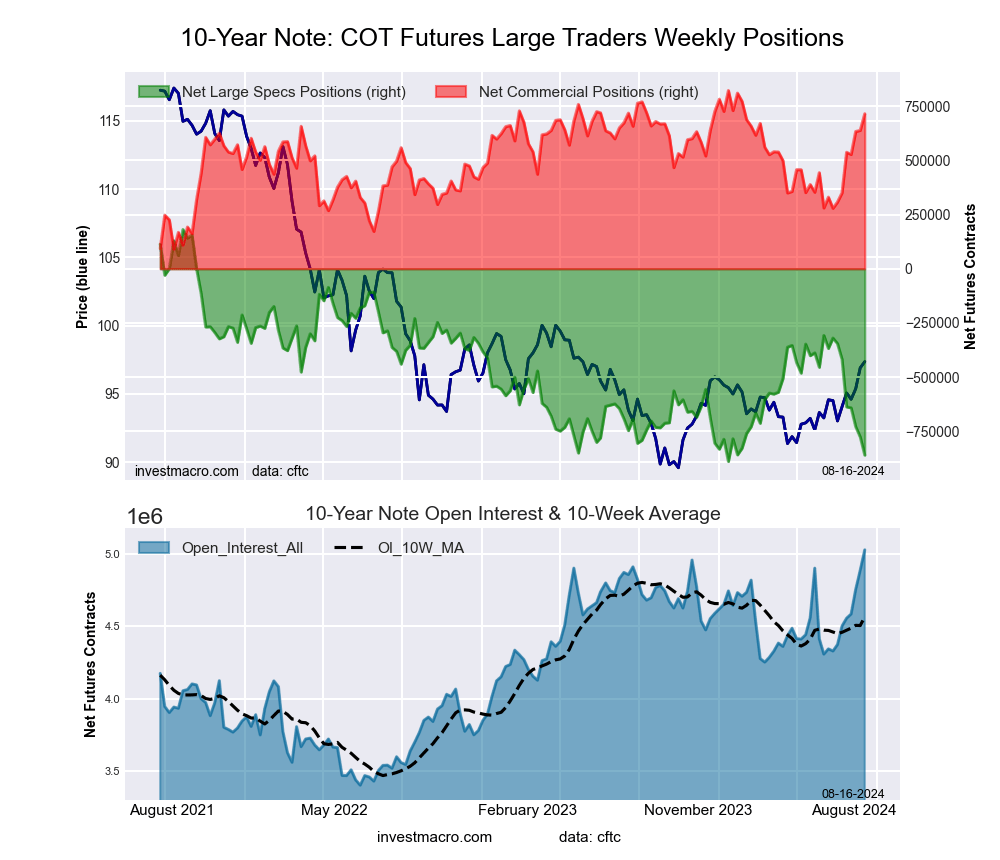
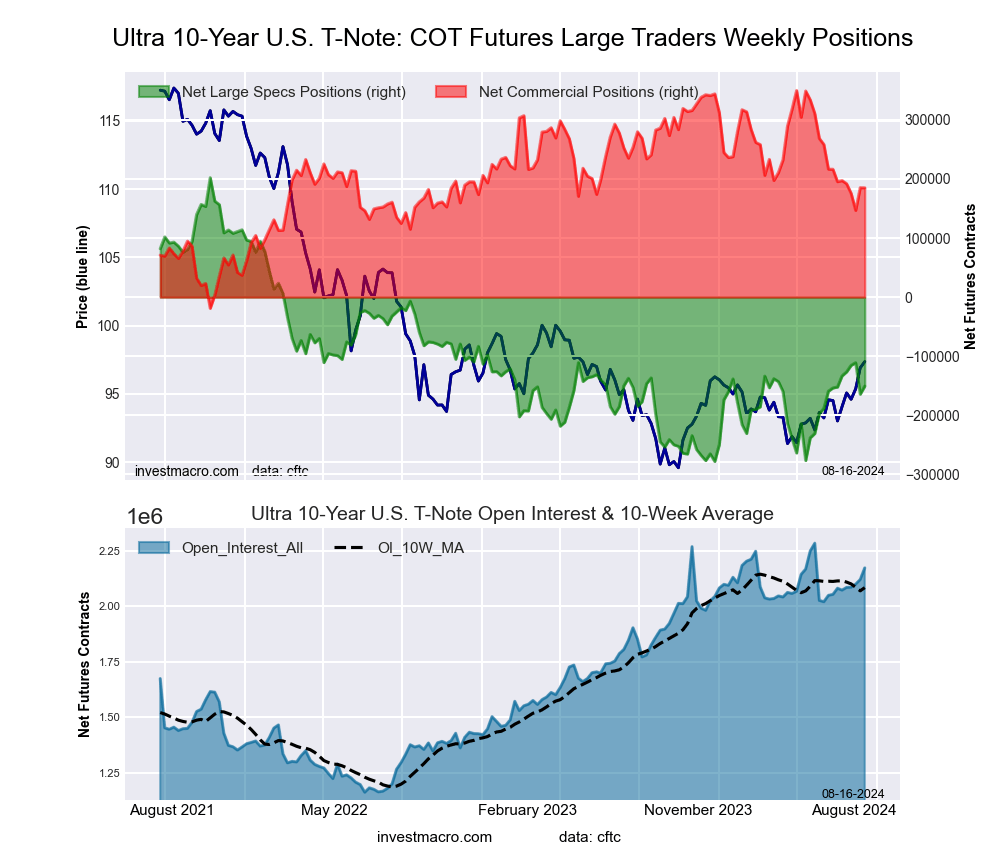
EUR/USD technical analysis

EUR/USD currency pair has developed a consolidation range around the 1.0806 level, with a breakout leading to achieving the target at 1.0946. A correction towards 1.0806 is currently anticipated, with the initial correction wave targeting 1.0880. Subsequently, a potential rebound to 1.0910 may occur before another decline to 1.0840. The MACD indicator supports this bearish outlook, indicating a downward trajectory from above zero.

The pair is forming a downward wave to 1.0880. Upon reaching this level, a rise to 1.0910 may be considered. This analysis is corroborated by the Stochastic oscillator, positioned below 20 and poised for an upward movement, suggesting a short-term recovery in the pair.

Investors and traders should monitor these developments closely, particularly any shifts in market sentiment influenced by macroeconomic data and central bank activities, which are crucial in shaping the currency dynamics in the near term.


Disclaimer

Any forecasts contained herein are based on the author’s particular opinion. This analysis may not be treated as trading advice. RoboForex bears no responsibility for trading results based on trading recommendations and reviews contained herein.

What You Can Learn from Europe’s “Dow Theory”-esque Non-confirmation

By Brian Whitmer | European Financial Forecast editor

Charles Dow (yes, the one with the averages named after him) developed a foundational concept in technical analysis that requires that price movement in industrial stocks and transportation shares confirm one another.

The main condition for a Dow Theory non-confirmation occurs when one sector makes a new extreme absent the other. Its classic application is observing the position of the Dow Jones Industrial Average, an index of 30 “industrial” stocks, versus the position of the Dow Jones Transportation Average, an index of 20 “transportation” stocks. In essence, whenever one index fails to keep up with the other, in either direction, it suggests an impending reversal.

These concepts can be applied universally.

For example, right now over in Britain, the FTSE 100’s divergence with the FTSE 350 Transportation Index just pushed to 29 months.

Britain's Longest Nonconfirmation to Date

This is a far more prolonged Dow Theory non-confirmation than that seen in July 2007 (seven months) or December 1999 (17 months). In 1999, the FTSE 100 eventually collapsed 53%, while the FTSE 350 Transports fell 66%. In 2007, the resulting declines were 49% and 77%, respectively.

In our view, Britain’s prolonged non-confirmation makes sense given a host of investor psychology and other extremes we’ve been tracking, not just in Europe but around the globe. If you want to stay up-to-date on our findings regarding the position of stocks and bond markets, currencies and the broad economic trends, check out some of our free must-read issues on www.elliottwave.com.

Brent Oil Price Trends Upward Amid Positive Market Signals

By RoboForex Analytical Department

Brent crude oil has reached $85.40, marking a continued increase over two consecutive sessions. This upward trend is primarily supported by recent US energy inventory statistics, which showed a significant decrease of 4.87 million barrels against an anticipated decline of 0.8 million barrels. This marks the longest stretch of inventory reductions since last September, underscoring a robust demand for oil.

Fueling the market optimism further, recent comments from Federal Reserve representatives suggest an imminent rate cut, with a 98% market expectation for this to occur in September. Lower interest rates typically stimulate economic activity, thereby boosting demand for oil.

Geopolitical tensions also play a role in the current price dynamics. Reports of renewed attacks by Hussite forces on vessels in the Red Sea have raised concerns about potential disruptions in oil supplies, prompting the market to add a risk premium to oil prices.

Brent technical analysis

Brent crude oil has shown a growth wave reaching 84.42. A consolidation range has been established around this level. If the market breaks above this range, we anticipate a move towards 86.10, which is the immediate target. After reaching this target, a retest of 84.42 could occur, potentially setting the stage for further growth towards 87.70 and possibly extending to 90.00. The MACD indicator supports this bullish outlook, indicating an upward trajectory from below the zero mark.

The market has found support at 84.42 and is progressing through a growth phase with an expected target at 86.10. We anticipate this target will be reached shortly, followed by a correction phase returning to 84.42. This view is supported by the Stochastic oscillator, which is nearing the 80 level, suggesting a potential pullback after the target is met.

Investors and traders should closely monitor these levels and the broader market context, including geopolitical developments and further signals from the Federal Reserve, as these factors will likely influence Brent’s price movements in the near term.


Disclaimer

Any forecasts contained herein are based on the author’s particular opinion. This analysis may not be treated as trading advice. RoboForex bears no responsibility for trading results based on trading recommendations and reviews contained herein.