Oil falls amid possible truce between Israel and Hamas. Indices remain under pressure

By JustMarkets 

At Tuesday’s close, the Dow Jones Index (US30) decreased by 0.14%, while the S&P 500 Index (US500) was down 0.16%. The NASDAQ Technology Index (US100) closed negative 0.06%.

Spotify (SPOT) shares are up 2.11% after reporting stronger-than-expected subscriber growth and higher-than-expected gross profit. Tesla’s (TSLA) second-quarter net income fell 45% from a year ago as sales of the company’s electric vehicles declined globally despite price cuts and low-interest financing. Tesla Inc shares fell 3% after the report was released. Alphabet Inc. (GOOG) reported second-quarter financial results on Tuesday that mostly exceeded analysts’ expectations. The company reported adjusted earnings per share (EPS) of $1.89, slightly above the consensus estimate of $1.83. Revenue for the quarter totaled $84.74 billion, which was also above analysts’ average prognosis of $84.16 billion. Google shares rose 2.2 percent after-hours trading. Visa (V)’s third-quarter revenue growth fell short of Wall Street expectations as high borrowing costs curbed consumer spending, sending shares of the world’s largest payment processor down 2.1% in extended trading.

Recently, the market has viewed a Trump victory as favorable for the dollar. A Trump administration would likely pursue tax cuts and stimulative fiscal policy, which would be hawkish for Fed policy and thus favorable for the dollar. In contrast, a victory for Vice President Harris would favor the status quo and would not support the dollar.

Markets are awaiting Friday’s PCE deflator report to see when inflation might fall enough for the Fed to start cutting rates. The PCE deflator is the Fed’s preferred inflation gauge. The consensus on Friday is that the June PCE deflator will fall to 2.4% y/y from May’s 2.6%, and the June core PCE deflator will fall to 2.5% y/y from May’s 2.6%. A decline in the PCE index could support indices that have been corrected for the past few days.

Equity markets in Europe traded flat on Tuesday. German DAX (DE40) rose by 0.82%, French CAC 40 (FR40) closed down 0.31%, Spanish IBEX 35 (ES35) added 0.62%, British FTSE 100 (UK100) closed negative 0.38%. European equity markets opened lower on Wednesday as disappointing earnings reports weighed on investor sentiment. LVMH reported lower sales growth in the second quarter as Chinese consumers curbed spending on luxury goods, while Deutsche Bank recorded a quarterly loss after provisioning for ongoing litigation against its Postbank unit.

WTI crude prices rose to above $77 a barrel on Wednesday after falling for four consecutive sessions, helped by a larger-than-expected decline in US oil inventories. API data showed a 3.9 million barrel decline in inventories last week, marking the fourth straight week of decline and exceeding market estimates of a 2.5 million barrel drop. Renewed optimism over ceasefire talks between Israel and Hamas also put downward pressure on prices after Israeli Prime Minister Benjamin Netanyahu said a ceasefire agreement could take shape.

Asian markets were predominantly down yesterday. Japan’s Nikkei 225 (JP225) decreased by 0.01%, China’s FTSE China A50 (CHA50) was down 1.55%, Hong Kong’s Hang Seng (HK50) lost 0.94%, while Australia’s ASX 200 (AU200) was positive 0.50%.

Malaysia’s annual inflation rate unexpectedly came in at 2.0% for June 2024, below market expectations of 2.2%, and stable for the second consecutive month. The reading remained at its highest level since August 2023. Core consumer prices, excluding volatile fresh food and administrative expenses, rose 1.9% y/y in June, maintaining the same pace for a third month and remaining at the highest since December 2023.

Jibun Bank’s Japan Manufacturing PMI unexpectedly fell to 49.2 in July 2024 from 50.0 in the previous month, missing market estimates of 50.5 and indicating the first contraction in factory activity since April. The latest data also marked the fifth contraction in the manufacturing sector this year amid a fresh drop in output. The flash data showed that Japan’s services PMI from Jibun Bank jumped to 53.9 in July 2024 from 49.4 in the previous month. It was the sixth rise in the services sector this year and the sharpest since April, as new orders rose by the most in three months and employment growth accelerated.

S&P 500 (US500) 5,555.74 −8.67 (−0.16%)

Dow Jones (US30) 40,358.09 −57.35 (−0.14%)

DAX (DE40) 18,557.70 +150.63 (+0.82%)

FTSE 100 (UK100) 8,167.37 −31.41 (−0.38%)

USD Index 104.44 +0.12 (+0.12%)

Important events today:
  • – Australia Manufacturing PMI (m/m) at 02:00 (GMT+3);
  • – Australia Services PMI (m/m) at 02:00 (GMT+3);
  • – Japan Manufacturing PMI (m/m) at 03:30 (GMT+3);
  • – Japan Services PMI (m/m) at 03:30 (GMT+3);
  • – Germany Manufacturing PMI (m/m) at 10:30 (GMT+3);
  • – Germany Services PMI (m/m) at 10:30 (GMT+3);
  • – Eurozone Manufacturing PMI (m/m) at 11:00 (GMT+3);
  • – Eurozone Services PMI (m/m) at 11:00 (GMT+3);
  • – UK Manufacturing PMI (m/m) at 11:30 (GMT+3);
  • – UK Services PMI (m/m) at 11:30 (GMT+3);
  • – US Manufacturing PMI (m/m) at 16:45 (GMT+3);
  • – US Services PMI (m/m) at 16:45 (GMT+3);
  • – Canada BoC Interest Rate Decision at 16:45 (GMT+3);
  • – Canada BoC Monetary Policy Statement at 16:45 (GMT+3);
  • – US New Home Sales (m/m) at 17:00 (GMT+3);
  • – US Crude Oil Reserves (w/w) at 17:30 (GMT+3);
  • – Canada BoC Press Conference at 17:30 (GMT+3);
  • – FOMC Member Bowman Speaks at 23:05 (GMT+3).

By JustMarkets


This article reflects a personal opinion and should not be interpreted as an investment advice, and/or offer, and/or a persistent request for carrying out financial transactions, and/or a guarantee, and/or a forecast of future events.

Brent Oil Prices Decline Amid Inventory Reductions and Middle East Optimism

By RoboForex Analytical Department

Brent crude oil prices have continued their downward trajectory, reaching 81.14 USD per barrel as of Wednesday. This marks the fifth consecutive session of decline, primarily influenced by significant reductions in US oil inventories. The latest data from the API indicates a decrease of 3.9 million barrels, surpassing the forecasted reduction of 2.5 million barrels and marking the fourth consecutive week without a correction.

Concurrently, developments in the Middle East are also impacting oil prices. There is emerging optimism regarding ceasefire negotiations between Israel and Hamas, which has helped alleviate some geopolitical pressures on oil prices. Additionally, concerns about potential disruptions in oil supplies due to forest fires in Canada influence market dynamics, albeit helping to stabilise prices momentarily.

The strength of the US dollar continues to make commodities less attractive, as a stronger dollar typically reduces the purchasing power of other currencies in the commodities market.

Technical analysis of Brent

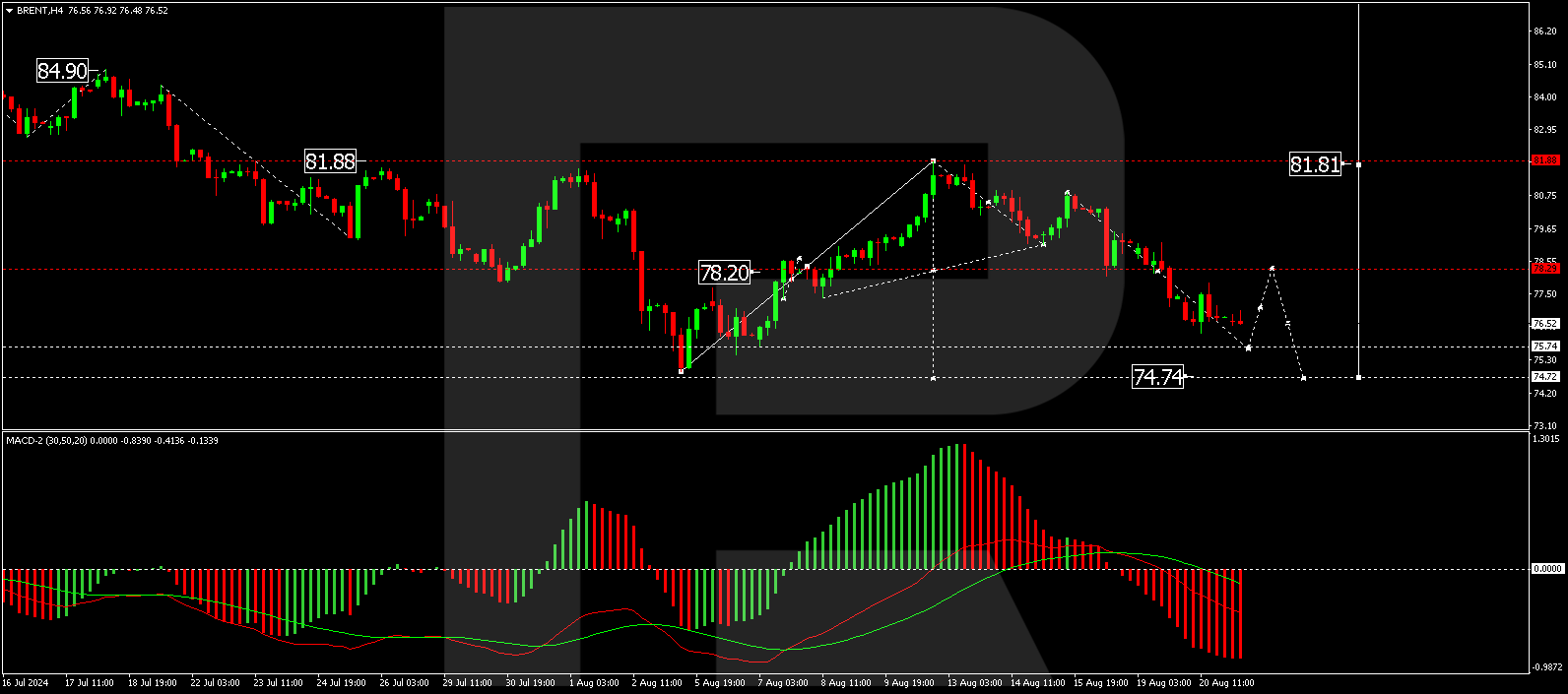
Brent oil is forming a consolidation range around the 80.80 USD level with an extension down to 79.76 USD. A further decline to 79.33 USD may occur. If the price exits this range on the upside, we might see the initiation of a growth wave targeting 84.24 USD. The MACD indicator supports this scenario, showing potential for new growth as it prepares at the lows.

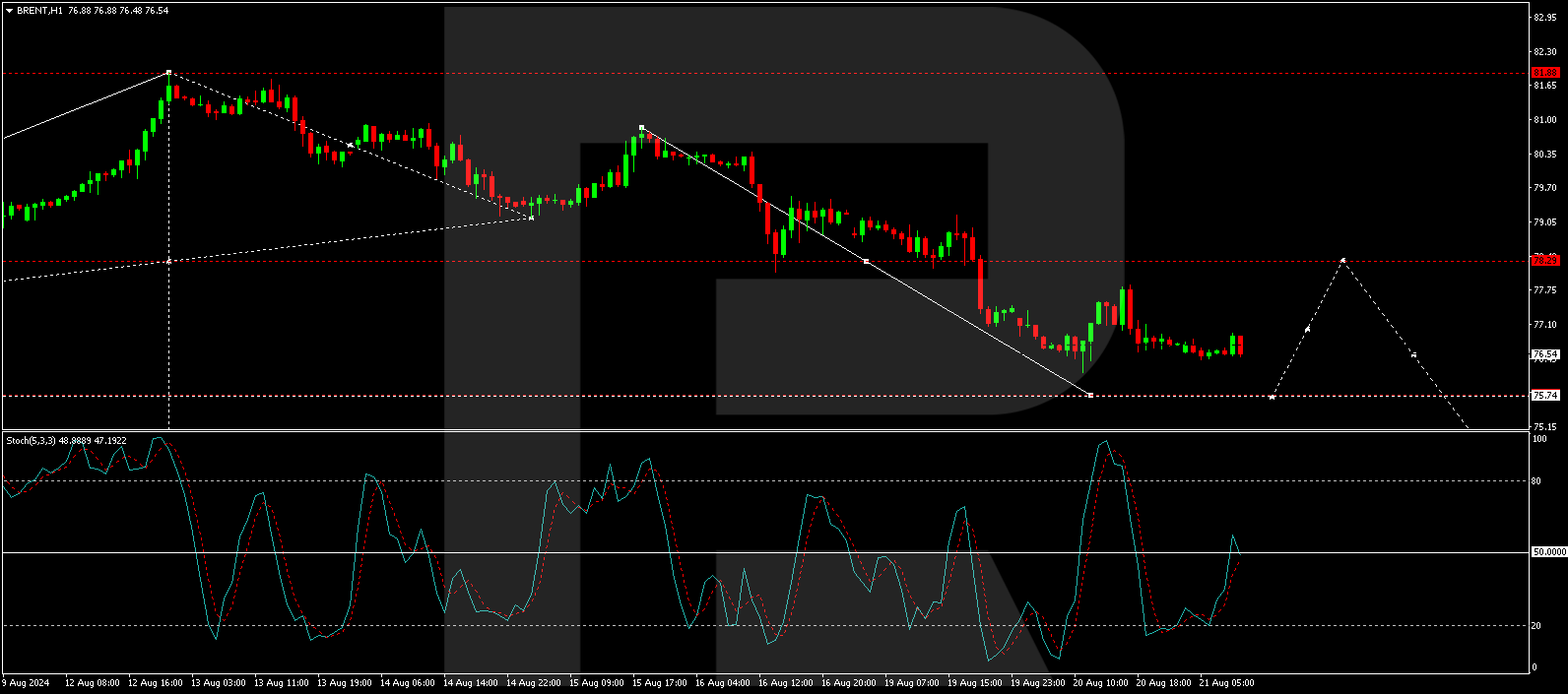
The market has established a consolidation range around the 81.84 USD level. The target level of 79.76 USD has been reached with a downward exit. We anticipate a new consolidation range forming at these lows, potentially followed by another decline to 79.33 USD. If the price exits the range upward, a rebound to 81.44 USD could occur. The Stochastic oscillator, currently below the 50 level and heading towards 20, supports this potential downward movement.


Investors and market analysts must closely monitor these developments, as any significant changes in US monetary policy or geopolitical events could further influence oil prices.


Disclaimer

Any forecasts contained herein are based on the author’s particular opinion. This analysis may not be treated as trading advice. RoboForex bears no responsibility for trading results based on trading recommendations and reviews contained herein.

Spot Ethereum ETFs go live!

By ForexTime 

  • Ethereum ETF’s exceed $100 million inflows on debut
  • Collective trading volume of ETFs surpass $1 billion
  • Cryptocurrency ↑ 50% since start of 2024
  • Technical levels – 21 & 50 day SMA

Only a few months ago we discussed the possibility of Ethereum ETFs after Bitcoin paved the way.

Earlier this week, Ethereum ETFs finally went live – marking another watershed moment in the digital asset space. And its debut yesterday did not disappoint, bringing in over $100 million of inflows despite the massive $484 million outflows from Grayscale’s freshly converted Ethereum Trust.

Note: An ETF is a derivative that enables traders to benefit from changes in the underlying asset’s price without owning it.

Like we have seen with Bitcoin ETFs, this crucial development may lead to increased exposure to Ethereum – providing greater and easier access without owning it. In addition, the second crypto adoption could open the floodgates for more ETF adoptions, with fresh anticipation for a Solana ETF soon.

Despite the collective trading volume of the nine new spot ETFs surpassing over $1 billion, Ethereum offered a muted response. Prices are trading around 3466 as of writing, trapped within a range on the daily charts.

Still, Ethereum is up over 50% since the start of 2024 and may push higher if the new Ether ETFs attract fresh inflows from investors and institutions.

Since reaching all-time highs on March 12th, 2024, Ethereum seems to be morphing into a descending triangle.

After bouncing off the support of the descending triangle on July 8th, 2024, the cryptocurrency rallied for 8 consecutive days and has remained in a range for the past 9 days.

The last 6-days have seen Ethereum prices close above its 50-day moving average and the cryptocurrency bulls may look to the following near-term resistance levels.

  • $3547.34: The resistance of the current range-bound channel

  • $3686: An important price level

Ethereum bears on the other hand will have their sights on the following near-term support level.

  • $3408.04; The 50-day simple moving average

  • $3385.39; The support level of the current range-bound area

  • $3262.77; The 21-day simple moving average

Ether


Forex-Time-LogoArticle by ForexTime

ForexTime Ltd (FXTM) is an award winning international online forex broker regulated by CySEC 185/12 www.forextime.com

American Bank Stocks Surge on IB Comeback

Source: McAlinden Research (7/18/24)

 McAlinden Research Partners McAlinden Research takes a look at shares of U.S. banks, which it believes are surging in the wake of recent quarterly earnings.

The latest spate of bank earnings coincided with the SPDR S&P Bank ETF’s (KBE:NYSEARCA) best 5-day span of trading since November 2020, rising by 12% in the period to Wednesday. The market’s positive reaction to second-quarter results was largely based on an ongoing rebound in the investment banking divisions of America’s largest financial institutions and some light at the end of the tunnel for beaten-down regional banks that have languished under persistently high short-term rates at the Fed.

In our July 1 Intelligence Briefing, we noted that results from Jefferies Financial Group, which come in well before most other financial firms, demonstrated a powerful performance from its capital markets and IB businesses. That disclosure resulted in Jefferies’s stock price touching an all-time high. We noted that the bounce in revenues could foreshadow similar strength for its larger peers. This was to be expected as global M&A volumes were up about 8% in Q2 YoY, but JPMorgan, Citigroup, and Wells Fargo reported particularly strong annual increases in their IB revenue of 46%, 60%, and 38%, respectively.

In fact, the Financial Times reports that Q2 was Wall Street’s best quarter for investment banking in more than two years, and four of the five largest US banks (with Goldman Sachs being the exception) announced higher-than-expected investment banking revenues for the quarter.

That was a helpful boost, but U.S. banks will need to see a continued resurgence of M&A to keep an increasing level of fees rolling in. Goldman Sachs noted that M&A volumes were still about 20% below 10-year averages, largely as a result of persistently slow private equity dealmaking volume. Bloomberg notes that PE sponsors have constituted up to 30% of investment banking revenue in some recent years. A burgeoning recovery in the underwriting of new public listings would also help to juice the fortunes of financial shares in quarters to come.

MRP recently highlighted a slight uptick in IPO proceeds YoY in Q1, along with a similarly moderate bounce in the number of initial listings, noting that a critical pillar of any potential IPO market recovery will be an expansion of PE exits. In 2023, US exits fell to a tenth of the 140 recorded in 2021, and it has been a tough start to 2024 as well, as PitchBook data showed only two private equity-backed IPOs over $100 million had been completed by the end of April, raising about $1 billion.

A gradual decline in rates should assist in the bounce-back of M&A activity. Long-term rates in the U.S. have already eased significantly since the end of April, but banks will also need a steeper fall in short-term rates to see earnings improve more significantly. One of the headwinds banks highlighted in second-quarter results was the consistent elevation of funding costs for the capital they lend out. Banks borrow money at the short end of the yield curve and end at the long end and a more than 20-month-long inversion of the 10-year U.S. Treasury yield versus the 3-month yield (10yr-3mo) has continually diminished net interest margins (NIMs which measure interest earned on loans versus interest paid to depositors) across four of the past five quarters.

When short-term rates are high, depositors tend to demand greater compensation for providing banks with their deposits — typically the cheapest source of liquidity for banks. As such, banks end up having to raise rates paid on deposits to compete with money market funds, as well as each other, for flows. Relief on this front is increasingly likely as a continued softening of consumer price inflation and a gradual weakening of labor market tightness is boosting bets on a rate cut in September. In fact, CME’s FedWatch tool calculates that bets made by Fed Funds futures have increased the odds of more than one cut by the end of the year to roughly 95%.


Important Disclosures:

  1. Statements and opinions expressed are the opinions of the author and not of Streetwise Reports, Street Smart, or their officers. The author is wholly responsible for the accuracy of the statements. Streetwise Reports was not paid by the author to publish or syndicate this article. Streetwise Reports requires contributing authors to disclose any shareholdings in, or economic relationships with, companies that they write about. Any disclosures from the author can be found  below. Streetwise Reports relies upon the authors to accurately provide this information and Streetwise Reports has no means of verifying its accuracy.
  2. This article does not constitute investment advice and is not a solicitation for any investment. Streetwise Reports does not render general or specific investment advice and the information on Streetwise Reports should not be considered a recommendation to buy or sell any security. Each reader is encouraged to consult with his or her personal financial adviser and perform their own comprehensive investment research. By opening this page, each reader accepts and agrees to Streetwise Reports’ terms of use and full legal disclaimer. Streetwise Reports does not endorse or recommend the business, products, services or securities of any company.

For additional disclosures, please click here.

McAlinden Research Partners Disclosures
This report has been prepared solely for informational purposes and is not an offer to buy/sell/endorse or a solicitation of an offer to buy/sell/endorse Interests or any other security or instrument or to participate in any trading or investment strategy. No representation or warranty (express or implied) is made or can be given with respect to the sequence, accuracy, completeness, or timeliness of the information in this Report. Unless otherwise noted, all information is sourced from public data.
McAlinden Research Partners is a division of Catalpa Capital Advisors, LLC (CCA), a Registered Investment Advisor. References to specific securities, asset classes and financial markets discussed herein are for illustrative purposes only and should not be interpreted as recommendations to purchase or sell such securities. CCA, MRP, employees and direct affiliates of the firm may or may not own any of the securities mentioned in the report at the time of publication.

Cutting marketing spending often backfires on businesses – new research could help investors distinguish shortsighted cuts from smart ones

By Andre Martin, University of Notre Dame  

Businesses are often tempted to cut their marketing budgets for the short-term savings it provides – but those cuts can cause problems in the long term. A new study my colleague Tarun Kushwaha and I published in The Journal of Marketing proposes a method for predicting whether these counterproductive cuts will take place up to a year in advance.

We gathered transcripts of nearly 25,000 earnings calls held by public companies from 2008 to 2019. We then analyzed how management teams discussed marketing and earnings. We found that the more earnings-oriented language was in a call — think words like “lucrative” or “revenues” — the more likely a management team was to cut their marketing budget for a boost in earnings.

Unlike business-as-usual budget shifts, the motive in these cases was to raise short-term earnings to gain personal profits – for example, to boost stock prices before an executive retires – to raise immediate funds, or to satisfy investor pressure and expectations. These cuts in exchange for a bump in earnings are shortsighted, since investing in marketing tends to grow a company’s market share over time.

Why it matters

Executives often feel pressured to meet short-term earnings targets at the expense of long-term goals, survey data and research have shown. Cutting costs is one way businesses make themselves look better in the short term. And since investing in marketing takes time to pay off, marketing spending often winds up on the chopping block.

My fellow marketing professors call these “myopic” marketing spending decisions – “myopic” being a fancy word for shortsighted. They often happen before initial public offerings, share repurchases and executive retirements.

While these myopic decisions have short-term benefits, they harm investors, customers and other stakeholders in the long term. After companies myopically cut marketing spending, they often lose market value; that’s why such cuts are linked with worse stock-market performance in the long run. A tool that helps investors identify myopic marketing spending would help them protect their portfolios from negative long-term consequences.

Our method isn’t just backward-looking – it can be used to forecast future shortsighted cuts to marketing spending. Investors could use it to analyze publicly available earnings-calls transcripts for useful data up to four times a year. We estimate that for every US$100 invested, using our method to avoid investing in shortsighted companies could return an additional $6.44 over four years compared with conventional methods. Marketing firms and advertising agencies could also use it to identify companies that plan to pare their marketing budgets.

What’s next

As part of our research efforts, my team has published the algorithm and data necessary to replicate our findings. This will let individual investors and other stakeholders gain valuable insights into executives’ intentions regarding the funding of their marketing and research departments.

While our research has primarily focused on transcribed text from earnings calls, we see more potential in analyzing the audio and video from these calls. Audio analysis could reveal insights from tone, pitch, pauses and filler words, while video analysis could capture the brief involuntary facial expressions known as micro-expressions.

The Research Brief is a short take on interesting academic work.The Conversation

About the Author:

Andre Martin, Assistant Professor of Marketing, University of Notre Dame

This article is republished from The Conversation under a Creative Commons license. Read the original article.

AUD is under pressure from the PBoC cut rates. Singapore is seeing a decline in inflation

By JustMarkets

At Monday’s close, the Dow Jones Industrial Average (US30) was up 0.32%, while the S&P 500 Index (US500) added 1.08%. The NASDAQ Technology Index (US100) closed positive 1.58%.

NVIDIA Corporation (NVDA) closed nearly 5% higher after Reuters reported that the chipmaker is developing a B20 version of its Blackwell GPU specifically for the Chinese market that will comply with US export control requirements. Ahead of Alphabet’s (GOOG) results release, Wedbush said it sees the tech giant’s sentiment as “positive ahead of second-quarter results” as advertising reviews and agency commentary point to the “continued strength of Google search.” Ahead of Tesla’s (TSLA) results release, CEO Elon Musk said humanoid robots will be used internally next year.

Equity markets in Europe were mostly up on Monday. Germany’s DAX (DE40) rose by 1.29%, France’s CAC 40 (FR40) closed positive 1.16%, Spain’s IBEX 35 (ES35) added 0.51%, and the UK’s FTSE 100 (UK100) closed positive 0.53%.

The Bank of England (BoE) urges market participants to prepare for a new cash management regime as excess liquidity is withdrawn from the financial system. Victoria Saporta, BoE executive director of markets, said the Central Bank wants to move from buying assets in exchange for cash reserves to a system of lending cash against those assets. The market has switched to repos as the BoE shrinks its balance sheet by selling bonds and not reinvesting in its maturing bond portfolio. However, the Central Bank now wants banks to use longer-term operations rather than short-term repo (STR) more often.

Morgan Stanley said the oil market deficit is likely to persist through most of the third quarter. However, by the fourth quarter, the market is expected to stabilize. This change is due to the decline in demand that typically occurs after summer and the projected increase in oil production by both OPEC and non-OPEC countries. That said, Morgan Stanley predicts that supply is likely to outstrip demand next year. The investment bank expects the oil price to fall to $75–79 by 2025.

WTI crude oil prices settled at $78.5 a barrel on Tuesday after falling for three consecutive sessions as investors’ attention shifted to US oil inventory data. On Monday, the People’s Bank of China unexpectedly lowered its interest rate to support economic growth, easing fears of a weakening Chinese economy and easing concerns about demand from the main oil consumer.

Asian markets were predominantly down yesterday. Japan’s Nikkei 225 (JP225) was down 1.16%, China’s FTSE China A50 (CHA50) lost 1.08%, Hong Kong’s Hang Seng (HK50) added 1.25%, and Australia’s ASX 200 (AU200) was negative 0.50%.

Hang Seng (HK50) shares fell by 0.4% in Tuesday morning session, bouncing back from an active session the previous day after fresh data showed Hong Kong’s annual inflation rate rose to a 3-month high of 1.5% in June, rising for a second month on the back of lower electricity subsidies. Meanwhile, business sentiment in the city turned negative in Q3 for the first time in 2 years due to concerns over a new security law.

Singapore’s annual inflation rate fell to 2.4% in June 2024 from 3.1% in May, below market estimates of 2.7% and pointing to the lowest rate since August 2021. Annualized core inflation fell to 2.9% from 3.1% in the previous 3 months, falling short of the 3.0% prognosis and indicating the lowest level since March 2022. On a month-on-month basis, CPI fell by 0.2%, the first decline in three months.

The Australian dollar held below $0.665, near its lowest level in three weeks, as China’s surprise move to cut key interest rates pressured the currency. The Australian dollar is widely seen as a liquid proxy for the Chinese yuan, as Australia’s economy relies heavily on exports to China. The local currency has also been pressured recently by weakening commodity prices as Australia is a net exporter of energy and metals.

In Japan, Toshimitsu Motegi, a senior ruling party official, called on the Bank of Japan to more clearly outline its plan to normalize monetary policy through successive rate hikes, adding that excessive yen depreciation was hurting the economy.

S&P 500 (US500) 5,564.41 +59.41 (+1.08%)

Dow Jones (US30) 40,415.44 +127.91 (+0.32%)

DAX (DE40) 18,407.07 +235.14 (+1.29%)

FTSE 100 (UK100) 8,198.78 +43.06 (+0.53%)

USD Index 104.30 -0.10 (-0.09%)

Important events today:
  • – Singapore Consumer Price Index (q/q) at 08:00 (GMT+3);
  • – US Existing Home Sales (m/m) at 17:00 (GMT+3).

By JustMarkets


This article reflects a personal opinion and should not be interpreted as an investment advice, and/or offer, and/or a persistent request for carrying out financial transactions, and/or a guarantee, and/or a forecast of future events.

The People’s Bank of China unexpectedly cut interest rates. Biden quits from the presidential race

By JustMarkets

On Friday, the Dow Jones (US30) Index fell by 0.93% (for the week +0.37%), while the S&P 500 (US500) Index lost 0.71% (for the week -2.36%). The NASDAQ Technology Index (US100) closed negative 0.81% (for the week -4.11%). Investors continued to take profits after the recent record highs of the major indices. In addition, after an already turbulent week, a global IT system failure affecting services from airlines to banks added to the worries. Presumably, the outage was caused by an update from CrowdStrike that caused problems with Microsoft’s Windows.

US President Joe Biden has withdrawn from the 2024 presidential election. This came after his supporters turned their backs on him for weeks amid his poor debate performance against former president and Republican nominee Donald Trump. Biden has endorsed Vice President Kamala Harris, who has said she is running for president.

Bitcoin rose to around $68,000 on Monday, hitting its highest level since mid-June. The US bitcoin exchange-traded funds received a total of more than $17 billion in inflows in July, setting a new record. BlackRock’s IBIT and Fidelity’s FBTC were the main contributors, with net inflows of about $19 billion and $10 billion, respectively. Betting on Trump’s second presidency also continued to support digital assets in anticipation of a more favorable regulatory environment for them. Trump is scheduled to speak at an industry conference in Nashville, Tennessee, later this month, and some analysts speculate that he will announce plans to include Bitcoin in the US strategic reserves.

Equity markets in Europe were mostly down on Friday. Germany’s DAX (DE40) fell by 1.00% (-3.01% for the week), France’s CAC 40 (FR40) lost 0.69% (-1.92% for the week), Spain’s IBEX 35 (ES35) fell by 0.54% (-1.23% for the week), and the UK’s FTSE 100 (UK100) closed negative 0.60% (-1.18% for the week).

While economic growth in the Eurozone remains sluggish, a dominant service sector driven by tourism is keeping price pressures at uncomfortably high levels. This poses challenges for the ECB, so Wednesday’s PMI data will be closely watched after the Central Bank kept interest rates at 3.75% last Thursday and gave no further guidance, saying it “depends on the data.”

On Friday, oil prices settled at their lowest level since mid-June as investors anticipated a possible ceasefire in Gaza, while a strong dollar also had an impact. The war in Gaza has prompted investors to put a risk premium on oil trading as tensions threaten global supplies. If a truce is reached, Iran-backed Houthi rebels may ease their attacks on commercial ships in the Red Sea as the group has declared support for Hamas.

Asian markets traded without any dynamics last week. Japan’s Nikkei 225 (JP225) fell by 3.85%, China’s FTSE China A50 (CHA50) gained 1.26%, Hong Kong’s Hang Seng (HK50) lost 4.31%, and Australia’s ASX 200 (AU200) was positive 0.15%.

The offshore yuan hit its lowest level in more than a week as traders reacted to the latest decision by the People’s Bank of China (PBoC). In a surprise move, key lending rates were cut to new record lows during the July fixing to support the fragile economic recovery. The 1-year prime rate (LPR), the benchmark for most corporate and household loans, was cut 10 basis points to 3.35%, while the 5-year rate, the benchmark for real estate mortgages, was cut 10 basis points to 3.85%. In addition, the Central Bank initiated a ¥58.2 billion reverse repurchase operation and cut the seven-day reverse repo rate by 10 basis points to 1.7% from 1.8%. The decision came shortly after last week’s third plenum and followed a series of economic data indicating that the economic recovery may be losing momentum.

The Australian dollar fell to $0.668, hitting its weakest level in three weeks, as a sharp decline in energy and metals prices pressured the currency. Australia’s economy relies heavily on commodity exports, making the Australian dollar sensitive to changes in commodity prices.

S&P 500 (US500) 5,505.00 −39.59 (−0.71%)

Dow Jones (US30) 40,287.53 −377.49 (−0.93%)

DAX (DE40) 18,171.93 −182.83 (−1.00%)

FTSE 100 (UK100) 8,155.72 −49.17 (−0.60%)

USD Index 104.37 +0.19 (+0.18%)

Important events today:
  • – New Zealand Trade Balance (q/q) at 01:45 (GMT+3);
  • – China PBoC Loan Prime Rate at 04:15 (GMT+3).

By JustMarkets


This article reflects a personal opinion and should not be interpreted as an investment advice, and/or offer, and/or a persistent request for carrying out financial transactions, and/or a guarantee, and/or a forecast of future events.

NZD/USD Faces Downward Pressure Amid US Political Developments and RBNZ Rate Speculations

By RoboForex Analytical Department

The NZD/USD pair is experiencing a significant downturn, trading around 0.5996. Several factors influence this decline, including global political developments and domestic monetary policy expectations.

The recent announcement by US President Joe Biden that he will not seek re-election in 2024 has unexpectedly bolstered the US dollar. Biden’s endorsement of Vice President Kamala Harris as his successor has introduced a new dynamic into the political landscape, generally favouring the stability of the US dollar.

Simultaneously, the New Zealand dollar is weakened by the looming possibility of interest rate cuts by the Reserve Bank of New Zealand (RBNZ). Market participants increasingly expect rate reductions beginning early in August following a weaker-than-expected Q2 inflation report. This anticipation builds on the RBNZ’s July decision to maintain the official cash rate at 5.5% per annum, coupled with hints that monetary policy might be relaxed if inflation pressures abate.

Adding to the pressure, recent trade data from New Zealand showed a surplus in June, primarily due to a sharper decline in imports compared to exports, suggesting potential economic softness.

NZD/USD Technical Analysis

The NZD/USD pair has established a consolidation range around the 0.6022 level, with a breakout leading to a continuation of the downward trend. The immediate target is 0.5962, with the potential to extend towards 0.5946. The MACD indicator supports this bearish outlook, as it remains below zero and points downwards, indicating sustained selling momentum.

Resistance was found at 0.6022, and the pair is extending its decline towards 0.5962. A corrective bounce to 0.6000 might occur before resuming the downward movement towards 0.5946. The Stochastic oscillator, currently below 20, suggests a potential brief recovery to around 50 before a likely resumption of the downward trend.

Investors and traders should closely monitor these developments, especially any further political news from the US and upcoming economic data from New Zealand. These factors could significantly impact the pair’s movements in the near term.


Disclaimer

Any forecasts contained herein are based on the author’s particular opinion. This analysis may not be treated as trading advice. RoboForex bears no responsibility for trading results based on trading recommendations and reviews contained herein.

Currency Speculators push British Pound bets to Record High

By InvestMacro

Here are the latest charts and statistics for the Commitment of Traders (COT) data published by the Commodities Futures Trading Commission (CFTC).

The latest COT data is updated through Tuesday July 16th and shows a quick view of how large market participants (for-profit speculators and commercial traders) were positioned in the futures markets. All currency positions are in direct relation to the US dollar where, for example, a bet for the euro is a bet that the euro will rise versus the dollar while a bet against the euro will be a bet that the euro will decline versus the dollar.

Weekly Speculator Bets led by British Pound & Japanese Yen

The COT currency market speculator bets were lower this week as five out of the eleven currency markets we cover had higher positioning while the other six markets had lower speculator contracts.

Leading the gains for the currency markets was the British Pound (48,212 contracts) with the Japanese Yen (30,961 contracts), the EuroFX (21,126 contracts), the Australian Dollar (8,700 contracts) and the US Dollar Index (2,342 contracts) also recording positive weeks.

The currencies seeing declines in speculator bets on the week were the Canadian Dollar (-21,261 contracts), the New Zealand Dollar (-13,351 contracts), the Swiss Franc (-3,705 contracts), the Mexican Peso (-1,613 contracts), the Brazilian Real (-1,842 contracts) and with Bitcoin (-461 contracts) also registering lower bets on the week.

Currency Speculators push British Pound bets to Record High

Highlighting the COT currency’s data is the new record high bullish sentiment in the speculator’s positioning of the British Pound Sterling.

Large speculative Sterling positions jumped this week by +48,212 contracts following last week’s rise by +22,649 contracts and the previous week’s (two weeks ago) gain by +17,993 contracts. This week’s rise by over +48,000 contracts is the largest one-week increase on record and pushed the overall net speculator standing to +132,902 contracts – a new all-time record bullish position. This new high level surpasses the previous record high of +98,366 contracts that was recorded on July 17th of 2007.

The GBP position has now gained by +152,977 contracts in just the past nine weeks, going from a bearish level of -20,075 contracts on May 14th to a new record high level this week to complete an incredible sentiment turnaround in a short period of time.

The Pound Sterling exchange rate (GBPUSD currency pair) against the US Dollar has been on the move higher and touched above the 1.3000 level this week for the first time in almost exactly a year. Helping the GBP strength is the outlook that the Bank of England will take longer to cut their interest rate due to sticky inflation while the US Federal Reserve is forecast-ed to start cutting rates this year and the Eurozone is possibly going to reduce their rate again in September.


Currencies Net Speculators Leaderboard

Legend: Weekly Speculators Change | Speculators Current Net Position | Speculators Strength Score compared to last 3-Years (0-100 range)


Strength Scores led by British Pound & Australian Dollar

COT Strength Scores (a normalized measure of Speculator positions over a 3-Year range, from 0 to 100 where above 80 is Extreme-Bullish and below 20 is Extreme-Bearish) showed that the British Pound (100 percent) and the Australian Dollar (100 percent) lead the currency markets this week. The New Zealand Dollar (65 percent), Mexican Peso (62 percent) and Bitcoin (58 percent) come in as the next highest in the weekly strength scores.

On the downside, the Brazilian Real (0 percent), the Swiss Franc (0 percent) and the Canadian Dollar (9 percent) come in at the lowest strength levels currently and are in Extreme-Bearish territory (below 20 percent).

Strength Statistics:
US Dollar Index (43.6 percent) vs US Dollar Index previous week (38.6 percent)
EuroFX (30.8 percent) vs EuroFX previous week (21.9 percent)
British Pound Sterling (100.0 percent) vs British Pound Sterling previous week (77.4 percent)
Japanese Yen (20.2 percent) vs Japanese Yen previous week (1.3 percent)
Swiss Franc (0.0 percent) vs Swiss Franc previous week (6.2 percent)
Canadian Dollar (8.8 percent) vs Canadian Dollar previous week (21.0 percent)
Australian Dollar (100.0 percent) vs Australian Dollar previous week (92.7 percent)
New Zealand Dollar (65.0 percent) vs New Zealand Dollar previous week (90.7 percent)
Mexican Peso (61.7 percent) vs Mexican Peso previous week (62.5 percent)
Brazilian Real (0.0 percent) vs Brazilian Real previous week (1.9 percent)
Bitcoin (57.7 percent) vs Bitcoin previous week (64.6 percent)


Australian Dollar & British Pound top the 6-Week Strength Trends

COT Strength Score Trends (or move index, calculates the 6-week changes in strength scores) showed that the Australian Dollar (53 percent) and the British Pound (42 percent) lead the past six weeks trends for the currencies. The US Dollar Index (29 percent), the New Zealand Dollar (10 percent) and Bitcoin (8 percent) are the next highest positive movers in the latest trends data.

The Mexican Peso (-31 percent) leads the downside trend scores currently with the Brazilian Real (-27 percent), Canadian Dollar (-23 percent) and the EuroFX (-18 percent) following next with lower trend scores.

Strength Trend Statistics:
US Dollar Index (29.1 percent) vs US Dollar Index previous week (25.7 percent)
EuroFX (-18.4 percent) vs EuroFX previous week (-23.0 percent)
British Pound Sterling (42.1 percent) vs British Pound Sterling previous week (27.8 percent)
Japanese Yen (-11.6 percent) vs Japanese Yen previous week (-15.8 percent)
Swiss Franc (-6.8 percent) vs Swiss Franc previous week (-2.9 percent)
Canadian Dollar (-23.4 percent) vs Canadian Dollar previous week (-14.1 percent)
Australian Dollar (52.6 percent) vs Australian Dollar previous week (44.1 percent)
New Zealand Dollar (10.3 percent) vs New Zealand Dollar previous week (45.9 percent)
Mexican Peso (-30.9 percent) vs Mexican Peso previous week (-28.3 percent)
Brazilian Real (-27.0 percent) vs Brazilian Real previous week (-6.4 percent)
Bitcoin (8.1 percent) vs Bitcoin previous week (9.6 percent)


Individual COT Forex Markets:

US Dollar Index Futures:

US Dollar Index Forex Futures COT ChartThe US Dollar Index large speculator standing this week was a net position of 18,550 contracts in the data reported through Tuesday. This was a weekly rise of 2,342 contracts from the previous week which had a total of 16,208 net contracts.

This week’s current strength score (the trader positioning range over the past three years, measured from 0 to 100) shows the speculators are currently Bearish with a score of 43.6 percent. The commercials are Bullish with a score of 60.0 percent and the small traders (not shown in chart) are Bearish-Extreme with a score of 19.6 percent.

Price Trend-Following Model: Uptrend

Our weekly trend-following model classifies the current market price position as: Uptrend. The current action for the model is considered to be: Hold – Maintain Long Position.

US DOLLAR INDEX StatisticsSPECULATORSCOMMERCIALSSMALL TRADERS
– Percent of Open Interest Longs:78.59.68.1
– Percent of Open Interest Shorts:30.559.46.2
– Net Position:18,550-19,278728
– Gross Longs:30,3273,6953,141
– Gross Shorts:11,77722,9732,413
– Long to Short Ratio:2.6 to 10.2 to 11.3 to 1
NET POSITION TREND:
– Strength Index Score (3 Year Range Pct):43.660.019.6
– Strength Index Reading (3 Year Range):BearishBullishBearish-Extreme
NET POSITION MOVEMENT INDEX:
– 6-Week Change in Strength Index:29.1-27.6-6.6


Euro Currency Futures:

Euro Currency Futures COT ChartThe Euro Currency large speculator standing this week was a net position of 24,749 contracts in the data reported through Tuesday. This was a weekly lift of 21,126 contracts from the previous week which had a total of 3,623 net contracts.

This week’s current strength score (the trader positioning range over the past three years, measured from 0 to 100) shows the speculators are currently Bearish with a score of 30.8 percent. The commercials are Bullish with a score of 70.7 percent and the small traders (not shown in chart) are Bearish with a score of 26.5 percent.

Price Trend-Following Model: Weak Downtrend

Our weekly trend-following model classifies the current market price position as: Weak Downtrend. The current action for the model is considered to be: Hold – Maintain Short Position.

EURO Currency StatisticsSPECULATORSCOMMERCIALSSMALL TRADERS
– Percent of Open Interest Longs:27.757.811.4
– Percent of Open Interest Shorts:23.965.47.6
– Net Position:24,749-49,54924,800
– Gross Longs:179,937375,21774,281
– Gross Shorts:155,188424,76649,481
– Long to Short Ratio:1.2 to 10.9 to 11.5 to 1
NET POSITION TREND:
– Strength Index Score (3 Year Range Pct):30.870.726.5
– Strength Index Reading (3 Year Range):BearishBullishBearish
NET POSITION MOVEMENT INDEX:
– 6-Week Change in Strength Index:-18.418.4-13.9


British Pound Sterling Futures:

British Pound Sterling Futures COT ChartThe British Pound Sterling large speculator standing this week was a net position of 132,902 contracts in the data reported through Tuesday. This was a weekly rise of 48,212 contracts from the previous week which had a total of 84,690 net contracts.

This week’s current strength score (the trader positioning range over the past three years, measured from 0 to 100) shows the speculators are currently Bullish-Extreme with a score of 100.0 percent. The commercials are Bearish-Extreme with a score of 0.0 percent and the small traders (not shown in chart) are Bullish-Extreme with a score of 96.3 percent.

Price Trend-Following Model: Strong Uptrend

Our weekly trend-following model classifies the current market price position as: Strong Uptrend. The current action for the model is considered to be: Hold – Maintain Long Position.

BRITISH POUND StatisticsSPECULATORSCOMMERCIALSSMALL TRADERS
– Percent of Open Interest Longs:65.318.114.3
– Percent of Open Interest Shorts:18.071.28.5
– Net Position:132,902-149,11816,216
– Gross Longs:183,28750,80340,067
– Gross Shorts:50,385199,92123,851
– Long to Short Ratio:3.6 to 10.3 to 11.7 to 1
NET POSITION TREND:
– Strength Index Score (3 Year Range Pct):100.00.096.3
– Strength Index Reading (3 Year Range):Bullish-ExtremeBearish-ExtremeBullish-Extreme
NET POSITION MOVEMENT INDEX:
– 6-Week Change in Strength Index:42.1-40.822.4


Japanese Yen Futures:

Japanese Yen Forex Futures COT ChartThe Japanese Yen large speculator standing this week was a net position of -151,072 contracts in the data reported through Tuesday. This was a weekly gain of 30,961 contracts from the previous week which had a total of -182,033 net contracts.

This week’s current strength score (the trader positioning range over the past three years, measured from 0 to 100) shows the speculators are currently Bearish with a score of 20.2 percent. The commercials are Bullish-Extreme with a score of 80.0 percent and the small traders (not shown in chart) are Bullish with a score of 57.4 percent.

Price Trend-Following Model: Downtrend

Our weekly trend-following model classifies the current market price position as: Downtrend. The current action for the model is considered to be: Hold – Maintain Short Position.

JAPANESE YEN StatisticsSPECULATORSCOMMERCIALSSMALL TRADERS
– Percent of Open Interest Longs:15.470.312.2
– Percent of Open Interest Shorts:64.618.514.9
– Net Position:-151,072159,089-8,017
– Gross Longs:47,356216,04237,613
– Gross Shorts:198,42856,95345,630
– Long to Short Ratio:0.2 to 13.8 to 10.8 to 1
NET POSITION TREND:
– Strength Index Score (3 Year Range Pct):20.280.057.4
– Strength Index Reading (3 Year Range):BearishBullish-ExtremeBullish
NET POSITION MOVEMENT INDEX:
– 6-Week Change in Strength Index:-11.616.5-32.1


Swiss Franc Futures:

Swiss Franc Forex Futures COT ChartThe Swiss Franc large speculator standing this week was a net position of -49,793 contracts in the data reported through Tuesday. This was a weekly reduction of -3,705 contracts from the previous week which had a total of -46,088 net contracts.

This week’s current strength score (the trader positioning range over the past three years, measured from 0 to 100) shows the speculators are currently Bearish-Extreme with a score of 0.0 percent. The commercials are Bullish-Extreme with a score of 100.0 percent and the small traders (not shown in chart) are Bearish with a score of 23.2 percent.

Price Trend-Following Model: Weak Downtrend

Our weekly trend-following model classifies the current market price position as: Weak Downtrend. The current action for the model is considered to be: Hold – Maintain Short Position.

SWISS FRANC StatisticsSPECULATORSCOMMERCIALSSMALL TRADERS
– Percent of Open Interest Longs:6.682.310.5
– Percent of Open Interest Shorts:57.019.822.5
– Net Position:-49,79361,672-11,879
– Gross Longs:6,49181,21910,344
– Gross Shorts:56,28419,54722,223
– Long to Short Ratio:0.1 to 14.2 to 10.5 to 1
NET POSITION TREND:
– Strength Index Score (3 Year Range Pct):0.0100.023.2
– Strength Index Reading (3 Year Range):Bearish-ExtremeBullish-ExtremeBearish
NET POSITION MOVEMENT INDEX:
– 6-Week Change in Strength Index:-6.87.7-3.7


Canadian Dollar Futures:

Canadian Dollar Forex Futures COT ChartThe Canadian Dollar large speculator standing this week was a net position of -132,473 contracts in the data reported through Tuesday. This was a weekly fall of -21,261 contracts from the previous week which had a total of -111,212 net contracts.

This week’s current strength score (the trader positioning range over the past three years, measured from 0 to 100) shows the speculators are currently Bearish-Extreme with a score of 8.8 percent. The commercials are Bullish-Extreme with a score of 89.5 percent and the small traders (not shown in chart) are Bearish-Extreme with a score of 15.7 percent.

Price Trend-Following Model: Strong Downtrend

Our weekly trend-following model classifies the current market price position as: Strong Downtrend. The current action for the model is considered to be: Hold – Maintain Short Position.

CANADIAN DOLLAR StatisticsSPECULATORSCOMMERCIALSSMALL TRADERS
– Percent of Open Interest Longs:8.878.010.3
– Percent of Open Interest Shorts:56.029.012.1
– Net Position:-132,473137,579-5,106
– Gross Longs:24,734219,02729,000
– Gross Shorts:157,20781,44834,106
– Long to Short Ratio:0.2 to 12.7 to 10.9 to 1
NET POSITION TREND:
– Strength Index Score (3 Year Range Pct):8.889.515.7
– Strength Index Reading (3 Year Range):Bearish-ExtremeBullish-ExtremeBearish-Extreme
NET POSITION MOVEMENT INDEX:
– 6-Week Change in Strength Index:-23.419.19.3


Australian Dollar Futures:

Australian Dollar Forex Futures COT ChartThe Australian Dollar large speculator standing this week was a net position of 11,113 contracts in the data reported through Tuesday. This was a weekly gain of 8,700 contracts from the previous week which had a total of 2,413 net contracts.

This week’s current strength score (the trader positioning range over the past three years, measured from 0 to 100) shows the speculators are currently Bullish-Extreme with a score of 100.0 percent. The commercials are Bearish-Extreme with a score of 0.0 percent and the small traders (not shown in chart) are Bullish-Extreme with a score of 100.0 percent.

Price Trend-Following Model: Uptrend

Our weekly trend-following model classifies the current market price position as: Uptrend. The current action for the model is considered to be: Hold – Maintain Long Position.

AUSTRALIAN DOLLAR StatisticsSPECULATORSCOMMERCIALSSMALL TRADERS
– Percent of Open Interest Longs:46.336.814.9
– Percent of Open Interest Shorts:41.548.97.6
– Net Position:11,113-27,88316,770
– Gross Longs:106,31284,40334,164
– Gross Shorts:95,199112,28617,394
– Long to Short Ratio:1.1 to 10.8 to 12.0 to 1
NET POSITION TREND:
– Strength Index Score (3 Year Range Pct):100.00.0100.0
– Strength Index Reading (3 Year Range):Bullish-ExtremeBearish-ExtremeBullish-Extreme
NET POSITION MOVEMENT INDEX:
– 6-Week Change in Strength Index:52.6-51.432.4


New Zealand Dollar Futures:

New Zealand Dollar Forex Futures COT ChartThe New Zealand Dollar large speculator standing this week was a net position of 12,561 contracts in the data reported through Tuesday. This was a weekly decrease of -13,351 contracts from the previous week which had a total of 25,912 net contracts.

This week’s current strength score (the trader positioning range over the past three years, measured from 0 to 100) shows the speculators are currently Bullish with a score of 65.0 percent. The commercials are Bearish with a score of 33.4 percent and the small traders (not shown in chart) are Bullish with a score of 52.1 percent.

Price Trend-Following Model: Weak Uptrend

Our weekly trend-following model classifies the current market price position as: Weak Uptrend. The current action for the model is considered to be: Hold – Maintain Long Position.

NEW ZEALAND DOLLAR StatisticsSPECULATORSCOMMERCIALSSMALL TRADERS
– Percent of Open Interest Longs:56.632.07.6
– Percent of Open Interest Shorts:35.951.88.4
– Net Position:12,561-12,102-459
– Gross Longs:34,47319,4844,648
– Gross Shorts:21,91231,5865,107
– Long to Short Ratio:1.6 to 10.6 to 10.9 to 1
NET POSITION TREND:
– Strength Index Score (3 Year Range Pct):65.033.452.1
– Strength Index Reading (3 Year Range):BullishBearishBullish
NET POSITION MOVEMENT INDEX:
– 6-Week Change in Strength Index:10.3-8.1-12.8


Mexican Peso Futures:

Mexican Peso Futures COT ChartThe Mexican Peso large speculator standing this week was a net position of 61,710 contracts in the data reported through Tuesday. This was a weekly reduction of -1,613 contracts from the previous week which had a total of 63,323 net contracts.

This week’s current strength score (the trader positioning range over the past three years, measured from 0 to 100) shows the speculators are currently Bullish with a score of 61.7 percent. The commercials are Bearish with a score of 38.3 percent and the small traders (not shown in chart) are Bearish with a score of 26.9 percent.

Price Trend-Following Model: Downtrend

Our weekly trend-following model classifies the current market price position as: Downtrend. The current action for the model is considered to be: Hold – Maintain Short Position.

MEXICAN PESO StatisticsSPECULATORSCOMMERCIALSSMALL TRADERS
– Percent of Open Interest Longs:49.946.52.9
– Percent of Open Interest Shorts:18.679.01.7
– Net Position:61,710-64,1822,472
– Gross Longs:98,49591,8665,742
– Gross Shorts:36,785156,0483,270
– Long to Short Ratio:2.7 to 10.6 to 11.8 to 1
NET POSITION TREND:
– Strength Index Score (3 Year Range Pct):61.738.326.9
– Strength Index Reading (3 Year Range):BullishBearishBearish
NET POSITION MOVEMENT INDEX:
– 6-Week Change in Strength Index:-30.930.2-1.7


Brazilian Real Futures:

Brazil Real Futures COT ChartThe Brazilian Real large speculator standing this week was a net position of -44,526 contracts in the data reported through Tuesday. This was a weekly lowering of -1,842 contracts from the previous week which had a total of -42,684 net contracts.

This week’s current strength score (the trader positioning range over the past three years, measured from 0 to 100) shows the speculators are currently Bearish-Extreme with a score of 0.0 percent. The commercials are Bullish-Extreme with a score of 100.0 percent and the small traders (not shown in chart) are Bearish with a score of 32.6 percent.

Price Trend-Following Model: Strong Downtrend

Our weekly trend-following model classifies the current market price position as: Strong Downtrend. The current action for the model is considered to be: Hold – Maintain Short Position.

BRAZIL REAL StatisticsSPECULATORSCOMMERCIALSSMALL TRADERS
– Percent of Open Interest Longs:24.272.52.6
– Percent of Open Interest Shorts:75.221.32.8
– Net Position:-44,52644,720-194
– Gross Longs:21,14063,2872,240
– Gross Shorts:65,66618,5672,434
– Long to Short Ratio:0.3 to 13.4 to 10.9 to 1
NET POSITION TREND:
– Strength Index Score (3 Year Range Pct):0.0100.032.6
– Strength Index Reading (3 Year Range):Bearish-ExtremeBullish-ExtremeBearish
NET POSITION MOVEMENT INDEX:
– 6-Week Change in Strength Index:-27.025.310.0


Bitcoin Futures:

Bitcoin Crypto Futures COT ChartThe Bitcoin large speculator standing this week was a net position of -579 contracts in the data reported through Tuesday. This was a weekly decrease of -461 contracts from the previous week which had a total of -118 net contracts.

This week’s current strength score (the trader positioning range over the past three years, measured from 0 to 100) shows the speculators are currently Bullish with a score of 57.7 percent. The commercials are Bullish with a score of 69.3 percent and the small traders (not shown in chart) are Bearish with a score of 22.0 percent.

Price Trend-Following Model: Weak Downtrend

Our weekly trend-following model classifies the current market price position as: Weak Downtrend. The current action for the model is considered to be: Hold – Maintain Short Position.

BITCOIN StatisticsSPECULATORSCOMMERCIALSSMALL TRADERS
– Percent of Open Interest Longs:79.23.54.7
– Percent of Open Interest Shorts:81.12.93.4
– Net Position:-579181398
– Gross Longs:24,7101,0911,463
– Gross Shorts:25,2899101,065
– Long to Short Ratio:1.0 to 11.2 to 11.4 to 1
NET POSITION TREND:
– Strength Index Score (3 Year Range Pct):57.769.322.0
– Strength Index Reading (3 Year Range):BullishBullishBearish
NET POSITION MOVEMENT INDEX:
– 6-Week Change in Strength Index:8.1-4.7-8.1


Article By InvestMacroReceive our weekly COT Newsletter

*COT Report: The COT data, released weekly to the public each Friday, is updated through the most recent Tuesday (data is 3 days old) and shows a quick view of how large speculators or non-commercials (for-profit traders) were positioned in the futures markets.

The CFTC categorizes trader positions according to commercial hedgers (traders who use futures contracts for hedging as part of the business), non-commercials (large traders who speculate to realize trading profits) and nonreportable traders (usually small traders/speculators) as well as their open interest (contracts open in the market at time of reporting). See CFTC criteria here.

Speculator Extremes: Australian Dollar, Gold & British Pound top Bullish Bets

By InvestMacro

The latest update for the weekly Commitment of Traders (COT) report was released by the Commodity Futures Trading Commission (CFTC) on Friday for data ending on July 16th.

This weekly Extreme Positions report highlights the Most Bullish and Most Bearish Positions for the speculator category. Extreme positioning in these markets can foreshadow strong moves in the underlying market.

To signify an extreme position, we use the Strength Index (also known as the COT Index) of each instrument, a common method of measuring COT data. The Strength Index is simply a comparison of current trader positions against the range of positions over the previous 3 years. We use over 80 percent as extremely bullish and under 20 percent as extremely bearish. (Compare Strength Index scores across all markets in the data table or cot leaders table)


Here Are This Week’s Most Bullish Speculator Positions:

Australian Dollar


The Australian Dollar speculator position comes in as the most bullish extreme standing this week. The Australian Dollar speculator level is currently at a 100.0 percent score of its 3-year range.

The six-week trend for the percent strength score totaled 52.6 this week. The overall net speculator position was a total of 11,113 net contracts this week with a rise of 8,700 contract in the weekly speculator bets.


Speculators or Non-Commercials Notes:

Speculators, classified as non-commercial traders by the CFTC, are made up of large commodity funds, hedge funds and other significant for-profit participants. The Specs are generally regarded as trend-followers in their behavior towards price action – net speculator bets and prices tend to go in the same directions. These traders often look to buy when prices are rising and sell when prices are falling. To illustrate this point, many times speculator contracts can be found at their most extremes (bullish or bearish) when prices are also close to their highest or lowest levels.

These extreme levels can be dangerous for the large speculators as the trade is most crowded, there is less trading ammunition still sitting on the sidelines to push the trend further and prices have moved a significant distance. When the trend becomes exhausted, some speculators take profits while others look to also exit positions when prices fail to continue in the same direction. This process usually plays out over many months to years and can ultimately create a reverse effect where prices start to fall and speculators start a process of selling when prices are falling.


Gold


The Gold speculator position comes next in the extreme standings this week. The Gold speculator level is now at a 100.0 percent score of its 3-year range.

The six-week trend for the percent strength score was 20.5 this week. The speculator position registered 285,024 net contracts this week with a weekly boost by 30,249 contracts in speculator bets.


British Pound


The British Pound speculator position comes in third this week in the extreme standings. The British Pound speculator level resides at a 100.0 percent score of its 3-year range.

The six-week trend for the speculator strength score came in at 42.1 this week. The overall speculator position was 132,902 net contracts this week with a gain of 48,212 contracts in the weekly speculator bets.


Silver


The Silver speculator position comes up number four in the extreme standings this week. The Silver speculator level is at a 98.8 percent score of its 3-year range.

The six-week trend for the speculator strength score totaled a change of 5.1 this week. The overall speculator position was 60,165 net contracts this week with a small edge lower by -891 contracts in the speculator bets.


Coffee


The Coffee speculator position rounds out the top five in this week’s bullish extreme standings. The Coffee speculator level sits at a 95.0 percent score of its 3-year range. The six-week trend for the speculator strength score was 3.2 this week.

The speculator position was 70,979 net contracts this week with a decrease of -4,441 contracts in the weekly speculator bets.


This Week’s Most Bearish Speculator Positions:

5-Year Bond


The 5-Year Bond speculator position comes in as the most bearish extreme standing this week. The 5-Year Bond speculator level is at a 0.0 percent score of its 3-year range.

The six-week trend for the speculator strength score was -0.2 this week. The overall speculator position was -1,576,174 net contracts this week with a dip by -9,573 contracts in the speculator bets.


Brazil Real


The Brazil Real speculator position comes in next for the most bearish extreme standing on the week. The Brazil Real speculator level is at a 0.0 percent score of its 3-year range.

The six-week trend for the speculator strength score was -27.0 this week. The speculator position was -44,526 net contracts this week with a reduction by -1,842 contracts in the weekly speculator bets.


Swiss Franc


The Swiss Franc speculator position comes in as third most bearish extreme standing of the week. The Swiss Franc speculator level resides at a 0.0 percent score of its 3-year range.

The six-week trend for the speculator strength score was -6.8 this week. The overall speculator position was -49,793 net contracts this week with a drop of -3,705 contracts in the speculator bets.


Cotton


The Cotton speculator position comes in as this week’s fourth most bearish extreme standing. The Cotton speculator level is at a 0.8 percent score of its 3-year range.

The six-week trend for the speculator strength score was -13.3 this week. The speculator position was -26,507 net contracts this week with a decline of -1,998 contracts in the weekly speculator bets.


Corn


Finally, the Corn speculator position comes in as the fifth most bearish extreme standing for this week. The Corn speculator level is at a 3.5 percent score of its 3-year range.

The six-week trend for the speculator strength score was -15.1 this week. The speculator position was -238,816 net contracts this week with an increase of 1,125 contracts in the weekly speculator bets.


Article By InvestMacroReceive our weekly COT Newsletter

*COT Report: The COT data, released weekly to the public each Friday, is updated through the most recent Tuesday (data is 3 days old) and shows a quick view of how large speculators or non-commercials (for-profit traders) were positioned in the futures markets.

The CFTC categorizes trader positions according to commercial hedgers (traders who use futures contracts for hedging as part of the business), non-commercials (large traders who speculate to realize trading profits) and nonreportable traders (usually small traders/speculators) as well as their open interest (contracts open in the market at time of reporting). See CFTC criteria here.