Gold’s Price Prospects Amid Middle East Tensions and Fed Policies

By RoboForex Analytical Department

Gold prices have recently dipped to 2507 USD per troy ounce but are poised for a potential rebound due to increased demand for safe-haven assets amid escalating conflict in the Middle East. Additionally, anticipations of monetary policy easing by the US Federal Reserve in September further bolster gold’s outlook.

Monetary Policy and Market Dynamics

Last week, Fed Chair Jerome Powell indicated a likely rate cut as US inflation approaches the target of 2%, with a particular focus on the softening employment market impacted by prolonged high interest rates. Mary Daly of the FRB San Francisco echoed Powell’s sentiment, advocating for policy adjustments which support a favourable environment for gold as lower interest rates typically decrease the opportunity cost of holding non-yielding assets like gold.

Geopolitical Influences

The situation in the Middle East, particularly between Israel and the Gaza Strip, remains volatile. Despite initial hopes for a peace agreement facilitated by US diplomatic efforts, the conflict has reignited, driving up demand for gold. Such geopolitical uncertainties typically enhance gold’s appeal as a protective investment during times of crisis.

Technical Analysis of XAU/USD

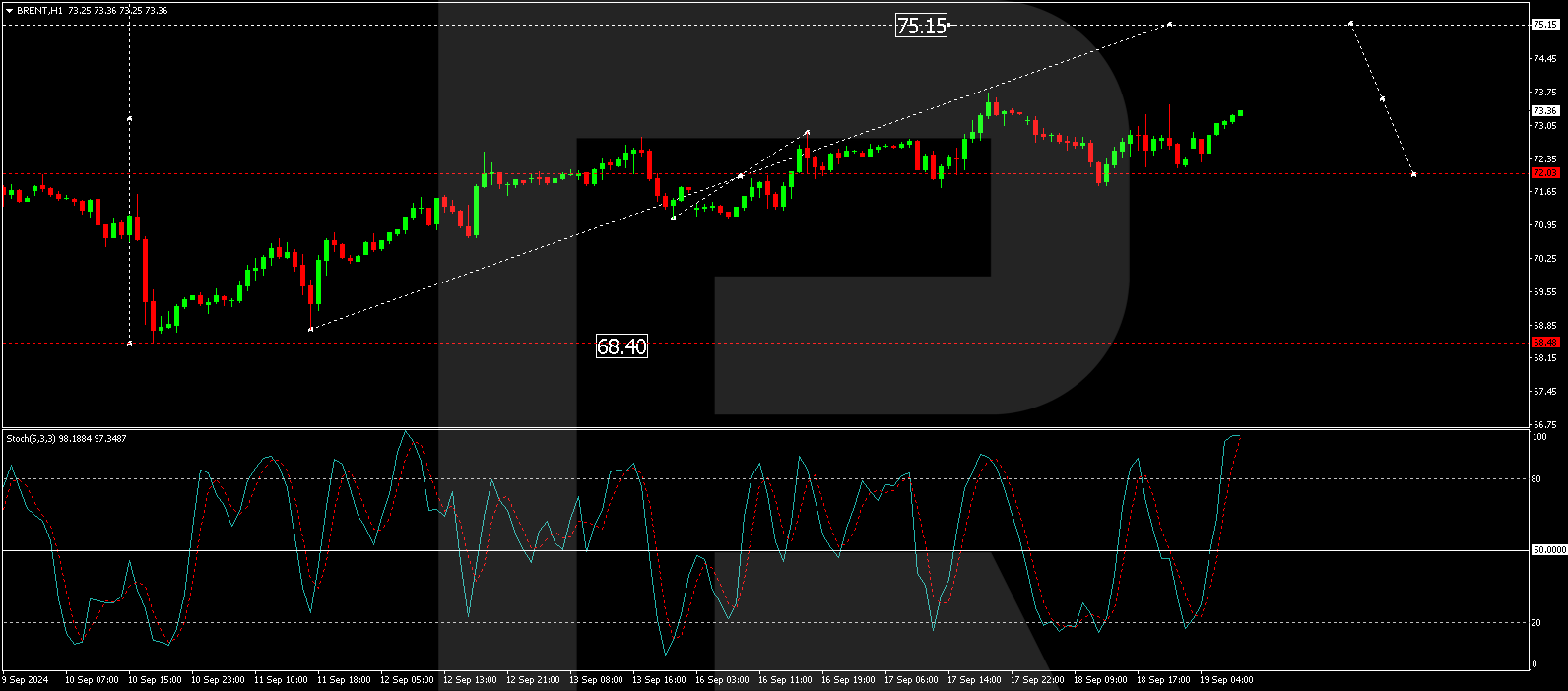
In the latest XAUUSD analysis, gold exhibited a downward impulse to 2470.77 USD, followed by a correction to 2526.00 USD. It is forming another downward wave targeting 2480.20 USD, expecting to break this level and potentially move towards 2435.55 USD. The MACD indicator, with its signal line positioned above zero but pointing downward, supports this bearish scenario.

After completing a corrective structure to 2526.00 USD, gold is expected to form a downward wave to 2500.00 USD. Upon reaching this target, a brief rise to 2513.33 USD might occur before continuing downward to 2480.20 USD. This pattern suggests only half of the anticipated downward trend. The Stochastic oscillator, near 50 and expected to rise to 80, indicates potential short-term gains before resuming the downward movement.

Summary

The interplay of easing monetary policies by the Fed and increasing geopolitical risks in the Middle East creates a complex but potentially favourable backdrop for gold prices. Investors might see gold as an attractive investment, a safe-haven asset and a hedge against potential currency devaluation and inflation uncertainties. These factors and technical indicators suggest a volatile but upward potential trajectory for gold prices in the near term.


Disclaimer

Any forecasts contained herein are based on the author’s particular opinion. This analysis may not be treated as trading advice. RoboForex bears no responsibility for trading results based on trading recommendations and reviews contained herein.

US30 index hits record intraday high!

By ForexTime

  • US30 posted highest-ever intraday price on Monday, August 26th
  • US stock markets cheer incoming Fed rate cuts
  • US30/Dow index could climb another 7% by August 2025
  • Technicals: US30 yet to reach “overbought” conditions
  • This week’s key events: Nvidia earnings, US jobless claims


The US30 stock index has just hit a new record high.

Yesterday (Monday, August 26th), this US stock index printed a price of 41468.5, surpassing its July 18th intraday peak of 41,448.5 by exactly 20 index points.

If the US30 index can register a closing price on the daily timeframe candlesticks above 41,313.7 from July 17th – then would also set a highest-ever closing price.

NOTE: The closing price is a widely used measure to often determine whether an asset has reached a record high.

Overall, US stock indexes have staged a stunning rebound from its sheer drop since mid-July through early August!

Dow hits new all-time intraday high


What is the US30 stock index?

The US30 stock index tracks the benchmark Dow Jones Industrial Average a.k.a. the “Dow”.

The Dow index is like a basket of stocks, with 30 different companies representing major industries across the US economy.

Among those 30 companies are popular names such as Apple, Microsoft, McDonald’s, Coca Cola, Visa, JPMorgan, Goldman Sachs, NIKE, Boeing, Walt Disney, and many more.

In short, if most of these 30 stocks go up, then the price of the basket/index goes up too, and vice versa.


Why is the US30 stock index rising?

Generally, stocks (and other riskier assets) tend to move higher at the thought of interest rates coming down.

This is because, lowered interest rates are intended to help support economic activity e.g. when a household has to pay less interest on its debt, it has more money to spend at McDonald’s, NIKE, and even Disney.

With that in mind, Fed Chair Jerome Powell declared at his Jackson Hole speech last Friday (August 23rd) that …

“The time has come for policy to adjust”.

That means the Fed is ready to start cutting interest rates at its next FOMC policy meeting on September 17-18th.

Hence, this stock index (along with its members’ share prices) has been rising, not waiting around till the actual rate cuts materialise.

After all, markets are forward looking in nature: today’s prices reflect tomorrow’s hopes.


What could move this index this week?

Note that the 30 stocks within the Dow’s “basket” are more sensitive to the economy.

That means the Dow tends to rise as its 30 member stocks earn more revenue and profits when the economy is doing well, and vice versa.

Such sensitivity to the economic cycle is in contrast to the big tech/growth companies that can still earn profits from continuous AI spending or even during recession during the global pandemic.

With all that in mind, for the rest of this week, the US30 is set to react to major US economic data announcements:

  • Tuesday, August 27th: @ 2:00PM GMT: US August consumer confidence and business conditions
  • Wednesday, August 28th: Nvidia earnings (after US markets close)
  • Thursday, August 29th @ 12:30PM GMT: US weekly initial jobless claims, 2Q GDP (second estimate)
  • Friday, August 30th @ 12:30PM GMT: US July PCE data (the Fed’s preferred inflation measure), personal income and spending

From the list above, arguably the initial jobless claims and Nvidia’s earnings should hold greater influence over the UXS30 index.

After all, Nvidia has been widely dubbed as the world’s most-important stock.

Also, the state of the US jobs market can truly shape market expectations for the size of the Fed’s September rate cut (25-basis points or 50-basis points cut?).


POTENTIAL SCENARIOS:

  • BULLISH: The US30 index should set a new record high if Nvidia can buffer hopes that its AI-fuelled future earnings are still growing, coupled with robust US economic data.

    Judging by another technical indicator, the 14-day relative strength index (RSI), the US30 has yet to officially reach “overbought” conditions (when the RSI touches 70 or higher).

This suggests that the US30 index still has room to climb even further into never-seen-before territory.


  • BEARISH: The US30 index could see an immediate retreat to around the 40,770 – 40,780 region for immediate support, or perhaps even its 21-day simple moving average (SMA).

    Such swift declines could be triggered if Nvidia delivers a massively disappointing earnings outlook, coupled with US economic data that stokes recession fears.


Over the longer term, Wall Street forecasts that the Dow can climb another 7% over the next 12 month, crossing above the 44k mark by August 2025.

However, the US30 index is bound to deliver plenty of shorter-term trading opportunities, as it seeks its next move from the current record highs.


Forex-Time-LogoArticle by ForexTime

ForexTime Ltd (FXTM) is an award winning international online forex broker regulated by CySEC 185/12 www.forextime.com

Space missions are getting more complex − lessons from Amazon and FedEx can inform satellite and spacecraft management in orbit

By Koki Ho, Georgia Institute of Technology and Mariel Borowitz, Georgia Institute of Technology 

Most space mission systems historically have used one spacecraft designed to complete an entire mission independently. Whether it was a weather satellite or a human-crewed module like Apollo, nearly every spacecraft was deployed and performed its one-off mission completely on its own.

But today, space industry organizations are exploring missions with many satellites working together. For example, SpaceX’s Starlink constellations include thousands of satellites. And new spacecraft could soon have the capabilities to link up or engage with other satellites in orbit for repairs or refueling.

Some of these spacecraft are already operating and serving customers, such as Northrop Grumman’s mission extension vehicle. This orbiting craft has extended the lives of multiple communications satellites.

Northrup Grumman’s mission extension vehicle is one example of a craft designed to service other satellites and spacecraft while in orbit.

These new design options and in-orbit capabilities make space missions look more like large logistics operations on Earth.

We’re researchers who have studied the space industry for years. We’ve studied how the space sector could learn lessons from companies like Amazon or FedEx about managing complex fleets and coordinating operations.

As companies develop satellite constellations as shown in this illustration, they’ll need to repair satellites in orbit.
NOIRLab/NSF/AURA/P. Marenfeld, CC BY-ND

Lessons from the ground transportation network

Space mission designers plan their routes in order to deliver their payloads to the Moon or Mars, or orbit efficiently within a set of cost, timeline and capacity constraints. But when they need to coordinate multiple space vehicles working together, route planning can get complicated.

Logistics companies on the ground solve similar problems every day and transport goods and commodities across the globe. So, researchers can study how these companies manage their logistics to help space companies and agencies figure out how to successfully plan their mission operations.

One NASA-funded study in the early 2000s had an idea for simulating space logistics operations. These researchers viewed orbits or planets as cities and the trajectories connecting them as routes. They also viewed the payload, consumables, fuel and other items to transport as commodities.

This approach helped them reframe the space mission problem as a commodity flow problem – a type of question that ground logistics companies work on all the time.

Lessons from ground logistics infrastructure

New capabilities for refueling and repairing spacecraft in orbit create new opportunities as well as challenges.

Namely, space operators don’t usually know which satellite will be the next one to fail or when that will happen. For these new technologies to be useful, space mission designers would need to come up with an infrastructure system. That could look like a fleet of service vehicles and depots in space that quickly respond to any unpredictable events.

Fortunately, space mission designers can learn from operations on the ground. City planners and emergency response organizations think through these types of challenges while determining where to locate hospitals or fire departments. They also consider these facilities’ capacities to respond to unpredictable calls.

We can draw an analogy between a ground logistics system design and an in-space servicing system design. This way, researchers can leverage theories developed for ground logistics to improve the space mission design practice.

One study published in November 2020 developed a framework for servicing spacecraft on orbit using what logistics experts call spatial queuing theory. Researchers most commonly use this modeling theory to analyze the performance of a ground logistics system.

Lessons from ground warehouse management

In the past, individual spacecraft carried out their missions independently, so if a satellite failed, its mission engineers had to develop and send a replacement.

Now, for missions with multiple satellites, such as the Iridium satellite constellation, operators often maintain one or more spares on orbit.

This becomes complicated for constellations made up of hundreds or thousands of spacecraft. Mission designers want to ensure they have enough spare satellites in orbit so they don’t have to interrupt the mission if one breaks. But sending too many spare satellites gets expensive.

When dealing with these types of large constellations, mission designers can learn from the methods Amazon and other ground companies use to manage their warehouses. Amazon puts these warehouses in specific places and stocks them with certain items to make sure the deliveries are handled efficiently.

Inventory management theories on the ground can help inform how space companies tackle these challenges.

A study published in November 2019 developed an approach that space companies could use to manage their spare strategies. This approach can help them decide where in orbit to allocate their spare satellites to meet their needs while minimizing any service interruptions.

International dimensions

Spacecraft operate in a complex and rapidly changing environment. Operators need to know where other missions are operating and what rules they should follow when refueling or repairing in space. In space, however, nobody has defined these rules yet.

Ships, aircraft and ground vehicles all have clear rules of the road to follow when interacting with other vehicles. For example, civilian ships and aircraft have to share their location with other vehicles and officials to help manage traffic.

Some researchers are examining what similar rules could look like for space. One study examined how developing rules based on a spacecraft’s size, age or other attributes might help future space operations run more smoothly. For example, one rule might be that the spacecraft that launched most recently should take responsibility for maneuvering when there’s another craft in its path.

With more satellites and spacecraft launching now than ever, companies and government agencies will need new technologies and policies to coordinate them. As space activity becomes more complex, researchers can continue to apply what they’ve learned on the ground to new missions in space.The Conversation

About the Author:

Koki Ho, Associate Professor of Aerospace Engineering, Georgia Institute of Technology and Mariel Borowitz, Associate Professor of International Affairs, Georgia Institute of Technology

This article is republished from The Conversation under a Creative Commons license. Read the original article.


Japanese Yen Gains as USD Weakens and BOJ Signals Possible Rate Hike

By RoboForex Analytical Department

The Japanese yen has shown a notable strengthening, with the USD/JPY pair dropping to 143.99 on Monday, marking a three-week low. This movement is primarily driven by the weakness of the US dollar and significant remarks from the Bank of Japan (BOJ) and the US Federal Reserve.

Market dynamics and Central Bank signals

The recent hawkish comments from Kazuo Ueda, the Governor of the Bank of Japan, have garnered significant attention. Last Friday, Ueda hinted that the BOJ might adjust its monetary policy if economic forecasts align with current trends. The market interpreted this statement as a potential precursor to an interest rate hike, especially in light of Japan’s core consumer price index rising for the third consecutive month to 2.7% in July, with overall inflation holding steady at 2.8%.

Conversely, Jerome Powell, Chair of the US Federal Reserve, adopted a more dovish stance, indicating that it might be time to revise US monetary policy due to increasing risks to the labour market. This suggests that the Fed could begin easing monetary policy as soon as September, a move that contrasts sharply with the potential tightening in Japan. These shifts in monetary policy outlooks have significantly shaped forex forecasts for the USD/JPY pair.

Technical analysis of USD/JPY

The USD/JPY formed a consolidation range around the 146.70 level before moving downward to 143.50. There may be a temporary rise to 144.55, but a further decline to 142.88 could follow. The MACD indicator supports this bearish outlook, with its signal line below zero and trending downward.

The pair has completed a downward structure to 143.44. A corrective move towards 144.55 is possible, potentially extending to 145.70 as a test from below. Following this, a decline to 142.88 might occur. The Stochastic oscillator, currently above 50, suggests a rise to 80 before the next downward phase.

Summary

The USD/JPY pair is experiencing downward pressure due to a combination of USD weakness and potential monetary policy adjustments from the BOJ. As market dynamics evolve with central bank policies and economic indicators, the yen could see further gains if the BOJ shifts towards a tighter monetary stance in response to rising inflation.


Disclaimer

Any forecasts contained herein are based on the author’s particular opinion. This analysis may not be treated as trading advice. RoboForex bears no responsibility for trading results based on trading recommendations and reviews contained herein.

Powell’s dovish comments support indices’ growth. Silver rises after gold

By JustMarkets

On Friday, the Dow Jones (US30) gained 1.14% (for the week +1.24%), while the S&P 500 (US500) gained 1.15% (for the week +1.39%). The NASDAQ Technology Index (US100) closed positive 1.47% (for the week +1.29%).

Speaking at the Fed’s annual symposium at Jackson Hole on Friday, Fed Chairman Jerome Powell recognized recent progress on inflation and said that “the time has come for policy adjustments.” The chairman noted that the US labor market is cooling rapidly following the release of a softer July employment report and downward revisions to the jobs data. Powell also noted that the FOMC has further strengthened its confidence that inflation is slowing to the 2% target, suggesting it is time to adjust monetary policy toward less tight conditions. In addition, Atlanta Fed President Bostic said late last week that more than one Fed interest rate cut may be needed before the end of the year.

The Canadian dollar rose to 1.35 per US dollar in August, the strongest in five months, as new evidence of the Fed’s dovish stance pressured the US dollar. Fed Chairman Jerome Powell said in a speech that a weak labor market and slowing US inflation require a quick response from the US Central Bank in the form of a less tight monetary policy, which boosted G10 currencies against the US dollar. The urgency in Powell’s rhetoric was enough to offset dovish expectations for the Bank of Canada, which has already begun a cycle of rate cuts to address growth and a moderate labor market domestically. The unemployment rate is holding at 6.4%, the highest in two years, with net employment falling and the lowest labor force participation rate since 1998.

Equity markets in Europe were mostly up on Friday. Germany’s DAX (DE40) gained 0.76% (for the week +1.75%), France’s CAC 40 (FR40) closed higher by 0.70% (for the week +1.77%), Spain’s IBEX 35 (ES35) added 1.09% (for the week +2.82%), and the UK’s FTSE 100 (UK100) closed up 0.48% (for the week +0.20%).

Silver (XAG/USD) traded above $29.5 per ounce in late August, near its highest levels in five weeks, as Federal Reserve Chairman Jerome Powell reinforced hopes of an interest rate cut in September. The US Central Bank is expected to begin easing policy in September, but the market remains divided over the size of the first-rate cut. Overall, traders are pricing in about 100 basis points of rate cuts at the Fed’s three remaining meetings this year. Precious metals also received support from increased safe-haven flows after Hezbollah launched rocket attacks on Israel over the weekend.

WTI crude oil prices rose to around $75.4 a barrel on Monday, rising for a third straight session, driven by concerns over supply risks amid escalating fears of a broader conflict in the Middle East.

Asian markets were mostly up last week. Japan’s Nikkei 225 (JP225) rose by 1.32%, China’s FTSE China A50 (CHA50) added 0.22%, Hong Kong’s Hang Seng (HK50) gained 0.24% over 5 trading days, and Australia’s ASX 200 (AU200) posted a positive 0.66%.

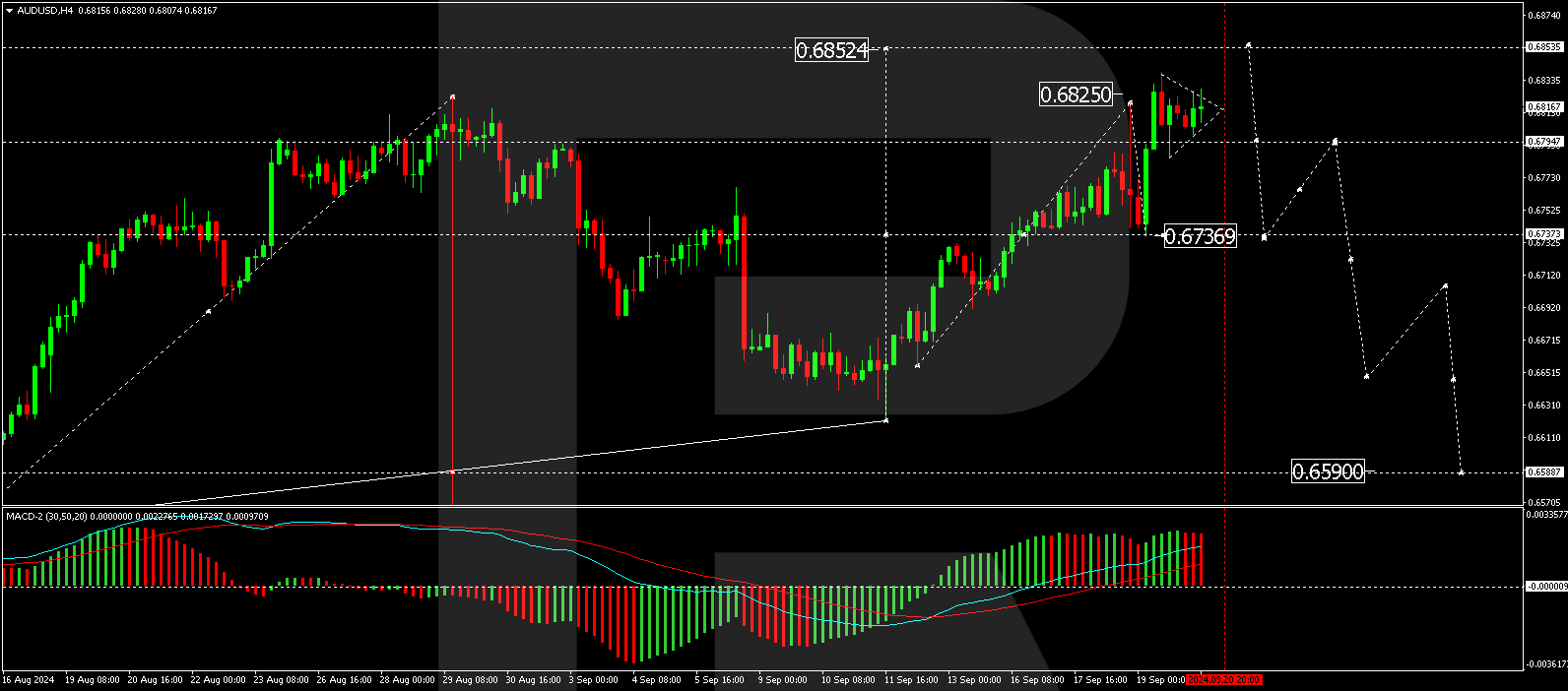
The Australian dollar traded near $0.68, moving towards the strongest levels this year, as the Reserve Bank of Australia’s (RBA) hawkish monetary policy outlook contrasted with dovish signals from the Federal Reserve. Minutes from the RBA’s last meeting showed that the money rate will remain stable for an extended period. RBA Governor Michele Bullock also recently said that despite signs of weakening inflation, it is “premature” to consider cutting interest rates.

In New Zealand, the Reserve Bank (RBNZ) began its easing cycle with a rate cut this month and has announced an upcoming cut. Markets expect aggressive easing before the end of the year, with traders estimating additional quarter-point rate cuts in October and November.

Pavel Durov, the billionaire co-founder and CEO of messaging app Telegram, was arrested at the Bourget airport outside of Paris Saturday evening. According to the report, Durov, 39, was traveling aboard his private jet after arriving from Azerbaijan, which triggered a French search warrant issued by the OFMIN of the French judicial police due to his inclusion in a wanted persons file (FPR). Durov was detained by the National Anti-Fraud Office (ONAF) over the alleged facilitation of various crimes, including terrorism, narcotics trafficking, and fraud. He faces up to 20 years in prison if convicted.

S&P 500 (US500) 5,634.61 +63.97 (+1.15%)

Dow Jones (US30) 41,175.08 +462.30 (+1.14%)

DAX (DE40) 18,633.10 +139.71 (+0.76%)

FTSE 100 (UK100) 8,327.78 +39.78 (+0.48%)

USD Index 100.68 −0.83 (−0.82%)

Important events today:
  • – German Ifo Business Climate (m/m) at 11:00 (GMT+3);
  • – US Durable Goods Orders (m/m) at 15:30 (GMT+3).

By JustMarkets


This article reflects a personal opinion and should not be interpreted as an investment advice, and/or offer, and/or a persistent request for carrying out financial transactions, and/or a guarantee, and/or a forecast of future events.

Speculators sharply raise Euro, British Pound & Canadian Dollar bets

By InvestMacro

Here are the latest charts and statistics for the Commitment of Traders (COT) data published by the Commodities Futures Trading Commission (CFTC).

The latest COT data is updated through Tuesday August 20th and shows a quick view of how large market participants (for-profit speculators and commercial traders) were positioned in the futures markets. All currency positions are in direct relation to the US dollar where, for example, a bet for the euro is a bet that the euro will rise versus the dollar while a bet against the euro will be a bet that the euro will decline versus the dollar.

Weekly Speculator Changes led by Euro & British Pound

The COT currency market speculator bets were higher this week as seven out of the eleven currency markets we cover had higher positioning while the other four markets had lower speculator contracts.

Leading the gains for the currency markets was the EuroFX (29,034 contracts) with the British Pound (19,699 contracts), the Canadian Dollar (15,201 contracts), the Australian Dollar (3,731 contracts), the Brazilian Real (2,887 contracts), the New Zealand Dollar (1,855 contracts) and the Japanese Yen (481 contracts) also showing positive weeks.

The currencies seeing declines in speculator bets on the week were the Mexican Peso (-15,448 contracts), the Swiss Franc (-4,050 contracts), the US Dollar Index (-945 contracts) and with Bitcoin (-638 contracts) also registering lower bets on the week.

Currency Speculators sharply raise Euro, British Pound & Canadian Dollar bets

This week’s COT currency’s data saw improvement in many of the non-dollar currencies this week. The US Dollar Index fell by over 1 percent this week as the American currency faces pressure from moderating inflation and expected interest rate cuts from the US Federal Reserve starting in September.

Here is this week’s COT currency roundup:

The Euro speculator positioning jumped by +29,034 contracts this week and rose for the fifth time out of the past seven weeks. This week’s gain was the highest weekly rise in over a year and brought the overall bullish position to an 11-week high. Euro positions have now been in bullish territory for seven straight weeks after a brief fall onto the bearish side for two weeks in late-June and early-July. The Euro exchange rate versus the dollar closed this week above it’s 200-week moving average and right below the 1.1200 exchange rate — the highest weekly close since July of 2023.

The British pound sterling speculator contracts rose strongly this week (+19,699 contracts) following sharp declines over the past three weeks that had taken a total of -94,371 contracts off of the speculator’s bullish standing. The GBP speculator position had surged to an all-time record high on July 23rd at a total of +142,183 contracts before embarking on a three-week slide. The previous record high speculator position had been prior (July 17th 2007 at +98,366 contracts) to the start of the Great Financial Crisis. This week’s rebound brings the speculator standing back up to a total of +67,511 contracts. The GBPUSD exchange rate this week has touched its highest level since March of 2022 against the US dollar and closed over 1.3200 to end the week.

The Canadian dollar has been on the other side of the spectrum than that of the British pound as it recently fell to an all-time record bearish speculator level. The CAD spec bets had dropped to -196,263 contracts on July 30th but have now rebounded for three straight weeks including this week’s gain by over +15,000 contracts. The CAD position settled this week at a standing of -164,410 contracts (the 4th most bearish level on record) and, overall, has now been in a bearish position for fifty-five straight weeks, dating back to August 1st of 2023. The Canadian dollar exchange rate had a strong week versus the US dollar and rose over 1 percent as the CAD futures price closed over the 0.7400 threshold and up against the top of its weekly down-trending channel that started in May/June of 2021.

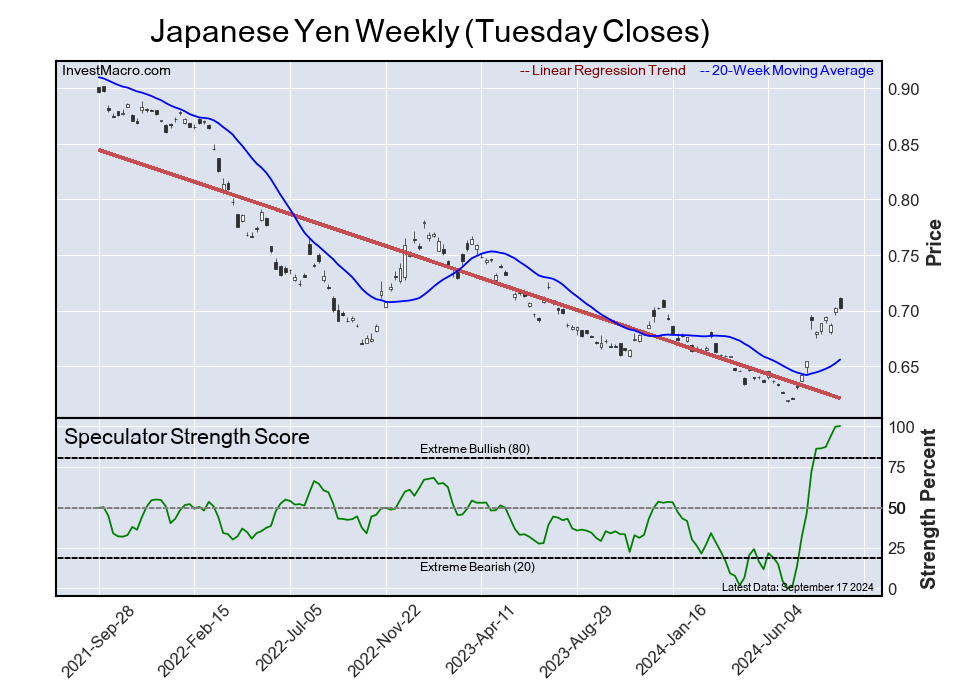
Finally, the Japanese yen speculator bets continued to gain for a seventh straight week this week after dropping to the second lowest level on record at -184,223 contracts on July 2nd. The seven-week improvement has totaled +207,808 contracts and has taken the speculator position from -184,223 contracts on July 2nd to this week’s total of +23,585 contracts. Traders have been quick to reverse their positions on central bank policy changes (and currency intervention) with the US Federal Reserve ready to reduce interest rates while the Bank of Japan is possibly looking to raise their rates. The yen exchange rate versus the dollar rose strongly this week with a 5-day gain over 2 percent. The Japanese yen strength brought the USDJPY currency pair to the 144.39 exchange rate, the best weekly close for the yen since January.


Currencies Net Speculators Leaderboard

Legend: Weekly Speculators Change | Speculators Current Net Position | Speculators Strength Score compared to last 3-Years (0-100 range)


Strength Scores led by Japanese Yen

COT Strength Scores (a normalized measure of Speculator positions over a 3-Year range, from 0 to 100 where above 80 is Extreme-Bullish and below 20 is Extreme-Bearish) showed that the Japanese Yen (100 percent) leads the currency markets this week. The the British Pound (66 percent), Bitcoin (63 percent) and the Australian Dollar (58 percent) come in as the next highest in the weekly strength scores.

On the downside, the Brazilian Real (4 percent), the New Zealand Dollar (14 percent) and the Canadian Dollar (14 percent) come in at the lowest strength levels currently and are in Extreme-Bearish territory (below 20 percent).

Strength Statistics:
US Dollar Index (41.5 percent) vs US Dollar Index previous week (43.6 percent)
EuroFX (44.2 percent) vs EuroFX previous week (31.8 percent)
British Pound Sterling (66.4 percent) vs British Pound Sterling previous week (57.6 percent)
Japanese Yen (100.0 percent) vs Japanese Yen previous week (99.8 percent)
Swiss Franc (44.8 percent) vs Swiss Franc previous week (52.3 percent)
Canadian Dollar (14.3 percent) vs Canadian Dollar previous week (7.5 percent)
Australian Dollar (57.9 percent) vs Australian Dollar previous week (54.7 percent)
New Zealand Dollar (14.4 percent) vs New Zealand Dollar previous week (10.9 percent)
Mexican Peso (48.5 percent) vs Mexican Peso previous week (56.0 percent)
Brazilian Real (3.7 percent) vs Brazilian Real previous week (1.0 percent)
Bitcoin (62.7 percent) vs Bitcoin previous week (72.4 percent)


Japanese Yen & Swiss Franc top the 6-Week Strength Trends

COT Strength Score Trends (or move index, calculates the 6-week changes in strength scores) showed that the Japanese Yen (99 percent) and the Swiss Franc (38 percent) lead the past six weeks trends for the currencies. The EuroFX (22 percent) and the US Dollar Index (3 percent) are the next highest positive movers in the latest trends data.

The New Zealand Dollar (-76 percent) leads the downside trend scores currently with the Australian Dollar (-35 percent), Canadian Dollar (-24 percent) and the Mexican Peso (-14 percent) following next with lower trend scores.

Strength Trend Statistics:
US Dollar Index (2.9 percent) vs US Dollar Index previous week (4.2 percent)
EuroFX (22.3 percent) vs EuroFX previous week (15.5 percent)
British Pound Sterling (-7.7 percent) vs British Pound Sterling previous week (-6.4 percent)
Japanese Yen (98.9 percent) vs Japanese Yen previous week (99.8 percent)
Swiss Franc (37.9 percent) vs Swiss Franc previous week (40.5 percent)
Canadian Dollar (-23.8 percent) vs Canadian Dollar previous week (-26.6 percent)
Australian Dollar (-34.8 percent) vs Australian Dollar previous week (-22.6 percent)
New Zealand Dollar (-76.3 percent) vs New Zealand Dollar previous week (-89.1 percent)
Mexican Peso (-14.1 percent) vs Mexican Peso previous week (-6.6 percent)
Brazilian Real (-7.8 percent) vs Brazilian Real previous week (-12.1 percent)
Bitcoin (-1.9 percent) vs Bitcoin previous week (19.7 percent)


Individual COT Forex Markets:

US Dollar Index Futures:

US Dollar Index Forex Futures COT ChartThe US Dollar Index large speculator standing this week equaled a net position of 17,591 contracts in the data reported through Tuesday. This was a weekly fall of -945 contracts from the previous week which had a total of 18,536 net contracts.

This week’s current strength score (the trader positioning range over the past three years, measured from 0 to 100) shows the speculators are currently Bearish with a score of 41.5 percent. The commercials are Bullish with a score of 66.1 percent and the small traders (not shown in chart) are Bearish-Extreme with a score of 2.2 percent.

Price Trend-Following Model: Strong Downtrend

Our weekly trend-following model classifies the current market price position as: Strong Downtrend. The current action for the model is considered to be: New Sell – Short Position.

US DOLLAR INDEX StatisticsSPECULATORSCOMMERCIALSSMALL TRADERS
– Percent of Open Interest Longs:72.819.34.8
– Percent of Open Interest Shorts:36.752.97.3
– Net Position:17,591-16,372-1,219
– Gross Longs:35,4529,4122,361
– Gross Shorts:17,86125,7843,580
– Long to Short Ratio:2.0 to 10.4 to 10.7 to 1
NET POSITION TREND:
– Strength Index Score (3 Year Range Pct):41.566.12.2
– Strength Index Reading (3 Year Range):BearishBullishBearish-Extreme
NET POSITION MOVEMENT INDEX:
– 6-Week Change in Strength Index:2.92.2-26.9


Euro Currency Futures:

Euro Currency Futures COT ChartThe Euro Currency large speculator standing this week equaled a net position of 56,017 contracts in the data reported through Tuesday. This was a weekly gain of 29,034 contracts from the previous week which had a total of 26,983 net contracts.

This week’s current strength score (the trader positioning range over the past three years, measured from 0 to 100) shows the speculators are currently Bearish with a score of 44.2 percent. The commercials are Bullish with a score of 55.8 percent and the small traders (not shown in chart) are Bearish with a score of 45.7 percent.

Price Trend-Following Model: Strong Uptrend

Our weekly trend-following model classifies the current market price position as: Strong Uptrend. The current action for the model is considered to be: Hold – Maintain Long Position.

EURO Currency StatisticsSPECULATORSCOMMERCIALSSMALL TRADERS
– Percent of Open Interest Longs:28.155.911.9
– Percent of Open Interest Shorts:20.068.87.1
– Net Position:56,017-89,22433,207
– Gross Longs:194,350386,94882,517
– Gross Shorts:138,333476,17249,310
– Long to Short Ratio:1.4 to 10.8 to 11.7 to 1
NET POSITION TREND:
– Strength Index Score (3 Year Range Pct):44.255.845.7
– Strength Index Reading (3 Year Range):BearishBullishBearish
NET POSITION MOVEMENT INDEX:
– 6-Week Change in Strength Index:22.3-23.221.9


British Pound Sterling Futures:

British Pound Sterling Futures COT ChartThe British Pound Sterling large speculator standing this week equaled a net position of 67,511 contracts in the data reported through Tuesday. This was a weekly lift of 19,699 contracts from the previous week which had a total of 47,812 net contracts.

This week’s current strength score (the trader positioning range over the past three years, measured from 0 to 100) shows the speculators are currently Bullish with a score of 66.4 percent. The commercials are Bearish with a score of 29.6 percent and the small traders (not shown in chart) are Bullish-Extreme with a score of 88.3 percent.

Price Trend-Following Model: Strong Uptrend

Our weekly trend-following model classifies the current market price position as: Strong Uptrend. The current action for the model is considered to be: Hold – Maintain Long Position.

BRITISH POUND StatisticsSPECULATORSCOMMERCIALSSMALL TRADERS
– Percent of Open Interest Longs:54.323.916.3
– Percent of Open Interest Shorts:25.158.410.9
– Net Position:67,511-79,95512,444
– Gross Longs:125,63455,24837,610
– Gross Shorts:58,123135,20325,166
– Long to Short Ratio:2.2 to 10.4 to 11.5 to 1
NET POSITION TREND:
– Strength Index Score (3 Year Range Pct):66.429.688.3
– Strength Index Reading (3 Year Range):BullishBearishBullish-Extreme
NET POSITION MOVEMENT INDEX:
– 6-Week Change in Strength Index:-7.75.85.4


Japanese Yen Futures:

Japanese Yen Forex Futures COT ChartThe Japanese Yen large speculator standing this week equaled a net position of 23,585 contracts in the data reported through Tuesday. This was a weekly increase of 481 contracts from the previous week which had a total of 23,104 net contracts.

This week’s current strength score (the trader positioning range over the past three years, measured from 0 to 100) shows the speculators are currently Bullish-Extreme with a score of 100.0 percent. The commercials are Bearish-Extreme with a score of 0.0 percent and the small traders (not shown in chart) are Bullish-Extreme with a score of 97.7 percent.

Price Trend-Following Model: Strong Uptrend

Our weekly trend-following model classifies the current market price position as: Strong Uptrend. The current action for the model is considered to be: Hold – Maintain Long Position.

JAPANESE YEN StatisticsSPECULATORSCOMMERCIALSSMALL TRADERS
– Percent of Open Interest Longs:28.159.211.4
– Percent of Open Interest Shorts:20.668.19.9
– Net Position:23,585-28,4014,816
– Gross Longs:88,761187,05535,989
– Gross Shorts:65,176215,45631,173
– Long to Short Ratio:1.4 to 10.9 to 11.2 to 1
NET POSITION TREND:
– Strength Index Score (3 Year Range Pct):100.00.097.7
– Strength Index Reading (3 Year Range):Bullish-ExtremeBearish-ExtremeBullish-Extreme
NET POSITION MOVEMENT INDEX:
– 6-Week Change in Strength Index:98.9-97.939.7


Swiss Franc Futures:

Swiss Franc Forex Futures COT ChartThe Swiss Franc large speculator standing this week equaled a net position of -25,714 contracts in the data reported through Tuesday. This was a weekly decline of -4,050 contracts from the previous week which had a total of -21,664 net contracts.

This week’s current strength score (the trader positioning range over the past three years, measured from 0 to 100) shows the speculators are currently Bearish with a score of 44.8 percent. The commercials are Bearish with a score of 48.6 percent and the small traders (not shown in chart) are Bullish with a score of 57.3 percent.

Price Trend-Following Model: Strong Uptrend

Our weekly trend-following model classifies the current market price position as: Strong Uptrend. The current action for the model is considered to be: Hold – Maintain Long Position.

SWISS FRANC StatisticsSPECULATORSCOMMERCIALSSMALL TRADERS
– Percent of Open Interest Longs:11.369.918.4
– Percent of Open Interest Shorts:49.625.124.9
– Net Position:-25,71430,096-4,382
– Gross Longs:7,60046,90712,329
– Gross Shorts:33,31416,81116,711
– Long to Short Ratio:0.2 to 12.8 to 10.7 to 1
NET POSITION TREND:
– Strength Index Score (3 Year Range Pct):44.848.657.3
– Strength Index Reading (3 Year Range):BearishBearishBullish
NET POSITION MOVEMENT INDEX:
– 6-Week Change in Strength Index:37.9-47.640.1


Canadian Dollar Futures:

Canadian Dollar Forex Futures COT ChartThe Canadian Dollar large speculator standing this week equaled a net position of -164,410 contracts in the data reported through Tuesday. This was a weekly lift of 15,201 contracts from the previous week which had a total of -179,611 net contracts.

This week’s current strength score (the trader positioning range over the past three years, measured from 0 to 100) shows the speculators are currently Bearish-Extreme with a score of 14.3 percent. The commercials are Bullish-Extreme with a score of 84.9 percent and the small traders (not shown in chart) are Bearish with a score of 23.1 percent.

Price Trend-Following Model: Weak Downtrend

Our weekly trend-following model classifies the current market price position as: Weak Downtrend. The current action for the model is considered to be: Hold – Maintain Short Position.

CANADIAN DOLLAR StatisticsSPECULATORSCOMMERCIALSSMALL TRADERS
– Percent of Open Interest Longs:6.282.29.6
– Percent of Open Interest Shorts:58.629.110.4
– Net Position:-164,410167,006-2,596
– Gross Longs:19,528258,24630,062
– Gross Shorts:183,93891,24032,658
– Long to Short Ratio:0.1 to 12.8 to 10.9 to 1
NET POSITION TREND:
– Strength Index Score (3 Year Range Pct):14.384.923.1
– Strength Index Reading (3 Year Range):Bearish-ExtremeBullish-ExtremeBearish
NET POSITION MOVEMENT INDEX:
– 6-Week Change in Strength Index:-23.822.1-1.5


Australian Dollar Futures:

Australian Dollar Forex Futures COT ChartThe Australian Dollar large speculator standing this week equaled a net position of -38,885 contracts in the data reported through Tuesday. This was a weekly boost of 3,731 contracts from the previous week which had a total of -42,616 net contracts.

This week’s current strength score (the trader positioning range over the past three years, measured from 0 to 100) shows the speculators are currently Bullish with a score of 57.9 percent. The commercials are Bearish with a score of 45.6 percent and the small traders (not shown in chart) are Bullish with a score of 57.5 percent.

Price Trend-Following Model: Strong Uptrend

Our weekly trend-following model classifies the current market price position as: Strong Uptrend. The current action for the model is considered to be: Hold – Maintain Long Position.

AUSTRALIAN DOLLAR StatisticsSPECULATORSCOMMERCIALSSMALL TRADERS
– Percent of Open Interest Longs:37.747.713.5
– Percent of Open Interest Shorts:58.427.313.2
– Net Position:-38,88538,366519
– Gross Longs:70,55489,42925,338
– Gross Shorts:109,43951,06324,819
– Long to Short Ratio:0.6 to 11.8 to 11.0 to 1
NET POSITION TREND:
– Strength Index Score (3 Year Range Pct):57.945.657.5
– Strength Index Reading (3 Year Range):BullishBearishBullish
NET POSITION MOVEMENT INDEX:
– 6-Week Change in Strength Index:-34.834.7-24.0


New Zealand Dollar Futures:

New Zealand Dollar Forex Futures COT ChartThe New Zealand Dollar large speculator standing this week equaled a net position of -13,769 contracts in the data reported through Tuesday. This was a weekly increase of 1,855 contracts from the previous week which had a total of -15,624 net contracts.

This week’s current strength score (the trader positioning range over the past three years, measured from 0 to 100) shows the speculators are currently Bearish-Extreme with a score of 14.4 percent. The commercials are Bullish-Extreme with a score of 81.2 percent and the small traders (not shown in chart) are Bullish with a score of 55.3 percent.

Price Trend-Following Model: Strong Uptrend

Our weekly trend-following model classifies the current market price position as: Strong Uptrend. The current action for the model is considered to be: Hold – Maintain Long Position.

NEW ZEALAND DOLLAR StatisticsSPECULATORSCOMMERCIALSSMALL TRADERS
– Percent of Open Interest Longs:28.364.26.7
– Percent of Open Interest Shorts:48.943.27.0
– Net Position:-13,76914,000-231
– Gross Longs:18,88742,9074,465
– Gross Shorts:32,65628,9074,696
– Long to Short Ratio:0.6 to 11.5 to 11.0 to 1
NET POSITION TREND:
– Strength Index Score (3 Year Range Pct):14.481.255.3
– Strength Index Reading (3 Year Range):Bearish-ExtremeBullish-ExtremeBullish
NET POSITION MOVEMENT INDEX:
– 6-Week Change in Strength Index:-76.374.7-16.0


Mexican Peso Futures:

Mexican Peso Futures COT ChartThe Mexican Peso large speculator standing this week equaled a net position of 34,646 contracts in the data reported through Tuesday. This was a weekly decrease of -15,448 contracts from the previous week which had a total of 50,094 net contracts.

This week’s current strength score (the trader positioning range over the past three years, measured from 0 to 100) shows the speculators are currently Bearish with a score of 48.5 percent. The commercials are Bullish with a score of 53.0 percent and the small traders (not shown in chart) are Bearish-Extreme with a score of 3.3 percent.

Price Trend-Following Model: Strong Downtrend

Our weekly trend-following model classifies the current market price position as: Strong Downtrend. The current action for the model is considered to be: Hold – Maintain Short Position.

MEXICAN PESO StatisticsSPECULATORSCOMMERCIALSSMALL TRADERS
– Percent of Open Interest Longs:38.257.32.3
– Percent of Open Interest Shorts:18.476.53.0
– Net Position:34,646-33,410-1,236
– Gross Longs:66,745100,0923,948
– Gross Shorts:32,099133,5025,184
– Long to Short Ratio:2.1 to 10.7 to 10.8 to 1
NET POSITION TREND:
– Strength Index Score (3 Year Range Pct):48.553.03.3
– Strength Index Reading (3 Year Range):BearishBullishBearish-Extreme
NET POSITION MOVEMENT INDEX:
– 6-Week Change in Strength Index:-14.115.4-23.3


Brazilian Real Futures:

Brazil Real Futures COT ChartThe Brazilian Real large speculator standing this week equaled a net position of -50,955 contracts in the data reported through Tuesday. This was a weekly increase of 2,887 contracts from the previous week which had a total of -53,842 net contracts.

This week’s current strength score (the trader positioning range over the past three years, measured from 0 to 100) shows the speculators are currently Bearish-Extreme with a score of 3.7 percent. The commercials are Bullish-Extreme with a score of 97.2 percent and the small traders (not shown in chart) are Bearish with a score of 31.8 percent.

Price Trend-Following Model: Downtrend

Our weekly trend-following model classifies the current market price position as: Downtrend. The current action for the model is considered to be: Hold – Maintain Short Position.

BRAZIL REAL StatisticsSPECULATORSCOMMERCIALSSMALL TRADERS
– Percent of Open Interest Longs:18.178.62.9
– Percent of Open Interest Shorts:82.214.23.2
– Net Position:-50,95551,235-280
– Gross Longs:14,35562,4902,300
– Gross Shorts:65,31011,2552,580
– Long to Short Ratio:0.2 to 15.6 to 10.9 to 1
NET POSITION TREND:
– Strength Index Score (3 Year Range Pct):3.797.231.8
– Strength Index Reading (3 Year Range):Bearish-ExtremeBullish-ExtremeBearish
NET POSITION MOVEMENT INDEX:
– 6-Week Change in Strength Index:-7.87.33.9


Bitcoin Futures:

Bitcoin Crypto Futures COT ChartThe Bitcoin large speculator standing this week equaled a net position of -243 contracts in the data reported through Tuesday. This was a weekly lowering of -638 contracts from the previous week which had a total of 395 net contracts.

This week’s current strength score (the trader positioning range over the past three years, measured from 0 to 100) shows the speculators are currently Bullish with a score of 62.7 percent. The commercials are Bullish with a score of 65.1 percent and the small traders (not shown in chart) are Bearish-Extreme with a score of 18.1 percent.

Price Trend-Following Model: Downtrend

Our weekly trend-following model classifies the current market price position as: Downtrend. The current action for the model is considered to be: Hold – Maintain Short Position.

BITCOIN StatisticsSPECULATORSCOMMERCIALSSMALL TRADERS
– Percent of Open Interest Longs:81.13.14.1
– Percent of Open Interest Shorts:81.93.13.3
– Net Position:-24317226
– Gross Longs:24,0169271,215
– Gross Shorts:24,259910989
– Long to Short Ratio:1.0 to 11.0 to 11.2 to 1
NET POSITION TREND:
– Strength Index Score (3 Year Range Pct):62.765.118.1
– Strength Index Reading (3 Year Range):BullishBullishBearish-Extreme
NET POSITION MOVEMENT INDEX:
– 6-Week Change in Strength Index:-1.92.70.5


Article By InvestMacroReceive our weekly COT Newsletter

*COT Report: The COT data, released weekly to the public each Friday, is updated through the most recent Tuesday (data is 3 days old) and shows a quick view of how large speculators or non-commercials (for-profit traders) were positioned in the futures markets.

The CFTC categorizes trader positions according to commercial hedgers (traders who use futures contracts for hedging as part of the business), non-commercials (large traders who speculate to realize trading profits) and nonreportable traders (usually small traders/speculators) as well as their open interest (contracts open in the market at time of reporting). See CFTC criteria here.

Speculator Extremes: Yen, Gold, 5-Year, 10-Year & Cotton lead Bullish & Bearish Positions

By InvestMacro

The latest update for the weekly Commitment of Traders (COT) report was released by the Commodity Futures Trading Commission (CFTC) on Friday for data ending on August 20th.

This weekly Extreme Positions report highlights the Most Bullish and Most Bearish Positions for the speculator category. Extreme positioning in these markets can foreshadow strong moves in the underlying market.

To signify an extreme position, we use the Strength Index (also known as the COT Index) of each instrument, a common method of measuring COT data. The Strength Index is simply a comparison of current trader positions against the range of positions over the previous 3 years. We use over 80 percent as extremely bullish and under 20 percent as extremely bearish. (Compare Strength Index scores across all markets in the data table or cot leaders table)


Here Are This Week’s Most Bullish Speculator Positions:

Japanese Yen


The Japanese Yen speculator position comes in as the most bullish extreme standing again this week following a recent change in policy for the BOJ and position switching of speculators. The Japanese Yen speculator level is currently at a 100.0 percent score of its 3-year range.

The six-week trend for the percent strength score totaled 98.9 this week. The overall net speculator position was a total of 23,585 net contracts this week with a small gain of 481 contract in the weekly speculator bets.


Speculators or Non-Commercials Notes:

Speculators, classified as non-commercial traders by the CFTC, are made up of large commodity funds, hedge funds and other significant for-profit participants. The Specs are generally regarded as trend-followers in their behavior towards price action – net speculator bets and prices tend to go in the same directions. These traders often look to buy when prices are rising and sell when prices are falling. To illustrate this point, many times speculator contracts can be found at their most extremes (bullish or bearish) when prices are also close to their highest or lowest levels.

These extreme levels can be dangerous for the large speculators as the trade is most crowded, there is less trading ammunition still sitting on the sidelines to push the trend further and prices have moved a significant distance. When the trend becomes exhausted, some speculators take profits while others look to also exit positions when prices fail to continue in the same direction. This process usually plays out over many months to years and can ultimately create a reverse effect where prices start to fall and speculators start a process of selling when prices are falling.


Gold


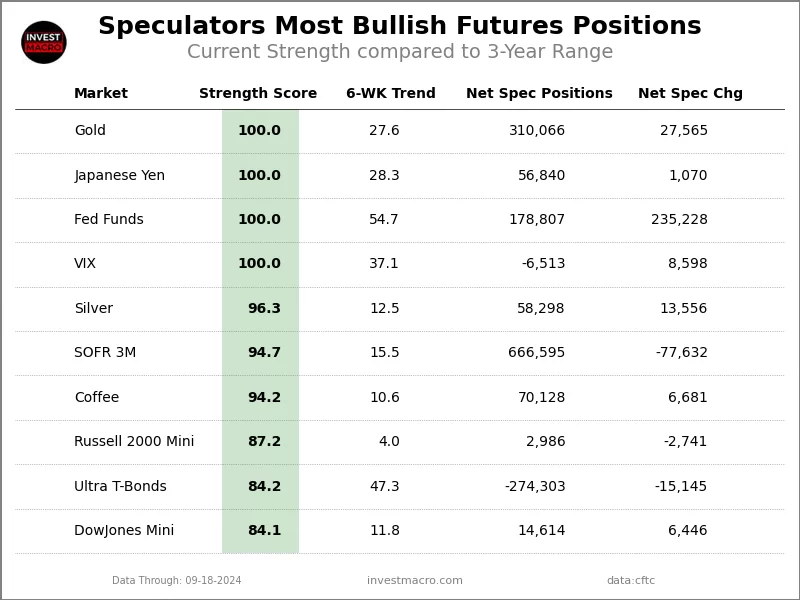
The Gold speculator position comes next in the extreme standings this week. The Gold speculator level is also at a 100.0 percent score of its 3-year range.

The six-week trend for the percent strength score was 15.3 this week. The speculator position registered 291,253 net contracts this week with a weekly boost by 23,989 contracts in speculator bets.


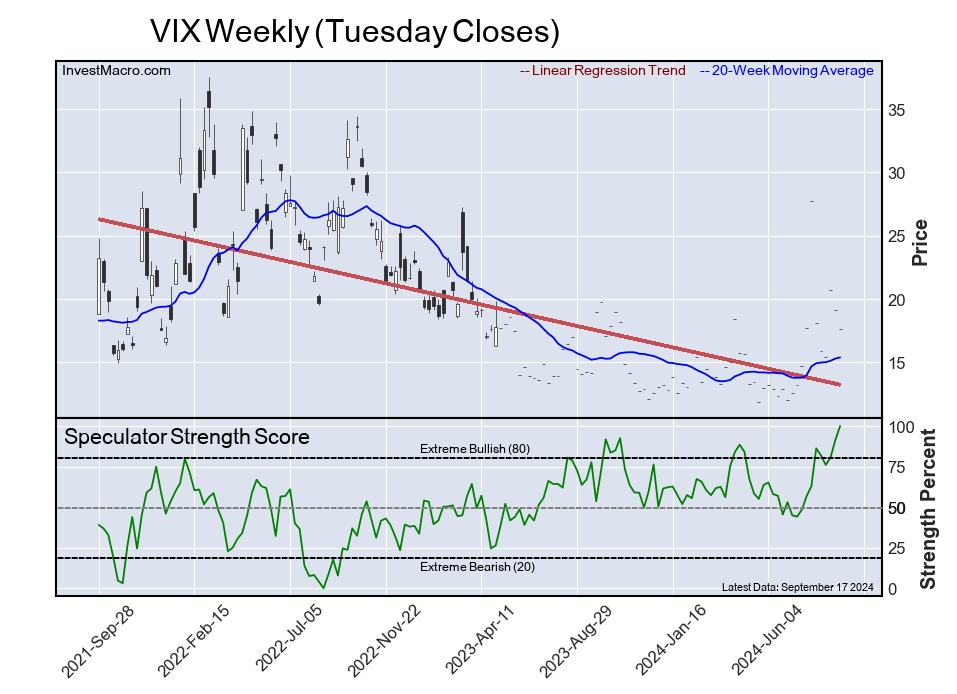
VIX


The VIX speculator position comes in third this week in the extreme standings. The VIX speculator level resides at a 88.5 percent score of its 3-year range.

The six-week trend for the speculator strength score came in at 39.9 this week. The overall speculator position was -24,592 net contracts this week with a decline of -4,330 contracts in the weekly speculator bets.


Coffee


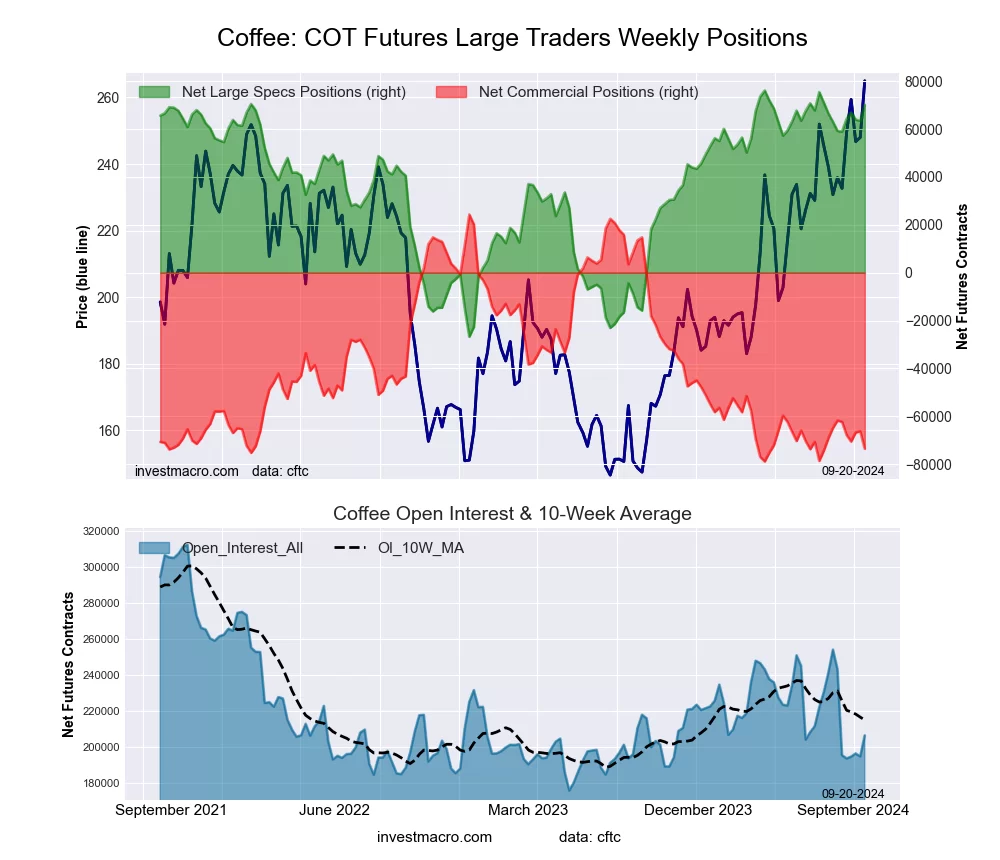
The Coffee speculator position comes up number four in the extreme standings this week. The Coffee speculator level is at a 88.4 percent score of its 3-year range.

The six-week trend for the speculator strength score totaled a change of -11.0 this week. The overall speculator position was 64,158 net contracts this week with an increase by 5,218 contracts in the speculator bets.


Silver


The Silver speculator position rounds out the top five in this week’s bullish extreme standings. The Silver speculator level sits at a 84.1 percent score of its 3-year range. The six-week trend for the speculator strength score was -15.9 this week.

The speculator position was 49,324 net contracts this week with a rise of 4,035 contracts in the weekly speculator bets.


This Week’s Most Bearish Speculator Positions:

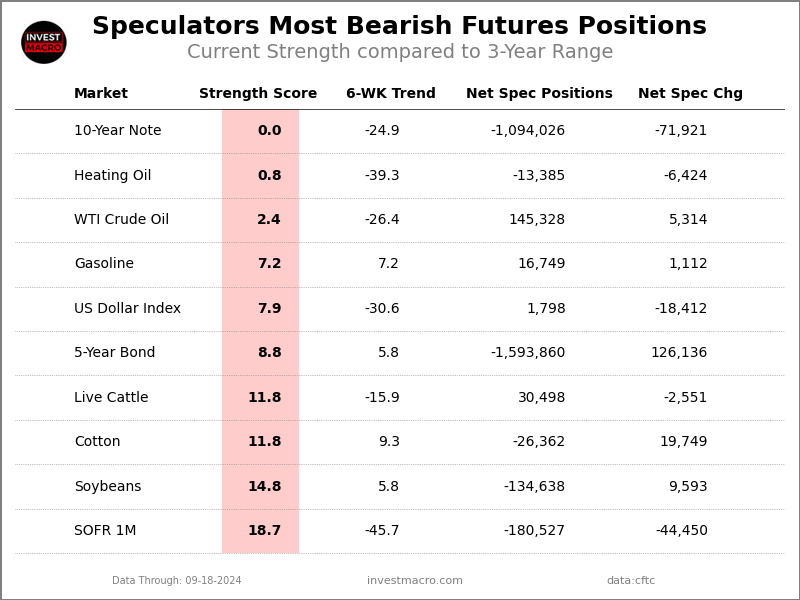
5-Year Bond


The 5-Year Bond speculator position comes in as the most bearish extreme standing this week. The 5-Year Bond speculator level is at a 0.0 percent score of its 3-year range.

The six-week trend for the speculator strength score was -9.9 this week. The overall speculator position was -1,736,810 net contracts this week with a drop of -41,738 contracts in the speculator bets.


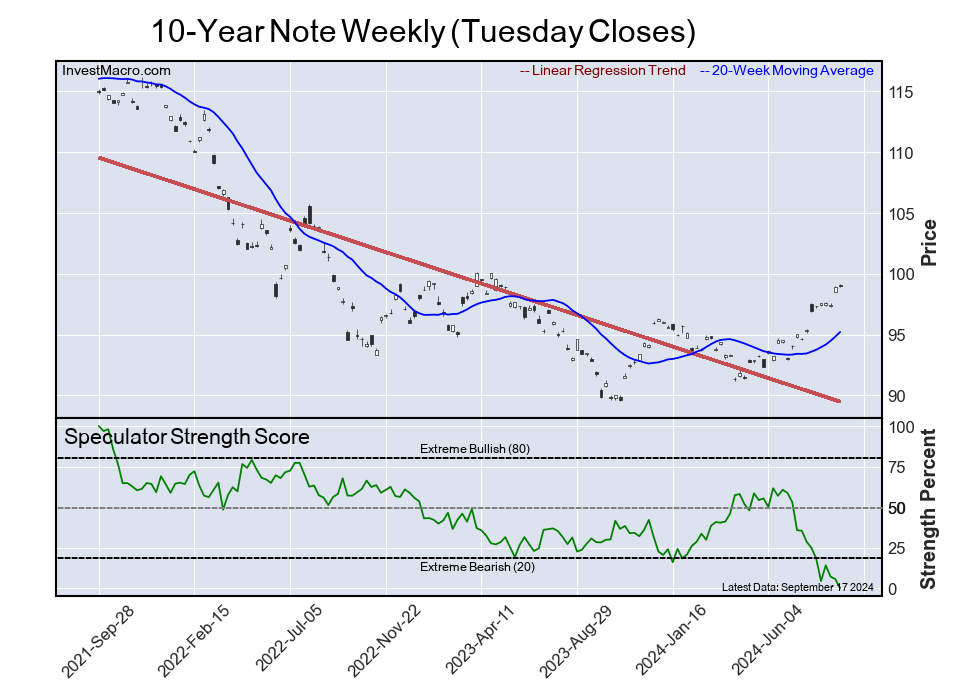
10-Year Note


The 10-Year Note speculator position comes in next for the most bearish extreme standing on the week. The 10-Year Note speculator level is at a 0.0 percent score of its 3-year range.

The six-week trend for the speculator strength score was -50.9 this week. The speculator position was -1,038,112 net contracts this week with a decline by -177,869 contracts in the weekly speculator bets.


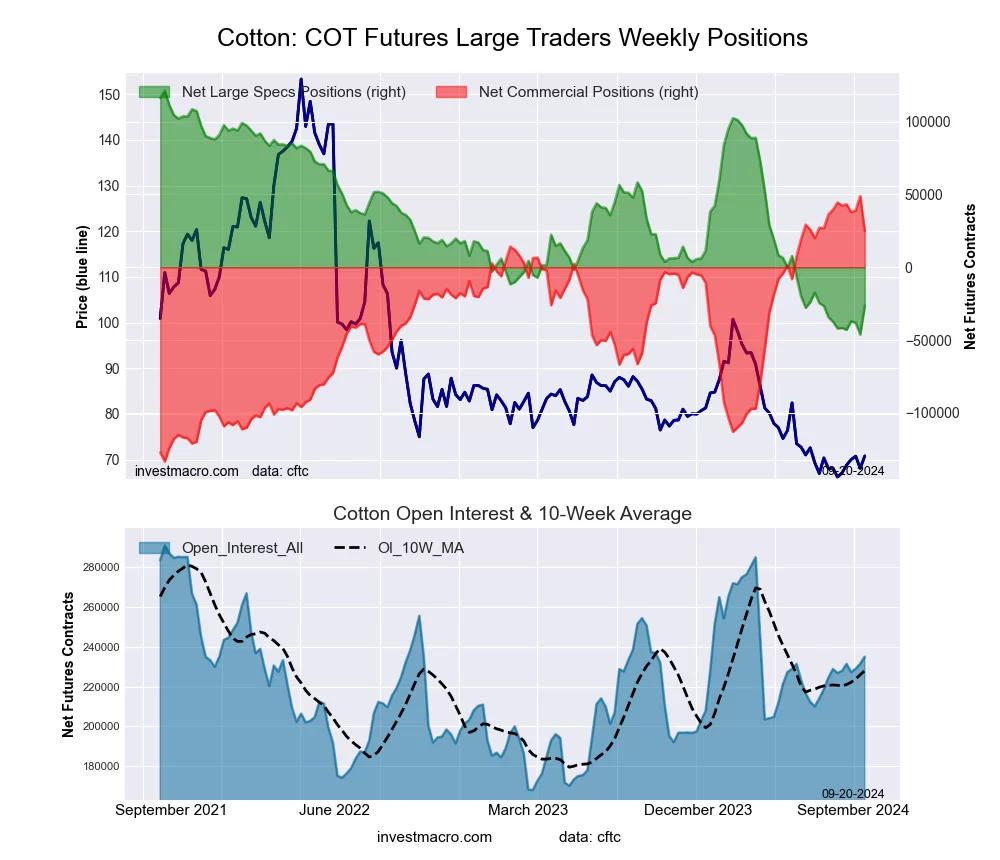
Cotton


The Cotton speculator position comes in as third most bearish extreme standing of the week. The Cotton speculator level resides at a 0.0 percent score of its 3-year range.

The six-week trend for the speculator strength score was -11.2 this week. The overall speculator position was -42,828 net contracts this week with a dip of -1,158 contracts in the speculator bets.


Brazil Real


The Brazil Real speculator position comes in as this week’s fourth most bearish extreme standing. The Brazil Real speculator level is at a 3.7 percent score of its 3-year range.

The six-week trend for the speculator strength score was -7.8 this week. The speculator position was -50,955 net contracts this week with a gain by 2,887 contracts in the weekly speculator bets.


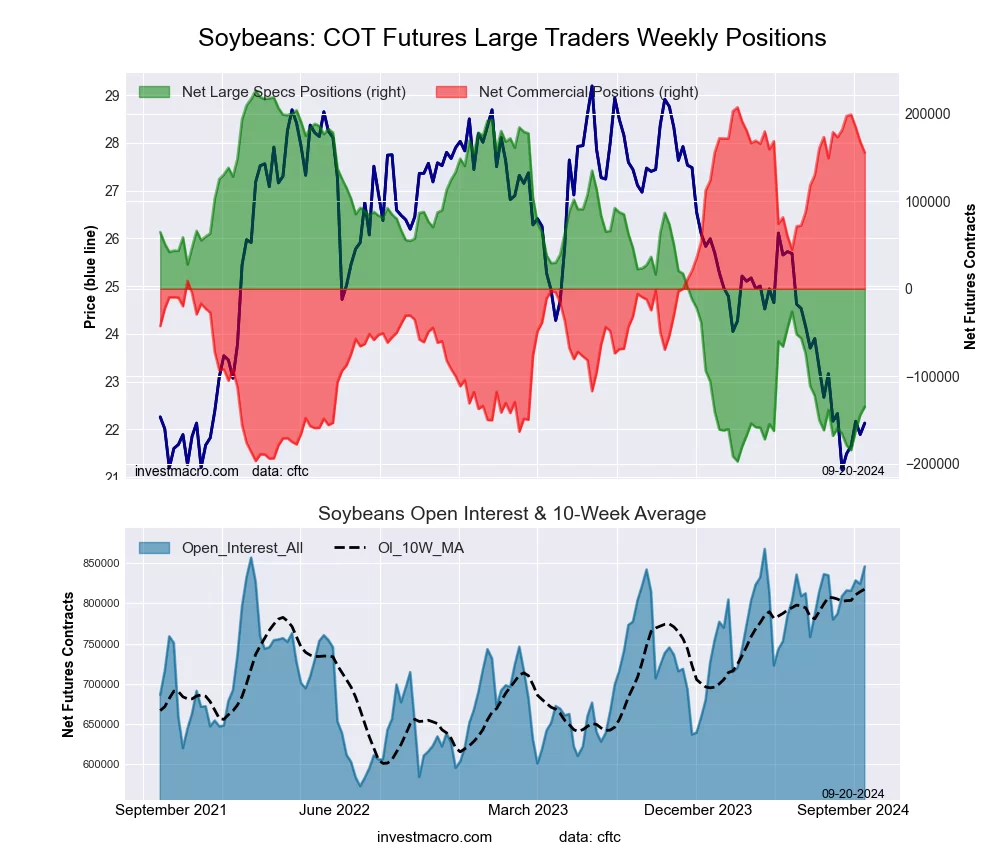
Soybeans


Finally, the Soybeans speculator position comes in as the fifth most bearish extreme standing for this week. The Soybeans speculator level is at a 4.3 percent score of its 3-year range.

The six-week trend for the speculator strength score was -6.8 this week. The speculator position was -178,893 net contracts this week with a reduction by -13,170 contracts in the weekly speculator bets.


Article By InvestMacroReceive our weekly COT Newsletter

*COT Report: The COT data, released weekly to the public each Friday, is updated through the most recent Tuesday (data is 3 days old) and shows a quick view of how large speculators or non-commercials (for-profit traders) were positioned in the futures markets.

The CFTC categorizes trader positions according to commercial hedgers (traders who use futures contracts for hedging as part of the business), non-commercials (large traders who speculate to realize trading profits) and nonreportable traders (usually small traders/speculators) as well as their open interest (contracts open in the market at time of reporting). See CFTC criteria here.

COT Metals Charts: Gold leads Speculator Bets higher

By InvestMacro

Here are the latest charts and statistics for the Commitment of Traders (COT) data published by the Commodities Futures Trading Commission (CFTC).

The latest COT data is updated through Tuesday August 20th and shows a quick view of how large traders (for-profit speculators and commercial entities) were positioned in the futures markets.

Gold leads Speculator Bets higher

The COT metals markets speculator bets were overall higher this week as five out of the six metals markets we cover had higher positioning while the other one markets had lower speculator contracts.

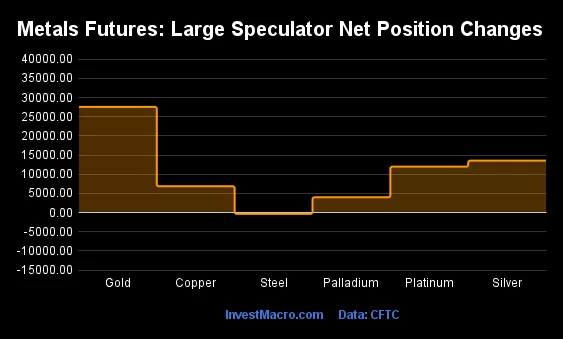
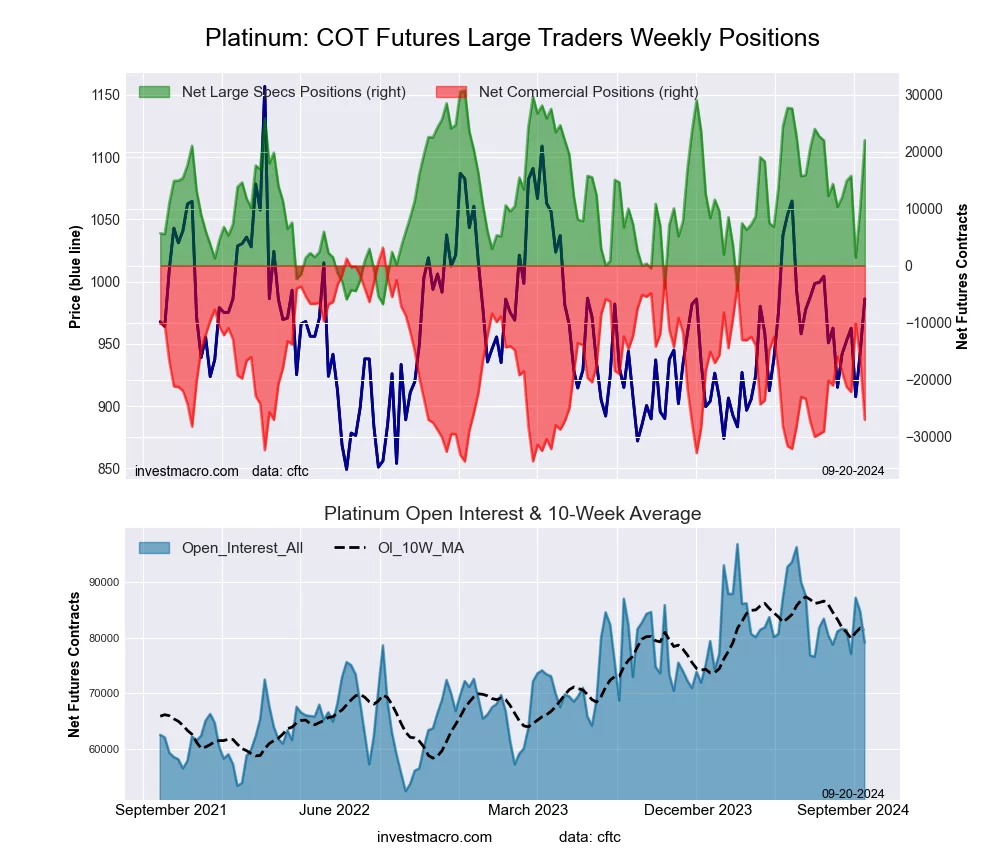
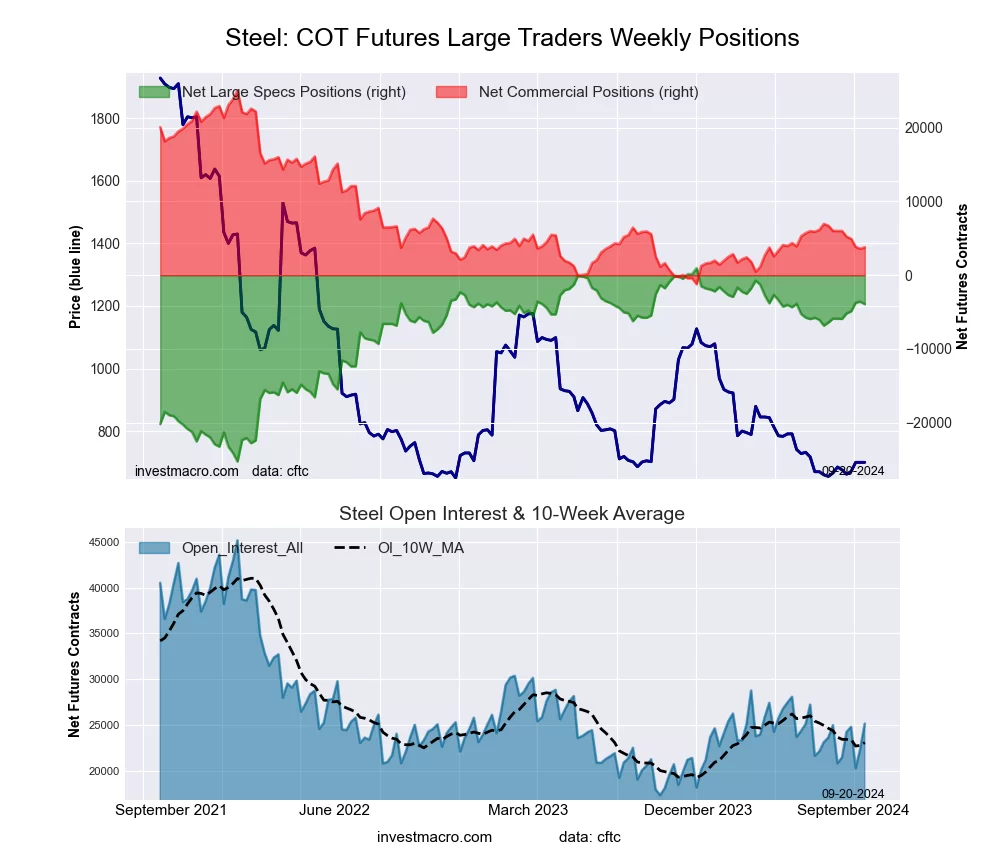
Leading the gains for the metals was Gold (23,989 contracts) with Copper (4,477 contracts), Silver (4,035 contracts), Platinum (2,887 contracts) and Steel (750 contracts) also showing positive weeks.

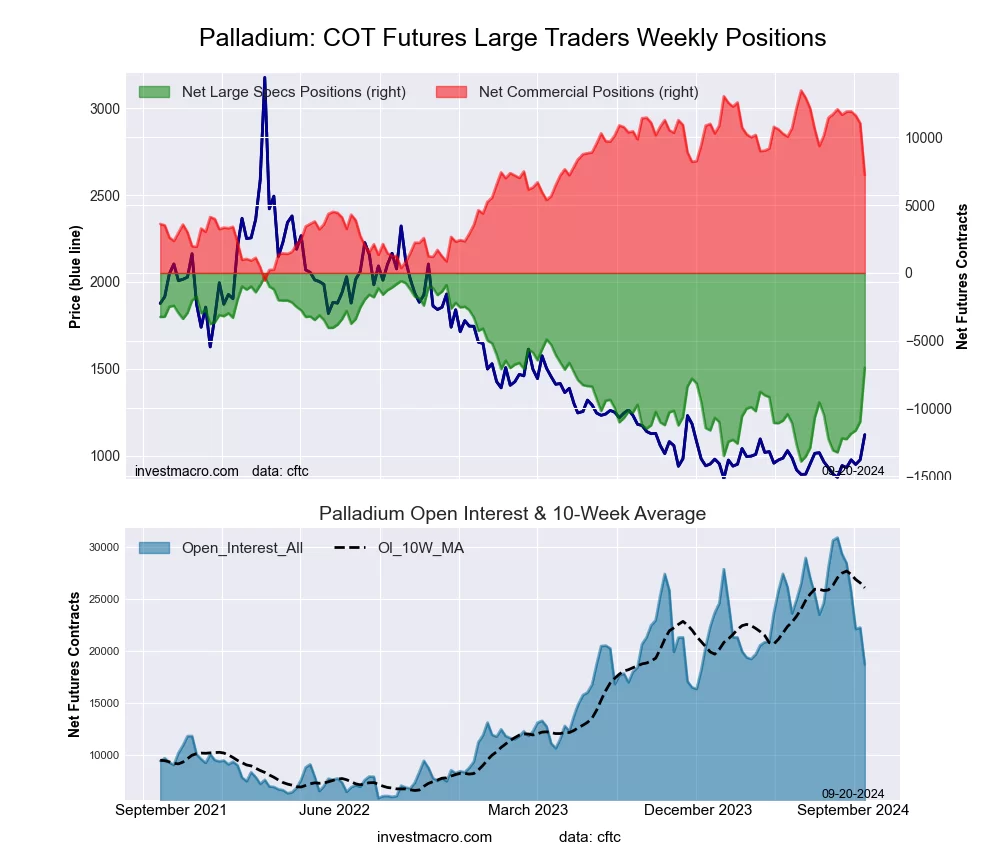
The market with declines in speculator bets was Palladium with a small dip by -41 contracts on the week.


Metals Net Speculators Leaderboard
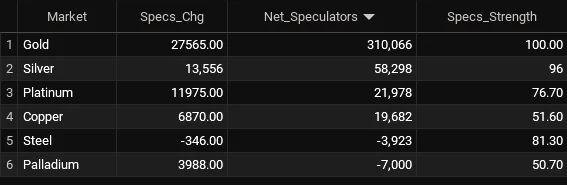
Legend: Weekly Speculators Change | Speculators Current Net Position | Speculators Strength Score compared to last 3-Years (0-100 range)


Strength Scores led by Gold & Silver
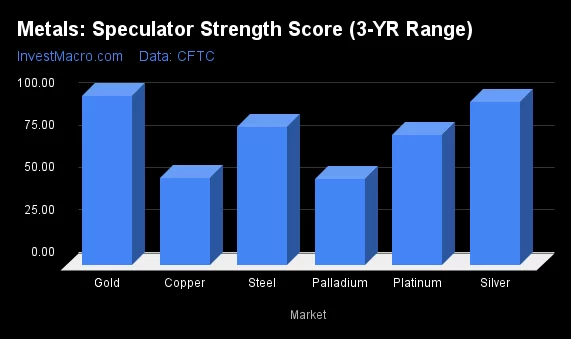
COT Strength Scores (a normalized measure of Speculator positions over a 3-Year range, from 0 to 100 where above 80 is Extreme-Bullish and below 20 is Extreme-Bearish) showed that Gold (100 percent) and Silver (84 percent) lead the metals markets this week. Steel (77 percent) comes in as the next highest in the weekly strength scores.

On the downside, Palladium (12 percent) comes in at the lowest strength level currently and is in Extreme-Bearish territory (below 20 percent).

Strength Statistics:
Gold (100.0 percent) vs Gold previous week (90.0 percent)
Silver (84.1 percent) vs Silver previous week (78.6 percent)
Copper (52.1 percent) vs Copper previous week (48.0 percent)
Platinum (57.6 percent) vs Platinum previous week (49.9 percent)
Palladium (12.0 percent) vs Palladium previous week (12.3 percent)
Steel (76.6 percent) vs Palladium previous week (73.7 percent)


Gold & Steel top the 6-Week Strength Trends

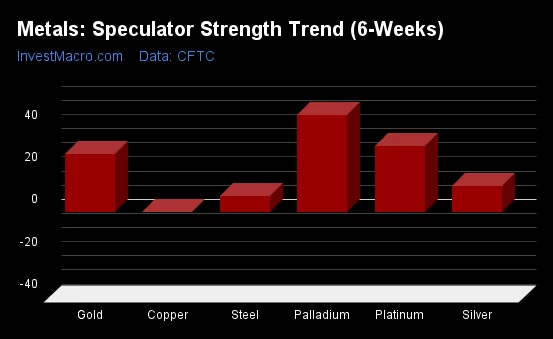
COT Strength Score Trends (or move index, calculates the 6-week changes in strength scores) showed that Gold (15 percent) and Steel (3 percent) lead the past six weeks trends for metals.

Copper (-33 percent), Platinum (-21 percent) and Palladium (-20 percent) lead the downside trend scores currently.

Move Statistics:
Gold (15.3 percent) vs Gold previous week (10.8 percent)
Silver (-15.9 percent) vs Silver previous week (-14.3 percent)
Copper (-33.3 percent) vs Copper previous week (-31.1 percent)
Platinum (-20.9 percent) vs Platinum previous week (-32.1 percent)
Palladium (-19.7 percent) vs Palladium previous week (-11.2 percent)
Steel (3.3 percent) vs Steel previous week (-0.6 percent)


Individual Markets:

Gold Comex Futures:
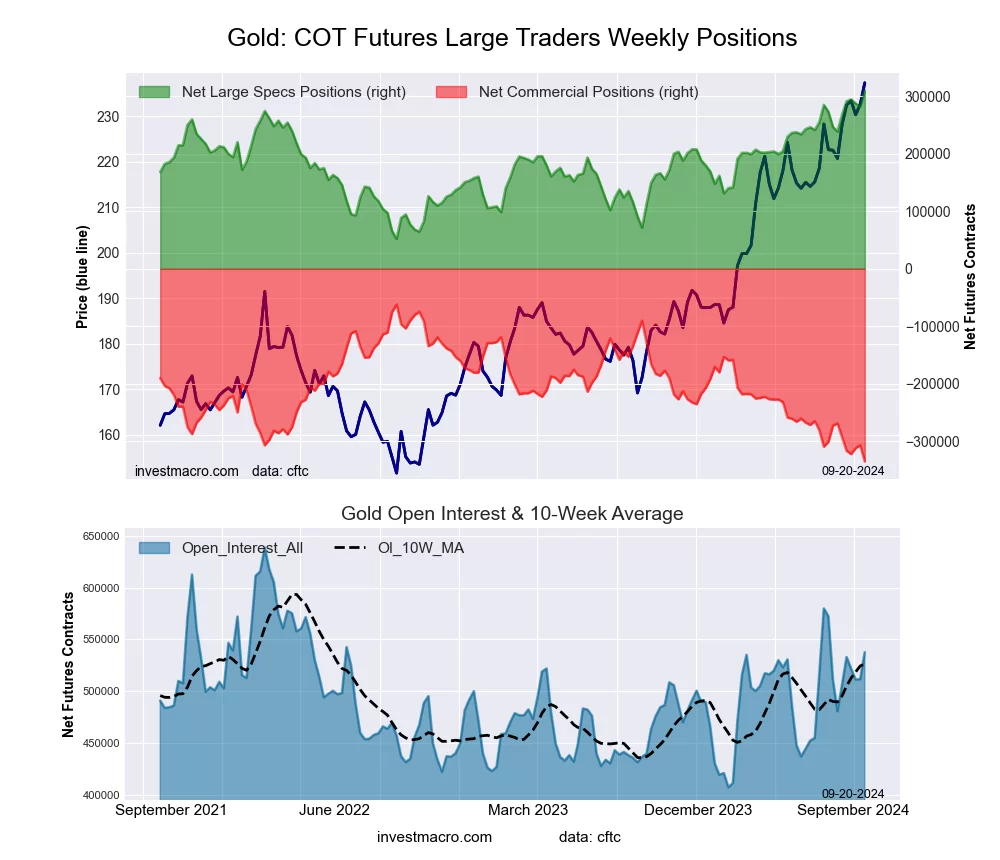
Gold Futures COT ChartThe Gold Comex Futures large speculator standing this week reached a net position of 291,253 contracts in the data reported through Tuesday. This was a weekly rise of 23,989 contracts from the previous week which had a total of 267,264 net contracts.

This week’s current strength score (the trader positioning range over the past three years, measured from 0 to 100) shows the speculators are currently Bullish-Extreme with a score of 100.0 percent. The commercials are Bearish-Extreme with a score of 0.0 percent and the small traders (not shown in chart) are Bullish with a score of 62.1 percent.

Price Trend-Following Model: Strong Uptrend

Our weekly trend-following model classifies the current market price position as: Strong Uptrend. The current action for the model is considered to be: Hold – Maintain Long Position.

Gold Futures StatisticsSPECULATORSCOMMERCIALSSMALL TRADERS
– Percent of Open Interest Longs:66.716.29.9
– Percent of Open Interest Shorts:12.175.65.2
– Net Position:291,253-316,50625,253
– Gross Longs:355,55186,23252,918
– Gross Shorts:64,298402,73827,665
– Long to Short Ratio:5.5 to 10.2 to 11.9 to 1
NET POSITION TREND:
– Strength Index Score (3 Year Range Pct):100.00.062.1
– Strength Index Reading (3 Year Range):Bullish-ExtremeBearish-ExtremeBullish
NET POSITION MOVEMENT INDEX:
– 6-Week Change in Strength Index:15.3-14.1-2.2


Silver Comex Futures:

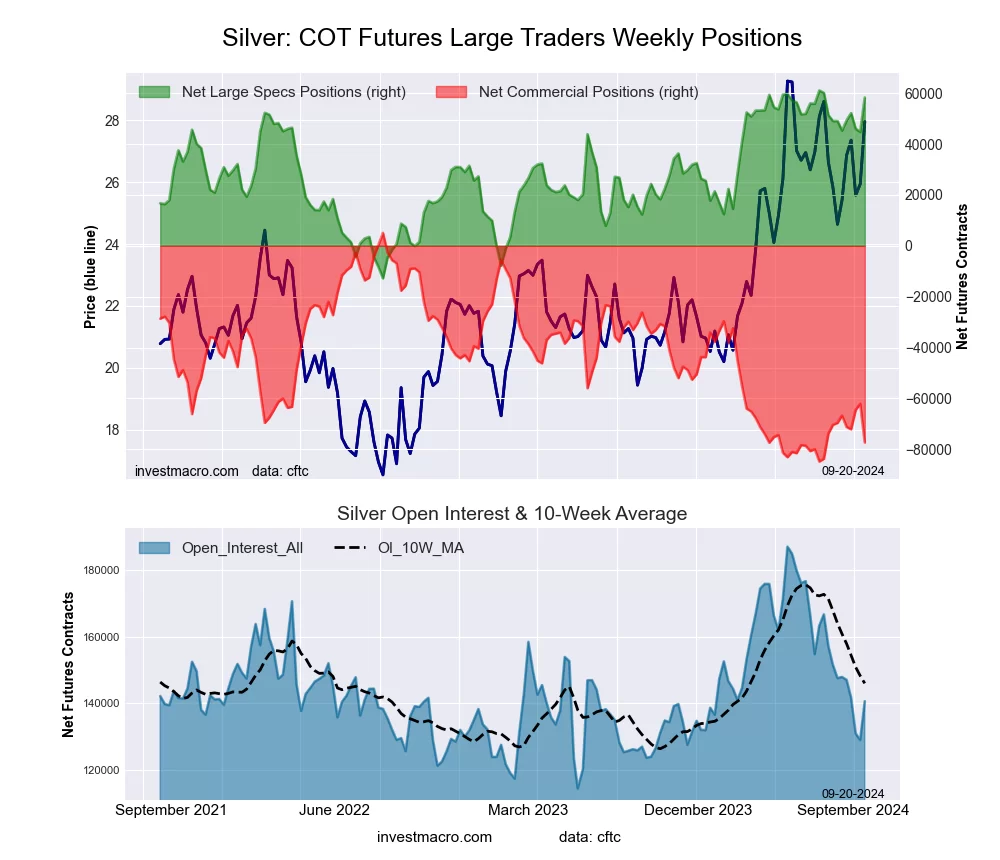
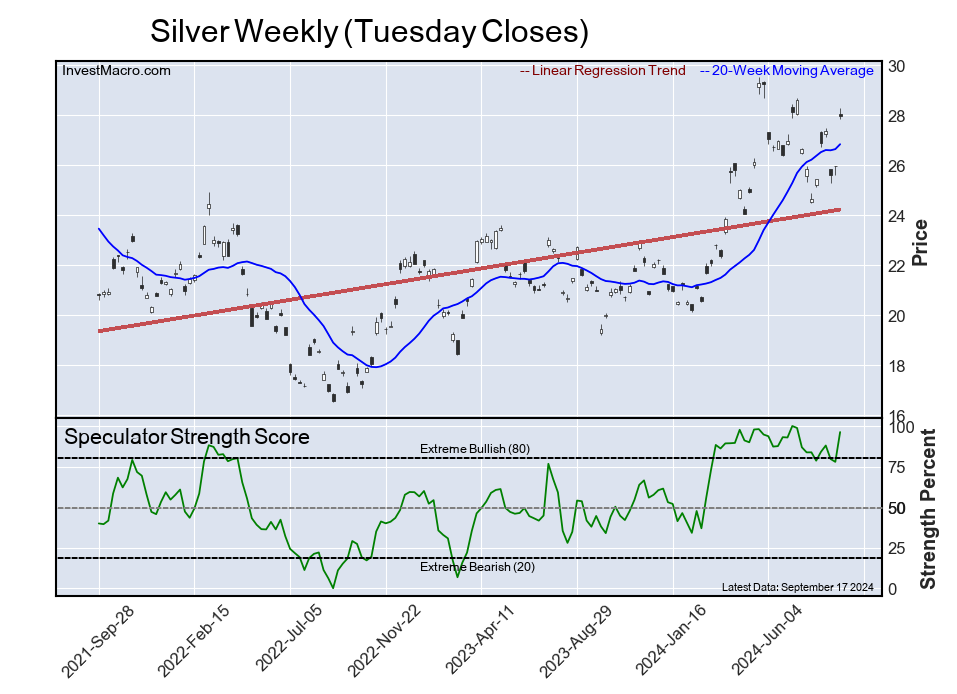
Silver Futures COT ChartThe Silver Comex Futures large speculator standing this week reached a net position of 49,324 contracts in the data reported through Tuesday. This was a weekly gain of 4,035 contracts from the previous week which had a total of 45,289 net contracts.

This week’s current strength score (the trader positioning range over the past three years, measured from 0 to 100) shows the speculators are currently Bullish-Extreme with a score of 84.1 percent. The commercials are Bearish-Extreme with a score of 15.1 percent and the small traders (not shown in chart) are Bullish with a score of 76.7 percent.

Price Trend-Following Model: Strong Uptrend

Our weekly trend-following model classifies the current market price position as: Strong Uptrend. The current action for the model is considered to be: Hold – Maintain Long Position.

Silver Futures StatisticsSPECULATORSCOMMERCIALSSMALL TRADERS
– Percent of Open Interest Longs:43.524.321.9
– Percent of Open Interest Shorts:9.972.77.0
– Net Position:49,324-71,22821,904
– Gross Longs:63,93035,69932,230
– Gross Shorts:14,606106,92710,326
– Long to Short Ratio:4.4 to 10.3 to 13.1 to 1
NET POSITION TREND:
– Strength Index Score (3 Year Range Pct):84.115.176.7
– Strength Index Reading (3 Year Range):Bullish-ExtremeBearish-ExtremeBullish
NET POSITION MOVEMENT INDEX:
– 6-Week Change in Strength Index:-15.915.1-8.9


Copper Grade #1 Futures:

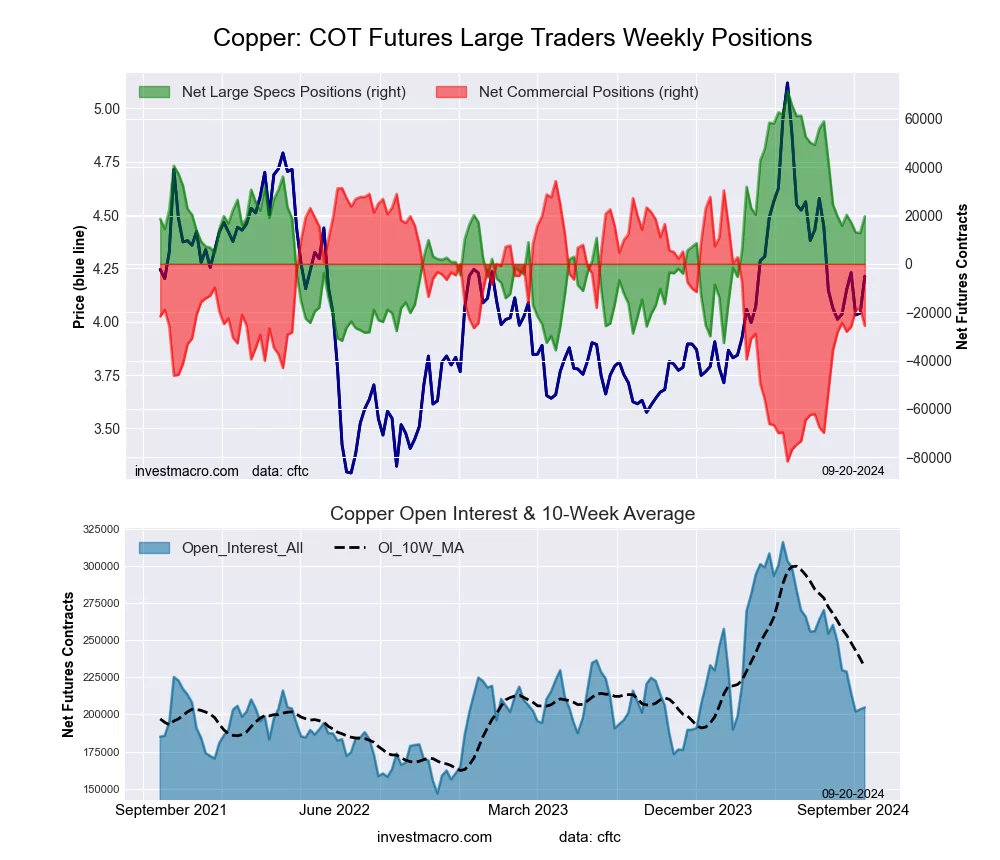
Copper Futures COT ChartThe Copper Grade #1 Futures large speculator standing this week reached a net position of 20,274 contracts in the data reported through Tuesday. This was a weekly advance of 4,477 contracts from the previous week which had a total of 15,797 net contracts.

This week’s current strength score (the trader positioning range over the past three years, measured from 0 to 100) shows the speculators are currently Bullish with a score of 52.1 percent. The commercials are Bearish with a score of 46.3 percent and the small traders (not shown in chart) are Bullish with a score of 64.5 percent.

Price Trend-Following Model: Strong Downtrend

Our weekly trend-following model classifies the current market price position as: Strong Downtrend. The current action for the model is considered to be: Hold – Maintain Short Position.

Copper Futures StatisticsSPECULATORSCOMMERCIALSSMALL TRADERS
– Percent of Open Interest Longs:40.131.88.4
– Percent of Open Interest Shorts:31.344.15.1
– Net Position:20,274-28,0057,731
– Gross Longs:91,83572,87419,316
– Gross Shorts:71,561100,87911,585
– Long to Short Ratio:1.3 to 10.7 to 11.7 to 1
NET POSITION TREND:
– Strength Index Score (3 Year Range Pct):52.146.364.5
– Strength Index Reading (3 Year Range):BullishBearishBullish
NET POSITION MOVEMENT INDEX:
– 6-Week Change in Strength Index:-33.334.1-22.9


Platinum Futures:

Platinum Futures COT ChartThe Platinum Futures large speculator standing this week reached a net position of 14,826 contracts in the data reported through Tuesday. This was a weekly boost of 2,887 contracts from the previous week which had a total of 11,939 net contracts.

This week’s current strength score (the trader positioning range over the past three years, measured from 0 to 100) shows the speculators are currently Bullish with a score of 57.6 percent. The commercials are Bearish with a score of 34.9 percent and the small traders (not shown in chart) are Bullish with a score of 72.9 percent.

Price Trend-Following Model: Strong Downtrend

Our weekly trend-following model classifies the current market price position as: Strong Downtrend. The current action for the model is considered to be: New Sell – Short Position.

Platinum Futures StatisticsSPECULATORSCOMMERCIALSSMALL TRADERS
– Percent of Open Interest Longs:56.522.912.4
– Percent of Open Interest Shorts:38.349.04.4
– Net Position:14,826-21,2736,447
– Gross Longs:45,98018,61610,054
– Gross Shorts:31,15439,8893,607
– Long to Short Ratio:1.5 to 10.5 to 12.8 to 1
NET POSITION TREND:
– Strength Index Score (3 Year Range Pct):57.634.972.9
– Strength Index Reading (3 Year Range):BullishBearishBullish
NET POSITION MOVEMENT INDEX:
– 6-Week Change in Strength Index:-20.922.1-8.0


Palladium Futures:

Palladium Futures COT ChartThe Palladium Futures large speculator standing this week reached a net position of -12,265 contracts in the data reported through Tuesday. This was a weekly decline of -41 contracts from the previous week which had a total of -12,224 net contracts.

This week’s current strength score (the trader positioning range over the past three years, measured from 0 to 100) shows the speculators are currently Bearish-Extreme with a score of 12.0 percent. The commercials are Bullish-Extreme with a score of 88.9 percent and the small traders (not shown in chart) are Bullish with a score of 50.7 percent.

Price Trend-Following Model: Weak Downtrend

Our weekly trend-following model classifies the current market price position as: Weak Downtrend. The current action for the model is considered to be: Hold – Maintain Short Position.

Palladium Futures StatisticsSPECULATORSCOMMERCIALSSMALL TRADERS
– Percent of Open Interest Longs:29.751.26.9
– Percent of Open Interest Shorts:72.99.35.6
– Net Position:-12,26511,908357
– Gross Longs:8,44014,5431,952
– Gross Shorts:20,7052,6351,595
– Long to Short Ratio:0.4 to 15.5 to 11.2 to 1
NET POSITION TREND:
– Strength Index Score (3 Year Range Pct):12.088.950.7
– Strength Index Reading (3 Year Range):Bearish-ExtremeBullish-ExtremeBullish
NET POSITION MOVEMENT INDEX:
– 6-Week Change in Strength Index:-19.718.18.2


Steel Futures Futures:

Steel Futures COT ChartThe Steel Futures large speculator standing this week reached a net position of -5,171 contracts in the data reported through Tuesday. This was a weekly increase of 750 contracts from the previous week which had a total of -5,921 net contracts.

This week’s current strength score (the trader positioning range over the past three years, measured from 0 to 100) shows the speculators are currently Bullish with a score of 76.6 percent. The commercials are Bearish with a score of 24.5 percent and the small traders (not shown in chart) are Bearish with a score of 27.8 percent.

Price Trend-Following Model: Downtrend

Our weekly trend-following model classifies the current market price position as: Downtrend. The current action for the model is considered to be: Hold – Maintain Short Position.

Steel Futures StatisticsSPECULATORSCOMMERCIALSSMALL TRADERS
– Percent of Open Interest Longs:12.977.00.7
– Percent of Open Interest Shorts:34.255.40.9
– Net Position:-5,1715,213-42
– Gross Longs:3,12918,655177
– Gross Shorts:8,30013,442219
– Long to Short Ratio:0.4 to 11.4 to 10.8 to 1
NET POSITION TREND:
– Strength Index Score (3 Year Range Pct):76.624.527.8
– Strength Index Reading (3 Year Range):BullishBearishBearish
NET POSITION MOVEMENT INDEX:
– 6-Week Change in Strength Index:3.3-3.57.3


Article By InvestMacroReceive our weekly COT Newsletter

*COT Report: The COT data, released weekly to the public each Friday, is updated through the most recent Tuesday (data is 3 days old) and shows a quick view of how large speculators or non-commercials (for-profit traders) were positioned in the futures markets.

The CFTC categorizes trader positions according to commercial hedgers (traders who use futures contracts for hedging as part of the business), non-commercials (large traders who speculate to realize trading profits) and nonreportable traders (usually small traders/speculators) as well as their open interest (contracts open in the market at time of reporting). See CFTC criteria here.
COT Bonds Charts: Speculator Bets led by Ultra Treasury Bonds & Ultra 10-Year Bonds

By InvestMacro

Here are the latest charts and statistics for the Commitment of Traders (COT) reports data published by the Commodities Futures Trading Commission (CFTC).

The latest COT data is updated through Tuesday August 20th and shows a quick view of how large traders (for-profit speculators and commercial hedgers) were positioned in the futures markets.

Weekly Speculator Changes led by Ultra Treasury Bonds & Ultra 10-Year Bonds

The COT bond market speculator bets were lower this week as just two out of the eight bond markets we cover had higher positioning while the other six markets had lower speculator contracts.

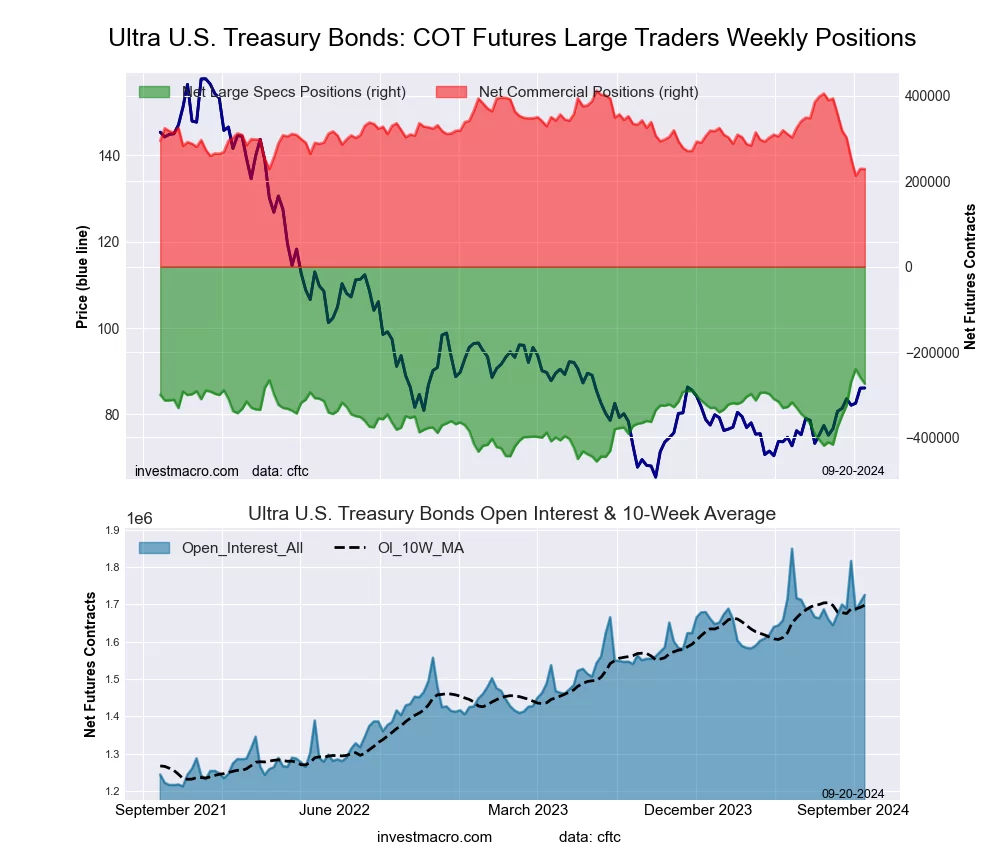
Leading the gains for the bond markets was the Ultra Treasury Bonds (23,519 contracts) with the Ultra 10-Year Bonds (15,073 contracts) also showing a positive week.

The bond markets with declines in speculator bets for the week were the 10-Year Bonds (-177,869 contracts), the SOFR 3-Months (-63,211 contracts), the 2-Year Bonds (-47,974 contracts), the Fed Funds (-45,221 contracts), the 5-Year Bonds (-41,738 contracts) and with the US Treasury Bonds (-7,165 contracts) also registering lower bets on the week.


Bonds Net Speculators Leaderboard

Legend: Weekly Speculators Change | Speculators Current Net Position | Speculators Strength Score compared to last 3-Years (0-100 range)


Strength Scores led by SOFR 3-Months & US Treasury Bonds

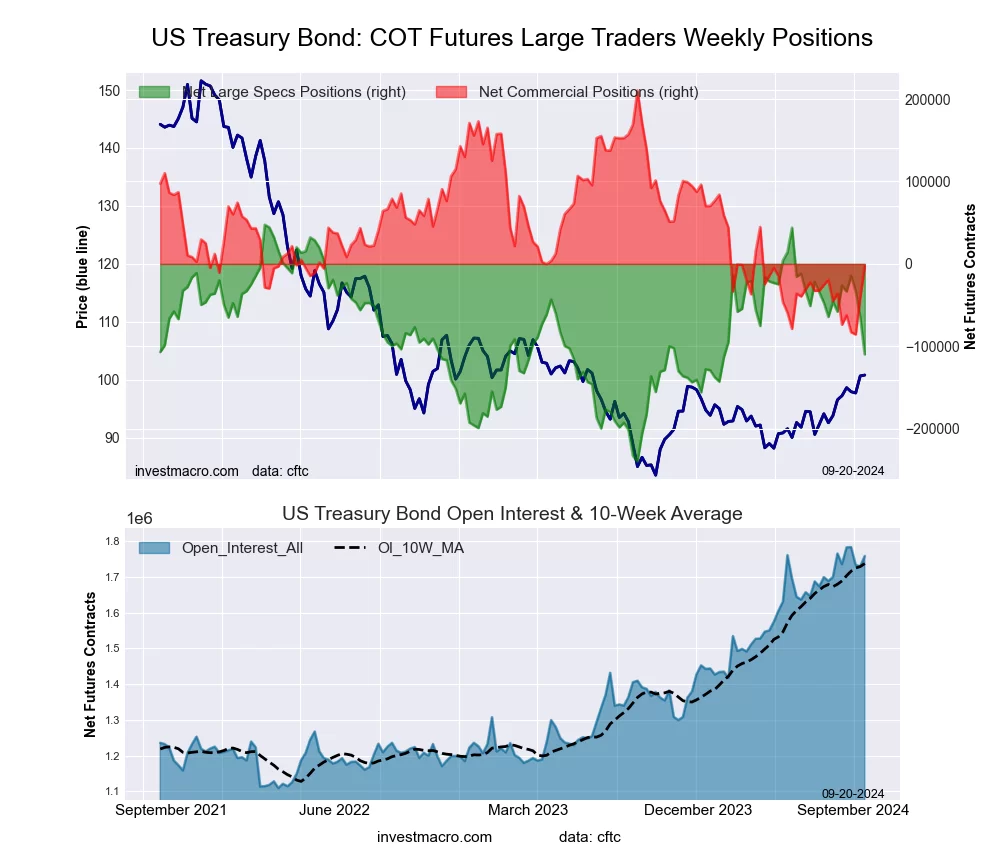
COT Strength Scores (a normalized measure of Speculator positions over a 3-Year range, from 0 to 100 where above 80 is Extreme-Bullish and below 20 is Extreme-Bearish) showed that the SOFR 3-Months (80 percent) and the US Treasury Bonds (72 percent) lead the bond markets this week. The Ultra Treasury Bonds (69 percent) comes in as the next highest in the weekly strength scores.

On the downside, the 5-Year Bonds (0 percent) and the 10-Year Bonds (0 percent) come in at the lowest strength level currently and are in Extreme-Bearish territory (below 20 percent). The next lowest strength scores were the 2-Year Bonds (21 percent) and the Ultra 10-Year Bonds (30 percent).

Strength Statistics:
Fed Funds (35.9 percent) vs Fed Funds previous week (46.2 percent)
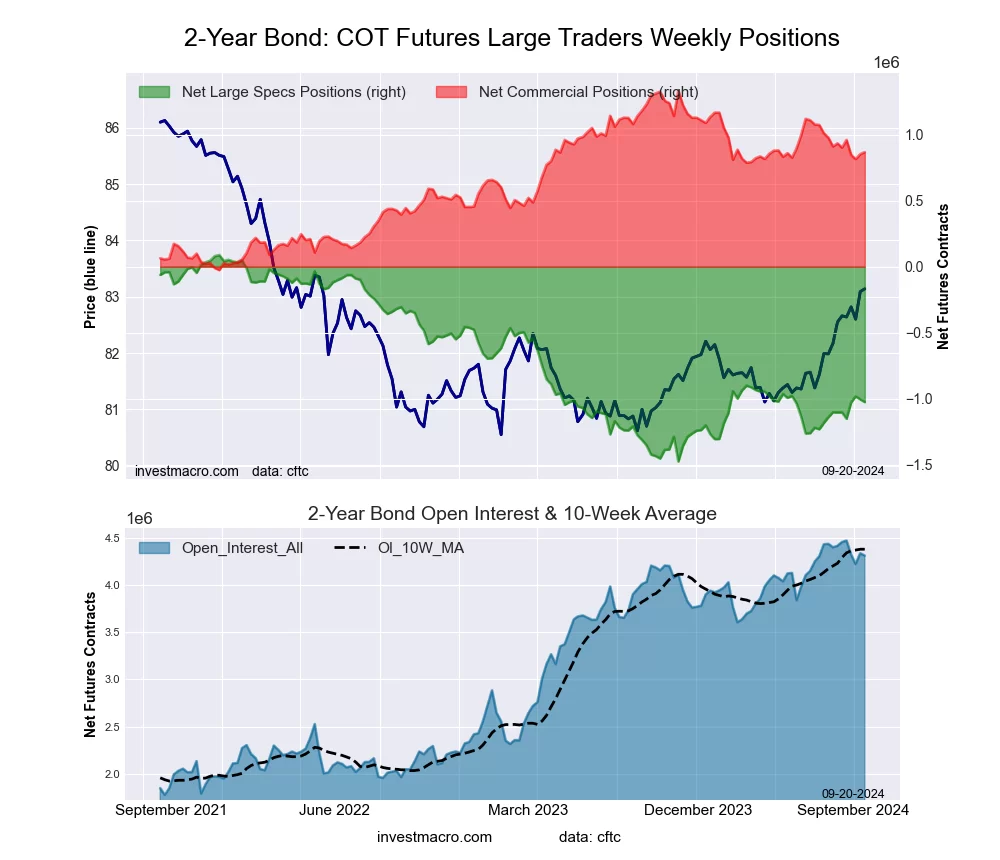
2-Year Bond (20.7 percent) vs 2-Year Bond previous week (23.8 percent)
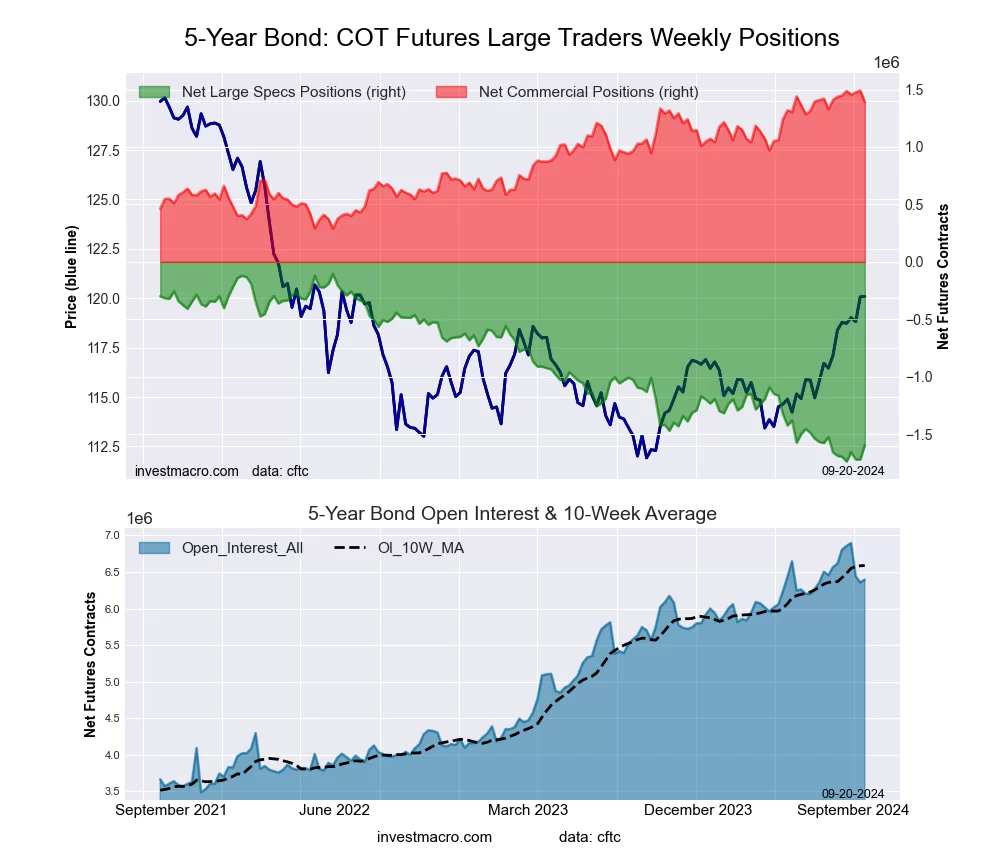
5-Year Bond (0.0 percent) vs 5-Year Bond previous week (2.4 percent)
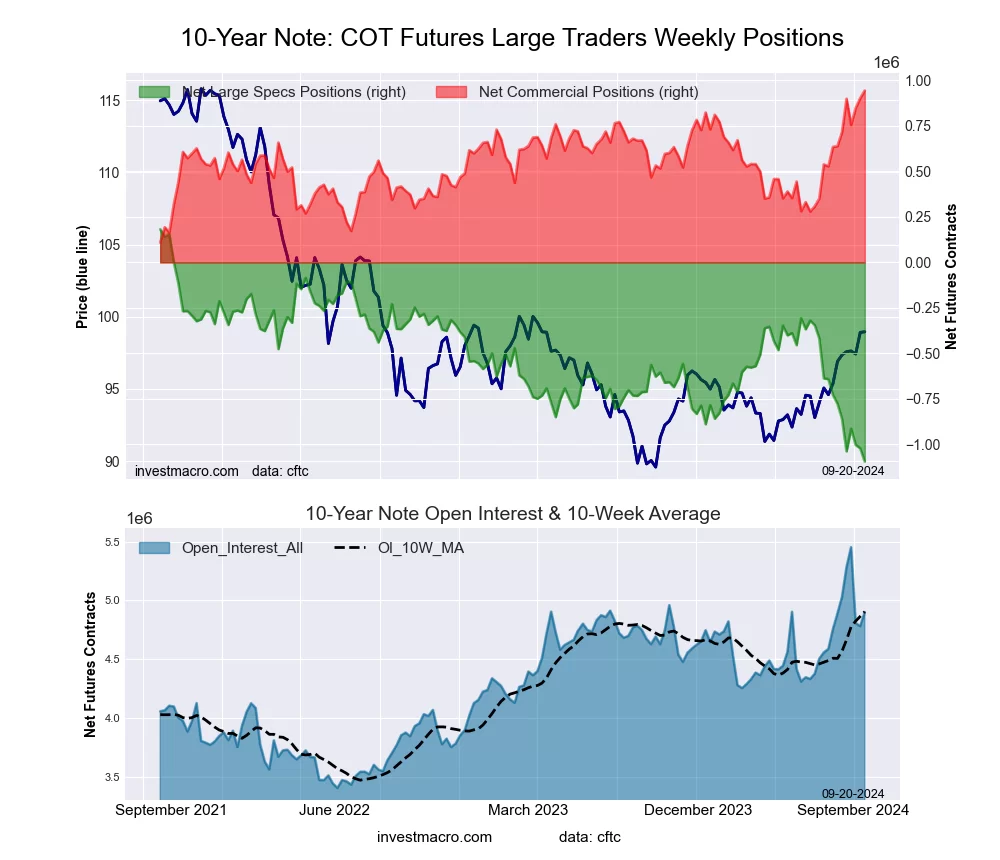
10-Year Bond (0.0 percent) vs 10-Year Bond previous week (14.6 percent)
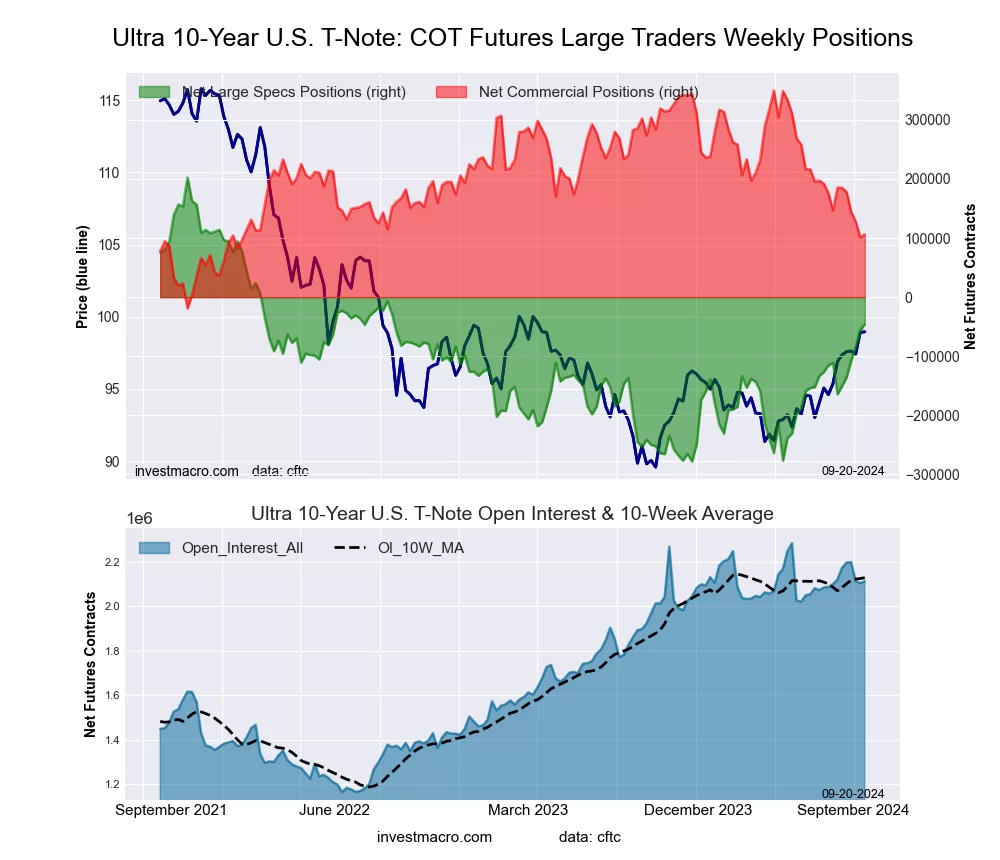
Ultra 10-Year Bond (29.7 percent) vs Ultra 10-Year Bond previous week (26.5 percent)
US Treasury Bond (71.8 percent) vs US Treasury Bond previous week (74.3 percent)
Ultra US Treasury Bond (68.8 percent) vs Ultra US Treasury Bond previous week (56.4 percent)
SOFR 3-Months (80.0 percent) vs SOFR 3-Months previous week (83.3 percent)


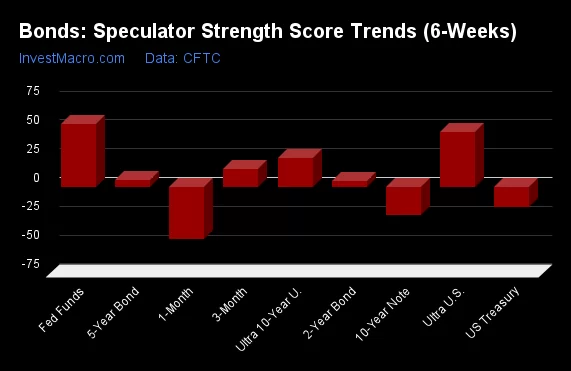
Ultra Treasury Bonds & SOFR 3-Months top the 6-Week Strength Trends

COT Strength Score Trends (or move index, calculates the 6-week changes in strength scores) showed that the Ultra Treasury Bonds (42 percent) and the SOFR 3-Months (27 percent) lead the past six weeks trends for bonds. The 2-Year Bonds (5 percent) and the  are the next highest positive movers in the latest trends data.

The 10-Year Bonds (-51 percent) leads the downside trend scores currently with the 5-Year Bonds (-10 percent) and the Fed Funds (-1 percent) following next with lower trend scores.

Strength Trend Statistics:
Fed Funds (-0.7 percent) vs Fed Funds previous week (15.5 percent)
2-Year Bond (5.1 percent) vs 2-Year Bond previous week (7.4 percent)
5-Year Bond (-9.9 percent) vs 5-Year Bond previous week (-9.2 percent)
10-Year Bond (-50.9 percent) vs 10-Year Bond previous week (-42.2 percent)
Ultra 10-Year Bond (-0.5 percent) vs Ultra 10-Year Bond previous week (0.3 percent)
US Treasury Bond (0.3 percent) vs US Treasury Bond previous week (-1.6 percent)
Ultra US Treasury Bond (42.2 percent) vs Ultra US Treasury Bond previous week (23.2 percent)
SOFR 3-Months (27.5 percent) vs SOFR 3-Months previous week (36.5 percent)


Secured Overnight Financing Rate (3-Month) Futures:

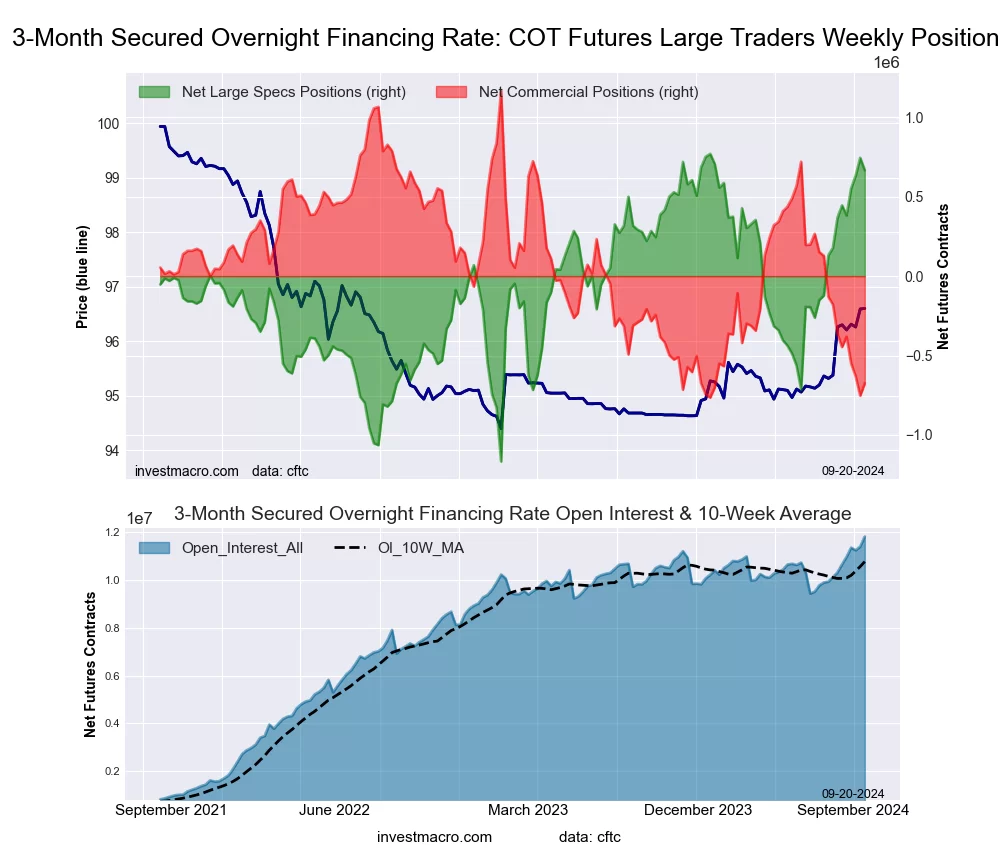
SOFR 3-Months Bonds Futures COT ChartThe Secured Overnight Financing Rate (3-Month) large speculator standing this week was a net position of 381,853 contracts in the data reported through Tuesday. This was a weekly reduction of -63,211 contracts from the previous week which had a total of 445,064 net contracts.

This week’s current strength score (the trader positioning range over the past three years, measured from 0 to 100) shows the speculators are currently Bullish with a score of 80.0 percent. The commercials are Bearish-Extreme with a score of 19.9 percent and the small traders (not shown in chart) are Bullish-Extreme with a score of 87.2 percent.

Price Trend-Following Model: Weak Uptrend

Our weekly trend-following model classifies the current market price position as: Weak Uptrend. The current action for the model is considered to be: Hold – Maintain Long Position.

SOFR 3-Months StatisticsSPECULATORSCOMMERCIALSSMALL TRADERS
– Percent of Open Interest Longs:15.455.20.4
– Percent of Open Interest Shorts:11.958.70.4
– Net Position:381,853-380,583-1,270
– Gross Longs:1,686,9806,061,55138,761
– Gross Shorts:1,305,1276,442,13440,031
– Long to Short Ratio:1.3 to 10.9 to 11.0 to 1
NET POSITION TREND:
– Strength Index Score (3 Year Range Pct):80.019.987.2
– Strength Index Reading (3 Year Range):BullishBearish-ExtremeBullish-Extreme
NET POSITION MOVEMENT INDEX:
– 6-Week Change in Strength Index:27.5-27.5-0.6


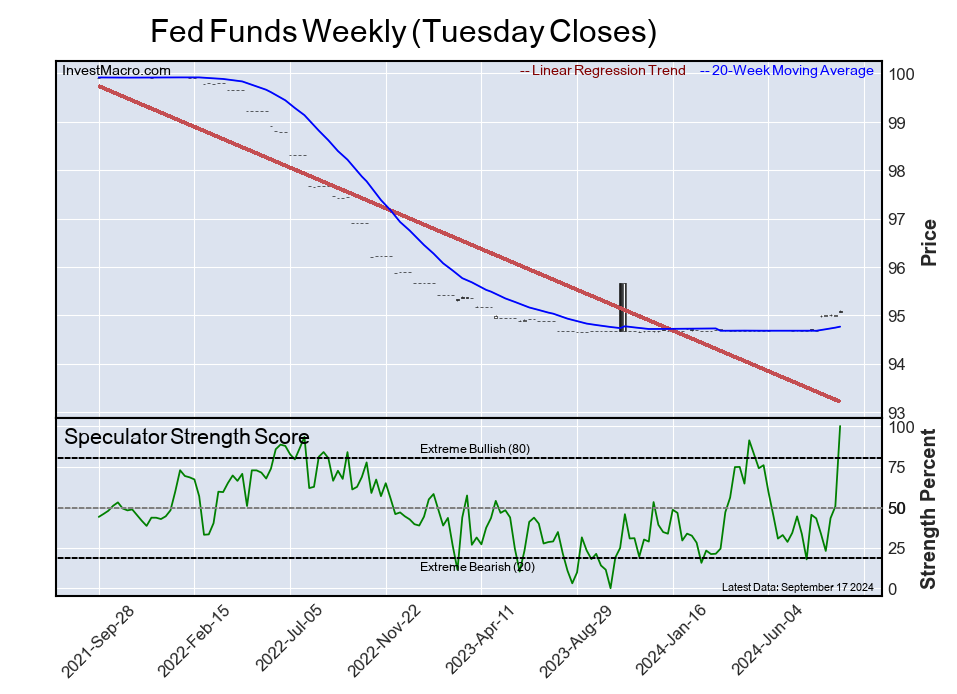
30-Day Federal Funds Futures:

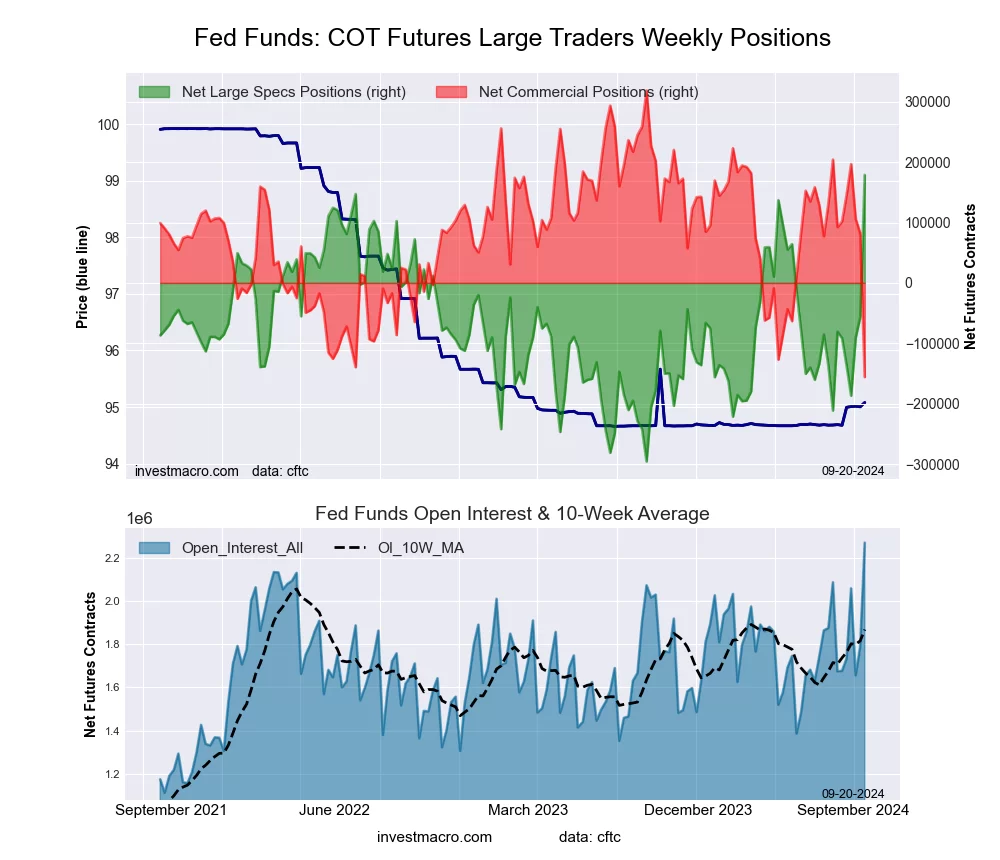
Federal Funds 30-Day Bonds Futures COT ChartThe 30-Day Federal Funds large speculator standing this week was a net position of -136,512 contracts in the data reported through Tuesday. This was a weekly decline of -45,221 contracts from the previous week which had a total of -91,291 net contracts.

This week’s current strength score (the trader positioning range over the past three years, measured from 0 to 100) shows the speculators are currently Bearish with a score of 35.9 percent. The commercials are Bullish with a score of 62.2 percent and the small traders (not shown in chart) are Bullish with a score of 68.4 percent.

Price Trend-Following Model: Downtrend

Our weekly trend-following model classifies the current market price position as: Downtrend. The current action for the model is considered to be: Hold – Maintain Short Position.

30-Day Federal Funds StatisticsSPECULATORSCOMMERCIALSSMALL TRADERS
– Percent of Open Interest Longs:8.575.31.7
– Percent of Open Interest Shorts:16.466.92.2
– Net Position:-136,512145,612-9,100
– Gross Longs:147,0091,304,23528,950
– Gross Shorts:283,5211,158,62338,050
– Long to Short Ratio:0.5 to 11.1 to 10.8 to 1
NET POSITION TREND:
– Strength Index Score (3 Year Range Pct):35.962.268.4
– Strength Index Reading (3 Year Range):BearishBullishBullish
NET POSITION MOVEMENT INDEX:
– 6-Week Change in Strength Index:-0.73.7-25.6


2-Year Treasury Note Futures:

2-Year Treasury Bonds Futures COT ChartThe 2-Year Treasury Note large speculator standing this week was a net position of -1,152,580 contracts in the data reported through Tuesday. This was a weekly fall of -47,974 contracts from the previous week which had a total of -1,104,606 net contracts.

This week’s current strength score (the trader positioning range over the past three years, measured from 0 to 100) shows the speculators are currently Bearish with a score of 20.7 percent. The commercials are Bullish with a score of 72.5 percent and the small traders (not shown in chart) are Bullish-Extreme with a score of 96.7 percent.

Price Trend-Following Model: Strong Uptrend

Our weekly trend-following model classifies the current market price position as: Strong Uptrend. The current action for the model is considered to be: Hold – Maintain Long Position.

2-Year Treasury Note StatisticsSPECULATORSCOMMERCIALSSMALL TRADERS
– Percent of Open Interest Longs:14.576.86.9
– Percent of Open Interest Shorts:40.355.42.6
– Net Position:-1,152,580960,037192,543
– Gross Longs:648,7673,436,139307,340
– Gross Shorts:1,801,3472,476,102114,797
– Long to Short Ratio:0.4 to 11.4 to 12.7 to 1
NET POSITION TREND:
– Strength Index Score (3 Year Range Pct):20.772.596.7
– Strength Index Reading (3 Year Range):BearishBullishBullish-Extreme
NET POSITION MOVEMENT INDEX:
– 6-Week Change in Strength Index:5.1-8.310.6


5-Year Treasury Note Futures:

5-Year Treasury Bonds Futures COT ChartThe 5-Year Treasury Note large speculator standing this week was a net position of -1,736,810 contracts in the data reported through Tuesday. This was a weekly fall of -41,738 contracts from the previous week which had a total of -1,695,072 net contracts.

This week’s current strength score (the trader positioning range over the past three years, measured from 0 to 100) shows the speculators are currently Bearish-Extreme with a score of 0.0 percent. The commercials are Bullish-Extreme with a score of 100.0 percent and the small traders (not shown in chart) are Bullish-Extreme with a score of 99.9 percent.

Price Trend-Following Model: Strong Uptrend

Our weekly trend-following model classifies the current market price position as: Strong Uptrend. The current action for the model is considered to be: Hold – Maintain Long Position.

5-Year Treasury Note StatisticsSPECULATORSCOMMERCIALSSMALL TRADERS
– Percent of Open Interest Longs:8.582.17.1
– Percent of Open Interest Shorts:33.960.43.5
– Net Position:-1,736,8101,486,515250,295
– Gross Longs:586,0305,625,205488,422
– Gross Shorts:2,322,8404,138,690238,127
– Long to Short Ratio:0.3 to 11.4 to 12.1 to 1
NET POSITION TREND:
– Strength Index Score (3 Year Range Pct):0.0100.099.9
– Strength Index Reading (3 Year Range):Bearish-ExtremeBullish-ExtremeBullish-Extreme
NET POSITION MOVEMENT INDEX:
– 6-Week Change in Strength Index:-9.95.916.8


10-Year Treasury Note Futures:

10-Year Treasury Notes Bonds Futures COT ChartThe 10-Year Treasury Note large speculator standing this week was a net position of -1,038,112 contracts in the data reported through Tuesday. This was a weekly decrease of -177,869 contracts from the previous week which had a total of -860,243 net contracts.

This week’s current strength score (the trader positioning range over the past three years, measured from 0 to 100) shows the speculators are currently Bearish-Extreme with a score of 0.0 percent. The commercials are Bullish-Extreme with a score of 100.0 percent and the small traders (not shown in chart) are Bullish-Extreme with a score of 99.0 percent.

Price Trend-Following Model: Strong Uptrend

Our weekly trend-following model classifies the current market price position as: Strong Uptrend. The current action for the model is considered to be: Hold – Maintain Long Position.

10-Year Treasury Note StatisticsSPECULATORSCOMMERCIALSSMALL TRADERS
– Percent of Open Interest Longs:7.878.39.3
– Percent of Open Interest Shorts:27.461.36.7
– Net Position:-1,038,112898,127139,985
– Gross Longs:411,6294,134,790493,072
– Gross Shorts:1,449,7413,236,663353,087
– Long to Short Ratio:0.3 to 11.3 to 11.4 to 1
NET POSITION TREND:
– Strength Index Score (3 Year Range Pct):0.0100.099.0
– Strength Index Reading (3 Year Range):Bearish-ExtremeBullish-ExtremeBullish-Extreme
NET POSITION MOVEMENT INDEX:
– 6-Week Change in Strength Index:-50.967.915.0


Ultra 10-Year Notes Futures:

Ultra 10-Year Treasury Notes Bonds Futures COT ChartThe Ultra 10-Year Notes large speculator standing this week was a net position of -135,560 contracts in the data reported through Tuesday. This was a weekly gain of 15,073 contracts from the previous week which had a total of -150,633 net contracts.

This week’s current strength score (the trader positioning range over the past three years, measured from 0 to 100) shows the speculators are currently Bearish with a score of 29.7 percent. The commercials are Bullish with a score of 53.4 percent and the small traders (not shown in chart) are Bullish-Extreme with a score of 87.6 percent.

Price Trend-Following Model: Weak Uptrend

Our weekly trend-following model classifies the current market price position as: Weak Uptrend. The current action for the model is considered to be: Hold – Maintain Long Position.

Ultra 10-Year Notes StatisticsSPECULATORSCOMMERCIALSSMALL TRADERS
– Percent of Open Interest Longs:13.374.410.3
– Percent of Open Interest Shorts:19.466.312.2
– Net Position:-135,560177,795-42,235
– Gross Longs:291,1561,634,861225,405
– Gross Shorts:426,7161,457,066267,640
– Long to Short Ratio:0.7 to 11.1 to 10.8 to 1
NET POSITION TREND:
– Strength Index Score (3 Year Range Pct):29.753.487.6
– Strength Index Reading (3 Year Range):BearishBullishBullish-Extreme
NET POSITION MOVEMENT INDEX:
– 6-Week Change in Strength Index:-0.5-5.312.7


US Treasury Bonds Futures:

US Year Treasury Notes Long Bonds Futures COT ChartThe US Treasury Bonds large speculator standing this week was a net position of -33,495 contracts in the data reported through Tuesday. This was a weekly decrease of -7,165 contracts from the previous week which had a total of -26,330 net contracts.

This week’s current strength score (the trader positioning range over the past three years, measured from 0 to 100) shows the speculators are currently Bullish with a score of 71.8 percent. The commercials are Bearish-Extreme with a score of 5.7 percent and the small traders (not shown in chart) are Bullish-Extreme with a score of 96.7 percent.

Price Trend-Following Model: Strong Uptrend

Our weekly trend-following model classifies the current market price position as: Strong Uptrend. The current action for the model is considered to be: Hold – Maintain Long Position.

US Treasury Bonds StatisticsSPECULATORSCOMMERCIALSSMALL TRADERS
– Percent of Open Interest Longs:19.663.112.9
– Percent of Open Interest Shorts:21.566.67.6
– Net Position:-33,495-62,34595,840
– Gross Longs:349,7581,123,590230,592
– Gross Shorts:383,2531,185,935134,752
– Long to Short Ratio:0.9 to 10.9 to 11.7 to 1
NET POSITION TREND:
– Strength Index Score (3 Year Range Pct):71.85.796.7
– Strength Index Reading (3 Year Range):BullishBearish-ExtremeBullish-Extreme
NET POSITION MOVEMENT INDEX:
– 6-Week Change in Strength Index:0.3-10.422.6


Ultra US Treasury Bonds Futures:

Ultra US Year Treasury Notes Long Bonds Futures COT ChartThe Ultra US Treasury Bonds large speculator standing this week was a net position of -325,614 contracts in the data reported through Tuesday. This was a weekly rise of 23,519 contracts from the previous week which had a total of -349,133 net contracts.

This week’s current strength score (the trader positioning range over the past three years, measured from 0 to 100) shows the speculators are currently Bullish with a score of 68.8 percent. The commercials are Bearish with a score of 39.8 percent and the small traders (not shown in chart) are Bearish with a score of 44.4 percent.

Price Trend-Following Model: Strong Uptrend

Our weekly trend-following model classifies the current market price position as: Strong Uptrend. The current action for the model is considered to be: Hold – Maintain Long Position.

Ultra US Treasury Bonds StatisticsSPECULATORSCOMMERCIALSSMALL TRADERS
– Percent of Open Interest Longs:8.977.310.9
– Percent of Open Interest Shorts:28.259.49.5
– Net Position:-325,614301,90923,705
– Gross Longs:150,2861,305,478184,173
– Gross Shorts:475,9001,003,569160,468
– Long to Short Ratio:0.3 to 11.3 to 11.1 to 1
NET POSITION TREND:
– Strength Index Score (3 Year Range Pct):68.839.844.4
– Strength Index Reading (3 Year Range):BullishBearishBearish
NET POSITION MOVEMENT INDEX:
– 6-Week Change in Strength Index:42.2-52.621.2


Article By InvestMacroReceive our weekly COT Newsletter

*COT Report: The COT data, released weekly to the public each Friday, is updated through the most recent Tuesday (data is 3 days old) and shows a quick view of how large speculators or non-commercials (for-profit traders) were positioned in the futures markets.

The CFTC categorizes trader positions according to commercial hedgers (traders who use futures contracts for hedging as part of the business), non-commercials (large traders who speculate to realize trading profits) and nonreportable traders (usually small traders/speculators) as well as their open interest (contracts open in the market at time of reporting). See CFTC criteria here.
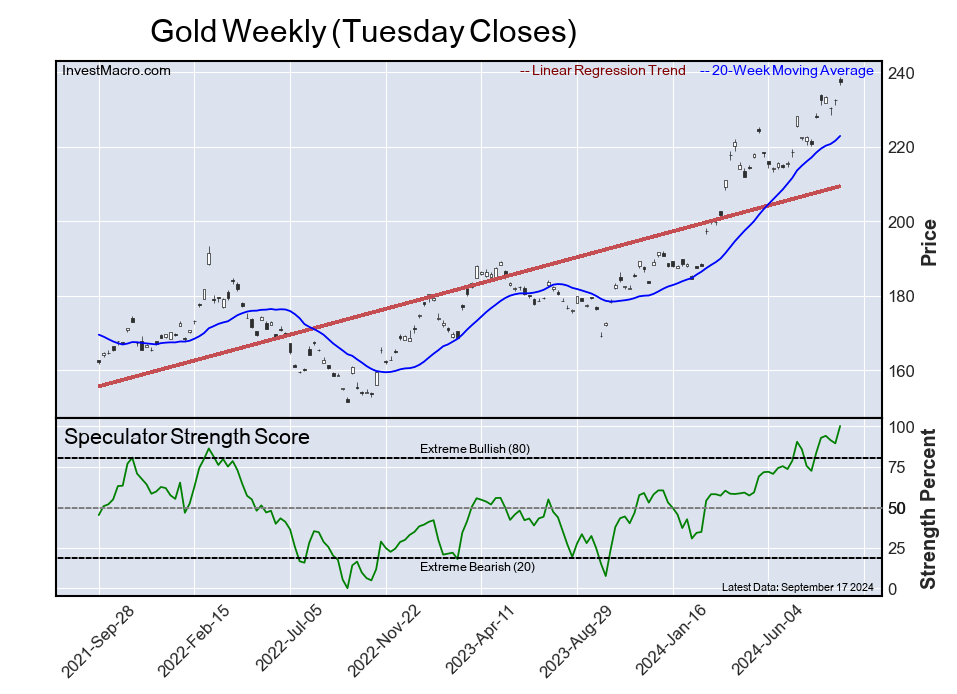
COT Soft Commodities Charts: Speculator Bets led by Wheat & Soybean Oil

By InvestMacro

Here are the latest charts and statistics for the Commitment of Traders (COT) reports data published by the Commodities Futures Trading Commission (CFTC).
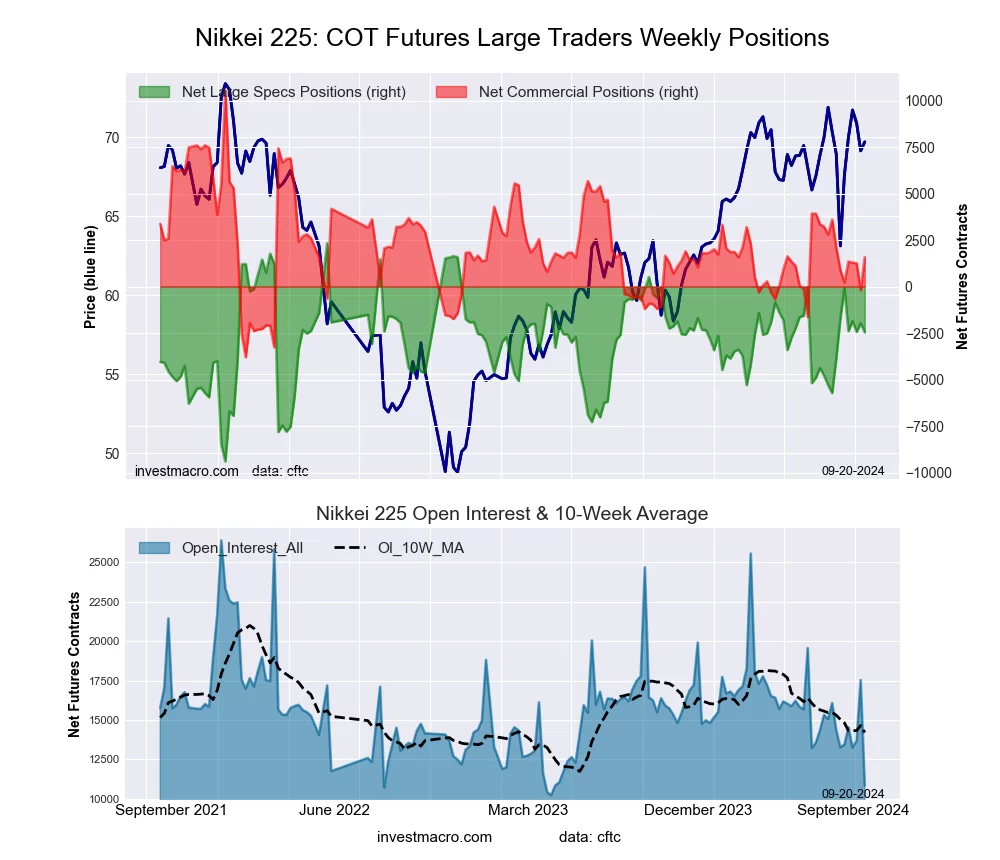
The latest COT data is updated through Tuesday August 20th and shows a quick view of how large traders (for-profit speculators and commercial entities) were positioned in the futures markets.

Weekly Speculator Changes led by Wheat & Soybean Oil

The COT soft commodities markets speculator bets were slightly lower this week as five out of the eleven softs markets we cover had higher positioning while the other six markets had lower speculator contracts.

Leading the gains for the softs markets was Wheat (13,199 contracts) with Soybean Oil (6,693 contracts), Coffee (5,218 contracts), Lean Hogs (4,692 contracts) and Soybean Meal (4,159 contracts) also showing positive weeks.

The markets with the declines in speculator bets this week were Sugar (-15,258 contracts) with Soybeans (-13,170 contracts), Corn (-11,291 contracts), Cocoa (-1,380 contracts), Cotton (-1,158 contracts) and with Live Cattle (-615 contracts) also registering lower bets on the week.


Soft Commodities Net Speculators Leaderboard

Legend: Weekly Speculators Change | Speculators Current Net Position | Speculators Strength Score compared to last 3-Years (0-100 range)


Strength Scores led by Coffee & Wheat

COT Strength Scores (a normalized measure of Speculator positions over a 3-Year range, from 0 to 100 where above 80 is Extreme-Bullish and below 20 is Extreme-Bearish) showed that Coffee (88 percent) leads the softs markets this week. Wheat (52 percent) comes in as the next highest in the weekly strength scores.

On the downside, Cotton (0 percent), Soybeans (4 percent), Sugar (8 percent), Corn (13 percent), Lean Hogs (13 percent), Live Cattle (17 percent) and Soybean Oil (18 percent) come in at the lowest strength levels currently and are in Extreme-Bearish territory (below 20 percent).

Strength Statistics:
Corn (12.8 percent) vs Corn previous week (14.3 percent)
Sugar (7.9 percent) vs Sugar previous week (13.1 percent)
Coffee (88.4 percent) vs Coffee previous week (83.3 percent)
Soybeans (4.3 percent) vs Soybeans previous week (7.4 percent)
Soybean Oil (18.1 percent) vs Soybean Oil previous week (14.4 percent)
Soybean Meal (33.0 percent) vs Soybean Meal previous week (31.3 percent)
Live Cattle (17.3 percent) vs Live Cattle previous week (18.0 percent)
Lean Hogs (12.7 percent) vs Lean Hogs previous week (8.6 percent)
Cotton (0.0 percent) vs Cotton previous week (0.7 percent)
Cocoa (39.4 percent) vs Cocoa previous week (40.8 percent)
Wheat (51.6 percent) vs Wheat previous week (42.0 percent)


Corn tops the 6-Week Strength Trends

COT Strength Score Trends (or move index, calculates the 6-week changes in strength scores) showed that Corn (10 percent), Lean Hogs (7 percent) and Wheat (7 percent) lead the past six weeks trends for soft commodities.

Soybean Oil (-27 percent) leads the downside trend scores currently with Soybean Meal (-22 percent), Live Cattle (-17 percent) and Sugar (-16 percent) following next with lower trend scores.

Strength Trend Statistics:
Corn (9.5 percent) vs Corn previous week (9.5 percent)
Sugar (-16.5 percent) vs Sugar previous week (-10.3 percent)
Coffee (-11.0 percent) vs Coffee previous week (-8.6 percent)
Soybeans (-6.8 percent) vs Soybeans previous week (-10.3 percent)
Soybean Oil (-26.9 percent) vs Soybean Oil previous week (-10.2 percent)
Soybean Meal (-21.6 percent) vs Soybean Meal previous week (-27.6 percent)
Live Cattle (-16.9 percent) vs Live Cattle previous week (-15.5 percent)
Lean Hogs (6.7 percent) vs Lean Hogs previous week (2.2 percent)
Cotton (-11.2 percent) vs Cotton previous week (-14.8 percent)
Cocoa (-2.9 percent) vs Cocoa previous week (0.1 percent)
Wheat (6.5 percent) vs Wheat previous week (-0.2 percent)


Individual Soft Commodities Markets:

CORN Futures:

CORN Futures COT ChartThe CORN large speculator standing this week totaled a net position of -165,296 contracts in the data reported through Tuesday. This was a weekly decline of -11,291 contracts from the previous week which had a total of -154,005 net contracts.

This week’s current strength score (the trader positioning range over the past three years, measured from 0 to 100) shows the speculators are currently Bearish-Extreme with a score of 12.8 percent. The commercials are Bullish-Extreme with a score of 88.7 percent and the small traders (not shown in chart) are Bullish with a score of 65.3 percent.

Price Trend-Following Model: Strong Downtrend

Our weekly trend-following model classifies the current market price position as: Strong Downtrend. The current action for the model is considered to be: Hold – Maintain Short Position.

CORN Futures StatisticsSPECULATORSCOMMERCIALSSMALL TRADERS
– Percent of Open Interest Longs:20.644.99.1
– Percent of Open Interest Shorts:31.232.211.1
– Net Position:-165,296197,121-31,825
– Gross Longs:319,844697,858140,896
– Gross Shorts:485,140500,737172,721
– Long to Short Ratio:0.7 to 11.4 to 10.8 to 1
NET POSITION TREND:
– Strength Index Score (3 Year Range Pct):12.888.765.3
– Strength Index Reading (3 Year Range):Bearish-ExtremeBullish-ExtremeBullish
NET POSITION MOVEMENT INDEX:
– 6-Week Change in Strength Index:9.5-7.1-28.1


SUGAR Futures:

SUGAR Futures COT ChartThe SUGAR large speculator standing this week totaled a net position of 19,304 contracts in the data reported through Tuesday. This was a weekly fall of -15,258 contracts from the previous week which had a total of 34,562 net contracts.

This week’s current strength score (the trader positioning range over the past three years, measured from 0 to 100) shows the speculators are currently Bearish-Extreme with a score of 7.9 percent. The commercials are Bullish-Extreme with a score of 92.7 percent and the small traders (not shown in chart) are Bearish-Extreme with a score of 11.8 percent.

Price Trend-Following Model: Downtrend

Our weekly trend-following model classifies the current market price position as: Downtrend. The current action for the model is considered to be: Hold – Maintain Short Position.

SUGAR Futures StatisticsSPECULATORSCOMMERCIALSSMALL TRADERS
– Percent of Open Interest Longs:22.954.27.5
– Percent of Open Interest Shorts:20.555.88.3
– Net Position:19,304-13,294-6,010
– Gross Longs:188,316446,31462,107
– Gross Shorts:169,012459,60868,117
– Long to Short Ratio:1.1 to 11.0 to 10.9 to 1
NET POSITION TREND:
– Strength Index Score (3 Year Range Pct):7.992.711.8
– Strength Index Reading (3 Year Range):Bearish-ExtremeBullish-ExtremeBearish-Extreme
NET POSITION MOVEMENT INDEX:
– 6-Week Change in Strength Index:-16.519.2-24.5


COFFEE Futures:

COFFEE Futures COT ChartThe COFFEE large speculator standing this week totaled a net position of 64,158 contracts in the data reported through Tuesday. This was a weekly rise of 5,218 contracts from the previous week which had a total of 58,940 net contracts.

This week’s current strength score (the trader positioning range over the past three years, measured from 0 to 100) shows the speculators are currently Bullish-Extreme with a score of 88.4 percent. The commercials are Bearish-Extreme with a score of 10.8 percent and the small traders (not shown in chart) are Bullish with a score of 71.8 percent.

Price Trend-Following Model: Strong Uptrend

Our weekly trend-following model classifies the current market price position as: Strong Uptrend. The current action for the model is considered to be: Hold – Maintain Long Position.

COFFEE Futures StatisticsSPECULATORSCOMMERCIALSSMALL TRADERS
– Percent of Open Interest Longs:40.938.84.3
– Percent of Open Interest Shorts:7.773.82.4
– Net Position:64,158-67,7373,579
– Gross Longs:79,03274,9798,296
– Gross Shorts:14,874142,7164,717
– Long to Short Ratio:5.3 to 10.5 to 11.8 to 1
NET POSITION TREND:
– Strength Index Score (3 Year Range Pct):88.410.871.8
– Strength Index Reading (3 Year Range):Bullish-ExtremeBearish-ExtremeBullish
NET POSITION MOVEMENT INDEX:
– 6-Week Change in Strength Index:-11.010.56.5


SOYBEANS Futures:

SOYBEANS Futures COT ChartThe SOYBEANS large speculator standing this week totaled a net position of -178,893 contracts in the data reported through Tuesday. This was a weekly reduction of -13,170 contracts from the previous week which had a total of -165,723 net contracts.

This week’s current strength score (the trader positioning range over the past three years, measured from 0 to 100) shows the speculators are currently Bearish-Extreme with a score of 4.3 percent. The commercials are Bullish-Extreme with a score of 97.6 percent and the small traders (not shown in chart) are Bullish with a score of 64.0 percent.

Price Trend-Following Model: Strong Downtrend

Our weekly trend-following model classifies the current market price position as: Strong Downtrend. The current action for the model is considered to be: Hold – Maintain Short Position.

SOYBEANS Futures StatisticsSPECULATORSCOMMERCIALSSMALL TRADERS
– Percent of Open Interest Longs:13.062.74.9
– Percent of Open Interest Shorts:34.938.57.2
– Net Position:-178,893197,454-18,561
– Gross Longs:105,737511,62639,933
– Gross Shorts:284,630314,17258,494
– Long to Short Ratio:0.4 to 11.6 to 10.7 to 1
NET POSITION TREND:
– Strength Index Score (3 Year Range Pct):4.397.664.0
– Strength Index Reading (3 Year Range):Bearish-ExtremeBullish-ExtremeBullish
NET POSITION MOVEMENT INDEX:
– 6-Week Change in Strength Index:-6.89.1-20.9


SOYBEAN OIL Futures:

SOYBEAN OIL Futures COT ChartThe SOYBEAN OIL large speculator standing this week totaled a net position of -42,670 contracts in the data reported through Tuesday. This was a weekly gain of 6,693 contracts from the previous week which had a total of -49,363 net contracts.

This week’s current strength score (the trader positioning range over the past three years, measured from 0 to 100) shows the speculators are currently Bearish-Extreme with a score of 18.1 percent. The commercials are Bullish-Extreme with a score of 82.3 percent and the small traders (not shown in chart) are Bearish with a score of 27.7 percent.

Price Trend-Following Model: Strong Downtrend

Our weekly trend-following model classifies the current market price position as: Strong Downtrend. The current action for the model is considered to be: Hold – Maintain Short Position.

SOYBEAN OIL Futures StatisticsSPECULATORSCOMMERCIALSSMALL TRADERS
– Percent of Open Interest Longs:23.353.25.3
– Percent of Open Interest Shorts:30.746.44.7
– Net Position:-42,67039,1493,521
– Gross Longs:133,857305,93430,612
– Gross Shorts:176,527266,78527,091
– Long to Short Ratio:0.8 to 11.1 to 11.1 to 1
NET POSITION TREND:
– Strength Index Score (3 Year Range Pct):18.182.327.7
– Strength Index Reading (3 Year Range):Bearish-ExtremeBullish-ExtremeBearish
NET POSITION MOVEMENT INDEX:
– 6-Week Change in Strength Index:-26.924.3-0.6


SOYBEAN MEAL Futures:

SOYBEAN MEAL Futures COT ChartThe SOYBEAN MEAL large speculator standing this week totaled a net position of 13,574 contracts in the data reported through Tuesday. This was a weekly lift of 4,159 contracts from the previous week which had a total of 9,415 net contracts.

This week’s current strength score (the trader positioning range over the past three years, measured from 0 to 100) shows the speculators are currently Bearish with a score of 33.0 percent. The commercials are Bullish with a score of 64.2 percent and the small traders (not shown in chart) are Bearish with a score of 48.5 percent.

Price Trend-Following Model: Strong Downtrend

Our weekly trend-following model classifies the current market price position as: Strong Downtrend. The current action for the model is considered to be: Hold – Maintain Short Position.

SOYBEAN MEAL Futures StatisticsSPECULATORSCOMMERCIALSSMALL TRADERS
– Percent of Open Interest Longs:22.246.49.3
– Percent of Open Interest Shorts:19.652.85.4
– Net Position:13,574-34,19720,623
– Gross Longs:118,191247,39349,516
– Gross Shorts:104,617281,59028,893
– Long to Short Ratio:1.1 to 10.9 to 11.7 to 1
NET POSITION TREND:
– Strength Index Score (3 Year Range Pct):33.064.248.5
– Strength Index Reading (3 Year Range):BearishBullishBearish
NET POSITION MOVEMENT INDEX:
– 6-Week Change in Strength Index:-21.619.911.5


LIVE CATTLE Futures:

LIVE CATTLE Futures COT ChartThe LIVE CATTLE large speculator standing this week totaled a net position of 35,622 contracts in the data reported through Tuesday. This was a weekly reduction of -615 contracts from the previous week which had a total of 36,237 net contracts.

This week’s current strength score (the trader positioning range over the past three years, measured from 0 to 100) shows the speculators are currently Bearish-Extreme with a score of 17.3 percent. The commercials are Bullish-Extreme with a score of 95.1 percent and the small traders (not shown in chart) are Bearish with a score of 20.4 percent.

Price Trend-Following Model: Weak Uptrend

Our weekly trend-following model classifies the current market price position as: Weak Uptrend. The current action for the model is considered to be: Hold – Maintain Long Position.

LIVE CATTLE Futures StatisticsSPECULATORSCOMMERCIALSSMALL TRADERS
– Percent of Open Interest Longs:34.336.09.7
– Percent of Open Interest Shorts:21.943.914.2
– Net Position:35,622-22,612-13,010
– Gross Longs:98,255103,18927,738
– Gross Shorts:62,633125,80140,748
– Long to Short Ratio:1.6 to 10.8 to 10.7 to 1
NET POSITION TREND:
– Strength Index Score (3 Year Range Pct):17.395.120.4
– Strength Index Reading (3 Year Range):Bearish-ExtremeBullish-ExtremeBearish
NET POSITION MOVEMENT INDEX:
– 6-Week Change in Strength Index:-16.922.5-14.9


LEAN HOGS Futures:

LEAN HOGS Futures COT ChartThe LEAN HOGS large speculator standing this week totaled a net position of -21,796 contracts in the data reported through Tuesday. This was a weekly boost of 4,692 contracts from the previous week which had a total of -26,488 net contracts.

This week’s current strength score (the trader positioning range over the past three years, measured from 0 to 100) shows the speculators are currently Bearish-Extreme with a score of 12.7 percent. The commercials are Bullish-Extreme with a score of 91.6 percent and the small traders (not shown in chart) are Bullish with a score of 62.2 percent.

Price Trend-Following Model: Strong Downtrend

Our weekly trend-following model classifies the current market price position as: Strong Downtrend. The current action for the model is considered to be: Hold – Maintain Short Position.

LEAN HOGS Futures StatisticsSPECULATORSCOMMERCIALSSMALL TRADERS
– Percent of Open Interest Longs:36.939.16.1
– Percent of Open Interest Shorts:46.327.78.1
– Net Position:-21,79626,506-4,710
– Gross Longs:86,24791,22514,296
– Gross Shorts:108,04364,71919,006
– Long to Short Ratio:0.8 to 11.4 to 10.8 to 1
NET POSITION TREND:
– Strength Index Score (3 Year Range Pct):12.791.662.2
– Strength Index Reading (3 Year Range):Bearish-ExtremeBullish-ExtremeBullish
NET POSITION MOVEMENT INDEX:
– 6-Week Change in Strength Index:6.7-5.4-11.0


COTTON Futures:

COTTON Futures COT ChartThe COTTON large speculator standing this week totaled a net position of -42,828 contracts in the data reported through Tuesday. This was a weekly decrease of -1,158 contracts from the previous week which had a total of -41,670 net contracts.

This week’s current strength score (the trader positioning range over the past three years, measured from 0 to 100) shows the speculators are currently Bearish-Extreme with a score of 0.0 percent. The commercials are Bullish-Extreme with a score of 99.3 percent and the small traders (not shown in chart) are Bearish-Extreme with a score of 14.0 percent.

Price Trend-Following Model: Downtrend

Our weekly trend-following model classifies the current market price position as: Downtrend. The current action for the model is considered to be: Hold – Maintain Short Position.

COTTON Futures StatisticsSPECULATORSCOMMERCIALSSMALL TRADERS
– Percent of Open Interest Longs:25.249.55.8
– Percent of Open Interest Shorts:43.730.85.9
– Net Position:-42,82843,223-395
– Gross Longs:58,393114,52113,326
– Gross Shorts:101,22171,29813,721
– Long to Short Ratio:0.6 to 11.6 to 11.0 to 1
NET POSITION TREND:
– Strength Index Score (3 Year Range Pct):0.099.314.0
– Strength Index Reading (3 Year Range):Bearish-ExtremeBullish-ExtremeBearish-Extreme
NET POSITION MOVEMENT INDEX:
– 6-Week Change in Strength Index:-11.29.113.3


COCOA Futures:

COCOA Futures COT ChartThe COCOA large speculator standing this week totaled a net position of 28,888 contracts in the data reported through Tuesday. This was a weekly reduction of -1,380 contracts from the previous week which had a total of 30,268 net contracts.

This week’s current strength score (the trader positioning range over the past three years, measured from 0 to 100) shows the speculators are currently Bearish with a score of 39.4 percent. The commercials are Bullish with a score of 56.7 percent and the small traders (not shown in chart) are Bullish with a score of 66.5 percent.

Price Trend-Following Model: Weak Downtrend

Our weekly trend-following model classifies the current market price position as: Weak Downtrend. The current action for the model is considered to be: Hold – Maintain Short Position.

COCOA Futures StatisticsSPECULATORSCOMMERCIALSSMALL TRADERS
– Percent of Open Interest Longs:38.930.38.8
– Percent of Open Interest Shorts:17.356.74.0
– Net Position:28,888-35,2706,382
– Gross Longs:51,92340,36911,703
– Gross Shorts:23,03575,6395,321
– Long to Short Ratio:2.3 to 10.5 to 12.2 to 1
NET POSITION TREND:
– Strength Index Score (3 Year Range Pct):39.456.766.5
– Strength Index Reading (3 Year Range):BearishBullishBullish
NET POSITION MOVEMENT INDEX:
– 6-Week Change in Strength Index:-2.93.2-2.6


WHEAT Futures:

WHEAT Futures COT ChartThe WHEAT large speculator standing this week totaled a net position of -25,706 contracts in the data reported through Tuesday. This was a weekly lift of 13,199 contracts from the previous week which had a total of -38,905 net contracts.

This week’s current strength score (the trader positioning range over the past three years, measured from 0 to 100) shows the speculators are currently Bullish with a score of 51.6 percent. The commercials are Bearish with a score of 48.9 percent and the small traders (not shown in chart) are Bearish with a score of 34.2 percent.

Price Trend-Following Model: Strong Downtrend

Our weekly trend-following model classifies the current market price position as: Strong Downtrend. The current action for the model is considered to be: Hold – Maintain Short Position.

WHEAT Futures StatisticsSPECULATORSCOMMERCIALSSMALL TRADERS
– Percent of Open Interest Longs:32.433.97.8
– Percent of Open Interest Shorts:38.626.39.1
– Net Position:-25,70631,360-5,654
– Gross Longs:134,387140,44132,167
– Gross Shorts:160,093109,08137,821
– Long to Short Ratio:0.8 to 11.3 to 10.9 to 1
NET POSITION TREND:
– Strength Index Score (3 Year Range Pct):51.648.934.2
– Strength Index Reading (3 Year Range):BullishBearishBearish
NET POSITION MOVEMENT INDEX:
– 6-Week Change in Strength Index:6.5-6.5-2.8


Article By InvestMacroReceive our weekly COT Newsletter

*COT Report: The COT data, released weekly to the public each Friday, is updated through the most recent Tuesday (data is 3 days old) and shows a quick view of how large speculators or non-commercials (for-profit traders) were positioned in the futures markets.

The CFTC categorizes trader positions according to commercial hedgers (traders who use futures contracts for hedging as part of the business), non-commercials (large traders who speculate to realize trading profits) and nonreportable traders (usually small traders/speculators) as well as their open interest (contracts open in the market at time of reporting). See CFTC criteria here.