COT Soft Commodities Charts: Speculator Bets led by Corn & Live Cattle

By InvestMacro

Here are the latest charts and statistics for the Commitment of Traders (COT) reports data published by the Commodities Futures Trading Commission (CFTC).

The latest COT data is updated through Tuesday October 29th and shows a quick view of how large traders (for-profit speculators and commercial entities) were positioned in the futures markets.

Weekly Speculator Changes led by Corn & Live Cattle

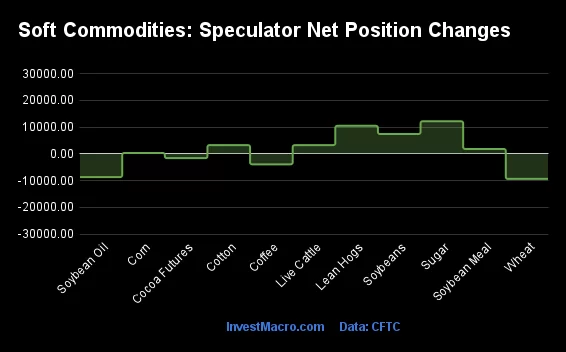
The COT soft commodities markets speculator bets were decisively lower this week as three out of the eleven softs markets we cover had higher positioning while the other eight markets had lower speculator contracts.

Leading the gains for the softs markets was Corn (65,464 contracts) with Live Cattle (8,955 contracts) and Lean Hogs (11,584 contracts) also having positive weeks.

The markets with the declines in speculator bets this week were Soybean Meal (-41,343 contracts), Soybeans (-13,765 contracts), Sugar (-10,708 contracts), Wheat (-5,809 contracts), Soybean Oil (-4,687 contracts), Cotton (-4,504 contracts), Cocoa (-3,578 contracts) and with Coffee (-1,003 contracts) also seeing lower bets on the week.


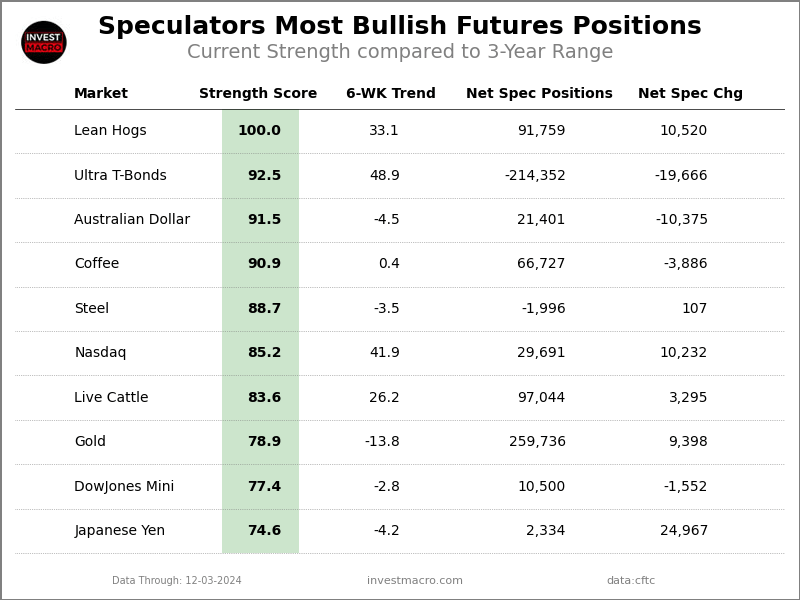
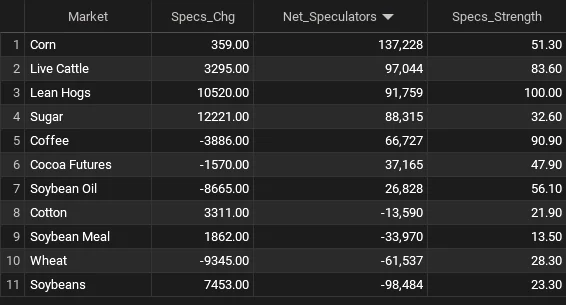
Soft Commodities Net Speculators Leaderboard

Legend: Weekly Speculators Change | Speculators Current Net Position | Speculators Strength Score compared to last 3-Years (0-100 range)


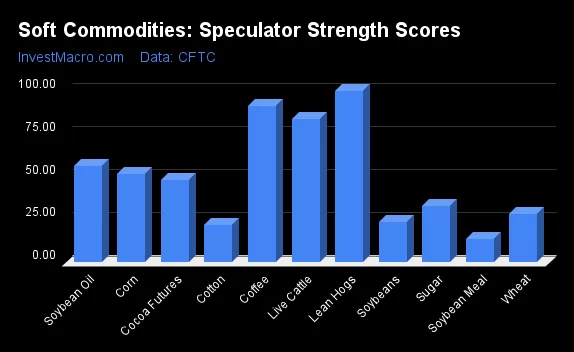
Strength Scores led by Lean Hogs & Coffee

COT Strength Scores (a normalized measure of Speculator positions over a 3-Year range, from 0 to 100 where above 80 is Extreme-Bullish and below 20 is Extreme-Bearish) showed that Lean Hogs (94 percent) and Coffee (90 percent) lead the softs markets this week. Soybean Oil (77 percent), Live Cattle (67 percent) and Wheat (54 percent) come in as the next highest in the weekly strength scores.

On the downside, Cotton (22 percent) and Soybeans (25 percent) come in at the lowest strength levels currently. The next lowest strength scores are the Sugar (31 percent) and the Soybean Meal (39 percent).

Strength Statistics:
Corn (44.5 percent) vs Corn previous week (36.1 percent)
Sugar (30.6 percent) vs Sugar previous week (34.4 percent)
Coffee (89.5 percent) vs Coffee previous week (90.5 percent)
Soybeans (24.8 percent) vs Soybeans previous week (28.1 percent)
Soybean Oil (76.7 percent) vs Soybean Oil previous week (79.2 percent)
Soybean Meal (38.5 percent) vs Soybean Meal previous week (55.5 percent)
Live Cattle (67.1 percent) vs Live Cattle previous week (57.4 percent)
Lean Hogs (94.0 percent) vs Lean Hogs previous week (82.8 percent)
Cotton (22.2 percent) vs Cotton previous week (25.1 percent)
Cocoa (48.1 percent) vs Cocoa previous week (51.8 percent)
Wheat (53.6 percent) vs Wheat previous week (57.8 percent)


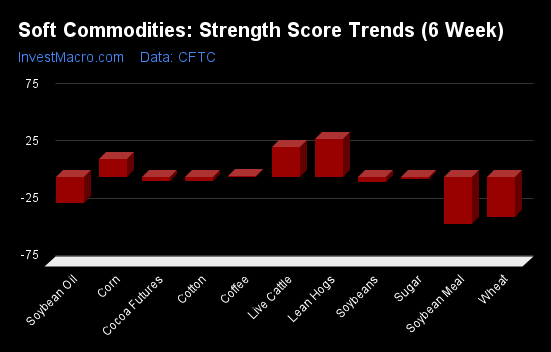
Lean Hogs & Live Cattle top the 6-Week Strength Trends

COT Strength Score Trends (or move index, calculates the 6-week changes in strength scores) showed that Lean Hogs (62 percent) and Live Cattle (55 percent) lead the past six weeks trends for soft commodities. Soybean Oil (40 percent), Corn (19 percent) and Soybeans (10 percent) are the next highest positive movers in the latest trends data.

Soybean Meal (-7 percent) leads the downside trend scores currently with Wheat (-6 percent) and Coffee (-5 percent) following next with lower trend scores.

Strength Trend Statistics:
Corn (19.0 percent) vs Corn previous week (8.4 percent)
Sugar (3.7 percent) vs Sugar previous week (10.6 percent)
Coffee (-4.7 percent) vs Coffee previous week (2.8 percent)
Soybeans (10.0 percent) vs Soybeans previous week (15.6 percent)
Soybean Oil (40.1 percent) vs Soybean Oil previous week (40.5 percent)
Soybean Meal (-6.6 percent) vs Soybean Meal previous week (12.1 percent)
Live Cattle (55.3 percent) vs Live Cattle previous week (42.8 percent)
Lean Hogs (62.2 percent) vs Lean Hogs previous week (55.1 percent)
Cotton (9.4 percent) vs Cotton previous week (25.1 percent)
Cocoa (3.7 percent) vs Cocoa previous week (8.9 percent)
Wheat (-6.3 percent) vs Wheat previous week (-0.6 percent)


Individual Soft Commodities Markets:

CORN Futures:

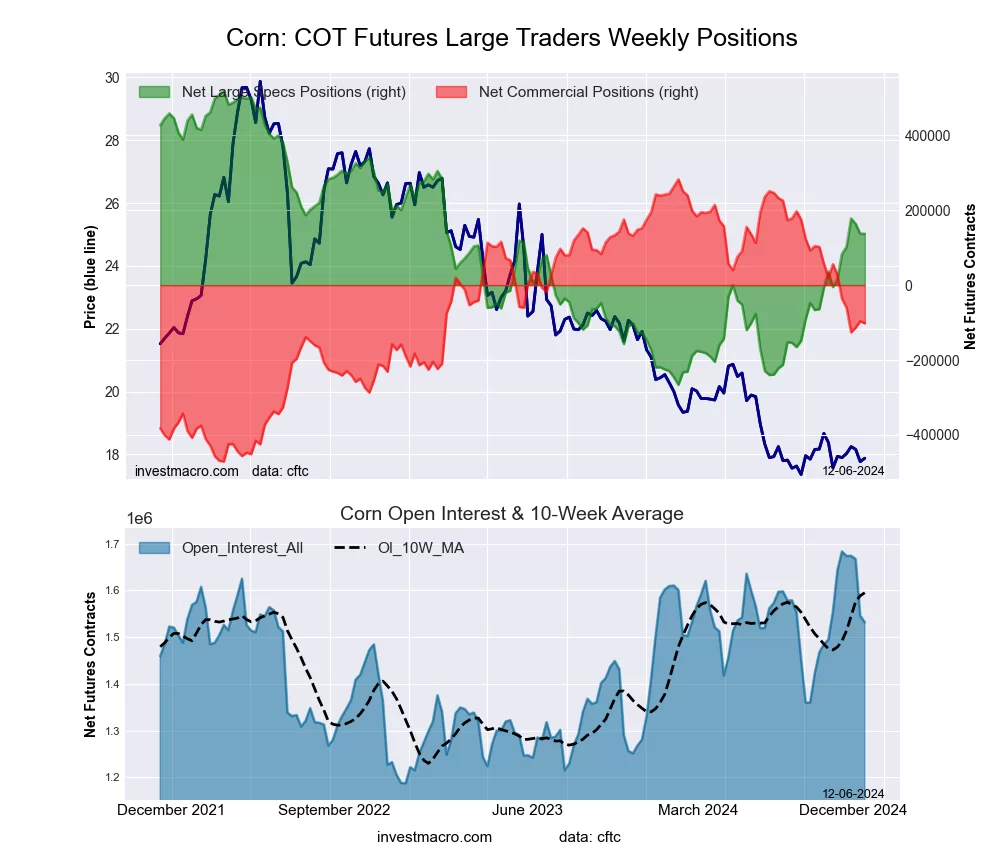
CORN Futures COT ChartThe CORN large speculator standing this week recorded a net position of 83,304 contracts in the data reported through Tuesday. This was a weekly increase of 65,464 contracts from the previous week which had a total of 17,840 net contracts.

This week’s current strength score (the trader positioning range over the past three years, measured from 0 to 100) shows the speculators are currently Bearish with a score of 44.5 percent. The commercials are Bullish with a score of 57.6 percent and the small traders (not shown in chart) are Bearish with a score of 46.0 percent.

Price Trend-Following Model: Downtrend

Our weekly trend-following model classifies the current market price position as: Downtrend.

CORN Futures StatisticsSPECULATORSCOMMERCIALSSMALL TRADERS
– Percent of Open Interest Longs:24.145.78.2
– Percent of Open Interest Shorts:19.147.910.9
– Net Position:83,304-36,852-46,452
– Gross Longs:405,262769,258137,217
– Gross Shorts:321,958806,110183,669
– Long to Short Ratio:1.3 to 11.0 to 10.7 to 1
NET POSITION TREND:
– Strength Index Score (3 Year Range Pct):44.557.646.0
– Strength Index Reading (3 Year Range):BearishBullishBearish
NET POSITION MOVEMENT INDEX:
– 6-Week Change in Strength Index:19.0-18.7-11.5


SUGAR Futures:

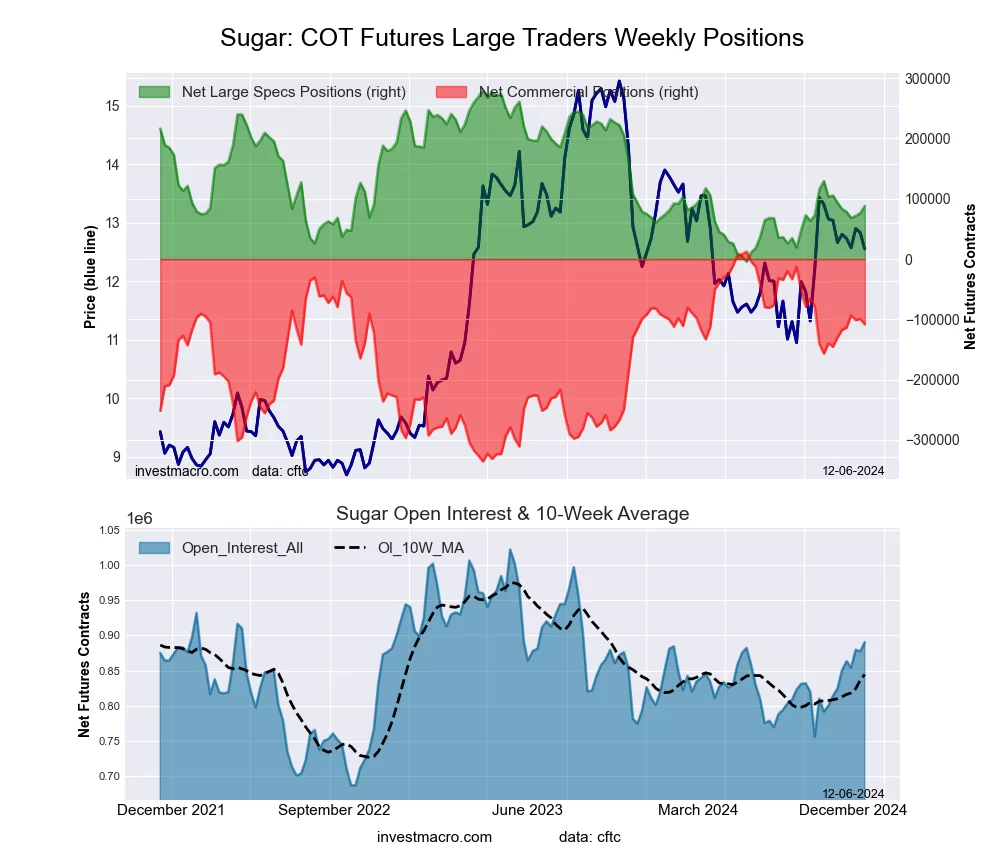
SUGAR Futures COT ChartThe SUGAR large speculator standing this week recorded a net position of 82,843 contracts in the data reported through Tuesday. This was a weekly lowering of -10,708 contracts from the previous week which had a total of 93,551 net contracts.

This week’s current strength score (the trader positioning range over the past three years, measured from 0 to 100) shows the speculators are currently Bearish with a score of 30.6 percent. The commercials are Bullish with a score of 62.7 percent and the small traders (not shown in chart) are Bullish with a score of 64.7 percent.

Price Trend-Following Model: Strong Uptrend

Our weekly trend-following model classifies the current market price position as: Strong Uptrend.

SUGAR Futures StatisticsSPECULATORSCOMMERCIALSSMALL TRADERS
– Percent of Open Interest Longs:26.249.49.8
– Percent of Open Interest Shorts:16.463.25.8
– Net Position:82,843-117,48034,637
– Gross Longs:222,539420,26583,668
– Gross Shorts:139,696537,74549,031
– Long to Short Ratio:1.6 to 10.8 to 11.7 to 1
NET POSITION TREND:
– Strength Index Score (3 Year Range Pct):30.662.764.7
– Strength Index Reading (3 Year Range):BearishBullishBullish
NET POSITION MOVEMENT INDEX:
– 6-Week Change in Strength Index:3.7-11.036.2


COFFEE Futures:

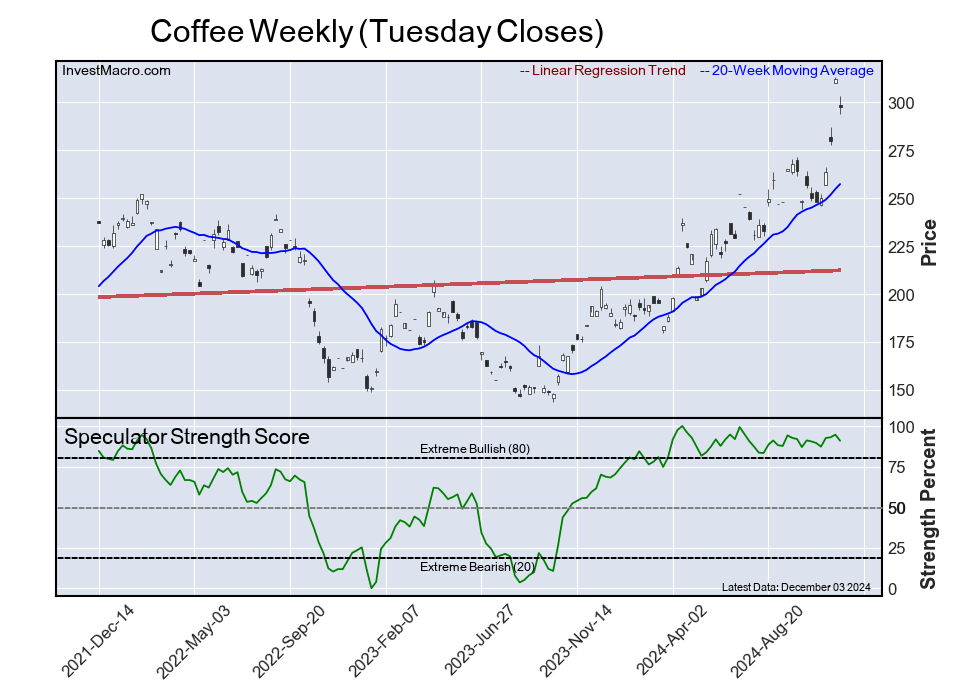
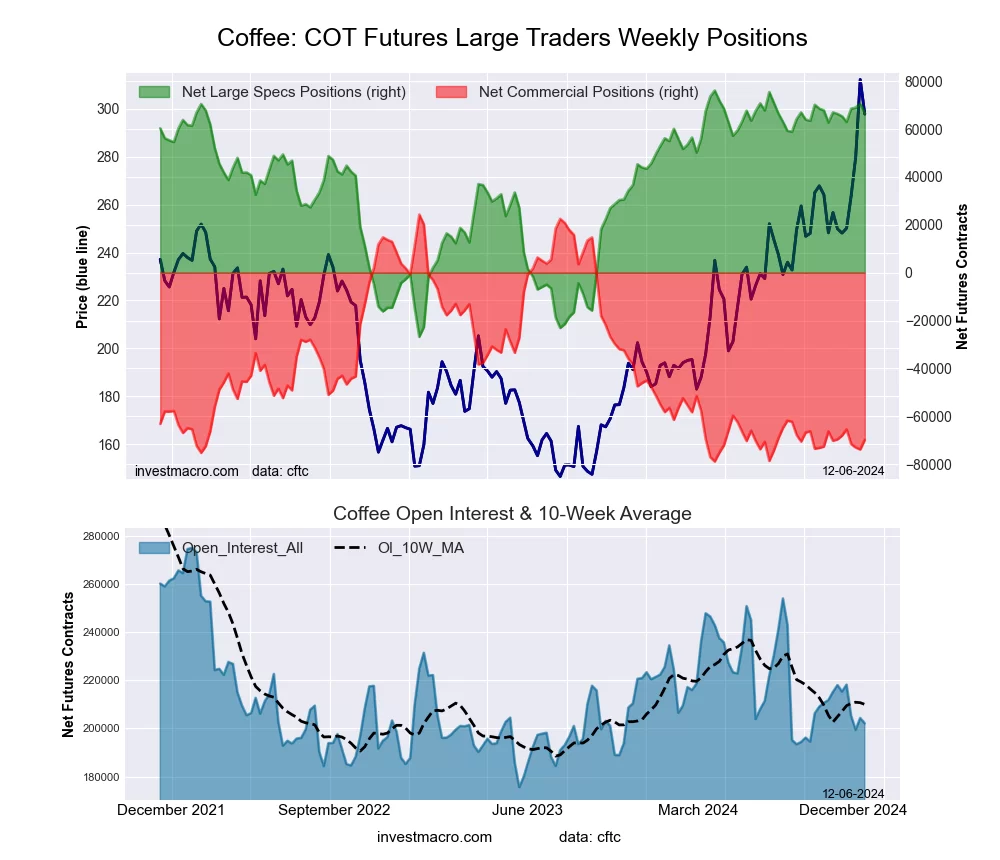
COFFEE Futures COT ChartThe COFFEE large speculator standing this week recorded a net position of 65,301 contracts in the data reported through Tuesday. This was a weekly fall of -1,003 contracts from the previous week which had a total of 66,304 net contracts.

This week’s current strength score (the trader positioning range over the past three years, measured from 0 to 100) shows the speculators are currently Bullish-Extreme with a score of 89.5 percent. The commercials are Bearish-Extreme with a score of 10.5 percent and the small traders (not shown in chart) are Bullish with a score of 58.7 percent.

Price Trend-Following Model: Uptrend

Our weekly trend-following model classifies the current market price position as: Uptrend.

COFFEE Futures StatisticsSPECULATORSCOMMERCIALSSMALL TRADERS
– Percent of Open Interest Longs:35.840.23.9
– Percent of Open Interest Shorts:5.571.82.7
– Net Position:65,301-68,0342,733
– Gross Longs:77,11986,4468,468
– Gross Shorts:11,818154,4805,735
– Long to Short Ratio:6.5 to 10.6 to 11.5 to 1
NET POSITION TREND:
– Strength Index Score (3 Year Range Pct):89.510.558.7
– Strength Index Reading (3 Year Range):Bullish-ExtremeBearish-ExtremeBullish
NET POSITION MOVEMENT INDEX:
– 6-Week Change in Strength Index:-4.75.3-10.3


SOYBEANS Futures:

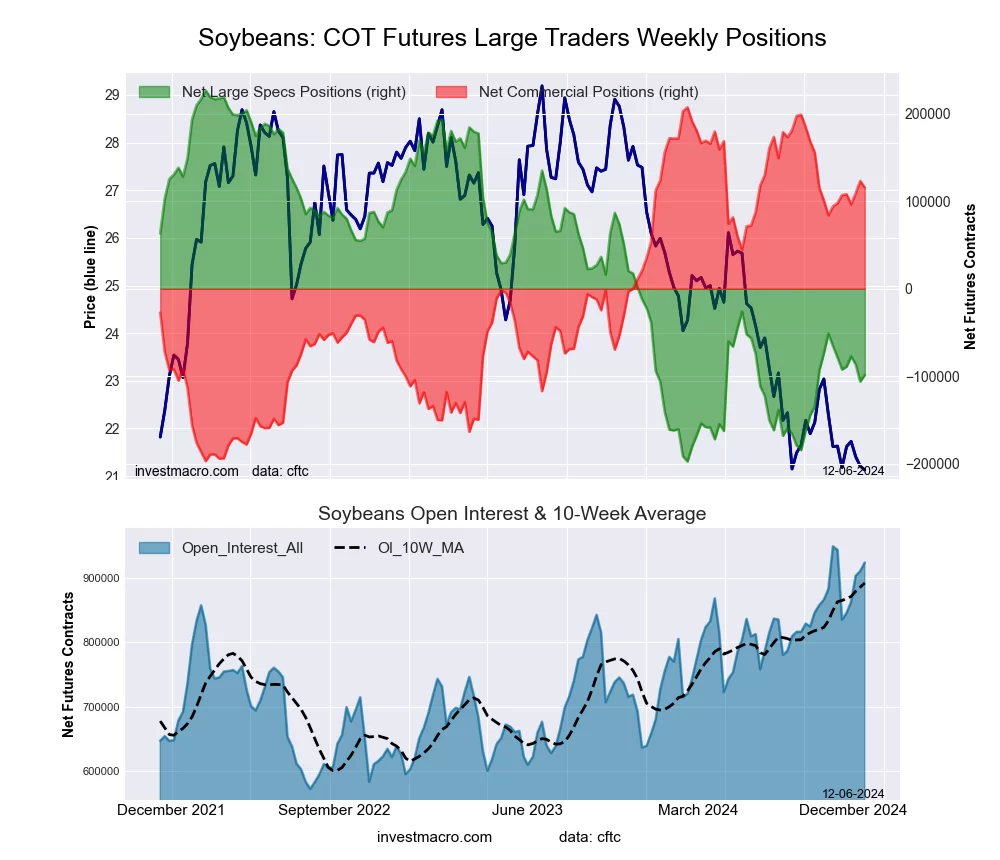
SOYBEANS Futures COT ChartThe SOYBEANS large speculator standing this week recorded a net position of -92,060 contracts in the data reported through Tuesday. This was a weekly lowering of -13,765 contracts from the previous week which had a total of -78,295 net contracts.

This week’s current strength score (the trader positioning range over the past three years, measured from 0 to 100) shows the speculators are currently Bearish with a score of 24.8 percent. The commercials are Bullish with a score of 75.2 percent and the small traders (not shown in chart) are Bullish with a score of 73.5 percent.

Price Trend-Following Model: Downtrend

Our weekly trend-following model classifies the current market price position as: Downtrend.

SOYBEANS Futures StatisticsSPECULATORSCOMMERCIALSSMALL TRADERS
– Percent of Open Interest Longs:17.558.46.4
– Percent of Open Interest Shorts:28.545.68.2
– Net Position:-92,060106,992-14,932
– Gross Longs:145,891487,28153,315
– Gross Shorts:237,951380,28968,247
– Long to Short Ratio:0.6 to 11.3 to 10.8 to 1
NET POSITION TREND:
– Strength Index Score (3 Year Range Pct):24.875.273.5
– Strength Index Reading (3 Year Range):BearishBullishBullish
NET POSITION MOVEMENT INDEX:
– 6-Week Change in Strength Index:10.0-12.015.8


SOYBEAN OIL Futures:

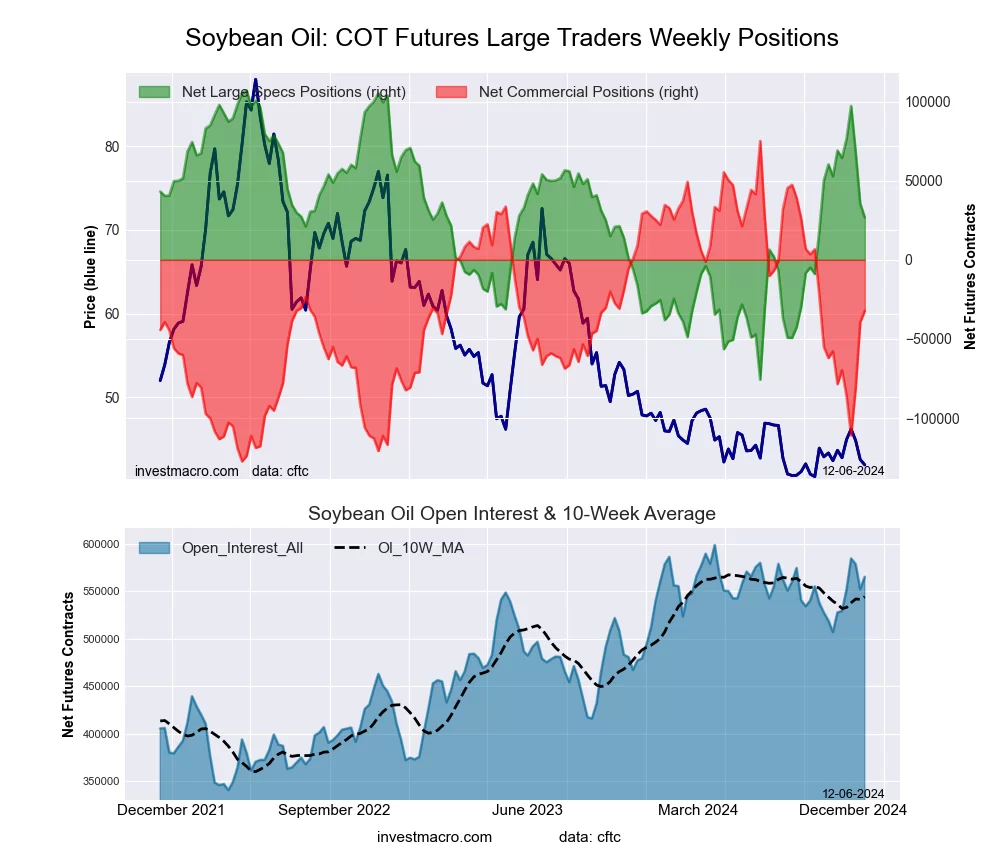
SOYBEAN OIL Futures COT ChartThe SOYBEAN OIL large speculator standing this week recorded a net position of 64,345 contracts in the data reported through Tuesday. This was a weekly fall of -4,687 contracts from the previous week which had a total of 69,032 net contracts.

This week’s current strength score (the trader positioning range over the past three years, measured from 0 to 100) shows the speculators are currently Bullish with a score of 76.7 percent. The commercials are Bearish with a score of 28.5 percent and the small traders (not shown in chart) are Bearish with a score of 34.8 percent.

Price Trend-Following Model: Weak Downtrend

Our weekly trend-following model classifies the current market price position as: Weak Downtrend.

SOYBEAN OIL Futures StatisticsSPECULATORSCOMMERCIALSSMALL TRADERS
– Percent of Open Interest Longs:29.048.95.8
– Percent of Open Interest Shorts:16.962.14.8
– Net Position:64,345-69,7055,360
– Gross Longs:153,757259,00230,638
– Gross Shorts:89,412328,70725,278
– Long to Short Ratio:1.7 to 10.8 to 11.2 to 1
NET POSITION TREND:
– Strength Index Score (3 Year Range Pct):76.728.534.8
– Strength Index Reading (3 Year Range):BullishBearishBearish
NET POSITION MOVEMENT INDEX:
– 6-Week Change in Strength Index:40.1-37.712.1


SOYBEAN MEAL Futures:

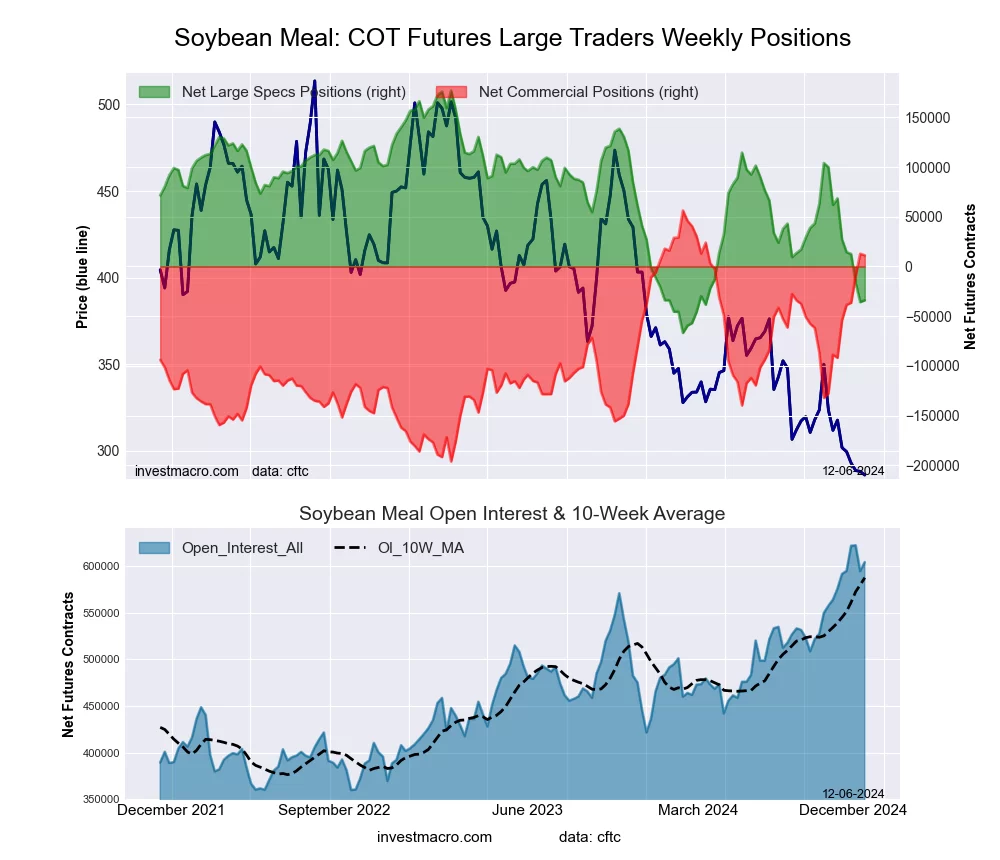
SOYBEAN MEAL Futures COT ChartThe SOYBEAN MEAL large speculator standing this week recorded a net position of 27,125 contracts in the data reported through Tuesday. This was a weekly reduction of -41,343 contracts from the previous week which had a total of 68,468 net contracts.

This week’s current strength score (the trader positioning range over the past three years, measured from 0 to 100) shows the speculators are currently Bearish with a score of 38.5 percent. The commercials are Bullish with a score of 56.3 percent and the small traders (not shown in chart) are Bullish with a score of 76.7 percent.

Price Trend-Following Model: Strong Downtrend

Our weekly trend-following model classifies the current market price position as: Strong Downtrend.

SOYBEAN MEAL Futures StatisticsSPECULATORSCOMMERCIALSSMALL TRADERS
– Percent of Open Interest Longs:23.445.19.5
– Percent of Open Interest Shorts:18.854.24.9
– Net Position:27,125-54,01626,891
– Gross Longs:138,571266,46755,890
– Gross Shorts:111,446320,48328,999
– Long to Short Ratio:1.2 to 10.8 to 11.9 to 1
NET POSITION TREND:
– Strength Index Score (3 Year Range Pct):38.556.376.7
– Strength Index Reading (3 Year Range):BearishBullishBullish
NET POSITION MOVEMENT INDEX:
– 6-Week Change in Strength Index:-6.63.038.3


LIVE CATTLE Futures:

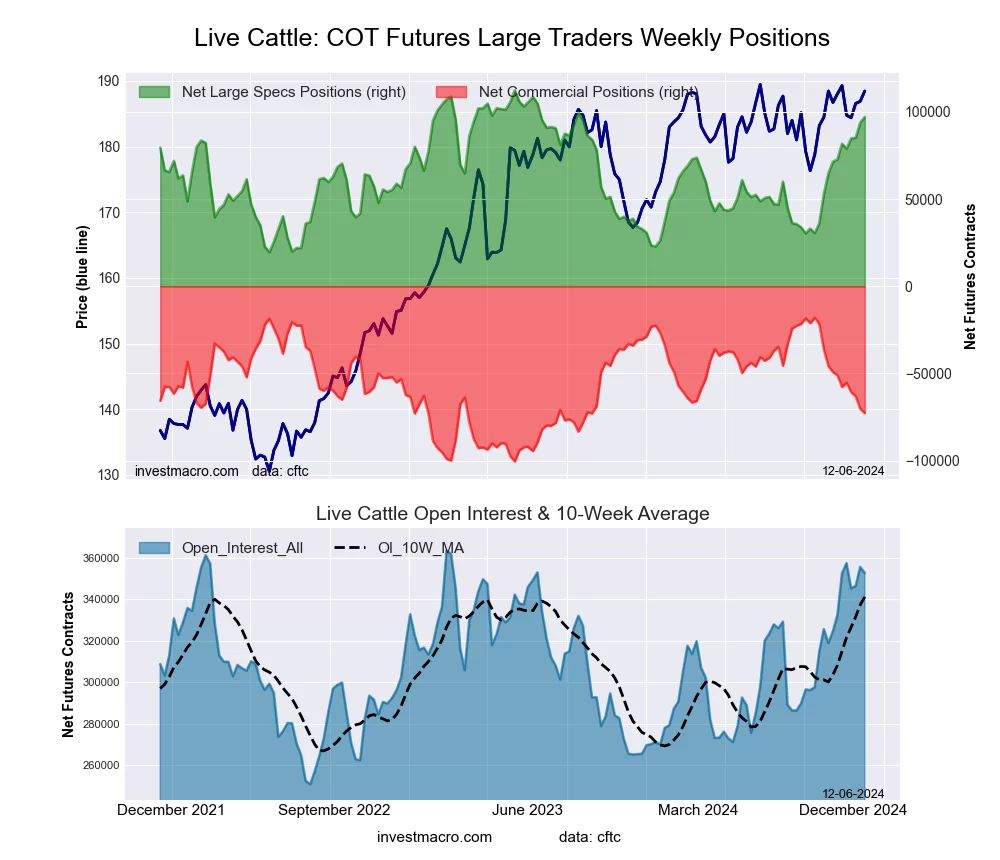
LIVE CATTLE Futures COT ChartThe LIVE CATTLE large speculator standing this week recorded a net position of 81,729 contracts in the data reported through Tuesday. This was a weekly rise of 8,955 contracts from the previous week which had a total of 72,774 net contracts.

This week’s current strength score (the trader positioning range over the past three years, measured from 0 to 100) shows the speculators are currently Bullish with a score of 67.1 percent. The commercials are Bullish with a score of 51.8 percent and the small traders (not shown in chart) are Bearish-Extreme with a score of 0.0 percent.

Price Trend-Following Model: Strong Uptrend

Our weekly trend-following model classifies the current market price position as: Strong Uptrend.

LIVE CATTLE Futures StatisticsSPECULATORSCOMMERCIALSSMALL TRADERS
– Percent of Open Interest Longs:42.132.77.0
– Percent of Open Interest Shorts:18.949.113.8
– Net Position:81,729-57,730-23,999
– Gross Longs:148,416115,37524,653
– Gross Shorts:66,687173,10548,652
– Long to Short Ratio:2.2 to 10.7 to 10.5 to 1
NET POSITION TREND:
– Strength Index Score (3 Year Range Pct):67.151.80.0
– Strength Index Reading (3 Year Range):BullishBullishBearish-Extreme
NET POSITION MOVEMENT INDEX:
– 6-Week Change in Strength Index:55.3-48.2-44.3


LEAN HOGS Futures:

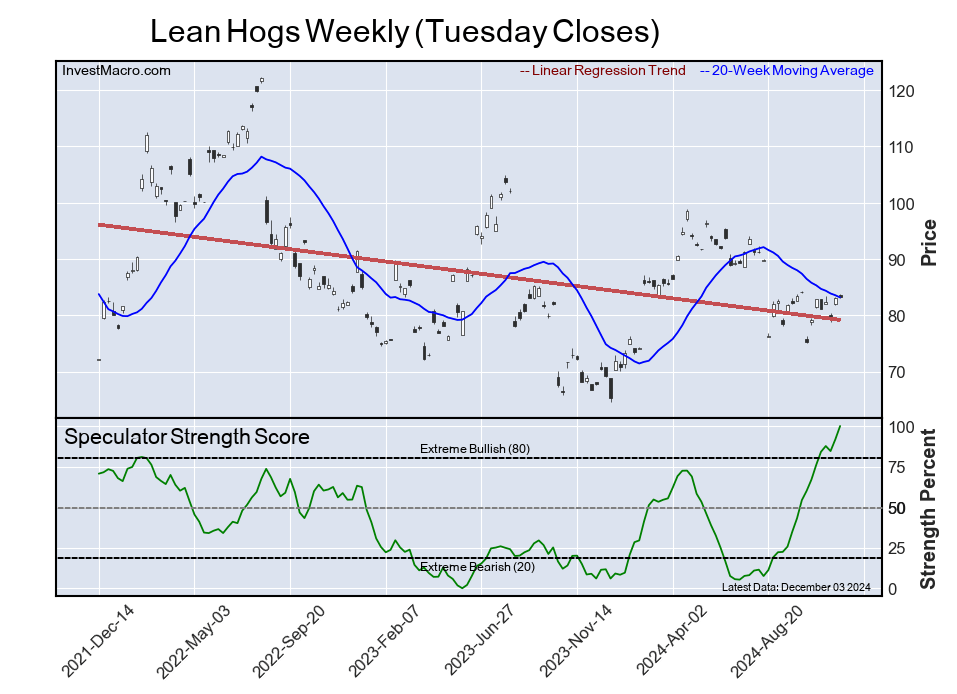
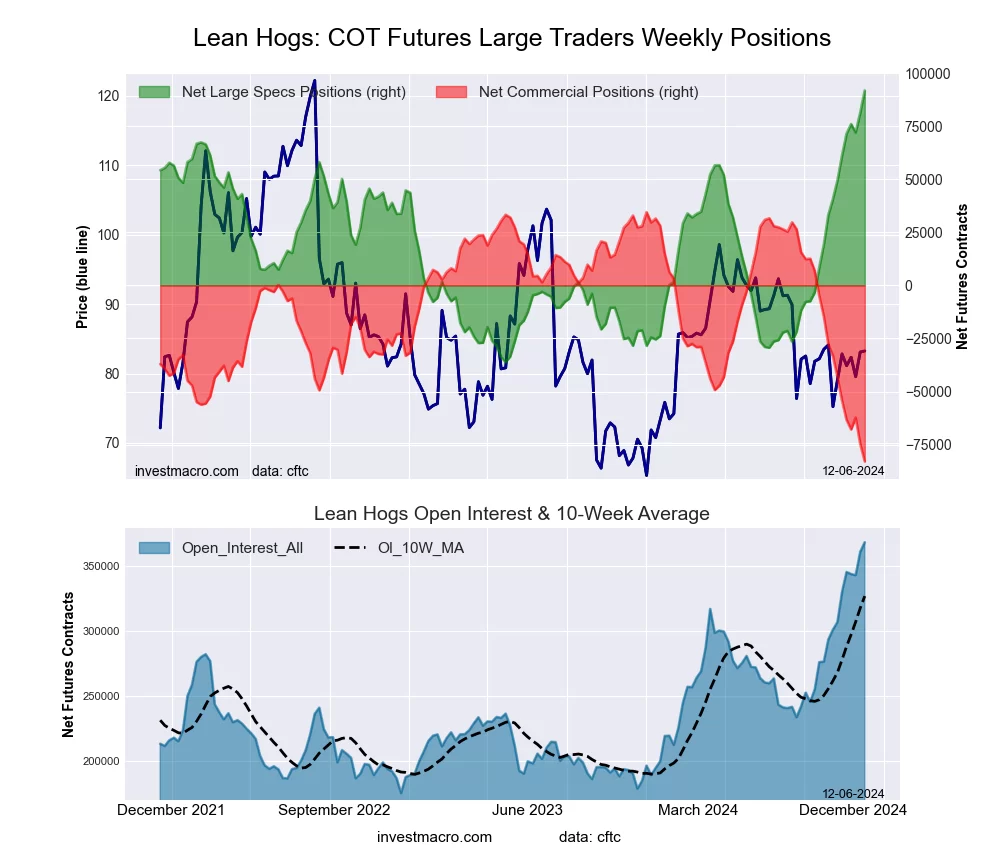
LEAN HOGS Futures COT ChartThe LEAN HOGS large speculator standing this week recorded a net position of 61,078 contracts in the data reported through Tuesday. This was a weekly rise of 11,584 contracts from the previous week which had a total of 49,494 net contracts.

This week’s current strength score (the trader positioning range over the past three years, measured from 0 to 100) shows the speculators are currently Bullish-Extreme with a score of 94.0 percent. The commercials are Bearish-Extreme with a score of 2.2 percent and the small traders (not shown in chart) are Bullish with a score of 52.6 percent.

Price Trend-Following Model: Downtrend

Our weekly trend-following model classifies the current market price position as: Downtrend.

LEAN HOGS Futures StatisticsSPECULATORSCOMMERCIALSSMALL TRADERS
– Percent of Open Interest Longs:45.230.56.9
– Percent of Open Interest Shorts:26.746.99.0
– Net Position:61,078-54,210-6,868
– Gross Longs:149,265100,60022,724
– Gross Shorts:88,187154,81029,592
– Long to Short Ratio:1.7 to 10.6 to 10.8 to 1
NET POSITION TREND:
– Strength Index Score (3 Year Range Pct):94.02.252.6
– Strength Index Reading (3 Year Range):Bullish-ExtremeBearish-ExtremeBullish
NET POSITION MOVEMENT INDEX:
– 6-Week Change in Strength Index:62.2-67.3-15.4


COTTON Futures:

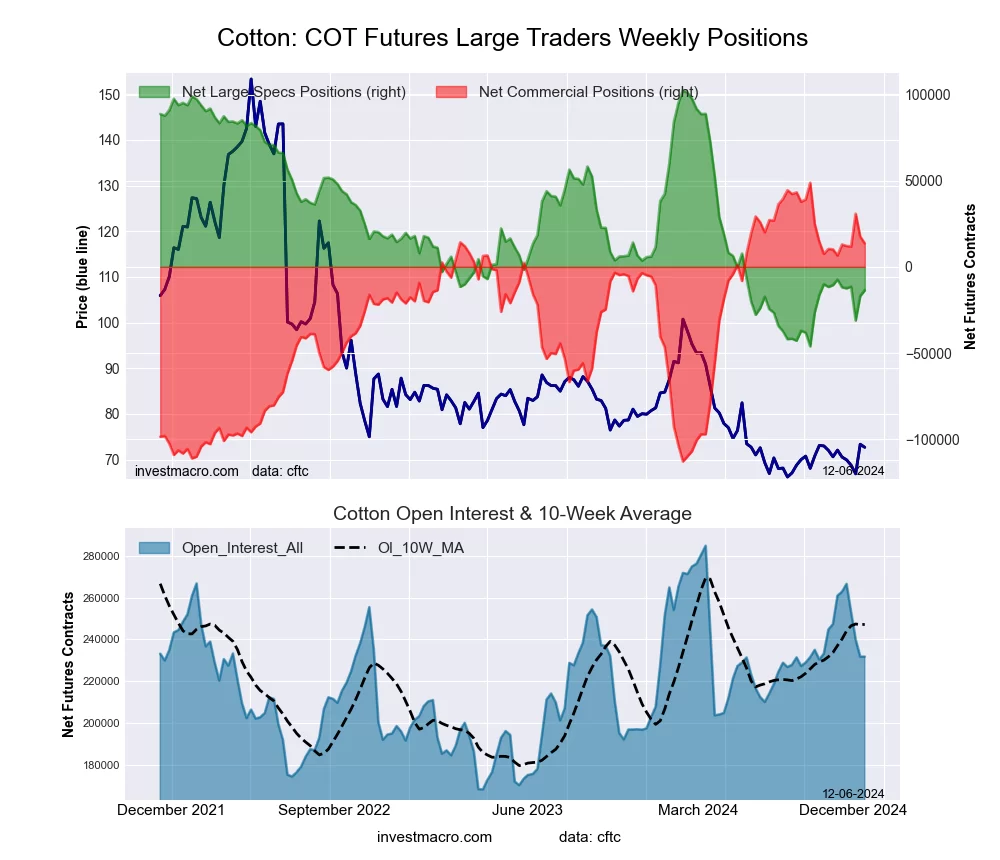
COTTON Futures COT ChartThe COTTON large speculator standing this week recorded a net position of -11,861 contracts in the data reported through Tuesday. This was a weekly reduction of -4,504 contracts from the previous week which had a total of -7,357 net contracts.

This week’s current strength score (the trader positioning range over the past three years, measured from 0 to 100) shows the speculators are currently Bearish with a score of 22.2 percent. The commercials are Bullish with a score of 78.9 percent and the small traders (not shown in chart) are Bearish-Extreme with a score of 9.7 percent.

Price Trend-Following Model: Uptrend

Our weekly trend-following model classifies the current market price position as: Uptrend.

COTTON Futures StatisticsSPECULATORSCOMMERCIALSSMALL TRADERS
– Percent of Open Interest Longs:24.948.55.2
– Percent of Open Interest Shorts:29.443.55.6
– Net Position:-11,86112,964-1,103
– Gross Longs:65,551127,37113,618
– Gross Shorts:77,412114,40714,721
– Long to Short Ratio:0.8 to 11.1 to 10.9 to 1
NET POSITION TREND:
– Strength Index Score (3 Year Range Pct):22.278.99.7
– Strength Index Reading (3 Year Range):BearishBullishBearish-Extreme
NET POSITION MOVEMENT INDEX:
– 6-Week Change in Strength Index:9.4-7.0-15.8


COCOA Futures:

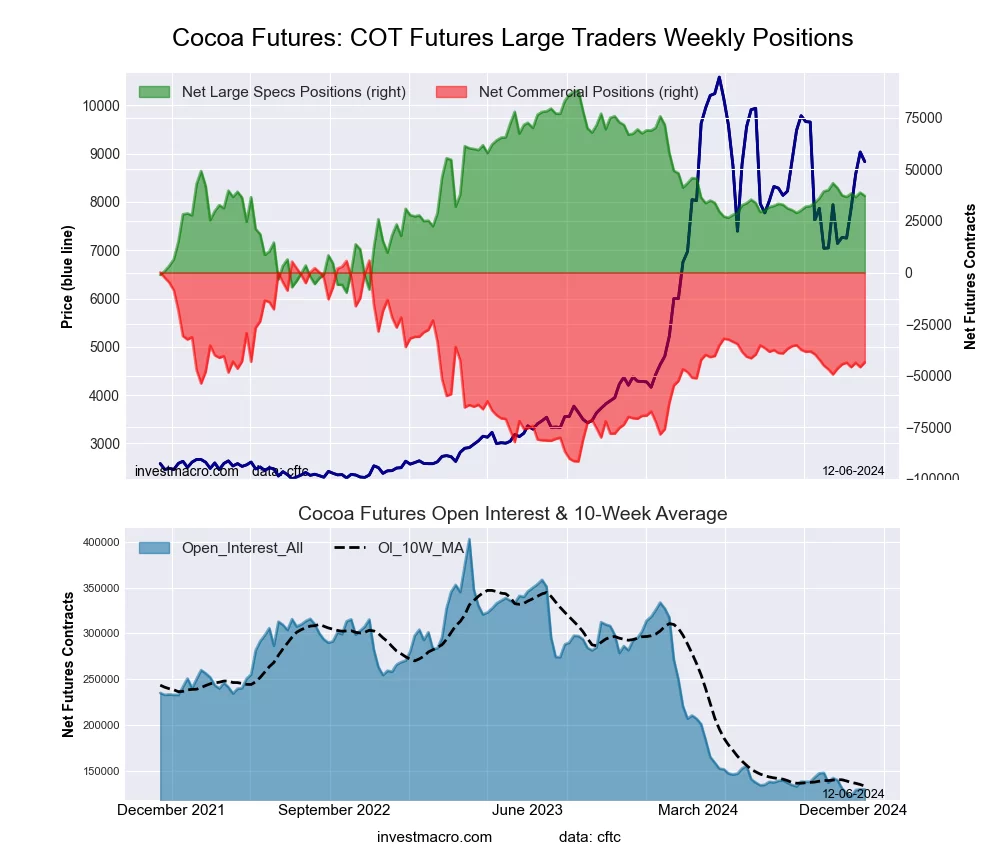
COCOA Futures COT ChartThe COCOA large speculator standing this week recorded a net position of 37,398 contracts in the data reported through Tuesday. This was a weekly decrease of -3,578 contracts from the previous week which had a total of 40,976 net contracts.

This week’s current strength score (the trader positioning range over the past three years, measured from 0 to 100) shows the speculators are currently Bearish with a score of 48.1 percent. The commercials are Bearish with a score of 47.3 percent and the small traders (not shown in chart) are Bullish with a score of 73.3 percent.

Price Trend-Following Model: Strong Downtrend

Our weekly trend-following model classifies the current market price position as: Strong Downtrend.

COCOA Futures StatisticsSPECULATORSCOMMERCIALSSMALL TRADERS
– Percent of Open Interest Longs:38.838.78.9
– Percent of Open Interest Shorts:10.372.73.4
– Net Position:37,398-44,5827,184
– Gross Longs:50,99550,90311,681
– Gross Shorts:13,59795,4854,497
– Long to Short Ratio:3.8 to 10.5 to 12.6 to 1
NET POSITION TREND:
– Strength Index Score (3 Year Range Pct):48.147.373.3
– Strength Index Reading (3 Year Range):BearishBearishBullish
NET POSITION MOVEMENT INDEX:
– 6-Week Change in Strength Index:3.7-5.011.5


WHEAT Futures:

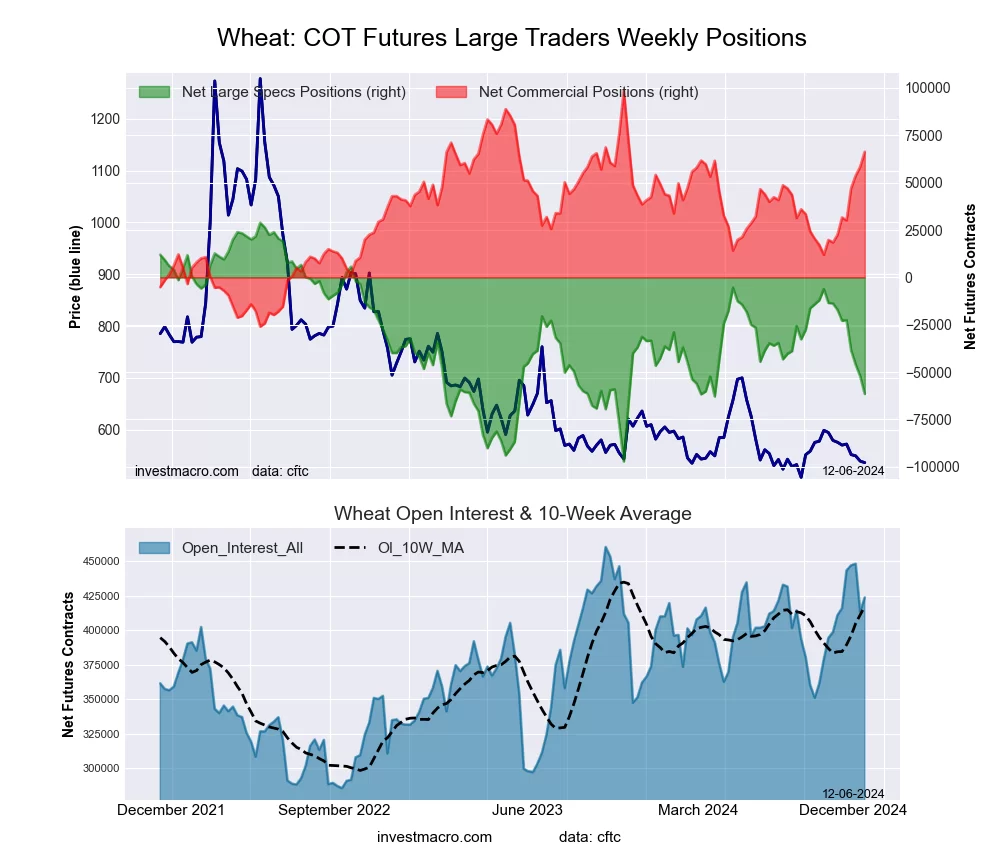
WHEAT Futures COT ChartThe WHEAT large speculator standing this week recorded a net position of -22,891 contracts in the data reported through Tuesday. This was a weekly lowering of -5,809 contracts from the previous week which had a total of -17,082 net contracts.

This week’s current strength score (the trader positioning range over the past three years, measured from 0 to 100) shows the speculators are currently Bullish with a score of 53.6 percent. The commercials are Bearish with a score of 49.0 percent and the small traders (not shown in chart) are Bearish-Extreme with a score of 10.5 percent.

Price Trend-Following Model: Strong Uptrend

Our weekly trend-following model classifies the current market price position as: Strong Uptrend.

WHEAT Futures StatisticsSPECULATORSCOMMERCIALSSMALL TRADERS
– Percent of Open Interest Longs:25.738.97.2
– Percent of Open Interest Shorts:31.231.39.3
– Net Position:-22,89131,600-8,709
– Gross Longs:106,934161,59630,120
– Gross Shorts:129,825129,99638,829
– Long to Short Ratio:0.8 to 11.2 to 10.8 to 1
NET POSITION TREND:
– Strength Index Score (3 Year Range Pct):53.649.010.5
– Strength Index Reading (3 Year Range):BullishBearishBearish-Extreme
NET POSITION MOVEMENT INDEX:
– 6-Week Change in Strength Index:-6.38.5-13.6


Article By InvestMacroReceive our weekly COT Newsletter

*COT Report: The COT data, released weekly to the public each Friday, is updated through the most recent Tuesday (data is 3 days old) and shows a quick view of how large speculators or non-commercials (for-profit traders) were positioned in the futures markets.

The CFTC categorizes trader positions according to commercial hedgers (traders who use futures contracts for hedging as part of the business), non-commercials (large traders who speculate to realize trading profits) and nonreportable traders (usually small traders/speculators) as well as their open interest (contracts open in the market at time of reporting). See CFTC criteria here.


COT Stock Market Charts: Speculator Bets led by S&P500 & Nasdaq Minis

By InvestMacro

Here are the latest charts and statistics for the Commitment of Traders (COT) data published by the Commodities Futures Trading Commission (CFTC).

The latest COT data is updated through Tuesday October 29th and shows a quick view of how large traders (for-profit speculators and commercial entities) were positioned in the futures markets.

Weekly Speculator Changes led by S&P500 & Nasdaq Minis

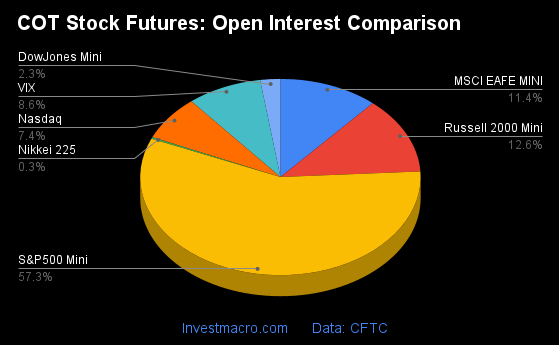
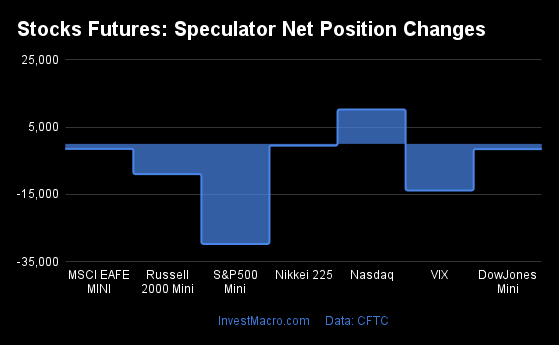
The COT stock markets speculator bets were overall lower this week as two out of the seven stock markets we cover had higher positioning while the other five markets had lower speculator contracts.

Leading the gains for the stock markets was the S&P500-Mini (39,717 contracts) with the Nasdaq-Mini (2,462 contracts) also showing a rising week.

The markets with the declines in speculator bets this week were the Russell-Mini (-6,844 contracts), the VIX (-5,597 contracts), the DowJones-Mini (-2,611 contracts), the Nikkei 225 (-498 contracts) and with the MSCI EAFE-Mini (-143 contracts) also seeing lower bets on the week.


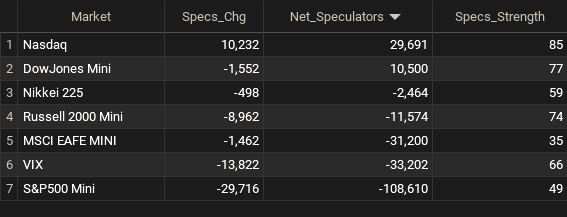
Stock Market Net Speculators Leaderboard


Legend: Weekly Speculators Change | Speculators Current Net Position | Speculators Strength Score compared to last 3-Years (0-100 range)


Strength Scores led by VIX & Russell-Mini

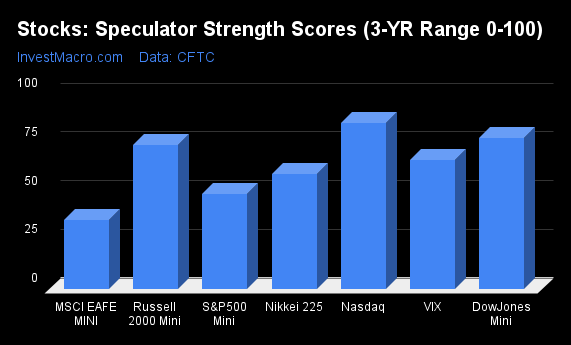
COT Strength Scores (a normalized measure of Speculator positions over a 3-Year range, from 0 to 100 where above 80 is Extreme-Bullish and below 20 is Extreme-Bearish) showed that the VIX (95 percent) and the Russell-Mini (90 percent) lead the stock markets this week. The DowJones-Mini (76 percent) and S&P500-Mini (74 percent) come in as the next highest in the weekly strength scores.

On the downside, the MSCI EAFE-Mini (31 percent) comes in at the lowest strength level currently.

Strength Statistics:
VIX (94.9 percent) vs VIX previous week (100.0 percent)
S&P500-Mini (74.1 percent) vs S&P500-Mini previous week (68.2 percent)
DowJones-Mini (76.0 percent) vs DowJones-Mini previous week (80.2 percent)
Nasdaq-Mini (47.1 percent) vs Nasdaq-Mini previous week (43.3 percent)
Russell2000-Mini (90.2 percent) vs Russell2000-Mini previous week (94.8 percent)
Nikkei USD (59.2 percent) vs Nikkei USD previous week (63.4 percent)
EAFE-Mini (31.3 percent) vs EAFE-Mini previous week (31.5 percent)


S&P500-Mini & Russell-Mini top the 6-Week Strength Trends

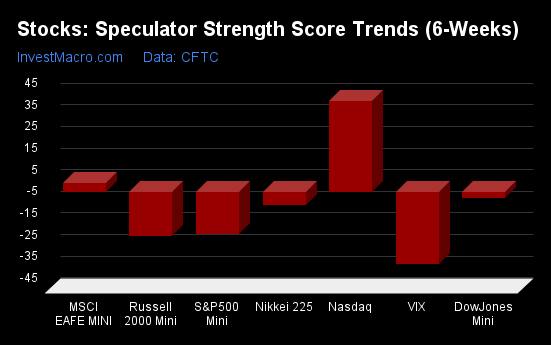
COT Strength Score Trends (or move index, calculates the 6-week changes in strength scores) showed that the S&P500-Mini (28 percent) leads the past six weeks trends for the stock markets. The Russell-Mini (6 percent), the MSCI EAFE-Mini (6 percent) and the VIX (4 percent) are the next highest positive movers in the latest trends data.

The Nasdaq-Mini (-22 percent) leads the downside trend scores currently followed by the DowJones-Mini (-8 percent) with a lower trend score.

Strength Trend Statistics:
VIX (4.5 percent) vs VIX previous week (17.3 percent)
S&P500-Mini (27.7 percent) vs S&P500-Mini previous week (12.3 percent)
DowJones-Mini (-8.1 percent) vs DowJones-Mini previous week (6.6 percent)
Nasdaq-Mini (-21.9 percent) vs Nasdaq-Mini previous week (-35.6 percent)
Russell2000-Mini (6.1 percent) vs Russell2000-Mini previous week (8.9 percent)
Nikkei USD (-6.3 percent) vs Nikkei USD previous week (16.2 percent)
EAFE-Mini (6.3 percent) vs EAFE-Mini previous week (-5.9 percent)


Individual Stock Market Charts:

VIX Volatility Futures:

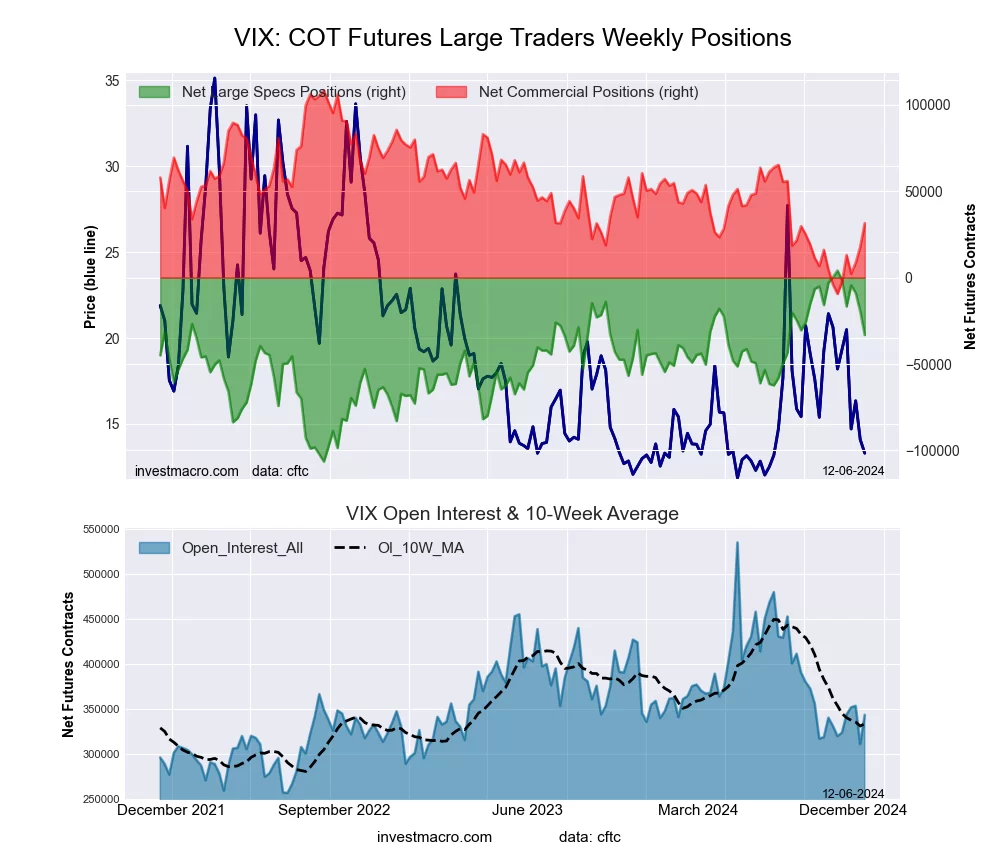
VIX Volatility Futures COT ChartThe VIX Volatility large speculator standing this week equaled a net position of -1,572 contracts in the data reported through Tuesday. This was a weekly lowering of -5,597 contracts from the previous week which had a total of 4,025 net contracts.

This week’s current strength score (the trader positioning range over the past three years, measured from 0 to 100) shows the speculators are currently Bullish-Extreme with a score of 94.9 percent. The commercials are Bearish-Extreme with a score of 5.8 percent and the small traders (not shown in chart) are Bullish-Extreme with a score of 95.2 percent.

Price Trend-Following Model: Strong Uptrend

Our weekly trend-following model classifies the current market price position as: Strong Uptrend.

VIX Volatility Futures StatisticsSPECULATORSCOMMERCIALSSMALL TRADERS
– Percent of Open Interest Longs:29.540.09.1
– Percent of Open Interest Shorts:30.040.87.8
– Net Position:-1,572-2,5964,168
– Gross Longs:95,529129,72629,505
– Gross Shorts:97,101132,32225,337
– Long to Short Ratio:1.0 to 11.0 to 11.2 to 1
NET POSITION TREND:
– Strength Index Score (3 Year Range Pct):94.95.895.2
– Strength Index Reading (3 Year Range):Bullish-ExtremeBearish-ExtremeBullish-Extreme
NET POSITION MOVEMENT INDEX:
– 6-Week Change in Strength Index:4.5-11.837.0


S&P500 Mini Futures:

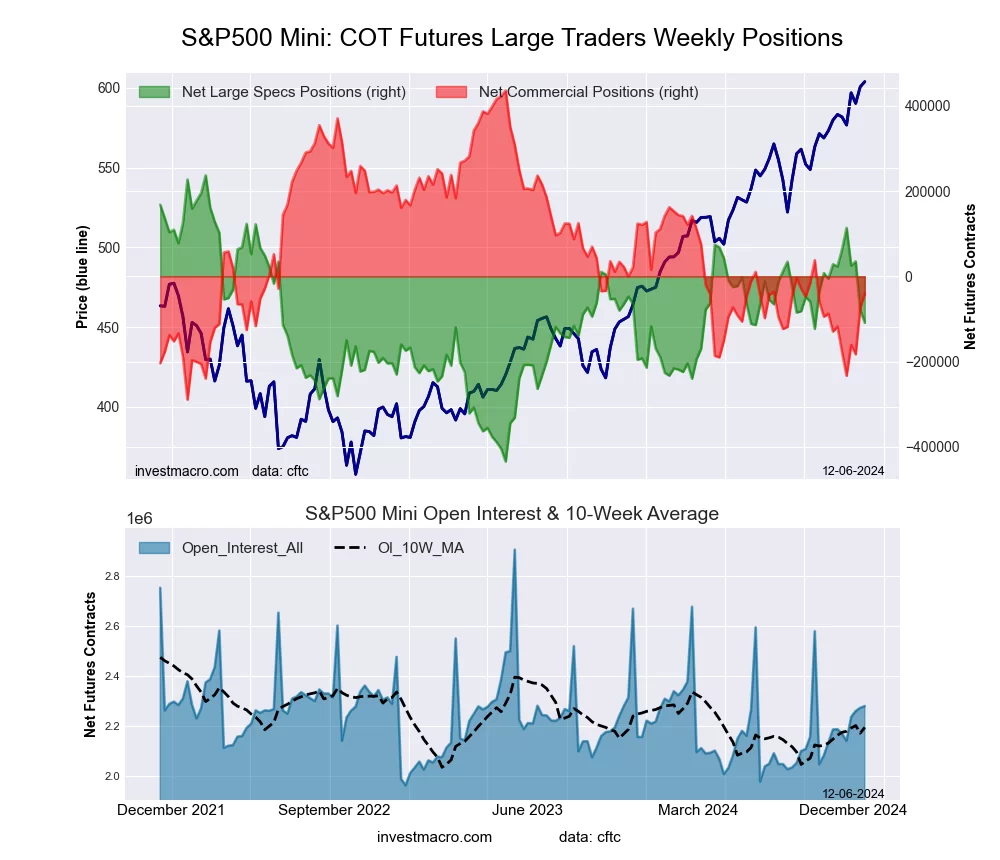
SP500 Mini Futures COT ChartThe S&P500 Mini large speculator standing this week equaled a net position of 62,698 contracts in the data reported through Tuesday. This was a weekly lift of 39,717 contracts from the previous week which had a total of 22,981 net contracts.

This week’s current strength score (the trader positioning range over the past three years, measured from 0 to 100) shows the speculators are currently Bullish with a score of 74.1 percent. The commercials are Bearish-Extreme with a score of 15.4 percent and the small traders (not shown in chart) are Bullish-Extreme with a score of 96.5 percent.

Price Trend-Following Model: Uptrend

Our weekly trend-following model classifies the current market price position as: Uptrend.

S&P500 Mini Futures StatisticsSPECULATORSCOMMERCIALSSMALL TRADERS
– Percent of Open Interest Longs:16.968.112.6
– Percent of Open Interest Shorts:14.076.37.3
– Net Position:62,698-177,608114,910
– Gross Longs:366,9151,476,451272,342
– Gross Shorts:304,2171,654,059157,432
– Long to Short Ratio:1.2 to 10.9 to 11.7 to 1
NET POSITION TREND:
– Strength Index Score (3 Year Range Pct):74.115.496.5
– Strength Index Reading (3 Year Range):BullishBearish-ExtremeBullish-Extreme
NET POSITION MOVEMENT INDEX:
– 6-Week Change in Strength Index:27.7-29.713.7


Dow Jones Mini Futures:

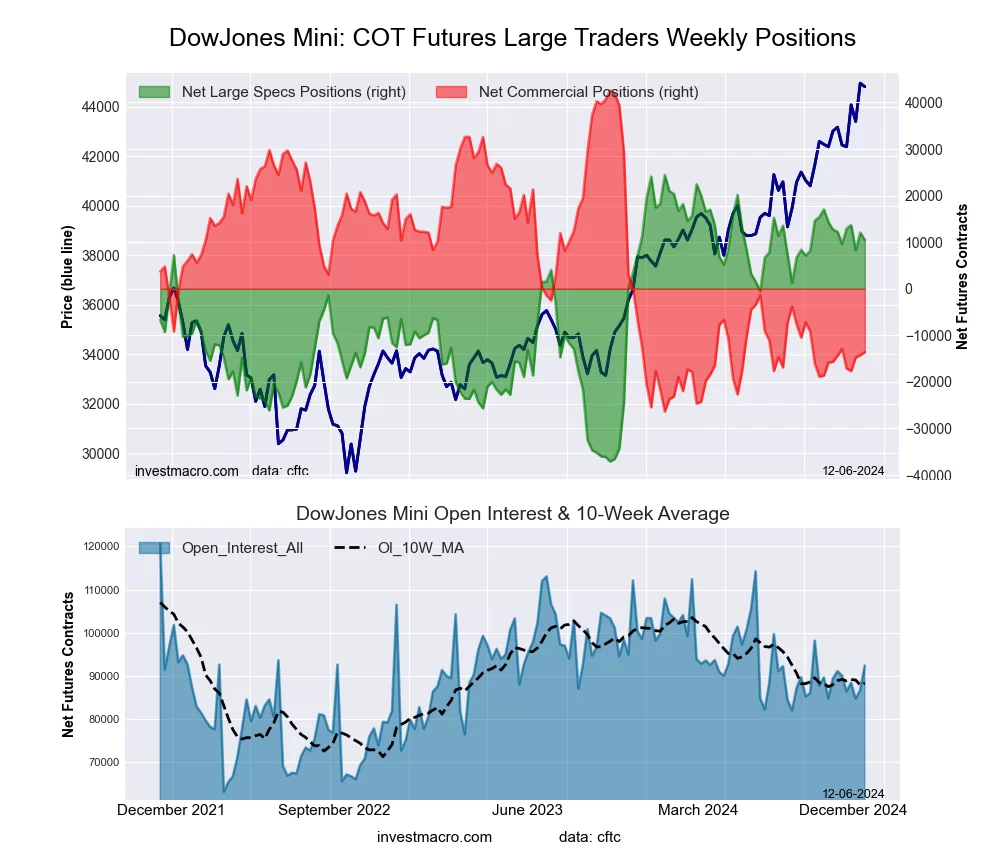
Dow Jones Mini Futures COT ChartThe Dow Jones Mini large speculator standing this week equaled a net position of 9,625 contracts in the data reported through Tuesday. This was a weekly decline of -2,611 contracts from the previous week which had a total of 12,236 net contracts.

This week’s current strength score (the trader positioning range over the past three years, measured from 0 to 100) shows the speculators are currently Bullish with a score of 76.0 percent. The commercials are Bearish-Extreme with a score of 19.5 percent and the small traders (not shown in chart) are Bullish with a score of 74.3 percent.

Price Trend-Following Model: Uptrend

Our weekly trend-following model classifies the current market price position as: Uptrend.

Dow Jones Mini Futures StatisticsSPECULATORSCOMMERCIALSSMALL TRADERS
– Percent of Open Interest Longs:25.753.318.3
– Percent of Open Interest Shorts:15.067.714.6
– Net Position:9,625-12,9023,277
– Gross Longs:23,11847,98016,452
– Gross Shorts:13,49360,88213,175
– Long to Short Ratio:1.7 to 10.8 to 11.2 to 1
NET POSITION TREND:
– Strength Index Score (3 Year Range Pct):76.019.574.3
– Strength Index Reading (3 Year Range):BullishBearish-ExtremeBullish
NET POSITION MOVEMENT INDEX:
– 6-Week Change in Strength Index:-8.14.511.6


Nasdaq Mini Futures:

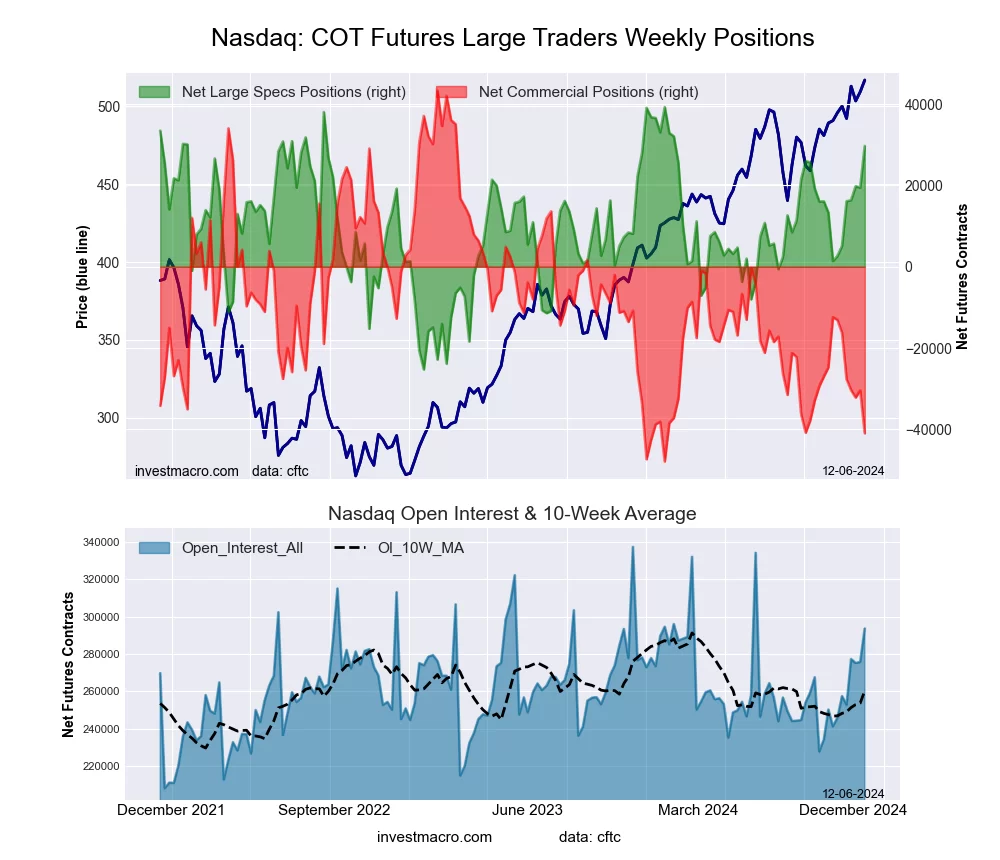
Nasdaq Mini Futures COT ChartThe Nasdaq Mini large speculator standing this week equaled a net position of 5,122 contracts in the data reported through Tuesday. This was a weekly advance of 2,462 contracts from the previous week which had a total of 2,660 net contracts.

This week’s current strength score (the trader positioning range over the past three years, measured from 0 to 100) shows the speculators are currently Bearish with a score of 47.1 percent. The commercials are Bearish with a score of 34.7 percent and the small traders (not shown in chart) are Bullish with a score of 75.7 percent.

Price Trend-Following Model: Strong Uptrend

Our weekly trend-following model classifies the current market price position as: Strong Uptrend.

Nasdaq Mini Futures StatisticsSPECULATORSCOMMERCIALSSMALL TRADERS
– Percent of Open Interest Longs:22.559.415.4
– Percent of Open Interest Shorts:20.565.711.1
– Net Position:5,122-16,23811,116
– Gross Longs:57,891152,91639,683
– Gross Shorts:52,769169,15428,567
– Long to Short Ratio:1.1 to 10.9 to 11.4 to 1
NET POSITION TREND:
– Strength Index Score (3 Year Range Pct):47.134.775.7
– Strength Index Reading (3 Year Range):BearishBearishBullish
NET POSITION MOVEMENT INDEX:
– 6-Week Change in Strength Index:-21.918.3-4.9


Russell 2000 Mini Futures:

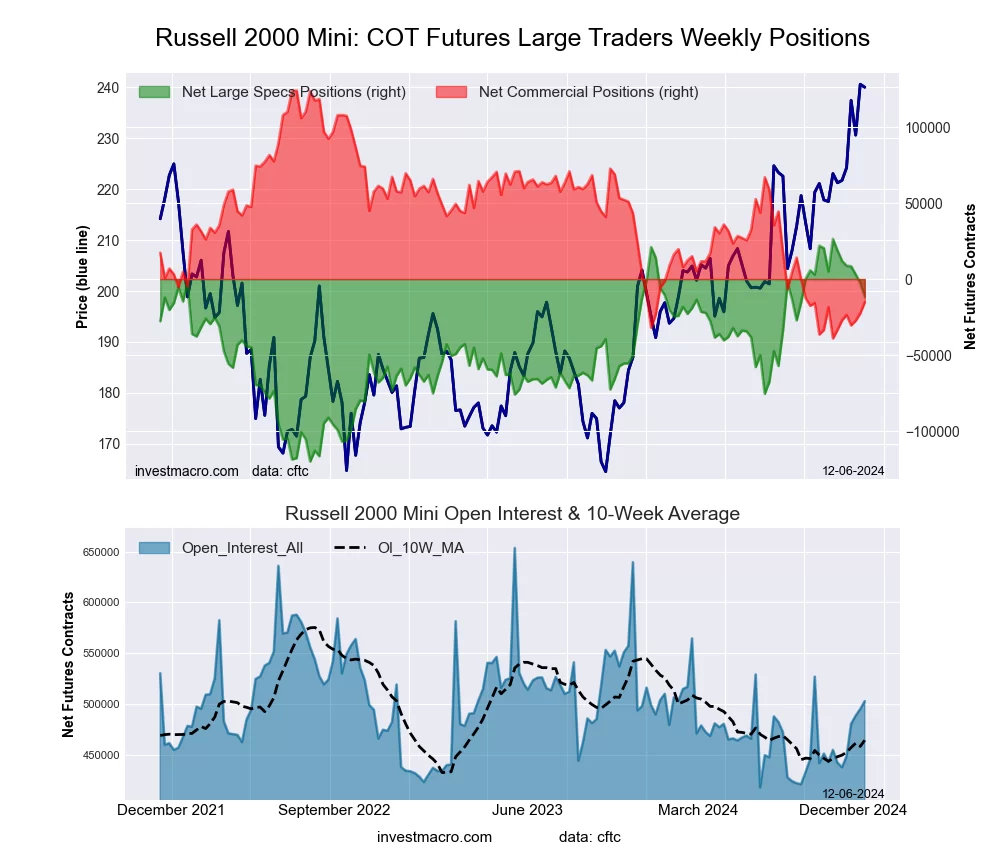
Russell 2000 Mini Futures COT ChartThe Russell 2000 Mini large speculator standing this week equaled a net position of 11,943 contracts in the data reported through Tuesday. This was a weekly fall of -6,844 contracts from the previous week which had a total of 18,787 net contracts.

This week’s current strength score (the trader positioning range over the past three years, measured from 0 to 100) shows the speculators are currently Bullish-Extreme with a score of 90.2 percent. The commercials are Bearish-Extreme with a score of 7.3 percent and the small traders (not shown in chart) are Bullish-Extreme with a score of 80.2 percent.

Price Trend-Following Model: Uptrend

Our weekly trend-following model classifies the current market price position as: Uptrend.

Russell 2000 Mini Futures StatisticsSPECULATORSCOMMERCIALSSMALL TRADERS
– Percent of Open Interest Longs:18.071.67.5
– Percent of Open Interest Shorts:15.377.84.0
– Net Position:11,943-27,13915,196
– Gross Longs:78,765313,57632,828
– Gross Shorts:66,822340,71517,632
– Long to Short Ratio:1.2 to 10.9 to 11.9 to 1
NET POSITION TREND:
– Strength Index Score (3 Year Range Pct):90.27.380.2
– Strength Index Reading (3 Year Range):Bullish-ExtremeBearish-ExtremeBullish-Extreme
NET POSITION MOVEMENT INDEX:
– 6-Week Change in Strength Index:6.1-7.08.3


Nikkei Stock Average (USD) Futures:

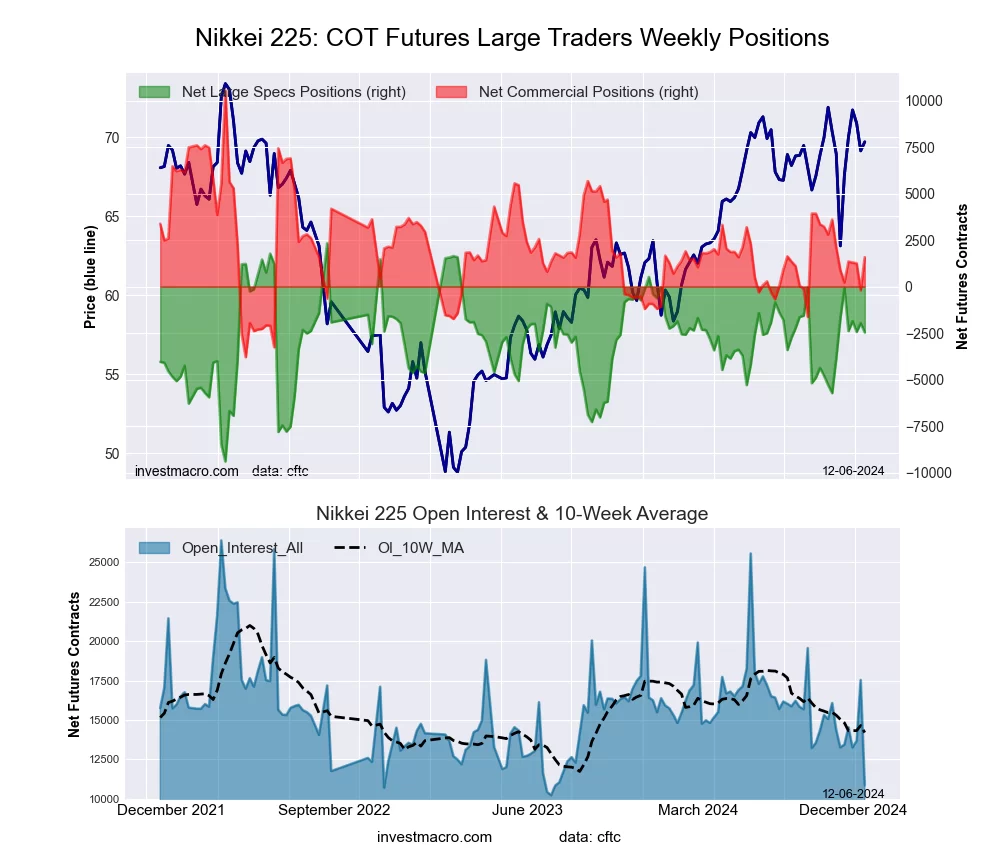
Nikkei Stock Average (USD) Futures COT ChartThe Nikkei Stock Average (USD) large speculator standing this week equaled a net position of -2,464 contracts in the data reported through Tuesday. This was a weekly decline of -498 contracts from the previous week which had a total of -1,966 net contracts.

This week’s current strength score (the trader positioning range over the past three years, measured from 0 to 100) shows the speculators are currently Bullish with a score of 59.2 percent. The commercials are Bearish with a score of 37.5 percent and the small traders (not shown in chart) are Bullish with a score of 60.1 percent.

Price Trend-Following Model: Weak Uptrend

Our weekly trend-following model classifies the current market price position as: Weak Uptrend.

Nikkei Stock Average Futures StatisticsSPECULATORSCOMMERCIALSSMALL TRADERS
– Percent of Open Interest Longs:2.070.227.7
– Percent of Open Interest Shorts:24.755.719.5
– Net Position:-2,4641,576888
– Gross Longs:2217,6203,008
– Gross Shorts:2,6856,0442,120
– Long to Short Ratio:0.1 to 11.3 to 11.4 to 1
NET POSITION TREND:
– Strength Index Score (3 Year Range Pct):59.237.560.1
– Strength Index Reading (3 Year Range):BullishBearishBullish
NET POSITION MOVEMENT INDEX:
– 6-Week Change in Strength Index:-6.34.81.0


MSCI EAFE Mini Futures:

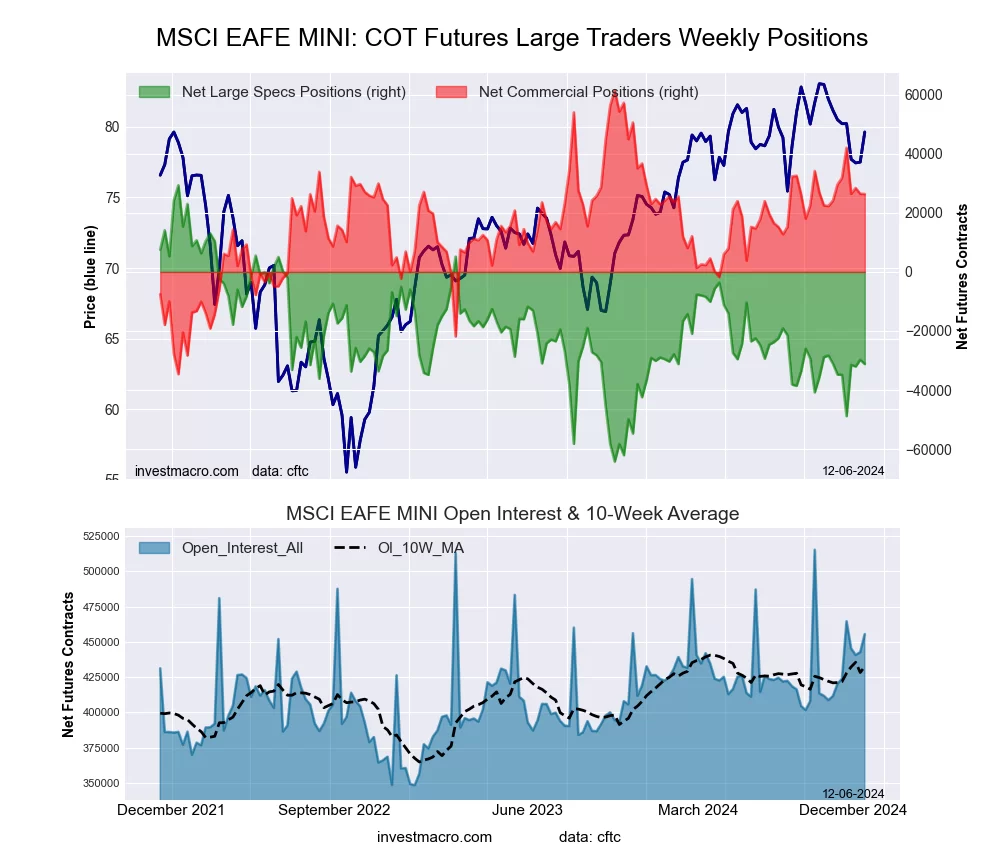
MSCI EAFE Mini Futures COT ChartThe MSCI EAFE Mini large speculator standing this week equaled a net position of -34,871 contracts in the data reported through Tuesday. This was a weekly reduction of -143 contracts from the previous week which had a total of -34,728 net contracts.

This week’s current strength score (the trader positioning range over the past three years, measured from 0 to 100) shows the speculators are currently Bearish with a score of 31.3 percent. The commercials are Bullish with a score of 69.2 percent and the small traders (not shown in chart) are Bearish with a score of 32.2 percent.

Price Trend-Following Model: Weak Uptrend

Our weekly trend-following model classifies the current market price position as: Weak Uptrend.

MSCI EAFE Mini Futures StatisticsSPECULATORSCOMMERCIALSSMALL TRADERS
– Percent of Open Interest Longs:7.389.62.7
– Percent of Open Interest Shorts:15.582.12.0
– Net Position:-34,87131,8433,028
– Gross Longs:31,027379,78111,564
– Gross Shorts:65,898347,9388,536
– Long to Short Ratio:0.5 to 11.1 to 11.4 to 1
NET POSITION TREND:
– Strength Index Score (3 Year Range Pct):31.369.232.2
– Strength Index Reading (3 Year Range):BearishBullishBearish
NET POSITION MOVEMENT INDEX:
– 6-Week Change in Strength Index:6.3-2.4-17.8


Article By InvestMacroReceive our weekly COT Newsletter

*COT Report: The COT data, released weekly to the public each Friday, is updated through the most recent Tuesday (data is 3 days old) and shows a quick view of how large speculators or non-commercials (for-profit traders) were positioned in the futures markets.

The CFTC categorizes trader positions according to commercial hedgers (traders who use futures contracts for hedging as part of the business), non-commercials (large traders who speculate to realize trading profits) and nonreportable traders (usually small traders/speculators) as well as their open interest (contracts open in the market at time of reporting). See CFTC criteria here.

Investors’ main focus today is on the NonFarm Payrolls report. Iran is preparing for a new attack on Israel

By JustMarkets

At the end of Thursday, the Dow Jones (US30) Index was down 0.90%. The S&P 500 Index (US500) was down 1.86%. The NASDAQ Technology Index (US100) closed lower by 2.44%. Disappointing earnings forecasts from major tech giants Microsoft (MSFT) and Meta (META) raised concerns about their high artificial intelligence costs and potential pressure on profits. Meta (-4.1%) and Microsoft (-6%) reported significant increases in artificial intelligence spending, dampening investor optimism and weighing on shares of other major tech companies, including Nvidia (-4.7%) and Amazon (-3.4%).

Today, the US Nonfarm Payrolls report will be released. Economists believe the labor market will add only 111,000 jobs in October, down significantly from 254,000 in September. Strikes by major companies (including Boeing) and weather-related disasters are cited as the reason for the drop. The unemployment rate is expected to remain at 4.1%, and average hourly earnings are expected to rise slightly from 3.9% to 4.0% year-over-year. The weak report should support stock indices and gold after a sell-off in previous sessions.

Equity markets in Europe were steadily declining on Thursday. Germany’s DAX (DE40) fell by 0.83%, France’s CAC 40 (FR40) closed down 1.05%, Spain’s IBEX 35 (ES35) lost 0.36%, and the UK’s FTSE 100 (UK100) closed down 0.61% yesterday. After Eurozone inflation unexpectedly rose to 2% from 1.7% and exceeded the forecast of 1.9%, investors are betting that the ECB will maintain a cautious stance on rate cuts, supported by solid economic growth. This is putting pressure on European indices. Weak corporate reports are also contributing to the negativity. TotalEnergies shares fell by 3.2% to their lowest level since February after reporting lower net income and sales in the third quarter. BNP Paribas shares fell by 4.8% as its results failed to impress investors, although the lender reaffirmed its 2024 growth trajectory. In contrast, Airbus rose by 0.3% after its earnings and revenue beat forecasts. Société Générale shares rose by 11.7% to their highest level since June after beating third-quarter earnings expectations.

WTI crude oil prices rose to $71 per barrel on Friday, rising for the third consecutive session as market attention shifted back to the Middle East conflict. The change was prompted by a report that Iran may be preparing to launch an attack on Israel from Iraq in the coming days, with sources indicating that the alleged attack could involve drones and ballistic missiles. Investors remained on edge, especially after Israel’s military chief warned that any further missile attacks would be followed by a “very hard” strike on Iran.

The US natural gas (XNG/USD) prices fell to below $3.75/mmbtu, down sharply from a four-month high of $3.1, amid falling risk premiums and evidence of ample domestic supply. Adding to this was data from Wood Mackenzie showing that US production rose to 103 bcf/d at the end of October, close to a record high. That matched a significant rise in inventories in the fourth week of the month when EIA data indicated a 78 billion cubic feet increase.

Asian markets were mostly down on Thursday. Japan’s Nikkei 225 (JP225) fell by 0.50%, China’s FTSE China A50 (CHA50) lost 0.50%, Hong Kong’s Hang Seng (HK50) decreased by 0.31% and Australia’s ASX 200 (AU200) was negative 1.04% for yesterday.

Hong Kong stocks rose by 1% on the first trading day of November, reversing losses from the previous two sessions amid gains across sectors. Traders welcomed private survey data showing that China’s manufacturing sector returned to growth in October after a series of stimulus measures taken by Beijing in late September, which coincided with official data.

In Australia, mixed economic data clouded the Reserve Bank of Australia’s (RBA) policy outlook. Producer prices rose more than expected in the third quarter, while retail sales slowed significantly in September. In addition, earlier data showed that the annual average consumer price index, the RBA’s preferred measure of inflation, fell only slightly to 3/5% in the third quarter, remaining above the target range of 2%-3%. Markets largely expect the RBA to keep rates unchanged at 4.35% during its upcoming meeting next week.

Indonesia’s annual inflation rate fell to 1.71% in October 2024, the lowest since October 2021, while remaining within the central bank’s target range of 1.5% to 3.5%. Core inflation hit a 15-month high of 2.21% from September’s 2.09%.

S&P 500 (US500) 5,705.45 −108.22 (−1.86%)

Dow Jones (US30) 41,763.46 −378.08 (−0.90%)

DAX (DE40) 19,077.54 −179.80 (−0.93%)

FTSE 100 (UK100) 8,110.10 −49.53 (−0.61%)

USD index 104.00 +0.02 (+0.02%)

News feed for: 2024.11.01

  • Australia Manufacturing PMI (m/m) at 00:00 (GMT+2);
  • Australia Producer Price Index (m/m) at 02:30 (GMT+2);
  • Japan Manufacturing PMI (m/m) at 02:30 (GMT+2);
  • Switzerland Consumer Price Index (m/m) at 09:30 (GMT+2);
  • Switzerland Manufacturing PMI (m/m) at 10:30 (GMT+2);
  • UK Manufacturing PMI (m/m) at 11:30 (GMT+2);
  • US Nonfarm Payrolls (m/m) at 14:30 (GMT+2);
  • US Unemployment Rate (m/m) at 14:30 (GMT+2);
  • Canada Manufacturing PMI (m/m) at 15:30 (GMT+2);
  • US ISM Manufacturing PMI (m/m) at 16:00 (GMT+2).

By JustMarkets


This article reflects a personal opinion and should not be interpreted as an investment advice, and/or offer, and/or a persistent request for carrying out financial transactions, and/or a guarantee, and/or a forecast of future events.

AUDUSD holds near August lows: US dollar pressure remains strong

By RoboForex Analytical Department

The AUD/USD pair fell to 0.6566 on Friday, marking its lowest since early August. The US dollar continued to strengthen last night, bolstered by signs of resilience in the US economy. Additionally, investors hold significant expectations for Donald Trump’s success in the upcoming presidential election next week.

Meanwhile, an unexpected improvement in Chinese manufacturing activity provided noticeable support for the Aussie. Given that China is Australia’s key trade and economic partner, the Australian dollar is highly responsive to developments in China.

Annual inflation in Australia eased to 3.5% in Q3 but remains above the Reserve Bank of Australia’s target range of 2.0-3.0%. Producer prices rose more than expected in the third quarter, while retail sales declined in September. These mixed signals are keeping the Aussie under pressure.

Baseline expectations suggest the Reserve Bank of Australia will leave the interest rate unchanged at 4.35% at its meeting next week.

Technical analysis of AUD/USD

On the H4 chart, the AUD/USD market completed a wave of decline to 0.6536. Today, the market is forming a consolidation range above this level. An upward breakout would signal the development of a growth wave towards 0.6656, viewed as a correction to the previous downtrend. Once this correction is completed, we may see a new decline towards 0.6492. Technically, this scenario is supported by the MACD indicator, with its signal line below zero near the lows and preparing to turn upwards.

On the H1 chart, the AUD/USD market has formed a consolidation range around 0.6561, with a potential extension towards 0.6530. After this, we may see the beginning of an upward wave targeting 0.6655 as the first objective. This growth structure is expected to be part of a broader correction. Technically, this scenario is also confirmed by the Stochastic oscillator, with its signal line below the 20 mark and preparing to rise towards 80.

Disclaimer

Any forecasts contained herein are based on the author’s particular opinion. This analysis may not be treated as trading advice. RoboForex bears no responsibility for trading results based on trading recommendations and reviews contained herein.

Week Ahead: US500 braces for US election/Fed showdown

By ForexTime 

  • US500 ends October ↓ 1%, still up ↑ 20% YTD
  • April & October only negative trading months this year
  • US election & FOMC decision = big price swings?
  • Fed expected to cut rates by 25bp in November
  • Technical levels – 5770, 5675 & 5600

FXTM’s US500, which tracks the benchmark S&P 500 index is heading for its worst week since early September.

Disappointing earnings reports from Microsoft and Meta sent the index tumbling almost 2% on Thursday while weaker-than-expected sales in China pressured Apple shares post-market trading.

And we could see more action this afternoon due to the key US jobs report (Friday 1st November).

But all eyes will be on the pivotal US election along with major central bank decisions in the week ahead:

Monday, 4th November

  • Public holiday in Japan
  • CN50: China’s NPCSC meeting
  • GER40: Germany HCOB Manufacturing PMI
  • USDInd: US factory orders

Tuesday, 5th November

  • CN50: China Caixin Services PMI
  • SG20: Singapore retail sales
  • AU200: RBA rate decision, Judo Bank Services PMI
  • UK100: S&P Global Services PMI
  • US500: US Presidential election, ISM Services PMI

Wednesday, 6th November

  • GER40: HCOB Services PMI, PPI
  • TWN: Taiwan CPI
  • JP225: BoJ meeting minutes
  • CAD: BoC meeting minutes

Thursday, 7th November

  • CN50: China trade, forex reserves
  • GER40: Industrial production, balance of trade
  • SEK: Riksbank Rate decision, CPI
  • UK100: BoE rate decision
  • US500: FOMC rate decision, initial jobless claims

Friday, 8th November

  • CAD: Employment change
  • TWN: Taiwan trade
  • UK100: BoE Chief Economist Huw Pill speech
  • USDInd: US University of Michigan consumer sentiment

Despite recent losses, the US500 is still up almost 20% year-to-date – adding to the 24% gains secured in 2023. Still, the index’s outlook hangs on how events play out in the week ahead…

US500 weekly

Here are 3 reasons you should keep a close eye on the US500:


    1) US Presidential election

US voters head for the polls on Tuesday, 5th November in what has been a tight presidential race.

This will be the most significant event for the United States in 2024, potentially influencing US stock markets depending on who becomes the new president.

  • A Trump victory could push the US500 higher due to the prospect of corporate tax cuts and a softer regulatory environment boosting company profits.
  • A Harris victory may trigger a “relief rally” as policy continuity removes an element of uncertainty. However, the upside could be capped by a potential hike in corporate taxes and tough regulations.
  • If the US election results are delayed or contested, the US500 may tumble amid the uncertainty.


    2) FOMC rate decision

Just two days after the US election the Federal Reserve is expected to cut interest rates by 25 basis points in November. But this decision could be influenced by the incoming US jobs report and the election outcome.

Although annual inflation has edged closer to the Fed’s 2% target, economic data remains mixed. A strong jobs report could fuel bets around slower-than-expected Fed rate cuts. But the election outcome is likely to determine what action the Fed takes in December and beyond.

  • A Trump victory could boost economic growth – triggering inflationary pressures. This may prompt the Fed to keep interest rates higher for longer.
  • A Harris victory that sees tax hikes and more caution to government spending may impact growth – possibly cooling inflation. Such a development could provide room for the Fed to cut rates.

Traders are currently pricing in a 95% probability of a 25-basis point cut in November with a 68% probability of another cut by December.

Considering how tech stocks account for over 30% of the S&P 500 weighting, the Fed decision could trigger price swings. Tech stocks are influenced by interest rates because their value is based on earnings forecasted in the future.


    3) Technical forces

The US500 has breached the bullish channel on the daily timeframe with prices trading 3% away from the all-time high at 5890. Interestingly, the Relative Strength Index (RSI) is approaching 30 – signalling that prices could be entering oversold zones.

  • If 5675 proves to be reliable support, prices may rebound back toward 5770, 5820 and 5890.
  • A solid breakdown and daily close below 5675 could see bears target the 100-day SMA at 5600 and 5550.

daily us500


Forex-Time-LogoArticle by ForexTime

ForexTime Ltd (FXTM) is an award winning international online forex broker regulated by CySEC 185/12 www.forextime.com

Expert Says Secondary Metals Will Star in New Bull Market

Source: Streetwise Reports (10/30/24)

Bob Moriarty of 321gold sat down with Francis Hunt of The Market Sniper recently to discuss the state of the commodities markets and the recent meeting of the BRICS nations in Russia. Find out why he thinks the bulls will be running for more than just gold. 

Major periods of rising gold prices since 1971 have included the 1970s and the 2000s. Many experts believe we’ve started a new period of such expansion now.

Spot prices touched a new record of US$2,769.02 per ounce on Tuesday “as the run-up to the 2024 presidential election and uncertainty prior to upcoming economic data kept safe haven demand in play,” Investing.com reported.

Bob Moriarty of 321gold sat down with Francis Hunt of The Market Sniper recently to discuss the state of the commodities markets and the recent meeting of the BRICS nations in Russia.

He told Hunt that the most important mechanism in determining their prices is not the textbook answer you’ve always been given.

“Ignore demand, ignore supply, ignore the value of the dollar, ignore the geopolitical, none of those make any difference whatsoever,” Moriarty said in the interview, posted on YouTube. “The only thing that moves the price of anything is sentiment.”

Sentiment Changing Soon

The Investing.com article reported by Scott Kanowsky said the rise is coming from safe haven demand and a string of expected economic readings expected soon, “which are likely to factor into in the Federal Reserve’s plans for interest rates.”

However, Moriarty said the overall price of gold miners has devalued vs. the price of gold and is “at the bottom now.”

“From a relative position of sentiment, everybody hates the miners,” he said of environmental and ESG concerns that have affected the industry. “You can go to Canada, and there’s probably 1,500 stocks, and the number of stocks under 10 cents is absolutely staggering. I own probably 50 different stocks, and I would guess 40 of them are under 10 centers per share . . . You don’t have to know anything about investing if you understand the sentiment.”

And Moriarty expects that sentiment to change soon.

“We’re going to be in a bull market probably for the next 10 or 20 years,” he said. “It has just started the real bull face. You’re going to see it in the other metals, and you’re absolutely going to see it in the miners. And I believe there are a lot of stocks that are going to go up 100-fold.”

But Moriarty said it won’t be just gold; other metals like silver, rhodium, palladium, and platinum will benefit, sometimes even more.

“Gold is going to continue to go up, but just like with dancing, sometimes you lead, sometimes you follow,” he said. “And I think it’s the secondary metals that are going to lead now.”

Most Valuable Precious Metal on the Planet?

Like gold, silver has had a good year so far and is up 42.17%, according to USA Today. It was trading at US$34.02 per ounce on Tuesday, an increase of 1.26% in the previous 24 hours.  Platinum, which was US$1,025.65 per ounce on Monday, is up 3.84% on the year.

But in addition to gold, silver and platinum, the platinum group contains lesser-known metals like osmium, ruthenium, iridium, palladium, and rhodium.

The metals are all very rare and have high corrosion resistance, catalytic properties, and high melting points, according to How Stuff Works.

But Mack Hayden wrote for the site that rhodium, a silver-white metal, is “the most valuable precious metal on the planet.” The automotive industry uses nearly 80% of the world’s supply to make catalytic converters that help reduce toxic gas emissions. South Africa is the leading producer, contributing about 80% of the global supply. It is often found mixed with other platinum group metals and requires extensive processing to extract.

Trading Economics said rhodium has increased US$250 per ounce or 5.65% since the beginning of 2024. While it was US$4,675 per ounce on Monday, it reached an all-time high of US$29,800 per ounce in 2021 — nearly 10 times gold’s current record price.

Hunt pointed out that two of the major producers of platinum, palladium, and rhodium are Russia and South Africa, two members of the BRICS group of nations that met earlier this month in Russia.

“They control price; that’s a big deal,” Moriarty agreed. “We’re going to see some real financial shocks with silver, with rhodium, with palladium, and with platinum.”

BRICS Group Expanding

BRICS is an intergovernmental organization that includes Brazil, Russia, India, China, South Africa, Iran, Egypt, Ethiopia, and the United Arab Emirates. At its October meeting, it expanded to add 13 new “partner nations.”

At the meeting, China President Xi Jinping referred to BRICS as “a vanguard for advancing global governance reform” and “reform of the international financial architecture.”

Bolivian President Luis Arce said, “the shield of BRICS and multipolarity” can protect formerly colonized nations, helping them resist “Western unipolarity and the tyranny of the dollar.”

With gold hitting record highs and silver rising, the other platinum group metals are nowhere near their eventual highs, Moriarty said.

“The Russians understand this, and they’re going to start buying palladium, they’re going to start buying rhodium, and they’re going to start buying silver because those metals are going to move faster and higher than gold,” he said, predicting record highs for all three.


Important Disclosures:

  1. Steve Sobek wrote this article for Streetwise Reports LLC and provides services to Streetwise Reports as an employee.
  2. This article does not constitute investment advice and is not a solicitation for any investment. Streetwise Reports does not render general or specific investment advice and the information on Streetwise Reports should not be considered a recommendation to buy or sell any security. Each reader is encouraged to consult with his or her personal financial adviser and perform their own comprehensive investment research. By opening this page, each reader accepts and agrees to Streetwise Reports’ terms of use and full legal disclaimer. Streetwise Reports does not endorse or recommend the business, products, services or securities of any company. 

For additional disclosures, please click here.

Stock indices under pressure ahead of US elections. Oil strengthened due to lower inventories

By JustMarkets

The Dow Jones (US30) Index was down 0.22% on Wednesday. The S&P 500 Index (US500) was down 0.33%. The NASDAQ Technology Index (US100) closed lower by 0.79%. Stocks gave up early gains and suffered moderate losses as declines in chip company stocks impacted the broader market. AMD closed down more than 10%, leading to a decline in chip company stocks after fourth-quarter revenue guidance came in below consensus.

Better-than-expected US economic news on Wednesday boosted the outlook for a soft landing and lent support to the US dollar after Q3 personal consumption rose more than expected and the October ADP employment report showed employers added the most jobs in 15 months.

Shares of Garmin Ltd (GRMN) rose more than 23% and topped the S&P 500 leaderboard after the company reported third-quarter revenue of $1.59 billion, above the consensus estimate of $1.43 billion. Snap Inc (SNAP) closed higher by more than 15% after reporting 443 million daily active users in the third quarter, above the consensus projection of 441.16 million.

Equity markets in Europe were steadily declining on Wednesday. Germany’s DAX (DE40) fell by 1.13%, France’s CAC 40 (FR40) closed down 1.10%, Spain’s IBEX 35 (ES35) lost 0.68%, and the UK’s FTSE 100 (UK100) closed down 0.73%. European equity markets were set for declines on Thursday, marking the third consecutive session of declines as investors awaited preliminary inflation data from the region that could influence the European Central Bank’s approach to cutting interest rates. The overall inflation rate is expected to rise to 1.9% y/y from 1.7%, while core inflation (excluding food and energy prices) is expected to fall to 2.6% y/y from 2.7%.

Eurozone inflation will reach the European Central Bank’s 2% target during 2025, ECB President Christine Lagarde said in an interview with a French newspaper, largely echoing her recent statement.

WTI crude oil prices rose to around $69 a barrel on Thursday, extending gains of more than 2% from the previous session, helped by an unexpected decline in US inventories. EIA data showed that US crude inventories fell by 0.5 million barrels last week, contradicting market expectations of a 2.3 million barrel increase. However, bearish pressure remains due to weak demand from China (the largest importer), while investors are assessing the supply outlook following reports that OPEC+ may postpone its planned December oil production increase by a month or more.

Asian markets were mostly down on Wednesday. Japan’s Nikkei 225 (JP225) rose by 0.96%, China’s FTSE China A50 (CHA50) fell by 1.02%, Hong Kong’s Hang Seng (HK50) lost 1.55% and Australia’s ASX 200 (AU200) was negative 0.83%.

Hong Kong stocks were up 0.7% from Thursday’s market open, partially recovering from the previous day’s decline amid gains across all sectors. Traders reacted to official PMI data for October, which showed factory activity in China rose for the first time in six months following a series of new stimulus measures designed to reverse slowing economic growth. Meanwhile, growth in the services sector was solid.

The Bank of Japan (BoJ) unanimously kept its key short-term interest rate unchanged at around 0.25% at its October meeting. The BoJ remains bullish on further rate hikes if economic and price data matches its estimates. In its quarterly prognoses, the BoJ maintained its projection that core inflation will reach 2.5% in fiscal 2024, while inflation is expected to reach 1.9% in fiscal 2025 and 2026. As for GDP, the Central Bank maintained its growth estimate for 2024 at 0.6%. It also expects growth of 1.1% in FY 2025 and 1.0% in FY 2026.

Retail sales in Australia rose by 0.1% in September, well below the 0.7% increase recorded in August and below projections for a 0.3% increase as the positive effect of warmer weather in August wore off. In addition, a mixed quarterly domestic inflation report released earlier this week lowered expectations for an immediate rate cut by the Reserve Bank of Australia (RBA). Markets largely expect the RBA to keep rates at 4.35% at its upcoming meeting next week, with the first-rate cut not expected until May next year.

S&P 500 (US500) 5,813.67 −19.25 (−0.33%)

Dow Jones (US30) 42,141.54 −91.51 (−0.22%)

DAX (DE40) 19,257.34 −220.73 (−1.13%)

FTSE 100 (UK100) 8,159.63 −59.98 (−0.73%)

USD Index 104.11 +0.11 (+0.11%)

News feed for: 2024.10.31

  • Japan Industrial Production (m/m) at 01:50 (GMT+2);
  • Japan Retail Sales (m/m) at 01:50 (GMT+2);
  • Australia Retail Sales (m/m) at 02:30 (GMT+2);
  • China Manufacturing PMI (m/m) at 03:30 (GMT+2);
  • China Non-Manufacturing PMI (m/m) at 03:30 (GMT+2);
  • Japan BoJ Interest Rate Decision (m/m) at 05:00 (GMT+2);
  • Japan BoJ Monetary Policy Statement (m/m) at 05:00 (GMT+2);
  • German Retail Sales (m/m) at 09:00 (GMT+2);
  • Switzerland Retail Sales (m/m) at 09:30 (GMT+2);
  • Eurozone Consumer Price Index (m/m) at 12:00 (GMT+2);
  • Eurozone Unemployment Rate (m/m) at 12:00 (GMT+2);
  • Canada GDP (m/m) at 14:30 (GMT+2);
  • US Core PCE Price Index (m/m) at 14:30 (GMT+2);
  • US Initial Jobless Claims (w/w) at 14:30 (GMT+2);
  • US Chicago PMI (m/m) at 15:45 (GMT+2);
  • US Natural Gas Storage (w/w) at 16:30 (GMT+2).

By JustMarkets


This article reflects a personal opinion and should not be interpreted as an investment advice, and/or offer, and/or a persistent request for carrying out financial transactions, and/or a guarantee, and/or a forecast of future events.

Australia has seen a sharp decline in inflationary pressures. Silver rose to $34 an ounce

By JustMarkets

At the end of Tuesday, the Dow Jones Index (US30) fell by 0.36%. The S&P 500 Index (US500) was up 0.16%. The NASDAQ Technology Index (US100) closed higher by 0.98%.

The latest data from the JOLTs report showed that job openings are at their lowest level since January 2021, along with increased layoffs. In contrast, the Central Bank’s Consumer Confidence Index rose sharply, posting its highest increase since March 2021. Despite the mixed signals, the dollar remained near its highest levels in three months, helped by expectations that the Fed will take a more cautious approach to its easing strategy. In addition, speculation surrounding Donald Trump’s possible victory in the November 5 election lent further support to the currency as his policies on tariffs, taxes and immigration are perceived to be inflationary.

In after-hours trading, shares of Alphabet (GOOG) were up nearly 6% following impressive quarterly revenue growth in its cloud division. Snap (SNAP) and Reddit were also up significantly, climbing 10.6% and 24.8%, respectively, thanks to strong quarterly results. AMD (AMD), however, suffered a downturn, falling 7.6% after posting weak fourth-quarter earnings guidance.

Equity markets in Europe were steadily declining on Tuesday. Germany’s DAX (DE40) fell by 0.27%, France’s CAC 40 (FR40) closed down 0.61%, Spain’s IBEX 35 (ES35) lost 0.91%, and the UK’s FTSE 100 (UK100) closed down 0.80%. European stock markets were set for declines on Wednesday as investors prepared for the latest GDP and inflation data from the region, as well as the UK government’s budget announcement. It is also a busy day for corporate earnings as reports from such large companies are scheduled. Notable earnings news included Swiss lender UBS reporting a third-quarter profit of $1.43 billion, well above estimates of $667.5 million, thanks to the successful integration of clients from Credit Suisse. UK-based Standard Chartered also reported earnings that exceeded projections and raised its revenue outlook for 2024.

WTI crude prices rose to around $67.5 a barrel on Wednesday after two consecutive declines, helped by an unexpected drop in US inventories. API data showed that US crude inventories fell by 0.6 million barrels last week, contradicting expectations of a 2.3 million barrel increase. Nevertheless, the downward trend persists as investor attention has shifted to weak fundamentals, including weak Chinese demand and ample supply, while traders await December OPEC+ production plans.

Silver (XAG/USD) rose to $34 an ounce on Tuesday, following gains in gold prices as uncertainty surrounding the US presidential election and tensions in the Middle East continue to drive demand for precious metals.

Asian markets were mostly rising on Monday. Japan’s Nikkei 225 (JP225) rose by 0.77%, China’s FTSE China A50 (CHA50) fell by 0.78%, Hong Kong’s Hang Seng (HK50) gained 0.49% and Australia’s ASX 200 (AU200) was positive 0.34%.

The offshore yuan fell to around 7.15 per dollar as traders are cautious ahead of the expected China PMI data to be released tomorrow. The data is expected to shed light on the impact of the latest stimulus measures. In addition, traders await the National People’s Congress meeting scheduled for November 4–8 for more details on the anticipated fiscal support measures.

In Australia, annual inflation fell to 2.8% in the third quarter, down from 3.8% in the previous quarter and slightly below the expected 2.9%. This marked the first time inflation has returned to the Reserve Bank of Australia’s (RBA) target range of 2–3% since the end of 2021. Core inflation, which is closely monitored by the Reserve Bank, also fell to 3.5% from 4%, which was in line with expectations. The latest inflation data suggests that price pressures in the country are easing, giving the Central Bank an opportunity to consider a rate cut at one of its last meetings of the year.

S&P 500 (US500) 5,832.92 +9.40 (+0.16%)

Dow Jones (US30) 42,233.05 −154.52 (−0.36%)

DAX (DE40) 19,478.07 −53.55 (−0.27%)

FTSE 100 (UK100) 8,219.61 −66.01 (−0.80%)

USD Index 104.28 −0.03 (−0.03%)

News feed for: 2024.10.30

  • Australia Consumer Price Index (m/m) at 02:30 (GMT+2);
  • Japan Consumer Confidence (m/m) at 07:00 (GMT+2);
  • Switzerland KOF Leading Indicators (m/m) at 10:00 (GMT+2);
  • German Unemployment Rate (m/m) at 10:55 (GMT+2);
  • German GDP (m/m) at 11:00 (GMT+2);
  • Eurozone GDP (m/m) at 12:00 (GMT+2);
  • US ADP Nonfarm Employment Change (m/m) at 14:15 (GMT+2);
  • US GDP (m/m) at 14:30 (GMT+2);
  • German Consumer Price Index (m/m) at 15:00 (GMT+2);
  • US Pending Home Sales (m/m) at 16:00 (GMT+2);
  • US Crude Oil Reserves (w/w) at 16:30 (GMT+2).

By JustMarkets


This article reflects a personal opinion and should not be interpreted as an investment advice, and/or offer, and/or a persistent request for carrying out financial transactions, and/or a guarantee, and/or a forecast of future events.

AUD/USD Continues Downward Spiral Amid Economic Concerns

By RoboForex Analytical Department 

The Australian dollar remains under significant pressure, with AUD/USD extending its downtrend mid-week to reach 0.6539, the lowest since August. The decline, which began on 1 October, has been relentless, with the pair experiencing little to no respite from its downward trajectory.

Recent data indicating that Australia’s annual inflation cooled to 2.8% in Q3 from 3.8% in Q2, falling just below the expected 2.9%, has contributed to the accelerated sell-off. Although this brings inflation within the Reserve Bank of Australia’s (RBA) target range of 2-3%, the core inflation gauge closely monitored by the RBA remains elevated at 3.5% year-on-year in Q3. Given the persistent core inflation, the RBA has no immediate impetus to lower interest rates.

The central bank maintains that inflation needs to stabilise before considering monetary easing. With the RBA’s next meeting scheduled for next week, market consensus does not anticipate a change in the current interest rate of 4.35% per annum. Rate cuts are not expected until at least May 2025.

Technical analysis of AUD/USD

The AUD/USD is persisting in its downward wave, targeting 0.6533. If this level is reached, a corrective phase towards 0.6613 may follow, and the downward trend is expected to resume towards 0.6491. The MACD indicator supports this bearish outlook, as its signal line is well below zero, indicating a continuation of the downward momentum.

On the hourly chart, AUD/USD has established a consolidation range around 0.6570, breaking downwards to continue towards 0.6533. Once this level is achieved, a corrective move to 0.6613 may begin, with an intermediate target at 0.6570. This potential upward correction is confirmed by the Stochastic oscillator, whose signal line is below 20 but poised to rise towards 80, suggesting a brief respite from the selling pressure.


Disclaimer

Any forecasts contained herein are based on the author’s particular opinion. This analysis may not be treated as trading advice. RoboForex bears no responsibility for trading results based on trading recommendations and reviews contained herein.

GBPUSD could be in for mid-week “sneaky surprise”

By ForexTime

  • GBPUSD’s forecasted volatility jumps 24% over past week
  • UK government set to issue most debt since 2020
  • US Treasury refunding announcement in focus
  • Friday’s US NFP triggered GBPUSD moves of ↑ 0.5% & ↓ 0.6% over past year
  • Bloomberg FX model: GBPUSD has 73% of trading within1.2836 – 1.3126 this week

Here’s something GBPUSD traders may not be aware of this week.

The UK and US governments are due to make twin announcements on Wednesday, October 30th that could translate into big moves for this FX pair.

Leading up to these announcements, the forecasted volatility for GBPUSD a.k.a “cable” has already risen by 24%, even though the period also covers the upcoming US presidential elections (but that’s a story for a not-too-distant article).

gbpusd w1


    1) UK Autumn Budget 2024

Chancellor of the Exchequer Rachel Reeves is set to deliver the new Labour government’s first annual budget on Wednesday at 12:30pm UK time.

Reeves is expected to announce a package of tax hikes and increased borrowing plans that will push UK debt sales to £293 billion – the highest since the response to Covid-19.

Investors will also keep an eye on any major updates on the country’s finances and the government’s plan for public spending.

This event will likely influence sentiment towards, not just the UK economy in the medium to longer term, but also GBPUSD in the immediate aftermath

The bigger picture…

Well, much attention will be on the debt sales worth the forecasted £293 billion.

This figure sets the market’s expectations for this pivotal announcement.

What does this mean?

Large debt sales may fuel concerns about inflation if they are seen as a sign of increased government spending.

High inflation expectations could even prevent the Bank of England from cutting rates as the expected pace.

Slower-than-expected BOE rate cuts could then lead to Sterling strength.

At the time of writing, traders have priced in a 25-basis point BoE cut in November with the probability of another 25 basis point cut by December at 60%.

How might this impact the GBPUSD?

  • The GBPUSD could jump if total debt sales surpass the £293 billion estimate as investors push back bets around faster BoE rate cuts.
  • Should total UK government debt sales announced below the $293 billion figure, this may weaken the GBPUSD as BoE rate cut expectations remain intact.


    2) US Treasury quarterly refunding

On the other side of the Atlantic, the dollar could be rocked by heavy hitting reports on Wednesday including the Q3 GDP and ADP employment data.

The US economy is expected to remain resilient, with a forecasted 3% growth in Q3 along with 110,000 jobs added in October, according to the Automatic Data Processing Inc. ADP).

But there’s another event you may not spot on most economic calendars that could serve a “sneaky surprise” for broader markets as well.

The US Treasury quarterly refunding, which is perhaps the focus of most bond traders, could have a major impact on the USD-side of GBPUSD on Wednesday.

The bigger picture…

This is where the US government announces how much new debt needs to be sold to markets to keep financing its budget for the quarter.

This event has sparked some action in the bond markets in the past, influencing the US dollar as result.

According to Bloomberg, bond dealers widely expect that the refunding auctions will total $125 billion for the third straight quarter.

How might this impact the GBPUSD?

As an oversimplification:

Falling Bond Prices –> Rising Yields –> Stronger Dollar (and vice versa)

With the above logic in mind …

  • A higher-than-$125 billion figure suggests that the US Treasury plans to sell more bonds to markets.

    If this weakens Treasury prices, yields could push higher, boosting the USD. A stronger USD is seen dragging the GBPUSD lower.

  • A lower-than- $125 billion figure may boost bond prices, pulling yields lower and weakening the USD. Dollar weakness could see the GBPUSD jump.

But wait, there’s more!

    3) US October nonfarm payrolls (NFP) report

Friday’s US jobs report, due at 12:30PM GMT on November 1st, will then come at the tail end of a busy and potentially volatile trading week for the GBPUSD.

This will be the final jobs report before the US election and something that could shape expectations around what action the Fed takes for the rest of 2024.

The US economy is expected to have created 110,000 jobs in October, a major drop from the 254,000 jobs seen in the previous month.

The also crucial unemployment rate is forecasted to remain unchanged at 4.1%.

Ultimately, a disappointing report may fuel speculation around Fed rate cuts, despite potential distortions in the NFP data from the effects of recent Hurricanes and industrial strikes.

Traders are currently pricing in a 96% probability of a 25-basis point Fed cut by November with the odds of another 25 basis point rate cut by December at 70%.

Over the past year, the US NFP report has triggered upside moves of as much as 0.5% or declines of 0.6% in a 6-hour window post-release for GBPUSD.


    4) Technical forces

This currency pair nicknamed “cable” has shed almost 3% month-to-date, pressured by a dovish Bank of England (BoE) and recent dollar rebound.

Although prices are bearish on the daily charts, the upcoming events could determine whether GBPUSD enters the new month above or below the psychological 1.30 level.

  • A solid daily close below the 100-day SMA may open the doors toward the 200-day SMA at 1.2800.
  • Should the 100-day SMA prove to be reliable support, this may send prices toward 1.3070 and the 50-day SMA at 1.3140.

GBPUSD--

Bloomberg’s FX model forecasts a 74% chance that GBPUSD will trade within the 1.2836 – 1.3126 range, using current levels as a base, over the next one-week period.


Forex-Time-LogoArticle by ForexTime
ForexTime Ltd (FXTM) is an award winning international online forex broker regulated by CySEC 185/12 www.forextime.com